


Community hub
Recent from talks
Contribute something
Nothing was collected or created yet.
World War II in Yugoslavia
View on Wikipedia
| World War II in Yugoslavia | ||||||||||
|---|---|---|---|---|---|---|---|---|---|---|
| Part of the European theatre of World War II | ||||||||||
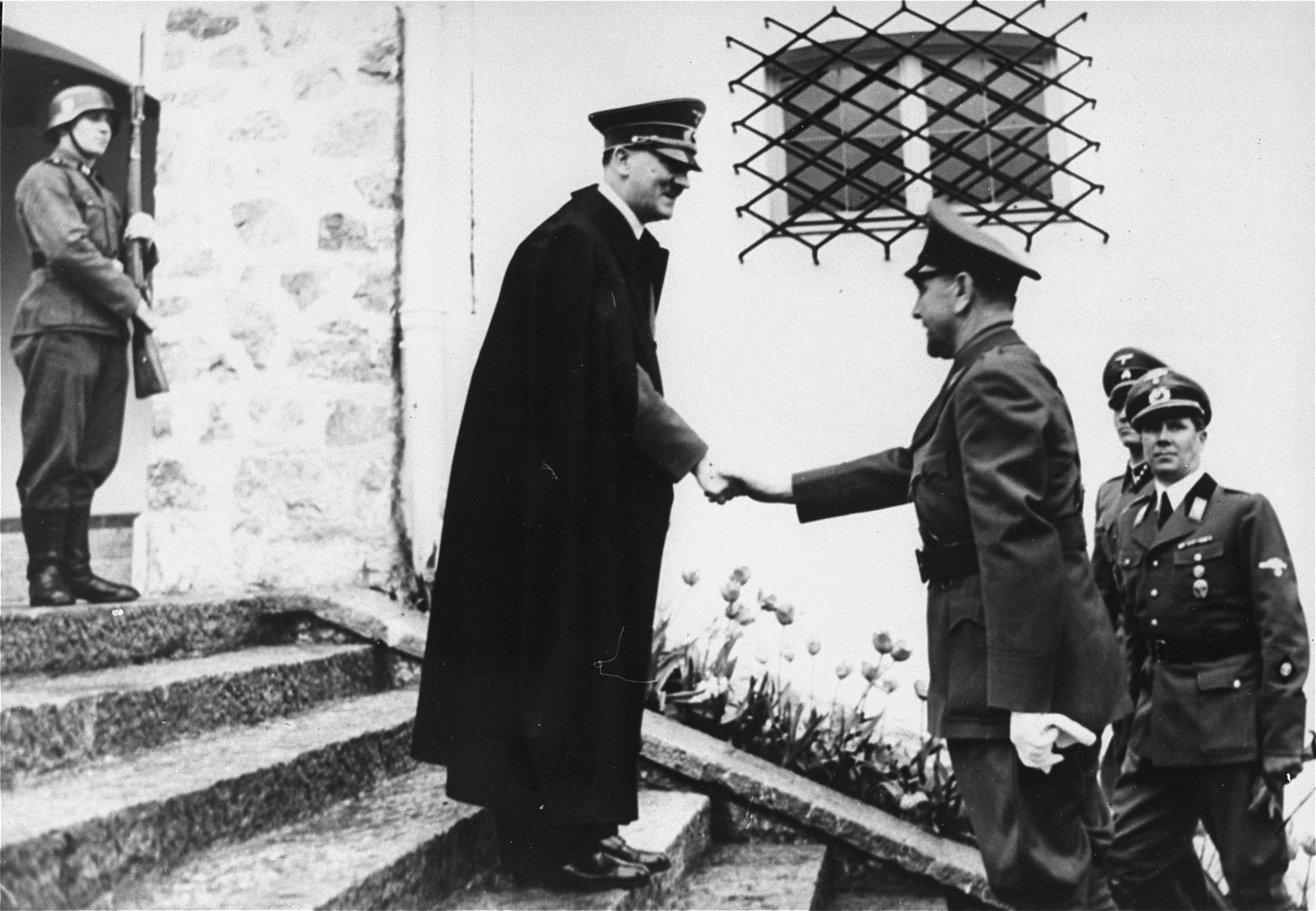
Clockwise from top left: Ante Pavelić visits Adolf Hitler at the Berghof; Stjepan Filipović hanged by the occupation forces; A group of Chetniks with German soldiers in a village in Serbia; Josip Broz Tito with members of the British mission; Draža Mihailović confers with his troops. | ||||||||||
| ||||||||||
| Belligerents | ||||||||||
April 1941: Germany Germany Italy Italy Hungary Hungary |
April 1941: Yugoslavia Yugoslavia | |||||||||
| 1941 – September 1943: | 1941–43: |
1941–43:
| ||||||||
| September 1943–1945: |
1943–45:
| |||||||||
| Strength | ||||||||||
300,000 (1944)[2] 321,000 (1943)[3] 170,000 (1943)[4] 170,000 (1943)[4]130,000 (1945)[5]  70,000 (1943)[6][7] 70,000 (1943)[6][7] 60,000 (1944)[8] 60,000 (1944)[8] 12,000 (1944)[9] 12,000 (1944)[9] |
700,000 (1941) (400,000 ill-prepared)[10]  93,000 (1943)[11][12] 93,000 (1943)[11][12] |
 100,000 (1943)[13] 100,000 (1943)[13] 800,000 (1945)[14]  580,000 (1944) 40,000 (1943)[15][16] 580,000 (1944) 40,000 (1943)[15][16] | ||||||||
| Casualties and losses | ||||||||||
|
Germany:[17]c 19,235–103,693 killed 14,805 missing[18] Italy:d9,065 killed 15,160 wounded 6,306 missing Independent State of Croatia:[19]99,000 killed |
Partisans:[20] 245,549 killed 399,880 wounded 31,200 died from wounds 28,925 missing | |||||||||
|
Total Yugoslav casualties: ≈850,000[23]–1,200,000 a ^ Axis puppet regime established on occupied Yugoslav territory | ||||||||||


World War II in the Kingdom of Yugoslavia began on 6 April 1941, when the country was invaded and swiftly conquered by Axis forces and partitioned among Germany, Italy, Hungary, Bulgaria and their client regimes. Shortly after Germany attacked the USSR on 22 June 1941,[27] the communist-led republican Yugoslav Partisans, on orders from Moscow,[27] launched a guerrilla liberation war fighting against the Axis forces and their locally established puppet regimes, including the Axis-allied Independent State of Croatia (NDH) and the Government of National Salvation in the German-occupied territory of Serbia. This was dubbed the National Liberation War and Socialist Revolution in post-war Yugoslav communist historiography. Simultaneously, a multi-side civil war was waged between the Yugoslav communist Partisans, the Serbian royalist Chetniks, the Axis-allied Croatian Ustaše and Home Guard, Serbian Volunteer Corps and State Guard, Slovene Home Guard, as well as Nazi-allied Russian Protective Corps troops.[28]
Both the Yugoslav Partisans and the Chetnik movement initially resisted the Axis invasion. However, after 1941, Chetniks extensively and systematically collaborated with the Italian occupation forces until the Italian capitulation, and thereon also with German and Ustaše forces.[28][29] The Axis mounted a series of offensives intended to destroy the Partisans, coming close to doing so in the Battles of Neretva and Sutjeska in the spring and summer of 1943.
Despite the setbacks, the Partisans remained a credible fighting force, with their organisation gaining recognition from the Western Allies at the Tehran Conference and laying the foundations for the post-war Yugoslav socialist state. With support in logistics and air power from the Western Allies, and Soviet ground troops in the Belgrade offensive, the Partisans eventually gained control of the entire country and of the border regions of Trieste and Carinthia. The victorious Partisans established the Socialist Federal Republic of Yugoslavia.
The conflict in Yugoslavia had one of the highest death tolls by population in the war, and is usually estimated at around one million, about half of whom were civilians. Genocide and ethnic cleansing was carried out by the Axis forces (particularly the Wehrmacht) and their collaborators (particularly the Ustaše and Chetniks), and reprisal actions from the Partisans became more frequent towards the end of the war, and continued after it.
Background
[edit]Prior to the outbreak of war, the government of Milan Stojadinović (1935–1939) tried to navigate between the Axis powers and the imperial powers by seeking neutral status, signing a non-aggression treaty with Italy and extending its treaty of friendship with France. At the same time, the country was destabilized by internal tensions, as Croatian leaders demanded a greater level of autonomy. Stojadinović was sacked by the regent Prince Paul in 1939 and replaced by Dragiša Cvetković, who negotiated a compromise with Croatian leader Vladko Maček in 1939, resulting in the formation of the Banovina of Croatia.
However, rather than reducing tensions, the agreement only reinforced the crisis in the country's governance.[30] Groups from both sides of the political spectrum were not satisfied: the pro-fascist Ustaše sought an independent Croatia allied with the Axis; Serbian public and military circles preferred alliance with the Western European empires, while the then-banned Communist Party of Yugoslavia saw the Soviet Union as a natural ally.
Following the fall of France in May 1940, Yugoslavia's Regent Prince Paul and his government saw no way of saving the Kingdom of Yugoslavia except through accommodation with the Axis powers. Although Germany's Adolf Hitler was not particularly interested in creating another front in the Balkans, and Yugoslavia itself remained at peace during the first year of the war, Benito Mussolini's Italy had invaded Albania in April 1939 and launched the rather unsuccessful Italo-Greek War in October 1940. These events resulted in Yugoslavia's geographical isolation from potential Allied support. The government tried to negotiate with the Axis on cooperation with as few concessions as possible, while attempting secret negotiations with the Allies and the Soviet Union, but these moves failed to keep the country out of the war.[31] A secret mission to the U.S., led by the influential Serbian-Jewish Captain David Albala, with the purpose of obtaining funding to buy arms for the expected invasion went nowhere,[citation needed] while the Soviet Union's Joseph Stalin expelled Yugoslav ambassador Milan Gavrilović just one month after agreeing a treaty of friendship with Yugoslavia[32] (prior to 22 June 1941, Nazi Germany and Soviet Russia adhered to the non-aggression pact the parties had signed in August 1939 and in the autumn 1940, Germany and the Soviet Union had been in talks on the USSR's potential accession to the Tripartite Pact).
1941
[edit]Having steadily fallen within the orbit of the Axis during 1940 after events such as the Second Vienna Award, Yugoslavia followed Bulgaria and formally joined the Tripartite Pact on 25 March 1941. Senior Serbian air force officers opposed to the move staged a coup d'état and took over in the following days.
Axis invasion and dismemberment of Yugoslavia
[edit]
On 6 April 1941 the Kingdom of Yugoslavia was invaded from all sides – by Germany, Italy, and their ally Hungary. Belgrade was bombed by the German air force (Luftwaffe). The war, known in the post-Yugoslavia states as the April War, lasted little more than ten days, ending with the unconditional surrender of the Royal Yugoslav Army on 17 April. Not only hopelessly ill-equipped compared to the German Army (Heer), the Yugoslav army attempted to defend all of its borders, thinly spreading its scarce resources. Additionally, much of the population refused to fight, instead welcoming the Germans as liberators from government oppression. As this meant that each individual ethnic group would turn to movements opposed to the unity promoted by the South Slavic state, two different concepts of anti-Axis resistance emerged: the royalist Chetniks, and the communist-led Partisans.[33]
Two of the principal constituent national groups, Slovenes and Croats, were not prepared to fight in defense of a Yugoslav state with a continued Serb monarchy. The only effective opposition to the invasion was from units wholly from Serbia itself.[34] The Serbian General Staff was united on the question of Yugoslavia as a "Greater Serbia" ruled, in one way or another, by Serbia. On the eve of the invasion, there were 165 generals on the Yugoslav active list. Of these, all but four were Serbs.[35]
The terms of the surrender were extremely severe, as the Axis proceeded to dismember Yugoslavia. Germany annexed northern Slovenia, while retaining direct occupation over a rump Serbian state. Germany also exercised considerable influence over the Independent State of Croatia (NDH) proclaimed on 10 April, which extended over much of today's Croatia and contained all of modern Bosnia and Herzegovina, despite the fact that the Treaties of Rome concluded between the NDH and Italy on 18 May envisioned the NDH becoming an effective protectorate of Italy.[36] Mussolini's Italy gained the remainder of Slovenia, Kosovo, coastal and inland areas of the Croatian Littoral and large chunks of the coastal Dalmatia region (along with nearly all of the Adriatic islands and the Bay of Kotor). It also gained control over the Italian governorate of Montenegro, and was granted the kingship in the Independent State of Croatia, though wielding little real power within it; although it did (alongside Germany) maintain a de facto zone of influence within the borders of the NDH. Hungary dispatched the Third Army to occupy Vojvodina in northern Serbia, and later forcibly annexed sections of Baranja, Bačka, Međimurje, and Prekmurje.[37]
The Bulgarian army moved in on 19 April 1941, occupying nearly all of modern-day North Macedonia and some districts of eastern Serbia which, with Greek western Thrace and eastern Macedonia (the Aegean Province), were annexed by Bulgaria on 14 May.[38]
The government in exile was now only recognized by the Allied powers.[39] The Axis had recognized the territorial acquisitions of their allied states.[40][41]
Early resistance
[edit]From the start, the Yugoslav resistance forces consisted of two factions: the Partisans, a communist-led movement propagating pan-Yugoslav tolerance ("brotherhood and unity") and incorporating republican, left-wing and liberal elements of Yugoslav politics, on one hand, and the Chetniks, a conservative royalist and nationalist force, enjoying support almost exclusively from the Serbian population in occupied Yugoslavia, on the other hand. From the start and until 1943, the Chetniks, who fought in the name of the London-based King Peter II's Yugoslav government-in-exile, enjoyed recognition and support from the Western Allies, while the Partisans were supported by the Soviet Union.
At the very beginning, the Partisan forces were relatively small, poorly armed, and without any infrastructure. But they had two major advantages over other military and paramilitary formations in former Yugoslavia: the first and most immediate advantage was a small but valuable cadre of Spanish Civil War veterans. Unlike some of the other military and paramilitary formations, these veterans had experience with a modern war fought in circumstances quite similar to those found in World War II Yugoslavia. In Slovenia, the Partisans likewise drew on the experienced TIGR members to train troops.
Their other major advantage, which became more apparent in the later stages of the War, was in the Partisans being founded on a communist ideology rather than ethnicity. Therefore, they won support that crossed national lines, meaning they could expect at least some levels of support in almost any corner of the country, unlike other paramilitary formations limited to territories with Croat or Serb majority. This allowed their units to be more mobile and fill their ranks with a larger pool of potential recruits.

While the activity of the Macedonian and Slovene Partisans was part of the Yugoslav People's Liberation War, the specific conditions in Macedonia and Slovenia, due to the strong autonomist tendencies of the local communists, led to the creation of separate sub-armies called the People's Liberation Army of Macedonia, and the Slovene Partisans led by the Liberation Front of the Slovene People, respectively.

The most numerous local force, apart from the four second-line German Wehrmacht infantry divisions assigned to occupation duties, was the Croatian Home Guard (Hrvatsko domobranstvo) founded in April 1941, a few days after the founding of the NDH. The force was formed with the authorisation of German authorities. The task of the new Croatian armed forces was to defend the new state against both foreign and domestic enemies.[43] The Croatian Home Guard was originally limited to 16 infantry battalions and 2 cavalry squadrons – 16,000 men in total. The original 16 battalions were soon enlarged to 15 infantry regiments of two battalions each between May and June 1941, organised into five divisional commands, some 55,000 enlisted men.[44] Support units included 35 light tanks supplied by Italy,[45] 10 artillery battalions (equipped with captured Royal Yugoslav Army weapons of Czech origin), a cavalry regiment in Zagreb and an independent cavalry battalion at Sarajevo. Two independent motorized infantry battalions were based at Zagreb and Sarajevo respectively.[46] Several regiments of Ustaše militia were also formed at this time, which operated under a separate command structure to, and independently from, the Croatian Home Guard, until late 1944.[47] The Home Guard crushed the Serb revolt in Eastern Herzegovina in June 1941, and in July they fought in Eastern and Western Bosnia. They fought in Eastern Herzegovina again, when Croatian-Dalmatian and Slavonian battalions reinforced local units.[46]
The Italian High Command assigned 24 divisions and three coastal brigades to occupation duties in Yugoslavia from 1941. These units were located from Slovenia, Croatia and Dalmatia through to Montenegro and Kosovo.[48]
From 1931 to 1939, the Soviet Union had prepared communists for a guerrilla war in Yugoslavia. On the eve of the war, hundreds of future prominent Yugoslav communist leaders completed special "partisan courses" organised by the Soviet military intelligence in the Soviet Union and Spain.[49]
On the day Germany attacked the Soviet Union, on 22 June 1941, the Communist Party of Yugoslavia (CPY) received orders from Moscow-based Comintern to come to the Soviet Union's aid.[27] On the same day, Croatian communists set up the 1st Sisak Partisan Detachment, the first armed anti-fascist resistance unit formed by a resistance movement in occupied Yugoslavia during World War II.[50] The detachment began resistance activities the day after its creation;[51] launching sabotage and diversionary attacks on nearby railway lines, destroying telegraph poles, attacking municipal buildings in surrounding villages, seizing arms and ammunition and creating a Communist propaganda network in Sisak and nearby villages.[51][52] At the same time, the CPY's Provincial Committee for Serbia made its decision to launch an armed uprising in Serbia and put together its Supreme Staff of the National Liberation Partisan Units of Yugoslavia to be chaired by Josip Broz Tito.[27] On 4 July, a formal order to begin the uprising was issued.[27] On 7 July, the Bela Crkva incident happened, which would later be considered the beginning of the uprising in Serbia. On 10 August 1941 in Stanulović, a mountain village, the Partisans formed the Kopaonik Partisan Detachment Headquarters. Their liberated area, consisting of nearby villages and called the "Miners Republic", was the first in Yugoslavia, and lasted 42 days. The resistance fighters formally joined the ranks of the Partisans later on.
The Chetnik movement (officially the Yugoslav Army in the Fatherland, JVUO) was organised following the surrender of the Royal Yugoslav Army by some of the remaining Yugoslav soldiers. This force was organised in the Ravna Gora district of western Serbia under Colonel Draža Mihailović in mid-May 1941. However, unlike the Partisans, Mihailović's forces were almost entirely ethnic Serbs. The Partisans and Chetniks attempted to cooperate early during the conflict and Chetniks were active in the uprising in Serbia, but this fell apart thereafter.

In September 1941, Partisans organised sabotage at the General Post Office in Zagreb. As the levels of resistance to its occupation grew, the Axis Powers responded with numerous minor offensives. There were also seven major Axis operations specifically aimed at eliminating all or most Yugoslav Partisan resistance. These major offensives were typically combined efforts by the German Wehrmacht and SS, Italy, Chetniks, the Independent State of Croatia, the Serbian collaborationist government, Bulgaria, and Hungary.
The First Anti-Partisan Offensive was the attack conducted by the Axis in autumn of 1941 against the "Republic of Užice", a liberated territory the Partisans established in western Serbia. In November 1941, German troops attacked and reoccupied this territory, with the majority of Partisan forces escaping towards Bosnia. It was during this offensive that tenuous collaboration between the Partisans and the royalist Chetnik movement broke down and turned into open hostility.
After fruitless negotiations, the Chetnik leader, General Mihailović, turned against the Partisans as his main enemy. According to him, the reason was humanitarian: the prevention of German reprisals against Serbs.[53] This however, did not stop the activities of the Partisan resistance, and Chetnik units attacked the Partisans in November 1941, while increasingly receiving supplies and cooperating with the Germans and Italians in this. The British liaison to Mihailović advised London to stop supplying the Chetniks after the Užice attack (see First Anti-Partisan Offensive), but Britain continued to do so.[54]
On 22 December 1941 the Partisans formed the 1st Proletarian Assault Brigade (1. Proleterska Udarna Brigada) – the first regular Partisan military unit capable of operating outside its local area. 22 December became the "Day of the Yugoslav People's Army".
1942
[edit] | This section relies largely or entirely on a single source. (December 2015) |


On 15 January 1942, the Bulgarian 1st Army, with three infantry divisions, transferred to south-eastern Serbia. Headquartered at Niš, it replaced German divisions needed in Croatia and the Soviet Union.[55]
The Chetniks initially enjoyed the support of the Western Allies (up to the Tehran Conference in December 1943). In 1942, Time Magazine featured an article which praised the "success" of Mihailović's Chetniks and heralded him as the sole defender of freedom in Nazi-occupied Europe.
Tito's Partisans fought the Germans more actively during this time. Tito and Mihailović had a bounty of 100,000 Reichsmarks offered by Germans for their heads. While "officially" remaining mortal enemies of the Germans and the Ustaše, the Chetniks were known for making clandestine deals with the Italians. The Second Enemy Offensive was a coordinated Axis attack conducted in January 1942 against Partisan forces in eastern Bosnia. The Partisan troops once again avoided encirclement and were forced to retreat over the Igman mountain near Sarajevo.
The Third Enemy Offensive, an offensive against Partisan forces in eastern Bosnia, Montenegro, Sandžak and Herzegovina which took place in the spring of 1942, was known as Operation TRIO by the Germans, and again ended with a timely Partisan escape. Over the course of the summer, they conducted the so-called Partisan Long March westwards through Bosnia and Herzegovina, while at the same time the Axis conducted the Kozara Offensive in northwestern Bosnia.
The Partisans fought an increasingly successful guerrilla campaign against the Axis occupiers and their local collaborators, including the Chetniks (which they also considered collaborators). They enjoyed gradually increased levels of success and support of the general populace, and succeeded in controlling large chunks of Yugoslav territory. People's committees were organised to act as civilian governments in areas of the country liberated by the Partisans. In places, even limited arms industries were set up.

To gather intelligence, agents of the Western Allies were infiltrated into both the Partisans and the Chetniks. The intelligence gathered by liaisons to the resistance groups was crucial to the success of supply missions and was the primary influence on Allied strategy in the Yugoslavia. The search for intelligence ultimately resulted in the decline of the Chetniks and their eclipse by Tito's Partisans. In 1942, though supplies were limited, token support was sent equally to each. In November 1942, Partisan detachments were officially merged into the People's Liberation Army and Partisan Detachments of Yugoslavia (NOV i POJ).
1943
[edit]Critical Axis offensives
[edit]In the first half of 1943 two Axis offensives came close to defeating the Partisans. They are known by their German code names Fall Weiss (Case White) and Fall Schwarz (Case Black), as the Battle of Neretva and the Battle of Sutjeska after the rivers in the areas they were fought, or the Fourth and Fifth Enemy Offensive, respectively, according to former Yugoslav historiography.
On 7 January 1943, the Bulgarian 1st Army also occupied south-west Serbia. Savage pacification measures reduced Partisan activity appreciably. Bulgarian infantry divisions in the Fifth anti-Partisan Offensive blocked the Partisan escape-route from Montenegro into Serbia and also participated in the Sixth anti-Partisan Offensive in Eastern Bosnia.[55]
Negotiations between Germans and Partisans started on 11 March 1943 in Gornji Vakuf, Bosnia. Tito's key officers Vladimir Velebit, Koča Popović and Milovan Đilas brought three proposals, first about an exchange of prisoners, second about the implementation of international law on treatment of prisoners and third about political questions.[56] The delegation expressed concerns about Italian involvement in supplying the Chetnik army and stated that the National Liberation Movement was an independent movement, with no aid from the Soviet Union or the UK.[57] Somewhat later, Đilas and Velebit were brought to Zagreb to continue the negotiations.[58]
In the Fourth Enemy Offensive, also known as the Battle of the Neretva or Fall Weiss (Case White), Axis forces pushed Partisan troops to retreat from western Bosnia to northern Herzegovina, culminating in the Partisan retreat over the Neretva river. This took place from January to April, 1943.

The Fifth Enemy Offensive, also known as the Battle of the Sutjeska or Fall Schwarz (Case Black), immediately followed the Fourth Offensive and included a complete encirclement of Partisan forces in southeastern Bosnia and northern Montenegro in May and June 1943.
In that August of my arrival [1943] there were over 30 enemy divisions on the territory of Jugoslavia, as well as a large number of satellite and police formations of Ustashe and Domobrani (military formations of the puppet Croat State), German Sicherheitsdienst, chetniks, Neditch militia, Ljotitch militia, and others. The partisan movement may have counted up to 150,000 fighting men and women (perhaps five per cent women) in close and inextricable co-operation with several million peasants, the people of the country. Partisan numbers were liable to increase rapidly.[59]
The Croatian Home Guard reached its maximum size at the end of 1943, when it had 130,000 men. It also included an air force, the Air Force of the Independent State of Croatia (Zrakoplovstvo Nezavisne Države Hrvatske, or ZNDH), the backbone of which was provided by 500 former Royal Yugoslav Air Force officers and 1,600 NCOs with 125 aircraft.[60] By 1943 the ZNDH was 9,775 strong and equipped with 295 aircraft.[47]
Italian capitulation and Allied support for the Partisans
[edit]
On 8 September 1943, the Italians concluded an armistice with the Allies, leaving 17 divisions stranded in Yugoslavia. All divisional commanders refused to join the Germans. Two Italian infantry divisions joined the Montenegrin Partisans as complete units, while another joined the Albanian Partisans. Other units surrendered to the Germans to face imprisonment in Germany or summary execution. Others surrendered themselves and their arms, ammunition and equipment to Croatian forces or to the Partisans, simply disintegrated, or reached Italy on foot via Trieste or by ship across the Adriatic.[44] The Italian Governorship of Dalmatia was disestablished and the country's possessions were subsequently divided between Germany, which established its Operational Zone of the Adriatic Littoral, and the Independent State of Croatia, which established the new district of Sidraga-Ravni Kotari. The former Italian kingdoms of Albania and of Montenegro were placed under German occupation.
On 25 September 1943, the German High Command launched Operation "Istrien", and on October 21 the military operation "Wolkenbruch" with the aim of destroying Partisan units in the Slovene-populated lands, Istria and the Littoral. In that operation 2,500 Istrians were killed among whom were Partisans and civilians including women, children, and elderly. Partisan units which did not withdraw from Istria in time were completely destroyed. German troops, including the SS division "Prinz Eugen", on September 25 began to carry out a plan for the complete destruction of the Partisans in Primorska and Istria.[61][unreliable source?]
Events in 1943 brought about a change in the attitude of the Allies. The Germans were executing Fall Schwarz (Battle of Sutjeska, the Fifth anti-Partisan offensive), one of a series of offensives aimed at the resistance fighters, when F.W.D. Deakin was sent by the British to gather information. His reports contained two important observations. The first was that the Partisans were courageous and aggressive in battling the German 1st Mountain and 104th Light Division, had suffered significant casualties, and required support. The second observation was that the entire German 1st Mountain Division had transited from the Soviet Union on rail lines through Chetnik-controlled territory. British intercepts (ULTRA) of German message traffic confirmed Chetnik timidity. Even though today many circumstances, facts, and motivations remain unclear, intelligence reports resulted in increased Allied interest in Yugoslavia air operations and shifted policy.
The Sixth Enemy Offensive was a series of operations undertaken by the Wehrmacht and the Ustaše after the capitulation of Italy in an attempt to secure the Adriatic coast. It took place in the autumn and winter of 1943/1944.
At this point the Partisans were able to win the moral, as well as limited material support of the Western Allies, who until then had supported Mihailović's Chetnik Forces, but were finally convinced of their collaboration by many intelligence-gathering missions dispatched to both sides during the course of the war.
In September 1943, at Churchill's request, Brigadier General Fitzroy Maclean was parachuted to Tito's headquarters near Drvar to serve as a permanent, formal liaison to the Partisans. While the Chetniks were still occasionally supplied, the Partisans received the bulk of all future support.[62]
When the AVNOJ (the Partisan wartime council in Yugoslavia) was eventually recognized by the Allies, by late 1943, the official recognition of the Partisan Democratic Federal Yugoslavia soon followed. The National Liberation Army of Yugoslavia was recognized by the major Allied powers at the Tehran Conference, when United States agreed to the position of other Allies.[63] The newly recognized Yugoslav government, headed by Prime Minister Tito, was a joint body formed of AVNOJ members and the members of the former government-in-exile in London. The resolution of a fundamental question, whether the new state would remained a monarchy or become a republic, was postponed until the end of the war, as was the status of King Peter II.
Subsequent to switching their support to the Partisans, the Allies set up the RAF Balkan Air Force (at the suggestion of Maclean) with the aim to provide increased supplies and tactical air support for Marshal Tito's Partisan forces.
1944
[edit]Last Axis offensive
[edit]In January 1944, Tito's forces unsuccessfully attacked Banja Luka. But, while Tito was forced to withdraw, Mihajlović and his forces were also noted by the Western press for their lack of activity.[64]
The Seventh Enemy Offensive was the final Axis attack in western Bosnia in the spring of 1944, which included Operation Rösselsprung (Knight's Leap), an unsuccessful attempt to eliminate Josip Broz Tito personally and annihilate the leadership of the Partisan movement.
Partisan growth to domination
[edit]Allied aircraft specifically started targeting ZNDH (Air Force of the Independent State of Croatia) and Luftwaffe bases and aircraft for the first time as a result of the Seventh Offensive, including Operation Rösselsprung in late May 1944. Up until then Axis aircraft could fly inland almost at will, as long as they remained at low altitude. Partisan units on the ground frequently complained about enemy aircraft attacking them while hundreds of Allied aircraft flew above at higher altitude. This changed during Rösselsprung as Allied fighter-bombers went low en-masse for the first time, establishing full aerial superiority. Consequently, both the ZNDH and Luftwaffe were forced to limit their operations in clear weather to early morning and late afternoon.[65]
The Yugoslav Partisan movement grew to become the largest resistance force in occupied Europe, with 800,000 men organised in 4 field armies. Eventually the Partisans prevailed against all of their opponents as the official army of the newly founded Democratic Federal Yugoslavia (later Socialist Federal Republic of Yugoslavia).
In 1944, the Macedonian and Serbian commands made contact in southern Serbia and formed a joint command, which consequently placed the Macedonian Partisans under the direct command of Marshal Tito.[66] The Slovene Partisans also merged with Tito's forces in 1944.[67][68]
On 16 June 1944, the Tito-Šubašić agreement between the Partisans and the Yugoslav Government in exile of Peter II was signed on the island of Vis. This agreement was an attempt to form a new Yugoslav government which would include both the communists and the royalists. It called for a merge of the Partisan Anti-Fascist Council of National Liberation of Yugoslavia (Antifašističko V(ij)eće Narodnog Oslobođenja Jugoslavije, AVNOJ) and the Government in exile. The Tito-Šubašić agreement also called on all Slovenes, Croats, and Serbs to join the Partisans. The Partisans were recognized by the Royal Government as Yugoslavia's regular army. Mihajlović and many Chetniks refused to answer the call. The Chetniks were, however, praised for saving 500 downed Allied pilots in 1944; United States President Harry S. Truman posthumously awarded Mihailović the Legion of Merit for his contribution to the Allied victory.[69]
Allied advances in Romania and Bulgaria
[edit]
In August 1944 after the Jassy-Kishinev Offensive overwhelmed the front line of Germany's Army Group South Ukraine, King Michael I of Romania staged a coup, Romania quit the war, and the Romanian army was placed under the command of the Red Army. Romanian forces, fighting against Germany, participated in the Prague Offensive. Bulgaria quit as well and, on 10 September, declared war on Germany and its remaining allies. The weak divisions sent by the Axis powers to invade Bulgaria were easily driven back.
In Macedonia, the Germans swiftly disarmed the 1st Occupation Corps of 5 divisions and the 5th Army, despite short-lived resistance by the latter. Survivors fought their way back to the old borders of Bulgaria.
After the occupation of Bulgaria by the Soviet army, negotiations between Tito and the Bulgarian communist leaders were organised which ultimately resulted in a military alliance between the two.
In late September 1944, three Bulgarian armies, some 455,000 strong in total led by General Georgi Marinov Mandjev, entered Yugoslavia with the strategic task of blocking the German forces withdrawing from Greece.
The new Bulgarian People's Army and the Red Army 3rd Ukrainian Front troops were concentrated at the old Bulgarian-Yugoslav border. At the dawn of October 8, they entered Yugoslavia from the south. The First and Fourth Bulgarian Armies invaded Vardar Macedonia, and the Second Army south-eastern Serbia. The First Army then swung north with the Soviet 3rd Ukrainian Front, through eastern Yugoslavia and south-western Hungary, before linking up with the British 8th Army in Austria in May 1945.[70]
Liberation of Belgrade and eastern Yugoslavia
[edit]
Concurrently, with Allied air support and assistance from the Red Army, the Partisans turned their attention to Central Serbia. The chief objective was to disrupt railroad communications in the valleys of the Vardar and Morava rivers, and prevent Germans from withdrawing their 300,000+ forces from Greece.
The Allied air forces sent 1,973 aircraft (mostly from the US 15th Air Force) over Yugoslavia, which discharged over 3,000 tons of bombs. On 17 August 1944, Tito offered an amnesty to all collaborators. On 12 September, Peter II broadcast a message from London, calling upon all Serbs, Croats and Slovenes to "join the National Liberation Army under the leadership of Marshal Tito". The message reportedly had a devastating effect on the morale of the Chetniks, many of which later defected to the Partisans. They were followed by a substantial number of former Croatian Home Guard and Slovene Home Guard troops.
In September under the leadership of the new Bulgarian pro-Soviet government, four Bulgarian armies, 455,000 strong in total, were mobilized. By the end of September, the Red Army (3rd Ukrainian Front) troops were concentrated at the Bulgarian-Yugoslav border. In the early October 1944 three Bulgarian armies, consisting of around 340,000 men,[71] together with the Red Army, reentered occupied Yugoslavia and moved from Sofia to Niš, Skopje and Pristina to block the German forces withdrawing from Greece.[72][73] The Red Army organised the Belgrade Offensive, and took the city on 20 October.
The partisans meanwhile attempted to stem the German withdrawal as the German Army Group E abandoned Greece and Albania via Yugoslavia and withdraw to defence lines further north. In September 1944, the allies launched Operation Ratweek, aiming to frustrate German movements through Serbia, Croatia and Slovenia. The British also sent a powerful combat unit launching Operation Floxo (known as 'Floydforce') composing of artillery and engineers which the Partisans were lacking. The Partisans with British artillery were able to stem the Germans and liberated Risan and Podgorica between October and December. By this time the Partisans effectively controlled the entire eastern half of Yugoslavia – Serbia, Macedonia, Montenegro – as well as most of the Dalmatian coast. The Wehrmacht and the forces of the Ustaše-controlled Independent State of Croatia fortified a front in Syrmia that held through the winter of 1944–45 in order to aid the evacuation of Army Group E from the Balkans.
To raise the number of Partisan troops Tito again offered the amnesty on 21 November 1944. In November 1944, the units of the Ustaše militia and the Croatian Home Guard were reorganised and combined to form the Army of the Independent State of Croatia.[47]
1945
[edit]"Every German unit which could safely evacuate from Yugoslavia might count itself lucky."[74]
The Germans continued their retreat. Having lost the easier withdrawal route through Serbia, they fought to hold the Syrmian front in order to secure the more difficult passage through Kosovo, Sandzak and Bosnia. They even scored a series of temporary successes against the People's Liberation Army. They left Mostar on 12 February 1945. They did not leave Sarajevo until 15 April. Sarajevo had assumed a last-moment strategic position as the only remaining withdrawal route and was held at substantial cost. In early March the Germans moved troops from southern Bosnia to support an unsuccessful counter-offensive in Hungary, which enabled the NOV to score some successes by attacking the Germans' weakened positions. Although strengthened by Allied aid, a secure rear and mass conscription in areas under their control, the one-time partisans found it difficult to switch to conventional warfare, particularly in the open country west of Belgrade, where the Germans held their own until mid-April in spite of all of the raw and untrained conscripts the NOV hurled in a bloody war of attrition against the Syrmian Front.[75]
On 8 March 1945, a coalition Yugoslav government was formed in Belgrade with Tito as Premier and Ivan Šubašić as foreign minister.
Partisan general offensive
[edit]
On 20 March 1945, the Partisans launched a general offensive in the Mostar-Višegrad-Drina sector. With large swaths of Bosnian, Croatian and Slovenian countryside already under Partisan guerrilla control, the final operations consisted in connecting these territories and capturing major cities and roads. For the general offensive Marshal Josip Broz Tito commanded a Partisan force of about 800,000 men organised into four armies: the
- 1st Army commanded by Peko Dapčević,
- 2nd Army commanded by Koča Popović,
- 3rd Army commanded by Kosta Nađ,
- 4th Army commanded by Petar Drapšin.
In addition, the Yugoslav Partisans had eight independent army corps (the 2nd, 3rd, 4th, 5th, 6th, 7th, 9th, and the 10th).
Set against the Yugoslav Partisans was German General Alexander Löhr of Army Group E (Heeresgruppe E). This Army Group had seven army corps :
- XV Mountain Corps,
- XV Cossack Corps,
- XXI Mountain Corps,
- XXXIV Infantry Corps,
- LXIX Infantry Corps,
- LXXXXVII Infantry Corps.
These corps included seventeen weakened divisions (1st Cossack, 2nd Cossack, 7th SS, 11th Luftwaffe Field Division, 22nd, 41st, 104th, 117th, 138th, 181st, 188th, 237th, 297th, 369th Croat, 373rd Croat, 392nd Croat and the 14th SS Ukrainian Division). In addition to the seven corps, the Axis had remnant naval and Luftwaffe forces, under constant attack by the British Royal Navy, Royal Air Force and United States Air Force.[76]

The army of the Independent State of Croatia was at the time composed of eighteen divisions: 13 infantry, two mountain, two assault and one replacement Croatian Divisions, each with its own organic artillery and other support units. There were also several armoured units. From early 1945, the Croatian Divisions were allocated to various German corps and by March 1945 were holding the Southern Front.[47] Securing the rear areas were some 32,000 men of the Croatian gendarmerie (Hrvatsko Oružništvo), organised into 5 Police Volunteer Regiments plus 15 independent battalions, equipped with standard light infantry weapons, including mortars.[77]
The Air Force of the Independent State of Croatia (Zrakoplovstvo Nezavisne Države Hrvatske, or ZNDH) and the units of the Croatian Air Force Legion (Hrvatska Zrakoplovna Legija, or HZL), returned from service on the Eastern Front provided some level of air support (attack, fighter and transport) right up until May 1945, encountering and sometimes defeating opposing aircraft from the British Royal Air Force, United States Air Force and the Soviet Air Force. Although 1944 had been a catastrophic year for the ZNDH, with aircraft losses amounting to 234, primarily on the ground, it entered 1945 with 196 machines. Further deliveries of new aircraft from Germany continued in the early months of 1945 to replace losses. By 10 March, the ZNDH had 23 Messerschmitt Bf 109 G&Ks, three Morane-Saulnier M.S.406, six Fiat G.50 Freccia, and two Messerschmitt Bf 110 G fighters. The final deliveries of up-to-date German Messerschmitt Bf 109 G and K fighter aircraft were still taking place in March 1945.[78] and the ZNDH still had 176 aircraft on its strength in April 1945.[79]
Between 30 March and 8 April 1945, General Mihailović's Chetniks mounted a final attempt to establish themselves as a credible force fighting the Axis in Yugoslavia. The Chetniks under Lieutenant Colonel Pavle Đurišić fought a combination of Ustaša and Croatian Home Guard forces in the Battle on Lijevča field. In late March 1945 elite NDH Army units were withdrawn from the Syrmian front to destroy Djurisic's Chetniks trying to make their way across the northern NDH.[80] The battle was fought near Banja Luka in what was then the Independent State of Croatia and ended in a decisive victory for the Independent State of Croatia forces.
Serbian units included the remnants of the Serbian State Guard and the Serbian Volunteer Corps from the Serbian Military Administration. There were even some units of the Slovene Home Guard (Slovensko domobranstvo, SD) still intact in Slovenia.[81]
By the end of March, 1945, it was obvious to the Croatian Army Command that, although the front remained intact, they would eventually be defeated by sheer lack of ammunition. For this reason, the decision was made to retreat into Austria, in order to surrender to the British forces advancing north from Italy.[82] The German Army was in the process of disintegration and the supply system lay in ruins.[83]
Bihać was liberated by the Partisans the same day that the general offensive was launched. The 4th Army, under the command of Petar Drapšin, broke through the defences of the XVth SS Cossack Cavalry Corps. By 20 April, Drapšin liberated Lika and the Croatian Littoral, including the islands, and reached the old Yugoslav border with Italy. On 1 May, after capturing the Italian territories of Rijeka and Istria from the German LXXXXVII Corps, the Yugoslav 4th Army beat the western Allies to Trieste by one day.
The Yugoslav 2nd Army, under the command of Koča Popović, forced a crossing of the Bosna River on 5 April, capturing Doboj, and reached the Una River. On 6 April, the 2nd, 3rd, and 5th Corps of the Yugoslav Partisans took Sarajevo from the German XXI Corps. On 12 April, the Yugoslav 3rd Army, under the command of Kosta Nađ, forced a crossing of the Drava river. The 3rd Army then fanned out through Podravina, reached a point north of Zagreb, and crossed the old Austrian border with Yugoslavia in the Dravograd sector. The 3rd Army closed the ring around the enemy forces when its advanced motorized detachments linked up with detachments of the 4th Army in Carinthia.
Also, on 12 April, the Yugoslav 1st Army, under the command of Peko Dapčević penetrated the fortified front of the German XXXIV Corps in Syrmia. By 22 April, the 1st Army had smashed the fortifications and was advancing towards Zagreb.
The long-drawn out liberation of western Yugoslavia caused more victims among the population. The breakthrough of the Syrmian front on 12 April was, in Milovan Đilas's words, "the greatest and bloodiest battle our army had ever fought", and it would not have been possible had it not been for Soviet instructors and arms.[84] By the time Dapčević's NOV units had reached Zagreb, on 9 May 1945, they had perhaps lost as many as 36,000 dead. There were by then over 400,000 refugees in Zagreb.[85] After entering Zagreb with the Yugoslav 2nd Army, both armies advanced in Slovenia.
Final operations
[edit]
On 2 May, the German capital city, Berlin, fell to the Red Army. On 8 May 1945, the Germans surrendered unconditionally and the war in Europe officially ended. The Italians had quit the war in 1943, the Bulgarians in 1944, and the Hungarians earlier in 1945. Despite the German capitulation, however, sporadic fighting still took place in Yugoslavia. On 7 May, Zagreb was evacuated, on 9 May, Maribor and Ljubljana were captured by the Partisans, and Löhr, Commander-in-Chief of Army Group E was forced to sign the total surrender of the forces under his command at Topolšica, near Velenje, Slovenia, on Wednesday 9 May 1945. Only the Croatian and other anti-Partisan forces remained.
From 10 to 15 May, the Yugoslav Partisans continued to face resistance from Croatian, and other anti-Partisan forces throughout the rest of Croatia and Slovenia. The Battle of Poljana started on 14 May, ending on 15 May 1945 at Poljana, near Prevalje in Slovenia. It was the culmination and last of a series of battles between Yugoslav Partisans and a large (in excess of 30,000) mixed column of German Army soldiers together with Croatian Ustaše, Croatian Home Guard, Slovenian Home Guard, and other anti-Partisan forces who were attempting to retreat to Austria. Battle of Odžak was the last World War II battle in Europe.[86] The battle began on 19 April 1945 and lasted until 25 May 1945,[87] 17 days after the end of the war in Europe.
Aftermath
[edit]| Part of a series on |
| Aftermath of World War II in Yugoslavia |
|---|
| Main events |
| Massacres |
| Camps |
On 5 May, in the town of Palmanova (50 km northwest of Trieste), between 2,400 and 2,800 members of the Serbian Volunteer Corps surrendered to the British.[88] On 12 May, about 2,500 additional Serbian Volunteer Corps members surrendered to the British at Unterbergen on the Drava River.[88] On 11 and 12 May, British troops in Klagenfurt, Austria, were harassed by arriving forces of the Yugoslav Partisans.[why?] In Belgrade, the British ambassador to the Yugoslav coalition government handed Tito a note demanding that the Yugoslav troops withdraw from Austria.
On 15 May 1945 a large column of the Croatian Home Guard, the Ustaše, the XVth SS Cossack Cavalry Corps and the remnants of the Serbian State Guard, and the Serbian Volunteer Corps, arrived at the southern Austrian border near the town of Bleiburg. The representatives of the Independent State of Croatia attempted to negotiate a surrender to the British under the terms of the Geneva Convention that they had joined in 1943, and were recognised by it as a "belligerent", but were ignored.[82] Most of the people in the column were turned over to the Yugoslav government as part of what is sometimes referred to as Operation Keelhaul. Following the repatriations, the Partisans proceeded to brutalize the POWs. The Partisans' actions were partly done for revenge as well as to suppress the potential continuation of armed struggle within Yugoslavia.[89]
On 15 May, Tito had placed Partisan forces in Austria under Allied control. A few days later he agreed to withdraw them. By 20 May, Yugoslav troops in Austria had begun to withdraw. On 8 June, the United States, the United Kingdom, and Yugoslavia agreed on the control of Trieste. On 11 November, parliamentary elections were held in Yugoslavia.[90] In these elections the communists had an important advantage because they controlled the police, judiciary and media. For that reason the opposition did not want to participate in the elections.[91] On 29 November, in accordance with election result, Peter II was deposed by communist dominated Yugoslavia's Constituent Assembly.[92] On the same day, the Federal People's Republic of Yugoslavia was established as a socialist state during the first meeting of the Yugoslav Parliament in Belgrade. Tito was appointed prime minister. The autonomist wing in the Communist Party of Macedonia, which dominated during World War II, was finally pushed aside in 1945 after the Second Assembly of the ASNOM.
On 13 March 1946, Mihailović was captured by agents of the Yugoslav Department of National Security (Odsjek Zaštite Naroda or OZNA).[93][94] From 10 June to 15 July of the same year, he was tried for high treason and war crimes. On 15 July, he was found guilty and sentenced to death by firing squad.[95]
On 16 July, a clemency appeal was rejected by the Presidium of the National Assembly. During early 18 July, Mihailović, together with nine other Chetnik and Nedić's officers, were executed in Lisičji Potok.[96] This execution essentially ended the World War II-era civil war between the communist Partisans and the royalist Chetniks.[97]
War crimes and atrocities
[edit]War crimes and atrocities against the civilian population were prevalent. Non-combat victims included the majority of the country's Jewish population, many of whom perished in concentration and extermination camps (e.g. Jasenovac, Stara Gradiška, Banjica, Sajmište, etc.) run by the client regimes or occupying forces themselves.
The Ustaše regime in Croatia (mostly Croats, but also Muslims and others) committed genocide against Serbs, Jews, Roma and anti-fascist Croats. The Chetniks (mostly Serbs, but also Montenegrins and others) pursued genocide[98][99] against Muslims, Croats and pro-Partisan Serbs, and the Italian occupation authorities instigated ethnic cleansing (Italianization) against Slovenes and Croats. The Wehrmacht carried out mass executions of civilians in retaliation for resistance activity (e.g. the Kragujevac massacre and the Kraljevo massacre). SS Division "Prinz Eugen" massacred large numbers of civilians and prisoners of war.[100] Hungarian occupation troops massacred civilians (mostly Serbs and Jews) during a major raid in southern Bačka, under the pretext of suppressing resistance activities.
During and after the final stages of the war, Yugoslav communist authorities and Partisan troops carried out reprisals against those associated with the Axis.
Ustashas
[edit]The Ustashas, a Croatian ultranationalist and fascist movement which operated from 1929 to 1945 and was led by Ante Pavelić, gained control of the newly formed Independent State of Croatia (NDH) that was set up by the Germans after the invasion of Yugoslavia.[101] The Ustashas sought an ethnically pure Croatian state by exterminating Serbs, Jews and Roma from its territory.[102] Their main focus were Serbs, who numbered about two million.[103] The strategy to achieve their goal was purportedly to kill one-third of Serbs, expel one-third and forcibly convert the remaining one-third.[104] The first massacre of Serbs took place on 28 April 1941 in the village of Gudovac where nearly 200 Serbs were rounded up and executed. The event initiated the wave of Ustasha violence targeting Serbs that came in the following weeks and months, as massacres occurred in villages throughout the NDH,[105] particularly in Banija, Kordun, Lika, northwest Bosnia and eastern Herzegovina.[106] Serbs in villages in the countryside were hacked to death with various tools, thrown alive into pits and ravines or in some cases locked in churches that were afterwards set on fire.[107] Ustasha Militia units razed whole villages, often torturing the men and raping the women.[108] Approximately every sixth Serb living in the NDH was the victim of a massacre, meaning that almost every Serb from this region had a family member that was killed in the war, mostly by the Ustashas.[109]
The Ustashas also set up camps throughout the NDH. Some of them were used to detain political opponents and those regarded as enemies of the state, some were transit and resettlement camps for the deportation and transfers of populations while others were used for the purpose of mass murder. The largest camp was the Jasenovac concentration camp, which was a complex of five subcamps, located some 100 km southeast of Zagreb.[108] The camp was notorious for its barbaric and cruel practices of murder as described by testimonies of witnesses.[110] By the end of 1941, along with Serbs and Roma, NDH authorities incarcerated the majority of the country's Jews in camps including Jadovno, Kruščica, Loborgrad, Đakovo, Tenja and Jasenovac. Nearly the entire Romani population of the NDH was also killed by the Ustashas.[108]
Chetniks
[edit]The Chetniks, a Serb royalist and nationalist movement which initially resisted the Axis[111] but progressively entered into collaboration with Italian, German and parts of the Ustasha forces, sought the creation of a Greater Serbia by cleansing non-Serbs, mainly Muslims and Croats from territories that would be incorporated into their post-war state.[112] The Chetniks systemically massacred Muslims in villages that they captured.[113] These occurred primarily in eastern Bosnia, in towns and municipalities like Goražde, Foča, Srebrenica and Višegrad.[113] Later, "cleansing actions" against Muslims took place in counties in Sandžak.[114] Actions against Croats were smaller in scale but similar in action.[115] Croats were killed in Bosnia, Herzegovina, northern Dalmatia, and Lika.[106]
German forces
[edit]In Serbia, in order to squelch resistance, retaliate against their opposition and terrorize the population, the Germans devised a formula where 100 hostages would be shot for every German soldier killed and 50 hostages would be shot for every wounded German soldier.[116][a] Those primarily targeted for execution were Jews and Serbian communists.[117] The most notable examples were the massacres in the villages of Kraljevo and Kragujevac in October 1941.[116] Germans also set up concentration camps and were aided in their persecution of Jews by Milan Nedić's puppet government and other collaborationist forces.
Italian forces
[edit]In April 1941, Italy invaded Yugoslavia, annexing or occupying large portions of Slovenia, Croatia, Herzegovina, Montenegro, Serbia and Macedonia, while directly annexing to Italy the Province of Ljubljana, Gorski Kotar and the Governorate of Dalmatia, along with most Croatian islands. To suppress the mounting resistance led by the Slovenian and Croatian Partisans, the Italians adopted tactics of "summary executions, hostage-taking, reprisals, internments and the burning of houses and villages."[118] This was particularly the case in the Province of Ljubljana, where Italian authorities terrorized the Slovene civilian population and deported them to concentration camps with the goal of Italianizing the area.[119][120]
Hungarian forces
[edit]Thousands of Serbs and Jews were massacred by Hungarian forces in the region of Bačka, the territory occupied and annexed by Hungary since 1941. Several high-ranking military officials were complicit in the atrocities.[121]
Partisans
[edit]The Partisans engaged in the massacres of civilians during and after the war.[122] A number of Partisan units, and the local population in some areas, engaged in mass murder in the immediate postwar period against POWs and other perceived Axis sympathizers, collaborators, and/or fascists along with their relatives. There were forced marches and execution of tens of thousands of captured soldiers and civilians (predominantly Croats associated with the NDH, but also Slovenes and others) fleeing their advance, in the Bleiburg repatriations. Atrocities also included the Kočevski Rog massacre, atrocities against the Italian population in Istria (the foibe massacres) and purges against Serbs, Hungarians and Germans associated with the axis forces during the Communist purges in Serbia in 1944–45. Also with the expulsions of the German population which took place after the war.[123]
Casualties
[edit]Yugoslav casualties
[edit]| Nationality | 1964 list | Kočović[124] | Žerjavić[22] |
|---|---|---|---|
| Serbs | 346,740 | 487,000 | 530,000 |
| Croats | 83,257 | 207,000 | 192,000 |
| Slovenes | 42,027 | 32,000 | 42,000 |
| Montenegrins | 16,276 | 50,000 | 20,000 |
| Macedonians | 6,724 | 7,000 | 6,000 |
| Muslims | 32,300 | 86,000 | 103,000 |
| Other Slavs | – | 12,000 | 7,000 |
| Albanians | 3,241 | 6,000 | 18,000 |
| Jews | 45,000 | 60,000 | 57,000 |
| Gypsies | – | 27,000 | 18,000 |
| Germans | – | 26,000 | 28,000 |
| Hungarians | 2,680 | – | – |
| Slovaks | 1,160 | – | – |
| Turks | 686 | – | – |
| Others | – | 14,000 | 6,000 |
| Unknown | 16,202 | – | – |
| Total | 597,323 | 1,014,000 | 1,027,000 |
| Location | Death toll | Survived |
|---|---|---|
| Bosnia and Herzegovina | 177,045 | 49,242 |
| Croatia | 194,749 | 106,220 |
| Macedonia | 19,076 | 32,374 |
| Montenegro | 16,903 | 14,136 |
| Slovenia | 40,791 | 101,929 |
| Serbia (proper) | 97,728 | 123,818 |
| AP Kosovo (Serbia) | 7,927 | 13,960 |
| AP Vojvodina (Serbia) | 41,370 | 65,957 |
| Unknown | 1,744 | 2,213 |
| Total | 597,323 | 509,849 |
The Yugoslav government estimated the number of casualties to be at 1,704,000 and submitted the figure to the International Reparations Commission in 1946 without any documentation.[125] An estimate of 1.7 million war related deaths was later submitted to the Allied Reparations Committee in 1948, despite it being an estimate of total demographic loss that covered the expected population if war did not break out, the number of unborn children, and losses from emigration and disease.[126] After Germany requested verifiable data the Yugoslav Federal Bureau of Statistics created a nationwide survey in 1964.[126] The total number of those killed was found to be 597,323.[127][128] The list stayed a state secret until 1989 when it was published for the first time.[22]
The U.S. Bureau of the Census published a report in 1954 that concluded that Yugoslav war related deaths were 1,067,000. The U.S. Bureau of the Census noted that the official Yugoslav government figure of 1.7 million war dead was overstated because it "was released soon after the war and was estimated without the benefit of a postwar census".[129] A study by Vladimir Žerjavić estimates total war related deaths at 1,027,000. Military losses are estimated at 237,000 Yugoslav partisans and 209,000 collaborators, while civilian losses at 581,000, including 57,000 Jews. Losses of the Yugoslav Republics were Bosnia 316,000; Serbia 273,000; Croatia 271,000; Slovenia 33,000; Montenegro 27,000; Macedonia 17,000; and killed abroad 80,000.[22] Statistician Bogoljub Kočović calculated that the actual war losses were 1,014,000.[22] The late Jozo Tomasevich, Professor Emeritus of Economics at San Francisco State University, believes that the calculations of Kočović and Žerjavić "seem to be free of bias, we can accept them as reliable".[130] Stjepan Meštrović estimated that about 850,000 people were killed in the war.[23] Vego cites figures from 900,000 to 1,000,000 dead.[131] Stephen R. A'Barrow estimates that the war caused 446,000 dead soldiers and 514,000 dead civilians, or 960,000 dead in total from the Yugoslav population out of 15 million.[21]
Kočović's research into human losses in Yugoslavia during World War Two was considered to be the first objective examination of the issue.[132] Shortly after Kočović published his findings in Žrtve drugog svetskog rata u Jugoslaviji, Vladeta Vučković, a U.S. based college professor, claimed in a London-based émigré magazine that he had participated in the calculation of the number of victims in Yugoslavia in 1947.[133] Vučković claimed that the figure of 1,700,000 originated with him, explaining that as an employee of the Yugoslav Federal Statistical Office, he was ordered to estimate the number of casualties suffered by Yugoslavia during the war, using appropriate statistical tools.[134] He came up with an estimated demographic (not real) population loss of 1.7 million.[134] He did not intend for his estimate to be used as a calculation of actual losses.[135] However, Foreign Minister Edvard Kardelj took this figure as the real loss in his negotiations with the Inter-Allied Reparations Agency.[134] This figure had also already been used by Marshal Tito in May 1945, and the figure of 1,685,000 was used by Mitar Bakić, secretary general of the Presidium of the Yugoslav government in an address to foreign correspondents in August 1945. The Yugoslav Reparations Commission had also already communicated the figure of 1,706,000 to the Inter-Allied Reparations Agency in Paris in late 1945.[134] Tito's figure of 1.7 million was aimed at both maximizing war compensation from Germany and demonstrating to the world that the heroism and suffering of Yugoslavs during the Second World War surpassed that of all other peoples save only those of the USSR, and, perhaps, Poland.[136]
The reasons for the high human toll in Yugoslavia were as follows:
- Military operations of five main armies (Germans, Italians, Ustaše, Yugoslav partisans and Chetniks).[137]
- German forces, under express orders from Hitler, fought with a special vengeance against the Serbs, who were considered Untermensch.[137] One of the worst massacres during the German military occupation of Serbia was the Kragujevac massacre.
- Deliberate acts of reprisal against target populations were perpetrated by all combatants. All sides practiced the shooting of hostages on a large scale. At the end of the war, many Ustaše collaborators were killed in the Bleiburg death marches.[138]
- The systematic extermination of large numbers of people for political, religious or racial reasons. The most numerous victims were Serbs killed by the Ustaše. Croats and Muslims were also killed by the Chetniks.
- The reduced food supply caused famine and disease.[139]
- Allied bombing of German supply lines caused civilian casualties. The hardest hit localities were Podgorica, Leskovac, Zadar and Belgrade.[140]
- The demographic losses due to a 335,000 reduction in the number of births and emigration of about 660,000 are not included with war casualties.[140]

Slovenia
[edit]In Slovenia, the Institute for Contemporary History, Ljubljana launched a comprehensive research on the exact number of victims of World War II in Slovenia in 1995.[141] After more than a decade of research, the final report was published in 2005, which included a list of names. The number of victims was set at 89,404.[142] The figure also includes the victims of summary killings by the Communist regime immediately after the war (around 13,500 people). The results of the research came as a shock for the public, since the actual figures were more than 30% higher than the highest estimates during the Yugoslav period.[143] Even counting only the number of deaths up to May 1945 (thus excluding the military prisoners killed by the Yugoslav Army between May and July 1945), the number remains considerably higher than the highest previous estimates (around 75,000 deaths versus a previous estimate of 60,000).
There are several reasons for such a difference. The new comprehensive research also included Slovenes killed by the Partisan resistance, both in battle (members of collaborationist and anti-Communist units), and civilians (around 4,000 between 1941 and 1945). Furthermore, the new estimates includes all the Slovenians from Nazi-annexed Slovenia who were drafted in the Wehrmacht and died either in battle or in prisoner camps during the war. The figure also includes the Slovenes from the Julian March who died in the Italian Army (1940–43), those from Prekmurje who died in the Hungarian Army, and those who fought and died in various Allied (mostly British) units. The figure does not include victims from Venetian Slovenia (except of those who joined the Slovenian Partisan units), nor does it include the victims among Carinthian Slovenes (again with the exception of those fighting in the Partisan units) and Hungarian Slovenes. 47% percent of casualties during the war were partisans, 33% were civilians (of which 82% were killed by Axis powers or Slovene home guard), and 20% were members of the Slovene home guard.[144]
Territory of the NDH
[edit]According to Žerjavić's research on the losses of the Serbs in the NDH, 82,000 died as members of the Yugoslav Partisans, and 23,000 as Chetniks and Axis collaborators. Of the civilian casualties, 78,000 were killed by the Ustaše in direct terror and in camps, 45,000 by German forces, 15,000 by Italian forces, 34,000 in battles between the Ustaše, the Chetniks, and the Partisans, and 25,000 died of typhoid. A further 20,000 died in the Sajmište concentration camp.[22] According to Ivo Goldstein, on NDH territory 45,000 of Croats are killed as Partisans while 19,000 perishing in prisons or camps.[145]
Žerjavić estimated the structure of the actual war and post-war losses of Croats and Bosniaks. According to his research, 69–71,000 Croats died as members of the NDH armed forces, 43–46,000 as members of the Yugoslav Partisans, and 60–64,000 as civilians, in direct terror and in camps.[146] Outside of the NDH, a further 14,000 Croats died abroad; 4,000 as Partisans and 10,000 civilian victims of terror or in camps. Regarding Bosniaks, including Muslims of Croatia, he estimated that 29,000 died as members of the NDH armed forces, 11,000 as members of the Yugoslav Partisans, while 37,000 were civilians and a further 3,000 Bosniaks were killed abroad; 1,000 Partisans and 2,000 civilians. Of the total Croat and Bosniak civilian casualties in the NDH, his research showed that 41,000 civilian deaths (18,000+ Croats and 20,000+ Bosniaks) were caused by the Chetniks, 24,000 by the Ustaše (17,000 Croats and 7,000 Bosniaks), 16,000 by the Partisans (14,000 Croats and 2,000 Bosniaks), 11,000 by German forces (7,000 Croats and 4,000 Bosniaks), 8,000 by Italian forces (5,000 Croats and 3,000 Bosniaks), while 12,000 died abroad (10,000 Croats and 2,000 Bosniaks).[147]
Individual researchers who assert the inevitability of using identification of casualties and fatalities by individual names have raised serious objections to Žerjavić's calculations/estimates of human losses by using standard statistical methods and consolidation of data from various sources, pointing out that such an approach is insufficient and unreliable in determining the number and character of casualties and fatalities, as well as the affiliation of the perpetrators of the crimes.[148]
In Croatia, the Commission for the Identification of War and Post-War Victims of the Second World War was active from 1991 until the Seventh Government of the republic, under Prime Minister Ivica Račan ended the commission in 2002.[149] In the 2000s, concealed mass grave commissions were established in both Slovenia and Serbia to document and excavate mass graves from the Second World War.
German casualties
[edit]According to German casualty lists quoted by The Times for 30 July 1945, from documents found amongst the personal effects of General Hermann Reinecke, head of the Public Relations Department of the German High Command, total German casualties in the Balkans amounted to 24,000 killed and 12,000 missing, no figure being mentioned for wounded. A majority of these casualties suffered in the Balkans were inflicted in Yugoslavia.[150] According to German researcher Rüdiger Overmans, German losses in the Balkans were more than three times higher: 103,693 during the course of the war, and some 11,000 who died as Yugoslav prisoners of war.[151]
Italian casualties
[edit]The Italians incurred 30,531 casualties during their occupation of Yugoslavia (9,065 killed, 15,160 wounded, 6,306 missing). The ratio of dead/missing men to wounded men was uncommonly high, as Yugoslav partisans would often murder prisoners.[citation needed] Their highest losses were in Bosnia and Herzegovina: 12,394. In Croatia the total was 10,472 and in Montenegro 4,999. Dalmatia was less bellicose: 1,773. The quietest area was Slovenia, where the Italians incurred 893 casualties.[152] An additional 10,090 Italians died post-armistice, either killed during Operation Achse or after joining Yugoslav partisans.
See also
[edit]- Adriatic Campaign of World War II
- Allied bombing of Yugoslavia in World War II
- Museum of 4 July
- Liberation Front of the Slovenian People
- Uprising in Serbia (1941)
- Seven anti-Partisan offensives
- Air warfare on the Yugoslav Front
- Yugoslavia and the Allies
- National Liberation War of Macedonia
- Slovene Lands in World War II
- Beisfjord massacre, a prisoner transfer from Yugoslavia that led to Norway's largest massacre
- Russian Protective Corps, a Wehrmacht unit composed of White Russian émigrés from Serbia
- Yugoslav World War II monuments and memorials
Notes
[edit]References
[edit]- ^ D'Amico, F. and G. Valentini. Regia Aeronautica Vol. 2: Pictorial History of the Aeronautica Nazionale Repubblicana and the Italian Co-Belligerent Air Force, 1943–1945. Carrollton, Texas: Squadron/Signal Publications, Inc., 1986.
- ^ Mitrovski, Glišić & Ristovski 1971, p. 211.
- ^ Tomasevich 2001, p. 255.
- ^ Jelić Butić 1977, p. 270.
- ^ Colić 1977, pp. 61–79.
- ^ Mitrovski, Glišić & Ristovski 1971, p. 49.
- ^ Tomasevich 2001, p. 167.
- ^ Tomasevich 2001, p. 183.
- ^ Tomasevich 2001, p. 771.
- ^ Tomasevich 1975, p. 64.
- ^ Microcopy No. T314, roll 566, frames 778 – 785
- ^ Borković, p. 9.
- ^ Zbornik dokumenata Vojnoistorijskog instituta: tom XII – Dokumenti jedinica, komandi i ustanova nemačkog Rajha – knjiga 3, p. 619
- ^ Perica 2004, p. 96.
- ^ Giacomo Scotti Ventimila caduti. Italiani in Iugoslavia 1943–45, printed by Mursia in Milan, 1970: in page 492 there is text regarding division Italia
- ^ "article by Giacomo Scotti" (PDF).
- ^ Sorge, Martin K. (1986). The Other Price of Hitler's War: German Military and Civilian Losses Resulting from World War II. Greenwood Publishing Group. pp. 62–63. ISBN 978-0-313-25293-8.
- ^ Overmans, Rüdiger (2000). Deutsche militärische Verluste im Zweiten Weltkrieg. p. 336
- ^ Geiger 2011, pp. 743–744.
- ^ Geiger 2011, pp. 701.
- ^ a b A'Barrow 2016.
- ^ a b c d e f g Žerjavić 1993.
- ^ a b Mestrovic 2013, p. 129.
- ^ Tomasevich 2001, p. 226.
- ^ Ramet 2006, p. 147.
- ^ Tomasevich 2001, p. 308.
- ^ a b c d e Ramet 2006, p. 142.
- ^ a b Ramet 2006, pp. 145–155.
- ^ Tomasevich 1975, p. 246.
- ^ Trbovich 2008, pp. 131–132.
- ^ Lampe 2000, p. 198.
- ^ Gorodetsky 2002, pp. 130–.
- ^ Roberts 1973, p. 26.
- ^ Shaw 1973, p. 92.
- ^ Shaw 1973, p. 89.
- ^ Degan, Vladimir Đuro (2008). Pravni aspekti i političke posljedice rimskih ugovora od 18. svibnja 1941. godine (PDF). Pravni fakultet u Splitu.
- ^ "Hungary". Shoah Foundation Institute Visual History Archive. Archived from the original on 3 February 2007. Retrieved 4 December 2015.
- ^ Thomas & Mikulan 1995, p. 24.
- ^ Talmon 1998, p. 294.
- ^ Thomas & Mikulan 1995, p. [page needed].
- ^ Lemkin 2008, pp. 241–64.
- ^ Tomasevich 2001, p. 85.
- ^ Tomasevich 2001, p. 419.
- ^ a b Thomas & Mikulan 1995, p. 12.
- ^ Tomasevich 2001, p. 420.
- ^ a b Thomas & Mikulan 1995, p. 13.
- ^ a b c d Thomas & Mikulan 1995, p. 17.
- ^ Thomas & Mikulan 1995, p. 10.
- ^ Timofejev 2011.
- ^ Pavličević 2007, pp. 441–442.
- ^ a b Goldstein, Ivo (1999). Croatia: A History. Montreal, Quebec: McGill-Queen's University Press. p. 141. ISBN 978-0-7735-2017-2.
- ^ Nikola Anić (2005), Antifašistička Hrvatska : Narodnooslobodilačka vojska i partizanski odredi Hrvatske 1941–19. (in German), Zagreb: Multigraf marketing-Savez antifašističkih boraca i antifašista Republike Hrvatske, p. 34, ISBN 953-7254-00-3,
Prvi partizanski odred, koji je osnovan u Hrvatskoj, odnosno u okupiranoj Jugoslaviji, formiran je 22. lipnja 1941., u šumi Žabno kod Siska. […] Nije to bio prvi partizanski odred u okupiranoj Europi, niti prvi antifašistički partizanski odred u Europi, kako se dugo govorilo. Prve oružane partizanske postrojbe u okupiranoj Europi pojavile su se još 1939., u okupiranoj Poljskoj, onda u Norveškoj, Francuskoj, zemljama Beneluksa, u Grčkoj itd. Sisački NOP odred je prvi antifašistički partizanski odred u okupiranoj Jugoslaviji, u Hrvatskoj.
- ^ Bailey 1980, p. 80.
- ^ LCWeb2.loc.gov
- ^ a b Thomas & Mikulan 1995, p. 32.
- ^ Lekovic 1985, p. 83.
- ^ Lekovic 1985, pp. 86–87.
- ^ Tomasevich 1975, p. 245.
- ^ Davidson, Contact.
- ^ Savić & Ciglić 2002, p. 60.
- ^ Editor Gašper Mithans; (2017) Palež u sjećanjima pp. 11–12; Istarsko povijesno društvo – Società storica istriana ISBN 978-953-59439-0-7 [1]
- ^ Martin 1946, p. 34.
- ^ Rendulić, Zlatko. Avioni domaće konstrukcije posle drugog svetskog rata (Domestic aircraft construction after World War II), Lola institute, Beograd, 1996, p 10. "At the Teheran Conference of 28 November to 1 December 1943, NOVJ is recognized as an allied army, this time by all three allied sides, and for the first time by the United States."
- ^ "While Tito Fights". Time Magazine. 17 January 1944. Archived from the original on 17 October 2007. Retrieved 14 September 2007.
- ^ Ciglić & Savić 2007, p. 113.
- ^ Narodnooslobodilačka Vojska Jugoslavije. Beograd. 1982.
- ^ Stewart, James (2006). Linda McQueen (ed.). Slovenia. New Holland Publishers. p. 15. ISBN 978-1-86011-336-9.[permanent dead link]
- ^ Klemenčič & Žagar 2004, pp. 167–168.
- ^ "The Ambassador in Yugoslavia (Cannon) to the Secretary of State". Office of the Historian, Foreign Service Institute, United States Department of State.
- ^ Thomas & Mikulan 1995, p. 33.
- ^ The Oxford companion to World War II, Ian Dear, Michael Richard Daniell Foot, Oxford University Press, 2001, ISBN 0-19-860446-7, p. 134.
- ^ Axis Forces in Yugoslavia 1941–45, Nigel Thomas, K. Mikulan, Darko Pavlović, Osprey Publishing, 1995, ISBN 1-85532-473-3, p. 33[permanent dead link].
- ^ World War II: The Mediterranean 1940–1945, World War II: Essential Histories, Paul Collier, Robert O'Neill, The Rosen Publishing Group, 2010, ISBN 1-4358-9132-5, p. 77.
- ^ Davidson, Rules and Reasons.
- ^ Pavlowitch 2008, p. 258.
- ^ Thomas & Mikulan 1995, p. 9.
- ^ Thomas & Mikulan 1995, p. 30.
- ^ Savić & Ciglić 2002, p. 70.
- ^ Ciglić & Savić 2007, p. 150.
- ^ Pavlowitch 2008, p. 256.
- ^ Thomas & Mikulan 1995, p. 22.
- ^ a b Shaw 1973, p. 101.
- ^ Ambrose, S. (1998). The Victors – The Men of World War II. London: Simon & Schuster. p. 335. ISBN 978-0-684-85629-2.
- ^ Đilas 1977, p. 440.
- ^ Pavlowitch 2008, p. 259.
- ^ Bušić & Lasić 1983, p. 277.
- ^ Đorić 1996, p. 169.
- ^ a b Tomasevich 1975, pp. 451–452.
- ^ Tomasevich 2001, p. 766.
- ^ Hammond, Andrew (2017). The Balkans and the West: Constructing the European Other, 1945–2003. Routledge. p. 22. ISBN 978-1-351-89422-7.
- ^ Klemenčič & Žagar 2004, p. 197.
- ^ John Abromeit; York Norman; Gary Marotta; Bridget Maria Chesterton (2015). Transformations of Populism in Europe and the Americas: History and Recent Tendencies. Bloomsbury Publishing. pp. 60–. ISBN 978-1-4742-2522-9.
- ^ Đureinović, Jelena (2019). The Politics of Memory of the Second World War in Contemporary Serbia: Collaboration, Resistance and Retribution. Routledge. p. 24. ISBN 978-1-000-75438-4.
- ^ Ramet 2006, p. 166.
- ^ "Too Tired", time.com, 24 June 1946.
- ^ Buisson, Jean-Christophe (1999). Le Général Mihailović: héros trahi par les Alliés 1893–1946. Perrin. p. 272. ISBN 978-2-262-01393-6.
- ^ Dragnich, Alex N. (1995). Yugoslavia's Disintegration and the Struggle for Truth. East European Monographs. p. 65. ISBN 978-0-880-33333-7.
- ^ Samuel Totten; William S. Parsons (1997). Century of genocide: critical essays and eyewitness accounts. Routledge. p. 430. ISBN 978-0-203-89043-1. Retrieved 11 January 2011.
- ^ Redžić, Enver (2005). Bosnia and Herzegovina in the Second World War. New York: Tylor and Francis. p. 84. ISBN 978-0714656250.
- ^ Tomasevich 2001, p. [page needed].
- ^ Zander, Patrick G. (2020). Fascism through History: Culture, Ideology, and Daily Life [2 volumes]. ABC-CLIO. p. 498. ISBN 978-1-440-86194-9.
- ^ Redžić, Enver; Donia, Robert (2004). Bosnia and Herzegovina in the Second World War. Routledge. p. 11. ISBN 978-1-135-76736-5.
- ^ Wachtel, Andrew (1998). Making a Nation, Breaking a Nation: Literature and Cultural Politics in Yugoslavia. Stanford University Press. p. 128. ISBN 978-0-804-73181-2.
- ^ Crnobrnja, Mihailo (1996). The Yugoslav Drama. McGill-Queen's University Press. p. 65. ISBN 978-0-773-51429-4.
- ^ Byford, Jovan (2020). Picturing Genocide in the Independent State of Croatia: Atrocity Images and the Contested Memory of the Second World War in the Balkans. Bloomsbury Publishing. p. 25. ISBN 978-1-350-01598-2.
- ^ a b Tomasevich 2001, p. 747.
- ^ Yeomans, Rory (2012). Visions of Annihilation: The Ustasha Regime and the Cultural Politics of Fascism, 1941–1945. University of Pittsburgh Press. p. 17. ISBN 978-0822977933.
- ^ a b c Megargee, Geoffrey P.; White, Joseph R. (2018). The United States Holocaust Memorial Museum Encyclopedia of Camps and Ghettos, 1933–1945, Volume III: Camps and Ghettos under European Regimes Aligned with Nazi Germany. Indiana University Press. pp. 47–49. ISBN 978-0-253-02386-5.
- ^ Pavković, Aleksandar (1996). The Fragmentation of Yugoslavia: Nationalism in a Multinational State. Springer. p. 43. ISBN 978-0-23037-567-3.
- ^ Crowe, David M. (2018). The Holocaust: Roots, History, and Aftermath. Routledge. p. 488. ISBN 978-0-429-97606-3.
- ^ Kennedy, Sean (2011). The Shock of War: Civilian Experiences, 1937–1945. University of Toronto Press. p. 57. ISBN 978-1-442-69469-9.
- ^ Ramet 2006, p. 145.
- ^ a b Hoare, Marko Attila (2006). Genocide and Resistance in Hitler's Bosnia: The Partisans and the Chetniks, 1941–1943. Oxford University Press/British Academy. pp. 143–147. ISBN 978-0-197-26380-8.
- ^ Tomasevich 1975, pp. 258–259.
- ^ Tomasevich 1975, p. 259.
- ^ a b c Tomasevich 2001, p. 745.
- ^ Longerich, Peter (2010). Holocaust: The Nazi Persecution and Murder of the Jews. Oxford University Press. p. 591. ISBN 978-0-19161-347-0.
- ^ General Roatta's War against the Partisans in Yugoslavia: 1942, IngentaConnect
- ^ Baldoli, Claudia (2009). A History of Italy. Macmillan International Higher Education. p. 192. ISBN 978-1-137-21908-4.
- ^ Tomasevich 2001, p. 104.
- ^ Braham, Randolph L. (2000). The Politics of Genocide: The Holocaust in Hungary. Wayne State University Press. p. 259. ISBN 978-0-81432-691-6.
- ^ Jonassohn, Kurt; Björnson, Karin Solveig (1998). Genocide and Gross Human Rights Violations: In Comparative Perspective. Transaction Publishers. p. 285. ISBN 978-1-4128-2445-3.
- ^ Mikaberidze, Alexander (2013). Atrocities, Massacres, and War Crimes: An Encyclopedia [2 volumes]: An Encyclopedia. ABC-CLIO. pp. 751–754. ISBN 978-1-598-84926-4.
- ^ Cohen 1996, p. 109.
- ^ MacDonald, David Bruce (2002). Balkan Holocausts?: Serbian and Croatian Victim Centered Propaganda and the War in Yugoslavia. Manchester University Press. p. 161. ISBN 978-0-71906-467-8.
- ^ a b Cohen 1996, p. 108.
- ^ Cohen 1996, pp. 108–109.
- ^ El-Affendi, Abdelwahab (2014). Genocidal Nightmares: Narratives of Insecurity and the Logic of Mass Atrocities. Bloomsbury Publishing USA. p. 124. ISBN 978-1-62892-073-4.
- ^ U.S. Bureau of the Census The Population of Yugoslavia Ed. Paul F. Meyers and Arthur A. Campbell, Washington D.C.- 1954
- ^ Tomasevich 2001, p. 737.
- ^ Army War College 1994, p. 116.
- ^ Danchev, Alex; Halverson, Thomas (2016). International Perspectives on the Yugoslav Conflict. Springer. p. 133. ISBN 978-1-34924-541-3.
- ^ Sindbaek, Tina (2012). Usable History?: Representations of Yugoslavia's Difficult Past from 1945 to 2002. ISD LLC. p. 188. ISBN 978-8-77124-107-5.
- ^ a b c d Tomasevich 2001, p. 723.
- ^ Ramet 2006, p. 161.
- ^ Bennett, Christopher (1997). Yugoslavia's Bloody Collapse: Causes, Course and Consequences. New York University Press. p. 45. ISBN 978-0-81471-288-7.
- ^ a b Tomasevich 2001, p. 744.
- ^ Tomasevich 2001, pp. 744–745.
- ^ Tomasevich 2001, p. 748.
- ^ a b Tomasevich 2001, p. 749.
- ^ "DS-RS.si". Archived from the original on 19 July 2011.
- ^ "DS-RS.si" (PDF). Archived from the original (PDF) on 19 July 2011.
- ^ "RTVSLO.si".
- ^ Delo, Sobotna priloga, 30 October 2010.
- ^ Bideleux, Robert; Jeffries, Ian (2017) The Balkans: A Post-Communist History p. 191; Routledge, ISBN 978-1-13458-328-7
- ^ Geiger 2012, p. 116.
- ^ Geiger 2012, pp. 117–118.
- ^ Geiger 2012, p. 103.
- ^ 66 7.6.2002 Zakon o prestanku važenja Zakona o utvrđivanju ratnih i poratnih žrtava II. svjetskog rata, narodne-novine.nn.hr
- ^ Davidson, The sixth offensive.
- ^ Overmans 2000, p. 336.
- ^ The South Slav Journal. Vol. 6. 1983. p. 117
Bibliography
[edit]- A'Barrow, Stephen R. (2016). Death of a Nation: A New History of Germany. Book Guild Publishing. ISBN 9781910508817.
- Bataković, Dušan T., ed. (2005). Histoire du peuple serbe [History of the Serbian People] (in French). Lausanne: L’Age d’Homme. ISBN 9782825119587.
- Bailey, R.H. (1980) [1978]. Partisans and Guerrillas. World War II. Vol. 12. Chicago: Time-Life Books.
- Borković, Milan. Kontrarevolucija u Srbiji – Kvislinška uprava 1941–1944 (in Serbo-Croatian).
- Bušić, Bruno; Lasić, Vinko (1983). Jedino Hrvatska!: Sabrani spisi (in Croatian). ZIRAL.
- Cancian, Mark, Lieutenant Colonel, USMCR (1994). "Commentary and Reply – The Wehrmacht in the Balkans – The Author Replies". Parameters: Journal of the US Army War College. XXIV (1): 115–116.
{{cite journal}}: CS1 maint: multiple names: authors list (link) - Ciglić, Boris; Savić, Dragan (2007). Dornier Do 17 The Yugoslav story. Operational Record 1937–1947. Translated by Savić, Miodrag. Belgrade: Jeroplan. ISBN 978-86-909727-0-8.
- Cohen, Philip J. (1996). Serbia's Secret War: Propaganda and the Deceit of History. Texas A&M University Press. ISBN 0-89096-760-1.
- Colić, Mladenko (1977). Kolaboracionističke oružane formacije u Jugoslaviji 1941–1945. godine: Oslobodilačka borba naroda Jugoslavije kao opštenarodni rat i socijalistička revolucija (in Serbo-Croatian). Vol. 2.
- Davidson, Basil. Partisan Picture.
- Deakin, Frederick William (1971). The embattled mountain. Oxford: Oxford University Press.
- Đilas, Milovan (1977). Wartime. New York: Harcourt Brace Jovanovich. ISBN 0-15-694712-9.
- Đorić, Marjan (1996). Bosanska Posavina: povijesno-zemljopisni pregled (in Croatian). Polion.
- Geiger, Vladimir (2012). "Human losses of Croats in World War II and the immediate post-war period caused by the Chetniks (Yugoslav Army in the Fatherland) and the Partisans (People's Liberation Army and the partisan detachment of Yugoslavia/Yugoslav Army) and the Yugoslav Communist authoritities. Numerical indicators". Review of Croatian History. 8 (1). Croatian institute of history: 77–121.
- Geiger, Vladimir (2011). "Ljudski gubici Hrvatske u Drugom svjetskom ratu koje su prouzročili "okupatori i njihovi pomagači"; Brojidbeni pokazatelji (procjene, izračuni, popisi)". Časopis za suvremenu povijest (in Serbo-Croatian). 43 (3): 699–749.
- Gorodetsky, Gabriel (2002). Stafford Cripps' Mission to Moscow, 1940-42. Cambridge University Press. ISBN 978-0-521-52220-5.
- Hehn, Paul N. (1979). The German Struggle Against Yugoslav Guerrillas in World War II: German Counter-Insurgency in Yugoslavia, 1941-1943. East European Quarterly. ISBN 978-0-914710-48-6.
- Higgins, Trumbull (1966). Hitler and Russia. The Macmillan Company.
- Jelić Butić, Fikreta (1977). Ustaše i NDH.
- Klemenčič, Matjaž; Žagar, Mitja (2004). "Histories of the Individual Yugoslav Nations". The former Yugoslavia's diverse peoples: a reference sourcebook. ABC-CLIO. pp. 167–168. ISBN 9781576072943.
- Lampe, John R. (2000). Yugoslavia as History: Twice There Was a Country. Cambridge University Press. p. 198. ISBN 9780521774017.
- Lekovic, Miso (1985). Martovski pregovori 1943.
- Lemkin, Raphael (2008). Axis Rule in Occupied Europe: Laws of Occupation, Analysis of Government, Proposals for Redress. Introductions by Samantha Power and William A. Schabas (2nd ed.). Clarke, New Jersey: The Lawbook Exchange, Ltd. pp. 241–264. ISBN 978-1-58477-901-8.
- Mamula, Branko (1985). "The National Liberation War in Yugoslavia, 1941–1945". The RUSI Journal. 130 (4): 52–56. doi:10.1080/03071848508522279.
- Maclean, Fitzroy (1949). Eastern Approaches. Penguin Group. ISBN 9780140132717.
{{cite book}}: ISBN / Date incompatibility (help) - McCormick, Rob (2008). "The United States' Response to Genocide in the Independent State of Croatia, 1941–1945". Genocide Studies and Prevention. 3 (1): 75–98.
- Mestrovic, Stjepan (2013). Genocide After Emotion: The Post-Emotional Balkan War. Routledge. ISBN 9781136163494.
- Mitrovski, Boro; Glišić, Venceslav; Ristovski, Tomo (1971). Bugarska vojska u Jugoslaviji 1941–1945 [The Bulgarian Army in Yugoslavia 1941–1945] (in Slovenian). Međunarodna politika.
- Martin, David (1946). Ally Betrayed: The Uncensored Story of Tito and Mihailovich. New York: Prentice Hall.
- Overmans, Rüdiger (2000). Deutsche militärische Verluste im Zweiten Weltkrieg. München: Oldenbourg. ISBN 3-486-56531-1.
- Pavličević, Dragutin (2007). Povijest Hrvatske. Naklada Pavičić. ISBN 978-953-6308-71-2.
- Pavlowitch, Stevan K. (2008). Hitler's New Disorder: The Second World War in Yugoslavia. Columbia University Press. ISBN 978-0-231-70050-4.
- Paris, Edmond (1988). Convert – or die!: Catholic persecution in Yugoslavia during World War II. Chick Publications. ISBN 9780937958353.
- Perica, Vjekoslav (2004). Balkan Idols: Religion and Nationalism in Yugoslav States. Oxford University Press. ISBN 0-19-517429-1.
- Ramet, Sabrina (2006). The Three Yugoslavias: State-Building and Legitimation, 1918–2005. New York: Indiana University Press. ISBN 0-253-34656-8. Retrieved 2 June 2011.
- Roberts, Walter R. (1973). Tito, Mihailović, and the Allies, 1941–1945. Rutgers University Press. ISBN 978-0-8135-0740-8.
- Savić, D.; Ciglić, B. (2002). Croatian Aces of World War II. Osprey Aircraft of the Aces – 49. Oxford: Osprey. ISBN 978-1-84176-435-1.
- Shaw, L. (1973). Trial by Slander: A background to the Independent State of Croatia. Canberra: Harp Books. ISBN 0-909432-00-7.
- Talmon, Stefan (1998). Recognition of governments in international law: with particular reference to governments in exile. Oxford University Press. ISBN 0-19-826573-5.
- Timofejev, Alexej J (2011). Rusija i Drugi svetski rat u Jugoslaviji [Russians and the Second World War in Yugoslavia] (in Serbo-Croatian). Belgrаde.
{{cite book}}: CS1 maint: location missing publisher (link) - Trbovich, Ana S. (2008). A Legal Geography of Yugoslavia's Disintegration. Oxford University Press. ISBN 978-0-19-533343-5.
- Thomas, Nigel; Mikulan, Krunoslav (1995). Axis Forces in Yugoslavia 1941–45. Men-at-Arms. Vol. 282. Illustrated by Darko Pavlovic. London: Osprey. ISBN 1-85532-473-3. Archived from the original on 29 December 2014. Retrieved 28 November 2014.
- Thomas, Nigel; Abbot, Peter; Chappell, M (2000). Partisan Warfare 1941–45. London: Osprey. ISBN 0-85045-513-8.
- Tomasevich, Jozo (1975). The Chetniks. Stanford University Press. ISBN 0804708576.
- Tomasevich, Jozo (2001). War and Revolution in Yugoslavia: 1941–1945. Stanford University Press. ISBN 9780804779241.
- Tošić-Malešević, N., 2015. Operacije Narodnooslobodilačke partizanske i Dobrovoljačke vojske Jugoslavije i delovanje Komunističke partije Jugoslavije u 1942. godini /Operations of the National Liberation Partisan and Volunteer Army of Yugoslavia and the actions of the Communist Party of Yugoslavia in 1942. Vojno delo, 67(4), pp. 334–358.
- Vucinich, Wayne S.; Tomasevich, Jozo; McClellan, Woodford; Auty, Phyllis; Macesich, George; Zaninovich, M. George; Halpern, Joel M. (1969). Vucinich, Wayne S. (ed.). Contemporary Yugoslavia: Twenty Years of Socialist Experiment. University of California Press. ISBN 9780520015364. LCCN 69-16512. OCLC 47922.
- Vukcevich, Bosko S. (1990). Diverse forces in Yugoslavia: 1941–1945. Authors Unlimited. ISBN 978-1-55666-053-5.
- Žerjavić, Vladimir (1993). Yugoslavia: Manipulations with the Number of Second World War Victims. Croatian Information Centre. ISBN 0-919817-32-7. Archived from the original on 3 March 2016. Retrieved 22 January 2011.

Yugoslavia articles | |||||||||||||||||||||||||||
|---|---|---|---|---|---|---|---|---|---|---|---|---|---|---|---|---|---|---|---|---|---|---|---|---|---|---|---|
| History |
| ||||||||||||||||||||||||||
| Politics |
| ||||||||||||||||||||||||||
| Economy | |||||||||||||||||||||||||||
| Society |
| ||||||||||||||||||||||||||


World War II in Yugoslavia
View on GrokipediaHistorical Background
Formation and Instability of the Kingdom of Yugoslavia
The Kingdom of Serbs, Croats, and Slovenes was proclaimed on December 1, 1918, in Belgrade by Serbian Prince Regent Alexander Karađorđević, with the aged King Peter I of Serbia as nominal monarch. This new state united the Kingdom of Serbia and the Kingdom of Montenegro with the former Austro-Hungarian territories inhabited by South Slavs, including Croatia-Slavonia, Bosnia and Herzegovina, Dalmatia, Slovenia, and Vojvodina, following the collapse of the Habsburg Empire at the end of World War I. The formation reflected Serbian aspirations for a greater unified South Slavic state but immediately faced challenges from integrating disparate administrative systems, economies, and national identities, with Serbia's pre-war military and bureaucratic dominance creating perceptions of hegemony among non-Serbs.[6][7] The Vidovdan Constitution, adopted on June 28, 1921, enshrined a unitary parliamentary monarchy with centralized authority vested in the king, who appointed the prime minister and could dissolve the assembly, while abolishing historical regions in favor of 33 oblasti (provinces) designed to dilute ethnic concentrations. This centralist framework, pushed by Serbian-dominated parties, prioritized national unity over federalism demanded by Croatian leaders like Stjepan Radić, exacerbating grievances as Croats viewed it as entrenching Serb control over the military, judiciary, and economy, where Serbs held disproportionate positions. Political violence ensued, including the 1928 shooting of Radić in parliament, prompting King Alexander—upon assuming personal rule after Peter I's death in 1921—to declare a royal dictatorship on January 6, 1929, suspend the constitution, ban parties, and rename the state the Kingdom of Yugoslavia on October 3, 1929, to emphasize a singular Yugoslav identity.[8][9] Alexander's assassination on October 9, 1934, in Marseille, France, by Bulgarian revolutionary Vlado Chernozemski, acting with support from Croatian Ustaša extremists opposed to perceived Serb oppression, marked a turning point, leaving the throne to the underage Peter II under the regency of Prince Paul. The regency period saw renewed parliamentary experiments, but ethnic strife persisted, with Croatian Peasant Party leader Vladko Maček refusing coalitions until the Cvetković–Maček Agreement of August 26, 1939, which established the autonomous Banovina of Croatia encompassing much of historic Croatian lands and granting it fiscal and administrative powers within the kingdom. While this compromise aimed to stabilize the state by addressing Croatian demands, it alienated Serbs fearing fragmentation and failed to resolve deeper divisions, as Bosnia-Herzegovina's status remained ambiguous and minority autonomist aspirations unmet, contributing to the kingdom's vulnerability amid rising Axis influence.[10][11]Ethnic Divisions and Political Polarization
The Kingdom of Serbs, Croats, and Slovenes, proclaimed on December 1, 1918, amalgamated South Slav groups with disparate imperial histories—Serbs from the centralized Kingdom of Serbia, Croats and Slovenes from the federalized Austro-Hungarian Empire—setting the stage for structural disputes over unitary versus federal governance. Serbs prioritized a strong central state to consolidate defenses against revisionist neighbors like Italy and Bulgaria, viewing decentralization as a vulnerability, while Croats perceived Serbian dominance in the military, bureaucracy, and Vidovdan Constitution of 1921 as marginalizing their regional interests. Bosnian Muslims, numbering around 718,000 in the 1921 census and often declaring as Serbs or Croats, formed a pivotal minority whose loyalties fluctuated, complicating alliances in mixed regions like Herzegovina and central Bosnia.[12][13] Ethnic fissures deepened amid economic strains from the Great Depression and political violence, as evidenced by the 1931 census revealing Serbs at 44% of the 13.9 million population, Croats at 23.9%, Slovenes at 8.5%, and Muslims (predominantly Bosniaks) at roughly 19% when separately tallied by religion. The Croatian Peasant Party under Vladko Maček demanded autonomy, contrasting with fragmented Serb monarchist groups, while the Ustaše—founded in 1929 by exiled Ante Pavelić as a fascist revolutionary organization—escalated polarization through terrorism, including the 1928 parliament shooting where Serb deputy Puniša Račić killed Croatian leader Stjepan Radić, killing four and wounding others. King Alexander I's response, a 1929 dictatorship dissolving the constitution and imposing Yugoslav unitarism, aimed to suppress separatism but alienated non-Serbs, fostering underground radicalism; the Ustaše's October 9, 1934, assassination of Alexander in Marseille by Bulgarian operative Vlado Chernozemski, coordinated with Macedonian revolutionaries, killed the king and French Foreign Minister Louis Barthou, prompting international condemnation and domestic crackdowns.[14][15][16] Under Regent Prince Paul, concessions like the August 26, 1939, Cvetković–Maček Agreement created the autonomous Banovina of Croatia, encompassing 45% of Yugoslavia's territory and 4.7 million people (including Croatian-majority areas and Bosnian districts with 800,000 Muslims and Serbs), granting fiscal and administrative powers to Maček's party in a bid to stabilize the regime. This pact, while averting Croatian boycott of parliament, provoked Serb backlash as a territorial carve-out undermining national integrity, with radicals decrying it as capitulation; the Yugoslav Muslim Organization, established February 16, 1919, in Sarajevo to safeguard Islamic endowments (vakufs) and agrarian rights, initially supported the deal for including Muslim lands but highlighted ongoing minority precarity amid Serb-Croat antagonism. Such maneuvers, intended to bridge divides, instead entrenched extremism, as Ustaše propaganda abroad vilified the compromise and communists exploited grievances, presaging factional fractures upon Axis invasion.[11][17]Pre-War Diplomacy and the 1941 Coup
The Kingdom of Yugoslavia, under the regency of Prince Paul from 1934 to 1941, pursued a foreign policy aimed at preserving neutrality amid escalating European tensions following the remilitarization of the Rhineland in 1936 and the Anschluss of Austria in 1938.[18] Prince Paul, wary of both Axis expansionism and the unreliability of Allied guarantees after the Munich Agreement, sought to balance relations with Germany and Italy through economic ties, including significant exports of copper, bauxite, and agricultural goods to Germany, which accounted for over 75% of Yugoslavia's trade by 1940.[19] Diplomatic overtures included a 1937 non-aggression pact with Italy and exploratory talks with Germany to avoid encirclement, particularly after Italy's occupation of Albania in April 1939, which heightened fears of Italian irredentism toward Dalmatia and Montenegro.[20] Despite a Balkan Entente with Greece, Romania, and Turkey in 1934, intended as a mutual defense mechanism, it proved ineffective against Axis pressures, as Romania and Bulgaria tilted toward Germany following the Molotov-Ribbentrop Pact and Soviet annexations in 1939-1940.[21] As German victories in Western Europe mounted in spring 1940, culminating in the fall of France, Prince Paul's government faced intensified Axis demands for alignment, including transit rights for German forces en route to Greece and Romania's oil fields.[1] Negotiations for accession to the Tripartite Pact, initiated in late 1940, were protracted, with Yugoslavia resisting military commitments while seeking assurances of territorial integrity; Germany, in turn, offered economic incentives and vague promises of non-aggression.[22] On March 25, 1941, Foreign Minister Aleksandar Cincar-Marković and Prime Minister Dragiša Cvetković signed the Pact in Vienna alongside German, Italian, and Japanese representatives, framing it as a political rather than military alliance that permitted no bases or troop deployments on Yugoslav soil.[22] Prince Paul viewed the accession as a pragmatic concession to forestall invasion, akin to Hungary and Romania's earlier joins, preserving Yugoslavia's de facto independence amid its military unpreparedness—its army, though numbering 1.2 million, was underequipped and plagued by ethnic divisions.[18] The signing provoked immediate domestic backlash, particularly among Serb nationalists who perceived it as capitulation, fueling underground opposition coordinated by air force officers and British contacts.[23] The coup d'état erupted on March 27, 1941, when a cadre of senior military officers, led by General Dušan Simović, seized control in Belgrade, arresting Prince Paul, Cvetković, and pro-Axis ministers while proclaiming the 17-year-old King Peter II of age and installing Simović as prime minister.[23] The plotters, predominantly Serb officers from the air force and general staff, drew on widespread anti-Axis sentiment, amplified by student demonstrations and the slogan "Better the grave than to be a slave," which echoed through Belgrade's streets as crowds toppled Axis symbols.[24] British intelligence, via Special Operations Executive (SOE) operatives and diplomats like Fitzroy Maclean, provided indirect support through funding, propaganda, and encouragement to dissident officers, though primary agency rested with domestic actors motivated by Serbian irredentism and aversion to perceived German dominance; declassified records indicate no direct orchestration by London, countering Axis propaganda claims of a British puppet regime.[23] [24] The new government renounced the Tripartite Pact, pledged loyalty to the Allies, and received immediate British recognition, but its defiant stance, lacking substantive military aid commitments from Britain or the Soviets, isolated Yugoslavia strategically.[1] Prince Paul, exiled to Athens and later Athens, later defended his diplomacy as realist preservation of sovereignty against inevitable Axis hegemony, a view contested by coup supporters who prioritized national honor over geopolitical calculus.[19]Axis Invasion and Territorial Dismemberment
German Ultimatum and Operation Punishment
Following the military coup d'état on 27 March 1941, which overthrew Prince Regent Paul and established an anti-Axis government under General Dušan Simović that repudiated Yugoslavia's accession to the Tripartite Pact signed two days prior, Adolf Hitler responded with immediate directives for invasion rather than diplomacy. That evening, Hitler issued Führer Directive No. 25, ordering the Wehrmacht to prepare for the "ruthless" military destruction of Yugoslavia to eliminate perceived threats to Axis plans in the Balkans and secure the southern flank for the impending invasion of the Soviet Union.[1] No formal ultimatum was extended to the new Yugoslav regime; instead, Germany severed diplomatic relations, mobilized forces from occupied territories, and coordinated with allies including Italy, Hungary, and Bulgaria for a rapid offensive codenamed Operation 25.[25] Hitler's rationale emphasized punishing the coup's "treachery" and preventing British influence, viewing the event as a direct affront despite Yugoslavia's prior acquiescence to Axis pressure.[26] The invasion began on 6 April 1941 at dawn, spearheaded by Operation Punishment (German: Unternehmen Strafgericht, also termed Operation Retribution), a concentrated Luftwaffe bombing campaign against Belgrade intended as punitive retribution for the coup. Field Marshal Alexander Löhr, commanding Luftflotte 4, executed the raids without declaration of war or warning, despite Belgrade's status as an open city lacking significant military defenses or industry.[27] Over 200 Ju 87 Stuka dive bombers, Ju 88s, and He 111s flew in three waves on the first day alone, dropping approximately 370 tons of high-explosive and incendiary bombs on government buildings, infrastructure, and residential areas, with subsequent attacks through 12 April exacerbating fires and destruction.[28] The operation's objectives prioritized demoralizing the population and disrupting command structures over tactical gains, reflecting Hitler's explicit order to "destroy Belgrade from the air by unremitting day and night attacks."[27] The bombings inflicted severe civilian tolls, with estimates ranging from 2,000 to over 10,000 deaths in Belgrade, alongside the destruction of 12,000 buildings and displacement of hundreds of thousands; Yugoslav air defenses, comprising fewer than 200 operational aircraft, downed only a handful of attackers before being overwhelmed.[1] [28] This aerial onslaught facilitated the ground advance, contributing to Yugoslavia's capitulation by 17 April after minimal resistance, as ethnic divisions and poor coordination hampered the Royal Yugoslav Army's 1.2 million mobilized troops. Operation Punishment exemplified early Axis terror tactics, setting a precedent for reprisal bombings in occupied Europe while underscoring the coup's unintended acceleration of Yugoslavia's dismemberment.[25]Rapid Conquest and Military Collapse
The ground offensives of Operation 25 began concurrently with the aerial strikes on April 6, 1941, as elements of German Army Group 12—primarily the 2nd Army from the southeast, the 1st Panzer Group, and the 41st and 46th Motorized Corps—crossed the Bulgarian and Romanian borders toward Niš and the Morava Valley, while the German 8th Army and Hungarian 3rd Army advanced from Hungary across the Drava River at bridges near Osijek and Đurđevac. Italian forces under General Vittorio Ambrosio pushed from Albania into Kosovo and Montenegro, though their progress was limited by mountainous terrain and logistical issues, committing about 22 divisions totaling 300,000 men but achieving few breakthroughs without German support. Hungarian troops, numbering around 45,000, focused on the Bačka region but encountered stiff initial resistance before advancing to Novi Sad by April 12. Bulgarian forces, approximately 100,000 strong, occupied Macedonia and parts of Thrace without significant combat, adhering to pre-arranged occupation zones.[28][29][30] The Royal Yugoslav Army, which had mobilized roughly 1.2 million men into three field armies (1st in the northwest, 2nd and 3rd in the center and southeast), fielded 28 infantry divisions, 3 cavalry divisions, 2 motorized brigades, and limited specialized units, but only about 70% were fully equipped and operational at the invasion's outset. Armored assets included fewer than 100 obsolete tanks, mostly French Renault FT-17 models from the 1910s, supplemented by a handful of Czech LT vz. 35s; artillery was predominantly horse-drawn field guns of World War I vintage, with scant modern anti-tank weapons or motorized transport, rendering divisions reliant on foot marches and vulnerable to mechanized assaults. The army's high command, led by General Danilo Kalafatović after mobilization, dispersed forces primarily along the Italian frontier in Slovenia and Croatia—reflecting pre-war fears of Italian aggression—leaving the Bulgarian border thinly held by just six understrength divisions of the 3rd Army, which crumbled within days under panzer thrusts.[31][29][28] Luftwaffe supremacy, having destroyed over 200 Yugoslav aircraft on the ground in the first strikes, enabled uninterrupted close air support and interdiction, paralyzing rail hubs and troop concentrations; Stuka dive-bombers and Bf 109 fighters inflicted heavy casualties on retreating columns, exacerbating command breakdowns. German panzer spearheads exploited river crossings secured intact—such as the Danube at Sipka and the Drava at multiple points—bypassing fortified lines and encircling pockets; by April 8, the 1st Panzer Group seized Skopje and Bitola, severing southern supply routes, while the 2nd Army captured Niš on April 9, opening the path to Belgrade. Yugoslav counterattacks, like the 4th Army's failed push at Kumanovo, faltered due to inferior firepower and coordination failures, with communications reliant on outdated field telephones prone to sabotage.[29][28][30] Ethnic fractures compounded the military disintegration, as morale plummeted in multi-ethnic units; Croatian-dominated divisions in the 4th and 7th Armies, such as the 12th Infantry Division near Slavonia, experienced mass desertions and mutinies, with some commanders like General Vladimir Kren refusing orders or surrendering en masse to advancing Germans by April 10, reflecting long-standing resentments from centralist Serb-dominated policies that alienated non-Serbs. In Slovenia, 1st Army units disintegrated amid local separatist sympathies, while Macedonian and Bosnian Muslim elements in southern formations offered minimal resistance. The government of Dušan Simović fled Belgrade for Sarajevo on April 13, then to Pale, as German forces approached the capital from multiple axes; total Yugoslav losses exceeded 3,000 killed and 345,000 captured, against German casualties of about 150 dead and 400 wounded. On April 17, General Radomir Janković signed the unconditional surrender at the Bulgarian border, ending organized resistance after 11 days, though pockets of irregular fighting persisted briefly in the hills. The collapse highlighted causal factors beyond numerical parity—Yugoslavia fielded more troops than the initial German commitment of 14 divisions (about 500,000 men)—including doctrinal rigidity, absence of blitzkrieg countermeasures, and pre-existing political instability that precluded unified defense.[32][29][33]Partition into Puppet States and Occupation Zones
Following the Kingdom of Yugoslavia's capitulation on April 17, 1941, after the Axis invasion that began on April 6, the territory was rapidly dismembered among Germany, Italy, Hungary, Bulgaria, and client states.[1] This partition exploited pre-existing ethnic tensions to redraw boundaries, creating occupation zones and puppet regimes aligned with Axis interests.[1] The Independent State of Croatia (NDH), a fascist puppet state under Ante Pavelić's Ustaše movement, was proclaimed on April 10, 1941, encompassing modern Croatia, all of Bosnia and Herzegovina, and parts of northern Dalmatia and Syrmia.[34] Recognized by Germany and Italy, the NDH operated as a nominally independent entity but served Axis strategic goals, with Italy claiming significant influence over its Adriatic territories through a buffer zone arrangement.[1] In central Serbia, Germany established direct military occupation, initially under a Commissioner Government, which was replaced on August 29, 1941, by the Government of National Salvation led by General Milan Nedić as a puppet administration to maintain order and counter resistance.[35] The Banat region, with its ethnic German population, received special status under German civil administration.[1] Italy occupied extensive Adriatic and Slovenian territories, including the Governorate of Dalmatia (annexing coastal areas and islands), the Province of Ljubljana in Slovenia, and Montenegro as a military administration that transitioned into the puppet Kingdom of Montenegro by July 1941.[36] Albania, under Italian control, expanded to incorporate Kosovo and western Macedonia.[1] Hungary annexed the Prekmurje region, Bačka, and Baranja in the north and northeast, with Hungarian forces entering on April 11, 1941, as part of the invasion support.[1] Bulgaria occupied and later annexed Macedonia, the Pirot district in southern Serbia, and supported Albanian claims on Kosovo, formalizing control over these southeastern areas.[1]| Occupying Power | Territories Controlled | Key Dates | Notes |
|---|---|---|---|
| Germany | Central Serbia (military occupation), Banat (civil administration), parts of Slovenia | April 1941 onward; Nedić government August 29, 1941 | Direct control to suppress uprisings; puppet regime for local collaboration.[35] [1] |
| Italy | Dalmatia, Adriatic islands, Ljubljana Province (Slovenia), Montenegro (initially), influence in NDH | April 1941; Montenegro puppet July 1941 | Aimed at securing Adriatic dominance; zones included annexed provinces.[36] [1] |
| Independent State of Croatia (puppet) | Croatia, Bosnia-Herzegovina, parts of Dalmatia/Syrmia | Proclaimed April 10, 1941 | Ustaše-led; divided internally with Axis zones.[34] [1] |
| Hungary | Prekmurje, Bačka, Baranja | Annexed April 11, 1941 onward | Ethnic Hungarian claims justified annexations.[1] |
| Bulgaria | Macedonia, Pirot district, support for Kosovo to Albania | Occupied April 1941; annexed later | Expanded Bulgarian territorial ambitions.[1] |
Emergence of Resistance Factions
Initial Anti-Axis Uprisings in Serbia and Montenegro
The uprisings in Serbia against German occupation began with isolated acts of sabotage in May and June 1941, escalating into widespread rural revolts by late July after communist-led groups conducted attacks that provoked severe German reprisals, including mass executions of civilians.[37] These reprisals, often involving the killing of 50 to 100 hostages for each German soldier harmed, radicalized peasants who formed ad hoc guerrilla bands to defend villages and disrupt supply lines, capturing small garrisons and controlling rural areas in central and western Serbia by early August.[35] Participation initially included both royalist sympathizers and communists, with local leaders coordinating ambushes that inflicted hundreds of casualties on German forces before organized resistance factions emerged.[38] In Montenegro, the revolt against Italian occupation erupted on July 13, 1941, directly triggered by the Italian-backed proclamation of a puppet state led by separatist Sekula Drljević the previous day, which offended Montenegrin national sentiments and mobilized former Yugoslav army officers who retained their weapons.[39] The uprising involved up to 32,000 rebels, predominantly non-communist nationalists and Greens (anti-communist Montenegrins), who rapidly overran Italian posts, liberated key towns like Pljevlja and Nikšić, and controlled approximately 80% of the territory within days, killing or wounding over 1,000 Italian troops in initial clashes.[40] Although the Communist Party of Yugoslavia's local branch played a coordinating role in urban centers, the revolt's scale stemmed from broad popular opposition to Italian economic exploitation and forced labor recruitment, rather than ideological directives alone.[40] Italian countermeasures, including aerial bombardments, reinforcements from Albania, and collaboration with local chetnik bands opposed to communists, regained control by late August 1941, with reprisals resulting in hundreds of civilian deaths and the deportation of around 10,000 Montenegrins to camps in Italy.[40] In Serbia, German offensives from September onward, bolstered by Bulgarian and quisling Nedić forces, similarly crushed the uncoordinated rebels by November, executing over 20,000 civilians in Kragujevac and Kraljevo massacres as deterrence, though the uprisings tied down occupation troops and demonstrated the fragility of Axis control in rural ethnic Serbian areas.[35] These early revolts, driven by immediate grievances over occupation brutality rather than unified strategy, laid the groundwork for formalized resistance but highlighted the risks of uncoordinated action against superior firepower.[37]Organization of the Royalist Chetniks
The Royalist Chetniks originated from remnants of the defeated Yugoslav Royal Army following the Axis invasion on 6 April 1941. Colonel Dragoljub "Draža" Mihailović, previously deputy chief of the Yugoslav Supreme Command's general staff, rejected the royal government's capitulation order and retreated with approximately 80 officers and soldiers to the Ravna Gora plateau in western Serbia by late April 1941, establishing the initial resistance nucleus there.[41] On 10 May 1941, Mihailović formally organized his group as the "Chetnik Detachments of the Yugoslav Army," emphasizing continuity with the pre-war military and loyalty to King Peter II and the exiled government in London. The command structure was hierarchical yet adapted to guerrilla warfare's demands, with Mihailović as supreme commander (Vojvoda) exercising central authority from Supreme Headquarters, initially at Ravna Gora and later relocating due to German offensives. Subordinate units operated semi-autonomously under regional commanders appointed by Mihailović, forming detachments (čete or odredi) of 100–1,000 men each, often drawn from local Serb populations and led by officers retaining Yugoslav Army ranks or traditional Chetnik titles like vojvoda and komita. Larger formations included groups (grupe) and corps (korpusi), such as the Timok Chetnik Corps under Ilija Trifunović-Birčanin or the Sandžak Corps under Pavle Đurišić, coordinated via couriers and radio when possible.[42] By August 1941, amid widespread uprisings in occupied Serbia, the organization expanded rapidly, with Mihailović claiming up to 200,000 members by late 1941, though active armed fighters numbered around 20,000–30,000, supplemented by civilian supporters providing intelligence and logistics. On 11 January 1942, the exiled Yugoslav government redesignated the force as the "Yugoslav Army in the Fatherland" (JVUO), formalizing its royalist orientation while maintaining Chetnik nomenclature and insignia, including the blue-white-red tricolour with a royal crown and the characteristic fur cap (šajkača) adorned with a cockade featuring crossed swords, oak leaves, and the motto "Za Kralja i Otačevinu" (For King and Fatherland).[42] [41] The Chetniks' decentralized nature reflected Serbia's mountainous terrain and poor communications, prioritizing survival and territorial control over unified offensives; regional leaders like Velimir Piletić in Bosnia or Zvonimir Vučković in eastern Serbia managed recruitment, training, and supply from local villages, often incorporating pre-war veterans and irregulars. Discipline followed Yugoslav military codes, but enforcement varied, with emphasis on anti-communist vigilance to counter emerging Partisan rivals. By 1943, as Allied support waned, the structure fragmented further into semi-independent commands, yet retained nominal allegiance to Mihailović until his capture in March 1946.[3]Communist Partisan Movement Under Tito
The Communist Partisan movement in Yugoslavia emerged from the underground Communist Party of Yugoslavia (KPJ), led by Josip Broz Tito since 1937, following the Axis invasion and occupation in April 1941. Despite the Soviet Union's non-aggression pact with Germany at the time, the KPJ's Central Committee, meeting clandestinely in Belgrade in late May 1941, resolved to organize armed resistance against the occupiers, viewing the partition as an opportunity to mobilize popular discontent and advance revolutionary goals. Tito, as secretary-general and head of the party's military apparatus, directed the formation of small partisan detachments for sabotage and guerrilla actions, initially limiting operations to avoid provoking reprisals until conditions ripened.[43][44] The trigger for widespread uprisings came with Germany's invasion of the Soviet Union on June 22, 1941, which aligned with KPJ ideology and spurred mass defections from Yugoslav forces. On July 4, 1941, the party formally proclaimed the start of armed struggle, leading to coordinated revolts: the first partisan detachment formed in Croatia on June 22 near Sisak, while major actions erupted in Serbia by mid-July, capturing towns like Loznica on August 31 and establishing the short-lived Republic of Užice in September. These early successes drew thousands of recruits, including non-communists attracted by the multi-ethnic "national liberation" framing, though the core leadership remained committed to establishing a socialist federation post-war, distinguishing it from royalist rivals. By December 1941, on Stalin's birthday, the 1st Proletarian Brigade was formed as the first regular unit, marking a shift toward structured military organization amid growing clashes with Chetnik forces over strategic differences and power.[45][46][47] Ideologically, the Partisans under Tito emphasized broad anti-fascist unity to build a "people's front," recruiting Serbs, Croats, Slovenes, and others while suppressing internal factionalism through party discipline. This approach contrasted with the Chetniks' Serb-centric monarchism, fostering early hostilities as Partisans attacked Chetnik units to preempt collaboration risks and consolidate control in contested areas. Strategically, operations focused on hit-and-run tactics against Axis supply lines and garrisons, avoiding pitched battles until numerically superior, which allowed survival against German reprisals like the September 1941 offensives that destroyed the Užice Republic but failed to eradicate the movement. By late 1941, partisan forces numbered around 80,000, sustained by local support and captured weapons, positioning them as a viable alternative resistance amid the civil war dimensions of the conflict.[46][48][4]Civil War Dimensions and Axis Countermeasures (1942)
Chetnik-Partisan Schism and Mutual Hostilities
Following the Axis invasion of the Soviet Union on June 22, 1941, both Chetnik and Partisan forces initially cooperated in uprisings against German and Italian occupation in Serbia and Montenegro, capturing towns and disrupting supply lines during the summer months.[41] However, strategic divergences soon emerged: Chetniks under Draža Mihailović prioritized selective sabotage to minimize civilian reprisals and awaited a major Allied landing, while Partisans advocated aggressive guerrilla warfare to seize territory and build revolutionary momentum, often disregarding the risk of German retaliation that killed thousands of Serb civilians in events like the Kragujevac massacre on October 21, 1941.[49] Ideological antagonism compounded these tensions, as Chetniks sought restoration of the Serb-dominated monarchy and viewed communists as a threat to national unity, whereas Partisans aimed to dismantle the pre-war order for a socialist federation, seeing royalists as obstacles to proletarian power.[50] Attempts at coordination failed during direct meetings between Mihailović and Tito representatives on September 19 and 26, 1941, in western Serbia, where Chetniks demanded subordination of Partisan units to the royal Yugoslav command structure, a condition rejected by the communists intent on independent operations.[41] Open hostilities erupted in early November 1941 amid competition for control in Serbia's uprising areas; Chetnik forces attacked Partisan detachments near Ravna Gora on November 4, killing approximately 30 communists, followed by Partisan counteroffensives that briefly encircled Mihailović's headquarters.[51] A temporary ceasefire took effect on November 21, but not before Chetniks captured hundreds of Partisans in western Serbia, executing scores in reprisal for perceived betrayals during the recent German Operation Užice.[38] Mutual hostilities intensified through reciprocal atrocities and propaganda campaigns portraying the rival faction as traitors: Chetniks accused Partisans of provoking genocidal reprisals to advance Soviet agendas, while Partisans denounced Chetniks as quiescent collaborators shielding Axis forces from decisive blows.[49] This intra-Serbian conflict weakened overall resistance, enabling German forces to dismantle the short-lived Užice Republic by late November and driving Partisans southward into Bosnia by December, where clashes persisted into 1942 over liberated zones like Foča.[50] The schism's civil war dimension, rooted in irreconcilable visions for Yugoslavia's future, resulted in thousands of deaths between the factions by mid-1942, diverting resources from anti-Axis efforts and foreshadowing Partisan dominance through superior organization and ruthlessness.[38]German and Ustashe Repression Campaigns
German forces conducted multiple anti-guerrilla operations in Yugoslavia during 1942, primarily targeting Partisan units in Bosnia following the Chetnik-Partisan schism, which allowed selective collaboration with Chetniks against communists. The Second Enemy Offensive, from 15 to 26 January, involved the 342nd and 718th Infantry Divisions alongside Croatian troops to clear Partisan forces from the Sarajevo-Visegrad region in eastern Bosnia; it resulted in 521 guerrillas killed, 1,331 captured, and German losses of 25 dead, 131 wounded, and 300 frostbite cases, though incomplete Italian coordination limited encirclement success.[52] In April-May, Task Force Bader, comprising the 718th Infantry Division, Italian, and Croatian elements, swept eastern Bosnia, killing 168 enemies and capturing 1,309, but many Partisans evaded into Italian-held zones.[52] A June operation by the 714th Infantry Division and Croatian brigades targeted western Bosnia, inflicting heavy Partisan casualties despite Croatian unreliability.[52] By mid-1942, German efforts had reportedly killed around 45,000 guerrillas across operations, though escapes and terrain favored Partisan survival and regrowth.[52] Operation Trio, launched 17 July and lasting until September 1942, marked the largest joint German-Ustashe-Italian counterinsurgency in the Independent State of Croatia (NDH), deploying several divisions to encircle and destroy Partisan main forces in northern and eastern Bosnia; it involved Ustashe Black Legion attacks from Han Pijesak and aimed to secure supply routes, but Partisans broke out with significant losses on both sides.[53] These campaigns emphasized rapid sweeps and reprisals, with Germans enforcing hostage executions—often 100 civilians per soldier killed—to deter resistance, though such measures fueled further recruitment for Partisans amid the civil war dynamics.[49] Parallel to German military operations, Ustashe forces in the NDH pursued systematic ethnic cleansing against Serbs, Roma, and Jews, escalating from 1941 village razings and massacres into sustained 1942 repression amid Serb uprisings provoked by prior atrocities. Policies under Poglavnik Ante Pavelić sought to eliminate or expel one-third of Serbs, convert another third, with mass killings peaking in summer 1941 but continuing through deportations and camp operations; specific actions included Ustashe raids on Serb villages in Lika, Banija, and Bosnia, where entire communities were slaughtered, such as in Tržačka Raštela where 27 were killed locally and 450 in environs by August 1941, with patterns persisting into 1942 despite Pavelić's nominal orders to curb excesses.[54] Concentration camps like Jasenovac processed tens of thousands, with Ustashe commandants overseeing executions by sledgehammer and knife to conserve ammunition.[55] Estimates of Serb deaths attributed to Ustashe range from 300,000 to 350,000 over the war, predominantly in 1941-1942 through these direct actions rather than solely camps, though figures vary due to postwar political manipulations; such violence not only decimated Serb populations but radicalized resistance, intertwining Axis repression with interethnic civil strife.[56][57] German overseers tolerated Ustashe excesses for stability but intervened sporadically, as in mid-1942 complaints over undisciplined killings undermining anti-Partisan efforts.[52]Limited Engagements and Strategic Restraint by Chetniks
The Chetnik forces under Draža Mihailović, following the suppression of the 1941 uprising in Serbia—which resulted in over 20,000 civilian deaths from German reprisals including the Kragujevac massacre of October 21, 1941, where 2,300–3,000 Serbs were executed for the deaths of 10 German soldiers—shifted to a policy of minimal direct combat with Axis occupiers. Mihailović's directives emphasized sabotage, intelligence gathering, and force preservation over open engagements, reasoning that sustained guerrilla warfare would invite total annihilation of Serb populations and military capacity without altering the strategic balance, given Axis numerical superiority and reprisal doctrine of executing 100 civilians per enemy killed. This restraint was codified in late 1941 orders to cease major attacks after Mihailović's November discussions with German authorities in Belgrade, where he secured temporary halts to operations in exchange for non-aggression, allowing Chetnik units to regroup and expand to an estimated 150,000–200,000 members by mid-1942 primarily through recruitment rather than attrition in battle.[58][41] In 1942, this strategy manifested in sporadic, low-risk actions such as disrupting Axis supply lines along the Morava and Danube rivers, where Chetniks destroyed bridges and derailed trains but avoided follow-on pursuits that could provoke armored counteroffensives. German records from the period indicate fewer than 500 Axis personnel killed by Chetniks in Serbia that year, contrasting sharply with Partisan claims of thousands, underscoring the deliberate limitation of engagements to conserve ammunition and manpower for anticipated Allied landings in the Balkans, which Mihailović expected would enable a coordinated royalist resurgence. Units in Italian-occupied zones, like those in Montenegro under Blažo Đukanović, similarly prioritized arming and training over assaults, accepting Italian supplies to bolster defenses against communist rivals while minimizing provocations that could draw Wehrmacht reinforcements. This approach, while criticized post-war for passivity, reflected a causal assessment that premature attrition would cede Yugoslavia to internal foes like Tito's Partisans, who escalated internecine violence, including the December 1941–January 1942 Užice clashes where Chetniks redirected efforts from Axis targets.[58][59] Chetnik restraint extended to intelligence cooperation with British Mission officers, who from January 1942 embedded with Mihailović's headquarters at Ravna Gora, reporting that his forces numbered around 40,000 active fighters but engaged Germans only when local commanders deemed risks low, such as ambushes on isolated garrisons yielding minimal reprisals. By mid-1942, as Axis countermeasures intensified—including Operation Teufel in eastern Bosnia, where Germans targeted both factions—Mihailović reiterated orders via radio and couriers to subordinate commanders like Velimir Piletić to "avoid decisive battles" and focus on territorial control in Serb-majority areas, preserving an estimated 80% of forces intact amid Partisan-Chetnik hostilities that claimed more Chetnik lives than Axis combat. This calculus prioritized long-term viability over immediate disruption, with Mihailović arguing in communications to London that Yugoslavia's liberation required surviving occupiers and communists to restore the monarchy, a view initially endorsed by SOE assessments until evidence of local Chetnik-Axis truces emerged.[60][41]Critical Confrontations and Turning Points (1943)
Partisan Offensives and Encirclements: Neretva and Sutjeska
In response to expanding Partisan control in late 1942, German-led Axis forces initiated Operation Case White (Fall Weiss) on 20 January 1943, aiming to encircle and destroy the primary Partisan operational groups in western Bosnia and Croatia.[61] The offensive involved approximately 90,000 Axis troops, including elements of the German 7th SS Mountain Division "Prinz Eugen," 714th and 717th Jäger Divisions, Italian Lombardia, RE, and Sassari Divisions, supported by Croatian units and 12,000–15,000 Chetnik auxiliaries.[62] Facing them were around 45,000 Partisans organized into 11 divisions, primarily the 1st Proletarian and 1st Rašian Divisions under Tito's direct command.[62] The Axis employed a multi-phase strategy (Weiss I–III) with pincer movements to compress Partisan-held territory, capturing key areas but struggling with mountainous terrain and Partisan night counterattacks.[61] Partisans conducted delaying actions while withdrawing southward, feigning intentions before destroying bridges and forcing a perilous crossing of the Neretva River under artillery and air bombardment to evade the tightening noose.[62] The operation concluded by early March 1943, with Axis forces claiming tactical gains including the seizure of Partisan free territory, but failing to annihilate the main force.[61] Partisan losses reached approximately 12,500 dead and 2,506 captured, though German reports inflated kills to 11,915; Axis casualties totaled 6,500–8,500 across all contingents.[62] [63] Despite the attrition, Tito's maneuver preserved the Partisan core, enabling regrouping and representing a strategic escape amid near-destruction.[62] Undeterred, the Axis launched Operation Case Black (Fall Schwarz) from 15 May to 16 June 1943, targeting the battered but reforming Partisan Main Operational Group near the Sutjeska River in southeastern Bosnia.[64] Over 127,000 Axis personnel—67,000 Germans, 43,000 Italians, plus Bulgarian and domestic auxiliaries—deployed with air superiority, artillery, and tanks to seal off escape routes in the rugged Suva Planina and Maglić mountains.[65] The encircled Partisans numbered about 22,000, including elite proletarian divisions depleted from prior fighting.[65] Partisans mounted desperate defenses and assaults, culminating in a breakout attempt through German lines at Višegrad on 16–17 May, followed by further penetrations amid supply shortages and relentless bombing.[64] Heavy fighting persisted into June, with Axis forces executing hundreds of exhausted or wounded Partisans unable to retreat.[64] The Main Group suffered 7,543 fatalities—over 30% losses across divisions, including 597 women fighters—and 4,209 captured, while Axis losses remained low at 323 German dead and fewer than 2,000 total wounded or missing.[65] Though tactically favoring the Axis through territorial control and inflicting disproportionate casualties, Case Black failed strategically to eradicate Tito's forces, which dispersed, reconsolidated eastward, and sustained the resistance movement's viability.[65] [64] These near-annihilations underscored Partisan resilience via mobility and terrain exploitation, yet highlighted vulnerabilities in logistics and manpower against superior Axis resources.
Italian Capitulation and Seizure of Arsenals
The Armistice of Cassible, signed secretly on 3 September 1943 between Italy and the Allies, was publicly announced on 8 September, leading to the rapid collapse of Italian authority in occupied Yugoslavia.[66] German forces, anticipating this development, initiated operations such as Operation Weiss to seize Italian-held territories and arsenals in the Balkans, aiming to prevent weapons from reaching Yugoslav resistance groups.[67] In response, Communist Partisans under Josip Broz Tito mobilized swiftly to overrun Italian garrisons, particularly along the Adriatic coast and in Montenegro, where Italian divisions had been stationed since 1941. Partisans achieved significant successes in disarming Italian units before German intervention could fully materialize. In Split and surrounding Dalmatian areas, Partisan forces captured substantial quantities of armored vehicles, including L6/40 tankettes, alongside rifles, machine guns, and ammunition from the Italian 158th Infantry Division.[68] On Adriatic islands such as Vis, Korčula, and Brač, Italian garrisons numbering in the thousands surrendered en masse to Partisans between 9 and 15 September, yielding artillery pieces, trucks, and small arms stockpiles that equipped newly formed brigades. In Montenegro, Partisans disarmed elements of the Italian Julia and Taurinense Divisions, acquiring howitzers and munitions in operations that netted over 700 prisoners and bolstered their operational capacity.[69] These seizures provided the Partisans with an estimated tens of thousands of rifles and heavy equipment, enabling a rapid expansion of their forces from approximately 80,000 in mid-1943 to over 200,000 by year's end, as the influx alleviated chronic shortages in modern weaponry. Chetnik forces under Draža Mihailović, previously allied with Italian occupation authorities against Partisans, secured fewer gains from the capitulation. Prior non-aggression pacts with Italians had positioned Chetniks to receive arms supplies directly, but the sudden armistice disrupted this arrangement, with many Chetnik units in Italian zones either clashing with advancing Germans or competing with Partisans for spoils. Limited reports indicate isolated Chetnik seizures in eastern Bosnia and Serbia, but these were dwarfed by Partisan hauls and often involved coordination with German efforts to neutralize Italian stockpiles, reflecting Chetnik strategic restraint toward Axis powers. The disparity in acquisitions underscored the Partisans' more confrontational posture, which prioritized offensive action over prior accommodations with occupiers. The windfall from Italian arsenals marked a pivotal shift, enhancing Partisan mobility and firepower for subsequent offensives like Case White, while exposing Chetnik vulnerabilities amid shifting Allied perceptions of resistance efficacy. German reprisals, including executions of surrendering Italians and intensified anti-partisan sweeps, followed but failed to recapture most captured materiel.[49]Allied Intelligence Reassessment and Support Shift
By mid-1943, British Special Operations Executive (SOE) field reports and signals intelligence intercepts from Government Code and Cypher School at Bletchley Park revealed that Draža Mihailović's Chetnik forces were conducting minimal sabotage against German and Italian targets, prioritizing preservation of strength for a potential post-war royalist restoration and, in several documented cases, tacitly or actively collaborating with Axis elements to combat Tito's expanding Partisan formations.[70][71] In contrast, intercepted Partisan communications and on-ground assessments indicated sustained guerrilla operations that immobilized approximately 15-20 German divisions in Yugoslavia, with verifiable claims of over 10,000 Axis casualties inflicted in the first half of 1943 alone through ambushes, rail disruptions, and engagements during the Axis Case Black offensive.[70] These empirical discrepancies—corroborated by Allied aerial reconnaissance of disrupted Axis logistics—undermined prior assumptions of Chetnik primacy, as initial 1941-1942 support had been predicated on their early uprisings but waned amid evidence of strategic restraint bordering on accommodation.[71] The reassessment accelerated following negative SOE liaison outcomes with Mihailović; a May 1943 British team dispatched to his Ravna Gora headquarters reported his refusal to coordinate anti-Axis actions or accept joint operations against German garrisons, citing risks to civilian populations and future political positioning.[72] Prime Minister Winston Churchill, briefed on a July 1943 signals digest highlighting Chetnik-Axis pacts in eastern Bosnia and Serbia, directed the suspension of all further aid to Mihailović by August, redirecting resources amid fears that continued backing would forfeit leverage against advancing Soviet influence in the Balkans.[70] Concurrently, exploratory SOE contacts with Partisans yielded more favorable intelligence: a September 1943 mission confirmed their seizure of Italian armistice stockpiles—yielding over 200,000 rifles, 3,000 machine guns, and heavy artillery from Adriatic depots—which enabled territorial expansion and validated claims of operational autonomy from Moscow despite ideological alignment.[70] Churchill formalized the pivot in October 1943 by appointing Brigadier Fitzroy Maclean as his personal envoy to Tito, with instructions to evaluate Partisan military efficacy independent of communist affiliations; Maclean's on-site reports from Jajce emphasized their multi-ethnic recruitment (reaching 80,000 fighters by late 1943) and disruption of German supply lines, prompting immediate authorization for supply airlifts.[70] At the November-December 1943 Cairo Conference, Allied leaders, including Churchill and U.S. representatives, endorsed the shift in a policy directive acknowledging Partisan requests for tactical air strikes on Axis strongholds like Knin and Split, signaling the end of exclusive Chetnik recognition and the onset of coordinated materiel support—initial drops of ammunition and medical supplies commenced in December via Mediterranean Allied Air Forces.[73] The U.S., initially skeptical due to anti-communist reservations and lingering OSS sympathy for Mihailović (as in the August 1943 Mansfield mission's mixed findings), aligned by early 1944 under Combined Chiefs of Staff pressure, though full American commitment lagged until confirmed German retreats post-Neretva and Sutjeska battles demonstrated Partisan resilience.[74] This pragmatic reorientation, driven by quantifiable combat metrics rather than ideological purity, prioritized tying down Axis reserves ahead of Overlord but sowed long-term geopolitical costs, as declassified intercepts later affirmed Partisan-Soviet coordination while exposing Chetnik overstatements of their 1941-1943 contributions.[71]Partisan Ascendancy and Axis Collapse (1944)
Failed German Assassination Attempts on Tito
Amid escalating Partisan threats in 1944, German forces pursued decapitation strategies to eliminate Yugoslav communist leader Josip Broz Tito, viewing his removal as key to disrupting resistance operations. The most direct assassination effort was Operation Rösselsprung, launched on May 25, 1944, targeting Tito's headquarters in Drvar, Bosnia. This followed six prior large-scale anti-Partisan offensives, such as Operation Schwartz in 1943, which failed to neutralize the leadership despite deploying over 50,000 troops.[75] The operation involved an airborne assault by elements of the 500th SS Parachute Battalion, comprising approximately 600-862 paratroopers in initial waves supported by gliders, under the overall command of General Ernst von Leyser's XV Mountain Corps. Ground support came from the 7th SS Mountain Division "Prinz Eugen" and Brandenburg special forces. Intelligence from deciphered Partisan communications pinpointed the Drvar cave complex, estimated to house Tito, 800 staff, and 350 guards, with 12,000 additional troops nearby. At 0630 hours, following artillery shelling, paratroopers landed amid heavy resistance, securing the town by 0900 and capturing around 400 prisoners, including senior aides. German commandos raided Tito's quarters, seizing his uniform but finding him absent.[76][75] Tito evaded capture due to prior warnings from intelligence leaks and double agents, departing the cave around noon with assistance from a British military mission embedded with Partisans. He was evacuated by air to Bari, Italy, and subsequently to the Adriatic island of Vis, beyond German reach. The assault inflicted heavy Partisan casualties—estimated at 6,000 in broader fighting—but failed to achieve its core objective, as Tito's survival preserved command continuity. German losses were severe, with roughly 662 of the 862 paratroopers rendered unfit, highlighting vulnerabilities in airborne operations against alerted defenders and terrain challenges. Partisan counterattacks forced a German withdrawal to defensive positions, rendering the raid a tactical success but strategic setback, as it bolstered Tito's reputation for resilience.[76][75]
Soviet Advances and Joint Operations in the East
In September 1944, following the Soviet occupation of Bulgaria and its declaration of war on Germany on 9 September, the Red Army's 3rd Ukrainian Front under Marshal Fyodor Tolbukhin positioned forces along the Bulgarian-Yugoslav border, preparing to exploit the collapse of Axis satellite states in the Balkans.[77] Bulgarian armies, now aligned with the Allies, initiated advances into eastern Yugoslavia, liberating border towns such as Dimitrovgrad and Pirot by late September, while disrupting German communications in the Timok region.[78] These movements created opportunities for coordination with Yugoslav Partisan units, which had intensified operations in Serbia since the August uprising, including the establishment of liberated zones in eastern areas.[79] By 1 October, Soviet troops crossed the Danube into Yugoslav territory from Romania, marking the first major Red Army ground incursion into the country and targeting German positions in the Banat and Vojvodina regions.[77] Joint operations ensued as Partisan formations, notably the 1st Proletarian Corps and local Serbian brigades, linked up with advancing Soviet and Bulgarian elements, providing intelligence, sabotage, and infantry support against entrenched German forces of Army Group F.[80] Soviet advantages in artillery, armor, and airpower complemented Partisan guerrilla tactics, enabling rapid penetrations; for instance, Bulgarian-Soviet forces engaged Germans at Bela Palanka on 8 October, while Partisans severed rail lines to isolate garrisons.[77] This collaboration inflicted significant attrition on German reserves, with estimates of thousands of Axis casualties in initial clashes, though Soviet logistical strains from overextended supply lines limited deeper commitments beyond eastern Serbia.[81] A pivotal engagement was the Niš Offensive in mid-October, where the Partisan 24th Macedonian Division, alongside Bulgarian 11th Division infantry, assaulted German defenses around Niš, supported by Soviet 17th Air Army strikes that neutralized fortifications and reinforcements.[78] The city fell on 14 October after intense street fighting, severing a critical German evacuation route along the Nišava Valley and yielding captured equipment, including artillery and vehicles, that bolstered Partisan capabilities.[79] German counterattacks, involving elements of the 7th SS Division, failed to retake the area, compelling Army Group F to redirect forces northward and exposing flanks in Vojvodina. These eastern successes, achieved through Soviet heavy firepower enabling Partisan maneuver warfare, accelerated the erosion of Axis control in Serbia's border regions, though Partisan accounts emphasize their independent territorial gains prior to Soviet arrival, contrasting with Soviet narratives highlighting decisive Red Army contributions.[81][79]Expansion of Partisan Territorial Control
Following the failure of the German-led Operation Rösselsprung in May-June 1944, which sought to decapitate Partisan leadership but instead allowed reorganization on Adriatic islands and in Bosnia, the Partisans initiated counteroffensives that reclaimed and expanded liberated areas in western Bosnia. These gains enabled the establishment of more stable administrative structures under national liberation committees, facilitating local governance, resource mobilization, and recruitment in regions such as around Drvar, Jajce, and Livno. By mid-1944, these territories served as bases for further operations, with Partisan forces leveraging captured Italian equipment from 1943 and increased Allied air supplies to maintain supply lines.[49] In the summer and early autumn of 1944, as German divisions were redeployed from the Balkans to counter Soviet advances in Romania and Bulgaria, the Partisans exploited the resulting power vacuums to extend control over additional rural and mountainous districts in eastern Bosnia, Herzegovina, and Montenegro. This phase marked a shift toward larger-scale engagements, with the Yugoslav National Liberation Army (NOVJ) forming multiple corps capable of holding fronts against fragmented Axis and collaborator units. According to Partisan operational records, liberated territory expanded to encompass over half of Yugoslavia's land area, approximately 130,000 square kilometers, by late 1944, though Axis forces retained urban centers and transportation corridors.[82] The growth in territorial control correlated with military expansion; estimates indicate the NOVJ reached around 300,000 combatants by mid-1944, organized into several army groups, enabling sustained pressure on enemy garrisons and the disruption of supply routes. This consolidation not only diverted significant Axis resources—up to 20 German divisions tied down in anti-partisan operations—but also positioned the Partisans to coordinate with advancing Soviet forces in the east, setting the stage for broader offensives. Control in these areas involved implementing provisional socialist policies, including agrarian reforms, which bolstered local support among peasants while alienating landowner classes and rival nationalists.[45][49]Final Campaigns and Communist Consolidation (1945)
Belgrade Offensive with Soviet Assistance
The Belgrade Offensive commenced on 14 September 1944 as a coordinated effort between Soviet and Yugoslav Partisan forces to dislodge German occupation from Belgrade and eastern Yugoslavia, following the rapid Soviet penetration into the Balkans after Romania and Bulgaria's switch to the Allied side in late August. Marshal Fyodor Tolbukhin's 3rd Ukrainian Front, comprising the 57th Army advancing from the south and elements of the 46th Army, provided armored and artillery support, while Josip Broz Tito's 1st Army Group—particularly its 12th Corps—led ground operations with local knowledge and guerrilla tactics. German defenders, including remnants of the 2nd Panzer Army under Generaloberst Maximilian von Weichs and the 7th SS Mountain Division, relied on fortified positions along the Danube and Sava rivers, bolstered by Serbian collaborationist units like the Serbian State Guard.[77][83] By early October, Partisan units had encircled Belgrade from the west and south, disrupting German supply lines and preventing reinforcements, while Soviet forces broke through Axis defenses south of the city on 14 October, exploiting the Germans' overstretched positions amid retreats from Romania. Intense urban and suburban fighting ensued from 16 to 19 October, with Partisans employing infiltration tactics against German strongpoints in areas like Zemun and Novi Beograd, supported by Soviet heavy artillery that neutralized bunkers but minimized city-center destruction to preserve infrastructure. German evacuation began on 19 October under pressure, allowing Soviet and Partisan troops to enter Belgrade on 20 October, marking the symbolic end of Axis control over the Yugoslav capital after over three years of occupation.[77] The offensive extended beyond the city, with pursuing forces driving German remnants westward through harsh terrain into November, effectively clearing eastern Yugoslavia and securing Partisan dominance in Serbia. Soviet involvement totaled around 100,000 troops in the final phases, pivotal for breaking fortified lines that Partisans alone lacked the heavy weaponry to overcome quickly, though Tito's forces bore the brunt of infantry engagements and claimed primary credit for the liberation to bolster their legitimacy. German losses exceeded 30,000 in killed, wounded, and captured across the broader operation, with disorganized retreats leading to the near-destruction of several divisions, while Allied-Yugoslav casualties remained lower due to the collapse of enemy morale and logistics. This victory facilitated Tito's establishment of the provisional government in Belgrade on 29 November, shifting the balance decisively toward Partisan consolidation amid the Axis collapse in the Balkans.[77]Pursuit of Retreating Forces and Bleiburg Repatriations
As the Independent State of Croatia (NDH) collapsed following the Partisan capture of Zagreb on May 8, 1945, elements of its armed forces—including Ustaše militia, Domobrani home guards, and accompanying civilians—retreated northwest through Slovenia toward the Austrian border, seeking surrender to British forces to evade Partisan retribution. Yugoslav Partisan units, advancing rapidly after the Belgrade Offensive, intercepted and pursued these columns, leading to widespread summary executions and initial massacres before many reached Allied lines; for instance, retreating NDH troops faced encirclement near the Drava River, where Partisan commissars ordered immediate killings without trials to prevent escapes.[84][85] The main concentration occurred at Bleiburg field near the Austrian town of Bleiburg, where an estimated 100,000 to 200,000 NDH soldiers, Slovene Home Guard members, and civilians amassed by May 14–15, 1945, under leaders like Ante Pavelić's remnants, formally surrendering to the British V Corps commanded by General Charles Keightley. British authorities, adhering to repatriation policies stemming from the February 1945 Yalta Conference agreements—which mandated return of displaced persons and enemy nationals to countries of origin regardless of likely fate—disarmed and handed over these groups to Partisan custody in batches from May 18 to late May, despite intelligence reports warning of probable massacres; separate repatriations occurred at Viktring for Slovenes and additional sites for Montenegrins and Chetnik remnants.[86][84] Upon transfer, Partisan forces under orders from figures like Ivan Rukavina and aligned with OZNA security apparatus initiated "death marches" southward, characterized by systematic shootings, beatings, starvation, and exposure; columns of up to 30,000 were force-marched hundreds of kilometers toward camps in Slovenia and Croatia, with stragglers and wounded killed en route, resulting in tens of thousands of deaths from direct violence or privation. Mass execution sites included forests near Macelj (where Croatian and Slovene prisoners were slaughtered in May–June), Tezno near Maribor (a mass grave holding over 1,000 skeletons uncovered in 1990), and Kočevski Rog, where approximately 10,000–12,000 Slovene Home Guard and civilians were executed by the 11th Dalmatian Brigade in late May, their bodies dumped in pits and karst sinkholes.[84][85][86] Casualty estimates for the Bleiburg-related events remain contested, with demographic studies by historians like Vladimir Žerjavić placing total deaths from marches, executions, and subsequent camp liquidations at 45,000–55,000, primarily military personnel from collaborationist units but including civilians; higher figures from Croatian exiles exceed 100,000, while Yugoslav-era accounts minimized them to under 10,000, reflecting suppression under Tito's regime where such reprisals were justified as retribution for Axis crimes but concealed to maintain Allied relations. These actions, while targeting many perpetrators of Ustaše genocide, constituted war crimes through indiscriminate scale and lack of due process, contributing to ethnic homogenization in post-war Yugoslavia via elimination of rival factions.[84][85]Dissolution of Rival Factions and Power Seizure
As Axis forces retreated and the Independent State of Croatia collapsed in May 1945, Josip Broz Tito's Partisan forces systematically dismantled remaining non-communist armed groups, including scattered Chetnik remnants loyal to Draža Mihailović, who continued guerrilla operations from mountain hideouts in eastern Serbia.[3] By mid-1945, most Chetnik units had disintegrated due to prior defeats, loss of Allied support, and internal desertions, with an estimated 50,000-80,000 fighters either surrendering to Partisans, fleeing abroad, or being hunted down; Mihailović himself evaded capture until March 13, 1946, when Partisan intelligence located him near Zlatibor Mountain.[3] [87] Mihailović's arrest marked the effective end of organized royalist resistance, as his trial by the People's Court in Belgrade—from June 10 to July 15, 1946—resulted in convictions for high treason, collaboration with Axis powers, and war crimes against civilians and Partisans, leading to his execution by firing squad on July 17, 1946.[87] The proceedings, conducted under communist authority, featured witness testimonies alleging Chetnik atrocities and pacts with German and Italian occupiers, though later analyses, including a 2015 Serbian Supreme Court rehabilitation ruling, highlighted procedural irregularities and political motivations in suppressing royalist narratives.[88] Similar tribunals targeted other faction leaders, such as quisling administrators from the Government of National Salvation, dissolving their networks through arrests exceeding 100,000 suspected collaborators by year's end.[3] Parallel to military liquidation, Partisans seized political power via the Anti-Fascist Council for the National Liberation of Yugoslavia (AVNOJ), whose third session in Belgrade on August 7, 1945, restructured it as the Temporary National Assembly of the Democratic Federal Yugoslavia (DFY), abolishing the monarchy, confiscating Karađorđević properties, and endorsing a federal republic with six constituent units.[89] This body, dominated by the Communist Party of Yugoslavia (KPJ), orchestrated November 11, 1945, elections restricted to the communist-led National Front slate, yielding a 90% turnout and unanimous approval in reported results, enabling the November 29 proclamation of the DFY as the provisional government—recognized by the Soviet Union immediately and Western Allies by February 1946 despite reservations over democratic deficits.[89] [90] Consolidation involved replacing local administrations with over 1,000 National Liberation Committees by late 1945, which enforced KPJ control, nationalized industries, and redistributed land from perceived enemies, effectively erasing rival ideologies through purges that eliminated non-communist parties like the Democrats and Agrarians via bans or forced mergers.[91] Non-communist opposition, including democratic socialists and monarchists, faced brutal suppression, with estimates of 50,000-100,000 executed or internated in the immediate postwar period to preclude challenges to Tito's one-party rule.[91] This power seizure, rooted in wartime AVNOJ decrees asserting sovereignty, transitioned Yugoslavia from occupation to communist federation, sidelining exile government claims from London.[89]Atrocities Committed by Belligerents
Ustashe Genocide Against Serbs, Jews, and Roma
The Independent State of Croatia (NDH), established as a puppet regime on April 10, 1941, following the Axis invasion of Yugoslavia, was governed by the Ustashe movement under Ante Pavelić. This fascist organization pursued an explicit policy of ethnic homogenization, targeting Serbs, Jews, and Roma as existential threats to Croatian statehood. Ustashe ideology, rooted in clerical fascism and ultranationalism, prescribed the physical elimination, expulsion, or forced conversion of Serbs, with directives from Pavelić's inner circle outlining a "one-third kill, one-third expel, one-third convert" formula to reduce the Serb population in targeted regions. These policies were enabled by NDH's alliance with Nazi Germany and Fascist Italy, which provided diplomatic recognition and military support while tolerating the regime's independent atrocities.[92][93] Persecution commenced immediately after NDH's formation, with massacres in Serb-majority areas of eastern Bosnia and Lika. In late April 1941, Ustashe forces under Vjekoslav "Maks" Luburić initiated village clearances, such as the Gudovac massacre near Bjelovar on April 28, where over 160 Serb civilians were slaughtered, and the Rašića Gaj killings in May, claiming around 2,800 Serb lives in Vlasenica municipality. By July 1941, systematic expulsions and killings escalated, with Ustashe units using knives, axes, and mallets—often dubbed the "Srbosjek" serrated knife for throat-slitting—to execute victims en masse, avoiding bullets to conserve resources. German and Italian observers documented the savagery, with Wehrmacht reports describing Ustashe methods as more brutal than those in Nazi camps. Estimates of Serb deaths attributable to Ustashe and NDH forces range from 250,000 to 350,000, based on demographic analyses and survivor testimonies cross-verified by historians, though post-war Yugoslav figures inflated totals for propaganda while post-1990s Croatian revisions minimized them amid nationalist resurgence.[93][94] Jews and Roma faced parallel extermination, integrated into the same camp system and killing operations. Approximately 20,000-30,000 Jews from NDH territories—out of a pre-war population of about 39,000—were murdered, primarily by Ustashe rather than direct German action, through ghettoization, forced labor, and shootings starting in May 1941, with synagogues burned and property confiscated under racial laws modeled on Nuremberg statutes. Roma, deemed "asocial" and racially inferior, suffered similarly, with 16,000-25,000 killed in NDH, often in family units herded into camps or executed in forested mass graves; Ustashe propaganda labeled them alongside Serbs as "internal enemies." The Jasenovac camp complex, operational from August 1941 to April 1945, epitomized this genocide, functioning not as an industrial extermination site but as a site of manual slaughter where guards competed in killing quotas; reliable historical estimates place total deaths there at 77,000-99,000, predominantly Serbs (over 45,000), followed by Jews (12,000-20,000) and Roma (15,000-16,000), derived from incomplete NDH records, Allied intelligence, and post-war excavations adjusted for political distortions on both sides.[94][95]Chetnik Massacres in Bosnian and Croatian Villages
Chetnik forces, operating primarily in eastern Bosnia and the Sandžak region, conducted systematic massacres against Muslim populations in villages from late 1941 onward, often framing these actions as reprisals for Ustaše atrocities against Serbs while pursuing broader goals of ethnic homogenization to secure Serb-majority territories. In the Foča area, commanders such as Vojislav Lukačević oversaw the killing of over 2,000 Muslim civilians between December 1941 and January 1942, including the slaughter of all males aged 15 and above in captured villages, with women and children displaced or subjected to further violence. These operations involved burning mosques and villages, contributing to the displacement of thousands and establishing Chetnik control through terror.[96][97] In early 1943, Pavle Đurišić's Chetnik units launched offensives in the Sandžak and eastern Bosnia, resulting in mass killings documented in Đurišić's own February 13 report to Draža Mihailović, which detailed the extermination of Muslim males and the flight of surviving women and children to Albania, with estimates of 8,000 to 10,000 Muslim deaths, predominantly civilians from razed villages around Priboj, Čajniče, and Foča. These actions, coordinated with Italian forces in some instances, aimed at "cleansing" the region of non-Serbs, burning hundreds of Muslim villages and prompting mass flight. Academic analyses, drawing on wartime records, attribute tens of thousands of Muslim and Croat civilian deaths across Bosnia to such Chetnik ethnic cleansing efforts, often exceeding immediate reprisal justifications given the scale and targeting of entire communities.[97] In Croatian villages, particularly in Lika, Dalmatia, and western Bosnia under the Independent State of Croatia (NDH), Chetnik detachments under Momčilo Đujić and others perpetrated massacres against Croat civilians starting in mid-1941, including the July 27 Bosansko Grahovo killings where around 100 Croats were slaughtered and over 250 houses burned in the village and surroundings. Further atrocities occurred in Dalmatian locales like Gata, where approximately 100 Croats were massacred, and in areas such as Štikovo in October 1941, with seven Croats killed in a targeted raid. These village-level operations, totaling thousands of Croat deaths, were driven by anti-Croat sentiment and efforts to seize NDH territories, though Chetnik leadership sporadically sought to curb excesses after 1943 amid shifting alliances and losses.[97][98]Partisan Reprisals, Executions, and Kočevski Rog Mass Graves
During the later stages of World War II and immediately after, Yugoslav Partisans under Josip Broz Tito carried out widespread reprisals and executions against perceived enemies, including Chetnik fighters, Axis collaborators, and anti-communist militias, as part of efforts to consolidate communist power and eliminate rivals. These actions often involved summary executions without formal trials, targeting individuals accused of collaboration with German, Italian, or puppet forces, as well as political opponents. In controlled territories from 1943 onward, Partisan units and the emerging OZNA security apparatus executed thousands, with methods including mass shootings and disposal in pits or rivers, justified internally as necessary to prevent counter-revolutions. Estimates of such wartime reprisals vary, but they contributed to the civil war dimension of the conflict, where Partisans prioritized destroying the Chetnik movement over exclusive anti-Axis operations after mid-1943.[93] Post-war executions intensified in May-June 1945 following the Axis defeat, as Partisan forces pursued and liquidated surrendering or captured opponents, including Serbian Chetniks who had evaded earlier defeats. Chetnik remnants, numbering in the thousands, faced systematic hunts; captured leaders and fighters were typically shot on the spot or transported to execution sites, with no quarter given due to their designation as traitors for alleged Axis ties. These reprisals extended to broader purges, where OZNA screened and eliminated suspected sympathizers, resulting in tens of thousands of deaths across Yugoslavia, often under the guise of "people's justice" to preempt royalist or nationalist resurgence.[93] The Kočevski Rog massacres exemplify these post-war executions, occurring in late May 1945 in the densely forested Kočevski Rog region of southern Slovenia, where Yugoslav Partisan units, including Slovene contingents, systematically killed captured members of the Slovene Home Guard (Domobranci), an anti-communist militia that had collaborated with Nazi Germany against Partisan forces. Victims, primarily disarmed Home Guard troops and some civilians handed over by British authorities or intercepted during retreats, were marched to remote karst pits and shafts, shot or bludgeoned, and buried en masse to conceal evidence. Estimates place the death toll at Kočevski Rog specifically at 10,000 to 15,000, mostly Home Guard personnel who had numbered around 17,500 by war's end, with broader Slovenian post-war killings reaching 50,000-140,000 across hundreds of sites.[93][49] Archaeological exhumations since the 1990s, including at sites like Jama pod Macesnovo gorico within Kočevski Rog, have uncovered remains confirming the scale: skeletal evidence of blunt force trauma, gunshot wounds, and explosive concealment, with artifacts linking victims to Home Guard uniforms and Partisan perpetrators. These graves, numbering over 400 in Slovenia alone, underscore the extrajudicial nature of the killings, as Partisan leadership, including figures like Edvard Kardelj, authorized rapid liquidation to secure loyalty in newly liberated areas. While some sources attribute the actions to revenge for Home Guard atrocities, the systematic disposal and suppression of records indicate a deliberate policy of elimination rather than isolated reprisals.[99][93]Axis Military Reprisals and Scorched-Earth Policies
The German high command, under directives from Adolf Hitler issued in September 1941, implemented a policy of executing 50 to 100 civilians for each German soldier killed by partisans in occupied southeastern Europe, including Yugoslavia, as a deterrent against resistance activities.[100] This ratio was rigidly applied in Serbia, where General Franz Böhme ordered the execution of 100 hostages per German casualty following partisan ambushes in mid-October 1941.[101] In the Kragujevac massacre on October 21, 1941, Wehrmacht units rounded up and shot approximately 2,800 male civilians, including schoolboys as young as 12, in direct reprisal for the deaths of 10 German soldiers the previous week.[101] Similarly, in Kraljevo on November 15-16, 1941, around 2,300 workers and civilians were machine-gunned in fulfillment of the quota, contributing to an estimated 20,000-30,000 executions in Serbia alone during late 1941.[52] Anti-partisan sweeps, such as Operations Südstern and Weiss in 1943-1944, escalated to scorched-earth tactics, involving the systematic burning of over 5,000 villages across Serbia, Montenegro, and Bosnia to deprive guerrillas of food, shelter, and recruits.[52] German forces under Field Marshal Walter von Reichenau and later Alexander Löhr dynamited homes, slaughtered livestock, and poisoned wells, resulting in widespread famine and displacement; in eastern Bosnia, for instance, entire Serb-populated regions were razed in 1942-1943, killing thousands through starvation and exposure.[93] These operations, justified internally as necessary to secure supply lines, inflicted disproportionate civilian casualties—estimated at 100,000-150,000 from reprisals and destruction in German-occupied zones—far exceeding direct combat losses.[49] Italian forces in occupied Dalmatia, Slovenia, and Montenegro adopted parallel reprisal measures, interning over 100,000 civilians in concentration camps like those on Rab and Vis islands, where harsh conditions led to 3,000-4,000 deaths from disease and malnutrition by 1943.[102] General Mario Roatta's "Circular 3C" of March 1942 authorized collective punishments, including village burnings and executions, in response to partisan sabotage; in the Ljubljana Province, Italian troops razed dozens of settlements, such as in the Kočevje region, executing hundreds in 1942 alone.[93] These policies, while less ideologically driven than German ones, mirrored scorched-earth destruction to suppress resistance, exacerbating ethnic tensions and contributing to 10,000-20,000 civilian deaths in Italian zones before their 1943 capitulation. Overall, Axis reprisals prioritized terror over precision, fueling the cycle of insurgency while devastating rural economies and populations.Casualties and Demographic Devastation
Overall Yugoslav Losses: Civilian vs. Military
Total war-related deaths in Yugoslavia from 1941 to 1945 are estimated at 1,014,000 by demographer Bogoljub Kočović and 1,027,000 by Vladimir Žerjavić, figures derived from comparative analysis of 1931 and 1948 censuses, accounting for natural population growth, territorial changes, and migration while correcting for post-war underregistration of births and overreporting of losses.[103][104] These independent calculations, conducted in the 1980s using archival vital statistics and survivor registries, superseded the inflated official Yugoslav estimate of 1.7 million, which the reparations commission advanced without rigorous demographic verification to maximize Allied compensation claims.[105] Military fatalities totaled approximately 305,000, encompassing deaths among Royal Yugoslav Army remnants, Partisan fighters (estimated at 237,000 including combat, executions, and disease), Chetnik forces, and Axis-aligned units like Croatian Domobrani, with losses occurring in battles against occupiers, inter-factional clashes, and post-defeat purges between 1941 and 1945.[105][103] This figure aligns with Kočović's breakdown of direct combat and captivity deaths across all belligerents, excluding wounded who later succumbed outside the war period.[104] Civilian deaths comprised the majority, around 709,000 to 722,000, driven by systematic killings in ethnic pogroms (such as Ustaše actions against Serbs and Jews), retaliatory massacres by all resistance groups, forced labor under occupation, and famine-induced mortality from disrupted agriculture and blockades, particularly in Serbia, Bosnia, and Croatia where civil war intensified after the 1941 Axis partition.[103][105] Žerjavić attributed over 500,000 civilian losses to non-combat causes like genocide and reprisals, a pattern corroborated by Kočović's regional tallies showing disproportionate impacts in multi-ethnic areas.[104] The civilian-to-military ratio of roughly 2:1 underscores Yugoslavia's experience as a hybrid of conventional invasion and protracted civil conflict, where irregular warfare and ethnic targeting amplified non-combatant suffering beyond frontline engagements; this contrasts with lower ratios in Western European theaters, as noted in comparative studies of Axis-occupied territories.[103] Post-war demographic recovery lagged, with birth deficits and refugee flows compounding the net loss to about 10% of the pre-war population of 15.5 million.[104]Ethnic and Regional Disparities in Mortality
The war's ethnic and regional mortality disparities reflected the interplay of genocidal policies, inter-ethnic reprisals, and occupation reprisals, with non-combatant losses dominating across groups. Serbs endured the heaviest absolute toll, primarily from systematic Ustashe extermination in the Independent State of Croatia (NDH), where Croatian authorities killed 320,000 to 340,000 ethnic Serbs in Croatia and Bosnia-Herzegovina between April 1941 and late 1942 through massacres, forced conversions, and concentration camps. Including subsequent years' violence, total Serb deaths reached approximately 487,000 to 530,000, representing about 7-8% of their pre-war population of roughly 6.5 million, driven mainly by Ustashe actions (70-80% of losses) alongside German reprisals and Chetnik-Partisan clashes. Jews and Roma faced near-total annihilation proportional to their numbers: of Yugoslavia's 82,000 Jews, around 67,000 perished in Axis-run camps like Sajmište and Auschwitz or local killings, equating to over 80% loss; Roma deaths numbered 25,000-30,000, or 50% of their estimated pre-war community, via Ustashe and German extermination.[1][5] Croat losses totaled around 207,000-250,000, or 5-6% of their 3.8 million pre-war population, stemming from Chetnik massacres (estimated 32,000-40,000 civilians in Bosnian and Croatian villages), Partisan reprisals against perceived collaborators, and Axis anti-partisan operations. Bosnian Muslims (103,000-144,000 total deaths, ~8-10% of 1.1 million) suffered disproportionately from Chetnik ethnic cleansing in eastern Bosnia, where 33,000-70,000 were killed in 1942-1943 massacres aimed at creating a "Greater Serbia," alongside Ustashe conscription deaths and Partisan infighting. Slovenes (32,000-40,000 deaths, ~3% of 1.3 million) and Montenegrins (high relative losses in civil strife, ~20,000-50,000 or 10-15% of 360,000) faced lower absolute but intense localized violence from Italian deportations, German killings, and factional wars. These figures derive from demographic analyses by statisticians like Vladimir Žerjavić and Bogoljub Kočović, who cross-referenced censuses, migration data, and survivor records to revise inflated Yugoslav communist-era claims of 1.7 million total deaths downward to ~1 million war-related losses, emphasizing civilian over military and highlighting ethnic targeting over combat.[103][104]| Ethnicity | Estimated War Deaths | Approximate % of Pre-War Population | Primary Perpetrators |
|---|---|---|---|
| Serbs | 487,000-530,000 | 7-8% | Ustashe (majority), Germans, Partisans |
| Jews | 67,000 | >80% | Germans, Ustashe |
| Roma | 25,000-30,000 | ~50% | Ustashe, Germans |
| Croats | 207,000-250,000 | 5-6% | Chetniks, Partisans, Axis forces |
| Bosnian Muslims | 103,000-144,000 | 8-10% | Chetniks, Ustashe, Partisans |