


Community hub
Recent from talks
Contribute something
Nothing was collected or created yet.
Allies of World War I
View on Wikipedia

Key Information


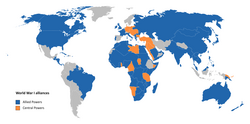
The Allies or the Entente (UK: /ɒ̃ˈtɒ̃t/, US: /ɒnˈtɒnt/ on-TONT) was an international military coalition of countries led by the French Republic, the United Kingdom, the Russian Empire, the United States, the Kingdom of Italy, and the Empire of Japan against the Central Powers of the German Empire, Austria-Hungary, the Ottoman Empire, and the Kingdom of Bulgaria in World War I (1914–1918).
By the end of the first decade of the 20th century, the major European powers were divided between the Triple Entente and the Triple Alliance. The Triple Entente was made up of the United Kingdom, France, and Russia. The Triple Alliance was originally composed of Germany, Austria–Hungary, and Italy, but Italy remained neutral in 1914. As the war progressed, each coalition added new members. Japan joined the Entente in 1914 and, despite proclaiming its neutrality at the beginning of the war, Italy also joined the Entente in 1915. The term "Allies" became more widely used than "Entente",[citation needed] although the United Kingdom, France, Russia, and Italy were also referred to as the Quadruple Entente and, together with Japan, as the Quintuple Entente.[1][2] The five British Dominions (Australia, Canada, New Zealand, Newfoundland, and the Union of South Africa) all fought alongside the British. The colonies of Allied countries, such as the American Philippines, Belgian Congo, British India, French Algeria, and Japanese Korea, were also used as a source of manpower by the colonial powers.
The United States joined near the end of the war in 1917 (the same year in which Russia withdrew from the conflict) as an "associated power" rather than an official ally. Primary reasons for why the United States joined the war include the unrestricted submarine warfare waged by Germany in the Atlantic, the revelation of the Zimmermann telegram, and strong economic and political ties with the Allies. Other "associated members" of the Allies included Serbia, Belgium, Montenegro, Asir, Nejd and Hasa, Portugal, Romania, Hejaz, Panama, Cuba, Greece, China, Siam, Brazil, Armenia, Luxembourg, Guatemala, Nicaragua, Costa Rica, Haiti, Liberia, and Honduras.[3] The treaties signed at the Paris Peace Conference recognised the British Empire, France, Italy, Japan, and the United States as "the Principal Allied and Associated Powers";[4] France, the UK, Italy, and the US were also referred as the "Big Four" top powers of the war.[5]
Background
[edit]When the war began in 1914, the Central Powers were opposed by the Triple Entente, formed in 1907 when the agreement between the United Kingdom and Russia complemented existing agreements between the three powers.
Fighting commenced when Austria invaded Serbia on 28 July 1914, in response to the assassination of Archduke Franz Ferdinand, heir to Emperor Franz Joseph I; this brought Serbia's ally Montenegro into the war on 9 August and it attacked the Austrian naval base at Cattaro, modern Kotor.[6] At the same time, German troops carried out the Schlieffen Plan, entering neutral Belgium and Luxembourg; over 95% of Belgium was occupied but the Belgian Army held their lines on the Yser Front throughout the war. This allowed Belgium to be treated as an Ally, in contrast to Luxembourg which retained control over domestic affairs but was occupied by the German military.
In the East, between 7 and 9 August the Russians entered German East Prussia and Austrian Eastern Galicia. Japan joined the Entente by declaring war on Germany on 23 August, then Austria on 25 August.[7] On 2 September, Japanese forces surrounded the German Treaty Port of Tsingtao (now Qingdao) in China and occupied German colonies in the Pacific, including the Mariana, Caroline, and Marshall Islands.
Despite its membership of the Triple Alliance, Italy remained neutral until 23 May 1915 when it joined the Entente, declaring war on Austria but not Germany. On 17 January 1916, Montenegro capitulated and left the Entente;[8] this was offset when Germany declared war on Portugal in March 1916, while Romania commenced hostilities against Austria on 27 August.[9]
On 6 April 1917, the United States entered the war as a co-belligerent, along with the associated allies of Liberia, Siam and Greece. After the 1917 October Revolution, Russia left the Entente and agreed to a separate peace with the Central Powers with the signing of the Treaty of Brest-Litovsk on 3 March 1918. Romania was forced to do the same in the May 1918 Treaty of Bucharest but on 10 November, it repudiated the Treaty and once more declared war on the Central Powers.
These changes meant the Allies who negotiated the Treaty of Versailles in 1919 included the United Kingdom, France, Italy, Japan and the United States; Part One of the Treaty agreed to the establishment of the League of Nations on 25 January 1919.[10] This came into being on 16 January 1920 with Britain, France, Italy and Japan as permanent members of the Executive Council; the US Senate voted against ratification of the treaty on 19 March, thus preventing the United States from joining the League.
Statistics
[edit]For similar statistics of the Central Powers, see Central Powers#Statistics.
| Country | Population (millions) | Land (million km2) | GDP ($ billion, 1990 prices) | Mobilised personnel | |
|---|---|---|---|---|---|
| First Wave (1914) | |||||
| Russian Empire | Russia
(inc. Congress Poland and Vistula Land) |
173.2 | 21.7 | 257.7 | 12,000,000[12] |
| Finland | 3.2 | 0.4 | 6.6 | ||
| Total | 176.4 | 22.1 | 264.3 | ||
| French Republic | France | 39.8 | 0.5 | 138.7 | 8,410,000[12] |
| French colonies | 48.3 | 10.7 | 31.5 | ||
| Total | 88.1 | 11.2 | 170.2 | ||
| British Empire | United Kingdom | 46.0 | 0.3 | 226.4 | 6,211,922[13] |
| British colonies | 380.2 | 13.5 | 257 | 1,440,437[14][15] | |
| British Dominions | 19.9 | 19.5 | 77.8 | 1,307,000[14] | |
| Total | 446.1 | 33.3 | 561.2 | 8,689,000[16] | |
| Empire of Japan | Japan | 55.1 | 0.4 | 76.5 | 800,000[12] |
| Japanese colonies[17] | 19.1 | 0.3 | 16.3 | ||
| Total | 74.2 | 0.7 | 92.8 | ||
| Serbia, Montenegro, and Bosnia and Herzegovina | 7.0 | 0.2 | 7.2 | 760,000[12] | |
| Second Wave (1915–1916) | |||||
| Kingdom of Italy | Italy | 35.6 | 0.3 | 91.3 | 5,615,000[12] |
| Italian colonies | 2.0 | 2.0 | 1.3 | ||
| Total | 37.6 | 2.3 | 92.6 | ||
| Portuguese Republic | Portugal | 6.0 | 0.1 | 7.4 | 100,000[12] |
| Portuguese colonies | 8.7 | 2.4 | 5.2 | ||
| Total | 14.7 | 2.5 | 12.6 | ||
| Kingdom of Romania | 7.7 | 0.1 | 11.7 | 750,000[12] | |
| Third Wave (1917–1918) | |||||
| United States of America | United States | 96.5 | 7.8 | 511.6 | 4,355,000[12] |
| overseas dependencies[18] | 9.8 | 1.8 | 10.6 | ||
| Total | 106.3 | 9.6 | 522.2 | ||
| Costa Rica, Cuba, Guatemala, Haiti, Honduras, Nicaragua and Panama | 9.0 | 0.6 | 10.6 | ||
| Republic of the United States of Brazil | 25.0 | 8.5 | 20.3 | 1,713[19] | |
| Kingdom of Greece | 4.8 | 0.1 | 7.7 | 230,000[12] | |
| Kingdom of Siam | 8.4 | 0.5 | 7.0 | 1,284[13] | |
| Republic of China | 441.0 | 11.1 | 243.7 | ||
| Republic of Liberia | 1.5 | 0.1 | 0.9 | ||
| Group | Population (millions) | Territory (million km2) | GDP ($ billion) | ||
|---|---|---|---|---|---|
| November 1914 | |||||
| Allies, total | 793.3 | 67.5 | 1,096.5 | ||
| UK, France and Russia only | 259.0 | 22.6 | 622.8 | ||
| November 1916 | |||||
| Allies, total | 853.3 | 72.5 | 1,213.4 | ||
| UK, France and Russia only | 259.0 | 22.6 | 622.8 | ||
| November 1918 | |||||
| Allies, total | 1,271.7 | 80.8 | 1,760.5 | ||
| Percentage of world | 70% | 61% | 64% | ||
| UK, France and US only | 182.3 | 8.7 | 876.6 | ||
| Percentage of world | 10% | 7% | 32% | ||
| Central Powers[21] | 156.1 | 6.0 | 383.9 | ||
| World, 1913 | 1,810.3 | 133.5 | 2,733.9 | ||
Principal powers
[edit]British Empire
[edit]
For much of the 19th century, Britain sought to maintain the European balance of power without formal alliances, a policy known as splendid isolation. This left it dangerously exposed as Europe divided into opposing power blocs. In response, the 1895–1905 Conservative government negotiated first the 1902 Anglo-Japanese Alliance, then the 1904 Entente Cordiale with France.[22] The first tangible result of this shift was British support for France against Germany in the 1905 Moroccan Crisis.
The 1905–1915 Liberal government continued this re-alignment with the 1907 Anglo-Russian Convention. Like the Anglo-Japanese and Entente agreements, it focused on settling colonial disputes but by doing so paved the way for wider co-operation and allowed Britain to refocus resources in response to German naval expansion.[23]

Since control of Belgium allowed an opponent to threaten invasion or blockade British trade, preventing it was a long-standing British strategic interest.[a][24] Under Article VII of the 1839 Treaty of London, Britain guaranteed Belgian neutrality against aggression by any other state, by force if required.[25] Chancellor Theobald von Bethmann Hollweg later dismissed this as a 'scrap of paper,' but British law officers routinely confirmed it as a binding legal obligation and its importance was well understood by Germany.[26]
The 1911 Agadir Crisis led to secret discussions between France and Britain in case of war with Germany. These agreed that within two weeks of its outbreak, a British Expeditionary Force of 100,000 men would be landed in France; in addition, the Royal Navy would be responsible for the North Sea, the Channel and protecting Northern France, with the French navy concentrated in the Mediterranean.[27] Britain was committed to support France in a war against Germany but this was not widely understood outside government or the upper ranks of the military.
As late as 1 August, a clear majority of the Liberal government and its supporters wanted to stay out of the war.[28] While Liberal leaders H. H. Asquith and Edward Grey considered Britain legally and morally committed to support France regardless, waiting until Germany triggered the 1839 Treaty provided the best chance of preserving Liberal party unity.[29]

The German high command was aware entering Belgium would lead to British intervention but decided the risk was acceptable; they expected a short war while their ambassador in London claimed troubles in Ireland would prevent Britain from assisting France.[30] On 3 August, Germany demanded unimpeded progress through any part of Belgium and when this was refused, invaded early on the morning of 4 August.
This changed the situation; the invasion of Belgium consolidated political and public support for the war by presenting what appeared to be a simple moral and strategic choice.[31] The Belgians asked for assistance under the 1839 Treaty and in response, Britain declared war on Germany on 4 August 1914.[32] Although Germany's violation of Belgium neutrality was not the only cause of British entry into the war, it was used extensively in government propaganda at home and abroad to make the case for British intervention.[33] This confusion arguably persists today.
The declaration of war automatically involved all Dominions, colonies, and protectorates of the British Empire, many of whom made significant contributions to the Allied war effort, both in the provision of troops and civilian labourers. It was split into Crown Colonies administered by the Colonial Office in London, such as Nigeria,[b] and the self-governing Dominions of Australia, Canada, New Zealand, Newfoundland, and South Africa. These controlled their own domestic policies and military expenditure but not foreign policy.
.jpg)
In terms of population, the largest component (after Britain herself) was the British Raj, which included modern India, Pakistan, Myanmar and Bangladesh. Unlike other colonies which came under the Colonial Office, it was governed directly by the India Office or by princes loyal to the British; it also controlled British interests in the Persian Gulf, such as the Trucial States and Oman. Over one million soldiers of the British Indian Army served in different theatres of the war, primarily France and the Middle East.
From 1914 to 1916, overall Imperial diplomatic, political and military strategy was controlled by the British War Cabinet in London; in 1917 it was superseded by the Imperial War Cabinet, which included representatives from the Dominions.[34] Under the War Cabinet were the Chief of the Imperial General Staff or CIGS, responsible for all Imperial ground forces, and the Admiralty that did the same for the Royal Navy. Theatre commanders like Douglas Haig on the Western Front or Edmund Allenby in Palestine then reported to the CIGS.
After the Indian Army, the largest individual units were the Australian Corps and Canadian Corps in France, which by 1918 were commanded by their own generals, John Monash and Arthur Currie.[35] Contingents from South Africa, New Zealand and Newfoundland served in theatres including France, Gallipoli, German East Africa and the Middle East. Australian troops separately occupied German New Guinea, with the South Africans doing the same in German South West Africa; this resulted in the Maritz rebellion by former Boers, which was quickly suppressed. After the war, New Guinea and South-West Africa became Protectorates, held until 1975 and 1990 respectively.
Russia
[edit]
Between 1873 and 1887, Russia was allied with Germany and Austria-Hungary in the League of the Three Emperors, then with Germany in the 1887–1890 Reinsurance Treaty; both collapsed due to the competing interests of Austria and Russia in the Balkans. While France took advantage of this to agree the 1894 Franco-Russian Alliance, Britain viewed Russia with deep suspicion; in 1800, over 3,000 kilometres separated the Russian Empire and British India, by 1902, it was 30 km in some areas.[36] This threatened to bring the two into direct conflict, as did the long-held Russian objective of gaining control of the Bosporus Straits and with it access to the British-dominated Mediterranean Sea.[37]

Russian defeat in the 1905 Russo-Japanese War and Britain's isolation during the 1899–1902 Second Boer War led both parties to seek allies. The Anglo-Russian Convention of 1907 settled disputes in Asia and allowed the establishment of the Triple Entente with France, which at this stage was largely informal. In 1908, Austria annexed the former Ottoman province of Bosnia and Herzegovina; Russia responded by creating the Balkan League in order to prevent further Austrian expansion.[38] In the 1912–1913 First Balkan War, Serbia, Bulgaria and Greece captured most of the remaining Ottoman possessions in Europe; disputes over the division of these resulted in the Second Balkan War, in which Bulgaria was comprehensively defeated by its former allies.
Russia's industrial base and railway network had significantly improved since 1905, although from a relatively low base; in 1913, Tsar Nicholas approved an increase in the Russian Army of over 500,000 men. Although there was no formal alliance between Russia and Serbia, their close bilateral links provided Russia with a route into the crumbling Ottoman Empire, where Germany also had significant interests. Combined with the increase in Russian military strength, both Austria and Germany felt threatened by Serbian expansion; when Austria invaded Serbia on 28 July 1914, Russian Foreign Minister Sergey Sazonov viewed it as an Austro-German conspiracy to end Russian influence in the Balkans.[39]
In addition to its own territory, Russia viewed itself as the defender of its fellow Slavs and on 30 July, mobilised in support of Serbia. In response, Germany declared war on Russia on 1 August, followed by Austria-Hungary on 6th; after Ottoman warships bombarded Odessa in late October, the Entente declared war on the Ottoman Empire in November 1914.[40]
France
[edit]
French defeat in the 1870–1871 Franco-Prussian War led to the loss of the two provinces of Alsace-Lorraine and the establishment of the Third Republic. The suppression of the Paris Commune by the new regime caused deep political divisions and led to a series of bitter political struggles, such as the Dreyfus affair. As a result, aggressive nationalism or Revanchism was one of the few areas to unite the French.
The loss of Alsace-Lorraine deprived France of its natural defence line on the Rhine, while it was weaker demographically than Germany, whose 1911 population was 64.9 million to 39.6 in France, which had the lowest birthrate in Europe.[41] This meant that despite their very different political systems, when Germany allowed the Reinsurance Treaty to lapse, France seized the opportunity to agree the 1894 Franco-Russian Alliance. It also replaced Germany as the primary source of financing for Russian industry and the expansion of its railway network, particularly in border areas with Germany and Austria-Hungary.[42]

However, Russian defeat in the 1904–1905 Russo-Japanese War damaged its credibility, while Britain's isolation during the Second Boer War meant both countries sought additional allies. This resulted in the 1904 Entente Cordiale with Britain; like the 1907 Anglo-Russian Convention, for domestic British consumption it focused on settling colonial disputes but led to informal co-operation in other areas. By 1914, both the British army and Royal Navy were committed to support France in the event of war with Germany but even in the British government, very few were aware of the extent of these commitments.[43]

In response to Germany's declaration of war on Russia, France issued a general mobilisation in expectation of war on 2 August and on 3 August, Germany also declared war on France.[44] Germany's ultimatum to Belgium brought Britain into the war on 4 August, although France did not declare war on Austria-Hungary until 12 August.
As with Britain, France's colonies also became part of the war; pre-1914, French soldiers and politicians advocated using French African recruits to help compensate for France's demographic weakness. But it eventually proved useless, the soldiers from Metropolitan France still undertook all the tasks.[45] From August to December 1914, the French lost nearly 300,000 dead on the Western Front, more than Britain suffered in the whole of WWII and the gaps were partly filled by colonial troops, over 500,000 of whom served on the Western Front over the period 1914–1918.[46] Colonial troops also fought at Gallipoli, occupied Togo and Kamerun in West Africa and had a minor role in the Middle East, where France was the traditional protector of Christians in the Ottoman provinces of Syria, Palestine and Lebanon.[47]
Japan
[edit]Prior to the Meiji Restoration in 1868, Japan was a semi-feudal, largely agrarian state with few natural resources and limited technology. By 1914, it had transformed itself into a modern industrial state, with a powerful military; by defeating China in the First Sino-Japanese War during 1894–1895, it established itself as the primary power in East Asia and colonised the then-unified Korea and Formosa, now modern Taiwan.
Concerned by Russian expansion in Korea and Manchuria, Britain and Japan signed the Anglo-Japanese Alliance on 30 January 1902, agreeing if either were attacked by a third party, the other would remain neutral and if attacked by two or more opponents, the other would come to its aid. This meant Japan could rely on British support in a war with Russia, if either France or Germany, which also had interests in China, decided to join them.[48] This gave Japan the reassurance needed to take on Russia in the 1905 Russo-Japanese War; victory established Japan in the Chinese province of Manchuria.

With Japan as an ally in the Far East, John Fisher, First Sea Lord from 1904 to 1910, was able to refocus British naval resources in the North Sea to counter the threat from the Imperial German Navy. The Alliance was renewed in 1911; in 1914, Japan joined the Entente in return for German territories in the Pacific, greatly annoying the Australian government which also wanted them.[49]
On 7 August 1914, Britain officially asked for assistance in destroying German naval units in China and Japan formally declared war on Germany on 23 August 1914, followed by Austria-Hungary on 25 August 1914.[50] On 2 September 1914, Japanese forces surrounded the German Treaty Port of Qingdao, then known as Tsingtao, which surrendered on 7 November. The Imperial Japanese Navy simultaneously occupied German colonies in the Mariana, Caroline, and Marshall Islands, while in 1917, a Japanese naval squadron was sent to support the Allies in the Mediterranean Sea.[51]
Japan's primary interest was in China and in January 1915, the Chinese government was presented with a secret ultimatum of Twenty-One Demands, demanding extensive economic and political concessions. While these were eventually modified, the result was a surge of anti-Japanese nationalism in China and an economic boycott of Japanese goods.[52] In addition, the other Allies now saw Japan as a threat, rather than a partner, leading to tensions first with Russia, then the US after it entered the war in April 1917. Despite protests from the other Allies, after the war Japan refused to return Qingdao and the province of Shandong to China.[53]
Italy
[edit]
The 1882 Triple Alliance between Germany, Austria-Hungary and Italy was renewed at regular intervals, but was compromised by conflicting objectives between Italy and Austria in the Adriatic and Aegean seas. Italian nationalists referred to Austrian-held Istria (including Trieste and Fiume) and Trento as 'the lost territories', making the Alliance so controversial that the terms were kept secret until it expired in 1915.[54]
Alberto Pollio, the pro-Austrian Chief of Staff of the Italian Army, died on 1 July 1914, taking many of the prospects for Italian support with him.[55] The Italian Prime Minister Antonio Salandra argued that as the Alliance was defensive in nature, Austria's aggression against Serbia and Italy's exclusion from the decision-making process meant it was not obliged to join them.[56]
His caution was understandable because France and Britain either supplied or controlled the import of most of Italy's raw materials, including 90% of its coal.[56] Salandra described the process of choosing a side as 'sacred egoism,' but as the war was expected to end before mid-1915 at the latest, making this decision became increasingly urgent.[57] In line with Italy's obligations under the Triple Alliance, the bulk of the army was concentrated on Italy's border with France; in October, Pollio's replacement, General Luigi Cadorna, was ordered to begin moving these troops to the North-Eastern one with Austria.[58]
Under the April 1915 Treaty of London, Italy agreed to join the Entente in return for Italian-populated territories of Austria-Hungary and other concessions; in return, it declared war on Austria-Hungary in May 1915 as required, although not on Germany until 1916.[59] Italian resentment at the difference between the promises of 1915 and the actual results of the 1919 Treaty of Versailles would be powerful factors in the rise of Benito Mussolini.[60]
Affiliated state combatants
[edit]Serbia
[edit]In 1817, the Principality of Serbia became an autonomous province within the Ottoman Empire; with Russian support, it gained full independence after the 1877–1878 Russo-Turkish War. Many Serbs viewed Russia as protector of the South Slavs in general but also specifically against Bulgaria, where Russian objectives increasingly collided with Bulgarian nationalism.[61]
When Austria annexed Bosnia and Herzegovina in 1908, Russia responded by creating the Balkan League to prevent further Austrian expansion.[38] Austria viewed Serbia with hostility partly due to its links with Russia, whose claim to be the protector of South Slavs extended to those within the Austro-Hungarian Empire, such as the Czechs and Slovaks. Serbia also potentially gave Russia the ability to achieve their long-held objective of capturing Constantinople and the Dardanelles.[37]

Austria-Hungary supported the idea of an independent Albania, since this would prevent Serbian access to the Austrian-controlled Adriatic Sea.[62] The success of the Albanian revolt in 1912 threatened Serbian ambitions for the incorporation of "Old Serbia" into its domain and exposed the weakness of the Ottoman Empire. This led to the outbreak of the First Balkan War, with Serbia, Montenegro, Bulgaria and Greece capturing most of the remaining Ottoman possessions in Europe. Disputes over the division of these resulted in the Second Balkan War, in which Bulgaria was comprehensively defeated by its former allies.
As a result of the 1913 Treaty of Bucharest, Serbia increased its territory by 100% and its population by 64%.[63] However, it now faced a hostile Austria-Hungary, a resentful Bulgaria and resistance in its conquered territories. Germany too had ambitions in the Ottoman Empire, the centrepiece being the planned Berlin–Baghdad railway, with Serbia the only section not controlled by a pro-German state.
The exact role played by Serbian officials in the assassination of Archduke Franz Ferdinand is still debated but despite complying with most of their demands, Austria-Hungary invaded on 28 July 1914. While Serbia successfully repulsed the Austro-Hungarian army in 1914, it was exhausted by the two Balkan Wars and unable to replace its losses of men and equipment. In 1915, Bulgaria joined the Central Powers and by the end of the year, a combined Bulgar-Austrian-German army occupied most of Serbia. Between 1914 and 1918, Serbia suffered the greatest proportional losses of any combatant, with over 25% of all those mobilised becoming casualties; including civilians and deaths from disease, over 1.2 million died, nearly 30% of the entire population.
Belgium
[edit]In 1830, the southern provinces of the Netherlands broke away to form the Kingdom of Belgium and their independence was confirmed by the 1839 Treaty of London. Article VII of the Treaty required Belgium to remain perpetually neutral and committed Austria, France, Germany and Russia to guarantee that against aggression by any other state, including the signatories.[64]
_par_Georges-%C3%89mile_Lebacq.jpg)

While the French and German militaries accepted Germany would almost certainly violate Belgian neutrality in the event of war, the extent of that was unclear. The original Schlieffen Plan only required a limited incursion into the Belgian Ardennes, rather than a full-scale invasion; in September 1911, the Belgian Foreign Minister told a British Embassy official they would not call for assistance if the Germans limited themselves to that.[43] While neither Britain or France could allow Germany to occupy Belgium unopposed, a Belgian refusal to ask for help would complicate matters for the British Liberal government, which contained a significant isolationist element.
However, the key German objective was to avoid war on two fronts; France had to be defeated before Russia could fully mobilise and give time for German forces to be transferred to the East. The growth of the Russian railway network and increase in speed of mobilisation made rapid victory over France even more important; to accommodate the additional 170,000 troops approved by the 1913 Army Bill, the 'incursion' now became a full-scale invasion. The Germans accepted the risk of British intervention; in common with most of Europe, they expected it to be a short war while their London Ambassador claimed civil war in Ireland would prevent Britain from assisting its Entente partners.[30]
On 3 August, a German ultimatum demanded unimpeded progress through any part of Belgium, which was refused. Early on the morning of 4 August, the Germans invaded and the Belgian government called for British assistance under the 1839 Treaty; by the end of 1914, over 95% of the country was occupied but the Belgian Army held their lines on the Yser Front throughout the war.
In the Belgian Congo, 25,000 Congolese troops plus an estimated 260,000 porters joined British forces in the 1916 East African Campaign.[65] By 1917, they controlled the western part of German East Africa which would become the Belgian League of Nations Mandate of Ruanda-Urundi or modern-day Rwanda and Burundi.[66]
Greece
[edit]

Greece almost doubled in size as a result of the Balkan Wars of 1912 and 1913, but the success masked deep divisions within the political elite. In 1908, the island of Crete, formally part of the Ottoman Empire but administered by Greek officials, declared union with Greece, led by the charismatic nationalist Eleftherios Venizelos. A year later, young army officers formed the Military League to advocate for an aggressive and expansionist foreign policy; with their backing, Venizelos won a majority in the 1910 Parliamentary elections, followed by another in 1912.[67] He had effectively broken the power of the pre-1910 political class and his position was then further strengthened by success in the Balkan Wars.
In 1913, the Greek monarch George I was assassinated; he was succeeded by his son Constantine who had attended Heidelberg University, served in a Prussian regiment and married Sophia of Prussia, sister of Emperor William II. These links and a belief the Central Powers would win the war combined to make Constantine pro-German.[68] Venizelos himself favoured the Entente, partly due to their ability to block the maritime trade routes required for Greek imports.

Other issues adding complexity to this decision included disputes with Bulgaria and Serbia over the regions of Thrace and Macedonia as well as control of the Aegean Islands. Greece captured most of the islands during the Balkan Wars but Italy occupied the Dodecanese in 1912 and was in no hurry to give them back, while the Ottomans demanded the return of many others.[69] In general, the Triple Entente favoured Greece, the Triple Alliance backed the Ottomans; Greece ultimately gained the vast majority but Italy did not cede the Dodecanese until 1947, while others remain disputed even today.
As a result, Greece initially remained neutral but in March 1915, the Entente offered concessions to join the Dardanelles campaign. Arguments over whether to accept led to the National Schism, with an Entente-backed administration under Venizelos in Crete, and a Royalist one led by Constantine in Athens that supported the Central Powers.[68]
In September 1915, Bulgaria joined the Central Powers; in October, Venizelos allowed Entente forces to land at Thessaloniki or Salonica to support the Serbs, although they were too late to prevent their defeat. In August 1916, Bulgarian troops advanced into Greek-held Macedonia and Constantine ordered the army not to resist; anger at this led to a coup and he was eventually forced into exile in June 1917. A new national government under Venizelos joined the Entente, while the Greek National Defence Army Corps fought with the Allies on the Macedonian front.
Montenegro
[edit]
Unlike Serbia, with whom it shared close cultural and political connections, the Kingdom of Montenegro gained little from its participation in the 1912–1913 Balkan Wars. The main Montenegrin offensive was in Ottoman-controlled Albania, where it suffered heavy losses during the seven month Siege of Scutari. Austria-Hungary opposed Serb or Montenegrin control of Albania, since it provided access to the Adriatic Sea; despite Scutari's surrender, Montenegro was forced to relinquish it by the 1913 Treaty of London and it became capital of the short-lived Principality of Albania.[70] This was largely an Austrian creation; the new ruler, William, Prince of Albania, was a German who was forced into exile in September, only seven months after taking up his new position and later served with the Imperial German Army.[71]

In addition to the lack of substantive gains from the Balkan Wars, there were long-running internal divisions between those who like Nicholas I preferred an independent Montenegro and those who advocated union with Serbia. In July 1914, Montenegro was not only militarily and economically exhausted, but also faced a multitude of political, economic and social issues.[72]
At meetings held in March 1914, Austria-Hungary and Germany agreed union with Serbia must be prevented; Montenegro could either remain independent or be divided, its coastal areas becoming part of Albania, while the rest could join Serbia.[72]
Nicholas seriously considered neutrality as a way to preserve his dynasty and on 31 July notified the Russian Ambassador Montenegro would only respond to an Austrian attack. He also held discussions with Austria, proposing neutrality or even active support in return for territorial concessions in Albania.[73]
However, close links between the Serbian and Montenegrin militaries as well as popular sentiment meant there was little support for remaining neutral, especially after Russia joined the war; on 1 August, the National Assembly declared war on Austria-Hungary in fulfilment of its obligations to Serbia. After some initial success, in January 1916, the Montenegrin Army was forced to surrender to an Austro-Hungarian force.
Beda
[edit]The Beda Sultanate was invaded by Ottoman forces in February 1915 and March 1916.[74] Britain assisted the Beda Sultanate in defeating the Ottoman invasions by sending arms and ammunition.[75]
Asir
[edit]The Idrisid Emirate of Asir participated in the Arab Revolt. Its Emir, Muhammad ibn Ali al-Idrisi, signed an agreement with the British and joined the Allies in May 1915.
Nejd and Hasa
[edit]The Emirate of Nejd and Hasa launched a failed offensive against the Ottoman aligned Emirate of Jabal Shammar in January 1915. It then agreed to enter the war as an ally of Britain in the Treaty of Darin on 26 December 1915.[76]
Romania
[edit]


Equal status with the main Entente Powers was one of the primary conditions for Romania's entry into the War. The Powers officially recognised this status through the 1916 Treaty of Bucharest.[77] Romania fought on three of the four European Fronts: Eastern, Balkan and Italian, fielding in total over 1,200,000 troops.[78]
Romanian military industry was mainly focused on converting various fortification guns into field and anti-aircraft artillery. Up to 334 German 53 mm Fahrpanzer guns, 93 French 57 mm Hotchkiss guns, 66 Krupp 150 mm guns, and dozens more 210 mm guns were mounted on Romanian-built carriages and transformed into mobile field artillery, with 45 Krupp 75 mm guns and 132 Hotchkiss 57 mm guns being transformed into anti-aircraft artillery. The Romanians also upgraded 120 German Krupp 105 mm howitzers, the result being the most effective field howitzer in Europe at that time. Romania even managed to design and build from scratch its own model of mortar, the 250 mm Negrei Model 1916.[79]
Other Romanian technological assets include the building of Vlaicu III, the world's first aircraft made of metal.[80] The Romanian Navy possessed the largest warships on the Danube. They were a class of four river monitors, built locally at the Galați shipyard using parts manufactured in Austria-Hungary. The first one launched was Lascăr Catargiu, in 1907.[81][82] The Romanian monitors displaced almost 700 tons, were armed with three 120 mm naval guns in three turrets, two 120 mm naval howitzers, four 47 mm anti-aircraft guns and two 6.5 machine guns.[83] The monitors took part in the Battle of Turtucaia and the First Battle of Cobadin. The Romanian-designed Schneider 150 mm Model 1912 howitzer was considered one of the most modern field guns on the Western Front.[84]
Romania's entry into the War in August 1916 provoked major changes for the Germans. General Erich von Falkenhayn was dismissed and sent to command the Central Powers forces in Romania, which enabled Hindenburg's subsequent ascension to power.[9] Due to having to fight against all of the Central Powers on the longest front in Europe (1,600 km) and with little foreign help (only 50,000 Russians aided 650,000 Romanians in 1916),[85] the Romanian capital was conquered that December. Vlaicu III was also captured and shipped to Germany, being last seen in 1942.[86] The Romanian administration established a new capital at Iași and continued to fight on the Allied side in 1917.[87] Despite being relatively short, the Romanian campaign of 1916 provided considerable respite for the Western Allies, as the Germans ceased all their other offensive operations in order to deal with Romania.[88] After suffering a tactical defeat against the Romanians (aided by Russians) in July 1917 at Mărăști, the Central Powers launched two counterattacks, at Mărășești and Oituz. The German offensive at Mărășești was soundly defeated, with German prisoners later telling their Romanian captors that German casualties were extremely heavy, and that they "had not encountered such stiff resistance since the battles of Somme and Verdun".[89] The Austro-Hungarian offensive at Oituz also failed. On 22 September, the Austro-Hungarian Enns-class river monitor SMS Inn was sunk by a Romanian mine near Brăila.[90][91] After Russia signed the Treaty of Brest-Litovsk and dropped out of the War, Romania was left surrounded by the Central Powers and eventually signed a similar treaty on 7 May 1918. Despite being forced to cede land to Austria-Hungary and Bulgaria, Romania ended up with a net gain in territory due to the Union with Bessarabia. On 10 November, Romania re-entered the War and fought a war with Hungary that lasted until August 1919.
Republic of the United States of Brazil
[edit]
Brazil entered the war in 1917 after the United States intervened on the basis of Germany's unrestricted submarine warfare sinking its merchant ships, which Brazil also cited as a reason to enter the war fighting against Germany and the Central Powers. The First Brazilian Republic sent the Naval Division in War Operations that joined the British fleet in Gibraltar and made the first Brazilian naval effort in international waters. In compliance with the commitments made at the Inter-American Conference, held in Paris from 20 November to 3 December 1917, the Brazilian Government sent a medical mission composed of civilian and military surgeons to work in field hospitals of the European theatre, a contingent of sergeants and officers to serve with the French Army; Airmen from the Army and Navy to join the Royal Air Force, and the employment of part of the Fleet, primarily in the anti-submarine war.
Co-belligerents: the United States
[edit]
The United States declared war on Germany in April 1917 on the grounds that Germany violated US neutrality by attacking international shipping with its unrestricted submarine warfare campaign.[92] The remotely connected Zimmermann Telegram of the same period, within which the Germans promised to help Mexico regain some of its territory lost to the US nearly seven decades before in the event of the United States entering the war, was also a contributing factor. The US entered the war as an "associated power", rather than a formal ally of France and the United Kingdom, in order to avoid "foreign entanglements".[93] Although the Ottoman Empire and Bulgaria severed relations with the United States, neither declared war,[94] nor did Austria-Hungary. Eventually, however, the United States also declared war on Austria-Hungary in December 1917, predominantly to help hard-pressed Italy.
Non-state combatants
[edit]Three non-state combatants, which voluntarily fought with the Allies and seceded from the constituent states of the Central Powers at the end of the war, were allowed to participate as winning nations to the peace treaties:[citation needed]
 Armenian irregulars and volunteers: seceded from the Russian Empire in the aftermath of the Russian Revolution and fought against the Ottoman Empire
 Assyrian volunteers under Mar Shimun XIX Benyamin and the Assyrian tribal chiefs decided to side with the Allies, first with Russia, and next with the British, in the hope that they might secure after the victory, self-government for the Assyrians.[95] The French also joined the alliance with the Assyrians, offering them 20,000 rifles, and the Assyrian army grew to 20,000 men co-led by Agha Petros of the Bit-Bazi tribe, and Malik Khoshaba of the Bit-Tiyari tribe.[96][97]
 Polish Legions
 Czechoslovak Legions: armed by France, Italy, and Russia


Additionally, there were also several Kurdish rebellions during World War I. Most of these, except for the uprisings of August 1917, were not supported by any of the Allied powers.[98]
Leaders
[edit]

Serbia
[edit]- Peter I – King of Serbia
- Crown Prince Alexander – Regent, Commander-in-Chief
- Nikola Pašić – Prime Minister of Serbia
- Field Marshal Radomir Putnik – Chief of the General Staff of the Serbian Army (1914–1915)
- General/Field Marshal Živojin Mišić – Deputy Chief of the General Staff (1914), Commander of First Army (1914–1915; 1917), later Chief of the General Staff (1918)
- General/Field Marshal Petar Bojović – Commander of the First Army (1914), Deputy Chief of General Staff (1915–1916), Chief of the General Staff (1916–1917) later Commander of the First Army (1918)
- General/Field Marshal Stepa Stepanović – Commander of the Second Army (1914–1918)
- General Pavle Jurišić Šturm – Commander of the Third Army (1914–1916)
- Colonel Dušan Stefanović – Minister of War (1914)
- Colonel Radivoje Bojović – Minister of War (1914–1915)
- Colonel/General Božidar Terzić – Minister of War (1915–1918)
- General Mihailo Rašić – Minister of War (1918)
- Colonel/General Miloš Vasić – Commander of the First Army (1916; 1917), Commander of the Third Army (1916)
Montenegro
[edit]- Nicholas I – King of Montenegro, Commander-in-Chief
- General Serdar Janko Vukotić – Prime Minister, Commander of the 1st Montenegrin Army
 General Božidar Janković – Chief of the General Staff of the Montenegrin Army (1914–1915)
- Colonel Petar Pešić – Deputy Chief of the General Staff of the Montenegrin Army (1914–1915), later Chief of the General Staff of the Montenegrin Army (1915–1916)
- Crown Prince Danilo II Petrović-Njegoš – in the staff of the 1st Montenegrin Army
- Brigadier Krsto Popović – in the staff of the 1st Montenegrin Army, Aide-de-camp to Serdar Janko Vukotić
- General Anto Gvozdenović – King's Aide-de-camp
- General Mitar Martinović – commander of several detachments in the Montenegrin Army (Drina and Herzegovina detachments together in 1914–1915, Kotor detachment in 1916)

Russia (1914–1917)
[edit]
- Nicholas II – Russian Emperor, King of Poland, and Grand Duke of Finland (until 15 March 1917)
- Grand Duke Nicholas Nikolaevich – Commander-in-Chief (1 August 1914 – 5 September 1916) and viceroy in the Caucasus
- Ivan Goremykin – Chairmen of Council of Ministers of the Russian Empire (1 August 1914 – 2 February 1916)
- Boris Stürmer – Chairmen of Council of Ministers of the Russian Empire (2 February 1916 – 23 November 1916)
- Alexander Trepov – Chairmen of Council of Ministers of the Russian Empire (23 November 1916 – 27 December 1916)
- Nikolai Golitsyn – Chairmen of Council of Ministers of the Russian Empire (27 December 1916 – 9 January 1917)
- General of the Cavalry Alexander Samsonov – Commander of the Russian Second Army for the invasion of East Prussia (1 August 1914 – 29 August 1914)
- General of the Cavalry Paul von Rennenkampf – Commander of the Russian First Army for the invasion of East Prussia (1 August 1914 – November 1914)
- General of the Artillery Nikolay Ivanov – Commander of the Russian Army on the Southwestern Front, (1 August 1914 – March 1916) responsible for much of the action in Galicia

Aleksei Brusilov in Rivne, Volhynian Governorate, 1915 - General Adjutant Aleksei Brusilov – Commander of the Southwestenr Front, then provisional Commander-in-Chief after the Tsar's abdication (February 1917 – August 1917)
- General of the Infantry Lavr Georgievich Kornilov – Commander of the Southwestern Front, then Commander-in-Chief (August 1917)
- General of the Infantry Aleksey Kuropatkin – Commander of the Northern Front (October 1915 – 1917)
- General of the Infantry Nikolai Yudenich – Commander of the Caucasus (January 1915 – May 1917)
- Admiral Andrei Eberhardt – Commander of the Black Sea Fleet (1914–16)
- Admiral Alexander Kolchak – Commander of the Black Sea Fleet (1916–17)
- Admiral Nikolai Essen – Commander of the Baltic Fleet (1913 – May 1915)
.jpg)
Belgium
[edit]- Albert I of Belgium – King of the Belgians (23 December 1909 – 17 February 1934) and Commander-in-Chief of the Belgian Army
- Charles de Broqueville – Prime Minister (1912–1918); replaced by Gérard Cooreman in June 1918 shortly before the end of the war.
- Félix Wielemans – Chief of Staff of the Belgian Army
- Gérard Leman – general commanding the defence of Liège
- Charles Tombeur – commander of the colonial Force Publique in the East African theatre
France
[edit]
- Raymond Poincaré – President of France
- René Viviani – Prime Minister of France (13 June 1914 – 29 October 1915)
- Aristide Briand – Prime Minister of France (29 October 1915 – 20 March 1917)
- Alexandre Ribot – Prime Minister of France (20 March 1917 – 12 September 1917)
- Paul Painlevé – Prime Minister of France (12 September 1917 – 16 November 1917)
- Georges Clemenceau – Prime Minister of France (from 16 November 1917)
- Divisional General/Marshal Joseph Joffre – Commander-in-Chief of the French Army (3 August 1914 – 13 December 1916)
- Divisional General Robert Nivelle – Commander-in-Chief of the French Army (13 December 1916 – April 1917)
- Divisional General/Marshal Philippe Pétain – Commander-in-Chief of the French Army (April 1917 – 11 November 1918)
- Divisional General/Marshal Ferdinand Foch – Supreme Allied Commander (26 March 1918 – 11 November 1918)
- Divisional General Maurice Sarrail – Commander of the Allied armies at the Salonika front (1915–1917)
- Army General Adolphe Guillaumat – Commander of the Allied armies at the Salonika front (1917–1918)
- Divisional General/Marshal Louis Franchet d'Espèrey – Commander of the Allied armies at the Salonika front (1918)
- Brigadier General Milan Rastislav Štefánik – general of the French Army, Commander of the Czechoslovak Legions
Britain and the British Empire
[edit]United Kingdom
[edit]

- George V – King of the United Kingdom, and the British Dominions, Emperor of India
- H. H. Asquith – Prime Minister of the United Kingdom (until 5 December 1916)
- David Lloyd George – Prime Minister of the United Kingdom (from 7 December 1916)
- Field Marshal Horatio Herbert Kitchener – Secretary of State for War (5 August 1914 – 5 June 1916)
- Edward Stanley, 17th Earl of Derby – Secretary of State for War (1916– )
- General William Robertson – Chief of the Imperial General Staff (23 December 1915 – February 1918)
- General Henry Wilson – Chief of the Imperial General Staff (February 1918 – February 1922)
- Field Marshal John French – Commander-in-Chief of the British Expeditionary Force (4 August 1914 – 15 December 1915)
- General/Field Marshal Douglas Haig – Commander-in-Chief of the British Expeditionary Force (15 December 1915 – 11 November 1918)
- General Sir David Henderson – Director-General of Military Aeronautics
- General Hugh Trenchard – Commander of the Royal Flying Corps – (August 1915 – January 1918) and Chief of the Air Staff of the combined Royal Air Force – 1 April 1918 – 13 April 1918
- Brigadier General Sir Frederick Sykes – Chief of the Air Staff – 13 April 1918 through 11 November 1918 (post-war to 31 March 1919)
- Winston Churchill – First Lord of the Admiralty – (1911 – May 1915)
- Arthur Balfour- First Lord of the Admiralty – (May 1915 – December 1916)
- Edward Carson – First Lord of the Admiralty – (10 December 1916 – 17 July 1917)
- Eric Geddes – First Lord of the Admiralty – (July 1917 – January 1919)
- Admiral of the Fleet John "Jackie" Fisher – First Sea Lord – (1914 – May 1915)
- Admiral Henry Jackson – First Sea Lord – (May 1915 – November 1916)
- Admiral John Jellicoe – Commander of the Grand Fleet (August 1914 – November 1916); First Sea Lord (November 1916 – December 1917)
- Admiral Rosslyn Wemyss – First Sea Lord (December 1917 – November 1919)
- Admiral David Beatty – Commander of the Grand Fleet (November 1916 – April 1919)
- General Archibald Murray – Commander of the Egyptian Expeditionary Force (January 1916 – June 1917)
- General Edmund Allenby – Commander of the Egyptian Expeditionary Force (June 1917 – November 1918)
- Eric John Eagles Swayne – Commander of British forces in the Somaliland Campaign
- William Peyton – commander and military secretary to the British Expeditionary Force
- Colonel T. E. Lawrence – a main leader of the Arab Revolt
Dominion of Canada
[edit]- Robert Borden – Prime Minister of Canada (1914–18)
- Sam Hughes – Minister of Militia and Defence (1914 – January 1915)
- Joseph Flavelle – Chairman of the Imperial Munitions Board (1915–19)
 Lieutenant-General Edwin Alderson – Commander of the unified Canadian Corps of the Canadian Expeditionary Force (26 January 1915 – September 1915)
- General Julian Byng – Commander of the unified Canadian Corps of the Canadian Expeditionary Force (June 1916 – June 1917)
- General Arthur Currie – Commander of the unified Canadian Corps of the Canadian Expeditionary Force (June 1917 – August 1919)[99]

Commonwealth of Australia
[edit]- Joseph Cook – Prime Minister of Australia (until 17 September 1914)
- Andrew Fisher – Prime Minister of Australia (17 September 1914 – 27 October 1915)
- Billy Hughes – Prime Minister of Australia (from 27 October 1915)
- General William Birdwood – Commander of the Australian Corps (all five Australian infantry divisions serving on the Western Front) (November 1917 – May 1918)
- Lieutenant General Sir John Monash – Commander of the Australian Corps (May 1918 –)
- Major General William Holmes – Commander of the Australian Naval and Military Expeditionary Force (August 1914 – February 1915)
- Lieutenant General Sir Harry Chauvel – Commander of the Desert Mounted Corps (Sinai and Palestine) (August 1917 –)
British India
[edit]- Charles Hardinge, 1st Baron Hardinge of Penshurst – Viceroy of India (1910–1916)
- Frederic Thesiger, 1st Viscount Chelmsford – Viceroy of India (1916–1921)
- Robert Crewe-Milnes, 1st Marquess of Crewe – Secretary of State for India (May 1911 – May 1915)
- Austen Chamberlain – Secretary of State for India (May 1915 – July 1917)
- Edwin Samuel Montagu – Secretary of State for India (July 1917 – March 1922)
- Beauchamp Duff – Commander-in-Chief, India (March 1914 – October 1916)
- Charles Monro – Commander-in-Chief, India (October 1916 – November 1920)
- Lieutenant-General John Nixon – commander of the British Indian Army (active in the Middle East)
Union of South Africa
[edit]- General Louis Botha – Prime Minister of South Africa
- General Jan Smuts – led forces in the South West Africa Campaign and East African Campaign, later a member of the Imperial War Cabinet
Dominion of New Zealand
[edit]- William Massey – Prime Minister of New Zealand
- General Sir Alexander Godley – Commandant of New Zealand Military Forces (to October 1914); Commander of the New Zealand Expeditionary Forces
- Major General Sir Alfred William Robin – Quartermaster-General and Commandant of New Zealand Military Forces (from October 1914)
- Major General Sir Andrew Hamilton Russell – Commander of the New Zealand Division
Dominion of Newfoundland
[edit]- Sir Edward Morris – Prime Minister of Newfoundland (1909–1917)
- Sir John Crosbie – Prime Minister of Newfoundland (1917–1918)
- Sir William Lloyd – Prime Minister of Newfoundland (1918–1919)
Japan
[edit]- Emperor Taishō – Emperor of Japan
- Ōkuma Shigenobu – Prime Minister of Japan (16 April 1914 – 9 October 1916)
- Terauchi Masatake – Prime Minister of Japan (9 October 1916 – 29 September 1918)
- Hara Takashi – Prime Minister of Japan (29 September 1918 – 4 November 1921)
- Katō Sadakichi – Commander-in-Chief of the Second Fleet deployed to the Siege of Tsingtao
- Kōzō Satō – Commander of the Second Special Task Fleet
- Kamio Mitsuomi – Commander of Allied land forces at Tsingtao
Italy (1915–1918)
[edit]- Victor Emmanuel III – King of Italy
- Antonio Salandra – Prime Minister (until 18 June 1916)
- Paolo Boselli – Prime Minister (18 June 1916 – 29 October 1917)
- Vittorio Emanuele Orlando – Prime Minister (from 29 October 1917)
- Luigi Cadorna – Commander-in-Chief of the Royal Italian Army
- Armando Diaz – Chief of General Staff of the Royal Italian Army
- Luigi, Duke of Abruzzi – Commander-in-Chief of the Adriatic Fleet of Italy (1914–17)
- Paolo Thaon di Revel – Admiral of the Royal Italian Navy
Romania (1916–1918)
[edit]- Ferdinand I – King of Romania
- General Constantin Prezan – Chief of the General Staff of Romania
- Ion I. C. Brătianu – Prime Minister of Romania
- Vintilă Brătianu – Secretary of War
- Field Marshal Alexandru Averescu – Commander of the 2nd Army, 3rd Army, then Army Group South
- General Eremia Grigorescu – Commander of the 1st Army
Portugal (1916–1918)
[edit]- Bernardino Machado – President of Portugal (until 12 December 1917)
- Afonso Costa – Prime Minister of Portugal (until 15 March 1916; then again 25 April 1917 – 10 December 1917)
- António José de Almeida – Prime Minister of Portugal (15 March 1916 – 25 April 1917)
- Sidónio Pais – Prime Minister of Portugal and War Minister (11 December 1917 – 9 May 1918) and President of Portugal (from 9 May 1918)
- José Norton de Matos – War Minister (until 10 December 1917)
- João Tamagnini Barbosa – Interim War Minister (9 May 1918 – 15 May 1918)
- Amílcar Mota – Secretary of State for War (15 May 1918 – 8 October 1918)
- Álvaro de Mendonça – Secretary of State for War (from 8 October 1918)
- Fernando Tamagnini de Abreu – Commander of the Portuguese Expeditionary Corps (CEP)
- José Augusto Alves Roçadas – Commander of the Portuguese Forces in Southern Angola
- José Luís de Moura Mendes – Commander of the Portuguese Forces in Eastern Africa (until June 1916)
- José César Ferreira Gil – Commander of the Portuguese Forces in Eastern Africa (from June 1916)
- Sousa Rosa – Commander of the Portuguese Forces in Eastern Africa (from 1917)
Greece (1916/17–1918)
[edit]
- Constantine I: King of Greece, he retired from the throne in June 1917, due to Allied pressure, without formally abdicating.
- Alexander: King of Greece from 1917 after his father was forced into exile
- Eleftherios Venizelos: Prime Minister of Greece after 13 June 1917
- Panagiotis Danglis: Greek general of the Hellenic Army
United States (1917–1918)
[edit]
- Woodrow Wilson – President of the United States/Commander-In-Chief of the US Armed Forces
- Newton D. Baker – US Secretary of War
- Josephus Daniels – US Secretary of the Navy
- Major General/General John J. Pershing – Commander of the American Expeditionary Forces
- Rear Admiral/Vice Admiral William Sims – Commander of US Naval Forces in European Waters
- Brigadier General Mason Patrick – Commander of the US Army Air Service
Siam (1917–1918)
[edit]_Arc_de_Triomphe_WW1_1919.jpg)
- Vajiravudh, King of Siam
- Chaophraya Bodindechanuchit, Minister of Defence
- Chakrabongse Bhuvanath, Supreme Commander of the Siamese Expeditionary Forces in World War I
- Phraya Thephatsadin, Commander of the Siamese Expeditionary Forces in the Western Front
Brazil (1917–1918)
[edit].jpg)
- Venceslau Brás – President of Brazil
- Pedro Frontin, Chief of the Divisão Naval em Operações de Guerra (Naval Division in War Operations)
- José Pessoa, lieutenant of the Brazilian Army in France
- Napoleão Felipe Aché, Chief of Brazilian Military Mission in France (1918–1919)
- M.D. Nabuco Gouveia – Chief of Brazilian Military Medical Commission
Armenia (1917–1918)
[edit]- Hovhannes Kajaznuni – first Prime Minister of the First Republic of Armenia
- General Andranik – military commander and statesman of the Caucasus Campaign
- Aram Manukian – Minister of Internal Affairs of the First Republic of Armenia
- Drastamat Kanayan – military commander and member of the Armenian Revolutionary Federation
- Tovmas Nazarbekian – Commander-in-Chief of the First Republic of Armenia
- Movses Silikyan – army general and national hero
Czechoslovakia (1918)
[edit]- Tomáš Garrigue Masaryk – first President of Czechoslovakia
- Milan Rastislav Štefánik – Commander of the Czechoslovak Legion
- Edvard Beneš – Minister of Foreign Affairs and the Interior
Personnel and casualties
[edit]
These are estimates of the cumulative number of different personnel in uniform 1914–1918, including army, navy and auxiliary forces. At any one time, the various forces were much smaller. Only a fraction of them were frontline combat troops. The numbers do not reflect the length of time each country was involved.
| Allied power | Mobilised personnel | Military fatalities | Wounded in action | Casualties, total | Casualties, % of total mobilised |
|---|---|---|---|---|---|
| Australia | 412,953[14] | 61,928 (14.99%)[c] | 152,171 | 214,099 | 52% |
| Belgium | 267,000[12] | 38,172 (14.29%)[d] | 44,686 | 82,858 | 31% |
| Brazil | 1,713[105][page needed] | 100 (5.84%)[106] | 0 | 100 | 5.84% |
| Canada | 628,964[14] | 64,944 (10.32%)[e] | 149,732 | 214,676 | 34% |
| France | 8,410,000[12] | 1,397,800 (16.62%)[f] | 4,266,000 | 5,663,800 | 67% |
| Greece | 230,000[12] | 26,000 (11.30%)[g] | 21,000 | 47,000 | 20% |
| India | 1,440,437[14] | 74,187 (5.15%)[h] | 69,214 | 143,401 | 10% |
| Italy | 5,615,000[12] | 651,010 (11.59%)[i] | 953,886 | 1,604,896 | 29% |
| Japan | 800,000[12] | 415 (0.05%)[j] | 907 | 1,322 | <1% |
| Monaco | 80[112] | 8 (10.00%)[112] | 0 | 8[112] | 10% |
| Montenegro | 50,000[12] | 3,000 (6.00%) | 10,000 | 13,000 | 26% |
| Nepal | 200,000[113] | 30,670 (15.33%) | 21,009 | 49,823 | 25% |
| New Zealand | 128,525[14] | 18,050 (14.04%)[k] | 41,317 | 59,367 | 46% |
| Portugal | 100,000[12] | 7,222 (7.22%)[l] | 13,751 | 20,973 | 21% |
| Romania | 750,000[12] | 250,000 (33.33%)[m] | 120,000 | 370,000 | 49% |
| Russia | 12,000,000[12] | 1,811,000 (15.09%)[n] | 4,950,000 | 6,761,000 | 56% |
| Serbia | 707,343[12] | 275,000 (38.87%)[o] | 133,148 | 408,148 | 58% |
| Siam | 1,284[118] | 19 (1.48%) | 0 | 19 | 2% |
| South Africa | 136,070[14] | 9,463 (6.95%)[p] | 12,029 | 21,492 | 16% |
| United Kingdom | 6,211,922[13] | 886,342 (14.26%)[q] | 1,665,749 | 2,552,091 | 41% |
| United States | 4,355,000[12] | 53,402 (1.23%)[r] | 205,690 | 259,092 | 5.9% |
| Total | 42,244,409 | 5,741,389 | 12,925,833 | 18,744,547 | 49% |
See also
[edit]- Allied intervention in the Russian Civil War
- Causes of World War I
- Color books, transcripts of official documents released by each nation early in the war
- Diplomatic history of World War I
- Historiography of the causes of World War I
- Home front during World War I
- International relations of the Great Powers (1814–1919)
- July Crisis
- War aims of the First World War
Footnotes
[edit]- ^ The consequences were demonstrated when Germany controlled these areas during 1940–1944.
- ^ Others included Gibraltar, Cyprus, Malta, East Africa Protectorate, Nyasaland, Northern and Southern Rhodesia, the Uganda Protectorate, the Gold Coast, Nigeria, British Honduras, the Falkland Islands, British Guiana, the British West Indies, British Malaya, North Borneo, Ceylon and Hong Kong.
- ^ Australia casualties
Included in total are 55,000 killed or missing in action and died of wounds[100]-.
The Commonwealth War Graves Commission Annual Report 2005–2006 is the source of total military dead.[101]–
Totals include 2,005 military deaths during 1919–21[102]–. The 1922 War Office report listed 59,330 Army war dead.[103] - ^ Belgium casualties
Included in total are 35,000 killed or missing in action and died of wounds[100] Figures include 13,716 killed and 24,456 missing up until Nov.11, 1918. "These figures are approximate only, the records being incomplete." .[104] - ^ Canada casualties
Included in total are 53,000 killed or missing in action and died of wounds.[100]
The Commonwealth War Graves Commission Annual Report 2005–2006 is the source of total military dead.[101]
Totals include 3,789 military deaths during 1919–21 and 150 Merchant Navy deaths[102]–. The losses of Newfoundland are listed separately on this table. The 1922 War Office report listed 56,639 Army war dead.[103] - ^ France casualties
Included in total are 1,186,000 killed or missing in action and died of wounds.[100] Totals include the deaths of 71,100 French colonial troops.[107]-Figures include war related military deaths of 28,600 from 11/11/1918 to 6/1/1919.[107] - ^ Greece casualties
Jean Bujac in a campaign history of the Greek Army in World War One listed 8,365 combat related deaths and 3,255 missing,[108] The Soviet researcher Boris Urlanis estimated total dead of 26,000 including 15,000 military deaths due disease[109] - ^ India casualties
British India included present-day India, Pakistan and Bangladesh.
Included in total are 27,000 killed or missing in action and died of wounds.[100]
The Commonwealth War Graves Commission Annual Report 2005–2006 is the source of total military dead.[101]
Totals include 15,069 military deaths during 1919–21 and 1,841 Canadian Merchant Navy dead.[102] The 1922 War Office report listed 64,454 Army war dead[103] - ^ Italy casualties
Included in total are 433,000 killed or missing in action and died of wounds[100]
Figures of total military dead are from a 1925 Italian report using official data.[110][page needed] - ^ War dead figure is from a 1991 history of the Japanese Army.[111]
- ^ New Zealand casualties
Included in total are 14,000 killed or missing in action and died of wounds.[100]
The Commonwealth War Graves Commission Annual Report 2005–2006 is the source of total military dead.[101]
Totals include 702 military deaths during 1919–21.[102] The 1922 War Office report listed 16,711 Army war dead.[103] - ^ Portugal casualties
Figures include the following killed and died of other causes up until Jan.1, 1920; 1,689 in France and 5,332 in Africa. Figures do not include an additional 12,318 listed as missing and POW.[114] - ^ Romania casualties
Military dead is "The figure reported by the Rumanian Government in reply to a questionnaire from the International Labour Office".[115] Included in total are 177,000 killed or missing in action and died of wounds.[100] - ^ Russia casualties
Included in total are 1,451,000 killed or missing in action and died of wounds.[100] The estimate of total Russian military losses was made by the Soviet researcher Boris Urlanis.[116] - ^ Serbia casualties
Included in total are 165,000 killed or missing in action and died of wounds.[100] The estimate of total combined Serbian and Montenegrin military losses of 278,000 was made by the Soviet researcher Boris Urlanis[117] - ^ South Africa casualties
Included in total are 5,000 killed or missing in action and died of wounds[100]
The Commonwealth War Graves Commission Annual Report 2005–2006 is the source of total military dead.[101]
Totals include 380 military deaths during 1919–2115. The 1922 War Office report listed 7,121 Army war dead.[103] - ^ UK and Crown Colonies casualties
Included in total are 624,000 killed or missing in action and died of wounds.[100]
The Commonwealth War Graves Commission Annual Report 2005–2006 is the source of total military dead.[101]
Military dead total includes 34,663 deaths during 1919–21 and 13,632 British Merchant Navy deaths.[102] The 1922 War Office report listed 702,410 war dead for the UK,[103] 507 from "Other colonies"[103] and the Royal Navy (32,287).[119]
The British Merchant Navy losses of 14,661 were listed separately;[119] The 1922 War Office report detailed the deaths of 310 military personnel due to air and sea bombardment of the UK.[120] - ^ United States casualties
Official military war deaths listed by the US Dept. of Defense for the period ending 31 Dec 1918 are 116,516; which includes 53,402 battle deaths and 63,114 other deaths. "Principal Wars in Which the United States Participated U.S. Military Personnel Serving and Casualties a/" (PDF). Department of Defense Statistical Information Analysis Division. Archived from the original (PDF) on 25 January 2007. The US Coast Guard lost an additional 192 dead .[121]
References
[edit]- ^ Torkunov, Anatoly V.; Martyn, Boris F.; Wohlforth, William C. (8 January 2020). History of International Relations and Russian Foreign Policy in the 20th Century (Volume I). Cambridge Scholars. ISBN 9781527545021.
- ^ Torkunov, Anatoly V.; Wohlforth, William C.; Martyn, Boris F. (8 January 2020). History of International Relations and Russian Foreign Policy in the 20th Century (Volume I). Cambridge Scholars. ISBN 978-1-5275-4502-1.
- ^ Karel Schelle, The First World War and the Paris Peace Agreement, GRIN Verlag, 2009, p. 24
- ^ Preamble, Treaty of Versailles Australian Treaty Series 1920 No 1
- ^ "Leaders of the Big Four nations meet for the first time in Paris". history.com. 16 November 2009.
- ^ Gilbert 1995, p. 44.
- ^ Mizokami, Kyle, "Japan's baptism of fire: World War I put country on a collision course with West Archived 31 July 2018 at the Wayback Machine", The Japan Times, 27 July 2014
- ^ Gilbert 1995, p. 225.
- ^ a b Gilbert 1995, p. 282.
- ^ Magliveras, Konstantin (1999). Exclusion from Participation in International Organisations: The Law and Practice Behind Member States' Expulsion and Suspension of Membership. Brill. pp. 8–12. ISBN 978-90-411-1239-2.
- ^ S.N. Broadberry; Mark Harrison (2005). The Economics of World War I. illustrated. Cambridge University Press. p. 7. ISBN 978-1-139-44835-2. Retrieved 16 March 2015.
- ^ a b c d e f g h i j k l m n o p q r s t Tucker, Spencer C (1999). The European Powers in the First World War: An Encyclopedia. New York: Garland. p. 172. ISBN 978-0-8153-3351-7.
- ^ a b c Gilbert, Martin (1994). Atlas of World War I. Oxford University Press. ISBN 978-0-19-521077-4. OCLC 233987354.
- ^ a b c d e f g War Office Statistics 2006, p. 756.
- ^ Indian Army only
- ^ Baker, Chris. "Some British Army statistics of the Great War". 1914-1918.net. Archived from the original on 18 July 2017. Retrieved 7 August 2017.
- ^ Korea, Formosa, Kwantung and Sakhalin
- ^ As Hawaii and Alaska were not yet U.S. states, they are included in the dependencies.
- ^ Hernâni Donato (1987). Dicionário das Batalhas Brasileiras. Rio de Janeiro: IBRASA. ISBN 978-85-348-0034-1.
- ^ S.N. Broadberry; Mark Harrison (2005). The Economics of World War I. illustrated. Cambridge University Press. p. 8. ISBN 978-1-139-44835-2. Retrieved 16 March 2015.
- ^ Germany (and colonies), Austria-Hungary, Ottoman Empire and Bulgaria
- ^ Avner Cohen, "Joseph Chamberlain, Lord Lansdowne and British foreign policy 1901–1903: From collaboration to confrontation", Australian Journal of Politics & History 43#2 (1997): 122–134.
- ^ Massie, Robert (2007). Dreadnought: Britain, Germany and the Coming of the Great War (2013 ed.). Vintage. pp. 466–468. ISBN 978-0-09-952402-1.
- ^ Nilesh, Preeta (2014). "Belgian Neutrality and the First world War; Some Insights". Proceedings of the Indian History Congress. 75: 1014. JSTOR 44158486.
- ^ Hull, Isabel (2014). A Scrap of Paper: Breaking and Making International Law during the Great War. Cornell University Press. p. 17. ISBN 978-0-8014-5273-4.
- ^ Schreuder, Deryck (Spring 1978). "Gladstone as "Troublemaker": Liberal Foreign Policy and the German Annexation of Alsace-Lorraine, 1870–1871". Journal of British Studies. 17 (2): 108–109. doi:10.1086/385724. JSTOR 175393. S2CID 145137541.
- ^ Jenkins, Roy (1964). Asquith (1988 Revised and Updated ed.). Harpers Collins. pp. 242–245. ISBN 978-0-00-217358-2.
{{cite book}}: ISBN / Date incompatibility (help) - ^ Catriona Pennell (2012). A Kingdom United: Popular Responses to the Outbreak of the First World War in Britain and Ireland. OUP Oxford. p. 27. ISBN 978-0-19-959058-2.
- ^ Cassar, George (1994). Asquith as War Leader. Bloomsbury. pp. 14–17. ISBN 978-1-85285-117-0.
- ^ a b Brock, Michael; Brock, Elinor, eds. (2014). Margot Asquith's Great War Diary 1914–1916: The View from Downing Street (Kindle ed.). OUP Oxford; Reprint edition. pp. 852–864. ISBN 978-0-19-873772-8.
- ^ Gullace, Nicoletta F (June 1997). "Sexual Violence and Family Honor: British Propaganda and International Law during the First World War". The American Historical Review. 102 (3): 717. doi:10.2307/2171507. JSTOR 2171507.
- ^ Tucker, Spencer C. A Global Chronology of Conflict: From the Ancient World to the Modern Middle East: From the Ancient World to the Modern Middle East. ABC-CLIO. 2009. P1562.
- ^ Stephen J. Lee (2005). Aspects of British Political History 1914–1995. Routledge. pp. 21–22. ISBN 978-1-134-79040-1.
- ^ Schuyler, Robert Livingston (March 1920). "The British Cabinet, 1916–1919". Political Science Quarterly. 35 (1): 77–93. doi:10.2307/2141500. JSTOR 2141500.
- ^ Perry (2004), p.xiii
- ^ Hopkirk, Peter (1990). The Great Game; On Secret Service in High Asia (1991 ed.). OUP. pp. 4–5. ISBN 978-0-7195-6447-5.
- ^ a b Dennis, Alfred L.P. (December 1922). "The Freedom of the Straits". The North American Review. 216 (805): 728–729. JSTOR 25112888.
- ^ a b Stowell, Ellery Cory (1915). The Diplomacy of the War of 1914: The Beginnings of the War (2010 ed.). Kessinger Publishing. p. 94. ISBN 978-1-165-81956-0.
{{cite book}}: ISBN / Date incompatibility (help) - ^ Jelavich, Barbara (2008). Russia's Balkan Entanglements. Cambridge University Press. p. 262. ISBN 978-0-521-52250-2.
- ^ Aksakal, Mustafa (2012). "War as a Saviour? Hopes for War & Peace in Ottoman Politics before 1914". In Afflerbach, Holger; Stevenson, David (eds.). An Improbable War? the Outbreak of World War I and European Political Culture Before 1914. Berghahn Books. p. 293. ISBN 978-0-85745-310-5.
- ^ Baux, Jean-Pierre. "1914; A Demographically Weakened France". Chemins de Memoire. Archived from the original on 19 August 2018. Retrieved 18 August 2018.
- ^ Starns, Karl M (2012). The Russian Railways and Imperial Intersections in the Russian Empire (PDF). Master of Arts in International Studies Thesis for Washington University. pp. 47–49. Archived (PDF) from the original on 26 March 2017. Retrieved 19 August 2018.
- ^ a b Brock, Michael; Brock, Elinor, eds. (2014). Margot Asquith's Great War Diary 1914–1916: The View from Downing Street (Kindle ed.). OUP Oxford; Reprint edition. pp. 759–781. ISBN 978-0-19-873772-8.
- ^ Tucker, Spencer C. A Global Chronology of Conflict: From the Ancient World to the Modern Middle East: From the Ancient World to the Modern Middle East. ABC-CLIO. 2009. p. 1556.
- ^ Hargreaves, John (1983). "French West Africa in the First World War; a review of L'Appel à l'Afrique. Contributions et Réactions à l'Effort de guerre en A.O.F. (1914–1919) by Marc Michel". The Journal of African History. 24 (2): 285–288. doi:10.1017/S002185370002199X. JSTOR 181646. S2CID 161424205.
- ^ Koller, Christian. "Colonial Military Participation in Europe". 1914–1918 Online. Archived from the original on 19 August 2018. Retrieved 19 August 2018.
- ^ Tanenbaum, Jan Karl (1978). "France and the Arab Middle East, 1914–1920". Transactions of the American Philosophical Society. 68 (7): 5. doi:10.2307/1006273. JSTOR 1006273.
- ^ Cavendish, Richard (January 2002). "The 1902 Anglo-Japanese Alliance". History Today. 52 (1). Archived from the original on 16 August 2018. Retrieved 15 August 2018.
- ^ Gilbert 1995, p. 123.
- ^ "宣戦の詔書 [Sensen no shōsho, Imperial Rescript on Declaration of War] (Aug. 23, 1914), Kanpō, Extra ed" (PDF). Library of Congress. Archived (PDF) from the original on 1 September 2017.
- ^ Gilbert 1995, p. 329.
- ^ Zhitian Luo, "National humiliation and national assertion-The Chinese response to the twenty-one demands", Modern Asian Studies (1993) 27#2 pp 297–319.
- ^ Gilbert 1995, p. 522.
- ^ Thompson, Mark (2008). The White War. Faber. pp. 13–14. ISBN 978-0-571-22334-3.
- ^ Thompson, Mark (2008). The White War. Faber. p. 22. ISBN 978-0-571-22334-3.
- ^ a b Hamilton, Richard F; Herwig, Holger H. Decisions for War, 1914–1917. p. 194.
- ^ Clark, Mark (2008). Modern Italy, 1871 to the Present (Longman History of Italy). Routledge. p. 219. ISBN 978-1-4058-2352-4.
- ^ Thompson, Mark (2008). The White War. Faber. p. 23. ISBN 978-0-571-22334-3.
- ^ Hamilton, Richard F; Herwig, Holger H. Decisions for War, 1914–1917. pp. 194–198.
- ^ Thompson, Mark (2008). The White War. Faber. pp. 378–382. ISBN 978-0-571-22334-3.
- ^ Roudometof, Victor (2001). Nationalism, Globalization, and Orthodoxy: The Social Origins of Ethnic Conflict in the Balkans. Praeger Publishing. p. 79. ISBN 978-0-313-31949-5.
- ^ Clark, Christopher (2013). The Sleepwalkers. Harper. pp. 282–283. ISBN 978-0-06-114665-7.
- ^ Clark, Christopher (2013). The Sleepwalkers. Harper. p. 285. ISBN 978-0-06-114665-7.
- ^ Hull, Isabel V (2014). A Scrap of Paper: Breaking and Making International Law during the Great War. Cornell University. pp. Chapter 2 Belgian Neutrality. ISBN 978-0-8014-5273-4.
- ^ van Reybrouck, David (2014). Congo: The Epic History of a People. Harper Collins. pp. 132 passim. ISBN 978-0-06-220012-9.
- ^ Strachan, Hew (2014). First World War; a New History. Simon & Schuster UK. p. 70. ISBN 978-1-4711-3426-5.
- ^ Mazower, Mark (December 1992). "The Messiah and the Bourgeoisie: Venizelos and Politics in Greece, 1909 – 1912". The Historical Journal. 35 (4): 886. doi:10.1017/S0018246X00026200. JSTOR 2639443. S2CID 154495315.
- ^ a b Mitchell, Dennis J (1996). Tucker, Spencer C (ed.). The European Powers in the First World War: An Encyclopedia. Routledge. pp. 195–196. ISBN 978-0-8153-0399-2. Archived from the original on 3 September 2018. Retrieved 2 September 2018.
- ^ Kaldis, William Peter (June 1979). "Background for Conflict: Greece, Turkey, and the Aegean Islands, 1912–1914". The Journal of Modern History. 51 (2): D1119 – D1146. doi:10.1086/242039. JSTOR 1881125. S2CID 144142861.
- ^ Treadway, John (1983). The Falcon and the Eagle: Montenegro and Austria-Hungary, 1908–14. Purdue Press. pp. 150–153. ISBN 978-0-911198-65-2.
- ^ Elsie, Robert (2010). Historical Dictionary of Albania. Historical Dictionaries of Europe. Vol. 75 (2 ed.). Scarecrow Press. p. 255. ISBN 978-0810861886.
- ^ a b Raspopović, Radoslav. "Montenegro". encyclopedia.1914-1918-online. Archived from the original on 6 September 2018. Retrieved 5 September 2018.
- ^ Treadway, John (1983). The Falcon and the Eagle: Montenegro and Austria-Hungary, 1908–14. Purdue Press. pp. 186–189. ISBN 978-0-911198-65-2.
- ^ Mehra, Ram Narain (1988). Aden & Yemen, 1905–1919. Agam Prakashan. pp. 125, 159.
- ^ Records of Yemen, 1797–1960: 1950–1954. Archive Editions. 1993. p. 397. ISBN 978-1852073701.
- ^ Abdullah I of Jordan; Philip Perceval Graves (1950). Memoirs. p. 186.
- ^ Clark, Charles Upson (1971). United Roumania. Arno Press. p. 135. ISBN 978-0405027413.
- ^ Spencer C. Tucker, Priscilla Mary Roberts, Encyclopedia of World War I, p. 273
- ^ Adrian Storea, Gheorghe Băjenaru, Artileria română în date și imagini (Romanian artillery in data and pictures), pp. 40, 49, 50, 54, 59, 61, 63, 65, and 66 (in Romanian)
- ^ Jozef Wilczynski, Technology in Comecon: Acceleration of Technological Progress Through Economic Planning and the Market, p. 243
- ^ International Naval Research Organization, Warship International, Volume 21, p. 160
- ^ Frederick Thomas Jane, Jane's Fighting Ships, p. 343[full citation needed]
- ^ Robert Gardiner, Conway's All the World Fighting Ships 1906–1921, p. 422
- ^ Adrian Storea, Gheorghe Băjenaru, Artileria română în date și imagini (Romanian artillery in data and pictures), p. 53 (in Romanian)
- ^ Torrey, Glenn E. (1998). Romania and World War I. Center for Romanian Studies. p. 58. ISBN 978-9739839167.
- ^ Michael Hundertmark, Holger Steinle, Phoenix aus der Asche – Die Deutsche Luftfahrt Sammlung Berlin, pp. 110–114 (in German)
- ^ România în anii primului război mondial (Romania in the years of the First World War), Volume II, p. 830 (in Romanian)
- ^ Gilbert 1995, p. 287.
- ^ King of Battle: Artillery in World War I. Brill. 2016. p. 347. ISBN 978-9004307285.
- ^ Konstam, Angus (2015). Gunboats of World War I. Bloomsbury Publishing. p. 29. ISBN 978-1472804990.
- ^ Greger, René (1976). Austro-Hungarian warships of World War I. Allan. p. 142. ISBN 978-0711006232.
- ^ "First World War.com – Primary Documents – U.S. Declaration of War with Germany, 2 April 1917". Archived from the original on 16 May 2008. Retrieved 12 May 2008.
- ^ Tucker&Roberts pp. 1232, 1264, 1559
- ^ Tucker&Roberts p. 1559
- ^ Malek, Yusuf (1935). The British Betrayal of the Assyrians. Assyrian International News Agency.
- ^ Paul Bartrop, Encountering Genocide: Personal Accounts from Victims, Perpetrators, and Witnesses, ABC-CLIO, 2014
- ^ Naayem, Joseph (30 July 1921). "Shall this Nation Die?". Chaldean rescue – via Google Books.
- ^ Eskander, Saad. "Britain's Policy Towards The Kurdish Question, 1915–1923" (PDF). etheses.lse.ac.uk. p. 45.
- ^ first Canadian to attain the rank of full general
- ^ a b c d e f g h i j k l Urlanis 2003, p. 85.
- ^ a b c d e f CWGC 2006.
- ^ a b c d e CWGC 2012.
- ^ a b c d e f g War Office Statistics 2006, p. 237.
- ^ War Office Statistics 2006, p. 352.
- ^ Donato 1987.
- ^ Francisco Verras; "D.N.O.G.: contribuicao da Marinha Brasileira na Grande Guerra" ("DNOG; the role of Brazilian Navy in the Great War") (in Portuguese) "A Noite" Ed. 1920
- ^ a b Huber 1931, p. 414.
- ^ Bujac 1930, p. 339.
- ^ Urlanis 2003, p. 160.
- ^ Mortara 1925.
- ^ Harries & Harries 1991, p. 111.
- ^ a b c "Monaco 11-Novembre : ces Monégasques morts au champ d'honneur". Archived from the original on 2 April 2015. Retrieved 31 December 2012.
- ^ Jain, G (1954) India Meets China in Nepal, Asia Publishing House, Bombay P92
- ^ War Office Statistics 2006, p. 354.
- ^ Urlanis 2003, p. 64.
- ^ Urlanis 2003, p. 46–57.
- ^ Urlanis 2003, p. 62–64.
- ^ Pongpipat, Kaona (11 November 2014). "WWI centenary commemoration honours Siamese soldiers". bangkokpost.com. Bangkok Post. Retrieved 1 September 2025.
- ^ a b War Office Statistics 2006, p. 339.
- ^ War Office Statistics 2006, p. 674–678.
- ^ Clodfelter 2002, p. 481.
Bibliography
[edit]- Ellis, John and Mike Cox. The World War I Databook: The Essential Facts and Figures for All the Combatants (2002)
- Esposito, Vincent J. The West Point Atlas of American Wars: 1900–1918 (1997); despite the title covers entire war; online maps from this atlas
- Falls, Cyril. The Great War (1960), general military history
- Gilbert, Martin (1995). First World War. HarperCollins. ISBN 978-0006376668. OCLC 1244719073.
- Gooch, G. P. Recent Revelations of European Diplomacy (1940), 475pp; summarises memoirs of major participants
- Higham, Robin and Dennis E. Showalter, eds. Researching World War I: A Handbook (2003); historiography, stressing military themes
- Pope, Stephen and Wheal, Elizabeth-Anne, eds. The Macmillan Dictionary of the First World War (1995)
- Strachan, Hew. The First World War: Volume I: To Arms (2004)
- Trask, David F. The United States in the Supreme War Council: American War Aims and Inter-Allied Strategy, 1917–1918 (1961)
- Tucker Spencer C (1999). The European Powers in the First World War: An Encyclopedia. New York: Garland. ISBN 978-0-8153-3351-7.
- Tucker, Spencer, ed. The Encyclopedia of World War I: A Political, Social, and Military History (5 volumes) (2005); online at eBook.com
- United States. War Dept. General Staff. Strength and organisation of the armies of France, Germany, Austria, Russia, England, Italy, Mexico and Japan (showing conditions in July, 1914) (1916) online
- The War Office (2006) [1922]. Statistics of the Military Effort of the British Empire During the Great War 1914–1920. Uckfield, East Sussex: Military and Naval Press. ISBN 978-1-84734-681-0. OCLC 137236769.
- CWGC (2006), Annual Report 2005–2006 (PDF), archived from the original (PDF) on 16 June 2007, retrieved 28 January 2007
- CWGC (2012), Debt of Honour Register, archived from the original on 18 January 2012
- Urlanis, Boris (2003) [1971, Moscow]. Wars and Population. Honolulu: University Press of the Pacific. OCLC 123124938.
- Huber, Michel (1931). La population de la France pendant la guerre, avec un appendice sur Les revenus avant et après la guerre (in French). Paris. OCLC 4226464.
{{cite book}}: CS1 maint: location missing publisher (link) - Bujac, Jean Léopold Emile (1930). Les campagnes de l'armèe Hellènique 1918–1922 (in French). Paris: Charles-Lavauzelle. OCLC 10808602.
- Mortara, Giorgio (1925). La Salute pubblica in Italia durante e dopo la Guerra (in Italian). New Haven, Connecticut: Yale University Press. OCLC 2099099.
- Harries, Merion; Harries, Susie (1991). Soldiers of the Sun: The Rise and Fall of the Imperial Japanese Army. Random House. ISBN 978-0-679-75303-2. OCLC 32615324.
- Clodfelter, Micheal (2002). Warfare and Armed Conflicts: A Statistical Reference to Casualty and Other Figures, 1500–2000 (2nd ed.). London: McFarland. ISBN 978-0-7864-1204-4. OCLC 48066096.
- Donato, Hernâni (1987). Dicionário das Batalhas Brasileiras. Rio de Janeiro: IBRASA. ISBN 978-85-348-0034-1.
Allies of World War I
View on GrokipediaOrigins and Causal Context
Pre-War Alliances and Ententes
The pre-war alliances and ententes forming the basis for the Allied coalition originated as countermeasures to the Triple Alliance of Germany, Austria-Hungary, and Italy, renewed in 1882 and expanded thereafter. The earliest key agreement was the Franco-Russian military convention signed on August 17, 1892, and ratified by France on December 4, 1893, and by Russia on January 1, 1894.[6] This secret pact stipulated mutual mobilization and attack: if France were attacked by Germany or by Italy supported by Germany, Russia would deploy all available forces against Germany; conversely, if Russia faced attack from Germany or Austria-Hungary supported by Germany, France would employ all its forces against Germany.[6] The alliance aimed to deter German aggression by creating a potential two-front war, driven by France's isolation after the 1871 loss of Alsace-Lorraine and Russia's need for French investment amid tensions with the Dual Alliance powers. Subsequent diplomatic understandings broadened this framework. The Entente Cordiale, signed on April 8, 1904, between Britain and France, resolved colonial rivalries without formal military commitments, granting Britain predominance in Egypt and France in Morocco, while addressing issues in Siam, Madagascar, and Newfoundland fisheries.[7] This agreement, facilitated by Foreign Secretary Lord Lansdowne and Ambassador Paul Cambon, marked Britain's shift from splendid isolation, motivated by Germany's naval buildup under the Tirpitz Plan and shared interests against Ottoman and Russian influences. Informal military staff talks began in 1906, fostering coordination but not obligation. The Anglo-Russian Convention of August 31, 1907, completed the Triple Entente by delineating spheres of influence in Persia (divided into Russian, neutral, and British zones), recognizing British interests in Afghanistan, and affirming Tibetan autonomy under Chinese suzerainty.[8] [9] This pact, signed in St. Petersburg, eased longstanding Great Game rivalries post-Russo-Japanese War (1904–1905), enabling Russia to focus westward against Austria-Hungary while Britain countered German expansionism.[9] Unlike the Franco-Russian pact, it lacked military clauses, yet collectively, these ententes—Franco-Russian Alliance (1894), Entente Cordiale (1904), and Anglo-Russian Entente (1907)—encircled the Central Powers, promoting diplomatic consultations that evolved into wartime solidarity without binding Britain legally to intervene until Belgian neutrality's violation in 1914. By 1914, supplementary agreements, such as the 1912 Anglo-French naval division and French-Russian reaffirmations, had deepened interoperability, though the system's rigidity amplified crisis escalation.Central Powers' Aggression and Allied Mobilization
The assassination of Archduke Franz Ferdinand on June 28, 1914, by Bosnian Serb nationalists in Sarajevo provided Austria-Hungary with a pretext to confront Serbia, amid long-standing tensions over Balkan nationalism and Serbian irredentism.[10] On July 23, Austria-Hungary issued a severe ultimatum to Serbia demanding suppression of anti-Austrian activities, participation in investigations, and Austrian officials' involvement in Serbian internal affairs, terms widely viewed as infringing Serbian sovereignty.[11] Serbia accepted most demands but rejected those compromising its independence, prompting Austria-Hungary—assured of German support via the July 5 "blank cheque"—to declare war on July 28, 1914, and bombard Belgrade the following day.[12] This act of aggression initiated hostilities, as Austria-Hungary mobilized approximately 500,000 troops for invasion, leveraging its superior forces against Serbia's 300,000 mobilized reservists.[13] Russia, bound by pan-Slavic ties and a 1903 informal understanding to protect Serbia, ordered partial mobilization on July 29 against Austria-Hungary, escalating to full general mobilization on July 30 involving over 1.4 million men, in response to the bombardment and to deter further Central Powers advances.[11] Germany, interpreting Russian mobilization as a direct threat under its alliance obligations to Austria-Hungary and fearing a two-front war, demanded Russia halt mobilization by noon on August 1; upon refusal, Germany declared war on Russia that evening, mobilizing 3.8 million troops while initiating its Schlieffen Plan to preemptively neutralize France.[14] France, allied with Russia since 1894, began general mobilization on August 1, deploying forces along its northeastern border to honor mutual defense commitments, with 3.7 million men called up by mid-August.[15] Germany declared war on France on August 3, 1914, and invaded neutral Belgium the next day via 1.5 million troops under the modified Schlieffen Plan, which prioritized a rapid sweep through Belgium and Luxembourg to encircle French armies before pivoting against Russia, disregarding Belgian neutrality guaranteed by the 1839 Treaty of London.[16] Belgian forces, numbering about 117,000, resisted at Liège from August 4, delaying German advances by 10 days and exposing the invasion's brutality, including civilian executions totaling over 6,000 in the "Rape of Belgium."[17] Britain, committed to Belgian neutrality under the same treaty and wary of German naval and continental dominance, issued an ultimatum on August 4 demanding German withdrawal; upon its expiration at 11 p.m., Britain declared war, mobilizing the British Expeditionary Force of 100,000 professionals and invoking dominion support, though initial cabinet divisions reflected no formal Anglo-French military alliance.[18] This sequence transformed a regional Balkan conflict into a general European war, with Allied powers framing their mobilization as defensive against Central Powers' expansionist moves.[10]Composition and Expansion
Core Entente Powers at Outbreak
The core Entente powers at the outbreak of World War I consisted of the Russian Empire, the French Third Republic, and the United Kingdom, bound together by the informal Triple Entente rather than a single binding treaty. This arrangement, comprising the Franco-Russian military alliance of 1894, the Anglo-French Entente Cordiale of 1904, and the Anglo-Russian Convention of 1907, positioned these states against the Central Powers' Triple Alliance of Germany, Austria-Hungary, and Italy. The Entente emphasized diplomatic coordination over rigid mutual defense obligations, yet it facilitated rapid alignment when Austria-Hungary declared war on Serbia on July 28, 1914, triggering Russian mobilization in defense of its Slavic ally.[19][20] The Franco-Russian Alliance originated in a secret military convention signed on August 17, 1892, and ratified by France on December 4, 1893, and by Russia on January 1, 1894. It stipulated that if Germany or its allies attacked either power, the other would employ all available forces to engage Germany, with mobilization targets of 1.3 million Russian troops within 18 days and French offensives to relieve pressure. This pact countered German dominance, as France sought revenge for the 1871 loss of Alsace-Lorraine and Russia aimed to deter German-Austrian pressure in the Balkans and secure French loans for its army reforms.[6][21] The Entente Cordiale, concluded on April 8, 1904, resolved longstanding colonial disputes by recognizing British paramountcy in Egypt and French interests in Morocco, alongside agreements on fishing rights, New Hebrides, and Siam. Absent formal military guarantees, it nonetheless led to Anglo-French naval conversations starting in 1905 and army staff talks by 1906, aligning strategies against potential German aggression and enabling Britain to abandon splendid isolation.[22][7] The Anglo-Russian Entente, signed August 31, 1907, demarcated spheres in Persia (with Russian north, British southeast, and neutral center), affirmed Afghan independence under British influence, and neutralized Tibet, easing imperial rivalries in Asia. This diplomatic settlement, motivated by mutual concerns over German penetration and Japanese expansion post-1905 Russo-Japanese War, completed the Triple Entente framework without explicit defense clauses.[23][8] Tensions escalated after the July 28 Austrian declaration, with Russia ordering general mobilization on July 30. Germany responded by declaring war on Russia August 1, invoking the Franco-Russian alliance as France mobilized August 1-2. Germany's war declaration on France August 3 and invasion of Belgium August 4 violated the 1839 Treaty of London, prompting Britain's ultimatum and declaration of war at 11 p.m. August 4. By August 6, Austria-Hungary had declared war on Russia, committing the core Entente to multi-front opposition against the Central Powers, with Russia fielding over 5 million troops, France 4 million, and Britain leveraging its Royal Navy for blockade and dominion support.[24][10]Major Later Adherents
Italy, bound by the Triple Alliance with Germany and Austria-Hungary, declared neutrality on August 4, 1914, citing the alliance's defensive nature and Austria-Hungary's aggression against Serbia as violations. Negotiations with the Entente culminated in the secret Treaty of London on April 26, 1915, under which Britain and France pledged territorial concessions including Trentino, South Tyrol, Istria, and parts of Dalmatia in exchange for Italy's entry. Italy declared war on Austria-Hungary on May 23, 1915, opening the Italian front and committing over 5 million troops by war's end, though initial offensives stalled amid high casualties.[25][26] Romania, motivated by irredentist claims to Transylvania and other territories under Austro-Hungarian control, adhered to the Allies via a treaty signed August 17, 1916, and declared war on Austria-Hungary on August 27, 1916. Romanian forces, numbering about 800,000 mobilized from a population of 8 million, advanced into Transylvania but faced rapid counteroffensives from German, Austro-Hungarian, and Bulgarian troops, leading to the occupation of Bucharest by December 6, 1916; Romania signed an armistice on December 9, 1917, before re-entering in November 1918 as Central Powers collapsed.[27][28] The United States, adhering to President Woodrow Wilson's policy of neutrality proclaimed August 4, 1914, shifted after Germany's resumption of unrestricted submarine warfare on February 1, 1917, and the intercepted Zimmermann Telegram proposing a German-Mexican alliance against the U.S. Wilson requested war on April 2, 1917, citing threats to American rights and commerce; Congress approved declarations against Germany on April 6, 1917, and Austria-Hungary on December 7, 1917. U.S. entry provided critical manpower, with over 2 million troops deployed by 1918, and economic resources that tipped the balance.[29][30] Greece experienced internal division during the National Schism, with Prime Minister Eleftherios Venizelos favoring Entente alignment for territorial gains in Asia Minor and the Balkans, opposed by King Constantine I's pro-German neutrality. Allied pressure, including the abdication of Constantine on June 12, 1917, enabled Venizelos's return; Greece severed ties with the Central Powers on June 29, 1917, and declared war on July 2, 1917, contributing expeditionary forces to the Salonika front.[31][32]Minor States, Dependencies, and Non-State Actors
Belgium, invaded by Germany on August 4, 1914, resisted the Schlieffen Plan's advance, holding a line at the Yser River that prevented full German occupation and tied down enemy divisions on the Western Front throughout the war.[33] Serbian forces, allied via ties to Russia, repelled initial Austro-Hungarian offensives in 1914 despite severe losses from combat and typhus epidemics, conducting guerrilla operations after territorial occupation in late 1915 until Allied support enabled recovery in 1918.[33] Montenegro, supporting Serbia, declared war on Austria-Hungary on August 5, 1914, but was overrun by early 1916, with its king-in-exile coordinating limited exile forces thereafter.[34] Romania joined the Entente on August 27, 1916, launching offensives into Transylvania but collapsing under combined Central Powers assault by December 1916, leading to armistice; it re-entered active fighting in 1918 after Bulgaria's capitulation.[33] Portugal, bound by the Anglo-Portuguese Alliance, declared war on Germany on March 9, 1916 (effective August after seizures of ships), deploying a 55,000-man expeditionary corps to France by 1917 for trench warfare, suffering 7,000 combat deaths.[35] Greece entered on June 29, 1917, after internal political shifts, contributing over 250,000 troops primarily to the Salonika Front against Bulgaria, aiding in the 1918 Balkan breakthrough.[34] Smaller declarations came from Siam (July 22, 1917), sending 1,200 volunteers and labor battalions to Europe; China (August 14, 1917), providing 140,000 laborers for logistics; and Brazil (October 26, 1917), focusing on naval patrols in the Atlantic with minimal ground forces.[35] Dependencies of major Allied powers supplied critical manpower and resources, often through conscription or imperial levies. British India mobilized over 1 million soldiers across fronts including Mesopotamia, East Africa, and the Western Front, with 60,000 fatalities and 65,000 wounded from battles like Neuve Chapelle in 1915.[33] The broader British Empire drew 3 million troops and laborers from dominions and colonies, including African contingents that captured German territories in 1914-1916.[36] French colonies contributed over 440,000 West African tirailleurs to European and African theaters, alongside Indochinese and North African units, totaling around 500,000 non-European combatants under French command.[37] These forces, while logistically vital, faced high attrition and post-war repatriation challenges, underscoring imperial dependencies' role in sustaining Allied numerical superiority.[38] Non-state actors aligned with the Entente included the Arab Revolt, launched June 5, 1916, by Sharif Husayn bin Ali of Hejaz against Ottoman rule, coordinated with British aid via the McMahon-Husayn Correspondence promising Arab independence.[39] Forces under Husayn's sons Faisal and Abdullah, numbering up to 30,000 irregulars with British officers like T.E. Lawrence, employed guerrilla tactics to disrupt Hejaz Railway supply lines, capturing Aqaba in July 1917 and aiding the 1918 advance on Damascus, diverting an estimated 20,000 Ottoman troops from other fronts.[40] This uprising weakened Ottoman cohesion but yielded limited autonomy post-war due to Anglo-French Sykes-Picot divisions.[41] Other irregulars, such as Assyrian levies in Mesopotamia cooperating with British advances after 1915, provided auxiliary scouting and combat support against Ottoman forces.[42]Military Contributions and Operations
Strategic Coordination and Command Structure
The Allies entered World War I with independent national command structures, reflecting sovereignty concerns and divergent strategic priorities, which initially hindered unified operations despite shared objectives against the Central Powers. Coordination began through ad-hoc inter-Allied military conferences, such as the Chantilly meetings in July 1915 and December 1915–January 1916, where French, British, Russian, and later Italian representatives planned synchronized offensives to relieve pressure on multiple fronts, including the Western, Eastern, and Italian theaters.[43][44] These efforts yielded limited success due to logistical variances and battlefield realities, as national armies retained operational autonomy under commanders like Joseph Joffre for France and John French for Britain. By late 1917, mounting casualties, the Italian defeat at Caporetto, and Russia's withdrawal following the Bolshevik Revolution prompted greater institutionalization of Allied collaboration. The Rapallo Conference of 5–7 November 1917, attended by British Prime Minister David Lloyd George, French Premier Georges Clemenceau, and Italian Premier Vittorio Orlando, established the Supreme War Council (SWC) as a permanent body to oversee strategic planning.[5] Headquartered in Versailles and comprising heads of government with military advisers from France, Britain, Italy, and later the United States, the SWC convened monthly to evaluate intelligence, integrate national plans, and recommend resource allocation, though it functioned primarily in an advisory capacity without direct command over field forces.[5] This structure addressed political fragmentation but exposed tensions, as British leaders like Lloyd George sought to curb French dominance while pushing for peripheral strategies over direct Western Front assaults. The German Spring Offensives of March 1918, exploiting Russian exit and pre-American buildup, necessitated operational unification on the Western Front. On 26 March 1918, the SWC appointed French Marshal Ferdinand Foch as Commander-in-Chief (Généralissime) of the Allied Armies, empowering him to direct tactical coordination among French, British Expeditionary Force (under Douglas Haig), and emerging American Expeditionary Forces (under John Pershing), who insisted on preserving U.S. units' national integrity despite integration into combined army groups.[45][46] Foch's role, formalized by 3 April 1918, emphasized defensive elasticity followed by counteroffensives, enabling the Hundred Days Offensive from July 1918, though Pershing's resistance delayed full American amalgamation until September.[47] Eastern and Italian fronts remained largely national, with Allied missions providing advisory support rather than command. Naval command centralized under the British Admiralty, which leveraged the Royal Navy's superiority—over 20 dreadnought battleships and extensive cruiser/destroyer fleets by 1914—to enforce a distant blockade and coordinate anti-submarine measures, including the convoy system's adoption in June 1917 after U.S. entry bolstered escort availability.[48] Allied navies, such as French and Japanese squadrons, operated in subordinate roles within British-led theaters like the Mediterranean and Adriatic, with minimal friction due to Britain's unchallenged maritime primacy, though doctrinal differences occasionally arose over commerce raiding versus fleet actions.[49] Overall, Allied command evolution from conference-based consultation to partial unification under crisis underscored causal trade-offs between coalition flexibility and efficiency, culminating in decisive 1918 alignment absent earlier.Key Land Theaters and Campaigns
The Western Front constituted the decisive land theater for the Entente powers, encompassing trench warfare in France and Belgium against German forces from August 1914 until the armistice on November 11, 1918.[50] French and British armies bore the brunt of early offensives, with the Battle of the Marne (September 6–12, 1914) marking a critical Allied halt to Germany's Schlieffen Plan advance toward Paris, forcing a retreat and the onset of positional warfare.[51] Subsequent attrition battles, including Verdun (February 21–December 18, 1916), inflicted 700,000 to 1,250,000 total casualties through relentless artillery and infantry assaults, primarily defensive for France but tying down German reserves.[52] The Somme Offensive (July 1–November 18, 1916), launched by British and French forces, resulted in hundreds of thousands of casualties on both sides amid minimal territorial gains, highlighting the futility of massed attacks against machine guns and barbed wire.[53] By 1918, with American reinforcements, Allied counteroffensives like the Hundred Days Offensive (August 8–November 11) exploited German exhaustion, leading to breakthroughs and the war's end. On the Eastern Front, Russian armies engaged Austria-Hungary and Germany across a vast front from Galicia to the Baltic, with the Brusilov Offensive (June 4–September 20, 1916) representing the Entente's most effective Russian operation, capturing 400,000 prisoners and vast territories through innovative infiltration tactics but at the cost of approximately two million Russian casualties, hastening Austria-Hungary's collapse.[54] [55] [56] Earlier battles, such as Tannenberg (August 26–30, 1914), saw Russian defeats, but the front diverted significant Central Powers resources, preventing full concentration on the West.[56] Russia's withdrawal following the 1917 revolutions shifted the burden, enabling German transfers westward. The Italian Front, activated after Italy's May 1915 entry, pitted Italian forces against Austria-Hungary along the Isonzo River and Alps, featuring twelve battles from June 1915 to September 1917 with high casualties but limited advances due to mountainous terrain.[57] The Eleventh Battle of the Isonzo (August 19–September 12, 1917) mobilized 51 Italian divisions and over 5,200 guns yet yielded stalemate.[58] Disaster struck at Caporetto (October 24–November 7, 1917), where Austro-German forces routed Italians, capturing 300,000 prisoners and prompting Allied reinforcements to stabilize the line at the Piave River.[57] The 1918 Vittorio Veneto Offensive (October 24–November 4) finally broke Austrian resistance, contributing to the empire's dissolution.[58] In the Balkans, Allied efforts focused on Serbia's defense and the Salonika (Macedonian) Front, where a multinational force of British, French, Italian, Russian, and Serbian troops—reaching 600,000 by mid-1916—contested Bulgarian and Central Powers advances after Serbia's 1915 overrun.[59] The campaign, often static, culminated in the Vardar Offensive (September 1918), shattering Bulgarian lines and prompting their armistice on September 29, with total Allied combat fatalities around 165,800, predominantly Serbian.[60] Middle Eastern land campaigns targeted Ottoman territories, with British-led forces in Mesopotamia capturing Basra (November 1914) but suffering reversal at Kut (April 1916) before Kut's relief and Baghdad's fall (March 1917).[61] In Palestine, the Sinai and Palestine Campaign (January 1915–October 1918) repelled Ottoman Suez threats, notably at Romani (August 3–5, 1916), advanced to Jerusalem's capture (December 9, 1917), and ended with the Battle of Megiddo (September 19–25, 1918), routing Ottoman armies through cavalry and air coordination.[62] [63] These operations, involving dominion and imperial troops, secured oil resources and facilitated Arab revolts against Ottoman rule.[64]Naval and Colonial Engagements
The Allied powers established naval superiority from the war's outset, with the British Royal Navy implementing a blockade of German ports starting in August 1914 to sever enemy access to overseas supplies and markets.[65] This distant blockade, enforced primarily by the Grand Fleet based at Scapa Flow, gradually strangled Germany's economy, reducing imports by over 60% by 1916 and contributing to widespread malnutrition among German civilians by 1917.[66] German U-boat campaigns from February 1915 onward sought to counter this by targeting Allied merchant shipping, sinking over 5,000 vessels by war's end, but Allied convoy systems and anti-submarine measures from 1917 mitigated losses and preserved surface fleet dominance.[67] The largest fleet engagement, the Battle of Jutland on May 31 to June 1, 1916, pitted 151 British warships under Admiral John Jellicoe against 99 German vessels commanded by Vice Admiral Reinhard Scheer in the North Sea.[68] The British suffered heavier material losses—14 ships sunk, including three battlecruisers, and 6,094 personnel killed—compared to Germany's 11 ships lost and 2,551 dead, due in part to inferior armor and signaling errors.[69] [70] However, the Germans disengaged and retired to port without challenging British control of the sea lanes thereafter, allowing the blockade to persist uninterrupted.[71] In peripheral theaters, Japanese naval forces, allied via the 1902 Anglo-Japanese Alliance, swiftly seized German Pacific possessions after declaring war on August 23, 1914.[72] The Imperial Japanese Navy captured the Caroline, Mariana, and Marshall Islands with minimal resistance by October 1914, while a joint Anglo-Japanese operation besieged and took the fortified base at Tsingtao (Qingdao) in China by November 7, 1914, eliminating the German East Asia Squadron's primary anchorage.[73] These actions secured Allied dominance in the Pacific and Indian Oceans early in the conflict.[74] Colonial engagements focused on overrunning Germany's four African territories, leveraging Allied numerical advantages and local forces. Togo surrendered to British and French troops after a brief amphibious assault on August 7-26, 1914, marking the first Allied victory of the war.[75] In Kamerun (Cameroon), multi-pronged invasions from August 1914 by British, French, and Belgian columns, supported by naval gunfire, culminated in the conquest of the last strongholds by February 1916.[75] German Southwest Africa fell to South African forces under Louis Botha by July 1915 following the Battle of Gibeon and subsequent advances, with minimal German resistance after early skirmishes.[76] The protracted East African campaign against German forces in Tanganyika, led by Colonel Paul von Lettow-Vorbeck's Schutztruppe of about 3,000 askari troops, tied down over 300,000 Allied soldiers from Britain, South Africa, India, Portugal, and Belgium across 1916-1918.[76] Employing guerrilla tactics, Lettow-Vorbeck evaded encirclement, raiding supply lines and Portuguese Mozambique from 1917, inflicting disproportionate casualties—Allies suffered around 10,000 dead from combat and disease—before surrendering on November 25, 1918, after the European armistice.[77] These operations diverted resources from European fronts but secured Allied territorial gains at high human and logistical cost.[78]Economic and Industrial Mobilization
Resource Production and Logistics
The Allied powers mobilized industrial resources on an unprecedented scale, directing economies toward munitions, steel, and other essentials despite initial shortages and territorial losses. Britain's creation of the Ministry of Munitions in June 1915 centralized control over raw materials and factories, addressing the shell crisis where output stood at just 70,000 shells per month in May 1915.[79][80] This led to rapid expansion, with government factories producing arms, explosives, and vehicles; by war's end, the ministry oversaw output from over 200 sites in England alone.[81] France, however, suffered acute constraints from German occupation of northern territories, which pre-war accounted for most heavy industry, forcing relocation of plants southward and reliance on imports to sustain artillery and steel needs.[82] The United States, entering in 1917, provided a decisive boost through agencies like the War Industries Board, ramping up aircraft engines, ships, and vehicles; for instance, U.S. shipbuilding surged to offset Allied merchant losses, while Liberty engines powered thousands of planes.[83][82] Logistics hinged on integrated transport systems, with railways forming the backbone for supplying the Western Front. British and French networks moved millions of tons of ammunition, food, and fuel annually, including from Channel ports like Newhaven, where over 866,000 train trucks delivered materiel for cross-Channel shipment via 165 vessels.[84][85] Inland, standard-gauge lines fed frontline depots, supplemented by narrow-gauge tracks for final delivery to trenches, though bottlenecks arose from sabotage, wear, and offensive demands. At sea, unrestricted submarine warfare inflicted heavy merchant tonnage losses—British shipping alone totaled 11.135 million tons sunk over 51 months—but the convoy system's adoption from mid-1917, escorted by destroyers and trawlers, curtailed sinkings to sustainable levels, enabling sustained transatlantic flows of U.S. aid.[86] American ship production post-1917 eventually exceeded replacements needed, stabilizing supply lines critical for the 1918 offensives.[87] Colonial dependencies supplemented raw materials, such as Australian wool and Indian jute, routed through imperial shipping to sustain prolonged attrition.[88]Financial and Trade Mechanisms
The Allies relied on a network of loans, credits, and joint financial arrangements to sustain their war efforts, with Britain initially serving as the primary lender to continental partners before the United States assumed dominance in external financing. In the war's opening phase, Britain extended credits to France and Russia to cover imports and military expenditures, amassing over £1 billion in advances by 1917, which helped stabilize Allied currencies against gold outflows.[89] France reciprocated with substantial loans, providing approximately $955 million to Russia between 1915 and 1917 through bilateral agreements, including pacts signed in February and November 1915, to fund Russian armament purchases.[90] These inter-Allied debts, totaling billions in nominal terms, were often unsecured and reflected pragmatic necessities rather than formal alliances, as evidenced by Russia's accumulation of obligations exceeding its repayment capacity amid domestic turmoil.[91] Prior to American entry in 1917, private U.S. banks, coordinated through entities like J.P. Morgan & Co., facilitated over $2 billion in loans to the Entente by April 1917, primarily for procuring munitions, food, and raw materials from American suppliers.[92] This mechanism evolved into government-backed credits post-1917, but early reliance on private finance underscored the Allies' dependence on neutral markets, with Britain acting as fiscal agent to pool Allied gold reserves and issue joint bonds, such as the 1915 Anglo-French loan in the U.S. totaling $500 million. Such arrangements mitigated competitive bidding that could inflate prices, though they strained British reserves, prompting suspension of gold convertibility in 1914.[93] Trade mechanisms emphasized coordinated procurement and economic pressure on the Central Powers through the Inter-Allied Blockade Committee, established in 1916 to enforce a naval and commercial embargo denying Germany access to overseas resources.[94] This body, comprising representatives from Britain, France, and later other Allies, intercepted neutral shipping, blacklisted firms trading with enemies, and confiscated contraband, reducing German imports by up to 60% by 1918 and contributing to resource shortages.[95] Complementing this, Allied Purchasing Commissions in the United States, formalized in 1915, centralized orders for steel, oil, and foodstuffs to prevent price gouging and ensure equitable distribution, handling billions in contracts while aligning with American export controls.[96] Logistical trade coordination extended to inter-Allied bodies like the Maritime Transport Council (1917), which pooled shipping tonnage—Britain contributing over 75% of Allied merchant vessels—to prioritize war materials over civilian goods, sustaining transatlantic supply lines despite U-boat threats.[97] These mechanisms, while effective in aggregating Allied economic power, exposed vulnerabilities such as over-reliance on British naval dominance and U.S. production, with total Entente external borrowing reaching $10 billion by war's end, much of it irrecoverable post-armistice.[98]Internal Challenges and Political Dynamics
Revolutions, Withdrawals, and Dissents
The Russian Empire faced escalating internal crises amid its war efforts, culminating in dual revolutions that forced its exit from the Entente alliance. The February Revolution erupted on March 8, 1917 (Gregorian calendar), driven by widespread discontent over food shortages, economic collapse, and heavy casualties from defeats such as the Brusilov Offensive's aftermath, leading to mass strikes and mutinies in Petrograd that prompted Tsar Nicholas II's abdication on March 15, 1917.[99] The ensuing Provisional Government, led by Alexander Kerensky, pledged to honor Entente commitments and launched the failed Kerensky Offensive in June 1917, which inflicted 60,000 Russian casualties and further eroded morale without territorial gains.[100] The October Revolution on November 7, 1917, saw Bolshevik forces under Vladimir Lenin overthrow the Provisional Government, capitalizing on promises of immediate peace, land redistribution, and worker control to consolidate power amid civil unrest.[101] The new Soviet regime initiated armistice talks with the Central Powers, signing a ceasefire on December 15, 1917, to halt hostilities along the Eastern Front. Negotiations concluded with the Treaty of Brest-Litovsk, ratified on March 3, 1918, under which Russia ceded control of approximately 1 million square miles of territory, including Poland, the Baltic states, Belarus, and Ukraine, recognizing their independence or annexation by Germany and Austria-Hungary; this relinquished about one-third of Russia's pre-war population (around 55 million people) and over half its industrial capacity.[102] [103] Russia's withdrawal enabled Germany to redeploy over 50 divisions to the Western Front, intensifying pressure on remaining Allied forces until the Armistice of November 1918 nullified the treaty's terms.[101] The Bolshevik decision prioritized internal consolidation over alliance obligations, viewing the war as imperialist and exploitative, though it provoked Allied suspicions of communist subversion, foreshadowing interventions in the Russian Civil War.[100] In contrast, other Allied nations encountered political dissents from socialist, anarchist, and pacifist factions but suppressed them without revolutionary collapse or withdrawal. In the United States, following entry in April 1917, the government enacted the Espionage Act of June 1917 and Sedition Act of May 1918 to prosecute anti-war agitation, resulting in over 2,000 convictions, including socialist leader Eugene V. Debs' 10-year sentence for a speech criticizing the draft.[104] Britain faced opposition from groups like the Independent Labour Party and conscientious objectors, numbering around 16,000 registered cases, many imprisoned or assigned non-combat roles, yet public support and censorship under the Defence of the Realm Act maintained cohesion.[105] France experienced labor strikes exceeding 100,000 participants in May-June 1917, fueled by war weariness, but these were quelled through concessions and repression without derailing participation. These managed dissents underscored the Allies' relatively stable domestic fronts compared to the Central Powers' disintegrations.Mutinies, Propaganda, and Home Front Strains
In the French Army, mutinies erupted in April-May 1917 after the Nivelle Offensive's failure, which inflicted roughly 120,000 casualties in its opening days amid minimal territorial gains, exacerbating war fatigue and grievances over inadequate leave, poor rations, and futile attacks.[106] These disturbances spread across 68 of the army's 112 divisions, with soldiers refusing frontline duties, singing revolutionary songs, and in some cases attempting marches toward Paris to demand better conditions or peace.[107] General Philippe Pétain quelled the unrest by implementing reforms including regular home leave, improved food supplies, defensive-oriented tactics, and enhanced trench welfare, while courts-martial issued over 400 death sentences, executing 50 soldiers as a deterrent.[108][109] Similar breakdowns occurred in other Allied forces. In the British Expeditionary Force, the Étaples training camp mutiny of September 1917 involved 3,000-4,000 troops protesting brutal drill regimens, military police harassment, and base restrictions; clashes killed six military policemen, leading to 54 courts-martial, three mutiny convictions with lengthy sentences, and one execution of Corporal Jesse Short.[110][111] Russian units saw mass desertions and refusals from mid-1917 onward, with over 50,000 soldiers fleeing in July alone amid shortages of food, ammunition, and uniforms, contributing directly to the army's collapse and the Bolshevik Revolution by November.[112] In Italy, a notable July 1917 mutiny at Santa Maria la Longa involved infantry refusing orders due to exhaustion and supply failures, suppressed by cavalry and armored cars with 11 deaths, including two officers; post-Caporetto defeats in October prompted further indiscipline and punitive decimations of units.[113][114] Home front pressures amplified military discontent through economic hardships and social unrest. France recorded 689 strikes in 1917 alone, mobilizing 293,000 workers over wage erosion from inflation and food scarcity, culminating in widespread demonstrations quelled only by Prime Minister Georges Clemenceau's repressive measures.[115] Britain faced rationing from early 1918 due to U-boat campaigns disrupting imports, sparking urban food queues, rent strikes, and labor agitation, including Glasgow's 1915-1919 unrest blending industrial disputes with anti-war sentiment.[116] Conscription fueled divisions in dominions: Australia's October 1917 referendum rejected compulsory overseas service by 54% (166,588-vote margin), reflecting anti-imperialist and labor opposition despite Prime Minister Billy Hughes' campaign; Canada's 1917 Military Service Act ignited ethnic riots in Quebec, with French Canadians viewing it as favoring English interests, resulting in over 20,000 exemptions sought amid violent protests.[117][118] Allied governments deployed propaganda to sustain morale and recruitment against these strains. Britain's Wellington House bureau, operational from 1914, disseminated atrocity reports and patriotic narratives via pamphlets and films to counter pacifism and bolster volunteerism, reaching neutral nations like the U.S.[119] France emphasized defensive heroism and family appeals in posters, while the U.S. Committee on Public Information, formed post-1917 entry, produced millions of leaflets, films, and speeches framing the war as a crusade for democracy, though often inflating German barbarism to suppress dissent.[120][121] These efforts mitigated but did not eliminate underlying causal factors like attrition and privation, with propaganda's reliance on emotional manipulation evident in its selective portrayal of home front sacrifices.Leadership and Decision-Making
Heads of State and Government
The principal Allied powers during World War I were led by a mix of monarchs and elected executives, whose decisions shaped entry into the conflict, wartime strategy, and eventual victory. Monarchs such as Britain's George V and Russia's Nicholas II held ceremonial yet symbolically unifying roles, while prime ministers and presidents exercised executive authority amid mounting domestic pressures from casualties and economic strain. Leadership transitions often reflected battlefield setbacks or internal political crises, with figures like France's Georges Clemenceau and Britain's David Lloyd George consolidating power to enforce total war mobilization.[122][123][124] In the United Kingdom, King George V reigned as head of state from May 1910 until his death in 1936, providing continuity during the empire's global commitments.[125] H. H. Asquith served as prime minister from 1908 to December 1916, overseeing initial mobilization but facing criticism for coalition management failures after the Somme offensive. David Lloyd George replaced him, leading until 1922 and prioritizing industrial output and conscription, which contributed to sustaining the British Expeditionary Force through 1918.[122][126] France's Raymond Poincaré held the presidency from 1913 to 1920, advocating prewar alliances that drew France into the conflict after the German invasion of August 1914. René Viviani was prime minister from June 1914 to October 1915, followed by Aristide Briand and Paul Painlevé amid repeated offensives. Georges Clemenceau assumed the premiership on November 15, 1917, imposing strict discipline on military command and suppressing dissent to prevent collapse, enabling the Allied counteroffensives of 1918.[127][123] Russia's Tsar Nicholas II ruled as autocrat from 1894 until his abdication on March 15, 1917, personally assuming army command in 1915, which exacerbated logistical failures and revolutionary unrest. The provisional government under Alexander Kerensky then governed until the Bolshevik coup in November 1917, attempting a final offensive in July that accelerated Russia's exit via the Treaty of Brest-Litovsk.[124] Italy, joining the Allies in May 1915, was headed by King Victor Emmanuel III throughout the war. Antonio Salandra served as prime minister from March 1914 to June 1916, negotiating the secret Treaty of London for territorial gains. Paolo Boselli followed until October 1917, resigning after the Caporetto defeat; Vittorio Orlando then led until 1919, coordinating with Allied reinforcements to stabilize the front.[128] The United States entered in April 1917 under President Woodrow Wilson, who had won re-election in 1916 on a neutrality platform but shifted after submarine warfare and the Zimmermann Telegram. Wilson directed mobilization of over 2 million troops by war's end, emphasizing ideological war aims that influenced the Armistice.[29] Japan's Emperor Taishō was nominal head of state, with Ōkuma Shigenobu as prime minister from April 1914 to October 1916, seizing German Pacific holdings per the Anglo-Japanese Alliance. Masatake Terauchi succeeded him until 1918, expanding influence in China via the Twenty-One Demands.[129] Smaller Allies like Serbia featured King Peter I as head of state, with regent Crown Prince Alexander assuming duties from 1914; Nikola Pašić dominated as prime minister, rallying exile governments after territorial occupation.[130][131]| Country | Head of State | Key Prime Ministers / Executives (1914–1918) |
|---|---|---|
| United Kingdom | George V (1910–1936) | H. H. Asquith (to 1916); David Lloyd George (1916–1922)[122] |
| France | Raymond Poincaré (1913–1920) | René Viviani (1914–1915); Georges Clemenceau (1917–1920)[127] |
| Russia | Nicholas II (to 1917); Provisional Government | Alexander Kerensky (1917)[124] |
| Italy | Victor Emmanuel III (1900–1946) | Antonio Salandra (1914–1916); Vittorio Orlando (1917–1919) |
| United States | Woodrow Wilson (1913–1921) | N/A (presidential system)[29] |
| Japan | Emperor Taishō (1912–1926) | Ōkuma Shigenobu (1914–1916); Masatake Terauchi (1916–1918)[129] |
Supreme Military Commanders
The supreme military command structures of the Allied powers in World War I evolved from independent national leadership to greater inter-Allied coordination, particularly on the Western Front, in response to mounting German pressure. Early in the war, France's Joseph Joffre served as commander-in-chief of the French Army from August 1914 until December 1916, overseeing key defensive actions like the Battle of the Marne on September 5–12, 1914, which halted the initial German advance.[132] Joffre was succeeded by Robert Nivelle in December 1916, who commanded until May 15, 1917, but his tenure ended amid the failure of the Nivelle Offensive, which aimed for a breakthrough via massive artillery barrages but resulted in over 100,000 French casualties in the first days of April 1917.[127] Philippe Pétain then assumed command on May 15, 1917, stabilizing the army after mutinies triggered by exhaustion and high losses, implementing defensive tactics and improved soldier welfare that restored morale by late 1917.[133] Britain's primary field command fell to Douglas Haig, who led the British Expeditionary Force (BEF) from December 19, 1915, to the war's end, directing major offensives such as the Somme campaign starting July 1, 1916, which involved over 1 million British and Commonwealth troops and inflicted 420,000 British casualties by November.[134] Haig's strategy emphasized attrition and tank integration by 1918, contributing to the Allied counteroffensives despite criticism for attritional tactics that prioritized material superiority over rapid decisive gains.[135] On the Eastern Front, Russia's supreme command shifted frequently amid logistical strains and internal turmoil. Grand Duke Nicholas Nikolaevich held the role from July 1914 to August 1915, coordinating initial invasions into East Prussia and Galicia but facing retreats after defeats like Tannenberg on August 26–30, 1914.[136] Tsar Nicholas II assumed personal command in September 1915, delegating operations to chiefs of staff like Mikhail Alekseyev, while Aleksei Brusilov led the Southwestern Front's offensive from June 4 to September 20, 1916, capturing 400,000 Austrian prisoners through infiltration tactics but at the cost of 1 million Russian casualties.[55] Italy's Luigi Cadorna commanded as chief of the general staff from July 1914 until November 9, 1917, enforcing rigid frontal assaults that yielded high losses, such as 300,000 casualties in the Eleventh Battle of the Isonzo from August to September 1917, culminating in the Caporetto disaster on October 24–December 19, 1917, where Italian forces retreated 100 kilometers.[137] Armando Diaz replaced him, reorganizing defenses, improving logistics, and integrating Allied support, which enabled the victory at Vittorio Veneto from October 24 to November 4, 1918, forcing Austria-Hungary's surrender.[138] The United States, entering in April 1917, placed John J. Pershing in charge of the American Expeditionary Forces (AEF) from May 1917, insisting on independent American units rather than amalgamation into Allied armies, building the AEF to over 2 million men by mid-1918 and leading operations like the Meuse-Argonne Offensive from September 26 to November 11, 1918, which advanced 10 kilometers against entrenched German positions.[139][140] Facing the German Spring Offensive beginning March 21, 1918, Allied leaders appointed Ferdinand Foch as supreme commander on March 26, 1918, at the Doullens Conference, granting him authority to coordinate French, British, American, and other forces without subordinating national commands.[141] Foch's direction emphasized elastic defense and rapid counterattacks, halting the offensives by July 1918 and orchestrating the Hundred Days Offensive from August 8, 1918, which exploited German exhaustion and led to armistice negotiations.[142] This unified command structure proved decisive, leveraging combined Allied manpower of over 6 million on the Western Front by late 1918 against a depleted Central Powers force.[141]Casualties, Losses, and Demographic Impact
Combatant Fatalities and Wounds
The Entente Powers' combatant forces sustained approximately 5.4 million fatalities during World War I, encompassing deaths from direct combat, wounds, disease, and other war-related causes among mobilized personnel exceeding 40 million. Russia incurred the highest toll at around 1.7 million fatalities, largely due to prolonged Eastern Front engagements, inadequate logistics, and exposure to harsh conditions exacerbating disease mortality. France followed with 1.4 million, reflecting intense attritional warfare on the Western Front where artillery barrages and trench stalemates inflicted disproportionate losses relative to mobilized strength. The British Empire recorded about 908,000 fatalities across its global forces, including significant contributions from dominion troops in campaigns like the Somme and Passchendaele. Italy suffered 650,000, concentrated in alpine offensives against Austria-Hungary, while the United States, entering late in 1917, tallied 116,500 fatalities, with roughly 53,400 from battle and the remainder from disease and accidents. Smaller allies like Romania (250,000) and Serbia (300,000) added to the aggregate, though precise attribution varies due to incomplete records and differing methodologies for including missing presumed dead or postwar POW returns.[143][144][145] Wounds afflicted even greater numbers, totaling over 12 million across Allied armies, often at a ratio of three to four wounded per fatality, straining medical evacuation and treatment capacities amid limited antibiotics and surgical resources. Many wounded cases involved multiple injuries from shrapnel or gas, with recovery rates improved by innovations like blood transfusions but still leading to high rates of permanent disability or reinjury upon return to front lines. French forces alone evacuated 4.2 million wounded, underscoring the human cost of defensive and offensive operations.[146][143]| Country | Fatalities | Wounded |
|---|---|---|
| Russia | 1,700,000 | 4,950,000 |
| France | 1,357,800 | 4,266,000 |
| British Empire | 908,370 | 2,090,212 |
| Italy | 650,000 | 947,000 |
| United States | 116,500 | 204,000 |