


Community hub
Recent from talks
Contribute something
Nothing was collected or created yet.
Jackfruit
View on Wikipedia
| Jackfruit | |
|---|---|

| |
Scientific classification 
| |
| Kingdom: | Plantae |
| Clade: | Tracheophytes |
| Clade: | Angiosperms |
| Clade: | Eudicots |
| Clade: | Rosids |
| Order: | Rosales |
| Family: | Moraceae |
| Genus: | Artocarpus |
| Species: | A. heterophyllus
|
| Binomial name | |
| Artocarpus heterophyllus | |
| Synonyms[3][4][5] | |
The jackfruit (Cebuano: nangka or Filipino: langka; Artocarpus heterophyllus)[6] is a species of tree in the fig, mulberry, and breadfruit family (Moraceae).[7]
The jackfruit is the largest tree fruit, reaching as much as 55 kg (120 pounds) in weight, 90 cm (35 inches) in length, and 50 cm (20 inches) in diameter.[7][8] A mature jackfruit tree produces some 200 fruits per year, with older trees bearing up to 500 fruits in a year.[7][9] The jackfruit is a multiple fruit composed of hundreds to thousands of individual flowers; the fleshy petals of the unripe fruit are eaten by humans,[7][10] in addition to the ripened fruit.
The jackfruit tree is well-suited to tropical lowlands and is widely cultivated throughout tropical regions of the world, particularly from South Asia to Southeast Asia and Oceania.[7][9][11][12]
Its ripe fruit can be sweet depending on grown variety, which is commonly used in desserts. Canned green jackfruit has a mild taste and meat-like texture that lends itself to being called "vegetable meat".[7] Jackfruit is commonly used in South and Southeast Asian cuisines.[13] Both ripe and unripe fruits are consumed. It is available internationally, canned or frozen, and in chilled meals, as are various products derived from the fruit, such as noodles and chips.[7]
Names
[edit].jpg)
The name jackfruit comes from Portuguese jaca added by physician and naturalist Garcia de Orta in his 1563 book Colóquios dos simples e drogas da India.[14][15] In turn, jaca is derived from the Malayalam word ചക്ക chakka,[10][16] when the Portuguese arrived in India at Calicut on the Malabar Coast in 1499. Later the Malayalam name chakka was recorded by Hendrik van Rheede (1636–1691) in the third volume of Hortus Malabaricus. Henry Yule translated Hendrik's book in Jordanus Catalani's (fl. 1321–1330) Mirabilia descripta: the wonders of the East.[17] The Malayalam ചക്ക chakka is derived from the Proto-Dravidian root kā(y) ("fruit, vegetable").[18]
Centuries later, botanist Ralph Randles Stewart suggested it was named after William Jack (1795–1822), a Scottish botanist who worked for the East India Company in Bengal, Sumatra, and Malaya.[19]
Nangka is another name used in Philippine English[7] borrowing from Tagalog related to nangkà in Cebuano[20] and in Malay, both from the same Austronesian language family.[21]
Description
[edit]
Shape, trunk and leaves
[edit]Artocarpus heterophyllus grows as an evergreen tree that has a relatively short trunk and dense treetop. It easily reaches heights of 9 to 21 m (30 to 69 feet)[7] and trunk diameters of 30 to 80 cm (10 to 30 inches). It sometimes forms buttress roots. The bark of the jackfruit tree is reddish-brown and smooth. In the event of injury to the bark, a milky sap is released.[7]
The leaves are alternate and spirally arranged. They are gummy and thick and are divided into a petiole and a leaf blade.[7][8] The petiole is 2.5 to 7.5 cm (1 to 3 inches) long. The leathery leaf blade is 20 to 40 cm (7 to 15 inches) long and 7.5 to 18 cm (3 to 7 inches) wide, and is oblong to ovate in shape.[7]
In young trees, the leaf edges are irregularly lobed or split. On older trees, the leaves are rounded and dark green, with a smooth leaf margin. The leaf blade has a prominent main nerve and, starting on each side, six to eight lateral nerves. The stipules are egg-shaped at a length of 1.5 to 8 cm (5⁄8 to 3+1⁄8 inches).
Flowers
[edit]
The inflorescences are formed on the trunk, branches or twigs (cauliflory). Jackfruit trees are monoecious, having both female and male flowers on a tree.[7][8] The inflorescences are pedunculated, cylindrical to ellipsoidal or pear-shaped, to about 10–12 cm (4–4+3⁄4 inches) long and 5–7 cm (2–3 inches) wide. Inflorescences are initially completely enveloped in egg-shaped cover sheets which rapidly slough off.
The flowers are small, sitting on a fleshy rachis.[22] The male flowers are greenish, some flowers are sterile. The male flowers are hairy and the perianth ends with two 1 to 1.5 mm (3⁄64 to 1⁄16 inch) membrane. The individual and prominent stamens are straight with yellow, roundish anthers. Pollen grains are tiny, around 60 microns in diameter. After the pollen distribution, the stamens become ash-gray and fall off after a few days. Later, all the male inflorescences also fall off. The greenish female flowers, with hairy and tubular perianth, have a fleshy flower-like base. The female flowers contain an ovary with a broad, capitate, or rarely bilobed scar. The blooming time ranges from December until February or March.
Fruit
[edit]
The ellipsoidal to roundish fruit is a multiple fruit formed from the fusion of the ovaries of multiple flowers.[7][8] The fruits grow on a long and thick stem on the trunk. They vary in size and ripen from an initially yellowish-greenish to yellow, and then at maturity to yellowish-brown. They possess a hard, gummy shell with small pimples surrounded with hard, hexagonal tubercles.[7] The large and variously shaped fruit have a length of 30 to 100 cm (10 to 40 inches) and a diameter of 15 to 50 cm (6 to 20 inches) and can weigh up to 55 kg (120 pounds) – the largest of all tree-borne fruits.[7][8][23]

The fruits consist of a fibrous, whitish core (rachis) about 5–10 cm (2–4 inches) thick. Radiating from this are many individual fruits, 10 cm (4 inches) long. They are elliptical to egg-shaped, light brownish achenes with a length of about 3 cm (1+1⁄8 inches) and a diameter of 1.5 to 2 cm (9⁄16 to 13⁄16 inch).
There may be about 100–500 seeds per fruit.[7] The seed coat consists of a thin, waxy, parchment-like and easily removable testa (husk) and a brownish, membranous tegmen. The cotyledons are usually unequal in size, and the endosperm is minimally present.[24] An average fruit consists of 27% edible seed coat, 15% edible seeds, 20% white pulp (undeveloped perianth, rags) and bark and 10% core.
The fruit matures during the rainy season from July to August. The bean-shaped achenes of the jackfruit are coated with a firm yellowish aril (seed coat, flesh), which has an intense sweet taste at maturity of the fruit. The pulp is enveloped by many narrow strands of fiber (undeveloped perianth), which run between the hard shell and the core of the fruit and are firmly attached to it. When pruned, the inner part (core) secretes a sticky, milky liquid,[7] which is hard to remove from the skin, even with soap and water. To clean the hands after "unwinding" the pulp an oil or other solvent is used. For example, street vendors in Tanzania, who sell the fruit in small segments, provide small bowls of kerosene for their customers to cleanse their sticky fingers. When fully ripe, jackfruit has a strong pleasant aroma, the pulp of the opened fruit resembles the odor of pineapple and banana.[7]
Jackfruit has a distinctive sweet and fruity aroma. In a study of flavour volatiles in five jackfruit cultivars, the main volatile compounds detected were ethyl isovalerate, propyl isovalerate, butyl isovalerate, isobutyl isovalerate, 3-methylbutyl acetate, 1-butanol, and 2-methylbutan-1-ol.[25] A fully ripe and unopened jackfruit is known to "emit a strong aroma" – perhaps unpleasant[7][26] – with the inside of the fruit described as smelling of pineapple and banana.[7]
Ecology
[edit]
The species has expanded excessively because its fruits, which naturally fall to the ground and open, are eagerly eaten by small mammals, such as the common marmoset and coati. The seeds are then dispersed by these animals, spreading jackfruit trees that compete for space with native tree species. The supply of jackfruit has allowed the marmoset and coati populations to expand. Since both prey opportunistically on bird eggs and nestlings, the increases in marmoset and coati populations are detrimental to local birds.[citation needed]
As an invasive species
[edit]The jackfruit can become an invasive species as in Brazil's Tijuca Forest National Park in Rio de Janeiro[27] or at the Horto Florestal in neighbouring Niterói. The Tijuca is mostly an artificial secondary forest, whose planting began during the mid-nineteenth century; jackfruit trees have been a part of the park's flora since it was founded.[citation needed]
Cultivation
[edit]
History
[edit]The jackfruit was domesticated independently in the Indian subcontinent and Southeast Asia, as indicated by the Southeast Asian names which are not derived from the Sanskrit roots. It was probably first domesticated by Austronesians in Java or the Malay Peninsula. The fruit was later introduced to Guam via Filipino settlers when both were part of the Spanish Empire.[28][21]
Care
[edit]In terms of taking care of the plant, minimal pruning is required; cutting off dead branches from the interior of the tree is only sometimes needed.[7] In addition, twigs bearing fruit must be twisted or cut down to the trunk to induce growth for the next season.[7] Branches should be pruned every three to four years to maintain productivity.[7]
Some trees carry too many mediocre fruits and these are usually removed to allow the others to develop better to maturity.
Stingless bees such as Tetragonula iridipennis are jackfruit pollinators, and so play an important role in jackfruit cultivation.[citation needed] It seems to be the case that pollination results from a three-way mutualism involving the flower, a fungus, and a species of gall midge, Clinidiplosis ultracrepidata. The fungus forms a film over the syncarps which is a food source to both the fly larvae and adults.[29]
Production and marketing
[edit]In 2017, India produced 1.4 million tonnes (1.5 million short tons) of jackfruit, followed by Bangladesh, Thailand, and Indonesia.[30]
The marketing of jackfruit involves three groups: producers, traders, and middlemen, including wholesalers and retailers.[31] The marketing channels are rather complex. Large farms sell immature fruit to wholesalers, which helps cash flow and reduces risk, whereas medium-sized farms sell the fruit directly to local markets or retailers.
-
 Packed jackfruit sold in a market
 -
 Selling jackfruit in Bangkok
 -
 At a fruit stand in Manhattan's Chinatown
 -
 Lengthwise-cut unripe jackfruit
 -
 Cut jackfruit
 -
 Polythene-packaged cut jackfruit
_-_photo_of_the_inside.jpg)


Commercial availability
[edit]Outside countries of origin, fresh jackfruit can be found at food markets throughout Southeast Asia.[7][32] It is also extensively cultivated in the Brazilian coastal region, where it is sold in local markets. It is available canned in sugary syrup, or frozen, already prepared and cut. Jackfruit industries are established in Sri Lanka and Vietnam, where the fruit is processed into products such as flour, noodles, papad, and ice cream.[32] It is also canned and sold as a vegetable for export.
Jackfruit is also widely available year-round, both canned and dried. Dried jackfruit chips are produced by various manufacturers. As reported in 2019, jackfruit became more widely available in US grocery stores, cleaned and ready to cook, as well as in premade dishes or prepared ingredients.[33] It is on restaurant menus in preparations such as taco fillings and vegan versions of pulled pork dishes.[33]
Uses
[edit]| Nutritional value per 100 g (3.5 oz) | |||||||||||||||||||||||||||||||||||||||||||||||
|---|---|---|---|---|---|---|---|---|---|---|---|---|---|---|---|---|---|---|---|---|---|---|---|---|---|---|---|---|---|---|---|---|---|---|---|---|---|---|---|---|---|---|---|---|---|---|---|
| Energy | 397 kJ (95 kcal) | ||||||||||||||||||||||||||||||||||||||||||||||
23.25 g | |||||||||||||||||||||||||||||||||||||||||||||||
| Sugars | 19.08 g | ||||||||||||||||||||||||||||||||||||||||||||||
| Dietary fiber | 1.5 g | ||||||||||||||||||||||||||||||||||||||||||||||
0.64 g | |||||||||||||||||||||||||||||||||||||||||||||||
1.72 g | |||||||||||||||||||||||||||||||||||||||||||||||
| |||||||||||||||||||||||||||||||||||||||||||||||
| Other constituents | Quantity | ||||||||||||||||||||||||||||||||||||||||||||||
| Water | 73.5 g | ||||||||||||||||||||||||||||||||||||||||||||||
| †Percentages estimated using US recommendations for adults,[34] except for potassium, which is estimated based on expert recommendation from the National Academies.[35] | |||||||||||||||||||||||||||||||||||||||||||||||
Nutrition
[edit]The edible raw pulp is 74% water, 23% carbohydrates, 2% protein, and 1% fat. The carbohydrate component is primarily sugars, and is a source of dietary fiber (table). In a reference amount of 100 grams (3.5 oz), raw jackfruit provides 95 kilocalories, and is a moderate source (10–19% of the Daily Value) of vitamin B6, vitamin C, and potassium, with no significant content of other micronutrients (table).
The jackfruit is a partial solution for food security in developing countries.[10][36]
Culinary uses
[edit]
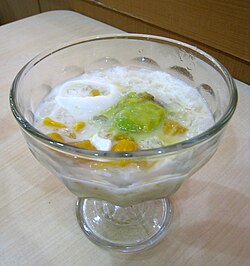
Ripe jackfruit is naturally sweet, with subtle pineapple- or banana-like flavor.[7] It can be used to make a variety of dishes, including custards, cakes, or mixed with shaved ice as es teler in Indonesia or halo-halo in the Philippines. For the traditional breakfast dish in southern India, idlis, the fruit is used with rice as an ingredient and jackfruit leaves are used as a wrapping for steaming. Jackfruit dosas can be prepared by grinding jackfruit flesh along with the batter. Ripe jackfruit arils are sometimes seeded, fried, or freeze-dried and sold as jackfruit chips.[7]
The seeds from ripe fruits are edible once cooked, and have a milky, sweet taste often compared to Brazil nuts. They may be boiled, baked, or roasted.[7] When roasted, the flavor of the seeds is comparable to chestnuts. Seeds are used as snacks (either by boiling or fire-roasting) or to make desserts. In Java, the seeds are commonly cooked and seasoned with salt as a snack. They are commonly used in curry in India in the form of a traditional lentil and vegetable mix curry. Young leaves are tender enough to be used as a vegetable.[7] Jackfruit seeds can also be dehydrated and ground into a thickener, used in cooking soup, or ground together with wheat to serve as a flour.[citation needed]
The flavor of the ripe fruit is comparable to a combination of apple, pineapple, mango, and banana.[7] Varieties are distinguished according to characteristics of the fruit flesh. In Indochina, the two varieties are the "hard" version (crunchier, drier, and less sweet, but fleshier), and the "soft" version (softer, moister, and much sweeter, with a darker gold-color flesh than the hard variety). Unripe jackfruit has a mild flavor and meat-like texture and is used in curry dishes with spices in many cuisines. The skin of unripe jackfruit must be peeled first, then the remaining jackfruit flesh is chopped into edible portions and cooked before serving. The final chunks resemble prepared artichoke hearts in their mild taste, color, and flowery qualities.[citation needed]
The cuisines of many Asian countries use cooked young jackfruit. In many cultures, jackfruit is boiled and used in curries as a staple food. The boiled young jackfruit is used in salads or as a vegetable in spicy curries and side dishes, and as fillings for cutlets and chops. It may be cooked with coconut milk and eaten alone or with meat, shrimp or smoked pork. The jackfruit seeds are also boiled and used in sambar (stew).[citation needed]
Processed jackfruit is sold in US stores and has been marketed as a plant-based meat alternative.[37] After roasting, the seeds may be used as a commercial alternative to chocolate aroma.[38]
South Asia
[edit]In many countries, including Bangladesh, the fruit is consumed on its own. The unripe fruit is used in curry, and the seed is often dried and preserved to be later used in curry.[7][39] In India, two varieties of jackfruit predominate: muttomvarikka and sindoor. Muttomvarikka has a slightly hard inner flesh when ripe, while the inner flesh of the ripe sindoor fruit is soft.[40] In Sri Lanka these two varieties are called waraka and wela respectively.
A sweet preparation called chakkavaratti (jackfruit jam) is made by seasoning pieces of muttomvarikka fruit flesh in jaggery, which can be preserved and used for many months. The fruits are either eaten alone or as a side to rice. The juice is extracted and either drunk straight or as a side. The juice is sometimes condensed and eaten as candies. The seeds are either boiled or roasted and eaten with salt and hot chilies. They are also used to make spicy side dishes with rice. Jackfruit may be ground and made into a paste, then spread over a mat and allowed to dry in the sun to create a natural chewy candy.[7]
-
 Jackfruit seeds
 -
 Jackfruit flesh of orange-fleshed variety
 -
 Jackfruit curry (Sri Lanka)
 -
 Green jackfruit and potato curry (West Bengal)
 -
 Jackfruit masala (India)
 -
 "Rags" fried in coconut oil from Kerala, India
 -
 Jackfruit (unripe) cutlet, India


_Cutlet.jpg)
Southeast Asia
[edit]

In Indonesia and Malaysia, jackfruit is called nangka. The ripe fruit is usually sold separately and consumed on its own, or sliced and mixed with shaved ice as a sweet concoction dessert such as es campur and es teler. The ripe fruit might be dried and fried as kripik nangka, or jackfruit cracker. The seeds are boiled and consumed with salt, as they contain edible starchy content; this is called beton. Young (unripe) jackfruit is made into curry called gulai nangka or stewed called gudeg.
In the Philippines, unripe jackfruit or langka is usually cooked in coconut milk and eaten with rice; this is called ginataang langka.[41] The ripe fruit is often an ingredient in local desserts such as halo-halo and the Filipino turon. The ripe fruit, besides also being eaten raw as it is, is also preserved by storing in syrup or by drying.[7] The seeds are also boiled before being eaten.[7]
Thailand is a major producer of jackfruit, which are often cut, prepared, and canned in a sugary syrup (or frozen in bags or boxes without syrup) and exported overseas, frequently to North America and Europe.
In Vietnam, jackfruit is used to make jackfruit chè, a sweet dessert soup, similar to the Chinese derivative bubur cha cha. The Vietnamese also use jackfruit purée as part of pastry fillings or as a topping on xôi ngọt (a sweet version of sticky rice portions).
in Taiwan, jackfruits are found primarily in the eastern part of the island. The fresh fruit can be eaten directly or preserved as dried fruit, candied fruit, or jam. It is also stir-fried or stewed with other vegetables and meat.[citation needed]
-
-
 Gudeg (left), jackfruit curry with palm sugar (Indonesia)
 -
 Halo-halo, shaved ice dessert with various fruits and toppings (Philippines)
 -
 Chunks seasoned with paprika, tomato, etc. as a meat substitute


Americas
[edit]In Brazil, three varieties are recognized: jaca-dura, or the "hard" variety, which has a firm flesh, and the largest fruits that can weigh between 15 and 40 kg each; jaca-mole, or the "soft" variety, which bears smaller fruits with a softer and sweeter flesh; and jaca-manteiga, or the "butter" variety, which bears sweet fruits whose flesh has a consistency intermediate between the "hard" and "soft" varieties.[42]
Many Brazilian recipes use jackfruit to create vegan meat, sweets or various recipes where animal meat is replaced by vegan jackfruit meat.[7]
Africa
[edit]From a tree planted for its shade in gardens, it became an ingredient for local recipes using different fruit segments. The seeds are boiled in water or roasted to remove toxic substances, and then roasted for a variety of desserts. The flesh of the unripe jackfruit is used to make a savory salty dish with smoked pork. The jackfruit arils are used to make jams or fruits in syrup, and can also be eaten raw.[7]
Materials
[edit]Wood and manufacturing
[edit]The golden yellow timber with good grain is used for building furniture and house construction in India. It is termite-resistant[43] and is superior to teak for building furniture. The wood of the jackfruit tree is important in Sri Lanka and is exported to Europe. Jackfruit wood is widely used in the manufacture of furniture, doors and windows, in roof construction,[7] and fish sauce barrels.[44]
The wood of the tree is used for the production of musical instruments. In Indonesia, hardwood from the trunk is carved out to form the barrels of drums used in the gamelan, and in the Philippines, its soft wood is made into the body of the kutiyapi, a type of boat lute. It is also used to make the body of the Indian string instrument veena and the drums mridangam, thimila, and kanjira.[45]
In culture
[edit]The jackfruit has played a significant role in Indian agriculture for centuries. Archaeological findings in India have revealed that jackfruit was cultivated in India 3,000 to 6,000 years ago.[46] It has also been widely cultivated in Southeast Asia.
The ornate wooden plank called avani palaka, made of the wood of the jackfruit tree, is used as the priest's seat during Hindu ceremonies in Kerala. In Vietnam, jackfruit wood is prized for the making of Buddhist statues in temples[47] The heartwood is used by Buddhist forest monastics in Southeast Asia as a dye, giving the robes of the monks in those traditions their distinctive light-brown color.[48]
Jackfruit is the national fruit of Bangladesh,[39][49] and Sri Lanka, and the state fruit of the Indian states of Kerala[50] (which hosts jackfruit festivals) and Tamil Nadu.[51][52]
See also
[edit]- Domesticated plants and animals of Austronesia
- Chempedak, a closely related Southeast Asian fruit sometimes confused with jackfruit
- Durian, a fruit similar in appearance but from an unrelated tree, also from Southeast Asia
References
[edit]- ^ Under its accepted name Artocarpus heterophyllus (then as heterophylla) this species was described in Encyclopédie Méthodique, Botanique 3: 209. (1789) by Jean-Baptiste Lamarck, from a specimen collected by botanist Philibert Commerson. Lamarck said of the fruit that it was coarse and difficult to digest. Larmarck's original description of tejas. Vol. t.3. Panckoucke;Plomteux. 1789. Retrieved 23 November 2012.
On mange la chair de son fruit, ainsi que les noyaux qu'il contient; mais c'est un aliment grossier et difficile à digérer.
- ^ "Name - !Artocarpus heterophyllus Lam". Tropicos. Saint Louis, Missouri: Missouri Botanical Garden. Retrieved 23 November 2012.
- ^ "Artocarpus heterophyllus Lam". World Flora Online. World Flora Consortium. 2023. Retrieved 3 September 2023.
- ^ "Name – Artocarpus heterophyllus Lam. synonyms". Tropicos. Saint Louis, Missouri: Missouri Botanical Garden. Retrieved 23 November 2012.
- ^ "Artocarpus heterophyllus". Germplasm Resources Information Network. Agricultural Research Service, United States Department of Agriculture. Retrieved 23 November 2012.
- ^ "Artocarpus heterophyllus". Tropical Biology Association. October 2006. Archived from the original on 15 August 2012. Retrieved 23 November 2012.
- ^ a b c d e f g h i j k l m n o p q r s t u v w x y z aa ab ac ad ae af ag ah ai aj ak Morton, Julia F. (1987). Jackfruit. In: Fruits of Warm Climates. Center for New Crops & Plant Products, Purdue University, Department of Horticulture and Landscape Architecture, West Lafayette, Indiana. pp. 58–64. ISBN 0-9610184-1-0. Retrieved 21 May 2025.
- ^ a b c d e "Jackfruit Fruit Facts". California Rare Fruit Growers, Inc. 1996. Retrieved 3 September 2023.
- ^ a b Love, Ken; Paull, Robert E (June 2011). "Jackfruit" (PDF). College of Tropical Agriculture and Human Resources, University of Hawaii at Manoa.
- ^ a b c Silver, Mark (May 2014). "Here's The Scoop On Jackfruit, A Ginormous Fruit To Feed The World". NPR. Retrieved 19 April 2016.
- ^ Boning, Charles R. (2006). Florida's Best Fruiting Plants:Native and Exotic Trees, Shrubs, and Vines. Sarasota, Florida: Pineapple Press, Inc. p. 107.
- ^ Elevitch, Craig R.; Manner, Harley I. (2006). "Artocarpus heterophyllus (Jackfruit)". In Elevitch, Craig R. (ed.). Traditional Trees of Pacific Islands: Their Culture, Environment, and Use. Permanent Agriculture Resources. p. 112. ISBN 0-9702544-5-8.
- ^ Janick, Jules; Paull, Robert E. (2007). The encyclopedia of fruit and nuts. pp. 155, 175, 481–5. ISBN 978-0851996387. OCLC 1114741519.
- ^ Oxford English Dictionary, Second Edition, 1989, online edition
- ^ The American Heritage Dictionary of the English Language: Fourth Edition. Bartleby. 2000. Archived from the original on 30 November 2005.
- ^ Pradeepkumar, T.; Jyothibhaskar, B. Suma; Satheesan, K. N. (2008). Prof. K. V. Peter (ed.). Management of Horticultural Crops. Horticultural Science Series. Vol. 11. New Delhi, India: New India Publishing. p. 81. ISBN 978-81-89422-49-3.
The English name jackfruit is derived from Portuguese jaca, which is derived from Malayalam chakka,
- ^ Friar Jordanus (1863). Mirabilia descripta: the wonders of the East. Hakluyt Society. p. 13. Retrieved 23 November 2012.
- ^ Southworth, Franklin (2 August 2004). Linguistic Archaeology of South Asia. Routledge. ISBN 1-134-31776-X – via Google Books.
- ^ Stewart, Ralph R. (1984). "How Did They Die?" (PDF). Taxon. 33 (1): 48–52. Bibcode:1984Taxon..33...48S. doi:10.2307/1222028. hdl:2027.42/149689. JSTOR 1222028.
- ^ Wolff, John U. (1972). "Nangkà" (PDF). A Dictionary of Cebuano Visayan. Vol. 2. p. 698.
- ^ a b Blust, Robert; Trussel, Stephen:
- "Loans: jackfruit - Artocarpus spp.". Austronesian Comparative Dictionary. Max Planck Institute for Evolutionary Anthropology. 2010. Retrieved 17 July 2023.
- Blust, Robert; Trussel, Stephen (2013). "The Austronesian Comparative Dictionary: A Work in Progress". Oceanic Linguistics. 52 (2): 493–523. doi:10.1353/ol.2013.0016. S2CID 146739541.
- ^ Pushpakumara, D. K. N. G. (2006). "Floral and Fruit Morphology and Phenology of Artocarpus heterophyllus Lam. (Moraceae)". Sri Lankan J. Agric. Sci. 43: 82–106.
- ^ Herrmann, Bridget; Cooper, Lucy (11 April 2024). "Jumbo jackfruit harvested at Feluga as demand for the popular vegan, vegetarian meat alternative grows". ABC News. Retrieved 11 April 2024.
- ^ N. Haq (2006). Jackfruit Artocarpus heterophyllus; Volume 10 of Fruits for the Future; p 4-11, 72 f. International Center for Underutilized Crops. ISBN 0-85432-785-1.[permanent dead link]
- ^ Ong, B.T.; Nazimah, S.A.H.; Tan, C.P.; Mirhosseini, H.; Osman, A.; Hashim, D. Mat; Rusul, G. (August 2008). "Analysis of volatile compounds in five jackfruit (Artocarpus heterophyllus L.) cultivars using solid-phase microextraction (SPME) and gas chromatography-time-of-flight mass spectrometry (GC-TOFMS)". Journal of Food Composition and Analysis. 21 (5): 416–422. doi:10.1016/j.jfca.2008.03.002.
- ^ Hargreaves, Dorothy; Hargreaves, Bob (2013). Tropical Trees of Hawaii (updated from first version in 1964). Kailua, Hawaii: Ross Hargreaves. p. 30. ISBN 978-0910690027.
- ^ "Danger or delight? Uphill battle for Brazil's huge jackfruit". ABC News.
- ^ Blench, Roger (2008). "A history of fruits on the Southeast Asian mainland" (PDF). In Osada, Toshiki; Uesugi, Akinori (eds.). Occasional Paper 4: Linguistics, Archaeology and the Human Past. Indus Project. pp. 115–137. ISBN 978-4-902325-33-1.
- ^ Balcombe, Jonathan (2021). Super Fly: The Unexpected Lives of the World's Most Successful Insects. New York: Penguin Books. p. 152. ISBN 978-0-14-313427-5.
- ^ Benjamin Elisha Sawe (25 April 2017). "World Leaders In Jackfruit Production". WorldAtlas. Retrieved 23 May 2018.
- ^ Haq, Nazmul (2006). Jackfruit: Artocarpus heterophyllus (PDF). Southampton, UK: Southampton Centre for Underutilised Crops. p. 129. ISBN 0-85432-785-1. Archived from the original (PDF) on 5 October 2012.
- ^ a b Goldenberg, Suzanne (23 April 2014). "Jackfruit heralded as 'miracle' food crop". The Guardian, London, UK. Retrieved 17 October 2016.
- ^ a b Brian Kateman (20 August 2019). "This Ancient 'Miracle Fruit' Is The Latest Meat Replacement Craze". Forbes. Retrieved 2 September 2019.
- ^ United States Food and Drug Administration (2024). "Daily Value on the Nutrition and Supplement Facts Labels". FDA. Archived from the original on 27 March 2024. Retrieved 28 March 2024.
- ^ "TABLE 4-7 Comparison of Potassium Adequate Intakes Established in This Report to Potassium Adequate Intakes Established in the 2005 DRI Report". p. 120. In: Stallings, Virginia A.; Harrison, Meghan; Oria, Maria, eds. (2019). "Potassium: Dietary Reference Intakes for Adequacy". Dietary Reference Intakes for Sodium and Potassium. pp. 101–124. doi:10.17226/25353. ISBN 978-0-309-48834-1. PMID 30844154. NCBI NBK545428.
- ^ Mwandambo, Pascal (11 March 2014). "Venture in rare jackfruit turns farmers' fortunes around". Standard Online. Standard Group Ltd. Retrieved 20 December 2016.
- ^ Stukin, Stacie (15 July 2016). "Is Jackfruit the Next Big Meat Substitute?". National Geographic. Retrieved 15 March 2025.
- ^ Spada, Fernanda Papa; et al. (21 January 2017). "Optimization of Postharvest Conditions To Produce Chocolate Aroma from Jackfruit Seeds" (PDF). Journal of Agricultural and Food Chemistry. 65 (6): 1196–1208. Bibcode:2017JAFC...65.1196S. doi:10.1021/acs.jafc.6b04836. PMID 28110526.
- ^ a b Matin, Abdul. "A poor man's fruit: Now a miracle food!". The Daily Star. Retrieved 12 June 2015.
- ^ Ashwini. A (2015). Morpho-Molecular Characterization of Jackfruit. Artocarpus heterophyllus (Thesis). Kerala Agricultural University.
- ^ "Ginataang Langka (Jackfruit in Coconut Milk)". Filipino Chow. 20 May 2018. Retrieved 19 April 2019.
- ^ General information Archived 13 April 2009 at the Wayback Machine, Department of Agriculture, State of Bahia
- ^ Bali, KALIUDA Gallery (30 January 2021). "All About Jackfruit Wood or Jackwood". KALIUDA Gallery Bali. Archived from the original on 3 October 2022. Retrieved 17 September 2021.
- ^ "Nam O fish sauce village". Danang Today. 26 February 2014. Retrieved 22 September 2015.
- ^ Chauhan, Chandrashekhar; Singru, P. M.; Vathsan, Radhika (31 March 2021). "The effect of the extended bridge on the Timbre of the Sarasvati Veena: a numerical and experimental study". Journal of Measurements in Engineering. 9 (1): 23–35. doi:10.21595/jme.2020.21712. ISSN 2335-2124.
- ^ Preedy, Victor R.; Watson, Ronald Ross; Patel, Vinood B., eds. (2011). Nuts and Seeds in Health and Disease Prevention (1st ed.). Burlington, Massachusetts: Academic Press. p. 678. ISBN 978-0-12-375689-3.
- ^ "Gỗ mít nài". Nhagoviethung.com. Archived from the original on 3 April 2017. Retrieved 17 June 2014.
- ^ Forest Monks and the Nation-state: An Anthropological and Historical Study in Northeast Thailand, J.L. Taylor 1993 p. 218
- ^ "Jackfruit – National Fruit of Bangladesh". By Bangladesh.com. Retrieved 5 April 2021.
- ^ "Jackfruit Declared as Official State Fruit of Kerala; Proposal by the Agriculture Department". India.com. 21 March 2018. Retrieved 12 January 2023.
- ^ Subrahmanian, N.; Hikosaka, Shu; Samuel, G. John; Thiagarajan, P. (1997). Tamil social history. Institute of Asian Studies. p. 88. Retrieved 23 March 2010.
- ^ "Kerala's State fruit!". Retrieved 17 March 2018.
External links
[edit] Jackfruit at the Wikibooks Cookbook subproject
 Media related to Artocarpus heterophyllus (category) at Wikimedia Commons
 Data related to Artocarpus heterophyllus at Wikispecies
 The dictionary definition of jackfruit at Wiktionary


Video
[edit]| Animal products | |
|---|---|
| |
| Edible plants / [oots | |
| Mushrooms | |
| |
|
|
| Resins | |
| Sap / gum / etc. | |
| Other | |
| Related | |

| Main symbols |
|   |
|---|---|---|
| Monuments and Memorials |
| |
| People |
| |
| Flora and fauna |
| |
| Other symbols |
| |
.svg)


| International | |
|---|---|
| National | |

Jackfruit
View on GrokipediaTaxonomy and Etymology
Scientific Classification
The jackfruit, scientifically known as Artocarpus heterophyllus Lam., belongs to the kingdom Plantae, phylum Tracheophyta, class Magnoliopsida, order Rosales, family Moraceae (the mulberry family), and tribe Artocarpeae.[4][5] The binomial name was established by Jean-Baptiste Lamarck in 1789, reflecting the species' distinctive variable leaf shapes (heterophyllus meaning "differently leaved").[6] Within the genus Artocarpus, which comprises approximately 70 species of primarily tropical evergreen trees, A. heterophyllus is closely related to breadfruit (Artocarpus altilis) and cempedak (Artocarpus integer), sharing a common ancestry in the Paleotropics.[7][8] The genus is characterized by evolutionary adaptations such as the development of large syncarpous fruits—formed by the fusion of numerous flowers into a single compound structure—which facilitate seed dispersal by large vertebrates and enhance nutritional storage in nutrient-poor tropical soils.[9][10] Historical synonyms for A. heterophyllus include Artocarpus integrifolia L.f. and Artocarpus maximus Blanco, reflecting early taxonomic variations based on morphological observations in colonial botanical descriptions.[6][11] Cytogenetically, A. heterophyllus is a tetraploid with a somatic chromosome number of 2n = 56 (basic number x = 14), a trait linked to its robust growth and fruit size.[12] Polyploidy is common in the Artocarpus genus, as seen in relatives like breadfruit, which also exhibits 2n = 56, contributing to hybrid vigor and adaptability in cultivated populations.[13][14]Common Names
The English name "jackfruit" originates from the Portuguese term "jaca," which was adopted by Portuguese explorers upon their arrival in India in the late 15th century and derives from the Malayalam word "chakka," referring to the fruit in the Malabar region.[12][15] This linguistic path reflects the fruit's historical dissemination through maritime trade routes connecting Indian subcontinent to Europe and beyond, with the term evolving into "jack" in English by the 17th century.[12] In the Indian subcontinent, where the jackfruit is native, it bears a variety of vernacular names tied to regional languages and ancient influences, including the Sanskrit "panasa," which likely contributed to Dravidian terms emphasizing its fruit-like qualities.[15] Common examples include "chakka" in Malayalam, "kathal" in Hindi, "kanthal" in Bengali, "phanasa" in Marathi and Gujarati, and "pala" or "palasu" in Tamil, with Kannada speakers using "halasu" for the tree and "halasina hannu" for the fruit.[15][16] Southeast Asian names demonstrate the fruit's spread via ancient trade networks across the Indian Ocean and archipelagoes, adapting to local Austronesian and Tai-Kadai languages.[17] In Malay and Indonesian, it is known as "nangka," while Javanese variants include "nangk" or "jak."[16][17] Thai communities call it "khanun" or "makmi," Vietnamese speakers use "mít," and in the Philippines, it is "langka" in Tagalog or "nangkà" in Cebuano.[18][11][16] Beyond these core regions, jackfruit has accrued over 100 local variants in introduced areas, such as "khnaôr" in Burmese or "bo luo mi" in Chinese, underscoring its adaptation through colonial and migratory exchanges.[19][16]Botanical Description
Tree Morphology
The jackfruit tree (Artocarpus heterophyllus) is a large evergreen species that typically attains a mature height of 10 to 25 meters, though exceptional specimens can exceed 30 meters under optimal conditions.[11][20] The trunk is straight and unbuttressed, reaching diameters of 30 to 100 centimeters at maturity, providing structural support for the expansive crown.[21][20] The bark is rough and scaly, colored grayish-brown to dark gray, and exudes a milky white latex when cut or injured, a characteristic feature of the Moraceae family.[11][12] Leaves are alternate, simple, and elliptic to oblong in shape, measuring 10 to 25 centimeters in length and 5 to 12 centimeters wide, with a glossy dark green upper surface, pale green underside, and thick, leathery texture that contributes to water retention in tropical environments.[11][3] Juvenile leaves on young shoots are often deeply lobed, transitioning to entire margins as the tree matures.[21][22] Branches emerge horizontally from the trunk, forming a dense, spreading canopy that can extend 10 to 15 meters in width, creating a rounded or dome-shaped profile in older trees.[23][12] The tree exhibits fast growth in tropical climates, adding up to 1.5 meters in height annually during early years, remaining evergreen in humid native habitats but potentially semi-deciduous in drier regions where leaf drop occurs seasonally to conserve water.[18][2] The root system is extensive and robust, featuring a deep taproot for primary anchorage combined with wide-spreading lateral roots that enhance stability in loose tropical soils and aid in erosion control.[12][2] This architecture allows the tree to thrive in a variety of soil types while resisting wind damage.[23]Flowers and Reproduction
The jackfruit tree (Artocarpus heterophyllus) is monoecious, bearing separate male and female inflorescences on the same individual, with flowers densely clustered on fleshy, elongated spikes known as syconia-like structures. Male inflorescences are typically cylindrical, measuring 7–12 cm in length and 1–2.5 cm in diameter, while female inflorescences are ovoid or globose, approximately 5–10 cm long. These inflorescences emerge on short peduncles from the trunk, main branches, or younger shoots, with each containing hundreds to thousands of tiny, sessile flowers averaging 4 mm across.[24][10] Flower anatomy is simple and specialized for entomophily. Male flowers consist of a single stamen with a short filament and bilobed anther, surrounded by a single whorl of two perianth lobes that are hairy and emit a musky scent to attract pollinators; the perianth persists post-anthesis. Female flowers feature a bicarpellary, syncarpous gynoecium with a unilocular ovary, papillate stigma, and similar perianth tissue, lacking petals or sepals in the conventional sense. Upon successful pollination, the perianth surrounding each fertilized female flower swells to form edible fruitlets, which aggregate into the compound syncarp, while unpollinated flowers abort and contribute to the fruit's fibrous core.[10][25][26] Pollination is primarily facilitated by the gall midge Clinodiplosis ultracrepidata (Diptera: Cecidomyiidae), a tiny insect (1.1–1.5 mm long) that breeds in male inflorescences, where its larvae feed on post-anthesis fungal growth (Rhizopus artocarpi), before females carry pollen to receptive female flowers; midges are attracted by volatile compounds such as methyl 2-methylbutyrate. Wind and other insects play secondary roles, suggesting ambophilous tendencies, with outcrossing essential for optimal seed set, though only about 3% of female flowers typically mature. Flowering occurs year-round in tropical regions but peaks during the dry season (e.g., December–March in subtropical areas), with environmental stressors like drought increasing the male-to-female sex ratio to favor pollen production.[10][27][28] Reproduction relies mainly on seeds for natural propagation, which are recalcitrant and retain viability for only 1–2 months under ambient conditions, necessitating immediate planting in moist soil for germination rates up to 90%. Vegetative methods, such as cleft or veneer grafting, are preferred for propagating superior cultivars to maintain desirable traits like fruit size and flavor, as seeds exhibit high variability; budding and air-layering are less common but viable alternatives. Seedlings from viable seeds emerge in 2–8 weeks, developing into trees that reach reproductive maturity in 3–5 years.[29][30][31]Fruit and Seeds
The jackfruit (Artocarpus heterophyllus) is recognized as the largest tree-borne fruit, with mature specimens capable of reaching lengths of up to 90 cm, diameters of 50 cm, and weights of up to 50 kg.[3] It develops as a syncarp, a compound multiple fruit formed from the coalescence of 100–500 individual fleshy carpels originating from fused female flowers in the inflorescence.[32] This structure results in an oblong-cylindrical form, with the edible portions comprising the fleshy perianth bulbs (arils) that surround the seeds, while the central core is fibrous and inedible.[3] Externally, the unripe fruit features a thick, rubbery rind that is green and covered in numerous hexagonal, bluntly conical spines derived from the carpel apices, providing protection during growth.[3] As the fruit ripens, the rind transitions to a yellowish-brown hue, and the spines tend to flatten and widen, signaling maturity alongside a change in internal pulp color from pale to golden yellow.[23] Internally, the fruit is divided into segments by the fibrous core, each containing one or more edible arils—juicy, bulbous structures that encase the seeds—and separated by a middle fused region that contributes to the overall rubbery texture.[15] The seeds, numbering 100–500 per fruit and comprising 8–15% of the total weight, are ellipsoid to oval in shape, measuring 2–3 cm in length and 1–1.5 cm in diameter.[32] Each seed consists of a light brown hull (testa) enclosing a thin, whitish membrane and a fleshy white kernel (cotyledon), which is rich in starch; the seeds are embedded within the arils and separated by a horny endocarp covered by a sub-gelatinous exocarp about 1 mm thick.[15][33] Fruit development begins post-pollination and typically spans 3–4 months to reach maturity, though this can extend to 5–6 months depending on climate and cultivar, with the fruit enlarging rapidly during the rainy season.[3][23] Unripe fruits remain green and firm, while ripening triggers a color shift to yellow, accompanied by increased sweetness in the arils.[3] Jackfruit primarily ripens on the tree, but if harvested mature (slightly under-ripe), it can continue ripening off the tree in warm conditions (75-80°F or 24-27°C) over 3-10 days. Exposure to warm sunlight can accelerate post-harvest ripening, though ethylene gas from fruits like bananas is commonly used to speed the process.[34][35] Varietal differences influence pulp characteristics, with sweet types generally featuring softer, melting textures in Indian cultivars like those common in Kerala, contrasted by firmer, less juicy pulp in Malaysian varieties such as Tekam Yellow.[23][36] Sour or subacid types, often found in wild or less domesticated forms, exhibit thinner arils with a more astringent flavor profile compared to the juicy, banana-pineapple-like sweetness of cultivated sweet varieties.[15]Habitat and Distribution
Native Range
The jackfruit (Artocarpus heterophyllus), a species in the Moraceae family, is native to the evergreen rainforests of the Western Ghats in southwestern India and parts of Sri Lanka, where it evolved in lowland to mid-elevation habitats ranging from 0 to 1,000 meters above sea level.[12][37] These regions represent biodiversity hotspots characterized by high floral diversity, with jackfruit co-occurring naturally alongside other Moraceae relatives in mixed evergreen and semi-evergreen forest ecosystems.[38][2] In its native range, jackfruit thrives in tropical wet climates with annual rainfall between 1,500 and 3,500 mm, evenly distributed to support its growth, and average temperatures ranging from 24°C to 35°C.[18] The species prefers well-drained loamy soils with a pH of 6.0 to 7.5, which facilitate root development in the humid, forested understory.[39] Prior to human intervention, its distribution was largely confined to the Indo-Malayan region, with evidence of Artocarpus phytoliths from Sri Lankan sites dating back approximately 36,000 years, suggesting ancient presence in the region.[40][12] Wild populations in native habitats face threats from ongoing deforestation in the Western Ghats, which fragments forest ecosystems and reduces genetic diversity.[41]Introduced and Cultivated Regions
Jackfruit was introduced to the Malay Archipelago in ancient times through maritime trade routes connecting the Indian subcontinent to Southeast Asia. Its spread to the Philippines and Indonesia occurred through ancient migrations and trade, integrating into local agriculture in Southeast Asia.[42] Today, jackfruit is cultivated across tropical and subtropical regions worldwide, with major producers including India, which leads global output at 1.4 million tons annually (as of 2018), followed by Bangladesh, Vietnam, Thailand, and Indonesia.[43] It has also been successfully established in Brazil, Australia, southern Florida in the United States, and parts of Africa such as Uganda and Mauritius, and is naturalized in some areas of Central America and the Pacific.[23][18][12] The tree thrives in USDA hardiness zones 10–12, favoring humid tropical conditions, and has seen recent expansions into subtropical areas like Hawaii and South Africa.[22][44] In introduced regions, jackfruit faces challenges from pests such as fruit borers (Diaphania caesalis), which tunnel into shoots and fruits, causing significant damage in non-native tropics.[12] Recent 2024 studies in Nayarit, Mexico, evaluated genotype suitability, characterizing varieties like “Agüitada,” “Rumina,” “Licenciada,” and “Karlita” for morphological, physiological, and physicochemical traits to improve adaptation.[45] Globally, jackfruit occupies over 500,000 hectares of cultivated land, with Asia accounting for approximately 90% of this area, primarily in India (around 188,000 hectares) and Bangladesh (over 25,000 hectares).[46][47] In some introduced areas, it poses minor invasive risks due to prolific seed dispersal, though management focuses on its economic value.[12]Ecological Role
Pollination and Seed Dispersal
Jackfruit is primarily wind- and insect-pollinated, with studies in introduced ranges such as Florida identifying gall midges of the species Clinodiplosis ultracrepidata (Diptera: Cecidomyiidae) as a key pollinator.[10] In native habitats, pollination occurs mainly through anemophily (wind) supplemented by insects like bees and flies. These insects are attracted to the volatile emissions from male inflorescences, particularly compounds like methyl tiglate, which elicit strong electrophysiological responses. Male flowers provide a brood site where midges oviposit eggs and larvae feed on symbiotic fungi growing within the inflorescence, forming a mutualistic relationship. In contrast, female inflorescences employ deceit pollination, luring insects with similar scents but offering no rewards, resulting in low pollination efficiency with seed set rates around 3% under natural conditions.[10] Secondary pollination agents include wind, which assists in pollen transfer given the fine, sticky nature of jackfruit pollen, as well as visits by small insects such as flies (e.g., Drosophilidae) and beetles. Experimental exclusion of insects reduced but did not eliminate seed set, supporting a role for anemophily alongside entomophily. Some jackfruit varieties exhibit self-incompatibility, which discourages self-fertilization and promotes outcrossing to enhance genetic diversity.[10][12][48][23] Seed dispersal in jackfruit occurs mainly through gravity and zoochory. Mature fruits, weighing up to 30 kg, detach and fall to the forest floor, where gravity facilitates initial spread. Animals play a key role by consuming the ripe, aromatic fruit and excreting viable seeds; in native ranges, this includes primates like monkeys, bats, elephants, rodents, and wild pigs, which can transport seeds over distances aiding colonization. In flood-prone riverine areas, water may contribute to dispersal by carrying floating fruits or seeds downstream.[49] Jackfruit seeds undergo hypogeal germination, where the cotyledons remain below ground. Fresh seeds germinate rapidly in moist, well-drained soil, with initial sprouting in 5–10 days and 80–100% germination achieved within 35–40 days under shaded conditions (50–70% shade) and temperatures around 25–30°C. Seeds lack dormancy but are recalcitrant and highly sensitive to desiccation, losing viability quickly if allowed to dry; they require immediate planting or storage in moist media at low temperatures (e.g., 6–15°C).[16] The high reproductive output of jackfruit supports forest regeneration in tropical ecosystems, with mature trees producing up to 200–250 fruits annually, each containing 30–500 seeds, yielding potentially over 25,000 seeds per tree per year. This prolific seed production, combined with effective dispersal, enables jackfruit to rapidly colonize gaps in native woodlands and contribute to biodiversity through seedling establishment.[23][50]Ecosystem Services
Jackfruit trees contribute significantly to carbon sequestration, with studies indicating that they can store approximately 26.7 tons of CO₂ per hectare in their biomass.[51] Their extensive root systems further aid in soil stabilization, effectively preventing erosion in tropical environments by anchoring soil and reducing surface runoff during heavy rains.[12] This root structure enhances overall ecosystem stability in flood-prone areas.[18] In terms of biodiversity support, jackfruit trees provide essential habitat and foraging opportunities for birds, insects, pollinators, and mammals, with their dense canopies and fallen fruits creating microhabitats that foster wildlife diversity in tropical and agroforestry settings.[52] For instance, the abundance of jackfruit influences the foraging and breeding success of species like golden-headed lion tamarins in shaded agroforests.[53] Additionally, the tree's milky latex serves as a natural deterrent against herbivores, acting as a defensive exudate that inhibits feeding by insects and mammals through its antimicrobial and irritant properties.[54] Jackfruit exhibits notable climate resilience, particularly once established, with its drought-tolerant characteristics enabling survival in varying moisture conditions and high temperatures, making it a valuable component of agroforestry systems amid environmental shifts.[55] Recent evaluations of cultivars have highlighted structural adaptations, such as thicker leaf tissues and optimized stomatal density, that enhance photosynthetic efficiency and water use under drought stress.[56] Regarding soil improvement, jackfruit benefits from associations with nitrogen-fixing plants in agroforestry setups, which elevate soil nitrogen levels by 9–19% through symbiotic processes and decomposition.[57] The tree's leaf litter further enriches the soil by adding organic matter, increasing soil organic carbon and nutrient availability while moderating soil temperature and moisture.[57] Jackfruit's deep root system plays a key role in water regulation, promoting infiltration and minimizing surface runoff during rainy seasons, which helps maintain hydrological balance and prevents downstream flooding in tropical landscapes.[52]Invasive Characteristics
Jackfruit (Artocarpus heterophyllus) has been identified as an invasive species in certain non-native ecosystems, particularly where human management is limited, allowing it to establish self-sustaining populations that disrupt local biodiversity. In Brazil, it is recognized as a problematic exotic species in the Atlantic Forest, including protected areas such as Tijuca National Park and 13 federal conservation units, where it was introduced centuries ago by Portuguese colonists and has since proliferated aggressively.[58][59] However, in most tropical regions, jackfruit remains non-invasive due to regular human harvesting of fruits, which prevents widespread seed dispersal and establishment beyond cultivated areas.[18] The spread of jackfruit in invasive contexts is facilitated by its seeds, which are primarily dispersed by birds and mammals that consume the fruit and excrete viable seeds in disturbed habitats such as forest edges or degraded lands.[60] These seeds germinate readily in such areas, and the tree's rapid growth—reaching up to 25 meters in height—enables it to outcompete native vegetation for light, water, and nutrients, leading to the formation of dense monospecific stands.[61] In Brazil's Atlantic Forest fragments, this has resulted in significantly reduced understory plant diversity, with studies reporting low species richness (Shannon diversity index averaging 0.74) in jackfruit-dominated areas compared to native forests.[62] Management efforts in conservation areas focus on physical and chemical control methods to curb jackfruit expansion. Mechanical techniques, such as trunk girdling, and chemical applications, including herbicide injection into the trunk, have been tested and shown effective in reducing tree vigor and preventing regrowth, with herbicide methods achieving higher mortality rates in field trials conducted in Brazilian protected sites.[63] These interventions are prioritized in biodiversity hotspots to restore native flora, though challenges persist due to the tree's prolific seed production and animal-mediated dispersal.[64]Cultivation
Historical Development
The domestication of jackfruit (Artocarpus heterophyllus) is believed to have occurred in the Western Ghats of India millennia ago, marking one of the earliest instances of tropical fruit cultivation in the Indian subcontinent.[50] Early references appear in Sanskrit literature, such as the Valmiki Ramayana (circa 500 BCE–100 BCE), where the fruit is described as "panasa" in forested landscapes, indicating its cultural and nutritional significance in Vedic society.[65] By around 1000 BCE, backyard cultivation was common in regions like Kerala, where the tree's multipurpose yield—fruit, seeds, and timber—supported household economies in the humid lowlands.[50] Jackfruit's spread beyond India occurred through ancient trade networks, reaching Southeast Asia by the 1st century CE via maritime routes and the early Silk Road extensions.[66] Historical accounts, including those by Roman naturalist Pliny the Elder around 77 CE, note the fruit's presence in Indian Ocean commerce, facilitating its adoption in present-day Malaysia, Indonesia, and Thailand. Varietal selection for improved fruit quality, such as sweeter pulp and larger yields, emerged during medieval periods (circa 500–1500 CE) in Indian agrarian texts and practices, prioritizing clones suited to local climates over wild variants.[67] European exploration further propelled its global dissemination; Portuguese traders introduced jackfruit to the Americas in the 16th century, initially planting it in Brazil and the Caribbean for colonial sustenance.[68] In the 19th and early 20th centuries, British colonial administrations promoted jackfruit in orchards across Malaysia and Sri Lanka to bolster food security amid plantation economies focused on export crops like rubber and tea.[69] These efforts established commercial-scale cultivation, with trees integrated into mixed agroforestry systems. Post-World War II, jackfruit expanded in Africa, particularly in tropical zones of Ghana and Kenya, as colonial and post-independence programs emphasized resilient, underutilized species for rural development.[70] By the 2020s, international organizations like the FAO have highlighted jackfruit's untapped potential as a climate-resilient superfood, launching initiatives such as Bangladesh's One Country One Priority Product to enhance value chains and commercialization.[71]Propagation Methods
Jackfruit trees are commonly propagated through seeds, which are recalcitrant and must be sown fresh to achieve optimal results. Direct sowing in well-drained soil under shade yields germination rates of 80-95% for fresh seeds, typically occurring within 3-8 weeks, though rates can drop below 70% if seeds are stored even briefly due to their short viability.[50][72] Seedlings exhibit high vigor but display variable traits owing to cross-pollination, making this method suitable primarily for producing rootstocks rather than elite cultivars.[23] Vegetative propagation ensures clonal reproduction of desirable traits and is preferred for commercial cultivation. Air-layering, also known as marcotting, involves wounding branches and applying rooting hormones like IBA at 5000-10000 ppm, achieving success rates of 80-100% when performed on young, semi-hardwood branches during the rainy season. Budding techniques, such as patch or chip budding, and grafting methods like veneer or cleft grafting, further support propagation of superior varieties, with veneer grafting yielding up to 90% success when scions are collected in spring or summer and matched cambium layers are aligned precisely.[73][74] These methods typically take 5-6 years for trees to bear fruit, compared to 8-10 years for seed-grown plants.[75] Tissue culture offers a rapid, disease-free alternative for mass propagation, particularly using nodal explants from mature trees to bypass challenges like latex exudation, which is mitigated by pre-treating with antioxidants such as ascorbic acid. Micropropagation protocols involve culturing explants on Murashige and Skoog medium supplemented with cytokinins like BAP (2-5 mg/L) for shoot multiplication, achieving 4-6 shoots per explant, followed by rooting on IBA-augmented media with 80-90% rooting efficiency.[76][77] Best practices emphasize grafting elite scions onto hardy rootstocks to promote dwarfing and improved adaptability, with operations timed to the rainy season for higher humidity and reduced transplant stress. Varieties like the sweet-fruited 'Black Gold', selected for its medium-sized, high-quality fruits, and the sour 'Cochin', valued for processing, are primarily propagated vegetatively to maintain monoclonal uniformity.[23][12]Growing Conditions
Jackfruit cultivation requires a tropical or subtropical climate with average temperatures of 25–35°C and annual rainfall of at least 1,000 mm, preferably evenly distributed, to support optimal growth and fruiting. The tree is highly sensitive to frost and cold, with leaf damage occurring below 5°C and severe injury or death at temperatures under 0°C, limiting its viability in regions prone to winter freezes. While moderately drought-tolerant once established, young trees and those in fruiting stages demand consistent moisture to prevent stress.[23][11][78] The tree performs best in deep, well-drained, fertile loamy soils with a pH range of 6.0–7.5, though it can adapt to poorer gravelly or lateritic conditions if drainage is adequate. It tolerates moderate salinity but is highly susceptible to waterlogging, which can lead to root rot and tree decline within days of flooding. For commercial or home planting, trees should be spaced 10–12 meters apart to allow for their large canopy and root spread, ensuring access to sunlight and preventing competition.[23][11][78] Essential care practices include supplemental irrigation during extended dry periods, particularly for establishing trees and during flowering to fruit set, to maintain soil moisture without saturation. Mulching with 5–15 cm of organic material around the base—kept away from the trunk—helps retain moisture, suppress weeds, and regulate soil temperature. Pruning is recommended after the third year to shape the tree, remove dead or crossing branches, and maintain a manageable height of 3–4 meters for easier harvesting, ideally performed post-harvest in the dry season. Fertilization involves balanced NPK applications, such as 10-10-10 formulations, starting with light doses for young trees (e.g., 0.1–0.2 kg per tree in the first year) and increasing to 0.5–1 kg for mature ones, split into 2–3 applications during the growing season to promote vigor without excess vegetative growth.[23][78] Common pests include mealybugs and scales on leaves and fruit, while diseases such as rhizopus fruit rot and root rot from poor drainage pose significant threats, potentially causing premature fruit drop or tree loss. Management focuses on cultural practices like removing infected parts and improving drainage, with organic options such as neem oil sprays applied at 2–5% concentration every 10–15 days providing effective control for sucking insects and early fungal infections. Integrated approaches, including sanitation and monitoring, are crucial to minimize chemical use.[23][50][78][79] Trees typically reach first fruiting in 3–5 years from seed or grafted stock, achieving full production by 7–10 years, with a productive lifespan extending 60–100 years under proper care, though peak yields occur before age 20.[23][11][78]Production Statistics
India is the largest producer of jackfruit, with approximately 1.4 million metric tons in 2023, followed by Bangladesh with about 1.05 million metric tons as of 2024.[80][81] Major exporters include Vietnam, which led global jackfruit exports with a value of approximately US$237 million in 2023, particularly for canned products.[82] Imports to Europe and the United States have been rising, reflecting growing demand for fresh and processed jackfruit in these markets.[83] A mature jackfruit tree typically yields 50–200 fruits per year, equivalent to 100–300 kg of fruit, depending on variety, climate, and management practices.[23] However, post-harvest losses in tropical regions pose significant challenges, estimated at 30–40% due to inadequate storage, transportation issues, and perishability.[84] The global jackfruit market is valued at around USD 375 million in 2025, primarily driven by demand for fresh and frozen products as vegan meat alternatives and exotic fruits.[80] Recent 2024 studies in Nayarit, Mexico, highlight varying yields among local genotypes, with production in the region increasing over 218% in recent years due to improved cultivation techniques.[45] Integrating jackfruit into agroforestry systems enhances sustainability and boosts yields by up to 20%, as intercropping with compatible species improves soil health and resource efficiency.[85]Nutritional Profile
Macronutrients and Micronutrients
The edible pulp of ripe jackfruit provides approximately 95 kilocalories per 100 grams, primarily from carbohydrates, with 23.25 grams of total carbohydrates including 1.5 grams of dietary fiber, 1.7 grams of protein, and 0.64 grams of fat; sodium content is low at 2 milligrams per 100 grams.[86] Jackfruit pulp is a source of several micronutrients, including vitamin C at 13.7 milligrams per 100 grams (14% of adult male US RDA), vitamin A, and B-complex vitamins such as thiamine and riboflavin; key minerals include magnesium at 29 milligrams per 100 grams, potassium at 448 milligrams per 100 grams (9% of adult male US RDA), and iron at 0.23 milligrams per 100 grams. Per 100g of ripe jackfruit, vitamin B12, vitamin D, and selenium provide 0% of adult male US RDA, while choline and all other vitamins and minerals contribute less than 5%.[86][3][87][88] The seeds of jackfruit exhibit nutritional variability but generally offer higher energy density, with around 185 kilocalories per 100 grams of fresh weight, 38 grams of carbohydrates, 4 grams of protein, and elevated potassium levels at 448 milligrams per 100 grams; protein content in seeds can range from 5.3% to 18% depending on processing and variety, while fiber is present at 1.56 to 3.92 grams per 100 grams.[3][89][90] Unripe jackfruit pulp contains higher starch levels, approximately 22% on a dry basis, making it suitable for vegetable use, and is rich in antioxidants such as carotenoids and phenolic compounds that contribute to its nutritional profile.[91][3]| Nutrient (per 100g) | Ripe Pulp | Seeds (fresh) |
|---|---|---|
| Calories | 95 kcal | 185 kcal |
| Carbohydrates | 23.25 g | 38 g |
| Protein | 1.7 g | 4 g |
| Fat | 0.64 g | 0.6 g |
| Fiber | 1.5 g | 3 g (avg.) |
| Potassium | 448 mg | 448 mg |
| Vitamin C | 13.7 mg | Trace |
| Magnesium | 29 mg | Variable |
| Iron | 0.23 mg | 1.2 mg (avg.) |