


Community hub
Recent from talks
Contribute something
Nothing was collected or created yet.
Lakshmi
View on Wikipedia
| Lakshmi | |
|---|---|
Mother Goddess Goddess of Wealth, Prosperity, Fortune, Sovereignty, Fertility, Abundance and Beauty[1][2] Supreme Goddess in Vaishnavism[3] | |
| Member of Tridevi and Pancha Prakriti | |
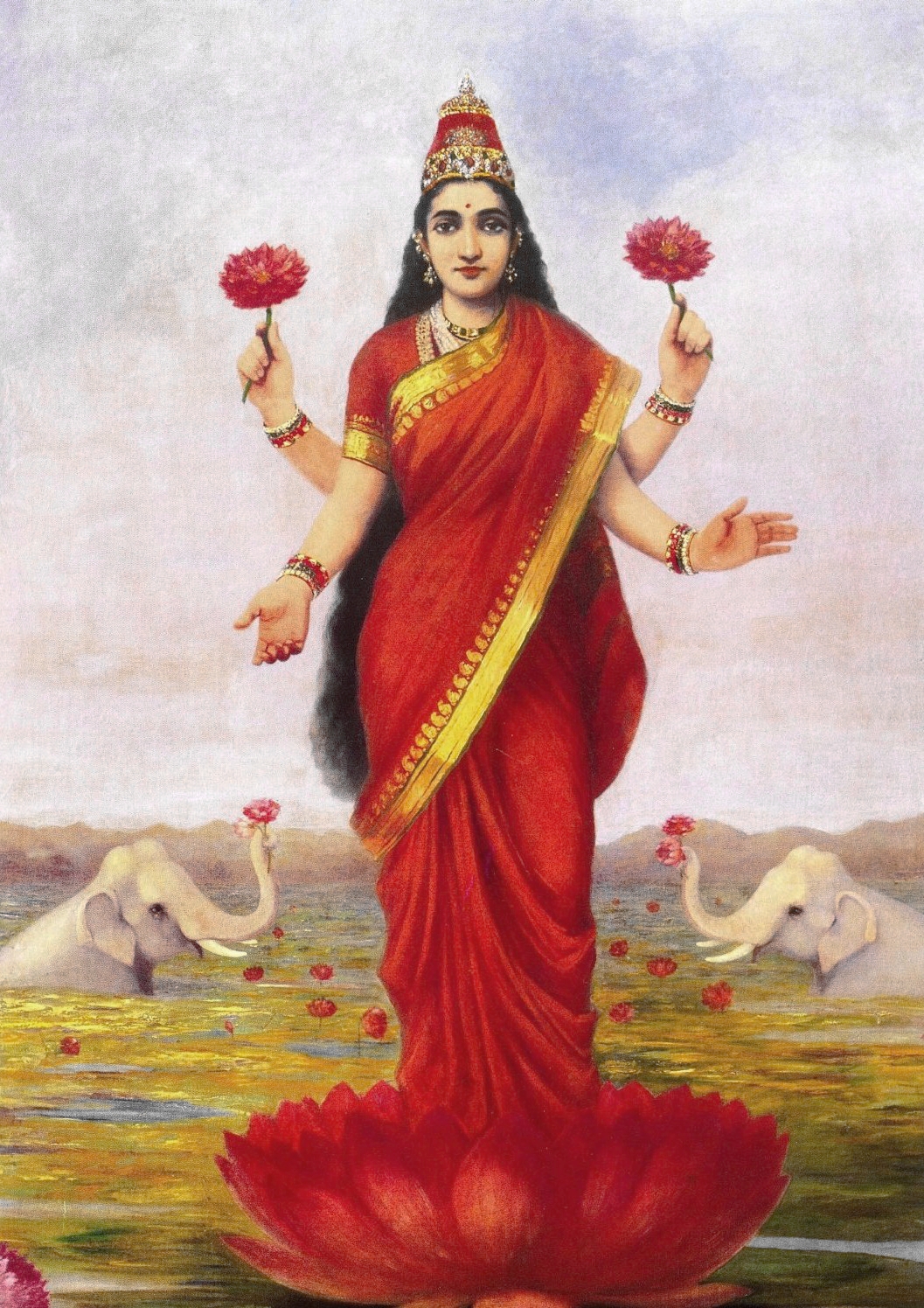
 Sri Gaja Lakshmi by Raja Ravi Varma (1896) | |
| Other names | |
| Devanagari | लक्ष्मी |
| Affiliation | |
| Abode | |
| Mantra | Oṃ Śrīṃ Mahālakṣmyai Namaḥ Oṃ Śrīṃ Śriye Namaḥ |
| Symbols | |
| Tree | Tulasi |
| Day | Friday |
| Mount | |
| Festivals | |
| Genealogy | |
| Siblings | Alakshmi |
| Consort | Vishnu[5] |
Lakshmi (/ˈlʌkʃmi/;[6][nb 1] Sanskrit: लक्ष्मी, IAST: Lakṣmī, sometimes spelled Laxmi), also known as Shri (Sanskrit: श्री, IAST: Śrī),[8] is one of the principal goddesses in Hinduism, revered as the goddess of happiness, fortune, wealth, prosperity, beauty, fertility, sovereignty, and abundance.[9][10][11] She along with Parvati and Sarasvati, form the trinity of goddesses called the Tridevi.[12][13]
Lakshmi has been a central figure in Hindu tradition since pre-Buddhist times (1500 to 500 BCE) and remains one of the most widely worshipped goddesses in the Hindu pantheon. Although she does not appear in the earliest Vedic literature, the personification of the term shri—auspiciousness, glory, and high rank, often associated with kingship—eventually led to the development of Sri-Lakshmi as a goddess in later Vedic texts, particularly the Shri Suktam.[10] Her importance grew significantly during the late epic period (around 400 CE), when she became particularly associated with the preserver god Vishnu as his consort. In this role, Lakshmi is seen as the ideal Hindu wife, exemplifying loyalty and devotion to her husband.[10] Whenever Vishnu descended on the earth as an avatar, Lakshmi accompanied him as consort, for example, as Sita and Radha or Rukmini as consorts of Vishnu's avatars Rama and Krishna, respectively.[8][14][15]
Lakshmi holds a prominent place in the Vishnu-centric sect of Vaishnavism, where she is not only regarded as the consort of Vishnu, the Supreme Being, but also as his divine energy (shakti).[10] she is also the Supreme Goddess in the sect and assists Vishnu to create, protect, and transform the universe.[5][14][16][17] She is an especially prominent figure in Sri Vaishnavism tradition, in which devotion to Lakshmi is deemed to be crucial to reach Vishnu.[18] Within the goddess-oriented Shaktism, Lakshmi is venerated as the prosperity aspect of the Supreme goddess.[19][14] The eight prominent manifestations of Lakshmi, the Ashtalakshmi, symbolise the eight sources of wealth.[20]
Lakshmi is depicted in Indian art as an elegantly dressed, prosperity-showering golden-coloured woman standing or sitting in the padmasana position upon a lotus throne, while holding a lotus in her hand, symbolising fortune, self-knowledge, and spiritual liberation.[21][22] Her iconography shows her with four hands, which represent the four aspects of human life important to Hindu culture: dharma, kama, artha, and moksha.[23][24] She is often accompanied by two elephants, as seen in the Gaja-Lakshmi images, symbolising both fertility and royal authority. The Gupta period sculpture and coins only associate lions with Lakshmi, often flanking her on either side.
Archaeological discoveries and ancient coinage suggest a recognition and reverence for Lakshmi by the first millennium BCE.[25][26] Iconography and statues of Lakshmi have also been found in Hindu temples throughout Southeast Asia, estimated to be from the second half of the first millennium CE.[27][28] The day of Lakshmi Puja during Navaratri, and the festivals of Deepavali and Sharad Purnima (Kojagiri Purnima) are celebrated in her honour.[29]
Etymology and epithets
[edit]| Part of a series on |
| Hinduism |
|---|
 |
Lakshmi in Sanskrit is derived from the root word lakṣ (लक्ष्) and lakṣa (लक्ष), meaning 'to perceive, observe, know, understand' and 'goal, aim, objective', respectively.[30] These roots give Lakshmi the symbolism: know and understand your goal.[31] A related term is lakṣaṇa, which means 'sign, target, aim, symbol, attribute, quality, lucky mark, auspicious opportunity'.[32]
The meaning and significance of Lakshmi evolved in ancient Sanskrit texts.[33] Lakshmi is mentioned once in Rigveda, in which the name is used to mean 'kindred mark, sign of auspicious fortune'.
भद्रैषां लक्ष्मीर्निहिताधि वाचि
bhadraiṣāṁ lakṣmīrnihitādhi vāci
Another important name of Lakshmi is Shri (Śrī), and the relationship between the two names is both etymologically and conceptually significant in Hindu sacred literature. The name Shri pervades Vedic literature, including the Rigveda, where she is mentioned approximately 130 times across various hymns. In these contexts, Shri consistently denotes ideas of prosperity, fertility, success, and auspiciousness. The name Lakshmi, by contrast, is more prominently used in later Puranic literature. Nonetheless, both names refer to the same divine figure, with the distinction between them rarely emphasized in early texts. However, some linguists note that they carry slightly different connotations. "Śrī" tends to denote general prosperity and auspiciousness, while "Lakṣmī" refers more specifically to material wealth. In Tamil-speaking traditions, the name Lakṣmī is rendered as Ilakkumi or Tiru, the latter being the regional equivalent of "Śrī," highlighting her continuity and adaptability across linguistic and cultural contexts.[34]
_(6843511981).jpg)
Lakshmi has numerous epithets and numerous ancient Stotram and Sutras of Hinduism recite her various names:[35][36] such as Sri (Radiance, eminence, splendor, wealth), Padmā (she who is mounted upon or dwelling in a lotus or She of the lotus), Kamalā or Kamalatmika (She of the lotus), Padmapriyā (Lotus-lover), Padmamālādhāra Devī (Goddess bearing a garland of lotuses), Padmamukhī (Lotus-faced-she whose face is as like as a lotus), Padmākṣī: (Lotus-eyed - she whose eyes are as beautiful as a lotus), Padmahasta: (Lotus-hand - she whose hand is holding [a] lotus[es]), Padmasundarī (She who is as beautiful as a lotus), Padmavati (She who was born from a lotus), Śrījā (Jatika of Sri), Narayani (belonging to Narayana or the wife of Narayana), Vaishnavi (worshipper of Vishnu or the power of Vishnu), Viṣṇupriyā (who is the beloved of Vishnu), Nandika (the one who gives pleasure). Shaktas also consider Lalita, who is praised with 1,000 names in the Lalita Sahasranama, as Lakshmi.[37]
Lakshmi Sahasranama of Skanda Purana praises Lakshmi as Mahadevi (she who is the great goddess), Mahamaya (she who is a great illusion), Karaveera Nivasini (The Goddess Who lives in Karaveera/Kolhapur) and Maha Astha Dasa Pithagne (she who has 18 great Shakta pithas). She is also praised as Mahalakshmi (she who is great Lakshmi), Mahakali (she who is great Kali), and Mahasaraswati (she who is great Saraswati) who are the primary deities in Devi Mahatmya. The other prominent names included in this text are, Bhuvaneshvari (she who is the Queen or ruler of the Universe), Katyayani (she who is the daughter of sage Katyayana), Kaushiki (Shakti that came out of the sheath (or Kosha) of Parvati), Brahmani (She who is the power of Brahma), Kamakshi (she who fulfils desires by her eyes), Chandi (she who killed Mahishasura), Chamunda (She who killed Chanda and Munda), Madhu Kaidabha Bhanjini (she who killed Madhu and Kaidabha), Durga (she who killed Durgamasura), Maheshvari (she who is the power of Maheshvara), Varahi (she who is the power of Varaha, a form of Vishnu), Narasimhi (she who is the power of Narasimha, a form of Vishnu), Srividyaa (she who is Sri Vidya), Sri Manthra Raja Rajini (the queen of Sri Vidya), Shadadharadhi devata (she who is the goddess of the six chakras).[38][39] Dutch author Dirk van der Plas says, "In Lakshmi Tantra, a text of Visnuite signature, the name Mahamaya is connected with third or destructive of Goddess' three partial functions, while in supreme form she is identified with Lakshmi".[40]
Her other names include:[35][41] Aishwarya, Akhila, Anagha, Anapagamini, Anumati, Apara, Aruna, Atibha, Avashya, Bala, Bhargavi, Bhudevi, Chakrika, Chanchala, Chandravadana, Chandrasahodari, Chandraroopa, Devi, Deepta, Dhruti, Haripriya, Harini, Harivallabha, Hemamalini, Hiranyavarna, Indira, Jalaja, Jambhavati, Janaki, Janamodini, Jyoti, Jyotsna, Kalyani, Kamalika, Ketaki, Kriyalakshmi, Kshirsha, Kuhu, Lalima, Madhavi, Madhu, Malti, Manushri, Nandika, Nandini, Nikhila, Nila Devi, Nimeshika, Padmavati, Parama, Prachi, Purnima, Radha, Ramaa, Rukmini, Samruddhi, Samudra Tanaya, Satyabhama, Shraddha, Shreeya, Sita, Smriti, Sridevi, Sudha, Sujata, Swarna Kamala, Taruni, Tilottama, Tulasi, Vasuda, Vasudhara, Vasundhara, Varada, Varalakshmi, Vedavati, Vidya, Vimala, and Viroopa.
Iconography and symbolism
[edit]
Lakshmi's iconography is found in ancient and modern Hindu and Buddhist temples. | |||||||||


,_Museum_of_Vietnamese_History,_Ho_Chi_Minh_City_-_20121014.JPG)


The image, icons, and sculptures of Lakshmi are represented with symbolism. Her name is derived from Sanskrit root words for knowing the goal and understanding the objective.[31] Her four arms are symbolic of the four goals of humanity that are considered good in Hinduism: dharma (pursuit of ethical, moral life), artha (pursuit of wealth, means of life), kama (pursuit of love, emotional fulfillment), and moksha (pursuit of self-knowledge, liberation).[24][42]
In Lakshmi's iconography, she is either sitting or standing on a lotus and typically carrying a lotus in one or two hands. The lotus carries symbolic meanings in Hinduism and other Indian traditions. It symbolizes knowledge, self-realization, and liberation in the Vedic context, and represents reality, consciousness, and karma ('work, deed') in the Tantra (Sahasrara) context.[43] The lotus, a flower that blooms in clean or dirty water, also symbolises purity regardless of the good or bad circumstances in which it grows. It is a reminder that good and prosperity can bloom and not be affected by evil in one's surroundings.[44][45]
Below, behind, or on the sides, Lakshmi is very often shown with one or two elephants, known as Gajalakshmi, and occasionally with an owl.[46] Elephants symbolise work, activity, and strength, as well as water, rain, and fertility for abundant prosperity.[47] The owl signifies the patient striving to observe, see, and discover knowledge, particularly when surrounded by darkness. As a bird reputedly blinded by daylight, the owl also serves as a symbolic reminder to refrain from blindness and greed after knowledge and wealth have been acquired.[48]
According to historian D. D. Kosambi, most of the Imperial Gupta kings were Vaishnavas and held the goddess Lakshmi in the highest esteem.[49] Goddess Lakshmi is Simhavahini (mount as lion) on most of the coins during their rule.[50] Coins during the rule of Prakashadiya, a Gupta ruler, contain the Garudadhvaja on the obverse and Lakshmi on the reverse.[49]
The Gupta period sculpture only used to associate lions with Lakshmi, but was later attributed to Durga or a combined form of both goddesses.[51][52][53] Lions were a 'vahana' of Lakshmi,[54] Lions are also associated with Veera Lakshmi, who is one of the Ashtalakshmi.[55] Historian B. C. Bhattacharya says, "An image of Gajalakshmi is found with two lions — one on either side of her. Two elephants are also shown near her head and by this we can say that Lion is also the vahana of Lakshmi along with Garuda".[56]
In some representations, wealth either symbolically pours out from one of her hands or she simply holds a jar of money. This symbolism has a dual meaning: wealth manifested through Lakshmi means both materials as well as spiritual wealth.[43] Her face and open hands are in a mudra that signifies compassion, giving or dāna ('charity').[42]
Lakshmi typically wears a red dress embroidered with golden threads, which symbolizes fortune and wealth. She, goddess of wealth and prosperity, is often represented with her husband Vishnu, the god who maintains human life filled with justice and peace. This symbolism implies wealth and prosperity are coupled with the maintenance of life, justice, and peace.[43] When Lakshmi and Vishnu appear together in images and statues, she is significantly smaller, which is often used to portray her devotional status as a wife. A frequently depicted scene of the pair illustrates Lakshmi massaging Vishnu's feet.[57]
Alternatively, Lakshmi Sahasranama of Skanda Purana, Lakshmi Tantra, and Markandeya Purana describe Lakshmi as having eighteen hands and is described as holding rosary, axe, mace, arrow, thunderbolt, lotus, pitcher, rod, sakti, sword, shield, conch, bell, wine-cup, trident, noose, and the discus in her eighteen hands, and as sitting on Garuda, a lion, or a tiger.[58][59][60] According to the Lakshmi Tantra, the goddess Lakshmi, in her ultimate form of Mahasri, has four arms of a golden complexion, and holds a citron, a club, a shield, and a vessel containing amrita.[61] In the Skanda Purana and the Venkatachala Mahatmayam, Sri, or Lakshmi, is praised as the mother of Brahma.[62]
In Japan, where Lakshmi is known as Kisshōten, she is commonly depicted with the Nyoihōju gem (如意宝珠) in her hand.[63]
Lakshmi is a member of the Tridevi, the triad of great goddesses. She represents the Rajas guna, and the Iccha-shakti.[64][65]
Historical development and attestations
[edit]Origin
[edit]_LACMA_M.85.62_(cropped).jpg)
The origins of Shri-Lakshmi can be traced to the earliest layers of Hindu sacred literature, particularly the Vedas. In the earliest texts, Shri or Lakshmi does not initially appear as a fully personified deity but as a collection of auspicious qualities and states such as radiance, beauty, abundance, power, and majesty. According to scholar Mandakranta Bose, this cluster of positive forces was gradually personified into a female divinity—a process consistent with a wider Indo-European pattern, in which ideals of well-being and sovereignty took the form of goddess figures. David Kinsley similarly notes that Lakshmi represents a type of royal goddess common to many Indo-European mythologies. Kinsley also notes that reverence of Shri-Lakshmi is particularly predates Buddhism, being featured in various stupa panels.[34]
While Lakshmi is often associated with success and dominion, her most enduring role in early Hinduism was that of a provider. Scholar Sukumari Bhattacharji, draws attention to the linguistic parallel between the Sanskrit term "Śrī" and the Latin "Ceres," the Roman goddess of fertility and agriculture, suggesting a shared etymological origin. Bhattacharji proposes that this connection reflects a deeper Indo-European tradition of female divinities tied to agricultural prosperity and maternal nourishment. Bhattacharji also offers a numismatic insight, pointing to the Kushana-era image of a goddess labeled "Ommo," who holds both a lotus and a cornucopia—symbols of fertility and abundance. She suggests that this figure may be more accurately identified with Śrī than with the more commonly assumed Uma, thus representing an early visual form of the goddess Lakshmi as she later appears in Puranic iconography. The depiction reinforces the idea of Lakshmi’s agrarian character, a view supported by her consistent association with fertility and wealth in early sources.[34]
Vedic texts
[edit]In Vedic literature—which includes the four Vedas, the Brahmanas, the Aranyakas, and the Upanishads—the name Shri appears frequently, while Lakshmi becomes more prominent only in later texts. The Rigveda (c. 1500 BCE) alone mentions Shri approximately 130 times, always in relation to prosperity, health, fortune, and radiance. In the Yajurveda’s various samhitas—Taittiriya, Kathaka, Maitrayani, and Vajasaneyi—Shri is mentioned thirteen times. While Shri and Lakshmi are considered to be identical in most of these attestations, a notable exception appears in the Vajasaneyi Samhita (31.22), which states “Śrīś ca te Lakṣmīś ca patnyau” (“Shri and Lakshmi are [his] two wives”), portraying them as distinct yet unified consorts of Vishnu, but without delineating any substantive difference between the two.[34]
One of the earliest dedicated hymns to the fully-personified goddess is the Shri Sukta, found in the khila (appendix) of the fifth mandala of the Rigveda. Though not part of the main body of the Rigvedic text, the Shri Sukta is a significant early theological development, possibly pre-dating Buddhism. The hymn comprises fifteen verses: the first two and last three invoke Lakshmi, while the central verses (3–12) are addressed to Shri. The hymn portrays the goddess as golden-hued, richly adorned with gold and silver ornaments, seated on a chariot, and associated with elephants, horses, and especially the lotus. She is invoked as the bestower of wealth, fame, food, and material wellbeing. Importantly, she is also called upon to dispel her antithetical counterpart Alakshmi, who embodies misfortune, poverty, and hunger. The distinction between Lakshmi and Alakshmi becomes a recurring theme in later texts, reinforcing Lakshmi’s association with auspiciousness and plenitude.[34]
In Atharva Veda, transcribed about 1000 BCE, Lakshmi evolves into a complex concept with plural manifestations. Book 7, Chapter 115 of Atharva Veda describes the plurality, asserting that a hundred Lakshmis are born with the body of a mortal at birth, some good, Punya ('virtuous') and auspicious, while others bad, paapi ('evil') and unfortunate. The good are welcomed, while the bad are urged to leave.[33] The concept and spirit of Lakshmi and her association with fortune and the good is significant enough that Atharva Veda mentions it in multiple books: for example, in Book 12, Chapter 5 as Punya Lakshmi.[66] In some chapters of Atharva Veda, Lakshmi connotes the good, an auspicious sign, good luck, good fortune, prosperity, success, and happiness.[2][34]
Despite the extensive praise of Shri-Lakshmi’s qualities, the early Vedic texts offer relatively little regarding her mythological origin. A more developed narrative appears in the Shatapatha Brahmana, variously estimated to be composed between 800 BCE and 300 BCE, Sri (Lakshmi) is part of one of many theories, in ancient India, about the creation of the universe. In Book 9 of Shatapatha Brahmana, Shri emerges from Prajapati, after his intense meditation on the creation of life and nature of the universe. Shri is described as a resplendent and trembling woman at her birth with immense energy and powers.[33] The gods are bewitched, desire her, and immediately become covetous of her. The gods approach Prajapati and request permission to kill her and then take her powers, talents, and gifts. Prajapati refuses, tells the gods that men should not kill women and that they can seek her gifts without violence.[67] The gods then approach Lakshmi. Agni gets food, Soma gets kingly authority, Varuna gets imperial authority, Mitra acquires martial energy, Indra gets force, Brihaspati gets priestly authority, Savitri acquires dominion, Pushan gets splendour, Saraswati takes nourishment and Tvashtri gets forms.[33] However, her presence is conditional and merit-based—she allies only with those worthy of her gifts. As a result, she moves among various divine and semi-divine figures, including Soma, Dharma, Indra, and even virtuous demons such as Bali and Prahlada. This portrayal of her shifting allegiance gives rise to the notion of her as an inconstant force, attaching herself to virtue and desert rather than personal loyalty. Ultimately, Shri settles as the steadfast consort of Vishnu, establishing the lasting association that defines Lakshmi in later devotional and mythological traditions.[34][2]
Epics
[edit]In the Epics of Hinduism, such as in Mahabharata, Lakshmi personifies wealth, riches, happiness, loveliness, grace, charm, and splendor.[2] In another Hindu legend about the creation of the universe as described in Ramayana,[68] Lakshmi springs with other precious things from the foam of the ocean of milk when it is churned by the gods and demons for the recovery of Amṛta. She appeared with a lotus in her hand and so she is also called Padmā.[2][69]: 108–11 Some scholars propose a theory that Sri and Lakshmi may have originally been different goddesses, who merged into one figure.[70]
Sita, the female protagonist of the Ramayana and her husband, the god-king Rama are considered as avatars of Lakshmi and Vishnu, respectively.
In the Mahabharata, Draupadi is described as an incarnation of Sri (Lakshmi).[71] A later interpolation attempts to reinterpret Draupadi as Shachi, associating Lakshmi instead with Rukmini, the consort of Krishna, who is an incarnation of Vishnu. However, scholars affirm that the original tradition identifies Sri with Draupadi, as evidenced in the Critical Edition.[72]
Upanishads
[edit]Shakta Upanishads are dedicated to the Tridevi of goddesses—Lakshmi, Saraswati and Parvati. Saubhagyalakshmi Upanishad describes the qualities, characteristics, and powers of Lakshmi.[73] In the second part of the Upanishad, the emphasis shifts to the use of yoga and transcendence from material craving to achieve spiritual knowledge and self-realization, the true wealth.[74][75] Saubhagya-Lakshmi Upanishad synonymously uses Sri to describe Lakshmi.[73]
Stotram and sutras
[edit]Numerous ancient Stotram and Sutras of Hinduism recite hymns dedicated to Lakshmi.[35] She is a major goddess in Puranas and Itihasa of Hinduism. In ancient scriptures of India, all women are declared to be embodiments of Lakshmi. For example:[35]
| Part of a series on |
| Vaishnavism |
|---|
 |
Every woman is an embodiment of you.
You exist as little girls in their childhood,
As young women in their youth
And as elderly women in their old age.
— Sri Kamala Stotram
Every woman is an emanation of you.
— Sri Daivakrta Laksmi Stotram
Ancient prayers dedicated to Lakshmi seek both material and spiritual wealth in prayers.[35]
Through illusion,
A person can become disconnected,
From his higher self,
Wandering about from place to place,
Bereft of clear thought,
Lost in destructive behavior.
It matters not how much truth,
May shine forth in the world,
Illuminating the entire creation,
For one cannot acquire wisdom,
Unless it is experienced,
Through the opening on the heart....
Puranas
[edit]Lakshmi is described prominently in Puranas of Hinduism. Vishnu Purana, in particular, dedicates many sections to her and also refers to her as Sri.[76] J. A. B. van Buitenen translates passages describing Lakshmi in Vishnu Purana:[76]
Sri, loyal to Vishnu, is the mother of the world. Vishnu is the meaning, Sri is the speech. She is the conduct, he the behavior. Vishnu is knowledge, she the insight. He is dharma, she the virtuous action. She is the earth, the earth's upholder. She is contentment, he the satisfaction. She wishes, he is the desire. Sri is the sky, Vishnu the Self of everything. He is the Sun, she the light of the Sun. He is the ocean, she is the shore.
Subhasita, genomic and didactic literature
[edit]Lakshmi, along with Parvati and Saraswati, is a subject of extensive Subhashita, genomic and didactic literature of India.[77] Composed in the 1st millennium BCE through the 16th century CE, they are short poems, proverbs, couplets, or aphorisms in Sanskrit written in a precise meter. They sometimes take the form of a dialogue between Lakshmi and Vishnu or highlight the spiritual message in Vedas and ethical maxims from Hindu Epics through Lakshmi.[77] An example Subhashita is Puranartha Samgraha, compiled by Vekataraya in South India, where Lakshmi and Vishnu discuss niti ('right, moral conduct') and rajaniti ('statesmanship' or 'right governance')—covering in 30 chapters and ethical and moral questions about personal, social and political life.[77]: 22
Manifestations and aspects
[edit]_in_the_Hoysaleshwara_temple_at_Halebidu.jpg)
Inside temples, Lakshmi is often shown together with Vishnu. In certain parts of India, Lakshmi plays a special role as the mediator between her husband Vishnu and his worldly devotees. When asking Vishnu for grace or forgiveness, the devotees often approach him through the intermediary presence of Lakshmi.[78] She is also the personification of spiritual fulfillment. Lakshmi embodies the spiritual world, also known as Vaikuntha, the abode of Lakshmi and Vishnu (collectively called Lakshmi Narayana). Lakshmi is the embodiment of the creative energy of Vishnu,[79] and primordial Prakriti who creates the universe.[80]

According to Garuda Purana, Lakshmi is considered as Prakriti (Mahalakshmi) and is identified with three forms — Sri, Bhu and Durga. The three forms consist of Satva ('goodness'),[2] rajas, and tamas ('darkness') gunas,[81] and assists Vishnu (Purusha) in creation, preservation and destruction of the entire universe. Durga's form represents the power to fight, conquer and punish the demons and anti-gods.
| Part of a series on |
| Shaktism |
|---|
 |
 Hinduism portal Hinduism portal |
In the Lakshmi Tantra and Lakshmi Sahasranama of Skanda Purana, Lakshmi is given the status of the primordial goddess. According to these texts, Durga and the other forms, such as Mahalakshmi, Mahakali and Mahasaraswati and all the Shaktis that came out of all gods such as Matrikas and Mahavidya,[82] are all various forms of Goddess Lakshmi.[83] In Lakshmi Tantra, Lakshmi tells Indra that she got the name Durga after killing an asura named Durgama.[84] Indologists and authors Chitralekha Singh and Prem Nath says, "Narada Purana describes the powerful forms of Lakshmi as Durga, Mahakali, Bhadrakali, Chandi, Maheshwari, Mahalakshmi, Vaishnavi and Andreye".[85]
Lakshmi, Saraswati, and Parvati are typically conceptualized as distinct in most of India, but in states such as West Bengal and Odisha, they are regionally believed to be forms of Durga.[86] In Hindu Bengali culture, Lakshmi, along with Saraswati, are seen as the daughters of Durga. They are worshipped during Durga Puja.[87]
In South India, Lakshmi is seen in two forms, Sridevi and Bhudevi, both at the sides of Venkateshwara, a form of Vishnu. Bhudevi represents the material world or energy, called the Apara Prakriti, or Mother Earth, while Sridevi is the spiritual world or energy called the Prakriti.[5][88] According to Lakshmi Tantra, Nila Devi, another manifestation or incarnation of Lakshmi, is the third consort of Vishnu.[89][90] Each goddess of this triad—Sridevi, Bhudevi, and Nila Devi—is mentioned in the Śrī Sūkta, Bhu Sūkta, and Nila Sūkta, respectively.[91][92][93] This threefold goddess can be found, for example, in Sri Bhu Neela Sahita Temple near Dwaraka Tirumala, Andhra Pradesh, and in Adinath Swami Temple in Tamil Nadu.[94] In many parts of the region, Andal is considered as an incarnation of Lakshmi.[95]

Ashta Lakshmi (Sanskrit: अष्टलक्ष्मी, Aṣṭalakṣmī, 'eight Lakshmis') is a group of eight secondary manifestations of Lakshmi. The Ashta Lakshmi presides over eight sources of wealth and thus represents the eight powers of Shri Lakshmi. Temples dedicated to Ashta Lakshmi are found in Tamil Nadu, such as Ashtalakshmi Kovil near Chennai and many other states of India.[96]
| Adi Lakshmi | The First manifestation of Lakshmi |
| Dhanya Lakshmi | Granary Wealth |
| Veera Lakshmi | Wealth of Courage |
| Gaja Lakshmi | Elephants spraying water, the wealth of fertility, rains, and food.[97] |
| Santana Lakshmi | Wealth of Continuity, Progeny |
| Vidya Lakshmi | Wealth of Knowledge and Wisdom |
| Vijaya Lakshmi | Wealth of Victory |
| Dhana / Aishwarya Lakshmi | Wealth of prosperity and fortune |
Creation and legends
[edit]
Devas (gods) and asuras (demons) were both mortal at one time in Hinduism. Amrita, the divine nectar that grants immortality, could only be obtained by churning Kshira Sagara ('Ocean of Milk'). The devas and asuras both sought immortality and decided to churn the Kshira Sagara with Mount Mandhara. The Samudra Manthana commenced with the devas on one side and the asuras on the other. Vishnu incarnated as Kurma, the tortoise, and a mountain was placed on the tortoise as a churning pole. Vasuki, the great venom-spewing serpent-god, was wrapped around the mountain and used to churn the ocean. A host of divine celestial objects came up during the churning. Along with them emerged the goddess Lakshmi. In some versions, she is said to be the daughter of the sea god since she emerged from the sea.[98]
In Garuda Purana, Linga Purana and Padma Purana, Lakshmi is said to have been born as the daughter of the divine sage Bhrigu and his wife Khyati and was named Bhargavi. According to Vishnu Purana, the universe was created when the devas and asuras churned the cosmic Kshira Sagara. Lakshmi came out of the ocean, bearing a lotus, along with the divine cow Kamadhenu, Varuni, the Parijat tree, the Apsaras, Chandra (the moon), and Dhanvantari with Amrita ('nectar of immortality'). When she appeared, she had a choice to go to the Devas or the Asuras. She chose the Devas' side and among thirty deities, she chose to be with Vishnu. Thereafter, in all three worlds, the lotus-bearing goddess was celebrated.[76]
According to another legend, she emerges during the creation of universe, floating over the water on the expanded petals of a lotus flower; she is also variously regarded as wife of Dharma, mother of Kāma, sister or mother of Dhātṛ and Vidhātṛ, wife of Dattatreya, one of the nine Shaktis of Viṣṇu, a manifestation of Prakṛti as identified with Dākshāyaṇī in Bharatasrama and as Sita, wife of Rama.[2][69]: 103–12
Worship and festivals
[edit]Festivals
[edit]Many Hindus worship Lakshmi on Deepavali (Diwali), the festival of lights.[99] It is celebrated in autumn, typically October or November every year.[100] The festival spiritually signifies the victory of light over darkness, knowledge over ignorance, good over evil and hope over despair.[101]

On the night of Deepavali, Hindus light up diyas (lamps and candles) inside and outside their home, and participate in family puja (prayers) typically to Lakshmi.[citation needed] Deepavali also marks a major shopping period, since Lakshmi connotes auspiciousness, wealth and prosperity.[104]
A very sacred day for the worship of Goddess Lakshmi falls on Chaitra Shukla Panchami, also called, Lakshmi Panchami, Shri Panchami, Kalpadi and Shri Vrata. As this worship is in the first week of the Hindu new year, by Hindu calendar, it is considered very auspicious.[105] Varalakshmi Vratam is celebrated by married Hindu women to pray for the well-being of their husbands.[106]
Gaja Lakshmi Puja is another autumn festival celebrated on Sharad Purnima in many parts of India on the full-moon day in the month of Ashvin (October).[29] Sharad Purnima, also called Kojaagari Purnima or Kuanr Purnima, is a harvest festival marking the end of monsoon season. There is a traditional celebration of the moon called the Kaumudi celebration, Kaumudi meaning moonlight.[107] On Sharad Purnima night, goddess Lakshmi is thanked and worshipped for the harvests. Vaibhav Lakshmi Vrata is observed on Friday for prosperity.[108]
Hymns
[edit]Numerous hymns, prayers, shlokas, stotra, songs, and legends dedicated to Lakshmi are recited during the ritual worship of the goddess.[35] These include:[109]
- Sri Mahalakshmi Ashtakam (by Indra)
- Sri Lakshmi Sahasaranama Stotra (by Sanat Kumara)
- Sri Stuti (by Vedanta Desika)
- Lakshmi Stuti (by Indra)
- Kanakadhara Stotram (by Adi Shankara)
- Chatuh Shloki (by Yamunacharya)
- Sri Lakshmi Sloka (by Bhagavan Hari Swamiji)
- Sri Sukta, which is contained in the Vedas and includes the Lakshmi Gayatri Mantra (Om Sri Mahalakshmyai ca vidmahe Vishnu patnyai ca dhimahi tanno Lakshmi prachodayat, Om)
- Lakshmi Gayatri mantra mentioned in the Linga Purana (48.13) - (Samudratayai vidmahe Vishnunaikena dhimahi tanno Radha prachodayat)[110]
- Ashtalakshmi Stotram (by U.V. Srinivasa Varadachariyar)[111]
Major Temples
[edit]Some temples dedicated to Goddess Lakshmi are:
- 108 Divya Desams
- Agroha Dham
- Ashtalakshmi Temple, Chennai
- Azhagiya Manavala Perumal Temple
- Bhagyalakshmi Temple, Hyderabad
- Chottanikkara Temple, Kerala
- Dadhimati Mata Temple
- Golden Temple, Sripuram
- Goravanahalli Mahalakshmi Temple[112]
- Harshat Mata Temple
- Jarai-ka-Math
- Kaila Devi Temple, Rajasthan
- Lakshmi Devi Temple, Doddagaddavalli
- Lakshminarayana Temple, Hosaholalu
- Lakshmi Temple, Khajuraho
- Laxminarayan Temple, Delhi
- Mahalakshmi Kollapuradamma Temple, Ratnagiri[113]
- Mahalakshmi Temple, Dahanu
- Mahalakshmi Temple, Kolhapur
- Mahalakshmi Temple, Mumbai
- Mookambika Temple, Kollur
- Pancha Bhargavi Kshethram
- Pundarikakshan Perumal Temple
- Padmakshi Temple
- Padmavathi Temple, Tamil Nadu
- Sri Kanaka Maha Lakshmi Temple, Andhra Pradesh
- Sri Lakshmi Chandrala Parameshwari Temple, Karnataka
- Sri Lakshmi Temple, Ashland, Massachusetts
- Thirunarayur Nambi Temple
- Vaishno Devi Temple
Archaeology
[edit]
A representation of the goddess as Gaja Lakshmi or Lakshmi flanked by two elephants spraying her with water, is one of the most frequently found in archaeological sites.[25][26] An ancient sculpture of Gaja Lakshmi (from Sonkh site at Mathura) dates to the pre-Kushan Empire era.[25] Atranjikhera site in modern Uttar Pradesh has yielded terracotta plaque with images of Lakshmi dating to the 2nd century BCE. Other archaeological sites with ancient Lakshmi terracotta figurines from the 3rd century BCE include Vaisali, Sravasti, Kausambi, Campa, and Candraketugadh.[26]
The goddess Lakshmi is frequently found in ancient coins of various Hindu kingdoms from Afghanistan to India. Gaja Lakshmi has been found on coins of Scytho-Parthian kings Azes II and Azilises; she also appears on Shunga Empire king Jyesthamitra era coins, both dating to 1st millennium BCE. Coins from 1st through 4th century CE found in various locations in India such as Ayodhya, Mathura, Ujjain, Sanchi, Bodh Gaya, Kanauj, all feature Lakshmi.[114] Similarly, ancient Greco-Indian gems and seals with images of Lakshmi have been found, estimated to be from 1st-millennium BCE.[115]
A 1400-year-old rare granite sculpture of Lakshmi has been recovered at the Waghama village along Jehlum in Anantnag district of Jammu and Kashmir.[116]
The Pompeii Lakshmi, a statuette supposedly thought to be of Lakshmi found in Pompeii, Italy, dates to before the eruption of Vesuvius in 79 CE.[117]
Outside Hinduism
[edit]Jainism
[edit]
Lakshmi is also an important deity in Jainism and found in Jain temples.[118][119] Some Jain temples also depict Sri Lakshmi as a goddess of artha ('wealth') and kama ('pleasure'). For example, she is exhibited with Vishnu in Parshvanatha Jain Temple at the Khajuraho Monuments of Madhya Pradesh,[120] where she is shown pressed against Vishnu's chest, while Vishnu cups a breast in his palm. The presence of Vishnu-Lakshmi iconography in a Jain temple built near the Hindu temples of Khajuraho, suggests the sharing and acceptance of Lakshmi across a spectrum of Indian religions.[120] This commonality is reflected in the praise of Lakshmi found in the Jain text Kalpa Sūtra.[121]
Buddhism
[edit]
In Buddhism, Lakshmi has been viewed as a goddess of abundance and fortune, and is represented on the oldest surviving stupas and cave temples of Buddhism.[122][123] In Buddhist sects of Tibet, Nepal, and Southeast Asia, Vasudhara mirrors the characteristics and attributes of the Hindu Goddess, with minor iconographic differences.[124]

In Chinese Buddhism, Lakshmi is referred to as either Gōngdétiān (功德天, lit "Meritorious god" ) or Jíxiáng Tiānnǚ (吉祥天女, lit "Auspicious goddess") and is the goddess of fortune and prosperity. She is regarded as the sister of Píshāméntiān (毗沙門天), or Vaiśravaṇa, one of the Four Heavenly Kings. She is also regarded as one of the twenty-four protective deities, and her image is frequently enshrined in the Mahavira Hall of most Chinese Buddhist monasteries together with the other deities. Her mantra, the Sri Devi Dharani (Chinese: 大吉祥天女咒; pinyin: Dà Jíxiáng Tiānnǚ Zhòu) is classified as one of the Ten Small Mantras (Chinese: 十小咒; pinyin: Shí xiǎo zhòu), which are a collection of dharanis that are commonly recited in Chinese Buddhist temples during morning liturgical services.[125]
The Dharani is as follows:
Namo buddhāya, Namo dharmāya, Namah samghāya, Namah Śrī Mahādevīye, Tadyathā Om paripūraņa cāre samanta darśane. Mahā vihāra gate samanta vidhamane. Mahā kārya pratişţhāpane, sarvārtha sādhane, supratipūri ayatna dharmatā. Mahā vikurvite, mahā maitrī upasamhite, mahārşi susamgŗhīte samantārtha anupālane svāhā.
In Japanese Buddhism, Lakshmi is known as Kishijoten (吉祥天, 'Auspicious Heavens') and is also the goddess of fortune and prosperity.[126] Like in China, Kishijoten is considered the sister of Bishamon (毘沙門, also known as Tamon or Bishamon-ten), who protects human life, fights evil, and brings good fortune. In ancient and medieval Japan, Kishijoten was the goddess worshiped for luck and prosperity, particularly on behalf of children. Kishijoten was also the guardian goddess of Geishas.
In Tibetan Buddhism, Lakshmi is an important deity, especially in the Gelug School. She has both peaceful and wrathful forms; the latter form is known as Palden Lhamo, Shri Devi Dudsol Dokam, or Kamadhatvishvari, and is the principal female protector of (Gelug) Tibetan Buddhism and of Lhasa, Tibet.[127]
While Lakshmi and Vaiśravaṇa are found in ancient Chinese and Japanese Buddhist literature, their roots have been traced to deities in Hinduism.[126]
Lakshmi is closely linked to Dewi Sri, who is worshipped in Bali as the goddess of fertility and agriculture.
Incarnations
[edit]Throughout various texts and scriptures, Lakshmi incarnated as the following:
- Vedavati – Vedavati is the possessor of the Vedas and is also considered the previous birth of goddess Sita.[128]
- Bhumi – Bhumi is the goddess of the Earth and the consort of Vishnu's 3rd avatar Varaha.[129] She is regarded as the mother of Narakasura, Mangala and Sita.[130]
- Varahi – Varahi is the female energy and consort of Varaha. She is the commander of the Matrikas.[131]
- Pratyangira – Pratyangira is the consort of Narasimha and the pure manifestation of the wrath of Tripurasundari.[132]
- Namagiri Thayar – Namagiri Thayar is the consort of Narasimha, 4th avatar of Vishnu.[133]
- Dharani – Dharani is the wife of sage Parashurama, the 6th avatar of Vishnu.[134]
- Sita – Sita is the female protagonist of the Hindu epic Ramayana and the consort of Rama, Vishnu's 7th avatar.[135] She is the chief goddess of the Rama-centric Hindu traditions and is the goddess of beauty, devotion and ploughshare.[136]
- Radha – Radha is the goddess of love, tenderness, compassion and devotion.[137] She is the eternal and chief consort of Krishna and she is also the personification of Mūlaprakriti, who is the feminine counterpart and internal potency (hladini shakti) of Krishna, Vishnu's 8th avatar.[138]
- Rukmini – Rukmini is the first and supreme queen of Krishna. She is the goddess of fortune and the queen of Dvaraka.[139][140]
- Jambavati – Jambavati is the second queen of Krishna.[141]
- Satyabhama – Satyabhama is the third queen of Krishna and personification of goddess Bhumi.[142]
- Kalindi – Kalindi is the fourth queen of Krishna and is worshipped as river goddess Yamuna.[143]
- Nagnajiti – Nagnajiti is the fifth queen of Krishna and the personification of Niladevi.[144]
- Mitravinda – Mitravinda is the sixth queen of Krishna.[145]
- Lakshmana – Lakshmana is the seventh queen of Krishna.[146]
- Bhadra – Bhadra is the eighth queen of Krishna (varies) .[147]
- Madri – according to Harivamsa Madri is the eighth queen of Krishna.[148]
- Gopis – Gopis are considered as the consorts and devotees of Krishna, and expansion of goddess Radha, among all the Gopi devotees of Radha Krishna, Lalita is the most prominent.[149]
- Junior wives of Krishna – They were several thousand women, Krishna married after rescuing them from the demon Narakasura, Rohini was considered the chief queen of them all.[150]
- Revati – Revati is the goddess of Opulence and the wife of Balrama, who is considered as Vishnu's avatar in some traditions.[151]
- Vatikā – Vatikā is the wife of sage Vyasa, who is considered as a partial incarnation of Vishnu.[152]
- Padmavati – Padmavati is the consort of Venkateswara, an avatar of Vishnu. She is the goddess of Tirupati.[153]
- Bhargavi – Bhargavi is the daughter of sage Bhrigu and his wife Khyati.[154]
- Vaishno Devi – Vaishnavi is seen as the potency of Vishnu and is worshipped as a combined avatar of Mahakali, Mahalakshmi and Mahasarasvati.[155]
- Ranganayaki – Ranganayaki is the chief consort of Ranganatha, an avatar of Vishnu. She is the goddess of Srirangam.[156]
- Andal – Andal is the consort of Ranganatha and the personification of Bhumi. She is the only female Alvar.[157]
- Archi – Archi is the consort of Prithu, an avatar of Vishnu.[158]
Gallery
[edit]-

-
 Self emerged idol of goddess Lakshmi with Srinivasa in Kallur Mahalakshmi temple [Second Kolhapur
 -
 Mahalaxmi temple Sulebhavi., Local form of goddess lakshmi
 -
 Miniature painting of Vishnu and Lakshmi
 -
 Oil on canvas by Raja Ravi Varma
.jpg)


See also
[edit]Notes
[edit]References
[edit]- ^
- Journal of Historical Research, Volumes 28-30. Department of History, Ranchi University. 1991. p. 3.
Lord Visnu is the refuge of the world and Goddess Lakshmi is the energy behind the Universe.
- Amulya Mohapatra; Bijaya Mohapatra (1 January 1993). Hinduism: Analytical Study. Mittal Publications. p. 26. ISBN 978-81-7099-388-9.
Sri or Laxmi is the goddess of wealth and fortune , power and beauty.
- Bulbul Sharma (2010). The Book of Devi. Penguin Books India. p. 47. ISBN 978-0-14-306766-5.
Sri or Lakshmi, as depicted in the sacred texts, is the goddess of wealth and fortune, royal power and beauty.
- Stephen Knapp (2012). Hindu Gods & Goddesses. Jaico Publishing House. p. 132. ISBN 978-81-8495-366-4.
Goddess Lakshmi is the consort and shakti, or potency, of Lord Vishnu. Lakshmi, or Sri when she is especially known as the goddess of beauty (though sometimes considered to be separate entities), is the goddess of fortune, wealth, power, and loveliness.
- David Kinsley (1 January 1989). The Goddesses' Mirror: Visions of the Divine from East and West. SUNY Press. p. 55. ISBN 978-0-88706-836-2.
- David Monaghan; Ariane Hudelet; John Wiltshire (10 January 2014). The Cinematic Jane Austen: Essays on the Filmic Sensibility of the Novels. McFarland & Company. p. 153. ISBN 978-0-7864-5322-1.
In Hindu mythology, Lakshmi is the goddess of wealth, power and beauty.
- Kaushal Kishore Sharma (1988). Rabindranath Tagore's Aesthetics. Abhinav Publications. p. 26. ISBN 978-81-7017-237-6.
Lakshmi, our Goddess of wealth, represents not only beauty and power but also the spirit of goodness.
- Journal of Historical Research, Volumes 28-30. Department of History, Ranchi University. 1991. p. 3.
- ^ a b c d e f g lakṣmī Archived 20 May 2015 at the Wayback Machine, Monier-Williams' Sanskrit–English Dictionary, University of Washington Archives
- ^ Lakshmi Tantra, Volumes -13. Motilal Banarasidas Publishers. 2007. p. 70. ISBN 978-81-208-1735-7.
- ^ "Translating the secrets of Makara Sankranti". Times of India. 14 January 2021.
- ^ a b c Anand Rao (2004). Soteriologies of India. LIT Verlag Münster. p. 167. ISBN 978-3-8258-7205-2. Archived from the original on 26 December 2018. Retrieved 22 September 2016.
- ^ "Lakshmi". Lexico UK English Dictionary. Oxford University Press. Archived from the original on 16 November 2021.
- ^ "Lakshmi". Oxford English Dictionary (Online ed.). Oxford University Press. (Subscription or participating institution membership required.)
- ^ a b Coulter, Charles Russell; Turner, Patricia (4 July 2013). Encyclopedia of Ancient Deities. Routledge. ISBN 978-1-135-96390-3.
- ^ Monaghan, Patricia (1 December 2010). Goddesses in World Culture: [3 volumes]. Bloomsbury Publishing USA. ISBN 978-0-313-35466-3.
- ^ a b c d Kinsley, David (1998). Hindu Goddesses: Visions of the Divine Feminine in the Hindu Religious Tradition. Motilal Banarsidass Publ. ISBN 978-81-208-0394-7.
- ^ James G. Lochtefeld (15 December 2001). The Illustrated Encyclopedia of Hinduism, Volume 1. The Rosen Publishing Group, Inc. ISBN 978-0-8239-3179-8.
- ^ Mark W. Muesse. The Hindu Traditions: A Concise Introduction. Fortress Press. p. 157. ISBN 978-1-4514-1400-4.
- ^ Kishore, B. R. (2001). Hinduism. Diamond Pocket Books (P) Ltd. p. 87. ISBN 978-81-7182-073-3.
- ^ a b c Williams, George M. (2003). Handbook of Hindu Mythology. ABC-CLIO, Inc. pp. 196–8. ISBN 1-85109-650-7.
- ^ Monaghan, Patricia (31 December 2010). Goddesses in World Culture. ABC-CLIO. ISBN 978-0-313-35465-6.
- ^ Sashi Bhusan Dasgupta (2004). Evolution of Mother Worship in India. Advaita Ashrama (A Publication House of Ramakrishna Math, Belur Math). p. 20. ISBN 978-81-7505-886-6.
- ^ Isaeva 1993, p. 252.
- ^ Carman, John Braisted; Vasudha Narayanan (1989). The Tamil Veda : Piḷḷān's interpretation of the Tiruvāymol̲i. Chicago: University of Chicago Press. ISBN 0-226-09305-0. OCLC 18624684.
- ^ Upendra Nath Dhal (1978). Goddess Laksmi: Origin and Development. Oriental Publishers & Distributors. p. 109.
Goddess Lakşmī is stated as the genetrix of the world; she maintains them as a mother ought to do . So she is often called as the Mātā.
- ^ James G. Lochtefeld (15 December 2001). The Illustrated Encyclopedia of Hinduism, Volume 1. The Rosen Publishing Group. p. 65. ISBN 978-0-8239-3179-8.
- ^ James G. Lochtefeld (2002). The Illustrated Encyclopedia of Hinduism: A-M. The Rosen Publishing Group. pp. 385–386. ISBN 978-0-8239-3179-8. Retrieved 15 October 2016.
- ^ Heinrich Robert Zimmer (2015). Myths and Symbols in Indian Art and Civilization. Princeton University Press. p. 100. ISBN 978-1-4008-6684-7. Retrieved 15 October 2016.
- ^ Rhodes, Constantina. 2011. Invoking Lakshmi: The Goddess of Wealth in Song and Ceremony. State University of New York Press, ISBN 978-1-4384-3320-2. pp. 29–47, 220–52.
- ^ a b "Divali – THE SYMBOLISM OF LAKSHMI." Trinidad and Tobago: National Library and Information System Authority. 2009. Archived from the original on 8 November 2014.
- ^ a b c Singh, Upinder. 2009. A History of Ancient and Early Medieval India: From the Stone Age to the 12th Century. ISBN 978-81-317-1120-0, Pearson Education. p. 438
- ^ a b c Vishnu, Asha. 1993. Material life of northern India: Based on an archaeological study, 3rd century B.C. to 1st century BCE. ISBN 978-81-7099-410-7. pp. 194–95.
- ^ Roveda, Vitorio. 2004. "The Archaeology of Khmer Images." Aséanie 13(13):11–46.
- ^ Jones, Soumya (Fall 2007). "O goddess where art thou?: Reexamining the Female Divine Presence in Khmer art" (PDF). SEAP Bulletin: 28–31. Archived from the original (PDF) on 9 November 2014.
- ^ a b Jones, Constance (2011). J. G. Melton (ed.). Religious Celebrations: An Encyclopedia of Holidays, Festivals, Solemn Observances, and Spiritual Commemorations. Abc-Clio. pp. 253–254, 798. ISBN 978-1-59884-205-0.
- ^ "lakṣ, लक्ष्." Monier-Williams Sanskrit-English Dictionary. Germany: University of Koeln. Archived 20 May 2015 at the Wayback Machine
- ^ a b Plum-Ucci, Carol. Celebrate Diwali. ISBN 978-0-7660-2778-7. pp. 79–86.
- ^ "lakṣaṇa." Monier-Williams Sanskrit-English Dictionary. Germany: University of Koeln. Archived 20 May 2015 at the Wayback Machine.
- ^ a b c d e Muir, John, ed. 1870. "Lakshmi and Shri." Pp. 348–49 in Original Sanskrit Texts on the Origin and History of the People of India – Their Religions and Institutions at Google Books, volume 5. London: Trubner & Co.
- ^ a b c d e f g Bose, Mandakranta (30 May 2018). The Oxford History of Hinduism: The Goddess. Oxford University Press. ISBN 978-0-19-107969-6.
- ^ a b c d e f Rhodes, Constantina. 2011. Invoking Lakshmi: The Goddess of Wealth in Song and Ceremony. State University of New York Press, ISBN 978-1-4384-3320-2.
- ^ Vijaya Kumara, 108 Names of Lakshmi, Sterling Publishers, ISBN 978-81-207-2028-2
- ^ Brooks 1992, p. 67.
- ^ Prabhakar T. Malshe (1974). Kolhapur: A Study in Urban Geography. University of Poona. p. 3.
- ^ Munindra Misra (4 August 2015). Lord Vishnu & Goddess Lakshmi. Osmora Publishing. ISBN 978-2-7659-1672-7.
- ^ Dirk van der Plas (1987). Effigies Dei: Essays on the History of Religions. Brill. p. 72.
- ^ "Sri Lakshmi Ashtottara Shatanamavali - śrī lakṣmī aṣṭōttaraśatanāmāvalī". Stotra Nidhi. 2 December 2018. Retrieved 17 June 2022.
- ^ a b Parasarthy, A. 1983. Symbolism in Hinduism. Chinmaya Mission Publication. ISBN 978-81-7597-149-3. pp. 57–59.
- ^ a b c Parasarthy, A. 1983. Symbolism in Hinduism. Chinmaya Mission Publication. ISBN 978-81-7597-149-3. pp. 91–92, 160–62.
- ^ Nathan, R. S. 1983. Symbolism in Hinduism. Chinmaya Mission Publication. ISBN 978-81-7597-149-3. p. 16.
- ^ Gibson, Lynne. 2002. Hinduism. Heinemann. ISBN 978-0-435-33619-6. p. 29.
- ^ Laura Amazzone (2012). Goddess Durga and Sacred Female Power. University Press of America. pp. 103–104. ISBN 978-0-7618-5314-5. Archived from the original on 26 December 2018. Retrieved 15 October 2016.
- ^ Werness, Hope. 2007. Continuum Encyclopedia of Animal Symbolism in World Art. Bloomsbury. ISBN 978-0-8264-1913-2. pp. 159–67.
- ^ Ajnatanama. 1983. Symbolism in Hinduism. Chinmaya Mission Publication. ISBN 978-81-7597-149-3. pp. 317–18.
- ^ a b Damodar Dharmanand Kosambi (1977). D. D. Kosambi Commemoration Volume. Banaras Hindu University. p. 97.
- ^ Damodar Dharmanand Kosambi (1977). D. D. Kosambi Commemoration Volume. Banaras Hindu University. p. 79.
- ^ Pal 1986, p. 79.
- ^ Journal, Volumes 6-7. Asiatic Society (Kolkata, India). 1964. p. 96.
From the occurrence of cornucopiae, lotus flower and lion mount the goddess has been described as Lakshmi - Ambikā — a composite icon combining the concepts of Śrī or Lakshmi, the goddess of prosperity, and Ambikā, the mother aspect of Durga.
- ^ Jackie Menzies (2006). Goddess: Divine Energy. Art Gallery of New South Wales. p. 113. ISBN 978-0-7347-6396-9.
- ^ Mihindukalasūrya Ār. Pī. Susantā Pranāndu (2005). Rituals, Folk Beliefs, and Magical Arts of Sri Lanka. Susan International. p. 228. ISBN 978-955-96318-3-5.
Lion: It was a 'vahana' of Lakshmi, the Goddess of Prosperity, and Parvati, the wife of Siva.
- ^ D. R. Rajeswari (1989). Sakti Iconography. Intellectual Publishing House. p. 22. ISBN 978-81-7076-015-3.
In some places Gazalakshmi also has been given Lion as her Vahana. In South India Veera Lakshmi, one of the forms of eight Lakshmis is having Lion as her Vahana. In Rameshwaram also for Veera Lakshmi Lion is Vahana. She carries Trisula, Sphere, Sankha, Chakra, and Abhaya and Varada mudras.
- ^ Urmila Agarwal (1995). North Indian temple sculpture. Munshiram Manoharlal Publishers. p. 60. ISBN 978-81-215-0458-4.
- ^ Lochtefeld, James (2002). The Illustrated Encyclopaedia of Hinduism (2 ed.). New York, USA: The Rosen Publishing Group Inc. p. 386. ISBN 0-8239-3180-3.
- ^ D. R. Rajeswari (1989). Sakti Iconography. Intellectual Publishing House. p. 19. ISBN 978-81-7076-015-3.
According to Sapta Sati the iconographical characteristics of Lakshmi are as follows: She is having 18 hands carrying rosary, axe, mace, arrow, thunderbolt, lotus, pitcher, rod, Sakti, Sword, Shield, Conch, bell, wine-cup, trident, noose and the discus
- ^ Saligrama Krishna Ramachandra Rao (1991). Pratima Kosha: Descriptive Glossary of Indian Iconography, Volume 5. IBH Prakashana. p. 65.
- ^ H. C. Das (1985). Cultural Development in Orissa. Punthi Pustak. p. 337.
The Bisvakarmasastra depicts her holding a pot, a club in her right hands, and a shield and a wood apple in the left. The Markandeya Purana describes the developed form of Laksmi having as many as 18 hands.
- ^ Sanjukta Gupta (2007). Lakshmi Tantra. MOTILAL BANARIDAS. p. 23. ISBN 978-81-208-1734-0.
- ^ Jaitentra Prakash Jain (1951). Skand Puran (PDF). Motilal banarasidas. p. 66. Archived from the original (PDF) on 17 October 2022. Retrieved 19 July 2022.
Obeisance to Sri. the mother of the worlds. Obeisance, obeisance to the mother of Brahma. Hail to you, to the lotuseyed one. Obeisance, obeisance to the lotus-faced one
- ^ "Butsuzōzui (Illustrated Compendium of Buddhist Images)" (in Japanese). Ehime University Library. 1796. p. (059.jpg). Archived from the original (digital photos) on 10 October 2018. Retrieved 14 May 2016.
- ^ "The Calcutta Review". 1855.
- ^ Vanamali (21 July 2008). Shakti: Realm of the Divine Mother. Simon and Schuster. ISBN 978-1-59477-785-1.
- ^ "अप क्रामति सूनृता वीर्यं पुन्या लक्ष्मीः"; अथर्ववेद: काण्डं 12 Archived 8 October 2016 at the Wayback Machine Atharva Veda Sanskrit Original Archive
- ^ Naama Drury (2010), The Sacrificial Ritual in the Satapatha Brahmana, ISBN 978-81-208-2665-6, pages 61–102
- ^ Ramayana, i.45.40–43
- ^ a b Williams, Monier. Religious Thought and Life in India, Part 1 (2nd ed.). Archived 16 March 2016 at the Wayback Machine.
- ^ Dalal, Roshen (18 April 2014). Hinduism: An Alphabetical Guide. Penguin UK. ISBN 978-81-8475-277-9.
- ^ "Svargarohanika parva". Sacred-texts.com. Retrieved 13 July 2015.
- ^ Brodbeck, Simon; Black, Brian (9 August 2007). Gender and Narrative in the Mahabharata. Routledge. ISBN 978-1-134-11995-0.
- ^ a b Mahadeva, A. 1950. "Saubhagya-Lakshmi Upanishad." In The Shakta Upanishads with the Commentary of Sri Upanishad Brahma Yogin, Adyar Library Series 10. Madras.
- ^ Saubhagya Lakshmi Upanishad (Original text, in Sanskrit). Archived 8 November 2014 at the Wayback Machine.
- ^ Warrier, A. G. Krishna, trans. 1931. Saubhagya Lakshmi Upanishad. Chennai: Theosophical Publishing House. ISBN 978-0-8356-7318-1.
- ^ a b c van Buitenen, J. A. B., trans. Classical Hinduism: A Reader in the Sanskrit Puranas, edited by Cornelia Dimmitt. Temple University Press. ISBN 978-0-87722-122-7. pp. 95–99
- ^ a b c Sternbach, Ludwik. 1974. Subhasita, Gnomic and Didactic Literature, A History of Indian Literature 4. Otto Harrassowitz Verlag. ISBN 978-3-447-01546-2.
- ^ Kinsley 1988, pp. 31–32.
- ^ Charles Russell Coulter; Patricia Turner (2013). Encyclopedia of Ancient Deities. Routledge. p. 285. ISBN 978-1-135-96390-3.
- ^ Pintchman, Tracy (2001). Seeking Mahadevi: Constructing the Identities of the Hindu Great Goddess. State University of New York Press. pp. 84–85. ISBN 978-0-7914-5007-9.
- ^ Pintchman 2001, p. 82.
- ^ Gupta 2000, p. 27.
- ^ Gupta 2000, p. [page needed].
- ^ Gupta 2000, p. 52.
- ^ Chitralekha Singh; Prem Nath (2001). Lakshmi. Crest Publishing House. p. 20. ISBN 978-81-242-0173-2.
- ^ Fuller, Christopher John. 2004. The Camphor Flame: Popular Hinduism and Society in India. Princeton University Press. ISBN 978-0-691-12048-5. p. 41.
- ^ Concise Encyclopaedia of India. Atlantic Publishers & Dist. 2006. ISBN 978-81-269-0639-0.
- ^ Edward Balfour (1873). Cyclopædia of India and of Eastern and Southern Asia. Adelphi Press. pp. 10–11. Archived from the original on 26 December 2018. Retrieved 22 September 2016.
- ^ T. N. Srinivasan (1982). A Hand Book of South Indian Images: An Introduction to the Study of Hindu Iconography. Tirumalai-Tirupati Devasthanams. p. 96.
- ^ S. M. Srinivasa Chari (1994). Vaiṣṇavism: Its Philosophy, Theology, and Religious Discipline. Motilal Banarsidass Publishers. p. 176. ISBN 978-81-208-1098-3.
- ^ Singh, Upinder (2008). A History of Ancient and Early Medieval India: From the Stone Age to the 12th Century. Pearson Education India. p. 438. ISBN 978-81-317-1677-9. Archived from the original on 13 January 2020. Retrieved 15 December 2019.
- ^ S. M. Srinivasa Chari (1994). Vaiṣṇavism: Its Philosophy, Theology, and Religious Discipline. Motilal Banarsidass Publishers. p. 177. ISBN 978-81-208-1098-3.
- ^ Chitta Ranjan Prasad Sinha (2000). Proceedings of the 9th Session of Indian Art History Congress, Hyderabad, November 2000. Indian Art History Congress. p. 61.
Of the four Vedas : Rig, Yajur, Sāma and Atharva, Puruşa Sukta of Rig Veda identifies Lord Vişņu as the Cosmic God . Sri Suktam, Bhu Suktam and Nila Suktam of Rig Veda reveals the glory of Lakşmi and her forms Sri, Bhū and Nila.
- ^ Knapp, Stephen. Spiritual India Handbook. ISBN 978-81-8495-024-3. p. 392.
- ^ Rao, A.V. Shankaranarayana (2012). Temples of Tamil Nadu. Vasan Publications. pp. 195–199. ISBN 978-81-8468-112-3.
- ^ Dehejia, Vidya, and Thomas Coburn. Devi: the great goddess: female divinity in South Asian art. Smithsonian. ISBN 978-3-7913-2129-5.
- ^ Dallapiccola, Anna. 2007. Indian Art in Detail. Harvard University Press. ISBN 978-0-674-02691-9. pp. 11–27.
- ^ "Why Lakshmi goes to wrong people?". english.webdunia.com. Archived from the original on 20 December 2019. Retrieved 24 August 2020.
- ^ Vera, Zak (February 2010). Invisible River: Sir Richard's Last Mission. AuthorHouse. ISBN 978-1-4389-0020-9. Archived from the original on 26 December 2018. Retrieved 26 October 2011.
First Diwali day called Dhanteras or wealth worship. We perform Laskshmi-Puja in evening when clay diyas lighted to drive away shadows of evil spirits.
- ^ "Diwali." Encyclopædia Britannica. 2009. Archived 14 November 2012 at the Wayback Machine
- ^ Mead, Jean. How and why Do Hindus Celebrate Divali? ISBN 978-0-237-53412-7.
- ^ Om Lata Bahadur 2006, pp. 92–93.
- ^ Kinsley 1988, pp. 33–34.
- ^ India Journal: 'Tis the Season to be Shopping Devita Saraf, The Wall Street Journal (August 2010)
- ^ "Lakshmi Panchami 2021: Date, significance, time, puja". India Today. 16 April 2021.
- ^ Fieldhouse, Paul (2017). Food, feasts, and faith : an encyclopedia of food culture in world religions. Santa Barbara, California. p. 263. ISBN 978-1-61069-411-7. OCLC 959260516.
{{cite book}}: CS1 maint: location missing publisher (link) - ^ "Sharad Poornima". Archived from the original on 29 December 2012.
- ^ "Observe Vaibhav Laxmi fast on Friday for prosperity - Times of India". The Times of India. 26 July 2019. Archived from the original on 29 February 2020. Retrieved 13 December 2019.
- ^ Lakshmi Stotra. Sanskrit documents. Archived 12 September 2016 at the Wayback Machine
- ^ Miller, Barbara Stoler (1975). "Rādhā: Consort of Kṛṣṇa's Vernal Passion". Journal of the American Oriental Society. 95 (4): 655–671. doi:10.2307/601022. ISSN 0003-0279. JSTOR 601022.
- ^ Hawley, John Stratton; Wulff, Donna Marie (1996). Devi: Goddesses of India. University of California Press. p. 108. ISBN 978-0-520-20058-6.
- ^ "Sri Mahalakshmi Temple in Goravanahalli". www.karnataka.com. 6 June 2017.
- ^ "Ratnagiri Kollapuradamma Temple". templesinindiainfo.com. 5 October 2021.
- ^ Upinder Singh (2009), A History of Ancient and Early Medieval India: From the Stone Age to the 12th Century, ISBN 978-81-317-1120-0, Pearson Education, pages 438, 480 for image
- ^ Duffield Osborne (1914), A Graeco-Indian Engraved Gem Archived 1 February 2016 at the Wayback Machine, American Journal of Archaeology, Vol. 18, No. 1, pages 32–34
- ^ "The Tribune, Chandigarh, India – Jammu & Kashmir". Tribuneindia.com. Archived from the original on 2 November 2012. Retrieved 9 November 2012.
- ^ "Casa della Statuetta Indiana or House of the Indian Statuette". Pompeii in Pictures. Archived from the original on 23 March 2015. Retrieved 10 February 2015.
- ^ Vidya Dehejia (2013). The Body Adorned: Sacred and Profane in Indian Art. Columbia University Press. p. 151. ISBN 978-0-231-51266-4.
The Vishnu-Lakshmi imagery on the Jain temple speaks of the close links between various Indian belief systems and the overall acceptance by each of the values adopted by the other
- ^ Robert S. Ellwood; Gregory D. Alles (2007). The Encyclopedia of World Religions. Infobase Publishing. p. 262. ISBN 978-1-4381-1038-7. Archived from the original on 6 July 2017. Retrieved 15 October 2016.
- ^ a b Dehejia, Vidya. 2009. The Body Adorned: Sacred and Profane in Indian Art. Columbia University Press. ISBN 978-0-231-14028-7. p. 151.
- ^ Jacobi, Hermann. The Golden Book of Jainism, edited by Max Muller, and Mahendra Kulasrestha. ISBN 978-81-8382-014-1. p. 213.
- ^ Wangu, Madhu Bazaz (2003). Images of Indian Goddesses: Myths, Meanings, and Models. Abhinav Publications. p. 57. ISBN 978-81-7017-416-5. Archived from the original on 22 April 2019.
The Goddess Lakshmi in Buddhist Art: The goddess of abundance and good fortune, Lakshmi, reflected the accumulated wealth and financial independence of the Buddhist monasteries. Her image became one of the popular visual themes carved on their monuments.
- ^ Heinrich Robert Zimmer (2015). Myths and Symbols in Indian Art and Civilization. Princeton University Press. p. 92. ISBN 978-1-4008-6684-7. Archived from the original on 6 September 2017. Retrieved 15 October 2016.
- ^ Shaw, Miranda. 2006. "Chapter 13." Pp. 258–62 in Buddhist Goddesses of India. Princeton University Press. ISBN 978-0-691-12758-3.
- ^ "Ten Small Mantras". www.buddhamountain.ca. Retrieved 15 October 2021.
- ^ a b Charles Russell Coulter; Patricia Turner (2013). Encyclopedia of Ancient Deities. Routledge. pp. 102, 285, 439. ISBN 978-1-135-96390-3. p. 102: "Kishijoten, a goddess of luck who corresponds to Lakshmi, the Indian goddess of fortune..."
- ^ Buswell, Robert E. Jr.; Ziegler, Donald S. Lopez Jr.; with the assistance of Juhn Ahn, J. Wayne Bass, William Chu, Amanda Goodman, Hyoung Seok Ham, Seong-Uk Kim, Sumi Lee, Patrick Pranke, Andrew Quintman, Gareth Sparham, Maya Stiller, Harumi (2013). Buswell, Robert E; Lopez, Donald S. Jr. (eds.). Princeton Dictionary of Buddhism. Princeton, NJ: Princeton University Press. p. 267. ISBN 978-0-691-15786-3.
{{cite book}}: CS1 maint: multiple names: authors list (link) - ^ The Rāmāyaṇa of Vālmīki: An Epic of Ancient India, Volume VII: Uttarakāṇḍa. Princeton University Press. 11 September 2018. ISBN 978-0-691-18292-6.
- ^ Duffy, Michelle; Mair, Judith (7 August 2017). "Social inclusion, social exclusion and encounter". Festival Encounters. Routledge. pp. 83–93. doi:10.4324/9781315644097-8. ISBN 978-1-315-64409-7.
- ^ Mani, Vettam (1 January 2015). Puranic Encyclopedia: A Comprehensive Work with Special Reference to the Epic and Puranic Literature. Motilal Banarsidass. p. 142. ISBN 978-81-208-0597-2.
- ^ Kinsley p. 156, Devi Mahatmya verses 8.62
- ^ An Introduction to Religious and Theological Studies, Second Edition. Cyril orji. 2021. ISBN 978-1-5326-8593-4.
- ^ Rajan, V. G. (19 February 1999). "Nr̥siṁha Cave Temple at Nāmakkal: Its Iconographical Significance". East and West. 49 (1/4): 189–194. JSTOR 29757426.
- ^ Coulter, Charles Russell; Turner, Patricia (4 July 2013). Encyclopedia of Ancient Deities. Routledge. ISBN 978-1-135-96390-3.
- ^ Krishnan Aravamudan (22 September 2014). Pure Gems of Ramayanam. PartridgeIndia. p. 213. ISBN 978-1-4828-3720-9.
- ^ Hattangadi, Sunder (2000). "सीतोपनिषत् (Sita Upanishad)" (PDF) (in Sanskrit). Retrieved 28 January 2016.
- ^ Gokhale, Namita; Lal, Malashri (10 December 2018). Finding Radha: The Quest for Love. Penguin Random House India Private Limited. ISBN 978-93-5305-361-1.
Like Sita, Radha is also a manifestation of Lakshmi.
- ^ Diana Dimitrova (2018). Divinizing in South Asian Traditions. Routledge. ISBN 978-0-8153-5781-0.
Radha is mentioned as the personification of the Mūlaprakriti, the "Root nature", that original seed from which all material forms evolved
- ^ Rukminisha Vijaya - 1 - Sri Vadiraja Tirtha, T.S.Raghavendran. p. 31.
- ^ Bhandarkar, Ramkrishna Gopal (1987). Vaiṣṇavism, Ṡaivism and Minor Religious Systems. Asian Educational Services. p. 21. ISBN 978-81-206-0122-2.
expressed a desire for as good a son as Rukmini, his chief consort, had.
- ^ Srimad Bhagavatam Canto 10 Chapter 83 Verse 9 Archived 27 September 2013 at the Wayback Machine. Vedabase.net. Retrieved on 2013-05-02.
- ^ "Harivamsa ch.38, 45-48".
- ^ Dalal, Roshen (2010), The Religions of India: A Concise Guide to Nine Major Faiths, Penguin Books India, ISBN 978-0-14-341517-6
- ^ Rajan, K. V. Soundara (1988). Secularism in Indian Art. Abhinav Publications. p. 17. ISBN 978-81-7017-245-1.
- ^ www.wisdomlib.org (28 April 2017). "Mitravinda, Mitravindā, Mitra-vinda: 7 definitions". www.wisdomlib.org. Retrieved 8 November 2022.
- ^ "Five Ques married by Krishna". Krishnabook.com. Archived from the original on 22 March 2021. Retrieved 25 January 2013.
- ^ Horace Hayman Wilson (1870). The Vishńu Puráńa: a system of Hindu mythology and tradition. Trübner. pp. 82–3. Retrieved 20 February 2013.
- ^ name=Harivamsha>"Harivamsha Maha Puraaam - Vishnu Parvaharivamsha in the Mahabharata - Vishnuparva Chapter 103 - narration of the Vrishni race". Mahabharata Resources Organization. Retrieved 25 January 2013.
- ^ Jestice, Phyllis G. (2004). Holy People of the World: A Cross-cultural Encyclopedia. ABC-CLIO. pp. 316–317. ISBN 978-1-57607-355-1.
- ^ Mani, Vettam (1975). Puranic Encyclopaedia: a Comprehensive Dictionary with Special Reference to the Epic and Puranic Literature. Delhi: Motilal Banarsidass Publishers. p. 531. ISBN 978-0-8426-0822-0.
- ^ Sen, Sudipta (8 January 2019). Ganges: The Many Pasts of an Indian River. Yale University Press. ISBN 978-0-300-24267-6.
- ^ Sullivan, Bruce M. (1999). Seer of the Fifth Veda: Kr̥ṣṇa Dvaipāyana Vyāsa in the Mahābhārata. Motilal Banarsidass Publ. ISBN 978-81-208-1676-3.
- ^ Sri Ramakrishna Dikshitulu and Oppiliappan Koil Sri Varadachari Sathakopan. Sri Vaikhasana Bhagavad Sastram (An Introduction) Archived 3 December 2008 at the Wayback Machine, pp. 16
- ^ Pattanaik, Devdutt (13 November 2020). "Bhrigu: The Father of Fortune". The Economic Times. ISSN 0013-0389. Retrieved 5 July 2024.
- ^ Understanding Culture and Society in India. Springer Nature Singapore. 2021. ISBN 978-981-16-1598-6.
- ^ Viswanatha (15 January 2016). Theology and Tradition of Eternity: Philosophy of Adi Advaita. Partridge Publishing. p. 68. ISBN 978-1-4828-6982-8.
- ^ S. M. Srinivasa Chari (1 January 1997). Philosophy and Theistic Mysticism of the Āl̲vārs. Motilal Banarsidass. pp. 11–12. ISBN 978-81-208-1342-7.
- ^ Tapasyananda, Swami. Srimad Bhagavata – Volume 1. Sri Ramakrishna Math(vedantaebooks.org).
Bibliography
[edit]- Brooks, Douglas Renfrew (1992). Auspicious Wisdom: The Texts and Traditions of Srividya Sakta Tantrism in South India. SUNY Press. ISBN 978-0-7914-1146-9.
- Gupta, Sanjukta (2000). Laksmi Tantra. Motilal Banarsidass Publishers. ISBN 978-81-208-1735-7.
- Isaeva, N. V. (1993). Shankara and Indian Philosophy. SUNY Press. ISBN 978-0-7914-1281-7.
- Kinsley, David (1988). Hindu Goddesses: Visions of the Divine Feminine in the Hindu Religious Tradition. University of California Press. ISBN 978-81-208-0394-7.
- Om Lata Bahadur (2006). John Stratton Hawley; Vasudha Narayanan (eds.). The Life of Hinduism. University of California Press. ISBN 978-0-520-24914-1.
- Pal, Pratapaditya (1986), Indian Sculpture: Circa 500 B.C.-A.D. 700, University of California Press, ISBN 978-0-520-05991-7
Further reading
[edit]- Kododwala, Dilip (2004). Divali. Evans. p. 11. ISBN 978-0-237-52858-4.
- Saraswati, Swami Satyananda (March 2001). Lakshmi Puja and Thousand Names. Devi Mandir Publications. ISBN 1-887472-84-3.
- Venkatadhvari (1904). Sri Lakshmi Sahasram (in Sanskrit). Chowkhamba Sanskrit Depot, Benares.
External links
[edit] Definitions from Wiktionary
 Media from Commons
 Quotations from Wikiquote
 Texts from Wikisource


Hindu deities and texts | ||
|---|---|---|
| Gods |  | |
| Goddesses | ||
| Deity groups | ||
| Texts (list) | ||
| Philosophy |
|  | |||||||||||||||||
|---|---|---|---|---|---|---|---|---|---|---|---|---|---|---|---|---|---|---|---|
| Texts |
| ||||||||||||||||||
| Deities |
| ||||||||||||||||||
| Practices |
| ||||||||||||||||||
| Related | |||||||||||||||||||


| International | |
|---|---|
| National | |
| People | |
| Other | |
