

Sweden
View on Wikipedia
Sweden,[f] formally the Kingdom of Sweden,[g][h] is a Nordic country located on the Scandinavian Peninsula in Northern Europe. It borders Norway to the west and north, and Finland to the east. At 450,295 square kilometres (173,860 sq mi),[4] Sweden is the largest Nordic country by both area and population, and is the fifth-largest country in Europe. Its capital and largest city is Stockholm. Sweden has a population of 10.6 million, and a low population density of 25.5 inhabitants per square kilometre (66/sq mi); 88% of Swedes reside in urban areas.[14] They are mostly in the central and southern half of the country. Sweden's urban areas together cover 1.5% of its land area. Sweden has a diverse climate owing to the length of the country, which ranges from 55°N to 69°N.
Key Information


.svg)


Sweden has been inhabited since prehistoric times around 12,000 BC. The inhabitants emerged as the Geats (Swedish: Götar) and Swedes (Svear), who formed part of the sea-faring peoples known as the Norsemen. A unified Swedish state was established during the late 10th century. In 1397, Sweden joined Norway and Denmark to form the Scandinavian Kalmar Union,[15] which Sweden left in 1523. When Sweden became involved in the Thirty Years' War on the Protestant side, an expansion of its territories began, forming the Swedish Empire, which remained one of the great powers of Europe until the early 18th century. During this era Sweden controlled much of the Baltic Sea. Most of the conquered territories outside the Scandinavian Peninsula were lost during the 18th and 19th centuries. The eastern half of Sweden, present-day Finland, was lost to Imperial Russia in 1809. The last war in which Sweden was directly involved was in 1814, when Sweden by military means forced Norway into a personal union, a union which lasted until 1905.
Sweden is a highly developed country ranked fifth in the Human Development Index.[16] It is a constitutional monarchy and a parliamentary democracy, with legislative power vested in the 349-member unicameral Riksdag. It is a unitary state, divided into 21 counties and 290 municipalities. Sweden maintains a Nordic social welfare system that provides universal health care and tertiary education for its citizens. It has the world's 14th highest GDP per capita and ranks very highly in quality of life, health, education, protection of civil liberties, economic competitiveness, income equality, gender equality and prosperity.[17][18] Sweden joined the European Union on 1 January 1995 and NATO on 7 March 2024. It is also a member of the United Nations, the Schengen Area, the Council of Europe, the Nordic Council, the World Trade Organization and the Organisation for Economic Co-operation and Development (OECD).
Etymology
[edit]The name for Sweden is generally agreed to derive from the Proto-Indo-European root *s(w)e, meaning 'one's own', referring to one's own tribe from the tribal period.[19][20][21] The native Swedish name, Sverige (a compound of the words Svea and rike, first recorded in the cognate Swēorice in Beowulf),[22] translates as "realm of the Swedes", which excluded the Geats in Götaland.
The contemporary English variation was derived in the 17th century from Middle Dutch and Middle Low German. As early as 1287, references are found in Middle Dutch referring to a lande van sweden ("land of [the] Swedes"), with swede as the singular form.[23] In Old English the country was known as Swéoland or Swíoríce, and in Early Modern English as Swedeland.[24] Some Finnic languages, such as Finnish and Estonian, use the terms Ruotsi and Rootsi; these variations refer to the Rus' people who inhabited the coastal areas of Roslagen in Uppland and who gave their name to Russia.[25]
History
[edit]Prehistory
[edit]
Sweden's prehistory begins in the Allerød oscillation, a warm period around 12,000 BC,[26] with Late Palaeolithic reindeer-hunting camps of the Bromme culture at the edge of the ice in what is now the country's southernmost province, Scania. This period was characterised by small clans of hunter-gatherers who relied on flint technology.[27]
Sweden and its people were first described by the Roman historian Publius Cornelius Tacitus in his Germania (98 AD).[28] In Germania 44 and 45 he mentions the Swedes (Suiones) as a powerful tribe with ships that had a prow at each end (longships).[29] Which kings (*kuningaz) ruled these Suiones is unknown, but Norse mythology presents a long line of legendary and semi-legendary kings going back to the last centuries BC. The runic script was in use among the south Scandinavian elite by at least the second century AD, but all that has survived from the Roman Period is curt inscriptions demonstrating that the people of south Scandinavia spoke Proto-Norse at the time, a language ancestral to Swedish and other North Germanic languages.[30]
In the sixth century, the Byzantine historian Jordanes names two tribes living in Scandza, both of which are now considered to be synonymous with the Swedes: the Suetidi and Suehans.[31] The Suehans were known to the Roman world as suppliers of black fox skins and, according to Jordanes, had very fine horses, similar to those of the Thyringi of Germania ("alia vero gens ibi moratur Suehans, quae velud Thyringi equis utuntur eximiis").
Viking Age
[edit]
The Swedish Viking Age lasted roughly from the eighth century to the 11th century. It is believed that Swedish Vikings and Gutar mainly travelled east and south, going to Finland, Estonia, the Baltic countries, Russia, Belarus, Ukraine, the Black Sea and even as far as Baghdad. Their routes passed through the Dnieper south to Constantinople, on which they carried out numerous raids. The Byzantine emperor Theophilos noticed their great skills in war and invited them to serve as his personal bodyguard, known as the Varangian Guard. The Swedish Vikings, called Rus, are believed to be the founders of Kievan Rus'.[32] The Vikings were described by many outside sources, such as the Arab traveler Ibn Fadlan.[33] The actions of these Swedish Vikings are commemorated on many runestones in Sweden, such as the Greece runestones and the Varangian runestones. There was also considerable participation in expeditions westwards, which are commemorated on stones such as the England runestones. The last major Swedish Viking expedition appears to have been the ill-fated expedition of Ingvar the Far-Travelled to Serkland, the region south-east of the Caspian Sea. Its members are commemorated on the Ingvar runestones, none of which mentions any survivor.[34]

During the early stages of the Viking Age, a centre of trade in Northern Europe developed at Birka on the island of Björkö, not far from where Stockholm was later constructed, in mid-latitude Sweden. Birka was founded around 750 AD as a trading port by a king or merchants trying to control trade.[35] Birka was the Baltic link in the Dnieper trade route through Ladoga (Aldeigja) and Novgorod (Holmsgard) to the Byzantine Empire and the Abbasid Caliphate.[36] It was abandoned around 975, at about the same time Sigtuna was founded as a town some 35 km to the northeast. It has been estimated that the population in Viking Age Birka was between 500 and 1000 people.[35] Archaeological finds indicate that Birka still was wealthy in the 9th and 10th centuries. Thousands of graves, coins, jewelry and other luxury items have been found there.[37]
Kingdom of Sweden
[edit]
The exact age of the kingdom of Sweden is unknown.[38] Determining its age depends mostly on whether Sweden is considered a nation when the Svear (Swedes) ruled Svealand or when the Svear and the Götar (Geats) of Götaland were united under a single ruler. Svealand was described by Tacitus in 98 AD as being under a single ruler, though it is unknown how long this had been the case. The epic poem Beowulf describes semi-legendary Swedish-Geatish wars in the sixth century.
However, historians typically start the line of Swedish monarchs from when Svealand and Götaland were ruled under the same king, namely Erik the Victorious and his son Olof Skötkonung in the tenth century. These events are often described as the consolidation of Sweden, although substantial areas were conquered and incorporated later. In this context, "Götaland" primarily refers to the provinces of Östergötland and Västergötland. Småland was of little interest at the time due to its deep pine forests, with only the city of Kalmar and its castle holding any significant importance. There were also Swedish settlements along the southern coastline of Norrland, one of the four lands of Sweden.[39]
Saint Ansgar is traditionally credited with introducing Christianity to Sweden in 829, but the new religion did not begin to fully replace paganism until the 12th century. During that century, Sweden was undergoing dynastic struggles between the Erik and Sverker clans. The conflict ended when a third clan married into the Erik clan, founding the Bjälbo dynasty, which gradually consolidated Sweden into a stronger state. According to the Legend of Saint Erik and the Erik's Chronicle, Swedish kings conducted a series of Crusades to pagan Finland and started conflicts with the Rus', who by then had no further connections with Sweden.[40] As a result of the Crusades, mostly with the Second Swedish Crusade led by Birger Jarl[41] Finland gradually became part of the kingdom of Sweden and the sphere of influence of the Catholic Church.[42] The Swedes built fortresses in Tavastland and Åbo, while a Swedish royal council was instituted, an administrative structure and fiscal apparatus was created, and law codes were codified during the reigns of Magnus Ladulås (1275–1290) and Magnus Eriksson (1319–1364).[43] As a result, the Finnish lands were firmly integrated into the Swedish realm.[44]
Except for the provinces of Scania, Blekinge, and Halland in the southwest of the Scandinavian peninsula, which were part of the Kingdom of Denmark during this period, feudalism never developed in Sweden as it did in much of Europe.[45] As a result, the peasantry remained largely a class of free farmers throughout most of Swedish history. Slavery, also known as thralldom, was not common in Sweden,[46] and the institution gradually diminished due to the spread of Christianity, the difficulty of obtaining slaves from lands east of the Baltic Sea, and by the development of cities before the 16th century.[47] Indeed, both slavery and serfdom were abolished altogether by a decree of King Magnus Eriksson in 1335. Sweden remained a poor and economically underdeveloped country, where barter was the primary means of exchange.[48]
In 1319, Sweden and Norway were united in a personal union under King Magnus Eriksson, the grandson of King Magnus Ladulås of Sweden and of King Haakon V of Norway. Magnus Eriksson also ruled Scania from 1332 to 1360. In the mid-14th century, Sweden was struck by the Black Death.[49] The population of Sweden and most of Europe was decimated. The population did not reach its pre-1348 levels until the beginning of the 19th century, with one third of the population dying between 1349 and 1351. During this period, the cities began to acquire greater rights and were heavily influenced by German merchants of the Hanseatic League, active especially at Visby. In 1397, Queen Margaret I of Denmark (the former daughter-in-law of Magnus Eriksson) established the personal union of Sweden, Norway, and Denmark through the Kalmar Union. However, Margaret's successors, whose rule was centred in Denmark, were unable to control the Swedish nobility.

In 1520, King Christian II of Denmark, who attempted to restore the Union of Kalmar through military force, ordered the massacre of Swedish nobles in Stockholm, an event known as the "Stockholm Bloodbath." This atrocity incited the Swedish nobility to renew their resistance, and on 6 June 1523 (now celebrated as Sweden's National Day), they made Gustav Vasa their king.[50] This is sometimes considered as the foundation of modern Sweden. Shortly afterwards the new king rejected Catholicism and led Sweden into the Protestant Reformation.[50] The term riksdag was used for the first time in the 1540s, although the first meeting where representatives of different social groups were called to discuss and determine affairs affecting the country as a whole took place as early as 1435, in the town of Arboga.[51] During the Riksdag assemblies of 1527 and 1544, under King Gustav Vasa, representatives of all four estates of the realm (clergy, nobility, townsmen and peasants) were called on to participate for the first time.[51] The monarchy became hereditary in 1544.[52] When Gustav Vasa broke the monopoly power of the Hanseatic League, he was regarded as a hero by the Swedish people.[53] Furthermore, when Sweden became more developed, after breaking the trade monopoly of the Hanseatic League, and entered its golden age, the fact that the peasantry had traditionally been free meant that a greater share of the economic benefits went to them rather than to a feudal landowning class.[54]
The end of the 16th century was marked by a final phase of rivalry between the remaining Catholics and the new Protestant communities. In 1592, Gustav Vasa's Catholic grandson and king of Poland, Sigismund, ascended the Swedish throne.[55] He pursued to strengthen Rome's influence by initiating Counter-Reformation and created a dual monarchy that temporarily became known as the Polish-Swedish Union. His despotic rule, strongly characterised by intolerance towards the Protestants, sparked a civil war that plunged Sweden into poverty.[56] In opposition, Sigismund's uncle and successor, Charles Vasa, summoned the Uppsala Synod in 1593 which officially confirmed the modern Church of Sweden as Lutheran. Following his deposition in 1599, Sigismund attempted to reclaim the throne sparing no expense, and hostilities between Poland and Sweden continued for the next hundred years.[57]
Swedish Empire
[edit]

Sweden rose to prominence on a continental scale during the reign of king Gustavus Adolphus, seizing territories from Russia and the Polish–Lithuanian Commonwealth in multiple conflicts.[58] During the Thirty Years' War, Sweden conquered approximately half of the Holy Roman states and defeated the Imperial army at the Battle of Breitenfeld in 1631.[59] Gustavus Adolphus planned to become the new Holy Roman Emperor, ruling over a united Scandinavia and the Holy Roman states, but he was killed at the Battle of Lützen in 1632. After the Battle of Nördlingen in 1634 – Sweden's only significant military defeat of the war – pro-Swedish sentiment among the German states faded.[59] These German provinces broke away from Swedish power one by one, leaving Sweden with only a few northern German territories: Swedish Pomerania, Bremen-Verden and Wismar. From 1643 to 1645, during the last years of the war, Sweden and Denmark-Norway fought the Torstenson War. The result of that conflict and the conclusion of the Thirty Years' War helped establish postwar Sweden as a major force in Europe.[59] The Peace of Westphalia in 1648 granted Sweden territories in northern Germany.
In the middle of the 17th century, Sweden was the third-largest country in Europe by land area. Sweden reached its largest territorial extent under the rule of Charles X after the treaty of Roskilde in 1658, following Charles X's crossing of the Danish Belts.[60][61] The foundation of Sweden's success during this period is credited to Gustav I's major changes to the Swedish economy in the 16th century, and his introduction of Protestantism.[62] One-third of the Finnish population died in the devastating Great Famine of 1695–1697 that struck the country.[63] Famine also hit Sweden, killing roughly 10% of Sweden's population.[64]
In the 17th century, Sweden was engaged in many wars, for example with Poland–Lithuania, with both sides competing for territories of today's Baltic states. The Polish–Swedish War (1626–1629) ended with a ceasefire in Stary Targ (Truce of Altmark) on 26 September 1629 that was in favour of the Swedes, to whom Poland ceded the larger part of Livonia together with its important port of Riga. The Swedes also gained the right to tax Poland’s Baltic trade (3.5% on the value of goods), and kept control of several cities in Royal Prussia and Ducal Prussia (including Pillau (Baltiysk), Memel (Klaipėda) and Elbing (Elbląg)). The Swedes later conducted a series of invasions into the Polish–Lithuanian Commonwealth, known as the Deluge.[65] After more than half a century of almost constant warfare, the Swedish economy had deteriorated. It became the lifetime task of Charles X's son, Charles XI, to rebuild the economy and refit the army.[66] His legacy to his son, the coming ruler of Sweden, Charles XII, was one of the finest arsenals in the world, a large standing army and a great fleet.[67] Russia, the most serious threat to Sweden at this time, had a larger army but lagged far behind in both equipment and training.[68]
After the Battle of Narva in 1700, one of the first battles of the Great Northern War, the Russian army was so severely devastated that Sweden had an open chance to invade Russia.[69] However, Charles XII did not pursue the Russian army, instead turning against Poland and defeating the Polish king, Augustus II the Strong, and his Saxon allies at the Battle of Kliszów in 1702.[70] This gave Russia time to rebuild and modernise its army.

After the success of invading Poland, Charles XII decided to make an attempt at invading Russia, but this ended in a decisive Russian victory at the Battle of Poltava in 1709.[71] After a long march exposed to Cossack raids, the Russian Tsar Peter the Great's scorched-earth techniques and the extremely cold winter of 1709, the Swedes stood weakened with a shattered morale and were enormously outnumbered against the Russian army at Poltava.[72] The defeat meant the beginning of the end for the Swedish Empire. In addition, the plague raging in East Central Europe devastated the Swedish dominions and reached Central Sweden in 1710.[73][74] Returning to Sweden in 1715, Charles XII launched two campaigns against Norway in 1716 and 1718, respectively. During the second attempt, he was shot to death during the siege of Fredriksten fortress.[75] The Swedes were not militarily defeated at Fredriksten, but the whole structure and organisation of the campaign fell apart with the king's death. Forced to cede large areas of land in the Treaty of Nystad in 1721, Sweden also lost its place as an empire and as the dominant state on the Baltic Sea.[76] With Sweden's lost influence, Russia emerged as an empire and became one of Europe's dominant nations. As the war finally ended in 1721, Sweden had lost an estimated 200,000 men, 150,000 of those from the area of present-day Sweden and 50,000 from the Finnish part of Sweden.[77] Executive power was historically shared between the King and an aristocratic Privy council until 1680, followed by the King's autocratic rule initiated by the commoner estates of the Riksdag. As a reaction to the failed Great Northern War, a parliamentary system was introduced in 1719, followed by three different flavours of constitutional monarchy in 1772, 1789 and 1809, the latter granting several civil liberties. Already during the first of those three periods, the 'Era of Liberty' (1719–72) the Swedish Riksdag had developed into a very active parliament, and this tradition continued into the nineteenth century, laying the basis for the transition towards modern democracy at the end of that century.[78] In the 18th century, Sweden did not have enough resources to maintain its territories outside Scandinavia, and most of them were lost, culminating with the loss in 1809 of eastern Sweden to Russia, which became the highly autonomous Grand Principality of Finland in Imperial Russia.[79]
In interest of re-establishing Swedish dominance in the Baltic Sea, Sweden allied itself against its traditional ally and benefactor, France, in the Napoleonic Wars. However, in 1810, a French Marshal, Jean-Baptiste Bernadotte, was chosen as heir presumptive to Charles XIII; in 1818, he established the House of Bernadotte, taking the regnal name of Charles XIV. Sweden's role in the Battle of Leipzig gave it the authority to force Denmark–Norway, an ally of France, to cede Norway to the King of Sweden on 14 January 1814 in exchange for the northern German provinces, at the Treaty of Kiel.[80] The Norwegian attempts to keep their status as a sovereign state were rejected by the Swedish king, Charles XIII. He launched a military campaign against Norway on 27 July 1814, ending in the Convention of Moss, which forced Norway into a personal union with Sweden under the Swedish crown, which lasted until 1905.[81][82] The 1814 campaign was the last time Sweden was at war.[83]
Modern history
[edit]
.jpg)
The Swedish East India Company began in 1731. The obvious choice of home port was Gothenburg (Swedish: Göteborg) at Sweden's west coast, as the mouth of Göta älv river was very wide and had the county's largest and best harbour for high-seas journeys. The trade continued into the 19th century, and caused the little town to become Sweden's second city.[84] Between 1750 and 1850, the population in Sweden doubled. According to some scholars, mass emigration to America became the only way to prevent famine and rebellion; over 1% of the population emigrated annually during the 1880s.[85] It is thought that between 1850 and 1910 more than one million Swedes moved to the United States.[86] Nevertheless, Sweden remained poor, retaining a nearly entirely agricultural economy even as Western European countries began to industrialise.[85][87]
Despite the slow rate of industrialisation into the 19th century, many important changes were taking place in the agrarian economy due to constant innovations and a rapid population growth.[88] These innovations included government-sponsored programmes of enclosure, aggressive exploitation of agricultural lands, and the introduction of new crops such as the potato.[88] The Swedish farming culture began to take on a critical role in Swedish politics, which has continued through modern times with modern Agrarian party (now called the Centre Party).[89] Between 1870 and 1914, Sweden began developing the industrialised economy that exists today.[90]
Strong grassroots movements sprang up in Sweden during the latter half of the 19th century (trade unions, temperance groups, and independent religious groups), creating a strong foundation of democratic principles. These movements precipitated Sweden's migration into a modern parliamentary democracy, achieved by the time of World War I. As the Industrial Revolution progressed during the 20th century, people gradually moved into cities to work in factories and became involved in socialist unions. A communist revolution was avoided in 1917, following the re-introduction of parliamentarism, and the country was democratised.
World War I and World War II
[edit]Sweden was officially neutral during World War I. However, under pressure from the German Empire, they did take steps which were detrimental to the Allied powers – most notably, mining the Öresund channel, thus closing it to Allied shipping, and allowing the Germans to use Swedish facilities and the Swedish cipher to transmit secret messages to their overseas embassies.[91] Sweden also allowed volunteers to fight alongside the Germans for the White Guards against the Red Guards and Russians in the Finnish Civil War, and briefly occupied Åland in cooperation with the German Empire.
As in the First World War, Sweden remained officially neutral during World War II, although its neutrality has been disputed.[92][93] Sweden was under German influence for much of the war, as ties to the rest of the world were cut off through blockades.[92] The Swedish government unofficially supported Finland in the Winter War and the Continuation War by allowing volunteers and materiel to be shipped to Finland. However, Sweden supported Norwegian resistance against Germany, and in 1943 helped rescue Danish Jews from deportation to Nazi concentration camps.
During the last year of the war, Sweden began to play a role in humanitarian efforts, and many refugees, among them several thousand Jews from Nazi-occupied Europe, were rescued thanks to the Swedish rescue missions to internment camps and partly because Sweden served as a haven for refugees.[94] The Swedish diplomat Raoul Wallenberg and his colleagues ensured the safety of tens of thousands of Hungarian Jews.[95] Nevertheless, both Swedes and others have argued that Sweden could have done more to oppose the Nazis' war efforts.[94]
Post-war era
[edit]
Sweden was officially a neutral country and remained outside NATO and Warsaw Pact membership during the Cold War, but privately Sweden's leadership had strong ties with the United States and other western governments. Following the war, Sweden took advantage of an intact industrial base, social stability and its natural resources to expand its industry to supply the rebuilding of Europe.[96] Sweden received aid under the Marshall Plan and participated in the OECD. During most of the post-war era, the country was governed by the Swedish Social Democratic Party largely in co-operation with trade unions and industry. The government actively pursued an internationally competitive manufacturing sector of primarily large corporations.[97]
Sweden was one of the founding states of the European Free Trade Area (EFTA). During the 1960s the EFTA countries were often referred to as the Outer Seven, as opposed to the Inner Six of the then-European Economic Community (EEC).[98]
Like many industrialised countries, Sweden entered a period of economic decline and upheaval following the oil embargoes of 1973–74 and 1978–79.[99] In the 1980s several key Swedish industries were significantly restructured. Shipbuilding was discontinued, wood pulp was integrated into modernised paper production, the steel industry was concentrated and specialised, and mechanical engineering was robotised.[100] Swedish GDP per capita ranking declined during this time.[97]
Recent history
[edit]A bursting real estate bubble caused by inadequate controls on lending combined with an international recession and a policy switch from anti-unemployment policies to anti-inflationary policies resulted in a fiscal crisis in the early 1990s.[101] Sweden's GDP declined by around 5%. In 1992, a run on the currency caused the central bank to briefly increase interest rates to 500%.[102][103]
.jpg)
The response of the government was to cut spending and institute a multitude of reforms to improve Sweden's competitiveness, among them reducing the welfare state and privatising public services and goods. A referendum passed with 52.3% in favour of joining the EU on 13 November 1994. Sweden joined the European Union on 1 January 1995. In a 2003 referendum the Swedish electorate voted against joining the Euro currency. Sweden held the chair of the European Union from 1 July to 31 December 2009.
On 28 September 1994, the MS Estonia sank as the ship was crossing the Baltic Sea, en route from Tallinn, Estonia, to Stockholm, Sweden. The disaster claimed the lives of 852 people (501 of them were Swedes[104]), being one of the worst maritime disasters of the 20th century.[105]
Until 2022, Sweden generally remained non-aligned militarily, although it participated in some joint military exercises with the North Atlantic Treaty Organization (NATO) and some other countries, stationed its troops under NATO command in Afghanistan, took part in EU-sponsored peacekeeping operations in Kosovo, Bosnia and Herzegovina, and Cyprus, and helped enforce a UN-mandated no-fly zone over Libya during the Arab Spring. In addition, there was extensive cooperation with other European countries in the area of defence technology and defence industry; some Swedish-made weaponry was used by Coalition militaries in Iraq.[106] In response to the 2022 Russian invasion of Ukraine, Sweden moved to formally join NATO, alongside Finland.[107] After many months of delays caused by the objections of Turkey and Hungary, Sweden became a NATO member on 7 March 2024.[108][109][110]
In recent decades Sweden has become a more culturally diverse nation due to significant immigration; in 2013, it was estimated that 15% of the population was foreign-born, and an additional 5% of the population were born to two immigrant parents. The influx of immigrants has brought new social challenges. Violent incidents have periodically occurred[111][112] including the 2013 Stockholm riots.[113] In response to these violent events, the anti-immigration opposition party, the Sweden Democrats, promoted their anti-immigration policies, while the left-wing opposition blamed growing inequality caused by the centre-right government's socioeconomic policies.[114]
Sweden was heavily affected by the 2015 European migrant crisis, eventually forcing the government to tighten regulations of entry to the country.[115] Some of the asylum restrictions were relaxed again later.[116]
On 30 November 2021, Magdalena Andersson became Sweden's first female prime minister.[117][118] The September 2022 general election ended in a narrow win to a bloc of right-wing parties.[119] On 18 October 2022, Ulf Kristersson of the Moderate Party became the new Prime Minister.[120]
Geography
[edit]
Situated in Northern Europe, Sweden lies west of the Baltic Sea and Gulf of Bothnia, providing a long coastline, and forms the eastern part of the Scandinavian Peninsula. To the west is the Scandinavian mountain chain (Skanderna), a range that separates Sweden from Norway. Finland is located to its north-east. It has maritime borders with Denmark, Germany, Poland, Russia, Lithuania, Latvia and Estonia, and it is also linked to Denmark (south-west) by the Öresund Bridge. Its border with Norway (1,619 km long) is the longest uninterrupted border within Europe.
Sweden lies between latitudes 55° and 70° N, and mostly between longitudes 11° and 25° E (part of Stora Drammen island is just west of 11°).

At 449,964 km2 (173,732 sq mi), Sweden is the 55th-largest country in the world,[121] the fifth-largest country in Europe, and the largest country in Northern Europe. The lowest elevation in Sweden is in the bay of Lake Hammarsjön, near Kristianstad, at −2.41 m (−7.91 ft) below sea level. The highest point is Kebnekaise at 2,096.8 m (6,879 ft) above sea level.[122]
Sweden has 25 provinces or landskap. While these provinces serve no political or administrative purpose, they play an important role in people's self-identity. The provinces are usually grouped together in three large lands, parts, the northern Norrland, the central Svealand and southern Götaland. The sparsely populated Norrland encompasses almost 60% of the country. Sweden also has the Vindelfjällen Nature Reserve, one of the largest protected areas in Europe, totaling 562,772 ha (approx. 5,628 km2).
About 15% of Sweden lies north of the Arctic Circle. Southern Sweden is predominantly agricultural, with increasing forest coverage northward. Around 65% of Sweden's total land area is covered with forests. The highest population density is in the valley of lake Mälaren and Stockholm, the Öresund Region in southern Sweden and along the western coast up to central Bohuslän. Gotland and Öland are Sweden's largest islands; Vänern and Vättern are its largest lakes. Vänern is the third largest in Europe, after Lake Ladoga and Lake Onega in Russia. Combined with the third- and fourth-largest lakes Mälaren and Hjälmaren, these lakes take up a significant part of southern Sweden's area. Sweden's extensive waterway availability throughout the south was exploited with the building of the Göta Canal in the 19th century, shortening the potential distance between the Baltic Sea south of Norrköping and Gothenburg by using the lake and river network to facilitate the canal.[123]
Sweden also has plenty of long rivers draining the lakes. Northern and central Sweden have several wide rivers known as älvar, commonly sourced within the Scandinavian Mountains. The longest river is Klarälven-Göta älv, which originates in Trøndelag in central Norway, running 1,160 kilometres (720 mi) before it enters the sea at Gothenburg. In southern Sweden, narrower rivers known as åar are also common. The vast majority of municipal seats are situated either along the sea, a river, or a lake, and most of the country's population resides in coastal municipalities.

Climate
[edit]Most of Sweden has a temperate climate, despite its northern latitude, with largely four distinct seasons and mild temperatures throughout the year. The winter in the far south is usually weak and is manifested only through some shorter periods with snow and sub-zero temperatures; autumn may well turn into spring there, without a distinct period of winter. The northern parts of the country have a subarctic climate while the central parts have a humid continental climate. The coastal south can be defined as having either a humid continental climate using the 0 °C isotherm, or an oceanic climate using the -3 °C isotherm.
Due to the increased maritime moderation in the peninsular south, summer differences between the coastlines of the southernmost and northernmost regions are about 2 °C (4 °F) in summer and 10 °C (18 °F) in winter. This grows further when comparing areas in the northern interior where the winter difference in the far north is about 15 °C (27 °F) throughout the country. The warmest summers usually happen in the Mälaren Valley around Stockholm[124] due to the vast landmass shielding the middle east coast from Atlantic low-pressure systems in July. Daytime highs in Sweden's municipal seats vary from 19 °C (66 °F) to 24 °C (75 °F) in July and −9 °C (16 °F) to 3 °C (37 °F) in January. The colder temperatures are influenced by the higher elevation in the northern interior. At sea level, the coldest average highs range from 21 °C (70 °F) to −6 °C (21 °F). As a result of the mild summers, the arctic region of Norrbotten has some of the northernmost agriculture in the world.[125]
Sweden is much warmer and drier than other places at a similar latitude, and even somewhat farther south, mainly because of the combination of the Gulf Stream[126][127] and the general west wind drift, caused by the direction of Earth's rotation.[128] Because of Sweden's high latitude, the length of daylight varies greatly. North of the Arctic Circle, the sun never sets for part of each summer, and it never rises for part of each winter. In the capital, Stockholm, daylight lasts for more than 18 hours in late June but only around 6 hours in late December. Sweden receives between 1,100 and 1,900 hours of sunshine annually.[129]
The highest temperature ever recorded in Sweden was 38 °C (100 °F) in Målilla in 1947,[130] while the coldest temperature ever recorded was −52.6 °C (−62.7 °F) in Vuoggatjålme on 2 February 1966.[131]
On average, most of Sweden receives between 500 and 800 mm (20 and 31 in) of precipitation each year, making it considerably drier than the global average. The south-western part of the country receives more precipitation, between 1,000 and 1,200 mm (39 and 47 in), and some mountain areas in the north are estimated to receive up to 2,000 mm (79 in). Despite northerly locations, southern and central Sweden may have almost no snow in some winters. Most of Sweden is located in the rain shadow of the Scandinavian Mountains through Norway and north-west Sweden. It is predicted that as the Barents Sea gets less frozen in the coming winters, becoming thus "Atlantified", additional evaporation will increase future snowfalls in Sweden and much of continental Europe.[132]
Vegetation
[edit]
Sweden has a considerable south to north distance which causes large climatic difference, especially during the winter. The related matter of the length and strength of the four seasons plays a role in which plants that naturally can grow at various places. Sweden is divided into five major vegetation zones. These are:
- The southern deciduous forest zone
- The southern coniferous forest zone
- The northern coniferous forest zone, or the Taiga
- The alpine-birch zone
- The bare mountain zone
Southern deciduous forest zone, also known as the nemoral region, the southern deciduous forest zone is a part of a larger vegetation zone which also includes Denmark and large parts of Central Europe. It has to a rather large degree become agricultural areas, but larger and smaller forests still exist. The region is characterised by a large wealth of trees and shrubs. The beech is the most dominant tree, but oak can also form smaller forests. Elm at one time formed forests, but have been heavily reduced due to Dutch Elm disease. Other important trees and shrubs in this zone include hornbeam, elder, hazel, fly honeysuckle, linden (lime), spindle, yew, alder buckthorn, blackthorn, aspen, European rowan, Swedish whitebeam, juniper, European holly, ivy, dogwood, goat willow, larch, bird cherry, wild cherry, maple, ash, alder along creeks, and in sandy soil birch compete with pine.[133] Spruce is not native but between approximately 1870 and 1980, large areas were planted with it.[134] During the last 40–50 years large areas of former spruce plantings have been replanted with deciduous forest.[135]
Southern coniferous forest zone, also known as the boreo-nemoral region, is delimited by the oak's northern natural limit (limes norrlandicus) and the Spruce's southern natural limit,[136] between the southern deciduous zone and the Taiga farther north. In the southern parts of this zone the coniferous species are found, mainly spruce and pine, mixed with various deciduous trees. Birch grows largely everywhere. The beech's northern boundary crosses this zone. Although in its natural area, also planted Spruce are common, and such woods are very dense, as the spruces can grow very tight, especially in this vegetation zone's southern areas.
The northern coniferous forest zone or the Taiga begins north of the natural boundary of the oak. Of deciduous species the birch is the only one of significance. Pine and spruce are dominant, but the forests are slowly but surely more sparsely grown the farther towards the north it gets. In the extreme north is it difficult to state the trees forms true forests at all, due to the large distances between the trees.[137]
The alpine-birch zone, in the Scandinavian mountains, depending on both latitude and altitude, is an area where only a smaller kind of birch (Betula pubescens or B.tortuosa) can grow. Where this vegetation zone ends, no trees grow at all: the bare mountain zone.[138]
Sweden had a 2019 Forest Landscape Integrity Index mean score of 5.35/10, ranking it 103rd globally out of 172 countries.[139] Sweden was ranked sixth in the Environmental Performance Index in 2024. The index combines various indicators around known issues around the world, and measures how good they fit in among each countries on a scale. Sweden scores good in parameters like air pollution, air quality, waste management, sanitation and drinking water etc.[140]
Government and politics
[edit]

Sweden has a history of strong political involvement by ordinary people through its "popular movements" (Folkrörelser), the most notable being trade unions, the independent Christian movement, the temperance movement, the women's movement, and the intellectual property pirate movements. Sweden was the first country in the world to outlaw corporal punishment of children by their parents (parents' right to spank their own children was first removed in 1966, and it was explicitly prohibited by law from July 1979[141]).
Sweden is currently leading the EU in statistics measuring equality in the political system and equality in the education system.[142] The Global Gender Gap Report 2006 ranked Sweden as the number one country in terms of gender equality.[143]
According to International IDEA’s Global State of Democracy (GSoD) Indices and Democracy Tracker, Sweden performs in the high range on overall democratic measures, with particular strengths in elected government and effective parliament.[144][145][146]
Constitutional framework
[edit]
Sweden has four fundamental laws (Swedish: grundlagar) which together form the Constitution: the Instrument of Government (Swedish: Regeringsformen), the Act of Succession (Swedish: Successionsordningen), the Freedom of the Press Act (Swedish: Tryckfrihetsförordningen), and the Fundamental Law on Freedom of Expression (Swedish: Yttrandefrihetsgrundlagen).[148][149]
The public sector in Sweden is divided into two parts: the legal person known as the State (Swedish: staten)[i] and local authorities:[j] the latter include Regional Councils (Swedish: regioner) (renamed from county councils (landsting) in 2020[150][151]) and local Municipalities (Swedish: kommuner).[152][153][154][155] The local authorities, rather than the State, make up the larger part of the public sector in Sweden.[156] Regional Councils and Municipalities are independent of one another, the former merely covers a larger geographical area than the latter.[156][157] The local authorities have self-rule, as mandated by the Constitution, and their own tax base.[153][158] Notwithstanding their self-rule, local authorities are nevertheless in practice dependent upon the State, as the parameters of their responsibilities and the extent of their jurisdiction are specified in the Local Government Act (Swedish: Kommunallagen) passed by the Riksdag.[153][159]
Sweden is a constitutional monarchy, and King Carl XVI Gustaf is the head of state, but the role of the monarch is limited to ceremonial and representative functions.[160] Under the provisions of the 1974 Instrument of Government, the King lacks any formal political power.[161][162] The King opens the annual Riksdag session, chairs the Special Council held during a change of Government, holds regular Information Councils with the Prime Minister and the Government, chairs the meetings of the Advisory Council on Foreign Affairs (Swedish: Utrikesnämnden), and receives Letters of Credence of foreign ambassadors to Sweden and signs those of Swedish ambassadors sent abroad.[163][164] In addition, the King pays State Visits abroad and hosts those incoming.[163]
Legislative power is vested in the unicameral Riksdag with 349 members. General elections are held every four years. Legislation may be initiated by the Government or by members of the Riksdag. Members are elected on the basis of proportional representation to a four-year term. The internal workings of the Riksdag are, in addition to the Instrument of Government, regulated by the Riksdag Act (Swedish: Riksdagsordningen).[165] The fundamental laws can be altered by the Riksdag alone; only an absolute majority with two separate votes, separated by a general election in between, is required.[148]
The Government (Swedish: Regeringen) operates as a collegial body with collective responsibility and consists of the Prime Minister—nominated by the Speaker and elected by a vote in the Riksdag—and other cabinet ministers (Swedish: Statsråd), appointed and dismissed at the sole discretion of the Prime Minister.[166] The Government is the supreme executive authority and is responsible for its actions to the Riksdag.[167]
Most of the State administrative authorities (Swedish: statliga förvaltningsmyndigheter) report to the Government. A unique feature of Swedish State administration is that individual cabinet ministers do not bear any individual ministerial responsibility for the performance of the agencies within their portfolio; as the director-generals and other heads of government agencies reports directly to the Government as a whole; and individual ministers are prohibited to interfere; thus the origin of the pejorative in Swedish political parlance term ministerstyre (English: "ministerial rule") in matters that are to be handled by the individual agencies, unless otherwise specifically provided for in law.
The Judiciary is independent from the Riksdag, Government and other State administrative authorities.[168] The role of judicial review of legislation is not practised by the courts; instead, the Council on Legislation gives non-binding opinions on legality.[169] There is no stare decisis in that courts are not bound by precedent, although it is influential.[170]
Elections
[edit]
For over 50 years, Sweden had had five parties who continually received enough votes to gain seats in the Riksdag—the Social Democrats, the Moderate Party, the Centre Party, the Liberal People's Party and the Left Party—before the Green Party became the sixth party in the 1988 election. In the 1991 election, while the Greens lost their seats, two new parties gained seats for the first time: the Christian Democrats and New Democracy. It was not until elections in 2010 that an eighth party, the Sweden Democrats, gained Riksdag seats. In the elections to the European Parliament, parties who have failed to pass the Riksdag threshold have managed to gain representation at that venue: the June List (2004–2009), the Pirate Party (2009–2014), and Feminist Initiative (2014–2019).
Election turnout in Sweden has always been high by international comparison. Although it declined in recent decades, the latest elections saw an increase in voter turnout (80.11% in 2002, 81.99% in 2006, 84.63% in 2010, 85.81 in 2014)[171] and 87.18% in 2018.[172] Swedish politicians enjoyed a high degree of confidence from the citizens in the 1960s, However, that level of confidence has since declined steadily, and is now at a markedly lower level than in its Scandinavian neighbours.[173]
Administrative divisions
[edit]
Sweden is a unitary state divided into 21 regions (regioner) and 290 municipalities (kommuner). Every region corresponds to a county (län) with a number of municipalities per county. Regions and municipalities are both local governments but have different roles and separate responsibilities. Health care, public transport and certain cultural institutions are administered by regional councils. Preschools, primary and secondary schooling, public water utilities, garbage disposal, elderly care and rescue services are administered by the municipalities. Gotland is a special case of being a region with only one municipality and the functions of region and municipality are performed by the same organisation.[174]
Municipal and region government in Sweden is similar to city commission and cabinet-style council government. Both levels have legislative assemblies (municipal councils and region assemblies of between 31 and 101 members (always an uneven number) that are elected from party-list proportional representation at the general election which are held every four years in conjunction with the national parliamentary elections.
Municipalities are also divided into a total of 2,512 parishes (församlingar). These have no official political responsibilities but are traditional subdivisions of the Church of Sweden and still have some importance as census districts.
The Swedish central government has 21 County Administrative Boards (Swedish: länsstyrelser), which are responsible for regional state administration not assigned to other government agencies or local government. Each county administrative board is led by a County Governor (Swedish: landshövding) appointed for a term of six years. The list of previous officeholders for the counties stretches back, in most cases, to 1634 when the counties were created by Lord High Chancellor Count Axel Oxenstierna. The main responsibility of the County Administrative Board is to co-ordinate the development of the county in line with goals set by the Riksdag and Government.
There are older historical divisions, primarily the twenty-five provinces and three lands, which still retain cultural significance.
Judicial system
[edit]The courts are divided into two parallel and separate systems: The general courts (allmänna domstolar) for criminal and civil cases, and general administrative courts (allmänna förvaltningsdomstolar) for cases relating to disputes between private persons and the authorities.[175] Each of these systems has three tiers, where the top tier court of the respective system typically only will hear cases that may become precedent. There are also several special courts, each of which hears a narrower range of cases as defined by legislation. Although these courts rule independently, some operate as specialised divisions within the general or general administrative courts.

The Supreme Court of Sweden (Swedish: Högsta domstolen) is the third and final instance in all civil and criminal cases in Sweden. The Supreme Court consists of 16 Justices (Swedish: justitieråd), appointed by the Government, but the court as an institution is independent of the Riksdag, and the Government is not able to interfere with the decisions of the court.
According to a victimisation survey of 1,201 residents in 2005, Sweden has above-average crime rates compared to other EU countries. Sweden has high or above-average levels of assaults, sexual assaults, hate crimes, and consumer fraud. Sweden has low levels of burglary, car theft and drug problems. Bribe seeking is rare.[176] A mid-November 2013 news report announced that four prisons in Sweden were closed during the year due to a significant drop in the number of inmates, with prison numbers in Sweden falling by around 1% a year since 2004.[177]
Foreign relations
[edit].jpg)
Throughout the 20th century, Swedish foreign policy was based on the principle of non-alignment in peacetime and neutrality in wartime. Sweden's government pursued an independent course of nonalignment in times of peace so that neutrality would be possible in the event of war.[96]
During the early Cold War era, Sweden combined its policy of non-alignment and a low profile in international affairs with a security policy based on strong national defence.[178] The function of the Swedish military was to deter attack.[179] Beginning in the late 1960s, Sweden attempted to play a more significant and independent role in international relations. It involved itself significantly in international peace efforts, especially through the United Nations, and in support of the Third World. Following the 1986 assassination of Olof Palme and with the end of the Cold War, Sweden has adopted a more traditional foreign policy approach. Nevertheless, the country remains active in peacekeeping missions and maintains a considerable foreign aid budget.
Since 1995 Sweden has been a member of the European Union, and as a consequence of a new world security situation the country's foreign policy doctrine has been partly modified, with Sweden playing a more active role in European security co-operation. In 2022, in response to Russia's invasion of Ukraine, Sweden moved to formally join the NATO alliance.[107] Sweden formally became a member of NATO in 2024.[110]
Military
[edit]_copy.jpg)
The law is enforced in Sweden by several government entities. The Swedish police is a Government agency concerned with police matters. The National Task Force is a national SWAT unit within the police force. The Swedish Security Service's responsibilities are counter-espionage, anti-terrorist activities, protection of the constitution and protection of sensitive objects and people.
The Försvarsmakten (Swedish Armed Forces) are a government agency reporting to the Swedish Ministry of Defence and responsible for the peacetime operation of the armed forces of Sweden. The primary task of the agency is to train and deploy peacekeeping forces abroad, while maintaining the long-term ability to refocus on the defence of Sweden in the event of war. The armed forces are divided into Army, Air Force and Navy. The head of the armed forces is the Supreme Commander (Överbefälhavaren, ÖB), the most senior commissioned officer in the country. Up to 1974, the King was pro forma Commander-in-Chief, but in reality it was clearly understood through the 20th century that the monarch would have no active role as a military leader.

Until the end of the Cold War, nearly all males reaching the age of military service were conscripted. In recent years, the number of male conscripts has declined markedly, whilst the number of female volunteers has seen a modest rise. Recruitment has increasingly focused on attracting the most committed candidates. Under current legislation, all personnel deployed abroad are required to be volunteers. As of 1 July 2010, Sweden discontinued regular conscription, moving to an all-volunteer military, except where compulsory service may be reinstated for national defence purposes.[180][181][182] The total forces gathered would consist of about 60,000 personnel. This in comparison with the 1980s, before the fall of the Soviet Union, when Sweden could gather up to 1,000,000 service members.
However, on 11 December 2014, due to tensions in the Baltic area, the Swedish Government reintroduced one part of the Swedish conscription system, refresher training.[183] On 2 March 2017, the government decided to reintroduce the remaining part of the Swedish conscription system, basic military training. The first recruits began their training in 2018. As the law is now gender neutral, both men and women may have to serve.[184]
Sweden decided not to sign the UN treaty on the Prohibition of Nuclear Weapons.[185] Swedish units have taken part in peacekeeping operations in the Democratic Republic of the Congo, Cyprus, Bosnia and Herzegovina, Kosovo, Liberia, Lebanon, Afghanistan and Chad.[186]
Economy
[edit]
.jpg)

Sweden is the twelfth-richest country in the world in terms of GDP (gross domestic product) per capita and a high standard of living is experienced by its citizens. Sweden is an export-oriented mixed economy. Timber, hydropower and iron ore constitute the resource base of an economy with a heavy emphasis on foreign trade. Sweden's engineering sector accounts for 50% of output and exports, while telecommunications, the automotive industry and the pharmaceutical industries are also of great importance. Sweden is the ninth-largest arms exporter in the world. Agriculture accounts for 2% of GDP and employment. The country ranks among the highest for telephone and Internet access penetration.[187]
Trade unions, employers' associations and collective agreements cover a large share of the employees in Sweden.[188][189] The high coverage of collective agreements is achieved despite the absence of state mechanisms extending collective agreements to whole industries or sectors. Both the prominent role of collective bargaining and the way in which the high rate of coverage is achieved reflect the dominance of self-regulation (regulation by the labour market parties themselves).[190] When the Swedish Ghent system was changed in 2007, resulting in considerably raised fees to unemployment funds, a substantial decline in union density and density of unemployment funds occurred.[191][192]
In 2010, Sweden's income Gini coefficient was the third lowest among developed countries, at 0.25—slightly higher than Japan and Denmark—suggesting Sweden had low income inequality. However, Sweden's wealth Gini coefficient at 0.853 was the second highest in developed countries, and above European and North American averages, suggesting high wealth inequality.[193][194] Even on a disposable income basis, the geographical distribution of Gini coefficient of income inequality varies within different regions and municipalities of Sweden. Danderyd, outside Stockholm, has Sweden's highest Gini coefficient of income inequality, at 0.55, while Hofors near Gävle has the lowest at 0.25. In and around Stockholm and Scania, two of the more densely populated regions of Sweden, the income Gini coefficient is between 0.35 and 0.55.[195]
In terms of structure, the Swedish economy is characterised by a large, knowledge-intensive and export-oriented manufacturing sector; an increasing, but comparatively small, business service sector; and by international standards, a large public service sector. Large organisations, both in manufacturing and services, dominate the Swedish economy.[196] High and medium-high technology manufacturing accounts for 9.9% of GDP.[197]
The 20 largest (by turnover) registered Swedish companies in 2007 were Volvo, Ericsson, Vattenfall, Skanska, Sony Ericsson Mobile Communications AB, Svenska Cellulosa Aktiebolaget, Electrolux, Volvo Personvagnar, TeliaSonera, Sandvik, Scania, ICA, Hennes & Mauritz, IKEA, Nordea, Preem, Atlas Copco, Securitas, Nordstjernan and SKF.[198] The vast majority of Sweden's industry is privately controlled, unlike many other industrialised Western countries.
An estimated 4.5 million Swedish residents are employed, and around a half of the workforce completed tertiary education.[199] In terms of GDP per-hour-worked, Sweden was the world's ninth highest in 2006 at US$31, compared to US$22 in Spain and US$35 in the United States.[200] GDP per-hour-worked is growing 2.5% per year for the economy as a whole and the trade-terms-balanced productivity growth is 2%.[200] According to the OECD, deregulation, globalisation, and technology sector growth have been key productivity drivers.[200] Sweden is a world leader in privatised pensions and pension funding problems are relatively small compared to many other Western European countries.[201] A pilot program to test the feasibility of a six-hour workday, without loss of pay, will commence in 2014, involving the participation of Gothenburg municipal staff. The Swedish government is seeking to reduce its costs through decreased sick leave hours and increased efficiency.[202]
.jpg)
The typical worker receives 40% of their labour costs after the tax wedge. Total tax collected by Sweden as a percentage of its GDP peaked at 52.3% in 1990.[203] The country faced a real estate and banking crisis in 1990–1991, and consequently passed tax reforms in 1991 to implement tax rate cuts and tax base broadening over time.[204][205] Since 1990, taxes as a percentage of GDP collected by Sweden have been dropping, with total tax rates for the highest income earners dropping the most.[206] In 2010 45.8% of the country's GDP was collected as taxes, the second highest among OECD countries, and nearly double the percentage in the US or South Korea.[203] Tax income-financed employment represents a third of the Swedish workforce, a substantially higher proportion than in most other countries. Overall, GDP growth has been fast since reforms—especially those in manufacturing—were enacted in the early 1990s.[207]
Sweden is the fourth-most competitive economy in the world, according to the World Economic Forum in its Global Competitiveness Report 2012–2013.[18] Sweden is the top performing country in the 2014 Global Green Economy Index (GGEI).[208] Sweden is ranked sixth in the IMD World Competitiveness Yearbook 2024.[209]
Sweden maintains its own currency, the Swedish krona (SEK). The Swedish Riksbank—founded in 1668 and thus the oldest central bank in the world—is currently focusing on price stability with an inflation target of 2%. According to the Economic Survey of Sweden 2007 by the OECD, the average inflation in Sweden has been one of the lowest among European countries since the mid-1990s, largely because of deregulation and quick utilisation of globalisation.[200]
The principal trading partners are Germany, the United States, Norway, the United Kingdom, Denmark, and Finland.
Energy
[edit]
Sweden's energy market is largely privatised. The Nordic energy market is one of the first liberalised energy markets in Europe and it is traded in NASDAQ OMX Commodities Europe and Nord Pool Spot. In 2006, out of a total electricity production of 139 TWh, electricity from hydropower accounted for 61 TWh (44%), and nuclear power delivered 65 TWh (47%). At the same time, the use of biofuels, peat etc. produced 13 TWh (9%) of electricity, while wind power produced 1 TWh (1%). Sweden was a net importer of electricity by a margin of 6 TWh.[210] Biomass is mainly used to produce heat for district heating and central heating and industry processes.
Sweden joined the International Energy Agency in 1974, after the 1973 oil crisis strengthened Sweden's commitment to decrease dependence on imported fossil fuels.[211] To protect against unexpected oil supply shocks and in accordance with international commitments made through the IEA, Sweden maintains a strategic petroleum reserve of at least 90 days of net oil imports. As of February 2022, Sweden's oil reserves totalled 130 days' worth of net imports.[212] Sweden has moved to generate electricity mostly from hydropower and nuclear power. The use of nuclear power has been limited, however. Among other things, the accident of Three Mile Island prompted the Riksdag to ban new nuclear plants. In March 2005, an opinion poll showed that 83% supported maintaining or increasing nuclear power.[213]
Sweden is considered a "global leader" in decarbonisation.[211] Politicians have made announcements about oil phase-out in Sweden, decrease of nuclear power, and multibillion-dollar investments in renewable energy and energy efficiency.[214][215] The country has for many years pursued a strategy of indirect taxation as an instrument of environmental policy, including energy taxes in general and carbon dioxide taxes in particular.[214] Sweden was the first nation to implement carbon pricing, and its carbon prices remain the highest in the world as of 2020. This model has been shown to be particularly effective at decarbonizing the nation's economy.[211]
Transport
[edit]

Sweden has 162,707 km (101,101 mi) of paved road and 1,428 km (887 mi) of expressways. Motorways run through Sweden and over the Öresund Bridge to Denmark. Sweden had left-hand traffic (vänstertrafik in Swedish) from approximately 1736, but after the Riksdag passed legislation in 1963 changeover took place on 3 September 1967, known in Swedish as Dagen H.
The Stockholm metro is the only underground system in Sweden and serves the city of Stockholm via 100 stations. The rail transport market is privatised, but while there are many privately owned enterprises, the largest operators are still owned by the state. Operators include SJ, Veolia Transport, Green Cargo, Tågkompaniet and Inlandsbanan. Most of the railways are owned and operated by Trafikverket.

Most tram networks were closed in 1967. But they survived in Norrköping, Stockholm and Gothenburg, with Gothenburg tram network being the largest. A new tram line opened in Lund on 13 December 2020.
The largest airports include Stockholm–Arlanda Airport (16.1 million passengers in 2009) 40 km (25 mi) north of Stockholm, Göteborg Landvetter Airport (4.3 million passengers in 2008), and Stockholm–Skavsta Airport (2.0 million passengers). Sweden hosts the two largest port companies in Scandinavia, Port of Göteborg AB (Gothenburg) and the transnational company Copenhagen Malmö Port AB. Malmö Airport in Scania, southern Sweden, is Sweden's fifth-busiest airport.
Sweden also has a number of car ferry connections to several neighbouring countries.[216] This includes a route from Umeå across the Gulf of Bothnia to Vaasa in Finland. There are several connections from the Stockholm area across the Sea of Åland to Mariehamn in Åland as well as Turku and Helsinki on the Finnish mainland and beyond to Estonia and St Petersburg in Russia. Ferry routes from the Stockholm area also connect with Latvia and Poland across the Baltic Sea. The ferry ports of Karlskrona and Karlshamn in southeastern Sweden serve Poland and Lithuania. Ystad and Trelleborg near the southern tip of Sweden have ferry links with the Danish island of Bornholm and the German ports of Sassnitz, Rostock and Travemünde, respectively, and ferries run to Świnoujście, Poland, from both of them. Trelleborg is the busiest ferry port in Sweden in terms of weight transported by lorry.[217] Despite the opening of the fixed link to Denmark, the Öresund Bridge, the busiest ferry route remains the short link across the narrowest section of the Öresund between Helsingborg and the Danish port of Helsingør, known as the HH Ferry route. There are over seventy departures a day each way; during peak times, a ferry departs every fifteen minutes.[218] Ports higher up the Swedish west coast include Varberg, with a ferry connection across the Kattegat to Grenaa in Denmark, and Gothenburg, serving Frederikshavn at the northern tip of Denmark and Kiel in Germany. Finally, there are ferries from Strömstad near the Norwegian border to destinations around the Oslofjord in Norway.
Sweden operates two domestic ferry routes using large vessels, both of which connect Gotland with the mainland. The lines leave from Visby harbour on the island, and the ferries sail to either Oskarshamn or Nynäshamn.[219] A smaller car ferry connects the island of Ven in Öresund with Landskrona.[220]
Public policy
[edit]Sweden has one of the most highly developed welfare states in the world. According to a 2012 OECD report, the country had the second-highest public social spending as a percentage of its GDP after France, and the third-highest total (public and private) social spending at 30.2% of its GDP, after France and Belgium.[221] Sweden spent 6.3% of its GDP, the ninth-highest among 34 OECD countries, to provide equal access to education.[222] On health care, the country spent 10.0% of its total GDP, the 12th highest.[223]
Historically, Sweden provided solid support for free trade (except agriculture) and mostly relatively strong and stable property rights (both private and public), though some economists have pointed out that Sweden promoted industries with tariffs and used publicly subsidised R&D during the country's early critical years of industrialisation.[224] After World War II a succession of governments expanded the welfare state by raising the taxes. A series of successive social reforms transformed the country into one of the most equal and developed on earth. The consistent growth of the welfare state led to Swedes achieving unprecedented levels of social mobility and quality of life—to this day Sweden consistently ranks at the top of league tables for health, literacy and Human Development—far ahead of some wealthier countries (for example the United States).[225] A report from the United Nations Development Program predicted that Sweden's rating on the Human Development Index will fall from 0.949 in 2010 to 0.906 in 2030.[226]
Sweden has been relatively quick to adopt neoliberal policies, such as privatisation, financialisation and deregulation,[227][228] compared to countries such as France.[200][229] The current Swedish government is continuing the trend of moderate rollbacks of previous social reforms.[200][230] Growth has been higher than in many other EU-15 countries. Since the mid-1980s, Sweden has had the fastest growth in inequality of any developed nation, according to the OECD. This has largely been attributed to the reduction in state benefits and a shift toward the privatisation of public services. Nevertheless, it remains far more egalitarian than most nations.[114][231]
Sweden adopted free market agricultural policies in 1990. Since the 1930s, the agricultural sector had been subject to price controls. In June 1990, the Riksdag voted for a new agricultural policy marking a significant shift away from price controls. As a result, food prices fell somewhat. However, the liberalisations soon became moot because EU agricultural controls supervened.[232]
In 2015 and 2016, 69 per cent of the employed workers is organised in trade unions. Union density in 2016 was 62% among blue-collar-workers (most of them in the Swedish Trade Union Confederation, LO) and 75% among white-collar workers (most of them in the Swedish Confederation of Professional Employees, TCO, and the Swedish Confederation of Professional Associations, SACO).[233] Sweden has state-supported union unemployment funds (Ghent system).[234] Trade unions have the right to elect two representatives to the board in all Swedish companies with more than 25 employees. Sweden has a relatively high amount of sick leave per worker in OECD: the average worker loses 24 days due to sickness.[207]
The unemployment rate was 7.2% in May 2017 while the employment rate was 67.4%, with the workforce consisting of 4,983,000 people while 387,000 are unemployed.[235][236] Unemployment among youth (aged 24 or younger) in 2012 was 24.2%, making Sweden the OECD country with the highest ratio of youth unemployment versus unemployment in general.[237]
Science and technology
[edit]
In the 18th century, Sweden's Scientific Revolution took off. Previously, technical progress had mainly come from mainland Europe.
In 1739, the Royal Swedish Academy of Sciences was founded, with people such as Carl Linnaeus and Anders Celsius as early members. Gustaf Dalén founded AGA, and received the Nobel Prize for his sun valve. Alfred Nobel invented dynamite and instituted the Nobel Prizes. Lars Magnus Ericsson started the company bearing his name, Ericsson, still one of the largest telecom companies in the world. Jonas Wenström was an early pioneer in alternating current and is along with Nikola Tesla credited as one of the inventors of the three-phase electrical system.[238]
The traditional engineering industry is still a major source of Swedish inventions, but pharmaceuticals, electronics and other high-tech industries are gaining ground. Tetra Pak was an invention for storing liquid foods, invented by Erik Wallenberg. Losec, an ulcer medicine, was the world's best-selling drug in the 1990s and was developed by AstraZeneca. More recently Håkan Lans invented the Automatic Identification System, a worldwide standard for shipping and civil aviation navigation. A large portion of the Swedish economy is to this day based on the export of technical inventions.[238]
Swedish inventors held 47,112 patents in the United States in 2014[update], according to the United States Patent and Trademark Office. As a nation, only ten other countries hold more patents than Sweden.[239]
Combined, the public and the private sector in Sweden allocate over 3.5% of GDP to research & development (R&D) per year, making Sweden's investment in R&D as a percentage of GDP the second-highest in the world.[240] For several decades the Swedish government has prioritised scientific and R&D activities. As a percentage of GDP, the Swedish government spends the most of any nation on research and development.[241] Sweden tops other European countries in the number of published scientific works per capita.[242]
The European Spallation Source (ESS) was scheduled to begin initial operations in 2019 with construction completion scheduled for 2025. The ESS will give an approximately 30 times stronger neutron beam than any of today's existing neutron source installations.[243] The MAX IV, costing some SEK 3 billion, was inaugurated on 21 June 2016. Both facilities have strong implications on material research. Sweden was ranked second in the Global Innovation Index in 2023, 2024 and 2025.[244][245][246][247][248]
Waste management
[edit]Sweden is known for its efficient waste management system. Only 0.7% of the total household waste is disposed, and the rest is reused.[249] Around 52% of its waste is used for energy production (that is burnt) and 47% recycled.[250][251] About two million tonnes of waste are imported from neighbouring countries to make profitable recycling products.[249] As of 2023 report, Sweden generated 1.7 billion euros in 2020 (the highest so far was 1.98 billion euros in 2016) from recycling waste.[252] The works are mostly executed through the public organisation, Swedish Waste Management (Avfall Sverige).[249]
Taxes
[edit]Since the late 1960s, Sweden has had the highest tax quota (as percentage of GDP) in the industrialised world, although today the gap has narrowed and Denmark has surpassed Sweden as the most heavily taxed country among developed countries. Sweden has a two-step progressive tax scale with a municipal income tax of about 30% and an additional high-income state tax of 20–25% when a salary exceeds roughly 320,000 SEK per year. Payroll taxes amount to 32%. In addition, a national VAT of 25% is added to many things bought by private citizens. Certain items are subject to additional taxes, e.g. electricity, petrol/diesel and alcoholic beverages. In 2007[update], total tax revenue was 47.8% of GDP, the second-highest tax burden among developed countries, down from 49.1% 2006.[253] Public sector spending amounts to 53% of the GDP. State and municipal employees total around a third of the workforce, much more than in most Western countries. Only Denmark has a larger public sector (38% of Danish workforce). Spending on transfers is also high. On average, 27% of taxpayers' money in Sweden goes to education and healthcare, whereas 5% goes to the police and military, and 42% to social security.[254]
Pensions
[edit]Every Swedish resident receives a state pension. Swedish Pensions Agency is responsible for pensions. People who have worked in Sweden, but relocated to another country, can also receive the Swedish pension. There are several types of pensions in Sweden: occupational and private pensions, and national retirement. A person can receive a combination of the various types of pensions.
Demographics
[edit]Largest cities or towns in Sweden
"Kommungruppsindelning 2017". Retrieved 16 September 2017. & "SCB befolkningsstatistik". Retrieved 11 July 2018. | |||||||||||
|---|---|---|---|---|---|---|---|---|---|---|---|
| Rank | Name | County | Pop. | Metro. | Rank | Name | County | Pop. | Metro. | ||
| 1 | Stockholm | Stockholm | 952,058 | 2,205,105 | 11 | Umeå | Västerbotten | 125,434 | 137,800 | ||
| 2 | Gothenburg | Västra Götaland | 565,496 | 1,015,974 | 12 | Lund | Skåne | 121,893 | 197,300 | ||
| 3 | Malmö | Skåne | 351,749 | 689,206 | 13 | Borås | Västra Götaland | 111,354 | 151,300 | ||
| 4 | Uppsala | Uppsala | 221,141 | 257,200 | 14 | Huddinge | Stockholm | 110,335 | 136,000 | ||
| 5 | Linköping | Östergötland | 158,953 | 189,800 | 15 | Eskilstuna | Södermanland | 105,014 | 110,900 | ||
| 6 | Örebro | Örebro | 150,949 | 196,700 | 16 | Nacka | Stockholm | 101,697 | 114,800 | ||
| 7 | Västerås | Västmanland | 150,564 | 169,200 | 17 | Gävle | Gävleborg | 100,825 | 107,500 | ||
| 8 | Helsingborg | Skåne | 143,671 | 321,500 | 18 | Halmstad | Halland | 99,932 | 119,300 | ||
| 9 | Norrköping | Östergötland | 140,991 | 149,600 | 19 | Sundsvall | Västernorrland | 98,837 | 115,300 | ||
| 10 | Jönköping | Jönköping | 137,863 | 156,700 | 20 | Södertälje | Stockholm | 96,254 | 158,300 | ||

People/km2:
The total resident population of Sweden was 10,588,020 in January 2025.[255] The population exceeded 10 million for the first time on Friday 20 January 2017.[256][257]
The average population density is just over 25 people per km2 (65 per square mile), with 1 437 persons per km2 in localities (continuous settlement with at least 200 inhabitants).[258][259] 88% of the population live in urban areas, which cover 1.5% of the entire land area.[14][260] 63% of Swedes are in large urban areas.[260] It is substantially higher in the south than in the north. There are more than 2000 localities.[14] The capital city Stockholm has a municipal population of about 950,000 (with 1.5 million in the urban area and 2.3 million in the metropolitan area). The second- and third-largest cities are Gothenburg and Malmö. Outside of major cities, areas with notably higher population density include the agricultural part of Östergötland, the western coast, the area around Lake Mälaren and the agricultural area around Uppsala.
Norrland, which covers approximately 60% of the Swedish territory, has a very low population density (below five people per square kilometre). The mountains and most of the remote coastal areas are almost unpopulated. Low population density exists also in large parts of western Svealand, as well as southern and central Småland. An area known as Finnveden, which is located in the south-west of Småland, and mainly below the 57th parallel, can also be considered as almost empty of people.
There are no official statistics on ethnicity, but according to Statistics Sweden, 2,752,572 (26%) inhabitants of Sweden were of a foreign background in 2021, defined as being born abroad or born in Sweden with both foreign-born parents.[261] Of these inhabitants, 2,090,503 persons were born abroad and 662,069 persons were born in Sweden to parents born abroad. In addition, 805,340 persons had one parent born abroad with the other parent born in Sweden.[261] Five minority groups are officially recognized by Sweden: Jews, Romani, Sámi, Sweden Finns, and Tornedalians.[262]
Sweden has one of the oldest populations in the world, with the average age of 41.1 years.[263]
Language
[edit]The official language of Sweden is Swedish,[1][2] a North Germanic language, related and very similar to Danish and Norwegian, but differing in pronunciation and orthography. Sweden Finns are Sweden's largest linguistic minority, comprising about 5% of Sweden's population,[264] and Finnish is recognised as a minority language.[2] The dialects spoken in Scania, the southernmost part of the country, are influenced by Danish because the region was a part of Denmark until the treaty of Roskilde in 1658. Owing to a 21st-century influx of native speakers of Arabic, the use of Arabic is likely more widespread in the country than that of Finnish. However, no official statistics are kept on language use.[265]
Along with Finnish, four other minority languages are also recognised: Meänkieli, Sámi, Romani, and Yiddish. Swedish became Sweden's official language on 1 July 2009, when a new language law was implemented.[2] The issue of whether Swedish should be declared the official language had been raised in the past, and the Riksdag voted on the matter in 2005, but the proposal narrowly failed.[266]
To varying degrees, a majority of Swedes, especially those born after World War II, understand and speak English, owing to trade links, the popularity of overseas travel, a strong Anglo-American influence and the tradition of subtitling rather than dubbing foreign television shows and films, and the relative similarity of the two languages which makes learning English easier. In a 2023 survey by Eurobarometer, 90% of the population reported the ability to speak English at a conversational level.[267] German is the second most widely spoken foreign language, with 25% reporting conversational proficiency, followed by French with 12%.[267]
English became a compulsory subject for secondary school students studying natural sciences as early as 1849, and has been a compulsory subject for all Swedish students since the late 1940s.[268] Most students also study one and sometimes two additional languages. Some Danish and Norwegian is also taught as part of Swedish courses for native speakers. Because of the extensive mutual intelligibility between the three continental Scandinavian languages, Swedish speakers often use their native language when visiting or living in Norway or Denmark.
Religion
[edit]
Before the 11th century, Swedes adhered to Norse paganism, worshiping Æsir gods, with its centre at the Temple in Uppsala. With Christianisation in the 11th century, the laws of the country changed, forbidding worship of other deities until the late 19th century. After the Protestant Reformation in the 1530s, the authority of the Roman Catholic Church was abolished and Lutheranism became widespread. Adoption of Lutheranism was completed by the Uppsala Synod of 1593, and it became the official religion. During the era following the Reformation, usually known as the period of Lutheran orthodoxy, small groups of non-Lutherans, especially Calvinist Dutch, the Moravian Church and French Huguenots played a significant role in trade and industry, and were quietly tolerated.[269] The Sami originally had their own shamanistic religion, but they were converted to Lutheranism by Swedish missionaries in the 17th and 18th centuries.
With religious liberalisations in the late 18th century believers of other faiths, including Judaism and Roman Catholicism, were allowed to live and work freely in the country. However, until 1860 it remained illegal for Lutherans to convert to another religion. The 19th century saw the arrival of various evangelical free churches, and, towards the end of the century, secularism, leading many to distance themselves from church rituals. Leaving the Church of Sweden became legal with the so-called Dissenter Act of 1860, but only under the provision of entering another Christian denomination. The right to stand outside any religious denomination was formally established in the law on freedom of religion in 1951.
In 2000, the Church of Sweden was separated from the state. Sweden was the second Nordic country to disestablish its state church (after Finland did so in the Church Act of 1869).[270]
At the end of 2024, 51.4% of Swedes belonged to the Church of Sweden;[271] this number has been decreasing by 1-2 percentage points each year since 2001.[272][273][274] Approximately 2% of the church's members regularly attend Sunday services.[275] The reason for the large number of inactive members is partly that, until 1996, children automatically became members at birth if at least one of the parents was a member. Since 1996, only children and adults who are christened become members. Some 275,000 Swedes are today members of various Evangelical Protestant free churches (where congregation attendance is much higher), and due to recent immigration, there are now some 100,000 Eastern Orthodox Christians and 92,000 Roman Catholics living in Sweden.[276]
30% are "none" or "unspecified".[277]
8% are "other" (than Church of Sweden).[277]
The first Muslim congregation was established in 1949. Islam's presence in Sweden remained marginal until the 1960s, when Sweden started to receive migrants from the Balkans and Turkey. Further immigration from North Africa and the Middle East have brought the estimated Muslim population to 600,000.[278] However, only about 110,000 were members of a congregation around 2010.[279][280][281]
Health
[edit]Healthcare in Sweden is mainly tax-funded, universal for all citizens, and decentralised,[282] although private health care also exists. The health care system in Sweden is financed primarily through taxes levied by regional councils and municipalities. A total of 21 councils are in charge of primary and hospital care within the country.
Private healthcare is uncommon in Sweden, and even private institutions operate under the supervision of local councils.[283] The city councils regulate the rules and the establishment of potential private practices. While care for the elderly or those who need psychiatric help is conducted privately in many other countries, in Sweden, publicly funded local authorities are in charge of this type of care.[284]
Healthcare in Sweden is similar in quality to other developed nations. Sweden ranks in the top five countries with respect to low infant mortality. It also ranks high in life expectancy and in safe drinking water.[285] In 2018, health and medical care represented around 11% of GDP.[286]
Education
[edit]
Children aged 1–5 years old are guaranteed a place in a public kindergarten (Swedish: förskola or, colloquially, dagis). Between the ages of 6 and 16, children attend compulsory comprehensive school. In the Programme for International Student Assessment (PISA), Swedish 15-year-old pupils score close to the OECD average.[287] After completing the ninth grade, about 90% of the students continue with a three-year upper secondary school (gymnasium), which can lead to both a job qualification or entrance eligibility to university. The school system is largely financed by taxes.
The Swedish government treats public and independent schools equally[288] by introducing education vouchers in 1992 as one of the first countries in the world after the Netherlands. Anyone can establish a for-profit school and the municipality must pay new schools the same amount as municipal schools get. School lunch is free for all students in Sweden, and providing breakfast is also encouraged.[289]
There are a number of different universities and colleges in Sweden, the oldest and largest of which are situated in Uppsala, Lund, Gothenburg and Stockholm. In 2000, 32% of Swedish people held a tertiary degree, making the country fifth in the OECD in that category.[290] Along with several other European countries, the government also subsidises tuition of international students pursuing a degree at Swedish institutions, although a recent bill passed in the Riksdag will limit this subsidy to students from EEA countries and Switzerland.[291]
The large influx of immigrants to Swedish schools has been cited as a significant part of the reason why Sweden has dropped more than any other European country in the international PISA rankings.[292][293][294][295]
Culture
[edit]Throughout the 1960s and 1970s, Sweden was seen as an international leader in what is now referred to as the "sexual revolution", with gender equality having particularly been promoted.[296][297] Sweden has also become very liberal towards homosexuality, as is reflected in the popular acceptance of films such as Show Me Love. Since 1 May 2009, Sweden repealed its "registered partnership" laws and fully replaced them with gender-neutral marriage.[298] Sweden also offers domestic partnerships for both same-sex and opposite-sex couples. Cohabitation (sammanboende) by couples of all ages, including teenagers as well as older couples, is widespread.
Music
[edit]
Historical re-creations of Norse music have been attempted based on instruments found in Viking sites. The instruments used were the lur (a sort of trumpet), simple string instruments, wooden flutes and drums. Sweden has a significant folk-music scene. The joik, a type of Sami music, is a chant that is part of the traditional Sami animistic spirituality. Notable composers include Johan Helmich Roman, Josef Martin Kraus, Franz Berwald, Wilhelm Stenhammar, Wilhelm Peterson-Berger, Hugo Alfvén, Kurt Atterberg, Ture Rangström, Hilding Rosenberg, Lars-Erik Larsson, Dag Wirén, Allan Pettersson, Karl-Birger Blomdahl, Ingvar Lidholm, Sven-David Sandström, Anders Eliasson and Anders Hillborg.
Sweden has a long tradition of "visor" – strophic songs with multiple verses telling different stories, often sung with lute or guitar. Notable singer/songwriters in this genre are Carl-Michael Bellman, Birger Sjöberg, Evert Taube, Ulf Peder Olrog, Olle Adolphson, Alf Hambe, Cornelis Vreeswijk, Stefan Sundström and Cajsa-Stina Åkerström.
Sweden also has a prominent choral music tradition. In 2003, it was estimated that five to six hundred thousand people sing in choirs.[299]
In 2007, with over 800 million dollars in revenue, Sweden was the third-largest music exporter in the world and surpassed only by the US and the UK.[300][301][better source needed] According to one source 2013, Sweden produces the most chart hits per capita in the world, followed by the UK and the US.[302] Sweden has a rather lively jazz scene. The Centre for Swedish Folk Music and Jazz Research has published an overview of jazz in Sweden by Lars Westin.[303]
Architecture
[edit].jpg)
Before the 13th century, almost all buildings were made of timber, but a shift soon began towards stone. Early Swedish stone buildings are the Romanesque churches on the countryside. This would include the Lund Cathedral from the 11th century and the somewhat younger church in Dalby, but also many early Gothic churches built through influences of the Hanseatic League, such as in Ystad, Malmö and Helsingborg.
Cathedrals in other parts of Sweden were also built as seats of Sweden's bishops. The Skara Cathedral is made of bricks from the 14th century, and the Uppsala Cathedral in the 15th century. In 1230, the foundations of the Linköping Cathedral were made, the material was there limestone, but the building took some 250 years to finish.
Among older structures are also some significant fortresses and other historical buildings such as at Borgholm Castle, Halltorps Manor, and Eketorp fortress on the island Öland, the Nyköping fortress and the Visby city wall.

In the 1520s, King Gustav Vasa initiated grand mansions, castles, and fortresses to be built. Some of the more magnificent include Kalmar Castle, Gripsholm Castle, and Vadstena.
In the next two centuries, Sweden was designated by Baroque architecture and later the rococo. Notable projects from that time include the city Karlskrona, which has now also been declared a World Heritage Site and the Drottningholm Palace.
The Stockholm exhibition, which marked the breakthrough of Functionalism, or funkis as it became known first surfaced in 1930; the style came to dominate in the following decades. Some notable projects of this kind were the Million Programme, offering affordable living in large apartment complexes.
The Avicii Arena, located in Stockholm, is the largest hemispherical building on Earth. Its dome has a diameter of 110 metres (360 feet) and took two and a half years to build.[304]
Media
[edit]
Swedes are among the greatest consumers of newspapers in the world, and nearly every town is served by a local paper. The country's main quality morning papers are Dagens Nyheter (liberal), Göteborgs-Posten (liberal), Svenska Dagbladet (liberal conservative) and Sydsvenska Dagbladet (liberal). The two largest evening tabloids are Aftonbladet (social democratic) and Expressen (liberal). The ad-financed, free international morning paper, Metro International, was founded in Stockholm, Sweden. The country's news is reported in English by, among others, The Local (liberal).[305]
The public broadcasting companies held a monopoly on radio and television for a long time in Sweden. Licence-funded radio broadcasts started in 1925. A second radio network was started in 1954, and a third opened 1962, in response to pirate radio stations. Non-profit community radio was allowed in 1979 and in 1993 commercial local radio started.
The licence-funded television service was officially launched in 1956. A second channel, TV2, was launched in 1969. These two channels (operated by Sveriges Television since the late 1970s) held a monopoly until the 1980s when cable and satellite television became available. The first Swedish-language satellite service was TV3 which started broadcasting from London in 1987. It was followed by Kanal 5 in 1989 (then known as Nordic Channel) and TV4 in 1990. TV4 began its terrestrial broadcasts in 1992, becoming the first private channel to broadcast television content from within the country.
Around half the population are connected to cable television. Digital terrestrial television in Sweden started in 1999.
Literature
[edit]
Sweden has many authors of worldwide recognition including August Strindberg, Astrid Lindgren, and Nobel Prize winners Selma Lagerlöf and Harry Martinson. In total seven Nobel Prizes in Literature have been awarded to Swedes. The first literary text from Sweden is the Rök runestone, carved during the Viking Age c. 800 AD. With the conversion of the land to Christianity around 1100 AD, Sweden entered the Middle Ages, during which monastic writers preferred to use Latin. Therefore, there are only a few texts in Old Swedish from that period. Swedish literature only began to flourish when the language was standardised during the 16th century. This standardisation was largely due to the full translation of the Bible into Swedish in 1541. This translation is the so-called Gustav Vasa Bible.
.jpg)
With improved education and the freedom brought by secularisation, the 17th century saw several notable authors develop the Swedish language further. Some key figures include Georg Stiernhielm (17th century), who was the first to write classical poetry in Swedish; Johan Henric Kellgren (18th century), the first to write fluent Swedish prose; Carl Michael Bellman (late 18th century), the first writer of burlesque ballads; and August Strindberg (late 19th century), a socio-realistic writer and playwright who won worldwide fame. The early 20th century continued to produce notable authors, such as Selma Lagerlöf, (Nobel laureate 1909), Verner von Heidenstam (Nobel laureate 1916) and Pär Lagerkvist (Nobel laureate 1951).
In recent decades, a handful of Swedish writers have established themselves internationally, including the detective novelist Henning Mankell and the writer of spy fiction Jan Guillou. The Swedish writer to have made the most lasting impression on world literature is the children's book writer Astrid Lindgren, and her books about Pippi Longstocking, Emil, and others. In 2008, the second best-selling fiction author in the world was Stieg Larsson, whose Millennium series of crime novels is being published posthumously to critical acclaim.[306]
Holidays
[edit].jpg)
.jpg)
Apart from traditional Protestant Christian holidays, Sweden also celebrates some unique holidays, some of a pre-Christian tradition. They include Midsummer celebrating the summer solstice; Walpurgis Night (Valborgsmässoafton) on 30 April lighting bonfires; and Labour Day or May Day on 1 May is dedicated to socialist demonstrations. The day of giver-of-light Saint Lucia, 13 December, is widely acknowledged in elaborate celebrations which betoken its Italian origin and commence the month-long Christmas season.
6 June is the National Day of Sweden and has since 2005 been a public holiday. Furthermore, there are official flag flying day observances and a Namesdays in Sweden calendar. In August many Swedes have kräftskivor (crayfish dinner parties). Martin of Tours Eve is celebrated in Scania in November with Mårten Gås parties, where roast goose and svartsoppa ('black soup') are served. The Sámi, one of Sweden's indigenous minorities, have their holiday on 6 February and Scania celebrate their Scanian Flag day on the third Sunday in July.[307]
Cuisine
[edit]
Swedish cuisine, like that of the other Nordic countries (Denmark, Norway and Finland), was traditionally simple. Fish (particularly herring), meat, potatoes and dairy products played prominent roles. Spices were sparse. Preparations include Swedish meatballs, traditionally served with gravy, boiled potatoes and lingonberry jam; pancakes; pyttipanna, a spiced fried hash of meat and potatoes originally meant to use up any leftovers of meat; lutfisk; and the smörgåsbord, or lavish buffet. Akvavit is a popular alcoholic distilled beverage, and the drinking of snaps is of cultural importance. The traditional flat and dry crisp bread has developed into several contemporary variants. Regionally important foods are the surströmming (a fermented fish) in northern Sweden and eel in southern Sweden.
In August, at the traditional feast known as crayfish party, kräftskiva, Swedes eat large amounts of crayfish boiled with dill.
Cinema
[edit]Swedish 20th-century culture is noted by pioneering works in the early days of cinema, with Mauritz Stiller and Victor Sjöström. In the 1920s–1980s, the filmmaker Ingmar Bergman and actors Greta Garbo and Ingrid Bergman became internationally noted people within cinema. More recently, the films of Lukas Moodysson, Lasse Hallström, and Ruben Östlund have received international recognition.
Sports
[edit]_cropped.jpg)
Sport activities are a national movement with half of the population actively participating in organised sporting activities. The two main spectator sports are football and ice hockey. Second to football, horse sports (of which most of the participants are women) have the highest number of practitioners. Thereafter, golf, orienteering, gymnastics, track and field, and the team sports of ice hockey, handball, floorball, basketball and bandy are the most popular in terms of practitioners.[308] The Swedish national men's ice hockey team, affectionately known as Tre Kronor (English: Three Crowns), has won the World Championships nine times, placing them third in the all-time medal count. Tre Kronor also won Olympic gold medals in 1994 and 2006. In 2006, Tre Kronor became the first national hockey team to win both the Olympic and world championships in the same year. The Swedish national men's football team has seen some success at the World Cup in the past, finishing second when they hosted the tournament in 1958, and third twice, in 1950 and 1994.
Sweden hosted the 1912 Summer Olympics, Equestrian at the 1956 Summer Olympics and the FIFA World Cup in 1958. Other big sports events include the UEFA Euro 1992, 1995 FIFA Women's World Cup, 1995 World Championships in Athletics, UEFA Women's Euro 2013, and several championships of ice hockey, curling, athletics, skiing, bandy, figure skating and swimming.
See also
[edit]
Notes
[edit]- ^ "Du gamla, du fria" has never been officially adopted as national anthem, but is so by convention.
- ^ Since 1 July 2009.[1][2] The Swedish Sign Language also has a special status as the official national sign language.
- ^ All five officially recognised as minority languages since 1999[3]
- ^ The .eu domain is also used, as it is shared with other European Union member states.
- ^ Since 3 September 1967
- ^ Swedish: Sverige [ˈsvæ̌rjɛ] ⓘ; Finnish: Ruotsi; Meänkieli: Ruotti; Northern Sami: Ruoŧŧa; Lule Sami: Svierik; Pite Sami: Sverji; Ume Sami: Sverje; Southern Sami: Sveerje or Svöörje; Yiddish: שוועדן, romanized: Shvedn; Scandoromani: Svedikko; Kalo Finnish Romani: Sveittiko.
- ^ The United Nations Group of Experts on Geographical Names states that Sweden's formal name is the Kingdom of Sweden.[13]
- ^ Swedish: Konungariket Sverige [ˈkôːnɵŋaˌriːkɛt ˈsvæ̌rjɛ] ⓘ
- ^ The State (Swedish: staten) is also descriptively translated into English as the "central government", not to be confused with the Government, i.e. the cabinet which is but one organ of the State.
- ^ An alternate English translation is "local governments".
References
[edit]- ^ a b "Språklag (2009:600)" (in Swedish). Riksdag. 28 May 2009. Archived from the original on 10 November 2014. Retrieved 10 November 2014.
- ^ a b c d Landes, David (1 July 2009). "Swedish becomes official 'main language'". The Local. Archived from the original on 10 December 2013. Retrieved 15 July 2009.
- ^ "Är svenskan också officiellt språk i Sverige?" [Is Swedish also an official language in Sweden?] (in Swedish). Swedish Language Council. 1 February 2008. Archived from the original on 6 February 2014. Retrieved 22 June 2008.
- ^ a b "Sweden country profile". BBC News. 6 December 2023. Archived from the original on 19 November 2023. Retrieved 6 December 2023.
- ^ "Land- och vattenareal per den 1 januari efter region och arealtyp. År 2012 - 2022". Statistikdatabasen. Statistics Sweden (SCB). Archived from the original on 10 July 2022. Retrieved 11 January 2023.
- ^ "Population statistics". Statistikmyndigheten SCB. Retrieved 13 February 2025.
- ^ "World Economic Outlook Database, April 2025".
- ^ "World Economic Outlook Database, April 2025".
- ^ "World Economic Outlook Database, April 2025".
- ^ "World Economic Outlook Database, April 2025".
- ^ "Gini coefficient of equivalised disposable income – EU-SILC survey". ec.europa.eu. Eurostat. Archived from the original on 9 October 2020. Retrieved 25 November 2023.
- ^ "Human Development Report 2023/2024" (PDF). United Nations Development Programme. 13 March 2024. Archived (PDF) from the original on 13 March 2024. Retrieved 13 March 2024.
- ^ "UNGEGN World Geographical Names". Unstats. 1 August 2011.
- ^ a b c "Increasing proportion of people live in urban areas". scb.se. 24 November 2021. Archived from the original on 24 November 2021. Retrieved 14 April 2025.
- ^ "Artikelarkiv". SO-rummet. Archived from the original on 9 October 2017. Retrieved 1 September 2017.
- ^ Human Development Report 2023-24: Breaking the gridlock: Reimagining cooperation in a polarized world. United Nations Development Programme. 13 March 2024. Archived from the original on 18 March 2024. Retrieved 16 March 2024.
- ^ "OECD Better Life Index". OECD Publishing. Archived from the original on 1 September 2013. Retrieved 27 August 2013.
- ^ a b "Global Competitiveness Report 2012–2013". World Economic Forum. 5 September 2012. Archived from the original on 10 December 2014. Retrieved 9 June 2013.
- ^ Indogermanisches etymologisches Wörterbuch by Julius Pokorny (English translation), p. 1493
- ^ Friesen (von), O. (1915). Verdandis småskrifter (Verdandis Pamphlets) nr. 200.
- ^ Hellquist, Elof (1922). Svensk etymologisk ordbok [Swedish etymological dictionary] (in Swedish). Gleerup. p. 915.
- ^ Hellquist, Elof (1922). Svensk etymologisk ordbok [Swedish etymological dictionary] (in Swedish). Gleerup. p. 917. Archived from the original on 28 August 2011. Retrieved 30 August 2011.
- ^ Lemma: SWEDEN Archived 20 April 2021 at the Wayback Machine, Instituut voor de Nederlandse Taal
- ^ "Sweden". Oxford English Dictionary (Online ed.). Oxford University Press. 195631. (Subscription or participating institution membership required.)
- ^ Elgan, Elisabeth; Scobbie, Irene (2015). Historical Dictionary of Sweden. Rowman & Littlefield. p. 287. ISBN 978-1-4422-5071-0. Archived from the original on 5 October 2023. Retrieved 9 September 2022.
- ^ Eric Delson; Ian Tattersall; John Van Couvering (2004). Encyclopedia of Human Evolution and Prehistory (Second ed.). Routledge. p. 569. ISBN 978-1-135-58228-9. Archived from the original on 5 October 2023. Retrieved 16 December 2020.
- ^ Theron Douglas Price (2015). Ancient Scandinavia: An Archaeological History from the First Humans to the Vikings. Oxford University Press. p. 43. ISBN 978-0-19-023197-2. Archived from the original on 5 October 2023. Retrieved 16 December 2020.
- ^ Elisabeth Elgán; Irene Scobbie (2015). Historical Dictionary of Sweden. Rowman & Littlefield Publishers. p. 5. ISBN 978-1-4422-5071-0. Archived from the original on 5 October 2023. Retrieved 16 December 2020.
- ^ Mitzi M. Brunsdale (2016). Encyclopedia of Nordic Crime Fiction: Works and Authors of Denmark, Finland, Iceland, Norway and Sweden Since 1967. McFarland. p. 368. ISBN 978-0-7864-7536-0. Archived from the original on 5 October 2023. Retrieved 16 December 2020.
- ^ Christopher McIntosh (2019). Beyond the North Wind: The Fall and Rise of the Mystic North. Red Wheel Weiser. pp. 71–72. ISBN 978-1-63341-090-9. Archived from the original on 5 October 2023. Retrieved 16 December 2020.
- ^ Nora Berend (2007). Christianization and the Rise of Christian Monarchy: Scandinavia, Central Europe and Rus' c.900–1200. Cambridge University Press. p. 174. ISBN 978-1-139-46836-7. Archived from the original on 5 October 2023. Retrieved 16 December 2020.
- ^ Janet L. B. Martin; John D. Martin (1995). Medieval Russia, 980–1584. Cambridge University Press. p. 2. ISBN 978-0-521-36832-2. Archived from the original on 5 October 2023. Retrieved 16 December 2020.
- ^ A History of the Vikings. Oxford University Press, 2001. ISBN 978-0-19-280134-0. Page 164.
- ^ Ferguson, Robert (2009). The Hammer and the Cross: A New History of the Vikings. Penguin Books Limited. ISBN 978-0-14-192387-1.
- ^ a b Price, T. Douglas; Arcini, Caroline; Gustin, Ingrid; Drenzel, Leena; Kalmring, Sven (March 2018). "Isotopes and human burials at Viking Age Birka and the Mälaren region, east central Sweden". Journal of Anthropological Archaeology. 49: 19–38. doi:10.1016/j.jaa.2017.10.002. ISSN 0278-4165.
- ^ 2006 Encyclopædia Britannica. Article "Birca".
- ^ Andersson (1975), p. 34
- ^ Hadenius, Stig; Nilsson, Torbjörn; Åselius, Gunnar (1996). Sveriges historia: vad varje svensk bör veta [History of Sweden: what every Swede should know] (in Swedish). Bonnier Alba. ISBN 978-91-34-51784-4.
- ^ Peterson, Gary Dean (2014). Warrior Kings of Sweden: The Rise of an Empire in the Sixteenth and Seventeenth Centuries. McFarland. ISBN 978-1-4766-0411-4.
- ^ Bagge, Sverre (2005). "The Scandinavian Kingdoms". In McKitterick, Rosamond (ed.). The New Cambridge Medieval History. Cambridge University Press. p. 724. ISBN 978-0-521-36289-4.
Swedish expansion in Finland led to conflicts with Rus', which were temporarily brought to an end by a peace treaty in 1323, dividing the Karelian peninsula and the northern areas between the two countries.
- ^ Tarkiainen, Kari (2010). Ruotsin itämaa. Helsinki: Svenska litteratursällskapet i Finland. pp. 104–147. ISBN 978-951-583-212-2.
- ^ Tarkiainen, Kari (2010). Ruotsin itämaa. Porvoo: Svenska litteratursällskapet i Finland. pp. 167–170. ISBN 978-951-583-212-2.
- ^ Kirby, David (13 July 2006). A Concise History of Finland. Cambridge University Press. ISBN 978-0-521-83225-0.
- ^ Kirby, p.9
- ^ Scott, Franklin D. (1977). Sweden: The Nation's History. University of Minnesota Press. p. 58. ISBN 978-0-8166-0804-1.
- ^ Westrin, Theodor, ed. (1920). Nordisk familjebok: konversationslexikon och realencyklopedi. Bd 30 (in Swedish) (New, rev. and richly ill. ed.). Nordisk familjeboks förl. pp. 159–160. Archived from the original on 20 June 2017. Retrieved 17 September 2014.
- ^ Scott, p. 55.
- ^ Scott, pp. 55–56.
- ^ Scott, pp. 56–57.
- ^ a b Scott, p. 121.
- ^ a b "The history of the Riksdag". Riksdag. Archived from the original on 20 May 2014. Retrieved 9 June 2013.
- ^ "Decisions that have changed Sweden 1523–2023". www.riksdagen.se. Archived from the original on 4 June 2024. Retrieved 4 June 2024.
- ^ Scott, p. 132.
- ^ Scott, pp. 156–157.
- ^ Worthington, David (2010). British and Irish Emigrants and Exiles in Europe, 1603–1688. BRILL. ISBN 978-90-474-4458-9. Archived from the original on 5 October 2023. Retrieved 29 October 2020.
- ^ the cambridge modern history. CUP Archive. 2019. Archived from the original on 5 October 2023. Retrieved 29 October 2020.
- ^ Davies, Norman (2005). God's Playground A History of Poland: Volume 1: The Origins to 1795. Oxford University Press. ISBN 978-0-19-925339-5. Archived from the original on 5 October 2023. Retrieved 29 October 2020.
- ^ Frost 2000, p. 102.
- ^ a b c Frost 2000, p. 103.
- ^ "A Political and Social History of Modern Europe V.1./Hayes..." Hayes, Carlton J. H. (1882–1964), Title: A Political and Social History of Modern Europe V.1., 2002-12-08, Project Gutenberg, webpage: Infomot-7hsr110. Archived 17 November 2007 at the Wayback Machine
- ^ However, Sweden's largest territorial extent lasted from 1319 to 1343 with Magnus Eriksson ruling all of the traditional lands of Sweden and Norway.
- ^ "Gustav I Vasa – Britannica Concise" (biography), Britannica Concise, 2007, webpage: EBConcise-Gustav-I-Vasa.
- ^ "Finland and the Swedish Empire". Library of Congress Country Studies. Archived from the original on 26 December 2016. Retrieved 17 September 2014.
- ^ Ewan, Elizabeth; Nugent, Janay (2008). Finding the family in medieval and early modern Scotland. Ashgate Publishing. p. 153. ISBN 978-0-7546-6049-1. Archived from the original on 5 September 2015.
- ^ Frost 2000, p. 156.
- ^ Frost 2000, p. 216.
- ^ Frost 2000, p. 222.
- ^ Frost 2000, p. 232.
- ^ Frost 2000, p. 230.
- ^ Frost 2000, p. 272.
- ^ Frost 2000, p. 290.
- ^ Frost 2000, p. 286.
- ^ Frandsen, Karl-Erik (2009). The Last Plague in the Baltic Region. 1709–1713. Museum Tusculanum Press. p. 80. ISBN 978-87-635-0770-7.
- ^ Engström, Nils Göran (1994). "Pesten i Finland 1710" [The plague in Finland in 1710]. Hippokrates. Suomen Lääketieteen Historian Seuran Vuosikirja. 11: 38–46. PMID 11640321.
- ^ Frost 2000, p. 295.
- ^ Frost 2000, p. 296.
- ^ Ericson, Lars (2004). Svenska knektar (in Swedish). Historiska media. p. 92.
- ^ Baten, Jörg (2016). A History of the Global Economy. From 1500 to the Present. Cambridge University Press. p. 22. ISBN 978-1-107-50718-0.
- ^ Jutikkala, Eino; Pirinen, Kauko (2003). A History of Finland. p. 287. ISBN 978-951-0-27911-3.
- ^ Schäfer, Anton (2002). Zeittafel der Rechtsgeschichte. Von den Anfängen über Rom bis 1919. Mit Schwerpunkt Österreich und zeitgenössischen Bezügen (in German) (3 ed.). Edition Europa Verlag. p. 137. ISBN 978-3-9500616-8-0.
- ^ Norborg, Lars-Arne. "svensk–norska unionen". ne.se (in Swedish). Nationalencyklopedin. Archived from the original on 15 January 2016. Retrieved 6 August 2015.
- ^ Ottosen, Morten Nordhagen (25 November 2015). "Mossekonvensjonen". Norges historie (in Norwegian). University of Oslo. Archived from the original on 3 July 2019. Retrieved 9 December 2019.
- ^ "Sweden and Norway celebrate peace treaty". The Local Europe AB. 14 August 2014. Archived from the original on 3 July 2019. Retrieved 9 December 2019.
- ^ Tore Frängsmyr, "Ostindiska Kompaniet", Publisher- "Bokförlaget Bra Böcker", Höganäs, 1976. (No ISBN to be found), backside overview and
- ^ a b Einhorn, Eric; Logue, John (1989). Modern Welfare States: Politics and Policies in Social Democratic Scandinavia. Praeger Publishers. p. 9. ISBN 978-0-275-93188-9.
Though Denmark, where industrialization had begun in the 1850s, was reasonably prosperous by the end of the nineteenth century, both Sweden and Norway were terribly poor. Only the safety valve of mass emigration to America prevented famine and rebellion. At the peak of emigration in the 1880s, over 1% of the total population of both countries emigrated annually.
- ^ Einhorn, Eric and John Logue (1989), p. 8.
- ^ Koblik, Steven (1975). Sweden's Development From Poverty to Affluence, 1750–1970. University of Minnesota Press. pp. 8–9. ISBN 978-0-8166-0766-2.
In economic and social terms the eighteenth century was more a transitional than a revolutionary period. Sweden was, in light of contemporary Western European standards, a relatively poor but stable country. ...It has been estimated that 75–80% of the population was involved in agricultural pursuits during the late eighteenth century. One hundred years later, the corresponding figure was still 72%.
- ^ a b Koblik, pp. 9–10.
- ^ Koblik, p. 11: "The agrarian revolution in Sweden is of fundamental importance for Sweden's modern development. Throughout Swedish history the countryside has taken an unusually important role in comparison with other European states."
- ^ Koblik, p. 90. "It is usually suggested that between 1870 and 1914 Sweden emerged from its primarily agrarian economic system into a modern industrial economy."
- ^ Siney, Marion C. (1975). "Swedish neutrality and economic warfare in World War I". Conspectus of History. 1 (2). Archived from the original on 5 October 2023. Retrieved 12 May 2014.
- ^ a b Koblik, pp. 303–313.
- ^ Nordstrom, p. 315: "Sweden's government attempted to maintain at least a semblance of neutrality while it bent to the demands of the prevailing side in the struggle. Although effective in preserving the country's sovereignty, this approach generated criticism at home from many who believed the threat to Sweden was less serious than the government claimed, problems with the warring powers, ill feelings among its neighbours, and frequent criticism in the postwar period."
- ^ a b Nordstrom, pp. 313–319.
- ^ "Raoul Wallenberg". Jewishvirtuallibrary.org. Archived from the original on 5 December 2014. Retrieved 28 August 2014.
- ^ a b Nordstrom, pp. 335–339.
- ^ a b Globalization and Taxation: Challenges to the Swedish Welfare State. By Sven Steinmo.
- ^ "Finland: Now, the Seven and a Half". Time. 7 April 1961. Archived from the original on 4 November 2011. Retrieved 18 July 2009.
- ^ Nordstrom, p. 344: "During the last 25 years of the century a host of problems plagued the economies of Norden and the West. Although many were present before, the 1973 and 1980 global oil crises acted as catalysts in bringing them to the fore."
- ^ Lobell, Håkan; Schön, Lennart; Krantz, Olle (June 2008). "Swedish Historical National Accounts, 1800–2000: Principles and Implications of a New Generation". Scandinavian Economic History Review. 56 (2). Almqvist and Wiksell International: 142–159. doi:10.1080/03585520802191282.[page needed]
- ^ Englund, P. 1990. "Financial deregulation in Sweden." European Economic Review 34 (2–3): 385–393. Korpi TBD. Meidner, R. 1997. "The Swedish model in an era of mass unemployment." Economic and Industrial Democracy 18 (1): 87–97. Olsen, Gregg M. 1999. "Half empty or half full? The Swedish welfare state in transition." Canadian Review of Sociology & Anthropology, 36 (2): 241–268.
- ^ Swisher, Kara (18 September 1992). "Sweden's 'Crazy' 500% Interest Rate; Fails to Faze Most Citizens, Businesses; Hike Seen as Short-Term Move to Protect Krona From Devaluation". The Washington Post. Archived from the original on 15 February 2011. Retrieved 3 August 2010 – via Highbeam.com.
- ^ Jonung, Lars; Kiander, Jaakko; Vartia, Pentti (2009). The Great Financial Crisis in Finland and Sweden. Edward Elgar Publishing. ISBN 978-1-84844-305-1. Archived from the original on 5 September 2015.
- ^ "Sweden pays tribute". thelocal.se. 28 September 2014. Archived from the original on 5 October 2023. Retrieved 4 September 2023.
- ^ Henley, Jon (23 January 2023). "Estonia ferry disaster inquiry backs finding bow door was to blame". The Guardian. Archived from the original on 5 October 2023. Retrieved 4 September 2023.
- ^ "New Swedish weapon in Iraq". The Local. 7 February 2006. Archived from the original on 29 April 2013. Retrieved 10 June 2013.
- ^ a b Erlanger, Steven; Shear, Michael D. (29 June 2022). "NATO formally invites Finland and Sweden to join the alliance". The New York Times. Archived from the original on 30 June 2022. Retrieved 30 June 2022.
- ^ "Turkey's Erdogan to back Sweden joining Nato". Archived from the original on 10 July 2023. Retrieved 10 July 2023.
- ^ Krisztina Than, Niklas Pollard (26 February 2024). "Sweden clears final hurdle to join NATO as Hungary approves accession". Reuters. Retrieved 28 February 2024.
- ^ a b "NATO - Sweden Accession Protocol - Notification of Entry Into Force, March 7, 2024". United States Department of State. 7 March 2024. Archived from the original on 7 March 2024. Retrieved 7 March 2024.
- ^ "Rioting breaks out in Malmö suburb". The Local. Archived from the original on 26 July 2013. Retrieved 30 June 2013.
- ^ "Fires and rioting after Malmö suburb unrest". The Local. Archived from the original on 5 February 2013. Retrieved 30 June 2013.
- ^ "Sweden Riots Put Faces to Statistics as Stockholm Burns". Bloomberg News. Archived from the original on 8 July 2013. Retrieved 30 June 2013.
- ^ a b Higgins, Andrew (26 May 2013). "In Sweden, Riots Put an Identity in Question". The New York Times. Archived from the original on 31 May 2013. Retrieved 1 June 2013.
- ^ Bilefsky, Dan (5 January 2016). "Sweden and Denmark add border controls to stem flows of migrants". The New York Times. Archived from the original on 7 January 2016. Retrieved 9 January 2016.
- ^ "Immigration: Sweden rolls back strict rules on family reunification". 19 June 2019. Archived from the original on 17 July 2019. Retrieved 7 August 2019.
- ^ Johnson, Simon; Pollard, Niklas (29 November 2021). "Sweden's first female premier returns days after quitting". Reuters. Archived from the original on 14 December 2021. Retrieved 1 December 2021.
- ^ "Magdalena Andersson: Sweden's first female PM returns after resignation". BBC News. 29 November 2021. Archived from the original on 29 November 2021. Retrieved 1 December 2021.
- ^ Savage, Maddy; Wertheimer, Tiffany (15 September 2022). "Magdalena Andersson: Swedish PM resigns as right-wing parties win vote". BBC News. Archived from the original on 14 September 2022. Retrieved 21 October 2022.
- ^ Walsh, Michael (18 October 2022). "Ulf Kristersson names ministers in his three-party government". Sveriges Radio. Archived from the original on 18 October 2022. Retrieved 18 October 2022.
- ^ "Country Comparison: Area". Central Intelligence Agency. Archived from the original on 2 June 2010. Retrieved 19 August 2010.
- ^ "Sweden's Highest Mountain Shrinks by Two Metres in a Year As Glacier Melts". Retrieved 5 July 2025.
- ^ "Göta kanal official website". Göta Canal. Archived from the original on 12 January 2016. Retrieved 9 January 2016.
- ^ "Dataserier med normalvärden för perioden 1991–2020" (in Swedish). SMHI. Archived from the original on 28 May 2021. Retrieved 1 November 2021.
- ^ "Det norrländska klimatets fördelar" [The Norrland climate's advantages] (in Swedish). Sveriges lantbruksuniversitet. 5 October 2021. Archived from the original on 1 November 2021. Retrieved 1 November 2021.
- ^ "BBC Climate and the Gulf Stream". BBC. Archived from the original on 28 September 2008. Retrieved 29 October 2008.
- ^ Watts, Harvey Maitland (1900). "The Gulf Stream Myth". Monthly Weather Review. 28 (9): 393–394. Bibcode:1900MWRv...28..393W. doi:10.1175/1520-0493(1900)28[393:TGSM]2.0.CO;2. Archived from the original on 25 February 2011. Retrieved 29 October 2008.
- ^ "Global Climate Maps". Food and Agriculture Organization. Archived from the original on 17 November 2006.
- ^ "Normal solskenstid för ett år" [Normal daylight hours for a year] (in Swedish). Swedish Meteorological and Hydrological Institute. Archived from the original on 26 August 2010. Retrieved 27 January 2010.
- ^ "Svenska temperaturrekord". Sveriges meteorologiska och hydrologiska institut. Archived from the original on 15 August 2017. Retrieved 8 April 2025.
- ^ "Weather Data: Sweden, Vuoggatjalme, 1966, February". geographic.org. Archived from the original on 29 June 2020. Retrieved 27 June 2020.
- ^ Bailey, Hannah; Hubbard, Alun; Klen, Eric S.; Mustonen, Kaisa-Riikka; Akers, Pete D.; Marttila, Hannu; Welker, Jeffrey M. (1 April 2021). "Arctic sea-ice loss fuels extreme European snowfall". Nature Geoscience. 14 (5): 283–288. Bibcode:2021NatGe..14..283B. doi:10.1038/s41561-021-00719-y. hdl:10037/20941. ISSN 1752-0894. S2CID 232765992. Archived from the original on 28 January 2023. Retrieved 3 April 2021.
- ^ "Södra lövskogsregionen". Skogskunskap (in Swedish). Forestry Research Institute of Sweden. Archived from the original on 12 October 2017. Retrieved 11 October 2017.
- ^ "Skog och bebyggelse" [Forest and Buildings] (in Swedish). Skåne Länsstyrelse. Archived from the original on 12 October 2017.
Granskogen, som spreds norrifrån, nådde inte Skåne förrän mot slutet av 1800-talet. Under 1900-talets första hälft planterades stora arealer granskog.
[The spruce forest, which spread from the north, did not reach Scania until the end of the 19th century. During the first half of the 20th century, large areas of spruce forest were planted.] - ^ About the 1984 "Ädellövskogslagen" [1] Archived 12 October 2017 at the Wayback Machine – "I Sydsverige (Skåne, Halland och Blekinge) skall minst 70% av beståndet utgöras av ädellöv. Enligt ädellövskogslagen skall efter slutavverkning, alltid ny ädellövskog anläggas på sådana marker." or "In southern Sweden (Scania, Halland and Blekinge) at least 70% of the stock must be of edible leaves. According to the 'edible deciduous forests law', after ever harvesting, new deciduous forests must always be planted on such fields." (in these three provinces)
- ^ "Södra barrskogsregionen". Skogskunskap. Forestry Research Institute of Sweden. Archived from the original on 13 October 2017. Retrieved 13 October 2017.
- ^ Lars Rydén; Pawel Migula; Magnus Andersson (2003). Environmental science: understanding, protecting and managing the environment in the Baltic Sea region. Baltic University Press. p. 82. ISBN 978-91-970017-0-0. Archived from the original on 5 October 2023. Retrieved 16 December 2020.
- ^ Swedish Encyclopedia "Bonniers Lexikon", vol 13 of 15, article "Sverige", Sweden, columns 1046–1050
- ^ Grantham, H. S.; et al. (2020). "Anthropogenic modification of forests means only 40% of remaining forests have high ecosystem integrity – Supplementary Material". Nature Communications. 11 (1): 5978. Bibcode:2020NatCo..11.5978G. doi:10.1038/s41467-020-19493-3. ISSN 2041-1723. PMC 7723057. PMID 33293507.
- ^ "2024 Environmental Performance Index - Sweden". Environmental Performance Index. Retrieved 15 October 2024.
- ^ Durrant, Joan E. (1996). "The Swedish Ban on Corporal Punishment: Its History and Effects". In Frehsee, Detlev; et al. (eds.). Family Violence Against Children: A Challenge for Society. Walter de Gruyter. p. 20. ISBN 978-3-11-014996-8. Archived from the original on 5 October 2023. Retrieved 17 September 2020.
- ^ "Report On The Equality Between Men And Women" (PDF). Directorate-General for Employment, Social Affairs and Inclusion. European Commission. February 2006. Archived from the original (PDF) on 17 August 2007.
- ^ "Nordic countries rank highest in gender equality". Nordic Council. Archived from the original on 21 August 2007. Retrieved 6 May 2009.
- ^ "Sweden | The Global State of Democracy". www.idea.int. Retrieved 6 October 2025.
- ^ "Global State of Democracy Indices | The Global State of Democracy". www.idea.int. Retrieved 6 October 2025.
- ^ "Home | The Global State of Democracy". www.idea.int. Retrieved 6 October 2025.
- ^ "The Swedish Government Offices – a historical perspective". Government Offices of Sweden. Archived from the original on 24 October 2014. Retrieved 8 November 2014.
- ^ a b "The Constitution". The Riksdag. Archived from the original on 10 November 2014. Retrieved 8 November 2014.
- ^ Petersson: pp. 38–40.
- ^ Riksdagsförvaltningen (20 November 2019). "En ny beteckning för kommuner på regional nivå och vissa frågor om regionindelning Konstitutionsutskottets Betänkande 2019/20:KU3 - Riksdagen" [A new designation for municipalities at the regional level and certain issues concerning regional division. Report of the Committee on the Constitution 2019/20:KU3]. riksdagen.se (in Swedish). Archived from the original on 17 February 2020. Retrieved 4 January 2020.
- ^ "Viktigare lagar och förordningar inför årsskiftet 2019/2020" [Important laws and ordinances ahead of the 2019/2020 turn of the year] (PDF). Government of Sweden (in Swedish). Archived (PDF) from the original on 30 December 2019. Retrieved 4 September 2022.
- ^ Larsson & Bäck: pp. 16–18.
- ^ a b c Larsson & Bäck: pp. 212–215.
- ^ Petersson: p. 92.
- ^ Petersson: p. 174.
- ^ a b Petersson: p. 79.
- ^ Larsson & Bäck: p. 210.
- ^ Petersson: pp. 79–82.
- ^ Petersson: pp. 80–82.
- ^ "Monarchy: A modern royal family". Swedish Institute. Archived from the original on 25 April 2013. Retrieved 13 March 2013.
- ^ "The Instrument of Government". The Riksdag. Archived from the original on 24 October 2014. Retrieved 8 November 2014.
- ^ "The Head of State". Government of Sweden. Archived from the original on 25 February 2014. Retrieved 8 November 2014.
- ^ a b "Duties of the Monarch". Royal Court of Sweden. Archived from the original on 16 March 2015. Retrieved 8 November 2014.
- ^ "A new government is formed". The Riksdag. Archived from the original on 9 November 2014. Retrieved 8 November 2014.
- ^ "The Riksdag Act – almost a fundamental law". The Riksdag. Archived from the original on 24 October 2014. Retrieved 9 November 2014.
- ^ "Forming a government". The Riksdag. Archived from the original on 9 October 2014. Retrieved 8 November 2014.
- ^ "The Instrument of Government (as of 2012)" (PDF). The Riksdag. Archived (PDF) from the original on 8 October 2014. Retrieved 8 November 2014.
- ^ "The Swedish courts". Swedish National Courts Administration. 27 November 2005. Archived from the original on 19 October 2014. Retrieved 9 November 2014.
- ^ Terrill 2009, p. 243.
- ^ Terrill 2009, p. 246.
- ^ "Röster – Val 2014" (in Swedish). Election Authority. Archived from the original on 3 May 2015. Retrieved 15 February 2016.
- ^ "Röster – Val 2018". Election Authority. Archived from the original on 17 December 2018. Retrieved 18 January 2019.
- ^ Holmberg, Sören (1999). Norris, Pippa (ed.). Critical Citizens: Global Support for Democratic Government. Oxford University Press. pp. 103–123. ISBN 978-0-19-829568-6.
- ^ "Municipalities and regions". skr.se. Archived from the original on 21 November 2021. Retrieved 21 November 2021.
- ^ "The Swedish courts". Swedish National Courts Administration. 10 March 2005. Archived from the original on 9 February 2009.
- ^ van Dijk, Jan; Robert Manchin; John van Kesteren; Sami Nevala; Gergely Hideg (2005). "EUICS report, The Burden of Crime in the EU, A Comparative Analysis of the" (PDF). Archived from the original (PDF) on 28 April 2008.
- ^ Orange, Richard (11 November 2013). "Sweden closes four prisons as number of inmates plummets". The Guardian. Archived from the original on 15 November 2013. Retrieved 15 November 2013.
- ^ As context, according to Edwin Reischauer, "To be neutral you must be ready to be highly militarized, like Switzerland or Sweden." – see Chapin, Emerson (2 September 1990). "Edwin Reischauer, Diplomat and Scholar, Dies at 79". The New York Times. Archived from the original on 25 April 2021. Retrieved 16 February 2016.
- ^ Nordstrom, p 336: "As a corollary, a security policy based on strong national defences designed to discourage, but not prevent, attack was pursued. For the next several decades, the Swedish poured an annual average of about 5% of GDP into making their defenses credible."
- ^ "Värnplikt" [Conscription] (in Swedish). Swedish Armed Forces. Retrieved 21 April 2010.
- ^ "Allmänna värnplikten skrotas" [General conscription scrapped] (in Swedish). Sveriges Television. Archived from the original on 26 April 2011. Retrieved 21 April 2010.
- ^ "Military conscription phase out under fire". The Local. Archived from the original on 22 January 2010. Retrieved 21 April 2010.
- ^ Försvarsmakten. "Frågor och svar om repetitionsutbildning" [FAQ about refresher training]. Försvarsmakten (in Swedish). Archived from the original on 1 November 2017. Retrieved 13 November 2017.
- ^ Regeringskansliet, Regeringen och (2 March 2017). "Regeringen återaktiverar mönstring och grundutbildning med värnplikt" [The government reactivates registration and basic training with conscription]. Regeringskansliet (in Swedish). Archived from the original on 13 November 2017. Retrieved 13 November 2017.
- ^ "Sweden declines to sign UN nuclear ban treaty". The Local. 12 July 2019. Archived from the original on 15 July 2019. Retrieved 8 August 2019.
- ^ "Swedish women take on tough UN peacekeeping missions | UN News". news.un.org. 7 March 2019. Retrieved 11 June 2025.
- ^ "EUROPE :: SWEDEN". The World Factbook. Central Intelligence Agency. Archived from the original on 18 January 2021. Retrieved 16 February 2016.
- ^ Anders Kjellberg (2019) Kollektivavtalens täckningsgrad samt organisationsgraden hos arbetsgivarförbund och fackförbund Archived 17 June 2019 at the Wayback Machine, Department of Sociology, Lund University. Studies in Social Policy, Industrial Relations, Working Life and Mobility. Research Reports 2019:1, Appendix 3 (in English) Tables A-G (in English)
- ^ Anders Kjellberg (2019) "Sweden: collective bargaining under the industry norm" Archived 25 July 2019 at the Wayback Machine, in Torsten Müller & Kurt Vandaele & Jeremy Waddington (eds.) Collective bargaining in Europe: towards an endgame, European Trade Union Institute (ETUI) Brussels 2019. Vol. III (pp. 583–604)
- ^ Anders Kjellberg (2017) "Self-regulation versus State Regulation in Swedish Industrial Relations" In Mia Rönnmar and Jenny Julén Votinius (eds.) Festskrift till Ann Numhauser-Henning. Lund: Juristförlaget i Lund 2017, pp. 357–383
- ^ Anders Kjellberg (2011) "The Decline in Swedish Union Density since 2007" Archived 12 March 2017 at the Wayback Machine Nordic Journal of Working Life Studies (NJWLS) Vol. 1. No 1 (August 2011), pp. 67–93
- ^ Anders Kjellberg and Christian Lyhne Ibsen (2016) "Attacks on union organizing: Reversible and irreversible changes to the Ghent-systems in Sweden and Denmark" Archived 9 March 2017 at the Wayback Machine in Trine Pernille Larsen and Anna Ilsøe (eds.)(2016) Den Danske Model set udefra (The Danish Model Inside Out) – komparative perspektiver på dansk arbejdsmarkedsregulering, Copenhagen: Jurist- og Økonomforbundets Forlag (pp.279–302)
- ^ "The Real Wealth of Nations: Pathways to Human Development (2010 Human Development Report – see Human Development Statistical Tables)". United Nations Development Program. 2011. pp. 152–156. Archived from the original on 16 July 2011. Retrieved 4 August 2012.
- ^ "Global Wealth Databook" (PDF). Credit Suisse (using Statistics Sweden data). 2010. pp. 14–15, 83–86. Archived from the original (PDF) on 23 October 2012.
- ^ Edvinsson, Sören; Malmberg, Gunnar; Häggström Lundevaller, Erling (2011). Do unequal societies cause death and disease?. Umeå University. Archived from the original on 5 October 2023. Retrieved 27 August 2012.
- ^ "Doing Business Abroad – Innovation, Science and Technology". Infoexport.gc.ca. Archived from the original on 4 October 2006. Retrieved 6 May 2009.
- ^ "High- and medium-high-technology manufacturing". Conferenceboard.ca. Archived from the original on 23 September 2012. Retrieved 22 September 2012.
- ^ "20 largest companies in Sweden". Largestcompanies.com. 6 October 2009. Archived from the original on 28 June 2012. Retrieved 25 August 2010.
- ^ "Education GPS - Sweden - Overview of the education system (EAG 2024)". gpseducation.oecd.org. Retrieved 11 June 2025.
- ^ a b c d e f "Economic survey of Sweden 2007". Oecd.org. 1 January 1970. Archived from the original on 26 April 2011. Retrieved 25 August 2010.
- ^ "Pension Reform in Sweden: Lessons for American Policymakers". The Heritage Foundation. Archived from the original on 13 January 2010. Retrieved 17 September 2014.
- ^ Gee, Oliver (8 April 2014). "Swedes to give six-hour workday a go". The Local. Archived from the original on 9 April 2014. Retrieved 9 April 2014.
- ^ a b "Revenue Statistics – Comparative tables". OECD, Europe. 2011. Archived from the original on 18 September 2012. Retrieved 13 August 2012.
- ^ Agell, Jonas; Englund, Peter; Södersten, Jan (December 1996). "Tax reform of the Century – the Swedish Experiment" (PDF). National Tax Journal. 49 (4): 643–664. doi:10.1086/NTJ41789232. S2CID 232211459. Archived from the original (PDF) on 27 November 2012.
- ^ "Financial Crisis – Experiences from Sweden, Lars Heikensten (1998)". Sveriges Riksbank. 15 July 1998. Archived from the original on 2 February 2013. Retrieved 13 March 2013.
- ^ Bengtsson, Niklas; Holmlund, Bertil & Waldenström, Daniel (June 2012). "Lifetime Versus Annual Tax Progressivity: Sweden, 1968–2009". SSRN 2098702.
- ^ a b OECD Economic Surveys: Sweden – Volume 2005 Issue 9 by OECD Publishing
- ^ "2014 Global Green Economy Index" (PDF). Dual Citizen LLC. 19 October 2014. Archived (PDF) from the original on 28 October 2014. Retrieved 19 October 2014.
- ^ "IMD World Competitiveness Booklet 2024" (PDF). Imd.ch. 30 May 2013. Archived from the original on 9 June 2013. Retrieved 27 March 2025.
- ^ "Kraftläget i Sverige, Vattensituationen" [The power situation in Sweden, the water situation] (PDF). Archived from the original (PDF) on 16 February 2008. Retrieved 19 April 2007.
- ^ a b c "Countries & Regions – Sweden". International Energy Agency. 2020. Archived from the original on 28 March 2019. Retrieved 17 May 2022.
- ^ "Oil Stocks of IEA Countries". International Energy Agency. 12 May 2022. Archived from the original on 16 May 2022. Retrieved 17 May 2022.
- ^ "Nuclear Power in Sweden". World Nuclear Association. September 2009. Archived from the original on 13 February 2010. Retrieved 29 January 2010.
- ^ a b "NATURAL RESOURCE ASPECTS OF SUSTAINABLE DEVELOPMENT IN SWEDEN". Agenda 21. United Nations. April 1997. Archived from the original on 4 March 2016. Retrieved 17 February 2016.
- ^ Vidal, John (8 February 2006). "Sweden plans to be world's first oil-free economy". The Guardian. Archived from the original on 5 October 2023. Retrieved 13 March 2013.
- ^ "Sweden Ferry Route Map". ferryroutes.com. Archived from the original on 5 June 2025. Retrieved 5 June 2025.
- ^ John Bitton and Nils-Åke Svensson, "Øresund sett från himlen" (Oresund seen from the sky), 2005, ISBN 978-91-85305-10-0, page 38
- ^ At "Tidtabell". Archived from the original on 24 December 2016. Retrieved 12 May 2015. please press "Tidtabell 2 jan – 31 maj 2015" (Time table 2. January to 31. May 2015) for PDF download
- ^ "Boka båtbiljetter till och från Gotland" [Book boat tickets to and from Gotland]. destinationgotland.se (in Swedish). Archived from the original on 18 May 2015. Retrieved 12 May 2015.
- ^ "Ventrafiken -Upplev sundets pärla" [Ventrafiken – Experience the pearl of the strait]. ventrafiken.se (in Swedish). Archived from the original on 1 May 2015. Retrieved 12 May 2015.
- ^ "OECD Factbook 2011–2012 (see Public Finance -> Social Expenditure)". OECD Publishing. 2012. Archived from the original on 23 August 2012. Retrieved 9 August 2012.
- ^ "OECD Factbook 2011–2012 (see Education -> Education Expenditure)". OECD Publishing. 2012. Archived from the original on 23 August 2012. Retrieved 9 August 2012.
- ^ "OECD Factbook 2011–2012 (see Health -> Health Expenditure)". OECD Publishing. 2012. Archived from the original on 23 August 2012. Retrieved 9 August 2012.
- ^ Chang, Ha-Joon. Kicking Away The Ladder. pp. 39–42.
- ^ Wilkinson, Richard; Pickett, Kate (8 March 2009). "The Spirit Level: Why More Equal Societies Almost Always Do Better" (PDF). Department of Health. Archived from the original (PDF) on 5 February 2016. Retrieved 16 February 2016.
- ^ Asher, Jana; Osborne Daponte, Beth. "A Hypothetical Cohort Model of Human Development" (PDF). Human Development Research Paper: 41. Archived (PDF) from the original on 19 February 2015. Retrieved 30 December 2014.
- ^ Pierre, Jon, ed. (2016). The Oxford Handbook of Swedish Politics (Oxford Handbooks). Oxford University Press. p. 573. ISBN 978-0-19-966567-9. Archived from the original on 9 October 2017.
- ^ Springer, Simon; Birch, Kean; MacLeavy, Julie, eds. (2016). The Handbook of Neoliberalism. Routledge. p. 569. ISBN 978-1-138-84400-1. Archived from the original on 9 October 2017.
- ^ "Sweden's balancing lessons for Europe". Archived from the original on 31 October 2011. Retrieved 17 September 2014.
- ^ "Moderate revolution". The Economist. Archived from the original on 4 January 2010. Retrieved 17 September 2014.
- ^ "Swedish riots rage for fourth night". The Guardian. 23 May 2013. Archived from the original on 17 August 2014. Retrieved 17 September 2014.
- ^ Lindberg, Henrik (May 2007). "The Role of Economists in Liberalising Swedish Agriculture". Econ Journal Watch. 4 (2). Archived from the original on 3 March 2016. Retrieved 17 February 2016.
- ^ Yearly averages excluding full-time students working part-time. See Anders Kjellberg Kollektivavtalens täckningsgrad samt organisationsgraden hos arbetsgivarförbund och fackförbund [ The coverage rate of collective agreements and the unionization rate among employers' associations and trade unions] Archived 12 March 2017 at the Wayback Machine, Department of Sociology, Lund University. Studies in Social Policy, Industrial Relations, Working Life and Mobility. Research Reports 2017:1, Appendix 3 (in English) Table A
- ^ Anders Kjellberg and Christian Lyhne Ibsen "Attacks on union organizing: Reversible and irreversible changes to the Ghent-systems in Sweden and Denmark" Archived 9 March 2017 at the Wayback Machine in Trine Pernille Larsen and Anna Ilsøe (eds.)(2016) Den Danske Model set udefra (The Danish Model Inside Out) – komparative perspektiver på dansk arbejdsmarkedsregulering, Copenhagen: Jurist- og Økonomforbundets Forlag (pp.279–302)
- ^ "Continued increase in the number of employees in the municipal sector". Statistics Sweden. 20 June 2017. Archived from the original on 9 October 2017. Retrieved 30 June 2017.
- ^ "SCB: Arbetslösheten minskar i landet". Svenska Dagbladet (in Swedish). 20 June 2017. Archived from the original on 23 June 2017. Retrieved 30 June 2017 – via Tidningarnas Telegrambyrå.
- ^ "Sweden: Highest ratio of youth unemployment". United Nations Regional Information Centre for Western Europe, Brussels. 2012. Archived from the original on 2 February 2013. Retrieved 9 August 2012.
- ^ a b "Innovation, Science/Research: Inventing tomorrow's world". Fact Sheet FS 4. Sweden.se. February 2010. Archived from the original on 4 January 2011. Retrieved 27 January 2011.
- ^ "Patents By Country, State, and Year – All Patent Types (December 2014)". United States Patent and Trademark Office. Archived from the original on 26 February 2016. Retrieved 17 February 2016.
- ^ "% Of GDP > Research And Development Expenditure statistics – countries compared". NationMaster. Archived from the original on 8 October 2012. Retrieved 22 September 2012.
- ^ "Government spending in research and development statistics – countries compared". NationMaster.com. 1 April 2007. Archived from the original on 30 September 2012. Retrieved 22 September 2012.
- ^ "Embassy of Sweden New Delhi – Science & Technology". Swedenabroad.se. Archived from the original on 16 September 2008. Retrieved 6 May 2009.
- ^ "Neutron scattering" (PDF). Institute of Physics. Archived (PDF) from the original on 22 October 2013. Retrieved 16 October 2013.
- ^ "GII Innovation Ecosystems & Data Explorer 2025". WIPO. Retrieved 16 October 2025.
- ^ Dutta, Soumitra; Lanvin, Bruno (2025). Global Innovation Index 2025: Innovation at a Crossroads. World Intellectual Property Organization. p. 19. doi:10.34667/tind.58864. ISBN 978-92-805-3797-0. Retrieved 17 October 2025.
- ^ Dutta, Soumitra; Lanvin, Bruno; Rivera León, Lorena; Wunsch-Vincent, Sacha (2024). Global Innovation Index 2024: Unlocking the Promise of Social Entrepreneurship. World Intellectual Property Organization. p. 18. doi:10.34667/tind.50062. ISBN 978-92-805-3681-2. Retrieved 6 October 2024.
- ^ Dutta, Soumitra; Lanvin, Bruno; Wunsch-Vincent, Sacha; León, Lorena Rivera; World Intellectual Property Organization (12 December 2023). Global Innovation Index 2023, 15th Edition. World Intellectual Property Organization. doi:10.34667/tind.46596. ISBN 9789280534320. Archived from the original on 22 October 2023. Retrieved 17 October 2023.
- ^ Dutta, Soumitra; Lanvin, Bruno; Wunsch-Vincent, Sacha; León, Lorena Rivera; World Intellectual Property Organization (2022). Global Innovation Index 2022, 15th Edition. World Intellectual Property Organization. doi:10.34667/tind.46596. ISBN 978-92-805-3432-0. Archived from the original on 3 December 2022. Retrieved 16 November 2022.
- ^ a b c Balaam, Kellie (20 December 2019). "Turning around WA's poor reputation on waste". Western Independent. Archived from the original on 6 June 2023. Retrieved 6 June 2023.
- ^ "Dirty power: Sweden wants your garbage for energy". america.aljazeera.com. Archived from the original on 6 June 2023. Retrieved 6 June 2023.
- ^ Eriksson, Ola; Finnveden, Göran (2009). "Plastic waste as a fuel - CO2-neutral or not?". Energy & Environmental Science. 2 (9): 907. Bibcode:2009EnEnS...2..907E. doi:10.1039/b908135f. ISSN 1754-5692. Archived from the original on 5 October 2023. Retrieved 6 June 2023.
- ^ "Sweden: waste collection industry turnover 2020". Statista. Archived from the original on 6 June 2023. Retrieved 6 June 2023.
- ^ Westerlund, Kenneth (11 March 2008). "Danmark har högsta skattetrycket" [Denmark has the highest tax burden]. Dagens Nyheter (in Swedish). Archived from the original on 14 February 2009. Retrieved 11 March 2008.
- ^ "Offentliga sektorns utgifter" [Public sector expenditures] (in Swedish). 22 August 2017. Archived from the original on 7 July 2018. Retrieved 21 April 2019.
- ^ Population statistics Archived 29 June 2021 at the Wayback Machine Statistics Sweden. Retrieved 30 March 2025.
- ^ Radio, Sveriges (20 January 2017). "Swedish population hits 10-million mark – Radio Sweden". Sveriges Radio. Archived from the original on 3 September 2019. Retrieved 19 September 2019.
- ^ "Sweden's population reaches historic ten million milestone". thelocal.se. 20 January 2017. Archived from the original on 14 September 2019. Retrieved 19 September 2019.
- ^ "Densification in half of Sweden's urban areas". Archived from the original on 5 August 2020. Retrieved 9 August 2020.
- ^ "Roughly 87 percent of the population lives in localities and urban areas". Archived from the original on 9 August 2020. Retrieved 9 August 2020.
- ^ a b Statistiska tätorter 2018 Archived 9 September 2020 at the Wayback Machine page 33
- ^ a b "Number of persons with foreign or Swedish background (detailed division) by region, age and sex. Year 2002 – 2021". Statistikdatabasen. Archived from the original on 19 April 2020. Retrieved 15 April 2022.
- ^ "Sweden's national minorities". sweden.se. 20 September 2023. Archived from the original on 1 December 2023. Retrieved 16 October 2023.
- ^ "World Factbook EUROPE : SWEDEN", The World Factbook, 12 July 2018, archived from the original on 18 January 2021, retrieved 23 January 2021
- ^ "På lördag kan 440 000 flagga blått och vitt" [On Saturday 440 000 can flag blue and white] (in Swedish). Statistics Sweden. 5 December 2008. Archived from the original on 20 August 2010. Retrieved 16 June 2009.
- ^ Forsberg, Ingrid (29 October 2014). "Hur många språk talas i Sverige?" [How many languages are spoken in Sweden?]. Sveriges Radio (in Swedish). Archived from the original on 4 March 2016. Retrieved 10 January 2016.
- ^ "Svenskan blir inte officiellt språk" [Swedish will not become an official language]. SVT Nyheter (in Swedish). Sveriges Television. 7 December 2005. Archived from the original on 11 March 2014. Retrieved 9 June 2013.
- ^ a b European Commission, Directorate-General for Communication (2024). Special Eurobarometer survey "Europeans and their languages". Publications Office. doi:10.2766/28257. ISBN 978-92-68-12045-3. Retrieved 22 October 2025.
- ^ "English spoken – fast ibland hellre än bra" (in Swedish). Lund University newsletter 7/1999. Archived from the original on 6 January 2006.
- ^ Gritsch, Eric (2010). A History of Lutheranism (2nd ed.). Fortress Press. p. 351. ISBN 978-1-4514-0775-4. Archived from the original on 5 October 2023. Retrieved 29 October 2020.
- ^ "MAARIT JÄNTERÄ-JAREBORG: Religion and the Secular State in Sweden" (PDF). Archived from the original (PDF) on 10 January 2016.
- ^ Svenska kyrkan (2024). "Svenska kyrkans medlemsutveckling år 1972-2024" [The Church of Sweden's membership development from 1972 to 2024] (PDF) (in Swedish). Archived (PDF) from the original on 7 April 2023. Retrieved 28 March 2025.
- ^ "Stift" [Diocese] (in Swedish). Church of Sweden. Archived from the original (PDF) on 20 February 2020.
- ^ "Swedes depart church in droves". The Local. Archived from the original on 2 August 2010.
- ^ "Medlemmar 1972–2006" [Members 1972–2006] (in Swedish). Church of Sweden. Archived from the original (xls) on 30 September 2007.
- ^ "Liturgy and Worship". Church of Sweden. Archived from the original on 22 April 2010.
- ^ Statistics about free churches and immigration churches from Swedish Wikipedia – in Swedish
- ^ a b "Religion of Sweden". Encyclopædia Britannica, Inc. 1 September 2024. Retrieved 1 September 2024.
- ^ International Religious Freedom Report 2014 : Sweden Archived 8 August 2019 at the Wayback Machine, U.S. Department Of State.
- ^ Magnusson, Erik; Lönnaeus, Olle; Orrenius, Niklas (8 February 2006). "Djup splittring bland Malmös muslimer" [Deep splits among Malmö's Muslims]. Sydsvenska Dagbladet (in Swedish). Archived from the original on 13 January 2012. Retrieved 25 August 2010.
- ^ "Statistik" [Statistics] (in Swedish). Swedish Commission for Government Support to Faith Communities. 2010. Archived from the original on 29 November 2012. Retrieved 4 July 2012.
- ^ Gardell, Mattias (May 2010). "Islam och muslimer i Sverige" [Islam and Muslims in Sweden] (PDF) (in Swedish). Inheritance Fund. Archived from the original (PDF) on 13 August 2010. Retrieved 4 July 2012.
- ^ "Getting Better Value for Money from Sweden's Healthcare System | OECD READ edition". OECD iLibrary. Archived from the original on 3 June 2020. Retrieved 7 December 2017.
- ^ "Improving Quality and Value for Money in Healthcare | OECD READ edition". OECD iLibrary. Archived from the original on 6 June 2020. Retrieved 7 December 2017.
- ^ Orange, Richard (28 April 2015). "Swedish council becomes first to limit private profits in healthcare". The Guardian. ISSN 0261-3077. Archived from the original on 5 April 2020. Retrieved 7 December 2017.
- ^ "OECD Better Life Index". oecdbetterlifeindex.org. Archived from the original on 25 December 2020. Retrieved 16 December 2020.
- ^ "Healthcare in Sweden". sweden.se. Archived from the original on 17 October 2019. Retrieved 28 March 2025.
- ^ "PISA results for Sweden" (PDF). OECD. Archived (PDF) from the original on 29 December 2009. Retrieved 25 August 2010.
- ^ "The Swedish model". The Economist. Archived from the original on 26 December 2016. Retrieved 17 September 2014.
- ^ "The provision of school food in 18 countries" (PDF). Children's Food Trust. July 2008. Archived from the original (PDF) on 1 March 2013. Retrieved 9 June 2013.
- ^ "Tertiary > Educational Attainment statistics – countries compared". NationMaster.com. Archived from the original on 4 November 2013. Retrieved 17 February 2016.
- ^ "Sweden introduces tuition fees and offers scholarships for students from outside EU". Studyinsweden.se. 21 April 2010. Archived from the original on 28 June 2010. Retrieved 3 August 2010.
- ^ "Immigrant children in Sweden blamed for country's poor test scores". The Independent. 16 March 2016. Archived from the original on 27 January 2018. Retrieved 28 January 2018.
- ^ "What's behind the rising inequality in Sweden's schools, and can it be fixed?". The Local. 22 August 2018. Archived from the original on 25 November 2018.
- ^ "Why Sweden's free schools are failing". New Statesman. 16 June 2016. Archived from the original on 15 November 2017. Retrieved 17 November 2017.
- ^ "Invandring säker faktor bakom Pisa-tappet" [Immigration is a definite factor behind the PISA drop]. Dagens Samhalle (in Swedish). 23 February 2016. Archived from the original on 15 November 2017. Retrieved 17 November 2017.
- ^ "The Swedish Myths: True, False, or Somewhere In Between?". Sweden.se. Archived from the original on 17 September 2010. Retrieved 27 January 2011.
- ^ Marklund, Carl (2009). "Hot Love and Cold People. Sexual Liberalism as Political Escapism in Radical Sweden". NORDEUROPAforum. 19 (1): 83–101. Archived from the original on 17 December 2012. Retrieved 5 May 2012.
- ^ "Sweden passes new gay marriage law". The Local. 2 April 2009. Archived from the original on 10 April 2009. Retrieved 5 May 2009.
- ^ Durant, Colin (2003). Choral Conducting: philosophy and practice. Routledge. pp. 46–47. ISBN 978-0-415-94356-7.
Sweden has a strong and enviable choral singing tradition. [..] All those interviewed placed great emphasis on the social identification through singing and also referred to the importance of Swedish folk song in the maintenance of the choral singing tradition and national identity.
- ^ "Consulate General of Sweden Los Angeles – Export Music Sweden at MuseExpo". Swedenabroad.com. Archived from the original on 15 June 2008. Retrieved 6 May 2009.
- ^ Interesting facts about EU countries. casgroup.fiu.edu
- ^ "Del 16 av 16" [Part 16 of 16]. Agenda (in Swedish). Sveriges Television. 15 December 2013. Archived from the original on 17 December 2013. Retrieved 17 December 2013. at 19:45, citing the Swedish Agency for Economic and Regional Growth.
- ^ "Lars Westin: Jazz in Sweden – an overview". Visarkiv.se. Archived from the original on 23 June 2008. Retrieved 25 August 2010.
- ^ "SGM Lights Up World's Largest Hemispherical Building". sgmlight.com. Archived from the original on 25 August 2022. Retrieved 25 August 2022.
- ^ Olson, Kenneth E. (1966). The history makers;: The press of Europe from its beginnings through 1965. LSU Press. pp. 33–49.
- ^ "Bestselling fiction authors in the world for 2008". Abebooks.com. Archived from the original on 29 May 2012. Retrieved 5 September 2009.
- ^ Lokala Nyheter Skåne (21 July 2019). "Så firas skånska flaggans dag | SVT Nyheter" [This is how Scanian Flag Day is celebrated]. SVT Nyheter (in Swedish). Svt.se. Archived from the original on 8 March 2021. Retrieved 3 June 2020.
- ^ "Idrottsrörelsen i siffror" [The sports movement in numbers] (PDF). rf.se (in Swedish). Swedish Sports Confederation. Archived from the original (PDF) on 9 August 2022. Retrieved 16 July 2020.
Further reading
[edit]- Bagge, Sverre (2005). "The Scandinavian Kingdoms". In The New Cambridge Medieval History. Eds. Rosamond McKitterick et al. Cambridge University Press, 2005. ISBN 978-0-521-36289-4.
- Bradley, David (1990). "Radical principles and the legal institution of marriage: domestic relations law and social democracy in Sweden—BRADLEY 4 (2): 154—International Journal of Law, Policy and the Family". International Journal of Law, Policy and the Family. 4 (2): 154–185. doi:10.1093/lawfam/4.2.154.
- Sweden Archived 18 January 2021 at the Wayback Machine. The World Factbook. Central Intelligence Agency.
- "Sweden's population 2012". Statistics Sweden. Archived from the original on 5 November 2013. Retrieved 24 March 2013.
- Durant, Colin (2003). Choral Conducting: philosophy and practice, Routledge, pp. 46–47. ISBN 978-0-415-94356-7.
- Einhorn, Eric and John Logue (1989). Modern Welfare States: Politics and Policies in Social Democratic Scandinavia. Praeger Publishers, 1989. ISBN 978-0-275-93188-9.
- Frost, Robert I (2000). The Northern Wars. War, State and Society in Northeastern Europe 1558–1721. Longman. ISBN 978-0-582-06429-4.
- Koblik, Steven (1975). Sweden's Development from Poverty to Affluence 1750–1970. University of Minnesota Press. ISBN 978-0-8166-0757-0.
- Larsson, Torbjörn; Bäck, Henry (2008). Governing and Governance in Sweden. Studentlitteratur AB. ISBN 978-91-44-03682-3.
- Magocsi, Paul Robert (1998). Encyclopedia of Canada's Peoples. University of Minnesota Press, 1998. ISBN 978-0-8020-2938-6.
- Ministry of Foreign Affairs, Sweden Archived 4 March 2016 at the Wayback Machine Agenda 21 – Natural Resource Aspects – Sweden. 5th Session of the United Nations Commission on Sustainable Development, April 1997.
- Nordstrom, Byron J. (2000). Scandinavia since 1500. University of Minnesota Press, 2000. ISBN 978-0-8166-2098-2.
- Petersson, Olof (2010). Den offentliga makten (in Swedish). SNS Förlag. ISBN 978-91-86203-66-5.
- Sawyer, Birgit; Sawyer, Peter H. (1993). Medieval Scandinavia: from Conversion to Reformation, Circa 800–1500. University of Minnesota Press. ISBN 978-0-8166-1739-5. Archived from the original on 20 April 2023. Retrieved 17 September 2020.
- "2006 census". Statistics Sweden. Archived from the original on 31 July 2009.
- "Preliminary Population Statistics, by month, 2004–2006". Statistics Sweden. 1 January 2007. Archived from the original on 14 July 2009.
- Yearbook of Housing and Building Statistics 2007 (PDF). Statistics Sweden, Energy, Rents and Real Estate Statistics Unit. 2007. ISBN 978-91-618-1361-2. Archived from the original (PDF) on 25 March 2009. Retrieved 19 February 2007.
- Terrill, Richard J. (2009). World Criminal Justice Systems: A Survey (7 ed.). Elsevier. ISBN 978-1-59345-612-2.
- United States Department of State – Sweden Archived 4 June 2019 at the Wayback MachineISBN 978-0-521-60367-6
External links
[edit] Definitions from Wiktionary
 Media from Commons
 News from Wikinews
 Quotations from Wikiquote
 Texts from Wikisource
 Textbooks from Wikibooks
 Resources from Wikiversity


- Sweden. The World Factbook. Central Intelligence Agency.
- Sweden (archived 2009) from University of Colorado at Boulder Libraries Government Publications guide
- Sweden profile from the BBC News
 Wikimedia Atlas of Sweden
 Geographic data related to Sweden at OpenStreetMap
- Key Development Forecasts for Sweden from International Futures
- Study in Sweden – Official guide to studying in Sweden
- Technological Waves and Economic Growth in Sweden 1850–2005 (archived) — Lennart Schon, CIRCLE, Lund University
- Sweden – Economic Growth and Structural Change, 1800–2000 — Economic History Association


Public sector
- Sweden.se — Sweden's official portal
- The Swedish Parliament – official website
- The Government of Sweden – official website
- The Royal Court Archived 11 October 2016 at the Wayback Machine – official website of the Swedish Monarchy
News media
- Radio Sweden Archived 30 April 2024 at the Wayback Machine – public service
- Sveriges Television (in Swedish) – public service
- Dagens Nyheter (in Swedish)
- Svenska Dagbladet (in Swedish)
- The Local – Sweden's news in English – independent English language news site
Trade
Travel
- VisitSweden.com – Official travel and tourism website for Sweden


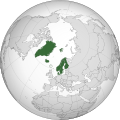


| International | |
|---|---|
| National | |
| Geographic | |
| Academics | |
| Artists | |
| People | |
| Other | |

Sweden
View on GrokipediaSweden operates under a unicameral parliament (Riksdag) that elects the prime minister, currently Ulf Kristersson, while King Carl XVI Gustaf serves as a ceremonial head of state with no political authority.[3][4]
Its economy, characterized by high productivity and export orientation in sectors like engineering, telecommunications, and pharmaceuticals, yields a GDP per capita of about $55,000 in 2024, ranking among the world's highest despite recent stagnation and recovery challenges.[5][6][7]
Historically, Sweden adhered to a policy of armed neutrality from 1814, avoiding direct involvement in major conflicts including the World Wars, until joining NATO in March 2024 amid heightened geopolitical tensions.[8][9]
The Swedish welfare state, expanded post-World War II, has delivered notable outcomes in public health, education, and income equality through universal benefits and high taxation, yet empirical analyses highlight distortions such as moral hazard in insurance programs, fiscal crises in the 1990s, and slower growth relative to pre-welfare expansion eras, prompting reforms that emphasized market liberalization.[10][11][12]
Etymology
Origins of the Name and National Symbols
The English name "Sweden" derives from Middle Dutch Zweden, the dative plural of Zwede meaning "Swede," entering usage around 1600.[13] The term "Swede" traces to Old Norse Svíar, denoting the ancient tribe in the Mälaren Valley, possibly from Proto-Norse Swihoniz signifying "one's own tribe," rooted in Proto-Indo-European *s(w)e- meaning "one's own."[14] In Swedish, Sverige evolved from Svea rike, literally "realm of the Swedes," reflecting the Svear people's historical dominance in unifying the region by the 12th century.[15] The Swedish national flag consists of a yellow Scandinavian cross extending to the edges on a medium blue field, with proportions standardized in 1906 but in use since the 16th century.[16] Its design likely drew inspiration from the Danish Dannebrog, adapting the off-center cross motif prevalent in Nordic heraldry to symbolize Christian unity.[17] The blue and yellow colors originate from the national coat of arms, where blue represents loyalty and yellow (or) signifies generosity in heraldic tradition.[18] One legend credits King Eric IX (reigned c. 1156–1160) with its inception, claiming he envisioned a golden cross in a blue sky during a crusade against Finnish pagans in the 1150s, though historical evidence points to formal adoption under the Vasa dynasty in the 1560s.[19] The lesser coat of arms features three blue coronets arranged horizontally on a yellow shield, an emblem documented since 1336 and associated with the "Three Wise Kings" in medieval iconography or as symbols of historical Scandinavian crowns claimed by Swedish rulers.[20] This design emerged during the Folkunga dynasty, with the coronets possibly adapting earlier tribal or royal motifs to assert sovereignty amid unions like the Kalmar Union (1397–1523).[21] The greater coat of arms, used for state occasions, incorporates a blue lion with golden claws from the ancient arms of the House of Bjelbo (c. 1250), alongside a Vasa lion (three golden sheaves on blue) and additional elements like the three coronets in an escutcheon, formalized by the 14th century to encapsulate Sweden's monarchical and territorial heritage.[21] These symbols underscore Sweden's evolution from tribal confederations to a centralized kingdom, with the lion emblemizing strength derived from early medieval seals.[22]History
Prehistory and Viking Age
Human settlement in present-day Sweden commenced around 12,000 BC following the retreat of the Weichselian glaciation, with early inhabitants belonging to Late Palaeolithic hunter-gatherer groups adapted to post-glacial environments.[23] These populations, initially nomadic, exploited coastal and inland resources during the Mesolithic period, which persisted until approximately 4000 BC, marked by the use of microlith tools and seasonal campsites.[24] The Neolithic era, beginning around 4000 BC, introduced agriculture and pottery to southern Sweden via influences from continental Europe, leading to settled farming communities and megalithic tombs, though population densities remained low due to the region's harsh climate and thin soils.[24] This period saw a transition to animal husbandry and cereal cultivation, evidenced by pollen analysis and settlement remains, but was interrupted by climatic fluctuations causing boom-and-bust cycles in population.[25] The Bronze Age (c. 1800–500 BC) witnessed the arrival of metalworking technologies, characterized by elaborate bronze artifacts, rock carvings depicting ships and rituals, and increased social stratification inferred from burial hoards containing weapons and jewelry.[24] Trade networks extended to Central Europe, supplying amber and furs in exchange for metals, with southern Sweden serving as a peripheral but connected zone.[26] During the Iron Age (c. 500 BC–800 AD), iron tools enhanced agricultural productivity and warfare capabilities, fostering permanent settlements and hierarchical societies.[27] Subdivided into Roman (influenced by Mediterranean contacts), Migration (marked by upheavals), and Vendel periods (c. 550–790 AD), this era featured elite burials with ship graves, helmets, and weapons at sites like Valsgärde and Vendel in Uppland, indicating powerful chieftains and emerging trade hubs.[28] [29] The Vendel period, named after the Uppland cemetery, revealed sophisticated craftsmanship and connections to Anglo-Saxon England through stylistic similarities in artifacts.[30] The Viking Age (c. 793–1066 AD) represented an expansion of these trends, with Swedish Vikings, often termed Varangians, prioritizing eastern expeditions for trade and conquest over western raids predominant among Danish and Norwegian groups.[31] Key centers included Birka on Lake Mälaren, established around 750 AD as a fortified emporium handling furs, slaves, and amber exports to the Byzantine Empire and Islamic caliphates via Russian river routes.[32] Swedish voyages reached the Caspian Sea and Constantinople, contributing to the formation of the Kievan Rus' polity, while Gotland served as a neutral trade nexus with picture stones commemorating ships and voyages.[33] Raiding occurred sporadically, but economic motivations drove settlement in Baltic regions and interactions yielding silver hoards totaling over 100,000 coins in Sweden.[34] The period waned with Christianization efforts under kings like Olof Skötkonung around 1000 AD and the consolidation of centralized power at Gamla Uppsala.[35]Medieval Kingdom and Kalmar Union
The medieval Kingdom of Sweden emerged in the 12th century as the regions of Svealand and Götaland consolidated under a single monarch, transitioning from fragmented petty kingdoms to a more unified realm.[36] This process was supported by the establishment of royal power through dynastic alliances and the Christianization of the population, which had largely concluded by the early 12th century with the creation of dioceses such as those in Uppsala and Skara.[37] The kingdom's expansion included crusades into Finland, initiated under leaders like Birger Jarl, who served as regent from 1248 and traditionally founded Stockholm around 1252 to control Baltic trade routes and defend against potential invasions.[38] The Folkung (or Bjälbo) dynasty dominated from 1250, when Valdemar was elected king, ushering in a era of internal stabilization and legal reforms amid civil strife with rival magnates.[39] Birger Jarl's son, Magnus Ladulås, ruled until 1290, followed by further conflicts that weakened central authority. In 1319, Magnus Eriksson, aged seven, was elected king of Sweden and Norway, inheriting a personal union that lasted until 1355 when Norwegian nobles rebelled.[37] His reign saw the codification of national laws, such as the Town Law of Magnus Eriksson in 1350, but was disrupted by the Black Death, which arrived in Sweden that same year and reduced the population by approximately 30-50%.[40] Deposed in 1364, Magnus was succeeded by Albert of Mecklenburg, whose rule ended in 1389 after defeat by Margaret I of Denmark at the Battle of Falköping, allowing her to claim regency over Sweden.[37] Margaret formalized the Kalmar Union on June 17, 1397, in Kalmar, creating a personal union of Denmark, Norway, and Sweden under her nephew Eric of Pomerania, aimed at countering Hanseatic influence but prioritizing Danish control.[41] Tensions escalated under the union's monarchs, as Swedish nobles resented heavy taxation and foreign governance, sparking the Engelbrekt rebellion in 1434 led by miner and noble Engelbrekt Engelbrektsson.[42] The uprising began with the burning of Borganäs Castle in midsummer 1434 and spread southward, forcing Eric's deposition in Sweden by 1436 and securing temporary autonomy through the Treaty of Fogelsång.[43] Engelbrekt was assassinated in 1436, but the revolt weakened union cohesion, leading to brief independence under Karl Knutsson before renewed Danish dominance. The union's end for Sweden came after Christian II's invasion in 1520, defeating regent Sten Sture the Younger at the Battle of Bogesund on January 19 and entering Stockholm on May 5.[24] Following his coronation on November 4, Christian orchestrated the Stockholm Bloodbath from November 7-10, executing around 90-100 Swedish nobles, clergy, and burghers on charges of heresy, including supporters of Sten Sture.[44] This atrocity ignited the Swedish War of Liberation, led by Gustav Vasa, who evaded execution, rallied forces in Dalarna, and compelled Danish withdrawal; he was elected king on June 6, 1523, restoring Swedish independence and dissolving the Kalmar Union.[36]Rise and Fall of the Swedish Empire
The rise of the Swedish Empire began under King Gustavus Adolphus, who ascended the throne in 1611 and implemented military reforms that emphasized mobility, discipline, and the integration of infantry, cavalry, and artillery, enabling Sweden to project power beyond its borders despite a population of approximately 1.5 million.[45] These innovations proved decisive in the Kalmar War against Denmark-Norway (1611–1613), where Sweden secured Jämtland, Härjedalen, and the Åland Islands via the Treaty of Knäred in 1613.[46] Further expansion followed in the Ingrian War (1610–1617) against Russia, culminating in the Treaty of Stolbovo on February 27, 1617, which granted Sweden Ingria, Kexholm, and access to the Gulf of Finland while isolating Russia from the Baltic Sea.[46] Sweden's intervention in the Thirty Years' War in 1630 marked a pivotal escalation, with Gustavus Adolphus leading Protestant forces to victories at Breitenfeld on September 17, 1631, and Lützen on November 16, 1632, where he was killed.[46] The Peace of Westphalia in 1648 formalized Sweden's gains, including Western Pomerania, the Duchy of Pomerania, Wismar, and the bishoprics of Bremen and Verden, providing control over the estuaries of the Oder, Elbe, and Weser rivers and elevating Sweden to a guarantor of the Holy Roman Empire's constitution.[47] Under Charles X Gustav (r. 1654–1660), the Second Northern War (1655–1660) against Denmark, Poland, and Russia yielded Scania, Blekinge, Bornholm, and Bohuslän through the Treaty of Roskilde in 1658, marking the empire's territorial zenith around the Baltic Sea, encompassing Finland, Estonia, Livonia, Ingria, and German holdings.[48] Charles XI (r. 1660–1697) consolidated these territories through administrative reforms and fortifications, reducing debt and strengthening absolutism, but the empire's overextension—spanning disparate regions with a thin administrative layer—sowed vulnerabilities given Sweden's limited manpower and resources compared to rivals.[49] The decline accelerated under Charles XII (r. 1697–1718) during the Great Northern War (1700–1721), initiated by a coalition of Denmark-Norway, Russia, Saxony-Poland-Lithuania, and later Prussia and Hanover, aimed at dismantling Swedish dominance.[50] Early Swedish successes, including the recapture of the Baltic provinces, faltered after the devastating defeat at Poltava on July 8, 1709, where Russian forces under Peter the Great routed Charles XII's army, capturing 6,901 Swedes and shattering the empire's military prestige.[50] Charles XII's death in 1718 amid the siege of Fredriksten Fortress hastened negotiations, leading to the Treaty of Nystad on September 10, 1721, by which Sweden ceded Livonia, Estonia, Ingria, and parts of Karelia to Russia; Bremen-Verden to Hanover; and Pomerania to Prussia, retaining only Swedish Pomerania until 1815.[50] The war's toll—over 200,000 Swedish casualties, economic devastation, and loss of customs revenues from Baltic trade—exposed the unsustainability of maintaining a continental empire with a small agrarian base, as Sweden's population and tax base could not support perpetual mobilization against growing powers like Russia, whose reforms under Peter enabled demographic and industrial advantages.[49] This collapse reduced Sweden to a regional power, reliant on neutrality and internal reforms for survival.[51]Age of Liberty and Unions with Norway and Denmark
The Age of Liberty, spanning 1718 to 1772, marked a shift from absolutist monarchy to parliamentary governance in Sweden following the death of Charles XII and the Treaty of Nystad in 1721, which concluded the Great Northern War and ended Sweden's status as a great power with significant territorial losses to Russia.[52] [53] Queen Ulrika Eleonora, who ascended in 1718, renounced absolute authority, leading to constitutional reforms between 1720 and 1723 that empowered the Riksdag (parliament), particularly the Estate of the Nobility, to control legislation, taxation, and foreign policy.[54] This era saw the emergence of factional politics, with the pro-Russian and interventionist Hats (Hattarna) dominating in the 1730s–1740s, pursuing aggressive wars against Russia (1741–1743) that resulted in further losses like parts of Finland, and the more pacifist Caps (Mössorna) gaining influence later, advocating fiscal restraint amid economic stagnation and peasant unrest.[55][56] Parliamentary dominance led to corruption, party patronage, and reduced royal influence under kings like Frederick I (1720–1751) and Adolph Frederick (1751–1771), who faced symbolic restrictions such as Riksdag oversight of court appointments.[54] Innovations included the 1766 Freedom of the Press Act, the world's first law guaranteeing press freedom, though it excluded political writings until later amendments; this fostered public debate but also partisan propaganda.[57] Economic policies emphasized mercantilism, with Hats promoting manufacturing subsidies and Caps favoring free trade, yet overall growth lagged due to war debts exceeding 50 million riksdaler by 1720 and population decline from prior conflicts.[53] The period ended with Crown Prince Gustav's bloodless coup on 19 August 1772, restoring monarchical authority amid elite dissatisfaction with parliamentary gridlock and external threats.[58] Sweden maintained no formal union with Denmark after the Kalmar Union's dissolution in 1523, instead engaging in recurrent hostilities as rivals, with Denmark-Norway forming a dual monarchy until 1814 that positioned it against Sweden in coalitions like the Great Northern War.[59] Relations began normalizing in the late 18th century through Enlightenment influences and shared neutrality during the Napoleonic Wars, evolving into cautious diplomacy by the 19th century without political union.[59] The union with Norway, established in 1814, arose from the Treaty of Kiel on 14 January 1814, whereby Denmark ceded Norway to Sweden as compensation for Sweden's alliance switch against Napoleon, prompting Norway's brief declaration of independence on 17 May 1814 under a new constitution.[60] This personal union placed both under King Charles XIII (and successors), sharing foreign policy and the monarch while retaining separate parliaments (Riksdag and Storting), armies, and internal governance; Norway's constitution took precedence, limiting Swedish integration.[61] Tensions escalated over symbols of equality, including the abolition of the Swedish governor-general in Norway by 1873 after disputes from 1859, and Norwegian demands for independent consulates (1898) and a separate foreign minister (1905).[62] The union dissolved peacefully on 7 June 1905 when the Norwegian Storting unilaterally ended it after King Oscar II refused to sanction a consular service bill, leading to swift Swedish acceptance via the Karlstad Convention on 23 September 1905, which demilitarized borders and confirmed separation without war.[62] Norway's referendum on 13 August 1905 approved dissolution by 99.5% (368,208 yes to 184 no), and Prince Charles of Denmark ascended as Haakon VII on 18 November 1905, marking Norway's full sovereignty amid Sweden's internal liberalization under growing democratic pressures.[62] This era facilitated Norway's economic modernization through Swedish stability but fueled Norwegian nationalism, rooted in cultural and resource disparities.[63]Industrialization and Modernization (19th-Early 20th Century)
In the early 19th century, Sweden remained predominantly agrarian and impoverished, with GDP per capita growth averaging 0.6% annually from 1800 to 1840, far below leading European economies.[64] Population pressures and crop failures, including famines between 1866 and 1869 caused by excessive rain, drought, and epidemics, exacerbated rural hardship, prompting mass emigration.[65] Between 1861 and 1881, approximately 150,000 Swedes departed for the United States, with emigration peaking in the 1880s at 330,000 individuals, including a record 46,000 in 1887 alone, driven primarily by economic distress in an agricultural society unable to absorb surplus labor.[66][67] Liberal reforms facilitated the transition to industrialization. The guild system, which restricted enterprise, was dismantled in 1846, enabling freer entrepreneurship, while a public school reform in 1842 improved workforce literacy and skills.[68] Agricultural commercialization post-Napoleonic Wars increased productivity, freeing labor for industry, and the introduction of railways in the 1850s spurred infrastructure and capital inflows.[64] These changes accelerated GDP per capita growth to 1.2% annually from 1840 to 1870 and 1.7% from 1870 to 1910, positioning Sweden among Europe's faster-growing economies during the Second Industrial Revolution.[64] Emigration to the U.S. from 1850 to 1910 further boosted domestic wages by 2.8% annually between 1870 and 1910 by alleviating labor surplus.[64] Export-led growth anchored industrialization, with timber dominating after a sawmill boom in the 1850s-1860s fueled by Western European demand, supplanting declining charcoal-based bar iron exports.[64] By the late 19th century, iron production modernized through technological catch-up, transitioning to higher-value steel via processes like Bessemer conversion, leveraging abundant domestic ore.[69] Around 1890, the Second Industrial Revolution introduced electric and combustion engines, fostering engineering, mining, steel, and pulp sectors; firms like LM Ericsson (telecommunications, founded 1876) and SKF (ball bearings, 1907) emerged as multinational exporters.[68] Hydropower, rather than coal, powered much of this expansion, enabling electro-mechanical innovations and distinguishing Sweden's path from coal-dependent peers.[69] Urbanization and structural shifts marked modernization, as industry absorbed rural migrants despite ongoing emigration. Population growth slowed to 0.6% annually from 1870 to 1910, reflecting outflows, while manufacturing's share rose, driving a pivot from primary to secondary sectors.[64] By 1913, Sweden's per capita income, though starting below half of Britain's in 1870, had narrowed gaps through market liberalization and export orientation, laying foundations for 20th-century prosperity without reliance on protectionism until later deviations.[70][71]Neutrality in the World Wars
Sweden maintained a policy of armed neutrality during both World Wars, declaring non-belligerency at the outset of each conflict while prioritizing national defense and economic interests amid geopolitical pressures. This stance, rooted in avoiding entanglement after centuries of warfare, involved selective trade and limited concessions to belligerents, often tilting toward the stronger regional power to deter invasion. Sweden's geography—bordering neutral Norway and Finland, and proximate to Germany—necessitated pragmatic deviations from strict impartiality, as evidenced by export dependencies and transit allowances that sustained its independence without formal alliance.[72][73] In World War I, Sweden proclaimed neutrality on August 2, 1914, following the mobilization of major powers, and sought to uphold commercial rights under international law despite Allied blockades and German submarine threats. The government under Prime Minister Hjalmar Hammarskjöld initially oriented trade toward the Central Powers, exporting significant quantities of iron ore and other raw materials vital to Germany's war economy, which strained relations with Britain and France and prompted partial embargoes on Swedish goods. By 1916, domestic shortages from disrupted imports fueled political unrest, contributing to Hammarskjöld's resignation and the formation of a coalition government under Nils Edén in 1917, which balanced trade by negotiating a May 1918 agreement with the Western Allies to restrict exports to Germany in exchange for food and coal access, accepted by Berlin to avoid further isolation. Sweden mobilized up to 500,000 troops by war's end, fortifying borders against potential incursions, but avoided direct military engagement, with neutrality debates dividing liberals (favoring Allies) from conservatives (pro-German sympathies).[74][75][72] During World War II, Sweden reiterated neutrality on September 1, 1939, after Germany's invasion of Poland, but faced immediate tests from the 1940 German occupations of Denmark and Norway, prompting defensive mobilizations exceeding 300,000 personnel and naval patrols in the Baltic. To avert invasion—feared given Germany's rapid Nordic conquests—Sweden permitted German troop and materiel transit via a June 1940 agreement, facilitating over 2 million soldiers' movement from Norway to Finland during the Continuation War, including sealed trains carrying munitions until Allied protests halted such cargo in 1943; leave transports for up to 100,000 Wehrmacht personnel annually continued until late 1943. Economically, Sweden exported approximately 10 million tons of high-grade iron ore annually to Germany from Narvik and Luleå ports, comprising up to 40% of Reich steel production needs and yielding lucrative revenues, under pre-war trade pacts renewed amid blockade risks. As Allied fortunes improved post-1943, Sweden shifted: banning German naval transit, allowing Allied air surveillance overflights, repatriating Norwegian and Danish resistance fighters for training, and providing intelligence via the "White Buses" operation that evacuated 15,000-20,000 concentration camp prisoners in 1945. These actions, while preserving formal non-alignment, reflected causal incentives—early deference to Axis proximity for survival, later alignment with emerging victors—rather than ideological impartiality, with post-war scrutiny highlighting how resource dependencies compromised strict neutrality.[76][77][73]Post-WWII Welfare State Development
The foundations of Sweden's post-World War II welfare state expansions were laid in the interwar period with the Social Democratic concept of folkhemmet (people's home), first articulated by Per Albin Hansson in a 1928 parliamentary speech envisioning a society free from class divisions through collective solidarity and state intervention.[78] This vision gained traction during the 1930s economic crisis via the coalition government's crisis package, which included housing reforms and employment programs, setting the stage for postwar universalism.[79] Immediate postwar reforms under Prime Minister Tage Erlander, who led from 1946 to 1969, focused on social security universality. The 1946 pension reform introduced a flat-rate national pension (folkpension) for all residents aged 67 and older, replacing localized means-tested systems and financed through general taxation to ensure broad coverage independent of prior contributions.[80] [81] In 1948, child allowances were established as a universal benefit paid to parents for each child under 16, aimed at reducing family poverty and supporting population stability without income testing.[82] These measures, part of a broader 1946–1950 reform wave, also encompassed improved labor laws and housing standards, reflecting a commitment to full employment and egalitarian redistribution.[83] Economic prosperity underpinned these expansions, with Sweden achieving among the highest GDP growth rates in the OECD during the 1950s and 1960s, averaging 4–5% annually, fueled by export-led industrialization and low regulatory burdens rather than welfare spending alone.[84] [85] Government tax revenues hovered at 21% of GDP in 1950, comparable to peers, allowing gradual increases in public outlays for healthcare, education, and supplementary pensions introduced in 1959.[86] Centralized collective bargaining, building on the 1938 Saltsjöbaden Agreement between unions and employers, maintained wage compression and labor peace, contributing to low unemployment below 2% through much of the period.[70] This "Swedish model" elevated living standards, with real output per worker-hour rising substantially, though its sustainability later faced scrutiny as public sector growth outpaced private productivity gains.[71]Late 20th to Early 21st Century: EU Integration, Immigration Surge, and NATO Accession
Sweden formally applied for European Union membership in July 1991, following the end of the Cold War and a reassessment of its long-standing policy of neutrality. A non-binding referendum on November 13, 1994, saw 52.3% of voters approve accession, with an 83.0% turnout, leading to Sweden's entry into the EU on January 1, 1995.[87] This integration facilitated freer movement of goods, services, capital, and people, boosting trade volumes; by the 2010s, over 60% of Swedish exports went to EU partners. Sweden opted into the Schengen Area in 2001, eliminating internal border controls, but maintained its national currency, the krona. A 2003 referendum on September 14 rejected adopting the euro, with 55.9% voting no and 78.5% turnout, preserving monetary policy independence amid concerns over sovereignty and economic risks.[88] Parallel to EU alignment, Sweden experienced a marked surge in immigration, particularly non-Western asylum seekers, straining integration efforts and social cohesion. Net migration rates rose steadily from the 1990s, peaking during the 2015 European migrant crisis when 162,877 asylum applications were filed, equivalent to about 1.6% of the population, predominantly from Syria, Afghanistan, and Iraq.[89] By 2023, foreign-born residents comprised approximately 20% of Sweden's 10.5 million population, with second-generation immigrants adding to cultural shifts. Early generous policies, rooted in humanitarianism, prioritized family reunification and welfare access, but led to high unemployment among newcomers—often exceeding 50% for non-EU migrants—and formation of segregated enclaves in suburbs like Malmö's Rosengård and Stockholm's Rinkeby, characterized by parallel societies resistant to assimilation.[90] This immigration wave correlated with elevated crime rates, including a quadrupling of the murder rate since the 1990s and a surge in gang-related shootings, with over 60 fatal incidents in 2022 alone. Studies indicate disproportionate involvement of foreign-born individuals and their descendants in violent crimes; for instance, a 2020 analysis found migrants overrepresented in homicide suspects by factors of 2-3 times relative to their population share, attributed to factors like socioeconomic exclusion, cultural clashes, and clan-based networks importing conflict dynamics from origin countries.[91] Official data from the Swedish National Council for Crime Prevention confirm higher offending rates among those born abroad, prompting policy reversals: post-2015, temporary residence permits were introduced, asylum grants declined sharply to under 10,000 annually by 2024, and stricter deportation measures enacted amid public backlash.[92] The Sweden Democrats, criticizing unchecked inflows for eroding the welfare model, gained electoral traction, securing 20.5% of votes in 2022 and influencing a right-leaning coalition's hardline stance.[93] Geopolitical shifts, exacerbated by Russia's 2022 invasion of Ukraine, eroded Sweden's non-alignment doctrine, hastening NATO pursuit. On May 18, 2022, Sweden jointly applied for membership with Finland, citing heightened Baltic Sea threats and the unsustainability of neutrality amid hybrid warfare risks.[94] After delays from Turkish and Hungarian ratifications—over objections to Sweden's initial laxity on Kurdish militants and Quran burnings—accession protocols were approved, culminating in Sweden's formal entry as NATO's 32nd member on March 7, 2024.[95] This marked the end of 200 years of military non-alignment, enhancing collective defense under Article 5 while integrating Swedish capabilities, including advanced submarines and Gripen fighters, into alliance structures. Public support surged to over 70% by 2023, reflecting pragmatic adaptation to a volatile security environment over ideological isolationism.[96]Geography
Physical Features and Borders
Sweden occupies the eastern half of the Scandinavian Peninsula in Northern Europe, bordering the Baltic Sea to the east, the Gulf of Bothnia to the northeast, and the Kattegat and Skagerrak straits to the southwest.[97] It shares land borders exclusively with Norway to the west and north, spanning 1,619 kilometers, and Finland to the east, covering 586 kilometers, for a total land boundary length of 2,205 kilometers.[98] A maritime boundary separates it from Denmark across the Øresund, connected since 2000 by the Øresund Bridge-tunnel.[99] The country's total area measures 450,295 square kilometers, with land area approximately 407,270 square kilometers, extending 1,572 kilometers north to south and up to 500 kilometers east to west.[100] [1] Its mainland coastline stretches 11,530 kilometers, augmented by extensive archipelagos, including over 24,000 islands along the eastern seaboard.[98] Terrain varies from rugged mountains in the northwest, where the Scandinavian Mountains (Kjölen range) form the natural border with Norway, to central forested highlands and southern lowlands.[101] The highest point is Kebnekaise in the north, with its northern peak at 2,096.8 meters above sea level as of measurements accounting for glacial retreat on the southern peak.[102] Forests cover more than two-thirds of the land, complemented by nearly 100,000 lakes—such as Lake Vänern, the largest in the European Union—and rivers draining eastward to the Baltic.[1] Arable land constitutes about 27,000 square kilometers, primarily in the south.[98]Climate Zones and Environmental Conditions
Sweden spans multiple Köppen climate classifications due to its north-south extent from 55°N to 69°N, with southern regions classified as oceanic (Cfb), central areas as humid continental (Dfb), and northern parts as subarctic (Dfc).[103] The North Atlantic Current, an extension of the Gulf Stream, moderates temperatures, preventing the severe cold typical of similar latitudes in continental interiors like Siberia, though its influence diminishes northward and inland.[104] In southern Sweden, winters are mild with January averages around 0°C to -2°C, while summers reach 16–18°C in July; precipitation totals 600–900 mm annually, distributed fairly evenly but peaking in late summer.[105] Central regions experience colder winters averaging -5°C to -10°C in January and similar summer highs, with annual rainfall of 500–800 mm, often as snow in winter.[106] Northern Sweden features subarctic conditions, with January means below -10°C and brief summers around 12–14°C, accompanied by lower precipitation of 400–600 mm, concentrated in summer convection.[105] Environmental conditions reflect this variability: vast boreal forests covering 58% of land support coniferous species adapted to short growing seasons, while 9% lakes and 10% wetlands buffer temperature extremes and host aquatic biodiversity.[107] Air quality remains high with low pollution levels due to sparse population density outside urban south, though acid rain from historical sulfur emissions has declined since the 1990s via emission controls.[108] Biodiversity in forests has increased over the past 20–30 years through voluntary set-asides and dead wood retention, enhancing habitat for species like woodpeckers and lichens, despite ongoing forestry pressures.[109]Government and Politics
Constitutional Framework and Monarchy
Sweden's constitutional framework comprises four fundamental laws that regulate the exercise of public power, safeguard democratic principles, and delineate institutional roles: the Instrument of Government (1974), the Act of Succession (1810, as amended), the Freedom of the Press Act (1949), and the Fundamental Law on Freedom of Expression (1991).[110] These laws require a qualified amendment process, involving approval by two successive Riksdags with an intervening general election, to ensure stability.[111] The Instrument of Government asserts that all public power derives from the people, realized through representative democracy, free opinion formation, and universal equal suffrage.[112] It positions the unicameral Riksdag as the foremost representative of the people, vests executive authority in the Government led by the Prime Minister, and designates the monarch as head of state with ceremonial functions only.[111] The Government remains accountable to the Riksdag, which can dismiss it via no-confidence votes, while judicial independence is enshrined to prevent executive interference.[112] As a constitutional monarchy, Sweden's head of state is King Carl XVI Gustaf of the House of Bernadotte, who acceded to the throne on September 15, 1973, following the death of his grandfather, King Gustaf VI Adolf.[113] The monarch holds no political authority, with duties confined to representational acts such as inaugurating Riksdag sessions, hosting state visits, conferring decorations, and serving as a unifying national symbol.[113] [114] Formal government formation involves the Speaker of the Riksdag proposing a Prime Minister, whom the King formally appoints without discretion, based on parliamentary support.[113] The Act of Succession establishes hereditary succession in the male line of the House of Bernadotte but was amended in 1980 to introduce absolute primogeniture, granting equal rights to male and female heirs regardless of birth order.[110] This change, effective for descendants of King Carl XVI Gustaf, ensures Crown Princess Victoria as heir apparent since her birth on December 14, 1977.[113] The monarchy's ceremonial nature, codified in the 1974 Instrument of Government, stripped remaining reserve powers from earlier constitutions, reflecting a post-1970s shift toward parliamentary sovereignty amid social democratic reforms.[111]Parliamentary System and Political Parties
Sweden operates a unicameral parliamentary system centered on the Riksdag, which consists of 349 members elected for four-year terms.[115] [116] Elections occur on the second Sunday in September, using proportional representation across 29 constituencies aligned with the country's counties, supplemented by national leveling seats to ensure proportionality.[117] [115] Parties must secure at least 4% of the national vote or 12% in a single constituency to gain representation, with seats allocated via the modified Sainte-Laguë method.[118] The Riksdag holds legislative authority, including passing laws, approving the budget, and overseeing the government, which requires its confidence to remain in office.[3] The prime minister, proposed by the speaker and elected by a simple majority in the Riksdag, forms the government; no-confidence votes can lead to resignation or new elections if unresolved.[117] This system fosters coalition or minority governments, as no single party has achieved an absolute majority since proportional representation was introduced in 1921.[3] Sweden's multi-party landscape reflects a spectrum from left-wing socialism to national conservatism, with eight parties holding seats in the Riksdag following the September 11, 2022, election.[119] The vote produced a narrow right-wing bloc victory (176 seats) over the left-wing bloc (173 seats), ending eight years of Social Democratic-led rule.[120] A minority government comprising the Moderate Party, Christian Democrats, and Liberals was formed in October 2022 under Prime Minister Ulf Kristersson, relying on external support from the Sweden Democrats via the Tidö Agreement, which prioritizes stricter immigration controls and law-and-order measures.[121] [122]| Party | Ideology | Seats (2022) |
|---|---|---|
| Social Democrats (S) | Social democracy, welfare state expansion | 107 |
| Sweden Democrats (SD) | National conservatism, immigration restriction | 73 |
| Moderates (M) | Liberal conservatism, free-market reforms | 68 |
| Centre Party (C) | Agrarian liberalism, rural interests | 24 |
| Left Party (V) | Democratic socialism, anti-capitalist policies | 24 |
| Christian Democrats (KD) | Christian democracy, family values | 19 |
| Liberals (L) | Social liberalism, education focus | 16 |
| Greens (MP) | Environmentalism, social progressivism | 18 |
Elections, Coalitions, and Recent Rightward Shifts
Sweden's parliamentary elections occur every four years to elect the 349 members of the Riksdag using proportional representation with a 4% national threshold for entry.[126] The 2018 election resulted in a hung parliament, with the Social Democrats securing 28.3% of the vote (144 seats) but unable to form a stable majority, leading to the January Agreement—a cross-bloc deal between the Social Democrats, Greens, Center Party, and Liberals that excluded the Sweden Democrats (SD) and supported Prime Minister Stefan Löfven until 2021, followed by Magdalena Andersson.[127] The SD, a nationalist party emphasizing immigration restriction and law-and-order policies, increased its share to 17.5% (62 seats) from 12.9% in 2014, reflecting growing voter concerns over integration challenges and rising violent crime linked to gang activity.[127] The September 11, 2022, election marked a pivotal shift, with the right-wing bloc—comprising the Moderate Party (M), SD, Christian Democrats (KD), and Liberals (L)—securing 176 seats against 173 for the left-green bloc, despite the Social Democrats remaining the largest party at 30.3% (107 seats).[120] The SD achieved its strongest result yet at 20.5% (73 seats), surpassing the Moderates' 19.1% (68 seats) and becoming the second-largest party, driven by public backlash against high immigration levels since 2015 and associated increases in shootings and bombings, which official statistics showed disproportionately involving foreign-born individuals.[120] Voter turnout was 84.2%, with the right's gains concentrated in areas affected by urban crime waves.[120] Post-election, Ulf Kristersson of the Moderates formed a minority government on October 18, 2022, comprising M, KD, and L, supported externally by the SD via the Tidö Agreement—a 60-page policy platform prioritizing stricter migration controls, tougher sentencing for gang crimes, and energy security.[128] This accord ended the previous cordon sanitaire against the SD, as mainstream right parties normalized cooperation to address empirical rises in asylum inflows (163,000 in 2015 alone) and failed integration outcomes, including higher welfare dependency and criminality among certain migrant cohorts per government data.[129] The shift signifies a broader realignment, with policies now emphasizing repatriation incentives and border controls, contrasting earlier centrist compromises that critics argue exacerbated social strains without evidence of long-term economic benefits from mass low-skilled immigration.[128]| Party | 2018 Vote % (Seats) | 2022 Vote % (Seats) |
|---|---|---|
| Sweden Democrats (SD) | 17.5% (62) | 20.5% (73) |
| Moderates (M) | 23.2% (84) | 19.1% (68) |
| Social Democrats (S) | 28.3% (144) | 30.3% (107) |
| Christian Democrats (KD) | 6.5% (22) | 5.3% (19) |
| Liberals (L) | 5.5% (20) | 4.6% (16) |
Administrative Divisions and Local Governance
Sweden is divided into 21 counties (län), which serve as the primary administrative subdivisions, each overseen by a County Administrative Board appointed by the central government to implement national policies and supervise local compliance.[130] These boards coordinate regional development, environmental protection, and emergency preparedness, while also acting as intermediaries between national authorities and local entities. Since January 1, 2019, all county councils have been restructured as elected regional assemblies (regioner), assuming responsibilities for public health care, regional public transport, and economic development planning across the same 21 territorial units.[131] Subnationally, Sweden comprises 290 municipalities (kommuner), the basic units of local self-government, each with an elected municipal council (kommunfullmäktige) that holds significant autonomy in service delivery.[132] Municipalities manage core functions including primary and secondary education, social welfare services, elderly care, child protection, urban planning, water supply, waste management, and local infrastructure maintenance, funded primarily through local taxes on income and property.[133] Executive powers are exercised by municipal boards and committees, with no formal mayoral office; the council chair often performs ceremonial leadership roles.[130] Local governance operates under the principle of subsidiarity, with municipalities and regions enjoying fiscal independence—collecting about half of total tax revenues—but subject to central oversight via laws, financial equalization grants, and performance audits to ensure equitable service standards nationwide.[131] Reforms since the 1970s have consolidated municipalities from over 2,400 to the current 290 through voluntary mergers, aiming to achieve economies of scale amid demographic pressures like rural depopulation and urban concentration, though boundaries remain stable as of 2025 with no major changes enacted.[132] County Administrative Boards retain veto power over municipal decisions conflicting with national law, such as zoning that impacts national infrastructure or environmental regulations.[130] Inter-municipal cooperation occurs through voluntary associations for shared services like fire protection or waste processing, while regions facilitate cross-county initiatives in tourism and labor market policies.[131] This decentralized structure supports Sweden's welfare model by tailoring services to local needs, but challenges persist in sparsely populated northern counties, where economies of scale strain municipal budgets despite state subsidies.[132]Judicial System and Rule of Law
Sweden's judicial system operates as a civil law tradition with an accusatorial procedure, featuring two parallel hierarchies: general courts for civil and criminal matters, comprising 48 district courts (tingsrätt), six courts of appeal (hovrätt), and the Supreme Court (Högsta domstolen); and administrative courts for disputes involving public authorities, including 12 administrative courts, four administrative courts of appeal, and the Supreme Administrative Court (Högsta förvaltningsdomstolen).[134][135][136] The system emphasizes prosecutor-led investigations, with no jury trials; instead, professional judges preside alongside lay judges (nämndemän), who are elected by municipal councils or appointed by political parties for four-year terms to incorporate public input.[137][138] Judges are appointed by the government upon recommendations from the independent Judges Proposal Board (Domarnämnden), which consists of five current or former judges, two non-judicial lawyers, and representatives from courts and law societies, ensuring merit-based selection over political influence.[139][140] The Supreme Court has 16 justices, led by a president appointed similarly.[140] Constitutional protections under the Instrument of Government mandate judicial independence from the executive and legislature in case decisions, with judges irremovable except via disciplinary proceedings.[111] Perceived independence remains high, with 75% of the general public and 70% of companies rating courts and judges as "fairly or very independent" in recent surveys.[141][142] Sweden ranks highly in global rule of law assessments, placing 4th out of 142 countries in the World Justice Project Rule of Law Index 2024 with a score of 0.86, reflecting strong performance in constraints on government powers, absence of corruption, and open government, though scores in criminal justice (0.82) and civil justice (0.83) lag slightly behind fundamentals like order and security (0.90).[143][144] Corruption is minimal, as evidenced by a score of 80/100 in Transparency International's 2024 Corruption Perceptions Index, ranking Sweden 8th globally and 4th in the EU.[145] The European Commission's 2025 Rule of Law Report affirms very high perceived judicial independence among the public, supported by robust safeguards against undue interference.[145] Challenges persist in enforcement amid rising violent crime, including gang-related shootings that reached 62 fatalities in 2022 before partial declines, straining judicial resources and public trust in effective rule of law application, particularly in immigrant-heavy areas with reported parallel societal structures.[146] A high legislative pace has led to concerns over inadequate constitutional scrutiny, with some amendments failing to meet proportionality requirements, as noted by the Swedish Institute for Human Rights.[147] Lay judges face scrutiny for potential political bias due to partisan appointments, prompting a 2025 government proposal to reform selection processes and constitutional amendment procedures to bolster impartiality and judicial autonomy.[145][148] Despite these issues, systemic corruption remains low, and courts maintain efficiency with average civil case durations under six months at district level.[149]Foreign Policy, Military, and NATO Membership
Sweden's foreign policy has historically emphasized non-alignment and neutrality, a stance formalized after the Napoleonic Wars in 1814 and maintained through both World Wars and the Cold War to avoid entanglement in great-power conflicts.[150] This policy involved armed neutrality, with significant military investments to deter invasion, as evidenced by Sweden's avoidance of direct involvement in World War II despite territorial concessions to maintain balance.[8] Post-Cold War, Sweden gradually integrated into Western structures, joining NATO's Partnership for Peace in 1994 and the European Union in 1995, while participating in UN peacekeeping and EU-led missions, but rejecting full NATO membership amid domestic opposition.[151] Russia's annexation of Crimea in 2014 and full-scale invasion of Ukraine in 2022 prompted a reevaluation, with public support for NATO surging from 28% in 2014 to a majority by mid-2022, driven by heightened Baltic Sea security threats.[152] Sweden applied for NATO membership on May 16, 2022, alongside Finland, leading to accession protocols signed in 2022 but delayed by Turkish and Hungarian objections over counter-terrorism and migration issues; Sweden addressed these through legislative changes and extraditions.[153] Full membership was achieved on March 7, 2024, marking the end of over two centuries of neutrality and integrating Sweden into collective defense under Article 5.[94] Post-accession, Sweden's policy prioritizes NATO interoperability, regional Nordic-Baltic cooperation, and deterrence against Russian aggression, while maintaining EU ties for sanctions and hybrid threat responses.[154] The Swedish Armed Forces, comprising the Army, Navy, Air Force, and Home Guard, emphasize high-technology deterrence and territorial defense, with approximately 15,000 active personnel augmented by selective conscription reintroduced in 2017 for both men and women after a post-Cold War suspension.[155] Conscription targets 8,500 trainees annually by 2026, focusing on voluntary enlistees who undergo 9-15 months of training before reserve assignment up to age 47 (with proposals to extend officer liability to 70 for wartime readiness).[156][157] Total reserves number around 30,000, supporting a total defense concept that includes civilian mobilization up to age 70 in crises.[158] Defense expenditures rose sharply post-2022, reaching $12.0 billion in 2024 (34% increase from prior year) and projected at $13 billion for 2025, equating to 2.4% of GDP and exceeding NATO's 2% guideline.[159][160] Parliament approved 300 billion SEK ($31 billion) in borrowing in June 2025 for rearmament, including submarines, fighter jets, and air defense systems, with plans to hit 2.8% of GDP in 2026 and approach NATO's emerging 3.5% core target by 2030 amid Russian threats.[161][162] This buildup addresses vulnerabilities exposed by Ukraine, prioritizing Arctic/Baltic capabilities and NATO integration over expeditionary roles.[163]Economy
Economic Model: Market Capitalism with High Taxation
Sweden's economy is fundamentally capitalist, characterized by private ownership of production, competitive markets, and profit-driven enterprise, with government intervention limited primarily to taxation and redistribution rather than direct control of resources. The private sector dominates economic activity, contributing the majority of GDP through household consumption and business investment, while public spending accounts for approximately 47.5% of GDP as of recent estimates. This structure supports high productivity and innovation, evidenced by Sweden's ranking of 12th globally in the 2024 Index of Economic Freedom, scoring 77.9 out of 100 for its rule of law, regulatory efficiency, and open markets.[164][165][164] High taxation enables a comprehensive welfare system, with the top marginal income tax rate at 52.2%, a corporate tax rate of 20.6%, and a value-added tax of 25%, resulting in total tax revenue equivalent to 42.6% of GDP. These revenues fund universal benefits such as healthcare, education, and pensions, but the system's sustainability hinges on market-generated growth rather than state ownership, as private firms like Ericsson and Volvo drive exports and technological advancement. In the early 1990s, following a banking crisis and GDP contraction of over 5%, Sweden implemented market-oriented reforms including deregulation of credit markets, privatization of state enterprises, and pension system liberalization, which boosted economic freedom scores from 61.4 in 1995 to 77.5 by 2024 and facilitated average annual GDP growth of around 2-3% thereafter.[166][167][168] Critics of the model, including analyses from free-market think tanks, argue that while high taxes correlate with reduced inequality metrics, they impose disincentives on labor supply and entrepreneurship, potentially capping long-term growth absent the 1990s liberalizations that shifted Sweden from rigid regulation toward flexible capitalism. Empirical data supports this causal link: post-reform productivity gains, including a "productivity dividend" from product market deregulation, contributed to GDP per capita exceeding $60,000 in purchasing power parity terms by 2023, outperforming many lower-tax peers in human development indices despite fiscal burdens. Nonetheless, public debt remains manageable at 36.4% of GDP, reflecting fiscal discipline amid high spending.[169][164][164]Key Sectors, Trade, and Innovation Hubs
Sweden's economy features a mix of advanced manufacturing, resource-based industries, and a dominant services sector. The services sector, encompassing finance, IT, retail, and tourism, accounts for the largest share of GDP, with manufacturing and industry contributing approximately 23.3% in recent assessments. Key manufacturing subsectors include automotive (e.g., Volvo), telecommunications equipment (e.g., Ericsson), and pharmaceuticals, supported by high productivity and export orientation. Forestry remains a cornerstone, with the forest industry generating SEK 185 billion in export value in 2024, representing about 10% of total goods exports and leveraging Sweden's vast timber resources for pulp, paper, and sawn wood production. Mining, particularly iron ore from regions like Kiruna, also bolsters industrial output, though its direct GDP share is smaller. Trade plays a pivotal role, with exports comprising around 55% of GDP in 2024, including 38% from goods and 17% from services. Major exports totaled US$195.8 billion in 2024, led by machinery, vehicles, pharmaceuticals, and paper products, yielding a trade surplus of US$6.79 billion. Imports reached US$188.97 billion, primarily electrical equipment, machinery, and vehicles. Sweden's top export partners include Germany (15.3% share), Norway (11.7%), and the United States, while key import sources are Germany (16.1%), the Netherlands (11%), and Norway (10%). As an EU member with the euro not adopted, Sweden benefits from tariff-free access to the single market, though global supply chain disruptions and energy dependencies have pressured balances in recent years. Innovation drives competitiveness, with gross R&D expenditure at 3.41% of GDP in 2022, among the highest globally, fostering clusters in technology and engineering. Stockholm serves as the primary hub, hosting Kista Science City—a leading ICT center with firms like Ericsson and numerous startups—and contributing to Sweden's strong performance in the Global Innovation Index. Gothenburg has emerged as a key R&D node, with business R&D expenditure growing significantly, particularly in life sciences and automotive innovation via entities like AstraZeneca and Volvo. Other hubs include Linköping for aerospace (Saab) and Uppsala for biotech, supported by government investments of SEK 6.5 billion in high-quality research in 2024. These ecosystems emphasize private-sector R&D, with public funding complementing venture capital availability.| Top Export Partners (2024 Shares) | Percentage |
|---|---|
| Germany | 15.3% |
| Norway | 11.7% |
| United States | ~7-10% |
| Denmark | Variable |
| Finland | Variable |
Labor Market, Unemployment, and Productivity
Sweden's labor market is characterized by high union density and extensive collective bargaining coverage. Union membership stood at approximately 69% of employees in 2020, down from 81% in 2000, with blue-collar workers experiencing steeper declines to around 59% by 2022.[170] [171] Collective agreements negotiated by unions and employer organizations cover over 90% of workers, setting wages and conditions sector-wide, which promotes wage compression but limits firm-level flexibility.[172] Unemployment rates have remained elevated post-pandemic, averaging 8-9% in 2025. In September 2025, the rate for ages 15-74 was 8.3%, with 476,000 unemployed, reflecting persistent weakness despite some monthly fluctuations.[173] Youth unemployment for those under 25 reached 23.6% in recent data, significantly higher than the OECD average.[174] This overall figure masks disparities: native-born Swedes face rates around 3-5%, while foreign-born unemployment exceeds 16-20%, with gaps widening for non-EU migrants and those lacking Swedish proficiency—the largest such language-related disparity in Europe.[175] [176] [177] Structural factors contribute to these outcomes, including stringent employment protection legislation and generous unemployment benefits that extend job search durations and reduce incentives for low-skilled workers to accept available positions. High marginal tax rates on labor income, averaging over 50% for middle earners, further distort work effort and job creation, particularly in low-productivity sectors. Immigration, comprising a large share of non-EU low-skilled inflows since the 2010s, has exacerbated mismatches: many arrive with skills non-transferable without language mastery or credentials recognition, leading to long-term welfare dependency and "brain waste" where overqualified individuals underperform.[178] [179] [180] Labor productivity remains among the world's highest, with GDP per hour worked at about 104% of U.S. levels in 2022 (in PPP terms), equating to roughly USD 90 annually.[181] [182] Sweden ranks in the top tier of OECD countries, driven by capital-intensive industries like manufacturing and tech, though growth has slowed to modest levels since 2010 amid demographic pressures and reduced R&D efficiency gains. Per-hour output averaged stable labor hours around 1,450 annually, underscoring that productivity stagnation ties to fewer innovations per worker rather than hours reductions. High union-driven wage floors and immigration-induced skill dilution hinder further gains in service sectors, where low-skilled labor influxes depress average output without offsetting capital deepening.[183] [184] Recent policy shifts toward stricter activation requirements and integration mandates aim to address these, but entrenched welfare incentives and housing shortages linked to zoning regulations continue to impede mobility and employment.[178]Public Finances: Taxes, Pensions, and Debt Sustainability
Sweden's public finances are characterized by high taxation levels that fund an extensive welfare state, coupled with a pension system incorporating automatic stabilizers and relatively low public debt supported by fiscal rules emphasizing discipline. The tax-to-GDP ratio stood at 41.4% in 2023, reflecting a slight decline from 42.5% in 2022, among the highest in the OECD.[185] This revenue primarily supports social expenditures, including pensions, healthcare, and unemployment benefits, though recent budget deficits have emerged amid economic headwinds. The tax system features progressive income taxation, with municipal taxes ranging from 29% to 35% on earned income and a national tax of 20% on income exceeding SEK 643,100 in 2025.[186] The effective top marginal rate reaches approximately 52%, applied to high earners after deductions.[166] Value-added tax (VAT) applies at a standard rate of 25% to most goods and services, with reduced rates of 12% for food and 6% for books, newspapers, and certain cultural items, generating substantial consumption-based revenue.[187] Employer social security contributions, at 31.42%, further bolster funding for pensions and insurance, comprising about 21.5% of total tax revenue.[166] These structures, while enabling generous public services, have prompted debates on work disincentives, as evidenced by Sweden's average net personal tax rate of 23.1% for single workers in 2024, below the OECD average of 25%.[188]| Tax Type | Rate (2025) | Application |
|---|---|---|
| Municipal Income Tax | 29-35% | Earned income, varies by locality |
| National Income Tax | 20% | Income > SEK 643,100 |
| VAT (Standard) | 25% | Most goods and services |
| Employer Social Contributions | 31.42% | Payroll for pensions and insurance |
Energy Production, Green Policies, and Dependencies
Sweden's electricity generation is dominated by low-carbon sources, with hydropower accounting for approximately 38% and nuclear power for 29% of total output in 2024, supplemented by wind at around 26%.[198][199] This mix enabled 99% low-carbon electricity production in 2024, positioning Sweden as a net exporter of power while maintaining grid stability through a combination of dispatchable hydro and baseload nuclear capacity.[200] Total electricity generation reached about 153 billion kWh annually in recent years, with renewables excluding nuclear comprising over 50% but subject to hydro's seasonal variability, which necessitates nuclear for reliability during low-water periods.[201] Green policies have emphasized decarbonization since the introduction of a carbon tax in 1991, initially set at SEK 250 per ton of CO2 equivalent and rising to SEK 1,330 by 2025 for most sectors, though with exemptions for industry and heat production that limit coverage to about 40% of national emissions.[202][203] This tax has driven efficiency gains and a shift to biofuels and electrification, contributing to a 33% reduction in emissions from 1990 to 2021.[204] National targets include net-zero emissions by 2045 and 100% fossil-free electricity by 2040, explicitly incorporating nuclear alongside renewables following a policy pivot in 2022 that abandoned a prior renewables-only mandate.[205] Recent government actions, such as proposing additional coastal sites for new reactors in October 2025, reflect recognition of nuclear's role in meeting rising demand from electrification and industry without over-reliance on intermittent wind and solar.[206][207] Despite these strengths, Sweden remains dependent on imported fossil fuels for transport and non-electric heating, with oil products, natural gas, and coal comprising significant portions of total primary energy supply despite declining shares.[208] In 2023, fossil fuels accounted for under 10% of electricity but over 40% of final energy consumption, primarily in road transport and district heating backups, exposing the economy to global price volatility as seen in the 2022 energy crisis.[209] Electrification efforts, including biofuel mandates and EV incentives, aim to reduce this vulnerability, but hydro-nuclear intermittency risks and slow grid expansion have prompted critiques of overambitious green targets straining affordability and security.[210] Sweden's export-oriented industry, such as steel and chemicals, further underscores the need for stable, domestic low-carbon power to avoid import dependencies in green hydrogen and battery production.[211]| Energy Source | Share of Electricity Generation (2024) | Notes |
|---|---|---|
| Hydropower | 38% | Seasonal; key for exports |
| Nuclear | 29% | Baseload; expansion planned |
| Wind | 26% | Growing but variable |
| Other (bio, solar) | ~7% | Minor role |
Demographics
Population Size, Growth, and Aging Trends
Sweden's population reached 10,605,098 as of August 2025, reflecting steady but modest expansion from approximately 10.5 million in 2023.[212] This places Sweden among Europe's mid-sized nations by population, with density at about 25 people per square kilometer due to its expansive land area.[213] Annual population growth has averaged around 0.3% in recent years, with a rate of 0.313% recorded for 2024, the slowest pace in over two decades absent higher net migration.[214] This deceleration stems primarily from a total fertility rate (TFR) of 1.43 children per woman in 2024, significantly below the 2.1 replacement level needed for generational stability without immigration.[215] Crude birth rates fell to 9.3 per 1,000 inhabitants in 2024, with only 98,500 births recorded, underscoring a persistent decline in native reproductive trends influenced by factors such as delayed childbearing and economic pressures on families.[216] The population is aging rapidly, with 20.6% aged 65 and over as of late 2024, up from lower shares in prior decades due to elevated life expectancy of 83.9 years and low fertility.[217][218] Median age stands at 41.1 years, signaling a maturing demographic structure where the working-age cohort (15-64) comprises about 63% but faces contraction risks from fewer entrants.[219] Projections indicate the elderly share rising to 23% by 2030, straining pension systems and healthcare as deaths outpace births without external inflows.[220] This trend aligns with broader European patterns but is accentuated in Sweden by historically generous welfare policies that, while extending longevity, have coincided with fertility erosion since the 1970s.[221]Ethnic Homogeneity, Immigration Waves, and Demographic Shifts
Historically, Sweden exhibited a high degree of ethnic homogeneity, with the population predominantly comprising ethnic Swedes of North Germanic descent, supplemented by small indigenous groups such as the Sami (estimated at 20,000–40,000) and Finnish-speaking Tornedalians in the north. Prior to World War II, net immigration was minimal, averaging around 6,000 arrivals annually from 1871 to 1940, primarily from neighboring Nordic countries, resulting in foreign-born residents constituting less than 2% of the population by 1950.[222][223] The initial major immigration wave post-World War II was driven by labor demands in Sweden's expanding industrial sector, attracting workers from Finland (over 400,000 by 1970), as well as from Yugoslavia, Italy, Greece, and other European nations, without a formal guest-worker program. These migrants, often temporary and from culturally proximate regions, integrated relatively readily, with foreign-born shares reaching about 4% by 1970. Immigration policy began shifting in the 1970s from labor recruitment to humanitarian grounds, introducing asylum and family reunification as primary channels, coinciding with Sweden's adoption of multiculturalism.[224] Subsequent waves increasingly originated from non-European countries, starting with refugees from Chile (around 50,000 after the 1973 coup), Iran (post-1979 revolution), and Lebanon during its civil war, followed by Somalis (over 40,000 in the 1990s amid famine and conflict). The 1990s Balkan wars brought over 100,000 from Bosnia and other Yugoslav states, while the 2000s saw surges from Iraq (peaking after the 2003 U.S. invasion, with 100,000+ arrivals) and continued African inflows. The 2010s marked the largest influx, dominated by Syrians (over 160,000 asylum grants since 2011 civil war), Afghans, and Eritreans, with asylum applications hitting 162,877 in 2015 alone—equating to 1.6% of the population that year.[224][225][226] These waves have driven profound demographic shifts, elevating the foreign-born population from approximately 11% in 2000 to 20.3% (about 2.17 million individuals) by 2023 in a total population of roughly 10.5 million. Persons with foreign background (born abroad or with both parents born abroad) comprise around 26% as of 2022, with non-European origins now predominant among recent cohorts—Syrians (1.9%), Iraqis (1.4%), and others forming significant shares beyond ethnic Swedes (79.6% by country-of-birth estimates). Immigrants from outside Europe exhibit higher total fertility rates (around 2.5–3.0 children per woman versus 1.5–1.7 for native Swedes), accelerating the proportional growth of non-ethnic Swedish groups and contributing to over 45% of population increase via net migration from 1945 onward. Official statistics from Eurostat and OECD underscore this transition from homogeneity, though integration challenges—evident in persistent socioeconomic disparities—highlight causal links between rapid, culturally distant inflows and altered societal composition, as critiqued in policy reviews despite mainstream narratives emphasizing diversity benefits.[227][228][229][230]Languages, Religions, and Cultural Assimilation
Swedish is the sole official language of Sweden, spoken natively by approximately 90% of the population and serving as the primary medium of education, government, and public life.[231][232] In addition to Swedish, five national minority languages—Finnish, Meänkieli (a Finnish dialect spoken in the Torne Valley), Romani Chib, Yiddish, and the Sámi languages (Northern, Lule, Ume, Pite, and Southern Sámi)—receive official recognition under the Language Act of 2009, entitling speakers in designated municipalities to services in those languages and cultural preservation support.[233][234] These minority languages trace historical roots: Finnish from border populations, Sámi from indigenous northern groups estimated at 20,000–40,000 speakers, and others from Jewish and Roma communities. Immigration has introduced non-official languages like Arabic (spoken by over 200,000 due to Middle Eastern inflows) and Somali, with foreign-born residents comprising 20% of the population as of 2023, though Swedish proficiency remains a key integration requirement for citizenship.[231][235] Sweden exhibits high secularism, with formal religious affiliation declining amid low practice rates. Membership in the Church of Sweden, a Lutheran body disestablished from state control in 2000, fell to 51% of the population (about 5.1 million people) by 2024, down from 70% in 2010, reflecting widespread disaffiliation driven by cultural shifts toward individualism rather than doctrinal commitment.[236] Church attendance is minimal, with only 3.8% participating weekly and about 6% monthly among members, underscoring a "belonging without believing" pattern where nominal ties persist for cultural or ceremonial reasons like weddings and funerals.[237] Other Christian denominations, including Pentecostals and Catholics, account for roughly 4–5% combined, while belief in God has dropped steadily, with surveys showing under 20% affirming personal faith by 2024.[238] Islam, the largest non-Christian faith, comprises an estimated 8% of the population per 2016 Pew data, concentrated in urban immigrant communities and growing via family reunification and asylum from Muslim-majority countries, though official counts vary due to underreporting and lack of mandatory registration.[239] Smaller groups include Buddhists (0.4%) and Jews (0.1%), with unaffiliated individuals at 27–30%, bolstered by generational secularization.[240] Cultural assimilation of immigrants in Sweden has faced significant challenges, particularly for non-Western arrivals, leading to persistent ethnic enclaves and divergent social norms. Post-1990s mass immigration, peaking at 163,000 net inflows in 2015, prioritized humanitarian intake over selectivity, resulting in over 50% of foreign-born adults lacking upper-secondary education and employment rates 20–30 percentage points below natives as of 2023.[225] Empirical studies indicate slower cultural convergence for groups from the Middle East and Africa, with surveys of newly arrived immigrants revealing higher endorsement of patriarchal values, honor-based conflict resolution, and religious conservatism—e.g., 40–60% supporting gender segregation in certain contexts—contrasting native Swedish egalitarianism and contributing to parallel societies in suburbs like Malmö's Rosengård or Stockholm's Rinkeby.[241] Integration failures manifest in high welfare dependency (60% of non-EU immigrants reliant on benefits after five years) and overrepresentation in crime, where foreign-born individuals commit offenses at 2–3 times the native rate, including gang violence tied to unassimilated clans importing clan-based loyalties.[225] Government policies emphasizing multiculturalism over enforced assimilation, such as lax language mandates until recent reforms, have exacerbated segregation, with 2022–2024 data showing 61 "vulnerable areas" featuring no-go zones for police due to immigrant-dominated subcultures resistant to Swedish legal and cultural norms.[242] Recent policy reversals, including tightened asylum rules post-2015 and citizenship delays for poor integrators, stem from these outcomes, as evidenced by rising native backlash and empirical recognition that causal factors like source-country cultural distance hinder rapid adaptation without coercive measures.[243][244]Health Outcomes, Life Expectancy, and Public Health Challenges
Sweden maintains one of the highest life expectancies in the world, reaching 84.1 years at birth in 2024, tied for the highest in the European Union alongside Italy.[245] This figure reflects 85.6 years for women and 82.6 years for men.[246] Healthy life expectancy, accounting for years lived in good health, stood at 71.1 years in 2021, an improvement of 1.85 years since 2000.[247] These outcomes stem from effective universal healthcare access, low rates of preventable diseases, and public health measures targeting noncommunicable conditions, which accounted for 84% of deaths in 2021.[248] Key health metrics underscore strong physical health performance. The infant mortality rate was 2.0 deaths per 1,000 live births in 2023, among the lowest globally.[249] Adult obesity prevalence reached 15% in 2019, slightly below the EU average but up from 11% in 2010, with ongoing increases noted through 2024.[250] Cardiovascular diseases and cancers remain leading causes of mortality, though age-standardized rates have declined due to preventive screenings and lifestyle interventions.[247] Public health challenges include persistent mental health deterioration, particularly among youth. Self-reported psychosomatic symptoms, depressive symptoms, and suicidal ideation among adolescents have risen sharply, with increases exceeding 100% in some indicators over the past decade.[251] Suicide rates stood at 12.6 per 100,000 population in 2023, equating to over 1,200 annual deaths, with undetermined intent cases adding several hundred more.[252][253] Rates are higher among men and middle-aged groups, though youth trends show acceleration in attempts and ideation.[254] These issues coincide with high healthcare spending at 11% of GDP, highlighting strains in addressing psychosocial factors despite robust infrastructure.[255] Emerging inequalities in life expectancy by education and region persist, challenging goals to eliminate avoidable disparities by 2048.[256]Education System: Structure, Performance, and Reforms
Sweden's education system encompasses preschool, compulsory schooling, upper secondary education, and higher education, with the latter three levels publicly funded and largely free of charge. Compulsory education begins the year a child turns six and lasts until age 16, comprising nine years of grundskola (comprehensive school) covering primary and lower secondary levels.[257] Upper secondary education (gymnasieskola), spanning three years for students aged 16-19, is not compulsory but guaranteed by law to all who complete grundskola, offering 18 national programs divided into vocational and higher education preparatory tracks, all including core subjects like Swedish, English, mathematics, and civics.[258] Higher education institutions, including universities and university colleges, provide bachelor's, master's, and doctoral programs, with tuition free for EU/EEA citizens and subsidized for others, emphasizing research and accessibility.[259] Sweden allocates significant resources to education, spending approximately USD 15,454 per student from primary through post-secondary non-tertiary levels, placing it near the upper end of OECD countries.[260] Despite this, student performance has declined over time, with PISA scores strong in 2000 and 2003 but dropping steadily from 2006 through 2015, and remaining below early 2000s peaks in 2022: mathematics at 482 points (OECD average 472), reading at 487 (OECD 476), and science at 499 (OECD 485).[261] [262] A persistent achievement gap exists between native and immigrant-origin students, with second-generation immigrants scoring lower on average in national tests and PISA, attributed in empirical studies to factors including language barriers, socioeconomic differences, and age at immigration, contributing to overall performance stagnation.[263] [264] Reforms since the 2010s have aimed to reverse declining outcomes by shifting toward knowledge-focused curricula, increased accountability, and standardized assessments, responding to critiques of earlier 1990s decentralization that diluted teacher qualifications and instructional consistency. The 2011 grading reform introduced a six-level scale (A-F, with F as explicit fail) in compulsory school from year 6, replacing relative grading to emphasize absolute criteria and enable earlier intervention.[265] [266] Additional measures included more national tests, revised syllabi prioritizing core knowledge in subjects like mathematics and Swedish, and eligibility requirements for upper secondary admission based on grades.[266] From July 2025, upper secondary grading will transition from course-based to subject-based overall grades to reduce administrative burden and better reflect holistic achievement.[267] These changes have correlated with rising fail rates post-2011 but mixed PISA recovery, underscoring persistent challenges in teacher recruitment and integration of diverse student populations.[268]Society
Welfare State: Historical Successes and Current Strains
Sweden's welfare state, formalized under the Social Democratic concept of folkhemmet (people's home) articulated by Per Albin Hansson in 1928, expanded rapidly after World War II through universal programs in healthcare, education, pensions, and unemployment insurance. This model underpinned postwar economic dynamism, with annual GDP growth averaging approximately 4% from 1950 to 1970, elevating Sweden to the fourth-richest nation per capita by 1970 and achieving low income inequality via progressive taxation and redistributive transfers.[64][71] High social trust and labor force participation in a culturally homogeneous society facilitated compliance and funding, as public spending remained below 20% of GDP in 1950, allowing market-oriented policies to generate the wealth redistributed through welfare.[71][269] The system's early successes included near-universal coverage and strong outcomes in health and education metrics; life expectancy rose from 62 years in 1930 to 76 by 1970, while literacy and enrollment rates approached 100%.[64] However, expansion accelerated in the 1960s–1980s, with government spending surging from 31% to 60% of GDP by 1980, coinciding with Sweden's relative economic decline from fourth to fourteenth richest by 1990, as high marginal taxes and rigid labor rules eroded incentives and productivity.[86][269] The 1990s banking crisis exposed vulnerabilities, prompting market-oriented reforms like pension privatization and spending caps, which restored growth to outperform EU averages post-1993.[12] Contemporary pressures arise from demographic aging and immigration-driven dependency. Sweden's old-age dependency ratio, projected to reach 35% by 2050 from 28% in 2020, strains public pensions and healthcare, which comprise over 13% of GDP; the 1998 notional defined-contribution reform incorporates automatic adjustments for life expectancy and demographics, averting immediate insolvency but requiring sustained contributions amid shrinking worker-to-retiree ratios.[270][271] Social protection expenditures stabilized at 27.5% of GDP in 2023, yet fiscal sustainability hinges on employment rates, which lag for aging cohorts.[272] Mass immigration since the 1990s, particularly non-EU asylum seekers peaking at 163,000 in 2015, has amplified strains through elevated welfare reliance. Foreign-born individuals exhibit poverty rates exceeding 30% versus under 10% for natives, with non-European immigrants twice as likely to depend on social assistance long-term due to skill mismatches and cultural barriers to integration.[273][274] Only 41% of migrants arriving 2016–2021 achieved self-sufficiency by 2021, contributing to disproportionate welfare outflows—foreign-born households received 62% of social assistance in recent years despite comprising 20% of the population.[275][276] These dynamics, compounded by parallel societies and gang violence in immigrant-dense areas, erode the high-trust foundations that historically sustained the model, fostering fiscal deficits and policy debates over eligibility restrictions.[225][277] Mainstream analyses often understate causal links between lax integration policies and dependency, attributing gaps primarily to discrimination rather than empirical selection effects in migrant cohorts.[273][278]Family Policies, Gender Roles, and Fertility Decline
Sweden's family policies emphasize support for dual-earner households through extensive paid parental leave, subsidized childcare, and child allowances. Parental leave totals 480 days per child, with 390 days compensated at approximately 80% of prior earnings, including reserved months for each parent to encourage shared responsibility.[279] Subsidized public childcare covers children from age one, with fees capped at a low percentage of household income, facilitating high female labor force participation rates exceeding 80% for women aged 25-54.[280] These measures, introduced progressively since the 1970s, initially correlated with fertility stabilization in the 1990s, when policies like the "speed premium" for closer birth spacing temporarily boosted second births.[281] Gender roles in Sweden have shifted toward egalitarianism, with policies promoting fathers' involvement via "daddy quotas" in leave since 1994, leading to fathers claiming about 30% of total leave days by the 2010s.[279] However, empirical data reveal persistent asymmetries: women perform 60-70% of unpaid household and childcare labor, even in dual-income couples, contributing to women's career interruptions and higher opportunity costs for childbearing.[282] High educational attainment among women, with over 60% holding tertiary degrees compared to men, reinforces delayed family formation, as career priorities and egalitarian norms increase selectivity in partnering.[280] Studies indicate that greater domestic gender equality at the individual level associates with higher completed fertility, but macro-level equality policies coincide with societal trends toward individualism and later unions.[283] Sweden's total fertility rate has fallen to 1.45 children per woman in 2023, well below the 2.1 replacement level, marking a sharp decline from 1.98 in 2010 and reversing earlier recoveries.[284] This drop primarily stems from reduced first-birth rates among women under 30, driven by economic insecurity, housing shortages, and labor market instability for young adults, rather than policy failures per se.[285] Despite family supports, the fertility decline persists amid cultural shifts: rising childlessness (now highest among low-educated women) and fewer couples transitioning to parenthood reflect intensified work-family conflicts under egalitarian ideals, where women's bargaining power delays commitments without guaranteeing more births.[280] Empirical analyses of Nordic reforms show that while leave extensions shortened birth intervals and marginally raised fertility in the short term, long-term trends indicate no sustained reversal, with dual-earner pressures exacerbating the "lowest-low" fertility trap below 1.5.[286] Housing costs and secular individualism further compound these dynamics, as young Swedes cite uncertainty in affording family life despite welfare provisions.[287]Crime Rates, Gang Violence, and Public Safety Issues
Sweden has experienced a notable escalation in organized gang violence since the mid-2010s, characterized by frequent shootings and bombings, despite some recent declines in overall homicide numbers. In 2024, the country recorded 92 cases of deadly violence, marking the lowest figure since 2014 and a decrease of 29 from 2023's 121 cases. Firearms were used in 45 of these 2024 incidents, down from 53 the previous year. However, gang-related firearm homicides remain disproportionately high compared to other European nations, with Sweden's gun death rate now ranking second highest per capita in Europe, driven by turf wars among criminal networks often rooted in marginalized immigrant communities. This contrasts with broader European homicide rates, where Sweden's overall per capita figure hovers around the continental average but exceeds most Nordic neighbors.[288][289][290][291] Gang violence has manifested in a surge of explosive attacks, with confirmed bombings rising from 149 incidents in 2023 to 317 in 2024, many targeting residential areas and linked to retaliatory feuds over drug markets. Shootings also persisted at elevated levels, with approximately 262 confirmed incidents in 2024—a one-third drop from 363 in 2023—yet still averaging roughly one per day adjusted for population. In 2023 alone, 53 individuals died from shootings, underscoring the lethality of these clashes. Criminal networks increasingly recruit youth, including teenage girls as spotters or hitwomen; in 2024, 280 girls aged 15-17 faced charges for murder, manslaughter, or other violent offenses. Empirical data indicate that foreign-born individuals and their descendants comprise a significant share of suspects in these crimes, with nearly 60% of total suspects and higher proportions for severe offenses like murder reported in 2017 studies, a pattern persisting amid integration challenges from large-scale immigration waves.[292][293][291][294][295] Public safety perceptions have deteriorated alongside these trends, with the Swedish Crime Survey revealing heightened fear of crime and eroding confidence in the justice system. Violent crimes against persons, including assaults, rose 4% in the first half of 2024 compared to 2023, contributing to widespread unease in urban areas plagued by gang activity. Surveys indicate strong public prioritization of police efforts against organized crime, reflecting concerns over uncontrolled violence in suburbs with high immigrant concentrations. Despite some police gains—such as a projected drop in fatal shootings—Prime Minister Ulf Kristersson acknowledged in early 2025 that the government had lost control over organized crime, prompting debates on tougher measures like expanded surveillance and deportations. Youth involvement in violence has alarmed authorities, with murder suspects under 20 including a rising number of girls: 21 in 2023 versus 8 in 2022.[296][297][298][299][300]| Year | Confirmed Shootings | Bombings | Fatal Shootings |
|---|---|---|---|
| 2023 | 363 | 149 | 53 |
| 2024 | 262 | 317 | ~40 (partial) |
Immigration Integration: Policies, Failures, and Empirical Outcomes
Sweden's immigration policies have emphasized humanitarian asylum since the post-World War II era, evolving into a generous system that accepted high numbers of refugees, particularly from the Middle East and Africa during the 2015 migrant crisis, when over 162,000 asylum applications were received.[224] In response to integration strains, policies shifted toward restrictionism starting in 2015 with temporary border controls, followed by a 2016 temporary law limiting permanent residence and family reunification, marking a departure from prior multiculturalism toward civic integration requirements like language and employment mandates.[224] [301] Further reforms under subsequent governments, including stricter asylum rules and deportation incentives by 2024, aimed to reduce inflows and prioritize labor migration over non-EU asylum seekers.[93] Integration efforts have included establishment programs offering language training, civic orientation, and job placement subsidies, but these have yielded uneven results, with non-Western immigrants facing persistent barriers due to skill mismatches, cultural differences, and policy emphasis on dispersion rather than assimilation.[302] Swedish Prime Minister Magdalena Andersson acknowledged in 2022 that integration had failed, fostering "parallel societies" characterized by segregation in suburbs like Malmö's Rosengård and Stockholm's Rinkeby, where immigrant concentrations exceed 80% and police report limited access in some areas. [303] This segregation correlates with higher welfare dependency, as foreign-born individuals receive social assistance at rates two to three times that of natives, even after controlling for education and duration of stay.[304] [276] Empirical data reveal stark disparities in labor market outcomes, with the 2023 employment rate for foreign-born at 64%, compared to 77% for natives, and non-EU migrants exhibiting gaps up to 20-30% lower wages and employment due to factors including lower qualifications and discrimination claims, though causal analyses point to selection effects from low-skill asylum cohorts.[175] [305]| Indicator (2022-2023) | Foreign-Born | Natives | Source |
|---|---|---|---|
| Employment Rate | 64% | 77% | [175] [306] |
| Social Assistance Receipt | 2-3x higher | Baseline | [276] |