Hubbry Logo
TricksterTricksterMain
Open search
Trickster
Community hub
Trickster
logo
8 pages, 0 posts
0 subscribers
Be the first to start a discussion here.
Trickster
Trickster
from Wikipedia
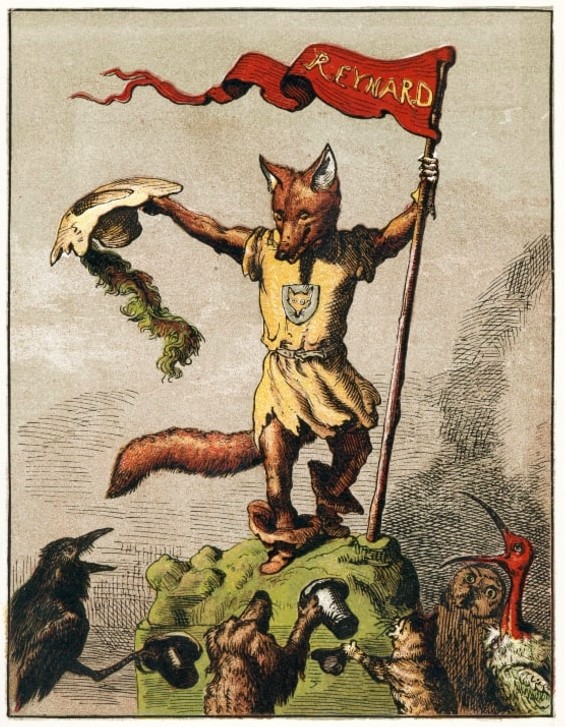
The trickster figure Reynard the Fox as depicted in an 1869 children's book by Michel Rodange

In mythology and the study of folklore and religion, a trickster is a character in a story (god, goddess, spirit, human or anthropomorphisation) who exhibits a great degree of intellect or secret knowledge and uses it to play tricks or otherwise disobey normal rules and defy conventional behavior.

Mythology

[edit]

Tricksters, as archetypal characters, appear in the myths of many different cultures. Lewis Hyde describes the trickster as a "boundary-crosser".[1] The trickster crosses and often breaks both physical and societal rules: Tricksters "violate principles of social and natural order, playfully disrupting normal life and then re-establishing it on a new basis."[2]

Often, this bending and breaking of rules takes the form of tricks and thievery. Tricksters can be cunning or foolish or both. The trickster openly questions, disrupts and mocks authority.[citation needed]

Many cultures have tales of the trickster, a crafty being who uses tricks to get food, steal precious possessions, or simply cause mischief. In some Greek myths Hermes plays the trickster. He is the patron of thieves and the inventor of lying, a gift he passed on to Autolycus, who in turn passed it on to Odysseus.[1] In Slavic folktales, the trickster and the culture hero are often combined.[citation needed]

Loki cuts the hair of the goddess Sif.

Frequently the trickster figure exhibits gender and form variability. In Norse mythology the mischief-maker is Loki, who is also a shapeshifter. Loki also exhibits sex variability, in one case even becoming pregnant. According to "The Song of Hyndla" in The Poetic Edda, Loki becomes a mare who later gives birth to Odin's eight-legged horse Sleipnir.[citation needed]

In African-American folklore, a personified rabbit, known as Brer Rabbit, is the main trickster figure.[3] In West Africa (and thence into the Caribbean via the slave trade), the spider (see Anansi) is often the trickster.[4] In southern African folklore a ǀKaggen is often the trickster, usually taking the form of a praying mantis.[5][6]

Comparison with clown

[edit]

The trickster is a term used for a non-performing "trick maker"; they may have many motives behind their intention but those motives are not largely in public view. They are internal to the character or person.

The clown, on the other hand, is a persona of a performer who intentionally displays their actions in public for an audience.

Native American tradition

[edit]

While the trickster crosses various cultural traditions, there are significant differences between tricksters from different parts of the world:

Many native traditions held clowns and tricksters as essential to any contact with the sacred. People could not pray until they had laughed, because laughter opens and frees from rigid preconception. Humans had to have tricksters within the most sacred ceremonies for fear that they forget the sacred comes through upset, reversal, surprise. The trickster in most native traditions is essential to creation, to birth.[7]

Native American tricksters should not be confused with the European fictional picaro. One of the most important distinctions is that "we can see in the Native American trickster an openness to life's multiplicity and paradoxes largely missing in the modern Euro-American moral tradition".[8] In some stories, the Native American trickster is foolish; other times wise. He can be a hero in one tale and a villain in the next.

In many Native American and First Nations mythologies, the Coyote spirit (Southwestern United States) or Raven spirit (Pacific Northwest) stole fire from the gods (stars, moon, and/or sun). Both are usually seen as jokesters and pranksters. In Native American creation stories, when Coyote teaches humans how to catch salmon, he makes the first fish weir out of logs and branches.[1]

Wakdjunga in Winnebago mythology is an example of the trickster archetype.

Wisakedjak (Wìsakedjàk in Algonquin, Wīsahkēcāhk(w) in Cree and Wiisagejaak in Oji-Cree) is a trickster figure in Algonquin and Chipewyan Storytelling.

Coyote

[edit]
Coyote often has the role of trickster as well as a clown in traditional stories.

The Coyote mythos is one of the most popular among western Native American cultures, especially among indigenous peoples of California and the Great Basin.

According to Crow (and other Plains) tradition, Old Man Coyote impersonates the Creator: "Old Man Coyote took up a handful of mud and out of it made people".[9] He also bestowed names on buffalo, deer, elk, antelopes, and bear. According to A. Hultkranz, the impersonation of Coyote as Creator is a result of a taboo, a mythic substitute to the religious notion of the Great Spirit whose name was too dangerous and/or sacred to use apart from at special ceremonies.[citation needed]

In Chelan myths, Coyote belongs to the animal people but he is at the same time "a power just like the Creator, the head of all the creatures." while still being a subject of the Creator who can punish him or remove his powers.[10] In the Pacific Northwest tradition, Coyote is mostly mentioned as a messenger, or minor power.

As the culture hero, Coyote appears in various mythic traditions, but generally with the same magical powers of transformation, resurrection, and "medicine". He is engaged in changing the ways of rivers, creating new landscapes and getting sacred things for people. Of mention is the tradition of Coyote fighting against monsters. According to Wasco tradition, Coyote was the hero to fight and kill Thunderbird, the killer of people, but he could do that not because of his personal power, but due to the help of the Spirit Chief. In some stories, Multnomah Falls came to be by Coyote's efforts; in others, it is done by Raven.

More often than not Coyote is a trickster, but always different. In some stories, he is a noble trickster: "Coyote takes water from the Frog people... because it is not right that one people have all the water." In others, he is malicious: "Coyote determined to bring harm to Duck. He took Duck's wife and children, whom he treated badly."[citation needed]

Oral stories

[edit]
Trickster subplot in The Relapse: Tom Fashion, pretending to be Lord Foppington, parleys with Sir Tunbelly Clumsey in a 19th-century illustration by William Powell Frith.
[edit]

In modern literature, the trickster survives as a character archetype, not necessarily supernatural or divine, sometimes no more than a stock character.

Often, the trickster is distinct in a story by their acting as a sort of catalyst; their antics are the cause of other characters' discomfiture, but they are left untouched. Shakespeare's Puck is an example of this. Another once-famous example was the character Froggy the Gremlin on the early USA children's television show "Andy's Gang". A cigar-puffing puppet, Froggy induced the adult humans around him to engage in ridiculous and self-destructive hi-jinks.[12]

For example, many European fairy tales have a king who wants to find the best groom for his daughter by ordering several trials. No brave and valiant prince or knight manages to win them, until a poor and simple peasant comes. With the help of his wits and cleverness, instead of fighting, they evade or fool monsters, villains and dangers in unorthodox ways. Against expectations, the most unlikely candidate passes the trials and receives the reward.[citation needed]

More modern and obvious examples of the trickster archetype include Bugs Bunny, the Cheshire Cat from Lewis Caroll's Alice's Adventures in Wonderland and Jerry from Tom and Jerry.[13]

When writing the screenplay for The Curse of the Black Pearl, Ted Elliott and Terry Rossio envisioned Jack Sparrow as a trickster, and Hector Barbossa as his corrupt foil, though the characters can be viewed as both light and dark tricksters.[14]

Online and multimedia

[edit]

In online environments, there has been a link between the trickster and Internet trolling. Some have said that a trickster is a type of online community character.[15][16]

Anthropologist James Cuffe has called the Chinese internet character Grass Mud Horse (cǎonímǎ 草泥马) a trickster candidate because of its duplicity in meaning.[17] Cuffe argues the Grass Mud Horse serves to highlight the creative potential of the trickster archetype in communicating experiential understanding through symbolic narrative. The Grass Mud Horse relies on the interpretative capacity of storytelling in order to skirt internet censorship while simultaneously commenting on the experience of censorship in China. In this sense Cuffe proposes the Grass Mud Horse trickster as 'a heuristic cultural function to aid the perceiver to re-evaluate their own experiential understanding against that of their communities. By framing itself against and in spite of limits the trickster offers new coordinates by which one can reassess and judges one's own experiences.'[17]

See also

[edit]

References

[edit]

Sources

[edit]
[edit]
Revisions and contributorsEdit on WikipediaRead on Wikipedia
from Grokipedia
In mythology and across diverse cultures, the trickster is a recurring archetypal figure characterized by cunning intelligence, moral ambiguity, and a propensity for , disruption, and boundary transgression, often manifesting as an animal, spirit, or who challenges social norms and cosmic order through pranks, thefts, or clever exploits. This motif embodies a paradoxical duality, serving simultaneously as a source of chaos that exposes human folly and frailty, and as a who inadvertently or deliberately bestows boons such as , , or upon humanity by upending established hierarchies. Cross-culturally prevalent from Paleolithic-era oral traditions to recorded myths, examples include among Indigenous North American tribes, who tricks others into revealing secrets or creating natural features; Loki in Norse lore, whose shape-shifting mischief precipitates both and innovative artifacts; Anansi the spider in West African and tales, embodying wit against stronger foes; and Hermes in , the swift messenger-god who steals Apollo's cattle through guile. Such figures reflect empirical patterns in human , where the trickster's appetites-driven antics—ranging from and to intellectual dominance—illustrate causal tensions between stability and , without inherent moral redemption or condemnation.

Definition and Conceptual Foundations

Etymology and Core Definition

The term "trickster" in the context of mythology and folklore refers to an archetypal figure who employs cunning, deception, and often humorous subversion to disrupt established norms, reveal hidden truths, or effect change, frequently embodying paradoxical qualities as both creator and destroyer. This character typically possesses superior intellect or esoteric knowledge that compensates for physical limitations, engaging in boundary-crossing behaviors that challenge social, moral, or cosmic orders while inadvertently fostering innovation or cultural establishment. Scholarly analyses, such as those by anthropologist Paul Radin, emphasize the trickster's amoral nature, portraying it as a "cheater and cheated, subhuman and superhuman" entity whose actions reflect primal human impulses toward survival and adaptation rather than ethical conformity. Etymologically, "trickster" derives from the "trikke," meaning a deceitful or clever act, evolving in to denote one who performs such feats, as documented in the English Dictionary's historical usage tracing back to the for general roguery. Its application as a specific folkloric emerged in 19th-century , with early uses attributed to scholars like Daniel Garrison Brinton in his 1868 work Myths of the , where he described indigenous American figures fitting this pattern, though the precise coining remains debated due to varying terminological precedents in earlier ethnographic accounts. The term gained prominence in 20th-century anthropology through Radin's 1956 monograph The Trickster: A Study in American Indian Mythology, which analyzed the Winnebago () figure Wakdjunkaga—translating roughly to "he who is sacred" or "trickster"—as a foundational example, influencing subsequent by framing the beyond mere toward a catalyst for mythological evolution. In psychological interpretations, such as Carl Gustav Jung's essay "On the Psychology of the Trickster Figure" (1954), the symbolizes the integration of unconscious shadow elements, manifesting daemonic traits that expose the relativity of moral binaries and propel , drawing from Radin's ethnographic data while cautioning against over-rationalizing its chaotic essence. This core definition underscores causal mechanisms in traditions: trickster exploits informational asymmetries and rule ambiguities to invert hierarchies, yielding adaptive outcomes like technological or social critique, as evidenced in diverse oral cycles where such figures establish , , or taboos amid their follies. Empirical patterns across cultures affirm its universality not as but as convergent response to human cognitive predispositions for resolution of existential tensions.

Symbolic and Functional Roles

The trickster symbolizes the paradoxical nature of existence, embodying both creative potential and destructive chaos while defying rigid categorizations of , humanity, and animality. This figure represents intertwined with ingenuity, serving as a mirror to the instabilities and contradictions inherent in cultural orders and natural processes. Often depicted as a shapeshifter or boundary-crosser, the trickster embodies fluidity and adaptability, reflecting the transient quality of identities and social constructs across diverse mythological traditions. Functionally, the trickster disrupts entrenched hierarchies and conventions through , humor, and , thereby catalyzing necessary change and within stagnant systems. By inverting norms and exposing flaws in —such as resources by higher powers—the trickster facilitates access to essential elements like , sustenance, or cultural advancements that would otherwise remain inaccessible. This role extends to cultural preservation, as the trickster's clever defiance fosters flexible thinking and vitality, preventing societal . In narratives, the trickster often transforms mishaps into opportunities for creation or revelation, underscoring a pragmatic realism where apparent yields tangible .

Archetypal Traits and Behaviors

Psychological and Moral Dimensions

The psychologically represents the raw, instinctual undercurrents of the human psyche, manifesting as impulsive behavior driven by unchecked appetites and a childlike mentality devoid of reflective purpose. In Paul Radin's 1956 study of the Winnebago trickster Wakdjunkaga, the figure is depicted as biologically mature yet psychically immature, engaging in acts of , sexuality, and that symbolize the dominance of primal urges over civilized restraint. This portrayal aligns with interpretations viewing the trickster as an embodiment of the psyche's chaotic, boundary-less elements, where cunning serves survival but lacks integration with . Morally, the trickster operates in an framework, unbound by societal or personal , prioritizing self-gratification and disruption over good or evil intentions. emphasizes that the trickster "knows neither good nor evil yet he is responsible for both," as his passion-driven actions inadvertently birth cultural values and norms despite their apparent immorality. This , distinct from deliberate immorality, challenges rigid moral hierarchies by exposing hypocrisies and fostering through , though it often inflicts collateral harm without remorse or reform. , in his 1998 analysis, argues that such figures provide essential disruptive intelligence to stagnant societies, enabling adaptation by blurring sacred and profane boundaries, yet their ethical detachment underscores a causal realism where outcomes, not intentions, define impact.

Boundary-Crossing and Transformative Aspects

Tricksters embody boundary-crossing by routinely violating social, moral, and cosmic norms, traversing divides between the sacred and profane, human and animal, or . This liminal positioning, as described in anthropological analyses, positions the trickster as a "lord of in-between," capable of moving between realms such as and earth or the living and the dead. Such transgressions challenge rigid categorizations, exposing their artificiality and prompting reevaluation of established orders. Transformative capacities further define the , often through or radical metamorphoses that alter form, , or identity, underscoring the fluidity inherent in reality. In Paul Radin's examination of Winnebago Trickster myths, the figure Wakdjunkaga undergoes changes and bodily transformations not merely for but to illustrate extremes of and the rejection of fixed roles, reinterpreting world through corporeal lenses. argues that these boundary violations in trickster narratives disrupt stasis, generating paths for innovation by following unexpected trajectories and integrating accidents into cultural progress. Ultimately, this dual aspect yields renewal amid chaos: boundary-crossing induces destruction of outdated structures, while transformation fosters creation of novel ones, as the trickster's actions reveal concealed truths and compel adaptation. Anthropological scholarship notes this process thrives in transitional phases where societal rules suspend, allowing the to mediate between stability and flux. In essence, the trickster's operations affirm that boundaries, though vital for order, require periodic breaching to sustain vitality, a dynamic evident across mythic traditions without reliance on .

Historical and Cross-Cultural Manifestations

African and African Diaspora Traditions

In sub-Saharan African oral traditions, trickster figures frequently appear as anthropomorphic animals or divine entities that prioritize intellect and deception over brute force, often serving to critique power imbalances and impart lessons on human frailty. Among the Akan peoples, including the Ashanti of present-day , the spider exemplifies this , bargaining with the sky god Nyame to secure all the world's stories as his own through a series of arduous tasks involving a python, , , and , thereby establishing narratives as a communal resource won by cunning. These tales, transmitted orally for generations, were first systematically documented by British Sutherland Rattray in his 1930 collection Akan-Ashanti Folk-Tales, revealing Anansi's dual role as culture hero and greedy buffoon whose schemes frequently backfire, underscoring the limits of trickery. In Yoruba mythology of and , Esu (also known as Elegba or Eshu-Elegbara) functions as a primordial and trickster-messenger who governs crossroads, chance, and uncertainty, using pranks and ambiguity to mediate between humans and deities while enforcing cosmic order through disruption. Depicted with phallic symbols and multicolored attire to signify his multifaceted nature, Esu sows confusion—such as in tales where he provokes quarrels by wearing a hat black on one side and white on the other—to reveal truths hidden by complacency, embodying the principle that fate involves both opportunity and peril. Anthropological analyses trace his attributes to pre-colonial Yoruba cosmology, where his rituals emphasize offerings to avert misfortune, distinguishing him from purely animal tricksters by his divine status and role in divination systems like . The emerges as a ubiquitous trickster in Bantu and other Southern and Eastern African folktales, outwitting larger beasts like or through feigned weakness or verbal guile, as in stories where it tricks an elephant into carrying it to stores or evades predators by exploiting their vanity. These narratives, prevalent across regions from to , often conclude with the hare's comeuppance, reinforcing communal values like amid the hare's emblematic smallness against formidable foes. Collected examples from early 20th-century ethnographies highlight the hare's consistency as a of the underdog's resilience in resource-scarce environments. During the transatlantic slave trade (roughly 1526–1867), which forcibly displaced over 12 million Africans primarily from West and Central regions, trickster motifs endured in diaspora communities as veiled critiques of enslavement, adapting animal protagonists to encode survival strategies. In , Anansi tales persisted among Akan-descended populations, featuring the spider's escapades against tigers or spirits to hoard food or evade labor, as compiled by folklorist Martha Warren Beckwith in her 1924 volume Jamaica Anansi Stories, which includes over 100 variants with accompanying music and riddles illustrating cultural with local elements. Similarly, in African American oral traditions of the , particularly among communities in the , the transformed into , who employs traps in reverse—tricking Br'er Fox into hurling him into a briar patch, his innate stronghold—mirroring enslaved Africans' use of dissimulation against overseers. These stories, antedating their 1880s publication by from Georgia slave narrators, derive from African hare precedents and served to preserve agency narratives amid systemic subjugation, though academic scrutiny notes their occasional moral inversion where trickery affirms rather than purely subverts hierarchy.

Native American and Indigenous North American Examples

In Native American oral traditions, the trickster archetype frequently embodies animal figures that serve dual roles as creators, transformers, and cautionary fools, with Coyote emerging as a dominant example across tribes in the American Southwest, Great Plains, and Pacific regions. Known variably as Ma'ii among the Navajo or Íshto'ba among the Nez Perce, Coyote initiates cultural innovations—such as securing fire or shaping landscapes—through cunning exploits, yet his impulsive greed and lust often precipitate disasters that instruct on human frailties. For instance, in Navajo narratives, Coyote scatters stars haphazardly into the night sky after growing impatient with their methodical placement by divine order, accounting for their irregular distribution, while also wielding influence over rainfall as Áłtsé hashké, or "first scolder." Among the Nez Perce, Coyote slays a world-engulfing monster and distributes its remains to form diverse tribes, establishing human societies through this act of resourceful dismemberment. Raven assumes the trickster mantle in Pacific Northwest Indigenous cosmologies, particularly among the Haida, Tlingit, Tsimshian, and related coastal groups, where he shape-shifts to pilfer celestial bodies from possessive giants, releasing the sun, moon, and stars to illuminate a previously dark world. These stories, transmitted orally for millennia, cast Raven as a pragmatic deceiver whose thievery fosters cosmic order, though his insatiable hunger—for light or food—frequently backfires, embedding lessons on consequence within feats of ingenuity. In Haida and Tlingit variants, Raven's transformations from bird to human or object enable such thefts, underscoring his boundary-transgressing essence as both benefactor and self-sabotager. Further east, in Algonquian traditions of tribes like the (), (or Nanabush) parallels these figures as a hare-man hybrid who engineers natural phenomena and social norms via pranks and errors, such as outwitting rivals to procure or birch-bark canoes for his people. As a , 's fumbling deceptions—mirroring Coyote's lustful mishaps or Raven's —yield practical knowledge, like fire-making or seasonal cycles, while highlighting ethical pitfalls of excess. These archetypes vary by tribal ecology and history: arid Southwest tales emphasize Coyote's tricks amid , Northwest narratives leverage Raven's adaptability to maritime abundance, and woodland stories via stress communal resourcefulness, reflecting adaptive realism over uniform moralizing. Tribal elders traditionally recounted these during winter, reserving them from summer hunts to maintain narrative potency, a practice rooted in experiential efficacy rather than abstract dogma.

Eurasian and Classical Mythologies

In , Hermes serves as a primary trickster figure, renowned for his cunning from birth when he stole Apollo's cattle shortly after being born and invented the from a shell to cover his tracks. As the messenger god, patron of thieves, travelers, and boundaries, Hermes embodies boundary-crossing through his swiftness, deceit, and role in guiding souls, often employing wit over force. complements this archetype by tricking twice—first in dividing sacrificial meat to favor mortals, then stealing fire from the gods to bestow it upon humanity, actions that provoked divine punishment yet advanced human progress. The Roman counterpart, Mercury, inherits Hermes' traits as a god of commerce, eloquence, and trickery, depicted with winged sandals and , facilitating deception in myths like aiding heroes through guile. In , Loki exemplifies the trickster as a shape-shifting companion to , capable of changing form and sex, who both aids the Aesir—such as procuring treasures like Thor's hammer—and sows chaos, including orchestrating the death of and fathering monstrous offspring like and , ultimately contributing to . His dual role as mischief-maker and occasional helper highlights the archetype's ambivalence, with primary sources like the and (compiled circa 13th century from older oral traditions) portraying him as integral yet disruptive to the divine order. Medieval Eurasian folklore features as a anthropomorphic trickster in beast epics originating in 12th-century French and tales, such as Roman de Renart, where the sly fox repeatedly deceives stronger animals like the Isengrim through lies, feigned piety, and cunning schemes, symbolizing the triumph of intellect and lower-class guile over brute aristocratic power. Slavic mythology includes Veles, a chthonic dragon-like deity opposing the thunder god Perun, associated with magic, wealth, and serpentine trickery in undermining cosmic order, as evidenced in comparative Indo-European analyses of mythological oppositions. These figures across Eurasian traditions consistently disrupt norms, catalyze change, and reveal societal tensions through their amoral ingenuity.

Other Global Variants

In Polynesian mythology, Māui serves as a prominent trickster and culture hero, depicted as a demigod with superhuman strength and shapeshifting abilities who employs cunning to benefit humanity. His exploits include tricking the sun to slow its path, thereby extending daylight for fishing and daily labors, and using a magical fishhook to draw up islands from the sea, such as the North Island of New Zealand in Māori traditions. Māui's attempts to conquer death by entering the goddess Hine-nui-te-pō's body to reverse mortality famously fail due to his laughter alerting her, resulting in his death by her obsidian teeth, underscoring the trickster's blend of ingenuity and hubris. Australian Aboriginal traditions feature tricksters like Bamapana in mythology, a figure who sows discord through vulgarity, lust, and deliberate misunderstandings to disrupt social harmony. Bamapana's actions, such as inciting arguments or inverting norms, highlight the trickster's role in challenging ancestral order while occasionally imparting lessons on consequences. Similarly, Waang, a ancestral being in Kulin lore, embodies trickster traits as a who introduces fire to humans via deception but also engages in thievery and , reflecting the archetype's dual capacity for creation and chaos. In Southeast Asian , figures like Sri Thanonchai in Thai traditions exemplify the trickster as a clever youth who outwits authorities through riddles and pranks, often exposing or in tales passed orally across , , and . Filipino myths include , a horse-headed humanoid who misleads travelers in forests by disorienting paths and creating illusions, serving as a cautionary embodiment of wilderness dangers and human overconfidence. These variants, while localized, share the core motif of boundary transgression to reveal truths or enforce moral reckonings, distinct from yet resonant with broader archetypal patterns.

Interpretations in Psychology and Philosophy

Jungian Archetype and Shadow Integration

Carl Gustav Jung identified the trickster as a primordial archetype manifesting across mythologies, characterized by its defiance of norms, instinctual drives, and capacity for both chaos and renewal. In his 1954 essay "On the Psychology of the Trickster-Figure," Jung portrayed the trickster not merely as a mythological entity but as a projection of the , embodying "countertendencies in the unconscious" that parallel the individual's inferior traits. This figure's puerile, amoral behaviors—such as gluttony, sexual excess, and deceit—highlight the psyche's raw, unrefined energies that civilized consciousness seeks to suppress. The trickster aligns closely with Jung's concept of , defined as the repository of repressed personal and collective contents, including instincts deemed incompatible with ego ideals. Unlike the personal shadow, which varies by individual, the trickster operates as a archetype, amplifying universal human frailties like irrationality and boundary violation on a mythic scale. Jung emphasized its dual nature: while representing "atrocious, unconscious and unrelated" elements that sabotage rationality, it also harbors transformative potential by dynamizing psychic development through conflict. In his commentary on Paul Radin's 1956 study of Winnebago trickster myths, Jung noted how the figure's antics initiate a "civilizing process" within its own cycle, evolving from undifferentiated chaos toward structured awareness. Shadow integration, central to Jung's process, involves withdrawing projections and assimilating these unconscious elements to achieve psychic wholeness. The facilitates this by irrupting into conscious life, often through synchronicities or neurotic symptoms, compelling confrontation with denied aspects of the . Jung argued that ignoring the shadow leads to its autonomous eruption as trickster-like sabotage, whereas active engagement transmutes its destructive impulses into creative adaptation, as seen in myths where the trickster's follies yield cultural innovations. This integration demands ethical discernment, balancing the trickster's liberating mischief against its peril of regression, ultimately serving as a catalyst for transcending ego limitations. Scholarly analyses affirm that the trickster's role underscores the necessity of embracing instinctual vitality for psychological maturity, countering one-sided .

Evolutionary and Anthropological Perspectives

In anthropological analyses, the trickster figure serves as a mediator of structural oppositions within mythological systems, resolving inherent cultural contradictions such as those between nature and culture, life and death, or the sacred and profane. Claude Lévi-Strauss, in his structuralist framework, posited that North American trickster myths, exemplified by figures like the Winnebago Wakdjunkaga, embody these binaries to facilitate cognitive and social mediation, transforming raw oppositions into ordered cultural categories. Paul Radin's 1956 ethnographic study of Winnebago (Ho-Chunk) trickster cycles further illustrates this, portraying the trickster as an amoral, instinct-driven entity whose chaotic exploits—ranging from scatological mishaps to thefts of fire and tools—incidentally establish human institutions like marriage taboos, cooking, and social norms, reflecting a transition from primal chaos to civilized order. From an evolutionary standpoint, trickster narratives likely persist across cultures due to their adaptive role in encoding solutions to social dilemmas prevalent in ancestral environments, particularly among societies. These stories often depict tricksters as free-riders who exploit norms through or , only to face , thereby illustrating the costs of and reinforcing group-level essential for in resource-scarce settings. Empirical analysis of indigenous , including trickster tales from American Indian and African traditions, supports this function, as the motifs of cunning circumvention of rules and subsequent transmit behavioral heuristics that deter and promote vigilance against cheaters, aligning with evolutionary pressures favoring reciprocity and . Trickster humor further contributes to social adaptation by subverting rigid norms, fostering flexibility and in response to environmental variability, a trait advantageous in fluctuating Pleistocene conditions. Deceptive behaviors modeled by tricksters mirror observed adaptive strategies in nonhuman and early humans, such as tactical for acquisition, suggesting these archetypes mythologize innate cognitive capacities for manipulation that enhanced reproductive fitness despite risks of social ostracism. While structuralist interpretations emphasize symbolic resolution over biological utility, the cross-cultural ubiquity of trickster figures—spanning , , and the —implies a causal link to universal human psychology shaped by selection for strategic intelligence amid cooperative interdependence.

Representations in Literature, Art, and Media

Pre-Modern Narratives and Folklore

In medieval European beast epics, the trickster figure appeared as , a cunning anthropomorphic character who repeatedly deceives and humiliates more powerful animals, reflecting satirical critiques of ecclesiastical and feudal hierarchies. Originating from Latin and narratives in the mid-12th century, such as the Flemish Ysengrimus of 1148, these stories expanded fables into episodic cycles where Reynard employs guile, flattery, and false piety to evade punishment and gain advantage over adversaries like the wolf Ysengrin. The tales circulated widely in languages by the 13th century, influencing moral and comic across , with Reynard embodying resourcefulness against brute force. Norse mythological narratives, recorded in the 13th-century and from pre-Christian oral traditions dating back to at least the , feature as a shape-shifting trickster who both assists and betrays the gods. Loki's exploits include transforming into a to distract a giant's stallion, enabling the gods to reclaim Thor's hammer , and orchestrating deceptions that lead to conflicts, such as binding the wolf. His dual role highlights boundary-crossing chaos, culminating in prophecies where his mischief escalates to cosmic destruction. In West African Akan oral , preserved through generations before 15th-century European contact, the spider functions as a trickster who outwits stronger creatures like leopards or gods to acquire wisdom, food, or all stories in the world. These tales, emphasizing verbal cunning over physical prowess, served didactic purposes in communal storytelling, with Anansi's failures underscoring the perils of greed. Similarly, in pre-colonial Native American oral myths across tribes like the and , acts as a creator-trickster who steals fire or shapes landscapes through pranks and blunders, blending humor with explanations of natural phenomena and social norms. Such narratives, transmitted verbally until 19th-century transcriptions, illustrate tricksters as agents of innovation amid folly.

19th-20th Century Literature and Adaptations

Johann Wolfgang von Goethe's epic poem Reineke Fuchs, published in 1794, represents an influential literary adaptation of the medieval cycle, casting the anthropomorphic fox as a cunning trickster who employs and to evade punishment and outmaneuver rivals in an animal society mirroring human courts. Goethe's rendition drew from beast epics, emphasizing Reynard's amoral ingenuity and survivalist ethos amid accusations of theft and betrayal. This work, illustrated in 19th-century editions such as Wilhelm von Kaulbach's 1846 engravings, sustained the trickster's satirical role in critiquing power structures. In , Joel Chandler Harris adapted African-derived trickster traditions in his series, beginning with Uncle Remus: His Songs and His Sayings in 1881, where repeatedly triumphs over stronger antagonists like Br'er Fox through clever ruses such as the trap. These narratives, framed as stories told by the fictional to a white boy, preserved elements of West African folklore transmitted via enslaved people, transforming oral tales into dialect-infused prose for post-Civil War readers. Harris collected over 180 tales across seven volumes by 1905, highlighting the trickster's role as a subversive . The early saw the emergence of original trickster figures in , notably J.M. Barrie's Peter Pan, first staged in 1904 and novelized in 1911, depicting the boy who never grows up as a mischievous boundary-crosser who thwarts with fairy dust, impersonations, and forgetful whimsy. Peter's traits—, defiance of rules, and chaotic play—align with trickster archetypes by disrupting Victorian norms of maturity and order, as analyzed in scholarly examinations of his liminal nature. Film adaptations extended these literary traditions, with Walt Disney's (1946) animating segments of Harris's stories, where the rabbit's ploy and briar patch escape underscored themes of resilience through over brute force. This production reached millions, though it drew criticism for romanticizing plantation life, reflecting debates over the cultural adaptation of trickster motifs in . In the , , portrayed by since his debut in Thor on May 6, 2011, exemplifies the archetype through , shape-shifting illusions, and opportunistic schemes that challenge divine and heroic . His invasion of Earth in The Avengers (released May 4, 2012) killed 74 people in the Battle of New York, showcasing destructive mischief rooted in Norse mythological precedents, yet adapted for blockbuster appeal with over $1.5 billion in global for the film alone. The 2021 Disney+ series , spanning two seasons through 2023, further explores his multiversal disruptions, emphasizing cunning survival over outright villainy, with the character appearing in 12 MCU projects by October 2023. Television series like feature trickster-like figures, such as the Eleventh Doctor (Matt Smith, 2010–2013), who employs temporal manipulation and rhetorical ploys to subvert cosmic threats, appearing in 44 episodes that drew average viewership of 7.5 million in the UK. Similarly, ' Bart Simpson, debuting in the show's premiere on December 17, 1989 but persisting into contemporary seasons, embodies juvenile pranks and institutional defiance, with over 750 episodes by 2023 reinforcing his role as a of irreverent chaos. In comics, (Peter Parker, created 1962 but revitalized in modern arcs like Spider-Man: No Way Home, 2021) uses web-based gadgets and quips to outwit physically superior foes, as analyzed in examinations of his guilt-driven yet agile persona. Digital media extends the into interactive formats, where video games incorporate trickster mechanics like stealth and ; for instance, player-driven cunning in titles leveraging advanced AI challenges societal norms through gameplay, as noted in analyses of since the . Streaming adaptations, such as Netflix's (2016–2021, 93 episodes), reimagine the as a charismatic rule-breaker exposing human flaws via psychological games, drawing 3.2 million U.S. households for its premiere week. platforms amplify trickster dynamics through algorithmic "trolling" and viral memes that mock , though these often devolve into unfocused disruption rather than the culturally regenerative mischief of traditional archetypes, per on showization trends.

Criticisms, Debates, and Societal Implications

Moral Ambiguities and Destructive Potential

Trickster figures in mythology frequently embody moral ambiguities, operating beyond binary notions of and , as their deceptions serve personal gain, societal , or inadvertent progress, often without clear ethical justification. This arises from their boundary-crossing nature, where cleverness enables both and exploitation, challenging rigid norms but inviting ethical scrutiny for prioritizing over communal welfare. Scholarly analyses note that tricksters like in West African folklore trick gods and humans alike, blurring moral lines through wit that yields stories or knowledge yet stems from cunning manipulation rather than . The destructive potential of tricksters manifests in narratives where their mischief precipitates catastrophe, death, or widespread harm, underscoring the risks of unchecked chaos. In , orchestrates the death of the god by exploiting Hodr's blindness with , an act that violates oaths of brotherhood and sets in motion the chain of events leading to Ragnarok, the apocalyptic downfall of the gods and renewal of the world through devastation. Similarly, in Native American traditions engages in greedy or foolish schemes that induce harm, such as inciting conflicts or causing like floods, embodying dual forces where creation emerges from prior destruction but at the cost of immediate suffering to animals, humans, and the cosmos. Critics of the trickster argue that romanticizing this destructive capacity overlooks causal harms, such as societal disruption or , which parallel real-world rationalizations of under guises of transformation. While some interpretations frame such actions as necessary for psychological or cultural renewal—shattering obsolete structures to foster growth—empirical examination of mythic outcomes reveals persistent costs, including betrayal-induced strife and existential threats, without guaranteed positive resolution. This duality prompts debates on whether the encourages adaptive realism or excuses predatory behavior, with sources emphasizing aspects where self-serving chaos overrides ethical constraints.

Scholarly Controversies on Universality

Scholars have long debated whether the trickster figure constitutes a universal archetype transcending cultural boundaries or a construct shaped by specific historical and social contexts. Proponents of universality, drawing on Carl Jung's concept of archetypes in the collective unconscious, argue that recurrent traits such as cunning, boundary violation, and ambivalence appear in myths from disparate traditions, including Native American Coyote cycles analyzed by Paul Radin in 1956 and African Anansi tales, suggesting innate psychological patterns rather than cultural diffusion. This view posits the trickster as a mediator of chaos and order, evident in over 20 independent ethnographic records spanning continents, as compiled in comparative myth studies. Critics, however, contend that such generalizations impose overly broad categories that obscure cultural specificities and evolutionary adaptations in oral narratives. William J. Hynes and William G. Doty, in their 1993 edited volume, describe the trickster as a "perplexing" entity whose contradictory attributes—simultaneously sacred and profane, creative and destructive—complicate universal definitions, framing the issue as akin to the philosophical "problem of universals" where abstract essences clash with particular instances. They emphasize that traits vary significantly; for instance, Winnebago trickster narratives stress amoral folly, while West African versions like those of Ajapa highlight resourcefulness tied to survival in agrarian societies, challenging archetypal uniformity. Anthropological relativists further critique comparative approaches for potential ethnocentrism, noting how Western interpretations, influenced by Jungian frameworks, may flatten indigenous complexities, as seen in the taming of Brer Rabbit from African roots to American folktales between the 17th and 19th centuries. These controversies extend to methodological concerns, with some scholars arguing that the trickster's "universality" reflects scholarly bias toward pattern-seeking over empirical variance in motif indices, such as those documented in Thompson's 1955 catalog where trickster elements appear in 70% of global folktale samples but with context-dependent functions. Defenders respond that dismissing universality ignores convergent evidence from cognitive anthropology, where trickery motifs correlate with human universals like deception in social cooperation, as modeled in evolutionary game theory studies since the 1980s. Despite these tensions, recent analyses, including those in 2012 theses synthesizing African, Caribbean, and U.S. variants, conclude that while core disruptions persist, rigid classifications risk undervaluing adaptive divergences, urging hybrid models balancing archetype and locality.

Modern Misapplications and Cultural Critiques

In contemporary political discourse, the Trickster archetype has been misapplied to figures such as , framing their norm-breaking rhetoric and policy inconsistencies as a necessary of entrenched elites rather than as emblematic of the archetype's inherent deceit and boundary dissolution. This portrayal emphasizes cunning as transformative intelligence while minimizing the Trickster's association with perpetuating insecurity and blurring truth, traits that echo mythological precedents but risk endorsing unaccountable disruption in democratic systems. Scholarly analyses critique such invocations for selectively amplifying the Trickster's paradoxical qualities—simultaneously creator and destroyer—leading to oversimplified applications that ignore cultural specificities. For instance, early 20th-century interpretations by romanticized the Winnebago Trickster as a primal embodiment of human needs, yet this was faulted for treating mythic figures as detached literary fictions detached from empirical tribal realities, fostering a Western toward over grounded . Critics like Ake Hultkrantz argued this approach dilutes the archetype's embedded contradictions, such as its clownish folly juxtaposed with heroic innovation, rendering it a malleable tool for ideological projection rather than rigorous analysis. Cultural commentators further highlight the dangers of romanticizing Trickster humor in modern society, where its norm-challenging function is invoked to justify excessive rule-breaking, potentially eroding social cohesion without yielding adaptive benefits. In literary adaptations by authors like , Trickster-inspired characters provoke chaos through appetite-driven antics, but this can misfire into unintended violence or commodification, as seen in appropriations of Edward Abbey's eco-disruptive narratives that inspired destructive acts contrary to their intent. Such misapplications overlook the archetype's shadow aspects, including its capacity to exploit vulnerabilities for personal gain, as evidenced in economic phenomena like the 2008 mortgage crisis or Ponzi schemes, where Trickster-like opportunism masquerades as market innovation. From a Jungian perspective, these modern deployments reflect an incomplete integration of the Trickster as a collective shadow—embodying inferior, irrational impulses that undermine rational order—yet often strip away its cautionary , reducing it to a celebratory of in and media. This selective emphasis aligns with broader cultural tendencies to valorize disruption amid institutional distrust, but risks amplifying the archetype's destructive potential, as its historical manifestations in and demonstrate causation of systemic harm through and blame-shifting rather than genuine renewal.

References

Add your contribution
Related Hubs
User Avatar
No comments yet.