


Community hub
Recent from talks
Contribute something
Nothing was collected or created yet.
Wind wave
View on Wikipedia
In fluid dynamics, a wind wave, or wind-generated water wave, is a surface wave that occurs on the free surface of bodies of water as a result of the wind blowing over the water's surface. The contact distance in the direction of the wind is known as the fetch. Waves in the oceans can travel thousands of kilometers before reaching land. Wind waves on Earth range in size from small ripples to waves over 30 m (100 ft) high, being limited by wind speed, duration, fetch, and water depth.[1]
When directly generated and affected by local wind, a wind wave system is called a wind sea. Wind waves will travel in a great circle route after being generated – curving slightly left in the southern hemisphere and slightly right in the northern hemisphere. After moving out of the area of fetch and no longer being affected by the local wind, wind waves are called swells and can travel thousands of kilometers. A noteworthy example of this is waves generated south of Tasmania during heavy winds that will travel across the Pacific to southern California, producing desirable surfing conditions.[2] Wind waves in the ocean are also called ocean surface waves and are mainly gravity waves, where gravity is the main equilibrium force.
Wind waves have a certain amount of randomness: subsequent waves differ in height, duration, and shape with limited predictability. They can be described as a stochastic process, in combination with the physics governing their generation, growth, propagation, and decay – as well as governing the interdependence between flow quantities such as the water surface movements, flow velocities, and water pressure. The key statistics of wind waves (both seas and swells) in evolving sea states can be predicted with wind wave models.
Although waves are usually considered in the water seas of Earth, the hydrocarbon seas of Titan may also have wind-driven waves.[3][4][5] Waves in bodies of water may also be generated by other causes, both at the surface and underwater (such as watercraft, animals, waterfalls, landslides, earthquakes, bubbles, and impact events).
Formation
[edit]


The great majority of large breakers seen at a beach result from distant winds. Five factors influence the formation of the flow structures in wind waves:[6]
- Wind speed or strength relative to wave speed – the wind must be moving faster than the wave crest for energy transfer to the wave.
- The uninterrupted distance of open water over which the wind blows without significant change in direction (called the fetch)
- Width of the area affected by fetch (at a right angle to the distance)
- Wind duration – the time for which the wind has blown over the water.
- Water depth
All of these factors work together to determine the size of the water waves and the structure of the flow within them.
The main dimensions associated with wave propagation are:
- Wave height (vertical distance from trough to crest)
- Wave length (distance from crest to crest in the direction of propagation)
- Wave period (time interval between arrival of consecutive crests at a stationary point)
- Wave direction or azimuth (predominantly driven by wind direction)
A fully developed sea has the maximum wave size theoretically possible for a wind of specific strength, duration, and fetch. Further exposure to that specific wind could only cause a dissipation of energy due to the breaking of wave tops and formation of "whitecaps". Waves in a given area typically have a range of heights. For weather reporting and for scientific analysis of wind wave statistics, their characteristic height over a period of time is usually expressed as significant wave height. This figure represents an average height of the highest one-third of the waves in a given time period (usually chosen somewhere in the range from 20 minutes to twelve hours), or in a specific wave or storm system. The significant wave height is also the value a "trained observer" (e.g. from a ship's crew) would estimate from visual observation of a sea state. Given the variability of wave height, the largest individual waves are likely to be somewhat less than twice the reported significant wave height for a particular day or storm.[7]
Wave formation on an initially flat water surface by wind is started by a random distribution of normal pressure of turbulent wind flow over the water. This pressure fluctuation produces normal and tangential stresses in the surface water, which generates waves. It is usually assumed for the purpose of theoretical analysis that:[8]
- The water is originally at rest.
- The water is not viscous.
- The water is irrotational.
- There is a random distribution of normal pressure to the water surface from the turbulent wind.
- Correlations between air and water motions are neglected.
The second mechanism involves wind shear forces on the water surface. John W. Miles suggested a surface wave generation mechanism that is initiated by turbulent wind shear flows based on the inviscid Orr–Sommerfeld equation in 1957. He found the energy transfer from the wind to the water surface is proportional to the curvature of the velocity profile of the wind at the point where the mean wind speed is equal to the wave speed. Since the wind speed profile is logarithmic to the water surface, the curvature has a negative sign at this point. This relation shows the wind flow transferring its kinetic energy to the water surface at their interface.
Assumptions:
- two-dimensional parallel shear flow
- incompressible, inviscid water and wind
- irrotational water
- slope of the displacement of the water surface is small[9]
Generally, these wave formation mechanisms occur together on the water surface and eventually produce fully developed waves.
For example,[10] if we assume a flat sea surface (Beaufort state 0), and a sudden wind flow blows steadily across the sea surface, the physical wave generation process follows the sequence:
- Turbulent wind forms random pressure fluctuations at the sea surface. Ripples with wavelengths in the order of a few centimeters are generated by the pressure fluctuations. (The Phillips mechanism[8])
- The winds keep acting on the initially rippled sea surface causing the waves to become larger. As the waves grow, the pressure differences get larger causing the growth rate to increase. Finally, the shear instability expedites the wave growth exponentially. (The Miles mechanism[8])
- The interactions between the waves on the surface generate longer waves[11] and the interaction will transfer wave energy from the shorter waves generated by the Miles mechanism to the waves which have slightly lower frequencies than the frequency at the peak wave magnitudes, then finally the waves will be faster than the crosswind speed (Pierson & Moskowitz[12]).
| Conditions necessary for a fully developed sea at given wind speeds, and the parameters of the resulting waves | |||||
|---|---|---|---|---|---|
| Wind conditions | Wave size | ||||
| Wind speed in one direction | Fetch | Wind duration | Average height | Average wavelength | Average period and speed |
| 19 km/h (12 mph) | 19 km (12 mi) | 2 hr | 0.27 m (0.89 ft) | 8.5 m (28 ft) | 3.0 sec, 10.2 km/h (9.3 ft/sec) |
| 37 km/h (23 mph) | 139 km (86 mi) | 10 hr | 1.5 m (4.9 ft) | 33.8 m (111 ft) | 5.7 sec, 21.4 km/h (19.5 ft/sec) |
| 56 km/h (35 mph) | 518 km (322 mi) | 23 hr | 4.1 m (13 ft) | 76.5 m (251 ft) | 8.6 sec, 32.0 km/h (29.2 ft/sec) |
| 74 km/h (46 mph) | 1,313 km (816 mi) | 42 hr | 8.5 m (28 ft) | 136 m (446 ft) | 11.4 sec, 42.9 km/h (39.1 ft/sec) |
| 92 km/h (57 mph) | 2,627 km (1,632 mi) | 69 hr | 14.8 m (49 ft) | 212.2 m (696 ft) | 14.3 sec, 53.4 km/h (48.7 ft/sec) |
| NOTE: Most of the wave speeds calculated from the wave length divided by the period are proportional to the square root of the wave length. Thus, except for the shortest wave length, the waves follow the deep water theory. The 28 ft long wave must be either in shallow water or intermediate depth. | |||||
Types
[edit]
Three different types of wind waves develop over time:
- Capillary waves, or ripples, dominated by surface tension effects.
- Gravity waves, dominated by gravitational and inertial forces.
- Seas, raised locally by the wind.
- Swells, which have traveled away from where they were raised by the wind, and have to a greater or lesser extent dispersed.
Ripples appear on smooth water when the wind blows, but will die quickly if the wind stops. The restoring force that allows them to propagate is surface tension. Sea waves are larger-scale, often irregular motions that form under sustained winds. These waves tend to last much longer, even after the wind has died, and the restoring force that allows them to propagate is gravity. As waves propagate away from their area of origin, they naturally separate into groups of common direction and wavelength. The sets of waves formed in this manner are known as swells. The Pacific Ocean is 19,800 km (12,300 mi) from Indonesia to the coast of Colombia and, based on an average wavelength of 76.5 m (251 ft), would have ~258,824 swells over that width.
It is sometimes alleged that out of a set of waves, the seventh wave in a set is always the largest; while this isn't the case, the waves in the middle of a given set tend to be larger than those before and after them.[13]
Individual "rogue waves" (also called "freak waves", "monster waves", "killer waves", and "king waves") much higher than the other waves in the sea state can occur. In the case of the Draupner wave, its 25 m (82 ft) height was 2.2 times the significant wave height. Such waves are distinct from tides, caused by the Moon and Sun's gravitational pull, tsunamis that are caused by underwater earthquakes or landslides, and waves generated by underwater explosions or the fall of meteorites—all having far longer wavelengths than wind waves.
The largest ever recorded wind waves are not rogue waves, but standard waves in extreme sea states. For example, 29.1 m (95 ft) high waves were recorded aboard the RRS Discovery, in a sea with 18.5 m (61 ft) significant wave height, so the highest wave was only 1.6 times the significant wave height.[14] The biggest recorded by a buoy (as of 2011) was 32.3 m (106 ft) high during the 2007 typhoon Krosa near Taiwan.[15]
Spectrum
[edit]
Ocean waves can be classified based on: the disturbing force that creates them; the extent to which the disturbing force continues to influence them after formation; the extent to which the restoring force weakens or flattens them; and their wavelength or period. Seismic sea waves have a period of about 20 minutes, and speeds of 760 km/h (470 mph). Wind waves (deep-water waves) have a period up to about 20 seconds.
| Wave type | Typical wavelength | Disturbing force | Restoring force |
|---|---|---|---|
| Capillary wave | < 2 cm | Wind | Surface tension |
| Wind wave | 60–150 m (200–490 ft) | Wind over ocean | Gravity |
| Seiche | Large, variable; a function of basin size | Change in atmospheric pressure, storm surge | Gravity |
| Seismic sea wave (tsunami) | 200 km (120 mi) | Faulting of sea floor, volcanic eruption, landslide | Gravity |
| Tide | Half the circumference of Earth | Gravitational attraction, rotation of Earth | Gravity |
The speed of all ocean waves is controlled by gravity, wavelength, and water depth. Most characteristics of ocean waves depend on the relationship between their wavelength and water depth. Wavelength determines the size of the orbits of water molecules within a wave, but water depth determines the shape of the orbits. The paths of water molecules in a wind wave are circular only when the wave is traveling in deep water. A wave cannot "feel" the bottom when it moves through water deeper than half its wavelength because too little wave energy is contained in the water movement below that depth. Waves moving through water deeper than half their wavelength are known as deep-water waves. On the other hand, the orbits of water molecules in waves moving through shallow water are flattened by the proximity of the sea bottom surface. Waves in water shallower than 1/20 their original wavelength are known as shallow-water waves. Transitional waves travel through water deeper than 1/20 their original wavelength but shallower than half their original wavelength.
In general, the longer the wavelength, the faster the wave energy will move through the water. The relationship between the wavelength, period and velocity of any wave is:

where C is speed (celerity), L is the wavelength, and T is the period (in seconds). Thus the speed of the wave derives from the functional dependence of the wavelength on the period (the dispersion relation).

The speed of a deep-water wave may also be approximated by:
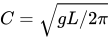
where g is the acceleration due to gravity, 9.8 meters (32 feet) per second squared. Because g and π (3.14) are constants, the equation can be reduced to:
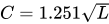
when C is measured in meters per second and L in meters. In both formulas the wave speed is proportional to the square root of the wavelength.
The speed of shallow-water waves is described by a different equation that may be written as:

where C is speed (in meters per second), g is the acceleration due to gravity, and d is the depth of the water (in meters). The period of a wave remains unchanged regardless of the depth of water through which it is moving. As deep-water waves enter the shallows and feel the bottom, however, their speed is reduced, and their crests "bunch up", so their wavelength shortens.
Spectral models
[edit]Sea state can be described by the sea wave spectrum or just wave spectrum . It is composed of a wave height spectrum (WHS) and a wave direction spectrum (WDS) . Many interesting properties about the sea state can be found from the wave spectra.


WHS describes the spectral density of wave height variance ("power") versus wave frequency, with dimension . The relationship between the spectrum and the wave amplitude for a wave component is:



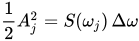
Some WHS models are listed below.
- The International Towing Tank Conference (ITTC) [18] recommended spectrum model for fully developed sea (ISSC[19] spectrum/modified Pierson-Moskowitz spectrum):[20]
![{\displaystyle {\frac {S(\omega )}{H_{1/3}^{2}T_{1}}}={\frac {0.11}{2\pi }}\left({\frac {\omega T_{1}}{2\pi }}\right)^{-5}\mathrm {exp} \left[-0.44\left({\frac {\omega T_{1}}{2\pi }}\right)^{-4}\right]}](https://wikimedia.org/api/rest_v1/media/math/render/svg/00832fedd4c0464ad4b04e1eafa386eb70a1e5b5)
- ITTC recommended spectrum model for limited fetch (JONSWAP spectrum)
- where
- (The latter model has since its creation improved based on the work of Phillips and Kitaigorodskii to better model the wave height spectrum for high wavenumbers.[21])
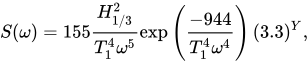
![{\displaystyle Y=\exp \left[-\left({\frac {0.191\omega T_{1}-1}{2^{1/2}\sigma }}\right)^{2}\right]}](https://wikimedia.org/api/rest_v1/media/math/render/svg/74984b4d06dba6b2b92c6d7d855c782df2ad3d5a)
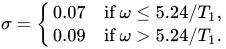
As for WDS, an example model of might be:

Thus the sea state is fully determined and can be recreated by the following function where is the wave elevation, is uniformly distributed between 0 and , and is randomly drawn from the directional distribution function [22]



Shoaling and refraction
[edit]
As waves travel from deep to shallow water, their shape changes (wave height increases, speed decreases, and length decreases as wave orbits become asymmetrical). This process is called shoaling.
Wave refraction is the process that occurs when waves interact with the sea bed to slow the velocity of propagation as a function of wavelength and period. As the waves slow down in shoaling water, the crests tend to realign at a decreasing angle to the depth contours. Varying depths along a wave crest cause the crest to travel at different phase speeds, with those parts of the wave in deeper water moving faster than those in shallow water. This process continues while the depth decreases, and reverses if it increases again, but the wave leaving the shoal area may have changed direction considerably. Rays—lines normal to wave crests between which a fixed amount of energy flux is contained—converge on local shallows and shoals. Therefore, the wave energy between rays is concentrated as they converge, with a resulting increase in wave height.
Because these effects are related to a spatial variation in the phase speed, and because the phase speed also changes with the ambient current—due to the Doppler shift—the same effects of refraction and altering wave height also occur due to current variations. In the case of meeting an adverse current the wave steepens, i.e. its wave height increases while the wavelength decreases, similar to the shoaling when the water depth decreases.[23]
Breaking
[edit]

Some waves undergo a phenomenon called "breaking".[24] A breaking wave is one whose base can no longer support its top, causing it to collapse. A wave breaks when it runs into shallow water, or when two wave systems oppose and combine forces. When the slope, or steepness ratio, of a wave, is too great, breaking is inevitable.
Individual waves in deep water break when the wave steepness—the ratio of the wave height H to the wavelength λ—exceeds about 0.17, so for H > 0.17 λ. In shallow water, with the water depth small compared to the wavelength, the individual waves break when their wave height H is larger than 0.8 times the water depth h, that is H > 0.8 h.[25] Waves can also break if the wind grows strong enough to blow the crest off the base of the wave.
In shallow water, the base of the wave is decelerated by drag on the seabed. As a result, the upper parts will propagate at a higher velocity than the base and the leading face of the crest will become steeper and the trailing face flatter. This may be exaggerated to the extent that the leading face forms a barrel profile, with the crest falling forward and down as it extends over the air ahead of the wave.
Three main types of breaking waves are identified by surfers or surf lifesavers. Their varying characteristics make them more or less suitable for surfing and present different dangers.
- Spilling, or rolling: these are the safest waves on which to surf. They can be found in most areas with relatively flat shorelines. They are the most common type of shorebreak. The deceleration of the wave base is gradual, and the velocity of the upper parts does not differ much with height. Breaking occurs mainly when the steepness ratio exceeds the stability limit.
- Plunging, or dumping: these break suddenly and can "dump" swimmers—pushing them to the bottom with great force. These are the preferred waves for experienced surfers. Strong offshore winds and long wave periods can cause dumpers. They are often found where there is a sudden rise in the seafloor, such as a reef or sandbar. Deceleration of the wave base is sufficient to cause upward acceleration and a significant forward velocity excess of the upper part of the crest. The peak rises and overtakes the forward face, forming a "barrel" or "tube" as it collapses.
- Surging: these may never actually break as they approach the water's edge, as the water below them is very deep. They tend to form on steep shorelines. These waves can knock swimmers over and drag them back into deeper water.
When the shoreline is near vertical, waves do not break but are reflected. Most of the energy is retained in the wave as it returns to seaward. Interference patterns are caused by superposition of the incident and reflected waves, and the superposition may cause localized instability when peaks cross, and these peaks may break due to instability. (see also clapotic waves)
Physics of waves
[edit]
Wind waves are mechanical waves that propagate along the interface between water and air; the restoring force is provided by gravity, and so they are often referred to as surface gravity waves. As the wind blows, pressure and friction perturb the equilibrium of the water surface and transfer energy from the air to the water, forming waves. The initial formation of waves by the wind is described in the theory of Phillips from 1957, and the subsequent growth of the small waves has been modeled by Miles, also in 1957.[26][27]


In linear plane waves of one wavelength in deep water, parcels near the surface move not plainly up and down but in circular orbits: forward above and backward below (compared to the wave propagation direction). As a result, the surface of the water forms not an exact sine wave, but more a trochoid with the sharper curves upwards—as modeled in trochoidal wave theory. Wind waves are thus a combination of transversal and longitudinal waves.
When waves propagate in shallow water, (where the depth is less than half the wavelength) the particle trajectories are compressed into ellipses.[29][30]
In reality, for finite values of the wave amplitude (height), the particle paths do not form closed orbits; rather, after the passage of each crest, particles are displaced slightly from their previous positions, a phenomenon known as Stokes drift.[31][32]
As the depth below the free surface increases, the radius of the circular motion decreases. At a depth equal to half the wavelength λ, the orbital movement has decayed to less than 5% of its value at the surface. The phase speed (also called the celerity) of a surface gravity wave is—for pure periodic wave motion of small-amplitude waves—well approximated by

where
- c = phase speed;
- λ = wavelength;
- d = water depth;
- g = acceleration due to gravity at the Earth's surface.
In deep water, where , so and the hyperbolic tangent approaches , the speed approximates


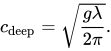
In SI units, with in m/s, , when is measured in metres. This expression tells us that waves of different wavelengths travel at different speeds. The fastest waves in a storm are the ones with the longest wavelength. As a result, after a storm, the first waves to arrive on the coast are the long-wavelength swells.


For intermediate and shallow water, the Boussinesq equations are applicable, combining frequency dispersion and nonlinear effects. And in very shallow water, the shallow water equations can be used.
If the wavelength is very long compared to the water depth, the phase speed (by taking the limit of c when the wavelength approaches infinity) can be approximated by

On the other hand, for very short wavelengths, surface tension plays an important role and the phase speed of these gravity-capillary waves can (in deep water) be approximated by
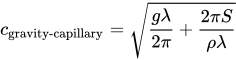
where
- S = surface tension of the air-water interface;
- = density of the water.[33]

When several wave trains are present, as is always the case in nature, the waves form groups. In deep water, the groups travel at a group velocity which is half of the phase speed.[34] Following a single wave in a group one can see the wave appearing at the back of the group, growing, and finally disappearing at the front of the group.
As the water depth decreases towards the coast, this will have an effect: wave height changes due to wave shoaling and refraction. As the wave height increases, the wave may become unstable when the crest of the wave moves faster than the trough. This causes surf, a breaking of the waves.

The movement of wind waves can be captured by wave energy devices. The energy density (per unit area) of regular sinusoidal waves depends on the water density , gravity acceleration and the wave height (which, for regular waves, is equal to twice the amplitude, ):


The velocity of propagation of this energy is the group velocity.
Models
[edit]
Surfers are very interested in the wave forecasts. There are many websites that provide predictions of the surf quality for the upcoming days and weeks. Wind wave models are driven by more general weather models that predict the winds and pressures over the oceans, seas, and lakes.
Wind wave models are also an important part of examining the impact of shore protection and beach nourishment proposals. For many beach areas there is only patchy information about the wave climate, therefore estimating the effect of wind waves is important for managing littoral environments.
A wind-generated wave can be predicted based on two parameters: wind speed at 10 m above sea level and wind duration, which must blow over long periods of time to be considered fully developed. The significant wave height and peak frequency can then be predicted for a certain fetch length.[35]
Seismic signals
[edit]Ocean water waves generate seismic waves that are globally visible on seismographs.[36] There are two principal constituents of the ocean wave-generated seismic microseism.[37] The strongest of these is the secondary microseism which is created by ocean floor pressures generated by interfering ocean waves and has a spectrum that is generally between approximately 6–12 s periods, or at approximately half of the period of the responsible interfering waves. The theory for microseism generation by standing waves was provided by Michael Longuet-Higgins in 1950 after in 1941 Pierre Bernard suggested this relation with standing waves on the basis of observations.[38][39] The weaker primary microseism, also globally visible, is generated by dynamic seafloor pressures of propagating waves above shallower (less than several hundred meters depth) regions of the global ocean. Microseisms were first reported in about 1900, and seismic records provide long-term proxy measurements of seasonal and climate-related large-scale wave intensity in Earth's oceans [40] including those associated with anthropogenic global warming.[41][42][43]
See also
[edit]
- Airy wave theory – Fluid dynamics theory on gravity waves
- Breakwater (structure) – Coastal defense structure
- Boussinesq approximation (water waves) – Approximation valid for weakly non-linear and fairly long waves
- Clapotis – Non-breaking standing wave pattern
- Cross sea – Sea state with two wave systems traveling at oblique angles
- Gravity wave – Wave where gravity is the main restoring force
- Internal wave – Type of wave within a fluid medium
- Luke's variational principle – Mathematics of surface waves on a fluid
- Mild-slope equation – Physics phenomenon and formula
- Rogue wave – Unexpectedly large transient ocean surface wave
- Shallow water equations – Set of partial differential equations that describe the flow below a pressure surface in a fluid
- Tsunami – Series of water waves
- Wave power – Transport of energy by wind waves, and the capture of that energy to do useful work
- Wave radar – Technology for measuring surface waves on water
- Wave setup – Increase in mean water level due to the presence of breaking waves
- Waves and shallow water – Effect of shallow water on a surface gravity wave
References
[edit]- ^ Tolman, H. L. (23 June 2010). Mahmood, M.F. (ed.). CBMS Conference Proceedings on Water Waves: Theory and Experiment (PDF). Howard University, US, 13–18 May 2008: World Scientific Publications. ISBN 978-981-4304-23-8.
{{cite book}}: CS1 maint: location (link) - ^ Holthuijsen (2007), page 5.[need quotation to verify]
- ^ Lorenz, R. D.; Hayes, A. G. (2012). "The Growth of Wind-Waves in Titan's Hydrocarbon Seas". Icarus. 219 (1): 468–475. Bibcode:2012Icar..219..468L. doi:10.1016/j.icarus.2012.03.002.
- ^ Barnes, Jason W.; Sotin, Christophe; Soderblom, Jason M.; Brown, Robert H.; Hayes, Alexander G.; Donelan, Mark; Rodriguez, Sebastien; Mouélic, Stéphane Le; Baines, Kevin H.; McCord, Thomas B. (2014-08-21). "Cassini/VIMS observes rough surfaces on Titan's Punga Mare in specular reflection". Planetary Science. 3 (1): 3. Bibcode:2014PlSci...3....3B. doi:10.1186/s13535-014-0003-4. ISSN 2191-2521. PMC 4959132. PMID 27512619.
- ^ Heslar, Michael F.; Barnes, Jason W.; Soderblom, Jason M.; Seignovert, Benoît; Dhingra, Rajani D.; Sotin, Christophe (2020-08-14). "Tidal Currents Detected in Kraken Mare Straits from Cassini VIMS Sun Glitter Observations". The Planetary Science Journal. 1 (2): 35. arXiv:2007.00804. Bibcode:2020PSJ.....1...35H. doi:10.3847/PSJ/aba191. ISSN 2632-3338. S2CID 220301577.
- ^ Young, I. R. (1999). Wind generated ocean waves. Elsevier. p. 83. ISBN 978-0-08-043317-2.
- ^ Weisse, Ralf; von Storch, Hans (2008). Marine climate change: Ocean waves, storms and surges in the perspective of climate change. Springer. p. 51. ISBN 978-3-540-25316-7.
- ^ a b c Phillips, O. M. (2006). "On the generation of waves by turbulent wind". Journal of Fluid Mechanics. 2 (5): 417–445. Bibcode:1957JFM.....2..417P. doi:10.1017/S0022112057000233. S2CID 116675962.
- ^ Miles, John W. (2006). "On the generation of surface waves by shear flows". Journal of Fluid Mechanics. 3 (2): 185–204. Bibcode:1957JFM.....3..185M. doi:10.1017/S0022112057000567. S2CID 119795395.
- ^ "Chapter 16, Ocean Waves". Archived from the original on 2016-05-11. Retrieved 2013-11-12.
- ^ Hasselmann, K.; et al. (1973). "Measurements of wind-wave growth and swell decay during the Joint North Sea Wave Project (JONSWAP)". Ergnzungsheft zur Deutschen Hydrographischen Zeitschrift Reihe A. 8 (12): 95. hdl:10013/epic.20654.
- ^ Pierson, Willard J.; Moskowitz, Lionel (15 December 1964). "A proposed spectral form for fully developed wind seas based on the similarity theory of S. A. Kitaigorodskii". Journal of Geophysical Research. 69 (24): 5181–5190. Bibcode:1964JGR....69.5181P. doi:10.1029/JZ069i024p05181.
- ^ "Know the risks: Waves". Royal National Lifeboat Institution. Retrieved 31 August 2024.
- ^ Holliday, Naomi P.; Yelland, Margaret J.; Pascal, Robin; Swail, Val R.; Taylor, Peter K.; Griffiths, Colin R.; Kent, Elizabeth (2006). "Were extreme waves in the Rockall Trough the largest ever recorded?". Geophysical Research Letters. 33 (L05613) 2005GL025238. Bibcode:2006GeoRL..33.5613H. doi:10.1029/2005GL025238.
- ^ P. C. Liu; H. S. Chen; D.-J. Doong; C. C. Kao; Y.-J. G. Hsu (11 June 2008). "Monstrous ocean waves during typhoon Krosa". Annales Geophysicae. 26 (6): 1327–1329. Bibcode:2008AnGeo..26.1327L. doi:10.5194/angeo-26-1327-2008.
- ^ Munk, Walter H. (1950). "Proceedings 1st International Conference on Coastal Engineering". Coastal Engineering Proceedings (1). Long Beach, California: ASCE: 1–4. doi:10.9753/icce.v1.1.
- ^ Tom Garrison (2009). Oceanography: An Invitation to Marine Science (7th ed.). Yolanda Cossio. ISBN 978-0495391937.
- ^ International Towing Tank Conference (ITTC), retrieved 11 November 2010
- ^ International Ship and Offshore Structures Congress
- ^ Pierson, W. J.; Moscowitz, L. (1964), "A proposed spectral form for fully developed wind seas based on the similarity theory of S A Kitaigorodskii", Journal of Geophysical Research, 69 (24): 5181–5190, Bibcode:1964JGR....69.5181P, doi:10.1029/JZ069i024p05181
- ^ Elfouhaily, T.; Chapron, B.; Katsaros, K.; Vandemark, D. (July 15, 1997). "A unified directional spectrum for long and short wind-driven waves" (PDF). Journal of Geophysical Research. 102 (C7): 15781–15796. Bibcode:1997JGR...10215781E. doi:10.1029/97jc00467.
- ^ Jefferys, E. R. (1987), "Directional seas should be ergodic", Applied Ocean Research, 9 (4): 186–191, Bibcode:1987AppOR...9..186J, doi:10.1016/0141-1187(87)90001-0
- ^ Longuet-Higgins, M. S.; Stewart, R. W. (1964). "Radiation stresses in water waves; a physical discussion, with applications". Deep-Sea Research. 11 (4): 529–562. Bibcode:1964DSRA...11..529L. doi:10.1016/0011-7471(64)90001-4.
- ^ Gulrez, Tauseef; Hassanien, Aboul Ella (2011-11-13). Advances in Robotics and Virtual Reality. Springer Science & Business Media. ISBN 9783642233630.
- ^ R.J. Dean and R.A. Dalrymple (2002). Coastal processes with engineering applications. Cambridge University Press. ISBN 978-0-521-60275-4. p. 96–97.
- ^ Phillips, O. M. (1957). "On the generation of waves by turbulent wind". Journal of Fluid Mechanics. 2 (5): 417–445. Bibcode:1957JFM.....2..417P. doi:10.1017/S0022112057000233. S2CID 116675962.
- ^ Miles, J. W. (1957). "On the generation of surface waves by shear flows". Journal of Fluid Mechanics. 3 (2): 185–204. Bibcode:1957JFM.....3..185M. doi:10.1017/S0022112057000567. S2CID 119795395.
- ^ Figure 6 from: Wiegel, R. L.; Johnson, J. W. (1950). "Proceedings 1st International Conference on Coastal Engineering". Coastal Engineering Proceedings (1). Long Beach, California: ASCE: 5–21. doi:10.9753/icce.v1.2.
- ^ For the particle trajectories within the framework of linear wave theory, see for instance:
Phillips (1977), page 44.
Lamb, H. (1994). Hydrodynamics (6th ed.). Cambridge University Press. ISBN 978-0-521-45868-9. Originally published in 1879, the 6th extended edition appeared first in 1932. See §229, page 367.
L. D. Landau and E. M. Lifshitz (1986). Fluid mechanics. Course of Theoretical Physics. Vol. 6 (Second revised ed.). Pergamon Press. ISBN 978-0-08-033932-0. See page 33. - ^ A good illustration of the wave motion according to linear theory is given by Prof. Robert Dalrymple's Java applet Archived 2017-11-14 at the Wayback Machine.
- ^ For nonlinear waves, the particle paths are not closed, as found by George Gabriel Stokes in 1847, see the original paper by Stokes. Or in Phillips (1977), page 44: "To this order, it is evident that the particle paths are not exactly closed ... pointed out by Stokes (1847) in his classical investigation".
- ^ Solutions of the particle trajectories in fully nonlinear periodic waves and the Lagrangian wave period they experience can for instance be found in:
J. M. Williams (1981). "Limiting gravity waves in water of finite depth". Philosophical Transactions of the Royal Society A. 302 (1466): 139–188. Bibcode:1981RSPTA.302..139W. doi:10.1098/rsta.1981.0159. S2CID 122673867.
J. M. Williams (1985). Tables of progressive gravity waves. Pitman. ISBN 978-0-273-08733-5. - ^ Carl Nordling, Jonny Östermalm (2006). Physics Handbook for Science and Engineering (Eight ed.). Studentliteratur. p. 263. ISBN 978-91-44-04453-8.
- ^ In deep water, the group velocity is half the phase velocity, as is shown here. Another reference is [1] Archived 2000-03-12 at the Wayback Machine.
- ^ Wood, AMM & Fleming, CA 1981, Coastal hydraulics, John Wiley & Sons, New York
- ^ "Peter Bormann. Seismic Signals and Noise" (PDF). Archived from the original (PDF) on 2016-03-04. Retrieved 2012-03-08.
- ^ Ardhuin, Fabrice, Lucia Gualtieri, and Eleonore Stutzmann. "How ocean waves rock the Earth: two mechanisms explain seismic noise with periods 3 to 300 s." Geophys. Res. Lett. 42 (2015).
- ^ Bernard, P. (1941). "Sur certaines proprietes de la boule etudiees a l'aide des enregistrements seismographiques". Bulletin de l'Institut Océanographique de Monaco. 800: 1–19.
- ^ Longuet-Higgins, M. S. (1950). "A theory of the origin of microseisms". Philosophical Transactions of the Royal Society A. 243 (857): 1–35. Bibcode:1950RSPTA.243....1L. doi:10.1098/rsta.1950.0012. S2CID 31828394.
- ^ Reguero, Borja; Losada, Inigo J.; Mendez, Fernand J. (2019). "A recent increase in global wave power as a consequence of oceanic warming". Nature Communications. 10 (1): 205. Bibcode:2019NatCo..10..205R. doi:10.1038/s41467-018-08066-0. PMC 6331560. PMID 30643133.
- ^ Aster, Richard C.; McNamara, Daniel E.; Bromirski, Peter D. (2008). "Multidecadal climate-induced variability in microseisms". Seismological Research Letters. 79 (2): 94–202. Bibcode:2008SeiRL..79..194A. doi:10.1785/gssrl.79.2.194.
- ^ Bromirski, Peter (2023). "Climate-Induced Decadal Ocean Wave Height Variability From Microseisms: 1931–2021". Journal of Geophysical Research: Oceans. 128 (8) e2023JC019722. Bibcode:2023JGRC..12819722B. doi:10.1029/2023JC019722.
- ^ Aster, Richard C.; Ringler, Adam T.; Anthony, Robert E.; Lee, Thomas A. (2023). "Increasing ocean wave energy observed in Earth's seismic wavefield since the late 20th century". Nature Communications. 14 (1): 6984. doi:10.1038/s41467-023-42673-w. PMC 10620394. PMID 37914695.

Scientific
[edit]- G. G. Stokes (1880). Mathematical and Physical Papers, Volume I. Cambridge University Press. pp. 197–229.
- Phillips, O. M. (1977). The dynamics of the upper ocean (2nd ed.). Cambridge University Press. ISBN 978-0-521-29801-8.
- Holthuijsen, Leo H. (2007). Waves in oceanic and coastal waters. Cambridge University Press. ISBN 978-0-521-86028-4.
- Janssen, Peter (2004). The interaction of ocean waves and wind. Cambridge University Press. ISBN 978-0-521-46540-3.
Other
[edit]- Rousmaniere, John (1989). The Annapolis Book of Seamanship (2nd revised ed.). Simon & Schuster. ISBN 978-0-671-67447-2.
- Carr, Michael (October 1998). "Understanding Waves". Sail. pp. 38–45.
External links
[edit]


| International | |
|---|---|
| National | |
| Other | |

Wind wave
View on GrokipediaFormation and Generation
Mechanism of Formation
Wind blowing across the sea surface generates shear stress at the air-sea interface, which disturbs the otherwise calm water and initiates the formation of small waves. This stress arises from the frictional drag between the moving air and the water surface, creating initial disturbances that manifest as capillary waves—short waves (wavelengths less than about 1.7 cm) where surface tension provides the primary restoring force. As these capillary waves grow and interact with the wind, they transition into capillary-gravity waves and eventually dominate gravity waves, where buoyancy acts as the restoring force for longer wavelengths. The process begins with instabilities in the shear flow, leading to exponential growth of these initial wavelets.[12][13] Turbulence within the wind flow is essential for the progression from these small ripples to larger, fully developed seas. Turbulent eddies in the atmospheric boundary layer impinge on the water surface, generating pressure fluctuations that resonate with the waves, thereby transferring momentum and energy efficiently. This turbulence enhances airflow separation over wave crests, creating regions of sheltering on the leeward sides that amplify wave growth. As waves steepen, micro-breaking events induced by turbulence further couple the air and water motions, sustaining the energy input until a mature sea state is reached, characterized by a balance between wind forcing and wave dissipation.[12][13] The mechanism of wind wave formation has intrigued observers for centuries. Leonardo da Vinci documented early insights in the late 15th century, describing how wind-generated waves propagate across the water surface without transporting the underlying fluid mass, likening them to undulations in a field of grain. These qualitative observations were later substantiated through systematic field experiments in the 19th and 20th centuries, including ship-based visual measurements that quantified wave development under varying wind conditions. A seminal contribution came from Sverdrup and Munk in 1947, who analyzed extensive oceanographic data to establish empirical relationships for wave growth.[14][15] In fetch-limited scenarios, where wind blows steadily over a finite distance, the significant wave height grows according to the approximate empirical relation: Here, is the wind speed at 19.5 m above the surface (in m/s), is the fetch length (in km), and is the acceleration due to gravity (9.81 m/s²). This formula, derived from mid-20th-century analyses of field data, illustrates how wave height scales with wind speed and the distance over which the wind acts, transitioning from young waves near the upwind boundary to more developed conditions farther downwind.[15]Influencing Factors
The generation and initial development of wind waves are primarily influenced by wind speed, duration, fetch length, water depth, and the direction of the fetch relative to the wind. Wind speed determines the amount of energy transferred to the water surface, with higher speeds producing larger waves, while duration refers to the time the wind blows steadily, allowing waves to grow progressively. Fetch length, the unobstructed distance over which the wind acts on the water, limits wave development if short, as it restricts the time available for energy accumulation. Water depth plays a key role in shallow environments, where it can constrain wave height and growth by introducing bottom friction, unlike in deep water where waves form freely without seabed interaction.[16][5][17] The alignment of fetch direction with the prevailing wind is crucial, as a consistent wind direction maximizes effective fetch and enhances wave growth, whereas shifting winds reduce it by dispersing energy. A minimum wind speed of approximately 2.3 m/s is required to initiate capillary waves in clean water conditions, marking the threshold where wind shear overcomes surface tension to start wave formation.[18][19] In fetch-limited environments, such as enclosed basins, wave heights and periods are significantly smaller than in the open ocean due to geographical constraints that cap the distance over which winds can act. For instance, in western Long Island Sound, easterly winds along the basin's axis yield up to 65% higher significant wave heights compared to westerly winds over shorter fetches, but overall waves remain underdeveloped relative to unlimited ocean conditions.[20] Atmospheric stability further modulates wave generation through its effects on wind profiles, with unstable conditions (e.g., warm water relative to air) enhancing turbulence and increasing wave growth rates by up to 50% in energy terms, while stable conditions suppress mixing and reduce growth. Thermal stratification alters the boundary layer, influencing shear stress at the air-sea interface and thus the efficiency of energy transfer from wind to waves.[21]Characteristics and Classification
Types of Wind Waves
Wind waves are classified into primary types based on their dominant restoring forces and wavelengths. Capillary waves, also known as ripples, are the smallest wind-generated waves with wavelengths typically less than 1.7 cm, where surface tension provides the primary restoring force.[22] These form under light winds and appear as fine disturbances on the water surface. Gravity waves, the most common type in oceans, have wavelengths from centimeters to hundreds of meters and are restored primarily by gravity, dominating the energy in wind-driven seas.[23] Infragravity waves, with periods between 30 seconds and 5 minutes, arise from nonlinear interactions among shorter wind waves and occupy the low-frequency end of the wave spectrum.[24] Wind waves evolve through distinct development stages influenced by wind duration and fetch. In the young sea stage, waves grow rapidly under accelerating winds, resulting in steep, irregular forms with heights increasing nonlinearly.[9] Fully developed seas represent an equilibrium state where wave height reaches a maximum for a given wind speed and duration, producing a chaotic mix of waves across various sizes and directions.[25] Following this, waves transition to decaying swell as they propagate away from the wind source, losing energy through dispersion and becoming more organized.[1] A key distinction exists between sea and swell within wind wave classifications. Sea waves, or wind seas, are generated locally by current winds, exhibiting short periods (4-8 seconds), irregularity, and alignment with the wind direction.[26] In contrast, swell consists of waves that have traveled far from their origin, featuring longer periods (over 10 seconds), greater regularity, and reduced steepness due to sorting by dispersion.[27] Rogue waves represent extreme manifestations of wind waves, defined as individual waves exceeding twice the significant wave height—the average of the highest one-third of waves in a given period.[28] These unpredictable events, often forming through wave superposition or focusing, can pose severe hazards to maritime activities. In severe storms, rogue waves occur approximately twice daily at any location, highlighting their relative frequency under intense conditions.[29]Wave Spectrum
The wave spectrum provides a two-dimensional representation of the energy distribution in wind wave fields as a function of frequency and direction, denoted as S(f, θ), where f is the wave frequency and θ is the propagation direction.[30] This spectral description captures the irregular nature of ocean waves, integrating over all components to yield total variance in sea surface elevation.[31] Key components of the wave spectrum include the peak frequency f_p, defined as the frequency corresponding to the maximum energy density; the spectral width, a measure of the bandwidth or spread of energy across frequencies, often quantified relative to f_p; and the directional spreading, which describes the angular distribution of wave energy around the mean direction, typically narrower in actively generated waves.[31][32] These elements vary with sea state, influencing overall wave behavior such as propagation and energy transfer.[30] In young seas, where waves are actively growing under local wind forcing, the spectrum exhibits a narrow peak with high energy concentration at f_p and limited directional spreading, often aligned closely with the wind direction.[33] As waves evolve with increasing fetch and duration, the spectrum broadens, with f_p shifting to lower values, greater spectral width, and increased directional spreading, transitioning to the more dispersed characteristics of swells that propagate independently of local winds.[33][34] Empirical observations from the Joint North Sea Wave Project (JONSWAP) in fetch-limited conditions, under stationary winds over distances up to 160 km, revealed spectra with a pronounced peak and an overshoot in energy relative to equilibrium forms, parameterized by a peak enhancement factor γ ≈ 3.3 to account for the sharper spectral shape during development.[34] This factor highlights the heightened energy at f_p in developing seas compared to fully developed states, based on direct measurements of wave growth and directional properties.[34]Spectral Models
Spectral models for wind waves provide mathematical representations of the wave energy spectrum, evolving from early empirical formulations in the mid-20th century to more sophisticated parameterizations that account for sea state development and directionality.[35] The foundational work began in the 1950s with spectral approaches introduced by Neumann (1952) and Pierson (1953), which shifted from descriptive wave statistics to frequency-domain analyses based on field observations, laying the groundwork for quantitative predictions of wave energy distribution.[35] By the 1960s and 1970s, these efforts progressed to parameterized models fitted to extensive datasets, incorporating physical principles like similarity theory, and culminated in hybrid formulations that blend empirical fits with theoretical constraints for broader applicability.[36] The Pierson-Moskowitz (PM) spectrum represents fully developed seas, where waves have reached equilibrium with sustained winds over long fetches.[37] Derived from shipborne measurements in the North Atlantic, it assumes a one-dimensional frequency spectrum that peaks at a frequency inversely proportional to wind speed.[38] For developing seas, where fetch or duration limits growth, the JONSWAP spectrum extends the PM form by introducing a peak enhancement factor to better capture the narrower spectral peak observed in fetch-limited conditions.[39] This parameterization, based on data from the Joint North Sea Wave Project, adjusts the exponential tail to reflect higher energy concentration around the peak frequency during early wave growth stages.[39] A key parameterization for the PM spectrum is given by where is the Phillips constant (typically 0.0081), is gravitational acceleration, is frequency, and is the peak frequency.[37] The JONSWAP spectrum modifies this by multiplying the PM form by a peak enhancement function , with for typical conditions, for , and otherwise.[39] To incorporate directionality, spectral models extend the one-dimensional form with spreading functions that distribute energy azimuthally, often using for , where is the direction relative to the mean wave propagation and (spreading parameter) increases with frequency to reflect narrower spreading at higher frequencies.[40] Seminal directional models, such as those proposed by Donelan et al. (1985) from lake measurements, refine this cosine-based spreading to depend on both wavenumber and wind speed, improving representations of short-crested seas.[41] These models have been validated against field data, showing good agreement with buoy measurements for moderate wind speeds and fetches, where PM spectra match significant wave heights within 10-20% in fully developed cases, and JONSWAP improves peak frequency predictions by up to 15% in developing seas.[42] Satellite altimeter data, such as from Envisat, further confirm spectral shapes in open ocean settings, with root-mean-square errors in energy density below 0.5 m²/Hz for JONSWAP applications.[43] However, limitations emerge in extreme conditions, such as hurricanes, where PM underestimates high-frequency tails due to unaccounted nonlinear interactions and swell interference, leading to overpredictions of peak periods by 20% or more.[44] Modern hybrid models address these by integrating parametric forms with physics-based source terms, enhancing accuracy across a wider range of sea states.[36]Propagation and Transformation
Shoaling and Refraction
As wind-generated surface waves propagate from deep to intermediate and shallow water, they undergo shoaling, a process in which wave height increases due to the decrease in local phase speed and wavelength while conserving energy flux. This height amplification arises because the group velocity, which determines energy transport, diminishes as depth decreases, concentrating energy into a narrower crest. In the shallow-water regime, the shoaling coefficient , relating local wave height to a reference height via , approximates , where is the reference water depth; this form, known as Green's law, stems from the linear shallow-water approximation where and is water depth.[45] The onset of significant shoaling effects occurs around the critical depth where water depth , with the local wavelength, defining the boundary for shallow-water dynamics in which bottom friction and nonlinearity become prominent.[46] Refraction accompanies shoaling as waves encounter varying bathymetry, causing wave crests to bend and align more parallel to depth contours, thereby altering wave direction toward shallower regions. This directional change follows Snell's law adapted for water waves, expressed as , where is the angle between the wave ray (perpendicular to the crest) and the normal to the depth contour, and subscript 0 denotes deep-water conditions; the relation holds because the intrinsic wave frequency remains constant while phase speed varies with local depth.[47] For irregular coastlines with complex bathymetry, shoaling and refraction interact nonlinearly, leading to wave focusing or spreading that can amplify or attenuate heights beyond simple plane-slope predictions. Ray tracing methods address these combined effects by numerically solving the ray equations—derived from the eikonal approximation of the wave dispersion relation— to track individual wave rays from offshore to the coast, enabling computation of refraction coefficients and transformed wave fields.[48]Wave Breaking
Wave breaking occurs when the amplitude of a wind-generated wave becomes sufficiently large relative to its wavelength or the local water depth, leading to instability and collapse of the wave crest. This process dissipates wave energy into turbulence, heat, and momentum transfer to the underlying water column, marking a critical transition from progressive wave motion to dissipative surf zone dynamics. In deep water, breaking is primarily driven by excessive steepness, while in shallow water, it results from the interaction with the seabed as waves shoal and heighten.[49] The classification of breaking types depends on the surf similarity parameter , where is the bottom slope, the deep-water wave height, and the deep-water wavelength. Spilling breakers form for (typically gentle slopes and moderate to high steepness), where the crest becomes unstable and foam spills down the front face gradually. Plunging breakers occur for (moderate slopes and varying steepness), characterized by the crest curling over and plunging forward into the trough, creating an air cavity. Surging breakers develop for (steep slopes and low steepness), where the wave surges up the beach without full collapse, often reflecting partially. This classification, originally quantified through laboratory observations, highlights how the interplay of bottom topography and wave steepness influences the breaking mechanism.[49] Breaking criteria provide thresholds for onset. In deep water (where depth d > L/2), the Miche limit establishes instability when the steepness exceeds H/L > 0.14, derived from nonlinear wave theory assuming the crest particle velocity approaches the phase speed. In shallow water (d < L/20), breaking initiates when the height-to-depth ratio surpasses H/d > 0.78, based on solitary wave stability analysis where orbital velocities at the crest equal the wave celerity. These limits are semi-empirical, validated across flume and field data, though actual breaking can vary by 10–20% due to irregularity. Shoaling increases wave height prior to breaking, often pushing steepness toward these limits. Each breaking event dissipates a significant fraction of the wave's kinetic energy, typically 10–20% for spilling and plunging types in controlled conditions, converting it into turbulent kinetic energy and bubble entrainment that enhances vertical mixing. This loss scales with the cube of wave height and occurs rapidly over one wave period, reducing subsequent propagation and contributing to overall spectral decay in wind wave fields. Plunging breakers exhibit higher dissipation (up to 20–25%) due to intense overturning, while spilling types spread the loss more gradually.[50][51] Wind forcing modulates breaking by altering wave growth and stability; onshore winds enhance steepness and promote earlier breaking, while offshore winds suppress it by sheltering crests. Laboratory experiments since the 1920s, including early flume studies on wind-wave interactions, have demonstrated these effects, showing wind speeds above 7 m/s increase breaking probability by 15–30% through momentum transfer. These observations underpin modern parameterizations of wind-induced dissipation in wave models.[52]Physical Principles
Fundamental Physics
The fundamental physics of wind waves is described by linear wave theory, which assumes small-amplitude waves where the wave height is much smaller than the wavelength, allowing for a linearized approximation of the governing equations. This theory also posits irrotational flow, meaning the velocity field can be derived from a scalar potential satisfying Laplace's equation, and neglects viscosity, treating the fluid as inviscid and incompressible. These assumptions simplify the analysis to focus on gravity-driven surface waves, providing a foundational framework for understanding wave motion under moderate wind conditions.[53][54] A key relation in this theory is the dispersion relation, which connects the angular frequency of the wave to its wavenumber and water depth : , where is the acceleration due to gravity. This equation indicates that wave speed depends on both wavelength and depth, leading to dispersive behavior where different wave components propagate at different velocities. In deep water, where , the hyperbolic tangent approximates to 1, simplifying to the deep-water dispersion relation , implying that longer waves travel faster than shorter ones.[54][53]/11:Appendix_A-_Linear_wave_theory) Under linear theory, water particle motion follows closed orbits that vary with depth. In deep water, these orbits are nearly circular, with particles moving in a backward direction relative to the wave propagation at the surface and diminishing exponentially with depth. In shallower water, the orbits become elliptical, flattening horizontally and vertically as the bottom is approached, until in very shallow conditions they approximate straight-line back-and-forth motion. These kinematics illustrate how wave energy is carried forward while individual particles oscillate without net displacement./11:Appendix_A-_Linear_wave_theory)[55] The phase velocity represents the speed of individual wave crests, while the group velocity governs the propagation of wave energy and information. In deep water, the group velocity is half the phase velocity, , meaning energy travels more slowly than the apparent wave crests, which overtake the group. This distinction arises directly from the dispersion relation and explains phenomena such as the spreading of wave packets generated by wind. Dispersion also influences the shape of wave spectra by separating frequency components over time.[53]/16:_Ocean_Waves/16.1:_Linear_Theory_of_Ocean_Surface_Waves)[56]Energy and Momentum Transfer
Wind waves acquire energy primarily from the wind through two key mechanisms: the sheltering acceleration proposed by Jeffreys and the pressure perturbation mechanism developed by Miles. Jeffreys' mechanism (1925) posits that wind induces a tangential stress on the leeward side of wave crests due to airflow sheltering, accelerating the air and creating a pressure difference that transfers momentum to the waves. In contrast, Miles' mechanism (1957) emphasizes perturbations in the atmospheric boundary layer above the wave surface, where wave-induced pressure fluctuations interact with the wind shear to amplify wave growth, particularly for longer waves. These processes dominate the initial wave generation and sustained growth under varying wind conditions.[57] The energy flux of wind waves, which governs their propagation and transformation, is given by the product of the group velocity and the energy density , representing the rate at which wave energy is transported. In deep water, is half the phase speed, derived from the dispersion relation, allowing energy to propagate at this reduced speed relative to individual wave crests.[58] In shallow water, dissipation occurs through bottom friction, often parameterized using quadratic friction laws that relate shear stress to the square of the near-bottom orbital velocity, with empirical drag coefficients typically ranging from 0.005 to 0.01.[59] This friction becomes significant when water depth is less than half the wavelength, leading to energy loss that scales with wave height and bottom roughness.[60] Momentum transfer from wind waves influences both ocean currents and the atmosphere. To the ocean, waves impart momentum via Stokes drift, a net Lagrangian transport in the direction of wave propagation, with surface velocities up to several percent of the phase speed for typical wind seas.[61] This drift enhances upper-ocean mixing and Ekman transport, particularly under strong winds.[62] Conversely, waves exert drag on the atmosphere through form drag and viscous stresses, where airflow separation over wave crests contributes substantially to the total wind stress; in storms, wave-supported stress accounts for approximately 50% of the momentum flux from wind to ocean.[63] This bidirectional exchange modulates air-sea coupling during high-wind events.[64]Modeling and Applications
Numerical and Analytical Models
Analytical models for wind waves provide foundational descriptions of wave behavior under idealized conditions, focusing on periodic waves in deep water. The linear theory developed by Airy assumes small-amplitude waves where the wave height is much smaller than the wavelength, leading to sinusoidal surface elevations and neglecting nonlinear effects.[65] This theory yields expressions for wave kinematics, such as the dispersion relation for deep water, where is angular frequency, is gravity, and is wavenumber.[66] Extensions of Airy theory incorporate mild nonlinearities for improved accuracy in moderate sea states. For steeper waves, nonlinear extensions like Stokes waves account for higher-order terms in the wave steepness , where is amplitude. Stokes theory, originally formulated to fifth order, describes progressive waves with asymmetric crests and troughs, capturing effects like wave-induced mean currents. These analytical solutions remain essential for validating numerical models and understanding fundamental wave dynamics, though they are limited to monochromatic waves and uniform conditions.[67] Numerical models simulate the evolution of irregular wind wave fields by solving the wave action balance equation, which governs the spectral density of wave action : Here, is the group velocity vector, represents changes in wavenumber due to refraction or currents, and denotes source terms including wind input , whitecapping dissipation , and nonlinear wave-wave interactions .[68] The nonlinear term , dominant for fully developed seas, redistributes energy across frequencies via resonant quadruplet interactions, as parameterized in the Hasselmann kinetic equation.[69] These models discretize the spectrum on a directional-frequency grid and propagate it spatially, enabling predictions of wave height, period, and direction over large domains. Third-generation spectral models, which fully resolve nonlinear interactions without empirical closures, have become standard for operational forecasting. The WAM (Wave Model) integrates the action balance equation with parameterized source terms, achieving global wave predictions with biases under 0.5 m in significant wave height during validation against buoys.[70] Similarly, WAVEWATCH III, developed for flexible grids including unstructured meshes, incorporates advanced propagation schemes and has been widely adopted for hindcasts and real-time forecasts, supporting applications in marine safety and offshore engineering. As of 2025, WAVEWATCH III has advanced to version 7.14, featuring improved high-resolution modeling for tropical regions and enhanced physics parameterizations.[71] Modern updates to these models post-2000 address limitations in complex environments by incorporating ocean currents and sea ice effects. Currents modulate wave refraction, Doppler shifting, and energy transfer, with studies showing up to 20% variations in significant wave height in current-dominated regions like the Gulf Stream when included.[72] For ice-covered areas, parameterizations in models like WAVEWATCH III account for damping by ice floes and partial ice concentration, improving simulations in polar seas where waves penetrate marginal ice zones, enhancing forecast accuracy for ice breakup and navigation.[73]Seismic Signals
Wind waves interacting with the ocean bottom generate seismic signals known as microseisms, which are low-amplitude ground vibrations detectable by seismometers worldwide. These signals arise primarily from two mechanisms: primary microseisms, caused by direct pressure fluctuations from waves impacting the seafloor, and secondary microseisms, resulting from nonlinear interactions between opposing wave trains that produce standing waves and enhanced pressure variations. Primary microseisms typically occur in the frequency range of 0.05 to 0.5 Hz, corresponding to the dominant periods of ocean swells, while secondary microseisms appear at roughly double that frequency, around 0.1 to 1 Hz, due to the beating of wave frequencies. The generation of these seismic waves involves acoustic coupling where dynamic seafloor pressure from passing waves propagates as P-waves through the solid earth. The amplitude of microseisms scales with the square of the ocean wave height, meaning stronger storms produce significantly more intense signals, as the pressure perturbation is proportional to the wave energy flux. For instance, during major extratropical cyclones, secondary microseism amplitudes can reach levels that dominate background seismic noise. Microseisms have been observed since the late 19th century, with early attributions to ocean waves by Timoteo Bertelli in the 1870s.[74] Following the 1906 San Francisco earthquake, persistent low-frequency tremors were noted and further linked to Pacific Ocean wave activity. Today, these signals enable remote monitoring of storm intensity and track tropical cyclone development by correlating microseism amplitudes with wave model outputs, providing a global, land-based proxy for ocean conditions without direct instrumentation.Measurement Techniques
Measurement of wind waves has evolved significantly since the 19th century, beginning with subjective visual observations by mariners using scales like the Beaufort scale to estimate wave heights based on wind force, such as 0 feet for Force 0 and up to 41 feet for Force 10.[75] These reports, collected along shipping lanes, provided qualitative data on average wave trains but suffered from inconsistencies due to observer variability. By the early 20th century, ship-based photography and stereophotogrammetry introduced quantitative analysis of wave elevations and spectra, while mid-century advancements included pressure transducers on ship hulls and sea bottoms for spectral corrections using linear wave theory.[76] The development of accelerometer-equipped buoys in the 1960s and 1970s enabled routine in-situ measurements, and late 20th-century remote sensing via radar altimeters marked a shift to global coverage. Post-2010, integration of artificial intelligence in processing satellite imagery, such as neural networks for synthetic aperture radar (SAR) data, has enhanced accuracy and real-time analysis of complex sea states.[77] In-situ techniques primarily rely on moored instruments to capture local wave properties like height, period, and direction. Wave buoys, such as the Datawell Directional Waverider MkIII, measure vertical acceleration using a single-axis accelerometer, which is double-integrated to derive surface displacement for significant wave height over periods of 1.6 to 30 seconds; horizontal accelerometers, pitch-roll sensors, and a fluxgate compass simultaneously determine directional spectra.[78] Pressure sensors, often bottom-mounted in shallow waters, detect wave-induced hydrostatic pressure fluctuations, which are transformed to surface elevations via linear dispersion relations and depth-dependent corrections like the hyperbolic cosine factor.[76] Current meters, including acoustic Doppler current profilers (ADCPs), infer wave orbital velocities from Doppler shifts in backscattered acoustic signals, providing integrated wave spectra alongside current profiles.[79] These methods target key characteristics such as significant wave height and peak period, offering high temporal resolution (e.g., 1 Hz sampling) but limited spatial coverage. Remote sensing methods enable broad-scale observations, complementing in-situ data with global or regional insights. Satellite altimetry, exemplified by the Jason series (e.g., Jason-3), employs Ku-band radar to emit pulses and analyze the returned echo's leading-edge slope, yielding significant wave height with along-track resolution of about 7 km.[80] High-frequency (HF) radar systems operate at frequencies like 4.5 MHz, transmitting radio waves that interact with ocean surface currents via Bragg scattering; the Doppler spectrum of backscattered signals resolves radial currents and, through inversion techniques like MUSIC, derives directional wave spectra over ranges up to 150 km with 5 km grid spacing, particularly valuable for coastal monitoring.[81] SAR instruments on satellites like Sentinel-1 use C-band imagery in interferometric wide swath mode to estimate wave parameters via empirical algorithms, such as CWAVE_S1A, which decomposes image spectra into orthogonal components for significant wave height retrieval.[77] Accuracy of these techniques varies by method and conditions, with calibration and environmental factors influencing reliability. Buoy systems like the Datawell Waverider achieve wave height accuracy better than 0.5% of the measured value immediately post-calibration, remaining under 1% after three years, and overall errors typically below 5% with proper maintenance.[78] Pressure sensors and current meters exhibit similar precision in controlled deployments but can degrade in strong currents or biofouling. Satellite altimetry from Jason missions underestimates significant wave height in long-period swells due to footprint averaging and signal attenuation, with biases up to 0.5 m in such cases.[80] HF radar directional spectra have root-mean-square errors around 20-30 degrees in direction, while Sentinel-1 SAR achieves 0.5-0.7 m RMSE for wave height against buoy validations, aided by AI-driven neural networks trained on model data.[77] Constellations like Sentinel-1 mitigate real-time global coverage gaps by providing frequent revisits (e.g., 6-12 days), enabling near-continuous monitoring despite sparse in-situ networks.[77]References
- https://www.coastalwiki.org/wiki/Waves
- https://www.coastalwiki.org/wiki/Shallow-water_wave_theory
- https://www.coastalwiki.org/wiki/Statistical_description_of_wave_parameters
- https://www.coastalwiki.org/wiki/Breaker_index