


Community hub
Recent from talks
Contribute something
Nothing was collected or created yet.
Villain
View on Wikipedia | This article has multiple issues. Please help improve it or discuss these issues on the talk page. (Learn how and when to remove these messages)
|


A villain (masculine), or villainess (feminine), also bad guy, baddy or baddie (sometimes known as a "black hat"),[1] is a stock character, whether based on a historical narrative or one of literary fiction. Random House Unabridged Dictionary defines such a character as "a cruelly malicious person who is involved in or devoted to wickedness or crime; scoundrel; or a character in a play, novel, or the like, who constitutes an important evil agency in the plot".[2] The antonym of a villain is a hero.
The villain's structural purpose is to serve as the opposite to the hero character, and their motives or evil actions drive a plot along.[3] In contrast to the hero, who is defined by feats of ingenuity and bravery and the pursuit of justice and the greater good, a villain is often defined by their acts of selfishness, evilness, arrogance, cruelty, and cunning, displaying immoral behavior that can oppose or pervert justice.[citation needed]
Etymology
[edit]
The term villain first came into English from the Anglo-French and Old French vilain, which in turn derives from the Late Latin word villanus.[4] This refers to those bound to the soil of the villa, who worked on the equivalent of a modern estate in Late Antiquity, in Italy or Gaul.[5][page needed]
Vilain later shifted to villein,[6] which referred to a person of less than knightly status, implying a lack of chivalry and courtesy. All actions that were unchivalrous or evil (such as treachery or rape) eventually became part of the identity of a villain in the modern sense of the word. Additionally, villein came into use as a term of abuse and eventually took on its modern meaning.[7]
The landed aristocracy of mediaeval Europe used politically and linguistically the Middle English descendant of villanus meaning "villager" (styled as vilain or vilein) with the meaning "a person of uncouth mind and manners". As the common equating of manners with morals gained in strength and currency, the connotations worsened, so that the modern word villain is no unpolished villager but is instead (among other things) a deliberate scoundrel or criminal.[8]
At the same time, the mediaeval expression "vilein" or "vilain" is closely influenced by the word "vile", referring to something wicked or worthless. As from the late 13th century, vile meant "morally repugnant; morally flawed, corrupt, wicked; of no value; of inferior quality; disgusting, foul, ugly; degrading, humiliating; of low estate, without worldly honor or esteem", from Anglo-French ville, Old French vil, from Latin vilis "cheap, worthless, of low value".[9]
Classical literature
[edit]In classical literature, the villain character is not always the same as those that appear in modern and postmodern incarnations, as the lines of morality are often blurred to imply a sense of ambiguity or affected by historical context and cultural ideas. Often the delineation of heroes and villains in such literature is left unclear.[10] Nevertheless, there are some exceptions to this such as Grendel from Beowulf who is unambiguously evil.
William Shakespeare modelled his archetypical villains as three-dimensional characters and acknowledged the complex nature that villains display in modern literature. For instance, he made Shylock a sympathetic character. However, Shakespeare's incarnations of historical figures were influenced by the propaganda pieces coming from Tudor sources, and his works often showed this bias and discredited their reputation. For example, Shakespeare famously portrayed Richard III as a hideous monster who destroyed his family out of spite.[11] Shakespeare also ensured that Iago in Othello and Antonio in The Tempest were completely void of redeeming traits.
Folk and fairy tales
[edit]Russian fairy tales
[edit]In an analysis of Russian fairy tales, Vladimir Propp concluded that the majority of stories had only eight "dramatis personae", one being the villain.[12]: 79 This analysis has been widely applied to non-Russian tales. The actions within a villain's sphere were:
- a story-initiating villainy, where the villain caused harm to the hero or his family
- a conflict between the hero and the villain, either a fight or other competition
- pursuing the hero after he has succeeded in winning the fight or obtaining something from the villain
When a character displays these traits, it is not necessarily tropes specific to the fairy tale genre, but it does imply that the one who performs certain acts to be the villain. The villain, therefore, can appear twice in a story to fulfill certain roles: once in the opening of the story, and a second time as the person sought out by the hero.[12]: 84
When a character has only performed actions or displayed traits that coincide with Vladimir Propp's analysis, that character can be identified as a pure villain. Folklore and fairy tale villains can also play a myriad of roles that can influence or propel a story forward. In fairy tales, villains can perform an influential role; for example, a witch who fought the hero and ran away, and who lets the hero follow her, is also performing the task of "guidance" and thus acting as a helper.[12]: 81
Propp also proposed another two archetypes of the villain's role within the narrative, in which they can portray themselves as villainous in a more general sense. The first is the false hero: This character is always villainous, presenting a false claim to be the hero that must be rebutted for the happy ending.[12]: 60 Examples of characters who display this trait, and interfere with the success of a tale's hero, are the Ugly Sisters in Cinderella who chopped off parts of their feet to fit in the shoe.[13]
Another role for the villain would be the dispatcher, who sends the hero on their quest. At the beginning of the story, their request may appear benevolent or innocent, but the dispatcher's real intentions might be to send the hero on a journey in the hopes of being rid of them.[12]: 77
The roles and influence that villains can have over a narrative can also be transferred to other characters – to continue their role in the narrative through another character. The legacy of the villain is often transferred through that of bloodlines (family) or a devoted follower. For example, if a dragon played the role of a villain but was killed by the hero, another character (such as the dragon's sister) might take on the legacy of the previous villain and pursue the hero out of revenge.[12]: 81
Villain archetypes
[edit]The fairy tale genre utilises villains as key components to push the narrative forward and influence the hero's journey. These, while not as rounded as those that appear in other forms of literature, are what is known as archetypes. The archetypal villain is a common occurrence within the genre and come under different categories that have different influences on the protagonist and the narrative.[citation needed]
False donor
[edit]The false donor is a villain who utilises trickery to achieve their ends. Often the false donor will pose as a benevolent figure or influence on the protagonist (or those associated with them) to present them with a deal. The deal will present a short-term solution or benefit for whoever accepts it and, in return, benefit the villain in the long term. During the story's climax, the hero often has to find a way to rectify the agreement in order to defeat the villain or achieve the happy ending.[citation needed]
Similarly, the devil archetype is one that also makes an offer to the protagonist (or someone associated with them) and appeals to their needs and desires. However, the devil archetype does not hide their intentions from the protagonist. The subsequent story often follows the protagonist's journey to try and annul the agreement before any damage can be done.[citation needed]
Beast
[edit]The beast is a character who relies on their instincts and ability to cause destruction to achieve their ends. The evil intentions of their actions are often easily identified, as they act without concern for others (or their wellbeing) or subtlety. The rampaging villain can take the form of a very powerful individual or a rampaging beast but is still one of the more dangerous villain archetypes due to their affinity for destruction.[citation needed]
Authority figure
[edit]The authority figure is one that has already attained a level of command and power but always craves more. They are often driven by their desire for material wealth, distinguished stature or great power and appear as a monarch, corporate climber or other powerful individual. Their end goal is often the total domination of their corporation, nation, or world through mystical means or political manipulation. Often this villain is defeated by their own greed, pride, or arrogance.[citation needed]
Traitor
[edit]The traitor is a villain who emphasizes the traits of trickery, manipulation and deception to achieve their goals, which is often to offer or supply information to the protagonist's opposition to halt them on their journey, often in exchange for their own freedom or safety. The traitor's goals are not always evil but the actions they commit to reach their goal can be considered inherently evil.[citation needed]
Animated villains
[edit]Animation is home to several different villains. Winsor McCay in How a Mosquito Operates had a cartoon mosquito torment a human being and in 1925, Walt Disney created Pete as an antagonist for the Alice Comedies with Pete later becoming an antagonist of Mickey Mouse and his friends and the first Disney villain. Fleischer Studios later had Bluto as the antagonist of the Popeye cartoons. Hanna-Barbera created Tom as an antagonist of Jerry. Likewise, the Looney Tunes had villains like Elmer Fudd, Yosemite Sam, Marvin the Martian, Wile E. Coyote, and Blacque Jacque Shellacque.
In 1937, Disney made the movie Snow White and the Seven Dwarfs and it had the Evil Queen as its antagonist. Since then, Disney made a lot of animated movies with villains based on fairy tale villains. Disney Villains became a major part of that franchise.
Saturday-morning cartoons also had villains like Dick Dastardly, Muttley and Snidely Whiplash. Since then, cartoon villains have had a reputation for being one-dimensional.[citation needed]
In modern animation, animated villains that are more significant and fleshed out have become increasingly common as cartoons have begun to be favored by adults. Shows such as Adventure Time, Gravity Falls, and Rick and Morty range from child to adult cartoons but are all watched by a largely older audience.[citation needed]
Sattar Sharmin and Sanyat Tania have argued that animated villains frequently fall into two categories: women who exhibit undesirable traits, or men displaying feminine traits. Specifically, they claim that female villains are often portrayed as ugly or venal, while male villains tend not to be.[14] Zachary Doiron has additionally argued that animated villains are frequently based on homophobic stereotypes.[15]
Villainous foil
[edit]
Villains in fiction commonly function in the dual role of adversary and foil to a story's heroes. In their role as an adversary, the villain serves as an obstacle the hero must struggle to overcome. In their role as a foil, they exemplify characteristics that are diametrically opposed to those of the hero, creating a contrast distinguishing heroic traits from villainous ones.[citation needed]
Other have pointed out that many acts of villains have a hint of wish-fulfillment,[16] which makes some readers or viewers identify with them as characters more strongly than with the heroes. Because of this, a convincing villain must be given a characterization that provides a motive for doing wrong, as well as being a worthy adversary to the hero. As put by film critic Roger Ebert: "Each film is only as good as its villain. Since the heroes and the gimmicks tend to repeat from film to film, only a great villain can transform a good try into a triumph."[17]
Portraying and employing villains in fiction
[edit]The actor Tod Slaughter typically portrayed villainous characters on both stage and screen in a melodramatic manner, with mustache-twirling, eye-rolling, leering, cackling, and hand-rubbing.[18][19]
Villains in film
[edit]In 1895, Thomas Edison and Alfred Clark made The Execution of Mary Stuart depicting Mary, Queen of Scots being decapitated. It describes neither Mary nor her executioner as villains (though at the time, it was deemed so realistic that audience members believed an actual woman had been beheaded in the making of that film.) In 1896, Georges Méliès made a horror film titled The House of the Devil which had The Devil as an antagonist. Edison's The Great Train Robbery, released in 1903 had the bandits who rob the train as its villains. In 1909, there was a feature length adaptation of Les Misérables with Javert as a villain and in 1910, Otis Turner had a Wicked Witch as the villain of a short film adaptation of The Wonderful Wizard of Oz. In 1914, Lois Weber made a film of The Merchant of Venice with Phillips Smalley as a villainous Shylock.
The 1915 film The Birth of a Nation has "Northern carpetbaggers" inciting black violence as its villains.[20] The 1916 film 20,000 Leagues Under the Sea has a man named Charles Denver as its villain. In the same year, Snow White had Queen Brongomar as a villain. The 1923 film The Ten Commandments has the main character's brother be a villain due to his commitment to breaking all of the Ten Commandments. In 1937, Walt Disney's Snow White and the Seven Dwarfs had the Evil Queen as a villain. In 1939, The Wizard of Oz had Wicked Witch of the West as its villain. In the 1940s, serial films about superheroes introduced supervillains as characters like Dr. Dana in Batman. The 1949 film Samson and Delilah has Hedy Lamarr as the villainous Delilah and George Sanders as the villainous Prince of Gaza.
In 1953, Byron Haskin made a film of The War of the Worlds. Like the book, it has Martians as villains.
Cecil B. DeMille's 1956 remake of The Ten Commandments had two main villains. Ramesses II, played by Yul Brynner and Dathan played by Edward G. Robinson. (It also had Nefertari be a Lady Macbeth figure egging Ramesses on.)
In 1960, the film Spartacus had Marcus Licinius Crassus as its villain. In the same year, the film Psycho had Norman Bates as a villainous protagonist. The 1962 film To Kill a Mockingbird, like the book, had Bob Ewell as its villain. Other 1960s films like The Guns of Navarone and The Great Escape had Nazis as their villains.
Beginning with Dr. No in 1962, every James Bond film has had a villain.
There were also villains in 1960s children's film. For instance, 101 Dalmatians and the 1966 Batman both had villains. The former having Cruella de Vil and the latter being the first time comic book supervillains were adapted to film.
In the 1970s and early 1980s, the Star Wars films introduced Darth Vader and Emperor Palpatine.
1980s films had villains like Khan in Star Trek, John Kreese in The Karate Kid and its sequels, Skynet in the Terminator films, Biff Tannen in the Back to the Future films, The Joker in Batman and Dark Helmet in Spaceballs.
1990s films had villains like General Mandible in Antz, Dennis Nedry in Jurassic Park, Edgar in Men in Black, Van Pelt in Jumanji, Rameses in The Prince of Egypt, Carrigan in Casper and Shan-Yu in Mulan. The Star Wars prequels also introduced several villains in addition to those the franchise already had.
Early 2000s films like the Spider-Man trilogy, The Dark Knight Trilogy, the Harry Potter films, The Lord of the Rings films and Avatar all had villains like, Green Goblin, Two-Face, Lord Voldemort, Saruman and Miles Quaritch.
In the 2010s, the Marvel Cinematic Universe and the DC Extended Universe have had several notable supervillains such as Thanos and General Zod.
Female villain
[edit]
The term villain is the universal term for characters who pose as catalysts for certain ideals that readers or observers find immoral, but the term "villainess" is often used to highlight specific traits that come with their female identity—separating them, in some aspects, from their male counterparts. The use of the female villain (or villainess) is often to highlight the traits that come specifically with the character and the abilities they possess that are exclusive to them. For example, one of the female villain's greatest weapons is her alluring beauty, sexuality or emotional intelligence. The perversion of inherently female traits in storytelling also alludes to the demonic display of the succubus and their affinity for utilizing their beauty as a weapon—a trait utilized by many female villains throughout modern fiction and mythology. However, this is not always the case. As seen often in animated films, female villains are portrayed with "ugly" appearances to contrast the beauty of the protagonist, in turn associating unattractiveness with evil. This paints female villains in a negative light compared to their heroine counterparts and showcases the duality of the female villain character.[21]
Use of the term "villain" to describe historical figures and real-life people
[edit]The ethical dimension of history poses the problem of judging those who acted in the past, and at times, tempts scholars and historians to construct a world of black and white in which the terms "hero" and "villain" are used arbitrary and with the pass of time become interchangeable. These binaries of course are reflected to varying degrees in endless movies, novels, and other fictional and non-fictional narratives.[22]
As processes of globalization connect the world, cultures with different historical trajectories and political traditions will need to find ways to work together not only economically, but also politically. In this evolving framework of globalization, tradition, according to political theorists like Edmund Burke, historical figures perceived and evaluated as either positive or negative become the embodiment of national political cultures that may collude or collide against one another.[23]
The usage of villain to describe a historical figure dates back to Tudor propaganda, pieces of which ended up influencing William Shakespeare's portrayal of Richard III as a spiteful and hunchback tyrant.[11]
Sympathetic villain
[edit] | This section needs additional citations for verification. (November 2023) |
.jpg)
The sympathetic villain, anti-villain or tragic villain is one with the typical traits of a villainous character but differs in their motivations. Their intention to cause chaos or commit evil actions is driven by an ambiguous motivation or is not driven by an intent to cause evil. Their intentions may coincide with the ideals of a greater good, or even a desire to make the world a better place, but their actions are inherently evil in nature. An anti-villain is the opposite of an antihero. While the antihero often fights on the side of good, but with questionable or selfish motives, the anti-villain plays a villain's game, but for a noble cause in a way that the audience or other characters can sympathize with. They may be more noble or heroic than an antihero, but the means to achieve their ends are often considered exploitative, immoral, unjust, or simply evil. Characters who fall into this category are often created with the intention of humanizing them, making them more relatable to the reader/viewer by posing the "how" and "why" behind their motivations rather than simply creating a one-dimensional character. Because of their motives, many of these types of villains are commonly nicknamed "anti-villains".
American writer Brad Warner has argued that "only cartoon villains cackle with glee while rubbing their hands together and dream of ruling the world in the name of all that is wicked and bad".[24] American writer Ben Bova recommends to writers that their works not contain villains. He states, in his Tips for writers:
In the real world there are no villains. No one actually sets out to do evil . . . Fiction mirrors life. Or, more accurately, fiction serves as a lens to focus on what they know in life and bring its realities into sharper, clearer understanding for us. There are no villains cackling and rubbing their hands in glee as they contemplate their evil deeds. There are only people with problems, struggling to solve them.[25]
Following up on Bova's point, American writer David Lubar adds that the villain "may be driven by greed, neuroses, or the conviction that his cause is just, but he's driven by something, not unlike the things that drive a hero."[26]
See also
[edit]References
[edit]- ^ The New Oxford Dictionary of English (1998) ISBN 0-19-861263-X – p.126 "baddy (also baddie) noun (pl. -ies) informal a villain or criminal in a book, film, etc.".
- ^ "villain". Dictionary.com. Wayback Machine. Archived from the original on 2014-04-02. Retrieved October 11, 2018.
- ^ "How to Write an Unforgettable Villain: Tips for Writing a Great Villain for Your Novel or Short Story". MasterClass. September 29, 2021. Retrieved September 23, 2023.
- ^ Robert K. Barnhart; Sol Steinmetz (1999). Chambers Dictionary of Etymology. New York: Chambers. p. 1204. ISBN 0-550-14230-4.
- ^ David B. Guralnik (1984). Webster's New World Dictionary (2nd college ed.). New York: Simon & Schuster. ISBN 0-671-41814-9.
- ^ "villain". Oxford Dictionaries. Archived from the original on October 12, 2018. Retrieved October 11, 2018.
- ^ C. S. Lewis (2013). Studies in Words. Cambridge University Press. pp. 120–121. ISBN 978-1-107-68865-0. Retrieved October 11, 2018.
- ^ The History of the Word 'Villain'. Retrieved August 22, 2021.
- ^ vile (adj.). Retrieved August 22, 2021.
- ^ "The greatest villains in literature". The Daily Telegraph. September 8, 2017. Archived from the original on 2022-01-12. Retrieved March 26, 2019.
- ^ a b Blakeney, Katherine (2010). "Perceptions of Heroes and Villains in European Literature". Inquires Journal. 2 (1). Retrieved March 25, 2019.
- ^ a b c d e f Vladimir Propp (1968). Morphology of the Folk Tale (2nd ed.). University of Texas Press. ISBN 0-292-78376-0. Retrieved September 5, 2019.
- ^ Maria Tatar (2004). The Annotated Brothers Grimm (1st ed.). W.W. Norton. p. 136. ISBN 0-393-05848-4.
- ^ Sharmin, Sattar; Tania, Sanyat (January 2018). "Gender Politics in the Projection of "Disney" Villains" (PDF). Journal of Literature and Art Studies.
- ^ Brown, Adelia (2021). "Hook, Ursula, and Elsa: Disney and Queer-coding from the 1950s to the 2010s". The Macksey Journal. 2 (43): 7–9 – via Scholastica.
- ^ Das, Sisir Kumar (1995). A History of Indian Literature: 1911-1956. Sahitya Akademi. p. 416. ISBN 978-81-7201-798-9. Retrieved October 11, 2018.
- ^ Roger Ebert (January 1, 1982). "Star Trek II: The Wrath of Khan Movie Review (1982)". RogerEbert.com. Retrieved October 11, 2018.
- ^ Bryan Senn (1996). Golden Horrors: An Illustrated Critical Filmography of Terror Cinema, 1931–1939. McFarland. p. 481. ISBN 978-0-7864-0175-8.
- ^ Jeffery Richards (2001). The Unknown 1930s: An Alternative History of the British Cinema, 1929–39. I.B. Tauris. p. 150. ISBN 978-1-86064-628-7.
- ^ "The Birth of a Nation (1915) | Decent Films - SDG Reviews".
- ^ Sharmin, Tania; Sattar, Sanyat (January 2018). "Gender Politics in the Projection of "Disney" Villains" (PDF). Journal of Literature and Art Studies. 8 (1): 53–57 – via David Publishing.
- ^ Miles, James (2010). "Heroes and villains | The Historical Thinking Project Blog". Retrieved August 22, 2021.
- ^ Hanke, Katja; Liu, James (2015). "Heroes and Villains of World History across Cultures". PLOS ONE. 1 (1) e0115641. Bibcode:2015PLoSO..1015641H. doi:10.1371/journal.pone.0115641. PMC 4317187. PMID 25651504.
- ^ Brad Warner (2007). Sit Down and Shut Up: Punk Rock Commentaries on Buddha, God, Truth, Sex, Death, and Dogen's Treasury of the Right Dharma Eye. New World Library. p. 119. ISBN 978-1-57731-559-9. Retrieved September 5, 2019.
- ^ Ben Bova (2008-01-28). "Tips for writers". Ben Bova. Archived from the original on 2009-08-21. Retrieved 2008-12-05.
- ^ Darcy Pattison (January 28, 2008). "Villains Don't Always Wear Black". Fiction Notes. Retrieved June 6, 2020.
External links
[edit]


Villain
View on GrokipediaDefinition and Etymology
Origins of the Term
The English word villain first appeared around 1300, borrowed from Anglo-French vilain and Old French vilain, denoting a peasant or farmhand of low social status.[2] This term derived from Medieval Latin villanus, meaning a rustic tied to a villa—a country estate or farm—and ultimately from classical Latin villa, referring to such rural properties.[8] In feudal Europe, villani were serfs or laborers bound to the land, often viewed by the nobility as uncultured or base due to their agrarian lifestyle and lack of noble refinement.[6] Over the subsequent centuries, the connotation evolved from socioeconomic inferiority to moral depravity. By the early 15th century, villain had come to describe not merely a low-born individual but one predisposed to ignoble or criminal behavior, reflecting medieval prejudices that equated rural simplicity with inherent coarseness or villainy.[6] This semantic shift paralleled broader cultural attitudes in which peasants were stereotyped as prone to vice, as seen in literary and legal texts equating low birth with untrustworthiness.[11] The term's pejorative force intensified during the Renaissance, when urban elites further distanced themselves from rural origins, solidifying villain as a marker of ethical failing rather than just class.[2] The modern sense of villain as a deliberate evildoer in narratives emerged later, with the first recorded use for a fictional character whose malevolent actions drive the plot dating to 1822.[2] This development coincided with the rise of novelistic traditions emphasizing psychological depth and moral contrast, transforming the word from a social insult to a staple of dramatic opposition.[3] Earlier proto-examples appear in 16th-17th century drama, but the full literary archetype solidified in the 19th century amid Romantic and Victorian storytelling.[12]Core Characteristics and Distinctions from Antagonists
A villain is fundamentally defined as a character who embodies deliberate malevolence, actively pursuing harm or destruction through immoral means, often driven by self-serving motives such as greed, revenge, or power lust without regard for ethical constraints.[13][14] Core traits include agency and intent: villains possess the capacity for choice and wield it to oppose moral order or the protagonist's virtuous aims, distinguishing them from mere obstacles by their culpable wickedness.[15] This intentional depravity manifests in actions like deception, cruelty, or tyranny, as seen in literary archetypes where the villain's schemes hinge on calculated exploitation of others' vulnerabilities.[16] In contrast to antagonists, who broadly encompass any entity—human, natural, or abstract—that generates conflict by thwarting the protagonist's objectives, villains are a subset defined by their ethical corruption.[17][15] An antagonist may oppose the hero through circumstantial rivalry, such as a business competitor with legitimate stakes or an environmental force like a storm, lacking the volitional evil that characterizes villains; for instance, the sea in Ernest Hemingway's The Old Man and the Sea (1952) serves as an antagonist by challenging the protagonist's endurance but operates without malice or moral agency.[18] Villains, however, invariably qualify as antagonists due to their oppositional role, but the reverse does not hold: not all antagonists exhibit the villain's hallmark of gratuitous harm, such as unprovoked betrayal or sadistic enjoyment of suffering.[19] This distinction underscores causal realism in narrative structure, where villains introduce purposeful ethical antagonism, heightening stakes through their redeemable-yet-often-irredeemable flaws, whereas antagonists can be morally neutral or even sympathetic if their goals align with plausible self-interest.[4] Empirical analysis of character tropes in storytelling reveals that villains often amplify narrative tension via their psychological depth—combining intellect, charisma, and backstory—yet these elements serve to rationalize rather than mitigate their core immorality, as unsubstantiated claims of "complexity" in academic literary criticism sometimes overemphasize sympathy at the expense of accountability.[16][20] Distinguishing them prevents conflation in analysis; for example, a tyrannical ruler like Shakespeare's Richard III (1593) qualifies as a villain through gleeful machinations and usurpation, while a rival suitor in a romance might antagonize without villainy if motivated by honorable competition.[13] This precision avoids diluting the term "villain" to mere opposition, preserving its utility in dissecting human capacity for unalloyed evil in fiction.[15]Historical Development in Literature and Folklore
Ancient and Classical Examples
In Mesopotamian literature, the Epic of Gilgamesh, dating to approximately 2100–1200 BCE, features Humbaba (also Huwawa) as an early antagonist figure. Appointed by the god Enlil as guardian of the sacred Cedar Forest, Humbaba is depicted as a monstrous being with a body covered in scales, lion-like claws, and a terrifying roar capable of shaking the earth, embodying threats to human ambition and divine boundaries. Gilgamesh and Enkidu's quest to slay him represents a defiance of natural and godly order, portraying Humbaba as a symbol of chaotic wilderness subdued by heroic force.[21][22] Ancient Greek epics provide prominent examples of villainous monsters and forces opposing heroic endeavors. In Homer's Odyssey, composed around the 8th century BCE, the Cyclops Polyphemus violates the sacred custom of xenia (hospitality) by imprisoning Odysseus's men in his cave and devouring several alive, his one-eyed, brutish form and cannibalistic acts marking him as a savage obstacle to the hero's return.[23] Similarly, in Hesiod's Theogony from circa 700 BCE, Typhon (Typhoeus) rises as a colossal storm-giant and father of monsters, with a hundred serpent heads spewing fire, challenging Zeus's supremacy in a cataclysmic battle that nearly overturns the Olympian cosmos before his defeat and imprisonment in Tartarus.[24] These figures underscore themes of disorder versus cosmic stability in early Greek narrative traditions. In classical Roman literature, Virgil's Aeneid, written between 29 and 19 BCE, presents Turnus, the Rutulian king, as a human antagonist driven by personal honor and territorial rivalry against the Trojan Aeneas. Turnus's prideful refusal to yield leads to brutal warfare and his eventual slaying, functioning as a foil to Aeneas's destined piety and empire-building, though ancient sources emphasize his martial valor alongside his flaws rather than pure malevolence. Egyptian mythology, preserved in texts like pyramid inscriptions from the Old Kingdom (c. 2686–2181 BCE), features Apophis, the serpentine embodiment of chaos who nightly assaults the sun barge of Ra, requiring ritual spearing and incantations for defeat to ensure daily renewal. These antagonists, often monstrous or hubristic, reflect cultural concerns with maintaining order against existential threats, predating more nuanced moral dichotomies in later storytelling.Medieval Folk Tales and Fairy Tales
In medieval European folk tales and fairy tales, villains typically functioned as the initial antagonists who disrupted harmony by causing harm, lack, or interdiction violations, as analyzed in structural models of wonder tales applicable to oral traditions of the period.[25] These figures embodied chaos, moral corruption, or supernatural malice, often defeated to restore order and reinforce virtues like obedience and piety. Common archetypes included monstrous beings such as giants and dragons, reflecting fears of uncontrollable natural forces and pagan remnants subdued by Christian heroes.[26] Human villains, like jealous step-relatives or deceptive kin, highlighted familial betrayals and envy, mirroring societal anxieties over inheritance and authority in feudal structures. For instance, precursors to tales like Hansel and Gretel emerged during the Great Famine of 1315–1317, featuring cannibalistic witches who lured and devoured children, symbolizing desperation and warnings against trusting strangers amid widespread starvation that killed up to 10–25% of Europe's population.[27] Wolves appeared as predatory deceivers in early versions of Little Red Riding Hood, with motifs traceable to 10th–14th century oral narratives in France and Italy, representing threats to innocence and the perils of straying from prescribed paths.[28] Supernatural antagonists, such as Grendel's mother in the Old English epic Beowulf (manuscript dated c. 1000 CE), depicted vengeful, aquatic monsters engaging in cannibalism and kin-slaying, serving as foils to heroic martial prowess and communal solidarity.[29] In Arthurian folklore adapted into popular tales, sorceresses like Morgan le Fay schemed against kings through enchantment and betrayal, embodying the dangers of arcane knowledge outside ecclesiastical control.[29] These villains' defeats often involved explicit violence—dismemberment, burning, or exile—underscoring causal retribution for evil acts and the triumph of divine or heroic justice over transgression.[30]Emergence in Modern Literature
The emergence of the modern literary villain coincided with the rise of Gothic fiction in the late 18th century, which introduced antagonists more psychologically intricate than the archetypal evils of medieval tales, often embodying societal fears of tyranny, the supernatural, and repressed desires. Horace Walpole's The Castle of Otranto (1764), widely recognized as the inaugural Gothic novel, centers on Manfred, a despotic nobleman whose obsessive quest to secure his lineage through incest and murder reflects Enlightenment critiques of feudal absolutism and inherited power.[31] [32] This archetype of the aristocratic villain, typically isolated in remote castles, proliferated in works by authors like Ann Radcliffe, whose The Mysteries of Udolpho (1794) features Montoni as a scheming Italian count exploiting vulnerability for gain.[33] By the early 19th century, Romantic influences infused villains with charismatic rebellion and tragic depth, drawing partial inspiration from John Milton's defiant Satan in Paradise Lost (1667), who served as a prototype for articulate, self-justifying adversaries. Matthew Gregory Lewis's The Monk (1796) exemplifies this shift with Ambrosio, a pious friar succumbing to demonic seduction and sadistic impulses, underscoring themes of clerical corruption and unchecked passion amid the French Revolution's upheavals.[34] In Mary Shelley's Frankenstein (1818), Victor Frankenstein and his Creature blur villainous lines, with the latter's vengeful rampage stemming from creator abandonment and isolation, probing Romantic concerns over scientific hubris and human alienation.[35] [9] Victorian literature further evolved the villain into a symbol of industrial-era anxieties, incorporating psychological realism and moral ambiguity while retaining Gothic elements of horror and transgression. Emily Brontë's Heathcliff in Wuthering Heights (1847) embodies the Byronic hero-villain, a brooding outsider driven by love-fueled cruelty and class resentment, challenging simplistic moral dichotomies.[36] Bram Stoker's Dracula (1897) presents the titular count as an aristocratic predator merging seduction with savagery, evoking fears of Eastern invasion, degeneration, and erotic excess in fin-de-siècle Britain.[37] [35] These portrayals marked a departure toward villains as causal agents of narrative conflict, often mirroring real-world upheavals like urbanization and imperialism, rather than abstract forces of evil.[32]Archetypes and Classifications
Traditional Archetypes
In traditional storytelling from folklore, myths, and early literature, villain archetypes typically manifest as unequivocal forces of malice, disruption, or moral inversion, serving to reinforce communal values and caution against deviance. These figures, rooted in oral traditions across Europe and beyond, emphasize binary oppositions—good versus evil—without the psychological complexity of later characterizations. Collections such as the Brothers Grimm's Kinder- und Hausmärchen (1812) and Charles Perrault's Contes de ma mère l'oye (1697) preserved many such archetypes, drawing from pre-Christian pagan elements and medieval Christian demonology.[38] Prominent among these is the wicked witch or hag, a supernatural antagonist wielding malevolent magic to ensnare or devour the innocent, symbolizing threats like famine or societal outsiders. In Slavic folklore, Baba Yaga inhabits a hut on chicken legs and devours children who fail her tests, embodying ambiguous yet often destructive wilderness forces documented in tales from the 16th century onward.[39] Similarly, the witch in the Grimms' Hansel and Gretel (1812) lures siblings with a candy house to eat them, reflecting historical fears of child abandonment and cannibalism during famines in 14th-17th century Europe.[40] The evil stepmother archetype portrays familial betrayal through jealousy and cruelty toward stepchildren, prioritizing biological offspring and inverting maternal ideals. Originally biological mothers in early Grimm drafts, editors shifted to stepmothers in 1819 editions to uphold motherhood's sanctity, as seen in Cinderella (first published 1697 by Perrault) where the stepmother enforces servitude and exclusion.[38] [41] This figure recurs in Snow White (Grimm 1812), with the queen's mirror-driven envy leading to attempted filicide, underscoring themes of vanity and inheritance disputes common in 17th-19th century agrarian societies.[42] Monstrous beasts, such as dragons or wolves, represent primal chaos and physical threat, often hoarding treasures or preying on villages until slain by heroes. In European myths, dragons embody evil incarnate, as in Beowulf's fire-breathing wyrm (circa 1000 CE) guarding a hoard, or Saint George's legend (popularized 12th century), symbolizing pagan chaos subdued by Christian order.[43] The Big Bad Wolf in Little Red Riding Hood (Perrault 1697; Grimm 1812) devours the protagonist, allegorizing predation and deception in forested frontiers where wolf attacks killed thousands in medieval France alone.[44] The tyrant ruler or demonic sovereign enforces oppression through power, as in fairy tale kings who demand impossible tasks or sacrifice youths. Medieval manuscripts depict such figures receiving infernal orders, aligning with folklore where rulers collude with devils, as in the 15th-century Propriétaire des Choses illustrating villains plotting under dark lords. These archetypes, empirically tied to real historical perils like despotic monarchs during feudalism, underscore causal links between unchecked authority and societal harm.[28]Variations Across Cultures
In European folklore, villains often represent stark moral absolutes, embodying chaos, greed, or supernatural malevolence that directly opposes heroic virtue and divine order, as seen in dragons slain by knights like Beowulf's fire-breathing foe or St. George's adversary, which hoard wealth and terrorize communities to symbolize avarice and pagan remnants subdued by Christian heroism. Similarly, witches and stepmothers in Grimm's tales, such as the cannibalistic queen in "Snow White," function as humanized agents of envy and cruelty, reinforcing binary good-evil dichotomies rooted in Judeo-Christian dualism.[45] These figures lack redemption arcs, serving primarily to validate the triumph of order over disorder. East Asian mythologies, by contrast, portray antagonists with greater ambiguity, often as disruptive forces tied to natural or karmic imbalances rather than inherent evil, reflecting Confucian and Buddhist emphases on harmony and cyclical retribution. In Japanese yokai lore, oni—horned, club-wielding demons—act as foes in tales like those of Momotaro, where they kidnap and ravage, yet some narratives depict them as former humans punished for wickedness, capable of loyalty or transformation, as in the redemption of Shuten-doji.[46] Chinese fox spirits (huli jing) seduce and deceive, embodying unchecked desire, but their villainy stems from disrupted yin-yang equilibrium, sometimes leading to enlightenment rather than annihilation, unlike the irredeemable Western devil.[47] Dragons here invert Western tropes, appearing as benevolent rain-bringers or imperial symbols, with antagonistic variants like the flood-causing yong punishing societal failings rather than embodying primal sin.[48] In Indigenous American traditions, trickster figures blur villainous roles, functioning as amoral catalysts for cultural lessons rather than defeated evils, as with the Navajo Coyote, who steals fire or causes famine through greed but inadvertently fosters innovation and survival skills, embodying the precarious balance of creation and destruction in oral narratives.[49] African folklore similarly features ambivalent antagonists like the Ashanti spider Anansi, who schemes to hoard stories from the sky god Nyame, succeeding through cunning but often ensnaring himself or others in folly, teaching communal wisdom over punitive justice.[50] Hindu epics present asuras, such as Ravana in the Ramayana, as formidable kings with boons and scholarly prowess opposing divine avatars, their hubris driving conflict yet highlighting dharma's complexity rather than absolute condemnation.[51] These variations underscore how villains mirror societal priors: Western individualism favors decisive eradication of threats, while collectivist or animistic frameworks integrate antagonists into restorative cycles, cautioning against over-simplifying cross-cultural archetypes amid interpretive biases in translated folklore.[52]Psychological and Evolutionary Foundations
Narrative Function and Moral Lessons
![Medieval miniature depicting villains receiving orders][float-right] In narrative structures, particularly in folktales, the villain fulfills a fundamental function by initiating conflict through acts of villainy, such as causing harm or disruption to the initial situation, which propels the hero into action.[53] Vladimir Propp's analysis of Russian folktales identifies the villain as one of seven core character spheres, responsible for struggling against the hero and often employing deception to achieve objectives, thereby structuring the plot around resolution of this antagonism.[54] This oppositional role generates tension, raises stakes, and enables the hero's growth, as the villain's actions necessitate trials that test and reveal the protagonist's virtues.[55] Villains also embody moral lessons by personifying vices like greed, deceit, or unchecked ambition, whose defeat illustrates the consequences of such traits and reinforces societal values of cooperation and restraint. In fairy tales and folklore, antagonists serve as cautionary archetypes, warning against behaviors that threaten communal harmony, with their inevitable downfall underscoring the triumph of ethical conduct.[56] For instance, tales featuring wolves or witches as predators teach vigilance against deception and the perils of straying from established norms, embedding practical wisdom about real-world dangers into memorable narratives.[57] From an evolutionary perspective, antagonists in stories likely facilitated the transmission of adaptive knowledge by evoking emotional responses to simulated threats, promoting avoidance of exploitative strategies and fostering prosocial behaviors through contrast with heroic altruism.[58] Narratives contrasting villainous exploitation with heroic resolution may have enhanced group cohesion by modeling reciprocity and deterring defection, as evidenced in analyses linking fiction to the spread of cooperative genes in historical societies.[59] This function persists, as villains continue to clarify moral boundaries, encouraging audiences to internalize lessons on causality between actions and outcomes without direct personal risk.[60]Evolutionary Psychology of Villain Traits
Villain archetypes frequently embody traits clustered under the Dark Triad—psychopathy, narcissism, and Machiavellianism—characterized by interpersonal antagonism, emotional coldness, and self-serving manipulation.[61] These traits manifest in narrative figures as ruthless ambition, deceitful scheming, and exploitative dominance, reflecting human capacities for antisocial behavior that contravene cooperative norms.[58] Evolutionary psychologists propose that Dark Triad traits arose as alternative reproductive strategies in ancestral environments marked by resource scarcity or social volatility, functioning as "fast" life-history adaptations that favor immediate exploitation over sustained reciprocity. In such contexts, individuals high in these traits could exploit cooperative groups by deceiving others for mating or resource access, with success hinging on low detection rates by cheater-detection mechanisms evolved for social exchange.[62] Frequency-dependent selection likely maintained these traits at low frequencies, as their benefits diminish when prevalent, allowing a minority of "cheaters" to thrive amid altruists without collapsing group stability.[63] Psychopathy, marked by impulsivity, fearlessness, and empathy deficits, may have conferred advantages in high-risk pursuits like hunting, warfare, or leadership during intergroup conflict, enhancing survival and status in small-scale societies where bold risk-taking yielded disproportionate reproductive payoffs.[64] Empirical models suggest psychopathic boldness correlates with adaptive outcomes in unstable ecologies, such as outcompeting rivals for mates, though full-spectrum psychopathy risks ostracism or retaliation.[65] Narcissism, involving inflated self-regard and entitlement, likely evolved to signal dominance and attract short-term partners, as grandiose displays historically boosted social influence and mating success in competitive hierarchies.[66] Research indicates narcissistic traits facilitate resource acquisition and coalition-building in zero-sum scenarios, akin to ancestral status contests, where overconfidence aids persuasion despite occasional miscalibration.[67] Machiavellianism, defined by cynical manipulation and strategic duplicity, aligns with evolved social intelligence for navigating complex alliances, enabling individuals to outmaneuver kin or rivals through calculated betrayal when reciprocity enforcement is weak.[68] This trait's persistence reflects adaptations to group-living pressures, where subtle exploitation of trust asymmetries—such as in trade or politics—provided fitness edges without immediate punishment, as evidenced by cross-cultural patterns in manipulative cognition.[69] In villain portrayals, these traits underscore a hyper-individualistic orientation that inverts welfare tradeoff ratios, prioritizing self-interest over communal welfare, a dynamic rooted in ancestral tensions between personal ambition and collective survival.[58] While adaptive sporadically in pre-modern settings, their prevalence in modern, rule-bound societies often leads to maladaptation, highlighting evolutionary mismatches between ancient strategies and contemporary cooperation demands.[70]Role in Storytelling and Media
As Foil to the Hero
In narrative structures, the villain often functions as a foil to the hero by presenting a deliberate contrast in traits, motivations, or actions that accentuate the protagonist's defining qualities, such as moral rectitude, resilience, or strategic acumen. This oppositional dynamic generates conflict essential for plot progression, forcing the hero to confront and affirm their own values through adversity. For instance, the villain's ruthlessness or ideological extremism highlights the hero's restraint or principled commitment, transforming mere opposition into a mechanism for character revelation and thematic depth.[71][72] Psychologically, this foiling role draws on human cognitive tendencies to derive meaning from binaries, where the villain's maladaptive behaviors—such as unchecked aggression or deception—serve as a counterfactual to the hero's adaptive responses, reinforcing audience comprehension of effective survival and social strategies. In evolutionary storytelling frameworks, heroes embody prosocial traits like cooperation and delayed gratification that promote group cohesion, while villains manifest exploitative or short-term gain-oriented impulses that threaten it, mirroring real-world threats in ancestral environments. This contrast not only sustains narrative engagement but also imparts implicit lessons on causal consequences of behavior, as evidenced in cross-cultural myths where antagonists' downfalls validate the hero's path.[73] Literary examples illustrate this precisely: in Robert Louis Stevenson's Strange Case of Dr Jekyll and Mr Hyde (1886), Edward Hyde embodies the unrestrained id-like impulses that foil Henry Jekyll's civilized restraint, exposing the perils of suppressing base instincts without integration. Similarly, in John Steinbeck's Of Mice and Men (1937), Lennie's unintentional destructiveness contrasts George's calculated protectiveness, underscoring themes of dependency and foresight amid economic hardship in 1930s California. In film, Darth Vader's authoritarian enforcement in the Star Wars saga (1977 onward) foils Luke Skywalker's individualistic heroism, amplifying the latter's growth through mirrored yet inverted father-son dynamics. These pairings ensure the villain is not merely obstructive but revelatory, enhancing the hero's arc without eclipsing it.[74][75]Portrayal Techniques and Evolution
Villains in traditional storytelling were often portrayed through overt visual and behavioral cues designed to signal moral corruption, such as dark attire, scarred or deformed features, and exaggerated mannerisms like sinister laughter or predatory gestures, which served as semiotic shorthand for otherness and threat.[76] These techniques drew on archetypal symbolism, associating antagonists with chaos or societal fears, as seen in Bram Stoker's Dracula (1897), where the titular count's pale complexion, hypnotic gaze, and nocturnal habits symbolized Victorian anxieties over immigration and sexual deviance.[9] In early cinema, similar methods prevailed, with silent films relying on exaggerated facial expressions and stark contrasts in lighting to distinguish villains from heroes, reinforcing binary moral frameworks.[77] The evolution of portrayal techniques accelerated in the 20th century, shifting from monolithic embodiments of evil to psychologically layered figures with discernible motivations, reflecting broader cultural disillusionment and narrative sophistication. In modernist literature, such as Ernest Hemingway's The Sun Also Rises (1926), antagonists like Robert Cohn were depicted less through physical monstrosity and more via social friction and perceived flaws, functioning as foils that exposed protagonists' insecurities rather than absolute malevolence.[9] By the mid-20th century in American cinema, villains in 1950s films like Ben-Hur (1959) remained tied to group-based stereotypes (e.g., Roman persecutors representing imperial excess), but the 1970s introduced deeper backstories and ambiguity, as in The Godfather (1972), where Don Vito Corleone's familial loyalty complicated his criminality amid post-Vietnam moral relativism.[77] Post-1970s developments emphasized internal monologues, tragic origins, and symbiotic dynamics with heroes, humanizing villains to explore ethical gray areas without absolving their actions. In Alan Moore's The Killing Joke (1988), the Joker's portrayal via a "one bad day" backstory blurred lines with Batman, using philosophical rants and chaotic symbolism to critique societal absurdity during the Cold War era, often evading traditional punishment.[9] Hollywood trends since the 1960s show antagonists gaining narrative weight, with complex depictions in films like The Dark Knight (2008), where the Joker's anarchic ideology and improvised theatrics challenged heroic absolutism through layered motivations rather than rote villainy.[78] This progression—from symbolic exteriors to causal backstories rooted in personal or systemic failures—mirrors advancements in audience empathy and storytelling realism, prioritizing causal explanations over simplistic demonization while maintaining the villain's role in driving conflict.[77]Villains Across Media Forms
In Film and Television
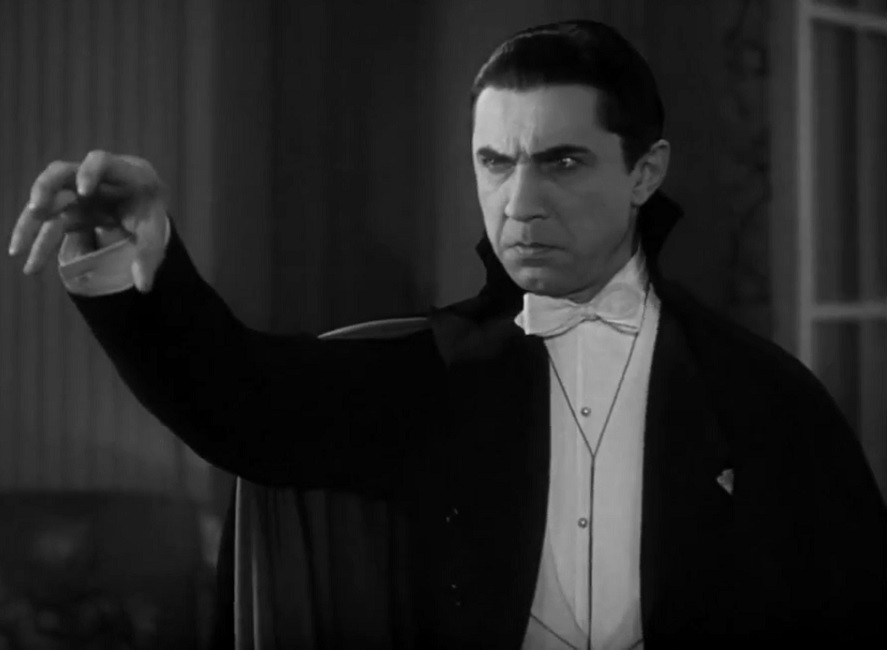
Villains in film originated in the silent era as straightforward antagonists motivated by greed or malice, often marked by exaggerated physical features like mustaches or scars to signal their threat.[79] Early sound films introduced iconic monstrous figures, such as Bela Lugosi's Count Dracula in the 1931 Universal adaptation, which established the seductive vampire archetype through shadowy cinematography and hypnotic performance.[80] Similarly, Boris Karloff's portrayal of Frankenstein's monster in the 1931 film depicted a tragic yet destructive creation, utilizing makeup and lumbering gait to evoke both pity and fear.[79] By the mid-20th century, villains evolved to reflect societal anxieties, incorporating psychological depth; Alfred Hitchcock's Psycho (1960) featured Anthony Perkins as Norman Bates, a disturbed motel owner whose dual personality pioneered the everyday killer trope, revealed through innovative editing and score.[80] Film noir techniques, including low-key lighting and chiaroscuro contrasts, became staples for portraying moral ambiguity, casting villains in ominous shadows to symbolize inner darkness, as in Billy Wilder's Double Indemnity (1944) with Barbara Stanwyck's manipulative femme fatale Phyllis Dietrichson.[81] In later decades, antagonists like Darth Vader in The Empire Strikes Back (1980) combined mechanical menace with operatic voice and black silhouette, influencing sci-fi portrayals of authoritarian evil.[80] Television villains initially appeared in episodic formats during the 1950s, often as disposable threats in anthology series like Alfred Hitchcock Presents (1955–1962), mirroring radio drama structures with moralistic resolutions.[77] The shift to serialized narratives in the 1970s enabled recurring characters with layered motivations; J.R. Ewing, played by Larry Hagman in Dallas (1978–1991), embodied corporate ruthlessness through scheming dialogue and family betrayals, boosting ratings via the "Who shot J.R.?" cliffhanger in 1980.[82] Modern TV has favored complex antagonists, such as Hannibal Lecter in the 2013–2015 series adaptation, where deliberate pacing and culinary metaphors heightened intellectual horror, adapting film techniques to episodic depth while exploring villainous charisma.[80] Portrayal techniques across both mediums emphasize visual and auditory cues for menace: villains are frequently lit from below or sidelit to distort features, paired with dissonant sound design to unsettle viewers, evolving from overt monstrosity to subtle psychological realism that mirrors real-world threats like ideological extremism or unchecked power.[83] This progression, evident from 1950s group-based foes to 2000s individuated sociopaths, reflects broader cultural shifts toward recognizing evil's roots in personal trauma or systemic corruption rather than inherent monstrosity.[77]In Animation and Comics
In animation, villains emerged prominently with the advent of feature-length films, exemplified by the Evil Queen in Disney's Snow White and the Seven Dwarfs (1937), whose design emphasized sharp features and dark attire to convey malice through exaggerated visual cues suited to the medium's expressive capabilities.[84] Early animated antagonists, such as those in Fleischer Studios' Superman shorts (1941–1943), like the Mechanical Monsters, prioritized mechanical threats over personality, reflecting wartime influences and the era's focus on spectacle rather than psychological depth.[85] By the mid-20th century, characters like Disney's Maleficent in Sleeping Beauty (1959) introduced fairy-tale grandeur with transformative abilities, leveraging animation's fluidity to depict shape-shifting and curses that live-action could not replicate as fluidly.[86] The 1990s Disney Renaissance shifted villain portrayals toward operatic flair and vocal performances, with Jafar in Aladdin (1992) and Ursula in The Little Mermaid (1989) using serpentine designs and bombastic schemes to drive narrative tension, often ending in spectacular downfalls that underscored moral binaries.[87] Non-Disney examples, such as Shredder in the Teenage Mutant Ninja Turtles animated series (1987–1996), embodied ninja clan rivalries rooted in serialized action, while anime villains like Frieza in Dragon Ball Z (1989–1996) featured escalating power levels and genocidal ambitions, adapting manga origins to animated battles with precise choreography.[88] Over time, animation villains evolved from archetypal evils to more layered figures; academic analyses note a trend post-1990s toward sympathetic traits, such as internal conflicts in Disney's revival-era antagonists, though core functions remained oppositional forces enabling heroic growth. In comics, villains originated in pulp-inspired crime fighters' rogues' galleries, with early examples like the Ultra-Humanite in Action Comics #13 (1939), a mad scientist body-swapping foe to Superman, establishing intellect-based threats paralleling heroic powers.[89] DC's Lex Luthor debuted in Action Comics #23 (1940) as a bald criminal mastermind, evolving from generic gangster to corporate titan driven by ego and anti-Superman ideology, reflecting real-world anxieties about unchecked ambition.[90] Marvel counterparts, such as Doctor Doom in Fantastic Four #5 (1962), combined scientific genius with monarchic tyranny and scarred visage from a failed experiment, providing a foil whose code of honor contrasted team heroism.[91] Comic villains' designs favored iconic visuals—Joker's green hair and smeared makeup in Batman #1 (1940) symbolizing chaotic nihilism—enabling recurring arcs where defeats rarely proved fatal, sustaining long-term narratives.[92] Magneto's Holocaust survivor backstory, introduced in Uncanny X-Men #200 (1985) flashback, added ideological complexity as a mutant supremacist viewing his extremism as defensive realism against human persecution, influencing debates on villain relatability without excusing terrorism.[91] This serialization allowed evolutionary depth, from one-dimensional foes in Golden Age comics (1938–1950s) to multifaceted antagonists in modern runs, where backstories like the Joker's ambiguous trauma in The Killing Joke (1988) explore causality between abuse and psychopathy, though empirical psychology disputes direct determinism.[93]In Video Games and Interactive Media
In video games, villains primarily function as antagonists that propel gameplay mechanics, providing obstacles through combat encounters, puzzles, and boss battles that test player skill and strategy. Early examples include Bowser, introduced in Super Mario Bros. (1985), who kidnaps Princess Peach and serves as a recurring physical challenge via platforming and combat, emphasizing persistence and timing over narrative depth.[94] Similarly, Ganon from The Legend of Zelda (1986) embodies a dark sorcerer archetype, culminating in a multi-phase boss fight that rewards exploration and item acquisition, establishing villains as culminations of progression systems.[94] These designs prioritize empirical gameplay feedback loops, where villain encounters yield satisfaction through mastery rather than moral ambiguity.[95] The evolution of video game antagonists shifted toward narrative integration in the 1990s and 2000s, incorporating backstories and motivations to enhance immersion without compromising player agency. Sephiroth in Final Fantasy VII (1997) exemplifies this, portrayed as a genetically engineered super-soldier driven by a god-complex and planetary destruction plot, whose psychological manipulation of protagonist Cloud adds layers of betrayal and inevitability, influencing player emotional investment.[94] Academic analysis highlights how such villains hinder progress while offering entertainment value, often evoking fear or moral questioning through scripted events and adaptive AI behaviors.[96] In interactive media like RPGs and action-adventures, antagonists adapt to player choices, as seen in Mass Effect series (2007–2012) where synthetic villains like the Reapers challenge decisions on AI ethics, but retain causal agency tied to predefined lore to maintain coherent challenge structures.[97] Visual and behavioral design of villains influences player perceptions of morality and threat level, with empirical studies showing that exaggerated features—such as grotesque forms or imposing silhouettes—heighten judgments of malevolence, facilitating intuitive threat assessment in fast-paced gameplay.[98] This contrasts with passive media, as interactivity grants players direct agency in villain defeat, fostering causal realism through repeated trials and skill-based victories, though some titles allow villainous player roles, elevating aggression via deviant character embodiment without altering core antagonism dynamics.[99] Boss battles, a staple mechanic, have progressed from static endurance tests in arcade eras to dynamic, multi-phase encounters in modern titles like Dark Souls (2011), where villains like Gwyn demand pattern recognition and resource management, underscoring their role in skill validation over simplistic good-evil binaries.[95]Gender Dynamics in Villainy
Female Villains and Their Tropes
Female villains in literature, film, and other media often embody archetypes that emphasize indirect aggression, manipulation, and subversion of traditional feminine roles, contrasting with male villains' tendencies toward overt physical dominance. These portrayals draw from observable patterns in storytelling, where female antagonists exploit social and emotional leverage rather than brute force, as cataloged in character archetype frameworks.[100] Such tropes persist across centuries, from ancient myths like Medea to modern examples, reflecting narrative needs for foils that challenge heroes through relational dynamics.[100] A core trope is the femme fatale or Black Widow, depicted as a seductive manipulator who uses charm, sexuality, and cunning to achieve personal gain, often leading men to ruin without direct confrontation. Examples include the Evil Queen in Snow White and Catwoman in Batman adaptations, where the villainess beguiles victims opportunistically.[101][100] This archetype underscores traits like adaptability and moral detachment, prioritizing deception over violence.[100] The Matriarch represents a twisted maternal figure, exerting possessive control under the guise of protection, smothering autonomy through emotional dominance. Seen in the Wicked Stepmother of Cinderella or the Nanny in The Hand That Rocks the Cradle, this trope highlights authoritarianism masked as benevolence.[100] Similarly, the Schemer crafts intricate plots with intellectual precision, as in the Marquise de Merteuil from Dangerous Liaisons, relying on patience and strategy to undermine foes.[100] Other prevalent types include the Lunatic, an unpredictable obsessive driven by distorted fantasies, exemplified by Alex Forrest in Fatal Attraction; the Backstabber, a duplicitous ally who betrays trust through envy, like Nina in 24; and the Fanatic, whose zealous ideology justifies extremism, akin to Medea's vengeful acts.[100] These archetypes collectively illustrate female villainy as relational and psychologically invasive, often allowing for redemption arcs more frequently than male counterparts, as female evil is framed as aberrant rather than innate.[102] Analyses of Disney portrayals further reveal stereotypes linking female villains to unnatural beauty or vanity, reinforcing deviations from normative femininity.[103]