Hubbry Logo
Dugout canoeDugout canoeMain
Open search
Dugout canoe
Community hub
Dugout canoe
logo
8 pages, 0 posts
0 subscribers
Be the first to start a discussion here.
Dugout canoe
Dugout canoe
from Wikipedia
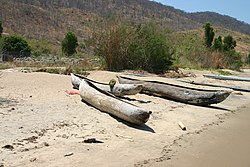
Dugouts on the shore of Lake Malawi

A dugout canoe or simply dugout is a boat made from a hollowed-out tree. Other names for this type of boat are logboat and monoxylon. Monoxylon (μονόξυλον) (pl: monoxyla) is Greek – mono- (single) + ξύλον xylon (tree) – and is mostly used in classic Greek texts. In German, they are called Einbaum ("one tree" in English). Some, but not all, pirogues are also constructed in this manner.

Dugouts are the oldest boat type archaeologists have found, dating back about 8,000 years to the Neolithic Stone Age.[1] This is probably because they are made of massive pieces of wood, which tend to preserve better than others, such as bark canoes.

Construction

[edit]
Building a seagoing dugout. The sides have likely been heated and bent outward.

Construction of a dugout begins with the selection of a log of suitable dimensions. Sufficient wood must be removed to make the vessel relatively light in weight and buoyant, yet still strong enough to support the crew and cargo. Specific types of wood were often preferred based on their strength, durability, and density. The shape of the boat is then fashioned to minimize drag, with sharp ends at the bow and stern.

First, the bark is removed from the exterior. Before the appearance of metal tools, dugouts were hollowed out using controlled fires. The burnt wood was then removed using an adze. Another method using tools is to chop out parallel notches across the interior span of the wood, then split out and remove the wood from between the notches. Once hollowed out, the interior was dressed and smoothed out with a knife or adze.

More primitive designs keep the tree's original dimensions, with a round bottom. However, it is possible to carefully steam the sides of the hollow log until they are pliable, then bend to create a more flat-bottomed "boat" shape with a wider beam in the center.

For travel in the rougher waters of the ocean, dugouts can be fitted with outriggers. One or two smaller logs are mounted parallel to the main hull by long poles. In the case of two outriggers, one is mounted on either side of the hull.

Africa

[edit]

The Dufuna canoe from Nigeria is an 8000-year-old dugout, the oldest boat discovered in Africa, and is, by varying accounts, the second or third-oldest ship worldwide. The well-watered tropical rainforest and woodland regions of sub-Saharan Africa provide both the waterways and the trees for dugout canoes, which are commonplace from the Limpopo River basin in the south through East and Central Africa and across to West Africa. African teak is the timber favoured for their construction, though this comprises a number of different species, and is in short supply in some areas. Dugouts are paddled across deep lakes and rivers or punted through channels in swamps (see makoro or mtumbwi) or in shallow areas, and are used for transport, fishing, and hunting, including, in the past, the very dangerous hunting of hippopotamus. Dugouts are called pirogues in Francophone areas of Africa.

A Nok sculpture portrays two individuals, along with their goods, in a dugout canoe.[2] Both of the anthropomorphic figures in the watercraft are paddling.[3] The Nok terracotta depiction of a dugout canoe may indicate that Nok people utilized dugout canoes to transport cargo, along tributaries (e.g., Gurara River) of the Niger River, and exchanged them in a regional trade network.[3] The Nok terracotta depiction of a figure with a seashell on its head may indicate that the span of these riverine trade routes may have extended to the Atlantic Coast.[3] In the maritime history of Africa, there is the earlier Dufuna canoe, which was constructed approximately 8000 years ago in the northern region of Nigeria; as the second earliest form of water vessel known in Sub-Saharan Africa, the Nok terracotta depiction of a dugout canoe was created in the central region of Nigeria during the first millennium BCE.[3]

The engineering and methodology (e.g., cultural valuations, use of iron tools) used in the construction of West African dugout canoes (e.g., rounded point sterns and pointed bows with 15° - 50° angle above water surface, increased stability via partly rounded or flat base, v-shaped hull, shallow draft for sailing water depths less than one foot, occasionally spanning more than one hundred feet in length) contributed to the capability of the canoes to be able to persist and navigate throughout the interconnected river system that connected the Benue River, Gambia River, Niger River, and Senegal River as well as Lake Chad; this river system connected diverse sources of water (e.g., lakes, rivers, seas, streams) and ecological zones (e.g., Sahara, Sahel, Savanna), and allowed for the transport of people, information, and economic goods along riverine trade networks that connect various locations (e.g., Bamako, Djenne, Gao, Mopti, Segou, Timbuktu) throughout West Africa and North Africa.[4] The knowledge and understanding (e.g., hydrography, marine geography, how canoe navigation is affected by the depth of the water, tides in the ocean, currents, and winds) of West African canoers facilitated the skillful navigation of various channels of the regional river system, while engaging in activities such as trade and fishing.[4] The construction schema for West African dugout canoes were also used among canoes in the Americas constructed by the African diaspora.[4] The sacredness of canoe-making is expressed in a proverb from Senegambia: "The blood of kings and the tears of the canoe-maker are sacred things which must not touch the ground."[4] In addition to possessing economic value, West African dugout canoes also possessed a sociocultural and psychospiritual value.[4]

In 1735 CE, John Atkins observed: "Canoos are what used through the whole Coast for transporting Men and Goods."[4] European rowboats, which frequently capsized, were able to be outmaneuvered and outperformed in terms of speed by West African dugout canoes.[4] Barbot stated, regarding West African canoers and West African dugout canoes, the "speed with which these people generally make these boats travel is beyond belief."[4] Alvise da Cadamosto also observed how "effortlessly" Portuguese caravels were outperformed by Gambian dugout canoes.[4] The skill of Kru canoers to be able to navigate the challenging conditions of the sea was also observed by Charles Thomas.[4]

Amid the 1590s CE, Komenda and Takoradi in Ghana served as production areas for dugout canoes made by the Ahanta people.[4] By 1679 CE, Barbot observed Takoradi to be "a major canoe-producing center, crafting dugouts capable of carrying up to eight tons."[4] Between the 17th century CE and 18th century CE, a production area and/or marketplace of dugout canoes was in Shama, which later became only a marketplace on Supome Island.[4] Amid the 1660s CE, in addition to other local canoers manufacturing dugout canoes, the Fetu people were observed by Muller as having bought dugout canoes that were made by the Ahanta people.[4]

West Africans (e.g., Ghana, Ivory Coast, Liberia, Senegal) and western Central Africans (e.g., Cameroon) independently developed the skill of surfing.[5] Amid the 1640s CE, Michael Hemmersam provided an account of surfing in the Gold Coast: "the parents 'tie their children to boards and throw them into the water.'"[5] In 1679 CE, Barbot provided an account of surfing among Elmina children in Ghana: "children at Elmina learned "to swim, on bits of boards, or small bundles of rushes, fasten'd under their stomachs, which is a good diversion to the spectators."[5] James Alexander provided an account of surfing in Accra, Ghana in 1834 CE: "From the beach, meanwhile, might be seen boys swimming into the sea, with light boards under their stomachs. They waited for a surf; and came rolling like a cloud on top of it. But I was told that sharks occasionally dart in behind the rocks and 'yam' them."[5] Thomas Hutchinson provided an account of surfing in southern Cameroon in 1861: "Fishermen rode small dugouts 'no more than six feet in length, fourteen to sixteen inches in width, and from four to six inches in depth.'"[5]

Asia

[edit]
Remains of an 8000-year-old dugout excavated in China

An 8000-year-old dugout canoe was found by archaeologists in Kuahuqiao, Zhejiang Province, in east China.[6] This is the earliest canoe found in Asia.

The Moken, an ethnic group that lives in Myanmar's Mergui Archipelago and the north of Thailand as sea nomads, still builds and uses dugout canoes.[7] According to the Moken's accounts of their people's origin, a mythical queen punished the forbidden love of their ancestral forefather for his sister-in-law by banishing him and his descendants to life on sea in dugout canoes with indentations fore and aft ("a mouth that eats and a rear that defecates"), symbolizing the unending cycle of ingestion, digestion and evacuation.[8]

A centuries-old unfinished dugout boat, a big banca (five tons, measuring 12 meters (39 ft) by 2 meters (6.6 ft) by 1.5 meters (4.9 ft)) was accidentally retrieved in November 2010 by Mayor Ricardo Revita at Barangay Casanicolasan, Rosales, Pangasinan, Philippines, in Lagasit River, near Agno River.[9] It is now on display in front of the Municipal Town Hall.

Fisherman in Kondakarla Ava

Dugout canoes are one of the most used traditional fishing vessels in India. Forest Department at Kolleru Lake held various contests with the dugout canoe among local fishing communities. In an era where the traditional canoe faces extinction, the boat race saw 22 participants. They also noted that within two decades, there were over 1,000 dugout canoes employed for fishing in the lake. Now, their count has dwindled to less than a hundred.[10]

Europe

[edit]
The Pesse canoe is the world's oldest known dugout
Slavic dugout from the 10th century
Ukrainian dugout (dowbanka) from the end of the 19th century
Building a dugout in Estonia
Twin dugout, Russia, late 19th century

In ancient Europe many dugouts were made from linden wood, for several reasons. First, linden trees were abundant in the Paleolithic after the melting of the Weichselian glaciation and readily available. Secondly, linden grew to be one of the tallest trees in the forests of the time, making it easier to build longer boats. Linden wood also lends itself well to carving and doesn't split or crack easily. It is also lighter than most other tree types in European old-growth forests, and for this reason, boats made from linden wood have a better cargo capacity and are easier to carry.

The Pesse canoe, found in the Netherlands, is a dugout which is believed to be the world's oldest boat, carbon dated to between 8040 BCE and 7510 BCE. Other dugouts discovered in the Netherlands include two in the province of North Holland: in 2003, near Uitgeest, dated at 617-600 BC;[11] and in 2007, near Den Oever, dated at 3300-3000 BC.[12]

Dugouts have also been found in Germany. In German, the craft is known as Einbaum (one-tree). In the old Hanseatic town of Stralsund, three log-boats were excavated in 2002. Two of the boats were around 7,000 years old and are the oldest boats found in the Baltic area. The third boat (6,000 years old) was 12 meters (39 ft) long and holds the record as the longest dugout in the region. The finds have partly deteriorated due to poor storage conditions.[13][14]

In 1991, remains of a linden wood log-boat of nearly 6 meters (20 ft) were found at Männedorf-Strandbad in Switzerland at Lake Zürich. The boat has since been dated to be 6,500 years old.[15]

In 1902 an oak logboat over 15 meters (49 ft) long and 1 meter (3.3 ft) wide, was found at Addergoole Bog, Lurgan, County Galway, Ireland, and delivered to the National Museum of Ireland. The Lurgan boat radiocarbon date was 3940 +/- 25 BP. The boat has holes suggesting that it had an outrigger or was joined to another boat.

In 2012, at Parc Glyndwr, Monmouth, Monmouthshire, Wales, an excavation by the Monmouth Archaeological Society, revealed three ditches suggesting a Neolithic dugout trimaran of similar length to the Lurgan log boat, carbon dated to 3700+/-35 BP.[16]

De Administrando Imperio details how the Slavs built monoxyla that they sold to Rus' in Kiev.[17] These boats were then used against the Byzantine Empire during the Rus'–Byzantine Wars of the 9th and 10th centuries. They used dugouts to attack Constantinople and to withdraw into their lands with bewildering speed and mobility. Hence, the name of Δρομίται ("people on the run") applied to the Rus in some Byzantine sources. The monoxyla were often accompanied by larger galleys, that served as command and control centres. Each Slavic dugout could hold from 40 to 70 warriors.

The Cossacks of the Zaporozhian Host were also renowned for their artful use of dugouts, which issued from the Dnieper to raid the shores of the Black Sea in the 16th and 17th centuries. Using small, shallow-draft, and highly maneuverable galleys known as chaiky, they moved swiftly across the Black Sea. According to the Cossacks' own records, these vessels, carrying a 50 to 70 man crew, could reach the coast of Anatolia from the mouth of the Dnieper River in forty hours.

More than 40 pre-historic log-boats have been found in the Czech Republic. The latest discovery was in 1999 of a 10 meters (33 ft) long log-boat in Mohelnice. It was cut out of a single oak log and has a width of 1.05 meters (3.4 ft). The log-boat has been dated to around 1000 BC and is kept at the Mohelnice Museum (Museum of National History). Geographically, Czech log-boat sites and remains are clustered along the Elbe and Morava rivers.[18]

Poland is known for so-called Lewin-type log-boats, found at Lewin Brzeski, Koźle and Roszowicki Las accordingly, and associated with the Przeworsk culture in the early centuries CE. Lewin logboats are characterized by a square or trapezoidal cross-section, rectangular hull-ends and low height of the sides in relation to vessel length. In addition, nearly all the Lewin-type boats have a single hole in the bow and two at the stern. The low height is a result of the parent log being split lengthwise in half, in order to obtain two identical timbers from a single trunk. The advantage lies in the resulting identical twin hulls, which are then joined to form a double-hulled raft. The paired hulls were joined by transverse poles, which did not go through the holes in the platform ends but were fastened to the top walls or in special grooves at the hull ends. These vessels were typically 7 meters (23 ft)–12 meters (39 ft) in length, and the largest of them could carry up to 1.5 tons of cargo because of the special design.[19][20]

Many pre-historic dugout boats have been found in Scandinavia. These boats were used for transport on calmer bodies of water, fishing and maybe occasionally for whaling and sealing. Dugouts require no metal parts, and were common amongst the Stone Age people in Northern Europe until large trees suitable for making this type of watercraft became scarce. Length was limited to the size of trees in the old-growth forests—up to 12 metres (39 ft) in length. In Denmark in 2001, and some years prior to that, a few dugout canoes of linden wood, were unearthed in a large-scale archaeological excavation project in Egådalen, north of Aarhus. They have been carbon dated to the years 5210-4910 BCE and they are the oldest known boats in Northern Europe.[21][22] In Scandinavia, later models increased freeboard (and seaworthiness) by lashing additional boards to the side of the dugout. Eventually, the dugout portion was reduced to a solid keel, and the lashed boards on the sides became a lapstrake hull.[23]

In the United Kingdom, two log boats were discovered in Newport, Shropshire, and are now on display at Harper Adams University Newport. The Iron Age residents of Great Britain, were known to have used longboats for fishing and basic trade. In 1964, a logboat was uncovered in Poole Harbour, Dorset. The Poole Logboat dated to 300 BC, was large enough to accommodate 18 people and was constructed from a giant oak tree. It is currently located in the Poole Museum. An even older logboat (the Hanson log boat) was unearthed in 1998 in Shardlow south of Derby. It has been dated to the Bronze Ages around 1500 BCE and is now exhibited at Derby Museum and Art Gallery. There was another pre-historic boat at the same location, but it was buried in situ.

In Northern Europe, the tradition of making dugout canoes survived into the 20th and 21st centuries in Estonia, where seasonal floods in Soomaa, a 390 square kilometers (150 sq mi) wilderness area, make conventional means of transportation impossible. In recent decades, a new surge of interest in crafting dugouts (Estonian haabjas) has revitalized the ancient tradition.[24] In December 2021 dugout boat culture of Estonia's Soomaa region was added to UNESCO's Intangible Cultural Heritage list.[25]

The Americas

[edit]
Native Americans making a dugout canoe, 1590
Contemporary seagoing dugout from the Pacific Northwest

Dugout canoes were constructed by indigenous people throughout the Americas, where suitable logs were available.

The Native Americans of the Pacific Northwest were and are still very skilled at crafting wood. Best known for totem poles up to 24 meters (80 ft) tall, they also construct dugout canoes over 18 meters (60 ft) long for everyday use and ceremonial purposes.[26] In the state of Washington, dugout canoes are traditionally made from huge cedar logs (such as Pacific red cedar) for ocean travelers, while natives around smaller rivers use spruce logs. Cedar logs have a resilience in salt water much greater than spruce.

In 1978, Geordie Tocher and two companions sailed a dugout canoe (the Orenda II), based on Haida designs (but with sails), from Vancouver, British Columbia, Canada to Hawaiʻi. The dugout was 40-foot (12 m) long, made of Douglas fir, and weighed 3.5-short-ton (3.2 t). The mission was launched to add credibility to stories that the Haida had travelled to Hawaiʻi in ancient times. Altogether, the group ventured some 7,242 kilometres (4,500 mi) after two months at sea.[27][28]

Oceania

[edit]
Māori waka canoe in a museum

Pacific Islands

[edit]

The Pacific Ocean has been the nursery for many different forms of dugout sailing craft. They differ in their sail plan (i.e., crab-claw or half-crab-claw, Latin, or triangular), hull formats (single, double, catamaran or proa), the absence or presence of a beam (a bridge for a double hull). Hull shapes and end forms vary greatly. Masts can "be right or made of double spars." Hulls can be constructed by assembling boards or digging out tree trunks. Intended use (fish, war, sea voyage) and geographical features (beach, lagoon, reefs) are reflected in the design. Importantly, there is an important dividing line: some craft use a tacking rig; others "shunt" that is change tack "by reversing the sail from one end of the hull to the other." Tacking rigs are similar to those seen in most parts of the world, but shunting rigs change tack by reversing the sail from one end of the hull to the other and sailing in the opposite direction (the "Pushmi-pullyu" of the sailing world).[29]

In the Pacific Islands, dugout canoes are very large, made from whole mature trees and fitted with outriggers for increased stability in the ocean, and were once used for long-distance travel.[30]

New Zealand

[edit]

The very large waka is used by Māori people, who came to New Zealand probably from East Polynesia in about 1280. Such vessels carried 40 to 80 warriors in calm sheltered coastal waters or rivers. It is believed that trans-ocean voyages were made in Polynesian catamarans and one hull, carbon-dated to about 1400, was found in New Zealand in 2011.[30] In New Zealand smaller waka were made from a single log, often totara, because of its lightness, strength and resistance to rotting. Larger waka were made of about seven parts lashed together with flax rope. All waka are characterized by very low freeboard. In Hawaiʻi, waʻa (canoes) are traditionally manufactured from the trunk of the koa tree. They typically carry a crew of six: one steersman and five paddlers.

Australasia

[edit]

The Australian Aboriginal people began using dugout canoes from around 1640 in coastal regions of northern Australia. They were brought by Buginese fishers of sea cucumbers, known as trepangers, from Makassar in South Sulawesi.[31] In Arnhem Land, dugout canoes are used by the local Yolngu people, called lipalipa [32] or lippa-lippa.[31]

Torres Strait Islander people used a double outrigger, unique to their area and probably introduced from Papuan communities and later modified. It was about 14 metres (46 ft) long, with two bamboo masts and sails made of pandanus-mat. They could sail as far as 80 kilometres (50 mi) and carry up to 12 people.[33]

Solomon Islanders

[edit]

The Solomon Islanders have used and continue to use dugout canoes to travel between islands. In World War II these were used during the Japanese occupation - with their small visual and noise signatures these were among the smallest boats used by the Allied forces in World War II. After the sinking of PT-109, Biuku Gasa reached the shipwrecked John F. Kennedy by dugout.

See also

[edit]

References

[edit]
[edit]
Revisions and contributorsEdit on WikipediaRead on Wikipedia
from Grokipedia
A dugout canoe is a made by hollowing out a single tree trunk, typically propelled by paddles and used for navigation on rivers, lakes, and coastal waters. Dugout canoes are among the earliest and most widespread designs in human history, with the oldest known example, the from the , dating to around 10,000 years ago. They have been used across all continents except for transportation, fishing, trade, and ceremonial purposes by diverse cultures, including in the , , , , and . In the of , groups such as the Haida, , and crafted large canoes from red cedar for and inter-community travel. These vessels played crucial roles in supporting economies and social connections in riverine and coastal societies worldwide. European explorers adopted the in the , where the word "" originates from the term canoa. Traditional dugouts declined with industrialization in the 19th and 20th centuries but continue in ceremonial and practical uses today, such as in Indigenous races on Canada's West Coast and daily transport in the Amazon.

Overview and History

Definition and Characteristics

A is a type of constructed by hollowing out a single log or tree trunk, forming a vessel typically without an internal frame or external planking. This monolithic design relies on the natural strength of the timber for structural integrity, distinguishing it from composite boats built from multiple pieces. Key physical characteristics of dugout canoes include lengths typically ranging from 3 to 20 meters, though most historical examples fall between 4 and 12 meters, with widths (beam) of 0.7 to 1.6 meters to promote speed through water. They feature a low freeboard—the distance from the to the —for ease of paddling and loading, while stability is achieved through the hull's width and careful rather than deep keels or . The hull's interior is often rounded or V-shaped for hydrodynamic efficiency, and ends may be pointed or blunt depending on regional adaptations. Unlike bark or skin-covered canoes, which use flexible coverings stretched over a frame of and stringers, dugout canoes emphasize seamless, one-piece without seams, joints, or added coverings, reducing vulnerability to leaks but increasing weight. This solid timber form provides durability for rough waters but limits portability compared to lighter alternatives. Dugout canoes are predominantly designs, but rare multi-hull variants exist where additional logs are lashed parallel to the main hull for enhanced stability in open seas. In some cultures, such as those in and , outrigger attachments—single floats connected by booms—serve as structural add-ons to prevent without altering the primary dugout hull.

Origins and Global Spread

The earliest known dugout canoes date back to approximately 8000 BCE, with evidence from the discovered in the , radiocarbon dated between 8040 and 7510 BCE and constructed from a single Scots pine log. In , the oldest examples appear around 5000–4000 BCE, as seen in archaeological finds from sites where dugouts facilitated early coastal and riverine mobility. Dugout canoes played a pivotal role in by enabling crossings of water barriers during the period in and supporting expansive Polynesian voyages , where they formed the basis for designs that connected distant islands. routes further disseminated the technology, as indigenous groups exchanged ideas and materials along coastal and riverine networks, adapting basic log forms to regional needs from the Mediterranean to the . By 3000 BCE, dugout designs had evolved from rudimentary hollowed logs to more refined shapes across continents, incorporating expansions through heating and wedging techniques that improved stability and capacity in diverse environments like northern European rivers and tropical coasts. Local adaptations drove variations, such as narrower profiles for swift currents in South American rivers or broader hulls for Pacific stability, reflecting environmental pressures and resource availability. In key historical events, dugout canoes supported Viking-era exploration in around 1000 CE, serving as auxiliary craft for local navigation alongside plank-built ships in Scandinavian waters. Similarly, in pre-Columbian , they enabled extensive coastal and inter-island exploration by indigenous groups, facilitating trade and settlement from the to the .

Archaeological Evidence

Archaeological evidence for dugout canoes primarily derives from waterlogged or anaerobic environments that preserve wooden artifacts otherwise prone to rapid decay. These conditions, such as peat bogs, lake bottoms, and river sediments, have yielded some of the earliest examples of watercraft, demonstrating the technology's antiquity and widespread adoption across continents. Radiocarbon dating and dendrochronology have been key techniques in establishing chronologies, revealing that dugout construction emerged independently in multiple regions during the Mesolithic and Neolithic periods. The , unearthed in a peat bog near Pesse in the in 1955, represents the oldest confirmed dugout canoe globally. Constructed from a Scots pine () log measuring approximately 3 meters in length, it dates to between 8040 and 7510 BCE via radiocarbon analysis. Tool marks on the interior indicate the use of early stone adzes for hollowing, suggesting rudimentary but effective woodworking skills among hunter-gatherers. This find highlights the canoe's role in early European mobility across wetlands and rivers. In , the , discovered in 1987 during well-digging in , , and fully excavated in 1994 by a joint German-Nigerian team, is the continent's oldest known example. Carved from African mahogany ( sp.), this 8.4-meter-long vessel dates to approximately 6000 BCE based on of associated organic material. Preserved in waterlogged clay sediments, it features a tapered prow and stern, indicating design considerations for stability and on rivers like the Yobe. The site's anaerobic conditions allowed for the survival of fine details, such as smoothed interior surfaces from repeated polishing. This artifact underscores dugout use in West African fluvial trade and subsistence economies during the . North American evidence includes well-preserved examples from glacial and lacustrine contexts, such as those recovered from British Columbia's coastal sites. For instance, partial dugout fragments from (EfSq-2) on the central coast, excavated in 2010, were found in a waterlogged creek bank associated with a shell midden, dating to precontact periods through contextual . These remains, analyzed via wood species identification (western red cedar), reveal marks and charring from fire-assisted hollowing, linking to broader Indigenous maritime traditions. Permafrost and bog preservation in northern regions, like the , has similarly yielded organic artifacts tied to canoe-based travel, though complete vessels are rarer due to post-depositional fragmentation. Analysis of these artifacts provides insights into technological evolution, with early examples like Pesse showing basic log truncation for crude functionality, evolving to more refined hydrodynamic shapes in later finds, such as Dufuna's flared sides for better load distribution. Tool marks consistently point to adzing with stone or early metal tools, while dendrochronological studies of oak and pine samples confirm seasonal felling practices tied to canoe building. Such evidence illustrates a progression from simple transport to versatile vessels supporting fishing and migration. Despite these discoveries, significant gaps persist in the record, particularly in arid and tropical regions where organic decay is accelerated by oxygen exposure and microbial activity, leading to underrepresentation of dugout use in places like the American Southwest or Saharan oases. These gaps emphasize the need for continued wetland surveys to fill chronological voids.

Construction and Design

Materials and Selection

Dugout canoes are primarily constructed from single tree trunks selected for their durability, lightness, and resistance to rot, with straight grain being essential for ease of carving and structural integrity. In North America, Western red cedar (Thuja plicata) is a preferred species due to its low density, high strength-to-weight ratio, and natural oils that provide rot resistance, allowing canoes to last for years in freshwater environments. Other commonly used woods include northern white cedar (Thuja occidentalis), eastern white pine (Pinus strobus), and cottonwood (Populus spp.), which offer similar lightweight properties suitable for hollowing without excessive weight. In the Amazon Basin, Spanish cedar (Cedrela odorata) and mahogany (Swietenia macrophylla) are favored for their hardness, water resistance, and availability in large sizes, enabling the creation of stable vessels for river navigation. Across Asia, teak (Tectona grandis) is selected for its exceptional durability, termite resistance, and ability to withstand prolonged exposure to saltwater, making it ideal for coastal dugout designs in regions like Indonesia. Tree selection emphasizes criteria such as , age, and to ensure the log can support a stable, buoyant canoe. Builders typically choose trees with a trunk of at least 0.5 to 1 meter at breast height to provide sufficient width for stability and capacity, as smaller logs limit the vessel's beam and load-bearing potential. Mature trees, often over 200-450 years old, are preferred for their denser, more uniform wood that resists cracking during hollowing. Availability is assessed based on local forests, with straight-growing specimens avoiding knots that could weaken the hull. Seasonal felling occurs during winter to reduce sap content, minimizing warping and facilitating smoother . While wood forms the core material, alternative resources are occasionally incorporated for reinforcement and waterproofing. Bark strips from species like or may be used rarely to lash repairs or reinforce gunwales, providing flexible binding without adding significant weight. Natural pitch, derived from or mixed with animal fat or , serves as a applied to cracks and the exterior to enhance water resistance and prevent rot, particularly in humid environments. These additions are minimal, as the goal remains a monolithic wooden structure. Deforestation has historically impacted traditional sourcing, with overharvesting of (Quercus spp.) in by the 19th century contributing to scarcity for logboat construction amid broader demands for shipbuilding timber. In modern contexts, sustainability challenges persist in regions like the Amazon, where selective logging for cedar and disrupts ecosystems and limits artisan access to suitable trees. To address this, some contemporary builders explore eco-friendly alternatives such as laminated wood composites from sustainably managed plantations, which reduce the need for large single trunks while maintaining strength and reducing environmental footprint.

Traditional Techniques

The construction of a traditional dugout canoe begins with the careful of a suitable , typically using stone or metal axes to cut it down, though in pre-metal eras, was sometimes employed to weaken and fell the tree over several days. Once felled, the log is debarked and marked along its centerline and at the ends to ensure symmetry, often guided by a scaled model or simple drawings that outline the desired hull shape, prow, and . The hollowing process starts with controlled burning, where a fire is built atop the log to char the interior wood selectively, protecting the sides with wet clay or moss to prevent over-burning. As the charred material softens, it is removed using adzes, chisels, or scraping tools made from stone, bone, or shell, repeated in layers until the desired depth is achieved. To curve the sides for better stability and capacity, the hull is heated with steam—generated by pouring water over hot stones or coals placed inside—and then manually bent outward while pliable. Finishing involves smoothing the interior and exterior surfaces with rasps, adzes, or abrasive shells to remove irregularities and achieve a hydrodynamic form. Thwarts—crosswise wooden braces—are then inserted and secured for seating and , typically positioned to accommodate paddlers without compromising balance. For waterproofing, the interior is often charred lightly to seal pores and repel water, supplemented in some traditions by coatings of tree resins or animal fats applied while hot. The entire process demands significant time and labor, typically requiring 100-500 hours for a 10-meter canoe built by 2-4 people, with variations depending on tool availability—stone-age methods extending the timeline compared to those using early metal implements.

Design Variations and Propulsion

Dugout canoes exhibit a range of structural modifications tailored to environmental demands and intended uses, with hull shapes adapted for enhanced performance characteristics such as speed or stability. Pointed prows, often spoon-shaped or featuring a stem bow with an angled cutwater of 0° to 45°, reduce water resistance and improve forward momentum, particularly in designs optimized for swift navigation through rivers or coastal waters. In contrast, flat-bottomed hulls, common in expanded forms with midship cross-sections ranging from round to half-oval and nearly flat bottoms, provide greater initial stability by lowering of and increasing the beam relative to length, making them suitable for carrying loads in calmer inland areas. Length-to-beam ratios vary accordingly, with slender or voyaging models achieving approximately 10:1 for pointed-end configurations to prioritize speed and tracking, while broader utility designs fall between 6.6:1 and 9.6:1 for better load-bearing equilibrium. Propulsion in dugout canoes relies primarily on , though adaptations allow for versatility across terrains. Paddling remains the dominant method, employing single-bladed paddles for efficient —often at rates of 45 per minute with a J-stroke for —suited to one or two occupants sitting on thwarts; double-bladed paddles appear rarely in certain traditions for balanced . In shallow waters or swamps, poling with a long staff pushes against the riverbed, enabling precise maneuvering where paddles are ineffective. Sails, typically triangular in and rigged on an unstayed sprit, made from cloth or palm leaves, harness wind for longer voyages, with historical examples including square or configurations on pirogue-style dugouts to facilitate upwind travel despite the absence of keels. by larger vessels or animals supplements these in trade scenarios, particularly for overloaded models. Additional features augment functionality and safety without altering the core structure. Outriggers, consisting of a float attached by booms to one side, enhance lateral balance in open-water designs, preventing under or heavy loads, as seen in Pacific traditions where they allow stable operation for fishing or inter-island transit. Thwarts—crosswise planks or rounded bars nailed or lashed in place—serve as structural reinforcements, seats for paddlers, and attachment points for gear, typically spaced to accommodate 1 to 20 people depending on size. Leeboards, vertical foils dropped from the side, occasionally fit to variants to reduce and improve directional control in crosswinds. Capacities range from 1-8 individuals in daily-use canoes to 12 or more in extended models, with cargo holdings up to 2-3 tons in robust freight types like those used by 19th-century explorers. Performance metrics underscore these adaptations' effectiveness, with paddled dugouts typically achieving sustained speeds of 5-6 km/h over distances, though motivated crews or favorable currents can reach 10 km/h in slender designs. Stability derives from the metacenter—the virtual pivot point of when heeled—positioned high relative to the center of in flat-bottomed or outrigger-equipped hulls, yielding resistance to rolling in choppy conditions; narrower pointed-prow variants rely more on skilled paddling for equilibrium but offer superior responsiveness. These qualities enable dugouts to navigate diverse waterways reliably, from tight channels to exposed coasts.

Cultural and Practical Uses

Transportation and Trade

Dugout canoes served as essential vessels for daily transportation across rivers, lakes, and coastal waters, enabling short-haul travel for indigenous communities in various regions. In the and areas, these heavy log boats were particularly suited to large bodies of water where portaging was minimal, allowing users to navigate unfrozen waterways efficiently. Their design supported load capacities ranging from small one-person craft to larger models accommodating up to 80 individuals or 30 to 100 barrels of goods, facilitating the movement of people and supplies over moderate distances. Maneuverability in river currents was enhanced by specialized paddles—such as double-ended ones for quick turns—and poles for shallow or swift sections, as evidenced in historical accounts from Florida's inland waterways. In trade networks, were instrumental in exchanging like shells, , and other non-local materials, supporting economic interactions over hundreds of miles before European contact. Along the in pre-1500 CE Mississippian societies, these vessels underpinned between mound centers and villages, carrying commodities essential to regional economies and enabling systems in areas like , where up to 50,000 canoes operated in urban hubs such as . In West Africa, pirogue-style dugouts facilitated riverine along the Gold Coast, with local navigators guiding European traders in coastal and inland exchanges of , highlighting their role in broader commercial pathways. For exploration, dugout-based canoes enabled significant coastal and open-water voyages, particularly in , where they formed the hull foundation for voyaging craft that supported settlement across islands up to 1,000 kilometers apart. In medieval , expanded dugout designs aided inland and river navigation for trade routes in regions like the and Baltic, contributing to cultural exchanges among Finnic groups. African inland navigation similarly relied on these canoes for traversing rivers like the , allowing communities to connect distant settlements through seasonal trade expeditions. Despite their versatility, dugout canoes had notable limitations, including vulnerability to rough weather due to low freeboard and poor lateral stability, which made them prone to in open seas or strong winds without stabilizers. Their substantial weight—often requiring teams for handling—necessitated frequent portages over land barriers like or dry stretches, restricting continuous travel and demanding physical labor from users.

Fishing and Ceremonial Roles

Dugout canoes played a vital role in indigenous fishing practices, leveraging their low profile and quiet for stealthy approaches to aquatic prey. Anglers used these vessels to position themselves close enough for spearing or deploying nets, techniques that minimized disturbance in shallow or calm waters. Many designs featured broad, stable hulls with integrated platforms, enabling fishermen to stand upright for better visibility and precision in spotting and harvesting . Such trips provided essential protein and economic support for communities reliant on riverine and coastal ecosystems. In ceremonial contexts, dugout canoes symbolized spiritual and communal transitions, frequently launched in rites of passage, funerals, and festivals to honor the deceased or mark seasonal cycles. Intricate carvings, particularly on prows depicting totemic figures or ancestral spirits, endowed the canoes with protective and symbolic power, believed to guide participants through rituals. Among the Māori, waka taua—ornately carved war canoes—featured prominently in ceremonies, transporting warriors while invoking incantations for success and returning remains in rituals that lifted spiritual restrictions through the kawa ceremony. In West African traditions, such as those of the , large pirogues carried over a hundred participants in masked dances and harvest festivals, blending communal celebration with invocations of fertility and abundance. These practices endure through oral histories that connect dugout canoes to ancestral voyages, recounting migrations and seafaring feats that underpin and navigational heritage.

Economic and Social Impact

Dugout canoes have served as a foundational element of economic systems in many indigenous societies, particularly those reliant on riverine and coastal networks, where they facilitated the exchange of goods such as , tools, and products across vast distances. In Pacific Northwest communities, canoes were integral to economic revitalization efforts, enabling the transport of resources and supporting that sustained livelihoods before and after European contact. Among the Warrau people of Guyana's wetlands, dugout canoes remain essential for accessing remote areas to gather wild foods and materials, directly contributing to household economies in swamp environments. In some Pacific cultures, canoes held akin to , used in inter-island systems that exchanged vessels for commodities like pigs or , which in turn supported social transactions including bridewealth payments. Socially, the of dugout canoes elevated builders to positions of high status within traditional communities, as the skill-intensive required deep knowledge of wood selection, techniques, and spiritual protocols, often marking individuals as cultural experts. divisions were pronounced in many groups, with men typically handling the labor-intensive building and maintenance, while women often took roles in paddling and managing onboard loads during voyages, reflecting broader labor divisions tied to mobility and resource use. Community events surrounding canoe launches reinforced social bonds, serving as ceremonial gatherings that involved rituals, feasts, and collective participation to honor the vessel's completion and ensure safe travels, as seen in contemporary revivals among and peoples. Over the long term, dugout canoes enabled expansive settlement patterns by allowing populations to navigate inland waterways and establish villages in previously inaccessible areas, shaping migration and resource distribution in regions like the Mississippi Valley and the . European colonization led to their decline in the , as indigenous groups adopted metal-hulled boats and shifted economies toward colonial , diminishing traditional canoe use in places like the and . However, recent revivals, often tied to cultural tourism, have restored their prominence; for instance, among Ainu communities in and Warrau groups in , guided canoe tours generate income while preserving skills and attracting visitors to indigenous heritage sites. In Amazonian riverine communities during the 2020s, canoe-based transport underpins local economies by supporting fishing and , with solar-powered variants reducing fuel costs and contributing to sustainable income streams.

Regional Variations

Africa

The Dufuna canoe, unearthed in 1987 near the village of Dufuna in , Nigeria, represents the oldest known watercraft in , radiocarbon-dated to approximately 6000 BC and measuring about 8.4 meters in length. This artifact, carved from a single log, demonstrates early mastery of dugout construction in the region, likely used for riverine transport along ancient waterways like the Yobe River. Its discovery challenges prior assumptions about prehistoric African navigation, highlighting sophisticated techniques predating similar finds elsewhere on the continent. African dugout canoes exhibit regional variations adapted to diverse aquatic environments. In , narrow pirogues on the , often fashioned from durable hardwoods like , extend up to 15 meters or more, enabling them to carry heavy loads through rapids and broad channels. These slender designs prioritize speed and maneuverability for river navigation. In contrast, East African examples, such as those around and the , feature broader hulls influenced by local maritime practices akin to , providing greater stability for lake fishing and coastal trade. across these areas relies on hardwoods like in West and Central Africa or in the east, with builders employing fire to char and soften the interior before using axes and adzes to hollow and shape the vessel. Paddles typically have broad, leaf-shaped blades carved from similar woods, optimizing thrust in shallow or winding waters. Dugouts have played vital roles in transportation, trade, and subsistence. Along trade routes, such as the , canoes facilitated commerce from around 1000 CE, linking inland empires like the Songhai with trans-Saharan caravans and enabling the movement of goods like salt, gold, and slaves between cities such as and . In East Africa's basin, Luo and other communities use outrigger-equipped dugouts for , particularly during nighttime operations where the added stabilizer allows safe handling of nets amid waves. These vessels underscore communal building traditions, often involving entire villages in the labor-intensive process. The mid-20th century introduction of motorboats after the accelerated the decline of traditional dugouts, as faster outboard engines dominated and on rivers and lakes like the and Victoria. However, contemporary revival efforts, driven by eco-tourism, have sustained their cultural and practical significance; in Botswana's , mokoro dugouts—poled by local guides—offer low-impact access to wetlands, preserving indigenous knowledge while supporting sustainable livelihoods.

Asia

In Asia, dugout canoes have been integral to maritime cultures across diverse environments, from Japan's coastal waters to Indonesia's archipelagos and Vietnam's riverine deltas, shaped by patterns and the need for versatile . These vessels, often crafted from locally abundant hardwoods, facilitated , , and cultural practices, evolving from prehistoric forms to incorporate regional adaptations like outriggers for stability in choppy seas. Archaeological evidence indicates their use dates back millennia, with early examples supporting and subsistence economies in the region. Distinct types emerged to suit local needs. In , the mon—a traditional dugout canoe hollowed from Japanese cedar (Cryptomeria japonica) logs—typically measures 5 to 10 meters in length and serves primarily for inshore fishing and coastal transport. These canoes, exemplified by Jomon-period replicas around 7.5 meters long, highlight the use of lightweight yet durable cedar for maneuverability in rough waters. In , the perahu encompasses various dugout-based boats, including smaller coastal types carved from ( grandis), often fitted with sails for extended voyages between islands. Teak's resistance to rot made it ideal for these vessels, which supported fishing and inter-island connectivity in the tropical . Construction techniques reflect technological advancements and environmental constraints. After approximately 500 BCE, during the in , metal adzes replaced stone tools, enabling more precise hollowing of logs and finer shaping of hulls for improved hydrodynamics. In Southeast Asian contexts like , poles were commonly lashed to the gunwales or used in assemblies for structural reinforcement, enhancing stability without adding excessive weight. While steaming was occasionally employed to bend wooden elements for attachments, the core hull was typically adzed directly from a single log, preserving the vessel's simplicity and seaworthiness. Dugout canoes played vital roles in transportation and cultural life. In Vietnam's , they have long been used for navigating the intricate canal networks, transporting and goods in a where cultivation originated around 2000 BCE with the southward spread of farming practices from southern . These canoes remain essential for local trade, poling through shallow waterways to connect rural producers with markets. In , ceremonial traditions evolved around boat racing, as seen in the , where elongated vessels—tracing roots to ancient riverine crafts—symbolize communal rituals honoring historical figures and invoking prosperity, though modern forms are plank-constructed. In the modern era, particularly in the , traditional bangka dugout canoes have incorporated reinforcements to extend lifespan and reduce maintenance amid rising fuel costs and environmental pressures. This hybridization maintains the design while blending wood hulls with synthetic materials for coastal and . Cultural festivals and workshops across actively preserve these techniques; for instance, in Vietnam's Central Highlands, community events and training sessions teach ethnic groups like the Bahnar to carve and maintain dugouts, ensuring the transmission of indigenous knowledge amid modernization.

Europe

Dugout canoes, known as logboats in , have a long history spanning from the period through the medieval era, primarily constructed from and other hardwoods in temperate regions. In the , archaeological evidence reveals logboats typically ranging from 4 to 12 meters in length, often made from massive trunks that provided durability for riverine and coastal navigation. For instance, the Iron Age Poole logboat, discovered in Dorset, , measures nearly 10 meters long and dates to approximately 295 BCE, representing one of the largest such vessels in southern Britain. These boats were essential for local transport in forested landscapes, with over 3,500 logboat finds documented across , many from waterlogged sites preserving their form. Construction techniques evolved from Neolithic times, beginning with polished stone adzes to hollow out logs, transitioning to bronze and later iron tools for greater precision. Fire was occasionally used to soften wood for shaping, though archaeological traces of this are rare, as seen in only one prehistoric British example. To seal gaps and repairs, moss or other vegetable matter served as caulking material, often packed into splits or joints alongside animal hair or fat for waterproofing. Moving heavy logs to water required communal effort, with experimental archaeology suggesting the use of log rollers—cylindrical wooden aids—to transport trunks overland, though the immense weight of large oaks made this labor-intensive. By the Iron Age and Viking period, some logboats were expanded through heating and spreading the hull, with partial planking added in clinker style, echoing the broader hulls of Viking knarr cargo ships for improved stability and capacity. Logboats facilitated key economic activities, including fishing in the from around 1000 BCE, where vessels like those excavated at , , supported coastal subsistence and trade. Along the River, they enabled medieval inland trade routes, carrying goods such as timber and agricultural products in paired configurations to increase load capacity, as evidenced by early medieval finds in . In rural settings, peasants relied on these simple craft for short-distance transport of produce and on rivers and lakes, exemplified by the 13th-century River Conon logboat in , which measured about 5 meters and likely served local needs. By the late medieval period, around 1500 CE, logboats declined in favor of more versatile clinker-built plank boats, which offered superior seaworthiness and scalability for expanding trade networks across . This shift marked the transition to advanced traditions influenced by Viking designs, rendering unexpanded logboats obsolete for most practical uses. Their legacy endures through heritage projects, such as the 2014 Prometheus experimental replica in Britain, which recreated a oak logboat using period tools to demonstrate ancient techniques, and similar 2010s initiatives in focused on expanded forms.

The Americas

In the Pacific Northwest of North America, indigenous peoples such as the Haida, , and Coast Salish crafted elaborate cedar dugout canoes from western red cedar trees often over 1,000 years old, with some vessels reaching lengths of up to 15 meters to accommodate large crews and cargo. These canoes frequently featured totem-carved prows depicting crests or spiritual motifs, enhancing their cultural significance beyond mere utility. In contrast, Amazonian indigenous groups, including the Warao and , constructed pirogues from lightweight woods like cedar or balsa, designed with curved bows and sterns to navigate the region's turbulent rapids and flooded forests efficiently. Construction techniques across the Americas emphasized resource adaptation and precision craftsmanship. Indigenous builders initiated the process with controlled burning to hollow out the log, followed by shaping with adzes made from stone or shell blades prior to European contact, ensuring structural integrity without metal tools. Gunwale reinforcements, often added as wooden strakes or frames, provided stability and prevented cracking during voyages, a practice evident in both coastal and riverine designs. Dugout canoes facilitated extensive trade and subsistence networks throughout pre-colonial . In the (circa 800–1500 CE), these vessels enabled riverine commerce along the and its tributaries, transporting goods like shells, copper, and across vast distances to support economies. In the , Warao fishing fleets relied on fleets of dugout canoes to harvest and manatees, sustaining multiethnic communities through seasonal migrations and exchanges. Contemporary revivals highlight the enduring legacy of these traditions amid modern challenges. On , post-2000 efforts by Haida carvers have resurrected cedar dugout construction for cultural journeys, such as , fostering intergenerational . However, in Brazil's Amazon, illegal logging and threaten access to suitable lightwoods, disrupting indigenous canoe-building and forcing reliance on imported materials that compromise traditional designs.

Oceania

In Oceania, dugout canoes have played a pivotal role in the cultural, navigational, and economic life of Pacific Island communities, from the isolated atolls of Polynesia to the coastal regions of Australia and New Zealand, enabling long-distance voyaging that facilitated human settlement across vast oceanic expanses. These vessels, typically hollowed from single logs of durable tropical hardwoods, were adapted with outriggers or multi-hull configurations to enhance stability on open seas, reflecting the region's emphasis on maritime connectivity rather than continental riverine use. Traditional construction relied on stone or shell tools and plant-based materials, underscoring the ingenuity of indigenous builders in harnessing local resources for survival and exploration. Distinct types of dugout canoes emerged across , tailored to regional environments and needs. In , the waka represented a sophisticated evolution from simple dugouts to large, multi-person vessels, with war canoes (waka taua) carved from single totara logs up to 25 meters long, capable of carrying up to 100 warriors and paddlers for coastal and inter-island travel. In , the lakatoi were multi-hulled trading canoes formed by lashing two or more dugout logs together, often exceeding 15 meters in length with supports, forming fleets for annual hiri expeditions that transported goods like clay pots and across the Gulf of Papua. Among Indigenous Australian communities in northern coastal areas like , dugout canoes were crafted for nearshore fishing and transport, hollowed from local hardwoods in mangrove-fringed environments to navigate shallow waters and reefs. Construction techniques in emphasized precision and natural materials to withstand tropical conditions. Builders used shell adzes—sharp tools made from or shells—for hollowing and shaping the log hulls, a method that allowed for controlled removal of wood without metal tools. Hulls were then joined or reinforced with lashing using cordage from or plant vines, ensuring flexibility against wave impacts, while outrigger booms—curved poles lashed across the hull to a float—provided essential stability for open-water voyages, as seen in both single- and double-outrigger designs prevalent from to . These canoes were integral to key uses that shaped Oceanic societies. Polynesian navigators employed star-based , observing constellations, ocean swells, and bird migrations from double or dugout canoes to undertake deliberate voyages, enabling the settlement of remote islands between approximately 300 BCE and 1300 CE, including expansions to , , and . In the Torres Strait, dugout canoes facilitated vital trade networks, carrying , tools, and foodstuffs between islands and in annual circuits that strengthened inter-community ties. For the , waka taua served in warfare, with fleets ramming enemy vessels or transporting raiding parties along coastlines, their carved prows symbolizing ancestral power and tribal identity during conflicts like the [Musket Wars](/page/Musket Wars). In modern times, efforts to revive dugout canoe traditions have gained international recognition, countering cultural erosion while addressing environmental challenges. The Polynesian Voyaging Society's , a performance-accurate replica of ancient voyaging canoes launched in 1975, has undertaken voyages in the 2020s as part of the Moananuiākea worldwide tour, including a leg to in November 2025 commemorating its historic 1985–1987 voyage, using non-instrument to reconnect Pacific communities and promote cultural heritage, with supporting these initiatives since 2015 to preserve intangible maritime knowledge. However, rising sea levels and ocean warming threaten low-lying islands like those in and , eroding beaches needed for launching dugout canoes and disrupting that sustain traditional practices, prompting communities to adapt by incorporating modern materials while advocating for global .

References

Add your contribution
Related Hubs
User Avatar
No comments yet.