


Community hub
Recent from talks
Contribute something
Nothing was collected or created yet.
Invasive species
View on Wikipedia


An invasive species is an introduced species that harms its new environment.[2] Invasive species adversely affect habitats and bioregions, causing ecological, environmental, and/or economic damage. Since the 20th century, invasive species have become serious economic, social, and environmental threats worldwide.
Invasion of long-established ecosystems by organisms is a natural phenomenon, but human-facilitated introductions have greatly increased the rate, scale, and geographic range of invasion. For millennia, humans have served as both accidental and deliberate dispersal agents, beginning with their earliest migrations, accelerating in the Age of Discovery, and accelerating again with the spread of international trade. Notable invasive plant species include the kudzu vine, giant hogweed (Heracleum mantegazzianum), Japanese knotweed (Reynoutria japonica), and yellow starthistle (Centaurea solstitialis). Notable invasive animals include European rabbits (Oryctolagus cuniculus), domestic cats (Felis catus), and carp (family Cyprinidae).
Terminology
[edit]Invasive species are the subset of established non-native alien or naturalized species that are a threat to native species and biodiversity.[3] The term "invasive" is poorly defined and often very subjective.[4] Invasive species may be plants, animals, fungi, and microbes; some include native species that have invaded human habitats such as farms and landscapes.[5] Some broaden the term to include indigenous or "native" species that have colonized natural areas.[4] Some sources name Homo sapiens as an invasive species,[6][7] but broad appreciation of human learning capacity and their behavioral potential and plasticity may argue against any such fixed categorization.[8] The definition of "native" can also be controversial. For example, the ancestors of modern horses (Equus ferus) evolved in North America and radiated to Eurasia before becoming extinct in North America. Upon being introduced to North America in 1493 by Spanish conquistadors, it is debatable whether the feral horses were native or exotic to the continent of their evolutionary ancestors.[9]
While invasive species can be studied within many subfields of biology, most research on invasive organisms has been in ecology and biogeography. Much of the work has been influenced by Charles Elton's 1958 book The Ecology of Invasion by Animals and Plants which creates a generalized picture of biological invasions.[10][11] Studies remained sparse until the 1990s.[11] This research, largely field observational studies, has disproportionately been concerned with terrestrial plants.[11] The rapid growth of the field has driven a need to standardize the language used to describe invasive species and events. Despite this, little standard terminology exists. The field lacks any official designation but is commonly referred to as "invasion ecology" or more generally "invasion biology".[10][11] This lack of standard terminology has arisen due to the interdisciplinary nature of the field, which borrows terms from disciplines such as agriculture, zoology, and pathology, as well as due to studies being performed in isolation.[12][10]
| Stage | Characteristic |
|---|---|
| 0 | Propagules residing in a donor region |
| I | Traveling |
| II | Introduced |
| III | Localized and numerically rare |
| IVa | Widespread but rare |
| IVb | Localized but dominant |
| V | Widespread and dominant |
In an attempt to avoid the ambiguous, subjective, and pejorative vocabulary that so often accompanies discussion of invasive species even in scientific papers, Colautti and MacIsaac proposed a new nomenclature system based on biogeography rather than on taxa.[4] By discarding taxonomy, human health, and economic factors, this model focused only on ecological factors. The model evaluated individual populations rather than entire species. It classified each population based on its success in that environment. This model applied equally to indigenous and to introduced species, and did not automatically categorize successful introductions as harmful.[4]
The USDA's National Invasive Species Information Center defines invasive species very narrowly. According to Executive Order 13112, "'Invasive species' means an alien species whose introduction does or is likely to cause economic or environmental harm or harm to human health."[13]
Causes
[edit]Typically, an introduced species must survive at low population densities before it becomes invasive in a new location.[14] At low population densities, it can be difficult for the introduced species to reproduce and maintain itself in a new location, so a species might need to reach a location multiple times before it becomes established. Repeated patterns of human movement, such as ships sailing to and from ports or cars driving up and down highways, offer repeated opportunities for establishment (referred to as a high propagule pressure).[15]
Ecosystem-based mechanisms
[edit]In ecosystems, the availability of resources determines the impact of additional species on the ecosystem. Stable ecosystems have a resource equilibrium, which can be changed fundamentally by the arrival of invasive species.[16] When changes such as a forest fire occur, normal ecological succession favors native grasses and forbs. An introduced species that can spread faster than natives can outcompete native species for food, squeezing the natives out. Nitrogen and phosphorus are often the limiting factors in these situations.[17] Every species occupies an ecological niche in its native ecosystem; some species fill large and varied roles, while others are highly specialized. Invading species may occupy unused niches, or create new ones.[18] For example, edge effects describe what happens when part of an ecosystem is disturbed, as in when land is cleared for agriculture. The boundary between the remaining undisturbed habitat and the newly cleared land itself forms a distinct new habitat, creating new winners and losers, and potentially hosting species that would not otherwise thrive outside the boundary habitat.[19]
In 1958, Charles S. Elton claimed that ecosystems with higher species diversity were less subject to invasive species because fewer niches remained unoccupied.[20] Other ecologists later pointed to highly diverse, but heavily invaded ecosystems, arguing that ecosystems with high species diversity were more susceptible to invasion.[21] This debate hinged on the spatial scale of invasion studies. Small-scale studies tended to show a negative relationship between diversity and invasion, while large-scale studies tended to show the reverse, perhaps a side-effect of invasives' ability to capitalize on increased resource availability and weaker species interactions that are more common when larger samples are considered.[22][23] However, this pattern does not seem to hold true for invasive vertebrates.[24]
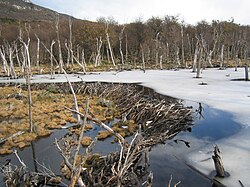
_(8387580552).jpg)
Island ecosystems may be more prone to invasion because their species face few strong competitors and predators, and because their distance from colonizing species populations makes them more likely to have "open" niches.[25] For example, native bird populations on Guam have been decimated by the invasive brown tree snake (Boiga irregularis).[26]
In New Zealand the first invasive species were the dogs and rats brought by Polynesian settlers around 1300. These and other introductions devastated endemic New Zealand species.[27][28] The colonization of Madagascar brought similar harm to its ecosystems.[29] Logging has caused harm directly by destroying habitat, and has allowed non-native species such as prickly pear (Opuntia) and silver wattle (Acacia dealbata) to invade.[30][31] The water hyacinth (Pontederia crassipes) forms dense mats on water surfaces, limiting light penetration and hence harming aquatic organisms, and creating substantial management costs.[32][33] The shrub lantana (Lantana camara) is now considered invasive in over 60 countries, and has invaded large geographies in several countries prompting aggressive federal efforts to control it.[34][35]
Primary geomorphological effects of invasive plants are bioconstruction and bioprotection. For example, kudzu (Pueraria montana), a vine native to Asia, was widely introduced in the southeastern United States in the early 20th century to control soil erosion. The primary geomorphological effects of invasive animals are bioturbation, bioerosion, and bioconstruction. For example, invasions of the Chinese mitten crab (Eriocheir sinensis) have resulted in higher bioturbation and bioerosion rates.[36]
A native species can also become harmful and effectively invasive to its native environment after human alterations to its food web. This has been the case with the purple sea urchin (Strongylocentrotus purpuratus), which has decimated kelp forests along the northern California coast due to overharvesting of its natural predator, the California sea otter (Enhydra lutris).[37]
Species-based mechanisms
[edit]

Invasive species appear to have specific traits or specific combinations of traits that allow them to outcompete native species. In some cases, these characteristics include rates of growth and reproduction. In other cases, invasive species interact with native species other more directly. One study found that 86% of invasive species could be identified from such traits alone.[38] Another study found that invasive species often had only a few of the traits, and that noninvasive species had these also.[38][39][40] Common invasive species traits include fast growth and rapid reproduction, such as vegetative reproduction in plants;[38] association with humans;[41] and prior successful invasions.[42] Domestic cats (Felis catus) are effective predators of wildlife. They have become feral and invasive in places such as the Florida Keys.[43]
An introduced species might become invasive if it can outcompete native species for resources. If these species evolved under great competition or predation, then the new environment may host fewer able competitors, allowing the invader to proliferate. Ecosystems used to their fullest capacity by native species can be modeled as zero-sum systems, in which any gain for the invader is a loss for the native. However, such unilateral competitive superiority (and extinction of native species with increased populations of the invader) is not the rule.[21][44]

An invasive species might be able to use resources previously unavailable to native species, such as deep water accessed by a long taproot, or to live on previously uninhabited soil types. For example, barbed goatgrass (Aegilops triuncialis) was introduced to California on serpentine soils, which have low water-retention, low nutrient levels, a high magnesium/calcium ratio, and possible heavy metal toxicity. Plant populations on these soils tend to show low density, but goatgrass can form dense stands on these soils and crowd out native species.[45]
Invasive species may also alter their environment by releasing chemical compounds, modifying abiotic factors, or affecting the behavior of herbivores, all of which can impact other species. Some, like mother of thousands (Kalanchoe daigremontana), produce allelopathic compounds that inhibit competitors.[46] Others like the toad plant (Stapelia gigantea) facilitate the growth of seedlings of other species in arid environments by providing appropriate microclimates and preventing herbivores from eating seedlings.[47]
Changes in fire regimens are another form of facilitation. Cheatgrass (Bromus tectorum), originally from Eurasia, is highly fire-adapted. It spreads rapidly after burning, and increases the frequency and intensity of fires by providing large amounts of dry detritus during the fire season in western North America. Where it is widespread, it has altered the local fire regimen so much that native plants cannot survive the frequent fires, allowing it to become dominant in its introduced range.[48]
Ecological facilitation occurs where one species, including invasive species, physically modifies a habitat in ways advantageous to other species. For example, zebra mussels (Dreissena polymorpha) increase habitat complexity on lake floors, providing crevices in which invertebrates live. This increase in complexity, together with the nutrition provided by the waste products of mussel filter-feeding, increases the density and diversity of benthic invertebrate communities.[49]
Introduced species may spread rapidly and unpredictably.[50] When bottlenecks and founder effects cause a great decrease in the population size and may constrict genetic variation,[51] individuals begin to show additive variance as opposed to epistatic variance. This conversion can lead to increased variance in the founding populations, which permits rapid evolution.[52] Selection may then act on the capacity to disperse as well as on physiological tolerance to new stressors in the environment, such as changed temperature and different predators and prey.[53]
Rapid adaptive evolution through intraspecific phenotypic plasticity, pre-adaptation, and post-introduction evolution lead to offspring that have higher fitness. Critically, plasticity permits changes to better suit the individual to its environment. Pre-adaptations and evolution after the introduction reinforce the success of the introduced species.[54]
The enemy release hypothesis states that evolution leads to ecological balance in every ecosystem. No single species can occupy a majority of an ecosystem due to the presences of competitors, predators, and diseases. Introduced species moved to a novel habitat can become invasive, with rapid population growth, when these controls do not exist in the new ecosystem.[55]
Vectors
[edit]Non-native species have many vectors, but most are associated with human activity. Natural range extensions are common, but humans often carry specimens faster and over greater distances than natural forces.[56] An early human vector occurred when prehistoric humans introduced the Pacific rat (Rattus exulans) to Polynesia.[57]

Vectors include plants or seeds imported for horticulture. The pet trade moves animals across borders, where they can escape and become invasive. Organisms may also stow away on transport vehicles. Incidental human assisted transfer is the main cause of introductions – other than in polar regions.[58] Diseases may be vectored by invasive insects: the Asian citrus psyllid (Diaphorina citri) carries the bacterial disease citrus greening.[59] The arrival of invasive propagules to a new site is a function of the site's invasibility.[60]
Many invasive species, once they are dominant in the area, become essential to the ecosystem of that area, and their removal could be harmful.[61] Economics plays a major role in exotic species introduction. High demand for the valuable Chinese mitten crab is one explanation for the possible intentional release of the species in foreign waters.[62]
Within the aquatic environment
[edit]Maritime trade has rapidly affected the way marine organisms are transported within the ocean; new means of species transport include hull fouling and ballast water transport. In fact, Molnar et al. 2008 documented the pathways of hundreds of marine invasive species and found that shipping was the dominant mechanism for the transfer of invasive species.[63]

Many marine organisms can attach themselves to vessel hulls. Such organisms are easily transported from one body of water to another, and are a significant risk factor for a biological invasion event.[64] Controlling for vessel hull fouling is voluntary and there are no regulations currently in place to manage hull fouling. However, the governments of California and New Zealand have announced more stringent control for vessel hull fouling within their respective jurisdictions.[65]
Another vector of non-native aquatic species is ballast water taken up at sea and released in port by transoceanic vessels.[66][67] Some 10,000 species are transported via ballast water each day.[68] Many of these are harmful. For example, freshwater zebra mussels (Dreissena polymorpha) from Eurasia most likely reached the Great Lakes via ballast water.[69] The mussels outcompete native organisms for oxygen and food, and can be transported in the small puddle left in a supposedly empty ballast tank.[66] Regulations attempt to mitigate such risks,[70][71] not always successfully.[72]
Climate change is causing an increase in ocean temperature. These changes to the environment in turn cause range shifts in organisms,[73][74] creating new species interactions. For example, organisms in a ballast tank of a ship traveling from the temperate zone through tropical waters may experience temperature fluctuations as much as 20 °C.[75] Heat challenges during transport may enhance the stress tolerance of species in their non-native range, by selecting for genotypes that will survive a second applied heat stress, such as increased ocean temperature in the founder population.[76]
Effects of wildfire and firefighting
[edit]Invasive species often exploit disturbances to an ecosystem (wildfires, roads, foot trails) to colonize an area. Large wildfires can sterilize soils, while adding nutrients.[17] Invasive plants that can regenerate from their roots then have an advantage over natives that rely on seeds for propagation.[48]
Adverse effects
[edit]Invasive species can affect the invaded habitats and bioregions adversely, causing ecological, environmental, or economic damage.[77]
Ecological
[edit]The European Union defines "Invasive Alien Species" as those that are outside their natural distribution area, and that threaten biological diversity.[78][79] Biotic invasion is one of the five top drivers for global biodiversity loss, and is increasing because of tourism and globalization.[80][81] This may be particularly true in inadequately regulated fresh water systems, though quarantines and ballast water rules have improved the situation.[82]

Invasive species may drive local native species to extinction via competitive exclusion, niche displacement, or hybridization with related native species. Therefore, besides their economic ramifications, alien invasions may result in extensive changes in the structure, composition and global distribution of the biota at sites of introduction, leading ultimately to the homogenization of the world's fauna and flora and the loss of biodiversity.[83][84] It is difficult to unequivocally attribute extinctions to a species invasion, though for example there is strong evidence that the extinction of about 90 amphibian species was caused by the chytrid fungus (Batrachochytrium dendrobatidis) spread by international trade.[85]
Multiple successive introductions of different non-native species can worsen the total effect, as with the introductions of the amethyst gem clam (Gemma gemma) and the European green crab (Carcinus maenas). The gem clam was introduced into California's Bodega Harbor from the US East Coast a century ago. On its own, it did not displace native clams (Nutricola spp.). However, in the mid-1990s, the introduction of the European green crab resulted in an increase of the amethyst gem at the expense of the native clams.[86] In India, multiple invasive plants have invaded 66% of natural areas, reducing the densities of native forage plants, declining the habitat-use by wild herbivores and threatening the long-term sustenance of dependent carnivores, including tigers.[87][88]
Invasive species can change the functions of ecosystems. For example, invasive plants can alter the fire regime (cheatgrass, Bromus tectorum), nutrient cycling (smooth cordgrass, Spartina alterniflora), and hydrology (Tamarix) in native ecosystems.[89] Invasive species that are closely related to rare native species have the potential to hybridize with the native species. Harmful effects of hybridization have led to a decline and even extinction of native species.[90][91] For example, hybridization with introduced cordgrass threatens the existence of California cordgrass (Spartina foliosa) in San Francisco Bay.[92] Invasive species cause competition for native species, and because of this 400 of the 958 endangered species under the Endangered Species Act are at risk.[93]

The unintentional introduction of forest pest species and plant pathogens can change forest ecology and damage the timber industry. Overall, forest ecosystems in the U.S. are widely invaded by exotic pests, plants, and pathogens.[94][95]
The Asian long-horned beetle (Anoplophora glabripennis) was first introduced into the U.S. in 1996, and was expected to infect and damage millions of acres of hardwood trees. As of 2005 thirty million dollars had been spent in attempts to eradicate this pest and protect millions of trees in the affected regions.[96] The woolly adelgid (Adelges tsugae) has inflicted damage on old-growth spruce, fir and hemlock forests and damages the Christmas tree industry.[97] Chestnut blight (Cryphonectria parasitica) and Dutch elm disease (Ascomycota) are plant pathogens with serious impacts.[98][99] Garlic mustard (Alliaria petiolata) is one of the most problematic invasive plant species in eastern North American forests, where it is highly invasive of the understory, reducing the growth rate of tree seedlings and threatening to modify the forest's tree composition.[100]
Native species can be threatened with extinction[101] through the process of genetic pollution. Genetic pollution is unintentional hybridization and introgression, which leads to homogenization or replacement of local genotypes as a result of either a numerical or fitness advantage of the introduced species.[102] Genetic pollution occurs either through introduction or through habitat modification, where previously isolated species are brought into contact with the new genotypes. Invading species have been shown to adapt to their new environments in a remarkably short amount of time.[101] The population size of invading species may remain small for a number of years and then experience an explosion in population, a phenomenon known as "the lag effect".[89]

Hybrids resulting from invasive species interbreeding with native species can incorporate their genotypes into the gene pool over time through introgression. Similarly, in some instances a small invading population can threaten much larger native populations. For example, cordgrass (Spartina alterniflora) was introduced in the San Francisco Bay and hybridized with native California cordgrass (Spartina foliosa). The higher pollen count and male fitness of the invading species resulted in introgression that threatened the native populations due to lower pollen counts and lower viability of the native species.[104] Reduction in fitness is not always apparent from morphological observations alone. Some degree of gene flow is normal, and preserves constellations of genes and genotypes.[91][105] An example of this is the interbreeding of migrating coyotes (Canis latrans) with the critically endangered red wolf (Canis rufus), in areas of eastern North Carolina where the red wolf was reintroduced, reducing wolf numbers.[106]
Environmental
[edit]In South Africa's Cape Town region, analysis demonstrated that the restoration of priority source water sub-catchments through the removal of thirsty alien plant invasions (such as Australian acacias, pines, eucalyptus, and Australian black wattle) would generate expected annual water gains of 50 billion liters within 5 years compared to the business-as-usual scenario (which is important as Cape Town experiences significant water scarcity). This is the equivalent to one-sixth of the city's current supply needs. These annual gains will double within 30 years. The catchment restoration is significantly more cost-effective then other water augmentation solutions (1/10 the unit cost of alternative options).[107] A water fund has been established, and these exotic species are being eradicated.[108]
Human health
[edit]Invasive species can affect human health. With the alteration in ecosystem functionality (due to homogenization of biota communities), invasive species have resulted in negative effects on human well-being, which includes reduced resource availability, unrestrained spread of human diseases, recreational and educational activities, and tourism.[109][110] Alien species have caused diseases including human immunodeficiency virus (HIV), monkey pox, and severe acute respiratory syndrome (SARS).[110]
Invasive species and accompanying control efforts can have long term public health implications. For instance, pesticides applied to treat a particular pest species could pollute soil and surface water.[96] Encroachment of humans into previously remote ecosystems has exposed exotic diseases such as HIV to the wider population.[96] Introduced birds (e.g. pigeons), rodents, and insects (e.g. mosquito, flea, louse and tsetse fly pests) can serve as vectors and reservoirs of human afflictions. Throughout recorded history, epidemics of human diseases, such as malaria, yellow fever, typhus, and bubonic plague, spread via these vectors.[20] A recent example of an introduced disease is the spread of the West Nile virus, which killed humans, birds, mammals, and reptiles.[111] The introduced Chinese mitten crabs (Eriocheir sinensis) are carriers of Asian lung fluke.[69] Waterborne disease agents, such as cholera bacteria (Vibrio cholerae), and causative agents of harmful algal blooms are often transported via ballast water.[112]
Economic
[edit]
Globally, invasive species management and control are substantial economic burdens, with expenditures reaching approximately $1.4 trillion annually.[55] The economic impact of invasive alien species alone was estimated to exceed $423 billion annually as of 2019. This cost has exhibited a significant increase, quadrupling every decade since 1970, underscoring the escalating financial implications of these biological invasions.[114]
Invasive species contribute to ecological degradation, altering ecosystem functionality and reducing the services ecosystems provide. This necessitates additional expenditures to control the spread of biological invasions, mitigate further impacts, and restore affected ecosystems. For example, the damage caused by 79 invasive species between 1906 and 1991 in the United States has been estimated at US$120 billion. Similarly, in China, invasive species have been reported to reduce the country's gross domestic product (GDP) by 1.36% per year.[110][115]
The management of biological invasions can be costly. In Australia, for instance, the expense to monitor, control, manage, and research invasive weed species is approximately AU$116.4 million per year, with costs directed solely to central and local governments.[110]
While in some cases, invasive species may offer economic benefits, such as the potential for commercial forestry from invasive trees, these benefits are generally overshadowed by the substantial costs associated with biological invasions. In most cases, the economic returns from invasive species are far less than the costs they impose.[116][110]
United States
[edit]In the Great Lakes region the sea lamprey (Petromyzon marinus) is an invasive species. In its original habitat, it had co-evolved as a parasite that did not kill its host. However, in the Great Lakes region, it acts as a predator and can consume up to 40 pounds of fish in its 12–18 month feeding period.[117] Sea lampreys prey on all types of large fish such as lake trout (Salvelinus namaycush) and salmon. The sea lampreys' destructive effects on large fish negatively affect the fishing industry and have helped cause the collapse of the population of some species.[117]
Economic costs from invasive species can be separated into direct costs through production loss in agriculture and forestry, and management costs. Estimated damage and control costs of invasive species in the U.S. amount to more than $138 billion annually.[96] Economic losses can occur through loss of recreational and tourism revenues.[118] When economic costs of invasions are calculated as production loss and management costs, they are low because they do not consider environmental damage; if monetary values were assigned to the extinction of species, loss in biodiversity, and loss of ecosystem services, costs from impacts of invasive species would drastically increase.[96] It is often argued that the key to invasive species management is early detection and rapid response.[119] However, early response only helps when the invasive species is not frequently reintroduced into the managed area, and the cost of response is affordable.[120]

Weeds reduce yield in agriculture. Many weeds are accidental introductions that accompany imports of commercial seeds and plants. Introduced weeds in pastures compete with native forage plants, threaten young cattle (e.g., leafy spurge, Euphorbia virgata) or are unpalatable because of thorns and spines (e.g., yellow starthistle, Centaurea solstitialis). Forage loss from invasive weeds on pastures amounts to nearly US$1 billion in the U.S.[96] A decline in pollinator services and loss of fruit production has been caused by honey bees (Apis mellifera) infected by the invasive varroa mite (Varroa destructor). Introduced rats (Rattus rattus and R. norvegicus) have become serious pests[121] on farms, destroying stored grains.[96] The introduction of leaf miner flies (Agromyzidae), including the American serpentine leaf miner (Liriomyza trifolii), to California has caused losses in California's floriculture industry, as the larvae of these invasive species feed on ornamental plants.[122]
Invasive plant pathogens and insect vectors for plant diseases can suppress agricultural yields and harm nursery stock. Citrus greening is a bacterial disease vectored by the invasive Asian citrus psyllid (Diaphorina citri). As a result, citrus is under quarantine and highly regulated in areas where the psyllid has been found.[59]
Invasive species can impact outdoor recreation, such as fishing, hunting, hiking, wildlife viewing, and water-based activities. They can damage environmental services including water quality, plant and animal diversity, and species abundance, though the extent of this is under-researched.[123] Eurasian watermilfoil (Myriophyllum spicatum) in parts of the US, fills lakes with plants, complicating fishing and boating.[124] The loud call of the introduced common coqui (Eleutherodactylus coqui) depresses real estate values in affected neighborhoods of Hawaii.[125] The large webs of the orb-weaving spider (Zygiella x-notata), invasive in California, disrupts garden work.[126]
Europe
[edit]The overall economic cost of invasive alien species in Europe between 1960 and 2020 has been estimated at around US$140 billion (including potential costs that may or may not have actually materialized) or US$78 billion (only including observed costs known to have materialized). These estimates are very conservative. Models based on these data suggest a true annual cost of around US$140 billion in 2020.[127]
Italy is one of the most invaded countries in Europe, with an estimate of more than 3,000 alien species. The impacts of invasive alien species on the economy has been wide-ranging, from management costs, to loss of crops, to infrastructure damage. The overall economic cost of invasions to Italy between 1990 and 2020 was estimated at US$819.76 million (EUR€704.78 million). However, only 15 recorded species have more reliably estimated costs, hence the actual cost may be much larger than the aforementioned sum.[128]
France has an estimated minimum of 2,750 introduced and invasive alien species. Renault et al. (2021) obtained 1,583 cost records for 98 invasive alien species and found that they caused a conservative total cost between US$1.2 billion and 11.5 billion over the period 1993–2018. This study extrapolated costs for species invading France, but for which costs were reported only in other countries but not in France, which yielded an additional cost ranging from US$151 million to $3.03 billion. Damage costs were nearly eight times higher than management expenditure. Insects, and in particular the Asian tiger mosquito (Aedes albopictus) and the yellow fever mosquito (A. aegypti), created the highest economic costs, followed by non-graminoid terrestrial flowering and aquatic plants (Ambrosia artemisiifolia, Ludwigia sp. and Lagarosiphon major). Over 90% of alien species currently recorded in France had no costs reported in the literature, resulting in high biases in taxonomic, regional and activity sector coverages. However, the lack of reports does not mean there are no negative consequences or costs.[129]
Favorable effects
[edit]The entomologist Chris D. Thomas argues that most introduced species are neutral or beneficial with respect to other species[130] but this is a minority opinion. The scientific community ubiquitously considers their effects on biodiversity to be negative.[131] Others point out that that conservation and restoration projects can have fascist principles behind them.[132] Some, like environmental journalist Fred Pearce, take a more philosophical stance on certain conservation paths, claiming that those "who want to cosset nature like a delicate flower, to protect it from the threat of alien species, are the ethnic cleansers of nature, neutralizing the forces that they should be promoting."[133] Emma Marris points out that, the "only way to really stop life from changing is to kill it."[134] Indigenous communities have often incorporated introduced species, such as the banana tree to the Americas, into their traditional diets and kinships.[134]
Some invasive species can provide a suitable habitat or food source for other organisms. In areas where a native has become extinct or reached a point that it cannot be restored, non-native species can fill their role. For instance, in the US, the endangered southwestern willow flycatcher (Empidonax traillii) mainly nests in the non-native tamarisk.[135] The introduced mesquite (Neltuma juliflora) is an aggressive invasive species in India, but is the preferred nesting site of native waterbirds in small cities like Udaipur in Rajasthan.[136] Similarly, Ridgway's rail (Rallus obsoletus) has adapted to the invasive hybrid of Spartina alterniflora and Spartina foliosa, which offers better cover and nesting habitat.[137] In Australia, saltwater crocodiles (Crocodylus porosus), which had become endangered, have recovered by feeding on introduced feral pigs (Sus domesticus).[138]
Non-native species can act as catalysts for restoration, increasing the heterogeneity and biodiversity in an ecosystem. This can create microclimates in sparse and eroded ecosystems, promoting the growth and reestablishment of native species. For example, in Kenya, guava trees in farmland are attractive to many fruit-eating birds, which drop seeds from rainforest trees as much as 2 km (1.2 mi) away beneath the guavas, encouraging forest regeneration.[139]
Non-native species can provide ecosystem services, functioning as biocontrol agents to limit the effects of invasive agricultural pests.[135] Asian oysters, for example, filter water pollutants better than native oysters in Chesapeake Bay.[140] Some species have invaded an area so long ago that they are considered to have naturalised there. For example, the sweat bee (Lasioglossum leucozonium), shown by population genetic analysis to be an invasive species in North America,[141] has become an important pollinator of caneberry (Rubus spp.) as well as cucurbit, apple trees, and blueberry (Cyanococcus) bushes.[142] In the US, the endangered Taylor's checkerspot butterfly (Euphydryas editha taylori) has come to rely on invasive ribwort plantain (Plantago lanceolata) as the food plant for its caterpillars.[143]
Some invasions offer potential commercial benefits. For instance, silver carp (Hypophthalmichthys molitrix) and common carp (Cyprinus carpio) can be harvested for human food and exported to markets already familiar with the product, or processed into pet foods or mink feed. Water hyacinth (Pontederia crassipes) can be turned into fuel by methane digesters,[144] and other invasive plants can be harvested and utilized as a source of bioenergy.[145]
Control, eradication, and study
[edit]Humans are versatile enough to remediate adverse effects of species invasions.[146][8][147] The public is motivated by invasive species that impact their local area.[148] The control of alien species populations is important in the conservation of biodiversity in natural ecosystem. One of the most promising methods for controlling alien species is genetic.[149]
Cargo inspection and quarantine
[edit]The original motivation was to protect against agricultural pests while still allowing the export of agricultural products. In 1994 the first set of global standards were agreed to, including the Agreement on the Application of Sanitary and Phytosanitary Measures (SPS Agreement). These are overseen by the World Trade Organization. The International Maritime Organization oversees the International Convention for the Control and Management of Ships' Ballast Water and Sediments (the Ballast Water Management Convention). Although primarily targeted at other, more general environmental concerns, the Convention on Biological Diversity does specify some steps that its members should take to control invasive species. The CBD is the most significant international agreement on the environmental consequences of invasive species; most such measures are voluntary and unspecific.[150]
Slowing spread
[edit]Firefighters are becoming responsible for decontamination of their own equipment, public water equipment, and private water equipment, due to the risk of aquatic invasive species transfer.[151] In the United States this is especially a concern for wildland firefighters because quagga (Dreissena bugensis) and zebra (Dreissena polymorpha) mussel invasion and wildfires co-occur in the American West.[152][153][154][155]
Reestablishing species
[edit]
Island restoration deals with the eradication of invasive species on islands. A 2019 study suggests that if eradications of invasive animals were conducted on just 169 islands, the survival prospects of 9.4% of the Earth's most highly threatened terrestrial insular vertebrates would be improved.[156]
Invasive vertebrate eradication on islands aligns with United Nations Sustainable Development Goal 15 and associated targets.[157][158]
Rodents were carried to South Georgia, an island in the southern Atlantic Ocean with no permanent inhabitants, in the 18th century by sealing and whaling ships. They soon wrought havoc on the island's bird population, eating eggs and attacking chicks. In 2018, the South Georgia Island was declared free of invasive rodents after a multi-year extermination effort. Bird populations have rebounded, including the South Georgia pipit (Anthus antarcticus) and South Georgia pintail (Anas georgica georgica), both endemic to the island.[159][160]
Taxon substitution
[edit]
Non-native species can be introduced to fill an ecological engineering role that previously was performed by a native species now extinct. The procedure is known as taxon substitution.[135][161][162] On many islands, tortoise extinction has resulted in dysfunctional ecosystems with respect to seed dispersal and herbivory. On the offshore islets of Mauritius, tortoises now extinct had served as the keystone herbivores. Introduction of the non-native Aldabra giant tortoises (Aldabrachelys gigantea) on two islets in 2000 and 2007 has begun to restore ecological equilibrium. The introduced tortoises are dispersing seeds of several native plants and are selectively grazing invasive plant species. Grazing and browsing are expected to replace ongoing intensive manual weeding, and the introduced tortoises are already breeding.[163]
By using them as food
[edit]The practice of eating invasive species to reduce their populations has been explored. In 2005, Chef Bun Lai of Miya's Sushi in New Haven, Connecticut, created the first menu dedicated to invasive species. At that time, half the items on the menu were conceptual because those invasive species were not yet commercially available.[164] By 2013, Miya's offered invasive aquatic species such as Chesapeake blue catfish (Ictalurus furcatus), Florida lionfish (Pterois sp.), Kentucky silver carp (Hypophthalmichthys molitrix), Georgia cannonball jellyfish (Stomolophus meleagris), and invasive plants such as Japanese knotweed (Reynoutria japonica) and autumn olive (Elaeagnus umbellata).[165][166][167][168] Joe Roman, a Harvard and University of Vermont conservation biologist and recipient of the Rachel Carson Environmental award, runs a website named "Eat The Invaders".[169][170][164] In the 21st century, organizations including Reef Environmental Educational Foundation and the Institute for Applied Ecology have published cookbooks and recipes using invasive species as ingredients.[171][172] Invasive plant species have been explored as a sustainable source of beneficial phytochemicals and edible protein.[173][174][175]
Proponents of eating invasive organisms argue that humans have the ability to eat away any species that it has an appetite for, pointing to the many animals which humans have been able to hunt to extinction—such as the Caribbean monk seal (Neomonachus tropicalis), and the passenger pigeon (Ectopistes migratorius). They further point to the success that Jamaica has had in significantly decreasing the population of lionfish by encouraging the consumption of the fish.[176] Skeptics point out that once a foreign species has entrenched itself in a new place—such as the Indo-Pacific lionfish that has now virtually taken over the waters of the Western Atlantic, Caribbean and Gulf of Mexico—eradication is almost impossible. Critics argue that encouraging consumption might have the unintended effect of spreading harmful species even more widely.[177]
Pesticides and herbicides
[edit]Pesticides are commonly used to control invasives.[178] Herbicides used against invasive plants include fungal herbicides.[178] Although the effective population size of an introduced population is bottlenecked, some genetic variation has been known to provide invasive plants with resistance against these fungal bioherbicides.[178] Invasive populations of cheatgrass (Bromus tectorum) exist with resistance to Ustilago bullata used as a biocontrol, and a similar problem has been reported in Japanese stiltgrass (Microstegium vimineum) subject to Bipolaris microstegii and B. drechsleri.[178] This is not solely a character of invasive plant genetics but is normal for wild plants such as the weed wild flax (Linum marginale) and its fungal pathogen flax rust (Melampsora lini).[178] Crops have another disadvantage over any uncontrolled plant – wild native or invasive – namely their greater uptake of nutrients, as they are deliberately bred to increase nutrient intake to enable increased product output.[178]
Gene drive
[edit]A gene drive could be used to eliminate invasive species and has, for example, been proposed as a way to eliminate invasive mammal species in New Zealand.[179] Briefly put, an individual of a species may have two versions of a gene, one with a desired coding outcome and one not, with offspring having a 50:50 chance of inheriting one or the other. Genetic engineering can be used to inhibit inheritance of the non-desired gene, resulting in faster propagation of the desired gene in subsequent generations.[180] Gene drives for biodiversity conservation purposes are being explored as part of The Genetic Biocontrol of Invasive Rodents program because they offer the potential for reduced risk to non-target species and reduced costs when compared to traditional invasive species removal techniques.[181] A wider outreach network for gene drive research exists to raise awareness of the value of gene drive research for the public good.[180] Some scientists are concerned that the technique could wipe out species in their original native habitats.[182] The gene could mutate, causing unforeseen problems,[183] or hybridize with native species.[184]
Predicting invasive plants
[edit]Accurately predicting the impacts of non-native plants can be an especially effective management option because most introductions of non-native plant species are intentional.[185][186][187] Weed risk assessments attempt to predict the chances that a specific plant will have negative effects in a new environment, often using a standardized questionnaire. The resulting total score is associated with a management action such as "prevent introduction".[188][189] Assessments commonly use information about the physiology,[188] life history,[189] native ranges,[190] and phylogenetic relationships of the species evaluated. The effectiveness of the approach is debated.[191][192]
Predicting invasive animals
[edit]Invasive alien animal species can seriously affect human well-being and biodiversity. A hierarchical approach underpins the management measures used to lessen these effects, ranging from invasive species management to invasion prevention through early warning and quick response.[193][194][195] Currenlty, a small number of research on invading mammals have employed spatially explicit models, and the majority of them only looked at a small number of species. The majority of the research employed climate matching to assess the appropriateness of global geographic regions or the potential for established species to spread farther. For species that are not yet established but are anticipated to do so, modelling techniques may be a helpful tool to evaluate the risk of establishment; nevertheless, there aren't many research of this kind for mammals.[193][196]
Returning invasive species to origin country
[edit]In 2025 in the first time in history a project to return an invasive specie to the country it came from, has been started in the Hebrides in Scotland. Hedgehogs "native to the UK mainland" were brought to those islands decades ago to fight garden pests, but the introduction create severe harm to birds which are nesting on the ground. The authorities decided to move them back to the mainland, meaning help to the birds but do not do harm to the hedgehogs.[197]
See also
[edit]References
[edit]Attribution
[edit]This article incorporates CC-BY-3.0 text from the reference[84]
Citations
[edit]- ^ "Global Compendium of Weeds: Vinca major". Hawaiian Ecosystems at Risk project (HEAR). Archived from the original on March 4, 2016. Retrieved February 13, 2020.
- ^ Davis, Mark A.; Thompson, Ken (2000). "Eight Ways to be a Colonizer; Two Ways to be an Invader: A Proposed Nomenclature Scheme for Invasion Ecology". Bulletin of the Ecological Society of America. 81 (3): 226–230. JSTOR 20168448.
- ^ Odd Terje Sandlund; Peter Johan Schei; Åslaug Viken (June 30, 2001). Invasive Species and Biodiversity Management. Springer Science & Business Media. pp. 2–. ISBN 978-0-7923-6876-2. Archived from the original on December 18, 2021. Retrieved November 1, 2020.
- ^ a b c d e Colautti, Robert I.; MacIsaac, Hugh J. (February 24, 2004). "A neutral terminology to define 'invasive' species: Defining invasive species". Diversity and Distributions. 10 (2): 135–141. doi:10.1111/j.1366-9516.2004.00061.x. S2CID 18971654.
- ^ S. Inderjit (January 16, 2006). Invasive Plants: Ecological and Agricultural Aspects. Springer Science & Business Media. pp. 252–. ISBN 978-3-7643-7380-1. Archived from the original on December 18, 2021. Retrieved November 1, 2020.
- ^ Marean, Curtis W. (2015). "The Most Invasive Species of All". Scientific American. 313 (2): 32–39. Bibcode:2015SciAm.313b..32M. doi:10.1038/scientificamerican0815-32. JSTOR 26046104. PMID 26349141.
- ^ Rafferty, John P. (2015). "Invasive species". Encyclopedia Britannica. Archived from the original on August 2, 2020. Retrieved August 18, 2020.
...[M]odern humans are among the most successful invasive species.
- ^ a b Root-Bernstein, Meredith; Ladle, Richard (2019). "Ecology of a widespread large omnivore, Homo sapiens, and its impacts on ecosystem processes". Ecology and Evolution. 9 (19): 10874–94. Bibcode:2019EcoEv...910874R. doi:10.1002/ece3.5049. PMC 6802023. PMID 31641442. S2CID 203370925.
- ^ Leidy, Joseph (March 5, 2012). "Ancient American Horses". Academy of Natural Sciences, Drexel University. Archived from the original on March 5, 2012. Retrieved January 10, 2019.
- ^ a b c Lockwood, Julie L.; Hoopes, Martha F.; Marchetti, Michael P. (2007). Invasion Ecology (PDF). Blackwell Publishing. p. 7. Archived from the original (PDF) on September 24, 2015. Retrieved January 21, 2014.
- ^ a b c d Lowry, E; Rollinson, EJ; Laybourn, AJ; Scott, TE; Aiello-Lammens, ME; Gray, SM; Mickley, J; Gurevitch, J (2012). "Biological invasions: A field synopsis, systematic review, and database of the literature". Ecology and Evolution. 3 (1): 182–96. doi:10.1002/ece3.431. PMC 3568853. PMID 23404636.
- ^ "Invasive Species". National Geographic Society. Retrieved November 28, 2022.
- ^ "Executive Order 13112 - 1. Definitions". Ars.usda.gov. Archived from the original on June 25, 2021. Retrieved May 27, 2021.
- ^ Tilman, D. (2004). "Niche tradeoffs, neutrality, and community structure: A stochastic theory of resource competition, invasion, and community assembly". Proceedings of the National Academy of Sciences. 101 (30): 10854–10861. Bibcode:2004PNAS..10110854T. doi:10.1073/pnas.0403458101. PMC 503710. PMID 15243158.
- ^ Verling, E. (2005). "Supply-side invasion ecology: characterizing propagule pressure in coastal ecosystems". Proceedings of the Royal Society B. 272 (1569): 1249–1256. doi:10.1098/rspb.2005.3090. PMC 1564104. PMID 16024389.
- ^ Byers, James E. (June 2002). "Impact of non-indigenous species on natives enhanced by anthropogenic alteration of selection regimes". Oikos. 97 (3): 449–458. Bibcode:2002Oikos..97..449B. doi:10.1034/j.1600-0706.2002.970316.x.
- ^ a b Davis, M.A.; Grime, J.P.; Thompson, K. (2000). "Fluctuating resources in plant communities: A general theory of invisibility". Journal of Ecology. 88 (3): 528–534. Bibcode:2000JEcol..88..528D. doi:10.1046/j.1365-2745.2000.00473.x. S2CID 14573817.
- ^ Fath, Brian D. (2008). Encyclopedia of Ecology (1st ed.). Amsterdam, the Netherlands: Elsevier Science. p. 1089. ISBN 978-0-444-52033-3.
- ^ Alverson, William S.; Waller, Donald M.; Solheim, Stephen L. (1988). "Forests Too Deer: Edge Effects in Northern Wisconsin". Conservation Biology. 2 (4): 348–358. Bibcode:1988ConBi...2..348A. doi:10.1111/j.1523-1739.1988.tb00199.x. JSTOR 2386294.
- ^ a b Elton, C.S. (2000) [1958]. The Ecology of Invasions by Animals and Plants. Foreword by Daniel Simberloff. Chicago: University of Chicago Press. p. 196. ISBN 978-0-226-20638-7.
- ^ a b Stohlgren, Thomas J.; Binkley, Dan; Chong, Geneva W.; Kalkhan, Mohammed A.; Schell, Lisa D.; Bull, Kelly A.; et al. (February 1999). "Exotic Plant Species Invade Hot Spots of Native Plant Diversity". Ecological Monographs. 69 (1): 25–46. doi:10.1890/0012-9615(1999)069[0025:EPSIHS]2.0.CO;2.
- ^ Byers, James E.; Noonburg, Erik G. (June 2003). "Scale Dependent Effects of Biotic Resistance to Biological Invasion". Ecology. 84 (6): 1428–1433. Bibcode:2003Ecol...84.1428B. doi:10.1890/02-3131.
- ^ Levine, Jonathan M. (May 5, 2000). "Species Diversity and Biological Invasions: Relating Local Process to Community Pattern". Science. 288 (5467): 852–854. Bibcode:2000Sci...288..852L. doi:10.1126/science.288.5467.852. PMID 10797006.
- ^ Ivey, Matthew R.; Colvin, Michael; Strickland, Bronson K.; Lashley, Marcus A. (June 14, 2019). "Reduced vertebrate diversity independent of spatial scale following feral swine invasions". Ecology and Evolution. 9 (13): 7761–7767. Bibcode:2019EcoEv...9.7761I. doi:10.1002/ece3.5360. PMC 6635915. PMID 31346438.
- ^ Stachowicz, J.J. (2005). "Species invasions and the relationships between species diversity, community saturation, and ecosystem functioning". In D.F. Sax; J.J. Stachowicz; S.D. Gaines (eds.). Species Invasions: Insights into Ecology, Evolution, and Biogeography. Sunderland, Massachusetts: Sinauer Associates. ISBN 978-0-87893-811-7.
- ^ "Brown Tree Snake". USDA National Invasive Species Information Center. Archived from the original on August 24, 2019.
- ^ Howe, K. R. (2003). The Quest for Origins. Penguin Books. p. 179. ISBN 0-14-301857-4.
- ^ "Rat remains help date New Zealand's colonisation". New Scientist. June 4, 2008. Archived from the original on June 11, 2022. Retrieved June 23, 2008.
- ^ Goodman, Steven M. (1997). "The birds of southeastern Madagascar". Fieldiana (87). doi:10.5962/bhl.title.3415.
- ^ Brown, Kerry A.; Gurevitch, Jessica (April 20, 2004). "Long-term impacts of logging on forest diversity in Madagascar". Proceedings of the National Academy of Sciences. 101 (16): 6045–6049. Bibcode:2004PNAS..101.6045B. doi:10.1073/pnas.0401456101. PMC 395920. PMID 15067121.
- ^ Kull, Ca; Tassin, J; Carriere, Sm (February 26, 2015). "Approaching invasive species in Madagascar". Madagascar Conservation & Development. 9 (2): 60. doi:10.4314/mcd.v9i2.2.
- ^ Villamagna, A. M.; Murphy, B. R. (February 2010). "Ecological and socio-economic impacts of invasive water hyacinth (Eichhornia crassipes): a review". Freshwater Biology. 55 (2): 282–298. Bibcode:2010FrBio..55..282V. doi:10.1111/j.1365-2427.2009.02294.x.
- ^ Rakotoarisoa, T. F.; Richter, T.; Rakotondramanana, H.; Mantilla-Contreras, J. (December 2016). "Turning a Problem Into Profit: Using Water Hyacinth (Eichhornia crassipes) for Making Handicrafts at Lake Alaotra, Madagascar". Economic Botany. 70 (4): 365–379. Bibcode:2016EcBot..70..365R. doi:10.1007/s12231-016-9362-y. S2CID 255557151. S2CID 18820290.
- ^ Bhagwat, Shonil A.; Breman, Elinor; Thekaekara, Tarsh; Thornton, Thomas F.; Willis, Katherine J. (2012). "A Battle Lost? Report on Two Centuries of Invasion and Management of Lantana camara L. in Australia, India and South Africa". PLOS ONE. 7 (3) e32407. Bibcode:2012PLoSO...732407B. doi:10.1371/journal.pone.0032407. PMC 3293794. PMID 22403653.
- ^ Mungi, Ninad Avinash; Qureshi, Qamar; Jhala, Yadvendradev V. (2020). "Expanding niche and degrading forests: Key to the successful global invasion of Lantana camara (sensu lato)". Global Ecology and Conservation. 23 e01080. Bibcode:2020GEcoC..2301080M. doi:10.1016/j.gecco.2020.e01080.
- ^ Fei, Songlin; Phillips, Jonathan; Shouse, Michael (November 23, 2014). "Biogeomorphic Impacts of Invasive Species". Annual Review of Ecology, Evolution, and Systematics. 45 (1): 69–87. doi:10.1146/annurev-ecolsys-120213-091928.
- ^ "Plague of purple sea urchins ravages California's offshore ecosystem, heads to Oregon". Los Angeles Times. October 24, 2019. Archived from the original on July 14, 2021. Retrieved July 14, 2021.
- ^ a b c Kolar, C.S. (2001). "Progress in invasion biology: predicting invaders". Trends in Ecology & Evolution. 16 (4): 199–204. doi:10.1016/S0169-5347(01)02101-2. PMID 11245943. S2CID 5796978.
- ^ Thebaud, C. (1996). "Assessing why two introduced Conyza differ in their ability to invade Mediterranean old fields". Ecology. 77 (3): 791–804. Bibcode:1996Ecol...77..791T. doi:10.2307/2265502. JSTOR 2265502.
- ^ Reichard, S.H. (1997). "Predicting invasions of woody plants introduced into North America". Conservation Biology. 11 (1): 193–203. Bibcode:1997ConBi..11..193R. doi:10.1046/j.1523-1739.1997.95473.x. PMC 7162396. S2CID 29816498.
- ^ Williams, J. D. (1998). "Non-indigenous Species". Status and Trends of the Nation's Biological Resources. Reston, Virginia: United States Geological Survey. pp. 117–29. ISBN 978-0-16-053285-6. DTIC ADA368849.
- ^ Ewell, J.J. (1999). "Deliberate introductions of species: Research needs – Benefits can be reaped, but risks are high". BioScience. 49 (8): 619–630. Bibcode:1999BiSci..49..619E. doi:10.2307/1313438. JSTOR 1313438.
- ^ Cove, Michael V.; Gardner, Beth; Simons, Theodore R.; Kays, Roland; O'Connell, Allan F. (February 1, 2018). "Free-ranging domestic cats (Felis catus) on public lands: estimating density, activity, and diet in the Florida Keys". Biological Invasions. 20 (2): 333–344. Bibcode:2018BiInv..20..333C. doi:10.1007/s10530-017-1534-x. S2CID 3536174.
- ^ Sax, Dov F.; Gaines, Steven D.; Brown, James H. (December 2002). "Species Invasions Exceed Extinctions on Islands Worldwide: A Comparative Study of Plants and Birds". The American Naturalist. 160 (6): 766–783. Bibcode:2002ANat..160..766S. doi:10.1086/343877. PMID 18707464. S2CID 8628360.
- ^ Huenneke, Laura Foster; Hamburg, Steven P.; Koide, Roger; Mooney, Harold A.; Vitousek, Peter M. (1990). "Effects of Soil Resources on Plant Invasion and Community Structure in Californian Serpentine Grassland". Ecology. 71 (2): 478–491. Bibcode:1990Ecol...71..478H. doi:10.2307/1940302. JSTOR 1940302.
- ^ Herrera, Ileana; Ferrer-Paris, José R.; Benzo, Diana; Flores, Saúl; García, Belkis; Nassar, Jafet M. (2018). "An Invasive Succulent Plant (Kalanchoe daigremontiana) Influences Soil Carbon and Nitrogen Mineralization in a Neotropical Semiarid Zone". Pedosphere. 28 (4): 632–643. Bibcode:2018Pedos..28..632H. doi:10.1016/S1002-0160(18)60029-3. hdl:1959.4/unsworks_64013. S2CID 104843296.
- ^ Herrera, Ileana; Ferrer-Paris, José R.; Hernández-Rosas, José I.; Nassar, Jafet M. (2016). "Impact of two invasive succulents on native-seedling recruitment in Neotropical arid environments". Journal of Arid Environments. 132: 15–25. Bibcode:2016JArEn.132...15H. doi:10.1016/j.jaridenv.2016.04.007.
- ^ a b Brooks, Matthew L.; D'Antonio, Carla M.; Richardson, David M.; Grace, James B.; Keeley, Jon E.; DiTOMASO, Joseph M.; Hobbs, Richard J.; Pellant, Mike; Pyke, David (2004). "Effects of Invasive Alien Plants on Fire Regimes". BioScience. 54 (7): 677. doi:10.1641/0006-3568(2004)054[0677:EOIAPO]2.0.CO;2. S2CID 13769125.
- ^ Silver Botts, P.; Patterson, B.A.; Schlosser, D. (1996). "Zebra mussel effects on benthic invertebrates: Physical or biotic?". Journal of the North American Benthological Society. 15 (2): 179–184. Bibcode:1996JNABS..15..179B. doi:10.2307/1467947. JSTOR 1467947. S2CID 84660670.
- ^ Keddy, Paul A. (2017). Plant Ecology. Cambridge University Press. p. 343. ISBN 978-1-107-11423-4. Archived from the original on August 16, 2021. Retrieved October 6, 2020.
- ^ Xu, Cheng-Yuan; Tang, Shaoqing; Fatemi, Mohammad; Gross, Caroline L.; Julien, Mic H.; Curtis, Caitlin; van Klinken, Rieks D. (September 1, 2015). "Population structure and genetic diversity of invasive Phyla canescens: implications for the evolutionary potential". Ecosphere. 6 (9): art162. doi:10.1890/ES14-00374.1.
- ^ Prentis, Peter (2008). "Adaptive evolution in invasive species". Trends in Plant Science. 13 (6): 288–294. Bibcode:2008TPS....13..288P. doi:10.1016/j.tplants.2008.03.004. hdl:10019.1/112332. PMID 18467157.
- ^ Lee, Carol Eunmi (2002). "Evolutionary genetics of invasive species". Trends in Ecology & Evolution. 17 (8): 386–391. doi:10.1016/s0169-5347(02)02554-5.
- ^ Zenni, R.D. (2013). "Adaptive Evolution and Phenotypic Plasticity During Naturalization and Spread of Invasive Species: Implications for Tree Invasion Biology". Biological Invasions. 16 (3): 635–644. doi:10.1007/s10530-013-0607-8. S2CID 82590.
- ^ a b Amstutz, Lisa J (2018). Invasive Species. Minneapolis, MN: Abdo Publishing. pp. 8–10. ISBN 978-1-5321-1024-5.
- ^ Cassey, P (2005). "Concerning Invasive Species: Reply to Brown and Sax". Austral Ecology. 30 (4): 475–480. Bibcode:2005AusEc..30..475C. doi:10.1111/j.1442-9993.2005.01505.x. hdl:10019.1/119884.
- ^ Matisoo-Smith, E. (1998). "Patterns of prehistoric human mobility in Polynesia indicated by mtDNA from the Pacific rat". Proceedings of the National Academy of Sciences of the United States of America. 95 (25): 15145–15150. Bibcode:1998PNAS...9515145M. doi:10.1073/pnas.95.25.15145. PMC 24590. PMID 9844030.
- ^ Essl, Franz; Lenzner, Bernd; Bacher, Sven; Bailey, Sarah; Capinha, Cesar; Daehler, Curtis; et al. (September 2020). "Drivers of future alien species impacts: An expert-based assessment". Global Change Biology. 26 (9): 4880–4893. Bibcode:2020GCBio..26.4880E. doi:10.1111/gcb.15199. PMC 7496498. PMID 32663906.
- ^ a b "Citrus Greening". Clemson Public Service Activities - The Department of Plant Industry. Archived from the original on June 16, 2013.
- ^ Leung, B. (2007). "The risk of establishment of aquatic invasive species: joining invasibility and propagule pressure". Proceedings of the Royal Society B. 274 (1625): 2733–2739. doi:10.1098/rspb.2007.0841. PMC 2275890. PMID 17711834.
- ^ Zavaleta, Erika S.; Hobbs, Richard J.; Mooney, Harold A. (August 2001). "Viewing invasive species removal in a whole-ecosystem context". Trends in Ecology & Evolution. 16 (8): 454–459. doi:10.1016/s0169-5347(01)02194-2.
- ^ Seinfeld, John H. (2016). Arias, Andres Hugo; Marcovecchio, Jorge Eduardo (eds.). Marine Pollution and Climate Change. John Wiley & Sons. ISBN 978-1-4822-9944-1.
- ^ Molnar, Jennifer L.; Gamboa, Rebecca L.; Revenga, Carmen; Spalding, Mark D. (November 2008). "Assessing the global threat of invasive species to marine biodiversity". Frontiers in Ecology and the Environment. 6 (9): 485–492. Bibcode:2008FrEE....6..485M. doi:10.1890/070064.
- ^ Drake, John (2007). "Hull fouling is a risk factor for intercontinental species exchange in aquatic ecosystems". Aquatic Invasions. 2 (2): 121–131. doi:10.3391/ai.2007.2.2.7.
- ^ "Biofouling moves up the regulatory agenda – GARD". www.gard.no. Archived from the original on January 13, 2020. Retrieved September 19, 2018.
- ^ a b Egan, Dan (October 31, 2005). "Noxious cargo". Journal Sentinel. Archived from the original on October 21, 2011. Retrieved April 22, 2017.
- ^ Xu, Jian; Wickramarathne, Thanuka L.; Chawla, Nitesh V.; Grey, Erin K.; Steinhaeuser, Karsten; Keller, Reuben P.; Drake, John M.; Lodge, David M. (2014). "Improving management of aquatic invasions by integrating shipping network, ecological, and environmental data". Proceedings of the 20th ACM SIGKDD international conference on Knowledge discovery and data mining. pp. 1699–1708. doi:10.1145/2623330.2623364. ISBN 978-1-4503-2956-9. S2CID 2371978.
- ^ Streftaris, N; Zenetos, Argyro; Papathanassiou, Enangelos (2005). "Globalisation in marine ecosystems: The story of non-indigenous marine species across European seas". Oceanography and Marine Biology. 43: 419–453. Archived from the original on September 20, 2018. Retrieved September 19, 2018.
- ^ a b Aquatic invasive species. A Guide to Least-Wanted Aquatic Organisms of the Pacific Northwest. 2001. University of Washington
- ^ Great Lake Commission. "Status of Ballast Water Discharge Regulations in the Great Lakes Region" (PDF). Archived (PDF) from the original on February 12, 2020. Retrieved September 19, 2018.
- ^ USCG. "Ballast Water Management for Control of Non-Indigenous Species in Waters of the United States" (PDF). Archived (PDF) from the original on May 11, 2020. Retrieved September 19, 2018.
- ^ Trainer, Vera L.; Bates, Stephen S.; Lundholm, Nina; Thessen, Anne E.; Cochlan, William P.; Adams, Nicolaus G.; Trick, Charles G. (2012). "Pseudo-nitzschia physiological ecology, phylogeny, toxicity, monitoring and impacts on ecosystem health". Harmful Algae. 14: 271–300. Bibcode:2012HAlga..14..271T. doi:10.1016/j.hal.2011.10.025. hdl:1912/5118.
- ^ Occhipinti-Ambrogi, Anna (2007). "Global change and marine communities: Alien species and climate change". Marine Pollution Bulletin. 55 (7–9): 342–352. Bibcode:2007MarPB..55..342O. doi:10.1016/j.marpolbul.2006.11.014. PMID 17239404.
- ^ Rahel, Frank J.; Olden, Julian D. (June 2008). "Assessing the Effects of Climate Change on Aquatic Invasive Species". Conservation Biology. 22 (3): 521–533. Bibcode:2008ConBi..22..521R. doi:10.1111/j.1523-1739.2008.00950.x. PMID 18577081. S2CID 313824.
- ^ Hua, J.; Hwang, W.H. (2012). "Effects of voyage routing on the survival of microbes in ballast water". Ocean Engineering. 42: 165–175. Bibcode:2012OcEng..42..165H. doi:10.1016/j.oceaneng.2012.01.013.
- ^ Lenz, Mark; Ahmed, Yasser; Canning-Clode, João; Díaz, Eliecer; Eichhorn, Sandra; Fabritzek, Armin G.; da Gama, Bernardo A. P.; Garcia, Marie; von Juterzenka, Karen (May 24, 2018). "Heat challenges can enhance population tolerance to thermal stress in mussels: a potential mechanism by which ship transport can increase species invasiveness". Biological Invasions. 20 (11): 3107–3122. Bibcode:2018BiInv..20.3107L. doi:10.1007/s10530-018-1762-8. S2CID 53082967.
- ^ Ehrenfeld, Joan G. (December 1, 2010). "Ecosystem Consequences of Biological Invasions". Annual Review of Ecology, Evolution, and Systematics. 41 (1): 59–80. doi:10.1146/annurev-ecolsys-102209-144650.
- ^ "Communication From The Commission To The Council, The European Parliament, The European Economic And Social Committee And The Committee Of The Regions Towards An EU Strategy On Invasive Species" (PDF). Archived (PDF) from the original on March 5, 2016. Retrieved May 17, 2011.
- ^ Lakicevic, Milena; Mladenovic, Emina (2018). "Non-native and invasive tree species - their impact on biodiversity loss". Zbornik Matice Srpske za Prirodne Nauke (134): 19–26. doi:10.2298/ZMSPN1834019L.
- ^ National Research Council (US) Committee on the Scientific Basis for Predicting the Invasive Potential of Nonindigenous Plants Plant Pests in the United States (2002). Predicting Invasions of Nonindigenous Plants and Plant Pests. Bibcode:2002nap..book10259N. doi:10.17226/10259. ISBN 978-0-309-08264-8. PMID 25032288. Archived from the original on November 17, 2019. Retrieved November 17, 2019.
- ^ Lewis, Simon L.; Maslin, Mark A. (2015). "Defining the Anthropocene". Nature. 519 (7542): 171–180. Bibcode:2015Natur.519..171L. doi:10.1038/nature14258. PMID 25762280. S2CID 205242896.
- ^ Millennium Ecosystem Assessment (2005). "Ecosystems and Human Well-being: Biodiversity Synthesis" (PDF). World Resources Institute. Archived (PDF) from the original on October 14, 2019. Retrieved September 18, 2007.
- ^ Baiser, Benjamin; Olden, Julian D.; Record, Sydne; Lockwood, Julie L.; McKinney, Michael L. (2012). "Pattern and process of biotic homogenization in the New Pangaea". Proceedings of the Royal Society B: Biological Sciences. 279 (1748): 4772–4777. doi:10.1098/rspb.2012.1651. PMC 3497087. PMID 23055062.
- ^ a b Odendaal, L. J.; Haupt, T. M.; Griffiths, C. L. (2008). "The alien invasive land snail Theba pisana in the West Coast National Park: Is there cause for concern?". Koedoe. 50 (1): 93–98. doi:10.4102/koedoe.v50i1.153.
- ^ Fisher, Matthew C.; Garner, Trenton W. J. (2020). "Chytrid fungi and global amphibian declines" (PDF). Nature Reviews Microbiology. 18 (6): 332–343. doi:10.1038/s41579-020-0335-x. hdl:10044/1/78596. PMID 32099078. S2CID 211266075. Archived (PDF) from the original on November 7, 2020. Retrieved September 28, 2020.
- ^ Grosholz, E.D. (2005). "Recent biological invasion may hasten invasional meltdown by accelerating historical introductions". Proceedings of the National Academy of Sciences. 102 (4): 1088–1091. Bibcode:2005PNAS..102.1088G. doi:10.1073/pnas.0308547102. PMC 545825. PMID 15657121.
- ^ Mungi, Ninad Avinash (2023). "Distribution, drivers and restoration priorities of plant invasions in India". Journal of Applied Ecology. 60 (11): 2400–2412. Bibcode:2023JApEc..60.2400M. doi:10.1111/1365-2664.14506.
- ^ Rastogi, Rajat (2023). "Multiple invasions exert combined magnified effects on native plants, soil nutrients and alters the plant-herbivore interaction in dry tropical forest". Forest Ecology and Management. 531 120781. Bibcode:2023ForEM.53120781R. doi:10.1016/j.foreco.2023.120781.
- ^ a b Mack, Richard N.; Simberloff, Daniel; Mark Lonsdale, W.; Evans, Harry; Clout, Michael; Bazzaz, Fakhri A. (June 2000). "Biotic Invasions: Causes, Epidemiology, Global Consequences, and Control". Ecological Applications. 10 (3): 689–710. doi:10.1890/1051-0761(2000)010[0689:BICEGC]2.0.CO;2. S2CID 711038.
- ^ Hawkes, C.V. (2005). "Plant invasion alters nitrogen cycling by modifying the soil nitrifying community". Ecology Letters. 8 (9): 976–985. Bibcode:2005EcolL...8..976H. doi:10.1111/j.1461-0248.2005.00802.x. PMID 34517683.
- ^ a b Rhymer, J. M.; Simberloff, D. (1996). "Extinction by hybridization and introgression". Annual Review of Ecology and Systematics. 27 (1): 83–109. Bibcode:1996AnRES..27...83R. doi:10.1146/annurev.ecolsys.27.1.83.
- ^ Ayres, D.; et al. (2004). "Spread of exotic cordgrasses and hybrids (Spartina sp.) in the tidal marshes of San Francisco Bay, California, USA". Biological Invasions. 6 (2): 221–231. Bibcode:2004BiInv...6..221A. doi:10.1023/B:BINV.0000022140.07404.b7. S2CID 24732543.
- ^ Primtel, David (2005). "Update on the environmental and economic costs associated with alien-invasive species in the United States". Ecological Economics. 52 (3): 273–288. Bibcode:2005EcoEc..52..273P. doi:10.1016/j.ecolecon.2004.10.002.
- ^ Liebhold, S.; et al. (2013). "A highly aggregated geographical distribution of forest pest invasions in the USA". Diversity and Distributions. 19 (9): 1208–1216. Bibcode:2013DivDi..19.1208L. doi:10.1111/ddi.12112. S2CID 85799394.
- ^ Oswalt, C.; et al. (2015). "A subcontinental view of forest plant invasions". NeoBiota. 24: 49–54. doi:10.3897/neobiota.24.8378.
- ^ a b c d e f g Pimentel, D.; R., Zuniga; Morrison, D (2005). "Update on the environmental and economic costs associated with alien-invasive species in the United States". Ecological Economics. 52 (3): 273–288. Bibcode:2005EcoEc..52..273P. doi:10.1016/j.ecolecon.2004.10.002.
- ^ "South/Adelges piceae - Bugwoodwiki". wiki.bugwood.org. Archived from the original on July 22, 2011. Retrieved June 26, 2022.
- ^ Schlarbaum, Scott E., Frederick Hebard, Pauline C. Spaine, and Joseph C. Kamalay. (1998) "Three American Tragedies: Chestnut Blight, Butternut Canker, and Dutch Elm Disease' . In: Britton, Kerry O., Ed. Exotic Pests of Eastern Forests Conference Proceedings; 1997 April 8–10; Nashville, TN. U.S. Forest Service and Tennessee Exotic Pest Plant Council., pp. 45–54.
- ^ Schlarbaum, Scott E.; Hebard, Frederick; Spaine, Pauline C.; Kamalay, Joseph C. (1997). "Three American Tragedies: Chestnut Blight, Butternut Canker and Dutch Elm Disease". (originally published via: Proceedings: Exotic Pests of Eastern Forests; (1997 April 8–10); Nashville, TN. Tennessee Exotic Pest Plant Council: 45–54.). Southern Research Station, Forest Service, United States Department of Agriculture. Archived from the original on April 24, 2012. Retrieved June 22, 2012.
Alternative link and additional publication citation information: Tree Search, US Forest Service, USDA. http://www.treesearch.fs.fed.us/pubs/745 Archived November 23, 2012, at the Wayback Machine - ^ Rodger, Vikki; Stinson, Kristin; Finzi, Adrian (2008). "Ready or Not, Garlic Mustard Is Moving In: Alliaria petiolata as a Member of Eastern North American Forests". BioScience. 58 (5): 5. doi:10.1641/b580510.
- ^ a b Mooney, HA; Cleland, EE (2001). "The evolutionary impact of invasive species". Proceedings of the National Academy of Sciences of the United States of America. 98 (10): 5446–51. Bibcode:2001PNAS...98.5446M. doi:10.1073/pnas.091093398. PMC 33232. PMID 11344292.
- ^ "Glossary: definitions from the following publication: Aubry, C., R. Shoal and V. Erickson. 2005. Grass cultivars: their origins, development, and use on national forests and grasslands in the Pacific Northwest. USDA Forest Service. 44 pages, plus appendices.; Native Seed Network (NSN), Institute for Applied Ecology, 563 SW Jefferson Ave, Corvallis, OR 97333, USA". Nativeseednetwork.org. Archived from the original on February 22, 2006. Retrieved May 17, 2011.
- ^ Boudjelas, Souyad (2000). 100 of the world's worst invasive alien species (PDF). iucn.org (Report). International Union for Conservation of Nature. Retrieved July 20, 2018.
- ^ Anttila, C. K.; King, R. A.; Ferris, C.; Ayres, D. R.; Strong, D. R. (2000). "Reciprocal hybrid formation of Spartina in San Francisco Bay". Molecular Ecology. 9 (6): 765–770. Bibcode:2000MolEc...9..765A. doi:10.1046/j.1365-294x.2000.00935.x. PMID 10849292. S2CID 32865913.
- ^ Genetic Pollution from Farm Forestry using eucalypt species and hybrids; A report for the RIRDC/L&WA/FWPRDC]; Joint Venture Agroforestry Program; by Brad M. Potts, Robert C. Barbour, Andrew B. Hingston; September 2001; RIRDC Publication No 01/114; RIRDC Project No CPF – 3A; (PDF). Australian Government, Rural Industrial Research and Development Corporation. 2001. ISBN 978-0-642-58336-9. Archived from the original (PDF) on January 2, 2004. Retrieved April 22, 2017.
- ^ Bohling, Justin H.; Waits, Lisette P. (2015). "Factors influencing red wolf–coyote hybridization in eastern North Carolina, USA". Biological Conservation. 184: 108–116. Bibcode:2015BCons.184..108B. doi:10.1016/j.biocon.2015.01.013.
- ^ "Cape Town is Facing Day Zero". The Nature Conservancy. Retrieved November 6, 2023.
- ^ "Greater cape town water fund" (PDF). Archived (PDF) from the original on February 28, 2021. Retrieved November 16, 2020.
- ^ Mazza, G.; Tricarico, E.; Genovesi, P.; Gherardi, F. (December 19, 2013). "Biological invaders are threats to human health: an overview". Ethology Ecology & Evolution. 26 (2–3): 112–129. doi:10.1080/03949370.2013.863225. S2CID 58888740.
- ^ a b c d e Pyšek, P.; Richardson, D.M. (2010). "Invasive Species, Environmental Change and Management, and Health". Annual Review of Environment and Resources. 35 (1): 25–55. doi:10.1146/annurev-environ-033009-095548.
- ^ Lanciotti, R. S.; Roehrig, J. T.; Deubel, V.; Smith, J.; Parker, M.; Steele, K.; et al. (December 17, 1999). "Origin of the West Nile Virus Responsible for an Outbreak of Encephalitis in the Northeastern United States". Science. 286 (5448): 2333–2337. doi:10.1126/science.286.5448.2333. PMID 10600742.
- ^ Hallegraeff, G.M. (1998). "Transport of toxic dinoflagellates via ships' ballast water: Bioeconomic risk assessment and efficacy of possible ballast water management strategies". Marine Ecology Progress Series. 168: 297–309. Bibcode:1998MEPS..168..297H. doi:10.3354/meps168297.
- ^ Dela Cruz, Raymond Carl (October 7, 2020). "Water hyacinths ground Pasig River Ferry ops". Philippine News Agency. Archived from the original on October 28, 2023. Retrieved August 10, 2024.
- ^ Environment, U. N. (September 4, 2023). "Invasive Alien Species Report". www.unep.org. Retrieved May 29, 2024.
- ^ Xu, Haigen; Ding, Hui; Li, Mingyan; Qiang, Sheng; Guo, Jianying; Han, Zhengmin; Huang, Zongguo; Sun, Hongying; He, Shunping; Wu, Hairong; Wan, Fanghao (2006). "The distribution and economic losses of alien species invasion to China". Biological Invasions. 8 (7): 1495–1500. Bibcode:2006BiInv...8.1495X. doi:10.1007/s10530-005-5841-2. S2CID 25890246.
- ^ Molnar, Jennifer L; Gamboa, Rebecca L; Revenga, Carmen; Spalding, Mark D (2008). "Assessing the global threat of invasive species to marine biodiversity". Frontiers in Ecology and the Environment. 6 (9): 485–492. Bibcode:2008FrEE....6..485M. doi:10.1890/070064.
- ^ a b "Great Lakes Fishery Commission – Sea Lamprey". www.glfc.org. Archived from the original on October 25, 2017. Retrieved October 24, 2017.
- ^ Simberloff, D. (2001). "Biological invasions – How are they affecting us, and what can we do about them?". Western North American Naturalist. 61 (3): 308–315. JSTOR 41717176.
- ^ 2008–2012 National Invasive Species Management Plan (PDF). Washington, DC.: National Invasive Species Council, Department of the Interior. 2008. Archived (PDF) from the original on September 29, 2015.
- ^ Holden, Matthew H.; Nyrop, Jan P.; Ellner, Stephen P. (June 1, 2016). "The economic benefit of time-varying surveillance effort for invasive species management". Journal of Applied Ecology. 53 (3): 712–721. Bibcode:2016JApEc..53..712H. doi:10.1111/1365-2664.12617.
- ^ Gougherty, Andrew V.; Davies, T. Jonathan (November 8, 2021). "Towards a phylogenetic ecology of plant pests and pathogens". Philosophical Transactions of the Royal Society B: Biological Sciences. 376 (1837) 20200359. doi:10.1098/rstb.2020.0359. PMC 8450633. PMID 34538142.
- ^ "American serpentine leafminer – Liriomyza trifolii (Burgess)". entnemdept.ufl.edu. Archived from the original on November 25, 2019. Retrieved November 20, 2019.
- ^ Eiswerth, M.E.; Darden, Tim D.; Johnson, Wayne S.; Agapoff, Jeanmarie; Harris, Thomas R. (2005). "Input-output modeling, outdoor recreation, and the economic impacts of weeds". Weed Science. 53 (1): 130–137. Bibcode:2005WeedS..53..130E. doi:10.1614/WS-04-022R. S2CID 85608607.
- ^ "Eurasian Watermilfoil in the Great Lakes Region". Great Lakes Information Network. November 1, 2006. Archived from the original on July 25, 2008.
- ^ Sin, Hans; Radford, Adam (2007). "Coqui frog research and management efforts in Hawaii". Managing Vertebrate Invasive Species: Proceedings of an International Symposium (G. W. Witmer, W. C. Pitt, K. A. Fagerstone, Eds) (PDF). Fort Collins, Colorado: USDA/APHIS/WS, National Wildlife Research Center. Archived from the original (PDF) on May 25, 2017. Retrieved June 26, 2013.
- ^ "Spider Invaders". KQED. October 18, 2010. Archived from the original on November 5, 2020. Retrieved December 13, 2020.
- ^ Haubrock, Phillip J.; Turbelin, Anna J.; Cuthbert, Ross N.; Novoa, Ana; Taylor, Nigel G.; Angulo, Elena; et al. (2021). "Economic costs of invasive alien species across Europe". Neobiota. 67: 153–190. Bibcode:2021NeoBi..67..153H. doi:10.3897/neobiota.67.58196. hdl:10138/333320. S2CID 237460752.
- ^ Haubrock, Phillip J.; Cuthbert, Ross N.; Tricarico, Elena; Diagne, Christophe; Courchamp, Franck; Gozlan, Rodolphe E. (July 29, 2021). "The recorded economic costs of alien invasive species in Italy" (PDF). NeoBiota. 67: 247–266. Bibcode:2021NeoBi..67..247H. doi:10.3897/neobiota.67.57747. hdl:2158/1262519. S2CID 238819772.
- ^ Renault, David; Manfrini, Eléna; Leroy, Boris; Diagne, Christophe; Ballesteros-Mejia, Liliana; Angulo, Elena; Courchamp, Franck (July 29, 2021). "Biological invasions in France: Alarming costs and even more alarming knowledge gaps". NeoBiota. 67: 191–224. Bibcode:2021NeoBi..67..191R. doi:10.3897/neobiota.67.59134. S2CID 237462170.
- ^ Thomas, Chris (2017). Inheritors of the Earth: How Nature Is Thriving in an Age of Extinction. PublicAffairs. ISBN 978-1-61039-727-8.
- ^ Halley, John (2019). "Doubting Thomas and the Love of Invasive Species". Book Review. Conservation Biology. 33 (6): 1451–1453. Bibcode:2019ConBi..33.1451H. doi:10.1111/cobi.13413.
- ^ Jr, Tom Zeller (May 30, 2017). "The Fascist History of De-Extinction". Undark Magazine. Retrieved April 27, 2025.
- ^ Pearce, Fred (2015). The New Wild: Why Invasive Species Will Be Nature's Salvation. Beacon Press. ISBN 978-0-8070-3368-5.
- ^ a b Marris, Emma (2021). Wild souls: freedom and flourishing in the non-human world. New York London Oxford New Delhi Sydney: Bloomsbury Publishing. ISBN 978-1-63557-494-4.
- ^ a b c Schlaepfer, Martin A.; Sax, Dov F.; Olden, Julian D. (June 2011). "The Potential Conservation Value of Non-Native Species: Conservation Value of Non-Native Species". Conservation Biology. 25 (3): 428–437. doi:10.1111/j.1523-1739.2010.01646.x. PMID 21342267. S2CID 2947682.
- ^ Mehta, Kanishka; Koli, Vijay K.; Kittur, Swati; Sundar, K. S. Gopi (February 21, 2024). "Can you nest where you roost? Waterbirds use different sites but similar cues to locate roosting and breeding sites in a small Indian city". Urban Ecosystems. 27 (4): 1279–1290. Bibcode:2024UrbEc..27.1279M. doi:10.1007/s11252-023-01454-5. S2CID 267973120.
- ^ McBroom, Jen (December 2012). Clapper Rail Surveys for the San Francisco Estuary Invasive Spartina Project (PDF) (Report). Oakland, California: State Coastal Conservancy. Archived (PDF) from the original on March 5, 2017. Retrieved November 30, 2020.
- ^ Ham, Anthony (August 15, 2022). "Pigs to the Rescue: An Invasive Species Helped Save Australia's Crocodiles". The New York Times.
- ^ Thompson, Ken. Where Do Camels Belong? (p. 154). Greystone Books. Kindle Edition.
- ^ Pelton, Tom (May 26, 2006) The Baltimore Sun.
- ^ Zayed, Amro; Constantin, Șerban A.; Packer, Laurence (September 12, 2007). "Successful Biological Invasion despite a Severe Genetic Load". PLOS ONE. 2 (9) e868. Bibcode:2007PLoSO...2..868Z. doi:10.1371/journal.pone.0000868. PMC 1964518. PMID 17848999.
- ^ Adamson, Nancy Lee (February 3, 2011). An Assessment of Non-Apis Bees as Fruit and Vegetable Crop Pollinators in Southwest Virginia (PDF) (Doctor of Philosophy in Entomology thesis). Blacksburg, Virginia: Virginia Polytechnic Institute and State University. Archived from the original (PDF) on November 20, 2015. Retrieved November 5, 2015.
- ^ Thomas, Chris D.. Inheritors of the Earth (p. 148). PublicAffairs. Kindle Edition.
- ^ Wolverton, B. C.; McDonald, Rebecca C. (1981). "Energy from vascular plant wastewater treatment systems". Economic Botany. 35 (2): 224–232. Bibcode:1981EcBot..35..224W. doi:10.1007/BF02858689. S2CID 24217507.. Cited in Duke, J. (1983) Handbook of Energy Crops Archived February 12, 2013, at the Wayback Machine. Purdue University, Center for New Crops & Plants Products
- ^ Van Meerbeek, Koenraad; Appels, Lise; Dewil, Raf; Calmeyn, Annelies; Lemmens, Pieter; Muys, Bart; Hermy, Martin (May 1, 2015). "Biomass of invasive plant species as a potential feedstock for bioenergy production". Biofuels, Bioproducts and Biorefining. 9 (3): 273–282. doi:10.1002/bbb.1539. S2CID 83918875.
- ^ Roelvink, Gerda; Martin, Kevin St; Gibson-Graham, J. K. (2015). Making Other Worlds Possible: Performing Diverse Economies. University of Minnesota Press. ISBN 978-0-8166-9329-0.
- ^ Garrido-Pérez, Edgardo I.; Tella Ruiz, David (2016). "Homo sapiens (Primates: Hominidae): ¿una especie invasora o aún peor? Un reto para potenciar la Ecología y la Biología de la conservación". Puente Biológico. 8: 43–55.
Translated as Garrido-Pérez, Edgardo I.; Tella Ruiz, David (2016). "Homo sapiens (Primates: Hominidae): an invasive species or even worse? A challenge for strengthening ecology and conservation biology". Archived from the original on June 11, 2022. Retrieved August 19, 2020 – via ResearchGate. - ^ Hakam, Lara (February 2013). "Invasive Species: Public Awareness and Education" (PDF). University of Washington. Archived (PDF) from the original on November 5, 2021. Retrieved September 30, 2020.
- ^ Makhrov, A. A.; Karabanov, D. P.; Koduhova, Yu. V. (July 2014). "Genetic methods for the control of alien species". Russian Journal of Biological Invasions. 5 (3): 194–202. Bibcode:2014RuJBI...5..194M. doi:10.1134/S2075111714030096. S2CID 256073288.
- ^ Lodge, David M.; Simonin, Paul W.; Burgiel, Stanley W.; Keller, Reuben P.; Bossenbroek, Jonathan M.; Jerde, Christopher L.; et al. (November 1, 2016). "Risk Analysis and Bioeconomics of Invasive Species to Inform Policy and Management". Annual Review of Environment and Resources. 41 (1): 453–488. doi:10.1146/annurev-environ-110615-085532.
- ^ O'Neill, Jr., Charles R. (2002). "Zebra Mussels and Fire Control Equipment" (PDF). SUNY College at Brockport: Sea Grant. Archived (PDF) from the original on November 5, 2021. Retrieved May 23, 2021.
- ^ Ouellet, Nicky (August 23, 2017). "Wildland Firefighters Try to Combat Spread of Invasive Species". All Things Considered. NPR. Archived from the original on June 13, 2021. Retrieved May 23, 2021.
- ^ Ouellet, Nicky (July 27, 2017). "How Montana Is Fighting Invasive Hitchhikers On Firefighting Aircraft". Montana Public Radio. Archived from the original on May 23, 2021. Retrieved May 23, 2021.
- ^ National Wildfire Coordinating Group (January 2017). "Guide to Preventing Aquatic Invasive Species Transport by Wildland Fire Operations" (PDF). Archived (PDF) from the original on April 19, 2021. Retrieved May 23, 2021.
- ^ National Wildfire Coordinating Group (June 11, 2018). "Decontaminating Firefighting Equipment to Reduce the Spread of Aquatic Invasive Species" (PDF). Archived (PDF) from the original on April 28, 2021. Retrieved May 23, 2021.
- ^ Holmes, Nick (March 27, 2019). "Globally important islands where eradicating invasive mammals will benefit highly threatened vertebrates". PLOS ONE. 14 (3) e0212128. Bibcode:2019PLoSO..1412128H. doi:10.1371/journal.pone.0212128. PMC 6436766. PMID 30917126.
- ^ de Wit, Luz A.; Zilliacus, Kelly M.; Quadri, Paulo; Will, David; Grima, Nelson; Spatz, Dena; et al. (September 2020). "Invasive vertebrate eradications on islands as a tool for implementing global Sustainable Development Goals". Environmental Conservation. 47 (3): 139–148. Bibcode:2020EnvCo..47..139D. doi:10.1017/S0376892920000211. S2CID 221990256.
- ^ "Pursuing Sustainable Development for Island Communities by Removing Invasive Species". Island Conservation. August 13, 2020. Archived from the original on September 26, 2020. Retrieved August 13, 2020.
- ^ Warren, Matt (May 8, 2018). "Rat begone: Record eradication effort rids sub-Antarctic island of invasive rodents". Science. Archived from the original on May 9, 2018. Retrieved May 9, 2018.
- ^ Hester, Jessica Leight (May 17, 2018). "The Intrepid Rat-Sniffing Terriers of South Georgia Island". Atlas Obscura. Archived from the original on May 22, 2018. Retrieved June 6, 2018.
- ^ "Invasive plants can create positive ecological change". Science Daily. February 14, 2011. Archived from the original on May 25, 2017. Retrieved June 22, 2017.
Invasive species could fill niches in degraded ecosystems and help restore native biodiversity....
- ^ Searcy, Christopher A.; Rollins, Hilary B.; Shaffer, H. Bradley (2016). "Ecological equivalency as a tool for endangered species management". Ecological Applications. 26 (1): 94–103. Bibcode:2016EcoAp..26...94S. doi:10.1890/14-1674. PMID 27039512.
- ^ Hansen, Dennis M.; Donlan, C. Josh; Griffiths, Christine J.; Campbell, Karl J. (2010). "Ecological history and latent conservation potential: Large and giant tortoises as a model for taxon substitutions". Ecography. 33 (2): 272–284. Bibcode:2010Ecogr..33..272H. doi:10.1111/j.1600-0587.2010.06305.x.
- ^ a b Jacobsen, Rowan (March 24, 2014). "The Invasivore's Dilemma". Outside. Archived from the original on May 28, 2019. Retrieved May 28, 2019.
- ^ Lai, Bun (September 1, 2013). "Invasive Species Menu of a World-Class Chef". Scientific American. 309 (3): 40–43. Bibcode:2013SciAm.309c..40L. doi:10.1038/scientificamerican0913-40. PMID 24003552.
- ^ Billock, Jennifer (February 9, 2016). "Bite Back Against Invasive Species at Your Next Meal". Smithsonian Magazine. Archived from the original on March 22, 2019. Retrieved May 28, 2019.
- ^ Snyder, Michael (May 19, 2017). "Can We Really Eat Invasive Species into Submission?". Scientific American. Archived from the original on August 1, 2020. Retrieved May 28, 2019.
- ^ Kolbert, Elizabeth (December 2, 2012). "Alien Entrées". New Yorker. Archived from the original on October 18, 2019. Retrieved February 13, 2020.
- ^ "Bio". Joe Roman. March 12, 2015. Archived from the original on May 28, 2019. Retrieved June 26, 2022.
- ^ "Eat The Invaders — Fighting Invasive Species, One Bite At A Time!". eattheinvaders.org. Archived from the original on May 19, 2019. Retrieved June 26, 2022.
- ^ Parks, Mary; Thanh, Thai (2019). The Green Crab Cookbook. Green Crab R&d. ISBN 978-0-578-42794-2. Archived from the original on October 4, 2020. Retrieved May 28, 2019.
- ^ "Lionfish Cookbook 2nd Edition | Reef Environmental Education Foundation". www.reef.org. Archived from the original on May 28, 2019. Retrieved May 28, 2019.
- ^ Iyer, Ajay; Bestwick, Charles S.; Duncan, Sylvia H.; Russell, Wendy R. (February 15, 2021). "Invasive Plants Are a Valuable Alternate Protein Source and Can Contribute to Meeting Climate Change Targets". Frontiers in Sustainable Food Systems. 5 575056. Bibcode:2021FrSFS...575056I. doi:10.3389/fsufs.2021.575056. hdl:2164/15875.
- ^ Iyer, Ajay; Guerrier, Lisa; Leveque, Salomé; Bestwick, Charles S.; Duncan, Sylvia H.; Russell, Wendy R. (2022). "High throughput method development and optimised production of leaf protein concentrates with potential to support the agri-industry". Journal of Food Measurement and Characterization. 16 (1): 49–65. doi:10.1007/s11694-021-01136-w. hdl:2164/19275. S2CID 244407388.
- ^ Nuñez, Martin A.; Kuebbing, Sara; Dimarco, Romina D.; Simberloff, Daniel (December 2012). "Invasive Species: to eat or not to eat, that is the question". Conservation Letters. 5 (5): 334–341. Bibcode:2012ConL....5..334N. doi:10.1111/j.1755-263X.2012.00250.x. hdl:11336/198362.
- ^ Conniff, Richard (January 24, 2014). "Invasive Lionfish, the Kings of the Caribbean, May Have Met Their Match". Yahoo News. Archived from the original on January 27, 2014.
- ^ Bryce, Emma (February 6, 2015). "Cooking can't solve the threat of invasive species". The Guardian. Archived from the original on October 17, 2017. Retrieved October 16, 2017.
- ^ a b c d e f Goss, EM; Kendig, AE; Adhikari, A; Lane, B; Kortessis, N; Holt, RD; Clay, K; Harmon, PF; Flory, SL (August 2020). "Disease in Invasive Plant Populations". Annual Review of Phytopathology. 58 (1): 97–117. Bibcode:2020AnRvP..58...97G. doi:10.1146/annurev-phyto-010820-012757. PMID 32516034. S2CID 219563975.
- ^ Kalmakoff, James (October 11, 2016). "CRISPR for pest-free NZ". Archived from the original on October 19, 2016. Retrieved October 19, 2016.
- ^ a b "Mission & Principles Statement". July 1, 2018. Retrieved November 14, 2018.
- ^ "GBIRd Fact Sheet" (PDF). April 1, 2018. Retrieved November 14, 2018.
- ^ "'Gene drives' could wipe out whole populations of pests in one fell swoop". The Conversation. August 8, 2017.
- ^ "An Argument Against Gene Drives to Extinguish New Zealand Mammals: Life Finds a Way". Plos blogs. November 30, 2017.
- ^ Campbell, Colin (October 17, 2016). "Risks may accompany gene drive technology". Otago Daily Times. Retrieved October 19, 2016.
- ^ Ööpik, Merle; Kukk, Toomas; Kull, Kalevi; Kull, Tiiu (2008). "The importance of human mediation in species establishment: analysis of the alien flora of Estonia". Boreal Environment Research. 13 (Supplement A): 53–67. hdl:10138/235238.
- ^ Lehan, Nora E.; Murphy, Julia R.; Thorburn, Lukas P.; Bradley, Bethany A. (July 2013). "Accidental introductions are an important source of invasive plants in the continental United States". American Journal of Botany. 100 (7): 1287–1293. doi:10.3732/ajb.1300061. PMID 23825135.
- ^ Virtue, J.G.; Bennett, Sarita; Randall, R.P. (2004). "Plant introductions in Australia: how can we resolve 'weedy' conflicts of interest?: Plant introductions in Australia: how can we resolve 'weedy' conflicts of interest?". In Sindel, Brian Mark; Johnson, Stephen Barry (eds.). Weed Management: Balancing People, Planet, Profit : 14th Australian Weeds Conference: Papers & Proceedings. Weed Society of New South Wales. pp. 42–48. ISBN 978-0-9752488-0-5. S2CID 82300163.
- ^ a b Pheloung, P.C.; Williams, P.A.; Halloy, S.R. (December 1999). "A weed risk assessment model for use as a biosecurity tool evaluating plant introductions". Journal of Environmental Management. 57 (4): 239–251. Bibcode:1999JEnvM..57..239P. doi:10.1006/jema.1999.0297.
- ^ a b Koop, Anthony L.; Fowler, Larry; Newton, Leslie P.; Caton, Barney P. (February 2012). "Development and validation of a weed screening tool for the United States". Biological Invasions. 14 (2): 273–294. Bibcode:2012BiInv..14..273K. doi:10.1007/s10530-011-0061-4. S2CID 254280051.
- ^ Pfadenhauer, William G.; Nelson, Michael F.; Laginhas, Brit B.; Bradley, Bethany A. (January 2023). "Remember your roots: Biogeographic properties of plants' native habitats can inform invasive plant risk assessments". Diversity and Distributions. 29 (1): 4–18. Bibcode:2023DivDi..29....4P. doi:10.1111/ddi.13639. S2CID 253220107.
- ^ Gordon, Doria R.; Flory, S. Luke; Lieurance, Deah; Hulme, Philip E.; Buddenhagen, Chris; Caton, Barney; et al. (March 2016). "Weed Risk Assessments Are an Effective Component of Invasion Risk Management". Invasive Plant Science and Management. 9 (1): 81–83. Bibcode:2016IPSM....9...81G. doi:10.1614/IPSM-D-15-00053.1. hdl:10019.1/116927. S2CID 86276601.
- ^ Hulme, Philip E. (February 2012). "Weed risk assessment: a way forward or a waste of time?: Weed risk assessment: a way forward or waste of time?". Journal of Applied Ecology. 49 (1): 10–19. doi:10.1111/j.1365-2664.2011.02069.x.
- ^ a b Bertolino, Sandro; Sciandra, Chiara; Bosso, Luciano; Russo, Danilo; Lurz, Peter W.W.; Di Febbraro, Mirko (2020). "Spatially explicit models as tools for implementing effective management strategies for invasive alien mammals". Mammal Review. 50 (2): 187–199. Bibcode:2020MamRv..50..187B. doi:10.1111/mam.12185. hdl:2318/1737199. ISSN 1365-2907.
- ^ Shackleton, Ross T.; Shackleton, Charlie M.; Kull, Christian A. (January 1, 2019). "The role of invasive alien species in shaping local livelihoods and human well-being: A review". Journal of Environmental Management. The human and social dimensions of invasion science and management. 229: 145–157. Bibcode:2019JEnvM.229..145S. doi:10.1016/j.jenvman.2018.05.007. ISSN 0301-4797. PMID 30049620.
- ^ Pejchar, Liba; Mooney, Harold A. (September 1, 2009). "Invasive species, ecosystem services and human well-being". Trends in Ecology & Evolution. 24 (9): 497–504. Bibcode:2009TEcoE..24..497P. doi:10.1016/j.tree.2009.03.016. ISSN 0169-5347. PMID 19577817.
- ^ Bender, Emily M.; Gebru, Timnit; McMillan-Major, Angelina; Shmitchell, Shmargaret (March 1, 2021). "On the Dangers of Stochastic Parrots: Can Language Models be Too Big? 🦜". Proceedings of the 2021 ACM Conference on Fairness, Accountability, and Transparency. FAccT '21. New York, NY, USA: Association for Computing Machinery. pp. 610–623. doi:10.1145/3442188.3445922. ISBN 978-1-4503-8309-7.
- ^ Elliards, Xander (April 9, 2025). "Hedgehogs to be evicted from Scottish island in world-first trial". The National. Retrieved April 10, 2025.
Further reading
[edit]- Mitchell, Heidi J.; Bartsch, Detlef (January 21, 2020). "Regulation of GM Organisms for Invasive Species Control". Frontiers in Bioengineering and Biotechnology. 7 454. doi:10.3389/fbioe.2019.00454. PMC 6985037. PMID 32039172.
- Removing Threat from Invasive Species with Genetic Engineering—Science in the News
- Sheppard, Andy; et al. (September 4, 2023). "The true damage of invasive alien species was just revealed in a landmark report. Here's how we must act". The Conversation.
- White, Michael (13 Dec 2017) [6 Dec 2017]. "Should We Fight Invasive Species with Genetic Engineering?" Pacific Standard.
External links
[edit]- North American Invasive Species Network, a consortium that uses a coordinated network to advance science-based understanding and enhance management of non-native, invasive species.
- Great Britain Non-native Species Secretariat (NNNS) website
- CABI Invasive Species Compendium, an encyclopaedic resource of scientific information
- Invasive Species, National Invasive Species Information Center, United States National Agricultural Library
- Invasive Species Specialist Group – Global Invasive Species Database
- Pacific Island Ecosystems at Risk project
- invadingspecies.com of the Ontario Ministry of Natural Resources and Ontario Federation of Anglers and Hunters
- Aquatic invasive species in Ireland, Inland Fisheries Ireland
- Invasive alien species in Belgium Belgian Forum on Invasive Species (BFIS)


| Air |
|
|---|---|
| Biological | |
| Digital | |
| Electromagnetic | |
| Natural | |
| Noise |
|
| Radiation | |
| Soil | |
| Solid waste | |
| Space | |
| Visual | |
| War | |
| Water |
|
| Topics | |
| Misc | |
| Responses | |
| Lists | |


| Authority control databases: National |
|---|

Invasive species
View on GrokipediaDefinitions and Terminology
Core Concepts and Criteria
A non-native species qualifies as invasive when it establishes a viable population in a novel ecosystem, reproduces and disperses rapidly beyond its introduction site, and inflicts measurable ecological, economic, or human health damage, prioritizing causal evidence of harm such as resource competition, predation, or habitat modification over taxonomic origin alone.[7] This framework derives from observable mechanisms like superior competitive ability or predator escape, where the species alters native community dynamics through direct displacement or indirect trophic cascades, as evidenced by shifts in native abundance and diversity metrics post-introduction.[8][9] Core criteria for invasiveness encompass demographic traits enabling persistence and proliferation, including high fecundity (e.g., annual reproductive output exceeding native counterparts by factors of 2-10), efficient propagule dispersal via wind, water, or vectors, phenotypic plasticity allowing exploitation of unoccupied niches, and reduced susceptibility to local pathogens or herbivores due to evolutionary naivety in the recipient biota.[10] These are quantified empirically through invasion curves modeling exponential growth rates (often r > 0.1 per generation versus near-zero for natives) and range expansion velocities surpassing 1 km/year in terrestrial systems.[9] Lack of co-evolved controls amplifies these effects, leading to dominance where invasives comprise over 50% of biomass in invaded patches, verifiable via field surveys and population modeling.[11] Such species drive substantial global harms, contributing to roughly 60% of documented plant and animal extinctions since 1500 CE through mechanisms like hyper-predation and hybridization.[7] Economically, they impose annual costs exceeding $423 billion USD as of 2023, encompassing direct losses from agricultural yield reductions (e.g., crop damage averaging 10-20% in affected regions) and management expenditures like eradication efforts. These figures, aggregated from invasion cost databases, underscore the causal link between unchecked spread and systemic degradation, with underreported indirect effects like lost ecosystem services amplifying totals beyond explicit tallies.Historical Evolution of the Term
The concept of species introductions disrupting natural assemblages predates the formal term "invasive species," with Charles Darwin noting in his 1859 On the Origin of Species the role of dispersal in species distribution and the potential for introduced plants and animals to compete with natives, as observed in acclimatization efforts of the era.[12] However, these early discussions treated such phenomena largely as curiosities within evolutionary dynamics rather than systematic ecological threats. The term "invasive species" gained prominence through Charles S. Elton's 1958 book The Ecology of Invasions by Animals and Plants, which framed biological invasions as perturbations to stable ecological equilibria, drawing analogies to human conquests and emphasizing the role of human-mediated transport in enabling rapid spread.[13] Elton's work shifted the focus from mere dispersal to the community-level consequences, establishing invasion ecology as a distinct field and influencing subsequent research on predictability of invasion success.[14] Following Elton's foundational text, the terminology evolved through institutional refinements that incorporated explicit human agency and standardized distinctions between non-native ("alien") species and those causing demonstrable harm ("invasive"). The International Union for Conservation of Nature (IUCN) began addressing invasive alien species in the 1980s, but systematic guidelines emerged in the 1990s amid growing recognition of biodiversity threats, culminating in the 1992 Convention on Biological Diversity (CBD), which defined invasive alien species as those whose introduction and spread outside their natural range threaten ecosystems, habitats, or species.[15] This period saw UN-backed efforts, including the Global Invasive Species Programme launched in 1997, to harmonize terms: "alien" denoting non-nativity via human vectors, while "invasive" required evidence of adverse impacts, moving beyond Elton's equilibrium disruption model toward policy-oriented frameworks for prevention and management.[16] By the 2000s, conceptual development pivoted empirically toward impact assessment, prioritizing measurable ecological, economic, or health effects over origin alone, informed by accumulating data from global repositories like the IUCN Global Invasive Species Database. Analyses of introduction records indicate that only approximately 10% of established non-native species exhibit invasive traits, underscoring that non-nativity alone insufficiently predicts harm and necessitating criteria like rapid spread and biotic resistance failure for classification.[17] This evidence-based refinement, evident in IUCN's 2000 guidelines, reflected a maturation from descriptive narratives to quantitative risk evaluation, though it retained Elton's core insight into invasions as irreversible alterations to recipient communities.[15]Debates Over Definitions
Scientific debates over the definition of invasive species center on whether non-native origin alone suffices as a criterion or if demonstrable negative impacts must be evidenced, with polarization evident in surveys of experts. A 2022 analysis of invasion science revealed high disagreement on foundational terms, including 52% of respondents rejecting claims that invasion terminology is xenophobic compared to 28% who agreed, underscoring divides between those prioritizing empirical harm and others viewing labels as value-laden.[18] Similarly, a 2011 survey of reviewers for the journal Biological Invasions highlighted ongoing contention over core concepts, with respondents split on using origin as a proxy for ecological risk rather than requiring causal proof of disruption.[19] Critics of origin-based definitions argue it embeds anthropocentric biases assuming pre-human equilibria, ignoring cases where native species drive comparable changes through range expansions or competitive dominance.[20] This tension manifests in "invasive denialism," a term coined to describe skepticism toward broad condemnation of non-natives absent impact data, contrasted with concerns over understating verified harms.[21] Empirical studies challenge the native-innocence assumption, documenting native species causing biodiversity shifts akin to those attributed to non-natives, such as through rapid expansions disrupting local assemblages.[22] In the 2020s, climate-induced native range shifts have further blurred distinctions, with species moving poleward or upslope at rates mimicking invasions, yet evading "invasive" labels despite potential for uncoordinated arrivals overwhelming resident biota.[23] A 2020 review urged reframing invasion frameworks to assess climate-driven native expansions under similar impact lenses, as absent biotic controls, these shifts can yield effects equivalent to non-native incursions. Proponents of refined terminology advocate impact-based metrics over pejorative origin proxies to foster nuance, proposing "invasive" apply strictly to non-natives with quantified negative effects while regulating others as presumptively benign until proven otherwise—a stance endorsed by 76% in a 2022 expert poll.[24] Such approaches counterbalance tendencies toward militaristic rhetoric in invasion discourse, which a 2019 linguistic analysis found more prevalent than in native ecology studies, potentially biasing policy against functional contributions of arrivals.[25] This shift prioritizes causal evidence from field data and experiments, mitigating equilibrium-model assumptions critiqued for overlooking dynamic, non-static ecosystems.[18]Historical Context
Natural and Prehistoric Invasions
Natural invasions of species across biogeographic barriers have shaped ecosystems for millions of years, predating human influence and demonstrating that biotic exchanges are inherent to Earth's dynamic geological and climatic history. Fossil records reveal recurrent episodes of such invasions during Pleistocene glaciations (approximately 2.6 million to 11,700 years ago), when lowered sea levels exposed land bridges like Beringia, enabling mammal migrations that triggered competitive displacements and extinctions comparable to those observed in contemporary human-mediated invasions. For instance, in Arctic Alaska, ice-age megafauna assemblages experienced invasions by species such as moose, alongside extinctions of endemic forms like steppe bison, horses, and woolly mammoths, while others like muskoxen persisted, illustrating how natural range expansions altered community structures without anthropogenic vectors.[26] The Great American Biotic Interchange, initiated around 3 million years ago with the closure of the Central American Seaway and formation of the Isthmus of Panama, exemplifies prehistoric invasions on a continental scale, where North American carnivores and ungulates colonized South America, contributing to the disproportionate extinction of native South American mammals and facilitating the evolutionary radiation of surviving lineages like marsupials. Paleoecological analyses indicate these invasions drove significant biodiversity turnover, with invading taxa exploiting novel niches and outcompeting locals, thereby challenging notions of pre-human ecosystems as static or equilibrium-bound. In South America, such events resulted in elevated extinction rates among large-bodied mammals, underscoring causal links between rapid faunal influxes and ecological restructuring akin to modern invasive dynamics.[27] Natural dispersal mechanisms, independent of humans, have long facilitated these invasions, including anemochory via wind, zoochory by birds carrying seeds over oceanic barriers, and hydrochory through ocean currents transporting propagules across seas. Migratory birds, for example, mediate long-distance seed dispersal of hundreds of kilometers, including to remote islands, as evidenced by empirical tracking of viable diaspores in droppings, which prefigures hybridization events detectable in ancient genomic records. Genomic studies of fossil and subfossil DNA reveal ancient hybridization following such natural invasions, where introgression from colonizing populations into resident genomes generated adaptive variants, contributing to speciation bursts and biodiversity shifts over Quaternary timescales. These processes highlight that invasive-like outcomes—range expansion, competition, and genetic admixture—arose endogenously through geophysical changes like glacial cycles, rather than solely via recent globalization.[28][29]Human-Driven Introductions Through History
Polynesians, during their expansion across the Pacific from approximately 1000 BCE to 1300 CE, introduced the Pacific rat (Rattus exulans) to numerous islands via voyaging canoes, where it became invasive by preying on seabird eggs, chicks, and native seeds, contributing to local extinctions of flightless birds and altering vegetation dynamics.[30] [31] Genetic evidence from mitochondrial DNA confirms these rats accompanied human settlers, distinguishing them from later European introductions.[30] European exploration and colonialism accelerated introductions starting in the late 15th century; Christopher Columbus's 1492 voyage to the Caribbean brought pigs (Sus scrofa), cats (Felis catus), rats (Rattus spp.), and mice (Mus musculus), establishing feral populations that depredated native fauna and competed with endemic species.[32] By the 1500s, transatlantic ships unintentionally transported additional species, such as European earthworms to North America—where native forms had been absent since the last glaciation—and water lettuce (Pistia stratiotes) possibly via early ballast practices, facilitating ecosystem changes like soil turnover and waterway clogging.[33] These transfers, part of the broader Columbian Exchange, involved over 100 Old World species to the Americas by 1600, many persisting as invasives.[32] In the 19th century, the Industrial Revolution amplified vectors through expanded trade; ornamental horticulture drove introductions of plants like Japanese knotweed (Reynoutria japonica), first planted in Britain in 1847 as a garden curiosity, which escaped cultivation and spread aggressively via rhizomes.[34] Victorian-era plant hunters sourced exotics from Asia and Africa for acclimatization societies, resulting in invasives such as kudzu (Pueraria montana) imported to the U.S. in 1876 for erosion control and ornament, later overtaking forests. Concurrently, ships increasingly discharged ballast water and sediment during the shift from solid to liquid ballast around the mid-1800s, introducing marine species like the European periwinkle snail (Littorina saxatilis) to North American coasts by the early 1800s, where it colonized intertidal zones.[35] Biogeographic analyses show human-mediated introductions during these periods elevated dispersal rates by orders of magnitude over natural baselines, with long-distance propagule pressure overwhelming isolation barriers that historically limited invasions to 10-100 km per millennium for many taxa.[36] By the late 19th century, agricultural expansions further vectored species like the Chinese mitten crab (Eriocheir sinensis) via intentional releases for fisheries, though initial escapes predated formal 20th-century recognitions.[37] This escalation, driven by steamship trade volumes exceeding prior sail-era capacities, set precedents for 20th-century booms without yet invoking systematic ecological monitoring.[35]Formal Recognition in the 20th Century
Following World War II, systematic ecological surveys began documenting the extensive damages from non-native species, shifting recognition from isolated cases to broader empirical patterns of ecosystem disruption and economic loss. In Australia, European rabbits (Oryctolagus cuniculus), proliferating since their 19th-century introduction, reached plague levels in the 1950s, devastating pastures and crops with annual agricultural damages exceeding tens of millions of Australian pounds—equivalent to hundreds of millions in modern terms—and prompting the 1950 release of myxomatosis virus, which reduced populations by over 90% in affected areas within years.[38] [39] Policy responses formalized in the late 20th century, building on environmental laws like the U.S. Endangered Species Act of 1973, which identified invasive species as threats to native biodiversity. The 1990 Nonindigenous Aquatic Nuisance Prevention and Control Act targeted pathways such as ballast water, while the 1992 Convention on Biological Diversity's Article 8(h) obligated signatories to prevent introductions, control, or eradicate alien species endangering ecosystems, habitats, or native taxa, influencing over 190 countries.[40] [41] U.S. Executive Order 13112, issued by President Clinton on February 3, 1999, established the National Invasive Species Council to oversee prevention, early detection, and coordinated control across federal agencies, defining invasive species as non-native organisms causing economic, environmental, or human health harm. Paralleling this, the Invasive Species Specialist Group, formed in 1994 under the IUCN Species Survival Commission, developed databases aggregating verified records of invasive species impacts, enabling global tracking of thousands of documented cases to inform prioritized interventions.[42] [43]Traits and Mechanisms of Invasiveness
Species-Level Characteristics
Invasive species commonly possess heritable traits that confer advantages in colonization and proliferation within non-native ranges, rooted in evolutionary pressures favoring rapid exploitation of resources. High fecundity, characterized by elevated seed or offspring production, enables quick population expansion; meta-analyses indicate invasive plants produce significantly more seeds and fruits than non-invasive counterparts, correlating with invasiveness across diverse taxa.[44][45] Similarly, short generation times and efficient resource use accelerate demographic growth, allowing invasives to outpace natives in disturbed or resource-variable settings.[46] Phenotypic plasticity—the capacity for genotype-dependent trait expression to vary with environmental cues—facilitates adaptation to heterogeneous conditions, though empirical syntheses reveal mixed evidence on its primacy over fixed trait means. Invasive species often display greater plasticity in growth and physiological responses compared to natives, enabling tolerance to novel stressors like varying nutrient availability or climate regimes.[47][48] Generalist feeding or habitat tolerances further enhance success, as seen in species with broad dietary ranges that reduce dependence on specific resources, contrasting specialists vulnerable to niche disruption.[46] Certain competitive mechanisms, such as allelopathy in plants, provide direct suppression of native competitors via biochemical inhibition of germination or growth; invasives frequently exhibit higher expression of such traits, contributing to dominance in recipient communities.[44] These attributes often stem from pre-adaptations in native ranges, particularly for species originating from disturbance-prone habitats like Mediterranean ecosystems, where historical anthropogenic pressures selected for resilience to soil turnover, fire, and fragmentation—traits that align causally with thriving in human-modified landscapes elsewhere.[49][50] Post-introduction, invasive species frequently undergo rapid evolution, with meta-analyses documenting trait shifts in defense, growth, and reproduction that enhance fitness; for instance, reduced herbivore defenses and increased competitive ability evolve within decades, driven by enemy release and novel selection.[51] Such changes occur via standing genetic variation or mutations, with multiply introduced populations showing elevated evolutionary potential, including phenotypic shifts in as few as 20 generations.[52][53] This evolutionary dynamism underscores how species-level traits interact with introduction dynamics to amplify invasiveness, independent of recipient ecosystem properties.[54]| Trait Category | Key Features in Invasives | Supporting Evidence |
|---|---|---|
| Reproductive | High fecundity, short generation time | Higher seed/fruit output vs. non-invasives[44] |
| Adaptive | Phenotypic plasticity in growth/physiology | Greater response variation to environment[47] |
| Competitive | Allelopathy, generalist resource use | Biochemical suppression and broad tolerances[46][44] |
| Evolutionary | Rapid post-introduction shifts | Trait evolution in defense/growth within decades[51] |
Ecosystem and Environmental Factors
The invasibility of recipient ecosystems is influenced by their structural and dynamic properties, including levels of disturbance, climatic suitability, and biotic interactions, rather than assuming perpetual equilibrium states that resist change. Disturbed habitats, such as those altered by fire, agriculture, or land-use changes, provide vacant niches and reduced competition, facilitating the establishment of invasive species more than intact systems. For instance, 86% of invasive plant species require disturbance for initial establishment, compared to only 12% of invasive animal species, based on a review of 53 case studies across taxa.[55][56] This pattern holds because disturbances lower native biomass and diversity, creating opportunities for propagule survival and germination, as evidenced in experimental manipulations where invasive plants colonized disturbed plots at rates up to three times higher than undisturbed controls.[57] Climatic congruence between the invader's native range and the recipient environment strongly predicts establishment success by aligning physiological tolerances for temperature, precipitation, and seasonality. Species introduced to regions with high climate matching—measured via niche overlap indices—exhibit establishment rates exceeding 50% in modeled projections, whereas mismatches reduce viability through physiological stress.[58][59] Human-induced fragmentation exacerbates this by generating heterogeneous microclimates and edge effects, where invasives exploit transitional zones; for example, forest edges created by logging show 2-5 times higher invasive cover than interior habitats due to altered light and moisture regimes.[60] The enemy release hypothesis posits that invasives thrive in novel ranges due to fewer co-evolved antagonists, such as pathogens and herbivores, allowing reallocation of resources from defense to growth and reproduction. Experimental evidence supports this: invasive plants like Callery pear experience 40-60% less herbivory in introduced ranges than natives, correlating with higher biomass accumulation in common garden trials.[61][62] Meta-analyses of 100+ studies confirm reduced enemy pressure boosts invasive performance by 20-30% on average, though generalist enemies may accumulate over time.[63] Anthropogenic alterations, including habitat fragmentation and land conversion, foster "novel ecosystems" characterized by non-historical species assemblages where invasives occupy functional roles vacated by declining natives, challenging views of ecosystems as static equilibria. These systems emerge from causal disruptions like soil compaction or nutrient enrichment, enabling invasives to stabilize processes such as erosion control or pollination in otherwise degraded landscapes; for instance, urban fragments harbor invasive-dominated networks that sustain biodiversity higher than expected under traditional resistance models.[64][65] Such dynamics underscore that invasiveness arises from interactions between ecosystem instability and invader traits, not inherent equilibrium resilience.[66]Vectors and Pathways of Introduction
Intentional Human Introductions
Intentional human introductions of non-native species occur for purposes including biological control, ornamental landscaping, forage and erosion control, aquaculture, and enhancement of food or sport fisheries. These translocations aim to provide economic or ecological benefits but frequently result in unintended invasions when species establish self-sustaining populations beyond their intended ranges. Historical records document such introductions dating back centuries, with acceleration in the 19th and 20th centuries due to expanding global trade and colonial activities.[67] One primary motive has been biological control, where predators or parasites are imported to suppress pest populations. In 1888, the vedalia beetle (Rodolia cardinalis), a native of Australia, was intentionally introduced to California to combat the cottony cushion scale (Icerya purchasi), which threatened citrus orchards; this effort succeeded dramatically, reducing scale infestations within two years and demonstrating classical biological control's potential, though subsequent introductions of control agents have sometimes disrupted native ecosystems.[68] Ornamental and utilitarian plantings provide another vector, as seen with kudzu (Pueraria montana), imported from Japan to the United States in 1876 for display at the Philadelphia Centennial Exposition and later promoted for erosion control and livestock forage in the southeastern states; by the mid-20th century, it had spread uncontrollably, smothering forests and reducing biodiversity.[69] Introductions for food, sport, or aesthetic reasons have similarly yielded mixed outcomes. European starlings (Sturnus vulgaris) were deliberately released in New York City's Central Park in 1890 by Eugene Schieffelin, who sought to establish all bird species mentioned in Shakespeare's works; the population exploded to over 200 million across North America, competing with native cavity-nesting birds and damaging agriculture through crop consumption.[70] In Africa, Nile perch (Lates niloticus) was stocked in Lake Victoria starting in the 1950s under colonial fisheries management to bolster commercial yields; initial catches surged, supporting a valuable export industry, but the predator decimated over 200 endemic cichlid species, causing biodiversity collapse and altering the lake's ecosystem dynamics.[71] Contemporary intentional introductions persist in sectors like aquaculture and habitat restoration, where species are selected for productivity or engineering benefits but risk escapement or hybridization. For instance, Atlantic salmon (Salmo salar) farming in Pacific waters has led to escapes establishing feral populations that interbreed with or outcompete wild stocks, while some restoration efforts, such as beaver (Castor canadensis) releases for wetland creation, have enabled range expansions into unsuitable habitats like Tierra del Fuego since the 1940s, resulting in landscape-altering dams and native vegetation loss. Empirical data indicate that while short-term gains often materialize—such as increased harvest volumes—long-term ecological costs frequently outweigh benefits, with introduced species contributing to 42% of threats to endangered taxa in some regions.[72][73]Unintentional Spread Mechanisms
One primary mechanism of unintentional invasive species spread involves maritime shipping, particularly through ballast water discharge. Zebra mussels (Dreissena polymorpha) were introduced to the Great Lakes in the late 1980s via ballast water from transoceanic vessels originating in Europe, where the species is native; they were first detected in Lake St. Clair in 1988 and rapidly proliferated across the system.[74][75] Similar hitchhiking occurs in hull fouling and cargo holds, facilitating the transport of aquatic invertebrates, algae, and microbes.[76] Air cargo and container shipments also serve as vectors for terrestrial hitchhikers, including insects and plant propagules. Inspections reveal nonindigenous pests in a substantial proportion of international flights and sea containers, with associations between contaminated arrivals and factors like seasonal wet conditions or origin regions.[77] Trade in soil-contaminated plant material exacerbates this, as contaminants such as weed seeds and pathogens adhere to roots or substrates during international horticultural exchanges.[78] Accidental releases from the pet and aquarium trades contribute further, where escapes or disposals of non-native animals establish feral populations. In Florida, Burmese pythons (Python bivittatus) proliferated in the Everglades following releases and escapes from the exotic pet market starting in the 1980s, leading to widespread establishment by the 2000s.[79] Genomics and trade volume analyses track these pathways, linking propagule pressure— the rate of introduction attempts—to invasion success, with global trade expansion correlating to accelerated establishment rates of alien species since the mid-20th century.[80][76]Influence of Global Trade, Travel, and Climate
International trade serves as the primary driver of biological invasions in terrestrial and aquatic ecosystems, with container shipping and air cargo acting as key vectors for unintentional introductions.[76] Freight shipping transports species via hull fouling, ballast water, and packaging materials, while air travel accelerates dispersal of insects and pathogens through cargo and passenger luggage.[81][82] The global shipping network, for instance, facilitates mosquito invasions, with models showing reduced spread in high-biosecurity ports but persistent risk from high trade volumes.[83] Post-2020 surges in e-commerce have amplified these risks, as exponential growth in small parcel shipments via postal and courier services has led to increased detections of live insects, seeds, and plant material in packages.[84] This pathway, often unregulated for non-commercial imports, disproportionately involves non-native species, including those traded as pets, where invasives are overrepresented across taxa like mammals, birds, and reptiles.[85] Combined with rising import volumes—such as millions of shipping containers annually to the United States—these trends create hotspots for new establishments in regions like North America.[86] Climate change synergizes with these human-mediated vectors by expanding suitable habitats for introduced species through rising temperatures, elevated CO2 levels, and altered precipitation patterns, enabling faster range shifts.[87] Invasive plants, for example, shift ranges at rates up to 100 times faster than many natives under warming scenarios, with environmental differences driving ongoing expansions beyond dispersal limits.[88][89] Studies project contractions in some southern habitats but northward expansions for species like Reynoutria japonica, with overall invasion risks heightened by disrupted monsoons and extreme weather favoring tropical invasives.[90] Integrated models accounting for trade globalization and climatic shifts forecast a 36% increase in alien species establishments worldwide by 2050, with emerging economies facing accelerated plant invasions due to these interacting drivers.[91][92] Such projections underscore causal linkages where initial introductions via trade enable establishments amplified by climate suitability, potentially overwhelming biosecurity in high-vulnerability areas.[93]