


Community hub
Recent from talks
Contribute something
Nothing was collected or created yet.
Psalms
View on Wikipedia

 | |||||
| Tanakh (Judaism) | |||||
|---|---|---|---|---|---|
|
|
|||||
| Old Testament (Christianity) | |||||
|
|
|||||
| Bible portal | |||||
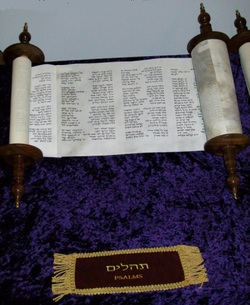
The Book of Psalms (/sɑː(l)mz/ SAH(L)MZ, US also /sɔː(l)mz/;[1] Biblical Hebrew: תְּהִלִּים, romanized: Tehillīm, lit. 'praises'; Ancient Greek: Ψαλμός, romanized: Psalmós; Latin: Liber Psalmorum; Arabic: مَزْمُور, romanized: Mazmūr, in Islam also called Zabur, Arabic: زَبُورُ, romanized: Zabūr), also known as the Psalter, is the first book of the third section of the Tanakh (Hebrew Bible) called Ketuvim ('Writings'), and a book of the Old Testament.[2]
The book is an anthology of Hebrew religious hymns. In the Jewish and Western Christian traditions, there are 150 psalms, and several more in the Eastern Christian churches.[3][4] The book is divided into five sections, each ending with a doxology, a hymn of praise. There are several types of psalms, including hymns or songs of praise, communal and individual laments, royal psalms, imprecation, and individual thanksgivings. The book also includes psalms of communal thanksgiving, wisdom, pilgrimage, and other categories.
Many of the psalms contain attributions to the name of King David and other Biblical figures, including Asaph, the sons of Korah, Moses, and Solomon. Davidic authorship of the Psalms is not accepted as a historical fact by modern scholars, who view it as a way to link biblical writings to well-known figures; while the dating of the Psalms is "notoriously difficult", some are considered preexilic and others postexilic.[4] The Dead Sea Scrolls suggest that the ordering and content of the later psalms (Psalms 90–150) was not fixed as of the mid-1st century CE.[5][6] Septuagint scholars, including Eugene Ulrich, have argued that the Hebrew Psalter was not closed until the 1st century CE.[7][8]
The English-language title of the book derives from the Greek word psalmoi (ψαλμοί), meaning 'instrumental music', and by extension referring to "the words accompanying the music".[9] Its Hebrew name, Tehillim (תהילים), means 'praises', as it contains many praises and supplications to God.
Structure
[edit]
Sections
[edit]The Book of Psalms is divided into five sections, each closing with a doxology (i.e., a benediction). These divisions were probably introduced by the final editors to imitate the five-fold division of the Torah:[10]
- Book 1 (Psalms 1–41)
- Book 2 (Psalms 42–72)
- Book 3 (Psalms 73–89)
- Book 4 (Psalms 90–106)
- Book 5 (Psalms 107–150)
Superscriptions
[edit]Many psalms (116 of the 150) have individual superscriptions (titles), ranging from lengthy comments to a single word. Over a third appear to be musical directions, addressed to the "leader" or "choirmaster", including such statements as "with stringed instruments" and "according to lilies". Others appear to be references to types of musical composition, such as "A psalm" and "Song", or regarding the occasion of the psalm ("On the dedication of the temple", "For the memorial offering", etc.). Many carry the names of individuals, the most common (73 psalms) being 'of David', and thirteen of these relate explicitly to incidents in the king's life.[11] Others named include Asaph (12), the sons of Korah (11), Solomon (2), Moses (1), Ethan the Ezrahite (1), and Heman the Ezrahite (1). The Septuagint, the Peshitta (the Syriac Vulgate), and the Latin Vulgate each associate several Psalms (such as 111 and 145) with Haggai and Zechariah. The Septuagint also attributes several Psalms (like 112 and 135) to Ezekiel and Jeremiah.
Numbering
[edit]| Hebrew numbering(Masoretic) | Greek numbering(Septuagint) |
|---|---|
| 1–8 | 1–8 |
| 9–10 | 9 |
| 11–113 | 10–112 |
| 114–115 | 113 |
| 116 | 114–115 |
| 117–146 | 116–145 |
| 147 | 146–147 |
| 148–150 | 148–150 |
Psalms are usually identified by a sequence number, often preceded by the abbreviation "Ps." Numbering of the Psalms differs – mostly by one – between the Hebrew (Masoretic) and Greek (Septuagint) manuscripts. Protestant translations use the Hebrew numbering, but other Christian traditions vary:
- Catholic official liturgical texts, such as the Roman Missal, use the Greek numbering[12]
- Modern Catholic translations often use the Hebrew numbering (noting the Greek number)
- Eastern Orthodox and Eastern Catholic translations use the Greek numbering (noting the Hebrew number)
The variance between Masorah and Septuagint texts in this numeration is likely due to a gradual neglect of the original poetic form of the Psalms; such neglect was occasioned by liturgical uses and carelessness of copyists. It is generally admitted that Psalms 9 and 10 (Hebrew numbering) were originally a single acrostic poem, wrongly separated by Massorah and rightly united by the Septuagint and the Vulgate.[13] Psalms 42 and 43 (Hebrew numbering) are shown by identity of subject (yearning for the house of Yahweh), of metrical structure and of refrain (comparing Psalms 42:6, 12; 43:5, Hebrew numbering), to be three strophes of one and the same poem. The Hebrew text is correct in counting as one Psalm 146 and Psalm 147. Later liturgical usage would seem to have split up these and several other psalms. Zenner combines into what he deems the original choral odes: Psalms 1, 2, 3, 4; 6 + 13; 9 + 10; 19, 20, 21; 56 + 57; 69 + 70; 114 + 115; 148, 149, 150.[14] A choral ode would seem to have been the original form of Psalms 14 and 70. The two strophes and the epode are Psalm 14; the two antistrophes are Psalm 70.[15] It is noteworthy that, on the breaking up of the original ode, each portion crept twice into the Psalter: Psalm 14 = 53, Psalm 70 = 40:14–18. Other such duplicated portions of psalms are Psalm 108:2–6 = Psalm 57:8–12; Psalm 108:7–14 = Psalm 60:7–14; Psalm 71:1–3 = Psalm 31:2–4. This loss of the original form of some of the psalms is considered by the Catholic Church's Pontifical Biblical Commission (1 May 1910) to have been due to liturgical practices, neglect by copyists, or other causes.[16]
Verse numbers were first printed in 1509.[17][18] Different traditions exist whether to include the original heading into the counting or not. This leads to inconsistent numbering in 62 psalms, with an offset of 1, sometimes even 2 verses.[19]
Additional psalms
[edit]The Septuagint, present in Eastern Orthodox churches, includes a Psalm 151; a Hebrew version of this was found in the Psalms Scroll of the Dead Sea Scrolls. Some versions of the Peshitta (the Bible used in Syriac churches mainly in the Middle East) include Psalms 152–155. There are also the Psalms of Solomon, which are a further 18 psalms of Jewish origin, likely originally written in Hebrew, but surviving only in Greek and Syriac translation. These and other indications suggest that the current Western Christian and Jewish collection of 150 psalms was selected from a wider set.
Primary types
[edit]Hermann Gunkel's pioneering form-critical work on the psalms sought to provide a new and meaningful context in which to interpret individual psalms—not by looking at their literary context within the Psalter (which he did not see as significant), but by bringing together psalms of the same genre (Gattung) from throughout the Psalter. Gunkel divided the psalms into five primary types:
Hymns
[edit]Hymns are songs of praise for God's work in creation or history. They typically open with a call to praise, describe the motivation for praise, and conclude with a repetition of the call. Two sub-categories are "enthronement psalms" celebrating the enthronement of Yahweh as king, and "Zion psalms" glorifying Mount Zion, God's dwelling-place in Jerusalem.[20] Gunkel also described a special subset of "eschatological hymns" which includes themes of future restoration (Psalm 126) or of judgment (Psalm 82). [21]
Communal laments
[edit]
Communal laments are psalms in which the nation laments some communal disaster.[22] Both communal and individual laments typically but not always include the following elements:
- address to God,
- description of suffering,
- cursing of the party responsible for the suffering,
- protestation of innocence or admission of guilt,
- petition for divine assistance,
- faith in God's receipt of prayer,
- anticipation of divine response, and
- a song of thanksgiving.[23][24]
In general, the individual and communal subtypes can be distinguished by the use of the singular "I" or the plural "we". However, the "I" could also be characterising an individual's personal experience that was reflective of the entire community.[25]
Royal psalms
[edit]
Royal psalms deal with such matters as the king's coronation, marriage, and battles.[22] None of them mentions any specific king by name, and their origin and use remain obscure;[26] several psalms, especially Psalms 93–99, concern the kingship of God, and might relate to an annual ceremony in which Yahweh would be ritually reinstated as king.[27]
Individual laments
[edit]Individual laments are psalms lamenting the fate of the psalmist. By far the most common type of psalm, they typically open with an invocation of God, followed by the lament itself and pleas for help, and often ending with an expression of confidence.[22]
Individual thanksgiving psalms
[edit]In individual thanksgiving psalms, the opposite of individual laments, the psalmist thanks God for deliverance from personal distress.[22]
In addition to these five major genres, Gunkel also recognised a number of minor psalm-types, including:
- communal thanksgiving psalms, in which the whole nation thanks God for deliverance;
- wisdom psalms, reflecting the Hebrew Biblical (Old Testament) wisdom literature;
- pilgrimage psalms, sung by pilgrims on their way to Jerusalem;
- entrance and prophetic liturgies; and
- A group of mixed psalms could not be assigned to any category.[28]
Composition
[edit]Origins
[edit]
The composition of the psalms spans at least five centuries, from Psalm 29's composition in the 10th century BCE to others clearly from the post-Exilic period (i.e., not earlier than the 5th century BCE). The majority originated in the southern kingdom of Judah and were associated with the Temple in Jerusalem, where they probably functioned as librettos during Temple worship. Exactly how they did so was unclear, but there are indications in some of them: "Bind the festal procession with branches, up to the horns of the altar"[30] suggests a connection with sacrifices, and "Let my prayer be set forth before you as incense"[31] suggests a connection with the offering of incense.[3]
According to Jewish tradition, the Book of Psalms was composed by the First Man (Adam), Melchizedek, Abraham, Moses, David, Solomon, Heman, Jeduthun, Asaph, and the three sons of Korah.[32][33] According to Abraham ibn Ezra, the final redaction of the book was made by the Men of the Great Assembly.[34]
Influences
[edit]Some of the psalms show influences from related earlier texts from the region; examples include various Ugaritic texts and the Babylonian Enūma Eliš. These influences may be either of background similarity or of contrast. For example, Psalm 29 shares characteristics with Canaanite religious poetry and themes. Robert Alter points out that the address to "sons of God" at the opening "[is] best thought of [as] the flickering literary afterlife of a polytheistic mythology" but that "belief in them...is unlikely to have been shared by the scribal circles that produced Psalms".[35] The contrast between the Psalmist's theology and the surrounding area's polytheistic religion is well seen in Psalms 104:26,[36] in which locals' mythical fierce sea-god—such as the Babylonian Tiamat, Canaanite Yam and the Leviathan which also appears in the Hebrew Bible—is "reduced to an aquatic pet with whom YHWH can play".[37]
Poetic characteristics
[edit]The biblical poetry of Psalms uses parallelism as its primary poetic device. Parallelism is a kind of symmetry in which restatement, synonym, amplification, grammatical repetition, or opposition develops an idea.[38][39] Synonymous parallelism involves two lines expressing essentially the same idea. An example of synonymous parallelism:
- "The LORD is my light and my salvation; whom shall I fear? The LORD is the stronghold of my life; of whom shall I be afraid?" (Psalm 27:1).
Two lines expressing opposites are known as antithetic parallelism. An example of antithetic parallelism:
- "And he led them in a cloud by day/ and all the night by a fiery light" (Psalm 78:14).
Two clauses expressing the idea of amplifying the first claim are known as expansive parallelism. An example of expansive parallelism:
- "My mouth is filled with your praise/ all the day with your lauding" (Psalm 71:8).
Editorial agenda
[edit].jpg)
Many scholars believe the individual Psalms were redacted into a single collection during the Second Temple period.[40] It had long been recognized that the collection bore the imprint of an underlying message or metanarrative, but that this message remained concealed, as Augustine of Hippo said, "The sequence of the Psalms seems to me to contain the secret of a mighty mystery, but its meaning has not been revealed to me" (Enarr. on Psalms 150:1). Others pointed out the presence of concatenation—that is, adjacent Psalms sharing similar words and themes. In time, this approach developed into recognizing overarching themes shared by whole groups of psalms.[41]
In 1985, Gerald H. Wilson's The Editing of the Hebrew Psalter proposed—by parallel with other ancient Near Eastern hymn collections—that psalms at the beginning and end (or "seams") of the five books of Psalms have thematic significance, corresponding in particular with the placement of the royal psalms. He pointed out that there was a progression of ideas from adversity through the crux of the collection in the apparent failure of the covenant in Psalm 89, leading to a concert of praise at the end. He concluded that the collection was redacted to be a retrospective of the failure of the Davidic covenant, exhorting Israel to trust in God alone in a non-messianic future.[42] Walter Brueggemann suggested that the underlying editorial purpose was oriented instead towards wisdom or sapiential concerns, addressing the issues of how to live the life of faith. Psalm 1 calls the reader to a life of obedience; Psalm 73 (Brueggemann's crux psalm) faces the crisis when divine faithfulness is in doubt; Psalm 150 represents faith's triumph when God is praised not for his rewards but for his being.[43] In 1997, David. C. Mitchell's The Message of the Psalter took a quite different line. Building on the work of Wilson and others,[44] Mitchell proposed that the Psalter embodies an eschatological timetable like that of Zechariah 9–14.[45] This programme includes the ingathering of exiled Israel by a bridegroom-king; his establishment of a kingdom; his violent death; Israel scattered in the wilderness, regathered and again imperiled, and then rescued by a king from the heavens, who establishes his kingdom from Zion, brings peace and prosperity to the earth and receives the homage of the nations.
These three views—Wilson's non-messianic retrospective of the Davidic covenant, Brueggemann's sapiential instruction, and Mitchell's eschatological-messianic program—all have their followers. However, the sapiential agenda has been somewhat eclipsed by the other two. Shortly before he died in 2005, Wilson modified his position to allow for the existence of messianic prophecy within the Psalms' redactional agenda.[46] Mitchell's position remains essentially unchanged, but he now sees the issue as identifying when the historical beginning of the Psalms turns to eschatology.[47]
James Vander Kam's The Dead Sea Scrolls Today examined the large Psalms scroll from Qumran, 11QPs(a), showing that while the early 1st century CE largely fixed the first three books (Psalms 1–89), Psalms 90–150 show variations in ordering and content, suggesting the collection was still being finalized into the mid-1st century CE and included material not found in the later Masoretic Text.[5] Peter Flint argues that the findings show there were three different versions of the Psalter circulating during the Second Temple period, with the Masoretic version being attested among the scrolls found at Masada.[48]
The ancient music of the Psalms
[edit]The Psalms were written not merely as poems, but as songs to be sung. According to Bible exegete Saadia Gaon (882–942) who served in the geonate of Babylonian Jewry, the Psalms were originally sung in the Temple precincts by the Levites, based on what was prescribed for each psalm (lineage of the singers, designated time and place, instruments used, manner of execution, etc.), but are permitted to be randomly read by anyone at any time and in any place.[49] More than a third of the psalms are addressed to the Director of Music. Some psalms exhort the worshipper to sing (e.g., Pss. 33:1–3; 92:1–3; 96:1–3; 98:1; 101:1; 150). Some headings denote the musical instruments on which the psalm should be played (Pss. 4, 5, 6, 8, 67). Some refer to the Levites who sang one of eight melodies, one of which was known simply as "the eighth" (Hebrew: sheminit) (Pss. 6, 12) .[50] And others preserve the name for ancient eastern modes, like ayelet ha-shachar (hind of the dawn; Ps. 22); shoshanim / shushan (lilies / lily; Pss. 45; 60), said to be describing a certain melody;[51] or ʻalmuth / ʻalamoth (mute;[52] Pss. 9, 46), which, according to Saadia Gaon, is "a silent melody, nearly inaudible."[53]
Despite the frequently heard view that their ancient music is lost, the means to reconstruct it are still extant. Fragments of temple psalmody are preserved in ancient synagogue and church chant, particularly in the tonus peregrinus melody to Psalm 114.[54] Cantillation signs, to record the melody sung, were in use since ancient times; evidence of them can be found in the manuscripts of the oldest extant copies of Psalms in the Dead Sea Scrolls and are even more extensive in the Masoretic Text, which dates to the Early Middle Ages and whose Tiberian scribes claimed to be basing their work on temple-period signs. (See Moshe ben Asher's 'Song of the Vine' colophon to the Codex Cairensis).[55]
Several attempts have been made to decode the Masoretic cantillation, but the most "successful" is that of Suzanne Haïk-Vantoura (1928–2000) in the last quarter of the 20th century.[56] Her reconstruction assumes the signs represent the degrees of various musical scales—that is, individual notes—which puts it at odds with all other existing traditions, where the signs invariably represent melodic motifs; it also takes no account of the existence of older systems of notation, such as the Babylonian and Palestinian systems. Musicologists have therefore rejected Haïk-Vantoura's theories, with her results dubios, and her methodology flawed.[57] In spite of this, Mitchell has repeatedly defended it, showing that, when applied to the Masoretic cantillation of Psalm 114, it produces a melody recognizable as the tonus peregrinus of church and synagogue.[58] Mitchell includes musical transcriptions of the temple psalmody of Psalms 120–134 in his commentary on the Songs of Ascents.
Views on the division into five books
[edit]In "The Flow of the Psalms", O. Palmer Robertson posits a thematic progression throughout the five books of Psalms, delineating distinctive characteristics and emphases:[59]
Book 1: Opposition – Predominantly attributed to David, these Psalms are perceived as the earliest in origin, characterized by a focus on trust in God, with Yahweh as the dominant name.
Book 2: Communication – Despite continued opposition, this book reflects an outreach even to enemies of God. The prevalent name for God shifts to Elohim, especially when borrowing sections from Book 1. Robertson suggests Book 2 may have Northern Kingdom origins.
Book 3: Devastation – Marked by the overtaking of Jerusalem, this book holds out hope for Jacob and Joseph, possibly symbolizing the Southern and Northern kingdoms. Expressions like "trust in God" diminish.
Book 4: Maturity – Notably, with over 10 quotes from Chronicles, indicating a temporal progression beyond the initial three books.
Book 5: Consummation – Robertson proposes that the Psalms of Ascent and Hallel Psalms are post-Babylonian exile compositions, portraying a culmination of themes and perspectives
Themes and execution
[edit]Most individual psalms involve the praise of God for his power and beneficence, for his creation of the world, and for his past acts of deliverance for Israel. They envision a world in which everyone and everything will praise God, and God in turn will hear their prayers and respond. Sometimes God "hides his face" and refuses to respond, questioning (for the psalmist) the relationship between God and prayer which is the underlying assumption of the Book of Psalms.[60]
Some psalms are called maskil (or maschil), meaning 'enlightened' or 'wise saying', because they impart wisdom. Most notable of these is Psalm 142 which is sometimes called the "Maskil of David"; others include Psalm 32 and Psalm 78.[61]
A special grouping and division in the Book of Psalms are fifteen psalms (Psalms 120–134) known in the construct case, shir ha-ma'aloth ("A Song of Ascents", "A Song of degrees"), and one as shir la-ma'aloth (Psalm 121). According to Saadia Gaon, these songs differed from the other psalms in that they were to be sung by the Levites in a "loud melody" (Judeo-Arabic: בלחן מרתפע).[62] Every psalm designated for Asaph (e.g. Psalms 50, 73–83) was sung by his descendants while making use of cymbals, in accordance with 1 Chronicles 16:5.[63][62] Every psalm wherein is found the introductory phrase "Upon Mahalath" (e.g. Psalms 53 and 88) was sung by the Levites by using large percussion instruments having wide and closed bezels on both sides and beaten with two wooden sticks.[64]
O. Palmer Robertson observes that many of the Psalms concern the subject of death and says "This unnatural conclusion to every human life can be understood only in the context of the original threat to the original man: 'in the day you shall eat of it you shall surely die.'"[65] Robertson goes on to say "The anticipation from redemption from the grave overcomes the inevitability of death. The psalmist is fully aware of his need for total deliverance from the last great enemy, and attests to expectation of deliverance."[66]
Later interpretation and influence
[edit]


Overview
[edit]Individual psalms were originally hymns, to be used on various occasions and at various sacred sites; later, some were anthologised, and might have been understood within the various anthologies (e.g., Psalm 123 as one of the Psalms of Ascent). Finally, individual psalms might be understood within the Psalter as a whole, either narrating the life of David or providing instruction like the Torah. In later Jewish and Christian tradition, the Psalms have come to be used as prayers, either individual or communal, as traditional expressions of religious feeling.[67]
Commentaries
[edit]Many authors have commented on the Psalms, including:
- Hilary of Poitiers[68]
- Augustine of Hippo[69]
- Saadia Gaon[70]
- Salmon ben Jeroham[71]
- Yefet ben Ali[72]
- Rashbam[73]
- Abraham ibn Ezra[74]
- David Kimhi[75]
- Obadiah ben Jacob Sforno[76]
- Joseph ben Abraham Gikatilla[77][page needed]
- Joseph Kara[78]
- Benjamin ben Judah[79]
- Rashi[80]
- Menachem Meiri[81]
- Isaiah di Trani[82]
- Thomas Aquinas[83]
- John Calvin[84]
- Emmanuel (pseudonym), Jewish Commentary on the Psalms.[85]
- Isaac Satanow[86]
Use in Jewish ritual
[edit]Some of the titles given to the Psalms have descriptions which suggest their use in worship:
- Some bear the Hebrew description shir (שיר; Greek: ᾠδή, ōdḗ, 'song'). Thirteen have this description. It means the 'flow of speech', as it were, in a straight line or in a regular strain. This description includes secular as well as sacred songs.
- Fifty-eight Psalms bear the description mizmor (מזמור; ψαλμός, psalmos, 'psalm'), a lyric ode set to music; a sacred song accompanied with a musical instrument.
- Psalm 145 alone has the designation tehillah (תהלה; ὕμνος, hymnos, 'hymn'), meaning a song of praise; a song the prominent thought of which is the praise of God.
- Thirteen psalms are described as maskil ('wise'): 32, 42, 44, 45, 52–55, 74, 78, 88, 89, and 142. Psalm 41:2, although not in the above list, has the description ashrei maskil.
- Six Psalms (16, 56–60) have the title michtam (מכתם, 'gold').[87] Rashi suggests that michtam refers to an item that a person carries with him at all times, hence, these Psalms contain concepts or ideas that are pertinent at every stage and setting throughout life, deemed vital as part of day-to-day spiritual awareness.[88]
- Psalm 7 (along with Habakkuk 3)[89] bears the title shigayon (שיגיון). There are three interpretations:[90] (a) According to Rashi and others, this term stems from the root shegaga, meaning "mistake"—David committed some sin and is singing in the form of a prayer to redeem himself from it; (b) shigayon was a type of musical instrument; (c) Ibn Ezra considers the word to mean "longing", as for example in the verse in Proverbs 5:19[91] tishge tamid.
Psalms are used throughout traditional Jewish worship. Many complete Psalms and verses from Psalms appear in Shacharit. The pesukei dezimra component incorporates Psalms 30, 100, and 145–150. Psalm 145 (commonly referred to as "Ashrei", which is really the first word of two verses appended to the beginning of the Psalm), is read three times every day: once in shacharit as part of pesukei dezimrah, as mentioned; once, along with Psalm 20, as part of the morning's concluding prayers; and once at the start of the afternoon service. On festival days and Shabbatot, instead of concluding the morning service, it precedes the Mussaf service. Psalms 95–99, 29, 92, and 93, along with some later readings, comprise the introduction (Kabbalat Shabbat) to the Friday night service. Traditionally, a different "Psalm for the Day"—Shir shel yom—is read after Shacharit each day of the week (starting Sunday, Psalms: 24, 48, 82, 94, 81, 93, 92). This is described in the Mishnah (the initial codification of the Jewish oral tradition) in the tractate Tamid. According to the Talmud, the Levites originally recited these daily Psalms in the Temple in Jerusalem on that day of the week. From Rosh Chodesh Elul until Hoshanah Rabbah, Psalm 27 is recited twice daily following the morning and evening services. There is a Minhag (custom) to recite Psalm 30 each morning of Chanukkah after Shacharit: some recite this in place of the regular "Psalm for the Day", others recite this additionally.
When a Jew dies, a watch is kept over the body and tehillim (Psalms) are recited constantly by sun or candlelight, until the burial service. Historically, this watch would be carried out by the immediate family, usually in shifts, but in contemporary practice this service is provided by an employee of the funeral home or chevra kadisha.
Many Jews complete the Book of Psalms on a weekly or monthly basis. Each week, some also say a Psalm connected to that week's events or the Torah portion read during that week. In addition, many Jews (notably Lubavitch, and other Chasidim) read the entire Book of Psalms prior to the morning service, on the Sabbath preceding the calculated appearance of the new moon.
The reading of psalms is viewed in Jewish tradition as a vehicle for gaining God's favor. They are thus often specially recited in times of trouble, such as poverty, disease, or physical danger; in many synagogues, Psalms are recited after services for the security of the State of Israel. Sefer ha-Chinuch[92] states that this practice is designed not to achieve favor, as such, but rather to inculcate belief in Divine Providence into one's consciousness, consistently with Maimonides' general view on Providence. (Relatedly, the Hebrew verb for prayer, hitpalal התפלל, is in fact the reflexive form of palal פלל, to intervene, petition, judge. Thus, "to pray" conveys the connotation of "judging oneself": ultimately, the purpose of prayer—tefilah תפלה—is to transform ourselves.)[93]
In Christian prayer and worship
[edit]


New Testament references show that the earliest Christians used the Psalms in worship, and the Psalms have remained an important part of worship in most Christian Churches. The Eastern Orthodox, Catholic, Presbyterian, Lutheran and Anglican Churches have always made systematic use of the Psalms, with a cycle for the recitation of all or most of them over the course of one or more weeks. In the early centuries of the Church, it was expected that any candidate for bishop would be able to recite the entire Psalter from memory, something they often learned automatically during their time as monks.[94] Christians have used Pater Noster cords of 150 beads to pray the entire Psalter.[95]
Paul the Apostle quotes psalms (specifically Psalms 14 and 53, which are nearly identical) as the basis for his theory of original sin, and includes the scripture in the Epistle to the Romans, chapter 3.
Several conservative Protestant denominations sing only the Psalms (some churches also sing the small number of hymns found elsewhere in the Bible) in worship and do not accept the use of non-Biblical hymns; examples are the Reformed Presbyterian Church of North America, the Presbyterian Reformed Church (North America), and the Free Church of Scotland (Continuing).
- Psalm 22 is of particular importance during the season of Lent as a Psalm of continued faith during severe testing.
- Psalm 23, The LORD is My Shepherd, offers an immediately appealing message of comfort and is widely chosen for church funeral services, either as a reading or in one of several popular hymn settings;
- Psalm 51, Have mercy on me O God, called the Miserere from the first word in its Latin version, in both Divine Liturgy and Hours, in the sacrament of repentance or confession, and in other settings;
- Psalm 82 is found in the Book of Common Prayer as a funeral recitation.
- Psalm 137, By the rivers of Babylon, there we sat down and wept, the Eastern Orthodox Church uses this hymn during the weeks preceding Great Lent.
- Psalm 145 by title 'A psalm of praise", is an acrostic of praise and David's final Psalm. Verses from it are frequently used in contemporary worship songs and read by contemporary worship leaders in services.
New translations and settings of the Psalms continue to be produced. An individually printed volume of Psalms for use in Christian religious rituals is called a Psalter.
Imam-ud-Din Shahbaz (1845–1921), a Punjabi evangelist and a poet, produced the first metrical translation of the Psalms in Punjabi, known as Punjabi Zabur. For a hundred years, the Punjabi Zabur has been used as an essential part of singing and praising in the majority of Urdu and Punjabi Churches around the globe.[citation needed]
Furthermore, psalms often serve as the inspiration for much of modern or contemporary Christian worship music in a variety of styles. Some songs are entirely based on a particular psalm or psalms, and many quote directly from the Book of Psalms (and other parts of the Bible).[96]
Eastern Orthodox Christianity
[edit]Orthodox Christians and Greek-Catholics (Eastern Catholics who follow the Byzantine rite) have long made the Psalms an integral part of their corporate and private prayers. The official version of the Psalter used by the Orthodox Church is the Septuagint. To facilitate its reading, the 150 Psalms are divided into 20 kathismata (Greek: καθίσματα; Slavonic: кафизмы, kafizmy; lit. "sittings") and each kathisma (Greek: κάθισμα; Slavonic: каѳисма, kafisma) is further subdivided into three stases (Greek: στάσεις, staseis lit. "standings", sing. στάσις, stasis), so-called because the faithful stand at the end of each stasis for the Glory to the Father ....
At Vespers and Matins, different kathismata are read at different times of the liturgical year and on different days of the week, according to the Church's calendar, so that all 150 psalms (20 kathismata) are read in the course of a week. During Great Lent, the number of kathismata is increased so that the entire Psalter is read twice a week. In the twentieth century, some lay Christians have adopted a continuous reading of the Psalms on weekdays, praying the whole book in four weeks.
Aside from kathisma readings, Psalms occupy a prominent place in every other Orthodox service, including the services of the Hours and the Divine Liturgy. In particular, the penitential Psalm 50 is widely used. Fragments of Psalms and individual verses are used as Prokimena (introductions to Scriptural readings) and Stichera. The bulk of Vespers would still be composed of Psalms even if the kathisma were to be disregarded; Psalm 118, "The Psalm of the Law", is the centerpiece of Matins on Saturdays, some Sundays, and the Funeral service. The entire book of Psalms is traditionally read aloud or chanted at the side of the deceased during the time leading up to the funeral, mirroring Jewish tradition.
Oriental Christianity
[edit]Several branches of Oriental Orthodox and those Eastern Catholics who follow one of the Oriental Rites will chant the entire Psalter during the course of a day during the Daily Office. This practice continues to be a requirement of monastics in the Oriental churches.
Catholic usage
[edit]
The Psalms have always been important in Catholic liturgy. The Liturgy of the Hours is centered on chanting or recitation of the Psalms, using fixed melodic formulas known as psalm tones. Early Catholics employed the Psalms widely in their individual prayers; however, as knowledge of Latin (the language of the Roman Rite) became uncommon, this practice ceased among the unlearned. However, until the end of the Middle Ages, it was not unknown for the laity to join in the singing of the Little Office of Our Lady, which was a shortened version of the Liturgy of the Hours providing a fixed daily cycle of twenty-five psalms to be recited, and nine other psalms divided across Matins.
The work of Bishop Richard Challoner in providing devotional materials in English meant that many of the psalms were familiar to English-speaking Catholics from the eighteenth century onwards. Challoner translated the entirety of the Little Office into English, Sunday Vespers, and daily Compline. He also provided other individual Psalms, such as 129/130, for prayer in his devotional books. Bishop Challoner is also noted for revising the Douay–Rheims Bible, and the translations he used in his devotional books are taken from this work.
Until the Second Vatican Council, the Psalms were either recited on a one-week or, less commonly (as in the case of Ambrosian rite), two-week cycle. Different one-week schemata were employed: most secular clergy followed the Roman distribution, while regular clergy almost universally followed that of St Benedict, with only a few congregations (such as the Benedictines of St Maur[97]) following individual arrangements. The Breviary introduced in 1974 distributed the psalms over a four-week cycle. Monastic usage varies widely. Some use the four-week cycle of the secular clergy, many retain a one-week cycle, either following St Benedict's scheme or another of their own devising, while others opt for some other arrangement.
Official approval was also given to other arrangements[Notes 1] by which the complete Psalter is recited in a one-week or two-week cycle. These arrangements are used principally by Catholic contemplative religious orders, such as that of the Trappists.[Notes 2]
The General Instruction of the Liturgy of the Hours 122 sanctions three modes of singing/recitation for the Psalms:
- directly (all sing or recite the entire psalm);
- antiphonally (two choirs or sections of the congregation sing or recite alternate verses or strophes); and
- responsorially (the cantor or choir sings or recites the verses while the congregation sings or recites a given response after each verse).
Of these three, the antiphonal mode is the most widely followed.[citation needed]
Over the centuries, the use of complete Psalms in the liturgy declined. After the Second Vatican Council (which also permitted the use of vernacular languages in the liturgy), longer psalm texts were reintroduced into the Mass during the readings. The revision of the Roman Missal after the Second Vatican Council reintroduced the singing or recitation of a more substantial section of a Psalm, in some cases an entire Psalm, after the first Reading from Scripture. This Psalm, called the Responsorial Psalm, is usually sung or recited responsorially, although the General Instruction of the Roman Missal 61 permits direct recitation.
Lutheran usage
[edit]In the Mass of the Lutheran Churches, the Psalms are sung according to the lectionary. It typically follows the lection from the Old Testament in the Order of Mass.[98]
The Divine Office is centered on chanting or recitation of the Psalms, using fixed melodic formulas known as psalm tones. These are prayed in Lutheran monasteries and convents, as well as by secular Lutheran priests and deacons, in addition to a number of Lutheran laypersons.[99]
Martin Luther's "Ein feste Burg ist unser Gott" ("A Mighty Fortress Is Our God") is based on Psalm 46.
Reformed usage
[edit]
Following the Protestant Reformation, many of the Psalms were set as hymns. These vernacular translations of the psalms were arranged into rhyming strict-metre verses, known as metrical psalms and used for congregational singing. The metrical psalms were particularly popular in the Calvinist tradition, where in the past they were often sung to the exclusion of other hymns (exclusive psalmody). John Calvin himself made some French translations of the Psalms for church usage, but the completed Genevan Psalter eventually used in church services consisted exclusively of translations by Clément Marot and Théodore de Bèze, on melodies by a number of composers, including Louis Bourgeois and a certain Maistre Pierre. Among famous hymn settings of the Psalter were the Scottish Psalter and the paraphrases by Isaac Watts. The first book printed in North America was a collection of Psalm settings, the Bay Psalm Book (1640).
Metrical psalms are still widely sung in many Reformed congregations. Additionally, the Psalms are popular for private devotion among the Reformed.[100]
There exists in some circles a custom of reading one Psalm and one chapter of Proverbs a day, corresponding to the day of the month.
Anglican usage
[edit]Anglican chant is a method of singing prose versions of the Psalms.
In the early 17th century, when the King James Bible was introduced, the metrical arrangements by Thomas Sternhold and John Hopkins were also popular and were provided with printed tunes. This version and the New Version of the Psalms of David by Tate and Brady produced in the late seventeenth century (see article on Metrical psalter) remained the normal congregational way of singing psalms in the Church of England until well into the nineteenth century.
In Great Britain, the 16th-century Coverdale psalter still forms the heart of daily worship in Cathedral and many parish churches. The new Common Worship service book has a companion psalter in modern English.
The version of the psalter in the American Book of Common Prayer prior to the 1979 edition is the Coverdale psalter. The Psalter in the American Book of Common Prayer of 1979 is a new translation, with some attempt to keep the rhythms of the Coverdale Psalter.
Islam
[edit]According to the Islamic holy book, the Qur'an, God has sent many messengers to humanity. Five universally acknowledged messengers (rasul) are Abraham, Moses, David, Jesus and Muhammad,[101] each believed to have been sent with a scripture. Muslims believe David (Dāwūd) received Psalms (Zabur)[102] (cf. Q38:28); Jesus (Īsā) the Gospel (Injeel); Muhammad received the Qur'an; and Abraham (Ibrahim) the Scrolls of Abraham;[103] meanwhile, the Tawrat is the Arabic name for the Torah within its context as an Islamic holy book believed by Muslims to have been given by God to the prophets and messengers amongst the Children of Israel, and often refers to the entire Hebrew Bible.[104] God is considered to have authored the Psalms.[105]
Use in the Rastafari movement
[edit]The Psalms are one of the most popular parts of the Bible among followers of the Rastafari movement.[106] Rasta singer Prince Far I released an atmospheric spoken version of the psalms, Psalms for I, set to a roots reggae backdrop from The Aggrovators.
Psalms set to music
[edit]Multiple psalms as a single composition
[edit]Psalms have often been set as part of a larger work. The psalms feature large in settings of Vespers, including those by Claudio Monteverdi, Antonio Vivaldi, Marc-Antoine Charpentier (84 settings H.149 – H.232) and Wolfgang Amadeus Mozart, who wrote such settings as part of their responsibilities as church musicians. Psalms are inserted in Requiem compositions, such as Psalm 126 in A German Requiem of Johannes Brahms and Psalms 130 and 23 in John Rutter's Requiem.
- Melodie na psałterz polski by Mikołaj Gomółka – 1580
- Psalmi Davidis poenitentiales (6, 32, 38, 51, 102, 130, 143) by Orlando di Lasso – 1584
- Psalmen Davids (1619), Symphoniae sacrae I (1629) and Becker Psalter (1661) by Heinrich Schütz
- Chandos Anthems by George Frideric Handel – 1717–18
- Zwei englisch Psalmen (1842), Sieben Psalmen nach Lobwasser (1843), Elijah (1846), and Drei Psalmen (1849) by Felix Mendelssohn
- Eighteen Liturgical Psalms by Louis Lewandowski – 1879
- Biblické písně by Antonín Dvořák – 1894
- Le Roi David by Arthur Honegger – 1921
- Symphony of Psalms (38, 39, 150) by Igor Stravinsky – 1930
- Chichester Psalms by Leonard Bernstein – 1965
- Tehillim by Steve Reich – 1981
- Four Psalms (114, 126, 133, 137) by John Harbison – 1998
Individual psalm settings
[edit]There are many settings of individual psalms. One of the better known examples is Gregorio Allegri's Miserere mei, a falsobordone setting of Psalm 51 ("Have mercy upon me, O God").[107] Settings of individual psalms by later composers are also frequent: they include works from composers such as George Frideric Handel, Felix Mendelssohn, Franz Liszt, Johannes Brahms and Ralph Vaughan Williams. Psalms also feature in more modern musical movements and popular genres.
See also
[edit]
Notes
[edit]- ^ See "Short" Breviaries in the 20th and early 21st century America Archived 18 January 2006 at the Wayback Machine for an in-progress study
- ^ See for example the Divine Office schedule at New Melleray Abbey
References
[edit]- ^ "Psalm". Longman Pronunciation Dictionary. Pearson.
- ^ Mazor 2011, p. 589.
- ^ a b Kselman 2007, p. 775.
- ^ a b Berlin & Brettler 2004, p. 1282.
- ^ a b VanderKam, James. The Dead Sea Scrolls Today. 2nd ed., Eerdmans, 2010, pp. 172—176.
- ^ Collins, John J. Introduction to the Hebrew Bible: Third Edition (2018). p. 498. Fortress Press.
- ^ Wilson, Gerald, "King, Messiah, and the Reign of God: Revisiting the Royal Psalms and the Shape of the Psalter." The Book of Psalms: Composition and Reception. p. 394. Brill. 2005.
- ^ Ulrich, Eugene (2000). Qumran Cave 4: XI: Psalms to Chronicles. Oxford University Press. ISBN 978-0198269434.
- ^ Murphy 1993, p. 626.
- ^ Bullock 2004, p. 58.
- ^ Hayes 1998, pp. 154–55.
- ^ For example "Psalmus 117" in Vigilia Paschalis in Nocte Sancta, 66
- ^ Clifford 2010, p. 773.
- ^ Zenner 1896.
- ^ Zenner, J.K., and Wiesmann, H., Die Psalmen nach dem Urtext, Munster, 1906, 305
- ^ Catholic Encyclopedia, The Biblical Commission, published by New Advent, accessed 19 November 2021
- ^ A Cyclopedia of Biblical Literature,... Illustrated by Numerous Engravings. Mark H. Newman. 1845.
- ^ "Erste Versnummerierungen (Verszählungen in gedruckten Bibelausgaben des 16. Jahrhunderts". www.wlb-stuttgart.de (in German). Retrieved 8 July 2020.
- ^ "Psalm 12 in 5 languages". BibleServer. Retrieved 8 July 2020.
- ^ Day 2003, pp. 11–12.
- ^ Bray 1996, p. 400.
- ^ a b c d Day 2003, p. 12.
- ^ Coogan, M. A Brief Introduction to the Old Testament: The Hebrew Bible in its Context. (Oxford University Press: Oxford 2009) p. 370
- ^ Murphy 1993, p. 627.
- ^ Bray 1996, p. 416.
- ^ Berlin & Brettler 2004, p. 1285, note to ps.2.
- ^ Kselman 2007, p. 776.
- ^ Day 2003, p. 13.
- ^ Helen C. Evans; William W. Wixom, eds. (5 March 1997). The Glory of Byzantium: Art and Culture of the Middle Byzantine Era, A.D. 843-1261. Metropolitan Museum of Art. p. 86. ISBN 978-0-87099-777-8. Retrieved 5 March 2018 – via Internet Archive.
- ^ Psalms 118:27
- ^ Psalms 141:2
- ^ Babylonian Talmud (Baba Bathra 14b–15a)
- ^ Simon 1982, pp. 237–243.
- ^ Simon 1982, p. 162.
- ^ Alter 2007, pp. 98–99.
- ^ Psalms 104:26
- ^ Alter 2007, pp. xiv–xv.
- ^ Coogan, M. A Brief Introduction to the Old Testament: The Hebrew Bible in its Context. (Oxford University Press: Oxford 2009). p. 369;
- ^ Kugel, James L. The Idea of Biblical Poetry. (Baltimore: Johns Hopkins University Press, 1981)
- ^ Haley, Kevin Joseph (7 December 2012). 'In the Midst of the Congregation I Will Praise You' (Ps 22:23b): The Reinterpretation of the Psalms of the Individual in Judaism and Christianity (Doctor of Philosophy (Theology) thesis). University of Notre Dame. Retrieved 19 December 2023.
- ^ C. Westermann, The Living Psalms (trans. J. R. Porter; Edinburgh: T. & T. Clark, 1989; M. E. Tate, Psalms 51–100 (Waco, Texas: Word, 1990).
- ^ G.H. Wilson, The Editing of the Hebrew Psalter (Chico, California: Scholars Press, 1985).
- ^ W. Brueggemann, 'Bounded by Obedience and Praise: The Psalms as Canon', JSOT 50: 3–92.
- ^ B. S. Childs, Introduction to the Old Testament as Scripture (Philadelphia: Fortress, 1979) 511–18; J. L. Mays, '"In a Vision": The Portrayal of the Messiah in the Psalms', Ex Auditu 7: 1–8; J. Forbes, Studies on the Book of Psalms (Edinburgh: T. & T. Clark, 1888).
- ^ David C. Mitchell, The Message of the Psalter: An Eschatological Programme in the Book of Psalms, JSOT Supplement 252 (Sheffield: Sheffield Academic Press, 1997).
- ^ G.H. Wilson, 'King, Messiah, and the Reign of God: Revisiting the Royal Psalms and the Shape of the Psalter' in P. W. Flint and P. D. Miller (eds.), The Book of Psalms: Composition and Reception (Leiden: Brill, 2005).
- ^ He has expanded his views on some subjects; see '"God Will Redeem My Soul From Sheol": The Psalms of the Sons of Korah', JSOT 30 (2006) 365–84; 'Lord, Remember David: G.H. Wilson and the Message of the Psalter', Vetus Testamentum 56 (2006) 526–48; The Songs of Ascents (Campbell: Newton Mearns, 2015) 211–16; 36–44.
- ^ Flint, Peter W. (2014). "Unrolling the Dead Sea Psalms Scrolls". In Brown, William P. (ed.). The Oxford Handbook of the Psalms. Oxford University Press. p. 240. ISBN 978-0-19-978333-5.
- ^ Saadia 2010, p. 33.
- ^ Saadia 2010, pp. 61, 70.
- ^ Saadia 2010, pp. 127–28, 150.
- ^ According to Saadia, the word is derived from the Hebrew root אלם, signifying a "mute," or person who cannot speak. Although the word עלמות as spelt in the psalm is with the Hebrew character ʻayin (ע), and the Hebrew word for "mute" is spelt with the Hebrew character aleph (א), the two letters are interchangeable.
- ^ Saadia 2010, pp. 65, 130.
- ^ Werner, The Sacred Bridge (New York: Columbia University Press, 1957) 419, 466.
- ^ For discussion on the origins and antiquity of the Masoretic cantillation, see D.C. Mitchell, The Songs of Ascents (Campbell: Newton Mearns 2015): 122-137.
- ^ S. Haïk-Vantoura, La musique de la Bible révélée (Robert Dumas: Paris, 1976); Les 150 Psaumes dans leurs melodies antiques (Paris: Fondation Roi David, 1985).
- ^ Dalia Cohen and Daniel Weill. "Progress in Deductive Research on the Original Performance of Tiberian Accents (Te'amim)." Proceedings of the Ninth World Conference of Jewish Studies, Division D, Vol. II (Jerusalem, 1986): 265–80; cf. also, e.g., the review by P.T. Daniels, Journal of the American Oriental Society, Vol. 112, No. 3 (Jul.–Sep, 1992), p. 499.
- ^ D.C. Mitchell, The Songs of Ascents: Psalms 120 to 134 in the Worship of Jerusalem's temples (Campbell: Newton Mearns 2015); 'Resinging the Temple Psalmody', JSOT 36 (2012) 355–78; 'How Can We Sing the Lord's Song?' in S. Gillingham (ed.), Jewish and Christian Approaches to the Psalms (Oxford University Press, 2013) 119–133.
- ^ Robertson, O. Palmer (2015). The Flow of the Psalms. P&R Publishing. pp. 8–22. ISBN 978-1-62995-133-1.
- ^ Berlin & Brettler 2004, p. 1284.
- ^ McKenzie, Steven L. (2000). King David: A Biography. New York: Oxford University Press. p. 39–40. ISBN 978-0-19-535101-9.
- ^ a b Saadia 2010, p. 31.
- ^ 1 Chronicles 16:5
- ^ Saadia 2010, pp. 31-32 (note 77).
- ^ Robertson, O. Palmer (2013). The Flow of the Psalms: Discovering Their Structure and Theology. P&R Publishing, p. 34, ISBN 978-1-62995-133-1
- ^ Roberson (2013), p. 35.
- ^ Kselman 2007, pp. 776–78.
- ^ Comments on the Psalms of Hilary of Poitiers, fourth century, Paris, Éditions du Cerf, 2008, collection Christian sources No. 515
- ^ Discourse on the Psalms, of St. Augustine, the fourth century, 2 vols., Collection "Christian Wisdom", Éditions du Cerf
- ^ Saadia Gaon (1966). Qafih, Yosef (ed.). Psalms, with a Translation and Commentary made by Rabbi Saadia Gaon (in Hebrew). Jerusalem - New York: American Academy for Jewish Studies. OCLC 741065024.
- ^ Jeroham, Salmon ben (1956). The Arabic Commentary of Salmon Ben Yeruham the Karaite on the Book of Psalms, Chapters 42-72 (in Hebrew). Dropsie College for Hebrew and Cognate Learning.
- ^ Bassor, Yaphet ben Heli (1846). Rabbi Yapheth ben Heli Bassorensis Karaïtae in librum Psalmorum comentarii Arabici e duplici codice mss. Bibliothecae Regiae Parisiensis edidit specimen et in Latinum convertit L. Bargès,... (in Latin). Excudebant Firmin Didot Fratres.
- ^ מונדשיין, אהרן; Mondschein, Aharon (2010). "On Rashbam's Rediscovered 'Lost Commentary' on Psalms / על גילוי הפירוש ה'אבוד' של רשב"ם לספר תהלים ופרסום מוקדם של פירושו למזמורים קכ-קלו". Tarbiz / תרביץ. עט (א): 91–141. ISSN 0334-3650. JSTOR 23607121.
- ^ Ezra, Abraham ben Meïr Ibn (2009). Abraham Ibn Ezra's Commentary on the First Book of Psalms: Chapter 1-41. Academic Studies Press. ISBN 978-1-934843-30-7.
- ^ Kimhi, David (1919). The Longer Commentary of R. David Ḳimḥi on the First Book of Psalms (I-X, XV-XVII, XIX, XXII, XXIV). Society for Promoting Christian Knowledge.
- ^ Sela, Yael (10 June 2022). "Sacred Poetry, Eternal Felicity, and the Redemption of Israel: Obadiah Sforno's Commentary on Psalms in the Berlin Haskalah". European Journal of Jewish Studies. 16 (2): 261–280. doi:10.1163/1872471X-bja10044. ISSN 1872-471X.
- ^ Simon 1982.
- ^ "MikraotGedolot – AlHaTorah.org". mg.alhatorah.org (in Hebrew). Retrieved 29 November 2023.
- ^ Binyamin ze'ev yitrof: Notes from various authors on Psalms, Job, the Megilloth (except Ruth) and Ezra. (1878) Amsterdam: Levisson
- ^ Gruber, Mayer I. (10 October 2007). Rashi's Commentary on Psalms. Jewish Publication Society. ISBN 978-0-8276-0872-6.
- ^ Meiri, Menahem ben Selomo (1936). Commentarius Libri Psalmorum (in Latin). Mekize Nirdamim.
- ^ תורת חיים - תהלים: על פי המסורה של כתר ארם צובה ... ועם פירושי הראשונים: רס"ג ... רש"י ... ראב"ע ... רי"ד ... רד"ק ... המאירי ... ספורנו ... ועם פירוש מצודת דוד ומצודת ציון (in Hebrew). 2018.
- ^ Commentary on the Psalms (up to Psalm 54) St. Thomas Aquinas, 1273, Éditions du Cerf, 1996
- ^ Comment psalms of John Calvin, 1557
- ^ Emmanuel, Commentaire juif des psaumes, Editions Payot, 1963
- ^ "ספר" תהלים: עם פירוש הרשב"ם הנמצא בברלין בכ"י בבית עקד הספרים אשר להמלך . (in Hebrew). דפוס ג' האלצינגער. 1816.
- ^ DLC (27 August 2006). "Hebrew Language Detective: katom". Balashon. Retrieved 19 September 2012.
- ^ "Daily Tehillim". Daily Tehillim. Retrieved 16 April 2014.
- ^ "Habakkuk 3 / Hebrew – English Bible / Mechon-Mamre". Mechon-mamre.org. Retrieved 17 March 2013.
- ^ "ארכיון הדף היומי". Vbm-torah.org.
- ^ "Proverbs 5:19 A loving doe, a graceful deer-may her breasts satisfy you always, may you ever be captivated by her love". Bible.cc. Retrieved 19 September 2012.
- ^ "ספר החינוך - אהרן, הלוי, מברצלונה, מיחס לו; שעוועל, חיים דב, 1906-1982; רוזנס, יהודה בן שמואל, 1657-1727; ברלין, ישעיה בן יהודה, 1725-1799 (page 637 of 814)". Hebrewbooks.org.
- ^ For the relationship between prayer and psalms—tefillah and tehillah—see S. R. Hirsch, Horeb §620. See also Jewish services § Philosophy of prayer
- ^ Meyer, Tom (27 March 2010). "Saint Sabas and the Psalms" (PDF). The Ecumenical Theological Research Fraternity in Israel. Archived (PDF) from the original on 14 July 2018. Retrieved 14 July 2018.
- ^ Doerr, Nan Lewis; Owens, Virginia Stem (28 August 2007). Praying with Beads: Daily Prayers for the Christian Year. Wm. B. Eerdmans Publishing. p. viii. ISBN 978-0-8028-2727-2.
- ^ Eekhoff Zylstra, Sarah (28 November 2016). "Let's Sing the Songs Jesus Sang". The Gospel Coalition. Retrieved 8 January 2020.
- ^ Little, Lester K. (1993). Benedictine Maledictions: Liturgical Cursing in Romanesque France. Cornell University Press. ISBN 978-0-8014-8113-0.
- ^ "The Eucharist also called Holy Communion (High Mass)". Church of Sweden. 2007. Archived from the original on 4 July 2007. Retrieved 19 May 2025.
- ^ "Monastic Life". Saint Augustine's House. 2025. Retrieved 18 May 2025.
Following the Benedictine Rule, seven separate liturgical offices plus the Eucharist are observed each day.
- ^ "The Psalms of David – Sung a cappella". Thepsalmssung.org. Retrieved 16 April 2014.
- ^ Concise Encyclopedia of Islam, C. Glasse, Messenger
- ^ Wherry, Elwood Morris (1896). A Complete Index to Sale's Text, Preliminary Discourse, and Notes. London: Kegan Paul, Trench, Trubner, and Co.
- ^ A-Z of Prophets in Islam and Judaism, B.M. Wheeler, Apostle
- ^ Isabel Lang Intertextualität als hermeneutischer Zugang zur Auslegung des Korans: Eine Betrachtung am Beispiel der Verwendung von Israiliyyat in der Rezeption der Davidserzählung in Sure 38: 21-25 Logos Verlag Berlin GmbH, 31.12.2015 ISBN 978-3-8325-4151-4 p. 98 (German)
- ^ "Psalms". Oxford Center for Islamic Studies. Archived from the original on 26 July 2018.
- ^ Murrell, Nathaniel Samuel. "Tuning Hebrew Psalms to Reggae Rhythms". Archived from the original on 23 November 2005. Retrieved 11 February 2008.
- ^ Staines, Joe, ed. (2010). "Gregorio Allegri". The Rough Guide to Classical Music (5th ed.). Rough Guides Ltd. p. 9. ISBN 978-1-84836-476-9.
Bibliography
[edit]- Alter, Robert (2007). The Book of Psalms. W. W. Norton. ISBN 978-0-393-06226-7.
- Berlin, Adele; Brettler, Marc Zvi (2004). "Psalms". In Berlin, Adele; Brettler, Marc Zvi; Fishbane, Michael A. (eds.). The Jewish Study Bible. Oxford University Press. ISBN 978-0-19-529751-5.
- Bray, G. (1996). Biblical Interpretation: Past and Present. Intervarsity Press.
- Bullock, C. Hassell (2004). Encountering the Book of Psalms: A Literary and Theological Introduction. Baker Academic. ISBN 978-0-8010-2795-6.
- Clifford, Richard J. (2010). "Psalms". In Coogan, Michael David; Brettler, Marc Zvi; Newsom, Carol Ann (eds.). The New Oxford Annotated Bible: New Revised Standard Version: with the Apocrypha: an Ecumenical Study Bible. Oxford University Press. ISBN 978-0-19-528955-8.
- Day, John (2003). Psalms. Continuum. ISBN 978-0-567-08454-5.
- Harris, Stephen L. (1985). Understanding the Bible. Mayfield.
- Hayes, John H. (1998). "The Songs of Israel". In McKenzie, Steven L.; Graham, Matt Patrick (eds.). The Hebrew Bible Today: An Introduction to Critical Issues. Westminster John Knox Press. ISBN 978-0-664-25652-4.
- Kselman, John S. (2007). "Psalms". In Coogan, Michael David; Brettler, Marc Zvi; Newsom, Carol Ann (eds.). The New Oxford Annotated Bible with the Apocryphal/Deuterocanonical Books. Oxford University Press. ISBN 978-0-19-528880-3.
- Mazor, Lea (2011). "Book of Psalms". In Berlin, Adele; Grossman, Maxine (eds.). The Oxford Dictionary of the Jewish Religion. Oxford University Press. ISBN 978-0-19-973004-9.
- Mitchell, David C. (1997). The Message of the Psalter: An Eschatological Programme in the Book of Psalms. JSOT: Sheffield Academic Press. ISBN 978-1-85075-689-7.
{{cite book}}: CS1 maint: publisher location (link) - Mitchell, David C. (2015). The Songs of Ascents: Psalms 120 to 134 in the Worship of Jerusalem's Temples. Campbell: Newton Mearns.
{{cite book}}: CS1 maint: publisher location (link) - Murphy, Roland E. (1993). "Psalms". In Coogan, Michael D.; Metzger, Bruce (eds.). The Oxford Companion to the Bible. Oxford University Press. ISBN 978-0-19-974391-9.
- Prinsloo, Willem S. (2003). "Psalms". In Dunn, James D. G.; Rogerson, John William (eds.). Eerdmans Commentary on the Bible. Eerdmans. ISBN 978-0-8028-3711-0.
- Saadia Gaon (2010). Qafih, Yosef (ed.). תהלים עם תרגום ופירוש הגאון רבינו סעדיה בן יוסף פיומי זצ"ל [Book of Psalms, with a Translation and Commentary made by Rabbi Saadia Gaon] (in Hebrew). Kiryat-Ono: Makhon Moshe (Makhon Mishnat haRambam). OCLC 741156698.
- Simon, Uriel [in Hebrew] (1982). ארבע גישות לספר תהלים: מר׳ סעדיה גאון עד ר׳ אברהם אבן עזרא: כולל שריד מ׳שיטה ראשונה׳ של פירוש ראב״ע לתהלים שעדיין לא ראתה אור [Four Approaches to the Book of Psalms: from Saadiah Gaon to Abraham Ibn Ezra] (in Hebrew). Ramat Gan: Bar-Ilan University. ISBN 978-965-226-031-4. OCLC 10751226.
- Theodore, Antony (2021). Psalms of Love. Kohinoor Books. ISBN 978-81-952546-1-3.
- Zenner, Johannes Konrad (1896). Die Chorgesänge im Buche der Psalmen: ihre Existenz und ihre Form nachgewiesen. Herder.
External links
[edit]


- TehillimForAll to read Psalms (Tehillim) together with others
- Tehillim Online to read psalms of David in Hebrew or transliterated.
- Learn Tehillim Online to read and hear TEHILIM OF THE DAY in Hebrew.
- Full reading and translation of all 150 Psalms
- Psalms from Dead Sea Scrolls (Psalms 151–154)
- Book of Psalms Audiobook—King James Version
 Psalms public domain audiobook at LibriVox Various versions

Translations
[edit]- Jewish translations:
- Tehillim—Psalms (Judaica Press) translation [with Rashi's commentary] at Chabad.org
- Christian translations:
Commentary and others
[edit]- Online encyclopedia
- "Psalms." Encyclopædia Britannica Online.
- Jewish
- reading of Tehillim—Psalms and many explanation.
- Psalms (Judaica Press) translation [with Rashi's commentary] at Chabad.org
- Penetrating beneath the surface level of the Tehillim—Psalms
- Reading of Tehillim—Psalms in ancient tunes and explanation. Also a free series that teaches how to read the cantillation notes of Psalms
- Christian
- St. Augustine of Hippo (1888). . Translated by Philip Schaff.
- Spurgeon, Charles H. (1885). The Treasury of David.
- Commentary on the Psalms by Gordon Churchyard, at www.easyenglish.bible
- Introduction to the Psalms by Wilbert R. Gawrisch
- Introduction to the Psalms a Forward Movement publication
- Fordham, David, ed. (October 1986), The Book of Psalms: In the Authorized Version (illuminated ed.), ISBN 978-0-8050-0046-7.
Jewish life | ||
|---|---|---|
| Birth and infancy |   | |
| Coming of age | ||
| Daily life | ||
| Marriage | ||
| Religious practice | ||
| Religious items | ||
| Death | ||

Psalms
View on GrokipediaBook Structure
Division into Five Books
The Book of Psalms is divided into five books, a structure evident in the Masoretic Text and preserved across ancient manuscripts: Book I comprises Psalms 1–41, Book II Psalms 42–72, Book III Psalms 73–89, Book IV Psalms 90–106, and Book V Psalms 107–150.[5] This organization likely originated in the pre-Septuagint era, no later than the third century BCE, and reflects an intentional editorial framework that groups psalms thematically and liturgically.[5] This pentateuchal arrangement is evident in ancient manuscripts, such as the Septuagint and Codex Vaticanus, which maintain this numerical pattern with minor variations. Books 3 and 4 each consist of 17 psalms, a number symbolizing completeness through the combination of 10 and 7, which are significant in biblical numerology.[6] Each book concludes with a doxology, serving as a liturgical marker of closure and praise to God: Book I ends with the benediction in Psalm 41:13 ("Blessed be the Lord God of Israel from everlasting to everlasting. Amen and Amen"), Book II with the ascription in Psalm 72:18–19 ("Blessed be the Lord God, the God of Israel, who alone does wondrous things... Blessed be his glorious name forever"), Book III with Psalm 89:52 ("Blessed be the Lord forever! Amen and Amen"), Book IV with the congregational response in Psalm 106:48 ("Blessed be the Lord, the God of Israel, from everlasting to everlasting! And let all the people say, 'Amen!' Praise the Lord!"), and Book V with the extended sequence of Hallelujah psalms culminating in Psalm 150.[7] In ancient Jewish tradition, this fivefold division symbolizes a parallel to the Torah's five books, portraying the Psalter as David's gift to Israel in response to Moses' law. The Midrash Tehillim explicitly states, "Moses gave them the five books of the Torah, and in exchange David gave them the five books of Psalms," interpreting the structure as a theological counterpart that invites meditation on divine instruction through praise and lament. Talmudic discussions, such as those in the Babylonian Talmud (B. Bava Batra 14b), further associate the Psalter's arrangement with David's compilation under prophetic inspiration, emphasizing its role in temple worship and ethical reflection akin to the Pentateuch. Scholars debate whether the five-book division reflects pre-exilic editorial practices or post-exilic redaction, with evidence pointing to both. Core collections in Books I and II may derive from monarchic-era compilations tied to Davidic and Korahite guilds, as musical notations suggest pre-exilic familiarity now obscure post-Exile.[5] However, the final structuring, including doxologies, likely solidified in the Persian or Hellenistic periods to unify disparate traditions for Second Temple use, as Books III–V incorporate communal and historical psalms responsive to exilic trauma.[5] The Dead Sea Scrolls affirm this framework's antiquity; manuscripts like 11QPs^a maintain the five-book boundaries while varying psalm sequences and adding non-canonical pieces, indicating the division was normative by the first century BCE but adaptable for liturgical purposes.[5] Thematic progressions across the books reveal a deliberate narrative arc, progressing from individual to communal concerns and culminating in eschatological hope. Book I centers on personal confrontation with adversity, dominated by David's laments (e.g., Psalms 3–7), while Book II extends communication between God and the king amid communal distress (e.g., Psalms 42–43). Book III grapples with covenant crisis following the Davidic monarchy's fall (e.g., Psalm 89), transitioning in Book IV to historical reflection and enthronement themes (e.g., Psalms 93–99). Book V emphasizes consummation through thanksgiving and universal praise, with a marked increase in communal motifs, such as the gathering of exiles in Psalm 107 and the ingathering of nations in Psalm 117, underscoring God's sovereign reign.[8] Beyond the thematic arc, the Psalter exhibits numerical patterns that enhance its literary artistry and theological emphasis. In Book 1 (Psalms 1-41), connections between corresponding thoughts form chiasms, aiding in thematic flow. Eightfold patterns appear prominently, as seen in Psalm 77, divided into nine eight-line stanzas, and in the broader progression of the Psalter. Many Psalms employ chiastic (x-shaped) or concentric (ring-like) structures, where elements mirror each other around a central point. For instance, Psalm 3 displays a chiastic pattern in divine names: YHWH, Elohim, YHWH, YHWH, YHWH, YHWH, Elohay, YHWH. These structures often highlight central themes, such as salvation or divine majesty.[9][3]Numbering Systems
The numbering of the Psalms varies between the Hebrew Masoretic Text (MT) and the Greek Septuagint (LXX), reflecting differences in how ancient scribes divided the poetic units during translation and transmission.[10][11] The MT, the basis for the standard Hebrew Bible, enumerates 150 psalms, while the LXX, an ancient Greek translation from the third to second centuries BCE, also counts 150 psalms but with distinct divisions that shift the numbering starting from Psalm 9.[10][12] These variations stem from interpretive decisions by the LXX translators, who sometimes combined or separated stanzas based on thematic or structural cues, such as acrostic patterns in Psalm 9-10, rather than strictly following Hebrew manuscript breaks.[13] The Latin Vulgate, translated by Jerome in the late fourth century CE, largely adopts the LXX numbering, influencing subsequent Western traditions.[10] The discrepancies create a consistent offset in numbering after the initial divergence, with further adjustments at key points. For example, Psalms 9 and 10 in the MT are treated as a single Psalm 9 in the LXX due to their shared acrostic structure.[11] This causes subsequent psalms to be offset by one until Psalm 113 in the LXX, which combines MT Psalms 114 and 115.[10] MT Psalm 116 is then divided into LXX Psalms 114 and 115, restoring the alignment temporarily before another split at the end, where MT Psalm 147 becomes LXX Psalms 146 and 147.[11] These choices likely arose from the LXX translators' emphasis on liturgical or poetic flow, as preserved in early Greek manuscripts like Codex Vaticanus and Codex Alexandrinus from the fourth and fifth centuries CE.[13][14]| MT Psalm | LXX/Vulgate Psalm | Notes |
|---|---|---|
| 9–10 | 9 | Combined in LXX due to acrostic unity.[10] |
| 11–113 | 10–112 | Offset by one.[11] |
| 114–115 | 113 | Combined in LXX.[10] |
| 116 | 114–115 | Split in LXX.[11] |
| 117–146 | 116–145 | Offset by one.[10] |
| 147 | 146–147 | Split in LXX.[11] |
| 148–150 | 148–150 | Identical.[10] |
Superscriptions and Attributions
Superscriptions in the Book of Psalms are editorial notes prefixed to 101 of the 150 psalms in the Masoretic Text, serving as titles that provide attributions, liturgical instructions, or contextual links. These headings typically begin with technical terms in Hebrew, such as lamnatseach ("for the director of music"), appearing in 55 psalms to indicate performance oversight, or shir ("song") and mizmor ("psalm"), denoting musical or poetic forms. Other examples include instrumental directives like binn'ginot ("with stringed instruments") in Psalm 4 or enigmatic terms such as maskil (possibly "contemplative poem") in Psalm 32 and miktam (meaning uncertain, perhaps "inscription") in Psalm 16, which likely guided ancient worship practices.[16] Authorship claims form a significant portion of these superscriptions, with 73 psalms attributed to David via the phrase l'david ("of David" or "belonging to David"), suggesting either composition or dedication to him. Additional attributions name Asaph in 12 psalms (e.g., Psalm 50), the Sons of Korah in 11 (e.g., Psalm 42), and rarer figures like Solomon (Psalms 72 and 127), Moses (Psalm 90), Heman (Psalm 88), and Ethan (Psalm 89), while 49 psalms remain anonymous. Thirteen superscriptions offer specific historical ties, such as Psalm 51's note referencing David's encounter with the prophet Nathan following his adultery with Bathsheba (2 Samuel 11–12), or Psalm 3's link to David's escape from Absalom (2 Samuel 15).[16] Scholarly consensus holds that these superscriptions were added post-exilically, likely between the 5th and 2nd centuries BCE, as editorial enhancements rather than original components of the psalms themselves, reflecting interpretive traditions that connected the texts to biblical figures and events. This view stems from linguistic analysis showing post-exilic Hebrew forms and comparative study with ancient Near Eastern poetic titles, which often included later annotations for liturgical use. Evidence from the Dead Sea Scrolls, including over 30 Psalms manuscripts from Qumran (ca. 250 BCE–68 CE), supports their antiquity, as most preserved fragments align with Masoretic superscriptions; however, variations—such as the absence of certain headings in damaged fragments or differences in the Great Psalms Scroll (11QPs^a), where some psalms appear without expected attributions—indicate an evolving editorial tradition rather than fixed originality.[16][17][18] Functionally, the superscriptions provided liturgical directions for temple worship, such as assigning roles or tunes (e.g., "To the tune of 'The Lilies of the Covenant'" in Psalm 80), and offered historical contextualization to enhance theological interpretation, portraying psalms as responses to life's crises or praises tied to Israel's story. Brevard Childs, in his canonical approach, emphasized their role as midrashic elements that reveal editorial intent to unify the Psalter around Davidic themes, even if not historically precise, thereby guiding readers toward a cohesive spiritual message. These notes thus bridged individual poems with communal use, influencing recitation and exegesis in Jewish and early Christian traditions.[16][18]Non-Canonical Psalms
Non-canonical psalms refer to compositions excluded from the standard Hebrew canon of 150 psalms but preserved in ancient manuscripts, translations, or sectarian collections such as the Septuagint and Dead Sea Scrolls. These texts often reflect diverse Jewish literary traditions from the Second Temple period, including autobiographical reflections, wisdom prayers, and historical laments, yet they did not achieve widespread acceptance in rabbinic Judaism.[15] Psalm 151, a short autobiographical composition attributed to David, appears in the Septuagint as an appendix "outside the number" of the canonical 150 psalms, with a superscription noting it was written after David's combat with Goliath. Its content summarizes key events from David's youth: his role as a shepherd overlooked by his brothers, his anointing by Samuel as king, and his victory over the Philistine giant through divine strength rather than physical prowess. A Hebrew version of Psalm 151 was discovered in the Dead Sea Scrolls' Great Psalms Scroll (11QPs^a), where it is divided into two parts—151A focusing on the anointing and 151B on the Goliath encounter—indicating textual development before its condensation in the Greek translation.[15] The Dead Sea Scrolls, particularly the first-century CE manuscript 11QPs^a from Qumran Cave 11, reveal additional non-canonical psalms integrated into an expanded psalter that includes both biblical and extracanonical material. Psalm 154, preserved in Hebrew in 11QPs^a and also in the Syriac Peshitta, is a wisdom poem invoking praise for God's glory and personified Wisdom, drawing parallels to Proverbs 8 and emphasizing communal worship and ethical instruction. Psalm 155, likewise attested in Hebrew in 11QPs^a and Syriac, functions as a thanksgiving psalm with pleas for deliverance from enemies and sin, echoing motifs from canonical Psalms 22 and 51, and concluding with affirmations of God's salvation. These psalms, influenced by Syriac traditions, likely originated in Jewish prayer practices but were used within the Qumran community's distinctive liturgical collection.[15][19] The Psalms of Solomon, a collection of 18 pseudepigraphic hymns attributed to King Solomon but composed in the mid-first century BCE, represent another significant extracanonical corpus, originally written in Hebrew and preserved in Greek and Syriac manuscripts. These poems blend lament over Jerusalem's conquest by Pompey in 63 BCE, wisdom reflections on righteousness and sin, and messianic hopes for a Davidic king to restore Israel, with the final two psalms (17–18) envisioning God's intervention through a pious ruler. They emphasize themes of covenant fidelity, divine judgment on the wicked, and the election of Israel, reflecting Pharisaic or devout Jewish perspectives amid Hellenistic-Roman pressures.[20] Exclusion from the Hebrew canon stemmed primarily from criteria such as late composition dates—postdating the prophetic era considered authoritative for sacred texts—and lack of inclusion in the Masoretic tradition finalized by rabbinic authorities around the first century CE. Doctrinal considerations, including alignment with established theological emphases, and association with sectarian groups like the Qumran community also contributed, as these psalms did not universally represent mainstream Jewish scripture despite their liturgical value in other traditions.[21][22]Literary Forms and Genres
Hymns of Praise
Hymns of praise constitute a major genre within the Book of Psalms, characterized by their focus on exalting God through celebratory declarations of divine attributes and deeds, absent any elements of personal or communal distress.[23] These psalms emphasize God's majesty, power, and benevolence, often inviting the community or all creation to join in adoration. Representative examples include Psalms 8, which marvels at human dignity within God's vast creation; Psalm 29, portraying Yahweh's voice dominating the cosmos; Psalm 33, celebrating divine sovereignty in history and nature; Psalm 100, a summons to joyful worship; Psalms 103–105, recounting God's compassionate rule and redemptive acts; Psalm 111, praising God's covenant faithfulness; Psalms 113–118, a collection extolling Yahweh's exaltation above all; Psalms 135–136, highlighting God's victories and enduring love; and Psalms 146–150, concluding the Psalter with fervent calls to praise.[24] According to form-critical analysis by Hermann Gunkel, such hymns form one of the primary categories in the Psalter, distinguished by their declarative style that proclaims God's worthiness without narrative specificity tied to individual experiences.[25] Structurally, hymns of praise typically open with a call to praise (e.g., "Praise the Lord!" or "Hallelujah!"), followed by descriptive sections outlining reasons for adoration, such as God's creative power, providential care, and redemptive interventions in history.[23] These descriptions often employ vivid imagery of divine acts, including the ordering of creation (as in Psalm 104) and deliverance of Israel (as in Psalm 105), reinforcing God's active role in the world. Some hymns incorporate alphabetic acrostics, where each line or verse begins with successive letters of the Hebrew alphabet, enhancing memorability and completeness; for instance, Psalm 111 uses this form to systematically enumerate God's wondrous works from aleph to tav.[26] Claus Westermann further delineates this structure as "descriptive praise," focusing on God's inherent qualities and historical interventions, which sets hymns apart from more personal genres like thanksgiving.[27] Within this genre, subtypes include enthronement hymns, which proclaim Yahweh's eternal kingship and universal rule, often evoking imagery of divine ascension to the throne amid cosmic acclaim. Psalm 47 exemplifies this, with its declaration that God "ascends amid shouts of joy" and subdues nations under his reign, reflecting ancient Near Eastern motifs of divine enthronement adapted to Israelite theology.[28] Another subtype comprises the Hallel psalms (Psalms 113–118), a cohesive unit of praise centered on Yahweh's transcendence and immanence, particularly his uplifting of the lowly and provision for the vulnerable; these psalms frame God's sovereignty in terms of elevation from humility to exaltation. Theologically, hymns of praise underscore universal worship, inviting all peoples, nations, and elements of creation to acknowledge God's supreme authority, thereby affirming Yahweh's unchallenged sovereignty over the cosmos and history. This emphasis on divine kingship and cosmic order promotes a worldview where praise integrates individual and communal life, declaring God's righteous rule as the foundation for all existence.[27]Lament Psalms
Lament psalms constitute the most prevalent genre within the Book of Psalms, comprising approximately 40% of the total 150 psalms, or roughly 60 examples, including Psalms 3–7, 12, 22, 28, 44, 60, 74, 79–80, 83, 86, 88, 102, 109, 137, and 142.[29] These compositions serve as formal prayers of distress directed to God, expressing raw human anguish amid personal or collective suffering while seeking divine intervention.[30] Drawing from form-critical analysis pioneered by Hermann Gunkel, lament psalms typically follow a structured sequence: an invocation addressing God, a detailed complaint outlining the source of suffering, a confession of trust in divine faithfulness, a petition for relief or justice, and a vow to offer praise upon deliverance.[31] This standard form often culminates in a dramatic shift from despair to hope, as exemplified in Psalm 22, where the initial cries of abandonment ("My God, my God, why have you forsaken me?") transition into affirmations of God's ultimate rescue and praise among the nations.[32] Such progression underscores the genre's dynamic movement, allowing the psalmist to articulate pain without resolution while anticipating God's response. Lament psalms are categorized into two main subtypes: individual laments, which focus on personal affliction such as illness, persecution, or isolation (e.g., Psalms 3, 22, and 88), and communal laments, which address national crises like defeat, exile, or communal sin (e.g., Psalms 44, 74, and 79).[33] For instance, Psalm 44 reflects a post-exilic community's bewilderment over military loss despite covenant fidelity, protesting God's apparent abandonment of the nation.[34] Theologically, lament psalms play a crucial role by modeling honest engagement with doubt and divine silence, transforming raw complaint into a reaffirmation of faith and trust in God's sovereignty.[35] Psychologically, they facilitate emotional processing by validating expressions of grief, anger, and vulnerability, which can lead to healing and restored relational integrity with God and community, as the act of lament prevents suppression of suffering and fosters resilience.[36] This dual function highlights laments as a vital resource for worship and pastoral care, emphasizing that faith thrives not in denial of pain but in its candid presentation before God.[37]Royal and Wisdom Psalms
Royal psalms constitute a distinct category within the Book of Psalms, focusing on the ideology of kingship, the divine appointment of the monarch, and the king's role in maintaining justice and order. These psalms often feature the presence of the LORD, the king (typically Davidic), hostile nations or enemies, and a chorus of loyal subjects, reflecting ancient Near Eastern royal motifs adapted to Israelite theology.[38] They were likely composed for use in royal ceremonies, such as coronations, weddings, and victory celebrations, emphasizing the king's military prowess, eternal rule, and covenantal relationship with God. Key examples include Psalm 2, a coronation hymn depicting the king as God's "son" installed on Zion amid opposition from earthly rulers; Psalm 45, a wedding song praising the bridegroom-king's splendor and righteous rule; Psalms 21 and 110, which celebrate the king's triumphs over enemies and portray him as a divine warrior-priest in the order of Melchizedek; and Psalm 72, a prayer for the ideal king's universal dominion, justice for the oppressed, and prosperity for the land.[38][39] These compositions tie closely to the Davidic covenant in 2 Samuel 7, promising an enduring throne despite human frailty, as seen in Psalm 89's poignant lament over the apparent failure of that promise amid national defeat and exile.[38] In their pre-exilic context, royal psalms served liturgical functions in the Jerusalem temple, reinforcing the monarch's semi-divine status and the stability of the Judahite kingdom during the monarchic period (ca. 1000–586 BCE), influenced by Egyptian and Canaanite royal ideologies such as the king as "begotten son of God."[39] Post-exile, with the cessation of Davidic kingship under Persian rule, these psalms underwent reinterpretation, shifting from historical royal encomia to expressions of hope for a future messianic figure, evident in Second Temple literature like the Dead Sea Scrolls and Psalms of Solomon.[39] This evolution underscores their role in sustaining communal identity amid political disempowerment. Wisdom psalms, by contrast, adopt a didactic and reflective tone, instructing readers on ethical living, divine justice, and the human condition through proverbial wisdom, contrasts between the righteous and the wicked, and meditation on Torah observance.[40] These psalms employ imperatives for moral guidance, similes, riddles, and acrostic structures to aid memorization, drawing on broader Israelite wisdom traditions while integrating cultic elements like temple imagery.[40] Representative examples include Psalm 1, which opens the Psalter by contrasting the "happy" person who meditates on Torah day and night—like a fruitful tree—with the wicked who are like chaff scattered by wind; Psalms 37 and 112, acrostics urging trust in God amid evildoers' temporary prosperity, promising land inheritance and enduring righteousness; Psalm 49, a riddle on the futility of wealth in the face of mortality, addressing all humanity; Psalm 73, a theodicy resolving the psalmist's envy of the wicked through renewed temple vision and divine perspective; and Psalms 127–128 and 133, which extol family blessings, communal harmony, and fear of the LORD as sources of prosperity.[40] Core themes revolve around retribution theology—the righteous flourish while the wicked perish—fear of YHWH as the beginning of wisdom, and Torah as a path to blessing, often using vocabulary like hokmah (wisdom) and yare’ YHWH (fear of the LORD).[40] Historically, wisdom psalms emerged primarily in the post-exilic period (ca. 500–200 BCE), shaped by scribal communities and temple schools responding to exile's traumas, the monarchy's collapse, and foreign domination, with an emphasis on Torah piety and creation theology for stability.[40] Unlike royal psalms' focus on institutional power, they prioritize personal and communal ethical instruction, influencing later Jewish and Christian messianic expectations through their universal scope.[39]Thanksgiving and Confidence Psalms
Thanksgiving psalms in the Book of Psalms express gratitude for God's specific interventions in times of distress, often recounting personal or communal deliverance from peril. These compositions, identified as a distinct genre in form-critical analysis, focus on declarative praise that testifies to divine acts of salvation rather than general adoration.[41] Individual thanksgiving psalms, such as Psalms 30, 32, 34, 66:13-20, 92, 107:1-3, 116, and 138, narrate the psalmist's recovery from illness, enemies, or other crises, emphasizing vows of praise now fulfilled through sacrifices or public testimony.[42] Communal examples, like Psalms 124 and 129, celebrate collective rescue, such as from national threats, highlighting God's role as protector of Israel.[43] A typical structure in these psalms follows a narrative arc of crisis, divine intervention, and resolution, often incorporating elements like a call to praise, a report of the peril, acknowledgment of God's saving action, and fulfillment of prior vows. For instance, Psalm 66:13-20 describes the psalmist's vow to offer sacrifices in the temple as a direct response to God's hearing of their prayer during distress.[44] This pattern models a transition from supplication to joyful proclamation, underscoring the reliability of God's response to faith.[41] Confidence psalms, also termed psalms of trust, affirm unwavering reliance on God amid ongoing or anticipated trials, portraying divine protection through vivid imagery of refuge and shepherding. Hermann Gunkel classified these as a subtype emphasizing hope and security, distinct from laments by their forward-looking assurance rather than complaint.[42] Examples include Psalms 4, 16, 23, 27, 62, and 125, where the psalmist declares trust despite threats from foes or uncertainty. Psalm 23, for example, uses shepherd imagery to depict God as provider and guide through "the valley of the shadow of death," evoking pastoral care and ultimate restoration.[45] Similarly, Psalm 27 opens with bold declarations of fearlessness—"The Lord is my light and my salvation; whom shall I fear?"—before shifting to pleas grounded in that same confidence.[44] Thematically, confidence psalms employ metaphors like rock, fortress, or dwelling in God's house to convey stability, as seen in Psalm 62's repeated exhortation to wait silently on God alone as the soul's refuge.[45] These works overlap briefly with hymns of praise in their trust motifs but differ by centering on personal affirmations of faith tied to God's attributes of faithfulness and nearness.[41] Together, thanksgiving and confidence psalms illustrate a theological progression from lament to praise, demonstrating how crises resolved through divine aid foster deeper trust and communal witness. This shift encourages believers to respond to trials with vows and declarations that honor God's sovereignty, serving as models for faithful endurance.[44] In form-critical scholarship, such as that of Claus Westermann, these genres highlight the Psalter's role in shaping human response to divine-human relations, prioritizing testimony over mere petition.[41]Composition and Origins
Historical Development
The historical development of the Psalms spans several centuries, beginning in the pre-exilic period from the 10th to 6th century BCE, when they emerged primarily within the context of temple liturgy under the Israelite monarchy. During this era, psalms were integral to worship practices in the Jerusalem Temple, performed by Levitical singers such as those from the families of Asaph, Heman, and Ethan, who accompanied rituals with musical instruments as described in later biblical accounts reflecting these traditions.[5] Possible Davidic collections formed an early core, with traditions attributing 73 psalms to David and organizing them across what may have originally been three collections tied to royal and temple service around 1000 BCE.[46] These compositions likely served liturgical functions during festivals and royal ceremonies, emphasizing communal praise and supplication in a stable monarchic setting.[47] The Babylonian Exile in the 6th century BCE introduced profound influences, marked by themes of displacement and loss that reshaped psalmic expression. Exiled Judeans, removed from their temple and homeland, articulated grief and longing in compositions reflecting the trauma of captivity, as seen in Psalm 137, which vividly depicts the anguish of forgetting Jerusalem by the rivers of Babylon and the demand to sing songs of Zion in a foreign land.[48] This psalm, dated to the exilic period around 587–539 BCE, exemplifies how the crisis of exile prompted reflections on divine faithfulness amid national catastrophe, influencing a broader corpus of laments that preserved communal memory during displacement.[49] Post-exilic finalization occurred between the 5th and 2nd centuries BCE, incorporating diaspora elements as returning exiles and scattered communities adapted psalms to new realities under Persian and Hellenistic rule. The Psalter's five-book structure stabilized in the late Persian period (5th–4th centuries BCE), with the full canonical collection of 150 psalms evident by the late 3rd or early 2nd century BCE, as reflected in the Septuagint translation for Greek-speaking Jewish diaspora audiences.[50] Evidence from the Qumran Dead Sea Scrolls, including manuscripts such as 4QPsalmsa (dated to the late 3rd/early 2nd century BCE) and 11QPsalmsa (dated to ca. 30–50 CE), reveals multiple collections and textual variants, indicating an ongoing editorial process that integrated diverse traditions from both returned and diaspora contexts.[51][52] Archaeological findings provide correlates supporting these phases, with Ugaritic texts from the 14th–12th centuries BCE offering parallels in poetic structure, divine imagery, and liturgical motifs that influenced early Israelite psalmody, such as repetitive epithets for deities and themes of cosmic order.[53] Similarly, the Lachish ostraca from the early 6th century BCE, discovered at the Judean fortress site, contain inscriptions alluding to prayers for divine intervention amid military siege, mirroring the crisis-laden supplications in pre-exilic and exilic psalms like those seeking deliverance from enemies.[54]Authorship Traditions
In Jewish and Christian traditions, the Book of Psalms is attributed to several figures based on the superscriptions prefixed to many of the poems. King David is credited with 73 psalms, reflecting ancient views of him as a musician and poet who composed them during his lifetime. Asaph, a Levite musician appointed by David, is attributed 12 psalms (Psalms 50, 73–83). The Sons of Korah, a guild of temple singers, are linked to 11 psalms (Psalms 42, 44–49, 84–85, 87–88). Solomon is named for two (Psalms 72 and 127), Moses for one (Psalm 90), and over 50 psalms remain anonymous or without specific attribution.[55][56] Modern biblical scholarship, however, regards these superscriptions as largely unreliable for determining original authorship, viewing them as editorial additions from the post-exilic period rather than authentic historical claims. Critical analysis highlights linguistic features, such as Aramaisms and late Hebrew forms in several "Davidic" psalms, indicating composition centuries after David's era, possibly during the Babylonian exile or Persian period. For instance, Psalm 139 contains vocabulary and syntax more typical of later biblical Hebrew, suggesting a date well after the 10th century BCE.[57][58] Pioneering work by Hermann Gunkel in the early 20th century shifted focus from individual authors to form criticism, classifying psalms by genre and Sitz im Leben (life setting) in ancient Israelite worship, rather than relying on superscriptions for attribution. Gunkel's approach emphasized collective composition over named individuals, influencing subsequent scholarship to attribute many psalms to anonymous temple singers or guilds like those of Asaph and Korah. Contemporary views often propose origins in prophetic or cultic circles, where psalms evolved through oral transmission and communal adaptation across generations.[31][59]External Influences
The Psalms exhibit notable parallels with non-Israelite literary traditions from the ancient Near East, reflecting cultural exchanges during periods of contact in the Late Bronze and Iron Ages. These influences manifest in shared motifs, imagery, and structural elements, suggesting that psalmic compositions drew upon or adapted regional poetic and religious conventions to articulate Israelite theology. Scholars identify these connections through comparative philology and textual analysis of excavated documents, highlighting how foreign sources contributed to the psalms' language and themes without implying direct borrowing in every case.[53] Canaanite and Ugaritic literature, particularly from the 14th–13th centuries BCE, provides striking parallels in divine warrior imagery and poetic forms. Psalm 29, for instance, portrays Yahweh as a storm god whose voice thunders over the waters and shakes the wilderness, echoing the Baal Cycle's depiction of Baal as a victorious warrior battling cosmic chaos with thunder and lightning. This imagery underscores Yahweh's supremacy in a manner akin to Baal's role in Ugaritic hymns, where the deity's voice dominates the divine assembly and natural forces. Additionally, Ugaritic texts demonstrate early alphabetic poetry, including acrostic structures and parallelismus membrorum, which prefigure similar techniques in psalms like Psalm 119, indicating a shared Canaanite poetic heritage that influenced Hebrew versification.[60][53][61] Egyptian influences are evident in wisdom instructions and royal psalms, stemming from diplomatic and cultural interactions during the New Kingdom period. Psalm 104's hymn to the creator god, celebrating the ordered cosmos with imagery of light, waters, and provision for creatures, closely resembles the Great Hymn to the Aten composed under Akhenaten (c. 1353–1336 BCE), which praises the sun disk's life-giving rays and daily renewal of creation. This parallel suggests exposure to Egyptian solar theology and natural order motifs, possibly transmitted through trade or scribal exchanges. Royal psalms, such as Psalm 2 and Psalm 72, incorporate Egyptian-style adoption and enthronement language, where the king is depicted as the gods' son and universal ruler, akin to pharaonic ideology in texts like the Memphite Theology.[62][63][39] Mesopotamian elements appear in the structure of lament psalms, drawing from Babylonian and Assyrian literary traditions. Individual laments in the Psalter, such as Psalms 22 and 88, follow a pattern of complaint, appeal, and resolution that mirrors the Babylonian poem Ludlul bēl nēmeqi (I Will Praise the Lord of Wisdom, c. 1300 BCE), where a righteous sufferer endures divine abandonment before experiencing restoration and vowing praise. This shared tripartite form—affliction, divine silence, and eventual deliverance—reflects a common Near Eastern convention for expressing innocent suffering and trust in divine justice.[64][65] Scholarly evidence for these influences derives from comparative philology and archaeological finds, including the 14th-century BCE Amarna letters, which document Canaanite-Egyptian correspondence in a dialect bridging Ugaritic and Hebrew, revealing linguistic and literary interconnections. These cuneiform tablets from Tell el-Amarna illustrate shared vocabulary and epistolary styles that parallel psalmic expressions of loyalty and divine favor, supporting the view that psalmic motifs evolved amid broader Semitic cultural dialogues.[66][67][68]Editorial Compilation
The editorial compilation of the Book of Psalms involved a multi-stage process of assembling and shaping disparate poetic materials into a cohesive collection, with early sub-collections forming the foundation for later redactions. One prominent early collection is the Elohistic Psalter, encompassing Psalms 42–83 (primarily Book II, Psalms 42–72), characterized by the predominant use of "Elohim" (God) rather than "Yahweh," reflecting an intentional theological emphasis on divine transcendence during the post-exilic period.[69] This collection likely emerged in the Persian period (ca. 539–333 BCE), integrating psalms attributed to groups like the Korahites and Asaphites with Davidic materials to create thematic unity around communal worship and divine sovereignty.[69] The final redaction of the Psalter, standardizing its five-book structure, occurred between approximately 400 and 200 BCE, during the late Persian and early Hellenistic periods, as evidenced by linguistic features of Late Biblical Hebrew and the translation of the Septuagint by the late third or early second century BCE.[50][70] These editorial efforts also incorporated deliberate numerical patterns in psalm structures, enhancing literary artistry, emphasizing theological themes, and reflecting intentional composition by ancient authors and editors for use in worship, meditation, and instruction. For instance, combined Psalms like 42–43, originally one composition, feature Elohim seven times in the first and third stanzas, three times in the middle, and YHWH once centrally, illustrating concentric arrangements that highlight divine presence amid lament.[71][3] Broader patterns, such as recurring refrains and sequences in divine names, further underscore this purposeful design. Evidence of these redactional processes appears in structural "seams" that link individual psalms into larger units, such as repeated refrains and thematic groupings. For instance, Psalm 136 features a recurring antiphonal refrain—"for his steadfast love endures forever"—repeated 26 times, serving as an editorial bridge that echoes earlier Hallel psalms (Psalms 111–118) and transitions to exilic themes in Psalm 137, thereby reinforcing communal thanksgiving motifs across Book V.[72] Similarly, the Songs of Ascents (Psalms 120–134) form a distinct thematic cluster focused on pilgrimage, Zion, and trust in God, likely compiled as a unit for liturgical use and positioned to conclude Book IV while introducing eschatological hopes in Book V.[72] These arrangements indicate deliberate editorial shaping to create narrative progression, from lament to praise, within the overall Psalter.[69] The redactors pursued purposes that unified the Psalter's diverse voices into a coherent theological whole, emphasizing Torah piety, royal ideology, and Yahweh's covenant faithfulness amid post-exilic challenges.[50] This unification adapted the collection for synagogue worship following the Babylonian exile and the diminished role of temple sacrifice, transforming temple-oriented psalms into resources for communal prayer, ethical reflection, and identity formation in diaspora settings.[70] Post-exilic wisdom influences, evident in editorial additions promoting righteous living and divine justice, further aligned the Psalter with broader scriptural themes like those in Proverbs and Job.[40] Variants from the Qumran manuscripts, such as 11QPs^a (the Great Psalms Scroll), reveal a fluid canonization process, with non-Masoretic psalm orders (e.g., Psalm 101 preceding 102, or Psalm 33 after 118) and inclusions of additional compositions like Psalm 151, suggesting that the Psalter's arrangement remained open to variation until the late Second Temple period.[73] These differences, dated to the 1st century CE, contrast with the stabilized Masoretic Text and highlight ongoing editorial experimentation in Jewish communities before the Hasmonean-era finalization.[70][52]Poetic and Musical Elements
Hebrew Poetry Features
Hebrew poetry in the Psalms is characterized by its emphasis on rhythmic language, structural patterns, and vivid figurative expression, distinguishing it from prose and contributing to its liturgical and devotional impact. Unlike Western poetry, it lacks consistent rhyme or strict syllable counts, relying instead on semantic and sonic devices to create balance and emphasis. These features, rooted in ancient Semitic traditions, enhance the emotional and theological depth of the texts, allowing for repetition of ideas and intricate layering of meaning.[74] A primary feature is parallelism, where consecutive lines or cola exhibit structural and semantic correspondence, often intensifying the central message. Synonymous parallelism repeats the same idea in varied words, as seen in Psalm 1:1-2: "Blessed is the man who walks not in the counsel of the wicked, nor stands in the way of sinners, nor sits in the seat of scoffers; but his delight is in the law of the Lord, and on his law he meditates day and night." Here, the first line's prohibitions against evil are echoed in the second's positive affirmation of righteousness.[75] Antithetic parallelism contrasts opposing ideas for rhetorical effect, such as in Psalm 1:6: "For the Lord knows the way of the righteous, but the way of the wicked will perish," highlighting moral dichotomy.[74] Synthetic parallelism advances the thought progressively without direct repetition or contrast, serving as a broader category for developmental structures in the Psalms.[74] Acrostics represent another structural technique, organizing verses according to the Hebrew alphabet to symbolize completeness or pedagogical intent. In alphabetic acrostics, each stanza or line begins with successive letters, as in Psalms 9-10, 25, 34, and 37, where the progression from aleph to tav underscores exhaustive praise or supplication.[76] These patterns, sometimes imperfect with missing letters, may intentionally guide interpretation, as argued in analyses of the Psalter's first book.[26] Chiastic structures, involving mirrored or inverted sequences (A-B-B'-A'), create symmetry and focal points, evident in Psalm 106, where historical recitations build to a central plea for redemption before reversing.[77] Meter and rhythm in the Psalms derive from stress accents rather than fixed syllables, producing a natural cadence suited to oral recitation. The qinah meter, a 3+2 stress pattern (three accents in the first colon, two in the second), evokes a limping or mournful rhythm, as in Psalm 3:2: "How many are my foes, O Lord! Many rise against me." This form predominates in laments, enhancing emotional weight through its imbalance.[78] Wordplay, including puns and paronomasia, adds layers of nuance; in Psalm 6, the verb shuv ("return") plays on themes of repentance and reversal, linking the psalmist's plea to divine response. Imagery devices enrich the Psalms' evocative power, with metaphors portraying divine attributes in concrete terms. God is frequently depicted as a rock, symbolizing unyielding strength and refuge, as in Psalm 18:2: "The Lord is my rock and my fortress and my deliverer."[79] Similarly, the shepherd metaphor in Psalm 23 conveys protective guidance: "The Lord is my shepherd; I shall not want." Hyperbole amplifies intensity, such as exaggerated descriptions of enemies or divine intervention, to convey overwhelming human frailty or God's supremacy without literal intent.[80] These elements collectively foster a poetry that invites meditation and communal chant.[75]Ancient Musical Practices
In ancient Israelite temple worship, music played a central role, particularly through the Levitical choirs responsible for leading sacred performances. According to 2 Chronicles 5:12-13, these choirs, comprising singers from families such as Asaph, Heman, and Jeduthun, accompanied the dedication of Solomon's temple with unified praise, utilizing instruments like cymbals for rhythmic emphasis, harps and lyres for melodic lines, and trumpets for ceremonial signals.[81] This organized musical ensemble underscored the liturgical importance of psalms, transforming textual recitations into communal acts of devotion during temple rituals.[82] Historical accounts further illustrate these practices, as seen in 1 Chronicles 16, where King David appointed Levites to minister before the ark of the covenant using harps, lyres, and cymbals, singing portions of what became canonical psalms in celebration of its arrival in Jerusalem. These references highlight music's role in processional and dedicatory events, with psalms serving as the primary lyrical content to invoke divine presence and historical remembrance.[83] Superscriptions in many psalms provide clues to their musical execution, including phrases like "to the tune of" (Hebrew al), which likely indicated accompaniment by a known melody or folk tune, facilitating standardized performance in worship settings.[84] Terms such as alamoth (e.g., Psalm 46) may refer to a high vocal range sung by maidens or possibly a flute-like instrument, while sheminith (e.g., Psalms 6 and 12) suggests an octave designation, perhaps for bass voices or lower tuning, aiding in the psalm's tonal structure.[85] Prophetic literature offers critical perspectives on these traditions, as in Amos 6:5, where the prophet condemns the northern elite for idly strumming harps and inventing instruments like David amid social injustice, implying that musical psalmody could devolve into self-indulgent performance detached from ethical imperatives.[86] This critique contrasts with temple ideals, revealing tensions in how psalms were musically rendered outside sacred confines.[87] Scholarly reconstructions, drawing on biblical texts and Near Eastern parallels, posit antiphonal singing as a prevalent style, where choirs alternated verses in call-and-response fashion, evident in psalms like 136 with its repetitive "for his steadfast love endures forever."[87] Such practices likely animated seasonal festivals, including the New Moon observance linked to Psalm 81, where music synchronized communal singing with ritual cycles to reinforce covenantal themes.[82] These elements collectively shaped psalmody as a dynamic, participatory tradition in pre-exilic Israel.Cantillation and Notation
The ta'amim, or cantillation marks, form a system of diacritical symbols placed above, below, or within the letters of the Hebrew text of the Bible, including the Psalms, to guide the melodic chanting, stress syllables, and indicate punctuation during synagogue recitation. Developed by the Tiberian Masoretes in the 9th–10th centuries CE, these marks preserve the oral traditions of biblical pronunciation and intonation that emerged in Jewish communities after the destruction of the Second Temple in 70 CE.[89] Examples of common ta'amim include the munach, a conjunctive mark that links words in a smooth, ascending melody to indicate continuity, and the tipcha (also known as mercha tipcha), a disjunctive accent that introduces a descending phrase, often signaling a pause similar to a comma.[90][91] The origins of this standardized cantillation system trace to the post-70 CE era, when synagogue worship replaced Temple rituals, necessitating a formalized method for public reading of sacred texts to ensure accurate transmission. Influenced by both Babylonian and Palestinian liturgical rites, the ta'amim evolved from earlier ekphonetic notations—simple signs denoting pitch inflections—into a comprehensive framework during the Masoretic period, reflecting regional synagogue practices across Jewish diasporas.[89][92] By the medieval era, these marks were integral to the Tiberian vocalization system, aiding scribes in codifying the Psalms' rhythmic and syntactic structure for communal chanting.[93] In function, ta'amim serve dual roles as musical and grammatical guides: disjunctive accents, such as the etnachta (marking the verse's midpoint with a significant pause) and the siluk (concluding the verse with a final cadence), divide the text into logical phrases for interpretive emphasis and breath control. Conjunctive accents, like the munach or mercha, connect adjacent words without interruption, creating fluid melodic lines that enhance the poetic flow. For instance, in Psalm 23 ("The Lord is my shepherd"), the opening verse features a munach on "ro'i" (my shepherd) to link it conjunctively to the following words, followed by a tipcha on "lo echsar" (I shall not want), introducing a disjunctive pause that highlights the assurance of divine provision, varying slightly in phrasing across reciters to underscore the psalm's pastoral imagery.[90][91][94] Regional variations in ta'amim melodies reflect diverse Jewish traditions, with Ashkenazi chant employing a modal system rooted in Central and Eastern European synagogue practices, characterized by ornate, stepwise progressions and minor keys for a contemplative tone in psalm recitation. In contrast, Sephardic melodies, influenced by Iberian and Mediterranean rites, favor a more ornate, maqam-based structure with wider intervals and brighter tonalities, as heard in the Jerusalem Sephardic tradition now prevalent in Israel.[95][92] These differences arise from post-exilic adaptations, yet all adhere to the same ta'amim symbols, allowing for cross-traditional interpretation.[94] Modern notations for ta'amim have been digitized and standardized, primarily through Unicode encoding (characters U+0591 to U+05AF in the Hebrew block), enabling precise reproduction in digital texts, software for chant composition, and online learning tools for biblical recitation. This facilitates global access to psalm cantillation, supporting both traditional study and contemporary adaptations in Jewish education and liturgy.[96][97]Theological Themes
Core Motifs and Imagery
The Psalms employ vivid nature imagery to evoke divine power and human vulnerability, drawing on elements of the natural world to symbolize God's sovereignty. Storms, for instance, are portrayed in Psalm 29 as manifestations of Yahweh's voice, thundering across the heavens and shaking the wilderness, underscoring the deity's cosmic authority over creation.[98] Similarly, the turbulent seas in Psalm 93 represent chaotic forces that roar and lift up their voices, yet they are subdued by the Lord's enthronement, affirming stability amid potential disorder.[99] Animal motifs further enrich this symbolism; in Psalm 42:1, the deer's panting for water streams illustrates the soul's desperate longing for God, reflecting themes of thirst and pursuit in arid landscapes.[100] Anthropomorphic depictions humanize the divine, attributing physical attributes to God to convey protection and intimacy. God's hand appears as an instrument of deliverance and judgment, guiding or striking with precision, while the divine eyes survey humanity with watchful care. Wings symbolize shelter, as in Psalm 91:4, where they offer refuge like a bird covering its young, emphasizing security under divine care.[101] These images blend the transcendent with the tangible, making abstract attributes accessible through familiar bodily forms.[102] Enemy motifs portray the wicked as predatory threats, using animalistic and trap-like imagery to highlight moral peril and inevitable reversal. The wicked are likened to lions in Psalm 7:2, crouching to devour the innocent, embodying ruthless aggression. Pits dug by adversaries, as in Psalm 7:15, serve as boomerang traps, where the schemer falls into their own snare, illustrating poetic justice.[103] Such metaphors underscore the Psalms' depiction of opposition as both fierce and self-defeating.[104] Zion and Jerusalem hold central symbolic roles as the divine dwelling place, radiating sanctity and universal appeal. In Psalm 48, the city is exalted as the joy of the whole earth, fortified by God's presence on its northern heights, portraying it as an impregnable stronghold. Psalm 87 envisions Zion as a mother birthing nations, where all peoples are registered as citizens, emphasizing its role as a cosmic hub of belonging and divine election.[105] These motifs position Jerusalem not merely as a geographic locale but as the epicenter of sacred order.[106]Divine Attributes and Human Response
The Book of Psalms portrays God's holiness as a central attribute, emphasizing His utter separateness and moral perfection, as seen in Psalm 99, where the repeated declaration "The LORD is holy" underscores His exalted sovereignty over nations and His rule from Zion.[107] This holiness is not abstract but intertwined with divine justice, depicted as God's unwavering commitment to equity, where He "loves justice" and establishes fairness in Israel, contrasting with the oppression often seen in human rulers.[107] Complementing these is God's mercy, vividly illustrated in Psalm 103, which celebrates His forgiveness of sins and compassionate removal of transgressions "as far as the east is from the west," reflecting a steadfast love that heals and redeems despite human frailty.[108] These attributes collectively reveal a God who is both righteous in judgment and gracious in restoration, inviting worshippers to recognize His comprehensive character. In response to these divine qualities, the psalms evoke profound human emotions, beginning with the "fear of the Lord," described in Psalm 19:9 as clean and enduring, a reverent awe that aligns the heart with God's perfect law and produces wisdom and righteousness.[109] This fear fosters joy in worship, as Psalm 100 exhorts all lands to "shout for joy" and serve the Lord with gladness, grounding communal praise in acknowledgment of God as Creator and Shepherd who provides abundantly.[110] Contrition emerges as a pivotal response, particularly in Psalm 51, where the psalmist pleads for a "broken and contrite heart" after sin, expressing deep remorse and seeking renewal through God's mercy, which accepts genuine repentance without despising the humbled spirit.[111] The relational dynamics between God and humanity in the psalms highlight covenant faithfulness, as in Psalm 89, which affirms God's unwavering loyalty to His promises with David, declaring that He will not violate His covenant or alter His word, even amid apparent national failures.[112] Prayer functions as an intimate dialogue, enabling petitioners to pour out laments, thanksgivings, and pleas, fostering a personal encounter where God's attributes are invoked for deliverance and guidance. This interplay balances divine transcendence—His supreme otherness—with immanence, exemplified in Psalm 139, where God's omniscience intimately searches and knows every thought, word, and path, yet does so with inescapable presence that comforts rather than overwhelms.Eschatological and Messianic Elements
The Book of Psalms contains several compositions that anticipate a future anointed figure, often linked to the Davidic line, embodying hopes for divine kingship and redemption. Psalms 2, 72, and 110 are prominent examples of such messianic expectations, portraying an ideal royal heir who extends God's rule universally. In Psalm 2, the "anointed" (mashiach) son of God is depicted as a conqueror over rebellious nations, with God declaring, "You are my Son; today I have begotten you," emphasizing divine sonship and authority over kings.[113] This psalm reflects early royal ideology but carries forward-looking implications for an eternal Davidic successor. Similarly, Psalm 72 invokes blessings on the king, envisioning justice for the oppressed and dominion "from sea to sea," symbolizing a messianic era of prosperity and equity under the Davidic throne.[113] Psalm 110 intensifies this imagery with an oracle where Yahweh invites "my lord" to sit at his right hand until enemies are subdued, combining royal and priestly roles in the figure of Melchizedek, pointing to an exalted, eternal Davidic priest-king.[114] Other psalms introduce a suffering dimension to the messianic figure, blending royal hope with affliction. Psalms 22 and 69 describe intense personal torment that later traditions interpret as prophetic of a servant-like Messiah. Psalm 22 opens with the cry "My God, my God, why have you forsaken me?" and details physical agony, including pierced hands and feet and the casting of lots for garments, evoking vulnerability and divine abandonment.[115] Psalm 69 echoes this with the sufferer's zeal for God's house, drowning in reproach, and pleas for deliverance, portraying a righteous figure persecuted unjustly.[113] These elements contrast with triumphant royal psalms, suggesting a multifaceted Messiah who endures trial before victory. Eschatological visions in the Psalms extend beyond individual figures to cosmic renewal, depicting God's ultimate sovereignty over creation. Psalms 46 and 98 envision universal peace under divine protection, where nations cease warring and the earth rejoices in Yahweh's salvation. In Psalm 46, God is a refuge amid upheavals, promising an end to conflict: "He makes wars cease to the end of the earth."[113] Psalm 98 calls for a "new song" celebrating God's marvelous deeds, with seas, rivers, and mountains praising the just judge who brings equity to all peoples.[113] The enthronement psalms (96–99) further emphasize eschatological judgment, proclaiming Yahweh's reign and impartial verdict on the world. Psalm 96 urges all creation to ascribe glory to God, who "will judge the peoples with equity," while Psalms 97 and 99 highlight fiery judgment and holiness, culminating in a renewed order where righteousness prevails.[113] These texts project a future where divine kingship resolves chaos, tying into messianic fulfillment. Post-exilic psalms articulate restoration hopes amid displacement, blending lament with anticipation of divine reversal. Psalm 126 recalls the return from Babylonian captivity as a dream-like joy—"The Lord has done great things for us"—yet prays for further renewal, likening it to streams reviving the Negeb desert, symbolizing ongoing eschatological hope for full redemption.[116] Psalm 137, composed by exiles, expresses anguish in Babylon but invokes vengeance on oppressors, declaring blessed those who repay Zion's ruin, including dashing infants against rocks—a stark cry for God's judgment that underscores longing for Jerusalem's vindication and ultimate triumph.[113] Interpretations of these elements diverge between Jewish and Christian traditions, particularly regarding suffering motifs. In Jewish exegesis, Psalm 22 is often viewed as David's personal lament or a communal expression of Israel's trials, with verses like the piercing interpreted metaphorically or as "like a lion" in some texts, rejecting a singular messianic prophecy.[117] Christian readings, however, apply it typologically to Jesus' crucifixion, seeing the forsaken cry and physical details as foreshadowing his passion, as referenced in the Gospels.[115] This contrast highlights how eschatological and messianic themes in the Psalms serve diverse theological frameworks, with royal psalms providing a shared basis for Davidic expectations.[113]Interpretive Traditions
Jewish Exegesis and Ritual Use
In Jewish tradition, the Book of Psalms has been subject to extensive exegesis, beginning with the aggadic Midrash Tehillim, a collection of homiletic interpretations compiled between the 3rd and 9th centuries CE, which expands on the psalms' verses through rabbinic storytelling, ethical lessons, and connections to other biblical narratives.[118] This midrash often links individual psalms to historical events or prophetic figures, such as associating Psalm 22 with Esther's plight during the Purim story, thereby reclaiming texts for Jewish resilience against adversity.[119] Rashi (1040–1105 CE), in his commentary on Psalms, emphasizes the pshat, or plain contextual meaning, while selectively incorporating midrashic insights to resolve textual ambiguities and refute non-Jewish interpretations, as seen in his treatment of Psalm 2, where he interprets the "anointed one" as referring to King David rather than a messianic figure in a Christian sense.[120][121] His approach balances literal exegesis with spiritual depth, making the psalms accessible for study and devotion. In Kabbalistic traditions, the Zohar provides mystical interpretations, viewing Psalm 23 as a metaphor for the soul's journey through divine emanations (sefirot), where "The Lord is my shepherd" symbolizes guidance by the sefirah of Chesed (loving-kindness), leading to spiritual sustenance amid trials.[122][123] The Psalms are integral to Jewish daily liturgy, recited as part of the Shema and Amidah prayers to invoke divine protection and praise, with specific verses from Psalms 145 forming the core of the Ashrei prayer, which is intoned three times daily—morning, afternoon, and evening services—to affirm God's sovereignty and beneficence.[124][125] Psalm 145's acrostic structure, praising God's attributes from aleph to tav, underscores its role in fostering habitual gratitude and communal recitation. On holidays, the Psalms feature prominently in ritual observances; the full Hallel, comprising Psalms 113–118, is chanted during Passover, Shavuot, and Sukkot to celebrate redemption and divine intervention, with Psalms 113–114 recited before the meal and 115–118 afterward on the Seder nights of Passover.[126][127] Penitential psalms, such as Psalm 130 ("Out of the depths I call to You, O Lord"), are incorporated into Selichot services during the High Holy Days, from Elul through Yom Kippur, as supplications for forgiveness and mercy amid the Ten Days of Repentance.[128] In modern Jewish practice, particularly within Hasidism, Psalms serve as tools for personal devotion and therapeutic healing, recited individually for emotional solace or to invoke spiritual remedies, as encouraged by figures like the Baal Shem Tov, who viewed them as channels for divine energy to address physical and psychological ailments.[129] This usage extends to contemporary settings, where psalms like 23 are employed in counseling and mindfulness practices to promote resilience and connection to the divine.[129]Christian Liturgical Integration
The Psalms hold a central place in the New Testament, where they are quoted over 116 times and alluded to extensively, with scholars identifying more than 300 total references that shape early Christian theology and worship.[130] For instance, Hebrews 1:5 directly quotes Psalm 2:7 to affirm Christ's sonship, illustrating how the Psalms were interpreted as prophetic fulfillments in Jesus' life and mission. These citations not only provide scriptural authority for doctrines like the Messiah's suffering and exaltation but also model the Psalms as a resource for prayer and proclamation in the nascent Christian community.[131] In the patristic era, early Church Fathers integrated the Psalms into daily liturgical practices, viewing them as essential for spiritual formation and communal worship. St. Basil the Great emphasized their role, noting that "psalms are constantly sung in the churches of God" to calm the soul and foster divine communion.[132] This tradition culminated in monastic rules, such as the Rule of St. Benedict (c. 530 AD), which prescribed chanting the entire Psalter weekly across the eight daily offices, promoting rhythmic recitation and antiphonal singing to deepen contemplation and discipline. These practices transformed the Psalms from individual devotion into a structured rhythm of prayer, influencing Western Christian spirituality profoundly. Across denominations, the Psalms remain integral to worship structures. In the Roman Catholic tradition, the Liturgy of the Hours—formerly the Breviary—originally required reciting the full Psalter weekly, a norm rooted in monastic heritage and continued in solemn forms, though revised to a four-week cycle for broader accessibility. Protestant reformers, particularly in Reformed and Anglican contexts, adapted the Psalms into metrical versions for congregational singing, as seen in the Scottish Psalter (1650), enabling vernacular participation without instrumental accompaniment to emphasize scriptural purity.[133] In Eastern Orthodoxy, the Psalms feature prominently in all-night vigils, with services like Great Vespers and Matins incorporating the Six Psalms (3, 37, 62, 87, 102, 142) and extended psalmody to evoke eschatological vigil and praise. The Second Vatican Council (1962–1965) further embedded the Psalms in Christian liturgy through reforms that promoted vernacular translations and active participation, as outlined in Sacrosanctum Concilium, which encouraged "the treasures of the Bible" like psalmody to be accessible in local languages during the Liturgy of the Hours and Mass.[134] This shift revitalized psalm singing, integrating it more fully into parish life and emphasizing its role in fostering communal prayer across diverse cultural contexts.Islamic and Other Religious References
In Islamic tradition, the Psalms are known as the Zabur, a divine revelation granted to the prophet David (Dawud). The Quran explicitly references this in Surah An-Nisa 4:163, which states that God revealed scriptures to various prophets, including "the Zabur to David," positioning it among earlier holy books like the Torah and Gospel. Similarly, Surah Al-Isra 17:55 affirms, "And to David We gave the Psalms," highlighting David's elevated status among prophets and the Zabur's role in divine favor. These verses portray the Zabur as a book of wisdom and praise, distinct from legal codes, though the Quran does not quote its contents directly. Themes of praise and judgment echo in Surah Al-Anbiya 21:79, where David receives knowledge to judge justly, with mountains and birds glorifying God alongside him, paralleling poetic motifs of divine sovereignty and human response in the Psalms. Hadith literature mentions the recitation of the Zabur but does not preserve it as a canonical text. A narration in Sahih al-Bukhari records the Prophet Muhammad stating that "the reciting of the Zabur was made easy for David," describing how he could complete its recitation swiftly during travel, emphasizing its melodic and devotional nature.[135] Some later traditions suggest reciting portions of the Zabur for spiritual protection, akin to protective supplications, but these lack direct attestation in core Hadith collections and reflect folk practices rather than authoritative scripture. Islamic scholars generally view the original Zabur as lost or altered over time, with the Quran superseding it as the final revelation. Beyond Islam, the Psalms influence minor religious traditions with shared Semitic heritage. In Rastafari, nyabinghi chants adapt biblical Psalms for spiritual and social resistance, often incorporating reggae rhythms; for instance, Psalm 137, lamenting exile by Babylon's rivers, inspires songs like "Rivers of Babylon" by The Melodians, symbolizing African diaspora struggles.[136] Mandaean prayers, preserved in texts like the Canonical Prayerbook, show parallels to Psalms, such as supplications for divine aid mirroring Psalm 13's pleas, reflecting ancient Mesopotamian-Semitic liturgical roots.[137] Scholars attribute these connections to common Semitic origins in ancient Near Eastern poetry, where themes of praise, lament, and divine justice evolved independently across Jewish, Islamic, and Gnostic-Mandaean contexts, without direct textual borrowing in later developments.Cultural and Artistic Legacy
Historical Commentaries
In antiquity, early Christian scholars engaged with the Psalms through textual and allegorical lenses. Origen's Hexapla, a monumental six-column edition compiling the Hebrew text, its Greek transliteration, and multiple Septuagint variants, served as a foundational tool for Psalms exegesis by facilitating precise comparisons between Hebrew originals and Greek translations, influencing subsequent commentaries on textual discrepancies in the Psalter.[138] Augustine's Enarrationes in Psalmos, a series of expositions delivered as sermons, exemplifies an allegorical approach centered on Christ, interpreting the Psalms as prophetic voices of the Church and its Savior, where historical figures like David symbolize Christ's suffering and triumph.[139] Medieval commentaries shifted toward more structured hermeneutics, balancing literal analysis with spiritual application. Thomas Aquinas, in his Expositio in Psalmos, emphasized the literal sense as the foundation for moral and spiritual interpretations, viewing the Psalms as guides for ethical conduct and contemplation of divine providence, often linking them to Christ's life without heavy allegory.[140] Jewish scholar Abraham Ibn Ezra, in his concise Commentary on the Psalms, focused on grammatical and philological precision to uncover the plain meaning (peshat), analyzing Hebrew syntax, vocabulary, and poetic structure to resolve ambiguities while incorporating insights from philosophy and science.[141] During the Reformation, interpreters prioritized personal piety and Christological fulfillment. John Calvin's Commentary on the Book of Psalms adopts a devotional tone, expounding the texts as prayers that foster intimate communion with God, emphasizing human frailty and divine sovereignty to edify believers in daily faith.[142] Martin Luther, in works like his Operationes in Psalmos, advanced a messianic reading, treating many Psalms as direct prophecies of Christ, redeploying literal senses from Jewish traditions to affirm Jesus as the fulfillment of Davidic promises.[143] Modern commentaries reflect critical methodologies, incorporating historical-critical analysis, form criticism, and contemporary perspectives. Franz Delitzsch's Biblical Commentary on the Psalms (1859–1860) applies a conservative historical-critical approach, examining linguistic, cultural, and theological contexts to trace the Psalms' origins in Israelite worship while affirming their enduring devotional value.[144] Hans-Joachim Kraus's two-volume Psalms (1960–1961, English 1988–1989) employs form-critical methods to classify Psalms by genre and liturgical function, providing detailed translations, linguistic notes, and discussions of their theological structure within ancient Near Eastern traditions.[145] Feminist scholars like Phyllis Trible have highlighted gender imagery in the Psalms, critiquing patriarchal assumptions and recovering feminine metaphors for God—such as compassionate motherhood in Psalm 131—to challenge androcentric readings and promote inclusive theology.[146] In the late 20th and 21st centuries, Walter Brueggemann's framework in The Message of the Psalms (1984) categorizes the Psalter into psalms of orientation (affirming stability), disorientation (voicing lament and chaos), and new orientation (celebrating reorientation), illustrating how the texts mirror the rhythms of human experience and faith.[147] These developments mark a progression from allegorical and devotional emphases to rigorous textual criticism and socially engaged interpretations.Musical Settings and Compositions
The Psalms have inspired a rich tradition of musical compositions across genres such as motets, anthems, and oratorios, with composers drawing on single or multiple psalm texts to explore themes of praise, lament, and divine mercy.[148] In the Renaissance, polyphony flourished in psalm settings, particularly in motets where composers like Josquin des Prez and Ludwig Senfl employed intricate vocal interweaving to elevate sacred texts, often for liturgical use in equal-voiced ensembles.[149] Senfl's psalm motets, for instance, adapted the genre to German Reformation contexts, blending homophonic and imitative textures to emphasize textual clarity and emotional depth.[150] During the Baroque era, individual psalm settings gained prominence, exemplified by Gregorio Allegri's Miserere mei, Deus (c. 1630s), a nine-voice polyphonic motet on Psalm 51 composed for the Sistine Chapel's Tenebrae services on Spy Wednesday and Good Friday.[151] The work alternates between a full choir, a solo quartet, and a chant schola using the Tonus peregrinus, creating a dramatic contrast that underscores the psalm's penitential plea; its secrecy was famously breached when a 14-year-old Mozart transcribed it from memory in 1770.[151] Johann Sebastian Bach incorporated psalm texts into several cantatas, such as BWV 150 (Nach dir, Herr, verlanget mich, c. 1707–1708), which draws on verses from Psalm 25 to express longing for divine guidance through arias and choruses in a concise, early Baroque style.[152] George Frideric Handel's oratorio Messiah (1741) weaves excerpts from multiple psalms, including Psalm 22:7–8 in the chorus "He trusted in God" and Psalm 68:18 in "Thou art gone up on high," alongside prophetic texts to narrate Christ's passion and resurrection.[153] In the 20th century, composers expanded psalm-based works into larger forms, blending neoclassicism, modernism, and minimalism. Igor Stravinsky's Symphony of Psalms (1930), a choral symphony commissioned for the Boston Symphony Orchestra's 50th anniversary, sets the closing verses of Psalm 38, the opening of Psalm 39, and the entirety of Psalm 150 from the Latin Vulgate, scored for chorus, orchestra (omitting violins and violas), two pianos, and harp to evoke rhythmic vitality and spiritual introspection through double fugues and alleluias.[154] Leonard Bernstein's Chichester Psalms (1965), commissioned for Chichester Cathedral and premiered in New York, combines Psalms 108, 100, 23, 2, 131, and 133 in Hebrew across three movements, employing tonal melodies, unusual meters like 7/4 and 10/4, and motivic repetition to fuse Judaic liturgy with accessible, jazzy elements reminiscent of his Broadway scores.[155] Minimalist trends emerged in Steve Reich's Tehillim (1981), which sets Psalms 19, 34, 18, and 150 for four sopranos, percussion, winds, and strings, using pulsating rhythms and canonical overlaps to create hypnotic, praise-filled textures that mark a shift toward vocal minimalism.[156] In the 21st century, psalm settings have continued to evolve in contemporary worship and indie music. The Psalms Project, started in 2013, has set all 150 Psalms to original music, blending modern instrumentation with ancient texts for devotional use.[157] Similarly, the EveryPsalm project (2020–2022) recorded weekly songs covering the entire Psalter, emphasizing accessibility and communal singing in diverse musical styles.[158] Canadian musician Jason Silver composed and recorded word-for-word settings for all 150 Psalms in varied contemporary genres and styles between February 2013 and December 2017 (initially released as singles on Spotify and Apple Music), later remixing/remastering them for a 10-volume album series released from late 2018 until 2020 (Love the Psalms).[159] He received the Worship Artist of the Year at the 2023 GMA Canada Covenant Awards.[160]Influence in Literature and Art
The Book of Psalms has profoundly shaped Western literature, with its poetic rhythms, lamentations, and praises echoing in the works of major authors. William Shakespeare's Hamlet draws on the introspective wonder of Psalm 8, particularly in the prince's soliloquy contemplating human frailty and divine majesty, where phrases like "What is a man" parallel the psalm's meditation on mortality amid cosmic scale.[161] John Milton's Paradise Lost incorporates pervasive allusions to the Psalms, structuring its epic narrative around themes of divine sovereignty and human fallibility, as seen in echoes of Psalm 2's imagery of rebellion against God to depict Satan's revolt.[162] In modern poetry, T.S. Eliot's Four Quartets integrates biblical scripture, including psalmic motifs of time, redemption, and divine encounter, to explore spiritual timelessness, with references to Psalm 139 underscoring the unity of beginning and end in God's knowledge.[163] In visual arts, the Psalms inspired intricate illuminations and paintings that visualized their emotional and theological depth. The ninth-century Utrecht Psalter, a Carolingian masterpiece, features 166 dynamic ink drawings accompanying each psalm, depicting vivid scenes of nature, warfare, and worship that influenced later Anglo-Saxon and Romanesque art styles through its expressive, narrative approach.[164] Rembrandt van Rijn's Saul and David (c. 1655) portrays the young musician soothing the tormented king with his harp, evoking David's role as psalmist and composer, where the artist's use of light and shadow conveys psychological tension drawn from the biblical tradition of psalms as therapeutic song.[165] Iconography of Psalm 51, the penitential plea for mercy, appears in medieval manuscripts like the thirteenth-century English Psalter leaf, where historiated initials illustrate David's repentance with figures in supplication, symbolizing contrition and renewal in Christian art.[166] The Psalms' resonance extends to cultural movements, particularly in civil rights activism and psychological interpretation. Martin Luther King Jr. invoked Psalm 23's imagery of the "valley of the shadow of death" in his 1957 sermon "Rediscovering Lost Values," framing the struggle for justice as a guided journey through peril toward liberation, inspiring collective resilience during the movement.[167] Jungian-inspired analyses have interpreted the Psalms' laments as archetypal expressions of the collective unconscious, representing universal patterns of suffering and integration that mirror the psyche's confrontation with its shadow.[168] Globally, translations of the Psalms have influenced non-Western artistic expressions, adapting their motifs to local contexts. Psalm 104's creation hymn shares thematic parallels with Chinese landscape paintings evoking harmony between humanity and nature, portraying mountains, rivers, and creatures in utopian balance to reflect ecological and spiritual themes.[169] In African contexts, Gbaya oral traditions incorporate psalm translations through ideophones and rhythmic styles, blending them into poetry and song that enhance communal storytelling.[170] The themes of exile and lament in Psalm 137 resonate with the narratives in Alice Walker's The Color Purple (1982), adapted into film (1985), symbolizing endurance and cultural displacement amid oppression.References
- https://www.[chabad.org](/page/Chabad.org)/library/article_cdo/aid/817346/jewish/Who-Made-Up-the-Way-We-Sing-the-Torah.htm