


Community hub
0 subscribers8 pages, 0 posts
Recent from talks
All channels
Be the first to start a discussion here.
Be the first to start a discussion here.
Be the first to start a discussion here.
Be the first to start a discussion here.
Contribute something
Welcome to the community hub built to collect knowledge and have discussions related to List of sieges.
Nothing was collected or created yet.
List of sieges
View on Wikipediafrom Wikipedia
| Part of a series on |
| War (outline) |
|---|
 |
A chronological list of sieges follows.
Ancient
[edit]Before 1000 BC
[edit]- Siege of Aratta (c. 2600 BC) this siege is semi or entirely mythical.
- Siege of Uruk (c. 2580 BC)
- Siege of Qabra (1780 BC)
- Siege of Hiritum (1764 BC)
- Siege of Larsa (1763 BC)
- Siege of Avaris (c. 1550 BC)
- Siege of Sharuhen (c. 1530 BC)
- Siege of Megiddo (c. 1457 BC)
- Siege of Jericho (c. 1400 BC)
- Siege of Dapur (1269 BC)
10th century BC
[edit]- Siege of Rabbah (10th century BC) (Bible reference: II Samuel 11–12)
- Siege of Abel-beth-maachah (10th century BC) (Bible reference: II Samuel 20:15–22)
- Siege of Gezer[broken anchor] (10th century BC)
- Sack of Jerusalem (925 BC) by Egyptian pharaoh Shoshenq I
9th century BC
[edit]- Siege of Gath (city) (ca. 830 BC) (Bible reference: II Kings 12:17/18)
- Siege of Samaria (ancient city) (9th century BC) (Bible reference: II Kings 6:24 – 7:7)
8th century BC
[edit]- Siege of Tyre (724–720 BC) by the Assyrians under Shalmaneser V and Sargon II
- Siege of Gezer (c. 733 BC)
- Siege of Hermopolis (701 BC)
- Siege of Azekah (701 BC)
- Siege of Lachish (701 BC)
- Siege of Jerusalem (701 BC) by the Assyrians under Sennacherib
- Siege of Tyre (701 BC) by the Assyrians under Sennacherib
7th century BC
[edit]- Siege of Babylon (689 BC)
- Siege of Tyre (671 BC) by the Assyrians under Esarhaddon
- Siege of Tyre (663 BC) by the Assyrians under Ashurbanipal
- Fall of Ashdod (635 BC)
- Fall of Assur (614 BC)
- Battle of Nineveh (612 BC)
- Fall of Harran (610 BC)
- Siege of Harran (609 BC)
6th century BC
[edit]- Siege of Jerusalem (597 BC) by Nebuchadnezzar II
- Siege of Jerusalem (587 BC) by Nebuchadnezzar II
- Siege of Tyre (586–573 BC) by Nebuchadnezzar II
- Siege of Sardis (547 BC)
- Siege of Gaza (525 BC)
- Siege of Memphis (525 BC)
-
 Depiction of the siege of Lachish from an Assyrian wall relief
 -

-
 A Medieval depiction of the siege of Jerusalem in 587 BC


5th century BC
[edit]- Siege of Naxos (499 BC) – part of the Ionian Revolt and the Greco-Persian Wars
- Siege of Amathus (498–497 BC) – Ionian Revolt
- Siege of Soli (497 BC) – Ionian Revolt
- Siege of Miletus (494 BC) – Ionian Revolt
- Siege of Lindos (490 BC) – part of the First Persian invasion of Greece
- Siege of Eretria (490 BC) – part of the First Persian invasion of Greece
- Siege of Paros (489 BC)
- Siege of Himera (480 BC) – Sicilian Wars
- Siege of Potidaea (480 BC) – Second Persian invasion of Greece
- Siege of Olynthus (480 BC) – second Persian invasion of Greece
- Siege of Sestos (479 BC) – Greco-Persian Wars
- Siege of Byzantium (478 BC) – Greco-Persian Wars
- Siege of Eion (477–476 BC) – Wars of the Delian League
- Siege of Naxos (469 BC) – Wars of the Delian League
- Siege of Phaselis (469 BC) – Wars of the Delian League
- Siege of Mycenae (468 BC)
- Siege of Thasos (465–463 BC) – Thasian rebellion
- Siege of Memphis (459–455 BC) – Wars of the Delian League
- Siege of Aegina (458 BC) – First Peloponnesian War
- Siege of Tanagra (457 BC) – First Peloponnesian War
- Siege of Prosopitis (455–454 BC) – Wars of the Delian League
- Siege of Kition (451 BC) – Wars of the Delian League
- Siege of Samos (440–439 BC) – Samian War
- Siege of Epidamnos (435 BC)
- Siege of Potidaea (432–430 BC) – Peloponnesian War
- Siege of Methone (431 BC) – Peloponnesian War
- Siege of Pheia (431 BC) – Peloponnesian War
- Siege of Thronium (431 BC) – Peloponnesian War
- Siege of Epidaurus (430 BC) – Peloponnesian War
- Siege of Plataea (429–427 BC) – Peloponnesian War
- Siege of Mytilene (428–427 BC) – Peloponnesian War
- Siege of Methymna (428 BC) – Peloponnesian War
- Siege of Naupactus (427 BC) – Peloponnesian War
- Siege of Pylos (425 BC) – Peloponnesian War
- Siege of Sphacteria (425 BC) – Peloponnesian War
- Siege of Nisaea (424 BC) – Peloponnesian War
- Siege of Delium (424 BC) – Peloponnesian War
- Siege of Mende (423 BC) – Peloponnesian War
- Siege of Scione (423–421 BC) – Peloponnesian War
- Siege of Torone (422 BC) – Peloponnesian War
- Siege of Stagirus (422 BC) – Peloponnesian War
- Siege of Galepsus (422 BC) – Peloponnesian War
- Siege of Epidaurus (418–417 BC) – Peloponnesian War
- Siege of Hysiae (417 BC) – Peloponnesian War
- Siege of Orneae (417 BC) – Peloponnesian War
- Siege of Melos (416 BC) – Peloponnesian War
- Siege of Syracuse (415–413 BC) – the Athenian siege
- Siege of Miletus (412 BC) – Peloponnesian War
- Siege of Selinus (409 BC) – Sicilian Wars
- Siege of Himera (409 BC) – Sicilian Wars
- Siege of Chalcedon (409 BC) – Peloponnesian War
- Siege of Byzantium (408 BC) – Peloponnesian War
- Siege of Methymna (406 BC) – Peloponnesian War
- Siege of Mytilene (406 BC) – Peloponnesian War
- Siege of Akragas (406 BC) – Sicilian Wars
- Siege of Samos (405 BC) – Peloponnesian War
- Siege of Athens (405–404 BC) – Peloponnesian War
4th century BC
[edit].jpg)

- Siege of Motya (398 BC) – Sicilian Wars
- Siege of Segesta (397 BC) – Sicilian Wars
- Siege of Syracuse (397 BC) – Sicilian Wars
- Siege of Tauromenium (394 BC) – Sicilian Wars
- Siege of Theodosia (389 BC) – Bosporan-Heracleote War
- Siege of Rhegium (386 BC)
- Siege of Samos (366 BC)
- Siege of Theodosia (c. 365 BC) – Bosporan-Heracleote War
- Siege of Theodosia (c. 360 BC) – Bosporan-Heracleote War
- Siege of Amphipolis (357 BC) – Rise of Macedon
- Siege of Pydna (357 BC) – Rise of Macedon
- Siege of Potidaea (356 BC) – Rise of Macedon
- Siege of Methone (356 BC) – Rise of Macedon
- Siege of Olynthus (349–348 BC) – Third Sacred War
- Siege of Syracuse (343 BC) – Sicilian Wars
- Siege of Perinthos (340 BC) – Third Sacred War
- Siege of Byzantion (340 BC) – Third Sacred War
- Siege of Pelium (335 BC) – Wars of Alexander the Great
- Siege of Miletus (334 BC) – Wars of Alexander the Great
- Siege of Halicarnassus (334 BC) – Wars of Alexander the Great
- Siege of Tyre (332 BC) – Wars of Alexander the Great
- Siege of Gaza (332 BC) – Wars of Alexander the Great
- Siege of Cyropolis (329 BC) – Wars of Alexander the Great
- Siege of the Sogdian Rock (327 BC) – Wars of Alexander the Great
- Siege of Neapolis (c. 327 BC) – Samnite Wars
- Siege of Massaga (327 BC) – Wars of Alexander the Great
- Siege of Aornos (326 BC) – Wars of Alexander the Great
- Siege of Kot Kamalia (325 BC) – Wars of Alexander the Great
- Siege of Atari (325 BC) – Wars of Alexander the Great
- Siege of the Mallian Citadel (325 BC) – Wars of Alexander the Great
- Siege of Lamia (323 BC) – Lamian War
- Siege of Cyzicus (319 BC) – Wars of the Diadochi
- Siege of Megalopolis (317 BC) – Wars of the Diadochi
- Siege of Tyre (315–314 BC) by Antigonus I Monophthalmus – Wars of the Diadochi
- Siege of Oreus (312 BC) – Wars of the Diadochi
- Siege of Syracuse (311–309 BC) – Sicilian Wars
- Siege of Siracena (309 BC) – Bosporan Civil War
- Siege of Munichia (307 BC) – Wars of the Diadochi
- Siege of Salamis (306 BC) – Wars of the Diadochi
- Siege of Rhodes (305 BC) by Demetrius Poliorcetes
3rd century BC
[edit]- Siege of Messene (295 BC) – Wars of the Diadochi
- Siege of Thebes (292–291 BC)
- Siege of Athens (287 BC)
- Siege of Syracuse (278 BC) – part of the Pyrrhic War
- Siege of Lilybaeum (278 BC) – part of the Pyrrhic War
- Siege of Sparta (272 BC) – Pyrrhus' invasion of the Peloponnese
- Siege of Agrigentum (261 BC) – part of the First Punic War
- Siege of Aspis (255 BC) – part of the First Punic War
- Siege of Lilybaeum (250 BC) – part of the First Punic War
- Siege of Drepana (249–241 BC) – part of the First Punic War
- Battle of "The Saw" (238 BC) – part of the Mercenary War
- Siege of Tunis (238 BC) – part of the Mercenary War
- Siege of Medion (231 BC) – First Illyrian War
- Siege of Issa (230–229 BC) – First Illyrian War
- Siege of Epidamnus (229 BC) – First Illyrian War

- Siege of Saguntum (219 BC) – casus belli for the Second Punic War
- Siege of Casilinum (216–215 BC) – Second Punic War
- Siege of Petelia (215 BC) – Second Punic War
- Siege of Arpi (213 BC) – Second Punic War
- Siege of Syracuse (213–212 BC) – the Roman siege
- Siege of Capua (211 BC) – Second Punic War
- Siege of Agrigentum (210 BC) – Second Punic War
- Battle of Cartagena (209 BC) – Second Punic War
- Siege of Manduria (209 BC) – Second Punic War
- Siege of Caulonia (209 BC) – Second Punic War
- Siege of Bactra (208–206 BC)
- Siege of Utica (204 BC) – Second Punic War
- Siege of Abydos (200 BC) – Cretan War (205–200 BC)

2nd century BC
[edit]- Siege of Gythium (195 BC) – War against Nabis
- Siege of Eucratideia (169 BC)
- Siege of Carthage (149–146 BC) by Scipio Aemilianus Africanus
- Siege of Numantia (134–133 BC) by Scipio Aemilianus Africanus
- Siege of Cirta (113 BC) – Jugurthine War
1st century BC
[edit]- Siege of Athens and Piraeus (87–86 BC) – First Mithridatic War
- Siege of Mytilene (81 BC)
- Siege of Cyzicus (73 BC) – Third Mithridatic War
- Siege of Jerusalem (63 BC) by Pompey the Great
- Siege of the Atuatuci (57 BC) – Gallic Wars
- Siege of Avaricum (52 BC) – Gallic Wars
- Siege of Alesia (52 BC) – Gallic Wars
- Siege of Uxellodunum (51 BC) – Gallic Wars
- Siege of Massilia (49 BC) – Caesar's Civil War
- Siege of Utica (49 BC) – Caesar's Civil War
- Siege of Dyrrhachium (48 BC) – Caesar's Civil War
- Siege of Alexandria (48–47 BC) – Caesar's Civil War
- Siege of Jerusalem (37 BC) by Herod the Great
- Siege of Aracillum (25 BC) – Cantabrian Wars
1st century A.D. to 5th century
[edit]1st century
[edit]
- Siege of Uspe (49)
- Siege of Camulodunum (60–61)
- Siege of Yodfat (67) – First Jewish–Roman War
- Siege of Gush Halav (67) – first Jewish–Roman War
- Zealot Temple Siege (68) – first Jewish–Roman War
- Siege of Jerusalem (70) – the Roman siege by Titus
- Siege of Masada (72–73 or 73–74) – first Jewish–Roman War
2nd century
[edit]- Battle of Sarmisegetusa (106) – Trajan's Dacian Wars
- Siege of Hatra (117) – Trajan's Parthian campaign
- Siege of Hatra (193) – by Septimius Severus during Roman–Parthian Wars
- Siege of Byzantium (194–196) by forces of Septimius Severus.
- Siege of Hatra (197) – by Septimius Severus during Roman–Parthian Wars
3rd century
[edit]- Siege of Jicheng (213)
- Siege of Hatra (220s) by Sasanians under Ardashir I
- Siege of Chencang (229) – Zhuge Liang's Northern Expeditions
- Siege of Aquileia (238) – Year of the Six Emperors
- Siege of Hatra (240-241) by Sasanians under Shapur I
- Siege of Philippopolis (250)
- Siege of Thessalonica (254)
- Siege of Dura-Europos (256)
- Siege of Tyana (272)
- Siege of Palmyra (272)
4th century
[edit]- Siege of Byzantium (324) – Civil wars of the Tetrarchy
- Siege of Nisibis (337) – Perso-Roman wars of 337–361

- Siege of Singara (344) – Perso-Roman wars of 337–361
- Siege of Nisibis (347) – Perso-Roman wars of 337–361
- Siege of Nisibis (350) – Perso-Roman wars of 337–361
- Siege of Autun (356)
- Siege of Senonae (356)
- Siege of Amida (359) – Perso-Roman wars of 337–361
- Siege of Singara (360) – Perso-Roman wars of 337–361
- Siege of Aquileia (361)
- Siege of Pirisabora (363) – Julian's Persian War
- Siege of Maiozamalcha (363) – Julian's Persian War
- Siege of Adrianople (378) – Gothic War (376–382)
5th century
[edit]- Siege of Asti (402)
- Siege of Florence (405)
- Siege of Rome (408–410)
- Siege of Arles (411)
- Siege of Valence (411)
- Siege of Bazas (413)
- Sack of Trier (413)
- Siege of Massilia (413)
- Siege of Theodosiopolis (421) – Roman–Sasanian War (421–422)
- Siege of Arles (425)
- Siege of Hippo Regius (430–431)
- Siege of Narbonne (436–437)
- Siege of Noviodunum (437)
- Siege of Viminacium (441) by Attila
- Siege of Naissus (442) by Attila
- Siege of Sirmium (442) by Attila
- Siege of Ratiaria (447) by Attila
- Siege of Metz (451) by Attila
- Siege of Aurelianum (451) by Attila
- Siege of Aquileia (452) by Attila
- Siege of Castrum Cainonense (463)
- Siege of Singidunum (472)
- Siege of Taragona (472)
- Siege of Rome (472) by Ricimer
- Siege of Papyrius (484–488)
- Siege of Ravenna (490–493) – Ostrogothic conquest of Italy
- Siege of Nisibis (498)
Medieval
[edit]6th century
[edit]

- Siege of Avignon (500)
- Siege of Vienne (500)
- Siege of Theodosiopolis (502) – Anastasian War
- Siege of Martyropolis (502) – Anastasian War
- Siege of Amida (502–503) – Anastasian War
- Siege of Constantina (502) – Anastasian War
- Siege of Harran (502) – Anastasian War
- Siege of Edessa (502) – Anastasian War
- Second siege of Theodosiopolis (502) – Anastasian War
- Siege of Amida (503) – Anastasian War
- Siege of Ashparin (503) – Anastasian War
- Siege of Kallinikos (503) – Anastasian War
- Siege of Amida (504) – Anastasian War
- Siege of Arles (507–508)
- Siege of Clermont (524)
- Siege of Vollore (524)
- Siege of Chastel-Marlhac (524)
- Siege of Vitry (524)
- Siege of Martyropolis (531) – Iberian War
- Siege of Autun (534)
- Siege of Panormus (535) – Gothic War (535–554)
- Siege of Naples (536) – Gothic War (535–554)
- Siege of Salona (537) – Gothic War (535–554)
- Siege of Rome (537–538) – Gothic War (535–554)
- Siege of Ariminum (538) – Gothic War (535–554)
- Siege of Mediolanum (538–539) – Gothic War (535–554)
- Siege of Ancona (538) – Gothic War (535–554)
- Siege of Urbino (538) – Gothic War (535–554)
- Siege of Cesena (538) – Gothic War (535–554)
- Siege of Orvieto (538) – Gothic War (535–554)
- Siege of Faesulae (539) – Gothic War (535–554)
- Siege of Auximum (539) – Gothic War (535–554)
- Siege of Ravenna (539–540) – Gothic War (535–554)
- Siege of Kassandria (539)
- Siege of Sura (540) – Lazic War
- Siege of Beroea (540) – Lazic War
- Siege of Antioch (540) – Lazic War
- Siege of Dara (540) – Lazic War
- Siege of Petra (541) – Lazic War
- Siege of Sisauranon (541) – Lazic War
- Siege of Verona (541) – Gothic War (535–554)
- Siege of Florence (542) – Gothic War (535–554)
- Siege of Naples (542–543) – Gothic War (535–554)
- Siege of Sergiopolis (542) – Lazic War
- Siege of Edessa (544) – Lazic War
- Siege of Otranto (544) – Gothic War (535–554)
- Siege of Auximum (544) – Gothic War (535–554)
- Siege of Pesaro (544) – Gothic War (535–554)
- Siege of Fermo (544) – Gothic War (535–554)
- Siege of Ascoli (544) – Gothic War (535–554)
- Siege of Spoleto (545) – Gothic War (535–554)
- Siege of Assisi (545) – Gothic War (535–554)
- Siege of Perugia (545) – Gothic War (535–554)
- Siege of Piacenza (545) – Gothic War (535–554)
- Siege of Rome (546–547) – Gothic War (535–554)
- Siege of Septem (547)
- Siege of Rossano (548) – Gothic War (535–554)
- Siege of Petra (549) – Lazic War
- Siege of Rome (549–550) – Gothic War (535–554)
- Siege of Centumcellae (549) – Gothic War (535–554)
- Siege of Reggio (549) – Gothic War (535–554)
- Siege of Messina (549) – Gothic War (535–554)
- Siege of Topeiros (549)
- Siege of the Abasgian fortress (549)
- Siege of Petra (550–551) – Lazic War
- Siege of Archaeopolis (550) – Lazic War
- Siege of Ancona (551) – Gothic War (535–554)
- Siege of the Sicilian forts (551) – Gothic War (535–554)
- Siege of Caranalis (551) – Gothic War (535–554)
- Siege of Crotone (551) – Gothic War (535–554)
- Siege of Rome (552) – Gothic War (535–554)
- Siege of Centumcellae (552–553) – Gothic War (535–554)
- Siege of Cumae (552) – Gothic War (535–554)
- Siege of Lucca (553) – Gothic War (535–554)
- Siege of Parma (553) – Gothic War (535–554)
- Siege of Conza (553–554) – Gothic War (535–554)
- Siege of Onoguris (555) – Lazic War
- Siege of Chalon-sur-Saône (555)
- Siege of Phasis (555–556) – Lazic War
- Siege of Tzacher (557) – Lazic War
- Siege of Arles (567)
- Siege of Sirmium (568) – Avar–Byzantine wars
- Siege of Pavia (569–572) – Byzantine–Lombard wars
- Siege of Thebothon (573) – Byzantine–Sasanian War of 572–591
- Siege of Nisibis (573) – Byzantine–Sasanian War of 572–591
- Siege of Dara (573) – Byzantine–Sasanian War of 572–591
- Siege of Apathea (573) – Byzantine–Sasanian War of 572–591
- Siege of Valence (574)
- Siege of Grenoble (574)
- Siege of Tournai (575)
- Siege of Amida (578) – Byzantine–Sasanian War of 572–591
- Siege of Aphumon (578) – Byzantine–Sasanian War of 572–591
- Siege of Chlomaron (578) – Byzantine–Sasanian War of 572–591
- Siege of Sirmium (580–582) – Avar–Byzantine wars
- Siege of Uzès (581)
- Siege of Bourges (583)
- Siege of Avignon (583)
- Siege of Singidunum (583)
- Siege of Anchialos (583)
- Siege of Seville (583)
- Siege of Aphumon (583)
- Siege of Akbas (583)
- Siege of Brescello (584) – Byzantine–Lombard wars
- Siege of Monocarton (585) – Byzantine–Sasanian War of 572–591
- Siege of Convenae (585)
- Siege of Cabaret (585)
- Siege of Ugernum (585)
- Siege of Appiaria (586) – Avar–Byzantine wars
- Siege of Thessalonica (586 or 597) – attack on the city by Slavs and Avars
- Siege of Comacina (587) – Byzantine–Lombard wars
- Siege of Beroe (587) – Avar–Byzantine wars
- Siege of Diocletianopolis (587) – Avar–Byzantine wars
- Siege of Philippopolis (587) – Avar–Byzantine wars
- Siege of Adrianople (587) – Avar–Byzantine wars
- Siege of Persian fort in Arzanene (587) – Byzantine–Sasanian War of 572–591
- Siege of Beïudaes (587) – Byzantine–Sasanian War of 572–591
- Siege of Singidunum (588) – Avar–Byzantine wars
- Siege of Anchialos (588) – Avar–Byzantine wars
- Siege of Drizipera (588) – Avar–Byzantine wars
- Siege of Tzurullon (588) – Avar–Byzantine wars
- Siege of Philippopolis (589) – Byzantine–Sasanian War of 572–591
- Siege of Akbas (590) – Byzantine–Sasanian War of 572–591
- Siege of Treviso (591)
- Siege of Perugia (593) – Byzantine–Lombard wars
- Siege of Singidunum (595) – Avar–Byzantine wars
7th century
[edit]
- Siege of Padua (601)
- Siege of Monselice (602)
- Siege of Cremona (603) – Byzantine–Lombard wars
- Siege of Mantua (603) – Byzantine–Lombard wars
- Siege of Edessa (603) – Byzantine–Sasanian War of 602–628
- Siege of Dara (603) – Byzantine–Sasanian War of 602–628
- Siege of Thessalonica (604)
- Siege of Orléans (604)
- Siege of Mardin (606–608) – Byzantine–Sasanian War of 602–628
- Siege of Kerteba (608) – Byzantine–Sasanian War of 602–628
- Siege of San (608) – Byzantine–Sasanian War of 602–628
- Siege of Basta (608) – Byzantine–Sasanian War of 602–628
- Siege of Balqa (608) – Byzantine–Sasanian War of 602–628
- Siege of Sanhur (608) – Byzantine–Sasanian War of 602–628
- Siege of Demqaruni (609) – Byzantine–Sasanian War of 602–628
- Siege of Theodisiopolis (609) – Byzantine–Sasanian War of 602–628
- Siege of Caesarea (611) – Byzantine–Sasanian War of 602–628
- Siege of Caesarea Maritima (614) by the Persians
- Siege of Jerusalem (614) by the Persians under Shahrbaraz
- Siege of Chalcedon (615) – Byzantine–Sasanian War of 602–628
- Siege of Thessalonica (615) – attack on the city by Slavs
- Siege of Thessalonica (617) – attack on the city by Slavs and Avars
- Siege of Alexandria (619) – Byzantine–Sasanian War of 602–628
- Siege of Ancyra (622) – Byzantine–Sasanian War of 602–628
- Siege of Constantinople (626) by Avars and Sassanid Persians in 626
- Battle of the Trench (627)
- Siege of Derbent (627) during the Third Perso-Turkic War
- Siege of Tbilisi (628) during the Third Perso-Turkic War
- Siege of Ctesiphon (629) – Sasanian civil war of 628-632
- Siege of Edessa (630)
- Siege of Exeter (c.630) – almost certainly fictional
- Siege of Ta'if (630)
- Siege of Wogastisburg (631)
- Siege of Bosra (634) – Muslim conquest of the Levant
- Siege of Damascus (634) – Muslim conquest of the Levant
- Siege of Emesa (635) – Muslim conquest of the Levant
- Siege of Laodicea (636) – Muslim conquest of the Levant
- Siege of Jerusalem (636–637) – Muslim conquest of the Levant
- Siege of Ctesiphon (637) – Muslim conquest of Persia
- Siege of Aleppo (637) – Muslim conquest of the Levant
- Siege of Germanicia (638) – Muslim conquest of the Levant
- Siege of Caesarea Maritima (640) – Muslim conquest of the Levant
- Siege of Babylon Fortress (640) – Muslim conquest of Egypt
- Siege of Alexandria (641) – Muslim conquest of Egypt
- Siege of Shushtar (641–642) – Muslim conquest of Persia
- Siege of Gundishapur (642) – Muslim conquest of Persia
- Siege of Tripoli (644) – Arab–Byzantine wars
- Siege of Ansi (645) – Goguryeo–Tang War
- Siege of Constantia (649) – Arab–Byzantine wars
- Siege of Arwad (649) – Arab–Byzantine wars
- Siege of Lapethus (650) – Arab–Byzantine wars
- Siege of Herat (652) – Muslim conquest of Persia
- Siege of Zaragoza (653)
- Siege of Theodosiopolis (655) – Arab–Byzantine wars
- Siege of Lyons (662)
- Siege of Lucera (663) – Byzantine–Lombard wars
- Siege of Beneventum (663) – Byzantine–Lombard wars
- Siege of SYLWS (664) – Arab–Byzantine wars
- Siege of Amorium (666) – Arab–Byzantine wars
- Siege of Clausurae (673)
- Siege of Narbonne (673)
- Siege of Maguelone (673)
- Siege of Nîmes (673)
- First Arab siege of Constantinople in 674–678
- Siege of Thessalonica (676–678) – attack on the city by Slavs
- Siege of Autun (679)
- Siege of Trent (680) by Perctarit
- Siege of Bulgar fortifications (680) – Byzantine–Bulgarian wars
- Siege of Mecca (683) by the Umayyads during the Second Fitna
- Siege of Damascus (690) by the Umayyads during the Second Fitna
- Siege of Mecca (692) by the Umayyads during the Second Fitna
- Siege of Carthage (698) – Muslim conquest of the Maghreb
8th century
[edit]
- Siege of Bergamo (701)
- Siege of Taranton (702) – Arab–Byzantine Wars
- Siege of Tyana (707–708) by the Umayyads
- Siege of Anchialus (708) – Byzantine-Bulgarian Wars
- Siege of Turanda (712) – Arab–Byzantine Wars
- Siege of Constantinople (717–718) by the Umayyads
- Siege of Toulouse (721) – Umayyad invasion of Gaul
- Siege of Angers (722)
- Siege of Nicaea (727) by the Umayyads
- Siege of Kamarja (729) by the Turgesh
- Siege of Bordeaux (732) – Umayyad invasion of Gaul
- Siege of Avignon (737) – Umayyad invasion of Gaul
- Siege of Narbonne (737) – Umayyad invasion of Gaul
- Siege of Nîmes (737) – Umayyad invasion of Gaul
- Siege of Synnada (740) – Arab–Byzantine Wars
- Siege of Laon (741)
- Siege of Loches (742)
- Siege of Emesa (745) – Third Fitna
- Siege of Wasit (749–750) – Abbasid Revolution
- Siege of Melitene (750)
- Siege of Narbonne (752–59) – Umayyad invasion of Gaul
- Siege of Pavia (755)
- Siege of Rome (756)
- Siege of Pavia (756)
- Siege of Suiyang (757) – known because of acts of cannibalism.
- Siege of Sythen (758)
- Siege of Bourbon (761) – Aquitanian War
- Siege of Clermont (761) – Aquitanian War
- Siege of Chantelle (761) – Aquitanian War
- Siege of Bourges (762) – Aquitanian War
- Siege of Thouars (762) – Aquitanian War
- Siege of Kamacha (766) – Arab–Byzantine Wars
- Siege of Toulouse (767) – Aquitanian War
- Siege of Syke (771) – Arab–Byzantine Wars

- Siege of Pavia (773–774) – Lombard kingdom conquered by Charlemagne
- Siege of Syburg (775) – Saxon Wars
- Siege of Syburg (776) – Saxon Wars
- Siege of Barbād (776)
- Siege of Zaragoza (778) by Charlemagne
- Siege of Germanikeia (778) – Arab–Byzantine Wars
- Siege of Semaluos (780) – Arab–Byzantine Wars
- Siege of Nakoleia (782) – Arab–Byzantine Wars
- Siege of Huesca (797)
- Siege of Trsat (799)
9th century
[edit]- Siege of Barcelona (800–801) by Louis the Pious
- Siege of Lucera (802)
- Siege of Canburg (805)
- Siege of Patras (805 or 807) by the Slavs of the Peloponnese
- Siege of Melitene (805) – Arab–Byzantine Wars
- Siege of Heraclea (806) – Arab–Byzantine Wars
- Siege of Tortosa (809) by Louis the Pious
- Siege of Serdica (809) – Byzantine–Bulgarian wars
- Siege of Venice (810)
- Siege of Debeltos (812) – Byzantine–Bulgarian wars
- Siege of Baghdad (812–813) – Fourth Fitna
- Siege of Mesembria (812) – Byzantine–Bulgarian wars
- Siege of Adrianople (813) – Byzantine–Bulgarian wars
- Siege of Constantinople (821–822)
- Siege of Arkadiopolis (823)
- Siege of Kaysum (824) – fourth Fitna
- Siege of Syracuse (827–828) – Muslim conquest of Sicily
- Siege and sack of Amorium (838) – Arab–Byzantine Wars
- Siege of Paris (845) – Viking expansion
- Siege of Rome (846)
- Siege of Marand (848)
- Capture of Faruriyyah (862) – Arab–Byzantine Wars
- Siege of Dowina (864)
- Siege of Baghdad (865) – Abbasid civil war (865–866)
- Siege of Ragusa (866–868) – Arab–Byzantine Wars
- Siege of Syracuse (868) – Muslim conquest of Sicily
- Siege of Dumbarton (870) – Viking expansion
.jpeg)
- Siege of Melite (870) – Muslim conquest of Sicily
- Siege of Bari (870–871) – Frankish conquest of the Emirate of Bari
- Siege of Salerno (871–872)
- Siege of Syracuse (877–878) – Muslim conquest of Sicily
- Siege of al-Mukhtarah (881) – Zanj Rebellion
- Siege of Asselt (882) – Viking expansion
- Siege of Euripos (883) – Arab–Byzantine Wars
- Siege of Rochester (885)
- Siege of Paris (885–886) – Viking expansion
- Siege of Buttington (893) – Viking expansion
- Siege of Bergamo (894)
- Siege of Rome (896)
- Siege of Spoleto (896)
- Siege of Amida (899)
10th century
[edit]

- Siege of Taormina (902) by the Aghlabids
- Siege of Thessalonica (904) by Saracen corsairs
- Siege of Chartres (911) – Viking expansion
- Siege of Queli (914)
- Siege of Regensburg (921)
- Siege of Rheims (922)
- Siege of Chièvrement (922)
- Siege of Saverne (923)
- Siege of Metz (923)
- Siege of Adrianople (923) – Byzantine–Bulgarian wars
- Siege of Zülpich (925)
- Siege of Durofostum (928)
- Siege of Brandenburg (929)
- Siege of Gana (929)
- Siege of Lebusa (929)
- Siege of Lenzen (929)
- Siege of Douai (930)
- Siege of Péronne (932)
- Siege of Saint-Quentin (935)
- Siege of Pierrepont (938)
- Siege of Laer (939)
- Siege of Eresburg (939)
- Siege of Chièvrement (939)
- Siege of Breisach (939)
- Siege of Montreuil (939)
- Siege of Laon (946)
- Siege of Rheims (946)
- Siege of Aquileia (947)
- Siege of Mouzon (948)
- Siege of Montaigu (948)
- Siege of Laon (949)
- Siege of Senlis (949)
- Siege of Nimburg (950)
- Siege of Pavia (951)
- Siege of Mareuil (952)
- Siege of Breisach (953)
- Siege of Mainz (953)
- Siege of Regensburg (953)
- Siege of Roßtal (954)
- Siege of Regensburg (954)
- Siege of Suithleiscranne (955)
- Siege of Augsburg (955)
- Siege of Pavia (956)
- Siege of Amida (960) – Arab–Byzantine wars
- Siege of Namur (960)
- Siege of Chièvrement (960)
- Siege of Troyes (960)
- Siege of Chandax (960–961) – Arab–Byzantine wars
- Siege of Montefeltro (961)
- Siege of Taormina (962) – Muslim conquest of Sicily
- Siege of Monte Sancti Leonis (962–963)
- Siege of Verim (963)
- Siege of Rometta (963–965) – Muslim conquest of Sicily
- Siege of Rome (964)
- Siege of Tarsus (965) – Byzantine conquest of Cilicia
- Siege of Mopsuestia (965) – Byzantine conquest of Cilicia
- Siege of Bari (968)
- Siege of Kiev (968)
- Siege of Manzikert (968) – Arab–Byzantine wars
- Siege of Antioch (968–969) – Arab–Byzantine wars
- Siege of Capua (969)
- Siege of Avellino (969)
- Siege of Antioch (971) – Arab–Byzantine wars
- Siege of Dorostolon (971) by the Byzantines
- Siege of Nisibis (972) – Arab–Byzantine wars
- Siege of Baalbek (975) – Syrian campaigns of John Tzimiskes
- Siege of Beirut (975) – Syrian campaigns of John Tzimiskes
- Siege of Byblos (975) – Syrian campaigns of John Tzimiskes
- Siege of Tripoli (975) – Syrian campaigns of John Tzimiskes
- Siege of Regensburg (976)
- Siege of Passau (977)
- Siege of Paris (978)
- Siege of Taranto (982)
- Siege of Verdun (984)
- Siege of Apameia (985) – Arab–Byzantine wars
- Siege of Marçon (987)
- Siege of Abydos (989)
- Siege of Nantes (992)
- Siege of Brandenburg (992)
- Siege of Langeais (994)
- Siege of Aleppo (994–995) – Arab–Byzantine wars
- Siege of Tripoli (995) – Arab–Byzantine wars
- Siege of Langeais (995–996)
- Siege of Poitiers (995)
- Siege of Tours (996)
- Siege of Châteauneuf (996)
- Revolt of Tyre (996–998)
- Siege of Bellac (997)
- Siege of Rochemeaux (997)
- Siege of Castel Sant'Angelo (998)
- Siege of Zadar (998) by the emperor Samuil of Bulgaria
11th century
[edit]


- Siege of Lastovo (1000) – Croatian–Venetian wars
- Siege of Rome (1001) – Byzantine conquest of Bulgaria
- Siege of Voden (1001)
- Siege of Taq (1002)
- Siege of Vidin (1002) – Byzantine conquest of Bulgaria
- Siege of Pernik (1003) – Byzantine conquest of Bulgaria
- Siege of Auxerre (1003)
- Siege of Ammerthal (1003)
- Siege of Creussen (1003)
- Siege of Pavia (1004)
- Siege of Bhatiya (1004-5)
- Siege of Multan (1005–1006)
- Siege of Valenciennes (1006–1007)
- Siege of Nairn (1009)
- Siege of Bari (1010–1011)
- Siege of Montbazon (1011)
- Siege of Lebusa (1012)
- Siege of Makrievo (1014) – Byzantine conquest of Bulgaria
- Siege of Montbazon (1015)
- Siege of Pernik (1016) – Byzantine conquest of Bulgaria
- Siege of Uflach (1016)
- Siege of Tours (1016)
- Siege of Glogau (1017)
- Siege of Niemcza (1017)
- Siege of Montboyau (1021)
- Siege of Capua (1024–1026)
- Siege of Pavia (1026)
- Siege of Montboyau (1026)
- Siege of Saumur (1026)
- Siege of Somnath (1026)
- Siege of Amboise (1027)
- Siege of Le Lude (1027)
- Siege of Saumur (1027)
- Siege of Bautzen (1029)
- Siege of Azaz (1030)
- Siege of Edessa (1031)
- Siege of Bautzen (1031)
- Siege of Sens (1032)
- Siege of Sarsawa (1033)
- Siege of Milan (1037) by the emperor Conrad II
- Siege of Hansi (1037–1038)
- Siege of Langeais (1038)
- Siege of Messina (1038)
- Siege of Germond (1039)
- Siege of Montgomery (1039)
- Siege of Zaranj (1040)
- Siege of Syracuse (1040)
- Siege of Tours (1042–1043)
- Siege of Bari (1043) – Norman conquest of Southern Italy
- Siege of Isfahan (1050–1051)
- Siege of Taq (1051)
- Siege of Alençon (1051)
- Siege of Domfront (1051)
- Siege of Arques (1052)
- Siege of Pozsony (1052) by Henrik III., Holy Roman Emperor
- Siege of Medina (1053–54) by the Byzantines
- Siege of Benevento (1054) – Norman conquest of Southern Italy
- Siege of Manzikert (1054) – Byzantine–Seljuq wars
- Siege of Reggio (1057) – Norman conquest of Southern Italy
- Siege of Capua (1057–1058) – Norman conquest of Southern Italy
- Siege of Thimert (1058–1060)
- Siege of Aquino (1058) – Norman conquest of Southern Italy
- Siege of Galeria (1059)
- Siege of Cariati (1059) – Byzantine–Norman wars
- Siege of Reggio (1059–1060) – Byzantine–Norman wars
- Siege of Melfi (1061) – Byzantine–Norman wars
- Siege of Messina (1061) – Norman conquest of Southern Italy
- Siege of Enna (1061) – Norman conquest of Southern Italy
- Siege of Capua (1062) – Norman conquest of Southern Italy
- Siege of Kuriyagawa (1062) – Former Nine Years' War
- Siege of Troina (1062–1063) – Norman conquest of Southern Italy
- Siege of Cerami (1063) – Norman conquest of Southern Italy
- Siege of Graus (1063)
- Siege of Ani (1064) – Seljuq conquest of Byzantine Armenia
- Siege of Barbastro (1064) – Reconquista
- Siege of Palermo (1064) – Norman conquest of Southern Italy
- Siege of Valencia (1065), a siege during the reign of Ferdinand I of León and Castile
- Siege of Exeter (1068)
- Siege of Bari (1068–1071) – Norman conquest of Southern Italy
- Siege of Iconium (1069) – Byzantine–Seljuq wars
- Siege of Brindisi (1070) – Norman conquest of Southern Italy
- Siege of Palermo (1071–1072) – Norman conquest of Southern Italy
- Siege of Zamora (1072)
- Siege of Lüneburg (1072) – Saxon Rebellion
- Siege of Trani (1073) – Norman conquest of Southern Italy
- Siege of Amalfi (1073) – Norman conquest of Southern Italy
- Siege of Heimenburg (1073) – Saxon Rebellion
- Siege of Asenburg (1073) – Saxon Rebellion
- Siege of Harzburg (1073) – Saxon Rebellion
- Siege of Wiganstein (1073) – Saxon Rebellion
- Siege of Moseburg (1073) – Saxon Rebellion
- Siege of Sassenstein (1073) – Saxon Rebellion
- Siege of Spatenburg (1074) – Saxon Rebellion
- Siege of Vokenroht (1074) – Saxon Rebellion
- Siege of Naples (1074) – Norman conquest of Southern Italy
- Siege of Norwich Castle (1075) – Revolt of the Earls
- Siege of Syracuse (1076) – Norman conquest of Southern Italy
- Siege of Salerno (1076–1077) – Norman conquest of Southern Italy
- Siege of Sigmaringen (1077) – Great Saxon Revolt
- Siege of Würzburg (1077) – Great Saxon Revolt
- Siege of La Flèche (1077)
- Siege of Trapani (1077) – Norman conquest of Southern Italy
- Siege of Naples (1077–78) – Norman conquest of Southern Italy
- Siege of Tübingen (1078) – Great Saxon Revolt
- Siege of Taormina (1078) – Norman conquest of Southern Italy
- Siege of Gerberoi (1080)
- Siege of La Flèche (1081)
- Siege of Durazzo (1081) – Byzantine–Norman wars
- Siege of Rome (1081–1084)
- Siege of Almenar (1082)
- Siege of Larissa (1082–1083) – Byzantine–Norman wars
- Siege of Carpi (1083)
- Siege of Castel Sant'Angelo (1084)
- Siege of Augsburg (1084) – Great Saxon Revolt
- Siege of Burgdorf (1084) – Great Saxon Revolt
- Siege of Toledo (1085) – Reconquista
- Siege of Antioch (1085)
- Siege of Syracuse (1086) – Norman conquest of Southern Italy
- Siege of Regensburg (1086) – Great Saxon Revolt
- Siege of Würzburg (1086) – Great Saxon Revolt
- Siege of Numa (1086) – Gosannen War
- Siege of Agrigento (1087) – Norman conquest of Southern Italy
- Siege of Castrogiovanni (1087) – Norman conquest of Southern Italy
- Siege of Tudela (1087) – Reconquista
- Siege of Kanazawa (1087) – Gosannen War
- Siege of Pevensey Castle (1088) – Rebellion of 1088
- Siege of Rochester Castle (1088) – Rebellion of 1088
- Siege of Gleichen (1088) – Great Saxon Revolt
- Siege of Quedlinburg (1088) – Great Saxon Revolt
- Siege of Butera (1089) – Norman conquest of Southern Italy
- Siege of Mantua (1090–1091)
- Siege of Toledo (1090) – Reconquista
- Siege of Governolo (1090)
- Siege of Courcy (1091)
- Siege of Seville (1091)
- Siege of Alamut (1092) – Nizari–Seljuk conflicts
- Siege of Dara (1092) – Nizari–Seljuk conflicts
- Siege of Breval (1092)
- Siege of Monteveglio (1092)
- Siege of Valencia (1092–1094) – Reconquista
- Siege of Huesca (1094) – Reconquista
- Siege of Chernigov (1094)
- Siege of Nogara (1094)
- Siege of Tynemouth Castle (1095)
- Siege of Morpeth Castle (1095)
- Siege of Newcastle (1095)
- Siege of Bamburgh Castle (1095)
- Siege of Amalfi (1096)
- Siege of Xerigordos (1096) – part of the People's Crusade
- Siege of Wieselburg (1096)
- Siege of Huesca (1096) – Reconquista
- Siege of Lamasar – Nizari uprising
- Siege of Nicaea (1097) – part of the First Crusade
- Siege of Antioch (1097–1098) – part of the First Crusade
- Siege of Capua (1098)
- Siege of Jerusalem (1098)
- Siege of Ma'arra (1098) – part of the First Crusade, known because of acts of cannibalism.
- Siege of Kållandsö Fort (1099)
- Siege of Arqa (1099) – part of the First Crusade
- Siege of Valencia (1099–1102) – Reconquista
- Siege of Jerusalem (1099) – part of the First Crusade
- Siege of Mayet (1099)
- Siege of Latakia (1099)
- First siege of Arsuf (1099) – Crusades
12th century
[edit]- Siege of Haifa (1100) – Crusades
- Siege of Le Mans (1100)
- Second siege of Arsuf (1101) – Crusades
- Siege of Caesarea (1101) – Crusades
- Siege of Latakia (1101–1103)
- Siege of Acre (1102) – Crusades
- Siege of Arundel (1102)
- Siege of Bridgnorth (1102)
- Siege of Jaffa (1102) – Crusades
- Siege of Tripoli (1102–1109) – Crusades
- Siege of Acre (1103) – Crusades
- Siege of Al-Rahba (1103)
- Siege of Acre (1104) – Crusades
- Siege of Takrit (sometime between 1105 and 1107) – Nizari–Seljuk conflicts
- Siege of Alamut (sometime between 1106 and 1109) – Nizari–Seljuk conflicts
- Siege of Shahdez (1107) – Nizari–Seljuk conflicts
- Siege of Nuremberg (1105)
- Siege of Cologne (1106)
- Siege of Apamea (1106) – Crusades, conflicts with the Assassins
- Siege of Apamea (September 1106) – Crusades, conflicts with the Assassins
- Siege of Malatya (1106)
- Siege of Castellum Arnaldi (1106) – Crusades
- Siege of Al-Rahba (1107)
- Siege of Hebron (1107) – Crusades
- Siege of Douai (1107)
- Siege of Dyrrhachium (1107–1108) – Byzantine–Norman wars
- Siege of Uclés (1108) – Reconquista
- Siege of Bratislava (1108)
- Siege of Sidon (1108) – Crusades
- Siege of Jableh (1109) – Crusades
- Siege of Nakło (1109)
- Siege of Głogów (1109)
- Siege of Baalbek (1110)
- Siege of Beirut (1110) – Crusades
- Siege of Novara (1110)
- Siege of Sidon (1110) – Norwegian Crusade
- Siege of Atarib (1110) – Crusades
- Siege of Le Puiset (1111)
- Siege of Vetula (1111) – Crusades
- Siege of Tyre (1111–1112) – Crusades
- Siege of Nicaea (1113) – Byzantine–Seljuq wars
- Siege of Hornburg Castle (1113)
- Siege of Mousson (1113)
- Siege of Bar (1113)
- Siege of Cologne (1114)
- Siege of Kafartab (1115) – Crusades
- Siege of Jaffa (1115) – Crusades
- Siege of Marqab (1116) – Crusades
- Siege of Alamut (1117–1118) – Nizari–Seljuk conflicts
- Siege of Lambsar (1117–1118) – Nizari–Seljuk conflicts
- Siege of Laodicea (1119) – Byzantine–Seljuq wars
- Siege of Sozopolis (1120) – Byzantine–Seljuq wars
- Siege of Jerash (1121) – Crusades
- Siege of Mainz (1121)
- Siege of Tbilisi (1121–1122) – Georgian–Seljuk wars
- Siege of Aschaffenburg Castle (1122)
- Siege of Faulquemont Castle (1122)
- Siege of Zardana (1122) – Crusades
- Siege of Balis (1122) – Crusades
- Siege of Kharput (1123) – Crusades
- Siege of Jaffa (1123) – Crusades
- Siege of Schulenburg Castle (1123)
- Siege of Manbij (1124)
- Siege of Azaz (1124) – Crusades
- Siege of Tyre (1124) – Crusades
- Siege of Aleppo (1124–1125) – Crusades
- Siege of Raffaniya (1126) – Crusades
- Siege of Al-Rahba (1127)
- Siege of Bayonne (1130–1131)
- Siege of De'an (1132) – Jin–Song Wars
- Siege of Kastamone (1132)
- Siege of Kastamone (1133)
- Siege of Savur (1134) – Crusades
- Siege of Gangra (1135)
- Siege of Montferrand (1137) – Crusades
- Siege of Anazarbos (1137) – Crusades
- Siege of Vahka (1137) – Crusades
- Siege of Antioch (1137) – Crusades
- Siege of Kafartab (1138) – Crusades
- Siege of Aleppo (1138) – Crusades
- Siege of Shaizar (1138) – Crusades
- Siege of Buza'a (1138) – Crusades
- Siege of Coria (1138) – Reconquista
- Siege of Baalbek (1139)
- Siege of Oreja (1139) – Reconquista
- Siege of Neocaesarea (1139–1140)
- Siege of Weinsberg (1140)
- Siege of Banias (1140) – Crusades
- Siege of Coria (1142) – Reconquista
- Siege of Lisbon (1142) – Reconquista
- Siege of Li Vaux Moise (1144) – Crusades

- Siege of Edessa (1144) – Crusades
- Siege of Al-Bira (1144) – Crusades
- Siege of Edessa (1146) – Crusades
- Siege of Almería (1147) – Reconquista
- Siege of Lisbon (1147) – Reconquista
- Siege of Tortosa (1148) – Reconquista
- Siege of Damascus (1148) – Second Crusade
- Siege of Turbessel (1150) – Crusades
- Siege of Jerusalem (1152) – Crusades
- Siege of Ascalon (1153) – Crusades
- Siege of Braničevo (1154)
- Siege of Tortona (1155)
- Siege of Brindisi (1155–1156)
- Siege of Shirakawa-den (1156)
- Siege of Baghdad (1157)
- Siege of Banias (1157) – Crusades
- Siege of Shaizar (1157) – Crusades
- Siege of Casalia (1157–1158) – Crusades
- Siege of Harim (1158) – Crusades
- Siege of Milan (1158) – part of the wars between Holy Roman Emperor Frederick I and the Northern Italy cities
- Siege of Crema (1159–1160) – part of the wars between Holy Roman Emperor Frederick I and the Northern Italy cities
- Siege of Sanjō Palace (1160) – the main action of the Heiji Rebellion took place in Kyoto
- Siege of Ani (1161) – Georgian–Seljuk wars
- Siege of Milan (1161–62) – part of the wars between Holy Roman Emperor Frederick I and the Northern Italy cities
- Siege of Harim (1164)
- Siege of Banias (1164)
- Siege of Alexandria (1167) – Crusader invasions of Egypt
- Siege of Wexford (1169) – the first major clash of the Norman invasion of Ireland
- Siege of Damietta (1169) – Crusader invasions of Egypt
- Siege of Kerak (1170) – Crusades
- Siege of Sinjar (1170)
- Siege of Kerak (1173) – Crusades
- Siege of Derbent (1173) – Caspian expeditions of the Rus'
- Siege of Alexandria (1174)
- Siege of Alessandria (1174–1175) – part of the wars between Holy Roman Emperor Frederick I and the Northern Italy cities
- Siege of Homs (1175)
- Siege of Montferrand (1175)
- Siege of Sinjar (1175)
- Siege of Azaz (1176)
- Siege of Masyaf (1176)
- Siege of Harim (1177) – Crusades
- Siege of Demmin (1177) – Brandenburg–Pomeranian conflict
- Conquest of Cuenca (1177) – Reconquista
- Siege of Claudiopolis (1179) – Byzantine–Seljuq wars
- Siege of Jacob's Ford (1179) – Crusades
- Siege of Nara (1180) – Genpei War
- Siege of Beirut (1182) – Crusades
- Siege of Mosul (1182)
- Siege of Amida (1183)
- Siege of Hiuchi (1183) – Genpei War
- Siege of Fukuryūji (1183) – Genpei War
- Siege of Tell Khalid (1183)
- Siege of Kerak (1183) – Crusades
- Siege of Hōjūjidono (1184) – Genpei War
- Siege of Santarém (1184)
- Siege of Kerak (1184) – Crusades
- Sack of Thessalonica (1185) by the Normans
- Siege of Mayyafariqin (1185)
- Siege of Lovech (1187)
- Siege of Tiberias (1187) – Crusades
- Siege of Toron (1187) – Crusades
- Siege of Ascalon (1187) – Crusades
- Siege of Jerusalem (1187) – Crusades
- Siege of Tyre (1187) – Crusades
- Siege of Kerak (1187–1188) – Crusades
- Siege of Sahyun Castle (1188) – Crusades
- Siege of al-Shughur (1188) – Crusades
- Siege of Bourzey Castle (1188) – Crusades
.jpg)
- Siege of Trapessac (1188) – Crusades
- Siege of Baghras (1188) – Crusades
- Siege of Safed (1188) – Crusades
- Siege of Belvoir (1188) – Crusades
- Siege of Acre (1189–1191) – Third Crusade
- Siege of Naples (1191)
- Siege of Jaffa (1192) – Third Crusade
- Siege of Verneuil (1194)
- Siege of Loches (1195)
- Siege of Aumâle (1196)
- Siege of Jaffa (1197) – Crusades
- Siege of Toron (1197–1198) – Crusade of 1197
- Siege of Châlus (1199)
- Siege of Montferrand (1199)
13th century
[edit]
- Siege of Varna (1201) – Byzantine-Bulgarian Wars
- Siege of Zadar (1202) – part of the Fourth Crusade
- Siege of Constantinople (1203) – part of the Fourth Crusade
- Siege of Château Gaillard (1203–1204) – French invasion of Normandy (1202–1204)
- Siege of Constantinople (1204) – part of the Fourth Crusade
- Siege of Trebizond (1205–1206) – Byzantine–Seljuk Wars
- Siege of Cologne (1205–1206) – German throne dispute
- Siege of Tripoli (1207) – Crusades
- Siege of Antalya (1207) – Byzantine–Seljuk Wars
- Siege of Beverin (1208) – Livonian Crusade
- Siege of Carcassonne (1209) – Albigensian Crusade
- Siege of Bram (1210) – Albigensian Crusade
- Siege of Al-Dāmūs (1210) – Reconquista
- Siege of Cēsis (1210) – Livonian Crusade
- Siege of Minerve (1210) – Albigensian Crusade
- Siege of Termes (1210) – Albigensian Crusade
- Siege of Lavaur (1211) - Albigensian Crusade
- Siege of Montferrand (1211) – Albigensian Crusade
- Siege of Toulouse (1211) – Albigensian Crusade
- Siege of Castelnaudary (1211) – Albigensian Crusade
- Siege of Beverin (1211) – Livonian Crusade
- Siege of Viljandi (1211) – Livonian Crusade
- Siege of Weissensee (1212) – German throne dispute
- Siege of Ganja (1213)
- Siege of Sinope (1214) – Byzantine–Seljuk Wars
- Siege of Zhongdu (1215) – Genghis Khan conquers Zhongdu, now Beijing
- Siege of Rochester castle (1215) – King John's Danish mercenaries attempt to take the castle of Rochester during the First Baron's war.
- Siege of Beaucaire (1216) – Albigensian Crusade
- Siege of Dover Castle (1216) – first Barons' War
- Siege of Windsor Castle (1216) – first Barons' War
- Siege of Hertford (1216) – first Barons' War

- Siege of Lincoln Castle (1217) – first Barons' War
- Siege of Mount Tabor (1217) – Crusades
- Siege of Toulouse (1217–18) – Albigensian Crusade
- Siege of Damietta (1218) – Fifth Crusade
- Siege of Marmande (1219) – Albigensian Crusade
- Siege of Toulouse (1219) – Albigensian Crusade
- Siege of Caesarea (1220) – Crusades
- Siege of Castelnaudary (1220–1221) – Albigensian Crusade
- Siege of Bamyan – Mongol conquest of Khwarezmia
- Siege of Nishapur (1221) – Mongol conquest of Khwarezmia
- Siege of Reval (1221) – Livonian Crusade
- Siege of Trebizond (1222–1223) – Byzantine–Seljuk Wars
- Siege of Reval (1223) – Livonian Crusade
- Siege of Fellin (1223) – Livonian Crusade
- Siege of Reval (1223) – Livonian Crusade
- Siege of Lohu (1223–1224) – Livonian Crusade
- Siege of La Rochelle (1224)
- Siege of Tartu (1224) – Livonian Crusade
- Siege of Jaén (1225) – Reconquista
- Siege of Avignon (1226) – Albigensian Crusade
- Siege of Toulouse (1226) – Albigensian Crusade
- Siege of Akhlat (1229)
- Siege of Jaén (1230) – Reconquista
- Siege of Beirut (1231–1232)
- Siege of Amida (1232)
- Siege of Kaifeng (1232–1233) – Mongol conquest of the Jin dynasty
- Siege of Burriana (1233) – Reconquista
- Siege of Caizhou (1233–1234) – Mongol conquest of the Jin dynasty

16th century illustration of the Mongol siege of Kiev in 1240. - Siege of Constantinople (1235) – a joint Bulgarian-Nicaean siege on the capital of the Latin Empire.
- Siege of Bilär (1236) – Mongol invasion of Volga Bulgaria
- Siege of Córdoba (1236) – Reconquista
- Siege of Khokhanaberd (1236) – Mongol invasions of Caucasus
- Siege of Ryazan (1237) – Mongol invasion of Rus'
- Siege of Kolomna (1237–1238) – Mongol invasion of Rus'
- Siege of Moscow (1238) – Mongol invasion of Rus'
- Siege of Vladimir (1238) – Mongol invasion of Rus'
- Siege of Kozelsk (1238) – Mongol invasion of Rus'
- Siege of Valencia (1238) – Reconquista
- Siege of Brescia (1238) – part of the wars between Holy Roman Emperor Frederick II and the Lombard League
- Siege of Mt. Tebulosmta (1238-1250) – Mongol invasions of Durdzuketia
- Siege of Faenza (1239) – part of the wars between Holy Roman Emperor Frederick II and the Lombard League
- Siege of Jerusalem (1239) – Crusades
- Siege of Kiev (1240) – Mongol invasion of Rus'
- Siege of Lahore (1241) – Mongol invasions of India
- Siege of Esztergom (1242) – First Mongol invasion of Hungary, Citadel of Esztergom,Turoc, Nyitra, Győr, Pannonhalma, Székesfehérvár, Segesd, Varasd, Kemlék, Csázma, Zágráb, Trogir, Veszprém, Tihany, Moson, Sopron, Vasvár, Zala, Léka, Pozsony, Komárom, Fülek and Abaújvár besieged but successfully resisted
- Siege of Viterbo (1243) – part of the wars between Holy Roman Emperor Frederick II and the Lombard League
- Siege of Montségur (1243–1244) – Albigensian Crusade
- Siege of Jerusalem (1244) by the Khwarezmians
- Siege of Damascus (1245)
- Siege of Jaén (1245–46) – Reconquista
- Siege of Ascalon (1247) – Crusades
- Siege of Parma (1247–1248) – part of the wars between Holy Roman Emperor Frederick II and the Lombard League
- Siege of Seville (1247–1248) – Reconquista
- Siege of Aachen (1248)
- Siege of Homs (1248–1249)
- Siege of Damietta (1249) – Seventh Crusade
- Siege of Naples (1252)
- Siege of Cologne (1252)
.png)

- Siege(s) of Gerdkuh (1253–1270)[1] – Mongol campaign against the Nizaris
- Siege of Mehrin (1253)
- Siege of Tun (1253)
- Siege of Tun (1256)
- Siege of Maymun-Diz (1256)
- Siege of Alamut (1256)
- Siege of Lambsar (1256–1257)
- Siege of Cologne (1257)

- Siege of Baghdad (1258)
- Siege of Mayyafariqin (1258–1259)
- Siege of Diaoyu Castle (1259) – Mongol conquest of the Song dynasty
- Siege of Al-Bira (1259) – Mongol invasions of the Levant
- Siege of Aleppo (1260)
- Siege of Constantinople (1260) – Nicaean–Latin wars
- Siege of Cologne (1262)
- Siege of Königsberg (1262–1265) – Prussian uprisings
- Siege of Bartenstein (1264) – Prussian uprisings
- Siege of al-Bira (1264–1265) – Mongol invasions of the Levant
- Fall of Arsuf (1265)
- Siege of Kenilworth (1266) – Second Barons' War
- Siege of Safed (1266)
- Siege of Xiangyang (1267–1273) – Mongol conquest of the Song dynasty
- Siege of Antioch (1268)

- Fall of Krak des Chevaliers (1271)
- Siege of Tripoli (1271)
- Siege of Al-Bira (1272) – Mongol invasions of the Levant
- Siege of Al-Rahba (1272) – Mongol invasions of the Levant
- Siege of Al-Bira (1275) – Mongol invasions of the Levant
- Siege of Algeciras (1278–1279) – Reconquista
- Siege of Berat (1280–1281)
- Siege of Margat (1282)
- Siege of Messina (1282)
- Siege of Trebizond (1282)
- Siege of Albarracín (1284)
- Siege of Acre (1291)
- Siege of Rumkale (1292)
- Capture of Berwick (1296) – first War of Scottish Independence
- Siege of Lille (1297) – Franco-Flemish War
- Siege of Damascus (1299–1300) – Mongol invasions of the Levant
14th century
[edit]- Siege of Ranthambore (1301)
- Siege of Ruad (1302)
- Siege of Buda by Charles I. (1302)
- Siege of Chittorgarh (1303)
- Siege of Stirling Castle (1304) – first War of Scottish Independence
- Siege of Zierikzee 1304
- Siege of Rhodes (1306–1310)
- Siege of Buda by Charles I. (1307)
- Siege of Gibraltar (1309) – first siege of Gibraltar, by Juan Alfonso de Guzman el Bueno in the Reconquista
- Siege of Algeciras (1309–10) – Reconquista
- Siege of Almería (1309) – Reconquista
- Siege of Warangal (1310)
- Siege of Dwarasamudra (1311)
- Siege of Florence (1312)
- Siege of Al-Rahba (1312–1313) – Mongol invasions of the Levant
- Siege of Roxburgh (1314) – first War of Scottish Independence
- Second siege of Gibraltar (1315) – second siege of Gibraltar, by the Nasrid caid Yahya in the Reconquista
- Siege of Carlisle (1315) – first War of Scottish Independence
- Siege of Christmemel (1315) – Lithuanian Crusade
- Siege of Warangal (1318)
- Siege of Berwick (1318) – first War of Scottish Independence
- Siege of Padua (1319–1320), by Cangrande I della Scala, lord of Verona
- Siege of Bursa (1320–1326) – Byzantine–Ottoman Wars
- Siege of Warangal (1323)
- Siege of Villa di Chiesa (1323–1324)
- Siege of Bristol (1326) – Invasion of England (1326)
- Siege of Nicaea (1328–1331) – Byzantine–Ottoman wars
- Siege of Medvėgalis (1329) – Lithuanian Crusade
- Siege of Kasagi (1331) – Genkō War
- Siege of Akasaka (1331) – Genkō War
- Third siege of Gibraltar – third siege of Gibraltar (1333), by a Marinids army, led by Abd al-Malik in the Reconquista
- Siege of Chihaya (1333) – Genkō War
- Siege of Berwick (1333)
- Fourth siege of Gibraltar – fourth siege of Gibraltar (1333), by King Alfonso XI of Castile in the Reconquista
- Siege of Kamakura (1333) – end of Ashikaga shogunate.
- Siege of Nicomedia (1333–1337) – Byzantine–Ottoman Wars
- Siege of Kanegasaki (1337)
- Siege of Kuromaru (1339)
- Siege of Tournai (1340) – part of the Hundred Years' War

- Siege of Vannes (1342) – part of the Hundred Years' War
- Siege of Hennebont (1342) – part of the Hundred Years' War
- Siege of Algeciras (1342–1344) – Reconquista
- Siege of Caffa (1346)
- Siege of Aiguillon (1346) – part of the Hundred Years' War
- Siege of Calais (1346–1347) – part of the Hundred Years' War
- Siege of Calais (1349) – part of the Hundred Years' War
- Siege of Gibraltar (1349–1350) – fifth siege of Gibraltar, by Alfonso XI in the Reconquista
- Siege of Saint-Jean-d'Angély (1351) – part of the Hundred Years' War
- Siege of Rennes (1356–57) – War of the Breton Succession
- Siege of Chartres (1360) – part of the Hundred Years' War
- Siege of Kaunas (1362) – Lithuanian Crusade
- Siege of León (1368)
- Siege of Algeciras (1369) – Reconquista
- Siege of Limoges (1370) – part of the Hundred Years' War
- Gibraltar (1374) – Moors of Fez cede Gibraltar to the Granadan Moors until 1410
- Siege of Philadelphia (1378–1390) – Byzantine–Ottoman Wars
- Siege of Moscow (1382)
- Siege of Sofia (1382 or 1385)
- Siege of Ypres (1383) – Despenser's Crusade
- Siege of Lisbon (1384) – 1383–1385 Portuguese interregnum
- Siege of Tbilisi (1386) – Timur's invasions of Georgia
- Siege of Isfahan (1387)
- Siege of Tarnovo (1393)
- Siege of Anjudan (1393)
- Siege of Constantinople (1394–1402) – Byzantine–Ottoman Wars
15th century
[edit]- Siege of Sivas (1400)
- Siege of Damascus (1400)
- Siege of Smyrna (1402)
- Siege of Birtvisi (1403) – Timur's invasions of Georgia
- Siege of Mercq (1405) – part of the Hundred Years' War
- Siege of Marienburg (1410) – in the aftermath of the Battle of Grunwald
- Siege of Constantinople (1411) – Byzantine–Ottoman Wars, during the Ottoman Interregnum
- Sixth siege of Gibraltar (1411) – Granadan Moors regain control from Fez
- Siege of Bourges (1412) – Armagnac–Burgundian Civil War

- Siege of Harfleur (1415) – reopening of the Hundred Years' War
- Siege of Rouen (1418–1419) – part of the Hundred Years' War
- Siege of Đông Quan (1418–1428) – Lam Sơn uprising
- Siege of Ceuta (1419)
- Siege of Sarai (1420)
- Siege of Meaux (1421–1422) – part of the Hundred Years' War
- Siege of Constantinople (1422) – Byzantine–Ottoman Wars
- Siege of Thessalonica (1422–1430)– Byzantine–Ottoman and Ottoman-Venetian Wars
- Siege of Golubac (1428)
- Siege of Orléans (1428–1429) – part of the Hundred Years' War
- Siege of Inverness (1429)
- Siege of Paris (1429) – part of the Hundred Years' War
- Siege of Malta (1429)
- Siege of Saint-Pierre-le-Moûtier – Armagnac–Burgundian Civil War
- Siege of La Charité (1429) – Armagnac–Burgundian Civil War
- Siege of Compiègne (1430) – part of the Hundred Years' War
- Siege of Angkor (1431)
- Siege of Pouancé (1432) – part of the Hundred Years' War
- Siege of Pilsen (1433–34) – Hussite Wars
- Siege of Gaeta (1435)
- Siege of Saint-Denis (1435) – part of the Hundred Years' War
- Siege of Calais (1436) – part of the Hundred Years' War
- Seventh siege of Gibraltar (1436) – siege of Gibraltar by the count of Niebla in the Reconquista
- Siege of Tangiers (1437)

- Siege of Belgrade (1440)
- Siege of Tartas (1440–1442) – part of the Hundred Years' War
- Siege of Novo Brdo (1440–41)
- Siege of Metz (1444)
- Siege of Rhodes (1444)
- Siege of Balkh (1447)
- Siege of Herat (1448)
- Siege of Svetigrad (1448)
- Siege of Krujë (1450)
- Siege of Constantinople (1453) – Byzantine–Ottoman Wars
Early modern
[edit]15th century
[edit]- Siege of Marienburg (1454) – Thirteen Years' War (1454–66)
- Siege of Berat (1455)
- Siege of Belgrade (1456) – part of Ottoman wars in Europe
- Siege of Deventer (1456)
- Siege of Marienburg (1457–1460) – Thirteen Years' War (1454–66)
- Siege of Roxburgh (1460)
- Siege of Trebizond (1460–1461)
- Siege of Harlech Castle (1461–68) – part of Wars of the Roses. Longest siege in British history.
- Siege of Shahrukhiya (1461–63)
- Siege of Hostalric (1462) – Catalan Civil War
- Eighth Siege of Gibraltar (1462), by a Castilian army in the Reconquista
- Siege of Mytilene (1462)
- Siege of Barcelona (1462) – Catalan Civil War

- Siege of Jajce (1463)
- Siege of Jajce (1464)
- Siege of Barcelona (1465) – Catalan Civil War
- Ninth Siege of Gibraltar (1466–1467), by the Duke of Medina Sidonia
- Siege of Krujë (1466–67)
- Siege of Krujë (1467)
- Siege of Negroponte (1470) – Ottoman–Venetian War (1463–1479)
- Siege of Barcelona (1472), during the Catalan Civil War
- Siege of Shkodra (1474)
- Siege of Neuss (1474–1475) – Burgundian Wars
- Siege of Burgos (1475–1476) – War of the Castilian Succession
- Siege of Neamț Citadel (1476)
- Siege of Krujë (1477–1478)
- Siege of Shkodra (1478–1479)
- Siege of Gdov (1480) – Russian-Livonian War (1480-1481)
- Siege of Izborsk (1480) – Russian-Livonian War (1480–81)
- Siege of Izborsk (1480) (2nd) – Russian-Livonian War (1480–81)
- Siege of Pskov (1480) – Russian-Livonian War (1480–81)
- Siege of Rhodes (1480) – first siege of Rhodes
- Sieges of Otranto (1480–1481)
- Siege of Fellin (1481) – Russian-Livonian War (1480–81)

- Siege of Hainburg (1482) – Austrian-Hungarian War (1477–1488)
- Siege of Utrecht (1483) – Second Utrecht Civil War
- Siege of Vienna (1485) – Austrian-Hungarian War (1477–1488)
- Siege of Retz (1486) – Austrian-Hungarian War (1477–1488)
- Siege of Wiener Neustadt (1487) – Austrian-Hungarian War (1477–1488)
- Siege of Málaga (1487) – Granada War
- Siege of Granada (1491–1492)
- Siege of Boulogne (1492)
- Siege of Samarkand (1494)
- Siege of Samarkand (1496)
- Siege of Samarkand (1497)
16th century
[edit]- Siege of the Castle of Saint George (1500) – Ottoman–Venetian War (1499–1503)
- Siege of Tabriz (1501)
- Siege of Samarkand (1501)
- Siege of Smolensk (1502) – Muscovite–Lithuanian Wars
- Siege of Kabul (1504)
- Capture of Mers-el-Kébir (1505)
- Tenth Siege of Gibraltar (1506) – by the Duke of Medina Sidonia
- Siege of Anjadiva (1506)
- Siege of Cannanore (1507)
- Spanish conquest of Oran (1509)
- Siege of Padua (1509) – War of the League of Cambrai
- Siege of Gongenyama (1510)
- Capture of Béjaïa (1510)
- Spanish conquest of Tripoli (1510)
- Portuguese conquest of Goa (1510)
- Siege of Mirandola (1511) – War of the League of Cambrai
- Capture of Malacca (1511)
- Siege of Aden (1513)
- Siege of Dijon (1513) – War of the League of Cambrai
- Siege of Crema (1514)
- Siege of Smolensk (1514) – Muscovite–Lithuanian Wars
- Siege of Arai (1516)
- Siege of Cairo (1517)

- Siege of Opochka (1517) – Muscovite–Lithuanian Wars
- Siege of Polotsk (1518) – Muscovite–Lithuanian Wars
- Siege of Allenstein (1521) – Polish–Teutonic War (1519–21)
- Siege of Pampeluna (1521) – Italian War of 1521–26
- Siege of Tenochtitlan (1521) – fall of the Aztec Empire.
- Siege of Mézières (1521) – Italian War of 1521–26
- Siege of Tournai (1521) – Italian War of 1521–26
- Siege of Belgrade (1521)
- Siege of Knin (1522)
- Siege of Genoa (1522) – Italian War of 1521–26
- Siege of Rhodes (1522) – second siege of Rhodes
- Siege of Marseille (1522–1524) – Italian War of 1521–26
- Conquest of Kalmar (1523)
- Conquest of Stockholm (1523)
- Siege of Fuenterrabía (1523–1524) – Italian War of 1521–26
- Siege of Edo (1524)

- Siege of Pavia (1524–25) – Italian War of 1521–26
- Siege of Sambhal (1526)
- Siege of Calicut (1526)
- Siege of Kamakura (1526)
- Sack of Rome (1527) – War of the League of Cognac
- Siege of Naples (1528) – War of the League of Cognac
- Capture of Peñón of Algiers (1529)
- Siege of Vienna (1529) – first siege of Vienna
- Siege of Florence (1529–1530) – War of the League of Cognac
- Siege of Buda (1530) by Wilhelm von Roggendorf and Bálint Török
- Siege of Diu (1531)
- Siege of Güns (1532)

- Siege of Maribor (1532)
- Siege of Coron (1532–1534)
- Siege of Baghdad (1534) – by Ottomans
- Siege of Tunis (1534)
- Conquest of Tunis (1535)
- Siege of Chittorgarh (1535)
- Siege of Cusco (1536–1537)
- Siege of Klis (1536–1537)
- Siege of Musashi-Matsuyama (1537)
- Siege of Corfu (1537) – Ottoman–Venetian War (1537–1540)
- Siege of Diu (1538)
- Siege of Castelnuovo (1539) – Ottoman–Venetian War (1537–1540)
- Siege of Yoshida-Kōriyama Castle (1540–1541)
- Siege of Buda (1540) by Leonhard von Fels and Niklas Salm
- Fall of Agadir (1541)
- Siege of Buda (1541) – capture of the city of Buda by the Turkish Ottoman Emperor Suleiman the Magnificent, as he invaded central Hungary
- Algiers expedition (1541)
- Siege of Uehara (1541)
- Siege of Fukuyo (1542)
- Siege of Kuwabara (1542)
- Siege of Pest (1542) – an attempt to recapture Buda from the Turks
- Siege of Copenhagen (1535–1536) – Count's Feud of 1534–1536
- Siege of Perpignan (1542) – Italian War of 1542–1546
- Siege of Toda Castle (1542–1543)
- Siege of Nagakubo (1543)
- Siege of Landrecies (1543) – Italian War of 1542–1546
- Siege of Esztergom (1543)
- Siege of Nice (1543) – Italian War of 1542–1546
- Siege of Kojinyama (1544)
- Siege of Kōriyama Castle (1544)
- Siege of St. Dizier (1544) – Italian War of 1542–46
- Sieges of Boulogne (1544–46) – Italian War of 1542–46
- Siege of Ryūgasaki (1545)
- Siege of Takatō (1545)
- Siege of Kawagoe Castle (1545–1546)
- Second siege of Diu (1546)
- Siege of Uchiyama (1546)
- Siege of Shika Castle (1546–1547)
- Siege of Van (1548) – Ottoman–Safavid War (1532–55)
- Siege of Aden (1548)
- Siege of Kajiki (1549)
- Siege of Fukashi (1549)

- Siege of Beijing (1550)
- Capture of Mahdia (1550)
- Sieges of Toishi (1550–51)
- Siege of Gozo (1551)
- Siege of Mirandola (1551–1552) – Italian War of 1551–1559
- Siege of Tripoli (1551)
- Siege of Eger (1552)
- Siege of Temesvár (1552)
- Siege of Muscat (1552)
- Siege of Metz (1552–53) – Italian War of 1551–1559
- Siege of Kazan (1552) – part of the Russo-Kazan wars
- Siege of Hormuz (1552–54)
- Siege of Eger (1552) – part of Ottoman–Habsburg wars
- Siege of Katsurao (1553)
- Siege of Iwatsurugi Castle (1554)

- Siege of Kiso Fukushima (1554)
- Siege of Kannomine (1554)
- Siege of Matsuo (1554)
- Siege of Siena (1554–55) – Italian War of 1551–1559
- Siege of Oran (1556)
- Siege of Katsurayama (1557)
- Siege of Kotte (1557–58) – Sinhalese–Portuguese War
- Siege of Calais (1558) – Italian War of 1551–1559
- Siege of Narva (1558) – Livonian War
- Siege of Thionville (1558) – Italian War of 1551–1559
- Siege of Bahrain (1559)
- Siege of Dorpat (1558) – Livonian War
- Siege of Weissenstein (1558) – Livonian War
- Siege of Dorpat (1559) – Livonian War
- Siege of Lais (1559) – Livonian War
- Siege of Fellin (1560) – Livonian War
- Siege of Weissenstein (1560) – Livonian War
- Siege of Leith (1560)
- Siege of Marune (1560)
- Siege of Moji (1561)
- Siege of Odawara (1561)
- Siege of Kaminogō Castle (1562)
- Siege of Inverness (1562)
- Siege of Rouen (1562) – French Wars of Religion
- Siege of Weissenstein (1562) – Livonian War
- Siege of Musashi-Matsuyama (1563)
- Siege of Orleans (1563) – French Wars of Religion

- Sieges of Oran and Mers El Kébir (1563)
- Capture of Älvsborg – Northern Seven Years' War
- Siege of Concepción (1564)
- Siege of Chauragarh (1564)
- Siege of Peñón de Vélez de la Gomera (1564)
- Siege of Kuragano (1565)
- Great Siege of Malta (1565)
- Siege of Minowa (1566)
- Siege of Szigetvár (1566) – Ottoman siege during which Suleiman the Magnificent died
- Siege of Valenciennes (1566–67) – Eighty Years' War
- Siege of Inabayama Castle (1567)
- Siege of Chittorgarh (1567–68)
- Siege of Ranthambore (1568)
- Siege of Chartres (1568)
- Siege of Malacca (1568)
- Siege of Hachigata (1568)
- Siege of Odawara (1569)
- Siege of Kanbara (1569)
- Siege of Kakegawa (1569)
- Siege of Tachibana (1569)
- Siege of Varberg (1569) – Northern Seven Years' War
- Siege of Ogucji Castle (1569)
- Siege of Hanazawa (1570)
- Siege of Chōkō-ji (1570)
- Siege of Kanegasaki (1570)
- Siege of Nicosia, Cyprus (1570) – Fourth Ottoman–Venetian War
- Siege of Famagusta, Cyprus (1570–71) – fourth Ottoman–Venetian War
- Siege of Reval (1570–71) – Livonian War
- Siege of Weissenstein (1570–71) – Livonian War
- Siege of Ishiyama Honganji (1570–1580) – longest siege in Japanese history
- Siege of Chale (1571) – War of the League of the Indies
- Siege of Fukazawa (1571)
- Siege of Moscow (1571) – part of Russo-Crimean Wars
- Sieges of Nagashima (1571, 1573, 1574)
- Siege of Mount Hiei (1571)
- Siege of Futamata (1572)
- Siege of Iwamura Castle (1572)
- Siege of Mons (1572) – Eighty Years' War
- Siege of Middelburg (1572–74) – Eighty Years' War
- Siege of La Rochelle (1572–1573), assault on the Huguenot city of La Rochelle during the French Wars of Religion.
- Siege of Sancerre (1572–1573) – French Wars of Religion
- Siege of Haarlem (1572–1573) – conducted by the Spanish against the Dutch during the Eighty Years' War
- Siege of Weissenstein (1572–73) – Livonian War
- Siege of Noda Castle (1573)
- Siege of Odani Castle (1573)
- Siege of Hikida Castle (1573)
- Siege of Ichijōdani Castle (1573)
- Siege of Alkmaar (1573) – turning point in the Eighty Years' War

Siege of Alkmaar during the Eighty Years' War, 1573 - Siege of Leiden (1573–1574) – Eighty Years' War
- Siege of Wesenberg (1574) – Livonian War
- Siege of Itami (1574)
- Siege of Takatenjin (1574)
- Siege of Tunis (1574)
- Siege of Limahong (1574)
- Siege of Yoshida Castle (1575)
- Siege of Nagashino (1575)
- Siege of Schoonhoven (1575) – Eighty Years' War
- Siege of Zierikzee (1575–1576)) – Eighty Years' War
- Siege of Mitsuji (1576)
- Siege of Takabaru (1576)
- Siege of Antwerp (1576) – during the Eighty Years' War
- Siege of Nanao (1577)
- Siege of Shigisan (1577)
- Siege of Reval (1577) – Livonian War


- Siege of Danzig (1577) – Danzig rebellion
- Siege of Gvozdansko (1577–1578)
- Siege of Kōzuki Castle (1578)
- Siege of Otate (1578)
- Siege of Deventer (1578) – Eighty Years' War
- Siege of Miki (1578–1580)
- Siege of Itami (1579)
- Siege of Maastricht (1579) – Eighty Years' War
- Siege of Polotsk (1579) – Livonian War
- Siege of Velikiye Luki – Livonian War
- Siege of Carrigafoyle Castle (1580) – Second Desmond Rebellion
- Siege of Steenwijk (1580–1581) – Eighty Years' War
- Siege of Smerwick (1580) – second Desmond Rebellion
- Siege of Takatenjin (1580–1581)
- Siege of Hijiyama (1581)
- Siege of Tottori (1581)
- Siege of Minamata Castle (1581)
- Siege of Narva (1581) – Livonian War
- Siege of Weissenstein (1581) – Livonian War
- Siege of Pskov (1581–1582) – Livonian War
- Siege of Niezijl (1581) – Eighty Years' War
.jpg)
- Siege of Takamatsu (1582)
- Siege of Takatō (1582)
- Siege of Uozu (1582)
- Siege of Lochem (1582) – Eighty Years' War
- Siege of Lier (1582) – Eighty Years' War
- Siege of Eindhoven (1583) – Eighty Years' War
- Siege of Godesberg (1583)
- Siege of Kaganoi (1584)
- Siege of Takehana (1584)
- Siege of Kanie (1584)
- Siege of Suemori (1584)
- Siege of Ypres (1584) – Eighty Years' War
- Siege of Ghent (1584) – Eighty Years' War
- Siege of Antwerp (1584–1585) – Eighty Years' War
- Siege of Bruges (1584) – Eighty Years' War
- Siege of Brussels (1584–85) – Eighty Years' War
- Siege of Toyama (1585)
- Siege of Negoro-ji (1585)
- Siege of Ōta Castle (1585)
- Siege of IJsseloord (1585) – Eighty Years' War
- Siege of Iwaya Castle (1586)
- Siege of Cartagena de Indias (1586) during the Anglo–Spanish War
- Siege of Grave (1586) – Eighty Years' War
- Siege of Venlo (1586) – Eighty Years' War
- Siege of Axel (1586) – Eighty Years' War
- Second siege of Neuss (July 1586)
- Siege of Rheinberg (1586–1590) – Eighty Years' War
- Siege of Ganjaku (1587)
- Siege of Akizuki (1587)
- Siege of Kagoshima (1587)
- Siege of Sluis (1587) – Eighty Years' War
- Siege of Johor (1587)
- Siege of Kraków (1587) – War of the Polish Succession (1587–88)
- Siege of Bergen op Zoom (1588) – Eighty Years' War

Siege of Bergen op Zoom by the Duke of Parma, 1588 - Siege of Coruña (1589)
- Siege of Kurokawa Castle (1589)
- Siege of Hachigata (1590)
- Siege of Paris (1590) – French Wars of Religion
- Siege of Odawara Castle (1590)
- Siege of Shimoda (1590)
- Siege of Oshi (1590)
- Siege of Zutphen (1591) – Eighty Years' War
- Siege of Deventer (1591) – Eighty Years' War
- Siege of Knodsenburg (1591) – Eighty Years' War
- Siege of Hulst (1591) – Eighty Years' War
- Siege of Nijmegen (1591) – Eighty Years' War
- Siege of Rouen (1591–1592) – French Wars of Religion
- Siege of Caudebec (1592) – French Wars of Religion
- Siege of Busanjin (1592) – Japanese invasions of Korea (1592–98)
- Siege of Dongrae (1592) – Japanese invasions of Korea (1592–98)
- Siege of Steenwijk (1592) – Eighty Years' War
- Siege of Bihać (1592) – Eighty Years' War
- Siege of Pyongyang (1592) – Japanese invasions of Korea (1592–98)
- Siege of Coevorden (1592) – Eighty Years' War
- Siege of Jinju (1592) – Japanese invasions of Korea (1592–98)
- Siege of Pyongyang (1593) – Japanese invasions of Korea (1592–98)
- Siege of Haengju (1593) – Japanese invasions of Korea (1592–98)
- Siege of Geertruidenberg (1593) – Eighty Years' War
- Siege of Sisak (1593) – Long Turkish War
- Siege of Jinju (1593) – Japanese invasions of Korea (1592–98)
- Siege of Coevorden (1593–1594) – Eighty Years' War
- Siege of Groningen (1594) – Eighty Years' War
- Siege of Enniskillen (1594) – Tyrone's Rebellion
- Siege of Morlaix (1594) – French Wars of Religion
- Siege of Fort Crozon (1594) – Anglo-Spanish War (1585–1604)
- Siege of Huy (1595) – Eighty Years' War
- Siege of Caracas (1595) during the Anglo–Spanish War
_door_Parma_-_Siege_of_Bergen_op_Zoom_in_1588_by_Alexander_Farnese,_Duke_of_Parma_(Bartholomeus_Willemsz._Dolendo).jpg)

- Siege of Le Catelet (1595) – French Wars of Religion
- Siege of Groenlo (1595) – Eighty Years' War
- Siege of Doullens – French Wars of Religion
- Siege of San Juan (1595) during the Anglo–Spanish War
- Siege of Calais (1596) – French Wars of Religion
- Siege of Hulst (1596) – Eighty Years' War
- Siege of Eger (1596) – Long Turkish War
- Siege of Amiens (1597) – French Wars of Religion
- Siege of Rheinberg (1597) – Eighty Years' War
- Siege of Meurs (1597) – Eighty Years' War
- Siege of Groenlo (1597) – during the Eighty Years' War
- Siege of Namwon (1597) – Japanese invasions of Korea (1592–98)
- Siege of Bredevoort (1597) – Eighty Years' War

- Siege of Enschede (1597) – Eighty Years' War
- Siege of Ootmarsum (1597) – Eighty Years' War
- Siege of Oldenzaal (1597) – Eighty Years' War
- Siege of Lingen (1597) – Eighty Years' War
- Siege of Buda (1598)
- Siege of Ulsan (1598) – Japanese invasions of Korea (1592–98)
- Second siege of Ulsan (1598) – Japanese invasions of Korea (1592–98)
- Siege of Suncheon (1598) – Japanese invasions of Korea (1592–98)
- Siege of Sacheon (1598) – Japanese invasions of Korea (1592–98)
- Siege of Schenckenschans (1599) – Eighty Years' War

- Siege of Zaltbommel (1599) – Eighty Years' War
- Siege of Cahir Castle (1599) – Nine Years' War (Ireland)
- Siege of Rees (1599) – Eighty Years' War
17th century
[edit]- Siege of San Andreas (1600) – Eighty Years' War
- Siege of Ueda (1600)
- Siege of Fushimi (1600)
- Siege of Ōtsu (1600)
- Siege of Shiroishi (1600)
- Siege of Hataya (1600)
- Siege of Kaminoyama (1600)
- Siege of Hasedō (1600)

- Siege of Tanabe (1600)
- Siege of Udo (1600)
- Siege of Yanagawa (1600)
- Siege of Pernau (1600) – Polish–Swedish War (1600–11)
- Siege of Fellin (1600) – Polish–Swedish War (1600–11)
- Siege of Dorpat (1600) – Polish–Swedish War (1600–11)
- Siege of Rheinberg (1601) – Eighty Years' War
- Siege of Ostend (1601–04) – Eighty Years' War
- Siege of Nagykanizsa (1601) – Long Turkish War
- Siege of Donegal (1601) – Nine Years' War (Ireland)
- Siege of Kinsale (1601–02) – Nine Years' War (Ireland)
- Siege of Wolmar (1601) – Polish–Swedish War (1600–11)
- Siege of 's-Hertogenbosch (1601) – Eighty Years' War
- Siege of Fellin (1602) – Polish–Swedish War (1600–11)
- Siege of Weissenstein (1602) – Polish–Swedish War (1600–11)
- Siege of Dunboy (1602) – Nine Years' War (Ireland)
- Siege of Grave (1602) – Eighty Years' War
- Siege of Buda (1602–1603) – Long Turkish War
- Siege of Sluis (1604) – Eighty Years' War
- Siege of Weissenstein (1604) – Polish–Swedish War (1600–11)
- Siege of Kromy (1605) – Polish–Muscovite War (1605–18)
- Siege of Lingen (1605) – Eighty Years' War
- Siege of Kandahar (1605–06)

- Siege of Malacca (1606) – Dutch-Portuguese War
- Siege of Ganja (1606) – Ottoman–Safavid War (1603–18)
- Siege of Groenlo (1606) – Eighty Years' War
- Siege of Tory Island (1608) – O'Doherty's rebellion
- Siege of Troitse-Sergiyeva Lavra (1608–10) – Polish–Muscovite War (1605–1618)
- Siege of Fellin (1600) – Polish–Swedish War (1600–11)
- Siege of Weissenstein (1608) – Polish–Swedish War (1600–11)
- Siege of Pärnu (1609) – Polish–Swedish War (1600–11)
- Siege of Smolensk (1609–11) – Polish–Muscovite War (1605–1618)
- Siege of Kalmar (1611) – Kalmar War
- Storming of Kristianopel (1611) – Kalmar War
- Siege of Moscow (1612) – Polish–Muscovite War (1605–1618)
- Siege of Smolensk (1613–17) – Polish–Muscovite War (1605–1618)

- Siege of Tikhvin (1613) – Ingrian War
- Siege of Gdov (1614) – Ingrian War
- Siege of Aachen (1614) – Eighty Years' War
- Siege of Osaka (1614–15)
- Siege of Pskov (1615) – Ingrian War
- Siege of Gradisca (1616) – Uskok War
- Siege of Gradisca (1617) – Uskok War
- Siege of Pilsen (1618) – Thirty Years' War
- Siege of Moscow (1618) – Polish–Muscovite War (1605–1618)
- Siege of Budweis (1619) – Thirty Years' War
- Siege of Kassa (1619) – Thirty Years' War
- Siege of Vienna (1619) – Thirty Years' War
- Siege of Bad Kreuznach (1620) – Thirty Years' War
- Siege of Neuhäusel (1621) – Thirty Years' War
- Siege of Saint-Jean-d'Angély (1621) – Huguenot rebellions
- Blockade of La Rochelle (1621–22) – Huguenot rebellions
- Siege of Montauban (1621) – Huguenot rebellions
- Siege of Pressburg (1621) – Thirty Years' War
- Siege of Riga (1621) – Polish–Swedish War (1621–25)
- Siege of Jülich (1621–22) – Eighty Years' War
- Siege of Frankenthal (1621–1623) – Thirty Years' War
- Siege of Ormuz (1622)
- Siege of Royan (1622) – Huguenot rebellions
- Siege of Nègrepelisse (1622) – Huguenot rebellions
.jpg)
- Siege of Montpellier (1622) – Huguenot rebellions
- Siege of Bergen-op-Zoom (1622) – Eighty Years' War
- Siege of Heidelberg (1622) – Thirty Years' War
- Capture of Mannheim (1622) – Thirty Years' War
- Siege of Araya Castle (1622–1623) – Eighty Years' War
- Siege of Breda (1624–1625) – Eighty Years' War
- Siege of Gavi (1625)
- Siege of Genoa (1625)
- Recapture of Bahia (1625) – Eighty Years' War
- Siege of Verrua (1625)
- Siege of Koknese (1625) – Polish–Swedish War (1621–25)
- Siege of Dorpat (1625) – Polish–Swedish War (1621–25)
- Siege of San Juan (1625) – Eighty Years' War
- Siege of Saint-Martin-de-Ré (1625)
- Siege of Oldenzaal (1626) – Eighty Years' War

- Siege of Saint-Martin-de-Ré (1627) – Anglo-French War (1627–1629)
- Siege of Wolfenbüttel (1627) – Thirty Years' War
- Siege of Nienburg (1627) – Thirty Years' War
- Siege of Groenlo (1627) – Eighty Years' War
- Siege of La Rochelle (1627–1628) – Huguenot rebellions
- Siege of Stralsund (1628) – Thirty Years' War
- Siege of Glückstadt (1628) – Thirty Years' War
- Siege of Batavia (1628–29)
- Siege of Mantua (1629–30)
- Siege of Casale Monferrato (1629–31)
- Siege of 's-Hertogenbosch (1629) – Eighty Years' War
- Siege of Privas (1629) – Huguenot rebellions
- Siege of Alès (1629) – Huguenot rebellions
- Sack of Magdeburg (1631) – Thirty Years' War
- Siege of Kreuznach (1631) - Thirty Years' War
- Siege of Maastricht (1632) – Eighty Years' War
- Siege of Nuremberg (1632) – Thirty Years' War

- Siege of Dorogobuzh (1632) – Smolensk War
- Siege of Smolensk (1632–33) – Smolensk War
- Siege of Daulatabad (1633)
- Siege of Hameln (1633) – Thirty Years' War
- Siege of Hagenau (1633) – Thirty Years' War
- Relief of Konstanz (1633) – Thirty Years' War
- Siege of Rheinfelden (1633) – Thirty Years' War
- Siege of Regensburg (1633) – Thirty Years' War
- Siege of Belaya (1634)
- Siege of Überlingen (1634) – Thirty Years' War
- Siege of Regensburg (1634) – Thirty Years' War
- Siege of Lüshun (1634)
- Siege of Hildesheim (1634) – Thirty Years' War
- Siege of Nördlingen (1634) – Thirty Years' War
- Siege of Minden (1634) – Thirty Years' War
- Siege of Heidelberg (1634) – Thirty Years' War
- Siege of Leuven (1635) – Eighty Years' War
- Siege of Schenkenschans (1635–1636) – Eighty Years' War
- Siege of Mainz (1635) – Thirty Years' War
- Siege of Dôle (1636) – Franco-Spanish War (1635–59)
- Siege of La Capelle (1636) – Franco-Spanish War (1635–59)
- Siege of Le Câtelet (1636) – Franco-Spanish War (1635–59)
- Siege of Magdeburg (1636) – Thirty Years' War
- Siege of Corbie (1636) – Franco-Spanish War (1635–59)
- Siege of Leipzig (1637) – Thirty Years' War
- Siege of Breda (1637) – Eighty Years' War
- Siege of Landrecies (1637) – Franco-Spanish War (1635–59)
- Siege of Venlo (1637) – Eighty Years' War
- Siege of Leucate (1637) – Franco-Spanish War (1635–59)
- Siege of Hara Castle (1637–1638)
- Siege of Azov (1637–1642) – part of Russo-Turkish Wars
- Siege of Saint-Omer (1638) – Franco-Spanish War (1635–59)
- Siege of Fuenterrabía (1638) – Franco-Spanish War (1635–59)
- Battle of Breisach (1638) – Thirty Years' War
- Siege of Lemgo (1638) – Thirty Years' War
- Siege of Baghdad (1638) by Ottomans
- Siege of Hesdin (1639) – Franco-Spanish War (1635–59)
- Relief of Thionville (1639) – Franco-Spanish War (1635–59)
- Siege of Salses (1639–1640) – Franco-Spanish War (1635–59)
- Siege of Casale (1640) – Franco-Spanish War (1635–59)
- Siege of Galle (1640) – Dutch-Portuguese War
- Siege of Turin (1640) – Franco-Spanish War (1635–59)
- Siege of Arras (1640) – Franco-Spanish War (1635–59)
- Siege of Neunburg (1641) – Thirty Years' War
- Siege of Wolfenbüttel (1641) – Thirty Years' War
- Siege of São Filipe (1641–1642) – Portuguese Restoration War
- Siege of Dorsten (1641) – Thirty Years' War
- Siege of Göttingen (1641) – Thirty Years' War
- Siege of Perpignan (1641–1642) – Franco-Spanish War (1635–59)
- Siege of Glogau (1642) – Thirty Years' War
- Siege of Olmütz (1642) – Thirty Years' War
- Siege of Brieg (1642) – Thirty Years' War
- Siege of Leipzig (1642) – Thirty Years' War
- Siege of Hull (1642) – First English Civil War
- Siege of Portsmouth (1642) – first English Civil War
- Second siege of Glogau (1642) – Thirty Years' War
- Sieges of Bradford (1642–1643) – first English Civil War
- Siege of Reading (1642–1643) – first English Civil War
- Siege of Chichester (1642) – first English Civil War
- Siege of Rocroi (1643) – Franco-Spanish War (1635–59)
- Siege of Thionville (1643) – Franco-Spanish War (1635–59)
- Siege of Worcester (1643) – first English Civil War
- Siege of Lichfield (1643) – first English Civil War
- Siege of Gloucester (1643) – first English Civil War
- Siege of Sierck (1643) – Franco-Spanish War (1635–59)
- Siege of Hull (1643) – first English Civil War
- Siege of Newcastle (1644) – first English Civil War
- Siege of Lathom House (1644) – first English Civil War
- Siege of Überlingen (1644) – Thirty Years' War
- Siege of Lyme Regis (1644) – first English Civil War
- Siege of York (1644) – first English Civil War
- Siege of Lincoln (1644) – first English Civil War
- Siege of Lleida (1644) – Franco-Spanish War (1635–59)
- Siege of Gravelines (1644) – Franco-Spanish War (1635–59)
- Siege of Oxford (1644–1646) – first English Civil War
- Siege of Sas van Gent (1644) – Eighty Years' War
- Siege of Philippsburg (1644) – Thirty Years' War
- Siege of Kassa (1644) – Thirty Years' War, Transylvanian intervention
- Siege of Montgomery Castle (1644) – first English Civil War
- Sieges of Taunton (1644–1645) – first English Civil War
- Siege of Duncannon (1645) – Irish Confederate Wars
- Siege of Chester (1645) – first English Civil War
- Great Siege of Scarborough Castle (1645) – first English Civil War
- Siege of Carlisle (1644) – first English Civil War
- Siege of Brünn (1645) – Thirty Years' War
- Siege of Mardyck (1645) – Franco-Spanish War (1635–59)
- Siege of Bristol (1645) – first English Civil War
- Siege of Béthune (1645) – Franco-Spanish War (1635–59)
- Siege of Lillers (1645) – Franco-Spanish War (1635–59)
- Siege of Saint-Venant (1645) – Franco-Spanish War (1635–59)
- Siege of Hulst (1645) – Eighty Years' War
- Siege of Worcester (1646) – first English Civil War
- Siege of Mardyck (1646) – Thirty Years' War
- Siege of Dunkirk (1646) – Franco-Spanish War (1635–59)
- Siege of Augsburg (1646) – Thirty Years' War
- Siege of Lindau (1647) – Thirty Years' War
- Siege of Armentières (1647) – Franco-Spanish War (1635–59)
- Siege of Landrecies (1647) – Franco-Spanish War (1635–59)
- Siege of Ypres (1647) – Franco-Spanish War (1635–59)
- Siege of Memmingen (1647) – Thirty Years' War
- Siege of Bar (1648) – Khmelnytsky Uprising, Polish–Lithuanian Commonwealth
- Siege of Candia (Crete) (1648–69) – claimed as the second-longest siege in history
- Siege of Pembroke (1648) – Second English Civil War
- Siege of Colchester (1648) – second English Civil War
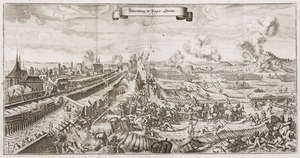
The final battle of the Thirty Years' War; Swedish siege of Prague (1648) - Siege of Prague (1648) – Thirty Years' War
- Siege of Inverness (1649)
- Siege of Zbarazh (1649) – Khmelnytsky uprising, Polish–Lithuanian Commonwealth
- Siege of Dublin (1649)
- Siege of Drogheda (1649) – Cromwellian conquest of Ireland
- Siege of Wexford (1649) – Cromwellian conquest of Ireland
- Siege of Waterford (1649–1650) – Cromwellian conquest of Ireland
- Siege of Inverness (1650)
- Siege of Kilkenny (1650) – Cromwellian conquest of Ireland
- Siege of Clonmel (1650) – Irish Confederate Wars
- Siege of Charlemont (1650) – Irish Confederate Wars
- Cromwell's Siege of Limerick City, Ireland (1651) – Irish Confederate Wars
- Siege of Barcelona (1651–1652), during the Catalan Revolt
- Siege of Galway (1651–1652) – Irish Confederate Wars
,_Poland_-_Geographicus_-_Krakow-pufendorf-1655.jpg)
- Siege of Arras (1654) – Franco-Spanish War (1635–59)
- Siege of Smolensk (1654) – Russo-Polish War (1654–67)
- Siege of Landrecies (1655) – Franco-Spanish War (1635–59)
- Siege of Santo Domingo (1655) – Anglo-Spanish War (1654–60)
- Siege of Kraków (1655) – Second Northern War
- Siege of Danzig (1655–60) – second Northern War
- Siege of Jasna Góra (1655) – during The Deluge
- Siege of Valenciennes (1656) – Franco-Spanish War (1635–59)
- Siege of Zamość (1656) – second Northern War
- Siege of Warsaw (1656) – second Northern War
- Siege of Nöteborg (1656) – Russo-Swedish War (1656–58)
- Siege of Nyenschantz (1656) – Russo-Swedish War (1656–58)
- Siege of Dyneburg (1656) – Russo-Swedish War (1656–58)
- Siege of Riga (1656) – Russo-Swedish War (1656–58)
- Siege of Dorpat (1656) – Russo-Swedish War (1656–58)
.jpg)
- Siege of Bidar (1657)
- Siege of Kraków (1657) – second Northern War
- Siege of Dorpat (1657) – Russo-Swedish War (1656–58)
- Siege of Dunkirk (1658) – Franco-Spanish War (1635–59)
- Siege of Toruń (1658) – second Northern War
- Siege of Badajoz (1658) – Portuguese Restoration War
- Siege of Copenhagen (1658–1659) Second Northern War, Swedes defeated by Danish and Dutch defenders
- Siege of Kolding (1658) – second Northern War
- Siege of Lyakhavichy (1660) – Russo-Polish War (1654–67)
- Siege of Fort Zeelandia (1661–1662) – Sino-Dutch conflicts
- Siege of Érsekújvár (1663) – Austro-Turkish War (1663–1664)
- Siege of Hlukhiv (1664) – Russo-Polish War (1654–67)
- Siege of Valência de Alcântara (1664)
- Siege of Novi Zrin Castle (1664) in northern Croatia – Austro-Turkish War (1663–64)
- Siege of Léva (1664) – Austro-Turkish War (1663–1664)
- Siege of Purandhar (1665)
- Siege of Ponda (1666)
- Siege of Charleroi (1667) – War of Devolution
- Siege of Tournai (1667) – War of Devolution
- Siege of Douai (1667) – War of Devolution
- Siege of Lille (1667) – War of Devolution
- Siege of Dole (1668) – War of Devolution
- Siege of Solovetsky Monastery (1668–76) – eight years
- Siege of Groenlo (1672) – Franco-Dutch War
- Siege of Groningen (1672) – Franco-Dutch War
- Siege of Kamenets (1672) – Polish–Ottoman War (1672–76)

- Siege of Maastricht (1673) – Franco-Dutch War
- Siege of Bonn (1673) – Franco-Dutch War
- Siege of Besançon (1674) – Franco-Dutch War
- Siege of Ponda (1675)
- Siege of Maastricht (1676) – Franco-Dutch War
- Siege of Philippsburg (1676) – Franco-Dutch War
- Siege of Valenciennes (1676–77) – Franco-Dutch War
- Siege of Freiburg (1677) – Franco-Dutch War
- Siege of Cambrai (1677) – Franco-Dutch War
- Siege of Malmö (1677) – Scanian War
- Siege of Ghent (1678) – Franco-Dutch War
- Siege of Ypres (1678) – Franco-Dutch War
- Siege of Puigcerdà (1678) – Franco-Dutch War
- Siege of Stralsund (1678) – Scanian War
- Siege of Vienna (1683) – siege of Vienna during the Great Turkish War
- Siege of Luxembourg (1684) – War of the Reunions
- Siege of Genoa (1684) – War of the Reunions
- Siege of Buda (1684), Austrian army tried to take Buda from Ottoman Turkey
- Siege of Santa Maura (1684) – Morean War
- Siege of Sinj (1684) – Morean War
- Siege of Sinj (1685) – Morean War
- Siege of Bijapur (1685–86)
- Siege of Cojor (1685) – Morean War
.jpg)
- Siege of Érsekújvár (1685) – Great Turkish War
- Siege of Kelefa (1686) – Morean War
- Siege of Navarino (1686) – Morean War
- Siege of Buda (1686) – Great Turkish War
- Siege of Modon (1686) – Morean War
- Siege of Nauplia (1686) – Morean War
- Siege of Pécs (1686) – Great Turkish War
- Siege of Golconda (1687)
- Siege of Castelnuovo (1687) – Morean War

- Siege of Monemvasia (1687–1690) – Morean War
- Siege of the Acropolis (1687) – Morean War
- Siege of Bangkok (1688) – Siamese revolution of 1688
- Siege of Negroponte (1688) – Great Turkish War
- Siege of Belgrade (1688) – Great Turkish War
- Siege of Knin (1688) – Morean War
- Siege of Philippsburg (1688) – Nine Years' War
- Siege of Mannheim (1688) – Nine Years' War
- Siege of Frankenthal (1688) – Nine Years' War
- Siege of Derry (1689) – Williamite War in Ireland
- Siege of Kaiserswerth (1689) – Nine Years' War
- Siege of Mainz (1689) – Nine Years' War
- Siege of Larache (1689)
- Siege of Pemaquid (1689) – Nine Years' War
- Siege of Carrickfergus (1689) – Williamite War in Ireland
- Siege of Bonn (1689) – Nine Years' War
- Siege of Gingee (1689–1698)
- First siege of Athlone (1690), Williamite War in Ireland
- Siege of Kanina (1690) – Morean War
- Siege of Niš (1690) – Great Turkish War
.JPG)
- Siege of Cork (1690) – Williamite War in Ireland
- Siege of Belgrade (1690) – Great Turkish War
- Siege of Québec City (1690) – first siege of Québec City
- Siege of Jinji (1690–1698)
- Siege of Limerick (1691), Williamite War in Ireland
- Second siege of Athlone (1691), Williamite War in Ireland
- Siege of Mons (1691) – Nine Years' War
- Siege of Cuneo (1691) – Nine Years' War
- Siege of Candia (1692) – Morean War
- Siege of Namur (1692) – Nine Years' War
- Siege of Embrun (1692) – Nine Years' War
- Siege of Ebernburg (1692) – Nine Years' War
- Siege of Belgrade (1693) – Great Turkish War
- Siege of Huy (1693) – Nine Years' War
- Siege of Charleroi (1693) – Nine Years' War
- Siege of Pinerolo (1693) – Nine Years' War
- Siege of Chios (1694) – Morean War
- Siege of Palamos (1694) – Nine Years' War
- Siege of Gerona (1694) – Nine Years' War
- Siege of Huy (1694) – Nine Years' War

- Siege of Ceuta (1694–1727) – claimed as the longest siege in history
- Siege of Casale (1695) – Nine Years' War
- Siege of Namur (1695) – Nine Years' War
- Capitulation of Diksmuide (1695) – Nine Years' War
- Siege of Mombasa (1696–1698) – Omani–Portuguese conflicts
- Siege of Pemaquid (1696) – Nine Years' War
- Siege of Fort Nashwaak (1696) – Nine Years' War
- Siege of Ath (1697) – Nine Years' War
- Siege of Barcelona (1697) – Nine Years' War
- Siege of Ebernburg (1697) – Nine Years' War
- Siege of Cartagena de Indias (1697)
18th century
[edit]
- Siege of Tönning (1700) – Great Northern War
- Siege of Riga (1700) – Great Northern War
- Siege of Narva (1700) – Great Northern War
- Siege of Kaiserswerth (1702) – War of the Spanish Succession
- Siege of Saint Donas (1702) – War of the Spanish Succession
- Siege of Castiglione (1702) – War of the Spanish Succession
- Siege of Landau (1702) – War of the Spanish Succession
- Siege of Borgoforte (1702) – War of the Spanish Succession
- Siege of Guastalla (1702) – War of the Spanish Succession
- Siege of Venlo (1702) – War of the Spanish Succession
- Siege of Stevensweert (1702) – War of the Spanish Succession
- Siege of Roermond (1702) – War of the Spanish Succession
- Siege of Nöteborg (1702) – Great Northern War
- Siege of Liége (1702) – War of the Spanish Succession
- Siege of Rheinberg (1702) – War of the Spanish Succession
- Siege of Hulst (1702) – War of the Spanish Succession
- Siege of Trarbach (1702) – War of the Spanish Succession
- Siege of St. Augustine (1702) – War of the Spanish Succession
- Siege of Andernach (1702) – War of the Spanish Succession
- Siege of Governolo (1702) – War of the Spanish Succession

- Siege of Neubourg (1703) – War of the Spanish Succession
- Siege of Kehl (1703) – War of the Spanish Succession
- Siege of Bonn (1703) – War of the Spanish Succession
- Siege of Thorn (1703) – Great Northern War
- Siege of Nago (1703) – War of the Spanish Succession
- Siege of Arco (1703) – War of the Spanish Succession
- Siege of Breisach (1703) – War of the Spanish Succession
- Siege of Huy (1703) – War of the Spanish Succession
- Siege of Limburg (1703) – War of the Spanish Succession
- Siege of Landau (1703) – War of the Spanish Succession
- Siege of Augsburg (1703) – War of the Spanish Succession
- Siege of Guadeloupe (1703) – War of the Spanish Succession
- Siege of Castello de Vide (1704) – War of the Spanish Succession
- Siege of Wagingera (1704)
- Siege of Barcelona (1704) – War of the Spanish Succession
- Siege of Susa (1704) – War of the Spanish Succession
- Siege of Portalegre (1704) – War of the Spanish Succession
- Siege of Vercelli (1704) – War of the Spanish Succession

- Siege of Rain (1704) – War of the Spanish Succession
- Siege of Narva (1704) – Great Northern War
- Siege of Dorpat (1704) – Great Northern War
- Siege of Villingen (1704) – War of the Spanish Succession
- Siege of Susa (1704) – War of the Spanish Succession
- Siege of Fort Isabella (1704) – War of the Spanish Succession
- Siege of Gibraltar (1704) – eleventh siege of Gibraltar, by Sir George Rooke's Anglo-Dutch fleet
- Siege of Ulm (1704) – War of the Spanish Succession
- Twelfth Siege of Gibraltar (1704–05) – War of the Spanish Succession
- Siege of Ivree (1704) – War of the Spanish Succession
- Siege of Landau (1704) – War of the Spanish Succession
- Siege of Verrua (1704) – War of the Spanish Succession
- Siege of Trarbach (1704) – War of the Spanish Succession
- Siege of Colonia del Sacramento (1704–1705) – War of the Spanish Succession
- Siege of St. John's (1705) – War of the Spanish Succession
- Siege of Valencia de Alcantara (1705) – War of the Spanish Succession
- Siege of Albuquerque (1705) – War of the Spanish Succession
- Siege of Huy (1705) – War of the Spanish Succession
- Siege of Liège (1705) – War of the Spanish Succession
- Second siege of Huy (1705) – War of the Spanish Succession
- Siege of Chivasso (1705) – War of the Spanish Succession
- Siege of Mirandola (1705) – War of the Spanish Succession
- Siege of Nice (1705–06) – War of the Spanish Succession
- Siege of Zoutleeuw (1705) – War of the Spanish Succession
- Siege of Barcelona (1705) – War of the Spanish Succession
- Siege of Hagenau (1705) – War of the Spanish Succession
- Siege of Badajoz (1705) – War of the Spanish Succession
- Siege of Zandvliet (1705) – War of the Spanish Succession
- Siege of Diest (1705) – War of the Spanish Succession

- Siege of San Mateo (1705) – War of the Spanish Succession
- Siege of Tripoli (1705) – Tripolitanian-Tunisian War (1704–1709)
- Siege of Alcantara (1706) – War of the Spanish Succession
- Siege of Barcelona (1706) – War of the Spanish Succession
- Siege of Hagenau (1706) – War of the Spanish Succession
- Siege of Ciudad Rodrigo (1706) – War of the Spanish Succession
- Siege of Turin (1706) – War of the Spanish Succession
- Siege of Oostende (1706) – War of the Spanish Succession
- Siege of Menin (1706) – War of the Spanish Succession
- Siege of Alicante (1706) – War of the Spanish Succession
- Siege of Dendermonde (1706) – War of the Spanish Succession
- Siege of Ath (1706) – War of the Spanish Succession
- Siege of Pavia (1706) – War of the Spanish Succession
- Siege of Cuenca (1706) – War of the Spanish Succession
- Siege of Pizzigetone (1706) – War of the Spanish Succession
- Siege of Elche (1706) – War of the Spanish Succession
- Siege of Cartagena (1706) – War of the Spanish Succession
- Siege of Casale (1706) – War of the Spanish Succession
- Siege of Milan (1707) – War of the Spanish Succession
- Siege of Villena (1707) – War of the Spanish Succession
- Siege of Xàtiva (1707) – War of the Spanish Succession
- Siege of Port Royal (1707) – War of the Spanish Succession
- Siege of Toulon (1707) – War of the Spanish Succession
- Siege of Gaeta (1707) – War of the Spanish Succession
- Siege of Pensacola (1707) – War of the Spanish Succession
- Siege of Ciudad Rodrigo (1707) – War of the Spanish Succession
_p4.220_SIEGE_OF_LILLE_-1708.jpg)
- Siege of Susa (1707) – War of the Spanish Succession
- Siege of Lérida (1707) – War of the Spanish Succession
- Siege of Morella (1707) – War of the Spanish Succession
- Siege of Oran (1707–1708) – Conflicts between Spain and Algiers
- Siege of Terki (1708) – Murat Kuchukov Movement
- Siege of Tortosa (1708) – War of the Spanish Succession
- Siege of Exilles (1708) – War of the Spanish Succession
- Siege of Lille (1708) – War of the Spanish Succession
- Siege of Fenestrelles (1708) – War of the Spanish Succession
- Siege of San Felipe (1708) – War of the Spanish Succession
- Siege of Leffinghe (1708) – War of the Spanish Succession
- Siege of Denia (1708) – War of the Spanish Succession
- Siege of Saint Ghislain (1708) – War of the Spanish Succession
- Siege of Brussels (1708) – War of the Spanish Succession
- Siege of Alicante (1708–09) – War of the Spanish Succession
- Siege of Ghent (1708) – War of the Spanish Succession
- Siege of Veprik (1709) – Great Northern War
- Siege of Tournai (1709) – War of the Spanish Succession
- Siege of Mons (1709) – War of the Spanish Succession
- Siege of Viborg (1710) – Great Northern War
- Siege of Reval (1710) – Great Northern War
- Siege of Douai (1710) – War of the Spanish Succession
- Siege of Béthune (1710) – War of the Spanish Succession
- Siege of Aire (1710) – War of the Spanish Succession
- Siege of Saint Venant (1710) – War of the Spanish Succession
- Siege of Port Royal (1710) – War of the Spanish Succession
- Siege of Gerona (1710–1711) – War of the Spanish Succession
- Siege of Kassa (1711) – Rákóczi's War of Independence
- Siege of Aren fort (1711) – War of the Spanish Succession
- Siege of Bouchain (1711) – War of the Spanish Succession
- Siege of Venasque (1711) – War of the Spanish Succession
- Siege of Stralsund (1711–15) – Great Northern War
- Siege of Castel-Leon (1711) – War of the Spanish Succession
- Siege of Cardona (1711) – War of the Spanish Succession
- Siege of Le Quesnoy (1712) – War of the Spanish Succession
- Siege of Landrecies (1712) – War of the Spanish Succession
- Siege of Marchiennes (1712) – War of the Spanish Succession
- Siege of Douai (1712) – War of the Spanish Succession

- Second siege of Le Quesnoy (1712) – War of the Spanish Succession
- Siege of Bouchain (1712) – War of the Spanish Succession
- Siege of Gerona (1712–1713) – War of the Spanish Succession
- Siege of Tönning (1713–1714) – Great Northern War
- Siege of Landau (1713) – War of the Spanish Succession
- Siege of Barcelona (1713–14) – War of the Spanish Succession
- Siege of Freiburg (1713) – War of the Spanish Succession
- Siege of Gurdaspur (1715)
- Siege of Brahan (1715) – Jacobite rising of 1715
- Siege of Inverness (1715) – Jacobite rising of 1715

- Siege of Temeşvar (1716) – Austro-Turkish War (1716–1718)
- Siege of Belgrade (1717) – Austro-Turkish War (1716–1718)
- Siege of Fredriksten (1718) – Great Northern War
- Siege of Isfahan (1722)
- Thirteenth Siege of Gibraltar (1727) – by a Spanish army
- Siege of Oran (1732) – Conflicts between Spain and Algiers
- Siege of Kehl (1733) – War of the Polish Succession
- Siege of Pizzighettone (1733) – War of the Polish Succession
- Siege of Danzig (1734) – War of the Polish Succession
- Siege of Gaeta (1734) – War of the Polish Succession
- Siege of Trarbach (1734) – War of the Polish Succession
- Siege of Capua (1734) – War of the Polish Succession
- Siege of Philippsburg (1734) – War of the Polish Succession
- Siege of Messina (1734–1735) – War of the Polish Succession
- Siege of Ganja (1734–1735) – Ottoman–Persian War (1730–35)
- Siege of Syracuse (1735) – War of the Polish Succession
- Siege of Trapani (1735) – War of the Polish Succession
- Siege of Colonia del Sacramento (1735–1737) – Spanish–Portuguese War (1735–1737)
- Siege of Perekop (1736) – Russo-Turkish War (1735–1739)
- Siege of Azov (1736) – Russo-Turkish War (1735–1739)
- Siege of Banja Luka (1737) – Austro-Turkish War (1737–1739)
- Siege of Ochakov (1737) – Russo-Turkish War (1735–1739)
- Siege of Kandahar (1737–1738)
- Siege of Mehadia (1738) – Austro-Turkish War (1737–1739)
- Siege of Orsova (1738) – Austro-Turkish War (1737–1739)

- Siege of Belgrade (1739) – Austro-Turkish War (1737–1739)
- Siege of Portobello (1739) – victory of British siege by Edward Vernon in the War of Jenkins' Ear
- Siege of St. Augustine (1740) – War of Jenkins' Ear
- Siege of Fort Mose (1740) – War of Jenkins' Ear
- Siege of Trichinopoly (1741)
- Siege of Cartagena de Indias (1741) – failed British siege by Edward Vernon in the War of Jenkins' Ear
- Siege of Brieg (1741) – War of the Austrian Succession
- Siege of Santiago (1741) – War of the Austrian Succession
- Siege of Neisse (1741)
- Siege of Glatz (1742) – War of the Austrian Succession
- Siege of Eger (1742) – War of the Austrian Succession
- Siege of Mirandola (1742) – War of the Austrian Succession
- Siege of Modena (1742) – War of the Austrian Succession
- Siege of Prague (1742) – War of the Austrian Succession
- Siege of La Guaira (1743) – War of the Austrian Succession
- Siege of Eger (1743) – War of the Austrian Succession
- Siege of Puerto Cabello (1743) – War of the Austrian Succession
- Blockade of Straubing (1743) – War of the Austrian Succession
- Siege of Trichinopoly (1743)
- Siege of Ingolstadt (1743) – War of the Austrian Succession
- Siege of Mosul (1743) – Ottoman–Persian War (1743–46)
- Siege of Kars (1744) – Ottoman–Persian War (1743–46)
- Siege of Menin (1744) – War of the Austrian Succession
- Siege of Ypres (1744) – War of the Austrian Succession
- Siege of Furnes (1744) – War of the Austrian Succession
- Siege of Annapolis Royal (1744) – War of the Austrian Succession (King George's War)
- Siege of Prague (1744) – War of the Austrian Succession
- Siege of Cuneo (1744) – War of the Austrian Succession
- Siege of Freiburg (1744) – War of the Austrian Succession
- Siege of Tabor (1744) – War of the Austrian Succession
- Siege of Tournai (1745) – War of the Austrian Succession
- Siege of Barabati (1745) – Fourth Maratha invasion of Bengal
- Siege of Louisbourg (1745) – War of the Austrian Succession (King George's War)
- Siege of Port Toulouse (1745) – War of the Austrian Succession (King George's War)
- Siege of Annapolis Royal (1745) – War of the Austrian Succession (King George's War)
- Fall of Ghent (1745) – War of the Austrian Succession
- Siege of Oudenarde (1745) – War of the Austrian Succession
- Siege of Ostend (1745) – War of the Austrian Succession
- Siege of Tortona (1745) – War of the Austrian Succession
- Siege of Kosel (1745) – War of the Austrian Succession
- Siege of Ruthven Barracks (1745) – Jacobite rising of 1745
- Siege of Culloden House (1745) – Jacobite rising of 1745
- Siege of Carlisle (November 1745) – Jacobite rising of 1745
- Siege of Carlisle (December 1745) – Jacobite rising of 1745
- Siege of Fort Augustus (December 1745) – Jacobite rising of 1745
- Siege of Stirling Castle (1746) – Jacobite rising of 1745
- Siege of Brussels (1746) – War of the Austrian Succession
- Siege of Ruthven Barracks (1746) – Jacobite rising of 1745
- Siege of Inverness (1746) – Jacobite rising of 1745
- Siege of Fort Augustus (March 1746) – Jacobite rising of 1745
- Siege of Blair Castle (1745) – Jacobite rising of 1745
- Siege of Fort William (1745) – Jacobite rising of 1745
- Siege of Genoa (1746) – War of the Austrian Succession
- Siege of Mons (1746) – War of the Austrian Succession

- Siege of Namur (1746) – War of the Austrian Succession
- Siege of Madras (1746) – War of the Austrian Succession
- Siege of Genoa (1747) – War of the Austrian Succession
- Siege of Hulst (1747) – War of the Austrian Succession
- Siege of Bergen op Zoom (1747) – War of the Austrian Succession
- Siege of Maastricht (1748) – War of the Austrian Succession
- Siege of Cuddalore (1748) – War of the Austrian Succession
- Siege of Pondicherry (1748) – War of the Austrian Succession
- Siege of Arcot (1751) – Second Carnatic War
- Siege of Trichinopoly (1751–52) – second Carnatic War
- Siege of Fort St Philip (1756) – Seven Years' War
- Siege of Pirna (1756) – Seven Years' War
- Siege of Prague (1757) – Seven Years' War
- Siege of Fort William Henry (1757) – Seven Years' War (French and Indian War)
- Siege of Schweidnitz (1757) – Seven Years' War
- Siege of Breslau (1757) – Seven Years' War

- Blockade of Liegnitz (1757) – Seven Years' War
- Blockade of Stralsund (1757–1758) – Seven Years' War
- Siege of Küstrin (1758) – Seven Years' War
- Siege of Schweidnitz (1758) – Seven Years' War
- Siege of Louisbourg (1758) – Seven Years' War (French and Indian War)
- Siege of Olmütz (1758) – by the Prussian army of Frederick the Great during the Seven Years' War
- Siege of Neisse (1758) – Seven Years' War
- Siege of Madras (1758–1759) – Seven Years' War
- Siege of Masulipatam (1759) – Seven Years' War
- Siege of Québec (1759) – second siege of Québec, during the Seven Years' War (French and Indian War)
- Siege of Münster (1759) – Seven Years' War
- Second siege of Münster (1759) – Seven Years' War
- Siege of Fort Loudoun (1760) – Seven Years' War (French and Indian War)
- Siege of Glatz (1760) – Seven Years' War
- Siege of Dresden (1760) – Seven Years' War

- Siege of Breslau (1760) – Seven Years' War
- Siege of Wittenberg (1760) – Seven Years' War
- Siege of Pondicherry (1760–1761) – Seven Years' War
- Siege of Cassel (1761) – Seven Years' War
- Sieges of Kolberg (1759, 1760, and 1761) – Seven Years' War
- Siege of Havana (1762) – Seven Years' War. British fleet headed by George Keppel, 3rd Earl of Albemarle lays siege to Spanish controlled Havana for a month.
- Siege of Schweidnitz (1762) – Seven Years' War
- Siege of Almeida (1762) – Seven Years' War
- Siege of Cassel (1762) – Seven Years' War
- Siege of Ambur (1767) – First Anglo-Mysore War
- Siege of Khotyn (1769) – Russo-Turkish War (1768–1774)
- Siege of Bender (1770) – Russo-Turkish War (1768–1774)
- Siege of Giurgevo (1771) – Russo-Turkish War (1768–1774)
- Siege of Silistria (1773) – Russo-Turkish War (1768–1774)
- Siege of Melilla (1774), during Hispano-Moroccan wars
- Siege of Boston (1775–1776) – American Revolutionary War
- Siege of Fort St. Jean (1775) – American Revolutionary War
.jpg)
- Siege of Fort Ticonderoga (1777) – American Revolutionary War
- Siege of Fort Stanwix (1777) – American Revolutionary War
- Siege of Fort Henry (1777) – American Revolutionary War
- Siege of Fort Mifflin (1777) – American Revolutionary War
- Siege of Pondicherry (1778) – Anglo-French War (1778–1783)
- Siege of Fort Vincennes (1779) – American Revolutionary War
- Great Siege of Gibraltar (1779–83) – fourteenth siege of Gibraltar, by a Spanish–French army in the American Revolutionary War
- Siege of Savannah (1779) – American Revolutionary War
- Siege of Tellicherry (1779–82) – Second Anglo-Mysore War
- Siege of Charleston (1780) – American Revolutionary War
- Siege of Kastania (1780)
- Siege of Vellore (1780–82) – second Anglo-Mysore War

- Siege of Pensacola (1781) – American Revolutionary War
- Siege of Fort Watson (1781) – American Revolutionary War
- Siege of Fort Motte (1781) – American Revolutionary War
- Siege of Augusta (1781) – American Revolutionary War
- Siege of Ninety-Six (1781) – American Revolutionary War
- Siege of Yorktown (1781) – American Revolutionary War
- Siege of Negapatam (1781) – fourth Anglo-Dutch War
- Siege of Brimstone Hill (1782) – Anglo-French War (1778–1783)
- Siege of Fort Henry (1782) – American Revolutionary War
- Siege of Cuddalore (1783) – second Anglo-Mysore War
- Siege of Mangalore (1783–1784) – second Anglo-Mysore War
- Siege of Nargund (1785) – Maratha–Mysore War
- Siege of Karginsk (1785) — Sheikh Mansur Movement
- Siege of Kizlyar (July 1785) — Sheikh Mansur Movement
- Battle of Grigoriopolis 1785 — Sheikh Mansur Movement
- Siege of Kizlyar (August 1785) — Sheikh Mansur Movement
- Siege of Badami (1786) – Maratha–Mysore War
- Siege of Bahadur Benda (1787) – Maratha–Mysore War
- Siege of Ochakov (1788) – Russo-Turkish War (1787–1792)
- Siege of Khotin (1788) – Austro-Turkish War (1788–1791)
- Siege of Anapa (1788) — Sheikh Mansur Movement

- Siege of Belgrade (1789) – Austro-Turkish War (1788–1791)
- Siege of Izmail (1789–1790) – Russo-Turkish War (1787–1792)
- Siege of Oran (1790–1792) – Conflicts between Spain and Algiers
- Siege of Anapa (1790) — Sheikh Mansur Movement
- Siege of Darwar (1790–1791) – third Anglo-Mysore War
- Siege of Koppal (1790–1791) – third Anglo-Mysore War
- Siege of Bangalore (1791) – third Anglo-Mysore War
- Siege of Coimbatore (1791) – third Anglo-Mysore War
- Siege of Anapa (1791) — Sheikh Mansur Movement
- Siege of Goorumconda (1791) – third Anglo-Mysore War

- Siege of Nundydroog (1791) – third Anglo-Mysore War
- Siege of Savendroog (1791) – third Anglo-Mysore War
- Siege of Seringapatam (1792) – third Anglo-Mysore War
- Siege of Thionville (1792) – War of the First Coalition
- Battle of Verdun (1792) – War of the First Coalition
- Siege of Lille (1792) – War of the First Coalition
- Siege of Mainz (1792) – War of the First Coalition
- Battle of Limburg (1792) – War of the First Coalition
- Siege of Maastricht (1793) – War of the First Coalition
- Siege of Condé (1793) – War of the First Coalition
- Siege of Mainz (1793) – War of the First Coalition
- Siege of Bellegarde (1793) – War of the First Coalition
- Siege of Valenciennes (1793) – War of the First Coalition
- Siege of Pondicherry (1793) – War of the First Coalition
- Siege of Lyon (1793) – War of the First Coalition
- Siege of Landau (1793) – War of the First Coalition

- Siege of Dunkirk (1793) – War of the First Coalition
- Siege of Le Quesnoy (1793) – War of the First Coalition
- Siege of Toulon (1793) – War of the First Coalition
- Siege of Maubeuge (1793) – War of the First Coalition
- Siege of Fort-Louis (1793) – War of the First Coalition
- Siege of Angers (1793) – War of the First Coalition
- Siege of San Fiorenzo (1794) – War of the First Coalition
- Siege of Bastia (1794) – War of the First Coalition
- Siege of Landrecies (1794) – War of the First Coalition
- Siege of Collioure (1794) – War of the First Coalition
- Siege of Ypres (1794) – War of the First Coalition
- Siege of Calvi (1794) – War of the First Coalition
- Siege of Luxembourg (1794–95) – War of the First Coalition
- Siege of Roses (1794–95) – War of the First Coalition

- Siege of Mannheim (1795) – War of the First Coalition
- Siege of Mantua (1796–97) – War of the First Coalition, French besieging
- Siege of Kehl (1796–97) – War of the First Coalition
- Siege of Hüningen (1796–97) – War of the First Coalition
- Siege of Port of Spain (1797), during the Anglo-Spanish War
- Siege of San Juan de Puerto Rico (1797), during the Anglo-Spanish War
- Siege of Malta (1798–1800), during the French Revolutionary Wars
- Siege of Corfu (1798–99) – War of the Second Coalition
- Siege of El Arish (1799) – French campaign in Egypt and Syria
- Siege of Jaffa (1799) – French campaign in Egypt and Syria
- Siege of Acre (1799) – French campaign in Egypt and Syria
- Siege of Mantua (1799) – War of the Second Coalition
- Siege of Seringapatam (1799) – Fourth Anglo-Mysore War
Modern military sieges
[edit]19th century
[edit]- Siege of Genoa (1800) – War of the Second Coalition
- Siege of Fort Bard (1800) – War of the Second Coalition
- Siege of Fort Julien (1801) – French campaign in Egypt and Syria
- Siege of Cairo (1801) – French campaign in Egypt and Syria
- Siege of Porto Ferrajo (1801) – War of the Second Coalition
- Siege of Alexandria (1801) – French campaign in Egypt and Syria
- Siege of Ahmednagar (1803) – Second Anglo-Maratha War
- Siege of Aligarh (1803) – second Anglo-Maratha War
- Siege of Erivan (1804) – Russo-Persian War (1804–13)
- Siege of Delhi (1804) – second Anglo-Maratha War
- Siege of Deeg (1804) – second Anglo-Maratha War

- Siege of Bharatpur (1805) – second Anglo-Maratha War
- Siege of Santo Domingo (1805)
- Siege of Gaeta (1806) – Invasion of Naples (1806)
- Siege of Magdeburg (1806) – War of the Fourth Coalition
- Siege of Belgrade (1806) – First Serbian uprising
- Siege of Hameln (1806) – War of the Fourth Coalition
- Siege of Stralsund (1807) – War of the Fourth Coalition
- Siege of Montevideo (1807) – during the British invasions of the River Plate
- Siege of Kolberg (1807) – War of the Fourth Coalition
- Siege of Danzig (1807) – War of the Fourth Coalition, French siege of Prussians and Russians
- Siege of Buenos Aires (1807) – during the British invasions of the River Plate
- Battle of Copenhagen (1807) – Bombarded by British fleet and by ground forces commanded by Arthur Wellesley

- Siege of Sveaborg (1808) – Finnish War
- Siege of Erivan (1808) – Russo-Persian War (1804–13)
- First siege of Zaragoza (1808) – Peninsular War
- Siege of Barcelona (1808) – Peninsular War
- Battle of Valencia (1808) – Peninsular War
- Second siege of Gerona (1808) – Peninsular War
- Siege of Roses (1808) – Peninsular War
- Second siege of Zaragoza (1808–1809) – Peninsular War
- Siege of Chaves (1809) – Peninsular War
- Third siege of Girona (1809) – Peninsular War
- Siege of Cádiz (1810–1812) – Peninsular War
- Siege of Santa Maura (1810) – Adriatic campaign
- Siege of Astorga (1810) – Peninsular War
- Siege of Lérida (1810) – Peninsular War
- First siege of Ciudad Rodrigo (1810) – Peninsular War by the French Marshal Michel Ney
- Siege of Mequinenza (1810) – Peninsular War
- Siege of Almeida (1810) – Peninsular War
- Siege of Tortosa (1810–11) – Peninsular War
- Siege of Olivenza (1811) – Peninsular War
- First siege of Badajoz (1811) – Peninsular War
- Siege of Figueras (1811) – Peninsular War
- Second siege of Badajoz (1811) – Peninsular War
- Siege of Tarragona (1811) – Peninsular War
- Siege of Valencia (Venezuela) (es) (1811) – Spanish American wars of independence
- First siege of Montevideo (1811) – Spanish American wars of independence
- Siege of Tarifa (1811–1812) – Peninsular War
- Siege of Valencia (1811–1812) – Peninsular War
- Second siege of Montevideo (1812–14) – Spanish American wars of independence
- Second siege of Ciudad Rodrigo (1812) – Peninsular War by Arthur Wellesley
- Siege of Cuautla (1812) – Mexican War of Independence
- Siege of Badajoz (1812) – Peninsular War
- Siege of Huajuapan de León (1812) – Mexican War of Independence
- Siege of the Salamanca Forts (1812) – Peninsular War
- Siege of Astorga (1812) – Peninsular War
- First siege of Puerto Cabello (es) (1812) – Spanish American wars of independence

- Siege of Riga (1812) – French invasion of Russia
- Siege of Fort Mackinac (1812) – War of 1812
- Siege of Detroit (1812) – War of 1812
- Siege of Fort Harrison (1812) – War of 1812
- Siege of Fort Wayne (1812) – War of 1812
- Siege of Burgos (1812) – Peninsular War
- Siege of Danzig (1813) – War of the Sixth Coalition
- Siege of Acapulco (1813) – Mexican War of Independence
- Siege of Fort Meigs (1813) – failed British siege of American garrison during the War of 1812
- Siege of Tarragona (1813) – Peninsular War
- Siege of Pamplona (1813) – Peninsular War
- Siege of San Sebastián (1813) – Peninsular War
- Siege of Chillán (1813) – Chilean War of Independence
- Second siege of Puerto Cabello (es) (1813) – Spanish American wars of independence
- Siege of Cattaro (1813–1814) – War of the Sixth Coalition
- Siege of Mainz (1813–1814) – War of the Sixth Coalition
- Siege of Zara (1813) – War of the Sixth Coalition
- Siege of Maturin (es) (1813–1814) – Spanish American wars of independence
- Siege of Hamburg (1813–1814) – War of the Sixth Coalition
- Siege of Metz (1814) – War of the Sixth Coalition
- Third siege of Puerto Cabello (es) (1814) – Spanish American wars of independence
- Siege of Antwerp (1814) – War of the Sixth Coalition
- Siege of Ragusa (1814) – War of the Sixth Coalition
- Siege of Bergen op Zoom (1814) – War of the Sixth Coalition
- First siege of Valencia (Venezuela) (es) (1814) – Spanish American wars of independence
- Second siege of Valencia (Venezuela) (es) (1814) – Spanish American wars of independence
- Siege of Prairie du Chien (1814) – War of 1812
- Siege of Fort Erie (1814) – War of 1812
- Siege of Aragua de Barcelona (es) (1814) – Spanish American wars of independence
- Siege of Santa Fe de Bogotá (es) (1814) – Spanish American wars of independence
- Siege of Ancona (1815) – Neapolitan War
- Siege of Gaeta (1815) – Neapolitan War
- Siege of Cartagena de Indias (es) (1815) – Spanish American wars of independence
- First siege of Angostura (es) (1817) – Spanish American wars of independence
- Siege of Barcelona (1817) – Spanish American wars of independence
- Second siege of Angostura (es) (1817) – Spanish American wars of independence
- Siege of Cartagena de Indias (es) (1820–21) – Spanish American wars of independence
- First siege of El Callao (es) (1821) – Spanish American wars of independence
- Siege of Tripolitsa (1821) – by the Greeks against the Ottomans, during the Greek War of Independence
- Siege of the Acropolis (1821–22) – by the Greeks against the Ottomans, during the Greek War of Independence
- Fourth siege of Puerto Cabello (es) (1822) – Spanish American wars of independence
- Siege of Pasto (es) (1822) – Spanish American wars of independence
- Fifth Siege of Puerto Cabello (1823) – Spanish American wars of independence
- Siege of Pamplona (1823) – 1823 French invasion of Spain
- First, second, and third sieges of Missolonghi (1822, 1823, 1825–1826)
- Second siege of El Callao (es) (1824–1826) – Spanish American wars of independence
- Siege of the Acropolis (1826–27) – by the Ottomans against the Greeks, during the Greek War of Independence
- Siege of Antwerp (1832) – conducted by French forces against a Dutch garrison after the Ten Days' Campaign.
- Siege of Jerusalem (1834) Peasants' Revolt of 1834 (Palestine)
- Siege of Puerto Cabello (es) (1835) – Reforms Revolution (Venezuela)
- Siege of the Alamo (1836) – Texas Revolution
- Siege of Herat (1837–38)
- Siege of Akmolinsk (1838)
- Siege of Aktau (1838)
- Third siege of El Callao (es) (1838)
- Siege of Akhoulgo (1839)
- Great Siege of Montevideo (1843–1851)
- Siege of Fort Texas (1846) – Mexican–American War
.jpg)
- Siege of Los Angeles (1846) – Mexican–American War
- Siege of Pueblo de Taos (1847) – Mexican–American War
- Siege of Puebla (1847) – Mexican–American War
- Siege of Veracruz (1847) – Mexican–American War. First U.S. amphibious landing
- Siege of Messina (1848) – Sicilian revolution of 1848
- Siege of San José del Cabo (1848) – Mexican–American War
- Siege of Peschiera del Garda (1848) – Italian Risorgimento
- Siege of Osoppo (1848) – Italian Risorgimento
- Siege of Pétervárad (1848–49) – Hungarian Revolution of 1848–49
- Siege of Arad (1848–49) – Hungarian Revolution of 1848–49
- Siege of Komárom (1848–49) – Hungarian Revolution of 1848–49 (temporarily relieved after the Spring Campaign)
- Siege of Lipótvár (1848–49) – Hungarian Revolution of 1848–49
- Siege of Déva (1849) – Hungarian Revolution of 1848–49
- Siege of Eszék (1849) – Hungarian Revolution of 1848–49
- Siege of Gyulafehérvár (1849) – Hungarian Revolution of 1848–49
- Siege of Venice (1849) – Italian Risorgimento
- Siege of Rome (1849) – Italian Risorgimento
- Siege of Buda (1849) – during the Hungarian Revolution of 1848–49
- Siege of Temesvár (1849) – Hungarian Revolution of 1848–49
- Siege of La Serena (1851) – 1851 Chilean Revolution
- Siege of Calafat (1854) – Crimean War

- Siege of Petropavlovsk-Kamchatsky (1854) – Crimean War
- Siege of Sevastopol (1854–55) – Crimean War
- Siege of Taganrog (1855) – Crimean War
- Siege of Kars (1855) – Crimean War
- Siege of Medina Fort (1857) – Toucouleurs besiege French for 97 days
- Siege of Delhi (1857) – Indian Rebellion of 1857
- Siege of Cawnpore (1857) – Indian Rebellion of 1857
- Siege of Lucknow (1857) – Indian Rebellion of 1857
- Siege of Arrah (1857) – Indian Rebellion of 1857
- Siege of Jhansi (1858) – Indian Rebellion of 1857
- Siege of Đà Nẵng (1858–1860)
- Siege of Tourane (1858–1860)
- Siege of Saigon (1859)
- Siege of Ancona (1860) – Italian Risorgimento
- Siege of Messina (1860–61) – Italian Risorgimento
- Siege of Civitella del Tronto (1860–61) – Italian Risorgimento
- Siege of Gaeta (1860–1861) – Italian Risorgimento
- Siege of Fort Sumter (1861) – Union soldiers in Fort Sumter surrendered after a few days of bombardment by Confederate forces starting the American Civil War.
- Siege of Tubac (1861) – Apache Wars
- Siege of New Orleans (1862) – Union Army besieged a Confederate city in the American Civil War
- Siege of Vicksburg (1863) – Union Army besieged a Confederate city in the American Civil War.
- Siege of Port Hudson (1863) – Union Army surrounded Confederate river stronghold for 48 days.
- Siege of Puebla (1863) – Second French intervention in Mexico
- Siege of Petersburg (1864–1865) – American Civil War
- Siege of Fort Ampola (1866) – Italian Risorgimento
- Fourth siege of El Callao (1866) – naval battle between Spain and Peru (and her allies)
- Siege of Querétaro (1867) – second French intervention in Mexico
- Siege of Mexico City (1867) – second French intervention in Mexico
- Siege of Humaitá (1867–1868) – Paraguayan War
- Siege of Hakodate (1869)

- Capture of Rome (1870) – Italian Risorgimento
- Siege of Strasbourg (1870) – Franco-Prussian War
- Siege of Toul (1870) – Franco-Prussian War
- Siege of Metz (1870) – Franco-Prussian War
- Siege of Paris and the Paris Commune (1870–71)
- Siege of Belfort (1870–71) – Franco-Prussian War
- Siege of Cartagena (1873–1874)
- Siege of Pamplona (1874) – First Spanish Republic
- Siege of Bar (1877) – Montenegrin–Ottoman War (1876–1878)
- Siege of Plevna (1877–1878) – Russo-Turkish War (1877–78)
- Siege of the Bears Paw (1877) – final engagement of the Nez Perce War.
- Siege of Eshowe (1879) – Anglo–Zulu War
- Fifth siege of El Callao (1880) – Chilean naval blockade and bombardment of El Callao (Peru), during the War of the Pacific
- Siege of Miraflores (1880) – Chilean siege of Lima (Peru), during the War of the Pacific
- Siege of Geok Tepe (1880–81) – Russian conquest of Turkestan
- Siege of Marabastad (1881) – First Boer War
- Siege of Khartoum (1884–85) – Mahdist War
- Siege of Tuyên Quang (1884–85) – Sino-French War
- Siege of Lapa (1893) – Federalist Revolution
- Siege of Mek'elè (1896) – First Italo-Ethiopian War
- Siege of Santiago (1898) – Spanish–American War
- First siege of San Juan (1898) – Spanish–American War
- Second siege of San Juan (1898) – Spanish–American War
- Siege of Manila (1898) – Spanish–American War
- Siege of Baler (1898–99) – Philippine Revolution
- Siege of Masbate (1898–99) – Philippine Revolution

- Siege of Zamboanga (1898–99) – Philippine Revolution
- Siege of Apia (1899) – Second Samoan Civil War
- Siege of Bucaramanga (1899) – Thousand Days' War (Colombia)
- Siege of Mafeking (1899–1900) – Second Boer War
- Siege of Kimberley (1899–1900) – second Boer War
- Siege of Ladysmith (1899–1900) – second Boer War
- Siege of the International Legations (1900) – Boxer Rebellion
- Siege of Beitang (1900) - – Boxer Rebellion, occurred in Beijing in parallel with the siege of International Legations
20th century
[edit]- Siege of San Cristobal (1901) – Thousand Days' War (Venezuela)
- Siege of La Victoria (1902)- Revolución Libertadora (Venezuela)
- Siege of Puerto Cabello (1902–1903)- Naval blockade of Venezuela
- Siege of La Guaira (1902–1903)- Naval blockade of Venezuela
- Siege of Castle San Carlos (1903)- Naval blockade of Venezuela
- Siege of Ciudad Bolivar (1903)- Revolución Libertadora (Venezuela)
- Siege of Port Arthur (1904–05) Russo-Japanese War
- Siege of Scutari (1912–13) – First Balkan War
- Siege of Adrianople (1912–13) – first Balkan War

- Siege of Vidin (1913) – Second Balkan War
- Siege of Veracruz (1914) – Mexican Revolution
- Battle of Liège (1914) – World War I
- Siege of Namur (1914) – World War I
- Siege of Maubeuge (1914) – World War I
- Siege of Toma (1914) – World War I
- Siege of Przemyśl (1914–15) – World War I
- Siege of Antwerp (1914) – World War I
- Siege of Tsingtao (1914) – World War I
- Defense of Van (1915) – World War I
- Siege of Novogeorgievsk (1915) – World War I
- Siege of Kaunas (1915) – World War I
- Siege of Kut (1915–16) – World War I
- Siege of Medina (1916–19) – World War I
- Battle of Jerusalem (1917) – World War I
- Siege of Najaf (1918) – World War I
- Siege of Aintab (1920–1921) – Franco-Turkish War
- Siege of Perekop (1920) – Russian Civil War
- Siege of Dushanbe (1922) – Russian Civil War
- Siege of Naco (1929) – Escobar Rebellion
- Siege of Cuartel de la Montaña (1936) – Spanish Civil War
- Siege of Cuartel de Loyola (1936) – Spanish Civil War
- Siege of Gijón (1936) – Spanish Civil War
- Siege of Oviedo (1936) – Spanish Civil War
- Siege of the Alcázar (1936) – Second Spanish Republic militias besieged the Alcázar of Toledo in the Spanish Civil War
- Siege of Santuario de Nuestra Señora de la Cabeza (1936–1937) – Spanish Civil War
- Siege of Madrid (1936–1939) – Spanish Civil War
- Siege of Gandesa (1938) – Spanish Civil War
- Siege of Warsaw (1939) – World War II
- Siege of Lwów (1939) – World War II
- Siege of Hegra Fortress (1940) – World War II
- Siege of Calais (1940) – World War II
- Siege of Lille (1940) – World War II
- Siege of Malta (1940–1943) – World War II

- Siege of Giarabub (1940–1941) – World War II
- Siege of Saïo (1941) – World War II
- Siege of Tobruk (1941) – World War II
- Siege of Brest Fortress (1941) – World War II
- Siege of Mogilev (1941) – World War II
- Siege of Odessa (1941) – World War II
- Siege of Leningrad (1941–1944) – also known as the 900-Day Siege, probably the most gruesome in history, World War II.
- Siege of Rogatica (1941) – World War II
- Siege of Sevastopol (1941–1942) – World War II
- Siege of Yenangyaung (1942) – World War II
- Siege of Stalingrad (1942–1943) – World War II
- Siege of Turjak (1943) – World War II
- Siege of Imphal (1944) – World War II
- Siege of Kohima (1944) – World War II
- Siege of Myitkyina (1944) – World War II
- Siege of Mount Song (1944) – World War II
- Siege of Hengyang (1944) – World War II
- Siege of La Rochelle (1944–1945) – World War II
- Siege of Dunkirk (1944–1945) – World War II
- Siege of Bastogne (1944) – World War II
- Siege of Budapest (1944–1945) – World War II
- Siege of Breslau (1945) – World War II
- Siege of Danzig (1945) – World War II
- Siege of Berlin (1945) – World War II
- Siege of Hutou Fortress (1945) – Soviet-Japanese War, part of World War II
- Siege of Jerusalem (1947–1948) – 1948 Arab–Israeli War – Palestinian Arabs laid siege to the Jewish quarters of Jerusalem, but were driven back. Siege was resumed in May by regular Jordanian and Egyptian forces. Ended in armistice.
- Siege of Changchun (1948) – Chinese Civil War
- Berlin Blockade (1948–49) – No military action, but the tactic to starve a city by cutting her supply lines is a feature of a siege. The famous Berlin Air Lift supplied the city with food, coal, medical supplies and other goods for nearly a year.
- Siege of Surakarta (1949) – Indonesian National Revolution
- Blockade of Wonsan (1951–53) – Korean War
- Siege of Dien Bien Phu (1954) – Vietnamese Viet Minh forces besieged French forces, effecting a final defeat on France's colonial occupation.
- Siege of Sidi Ifni (1957–58) – Ifni War
- Siege of Jadotville (1961) – Congo Crisis
- Siege of Puerto Cabello (1962) – Venezuelan political crisis
- Siege of Erenköy (1964) – Turkish Cypriots holding out against attacking Greek and Greek Cypriot forces. Turkish invasion of Cyprus
- Siege of Plei Me (1965) – Vietnam War
- Encirclement of Jerusalem (1967) – Six-Day War
- Siege of Sana'a (1967–68) – North Yemen Civil War
- Siege of Khe Sanh (1968) – Vietnam War
- Siege of Huế (1968) – Vietnam War
- Siege of Da Nang (1968) – Vietnam War
- Siege of Owerri (1968) – Nigerian Civil War
- Siege of Jolo (1974) – Moro conflict
- Siege of Saigon (1975) – Vietnam War
- Siege of Tel al-Zaatar (1976) – Lebanese Civil War
- Grand Mosque seizure (1979)
- Siege of Khost (1980–91) – Soviet–Afghan War
- Siege of Aleppo (1980) – Islamist uprising in Syria
- Siege of Abadan (1980–81) – Iran–Iraq War
- Siege of Zahleh (1980-81) – Lebanese Civil War
- Siege of Hama (1982) better known as Hama massacre, Islamist uprising in Syria.
- Siege of Beirut (1982) – 1982 Lebanon War
- Siege of Urgun (1983–84) – Soviet–Afghan War
- Badaber uprising (1985) – Soviet–Afghan War
- War of the Camps (1985–88) – Lebanese Civil War
- Siege of Masaka (1985) – Ugandan Bush War
- Siege of Basra (1987) – Iran–Iraq War
- Siege of Jeffna (1987) – Sri Lankan Civil War
- Battle of Kokavil (1990) – Sri Lankan Civil War
- First Battle of Elephant Pass (1991) – Sri Lankan Civil War
- Battle of the Barracks (1991) – Croatian War of Independence
- Siege of Kijevo (1991) – Croatian War of Independence
- Siege of Slunj (1991) – Croatian War of Independence
- Siege of Vukovar (1991) – Croatian War of Independence
- Siege of Dubrovnik (1991–92) – Croatian War of Independence
- Siege of Stepanakert (1991–92) – First Nagorno-Karabakh War

- Siege of Sarajevo (1992–96) – Bosnian War
- Siege of Mostar (1992–93,1993–94) – Bosnian War
- Siege of Doboj (1992) – Bosnian War
- Siege of Žepa (1992-95) – Bosnian War
- Siege of Bihać (1992–95) – Bosnian War
- Siege of Tkvarcheli (1992–93) – War in Abkhazia (1992–93)
- Siege of Kotor Varoš (1992) – Bosnian War
- Siege of Smoluća (1992) – Bosnian War
- Siege of Goražde (1992–95) – Bosnian War
- Siege of Srebrenica (1993–1995) – Bosnian War
- Battle of Grozny (1994–1995) – First Chechen War
- Battle of Jaffna (1995) – Sri Lankan Civil War
- Siege of Freetown (1997-1998) – Sierra Leone Civil War
- Siege of Junik (1998) – Kosovo War
- Siege of Mitú (1998) – Colombian conflict
- Battle of Grozny (1999–2000) – Second Chechen War
21st century
[edit]- Siege of Kunduz (2001) – War in Afghanistan (2001–2021)
- Siege of the Church of the Nativity in Bethlehem (2002) – Second Intifada
- Siege of Monrovia (2003) – Second Liberian Civil War
- Siege of Sadr City (2004–2008) – Iraq War
- Siege of Sangin (2006–2007) – War in Afghanistan (2001–2021)
- Siege of Musa Qala (2006) – War in Afghanistan (2001–2021)
- Siege of Bint Jbeil (2006) – Second Lebanon War[2][3]
- Siege of Al Amarah (2006) – Iraq War
- Siege of UK bases in Basra (2007) – Iraq War
- Siege of Nahr el-Bared (2007) – 2007 Lebanon Conflict
- Blockade of the Gaza Strip (2007–present) – Gaza–Israel conflict
- Siege of Lal Masjid (2007) – War in North-West Pakistan
- Siege of Baidoa (2008) – Somali Civil War
- Siege of Misrata (2011) – First Libyan Civil War
- First Battle of Zawiya (2011) – first Libyan Civil War[4]
- Siege of Daraa (2011) – Syrian Civil War
- Siege of Homs (2011–2014) – Syrian Civil War
- Siege of Baniyas (2011) – Syrian Civil War
- Siege of Talkalakh (2011) – Syrian Civil War
- Siege of Rastan and Talbiseh (2011) – Syrian Civil War
- Siege of Hama (2011) – Syrian Civil War
- Siege of Latakia (2011) – Syrian Civil War
- Battle of Sirte (2011) – first Libyan Civil War[5]
- Siege of Dammaj (2011–12, 2013–14) – Yemeni Revolution / Houthi insurgency in Yemen
- Siege of Northern Homs (2012–2018) – Syrian Civil War
- Siege of Aleppo (2012–2016) – Syrian Civil War
- Siege of Nubl and Al-Zahraa (2012–2016) – Syrian Civil War
- Siege of Menagh Air Base (2012–2013) – Syrian Civil War
- Siege of Bani Walid (2012) – Factional violence in Libya (2011–14)

- Siege of Base 46 (2012) – Syrian Civil War
- First siege of Wadi Deif (2012–2013) – Syrian Civil War
- Siege of Darayya and Muadamiyat (2012-2016) – Syrian Civil War
- Zamboanga City crisis (2013) – Moro conflict
- Siege of Eastern Ghouta (2013–2018) – Syrian Civil War
- Siege of PK5 district (2013-2020) – Central African Republic Civil War (2012-present)
- Siege of Wadi Barada (2013–2017) – Syrian Civil War
- Second siege of Wadi Deif (2014) – Syrian Civil War
- Siege of Sloviansk (2014) – Russo-Ukrainian War (War in Donbass)
- Siege of the Luhansk Border Base (2014) – Russo-Ukrainian War (War in Donbass)
- Siege of Amirli (2014) – Iraqi Civil War
- Siege of Deir ez-Zor (2014–2017) – Syrian Civil War
- Battle of Ilovaisk (2014) – Russo-Ukrainian War (War in Donbass)
- Siege of Saqlawiyah (2014) – Iraqi Civil War
- Siege of Kobanî (2014–2015) – Syrian Civil War[6]
- Siege of Al-Fu'ah and Kafriya (2015–2018) – Syrian Civil War
- Siege of Taiz (2015-present)– Yemeni Civil War
- Cizre operation (2015) – Kurdish–Turkish conflict (2015–present)
- Siege of Silvan (2015) – Kurdish–Turkish conflict (2015–present)
- Siege of Sur (2015–2016) – Kurdish–Turkish conflict (2015–present)
- Siege of Cizre (2015–2016) Kurdish–Turkish conflict (2015–present)
- Siege of Fallujah (2016) – Iraqi Civil War

- Siege of Sirte (2016) – Second Libyan Civil War[7]
- Siege of Derna (2016–2018) – second Libyan Civil War
- Siege of Mosul (2016–2017) – Iraqi Civil War
- Siege of Tabqa (2017) – Syrian Civil War
- Siege of Marawi (2017) – Moro conflict
- Siege of Sidi Akribesh (2017) – second Libyan Civil War
- Siege of Al Hudaydah (2018) — Yemeni Civil War
- Siege of Baghuz Fawqani (2019) – Syrian Civil War
- Siege of the Jabara Valley (2019) – Yemeni Civil War
- Siege of Ras al-Ayn (2019) – Syrian Civil War
- Siege of Farabougou (2020) – Mali War
- Siege of Qamishli and Al-Hasakah (2021) – Syrian Civil War
- Siege of Madjoari (2021) – Jihadist insurgency in Burkina Faso
- Battle of Palma (2021) – Insurgency in Cabo Delgado[8]
- Siege of Panjshir (2021) – Republican insurgency in Afghanistan
- Siege of Tigray (2021-2023) – Tigray War
- Al Sina’a prison siege (2022) – Syrian Civil War
- Siege of Djibo (2022-present) – Jihadist insurgency in Burkina Faso
- Siege of Chernihiv (2022) – Russo-Ukrainian War (Russian invasion of Ukraine)
- Siege of Mariupol (2022) – Russo-Ukrainian War (Russian invasion of Ukraine)
- Siege of Moura (2022) – better known as Moura massacre, Mali War[9]
- Siege of Kawkareik (2022) – Myanmar civil war (2021–present)
- Siege of Ti Bwar (2022) – Myanmar civil war (2021–present)
- Blockade of the Republic of Artsakh (2022–2023) – aftermath of the Second Nagorno-Karabakh War
- Siege of Paraskoviivka (2023) – Russo-Ukrainian War (2022-present)
- Siege of El Obeid (2023) – Sudanese civil war (2023–present)
- Siege of Zalingei (2023) – Sudanese civil war (2023–present)
- Siege of El Geneina (2023) – Sudanese civil war (2023–present)
- Siege of Diling (2023-2024) – Sudanese civil war (2023–present)[10]
- Siege of Timbuktu (2023-present) – Mali War
- Siege of the 16th Infantry Division base (2023) – Sudanese civil war (2023–present)

- Siege of Gaza City (2023) – Gaza war
- Al-Shifa Hospital sieges (2023, 2024)
- Siege of Al-Qarara (2023) – Gaza war
- Kamal Adwan Hospital sieges (2023, 2024)- Gaza war
- Siege of Babanusa (2024-2025) – Sudanese civil war (2023–present)
- Siege of Khan Yunis (2024) – Gaza war (battle since 2023, siege completed in 2024)
- Nasser Hospital siege (2024)
- Siege of Hpasawng (2024-present)– Myanmar civil war (2021–present)[11]
- Siege of Myawaddy (2024) – Myanmar civil war (2021–present)
- Siege of El Fasher (2024-2025) – Sudanese civil war (2023–present) (battle since 2023, siege completed in 2024)[12]
- Siege of Al-Fulah (2024) – Sudanese civil war (2023–present)
- Siege of Lashio (2024) – Myanmar civil war (2021–present)[13]
- Siege of North Gaza (2024) – Gaza war[14]
- Siege of Ann (2024) – Myanmar civil war (2021–present)[15]
- Siege of Falam (2024-2025) – Myanmar civil war (2021–present) [16]
- Siege of Beit Hanoun (2025) – Gaza war
- Siege of Myrnohrad (2025) – Russo-Ukrainian War (2022-present)
Police sieges
[edit]A police siege is a standoff between law enforcement officers and armed criminals, suspects, or protesters.
- Siege of Sidney Street (1911) England
- Attica Siege (1971) United States of America
- Munich Olympic massacre (1972) Germany
- Wounded Knee Incident (1973) United States of America
- Norrmalmstorg robbery (1973) Sweden
- Huntsville Prison (1974) United States of America
- Spaghetti House siege (1975) England
- Balcombe Street Siege (1975) England
- Hanafi Siege (1977) United States of America
- MOVE Siege (1978) United States of America
- Iranian Embassy Siege (1980) England
- Siege of the Libyan Embassy in London (1984) United Kingdom
- Palace of Justice siege (1985) Colombia
- Oka Crisis (1990) Quebec, Canada
- Ruby Ridge Siege (1992) United States of America
- Waco Siege (1993) United States of America
- Chiapas conflict (1994–late 2010s) Chiapas, Mexico
- Gustafsen Lake Standoff (1995) British Columbia, Canada
- Montana Freemen Siege (1996) United States of America
- Japanese embassy hostage crisis (1996–1997) Peru
- Republic of Texas Davis Mountain Resort siege (1997) United States of America
- Sauk Siege (2000) Malaysia
- Moscow theater hostage crisis (2002) Russia
- Beslan hostage crisis (2004) Russia
- January 2005 Dagestan sieges (2005) Russia
- Manila Peninsula siege (2007) Philippines
- Napier shootings (2009) New Zealand
- Siege of Complexo do Alemão's slums, major urban conflict in Rio de Janeiro (2010) Brazil
- Hectorville siege (2011) Australia
- Wukan protests (2011) China
- Siege of Eker (2012) Bahrain
- Sydney hostage crisis (2014) Australia
- Hypercacher kosher supermarket siege (2015) France
- 2016 Yerevan hostage crisis (2016) Armenia
- Kidapawan jail siege (2017) Philippines
- Brighton siege (2017) Australia
- Siege of the Chinese University of Hong Kong (2019)
- Siege of the Hong Kong Polytechnic University (2019)
- 2022 Iraq parliament siege (2022) Iraq
- Siege of the Villa Rossa Hotel (2022) Somalia
- Blockade of Soyapango (2022) El Salvador
- Bannu counterterrorism centre siege (2022) Pakistan
- 2023 Karachi police station siege (2023) Pakistan
- Blockade of Nueva Concepción (2023) El Salvador
- Blockade of the Cabañas Department (2023) El Salvador
- 2024 Mogadishu SYL Hotel attack and siege (2024) Somalia
- Blockade of southern Chalatenango (2024) El Salvador
Other
[edit]- Gwangju uprising (1980) South Korea
- Storming of the Legislative Council Complex (2019) Hong Kong
References
[edit]- ^ Daftary, Farhad (1992). The Isma'ilis: Their History and Doctrines. Cambridge University Press. p. 429. ISBN 978-0-521-42974-0.
- ^ "Behind Israel's New Battle Plan". Time. 25 July 2006. Archived from the original on 21 September 2006. Retrieved 19 December 2023.
- ^ "Desperate survivors use truce to flee for safety". www.theguardian.com. 1 August 2006. Retrieved 19 December 2023.
- ^ "Zawiyah in Rebel Hands, But Under Siege". News24. 5 March 2011.
- ^ "Rebels besiege Qadhafi's hometown". www.politico.com. 25 September 2011. Retrieved 20 November 2023.
- ^ "Siege Watch". Archived from the original on 30 September 2018. Retrieved 29 September 2018.
- ^ "Libyan forces cut off ISIS in Sirte by capturing city's main port". Rudaw. 11 June 2016. Retrieved 4 October 2023.
- ^ "Dozens killed in besieged Mozambique gas town". Reuters. 28 March 2021. Retrieved 18 July 2023.
- ^ "Malian, foreign soldiers allegedly killed hundreds in town siege -rights group". Reuters. 5 April 2022. Retrieved 18 July 2023.
- ^ "Sudanese army breaks SPLM-N siege on Dilling, South Kordofan". Sudan Tribune. 30 July 2024. Retrieved 29 August 2024.
- ^ "Karenni Rebels Capture Two Strategic Myanmar Junta Battalions". Irrawady. 4 July 2025. Retrieved 19 July 2025.
- ^ "Essential supplies running out as RSF paramilitary encircles Darfur's largest city". the Guardian. 2 May 2024. Retrieved 3 May 2024.
- ^ "Rifle Fire Audible in Lashio as Rebels Encircle Myanmar Junta Stronghold". The Irrawady. 4 July 2024. Retrieved 8 January 2025.
- ^ "Palestine's UN envoy says 'genocide within genocide' going on in north Gaza". Al Jazeera. 13 October 2024. Retrieved 15 October 2024.
- ^ "Arakan Army captures two more bases in Ann, drawing nearer to Myanmar military's regional headquarters". Myanmar Now. 8 November 2024. Retrieved 4 January 2025.
- ^ "Chin Rebels Rout Myanmar Junta From Falam After Five-Month Battle". The Irrawaddy. 8 April 2025. Retrieved 6 December 2025.
List of sieges
View on Grokipediafrom Grokipedia
A siege constitutes a military operation wherein an attacking force encircles a fortified position, such as a city or fortress, to sever external supplies, reinforcements, and communication, thereby compelling the surrender of defenders through progressive deprivation of resources, morale erosion, or direct breaching efforts.[1] Such lists enumerate documented instances of these engagements across epochs, from Bronze Age conflicts evidenced in Mesopotamian records to engagements in 20th-century world wars and beyond, emphasizing sieges' role as a resource-efficient alternative to open-field battles that leverages attrition over immediate confrontation.[2] Siege warfare's tactical evolution reflects technological advancements, progressing from rudimentary blockades and mining in antiquity—exemplified by Assyrian campaigns employing ramps and battering rams—to medieval counterweight trebuchets and gunpowder artillery, which shifted emphasis from prolonged starvation to explosive demolition of defenses.[3] These compilations highlight sieges' strategic significance in empire-building, as attackers often prioritized capturing strongholds to control territory and populations, while defenders relied on walls, provisions stockpiles, and sorties; notable examples include prolonged blockades like those at Tyre and Candia, which tested limits of endurance and innovation in both assault and resistance.[4]
These sieges highlight the persistence of urban encirclement tactics in 21st-century conflicts, often involving non-state actors and resulting in significant civilian casualties due to prolonged fighting in densely populated areas.[156]
Ancient sieges
Sieges before 1000 BC
Sieges before 1000 BC were characteristic of Bronze Age warfare in the Near East, where walled cities prompted attackers to employ blockades, assaults, and early engineering tactics to overcome fortifications. Detailed contemporary records are rare, primarily surviving from Egyptian royal inscriptions that describe campaigns against Canaanite and Syrian city-states. These accounts highlight the strategic importance of controlling trade routes and securing tribute, with sieges often following open battles to compel submission. Archaeological evidence from fortified sites corroborates the prevalence of such conflicts, though specifics remain limited outside pharaonic annals. The Siege of Megiddo in 1457 BC marked the first battle in history with a detailed written account, preserved in Thutmose III's temple annals at Karnak. Egyptian forces under the pharaoh blockaded the city held by a Canaanite coalition led by the prince of Kadesh, enduring supply shortages and internal debates over routes before isolating Megiddo with a moat and palisade. After seven months, the defenders surrendered, yielding vast spoils including 924 chariots and over 2,000 cattle, securing Egyptian dominance over the Via Maris.[5][6] The Siege of Dapur occurred in 1269 BC during Ramesses II's campaigns against the Hittite Empire. Targeting the fortified city in northern Syria, Egyptian troops assaulted its walls following field engagements with local forces, as depicted in reliefs from the pharaoh's Theban temple showing scaling ladders and battering. The city fell, allowing Ramesses to install a statue of himself and advance Egyptian influence northward before withdrawing.[7][8] Additional sieges likely featured in Hittite expansions under rulers like Suppiluliuma I (c. 1344–1322 BC), who captured cities such as Carchemish through prolonged encirclements, though Hittite texts emphasize diplomacy alongside force. In Mesopotamia and Anatolia, Akkadian and Old Babylonian kings conducted urban assaults, as inferred from cuneiform references to breached walls, but lacked the tactical granularity of Egyptian reports.[9]Sieges from 1st to 5th centuries AD
The period from the 1st to 5th centuries AD saw numerous sieges, primarily involving the Roman Empire against Jewish revolts, Sassanian Persia, and later barbarian migrations into Roman territories.- 70 AD – Siege of Jerusalem: Roman legions under Titus besieged the city defended by Jewish factions amid the First Jewish-Roman War. The siege began in April and culminated in September with the breaching of the Antonia Fortress and the temple walls, leading to the city's capture, the destruction of the Second Temple, and an estimated 1.1 million deaths according to contemporary accounts.[10][11]
- 359 AD – Siege of Amida: Sassanian forces led by King Shapur II assaulted the Roman frontier city of Amida (modern Diyarbakir, Turkey) in Mesopotamia. After 73 days of intense combat involving siege engines, mining, and heavy casualties—over 30,000 Persians killed—the city fell, marking a significant Sassanian victory but weakening their campaign due to losses.[12]
- 362 AD – Siege of Nisibis: During Emperor Julian's Persian expedition, Sassanian forces under Shapur II attempted to besiege Nisibis but failed as part of broader Roman offensives; earlier sieges in 337, 346, and 350 had also been repelled by Roman defenders using innovative tactics like flooding. The city remained Roman until ceded in 363.[13]
- 410 AD – Sack of Rome: Visigoths under King Alaric I, after multiple blockades demanding ransom and settlement, entered Rome on August 24 via the Salarian Gate, possibly opened by slaves. The three-day sack involved plunder but spared many lives and buildings, influenced by Alaric's Arian Christian scruples, symbolizing the Western Empire's vulnerability.[14]
- 452 AD – Sack of Aquileia: Hunnic hordes commanded by Attila besieged and razed the northern Italian city of Aquileia after a prolonged assault, contributing to the devastation of the region during the Hunnic invasion of Italy and prompting refugees to flee to lagoons that would form Venice.[15]
- 455 AD – Sack of Rome: Vandal fleet and army under King Genseric sailed up the Tiber, entered Rome unopposed after a brief siege facilitated by papal negotiation, and conducted a 14-day organized plunder, capturing the empress and treasures before withdrawing to Carthage, further eroding imperial authority without widespread destruction.[16]
Medieval sieges
6th century
The 6th century featured sieges amid the Byzantine Empire's efforts to reconquer former Roman territories under Emperor Justinian I, particularly during the Gothic War (535–554 against the Ostrogoths in Italy and the Lazic War (541–562) against the Sasanians in the Caucasus. These conflicts involved prolonged blockades, engineering feats like aqueduct infiltrations, and attrition tactics, reflecting the era's reliance on fortified urban centers and supply disruptions rather than open-field battles. Primary accounts, such as those by Procopius of Caesarea, an eyewitness to many events, provide detailed but potentially biased perspectives favoring Byzantine capabilities, though archaeological evidence corroborates the scale of destruction in affected cities. In 536, Belisarius besieged Naples, held by an Ostrogothic garrison under an unnamed commander loyal to King Theodahad. The 20-day operation succeeded when Byzantine troops, guided by local defectors, infiltrated via an abandoned aqueduct, catching defenders off guard and sacking the city with minimal losses. This victory opened southern Italy to Byzantine advances, shocking Ostrogothic leadership and prompting reinforcements. The Siege of Rome (537–538) followed, with Ostrogothic King Vitiges investing the city held by Belisarius and approximately 5,000 Byzantine troops plus local militia. Lasting from March 2, 537, to March 12, 538—a year and nine days—the besiegers, numbering around 45,000–150,000 per Procopius (likely exaggerated), constructed extensive earthworks, cut aqueducts to induce famine, and launched assaults repelled by Belisarius's sallies and archery. Byzantine reinforcements via sea sustained the defense, forcing Vitiges to lift the siege amid Gothic desertions and supply failures; Rome remained Byzantine-held until later reversals. During the Gothic War's resurgence, Ostrogothic King Totila besieged Rome again from late 545 to December 17, 546. Commanded by Bessas for the Byzantines, the garrison faced attrition from severed aqueducts and blockades, exacerbated by internal betrayals; Totila's forces, blending Gothic warriors and Italian allies, breached the walls after a yearlong effort, depopulating the city and destroying infrastructure to deny it to foes. This second Gothic capture reversed early Byzantine gains, though Narses later retook Italy by 554.[17] In the Lazic War, the Siege of Petra (550–551) saw Byzantine general Bessas assault the Sasanian-held fortress in Lazica (modern western Georgia), a strategic stronghold controlling Black Sea access. After months of bombardment and mining, the Persians surrendered in 551 due to supply shortages and internal dissent, yielding control to Byzantium until a 562 peace; Procopius notes the site's natural defenses, including cliffs and gates, which prolonged resistance despite numerical inferiority.[18] Earlier frontier clashes included the Anastasian War (502–506), with Sasanian sieges of Theodosiopolis (502) and Martyropolis (502–503), where Persian forces under Kavadh I employed sapping and rams but failed due to Byzantine counter-sieges and weather, highlighting logistical vulnerabilities in eastern campaigns.7th century
The 7th century featured sieges predominantly amid the Rashidun Caliphate's conquests against Byzantine and Sassanid territories, alongside early Umayyad efforts to expand further. These operations often involved blocking supply lines and exploiting weakened defenses following decisive field battles, leading to the fall of key administrative and fortified centers.- Siege of Damascus (634): Rashidun forces under Khalid ibn al-Walid besieged the Byzantine stronghold of Damascus starting 21 August, employing maneuvers to divide defenders and breach gates after a month-long blockade that cut off reinforcements and provisions; the city surrendered on 19 September, enabling further advances into Syria.[19][20]
- Siege of Jerusalem (636–637): Following the Battle of Yarmouk, Abu Ubayda ibn al-Jarrah's Rashidun army encircled Jerusalem in late 636, maintaining pressure through isolation until Patriarch Sophronius negotiated surrender terms in early 637, conditional on Caliph Umar's personal ratification, after which the city capitulated without assault.[21][22]
- Siege of Ctesiphon (637): After victory at al-Qadisiyyah, Rashidun troops under Sa'd ibn Abi Waqqas advanced to besiege the Sassanid capital Ctesiphon from January to March, prompting Emperor Yazdegerd III to evacuate amid internal collapse and failed counterattacks, resulting in the city's abandonment and looting by Arab forces.[23][24]
- Siege of Babylon Fortress (640–641): During the Muslim conquest of Egypt, Amr ibn al-As's forces invested the Byzantine-held fortress of Babylon (near modern Cairo) starting late 640, using earthworks and assaults to overcome defenses after six months, with the garrison yielding in April 641 and facilitating control over the Nile Delta.[25][26]
- Siege of Alexandria (641–642): Amr ibn al-As continued the Egyptian campaign by blockading Alexandria from spring 641, reinforced by naval elements; after initial repulses, the Byzantine garrison under Cyrus surrendered in September 642 following a prolonged investment that exhausted supplies and morale.[26]
- Siege of Constantinople (674–678): Umayyad naval and land forces under Caliph Mu'awiya I established a blockade of the Byzantine capital from spring 674, anchoring in the Sea of Marmara and conducting annual assaults; Emperor Constantine IV countered with Greek fire from dromons, disease outbreaks, and Bulgarian raids on besiegers, forcing withdrawal by 678 and halting Arab expansion into Anatolia.[27][28]
8th century
The 8th century featured sieges primarily driven by Arab-Byzantine conflicts and Frankish territorial expansions in western Europe, reflecting broader struggles over Anatolia, the Mediterranean, and Gaul. Siege of Constantinople (717–718): Umayyad Caliph Sulayman ibn Abd al-Malik dispatched an army of approximately 80,000–120,000 troops under Maslama ibn Abd al-Malik, supported by a fleet of 1,800 ships, to besiege the Byzantine capital starting August 15, 717.[29] Emperor Leo III's defenders repelled assaults using the Theodosian Walls' fortifications, incendiary Greek fire against the naval blockade, and scorched-earth tactics that depleted Arab supplies.[29] A severe winter, combined with Bulgarian Khan Tervel's cavalry raids inflicting heavy casualties, forced the Arabs to lift the siege by August 718, with estimates of 100,000–200,000 Umayyad losses from combat, disease, and starvation.[29] This failure marked the end of major Arab offensives against Europe, preserving Byzantine control over Anatolia.[30] Siege of Narbonne (752–759): Frankish King Pepin the Short initiated a prolonged blockade of the Umayyad-held stronghold in Septimania, defended by Andalusian Muslim forces and local Gothic allies, to consolidate control over southern Gaul following the Battle of Poitiers.[31] The seven-year encirclement involved Frankish engineering to cut supply lines and exploit internal divisions, culminating in the city's surrender on July 22, 759, after betrayal by Gothic commander Miló.[32] This victory expelled Muslim authority from metropolitan France, enabling Frankish expansion into the Midi.[31] Siege of Pavia (773–774): Charlemagne, co-ruler of the Franks, invaded Lombard Italy in response to Pope Adrian I's appeals against King Desiderius, besieging the Lombard capital with a divided force that crossed the Alps via separate passes.[33] The seven-month investment, involving sapping and bombardment, starved the defenders despite Desiderius's raids; Pavia capitulated in June 774, leading to the Lombards' annexation into the Frankish realm and Charlemagne's assumption of the iron crown.[33] The fall dismantled the independent Lombard kingdom, bolstering papal-Frankish alliances.[33]9th century
- 838: Sack of Amorium – Abbasid forces under Caliph al-Mu'tasim besieged the fortified Byzantine city of Amorium in Anatolia, which fell after a prolonged defense undermined by internal betrayal; the city was systematically razed, resulting in heavy casualties and marking one of the most significant Byzantine defeats against Arab armies in the period.[34][35]
- 845: Siege of Paris – Viking raiders led by Reginherus (possibly Ragnar Lodbrok) with approximately 120 ships ascended the Seine and besieged the Frankish capital of Paris for two days, leading to the city's surrender after bombardment with catapulted diseased corpses; the Carolingian defenders under Charles the Bald paid 7,000 pounds of silver in danegeld to lift the siege, allowing the Vikings to withdraw.[36]
- 860: Siege of Constantinople – Rus' Varangians numbering around 5,000 in 200 ships launched a surprise naval assault on the Byzantine capital, sacking suburbs and besieging the city walls for weeks while the emperor was absent; the defenders repelled the attackers using Greek fire and other defenses, with the Rus' eventually withdrawing after a reported miraculous intervention or negotiated tribute, suffering heavy losses.[37][38]
- 871: Siege of Bari – Frankish Emperor Louis II, with allied Slavic naval support, besieged the Arab emirate stronghold of Bari in southern Italy for several months, capturing the city on February 2 after breaching the walls; this ended the short-lived Emirate of Bari and disrupted Muslim naval power in the Adriatic.[39][40]
- 877–878: Siege of Syracuse – Aghlabid Arab forces under Ahmad ibn Umar laid siege to the Byzantine-held capital of Sicily starting in August 877, enduring harsh winter conditions and disease; the city fell on May 21, 878, following a breach and subsequent massacre of defenders and inhabitants, securing full Muslim control over Sicily.[41][42]
- 885–886: Siege of Paris – A large Viking fleet of about 700 ships under leaders including Sigfred and Rollo besieged Paris for nearly a year, employing fire ships, siege engines, and assaults on bridges and walls against Frankish defenders led by Odo, Count of Paris; the city held due to reinforced fortifications and relief efforts, with the Vikings ultimately accepting tribute and dispersing after failing to breach the defenses.[43]
10th century
The 10th century witnessed sieges driven by Viking expansions in Francia, the final stages of Aghlabid conquests in Sicily, and Byzantine counteroffensives against Arab emirates in the eastern Mediterranean. These conflicts highlighted the era's fragmented polities, where fortified cities served as key defensive bastions amid territorial ambitions and raids. Byzantine successes under the Macedonian dynasty marked a reversal of earlier losses, reclaiming strategic islands and coastal enclaves through prolonged blockades and assaults.[44]- Siege of Taormina (902): Aghlabid forces under Emir Ibrahim II besieged and captured Taormina, the last significant Byzantine stronghold in Sicily, ending over seven decades of intermittent conquest and securing Muslim control over the island.[45][46]
- Sack of Thessalonica (904): Saracen raiders led by Leo of Tripoli, operating from Tarsus under Abbasid and Tulunid auspices, blockaded and stormed Thessalonica, Byzantium's second-largest city, resulting in its plunder, the enslavement of approximately 22,000 inhabitants, and a severe blow to imperial prestige and economy.[47][48]
- Siege of Chartres (911): Viking chieftain Rollo's forces invested Chartres but were repelled by a Frankish relief army under Robert I of Paris and Duke Richard of Burgundy, prompting the Treaty of Saint-Clair-sur-Epte, which ceded land in Normandy to Rollo in exchange for baptism and fealty to King Charles the Simple.[49]
- Siege of Chandax (960–961): Byzantine expeditionary forces commanded by Nikephoros Phokas, comprising 3,000 oarsmen, marines, and infantry supported by a fleet, besieged the Emirate of Crete's capital Chandax (modern Heraklion) for seven months, employing sappers, countermines, and assaults to breach defenses, ultimately reconquering the island and halting Arab piracy in the Aegean.[44][50][51]
- Siege of Antioch (968–969): Byzantine armies under Nikephoros Phokas encircled Antioch, held by the Hamdanid emirate, cutting supply lines and enduring winter hardships; the city surrendered on October 28, 969, restoring Byzantine dominance in Syria and yielding significant tribute and captives.[52][53]
11th century
The Siege of Bari (1068–1071) saw Norman forces under Robert Guiscard besiege the last major Byzantine stronghold in southern Italy, which capitulated on 16 April 1071 after a blockade that induced famine and internal dissent among the defenders.[54] [55] The Siege of Palermo (1071–1072), led by Roger I of Sicily, targeted the Muslim emirate's capital on the island; after five months of land and sea encirclement, the city surrendered on 10 January 1072, marking a key step in the Norman conquest of Sicily despite ongoing local resistance.[56] [57] The Siege of Nicaea (14 May–19 June 1097) initiated the First Crusade's major operations, with Crusader armies cooperating with Byzantine forces to encircle the Seljuk-held city; despite Seljuk relief attempts, Nicaea yielded to Emperor Alexios I Komnenos via negotiated surrender, averting a full Crusader assault.[58] [59] The Siege of Antioch (20 October 1097–28 June 1098) involved Crusader forces under leaders like Bohemond of Taranto enduring starvation and disease while blockading the city against Yaghi-Siyan’s garrison; internal betrayal by a defender allowed entry, leading to capture amid a subsequent Seljuk counter-siege that the Crusaders repelled. [60] The Siege of Jerusalem (7 June–15 July 1099) concluded the First Crusade, as reduced Crusader contingents under Godfrey of Bouillon employed siege towers and ladders to breach Fatimid defenses; the city fell with widespread slaughter of inhabitants estimated in the thousands, establishing Latin Christian rule.[61] [62]12th century
The Siege of Lisbon occurred from July to October 1147, when Crusader forces from England, Flanders, and other northern European regions, numbering around 164 ships and 13,000 men, joined Portuguese King Afonso I in besieging the city held by Almoravid Muslims under Governor Ibn Qasi.[63] The defenders, estimated at 50,000 including civilians, withstood assaults involving siege towers, catapults, and naval blockade, but famine and internal discord led to surrender on October 25, allowing Christian forces to capture and sack the city, marking a key Reconquista victory.[63] The Siege of Damascus took place from July 24 to 28, 1148, during the Second Crusade, with Frankish armies under Louis VII of France and Conrad III of Germany, totaling about 50,000, attempting to capture the city from Zengid ruler Mu'in ad-Din Unur's coalition forces.[64] Initial assaults breached outer walls, but disputes over camp positioning, suspected betrayal by local allies, and supply shortages forced withdrawal after four days, resulting in a decisive Muslim victory and contributing to the Crusade's collapse.[64][65] Saladin's Siege of Tyre lasted from November 12, 1187, to January 1, 1188, following his victory at Hattin, with Ayyubid forces of approximately 20,000 besieging the coastal stronghold defended by a mixed garrison of Franks, Sicilians, and Templars under Conrad of Montferrat, reinforced by sea.[66] Despite deploying siege engines and attempting amphibious assaults, Saladin failed to breach the double-walled defenses amid winter storms and arriving Crusader fleets, lifting the siege to redirect efforts elsewhere.[66] The Siege of Jerusalem unfolded from September 20 to October 2, 1187, after Saladin's triumph at the Battle of Hattin, with his army of over 30,000 surrounding the city defended by Balian of Ibelin and around 1,000 knights plus civilians.[67] Intense bombardment and mining operations threatened breaches, but negotiations led to surrender terms allowing safe passage for inhabitants upon ransom, averting a sack and enabling Saladin's relatively merciful occupation on October 2.[67][68] The Siege of Acre, from August 28, 1189, to July 12, 1191, initiated the Third Crusade, pitting Crusader forces starting with Guy of Lusignan's 7,000 against Saladin's relieving armies, later joined by Philip II of France and Richard I of England, totaling up to 30,000 besiegers versus 20,000-40,000 defenders under Saladin's command.[69] Prolonged attrition warfare featured massive trebuchets like "God's Stone-Thrower," naval blockades, epidemics, and failed relief attempts, culminating in starvation-induced surrender to Crusaders, who executed 2,700 prisoners post-victory, securing a vital port.[69] The Siege of Naples in 1191 saw Holy Roman Emperor Henry VI besiege the Sicilian city held by Tancred of Lecce's forces, part of his campaign to claim the throne via Empress Constance.[70] Lasting three months from May, the imperial army of tens of thousands faced stout resistance, disease outbreaks, and logistical strains, forcing abandonment in August without capture, highlighting vulnerabilities in large-scale medieval expeditions.[70]13th century
The 13th century featured sieges across Eurasia, driven by Crusader expeditions, Mongol expansions, and feudal conflicts in Europe, often involving advanced siege engines like trebuchets and counterweight catapults.[71][72] Sack of Constantinople (1203–1204): During the Fourth Crusade, Western European forces under Venetian and Frankish command besieged the Byzantine capital starting in July 1203, initially to install a friendly emperor but resuming in April 1204 after political upheaval; the city walls were breached using siege towers and catapults, leading to a three-day sack on April 12–15, 1204, with widespread looting of relics, treasures, and an estimated death toll of thousands among defenders and civilians, establishing the Latin Empire.[71][73] Siege of Kaifeng (1232–1233): Mongol forces under Ögedei Khan encircled the Jin dynasty's capital in April 1232 with approximately 15,000 troops, employing trebuchets and gunpowder bombs against walls defended by gunpowder weapons; famine and defections forced surrender in March 1233 after a year-long blockade, resulting in the city's capture and contributing to the Jin collapse, with defenders using early explosive devices in recorded combat.[74][75] Siege of Damietta (1249): In the Seventh Crusade, King Louis IX of France landed with 15,000 men near the Egyptian Nile Delta port in June 1249; the Ayyubid garrison, weakened by internal strife and the sultan's illness, abandoned the city on June 5 without major resistance due to flood risks and low morale, allowing Crusaders to occupy it intact as a base for advancing toward Cairo, though the campaign later failed at Mansurah.[76][77] Siege of Baghdad (1258): Hulagu Khan's Mongol army of 150,000, including Chinese engineers, invested the Abbasid capital on January 29, 1258, using massive trebuchets to bombard walls defended by Caliph al-Musta'sim's 50,000 troops; breaches occurred by February 5, leading to the caliph's surrender on February 10 and a week-long massacre that killed 200,000–800,000 civilians, destroying libraries and irrigation systems, ending the Abbasid Caliphate.[78][79] Siege of Xiangyang (1268–1273): Kublai Khan's Yuan forces under Aju besieged the Song stronghold on the Han River in 1268 with 100,000 troops, introducing counterweight trebuchets from Persian and Chinese advisors to target walls held by 20,000 defenders under Lü Wenhuan; naval blockades and relentless bombardment overcame relief attempts, forcing surrender in March 1273 after five years, opening the Yangtze for Mongol conquest of southern China.[72][80] Siege of Acre (1291): Mamluk Sultan al-Ashraf Khalil mobilized 160,000 troops starting April 6, 1291, against the last Crusader stronghold defended by 15,000–30,000 Franks, Templars, and Hospitallers; massive mining, sapping, and 20+ trebuchets breached walls by May 18 despite counterattacks and reinforcements from Cyprus, resulting in the city's fall, evacuation of survivors, and demolition of fortifications, marking the end of Crusader presence in the Levant.[81][82] In Europe, the Siege of Kenilworth (1266) saw Henry III's royal army of 10,000–15,000 besiege rebel barons holding the castle for six months with ditches, engines, and blockades until terms were negotiated in December, one of the longest medieval English sieges, ending the Second Barons' War.[4]14th century
- Siege of Stirling Castle (1304): From April 22 to July 24, 1304, King Edward I of England besieged the Scottish-held Stirling Castle, the last major stronghold of Scottish resistance during the Wars of Scottish Independence. The English deployed multiple siege engines, including the massive trebuchet known as the War Wolf, which required 30 to 40 men to operate and could hurl 300-pound projectiles. The castle's garrison of about 30 men under Sir William Oliphant surrendered after intense bombardment damaged the defenses, marking an English victory that temporarily subdued Scotland.[83][84]
- Siege of Algeciras (1342–1344): Castilian forces under King Alfonso XI of Castile, supported by Portuguese allies and a Genoese fleet under the command of Carlo I Grimaldi, besieged the Marinid-held port of Algeciras in southern Iberia as part of the Reconquista. The operation involved a combined land and naval blockade, with the Christian fleet preventing resupply despite Marinid naval counterattacks from Morocco. The city fell on March 26, 1344, after prolonged attrition, representing a significant Christian advance against Muslim holdings in the Strait of Gibraltar.[85][86]
- Siege of Calais (1346–1347): Following the English victory at Crécy, King Edward III of England invested the French port of Calais on September 4, 1346, with an army of approximately 20,000 men, initiating the longest siege of the Hundred Years' War. The French garrison and citizens endured 11 months of blockade, suffering severe famine as English forces constructed fortified camps and mined approaches. On August 3, 1347, the defenders surrendered; Edward demanded the execution of six principal burghers, but Queen Philippa's intercession spared their lives. The English retained Calais as a continental foothold until 1558.[87]
15th century
The Siege of Orléans, lasting from October 12, 1428, to May 8, 1429, involved English forces under the Earl of Suffolk besieging the French city with approximately 5,000 troops against 2,400 initial defenders, reinforced by Joan of Arc's arrival in April 1429, leading to French counterattacks that forced English withdrawal and marked a turning point in the Hundred Years' War. The Fall of Constantinople occurred from April 6 to May 29, 1453, when Ottoman Sultan Mehmed II deployed 80,000 soldiers and massive bombards against Byzantine Emperor Constantine XI's 7,000 defenders, breaching Theodosian Walls after 53 days and ending the Byzantine Empire.[88] In the Siege of Belgrade from June 29 to July 22, 1456, Ottoman forces under Mehmed II, numbering over 100,000, assaulted Hungarian and Serbian defenders led by John Hunyadi, who repelled the attackers through peasant militias and cannon fire, halting Ottoman expansion into Europe temporarily.[89] The Siege of Rhodes in 1480 saw Ottoman Sultan Mehmed II send 70,000 troops and 160 ships against the Knights Hospitaller under Grand Master Pierre d'Aubusson, who with 500 knights and 3,000 locals withstood assaults for three months until the Ottomans withdrew after heavy losses, preserving the island stronghold.[90] The Siege of Granada from April 1491 to January 2, 1492, featured Spanish Catholic Monarchs Ferdinand II and Isabella I encircling the city with 50,000 troops, prompting Emir Muhammad XII's surrender and concluding the Reconquista by unifying the Iberian Peninsula under Christian rule.[91] The Siege of Harlech Castle, enduring from 1461 to 1468 during the Wars of the Roses, saw Lancastrian forces hold the Welsh fortress against Yorkist sieges, representing the longest siege in British history until its fall to Edward IV's troops.[92]Early modern sieges
16th century
The Fall of Tenochtitlan (May 22–August 13, 1521) involved Spanish forces under Hernán Cortés, supported by indigenous allies, besieging the Aztec capital after initial setbacks including the Noche Triste retreat.[93] The three-month siege featured brigantine ships on Lake Texcoco and resulted in the city's destruction, with smallpox aiding the attackers by decimating defenders.[94] This victory ended Aztec rule and facilitated Spanish conquest of central Mexico.[95] The Siege of Rhodes (June 26–December 22, 1522) pitted Ottoman Sultan Suleiman the Magnificent's army against the Knights Hospitaller, who defended the island fortress.[96] Despite fierce resistance, including mining and counter-mining, the knights surrendered after terms allowed evacuation, securing Ottoman control over eastern Mediterranean approaches.[97] The Siege of Vienna (September 27–October 15, 1529) marked Suleiman's first major European push, with Ottoman forces numbering around 100,000 facing Habsburg defenders under Niklas, Graf Salm.[98] Heavy rains, supply shortages, and stout fortifications forced withdrawal, halting Ottoman advance into Central Europe.[99] The Siege of Metz (October 19, 1552–January 2, 1553) saw Holy Roman Emperor Charles V's imperial army of over 100,000 besiege the French-held city defended by Francis, Duke of Guise.[100] Disease and harsh winter conditions ravaged attackers, leading to retreat and French retention of the stronghold during the Italian War.[101] The Great Siege of Malta (May 18–September 8, 1565) confronted Ottoman forces under Piali Pasha and Mustafa Pasha with Knights Hospitaller led by Jean de Valette.[102] The four-month defense, bolstered by timely Spanish reinforcements, inflicted heavy Ottoman losses estimated at 25,000–35,000, repelling the invasion and preserving Christian naval positions.[103] The Siege of Szigetvár (August 5–September 8, 1566) featured Croatian-Hungarian garrison under Nikola IV Zrinski resisting Suleiman's 100,000-strong army.[104] Defenders delayed the Ottoman advance on Vienna, inflicting 20,000–30,000 casualties before fortress capture, with Zrinski's death in the final sortie; Suleiman died during the campaign, marking a pyrrhic Ottoman success.[105] The Siege of Leiden (October 1573–October 3, 1574) during the Dutch Revolt saw Spanish troops under Francisco de Valdés encircle the city, causing famine that killed up to one-third of inhabitants.[106] Relief came via Dutch "Sea Beggars" breaching dykes to flood approaches, forcing Spanish withdrawal and symbolizing innovative water-based defense.[107] The Siege of Antwerp (July 1584–August 17, 1585) in the Eighty Years' War involved Spanish forces under Alexander Farnese constructing a Scheldt River bridge to blockade the rebel-held city.[108] After over a year, including failed Dutch fire ship attacks, Antwerp surrendered, crippling northern rebel finances but prompting mass emigration.[109]17th century
- Siege of Breda (1624–1625): Spanish forces under Ambrogio Spinola, numbering around 23,000, encircled the Dutch-held city in the southern Netherlands during the Eighty Years' War, constructing double lines of fortifications and trenches despite harsh winter conditions and disease outbreaks that reduced their effective strength.[110] The defenders, led by Justin of Nassau with about 7,000 troops, held out for nearly ten months amid failed relief attempts by Ernst von Mansfeld, ultimately surrendering on June 5, 1625, after supplies dwindled; this marked Spinola's final major triumph for Spain but strained imperial finances heavily.[110]
- Siege of La Rochelle (1627–1628): French royal army of King Louis XIII, commanded by Cardinal Richelieu with up to 30,000 troops and engineers who built a 1,800-meter seawall to blockade the harbor, assaulted the Huguenot Protestant stronghold of approximately 27,000 inhabitants during the Huguenot rebellions.[111] The 14-month blockade caused famine, with defenders rejecting English relief efforts under the Duke of Buckingham; the city capitulated on October 28, 1628, with survivors granted amnesty but religious privileges curtailed, solidifying royal centralization.[111]
- Siege of 's-Hertogenbosch (1629): Dutch Republic forces under Stadtholder Frederick Henry, with 28,000 men including engineers like Simon Stevin, invested the Spanish-held fortress city (Bois-le-Duc) in Brabant during the Eighty Years' War, employing extensive dikes, canals, and mines to flood approaches and undermine walls over four months.[112] Despite Spanish reinforcements under Ambrosio Spinola failing to break the encirclement, the garrison of 6,000 surrendered on September 18, 1629, yielding a key inland stronghold to the Dutch and shifting momentum in the war.[112]
- Siege of Magdeburg (1631): Imperial Catholic League army of 40,000 under Johann Tserclaes, Count of Tilly, bombarded and stormed the Protestant city of 30,000 during the Thirty Years' War after a two-month blockade, breaching walls on May 20 amid defender resistance led by city officials.[113] The ensuing sack lasted five days, with fires destroying 90% of the city and estimates of 20,000 civilian and military deaths from violence, arson, and plague, exemplifying the war's brutality and galvanizing Protestant opposition.[113]
- Siege of Limerick (1691): Williamite forces of 20,000 under General Godert de Ginkel encircled the Jacobite-held Irish city during the Williamite War in Ireland, capturing Thomond Bridge on August 30 after artillery preparation and repelling sorties, with defenders numbering around 15,000 under Patrick Sarsfield.[114] The two-month operation ended with Jacobite surrender on October 3, 1691, following failed counterattacks and supply shortages, leading to the Treaty of Limerick that allowed some Catholic soldiers to depart for France while curtailing Irish autonomy.[114]
- Siege of Vienna (1683): Ottoman Empire army of about 170,000 under Grand Vizier Kara Mustafa Pasha besieged the Habsburg capital starting July 14, tunneling and mining defenses while facing counter-mines from 15,000 garrison troops under Starhemberg.[115] Relieved on September 12 by a Holy League force of 70,000 led by Polish King John III Sobieski, whose winged hussars charged decisively, the Ottomans retreated with heavy losses estimated at 15,000, marking the empire's high-water mark in Europe and initiating territorial reversals.[115]
18th century
- Siege of Louisbourg (30 May – 27 July 1758): British naval and army forces under Admiral Edward Boscawen and General Jeffery Amherst, numbering around 13,000 troops, landed near the French fortress in Nova Scotia and conducted a 49-day siege, capturing it and two French warships, which opened the St. Lawrence River for further operations against New France.[117][118]
- Siege of Quebec (June – September 1759): British expedition under Major-General James Wolfe, following the capture of Louisbourg, besieged the French stronghold in New France, culminating in the Battle of the Plains of Abraham on 13 September where Wolfe defeated Marquis de Montcalm's forces, leading to the city's surrender on 18 September and the effective British conquest of Canada.[119][120]
- Siege of Pondicherry (4 September 1760 – 16 January 1761): British army and naval forces under Sir Eyre Coote and Admiral Samuel Cornish besieged the French colonial enclave in India during the Third Carnatic War, resulting in the surrender of Count de Lally's garrison and the end of significant French territorial power on the Indian subcontinent.[121][122]
- Siege of Boston (19 April 1775 – 17 March 1776): Colonial American militia and Continental Army under George Washington encircled British forces under General Thomas Gage and later William Howe within Boston, prompting the British evacuation by sea after the fortification of Dorchester Heights with captured cannon from Fort Ticonderoga.[123][124]
- Great Siege of Gibraltar (24 June 1779 – 7 February 1783): Combined Spanish and French forces, totaling over 40,000 troops under the Duke of Crillon, attempted to capture the British-held Rock of Gibraltar defended by about 7,000 soldiers under George Augustus Eliott; the prolonged blockade and assaults failed, marking a major British defensive success amid the American Revolutionary War.[125][126]
- Siege of Yorktown (28 September – 19 October 1781): American Continental Army under George Washington and French troops under Comte de Rochambeau and Admiral de Grasse, totaling around 17,000 men, besieged British forces under Lord Cornwallis at Yorktown, Virginia, using parallel trenches and artillery; Cornwallis surrendered over 7,000 troops, effectively ending major combat in the American Revolutionary War.[127][128]
Modern military sieges
19th century
- Siege of Zaragoza (15 June – 14 August 1808): During the Peninsular War, French forces under General Lefebvre-Desnouettes, numbering around 13,000, besieged the Spanish city of Zaragoza defended by approximately 8,000 regulars and civilians led by General José de Palafox. The French withdrew after heavy casualties due to fierce urban fighting and disease, with Spanish forces inflicting significant losses despite their own high attrition.[129] A second siege from December 1808 to February 1809 saw French troops under Generals Junot and Lannes, totaling over 35,000, eventually capture the city after prolonged street-to-street combat, resulting in 20,000–25,000 Spanish casualties including civilians and the deaths of most defenders.[130]
- Siege of Sevastopol (17 October 1854 – 11 September 1855): In the Crimean War, Allied forces comprising British, French, Ottoman, and Sardinian troops, exceeding 185,000 at peak, besieged the Russian naval base defended by about 70,000 soldiers under generals like Menshikov and Totleben. The 11-month siege involved massive artillery exchanges, trench warfare, and assaults on fortifications like the Malakoff Tower, culminating in Russian evacuation after over 100,000 casualties on both sides, marking a turning point that led to Russia's war defeat.[131]
- Siege of Lucknow (30 May – 25 September 1857, with second phase November 1857): Amid the Indian Rebellion of 1857, approximately 7,000–8,000 rebel sepoys under Begum Hazrat Mahal besieged the British Residency in Lucknow, held by around 1,700 British and loyal Indian troops and civilians led by Sir Henry Lawrence and later Sir James Outram. The defense endured 87 days of bombardment and assaults until partial relief by Havelock and Outram in September, followed by full relief in November by Sir Colin Campbell's forces; total casualties exceeded 2,000 defenders and thousands of attackers, highlighting British resilience amid mutiny.[132]
- Siege of Vicksburg (18 May – 4 July 1863): In the American Civil War, Union Army under Major General Ulysses S. Grant, with over 77,000 troops and naval support, besieged the Confederate stronghold on the Mississippi River defended by Lieutenant General John C. Pemberton’s 33,000 soldiers. After failed assaults, Grant imposed a blockade involving trenches, mines, and artillery, leading to Confederate surrender on 4 July after 47 days, yielding Union control of the Mississippi and 29,500 prisoners with minimal Union losses of about 4,900.[133]
- Siege of Paris (19 September 1870 – 28 January 1871): During the Franco-Prussian War, Prussian and German states' forces totaling around 240,000 under King Wilhelm I and General Moltke encircled Paris, defended by 600,000 French National Guard and regulars led by General Trochu. The 132-day blockade featured balloon communications, bombardment from 1870, and French sorties like Buzenval, ending in French capitulation due to starvation and ammunition shortages, with over 150,000 French casualties from combat, disease, and privation, facilitating German unification.[134]
- Siege of Khartoum (13 March 1884 – 26 January 1885): In the Mahdist War, Sudanese Mahdist forces under Muhammad Ahmad (the Mahdi), numbering 50,000–60,000, besieged the Egyptian garrison in Khartoum held by about 7,000 troops and civilians under British General Charles Gordon. The 317-day siege involved river blockades and assaults, culminating in the city's fall on 26 January 1885 with Gordon's death and massacre of most defenders; a British relief expedition under Wolseley arrived two days later, too late to intervene, resulting in over 10,000 Egyptian deaths.[135]
- Sieges of the Second Boer War (October 1899 – May 1900): Boer republics' commandos besieged three British-held towns in South Africa: Kimberley (14 October 1899 – 15 February 1900) by 8,000 Boers against 5,000 defenders under Cecil Rhodes, relieved by Methuen after 124 days and 250 deaths from disease and combat; Mafeking (13 October 1899 – 17 May 1900) by 6,000–8,000 Boers against Colonel Baden-Powell's 1,200 garrison, enduring 217 days with minimal losses until relief; Ladysmith (2 November 1899 – 28 February 1900) by 21,000 Boers against 12,000 British under Sir George White, holding 118 days amid 5,000 casualties from typhoid and fighting until relieved by Buller. These sieges strained British logistics and boosted imperial resolve, with total defender casualties around 6,000 primarily non-combat.[136]
20th century
- Siege of Port Arthur (1 August 1904 – 2 January 1905): During the Russo-Japanese War, Japanese forces under General Nogi Maresuke besieged the Russian-held port in Manchuria, enduring high casualties from assaults on fortified positions before capturing it after 155 days, with over 60,000 Japanese and 31,000 Russian casualties.[137]
- Siege of Antwerp (28 September – 10 October 1914): In World War I, German forces besieged the Belgian city defended by Belgian troops and British Royal Naval Division, capturing it after heavy artillery bombardment breached the outer forts, delaying the German advance into France.[138]
- Siege of Kut (7 December 1915 – 29 April 1916): Ottoman forces under Halil Pasha besieged a British-Indian garrison of about 8,000 under Major-General Townshend in Mesopotamia during World War I, leading to the surrender of 13,000 British troops after failed relief attempts and starvation, marking one of Britain's largest capitulations.[139]
- Siege of Leningrad (8 September 1941 – 27 January 1944): Nazi German and Finnish forces blockaded the Soviet city for 872 days during World War II, causing around 1 million civilian deaths primarily from starvation and bombardment, though the city held with supply via the "Road of Life" across Lake Ladoga until Soviet forces lifted the siege.[140]
- Battle of Stalingrad (23 August 1942 – 2 February 1943): German Sixth Army under Paulus besieged and fought house-to-house in the Soviet city during World War II, but Soviet counteroffensives encircled and forced the surrender of 91,000 Axis troops after over 1.1 million total casualties, turning the tide on the Eastern Front.[141]
- Siege of Khe Sanh (21 January – 9 July 1968): North Vietnamese forces besieged the U.S. Marine base in Quảng Trị Province during the Vietnam War's Tet Offensive, subjecting 6,000 defenders to 77 days of artillery and infantry assaults, but U.S. air support inflicted heavy NVA losses, allowing the base to hold before evacuation.
- Siege of Sarajevo (5 April 1992 – 1 November 1995): Bosnian Serb forces under the Army of Republika Srpska besieged the Bosnian capital during the Bosnian War, shelling and sniping civilians for nearly 1,425 days and killing over 11,000, until NATO intervention and the Dayton Agreement ended the blockade.[142]
21st century
| Date | Location | Besiegers | Besieged | Outcome |
|---|---|---|---|---|
| November 7 – December 23, 2004 | Fallujah, Iraq | United States-led coalition forces and Iraqi security forces | Insurgents (including al-Qaeda in Iraq) | Coalition forces captured the city after intense urban combat, estimating 1,200 insurgents killed.[143][144] |
| September 2014 – January 2015 | Kobanî, Syria | Islamic State (ISIS) | Kurdish People's Protection Units (YPG) supported by U.S.-led coalition airstrikes | Kurdish forces lifted the siege with coalition air support, preventing ISIS capture of the town.[145][146] |
| July 2016 – December 2016 | Eastern Aleppo, Syria | Syrian government forces, Russian military, and allied militias | Rebel groups (including Free Syrian Army factions) | Government forces recaptured eastern Aleppo, ending rebel control after a prolonged encirclement and bombardment.[147][148] |
| May 23 – October 23, 2017 | Marawi, Philippines | Philippine Armed Forces | ISIS-affiliated Maute and Abu Sayyaf groups | Government forces retook the city after five months of fighting, with over 1,000 militants and 160 soldiers killed.[149][150] |
| October 17, 2016 – July 10, 2017 | Mosul, Iraq | Iraqi security forces, Kurdish Peshmerga, and U.S.-led coalition | Islamic State (ISIS) | Iraqi-led forces liberated the city, though at high civilian cost with thousands killed.[151][152] |
| February 24 – May 20, 2022 | Mariupol, Ukraine | Russian Armed Forces and Donetsk People's Republic forces | Ukrainian Armed Forces (including Azov Regiment) | Russian forces captured the city after destroying much of it, with at least 8,000 civilians killed by fighting or related causes; Ukrainian defenders surrendered at Azovstal steel plant.[153][154][155] |
Police sieges
19th and 20th century police sieges
The Glenrowan siege occurred on June 27–28, 1880, in Victoria, Australia, when police surrounded the Glenrowan Inn where the Ned Kelly bushranger gang had taken approximately 60 hostages as part of a plan to derail a police train and ambush reinforcements.[157] An informant alerted authorities to the plot, leading Victorian police, numbering around 30 troopers, to encircle the building before dawn on June 28; gunfire erupted after the gang released most hostages but fortified the inn.[158] Three gang members—Dan Kelly, Steve Hart, and Joe Byrne—died inside during the exchange, while Ned Kelly, wounded multiple times including in the legs, attempted a final armored assault and was captured alive; no police fatalities occurred, though several were injured.[159] The event marked the end of the Kelly gang's 18-month crime spree, with Kelly executed in November 1880.[157] The Siege of Sidney Street took place on January 3, 1911, in London's East End, following the December 16, 1910, Houndsditch murders where a gang of Latvian anarchists killed three police officers during a botched burglary.[160] Intelligence identified two suspects, Fritz Svaars and Jacob Fuler, barricaded in a house at 100 Sidney Street; over 200 Metropolitan Police officers and Scots Guards troops surrounded the site, exchanging fire for six hours after the suspects refused surrender.[161] The building caught fire from gunfire or internal ignition, forcing the gunmen to remain inside where both perished; no further police deaths occurred in the siege itself, though Home Secretary Winston Churchill's on-site observation drew criticism for potential risk to responders.[162] The incident highlighted early 20th-century urban policing challenges against armed immigrant radicals and prompted calls for improved police armament.[160] In Philadelphia on May 13, 1985, police confronted the MOVE communal residence at 6221 Osage Avenue after years of neighbor complaints about sanitation, noise, and animal hoarding; the back-to-nature group's fortifications and rhetoric escalated tensions.[163] Over 500 officers, using armored vehicles and firing 10,000–13,000 rounds, besieged the rowhouse where 13 MOVE members (including founder John Africa) were inside; a state police helicopter dropped an explosive device on the roof to destroy a rooftop bunker, igniting a fire that killed 11 occupants—six adults and five children—and destroyed 65 homes.[164] [165] Two survivors, Ramona Africa and Michael Ward, faced charges (later acquitted or served time); a 1986 commission criticized city officials for recklessness but cleared police of intentional murder.[164] The Ruby Ridge standoff unfolded from August 21–31, 1992, in Boundary County, Idaho, targeting Randy Weaver's remote cabin over federal firearms charges tied to his white separatist associations.[166] Initial surveillance by six U.S. Marshals led to a firefight killing Weaver's dog, his 14-year-old son Sammy, and Marshal William Degan; the FBI assumed control, deploying 400 agents in a siege with rules of engagement allowing deadly force on armed adults.[167] On August 22, an FBI sniper shot Weaver in the arm and fatally wounded his wife Vicki (holding infant) while she stood in the doorway; the 11-day perimeter held with negotiator Bo Gritz facilitating Weaver's surrender on August 31.[168] A 1995 DOJ review found excessive force and procedural errors, leading to acquittals for Weaver on most counts and a $3.1 million settlement.[166] The Waco siege lasted 51 days from February 28 to April 19, 1993, near Waco, Texas, beginning with an ATF raid on the Branch Davidian compound for suspected illegal weapons and child abuse under leader David Koresh.[169] The initial assault killed four agents and six Davidians in a shootout, prompting an FBI-led siege involving 900 personnel, psychological tactics like loud music, and negotiations yielding 35 exits but stalling on Koresh's surrender. On April 19, tear gas insertion preceded a fire—attributed by FBI to Davidian arson but disputed by survivors—killing 76 inside, including Koresh and 25 children; nine Davidians were convicted on related charges.[170] Congressional probes criticized federal tactics but affirmed no deliberate massacre.[169]21st century police sieges
The 21st century has seen police sieges primarily in the form of barricade standoffs, hostage crises, and occupations by armed individuals or groups resisting law enforcement, often resolved through negotiation, tactical assaults, or prolonged containment rather than prolonged military-style encirclement. These incidents frequently involve specialized units like SWAT or equivalent forces, with outcomes varying from peaceful surrenders to fatalities. Unlike historical military sieges, durations are typically hours to weeks, emphasizing de-escalation amid risks of violence from firearms, explosives, or booby traps.[171] Notable examples include:- Beslan school siege (September 1–3, 2004, Beslan, Russia): Approximately 30–35 Chechen militants seized School Number One, taking over 1,100 hostages including more than 770 children during a back-to-school ceremony; they demanded Russian withdrawal from Chechnya. Russian special forces (including OMON police units) stormed the building after explosions, killing all attackers but resulting in 334 deaths (186 children) and over 700 injuries from gunfire, blasts, and structural collapse.[172]
- Edward and Elaine Brown standoff (June–October 2007, Plainfield, New Hampshire, USA): Convicted tax evaders Edward and Elaine Brown fortified their 110-acre property with weapons, ammunition, and booby traps after refusing to surrender following their July 2006 convictions; supporters rallied, turning it into a nine-month armed resistance against U.S. Marshals. The siege ended peacefully on October 4 via a pizza delivery ruse leading to arrests; the couple faced additional sentences for weapons charges, with Edward receiving 37 years.[173][174]
- 2013 Alabama bunker hostage crisis (January 29–February 4, 2013, Midland City, Alabama, USA): Jimmy Lee Dykes killed a school bus driver and abducted 5-year-old Ethan Gilman, barricading him in an underground bunker after demanding supplies and airing grievances against government. FBI hostage negotiators maintained contact via electrical line for nearly six days while surrounding the site; an assault using flash-bang grenades rescued the boy unharmed and killed Dykes.[175][176]
- Christopher Dorner cabin standoff (February 12, 2013, Big Bear Lake, California, USA): Former LAPD officer Dorner, wanted for multiple murders amid a revenge manifesto against police, exchanged fire with San Bernardino County Sheriff's deputies after holing up in a cabin, killing one deputy and wounding another. Authorities deployed tear gas canisters that ignited a fire; Dorner died of a self-inflicted gunshot wound inside the burning structure, ending a nine-day manhunt.[177][178]
- Bundy Ranch standoff (April 5–12, 2014, Bunkerville, Nevada, USA): Rancher Cliven Bundy, facing eviction for unpaid grazing fees exceeding $1 million, mobilized hundreds of armed supporters against Bureau of Land Management agents attempting to impound cattle. Federal forces withdrew after a tense armed confrontation to avoid escalation; no shots were fired, but it highlighted militia involvement in land disputes.[179][180]
- Malheur National Wildlife Refuge occupation (January 2–February 11, 2016, Harney County, Oregon, USA): Led by Ammon Bundy, armed militants seized the refuge headquarters to protest federal land management and support local ranchers' sentences; up to 40 occupiers controlled the site for 41 days, damaging artifacts and infrastructure. FBI surveillance and arrests during traffic stops led to most surrenders; one occupier, LaVoy Finicum, was killed in a subsequent confrontation.[181][182]