


from Wikipedia

.jpg)


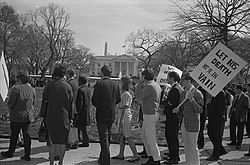
From top to bottom, left to right: Martin Luther King Jr. is assassinated in Memphis, Tennessee, sparking national unrest; Robert F. Kennedy is assassinated in Los Angeles after winning the California Democratic primary; the 1968 Summer Olympics in Mexico City occur under the shadow of the Tlatelolco massacre; protests erupt at the 1968 Democratic National Convention in Chicago; the Prague Spring sees reformist Alexander Dubček crushed by a Warsaw Pact invasion; the May protests mobilize millions of students and workers; Apollo 8 orbits the Moon and captures the iconic Earthrise photo; the Tet Offensive shifts U.S. public opinion on the Vietnam War; and the My Lai massacre results in the deaths of hundreds of civilians, highlighting the war’s moral failures.
| Years |
|---|
| Millennium |
| 2nd millennium |
| Centuries |
| Decades |
| Years |
| 1968 by topic |
|---|
| Subject |
| By country |
|
| Lists of leaders |
| Birth and death categories |
| Establishments and disestablishments categories |
| Works category |

Wikimedia Commons has media related to 1968.
1968 (MCMLXVIII) was a leap year starting on Monday of the Gregorian calendar, the 1968th year of the Common Era (CE) and Anno Domini (AD) designations, the 968th year of the 2nd millennium, the 68th year of the 20th century, and the 9th year of the 1960s decade.
Events
[edit]January–February
[edit].jpg)

- January – The I'm Backing Britain campaign starts spontaneously.
- January 5 – Prague Spring: Alexander Dubček is chosen as leader of the Communist Party of Czechoslovakia.[1]
- January 10 – John Gorton is sworn in as 19th Prime Minister of Australia, taking over from John McEwen after being elected leader of the Liberal Party the previous day, following the disappearance of Harold Holt. Gorton becomes the only Senator to become Prime Minister, though he immediately transfers to the House of Representatives through the 1968 Higgins by-election in Holt's vacant seat.
- January 15 – The 1968 Belice earthquake in Sicily kills 380 and injures around 1,000.[2][3]
- January 21
- Vietnam War: Battle of Khe Sanh – One of the most publicized and controversial battles of the war begins, ending on April 8.
- 1968 Thule Air Base B-52 crash: A U.S. B-52 Stratofortress crashes in Greenland, discharging 4 nuclear bombs.[4]
- January 23 – North Korea seizes the USS Pueblo, claiming the ship violated its territorial waters while spying.
- January 25 – Israeli submarine INS Dakar sinks in the Mediterranean Sea, killing 69.[5]
- January 28 – French submarine Minerve sinks in the Mediterranean Sea, killing 52.
- January 30 – Vietnam War: The Tet Offensive begins as Viet Cong forces launch a series of surprise attacks across South Vietnam.
- January 31
- Viet Cong soldiers attack the Embassy of the United States, Saigon.
- Nauru president Hammer DeRoburt declares independence from Australia, Britain and New Zealand.[6]
- February 1
- Vietnam War: Execution of Nguyễn Văn Lém – A Viet Cong officer is summarily executed by Nguyễn Ngọc Loan, a South Vietnamese National Police Chief. The event is photographed by Eddie Adams. The photo makes headlines around the world, eventually winning the 1969 Pulitzer Prize, and sways U.S. public opinion against the war.
- The Pennsylvania Railroad and the New York Central Railroad merge to form Penn Central, the largest ever corporate merger up to this date.
- February 6–18 – The 1968 Winter Olympics are held in Grenoble, France.
- February 8 – Civil rights movement in the United States: Orangeburg Massacre – A civil rights demonstration on a college campus to protest de facto racial segregation in South Carolina is broken up by highway patrolmen; three African American students are killed, the first instance of police killing student protestors at an American campus.
- February 12 – Vietnam War: Phong Nhị and Phong Nhất massacre.
- February 19 – The television series Mister Rogers' Neighborhood premieres on National Educational Television in the United States and becomes one of the longest running children's shows ever.
- February 24 – Vietnam War: The Tet Offensive is halted; South Vietnam recaptures Huế.
- February 25 – Vietnam War: Hà My massacre.
March–April
[edit]
- March 1
- Commonwealth Immigrants Act 1968 further reduces right of entry for citizens from the British Commonwealth to the United Kingdom.
- First performance of an Andrew Lloyd Webber–Tim Rice musical, Joseph and the Amazing Technicolor Dreamcoat in its original form as a "pop cantata", by pupils of a private school in London.[7][8][9]
- March 2 – Baggeridge Colliery closes marking the end of over 300 years of coal mining in the Black Country of England.[10]
- March 3 – Air France Flight 212, a Boeing 707, crashes in Guadeloupe while approaching an airport. As a result, 63 people die.
- March 6 – Un-recognized Rhodesia executes 3 black citizens, the first executions since UDI, prompting international condemnation.
- March 7 – Vietnam War: The First Battle of Saigon ends.
- March 8
- The first student protests spark the 1968 Polish political crisis.
- The Soviet ballistic missile submarine K-129 sinks with all 98 crew members, about 90 nautical miles (104 miles or 167 km) southwest of Hawaii.[11][12]
- March 10–11 – Vietnam War: Battle of Lima Site 85, the largest single ground combat loss of United States Air Force members (12) during the (at this time) secret war later known as the Laotian Civil War.
- March 11 – U.S. President Lyndon B. Johnson mandates that all computers purchased by the federal government support the ASCII character encoding.[13]
- March 12
- Mauritius achieves independence from British rule.
- U.S. President Lyndon B. Johnson barely edges out antiwar candidate Eugene McCarthy in the New Hampshire Democratic primary, a vote which highlights the deep divisions in the country, and the party, over Vietnam.
- March 13 – The first Rotaract club is chartered in North Charlotte, North Carolina.
- March 14
- Late this evening, the U.K. government at the request of the U.S. agrees that the London Gold Pool will be closed from tomorrow.[14] George Brown, the British Foreign Secretary, apparently drunk, is absent from meetings to discuss the crisis[15] and is forced to resign from the government on March 15.[16]
- Nerve gas leaks from the U.S. Army Dugway Proving Ground near Skull Valley, Utah.
- March 16
- Vietnam War – My Lai massacre: American troops kill between 347 and 504 unarmed civilians and rape women and children. The story, initially covered up as a military victory, will first become public in November 1969 and will help undermine public support for the U.S. efforts in Vietnam.
- U.S. Senator Robert F. Kennedy enters the race for the Democratic Party presidential nomination.
- March 18 – Gold standard: The United States Congress repeals the requirement for a gold reserve to back U.S. currency.
- March 19–23 – Afrocentrism, Black Power, Vietnam War: Students at Howard University in Washington, D.C., signal a new era of militant student activism on college campuses in the U.S. Students stage rallies, protests and a 5-day sit-in, laying siege to the administration building, shutting down the university in protest over its ROTC program and the Vietnam War, and demanding a more Afrocentric curriculum.
- March 22 – Daniel Cohn-Bendit ("Danny the Red") and 7 other students occupy the administrative offices of the new Nanterre campus of the University of Paris as part of protests over a rigid educational system, setting in motion a chain of 'May 68' events that lead France to the brink of revolution.
- March 24 – Aer Lingus Flight 712 crashes en route from Cork to London near Tuskar Rock, Wexford, killing 61 passengers and crew.
- March 28 – Brazilian high school student Edson Luís de Lima Souto is shot by the police in a protest for cheaper meals at a restaurant for low-income students. The aftermath of his death is one of the first major events against the military dictatorship.
- March 31 – In a televised address, U.S. President Lyndon B. Johnson announces that he will not be a candidate for re-election.
- April 2
- Bombs explode at midnight in two department stores in Frankfurt-am-Main; Andreas Baader and Gudrun Ensslin are later arrested and sentenced for arson.
- 2001: A Space Odyssey premieres in the Uptown Theater in Washington D.C.[17]
- April 4
- Assassination of Martin Luther King Jr.: Martin Luther King Jr. is shot dead at the Lorraine Motel in Memphis, Tennessee by James Earl Ray. King-assassination riots erupt in major American cities, lasting for several days afterwards.
- Apollo program: Apollo-Saturn mission 502 (Apollo 6) is launched, as the second and last uncrewed test-flight of the Saturn V launch vehicle.
- AEK Athens wins the FIBA European Cup Winners Cup Final in basketball against Slavia Prague, in front of a record attendance of 80,000 spectators. It is the first major European trophy won at club level of any sport in Greece.
- April 6
- 13th Eurovision Song Contest is held in the Royal Albert Hall, London. The winning song, Spain's "La, la, la" (music and lyrics by Manuel de la Calva and Ramón Arcusa) is sung in Spanish by Massiel after Spanish authorities refuse to allow Joan Manuel Serrat to perform it in Catalan. The United Kingdom finishes in second place, one point behind, with the song "Congratulations" sung by Cliff Richard, which goes on to outsell the winning Spanish entry throughout Europe.
- A shootout between Black Panthers and police in Oakland, California, results in several arrests and deaths, including 17-year-old Panther Bobby Hutton.
- Richmond, Indiana explosion: A double explosion in downtown Richmond caused by a methane leak kills 41 and injures 150.
- April 7 – British racing driver Jim Clark is killed in a Formula 2 race at Hockenheim.
- April 10 – The ferry TEV Wahine strikes a reef at the mouth of Wellington Harbour, New Zealand, with the loss of 53 lives, in Cyclone Giselle, which has created the windiest conditions ever recorded in New Zealand.
- April 11
- Josef Bachmann tries to assassinate Rudi Dutschke, leader of the left-wing movement (APO) in Germany, and tries to commit suicide afterwards, failing in both, although Dutschke dies of his brain injuries 11 years later.
- German left-wing students blockade the Springer Press headquarters in Berlin and many are arrested (one of them Ulrike Meinhof).
- April 18 – London Bridge is sold to U.S. entrepreneur Robert P. McCulloch for reconstruction at Lake Havasu City, Arizona.[18]
- April 20
- Pierre Elliott Trudeau becomes the 15th Prime Minister of Canada.[19]
- Conservative British politician Enoch Powell makes a controversial "Rivers of Blood" speech in Birmingham deploring the effects of immigration; he is dismissed from the Shadow Cabinet the following day.[20]
- South African Airways Flight 228 a Boeing 707 crashed shortly after take-off killing 123 people on board.
- April 23
- President Mobutu releases captured mercenaries in the Congo.
- Surgeons at the Hôpital de la Pitié, Paris, perform Europe's first heart transplant, on Clovis Roblain.
- The United Methodist Church is created by the union in Dallas, Texas, of the former Methodist and Evangelical United Brethren churches.
- April 23–30 – Vietnam War: Columbia University protests of 1968 – Student protesters at Columbia University in New York City take over administration buildings and shut down the university.
- April 26 – The nuclear weapon "Boxcar" is tested at the Nevada Test Site in the biggest detonation of Operation Crosstie.
May–June
[edit]
- May 1 – CARIFTA, the Caribbean Free Trade Association, is formally created as an agreement between Antigua and Barbuda, Barbados, Guyana, and Trinidad and Tobago.[21]
- May 2
- The Israel Broadcasting Authority commences television broadcasts.
- May 68: Authorities close the Nanterre campus of the University of Paris and the focus of protest moves to the Sorbonne.
- May 3 – Braniff Flight 352 crashes near Dawson, Texas, United States, killing all 85 people on board.
- May 6 – May 68: Student protestors begin battling with police on the streets of Paris.
- May 13
- May 68: Major left trade union federations in France call a 1-day general strike and join student protesters in a million-strong march through the streets of Paris.[22]
- Manchester City wins the 1967–68 Football League First Division by 2 clear points, over English club rivals Manchester United.
- May 16 – Ronan Point, a 23 floor tower block in Canning Town, east London, partially collapses after a gas explosion, killing 5.
- May 17 – The Catonsville Nine enter the Selective Service offices in Catonsville, Maryland, take dozens of selective service draft records, and burn them with napalm as a protest against the Vietnam War.
- May 18
- Mattel's Hot Wheels toy cars are introduced in the United States.
- West Bromwich Albion win the English Football Association Cup, defeating Everton 1–0 after extra time. The winning goal is scored by Jeff Astle.
- May 19
- 1968 Italian general election.
- Nigerian forces capture Port Harcourt and form a ring around the Biafrans. This contributes to a humanitarian disaster as the surrounded population already suffers from hunger and starvation.
- May 22 – The U.S. nuclear-powered submarine Scorpion sinks with 99 men aboard, 400 miles southwest of the Azores.
- May 27 – May 68: Grenelle agreements concluded in France, giving a large increase in minimum wages, but are rejected by trade unions.[23]
- May 29
- May 68: President de Gaulle of France leaves Paris without telling his prime minister, Georges Pompidou, where he is going – which is in fact to the headquarters of the French Forces in Germany at Baden-Baden to assure himself of military support.[24]
- Manchester United F.C. wins the European Cup Final, becoming the first English team to do so.
- May 30
- May 68: With hundreds of thousands marching on the streets of Paris, President de Gaulle calls an election, which has the effect of calming the situation.[24]
- Bobby Unser wins the Indianapolis 500 automobile race.
- June 2 – Student demonstrations in Yugoslavia start in Belgrade.
- June 3 – Radical feminist Valerie Solanas shoots Andy Warhol at his New York City studio, The Factory; he survives after a 5-hour operation.
- June 4 – The Standard & Poor's 500 index in the United States closes above 100 for the first time, at 100.38.
- June 5 – Assassination of Robert F. Kennedy: Senator Robert F. Kennedy, a leading 1968 Democratic presidential candidate, is shot at the Ambassador Hotel in Los Angeles. Palestinian-born Sirhan Sirhan is arrested.
- June 7 – Ford sewing machinists strike for equal pay starts at the Ford Dagenham plant in London.
- June 10 – Italy beats Yugoslavia 2–0 in a replay to win the 1968 European Championship in Association football. The original final on June 8 ended 1–1.
- June 12 – The horror film Rosemary's Baby premieres in the U.S.
- June 17 – The Malayan Communist Party launches a second insurgency and the state of emergency is again imposed in Malaysia.
- June 20 – Austin Currie, Member of the Parliament of Northern Ireland, along with others, squats in a house in Caledon to protest discrimination in housing allocations.
- June 21 – A student demonstration in front of the Jornal do Brasil ("JB") building in Rio de Janeiro ends with 28 dead and over a thousand arrested.
- June 23 – Puerta 12 tragedy: A football stampede in Buenos Aires leaves 74 dead and 150 injured.
- June 23–30 – 1968 French legislative election: The Gaullist Union pour la défense de la République becomes the first party in French political history to obtain an absolute majority in the National Assembly.[25] George Pompidou leads the party through the campaign but resigns as prime minister afterwards. The public unrest of May 68 subsides.
- June 26
- The Bonin Islands are returned to Japan after 23 years of occupation by the United States Navy.
- The "March of the One Hundred Thousand" takes place in Rio de Janeiro as crowds demonstrate against the Brazilian military government.
July–August
[edit]
- July 1 – The Nuclear Non-Proliferation Treaty opens for signature.
- July 4 – English yachtsman Alec Rose, 59, receives a hero's welcome as he sails into Portsmouth, after his 354-day solo round-the-world trip.
- July 17 – Saddam Hussein becomes Vice Chairman of the Revolutionary Council in Iraq after a coup d'état.
- July 18 – The semiconductor company Intel is founded in what becomes known as the Silicon Valley of California.
- July 20 – The first International Special Olympics Summer Games are held at Soldier Field in Chicago, Ill, with about 1,000 athletes with intellectual disabilities.
- July 23–28 – Black militants led by Fred (Ahmed) Evans engage in a fierce gunfight with police in the Glenville Shootout of Cleveland, Ohio, in the United States, leaving 7 people killed.
- July 25 – Pope Paul VI publishes the encyclical Humanae vitae, reaffirming the Catholic Church's opposition to artificial birth control.
- July 25- Tysons Corner Center[26] one of the largest malls in the U.S. opens to the public and the Washington DC area.
- July 26 – Vietnam War: South Vietnamese opposition leader Trương Đình Dzu is sentenced to 5 years hard labor for advocating the formation of a coalition government as a way to move toward an end to the war.
- July 29 – Arenal Volcano erupts in Costa Rica for the first time in centuries.
- August 1 – The Municipal University of São Caetano do Sul is established in São Caetano do Sul, São Paulo.
- August 2 – The magnitude (Mw) 7.6 Casiguran earthquake affects the Aurora province in the Philippines with a maximum Mercalli intensity of IX (Violent), killing at least 207 and injuring 261.
- August 5–8 – The Republican National Convention in Miami Beach, Florida nominates Richard Nixon for U.S. president and Spiro Agnew for vice president.
- August 11 – The last steam passenger train service runs in Britain. A selection of British Rail steam locomotives make the 120-mile journey from Liverpool to Carlisle and return – the journey is known as the Fifteen Guinea Special.
- August 18 – Two charter buses are forced into the Hida River on National Highway Route 41 in Japan in an accident caused by heavy rain; 104 are killed.
- August 20–21 – Warsaw Pact invasion of Czechoslovakia: The 'Prague Spring' of political liberalization ends, as 750,000 Warsaw Pact troops and 6,500 tanks with 800 aircraft invade Czechoslovakia, the largest military operation in Europe since the end of World War II.
- August 24 – Canopus (nuclear test): France explodes its first hydrogen bomb in a test at Fangataufa atoll in French Polynesia.
- August 22–30 – 1968 Democratic National Convention protests: Police clash with anti-Vietnam War protesters in Chicago outside the 1968 Democratic National Convention, which nominates Hubert Humphrey for U.S. president and Edmund Muskie for vice president. The riots and subsequent trials are an essential part of the activism of the Youth International Party.
- August 29 – Crown Prince Harald of Norway marries Sonja Haraldsen, the commoner he has dated for 9 years.
September–October
[edit]
- September 6 – Swaziland (later known as Eswatini) becomes independent of the United Kingdom.
- September 7 – The crash of Air France Flight 1611 kills 95 people, including French Army General René Cogny, as the Caravelle jetliner plunges into the Mediterranean Sea following a fire while making its approach to Nice following its departure from the island of Corsica.
- September 11
- The International Association of Classification Societies (IACS) is founded.[27]
- John Eliot Gardiner conducts Monteverdi's Vespro della Beata Vergine with the Monteverdi Choir at the BBC Proms in London.[28]
- September 13 – Albania officially withdraws from the Warsaw Pact upon the Soviet Union-led Warsaw Pact invasion of Czechoslovakia, having already ceased to participate actively in Pact activity since 1962.
- September 17 – The D'Oliveira affair: The Marylebone Cricket Club tour of South Africa is cancelled when the South Africans refuse to accept the presence of Basil D'Oliveira, a Cape Coloured, in the England side.
- September 21 – The Soviet Zond 5 uncrewed lunar flyby mission returns to Earth, with its first-of-a-kind biological payload intact.
- September 23 – Vietnam War: The Tet Offensive comes to an end in South Vietnam.
- September 27 – Marcelo Caetano becomes prime minister of Portugal.
- September 29 – A referendum in Greece gives more power to the military junta.
- October 2 – Tlatelolco massacre: A student demonstration ends in bloodbath at La Plaza de las Tres Culturas in Tlatelolco, Mexico City, Mexico, 10 days before the inauguration of the 1968 Summer Olympics. 300-400 are estimated to have been killed.
- October 3 – In Peru, Juan Velasco Alvarado takes power in a revolution.
- October 8 – Vietnam War: Operation Sealords – United States and South Vietnamese forces launch a new operation in the Mekong Delta.
- October 10 – The Detroit Tigers win the 1968 World Series in baseball in seven games.
- October 11
- Apollo program: NASA launches Apollo 7, the first crewed Apollo mission (Wally Schirra, Donn Eisele, Walter Cunningham). Mission goals include the first live television broadcast from orbit and simulating lunar module rendezvous and docking, using the S-IVB rocket stage as a test target.
- In Panama, a military coup d'état, led by Col. Boris Martinez and Col. Omar Torrijos, overthrows the democratically elected (but highly controversial) government of President Arnulfo Arias. Within a year, Torrijos ousts Martinez and takes charge as de facto Head of Government in Panama.
- October 12–27 – The 1968 Summer Olympics are held in Mexico City, Mexico.
- October 12 – Equatorial Guinea receives its independence from Spain.
- October 14 – Vietnam War: The United States Department of Defense announces that the United States Army and United States Marines will send about 24,000 troops back to Vietnam for involuntary second tours.
- October 16
- 1968 Olympics Black Power salute: In Mexico City, African-American athletes Tommie Smith and John Carlos raise their fists in a Black Power salute after winning, respectively, the gold and bronze medals in the Olympic men's 200 metres (with the support of Australian silver medallist Peter Norman).
- Kingston, Jamaica is rocked by the Rodney Riots, provoked by the banning of Guyanese-born academic and activist Walter Rodney from the country.
- October 18 – U.S. athlete Bob Beamon breaks the long jump world record by 55 cm / 213⁄4 ins at the Olympics in Mexico City. His record stands for 23 years, and remains the second longest jump in history.
- October 25 – Rock band Led Zeppelin make their first live performance, at Surrey University in England[29]
- October 31 – Vietnam War: Citing progress in the Paris peace talks (which began on May 13), U.S. President Lyndon B. Johnson announces to the nation that he has ordered a complete cessation of "all air, naval, and artillery bombardment of North Vietnam" effective November 1.
- October 31 – Great Drought of 1968: Amidst a collapse of hydropower President of Chile Eduardo Frei Montalva decrees the establishment of daylight saving time.[30][31]
November–December
[edit]
- November 5
- 1968 United States presidential election: Republican candidate Richard Nixon defeats the Democratic candidate, Vice President Hubert Humphrey, and American Independent Party candidate George Wallace.
- Luis A. Ferré of the newly formed New Progressive Party is elected Governor of Puerto Rico by beating incumbent governor Roberto Sánchez Vilella of the People's Party, Luis Negrón López of the Popular Democratic Party and Antonio J. Gonzalez of the Puerto Rican Independence Party; he also becomes the first "statehooder" governor of the Island.
- November 7 – Start of the 1968 movement in Pakistan, which leads to the resignation of General Ayub Khan, and ultimately the split of the country and formation of Bangladesh.
- November 8 – The Vienna Convention on Road Signs and Signals is signed and ratified.
- November 11 – A second republic is declared in the Maldives.
- November 15 – Vietnam War: Operation Commando Hunt is initiated to interdict men and supplies on the Ho Chi Minh trail, through Laos into South Vietnam. By the end of the operation, 3 million tons of bombs are dropped on Laos, slowing but not seriously disrupting trail operations.[32][33]
- November 17
- British European Airways introduces the BAC One-Eleven into commercial service.
- The "Heidi Game": NBC cuts off the final 1:05 of an Oakland Raiders–New York Jets football game to broadcast the pre-scheduled Heidi. Fans are unable to see Oakland (which had been trailing 32–29) score 2 late touchdowns to win 43–32; as a result, thousands of outraged football fans flood the NBC switchboards to protest.
- November 19 – In Mali, President Modibo Keïta's regime is overthrown in a bloodless military coup led by Moussa Traoré.[34]
- November 20 – The Farmington Mine disaster in Farmington, West Virginia, kills seventy-eight men.
- November 22
- The Beatles ("The White Album") and The Kinks Are the Village Green Preservation Society are released.[35]
- Japan Air Lines Flight 2, flying from Tokyo to San Francisco International Airport ditches in San Francisco Bay due to pilot error; all 107 on board survive without injury.
- November 24 – 4 men hijack Pan Am Flight 281 from JFK International Airport, New York to Havana, Cuba.
- December 9 – Douglas Engelbart publicly demonstrates his pioneering hypertext system, NLS, in San Francisco, together with the computer mouse, at what becomes retrospectively known as "The Mother of All Demos".
- December 10 – Japan's biggest heist, the never-solved "300 million yen robbery", occurs in Tokyo.
- December 11 – The film Oliver! based on the hit London and Broadway musical, opens in the U.S. after being released first in the UK. It goes on to win the Academy Award for Best Picture.
- December 13 – Prompted by growing unrest and a perceived proliferation of "pro-communist" violent actions, Brazilian president Artur da Costa e Silva enacts the so-called AI-5, the fifth of a series of non-constitutional emergency decrees allegedly to help "stabilize" the country after the turmoils of the early 1960s.
- December 20 – The first known Zodiac Killer murder takes place in Lake Herman Road, Vallejo, California.
- December 22 – Mao Zedong advocates that educated urban youth in China be sent for re-education in the countryside. It marks the start of the "Up to the mountains and down to the villages" movement.
- December 24 – Apollo program: The crewed U.S. spacecraft Apollo 8 enters orbit around the Moon. Astronauts Frank Borman, Jim Lovell and William Anders become the first humans to see the far side of the Moon and planet Earth as a whole, as well as having traveled further away from Earth than any people in history. Anders photographs Earthrise. The crew also give a reading from the Book of Genesis.
- December 28 – 1968 Israeli raid on Lebanon: Israeli forces fly into Lebanese airspace, launching an attack on the airport in Beirut and destroying more than a dozen aircraft.
Dates unknown
[edit]- The Khmer Rouge is officially formed in Cambodia as an offshoot movement of the Vietnam People's Army from North Vietnam to bring communism to the nation. A few years later, they will become bitter enemies.
- Drainage of the Flevopolder in the Netherlands is completed, creating by some definitions the largest artificial island in the world.[36][37]
- An oil field is confirmed in Northern Alaska: the Prudhoe Bay Oil Field.
Births
[edit]| Births |
|---|
| January · February · March · April · May · June · July · August · September · October · November · December |
January
[edit].jpg)


-2.jpg)
- January 1 – Davor Šuker, Croatian footballer
- January 2
- Oleg Deripaska, Russian businessman
- Cuba Gooding Jr., American actor
- Anky van Grunsven, Dutch equesterian
- January 5
- DJ BoBo, Swiss singer-songwriter and dancer
- Andrzej Gołota, Polish boxer[38]
- Carrie Ann Inaba, American choreographer, game show host and singer
- January 6 – John Singleton, African-American film director and writer (d. 2019)[39]
- January 9 – Silver King, Mexican luchador (d. 2019)
- January 10 – Nurul Amin, Bangladeshi politician
- January 11 – Benjamin List, German organic chemist, recipient of Nobel Prize in Chemistry
- January 12
- Rachael Harris, American actress and comedian[40]
- January 13 – Pat Onstad, Canadian soccer player
- January 14 – LL Cool J, African-American rapper and actor
- January 16 – Atticus Ross, English musician, songwriter, record producer and audio engineer
- January 17 – Svetlana Masterkova, Russian athlete
- January 18 – David Ayer, American filmmaker
- January 24
- Michael Kiske, German musician
- Mary Lou Retton, American gymnast
- January 26 – Novala Takemoto, Japanese author and fashion designer
- January 27 – Mike Patton, American singer
- January 28 – Sarah McLachlan, Canadian singer
- January 29 – Edward Burns, American actor
- January 30 – King Felipe VI of Spain
February
[edit]


.jpg)
- February 1
- Lisa Marie Presley, American singer-songwriter, daughter of Elvis Presley (d. 2023)
- Mark Recchi, Canadian ice hockey player
- February 3 – Vlade Divac, Serbian basketball player
- February 5
- Marcus Grönholm, Finnish rally driver
- Qasim Melho, Syrian television actor
- February 7
- Peter Bondra, Slovak ice hockey player
- Porntip Nakhirunkanok, Miss Universe 1988
- February 8
- Gary Coleman, African-American actor (d. 2010)
- April Stewart, American voice actress
- February 10
- Laurie Foell, New Zealand/Australian actress
- Atika Suri, Indonesian television newscaster
- February 11
- Lavinia Agache, Romanian artistic gymnast
- Mo Willems, American children's book author
- February 12 – Josh Brolin, American actor
- February 13
- Kelly Hu, American actress and voice artist, previously fashion model and beauty queen
- Niamh Kavanagh, Irish singer, Eurovision Song Contest 1993 winner
- February 14 – Jules Asner, American model and television personality
- February 15 – Gloria Trevi, Mexican singer and actress[41]
- February 18
- Molly Ringwald, American actress[42]
- Dennis Satin, German film director
- February 21 – Pellom McDaniels, American football player (d. 2020)
- February 22
- Bradley Nowell, American musician (d. 1996)
- Jeri Ryan, American actress
- February 23 – Jagath Wickramaratne, Sri Lankan politician and 23rd Speaker of the Parliament
- February 24
- Mitch Hedberg, American stand-up comedian (d. 2005)
- February 29 – Sam Sneed, American producer and rapper
March
[edit]

_(cropped).jpg)
.jpg)

- March 1
- Kat Cressida, American voice actress
- Kunjarani Devi, Indian weightlifter
- Muho Noelke, German Zen master
- March 2 – Daniel Craig, British actor
- March 3 – Brian Leetch, American ice hockey player
- March 4
- Giovanni Carrara, Venezuelan Major League Baseball player
- Patsy Kensit, British actress
- Kyriakos Mitsotakis, Greek politician, Prime Minister of Greece (2019–present)[43]
- March 5
- Gordon Bajnai, Hungarian Prime Minister
- Ambrose Mandvulo Dlamini, 10th Prime Minister of Eswatini (d. 2020)
- March 6 – Moira Kelly, American actress
- March 7 – Jeff Kent, American baseball player
- March 9
- Youri Djorkaeff, French footballer[44]
- Rexy Mainaky, Indonesian badminton player
- March 11 – Lisa Loeb, American singer
- March 12
- Aaron Eckhart, American actor
- Tammy Duckworth, US Senator
- March 13
- Gillian Keegan, British politician
- Masami Okui, Japanese singer
- March 14
- Megan Follows, Canadian-American actress[45]
- James Frain, British actor
- March 15
- Mark McGrath, American singer
- Terje Riis-Johansen, Norwegian politician
- Sabrina Salerno, Italian singer
- March 16
- David MacMillan, Scottish-born organic chemist, recipient of Nobel Prize in Chemistry
- Trevor Wilson, American basketball player
- March 20
- Carlos Almeida, Cape Verdean long-distance runner
- Ultra Naté, American singer-songwriter, record producer, DJ and promoter
- March 22 – Euronymous, Norwegian musician (d. 1993)
- March 23
- Damon Albarn, English singer-songwriter and musician[46]
- Mike Atherton, English cricketer[47]
- Fernando Hierro, Spanish football player and coach[48]
- March 26
- Kenny Chesney, American country music singer[49]
- James Iha, American rock musician
- March 27 – Ben Koldyke, American actor
- March 28 – Iris Chang, American author (d. 2004)[50]
- March 29 – Lucy Lawless, New Zealand actress and singer[51]
- March 30 – Celine Dion, Canadian singer[52]
- March 31 – César Sampaio, Brazilian football player and coach[53]
April
[edit]


- April 1
- Julia Boutros, Lebanese singer
- Andreas Schnaas, German director
- Alexander Stubb, 43rd Prime Minister of Finland
- April 5
- Paula Cole, American singer
- Stephen Bardo, American basketball player
- Stewart Lee, English stand-up comedian
- April 7 – Jože Možina, Slovenian historian, sociologist and journalist
- April 8
- Patricia Arquette, American actress
- Shawn Fonteno, American actor and rapper
- April 9 – Tom Brands, American Olympic wrestler
- April 11 – CB Milton, Dutch electronic music vocalist
- April 12
- Ott, English musician and record producer
- Neil Brady, Canadian ice hockey player
- April 13 – Necrobutcher, Norwegian musician
- April 14 – Anthony Michael Hall, American actor and singer
- April 15 – Stacey Williams, American model
- April 16
- Greg Baker, American actor and musician
- Martin Dahlin, Swedish football player
- Vickie Guerrero, American professional wrestler
- April 17
- Julie Fagerholt, Danish fashion designer
- Adam McKay, American film director, producer, screenwriter, comedian and actor
- April 18 – David Hewlett, English-born Canadian actor, writer and director
- April 19 – Ashley Judd, American actress
- April 20
- J. D. Roth, American television host
- Yelena Välbe, Russian cross-country skier
- April 22 – Zarley Zalapski, Canadian ice hockey player (d. 2017)
- April 23 – Timothy McVeigh, American terrorist (d. 2001)
- April 24
- Stacy Haiduk, American actress
- Jorge Medina, Bolivian civil rights activist and politician (d. 2022)[54]
- Yuji Nagata, Japanese professional wrestler
- April 28 – Howard Donald, British singer (Take That)
- April 29
- Kolinda Grabar-Kitarović, President of Croatia (2015–2020)[55]
- Michael Herbig, German film director, actor and author
- Darren Matthews, English professional wrestler
May
[edit].jpg)
.jpg)


.jpg)
- May 1 – Oliver Bierhoff, German footballer
- May 2
- Jeff Agoos, American soccer player
- Hikaru Midorikawa, Japanese voice actor
- May 3
- Nina Paley, American cartoonist
- Li Yong, Chinese host (d. 2018)
- Amy Ryan, American actress
- May 4
- Julian Barratt, English comedian, actor, musician and music producer
- Momoko Kikuchi, Japanese actress and singer
- Eric Xun Li, Chinese venture capitalist
- May 5 – John Soko, Zambian footballer (d. 1993)
- May 7
- Eagle-Eye Cherry, Swedish-born musician
- Traci Lords, American actress
- May 8
- Mickaël Madar, French footballer[56]
- Éric Martineau, French politician[57]
- May 9
- Carla Overbeck, American soccer player
- Marie-José Pérec, French athlete
- Nataša Pirc Musar, Slovenian politician, attorney, author, journalist and 5th President of Slovenia
- May 10 – Al Murray, English comedian
- May 12 – Tony Hawk, American skateboarder
- May 13
- Sonja Zietlow, German television presenter
- Scott Morrison, 30th Prime Minister of Australia
- May 14 – Greg Davies, English actor, comedian and presenter
- May 16 – Chingmy Yau, Hong Kong actress
- May 17 – Constance Menard, French professional dressage rider
- May 18 – Vanessa Leggett, American freelance journalist, author, lecturer and First Amendment advocate
- May 19 – Kyle Eastwood, American jazz bass musician
- May 20
- Timothy Olyphant, American actor
- Waisale Serevi, Fijian rugby player
- May 22
- Michael Kelly, American actor
- Graham Linehan, Irish television writer and director
- May 23 – John Ortiz, American actor
- May 24 – Charles De'Ath, English actor
- May 26 – King Frederik X of Denmark
- May 27
- Jeff Bagwell, American baseball player
- Frank Thomas, American baseball player
- May 28 – Kylie Minogue, Australian actress and singer
- May 30 – Zacarias Moussaoui, French-Moroccan 9/11 conspirator
June
[edit]
.jpg)
.jpg)
.jpg)

.jpg)
- June 1 – Jason Donovan, Australian actor and singer
- June 2
- Beetlejuice, American entertainer, member of the Wack Pack (The Howard Stern Show)
- Jon Culshaw, English impressionist
- June 4 – Scott Wolf, American actor
- June 5 – Sandra Annenberg, Brazilian newscaster, previously actress
- Mel Giedroyc, English comedian and presenter
- June 9 – Aleksandr Konovalov, Russian lawyer and politician
- June 10
- Bill Burr, American comedian
- Nobutoshi Canna, Japanese voice actor
- June 14
- Yasmine Bleeth, American actress
- Raj Thackeray, Indian politician
- June 16 – Mariana Mazzucato, Italian born-American economist[58]
- June 20 – Mateusz Morawiecki, Polish banker and politician, 17th Prime Minister of Poland
- June 22 – Lohan Ratwatte, Sri Lankan politician, MP (2010–2024) (d. 2025)
- June 24 – Boris Gelfand, Israeli chess grandmaster
- June 25 – Albert Fulivai, Tongan rugby league player
- June 26
- Paolo Maldini, Italian football player
- Jovenel Moïse, 42nd President of Haiti (d. 2021)[59]
- Iwan Roberts, Welsh footballer
- June 27 – Isabel Saint Malo, Panamian politician
- June 28
- Chayanne, Puerto Rican-American singer
- Adam Woodyatt, English actor
- June 29 – Theoren Fleury, Canadian ice hockey player[60]
- June 30 – Phil Anselmo, American heavy metal vocalist
July
[edit].jpg)


.jpg)
.jpg)

- July 5
- Ken Akamatsu, Japanese manga artist
- Darin LaHood, American attorney and politician[61]
- Michael Stuhlbarg, American actor
- July 6 – Rashid Sidek, Malaysian badminton player and coach
- July 7
- Jorja Fox, American actress
- Allen Payne, American actor
- Jeff VanderMeer, American writer
- July 8
- Billy Crudup, American actor
- Akio Suyama, Japanese voice actor
- Josephine Teo, Singaporean politician
- Michael Weatherly, American actor
- July 9 – Eduardo Santamarina, Mexican actor
- July 10 – Hassiba Boulmerka, Algerian athlete
- July 11 – Conrad Vernon, American voice actor and director
- July 13
- Robert Gant, American actor
- Omi Minami, Japanese voice actress
- July 14 – Samantha Gori, Italian basketball player
- July 15
- Leticia Calderón, Mexican actress
- Rosalinda Celentano, Italian actress
- Eddie Griffin, American actor and comedian
- July 16
- Dhanraj Pillay, Indian field hockey player
- Barry Sanders, American football player
- Olga de Souza, Brazilian-Italian singer, model and dancer
- July 17
- Darren Day, British actor and TV presenter
- Beth Littleford, American actress and comedian
- July 18 – Grant Bowler, New Zealand-born Australian actor
- July 19 – Robert Flynn, American vocalist and guitarist (Machine Head)
- July 20 – Jimmy Carson, American ice hockey player
- July 23
- Elden Campbell, American basketball player (d. 2025)
- Gary Payton, American basketball player
- Stephanie Seymour, American model and actress
- July 24
- Kristin Chenoweth, American actress and singer
- Troy Kotsur, American actor
- Laura Leighton, American actress
- July 25 – John Grant, American singer-songwriter
- July 27
- Cliff Curtis, New Zealand actor
- Julian McMahon, Australian actor (d. 2025)
- July 30
- Terry Crews, American actor, television host and artist, previously American football player
- Robert Korzeniowski, Polish athlete
August
[edit]


.jpg)


- August 1 – Pavo Urban, Croatian photographer (d. 1991)
- August 3 – Rod Beck, American baseball player (d. 2007)
- August 4
- Lee Mack, English actor and stand-up comedian
- Olga Neuwirth, Austrian composer
- August 5 – Patricia Tarabini, Argentine tennis player
- Marine Le Pen, French politician
- Colin McRae, Scottish rally car driver (d. 2007)
- August 6
- August 7 – Lynn Strait, American musician (d. 1998)
- August 8 – Kimberly Brooks, American actress and voice artist
- August 9
- Gillian Anderson, American actress
- Eric Bana, Australian actor
- James Roy, Australian author
- August 11 – Vladimir Kosterin, Ukrainian businessman and foundation president[62]
- August 12
- Pablo Rey, Spanish painter
- Paul Tucker, English songwriter and record producer
- Kōji Yusa, Japanese voice actor
- August 14
- Catherine Bell, American actress
- Darren Clarke, Northern Irish golfer
- Jennifer Flavin, businesswoman, previously model
- Jason Leonard, English rugby union player
- August 15 – Debra Messing, American actress
- August 16 – Arvind Kejriwal, Indian politician
- August 17
- Ed McCaffrey, American football player
- Bruno van Pottelsberghe, Belgian economist
- Helen McCrory, English actress (d. 2021)
- August 20
- Klas Ingesson, Swedish footballer (d. 2014)
- Yuri Shiratori Japanese actress and singer
- Bai Yansong, Chinese host
- August 21
- Dina Carroll, British singer
- Stretch, American rapper and record producer (d. 1995)
- August 24
- Shoichi Funaki, Japanese professional wrestler
- Hiroshi Kitadani, Japanese singer
- Tim Salmon, American baseball player
- Daniel Pollock, Australian actor (d. 1992)
- August 25 – Rachael Ray, American television chef and host
- August 27
- Bong Rivera, Filipino politician and businessman
- Luis Tascón, Venezuelan politician (d. 2010)
- August 28
- Billy Boyd, Scottish actor
- Tom Warburton, American animator
- August 31
- Valdon Dowiyogo, Nauruan politician and Australian football player
- Hideo Nomo, Japanese baseball player
September
[edit]_(cropped).jpg)
.jpg)


.jpg)

_(cropped).jpg)
_(cropped).jpg)
- September 1
- Mohamed Atta, 9/11 ringleader of the hijackers and pilot of American Airlines Flight 11 (d. 2001)
- Atsuko Yuya, Japanese voice actress
- September 2 – Francisco Acevedo, American serial killer[63]
- September 3 – Raymond Coulthard, English actor
- September 4
- John DiMaggio, American voice actor and comedian
- Mike Piazza, American baseball player
- September 5 – Thomas Levet, French golfer
- September 7 – Marcel Desailly, French footballer
- September 9 – Julia Sawalha, English actress
- September 10
- Big Daddy Kane, American hip-hop artist
- Guy Ritchie, British film director
- September 11
- Kay Hanley, American musician
- Tetsuo Kurata, Japanese actor model
- September 13 – Laura Cutina, Romanian artistic gymnast
- September 15 – Danny Nucci, American actor
- September 16 – Marc Anthony, American actor and singer
- September 17
- Anastacia, American singer-songwriter
- Tito Vilanova, Spanish football manager (d. 2014)
- September 18 – Toni Kukoč, Croatian basketball player
- September 20 – Van Jones, African-American author
- September 21
- Lisa Angell, French singer
- Kevin Buzzard, British mathematician
- Ricki Lake, American actress, producer and television presenter
- September 22 – Mihai Răzvan Ungureanu, 62nd Prime Minister of Romania
- September 23 – Michelle Thomas, American actress (d. 1998)
- September 25
- Prince Friso of Orange-Nassau, (d. 2013)
- John A. List, American economist
- Will Smith, African-American actor and rapper
- September 26
- James Caviezel, American actor
- Michelle Meldrum, American guitarist (d. 2008)
- Tricia O'Kelley, American actress
- Ben Shenkman, American television, film and stage actor
- September 27
- Mari Kiviniemi, 62nd Prime Minister of Finland
- Shofiqul Haque Milon, Bangladeshi politician
- Paul Rudish, American voice actor and animator
- September 28
- Mika Häkkinen, Finnish double Formula 1 world champion
- Naomi Watts, British actress and film producer
- September 29
- Patrick Burns, American paranormal investigator and television personality
- Luke Goss, English singer and actor
- Alex Skolnick, American jazz/heavy metal guitarist
- Samir Soni, Indian film and TV actor
- September 30 – Bennet Omalu, Nigerian pathologist
October
[edit]- October 1
- Kevin Griffin, American singer-songwriter, frontman of Better Than Ezra[64]
- Mark Durden-Smith, British television presenter
- Jay Underwood, American actor
- October 2
- Lucy Cohu, English actress
- Victoria Derbyshire, English broadcast presenter
- Jana Novotná, Czech tennis player (d. 2017)
- October 3 – Nadia Calviño, Spanish politician
- October 7
- Luminița Anghel, Romanian dance/pop recording artist, songwriter, television personality and politician
- Thom Yorke, British singer-songwriter
- October 8
- Daniela Castelo, Argentine journalist (d. 2011)
- Emily Procter, American actress
- October 9
- Troy Davis, American high-profile death row inmate and human rights activist (d. 2011)
- Pete Docter, American animator, director
- October 10
- Bart Brentjens, Dutch mountainbiker
- Feridun Düzağaç, Turkish rock singer-songwriter
- October 11
- Tiffany Grant, American voice actress
- Jane Krakowski, American actress
- Brett Salisbury, American football quarterback
- October 12
- Paul Harragon, Australian rugby league player
- Hugh Jackman, Australian actor, singer and producer
- October 13
- Preet Bharara, Indian-American politician
- Tisha Campbell-Martin, American actress and singer
- October 14
- Matthew Le Tissier, English footballer
- October 15
- Didier Deschamps, French footballer
- Jyrki 69, Finnish singer
- Nashwa Mustafa, Egyptian actress
- October 16 – Michael Stich, German tennis player
- October 20 – Damien Timmer, British joint-managing director, television producer, television executive producer
- October 22 – Shaggy, Jamaican singer
- October 24 – Mark Walton, American story artist, actor
- October 27 – Alain Auderset, Swedish writer
- October 28 – Juan Orlando Hernández, 55th President of Honduras
- October 29
- Johann Olav Koss, Norwegian speed skater[65]
- Tsunku, Japanese singer, music producer and song composer
- John Farley, American actor and comedian
- October 30
- Moira Quirk, English actress and voice actress
- Jack Plotnick, American film and television actor, writer and producer
November
[edit]_(cropped).jpg)


.jpg)


.jpg)
_(rotated).jpg)


- November 1 – Silvio Fauner, Italian cross-country skier
- November 4
- Lee Germon, New Zealand cricketer
- Daniel Landa, Czech composer, singer and actor
- Miles Long, American pornographic actor and director
- November 5
- Mr. Catra, Brazilian musician (d. 2018)
- Sam Rockwell, American actor
- Seth Gilliam, African-American actor
- Penny Wong, Australian politician, Foreign Minister [66]
- November 6 – Kelly Rutherford, American actress
- November 7 – Ignacio Padilla, Mexican writer (d. 2016)
- November 8
- Parker Posey, American actress
- Zara Whites, Dutch actress
- November 9 – Nazzareno Carusi, Italian classical pianist
- November 10 – Tracy Morgan, African-American actor and comedian
- November 12
- Kathleen Hanna, American musician and activist
- Aya Hisakawa, Japanese voice actress
- Sammy Sosa, Dominican Major League Baseball player
- November 13 – Pat Hentgen, American baseball player
- November 15
- Fausto Brizzi, Italian screenwriter and film director
- Ol' Dirty Bastard, American rapper (d. 2004)
- November 16 – Tammy Lauren, American actress
- November 18
- Barry Hunter, Northern Irish footballer and football manager
- Luizianne Lins, Brazilian politician
- Owen Wilson, American actor and comedian
- November 20
- Chew Chor Meng, Singaporean Chinese television actor
- Tarique Rahman - Bangladeshi politician, 11th Prime Minister of Bangladesh[67]
- Jules Trobaugh, American artist and photographer
- November 21
- Qiao Hong, Chinese table tennis player
- Sean Schemmel, American voice actor
- November 24
- Phil Starbuck, English footballer
- Awie, Malaysian rock singer
- yukihiro, Japanese musician
- November 25
- Tunde Baiyewu, British singer
- Jill Hennessy, Canadian actress
- November 27 – Michael Vartan, French actor
- November 29
- Hayabusa, Japanese professional wrestler (d. 2016)
- Jonathan Knight, American singer
- November 30 – Rica Matsumoto, Japanese actress, voice actress and singer
December
[edit]

.jpg)

.jpg)

- December 2
- Lucy Liu, American actress, voice actress, director, singer, dancer, model and artist
- Rena Sofer, American actress
- December 3
- Brendan Fraser, Canadian-American actor
- Montell Jordan, American singer
- December 5
- Margaret Cho, American actress and comedian
- Wendi Deng Murdoch, Chinese-American entrepreneur and businesswoman
- December 7
- Mark Geyer, Australian rugby league player
- David Kabré, Burkinabe military leader and politician
- December 9 – Kurt Angle, American amateur and professional wrestler, 1996 Olympic gold medalist
- December 11
- Emmanuelle Charpentier, French biochemist, recipient of Nobel Prize in Chemistry
- Monique Garbrecht-Enfeldt, German speed skater
- Eula Valdez, Filipino actress
- December 18
- Casper Van Dien, American actor
- Rachel Griffiths, Australian actress
- December 19 – Ken Marino, American actor and comedian
- December 20 – Nadia Farès, Moroccan born-French actress
- December 21 – Khrystyne Haje, American actress
- December 22 – Dina Meyer, American actress
- December 23 – Manuel Rivera-Ortiz, American photographer
- December 24 – Choi Jin-sil, South Korean actress and model (d. 2008)
- December 25 – Helena Christensen, Danish model
- December 28 – Lior Ashkenazi, Israeli actor
- December 30 – Fabrice Guy, French Olympic skier
Unknown date
[edit]- Eleonora Requena, Venezuelan poet.[68]
- Martin Ssempa, Ugandan pastor and internet meme.
- Isadora Zubillaga, Venezuelan diplomat and activist.[69]
Deaths
[edit]| Deaths |
|---|
| January · February · March · April · May · June · July · August · September · October · November · December |
January
[edit]

- January 4
- Armando Castellazzi, Italian footballer and manager (b. 1904)
- Joseph Pholien, Belgian politician, 37th Prime Minister of Belgium (b. 1884)
- January 6 – Karl Kobelt, 2-time President of the Swiss Confederation (b. 1891)
- January 7
- Gholamreza Takhti, Iranian wrestler (b. 1930)
- Mario Roatta, Italian general (b. 1887)
- January 9 – Kōkichi Tsuburaya, Japanese athlete (b. 1940)
- January 10
- Ali Fuat Cebesoy, Turkish politician (b. 1882)
- Eben Dönges, acting Prime Minister of South Africa and elected President of South Africa (b. 1898)
- January 15 – Leopold Infeld, Polish physicist (b. 1898)
- January 16 – Bob Jones Sr., American evangelist, religious broadcaster and founder of Bob Jones University (b. 1883)[70]
- January 18 – John Ridgely, American actor (b. 1909)
- January 21 – Georg Dertinger, German politician (b. 1902)
- January 22
- Aleksandr Arbuzov, Russian chemist (b. 1877)
- Duke Kahanamoku, American Olympic swimmer (b. 1890)
- January 29 – Tsuguharu Foujita, Japanese-French painter and printmaker (b. 1886)
February
[edit]

- February 4
- Eddie Baker, American actor (b. 1897)
- Neal Cassady, American author and poet (b. 1926)
- February 7 – Nick Adams, American actor (b. 1931)
- February 10 – Pitirim Sorokin, Russian-born American sociologist (b. 1889)
- February 11 – Howard Lindsay, American playwright (b. 1888)
- February 13
- Mae Marsh, American actress (b. 1894)
- Ildebrando Pizzetti, Italian composer (b. 1880)
- Portia White, Canadian opera singer (b. 1911)[71]
- February 15 – Little Walter, American blues musician and singer-songwriter (b. 1930)
- February 17 – Sir Donald Wolfit, English actor (b. 1902)
- February 19 – Georg Hackenschmidt, German strongman and professional wrestler (b. 1877)
- February 20 – Anthony Asquith, British film director and writer (b. 1902)[72]
- February 21 – Howard Florey, Australian-born pharmacologist, recipient of the Nobel Prize for Physiology or Medicine (b. 1898)
- February 22 – Peter Arno, American cartoonist (b. 1904)
- February 25 – Camille Huysmans, Belgian politician, 34th Prime Minister of Belgium (b. 1871)
- February 27
- Frankie Lymon, American singer (b. 1942)
- Hertha Sponer, German physicist and chemist (b. 1895)
- February 29 – Hugo Benioff, American seismologist (b. 1899)
March
[edit]_-_Restoration.jpg)
- March 6 – Joseph W. Martin Jr., American politician (b. 1884)
- March 8 – Jerzy Braun, Polish athlete (b. 1911)
- March 14 – Erwin Panofsky, German-Jewish art historian (b. 1892)
- March 15 – Khuang Aphaiwong, 4th Prime Minister of Thailand, country leader during World War II (b. 1902)
- March 16 – Mario Castelnuovo-Tedesco, Italian composer (b. 1895)[73]
- March 20 – Carl Theodor Dreyer, Danish film director (b. 1889)[74]
- March 23 – Edwin O'Connor, American journalist, novelist and radio commentator (b. 1918)[75]
- March 24 – Alice Guy-Blaché, French filmmaker (b. 1873)[76]
- March 27 – Yuri Gagarin, Soviet cosmonaut, first human in space (b. 1934)[77]
- March 30 – Bobby Driscoll, American child actor (b. 1937)
April
[edit]

- April 1 – Lev Landau, Russian physicist, Nobel Prize laureate (b. 1908)
- April 4
- Martin Luther King Jr., American civil rights leader, recipient of the Nobel Peace Prize (b. 1929)
- Assis Chateaubriand, Brazilian newspaper magnate (b. 1892)
- April 7 – Jim Clark, Scottish racing driver and double Formula One World Champion (b. 1936)
- April 12 – Heinrich Nordhoff, German automotive engineer (b. 1899)[78]
- April 15 – Boris Lyatoshinsky, Ukrainian composer, conductor and teacher (b. 1895)
- April 16
- Fay Bainter, American actress (b. 1893)
- Albert Betz, German physicist (b. 1885)
- Edna Ferber, American writer (b. 1885)[79]
- April 20 – Soraya Tarzi, Afghan queen (b. 1899)[80]
- April 24
- Tommy Noonan, American actor (b. 1921)
- Walter Tewksbury, American athlete (b. 1876)
- April 26 – John Heartfield, German visual artist (b. 1891)
- April 28 – Raoul Abatchou, Central African politician and mining operator (b. 1926)[81]
May
[edit]- May 5 – Albert Dekker, American actor (b. 1905)
- May 7 – Lurleen Wallace, American politician (b. 1926)
- May 9
- Finlay Currie, Scottish actor (b. 1878)
- Mercedes de Acosta, American poet, playwright and novelist (b. 1892)
- Marion Lorne, American actress (b. 1883)
- May 10 – Scotty Beckett, American child actor (b. 1929)
- May 11 – Robert Burks, American cinematographer (b. 1909)
- May 14 – Husband E. Kimmel, American admiral (b. 1882)
- May 23 – Franco Riccardi, Italian fencer, Olympic champion (b. 1905)[82]
- May 25 – Georg von Küchler, German field marshal and war criminal (b. 1881)
- May 26 – Little Willie John, American R&B singer (b. 1937)
- May 28
- Kees van Dongen, Dutch-French painter (b. 1877)
- Fyodor Okhlopkov, Soviet sniper (b. 1908)
June
[edit]

- June 1 – Helen Keller, American activist and spokeswoman for the deaf and blind (b. 1880)[83]
- June 2 – R. Norris Williams, American tennis player (b. 1891)
- June 4
- Dorothy Gish, American actress (b. 1898)
- Sir Walter Nash, 27th Prime Minister of New Zealand (b. 1882)[84]
- June 6
- Randolph Churchill, British politician, son of Winston Churchill (b. 1911)
- Robert F. Kennedy, American lawyer, politician (United States Senator, U.S. Attorney General) and a leading 1968 Democratic presidential candidate (b. 1925)
- June 7 – Dan Duryea, American actor (b. 1907)
- June 8 – Ludovico Scarfiotti, Italian racing driver (b. 1933)
- June 14
- Karl-Birger Blomdahl, Swedish composer (b. 1916)
- Salvatore Quasimodo, Italian writer, Nobel Prize laureate (b. 1901)
- Ernest Stoneman, American country music artist (b. 1893)[85]
- June 15
- Sam Crawford, American baseball player (b. 1880)[86]
- Wes Montgomery, American jazz guitarist (b. 1923)
- June 17 – José Nasazzi, Uruguayan footballer (b. 1901)
- June 18 – Nikolaus von Falkenhorst, German general and war criminal (b. 1885)
- June 25 – Tony Hancock, English comedian and actor (b. 1924)
July
[edit]
.jpg)
- July 1
- Fritz Bauer, German judge and prosecutor (b. 1903)
- Virginia Weidler, American actress (b. 1927)
- July 2
- Zaki al-Arsuzi, Syrian philosopher, philologist, sociologist and historian (b. 1899)
- Francis Brennan, American cardinal (b. 1894)
- July 7 – Jo Schlesser, French racing driver (b. 1928)
- July 9 – Alexander Cadogan, British diplomat (b. 1884)
- July 12 – José Bordas Valdez, 43rd President of the Dominican Republic (b. 1874)
- July 13 – Ilias Tsirimokos, Prime Minister of Greece (b. 1907)[87]
- July 14 – Konstantin Paustovsky, Russian-Soviet writer (b. 1892)
- July 15 – Cai Chusheng, Chinese film director (b. 1906)
- July 18 – Corneille Heymans, Belgian physiologist, Nobel Prize laureate (b. 1892)
- July 20 – Joseph Keilberth, German conductor (b. 1908)
- July 21 – Ruth St. Denis, American dancer (b. 1879)
- July 22 – Giovannino Guareschi, Italian journalist (b. 1908)
- July 23
- Luigi Cevenini, Italian footballer and coach (b. 1895)
- Sir Henry Dale, English pharmacologist and physiologist (b. 1875)
- July 27 – Lilian Harvey, Anglo-German actress and singer (b. 1906)
- July 28
- Otto Hahn, German chemist, discoverer of nuclear fission, Nobel Prize laureate (b. 1879)
- Ángel Herrera Oria, Spanish journalist, politician, cardinal and servant of God (b. 1886)
August
[edit]
- August 3 – Konstantin Rokossovsky, Soviet officer, Marshal of the Soviet Union (b. 1896)
- August 5 – Luther Perkins, American guitarist (b. 1928)
- August 10 – Ratna Asmara, Indonesian actress and director (b. 1913)
- August 19 – George Gamow, Soviet-American theoretical physicist and cosmologist (b. 1904)
- August 25 – Stan McCabe, Australian cricketer (b. 1910)
- August 26 – Kay Francis, American actress (b. 1905)
- August 27
- Robert Z. Leonard, American film director (b. 1889)
- Princess Marina of Greece and Denmark (b. 1906)
- August 29 – Ulysses S. Grant III, American soldier and planner (b. 1881)[88]
- August 30 – William Talman, American actor (b. 1915)
- August 31 – Dennis O'Keefe, American actor (b. 1908)
September
[edit]
- September 3 – Juan José Castro, Argentine composer and conductor (b. 1895)
- September 7 – Lucio Fontana, Italian painter and sculptor (b. 1899)
- September 13 – Frank Barson, English footballer (b. 1891)
- September 17 – Armand Blanchonnet, French Olympic cyclist (b. 1903)
- September 18
- Franchot Tone, American actor (b. 1905)
- Francis McDonald, American actor (b. 1891)
- September 19
- Chester Carlson, American physicist and inventor (b. 1906)
- Red Foley, American singer (b. 1910)
- September 23 – Padre Pio, Italian Roman Catholic priest and saint (b. 1887)
- September 24 – Virginia Valli, American actress (b. 1898)
- September 28 – Sir Norman Brookes, Australian tennis champion (b. 1877)
October
[edit].jpg)
,_lecturing_at_Catholic_University,_Washington,_D.C.,_1946.jpg)
- October 1 – Romano Guardini, Italian-German Catholic priest and theologian (b. 1885)
- October 2 – Marcel Duchamp, French artist (b. 1887)
- October 4
- Francis Biddle, American politician (b. 1886)
- Hitoshi Imamura, Japanese general (b. 1886)
- October 13
- Manuel Bandeira, Brazilian poet, literary critic and translator (b. 1886)
- Bea Benaderet, American actress (b. 1906)
- October 15
- Franz Beyer, German general (b. 1892)
- Herbert Copeland, American biologist (b. 1902)
- October 18 – Lee Tracy, American actor (b. 1898)
- October 20 – Bud Flanagan, British entertainer and comedian (b. 1896)[89]
- October 26 – Sergei Bernstein, Russian and Soviet mathematician (b. 1880)
- October 27 – Lise Meitner, German-Austrian physicist, discoverer of nuclear fission (b. 1878)
- October 28 – Hans Cramer, German general (b. 1896)
- October 30
- Rose Wilder Lane, American author (b. 1886)[90]
- Ramon Novarro, Mexican-born American actor (b. 1899)
- Conrad Richter, American writer (b. 1890)
November
[edit]

- November 1 – Georgios Papandreou, 3-time Prime Minister of Greece (b. 1888)
- November 6 – Charles Munch, French conductor (b. 1891)
- November 7 – Alexander Gelfond, Soviet mathematician (b. 1906)
- November 8 – Wendell Corey, American actor (b. 1914)
- November 9
- Jan Johansson, Swedish jazz pianist (b. 1931)
- Gerald Mohr, American actor (b. 1914)
- November 11 – Jeanne Demessieux, French composer (b. 1921)
- November 14 – Ramón Menéndez Pidal, Spanish philologist and historian (b. 1869)
- November 15 – Charles Bacon, American athlete (b. 1885)
- November 16
- Augustin Bea, German cardinal (b. 1881)
- Carl Bertilsson, Swedish gymnast (b. 1889)
- November 17
- Abdul Wahed Bokainagari, Bengali politician (b. 1876)[91]
- Mervyn Peake, English writer, artist, poet and illustrator (b. 1911)[92]
- November 18 – Walter Wanger, American film producer (b. 1894)
- November 20 – Helen Gardner, American actress (b. 1884)
- November 24 – István Dobi, prime minister of Hungary (b. 1898)[93]
- November 25 – Upton Sinclair, American writer (b. 1878)[94]
- November 26 – Arnold Zweig, German writer, pacifist and socialist (b. 1887)
- November 28 – Enid Blyton, English writer (b. 1897)
- November 30 – Charles Henry Bartlett, British cyclist (b. 1885)
December
[edit]


- December 1
- Hugo Haas, Czech actor, director and writer (b. 1901)
- Darío Moreno, Turkish-Jewish polyglot singer, composer, lyricist and guitarist (b. 1921)
- December 4 – Archie Mayo, American actor and director (b. 1891)
- December 5 – Fred Clark, American actor (b. 1914)
- December 9 – Enoch L. Johnson, American political boss and racketeer (b. 1883)
- December 10
- Karl Barth, German Protestant theologian (b. 1886)
- Thomas Merton, American author (b. 1915)
- December 12
- Tim Ahearne, Irish athlete (b. 1885)
- Tallulah Bankhead, American actress (b. 1902)
- December 14 – Dorothy Payne Whitney, American-born philanthropist, social activist (b. 1887)[95]
- December 18 – Giovanni Messe, Italian field marshal and politician (b. 1883)
- December 19 – Norman Thomas, American socialist (b. 1884)
- December 20
- Max Brod, Czech-born Israeli composer, writer and biographer (b. 1884)
- John Steinbeck, American writer, Nobel Prize laureate (b. 1902)[96]
- December 21 – Vittorio Pozzo, Italian football player and manager (b. 1886)[97]
- December 30
- Augustus Agar, British naval officer, Victoria Cross recipient (b. 1890)
- Trygve Lie, Norwegian politician, 1st Secretary General of the United Nations (b. 1896)[98]
- Bill Tytla, Ukrainian-born American animator (b. 1904)[99]
- Kirill Meretskov, Soviet military officer, Marshal of the Soviet Union (b. 1897)
- December 31 – George Lewis, American musician (b. 1900)
Date unknown
[edit]Nobel Prizes
[edit]
References
[edit]- ^ Navazelskis, Inabhfghh (1990). Alexander Dubcek. Chelsea House Publications. ISBN 1-55546-831-4.
- ^ "Italy: The Day the Earth Shook". Time. January 26, 1968. Archived from the original on March 6, 2008. Retrieved August 2, 2011.
- ^ "CPTI – catalogo (per finestre temporali)". emidius.mi.ingv.it.
- ^ Conversation, -Timothy J. Jorgensen for The Conversation Timothy J. Jorgensen for The (January 21, 2018). "50 years ago, a U.S. military jet crashed in Greenland – with 4 nuclear bombs on board". PBS News. Retrieved September 27, 2025.
- ^ Gross, Judah Ari (May 28, 2018). "50 years after enigmatic sinking, Israel releases footage of search for lost sub". The Times of Israel. ISSN 0040-7909. Retrieved September 4, 2025.
- ^ "Nauru: How Pleasant Island became world's smallest republic".
- ^ Vocal Selections: Joseph and the Amazing Technicolor Dreamcoat. Milwaukee, WI: Hal Leonard. 1994. ISBN 978-0-7935-3427-2.
- ^ "About The Show". The Really Useful Group. Archived from the original on December 25, 2008. Retrieved December 29, 2008.
- ^ "Joseph and the Amazing Technicolor Dreamcoat". AndrewLloydWebber.com. 1991. Archived from the original on October 23, 2010. Retrieved October 8, 2010.
- ^ "The Closing Of Baggeridge Colliery". The Black Country Society. Archived from the original on July 19, 2011. Retrieved April 28, 2018.
- ^ Paul E. Fontenoy, Submarines: An Illustrated History of Their Impact (ABC-CLIO, 2007) p60
- ^ "CIA tells Russia of Soviet sea disaster". The Times. No. 64466. London. October 17, 1992. col. F-G, p. 10.
- ^ Lyndon B. Johnson (March 11, 1968). Gerhard Peters; John T. Woolley (eds.). "Memorandum Approving the Adoption by the Federal Government of a Standard Code for Information Interchange Online". The American Presidency Project.
- ^ "House of Commons Sitting, London Gold Market Closing, HC Deb vol 760 cc1855-62". Parliamentary Debates (Hansard). March 14, 1968.
- ^ Dickinson, John (March 15, 1968). "Brown Riddle in Dollar Row". The Evening News. London. p. 1.
- ^ Paterson, Peter (1993). Tired and Emotional: the life of Lord George-Brown. London: Chatto & Windus. ISBN 9780701139766.
- ^ Coate, Michael. "The Original Reserved-Seat Roadshow Engagements Of "2001: A Space Odyssey"". in70mm.com. Archived from the original on July 23, 2023. Retrieved July 12, 2023.
- ^ Penguin Pocket On This Day. Penguin Reference Library. 2006. ISBN 978-0-14-102715-9.
- ^ "Pierre Elliott Trudeau." Prime Minister of Canada. August 26, 2013. Accessed April 8, 2015.
- ^ "1968: Powell slates immigration policy". BBC News. April 20, 1968. Archived from the original on March 7, 2008. Retrieved February 5, 2008.
- ^ McDonald, Vincent R. (1973). The Caribbean Economies. Ardent Media. p. 73.
- ^ "May 1968: The protests that changed the world". ABC News. May 11, 2018. Retrieved March 27, 2025.
- ^ Seidman, Michael (1993). "Workers in a Repressive Society of Seductions". French Historical Studies. 18. Duke University Press: 264. doi:10.2307/286966. ISSN 0016-1071. JSTOR 286966. OCLC 5548695526.
- ^ a b Dogan, Mattei (1984). "How Civil War Was Avoided in France". International Political Science Review. 5 (3): 245–277. doi:10.1177/019251218400500304. JSTOR 1600894. S2CID 144698270.
- ^ "France" (PDF). Inter-Parliamentary Union.
- ^ "Tysons Corner Center", Wikipedia, August 9, 2025, retrieved September 3, 2025
- ^ Bhattacharjee, Shilavadra (July 3, 2019). "What is International Association of Classification Societies (IACS)?". Marine Insight. Retrieved August 2, 2023.
- ^ "Prom 49", BBC, London. Archive from 11 September 1968.
- ^ Polcaro, Rafael (November 22, 2017). "Back In Time: Led Zeppelin members talk about The Beatles".
- ^ Bertin, Ximena (April 26, 2014). "El hombre que cambió la hora". La Tercera (in Spanish). Retrieved May 15, 2016.
- ^ Ministerio del Interior (November 2, 1968). "Decreto 1474: Adelanta la hora oficial en 60 minutos" (in Spanish). Biblioteca del Congreso Nacional. Retrieved November 10, 2017.
- ^ "Commando Hunt, Operation", in Historical Dictionary of the War in Vietnam, by Ronald B. Frankum Jr. (Scarecrow Press, 2011) p123-124
- ^ "Ho Chi Minh Trail", by William M. Leary, in The Encyclopedia of the Vietnam War: A Political, Social, and Military History (ABC-CLIO, 2010) p506
- ^ Mali country profile (PDF), Washington, D.C.: Library of Congress Federal Research Division, January 2005, p. 3
- ^ Marr, Andrew (2007). A History of Modern Britain. London: Macmillan. p. 281. ISBN 978-1-4050-0538-8.
- ^ "How a Nazi Blockade Triggered a Food Revolution". Bloomberg News. November 2, 2018. Archived from the original on December 21, 2021 – via YouTube.
- ^ "Dutch Flevoland - The Largest Man-Made Island". www.tourism-review.com. April 28, 2014. Retrieved November 22, 2015. René-Levasseur Island in the Canadian province of Quebec is considerably larger; however, this was a natural landform that became an island after the completion of the Daniel-Johnson dam in the late 1960s created Manicouagan Reservoir.
- ^ "Andrzej Gołota". Onet Sport (in Polish). November 15, 2012. Retrieved May 20, 2019.
- ^ Ryan Gilbey (April 30, 2019). "John Singleton obituary". The Guardian. Retrieved August 14, 2023.
- ^ "UPI Almanac for Sunday, Jan. 12, 2020". United Press International. January 12, 2020. Archived from the original on January 13, 2020. Retrieved June 27, 2020.
- ^ "Gloria Trevi". Biography.com. April 17, 2019. Retrieved August 24, 2019.
- ^ "Molly Ringwald Facts". Encyclopedia Britannica. Retrieved March 15, 2021.
- ^ "Kyriakos Mitsotakis | Biography, Policies,& Facts | Britannica".
- ^ "Djorkaeff, Youri". national-football-teams.com.
- ^ Hubbard, Linda S.; Steen, Sara; O'Donnell, Owen (1989). Contemporary Theatre, Film and Television. Gale. p. 131. ISBN 978-0-8103-2070-3. Retrieved March 17, 2020.
- ^ Omnibus Press (November 10, 2014). 100 Years of British Music. Omnibus Press. p. 241. ISBN 978-1-78323-565-0.
- ^ Gale Group (June 2004). Contemporary Authors: A Bio-Bibliographical Guide to Current Writers in Fiction, General Nonfiction, Poetry, Journalism, Drama, Motion Pictures, Television, and Other Field. Gale. p. 16. ISBN 978-0-7876-6701-6.
- ^ "Hierro". bdfutbol.com.
- ^ Maxine Block; Anna Herthe Rothe; Marjorie Dent Candee (2004). Current Biography Yearbook. H.W. Wilson. p. 73.
- ^ Contemporary Authors. Gale Research Company. 1999. p. 71. ISBN 978-0-7876-2673-0.
- ^ Thomas McMahon (2000). Creative and Performing Artists for Teens. Gale Group. p. 627. ISBN 978-0-7876-3976-1.
- ^ The News. Independent Communications Network Limited. March 2006. p. 60.
- ^ "Sampaio, César". national-football-teams.com.
- ^ "World in brief: November 24, 2022". Morning Star. November 24, 2022.
- ^ "Kolinda Grabar Kitarović". vecernji.hr.
- ^ Day by Day in Jewish Sports History. KTAV Publishing House. 2008. ISBN 978-1-60280-013-7.
- ^ Assemblée nationale. "M. Éric Martineau - Sarthe (3e circonscription)". Assemblée nationale (in French). Retrieved June 6, 2024.
- ^ "Mariana Mazzucato". myastro.com. my Astro.
- ^ Boursiquot, Sherley (February 7, 2017). "Who Is Jovenel Moïse? Meet Haiti's New President After 2016 Election". International Business Times. Retrieved July 7, 2021.
- ^ Biographical information and career statistics from
- ^ "Darin LaHood (id. L000585)". Biographical Directory of the United States Congress. Retrieved February 9, 2022.
- ^ "Risk Reduction Foundation". June 18, 2025.
- ^ "Three women strangled to death in the streets of New York by Francisco Acevedo". August 21, 2023.
- ^ "1. In a debating moodJessica Simpson's dad". Chicago Tribune. October 2004.
- ^ "Johann Olav Koss". Olympedia.
- ^ "Senator the Hon Penny Wong".
- ^ https://www.bssnews.net/news/361911
- ^ "Eleonora Requena". Letralia. Retrieved June 20, 2021.
- ^ "El Gobierno concede la nacionalidad española a Isadora Zubillaga, asesora internacional de Leopoldo López". Notimerica. Europa Press. July 21, 2017. Retrieved August 7, 2021.
- ^ "Bob Jones: He Bridged a Great Gap". Christianity Today. February 2, 1968. Retrieved October 28, 2022.
- ^ Portia White
- ^ Frank Manchel (1990). Film Study: An Analytical Bibliography. Fairleigh Dickinson University Press. p. 1841. ISBN 978-0-8386-3413-4.
- ^ Journal of Synagogue Music. Cantors Assembly. 1974. p. 9.
- ^ James Monaco (1991). The Encyclopedia of Film. Perigee Books. p. 166. ISBN 978-0-399-51604-7.
- ^ Duffy, Charles F. (2003). A Family of His Own: A Life of Edwin O'Connor. CUA Press. p. 353. ISBN 978-0-8132-1337-8.
- ^ Louise Heck-Rabi (1984). Women Filmmakers: A Critical Reception. Scarecrow Press. p. 1. ISBN 978-0-8108-1660-2.
- ^ "First Spaceman is Killed — Gagarin Dies in Crash of Test Plane", Chicago Tribune, March 28, 1968, p1.
- ^ Heinz Nordhoff
- ^ R. Baird Shuman (2002). Great American Writers: Twentieth Century. Marshall Cavendish. p. 503. ISBN 978-0-7614-7240-7.
- ^ Biography of Soraya Tarzi
- ^ Kalck, Pierre (2005). Historical Dictionary of the Central African Republic (Historical Dictionaries of Africa). Lanham: Rowman & Littlefield. p. 1.
- ^ Franco RICCARDI
- ^ Nigel Starck (January 1, 2006). Life After Death: The Art of the Obituary. Melbourne Univ. Publishing. p. 188. ISBN 978-0-522-85256-1.
- ^ "Sir Walter Nash | prime minister of New Zealand". Britannica. 1998. Retrieved October 28, 2022.
- ^ ERNEST V. "POP" STONEMAN
- ^ "Sam Crawford Stats, Fantasy & News". MLB.com. Retrieved October 28, 2022.
- ^ Tsirimokos dies. Greek leader, 60; Socialist Was Premier for 30 Days in 1965 Turmoil
- ^ "Commander-in-Chief Major General Ulysses S. Grant III". Military Order of the Loyal Legion of the United States. Archived from the original on May 5, 2006. Retrieved October 28, 2022.
- ^ *The legendary “Bud Flanagan” – from ‘cradle-to-grave’ – (an east-end boy done good)
- ^ Rose Wilder Lane
- ^ "৪৪ তম মৃত্যুবার্ষিকী আবদুল ওয়াহেদ বোকাইনগরী". Valuka.com (in Bengali). Retrieved January 8, 2019.
- ^ Sahlas, Demetrios J. (2003). "Dementia With Lewy Bodies and the Neurobehavioral Decline of Mervyn Peake". Archives of Neurology. 60 (6): 889–892. doi:10.1001/archneur.60.6.889. PMID 12810496.
- ^ István Dobi
- ^ Jay Parini (2004). The Oxford Encyclopedia of American Literature. Oxford University Press. p. 3. ISBN 978-0-19-515653-9.
- ^ Whitney, Dorothy Payne (1887–1968)
- ^ "John Steinbeck Biography". National Steinbeck Centre. Archived from the original on March 5, 2010.
- ^ Vittorio Pozzo
- ^ Estados Unidos. Presidente (1963–1969: Johnson) (1971). Public Papers of the Presidents of the United States, Lyndon B. Johnson. U.S. Government Printing Office. p. 1232.
{{cite book}}: CS1 maint: numeric names: authors list (link) - ^ Bill Tytla
Further reading
[edit]- Sherman, Daniel J. et al. eds. The Long 1968: Revisions and New Perspectives (Indiana University Press; 2013) 382 pages; essays by scholars on the cultural and political impact of 1968 in France, Mexico, Northern Ireland, the United States, etc.
- Kurlansky, Mark. (2004). 1968: The Year that Rocked the World. London: Jonathan Cape. ISBN 978-0-224-06251-0
- NPR "Echoes of 1968" report series.
- 1968 – The Year in Sound An Audiofile produced by Lou Zambrana of WCBS Newsradio 880 (WCBS-AM New York) Part of WCBS 880's celebration of 40 years of newsradio.
- Time, 40th Anniversary Special (2008). "1968: The Year That Changed the World."
- Newsweek. "1968: The Year That Made Us Who We Are." November 19, 2007.
- 1968: The Year That Shaped a Generation, time.com, January 11, 1988.
- Magnum Photos, Historic photos from 1968 Archived December 30, 2019, at the Wayback Machine
- BBC Radio 4 – 1968 Myth or Reality? – six months of 'news on this day' programmes and documentaries
- Interactive 1968 Timeline Archived June 27, 2015, at the Wayback Machine
- Reflections on 1968 Read people's memories of the year 1968. Minnesota Historical Society
External links
[edit]- "1968". Timeline. US: Digital Public Library of America.
{{cite web}}: CS1 maint: deprecated archival service (link)

from Grokipedia
International Conflicts and Geopolitics
Vietnam War Developments
The Tet Offensive began on January 30, 1968, as North Vietnamese Army (NVA) and Viet Cong (VC) forces initiated coordinated assaults on more than 100 targets throughout South Vietnam, exploiting the Lunar New Year (Tet) holiday truce.[14] These attacks struck provincial capitals, district towns, and military installations, including Saigon and Hue, with over 84,000 communist combatants involved in the initial wave.[15] In Saigon, VC sappers targeted the U.S. Embassy on January 31, breaching the perimeter and occupying the chancery grounds for several hours before U.S. forces eliminated the intruders.[14] Concurrent strikes hit Tan Son Nhut Air Base and the presidential palace, though allied defenses contained the penetrations without loss of strategic assets.[16] The Battle of Hue exemplified the offensive's urban intensity, where NVA and VC units seized the historic citadel and much of the city on January 31, holding it against repeated assaults for 26 days.[15] U.S. Marines and ARVN troops, supported by air and artillery, methodically cleared the area house-to-house, recapturing the citadel by March 2 at the cost of heavy fighting in confined spaces.[17] Similar patterns unfolded elsewhere, with initial surprise gains reversed by rapid counteroffensives that exploited communist overextension and supply shortages.[18] Communist casualties exceeded 50,000 killed, including the bulk of remaining VC main force units, rendering the southern insurgency cadre nearly ineffective and compelling Hanoi to rely on NVA regulars for future operations.[19] In contrast, U.S. forces suffered approximately 4,000 fatalities during the offensive's first phase, with ARVN losses around 2,500, underscoring the disproportionate attrition inflicted on the attackers.[15] Tactically, the failure to retain seized territories or incite popular revolts exposed fundamental flaws in communist planning, including inadequate reserves and vulnerability to superior firepower, leading to a strategic depletion without offsetting territorial or political advances.[17] By late March, surviving enemy elements withdrew to sanctuaries, marking the offensive's collapse as a military initiative.[18]Prague Spring and Soviet Intervention
Alexander Dubček replaced Antonín Novotný as First Secretary of the Communist Party of Czechoslovakia on January 5, 1968, marking the start of reforms aimed at addressing economic stagnation and political rigidity within the socialist framework.[20] These changes, collectively termed the Prague Spring, sought to implement "socialism with a human face" by relaxing central controls while preserving the party's leading role.[21] In April 1968, the party's Action Programme outlined key initiatives, including the lifting of press censorship to foster open debate, expanded freedom of speech, limits on secret police powers, and economic decentralization to devolve decision-making to enterprises and promote market-like incentives for efficiency.[21][22] These measures spurred public engagement, cultural revival, and criticism of past Stalinist excesses, but they also raised concerns in Moscow about eroding ideological discipline and the potential for broader bloc instability.[5] Soviet Premier Leonid Brezhnev, fearing contagion to other satellite states, pursued diplomatic pressure through summits like the July 1968 Cierna nad Tisou meeting, which yielded temporary assurances but failed to halt reforms.[5] On August 20, 1968, Warsaw Pact forces under Soviet command invaded, deploying roughly 500,000 troops from the USSR, Poland, Hungary, Bulgaria, and East Germany to occupy Prague and other centers, overwhelming minimal armed resistance.[5] The operation, codenamed Operation Danube, resulted in 137 Czechoslovak civilian deaths and approximately 500 serious injuries during the initial phase, with opposition manifesting through passive tactics like traffic obstructions and defiant radio broadcasts.[23][24] Dubček and top officials were detained in Moscow and coerced into endorsing the intervention, leading to the rollback of liberalizations.[5] Gustáv Husák succeeded Dubček as First Secretary in April 1969, initiating "normalization"—a systematic purge of over 300,000 party members, reinstatement of censorship, and reassertion of centralized control—which empirically illustrated the causal dependence of Eastern Bloc regimes on Soviet enforcement to suppress internal deviations from orthodoxy.[25][21] This era persisted until the late 1980s, constraining economic innovation and political pluralism under the threat of renewed coercion.[25]USS Pueblo Seizure
On January 23, 1968, North Korean torpedo boats and submarine chasers, supported by MiG-21 fighters, attacked and seized the USS Pueblo (AGER-2), a lightly armed U.S. Navy technical research ship engaged in signals intelligence collection approximately 12 nautical miles off the North Korean coast in international waters.[26] The assault killed Fireman Duane D. Hodges and wounded ten of the 83 crew members; the survivors were boarded, bound, and the vessel towed to Wonsan harbor despite attempts to resist with small arms and maneuver.[26] North Korea claimed the ship had violated its territorial waters and conducted espionage, charges the U.S. rejected while asserting the Pueblo remained outside the 12-mile limit.[27] The captured crew faced 11 months of captivity involving systematic torture, malnutrition, and coerced participation in propaganda trials, including forced admissions of guilt broadcast on North Korean media.[28] Diplomatic negotiations at Panmunjom, mediated partly through Soviet channels, dragged on amid U.S. considerations of military retaliation—including air strikes, a naval blockade, and even nuclear options—but ultimately prioritized de-escalation given commitments in Vietnam.[27] The 82 surviving crew were released on December 23, 1968, crossing the DMZ after the U.S. signed a demanded apology for "intrusion and espionage," which Secretary of State Dean Rusk publicly repudiated immediately upon their return.[27] The Pueblo itself remains in North Korean hands, displayed as a trophy in Pyongyang.[26] The seizure revealed critical U.S. operational shortcomings, including inadequate defensive preparations—no escorts, minimal armament, and a flawed emergency destruction plan for classified materials hampered by shallow waters preventing weighted overboard disposal.[26] North Korean forces captured encryption machines, codebooks, manuals, and thousands of intercepted messages, marking one of the most severe cryptographic losses in U.S. history and potentially enabling enemy decryption capabilities for years.[29][27] Mission planners had underestimated North Korean aggression despite recent border incidents, reflecting intelligence overconfidence and resource strains from concurrent global crises.[26] No court-martial ensued for the crew, though the episode prompted reviews of naval intelligence procedures.[26]Other Global Conflicts
In the Nigerian Civil War, federal forces intensified their blockade of the secessionist Biafran region throughout 1968, exacerbating a humanitarian crisis marked by severe food shortages and famine. Following the capture of Port Harcourt earlier that year, the blockade severed supply lines, leading to widespread malnutrition that claimed an estimated one million lives by the war's end, with 1968 representing a peak period of starvation due to restricted relief efforts. Biafran forces achieved a notable defensive success at the Abagana ambush on March 31, where they destroyed a federal supply convoy of over 100 vehicles, temporarily alleviating some logistical pressures on the enclave.[30][31][32] In the Middle East, the aftermath of the 1967 Six-Day War fueled escalating border skirmishes that defined the early phase of the War of Attrition between Israel and Egypt, with artillery duels and commando raids intensifying along the Suez Canal throughout 1968. Egyptian forces initiated sporadic shelling of Israeli positions to reclaim lost territory, prompting Israeli reprisals that included deep strikes into Egyptian territory, resulting in hundreds of casualties on both sides by year's end. These exchanges, involving Jordan and Palestinian fedayeen groups as well, set the stage for more sustained combat in subsequent years without altering frontline positions significantly.[33][34] The North Yemen Civil War persisted into 1968, culminating in the lifting of the royalist siege of Sanaa on February 7 after republican defenders, bolstered by Egyptian air support, repelled tribal assaults backed by Saudi Arabia. The 70-day encirclement had strained republican supply lines, but its failure marked a tactical setback for royalist forces seeking to restore the monarchy, with fighting continuing in northern highlands amid proxy involvement from regional powers. In newly independent South Yemen, following Britain's full withdrawal from Aden on November 30, 1967, the National Liberation Front government faced ongoing insurgencies, including deadly clashes with rebels in Bayhan and Harib districts on October 14 that killed at least 20 insurgents.[35][36]United States Domestic Affairs
Assassinations of Key Figures
Martin Luther King Jr. was assassinated on April 4, 1968, at the Lorraine Motel in Memphis, Tennessee, where he was supporting striking sanitation workers. James Earl Ray, a 40-year-old escaped convict with a record of burglaries and armed robbery, fired a single .30-06 Remington bullet from a bathroom window in the adjoining boarding house, approximately 207 feet away, striking King in the jaw and neck. King, aged 39, was pronounced dead at St. Joseph's Hospital about an hour later. Ray had purchased the rifle under an alias days earlier and fled immediately after the shooting, initiating a two-month international manhunt that ended with his arrest at London's Heathrow Airport on June 8.[37] Ray pleaded guilty to the murder in March 1969, receiving a 99-year sentence to avoid the death penalty, though he recanted shortly thereafter, alleging coercion and claiming a mysterious handler named "Raoul" orchestrated the plot. The FBI's investigation concluded Ray acted alone, motivated by racial animosity evidenced by his support for segregationist figures like George Wallace. However, the 1979 House Select Committee on Assassinations (HSCA) determined that Ray fired the fatal shot but found a "likelihood of conspiracy" based on Ray's movements, witness accounts of additional suspects, and a disputed police Dictabelt recording suggesting a second gunman—evidence later critiqued by the National Academy of Sciences as unreliable due to timing discrepancies. No conclusive proof of broader involvement by government agencies or organized crime emerged, despite persistent allegations.[38] The assassination precipitated immediate civil unrest across the United States, igniting riots in over 100 cities during what became known as the Holy Week Uprisings. From April 4 to 11, disturbances involved arson, looting, and clashes with police and National Guard troops, resulting in 43 deaths, more than 3,000 injuries, approximately 21,000 arrests, and property damage estimated at $100 million (equivalent to over $900 million in 2023 dollars). Washington, D.C., saw the most severe violence, with over 1,000 buildings damaged or destroyed and federal intervention required; similar patterns occurred in Baltimore, Chicago, and Kansas City, where economic losses stemmed directly from fires and vandalism targeting commercial districts. These events highlighted failures in local policing and intelligence amid heightened racial tensions.[39][40] On June 5, 1968, Robert F. Kennedy, a U.S. senator and Democratic presidential candidate, was shot at the Ambassador Hotel in Los Angeles shortly after celebrating his victory in the California primary. Sirhan Bishara Sirhan, a 24-year-old Jordanian immigrant of Palestinian descent, approached Kennedy in a crowded kitchen pantry and fired eight shots from a .22-caliber Iver Johnson revolver at point-blank range, wounding Kennedy three times—including a fatal shot to the back of the head—and injuring five others. Kennedy, 42, died 25 hours later at Good Samaritan Hospital. Sirhan, subdued by Kennedy's aides including Rosey Grier, confessed initially but later cited memory lapses and anger over Kennedy's pro-Israel stance during the 1967 Six-Day War as motives. Sirhan was convicted of first-degree murder in 1969 and sentenced to death, commuted to life imprisonment in 1972; he remains incarcerated, with multiple parole denials citing his inconsistent remorse and potential risk. The Los Angeles Police Department and FBI investigations affirmed Sirhan acted as a lone gunman, supported by eyewitness identifications, ballistics matching all bullets to his weapon, and his diary entries expressing hostility toward Kennedy. The HSCA in 1979 echoed this but noted acoustic analysis of a Pruszynski recording indicating possible additional shots from a different firearm, suggesting a security guard as a potential accomplice—though re-examinations, including by the LAPD in 2012, reaffirmed the single-shooter conclusion due to evidentiary limitations. Critical security lapses included the absence of coordinated protection in the unsecured pantry despite advance warnings of threats, reliance on private security, and failure to clear the area post-speech, exposing Kennedy to unmanaged crowds.[41][42]Presidential Election and Political Shifts
The 1968 United States presidential election occurred on November 5, with Republican Richard Nixon defeating Democrat Hubert Humphrey and American Independent George Wallace. Nixon garnered 301 electoral votes to Humphrey's 191 and Wallace's 46, securing the presidency despite a fragmented electorate.[43][44]| Candidate | Party | Popular Vote | Percentage | Electoral Votes |
|---|---|---|---|---|
| Richard Nixon | Republican | 31,783,783 | 43.4% | 301 |
| Hubert Humphrey | Democratic | 31,271,839 | 42.7% | 191 |
| George Wallace | American Independent | 9,899,557 | 13.5% | 46 |
Civil Rights Legislation and Riots
The Fair Housing Act, enacted as Title VIII of the Civil Rights Act of 1968, was signed into law by President Lyndon B. Johnson on April 11, 1968, prohibiting discrimination in the sale, rental, and financing of housing based on race, color, religion, or national origin.[49][50] The legislation emerged amid widespread urban unrest following the April 4 assassination of Martin Luther King Jr., with Congress accelerating its passage from prior stalled bills to address immediate pressures from rioting in over 100 cities.[49] The riots, erupting primarily in African American neighborhoods, caused extensive damage and loss of life, exemplified by events in Washington, D.C., where 12 deaths occurred, over 1,000 buildings were burned or damaged, more than 900 businesses were affected, and approximately 6,000 arrests were made over four days from April 4 to 8.[51][52] While triggered by grief over King's death, empirical accounts indicate substantial opportunistic elements, including widespread looting of storefronts for goods like appliances and food, alongside arson that targeted commercial properties rather than symbols of systemic oppression.[53] National analyses, such as those echoing the Kerner Commission's examination of prior disorders, highlighted underlying socioeconomic grievances like poverty and unemployment but also noted how initial protests devolved into undirected violence and predation within affected communities, complicating attributions to purely political motives.[54] Passage of the Fair Housing Act was positioned as a direct response to these disorders, with Johnson invoking the legislation to restore order and signal federal commitment to equity, though its initial framework relied on private lawsuits for enforcement, lacking administrative powers for the Department of Housing and Urban Development until later amendments.[55] Empirical data on housing patterns post-1968 reveal limited immediate desegregation; residential segregation indices, measuring the probability that black and white individuals lived in different neighborhoods, remained above 70 in major metros through the 1970s, sustained by persistent private discrimination, local zoning barriers, and socioeconomic disparities rather than outright legal prohibitions.[56][57] Studies attribute this persistence to the Act's weak initial mechanisms, which handled fewer than 1,000 complaints annually in its early years, yielding negligible shifts in occupancy patterns despite the legal ban.[58]Global Social Unrest and Movements
Student Protests and Revolts
Student protests in 1968 erupted globally, driven by grievances over university conditions, authoritarianism, and opposition to the Vietnam War, but most movements failed to achieve systemic change and faced severe suppression. In France, unrest began in early May with student occupations at the Sorbonne and Nanterre universities, escalating into a general strike that paralyzed the economy. Approximately 10 million workers, representing two-thirds of the French labor force, participated in strikes by mid-May, halting factories and transport, which brought the government of President Charles de Gaulle to the brink of collapse.[59][60] The French crisis peaked around May 29, when de Gaulle briefly disappeared, fueling speculation of resignation, but he reemerged with a massive rally on May 30 in Paris, drawing over 300,000 supporters and restoring his authority. Student demands for educational reform and greater freedoms led to negotiations, including the Grenelle Accords offering wage increases and union rights, yet core revolutionary aims were unmet as de Gaulle dissolved the National Assembly and called elections, resulting in a Gaullist landslide victory in June with 353 seats compared to 245 previously.[61] This backlash underscored the protests' political failure, shifting public opinion toward stability over upheaval. In the United States, Columbia University students occupied five buildings starting April 23, protesting university ties to military research and racial discrimination in nearby Harlem expansions, involving groups like Students for a Democratic Society and the Student Afro-American Society. The week-long occupation ended with police intervention on April 30, arresting over 700 and injuring hundreds, leading to temporary administrative concessions like ending gym construction in Harlem but provoking broader institutional resistance and contributing to a conservative campus climate.[62][63] Mexico's student movement culminated in the Tlatelolco Massacre on October 2, when army and paramilitary forces fired on demonstrators in Mexico City's Plaza de las Tres Culturas, killing an estimated 200 to 300 people amid protests against government repression ahead of the Olympics. Official figures claimed around 44 deaths, but declassified U.S. documents and eyewitness accounts indicate higher casualties, with thousands arrested; the suppression ensured the PRI regime's continuity without yielding to demands for democratic reforms.[64][65] Globally, these revolts empirically demonstrated high failure rates in overturning establishments, often resulting in electoral conservative gains and reinforced state controls rather than the radical societal shifts envisioned by participants.[66]Counterculture Expansion and Criticisms
The counterculture movement, characterized by rejection of traditional norms in favor of communal living, sexual liberation, and psychedelic drug use, expanded significantly in 1968 as disillusionment with mainstream society deepened amid ongoing social upheavals. Hippie communes proliferated, particularly in rural areas of California and the Northeast, drawing young participants seeking self-sufficiency and alternative lifestyles; for instance, the Morning Star Ranch commune in Sonoma County grew to nearly 150 residents by the late 1960s, exemplifying the influx of urban dropouts experimenting with collective agriculture and free expression.[67] This expansion built on the 1967 Human Be-In and Summer of Love, with hippie-influenced fashions and attitudes permeating youth culture nationwide.[68] Drug experimentation surged within these communities, with hallucinogens like LSD central to expanding consciousness; college officials reported rising use of LSD and psilocybin on campuses, reflecting broader countercultural embrace of psychedelics as tools for spiritual insight.[69] Marijuana and LSD consumption spiked among the under-30 demographic, fueled by cultural icons and underground distribution networks, though federal crackdowns began curtailing supply later in the decade.[70] Critics, including sociologists and law enforcement officials, highlighted the movement's permissiveness as contributing to societal costs, such as family instability; divorce rates climbed from 2.2 per 1,000 population in 1960 to 3.2 by 1969, coinciding with countercultural promotion of "free love" that undermined marital commitments.[71] Violent crime rates rose 126% between 1960 and 1970, with some analyses linking the era's anti-authority ethos and drug normalization to eroded social controls and increased urban pathology.[72] Homicide rates more than doubled from pre-1960s lows, as cultural shifts prioritized individual hedonism over communal restraint, exacerbating breakdowns in traditional structures.[73] By late 1968, internal fragmentation emerged as excesses— including hard drug transitions and interpersonal conflicts in communes—undermined the movement's utopian ideals, presaging its dispersal after high-profile gatherings that exposed logistical and hygienic failures.[74] Empirical outcomes, such as higher addiction rates and venereal disease incidence among participants, underscored causal links between unchecked experimentation and long-term personal harms, prompting reevaluations even among early adherents.[75]Scientific and Technological Achievements
Space Exploration Milestones
In 1968, the Apollo program achieved several critical milestones that advanced preparations for lunar landings, including the first uncrewed test of the Lunar Module and the initial manned flights of the Command and Service Module. These efforts were complemented by the final Surveyor robotic lander on the Moon and Soviet circumlunar probes, heightening competition in the Space Race. Engineering advancements, such as the Saturn IB and Saturn V rockets, demonstrated reliable performance under demanding conditions.[76] Apollo 5, launched on January 22, 1968, aboard a Saturn IB rocket, conducted the first uncrewed flight test of the Lunar Module (LM-1). The mission verified the functionality of the LM's descent propulsion system (DPS) and ascent propulsion system (APS) through simulated firings in Earth orbit, confirming the vehicle's ability to perform key maneuvers essential for lunar operations. No major anomalies occurred, paving the way for subsequent manned tests.[76] Surveyor 7, the seventh and final spacecraft in NASA's Surveyor series, launched on January 7, 1968, and soft-landed on the Moon's surface near the crater Tycho on January 10 at 01:05:36 UT. Unlike prior missions targeted at potential Apollo sites, Surveyor 7 focused on scientific analysis of rugged highland terrain, deploying a camera that transmitted over 21,000 images and a soil mechanics surface sampler that conducted 19 excavations to assess lunar regolith properties. The data supported evaluations of landing hazards in non-mare regions.[77] Apollo 7, the first manned Apollo mission, lifted off on October 11, 1968, from Cape Kennedy with astronauts Walter M. Schirra Jr. as commander, Donn F. Eisele as command module pilot, and R. Walter Cunningham as lunar module pilot—though no LM was carried. Over 11 days in Earth orbit, the crew tested the Command and Service Module (CSM) systems, including rendezvous simulations, life support, and propulsion, while conducting two rendezvous with an unmanned S-IVB stage. Despite crew colds causing tension, the mission validated CSM reliability for future flights, accumulating 163 orbits.[78] The Soviet Zond 5 mission, launched on September 15, 1968, from Baikonur Cosmodrome, marked the first spacecraft to circumnavigate the Moon and return safely to Earth with biological specimens. Carrying two Russian steppe tortoises, plants, seeds, bacteria, and other organisms, it flew within 1,950 km of the lunar surface, enduring reentry g-forces up to 20g before splashing down in the Indian Ocean on September 21. The tortoises survived but lost weight due to dehydration, providing data on radiation and microgravity effects as a precursor to potential manned Zond flights.[79] Apollo 8, launched on December 21, 1968, at 7:51 a.m. EST aboard the first crewed Saturn V rocket, carried Frank Borman, James A. Lovell Jr., and William A. Anders—the first humans to depart low Earth orbit and travel to the Moon. Entering lunar orbit on December 24 after a 240,000-mile journey, the crew completed 10 orbits over 20 hours, verifying navigation, communication, and mid-course corrections with the Saturn V's S-IVB third stage. On Christmas Eve, they broadcast a reading from the Book of Genesis to an estimated 1 billion viewers worldwide. The mission concluded with a precise reentry and splashdown on December 27, demonstrating the feasibility of translunar injection and lunar orbit operations. Iconic photographs, including Anders' "Earthrise," captured the fragile blue planet against the lunar horizon, influencing public perception of space exploration.[80]Industrial and Computing Innovations
On July 18, 1968, Robert Noyce and Gordon Moore, former executives at Fairchild Semiconductor, incorporated Intel Corporation in Mountain View, California, with initial funding from venture capitalist Arthur Rock, aiming to advance semiconductor memory and integrated circuits amid growing demand for reliable electronic components in computing and consumer electronics.[81] Intel's early focus on metal-oxide-semiconductor (MOS) technology laid groundwork for scalable dynamic random-access memory (DRAM), enabling smaller, more efficient computer systems that propelled the microelectronics industry forward.[82] A pivotal demonstration of interactive computing occurred on December 9, 1968, when engineer Douglas Engelbart presented the "Mother of All Demos" at the Fall Joint Computer Conference in San Francisco, showcasing innovations including the computer mouse, hypertext links, real-time collaborative editing, and graphical user interfaces on a large-screen display connected via video conferencing.[83] This event, developed at the Stanford Research Institute, influenced subsequent advancements in personal computing by illustrating human-computer symbiosis, though adoption was gradual due to hardware limitations of the era.[84] In computing software and algorithms, IBM released the Customer Information Control System (CICS) in 1968, a transaction-processing middleware that facilitated high-volume data handling for mainframe applications in banking and retail, reducing reliance on batch processing and punched cards.[82] Concurrently, the A* search algorithm, devised by Peter Hart, Nils Nilsson, and Bertram Raphael, emerged as an efficient pathfinding method for artificial intelligence, optimizing heuristic searches in robotics and gaming precursors by balancing computational cost and solution optimality.[85] Medium-scale integration (MSI) chips also advanced in 1968, integrating dozens of transistors per chip to support complex logic functions, bridging toward large-scale integration that defined later microprocessor eras.[85] Industrial adhesive research at 3M yielded a breakthrough in 1968 when chemist Spencer Silver synthesized a low-tack, reusable pressure-sensitive adhesive during efforts to develop stronger bonds for aerospace applications, though its commercial viability as the basis for repositionable notes was not realized until the 1970s.[86] Complementing this, 3M introduced its Color-in-Color copying system that year, enabling full-color duplicates in under a minute via electrostatic processes, which expanded office duplication capabilities beyond monochrome and supported emerging color printing demands in business documentation.[86] These developments underscored 1968's emphasis on materials science innovations with latent scalable applications in productivity tools.Cultural and Entertainment Developments
Film and Literature Releases
2001: A Space Odyssey, directed by Stanley Kubrick, premiered on April 2, 1968, at the Uptown Theatre in Washington, D.C., and opened widely on April 3.[87] The film, exploring human evolution, artificial intelligence, and space travel, faced mixed initial reviews for its pacing and ambiguity but later gained acclaim as a cinematic milestone, with re-releases contributing to a worldwide gross exceeding $146 million.[88] Planet of the Apes, directed by Franklin J. Schaffner and starring Charlton Heston, was released on April 3, 1968, depicting a dystopian future where apes rule over mute humans; it resonated with contemporary social unrest themes and earned $32.6 million at the North American box office against a $5.8 million budget.[89][90] Other commercially successful films included Funny Girl, starring Barbra Streisand in her debut, which topped the U.S. box office with $58.3 million in rentals, reflecting strong appeal in musical comedy genres.[91] The Odd Couple, a Neil Simon adaptation directed by Gene Saks, released May 2, 1968, grossed $44.3 million domestically through its portrayal of mismatched roommates, earning Academy Award nominations for its screenplay and supporting performances.[91] Rosemary's Baby, Roman Polanski's horror film released June 12, 1968, achieved $33.4 million in U.S. rentals, praised for its psychological tension and Mia Farrow's performance, though some critics noted its divergence from Ira Levin's source novel.[91]| Film Title | Release Date | U.S. Box Office Gross (approx.) | Notable Reception |
|---|---|---|---|
| Funny Girl | Sep 19, 1967 (wide 1968) | $58.3 million rentals | Highest grossing; Streisand's star-making role[91] |
| 2001: A Space Odyssey | Apr 3, 1968 | $56.8 million (initial) | Mixed initial; later influential in sci-fi[88] |
| The Odd Couple | May 2, 1968 | $44.3 million | Oscar-nominated comedy[91] |
| Planet of the Apes | Apr 3, 1968 | $32.6 million | Dystopian hit amid era's turmoil[89] |
| Rosemary's Baby | Jun 12, 1968 | $33.4 million rentals | Critical horror success[91] |
Music and Artistic Trends
The Beatles dominated the year's singles charts with "Hey Jude," released August 26, 1968, which topped the Billboard Hot 100 for nine weeks and ranked as the number-one song on the year-end chart based on sales and airplay data. Their self-titled double album, commonly called the White Album, followed on November 22, 1968, debuting at number 11 on the US Billboard 200 before ascending to number one amid reports of escalating band tensions during recording. The album's eclectic tracks, spanning rock, folk, and experimental styles, sold over 3 million copies in the US by year's end, reflecting the group's commercial resilience despite creative fractures.[95] Soul music saw strong performance from Aretha Franklin, whose single "Think," co-written with Ted White and released May 1968, peaked at number seven on the Billboard Hot 100 and number one on the R&B chart for three weeks, driven by its empowering lyrics and gospel-infused vocals backed by The Sweet Inspirations. Her album Aretha Now, issued June 14, 1968, further solidified her influence, blending soul with pop elements and achieving top-10 status on the Billboard 200. Similarly, The Rolling Stones' "Jumpin' Jack Flash," released May 24, 1968, reached number three on the Billboard Hot 100, its raw guitar riff and blues roots marking a pivot from their prior psychedelic experiments. The band's Beggars Banquet, released December 6, 1968, peaked at number five on the US charts, emphasizing acoustic and hard-edged rock tracks like "Sympathy for the Devil."[96] Genre trends indicated a decline in pure psychedelia, which had saturated the market after 1967's Summer of Love excesses, giving way to harder rock variants rooted in blues and country influences as artists sought more grounded expressions. This shift was evident in the Stones' return to rhythmic, riff-driven sounds on Beggars Banquet and the Beatles' stripped-back eclecticism, contrasting earlier acid-rock excesses. Soul-rock fusions, exemplified by Franklin's hits, bridged genres commercially, with sales data showing sustained R&B crossover appeal amid rock's evolution toward intensity over hallucination.[97]Sports and Competitions
Summer Olympics Highlights
The 1968 Summer Olympics took place in Mexico City from October 12 to 27, the first hosted in Latin America and at a high altitude of approximately 2,240 meters (7,350 feet).[98] The thinner air reduced aerodynamic drag, facilitating exceptional performances in sprinting, jumping, and other explosive events, with athletes setting 10 world records in athletics alone.[99] This altitude effect prompted pre-Games debates and acclimatization strategies, as endurance events like the marathon saw diminished times due to lower oxygen levels.[100] The United States dominated the medal table, securing 45 gold medals and 107 total, with particular strength in track and field where they won 15 golds amid the record-breaking conditions.[101] A standout achievement was Bob Beamon's long jump on October 18, leaping 8.90 meters (29 feet 2.5 inches) to shatter the previous world record by 55 centimeters—a margin that endured for 23 years.[102] Other notable records included Tommie Smith's 200-meter gold in 19.83 seconds and Lee Evans's 400-meter victory at 43.86 seconds, both benefiting from the venue's unique physiology.[98] Dick Fosbury introduced his backward "Fosbury Flop" technique to claim high jump gold, revolutionizing the event.[99] Protests marked the Games, including the Olympic Project for Human Rights' call for a boycott by Black athletes to protest racism in the U.S., IOC president Avery Brundage's policies, and apartheid in South Africa and Rhodesia; though no mass boycott occurred, the IOC excluded South Africa from participation.[103] On October 16, during the 200-meter medal ceremony, U.S. gold medalist Tommie Smith and bronze medalist John Carlos raised black-gloved fists in a Black Power salute, heads bowed, to highlight racial injustice, prompting their immediate suspension and expulsion by the IOC.[104] These actions drew international controversy, with supporters viewing them as civil rights advocacy and critics, including Brundage, decrying politicization of sport.[105] While altitude explained many feats, some contemporary observers raised doping suspicions amid the anomalous records, though no formal cases were substantiated at the time; later revelations confirmed systematic enhancement in programs like East Germany's, which debuted separately and medaled strongly.[99] The Games overall showcased athletic breakthroughs tempered by geopolitical tensions.[100]Other Major Sporting Events
In American football, Super Bowl II was held on January 14 at the Orange Bowl in Miami, Florida, where the Green Bay Packers of the National Football League defeated the Oakland Raiders of the American Football League 33–14 to secure their second consecutive championship.[106] The Packers' victory was marked by quarterback Bart Starr's efficient performance and a dominant defensive effort that limited the Raiders' offense.[106] In baseball, the World Series concluded on October 10 with the Detroit Tigers defeating the St. Louis Cardinals 4–3, clinching the title in Game 7 on pitcher Mickey Lolich's complete-game victory.[107] The series, played amid the "Year of the Pitcher" due to low offensive output league-wide, featured Lolich winning three games, including the decisive finale.[107] Basketball's NBA Finals saw the Boston Celtics defeat the [Los Angeles Lakers](/page/Los Angeles_Lakers) 4–2, with the series ending on May 2 in Los Angeles; Bill Russell, serving as player-coach, led Boston to their 10th title in 12 seasons.[108] John Havlicek topped playoff scoring with 493 points.[108] In ice hockey, the Montreal Canadiens swept the St. Louis Blues 4–0 in the Stanley Cup Finals, winning the championship on May 11 at the Forum in Montreal.[109] The Canadiens' victory extended their dominance in the post-expansion era NHL.[109] Soccer's UEFA European Championship, hosted by Italy from June 5 to 10, culminated with Italy defeating Yugoslavia 2–0 in a replay final after a 1–1 draw; goals came from Luigi Riva and Pietro Anastasi.[110] Italy advanced to the final via a coin toss against the Soviet Union in the semifinals following a 0–0 draw.[110] Tennis at Wimbledon, the inaugural Open Championship allowing professionals, saw Rod Laver win the men's singles on July 6 by defeating Tony Roche 6–3, 6–4, 6–2, completing his second Grand Slam year.[111] Billie Jean King claimed the women's singles title, beating Judy Tegart 9–7, 7–5.[112] In boxing, Joe Frazier captured the vacant heavyweight title on March 4 by stopping Buster Mathis via technical knockout in the 11th round in New York City, filling the void left by Muhammad Ali's 1967 stripping, which various commissions upheld through 1968 amid his draft refusal conviction.[113] Frazier's rise included defenses against contenders like Oscar Bonavena later that year.[114]Economic Events and Disasters
Economic Indicators and Policies
In the United States, real GDP grew by 4.9% in 1968, reflecting continued expansion amid rising fiscal pressures from Vietnam War expenditures, which strained federal budgets and contributed to overheating.[115] Consumer price inflation accelerated to 4.7% for the year, driven by excess demand and monetary accommodation, while the unemployment rate averaged a low 3.4%, near full employment levels.[115][116] These indicators highlighted an economy operating above potential, with war-related spending exacerbating deficits that reached approximately $25 billion, prompting concerns over sustainability.[117] To address the deficit and inflationary risks, President Lyndon B. Johnson signed the Revenue and Expenditure Control Act on June 5, 1968, imposing a temporary 10% surcharge on individual and corporate income taxes, effective retroactively from July 1.[118] The measure aimed to raise an estimated $12 billion annually while mandating $6 billion in spending cuts, though political resistance delayed its passage until June and limited its immediate fiscal impact.[119] This policy marked a rare wartime tax increase, intended to signal fiscal discipline amid gold outflows and balance-of-payments strains, which intensified in early 1968 following the Tet Offensive's revelation of escalating costs.[120] Globally, major economies exhibited moderate growth, with world GDP expanding around 5% in real terms, supported by industrial production gains in Europe and Japan, though inflation edged higher in several nations averaging 3-5%.[121] Crude oil prices remained stable at an annual average of $3.18 per barrel, reflecting pre-embargo supply adequacy from OPEC and non-OPEC producers.[122] Stock markets in the U.S. and internationally experienced volatility, with the Dow Jones Industrial Average dipping sharply in March after the Tet Offensive's economic shocks compounded investor fears of prolonged deficits and currency devaluation.[123] These pressures underscored a transition from postwar boom stability toward mounting imbalances in advanced economies.Natural and Man-Made Disasters
On August 31, 1968, a magnitude 7.1 earthquake struck the Dasht-e Bayaz region in northeastern Iran, followed by a magnitude 6.3 event on September 1 near Ferdows, causing widespread destruction across a remote arid area spanning approximately 80 km of surface ruptures. Estimates of fatalities range from 7,000 to 12,000, with over 12,000 housing units destroyed and the shocks felt across 400,000 km²; some reports cite up to 15,000 deaths, reflecting challenges in verifying counts in the isolated terrain. Rescue efforts were hampered by the region's inaccessibility, leading to reliance on local communities and limited international aid, though the events prompted subsequent geological studies of the left-lateral strike-slip Dasht-e Bayaz Fault.[124][125][126] In the United States, a major tornado outbreak unfolded from May 15 to 16, producing 39 confirmed tornadoes across the central region, including two F5 events in northeastern Iowa that devastated Charles City and Oelwein. The Charles City tornado alone killed 13 people, injured 450, and destroyed or damaged nearly 800 structures, with total Iowa fatalities reaching 18 and statewide injuries at 619; the broader outbreak claimed 72 lives, 45 in Arkansas. Response involved National Weather Service warnings issued hours in advance, enabling some evacuations, but the storms' rapid intensification—fueled by high instability—overwhelmed rural infrastructure, leading to federal disaster declarations and long-term rebuilding focused on reinforced shelters.[127][128] The Great Flood of 1968 inundated southeast England from early September, triggered by nearly two days of relentless rainfall exceeding 200 mm in parts of the region, submerging homes, roads, and farmland across counties like Hampshire and Sussex. While exact death tolls were low (under 10 confirmed), the event displaced thousands, damaged infrastructure valued in millions of pounds, and highlighted vulnerabilities in urban drainage systems; emergency responses included military-assisted evacuations and temporary barriers, influencing later flood management policies.[129] Among man-made incidents, the Farmington Mine disaster on November 20, 1968, involved a methane gas and coal dust explosion at Consolidation Coal Company's No. 9 underground mine in Marion County, West Virginia, killing 78 of the 99 workers present, with 19 bodies never recovered due to unstable conditions. Investigations attributed the blast to inadequate ventilation and ignition sources, prompting immediate sealing of the mine and a protracted rescue operation using ventilation fans and exploratory drilling; the tragedy, part of 311 U.S. coal mining fatalities that year, catalyzed the Federal Coal Mine Health and Safety Act of 1969, mandating improved gas monitoring and escape routes.[130][131] On May 3, 1968, Braniff International Airways Flight 352, a Lockheed L-188A Electra en route from New Orleans to Dallas, encountered severe turbulence over Dawson, Texas, leading to structural failure and crash into a field, killing all 85 aboard (80 passengers and 5 crew). The National Transportation Safety Board determined microburst downdrafts exceeding 50 knots caused wing separation, with pilot error in not descending cited as contributory; wreckage analysis revealed fatigue in the propeller hubs from prior maintenance issues, resulting in enhanced turbulence avoidance protocols and Electra fleet inspections across airlines.[132]Births
January
On January 1, Guy Boniface, a prominent French rugby union centre who earned 35 caps for France and was posthumously inducted into the World Rugby Hall of Fame, died in a car crash near Saint-Sever, France, at the age of 30 while returning from a club match.[133][134] Joseph Pholien, who served as Prime Minister of Belgium from 1950 to 1952 and was a key figure in the Christian Social Party as well as a World War II resistance fighter against communism, died on January 4 in Brussels at age 83.[135] On January 9, Kōkichi Tsuburaya, the Japanese marathon runner who won bronze at the 1964 Tokyo Olympics and later served in the Japan Ground Self-Defense Force, died by suicide at age 27 in his dormitory by slashing his wrists, leaving notes expressing regret to his family and superiors amid pressures from perceived athletic failures and military duties.[136][137]February
Neal Cassady (aged 41), the real-life inspiration for the character Dean Moriarty in Jack Kerouac's novel On the Road and a central figure in the Beat Generation, died on February 4 from exposure after collapsing near railroad tracks in San Miguel de Allende, Mexico, possibly exacerbated by diabetes and alcohol consumption.[138][139] Nick Adams (aged 36), American actor known for roles in films like Rebel Without a Cause and the television series The Rebel, was found dead on February 7 in his Beverly Hills home from a drug overdose involving secobarbital and other substances, amid reports of financial and career struggles.[140] Mae Marsh (aged 73), pioneering silent film actress who starred as Flora Cameron in D.W. Griffith's The Birth of a Nation, died on February 13 from a heart attack in Hermosa Beach, California.[141] Peter Arno (aged 64), influential New Yorker cartoonist renowned for his urbane social satires and contributions spanning over four decades, succumbed to emphysema on February 22 in Port Chester, New York.[142] Frankie Lymon (aged 25), teen idol and lead singer of The Teenagers famous for the 1956 hit "Why Do Fools Fall in Love," died on February 27 from a heroin overdose in his grandmother's New York apartment bathroom.[143] Juanita Hall (aged 66), Tony Award-winning actress and singer who originated the role of Bloody Mary in the Broadway production of South Pacific, passed away on February 28 from complications of diabetes in Bay Shore, New York.[144]March
On March 24, Alice Guy-Blaché, a pioneering French film director, producer, and screenwriter recognized as one of the first narrative filmmakers, died at age 94 in Mahwah, New Jersey, from bronchial pneumonia and uremia.[145] She directed over 1,000 films between 1896 and 1920, including early sound experiments like Gaumont Chronophone shorts, and established Solax Studios, the first film company run by a woman in the United States.[146] Yuri Alekseyevich Gagarin, the Soviet cosmonaut who became the first human to journey into outer space aboard Vostok 1 on April 12, 1961, died on March 27 at age 34 near Kirzhach, Russia, when the MiG-15UTI trainer aircraft he was piloting with instructor Vladimir Seryogin crashed during a routine training flight.[147] The official investigation attributed the accident to the pilots performing hazardous maneuvers at low altitude to evade a weather balloon, though subsequent analyses have proposed factors including technical malfunctions or spatial disorientation.[148] U.S. President Lyndon B. Johnson issued a statement expressing regret over the loss of the accomplished aviator and space pioneer.[149] On March 30, American child actor Robert Cletus "Bobby" Driscoll, known for voicing and modeling Disney's Peter Pan (1953) and starring in films like Song of the South (1946) and Treasure Island (1950), died at age 31 in a Greenwich Village tenement in New York City from occlusive coronary artery arteriosclerosis exacerbated by years of heroin use.[150] His body was unidentified for weeks and buried in a pauper's grave on Hart Island; former child stardom contributed to his later struggles with addiction and career decline after puberty-related typecasting by studios.[151]April
On April 1, Lev Landau, the Soviet theoretical physicist who received the 1962 Nobel Prize in Physics for his pioneering research on superfluidity, died at age 60 in Moscow from complications following a car accident in 1962 that left him with lasting brain damage. Landau's contributions spanned condensed matter physics, including the Landau theory of Fermi liquids and second-order phase transitions, influencing quantum mechanics and low-temperature physics. On April 7, Jim Clark, the Scottish Formula One racing driver and two-time world champion (1963 and 1965), died at age 32 during a Formula Two race at the Hockenheimring in West Germany when his Lotus-Cosworth suffered a tire failure at high speed, causing a fatal crash.[152] Clark held records for 25 Grand Prix victories and the 1965 Indianapolis 500 win, known for his precise driving style and dominance in an era of dangerous circuits.[153] His death prompted reflections on motorsport safety amid a series of fatal accidents that year.[154] On April 16, Edna Ferber, the American novelist and playwright awarded the Pulitzer Prize for So Big (1924), died at age 82 in New York City from undisclosed natural causes. Ferber's works, including Cimarron (adapted into an Academy Award-winning film) and collaborations with George S. Kaufman on plays like Dinner at Eight, depicted American life with sharp social commentary on ambition, class, and regional identity. Her novels often drew from historical events, emphasizing individual resilience against systemic barriers.May
- 1 May: Harold Nicolson, British political figure, author, and diarist known for his works on diplomacy and biographies of figures like Paul Verlaine and Lord Curzon, died at age 71 from a heart attack.[155]
- 2 May: Donald L. Hall, American aviation engineer who designed the Spirit of St. Louis aircraft used by Charles Lindbergh for the first solo transatlantic flight in 1927, died at age 78.[155]
- 5 May: Albert Dekker, American character actor appearing in over 50 films including The Killers (1946) and Dr. Cyclops (1940), was found dead at age 62 in his apartment, bound and with derogatory words written on his body; the coroner ruled it an accidental autoerotic asphyxiation.[155]
- 9 May: Marion Lorne, American actress best known for her role as Aunt Clara in the television series Bewitched, died at age 84 from natural causes.
- 10 May: Scotty Beckett, American child actor who starred in films like Our Gang shorts and A Date with Judy (1948), died at age 38 from a self-inflicted gunshot wound amid struggles with alcoholism and legal issues.[156]
- 11 May: Finlay Currie, Scottish actor recognized for roles in Quo Vadis (1951) and Ben-Hur (1959), died at age 86.[156]
- 26 May: William "Little Willie" John, American R&B singer noted for hits like "Fever" (1956), which later became a standard, died at age 30 in prison from a heart attack while serving a manslaughter sentence.
June
- June 1: Helen Keller, American author, disability rights advocate, and lecturer who overcame blindness and deafness to become a prominent socialist and co-founder of the ACLU, died at her home in Westport, Connecticut, at age 87 from natural causes related to arteriosclerosis. Keller's life exemplified resilience, having learned to communicate via the Tadoma method and finger-spelling, and her book The Story of My Life (1903) remains a classic in American literature.
- June 1: André Laurendeau, Canadian journalist, politician, and co-chair of the Royal Commission on Bilingualism and Biculturalism, died at age 52 from a heart attack; he had advocated for Quebec's cultural preservation amid rising separatism.
- June 4: Dorothy Gish, pioneering American silent film actress known for roles in D.W. Griffith's epics like Orphans of the Storm (1921), died at age 70 from bronchial pneumonia in New York City; she starred in over 100 films and influenced theater through her work with the Theatre Guild.
- June 14: Salvatore Quasimodo, Italian poet and Nobel Prize in Literature winner (1959) for his lyrical works evoking Sicily's landscapes and post-World War II humanism, such as Ed è subito sera (1942), died at age 66 from complications following surgery in Naples. His shift from hermeticism to socially engaged verse reflected Italy's fascist-era struggles and reconstruction.
- June 25: Tony Hancock, British comedian famed for the radio and TV series Hancock's Half Hour (1954–1961), which satirized everyday absurdities through his everyman persona, died at age 44 from a barbiturate overdose in Sydney, Australia, ruled a suicide amid career pressures and alcoholism. Hancock's innovative sketch comedy influenced British humor, though personal demons led to his relocation and isolation Down Under.
July
- July 1: Virginia Weidler, American child actress known for roles in films such as Babes on Broadway (1941), died of heart disease at age 42.
- July 7: Ellsworth "Bumpy" Johnson, Harlem-based crime boss and racketeer who controlled much of the neighborhood's illegal gambling and narcotics trade in the mid-20th century, died of congestive heart failure at age 62 while dining in a restaurant.[157][158]
- July 13: Westbrook Van Voorhis, American radio announcer famous for narrating The March of Time series, died of cancer at age 64.[159]
- July 21: Ruth St. Denis, American modern dance pioneer who co-founded Denishawn School and introduced Eastern influences to Western dance, died at age 89.[160][161]
- July 27: Lilian Harvey, Anglo-German actress and singer prominent in European cinema during the 1930s, died of liver failure at age 62.[162]
- July 28: Otto Hahn, German chemist awarded the 1944 Nobel Prize in Chemistry for the discovery of nuclear fission in uranium, died at age 89.[163][164]
August
On August 3, Konstantin Rokossovsky, a Soviet and Polish military commander who rose to the rank of Marshal of the Soviet Union and led key World War II offensives including the liberation of Poland and the advance to Berlin, died in Moscow at age 71 from prostate cancer.[165] On August 5, Luther Perkins, the lead guitarist for Johnny Cash's Tennessee Three whose sparse, treble-heavy picking style defined the "boom-chicka-boom" rhythm on hits like "Folsom Prison Blues" and "I Walk the Line," died at age 40 from burns and smoke inhalation sustained in a house fire in Hendersonville, Tennessee, after falling asleep with a lit cigarette.[166] On August 26, Kay Francis, a prominent Hollywood actress of the 1930s who starred in over 50 films including Trouble in Paradise and was known for her sophisticated roles and distinctive speech impediment, died in New York City at age 63 from cancer.[167] On August 30, William Talman, an American actor best recognized as district attorney Hamilton Burger on the television series Perry Mason, where he portrayed the perennial losing prosecutor opposite Raymond Burr from 1957 to 1966, died in Encino, California, at age 53 from complications of lung cancer; prior to his death, he recorded a public service announcement warning against smoking.[168] On August 31, Dennis O'Keefe, a film actor who appeared in over 60 movies including The Fighting Seabees and Raw Deal, often in action and film noir roles, died in Santa Monica, California, at age 60 from lung cancer.[169]September
Franchot Tone, American stage, film, and television actor noted for his leading role opposite Clark Gable and Charles Laughton in Mutiny on the Bounty (1935), died on September 18 of lung cancer at age 63 in New York City.[170] Chester F. Carlson, American physicist and inventor who developed the electrophotographic process known as xerography—the foundational technology for modern photocopying—died on September 19 of a heart attack at age 62 while attending a theater performance in New York City.[171] Red Foley, American country music singer, guitarist, and Grand Ole Opry star known for hits like "Chattanoogie Shoe Shine Boy" and his pioneering blend of gospel, boogie, and honky-tonk styles, died on September 19 of respiratory failure following a heart attack at age 58 in a Fort Wayne, Indiana, motel room after a performance.[172] Padre Pio (born Francesco Forgione), Italian Capuchin friar and mystic renowned for bearing the stigmata since 1918 and founding prayer groups that grew into a global charitable network, died on September 23 of natural causes at age 81 in San Giovanni Rotondo, Italy; over 100,000 attended his funeral.[173] Daniel Johnson Sr., Quebec premier from 1966 who advanced the Quiet Revolution's infrastructure projects including the Manicouagan power dams and advocated federalism amid rising separatism, died suddenly on September 26 of a coronary thrombosis at age 53 while playing tennis in Quebec City.[174]October
October 2 – Marcel Duchamp, aged 81, collapsed and died in his studio in Neuilly-sur-Seine, France.[175] The artist, born in Blainville-Crevon, had pioneered Dadaist readymades such as Fountain and influenced conceptual art through works challenging traditional aesthetics.[175] October 4 – Francis Biddle, aged 82, suffered a fatal heart attack at his summer home in Wellfleet, Massachusetts.[176] As U.S. Attorney General from 1941 to 1945 under President Franklin D. Roosevelt, Biddle oversaw the Justice Department during World War II and later served as a U.S. judge at the Nuremberg Trials.[177] October 13 – Bea Benaderet, aged 62, died of lung cancer in Los Angeles, California.[178] The actress provided voices for Betty Rubble in The Flintstones and Kate Bradley in Petticoat Junction, with a career spanning radio, animation, and live-action television.[178] October 18 – Lee Tracy, aged 70, succumbed to cancer in Santa Monica, California.[179] Known for portraying fast-talking reporters in films like Blessed Event (1932) and Dinner at Eight (1933), Tracy originated the role of Hildy Johnson in the 1928 Broadway production of The Front Page.[179] October 30 – Pert Kelton, aged 61, died of a heart attack while swimming at a YMCA in Ridgewood, New Jersey.[180] She originated the role of Alice Kramden in the 1951 DuMont The Honeymooners sketches and appeared in vaudeville, films, and radio.[180] October 30 – Ramon Novarro, aged 69, was beaten to death in his North Hollywood home by two young men seeking money and valuables.[181] The Mexican-born silent film star rose to fame as the lead in the 1925 epic Ben-Hur, becoming MGM's top male actor after Rudolph Valentino's death.[181]November
Georgios Papandreou, who served three terms as Prime Minister of Greece (1944–1945, 1963, and 1967), died on November 1 in Athens at age 80 from respiratory failure following a prolonged illness.[182][183] American actor Wendell Corey, known for roles in films such as Rear Window (1954) and service on the Santa Monica City Council, died on November 8 in Woodland Hills, California, at age 54 from cirrhosis of the liver.[184][185] Upton Sinclair, the American novelist and social reformer best remembered for his 1906 muckraking exposé The Jungle—which influenced food safety legislation including the Pure Food and Drug Act—died on November 25 in Bound Brook, New Jersey, at age 90.[186][187] German writer Arnold Zweig, author of anti-war novels like The Case of Sergeant Grischa (1927) and a vocal critic of Nazism during exile, died on November 26.[188] British children's author Enid Blyton, whose works including the Famous Five and Noddy series sold over 600 million copies worldwide, died on November 28 in Hampstead, London, at age 71 from vascular dementia.[189][190]December
On December 9, Enoch Lewis "Nucky" Johnson, the Prohibition-era political boss of Atlantic City, New Jersey, who controlled gambling and vice operations there from 1911 to 1941, died at age 85 from complications of old age at the Atlantic County Convalescent Home in Northfield, New Jersey.[191] Thomas Merton, an American Trappist monk, prolific writer, and influential thinker on spirituality, interfaith dialogue, and social justice, died on December 10 at age 53 in Bangkok, Thailand; the official cause was heart failure, though autopsy evidence pointed to accidental electrocution from a faulty electric fan, with some speculation of foul play unproven.[192][193] On December 12, Tallulah Bankhead, the American actress renowned for her stage performances in works like The Little Foxes and screen roles in films such as Lifeboat, succumbed to pneumonia complicated by emphysema at age 66 in New York City.[194] John Steinbeck, the Nobel Prize-winning American author of novels including The Grapes of Wrath and Of Mice and Men, died on December 20 at age 66 from severe coronary and valvular heart disease in his New York City apartment.[195][196]Deaths
January
On January 1, Guy Boniface, a prominent French rugby union centre who earned 35 caps for France and was posthumously inducted into the World Rugby Hall of Fame, died in a car crash near Saint-Sever, France, at the age of 30 while returning from a club match.[133][134] Joseph Pholien, who served as Prime Minister of Belgium from 1950 to 1952 and was a key figure in the Christian Social Party as well as a World War II resistance fighter against communism, died on January 4 in Brussels at age 83.[135] On January 9, Kōkichi Tsuburaya, the Japanese marathon runner who won bronze at the 1964 Tokyo Olympics and later served in the Japan Ground Self-Defense Force, died by suicide at age 27 in his dormitory by slashing his wrists, leaving notes expressing regret to his family and superiors amid pressures from perceived athletic failures and military duties.[136][137]February
Neal Cassady (aged 41), the real-life inspiration for the character Dean Moriarty in Jack Kerouac's novel On the Road and a central figure in the Beat Generation, died on February 4 from exposure after collapsing near railroad tracks in San Miguel de Allende, Mexico, possibly exacerbated by diabetes and alcohol consumption.[138][139] Nick Adams (aged 36), American actor known for roles in films like Rebel Without a Cause and the television series The Rebel, was found dead on February 7 in his Beverly Hills home from a drug overdose involving secobarbital and other substances, amid reports of financial and career struggles.[140] Mae Marsh (aged 73), pioneering silent film actress who starred as Flora Cameron in D.W. Griffith's The Birth of a Nation, died on February 13 from a heart attack in Hermosa Beach, California.[141] Peter Arno (aged 64), influential New Yorker cartoonist renowned for his urbane social satires and contributions spanning over four decades, succumbed to emphysema on February 22 in Port Chester, New York.[142] Frankie Lymon (aged 25), teen idol and lead singer of The Teenagers famous for the 1956 hit "Why Do Fools Fall in Love," died on February 27 from a heroin overdose in his grandmother's New York apartment bathroom.[143] Juanita Hall (aged 66), Tony Award-winning actress and singer who originated the role of Bloody Mary in the Broadway production of South Pacific, passed away on February 28 from complications of diabetes in Bay Shore, New York.[144]March
On March 24, Alice Guy-Blaché, a pioneering French film director, producer, and screenwriter recognized as one of the first narrative filmmakers, died at age 94 in Mahwah, New Jersey, from bronchial pneumonia and uremia.[145] She directed over 1,000 films between 1896 and 1920, including early sound experiments like Gaumont Chronophone shorts, and established Solax Studios, the first film company run by a woman in the United States.[146] Yuri Alekseyevich Gagarin, the Soviet cosmonaut who became the first human to journey into outer space aboard Vostok 1 on April 12, 1961, died on March 27 at age 34 near Kirzhach, Russia, when the MiG-15UTI trainer aircraft he was piloting with instructor Vladimir Seryogin crashed during a routine training flight.[147] The official investigation attributed the accident to the pilots performing hazardous maneuvers at low altitude to evade a weather balloon, though subsequent analyses have proposed factors including technical malfunctions or spatial disorientation.[148] U.S. President Lyndon B. Johnson issued a statement expressing regret over the loss of the accomplished aviator and space pioneer.[149] On March 30, American child actor Robert Cletus "Bobby" Driscoll, known for voicing and modeling Disney's Peter Pan (1953) and starring in films like Song of the South (1946) and Treasure Island (1950), died at age 31 in a Greenwich Village tenement in New York City from occlusive coronary artery arteriosclerosis exacerbated by years of heroin use.[150] His body was unidentified for weeks and buried in a pauper's grave on Hart Island; former child stardom contributed to his later struggles with addiction and career decline after puberty-related typecasting by studios.[151]April
On April 1, Lev Landau, the Soviet theoretical physicist who received the 1962 Nobel Prize in Physics for his pioneering research on superfluidity, died at age 60 in Moscow from complications following a car accident in 1962 that left him with lasting brain damage. Landau's contributions spanned condensed matter physics, including the Landau theory of Fermi liquids and second-order phase transitions, influencing quantum mechanics and low-temperature physics. On April 7, Jim Clark, the Scottish Formula One racing driver and two-time world champion (1963 and 1965), died at age 32 during a Formula Two race at the Hockenheimring in West Germany when his Lotus-Cosworth suffered a tire failure at high speed, causing a fatal crash.[152] Clark held records for 25 Grand Prix victories and the 1965 Indianapolis 500 win, known for his precise driving style and dominance in an era of dangerous circuits.[153] His death prompted reflections on motorsport safety amid a series of fatal accidents that year.[154] On April 16, Edna Ferber, the American novelist and playwright awarded the Pulitzer Prize for So Big (1924), died at age 82 in New York City from undisclosed natural causes. Ferber's works, including Cimarron (adapted into an Academy Award-winning film) and collaborations with George S. Kaufman on plays like Dinner at Eight, depicted American life with sharp social commentary on ambition, class, and regional identity. Her novels often drew from historical events, emphasizing individual resilience against systemic barriers.May
- 1 May: Harold Nicolson, British political figure, author, and diarist known for his works on diplomacy and biographies of figures like Paul Verlaine and Lord Curzon, died at age 71 from a heart attack.[155]
- 2 May: Donald L. Hall, American aviation engineer who designed the Spirit of St. Louis aircraft used by Charles Lindbergh for the first solo transatlantic flight in 1927, died at age 78.[155]
- 5 May: Albert Dekker, American character actor appearing in over 50 films including The Killers (1946) and Dr. Cyclops (1940), was found dead at age 62 in his apartment, bound and with derogatory words written on his body; the coroner ruled it an accidental autoerotic asphyxiation.[155]
- 9 May: Marion Lorne, American actress best known for her role as Aunt Clara in the television series Bewitched, died at age 84 from natural causes.
- 10 May: Scotty Beckett, American child actor who starred in films like Our Gang shorts and A Date with Judy (1948), died at age 38 from a self-inflicted gunshot wound amid struggles with alcoholism and legal issues.[156]
- 11 May: Finlay Currie, Scottish actor recognized for roles in Quo Vadis (1951) and Ben-Hur (1959), died at age 86.[156]
- 26 May: William "Little Willie" John, American R&B singer noted for hits like "Fever" (1956), which later became a standard, died at age 30 in prison from a heart attack while serving a manslaughter sentence.
June
- June 1: Helen Keller, American author, disability rights advocate, and lecturer who overcame blindness and deafness to become a prominent socialist and co-founder of the ACLU, died at her home in Westport, Connecticut, at age 87 from natural causes related to arteriosclerosis. Keller's life exemplified resilience, having learned to communicate via the Tadoma method and finger-spelling, and her book The Story of My Life (1903) remains a classic in American literature.
- June 1: André Laurendeau, Canadian journalist, politician, and co-chair of the Royal Commission on Bilingualism and Biculturalism, died at age 52 from a heart attack; he had advocated for Quebec's cultural preservation amid rising separatism.
- June 4: Dorothy Gish, pioneering American silent film actress known for roles in D.W. Griffith's epics like Orphans of the Storm (1921), died at age 70 from bronchial pneumonia in New York City; she starred in over 100 films and influenced theater through her work with the Theatre Guild.
- June 14: Salvatore Quasimodo, Italian poet and Nobel Prize in Literature winner (1959) for his lyrical works evoking Sicily's landscapes and post-World War II humanism, such as Ed è subito sera (1942), died at age 66 from complications following surgery in Naples. His shift from hermeticism to socially engaged verse reflected Italy's fascist-era struggles and reconstruction.
- June 25: Tony Hancock, British comedian famed for the radio and TV series Hancock's Half Hour (1954–1961), which satirized everyday absurdities through his everyman persona, died at age 44 from a barbiturate overdose in Sydney, Australia, ruled a suicide amid career pressures and alcoholism. Hancock's innovative sketch comedy influenced British humor, though personal demons led to his relocation and isolation Down Under.
July
- July 1: Virginia Weidler, American child actress known for roles in films such as Babes on Broadway (1941), died of heart disease at age 42.
- July 7: Ellsworth "Bumpy" Johnson, Harlem-based crime boss and racketeer who controlled much of the neighborhood's illegal gambling and narcotics trade in the mid-20th century, died of congestive heart failure at age 62 while dining in a restaurant.[157][158]
- July 13: Westbrook Van Voorhis, American radio announcer famous for narrating The March of Time series, died of cancer at age 64.[159]
- July 21: Ruth St. Denis, American modern dance pioneer who co-founded Denishawn School and introduced Eastern influences to Western dance, died at age 89.[160][161]
- July 27: Lilian Harvey, Anglo-German actress and singer prominent in European cinema during the 1930s, died of liver failure at age 62.[162]
- July 28: Otto Hahn, German chemist awarded the 1944 Nobel Prize in Chemistry for the discovery of nuclear fission in uranium, died at age 89.[163][164]