


Community hub
Recent from talks
Contribute something
Nothing was collected or created yet.
Sidon
View on Wikipedia | This article needs additional citations for verification. (December 2023) |
Sidon (/ˈsaɪdən/ SY-dən), or Saida (/ˈsaɪdə, ˈsɑːɪdə/ SY-də, SAH-id-ə; Arabic: صيدا, romanized: Ṣaydā), is the third-largest city in Lebanon. It is located on the Mediterranean coast in the South Governorate, of which it is the capital. Tyre, to the south, and the Lebanese capital of Beirut, to the north, are each about 40 kilometres (25 miles) away. Sidon has a population of about 80,000 within the city limits, while its metropolitan area has more than a quarter-million inhabitants.
Key Information


Etymology
[edit]
| ||||||
| ḏjdwnꜣ[1][2] in hieroglyphs | ||||||
|---|---|---|---|---|---|---|
| Era: New Kingdom (1550–1069 BC) | ||||||


| ||||||
| ḏddwnꜣ[3][4] in hieroglyphs | ||||||
|---|---|---|---|---|---|---|

The Phoenician name Ṣīdūn (𐤑𐤃𐤍, ṢDN) probably meant "fishery" or "fishing town".[5] It is mentioned in Papyrus Anastasi I as ḏjdwnꜣ.[1][2][3][4] It appears in Biblical Hebrew as Ṣīḏōn (Hebrew: צִידוֹן) and in Syriac as Ṣidon (ܨܝܕܘܢ). This was Hellenised as Sidṓn (Ancient Greek: Σιδών), which was Latinised as Sidon and entered English in this form. The name appears in Classical Arabic as Ṣaydūn (صَيْدونْ)[citation needed] and in Modern Arabic as Ṣaydā (صَيْدَا).
As a Roman colony, it was notionally refounded and given the formal name Colonia Aurelia Pia Sidon to honour its imperial sponsor.
During the crusades, Sidon was known in Latin as Sagittus and in Old French as Saete, Sayette or Sagette.
In the Book of Genesis, Sidon was the first-born son of Canaan, who was a son of Ham, making Sidon a great-grandson of Noah.
History
[edit]In antiquity, Sidon held prominence as a significant Phoenician city. It was nestled on a mainland promontory and boasted two harbors.[6] Throughout ancient history, Sidon had many conquerors: Assyrians, Babylonians, Egyptians, Persians, Greeks, and finally Romans. Under Persian rule, it eclipsed Tyre to become the paramount city in Phoenicia.[6] In the New Testament era, Herod the Great visited Sidon. Both Jesus and Saint Paul are said to have visited it, too (see Biblical Sidon below). The city was eventually conquered by the Arabs and then by the Ottoman Turks.[7][8]
Prehistory
[edit]Sidon has been inhabited since very early in prehistory. The archaeological site of Sidon II shows a lithic assemblage dating to the Acheulean, whilst finds at Sidon III include a Heavy Neolithic assemblage suggested to date just prior to the invention of pottery.[9]
Middle Bronze
[edit]Middle Bronze IIA
[edit]In late MB IIA, Sidon Level 4 became an important port trading with Egypt (late 12th and early 13th dynasties).[10]
Late Bronze
[edit]Late Bronze II
[edit]Amarna period. Around 1350 BC, Sidon was part of the Egyptian Empire and ruled by Zimredda of Sidon. During the Amarna Period, Egypt went into decline, leading to uprising and turmoil in the Levant. There was rivalry between Lebanese coastal city-states fighting for dominance, with Abimilku of Tyre in the south, and Rib-Hadda of Byblos in the north. Byblos became significantly weakened as the dominant city on the Lebanese coast. Further north, the Akkar Plain rebelled and became the kingdom of Amurru with Hittite support. The Mitanni Empire, an ally of the Egyptians, had dominated Syria but now fell apart due to the military campaigns of Suppiluliuma I of Hatti. Tutankhamun and his general Horemheb scrambled to keep Egyptian control over southern Levant, as the Hittites became overlords in the north.
The oldest testimony documenting words in the Phoenician language of Sidon, is also from this period. The Book of Deuteronomy (3, 9) reads: "the Sidonians call Hermon Sirion". In other words: Mount Hermon was called "Sirion", in (the Phoenician language of) Sidon.
Iron Age
[edit]
Sidon was one of the most important Phoenician cities, and it may have been the oldest. From there and other ports, a great Mediterranean commercial empire was founded. Homer praised the skill of its craftsmen in producing glass, purple dyes, and its women's skill at the art of embroidery. It was also from here that a colonising party went to found the city of Tyre. Tyre also grew into a great city, and in subsequent years there was competition between the two, each claiming to be the metropolis ('Mother City') of Phoenicia.
During the Phoenician era, Sidon thrived on two pivotal industries: glass manufacturing and purple dye production. The city's glass production operated on an extensive scale, while the manufacturing of purple dye held nearly equal importance.[11][12] The magnitude of Sidon's purple dye production was evident through a considerable mound of discarded Murex trunculus shells discovered near the southern harbor.[6] These shells were broken to extract the precious pigment, so rare that it became synonymous with royalty.[11][12]
In AD 1855, the sarcophagus of King Eshmun’azar II was discovered. From a Phoenician inscription on its lid, it appears that he was a "king of the Sidonians," probably in the 5th century BC, and that his mother was a priestess of ‘Ashtart, "the goddess of the Sidonians."[13] In this inscription the gods Eshmun and Ba‘al Sidon 'Lord of Sidon' (who may or may not be the same) are mentioned as chief gods of the Sidonians. ‘Ashtart is entitled ‘Ashtart-Shem-Ba‘al, '‘Ashtart the name of the Lord', a title also found in an Ugaritic text.[14]
Nebuchadnezzar II subjugated the city to be part of the Neo-Babylonian Empire.[15] Sidon's navy played a significant role in the Battle of Salamis in 480 BC, aligning with the Persian fleet against the Greeks. From the mid-fifth century BC onward, warships became a prominent feature on the city's coinage.[6] At the end of the Persian era, in 351 BC, Phoenicia was invaded by Artaxerxes III.[16]
Persian and Hellenistic periods
[edit]
Like other Phoenician city-states, Sidon suffered from a succession of conquerors, first by the Achaemenid Empire in the 6th century BC, ending with its occupation by Alexander the Great in 333 BC, and the start of the Hellenistic period of Sidon's history.[16] The Persian influence seems to have been profound, as is observed in the change of the architectural style of the city. In exchange for supporting his conquest of Egypt, King Cambyses II of Persia awarded Sidon with the territories of Dor, Joppa, and the Plain of Sharon.[a][b][18]
Under the Diadochi or successors of Alexander, it enjoyed relative autonomy and organised games and competitions in which the greatest athletes of the region participated. In the Hellenistic period necropolis of Sidon, important finds such as the Alexander Sarcophagus (likely the tomb of King Abdalonymus rather than Alexander[6]), the Lycian tomb and the Sarcophagus of the Crying Women were discovered, which are now on display at the Archaeological Museum of Istanbul.[19]
Roman period
[edit]When Sidon fell under Roman domination, it continued to mint its own silver coins.[20] The city was embellished by Herod, king of Judaea,[21] who built there a theatre.[22] By the First Jewish–Roman War, Sidon sheltered enough Jews that local pagans hesitated to attack them during the broader massacre of Jews in Greco-Syrian towns in 66 CE, as documented by Josephus.[21]

The Romans built a theater and other major monuments in the city, and an underground Mithraeum was discovered. In the reign of Elagabalus, a Roman colony was established there. The Philogelos, a Greek-language joke book written circa the 4th century AD, features a series of jokes about Sidonians, who are stereotyped as unintelligent and literal-minded.[23] During the Byzantine Empire, when the great earthquake of AD 551 destroyed most of the cities of Phoenice, the law school of Berytus took refuge in Sidon. The town continued quietly for the next century, until the Muslim conquest of the Levant in 636.[6][8]
Crusader-Ayyubid period
[edit]
On 4 December 1110, Sidon was captured after the siege of Sidon, a decade after the First Crusade, by King Baldwin I of Jerusalem and King Sigurd I of Norway. It then became the center of the Lordship of Sidon, an important vassal-state of the Kingdom of Jerusalem. Saladin captured it from the Crusaders in 1187, but German Crusaders restored it to Christian control in the Crusade of 1197. It remained an important Crusader stronghold until it was destroyed by the Ayyubids in 1249. In 1260, it was again destroyed by the Mongols led by Kitbuqa.[24] The remains of the original walls are still visible.[25][26][27]
During the 12th century, Benjamin of Tudela noted the presence of approximately twenty Jews, possibly Jewish families, in Sidon, which he described as a "large city."[21]
Ottoman period
[edit]After Sidon came under Ottoman Turkish rule in the early 16th century, it became the capital of the Sidon Eyalet (province) and regained a great deal of its earlier commercial importance.[28] In 1521, Moses Basola encountered twenty families of Musta'rabi Jews during his visit to Sidon.[21]
During the 18th century, the city was dominated by the Hammud family of notables, who monopolized the production and exporting of cotton in the region and built numerous palaces and public works in the city. The Hammuds also served as government customs agents and tax collectors for various Ottoman religious foundations.[28]
During the Egyptian–Ottoman War, Sidon, like much of Ottoman Syria, was occupied by the forces of Muhammad Ali of Egypt. His ambitions were opposed by the British Empire, which backed the Ottomans. The British Admiral Charles Napier, commanding a mixed squadron of British, Turkish and Austrian ships, bombarded Sidon on 26 September 1840, and landed with a column. Sidon capitulated in two days, and the British went on to Acre. This action was recalled in two Royal Navy vessels being named HMS Sidon.[29]
The 19th century brought significant changes to the Jewish community of Sidon. By 1830, the community, comprising around twenty-five families of primarily Arabic-speaking merchants, had customs akin to those of Judean Jews. Starting in 1850, the community witnessed growth as Maghrebi Jews, initially settled in the Chouf Mountains above Beirut, migrated to Sidon and Beirut amidst escalating Druze-Maronite tensions and the ensuing 1860 war. With roots in mountain traditions, they introduced citrus cultivation on the outskirts of Sidon, leading to the construction of a new synagogue in 1860 to meet the needs of the expanding community.[21]
From 1887 the Royal necropolis of Sidon was extensively excavated by the Ottomans, and its treasures transferred to Istanbul (like the Alexander sarcophagus). Sidon was a small fishing town of 10,000 inhabitants in 1900.
After World War I
[edit]
After World War I it became part of the French Mandate of Lebanon.[30] During World War II the city, together with the rest of Lebanon, was captured by British forces fighting against the Vichy French, and following the war it became a major city of independent Lebanon.[31] Following the 1948 Palestinian expulsion and flight, Palestinian refugees arrived in Sidon, as in other Lebanese cities, and were settled at the large refugee camps of Ein el-Hilweh and Mieh Mieh.[32] At first these consisted of enormous rows of tents, but gradually houses were constructed. The refugee camps constituted de facto neighborhoods of Sidon, but had a separate legal and political status which made them into a kind of enclaves. At the same time, the remaining Jews of the city fled, and the Jewish cemetery fell into disrepair, threatened by coastal erosion.
On Easter Sunday, 19 April 1981, at least sixteen people were killed in Sidon after the (South Lebanon Army) SLA's long-range artillery indiscriminately shelled the city centre. It was reported that it was in response to a request from Bashir Gemayel in connection with ongoing Syrian attacks on Phalangist positions around Zahle. Israel denied involvement.[33] After the 1982 Israeli invasion of Lebanon, Sidon was occupied by the Israeli army for almost two and a half years.[34]
On 18 August 1997, following a roadside bomb near Jezzine which killed two teenage members of a SLA leader's family, SLA artillery shelled Sidon killing seven civilians and wounding thirty-five. Hizbollah responded the following day by firing 60–80 rockets into the security zone and northern Israel. According to UNIFIL observers the missiles appeared to be targeted at uninhabited areas. The attack on Sidon is credited with leading to a truce between Hizbollah and Amal and increased cooperation between the two groups and the Lebanese Army. This was evident in the Ansariya ambush the following month.[35]
On 8 June 1999, two gunmen entered the Palais de Justice, Sidon's main courthouse, and shot dead three magistrates and a chief prosecutor. The attackers escaped. No group claimed responsibility but suspicion focused on Osbat al-Ansar whose leader had been sentenced to death in absentia for the murder of the head of the Sufi Al-Ahbash movement and the attempted assassination of the mufti of Tripoli. He was believed to be in hiding in the Ain al-Hilwa refugee camp.[36]
Studies in 2000 showed a population of 65,000 in the city, and around 200,000 in the metropolitan area. The little level land around the city is used for cultivation of wheat, vegetables, and fruits, especially citrus and bananas. The fishing in the city remains active with a newly opened fishery that sells fresh fish by bidding every morning. The ancient basin was transformed into a fishing port, while a small quay was constructed to receive small commercial vessels (see "Old City" and the "Architecture and landscape" sections below).

Saida Municipal Stadium was inaugurated in 2000 for the Asian Football Confederation's Cup 2000.
Politics
[edit] |

This sectarian and demographic division rose to the surface during the Lebanese Civil War, when armed clashes erupted between Sunni Muslims and Christians. The clashes ended with the surrender of the Christian front, and Christians were forced to move to east Beirut. After the war ended in 1990, some Christians gradually returned to their hometowns but in 2000 many fled to Israel. The local politics of Sidon in the 20th century was mainly dominated up till the 1980s by allegiances around two main families, the El-Bizri and Saad. The El-Bizri politicians were known for their business connections, close ties with eminent Lebanese and Levantine leaders, and their bent on serving the Lebanese state as government ministers, officials and mayors. The Saad politicians tended to be populist and became engaged in violent protests in the 1940s, 1950s and then during the Lebanese civil war as Nasserites (populist followers of Nasser in Lebanon).
The local political conflict between these two families was always resolved through amicable means and ties of kinship. Their hold over the political aspects of the city was similar to that of Mediterranean families in Sicily or to being also influenced by the ties of Arab families, clans, and tribes in traditionalist forms. The most notable figures of the El-Bizri family in the first half of the 20th century were: Ahmad El-Bizri (born 1899), Salah El-Bizri, Eizeddine El-Bizri (commonly known as Eizzo) and Anwar El-Bizri (born 1910). These four brothers were businessmen and politicians who dominated the political life of the city up till the late 1940s, using traditional inherited forms of governance since Ottoman times. With intelligence and strength they maintained their power for over 50 years. It is from their ranks that Maarouf Saad started his public life, and their close cousins, Nazih El-Bizri, Amin El-Bizri, and Fouad El-Bizri became the next generation of politicians and statesmen in Lebanon; holding positions as ministers and members of parliament.
The El-Bizri and the Saad political practices were bent on social justice and on local service in public affairs. The El-Bizri were since the Ottoman rule bent on serving the state, and this continued with their loyalty and support to the successive governments of Lebanon since the times of independence. They also helped eminent politicians and statesmen from Sidonian descent such as the Prime Ministers Riad Solh, Takieddine el-Solh and Rashid Solh, they also gave their support to former Prime Minister Saeb Salam, father of Tamam Salam, Prime Minister 2014–2016. The presence of the El-Bizris was at times intimidating on the local scene, but they were also known for their goodwill and dignified public service.
The Saad family developed their links with Nasserism in the 1950s and engaged in the uprising and armed protest of 1958 against the government of the Lebanese President Chamoun. They also became involved in the civil war as part of the left wing politics of the Lebanon (Al-Haraka al-Wataniyya) with PLO connections, and they actively contributed to resisting the Israeli occupation after 1982. The Saads remained populist in their politics and focused on the grassroots, while the El-Bizri were generally appealing to the middle and upper classes. In the middle 1980s, the Hariri family began to rise to prominence and became the most influential in Sidon in political and financial terms, even though the presence of the Saad and the El-Bizri in local politics remained significant at the level of visibility and activism. The Saad family developed its original politics from within the sphere of influence of the El-Bizri family and then became a power to reckon with on its own after 1948, and most powerfully in 1958, then in the civil war and until the present today.
Maarouf Saad, the leader of his family, and a local influential politician, was assassinated at the eve of the Lebanese civil war in 1975. The Saads retained their populism and grassroots appeal, and attracted a core of loyal adherents since the middle of the 20th century. While the El-Bizri were Levantine in their Arabism (namely focused mainly on Bilad al-Shaam in regional politics), and the Solh being also similar to them in this, the Saad were leaning more towards a broader pan-Arabism (Nasserite, Libyan, and then Syrian). The Hariri family started to rise to political and economic prominence in the 1980s and became perhaps the most influential family in Lebanon by the mid-1990s, following modern forms of political practice through a large party (Future Movement) that cuts across various economic classes.
Impact on Sidon of regional underdevelopment
[edit]According to a 2013 United Nations Development Programme (UNDP) report "data also point to an increase in urban poverty especially in Lebanon's largest cities suburbs such as Beirut, Tripoli and Saida, as illustrated by poverty-driven symptoms (child labour, over-crowding and deteriorated environment conditions)."[37] In another UNDP report, the author discusses the development predominance of Beirut over the rest of the regions of Lebanon (North, South and Beqaa) is a well-known imbalance that can be dated to the early 19th century.[38] With the expansion of Beirut in the 1870s, urban growth in the future capital outpaced Tripoli and Saida. Transportation routes, missionary schools, universities and hospitals as well as the Beirut port development and the commerce of silk participated to the fortification of Beirut as a major trade center for Mediterranean exchange (ARNAUD 1993; LABAKI 1999: 23). However, the establishment of Great Lebanon in 1920, under the French mandate, added the poorer areas of the North (Akkar), Beqaa (Baalbak-Hermel) and the South (Jabal Aamel) to the relatively affluent cities of Mount Lebanon. This addition made of Lebanon a country composed of unequally developed regions. This legacy remains a heavy load to bear socially, culturally, economically and politically. Even though the public policies elaborated by the young Lebanese State were attempting to have regional perspectives, the early urban planning schemes reveal a development approach exclusively axed[dubious – discuss] on Beirut and its suburbs.[citation needed]
The post war development policy of the State, promoted by Hariri government (1992–1998), was centered around balanced development and is widely inspired by the 1943 Pact and the 1989 Taef agreement (LABAKI1993: 104). However the application of this policy aims mainly at the rehabilitation and construction of roads and infrastructures (electricity, telephone, sewage). Another of its components is the rehabilitation of government buildings (airport, port, schools, universities and hospitals). Transportation projects (mainly concentrated on the coastal line) constitute 25% of the budget of 10-year economic plan developed by the CDR (BAALBAKI 1994: 90). However, all these projects are predominantly concentrated around Beirut, ignoring the regions.
The former Makab (waste dump) and the treatment plant
[edit]Near the southern entrance to the city used to be a 'rubbish mountain' called at the time by the locals the Makab; namely, a 600,000 cubic metre heap that reached the height of a four-story building. It was originally created to dispose of the remains of buildings destroyed in Israeli air strikes during the 1982 invasion, but it then became the main dump for the city. Growing out of the sea, it became an environmental hazard, with medical waste and plastic bags polluting nearby fishing grounds.[citation needed]
Sidon politicians, including the Hariri family, failed for decades to resolve the Makab crisis—which has endangered residents' health (especially during episodic burning). In 2004, Engineer Hamzi Moghrabi, a Sidon native, conceived the idea to establish a treatment plant for the city's decades-old chronic waste problem. He established the privately funded IBC Enviro and the treatment plant became operational in 2013.[39]
The Ministry of Environment came up with a $50,000+ plan to clean the whole area and transform the dump into a green space, along with other heaps in the country. Qamla beach in Sidon, a coast in close proximity to the Sea Castle, witnessed a large municipal cleanup in May 2011, as it was an easy target of rubbish being washed up by the Makab. These plans aim to revive the former glory of the city's coasts and attract tourists who avoided swimming in Sidon's sea before. The project of cleaning the region where the waste dump has already started, and currently a waves-barrier is being built, and the vast bulk of the waste dump being cleared.[40][41][42][43]
Local government
[edit]The city of Sidon is administered by the Municipality of Sidon. The municipality is constituted of a council of 21 members including the City Mayor and his Deputy. It has administrative and financial independence but remains under the control and supervision of the central government, specifically the Ministry of Interior. The municipality's jurisdiction is limited to a region of 786 hectares in area and 5 meters in elevation, while each of the city's suburbs is administered by its own independent municipal council. Sidon is the center of the Governorate of South Lebanon, and hosts the seat of the Governor of Southern Lebanon. The city is also the center of the Sidon District and the Union of Sidon and Zahrani Municipalities (founded in 1978 and contains 15 municipalities). Sidon hosts the southern regional headquarters of a series of governmental facilities like the Central Bank of Lebanon, Électricité du Liban, Central Telecommunications Station and others. It is also the home of the Justice Palace of South Lebanon in its new headquarters on East Boulevard (the old headquarters were an old Ottoman Saray that is currently occupied by the LSF and is planned to be transformed into a cultural center by the municipality).[citation needed]
In the 2000 and 2005 parliamentary elections, the Sidon District along with the Tyre and Bint Jbeil districts formed the first electoral district of South Lebanon. However, in the 2009 elections – and due to the reactivation of the 1960 electoral law – the city of Sidon was separated from its district to form a separate electoral district.[citation needed]
Demographics
[edit]In 2014, Muslims made up 92.99% and Christians made up 6.49% of registered voters in Sidon. 82.16% of the voters were Sunni Muslims and 10.83% were Shiite Muslims.[44]
The overwhelming majority of Sidon's population belong to the Sunni sect of Islam, with a small number of Shiites and Christians. Sidon is the seat of the Greek Melkite Catholic Archbishop of Sidon and Deir el Qamar, and has housed a significant Catholic population throughout its history.[45] Sidon also hosts the seat of the Shiite Ayatollah of South Lebanon.[citation needed]
In the 1930s, when Lebanon was still under the French mandate, Sidon had the largest Jewish population in Lebanon, estimated at 3,588, compared to 3,060 in Beirut,[46] however by the end of 1990s most of the Jewish population had emigrated leaving their cemetery and other sites in a state of abandonment.[47]
Main sights
[edit]

- Sidon Sea Castle, a fortress built by the Crusaders in the early 13th century. It is located near the Port of Sidon.
- Sidon Soap Museum. It traces the history of the soap making in the region and its different manufacturing steps.
- Khan al-Franj ("Caravanserai of the French"), a complex built in the 16th century, though erroneously credited to Emir Fakhreddine II in the 17th century. It gained its name for accommodating French merchants and goods in order to develop trade with Europe. This is a typical khan with a large rectangular courtyard and a central fountain surrounded by covered galleries.
- Debbane Palace, a historical residence built in 1721, an example of Arab-Ottoman architecture.[48] This villa was earlier occupied by the Hammoud family in the 18th century and also by members of the famous Ottoman aristocrats of the Abaza clan in the late 19th century and early 20th century. The vaults at the ground level being originally stables for the villa residents and then turned into shops as part of the old souks, and known until recent time by association to the Abazas.
- The Castle of St. Louis (Qalaat Al Muizz). It was built by the Crusaders in the 13th century on top of the remains of a fortress built by the Fatimid caliph Al Muizz. It is located to the south of the Old Souks near Murex Hill.
- Eshmun Temple, dedicated to the Phoenician god of healing. Built in the 7th century BC, it is located in the north of Sidon near the Awali River.
- The British War Cemetery in Sidon. Opened in 1943 by units of His Majesty's (King George VI) British Forces occupying the Lebanon after the 1941 campaign against the Vichy French troops. It was originally used for the burial of men who died while serving with the occupation force, but subsequently the graves of a number of the casualties of the 1941 campaign were moved into the cemetery from other burial grounds or from isolated positions in the vicinity. The cemetery now contains 176 Commonwealth burials of the Second World War and nine war graves of other nationalities. It was designed by G. Vey. It is perhaps the only garden in modern Sidon that is elegantly kept and cared for. It is not a public garden, but can be visited when the wardens have its gateways opened.[49]
Education
[edit]Sidon is home to numerous educational facilities ranging from public elementary schools to private universities. According to a 2006 study, the city is home to 29 schools that serve a total of 18,731 students: 37% are in public schools, 63% are in private schools. Sidon also contains 10 universities, 5 of which are private universities.
| University | Faculty | Type |
|---|---|---|
| Lebanese International University (LIU) | N/A | Private |
| Lebanese University (LU) | Faculty of Law, Political Science and Public Administration | Public |
| Saint Joseph University (USJ) | N/A | Private |
| American University of Lebanon (AUL) | N/A | Private |
| Al-Jinan University | N/A | Private |
| Lebanese University (LU) | Faculty of Public Health | Public |
| Lebanese University (LU) | Faculty of Literature and human Science | Public |
| Lebanese University (LU) | Institute of Social Sciences | Public |
| American University of Science and Technology | N/A | Private |
| Lebanese American University | N/A | Private |
| Lebanese University (LU) | Institute of Technology | Public |
Archaeology
[edit]The following archaeological sites in the area indicate settlements from the earliest prehistorical times.
Sidon I, II and III are prehistoric sites, while Sidon I is the tell of ancient Sidon starting from the Early Bronze Age.
Sidon I is an archaeological site located to the east of the city, south of the road to Jezzine. An assemblage of flint tools was found by P. E. Gigues suggested to date between 3800 and 3200 BC. The collection included narrow axes or chisels that were polished on one side and flaked on the other, similar to ones found at Ain Cheikh, Nahr Zahrani and Gelal en Namous.[9] The collection appears to have gone missing from the Archaeological Museum of the American University of Beirut.[50]
Sidon II is said to be "near the church" at approximately fifty meters above sea level. P. E. Gigues suggested that the industry found on the surface of this site dated to the Acheulean.[9]
Sidon III was found by E. Passemard in the 1920s, who made a collection of material that is now in the National Museum of Beirut marked "Camp de l'Aviation". It includes large flint and chert bifacials that may be of Heavy Neolithic origin.[9]
Sidon IV is the tell mound of ancient Sidon with Early Bronze Age (c. 3200 BC) deposits, now located underneath the ruined Saint Louis Castle and what are also thought to be the ruins of a Roman theater.[9]
Bronze Age city and kingdom
[edit]City of Sidon (Sidon IV site)
[edit]In the area of this ruined Crusader castle, recent excavations uncovered a late Early Bronze Age I (EB I) settlement on bedrock. Here, an uninterrupted sequence from EB I to EB III was found. A modest third-millennium BC settlement consisting of domestic installations and tombs was also uncovered.[51][52] Yet the following history of Sidon was not clarified. Very little has been known about the location, extent, and significance of Middle Bronze Age (MBA) Sidon until recently.[52]
Tell el-Burak MBA settlement
[edit]Since the early 21st century, Tell el-Burak excavations have helped significantly in this area, because it was an active settlement during MBA, and quite well preserved. Tell el-Burak is located along the coast 9 km south from Sidon. Previously, there was a big gap in the history of this whole coastal area from the end of the Early Bronze Age until the middle of the 2nd millennium BC, when Sidon is first mentioned in the historical texts.[53]
MBA kingdom of Sidon
[edit]Archaeologists determined that Sidon was clearly the big power centre during MBA, controlling significant territory. So there appears to have been the "Kingdom of Sidon" that controlled el-Burak, and many other surrounding areas.[53]
Excavation history
[edit]The area around Sidon contains a number of important necropoli (below in order of age, and noting their principal excavators):[54]
- Dakerman (Roger Saidah, 1968–1969)
- Tambourit (Saidah, 1977)
- Magharet Abloun (Aimé Péretié, 1855; Ernest Renan, 1864; Georges Contenau, 1920)
- Ayaa (William King Eddy, 1887; Osman Hamdi Bey, 1892; Contenau, 1920)
- Ain al-Hilweh (Charles Cutler Torrey, 1919–1920)
- El-Merah (Contenau, 1920)
- Qrayé (Contenau, 1920)
- Almoun, (Conenau, 1924)
- El-Harah (Theodore Makridi, 1904; Contenau, 1924)
- Magharet Abloun, Greco-Roman part (Renan, 1864; Contenau, 1914–1924)
- Helalié/Baramié/Mar Elias (William John Bankes, 1816; Renan 1864; Contenau, 1914; M. Meurdrac & L. Albanèse, 1938–1939)
In indication of the high-profile of the old city of Sidon in archaeological expeditions, and mainly in the 19th century, in October 1860 the famous French scholar Ernest Renan was entrusted with an archaeological mission to Lebanon, which included the search for the antique parts of Sidon. The Phoenician inscriptions that he discovered, and his field data, were eventually published in his notebook the: Mission de Phénicie (1864–1874; Phoenician Expedition).
The St. Louis castle grounds were excavated in 1914–1920 by a French team.[55] Then eastwards a new site was also excavated by another generation of French expeditions in the 1960s. This same site received renewed attention in 1998 when the Directorate General of Antiquities in Lebanon authorized the British Museum to begin excavations on this area of land that was specifically demarcated for archaeological research. This has resulted in published papers, with a special focus on studying ceramics.[56]
The archaeological fieldwork was not fully undertaken since the independence of the Lebanon. The main finds are displayed in the National Museum in Beirut. The fieldwork was also interrupted during the long civil war period, and it is now resumed but at a timid and slow scale, and not involving major international expeditions or expertise. Perhaps this is also indicative of the general lack in cultural interests among the authorities of this city, and almost of the non-existence of notable intellectual activities in its modern life. There are signs that the locals are beginning to recognize the value of the medieval quarters, but this remains linked to minor individual initiatives and not a coordinated collective effort to rehabilitate it like it has been the case with Byblos, even though the old district of Sidon contains a great wealth in old and ancient architecture.
During the 2024 Israeli invasion of Lebanon, UNESCO gave enhanced protection to 34 cultural sites in Lebanon including the archaeological sites at Sidon to safeguard them from damage.[57][58]
In the Bible
[edit]
Hebrew Bible/Old Testament
[edit]The Hebrew Bible describes Sidon (צִידוֹן) in several passages:
- It received its name from the "first-born" of Canaan, the grandson of Noah.[59]
- The Tribe of Zebulun has a frontier on Sidon[60][61]
- It was the first home of the Phoenicians on the coast of Canaan, and from its extensive commercial relations became a "great" city.[62]
- It was the mother city of Tyre. It lay within the lot of the tribe of Asher, but was never subdued.[63]
- The Sidonians long oppressed Israel.[64]
- From the time of David its glory began to wane, and Tyre, its "virgin daughter",[65] rose to its place of pre-eminence.
- Solomon entered into a matrimonial alliance with the Sidonians, and thus their form of idolatrous worship found a place in the land of Israel.[66]
- Jezebel was the daughter of King Ithobaal I of Sidon.[67]
- It was famous for its manufactures and arts, as well as for its commerce.[68]
- It is frequently referred to by the prophets.[69]
- Elijah sojourned in Sidon, performing miracles.[70]
New Testament
[edit]- Jesus visited the region or "coasts" (King James Version) of Tyre and Sidon[71] and from this region many came forth to hear him preaching,[72] leading to the stark contrast in Matthew 11:21-23 to Korazin and Bethsaida.[73] See the exorcism of the Syrophoenician woman's daughter, which takes place on the coast, in the region of Sidon and Tyre. Then he returned from the region of Tyre, and went by way of Sidon towards the Sea of Galilee, in the region of the Decapolis[74]
- From Sidon, at which his ship put in after leaving Caesarea, Paul finally sailed for Rome.[75]
In ancient mythology
[edit]- The account ascribed to the Phoenician historian Sanchuniathon makes Sidon a daughter of Pontus, son of Nereus. She is said there to have first invented musical song from the sweetness of her voice.
Gallery
[edit]-
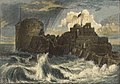
 Port of Sidon, 19th century
 -
 The castle and the harbour of Saida, the ancient Sidon
 -
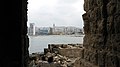 Sidon Castle
 -
 Sidon, Sarcophagus relief of a boat
 -
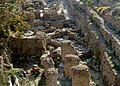 Sidon College site
 -
 Sidon Stadium
 -
 Sidon, Lebanon, Panorama
 -
 Mosque, Sidon
 -
 صيدا - صورة جوية قديمة
 -
 Mosque
 -
 Sidon, vue meridionale (viewed from the south)
 -
 Sidon District Map


International relations
[edit]Twin towns and sister cities
[edit]


Notable people
[edit]In antiquity and the pre-modern era
[edit]Chronological list.
- Eumaeus, character from Greek mythology. In Homer, Eumaeus tells of having been kidnapped as child from Sidon, where his father was the king.
- Antipater of Sidon (2nd century BC), poet
- Zeno of Sidon (c. 150 – c. 75 BC), Epicurean philosopher born in Sidon
- Dorotheus of Sidon (1st century BC) Greek astrologer associated with Sidon
- Boethus of Sidon (c. 75 – c. 10 BC), peripatetic philosopher
- Tiberius Julius Abdes Pantera, Roman soldier who, according to his grave found in Germany in the 19th century, was born in Sidon
- Zenobius and his sister Zenobia, early-Christian martyrs executed around AD 290 under Diocletian
- Euthymios Saifi (1643–1723), Melkite Catholic Bishop of Sidon and Tyre
- Yusuf al-Asir (born 1232 AH = 1817 AD; died 1307 AH = 1889 AD), faqih, Islamic scholar, writer, poet, linguist, and journalist
In the modern era
[edit]- Fayza Ahmed (Al-Rawwass), Arab singer formerly based in Egypt
- Afif al-Bizri, (Afif El-Bizri) former Chief of Staff of the Syrian armed forces with a high-standing military rank and political profile during the Syria-Egypt republican union of the Nasser era.
- Raymond Audi, international banker, and former Minister of Refugees in the government of Lebanon (Originally Palestinian)
- Dr. Nazih El Bizri, longstanding politician: mayor of Sidon from 1952 till 1959, Member of Lebanese Parliament from 1953 till 1958 and from 1972 till 1992. Lebanese Minister of Health, and Minister of Social Affairs from 1955 till 1956, then from 1972 till 1973, and from 1980 till 1982.
- The Four Brothers - Riad El Bizri's Sons:
- Ahmad El-Bizri, Salah-Eddine El-Bizri (Mayor of Sidon from 1937 till 1951. Member of Parliament from 1951 till 1953), Ezzedine El-Bizri, Anwar El-Bizri.
- Bahia Hariri, former Minister of Education in the governments of Lebanon and philanthropist
- Rafic Hariri, former Prime Minister, billionaire and international businessman
- Bahaa Hariri, international businessman and billionaire, son of Rafic Hariri
- Saad Hariri, youngest former Prime Minister of Lebanon
- Ahmad Hijazi (born 1994), Lebanese footballer at Dhangadhi (Nepalese club) [76]
- Adel Osseiran, co-founder of modern Lebanon, was a prominent Lebanese statesman, a former Speaker of the Lebanese Parliament, and one of the founding fathers of the Lebanese Republic.
- Ali Osseiran, Member of Parliament and Former Minister
- Maarouf Saad, former deputy representing Sidon in the national parliament and founder of the Popular Nasserite Party
- Fouad Siniora, former Prime Minister of Lebanon, minister of finance, and member of parliament
- Riad Solh, former Prime Minister of Lebanon
- Sami Solh, former Prime Minister of Lebanon
See also
[edit]
- Abdalonymus – 4th-century BC King of Sidon
- Amarna letter EA 144
- King of Sidon – Ruler of Sidon
- Royal necropolis of Ayaa – Phoenician necropolis in Lebanon
- Sarcophagus of Eshmunazar II – 6th-century BC Phoenician royal coffin
- Sidon Eyalet – Administrative division of the Ottoman Empire from 1660 to 1864
- Sidon Mithraeum – Former mithraeum discovered in Sidon, kept in the Louvre
- Temple of Eshmun – Ancient temple to the Phoenician god of healing in Lebanon
Notes
[edit]- ^ See lines 18–20 of the Eshmunazar II sarchophagus inscription.
- ^ The territories of the Phoenician cities could be discontiguous: thus, the lands and the cities of Dor and Joppa belonging to the Sidonians were separated from Sidon by the city of Tyre.[17]
References
[edit]- ^ a b Gauthier, Henri (1929). Dictionnaire des Noms Géographiques Contenus dans les Textes Hiéroglyphiques Vol. 6. p. 113.
- ^ a b Wallis Budge, E. A. (1920). An Egyptian hieroglyphic dictionary: with an index of English words, king list and geological list with indexes, list of hieroglyphic characters, coptic and semitic alphabets, etc. Vol II. John Murray. p. 1064.
- ^ a b Gauthier, Henri (1929). Dictionnaire des Noms Géographiques Contenus dans les Textes Hiéroglyphiques Vol. 6. p. 138.
- ^ a b Wallis Budge, E. A. (1920). An Egyptian hieroglyphic dictionary: with an index of English words, king list and geological list with indexes, list of hieroglyphic characters, coptic and semitic alphabets, etc. Vol II. John Murray. p. 1065.
- ^ Frederick Carl Eiselen (1907). Sidon: A Study in Oriental History, Volume 4. Columbia University Press. p. 12. ISBN 9780231928007. Archived from the original on 17 September 2023. Retrieved 28 September 2020.
{{cite book}}: ISBN / Date incompatibility (help) - ^ a b c d e f Gates, Charles (2011). Ancient cities: the archaeology of urban life in the ancient Near East and Egypt, Greece and Rome (2nd ed.). London: Routledge. pp. 197, 190, 191. ISBN 978-0-203-83057-4.
- ^ Gwiazda, Mariusz; Piątkowska-Małecka, Joanna; Wicenciak, Urszula; Makowski, Piotr; Barański, Tomasz (1 May 2021). "The Sidon's/Ṣaydā Northern Hinterland during the Early Byzantine–Early Islamic Transition". Bulletin of the American Schools of Oriental Research. 385: 171–200. doi:10.1086/712931. ISSN 0003-097X.
- ^ a b Breen, Colin; Forsythe, Wes; O’Connor, Marianne; Westley, Kieran (2014). "The Mamluk/ Ottoman-period Maritime Cultural Landscape of Lebanon" (PDF). Centre for Maritime Archaeology: 20–36.
- ^ a b c d e Lorraine Copeland; P. Wescombe (1965). Inventory of Stone-Age sites in Lebanon, p. 136. Imprimerie Catholique.[permanent dead link]
- ^ Forstner-Müeller et al. 2006
- ^ a b Jacoby, David (1997). "Silk in Western Byzantium before the Fourth Crusade". Trade, Commodities, and Shipping in the Medieval Mediterranean. pp. 455 ff and notes [17]–[19].
- ^ a b "Porphyrogennetos". The Oxford Dictionary of Byzantium. New York, NY & Oxford, UK: Oxford University Press. 1991. p. 1701. ISBN 0-195-04652-8.
- ^ Thomas Kelly, Herodotus and the Chronology of the Kings of Sidon, Bulletin of the American Schools of Oriental Research, no. 268, pp. 39–56, 1987
- ^ Sugimoto, David T. (2014). "Transformation of a Goddess" (PDF).
- ^ Tucker 2019, p. 876.
- ^ a b Waldemar, Heckel (2008). Who's Who in the Age of Alexander the Great. Blackwell. p. 172. ISBN 9781405154697.
- ^ Elayi 1997, p. 66.
- ^ Briant 2002, p. 490.
- ^ "Istanbul Archaeology Museum". The New York Times. Archived from the original on 24 May 2012. Retrieved 10 May 2008.
- ^ Wicenciak, Urszula (2 September 2019). "Aspects of economic activity in Phoenicia during Roman and Byzantine times. The case of olive oil and amphora production in Chhim, in the chora of Sidon". Levant. 51 (3): 314–336. doi:10.1080/00758914.2020.1854973. ISSN 0075-8914.
- ^ a b c d e Schulze, Kirsten (October 2010). "Sidon". In Stillman, Norman A. (ed.). Encyclopedia of Jews in the Islamic World. Brill Reference Online.
- ^ Rogers, Guy MacLean (2021). For the Freedom of Zion: the Great Revolt of Jews against Romans, 66-74 CE. New Haven: Yale University Press. pp. 22, 536. ISBN 978-0-300-24813-5.
- ^ Laes, Christian (18 September 2005). "M. Andreassi, Le facezie del Philogelos. Barzellette antiche e umorismo moderno". Bryn Mawr Classical Review. Archived from the original on 14 October 2008. Retrieved 13 November 2008.
- ^ Runciman 1987, p. 308.
- ^ Sawaya, Gioia (7 December 2018). "Archaeology of Superpositions, as seen in Sidon's Sea Castle". Hidden Architecture. Retrieved 28 May 2024.
- ^ Marriner, Nick; Morhange, Christophe; Doumet-Serhal, Claude (November 2006). "Geoarchaeology of Sidon's ancient harbours, Phoenicia". Journal of Archaeological Science. 33 (11): 1514–1535. Bibcode:2006JArSc..33.1514M. doi:10.1016/j.jas.2006.02.004. ISSN 0305-4403.
- ^ Frost, Honor (March 1973). "The offshore island harbour at Sidon and other Phoenician sites in the light of new dating evidence". International Journal of Nautical Archaeology. 2 (1): 75–94. Bibcode:1973IJNAr...2...75F. doi:10.1111/j.1095-9270.1973.tb00492.x. ISSN 1057-2414.
- ^ a b Winter, Stefan (2020). "Saïda à l'époque des agha-s: la famille Hammud et l'État ottoman au XVIIIe siècle". Archivum Ottomanicum. 37: 219–242. Archived from the original on 13 February 2023. Retrieved 8 March 2022.
- ^ Colledge, James Joseph; Warlow, Ben (2006). Ships of the Royal Navy: the complete record of all fighting ships of the Royal Navy from the 15th century to the present (New rev. ed.). London: Chatham Publ. ISBN 978-1-86176-281-8.
- ^ "Lebanon - French Mandate, Mediterranean, Phoenicians | Britannica". www.britannica.com. Retrieved 28 May 2024.
- ^ Bacha, François El (8 May 2021). "Lebanon / History: Lebanon in the turmoil of WWII and its independence". Libnanews, Le Média Citoyen du Liban. Retrieved 28 May 2024.
- ^ Lax, Chaim (9 March 2023). "The Palestinian Refugees: 1948 to Today". HonestReporting. Retrieved 28 May 2024.
- ^ Middle East International No 149, 8 May 1981; Publishers Lord Mayhew, Dennis Walters MP, Editor Michael Adams; John Bulloch pp.6-7. No 148, 24 April 1981; Jim Muir p. 3
- ^ Fisher, Dan (17 February 1985). "Israel Quits Sidon in 1st Pullout Step : No Incidents Mar Troop Withdrawal in South Lebanon". Los Angeles Times. Retrieved 28 May 2024.
- ^ Middle East International No 557, 29 August 1997; Michael Jansen, pp. 3-7. No 558. 12 September 1997.
- ^ Middle East International No 602, 18 June 1999; Jim Quilty p.9
- ^ Poverty undp.org Archived 5 November 2013 at the Wayback Machine
- ^ "Towards a Regionally Balance Development" (PDF). Undp.org.lb. Archived (PDF) from the original on 4 March 2016. Retrieved 16 March 2015.
- ^ Chami, Hanadi (4 October 2012). "Saida to get rid of trash mountain". Lebanon Opportunities. Retrieved 17 September 2023.
- ^ Antelava, Natalia (25 December 2009). "Lebanese city's mountain of rubbish". BBC News. Archived from the original on 15 June 2013. Retrieved 16 March 2015.
- ^ "Mountain of rubbish overwhelms Sidon". Emirates 24/7. Archived from the original on 27 November 2009. Retrieved 15 September 2014.
- ^ "Sidon chokes under rubbish dump". Archived from the original on 2 April 2015. Retrieved 15 September 2014.
- ^ "Syringes plague Sidon beach as dump spills medical waste". The Daily Star Newspaper - Lebanon. Retrieved 15 September 2014.
- ^ a b https://lub-anan.com/المحافظات/الجنوب/صيدا-مدينة/صيدا/المذاهب/
- ^ "Saïdā (Sidone) (Maronite Eparchy) [Catholic-Hierarchy]". www.catholic-hierarchy.org. Archived from the original on 29 March 2019. Retrieved 28 March 2019.
- ^ Simon, Reeva S., Michael M. Laskier, and Sara Reguer, eds. 2003. The Jews of the Middle East and North Africa in Modern Times. New York: Columbia University Press, pg. 332
- ^ "Nabi Saydoun Project". Retrieved 13 November 2024.
- ^ "Welcome to Debbane Palace". Museumsaida.org. Archived from the original on 11 May 2008. Retrieved 6 May 2009.
- ^ Reading Room Manchester. "Cemetery Details". CWGC. Archived from the original on 6 October 2014. Retrieved 29 January 2015.
- ^ Gigues, P. E. (1937–1938), "Lébé'a, Kafer-Garra, Qrayé: nécropoles de la région sidonienne". BMB (Bulletin du Musée de Beyrouth), vol. 1, pp. 35–76, vol. 2, pp. 30–72, vol. 3, pp. 54–63.
- ^ Doumet-Serhal, C. 2006. "The Early Bronze Age in Sidon: 'College Site' Excavations (1998–2000–2001)". Bibliothèque archeologique et historique 178. Beirut: Institut français du Proche-Orient
- ^ a b Doumet-Serhal, C. 2010. "Sidon during the Bronze Age: Burials, Rituals and Feasting Grounds at 'College Site'". Near Eastern Archaeology, 73:114–129.
- ^ a b Sader, Hélène; Kamlah, Jens (2010). "Tell el-Burak: A New Middle Bronze Age Site from Lebanon". Near Eastern Archaeology. 73 (2/3). University of Chicago Press: 130–141. doi:10.1086/NEA25754042. Archived from the original on 10 November 2021 – via ResearchGate.
- ^ Nina Jidéjian, "Greater Sidon and its 'Cities of the Dead'", National Museum News, page 24. Archived 25 January 2021 at the Wayback Machine.
- ^ "Sidon Excavation | Sidon Excavation". Retrieved 28 May 2024.
- ^ "Previous Excavation". SidonExcavation. Archived from the original on 19 April 2002. Retrieved 26 January 2013.
- ^ "Cultural property under enhanced protection Lebanon". Archived from the original on 31 December 2024. Retrieved 1 January 2025.
- ^ "Lebanon: 34 cultural properties placed under enhanced protection". Archived from the original on 27 December 2024. Retrieved 1 January 2025.
- ^ Genesis 10:15, 19
- ^ Klein, Reuven Chaim (Rudolph) (April 2018). "Nations and Super-Nations of Canaan" (PDF). Jewish Bible Quarterly. 46 (2): 84. ISSN 0792-3910. cites Rashi and Radak as reading that verse as saying that the city of Sidon itself was not said to be part of Zebulun's territory, while the medieval exgete Elazar Rokeach understood that it was.
- ^ Genesis 49:13
- ^ Joshua 11:8, 19:28
- ^ Judges 1:31
- ^ Judges 10:12
- ^ Isaiah 23:12
- ^ 1 Kings 11:1, 33
- ^ 1 Kings 16:31
- ^ 1 Kings 5:6; 1 Chronicles 22:4; Ezekiel 27:8
- ^ Isaiah 23:2, 4, 12; Jeremiah 25:22, 27:3, 47:4; Ezekiel 27:8, 28:21, 22, 32:30; Joel 3:4
- ^ 1 Kings 17:9–24; see also in the New Testament, Luke 4:26
- ^ Matthew 15:21; Mark 7:24
- ^ Mark 3:8; Luke 6:17
- ^ Matthew 11:21–23
- ^ Mark 7:31
- ^ Acts 27:3, 4
- ^ "Ahmad Hijazi - Soccer player profile & career statistics - Global Sports Archive". globalsportsarchive.com. Archived from the original on 24 April 2021. Retrieved 23 November 2020.
Sources
[edit] This article incorporates text from a publication now in the public domain: Easton, Matthew George (1897). "Sidon". Easton's Bible Dictionary (New and revised ed.). T. Nelson and Sons.
- Additional notes taken from Collier's Encyclopedia (1967 edition)
- Briant, Pierre (2002). From Cyrus to Alexander: A history of the Persian Empire. Winona Lake, IN: Eisenbrauns. ISBN 9781575061207.
- Elayi, Josette (1997). "Pouvoirs locaux et organisation du territoire des cités phéniciennes sous l'Empire perse achéménide" [Local authorities and organization of the territory of the Phoenician cities under the Persian Achaemenid Empire]. Espacio, Tiempo y Forma. 2, Historia antigua (in French). 10. Editorial UNED: 63–77. OCLC 758903288. Archived from the original on 4 October 2023.
- Runciman, Steven (1987). A History of the Crusades. Vol. 3: The Kingdom of Acre and the Later Crusades. Cambridge University Press. ISBN 9780521347723.
- Tucker, Spencer C. (2019). Middle East Conflicts from Ancient Egypt to the 21st Century: An Encyclopedia and Document Collection. ABC-CLIO. ISBN 978-1-440-85353-1.

Further reading
[edit]- Aubet, Maria Eugenia (2001). The Phoenicians and the West: Politics, Colonies and Trade. 2nd ed. Translated by Mary Turton. Cambridge, UK: Cambridge University Press.
- Markoe, Glenn (2000). "Phoenicians". Vol. 2: Peoples of the Past. Berkeley, Cal.: University of California Press.
- Moscati, Sabatino (1999). The World of the Phoenicians. London: Phoenix Giant.
External links
[edit]
- Sidon On Google Maps Street View By Paul Saad
- Sidonianews (Sidon News Portal) (in Arabic)
- Lebanon, the Cedars' Land: Sidon Archived 16 January 2021 at the Wayback Machine
- Sidon excavations
- Ancient Phoenician Sidon (Saida) in Lebanon


With correspondence to modern geography | ||||||||||||||||||||
| Europe |
|   | ||||||||||||||||||
| Levant |
| |||||||||||||||||||
| ||||||||||||||||||||

| International | |
|---|---|
| National | |
| Geographic | |
| Other | |

Sidon
View on GrokipediaGeography and Environment
Location and Topography
Sidon lies at coordinates 33°33′N 35°22′E along the Mediterranean coast in Lebanon's South Governorate, approximately 40 kilometers south of Beirut.[4] Its position on a narrow coastal plain, adjacent to the eastern flanks of the Mount Lebanon range, positioned it at the interface of maritime and overland pathways, with mountain passes enabling access to interior valleys and resources.[5] The local topography includes a low-lying littoral zone with pocket beaches and a natural harbor sheltered by a promontory and offshore sandstone reefs, which provided protection from dominant westerly winds and supported anchorage for ancient shipping.[6] [7] Rising hinterland hills, part of the Mount Lebanon foothills, feature terraced slopes suitable for cultivation and stone quarrying, while sedimentary processes have led to partial silting of ancient harbor basins over millennia.[8] The region experiences seismic activity due to proximity to the Yammouneh Fault and offshore thrusts within the Dead Sea Transform system, contributing to historical earthquakes like the 551 CE event that generated tsunamis along the Phoenician coast and the 1202 CE rupture.[9] [10] This tectonic setting underscores Sidon's exposure to ground shaking and coastal inundation, factors that periodically disrupted its harbor functionality.[11]Climate and Natural Resources
Sidon experiences a Mediterranean climate characterized by mild, wet winters and hot, dry summers. Average winter temperatures range from 6°C to 15°C, with daytime highs around 13°C in January, while summer highs reach 30°C to 31°C in August.[12] [13] Annual precipitation totals approximately 700-800 mm, predominantly falling between October and April, with peak rainfall in December and January exceeding 120 mm per month.[14] [15] This seasonal pattern supports the cultivation of olives and citrus fruits on the coastal plain, which benefit from the winter rains and mild temperatures for growth.[16] Historically, Sidon's coastal location and hinterland provided key resources for Phoenician industries, including murex snails harvested from nearby shores for producing Tyrian purple dye, a labor-intensive process yielding the valuable color used in textiles.[17] [18] Cedar wood from Mount Lebanon's forests supplied timber for shipbuilding, enabling maritime trade, while local sands facilitated glass production, with Sidon renowned as an ancient center for glassmaking.[17] [19] [20] In recent decades, climate variability has intensified challenges, with prolonged droughts since 2019 reducing water availability and exacerbating shortages in southern Lebanon, including Sidon, amid Lebanon's broader economic crisis.[21] [22] These dry periods, linked to shifting weather patterns and reduced snowfall, have strained agricultural resources like olives and citrus, contributing to overexploitation and pollution of coastal waters that limit sustainable yields.[23] [24]Etymology
Name Origins and Historical Usage
The name Sidon originates from the Phoenician Ṣīdūn (𐤑𐤃𐤍, ṣdn), a term likely denoting "fishery" or "fishing town," derived from the Semitic root ṣwd meaning "to hunt" or "to fish."[25] This etymology aligns with the city's coastal position and its early role as a maritime center in Phoenician trade networks, where fishing and seafaring formed foundational economic activities, as evidenced by archaeological remains of harbors and related artifacts from the Late Bronze Age.[26] Linguistic parallels in Northwest Semitic languages, such as Hebrew ṣāyid ("hunter" or "fisher"), reinforce this connection without reliance on later mythological interpretations.[27] The name appears in Hebrew as Ṣīḏōn (צִידוֹן), preserving the original vocalization and consonantal structure in biblical and inscriptional contexts.[28] In Egyptian records, it is rendered as ḏdwnꜣ or similar, attesting to Sidon's prominence in international correspondence by the Ramesside period (circa 13th century BC), as seen in administrative papyri like Papyrus Anastasi I. Greek sources Hellenized it as Sidṓn (Σιδών), a form Latinized as Sidon under Roman administration, reflecting phonetic adaptations during Hellenistic and imperial rule without altering the core Semitic identity.[1] Under Arab conquests from the 7th century AD, the name evolved to Sayda or Ṣaydā in Arabic, emphasizing the initial ṣ sound, and retained this variant through Mamluk and Ottoman eras as Sayda, as documented in medieval itineraries and administrative records. These linguistic shifts trace the city's transitions across empires—Phoenician autonomy, Persian satrapy, Greco-Roman provinces, and Islamic caliphates—while underscoring its enduring status as a Phoenician hub, where the name's persistence in cuneiform, alphabetic, and later scripts highlights consistent recognition in trade and diplomatic texts.[29]History
Prehistoric and Bronze Age Foundations
The Sidon-Dakerman area preserves evidence of human occupation extending to the Neolithic period, though specific artifacts and structures from this era remain limited.[8] Archaeological investigations reveal continuous settlement layers from the Early Bronze Age onward, commencing around 3000 BCE, with six distinct habitat phases documenting urban expansion during the 3rd millennium BC.[30] Pottery assemblages and copper implements from these strata point to established craft production and resource exploitation, while the development of port infrastructure facilitated initial maritime exchanges with regional networks, spurring settlement growth beyond subsistence agriculture.[5][31] During the Middle Bronze Age (ca. 2000–1550 BCE), Sidon emerged as a dual-purpose hub—a coastal emporium handling imports like metals and a inland-oriented center for agricultural processing and textile production, as indicated by faunal remains and tool kits emphasizing domesticated herds over hunting.[32][31] The site's territorial reach extended southward to Tell el-Burak, a coastal outpost 9 km away featuring monumental mud-brick architecture and storage facilities, likely administered from Sidon to secure agrarian surpluses and trade routes. Over 100 excavated burials from this phase, often in multi-generational chamber tombs with grave goods such as weapons, jewelry, and imported ceramics, attest to stratified social hierarchies and accumulated wealth derived from inter-Canaanite alliances and Levantine commerce, without evidence of centralized royal iconography.[33] The Late Bronze Age (ca. 1550–1200 BCE) integrated Sidon more firmly into Egyptian imperial orbits, with diplomatic cuneiform tablets from the Amarna archive—specifically EA 144–145—recording appeals from King Zimredda to Pharaoh Akhenaten regarding territorial disputes and loyalty oaths, underscoring Sidon's status as a subordinate city-kingdom reliant on pharaonic protection.[1] These interactions amplified Sidon's intermediary role in eastern Mediterranean exchanges, channeling timber, purple dye precursors, and metals through its harbors, which fostered proto-urban hierarchies grounded in seafaring economics rather than purely agrarian or militaristic foundations.[32] Regional upheavals circa 1200 BCE, linked to migratory pressures and systemic breakdowns across the Levant, disrupted broader Bronze Age networks but left Sidon with stratigraphic continuity into subsequent eras, absent clear markers of wholesale destruction.[1]Iron Age and Phoenician Dominance
Sidon rose to prominence in the early Iron Age (c. 1200–1000 BC) as the most powerful Phoenician city-state, leveraging its natural harbor and proximity to cedar forests to dominate regional maritime commerce before ceding preeminence to Tyre.[34] Archaeological evidence from sites like Trench 28 reveals well-preserved Iron Age layers, including 5th-century BC pits and structures indicative of sustained urban growth and trade infrastructure.[35] The city's survival amid the Late Bronze Age collapse, unlike inland Hittite and Canaanite centers, stemmed from its seafaring adaptability and avoidance of direct Sea Peoples incursions, enabling rapid reconfiguration of trade routes across the Mediterranean.[36] By the 9th–6th centuries BC, Sidon's economy centered on high-value exports, including cedar timber, fine linens, and glassware, facilitated by advanced shipbuilding techniques that supported voyages to Iberia, North Africa, and the western Mediterranean.[37] The purple dye industry, extracting Tyrian purple from murex snails, generated immense wealth; production demanded processing up to 12,000 snails per gram of dye, yielding a labor-intensive process reliant on organized coastal facilities and likely involving compulsory labor pools, as inferred from the scale and foul byproducts documented in ancient accounts and residue analyses.[18] Underwater archaeology, including Phoenician shipwrecks off Lebanon and Cyprus laden with amphorae and metals, corroborates the volume of bulk cargo trade, with Sidon's networks exchanging Levantine goods for silver from Tartessos and ivory from Africa.[17] Cultural innovations included the refinement and export of the proto-Canaanite alphabet, adapted for phonetic writing to streamline commerce, alongside the founding of emporia that presaged colonies like Carthage—though Tyre led in the latter, Sidon's vessels integrated into the shared Phoenician web.[38] Elite burials, such as the basalt sarcophagus of King Tabnit (r. c. 549–539 BC), exemplify Egyptian stylistic imports, featuring anthropoid forms and hieroglyphic motifs repurposed for Phoenician elites, signaling deep stylistic borrowing from the Nile Valley amid Sidon's role as a conduit for eastern Mediterranean motifs.[5] These artifacts, quarried in Egypt and shipped northward, underscore causal ties between Sidon's commercial pull and artistic hybridization, prioritizing functional adaptation over indigenous invention.[39]Classical Periods: Persian, Hellenistic, and Roman Rule
Following the conquest of Babylon by Cyrus the Great in 539 BC, Sidon integrated into the Achaemenid Empire as a key Phoenician port, functioning as the capital of a semi-autonomous satrapy under local kings who swore loyalty to Persian overlords and supplied naval forces for imperial campaigns, such as the fleet against Greece in 480 BC.[40] Sidonian rulers like Tennes, who briefly rebelled against Artaxerxes III in 345 BC before his execution, exemplified the blend of vassalage and privilege, with the city benefiting from Persian administrative stability that facilitated trade in timber, purple dye, and metals. The royal necropolis at Ayaa, comprising rock-cut hypogea with 21 sarcophagi including elaborate imports like the Satrap Sarcophagus dated to the late 5th century BC, attests to elite wealth derived from these exchanges and Persian favor, though such opulence relied on tribute systems that strained local resources.[41][5] In 332 BC, amid Alexander the Great's campaign after the Battle of Issus, Sidon avoided destruction by surrendering promptly; an anti-Persian faction ousted pro-Achaemenid officials, inviting Macedonian forces and leading to the appointment of Abdalonymus as king without a prolonged siege.[42] Under subsequent Hellenistic rulers, including brief Ptolemaic oversight before Seleucid dominance from circa 200 BC, the city prospered as a cultural and commercial center, minting autonomous coins with Phoenician inscriptions and Seleucid portraits from Antiochus IV onward, reflecting fiscal autonomy amid imperial oversight.[43] Philosophical activity flourished, exemplified by Zeno of Sidon (c. 150–75 BC), head of the Epicurean school, while heavy Seleucid taxation—intended to fund military expansions—fueled regional discontent, though Sidon-specific revolts are sparsely documented compared to Judean uprisings chronicled by Josephus under Antiochus IV (r. 175–164 BC).[44] This revenue extraction paradoxically enabled civic infrastructure like early theaters, blending local Phoenician traditions with Greek urban planning. Roman general Pompey annexed Sidon to the province of Syria in 64 BC, affirming its free city status with retained self-rule, tax exemptions, and harbor privileges to leverage its trade networks for imperial logistics.[45] Subsequent emperors enhanced this favoritism through public works, including aqueducts channeling water from inland springs to support population growth and a theater accommodating public spectacles, as part of broader provincial investments in Phoenician coastal infrastructure.[46] By 198 AD, under Septimius Severus, Sidon attained colonia status as Colonia Aurelia Sidon, extending Roman citizenship to elites and stimulating economic vitality via coin issues depicting imperial motifs alongside local deities like Astarte, though this integration deepened dependence on Rome's fiscal demands.[45][43]Medieval Era: Arab Conquests, Crusades, and Mamluk Control
Following the Arab conquests of the Levant in the 630s CE, Sidon submitted to Umayyad forces under Muawiyah ibn Abi Sufyan, integrating into the caliphate as a strategic Mediterranean port with sustained settlement and economic activity despite initial disruptions.[5] Under Umayyad and subsequent Abbasid rule (661–969 CE), the city's harbor facilitated regional trade in commodities like timber and glass, with repairs to coastal infrastructure supporting Levantine commerce amid political transitions.[5] [47] Fatimid control from the late 10th century briefly emphasized Sidon's defensive role, fortifying sites against Byzantine incursions before the onset of Crusader campaigns.[5] In December 1110 CE, Crusader forces under Baldwin I of Jerusalem, aided by Norwegian King Sigurd I's fleet and Venetian naval support led by Doge Ordelafo Faliero, captured Sidon after a 40-day siege, establishing it as a key outpost in the Kingdom of Jerusalem.[48] The victory expanded Crusader coastal holdings, enabling harbor enhancements that preserved Sidon's trade networks in silk, dyes, and agricultural goods, though chronic sieges necessitated robust fortifications like the Sea Castle.[5] During the 12th and 13th centuries, Sidon served as a Crusader stronghold, with structures such as St. Louis Castle (built circa 1254 CE in honor of King Louis IX) reflecting defensive priorities amid ongoing conflicts with Muslim forces.[5] Archaeological evidence from excavations near St. Louis Castle, conducted between 2019 and 2021, uncovered two mass graves containing the remains of at least 25 individuals—predominantly young adult males—dated to circa 1253 CE through radiocarbon analysis and artifact associations.[49] Bioarchaeological examination revealed perimortem weapon injuries, including blade cuts and puncture wounds primarily to the back and skull, indicating battlefield casualties likely from a Damascene assault on the city led by Prince An-Nasir Yusuf, with victims exhibiting robust builds consistent with European warrior demographics.[49] [50] These findings underscore the era's violent sieges, contrasting with the port's economic resilience evidenced by imported ceramics and continued maritime activity.[49] Mamluk Sultan Al-Ashraf Khalil's campaigns culminated in the reconquest of Sidon in July 1291 CE, shortly after the fall of Acre, extinguishing Crusader presence in the Levant and transitioning the city under Mamluk administration.[5] Under Mamluk rule (1291–1516 CE), Sidon retained its commercial function, with harbor maintenance and overland trade routes linking it to Damascus, though fortifications were repurposed for defense against Mongol threats, prioritizing stability over expansion.[5] Empirical records of tax revenues and merchant activities affirm the port's role in sustaining regional exchange, despite the shift from Crusader to Islamic governance.[5]Ottoman Rule and Early Modern Period
Sidon fell under Ottoman control following Sultan Selim I's victory over the Mamluks at the Battle of Marj Dabiq on August 24, 1516, integrating the city into the empire's administrative framework as part of the Sanjak of Sidon within the Eyalet of Damascus. The city's economy centered on maritime trade, with silk production and export from Mount Lebanon's hinterlands becoming prominent by the 17th century, supplemented by cotton and soap manufacturing; tax records from the period indicate fluctuating revenues tied to these commodities, reflecting both regional agricultural output and European demand.[51] Under the Ottoman timar system, local elites managed land revenues, but central oversight remained limited, contributing to Sidon's gradual economic eclipse by emerging ports like Beirut.[52] The Ma'nid dynasty, Druze emirs ruling from the early 16th century, exerted de facto control over Sidon and its mountainous interior through the 17th century, granting the region semi-autonomy in exchange for tribute and military service to the Ottomans; Fakhr al-Din II (r. 1590–1635) expanded this by promoting silk cultivation and fortifying trade routes, though his ambitions led to Ottoman suppression in 1633.[53] Successors like the Shihab emirs in the 18th century maintained similar arrangements, fostering local stability via alliances with Druze and Christian notables but enabling corruption through tax farming (iltizam), which prioritized elite extraction over infrastructure or innovation.[54] The Ottoman millet system reinforced sectarian cohesion by delegating communal governance to religious leaders—Sunni Muslims, Druze, Maronites, and others—preserving social order amid diversity but entrenching divisions that hindered unified economic or administrative reforms.[55] Egyptian forces under Ibrahim Pasha occupied Sidon in 1831 during Muhammad Ali's campaign against Ottoman rule, holding the city until 1840 and imposing conscription and taxation that sparked local revolts; Ottoman restoration followed European intervention at the Convention of London.[56] The January 1, 1837, earthquake inflicted severe destruction on Sidon, collapsing much of the coastal infrastructure and exacerbating vulnerabilities in the already weakened urban fabric.[57] Mid-century Druze-Christian clashes, peaking in the 1840–1845 conflicts and 1860 Mount Lebanon war, spilled into Sidon's environs, displacing populations and disrupting trade amid Ottoman efforts to reassert central authority through the Tanzimat reforms.[58]19th and 20th Centuries: Mandate to Independence
During the French Mandate (1920–1943), Sidon was incorporated into the State of Greater Lebanon, proclaimed on September 1, 1920, by High Commissioner Henri Gouraud to consolidate French control over former Ottoman territories with a Christian-majority core.[59] This period emphasized administrative centralization and limited infrastructure improvements, though urban planning focused more on Beirut than peripheral cities like Sidon, where port activities and local governance saw modest modernization without transformative redesign.[60] Lebanon's declaration of independence on November 22, 1943, ended formal Mandate rule, but French troops withdrew only gradually amid World War II pressures, leaving Sidon as a coastal trade hub in the nascent republic.[61] The 1948 Arab-Israeli War triggered a mass influx of Palestinian refugees into Sidon, prompting the International Committee of the Red Cross to establish Ein al-Hilweh camp in 1948 approximately 3 km southeast of the city center.[62] Initially sheltering around 15,000 displaced persons mainly from northern Palestinian coastal areas like Haifa and Acre, the camp expanded amid Lebanon's restrictive policies that barred refugees from citizenship, property ownership, and formal employment, confining them to de facto ghettos and enabling militant factional entrenchment over decades.[63][64] By the 1970s, Sidon's population had swelled beyond 50,000, incorporating these refugees and straining urban resources, with camp poverty rates exceeding 80% due to aid dependency and exclusion from national integration.[65] The Lebanese Civil War (1975–1990) inflicted widespread destruction on Sidon, fueled by its status as a Palestinian stronghold hosting Palestine Liberation Organization (PLO) bases that drew cross-sectarian clashes between Sunni, Shia, and Christian militias.[66] Israeli interventions escalated the toll: Operation Litani on March 14, 1978, involved 20,000–25,000 troops invading southern Lebanon to expel PLO fighters beyond the Litani River, bombarding Sidon and nearby villages with civilian casualties estimated at 1,000–2,000.[67][68] The 1982 Lebanon War saw fiercer urban combat in the Battle of Sidon, where Israeli forces targeted PLO infrastructure, resulting in heavy artillery exchanges, thousands displaced, and significant infrastructure losses amid PLO guerrilla tactics.[69][70] Postwar reconstruction after the 1989 Taif Accord faltered in Sidon due to entrenched refugee camps and factional violence, with Ein al-Hilweh emerging as a militant hub for groups like Fatah and Islamist splinters, undermining state authority.[71] The rise of Hezbollah in southern Lebanon during the 1990s, backed by Iranian funding and focused on resisting Israeli occupation until 2000, indirectly shaped regional dynamics but had limited direct sway in Sunni-dominated Sidon, where Palestinian autonomy and Lebanese army incursions perpetuated instability over rebuilding.[72] Failed refugee assimilation, evidenced by camp populations doubling to over 50,000 by 2000 amid national growth, entrenched socioeconomic divides, with Sidon's metro area exceeding 200,000 inhabitants yet marked by informal economies and periodic clashes.[65][73]Contemporary History: Civil War, Conflicts, and Economic Decline
In the 2006 Lebanon War, triggered by Hezbollah's cross-border raid on July 12, Israeli airstrikes targeted southern Lebanese infrastructure, including areas around Sidon, damaging roads, bridges, and fuel depots that disrupted local trade and fisheries vital to the city's economy.[74] The conflict displaced thousands from Sidon and nearby villages, with the city's port operations halted amid widespread power outages and supply chain breakdowns, exacerbating short-term economic losses estimated in the millions for southern Lebanon.[75] Lebanon's economic crisis, intensifying from October 2019, severely impacted Sidon through hyperinflation and a 90% devaluation of the Lebanese pound against the dollar, rendering imports unaffordable and crippling the city's port activities, which handle significant regional cargo alongside fishing and small-scale manufacturing.[75] Bank liquidity shortages led to capital controls, freezing residents' access to savings and fueling poverty rates that surged above 80% in southern areas like Sidon by 2022, while corruption scandals and governance paralysis delayed reforms needed for port modernization.[76] Nationally, real GDP contracted by over 38% since 2019, with Sidon's trade-dependent economy suffering compounded effects from reduced remittances and tourism collapse.[77] The 2024 escalation between Israel and Hezbollah, beginning October 8 with intensified cross-border exchanges, prompted mass displacements from southern Lebanon, including Sidon, where over 60,000 residents fled northward amid Israeli evacuation orders and strikes on nearby Hezbollah positions, such as the March 2024 hit in Jadra, 10 km north of the city.[78] Post-November 2024 ceasefire violations included Israeli airstrikes spilling into Sidon-adjacent areas, like October 2025 incidents near Nabatieh, further straining local resources and halting recovery efforts.[79] In parallel, 2025 agreements advanced disarmament of Palestinian factions in Sidon's Ain al-Hilweh refugee camp, the largest in Lebanon, with phases beginning August 21 under a Lebanese-Palestinian accord restricting weapons to state forces, handing over arms from PLO-aligned groups amid prior camp clashes.[80] [81] However, non-PLO factions like Hamas resisted full compliance, prolonging security tensions.[82] Persistent sectarian divisions and Hezbollah's dominant influence in southern governance have stalled national reforms, blocking IMF-backed restructuring and perpetuating economic stagnation, as political deadlocks—exemplified by repeated presidential vacancies—prioritize factional vetoes over fiscal stabilization critical for cities like Sidon.[83] This dynamic, rooted in confessional power-sharing failures, has hindered infrastructure rebuilding and foreign investment, leaving Sidon's recovery vulnerable to recurrent conflicts.[84]Archaeology
Major Excavation Sites
The College Site, located at the core of ancient Sidon and associated with phases including Sidon IV, has yielded stratified evidence of a Bronze Age citadel and settlement, with layers spanning from the Early Bronze Age (ca. 3000 BCE) through subsequent periods, revealing defensive structures and urban development.[85][86] Excavations initiated in 1998 by a British Museum-led team under Claude Doumet-Serhal have employed stratigraphic sequencing combined with radiocarbon dating to establish chronologies, such as for Middle Bronze Age burials dated to the first half of the second millennium BCE, countering assumptions of uninterrupted continuity by highlighting phases of abandonment and rebuilding.[87][32] The Ayaa necropolis, situated in Sidon's hinterland, consists of two hypogea containing 21 royal sarcophagi from the Achaemenid period (5th-4th centuries BCE), excavated primarily in 1887-1888, with later surveys confirming elite burial practices linked to Sidonian rulers under Persian overlordship. Methodologies here focused on tomb architecture and associated stratigraphy, though limited by early 20th-century looting, emphasizing rock-cut chambers over surface scatters for dating via contextual ceramics rather than solely typology.[88] At the Frères site, excavations have uncovered a Late Bronze Age temple complex with an underground "holy of holies" chamber dated to ca. 1300 BCE via stratigraphic correlation and artifact contexts, alongside a adjacent monumental room revealed in 2015, indicating ritual spaces integrated into urban fabric.[89][90] Doumet-Serhal's ongoing work since the late 1990s incorporates radiocarbon analysis to refine these dates, prioritizing empirical sequences over narrative interpretations of Phoenician religiosity.[91] Tell el-Burak, a coastal site 9 km south of Sidon, represents a Middle Bronze Age (ca. 2000-1600 BCE) port settlement with a monumental building interpreted as an administrative outpost of the Sidonian polity, excavated since the early 2000s through geoarchaeological coring and stratigraphic trenching to map harbor evolution and inland connections.[92][93] Excavations at St. Louis Castle, a Crusader-era fortress, have targeted the dry moat, uncovering mid-13th-century CE mass graves via osteological and radiocarbon dating (e.g., calibrated to 1253 CE), with trauma analysis integrated into stratigraphic profiling to reconstruct siege-related depositions without presuming uniform military outcomes.[49][94] These efforts, continuing under multidisciplinary teams, underscore causal factors like conflict-driven stratigraphy over idealized trade narratives.[87]Key Artifacts and Interpretations
The sarcophagus of Eshmunazar II, a Phoenician king of Sidon reigning circa 539–525 BCE, exemplifies cultural fusion in royal burial practices, featuring an Egyptian-style anthropoid form imported from Egypt but inscribed with the longest known Phoenician text cursing any violators of the tomb.[95] Unearthed in 1855 from Sidon's royal necropolis, the inscription details temple constructions and territorial claims, reflecting elite assertions of divine favor and continuity amid Persian overlordship.[96] This artifact underscores socioeconomic hierarchies, as such monumental imports required command of long-distance trade networks, likely funded by Sidon's maritime commerce rather than broad popular contributions. Archaeological evidence from Sidon's Iron Age temple, dating to the 12th–11th centuries BCE, includes wall benches and niches interpreted as supports for idol statues, alongside ritual items like astragali for divination and specialized chalices, indicating organized cultic practices tied to elite patronage.[3] These features suggest temples served as centers for communal worship of deities like Baal or Astarte, but with priestly or royal oversight, as benches facilitated offerings without evidence of egalitarian participation. Royal tombs in the Ayaa necropolis nearby reveal further elite disparities, with marble sarcophagi mimicking Egyptian elites, though largely looted of presumed precious metals; surviving traces imply gold and silver grave goods concentrated among rulers, highlighting wealth accumulation from trade monopolies rather than diffused prosperity.[97] Industrial remnants, such as vats stained with murex-derived purple dye and vast shell middens near Sidon, attest to large-scale production of Tyrian purple, a luxury export commanding high value due to labor-intensive extraction from sea snails.[98] Glass beads and related workshop debris further evidence specialized crafts, but purple dominated as Sidon's economic driver, fostering naval capabilities through control of coastal shellfish beds and Mediterranean shipping lanes—causal chains where dye scarcity incentivized fleet expansion for resource security and market dominance, not incidental seafaring.[99] Interpretations of these artifacts emphasize trade-induced stratification over egalitarian myths; royal curses and opulent tombs reflect oligarchic governance by merchant-kings, with no epigraphic or structural evidence for democratic assemblies in Sidon, contrary to speculative links with Greek models—governance instead prioritized elite councils akin to Carthage's suffetes, sustaining monopolies that propelled naval power without broad citizen input.[100] Dye vats' scale implies centralized control, yielding disparities where elites amassed wealth from exports, while labor fell to dependents, grounding Phoenician success in realist incentives of scarcity and maritime enforcement rather than ideological assemblies.[101]Recent Discoveries and Ongoing Research
Archaeological investigations in Sidon have yielded significant post-2000 findings that refine understandings of medieval violence and ancient religious continuity. In 2021, osteological analysis of two mass graves within the dry moat of Sidon Castle (St. Louis Castle) identified remains of at least 25 young adult males, aged 15–25, with no females or children present. Radiocarbon dating of bones, corroborated by a Crusader silver coin from the reign of Louis IX (1226–1270), places the interments around 1253 AD, aligning with the Seventh Crusade's aftermath and Mamluk forces' recapture of the city. Examination revealed perimortem sharp-force and blunt-force trauma on 80% of crania and postcrania, consistent with edged weapons and possibly post-mortem charring, indicating battlefield slaughter rather than disease or ritual disposal.[49][102] Long-term excavations directed by Claude Doumet-Serhal since 1998 have documented uninterrupted settlement from the Bronze Age onward, with recent phases emphasizing Iron Age temple complexes. A 2021–2022 study in Berytus detailed the temple's final usage phases (circa 1000–800 BC), including stratigraphic evidence of ritual deposits like ash layers and faunal remains suggesting sacrificial practices. These findings link to Phoenician cultic traditions, potentially contemporaneous with biblical figures like Jezebel, whose Sidonian origins are noted in 1 Kings 16:31.[103][3] In June 2025, spatial analysis of the temple's subterranean rooms, published by the Université Saint-Joseph, clarified functional distinctions: Room 3 featured tannours (clay ovens) for offerings, while adjacent chambers held benches for libations, indicating phased evolution from Late Bronze Age (Phase D, circa 1200 BC) to Iron Age I (Phase C). A newly documented monumental underground room, with 4.5-meter-high ashlar walls extending 7.5 meters below ground, was interpreted as an earlier ritual extension, yielding pottery and tools datable to the 12th–11th centuries BC via typology and C14 assays. This expands evidence of concealed sacred architecture, though interpretations of specific deities (e.g., Eshmun or Astarte) remain provisional pending further epigraphic data.[104][105] Ongoing research, including Doumet-Serhal's 27-year project through 2025, continues amid Lebanon's economic crisis and conflict, which have disrupted funding from international partners like the British Museum and limited site access. Stratigraphic and bioarchaeological methods prioritize empirical sequencing over narrative conjecture, with priorities on conserving artifacts vulnerable to coastal erosion and urban encroachment. Despite these constraints, 2024–2025 fieldwork has integrated GIS mapping to correlate temple layouts with broader Phoenician networks, promising refined chronologies for regional trade and cultic exchanges.[106][87]Economy
Ancient Commercial Achievements
Sidon emerged as a prominent Phoenician hub for luxury goods production, particularly Tyrian purple dye derived from murex sea snails, with archaeological evidence from coastal sites confirming industrial-scale processing involving the extraction of glandular secretions from thousands of snails to produce minute quantities of pigment—approximately 12,000 snails yielding one gram of pure dye.[99] This labor-intensive craft, centered in Sidon and nearby Tyre, generated immense value, as the dye commanded prices equivalent to its weight in silver and was reserved for elite textiles and imperial garments across Mediterranean empires.[18] Export of dyed fabrics via Sidon's maritime networks fueled economic expansion, with residues of murex shells at production facilities underscoring the scale of operations from the Late Bronze Age onward.[107] Complementing dye production, Sidon specialized in glassmaking, leveraging abundant local silica sands to innovate core-formed and blown vessels by the 8th century BCE, including monochrome inlays for furniture and intricate mosaic pieces that distinguished Phoenician exports.[108] Artisans in the city advanced techniques from Egyptian precedents, producing luxury items like Sidonian vases during Hellenistic influences, which circulated widely through trade depots.[109] The Phoenician alphabet, originating in script traditions of coastal cities including Sidon around 1200 BCE, streamlined commerce by enabling precise accounting, contracts, and navigational records, thereby reducing transaction costs and facilitating the lingua franca status of Phoenician in Iron Age Mediterranean exchanges.[110] Sidon’s commercial reach extended through established colonies—such as those in North Africa and Iberia—and overland-maritime routes importing tin from western Europe for bronze alloying and amber from Baltic sources for jewelry, evidencing diversified supply chains documented in artifact distributions.[111] Assyrian royal annals quantify this prosperity, recording tribute from Sidon’s kings to Shalmaneser III (r. 859–824 BCE) in gold, silver, ivory, and elephant hides, alongside later payments under Esarhaddon reflecting coerced but substantial wealth extraction without diminishing core trade capacities.[112] While market incentives drove expansion, operations relied on coerced labor, inferred from broader Phoenician practices including captives from raids integrated into workshops, though direct Sidonian skeletal analyses reveal limited stress markers attributable to such systems amid sparse urban remains.[20]Modern Sectors and Persistent Challenges
Sidon’s economy centers on fishing, small-scale port activities, and agriculture, with the latter focusing on citrus fruits and bananas in the surrounding coastal plain. The fishing sector remains artisanal, employing local vessels for coastal catches amid national reliance on imports for 85% of fish consumption.[113] The port of Sidon handles limited cargo, serving as a secondary facility to Beirut, with temporary redirection of some imports following the 2020 Beirut port explosion that devastated national logistics infrastructure.[114] Remittances from the diaspora supplement household incomes but do not drive broader sectoral expansion, reflecting Lebanon's service-oriented national economy where agriculture and fisheries contribute modestly to overall output.[115] The 2019 financial crisis precipitated a banking collapse, with depositors unable to access funds and the central bank imposing informal capital controls, eroding confidence and halting credit flows. Subsidies on essentials like fuel and medicine ended abruptly, triggering shortages and hyperinflation exceeding 200% annually by 2021, which crippled import-dependent sectors including Sidon's port and fisheries.[116] Nationally, unemployment surged from 11.4% in 2018-2019 to 29.6% by 2022, with poverty rates tripling to 44% of the population by 2022, driven by real income losses averaging 60-70% across households.[117][116] In Sidon, these dynamics stalled agricultural exports and port throughput, as evidenced by broader Lebanese maritime declines post-2019, including reduced vessel calls and cargo handling amid fuel scarcity.[116] Persistent challenges stem from entrenched corruption and sectarian patronage systems, which allocate public resources through clientelist networks rather than merit-based investments, perpetuating inefficiency in sectors like Sidon's port where political favoritism overrides modernization.[118] In Sidon, historical patterns of elite patronage, including misuse of public works for electoral loyalty, have diverted funds from infrastructure upgrades, contrasting with potential for trade revival through transparent governance.[119] Lebanon's failure to enact fiscal reforms or prosecute graft—despite documented losses exceeding $72 billion in the financial sector since 2019—has blocked diversification, leaving local economies vulnerable to exogenous shocks without adaptive capacity.[76][120] This systemic prioritization of confessional quotas over economic rationality sustains stagnation, as patronage extraction undermines incentives for private sector growth in fishing and agriculture.[121]Politics and Governance
Local Government Structure
Sidon Municipality operates within Lebanon's decentralized framework, subordinate to the South Governorate (Muḥāfaẓat al-Janūb), which coordinates district-level administration including the Sidon District. The municipal structure adheres to a mayor-council system, where an elected council—typically comprising 21 to 24 members depending on population thresholds—oversees local services such as waste management, urban planning, and infrastructure maintenance, while the mayor, selected by the council from its members, executes decisions and represents the body.[122][123] This setup derives from the 1977 Code of Municipalities, amended sporadically, emphasizing council approval for budgets and major contracts, though practical authority often hinges on central government approvals from the Ministry of Interior and Municipalities.[124] Municipal elections, held every four years, were last conducted in southern Lebanon, including Sidon, on May 24, 2025, following repeated postponements from the prior 2016 cycle due to political deadlock and the economic crisis; prior terms were extended ad hoc by decree, with the 2016 council's mandate prolonged into 2025. The 2025 polls reinforced Sunni-majority representation on Sidon's council, aligning with the city's demographic composition where Sunnis form the plurality. However, operational inefficiencies persist, as the municipality's budget—projected at around LBP 50 billion annually pre-crisis but eroded by hyperinflation—relies heavily on central transfers and user fees, with local tax revenues plummeting due to widespread evasion and devalued currency since the 2019 financial collapse.[125][126][127] Service delivery exemplifies these constraints: waste collection, a core municipal responsibility, transitioned from the notorious Makab open dump—which accumulated over 1.3 million cubic meters of untreated refuse by 2014—to a sorting and treatment facility in the 2010s, reducing immediate overflows through partial remediation and park conversion efforts. Yet, the ongoing liquidity crisis has disrupted operations, leading to erratic pickups and renewed garbage accumulation by 2023, as fuel shortages and unpaid contractor fees compound low revenue capture. Central aid remains sporadic, with Sidon receiving only LBP 4.5 billion (about $50,000 at parallel rates) monthly in recent allocations against needs exceeding $1 million, underscoring dependency on national fiscal flows amid debt defaults.[128][129][130][131]Sectarian Politics and Power Dynamics
Sidon maintains a predominantly Sunni Muslim population, comprising an estimated 80% of residents, alongside Shia, Christian, and Druze minorities that form smaller pockets within the city.[132] This confessional composition shapes local politics, with Sunnis historically aligned against Hezbollah's influence, though Shia communities exert leverage through the Amal Movement, fostering tensions in power allocation.[133] The city's Sunni majority has sustained support for secular-leaning factions like the Future Movement, founded by Rafik Hariri, a native of Sidon, which emphasizes economic liberalism over Islamist agendas.[134] Electoral contests in Sidon pit the Future Movement against Islamist groups, including Salafist currents, reflecting intra-Sunni rivalries that prioritize sectarian loyalty over policy coherence. In the 2016 municipal elections, the Future Movement-backed Sidon Development List secured a decisive victory, capturing the majority of council seats against the Islamist-leaning Voice of the Sunnis list, underscoring the dominance of Hariri-linked networks in local governance.[135] However, national crises delayed subsequent municipal polls beyond their 2022 due date, exacerbating governance vacuums and allowing entrenched clientelist practices to persist without electoral renewal.[136] Lebanon's Taif Accord of 1989, which enshrined sectarian quotas in national institutions, extends to local councils through proportional representation based on the outdated 1932 census, compelling Sidon's municipal bodies to balance seats across confessions regardless of current demographics. This framework incentivizes clientelism, where leaders distribute patronage—such as jobs, services, and subsidies—along sectarian lines to maintain coalitions, often sidelining merit-based decision-making.[137] Consequently, fierce competition among Sunni factions and minority pressures has stalled key infrastructure projects, including urban development initiatives hampered by Sidon's proximity to Beirut and rival actors' vetoes, rendering the city an economic backwater despite its strategic port location.[135] Such paralysis highlights how confessional power-sharing, intended to stabilize divisions, instead perpetuates inefficiency and dependency on personal networks over public welfare.Security Issues
Palestinian Refugee Camps and Militancy
The Palestinian refugee camps in Sidon originated following the 1948 Arab-Israeli War, when displaced Palestinians from northern and coastal areas of Mandatory Palestine settled in the region under the auspices of the International Committee of the Red Cross and later UNRWA.[64][138] Ain al-Hilweh, the largest such camp in Lebanon and located adjacent to Sidon, was established that year to house initial waves of refugees, growing over decades to accommodate an estimated 80,000 residents, including registered UNRWA beneficiaries and unregistered arrivals from Syria since 2011.[139][138] Sidon hosts multiple camps alongside smaller gatherings, contributing to the national pattern where approximately 45% of Lebanon's 450,000 registered Palestinian refugees reside in 12 official camps characterized by overcrowding and substandard infrastructure.[140] These camps have evolved into semi-autonomous enclaves dominated by Palestinian factions, with Lebanese security forces historically barred from entry, fostering internal governance by armed groups rather than state authority.[84] Dominant factions in Ain al-Hilweh include Fatah, which maintains a presence through its military wing, alongside Hamas and jihadi Salafist groups such as Jund al-Sham and Usbat al-Ansar, often aligned with broader Islamist networks.[141][142] This fragmentation has perpetuated militancy, as factions control territories within the camps, using them as bases for recruitment, arms storage, and ideological propagation amid limited external oversight.[143] UNRWA provides essential aid including education, healthcare, and food assistance to camp residents, yet Palestinian refugees face Lebanese legal restrictions barring property ownership and limiting access to over 30 regulated professions, exacerbating dependency and informal economies.[140][144] Poverty affects over 90% of Palestinian refugees in Lebanon, with rates in southern camps like Ain al-Hilweh reaching 93% by 2022 due to economic exclusion, high unemployment (particularly among youth), and reliance on remittances or illicit activities.[145] This despair correlates with elevated crime, including smuggling and factional extortion, stemming from failed internal self-governance where armed groups prioritize territorial control over development, rather than external narratives of perpetual displacement.[146][147] Efforts to curb militancy intensified in 2024-2025 through phased disarmament agreements, with Palestinian factions in Ain al-Hilweh handing over truckloads of weapons—including rifles, RPGs, and ammunition—to the Lebanese Army in September 2025 as part of a broader initiative to assert state monopoly on force in the camps.[84][148] These deals, monitored by the army and PLO representatives, mark a shift from de facto factional rule but face challenges from holdout jihadi elements resistant to full compliance.[149][150]Clashes with Islamist Groups and State Authority
In July 2023, intense clashes erupted in Sidon's Ain al-Hilweh Palestinian refugee camp following the assassination of Fatah military commander Abu Ashraf al-Armoushi by Islamist militants affiliated with groups such as Jund al-Sham, triggering battles between Fatah forces and Salafist-leaning factions that resulted in at least 12 deaths and over 40 injuries in the initial days, with violence spilling into surrounding Sidon neighborhoods via stray gunfire and displacement of around 2,000 residents.[151][152] Renewed fighting in September 2023 between the same factions killed at least 10 more and wounded dozens, underscoring the camp's role as a haven for armed Islamist elements challenging Fatah's dominance, with the Lebanese army imposing a siege but halting short of full entry due to longstanding restrictions on state intervention in camp affairs.[153][154] These 2021–2023 episodes, including smaller March 2023 skirmishes that injured several, highlighted governance voids exacerbated by the 1969 Cairo Agreement, which ceded de facto control of camps like Ain al-Hilweh to Palestinian armed groups, enabling proliferation of weapons and fostering ISIS-linked networks such as Saraya al-Ashtar that have conducted operations spilling into Sidon city, including attempted attacks and criminal activities.[155][156][157] Lebanese security reports document spillover effects, with camp-based militants linked to ISIS affiliates perpetrating thefts, robberies, and assaults in Sidon amid Lebanon's economic collapse, which has amplified intra-camp rivalries and opportunistic crime without robust state enforcement.[158] The army's repeated sieges, as in 2023, have contained but not eradicated these threats, reflecting limited sovereignty over the camps where non-state actors maintain heavy armaments, including RPGs and machine guns, beyond Fatah's oversight.[159] By August 2025, partial disarming advanced under Lebanese-Palestinian dialogues and a government decree restricting arms to state forces, with the army collecting multiple truckloads of weapons from Ain al-Hilweh and other camps like Beddawi, yet reports indicate incomplete compliance as hardcore Islamist holdouts retain stockpiles, perpetuating risks of renewed clashes and urban spillover violence.[160][161] This incremental process, spanning phases since late August 2025, underscores persistent state fragility rooted in the Cairo Agreement's legacy of tolerated Palestinian autonomy, which has historically shielded militant infrastructure from full disarmament.[84][162]Regional Conflicts and External Influences
During the 2006 Lebanon War, Israeli airstrikes targeted Hezbollah infrastructure in southern Lebanon, including areas around Sidon, resulting in widespread destruction of roads, bridges, and civilian structures that severed access to the city and displaced approximately one million Lebanese overall, with southern regions like Sidon serving as evacuation hubs for tens of thousands fleeing further south.[163][164] The conflict, initiated by Hezbollah's cross-border raid and rocket barrages into Israel on July 12, 2006, caused an estimated $3.6 billion in infrastructure damage across Lebanon, with Sidon's port and surrounding agricultural lands suffering indirect hits from supply disruptions and fuel shortages.[165] The 2024 Israel-Hezbollah escalation, triggered by Hezbollah's rocket attacks in solidarity with Hamas following October 7, 2023, intensified strikes on southern Lebanon, displacing hundreds of thousands and inflicting $8.5 billion in damages, with Sidon's proximity to the Litani River amplifying economic losses through disrupted trade routes and port operations.[166][167] A US-brokered ceasefire on November 27, 2024, mandated Hezbollah's withdrawal south of the Litani and Lebanese Armed Forces (LAF) deployment to enforce Resolution 1701, yet violations persisted, including Israeli airstrikes near Sidon in October 2025 that killed at least four and targeted suspected militant sites amid reports of Hezbollah rocket launches.[168][169] These actions reflect Israel's reliance on intelligence of Hezbollah's estimated 150,000 rockets fired since 2023, justifying precision strikes to degrade threats originating from civilian-adjacent areas.[170] Hezbollah's post-ceasefire rearmament efforts south of the Litani, including weapon smuggling and reconstruction of tunnels, have eroded Lebanese sovereignty as an Iranian proxy, contravening UN Security Council Resolution 1701, as documented in UNIFIL assessments of unauthorized militant presence and LAF operations to neutralize over 50 explosive sites by mid-2025.[171][172] Sidon's strategic position as a northern buffer to the conflict zone has magnified these dynamics, with LAF reinforcements aiming for enhanced southern coverage exacerbating local economic strain from ongoing border tensions and restricted mobility.[173][174]Demographics and Society
Population Composition
Sidon’s metropolitan population is estimated at around 200,000 as of 2023, encompassing the city proper of approximately 163,000 and surrounding suburbs, reflecting growth from roughly 110,000 residents in the late 1980s largely driven by influxes of Palestinian and later Syrian refugees.[175][176] Urban density in the core areas reaches about 10,000 people per square kilometer, concentrated along the coastal plain.[177] The city features a predominantly Sunni Muslim population, estimated at 70-80% of residents, with Shia Muslims comprising 10-15% and Christians around 10%, primarily Maronites and Greek Orthodox; these proportions have been shaped by internal migrations and refugee settlements but lack precise verification due to Lebanon’s absence of a national census since 1932 amid political sensitivities and ongoing crises.[178] Palestinian refugees, mostly Sunni, number approximately 50,000-70,000 in Sidon’s vicinity, concentrated in camps like Ain al-Hilweh (over 70,000 residents) and others such as Mieh Mieh, representing about 36% of Lebanon’s registered Palestinian refugee population per 2017 data.[179] Reliable demographic tracking remains hampered by Lebanon’s multifaceted crises, including economic collapse and conflict, leading to inconsistent estimates across sources. Post-2019, brain drain has accelerated, with youth emigration intent exceeding 70% among those aged 18-24 according to surveys, exacerbating population shifts through outflow of skilled residents.[180][181]Social Challenges and Urban Development
Sidon faces acute overcrowding exacerbated by the influx of Syrian refugees and the density within Palestinian refugee camps such as Ein el-Hilweh, where substandard infrastructure and housing contribute to informal settlements and strained urban resources.[182][183][184] Many displaced families reside in tented areas or abandoned buildings, amplifying pressures on water, sanitation, and public spaces amid Lebanon's broader demographic shifts.[185] Education in these camps suffers from high dropout rates, reaching approximately 18% among Palestinian refugee children aged 6-18, driven by economic hardship, inadequate facilities, and limited access to quality schooling.[186] Primary completion rates hover around 37%, with factors like child labor and family poverty perpetuating cycles of undereducation, particularly in Sidon's camp-adjacent neighborhoods.[187] These issues reflect policy shortcomings in integrating refugee education into local systems without sufficient funding or oversight. Healthcare access has deteriorated due to national subsidy cuts on essential medicines and services, leaving residents reliant on overburdened facilities amid rising costs and shortages.[188] In Sidon, this manifests in delayed treatments and increased vulnerability for camp populations, compounded by the economic crisis since 2019 that has halved hospital capacities and eroded public health provisioning.[189] Urban infrastructure lags, with electricity supply averaging 6-8 hours per day in 2025, forcing dependence on costly private generators and hindering daily life and development.[190] Pollution from untreated waste accumulates in sites like Sidon's landfill, violating environmental standards and contaminating local areas, while harbor maintenance remains neglected, contrasting the city's ancient Phoenician era of adaptive coastal engineering.[191] Lebanon's Corruption Perceptions Index score of 22 out of 100 in 2024 underscores systemic graft as a root cause, impeding investment and perpetuating stagnation in urban renewal efforts.[192][193]Culture and Heritage
Phoenician Cultural Legacy
The Phoenicians of Sidon developed a consonantal alphabet around 1200–1000 BCE, consisting of 22 signs that prioritized efficiency for trade records and inscriptions. This script, adapted by Greek traders by the 8th century BCE, introduced vowels and formed the basis for the Greek alphabet, which in turn influenced Latin and modern Western scripts.[194][195] Sidonians excelled in maritime commerce, establishing trade networks across the Mediterranean, as evidenced by references in Homer's Iliad and Odyssey to Sidonian craftsmanship in luxury goods like embroidered fabrics and silver kraters transported by sea. These epics portray Phoenicians as skilled navigators and artisans, supplying elite items to distant regions, which facilitated cultural exchanges.[196][197] Phoenician art from Sidon blended Egyptian and Assyrian influences, seen in stone sculptures and ivories featuring hieratic poses and winged motifs, as in anthropoid sarcophagi and relief plaques uncovered at local sites. Artisans produced high-value exports like Tyrian purple dye, extracted from murex snails in coastal workshops since the 16th century BCE, which commanded prices exceeding gold due to its labor-intensive fermentation process yielding a durable reddish-purple hue.[198][199][18] Innovations in glassmaking included 8th-century BCE monochrome vessels and mosaic inlays for furniture, techniques that enhanced optical qualities and export appeal. Religious practices involved festivals with votive offerings at sanctuaries like Eshmun's near Sidon, where terracotta statues of healed individuals—often children—deposited from the 7th century BCE onward attest to healing rituals and communal ceremonies.[108][200][201]Religious Practices and Traditions
In ancient Sidon, religious practices centered on polytheistic worship of deities such as Eshmun, the god of healing, and Astarte, the goddess of fertility, with major temples dedicated to these figures. The Temple of Eshmun, constructed in the 7th century BCE under King Eshmunazar II near the Awali River, served as a primary sanctuary featuring a large podium and architectural elements influenced by Achaemenid styles, where rituals likely included offerings and healing invocations.[202][203] Phoenician religion exhibited syncretistic tendencies, incorporating foreign divinities while maintaining core rituals like animal sacrifices and libations, as evidenced by inscriptions and artifacts from Sidonian sites.[200] Allegations of child sacrifice in Phoenician practices, including in Sidon, appear in biblical texts condemning offerings to Baal or Molech, but direct archaeological evidence is primarily from Punic tophets in Carthage, where urns containing infant remains dated to the 8th–2nd centuries BCE suggest ritual burning, though interpretations debate whether these represent vowed sacrifices or natural deaths followed by dedication.[204] No comparable tophet sites have been confirmed in Sidon itself, limiting verification to textual claims from Hebrew prophets and Greek authors like Plutarch, who described Carthaginian vows of children in crises.[205] Over time, Hellenistic and Roman influences introduced syncretism, equating Eshmun with Asclepius, but by the 7th century CE Arab conquests shifted dominance to Islam, supplanting overt polytheism.[206] Contemporary religious life in Sidon reflects Abrahamic traditions, with Sunni Islam predominant among the population, supplemented by Shia Muslim and Christian minorities including Maronites and Greek Orthodox. Sunni practices involve daily prayers at mosques like the Great Omari Mosque, while Shia communities maintain husseiniyas for commemorations such as Ashura, featuring processions on the 10th of Muharram to mourn Imam Hussein's martyrdom at Karbala in 680 CE, often including chest-beating and dramatic reenactments.[178][207] Christian traditions persist through liturgies in churches, with folk elements blending saint veneration akin to Islamic awliya cults, though ancient Phoenician pluralism—marked by inclusive deity worship in inscriptions—contrasts with modern sectarian demarcations amid Islamist influences in nearby refugee camps.[208][209]Religious and Literary Significance
Biblical Mentions and Interpretations
Sidon appears in the Old Testament primarily as a prominent Canaanite city, first referenced in the Table of Nations as the firstborn son of Canaan, indicating its early significance among Phoenician settlements along the Mediterranean coast. This genealogical listing in Genesis 10:15 underscores Sidon's foundational role in the region's ethnic and urban development, corroborated by ancient Near Eastern records of Phoenician maritime prominence dating to the late third millennium BCE.[210] Additional mentions include territorial boundaries in Joshua 11:8 and 19:28, where Sidon marks the northern extent of Asher's inheritance, though the tribe failed to fully conquer it (Judges 1:31), reflecting ongoing Canaanite-Phoenician autonomy despite Israelite claims. Prophetic oracles against Sidon appear in Ezekiel 28:20–26, distinct from the adjacent judgment on Tyre, where God declares intent to execute vengeance for Sidon's offenses, including bloodshed and idolatry, yet promises eventual recognition of divine sovereignty amid Israel's restoration. Alliances with Israel are noted in 1 Kings 5, where King Hiram of Tyre—whose domain included Sidon—supplied cedar and skilled laborers from Sidonian territories for Solomon's temple construction around 950 BCE, evidencing pragmatic economic ties rather than subjugation. These interactions align with historical Phoenician expertise in shipbuilding and trade, as Sidonians manned vessels for Tyre (Ezekiel 27:8), prioritizing literal commercial realism over idealized enmity.[210] In the New Testament, Sidon features in accounts of Jesus' ministry, with crowds from the Tyre-Sidon region seeking healing (Mark 3:8), highlighting its proximity to Galilee—approximately 25 miles northwest—and demographic intermingling in the first century CE. Jesus withdraws to the district of Tyre and Sidon in Matthew 15:21 and Mark 7:24, performing the exorcism of a Syrophoenician woman's daughter, an episode tied to Gentile faith amid Jewish rejection, without prophetic overtones but grounded in regional Hellenistic-Jewish dynamics. Woes pronounced on Tyre and Sidon (Matthew 11:21–22; Luke 10:13–14) compare their hypothetical repentance to unrepentant Galilean towns, reflecting rhetorical emphasis on opportunity rather than empirical vice unique to Sidon, as no archaeological or extrabiblical data substantiates exceptional "wickedness" beyond standard Phoenician practices like Baal worship. Interpretations of these mentions vary between literal geographic references and allegorical symbolism, with the former prevailing in historical-critical scholarship due to corroboration from Assyrian and Egyptian annals naming Sidon as a key port by the ninth century BCE.[210] Theological readings often portray Sidon as emblematic of pagan opposition or worldly allure, as in evangelical analyses linking it to systemic idolatry (e.g., Jezebel's Sidonian origins in 1 Kings 16:31), yet such views lack causal evidence distinguishing Sidon's conduct from broader Canaanite norms, favoring first-principles assessment of shared regional idolatry over biased amplification.[3] Prophetic elements, like Ezekiel's oracle, function as theological polemic rather than predictive history, empirically unverified in Sidon's survival through Persian and Hellenistic eras, underscoring the texts' focus on covenantal geography over exaggerated moral caricature.Mythological and Ancient Texts
In Greek mythology, Europa is portrayed as the daughter of Agenor, king of Sidon, whom Zeus abducted in the guise of a bull while she gathered flowers by the sea, an event mythically linked to the etymology of "Europe." This tradition, recorded in ancient sources such as Apollodorus's Bibliotheca (c. 2nd century BCE), positions Sidon as Europa's homeland, emphasizing the city's Phoenician maritime prominence in early Greek narratives of divine intervention and cultural exchange. Variant accounts, including those in Moschus's Europa (3rd century BCE), occasionally associate her with Tyre instead, reflecting fluid Phoenician city-state attributions in Hellenistic retellings rather than fixed historical geography. These myths likely served to explain Greek-Phoenician ties through legendary kinship, with source reliability hinging on their compilation from oral traditions predating written Greek records by centuries. Homer's Iliad and Odyssey (composed c. 8th century BCE) reference Sidon over a dozen times, depicting its inhabitants—termed Sidonians or Phoenicians—as master craftsmen renowned for luxury exports like finely wrought silver bowls, intricate ivory work, and robes dyed in the famed purple extracted from murex shells. In Odyssey 4.614–619, for example, Helen receives a Sidonian garment as a gift, symbolizing elite trade networks; similarly, Iliad 6.289–292 praises Sidonian skill in bronze and gold inlays. These allusions, drawn from Bronze Age interactions evidenced archaeologically, blend ethnographic observation with epic trope, portraying Sidon not as a mythic locus but as a real-world hub of artisanal and seafaring prowess, with Homer's accuracy corroborated by contemporary Near Eastern trade records rather than invented lore. Scholarly analysis attributes such details to Mycenaean-era contacts, underscoring the texts' value as early attestations of Sidon's reputation over purely fabulist invention.[197][211] Ancient Near Eastern literature mentions Sidon primarily in administrative and diplomatic contexts, lacking overt mythological episodes but implying ritual parallels. Egyptian texts from the New Kingdom (c. 15th–13th centuries BCE), including the Amarna Letters (EA 87–89, c. 1350 BCE), list Sidon (rendered as ḏdwn.t, 'fishery') as a Levantine port under pharaonic oversight, involved in tribute and timber shipments, with no divine agency invoked beyond standard royal ideology. Ugaritic tablets (c. 14th–12th centuries BCE) from Ras Shamra reference Sidon (ṣdn) as a peer city-state in commercial pacts, such as grain exchanges (KTU 4.96), and its pantheon echoes Ugaritic motifs—like the storm god Baal's maritime battles in the Baal Cycle (KTU 1.2)—through shared Canaanite archetypes of fertility and sea mastery, though without direct narrative causation or Sidon-specific myths due to the corpus's focus on Ugarit itself. These attestations, preserved on cuneiform and hieroglyphic media, prioritize verifiable trade realism over speculative theology, with fragmentary survival limiting deeper mythic inference.[1][212]Notable Sights and Tourism
Historical Landmarks
The Sea Castle of Sidon, constructed in 1228 by the Crusader Knights of St. John on a small island in the city's port, served as a defensive fortress during the Crusades.[213] Originally built to protect against sea invasions, it incorporated elements of earlier Phoenician structures in the vicinity, though the primary fortifications date to the medieval period.[214] The castle endured multiple sieges and changes in control, including Mamluk and Ottoman occupations, before falling into partial ruin.[215] Khan al-Franj, an Ottoman-era caravanserai dating to the 17th century and attributed to Emir Fakhreddine II, functioned as a commercial inn for European merchants, particularly French traders, facilitating silk and other goods exchange in Sidon's bustling port.[216] Built in the early Ottoman period around 1540–1560, it was leased to "Franks" (Western Europeans), earning its name meaning "Inn of the Franks."[217] The structure features typical caravanserai architecture with courtyards and arched vaults designed for secure lodging and storage.[218] The Temple of Eshmun, dedicated to the Phoenician god of healing, comprises ruins originating from the late 7th century BCE, with major construction under Babylonian influence (605–539 BCE) and expansions during the Achaemenid era by King Eshmunazar II around the 6th–5th centuries BCE.[219] The site includes a pyramidal structure akin to a ziggurat and later Hellenistic and Roman modifications, reflecting continuous use until the 8th century CE.[220] Sidon preserves Roman-era remnants, including a theater constructed or embellished by Herod the Great in the 1st century BCE and additional baths and monuments built under Roman rule from the 1st century CE onward.[221] These structures highlight the city's prosperity during imperial integration, with the theater accommodating public spectacles.[222] Many of Sidon's historical landmarks suffered damage during the 2006 Israel-Hezbollah conflict, though core historic centers largely escaped direct hits, enabling partial archaeological continuity.[223] Renewed hostilities in 2024, amid the Israeli invasion of southern Lebanon, inflicted further destruction on cultural sites in the region, including potential impacts on Crusader fortifications like the Sea Castle, prompting calls for urgent assessments and restorations. Efforts to restore these sites have been intermittent, hampered by ongoing instability, with some partial repairs documented post-2006 but limited progress amid recent events.[224]Archaeological and Cultural Sites
The Sidon Archaeological Museum, located at the Frères excavation site, displays artifacts spanning from the fourth millennium BCE, including pottery and structural remains from Phoenician periods, offering visitors interpretive insights into the city's continuous occupation and material culture. Excavations at the site have uncovered a Bronze Age temple complex with an underground chamber dating to around 1700 BCE, interpreted by archaeologists as a "holy of holies" for ritual purposes, evidenced by associated votive offerings and architectural features that underscore early religious practices in the region.[225][226] The Royal Necropolis of Ayaa, situated near Sidon, comprises two hypogea tombs that housed 21 sarcophagi of Phoenician kings and nobles from the fifth to fourth centuries BCE, blending local anthropoid styles with emerging Hellenistic influences as seen in exported examples like the Alexander Sarcophagus. These underground chambers, accessed via rock-cut entrances, allow limited on-site visitation to contextualize elite funerary customs, though many artifacts were relocated to museums abroad following 19th-century excavations, emphasizing the site's value for understanding Sidon's royal patronage of art and burial rites.[227] Approximately 9 kilometers south of Sidon, Tell el-Burak functioned as a Phoenician coastal outpost and agricultural center from circa 725 to 350 BCE, featuring monumental buildings, plastered basins, and the region's oldest known wine press, excavated through joint Lebanese-German efforts since 2001. The site's remains, including evidence of specialized production like hydraulic mortar from recycled ceramics, provide educational value on Phoenician economic strategies, trade, and technological adaptations, with ongoing fieldwork enhancing interpretive displays for scholarly and public audiences.[93][228]Notable People
Ancient and Pre-Modern Figures
Eshmunazar II ruled Sidon as a vassal of the Achaemenid Empire from approximately 539 to 525 BC; his reign is documented through a Phoenician inscription on his sarcophagus, which credits him with constructing temples to the deities Astarte and Eshmun at Sidon, as well as a temple to Baal of Sidon at Magalart.[229][95] The sarcophagus, carved in Egyptian style, was discovered in Sidon in 1855 and underscores Sidon's cultural ties to Egypt during Persian overlordship.[229] His father, Tabnit, preceded him as king from circa 549 to 539 BC and served as high priest of Astarte; Tabnit's basalt sarcophagus, also Egyptian-influenced, bears a curse against disturbers and was unearthed in Sidon in 1887, revealing Phoenician royal burial practices.[39] Abdalonymus, a gardener of royal Phoenician descent, was appointed king of Sidon by Alexander the Great in 332 BC following the Macedonian conquest; ancient accounts describe Alexander selecting him for his virtue and simplicity, elevating him from obscurity to rule the city.[230] Zeno of Sidon (c. 150–75 BC) headed the Epicurean school in Athens and critiqued Euclid's axioms, arguing that infinite divisibility undermines certain geometric proofs; his lectures, preserved in fragments, emphasize empirical observation over abstract deduction.[231] Antipater of Sidon, active in the late 2nd century BC, composed epigrams preserved in the Greek Anthology, including an early list of the Seven Wonders of the Ancient World, highlighting Hellenistic admiration for monumental architecture.[232] Dorotheus of Sidon (fl. 1st century AD) authored the Pentateuch, a hexameter poem on horoscopic astrology that influenced later Arabic and Byzantine traditions through its delineations of planetary lots and predictive techniques.[233]Modern and Contemporary Individuals
Rafic Hariri (1944–2005), born in Sidon to a modest Sunni Muslim family, rose from humble origins to become a prominent businessman and statesman. He amassed wealth through construction and telecommunications ventures, notably founding Saudi Oger in 1979, which secured major contracts in Saudi Arabia and contributed to Lebanon's post-civil war infrastructure rebuilding after 1990.[234] As Prime Minister from 1992 to 1998 and again from 2000 to 2004, Hariri spearheaded economic reforms, including the Horizon 2000 plan that reduced public debt through privatization and foreign investment, though critics attributed persistent fiscal imbalances to his administration's borrowing practices. His assassination on February 14, 2005, via a truck bomb in Beirut, triggered the Cedar Revolution, mass protests that pressured Syrian forces to withdraw from Lebanon after 29 years of occupation, with UN investigations implicating Hezbollah and Syrian intelligence, though convictions remain contested amid Lebanon's sectarian politics. Hariri's siblings and descendants have continued his political legacy in Sidon. Bahia Hariri (born 1952), his sister, served as a Member of Parliament for Sidon since 1992 and as Minister of Education from 2000 to 2004, focusing on educational infrastructure through the Hariri Foundation, which she leads and has built schools across southern Lebanon.[235] Fouad Siniora (born 1943 in Sidon), a longtime Hariri ally, succeeded him as Prime Minister from 2005 to 2009, navigating the 2006 Israel-Hezbollah War and implementing austerity measures amid economic strain, including a 2007 budget that cut subsidies but faced strikes over inequality.[236] In business, Raymond Audi (1932–2022), born in Sidon to a banking family tracing roots to 1830, expanded Audi Bank into a regional powerhouse by the 1960s, merging with Saradar in 2010 to form one of Lebanon's largest financial institutions with assets exceeding $40 billion pre-2019 crisis.[237] Audi's philanthropy preserved Sidon's heritage, funding the 2000 Soap Museum to revive traditional Phoenician soap-making and archaeological restorations amid urban decay.[238] Fayza Ahmed (1934–1983), born in Sidon to Syrian-Lebanese parents, emerged as a celebrated singer and actress in the Arab world, recording over 1,000 songs in Egyptian Arabic and starring in six films during the 1950s–1960s golden age.[239] Her emotive style blended Umm Kulthum influences with folk elements, gaining popularity in Cairo after moving there in 1955, though her career waned amid personal hardships and industry shifts toward Western pop.[240]References
- https://handwiki.org/wiki/Social:Sarcophagus_of_Eshmunazar_II
- https://en.wikivoyage.org/wiki/Sidon