


| Wolf Temporal range:
Middle Pleistocene – present (400,000–0 YBP) | |
|---|---|

| |
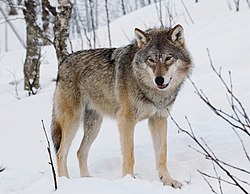
Eurasian wolf (Canis lupus lupus) at Polar Park in Bardu, Norway
| |
Scientific classification 
| |
| Kingdom: | Animalia |
| Phylum: | Chordata |
| Class: | Mammalia |
| Order: | Carnivora |
| Suborder: | Caniformia |
| Family: | Canidae |
| Subfamily: | Caninae |
| Genus: | Canis |
| Species: | C. lupus
|
| Binomial name | |
| Canis lupus | |
| Subspecies | |
.png)
| |
| Global wolf range based on IUCN's 2023 assessment.[1] | |

The wolf (Canis lupus;[b] pl.: wolves), also known as the grey wolf or gray wolf, is a canine native to Eurasia and North America. More than thirty subspecies of Canis lupus have been recognized, including the dog and dingo, though grey wolves, as popularly understood, include only naturally-occurring wild subspecies. The wolf is the largest wild extant member of the family Canidae, and is further distinguished from other Canis species by its less pointed ears and muzzle, as well as a shorter torso and a longer tail. The wolf is nonetheless related closely enough to smaller Canis species, such as the coyote and the golden jackal, to produce fertile hybrids with them. The wolf's fur is usually mottled white, brown, grey, and black, although subspecies in the arctic region may be nearly all white.
Of all members of the genus Canis, the wolf is most specialized for cooperative game hunting, as demonstrated by its physical adaptations to tackling large prey, its more social nature, and its highly advanced expressive behaviour, including individual or group howling. It travels in nuclear families, consisting of a mated pair accompanied by their offspring. Offspring may leave to form their own packs on the onset of sexual maturity and in response to competition for food within the pack. Wolves are also territorial, and fights over territory are among the principal causes of mortality. The wolf is mainly a carnivore and feeds on large wild hooved mammals as well as smaller animals, livestock, carrion, and garbage. Single wolves or mated pairs typically have higher success rates in hunting than do large packs. Pathogens and parasites, notably the rabies virus, may infect wolves.
The global wild wolf population was estimated to be 300,000 in 2003 and is considered to be of Least Concern by the International Union for Conservation of Nature (IUCN). Wolves have a long history of interactions with humans, having been despised and hunted in most pastoral communities because of their attacks on livestock, while conversely being respected in some agrarian and hunter-gatherer societies. Although the fear of wolves exists in many human societies, the majority of recorded attacks on people have been attributed to animals suffering from rabies. Wolf attacks on humans are rare because wolves are relatively few, live away from people, and have developed a fear of humans because of their experiences with hunters, farmers, ranchers, and shepherds.
Etymology
[edit]The English "wolf" stems from the Old English wulf, which is itself derived from the Proto-Germanic *wulfaz. The Proto-Indo-European root *wĺ̥kʷos is also the source of the Latin word for the animal lupus (from Proto-Italic *lúkʷos).[4][5] The name "grey wolf" refers to the greyish colour of the species.[6]
Since pre-Christian times, Germanic peoples such as the Anglo-Saxons took on wulf as a prefix or suffix in their names. Examples include Wulfhere ("Wolf Army"), Cynewulf ("Royal Wolf"), Cēnwulf ("Bold Wolf"), Wulfheard ("Wolf-hard"), Earnwulf ("Eagle Wolf"), Wulfstān ("Wolf Stone") Æðelwulf ("Noble Wolf"), Wolfhroc ("Wolf-Frock"), Wolfhetan ("Wolf Hide"), Scrutolf ("Garb Wolf"), Wolfgang ("Wolf Gait") and Wolfdregil ("Wolf Runner").[7]
Taxonomy
[edit]| Canine phylogeny with ages of divergence | |||||||||||||||||||||||||||||||||||||||||||||
| |||||||||||||||||||||||||||||||||||||||||||||
| Cladogram and divergence of the grey wolf (including the domestic dog) among its closest extant relatives[8] |
.png)
.png)
.jpg)
.png)
.png)
.png)
.png)
.png)
.png)
In 1758, the Swedish botanist and zoologist Carl Linnaeus published in his Systema Naturae the binomial nomenclature.[3] Canis is the Latin word meaning "dog",[9] and under this genus he listed the doglike carnivores including domestic dogs, wolves, and jackals. He classified the domestic dog as Canis familiaris, and the wolf as Canis lupus.[3] Linnaeus considered the dog to be a separate species from the wolf because of its "cauda recurvata" (upturning tail) which is not found in any other canid.[10]
Subspecies
[edit]In the third edition of Mammal Species of the World published in 2005, the mammalogist W. Christopher Wozencraft listed under C. lupus 36 wild subspecies, and proposed two additional subspecies: familiaris (Linnaeus, 1758) and dingo (Meyer, 1793). Wozencraft included hallstromi—the New Guinea singing dog—as a taxonomic synonym for the dingo. Wozencraft referred to a 1999 mitochondrial DNA (mtDNA) study as one of the guides in forming his decision, and listed the 38 subspecies of C. lupus under the biological common name of "wolf", the nominate subspecies being the Eurasian wolf (C. l. lupus) based on the type specimen that Linnaeus studied in Sweden.[11] Studies using paleogenomic techniques reveal that the modern wolf and the dog are sister taxa, as modern wolves are not closely related to the population of wolves that was first domesticated.[12] In 2019, a workshop hosted by the IUCN/Species Survival Commission's Canid Specialist Group considered the New Guinea singing dog and the dingo to be feral Canis familiaris, and therefore should not be assessed for the IUCN Red List.[13]
Evolution
[edit]
The phylogenetic descent of the extant wolf C. lupus from the earlier C. mosbachensis (which in turn descended from C. etruscus) is widely accepted.[14] Among the oldest fossils of the modern grey wolf is one from Ponte Galeria in Italy, dating to 406,500 ± 2,400 years ago.[15] Remains from Cripple Creek Sump in Alaska may be considerably older, around 1 million years old,[16] though differentiating between the remains of modern wolves and C. mosbachensis is difficult and ambiguous, with some authors choosing to include C. mosbachensis (which first appeared around 1.4 million years ago) as an early subspecies of C. lupus.[15]
Considerable morphological diversity existed among wolves by the Late Pleistocene. Many Late Pleistocene wolf populations had more robust skulls and teeth than modern wolves, often with a shortened snout, a pronounced development of the temporalis muscle, and robust premolars. It is proposed that these features were specialized adaptations for the processing of carcass and bone associated with the hunting and scavenging of Pleistocene megafauna. Compared with modern wolves, some Pleistocene wolves showed an increase in tooth breakage similar to that seen in the extinct dire wolf. This suggests they either often processed carcasses, or that they competed with other carnivores and needed to consume their prey quickly. The frequency and location of tooth fractures in these wolves indicates they were habitual bone crackers like the modern spotted hyena.[17]
Genomic studies suggest modern wolves and dogs descend from a common ancestral wolf population.[18][19][20] A 2021 study found that the Himalayan wolf and the Indian plains wolf are part of a lineage that is basal to other wolves and split from them 200,000 years ago.[21] Other wolves appear to share most of their common ancestry much more recently, within the last 23,000 years (around the peak and the end of the Last Glacial Maximum), originating from Siberia[22] or Beringia.[23] While some sources have suggested that this was a consequence of a population bottleneck,[23] other studies have suggested that this a result of gene flow homogenising ancestry.[22]
A 2016 genomic study suggests that Old World and New World wolves split around 12,500 years ago followed by the divergence of the lineage that led to dogs from other Old World wolves around 11,100–12,300 years ago.[20] An extinct Late Pleistocene wolf may have been the ancestor of the dog,[24][17] with the dog's similarity to the extant wolf being the result of genetic admixture between the two.[17] The dingo, Basenji, Tibetan Mastiff and Chinese indigenous breeds are basal members of the domestic dog clade. The divergence time for wolves in Europe, the Middle East, and Asia is estimated to be fairly recent at around 1,600 years ago. Among New World wolves, the Mexican wolf diverged around 5,400 years ago.[20]
Admixture with other canids
[edit]
In the distant past, there was gene flow between African wolves, golden jackals, and grey wolves. The African wolf is a descendant of a genetically admixed canid of 72% wolf and 28% Ethiopian wolf ancestry. One African wolf from the Egyptian Sinai Peninsula showed admixture with Middle Eastern grey wolves and dogs.[25] There is evidence of gene flow between golden jackals and Middle Eastern wolves, less so with European and Asian wolves, and least with North American wolves. This indicates the golden jackal ancestry found in North American wolves may have occurred before the divergence of the Eurasian and North American wolves.[26]
The common ancestor of the coyote and the wolf is admixed with a ghost population of an extinct unidentified canid. This canid was genetically close to the dhole and evolved after the divergence of the African hunting dog from the other canid species. The basal position of the coyote compared to the wolf has been proposed to be due to the coyote retaining more of the mitochondrial genome of this unidentified canid.[25] Similarly, a museum specimen of a wolf from southern China collected in 1963 showed a genome that was 12–14% admixed from this unknown canid.[27] In North America, some coyotes and wolves show varying degrees of past genetic admixture.[26]
In more recent times, some male Italian wolves originated from dog ancestry, which indicates female wolves will breed with male dogs in the wild.[28] In the Caucasus Mountains, ten percent of dogs including livestock guardian dogs, are first generation hybrids.[29] Although mating between golden jackals and wolves has never been observed, evidence of jackal-wolf hybridization was discovered through mitochondrial DNA analysis of jackals living in the Caucasus Mountains[29] and in Bulgaria.[30] In 2021, a genetic study found that the dog's similarity to the extant grey wolf was the result of substantial dog-into-wolf gene flow, with little evidence of the reverse.[31]
Description
[edit]
The wolf is the largest extant member of the family Canidae,[32] and is further distinguished from coyotes and jackals by a broader snout, shorter ears, a shorter torso and a longer tail.[33][32] It is slender and powerfully built, with a large, deeply descending rib cage, a sloping back, and a heavily muscled neck.[34] The wolf's legs are moderately longer than those of other canids, which enables the animal to move swiftly, and to overcome the deep snow that covers most of its geographical range in winter,[35] though more short-legged ecomorphs are found in some wolf populations.[36] The ears are relatively small and triangular.[34] The wolf's head is large and heavy, with a wide forehead, strong jaws and a long, blunt muzzle.[37] The skull is 230–280 mm (9.1–11.0 in) in length and 130–150 mm (5.1–5.9 in) in width.[38] The teeth are heavy and large, making them better suited to crushing bone than those of other canids, though they are not as specialized as those found in hyenas.[39][40] Its molars have a flat chewing surface, but not to the same extent as the coyote, whose diet contains more vegetable matter.[41] Females tend to have narrower muzzles and foreheads, thinner necks, slightly shorter legs, and less massive shoulders than males.[42]
.jpg)
Adult wolves measure 105–160 cm (41–63 in) in length and 80–85 cm (31–33 in) at shoulder height.[37] The tail measures 29–50 cm (11–20 in) in length, the ears 90–110 mm (3.5–4.3 in) in height, and the hind feet are 220–250 mm (8.7–9.8 in).[43] The size and weight of the modern wolf increases proportionally with latitude in accordance with Bergmann's rule.[44] The mean body mass of the wolf is 40 kg (88 lb), the smallest specimen recorded at 12 kg (26 lb) and the largest at 79.4 kg (175 lb).[45][37] On average, European wolves weigh 38.5 kg (85 lb), North American wolves 36 kg (79 lb), and Indian and Arabian wolves 25 kg (55 lb).[46] Females in any given wolf population typically weigh 5–10 lb (2.3–4.5 kg) less than males. Wolves weighing over 54 kg (119 lb) are uncommon, though exceptionally large individuals have been recorded in Alaska and Canada.[47] In central Russia, exceptionally large males can reach a weight of 69–79 kg (152–174 lb).[43]
Pelage
[edit]
The wolf has very dense and fluffy winter fur, with a short undercoat and long, coarse guard hairs.[37] Most of the undercoat and some guard hairs are shed in spring and grow back in autumn.[46] The longest hairs occur on the back, particularly on the front quarters and neck. Especially long hairs grow on the shoulders and almost form a crest on the upper part of the neck. The hairs on the cheeks are elongated and form tufts. The ears are covered in short hairs and project from the fur. Short, elastic and closely adjacent hairs are present on the limbs from the elbows down to the calcaneal tendons.[37] The winter fur is highly resistant to the cold. Wolves in northern climates can rest comfortably in open areas at −40 °C (−40 °F) by placing their muzzles between the rear legs and covering their faces with their tail. Wolf fur provides better insulation than dog fur and does not collect ice when warm breath is condensed against it.[46]
In cold climates, the wolf can reduce the flow of blood near its skin to conserve body heat. The warmth of the foot pads is regulated independently from the rest of the body and is maintained at just above tissue-freezing point where the pads come in contact with ice and snow.[48] In warm climates, the fur is coarser and scarcer than in northern wolves.[37] Female wolves tend to have smoother furred limbs than males and generally develop the smoothest overall coats as they age. Older wolves generally have more white hairs on the tip of the tail, along the nose, and on the forehead. Winter fur is retained longest by lactating females, although with some hair loss around their teats.[42] Hair length on the middle of the back is 60–70 mm (2.4–2.8 in), and the guard hairs on the shoulders generally do not exceed 90 mm (3.5 in), but can reach 110–130 mm (4.3–5.1 in).[37]
A wolf's coat colour is determined by its guard hairs. Wolves usually have some hairs that are white, brown, grey and black.[49] The coat of the Eurasian wolf is a mixture of ochreous (yellow to orange) and rusty ochreous (orange/red/brown) colours with light grey. The muzzle is pale ochreous grey, and the area of the lips, cheeks, chin, and throat is white. The top of the head, forehead, under and between the eyes, and between the eyes and ears is grey with a reddish film. The neck is ochreous. Long, black tips on the hairs along the back form a broad stripe, with black hair tips on the shoulders, upper chest and rear of the body. The sides of the body, tail, and outer limbs are a pale dirty ochreous colour, while the inner sides of the limbs, belly, and groin are white. Apart from those wolves which are pure white or black, these tones vary little across geographical areas, although the patterns of these colours vary between individuals.[50]
In North America, the coat colours of wolves follow Gloger's rule, wolves in the Canadian arctic being white and those in southern Canada, the U.S., and Mexico being predominantly grey. In some areas of the Rocky Mountains of Alberta and British Columbia, the coat colour is predominantly black, some being blue-grey and some with silver and black.[49] Differences in coat colour between sexes is absent in Eurasia;[51] females tend to have redder tones in North America.[52] Black-coloured wolves in North America acquired their colour from wolf-dog admixture after the first arrival of dogs across the Bering Strait 12,000 to 14,000 years ago.[53] Research into the inheritance of white colour from dogs into wolves has yet to be undertaken.[54]
Ecology
[edit]Distribution and habitat
[edit]
Wolves occur across Eurasia and North America. However, deliberate human persecution because of livestock predation and fear of attacks on humans has reduced the wolf's range to about one-third of its historic range; the wolf is now extirpated (locally extinct) from much of its range in Western Europe, the United States and Mexico, and completely in the British Isles and Japan. In modern times, the wolf occurs mostly in wilderness and remote areas. The wolf can be found between sea level and 3,000 m (9,800 ft). Wolves live in forests, inland wetlands, shrublands, grasslands (including Arctic tundra), pastures, deserts, and rocky peaks on mountains.[1] Habitat use by wolves depends on the abundance of prey, snow conditions, livestock densities, road densities, human presence and topography.[41]
Diet
[edit]
Like all land mammals that are pack hunters, the wolf feeds predominantly on ungulates that can be divided into large size 240–650 kg (530–1,430 lb) and medium size 23–130 kg (51–287 lb), and have a body mass similar to that of the combined mass of the pack members.[55][56] The wolf specializes in preying on the vulnerable individuals of large prey,[41] with a pack of 15 able to bring down an adult moose.[57] The variation in diet between wolves living on different continents is based on the variety of hoofed mammals and of available smaller and domesticated prey.[58]
In North America, the wolf's diet is dominated by wild large hoofed mammals (ungulates) and medium-sized mammals. In Asia and Europe, their diet is dominated by wild medium-sized hoofed mammals and domestic species. The wolf depends on wild species, and if these are not readily available, as in Asia, the wolf is more reliant on domestic species.[58] Across Eurasia, wolves prey mostly on moose, red deer, roe deer and wild boar.[59] In North America, important range-wide prey are elk, moose, caribou, white-tailed deer and mule deer.[60] Prior to their extirpation from North America, wild horses were among the most frequently consumed prey of North American wolves.[61] Wolves can digest their meal in a few hours and can feed several times in one day, making quick use of large quantities of meat.[62] A well-fed wolf stores fat under the skin, around the heart, intestines, kidneys, and bone marrow, particularly during the autumn and winter.[63]
Nonetheless, wolves are not fussy eaters. Smaller-sized animals that may supplement their diet include rodents, hares, insectivores and smaller carnivores. They frequently eat waterfowl and their eggs. When such foods are insufficient, they prey on lizards, snakes, and frogs, when available,[64] and have even been known to feed on grasshoppers.[65] Wolves in some areas may consume fish and even marine life.[66][67][68] Wolves also consume some plant material. In Europe, they eat apples, pears, figs, melons, berries and cherries. In North America, wolves eat blueberries and raspberries. They also eat grass, which may provide some vitamins, but is most likely used mainly to induce vomiting to rid themselves of intestinal parasites or long guard hairs.[69] They are known to eat the berries of mountain-ash, lily of the valley, bilberries, cowberries, European black nightshade, grain crops, and the shoots of reeds.[64]
In times of scarcity, wolves will readily eat carrion.[64] In Eurasian areas with dense human activity, many wolf populations are forced to subsist largely on livestock and garbage.[59] As prey in North America continue to occupy suitable habitats with low human density, North American wolves eat livestock and garbage only in dire circumstances.[70] Cannibalism is not uncommon in wolves during harsh winters, when packs often attack weak or injured wolves and may eat the bodies of dead pack members.[64][71][72]
Interactions with other predators
[edit]Wolves typically dominate other canid species in areas where they both occur. In North America, incidents of wolves killing coyotes are common, particularly in winter, when coyotes feed on wolf kills. Wolves may attack coyote den sites, digging out and killing their pups, though rarely eating them. There are no records of coyotes killing wolves, though coyotes may chase wolves if they outnumber them.[73] According to a press release by the U.S. Department of Agriculture in 1921, the infamous Custer Wolf relied on coyotes to accompany him and warn him of danger. Though they fed from his kills, he never allowed them to approach him.[74] Interactions have been observed in Eurasia between wolves and golden jackals, the latter's numbers being comparatively small in areas with high wolf densities.[37][73][75] Wolves also kill red, Arctic and corsac foxes, usually in disputes over carcasses, sometimes eating them.[37][76]

Brown bears typically dominate wolf packs in disputes over carcasses, while wolf packs mostly prevail against bears when defending their den sites. Both species kill each other's young. Wolves eat the brown bears they kill, while brown bears seem to eat only young wolves.[77] Wolf interactions with American black bears are much rarer because of differences in habitat preferences. Wolves have been recorded on numerous occasions actively seeking out American black bears in their dens and killing them without eating them. Unlike brown bears, American black bears frequently lose against wolves in disputes over kills.[78] Wolves also dominate and sometimes kill wolverines, and will chase off those that attempt to scavenge from their kills. Wolverines escape from wolves in caves or up trees.[79]
Wolves may interact and compete with felids, such as the Eurasian lynx, which may feed on smaller prey where wolves are present[80] and may be suppressed by large wolf populations.[81] Wolves encounter cougars along portions of the Rocky Mountains and adjacent mountain ranges. Wolves and cougars typically avoid encountering each other by hunting at different elevations for different prey (niche partitioning). This is more difficult during winter. Wolves in packs usually dominate cougars and can steal their kills or even kill them,[82] while one-to-one encounters tend to be dominated by the cat, who likewise will kill wolves.[83] Wolves more broadly affect cougar population dynamics and distribution by dominating territory and prey opportunities and disrupting the feline's behaviour.[84] Wolf and Siberian tiger interactions are well-documented in the Russian Far East, where tigers significantly depress wolf numbers, sometimes to the point of localized extinction.[85][80]
In Israel, Palestine, Central Asia and India wolves may encounter striped hyenas, usually in disputes over carcasses. Striped hyenas feed extensively on wolf-killed carcasses in areas where the two species interact. One-to-one, hyenas dominate wolves, and may prey on them,[86] but wolf packs can drive off single or outnumbered hyenas.[87][88] There is at least one case in Israel of a hyena associating and cooperating with a wolf pack.[89]
Infections
[edit]
Viral diseases carried by wolves include: rabies, canine distemper, canine parvovirus, infectious canine hepatitis, papillomatosis, and canine coronavirus. In wolves, the incubation period for rabies is eight to 21 days, and results in the host becoming agitated, deserting its pack, and travelling up to 80 km (50 mi) a day, thus increasing the risk of infecting other wolves. Although canine distemper is lethal in dogs, it has not been recorded to kill wolves, except in Canada and Alaska. The canine parvovirus, which causes death by dehydration, electrolyte imbalance, and endotoxic shock or sepsis, is largely survivable in wolves, but can be lethal to pups.[90] Bacterial diseases carried by wolves include: brucellosis, Lyme disease, leptospirosis, tularemia, bovine tuberculosis,[91] listeriosis and anthrax.[92] Although lyme disease can debilitate individual wolves, it does not appear to significantly affect wolf populations. Leptospirosis can be contracted through contact with infected prey or urine, and can cause fever, anorexia, vomiting, anemia, hematuria, icterus, and death.[91]
Wolves are often infested with a variety of arthropod exoparasites, including fleas, ticks, lice, and mites. The most harmful to wolves, particularly pups, is the mange mite (Sarcoptes scabiei),[93] though they rarely develop full-blown mange, unlike foxes.[37] Endoparasites known to infect wolves include: protozoans and helminths (flukes, tapeworms, roundworms and thorny-headed worms). Most fluke species reside in the wolf's intestines. Tapeworms are commonly found in wolves, which they get though their prey, and generally cause little harm in wolves, though this depends on the number and size of the parasites, and the sensitivity of the host. Symptoms often include constipation, toxic and allergic reactions, irritation of the intestinal mucosa, and malnutrition. Wolves can carry over 30 roundworm species, though most roundworm infections appear benign, depending on the number of worms and the age of the host.[93]
Behaviour
[edit]
Social structure
[edit]
The wolf is a social animal.[37] Its populations consist of packs and lone wolves, most lone wolves being temporarily alone while they disperse from packs to form their own or join another one.[94] The wolf's basic social unit is the nuclear family consisting of a mated pair accompanied by their offspring.[37] The average pack size in North America is eight wolves and 5.5 in Europe.[44] The average pack across Eurasia consists of a family of eight wolves (two adults, juveniles, and yearlings),[37] or sometimes two or three such families,[41] with examples of exceptionally large packs consisting of up to 42 wolves being known.[95] Cortisol levels in wolves rise significantly when a pack member dies, indicating the presence of stress.[96] During times of prey abundance caused by calving or migration, different wolf packs may join together temporarily.[37]
Offspring typically stay in the pack for 10–54 months before dispersing.[97] Triggers for dispersal include the onset of sexual maturity and competition within the pack for food.[98] The distance travelled by dispersing wolves varies widely; some stay in the vicinity of the parental group, while other individuals may travel great distances of upwards of 206 km (128 mi), 390 km (240 mi), and 670 km (420 mi) from their natal (birth) packs.[99] A new pack is usually founded by an unrelated dispersing male and female, travelling together in search of an area devoid of other hostile packs.[100] Wolf packs rarely adopt other wolves into their fold and typically kill them. In the rare cases where other wolves are adopted, the adoptee is almost invariably an immature animal of one to three years old, and unlikely to compete for breeding rights with the mated pair. This usually occurs between the months of February and May. Adopted males may mate with an available pack female and then form their own pack. In some cases, a lone wolf is adopted into a pack to replace a deceased breeder.[95]
Wolves are territorial and generally establish territories far larger than they require to survive assuring a steady supply of prey. Territory size depends largely on the amount of prey available and the age of the pack's pups. They tend to increase in size in areas with low prey populations,[101] or when the pups reach the age of six months when they have the same nutritional needs as adults.[102] Wolf packs travel constantly in search of prey, covering roughly 9% of their territory per day, on average 25 km/d (16 mi/d). The core of their territory is on average 35 km2 (14 sq mi) where they spend 50% of their time.[101] Prey density tends to be much higher on the territory's periphery. Wolves tend to avoid hunting on the fringes of their range to avoid fatal confrontations with neighbouring packs.[103] The smallest territory on record was held by a pack of six wolves in northeastern Minnesota, which occupied an estimated 33 km2 (13 sq mi), while the largest was held by an Alaskan pack of ten wolves encompassing 6,272 km2 (2,422 sq mi).[102] Wolf packs are typically settled, and usually leave their accustomed ranges only during severe food shortages.[37] Territorial fights are among the principal causes of wolf mortality, one study concluding that 14–65% of wolf deaths in Minnesota and the Denali National Park and Preserve were due to other wolves.[104]
Communication
[edit]
Wolves communicate using vocalizations, body postures, scent, touch, and taste.[105] The phases of the moon have no effect on wolf vocalization, and despite popular belief, wolves do not howl at the Moon.[106] Wolves howl to assemble the pack usually before and after hunts, to pass on an alarm particularly at a den site, to locate each other during a storm, while crossing unfamiliar territory, and to communicate across great distances.[107] Wolf howls can under certain conditions be heard over areas of up to 130 km2 (50 sq mi).[41] Other vocalizations include growls, barks and whines. Wolves do not bark as loudly or continuously as dogs do in confrontations, rather barking a few times and then retreating from a perceived danger.[108] Aggressive or self-assertive wolves are characterized by their slow and deliberate movements, high body posture and raised hackles, while submissive ones carry their bodies low, flatten their fur, and lower their ears and tail.[109]
Scent marking involves urine, feces, and preputial and anal gland scents. This is more effective at advertising territory than howling and is often used in combination with scratch marks. Wolves increase their rate of scent marking when they encounter the marks of wolves from other packs. Lone wolves will rarely mark, but newly bonded pairs will scent mark the most.[41] These marks are generally left every 240 m (790 ft) throughout the territory on regular travelways and junctions. Such markers can last for two to three weeks,[102] and are typically placed near rocks, boulders, trees, or the skeletons of large animals.[37] Raised leg urination is considered to be one of the most important forms of scent communication in the wolf, making up 60–80% of all scent marks observed.[110]
Reproduction
[edit].jpg)
Wolves are monogamous, mated pairs usually remaining together for life. Should one of the pair die, another mate is found quickly.[111] With wolves in the wild, inbreeding does not occur where outbreeding is possible.[112] Wolves become mature at the age of two years and sexually mature from the age of three years.[111] The age of first breeding in wolves depends largely on environmental factors: when food is plentiful, or when wolf populations are heavily managed, wolves can rear pups at younger ages to better exploit abundant resources. Females are capable of producing pups every year, one litter annually being the average.[113] Oestrus and rut begin in the second half of winter and lasts for two weeks.[111]

Dens are usually constructed for pups during the summer period. When building dens, females make use of natural shelters like fissures in rocks, cliffs overhanging riverbanks and holes thickly covered by vegetation. Sometimes, the den is the appropriated burrow of smaller animals such as foxes, badgers or marmots. An appropriated den is often widened and partly remade. On rare occasions, female wolves dig burrows themselves, which are usually small and short with one to three openings. The den is usually constructed not more than 500 m (1,600 ft) away from a water source. It typically faces southwards where it can be better warmed by sunlight exposure, and the snow can thaw more quickly. Resting places, play areas for the pups, and food remains are commonly found around wolf dens. The odor of urine and rotting food emanating from the denning area often attracts scavenging birds like magpies and ravens. Though they mostly avoid areas within human sight, wolves have been known to nest near homes, paved roads and railways.[114] During pregnancy, female wolves remain in a den located away from the peripheral zone of their territories, where violent encounters with other packs are less likely to occur.[115]
The gestation period lasts 62–75 days with pups usually being born in the spring months or early summer in very cold places such as on the tundra. Young females give birth to four to five young, and older females from six to eight young and up to 14. Their mortality rate is 60–80%.[116] Newborn wolf pups look similar to German Shepherd Dog pups.[117] They are born blind and deaf and are covered in short soft greyish-brown fur. They weigh 300–500 g (11–18 oz) at birth and begin to see after nine to 12 days. The milk canines erupt after one month. Pups first leave the den after three weeks. At one-and-a-half months of age, they are agile enough to flee from danger. Mother wolves do not leave the den for the first few weeks, relying on the fathers to provide food for them and their young. Pups begin to eat solid food at the age of three to four weeks. They have a fast growth rate during their first four months of life: during this period, a pup's weight can increase nearly 30 times.[116][118] Wolf pups begin play-fighting at the age of three weeks, though unlike young coyotes and foxes, their bites are gentle and controlled. Actual fights to establish hierarchy usually occur at five to eight weeks of age. This is in contrast to young coyotes and foxes, which may begin fighting even before the onset of play behaviour.[119] By autumn, the pups are mature enough to accompany the adults on hunts for large prey.[115]
Hunting and feeding
[edit].jpg)
Single wolves or mated pairs typically have higher success rates in hunting than do large packs; single wolves have occasionally been observed to kill large prey such as moose, bison and muskoxen unaided.[120][121] The size of a wolf hunting pack is related to the number of pups that survived the previous winter, adult survival, and the rate of dispersing wolves leaving the pack. The optimal pack size for hunting elk is four wolves, and for bison a large pack size is more successful.[122] Wolves move around their territory when hunting, using the same trails for extended periods.[123] Wolves are nocturnal predators. During the winter, a pack will commence hunting in the twilight of early evening and will hunt all night, traveling tens of kilometres. Sometimes hunting large prey occurs during the day. During the summer, wolves generally tend to hunt individually, ambushing their prey and rarely giving pursuit.[124]
When hunting large gregarious prey, wolves will try to isolate an individual from its group.[125] If successful, a wolf pack can bring down game that will feed it for days, but one error in judgement can lead to serious injury or death. Most large prey have developed defensive adaptations and behaviours. Wolves have been killed while attempting to bring down bison, elk, moose, muskoxen, and even by one of their smallest hoofed prey, the white-tailed deer. With smaller prey like beaver, geese, and hares, there is no risk to the wolf.[126] Although people often believe wolves can easily overcome any of their prey, their success rate in hunting hoofed prey is usually low.[127]

The wolf must give chase and gain on its fleeing prey, slow it down by biting through thick hair and hide, and then disable it enough to begin feeding.[126] Wolves may wound large prey and then lie around resting for hours before killing it when it is weaker due to blood loss, thereby lessening the risk of injury to themselves.[128] With medium-sized prey, such as roe deer or sheep, wolves kill by biting the throat, severing nerve tracks and the carotid artery, thus causing the animal to die within a few seconds to a minute. With small, mouselike prey, wolves leap in a high arc and immobilize it with their forepaws.[129]
Once prey is brought down, wolves begin to feed excitedly, ripping and tugging at the carcass in all directions, and bolting down large chunks of it.[130] The breeding pair typically monopolizes food to continue producing pups. When food is scarce, this is done at the expense of other family members, especially non-pups.[131] Wolves typically commence feeding by gorging on the larger internal organs, like the heart, liver, lungs, and stomach lining. The kidneys and spleen are eaten once they are exposed, followed by the muscles.[132] A wolf can eat 15–19% of its body weight in one sitting.[63]
Status and conservation
[edit]The global wild wolf population in 2003 was estimated at 300,000.[133] Wolf population declines have been arrested since the 1970s. This has fostered recolonization and reintroduction in parts of its former range as a result of legal protection, changes in land use, and rural human population shifts to cities. Competition with humans for livestock and game species, concerns over the danger posed by wolves to people, and habitat fragmentation pose a continued threat to the wolf. Despite these threats, the IUCN classifies the wolf as Least Concern on its Red List due to its relatively widespread range and stable population. The species is listed under Appendix II of the Convention on International Trade in Endangered Species of Wild Fauna and Flora (CITES), meaning international trade in the species (including parts and derivatives) is regulated. However, populations of Bhutan, India, Nepal and Pakistan are listed in Appendix I which prohibits commercial international trade in wild-sourced specimens.[1]
North America
[edit]
In Canada, 50,000–60,000 wolves live in 80% of their historical range, making Canada an important stronghold for the species.[41] Under Canadian law, First Nations people can hunt wolves without restrictions, but others must acquire licenses for the hunting and trapping seasons. As many as 4,000 wolves may be harvested in Canada each year.[134] The wolf is a protected species in national parks under the Canada National Parks Act.[135] In Alaska, 7,000–11,000 wolves are found on 85% of the state's 1,517,733 km2 (586,000 sq mi) area. Wolves may be hunted or trapped with a license; around 1,200 wolves are harvested annually.[136]
In the contiguous United States, wolf declines were caused by the expansion of agriculture, the decimation of the wolf's main prey species like the American bison, and extermination campaigns.[41] Wolves were given protection under the Endangered Species Act (ESA) of 1973, and have since returned to parts of their former range thanks to both natural recolonizations and reintroductions in Yellowstone and Idaho.[137] The repopulation of wolves in Midwestern United States has been concentrated in the Great Lakes states of Minnesota, Wisconsin and Michigan where wolves number over 4,000 as of 2018.[138] Wolves also occupy much of the northern Rocky Mountains region and the northwest, with a total population over 3,000 as of the 2020s.[139] In Mexico and parts of the southwestern United States, the Mexican and U.S. governments collaborated from 1977 to 1980 in capturing all Mexican wolves remaining in the wild to prevent their extinction and established captive breeding programs for reintroduction.[140] As of 2024, the reintroduced Mexican wolf population numbers over 250 individuals.[141]
Eurasia
[edit]
The European Union has 20,300 wolves with breeding packs in 23 countries.[142] In many EU countries, the wolf is strictly protected under the 1979 Berne Convention on the Conservation of European Wildlife and Natural Habitats (Appendix II) and the 1992 Council Directive 92/43/EEC on the Conservation of Natural Habitats and of Wild Fauna and Flora (Annex II and IV). There is extensive legal protection in many European countries, although there are national exceptions.[1][143]
Wolves have been persecuted in Europe for centuries, having been exterminated in Great Britain by 1684, in Ireland by 1770, in Central Europe by 1899, in France by the 1930s, and in much of Scandinavia by the early 1970s. They continued to survive in parts of Finland, Eastern Europe and Southern Europe.[144] Since 1980, European wolves have rebounded and expanded into parts of their former range. The decline of the traditional pastoral and rural economies seems to have ended the need to exterminate the wolf in parts of Europe.[134] As of 2016, estimates of wolf numbers include: 4,000 in the Balkans, 3,460–3,849 in the Carpathian Mountains, 1,700–2,240 in the Baltic states, 1,100–2,400 in the Italian Peninsula, and around 2,500 in the northwest Iberian peninsula as of 2007.[145] In a study of wolf conservation in Sweden, it was found that there was little opposition between the policies of the European Union and those of the Swedish officials implementing domestic policy.[146]
In the former Soviet Union, wolf populations have retained much of their historical range despite Soviet-era large scale extermination campaigns. Their numbers range from 1,500 in Georgia, to 20,000 in Kazakhstan and up to 45,000 in Russia.[147] In Russia, the wolf is regarded as a pest because of its attacks on livestock, and wolf management means controlling their numbers by destroying them throughout the year. Russian history over the past century shows that reduced hunting leads to an abundance of wolves.[148] The Russian government has continued to pay bounties for wolves and annual harvests of 20–30% do not appear to significantly affect their numbers.[149]

In the Middle East, only Israel and Oman give wolves explicit legal protection.[150] Israel has protected its wolves since 1954 and has maintained a moderately sized population of 150 through effective enforcement of conservation policies. These wolves have moved into neighboring countries. Approximately 300–600 wolves inhabit the Arabian Peninsula.[151] The wolf also appears to be widespread in Iran.[152] Turkey has an estimated population of about 7,000 wolves.[153] Outside of Turkey, wolf populations in the Middle East may total 1,000–2,000.[150]
In southern Asia, the northern regions of Afghanistan and Pakistan are important strongholds for wolves.[154] Wolf populations in Pakistan have suffered population declines and range contraction. They are now confined to remote, barren, mountainous regions and extensive deserts. Numerous factors are thought to be responsible for their decline. The expansion of agricultural practices and land conversion has caused habitat loss.[154] The wolf has been protected in India since 1972.[155] The Indian wolf is distributed across the states of Gujarat, Rajasthan, Haryana, Uttar Pradesh, Madhya Pradesh, Maharashtra, Karnataka and Andhra Pradesh.[156] As of 2019, it is estimated that there are around 2,000–3,000 Indian wolves in the country.[157] In East Asia, Mongolia's population numbers 10,000–20,000. In China, Heilongjiang has roughly 650 wolves, Xinjiang has 10,000 and Tibet has 2,000.[158] 2017 evidence suggests that wolves range across all of mainland China.[159] Wolves have been historically persecuted in China[160] but have been legally protected since 1998.[161] The last Japanese wolf was captured and killed in 1905.[162]
Relationships with humans
[edit]In culture
[edit]In folklore, religion and mythology
[edit]
The wolf is a common motif in the mythologies and cosmologies of peoples throughout its historical range. The Ancient Greeks associated wolves with Apollo, the god of light and order.[163] The Ancient Romans connected the wolf with their god of war and agriculture Mars,[164] and believed their city's founders, Romulus and Remus, were suckled by a she-wolf.[165] Norse mythology includes the feared giant wolf Fenrir,[166] and Geri and Freki, Odin's faithful pets.[167]
In Chinese astronomy, the wolf represents Sirius and guards the heavenly gate. In China, the wolf was traditionally associated with greed and cruelty and wolf epithets were used to describe negative behaviours such as cruelty ("wolf's heart"), mistrust ("wolf's look") and lechery ("wolf-sex"). In both Hinduism and Buddhism, the wolf is ridden by gods of protection. In Vedic Hinduism, the wolf is a symbol of the night and the daytime quail must escape from its jaws. In Tantric Buddhism, wolves are depicted as inhabitants of graveyards and destroyers of corpses.[166]
In the Pawnee creation myth, the wolf was the first animal brought to Earth. When humans killed it, they were punished with death, destruction and the loss of immortality.[168] For the Pawnee, Sirius is the "wolf star" and its disappearance and reappearance signified the wolf moving to and from the spirit world. Both Pawnee and Blackfoot call the Milky Way the "wolf trail".[169] The wolf is also an important crest symbol for clans of the Pacific Northwest like the Kwakwakaʼwakw.[166]
The concept of people turning into wolves, and the inverse, has been present in many cultures. One Greek myth tells of Lycaon being transformed into a wolf by Zeus as punishment for his evil deeds.[170] The legend of the werewolf has been widespread in European folklore and involves people willingly turning into wolves to attack and kill others.[171] The Navajo have traditionally believed that witches would turn into wolves by donning wolf skins and would kill people and raid graveyards.[172] The Dena'ina believed wolves were once men and viewed them as brothers.[163]
In fable and literature
[edit]Aesop featured wolves in several of his fables, playing on the concerns of Ancient Greece's settled, sheep-herding world. His most famous is the fable of "The Boy Who Cried Wolf", which is directed at those who knowingly raise false alarms, and from which the idiomatic phrase "to cry wolf" is derived. Some of his other fables concentrate on maintaining the trust between shepherds and guard dogs in their vigilance against wolves, as well as anxieties over the close relationship between wolves and dogs. Although Aesop used wolves to warn, criticize and moralize about human behaviour, his portrayals added to the wolf's image as a deceitful and dangerous animal. The Bible uses an image of a wolf lying with a lamb in a utopian vision of the future. In the New Testament, Jesus is said to have used wolves as illustrations of the dangers his followers, whom he represents as sheep, would face should they follow him.[173]

Isengrim the wolf, a character first appearing in the 12th-century Latin poem Ysengrimus, is a major character in the Reynard Cycle, where he stands for the low nobility, whilst his adversary, Reynard the fox, represents the peasant hero. Isengrim is forever the victim of Reynard's wit and cruelty, often dying at the end of each story.[174] The tale of "Little Red Riding Hood", first written in 1697 by Charles Perrault, is considered to have further contributed to the wolf's negative reputation in the Western world. The Big Bad Wolf is portrayed as a villain capable of imitating human speech and disguising itself with human clothing. The character has been interpreted as an allegorical sexual predator.[175] Villainous wolf characters also appear in The Three Little Pigs and "The Wolf and the Seven Young Goats".[176] The hunting of wolves, and their attacks on humans and livestock, feature prominently in Russian literature, and are included in the works of Leo Tolstoy, Anton Chekhov, Nikolay Nekrasov, Ivan Bunin, Leonid Pavlovich Sabaneyev, and others. Tolstoy's War and Peace and Chekhov's Peasants both feature scenes in which wolves are hunted with hounds and Borzois.[177] The musical Peter and the Wolf involves a wolf being captured for eating a duck, but is spared and sent to a zoo.[178]
Wolves are among the central characters of Rudyard Kipling's The Jungle Book. His portrayal of wolves has been praised posthumously by wolf biologists for his depiction of them: rather than being villainous or gluttonous, as was common in wolf portrayals at the time of the book's publication, they are shown as living in amiable family groups and drawing on the experience of infirm but experienced elder pack members.[179] Farley Mowat's largely fictional 1963 memoir Never Cry Wolf is widely considered to be the most popular book on wolves, having been adapted into a Hollywood film and taught in several schools decades after its publication. Although credited with having changed popular perceptions on wolves by portraying them as loving, cooperative and noble, it has been criticized for its idealization of wolves and its factual inaccuracies.[180][181][182]
Conflicts
[edit]Human presence appears to stress wolves, as seen by increased cortisol levels in instances such as snowmobiling near their territory.[183]
Predation on livestock
[edit]
Livestock depredation has been one of the primary reasons for hunting wolves and can pose a severe problem for wolf conservation. As well as causing economic losses, the threat of wolf predation causes great stress on livestock producers, and no foolproof solution of preventing such attacks short of exterminating wolves has been found.[184] Some nations help offset economic losses to wolves through compensation programs or state insurance.[185] Domesticated animals are easy prey for wolves, as they have been bred under constant human protection, and are thus unable to defend themselves very well.[186] Wolves typically resort to attacking livestock when wild prey is depleted.[187] In Eurasia, a large part of the diet of some wolf populations consists of livestock, while such incidents are rare in North America, where healthy populations of wild prey have been largely restored.[184]
The majority of losses occur during the summer grazing period, untended livestock in remote pastures being the most vulnerable to wolf predation.[188] The most frequently targeted livestock species are sheep (Europe), domestic reindeer (northern Scandinavia), goats (India), horses (Mongolia), cattle and turkeys (North America).[184] The number of animals killed in single attacks varies according to species: most attacks on cattle and horses result in one death, while turkeys, sheep and domestic reindeer may be killed in surplus.[189] Wolves mainly attack livestock when the animals are grazing, though they occasionally break into fenced enclosures.[190]
Competition with dogs
[edit]A review of the studies on the competitive effects of dogs on sympatric carnivores did not mention any research on competition between dogs and wolves.[191][192] Competition would favour the wolf, which is known to kill dogs; however, wolves usually live in pairs or in small packs in areas with high human persecution, giving them a disadvantage when facing large groups of dogs.[192][193]
Wolves kill dogs on occasion, and some wolf populations rely on dogs as an important food source. In Croatia, wolves kill more dogs than sheep, and wolves in Russia appear to limit stray dog populations. Wolves may display unusually bold behaviour when attacking dogs accompanied by people, sometimes ignoring nearby humans. Wolf attacks on dogs may occur both in house yards and in forests. Wolf attacks on hunting dogs are considered a major problem in Scandinavia and Wisconsin.[184][194] Although the number of dogs killed each year by wolves is relatively low, it induces a fear of wolves entering villages and farmyards to prey on them. In many cultures, dogs are seen as family members, or at least working team members, and losing one can lead to strong emotional responses such as demanding more liberal hunting regulations.[192]
Dogs that are employed to guard sheep help to mitigate human–wolf conflicts, and are often proposed as one of the non-lethal tools in the conservation of wolves.[192][195] Shepherd dogs are not particularly aggressive, but they can disrupt potential wolf predation by displaying what is to the wolf ambiguous behaviours, such as barking, social greeting, invitation to play or aggression. The historical use of shepherd dogs across Eurasia has been effective against wolf predation,[192][196] especially when confining sheep in the presence of several livestock guardian dogs.[192][197] Shepherd dogs are sometimes killed by wolves.[192]
Attacks on humans
[edit]
The fear of wolves has been pervasive in many societies, though humans are not part of the wolf's natural prey.[198] How wolves react to humans depends largely on their prior experience with people: wolves lacking any negative experience of humans, or which are food-conditioned, may show little fear of people.[199] Although wolves may react aggressively when provoked, such attacks are mostly limited to quick bites on extremities, and the attacks are not pressed.[198]
Predatory attacks may be preceded by a long period of habituation, in which wolves gradually lose their fear of humans. The victims are repeatedly bitten on the head and face, and are then dragged off and consumed unless the wolves are driven off. Such attacks typically occur only locally and do not stop until the wolves involved are eliminated. Predatory attacks can occur at any time of the year, with a peak in the June–August period, when the chances of people entering forested areas (for livestock grazing or berry and mushroom picking) increase.[198] Cases of non-rabid wolf attacks in winter have been recorded in Belarus, Kirov and Irkutsk oblasts, Karelia and Ukraine. Also, wolves with pups experience greater food stresses during this period.[37] The majority of victims of predatory wolf attacks are children under the age of 18 and, in the rare cases where adults are killed, the victims are almost always women.[198] Indian wolves have a history of preying on children, a phenomenon called "child-lifting". They may be taken primarily in the spring and summer periods during the evening hours, and often within human settlements.[200]
Cases of rabid wolves are low when compared to other species, as wolves do not serve as primary reservoirs of the disease, but can be infected by animals such as dogs, jackals and foxes. Incidents of rabies in wolves are very rare in North America, though numerous in the eastern Mediterranean, the Middle East and Central Asia. Wolves apparently develop the "furious" phase of rabies to a very high degree. This, coupled with their size and strength, makes rabid wolves perhaps the most dangerous of rabid animals.[198] Bites from rabid wolves are 15 times more dangerous than those of rabid dogs.[201] Rabid wolves usually act alone, travelling large distances and often biting large numbers of people and domestic animals. Most rabid wolf attacks occur in the spring and autumn periods. Unlike with predatory attacks, the victims of rabid wolves are not eaten, and the attacks generally occur only on a single day. The victims are chosen at random, though most cases involve adult men. During the fifty years up to 2002, there were eight fatal attacks in Europe and Russia, and more than two hundred in southern Asia.[198]
Human hunting of wolves
[edit]
Theodore Roosevelt said wolves are difficult to hunt because of their elusiveness, sharp senses, high endurance, and ability to quickly incapacitate and kill hunting dogs.[202] Historic methods included killing of spring-born litters in their dens, coursing with dogs (usually combinations of sighthounds, Bloodhounds and Fox Terriers), poisoning with strychnine, and trapping.[203][204]
A popular method of wolf hunting in Russia involves trapping a pack within a small area by encircling it with fladry poles carrying a human scent. This method relies heavily on the wolf's fear of human scents, though it can lose its effectiveness when wolves become accustomed to the odor. Some hunters can lure wolves by imitating their calls. In Kazakhstan and Mongolia, wolves are traditionally hunted using eagles and large falcons, though this practice is declining, as experienced falconers are becoming few in number. Shooting wolves from aircraft is highly effective, due to increased visibility and direct lines of fire.[204] Several types of dog, including the Borzoi and Kyrgyz Tajgan, have been specifically bred for wolf hunting.[192]
Wolves as pets and working animals
[edit]Wolves and wolf-dog hybrids are sometimes kept as exotic pets, wolves do not show the same tractability as dogs in living alongside humans, being generally less responsive to human commands and more likely to act aggressively. Humans are more likely to be fatally mauled by a pet wolf or wolf-dog hybrid than by a dog.[205]
Notes
[edit]- ^ Populations of Bhutan, India, Nepal, and Pakistan are included in Appendix I. Excludes domesticated form and dingo, which are referenced as Canus lupus familiaris and Canus lupus dingo.
- ^ Domestic and feral dogs are included in the phylogenetic but not colloquial definition of 'wolf', and are thus not in the scope of this article.
References
[edit]- ^ a b c d e Boitani, L.; Phillips, M. & Jhala, Y. (2023) [amended version of 2018 assessment]. "Canis lupus". IUCN Red List of Threatened Species. 2023 e.T3746A247624660. doi:10.2305/IUCN.UK.2023-1.RLTS.T3746A247624660.en. Retrieved June 2, 2024.
- ^ "Appendices | CITES". cites.org. Retrieved January 14, 2022.
- ^ a b c Linnæus, Carl (1758). "Canis Lupus". Systema naturæ per regna tria naturæ, secundum classes, ordines, genera, species, cum characteribus, differentiis, synonymis, locis. Tomus I (in Latin) (10 ed.). Holmiæ (Stockholm): Laurentius Salvius. pp. 39–40.
- ^ Harper, Douglas. "wolf". Online Etymology Dictionary.
- ^ A. Lehrman (1987). "Anatolian Cognates of the PIE Word for 'Wolf'". Die Sprache. 33: 13–18.
- ^ Young, Stanley P.; Goldman, Edward A. (1944). The Wolves of North America, Part I. New York, Dover Publications, Inc. p. 390.
- ^ Marvin 2012, pp. 74–75.
- ^ Koepfli, Klaus-Peter; Pollinger, John; Godinho, Raquel; Robinson, Jacqueline; Lea, Amanda; Hendricks, Sarah; Schweizer, Rena M.; Thalmann, Olaf; Silva, Pedro; Fan, Zhenxin; Yurchenko, Andrey A.; Dobrynin, Pavel; Makunin, Alexey; Cahill, James A.; Shapiro, Beth; Álvares, Francisco; Brito, José C.; Geffen, Eli; Leonard, Jennifer A.; Helgen, Kristofer M.; Johnson, Warren E.; o'Brien, Stephen J.; Van Valkenburgh, Blaire; Wayne, Robert K. (2015). "Genome-wide Evidence Reveals that African and Eurasian Golden Jackals Are Distinct Species". Current Biology. 25 (#16): 2158–65. Bibcode:2015CBio...25.2158K. doi:10.1016/j.cub.2015.06.060. PMID 26234211.
- ^ Harper, Douglas. "canine". Online Etymology Dictionary.
- ^ Clutton-Brock, Juliet (1995). "2-Origins of the dog". In Serpell, James (ed.). The Domestic Dog: Its Evolution, Behaviour and Interactions with People. Cambridge University Press. pp. 7–20. ISBN 0-521-41529-2.
- ^ Wozencraft, W. C. (2005). "Order Carnivora". In Wilson, D. E.; Reeder, D. M. (eds.). Mammal Species of the World: A Taxonomic and Geographic Reference (3rd ed.). Johns Hopkins University Press. pp. 575–577. ISBN 978-0-8018-8221-0. OCLC 62265494.
- ^ Larson, G.; Bradley, D. G. (2014). "How Much Is That in Dog Years? The Advent of Canine Population Genomics". PLOS Genetics. 10 (1) e1004093. doi:10.1371/journal.pgen.1004093. PMC 3894154. PMID 24453989.
- ^ Alvares, Francisco; Bogdanowicz, Wieslaw; Campbell, Liz A.D.; Godinho, Rachel; Hatlauf, Jennifer; Jhala, Yadvendradev V.; Kitchener, Andrew C.; Koepfli, Klaus-Peter; Krofel, Miha; Moehlman, Patricia D.; Senn, Helen; Sillero-Zubiri, Claudio; Viranta, Suvi; Werhahn, Geraldine (2019). "Old World Canis spp. with taxonomic ambiguity: Workshop conclusions and recommendations. CIBIO. Vairão, Portugal, 28–30 May 2019" (PDF). IUCN/SSC Canid Specialist Group. Retrieved March 6, 2020.
- ^ Mech & Boitani 2003, pp. 239–245.
- ^ a b Iurino, Dawid A.; Mecozzi, Beniamino; Iannucci, Alessio; Moscarella, Alfio; Strani, Flavia; Bona, Fabio; Gaeta, Mario; Sardella, Raffaele (February 25, 2022). "A Middle Pleistocene wolf from central Italy provides insights on the first occurrence of Canis lupus in Europe". Scientific Reports. 12 (1): 2882. Bibcode:2022NatSR..12.2882I. doi:10.1038/s41598-022-06812-5. ISSN 2045-2322. PMC 8881584. PMID 35217686.
- ^ Tedford, Richard H.; Wang, Xiaoming; Taylor, Beryl E. (2009). "Phylogenetic Systematics of the North American Fossil Caninae (Carnivora: Canidae)". Bulletin of the American Museum of Natural History. 325: 1–218. doi:10.1206/574.1. hdl:2246/5999. S2CID 83594819.
- ^ a b c Thalmann, Olaf; Perri, Angela R. (2018). "Paleogenomic Inferences of Dog Domestication". In Lindqvist, C.; Rajora, O. (eds.). Paleogenomics. Population Genomics. Springer, Cham. pp. 273–306. doi:10.1007/13836_2018_27. ISBN 978-3-030-04752-8.
- ^ Freedman, Adam H.; Gronau, Ilan; Schweizer, Rena M.; Ortega-Del Vecchyo, Diego; Han, Eunjung; et al. (2014). "Genome Sequencing Highlights the Dynamic Early History of Dogs". PLOS Genetics. 10 (1). e1004016. doi:10.1371/journal.pgen.1004016. PMC 3894170. PMID 24453982.
- ^ Skoglund, Pontus; Ersmark, Erik; Palkopoulou, Eleftheria; Dalén, Love (2015). "Ancient Wolf Genome Reveals an Early Divergence of Domestic Dog Ancestors and Admixture into High-Latitude Breeds". Current Biology. 25 (11): 1515–1519. Bibcode:2015CBio...25.1515S. doi:10.1016/j.cub.2015.04.019. PMID 26004765.
- ^ a b c Fan, Zhenxin; Silva, Pedro; Gronau, Ilan; Wang, Shuoguo; Armero, Aitor Serres; Schweizer, Rena M.; Ramirez, Oscar; Pollinger, John; Galaverni, Marco; Ortega Del-Vecchyo, Diego; Du, Lianming; Zhang, Wenping; Zhang, Zhihe; Xing, Jinchuan; Vilà, Carles; Marques-Bonet, Tomas; Godinho, Raquel; Yue, Bisong; Wayne, Robert K. (2016). "Worldwide patterns of genomic variation and admixture in gray wolves". Genome Research. 26 (2): 163–173. doi:10.1101/gr.197517.115. PMC 4728369. PMID 26680994.
- ^ Hennelly, Lauren M.; Habib, Bilal; Modi, Shrushti; Rueness, Eli K.; Gaubert, Philippe; Sacks, Benjamin N. (2021). "Ancient divergence of Indian and Tibetan wolves revealed by recombination-aware phylogenomics". Molecular Ecology. 30 (24): 6687–6700. Bibcode:2021MolEc..30.6687H. doi:10.1111/mec.16127. PMID 34398980. S2CID 237147842.
- ^ a b Bergström, Anders; Stanton, David W. G.; Taron, Ulrike H.; Frantz, Laurent; Sinding, Mikkel-Holger S.; Ersmark, Erik; Pfrengle, Saskia; Cassatt-Johnstone, Molly; Lebrasseur, Ophélie; Girdland-Flink, Linus; Fernandes, Daniel M.; Ollivier, Morgane; Speidel, Leo; Gopalakrishnan, Shyam; Westbury, Michael V. (July 14, 2022). "Grey wolf genomic history reveals a dual ancestry of dogs". Nature. 607 (7918): 313–320. Bibcode:2022Natur.607..313B. doi:10.1038/s41586-022-04824-9. ISSN 0028-0836. PMC 9279150. PMID 35768506.
- ^ a b Loog, Liisa; Thalmann, Olaf; Sinding, Mikkel-Holger S.; Schuenemann, Verena J.; Perri, Angela; Germonpré, Mietje; Bocherens, Herve; Witt, Kelsey E.; Samaniego Castruita, Jose A.; Velasco, Marcela S.; Lundstrøm, Inge K. C.; Wales, Nathan; Sonet, Gontran; Frantz, Laurent; Schroeder, Hannes (May 2020). "Ancient DNA suggests modern wolves trace their origin to a Late Pleistocene expansion from Beringia". Molecular Ecology. 29 (9): 1596–1610. Bibcode:2020MolEc..29.1596L. doi:10.1111/mec.15329. ISSN 0962-1083. PMC 7317801. PMID 31840921.
- ^ Freedman, Adam H; Wayne, Robert K (2017). "Deciphering the Origin of Dogs: From Fossils to Genomes". Annual Review of Animal Biosciences. 5: 281–307. doi:10.1146/annurev-animal-022114-110937. PMID 27912242. S2CID 26721918.
- ^ a b Gopalakrishnan, Shyam; Sinding, Mikkel-Holger S.; Ramos-Madrigal, Jazmín; Niemann, Jonas; Samaniego Castruita, Jose A.; Vieira, Filipe G.; Carøe, Christian; Montero, Marc de Manuel; Kuderna, Lukas; Serres, Aitor; González-Basallote, Víctor Manuel; Liu, Yan-Hu; Wang, Guo-Dong; Marques-Bonet, Tomas; Mirarab, Siavash; Fernandes, Carlos; Gaubert, Philippe; Koepfli, Klaus-Peter; Budd, Jane; Rueness, Eli Knispel; Heide-Jørgensen, Mads Peter; Petersen, Bent; Sicheritz-Ponten, Thomas; Bachmann, Lutz; Wiig, Øystein; Hansen, Anders J.; Gilbert, M. Thomas P. (2018). "Interspecific Gene Flow Shaped the Evolution of the Genus Canis". Current Biology. 28 (21): 3441–3449.e5. Bibcode:2018CBio...28E3441G. doi:10.1016/j.cub.2018.08.041. PMC 6224481. PMID 30344120.
- ^ a b Sinding, Mikkel-Holger S.; Gopalakrishan, Shyam; Vieira, Filipe G.; Samaniego Castruita, Jose A.; Raundrup, Katrine; Heide Jørgensen, Mads Peter; Meldgaard, Morten; Petersen, Bent; Sicheritz-Ponten, Thomas; Mikkelsen, Johan Brus; Marquard-Petersen, Ulf; Dietz, Rune; Sonne, Christian; Dalén, Love; Bachmann, Lutz; Wiig, Øystein; Hansen, Anders J.; Gilbert, M. Thomas P. (2018). "Population genomics of grey wolves and wolf-like canids in North America". PLOS Genetics. 14 (11) e1007745. doi:10.1371/journal.pgen.1007745. PMC 6231604. PMID 30419012.
- ^ Wang, Guo-Dong; Zhang, Ming; Wang, Xuan; Yang, Melinda A.; Cao, Peng; Liu, Feng; Lu, Heng; Feng, Xiaotian; Skoglund, Pontus; Wang, Lu; Fu, Qiaomei; Zhang, Ya-Ping (2019). "Genomic Approaches Reveal an Endemic Subpopulation of Gray Wolves in Southern China". iScience. 20: 110–118. Bibcode:2019iSci...20..110W. doi:10.1016/j.isci.2019.09.008. PMC 6817678. PMID 31563851.
- ^ Iacolina, Laura; Scandura, Massimo; Gazzola, Andrea; Cappai, Nadia; Capitani, Claudia; Mattioli, Luca; Vercillo, Francesca; Apollonio, Marco (2010). "Y-chromosome microsatellite variation in Italian wolves: A contribution to the study of wolf-dog hybridization patterns". Mammalian Biology—Zeitschrift für Säugetierkunde. 75 (4): 341–347. Bibcode:2010MamBi..75..341I. doi:10.1016/j.mambio.2010.02.004.
- ^ a b Kopaliani, N.; Shakarashvili, M.; Gurielidze, Z.; Qurkhuli, T.; Tarkhnishvili, D. (2014). "Gene Flow between Wolf and Shepherd Dog Populations in Georgia (Caucasus)". Journal of Heredity. 105 (3): 345–53. doi:10.1093/jhered/esu014. PMID 24622972.
- ^ Moura, A. E.; Tsingarska, E.; Dąbrowski, M. J.; Czarnomska, S. D.; Jędrzejewska, B. A.; Pilot, M. G. (2013). "Unregulated hunting and genetic recovery from a severe population decline: The cautionary case of Bulgarian wolves". Conservation Genetics. 15 (2): 405–417. doi:10.1007/s10592-013-0547-y.
- ^ Bergström, Anders; Frantz, Laurent; Schmidt, Ryan; Ersmark, Erik; Lebrasseur, Ophelie; Girdland-Flink, Linus; Lin, Audrey T.; Storå, Jan; Sjögren, Karl-Göran; Anthony, David; Antipina, Ekaterina; Amiri, Sarieh; Bar-Oz, Guy; Bazaliiskii, Vladimir I.; Bulatović, Jelena; Brown, Dorcas; Carmagnini, Alberto; Davy, Tom; Fedorov, Sergey; Fiore, Ivana; Fulton, Deirdre; Germonpré, Mietje; Haile, James; Irving-Pease, Evan K.; Jamieson, Alexandra; Janssens, Luc; Kirillova, Irina; Horwitz, Liora Kolska; Kuzmanovic-Cvetković, Julka; Kuzmin, Yaroslav; Losey, Robert J.; Dizdar, Daria Ložnjak; Mashkour, Marjan; Novak, Mario; Onar, Vedat; Orton, David; Pasaric, Maja; Radivojevic, Miljana; Rajkovic, Dragana; Roberts, Benjamin; Ryan, Hannah; Sablin, Mikhail; Shidlovskiy, Fedor; Stojanovic, Ivana; Tagliacozzo, Antonio; Trantalidou, Katerina; Ullén, Inga; Villaluenga, Aritza; Wapnish, Paula; Dobney, Keith; Götherström, Anders; Linderholm, Anna; Dalén, Love; Pinhasi, Ron; Larson, Greger; Skoglund, Pontus (2020). "Origins and genetic legacy of prehistoric dogs". Science. 370 (6516): 557–564. doi:10.1126/science.aba9572. PMC 7116352. PMID 33122379. S2CID 225956269.
- ^ a b Mech, L. David (1974). "Canis lupus". Mammalian Species (37): 1–6. doi:10.2307/3503924. JSTOR 3503924. Archived from the original on July 31, 2019. Retrieved July 30, 2019.
- ^ Heptner & Naumov 1998, pp. 129–132.
- ^ a b Heptner & Naumov 1998, p. 166.
- ^ Mech 1981, p. 13.
- ^ Tomiya, Susumu; Meachen, Julie A. (January 17, 2018). "Postcranial diversity and recent ecomorphic impoverishment of North American gray wolves". Biology Letters. 14 (1) 20170613. doi:10.1098/rsbl.2017.0613. ISSN 1744-9561. PMC 5803591. PMID 29343558.
- ^ a b c d e f g h i j k l m n o p q Heptner & Naumov 1998, pp. 164–270.
- ^ Mech 1981, p. 14.
- ^ Therrien, F. O. (2005). "Mandibular force profiles of extant carnivorans and implications for the feeding behaviour of extinct predators". Journal of Zoology. 267 (3): 249–270. doi:10.1017/S0952836905007430.
- ^ Mech & Boitani 2003, p. 112.
- ^ a b c d e f g h Paquet, P.; Carbyn, L. W. (2003). "Ch23: Gray wolf Canis lupus and allies". In Feldhamer, G. A.; Thompson, B. C.; Chapman, J. A. (eds.). Wild Mammals of North America: Biology, Management, and Conservation (2 ed.). Johns Hopkins University Press. pp. 482–510. ISBN 0-8018-7416-5.[permanent dead link]
- ^ a b Lopez 1978, p. 23.
- ^ a b Heptner & Naumov 1998, p. 174.
- ^ a b Miklosi, A. (2015). "Ch. 5.5.2—Wolves". Dog Behaviour, Evolution, and Cognition (2 ed.). Oxford University Press. pp. 110–112. ISBN 978-0-19-104572-1.
- ^ Macdonald, D. W.; Norris, S. (2001). Encyclopedia of Mammals. Oxford University Press. p. 45. ISBN 978-0-7607-1969-5.
- ^ a b c Lopez 1978, p. 19.
- ^ Lopez 1978, p. 18.
- ^ Lopez 1978, pp. 19–20.
- ^ a b Gipson, Philip S.; Bangs, Edward E.; Bailey, Theodore N.; Boyd, Diane K.; Cluff, H. Dean; Smith, Douglas W.; Jiminez, Michael D. (2002). "Color Patterns among Wolves in Western North America". Wildlife Society Bulletin. 30 (3): 821–830. JSTOR 3784236.
- ^ Heptner & Naumov 1998, pp. 168–169.
- ^ Heptner & Naumov 1998, p. 168.
- ^ Lopez 1978, p. 22.
- ^ Anderson, T. M.; Vonholdt, B. M.; Candille, S. I.; Musiani, M.; Greco, C.; Stahler, D. R.; Smith, D. W.; Padhukasahasram, B.; Randi, E.; Leonard, J. A.; Bustamante, C. D.; Ostrander, E. A.; Tang, H.; Wayne, R. K.; Barsh, G. S. (2009). "Molecular and Evolutionary History of Melanism in North American Gray Wolves". Science. 323 (5919): 1339–1343. Bibcode:2009Sci...323.1339A. doi:10.1126/science.1165448. PMC 2903542. PMID 19197024.
- ^ Hedrick, P. W. (2009). "Wolf of a different colour". Heredity. 103 (6): 435–436. Bibcode:2009Hered.103..435H. doi:10.1038/hdy.2009.77. PMID 19603061. S2CID 5228987.
- ^ Earle, M (1987). "A flexible body mass in social carnivores". American Naturalist. 129 (5): 755–760. Bibcode:1987ANat..129..755E. doi:10.1086/284670. S2CID 85236511.
- ^ Sorkin, Boris (2008). "A biomechanical constraint on body mass in terrestrial mammalian predators". Lethaia. 41 (4): 333–347. Bibcode:2008Letha..41..333S. doi:10.1111/j.1502-3931.2007.00091.x.
- ^ Mech, L. David (1966). The Wolves of Isle Royale. Fauna Series 7. Fauna of the National Parks of the United States. pp. 75–76. ISBN 978-1-4102-0249-9.
- ^ a b Newsome, Thomas M.; Boitani, Luigi; Chapron, Guillaume; Ciucci, Paolo; Dickman, Christopher R.; Dellinger, Justin A.; López-Bao, José V.; Peterson, Rolf O.; Shores, Carolyn R.; Wirsing, Aaron J.; Ripple, William J. (2016). "Food habits of the world's grey wolves". Mammal Review. 46 (4): 255–269. Bibcode:2016MamRv..46..255N. doi:10.1111/mam.12067. hdl:10536/DRO/DU:30085823. S2CID 31174275.
- ^ a b Mech & Boitani 2003, p. 107.
- ^ Mech & Boitani 2003, pp. 109–110.
- ^ Landry, Zoe; Kim, Sora; Trayler, Robin B.; Gilbert, Marisa; Zazula, Grant; Southon, John; Fraser, Danielle (June 1, 2021). "Dietary reconstruction and evidence of prey shifting in Pleistocene and recent gray wolves (Canis lupus) from Yukon Territory". Palaeogeography, Palaeoclimatology, Palaeoecology. 571 110368. Bibcode:2021PPP...57110368L. doi:10.1016/j.palaeo.2021.110368. ISSN 0031-0182. Retrieved April 23, 2024 – via Elsevier Science Direct.
- ^ Mech 1981, p. 172.
- ^ a b Mech & Boitani 2003, p. 201.
- ^ a b c d Heptner & Naumov 1998, pp. 213–231.
- ^ Barton, Brandon T.; Hill, JoVonn G.; Wolff, Carter L.; Newsome, Thomas M.; Ripple, William J.; Lashley, Marcus A. (September 18, 2019). "Grasshopper consumption by grey wolves and implications for ecosystems". Ecology. 101 (2) e02892. doi:10.1002/ecy.2892. ISSN 0012-9658. PMID 31531974. Retrieved April 20, 2025 – via Wiley Online Library.
- ^ Gable, T. D.; Windels, S. K.; Homkes, A. T. (2018). "Do wolves hunt freshwater fish in spring as a food source?". Mammalian Biology. 91: 30–33. Bibcode:2018MamBi..91...30G. doi:10.1016/j.mambio.2018.03.007. S2CID 91073874.
- ^ Woodford, Riley (November 2004). "Alaska's Salmon-Eating Wolves". Wildlifenews.alaska.gov. Retrieved July 25, 2019.
- ^ McAllister, I. (2007). The Last Wild Wolves: Ghosts of the Rain Forest. University of California Press. p. 144. ISBN 978-0-520-25473-2.
- ^ Fuller, T. K. (2019). "Ch3-What wolves eat". Wolves: Spirit of the Wild. Chartwell Crestline. p. 53. ISBN 978-0-7858-3738-1.
- ^ Mech & Boitani 2003, p. 109.
- ^ Mech 1981, p. 180.
- ^ Klein, D. R. (1995). "The introduction, increase, and demise of wolves on Coronation Island, Alaska". In Carbyn, L. N.; Fritts, S. H.; Seip, D. R. (eds.). Ecology and conservation of wolves in a changing world. Canadian Circumpolar Institute, Occasional Publication No. 35. pp. 275–280.
- ^ a b Mech & Boitani 2003, pp. 266–268.
- ^ Merrit, Dixon (January 7, 1921). "World's Greatest Animal Dead" (PDF). US Department of Agriculture Division of Publications. p. 2. Archived (PDF) from the original on July 24, 2019. Retrieved July 26, 2019.
- ^ Giannatos, G. (April 2004). "Conservation Action Plan for the golden jackal Canis aureus L. in Greece" (PDF). World Wildlife Fund Greece. pp. 1–47. Archived (PDF) from the original on December 9, 2017. Retrieved October 29, 2019.
- ^ Mech & Boitani 2003, p. 269.
- ^ Mech & Boitani 2003, pp. 261–263.
- ^ Mech & Boitani 2003, pp. 263–264.
- ^ Mech & Boitani 2003, p. 266.
- ^ a b Mech & Boitani 2003, p. 265.
- ^ Sunquist, Melvin E.; Sunquist, Fiona (2002). Wild cats of the world. University of Chicago Press. p. 167. ISBN 0-226-77999-8.
- ^ Mech & Boitani 2003, pp. 264–265.
- ^ Jimenez, Michael D.; Asher, Valpa J.; Bergman, Carita; Bangs, Edward E.; Woodruff, Susannah P. (2008). "Gray Wolves, Canis lupus, Killed by Cougars, Puma concolor, and a Grizzly Bear, Ursus arctos, in Montana, Alberta, and Wyoming". The Canadian Field-Naturalist. 122: 76. doi:10.22621/cfn.v122i1.550.
- ^ Elbroch, L. M.; Lendrum, P. E.; Newsby, J.; Quigley, H.; Thompson, D. J. (2015). "Recolonizing wolves influence the realized niche of resident cougars". Zoological Studies. 54 (41): e41. doi:10.1186/s40555-015-0122-y. PMC 6661435. PMID 31966128.
- ^ Miquelle, D. G.; Stephens, P. A.; Smirnov, E. N.; Goodrich, J. M.; Zaumyslova, O. J.; Myslenkov, A. E. (2005). "Tigers and Wolves in the Russian Far East: Competitive Exclusion, Functional Redundancy and Conservation Implications". In Ray, J. C.; Berger, J.; Redford, K. H.; Steneck, R. (eds.). Large Carnivores and the Conservation of Biodiversity. Island Press. pp. 179–207. ISBN 1-55963-080-9. Archived from the original on June 3, 2016. Retrieved November 22, 2015.
- ^ Monchot, H.; Mashkour, H. (2010). "Hyenas around the cities. The case of Kaftarkhoun (Kashan- Iran)". Journal of Taphonomy. 8 (1): 17–32..
- ^ Mills, M. G. L.; Mills, Gus; Hofer, Heribert (1998). Hyaenas: status survey and conservation action plan. IUCN. pp. 24–25. ISBN 978-2-8317-0442-5. Archived from the original on May 16, 2016. Retrieved November 22, 2015.
- ^ Nayak, S.; Shah, S.; Borah, J. (2015). "Going for the kill: an observation of wolf-hyaena interaction in Kailadevi Wildlife Sanctuary, Rajasthan, India". Canid Biology & Conservation. 18 (7): 27–29.
- ^ Dinets, Vladimir; Eligulashvili, Beniamin (2016). "Striped Hyaenas (Hyaena hyaena) in Grey Wolf (Canis lupus) packs: Cooperation, commensalism or singular aberration?". Zoology in the Middle East. 62: 85–87. doi:10.1080/09397140.2016.1144292. S2CID 85957777.
- ^ Mech & Boitani 2003, pp. 208–211.
- ^ a b Mech & Boitani 2003, pp. 211–213.
- ^ Graves 2007, pp. 77–85.
- ^ a b Mech & Boitani 2003, pp. 202–208.
- ^ Mech & Boitani 2003, p. 164.
- ^ a b Mech & Boitani 2003, pp. 2–3, 28.
- ^ Molnar, B.; Fattebert, J.; Palme, R.; Ciucci, P.; Betschart, B.; Smith, D. W.; Diehl, P. (2015). "Environmental and intrinsic correlates of stress in free-ranging wolves". PLOS ONE. 10 (9). e0137378. Bibcode:2015PLoSO..1037378M. doi:10.1371/journal.pone.0137378. PMC 4580640. PMID 26398784.
- ^ Mech & Boitani 2003, pp. 1–2.
- ^ Mech & Boitani 2003, pp. 12–13.
- ^ Nowak, R. M.; Paradiso, J. L. (1983). "Carnivora;Canidae". Walker's Mammals of the World. Vol. 2 (4th ed.). Johns Hopkins University Press. p. 953. ISBN 978-0-8018-2525-5.
- ^ Mech & Boitani 2003, p. 38.
- ^ a b Jędrzejewski, W. O.; Schmidt, K.; Theuerkauf, J. R.; Jędrzejewska, B. A.; Kowalczyk, R. (2007). "Territory size of wolves Canis lupus: Linking local (Białowieża Primeval Forest, Poland) and Holarctic-scale patterns". Ecography. 30 (1): 66–76. Bibcode:2007Ecogr..30...66J. doi:10.1111/j.0906-7590.2007.04826.x. S2CID 62800394.
- ^ a b c Mech & Boitani 2003, pp. 19–26.
- ^ Mech, L. D. (1977). "Wolf-Pack Buffer Zones as Prey Reservoirs". Science. 198 (4314): 320–321. Bibcode:1977Sci...198..320M. doi:10.1126/science.198.4314.320. PMID 17770508. S2CID 22125487. Archived from the original on July 24, 2018. Retrieved January 10, 2019.
- ^ Mech, L. David; Adams, L. G.; Meier, T. J.; Burch, J. W.; Dale, B. W. (2003). "Ch.8-The Denali Wolf-Prey System". The Wolves of Denali. University of Minnesota Press. p. 163. ISBN 0-8166-2959-5.
- ^ Mech & Boitani 2003, pp. 66–103.
- ^ Busch 2007, p. 59.
- ^ Lopez 1978, p. 38.
- ^ Lopez 1978, pp. 39–41.
- ^ Mech & Boitani 2003, p. 90.
- ^ Peters, R. P.; Mech, L. D. (1975). "Scent-marking in wolves". American Scientist. 63 (6): 628–637. Bibcode:1975AmSci..63..628P. PMID 1200478.
- ^ a b c Heptner & Naumov 1998, p. 248.
- ^ Mech & Boitani 2003, p. 5.
- ^ Mech & Boitani 2003, p. 175.
- ^ Heptner & Naumov 1998, pp. 234–238.
- ^ a b Mech & Boitani 2003, pp. 42–46.
- ^ a b Heptner & Naumov 1998, pp. 249–254.
- ^ Mech & Boitani 2003, p. 47.
- ^ Mech & Boitani 2003, pp. 46–49.
- ^ Fox, M. W. (1978). The Dog: Its Domestication and Behavior. Garland STPM. p. 33. ISBN 978-0-89464-202-9.
- ^ Mech & Boitani 2003, pp. 119–121.
- ^ Thurber, J. M.; Peterson, R. O. (1993). "Effects of Population Density and Pack Size on the Foraging Ecology of Gray Wolves". Journal of Mammalogy. 74 (4): 879–889. doi:10.2307/1382426. JSTOR 1382426. S2CID 52063038.
- ^ Mech, Smith & MacNulty 2015, p. 4.
- ^ Heptner & Naumov 1998, p. 233.
- ^ Heptner & Naumov 1998, p. 240.
- ^ MacNulty, Daniel; Mech, L. David; Smith, Douglas W. (2007). "A proposed ethogram of large-carnivore predatory behavior, exemplified by the wolf". Journal of Mammalogy. 88 (3): 595–605. Bibcode:2007JMamm..88..595M. doi:10.1644/06-MAMM-A-119R1.1.
- ^ a b Mech, Smith & MacNulty 2015, pp. 1–3.
- ^ Mech, Smith & MacNulty 2015, p. 7.
- ^ Mech, Smith & MacNulty 2015, p. 82–89.
- ^ Zimen, Erik (1981). The Wolf: His Place in the Natural World. Souvenir Press. pp. 217–218. ISBN 978-0-285-62411-5.
- ^ Mech 1981, p. 185.
- ^ Mech & Boitani 2003, p. 58.
- ^ Mech & Boitani 2003, pp. 122–125.
- ^ Mech & Boitani 2003, p. 230.
- ^ a b Mech & Boitani 2003, pp. 321–324.
- ^ Government of Canada (July 29, 2019). "Schedule 3 (section 26) Protected Species". Justice Laws Website. Archived from the original on April 9, 2019. Retrieved October 30, 2019.
- ^ State of Alaska (October 29, 2019). "Wolf Hunting in Alaska". Alaska Department of Fish and Game. Archived from the original on September 30, 2019. Retrieved October 30, 2019.
- ^ "Wolf Recovery under the Endangered Species Act" (PDF). US Fish and Wildlife Service. February 2007. Archived (PDF) from the original on August 3, 2019. Retrieved September 1, 2019.
- ^ "Wolf Numbers in Minnesota, Wisconsin and Michigan (excluding Isle Royale)—1976 to 2015". U.S. Fish and Wildlife Service. Retrieved March 23, 2020.
- ^ "How many wild wolves are in the United States?". Wolf Conservation Center. Retrieved May 10, 2023.
- ^ Nie, M. A. (2003). Beyond Wolves: The Politics of Wolf Recovery and Management. University of Minnesota Press. pp. 118–119. ISBN 0-8166-3978-7.
- ^ "Mexican Wolf Population Grows for Eighth Consecutive Year | U.S. Fish & Wildlife Service". www.fws.gov. March 5, 2024. Retrieved March 6, 2024.
- ^ Blanco, J.; Sundseth, K. (2023). The situation of the wolf (canis lupus) in the European Union – An in-depth analysis. Publications Office of the European Union. doi:10.2779/187513. ISBN 978-92-68-10281-7. Retrieved February 7, 2025.
- ^ European Commission: Status, management and distribution of large carnivores—bear, lynx, wolf & wolverine—in Europe December 2012. page 50.
- ^ Mech & Boitani 2003, pp. 318–320.
- ^ "Status of large carnivore populations in Europe 2012–2016". European Commission. Archived from the original on September 2, 2019. Retrieved September 2, 2019.
- ^ The Wolf Dilemma: Following the Practices of Several Actors in Swedish Large Carnivore Management. Ramsey, Morag (2015) https://www.diva-portal.org/smash/get/diva2:821120/FULLTEXT01.pdf Retrieved 30 September 2023
- ^ Goldthorpe, Gareth (2016). The wolf in Eurasia—a regional approach to the conservation and management of a top-predator in Central Asia and the South Caucasus. Fauna & Flora International. doi:10.13140/RG.2.2.10128.20480.
- ^ Baskin, Leonid (2016). "Hunting as Sustainable Wildlife Management". Mammal Study. 41 (4): 173–180. doi:10.3106/041.041.0402.
- ^ "The Wolf in Russia—situations and problems" (PDF). Wolves and Humans Foundation. Archived from the original (PDF) on September 23, 2007. Retrieved September 2, 2019.
- ^ a b Fisher, A. (January 29, 2019). "Conservation in conflict: Advancement and the Arabian wolf". Middle East Eye. Archived from the original on November 7, 2019. Retrieved November 11, 2019.
- ^ Mech & Boitani 2003, pp. 323, 327.
- ^ Busch 2007, p. 231.
- ^ Şekercioğlu, Çağan (December 15, 2013). "Turkey's Wolves Are Texting Their Travels to Scientists". National Geographic. Archived from the original on October 6, 2019. Retrieved November 19, 2019.
- ^ a b Kabir, Muhammad; Hameed, Shoaib; Ali, Hussain; Bosso, Luciano; Din, Jaffar Ud; Bischof, Richard; Redpath, Steve; Nawaz, Muhammad Ali (November 9, 2017). "Habitat suitability and movement corridors of grey wolf (Canis lupus) in Northern Pakistan". PLOS ONE. 12 (11) e0187027. Bibcode:2017PLoSO..1287027K. doi:10.1371/journal.pone.0187027. ISSN 1932-6203. PMC 5679527. PMID 29121089.
 This article incorporates text available under the CC BY 4.0 license.
- ^ Mech & Boitani 2003, p. 327.
- ^ Yadvendradev, V. Jhala; Giles, Robert H. Jr. (991). "The Status and Conservation of the Wolf in Gujarat and Rajasthan, India". Conservation Biology. 5 (4). Wiley: 476–483. Bibcode:1991ConBi...5..476J. doi:10.1111/j.1523-1739.1991.tb00354.x. JSTOR 2386069.
- ^ Sharma, Lalit Kumar; Mukherjee, Tanoy; Saren, Phakir Chandra; Chandra, Kailash (2019). "Identifying suitable habitat and corridors for Indian Grey Wolf (Canis lupus pallipes) in Chotta Nagpur Plateau and Lower Gangetic Planes: A species with differential management needs". PLOS ONE. 14 (4) e0215019. Bibcode:2019PLoSO..1415019S. doi:10.1371/journal.pone.0215019. PMC 6457547. PMID 30969994.
- ^ Mech & Boitani 2003, p. 328.
- ^ Larson, Greger (2017). "Reconsidering the distribution of gray wolves". Zoological Research. 38 (3): 115–116. doi:10.24272/j.issn.2095-8137.2017.021. PMC 5460078. PMID 28585433.
- ^ Busch 2007, p. 232.
- ^ Xu, Yu; Yang, Biao; Dou, Liang (2015). "Local villagers' perceptions of wolves in Jiuzhaigou County, western China". PeerJ. 3 e982. doi:10.7717/peerj.982. PMC 4465947. PMID 26082870.
- ^ Ishiguro, Naotaka; Inoshima, Yasuo; Shigehara, Nobuo (2009). "Mitochondrial DNA Analysis of the Japanese Wolf (Canis Lupus Hodophilax Temminck, 1839) and Comparison with Representative Wolf and Domestic Dog Haplotypes". Zoological Science. 26 (11): 765–70. doi:10.2108/zsj.26.765. PMID 19877836. S2CID 27005517.
- ^ a b Mech & Boitani 2003, p. 292.
- ^ Lopez 1978, p. 210.
- ^ Marvin 2012, p. 128.
- ^ a b c Werness, Hope B. (2007). The Continuum Encyclopedia of Animal Symbolism in World Art. Continuum International Publishing Group. pp. 405, 437. ISBN 978-0-8264-1913-2.
- ^ Marvin 2012, p. 78.
- ^ Lopez 1978, p. 133.
- ^ Busch 2007, p. 110.
- ^ Marvin 2012, p. 47.
- ^ Marvin 2012, p. 50.
- ^ Lopez 1978, p. 123.
- ^ Marvin 2012, pp. 38–45.
- ^ Lopez 1978, p. 259.
- ^ Marvin 2012, pp. 64–70.
- ^ Lopez 1978, p. 263.
- ^ Graves 2007, pp. 21, 123.
- ^ Marvin 2012, p. 162.
- ^ Cassidy, K; Smith, D. W.; Mech, L. D.; MacNulty, D. R.; Stahler, D. R.; Metz, M. C. (2006). "Territoriality and interpack aggression in wolves: Shaping a social carnivore's life history. Rudyard Kipling's Law of the Jungle Meets Yellowstone's Law of the Mountains". Yellowstone Science. 24 (1): 37–41.
- ^ Mech & Boitani 2003, p. 294.
- ^ Jones, K. (2001). "Never Cry Wolf: Science, Sentiment, and the Literary Rehabilitation of Canis Lupus". The Canadian Historical Review. 84. Archived from the original on October 12, 2013. Retrieved July 28, 2012.
- ^ Grooms, Steve (2008). "The Mixed Legacy of Never Cry Wolf" (PDF). International Wolf. 18 (3): 11–13. Archived from the original (PDF) on June 21, 2010.
- ^ Creel, S.; Fox, J. E.; Hardy, A.; Sands, J.; Garrott, B.; Peterson, R. O. (2002). "Snowmobile activity and glucocorticoid stress responses in wolves and elk". Conservation Biology. 16 (3): 809–814. Bibcode:2002ConBi..16..809C. doi:10.1046/j.1523-1739.2002.00554.x. S2CID 84878446.
- ^ a b c d Mech & Boitani 2003, p. 305.
- ^ Mech & Boitani 2003, p. 309.
- ^ Mech 1981, p. 173.
- ^ Levy, Max G. (December 11, 2020). "These Non-Lethal Methods Encouraged by Science Can Keep Wolves From Killing Livestock". Smithsonian Magazine. Retrieved December 16, 2020.
- ^ Mech & Boitani 2003, p. 307.
- ^ Mech & Boitani 2003, p. 306.
- ^ Graves 2007, p. 45.
- ^ Vanak, A. T.; Dickman, C. R.; Silva-Rodriguez, E. A.; Butler, J. R. A.; Ritchie, E. G. (2014). "Top-dogs and under-dogs: competition between dogs and sympatric carnivores". In Gompper, M. E. (ed.). Free-Ranging Dogs and Wildlife Conservation. Oxford University Press. pp. 69–93. ISBN 978-0-19-966321-7.
- ^ a b c d e f g h Lescureux, Nicolas; Linnell, John D. C. (2014). "Warring brothers: The complex interactions between wolves (Canis lupus) and dogs (Canis familiaris) in a conservation context". Biological Conservation. 171: 232–245. Bibcode:2014BCons.171..232L. doi:10.1016/j.biocon.2014.01.032.
- ^ Boitani, L. (1983). "Wolf and dog competition in Italy". Acta Zoologica Fennica (174): 259–264.
- ^ Backeryd, J. (2007). "Wolf attacks on dogs in Scandinavia 1995–2005—Will wolves in Scandinavia go extinct if dog owners are allowed to kill a wolf attacking a dog?" (PDF). Examensarbete, Institutionen för ekologi, Grimsö forskningsstation. Sveriges Lantbruksuniversitet. Archived from the original (PDF) on July 17, 2019. Retrieved July 17, 2019.
- ^ Shivik, John A. (2006). "Tools for the Edge: What's New for Conserving Carnivores". BioScience. 56 (3): 253. doi:10.1641/0006-3568(2006)056[0253:TFTEWN]2.0.CO;2.
- ^ Coppinger, R.; Schneider, R. (1995). "Evolution of working dogs". In Serpell, J. (ed.). The Domestic Dog: Its Evolution, Behaviour and Interactions With People. University Press, Cambridge. pp. 21–47. ISBN 978-0-521-42537-7.
- ^ Espuno, Nathalie; Lequette, Benoit; Poulle, Marie-Lazarine; Migot, Pierre; Lebreton, Jean-Dominique (2004). "Heterogeneous response to preventive sheep husbandry during wolf recolonization of the French Alps". Wildlife Society Bulletin. 32 (4): 1195–1208. doi:10.2193/0091-7648(2004)032[1195:HRTPSH]2.0.CO;2. S2CID 86058778.
- ^ a b c d e f Linnell, J. D. C. (2002). The Fear of Wolves: A Review of Wolf Attacks on Humans (PDF). Norsk Institutt for Naturforskning (NINA). ISBN 978-82-426-1292-2. Archived (PDF) from the original on May 17, 2014. Retrieved August 16, 2013.
- ^ Mech & Boitani 2003, pp. 300–304.
- ^ Rajpurohit, K.S. (1999). "Child lifting: Wolves in Hazaribagh, India". Ambio. 28: 162–166.
- ^ Heptner & Naumov 1998, p. 267.
- ^ Roosevelt, Theodore (1909). Hunting the grisly and other sketches; an account of the big game of the United States and its chase with horse, hound, and rifle. G. P. Putnam's sons. pp. 179–207. Archived from the original on June 24, 2015. Retrieved May 14, 2014.
- ^ Lopez 1978, p. 108.
- ^ a b Graves 2007, pp. 121–140.
- ^ Tucker, P.; Weide, B. (1998). "Can You Turn a Wolf into a Dog" (PDF). Wild Sentry. Archived from the original (PDF) on December 8, 2015. Retrieved March 21, 2016.

Bibliography
[edit]- Busch, R. H. (2007). Wolf Almanac, New and Revised: A Celebration Of Wolves And Their World (3 ed.). Rowman & Littlefield. ISBN 978-1-59921-069-8.
- Graves, Will (2007). Wolves in Russia: Anxiety throughout the ages. Detselig Enterprises. ISBN 978-1-55059-332-7.
- Heptner, V. G.; Naumov, N. P. (1998). Mammals of the Soviet Union Vol. II Part 1a, Sirenia and Carnivora (Sea cows; Wolves and Bears). Science Publishers, Inc. USA. ISBN 978-1-886106-81-9.
- Lopez, Barry H. (1978). Of Wolves and Men. J. M. Dent and Sons Limited. ISBN 978-0-7432-4936-2.
- Marvin, Garry (2012). Wolf. Reaktion Books Ltd. ISBN 978-1-86189-879-1.
- Mech, L. David (1981). The Wolf: The Ecology and Behaviour of an Endangered Species. University of Minnesota Press. ISBN 978-0-8166-1026-6.
- Mech, L. David; Boitani, Luigi, eds. (2003). Wolves: Behaviour, Ecology and Conservation. University of Chicago Press. ISBN 978-0-226-51696-7.
- Mech, L. David; Smith, Douglas W.; MacNulty, Daniel R. (2015). Wolves on the Hunt: The Behavior of Wolves Hunting Wild Prey. University of Chicago Press. ISBN 978-0-226-25514-9.
External links
[edit]


- The International Wolf Center
- Staying Safe in Wolf Country, ADFG (January 2009)
- Watch Death of a Legend and Cry of the Wild Archived April 20, 2009, at the Wayback Machine by Bill Mason
.png)


_-_N._donnezani.png)
_-_V._praeglacialis.png)
.jpg)

_-_C._a._europaeus.png)
_-_C._mosbachensis.png)
_-_C._l._spelaeus.png)
| International | |
|---|---|
| National | |
| Other | |

Etymology
Linguistic origins and cultural connotations
The English term "wolf" derives from Old English wulf, which traces back to Proto-Germanic *wulfaz and ultimately to the Proto-Indo-European root *wĺ̥kʷos, meaning a wild carnivorous canine.[10] This root also underlies cognates in other Indo-European languages, such as Latin lupus, Ancient Greek lykos, Sanskrit vṛka, and Old Irish fael, reflecting a shared prehistoric conceptualization of the animal as a predatory beast.[11] Exceptions exist, such as Swedish varg, which stems from a distinct Proto-Indo-European root *werg̑-, denoting "killer" or "strangler," possibly due to regional linguistic shifts or avoidance of the primary term for superstitious reasons.[12] In cultural contexts, wolves have evoked dual connotations of peril and prowess across societies. In European folklore, they frequently symbolize cunning predation and moral hazard, as in the biblical metaphor of a "wolf in sheep's clothing" from the Gospel of Matthew (7:15), denoting deceitful threats, or the Brothers Grimm's "Little Red Riding Hood" (1812), where the wolf embodies gluttonous danger to the innocent.[13] Conversely, in Norse mythology, wolves like Fenrir represent chaotic destruction foretold to devour Odin at Ragnarök, yet Geri and Freki serve as loyal companions to the god, highlighting themes of ferocity tempered by allegiance.[14] Indigenous North American traditions often portray wolves positively as guides or kin, with tribes like the Lakota viewing them as skilled hunters embodying endurance and communal strategy, as documented in oral histories emphasizing the animal's role in teaching survival ethics.[14] In contrast, some Middle Eastern lore, including pre-Islamic Arabian tales, casts wolves as spectral adversaries to jinn spirits, underscoring enmity between the natural predator and supernatural forces.[13] These varied associations stem from empirical observations of wolves' pack dynamics and predatory efficiency, influencing human narratives without consistent anthropomorphic idealization.[15]Taxonomy and Systematics
Classification and nomenclature
The gray wolf (Canis lupus) belongs to the domain Eukaryota, kingdom Animalia, phylum Chordata, class Mammalia, order Carnivora, family Canidae, genus Canis, and species C. lupus.[16][17] This placement reflects its membership in the canid family, characterized by carnivorous mammals with adaptations for cursorial hunting, including elongated snouts, dental specializations for shearing flesh, and social pack behaviors rooted in cooperative predation.[18] The binomial nomenclature Canis lupus was established by Swedish naturalist Carl Linnaeus in the tenth edition of Systema Naturae, published on October 1, 1758, marking the formal adoption of Linnaean taxonomy for the species based on European specimens.[19][18] The genus name Canis derives from Latin for "dog," encompassing wolves, dogs, coyotes, and jackals due to shared morphological traits like 42 teeth and non-retractile claws, while lupus directly translates to "wolf" from classical Latin descriptions of the animal's predatory nature.[18] Linnaeus's designation drew from earlier works, including Gessner's 1551 illustrations and Gesner's 1560 anatomical notes, but prioritized observable traits over folklore, establishing C. lupus as the type species for the genus.[18] Subsequent taxonomic refinements by the International Commission on Zoological Nomenclature (ICZN) affirmed the name's priority; in Opinion 2027 (2003), the ICZN ruled that lupus remains valid despite potential pre-Linnaean usages, as Linnaeus's description met criteria for specific diagnosis under binomial rules.[19] This decision resolved ambiguities from earlier synonyms like C. borealis or C. occidentalis, proposed in the 19th century based on regional variants, emphasizing genetic and morphological continuity across populations rather than splitting into multiple species.[19] The domestic dog is formally classified as a subspecies, C. l. familiaris (Linnaeus, 1758), reflecting archaeological and genetic evidence of derivation from wolf ancestors approximately 15,000–40,000 years ago through human selection for tameness and utility.[17][18]Subspecies diversity
The gray wolf (Canis lupus) exhibits extensive subspecies diversity, with morphological, geographical, and genetic distinctions proposed across its range, though the exact number and validity remain debated due to clinal variation and interbreeding. Up to 38 subspecies have been described historically, primarily based on cranial measurements, pelage color, and habitat adaptations, but genetic studies reveal continuous gene flow that undermines many traditional boundaries.[20][21] In North America, five subspecies are commonly recognized: the Arctic wolf (C. l. arctos), characterized by white fur suited to tundra environments; the larger Northwestern wolf (C. l. occidentalis), inhabiting boreal forests and weighing up to 60 kg; the Great Plains wolf (C. l. nubilus); the Eastern timber wolf (C. l. lycaon), with ongoing taxonomic debate regarding its status as a gray wolf subspecies or distinct lineage; and the endangered Mexican wolf (C. l. baileyi), the smallest North American form at 20-40 kg with a narrow skull.[22][23] Eurasian subspecies reflect regional adaptations, including the nominate Eurasian wolf (C. l. lupus) across Europe and northern Asia, with variable gray-brown coats; the Tundra wolf (C. l. albus), lighter-furred for Arctic conditions; the Arabian wolf (C. l. arabs), a small desert form; the Indian wolf (C. l. pallipes), adapted to arid grasslands; and the Himalayan wolf (C. l. chanco), high-altitude dweller with distinct genetic markers.[18][20]| Region | Subspecies Example | Key Traits | Status Notes |
|---|---|---|---|
| North America | C. l. baileyi | Small size, dark coat, southwestern U.S./Mexico | Endangered, ~200 individuals [5] |
| Eurasia | C. l. pallipes | Lean build, pale fur, Indian subcontinent | Vulnerable, fragmented populations [20] |
| Arctic | C. l. arctos | White pelage, large body for cold retention | Stable in remote areas [22] |