Hubbry Logo
Atlantic OceanAtlantic OceanMain
Open search
Atlantic Ocean
Community hub
Atlantic Ocean
logo
8 pages, 0 posts
0 subscribers
Be the first to start a discussion here.
Atlantic Ocean
Atlantic Ocean
from Wikipedia

This video was taken by the crew of Expedition 29 on board the ISS. The pass starts from just northeast of the island of Newfoundland over the North Atlantic Ocean to central Africa, over South Sudan.

Key Information

The Atlantic Ocean is the second largest of the world's five oceanic divisions, with an area of about 85,133,000 km2 (32,870,000 sq mi).[2] It covers approximately 17% of Earth's surface and about 24% of its water surface area. During the Age of Discovery, it was known for separating the New World of the Americas (North America and South America) from the Old World of Afro-Eurasia (Africa, Asia, and Europe).

Through its separation of Afro-Eurasia from the Americas, the Atlantic Ocean has played a central role in the development of human society, globalization, and the histories of many nations. While the Norse were the first known humans to cross the Atlantic, it was the expedition of Christopher Columbus in 1492 that proved to be the most consequential. Columbus's expedition ushered in an age of exploration and colonization of the Americas by European powers, most notably Portugal, Spain, France, and the United Kingdom. From the 16th to 19th centuries, the Atlantic Ocean was the center of both an eponymous slave trade and the Columbian exchange while occasionally hosting naval battles. Such naval battles, as well as growing trade from regional American powers like the United States and Brazil, both increased in degree during the early 20th century. After World War II, major military operations became rarer, though notable postwar conflicts include the Cuban Missile Crisis and the Falklands War. The ocean remains a core component of trade around the world.

The Atlantic Ocean's temperatures vary by location. For example, the South Atlantic maintains warm temperatures year-round, as its basin countries are tropical. The North Atlantic maintains a temperate climate, as its basin countries are temperate and have seasons of extremely low temperatures and high temperatures.[5]

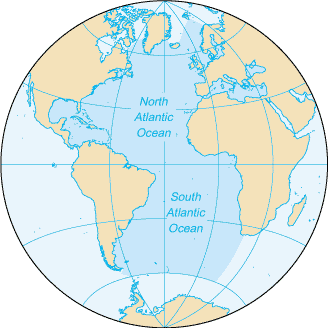
The Atlantic Ocean occupies an elongated, S-shaped basin extending longitudinally between Europe and Africa to the east, and the Americas to the west. As one component of the interconnected World Ocean, it is connected in the north to the Arctic Ocean, to the Pacific Ocean in the southwest, the Indian Ocean in the southeast, and the Southern Ocean in the south. Other definitions describe the Atlantic as extending southward to Antarctica. The Atlantic Ocean is divided in two parts, the northern and southern Atlantic, by the Equator.[6]

Toponymy

[edit]
The Aethiopian Ocean depicted in a 1710 French map of Africa

The oldest known mentions of an "Atlantic" sea come from Stesichorus around mid-sixth century BC (Sch. A. R. 1. 211):[7] Atlantikôi pelágei (Ancient Greek: Ἀτλαντικῷ πελάγει, 'the Atlantic sea', etym. 'Sea of Atlas') and in The Histories of Herodotus around 450 BC (Hdt. 1.202.4): Atlantis thalassa (Ancient Greek: Ἀτλαντὶς θάλασσα, 'Sea of Atlas' or 'the Atlantic sea'[8]) where the name refers to "the sea beyond the pillars of Hercules" which is said to be part of the sea that surrounds all land.[9] In these uses, the name refers to Atlas, the Titan in Greek mythology, who supported the heavens and who later appeared as a frontispiece in medieval maps and also lent his name to modern atlases.[10] On the other hand, to early Greek sailors and in ancient Greek mythological literature such as the Iliad and the Odyssey, this all-encompassing ocean was instead known as Oceanus, the gigantic river that encircled the world; in contrast to the enclosed seas well known to the Greeks: the Mediterranean and the Black Sea.[11] In contrast, the term "Atlantic" originally referred specifically to the Atlas Mountains in Morocco and the sea off the Strait of Gibraltar and the West African coast.[10]

The term "Aethiopian Ocean", derived from Ancient Ethiopia, was applied to the southern Atlantic as late as the mid-19th century.[12] During the Age of Discovery, the Atlantic was also known to English cartographers as the Great Western Ocean.[13]

The Atlantic as seen from the shores of Clare Island, Ireland in 1981.

The pond is a term often used by British and American speakers in reference to the northern Atlantic Ocean, as a form of meiosis, or ironic understatement. It is used mostly when referring to events or circumstances "on this side of the pond" or "on the other side of the pond" or "across the pond", rather than to discuss the ocean itself.[14] The term dates to 1640, first appearing in print in a pamphlet released during the reign of Charles I, and reproduced in 1869 in Nehemiah Wallington's Historical Notices of Events Occurring Chiefly in The Reign of Charles I, where "great Pond" is used in reference to the Atlantic Ocean by Francis Windebank, Charles I's Secretary of State.[15][16][17]

Extent and data

[edit]

The International Hydrographic Organization (IHO) defined the limits of the oceans and seas in 1953,[18] but some of these definitions have been revised since then and some are not recognized by various authorities, institutions, and countries, for example the CIA World Factbook. Correspondingly, the extent and number of oceans and seas vary.

The Atlantic Ocean is bounded on the west by North and South America. It connects to the Arctic Ocean through the Labrador Sea, Denmark Strait, Greenland Sea, Norwegian Sea and Barents Sea with the northern divider passing through Iceland and Svalbard. To the east, the boundaries of the ocean proper are Europe and Africa: the Strait of Gibraltar (where it connects with the Mediterranean Sea – one of its marginal seas – and, in turn, the Black Sea, both of which also touch upon Asia).

In the southeast, the Atlantic merges into the Indian Ocean. The 20° East meridian, running south from Cape Agulhas to Antarctica defines its border. In the 1953 definition it extends south to Antarctica, while in later maps it is bounded at the 60° parallel by the Southern Ocean.[18]

The Atlantic has irregular coasts indented by numerous bays, gulfs and seas. These include the Baltic Sea, Black Sea, Caribbean Sea, Davis Strait, Denmark Strait, part of the Drake Passage, Gulf of Mexico, Labrador Sea, Mediterranean Sea, North Sea, Norwegian Sea, almost all of the Scotia Sea, and other tributary water bodies.[1] Including these marginal seas the coast line of the Atlantic measures 111,866 km (69,510 mi) compared to 135,663 km (84,297 mi) for the Pacific.[1][19]

Including its marginal seas, the Atlantic covers an area of 106,460,000 km2 (41,100,000 sq mi) or 23.5% of the global ocean and has a volume of 310,410,900 km3 (74,471,500 cu mi) or 23.3% of the total volume of the Earth's oceans. Excluding its marginal seas, the Atlantic covers 81,760,000 km2 (31,570,000 sq mi) and has a volume of 305,811,900 km3 (73,368,200 cu mi). The North Atlantic covers 41,490,000 km2 (16,020,000 sq mi) (11.5%) and the South Atlantic 40,270,000 km2 (15,550,000 sq mi) (11.1%).[3] The average depth is 3,646 m (11,962 ft) and the maximum depth, the Milwaukee Deep in the Puerto Rico Trench, is 8,376 m (27,480 ft).[20][21]

Bathymetry

[edit]
False color map of ocean depth in the Atlantic basin

The bathymetry of the Atlantic is dominated by a submarine mountain range called the Mid-Atlantic Ridge (MAR). It runs from 87°N or 300 km (190 mi) south of the North Pole to the subantarctic Bouvet Island at 54°S.[22] Expeditions to explore the bathymertry of the Atlantic include the Challenger expedition and the German Meteor expedition; as of 2001, Columbia University's Lamont–Doherty Earth Observatory and the United States Navy Hydrographic Office conduct research on the ocean.[23]

Mid-Atlantic Ridge

[edit]

The MAR divides the Atlantic longitudinally into two halves, in each of which a series of basins are delimited by secondary, transverse ridges. The MAR reaches above 2,000 m (6,600 ft) along most of its length, but is interrupted by larger transform faults at two places: the Romanche Trench near the Equator and the Gibbs fracture zone at 53°N. The MAR is a barrier for bottom water, but at these two transform faults deep water currents can pass from one side to the other.[24]

The MAR rises 2–3 km (1.2–1.9 mi) above the surrounding ocean floor and its rift valley is the divergent boundary between the North American and Eurasian plates in the North Atlantic and the South American and African plates in the South Atlantic. The MAR produces basaltic volcanoes in Eyjafjallajökull, Iceland, and pillow lava on the ocean floor.[25] The depth of water at the apex of the ridge is less than 2,700 m (1,500 fathoms; 8,900 ft) in most places, while the bottom of the ridge is three times as deep.[26]

The MAR is intersected by two perpendicular ridges: the Azores–Gibraltar transform fault, the boundary between the Nubian and Eurasian plates, intersects the MAR at the Azores triple junction, on either side of the Azores microplate, near the 40°N.[27] A much vaguer, nameless boundary, between the North American and South American plates, intersects the MAR near or just north of the Fifteen-Twenty fracture zone, approximately at 16°N.[28]

In the 1870s, the Challenger expedition discovered parts of what is now known as the Mid-Atlantic Ridge, or:

An elevated ridge rising to an average height of about 1,900 fathoms [3,500 m; 11,400 ft] below the surface traverses the basins of the North and South Atlantic in a meridianal direction from Cape Farewell, probably its far south at least as Gough Island, following roughly the outlines of the coasts of the Old and the New Worlds.[29]

The remainder of the ridge was discovered in the 1920s by the German Meteor expedition using echo-sounding equipment.[30] The exploration of the MAR in the 1950s led to the general acceptance of seafloor spreading and plate tectonics.[22]

Most of the MAR runs under water but where it reaches the surfaces it has produced volcanic islands. While nine of these have collectively been nominated a World Heritage Site for their geological value, four of them are considered of "Outstanding Universal Value" based on their cultural and natural criteria: Þingvellir, Iceland; Landscape of the Pico Island Vineyard Culture, Portugal; Gough and Inaccessible Islands, United Kingdom; and Brazilian Atlantic Islands: Fernando de Noronha and Atol das Rocas Reserves, Brazil.[22]

Ocean floor

[edit]

Continental shelves in the Atlantic are wide off Newfoundland, southernmost South America, and northeastern Europe. In the western Atlantic carbonate platforms dominate large areas, for example, the Blake Plateau and Bermuda Rise. The Atlantic is surrounded by passive margins except at a few locations where active margins form deep trenches: the Puerto Rico Trench (8,376 m or 27,480 ft maximum depth) in the western Atlantic and South Sandwich Trench (8,264 m or 27,113 ft) in the South Atlantic. There are numerous submarine canyons off northeastern North America, western Europe, and northwestern Africa. Some of these canyons extend along the continental rises and farther into the abyssal plains as deep-sea channels.[24]

In 1922, a historic moment in cartography and oceanography occurred. The USS Stewart used a Navy Sonic Depth Finder to draw a continuous map across the bed of the Atlantic. This involved little guesswork because the idea of sonar is straightforward with pulses being sent from the vessel, which bounce off the ocean floor, then return to the vessel.[31] The deep ocean floor is thought to be fairly flat with occasional deeps, abyssal plains, trenches, seamounts, basins, plateaus, canyons, and some guyots. Various shelves along the margins of the continents constitute about 11% of the bottom topography with few deep channels cut across the continental rise.

The mean depth between 60°N and 60°S is 3,730 m (12,240 ft), or close to the average for the global ocean, with a modal depth between 4,000 and 5,000 m (13,000 and 16,000 ft).[24]

In the South Atlantic the Walvis Ridge and Rio Grande Rise form barriers to ocean currents. The Laurentian Abyss is found off the eastern coast of Canada.

Water characteristics

[edit]
Visualisation of the Gulf Stream stretching from the Gulf of Mexico to Western Europe
As the Gulf Stream meanders across the North Atlantic from the North American east coast to Western Europe its temperature drops by 20 °C (36 °F).
Map displaying a looping line with arrows indicating that water flows eastward in the far Southern Ocean, angling northeast of Australia, turning sough-after passing Alaska, then crossing the mid-Pacific to flow north of Australia, continuing west below Africa, then turning northwest until reaching eastern Canada, then angling east to southern Europe, then finally turning south just below Greenland and flowing down the Americas' eastern coast, and resuming its flow eastward to complete the circle
Path of the thermohaline circulation. Purple paths represent deep-water currents, while blue paths represent surface currents.

Surface water temperatures, which vary with latitude, current systems, and season and reflect the latitudinal distribution of solar energy, range from below −2 °C (28 °F) to over 30 °C (86 °F). Maximum temperatures occur north of the equator, and minimum values are found in the polar regions. In the middle latitudes, the area of maximum temperature variations, values may vary by 7–8 °C (13–14 °F).[23]

From October to June the surface is usually covered with sea ice in the Labrador Sea, Denmark Strait, and Baltic Sea.[23][failed verification]

The Coriolis effect circulates North Atlantic water in a clockwise direction, whereas South Atlantic water circulates counter-clockwise. The south tides in the Atlantic Ocean are semi-diurnal; that is, two high tides occur every 24 lunar hours. In latitudes above 40° North some east–west oscillation, known as the North Atlantic oscillation, occurs.[23]

Salinity

[edit]

On average, the Atlantic is the saltiest major ocean; surface water salinity in the open ocean ranges from 33 to 37 parts per thousand (3.3–3.7%) by mass and varies with latitude and season. Evaporation, precipitation, river inflow and sea ice melting influence surface salinity values. Although the lowest salinity values are just north of the equator (because of heavy tropical rainfall), in general, the lowest values are in the high latitudes and along coasts where large rivers enter. Maximum salinity values occur at about 25° north and south, in subtropical regions with low rainfall and high evaporation.[23]

The high surface salinity in the Atlantic, on which the Atlantic thermohaline circulation is dependent, is maintained by two processes: the Agulhas Leakage/Rings, which brings salty Indian Ocean waters into the South Atlantic, and the "Atmospheric Bridge", which evaporates subtropical Atlantic waters and exports it to the Pacific.[32]

Water masses

[edit]
Temperature-salinity characteristics for Atlantic water masses[33]
Water mass Temperature Salinity
Upper waters (0–500 m or 0–1,600 ft)
Atlantic Subarctic
Upper Water (ASUW)
0.0–4.0 °C 34.0–35.0
Western North Atlantic
Central Water (WNACW)
7.0–20 °C 35.0–36.7
Eastern North Atlantic
Central Water (ENACW)
8.0–18.0 °C 35.2–36.7
South Atlantic
Central Water (SACW)
5.0–18.0 °C 34.3–35.8
Intermediate waters (500–1,500 m or 1,600–4,900 ft)
Western Atlantic Subarctic
Intermediate Water (WASIW)
3.0–9.0 °C 34.0–35.1
Eastern Atlantic Subarctic
Intermediate Water (EASIW)
3.0–9.0 °C 34.4–35.3
Mediterranean Water (MW) 2.6–11.0 °C 35.0–36.2
Arctic Intermediate Water (AIW) −1.5–3.0 °C 34.7–34.9
Deep and abyssal waters (1,500 m–bottom or 4,900 ft–bottom)
North Atlantic
Deep Water (NADW)
1.5–4.0 °C 34.8–35.0
Antarctic Bottom Water (AABW) −0.9–1.7 °C 34.6–34.7
Arctic Bottom Water (ABW) −1.8 to −0.5 °C 34.9–34.9

The Atlantic Ocean consists of four major, upper water masses with distinct temperature and salinity. The Atlantic subarctic upper water in the northernmost North Atlantic is the source for subarctic intermediate water and North Atlantic intermediate water. North Atlantic central water can be divided into the eastern and western North Atlantic central water since the western part is strongly affected by the Gulf Stream and therefore the upper layer is closer to underlying fresher subpolar intermediate water. The eastern water is saltier because of its proximity to Mediterranean water. North Atlantic central water flows into South Atlantic central water at 15°N.[34]

There are five intermediate waters: four low-salinity waters formed at subpolar latitudes and one high-salinity formed through evaporation. Arctic intermediate water flows from the north to become the source for North Atlantic deep water, south of the Greenland-Scotland sill. These two intermediate waters have different salinity in the western and eastern basins. The wide range of salinities in the North Atlantic is caused by the asymmetry of the northern subtropical gyre and a large number of contributions from a wide range of sources: Labrador Sea, Norwegian-Greenland Sea, Mediterranean, and South Atlantic Intermediate Water.[34]

The North Atlantic deep water (NADW) is a complex of four water masses, two that form by deep convection in the open ocean – classical and upper Labrador sea water – and two that form from the inflow of dense water across the Greenland-Iceland-Scotland sill – Denmark Strait and Iceland-Scotland overflow water. Along its path across Earth the composition of the NADW is affected by other water masses, especially Antarctic bottom water and Mediterranean overflow water.[35] The NADW is fed by a flow of warm shallow water into the northern North Atlantic which is responsible for the anomalous warm climate in Europe. Changes in the formation of NADW have been linked to global climate changes in the past. Since human-made substances were introduced into the environment, the path of the NADW can be traced throughout its course by measuring tritium and radiocarbon from nuclear weapon tests in the 1960s and CFCs.[36]

Gyres

[edit]
Map showing 5 circles. The first is between western Australia and eastern Africa. The second is between eastern Australia and western South America. The third is between Japan and western North America. Of the two in the Atlantic, one is in hemisphere.
North Atlantic
gyre
North Atlantic
gyre
North Atlantic
gyre
Indian
Ocean
gyre
North
Pacific
gyre
South
Pacific
gyre
South Atlantic
        gyre
Map showing 5 circles. The first is between western Australia and eastern Africa. The second is between eastern Australia and western South America. The third is between Japan and western North America. Of the two in the Atlantic, one is in hemisphere.
World map of the five major ocean gyres

The clockwise warm-water North Atlantic Gyre occupies the northern Atlantic, and the counter-clockwise warm-water South Atlantic Gyre appears in the southern Atlantic.[23]

In the North Atlantic, surface circulation is dominated by three inter-connected currents: the Gulf Stream which flows north-east from the North American coast at Cape Hatteras; the North Atlantic Current, a branch of the Gulf Stream which flows northward from the Grand Banks; and the Subpolar Front, an extension of the North Atlantic Current, a wide, vaguely defined region separating the subtropical gyre from the subpolar gyre. This system of currents transports warm water into the North Atlantic, without which temperatures in the North Atlantic and Europe would plunge dramatically.[37]

In the subpolar gyre of the North Atlantic warm subtropical waters are transformed into colder subpolar and polar waters. In the Labrador Sea this water flows back to the subtropical gyre.

North of the North Atlantic Gyre, the cyclonic North Atlantic Subpolar Gyre plays a key role in climate variability. It is governed by ocean currents from marginal seas and regional topography, rather than being steered by wind, both in the deep ocean and at sea level.[38] The subpolar gyre forms an important part of the global thermohaline circulation. Its eastern portion includes eddying branches of the North Atlantic Current which transport warm, saline waters from the subtropics to the northeastern Atlantic. There this water is cooled during winter and forms return currents that merge along the eastern continental slope of Greenland where they form an intense (40–50 Sv) current which flows around the continental margins of the Labrador Sea. A third of this water becomes part of the deep portion of the North Atlantic Deep Water (NADW). The NADW, in turn, feeds the meridional overturning circulation (MOC), the northward heat transport of which is threatened by anthropogenic climate change. Large variations in the subpolar gyre on a decade-century scale, associated with the North Atlantic oscillation, are especially pronounced in Labrador Sea Water, the upper layers of the MOC.[39]

The South Atlantic is dominated by the anti-cyclonic southern subtropical gyre. The South Atlantic Central Water originates in this gyre, while Antarctic Intermediate Water originates in the upper layers of the circumpolar region, near the Drake Passage and the Falkland Islands. Both these currents receive some contribution from the Indian Ocean. On the African east coast, the small cyclonic Angola Gyre lies embedded in the large subtropical gyre.[40] The southern subtropical gyre is partly masked by a wind-induced Ekman layer. The residence time of the gyre is 4.4–8.5 years. North Atlantic Deep Water flows southward below the thermocline of the subtropical gyre.[41]

Sargasso Sea

[edit]
Approximate extent of the Sargasso Sea
Sargassum fish (Histrio histrio)

The Sargasso Sea in the western North Atlantic can be defined as the area where two species of Sargassum (S. fluitans and natans) float, an area 4,000 km (2,500 mi) wide and encircled by the Gulf Stream, North Atlantic Drift, and North Equatorial Current. This population of seaweed probably originated from Tertiary ancestors on the European shores of the former Tethys Ocean and has, if so, maintained itself by vegetative growth, floating in the ocean for millions of years.[42]

Other species endemic to the Sargasso Sea include the sargassum fish, a predator with algae-like appendages which hovers motionless among the Sargassum. Fossils of similar fishes have been found in fossil bays of the former Tethys Ocean, in what is now the Carpathian region, that were similar to the Sargasso Sea. It is possible that the population in the Sargasso Sea migrated to the Atlantic as the Tethys closed at the end of the Miocene around 17 Ma.[42] The origin of the Sargasso fauna and flora remained enigmatic for centuries. The fossils found in the Carpathians in the mid-20th century often called the "quasi-Sargasso assemblage", finally showed that this assemblage originated in the Carpathian Basin from where it migrated over Sicily to the central Atlantic where it evolved into modern species of the Sargasso Sea.[43]

The location of the spawning ground for European eels remained unknown for decades. In the early 19th century it was discovered that the southern Sargasso Sea is the spawning ground for both the European and American eel and that the former migrate more than 5,000 km (3,100 mi) and the latter 2,000 km (1,200 mi). Ocean currents such as the Gulf Stream transport eel larvae from the Sargasso Sea to foraging areas in North America, Europe, and northern Africa.[44] Recent but disputed research suggests that eels possibly use Earth's magnetic field to navigate through the ocean both as larvae and as adults.[45]

Climate

[edit]
Map of Caribbean showing seven approximately parallel westward-pointing arrows that extend from east of the Virgin Islands to Cuba. The southern arrows bend northward just east of the Dominican Republic before straightening out again.
Waves in the trade winds in the Atlantic Ocean – areas of converging winds that move along the same track as the prevailing wind – create instabilities in the atmosphere that may lead to the formation of hurricanes.

The climate is influenced by the temperatures of the surface waters and water currents as well as winds. Because of the ocean's great capacity to store and release heat, maritime climates are more moderate and have less extreme seasonal variations than inland climates. Precipitation can be approximated from coastal weather data and air temperature from water temperatures.[23]

The oceans are the major source of atmospheric moisture that is obtained through evaporation. Climatic zones vary with latitude; the warmest zones stretch across the Atlantic north of the equator. The coldest zones are in high latitudes, with the coldest regions corresponding to the areas covered by sea ice. Ocean currents influence the climate by transporting warm and cold waters to other regions. The winds that are cooled or warmed when blowing over these currents influence adjacent land areas.[23]

The Gulf Stream and its northern extension towards Europe, the North Atlantic Drift is thought to have at least some influence on climate. For example, the Gulf Stream helps moderate winter temperatures along the coastline of southeastern North America, keeping it warmer in winter along the coast than inland areas. The Gulf Stream also keeps extreme temperatures from occurring on the Florida Peninsula. In the higher latitudes, the North Atlantic Drift, warms the atmosphere over the oceans, keeping the British Isles and northwestern Europe mild and cloudy, and not severely cold in winter, like other locations at the same high latitude. The cold water currents contribute to heavy fog off the coast of eastern Canada (the Grand Banks of Newfoundland area) and Africa's northwestern coast. In general, winds transport moisture and air over land areas.[23]

Natural hazards

[edit]
Iceberg A22A in the South Atlantic Ocean

Every winter, the Icelandic Low produces frequent storms. Icebergs are common from early February to the end of July across the shipping lanes near the Grand Banks of Newfoundland. The ice season is longer in the polar regions, but there is little shipping in those areas.[46]

Hurricanes are a hazard in the western parts of the North Atlantic during the summer and autumn. Due to a consistently strong wind shear and a weak Intertropical Convergence Zone, South Atlantic tropical cyclones are rare.[47]

Geology and plate tectonics

[edit]

The Atlantic Ocean is underlain mostly by dense mafic oceanic crust made up of basalt and gabbro and overlain by fine clay, silt and siliceous ooze on the abyssal plain. The continental margins and continental shelf mark lower density, but greater thickness felsic continental rock that is often much older than that of the seafloor. The oldest oceanic crust in the Atlantic is up to 145 million years and is situated off the west coast of Africa and the east coast of North America, or on either side of the South Atlantic.[48]

In many places, the continental shelf and continental slope are covered in thick sedimentary layers. For instance, on the North American side of the ocean, large carbonate deposits formed in warm shallow waters such as Florida and the Bahamas, while coarse river outwash sands and silt are common in shallow shelf areas like the Georges Bank. Coarse sand, boulders, and rocks were transported into some areas, such as off the coast of Nova Scotia or the Gulf of Maine during the Pleistocene ice ages.[49]

Central Atlantic

[edit]
Opening of the central Atlantic 200–170 Ma

The break-up of Pangaea began in the central Atlantic, between North America and Northwest Africa, where rift basins opened during the Late Triassic and Early Jurassic. This period also saw the first stages of the uplift of the Atlas Mountains. The exact timing is controversial with estimates ranging from 200 to 170 Ma.[50]

The opening of the Atlantic Ocean coincided with the initial break-up of the supercontinent Pangaea, both of which were initiated by the eruption of the Central Atlantic Magmatic Province (CAMP), one of the most extensive and voluminous large igneous provinces in Earth's history associated with the Triassic–Jurassic extinction event, one of Earth's major extinction events.[51] Theoliitic dikes, sills, and lava flows from the CAMP eruption at 200 Ma have been found in West Africa, eastern North America, and northern South America. The extent of the volcanism has been estimated to 4.5×10⁶ km2 (1.7×10⁶ sq mi) of which 2.5×10⁶ km2 (9.7×10⁵ sq mi) covered what is now northern and central Brazil.[52]

The formation of the Central American Isthmus closed the Central American Seaway at the end of the Pliocene 2.8 Ma ago. The formation of the isthmus resulted in the migration and extinction of many land-living animals, known as the Great American Interchange, but the closure of the seaway resulted in a "Great American Schism" as it affected ocean currents, salinity, and temperatures in both the Atlantic and Pacific. Marine organisms on both sides of the isthmus became isolated and either diverged or went extinct.[53]

North Atlantic

[edit]

Geologically, the North Atlantic is the area delimited to the south by two conjugate margins, Newfoundland and Iberia, and to the north by the Arctic Eurasian Basin. The opening of the North Atlantic closely followed the margins of its predecessor, the Iapetus Ocean, and spread from the central Atlantic in six stages: IberiaNewfoundland, Porcupine–North America, Eurasia–Greenland, Eurasia–North America. Active and inactive spreading systems in this area are marked by the interaction with the Iceland hotspot.[54]

Seafloor spreading led to the extension of the crust and the formation of troughs and sedimentary basins. The Rockall Trough opened between 105 and 84 million years ago although the rift failed along with one leading into the Bay of Biscay.[55]

Spreading began opening the Labrador Sea around 61 million years ago, continuing until 36 million years ago. Geologists distinguish two magmatic phases. One from 62 to 58 million years ago predates the separation of Greenland from northern Europe while the second from 56 to 52 million years ago happened as the separation occurred.

Iceland began to form 62 million years ago due to a particularly concentrated mantle plume. Large quantities of basalt erupted at this time period are found on Baffin Island, Greenland, the Faroe Islands, and Scotland, with ash falls in Western Europe acting as a stratigraphic marker.[56] The opening of the North Atlantic caused a significant uplift of continental crust along the coast. For instance, despite 7 km thick basalt, Gunnbjorn Field in East Greenland is the highest point on the island, elevated enough that it exposes older Mesozoic sedimentary rocks at its base, similar to old lava fields above sedimentary rocks in the uplifted Hebrides of western Scotland.[57]

The North Atlantic Ocean contains about 810 seamounts, most of them situated along the Mid-Atlantic Ridge.[58] The OSPAR database (Convention for the Protection of the Marine Environment of the North-East Atlantic) mentions 104 seamounts: 74 within national exclusive economic zones. Of these seamounts, 46 are located close to the Iberian Peninsula.

South Atlantic

[edit]
The opening of the South Atlantic

West Gondwana (South America and Africa) broke up in the Early Cretaceous to form the South Atlantic. The apparent fit between the coastlines of the two continents was noted on the first maps that included the South Atlantic and it was also the subject of the first computer-assisted plate tectonic reconstructions in 1965.[59][60] This magnificent fit, however, has since then proven problematic and later reconstructions have introduced various deformation zones along the shorelines to accommodate the northward-propagating break-up.[59] Intra-continental rifts and deformations have also been introduced to subdivide both continental plates into sub-plates.[61]

Geologically, the South Atlantic can be divided into four segments: equatorial segment, from 10°N to the Romanche fracture zone (RFZ); central segment, from RFZ to Florianopolis fracture zone (FFZ, north of Walvis Ridge and Rio Grande Rise); southern segment, from FFZ to the Agulhas–Falkland fracture zone (AFFZ); and Falkland segment, south of AFFZ.[62]

In the southern segment the Early Cretaceous (133–130 Ma) intensive magmatism of the Paraná–Etendeka Large Igneous Province produced by the Tristan hotspot resulted in an estimated volume of 1.5×10⁶ to 2.0×10⁶ km3 (3.6×10⁵ to 4.8×10⁵ cu mi). It covered an area of 1.2×10⁶ to 1.6×10⁶ km2 (4.6×10⁵ to 6.2×10⁵ sq mi) in Brazil, Paraguay, and Uruguay and 0.8×10⁵ km2 (3.1×10⁴ sq mi) in Africa. Dyke swarms in Brazil, Angola, eastern Paraguay, and Namibia, however, suggest the LIP originally covered a much larger area and also indicate failed rifts in all these areas. Associated offshore basaltic flows reach as far south as the Falkland Islands and South Africa. Traces of magmatism in both offshore and onshore basins in the central and southern segments have been dated to 147–49 Ma with two peaks between 143 and 121 Ma and 90–60 Ma.[62]

In the Falkland segment rifting began with dextral movements between the Patagonia and Colorado sub-plates between the Early Jurassic (190 Ma) and the Early Cretaceous (126.7 Ma). Around 150 Ma sea-floor spreading propagated northward into the southern segment. No later than 130 Ma rifting had reached the Walvis Ridge–Rio Grande Rise.[61]

In the central segment, rifting started to break Africa in two by opening the Benue Trough around 118 Ma. Rifting in the central segment, however, coincided with the Cretaceous Normal Superchron (also known as the Cretaceous quiet period), a 40 Ma period without magnetic reversals, which makes it difficult to date sea-floor spreading in this segment.[61]

The equatorial segment is the last phase of the break-up, but, because it is located on the Equator, magnetic anomalies cannot be used for dating. Various estimates date the propagation of seafloor spreading in this segment and consequent opening of the Equatorial Atlantic Gateway (EAG) to the period 120–96 Ma.[63][64] This final stage, nevertheless, coincided with or resulted in the end of continental extension in Africa.[61]

About 50 Ma the opening of the Drake Passage resulted from a change in the motions and separation rate of the South American and Antarctic plates. First, small ocean basins opened and a shallow gateway appeared during the Middle Eocene. 34–30 Ma a deeper seaway developed, followed by an Eocene–Oligocene climatic deterioration and the growth of the Antarctic ice sheet.[65]

Closure of the Atlantic

[edit]

An embryonic subduction margin is potentially developing west of Gibraltar. The Gibraltar Arc in the western Mediterranean is migrating westward into the central Atlantic where it joins the converging African and Eurasian plates. Together these three tectonic forces are slowly developing into a new subduction system in the eastern Atlantic Basin. Meanwhile, the Scotia Arc and Caribbean plate in the western Atlantic Basin are eastward-propagating subduction systems that might, together with the Gibraltar system, represent the beginning of the closure of the Atlantic Ocean and the final stage of the Atlantic Wilson cycle.[66]

History

[edit]

Old World

[edit]

Mitochondrial DNA (mtDNA) studies indicate that 80,000–60,000 years ago a major demographic expansion within Africa, derived from a single, small population, coincided with the emergence of behavioral complexity and the rapid MIS 5–4 environmental changes. This group of people not only expanded over the whole of Africa, but also started to disperse out of Africa into Asia, Europe, and Australasia around 65,000 years ago and quickly replaced the archaic humans in these regions.[67] During the Last Glacial Maximum (LGM) 20,000 years ago humans had to abandon their initial settlements along the European North Atlantic coast and retreat to the Mediterranean. Following rapid climate changes at the end of the LGM this region was repopulated by Magdalenian culture. Other hunter-gatherers followed in waves interrupted by hazards such as the Laacher See volcanic eruption, the inundation of Doggerland (now the North Sea), and the formation of the Baltic Sea.[68] The European coasts of the North Atlantic were permanently populated about 9,000–8.5,000 years ago.[69]

This human dispersal left abundant traces along the coasts of the Atlantic Ocean. 50 kya-old, deeply stratified shell middens found in Ysterfontein on the western coast of South Africa are associated with the Middle Stone Age (MSA). The MSA population was small and dispersed and the rate of their reproduction and exploitation was less intense than those of later generations. While their middens resemble 12–11 kya-old Late Stone Age (LSA) middens found on every inhabited continent, the 50–45 kya-old Enkapune Ya Muto in Kenya probably represents the oldest traces of the first modern humans to disperse out of Africa.[70]

Excavation of the Ertebølle middens in 1880

The same development can be seen in Europe. In La Riera Cave (23–13 kya) in Asturias, Spain, only some 26,600 molluscs were deposited over 10 kya. In contrast, 8–7 kya-old shell middens in Portugal, Denmark, and Brazil generated thousands of tons of debris and artefacts. The Ertebølle middens in Denmark, for example, accumulated 2,000 m3 (71,000 cu ft) of shell deposits representing some 50 million molluscs over only a thousand years. This intensification in the exploitation of marine resources has been described as accompanied by new technologies – such as boats, harpoons, and fish hooks  – because many caves found in the Mediterranean and on the European Atlantic coast have increased quantities of marine shells in their upper levels and reduced quantities in their lower. The earliest exploitation took place on the submerged shelves, now submerged and most settlements now excavated were then located several kilometers from these shelves. The reduced quantities of shells in the lower levels can represent the few shells that were exported inland.[71]

New World

[edit]

During the LGM the Laurentide Ice Sheet covered most of northern North America while Beringia connected Siberia to Alaska. In 1973, late American geoscientist Paul S. Martin proposed a "blitzkrieg" colonization of the Americas by which Clovis hunters migrated into North America around 13,000 years ago in a single wave through an ice-free corridor in the ice sheet and "spread southward explosively, briefly attaining a density sufficiently large to overkill much of their prey."[72] Others later proposed a "three-wave" migration over the Bering Land Bridge.[73] These hypotheses remained the long-held view regarding the settlement of the Americas, a view challenged by more recent archaeological discoveries: the oldest archaeological sites in the Americas have been found in South America; sites in northeast Siberia report virtually no human presence there during the LGM; and most Clovis artefacts have been found in eastern North America along the Atlantic coast.[74] Furthermore, colonisation models based on mtDNA, yDNA, and atDNA data respectively support neither the "blitzkrieg" nor the "three-wave" hypotheses but they also deliver mutually ambiguous results. Contradictory data from archaeology and genetics will most likely deliver future hypotheses that will, eventually, confirm each other.[75] A proposed route across the Pacific to South America could explain early South American finds and another hypothesis proposes a northern path, through the Canadian Arctic and down the North American Atlantic coast.[76] Early settlements across the Atlantic have been suggested by alternative theories, ranging from purely hypothetical to mostly disputed, including the Solutrean hypothesis and some of the Pre-Columbian trans-oceanic contact theories.

Based on the medieval Íslendingasögur sagas, including the Grœnlendinga saga, this interpretative map of the "Norse World" shows that Norse knowledge of the Americas and the Atlantic remained limited.

The Norse settlement of the Faroe Islands and Iceland began during the 9th and 10th centuries. A settlement on Greenland was established before 1000 CE, but contact with it was lost in 1409 and it was finally abandoned during the early Little Ice Age. This setback was caused by a range of factors: an unsustainable economy resulted in erosion and denudation, while conflicts with the local Inuit resulted in the failure to adapt their Arctic technologies; a colder climate resulted in starvation, and the colony got economically marginalized as the Great Plague harvested its victims on Iceland in the 15th century.[77] Iceland was initially settled 865–930 CE following a warm period when winter temperatures hovered around 2 °C (36 °F) which made farming favorable at high latitudes. This did not last, however, and temperatures quickly dropped; at 1080 CE summer temperatures had reached a maximum of 5 °C (41 °F). The Landnámabók (Book of Settlement) records disastrous famines during the first century of settlement – "men ate foxes and ravens" and "the old and helpless were killed and thrown over cliffs" – and by the early 1200s hay had to be abandoned for short-season crops such as barley.[78]

Atlantic World

[edit]
The Atlantic Gyres influenced the Portuguese discoveries and trading port routes, here shown in the India Run ("Carreira da Índia"), which would be developed in subsequent years.

Christopher Columbus reached the Americas in 1492, sailing under the Spanish flag.[79] Six years later Vasco da Gama reached India under the Portuguese flag, by navigating south around the Cape of Good Hope, thus proving that the Atlantic and Indian Oceans are connected. In 1500, in his voyage to India following Vasco da Gama, Pedro Álvares Cabral reached Brazil, taken by the currents of the South Atlantic Gyre. Following these explorations, Spain and Portugal quickly conquered and colonized large territories in the New World and forced the Amerindian population into slavery in order to exploit the vast quantities of silver and gold they found. Spain and Portugal monopolized this trade in order to keep other European nations out, but conflicting interests nevertheless led to a series of Spanish-Portuguese wars. A peace treaty mediated by the Pope divided the conquered territories into Spanish and Portuguese sectors while keeping other colonial powers away. England, France, and the Dutch Republic enviously watched the Spanish and Portuguese wealth grow and allied themselves with pirates such as Henry Mainwaring and Alexandre Exquemelin. They could explore the convoys leaving the Americas because prevailing winds and currents made the transport of heavy metals slow and predictable.[79]

Embarked and disembarked slaves in the Atlantic slave trade 1525–1863 (first and last slave voyages)

In the colonies of the Americas, depredation, smallpox and other diseases, and slavery quickly reduced the indigenous population of the Americas to the extent that the Atlantic slave trade was introduced by colonists to replace them – a trade that became the norm and an integral part of the colonization. Between the 15th century and 1888, when Brazil became the last part of the Americas to end the slave trade, an estimated 9.5 million enslaved Africans were shipped into the New World, most of them destined for agricultural labor. The slave trade was officially abolished in the British Empire and the United States in 1808, and slavery itself was abolished in the British Empire in 1838 and in the United States in 1865 after the Civil War.[80][81]

From Columbus to the Industrial Revolution trans-Atlantic trade, including colonialism and slavery, became crucial for Western Europe. For European countries with direct access to the Atlantic (including Britain, France, the Netherlands, Portugal, and Spain) 1500–1800 was a period of sustained growth during which these countries grew richer than those in Eastern Europe and Asia. Colonialism evolved as part of the trans-Atlantic trade, but this trade also strengthened the position of merchant groups at the expense of monarchs. Growth was more rapid in non-absolutist countries, such as Britain and the Netherlands, and more limited in absolutist monarchies, such as Portugal, Spain, and France, where profit mostly or exclusively benefited the monarchy and its allies.[82]

Trans-Atlantic trade also resulted in increasing urbanization: in European countries facing the Atlantic, urbanization grew from 8% in 1300, 10.1% in 1500, to 24.5% in 1850; in other European countries from 10% in 1300, 11.4% in 1500, to 17% in 1850. Likewise, GDP doubled in Atlantic countries but rose by only 30% in the rest of Europe. By the end of the 17th century, the volume of the Trans-Atlantic trade had surpassed that of the Mediterranean trade.[82]

Economy

[edit]
Cod fishery in Norway

The Atlantic has contributed significantly to the development and economy of surrounding countries. Besides major transatlantic transportation and communication routes, the Atlantic offers abundant petroleum deposits in the sedimentary rocks of the continental shelves.[23] The Atlantic harbors petroleum and gas fields, fish, marine mammals (seals and whales), sand and gravel aggregates, placer deposits, polymetallic nodules, and precious stones.[83] Gold deposits are a mile or two underwater on the ocean floor, however, the deposits are also encased in rock that must be mined through. Currently, there is no cost-effective way to mine or extract gold from the ocean to make a profit.[84] Various international treaties attempt to reduce pollution caused by environmental threats such as oil spills, marine debris, and the incineration of toxic wastes at sea.[23]

Fisheries

[edit]

The shelves of the Atlantic hosts one of the world's richest fishing resources. The most productive areas include the Grand Banks of Newfoundland, the Scotian Shelf, Georges Bank off Cape Cod, the Bahama Banks, the waters around Iceland, the Irish Sea, the Bay of Fundy, the Dogger Bank of the North Sea, and the Falkland Banks.[23] Fisheries have undergone significant changes since the 1950s and global catches can now be divided into three groups of which only two are observed in the Atlantic: fisheries in the eastern-central and southwest Atlantic oscillate around a globally stable value, the rest of the Atlantic is in overall decline following historical peaks. The third group, "continuously increasing trend since 1950", is only found in the Indian Ocean and western Pacific.[85] UN FAO partitioned the Atlantic into major fishing areas:

Northeast Atlantic
Banks of the northeast Atlantic

Northeast Atlantic is schematically limited to the 40°00' west longitude (except around Greenland), south to the 36°00' north latitude, and to the 68°30' east longitude, with both the west and east longitude limits reaching to the north pole. The Atlantic's subareas include: Barents Sea; Norwegian Sea, Spitzbergen, and Bear Island; Skagerrak, Kattegat, Sound, Belt Sea, and Baltic Sea; North Sea; Iceland and Faroes Grounds; Rockall, Northwest Coast of Scotland, and North Ireland; Irish Sea, West of Ireland, Porcupine Bank, and eastern and western English Channel; Bay of Biscay; Portuguese Waters; Azores Grounds and Northeast Atlantic South; North of Azores; and East Greenland. There are also two defunct subareas.[86]

In the Northeast Atlantic total catches decreased between the mid-1970s and the 1990s and reached 8.7 million tons in 2013. Blue whiting reached a 2.4 million tons peak in 2004 but was down to 628,000 tons in 2013. Recovery plans for cod, sole, and plaice have reduced mortality in these species. Arctic cod reached its lowest levels in the 1960s–1980s but is now recovered. Arctic saithe and haddock are considered fully fished; Sand eel is overfished as was capelin which has now recovered to fully fished. Limited data makes the state of redfishes and deep-water species difficult to assess but most likely they remain vulnerable to overfishing. Stocks of northern shrimp and Norwegian lobster are in good condition. In the Northeast Atlantic, 21% of stocks are considered overfished.[85]
This zone makes almost three-quarters (72.8%) of European Union fishing catches in 2020. Main fishing EU countries are Denmark, France, the Netherlands and Spain. Most common species include herring, mackerel, and sprats.
Banks of the northwest Atlantic
Northwest Atlantic
In the Northwest Atlantic landings have decreased from 4.2 million tons in the early 1970s to 1.9 million tons in 2013. During the 21st century, some species have shown weak signs of recovery, including Greenland halibut, yellowtail flounder, Atlantic halibut, haddock, spiny dogfish, while other stocks shown no such signs, including cod, witch flounder, and redfish. Stocks of invertebrates, in contrast, remain at record levels of abundance. 31% of stocks are overfished in the northwest Atlantic.[85]
Capture of Atlantic northwest cod in million tons

In 1497, John Cabot became the first Western European since the Vikings to explore mainland North America and one of his major discoveries was the abundant resources of Atlantic cod off Newfoundland. Referred to as "Newfoundland Currency" this discovery yielded some 200 million tons of fish over five centuries. In the late 19th and early 20th centuries, new fisheries started to exploit haddock, mackerel, and lobster. From the 1950s to the 1970s, the introduction of European and Asian distant-water fleets in the area dramatically increased the fishing capacity and the number of exploited species. It also expanded the exploited areas from near-shore to the open sea and to great depths to include deep-water species such as redfish, Greenland halibut, witch flounder, and grenadiers. Overfishing in the area was recognized as early as the 1960s but, because this was occurring on international waters, it took until the late 1970s before any attempts to regulate was made. In the early 1990s, this finally resulted in the collapse of the Atlantic northwest cod fishery. The population of a number of deep-sea fishes also collapsed in the process, including American plaice, redfish, and Greenland halibut, together with flounder and grenadier.[87]

Eastern central-Atlantic
In the eastern central-Atlantic small pelagic fishes constitute about 50% of landings with sardine reaching 0.6–1.0 million tons per year. Pelagic fish stocks are considered fully fished or overfished, with sardines south of Cape Bojador the notable exception. Almost half of the stocks are fished at biologically unsustainable levels. Total catches have been fluctuating since the 1970s; reaching 3.9 million tons in 2013 or slightly less than the peak production in 2010.[85]
Bahama Banks
Western central-Atlantic
In the western central-Atlantic, catches have been decreasing since 2000 and reached 1.3 million tons in 2013. The most important species in the area, Gulf menhaden, reached a million tons in the mid-1980s but only half a million tons in 2013 and is now considered fully fished. Round sardinella was an important species in the 1990s but is now considered overfished. Groupers and snappers are overfished and northern brown shrimp and American cupped oyster are considered fully fished approaching overfished. 44% of stocks are being fished at unsustainable levels.[85]
Agulhas Bank
Southeast Atlantic
In the southeast Atlantic catches have decreased from 3.3 million tons in the early 1970s to 1.3 million tons in 2013. Horse mackerel and hake are the most important species, together representing almost half of the landings. Off South Africa and Namibia deep-water hake and shallow-water Cape hake have recovered to sustainable levels since regulations were introduced in 2006 and the states of southern African pilchard and anchovy have improved to fully fished in 2013.[85]
Southwest Atlantic
In the southwest Atlantic, a peak was reached in the mid-1980s and catches now fluctuate between 1.7 and 2.6 million tons. The most important species, the Argentine shortfin squid, which reached half a million tons in 2013 or half the peak value, is considered fully fished to overfished. Another important species was the Brazilian sardinella, with a production of 100,000 tons in 2013 it is now considered overfished. Half the stocks in this area are being fished at unsustainable levels: Whitehead's round herring has not yet reached fully fished but Cunene horse mackerel is overfished. The sea snail perlemoen abalone is targeted by illegal fishing and remains overfished.[85]

Environmental issues

[edit]

Endangered species

[edit]

Endangered marine species include the manatee, seals, sea lions, turtles, and whales. Drift net fishing can kill dolphins, albatrosses and other seabirds (petrels, auks), hastening the fish stock decline and contributing to international disputes.[88]

Waste and pollution

[edit]

Marine pollution is a generic term for the entry into the ocean of potentially hazardous chemicals or particles. The biggest culprits are rivers and with them many agriculture fertilizer chemicals as well as livestock and human waste. The excess of oxygen-depleting chemicals leads to hypoxia and the creation of a dead zone.[89]

Marine debris strewn over the beaches of the South Atlantic Inaccessible Island

Marine debris, which is also known as marine litter, describes human-created waste floating in a body of water. Oceanic debris tends to accumulate at the center of gyres and coastlines, frequently washing aground where it is known as beach litter. The North Atlantic garbage patch is estimated to be hundreds of kilometers across in size.[90]

Other pollution concerns include agricultural and municipal waste. Municipal pollution comes from the eastern United States, southern Brazil, and eastern Argentina; oil pollution in the Caribbean Sea, Gulf of Mexico, Lake Maracaibo, Mediterranean Sea, and North Sea; and industrial waste and municipal sewage pollution in the Baltic Sea, North Sea, and Mediterranean Sea.

A USAF C-124 aircraft from Dover Air Force Base, Delaware was carrying three nuclear bombs over the Atlantic Ocean when it experienced a loss of power. For their own safety, the crew jettisoned two nuclear bombs, which were never recovered.[91]

Climate change

[edit]

North Atlantic hurricane activity has increased over past decades because of increased sea surface temperature (SST) at tropical latitudes, changes that can be attributed to either the natural Atlantic Multidecadal Oscillation (AMO) or to anthropogenic climate change.[92] A 2005 report indicated that the Atlantic meridional overturning circulation (AMOC) slowed down by 30% between 1957 and 2004.[93] In 2024, the research highlighted a significant weakening of the AMOC by approximately 12% over the past two decades.[94] If the AMO were responsible for SST variability, the AMOC would have increased in strength, which is apparently not the case. Furthermore, it is clear from statistical analyses of annual tropical cyclones that these changes do not display multidecadal cyclicity.[92] Therefore, these changes in SST must be caused by human activities.[95]

The ocean mixed layer plays an important role in heat storage over seasonal and decadal time scales, whereas deeper layers are affected over millennia and have a heat capacity about 50 times that of the mixed layer. This heat uptake provides a time-lag for climate change but it also results in thermal expansion of the oceans which contributes to sea level rise. 21st-century global warming will probably result in an equilibrium sea-level rise five times greater than today, whilst melting of glaciers, including that of the Greenland ice sheet, expected to have virtually no effect during the 21st century, will likely result in a sea-level rise of 3–6 metres (9.8–19.7 ft) over a millennium.[96]

See also

[edit]

References

[edit]

Further reading

[edit]
[edit]
Revisions and contributorsEdit on WikipediaRead on Wikipedia
from Grokipedia
The Atlantic Ocean is the second-largest oceanic body on , encompassing an area of approximately 106,460,000 square kilometers (41,105,000 square miles), which represents about 20% of the planet's total surface area. Bounded by the eastern coasts of the to the west, the western shores of and to the east, the to the north, and the to the south, it forms a critical divide between the and the continents. The ocean's seafloor features the , a divergent tectonic boundary where new is formed, contributing to the gradual widening of the basin at rates of 2 to 5 centimeters per year. Its waters support major surface currents, including the warm along the western boundary, which transports heat northward and influences regional climates in and . The Atlantic plays a pivotal role in global thermohaline circulation, where density-driven flows of deep waters, such as , redistribute heat, nutrients, and carbon across hemispheres, modulating weather patterns and marine ecosystems. Economically, it facilitates transoceanic shipping routes and sustains extensive fisheries, while its marginal seas and coastal zones host diverse amid varying depths averaging around 3,300 meters, with extremes exceeding 8,000 meters in trenches like the . Historically, the ocean enabled pivotal explorations from Viking voyages to Columbus's crossing, fostering trade networks that shaped modern demographics through migrations and, regrettably, the transatlantic slave trade involving millions forcibly transported from .

Overview

Etymology and Naming

The name Atlantic derives from the Atlantikós, meaning "pertaining to Atlas," referring to the Titan Atlas from who was condemned to hold up the heavens on his shoulders at the western extremity of the known world. This association linked the ocean to the mythical Mount Atlas, identified with the in modern , beyond which lay the unexplored western sea. The earliest documented reference to the "Atlantic Sea" appears in the works of the Greek poet in the 6th century BCE, using the phrase Atlantikôi pelágei, or "Sea of Atlas." By the 5th century BCE, described the waters west of the () as the sea adjacent to Atlas's domain, distinguishing it from the enclosed Mediterranean. The term entered Latin as Oceanus Atlanticus, solidifying its use in Roman geography for the vast body separating and from the unknown lands to the west. Prior to widespread adoption of "Atlantic," ancient Mediterranean cultures referred to the ocean variably as the "Outer Sea" or "Great Sea Beyond," reflecting its boundary at the edge of the oikoumene (inhabited world). In some early contexts, portions south of the equator were termed the "Aethiopian Sea" by Greek writers, denoting regions associated with "Aethiopia" (lands of dark-skinned peoples south of Egypt), though this was not a primary name for the entire ocean. During the Age of Exploration, European mariners occasionally called it the "Western Ocean" or "Sea of Darkness" due to its perceived perils and the sun's setting therein, but Atlantic prevailed in cartography by the 16th century. The name has remained standard since, encompassing the full extent from the Arctic to Antarctic waters, without substantive alteration.

Extent, Boundaries, and Dimensions

The Atlantic Ocean is defined by the International Hydrographic Organization (IHO) as extending from the Arctic Ocean in the north, bounded by the continents of North and South America to the west, and Europe and Africa to the east, with its southern limit reaching the Antarctic continent or conventionally set at 60°S latitude along the Antarctic Circumpolar Current. This delineation accounts for the irregular coastlines and marginal seas, such as the Norwegian Sea, North Sea, Baltic Sea, Mediterranean Sea, Black Sea, Caribbean Sea, and Gulf of Mexico, which are hydrologically connected but sometimes excluded in strict basin measurements. Meridionally, the ocean spans approximately from 78°N near the to 60°S, yielding a north-south extent of about 16,000 kilometers, while its latitudinal width varies, averaging around 5,000 kilometers at the between the Brazilian and African coasts. The basin's S-shaped configuration results from the divergence of the North American and Eurasian/African plates along the , influencing its overall dimensions. The Atlantic covers a surface area of approximately 106,460,000 square kilometers when including adjacent seas, representing about 29% of the global area, though the core basin excluding marginal waters measures roughly 82 million square kilometers. Its volume totals 310,410,900 cubic kilometers, comprising 23.3% of Earth's oceanic water. Average depth reaches 3,332 meters inclusive of marginal seas, with deeper modal depths of 4,000 to 5,000 meters in the open basin; the maximum depth is 8,376 meters at the within the .

Physical Geography

Bathymetry and Topography

The Atlantic Ocean's features a prominent central divide formed by the , which separates the ocean into eastern and western basins with depths generally exceeding 3,000 meters. Abyssal plains dominate the deep seafloor, characterized by flat expanses covered by thick layers derived from continental and marine organisms, with depths typically ranging from 3,000 to 6,000 meters. The average depth of the Atlantic, including adjacent seas, measures approximately 3,332 meters, while excluding these marginal waters it reaches about 3,926 meters. Continental margins frame the ocean basins, beginning with the continental shelf, a gently sloping platform extending from shorelines at depths less than 200 meters, with widths varying from less than 10 kilometers in tectonically active regions to over 200 kilometers in passive margins like the U.S. East Coast. The continental slope follows, descending steeply from the shelf break at around 200 meters to depths of 2,000–4,000 meters over distances of 20–100 kilometers, often incised by submarine canyons that channel sediments to the deeper ocean. Seaward of the slope lies the continental rise, a transitional wedge of accumulated sediments forming a gentler incline toward the abyssal plains. The ocean's deepest features include the in the North Atlantic, reaching a maximum depth of 8,605 meters at the , where subduction-related create a pronounced linear depression. Other notable trenches and fracture zones offset the , influencing distribution and deep circulation, while scattered seamounts and guyots rise from the abyssal plains, some exceeding 2,000 meters in height and formed by volcanic hotspots. In the South Atlantic, the Argentine Basin represents one of the broadest abyssal plains, with depths averaging around 5,500 meters and minimal topographic relief due to uniform blanketing. These bathymetric variations result primarily from , with divergent spreading at the ridge generating new crust and passive margins accumulating sediments over geological time.

Mid-Atlantic Ridge

The constitutes a divergent plate boundary traversing the Atlantic Ocean basin, delineating the separation between the Eurasian and North American plates in the north and the African and South American plates in the south. This submarine mountain range spans roughly 16,000 kilometers from the southward to near in the , forming part of the global system that encircles approximately 60,000 kilometers around . The ridge's crest typically lies at depths of about 2,500 meters below , with the structure broadening and deepening away from the axis as older crust cools and subsides. Seafloor spreading drives the ridge's dynamics, with new generated at rates of 2 to 5 centimeters per year through mantle that erupts as basaltic lava along the central . This process, evidenced by symmetric magnetic stripe patterns on either side of the ridge—resulting from periodic reversals in Earth's geomagnetic field—has widened the Atlantic basin since the breakup of approximately 180 million years ago. The axial , often 1 to 2 kilometers deep and 20 to 50 kilometers wide, marks the active spreading center where tectonic plates diverge, facilitating ascent and crustal accretion. Volcanic and seismic activity predominates along the ridge, with frequent earthquakes clustered in swarms reflecting brittle fracturing of the and magma intrusions. Submarine eruptions produce pillow lavas and sheet flows, while hydrothermal vents—such as those at the field—emit mineral-rich fluids heated by underlying magmatic bodies, supporting chemosynthetic ecosystems. In , where the ridge emerges subaerially, these processes manifest as zones like the Reykjanes Peninsula, enabling direct observation of plate divergence, basaltic fissure eruptions, and associated . Bathymetric variations along the ridge, including transform faults offsetting segments, influence spreading asymmetry and crustal thickness, with slower-spreading sections exhibiting thinner crust and more pronounced faulting compared to faster-spreading counterparts elsewhere.

Seabed and Marginal Features

The continental margins flanking the Atlantic Ocean are primarily passive margins, lacking significant tectonic activity associated with subduction or volcanism, in contrast to active margins found along the Pacific Ring of Fire. These margins transition from continental crust to oceanic crust and include the continental shelf, slope, and rise. The shelves are relatively wide and gently sloping, with sediment accumulation from fluvial and coastal erosion; for instance, the U.S. Atlantic shelf extends seaward up to 250 kilometers in some areas, featuring unconsolidated sands and muds. The continental slopes descend steeply at angles of 2-5 degrees, incised by submarine canyons that serve as conduits for sediment transport to deeper waters. Beyond the slopes, the continental rises form aprons of accumulated , thickening toward the abyssal plains of the ocean basins. These rises are prominent along the Atlantic's margins due to the depositional nature of passive settings, with sediment wedges up to several kilometers thick derived from long-term of adjacent continents. The in the central Atlantic comprises abyssal plains, such as the Sohm and Argentine Basins, covered by fine-grained pelagic that accumulate at rates of about 1-5 cm per thousand years. distribution shows terrigenous clays dominant near margins, transitioning to oozes in mid-depths and siliceous oozes in deeper, nutrient-rich zones, with overall thickness in Atlantic basins roughly twice that of the Pacific due to older crustal age and proximity to sediment sources. Marginal features also include isolated seamounts, guyots, and fracture zones offsetting the , though these are less extensive than in the Pacific. Sedimentation patterns reflect sea-floor spreading, with thinner red clays and nodules on younger ridge-flank crust increasing basinward. Exploration has revealed potential hydrocarbon reserves in margin sediments, particularly in rift basins formed during the Atlantic's opening, but extraction faces environmental and geological challenges.

Oceanographic Characteristics

Water Properties and Salinity

The Atlantic Ocean exhibits distinct water properties influenced by , , and their interactions, which govern and vertical stratification. Average surface measures approximately 35-37 parts per thousand (ppt), rendering it the saltiest of the world's oceans, exceeding the global marine average of 35 ppt due to higher rates relative to and limited freshwater influx compared to the Pacific. This peaks in subtropical regions, reaching up to 37 ppt, while declining toward equatorial zones around 35 ppt from rainfall dilution and polar areas below 34 ppt from ice melt and river discharge. Surface water temperatures span a broad latitudinal , ranging from near-freezing values of about -1°C in sectors during winter to maxima exceeding 27°C in tropical latitudes year-round, with temperate mid-latitude averages around 13°C in and higher in summer. Vertically, temperatures decrease sharply in the layer—typically 100-1000 meters depth—dropping from surface warmth to 4-5°C at intermediate depths and approaching 2°C in abyssal waters, reflecting limited mixing and geothermal influences. Salinity variations exhibit both horizontal and vertical patterns, with subsurface maxima in subtropical mode waters due to evaporative concentration and minimal vertical exchange, while deeper waters show homogenization around 34.5-35 ppt from long-term mixing. These properties interplay to determine density, which increases with (by about 0.8 kg/m³ per ppt) and cooling, fostering dense formation in high-latitude sites where salinities near 35 ppt and temperatures below 4°C enable sinking. Oxygen , another key property, correlates inversely with temperature, achieving levels above 230 µmol/kg in cold, saline polar source waters before remineralization reduces concentrations in deeper layers.

Currents, Gyres, and Circulation Patterns

The Atlantic Ocean features two primary subtropical gyres: the clockwise-rotating and the counterclockwise-rotating South Atlantic Gyre, both driven by and the Coriolis effect. These gyres dominate surface circulation, transporting heat, nutrients, and materials across the basin. The comprises the westward , the northward along the North American coast, the eastward , and the southward off . The , a western boundary current, accelerates from the , reaching maximum speeds of approximately 2.5 m/s near the surface and transporting about 30 Sverdrups (Sv) of volume through the Straits of Florida, increasing to around 90 Sv by due to inflows from the and recirculation. This current carries warm water exceeding 20°C northward, influencing regional climates. In the South Atlantic, the gyre includes the westward , the southward Brazil Current, the eastward South Atlantic Current, and the northward along Africa's southwest coast. These currents form a closed loop, with the noted for its of nutrient-rich waters. Overlying these wind-driven patterns is the Atlantic Meridional Overturning Circulation (AMOC), a thermohaline-driven system that conveys warm, saline surface water northward and returns cold, dense deep water southward. In the North Atlantic, cooling and evaporation produce (NADW), sinking near and to drive the overturning, which redistributes heat equivalent to about 1 petawatt globally. The AMOC integrates with gyres via exchanges like the Gulf Stream's contribution to northward heat transport.

Sargasso Sea

The Sargasso Sea is a vast expanse within the North Atlantic Ocean, spanning approximately two million square miles and uniquely delimited by converging ocean currents rather than coastal landmasses. Positioned roughly between 20° and 35° N latitude and 30° to 70° W longitude, its boundaries consist of the to the west, the to the north, the to the east, and the to the south. This configuration isolates the region as part of the North Atlantic Subtropical Gyre, promoting distinct hydrodynamic and biochemical conditions. Water depths in the range from the shallow coral platforms near to abyssal depths surpassing 4,500 meters. The area features warm, saline surface waters driven by high rates outpacing and freshwater influx, resulting in an oligotrophic profile with low nutrient concentrations and remarkable optical clarity. Seasonal winter mixes waters to depths of about 300 meters, enhancing nutrient and supporting modest primary productivity amid otherwise nutrient-limited conditions. Ecologically, the Sargasso Sea is renowned for its floating Sargassum mats, composed mainly of Sargassum natans and Sargassum fluitans, which create a dynamic for pelagic . These weed lines provide essential refuge and foraging grounds for juvenile fish, crustaceans, and invertebrates, while serving as the primary spawning site for American (Anguilla rostrata) and European (Anguilla anguilla) eels, where migrating adults deposit eggs and larvae develop among the vegetation. The ecosystem sustains biodiversity hotspots, including threatened sea turtles and , underscoring its role in transatlantic migratory pathways. Contemporary pressures on the Sargasso Sea encompass chemical pollution, accumulation, of fisheries, and fueling expansive proliferations that strand on remote shores, altering coastal dynamics. First documented by in 1492 upon encountering the during his transatlantic crossing, the region evoked early seafaring lore of impassable tangles, though practical navigation proved feasible. Portuguese explorers in the 1400s reportedly coined its name, likening the gas-filled fronds to clusters.

Geological History

Formation and Plate Tectonics

The Atlantic Ocean formed through the process of continental rifting and associated with the breakup of the , which began approximately 200 million years ago during the to period. This divergence was driven by tectonic forces causing the separation of the African, South American, North American, and Eurasian plates, with initial rifting initiating around 201 million years ago along a fissure that extended between these landmasses. As the plates moved apart, upwelling magma from filled the gap, solidifying into new and progressively widening the basin. The Mid-Atlantic Ridge (MAR), a divergent plate boundary extending over 16,000 kilometers from the to the [Southern Ocean](/page/Southern Ocean), represents the primary site of this ongoing in the Atlantic. At the ridge axis, partial melting of the due to decompression generates basaltic magma that erupts to form new , which then cools and moves away symmetrically on either side at rates averaging 2.5 centimeters per year, though varying from 2 to 5 centimeters per year along different segments. This half-spreading rate results in the oldest oceanic crust in the Atlantic dating to about 180 million years near the continental margins, with age increasing toward the ridge, as evidenced by of basalts and symmetric patterns recorded in the seafloor. Plate tectonic dynamics in the Atlantic are characterized by slow-spreading behavior, leading to a rugged with axial valleys, transform faults offsetting the ridge segments, and periodic rather than continuous melt supply seen at faster-spreading ridges. Evidence from seismic surveys and dredged samples confirms uniform crustal accretion along these slow-spreading sections, with crustal thickness typically around 6-7 kilometers, thinner than at fast-spreading centers due to reduced melt production. The overall widening of the Atlantic, at a full spreading rate of approximately 5 centimeters per year on average, continues to push the westward relative to and , contributing to the current basin dimensions exceeding 4,000 kilometers in width at equatorial latitudes. This process exemplifies causal plate divergence driven by and slab pull forces elsewhere, without reliance on unsubstantiated mechanisms.

Evolutionary Phases

The evolutionary phases of the Atlantic Ocean commenced with the initial rifting of the supercontinent during the , approximately 230–200 million years ago, characterized by that formed rift basins along the proto-Atlantic margins, such as the in eastern and equivalent structures in northwest . This pre-breakup phase involved distributed continental thinning and magmatism, culminating in the emplacement of the (CAMP) around 201 million years ago, which facilitated localized weakening of the prior to formation. Syn-breakup phases transitioned to in the Central Atlantic during the , roughly 180–175 million years ago, as indicated by the Central Atlantic Magnetic Anomaly (CAMA), marking the onset of divergent plate motion between and with initial half-spreading rates of about 1–2 cm/year. The South Atlantic initiated spreading in the , around 130–127 million years ago, driven by the separation of and , accompanied by voluminous from the Paraná-Etendeka , which extruded over 1 million km³ of basalt and influenced global climate via CO₂ release. Concurrently, the Equatorial Atlantic gateway progressively opened during the mid-Cretaceous (circa 110–100 million years ago), transitioning from restricted to fully marine connections and altering ocean circulation patterns. The North Atlantic's lagged, with rifting in the to (160–140 million years ago) between and , but sustained commenced around 130 million years ago, propagating northward, and after 60 million years ago following the arrival of the Iceland , which generated the with over 1.3 million km³ of volcanic material. Post-breakup phases from the onward featured asymmetric spreading, with rates peaking at 4–5 cm/year during the and varying due to plume interactions and slab pull forces, resulting in the current basin width exceeding 5,000 km in places; these dynamics are reconstructed via data and hotspot tracks, confirming a diachronous opening from south to north. Variations in spreading symmetry, such as eastward-biased margins in the South Atlantic, reflect inherited crustal heterogeneities from the rifting stages.

Future Tectonic Dynamics

The Atlantic Ocean continues to widen at an average rate of 2.5 to 5 centimeters per year due to along the , where divergent plate boundaries facilitate the of mantle material and the creation of new . This process, driven by convection currents in the , separates the North and South American plates from the Eurasian and African plates, with projections indicating sustained expansion over the next tens of millions of years absent major disruptions. Long-term models forecast that this widening phase will persist for approximately 100 to 125 million years, after which processes may initiate at the ocean's margins, potentially reversing the expansion. zones, where dense oceanic sinks into , become more likely as the ocean floor ages and cools beyond about 10 to 20 million years, increasing its gravitational instability. Computational simulations suggest that a nascent zone beneath the , currently advancing westward at rates of millimeters per year, could propagate into the central Atlantic, forming an "Atlantic " analogous to the Pacific's circum-oceanic subduction system. Over 200 to 220 million years, such could draw the toward and , leading to the Atlantic's progressive closure and the assembly of a future , potentially named Amasia, through collisional . These projections derive from plate kinematic reconstructions and models, though uncertainties remain due to variables like plume dynamics and intra-plate stresses that could alter timelines or outcomes. Empirical evidence from and paleomagnetic data supports the feasibility of subduction invasion from relict zones like , but the exact onset depends on the balance between spreading rates and slab pull forces.

Climate and Meteorology

Regional Climate Influences

The Atlantic Ocean's major currents exert profound effects on adjacent continental climates through heat redistribution and atmospheric interactions. In the North Atlantic, the and , components of the Atlantic Meridional Overturning Circulation (AMOC), advect warm tropical waters poleward, moderating temperatures in . Observational records indicate that at 50°N , surface air temperatures in European coastal regions average 5°C warmer than in equivalent North American locations, with the difference reaching up to 10°C during winter months. This amelioration stems from the positioning of warm subtropical waters adjacent to via gyre circulation, enabling efficient heat release to the atmosphere despite limited direct heat flux from the current itself. Conversely, the transports frigid Arctic waters southward along Canada's eastern seaboard, cooling the regions. This results in summer air temperatures often below 15°C in coastal areas, persistent fog from cold-sea air , and a maritime prone to icebergs as far south as 40°N during spring. Along the U.S. East Coast, the Gulf Stream's proximity elevates sea surface temperatures by 5–10°C relative to the open ocean, fostering higher rates and contributing to humid subtropical conditions from to the . In the eastern Atlantic, cold upwelling currents desiccate African margins. The chills northwest African coasts to 15–18°C annually, stabilizing the marine and suppressing , which exacerbates aridity in and by reducing onshore moisture flux. The similarly cools and to below 20°C nearshore, driving fog but minimal rainfall—less than 50 mm/year in the Namib Desert—through enhanced atmospheric stability despite nutrient-rich . Tropical Atlantic sea surface temperatures (SSTs) modulate rainfall in bordering regions, particularly the . Warmer SSTs in the northeastern tropical Atlantic, observed at anomalies exceeding 1°C during wet phases like the 1990s–2000s, strengthen the West African monsoon by enhancing low-level moisture convergence, yielding precipitation increases of 20–50% above drought-era norms (e.g., 1980s). Salinity variations in the subtropical North Atlantic further predict Sahel hydroclimate, with lower spring correlating to enhanced summer via altered meridional gradients. In the South Atlantic, the Brazil Current warms southeastern Brazilian coasts, supporting higher rainfall in the region, while the opposing cold Falkland Current cools , confining temperate forests to narrower bands.

Natural Hazards and Variability

The Atlantic Ocean experiences significant natural hazards, primarily tropical cyclones originating in its tropical regions, which pose risks to coastal populations, , and maritime navigation. The North Atlantic basin, encompassing the main development region between 10°N and 20°N , produces an average of 14 named tropical storms annually, of which 7 develop into hurricanes and 3 reach major hurricane status (Category 3 or higher on the Saffir-Simpson scale), based on the 1991–2020 period. These systems draw energy from warm s exceeding 26.5°C, fueling intensification and enabling landfall impacts across the eastern U.S., islands, and occasionally as extratropical remnants. Historical data indicate no century-scale increase in major hurricane frequency after accounting for observational biases, with periods of elevated activity linked to multidecadal variations rather than monotonic trends. Icebergs calved from Greenland's glaciers represent another persistent navigational hazard in the northwest Atlantic, particularly along the "Iceberg Alley" corridor from 40°N to 55°N between March and July, where dense fog, storms, and shipping traffic exacerbate collision risks. The , established post-Titanic sinking in 1912, monitors approximately 500–1,000 icebergs annually exceeding detection thresholds, providing warnings to transatlantic vessels; despite this, and bergy bits—smaller, harder-to-spot fragments—continue to endanger shipping due to their low visibility in rough seas. Submarine earthquakes along the generate occasional , though these are typically low-amplitude and localized compared to Pacific events, as the divergent plate boundary produces less vertical seafloor displacement; notable examples include the , which triggered a tsunami killing 28 in Newfoundland. Climate variability in the Atlantic manifests through oscillatory modes that modulate hazard frequency and intensity. The North Atlantic Oscillation (NAO), a hemispheric pressure dipole between the and , influences storm tracks: positive phases route cyclones northward toward , enhancing winter there while reducing U.S. East Coast storminess, whereas negative phases amplify outbreaks and blocking highs, increasing mid-latitude severity. The Atlantic Multidecadal Oscillation (AMO), characterized by 60–80-year cycles in sea surface temperatures, correlates with hurricane activity, with warm phases (e.g., post-1995) elevating basin-wide by altering vertical and moisture influx, though natural variability explains much of the observed fluctuations rather than external forcings alone. These modes interact, as AMO warmth can shift NAO centers eastward, amplifying European impacts during certain decadal alignments.

Ecology and Biodiversity

Marine Ecosystems and Habitats

The Atlantic Ocean encompasses diverse marine ecosystems, ranging from nutrient-rich upwelling zones to oligotrophic open waters and chemosynthetic deep-sea vents. Pelagic habitats dominate the water column, divided into epipelagic (0-200 m), mesopelagic (200-1000 m), bathypelagic (1000-4000 m), and abyssalpelagic (>4000 m) layers, where primary productivity varies with nutrient availability and light penetration. Upwelling systems along the eastern boundaries, including the Canary Current off northwest Africa, Benguela Current off southwest Africa, and equatorial Guinea upwelling, drive seasonal peaks in biological productivity during boreal summer by bringing nutrient-laden deep waters to the surface. These areas support high phytoplankton biomass, sustaining food webs that extend to pelagic fish and marine mammals. Benthic habitats span continental shelves, slopes, and the deep seafloor, influenced by and . Shallow shelf ecosystems feature sedimentary bottoms with infaunal communities of polychaetes, mollusks, and crustaceans, while slopes host cold-water corals and submarine canyons that enhance local through complexity. The , a slow-spreading ridge bisecting the ocean, supports unique fields, such as Rainbow at 36°14'N, Lucky Strike at 37°N, and newly discovered sites spanning 434 miles identified in 2023, where chemosynthetic bacteria form the base of ecosystems tolerant of temperatures exceeding 400°C. These vents host specialized fauna like tubeworms and mussels, independent of sunlight-driven . Shallow-water habitats include coral reefs primarily in tropical regions, with Atlantic reefs exhibiting lower species diversity—approximately half that of Pacific reefs—concentrated in the and along Brazil's coast, such as the Abrolhos Bank where reefs cover about 8 km². Biodiversity hotspots in the southwestern Atlantic, driven by and frontal systems, feature elevated productivity and species richness in both pelagic and benthic realms. Overall, Atlantic primary productivity has declined by 10% in the North Atlantic since the , linked to surface warming and reduced nutrient .

Key Species and Biological Productivity

The Atlantic Ocean exhibits significant spatial and temporal variability in biological productivity, primarily driven by phytoplankton primary production, which forms the base of the marine food web and accounts for the majority of organic matter synthesis in surface waters. Productivity is highest in temperate and subpolar regions, such as the North Atlantic and upwelling zones off northwest Africa, where seasonal mixing, nutrient replenishment from deep waters, and enhanced solar irradiance during spring blooms elevate rates; for instance, the North Atlantic spring phytoplankton bloom is fueled by increased sunlight, warming surface temperatures, and nutrient upwelling, supporting elevated chlorophyll concentrations observable via satellite. In contrast, subtropical gyres like the Sargasso Sea maintain low productivity due to persistent stratification and nutrient limitation, with small phytoplankton taxa dominating biomass despite overall oligotrophic conditions. Overall, North Atlantic productivity has declined approximately 10% since the mid-19th century, coinciding with industrial-era changes in circulation and nutrient dynamics, though tropical upwelling systems sustain peaks during boreal summer through wind-driven nutrient injection. Zooplankton, including copepods and , mediate energy transfer from to higher trophic levels, with varying regionally; in the Northeast U.S. shelf, zooplankton abundance tracks phytoplankton cycles but has shown declines amid shifts toward smaller phytoplankton dominance, potentially reducing export production and recruitment. Key phytoplankton groups include diatoms in nutrient-rich blooms and smaller flagellates in stratified waters, while zooplankton communities in the Subarctic Atlantic sustain high secondary production, contributing to via the . These dynamics underpin the ocean's role in global biogeochemical cycles, though recent plankton composition shifts—favoring small, less nutritious forms—have diminished net primary productivity in parts of the North Atlantic by altering grazing and sinking rates. Commercially and ecologically significant fish species include (Gadus morhua), (Clupea harengus), and (Scomber scombrus), which form major stocks in the Northeast Atlantic but face depletion from ; for example, Celtic Sea cod abundance stands at only 21% of unfished levels, while Irish Sea whiting is at 8%. Pelagic species like (Thunnus thynnus) and (Xiphias gladius) migrate across the basin, supporting transatlantic fisheries, whereas demersal stocks such as (Melanogrammus aeglefinus) thrive in productive shelf areas like the Grand Banks. Marine mammals, including humpback whales (Megaptera novaeangliae) and sperm whales (Physeter macrocephalus), rely on these productive zones for and squid prey, with historical reducing populations but recent recoveries in some areas tied to krill abundance. In the Southeast U.S., species like loggerhead turtles (Caretta caretta) and (Acipenser oxyrinchus) highlight , though many face threats from and habitat alteration.

Human Engagement

Historical Exploration and Knowledge

Ancient Phoenician sailors were among the earliest to navigate beyond the into the , establishing trade routes along its eastern margins by approximately 1200 BCE. These voyages facilitated commerce in metals like tin, with expeditions reportedly reaching the as described by the Greek historian in accounts of circumnavigating , though direct Atlantic crossings to the lack archaeological corroboration. Greek and Roman knowledge remained peripheral, often conceptualizing the Atlantic as a vast, encircling "Ocean Sea" bounding the known world, with limited empirical voyages confined to coastal fringes. Norse seafarers achieved the first documented transatlantic crossings from to around 1000 CE. In 986 CE, sighted an unknown landmass west of while en route from , but followed in circa 1000 CE, landing at sites identified as in modern Newfoundland, , establishing a short-lived settlement known as . These expeditions relied on open clinker-built longships adapted for North Atlantic conditions, leveraging knowledge of and currents, though sustained failed due to logistical challenges and indigenous resistance. The 15th-century Portuguese initiatives marked systematic of the Atlantic's mid-latitudes and southern reaches, driven by the quest for direct routes to Asian spices bypassing Ottoman-controlled land paths. Under , Portugal colonized the by 1427 and by 1419, while expeditions probed West African coasts starting with the 1415 capture of . Innovations like the ship and enabled offshore navigation, culminating in rounding the in 1488, confirming the Atlantic's connection to the . Christopher Columbus's 1492 voyage, sponsored by , initiated repeated transatlantic crossings to the , with his fleet departing on August 3 and making landfall in on October 12 after 33 days at sea. Though intending to reach , Columbus's four expeditions (1492–1504) mapped Caribbean islands and mainland coasts, spurring European recognition of the ocean as a conduit to new continents rather than an impassable barrier. Subsequent explorers, including John Cabot's 1497 North American voyage for and Pedro Álvares Cabral's 1500 Brazilian landfall for , expanded cartographic knowledge, delineating and the volta do mar return current pattern essential for reliable eastbound passages. By the , Atlantic knowledge encompassed major current systems and wind patterns, facilitating colonization and the , though early maps like the 1507 Waldseemüller projection inaccurately compressed longitudes, underestimating the ocean's width. Ferdinand Magellan's 1519–1522 , though primarily Pacific-focused, validated global oceanic connectivity originating from Atlantic departures. These efforts shifted perceptions from mythic perils—such as sea monsters—to empirical navigation, laying foundations for modern despite persistent gaps in deep-water until 19th-century sounding expeditions.

Economic Exploitation and Trade

The Atlantic Ocean has facilitated extensive economic exploitation since the Age of Discovery, with European powers establishing trade routes for commodities such as , , and extracted from the . and Spanish voyages in the 15th and 16th centuries initiated the system, exchanging European manufactured goods for African slaves and American raw materials, generating profits that funded colonial expansion. A central component of this exploitation was the transatlantic slave trade, which transported approximately 12.5 million Africans across the ocean between the 16th and 19th centuries to supply labor for plantations in the , driven by demand for cash crops like and . From 1700 to 1810, scholars estimate 6.5 million Africans were forcibly taken to the and 3.5 million to , with mortality rates during the exceeding 10-20% due to overcrowding and disease, reflecting the trade's prioritization of volume over human welfare to maximize economic returns. This system contributed to capital accumulation in , with British ports like deriving up to 80% of trade value from slave-related commerce by the . In modern times, represents a primary form of resource exploitation, yielding millions of tons of catch annually from stocks like , sardines, and , supporting industries in countries bordering the . The U.S. Atlantic fisheries alone contributed to a $94 billion in 2016, with comprising part of the 65% from marine sectors including , though overexploitation has depleted stocks like North Atlantic by over 90% since the 1990s due to industrial-scale harvesting exceeding sustainable yields. Offshore oil and gas extraction has emerged as another key economic driver, with production in regions like the , , and Brazil's Atlantic margin accounting for significant global output. and the extracted around 1.8 million barrels per day from the in peak years, while Brazil's offshore fields produced over 2.5 million barrels daily by 2023, leveraging deepwater technologies to access reserves estimated at billions of barrels. The , connected to the Atlantic, supplied 14% of U.S. production as of 2020, with platforms enduring hurricanes to sustain output valued at tens of billions annually. The Atlantic remains a critical corridor, carrying over 80% of global goods by volume via maritime shipping, including transatlantic routes linking , , and with containerized , bulk commodities, and energy products. In 2023, seaborne volumes reached 12.3 billion tons worldwide, with Atlantic lanes facilitating key exchanges like U.S. exports of soybeans and machinery to , underscoring the ocean's role in integrating economies despite vulnerabilities to disruptions like congestion or geopolitical tensions.

Environmental Dynamics

Pollution Sources and Accumulation

Plastic pollution enters the Atlantic Ocean primarily through rivers carrying mismanaged waste from coastal populations, direct maritime discards from shipping and fishing vessels, and atmospheric transport of . Globally, 4–12 million tonnes of plastic waste reach oceans annually, with the Atlantic receiving substantial inputs via rivers like the Amazon and , which discharge into its basins. Microplastic concentrations in the North Atlantic subtropical gyre exceed those in surrounding waters, with subsurface abundances of , , and particles reaching up to 1.8-fold higher levels at intermediate depths compared to open ocean areas. Abandoned, lost, or discarded fishing gear, known as ghost gear, contributes 500,000 to 1 million tonnes annually worldwide, with significant portions entangling in Atlantic fisheries through ongoing "ghost fishing." Oil spills from tanker collisions and releases represent acute pollution events, with historical incidents like the Atlantic Empress collision in 1979 off Trinidad releasing approximately 287,000 metric tons of crude oil into the western Atlantic. The blowout in 2010 in the , part of the broader Atlantic system, discharged nearly 5 million barrels, with hydrocarbons dispersing via the Loop Current into Atlantic waters. Agricultural runoff delivers excess and , fueling and hypoxic zones; for instance, nutrient loads from U.S. Mid-Atlantic rivers contribute to degraded coastal ecosystems, exacerbating algal blooms and oxygen depletion. Atmospheric deposition adds persistent organic pollutants (POPs), trace metals like mercury from combustion, and reactive , with fluxes to the Atlantic estimated at significant rates from 2010–2019 modeling, influencing surface and subsurface chemistry. Pollutants accumulate in ocean gyres due to convergent currents; the North Atlantic Subtropical Gyre traps debris, forming a where 83% of sampled plastics concentrate, driven by Ekman convergence rather than visible surface slicks. Time-series data from 1986–2008 show increasing plastic content in the western North Atlantic, with concentrations in the gyre rising over decades. Without intervention, microplastic levels in the North Atlantic may exceed ecological safe limits for marine organisms.

Resource Management and Overexploitation

The Atlantic Ocean's biological resources, particularly fish stocks, have been subject to extensive exploitation, with fisheries representing the primary sector affected by overharvesting. Commercial fishing in the Northwest Atlantic intensified in the mid-20th century, leading to the collapse of northern cod stocks by 1993, where biomass fell to less than 1% of historical levels due to sustained catches exceeding recruitment rates. Similar depletions occurred in other species, such as haddock and herring, driven by technological advances in trawling that outpaced natural replenishment. Management responses include moratoriums and rebuilding plans; Canada imposed a full ban on northern cod fishing in 1992, while U.S. fisheries under NOAA maintain limited quotas for and stocks as part of a federally mandated recovery program initiated in the late . Regional Fisheries Management Organizations (RFMOs) coordinate multinational efforts: the Northwest Atlantic Fisheries Organization (NAFO) applies precautionary reference points, defining overfishing as fishing mortality exceeding sustainable levels (F > Fmsy) for more than three to five years, and sets total allowable catches (TACs) for transboundary stocks like . The International Commission for the Conservation of Atlantic Tunas (ICCAT) manages highly migratory , recommending TAC reductions for overfished to end , though compliance varies. Despite these measures, many Atlantic stocks remain overexploited; as of 2023, NOAA reported 21 U.S.-managed stocks subject to overfishing, including several in Atlantic waters, while northeast Atlantic herring biomass declined 36% over the prior decade due to persistent high harvests. Globally, FAO assessments indicate 35.5% of marine stocks fished unsustainably, with Atlantic tunas and groundfish exemplifying regional trends where illegal, unreported, and unregulated (IUU) fishing accounts for up to 30% of high-value catches, undermining quota systems. Non-biological resources like offshore oil and gas face extraction pressures but less acute risks due to geological limits and regulatory caps; however, seabed minerals such as polymetallic nodules remain largely unexploited pending international frameworks under the . Challenges to effective management include enforcement gaps in distant waters and political quota negotiations that prioritize short-term economic gains over long-term stock viability, as evidenced by repeated TAC exceedances in ICCAT and NAFO fisheries.

Climate Influences and Scientific Debates

The Atlantic Ocean exerts significant influence on global and regional climates through its meridional overturning circulation (AMOC), which transports approximately 15-30 million cubic meters per second of warm, saline surface water northward and returns colder, denser deep water southward, thereby redistributing heat from the to higher latitudes. This system, including the , moderates 's climate by delivering heat equivalent to about 1 petawatt, enabling temperatures 5-10°C warmer than comparable latitudes in during winter. Empirical observations confirm that disruptions to this heat transport could lead to cooler conditions in , though the exact magnitude remains debated due to confounding factors like and . The Atlantic Multidecadal Oscillation (AMO), a natural variability mode with a 60-80 year cycle characterized by alternating warm and cool phases in North Atlantic sea surface temperatures (SSTs), modulates regional precipitation and temperature patterns, such as increased rainfall during positive phases and enhanced North American risk during negative ones. Atlantic SST anomalies also influence activity; warmer waters, exceeding 26.5°C, fuel hurricane intensification, with climate-driven SST rises contributing to higher wind speeds and rainfall in Atlantic storms, as evidenced by 2024 analyses showing 9-28 mph increases attributable to anthropogenic warming. Scientific debates center on the AMOC's vulnerability to anthropogenic forcing, particularly freshwater influx from ice melt reducing and density-driven sinking in the Nordic Seas. Observations indicate a potential 15% weakening since the mid-20th century, but direct measurements from programs like RAPID since 2004 show no statistically significant long-term decline as of 2025, challenging alarmist projections of imminent collapse. A 2023 statistical analysis suggested a tipping point as early as 2025, yet this has been contested for methodological flaws, including failure to account for observational uncertainties and internal variability, with multi-model ensembles under extreme forcings projecting resilience without abrupt shutdown through 2100. Similarly, the AMO's persistence amid rising gases raises questions about its internal versus forced components, with some models indicating anthropogenic warming may dampen its amplitude by 11-17% by century's end, complicating attribution of recent Atlantic warming trends. These debates underscore tensions between paleoclimate proxies suggesting past collapses and modern simulations emphasizing stability, informed by eddy-resolving models that highlight mesoscale processes mitigating destabilization.

References

Add your contribution
Related Hubs
User Avatar
No comments yet.