


Community hub
Recent from talks
Contribute something
Nothing was collected or created yet.
Corfu
View on Wikipedia
Corfu (/kɔːrˈf(j)uː/ kor-FEW, -FOO, US also /ˈkɔːrf(j)uː/ KOR-few, -foo) or Kerkyra (Greek: Κέρκυρα, romanized: Kérkyra, pronounced [ˈcercira] ⓘ)[a] is a Greek island in the Ionian Sea, of the Ionian Islands;[1] including its small satellite islands, it forms the margin of Greece's northwestern frontier.[2] The island is part of the Corfu regional unit, and is administered by three municipalities with the islands of Othonoi, Ereikoussa, and Mathraki.[3] The principal city of the island (pop. 32,095) is also named Corfu.[4] Corfu is home to the Ionian University.
Key Information


The island is bound up with the history of Greece from the beginnings of Greek mythology, and is marked by numerous battles and conquests. Ancient Korkyra took part in the Battle of Sybota which was a catalyst for the Peloponnesian War, and, according to Thucydides, the largest naval battle between Greek city states until that time. Thucydides also reports that Korkyra was one of the three great naval powers of Greece in the fifth century BCE, along with Athens and Corinth.[5] Ruins of ancient Greek temples and other archaeological sites of the ancient city of Korkyra are located in Palaiopolis. Medieval castles punctuating strategic locations across the island are a legacy of struggles in the Middle Ages against invasions by pirates and the Ottomans. Two of these castles enclose its capital, which is the only city in Greece to be surrounded in such a way. As a result, Corfu's capital has been officially declared a kastropolis ("castle city") by the Greek government.[6]
From medieval times and into the 17th century, the island, as part of the Republic of Venice since 1204, successfully repulsed the Ottomans during several sieges, was recognised as a bulwark of the European States against the Ottoman Empire and became one of the most fortified places in Europe.[7] The fortifications of the island were used by the Venetians to defend against Ottoman intrusion into the Adriatic. In November 1815 Corfu came under British rule following the Napoleonic Wars, and in 1864 was ceded to modern Greece by the British government along with the remaining islands of the United States of the Ionian Islands under the Treaty of London. Corfu is the origin of the Ionian Academy, the first university of the modern Greek state, and the Nobile Teatro di San Giacomo di Corfù, the first Greek theatre and opera house of modern Greece. Ioannis Kapodistrias, the first governor of independent Greece after the revolution of 1821, founder of the modern Greek state, and a distinguished European diplomat, was born in Corfu.
In 2007, the city's old town was added to the UNESCO World Heritage List, following a recommendation by ICOMOS.[8][9][10] The 1994 European Union summit was held in Corfu.[11] The island is a popular tourist destination.[12][13]
Name
[edit]The Greek name, Kerkyra or Korkyra, is related to two powerful water deities: Poseidon, god of the sea, and Asopos, an important Greek mainland river.[14] According to myth, Poseidon fell in love with the beautiful nymph Korkyra, daughter of Asopos and river nymph Metope, and abducted her.[14] Poseidon brought Korkyra to the hitherto unnamed island and, in marital bliss, offered her name to the place: Korkyra,[14] which gradually evolved to Kerkyra (Doric).[6] They had a child, Phaiax, after whom the inhabitants of the island were named Phaiakes (in Latin, Phaeaciani). Corfu is known as the island of the Phaeacians.
The name Corfù is a Venetian and Italian version of the Byzantine Κορυφώ (Koryphō), meaning "city of the peaks". It derives from the Byzantine Greek Κορυφαί (Koryphai) (crests or peaks), denoting the two peaks of Palaio Frourio.[6]
Geography
[edit]
Corfu is located in the northwestern corner of Greece. The northeastern edge of Corfu lies off the coast of Sarandë, Albania, separated by straits varying in width from 3 to 23 km (2 to 14 miles). The southeast side of the island lies off the coast of Thesprotia, Greece. Its shape resembles a sickle (drepanē, δρεπάνι), to which it was compared by the ancients: the concave side, with the city and harbour of Corfu in the centre, lies toward the Albanian coast.[15] With the island's area estimated at 592.9 km2 (228.9 sq mi; 146,500 acres),[16] it runs approximately 64 km (40 mi) long, with greatest breadth at around 32 km (20 mi).
Two high and well-defined ranges divide the island into three districts, of which the northern is mountainous, the central undulating, and the southern low-lying. The more important of the two ranges, that of Pantokrator (Παντοκράτωρ – the Almighty) stretches east and west from Cape Falacro to Cape Psaromita, and attains its greatest elevation in the summit of the same name.[15]


The second range culminates in the mountain of Santi Jeca, or Santa Decca, as it is known having been latinised from the Greek name Άγιοι Δέκα (Hagioi Deka), or the Ten Saints. The whole island, composed as it is of various limestone formations, presents great diversity of surface.[15] Beaches are found in Agios Gordis, the Korission Lagoon, Agios Georgios, Marathia, Kassiopi, Sidari, Palaiokastritsa and many others. Corfu is located near the Kefalonia geological fault formation; earthquakes have occurred.
Corfu's coastline spans 217 km (135 mi) including capes; its highest point is Mount Pantokrator (906 m (2,972 ft)); and the second Stravoskiadi, at 849 m (2,785 ft). The full extent of capes and promontories take in Agia Aikaterini, Drastis to the north, Lefkimmi and Asprokavos to the southeast, and Megachoro to the south. Two islands are also to be found at a middle point of Gouvia and Corfu Bay, which extends across much of the eastern shore of the island; are known as Lazareto and Ptychia (or Vido).
Diapontia Islands
[edit]
The Diapontia Islands (Greek: Διαπόντια νησιά) are located in the northwest of Corfu, (6 km away) and about 40 km (25 mi) from the Italian coast. The main islands are Othonoi, Ereikoussa and Mathraki.
Lazaretto Island
[edit].jpg)
Lazaretto Island, formerly known as St. Dimitrios, is located 1.1 km (0.68 mi) off the coast northeast of the city Corfu. Lazaretto has an area of 7.1 ha (17.5 acres) and comes under the administration of the Greek National Tourist Organization. During Venetian rule in the early 16th century, a monastery was built on the islet and a leprosarium established later in the century, after which the island was named. In 1798, during the French occupation, the islet was occupied by the Russo-Turkish fleet, who ran it as a military hospital. During the period of British rule, in 1814, the leprosarium was once again opened after renovations, and following Enosis in 1864 the leprosarium again saw occasional use.[17] During World War II, the Axis occupation of Greece established a Nazi concentration camp there for the prisoners of the Greek resistance,[18] while remaining today are the two-storeyed building that served as the Headquarters of the Italian army, a small church, and the wall against which those condemned to death were shot.[17][18]
Climate
[edit]Corfu has a hot-summer Mediterranean climate (Köppen climate classification: Csa) featuring hot, dry summers and mild to cool, very rainy winters, which are much wetter than other Greek islands.[19] The highest temperature ever recorded is 42.8 °C (109.0 °F) on 24 July 2007 while the lowest is −6.0 °C (21.2 °F) on 17 January 2012.
| Climate data for Corfu (1955-2010) HNMS 1 m asl | |||||||||||||
|---|---|---|---|---|---|---|---|---|---|---|---|---|---|
| Month | Jan | Feb | Mar | Apr | May | Jun | Jul | Aug | Sep | Oct | Nov | Dec | Year |
| Record high °C (°F) | 21.0 (69.8) |
23.0 (73.4) |
26.0 (78.8) |
28.0 (82.4) |
34.0 (93.2) |
41.0 (105.8) |
42.8 (109.0) |
40.0 (104.0) |
37.4 (99.3) |
33.0 (91.4) |
27.8 (82.0) |
22.0 (71.6) |
42.8 (109.0) |
| Mean daily maximum °C (°F) | 13.9 (57.0) |
14.1 (57.4) |
16.0 (60.8) |
19.1 (66.4) |
24.0 (75.2) |
28.2 (82.8) |
31.2 (88.2) |
31.5 (88.7) |
27.5 (81.5) |
23.2 (73.8) |
18.7 (65.7) |
15.2 (59.4) |
21.9 (71.4) |
| Daily mean °C (°F) | 9.8 (49.6) |
10.2 (50.4) |
12.1 (53.8) |
15.2 (59.4) |
19.9 (67.8) |
24.2 (75.6) |
26.7 (80.1) |
26.6 (79.9) |
22.7 (72.9) |
18.5 (65.3) |
14.4 (57.9) |
11.2 (52.2) |
17.6 (63.7) |
| Mean daily minimum °C (°F) | 5.3 (41.5) |
5.7 (42.3) |
7.1 (44.8) |
9.6 (49.3) |
13.3 (55.9) |
16.9 (62.4) |
18.9 (66.0) |
19.3 (66.7) |
16.8 (62.2) |
13.7 (56.7) |
10.2 (50.4) |
7.0 (44.6) |
12.0 (53.6) |
| Record low °C (°F) | −6.0 (21.2) |
−4.2 (24.4) |
−4.4 (24.1) |
−0.2 (31.6) |
4.6 (40.3) |
8.7 (47.7) |
10.0 (50.0) |
11.3 (52.3) |
7.2 (45.0) |
2.8 (37.0) |
−2.2 (28.0) |
−2.0 (28.4) |
−6.0 (21.2) |
| Average rainfall mm (inches) | 135.8 (5.35) |
123.1 (4.85) |
99.6 (3.92) |
65.2 (2.57) |
36.5 (1.44) |
15.5 (0.61) |
8.7 (0.34) |
21.7 (0.85) |
87.8 (3.46) |
140.4 (5.53) |
187.1 (7.37) |
189.9 (7.48) |
1,111.3 (43.75) |
| Average rainy days | 14.8 | 13.4 | 12.9 | 12.2 | 7.7 | 4.8 | 3.3 | 3.3 | 7.4 | 11.4 | 14.7 | 16.5 | 122.4 |
| Average relative humidity (%) | 75.6 | 74.1 | 73.1 | 72.5 | 69.2 | 63.2 | 61.7 | 61.7 | 70.3 | 74.9 | 77.5 | 77.1 | 70.9 |
| Mean monthly sunshine hours | 117.7 | 116.8 | 116.0 | 206.5 | 276.8 | 324.2 | 364.5 | 332.8 | 257.1 | 188.9 | 133.5 | 110.9 | 2,545.7 |
| Source 1: InfoClimat extremes 1991-present [20]
Hellenic National Meteorological Service[21] | |||||||||||||
| Source 2: NOAA (extremes and sun 1961−1990)[22] | |||||||||||||
Biodiversity
[edit]Flora
[edit]Homer identifies six plants that adorn the garden of Alcinous: wild olive, pear, pomegranate, apple, fig and grape vine. Of these the apple and the pear are very inferior in Corfu; the others thrive, together with all the fruit trees known in Southern Europe, with addition of the kumquat, loquat and prickly pear and, in some spots, the banana. Olive trees dominate and their combination with cypress trees compose the typical Corfiot landscape. When undisturbed by cultivation,[15] the high maquis is the major natural vegetation type followed by deciduous oak forests and to a lesser extent, pine forests. In total more than 1800 plant species have been recorded.[23]
Fauna
[edit]Corfu is a continental island; its fauna is similar to that of the opposite mainland and encompasses a diverse range of species from mammals and birds to reptiles and marine life. Notable mammals include foxes, hares, weasels, hedgehogs, and otters, with jackals previously present but now likely extinct. The island also boasts diverse birdlife, including eagles, widgeons, coots, and kingfishers, as well as unique insects like the hummingbird hawk-moth. Freshwater terrapins and bullfrogs are found in wetland areas, and the loggerhead sea turtle nests on the beaches.[24][25]
Birds
[edit]Avifauna is extensive, with around 300 bird species recorded since the 19th century. Species vary in size from the greater flamingo to the goldcrest.[26] Some species have become extinct, such as the rock partridge and the grey partridge, or no longer breed on the island, like the eastern imperial eagle, the white-tailed eagle, the Bonelli's eagle, the griffon vulture and the Egyptian vulture.[27][28]
Mammals
[edit]Around 40 species of mammals live on the island and in the sea around it. Fin whales, sperm whales, Cuvier's beaked whales, common bottlenose dolphins, short-beaked common dolphins, striped dolphins and Risso's dolphins are the regularly present cetaceans.[29] Monk seals appear from time to time without breeding there anymore. Eurasian otters still survive in the lagoons and streams of Corfu.[30][25][31] The golden jackal was very common till the 1960s, but after persecution it became extinct, with the last individuals observed in the first half of the 1990s.[32][33] Recent sightings indicate a recolonization effort from the nearby mainland.[25] Wild boars were exterminated after 2000, after farmers complained about crop damage, but at the moment they recolonized Corfu, swimming from the mainland.[25] Red foxes, beech martens, least weasels, European hares, northern white-breasted hedgehogs are quite widespread, as some of the smaller mammals like the European edible dormouse, the hazel dormouse, the house mouse, the yellow-necked mouse, the western broad-toothed field mouse, the wood mouse, the lesser white-toothed shrew, the etruscan shrew, as well as several species of bats.[25][34][35] Coypus, fallow deer, red deer, Indian crested porcupines, Siberian chipmunks and raccoons have been observed recently, but they are escapees and only the coypu and the raccoon have established viable populations.[25][36]
Amphibians and reptiles
[edit]Eight species of amphibians and 31 species of reptiles live or have been recorded on and around Corfu.[37]
The Greek newt, the Macedonian crested newt, the common toad, the European green toad, the European tree frog, the agile frog, the Epirus water frog and the Greek marsh frog are the representatives of the Amphibia Class.
Loggerhead sea turtles nest on the sandy beaches. On land, the Hermann's tortoise is widespread, while the marginated tortoise's status is unclear. In freshwater wetlands European pond terrapins and Balkan terrapins are common, but the last few years face the competition of the introduced pond slider.
Lizard species include typical lizards and geckos like the starred agama, the Mediterranean house gecko, the moorish gecko, the Dalmatian algyroides, the common wall lizard, the Balkan wall lizard, the Balkan green lizard, the European green lizard and the snake-eyed skink as also the legless Greek slow worm and the European glass lizard.
Of the snakes of Corfu, only the nose-horned viper is potentially dangerous. The harmless snake list includes the European worm snake, the javelin sand boa, the Dahl's whip snake, the Balkan whip snake, the Caspian whip snake, the four-lined snake, the Aesculapian snake, the leopard snake, the grass snake, the dice snake, the European cat snake, the eastern Montpellier snake.
Dragonflies
[edit]Corfu has a rich and diverse dragonfly fauna and 39 out of Europe’s 143 species are presently confirmed to have breeding populations on the island, four of them quite recent additions.[38] The Dainty Bluet (Coenagion scitulum) and the Blue-eye (Erythromma lindenii) were reported for the first time in 2013,[39] the Black Pennant (Selysiothemis nigra) was in 2009,[40] and the Bladetail (Lindenia tetraphylla) in 2014.[41] The “Critically Endangered” Greek Red Damsel (Pyrrhosoma elisabethae) and the “Near Threatened” Eastern Spectre (Caliaeshna microstigma) also have breeding populations on the island but are severely threatened by habitat loss. Some species reported from the island in the beginning of the 20th century have not been found in recent years, and may have been lost to the island. Dragonflies are used as indicators for water quality as their larvae are very sensitive to pollution.
Butterflies
[edit]There are 75 (plus) known species of Corfiot butterfly. Of particular interest are the southern swallowtail, southern festoon, Oberthür's grizzled skipper, Lulworth skipper, eastern orange tip, Krueper's small white, eastern baton blue and the tree grayling, many of which are of near threatened status. Before the turn of the century, not much had been published about the butterfly fauna of Corfu, and there were only a few short and obscure scientific articles. Recent interest grew when a Facebook discussion page (now called Corfu Butterfly Conservation) was created on 27 April 2014. Since that time, a group of responsible butterfly enthusiasts has grown (731 members at the time of writing) who share their passion for the butterflies and moths found on the island. It is through this work that more is being discovered about the distribution and abundance of butterflies across the island.[42]
Corfu Butterfly Conservation
[edit]Corfu Butterfly Conservation (CBC) was launched in April 2019. The group is composed of concerned residents, island visitors and scientists from throughout Europe.[43] Their goals are to produce robust scientific data that can be used to influence policy and protect habitat for the benefit of Corfu's butterflies and the wider natural environment, as well as to stimulate public interest in butterfly conservation.
CBC launched its website (www.corfubutterflyconservation.org, funded by the Royal Entomological Society's Goodman Award) on the 1 January 2021 to coincide with the launch of the Corfu Butterfly Survey.[44] The website describes the 75 species of butterflies that have been confirmed by members of CBC from the island. It outlines the value of butterflies as indicators of the island's biodiversity status and encourages enthusiasts to record their sightings on this website, as participants of the survey.[42] On the 16 December 2021, CBC became a UK registered community interest company (No.13813164) and so its identity changed from being a project to that of an organisation.[42]
History
[edit]Early history
[edit]
The earliest reference to Corfu is the Mycenaean Greek word ko-ro-ku-ra-i-jo ("man from Kerkyra") written in Linear B syllabic script, c. 1300 BC.[45] According to Strabo, Corcyra (Κόρκυρα) was the Homeric island of Scheria (Σχερία),[46] and its earliest inhabitants were the Phaeacians (Φαίακες). The island has indeed been identified by some scholars with Scheria, the island of the Phaeacians described in Homer's Odyssey, though conclusive and irrefutable evidence for this theory has not been found. Apollonius of Rhodes depicts the island in Argonautica as a place visited by the Argonauts. Jason and Medea were married there in 'Medea's Cave'. Apollonius named the island Drepane, Greek for "sickle", since it was thought to hide the sickle that Cronus used to castrate his father Uranus, from whose blood the Phaeacians were descended. In an alternative account, Apollonius identifies the buried sickle as a scythe belonging to Demeter, yet the name Drepane probably originated in the sickle-shape of the island. According to a scholiast, commenting on the passage in Argonautica, the island was first of all called Macris after the nurse of Dionysus who fled there from Euboea.[47]
Some scholars have asserted that Corfu is Taphos, the island of the Lelegian Taphians.[48]
According to Strabo (VI, 269), the Liburnians were masters of the island Korkyra (Corfu) for a time, until the 8th century BC. They reportedly were expelled from Korkyra by the Corinthians.[49][50][51]
At a date no doubt previous to the foundation of Syracuse, Corfu was peopled by settlers from Corinth, probably 730 BC, but it appears to have previously received a stream of emigrants from Eretria. The commercially advantageous location of Corcyra on the way between Greece and Magna Grecia, and its fertile lowlands in the southern section of the island favoured its growth and, influenced perhaps by the presence of non-Corinthian settlers, its people, quite contrary to the usual practice of Corinthian colonies, maintained an independent and even hostile attitude towards the mother city.[15]
This opposition came to a head in the early part of the 7th century BC, when their fleets fought the first naval battle recorded in Greek history: 665 BC according to Thucydides. These hostilities ended in the conquest of Corcyra by the Corinthian tyrant Periander (Περίανδρος) who induced his new subjects to join in the colonization of Apollonia and Anactorium. The island soon regained its independence and thenceforth devoted itself to a purely mercantile policy. During the Persian invasion of 480 BC it manned the second largest Greek fleet (60 ships), but took no active part in the war. In 435 BC it was again involved in a quarrel with Corinth over the control of Epidamnus, and sought assistance from Athens (see Battle of Sybota).[15]
This new alliance was one of the chief immediate causes of the Peloponnesian War, in which Corcyra was of considerable use to the Athenians as a naval station, but did not render much assistance with its fleet. The island was nearly lost to Athens by two attempts of the oligarchic faction to effect a revolution; on each occasion the popular party ultimately won the day and took a most bloody revenge on its opponents (427 BC and 425 BC).[52][15]
During the Sicilian campaigns of Athens Corcyra served as a supply base; after a third abortive rising of the oligarchs in 410 BC it practically withdrew from the war. In 375 BC it again joined the Athenian alliance; two years later it was besieged by a Spartan force, but in spite of the devastation of its flourishing countryside held out successfully until relieved. In the Hellenistic period Corcyra was exposed to attack from several sides.[15]
In 303 BC, after a vain siege by Cassander,[15] the island was occupied for a short time by the Lacedaemonian general Cleonymus of Sparta, then regained its independence and later it was attacked and conquered by Agathocles of Syracuse. He offered Corfu as dowry to his daughter Lanassa on her marriage to Pyrrhus, King of Epirus. The island then became a member of the Epirotic alliance. It was then perhaps that the settlement of Cassiope was founded to serve as a base for the King of Epirus' expeditions. The island remained in the Epirotic alliance until 255 BC when it became independent after the death of Alexander, last King of Epirus. In 229 BC, following the naval battle of Paxos, it was captured by the Illyrians, but was speedily delivered by a Roman fleet and remained a Roman naval station until at least 189 BC. At this time, it was governed by a prefect (presumably nominated by the consuls), but in 148 BC it was attached to the province of Macedonia.[53] In 31 BC, it served Octavian (Augustus) as a base against Mark Antony.[15]
Roman and medieval history
[edit]
Christianity arrived in Corfu early; two disciples of Saint Paul, Jason of Tarsus and Sosipatrus of Patras, taught the Gospel, and according to tradition the city of Corfu and much of the island converted to Christianity. Their relics were housed in the old cathedral (at the site of the current Old Fortress, before a dedicated church was built for them c. 100 AD.[54]
During Late Antiquity (late Roman/early Byzantine period), the island formed part of the province of Epirus Vetus in the praetorian prefecture of Illyricum.[55] In 551, during the Gothic War, the Ostrogoths raided the island and destroyed the city of Corfu, then known as Chersoupolis (Χερσούπολις, "city on the promontory") because of its location between Garitsa Bay and Kanoni. Over the next centuries, the main settlement was moved north, to the location of the current Old Fortress, where the rocky hills offered natural protection against raids. From the twin peaks of the new site, the medieval city received its new name, Korypho (Κορυφώ, "city on the peak") or Korphoi (Κορφοί, "peaks"), whence the modern Western name of "Corfu". The previous site of the city, now known as Palaiopolis (Παλαιόπολις, "old city"), continued to be inhabited for several centuries, however.[56]
From at least the early 9th century, Corfu and the other Ionian Islands formed part of the theme of Cephallenia.[57] This naval theme provided a defensive bulwark for Byzantium against western threats, but also played a major role in securing the sealanes to the Byzantine possessions in southern Italy. Indeed, traveller reports from throughout the middle Byzantine period (8th–12th centuries) make clear that Corfu was "an important staging post for travels between East and West".[58] Indeed, the medieval name of Corfu first appears (Latinized Coryphus) in Liutprand of Cremona's account of his 968 embassy to the Byzantine court.[59] Corfu enjoyed relative peace and safety during the Macedonian dynasty (867–1054), which allowed the construction of a monumental church to Saints Iason and Sosipatrus outside the city wall of Palaiopolis.[59] Nevertheless, in 933, the city, led by its archbishop, Arsenios, withstood a Saracen attack; Arsenios was canonized and became the city's patron saint.[60]
The peace and prosperity of the Macedonian era ended with another Saracen attack in 1033, but more importantly with the emergence of a new threat: following the Norman conquest of Southern Italy, the ambitious Norman monarchs set their sights on expansion in the East. Three times on the space of a century Corfu was the first target and served as a staging area for the Norman invasions of Byzantium. The first Norman occupation from 1081 to 1084 was ended only after the Byzantine emperor Alexios I Komnenos secured the aid of the Republic of Venice, in exchange to wide-ranging commercial concessions to Venetian merchants. The admiral George of Antioch captured Corfu again in 1147, and it took a ten-month siege for Manuel I Komnenos to recover the island in 1149. In the third invasion in 1185, the island was again captured by William II of Sicily, but was soon regained by Isaac II Angelos.[61]
During the break-up of the Byzantine Empire the island was occupied by Genoese privateers (1197–1207), who in turn were expelled by the Venetians. In 1214 it passed to the Greek despots of Epirus,[15] who gave it to Manfred of Sicily as a dowry in 1259.[62] At his death in 1267 it passed to the House of Anjou. Thus, Corfu became a part of the Angevin Kingdom of Albania that was established and ruled by Frankish Charles of Anjou of the royal Capetian dynasty.[63] Under the latter, the island suffered considerably from the inroads of various adventurers.[15]
The island was one of the first places in Europe in which Romani people settled. In about 1360, a fiefdom, called the Feudum Acinganorum was established, with mainly Romani serfs.[64][65] From 1386, Corfu was controlled by the Republic of Venice, which in 1401 acquired formal sovereignty and retained it until the French Occupation of 1797.[15] Corfu became central for the propagation of the activities of the Filiki Etaireia among the Greek Diaspora and philhellenic societies across Europe, through nobles like Ioannis Kapodistrias and Dionysios Romas.
Venetian rule
[edit]

From medieval times and into the 17th century, the island was recognised as a bulwark of the European States against the Ottoman Empire and became one of the most fortified places in Europe.[7] The fortifications of the island were used by the Venetians to defend against Ottoman intrusion into the Adriatic. Corfu repulsed several Ottoman sieges, before passing under British rule following the Napoleonic Wars.[66][67][68][69][70][71][72]
Kerkyra, the "Door of Venice" during the centuries when the whole Adriatic was the Gulf of Venice,[73] remained in Venetian hands from 1401 until 1797, though several times assailed by Ottoman naval and land forces[15] and subjected to four notable sieges in 1537, 1571, 1573 and 1716, in which the strength of the city defences asserted itself time after time. The effectiveness of the powerful Venetian fortifications as well as the strength of some old Byzantine castles in Angelokastro, Kassiopi Castle, Gardiki and elsewhere, were additional factors that enabled Corfu to remain free. Will Durant claimed that Corfu owed to the Republic of Venice the fact that it was one of the few parts of Greece never conquered by the Ottomans.[74]
A series of attempts by the Ottomans to take the island began in 1431 when Ottoman troops under Ali Bey landed on the island. The Ottomans tried to take the city castle and raided the surrounding area, but were repulsed.[75]
The Siege of Corfu (1537) was the first great siege by the Ottomans. It began on 29 August 1537, with 25,000 soldiers from the Ottoman fleet landing and pillaging the island and taking 20,000 hostages as slaves. Despite the destruction wrought on the countryside, the city castle held out in spite of repeated attempts over twelve days to take it, and the Turks left the island unsuccessfully because of poor logistics and an epidemic that decimated their ranks.[75]
Thirty-four years later, in August 1571, Ottoman forces returned for yet another attempt to conquer the island. Having seized Parga and Mourtos from the Greek mainland side, they attacked the Paxi islands. Subsequently they landed on Corfu's southeast shore and established a large beachhead all the way from the southern tip of the island at Lefkimmi to Ipsos in Corfu's eastern midsection. These areas were thoroughly pillaged as in past encounters. Nevertheless the city castle stood firm again, a testament to Corfiot-Venetian steadfastness as well as the Venetian castle-building engineering skills. Another castle, Angelokastro, situated on the northwest coast near Palaiokastritsa (Greek: Παλαιοκαστρίτσα meaning Old Castle place) and located on particularly steep and rocky terrain, also held out. The castle is a tourist attraction today.[75]
These defeats in the east and the west of the island proved decisive, and the Ottomans abandoned their siege and departed. Two years later they repeated their attempt. Coming from Africa after a victorious campaign, they landed in Corfu and wreaked havoc on rural areas. Following a counterattack by the Venetian-Corfiot forces, the Ottoman troops were forced to leave the city sailing away.[75]

The second great siege of Corfu took place in 1716, during the last Ottoman–Venetian War (1714–18). After the conquest of the Peloponnese in 1715, the Ottoman fleet appeared in Buthrotum opposite Corfu. On 8 July the Ottoman fleet, carrying 33,000 men, sailed to Corfu from Buthrotum and established a beachhead at Ipsos.[75] The same day, the Venetian fleet encountered the Ottoman fleet off the Corfu Channel and defeated it in the ensuing naval battle. On 19 July, after taking a few outlying forts, the Ottoman army reached the hills around the city of Corfu and laid siege to it. Despite repeated assaults and heavy fighting, the Ottomans were unable to breach the defences and were forced to raise the siege after 22 days. The 5,000 Venetians and foreign mercenaries, together with 3,000 Corfiotes, under the leadership of Count von der Schulenburg who commanded the defence of the island, were victorious once more.[6][75][76] The success was owed in no small part to the extensive fortifications, where Venetian castle engineering had proven itself once again against considerable odds. The repulse of the Ottomans was widely celebrated in Europe, Corfu being seen as a bastion of Western civilization against the Ottoman tide.[66][77] Today, however, this role is often relatively unknown or ignored, but was celebrated in Juditha triumphans by the Venetian composer Antonio Vivaldi.
Venetian policies and legacy
[edit]Corfu's urban architecture differs from that of other major Greek cities, because of Corfu's unique history. From 1386 to 1797, Corfu was ruled by Venetian nobility; much of the city reflects this era when the island belonged to the Republic of Venice, with multi-storeyed buildings on narrow lanes. The Old Town of Corfu has clear Venetian influence and is amongst the World Heritage Sites in Greece. It was in the Venetian period that the city saw the erection of the first opera house (Nobile Teatro di San Giacomo di Corfù) in Greece.
Many Venetian-speaking families settled in Corfu during these centuries; they were called Corfiot Italians, and until the second half of the 20th century the Veneto da mar was spoken in Corfu. During this time, the local Greek language assimilated a large number of Italian and Venetian words, many of which are still common today. The internationally renowned Venetian-born British photographer Felice Beato (1832–1909) is thought to have spent much of his childhood in Corfu. Also many Italian Jews took refuge in Corfu during the Venetian centuries and spoke their own language (Italkian), a mixture of Hebrew-Italian in a Venetian or Apulian dialect with some Greek words.
Venetians promoted the Catholic Church during their four centuries of rule in Corfu. Today the majority of Corfiots are Greek Orthodox, but the small Catholic minority (5%), living harmoniously with the Orthodox community, owes its faith to these origins. These contemporary Catholics are mostly families who came from Malta, but also from Italy, and today the Catholic community numbers about 4,000 (2⁄3 of Maltese descent), who live almost exclusively in the Venetian "Citadel" of Corfu City. Like other native Greek Catholics, they celebrate Easter using the same calendar as the Greek Orthodox church. The Cathedral of St. James and St. Christopher in Corfu City is the see of the Roman Catholic Archdiocese of Corfu, Zakynthos and Cephalonia.
The island served also as a refuge for Greek scholars, and in 1732, it became the home of the first academy of modern Greece.[15] A Corfu cleric and scholar, Nikephoros Theotokis (1732–1800) became renowned in Greece as an educator, and in Russia (where he moved later in his life) as an Orthodox archbishop.
The island's culture absorbed Venetian influence in a variety of ways; like other Ionian islands (see Cuisine of the Ionian islands), its local cuisine took in such elements and today's Corfiot cooking includes Venetian delicacies and recipes: "Pastitsada", deriving from the Venetian "Pastissada" (Italian: "Spezzatino") and the most popular dish in the island of Corfu, "Sofrito", "Strapatsada", "Savoro", "Bianco" and "Mandolato".
-
 Venetian Old Fortress, Map 1573
 -
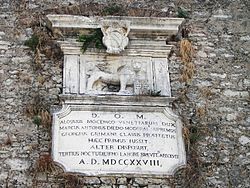
-
 Panoramic view of Corfu (city) from the New Fortress
 -
 Detail of the south wing of the entrance at Kassiopi Castle
 -
 View of Kasiopi village from the castle


19th century
[edit]
By the 1797 Treaty of Campo Formio, Corfu was ceded to the French, who occupied it for two years as the département of Corcyre, until they were expelled by a joint Russian-Ottoman squadron under Admiral Ushakov. For a short time it became the capital of a self-governing federation of the Heptanesos ("Seven Islands"), under Ottoman suzerainty; in 1807 after the Treaty of Tilsit its faction-ridden government was again replaced by a French administration under governor François-Xavier Donzelot, and in 1809 it was besieged in vain by a British Royal Navy fleet, which had captured all the other Ionian islands.[15]
Following the final defeat of Napoleon at the Battle of Waterloo, the Ionian Islands became a protectorate of the United Kingdom by the Treaty of Paris of 5 November 1815 as the United States of the Ionian Islands. Corfu became the seat of the British Lord High Commissioner of the Ionian Islands.[15] The population of the island was 66,000 by 1848.[78]The period of British rule led to investment in new roads, an improved water supply system, and the expansion of the Ionian Academy into a university. During this period the Greek language became the official language.[citation needed]
Following a plebiscite the Second National Assembly of the Greeks at Athens elected a new king, Prince Wilhelm (William) of Denmark, who took the name George I and brought with him the Ionian Islands as a coronation gift from Britain. On 29 March 1864, the United Kingdom, Greece, France and Russia signed the Treaty of London, pledging the transfer of sovereignty to Greece upon ratification. Thus, on 21 May, by proclamation of the Lord High Commissioner, the Ionian Islands were united with Greece.[75]
In 1891, an anti-Semitic pogrom took place following a case of blood libel, and riots ensued.[79][80][81] As of May 1891, arson attempts had been unsuccessful and the British Parliament could not answer a question about whether some people had died.[82] Part of the Jewish population chose to leave the island, mainly for Thessaloniki, the Ottoman territories being more welcoming. Albert Cohen's family left in 1900 and settled in Marseille.[83][84]
British Lord High Commissioners during the protectorate
[edit]
This is a list of the British High Commissioners of the Ionian Islands; (as well as the transitional Greek Governor, appointed a year prior to Enosis (Union) with Greece in 1864).[85]
- Sir James Campbell 1814–1816
- Sir Thomas Maitland (1759–1824) 1815–1823
- Sir Frederick Adam (1781–1853) 1823–1832
- Sir Alexander Woodford (1782–1870) 1832
- George Nugent-Grenville, 2nd Baron Nugent (1788–1850) 1832–1835
- Howard Douglas (1776–1861) 1835–1840
- James Alexander Stewart-Mackenzie (1784–1843) 1840–1843
- John Colborne, 1st Baron Seaton (1778–1863) 1843–1849
- Sir Henry George Ward (1797–1860) 1849–1855
- Sir John Young (1807–1876) 1855–1859
- William Ewart Gladstone (1809–1898) 1859
- Sir Henry Knight Storks (1811–1874) 1859–1863
- Count Dimitrios Nikolaou Karousos, President of the Ionian Parliament (1799–1873) 1863–1864
First World War
[edit]
During the First World War, the island served as a refuge for the Serbian army that retreated there on Allied forces' ships from a homeland occupied by the Austrians, Germans and Bulgarians. During their stay, a large portion of Serbian soldiers died from exhaustion, food shortage, and various diseases. Most of their remains were buried at sea near the island of Vido, a small island at the mouth of Corfu port, and a monument of thanks to the Greek nation has been erected at Vido by the grateful Serbs; consequently, the waters around Vido Island are known by the Serbian people as the Blue Tomb (in Serbian, Плава Гробница, Plava Grobnica), after a poem written by Milutin Bojić following World War I.[86]
Interwar period
[edit]In 1923, after a diplomatic dispute between Italy and Greece, Italian forces bombarded and occupied Corfu. The League of Nations settled this Corfu incident in Italy's favour.
Second World War
[edit]Italian occupation and resistance
[edit]
During the Greco-Italian War, Corfu was occupied by the Italians in April 1941. They administered Corfu and the Ionian islands as a separate entity from Greece until September 1943, following Benito Mussolini's orders of fulfilling Italian Irredentism and making Corfu part of the Kingdom of Italy. During the Second World War the 10th Infantry Regiment of the Greek Army, composed mainly of Corfiot soldiers,[87] was assigned the task of defending Corfu. The regiment took part in Operation Latzides, which was an unsuccessful attempt to stem the forces of the Italians.[87] After Greece's surrender to the Axis, the island came under Italian control and occupation.[87] On the first Sunday of November 1941, high school students from all over Corfu took part in student protests against the occupying Italian army; these student protests of the island were among the first acts of overt popular Resistance in occupied Greece and a rare phenomenon even by wartime European standards.[87] Subsequently, a considerable number of Corfiots escaped to Epirus in mainland Greece and enlisted as partisans in ELAS and EDES, in order to join the resistance movement gathering in the mainland.[87]
German bombing and occupation
[edit]
Upon the fall of Italian fascism in 1943, the Nazis moved to take control of the island. On 14 September 1943, Corfu was bombarded by the Luftwaffe. The Nazi bombing raids destroyed most of the city's buildings, including churches, homes, and whole city blocks, especially in the Jewish quarter Evraiki. Other losses included the city's market (αγορά) and the hotel Bella Venezia. The worst losses were the historic buildings of the Ionian Academy (Ιόνιος Ακαδημία), the Municipal Theatre (which in 1901 had replaced the Nobile Teatro di San Giacomo di Corfù), the Municipal Library, and the Ionian Parliament.[87]
Following the Wehrmacht invasion, the Italians capitulated, and the island came under German occupation. Corfu's mayor at the time, Kollas, was a known collaborator and various anti-semitic laws were passed by the Nazi occupation government of the island.[88] In early June 1944, while the Allies bombed Corfu as a diversion from the Normandy landings, the Gestapo rounded up the Jews of the city, temporarily incarcerated them at the old fort (Palaio Frourio), and on 10 June sent them to Auschwitz II, where most of them were murdered by gas.[88][89] Approximately two hundred out of a total population of 1,900 escaped.[90] Many among the local population at the time provided shelter and refuge to those 200 Jews who managed to escape the Nazis.[91] In Evraiki (Εβραική, meaning Jewish quarter), there is currently a synagogue with about 65 members, who still speak their original Italkian language.[90]
Liberation
[edit]
Corfu was liberated by British troops, specifically the 40th Royal Marine Commando, which landed in Corfu on 14 October 1944, as the Germans were evacuating Greece.[92] The Royal Navy swept the Corfu Channel for mines in 1944 and 1945, and found it to be free of mines.[93] A large minefield was laid there shortly afterwards by the newly communist Albania and gave rise to the Corfu Channel Incident.[93][94][95][96] This incident led to the Corfu Channel Case, where the United Kingdom opened a case against the People's Republic of Albania at the International Court of Justice.[97][98]
Post–World War and modern Corfu
[edit]After World War II and the Greek Civil War, the island was rebuilt under the general programme of reconstruction of the Greek Government (Ανοικοδόμησις) and many elements of its classical architecture remain. Its economy grew but a portion of its inhabitants left the island for other parts of the country; buildings erected during Italian occupation – such as schools or government buildings – were put back to civic use. In 1956 Maria Desylla Kapodistria, relative of first Governor (head of state) of Greece Ioannis Kapodistrias, was elected mayor of Corfu and became the first female mayor in Greece.[99] The Corfu General Hospital was also constructed;[100] electricity was introduced to the villages in the 1950s, the radio substation of Hellenic Radio in Corfu was inaugurated in March 1957,[101] and television was introduced in the 1960s, with internet connections in 1995.[102] The Ionian University was established in 1984.
Architecture
[edit]
Venetian influence
[edit]
Corfu's urban architecture influence derives from Venice, reflecting the fact that from 1386 to 1797 the island was ruled by the Venetians. The architecture of the Old Town of Corfu along with its narrow streets, the kantounia, has clear Venetian influence and is amongst the World Heritage Sites in Greece. Other notable Venetian-era buildings include the Nobile Teatro di San Giacomo di Corfù, the first Greek opera house, and Liston, a multi-level commercial and residential building, with an arched colonnade at ground level, lined with cafes and restaurants on its east side, and restaurants and other stores on its west side. Liston's main thoroughfare is often the site of parades and other mass gatherings. Liston is on the edge of the Spianada (Esplanade), the vast main plaza and park which incorporates a cricket field, a pavilion, and Maitland's monument. Also notable are the Old and New forts, the recently restored Palace of Sts. Michael and George, formerly the residence of the British colonial governor and the seat of the Ionian Senate, and the summer Palace of Mon Repos, formerly the property of the Greek royal family and birthplace of the Prince Philip, Duke of Edinburgh. The Park of Mon Repos is built on part of the Palaiopolis of Kerkyra, where excavations were conducted by the Greek Archaeological Service in collaboration with academics and universities internationally. Examples of the finds can be found in the Museum of the Palace of Mon Repos and at the Archaeological Museum of Corfu.[103]
The Achilleion
[edit]
In 1889, Empress Elisabeth of Austria built a summer palace in the region of Gastouri (Γαστούρι) to the south of the city, naming it Achílleion (Αχίλλειον) after the Homeric hero Achilles. The structure is filled with paintings and statues of Achilles, both in the main hall and in the gardens, depicting scenes of the Trojan War. The palace, with the neoclassical Greek statues that surround it, is a monument to platonic romanticism as well as escapism. It served as a refuge for the grieving Empress following the tragic death of her only son Crown Prince, Rudolf.

The Imperial gardens on the hill look over the surrounding green hills and valleys and the Ionian Sea. The centrepiece of the gardens is a marble statue on a high pedestal, of the mortally wounded Achilles (Greek: Αχιλλεύς Θνήσκων, Achilleús Thnēskōn, Achilles Dying) without hubris and wearing only a simple cloth and an ancient Greek hoplite helmet. This statue was carved by German sculptor Ernst Gustav Herter.
The hero is presented devoid of rank or status, and seems notably human, though heroic, as he is forever trying to pull Paris's arrow from his heel. His classically depicted face is full of pain. He gazes skyward, as if to seek help from Olympus. According to Greek mythology, his mother Thetis was a goddess.[citation needed]
In contrast, at the great staircase in the main hall is a giant painting of the triumphant Achilles full of pride. Dressed in full royal military regalia and erect on his racing chariot, he pulls the lifeless body of Hector of Troy in front of the stunned crowd watching helplessly from inside the walls of the Trojan citadel.
In 1898, Empress Sissi was assassinated at the age of 60 by an Italian anarchist, Luigi Lucheni, in Geneva, Switzerland. After her death, the palace was sold to the German Kaiser Wilhelm II. Following the Kaiser's purchase of the Achilleion, he invited archaeologist Reinhard Kekulé von Stradonitz, a friend and advisor, to come to Corfu to advise him where to position the huge statue of Achilles which he commissioned. The famous salute to Achilles from the Kaiser, which had been inscribed at the statue's base, was also created by Kekulé. The inscription read:[104]
To the Greatest Greek from the Greatest German
The inscription was subsequently removed after World War II.[105]
The Achilleion was eventually acquired by the Greek state and has now been converted into a museum.
Kaiser's Bridge
[edit]
German Kaiser Wilhelm II was also fond of taking holidays in Corfu. Having purchased the Achilleion in 1907 after Sissi's death, he appointed Carl Ludwig Sprenger as the botanical architect of the Palace, and also built a bridge later named by the locals after him—the "Kaiser's bridge" (Greek: η γέφυρα του Κάιζερ transliterated as: i gefyra tou Kaizer)—to access the beach without traversing the road forming the island's main artery to the south. The bridge, arching over the road, spanned the distance between the lower gardens of Achilleion and the nearby beach; its remains are an important landmark on the highway. The bridge's central section was demolished by the Wehrmacht in 1944, during the German occupation of World War II, to allow for the passage of an enormous cannon, forming part of the Nazi defences in the southeastern coast of Corfu.[106][107]
Urban landscape
[edit]Old town
[edit]
The Old Town of Corfu city is a UNESCO World Heritage Site. In several parts of the old city, buildings of the Venetian era are to be found. The old city's architectural character is strongly influenced by the Venetian style, coming as it did under Venetian rule for a long period; its small and ancient side streets, and the old buildings' trademark arches are particularly reminiscent of Venice.
The city of Corfu stands on the broad part of a peninsula, whose termination in the Venetian citadel (Greek: Παλαιό Φρούριο) is cut off from it by an artificial fosse formed in a natural gully, with a seawater moat at the bottom,[15] that now serves as a marina and is called the Contrafossa. In the old town there are many narrow streets paved with cobblestones. These streets are known as kantoúnia (Greek: καντούνια), and the older amongst them sometimes follow the gentle irregularities of the ground; while many are too narrow for vehicular traffic. A promenade rises by the seashore towards the bay of Garitsa (Γαρίτσα), together with an esplanade between the city and the citadel known as Spianada with the Liston arcade (Greek: Λιστόν) to its west side, where restaurants and bistros abound.[1]
Ano and Kato Plateia and the music pavilion
[edit]
Near the old Venetian Citadel a large square called Spianada is also to be found, divided by a street in two parts: "Ano Plateia" (literally: "Upper square") and "Kato Plateia" (literally: "Lower square"), (Ανω Πλατεία and Κάτω Πλατεία in Greek). This is the biggest square in South-Eastern Europe and one of the largest in Europe,[108][109] and replete with green spaces and interesting structures, such as a Roman-style rotunda from the era of British administration, known as the Maitland monument, built to commemorate Sir Thomas Maitland. An ornate music pavilion is also present, where the local "Philharmonikes" (Philharmonic Orchestras) (Φιλαρμονικές), mount classical performances in the artistic and musical tradition for which the island is well known. "Kato Plateia" also serves as a venue where cricket matches are held from time to time. In Greece, cricket is unique to Corfu, as it was once a British protectorate.
Palaia Anaktora and its gardens
[edit].jpg)

Just to the north of "Kato Plateia" lie the "Palaia Anaktora" (Παλαιά Ανάκτορα: literally "Old Palaces"): a large complex of buildings of Roman architectural style which formerly housed the Kings of Greece, and prior to that the British Governors of the island. It was then called the Palace of Saints Michael and George. The Order of St. Michael and St. George was founded here in 1818 with motto auspicium melioris aevi,[110][111] and is still awarded by the United Kingdom. Today the palace is open to the public and forms a complex of halls and buildings housing art exhibits, including a Museum of Asian Art, unique across Southern Europe in its scope and in the richness of its Chinese and Asian exhibits. The gardens of the Palaces, complete with old Venetian stone aquariums, exotic trees and flowers, overlook the bay through old Venetian fortifications and turrets, and the local sea baths (Μπάνια τ' Αλέκου) are at the foot of the fortifications surrounding the gardens. A café on the grounds includes its own art gallery, with exhibitions of both local and international artists, known locally as the Art Café. From the same spot, the viewer can observe ships passing through the narrow channel of the historic Vido island (Νησί Βίδου) to the north, on their way to Corfu harbour (Νέο Λιμάνι), with high speed retractable aerofoil ferries from Igoumenitsa also cutting across the panorama. A wrought-iron aerial staircase, closed to visitors, descends to the sea from the gardens; the Greek royal family used it as a shortcut to the baths. Rewriting history, locals now refer to the old Royal Gardens as the "Garden of the People" (Ο Κήπος του Λαού).
Churches
[edit]In the city, there are thirty-seven Greek churches, the most important of which are the city's cathedral, the church dedicated to Our Lady of the Cave (η Παναγία Σπηλιώτισσα (hē Panagia Spēliōtissa)); Saint Spyridon Church, wherein lies the preserved body of the patron saint of the island; and finally the suburban church of St Jason and St Sosipater (Αγιοι Ιάσων και Σωσίπατρος), reputedly the oldest in the island,[15] and named after the two saints probably the first to preach Christianity to the Corfiots.
Pontikonisi
[edit]The nearby island, known as Pontikonisi (Greek meaning "mouse island"), though small is very green with abundant trees, and at its highest natural elevation (excluding its trees or man-made structures, such as the monastery), stands at about 2 m (6 ft 6.74 in). Pontikonisi is home of the monastery of Pantokrator (Μοναστήρι του Παντοκράτορος); the white stone staircase of the monastery, viewed from afar, gives the impression of a (mouse) tail, which lent the island its name.
Archaeology
[edit]Palaiopolis
[edit]In the city of Corfu, the ruins of the ancient city of Korkyra, also known as Palaiopolis, include ancient temples which were excavated at the location of the palace of Mon Repos, which was built on the ruins of the Palaiopolis. The temples are: Kardaki Temple, Temple of Artemis, and the Temple of Hera. Hera's temple is situated at the western limits of Mon Repos, close to Kardaki Temple and to the northwest.[112] It is approximately 700 m. to the southeast of the Temple of Artemis in Corfu.[112] Hera's Temple was built at the top of Analipsis Hill, and, because of its prominent location, it was highly visible to ships passing close to the waterfront of ancient Korkyra.[112]
Kardaki Temple
[edit]
Kardaki Temple is an Archaic Doric temple in Corfu, Greece, built around 500 BC in the ancient city of Korkyra (or Corcyra), in what is known today as the location Kardaki in the hill of Analipsi in Corfu.[113] The temple features several architectural peculiarities that point to a Doric origin.[113][114] The temple at Kardaki is unusual because it has no frieze, following perhaps architectural tendencies of Sicilian temples.[115]
It is considered to be the only Greek temple of Doric architecture that does not have a frieze.[113] The spacing of the temple columns has been described as "abnormally wide".[116] The temple also lacked both porch and adyton, and the lack of a triglyph and metope frieze may be indicative of Ionian influence.[117] The temple at Kardaki is considered an important and to a certain degree mysterious topic on the subject of early ancient Greek architecture. Its association with the worship of Apollo or Poseidon has not been established.
Temple of Artemis
[edit]
The Temple of Artemis is an Archaic Greek temple in Corfu, built in around 580 BC in the ancient city of Korkyra (or Corcyra), in what is known today as the suburb of Garitsa. The temple was dedicated to Artemis. It is known as the first Doric temple exclusively built with stone.[118] It is also considered the first building to have incorporated all of the elements of the Doric architectural style.[119] Very few Greek temple reliefs from the Archaic period have survived, and the large fragments of the group from the pediment are the earliest significant survivals.
The temple was a peripteral–styled building with a pseudodipteral configuration. Its perimeter was rectangular, with width of 23.46 m (77.0 ft) and length 49 m (161 ft) with an eastward orientation so that light could enter the interior of the temple at sunrise.[118] It was one of the largest temples of its time.[120]
The metope of the temple was probably decorated, since remnants of reliefs featuring Achilles and Memnon were found in the ancient ruins.[118] The temple has been described as a milestone of Ancient Greek architecture and one of 150 masterpieces of Western architecture.[119] The Corfu temple architecture may have influenced the design of an archaic sanctuary structure found at the Sant'Omobono archaeological site in Rome, dating from the time of the Etruscans, which incorporates similar design elements.[121] If still in use by the 4th-century, the temple would have been closed during the persecution of pagans in the late Roman Empire, when the Christian Emperors issued edicts prohibiting non-Christian worship. Kaiser Wilhelm II, while vacationing at his summer palace of Achilleion in Corfu and while Europe was preparing for war, was involved in excavations at the site of the ancient temple.
Temple of Hera
[edit]
The Temple of Hera or Heraion is an archaic temple in Corfu, built around 610 BC in the ancient city of Korkyra (or Corcyra), in what is known today as Palaiopolis, and lies within the ground of the Mon Repos estate.[122][123][112] The sanctuary of Hera at Mon Repos is considered a major temple, and one of the earliest examples of archaic Greek architecture.[112]
Large terracotta figures such as lions, gorgoneions, and Daidala maidens, created and painted in vivid colour by artisans, who were inspired by myth traditions across the Mediterranean, decorated the roof of the temple, making it one of the most intricately adorned temples of Archaic Greece and the most ambitious roof construction project of its time.[112] Built at the top of Analipsis Hill, Hera's sanctuary was highly visible to ships approaching the waterfront of the ancient city of Korkyra.[112]
The Digital Archaic Heraion Project at Mon Repos is a project that has undertaken the task of digitising the architectural fragments found at the Corfu Heraion with the aim to reconstruct in 3D the Temple at Palaiopolis in virtual space.[124]
Tomb of Menecrates
[edit]
.jpg)
The Tomb of Menecrates or Monument of Menecrates is an Archaic cenotaph in Corfu, built around 600 BC in the ancient city of Korkyra (or Corcyra).[125][126] The tomb and the funerary sculpture of a lion were discovered in 1843 during demolition works by the British Army who were demolishing a Venetian fortress in the location of Garitsa hill in Corfu.[127] The tomb is dated to the 6th century BC.[127]
The lion is dated at the end of the 7th century BC and it is one of the earliest funerary lions ever found.[127] The tomb and the lion were found in an area which was part of the necropolis of ancient Korkyra, which was discovered by the British army at the time.[127] According to an Ancient Greek inscription found on the grave, the tomb was a monument built by the ancient Korkyreans in honour of their proxenos (ambassador) Menecrates, son of Tlasios, from Oeiantheia. Menecrates was the ambassador of ancient Korkyra to Oeiantheia, modern day Galaxidi or Ozolian Locris,[128][129] and he was lost at sea. In the inscription it is also mentioned that the brother of Menecrates, Praximenes, had arrived from Oeiantheia to assist the people of Korkyra in building the monument to his brother.[130][125]
Other archaeological sites
[edit]In Cassiope, the only other city of ancient importance, its name is still preserved by the village of Kassiopi, and there are some rude remains of building on the site; but the temple of Zeus Cassius for which it was celebrated has totally disappeared.
Castles
[edit]The castles of Corfu, located at strategic points on the island helped defend the island from many invaders and they were instrumental in repulsing repeated Turkish invasions, making Corfu one of the few places in Greece never to be conquered by the Ottomans.
Palaio Frourio
[edit]

The old citadel (in Greek Palaio Frourio (Παλαιό Φρούριο) is an old Venetian fortress built on an artificial islet with fortifications surrounding its entire perimeter, although some sections, particularly on the east side, are slowly being eroded and falling into the sea. Nonetheless, the interior has been restored and is in use for cultural events, such as concerts (συναυλίες) and Sound and Light Productions (Ηχος και Φως), when historical events are recreated using sound and light special effects. These events take place amidst the ancient fortifications, with the Ionian Sea in the background. The central high point of the citadel rises like a giant natural obelisk complete with a military observation post at the top, with a giant cross at its apex; at the foot of the observatory lies St. George's church, in a classical style punctuated by six Doric columns,[131] as opposed to the Byzantine architectural style of the greater part of Greek Orthodox churches.
Neo Frourio
[edit]
The new citadel or Neo Frourio (Νέο Φρούριο, "New Fortress") is a huge complex of fortifications built by the British during their rule of the island (1815–63) dominating the northeastern part of the city.[132][failed verification] The huge walls of the fortress loom over the landscape as one travels from Neo Limani (Νέο Λιμάνι, "New Port") to the city, taking the road that passes through the fishmarket (ψαραγορά). The new citadel was until recently a restricted area due to the presence of a naval garrison, but old restrictions have been lifted and it is now open to the public, with tours possible through the maze of medieval corridors and fortifications. The winged Lion of St Mark, the symbol of Venice, can be seen at regular intervals adorning the fortifications.
Angelokastro
[edit].jpg)
Angelokastro (Greek: Αγγελόκαστρο (Castle of Angelos or Castle of the Angel); Venetian: Castel Sant'Angelo) is a Byzantine castle on the island's northwest coast.[133][134] It is located at the top of the highest peak of the island's shoreline, near Palaiokastritsa, and built on particularly precipitous and rocky terrain. It stands 1,000 ft (305 m) on a steep cliff above the sea and surveys the City of Corfu and the mountains of mainland Greece to the southeast and a wide area of Corfu toward the northeast and northwest.[133][135]
Angelokastro is one of the most important fortified complexes of Corfu. It was an acropolis which surveyed the region all the way to the southern Adriatic and presented a formidable strategic vantage point to the occupant of the castle.
Angelokastro formed a defensive triangle with the castles of Gardiki and Kassiopi, which covered Corfu's defences to the south, northwest and northeast. The castle never fell, despite frequent sieges and attempts at conquering it through the centuries, and played a decisive role in defending the island against pirate incursions and during three sieges of Corfu by the Ottomans, significantly contributing to their defeat. During invasions it helped shelter the local peasant population. The villagers also fought against the invaders playing an active role in the defence of the castle. Angelokastro, located at the western frontier of the Empire, was instrumental in repulsing the Ottomans during the first great siege of Corfu in 1537, in the siege of 1571 and the second great siege of Corfu in 1716 causing the Ottomans to fail at penetrating the defences of Corfu in the North. Consequently the Turks were never able to create a beachhead and to occupy the island.[136]
Gardiki Castle
[edit]
Gardiki Castle (Greek: Κάστρο Γαρδικίου) is a 13th-century Byzantine castle on the southwestern coast of Corfu and the only surviving medieval fortress on the southern part of the island.[137] It was built by a ruler of the Despotate of Epirus,[138] and was one of three castles which defended the island before the Venetian era (1401–1797).
The location of Gardiki at the narrow southwest flank of Corfu provided protection to the fields and the southern lowlands of Corfu and in combination with Kassiopi Castle on the northeastern coast of the island and Byzantine Angelokastro protecting the northwestern shore of Corfu, formed a triangular line of defence which protected Corfu during the pre-Venetian era.[138][139][140]
Kassiopi Castle
[edit]
Kassiopi Castle (Greek: Κάστρο Κασσιώπης) is a castle on the northeastern coast of Corfu overseeing the fishing village of Kassiopi.[141] It was one of three Byzantine-period castles that defended the island before the Venetian era (1386–1797). The castles formed a defensive triangle, with Gardiki guarding the island's south, Kassiopi the northeast and Angelokastro the northwest.[139][140]
Its position at the northeastern coast of Corfu overseeing the Corfu Channel that separates the island from the mainland gave the castle an important vantage point and an elevated strategic significance.[141]
Kassiopi Castle is considered one of the most imposing architectural remains in the Ionian Islands,[142] along with Angelokastro, Gardiki Castle and the two Venetian Fortresses of Corfu City, the Citadel and the New Fort.[142]
Since the castle was abandoned for a long time, its structure is in a state of ruin. The eastern side of the fort has disappeared and only a few traces of it remain. There are indications that castle stones have been used as building material for houses in the area. Access to the fortress is mainly from the southeast through a narrow walkway which includes passage from homes and backyards, since the castle is at the centre of the densely built area of the small village of Kassiopi.[143][144]
Municipalities
[edit]The three present municipalities of Corfu and Diapontia Islands were formed in the 2019 local government reform from the former municipality Corfu.[3][145]
Education
[edit]Ionian Academy
[edit]
The Ionian Academy was an institution that maintained the tradition of Greek education while the rest of Greece was still under Ottoman rule. The academy was established by the French during their administration of the island as the département of Corcyre,[146][147] and became a university during the British administration,[147] through the actions of Frederick North, 5th Earl of Guilford in 1824.[148] It is also considered the precursor of the Ionian University. It had Philological, Law, and Medical Schools.
Ionian University
[edit]
The Ionian University was established in 1984, in recognition, by the administration of Andreas Papandreou, of Corfu's contribution to Education in Greece, as the seat of the first Greek university in modern times,[149] the Ionian Academy. The university opened its doors to students in 1985 and today comprises three Schools and six Departments offering undergraduate and post-graduate degree programmes and summer schools.[150][151]
Student activism
[edit]In the modern era, beginning with its massive student protests during World War II against fascist occupation, and continuing in the fight against the dictatorship of Georgios Papadopoulos (1967–1974), students in Corfu have played a vanguard role in protesting for freedom and democracy in Greece, against both internal and external oppression. For Corfiotes a recent example of such heroism is that of geology student Kostas Georgakis, who set himself ablaze in Genoa, Italy on 19 September 1970, in a protest against the Greek military junta of 1967-1974.
Culture
[edit]Corfu has a long musical, theatrical, and operatic tradition. The operas performed in Corfu were at par with their European counterparts. The phrase "applaudito in Corfu" (applauded in Corfu) was a measure of high accolade for an opera performed on the island. The Nobile Teatro di San Giacomo di Corfù was the first theatre and opera house of modern Greece and the place where the first Greek opera, Spyridon Xyndas' The Parliamentary Candidate (based on an exclusively Greek libretto) was performed.
Museums and libraries
[edit]
The most notable of Corfu's museums and libraries are located in the city; these include:[152]
- The Archaeological Museum, inaugurated in 1967, was constructed to house the exhibit of the huge Gorgon pediment of the Artemis temple in the ancient city of Korkyra, excavated at Palaiopolis in the early 20th century. The pediment has been described by The New York Times as the "finest example of archaic temple sculpture extant".[153] Kaiser Wilhelm II had developed a "lifelong obsession" with the Gorgon sculpture, dating from seminars on Greek Archaeology the Kaiser attended while at the University of Bonn. The seminars were given by archaeologist Reinhard Kekulé von Stradonitz, who later became the Kaiser's advisor.[104] In 1994, two more halls were added to the museum, where new discoveries from the excavations of the ancient city and the Garitsa cemetery are exhibited.
- The Museum of Asian art of Corfu is located at the Palace of St. Michael and St. George (mainly Chinese and Japanese Arts); its unique collection is housed in 15 rooms, taking in over 12,000 artifacts, including a Greco-Buddhist art collection that shows the influence of Alexander the Great on Buddhist culture as far as Pakistan (see Greco-Buddhism).
- The Banknote Museum, located in Aghios Spyridon square, features a complete collection of Greek banknotes from independence to the adoption of the euro in 2002.
- The Byzantine Museum of Antivouniotissa, a church converted into a museum featuring rare Byzantine art.
- Kapodistrias Museum. Ioannis Kapodistrias' summer home in Koukourisa in his birthplace of Corfu has been converted to a museum commemorating his life and accomplishments and has been named in his honour.[154] Donated by Maria Desylla Kapodistria, grand niece of Ioannis Kapodistrias, former mayor of Corfu and first female mayor of Greece.
- The Music Museum of the Philharmonic Society of Corfu is located in the building of the Philharmonic Society and features scores, instruments, paintings and documents related to the music history of Corfu and the 19th-century Ionian Islands.

- The Public Library of Corfu is located at the old English Barracks, in Palaio Frourio.
- The Reading Society of Corfu has an extensive library of old Corfu manuscripts and rare books.
- The Serbian Museum of Corfu (Serbian: Српска кућа, Serbian House) houses rare exhibits about the Serbian soldiers' tragic fate during the First World War. The remnants of the Serbian Army of about 150,000 soldiers together with their government in exile, found refuge and shelter in Corfu, following the collapse of the Serbian Front as a result of the Austro-Hungarian attack of 6 October 1915. Exhibits include photographs from the three years stay of the Serbians in Corfu, together with other exhibits such as uniforms, arms and ammunition of the Serbian army, Serbian regimental flags, religious artifacts, surgical tools and other decorations of the Kingdom of Serbia.
- Solomos Museum and the Corfiot Studies Society.
Patron Saint Spyridon
[edit]
Saint Spyridon the Thaumaturgist (Miracle-worker, Θαυματουργός) is the patron saint (πολιούχος) of the city and the island. St. Spyridon is revered for the miracle of expelling the plague (πανώλη) from the island, among many other miracles attributed to him. It is believed by the faithful that on its way from the island the plague scratched one of the fortification stones of the old citadel to indicate its fury at being expelled; to St. Spyridon is also attributed the role of saving the island at the second great siege of Corfu in 1716.[155][156] The legend says that the sight of St. Spyridon approaching Ottoman forces bearing a flaming torch in one hand and a cross in the other caused panic.[75][157][158] The legend also states that the Saint caused a tempest which was partly responsible for repulsing the Ottomans.[159] This victory over the Ottomans, therefore, was attributed not only to the leadership of Count Schulenburg who commanded the stubborn defence of the island against Ottoman forces, but also to the miraculous intervention of St. Spyridon. Venice honoured von der Schulenburg and the Corfiots for successfully defending the island. Recognizing St. Spyridon's role in the defence of the island Venice legislated the establishment of the litany (λιτανεία) of St Spyridon on 11 August as a commemoration of the miraculous event, inaugurating a tradition that continues to this day.[75] In 1716 Antonio Vivaldi, on commission by the republic of Venice, composed the oratorio Juditha triumphans to commemorate this great event. Juditha triumphans was first performed in November 1716 in Venice by the orchestra and choir of the Ospedale della Pietà and is described as Vivaldi's first great oratorio.[160] Hence Spyridon is a popular first name for Greek males born on the island and/or to islanders.
Music
[edit]Musical history
[edit]
While much of present-day Greece was under Ottoman rule, the Ionian Islands enjoyed a Golden Age in music and opera. Corfu was the capital city of a Venetian protectorate and it benefited from a unique musical and theatrical heritage. Then in the 19th century, as a British Protectorate, Corfu developed a musical heritage of its own and which constitutes the nucleus of modern Greek musical history. Until the early 18th century, musical life took place in city and village squares, with performances of straight or musical comedies – known as Momaries or Bobaries. From 1720, Corfu became the possessor of the first theatre in post-1452 Greece. It was the Teatro San Giacomo (now the City Hall) named after the nearby Roman Catholic cathedral (completed in 1691).[161]
The island was also the center of the Ionian School of music, the musical production of a group of Heptanesian composers, whose heyday was from the early 19th century till approximately the 1950s. It was the first school of classical music in Greece and it was a heavy influence for the later Greek music scene, after the independence.
The three Philharmonics
[edit]
Corfu's Philharmonic Societies provide free instruction in music, and continue to attract young recruits. There are nineteen such marching wind bands throughout the island.
Corfu city is home to the three most prestigious bands – in order of seniority:
- the Philharmonic Society of Corfu use dark blue uniforms with dark red accents, and blue and red helmet plumes. It is usually called the Old Philharmonic or simply the Paliá ("Old"). Founded 12 September 1840.
- the Mantzaros Philharmonic Society use blue uniforms with blue and white helmet plumes. It is commonly called the Néa ("New"). Founded 25 October 1890.
- the Capodistria Philharmonic Union use bright red and black uniforms and plumes. It is commonly called the Cónte Capodístria or simply the Cónte ("Count"). It is the juniormost of the three (founded 18 April 1980).
All three maintain two major bands each, the main marching bands that can field up to 200 musicians on grand occasions, and the 60-strong student bandinas meant for lighter fare and on-the-job training.
The bands give regular summer weekend promenade concerts at the Spianada Green "pálko", and have a prominent part in the yearly Holy Week ceremonies.
Ionian University music department
[edit]
Since the early 1990s a music department has been established at the Ionian University. Aside from its academic activities, concerts in Corfu and abroad, and musicological research in the field of Neo-Hellenic Music, the Department organizes an international music academy every summer, which gathers together both international students and professors specialising in brass, strings, singing, jazz and musicology.
Theatres and operatic tradition
[edit]Teatro di San Giacomo
[edit]
Under Venetian rule, the Corfiotes developed a fervent appreciation of Italian opera, which was the real source of the extraordinary (given conditions in the mainland of Greece) musical development of the island during this era.[162] The opera house of Corfu during the 18th and 19th centuries was the Nobile Teatro di San Giacomo, named after the neighbouring Catholic cathedral; it was later converted into the City Hall.[162] It was both the first theatre and first opera house of Greece in modern times and the place where the first Greek opera (based on an exclusively Greek libretto), Spyridon Xyndas' The Parliamentary Candidate was performed.[162] A long series of local composers, such as Nikolaos Mantzaros, Spyridon Xyndas, Antonio Liberali, Domenico Padovani, the Zakynthian Pavlos Carrer, the Lambelet family, Spyridon Samaras, and others, all developed careers intertwined with the theatre.[162] San Giacomo's place was taken by the Municipal Theatre in 1902, which maintained the operatic tradition vividly until its destruction during German air raid in 1943.[162]
The first opera to be performed in the San Giacomo was in 1733 ("Gerone, tiranno di Siracusa"),[162] and for almost two hundred years, between 1771 and 1943, nearly every major opera from the Italian tradition, as well as many others from Greek and French composers, were performed on the stage of the San Giacomo; this tradition continues to be reflected in Corfiote operatic history, a fixture in famous opera singers' itineraries.[163]
Municipal Theatre of Corfu
[edit]
.jpg)
The Municipal Theatre of Corfu (Greek: Δημοτικό Θέατρο Κέρκυρας) was the main theatre and opera house in Corfu.[164] Opened in 1902, the theatre was the successor of Nobile Teatro di San Giacomo di Corfù which became the Corfu city hall. It was destroyed during a Luftwaffe aerial bombardment in 1943.[164]
During its 41-year history, it was one of the premier theatres and opera houses in Greece, and as the first theatre in Southeastern Europe,[164] it contributed to the arts and to the history of the Balkans and of Europe.[165][164][166] The archives of the theatre, including the historical San Giacomo archives, all valuables and art were destroyed in the Luftwaffe bombing with the sole exception of the stage curtain, which was not in the premises the night of the bombing and thus escaped harm; among the losses are believed to have been numerous manuscripts of the work of Spyridon Xyndas, composer of the first opera in Greek.[164]
Festivities
[edit]Easter
[edit]On Good Friday, from the early afternoon onward, the bands of the three Philharmonic Societies, separated into squads, accompany the Epitaph processions of the city churches. Late in the afternoon, the squads come together to form one band in order to accompany the Epitaph procession of the cathedral, while the funeral marches that the bands play differ depending on the band; the Old Philharmonic play Albinoni's Adagio, the Mantzaros play Verdi's Marcia Funebre from Don Carlo, and the Capodistria play Chopin's Funeral March and Mariani's Sventura.[167]
On Holy Saturday morning, the three city bands again take part in the Epitaph processions of St. Spyridon Cathedral in procession with the Saint's relics.[167] At this point the bands play different funeral marches, with the Mantzaros playing Miccheli's Calde Lacrime, the Palia playing Marcia Funebre from Faccio's Amleto, and the Capodistria playing the Funeral March from Beethoven's Eroica. This custom dates from the 19th century, when colonial administrators banned the participation of the British garrison band in the traditional Holy Friday funeral cortege. The defiant Corfiotes held the litany the following morning, and paraded the relics of St. Spyridon too, so that the administrators would not dare intervene.
The litany is followed , at exactly 11:00 AM, the celebration of the "Early Resurrection"; balconies in the old city are decked in bright red cloth, and Corfiotes throw down large clay pots (the bótides, μπότηδες) full of water to smash on the street pavement, especially in wider areas of Liston and in an organised fashion.[167] This is enacted in anticipation of the Resurrection of Jesus, which is to be celebrated that same night,[167] and to commemorate King David's phrase: "Thou shalt dash them in pieces like a potter's vessel" (Psalm 2:9).
Once the bótides commotion is over, the three bands parade the clay-strewn streets playing the famous "Graikoí" festive march.[168] The march, which functions as the anthem of the island, was composed during the period of Venetian rule, and its lyrics include: "Greeks, never fear, we are all enslaved: you to the Turks, we to the Venetians, but one day we shall all be free".[citation needed]
Ta Karnavalia
[edit]Another venerable Corfu tradition is known as the Carnival or Ta Karnavalia. Venetian in origin, festivities include a parade featuring the main attraction of Karnavalos, a rather grotesque figure with a large head and smiling face, leading a diverse procession of colourful floats.[169] Corfiots, young and old, dress up in colourful costumes and follow the parade, spilling out into the area's narrow streets (kantounia) and spreading the festivities across the city,[169] dancing and socialising. At night, dance and costume parties are traditional.[169]
Cultural depictions
[edit]In myth
[edit]- It is in Corfu that Heracles, just before embarking on his ten labours, slept with the naiad Melite; their son was Hyllus (not to be confused with Hyllus, the leader of the Heraclids, also a son of Heracles).[170]
- Corfu marks the Argonauts' refuge from the avenging Colchic fleet, after their seizure of the Golden Fleece.[75]
- In the mythical sea adventure of Homer's Odyssey, Kerkyra is the island of the Phaeacians, (Phaiakes) wherein Odysseus (Ulysses) meets Nausica, the daughter of King Alkinoos. The bay of Palaiokastritsa is considered to be the place where Odysseus disembarked.[171]
In literature
[edit]- British naturalist Gerald Durrell wrote three books about his 1935–1940 childhood on Corfu: My Family and Other Animals; Birds, Beasts and Relatives; and The Garden of the Gods. His brother, literary author Lawrence Durrell, also wrote a volume about Corfu: Prospero's Cell: A Guide to the Landscape and Manners of the Island of Corcyra (Corfu).
- Mary Stewart's novel This Rough Magic is set in Corfu.
- Prospero's island in Shakespeare's final play, The Tempest, is often said to have been based on Corfu.
- Letitia Elizabeth Landon twice wrote of Corfu as an island paradise: the first poem appeared in Fisher's Drawing Room Scrap Book for 1835, to a picture by Thomas Allom;[172] and the second in the same publication for 1838, to a picture by Charles Bentley titled Corfu and Manduchio from Mount Olivet.[173] A third poem of hers, paired with and based on an engraving of a painting by Samuel Prout depicting a city scene in Corfu, was published in the Scrap Book for 1837.[174]
- Humbert Humbert's first love, Annabel Leigh, is said to have died of typhus in Corfu in a scene of Vladimir Nabokov's Lolita.
- Albert Cohen wrote three books which are partially or entirely set in Corfu. They are: Mangeclous, Les Valeureux, and Belle du Seigneur. Cohen himself was born on the island.
- Voltaire references two monks from Corfu in Chapter XXVIII of Candide
In film
[edit]- Corfu was one of the main locations featured in the 1970 film The Executioner starring George Peppard and Joan Collins.[175]
- Corfu was one of the settings of The Burglars, a 1971 film starring Jean-Paul Belmondo and Omar Sharif.
- The Countess of Corfu (Greek: Η Κόμησσα Της Κέρκυρας), a 1972 film starring Rena Vlahopoulou and Alekos Alexandrakis, was filmed in Corfu.
- Much of the 1978 Billy Wilder film Fedora is set in Corfu and filmed on location.
- Some scenes of the 1978 film The Greek Tycoon starring Anthony Quinn and Jacqueline Bisset were filmed in Corfu.[176][177] The film is a fictionalized account of the life of the Greek shipping magnate, Aristotle Onassis.
- The 1980 French comedy Jupiter's Thigh starring Annie Girardot and Philippe Noiret includes some scenes in Corfu Town.[178]
- The 1981 James Bond movie For Your Eyes Only has a number of scenes filmed in Corfu. The most memorable scene of the film to be bound with the island is of the underwater ancient Greek temple, with a huge turtle swimming in front of the camera; a casino scene was also filmed at the Achilleion.[179] Other scenes filmed here include those tracing 'Melina' and James' walk through the city's streets, and Melina being greeted by Bond at Pontikonisi island. A major action element was filmed on the largest sandy beach on the island, Issos Beach in Agios Georgios South, involving a beach buggy chase along the dunes. The film's scene depicting a Greek wedding was filmed at the Bouas-Danilia traditional village (Μπούας Δανίλια παραδοσιακό χωριό).[179] Action scenes were also filmed at Neo Frourio.[180]
- The 1984 Greek film "Η Τιμή της Αγάπης" (The Price of Love), directed by Tonia Marketaki is a tragic love story taking place in Corfu. It is based on the novel Honour and Money by Konstantinos Theotokis.[181]
- Corfu is also the setting of a 1987 BBC TV series version, and a 2005 BBC movie version, of My Family and Other Animals, Gerald Durrell's book about his childhood in Corfu in the late 1930s
- The Gaze of the Gorgon (1992): a poem-film for BBC television by British poet Tony Harrison. The film examines the politics of conflict in the 20th century using the Gorgon as a metaphor. The imaginary narration of the film is done through the mouth of German-Jewish poet Heinrich Heine. The film describes the connection between the Corfu Gorgon at the Artemis Temple of Corfu and Kaiser Wilhelm II.[182][183] Harrison concludes his 1992 film-poem by making a proposal that in the 1994 European Union summit in Corfu, Heine's statue be returned to Corfu on time to preside over the new Europe so that EU can keep its eyes open and not turn to stone from the Gorgon's gaze.[183][184][185]
- ITV aired a TV series named The Durrells in Corfu in April 2016 and ultimately lasting four seasons, concluding in May 2019. It was a biographical series detailing Gerald Durrell's childhood on Corfu.
In popular culture
[edit]
Corfu is one of the locations in the legend of Simon and Milo, where Simon falls in love temporarily. It is the setting of the 1998 song "Mediterranean Lady" by Prozzak. The island is alluded to several times in David Foster Wallace's 1987 novel, The Broom of the System. Drake mentions Corfu in a song. It is also mentioned in Brian Jacques' adventure novel, Voyage of Slaves.
Tourism
[edit]
Corfiotes have a long history of hospitality to foreign residents and visitors, typified in the 20th century by Gerald Durrell's childhood reminiscence My Family and Other Animals. The north east coast has largely been developed by a few British holiday companies, with large expensive holiday villas.[186] Package holiday resorts exist on the north, east and southwest coasts. Since 2021 there is an extra service added for visitors of the island called The Corfu Island Pass© Archived 29 August 2025 at the Wayback Machine. This official discount pass of Corfu gives everyone visiting Corfu a discount on sightseeing tours, rentals and cruises.
At the other end of the island, the southern resort of Kavos also provides tourist facilities.
St George South to the west boasts the largest sandy beach on the island coupled with a selection of all-inclusive package hotels and traditional corfiot villas and flats. The Korission lake nature reserve also provides a stopover for European birds migrating south.
Up until the early 20th century, it was mainly visited by the European royals and elites, including Emperor Wilhelm II of Germany and Empress Elisabeth of Austria; today it is also widely visited by middle class families (primarily from the UK, Scandinavia and Germany). With the advent of the jet airliner bringing these groups relatively affordable 'package holidays', Corfu was one of the primary destinations for this new form of mass tourism.[187] It is still popular with the ultra-wealthy however, and in the island's northeast the homeowners include members of the Rothschild family and Russian oligarchs.[188][189]
Transport
[edit]

The island is linked by two highways: GR-24 in the northwest and GR-25 in the south.
- Greek National Road 24, Cen., NW, Corfu – Palaiokastritsa
- Greek National Road 25, Cen., S, SE, Corfu – Lefkimi
Corfu has ferry services both by traditional ferries to Gaios in the island of Paxoi and as far as Patras and both traditional ferries and advanced retractable airfoil, hydrodynamic-flow, high-speed ferries called "Flying Dolphins" to Igoumenitsa and Sarandë in neighbouring Albania. The small port of Lefkimmi is also to be found at the southernmost tip of the island on Cape Kavos, offering a ferry service to the mainland.
The Ioannis Kapodistrias International Airport, named after Ioannis Kapodistrias, a Corfiot and European diplomat, and the first governor of the independent Greek state, is located around three kilometres south of Kerkyra, just half a kilometre north of Pontikonisi. The approach and landing, in a northeasterly direction, afford passengers aerial views of Pontikonisi and Vlaheraina Monastery, also taking in the hills of Kanoni, as the runway employed for landing lies a few hundred metres from these local landmarks. The airport offers domestic flights from Olympic Airlines (OA 600, 602 and 606), and Aegean Airlines (A3 402, 404 and 406). Seaplanes, Air Sea Lines, a Greek seaplane operator, offers scheduled flights from Corfu to Paxoi, Lefkada, Ithaki, Kefalonia, Ioannina, Patras and Brindisi in Italy.
The buses to the main places on the island run about six times a day between the city and Glyfada, Sidari, Paleokastritsa, Roda and Acharavi, Lefkimmi, Lefkimmi and Piri. Other coaches drive up to twice a day to Athens and Thessaloniki. City buses run through the city to the Airport, Achilleion, Gouvia, Afra, Pelekas and some other places of interest.
The Diapontia Islands are accessible by boat with regular services from Corfu port and Agios Stefanos Avliotes and by ferry from Corfu city port.
Economy
[edit]
Corfu is mostly planted with olive groves and vineyards and has been producing olive oil and wine since antiquity. The main wine grape varietals found in Corfu are the indigenous white Kakotrýgēs and red Petrokóritho, the Cefalonian white Robóla, the Aegean Moscháto (white muscat), the Achaean Mavrodáphnē and others.[190]
Modern times have seen the introduction of specialist cultivation supported by the mild climate, like the kumquat and bergamot oranges, which are extensively used in making spoon sweets and liqueurs. Corfu also produces local animal products, such as Corfiote graviéra (a variant of gruyere) and "Corfu" cheese (a variant of Grana); "Corfu butter" (Boútyro Kerkýras), an intensely flavored cooking and baking butter made of ewe's milk; and the noúmboulo salami made of pork and lard and flavored with orange peel, oregano, thyme and other aromatic herbs, which are also burned for smoking.
Local culinary specialties include sofrito (a veal rump roast of Venetian origin), pastitsáda (bucatini pasta served with diced veal cooked in a tomato sauce), bourdétto (cod cooked in a peppery sauce), mándoles (caramelized almonds), pastéli (honey bars made with sesame, almonds or pistachios), mandoláto (a "pastéli" made of crushed almonds, sugar, honey and vanilla), and tzitzibíra, the local ginger beer, a remnant of the British era. There are three breweries in Corfu and one bed layers factory.
The island has again become an important port of call and has a considerable trade in olive oil.[15] In earlier times there was a great export of citron, which was cultivated here, including for ritual use in the Jewish community during the Sukkot holiday.
International relations
[edit]Twin towns – sister cities
[edit] Asha, Cyprus
 Bari, Italy
 Belgrade, Serbia
 Bethlehem, United States[191]
- Famagusta, Cyprus
 Ioannina, Greece
- Kruševac, Serbia
 Meißen, Germany (1996)[192]
- Novi Sad, Serbia (2017)[193][194]
- Paphos, Cyprus
- Parma, Italy
 Sarandë, Albania
 Tai'an, China
- Tremetousia, Cyprus
- Troisdorf, Germany (1996)[192]
- Vathy, Greece


Notable people
[edit]Ancient and medieval
[edit]- Ptolichus (5th century BCE), ancient Greek sculptor
- Peithias (5th century BCE), leader during the Peleponnesian War
- Philiscus (c. 3rd century BCE), tragic poet, born in Corfu
- Philomena (291–304 CE), virgin martyr and saint
- Arsenius (d. 959), bishop and saint
Modern
[edit]

- Princess Alexia of Greece and Denmark, born in Corfu
- Panos Aravantinos, Greek artist, born in Corfu
- Marie Aspioti, Greek magazine publisher and cultural figure who influenced the literary and cultural life of post-war Corfu
- Felice Beato, 19th-century photographer, born in Corfu
- Giacomo Casanova, lived on the island as an officer of the Venetian army
- Tilemachos Chytiris, Greek politician, Member of the Hellenic Parliament
- Albert Cohen, Swiss-French author, born in Corfu
- Spiro Çomora, Albanian playwright, born in Corfu
- Nikos Dendias, Greek lawyer and politician, has been Member of the Hellenic Parliament and has served as Minister for National Defence and Minister for Foreign Affairs
- Maria Desylla-Kapodistria, relative of Ioannis Kapodistrias, mayor of Corfu and first female mayor of Greece[99]
- Mathew Devaris, scholar, born in Corfu
- Tommaso Diplovataccio, Greco-Italian jurist, publisher and politician, born in Corfu
- Eleni Doika, Greek Olympic gymnast, born in Corfu
- Viktor Dousmanis, Hellenic Army officer, born in Corfu
- Panagiotis Doxaras, painter, pioneer of the Heptanese School of painting, worked and died in Corfu
- Gerald Durrell, British naturalist and younger brother of Lawrence Durrell, lived in Corfu
- Lawrence Durrell, British writer and older brother of Gerald Durrell, lived in Corfu
- Elisabeth of Bavaria ("Sissi"), Empress of Austria, built Achilleion as summer palace
- Thomas Flanginis, wealthy Greek lawyer and merchant in Venice, who founded the Flanginian School, a Greek college where many teachers were trained
- Mario Frangoulis, Greek vocalist, famous for his refined tenor vocals
- Kostas Georgakis, student, martyr of the resistance against the Greek military junta of 1967–1974, born in Corfu
- Angela Gerekou, actress, singer and politician, born in Corfu, wife of Tolis Voskopoulos
- Angelos Giallinas, Greek landscape painter, known primarily for his watercolors
- Spyridon Gianniotis, Greek competitive swimmer, Olympic silver medalist in swimming, raised in Corfu with father from Corfu
- Gaetano Giuffrè, composer and conductor, born in Corfu
- Spyros Gogolos, footballer, born in Corfu
- Angelos Grammenos, Greek actor, television director and singer
- Ian Hamilton, British Army officer, led the 1915 Gallipoli Landings, born in Corfu
- Markos Antonios Katsaitis (1717–1787), Greek scholar, geographer and lawyer born in Corfu[195]
- Augustinos Kapodistrias, younger brother of Ioannis Kapodistrias, soldier and politician, born in Corfu[196]
- Ioannis Kapodistrias, first Governor of Greece, born in Corfu
- Giorgos Katsaros, noted Greek musician and songwriter
- Nikos Kourkoulos, Greek theatrical and film actor
- Spyridon Lambros, history professor and former Prime Minister of Greece, born in Corfu
- Petros Lantzas, Greek rebel, spy and privateer
- Vicky Leandros, international pop star, born in Corfu
- Andreas Mandelis, researcher and scientist in photonics, born in Corfu
- Nikolaos Mantzaros, Greek composer, born in Corfu
- Aristedes Metallinos, Greek sculptor
- George Metallinos, Greek Orthodox theologian, priest (protopresbyter), historian, author and professor
- Margarita Miniati (1821–1897), Greek scholar and writer, born in Corfu
- Andreas Moustoxydis, historian and philologist, born in Corfu
- Rena Pagrati, Greek film, television and theatre actress
- Vangelis Petsalis, Greek classical musician and composer, born in Corfu
- Prince Philip, Duke of Edinburgh (1921–2021), born Prince Philippos of Greece and Denmark, in Corfu
- Spiros Pizanis, famous Greek painter
- Iakovos Polylas, first publisher of Dionysios Solomos, born in Corfu
- Henry Ponsonby (1825–1895), private secretary to Queen Victoria
- Alfredo Ragona (born 1922), Greek footballer
- Georgios Rallis (1918–2006), prime minister, son of Ioannis Rallis and Zaira, daughter of George Theotoki
- Alexander Rossi, artist, born in Corfu
- Sakis Rouvas, Greek singer and athlete, born in Corfu
- Spyridon Samaras, Greek composer, born in Corfu
- Georgios Samartzis, Greek painter and musician, associated with the Heptanese School of painting
- Johann Matthias von der Schulenburg, Austrian general and aristocrat
- Edith Œnone Somerville (1858-1949), Irish novelist, born in Corfu
- Nikolaos Sophianos, was a Greek humanist and cartographer, born in Corfu
- Carl Ludwig Sprenger, German botanist, lived in Corfu
- Theodore Stephanides, Greek poet, author, doctor and naturalist, born in Corfu
- Anthony Stevens, Jungian analyst, lived in Corfu
- Xenophon Stratigos, Greek military officer
- Georgios Theotokis, former Prime Minister of Greece, born in Corfu
- Ioannis Theotokis, Greek politician, born in Corfu
- Nikephoros Theotokis (1732–1800), Greek educator and Russian archbishop, born in Corfu
- Nikolaos Ventouras, Greek artist and engraver
- Rena Vlahopoulou, Greek actress and singer, born in Corfu
- Stylianos Vlasopoulos, scion of the aristocratic Vlassopoulos dynasty of Corfu
- Eugenios Voulgaris, Greek scholar, born in Corfu
- Sotirios Voulgaris (1857–1932), Greek silversmith and businessman, founder of the Bulgari jewellery store that later became the luxury fashion company Bulgari
- Petros Vrailas Armenis, Greek philosopher, politician, diplomat and former owner of the predecessor of the Achilleion palace, born in Corfu
- Wilhelm II of Germany, bought Achilleion after Sissi's death
- Spyridon Xyndas (1812–1896), Greek composer and musician, born in Corfu
Gallery
[edit]-
 Cape Drastis at the northwest tip of Corfu island
 -
 Chalikiopoulou Lagoon (or Lake Chalikiopoulou), south of Corfu town
 -

-
 Old tower, Corfu town
 -
 Panorama of the Old Town of Corfu
 -
 Venetian quarter, Corfu town
 -
 Odós Ipeirou in Corfu old town
 -
 Historic building in Evgeniou Voulgareos street
 -
 View of St. George's Temple at the Old Fortress
 -

-
 Gardens of Achilleion
 -
 Statues at the Achilleion terrace
 -
 Villa Rossa, landmark of Corfu city
 -
 Pelekas village
 -
 Kaiser's Bridge in Corfu c. 1918
 -
 Workers on Corfu. The image shows the Old Fortress. First World War


.jpg)


See also
[edit]Explanatory notes
[edit]- ^ Ancient Greek: Κόρκυρα, romanized: Kórkyra, pronounced [kórkyra]; Medieval Greek: Κορυφώ, romanized: Koryfó; Latin: Corcyra.
Citations
[edit]- ^ a b Packe, Cathy (22 November 2016). "The Complete Guide To: Corfu". The Independent. Archived from the original on 27 April 2021. Retrieved 27 August 2021.
- ^ Trevor Webster (1994). Where to Go in Greece: A New Look. Vol. 1. Settle Press. p. 221. ISBN 9781872876207. Archived from the original on 10 March 2023. Retrieved 3 May 2020.
Corfu is one of the most northern isles in Greece and also the most westerly, apart from three of its own small satellite isles...
- ^ a b "Διάσπαση: Δείτε την Τροπολογία". Κέρκυρα (Corfu TV News). 25 February 2019. Archived from the original on 12 January 2025. Retrieved 20 October 2019.
- ^ "ΦΕΚ B 1292/2010, Kallikratis reform municipalities" (in Greek). Government Gazette. Archived from the original on 10 October 2021. Retrieved 10 September 2021.
- ^ Thucydides, History of the Peloponnesian War 1.36.3
- ^ a b c d "Corfu City Hall website". City of Corfu. Archived from the original on 6 January 2008.
In literature, apart from the Homeric name Scheria, we meet various other names for the island, like Drepanë or Arpi, Makris, Cassopaea, Argos, Keravnia, Phaeacia, Corkyra or Kerkyra (in Doric), Gorgo or Gorgyra and much later the medieval names Corypho or Corfoi, because of the two characteristic rock-peaks of the Old Fortress of Corfu.
- ^ a b Johann Georg Keyssler (1760). Travels Through Germany, Bohemia, Hungary, Switzerland, Italy, and Lorrain: Giving a True and Just Description of the Present State of Those Countries …. G. Keith. p. 54. Archived from the original on 11 October 2023. Retrieved 6 July 2013.
Corfu is not only a bulwark to the Venetians against the attack of a foreign enemy,... [...] ....and, since count Schulenburg caused several fortifications to be added to it, it may justly be looked upon as one of the strongest places in Europe.
- ^ "on UNESCO World Heritage List". BBC News. 28 June 2007. Archived from the original on 9 December 2017. Retrieved 29 June 2009.
- ^ "UNESCO Advisory Body ICOMOS report on Corfu History" (PDF). Archived (PDF) from the original on 18 August 2016. Retrieved 3 July 2007.
- ^ "Old Town of Corfu on UNESCO website retrieved 3 July 2007". Whc.unesco.org. Archived from the original on 28 May 2025. Retrieved 29 June 2009.
- ^ ANDREW MARSHALL IN CORFU (24 June 1994). "European Union Summit: Corfu summiteers ready to fudge key EU decision". The Independent. Archived from the original on 31 January 2025. Retrieved 26 August 2017.
- ^ Duncan Garwood, Mediterranean Europe, 2009
- ^ Russell King, John Connell, Small worlds, global lives: islands and migration, 1999
- ^ a b c "Korkyra". Theoi.com. Greek Mythology Encyclopedia. Archived from the original on 20 June 2012. Retrieved 29 June 2009.
- ^ a b c d e f g h i j k l m n o p q r s t One or more of the preceding sentences incorporates text from a publication now in the public domain: Gardner, Ernest Arthur; Caspari, Maximillian Otto Bismark (1911). "Corfu". In Chisholm, Hugh (ed.). Encyclopædia Britannica. Vol. 7 (11th ed.). Cambridge University Press. pp. 145–146.
- ^ "Population & housing census 2001 (incl. area and average elevation)" (PDF) (in Greek). National Statistical Service of Greece. Archived from the original (PDF) on 21 September 2015.
- ^ a b "Corfu honored with a new museum". Koine.terapad.com. Archived from the original on 1 June 2012. Retrieved 29 June 2009.
- ^ a b "Lazaretto Islet". Travel-to-Corfu.com. Archived from the original on 19 April 2012. Retrieved 29 June 2009.
- ^ "Corfu climate: Average Temperature, weather by month, Corfu water temperature - Climate-Data.org". en.climate-data.org. Retrieved 21 March 2023.
- ^ "Kekira Climate extremes 1991-present". Archived from the original on 7 December 2024. Retrieved 1 March 2023.
- ^ a b "Mean Corfu Climatic Averages". Hellenic National Meteorological Service. Archived from the original on 24 January 2015. Retrieved 1 March 2015.
- ^ "Kekira Climate Normals 1961–1990". National Oceanic and Atmospheric Administration. Archived from the original on 13 July 2020. Retrieved 1 March 2015.
- ^ Panitsa, M. & E. Iliadou 2013: Flora and Phytogeography of the Ionian Islands (Greece). 2nd Botanical Conference in Menorca.
- ^ "Mammals – Routes Of Discovery". Archived from the original on 4 September 2025. Retrieved 30 July 2025.
- ^ a b c d e f Stille, M.; Gasteratos, I.; Stille, B. (16 November 2021). "Larger mammals of Corfu, Ionian Islands, Greece – status and potential threats" (PDF). Russian Journal of Theriology. 20 (2): 204–214. doi:10.15298/rusjtheriol.20.2.09. ISSN 1682-3559.
- ^ Gasteratos, I. unpublished data.
- ^ Γαστεράτος Ι. 2020: Τα Πουλιά των Προστατευόμενων Περιοχών της Κέρκυρας. Διημερίδα 'Οι Προστατευόμενες Περιοχές του Φορέα Διαχείρισης Καλαμά – Αχέροντα – Κέρκυρας' 24-25/1/2020.
- ^ Γαστεράτος, Ι. 2019: Αλλαγές σε οικοσυστήματα της Κέρκυρας. Κάποια παραδείγματα. Επιστημονικό – Εκπαιδευτικό Συνέδριο 'Βιοποικιλότητα – Κλιματική αλλαγή και επιπτώσεις της σε νησιωτικά οικοσυστήματα.' Κέρκυρα 6-8/3/2020.
- ^ Frantzis, A. 2009: Cetaceans in Greece: Present status of knowledge. Initiative for the Conservation of Cetaceans in Greece.
- ^ Ruiz-Olmo, J. 2006: The Otter (Lutra lutra L.) on Corfu Island (Greece): Situation in 2006. IUCN Otter Spec. Group Bull. 23: 17-25.
- ^ Roberts, G. 2022: Otter survey of the island of Corfu 2021. OTTER, Journal of the International Otter Survival Fund 2022: 39-42.
- ^ Masseti, M. (2010). "Homeless mammals from the Ionian and Aegean islands". Bonn Zoological Bulletin. 57 (2): 367–373.
- ^ Gasteratos, I. & Z. Fondoulakou 2018: The presence and the extinction of the Golden Jackal Canis aureus from the Island of Corfu, northwestern Greece. Conference: 2nd International Jackal Symposium: Marathon, Greece.
- ^ Hanák, V., Benda, P., Ruedi, M., Horacek, I. & T.S. Sofianidou 2001: Bats (Mammalia: Chiroptera) of Eastern Mediterranean. Part 2. New records and review of distribution of bats in Greece. Acta Societatis Zoologicae Bohemicae 65: 279-346.
- ^ Life GRECABAT: Κατάλογος σπηλαίων με εποχές παρουσίας σημαντικών αποικιών (accessed in: 28/4/2021).
- ^ Stille, M., Gasteratos, I. & B. Stille 2021: Alien and invasive terrestrial vertebrate species on Corfu, Ionian Islands, Greece. Journal of Vertebrate Biology 70(1): 1-13.
- ^ Stille, Bo; Stille, Marie (2017). The Herpetofauna of Corfu and Adjacent Islands. Frankfurt am Main: Edition Chimaira. pp. 1–354. ISBN 978-3-89973-524-6.
- ^ Stille, Marie; Stille, Bo (2020). The Dragonflies of Corfu (Revised 2nd ed.). Frankfurt am Main: Edition Chimaira. pp. 1–251. ISBN 978-389973-040-1.
- ^ Brochard, Christophe; van der Ploeg, Ewoud (2013). "Searching for exuviae of endemic Odonata species in Greece". Brachytron. 15 (2): 83–101.
- ^ Sutton, Peter G (2009). "A checklist of the dragonflies (Odonata) of Corfu (Kerkira) including a new record for the Ionian Islands, the Black Pennant Selysiothemis nigra (Van der Linden, 1825)". Bulletin of the Amateur Entomologists' Society. 68 (485): 136–144 – via ResearchGate.
- ^ Stille, Marie; Stille, Bo; Schröter, A (2014). "Lindenia tetraphylla - new for the island of Kerkira (Corfu), Greece (Odonata:Gomphidae)". Notulae Odonatologicae. 8 (4): 86–90 – via ResearchGate.
- ^ a b c "About the Corfu Butterfly Conservation". Corfu Butterfly Conservation. Retrieved 11 March 2022.
- ^ Danahar G. W. (2020) Corfiot Butterflies – a contemporary perspective and global context, European Butterflies, Issue 3, pages 6-7.
- ^ Danahar G. W. (2022) Corfu Butterfly Conservation (CBC) – our first year of survey work - 2021, European Butterflies, Issue 5, pages 18 - 21.
- ^ "Palaeolexicon - The Linear B word ko-ro-ku-ra-i-jo". www.palaeolexicon.com. Archived from the original on 3 December 2024. Retrieved 16 August 2024.
- ^ Strab. vi. p. 407
- ^ W.H. Race, Apollonius Rhodius: Argonautica, Loeb Classical Library (2008), p. 409 n. 125–27; verses 4.982–992
- ^ Cees H. Goekoop (15 September 2010). Where on Earth Is Ithaca?: A Quest for the Homeland of Odysseus. Eburon Uitgeverij B.V. p. 85. ISBN 978-90-5972-344-3. Retrieved 11 November 2012.
- ^ Wilkes 1996, pp. 100–101, 111.
- ^ Šašel Kos 2005, pp. 183.
- ^ Barnett 2016, pp. 72–73.
- ^ Thucydides. "The Revolution in Corcyra." c. 400 BC. Reprinted in Rogers, Perry. Aspects of Western Civilization. pp. 76–78. Pearson: Upper Saddle River. 2011.
- ^ The Oxford Classical Dictionary, Oxford University Press, Oxford: 1992.
- ^ Leontsini 2014, pp. 26–27.
- ^ Leontsini 2014, pp. 28–29.
- ^ Leontsini 2014, pp. 32–33.
- ^ Leontsini 2014, pp. 30–31.
- ^ Leontsini 2014, pp. 31–32, 33–34.
- ^ a b Leontsini 2014, p. 35.
- ^ Leontsini 2014, p. 34.
- ^ Leontsini 2014, pp. 36–38.
- ^ Runciman, Steven (1958). The Sicilian Vespers. Cambridge: Cambridge University Press. p. 43. ISBN 978-1-107-60474-2.
{{cite book}}: ISBN / Date incompatibility (help) - ^ Hazard, H. W. (2017). A History of the Crusades, Volume 2: The Later Crusades, 1189-1311. USA: University of Pennsylvania Press, Incorporated, p. 260
- ^ Keil, Charles; Keil, Angeliki; Feld, Steven (9 December 2002). Bright Balkan Morning: Romani Lives and the Power of Music in Greek Macedonia. Wesleyan University Press. p. 108. ISBN 9780819564887.
- ^ Fraser, Angus (23 February 1995). The Gypsies. Wiley. pp. 50–51. ISBN 9780631196051.
- ^ a b The Scots Magazine and Edinburgh Literary Miscellany. Vol. 71. Archibald Constable. 1809. p. 916. Retrieved 6 July 2013.
Under the Venetians, in the middle ages, and down even to the seventeenth century, Corfu was esteemed the advanced bastion and bulwark of the Christian states, against the Ottoman power, when the Solymans and the Sclims menaced ...
- ^ John Julius Norwich (4 December 2007). The Middle Sea: A History of the Mediterranean. Knopf Doubleday Publishing Group. p. 385. ISBN 978-0-307-38772-1. Retrieved 6 July 2013.
For Venice only a single bulwark remained: Corfu. The army that, early in 1716, the Grand Vizir flung against the citadel of Corfu consisted of 30,000 infantry and some 3,000 horse.
- ^ Elizabeth Mary Leveson-Gower Grosvenor Westminster (1842). Narrative of a Yacht Voyage in the Mediterranean: During 1840–41. J. Murray. p. 250. Retrieved 6 July 2013.
Corfu thus became a strong bulwark against the Turks, whose frequent attacks were successfully repulsed. In 1716 it was besieged for forty-two days by a formidable Ottoman army and fleet, and several daring attempts were made to storm ...
- ^ Sir Richard Phillips (1822). New Voyages and Travels: Consisting of Originals, Translations, and Abridgments; with Index and Historical Preface. C. Wiley. p. 63. Retrieved 6 July 2013.
The town of Corfu, the bulwark of Italy and of the east, is Covered in all directions, towards the sea and land,
- ^ John Knox (1767). A New Collection of Voyages, Discoveries and Travels: Containing Whatever is Worthy of Notice, in Europe, Asia, Africa and America. J. Knox. p. 203. Retrieved 6 July 2013.
Some pieces by Castiglione, deserved particular notice, together with the last siege, and the new fortifications of Corfu, which is not only painted on a picture, but curiously modelled in wood. Corfu is not only a bulwark to the Venetians, against ...
- ^ Kenneth Meyer Setton (1991). Venice, Austria, and the Turks in the Seventeenth Century. American Philosophical Society. p. 253. ISBN 978-0-87169-192-7. Retrieved 6 July 2013.
Thus the important stronghold of Corfu was protected (according to a dispatch of Antonio Priuli, proveditor generale da ... Morea would prove to be, for they were bulwarks against the Turks' intrusion into the Adriatic.17 Corfu was apparently ...
- ^ Henry Jervis-White-Jervis (1852). History of the island of Corfú and of the republic of the Ionian Islands. Colburn and co. p. 126. Retrieved 6 July 2013.
...sister of Sixtus-Quintus, to the Book of Gold, the Holy Father having expressed his gratitude, the Venetians represented to him that the protection of Corfu and Candia, which were the two bulwarks of Christianity, cost them more than 500,000 ...
- ^ "The Gulf of Venice runs for 800 mi (1,287 kilometres) between Italy and Esclavonia, and at the end of it is the island of Corfu, which the Venetians call their door, although Venice is in fact 800 mi (1,287 kilometres) away." (Pedro Tafur in 1436, Andanças e viajes Archived 29 June 2011 at the Wayback Machine).
- ^ Will Durant. The Renaissance. page 684. MJF Books. New York, 1981 ISBN 1-56731-016-8
- ^ a b c d e f g h i j "History of Corfu". Corfuweb.gr. Archived from the original on 11 April 2009. Retrieved 29 June 2009.
- ^ "History of Corfu from xenos website". Archived from the original on 14 August 2007.
- ^ The Cambridge Illustrated Atlas of Warfare: Renaissance to Revolution, 1492–1792. Cambridge University Press. 1996. p. 25. ISBN 978-0-521-47033-9. Retrieved 6 July 2013.
The Ottomans were a major and expanding presence in Europe, Asia, and Africa. ... The knights, their fortifications strengthened by bastions, resisted assaults and bombardment before accepting ... Ottoman naval pressure on Europe increased in the Mediterranean, with sieges of Corfu in 1537 (map 2) and Reggio in 1543.
- ^ The National Cyclopaedia of Useful Knowledge (First ed.). London: Charles Knight. 1848. p. Vol IV, 939.
- ^ "Corfou". jguideeurope.org (in French). Archived from the original on 6 August 2025. Retrieved 8 March 2025.
- ^ "Corfu". jewishvirtuallibrary.org. Archived from the original on 2 September 2025. Retrieved 28 April 2024.
- ^ Sekas, Sakis (2004). "The Port Jews of Corfu and the 'Blood Libel' of 1891: A Tale of Many Centuries and of One Event". Jewish Culture and History. 7 (1–2): 171–196. doi:10.1080/1462169X.2004.10512017.
- ^ "Anti-Jewish riots at Corfu". api.parliament.uk (Question to Parliament: J. Goldsmid, 15 May 1891). Archived from the original on 3 December 2024. Retrieved 8 March 2025.
- ^ "Sur les pas d'Albert Cohen à Corfou, l'île mosaïque". atelier-albert-cohen.org (in French). 2017. Archived from the original on 29 August 2025. Retrieved 8 March 2025.
- ^ Gottheil, Richard; Caimi, M. "Corfu". jewishencyclopedia.com.
- ^ ca:Història de Corfú
- ^ "Serbs in Corfu website". Archived from the original on 28 September 2007.
- ^ a b c d e f "Επίσημη Ιστοσελίδα Δήμου Κεντρικής Κέρκυρας και Διαποντίων Νήσων". Δήμος Κεντρικής Κέρκυρας και Διαποντίων Νήσων. Archived from the original on 6 January 2008.
- ^ a b United States Holocaust Memorial Museum Archived 12 March 2007 at the Wayback Machine on the Holocaust in Corfu. Also contains information about the Nazi collaborator mayor Kollas.
- ^ From the interview of a survivor in the film "Shoah"
- ^ a b "Central Jewish Council of Greece website". Kis.gr. Archived from the original on 17 October 2007. Retrieved 29 June 2009.
- ^ United States Holocaust Memorial Museum Archived 8 December 2012 at the Wayback Machine: "[...]two hundred of the 2,000 Corfu Jews found sanctuary with Christian families[...]"
- ^ BBC WW2 People's War Archived 6 September 2012 at archive.today Quote: "By the time I got back to camp the troop had returned from Corfu full of stories about the wonderful reception they’d had from the locals as the liberators of the island." Bill Sanderson's Wartime Experiences -Part 4 – 40 Commando by Bill Sanderson (junior) Bill Sanderson's Wartime Experiences -Part 4 – 40 Commando by Bill Sanderson (junior) Retrieved 31 July 2008
- ^ a b Wright, Quincy (1949). "The Corfu Channel Case". The American Journal of International Law. 43 (3): 491–494. doi:10.2307/2193642. JSTOR 2193642. S2CID 147423999.
- ^ Corfu Channel Incident Archived 3 April 2009 at the Wayback Machine Records of the Admiralty, Naval Forces, Royal Marines, Coastguard, and related bodies U.K. Retrieved 31 July 2008.
- ^ Bancroft, Harding F.; Stein, Eric (1949). "The Corfu Channel Case: Judgment on the Preliminary Objection". Stanford Law Review. 1 (4): 646–657. doi:10.2307/1226351. JSTOR 1226351.
- ^ Cook, Bernard A. (2001). Europe Since 1945: An Encyclopedia. Taylor & Francis. ISBN 9780815340577.
- ^ "World Court Gets Albanian Dispute". The New York Times. 10 April 1947. pp. 1, 10.
- ^ Anderson, David (10 April 1949). "World Court Finds Albania Liable in Corfu Mining of 2 British Ships". The New York Times. pp. 1, 15.
- ^ a b Municipality of Corfu from the Internet archive Quote: "In the elections of 1954 Stamatios Desillas was elected Mayor for a second term and remained in office until his death, Christmas Day 1955. Soon after a bye-election took place in Corfu in which the widow of the deceased Maria Desilla – Kapodistria, was elected Mayor with 5,365 votes in a total of 10,207. Maria Desilla became Mayor of Corfu on 15 April 1956 until 9 May 1959. She was the first female Mayor in Greece."
- ^ "Corfu General Hospital". Archived from the original on 25 December 2007.
- ^ "Corfu Radio Station History". Tvradio.ert.gr. Archived from the original on 2 April 2009. Retrieved 29 June 2009.
- ^ Alfa History Archived 23 July 2011 at the Wayback Machine Quote:1995 The first in Corfu ISP by Alfa and Forthnet.
- ^ R. Winkes (editor), Kerkyra. Artifacts from the Palaiopolis, Providence 2004.
- ^ a b John C. G. Röhl (1998). Young Wilhelm: The Kaiser's Early Life, 1859–1888. Cambridge University Press. p. 297. ISBN 978-0-521-49752-7. Retrieved 4 May 2013.
After the purchase of the 'Achilleion', Kekule was invited by the Kaiser to go to Corfu to provide advice on the positioning of the ... 94 Without a doubt, Wilhelm's lifelong obsession with the statue of the Gorgon unearthed in Corfu stems from the ...
- ^ Sherry Marker; John S. Bowman; Peter Kerasiotis (1 March 2010). Frommer's Greek Islands. John Wiley & Sons. p. 476. ISBN 978-0-470-52664-4. Retrieved 4 May 2013.
Achilles that the Kaiser had inscribed, to the Greatest Greek from the Greatest German, a sentiment removed after World War II.
- ^ Frank Giles; Spiro Flamburiari; Fritz Von der Schulenburg (1 September 1994). Corfu: the garden isle. J. Murray in association with the Hellenic Group of Companies Ltd. p. 109. ISBN 978-1-55859-845-4. Retrieved 4 May 2013.
Although subsequently demolished in 1944 to allow the passage of a huge German coastal gun beneath, the locality still bears the name "Kaiser's Bridge".
- ^ Corfu map Archived 12 October 2007 at the Wayback Machine: The bridge was destroyed during a German attack in World War II. The remains can still be seen today.
- ^ Corfu Life UK Archived 4 October 2008 at the Wayback Machine Quote: "The French were the ones who turned the Spianada into a public square and park – one of the biggest in Europe"
- ^ Brohure of Kerkyra Archived 3 October 2008 at the Wayback Machine Quote: "SOCCER The tournament will start on Wednesday 04 of July An Open Ceremony and a parade of all the teams will take place in the biggest square in the Balkansand one of the most impressive ones in the whole continent, to the square Spianada itself which is constructed similarlyto the Royal Gardens of Europe."
- ^ Stamatopoulos 1993, p. 172: "The Palace of St. Michael and St. George (Plate III), which is generally considered the finest of the British buildings in ... seat of the Order of St. Michael and St. George which had been instituted in 1818 to honour distinguished British and local ..."
- ^ A. F. Madden (1985). Select Documents on the Constitutional History of the British Empire and Commonwealth: "The Empire of the Bretaignes," 1175–1688. Greenwood Publishing Group. pp. 690–. ISBN 978-0-313-23897-0.
- ^ a b c d e f g Sapirstein, Philip (1 January 2012). "The Monumental Archaic Roof of the Temple of Hera at Mon Repos, Corfu". Hesperia. 81 (1): 31–91. doi:10.2972/hesperia.81.1.0031. JSTOR 10.2972/hesperia.81.1.0031. S2CID 193469029.
- ^ a b c Franklin P. Johnson (January 1936). "The Kardaki Temple". American Journal of Archaeology. 40 (1): 46–54. doi:10.2307/498298. JSTOR 498298. S2CID 191378100.
This is the only Greek Doric building that is known to have had no frieze.
(subscription required) - ^ William Bell Dinsmoor; William James Anderson (1973). The Architecture of Ancient Greece: An Account of Its Historic Development. Biblo & Tannen Publishers. p. 92. ISBN 978-0-8196-0283-1. Archived from the original on 26 March 2023. Retrieved 8 May 2019.
- ^ Acta Ad Archaeologiam Et Artium Historiam Pertinentia: 4o. "L'Erma" di Bretschneider. 1978. p. 47. Archived from the original on 10 December 2024. Retrieved 8 May 2019.
In this respect it is surpassed only by the perhaps slightly later temple at Kardaki on Corfu (*), where the frieze was completely omitted. This is nothing but the logical consequence of the tendencies from the early Sicilian temples, where the ties...
- ^ Robertson, D. S. (May 1969). Greek and Roman Architecture (2 ed.). Cambridge University Press. p. 326. ISBN 978-0-521-09452-8.
- ^ Campbell, Gordon (2007). The Grove Encyclopedia of Classical Art and Architecture. Oxford University Press. p. 311. ISBN 978-0-19-530082-6. Archived from the original on 4 December 2024. Retrieved 8 May 2019.
A second temple, at Kardaki on the east side of Corfu town, was also Doric but had 6 by 12 columns, and its cella had neither false porch nor adyton. The columns are widely spaced, and the unusual absence of a triglyph and metope frieze may be explained by the influence of Ionic forms.
- ^ a b c Darling 2004, pp. 184–186.
- ^ a b Cruickshank 2000, p. 18: "The island of Corfu, to the northwest of present-day Greece, off the coast of Albania, was an early colony of the city of Corinth and was under Corinthian control when its Temple of Artemis was constructed. A milestone in Greek architecture, this was the first building that was truly Doric. Many if not all of its Doric characteristics had appeared in earlier structures but here they were used for the first time as an ensemble."
- ^ Gates 2003, pp. 211–213.
- ^ Houby-Nielsen 2013, p. 203.
- ^ Margaret M. Miles (8 August 2016). A Companion to Greek Architecture. John Wiley & Sons. p. 169. ISBN 978-1-4443-3599-6.
- ^ Marconi, Clemente (5 February 2007). Temple Decoration and Cultural Identity in the Archaic Greek World: The Metopes of Selinus. Cambridge University Press. p. 219. ISBN 978-0-521-85797-0.
- ^ "Philip Sapirstein: "el templo de Hera fue construido originalmente con la columnata de piedra"". mediterraneoantiguo.com. 16 September 2016. Archived from the original on 14 December 2019. Retrieved 8 May 2019.
- ^ a b Gardner, Percy (1896). Sculptured Tombs of Hellas. London: Macmillan and Company, Limited. p. 200.
- ^ Luca Di Lorenzo (9 May 2018). Corfù - La guida di isole-greche.com. Luca Di Lorenzo. p. 205. ISBN 978-88-283-2151-4. Archived from the original on 26 June 2019.
- ^ a b c d "Funerary Archaic Lion". Archaeological Museum of Corfu. Archived from the original on 14 May 2019. Retrieved 14 May 2019.
- ^ Nick Fisher; Hans van Wees (31 December 1998). Archaic Greece: New Approaches and New Evidence. Classical Press of Wales. p. 41. ISBN 978-1-910589-58-8.
- ^ Germain Bazin (1976). The History of World Sculpture. Chartwell Books. p. 127. ISBN 9780890090893.
This lion was found near the tomb of Menekrates in the necropolis of ancient Kerkyra (modern Corfu). Menekrates was a Lokrian, the proxenos of the people of Kerkyra, according to a metric inscription on the grave monument.
- ^ "Το μνημείο του Μενεκράτη". Odysseus. Archived from the original on 5 November 2019. Retrieved 14 May 2019.
- ^ "St. George Article". Archived from the original on 11 March 2007.
- ^ Stamatopoulos 1993, p. 162: "The New Fortress was built on the hill of St. Mark between 1572 and 1645, the military engineer ..."
- ^ a b Stamatopoulos 1993, pp. 163–165, 325: "On a precipitous rocky peak dominating a wide range of coastline around Palaeokastritsa stand the crumbling walls and battlements of the twelfth-century Byzantine Fortress of Angelokastro, not far from the village of Krini." (p. 163); "After a siege lasting a year the invaders were finally driven away by the defenders of the fortress who were helped by the inhabitants of the neighbouring villages. Again, during the first great siege of Corfu by the Turks in 1537, Angelocastro successfully resisted attack. About 3,000 villagers had sought refuge within the fortress to escape the fate of the inhabitants of other parts of the island who were ... In 1571, when they once more invaded Corfu, the Ottomans again unsuccessfully attacked, Angelocastro, where 4,000 people had taken refuge. During the second great siege of the city by the Ottomans in 1716, Angelokastro once again served as a refuge for the ... During the course of the centuries Angelocastro played an important part in the defence of the island. In 1403 a force of Genoese soldiers, under the command of the French condottiere Boucicaut, landed at Palaeokastritsa and attacked ... The fortress existed in 1272 when it was formally taken over by the Italian Giordano di San Felice in the name of the Angevin rulers of Naples, who held the island of Corfu from 1267 to 1386." (p. 164); "... Angelocastro was probably built during the reign of the Byzantine Emperor Manuel Comnenos (1143 - 1180)." (p. 164); "This was used as a hermitage and was converted into a chapel, probably around the end of the eighteenth century" (p. 165); "From the top of Angelocastro the view sweeps far and wide over the hills across the breadth of Corfu, to the town, the Eastern Channel and the mountains on the mainland, over a sheer drop of a thousand feet to the sea below" (p. 325).
- ^ Michaēl S. Kordōsēs (1981). Symvolē stēn historia kai topographia tēs periochēs Korinthou stous mesous chronous. Vivliopōleio D.N. Karavia. p. 140. Retrieved 19 September 2013.
Ή ύπαρξη βυζαντινών έρειπίων στή θέση Πατίμα δείχνει πιθανότατα ότι στό σημείο αύτό ύπήρχε βυζαντινός οικισμός. Δέν άποκλείεται, σέ δυσκολότερα χρόνια, ό πληθυσμός νά μετοίκησε άπό τή θέση αύτήστσν οχυρωμένο λόφο. Εκτός άπό τό βυζαντινό φρούριο, στήν περιοχή τοϋ Άγγελοκάστρου παρουσιάζουν ένδιαφέρον καί δυό παλιές έκ- κλησίες, πού ...Ο Buchon, που επισκέφθηκε το καστρο, υποθέτει οτι χτιστηκε ατα τελη του ΙΒ' αιώνα από καποιο μελος της οικογενειας των Αγγελων Κομνηνων, σε μια ταραγμένη εποχή που ευνοουσε προσωπα με κυρος να γινονται ανεξαρτητα απο το κεντρο. Τα τειχη του, γραφει, μαρτυρουν βιαστικη κατασκευή.
- ^ John S. Bowman; Peter Kerasiotis; Sherry Marker (10 January 2012). Frommer's Greece. John Wiley & Sons. p. 567. ISBN 978-1-118-20577-8. Retrieved 11 February 2013.
- ^ Stamatopoulos 1993, pp. 164–165: "Again, during the first great siege of Corfu by the Turks in 1537, Angelocastro ... and After a siege lasting a year the invaders were finally driven away by the defenders of the fortress who were helped by the inhabitants of the neighbouring villages. In 1571, when they once more invaded Corfu, the Turks again unsuccessfully attacked, Angelocastro, where 4,000 people had taken refuge. During the second great siege of the city by the Turks in 1716, Angelokastro once again served..."
- ^ DK Publishing (1 May 2012). Top 10 Corfu & the Ionian Islands. DK Publishing. p. 80. ISBN 978-0-7566-9434-0.
- ^ a b Nick Edwards (2003). The Rough Guide to Corfu. Rough Guides. p. 223. ISBN 978-1-84353-038-1.
On the other side of Mount Ayios Matheos. 2 km by road, is Gardiki Pirgos, the ruins of a thirteenth century castle built in this unlikely lowland setting by the despots of Epirus.
- ^ a b Dēmētrēs Philippidēs (1983). Greek Traditional Architecture: Eastern Aegean, Sporades-Ionian Islands. Vol. 1. Melissa. p. 222.
- ^ a b "The Old Town of Corfu Nomination for inclusion on the World Heritage List STATE PARTY Greece STATE, PROVINCE OR REGION Greece, lonian Islands Region, Corfu Prefecture NAME OF PROPERTY The Old Town of Corfu" (PDF). UNESCO. p. 29. Archived (PDF) from the original on 3 October 2018. Retrieved 26 December 2019.
One thing is certain, however. The area under plough outside the walls increased, since the village communities multiplied across the entire island (if we are to judge from the Byzantine castles that have survived) in order to protect the fields. They are castles such as Kassiopi, Angelokastro and Gardiki and, of course, the Old Fortress which was the medieval town itself.
- ^ a b Stamatopoulos 1993, p. 166.
- ^ a b Martin Young (1977). Corfu and the Other Ionian Islands. Cape. p. 108. ISBN 978-0-224-01307-9.
- ^ Sotiris Voyadjis; Ασπασία Ραπτάκη (January 2007). Το κάστρο της Κασσιώπης, Κέρκυρα. Περί Ιστορίας, Τ. 5, 2007 (in Greek). Academia.edu, Ionian Society of Historical Studies: 13–34. Archived from the original on 3 December 2024. Retrieved 8 May 2019.
- ^ Συνολική Ανάδειξη Κάστρου Κασσιώπης (PDF) (in Greek). 21st Ephorate of Byzantine Antiquities of Greece. p. 384. Archived from the original (PDF) on 4 March 2016. Retrieved 8 May 2019.
- ^ "Τροποποίηση του άρθρου 1 του ν. 3852/2010" [Amendment of Article 1 of l. 3852/2010] (in Greek). Government Gazette. p. 1164. Archived from the original on 6 April 2019. Retrieved 6 September 2021.
- ^ The Literary Panorama, and National Register. Cox, Son, and Baylis. 1811. p. 561.
- ^ a b E. Nikolaidēs (15 December 2011). Science and Eastern Orthodoxy: From the Greek Fathers to the Age of Globalization. JHU Press. p. 171. ISBN 978-1-4214-0298-7.
- ^ Sir John Edwin Sandys (1967). A History of Classical Scholarship: The eighteenth century in Germany, and the nineteenth century in Europe and the United States of America. Hafner Pub. Co. p. 369.
- ^ "IONIAN UNIVERSITY". ionio.gr. Archived from the original on 1 September 2025. Retrieved 16 August 2024.
- ^ "Ionian University Brochure 2017". www.ionio.gr. Archived from the original on 9 October 2017. Retrieved 10 May 2019.
- ^ "Ionian University Summer Schools". www.ionio.gr.
- ^ "Libraries and Museums from the City Hall website". Archived from the original on 6 January 2008.
- ^ Frommer's Review. "Archaeological Museum". The New York Times. Archived from the original on 11 August 2011. Retrieved 26 September 2011.
- ^ Bistika, Eleni (22 February 2008). Ιωάννης Καποδίστριας και 180 χρόνια ελληνορωσικών διπλωματικών σχέσεων, στο Κέντρο Ευρωπαϊκών Σπουδών... [Ioannis Kapodistrias and 180 years of Greek-Russian diplomatic relations, at the Center for European Studies...]. Kathimerini (in Greek). Archived from the original on 11 December 2024. Η γενέτειρά του Κέρκυρα, ψύχραιμη, απολαμβάνει το προνόμιο να έχει το γοητευτικό Μουσείο Καποδίστρια στη θέση Κουκουρίσα ... εξοχική κατοικία με τον μαγευτικό κήπο της οικογενείας Καποδίστρια, που η Μαρία Δεσύλλα – Καποδίστρια δώρισε στις τρεις κερκυραϊκές εταιρείες [His birthplace, Corfu, cool, enjoys the privilege to have the charming Museum Kapodistria in the location Koukourisa ... summer residence with the enchanting garden of the Kapodistrias family, which Maria Dessyla Kapodistria donated to the three Corfiote societies]
- ^ Robert Holland (26 January 2012). Blue-Water Empire: The British in the Mediterranean since 1800. Penguin Books Limited. p. 506. ISBN 978-1-84614-555-1.
- ^ John Freely (30 April 2008). The Ionian Islands: Corfu, Cephalonia and Beyond. I.B.Tauris. p. 44. ISBN 978-0-85771-828-0.
- ^ Essential Corfu. AA Publishing. 1995. p. 11. ISBN 978-0-7495-0921-7.
A dreadful storm - coupled with the rumour that St Spyridon was threatening the Turkish army with a flaming torch - broke the Turks' ...
- ^ Michael Pratt, Lor (1978). Britain's Greek Empire: Reflections on the History of the Ionian Islands from the Fall of Byzantium. Rex Collings. p. 47. ISBN 978-0-86036-025-4.
refers to the 1716 siege, when Spyridon is meant to have frightened away the Turks;
- ^ Dana Facaros; Michael Pauls (2007). The Greek Islands. New Holland Publishers. p. 450. ISBN 978-1-86011-325-3.
- ^ "Baroque Music". Archived from the original on 26 January 2010. Retrieved 20 October 2007. As far as his theatrical activities were concerned, the end of 1716 was a high point for Vivaldi. In November, he managed to have the Ospedale della Pietà perform his first great oratorio, Juditha Triumphans devicta Holofernis barbaric [sic]. This work was an allegorical description of the victory of the Venetians (the Christians) over the Turks (the barbarians) in August 1716.
- ^ Corfu the Garden Isle, editor Frank Giles, John Murray 1994, ISBN 0-7195-5375-X
- ^ a b c d e f Birth of Greek opera Paper Archived 16 October 2015 at the Wayback Machine Kostas Kardamis "San Giacomo and Greek ottocento"XI Convegno Annuale di Società Italiana di Musicologia Lecce, 22–24 October 2004
- ^ History of the theatre from Corfu cityhall
- ^ a b c d e History of the municipal theatre from Corfu cityhall
- ^ Horton, John Joseph (1990). John Joseph (ed.). Yugoslavia (2 ed.). Clio Press. p. 12. ISBN 978-1-85109-105-8.
The addition of the Greek island of Corfu to the south, where the declaration of the Kingdom of Serbs, Croats and Slovenes was made at the municipal theatre in 1918
- ^ Anthony Hirst; Patrick Sammon (26 June 2014). The Ionian Islands: Aspects of their History and Culture. Cambridge Scholars Publishing. p. 343. ISBN 978-1-4438-6278-3.
After 1818, when an opera composed by Rossini was first scheduled for presentation in Corfu, operas by Rossini predominated over works composed by earlier or contemporary artists. This development reflected a general change in Europe, clearly illustrated by the performance of Wagner's Lohengrin in Italian for the inauguration of the new Municipal Theatre of Corfu (1902)
- ^ a b c d "Corfu city hall website on Easter festivities". Archived from the original on 14 December 2007.
- ^ "As the Old Philharmonic concludes its marching in front of their building with a hearty rendition of the Graikoí March, the New Philharmonic appears and "salutes" their rivals with yet another rendition of the same march". YouTube. 28 April 2008. Archived from the original on 15 January 2025. Retrieved 29 November 2016.
- ^ "Hercules slept with a minor goddess named Melite and she bore him a son named Hyllus (not to be confused with Hyllus, Hercules' son by Deianeira)". Marvunapp.com. Archived from the original on 3 April 2025. Retrieved 29 June 2009.
- ^ "Mirror Newspaper Travel section". Daily Mirror. Archived from the original on 6 June 2011. Retrieved 2 April 2018.
- ^ Landon, Letitia Elizabeth (1834). "Corfu". Fisher's Drawing Room Scrap Book, 1835. London: H. Fisher, R. Fisher & P. Jackson. p. 31–32, plate 17. OCLC 719444173 – via Wikisource.
- ^ Landon, Letitia Elizabeth (1837). "Corfu". Fisher's Drawing Room Scrap Book, 1838. London & Paris: Fisher, Son, & Co. p. 48, plate 33. OCLC 719444173 – via Wikisource.
- ^ Landon, Letitia Elizabeth (1836). "Strada Reale—Corfu". Fisher's Drawing Room Scrap Book, 1838. London & Paris: Fisher, Son, & Co. p. 36, plate 22. OCLC 719444173 – via Wikisource.
- ^ "Turner Classic Movies - TCM.com". Turner Classic Movies. Archived from the original on 8 August 2024. Retrieved 7 January 2025.
- ^ The Greek Tycoon (1978) - Filming & production - IMDb, archived from the original on 27 November 2024, retrieved 26 March 2024
- ^ "Actors Jacqueline Bisset and Anthony Quinn filming "The Greek Tycoon"..." Getty Images. 24 March 2023. Archived from the original on 29 August 2025. Retrieved 26 March 2024.
- ^ On a volé la cuisse de Jupiter (1980) - Filming & production - IMDb, archived from the original on 27 November 2024, retrieved 26 March 2024
- ^ a b "007 Fact website". 007.info. 24 June 1981. Archived from the original on 1 May 2012. Retrieved 29 June 2009.
- ^ "imdb". IMDb. Archived from the original on 11 January 2011. Retrieved 29 June 2018.
- ^ "The Price of Lave" (in Greek). Tainiothiki. Archived from the original on 1 March 2013. Retrieved 4 May 2013.
- ^ BFI. "The Gaze of the Gorgon". Archived from the original on 13 December 2013.
- ^ a b Merten, Karl (2004). Antike Mythen – Mythos Antike: posthumanistische Antikerezeption in der englischsprachigen Lyrik der Gegenwart. Wilhelm Fink Verlag. pp. 105–106. ISBN 978-3-7705-3871-3. Retrieved 4 May 2013.
der Räume und Kunstwerke des Achilleions hat, von entsprechendem dokumentarischem Filmmaterial begleitet.
- ^ Pearson, Allison (4 October 1992). "Sunny side up but it's no yolk at all". The Independent. Archived from the original on 14 December 2013. Retrieved 9 May 2013.
- ^ Joe Kelleher (1996). Tony Harrison. Northcote House. p. 53. ISBN 978-0-7463-0789-2. Retrieved 9 May 2013.
The poem concludes with the proposal that 'to keep new Europe open-eyed/ they let the marble poet preside...'.
- ^ Foster, Nick (17 September 2009). "Overseas Buyers Fall for Corfu's Historic Charm". The New York Times. Archived from the original on 24 September 2020. Retrieved 30 April 2010.
- ^ Tsartas, Paris (September 2003). "Tourism Development in Greek Insular and Coastal Areas: Sociocultural Changes and Crucial Policy Issues". Journal of Sustainable Tourism. 11 (2–3): 116–132. Bibcode:2003JSusT..11..116T. doi:10.1080/09669580308667199. S2CID 41077364.
- ^ Foster, Nick (17 June 2011). "Ionian rhapsody". Financial Times. Archived from the original on 4 February 2017.
- ^ "Daily Telegraph, 3 November 2008". 3 November 2008.
- ^ "At the time of his writing, Lambert-Gocs found 1800 hectares of vines dominated mainly by white Kakotrygis and red Petrokoritho (both cultivars having both red and white versions). Also cultivated on the island are the white Petrokoritho, Moschato Aspro, Robola and Kozanitis and the red Kakotrygis and Mavrodafni". Greekwinemakers.com. Archived from the original on 20 March 2012. Retrieved 29 June 2009.
- ^ "Sister Cities". bethlehem-pa.gov. City of Bethlehem. Archived from the original on 1 April 2022. Retrieved 7 June 2023.
- ^ a b "Twinnings" (PDF). Central Union of Municipalities & Communities of Greece. Archived (PDF) from the original on 15 January 2016. Retrieved 25 August 2013.
- ^ "Нови Сад и Крф побратими и пријатељи" (in Serbian). 21 May 2017. Retrieved 5 November 2023.[permanent dead link]
- ^ "Упознајмо градове побратиме Новог Сада – Крф" (in Serbian). gradskeinfo.rs. 6 November 2024. Archived from the original on 4 September 2025. Retrieved 2 June 2025.
- ^ Bracewell, Wendy (2009). Orientations: an anthology of East European travel writing, c. 1550-2000. Central European University Press. pp. 49–50. ISBN 978-963-9776-10-4.
A Venetian Greek in the Ottoman Balkans Marco Antonio Cazzaiti, 1 742 Marco Antonio Cazzaiti (Markos Antonios Katsaites, 1717–1787) was a nobleman from Venetian Corfu, a lawyer and geographer...Greek in origin and consciousness
- ^ "Avgoustinos Kapodistrias". Sansimera.gr. Archived from the original on 2 April 2009. Retrieved 29 June 2009.

General and cited sources
[edit]- Barnett, Charles (2016). "Promišljanja o identitetu, etnicitetu i "helenizaciji" predrimske Liburnije" [Rethinking Identity, Ethnicity, and "Hellenization" in pre-Roman Liburnia]. Miscellanea Hadriatica et Mediterranea (in Croatian and English). 3: 63–98. doi:10.15291/misc.1367.
- Cruickshank, Dan (2000). Architecture: 150 Masterpieces of Western Architecture. New York, NY: Watson-Guptill Publications. ISBN 978-0-8230-0289-4.
- Darling, Janina K. (2004). Architecture of Greece. Reference Guides to National Architecture. Westport, CT: Greenwood Press. doi:10.5040/9798400614071. ISBN 978-0-313-32152-8. Archived from the original on 30 August 2025. Retrieved 4 April 2025.
- Gates, Charles (2003). Ancient Cities: The Archaeology of Urban Life in the Ancient Near East and Egypt, Greece and Rome. New York, NY: Routledge. ISBN 978-0-415-01895-1.
- Houby-Nielsen, Sanne (2013) [2009]. "Attica: A View from the Sea". In Raaflaub, Kurt A.; van Wees, Hans (eds.). A Companion to Archaic Greece. Blackwell Companions to the Ancient World (paperback ed.). Malden, MA & Oxford, UK: Wiley-Blackwell. pp. 182–211. ISBN 978-1-118-45138-0. Archived from the original on 2 September 2025. Retrieved 6 March 2025.
- Leontsini, Maria (2014). "The Ionian Islands During the Byzantine Period: An Overview of their History and Monuments". In Hirst, Anthony; Sammon, Patrick (eds.). The Ionian Islands: Aspects of their History and Culture. Cambridge Scholars Publishing. pp. 26–63. ISBN 978-1-4438-6278-3.
- Šašel Kos, Marjeta (2005). Appian and Illyricum. Narodni muzej Slovenije. ISBN 978-961-6169-36-3.
- Soustal, Peter; Koder, Johannes (1981). Tabula Imperii Byzantini, Band 3: Nikopolis und Kephallēnia (in German). Vienna: Verlag der Österreichischen Akademie der Wissenschaften. ISBN 978-3-7001-0399-8.
- Stamatopoulos, Nondas (1993) [1st ed. published in 1971]. Old Corfu: History and Culture (3rd, rev. and enl. ed.). Corfu: N. Stamatopoulos. ISBN 978-960-8403-00-0.
- Wilkes, John (1996) [1992]. The Illyrians. The Peoples of Europe. Blackwell. ISBN 978-0-631-19807-9. OCLC 36173200.
Further reading
[edit]- "Corfu", A Hand-book for Travellers in the Ionian Islands, Greece, Turkey, Asia Minor, and Constantinople, London: J. Murray, 1840, OCLC 397597, OL 6952607M
- "Corfu", Handbook for Travellers in Greece (7th ed.), London: John Murray, 1900, OL 24368063M
- "Corfu", Greece (4th ed.), Leipzig: Karl Baedeker, 1909, OL 24347510M
- Siebert, Diana: Aller Herren Außenposten. Korfu von 1797 bis 1944. Köln, 2016 ISBN 978-3-00-052502-5
External links
[edit] Definitions from Wiktionary
 Media from Commons
 News from Wikinews
 Quotations from Wikiquote
 Texts from Wikisource
 Textbooks from Wikibooks
 Resources from Wikiversity
 Travel information from Wikivoyage


- Municipality of Corfu Archived 17 December 2020 at the Wayback Machine (official site)
- Serbs in Corfu and Vido: Historical Website
- Corfu Butterfly Conservation
- Corfugo Website
- Corfu island pass Archived 29 August 2025 at the Wayback Machine (official site)
- Messonghi, Corfu (official site)
| Regional unit of Corfu |  | |
|---|---|---|
| Regional unit of Cephalonia | ||
| Regional unit of Ithaca | ||
| Regional unit of Lefkada | ||
| Regional unit of Zakynthos | ||
| ||

Corfu
View on GrokipediaEtymology
Origins and historical names
The ancient Greek name for the island was Κόρκυρα (Korkyra), a term attested in classical historiography and epigraphy, including Thucydides' detailed accounts of Corcyra's rivalry with Corinth in the 430s BC, which highlighted its status as a major naval power founded as a Corinthian colony around 730 BC.[10] [11] The etymology of Korkyra remains uncertain and may trace to pre-Greek substrates, with possible earlier references to Drepane ("sickle"), reflecting the island's curved shape, though phonetic links to mythological figures like the nymph Korkyra appear in later traditions without direct primary evidence.[12] Ancient inscriptions, such as a boustrophedon lead plaque fragment, confirm the name's use in local contexts from the archaic period.[13] Under Roman administration following the conquest in 229 BC, the name was Latinized to Corcyra, preserving the Greek form in administrative records and literature.[14] In the Byzantine era, the principal settlement acquired the descriptive name Κορυφώ (Koryphō), denoting "city of peaks" in reference to the twin hills surmounting the fortified old town.[15] [14] Venetian rule, established in 1386 and enduring until 1797, rendered this as Corfù, an Italianate adaptation that emphasized the topographic features and solidified the variant Corfu in Western European languages through prolonged administrative and cartographic use, despite the persistence of Kérkyra in modern Greek.[14] [16] This evolution underscores the influence of successive overlords on nomenclature, with the Venetian form's durability stemming from its alignment with the island's visible geography rather than archaic philology.[17]Geography
Physical landscape and geology
Corfu exhibits a varied topography, with a northern mountainous region dominated by olive-clad hills and rising to the island's highest point, Mount Pantokrator, at 906 meters elevation. The central area features undulating hills and valleys, while the southern portion consists of low-lying plains and coastal flats, contributing to a total land area of approximately 588 square kilometers and a coastline extending 217 kilometers. This terrain results from differential uplift and erosion within the Ionian geotectonic zone.[2][18][19] Geologically, Corfu comprises primarily limestone formations from both alpine and post-alpine periods, including sedimentary sequences of the Paxos and Ionian units, with turbidite deposits and interbedded muds and sands evident in outcrops. These rocks, shaped by tectonic compression along the northwestern flanks of the Hellenic Fold and Thrust Belt, form karstic features such as rugged cliffs and sea caves. Erosion of these soluble limestones by marine and subaerial processes has carved distinctive bays, exemplified by the dramatic headlands and inlets at Paleokastritsa, where wave action and dissolution create arched overhangs and isolated stacks.[20][21][22][23] The island's position near active fault lines in the Ionian Sea exposes it to seismic hazards associated with the broader convergence of the African and Eurasian plates, manifesting in the external Hellenides thrust system. Historical evidence includes strong shaking from the 1953 Ionian seismic sequence, which, while centered southward, underscored regional instability through aftershocks and minor structural damage reported in northern areas like Corfu. This tectonic setting drives ongoing uplift and faulting, influencing landscape evolution via episodic deformation rather than uniform subsidence.[24][25]Climate and environmental conditions
Corfu exhibits a typical Mediterranean climate with pronounced seasonal contrasts, featuring hot, dry summers and mild, wet winters. Average high temperatures peak at around 30°C in July and August, while January daytime averages hover near 10°C, with lows occasionally dipping to 5°C. Precipitation totals approximately 1,000 mm annually along coastal areas, rising inland, and concentrates heavily from October to March, with November often recording the highest monthly rainfall of over 140 mm. Summers remain arid, with July seeing minimal rain, less than 20 mm on average. The prevailing northerly to northwesterly Maistro winds, strongest from late May to September, exert a moderating influence by enhancing evaporation and cooling surface temperatures during peak heat, typically intensifying in afternoons to Beaufort force 4-5. These winds arise from regional pressure gradients between the Balkans and the Mediterranean, contributing to relatively stable summer conditions despite high humidity. Long-term meteorological data reveal a modest warming trend in Corfu, with average annual temperatures rising by approximately 1°C since the 1980s, consistent with broader Greek patterns showing increases up to 1.5°C over the past three decades. This shift correlates with global anthropogenic greenhouse gas emissions, as evidenced by reanalysis datasets and station records, though local variability persists due to microclimatic factors. Empirical records underscore heightened risks of hydrological extremes, including summer droughts exacerbated by tourism-driven water demands—Corfu has faced shortages prompting AI-assisted management trials—and intense flood events, such as the August 2025 storm that inundated Corfu Town with over 100 mm of rain in hours, disrupting infrastructure. These incidents highlight infrastructural vulnerabilities, where rapid urbanization and seasonal population surges outpace adaptive measures like enhanced drainage or reservoir capacity, amplifying impacts from both scarcity and deluge without sufficient empirical mitigation strategies.Associated islands and maritime features
The Diapontia Islands, positioned northwest of Corfu in the Ionian Sea, comprise the main inhabited islets of Othonoi, Ereikoussa, and Mathraki, alongside numerous smaller uninhabited rocks and outcrops forming a complex of over 150 features. These islands administratively belong to the Municipality of Central Corfu and Diapontian Islands, serving as remote extensions with limited human settlement and emphasis on ecological preservation. Surrounding waters host marine protected areas critical for biodiversity conservation.[26][27][28] Lazaretto Island, a small uninhabited islet east of Corfu Town, historically functioned as a quarantine station and leprosarium before Venetian rule, later repurposed during World War II and the Greek Civil War (1946–1949) for internment and executions. Today, it remains unpopulated and designated as a historic site, accessible primarily for commemorative purposes.[29][30] Pontikonisi, known as Mouse Island, lies at the entrance to Chalikiopoulos Lagoon southeast of Corfu, featuring a 12th-century Byzantine chapel dedicated to Pantokrator atop its forested mound. This diminutive islet, reachable by short boat trips, exemplifies localized maritime integration without permanent residency. Vido Island, situated opposite Corfu's old port, adds to the cluster of proximate islets with ecological and occasional touristic value.[31][32] Southward, Paxoi and Antipaxos form associated southern outliers, approximately 7 nautical miles from Corfu, under the Paxoi municipality within the Corfu regional unit. Paxoi supports an economy centered on olive cultivation, with terraced groves producing renowned varieties, while Antipaxos remains sparsely inhabited at 21 residents in 2021 and focuses on viticulture and tourism.[33][34] Corfu's maritime domain falls within the Ionian Sea, where Greece delineated an Exclusive Economic Zone (EEZ) on April 18, 2025, spanning from Corfu northward arcs to the Peloponnese, enabling sovereign rights over fisheries and resources per United Nations Convention on the Law of the Sea (UNCLOS) frameworks to which Greece adheres. Boundaries incorporate provisional equidistance lines amid ongoing delimitations, such as with Albania near the Corfu Strait, while major shipping lanes facilitate Adriatic-Mediterranean transit and support regional fishery zones. In July 2025, Greece specified boundaries for Ionian marine parks to enhance protection of these waters.[35][36][37]Biodiversity
Flora and vegetation
Corfu's flora encompasses over 1,340 taxa of vascular plants, reflecting a Mediterranean biogeographical pattern with low endemism due to the island's geological history and connectivity to continental Greece.[38] Native vegetation features maquis shrublands dominated by sclerophyllous species such as Quercus coccifera (kermes oak) and Arbutus unedo (strawberry tree), interspersed with aromatic herbs including Origanum vulgare (oregano) and Thymus capitatus (thyme), which contribute to the region's characteristic scent and support pollinator diversity.[39] These shrublands occur primarily on calcareous soils in upland areas like Mount Pantokrator, where empirical surveys document hotspots of herbaceous diversity.[40] Olive trees (Olea europaea) form the most extensive cultivated and semi-natural stands, occupying about 60% of cultivable land and numbering over 4 million individuals, many centuries old.[41] These groves, often on terraced slopes, have shaped the island's agroecosystem since antiquity but replaced denser native woodlands. Maquis understory in less intensively managed areas hosts geophytes like orchids, with more than 60 species recorded, including the Corfu-endemic Ophrys helenae (Helen's bee orchid), which favors damp meadows and limestone outcrops.[42][43] Venetian administration from 1386 to 1797 accelerated deforestation through systematic logging of oak forests for naval timber, reducing original woodland cover and promoting erosion-prone olive monocultures.[44] Contemporary efforts mitigate this legacy via targeted reforestation; for instance, in 2025, 1,000 trees were planted in northern Corfu's Anapaftiria area to enhance soil stability and biodiversity.[45] Introduced succulents like prickly pear (Opuntia ficus-indica), disseminated post-Columbian contact and aided by avian dispersal, have naturalized widely on rocky slopes, forming dense stands that outcompete native scrub in disturbed sites and alter soil microhabitats.[46]Fauna and wildlife
Corfu's fauna encompasses a range of Mediterranean species adapted to its varied terrains, including forests, wetlands, and coastal areas, though populations face significant pressures from habitat fragmentation and human activity. Native mammals include the Eurasian otter (Lutra lutra), classified as endangered in Greece due to wetland loss and restricted estuary access, with confirmed presence on the island through surveys conducted from 2020 to 2021.[47][48] Other terrestrial mammals documented include red foxes (Vulpes vulpes), stone martens (Martes foina), wild boars (Sus scrofa), and hedgehogs (Erinaceus concolor), alongside smaller carnivores like least weasels (Mustela nivalis).[48] Reptiles and amphibians, such as the European pond turtle (Emys orbicularis hellenica) and agile frog (Rana dalmatica), inhabit freshwater and riparian zones, while the critically endangered Corfu toothcarp (Aphanius iberus corfuensis) persists in isolated coastal lagoons but suffers from competition with invasive mosquitofish (Gambusia holbrooki).[49][50] Marine mammals like the Mediterranean monk seal (Monachus monachus), listed as endangered globally, exhibit occasional presence in coastal caves along Corfu's northwest shores, with dedicated monitoring projects using camera traps and habitat surveys ongoing since at least 2022 to detect sightings and assess pupping sites.[51][52] Loggerhead sea turtles (Caretta caretta), vulnerable under IUCN criteria, show sporadic nesting along Ionian Sea coasts including Corfu's beaches, though not as primary sites compared to Zakynthos or Crete, with threats from beachfront development disrupting egg-laying recorded in regional assessments.[53][54] Introduced species exacerbate declines in native populations; invasive vertebrates such as the coypu (Myocastor coypus), raccoon (Procyon lotor), and American pond slider (Trachemys scripta elegans) have established breeding populations on Corfu, competing for resources and predating on eggs or juveniles of endemic taxa since their detection in surveys up to 2021.[47][55] Habitat loss from tourism-driven construction, agricultural intensification, and water extraction has contributed to broader population reductions, with otter habitats particularly diminished and overall mammal distributions contracting as noted in field studies from January 2020 to March 2021.[48][56] Conservation efforts prioritize protected areas and invasive control to mitigate these pressures, though data gaps persist on precise population sizes for many taxa.[47]Terrestrial species
Corfu's terrestrial fauna includes a range of mammals, birds, reptiles, amphibians, and insects, with many species adapted to the island's varied habitats from coastal wetlands to mountainous interiors, though local populations have experienced declines linked to habitat fragmentation and urbanization pressures.[47] [56] Among mammals, the stone marten (Martes foina), a nocturnal predator no larger than a domestic cat, remains common throughout Corfu, preying on small vertebrates and birds while inhabiting forests and rocky areas.[48] [57] Wild boar (Sus scrofa) occupy highland regions, with camera trap evidence confirming their presence and potential reproduction since reintroduction efforts following historical extirpation through hunting.[56] [47] The Eurasian otter (Lutra lutra) persists in remnant wetlands but shows reduced distribution due to estuary modifications and water extraction, contributing to broader IUCN-noted declines in Mediterranean freshwater habitats.[58] [59] Birds of prey such as Eleonora's falcon (Falco eleonorae), a long-winged migrant, utilize Corfu's steep coastal cliffs for breeding colonies during summer, specializing in capturing passerines to feed late-hatching young.[60] [61] Reptiles include the green lizard (Lacerta viridis), which inhabits open woodlands and scrub, while amphibians such as endemic frog species face heightened vulnerability from pesticide runoff in agricultural lowlands, exacerbating population stresses observed in regional IUCN assessments.[62] [63] Insects thrive in Corfu's wetlands and forests, with 39 dragonfly and damselfly species (Odonata) documented, including records of the black pennant (Selysiothemis nigra) as a new Ionian occurrence.[64] [65] Butterflies exhibit high diversity, with ongoing monitoring by local conservation groups revealing species lifecycles tied to floral resources, though wetland drainage from urban expansion threatens larval habitats.[66] [67]Marine life
The coastal waters of Corfu host extensive Posidonia oceanica seagrass meadows, particularly along the northeast coast such as the Erimitis Peninsula, which function as nurseries, spawning grounds, and habitats for diverse marine species including over 400 associated plant taxa and numerous fish and invertebrates.[68] These meadows support key demersal fish populations, such as the dusky grouper (Epinephelus marginatus), a large predatory species commonly observed near rocky reefs and seagrass beds in Corfu's waters.[69] However, anchoring from tourism vessels has documented negative impacts on these meadows around Corfu, degrading habitat structure and reducing biodiversity.[70] Fish stocks in the Ionian Sea, encompassing Corfu's marine environment, have declined markedly due to overexploitation, with Mediterranean-wide assessments indicating that over 60% of stocks remain overfished as of 2023, following a trend of falling populations by more than one-third since the mid-20th century.[71][72] Landings in the eastern Mediterranean, including Ionian regions, peaked before the mid-1990s and have since trended downward, reflecting sustained pressure from commercial fisheries.[73] Cetacean presence in Corfu's surrounding Ionian waters includes sperm whales (Physeter macrocephalus), which inhabit the Hellenic Trench extending to the western Ionian Islands, with year-round occurrences documented through acoustic and visual surveys.[74][75] These large odontocetes face habitat disruptions from vessel traffic, including tourism operations, which contribute to noise pollution and potential collisions in core foraging areas.[76] Marine pollution exacerbates habitat stress, with microplastic concentrations elevated in the Corfu Gulf and broader Ionian Sea, posing ingestion risks to seagrass-associated species and benthic organisms.[77] Benthic litter surveys in Ionian fishing grounds reveal plastics as the dominant pollutant, accumulating in shallower depths and affecting Posidonia ecosystems critical to local biodiversity.[78]History
Prehistoric and ancient periods
Archaeological excavations at the Sidari site on Corfu's north coast reveal evidence of early Neolithic settlement around 6050–5960 cal BC, marked by impressed ware pottery overlying Mesolithic layers and indicating the adoption of agriculture in the Ionian region.[79] These findings, derived from stratigraphic analysis, demonstrate continuity from pre-Neolithic foraging economies, with carbon-14 dating confirming the transition to sedentary farming communities by circa 6000 BCE.[80] Limited Bronze Age remains suggest sporadic occupation, potentially linked to Aegean trade networks through obsidian tools sourced from distant volcanic origins, though direct Minoan connections remain unproven by artifact provenance studies in the Ionian islands.[81] The ancient polis of Korkyra was established circa 734 BCE by Corinthian colonists, supplanting an earlier Eretrian settlement, as recorded in Thucydides' historical account of colonial expansion.[82][83] The colony's strategic location on the island's east coast facilitated maritime control but exposed it to threats from Illyrian seafaring groups, prompting the construction of early defensive walls and acropolis fortifications documented in archaeological surveys of the Kanoni peninsula.[84] These measures, corroborated by ceramic and structural evidence, underscore the causal role of regional piracy in shaping the settlement's initial urban layout and military priorities.[11]Classical antiquity and Hellenistic era
Kerkyra, renowned for its formidable navy and strategic location bridging the Ionian Sea and mainland Greece, played a pivotal role in classical conflicts despite its colonial ties to Corinth. During the Second Persian Invasion of 480 BCE, Kerkyra assembled a fleet of 60 triremes—the second largest after Athens—but contrary winds or navigational delays prevented active participation in battles such as Salamis, allowing the island to preserve its resources amid the broader Greek defense.[85] [86] This neutrality underscored Kerkyra's prioritization of autonomy over pan-Hellenic solidarity. Tensions with Corinth escalated in 433 BCE over control of Epidamnus, culminating in the Battle of Sybota, where Kerkyra's alliance with Athens against Corinthian forces marked the largest naval engagement up to that point and served as a direct catalyst for the Peloponnesian War.[87] The ensuing civil strife in 427 BCE between democratic and oligarchic factions devastated the island, with atrocities documented by Thucydides highlighting the brutality of stasis.[85] Archaeological remains of temples dedicated to deities such as Hera, Artemis, and Poseidon attest to Kerkyra's vibrant religious life and cultural flourishing in the classical period, reflecting its economic prosperity derived from maritime trade and fertile agriculture. The Temple of Artemis, constructed around 580 BCE, featured a notable pediment with Gorgon imagery, symbolizing protective cults central to the polis's identity.[85] Similarly, the Heraion near Mon Repos, dating to circa 610 BCE, served as a key sanctuary, evidenced by terracotta sculptures and architectural fragments that indicate sustained patronage and ritual activity.[88] These sites, excavated amid the ancient urban core of Paleopolis, underscore Kerkyra's role as a cult center, where religious infrastructure supported social cohesion and economic exchanges in olive products and other goods.[85] In the Hellenistic era, Kerkyra's strategic value drew repeated interventions from successor kingdoms following Macedonian dominance after the Battle of Chaeronea in 338 BCE. Under Alexander the Great's successors, the island briefly fell to Spartan forces before Macedonian recovery, with Cassander attempting a siege in 303 BCE that ultimately failed, leading to transient occupation by Agathocles of Syracuse.[85] By circa 280 BCE, control shifted to the Ptolemaic Kingdom of Egypt, fostering a period of relative stability and economic growth through enhanced trade networks, bolstered by the island's olive cultivation and naval capabilities.[85] This Ptolemaic oversight integrated Kerkyra into broader Hellenistic dynamics, emphasizing its utility as a naval base amid the Diadochi conflicts.[12]Roman, Byzantine, and medieval rule
Following the Roman victory in the First Illyrian War, Corfu submitted to Roman authority in 229 BCE, becoming part of the province of Macedonia and serving thereafter as a key naval station in the Adriatic.[84][89] Under Roman administration, the island experienced relative stability until the empire's division, with archaeological evidence indicating continued urban development in ancient Korkyra.[84] In 365 CE, a massive earthquake struck the eastern Mediterranean, generating tsunamis that devastated coastal regions including parts of Greece, as recorded by the historian Ammianus Marcellinus, who described the sea's retreat and subsequent inundation across Macedonia and beyond.[90] This event, linked to seismic activity along regional fault lines, likely contributed to infrastructural damage on Corfu, prompting later defensive reinforcements.[91] With the establishment of the Byzantine Empire, Corfu integrated into the thematic system, assigned to the Theme of Cephalonia by the 8th century, where it functioned as a bulwark against Arab and Slavic raids.[92] Emperor Justinian I initiated fortification projects in the 6th century to counter incursions, including the expansion of castles like Kassiopi, reflecting adaptive strategies to frequent barbarian threats from Slavic groups penetrating the Balkans from the 6th to 9th centuries.[93] These measures preserved a predominantly Greek-speaking population amid broader demographic shifts in the mainland, with the island's isolation limiting Slavic settlement compared to continental Greece.[84] The Norman invasion under Robert Guiscard disrupted Byzantine control when forces seized Corfu in 1081 as a staging point for assaults on Dyrrhachium, holding the island until 1085 despite naval resistance from Byzantine-Venetian fleets.[94][95] Recovered by Emperor Alexios I Komnenos, the episode underscored vulnerabilities in imperial defenses, leading to heightened garrisoning and alliances that foreshadowed external protections.[96] After the Fourth Crusade fragmented Byzantine territories in 1204, Corfu fell under the Despotate of Epirus from 1214 to 1267, ruled by the Komnenos Doukas dynasty, which imposed feudal structures emphasizing local lordships and military obligations to counter Angevin and Serbian pressures.[97][98] This period saw the construction of inland fortresses like Gardiki to address inland threats, diversifying defenses beyond coastal sites and stabilizing a mixed nobility amid succession disputes that eroded central authority.[99] The despotate's internal fragmentation and external conquests created power vacuums, causally incentivizing Corfiot elites to seek Venetian suzerainty by the late 14th century for sustained security against Ottoman advances.[97]Venetian dominance (1386–1797)
In 1386, facing threats from Anjou forces and the declining Byzantine authority, the Council of Nobles in Corfu petitioned the Republic of Venice for protection, leading to the island's incorporation as a Venetian possession; formal sovereignty was established by 1401 after initial vassal status.[100][101] This marked the onset of a 411-year period of direct governance, during which Venice appointed a Provveditore Generale to oversee administration, supplanting much of the prior local autonomy with centralized decrees from the Serenissima, though the island's noble council retained consultative roles under Venetian oversight.[102][103] To safeguard strategic maritime interests against Ottoman expansion, Venice invested heavily in fortifications, reinforcing the medieval Old Fortress with bastions and walls starting in the early 15th century and constructing the New Fortress after the 1537 siege by Suleiman the Magnificent, which, despite causing significant casualties, was repelled; subsequent Ottoman assaults in 1571 and 1716 also failed due to these defenses and naval support.[93][104][105] These works imposed labor corvées on the populace, eroding traditional self-governance as resources were redirected toward military preparedness, yet they preserved Corfu as the only major Greek island to evade Ottoman conquest. Economically, Venetian policies prioritized olive monoculture for oil exports, benefiting allied Catholic merchant elites and Venetian traders while extracting heavy tithes—up to one-third of produce—fostering dependency and occasional peasant unrest against feudal obligations.[106] Plague management exemplified imposed order, with the establishment of the Lazaretto island quarantine station in the 16th century to isolate arrivals and contain outbreaks, as seen in rigorous 17th- and 18th-century protocols that limited epidemics despite trade volumes; this system, enforced by Venetian health magistrates, curtailed local mobility and commerce during cordons but mitigated mortality compared to mainland regions.[107] Culturally, Venetian rule introduced Italianate elements—evident in administrative lingua franca, architectural motifs like arcaded streets, and elite education—yet faced Orthodox resistance, as the Greek Church retained dominance without forced Latinization, leading to hybrid dialects incorporating one-third Italian loanwords but preserving liturgical and folk traditions amid sporadic revolts against perceived Catholic favoritism.[102][98] This duality highlighted causal trade-offs: defensive security and economic integration at the cost of eroded indigenous autonomy, substantiated by administrative archives showing consistent Venetian prioritization of republic-wide imperatives over local customs.[108]Policies, fortifications, and cultural impositions
Venetian administration of Corfu operated through oversight by the Senate in Venice, delegating day-to-day governance to a local Council of Nobles comprising Greek-origin elites who acted as proxies for Venetian interests. This structure maintained feudal hierarchies dividing society into nobility, citizens, and commoners, while prioritizing maritime defense against Ottoman threats. Corfu's strategic harbor served as a naval base, contributing five galleys commanded by local captains like Bouas and Kontokalis to the Holy League fleet for the Battle of Lepanto on October 7, 1571, where the Christian alliance defeated the Ottoman navy. Trade records from the period reflect heightened commercial volumes, with Venetian protection enabling safe passage for olive oil, wine, and salt exports, underscoring the economic rationale for remote senatorial control.[109][100] Fortification efforts intensified as causal measures to repel invasions, with the Venetians reinforcing the medieval Old Fortress and initiating the New Fortress in 1576 under architect Francesco Vitelli to counter artillery-equipped Ottoman forces. Construction of the New Fortress, spanning 1576 to 1645, involved razing civilian structures to erect bastioned walls, tunnels, and gun emplacements overlooking the harbor, designed per Renaissance trace italienne principles for angled defense. These expansions, including upgrades at sites like Kassiopi and Gardiki castles, successfully deterred major assaults, as evidenced by the failure of Ottoman sieges in 1537 and 1716, preserving Venetian control without significant territorial losses.[110][111] Cultural policies imposed Latin Christian elements, including Catholic bishoprics and churches like San Salvatore, amid efforts to align local rites with Venetian Catholicism, yet clashed with the Orthodox majority's adherence to Byzantine traditions. While official promotion favored Latin clergy and ecclesiastical union, pragmatic tolerance emerged by the 16th century, permitting Orthodox operations under supervision to avoid unrest. This friction reinforced covert preservation of Greek Orthodox liturgy and Hellenic identity, as locals navigated impositions through syncretic practices and resistance to full Latinization, maintaining cultural continuity despite Venetian architectural and linguistic influences.[112][112]British protectorate (1815–1864)
The United States of the Ionian Islands was established by the Treaty of Paris on 20 November 1815 as a British protectorate following the Napoleonic Wars, comprising the seven principal Ionian Islands with Corfu serving as the capital and seat of the Lord High Commissioner.[113] The protectorate featured a constitution modeled on British principles, including a legislative assembly of local nobles and a senate, though the British commissioner held veto power over decisions, which local elites critiqued as undermining autonomy despite formal representative structures.[114] Initial commissioners, such as Sir Thomas Maitland (1815–1824), prioritized administrative centralization and public order, establishing a Sanitary Commission in 1815 to address health crises and initiating infrastructure projects including road networks connecting Corfu's interior and ports.[115] Subsequent administrators expanded reforms, with figures like John Adam (1824–1827) and later Lord High Commissioner Sir Howard Douglas (1835–1841) overseeing the construction of schools, hospitals, and aqueducts, which improved literacy rates and reduced disease incidence through quarantine measures and urban sanitation in Corfu town.[116] British forces effectively suppressed endemic banditry and piracy that had persisted from prior Venetian and French occupations, deploying garrisons and naval patrols to secure trade routes and rural areas, while enforcing anti-slaving edicts that curtailed human trafficking networks transiting the Adriatic.[117] These measures, grounded in empirical policing and legal codification, contrasted with local grievances over fiscal burdens and restricted self-governance, yet yielded measurable gains in security and economic stability as evidenced by increased commerce volumes reported in commissioner dispatches.[114] Cultural exchanges included the introduction of cricket in Corfu on 23 April 1823, when British naval officers played the first recorded match on the island, fostering a local tradition that persisted post-protectorate among Ionian youth.[118] By the 1850s, irredentist agitation for enosis—union with the Kingdom of Greece—intensified amid Greek national revival and dissatisfaction with protectorate vetoes, culminating in the Ionian Assembly's resolution for cession on 26 November 1850 and formal approval via the Treaty of London on 29 March 1864.[113] The islands' integration into Greece occurred on 21 May 1864, with British forces evacuating Corfu, marking the end of the protectorate amid plebiscitary endorsements in local assemblies driven by ethnic kinship and anti-colonial sentiment rather than outright rejection of infrastructural legacies.[119]Administrative reforms and infrastructure
During the British protectorate, administrative reforms emphasized institutional modernization and governance efficiency, beginning with the 1817 constitution that established a legislative assembly and senate while reserving key powers for the Lord High Commissioner.[120] High Commissioner Sir Frederick Adam (1824–1832) advanced these by reforming the judiciary to reduce corruption and streamline legal processes, drawing on British models to replace Venetian-era inefficiencies.[121] Financial administration saw stabilization through balanced budgets and revenue from customs, as documented in parliamentary Blue Books, which curbed fiscal deficits inherited from prior French and Venetian rule.[122] A cornerstone reform was the founding of the Ionian Academy in Corfu on May 29, 1824, by philhellene Frederick North, 5th Earl of Guilford, under British auspices; it provided higher education in humanities, sciences, and medicine, graduating over 1,000 students before closing in 1864.[123] This institution fostered local intellectual capacity, countering claims of mere exploitation by enabling skilled administration and self-governance preparation. Anti-corruption drives under commissioners like John Colborne (1843–1849) further professionalized civil service recruitment, prioritizing merit over patronage.[113] Infrastructure developments focused on connectivity and public health, with Adam initiating a comprehensive road network across the islands, expanding from Venetian-era paths totaling fewer than 50 kilometers to over 300 kilometers of carriage roads by the 1830s, linking rural areas to ports and boosting agricultural exports like olives and currants.[113] Trade volumes grew substantially, with Corfu's port handling increased shipments to Britain and the Levant, reflecting enhanced economic integration rather than extraction alone.[124] Sanitation reforms included quarantine stations and water systems in Corfu town, reducing epidemics, while the construction of the Saint Michael and Saint George Palace (1819–1824) served as administrative headquarters, symbolizing stable governance. These investments, funded partly by local revenues, promoted self-sufficiency in food production and exports, underpinning the islands' smooth transition to Greek sovereignty in 1864.[125]Modern era: Independence to interwar period
Following the cession by Britain on May 21, 1864, Corfu and the other Ionian Islands were incorporated into the Kingdom of Greece, ending the United States of the Ionian Islands protectorate and fulfilling long-standing enosis aspirations among the local Greek population.[126] This union aligned Corfu administratively with mainland Greece under King George I, though the island's economy, bolstered by prior British investments in roads, sanitation, and education, provided a comparative advantage in initial integration.[127] Agricultural output, centered on olives, currants, and wine, continued as the economic mainstay, but transition to Greek tariffs and governance introduced fiscal strains without immediate infrastructural upgrades.[5] Corfiot participation in the Balkan Wars of 1912–1913 involved thousands of islanders in Greek forces, aiding territorial expansions in Macedonia and Epirus, yet the conflicts disrupted trade routes and imposed recruitment burdens on an agrarian economy already recovering from Ottoman-era legacies.[5] During World War I, Greece's official neutrality under King Constantine I extended to Corfu, but Allied pressures led to French occupation of the island in early 1916 to secure strategic positions against Central Powers influence.[128] Concurrently, Corfu hosted the evacuation of the Serbian army and government following their retreat from Albania, with approximately 150,000 Serbs arriving between January and February 1916; this influx overwhelmed local resources, exacerbating disease outbreaks like typhus that claimed over 10,000 Serbian lives and strained food supplies for residents.[129] The Allied blockade of the eastern Mediterranean, enforced from 1915, restricted grain imports—critical for Greece, which relied on foreign wheat—heightening empirical famine risks through disrupted shipping and hoarding amid wartime inflation, though Corfu avoided outright starvation due to its olive-based self-sufficiency.[130] The Greek National Schism divided loyalties, with Venizelist supporters favoring Entente alignment while royalists upheld neutrality; Corfu, leveraging its Allied-occupied status, became a logistical hub for pro-Venizelos naval elements and Serbian reorganization, indirectly bolstering the provisional government's position in Thessaloniki without hosting it directly.[131] Post-1918, population figures from Greek censuses reflected interwar growth to over 100,000 on Corfu proper by the late 1920s, driven by natural increase and limited return migration, though islands overall experienced net outflows compared to 1920 baselines.[132] Agricultural stagnation persisted amid recovery from mobilization losses and global price volatility, with olive and citrus production dominating but yielding low productivity due to fragmented landholdings and insufficient mechanization; in 1920 sectoral data showed over 70% of families engaged in primary production, underscoring vulnerability to droughts and export fluctuations without diversification.[133] Balkan Wars aftermath compounded this, as demobilized soldiers reintegrated into subsistence farming, delaying capital investment and perpetuating economic baselines tied to prewar export patterns.[134]World War II occupations and resistance
Italian forces completed the occupation of Corfu on April 30, 1941, shortly after the German invasion of Greece facilitated Axis advances into the [Ionian Islands](/page/Ionian Islands).[135] The island remained under Italian administration until September 1943, during which period local populations experienced economic exploitation and forced labor, though overt violence was comparatively restrained relative to mainland Greece.[136] Following Italy's armistice with the Allies on September 8, 1943, German troops rapidly seized control of Corfu, clashing with Italian garrisons and killing at least 600 Italian soldiers in the process.[137] The German occupation intensified hardships, including aerial bombings that targeted infrastructure and the Jewish quarter, resulting in civilian deaths. Under German rule, the island's Jewish community of approximately 1,800—long established since medieval times—faced systematic persecution. On June 9–10, 1944, SS forces under Colonel Josef Schwengel rounded up the Jews, confining them before deporting them via Patras and the Banjica concentration camp to Auschwitz-Birkenau; roughly 90% of deportees perished in the Holocaust, with only about 187 survivors returning.[138] [139] [140] Greek resistance groups, including the communist-oriented ELAS and nationalist EDES, mounted guerrilla operations against Axis occupiers across Greece, with activities on Corfu focusing on sabotage, intelligence gathering, and intermittent attacks that disrupted supply convoys and communications lines to mainland forces.[141] [142] These efforts, though constrained by the island's isolation and naval patrols, contributed to localized attrition on occupation resources, exemplified by actions in southern Corfu near Lefkimmi where locals aided evasion and minor ambushes.[143] Overall efficacy remained limited compared to rugged mainland theaters, with resistance prioritizing survival and coordination with Allied intelligence over sustained combat.
Axis invasions and local responses
The Corfu Incident of August 1923, triggered by the murder of Italian boundary commission members on Greek soil near the Albanian border, led Benito Mussolini to order the bombardment of Corfu's fortifications and a brief occupation by Italian forces, demanding reparations and highlighting Italy's irredentist claims on the island as a precursor to later aggressions.[144] In World War II, Italian troops completed the occupation of Corfu on April 30, 1941, shortly after the German-led Axis conquest of mainland Greece, with Greek defenders surrendering after minimal combat owing to the prior disarmament of forces following the broader Greek military collapse in late April.[135] Local responses to Italian rule from 1941 to 1943 included instances of collaboration for economic survival amid scarcity, alongside sporadic sabotage prompting Italian arrests of suspected locals, though systematic resistance groups were scarce on Corfu relative to continental Greece due to the island's isolation and small population.[137] The severe famine afflicting Corfu during 1941–1942 stemmed chiefly from the Allied naval blockade halting food imports—essential for the import-dependent island—exacerbated by Italian requisitions under Governor Umberto Parini, who rejected Red Cross aid distributions; black markets, driven by local traders' evasion of controls, supplied alternative foodstuffs and attenuated total mortality through entrepreneurial agency rather than reliance on external relief.[140][137]Postwar reconstruction and EU integration
Corfu was liberated from German occupation on 14 October 1944 by British forces, marking the end of Axis control over the island amid the broader Allied advance in the Mediterranean.[145][136] Postwar recovery faced immediate hurdles from wartime devastation, including damaged ports and infrastructure essential for trade and connectivity, compounded by Greece's civil war (1946–1949) that disrupted national stabilization efforts.[146] Greece's participation in the Marshall Plan (1948–1952) delivered approximately $700 million in aid, funding reconstruction projects nationwide, including harbor repairs and agricultural revival that indirectly benefited insular economies like Corfu's through restored shipping routes and import capabilities.[147] This external assistance mitigated famine risks and enabled basic rebuilding, though persistent currency devaluation and unemployment tempered gains until the early 1950s.[147] The 1953 Ionian earthquake, measuring 7.2 in magnitude and striking on 12 August, inflicted further damage across the island chain, destroying structures in coastal areas and prompting adoption of earthquake-resistant building standards in subsequent public works, which emphasized reinforced concrete over traditional masonry to enhance long-term resilience.[148][149] Greece's entry into the European Economic Community on 1 January 1981 unlocked structural funds and market access, fostering infrastructure upgrades in Corfu—such as road networks and airport expansions—that amplified tourism inflows and migrant remittances, contributing to GDP growth averaging 2–3% annually through the 1980s and 1990s.[150][151] However, integration coincided with expansionary fiscal policies under socialist governance, including inflated public payrolls and pension commitments that swelled national debt from 28% of GDP in 1980 to over 100% by 2009, diverting resources from productive investments and eroding competitiveness.[152][153] The ensuing sovereign debt crisis exposed Corfu's overreliance on seasonal tourism, which by the 2000s generated up to 80% of local income on islands but proved volatile amid austerity measures, with visitor numbers dipping 10–15% in peak crisis years (2010–2015) before partial rebound.[154][155] This dependency, unaddressed by earlier state-led interventions favoring short-term subsidies over diversification, underscored causal links between unchecked public spending and vulnerability to external shocks.[156][157]Economic challenges and recovery
The Greek Civil War (1946–1949) severely disrupted Corfu's economy, as part of the national devastation that reduced output by an amount equivalent to nearly one year's GDP, with lingering effects persisting for at least a decade through destroyed infrastructure, disrupted agriculture, and population displacement.[158] Although Corfu experienced fewer direct combat operations compared to mainland regions, the island's trade networks and agricultural exports—key to its prewar economy—suffered from blockades and inflation, exacerbating postwar scarcity. Recovery began with U.S. Marshall Plan aid from 1948, which stabilized national finances and enabled initial rebuilding, though local implementation faced delays due to partisan divisions.[159] By the 1960s, Corfu's economy rebounded through the nascent tourism sector, correlating with Greece's overall annual GDP growth averaging 7.7% from 1960 to 1973, driven by foreign exchange inflows from visitors attracted to the island's Venetian heritage and beaches. This market-led expansion, fueled by private hotel developments and improved air links, marked a causal shift from agrarian dependence, with tourism emerging as a primary growth engine absent heavy state intervention. Empirical data from the period show tourism receipts rising sharply, contributing to regional prosperity in the Ionian Islands, though overreliance on seasonal inflows introduced vulnerabilities.[160] The 2010s sovereign debt crisis imposed acute challenges on Corfu, mirroring national trends where GDP contracted by 25% from 2010 levels and unemployment peaked at 27% amid austerity measures and capital controls.[161] Island-specific strains included reduced tourist arrivals and emigration of young workers, straining local services, yet recovery accelerated via private investments rather than fiscal stimuli, such as the €273 million mega-yacht marina project in southern Corfu approved in 2023–2024, which promises 105 berths and €50 million in direct development by Lamda Development.[162] These initiatives, often through privatizations managed by the Hellenic Republic Asset Development Fund, have generated economic multipliers exceeding €20 billion nationally via concessions and fees, underscoring market-driven resilience over state-led efforts.[163] EU structural funds supported Corfu's infrastructure recovery, channeling billions into roads, ports, and energy projects since Greece's 1981 accession, but absorption rates have been hampered by bureaucratic inefficiencies and administrative delays, as evidenced by systemic gaps threatening full utilization of recovery allocations.[164] Critiques from economic analyses highlight how regulatory hurdles and institutional weaknesses in Greece—beyond mere funding availability—have prolonged implementation, favoring private-sector agility in sectors like marinas as a more causal factor in sustained rebounds.[165] By 2024, such dynamics positioned Corfu for diversified growth, with privatization proceeds enhancing fiscal stability and investor confidence.[166]Demographics
Population statistics and trends
The population of the Corfu regional unit stood at 101,600 according to the 2021 census conducted by the Hellenic Statistical Authority (ELSTAT), down slightly from 102,071 in the 2011 census, reflecting a modest decline of under 1% over the decade primarily driven by net emigration.[167] This trend aligns with broader Greek demographic patterns, where economic pressures post-2008 crisis prompted outflows of working-age individuals, though Corfu's tourism sector has partially mitigated sharper drops seen elsewhere.[168] Demographic aging is pronounced, with the island's median age exceeding 45 years, mirroring national estimates of 46.8 years amid persistently low fertility. Greece's total fertility rate averaged 1.32 children per woman in 2023, well below replacement level, contributing to a shrinking and older resident base on Corfu.[169][170] Population is heavily concentrated in urban areas, particularly Corfu Town (Kerkyra), home to approximately 40,050 inhabitants as of 2021, accounting for roughly 40% of the regional total.[3] This urbanization pattern underscores reliance on the capital for services and employment, while rural villages experience depopulation.[168]Ethnic composition and migration patterns
The ethnic composition of Corfu remains overwhelmingly Greek, with ethnic Greeks forming the vast majority of the island's approximately 102,000 permanent residents as of the 2011 census, reflecting broader patterns in Greece where citizenship data indicate Greeks comprise 91.6% of the population and Albanians 4.4%.[171][167] This homogeneity stems from Corfu's historical continuity as a Greek-inhabited Ionian island, with limited non-Greek settlement beyond transient or labor-based inflows. Religious affiliation mirrors this, with the Greek Orthodox Church predominant among over 95% of residents, supplemented by a small Catholic minority of about 4% tracing to Venetian-era influences.[172] Significant Albanian migration to Corfu occurred in the 1990s following Albania's communist collapse, as part of Greece's broader reception of over 200,000 Albanian laborers by the mid-1990s, drawn to construction, agriculture, and seasonal work on the island.[173] These migrants, often undocumented initially, settled in pockets near urban centers like Corfu Town, contributing to integration strains including overcrowding in low-wage sectors and occasional social frictions over resource allocation, though exact current proportions on the island remain untracked due to Greece's lack of ethnicity-specific censuses.[174] By the early 2000s, regularizations under programs like Greece's 1998 white card initiative documented over 240,000 Albanian applicants nationwide, with Corfu sharing in this demographic shift.[174] Post-2008 economic crisis outflows have marked a brain drain from Corfu, aligning with Greece's net loss of 427,000 young, educated citizens to EU destinations like Germany and the UK between 2008 and 2016, exacerbating depopulation in rural areas and straining the island's skilled labor pool in tourism and services.[175] In parallel, inflows via Greece's Golden Visa program since 2013 have introduced non-EU investors, primarily Chinese (over 6,000 permits nationwide by 2024) and Russians, who acquire residential properties on Corfu starting at €250,000 thresholds, driving up local real estate prices and reducing affordability for native residents amid tourism pressures.[176][177] This has altered migration patterns by favoring capital-driven residency over labor migration, with cumulative investments exceeding €1.5 billion nationally by 2019, portions directed to high-demand Ionian properties.[178] Transient refugee movements peaked during the 2015 migrant crisis, when Greece recorded over 800,000 sea arrivals primarily via Aegean routes, but with secondary transits through western ports including Corfu totaling thousands, imposing short-term logistical strains on reception facilities and local services per UNHCR monitoring of island-wide pressures.[179] These patterns underscore Corfu's role as a peripheral node in Greece's migration dynamics, balancing historical insularity with modern economic pulls and pushes.Urbanization and settlement patterns
Corfu's settlement patterns reflect a pronounced concentration along the coastline, where over 70% of the island's approximately 102,000 permanent residents live in urban and peri-urban areas as of the 2021 census, driven by access to ports, tourism infrastructure, and services.[167] Inland regions, particularly mountainous villages in the interior, exhibit low population densities averaging under 50 inhabitants per km², contrasting sharply with coastal municipalities like Kerkyra, which host densities exceeding 1,000 per km² in core urban zones.[180] Satellite-derived population mapping from 2020 data underscores this disparity, showing clustered high-density nodes around bays and harbors, while upland areas display fragmented, low-intensity scatter typical of depopulated agrarian hamlets.[181] A rural exodus accelerated post-World War II, with residents migrating from inland villages to coastal towns for employment in tourism and fisheries, leaving many highland settlements abandoned or reduced to seasonal use by elderly holdouts.[182] Census trends indicate a 20-30% decline in inland village populations between 1991 and 2021, correlating with broader Greek depopulation patterns where economic opportunities favor lowlands and shores over remote interiors.[183] Examples include ghost hamlets in the northeast interior, where stone houses stand vacant due to outmigration, as documented in local surveys of abandoned sites linked to 20th-century poverty and war aftermaths.[184] Tourist enclaves exacerbate seasonal density spikes, with resorts like Sidari—home to just 386 permanent residents—swelling to several thousand during peak summer months through influxes of visitors accommodated in hotels and rentals.[185] This pattern aligns with Corfu's overall urbanization, where coastal strips experience transient populations pushing effective densities to 500-1,000 per km² in high season, reliant on short-term stays rather than permanent settlement.[186] Such dynamics, fueled by tourism demand, have spurred peri-urban expansion around existing villages, though unchecked growth risks straining limited arable land without corresponding infrastructure scaling.[187]Government and Administration
Local governance structure
The Corfu regional unit operates within the framework of the Ionian Islands Region, a second-tier administrative entity under Greece's decentralized system as defined by the constitution and subsequent reforms.[188] The regional governor, elected every five years, oversees broader policy coordination, including economic development and infrastructure, while delegating day-to-day operations to the regional units.[189] Corfu's regional unit administration supports the municipalities but lacks direct executive powers over local matters, focusing instead on inter-municipal coordination and regional planning. At the municipal level, governance follows the mayor-council model established by Law 3852/2010 (Kallikratis Programme), where an elected mayor heads the executive branch, supported by deputy mayors and thematic committees, and a municipal council of elected members handles legislative functions such as approving budgets and bylaws.[188] The Corfu regional unit comprises four municipalities—Central Corfu and Diapontia Islands, North Corfu, South Corfu, and Paxi—each managing local services including water supply, waste collection, public transport, and civil registry.[190] The mayor of the Central Corfu and Diapontia Islands Municipality, which encompasses the island's urban core and satellite isles like Othonoi, Ereikoussa, and Mathraki, exercises authority over approximately 100,000 residents and coordinates with the council on fiscal decisions.[190] The Kallikratis reform, implemented on January 1, 2011, merged over 1,000 pre-existing units nationwide into 325 larger municipalities to promote fiscal sustainability and service efficiency, devolving competencies from central government to locals in sectors like primary education support and environmental protection.[188] Corfu's municipalities now handle budgets funded by property taxes, tourism levies, central government grants, and EU cohesion funds, with annual expenditures covering operational costs and capital projects under strict national oversight to ensure compliance with austerity measures post-2009 fiscal crisis.[188] EU structural funds, channeled through the Ionian Islands Operational Programme (2014-2020 and subsequent cycles), are allocated to municipalities via competitive applications for initiatives like sustainable tourism infrastructure and green energy, with local councils submitting proposals vetted by regional committees for alignment with EU priorities such as regional convergence.[188] This process emphasizes transparency, requiring public consultations and audits, though implementation has faced delays due to bureaucratic hurdles inherent in Greece's multi-tiered system.[188]Political history and sentiments
Corfu's political landscape has historically been characterized by a liberal-conservative orientation, shaped by centuries of foreign rule under Venice and Britain, which fostered a tradition of pragmatic governance and resistance to centralized Athens control.[191] Following the fall of the military junta in 1974 and the return to democracy, the center-right New Democracy (ND) party established strong support on the island, aligning with its emphasis on economic liberalism and institutional stability, in contrast to the socialist PASOK's urban appeal elsewhere in Greece. In parliamentary elections, Corfu's constituency has consistently favored ND in the post-junta era, with the party securing majorities in key contests such as the 2019 vote where ND won nationally amid a shift away from Syriza governance. Local sentiments reflect this conservative tilt, prioritizing tourism-driven stability over radical reforms, though PASOK retained pockets of influence among traditionalists until its decline in the 2010s.[192] Autonomy debates intensified in 2008, when business leaders and residents launched campaigns for greater self-rule, arguing that Corfu contributed up to 20% of central government revenue through tourism taxes yet received disproportionate underinvestment in infrastructure, such as the absence of a fully equipped hospital despite a population of 150,000 including seasonal influxes.[191] These petitions, led by figures like property developer Panagiotis Dakaris, highlighted systemic neglect by Athens, with calls for devolved powers echoing historical Ionian separatism under British protection until 1864.[193] The movement gained traction among local elites but did not lead to formal secession bids, subsiding amid Greece's broader debt crisis. Governance challenges on Corfu are compounded by national corruption patterns, with Greece ranking 59th out of 180 in Transparency International's 2022 Corruption Perceptions Index (score 49/100), reflecting entrenched issues in public sector procurement and local administration that fuel perceptions of inefficiency and favoritism.[194] Autonomy advocates cited such drags, including opaque fund allocation, as evidence of Athens' mismanagement, though empirical data shows no unique Corfu spike beyond national averages.[195] These sentiments underscore a preference for accountable local control over distant bureaucratic oversight.Administrative divisions and municipalities
The Corfu regional unit comprises four municipalities, established under Greece's Kallikratis administrative reform of 2010 and effective from January 1, 2011.[196] These units manage local services, including zoning and permitting, which have gained prominence amid rapid real estate development driven by tourism and foreign investment programs like the Golden Visa scheme.[197]| Municipality | Seat | Population (2021 census) | Jurisdiction Notes |
|---|---|---|---|
| Central Corfu and Diapontia Islands (Δήμος Κεντρικής Κέρκυρας και Διαποντίων Νήσων) | Corfu (city) | 67,112 | Covers central Corfu island, including the capital, and the Diapontia Islands (Othonoi, Ereikoussa, Mathraki); largest by area (235 km²) and population, handling urban planning for densely settled coastal zones.[198] |
| North Corfu (Δήμος Βόρειας Κέρκυρας) | Acharavi | 17,278 | Encompasses northern Corfu island (approx. 205 km²), focusing on rural and semi-rural areas with oversight of agricultural land zoning.[198][199] |
| South Corfu (Δήμος Νότιας Κέρκυρας) | Lefkimmi | 14,774 | Administers southern Corfu island, including remote coastal and inland districts, with responsibilities for environmental zoning in ecologically sensitive areas.[198] |
| Paxi (Δήμος Παξών) | Gaios | 2,466 | Separate entity for the Paxi island group (south of Corfu), maintained for fiscal and administrative autonomy due to geographic isolation, emphasizing localized regulation of small-scale development.[198][197] |
Economy
Primary sectors: Agriculture and fisheries
Agriculture on Corfu centers on olive cultivation, which covers much of the arable land and yields an average of 15,000 tons of olive oil annually from the island's extensive groves of varieties like Lianolia and Koroneiki.[202] [41] Much of this output qualifies for Protected Designation of Origin (PDO) status as "Kerkyras" olive oil, reflecting traditional methods and local terroir that sustain quality amid variable conditions.[203] Kumquats represent a distinctive crop unique to Corfu within Greece, grown mainly in northern areas like Nymfes village, with production focused on liqueurs, preserves, and fresh fruit under Protected Geographical Indication (PGI) labeling; yields remain limited due to the fruit's niche cultivation requirements.[204] [205] Fisheries around Corfu involve small-scale operations targeting species like seabream and tuna in the Ionian Sea, but aggregate annual catches for the island are modest and have declined owing to overexploitation, stock depletion, and regulatory pressures on local fleets.[206] [207] Climate variability exacerbates vulnerabilities in these sectors, with irregular rainfall and prolonged droughts reducing olive yields by contributing to water stress and lower fruit set, as observed in recent low-harvest years across Greek olive regions including the Ionian islands.[208] [209] Such causal factors, rooted in shifting precipitation patterns and heat extremes, have led to production drops of 10-15% in affected cycles, underscoring the need for adaptive practices to maintain long-term viability without external inputs.[210]Tourism dominance and economic reliance
Tourism overwhelmingly dominates Corfu's economy, attracting over 2.5 million overnight visitors in 2024 alongside more than 800,000 day-trippers, the majority arriving via cruise ships or from nearby coasts.[211] Visitor arrivals peak sharply during the summer months, with Corfu International Airport handling 4.34 million passengers that year, including 3.94 million international flights.[212] This influx generates direct annual revenue exceeding €1.1 billion, bolstering foreign exchange earnings and supporting a wide array of local businesses from hospitality to services.[211] The sector's preeminence fosters economic reliance, as tourism underpins a substantial portion of employment and income on the island, where alternative industries like agriculture contribute far less. However, this dependence manifests in high seasonality, with widespread temporary jobs vanishing in winter, leaving many residents to depend on unemployment benefits for up to four months annually.[213] Such patterns exacerbate income volatility, as off-season economic activity contracts sharply despite the overall prosperity tourism provides.[214] In response to rising overtourism pressures, Corfu has pivoted toward luxury tourism since 2023, prioritizing high-end accommodations and affluent visitors to mitigate mass influxes and distribute benefits more sustainably.[215] This strategy gained formal momentum in July 2025 with the Corfu Declaration, signed by representatives from Greek island regions to advocate environmental safeguards, infrastructure resilience, and quality-over-quantity growth in tourism.[216]Real estate, investment, and Golden Visa impacts
Greece's Golden Visa program, introduced in 2013 to attract foreign direct investment through real estate purchases of at least €250,000 (later adjusted in high-demand areas), has channeled significant capital into Corfu's property market, particularly appealing to non-EU nationals seeking EU residency.[176] Investors from China and Russia have been prominent buyers, drawn by the program's benefits and Corfu's appeal as a scenic Ionian island, with notary and agency records indicating heightened activity from these nationalities since the program's inception.[217] [218] This foreign influx has spurred luxury villa and resort developments, concentrated in northern coastal zones like Kassiopi and Paleokastritsa, where demand for high-end properties has outpaced supply.[219] Nationally, Golden Visa-related transactions accounted for about 10% of Greece's real estate deals in 2023-2024, contributing to a surge in foreign investments totaling €1.9 billion in 2024, with over 60% directed to property; Corfu, as part of the Ionian Islands' tourism-driven economy, has mirrored this trend through elevated sales volumes and price appreciation exceeding 20% in prime areas post-2020.[220] [221] [222] The capital injection has aided post-2009 crisis recovery by funding construction and generating notary fees, yet it has inflated baseline property values, with average yields for beachfront rentals reaching 6-8% amid non-local demand.[223] [224] Causally, the program's structure incentivizes speculative purchases over local needs, as foreign buyers—often unconcerned with year-round occupancy—bid aggressively, eroding housing affordability for Corfiot residents whose incomes lag behind national recovery averages.[225] This dynamic has prompted displacement effects, with developers prioritizing investor-targeted luxury units over affordable stock, forcing locals into higher rents or peripheral relocation, as evidenced by broader Greek island patterns where Golden Visa demand correlates with reduced budget housing availability.[226] While economic reports from developer-aligned sources emphasize growth benefits, independent analyses highlight the zero-sum outcome: revived liquidity at the expense of endogenous affordability, absent countervailing policies like supply mandates.[227]Infrastructure strains and reform efforts
Corfu experiences significant infrastructure strains exacerbated by seasonal tourism peaks, which increase population density from approximately 100,000 residents to over 1 million visitors annually, overwhelming limited resources. Water supply shortages intensified during the 2024 droughts, with chronic leaks in aging pipelines—estimated to lose up to 50% of treated water—and reliance on desalination plants that struggle to meet demand, leading to rationing and reliance on bottled imports in rural areas.[228][229] Waste management failures compound these issues, as summer tourist influxes cause daily waste generation to surge from 150 tons to 170 tons on Corfu, resulting in overflowing bins, illegal dumping, and periodic landfill collapses, such as the 2018 system breakdown that persisted into subsequent seasons due to inadequate capacity and collection delays.[230][231] Road infrastructure represents another bottleneck, characterized by low density—approximately 0.5 km of paved road per square kilometer in rural zones—and degraded surfaces prone to potholes and erosion, contributing to traffic congestion during peak months when vehicle numbers double, with average delays exceeding 30 minutes on key routes like the Corfu Town ring road.[232][233] These strains stem from historical underinvestment relative to tourism revenues, which exceed €1 billion yearly, highlighting critiques of state mismanagement in prioritizing short-term fiscal austerity over resilient upgrades, while private tourism operators often deploy ad-hoc solutions like shuttle services to mitigate immediate impacts.[234] Reform efforts include the 2025 revival of seaplane services, with Hellenic Seaplanes conducting successful test flights and landings in August 2025—the first in 15 years—aimed at enhancing inter-island connectivity to Corfu from Paxos and mainland ports, reducing road and ferry dependencies.[235] EU-funded initiatives support port modernizations, allocating €10 million ($11 million) for green upgrades at Corfu Port, including shore power feasibility studies and expansions at Lefkimmi to handle increased passenger volumes until 2030, alongside national plans to consolidate fragmented water utilities for efficiency gains.[236][237] These measures, however, face implementation delays due to bureaucratic hurdles, with private sector involvement in AI-driven water optimization piloted on Corfu showing promise for predictive demand management amid ongoing tourism growth.[229]Built Environment
Architectural styles and influences
Corfu's architecture primarily reflects Venetian Gothic influences from the period of rule by the Republic of Venice (1386–1797), characterized by the use of local limestone and sandstone in pointed arches, ogee curves, and ornate tracery that adapt northern European Gothic forms to Mediterranean seismic conditions and available materials.[238] These structures often feature multi-arched loggias and facades with intricate stone carvings, emphasizing verticality and light penetration through narrow windows framed in Istrian stone imports.[239] Brick elements, sourced from Venetian kilns or local production, appear in vaulted interiors for added flexibility during tremors, contributing to the style's endurance in a region prone to moderate seismic activity.[240] Superimposed on this base are neoclassical elements introduced during the British Protectorate (1815–1864), employing whitewashed stucco over stone cores, Doric and Ionic columns, and pedimented porticos to evoke classical Greek prototypes while prioritizing symmetry and open arcades for urban ventilation.[241] These additions, often in public and residential facades, incorporate lime-based renders for weather resistance and aesthetic uniformity, blending with Venetian precedents through hybrid motifs like balustrades atop Gothic bases.[240] Vernacular rural architecture relies on undressed local schist and limestone blocks laid in irregular courses with mud or lime mortar, forming thick walls (up to 80 cm) that distribute seismic loads via interlocking stones and timber lintels, enhancing stability in Corfu's relatively low-intensity earthquake profile compared to southern Ionian islands.[242] Wooden roof trusses, infilled with reed and clay, further absorb vibrations, a technique rooted in pre-Venetian Byzantine practices but refined through empirical adaptation to the island's geology. Tensions between preservation and overdevelopment persist, as tourism pressures since the 1970s have led to incompatible modern concrete infills in historic stone frameworks, eroding material authenticity despite UNESCO oversight of the Old Town since 2007; critics argue that unchecked resort expansions risk diluting Gothic and neoclassical fabric with standardized builds lacking seismic or stylistic fidelity.[243][241] Restoration initiatives, funded at €6–7 million for key structures as of 2025, prioritize reversible interventions to retain original mortars and stones amid these threats.[244]Urban centers and historic districts
Corfu Town, the island's principal urban center and administrative capital, features a historic core that integrates densely packed residential quarters with public spaces, fostering a pedestrian-oriented livability reflective of UNESCO criteria for coherent urban ensembles.[241] The Old Town, inscribed as a UNESCO World Heritage Site in 2007, preserves a walled district of narrow alleys and neoclassical buildings dating from Venetian (15th-18th centuries) and later 19th-century constructions, emphasizing defensive urban planning adapted for continuous habitation.[241] This layout supports daily social interactions amid preserved arcades and markets, distinct from mainland Greek urbanism due to prolonged Western European influences.[245] At the Old Town's core lies Spianada Square, measuring 42,000 square meters and recognized as the largest in the Balkans, initially cleared by Venetians in 1516 and expanded in 1537 to provide an open field of fire for fortifications, later evolving into a manicured esplanade under French and British administrations.[246] Bordered by the Liston promenade with its neoclassical cafes, the square accommodates cultural gatherings, promenades, and sports like cricket introduced by the British in the 19th century, enhancing communal livability through expansive green space amid dense surroundings.[247] South of Corfu Town in the Gastouri district, the Achilleion Palace exemplifies imperial-era contributions to the built environment, commissioned by Austrian Empress Elisabeth in 1889-1891 as a neoclassical retreat inspired by Achilles mythology and acquired by German Kaiser Wilhelm II in 1907 for seasonal residence until 1914.[248] The palace's gardens and statuary, modified by Wilhelm to include a massive Achilles statue, integrate with suburban fabric, offering elevated views that complement urban accessibility without modern infrastructural impositions.Nearby, Pontikonisi islet, a compact, cypress-covered outcrop connected by causeway near Kanoni, symbolizes Corfu's mythic heritage as the petrified ship of Odysseus from Homeric tradition, topped by a 12th-century Byzantine chapel of Pantokrator that draws visitors for its serene integration into the coastal urban edge.[249] Its diminutive scale and accessibility via footbridge underscore naturalistic elements in historic district planning, promoting visual and recreational livability.[250] Kaiser's Bridge, constructed circa 1910 in Gastouri by Wilhelm II's engineers, spans the coastal road as a stone-arched viaduct linking Achilleion's lower gardens directly to the sea, exemplifying early 20th-century adaptive infrastructure for private yet scenic access amid public routes.[251] This engineering feat, now partially ruined, highlights how elite patronage preserved green corridors within expanding urban areas, aligning with UNESCO-valued harmony between built and natural features.[252]
Archaeological sites and artifacts
The principal archaeological site on Corfu is Palaiopolis, the ancient city of Korkyra founded by Corinthian colonists circa 730 BCE, with remains spanning the Archaic to Hellenistic periods. Excavations, ongoing since the 19th century and intensified post-World War II, have uncovered an agora, residential quarters, and harbor facilities near the modern airport, dated primarily via stratigraphic layers, imported Corinthian pottery, and coin finds establishing settlement continuity from the late 8th century BCE.[253][254][255] The Temple of Kardaki, a Doric peripteral structure lacking a frieze, dates to approximately 500 BCE based on its masonry techniques and comparison to contemporaneous mainland temples; it likely served as a sanctuary to Poseidon or a local deity, with fragments reassembled from 19th-century discoveries.[256][257][258] Nearby, the Heraion at Mon Repos, constructed around 610 BCE, represents one of the earliest monumental Archaic roofs, evidenced by terracotta sima fragments and lion-head waterspouts analyzed for stylistic evolution from Geometric to Orientalizing motifs.[88][259][260] Further sanctuaries include the Temple of Artemis, built circa 580 BCE as the earliest known Doric temple in monolithic stone, dated through its pedimental sculptures depicting a central Gorgon flanked by felines, with clay and stone analysis confirming Archaic workmanship.[88][258] The Tomb of Menecrates, a circular cenotaph from around 600 BCE, features an inscribed narrative of the consul's mythical disappearance at sea, authenticated by epigraphic comparison to other Archaic funerary texts and its limestone construction.[261][262] Artifacts from these sites, such as the Gorgoneion pediment and votive terracottas, are housed in the Corfu Archaeological Museum, with dating corroborated by thermoluminescence on ceramics and stylistic typology.[263] Preservation efforts have intensified since the 1990s, including repatriations of looted items from foreign collections—such as 29 antiquities returned to Greece in 2025 from U.S. sources—to deter illicit trade and support contextual reanalysis.[264][265]Fortifications and military heritage
The fortifications of Corfu, enhanced significantly under Venetian administration from the late 14th to 18th centuries, proved highly effective in deterring and repelling invasions, particularly from Ottoman forces. The Old Fortress (Palaio Frourio), with origins in Byzantine times but rebuilt and expanded by Venetians in the 15th century, served as the primary bulwark for Corfu Town, incorporating moats, bastions, and artillery emplacements. Its elevated summit offers panoramic views of Corfu Town and the Ionian Sea, serving as a notable attraction for visitors. Complementing it, the New Fortress (Neo Frourio), erected between 1576 and 1645 atop St. Mark's Hill, added layered defenses with extensive walls and gun batteries overlooking the sea and land approaches. These Venetian-engineered structures successfully withstood three major Ottoman sieges—in 1537, 1571, and the most intense in 1716—where combined Ottoman naval and land forces numbering tens of thousands failed to breach the defenses despite prolonged bombardments.[266][267] Byzantine-period hilltop castles further bolstered Corfu's defensive network, forming a triangular system that guarded key coastal and interior vulnerabilities. Angelokastro, perched on steep cliffs in the northwest near Paleokastritsa, provided oversight of the western seaboard and repelled assaults including during the 1571 Ottoman incursion. Gardiki Castle, located in the southwest near Agios Georgios, controlled southern access points with its robust 13th-century walls, while Kassiopi Castle in the northeast dominated the channel to Albania, originally built by Justinian I in the 6th century and reinforced against Norman and pirate threats. This triad of elevated bastions enabled rapid signaling, troop redeployment, and resistance to raids, contributing to the island's overall resilience before Venetian consolidation of power.[268][269] The collective efficacy of these fortifications ensured Corfu remained unconquered by the Ottomans, unlike most Greek territories, preserving Venetian influence and serving as a bulwark for European Christendom against eastern expansion. Following the island's cession to Greece in 1864 and subsequent conflicts, including World War II occupations, the fortifications were largely demilitarized by the mid-20th century, shifting from active defense to preserved historical sites amid Greece's post-war stabilization and alliance commitments.[266]Culture
Religious traditions and festivals
Corfu maintains a predominantly Greek Orthodox religious landscape, evidenced by over 250 churches and monasteries dedicated to Orthodox worship, many dating to the Byzantine and Venetian periods.[270] [271] Saint Spyridon, the island's patron saint since the 16th century, receives central veneration through four annual litanies (processions) of his incorrupt relics from the Church of Saint Spyridon in Corfu Town. These include the August 11 commemoration of his 1716 miracle repelling an Ottoman siege, involving intercession that halted a plague and storm, and the primary feast on December 12, marking his death in 350 AD. The December event spans three days with liturgies and processions, attracting thousands of pilgrims from Greece and internationally to participate in vespers and the saint's peripeteia (circumambulation).[272] [273] [274] The Carnival, or Ta Karnavalia, held from late January to early March before Lent, originated under Venetian governance (1386–1797) and features parades of masked revelers, grotesque floats satirizing public figures, and battles of flowers along the Liston promenade. Venetian administrators introduced these elaborate festivities, blending local Orthodox fasting cycles with Italian carnival elements like commedia dell'arte influences. Attendance peaks during the closing Sunday parade, drawing tens of thousands to Corfu Town for street performances and the symbolic funeral of King Carnival.[275] [276] Easter (Pascha), the paramount Orthodox observance, incorporates distinct Corfiot customs such as the Palm Sunday litany of Saint Spyridon's shrine and midnight Resurrection services punctuated by drumbeats, philharmonic bands, and mass fireworks displays symbolizing Christ's triumph over death. On Holy Saturday, the throwing of clay botides (jugs) from balconies purges evil spirits, a practice tied to Judas Iscariot's betrayal. These rites, rooted in Byzantine liturgy and local adaptation, see widespread island participation, with Corfu Town's services gathering several thousand faithful amid controlled fireworks rather than inter-parish rocket volleys seen elsewhere in Greece.[277] [278]Music, theater, and performing arts
Corfu's performing arts scene is anchored in its philharmonic bands, which emerged in the early 19th century following a 1837 British colonial prohibition on military bands participating in Orthodox religious processions, prompting locals to form their own ensembles modeled on European prototypes.[279] The island now hosts 17 such bands with approximately 2,000 musicians, though three principal societies dominate town performances: the Philharmonic Society of Corfu (founded 1840, the oldest in Greece and first to perform the national anthem in 1824 under its composer Nikolaos Mantzaros), the Kapodistrias Philharmonic (established 1980), and the Mantzaros Philharmonic (1890).[280][281][282] These bands specialize in marching music for festivals, weddings, and funerals, blending Italian influences with local rhythms, and were designated intangible cultural heritage by Greece's Ministry of Culture in 2022.[280][283] The Ionian School of music, pioneered by Corfiot composers in the early 1800s during British rule, produced cantatas that represent the earliest extant Greek orchestral scores, fusing neoclassical European forms with Hellenic themes.[284] Nikolaos Halikiopoulos Mantzaros (1795–1872), deemed the school's founder, composed over 20 cantatas, including patriotic works premiered during independence celebrations, alongside his opera Don Crepuscolo (1815).[285] These pieces, often performed by philharmonic ensembles or choirs like the Polifoniko, emphasize choral and instrumental textures evoking antiquity, sustaining a tradition of public serenades known as kantades.[286][287] Theater in Corfu traces to the Nobile Teatro di San Giacomo, constructed as a church in 1663–1691 and converted to an opera house in 1720, becoming the Balkans' first such venue and Greece's opera epicenter from 1733 to 1893 with Italian opera buffa stagings.[288][289] Antonio Vivaldi rehearsed works there in the 18th century, though the theater later served as town hall after 1903.[290] The Municipal Theatre, opened in 1902 as Greece's premier opera venue, hosted Italian and emerging Greek productions until its destruction by Luftwaffe bombing on September 13, 1943; rebuilt post-1970s, it now facilitates revivals through the Municipal Regional Theatre of Corfu (DI.PE.THE.K.), founded 1997, staging modern Greek plays and occasional operas.[291][292]Museums, libraries, and cultural institutions
The Archaeological Museum of Corfu, established in 1965 on land donated by the city, primarily houses artifacts excavated from the ancient city and surrounding sites, with its initial focus on finds from the Temple of Artemis, including the renowned west pediment featuring Medusa and her children, dating to circa 590 BCE.[293] Subsequent expansions in 1994 incorporated halls displaying acquisitions from recent excavations in the old town and Garitsa cemetery, encompassing pottery, sculptures, and votive offerings from the Geometric to Hellenistic periods.[293] These holdings illustrate Corfu's role as a Corinthian colony through evidence of trade and cult practices, with artifacts such as bronze tripods and terracotta figurines acquired via systematic digs conducted by Greek archaeological services since the early 20th century.[294] The Museum of Asian Art, originally founded in 1928 as the Museum of Sino-Japanese Art within the Palace of Saint Michael and Saint George, originated from a donation of approximately 10,500 Sino-Japanese artifacts by diplomat Gregorios Manos, collected during his postings in China and Japan from 1895 to 1926.[295] The collection expanded in 1973 with the Hadjivassiliou bequest of 400 items from India, Pakistan, Tibet, Siam, and Southeast Asia, including porcelain, jade carvings, and textiles spanning Neolithic to modern eras.[296] These holdings, totaling over 15,000 objects, reflect private acquisitions by Greek diplomats and collectors rather than institutional purchases, emphasizing Corfu's historical ties to Eastern trade routes via Venetian and British influences.[297] The Banknote Museum, opened in 1981 by the Ionian Bank in its former Corfu headquarters designed by architect Ioannis Chronis in 1845, displays over 1,500 Greek banknotes issued from 1822 to 2002, alongside printing matrices, sketches, and archival documents tracing monetary evolution.[298] Key acquisitions include Ionian Bank notes from 1839 to 1920, first Greek state issues post-independence, and a rare 1300 CE Byzantine hyperpyron coin, sourced from the bank's operational archives and historical donations to document economic shifts under Ottoman, British, and modern Greek governance.[299] The collection underscores Corfu's role as a financial hub during the British Protectorate, with exhibits on counterfeiting prevention and currency standardization acquired through institutional preservation efforts.[298] Corfu's public libraries trace to the Central Public Historic Library, Greece's oldest, formed in the mid-18th century through monastic and private donations including rare manuscripts and incunabula, later consolidated in 1831 under Bavarian administration.[300] During the British Protectorate (1815–1864), the Corfu Reading Society, established in 1836, acquired English-language volumes and periodicals via subscriptions and bequests, fostering Enlightenment ideals amid colonial governance and housing over 20,000 items today, including 19th-century British legal texts reflective of Ionian State reforms.[301] These institutions' holdings, built on Venetian-era foundations but augmented with British-era acquisitions, preserve records of local intellectual life without reliance on state funding until post-union with Greece in 1864.[302]Literary and mythological representations
In Greek mythology, the island of Corfu—anciently Korkyra or Corcyra—owes its name to the nymph Korkyra, daughter of the river god Asopus and the nymph Metope, whom Poseidon abducted and carried to the then-unnamed island, subsequently naming it after her; their union produced the son Phaiax, eponymous ancestor of the Phaeacians who inhabited the land.[303] [84] This narrative functions primarily as an etiological tale explaining the island's toponym, without empirical basis as a causal historical event, as mythological accounts of divine abductions lack corroboration from archaeological or textual records predating the myths themselves.[303] Corfu is traditionally identified with Scheria, the paradisiacal island of the Phaeacians in Homer's Odyssey, where the shipwrecked Odysseus washes ashore, encounters Princess Nausicaa, and receives hospitality from King Alcinous before being conveyed homeward; the Phaeacians' advanced seafaring and the island's fertile, mist-shrouded description align with ancient identifications linking Scheria to Corcyra.[304] [305] Ancient authorities such as Apollodorus and Apollonius of Rhodes reinforced this association, placing Scheria near Corfu's location off Greece's northwest coast, though debates persist due to the absence of definitive excavations confirming Homeric sites amid the island's topography.[306] Local lore extends the Odyssey motifs, associating the islet of Pontikonisi (Mouse Island) with the Phaeacian ship that Poseidon transformed into stone as punishment for aiding Odysseus, a tradition rooted in post-Homeric interpretations rather than the epic itself.[304] In modern literature, Lawrence Durrell's Prospero's Cell (1945), drawing from his residence on Corfu between 1935 and 1939, evokes the island as a Prospero-like realm of natural beauty and cultural syncretism, blending personal memoir with observations of its Venetian-influenced villages, olive groves, and Ionian Sea vistas.[307] [308] Durrell's work, while poetic, reflects pre-World War II realities without romanticizing beyond verifiable island features like its cypress-dotted landscapes. Other 20th-century novels set on Corfu include Mary Stewart's This Rough Magic (1964), a suspense tale incorporating the island's rugged northwest coast and mythological echoes for atmospheric tension.[309] The island's mythic and literary allure influenced adaptations like the 1981 James Bond film For Your Eyes Only, filmed partly in Corfu and drawing on Ian Fleming's source material to feature its cliffs and waters as exotic backdrops, though prioritizing cinematic spectacle over textual fidelity.[309]Education
Historical institutions
The Ionian Academy, established on May 18, 1824, in Corfu under the British protectorate of the Ionian Islands, represented the first higher education institution in the modern Greek world. Founded through the initiative and funding of Frederick North, 5th Earl of Guilford, a philhellene British aristocrat, it operated until 1864, when the Ionian Islands united with Greece.[310][311] The academy initially comprised faculties of philosophy (encompassing theology and natural sciences), law, and medicine, with later additions including polytechnic studies, obstetrics, and pharmacology, reflecting a curriculum aimed at professional training and classical scholarship amid the post-Napoleonic era's emphasis on Enlightenment-influenced learning.[311][312] Complementing the academy's theological faculty, a dedicated theological seminary functioned in Corfu to train Orthodox clergy, with records indicating its relocation to the Mon Repos estate in 1840 under British High Commissioner Lord Howard Douglas, where it operated briefly before returning to prior premises. This institution supported ecclesiastical education amid the islands' Orthodox majority, focusing on scriptural exegesis, patristics, and pastoral duties, though exact foundational dates predate detailed archival records from the Venetian period.[313] During the British administration (1815–1864), educational reforms standardized primary and secondary schooling across the Ionian Islands, introducing a centralized system influenced by British models such as the Lancastrian monitorial method, which emphasized cost-effective, peer-led instruction in reading, writing, arithmetic, and moral education. By the 1820s, public schools proliferated, with Corfu hosting multiple gymnasia (secondary schools) offering curricula in classics, modern languages, and sciences, fostering a bilingual elite while addressing class and gender disparities in access. These efforts, overseen by colonial education boards, expanded literacy rates and administrative training, though enrollment remained limited to urban males predominantly.[114][314]Modern universities and research
The Ionian University, established in 1984 and headquartered in Corfu, serves as the primary higher education institution on the island, with departments emphasizing interdisciplinary approaches including music studies and informatics.[315] The Department of Music Studies, operational since 1992, focuses on music informatics and related fields, contributing to research outputs such as analyses of creative thinking in music products and intelligent audio processing.[316][317] The Department of Informatics integrates information and communication technologies with humanities, yielding publications on topics like musical information retrieval, with individual researchers accumulating over 800 citations in this domain.[318][319] Research productivity at the university is tracked through monthly bulletins issued by its library, highlighting outputs across disciplines.[320] In biodiversity, studies document ecological shifts, including a decline in wild green foraging over the past 50 years due to demographic and developmental factors, and surveys of alien terrestrial vertebrates, identifying four invasive species on Corfu as of 2021.[183][55] Investigations into monumental olive trees underscore their role in preserving unique biodiversity while supporting sustainable tourism in the Ionian Islands.[321] In tourism economics, university-linked research examines sustainable development models, such as ecotourism trends in regional contexts and decade-long data on visitor influxes to Corfu, revealing patterns in environmental tourism viability.[322][323] Overall, the institution's research garners approximately 28,400 citations across 25 topics, positioning it 18th among Greek universities in global rankings as of 2025.[324]Student movements and intellectual life
Corfiot students demonstrated notable resistance during the Axis occupation of World War II. On November 2, 1941, local students organized protests against the Nazi authorities, decrying the occupation's oppressive measures; these actions prompted arrests, beatings of participants, and the dismissal of teachers who supported the demonstrations.[325] In the 1960s and 1970s, amid Greece's military junta (1967–1974), students nationwide, including those affiliated with Corfu's educational institutions, contributed to anti-regime activism that foreshadowed larger uprisings. Corfiot youth participated in broader student networks opposing the dictatorship's suppression of dissent, with the self-immolation of Kostas Georgakis in 1970—though not a Corfiot—serving as an early catalyst for such movements across Greece, influencing local sentiments against authoritarian control.[326][327] Specific Corfu-based protests during this period aligned with national efforts to challenge junta censorship and militarization of campuses, though documentation emphasizes Athens-centric events like the 1973 Polytechnic uprising. Corfu's intellectual life has historically centered on hubs fostering liberal and enlightenment ideals, with roots in the Ionian Islands' relative autonomy under Venetian rule (1386–1797), where intellectual pursuits thrived alongside commerce and arts. The Corfu Reading Society, founded in 1836 by fourteen young intellectuals returning from European studies—primarily in France—has sustained this tradition, promoting research into local history, culture, and social issues through libraries, lectures, and publications.[328][329] These circles echoed Venizelist emphases on republicanism and modernization, positioning Corfu as a peripheral yet influential node in early 20th-century Greek liberal thought, distinct from mainland royalist strongholds. At the modern Ionian University, established in Corfu in 1984, student movements intersect with ongoing national debates over institutional autonomy. Protests by Ionian students have joined wider Greek actions against reforms introducing private higher education providers, which critics argue erode public universities' financial and academic independence; such tensions peaked in occupations of over 150 faculties in early 2024.[330] These efforts reflect persistent advocacy for "university asylum"—the policy barring police from campuses—amid government pushes for greater oversight, highlighting Corfu's role in sustaining Greece's contentious discourse on higher education self-governance.[331][332]Transport and Connectivity
Airports, ports, and road networks
Corfu International Airport "Ioannis Kapodistrias" (CFU), located 2 km south of Corfu Town, serves as the island's main aviation gateway, handling both domestic and international flights primarily from European destinations during the summer tourist season.[333] In recent years, the airport has processed over 4 million passengers annually, with 4,343,748 recorded in one peak year, reflecting a capacity strained by seasonal demand from low-cost carriers and charter flights.[334] The facility features a single runway and terminal, supporting up to around 5,000 passengers per day on average, though peaks exceed this due to tourism influxes.[335] The Port of Corfu, situated in the capital, functions as a major hub for maritime passenger traffic, connecting the island to the Greek mainland via frequent ferries to Igoumenitsa (just 1.5 nautical miles away) and to Italian ports including Brindisi, Bari, and Ancona.[336] It accommodates approximately 4,100 vessel calls yearly, carrying around 700,000 passengers, with services emphasizing vehicle and foot passenger transport across the Adriatic.[337] Ferry operations to Italy typically involve overnight routes operated by companies like Anek Lines and Ventouris Ferries, handling significant volumes of tourists and freight, though exact Italy-specific figures remain integrated within broader Adriatic traffic exceeding 20 million passengers regionally.[338] Corfu's road network comprises primarily narrow, winding routes adapted to the island's hilly terrain and limited land area of 590 km², resulting in frequent congestion, especially on coastal and central arteries during peak summer months when tourist vehicles overwhelm capacity.[339] The infrastructure lacks extensive highways, with most roads being two-lane or single-lane, contributing to bottlenecks around key towns like Corfu Town and resort areas such as Sidari and Kavos, where traffic volumes spike due to rental cars and limited public bus alternatives.[340] This setup prioritizes scenic access over high-speed connectivity, with no motorways present and reliance on regional roads linking ports, airport, and interior villages.Recent infrastructure developments
In 2025, Hellenic Seaplanes advanced construction of waterfront terminals in Corfu and Paxos to support scheduled seaplane services linking the islands, with operations targeted for early summer following a successful test flight over Corfu's coastline in August.[341][342] The initiative, licensed as part of Greece's first seaplane bases, aims to enhance connectivity for Paxos via short-haul flights from Corfu, building on delays from initial 2024 plans.[343] Road improvement projects in northern Corfu progressed in 2025 under European Union standards, with the initial phase completing upgrades to rural routes including the 3.96 km Sfakera–Kitos–Episkepsi road, followed by ten additional segments totaling over 40 km of enhanced paving and drainage.[344][345] These EU-funded efforts focus on safety and accessibility, extending from works initiated in February.[345] The Lefkimmi port in southern Corfu underwent modernization in 2025 as part of the Ionian Islands regional development plan, incorporating upgrades to docking facilities and operational capacity primarily for ferry traffic, though the main Corfu port handled a 79% rise in cruise arrivals in early 2025 amid existing infrastructure constraints limiting further expansion.[237][346]Modern Challenges and Developments
Overtourism and sustainability initiatives
Tourist arrivals to Corfu increased by 7% in 2024, reaching nearly 2 million visitors, driven by expanded international flights and seasonal demand.[9] This growth, alongside over 4.3 million airport passengers, has intensified pressure on infrastructure, manifesting in water shortages and rationing during dry summers, as reservoirs strain under hotel and visitor usage.[347] [348] Overtourism has elevated housing costs through proliferation of short-term rentals, displacing residents and reducing long-term affordability in areas like Corfu Town, where locals report multiple relocations due to rising property prices.[349] Such dynamics risk cultural dilution, as traditional communities erode amid homogenized tourist-oriented developments prioritizing volume over local heritage preservation.[350] In response, Corfu's authorities pivoted in 2025 toward sustainable luxury tourism, targeting high-spending visitors to cap volumes while maintaining revenue; luxury villa bookings surged 29% for the year, supported by investments in upscale accommodations.[212] The Corfu Declaration, signed in July 2025 by Ionian, North Aegean, and South Aegean regional leaders, commits to environmental safeguards, infrastructure upgrades, and quality-focused policies to foster resilient tourism models.[216] These measures emphasize reducing ecological footprints, such as through better water management and limits on mass arrivals, though implementation faces challenges from entrenched low-cost operators.[351]Migration pressures and demographic shifts
Following the 2015 European migration crisis, Corfu experienced relatively limited direct arrivals compared to Aegean islands, with Greece recording over 856,000 sea and land entries nationwide by December 2015, primarily via the Turkey-Greece route.[352] Local coastguard reports noted sporadic irregular boat crossings from nearby Albania, totaling fewer than 1,000 annual interceptions in the Ionian region post-2015, straining port facilities and temporary reception points without dedicated large-scale camps.[353] These pressures exacerbated existing infrastructure challenges, including overburdened water supplies and healthcare access for processing small groups of asylum seekers, primarily from Syria, Afghanistan, and North Africa, amid national backlogs exceeding 100,000 pending applications by 2016.[179] Integration of arriving migrants has correlated with elevated local crime rates, mirroring patterns observed across Greek islands where a 1-percentage-point rise in refugee population share increased reported incidents by 1.7-2.5 percentage points, driven by property crimes and assaults per police data from 2015-2018.[354] In Corfu, anecdotal reports from municipal authorities linked a subset of these arrivals to petty theft and disorder in urban areas like Corfu Town, though comprehensive island-specific statistics remain sparse; national trends show foreigners comprising 36% of homicide arrests despite representing under 10% of the population.[355] Such correlations underscore failures in rapid screening and relocation, with many asylum claims rejected (approval rates below 50% for Ionian entries) leading to prolonged stays and social tensions without effective vocational or language programs.[356] Countervailing demographic shifts stem from significant youth out-migration, with Greece's net migration balance negative at -22,476 in 2021, including over 400,000 educated young adults (aged 20-39) departing during the 2008-2018 economic downturn for opportunities in Germany and the UK.[357] Corfu's population, stable at around 100,000 residents, reflects this brain drain acutely due to limited high-skill jobs beyond tourism and agriculture, prompting regional policies like tax incentives for returning professionals under the 2019-2023 National Recovery Plan to retain skilled workers and mitigate aging demographics.[358] Recent reversals show inbound Greek emigrants outpacing outflows since 2023, but islands like Corfu continue advocating for EU-funded retention schemes to address skill gaps in sectors such as IT and renewable energy.[359]Environmental and economic controversies
Corfu has faced persistent challenges with waste management exacerbated by seasonal tourism, which generates substantial volumes of refuse that overwhelm local infrastructure. In 2018, approximately 4,000 tonnes of household waste accumulated across the island during peak summer months, leading to visible piles and prompting discussions to ship debris to the mainland.[360] Since 2009, Greek authorities have incurred millions in European Union fines for inadequate waste disposal practices on Corfu, yet enforcement has proven ineffective, with recurring overflows in landfills and illegal dumping sites.[234] These issues stem from insufficient state investment in recycling and processing facilities, where tourism-driven waste volumes—rising rapidly since the 1960s—outpace capacity, resulting in environmental contamination of coastal and rural areas.[361] Biodiversity in Corfu's coastal ecosystems has suffered from tourism-related disturbances, particularly affecting loggerhead sea turtle (Caretta caretta) nesting sites in the Ionian Sea region. Increased beach development, mechanized cleaning, artificial lighting, and watercraft activity have contributed to a documented decline in nesting activity on affected shores, as these factors disrupt hatching success and female return rates.[362] While Greece overall recorded elevated nest counts in recent years, localized pressures in Corfu's beaches—part of broader Mediterranean threats including habitat loss—highlight vulnerabilities, with sporadic nesting events underscoring inconsistent protection amid development.[53] Claims of sustainable tourism often overlook these causal links, where state regulatory gaps allow private beachfront expansions to prioritize short-term yields over ecological preservation. Economically, Corfu participates in Greece's Golden Visa program, which grants residency for real estate investments starting at €250,000, drawing foreign capital but sparking debates over its role as a de facto tax incentive mechanism. Critics argue it inflates property prices, exacerbating housing shortages for locals and favoring wealthy non-residents, with the program labeled "toxic" by 2025 due to unintended affordability crises in tourist-heavy areas like Corfu.[363] [364] Proponents counter that it has injected billions into the Greek economy since inception, boosting GDP growth, employment in construction, and reducing unemployment through sustained investment flows, though benefits accrue unevenly without addressing underlying fiscal neglect.[223] This reliance on private foreign funds amplifies state shortcomings in public revenue generation, as lax oversight permits developments like the contested Erimitis resort proposal on protected land, pitting conservation against profit-driven initiatives.[243]Future prospects and policy debates
The Greek government's 2030 regional development plan for the Ionian Islands, announced by Prime Minister Kyriakos Mitsotakis during a visit to Corfu on April 19, 2023, allocates €1.3 billion across over 260 projects aimed at enhancing infrastructure, networks, and connectivity.[365][366] These initiatives include port upgrades, water system modernizations, and tourism enhancements, with Corfu positioned as a central beneficiary to support economic diversification beyond seasonal visitor influxes.[367] Seaplane services represent a key connectivity boost, with Hellenic Seaplanes conducting the first successful test flight over Corfu's coastline on August 15, 2025, marking the revival of such operations after 15 years and enabling faster inter-island and coastal links starting from spring 2024.[341][235] This development is expected to integrate with broader waterway networks, reducing reliance on ferries and airports while promoting aerial tourism routes.[368] Policy debates center on achieving sustainable tourism amid rising visitor numbers, with Corfu's local authorities advocating a shift toward high-spending luxury travelers to curb mass tourism pressures and maintain revenue without proportional infrastructure strain.[351][9] This strategy, formalized in initiatives like the July 2025 Corfu Declaration uniting island regions for environmental protection and quality-focused growth, contrasts with concerns over potential backlash from residents facing year-round overcrowding and resource depletion.[216][369] Climate risks, including heightened flood and drought vulnerabilities identified in assessments of Corfu as a UNESCO World Heritage site, fuel discussions on adaptation measures such as reinforced urban planning and disaster mitigation, though empirical data shows no widespread climate-induced migration patterns specific to the island as of 2025.[370][371] These debates emphasize local resilience through self-reliant infrastructure investments over central dependency, aligning with right-leaning calls for fiscal autonomy in regional funding amid national recovery priorities.[372]References
- https://www.wikidata.org/wiki/Q64868574