
.jpg/250px-Lyndon_B._Johnson,_photo_portrait,_color_(3x4_cropped).jpg)


.jpg)
Community hub
Recent from talks
Contribute something
Nothing was collected or created yet.
Lyndon B. Johnson
View on Wikipedia
Lyndon Baines Johnson (/ˈlɪndən ˈbeɪnz/; August 27, 1908 – January 22, 1973), also known as LBJ, was the 36th president of the United States, serving from 1963 to 1969. He became president after the assassination of John F. Kennedy, under whom he had served as the 37th vice president from 1961 to 1963. A Southern Democrat, Johnson previously represented Texas in Congress for over 23 years, first as a U.S. representative from 1937 to 1949, and then as a U.S. senator from 1949 to 1961.
Key Information

(2).jpg)

Born in Stonewall, Texas, Johnson worked as a teacher and a congressional aide before winning election to the U.S. House of Representatives in 1937. In 1948, he was controversially declared the winner in the Democratic primary for the U.S. Senate election in Texas before winning the general election.[1] He became Senate majority whip in 1951, Senate Democratic leader in 1953 and majority leader in 1954. Senator Kennedy bested Johnson and his other rivals for the 1960 Democratic presidential nomination before surprising many by offering to make Johnson his vice presidential running mate. The Kennedy–Johnson ticket won the general election. Vice President Johnson assumed the presidency in 1963, after President Kennedy was assassinated. The following year, Johnson won re election to the presidency in a landslide, winning the largest share of the popular vote for the Democratic Party in history, and the highest for any candidate since the advent of widespread popular elections in the 1820s.
Lyndon Johnson's Great Society was aimed at expanding civil rights, public broadcasting, access to health care, aid to education and the arts, urban and rural development, consumer protection, environmentalism, and public services. He sought to create better living conditions for low-income Americans by spearheading the war on poverty. As part of these efforts, Johnson signed the Social Security Amendments of 1965, which resulted in the creation of Medicare and Medicaid. Johnson made the Apollo program a national priority; enacted the Higher Education Act of 1965 which established federally insured student loans; and signed the Immigration and Nationality Act of 1965 which laid the groundwork for U.S. immigration policy today. Johnson's civil rights legacy was shaped by the Civil Rights Act of 1964, the Voting Rights Act of 1965, and the Civil Rights Act of 1968. Due to his domestic agenda, Johnson's presidency marked the peak of modern American liberalism in the 20th century.[2] Johnson's foreign policy prioritized containment of communism, including in the ongoing Vietnam War.
Johnson began his presidency with near-universal support, but his approval declined throughout his presidency as the public became frustrated with both the Vietnam War and domestic unrest, including race riots, increasing public skepticism with his reports and policies (coined the credibility gap), and increasing crime. Johnson initially sought to run for re-election in 1968; however, following disappointing results in the New Hampshire primary, he withdrew his candidacy. Johnson retired to his Texas ranch and kept a low public profile until he died in 1973. Public opinion and academic assessments of Johnson's legacy have fluctuated greatly. Historians and scholars rank Johnson in the upper tier for his accomplishments regarding domestic policy. His administration passed many major laws that made substantial changes in civil rights, health care, welfare, and education. Conversely, Johnson is heavily criticized for his foreign policy, namely escalating American involvement in the Vietnam War.[3][4]
Early life
[edit]
| ||
|---|---|---|
|
Personal 37th Vice President of the United States 36th President of the United States
Tenure
Policies  |
||
.jpg)
Lyndon Baines Johnson was born on August 27, 1908, near Stonewall, Texas, in a small farmhouse on the Pedernales River.[5] He was the eldest of five children born to Samuel Ealy Johnson Jr. and Rebekah Baines.[6][7] Johnson was not given a name until he was three months old, as his parents could not agree on a name that both liked. Finally, he was named after "criminal lawyer—a county lawyer" W. C. Linden, who his father liked; his mother agreed on the condition of spelling it as Lyndon.[8][9] Johnson had one brother, Sam Houston Johnson, and three sisters, Rebekah, Josefa, and Lucia.[10] Through his mother, he was a great-grandson of Baptist clergyman George Washington Baines.[11]
Johnson's paternal grandfather, Samuel Ealy Johnson Sr., was raised Baptist and for a time was a member of the Christian Church (Disciples of Christ). In his later years, Samuel Sr. became a Christadelphian; Samuel Jr. also joined the Christadelphian Church toward the end of his life.[12] Johnson was influenced in his positive attitude toward Jews by the religious beliefs that his family, especially his grandfather, had shared with him.[13]
Johnson grew up poor, with his father losing a great deal of money.[14] Biographer Robert Caro described him as being raised "in a land without electricity, where the soil was so rocky that it was hard to earn a living from it."[14]
In school, Johnson was a talkative youth who was elected president of his 11th-grade class. He graduated in 1924 from Johnson City High School, where he participated in public speaking, debate, and baseball.[15][16] At 15, Johnson was the youngest in his class. Pressured by his parents to attend college, he enrolled at a "sub college" of Southwest Texas State Teachers College (SWTSTC) in the summer of 1924, where students from unaccredited high schools could take the 12th-grade courses needed for admission to college. He left the school just weeks after his arrival and decided to move to California. He worked at his cousin's legal practice and in odd jobs before returning to Texas, where he worked as a day laborer.[17]
In 1926, Johnson enrolled at SWTSTC. He worked his way through school, participated in debate and campus politics, and edited the school newspaper, The College Star.[18] The college years refined his skills of persuasion and political organization. For nine months, from 1928 to 1929, Johnson paused his studies to teach Mexican–American children at the segregated Welhausen School in Cotulla, Texas, 90 miles (140 km) south of San Antonio. The job helped him to save money to complete his education, and he graduated in 1930 with a Bachelor of Science in history and his certificate of qualification as a high school teacher.[19][20] He briefly taught at Pearsall High School in Pearsall, Texas before taking a position teaching public speaking at Sam Houston High School in Houston.[21]
When he returned to San Marcos in 1965, after signing the Higher Education Act of 1965, Johnson reminisced:
I shall never forget the faces of the boys and the girls in that little Welhausen Mexican School, and I remember even yet the pain of realizing and knowing then that college was closed to practically every one of those children because they were too poor. And I think it was then that I made up my mind that this nation could never rest while the door to knowledge remained closed to any American.[22]
Entry into politics
[edit]After Richard M. Kleberg won a 1931 special election to represent Texas in the United States House of Representatives, he appointed Johnson as his legislative secretary. This marked Johnson's formal introduction to politics. Johnson secured the position on the recommendation of his father and that of state senator Welly Hopkins, for whom Johnson had campaigned in 1930.[23] Kleberg had little interest in the day-to-day duties of a Congressman, instead delegating them to Johnson.[24] After Franklin D. Roosevelt won the 1932 U.S. presidential election, Johnson became a lifelong supporter of Roosevelt's New Deal.[25] Johnson was elected speaker of the "Little Congress", a group of Congressional aides, where he cultivated Congressmen, newspapermen, and lobbyists. Johnson's friends soon included aides to President Roosevelt as well as fellow Texans such as vice president John Nance Garner and congressman Sam Rayburn.[26]
In 1935, Johnson was hired as Texas state administrator of the National Youth Administration (NYA). The job allowed him to travel around Texas seeking financial sponsors for NYA construction projects. Within six months, 18,000 young Texans were working on roads, parks, schools, and other public buildings.[27] He resigned two years later to run for Congress. A notoriously tough boss, Johnson often demanded long workdays and work on weekends.[28] He was described by friends, fellow politicians, and historians as motivated by lust for power and control. As Caro observes, "Johnson's ambition was uncommon – in the degree to which it was unencumbered by even the slightest excess weight of ideology, of philosophy, of principles, of beliefs."[29]
U.S. House of Representatives (1937–1949)
[edit]
In 1937, after the death of 13-term congressman James P. Buchanan, Johnson successfully campaigned in a special election for Texas's 10th congressional district, which included Austin and the surrounding Texas Hill Country. He ran on a New Deal platform and was effectively aided by his wife.[31] He served as a U.S. Representative from April 10, 1937, to January 3, 1949.[32] President Roosevelt found Johnson to be a political ally[33] and conduit for information, particularly regarding the internal politics of Texas and the machinations of Vice President John Nance Garner and House Speaker Sam Rayburn.[34] As a member of the House Naval Affairs Committee, Johnson helped plan a huge naval air training base at Corpus Christi, Texas. He also helped establish shipbuilding sites at Houston and Orange, Texas; and a Navy Reserve station in Dallas.[35]
Johnson successfully sponsored many federal projects for his home district. One was a program that provided cheap electricity for farmers under the new Rural Electrification Administration (REA), and he secured approval to complete the hydroelectric Mansfield Dam on the Colorado River near Austin.[36][37] He also sponsored projects that gave his Texas district soil conservation, public housing, lower railroad freight rates, and expanded credit for loans to farmers.[38] He steered the projects towards contractors he knew, such as Herman and George Brown, who financed much of Johnson's future career.[39][40]
During this time Johnson maintained a hostile position towards civil rights legislation like almost all other Southern Democrat legislators; voting against anti-lynching legislation, anti-poll tax legislation and the Fair Employment Practice Committee.[41][42]
1941 U.S. Senate election
[edit]In April 1941, U.S. Senator Morris Sheppard of Texas died, triggering a special election. Texas law allowed Johnson to run without giving up his House seat. The election had no primaries or runoff, forcing Johnson to compete against multiple Democrats, including Governor W. Lee "Pappy" O'Daniel.[43]
Johnson campaigned aggressively, emphasizing his ties to President Roosevelt, and initially appeared to be leading. However, after late returns came in, O'Daniel narrowly won by 1,311 votes.[43] In The Path to Power, Johnson biographer Robert Caro argues that the election results were manipulated in O'Daniel's favor by lobbyists from Texas' alcohol industry. O'Daniel was a staunch prohibitionist, and as Governor, he had proposed a bill preventing the sale of alcohol within ten miles of a military base; Caro notes how business interests feared the passing of this bill, as preparations for World War II had brought thousands of young soldiers into the region. To prevent the passing of this bill, lobbyists sought to elect O'Daniel to the Senate to place the "wet" lieutenant governor Coke Stevenson in the governorship, and hence rigged ballots in East Texas, swinging the election in O'Daniel's favor.[44] Johnson ultimately lost by just 0.23% of the vote.[45]
Though defeated, Johnson retained his House seat and political network, including support from South Texas political boss George Berham Parr.[46] When O'Daniel declined to seek re-election in 1948,[47] Johnson prepared for another Senate run, this time carefully managing vote tallies.[46] He would go on to win the 1948 Democratic primary by just 87 votes.[48]
Active military duty (1941–1942)
[edit]
Johnson was a member of the U.S. Naval Reserve when Japan attacked Pearl Harbor in December 1941. Two days after the attack, he requested an indefinite leave of absence and applied for active duty, making him one of the first members of Congress to volunteer for an active military role.[49]
Johnson was first ordered to the Office of the Chief of Naval Operations to assess the production and manpower problems that were slowing the manufacture of ships and planes. In May 1942, he was appointed President Roosevelt's personal representative to the Navy and was sent on a survey mission of the Pacific theater of combat. Stationed in Australia and New Zealand, it was his duty to find the underreported problems facing U.S. troops in the Pacific and report this firsthand information to Roosevelt.[50]
On June 9, 1942, Johnson received the Silver Star from General Douglas MacArthur for gallantry in action during an aerial combat mission over hostile positions in New Guinea.[51] Though accounts differ, Johnson's aircraft, a B-26 bomber, reportedly turned back before reaching the target due to mechanical trouble.[52][53] Johnson's biographer Robert Caro was quoted as saying "I think that the weight of the evidence at this moment is that the plane was attacked by Zeroes and that he was cool under fire",[52] but also "The fact is, LBJ never got within sight of Japanese forces. His combat experience was a myth."[54]
Johnson served in the Pacific through July 1942. He was released from his military active duty after President Roosevelt recalled all active duty legislators back to Washington, D.C.[55] In addition to the Silver Star, Johnson received the Asiatic-Pacific Campaign Medal, and the World War II Victory Medal.[56]
U.S. Senate (1949–1961)
[edit]1948 U.S. Senate election
[edit]
- Johnson—>90%
- Johnson—80–90%
- Johnson—70–80%
- Johnson—60–70%
- Johnson—50–60%
- Stevenson—50–60%
- Stevenson—60–70%
- Stevenson—70–80%
- Stevenson—80–90%
- Stevenson—>90%
- No vote
In 1948, Johnson again ran for the U.S. Senate and won the general election after being declared winner in a highly controversial Democratic Party primary election against the well-known former governor Coke Stevenson.[59] Johnson drew crowds to fairgrounds with his rented Sikorsky S-51 helicopter, dubbed "The Johnson City Windmill".[60] He raised money to flood the state with campaign circulars and won over conservatives by casting doubts on Stevenson's support for the Taft–Hartley Act (curbing union power).[61] Stevenson came in first in the primary but lacked a majority, so a runoff election was held;[59][62] Johnson campaigned harder, while Stevenson's efforts slumped due to a lack of funds.[63]
The runoff vote count, handled by the Democratic State Central Committee, took a week. Johnson was announced the winner by 87 votes out of 988,295, an extremely narrow margin. However, Johnson's victory was based on 200 "patently fraudulent"[64]: 608 ballots reported six days after the election from Box 13 in Jim Wells County, in an area dominated by political boss George Parr. The added names were in alphabetical order and written with the same pen and handwriting, at the end of the list of voters. Some on this part of the list insisted that they had not voted that day.[65] Election judge Luis Salas said in 1977 that he had certified 202 fraudulent ballots, 200 for Johnson, and two for Stevenson.[66] Robert Caro made the case in his 1990 book that Johnson had stolen the election in Jim Wells County, and that there were thousands of fraudulent votes in other counties as well, including 10,000 votes switched in San Antonio.[67] The Democratic State Central Committee voted to certify Johnson's nomination by a majority of one (29–28). The state Democratic convention upheld Johnson. Stevenson went to court, eventually taking his case before the U.S. Supreme Court, but with timely help from his friend and future U.S. Supreme Court Justice Abe Fortas, Johnson prevailed on the basis that jurisdiction over naming a nominee rested with the party, not the federal government. Johnson soundly defeated Republican Jack Porter in the general election in November and went to Washington, permanently dubbed "Landslide Lyndon". Johnson, dismissive of his critics, happily adopted the nickname.[68]
Freshman senator to majority whip
[edit]
During his two terms in the Senate, Johnson drifted rightward.[69] He felt he had to tread carefully lest he offend politically powerful conservative oil and gas interests in Texas,[70] and in part to curry favor with the chamber's powerful southern chairmen, most notably Senator Richard Russell, Democrat from Georgia and leader of the Southern Caucus[71] within the Conservative coalition that dominated the Senate.[72] With Russell's support, Johnson won election as Democratic whip in 1951, serving in this capacity until 1953.[32] While serving as whip, Johnson increased his ability to persuade people to reach agreement.[73]
As a member of the Senate Committee on Interstate and Foreign Commerce, Johnson was chairman of the Senate subcommittee that refused the re-nomination of Leland Olds—who was opposed by Texas oil and gas interests[74]—as chairman of the Federal Power Commission (FPC) on the grounds that he had been sympathetic towards communism.[75] As a member of the FPC, Olds had played a key role in the development of federal regulation of the natural gas industry.[76]
President Truman favored federal control of tidelands oil deposits off the Texas coast. Privately, Johnson told friends that he favored federal control, but in public he staunchly defended states' rights. In 1951–52, Johnson helped pass bills granting 47 states control over 3 miles of offshore lands and Texas, 10.5 miles. Truman vetoed the bills, calling them "robbery in broad daylight".[77]
Johnson was appointed to the Senate Armed Services Committee,[78] and became increasingly concerned with the country's military preparedness in the Cold War with the Soviet Union. He became chairman of the Senate Preparedness Investigating Subcommittee, and conducted investigations of defense costs and efficiency.[79] After the Korean War began in 1950, he called for more troops and for improved weapons.[80] Biographer Caro wrote that Johnson was obsessed with having all subcommittee reports be unanimous, maneuvering frequently to gain the backing of all the Republicans.[81] He used his political influence in the Senate to receive broadcast licenses from the Federal Communications Commission in his wife's name.[66][82]
Senate Democratic leader
[edit]
In the 1952 elections, Republicans won a majority in both the House and Senate. In January 1953, Johnson was chosen by his fellow Democrats as Senate Minority Leader; he became the most junior senator ever elected to this position.[83] He reformed the seniority system so that Democratic senators, including freshmen, were more likely to receive a committee assignment that closely aligned with their expertise rather than an assignment based solely on their seniority.[84][page needed]
Senate Majority Leader
[edit]In 1954, Johnson was re-elected to the Senate and, with Democrats winning the majority in the Senate, he became majority leader.[59] President Dwight D. Eisenhower found Johnson more cooperative than the Senate Republican leader, William F. Knowland of California. Particularly on foreign policy, Johnson offered bipartisan support to the president.[85][86]
Historians Caro and Dallek consider Johnson the most effective Senate majority leader ever.[87][88] He was unusually proficient at gathering information.[89] One biographer suggests he was "the greatest intelligence gatherer Washington has ever known", discovering exactly where every senator stood on issues, his philosophy and prejudices, his strengths and weaknesses, and what it took to get his vote.[90] Bobby Baker claimed that Johnson would occasionally send senators on NATO trips so they were absent and unable to cast dissenting votes.[91] Central to Johnson's control was "The Treatment",[92] described by two journalists:
The Treatment could last ten minutes or four hours. It came, enveloping its target, at the Johnson Ranch swimming pool, in one of Johnson's offices, in the Senate cloakroom, on the floor of the Senate itself – wherever Johnson might find a fellow Senator within his reach. Its tone could be supplication, accusation, cajolery, exuberance, scorn, tears, complaint, and the hint of threat. It was all of these together. It ran the gamut of human emotions. Its velocity was breathtaking and it was all in one direction. Interjections from the target were rare. Johnson anticipated them before they could be spoken. He moved in close, his face a scant millimeter from his target, his eyes widening and narrowing, his eyebrows rising and falling. From his pockets poured clippings, memos, statistics. Mimicry, humor, and the genius of analogy made The Treatment an almost hypnotic experience and rendered the target stunned and helpless.[93]
In 1956, during the Suez Crisis, Johnson tried to prevent the U.S. government from criticizing Israel for its invasion of the Sinai Peninsula.[94] Along with much of the rest of the nation, Johnson was appalled by the threat of possible Soviet domination of space exploration implied by the launch of Sputnik 1, the first artificial Earth satellite, and used his influence to ensure passage of the National Aeronautics and Space Act of 1958, which established NASA.[57] Johnson helped establish the Senate Aeronautical and Space Committee, and made himself its first chairman.[95]
During his tenure as Majority Leader, Johnson did not sign the 1956 Southern Manifesto,[96][97] and shepherded the Civil Rights Acts of 1957 and 1960 to passage — the first civil rights bills to pass Congress since the Enforcement Acts and the Civil Rights Act of 1875 during Reconstruction.[103] Johnson negotiated a middle course between Northern liberal senators and the Southern bloc of senators who had opposed such legislation by removing key enforcement provisions,[104][105] such as Title III, which authorized the attorney general to initiate civil action for preventive relief in a wide range of civil rights matters.[106] Being a Southerner was seen as an impossible barrier for a presidential candidate[107] and towards the end of his Senate career as well as not signing the Southern Manifesto, he distanced himself further from the Southern Caucus in 1959 by joining the Democrat's Western regional conference.[108]
Campaigns of 1960
[edit]
In 1960, Johnson's success in the Senate rendered him a potential Democratic presidential candidate. James H. Rowe repeatedly urged Johnson to launch a campaign in early 1959, but Johnson thought it was better to wait, thinking that Senator John F. Kennedy's candidacy would create a division in the ranks that could then be exploited.[109] Johnson's strategy was to sit out the primaries and to rely on his legislative record as Senate Majority Leader, the support of Southern Democrats, and the favors owed by Democratic senators to him and by Democratic representatives to his close ally Sam Rayburn, the Speaker of the House.[109] In July 1960, Johnson finally entered the campaign. Johnson's late entry, coupled with his reluctance to leave Washington, D.C., allowed rival John F. Kennedy to secure a substantial early lead in securing support from Democratic state party officials. Johnson underestimated Kennedy's endearing charm and intelligence in comparison to his perceived crude and wheeling-dealing "Landslide Lyndon" style.[110] Caro suggests that Johnson's hesitancy to enter the race resulted from his fear of losing.[111]
Johnson attempted in vain to capitalize on Kennedy's youth, poor health, and failure to take a position regarding McCarthyism.[112] He had formed a "Stop Kennedy" coalition with Adlai Stevenson, Stuart Symington, and Hubert Humphrey, but it proved a failure. Despite Johnson having the support of established Democrats and the party leadership, this did not translate into popular approval. Johnson received 409 votes on the only ballot at the Democratic convention to Kennedy's 806, and so the convention nominated Kennedy. Tip O'Neill was a representative from Kennedy's home state of Massachusetts at that time, and he recalled that Johnson approached him at the convention and said, "Tip, I know you have to support Kennedy at the start, but I'd like to have you with me on the second ballot." O'Neill replied, "Senator, there's not going to be any second ballot."[113]
Vice presidential nomination
[edit]After much discussion with party leaders and others, Kennedy offered Johnson the vice presidential nomination at the Los Angeles Biltmore Hotel on July 14, the morning after Kennedy was nominated, and Johnson accepted. From that point to the actual nomination that evening, several facts are in dispute, including whether convention chairman LeRoy Collins' had the two-thirds majority required to begin the convention's proceedings.[114] Kennedy's choice of Johnson as his running mate was intended to attract Southern votes.[115] Kennedy was a liberal Bostonian and a Roman Catholic. Johnson was more conservative, a Southerner, and a member of the Disciples of Christ.[116][117] Nevertheless, labor leaders were unanimous in their opposition to Johnson. AFL-CIO president George Meany called Johnson "the arch-foe of labor", and Illinois AFL-CIO president Reuben Soderstrom asserted Kennedy had "made chumps out of leaders of the American labor movement".[118][119]
Re-election to U.S. Senate
[edit]At the same time as his vice presidential run, Johnson also sought a third term in the U.S. Senate. According to Robert Caro:
Johnson won an election for both the vice presidency of the United States, on the Kennedy–Johnson ticket, and for a third term as senator (he had Texas law changed to allow him to run for both offices). When he won the vice presidency, he made arrangements to resign from the Senate, as he was required to do under federal law, as soon as it convened on January 3, 1961.[120]
Johnson was re-elected senator with 1,306,605 votes (58 percent) to Republican John Tower's 927,653 (41.1 percent). Fellow Democrat William A. Blakley was appointed to replace Johnson, but lost a special election in May 1961 to Tower.
Vice presidency (1961–1963)
[edit]

After the election, Johnson was concerned about the traditionally ineffective nature of his new office and sought authority not allotted to him as vice president. He initially sought a transfer of the authority of Senate majority leader to the vice presidency, since that office made him president of the Senate, but faced vehement opposition from the Democratic Caucus, including members whom he had counted as his supporters.[121]
Johnson sought to increase his influence within the executive branch. He drafted an executive order for Kennedy's signature, granting Johnson "general supervision" over matters of national security, and requiring all government agencies to "cooperate fully with the vice president in the carrying out of these assignments". Kennedy's response was to sign a non-binding letter requesting Johnson to "review" national security policies instead.[122] Kennedy similarly turned down early requests from Johnson to be given an office adjacent to the Oval Office and to employ a full-time staff within the White House.[123] In 1961, Kennedy appointed Johnson's friend Sarah T. Hughes to a federal judgeship. Johnson tried but failed to have Hughes nominated at the beginning of his vice presidency. House Speaker Sam Rayburn wangled the appointment from Kennedy in exchange for support of an administration bill.
With the exception of Kennedy himself, other members of the Kennedy White House were openly contemptuous of Johnson, including the president's brother, Attorney General Robert F. Kennedy, and they ridiculed his comparatively brusque and crude manner. Then Congressman Tip O'Neill recalled that the Kennedy staffers "had a disdain for Johnson that they didn't even try to hide.... They actually took pride in snubbing him."[124]
Kennedy made efforts to keep Johnson busy and informed, telling aides, "I can't afford to have my vice president, who knows every reporter in Washington, going around saying we're all screwed up, so we're going to keep him happy."[125] Kennedy appointed him to jobs such as the head of the President's Committee on Equal Employment Opportunities, where Johnson worked with African Americans and other minorities. Kennedy may have intended this to remain a nominal position, but Taylor Branch contends in his book Pillar of Fire that Johnson pushed the Kennedy administration's actions further and faster for civil rights than Kennedy originally intended.[citation needed]
Johnson went on multiple minor diplomatic missions, which gave him some insights into global issues and opportunities for self-promotion. During his visit to West Berlin on August 19–20, 1961, Johnson sought to calm Berliners who were outraged by the building of the Berlin Wall.[126] He also attended Cabinet and National Security Council meetings. Kennedy gave Johnson control over all presidential appointments involving Texas, and appointed him chairman of the President's Ad Hoc Committee for Science.[127]
Kennedy also appointed Johnson Chairman of the National Aeronautics and Space Council. The Soviets beat the United States with the first crewed spaceflight in April 1961, and Kennedy gave Johnson the task of evaluating the U.S. space program and recommending a project that would allow the United States to catch up or beat the Soviets.[128] Johnson recommended that the United States gain the leadership role by committing to landing an American on the Moon in the 1960s.[129][130] Kennedy assigned priority to the space program, but Johnson's appointment provided cover in case of a failure.[131]
In August 1963, Johnson was touched by a Senate scandal when Bobby Baker, the Secretary to the Majority Leader of the Senate and a protégé of Johnson's, came under investigation by the Senate Rules Committee for alleged bribery and financial malfeasance. One witness alleged that Baker arranged for the witness to give kickbacks for the Vice President. Baker resigned in October, and the investigation did not expand to Johnson. The negative publicity, however, fed rumors in Washington circles that Kennedy was planning on dropping Johnson from the Democratic ticket in the 1964 presidential election. However, on October 31, 1963, a reporter asked if he intended and expected to retain Johnson on the ticket. Kennedy replied, "Yes to both those questions."[132] There is little doubt that Robert Kennedy and Johnson hated each other,[133] yet John and Robert Kennedy agreed that dropping Johnson from the ticket could produce heavy losses in the South.[134][135]
Presidency (1963–1969)
[edit]Succession
[edit]
President Kennedy was assassinated on November 22, 1963, in Dallas, Texas.[136] Later that day, Johnson took the presidential oath of office aboard Air Force One.[137] Cecil Stoughton's iconic photograph of Johnson taking the oath of office as Mrs. Kennedy looks on is the most famous photo ever taken aboard a presidential aircraft.[138][137] Johnson was sworn in by District Court judge Sarah T. Hughes and is to date the only president in U.S. history to be sworn in by a woman.[139][140]
Johnson was convinced of the need to make an immediate show of transition of power after the assassination to provide stability to a grieving nation.[141] He and the Secret Service, not knowing whether the assassin acted alone or as part of a broader conspiracy, felt compelled to return rapidly to Washington, D.C.; this was greeted by some with assertions that he was in too much haste to assume power.[136] In response to the public demand for answers and the growing number of conspiracy theories, Johnson established a commission headed by Chief Justice Earl Warren, known as the Warren Commission, to investigate Kennedy's assassination.[142] The commission conducted extensive research and hearings and unanimously concluded that Lee Harvey Oswald acted alone in the assassination.[143]

When Johnson assumed office, he asked the existing Cabinet to remain in place.[144] Despite his notoriously poor relationship with Johnson, Robert F. Kennedy stayed on as Attorney General until September 1964, when he resigned to run for the U.S. Senate.[145] Four of the Kennedy cabinet members Johnson inherited—Secretary of State Dean Rusk, Secretary of the Interior Stewart Udall, Secretary of Agriculture Orville L. Freeman, and Secretary of Labor W. Willard Wirtz—served until the end of Johnson's presidency.[146] Other Kennedy holdovers, including Secretary of Defense Robert McNamara, left office during Johnson's tenure. Although Johnson had no official chief of staff, Walter Jenkins presided over daily operations at the White House. George Reedy, who was Johnson's second-longest-serving aide, assumed the post of press secretary when John F. Kennedy's own Pierre Salinger left that post in March 1964.[147] Horace Busby served primarily as a speechwriter and political analyst.[148] Bill Moyers handled scheduling and speechwriting part-time.[149]
Taxation and budget
[edit]The new president thought it advantageous to quickly pursue one of Kennedy's primary legislative goals — a tax cut. Johnson worked closely with Senator Harry F. Byrd of Virginia to negotiate a reduction in the budget below $100 billion in exchange for what became overwhelming Senate approval of the Revenue Act of 1964. The act cut individual income tax rates across the board by approximately 20 percent, cut the top marginal tax rate from 91 to 70 percent, and slightly reduced corporate tax rates.[150] Passage of the long-stalled tax cut facilitated efforts to move ahead on civil rights legislation.[151] Despite a period of strong economic growth, heavy spending on the Vietnam War and on domestic programs contributed to a rising budget deficit, as well as a period of inflation that would continue into the 1970s.[152] To counter this, Johnson reluctantly signed a second tax bill, the Revenue and Expenditure Control Act of 1968, which included a mix of tax increases and spending cuts, producing a budget surplus.[153][154]
Civil Rights Act of 1964
[edit]
On November 27, 1963, Johnson delivered his "Let Us Continue" speech to Congress, saying that "No memorial oration or eulogy could more eloquently honor President Kennedy's memory than the earliest possible passage of the Civil Rights Bill for which he fought so long."[155] The wave of national grief following the assassination gave enormous momentum to Johnson's promise to carry out Kennedy's plans.[156]
Johnson asked Robert Kennedy to spearhead the undertaking on Capitol Hill. This provided adequate political cover for Johnson should the effort fail, but if it were successful, Johnson would receive ample credit.[157] Biographer Caro notes that the bill Kennedy had submitted was facing the same tactics that prevented the passage of civil rights bills in the past: Southern congressmen and senators used congressional procedure to prevent it from coming to a vote.[158] In particular, they held up all of the major bills Kennedy had proposed and that were considered urgent, especially the tax reform bill, to force the bill's supporters to pull it.[158] For Johnson's civil rights bill to reach the House floor for a vote, the president needed to find a way to circumvent Representative Howard W. Smith, the chairman of the House Rules Committee. Johnson used a discharge petition to force it onto the House floor.[159] Facing a growing threat that they would be bypassed, the Rules Committee approved the bill and moved it to the floor of the full House, which soon passed it by a vote of 290–110.[160] Johnson convinced Senate Majority Leader Mike Mansfield to put the House bill directly into consideration by the full Senate, bypassing the Senate Judiciary Committee and its segregationist chairman James Eastland.[161] Since bottling up the civil rights bill in a committee was no longer an option, the anti-civil rights senators were left with the filibuster as their only remaining tool. Overcoming the filibuster required the support of at least 20 Republicans, who were growing less supportive because their party was about to nominate for president a candidate who opposed the bill.[162] According to Caro, Johnson ultimately could convince Republican leader Everett Dirksen to support the bill that amassed the necessary Republican votes to overcome the filibuster in March 1964; the bill passed the Senate by a vote of 71–29.[163][164]
Johnson signed the Civil Rights Act of 1964 into law on July 2.[164] The act outlawed discrimination based on race, color, national origin, religion, or sex.[165] It prohibited racial segregation in public accommodations and employment discrimination, and strengthened the federal government's power to investigate racial and gender employment discrimination.[166] The following evening, Johnson told aide Bill Moyers, "I think we may have lost the South for your lifetime – and mine", anticipating a backlash from Southern whites against Johnson's Democratic Party.[167][168]
Great Society
[edit]
By early 1964, Johnson had begun to use the name "Great Society" to describe his domestic program.[169] Johnson's Great Society program encompassed movements of urban renewal, modern transportation, clean environment, anti-poverty, healthcare reform, crime control, and educational reform.[170] To ensure the passage of his programs, Johnson placed an unprecedented emphasis on relations with Congress.[171]
1964 presidential election
[edit]In Spring 1964, Johnson was not optimistic about his prospects of being elected president.[172] A pivotal change took place in April when he assumed personal management of negotiations between the railroad brotherhood and the railroad industry over the issue of featherbedding. Johnson emphasized to the parties the potential impact upon the economy of a strike. After considerable horse-trading, especially with the carriers who won promises from the president for greater freedom in setting rights and more liberal depreciation allowances from the Internal Revenue Service, Johnson obtained an agreement. This substantially boosted his self-confidence and image.[173]
Robert F. Kennedy was widely considered an impeccable choice for Johnson's vice presidential running mate but Johnson and Kennedy had never liked each other, and Johnson, afraid that Kennedy would be credited with his election as president, consistently opposed the idea.[174] Kennedy was undecided about accepting an offer as Johnson's running mate, knowing that the prospect rankled Johnson. Barry Goldwater's poor polling numbers was perceived as reducing the political significance of Johnson's selection of a running mate.[175] Hubert Humphrey's selection as vice president then became a foregone conclusion and was thought to strengthen Johnson in the Midwest and industrial Northeast.[176] Knowing the degree of frustration inherent in the office of vice president, Johnson put Humphrey through a gauntlet of interviews to guarantee his loyalty. Having made the decision, he kept the announcement from the press until the last moment to maximize media speculation and coverage.[177]
In preparation for the Democratic convention in Atlantic City, Johnson requested the FBI send 30 agents to cover convention activities; the objective of the squad was to inform the White House staff of any disruptive activities. The squad's focus narrowed upon the Mississippi Freedom Democratic Party (MFDP) delegation, which sought to displace the white segregationist delegation regularly selected in the state. The squad's activities included wiretaps of Martin Luther King's room and the Student Nonviolent Coordinating Committee (SNCC) and the Congress of Racial Equality (CORE). From beginning to end, the squad's assignment was carefully couched in terms of the monitoring of disruptive activities that might endanger the president and other high-ranking officials.[178]
Johnson was very concerned about potential political damage from media coverage of racial tensions exposed by a credentials fight between the MFDP and the segregationist delegation, and he assigned Humphrey to manage the problem.[179] The convention's Credentials Committee declared that two MFDP delegates in the delegation be seated as observers and agreed to "bar future delegations from states where any citizens are deprived of the right to vote because of their race or color".[180] The MFDP rejected the committee's ruling. The convention became the apparent personal triumph that Johnson craved, but a sense of betrayal caused by the marginalization of the MFDP would trigger disaffection with Johnson and the Democratic Party from the left; SNCC chairman John Lewis would call it a "turning point in the civil rights movement".[181]

Early in the 1964 presidential campaign, Barry Goldwater appeared to be a strong contender, with strong support from the South, which threatened Johnson's position as he had predicted in reaction to the passage of the Civil Rights Act. However, Goldwater lost momentum as his campaign progressed. On September 7, 1964, Johnson's campaign managers broadcast the "Daisy ad": it portrayed a little girl picking petals from a daisy, followed by a countdown and explosion of a nuclear bomb. The message conveyed was that electing Goldwater risked a nuclear war. Goldwater's campaign message was best symbolized by the bumper sticker displayed by supporters claiming "In your heart, you know he's right". Opponents captured the spirit of Johnson's campaign with bumper stickers that said "In your heart, you know he might" and "In your guts, you know he's nuts".[182] CIA Director William Colby asserted that Tracy Barnes instructed the CIA to spy on the Goldwater campaign and the Republican National Committee to provide information to Johnson's campaign.[183] Johnson won the presidency by a landslide with 61.05 percent of the vote, making it the highest ever share of the popular vote.[184] At the time, this was also the widest popular margin in the 20th century — more than 15.95 million votes — this was later surpassed by incumbent President Nixon's victory in 1972.[185] In the Electoral College, Johnson defeated Goldwater by a margin of 486 to 52. Johnson won 44 states, compared to Goldwater's six. Voters also gave Johnson the largest majorities in Congress since FDR's election in 1936 — a Senate with a 68–32 majority and a House with a 295–140 Democratic margin.[186]
Voting Rights Act
[edit]
Soon after the 1964 election, civil rights organizations such as the Southern Christian Leadership Conference (SCLC) and the Student Nonviolent Coordinating Committee (SNCC) began a push for federal action to protect the voting rights of racial minorities.[187] On March 7, 1965, these organizations began the Selma to Montgomery marches in which Selma residents proceeded to march to Alabama's capital, Montgomery, to highlight voting rights issues and present Governor George Wallace with their grievances. On the first march, demonstrators were stopped by state and county police, who shot tear gas into the crowd and trampled protesters. Televised footage of the scene, which became known as "Bloody Sunday", generated outrage across the country.[188] In response to the rapidly increasing political pressure upon him, Johnson decided to immediately send voting rights legislation to Congress, and to address the American people in a speech before a Joint session of Congress. He began:
I speak tonight for the dignity of man and the destiny of democracy. I urge every member of both parties, Americans of all religions and of all colors, from every section of this country, to join me in that cause. ... Rarely in any time does an issue lay bare the secret heart of America itself. Rarely are we met with a challenge, not to our growth or abundance, or our welfare or our security, but rather to the values and the purposes and the meaning of our beloved nation. The issue of equal rights for American Negroes is such an issue. And should we defeat every enemy, and should we double our wealth and conquer the stars, and still be unequal to this issue, then we will have failed as a people and as a nation. For, with a country as with a person, 'what is a man profited if he shall gain the whole world, and lose his own soul?'[188][189]
Johnson and Dirksen established a strong bipartisan alliance in favor of the Voting Rights Act of 1965, precluding the possibility of a Senate filibuster defeating the bill. In August 1965, the House approved the bill by a vote of 333 to 85, and Senate passed the bill by a vote of 79 to 18.[190] The landmark legislation outlawed discrimination in voting, thus allowing millions of Southern blacks to vote for the first time. The results were significant; between the years of 1968 and 1980, the number of Southern black elected state and federal officeholders nearly doubled.[189] In Mississippi, the voter registration rate of African Americans rose from 6.7 percent to 59.8 percent between 1964 and 1967, a reflection of a broader increase in African-American voter registration rates.[191]
After the murder of civil rights worker Viola Liuzzo, Johnson went on television to announce the arrest of four Ku Klux Klans men implicated in her death. He angrily denounced the Klan as a "hooded society of bigots," and warned them to "return to a decent society before it's too late". Johnson was the first president to arrest and prosecute members of the Klan since Ulysses S. Grant.[b][192] He turned to themes of Christian redemption to push for civil rights, mobilizing support from churches.[193] At the Howard University commencement address on June 4, 1965, he said that both the government and the nation needed to help achieve these goals: "To shatter forever not only the barriers of law and public practice but the walls which bound the condition of many by the color of his skin. To dissolve, as best we can, the antique enmities of the heart which diminish the holder, divide the great democracy, and do wrong — great wrong — to the children of God ..."[194]
Fair Housing Act
[edit]The Fair Housing Act, a component of the Civil Rights Act of 1968, outlawed several forms of housing discrimination and effectively allowed many African Americans to move to the suburbs.[195] Johnson submitted a bill to Congress in April 1966 that barred house owners from refusing to enter into agreements on the basis of race; the bill immediately garnered opposition from many of the Northerners who had supported the last two major civil rights bills.[196] Though a version of the bill passed the House, it failed to win Senate approval, marking Johnson's first major legislative defeat.[197] The law gained new impetus after the April 4, 1968, assassination of Martin Luther King Jr., and the civil unrest across the country that followed.[198] The bill passed Congress on April 10 and was quickly signed into law by Johnson.[198][199]
War on Poverty
[edit]
In his 1964 State of the Union Address Johnson stated, "this administration today, here and now, declares an unconditional war on poverty in America. Our aim is not only to relieve the symptoms of poverty but to cure it–and above all, to prevent it."[200] During the Johnson administration, national poverty declined significantly, with the percentage of Americans living below the poverty line dropping from 23 to 12 percent.[3]
In August 1964, Johnson signed the Economic Opportunity Act of 1964, which would create the Office of Economic Opportunity (OEO) to oversee local Community Action Agencies (CAA) charged with dispensing aid to those in poverty.[201] Each CAA was required to have "maximum feasible participation" from local residents, who would design and operate anti-poverty programs unique to their communities' needs.[202] This was threatening to local political leaders who saw CAAs as alternative power structures in their own communities, funded and encouraged by the OEO.[203][204][205] In 1967, the Green Amendment gave city governments the right to decide which entity would be the official CAA for their community. The net result was a halt to the citizen participation reform movement.[206][207]
The Economic Opportunity Act created the Job Corps and Volunteers in Service to America (VISTA), a domestic version of the Peace Corps.[208] Modeled after the Civilian Conservation Corps (CCC), Job Corps was a residential education and job-training program that provided academic and vocational skills to low-income at-risk young people.[209][210] VISTA deployed volunteers on community projects across the nation to address issues such as illiteracy, inadequate housing, and poor health.[209] By the end of 1965, 2,000 volunteers had signed on.[211] Congress also agreed to Upward Bound, a program that trained low-income students in the skills they needed for college.[212] The act reflected Johnson's belief that the government could best help the impoverished by providing them with economic opportunities.[213] Johnson convinced Congress to approve the Food Stamp Act of 1964, which made permanent the food stamp pilot programs that had been initiated by President Kennedy.[214]
To combat homelessness, Johnson signed the Housing and Urban Development Act of 1965, which provided rent subsidies for the elderly and disabled, construction of 240,000 housing units, and $3 billion for urban renewal. In September 1965, Johnson would go on to sign legislation that would establish the Department of Housing and Urban Development (HUD), to oversee the newly funded housing programs. Providing an additional $1.1 billion for roads, health clinics, and other public works was the Appalachian Regional Development Act, a measure to improve living standards in Appalachia.[215][216]
Johnson took an additional step in the war on poverty with an urban renewal effort, the "Demonstration Cities Program". To be eligible, a city was required to demonstrate its readiness to "arrest blight and decay and make a substantial impact on the development of its entire city". Johnson requested an investment of $400 million per year totaling $2.4 billion. In late 1966, Congress passed a substantially reduced program costing $900 million, which Johnson later called the Model Cities Program. The New York Times wrote 22 years later that the program was largely a failure.[217]
Healthcare reform
[edit]
Johnson's initial effort to improve healthcare was the creation of The Commission on Heart Disease, Cancer, and Strokes (HDCS). These diseases accounted for 71 percent of the nation's deaths in 1962.[218]
In 1965, Johnson turned his focus to hospital insurance for the aged under Social Security.[219] The key player in initiating this program, named Medicare, was Representative Wilbur Mills, Chairman of the House Ways and Means Committee. To reduce Republican opposition, Mills suggested that Medicare be fashioned as three layers: hospital insurance under Social Security; a voluntary insurance program for doctor visits; and an expanded medical welfare program for the poor administered through the states, known as Medicaid.[220] The bill passed the House by a margin of 110 votes on April 8. The effort in the Senate was considerably more complicated, but the Medicare bill passed Congress on July 28.[221] Medicare now covers tens of millions of Americans.[222]
Immigration
[edit]_-_restoration1.jpg)
The sweeping Immigration and Nationality Act of 1965 reformed the country's immigration system and repealed the National Origins Formula, which had restricted emigration from countries outside of Western Europe and the Western Hemisphere. The annual rate of inflow doubled between 1965 and 1970, and doubled again by 1990, with dramatic increases from Asia and Latin America, including Mexico.[66] Scholars give Johnson little credit for the law, which was not one of his priorities; he had supported the McCarren–Walter Act of 1952, which proved unpopular with reformers.[223]
Federal funding for education
[edit]
Johnson, whose own ticket out of poverty was a public education in Texas, believed that education was an essential component of the American dream, especially for minorities.[224] He made education the top priority of the Great Society agenda, with an emphasis on helping poor children. Buoyed by his landslide victory in the 1964 election, in early 1965 Johnson proposed the Elementary and Secondary Education Act (ESEA), which would double federal spending on education from $4 billion to $8 billion.[225] The bill quickly passed both houses of Congress by wide margins.[226] ESEA increased funding to all school districts, but directed more money going to districts that had large proportions of students from poor families.[227]
Although ESEA solidified Johnson's support among K–12 teachers' unions, neither the Higher Education Act nor the new endowments mollified the college professors and students growing increasingly uneasy with the war in Vietnam.[228][229] Johnson's second major education program was the Higher Education Act of 1965, which increased federal money given to universities, created scholarships, gave low-interest loans to students, and established a Teacher Corps.[230] Johnson also established Head Start, an early education program to help prepare children from disadvantaged families for success in public schools.[231] In 1967, Johnson signed the Public Broadcasting Act to create educational television programs to supplement broadcast networks.[232]
In 1965, Johnson set up the National Endowment for the Humanities and the National Endowment for the Arts, to support the study of literature, history, and law, and arts such as music, painting, and sculpture.[233]
Transportation
[edit]In March 1966, Johnson sent to Congress a transportation message which included the creation of a new Transportation Department, comprising the Commerce Department's Office of Transportation, the Bureau of Public Roads, the Federal Aviation Agency, the Coast Guard, the Maritime Administration, the Civil Aeronautics Board, and the Interstate Commerce Commission. The bill passed the Senate after some negotiation over navigation projects; in the House, passage required negotiation over maritime interests and the bill was signed October 15, 1965.[234]
Environment
[edit]
During his tenure as president, Johnson signed over 300 conservation measures into law, forming the legal basis of the modern environmental movement.[235] He signed into law the Clean Air Act of 1963, which had been proposed by President Kennedy. The Clean Air Act set emission standards for stationary emitters of air pollutants and directed federal funding to air quality research.[236] In 1965, the act was amended by the Motor Vehicle Air Pollution Control Act, which directed the federal government to establish and enforce national standards for controlling the emission of pollutants from new motor vehicles and engines.[237] In September 1964, Johnson signed the Wilderness Act, which established the National Wilderness Preservation System (preserving 9.1 million acres of forestland from industrial development),[238][239] and signed a law establishing the Land and Water Conservation Fund, which aids the purchase of land used for federal and state parks.[240][241]
In 1965, First Lady Lady Bird Johnson took the lead in calling for passage of the Highway Beautification Act.[242] The act called for control of outdoor advertising, including removal of certain types of signs, along the nation's growing Interstate Highway System and the existing federal-aid primary highway system. It also required certain junkyards along Interstate or primary highways to be removed or screened and encouraged scenic enhancement and roadside development.[243]
Gun control
[edit]Though Johnson had already introduced a gun control bill on June 6, 1968, after the assassination of Robert Kennedy, Lady Bird Johnson's press secretary Liz Carpenter, in a memo to the president, worried that the country had been "brainwashed by high drama," and that Johnson "need[ed] some quick dramatic actions" that addressed "the issue of violence." In October, Johnson signed the Gun Control Act of 1968, but did not invoke the memory of Robert Kennedy as he had so often done with his brother–an omission historian Jeff Shesol has argued was motivated by Johnson's longstanding contempt for Robert.[244] The measure prohibited convicted felons, drug users, and the mentally ill from purchasing handguns and raised record-keeping and licensing requirements.[245] It also banned mail order sales of rifles and shotguns.[246]
Urban riots
[edit]
_(cropped).jpg)
The nation experienced a series of "long hot summers" of civil unrest during the Johnson years. They started with the Harlem riots in 1964, and the Watts district of Los Angeles in 1965. The momentum for the advancement of civil rights came to a sudden halt following the riots in Watts. After 34 people were killed and $35 million (equivalent to $349.22 million in 2024) in property was damaged, the public feared an expansion of the violence to other cities, and so the appetite for additional programs in Johnson's agenda was lost.[247][248]
In what is known as the "Long hot summer of 1967", more than 150 riots erupted across the United States.[249] The Boston Globe called it "a revolution of black Americans against white Americans, a violent petition for the redress of long-standing grievances."[250] The Newark riots left 26 dead and 1,500 injured.[250] The Detroit riot resulted in 43 deaths, 2250 injuries, 4,000 arrests, and millions of dollars' worth of property damage. Governor George Romney sent in 7,400 national guard troops to quell fire bombings, looting, and attacks on businesses and police. Johnson finally sent in federal troops with tanks and machine guns.[251] At an August 2, 1967, cabinet meeting, Attorney General Ramsey Clark warned that untrained and undisciplined local police forces and National Guardsmen might trigger a "guerrilla war in the streets,"[252][253] as evidenced by the climate of sniper fire in Newark and Detroit. Snipers created a dangerous situation for both law enforcement and civilians, with shooters often targeting from rooftops and other concealed locations.[254][255]
Johnson's popularity plummeted as a massive white political backlash took shape, reinforcing the sense Johnson had lost control of the streets of major cities and his own party.[256] The president created the 11-member Kerner Commission to study the causes behind the recurring outbreaks of urban civil disorder, headed by Illinois Governor Otto Kerner.[66] The commission's 1968 report suggested legislative measures to promote racial integration and alleviate poverty and concluded that the nation was "moving toward two societies, one black, one white—separate and unequal."[257] According to Press Secretary George Christian, Johnson was unsurprised by the riots, saying: "What did you expect? ... When you put your foot on a man's neck and hold him down for three hundred years, and then you let him up, what's he going to do? He's going to knock your block off."[258]
Backlash against Johnson (1966–1967)
[edit]In 1966, the press sensed a credibility gap between what Johnson was saying in press conferences and what was happening in the Vietnam War, which led to less favorable coverage of Johnson and his administration.[259]
By the end of 1966, Democratic Governor Warren E. Hearnes of Missouri warned that Johnson would lose the state by 100,000 votes, despite winning by a margin of 500,000 in 1964. "Frustration over Vietnam; too much federal spending and ... taxation; no great public support for your Great Society programs; and ... public disenchantment with the civil rights programs "had eroded the President's standing, the governor reported.[260] There were bright spots; in January 1967, Johnson boasted that wages were the highest in history, unemployment was at a 13-year low, and corporate profits and farm incomes were greater than ever; a 4.5 percent jump in consumer prices was worrisome, as was the rise in interest rates. Johnson asked for a temporary 6 percent surcharge in income taxes to cover the mounting deficit caused by increased spending. Johnson's approval ratings stayed below 50 percent and, in December 1966, his disapproval rating surpassed his approval rating. In January 1967, the number of his strong supporters had plunged to 16 percent, from 25 percent four months before.
Asked to explain his diminished popularity, Johnson said, "I am a dominating personality, and when I get things done I don't always please all the people."[261] Johnson also blamed the press, saying they showed "complete irresponsibility and lie and misstate facts and have no one to be answerable to", and "the preachers, liberals and professors" who had turned against him.[262]
In the congressional elections of 1966, the Republicans gained three seats in the Senate and 47 in the House, reinvigorating the conservative coalition, which made it more difficult for Johnson to pass additional Great Society legislation. However, Congress ultimately passed almost 96 percent of the administration's Great Society programs.[263]
Space program
[edit]
During the Johnson administration, NASA conducted the Gemini crewed space program, developed the Saturn V rocket and its launch facility, and prepared to make the first crewed Apollo program flights. On January 27, 1967, the nation was stunned when the entire crew of Apollo 1 was killed in a cabin fire during a spacecraft test on the launch pad, stopping Apollo in its tracks. Rather than appointing another Warren-style commission, Johnson accepted Administrator James E. Webb's request for NASA to do its own investigation.[264]
Johnson maintained his staunch support of Apollo through Congressional and press controversy, and the program recovered. The first two crewed missions, Apollo 7 and the first crewed flight to the Moon, Apollo 8, were completed by the end of Johnson's term. He congratulated the Apollo 8 crew, saying, "You've taken ... all of us, all over the world, into a new era."[265][266] On July 16, 1969, Johnson attended the launch of the first Moon landing mission Apollo 11, becoming the first former or incumbent U.S. president to witness a rocket launch.[267]
Vietnam War
[edit]
The Vietnam War began in 1955 as Communist forces started operating in South Vietnam. By the time Johnson took office, there were 16,700 American military personnel in South Vietnam.[268] Despite some misgivings, Johnson ultimately came to support escalation of the U.S. role in Vietnam.[269] Like the vast majority of American leaders in the mid-1960s, he was determined to prevent the spread of Communism.[270] Johnson's decision to escalate was also influenced heavily by reputation. Under pressure from pro-war politicians like Barry Goldwater, Johnson feared that if he made the decision to not stand firm in Vietnam he would lose domestic political credibility as well as contribute to a decline in the international reputation of the U.S.[271] On October 11, 1963, President Kennedy had signed NSAM 263 ordering the withdrawal of 1,000 military personnel by the end of the year following recommendations of the McNamara–Taylor mission report.[272][273][274] On November 26, Johnson signed NSAM 273 which reaffirmed the Kennedy administration withdrawal approval and continued support for South Vietnam.[275][276] In August 1964, ambiguous evidence suggested two U.S. destroyers had been attacked by North Vietnamese torpedo boats in international waters in the Gulf of Tonkin. Although Johnson very much wanted to keep discussions about Vietnam out of the 1964 election campaign, he felt forced to respond to the supposed Communist aggression. He obtained from Congress the Gulf of Tonkin Resolution on August 7, 1964, giving blanket congressional approval for use of military force to repel future attacks.[277]

Johnson decided on a systematic bombing campaign, which became known as Operation Rolling Thunder, in February 1965 after an attack by Viet Cong guerrillas on Pleiku Air Base, killing eight Americans.[279] The U.S. would continue to bomb North Vietnam until late 1968.[280] In March 1965, McGeorge Bundy called for American ground operations; Johnson agreed and also quietly changed the mission from defensive to offensive operations.[281] On March 8, 1965, 3,500 troops went ashore near Da Nang, the first time U.S. combat forces had been sent to mainland Asia since the Korean War.[282] In June, South Vietnamese Ambassador Maxwell D. Taylor reported that the bombing offensive against North Vietnam had been ineffective and that the South Vietnamese army was outclassed and in danger of collapse.[283] In late July, McNamara and Johnson's top advisors recommended an increase in U.S. soldiers from 75,000 to over 200,000.[284] Johnson agreed but felt boxed in by unpalatable choices. If he sent additional troops he would be attacked as an interventionist, and if he did not, he thought he risked being impeached.[285] By October 1965, there were over 200,000 troops deployed in Vietnam.[286] Throughout 1965, few members of Congress or the administration openly criticized Johnson's handling of the war.[287]

In early 1966, Senator Robert F. Kennedy harshly criticized Johnson's bombing campaign, stating that the U.S. may be headed "on a road from which there is no turning back, a road that leads to catastrophe for all mankind."[288] Soon thereafter, the Senate Foreign Relations Committee, chaired by Senator James William Fulbright, held televised hearings examining the administration's Vietnam policy.[289] In July, polling results indicated that Americans favored the bombing campaign by a five-to-one margin; however, in August a Defense Department study indicated that the bombing campaign was having minimal impact on North Vietnam.[290] By late 1966, multiple sources began to report progress was being made against the North Vietnamese logistics and infrastructure; Johnson was urged to begin peace discussions. English philosopher Bertrand Russell initiated the International War Crimes Tribunal to condemn the American effort.[291] The gap with Hanoi, however, was an unbridgeable demand on both sides for a unilateral end to bombing and withdrawal of forces.[292] Johnson grew more and more anxious about justifying war casualties, and talked of the need for decisive victory, despite the unpopularity of the cause.[293] By the end of 1966, it was clear that the air campaign and the pacification effort had both failed, and Johnson agreed to McNamara's new recommendation to add 70,000 troops in 1967 and the CIA's recommendations to increased bombings against North Vietnam.[294] The bombing escalation ended secret talks being held with North Vietnam, but U.S. leaders did not consider North Vietnamese intentions in those talks to be genuine.[295]

By the middle of 1967 nearly 70,000 Americans had been killed or wounded in the war, which was being commonly described in the news media and elsewhere as a "stalemate."[296] In January and February, probes were made to assess North Vietnamese's willingness to discuss peace, but they fell on deaf ears. Ho Chi Minh declared that the only solution was a unilateral U.S. withdrawal.[297] A Gallup, Inc. poll in July 1967 showed that 52 percent of Americans disapproved of the president's handling of the war, and only 34 percent thought progress was being made.[298] Nonetheless, Johnson agreed to an increase of 55,000 troops, bringing the total to 525,000.[299] In August, Johnson, with the Joint Chiefs' support, decided to expand the air campaign and exempted only Hanoi, Haiphong and a buffer zone with China from the target list.[300] Later that month McNamara told a Senate subcommittee that an expanded air campaign would not bring Hanoi to the peace table. The Joint Chiefs were astounded, and threatened mass resignation; McNamara was summoned to the White House for a three-hour dressing down. Nevertheless, Johnson had received reports from the CIA confirming McNamara's analysis at least in part. In the meantime an election establishing a constitutional government in the South was concluded and provided hope for peace talks.[301]
With the war arguably in a stalemate and in light of the widespread disapproval of the conflict, Johnson convened a group of veteran government foreign policy experts, informally known as "the Wise Men": Dean Acheson, General Omar Bradley, George Ball, McGeorge Bundy, Arthur Dean, C. Douglas Dillon, Abe Fortas, Averell Harriman, Henry Cabot Lodge, Robert Daniel Murphy, and Maxwell D. Taylor.[302] They unanimously opposed leaving Vietnam, and encouraged Johnson to "stay the course."[303] Afterward, on November 17, in a nationally televised address, the president assured the American public, "We are inflicting greater losses than we're taking...We are making progress." Less than two weeks later, Robert McNamara announced his resignation as Defense Secretary. Behind closed doors, he had begun regularly expressing doubts over Johnson's war strategy, angering the president. He joined a growing list of Johnson's top aides who resigned over the war, including Bill Moyers, McGeorge Bundy, and George Ball.[288][304] In October, with ever-increasing public protests against the war, Johnson engaged the FBI and the CIA to investigate, monitor, and undermine anti-war activists.[305] In mid-October, there was a demonstration of 100,000 at the Pentagon; Johnson and Dean Rusk were convinced that foreign communist sources were behind the demonstration, but that was refuted in the CIA's findings.[306]
Tet Offensive
[edit]
On January 30, 1968, the Viet Cong and the North Vietnamese Army began the Tet Offensive against South Vietnam's five largest cities, including Saigon. While the Tet Offensive failed militarily, it was a psychological victory, definitively turning American public opinion against the war effort. In February 1968, influential news anchor Walter Cronkite of CBS News expressed on the air that the conflict was deadlocked and that additional fighting would change nothing. Johnson reacted, saying "If I've lost Cronkite, I've lost middle America".[307] Indeed, demoralization about the war was everywhere; 26 percent then approved of Johnson's handling of Vietnam, while 63 percent disapproved.[308] College students and others protested, burned draft cards, and chanted, "Hey, hey, LBJ, how many kids did you kill today?"[309]
The Tet Offensive convinced senior leaders of the Johnson administration, including the "Wise Men" and new Defense Secretary Clark Clifford, that further escalation of troop levels would not help bring an end to the war.[310] Johnson was initially reluctant to follow this advice, but ultimately agreed to allow a partial bombing halt and to signal his willingness to engage in peace talks.[311] On March 31, 1968, Johnson announced that he would halt the bombing in North Vietnam, while at the same time announcing that he would not seek re-election.[312] He also escalated U.S. military operations in South Vietnam in order to consolidate control of as much of the countryside as possible before the onset of serious peace talks.[313] Talks began in Paris in May, but failed to yield any results.[314] Two of the major obstacles in negotiations were the unwillingness of the United States to allow the Viet Cong to take part in the South Vietnamese government, and the unwillingness of North Vietnam to recognize the legitimacy of South Vietnam.[315] In October 1968, when the parties came close to an agreement on a bombing halt, Republican presidential nominee Richard Nixon intervened with the South Vietnamese, promising better terms so as to delay a settlement on the issue until after the election.[316] Johnson sought a continuation of talks after the 1968 election, but the North Vietnamese argued about procedural matters until after Nixon took office.[317]
Dominican Republic
[edit]Like President Kennedy, Johnson sought to isolate Cuba, which was under the rule of the Soviet-aligned Fidel Castro.[318]
In 1965, the Dominican Civil War broke out between the government of President Donald Reid Cabral and supporters of former president Juan Bosch.[319] On the advice of Abe Fortas, Johnson dispatched over 20,000 Marines to the Dominican Republic.[320] Their role was not take sides but to evacuate American citizens and restore order. The U.S. also helped arrange an agreement providing for new elections. Johnson's use of force in ending the civil war alienated many in Latin America, and the region's importance to the administration receded as Johnson's foreign policy became increasingly dominated by the Vietnam War.[319]
Soviet Union
[edit]
Though actively engaged in containment in Southeast Asia, the Middle East and Latin America, Johnson made it a priority to seek arms control deals with Moscow.[321] The Soviet Union also sought closer relations to the United States during the mid-to-late 1960s, partly due to the increasingly worse Sino-Soviet split. Johnson attempted to reduce tensions with China by easing restrictions on trade, but the beginning of China's Cultural Revolution ended hopes of a greater rapprochement.[322] Johnson was concerned with averting the possibility of nuclear war, and he sought to reduce tensions in Europe.[323] The Johnson administration pursued arms control agreements with the Soviet Union, signing the Outer Space Treaty and the Treaty on the Non-Proliferation of Nuclear Weapons, and laid the foundation for the Strategic Arms Limitation Talks.[321] Johnson held a largely amicable meeting with Soviet Premier Alexei Kosygin at the Glassboro Summit Conference in 1967, and in July 1968 the United States, Britain, and the Soviet Union signed the Non-Proliferation Treaty, in which each signatory agreed not to help other countries develop or acquire nuclear weapons. A planned nuclear disarmament summit between the United States and the Soviet Union was scuttled after Soviet forces violently suppressed the Prague Spring, an attempted democratization of Czechoslovakia.[324]
Surveillance of Martin Luther King
[edit]Johnson continued the FBI's wiretapping of Martin Luther King Jr. authorized by the Kennedy administration under Attorney General Robert F. Kennedy.[325] Johnson also authorized the tapping of phone conversations of others, including the Vietnamese friends of a Nixon associate.[326]
International trips
[edit]
Johnson made eleven international trips to twenty countries during his presidency.[327] He flew five hundred twenty-three thousand miles (841,690 km) aboard Air Force One while in office. His October 1966 visit to Australia sparked demonstrations from anti-war protesters.[328] One of the most unusual international trips in presidential history occurred before Christmas 1967. The President began the trip by going to the memorial for Australian Prime Minister Harold Holt, who was presumed drowned in a swimming accident. The White House did not reveal in advance to the press that the President would make the first round-the-world presidential trip. The trip was twenty-six thousand nine hundred fifty-nine miles (43,386.3 km) completed in only 112.5 hours (4.7 days). Air Force One crossed the equator twice, stopped at Travis Air Force Base, in Honolulu, Pago Pago, Canberra, Melbourne, Vietnam, Karachi, and Rome.[329]
1968 presidential election
[edit]
As he had served less than two years of President Kennedy's term, Johnson was constitutionally eligible for election to a second full term in the 1968 presidential election.[330][331] Despite Johnson's growing unpopularity, conventional wisdom held that it would be impossible to deny re-nomination to a sitting president.[332] In September 1967 Johnson openly admitted he was considering dropping out of the race for re-election.[333] Johnson won a narrow victory in the New Hampshire presidential primary on March 12,[334] but in a March 31 speech, Johnson shocked the nation when he announced he would not run for re-election by concluding with the line: "I shall not seek, and I will not accept, the nomination of my party for another term as your president".[335] The next day, his approval ratings increased from 36 percent to 49 percent.[336]
Historians have debated the factors that led to Johnson's surprise decision. Shesol says Johnson wanted out of the White House but also wanted vindication; when the indicators turned negative he decided to leave.[337] Woods writes that Johnson realized he needed to leave in order for the nation to heal.[338] Dallek says that Johnson had no further domestic goals, and realized that his personality had eroded his popularity. His health was not good, and he was preoccupied with the Kennedy campaign; his wife was pressing for his retirement and his base of support continued to shrink. Leaving the race would allow him to pose as a peacemaker.[339] Bennett, however, says Johnson "had been forced out of a reelection race in 1968 by outrage over his policy in Southeast Asia."[340] Johnson may also have hoped that the convention would ultimately choose to draft him back into the race.[341]
Vice President Hubert Humphrey entered the race after Johnson's withdrawal, making the 1968 Democratic primaries a three-way contest between Humphrey, Kennedy, and McCarthy. Kennedy cut into McCarthy's liberal and anti-war base, while also winning the support of the poor and working class. He won a series of primary victories, but was assassinated in June by Sirhan Sirhan, an Arab nationalist.[342] With Johnson's support, Humphrey won the presidential nomination at the tumultuous 1968 Democratic National Convention, held in Chicago in late August. Violent police attacks against anti-war protesters in Chicago marred the convention.[343]
Humphrey's polling numbers improved after a September 30 speech in which he broke with Johnson's war policy, calling for an end to the bombing of North Vietnam.[344] In what was termed the October surprise, Johnson announced to the nation on October 31, 1968, that he had ordered a complete cessation of "all air, naval and artillery bombardment of North Vietnam", effective November 1, should the North Vietnamese government be willing to negotiate and citing progress with the Paris peace talks.[345]
Republican nominee Richard Nixon won the election.[344]
Judicial appointments
[edit].jpg)
Johnson appointed Justices Abe Fortas (1965) and Thurgood Marshall (1967) to the Supreme Court of the United States. Johnson anticipated court challenges to his legislative measures in 1965 and thought it advantageous to have a "mole" in the Supreme Court to provide him with inside information, as he was able to get from the legislative branch. Abe Fortas in particular Johnson thought could fill the bill. The opportunity arose when an opening occurred for ambassador to the UN, with Adlai Stevenson's death; Associate Justice Arthur Goldberg accepted Johnson's offer to transfer to the UN position. Johnson insisted on Fortas assuming Goldberg's seat, over Fortas's wife's objection that it was too early in his career.[346] When Earl Warren announced his retirement in 1968, Johnson nominated Fortas to succeed him as Chief Justice of the United States, and nominated Homer Thornberry to succeed Fortas as associate justice. However, Fortas's nomination was filibustered by senators, and neither nominee was voted upon by the full Senate.[citation needed]
Post-presidency (1969–1973)
[edit]On Inauguration Day (January 20, 1969), Johnson saw Nixon sworn in, then got on the plane to fly back to Texas. When the front door of the plane closed, Johnson pulled out a cigarette — his first cigarette he had smoked since his heart attack in 1955. One of his daughters pulled it out of his mouth and said, "Daddy, what are you doing? You're going to kill yourself." He took it back and said, "I've now raised you, girls. I've now been President. Now it's my time!" From that point on, he went into a very self-destructive spiral.
— Historian Michael Beschloss[347]
After leaving the presidency in January 1969, Johnson went home to his ranch in Stonewall, Texas, accompanied by former aide and speechwriter Harry J. Middleton, who would draft Johnson's first book, The Choices We Face, and work with him on his memoirs, The Vantage Point: Perspectives of the Presidency 1963–1969, published in 1971.[348] That year, the Lyndon Baines Johnson Library and Museum opened on the campus of The University of Texas at Austin. He donated his Texas ranch in his will to the public to form the Lyndon B. Johnson National Historical Park, with the provision that it "remain a working ranch and not become a sterile relic of the past".[349]

Johnson gave Nixon high grades in foreign policy, but worried that his successor was being pressured into removing U.S. forces from South Vietnam before the South Vietnamese were able to defend themselves. "If the South falls to the Communists, we can have a serious backlash here at home," he warned.[350]
During the 1972 presidential election, Johnson only reluctantly endorsed Democratic nominee George McGovern, a senator from South Dakota; McGovern had long opposed Johnson's foreign and defense policies. Johnson wanted to attend the Democratic National Convention, but was advised not to attend as he would not be welcome. The McGovern nomination and platform dismayed him. Nixon could be defeated, Johnson insisted, "if only the Democrats don't go too far left".[351] Johnson felt Edmund Muskie would be more likely to defeat Nixon; however, he declined to try to stop McGovern receiving the nomination as he felt his unpopularity within the Democratic Party was such that anything he said was more likely to help McGovern. Johnson's protégé John Connally had served as President Nixon's Secretary of the Treasury and then stepped down to head "Democrats for Nixon", a group funded by Republicans. It was the first time that Connally and Johnson were on opposite sides of a general election campaign.[352]
Personal life
[edit]Marriage and children
[edit]On November 17, 1934, Johnson married Claudia Alta "Lady Bird" Taylor from Karnack, Texas. The two first met after he attended Georgetown University Law Center in Washington, D.C. for one semester.[353] During their first date, Johnson asked her to marry him; many dates later, she finally agreed.[354] The wedding was officiated by Arthur R. McKinstry at St. Mark's Episcopal Church in San Antonio.[355] They had two daughters: Lynda Bird in 1944 and Luci Baines in 1947. Johnson gave his children names with the LBJ initials; his dog was named Little Beagle Johnson, and his home was the LBJ Ranch in the Texas Hill Country. His initials were on his cufflinks, ashtrays, and clothes.[356] During his marriage, Johnson had affairs with "numerous"[357] women, including socialite Alice Marsh, who was considered, outside his marriage, his most important relationship.[357]
Health
[edit]
On July 2, 1955, at age 46, Johnson, a 60-cigarette-per-day smoker, suffered a near-fatal heart attack, which inspired him to discontinue smoking. Five months later, Johnson's doctors reported he had made "a most satisfactory recovery".[358][359]
Johnson may have suffered a second heart attack following President Kennedy's assassination, but the diagnosis released to the public was that he had an angina attack.[360]
On November 8, 1965, Johnson underwent surgery at Bethesda Naval Hospital to remove his gallbladder and a kidney stone. After the procedure, Johnson's doctors reported that the president had come through the surgery "beautifully as expected."[361] He was able to resume his duties the following day, and he met with reporters a couple of days later to reassure the nation that he was recovering well. Although Johnson was incapacitated during surgery, there was no transfer of presidential power to Vice President Humphrey.[362][363]
In March 1970, Johnson suffered an attack of angina and was taken to Brooke Army General Hospital in San Antonio. He had gained more than 25 pounds (11 kg) since leaving the White House; he now weighed around 235 pounds (107 kg) and was urged to lose considerable weight. By the summer of 1970, again gripped by chronic chest pains, Johnson lost 15 pounds (6.8 kg) in less than a month on a crash water diet. He had also resumed smoking shortly before Christmas 1971, having not smoked since his near-fatal heart attack in July 1955.[351]
In April 1972, Johnson had another major heart attack while visiting his daughter, Lynda, in Virginia. "I'm hurting real bad",[351] he confided to friends. The chest pains returned nearly every afternoon — jolting pains that left him frightened and breathless. A portable oxygen tank was kept by his bed, and he periodically interrupted what he was doing to lie down and don the mask. He continued to smoke heavily and, although nominally on a low-calorie, low-cholesterol diet, kept to it only intermittently. Meanwhile, he began to experience severe abdominal pains, diagnosed as diverticulosis. His heart condition rapidly worsened and surgery was recommended. Johnson flew to Houston to consult with heart specialist Michael DeBakey, where he learned his condition was terminal. DeBakey found that despite two of Johnson's coronary arteries being in urgent need of a coronary bypass, his heart was in such poor condition that he likely would have died during surgery.[350]
Death
[edit]

Johnson recorded an hour-long television interview with newsman Walter Cronkite at his ranch on January 12, 1973, in which he discussed his legacy, particularly about the civil rights movement. He was still smoking heavily, and told Cronkite that it was better for his heart "to smoke than to be nervous".[364]
At approximately 3:50 P.M. Central on January 22, 1973, Johnson suffered his final heart attack in his bedroom. He managed to telephone the Secret Service agents on the ranch, who found him still holding the telephone receiver, unconscious and "appear[ing] to be dead".[365] They attempted resuscitation, and Johnson was airlifted in one of his planes to San Antonio International Airport, en route to Brooke Army Medical Center. However, cardiologist and Army colonel George McGranahan pronounced him dead on arrival at the airport at 4:33 P.M. Johnson was 64.[365]
Shortly after the former president was pronounced dead, Johnson's press secretary Tom Johnson (no relation) telephoned Cronkite to tell him. Cronkite was anchoring CBS Evening News live at the moment Johnson reached him, which enabled him to report on President Johnson's death as he received direct information.[366] Nixon mentioned Johnson's death in a speech he gave the day after Johnson died, announcing the peace agreement to end the Vietnam War.[367][368]
Funeral
[edit]Johnson was honored with a state funeral. Initially, his body lay in repose at the LBJ Presidential Library in Austin.[369] Afterwards, Johnson's body was flown to Washington.[369] Texas Congressman J. J. Pickle and former Secretary of State Dean Rusk eulogized him when he lay in state at the Capitol.[370][369]
The state funeral took place on January 25 at the National City Christian Church in Washington, D.C., where he had often worshiped as president. The service was presided over by President Nixon and attended by foreign dignitaries, led by Eisaku Satō, who had served as Japanese prime minister during Johnson's presidency.[371] Eulogies were given by George Davis, the church's pastor, and W. Marvin Watson, Johnson's last Postmaster General and a longtime advisor.[372]
Later that same day, Johnson was buried in his family's private cemetery in Gillespie County, Texas, near the house in which he was born. Billy Graham officiated the service. He and former Texas governor Connally gave eulogies. Several hundred people were in attendance.[373]
The state funeral, the last for a president until Richard Nixon's in 1994, occurred the same week as Nixon's second inauguration.[374] As Johnson died only two days after the inauguration,[369][374] various activities surrounding the inauguration were canceled.[374]
Personality and public image
[edit]According to biographer Randall Woods, Johnson posed in many different roles:
"Johnson the Son of the Tenant Farmer, Johnson the Great Compromiser, Johnson the All-Knowing, Johnson the Humble, Johnson the Warrior, Johnson the Dove, Johnson the Romantic, Johnson the Hard-Headed Pragmatist, Johnson the Preserver of Traditions, Johnson the Crusader for Social Justice, Johnson the Magnanimous, Johnson the Vindictive or Johnson the Uncouth, LBJ the Hick, Lyndon the Satyr, and Johnson the Usurper".[375]
Johnson had his particular brand of persuasion, known as "The Johnson Treatment".[376] "There was no more powerful majority leader in American history," biographer Robert Dallek writes. Dallek stated that Johnson had biographies on all the senators, knew what their ambitions, hopes, and tastes were and used it to his advantage in securing votes. Another Johnson biographer noted, "He could get up every day and learn what their fears, their desires, their wishes, their wants were and he could then manipulate, dominate, persuade and cajole them." As president, Johnson vetoed 30 bills; no other president in history vetoed so many bills and never had a single one overridden by Congress. He was often seen as an ambitious, tireless, and imposing figure who was ruthlessly effective at getting legislation passed. He typically worked 18- to 20-hour days without a break and had no regular leisure activities. He stood 6 feet 3.5 inches (1.918 m) tall.[377][378][379]
Johnson's cowboy hat and boots reflected his Texas roots and love of the rural hill country. From 250 acres (100 ha) of land that he was given by an aunt in 1951, he created a 2,700-acre (1,100 ha) working ranch with 400 cattle. The National Park Service keeps a herd descended from Johnson's and maintains the ranch property.[380]
Biographer Randall Woods argues that Social Gospel themes Johnson learned from childhood allowed him to transform social problems into moral problems. This helps explain his longtime commitment to social justice, and explicitly inspired his foreign-policy approach to Christian internationalism and nation-building. For example, in a 1966 speech he quoted at length from the Social Creed of the Methodist Church, adding "It would be very hard for me to write a more perfect description of the American ideal."[381]
Legacy
[edit]| Part of a series on |
| Progressivism |
|---|
 |


Scholars have viewed Johnson through the lens of both his legislative achievements and his lack of success in the Vietnam War. His overall rating among historians has remained relatively steady, and his average ranking is higher than any of the eight presidents who followed him, although similar to Reagan and Clinton.[382] In public polling of presidential favorability of Johnson and the presidents who succeeded him Johnson tends to appear more toward the bottom of lists, typically excepting Donald Trump, George W. Bush and Richard Nixon, and sometimes Gerald Ford.
Historian Kent Germany explains:
The man who was elected to the White House by one of the widest margins in U.S. history and pushed through as much legislation as any other American politician now seems to be remembered best by the public for succeeding an assassinated hero, steering the country into a quagmire in Vietnam, cheating on his saintly wife, exposing his stitched-up belly, using profanity, picking up dogs by their ears, swimming naked with advisers in the White House pool, and emptying his bowels while conducting official business. Of all those issues, Johnson's reputation suffers the most from his management of the Vietnam War, something that has overshadowed his civil rights and domestic policy accomplishments and caused Johnson himself to regret his handling of "the woman I really loved — the Great Society."[383]
Memorials
[edit]The Manned Spacecraft Center in Houston was renamed the Lyndon B. Johnson Space Center in 1973,[384] and the United States Department of Education headquarters was named after Johnson in 2007.[385] The Lyndon B. Johnson School of Public Affairs at the University of Texas at Austin was named in his honor, as is the Lyndon B. Johnson National Grassland. Also named for him are schools in Austin and Laredo, Texas; Melbourne, Florida; and Jackson, Kentucky. Interstate 635 in Dallas is named the Lyndon B. Johnson Freeway. The Lyndon Baines Johnson Memorial Grove on the Potomac was dedicated in 1976.
Johnson was awarded the Presidential Medal of Freedom posthumously in 1980.[386] Texas created a state holiday on August 27 to mark Johnson's birthday, known as Lyndon Baines Johnson Day.[387]
Major legislation signed
[edit]- 1963: Clean Air Act[388]
- 1963: Higher Education Facilities Act[389][390]
- 1963: Vocational Education Act[391]
- 1964: Civil Rights Act
- 1964: Urban Mass Transportation Act
- 1964: Wilderness Act
- 1964: Nurse Training Act[392]
- 1964: Food Stamp Act
- 1964: Economic Opportunity Act
- 1965: Housing and Urban Development Act
- 1965: Higher Education Act
- 1965: Older Americans Act
- 1965: Coinage Act
- 1965: Social Security Act
- 1965: Voting Rights Act
- 1965: Immigration and Nationality Services Act
- 1966: Animal Welfare Act
- 1966: Freedom of Information Act
- 1967: Age Discrimination in Employment Act[393]
- 1967: Public Broadcasting Act
- 1968: Architectural Barriers Act
- 1968: Bilingual Education Act
- 1968: Civil Rights Act
- 1968: Gun Control Act
Significant regulatory changes
[edit]Works
[edit]See also
[edit]- Electoral history of Lyndon B. Johnson
- Family of Lyndon B. Johnson
- History of the United States (1945–1964)
- History of the United States (1964–1980)
- Holocaust Museum Houston
- Johnson Doctrine
- List of presidents of the United States
- List of presidents of the United States by previous experience
- Lyndon B. Johnson in popular culture
- Lyndon B. Johnson School of Public Affairs
- Lyndon Baines Johnson Library and Museum, University of Texas at Austin
- Presidents of the United States on U.S. postage stamps
- Zephyr Wright
Notes
[edit]- ^ Johnson was vice president under John F. Kennedy and became president upon Kennedy's assassination on November 22, 1963. As this was prior to the adoption of the Twenty-fifth Amendment in 1967, a vacancy in the office of vice president was not filled until the next ensuing election and inauguration.
- ^ President Grant, on October 17, 1871, suspended habeas corpus in nine South Carolina counties, sent in troops, and prosecuted the Klan in the federal district court.
References
[edit]- ^ "Lyndon Baines Johnson, 37th Vice President (1961–1963)". US Senate. Archived from the original on July 24, 2019. Retrieved October 5, 2019.
- ^ Papathanassiou, Manolis. "Biographies of Presidents – Lyndon Johnson". The Presidents of the USA. Retrieved February 26, 2021.
- ^ a b Dallek, Robert (July 8, 2002). "Presidency: How Do Historians Evaluate the Administration of Lyndon Johnson?". History News Network. Archived from the original on January 9, 2021. Retrieved June 17, 2010.
- ^ "Survey of Presidential Leadership – Lyndon Johnson". C-SPAN. Archived from the original on February 9, 2011. Retrieved June 17, 2010.
- ^ "Lyndon B. Johnson National Historical Park: LBJ Ranch District" (PDF). National Park Service. Archived from the original (PDF) on June 1, 2009. Retrieved June 5, 2017.
- ^ "JOHNSON, REBEKAH BAINES". Texas State Historical Association. June 15, 2010. Retrieved June 5, 2017.
- ^ Johnson, Rebekah Baines (1965). A Family Album. McGraw Hill.
- ^ Beschloss, Michael (December 2001). "Lyndon Johnson on the Record". Texas Monthly. Retrieved July 29, 2024.
- ^ Beschloss, Michael (January 21, 2013). "Lyndon Johnson on the Record". Texas Monthly. Retrieved July 31, 2024.
- ^ Newlon, Clarke (1970). L. B. J., the man from Johnson City. Dodd, Mead. p. 224. ISBN 978-0-396-04983-8.
- ^ "George Washington Baines". Baylor University. Retrieved June 5, 2017.
- ^ "Religion and President Johnson". Lyndon Baines Johnson Library and Museum. Archived from the original on December 5, 2000. Retrieved December 4, 2013.
- ^ Banta, Joseph (January 1964). "President Lyndon B. Johnson". The Christadelphian. 101: 26.
- ^ a b Braver, Rita (January 22, 2023). "LBJ and his monumental presidency". CBS News. Retrieved January 22, 2023.
- ^ Greenbaum, Patty; Lewis, Lisa; Drake, Anne; Loven, Zazel, eds. (1990). Yearbook. New York, NY: Dolphin. p. 89. ISBN 978-0-385-41625-2.
- ^ "Public School Products". Time. September 14, 1959.
- ^ Woods (2006), pp. 44–48
- ^ The Student Editorials of Lyndon Baines Johnson. LBJ Common Experience, Paper 1. 1968. Archived from the original on March 4, 2012. Retrieved October 12, 2014.
- ^ Van Oudekerke, Rodney (2011). Historic San Marcos: An Illustrated History. San Antonio, TX: Historical Publishing Network. p. 73. ISBN 978-1-9353-7740-5 – via Google Books.
- ^ Fredericks, Janet Patricia (1982). "I". The Educational Views of Lyndon Baines Johnson Prior to His Presidency (PhD). Loyola University Chicago. p. 6.
- ^ "President Lyndon B. Johnson's Biography". Lyndon Baines Johnson Library and Museum. Archived from the original on January 18, 2012. Retrieved December 4, 2013.
- ^ "Remarks at Southwest Texas State College Upon Signing the Higher Education Act of 1965". Lyndon Baines Johnson Library and Museum. Archived from the original on July 14, 2007. Retrieved April 11, 2006.
- ^ Woods (2006), pp. 69, 73–75
- ^ Woods (2006), pp. 76–80
- ^ Woods (2006), pp. 87–88
- ^ Woods (2006), pp. 89–90
- ^ "Biography: Lyndon B. Johnson". LBJ Presidential Library.
 This article incorporates text from this source, which is in the public domain.
- ^ Woods (2006), p. 131
- ^ Caro (1982), p. 275
- ^ Caro, Robert. The Path to Power. Location 15443 (Kindle edition).
- ^ "Johnson, Lyndon B. (Lyndon Baines) 1908-1973". Wilson Center.
- ^ a b "JOHNSON, Lyndon Baines – Biographical Information". Biographical Directory of the United States Congress. Retrieved October 6, 2008.
- ^ "Lyndon B. Johnson: Life in Brief". Miller Center. October 4, 2016.
- ^ Folsom, Burton W. (2011). FDR Goes to War: How Expanded Executive Power, Spiraling National Debt, and Restricted Civil Liberties Shaped Wartime America. Threshold Editions. p. 220.
- ^ Dallek (1991), p. 198.
- ^ "Biography: Lyndon B. Johnson". LBJ Presidential Library. This article incorporates text from this source, which is in the public domain.
- ^ Dallek (1991), pp. 177–184.
- ^ Dallek (1991), pp. 170–174
- ^ Mellen, Joan (2016). Faustian Bargains Lyndon Johnson and Mac Wallace in the Robber Baron Culture of Texas. p. 7.
- ^ Currinder, Marian (February 7, 2019). "What LBJ can teach new Congress members about gaining power in the House". Vox. Retrieved August 22, 2024.
- ^ Caro (2002), Ch. 31. The Compassion of Lyndon Johnson.
- ^ Dallek (1991), p. 289.
- ^ a b Sweany, Brian D. (February 2006). "Texas History 101". Texas Monthly. Retrieved May 29, 2023.
- ^ Caro (1982), pp. 734–740.
- ^ "TX US Senate - Special Election Race - Jun 28, 1941". Our Campaigns. Retrieved May 29, 2023.
- ^ a b Dallek (1991), p. 327
- ^ "TSHA | O'Daniel, Wilbert Lee [Pappy]". www.tshaonline.org. Retrieved May 29, 2023.
- ^ Tolchin, Martin (February 11, 1990). "How Johnson Won Election He'd Lost". The New York Times. ISSN 0362-4331. Retrieved May 29, 2023.
- ^ "LBJ's Military Service". LBJ Presidential Library. Retrieved August 7, 2025. This article incorporates text from this source, which is in the public domain.
- ^ "LBJ's Military Service". LBJ Presidential Library. Retrieved August 7, 2025. This article incorporates text from this source, which is in the public domain.
- ^ "Lyndon B. Johnson". LBJ Presidential Library. Retrieved August 7, 2025. This article incorporates text from this source, which is in the public domain.
- ^ a b "In-Depth Specials – The story behind Johnson's Silver Star". CNN. Archived from the original on June 13, 2008. Retrieved October 6, 2008.
- ^ LBJ's medal for valour 'was sham' The Guardian, July 6, 2001
- ^ Tillman, Barrett; Sakaida, Henry (April 2001). "Silver Star Airplane Ride". US Naval Institute. Retrieved February 14, 2024.
- ^ "LBJ's Military Service". LBJ Presidential Library. Retrieved August 7, 2025. This article incorporates text from this source, which is in the public domain.
- ^ "LBJ's Military Service". LBJ Presidential Library. Retrieved August 7, 2025. This article incorporates text from this source, which is in the public domain.
- ^ a b "Biography Lyndon B. Johnson". LBJ Presidential Library.
- ^ Texas State Historical Association (1949). "Texas Almanac, 1949-1950". The Portal to Texas History. The Dallas Morning News. p. 474. Retrieved March 24, 2022.
- ^ a b c "Lyndon B. Johnson: Life Before the Presidency". Miller Center. October 4, 2016.
- ^ Caro 1990 p. 231.
- ^ Caro 1990 p. 225.
- ^ Dallek 1991, pp. 318–319, 321.
- ^ Dallek 1991, pp. 319, 321.
- ^ Dale Baum and James L. Hailey (Autumn 1994). "Lyndon Johnson's Victory in the 1948 Texas Senate Race: A Reappraisal". Political Science Quarterly. 109 (4): 595–613. doi:10.2307/2151840. JSTOR 2151840.
To the east in neighboring Jim Wells County – home of the notorious Box 13, which happened to be the only box in the county dominated by Parr's operatives – LBJ managed to acquire, according to the estimates, a four-percentage-point net gain over Stevenson, or about only 387 votes (of which at least two hundred were patently fraudulent).
- ^ Caro (1990), pp. 360–361
- ^ a b c d Frum, David (2000). How We Got Here: The '70s. New York City: Basic Books. ISBN 978-0-465-04195-4.
- ^ Woods (2006), p. 217
- ^ Dallek (1991), p. 346
- ^ Zeitz, Joshua (2019). Building the Great Society: Inside Lyndon Johnson's White House. Penguin Publishing Group. p. 13.
- ^ Patterson (1996), p. 530.
- ^ Caro (2002), Ch. 7. A Russell of the Russells of Georgia.
- ^ Mayer, Michael S. (2009). The Eisenhower Years. p. 356.
- ^ Schultz, Randy (2002). Lyndon B. Johnson. p. 22.
- ^ Dallek (1991), p. 375.
- ^ Caro (2002), Ch. 10–12.
- ^ CQ Press (2012). Guide to Congress. SAGE Publications. p. 355.
- ^ Dallek (1991), pp. 372–373.
- ^ "Johnson, Lyndon B. (Lyndon Baines), 1908-1973". LBJ Presidential Library.
- ^ The American Presidents. Grolier Incorporated. 1992. p. 171.
- ^ Dallek (1991), pp. 394–396.
- ^ "Bipartisan Quadrille". Concord Historical Society. January 23, 2018.
- ^ Caro, Robert A. (December 18, 1989). "The Johnson Years: Buying And Selling". The New Yorker.
- ^ Patterson (1996), p. 529.
- ^ Caro (2002).
- ^ "Lyndon B. Johnson Master of the Senate". United States Senate. This article incorporates text from this source, which is in the public domain.
- ^ Goldfield, David (2014). "Border Men: Truman, Eisenhower, Johnson, and Civil Rights". The Journal of Southern History. 80 (1): 7–38. JSTOR 23796842.
- ^ Dallek (1998), p. 6.
- ^ "The Years of Lyndon Johnson III: Master of the Senate". Robert A Caro - author's site. Retrieved August 27, 2024.
- ^ Shesol, Jeff. Mutual Contempt. p. 12.
- ^ Woods (2006), p. 262
- ^ "LBJ". American Experience. Archived from the original on September 30, 2011. Retrieved October 12, 2014.
- ^ "The New York Times, The Johnson Treatment: Lyndon B. Johnson and Theodore F. Green". Afterimagegallery.com. Archived from the original on October 5, 2008. Retrieved October 6, 2008.
- ^ Evans, Rowland; Novak, Robert (1966). Lyndon B. Johnson: The Exercise of Power. [New York] New American Library. p. 104.
- ^ "The Future Foretold: Lyndon Baines Johnson's Congressional Support for Israel". University of Texas at Austin.
- ^ "Senate Papers of Lyndon B. Johnson, 1949-1961". LBJ Presidential Library.
- ^ Badger, Tony (1999). "Southerners Who Refused to Sign the Southern Manifesto". The Historical Journal. 42 (2). Cambridge University Press: 517–534. doi:10.1017/S0018246X98008346. JSTOR 3020998. S2CID 145083004.
- ^ "Senate – March 12, 1956" (PDF). Congressional Record. 102 (4). U.S. Government Printing Office: 4459–4461. Retrieved April 12, 2023.
- ^ "LBJ (Parts 1–2)". American Experience. Season 4. Episode 1. September 30, 1991. PBS. WGBH. Retrieved November 14, 2022.
- ^ "JFK (Part 1)". American Experience. Season 25. Episode 7. November 11, 2013. PBS. WGBH. Retrieved September 24, 2019.
- ^ "Senate – August 7, 1957" (PDF). Congressional Record. 103 (10). U.S. Government Printing Office: 13900. Retrieved February 18, 2022.
- ^ "Senate – August 29, 1957" (PDF). Congressional Record. 103 (12). U.S. Government Printing Office: 16478. Retrieved February 18, 2022.
- ^ "Senate – April 8, 1960" (PDF). Congressional Record. 106 (6). U.S. Government Printing Office: 7810–7811. Retrieved February 18, 2022.
- ^ [98][99][100][101][102]
- ^ "Biography Lyndon B. Johnson". LBJ Presidential Library. This article incorporates text from this source, which is in the public domain.
- ^ "Lyndon B. Johnson Master of the Senate". United States Senate.
- ^ Mayer, Michael S. (2009). The Eisenhower Years. p. 359.
- ^ Caro (2002), Ch. 5. The Path Ahead.
- ^ "National Affairs: Go West, Lyndon". Time Magazine. February 23, 1959. Retrieved August 29, 2024.
- ^ a b Robert A. Caro (2014). "Chapter 1 The Prediction". The Passage of Power: The Years of Lyndon Johnson. Knopf Doubleday Publishing. ISBN 9780679405078.
- ^ Dallek (1991), p. 560
- ^ Caro 2012, Part I (passim).
- ^ Dallek (1991), p. 570
- ^ Farrell, John A. (2001). Tip O'Neill and the Democratic Century: A Biography. Little, Brown. ISBN 978-0-316-26049-7.
- ^ Dallek (1991), pp. 578–582
- ^ "Lyndon B. Johnson". LBJ Presidential Library.
- ^ Lawrence, WH (July 15, 1960). "Johnson is Nominated for Vice President; Kennedy Picks Him to Placate the South". New York Times. Retrieved October 6, 2015.
- ^ "LBJ". PBS American Experience.
- ^ Caro (2012), p. 406
- ^ Soderstrom, Carl; Soderstrom, Robert; Stevens, Chris; Burt, Andrew (2018). Forty Gavels: The Life of Reuben Soderstrom and the Illinois AFL-CIO. 3. Peoria, IL: CWS Publishing. pp. 175–176. ISBN 978-0-9982575-3-2.
- ^ Caro (2002), p. 1035
- ^ "Vice Presidents of the United States – Lyndon B. Johnson (1963)" (PDF). United States Senate. Retrieved December 1, 2013.
- ^ Caro (2012), pp. 170–171
- ^ Caro (2012), p. 172
- ^ O'Neill, Tip; Novak, William (1987). Man of the House: The Life and Political Memoirs of Speaker Tip O'Neill. New York: Random House. p. 182. ISBN 978-0-394-55201-9.
- ^ Caro (2012), p. 176
- ^ Andreas Daum, Kennedy in Berlin. New York: Cambridge University Press, 2008, pp. 51‒57.
- ^ Dallek (1998), p. 15
- ^ Kennedy to Johnson, "Memorandum for Vice President" Archived January 31, 2017, at the Wayback Machine, April 20, 1961.
- ^ Johnson to Kennedy, "Evaluation of Space Program" Archived November 6, 2017, at the Wayback Machine, April 28, 1961.
- ^ Evans, Ben (2010). Foothold in the Heavens: The Seventies. p. 193.
- ^ Dallek (1998), p. 16
- ^ "Kennedy Denied Talk of Dropping Johnson". The New York Times. November 23, 1963. p. 9.
- ^ Shesol, Jeff (1998). Mutual Contempt: Lyndon Johnson, Robert Kennedy and the Feud that Defined a Decade. New York: W.W. Norton & Company. ISBN 0393318559.
- ^ Dallek (1998), pp. 42–44
- ^ Savage, Sean J. (2012). JFK, LBJ, and the Democratic Party. New York: State University of New York Press. pp. 196–197. ISBN 978-0791461693.
- ^ a b Dallek (1998), pp. 49–51
- ^ a b Walsh (2003), pp. xv, 2, 17, 73–78
- ^ terHorst & Albertazzie (1979), pp. 223, 225–226
- ^ Bell, Jack (1965). The Johnson Treatment: how Lyndon B. Johnson took over the presidency and made it his own. New York: Harper & Row. p. 13.
- ^ terHorst & Albertazzie (1979), p. 226
- ^ Walsh (2003), pp. 77–78
- ^ Dallek (1998), p. 51
- ^ Holland, Max (1995). "The Key to the Warren Report" (PDF). American Heritage. 46 (7): 50–59. Retrieved February 22, 2025.
- ^ "Lyndon B. Johnson's Cabinet". Austin, Texas: The Lyndon Baines Johnson Presidential Library. Archived from the original on December 4, 2019. Retrieved July 6, 2017.
- ^ Dallek (1998), p. 58
- ^ Onion, Rebecca (November 22, 2013). "'I Rely On You. I Need You.' How LBJ Begged JFK's Cabinet To Stay". Slate. New York City: The Slate Group.
- ^ Dallek (1998), p. 66
- ^ Dallek (1998), p. 67
- ^ Dallek (1998), p. 68
- ^ Bernstein (1996), pp. 37–38
- ^ Dallek (1998), pp. 73–74.
- ^ Mackenzie and Weisbrot (2008), p. 318
- ^ Zelizer (2015), pp. 300–302.
- ^ The Balance https://www.thebalance.com/us-deficit-by-year-3306306
- ^ "1963 Year in Review – Transition to Johnson". UPI. November 19, 1966. Retrieved December 21, 2011.
- ^ Walsh (2003), p. 78
- ^ Dallek (1998), p. 115
- ^ a b Caro (2012), p. 459
- ^ Caro (2012), p. 462
- ^ Dallek (1998), p. 116
- ^ Zelizer (2015), pp. 101–102.
- ^ Caro (2012), p. 463
- ^ Caro (2012), p. 465
- ^ a b Schlesinger, Arthur Jr. (2002) [1978]. Robert Kennedy And His Times. pp. 644–645.
- ^ "Evaluating the success of the Great Society". The Washington Post.
- ^ Zelizer, pp. 128–129.
- ^ Kaiser, Charles (January 23, 2023). "'We may have lost the south': what LBJ really said about Democrats in 1964". The Guardian. Retrieved February 20, 2023.
- ^ Dallek (1998), p. 120
- ^ Isenberg, Nancy (2017). White Trash: The 400-Year Untold History of Class in America. Viking. p. 232. ISBN 9780670785971.
- ^ Dallek (1998), pp. 81–82.
- ^ Patterson (1996), pp. 530–532.
- ^ Dallek (1998), p. 127
- ^ Dallek (1998), pp. 124–126
- ^ Dallek (1998), pp. 135–137
- ^ Dallek (1998), pp. 140–142
- ^ Dallek (1998), p. 157
- ^ Dallek (1998), pp. 157–159
- ^ Dallek (1998), pp. 161–163
- ^ Dallek (1998), p. 164
- ^ Dallek (1998), p. 165
- ^ Lewis, John; D'Orso, Michael (1998). Walking with the Wind: A Memoir of the Movement. Harcourt Brace. ISBN 978-0-15-600708-5.
- ^ Dallek (1998), p. 170
- ^ Usdin, Steve (May 22, 2018). "When the CIA Infiltrated a Presidential Campaign Politico". Politico.
- ^ Leip, David. Dave Leip's Atlas of U.S. Presidential Elections
- ^ Dallek (1998), p. 182
- ^ Dallek (1998), p. 184
- ^ Williams, Juan (2002). Eyes on the Prize: America's Civil Rights Years, 1954–1965. New York, NY: Penguin Books. p. 253. ISBN 0-14-009653-1.
- ^ a b May, Gary (March 6, 2015). ""The American Promise" — LBJ's Finest Hour". BillMoyers.com. Retrieved August 11, 2017.
- ^ a b Dallek (1998), p. 218.
- ^ Mackenzie and Weisbrot (2008), pp. 175–176
- ^ Zelizer (2015), p. 228.
- ^ McFeely (2002), Grant: A Biography, pp. 369–371.
- ^ Woods (2006), pp. 759–787
- ^ Public Papers of the Presidents of the United States: Lyndon B. Johnson, 1965. Volume II, entry 301, pp. 635–640. (1966)
- ^ Fletcher, Michael (May 18, 2014). "Great Society at 50: Prince George's illustrates domestic programs' impact — and limits". The Washington Post. Retrieved August 21, 2016.
- ^ Zelizer (2015), pp. 235–236.
- ^ Zelizer (2015), pp. 244–246.
- ^ a b Kotz, Nick (2005). "14. Another Martyr". Judgment days: Lyndon Baines Johnson, Martin Luther King, Jr., and the laws that changed America. Boston: Houghton Mifflin. p. 417. ISBN 0-618-08825-3.
- ^ Risen, Clay (April 2008). "The Unmaking of the President: Lyndon Johnson believed that his withdrawal from the 1968 presidential campaign would free him to solidify his legacy". Smithsonian Magazine. pp. 3, 5 and 6 in online version. Archived from the original on January 4, 2013. Retrieved July 18, 2012.
- ^ Bornet (1983), pp. 54–55
- ^ Zelizer (2015), pp. 132–134.
- ^ G. Calvin Mackenzie and Robert Weisbrot. The Liberal Hour: Washington and the Politics of Change in the 1960s. p. 102.
- ^ G. Calvin Mackenzie and Robert Weisbrot. The Liberal Hour: Washington and the Politics of Change in the 1960s. p. 103.
- ^ Mayor Daley on the Community Action Program The Miller Center
- ^ "LBJ and Senator Richard Russell on the Community Action Program Archived 2016-06-06 at the Wayback Machine," audio recording June 2, 1966: conversation excerpt (President Johnson and Georgia Sen. Richard Russell express dislike and distrust of Community Action Program), Conversation Number: WH6606.01 #10205, The Miller Center
- ^ Tolbert, Jovita A. "A Brief History of Community Action" (PDF). NASCSP. Archived from the original (PDF) on March 28, 2016.
- ^ Gillette, Michael L. (2010). Launching the War on Poverty: An Oral History. Oxford University Press. pp. 235–236.
- ^ Zelizer (2015), pp. 135–136.
- ^ a b "Economic Opportunity Act". Encyclopedia Britannica.
- ^ "Job Corps". USA.gov.
- ^ "Volunteers in Service to America". Encyclopedia Britannica.
- ^ Dallek (1998), p. 227.
- ^ Patterson (1996), pp. 535, 538–539.
- ^ Cleveland, Frederic N. (1969). Congress and Urban Problems. New York: Brookings Institution. p. 305. ASIN B00DFMGVNA.
- ^ "In 1965, President Lyndon B. Johnson signed two historic housing bills within four weeks of each other". LBJ Presidential Library. Retrieved August 5, 2025.
- ^ Carlisle, Rodney P. (2007). Turning Points—Actual and Alternate Histories: America in Revolt During the 1960s and 1970s. Bloomsbury Academic. p. 50.
- ^ Dallek (1998), pp. 320–322
- ^ Dallek (1998), p. 204
- ^ Dallek (1998), p. 205
- ^ Dallek (1998), p. 208
- ^ Dallek (1998), p. 209
- ^ "Medicare Celebrates 35 Years of Keeping Americans Healthy". Archived from the original on July 14, 2008. Retrieved January 19, 2010.
- ^ Lerner, Mitchell B. (2012). A Companion to Lyndon B. Johnson. John Wiley & Sons. pp. 211–17. ISBN 978-1-4443-3389-3. Retrieved October 25, 2015.
- ^ Bernstein (1996), pp. 183–213
- ^ Dallek (1998), pp. 195–198.
- ^ Dallek (1998), pp. 200–201.
- ^ Bernstein (1996), p. 195.
- ^ Woods (2006), pp. 563–568
- ^ Dallek (1998), pp. 196–202
- ^ "Higher Education Act". LBJ Presidential Library. This article incorporates text from this source, which is in the public domain.
- ^ Zelizer (2015), p. 184.
- ^ Clark, Charles S. (September 18, 1992). "Public Broadcasting: Will political attacks and new technologies force big changes?". No. 35. CQ Press. Retrieved August 24, 2016.
- ^ "National Foundation on the Arts and the Humanities Act of 1965, 20 US Code § 952". Cornell University Law School Legal Information Institute. Retrieved February 18, 2017.
- ^ Dallek (1998), pp. 315–316
- ^ "Lyndon B. Johnson and the Environment" (PDF). National Park Service. Retrieved March 24, 2022.
- ^ Mackenzie and Weisbrot (2008), pp. 213–214
- ^ Adelman, S. Allan (Fall 1970). "Control of Motor Vehicle Emissions: State or Federal Responsibility?". Catholic University Law Review. 20 (1). Washington, D.C.: Columbus School of Law, The Catholic University of America: 157–170. Retrieved June 18, 2017.
- ^ Mackenzie and Weisbrot (2008), pp. 204–207
- ^ "Lyndon Johnson's "Great Society"". U.S. History: From Pre-Columbian to the New Millennium. Retrieved February 2, 2024.
- ^ "Land & Water Conservation Fund". Forest Society. Retrieved February 3, 2024.
- ^ "Anniversary of the Wilderness Act and Land and Water Conservation Bill". GovInfo. Retrieved February 3, 2024.
- ^ Mackenzie and Weisbrot (2008), pp. 208–209
- ^ "How the Highway Beautification Act Became a Law". U.S. Department of Transportation. This article incorporates text from this source, which is in the public domain.
- ^ Shesol, Jeff. Mutual Contempt. pp. 459–460.
- ^ "History of gun-control legislation". The Washington Post. December 22, 2012. Retrieved August 24, 2016.
- ^ Dolak, Kevin (November 21, 2013). "Gun Debate Spurred by Kennedy Assassination Rages on Today". ABC News Internet Ventures. Retrieved July 7, 2014.
- ^ Dallek (1998), pp. 222–223
- ^ "Lyndon B. Johnson: The American Franchise". Charlottesville, Virginia: Miller Center of Public Affairs, University of Virginia. October 4, 2016. Retrieved June 22, 2017.
- ^ McLaughlin, Malcolm (2014). The Long, Hot Summer of 1967: Urban Rebellion in America. Palgrave Macmillan. ISBN 9781137269638.
- ^ a b Dallek (1998), p. 412.
- ^ McLaughlin, Malcolm (2014). The Long, Hot Summer of 1967: Urban Rebellion in America. New York City: Palgrave Macmillan. pp. 1–9, 40–41. ISBN 978-1-137-26963-8.
- ^ Hinton, Elizabeth (2016). From the War on Poverty to the War on Crime: The Making of Mass Incarceration in America. Harvard University Press. p. 108.
- ^ Flamm, Michael W. (2017). In the Heat of the Summer: The New York Riots of 1964 and the War on Crime. University of Pennsylvania Press. p. 276.
- ^ Bigart, Homer (July 16, 1967). "Newark Riot Deaths at 21 As Negro Sniping Widens; Hughes May Seek U.S. Aid". The New York Times.
- ^ Roberts, Gene (July 26, 1967). "Troops Battle Detroit Snipers, Firing Machine Guns From Tanks; Lindsay Appeals To East Harlem; Detroit Toll Is 31 Rioters Rout Police-- Guardsmen Released To Aid Other Cities". The New York Times. The New York Times.
- ^ Woods, Randall (2006), pp. 790–795.; Michael W. Flamm. Law And Order: Street Crime, Civil Unrest, and the Crisis of Liberalism in the 1960s (2005).
- ^ ""Our Nation Is Moving Toward Two Societies, One Black, One White—Separate and Unequal": Excerpts from the Kerner Report". History Matters: The U.S. Survey Course on the Web. Source: United States. Kerner Commission, Report of the National Advisory Commission on Civil Disorders (Washington, D.C.: U.S. Government Printing Office, 1968). American Social History Productions. Retrieved July 12, 2017.
{{cite web}}: CS1 maint: others (link) - ^ Kotz, Nick (2005). "14. Another Martyr". Judgment days: Lyndon Baines Johnson, Martin Luther King Jr., and the laws that changed America. Boston: Houghton Mifflin. p. 418. ISBN 978-0-618-08825-6.
- ^ Rouse, Robert (March 15, 2006). "Happy Anniversary to the first scheduled presidential press conference – 93 years young!". American Chronicle. Archived from the original on September 13, 2008.
- ^ Phillips, David (2007). On This Day. iUniverse. p. 177. ISBN 978-0-595-46288-9.
- ^ Nelson, Phillip (2014). LBJ: From Mastermind to the "colossus" : The Lies, Treachery, and Treasons Continue. New York: Skyhorse. ISBN 978-1-62873-692-2.
- ^ Dallek (1998), pp. 391–396
- ^ "The Impact of the Great Society Upon The Lives of Families and Young Children" (PDF). Infant & Toddler Coordinators Association. August 2005. Retrieved December 4, 2013.
- ^ "James E. Webb – NASA Administrator, February 14, 1961 – October 7, 1968". History.NASA.gov. NASA. Archived from the original on April 25, 2009.
- ^ "Lyndon B. Johnson". Clinton White House. 1990s. Archived from the original on May 28, 2010. Retrieved November 22, 2009.
- ^ Freidel, Frank; Sidey, Hugh (2006). "Lyndon B. Johnson". The Presidents of the United States of America. White House Historical Association. Retrieved February 19, 2017 – via The White House website.
- ^ Shribman, David (July 11, 2019). "Column One: 50 years after Apollo 11, the moon's allure still resonates". Los Angeles Times. Retrieved January 22, 2021.
- ^ Mackenzie and Weisbrot (2008), pp. 289, 293
- ^ Patterson (1996), pp. 600–601.
- ^ Patterson (1996), pp. 604–605.
- ^ Logevall, Frederick (2008). Making sense of the Vietnam wars: local, national, and transnational perspectives (1st ed.). Oxford University Press. pp. 91–108. ISBN 9786611342067.
- ^ Logevall, Frederick (1998), "Vietnam and the Question of What Might Have Been," in Mark J. White, ed. Kennedy: The New Frontier Revisited, New York: New York University Press, pp. 25, 27, 34-53
- ^ National Security Action Memoranda [NSAM]: NSAM 263, South Vietnam (Report). John F. Kennedy Presidential Library and Museum. Retrieved May 6, 2024.
- ^ MCNAMARA-TAYLOR REPORT ON VIETNAM (PDF). cia.gov (Report). Retrieved May 6, 2024.
- ^ 331. National Security Action Memorandum No. 273 — FOREIGN RELATIONS OF THE UNITED STATES, 1961–1963, VOLUME IV, VIETNAM, AUGUST–DECEMBER 1963 (Report). United States Department of State, Office of the Historian. November 26, 1963. Retrieved May 6, 2024.
- ^ Pentagon Papers, IV:B Evolution of the War, Counterinsurgency, The Kennedy Commitments, 1961–1963, 4. Phased Withdrawal of U.S. forces from Vietnam, 1962–1964, p. 30
- ^ Dallek (1998), pp. 144–155.
- ^ "Battlefield:Vietnam Timeline". Public Broadcasting Service (PBS).
- ^ "Election and the Vietnam War - Lyndon B. Johnson". Encyclopedia Britannica. Retrieved February 3, 2024.
- ^ Mackenzie and Weisbrot (2008), p. 309
- ^ Dallek (1998), p. 255.
- ^ Germany, Kent (October 4, 2016). "Lyndon B. Johnson: Foreign Affairs". The Miller Center. Retrieved February 3, 2024.
- ^ Dallek (1998), p. 270
- ^ Patterson (1996), pp. 612–613.
- ^ Dallek (1998), pp. 272–277.
- ^ Dallek (1998), p. 284.
- ^ Mackenzie and Weisbrot (2008), pp. 304–305, 308
- ^ a b "The War in Vietnam: Escalation Phase". Santa Barbara, California: The American Presidency Project. Archived from the original on August 28, 2017. Retrieved July 11, 2017.
- ^ Dallek (1998), p. 369.
- ^ Dallek (1998), p. 376
- ^ Dallek (1998), p. 380
- ^ Dallek (1998), p. 381.
- ^ Dallek (1998), p. 386.
- ^ Dallek (1998), pp. 386–388.
- ^ Dallek (1998), p. 390.
- ^ Dallek (1998), pp. 470–471.
- ^ Dallek (1998), pp. 445–447
- ^ Dallek (1998), p. 474
- ^ Dallek (1998), p. 473.
- ^ Dallek (1998), p. 477.
- ^ Dallek (1998), pp. 478–479.
- ^ Dallek (1998), p. 494.
- ^ Glass, Andrew (March 25, 2010). "Johnson meets with 'The Wise Men,' March 25, 1968". Arlington, Virginia: Politico. Retrieved July 11, 2017.
- ^ Dallek (1998), p. 495.
- ^ Dallek (1998), pp. 486–487
- ^ Dallek (1998), p. 489
- ^ Dallek (1998), pp. 505–506.
- ^ Dallek (1998), p. 509.
- ^ "The Sixties." Junior Scholastic. February 11, 1994. p. 4.
- ^ Dallek (1998), p. 511
- ^ Patterson (1996), pp. 683–684.
- ^ Dallek (1998), p. 513
- ^ Patterson (1996), pp. 684–685.
- ^ Dallek (1998), pp. 538–541, 564
- ^ Patterson (1996), p. 703.
- ^ Dallek (1998), pp. 584–585
- ^ Dallek (1998), p. 597
- ^ William O. Walker III, "The Struggle for the Americas: The Johnson Administration and Cuba", H.W. Brands, ed. The foreign policies of Lyndon Johnson : beyond Vietnam (1999) pp 61–97. online
- ^ a b Herring (2008), pp. 732–736
- ^ Alan McPherson, "Misled by himself: What the Johnson tapes reveal about the Dominican intervention of 1965." Latin American Research Review (2003) 38#2: 127–146. online
- ^ a b H. W. Brands, ed. (1999). The Foreign Policies of Lyndon Johnson: Beyond Vietnam. Texas A&M University Press. pp. 19–20. ISBN 9780890968734.
- ^ Herring (2008), pp. 730–732
- ^ Schwartz, Thomas Alan (2003). Lyndon Johnson and Europe: In the Shadow of Vietnam. Harvard University Press. pp. 19–20. ISBN 9780674010741. Retrieved August 23, 2016.
lyndon johnson prelude to detente.
- ^ Herring (2008), pp. 755–757
- ^ Garrow, David J. (July 8, 2002). "The FBI and Martin Luther King". The Atlantic.
- ^ Sanchez, Julian (March 16, 2008). "Wiretapping's true danger". Los Angeles Times. Archived from the original on April 20, 2008. Retrieved December 29, 2008.
- ^ "Travels of President Lyndon B. Johnson". U.S. Department of State Office of the Historian.
- ^ Humphries, David (November 12, 2011). "LBJ came all the way – but few followed". Sydney Morning Herald. Retrieved December 3, 2013.
- ^ Walsh (2003), p. 91
- ^ "Johnson Can Seek Two Full Terms". The Washington Post. November 24, 1963. p. A2.
- ^ Moore, William (November 24, 1963). "Law Permits 2 Full Terms for Johnson". The Chicago Tribune. p. 7.
- ^ Mackenzie and Weisbrot (2008), p. 343
- ^ Langguth, A.J. (2000). Our Vietnam 1954–1975. Simon & Schuster. p. 458. ISBN 978-0-7432-1244-1.
- ^ Clarke, Thurston (2008). The Last Campaign: Robert F. Kennedy and 82 Days That Inspired America. Henry Holt. p. 36.
- ^ "Remarks on Decision not to Seek Re-Election (March 31, 1968)". The Miller Center, University of Virginia. Archived from the original on December 3, 2013. Retrieved December 4, 2013.
- ^ Updegrove, Mark K. (2012). Indomitable will: LBJ in the presidency (1st ed.). New York: Crown. p. 272. ISBN 978-0-307-88771-9.
- ^ Jeff Shesol (1998). Mutual Contempt: Lyndon Johnson, Robert Kennedy, and the Feud that Defined a Decade. W W Norton. pp. 545–47. ISBN 9780393040784. Retrieved October 25, 2015.
- ^ Woods (2006), pp. 834–835
- ^ Dallek (1998), pp. 518–525.
- ^ Anthony J. Bennett (2013). The Race for the White House from Reagan to Clinton: Reforming Old Systems, Building New Coalitions. Palgrave Macmillan. p. 160. ISBN 9781137268600. Retrieved October 25, 2015.
- ^ Nelson, Justin A. (December 2000). "Drafting Lyndon Johnson: The President's Secret Role in the 1968 Democratic Convention". Presidential Studies Quarterly. 30 (4): 688–713. doi:10.1111/j.0360-4918.2000.00139.x. JSTOR 27552141.
- ^ Patterson (1996), pp. 691–693.
- ^ Patterson (1996), pp. 694–697.
- ^ a b Sabato, Larry (March 16, 2016). "The Ball of Confusion That Was 1968". Sabato's Crystal Ball. Retrieved August 22, 2016.
- ^ "The President's Address to the Nation Upon Announcing His Decision To Halt the Bombing of North Vietnam". The American Presidency Project. October 31, 1968. Retrieved May 3, 2025.
- ^ Dallek (1998), pp. 233–235
- ^ Decisions That Shook the World, vol. 1, 38:18–47. Dir. Gerald Rafshoon. Camera Planet/Discovery Productions, 2004.
- ^ "Harry J. Middleton Curriculum Vitae". LBJ Presidential Library Reading Room. February 25, 1971.
- ^ Harris, Marvin (December 1999). "Taming the wild pecan at Lyndon B. Johnson National Historical Park". Park Science. 19 (2).
- ^ a b Janos, Leo (July 1973). "The Last Days of the President". The Atlantic. Retrieved July 15, 2013.
- ^ a b c Janos, Leo (July 1973). "The Last Days of the President". The Atlantic.
- ^ Ashman, Charles R. (1974). Connally: The Adventures of Big Bad John. New York: Morrow. p. 271. ISBN 978-0-688-00222-0.
- ^ Tzatzev, Aleksi (September 8, 2012). "Six Law School Dropouts Who Went On To Become President". Business Insider. Retrieved October 22, 2020.
- ^ Caro, Robert A. (1982–2012). The years of Lyndon Johnson. New York: Alfred A. Knopf. ISBN 978-0-679-40507-8. OCLC 8590268.
- ^ "A. R. McKinstry, 97 – Ex-Episcopal Bishop". The New York Times. December 29, 1991. Retrieved July 25, 2017.
- ^ Steele, John (June 25, 1956). "A Kingmaker or a Dark Horse". Life. pp. 111–124. Retrieved June 23, 2015.
- ^ a b Caro, Robert A. (January 28, 2019). "The Secrets of Lyndon Johnson's Archives". The New Yorker. Retrieved January 28, 2019.
- ^ "Lyndon Johnson To Retain Post". Sarasota Herald-Tribune. January 1, 1956.
- ^ "Johnson To Continue As Demo Leader". Times Daily. January 1, 1956.
- ^ Mirkin, Gabe (February 6, 2019). "Lyndon Baines Johnson's heart attacks". Villages-News: News, photos, events in The Villages, Florida.
- ^ Gilbert, Robert E. (2010). "Presidential Disability and the Twenty-Fifth Amendment: The Difficulties Posed By Psychological Illness". Fordham Law Review. 79 (3): 843–879.
- ^ Pappas, Theodore N. (July 1, 2017). "Politics and the president's gallbladder". Bulletin of the American College of Surgeons. 102 (7): 71–72. PMID 28885794. Archived from the original on April 22, 2023. Retrieved October 5, 2019.
- ^ Gilbert, Robert E. (December 1995). "The Political Effects of Presidential Illness: The Case of Lyndon B. Johnson". Political Psychology. 16 (4). International Society of Political Psychology: 761–776. doi:10.2307/3791892. JSTOR 3791892.
- ^ "In His Final Days, LBJ Agonized Over His Legacy". PBS NewsHour. December 4, 2012. Retrieved April 25, 2019.
- ^ a b "Lyndon Johnson, 36th President is Dead". The New York Times. Associated Press. January 23, 1973.
- ^ From the archives: President Lyndon B. Johnson dies in 1973 on YouTube
- ^ Claffey, Charles (January 25, 1973). "Johnson lies in state at Capitol; burial is today at Texas ranch". The Boston Globe. p. 1.
- ^ Rusk, Dean (1990). Rusk, Richard; Papp, Daniel S. (eds.). As I Saw It. New York: W. W. Norton & Company. ISBN 0-393-02650-7.
- ^ a b c d Foley, Thomas (January 25, 1973). "Thousands in Washington Brave Cold to Say Goodbye to Johnson". Los Angeles Times. p. A1.
- ^ "Lying in State or in Honor". US Architect of the Capitol (AOC). Retrieved September 1, 2018.
- ^ United Press International (January 26, 1973). "LBJ buried near his Texas birthplace". The Boston Globe. p. 1. Archived from the original on January 31, 2013. Retrieved July 6, 2017.
- ^ Johnson, Haynes; Witcover, Jules (January 26, 1973). "LBJ Buried in Beloved Texas Hills". The Washington Post. p. A1.
- ^ "Johnson Family Cemetery". Johnson City, Texas: National Park Service, Lyndon B. Johnson National Historical Park. Retrieved January 11, 2024.
- ^ a b c Elsen, William A. (January 25, 1973). "Ceremonial Group Had Busy 5 Weeks". The Washington Post. p. D3.
- ^ Woods, LBJ, pp. 639, 644–645., quoted in Germany, "Historians and the Many Lyndon Johnsons." p. 1007.
- ^ Jardine, Lisa (January 21, 2009). "Lyndon B Johnson: The uncivil rights reformer". The Independent. London. Retrieved September 5, 2010.
- ^ Caro (1982), p. 146
- ^ Dallek (1998), p. 12
- ^ Dallek, Robert (2003). An Unfinished Life: John F. Kennedy. Little, Brown, and Co. p. 354. ISBN 978-0-316-17238-7.
- ^ "Ranching the LBJ Way". National Park Service. Archived from the original on June 20, 2013. Retrieved June 18, 2013.
- ^ Woods (2006), pp. 27, 430, 465–466, 486–487
- ^ "Siena College presidential surveys". Retrieved August 30, 2016.
- ^ Kent B. Germany, "Historians and the Many Lyndon Johnsons: A Review Essay" Journal of Southern History (2009) 75#4 pp 1001–1028 at p. 1005. in JSTOR
- ^ McElheny, Victor K. (August 28, 1973). "Houston Space Center Is Rededicated to Johnson: New Stamp Issued". The New York Times. p. 24.
- ^ "President Bush Signs H.R. 584, Designates U.S. Department of Education as the Lyndon Baines Johnson Federal Building". whitehouse.gov. Retrieved October 6, 2008 – via National Archives.
- ^ Wolley, John T.; Peters, Gerhard (June 9, 1980). "Jimmy Carter, XXXIX President of the United States: 1977–1981, Presidential Medal of Freedom Remarks at the Presentation Ceremony, June 9, 1980". The American Presidency Project. www.presidency.ucsb.edu. Archived from the original on July 20, 2011. Retrieved February 11, 2011.
- ^ United Press International (May 30, 1973). "Birthday of Johnson Now Texas Holiday". The New York Times. p. 45.
- ^ "Remarks Upon Signing the Clean Air Act". John T. Woolley and Gerhard Peters, The American Presidency Project. Retrieved November 22, 2010.
- ^ "Facilities Act of December 16, 1963". Higher-Ed.org. Archived from the original on November 2, 2010. Retrieved November 22, 2010.
- ^ "Remarks Upon Signing the Higher Education Facilities Act". John T. Woolley and Gerhard Peters, The American Presidency Project. Retrieved November 22, 2010.
- ^ "Remarks Upon Signing the Vocational Education Bill". John T. Woolley and Gerhard Peters, The American Presidency Project. Retrieved November 22, 2010.
- ^ "Remarks Upon Signing the Nurse Training Act of 1964". John T. Woolley and Gerhard Peters, The American Presidency Project. Retrieved February 25, 2011.
- ^ "Age Discrimination in Employment Act of 1967". Finduslaw.com. Archived from the original on December 8, 2011. Retrieved June 17, 2010.
- ^ Griffith, Allison (1962). "Lyndon B. Johnson (introduction)". National Aeronautics and Space Act: A Study of the Development of Public Policy. Public Affairs Press. LCCN 62014610.
- ^ Johnson, Lyndon B. (1969). Choices We Face. A Bantam extra. Bantam. LCCN 68059614.
- ^ Johnson, Lyndon B. (1971). The Vantage Point: Perspectives of the Presidency, 1963–1969. Holt, Rinehart and Winston. ISBN 978-0-03-084492-8. LCCN 74102146.

Works cited
[edit]- Bernstein, Irving (1996). Guns or Butter: The Presidency of Lyndon Johnson. New York: Oxford University Press. ISBN 978-0195063127.
- Caro, Robert (1982). The Years of Lyndon Johnson: The Path to Power. Alfred A. Knopf. ISBN 978-0-679-72945-7.
- Caro, Robert (1990). The Years of Lyndon Johnson: Means of Ascent. Alfred A. Knopf. ISBN 978-0-394-52835-9.
- Caro, Robert (2002). The Years of Lyndon Johnson: Master Of The Senate. Alfred A. Knopf. ISBN 978-0-394-72095-1.
- Caro, Robert (2012). The Years of Lyndon Johnson: The Passage of Power. Alfred A. Knopf. ISBN 978-0-375-71325-5.
- Dallek, Robert (1991). Lone Star Rising: Lyndon Johnson and His Times, 1908–1960. Oxford University Press. ISBN 978-0195079043.
- Dallek, Robert (1998). Flawed Giant: Lyndon Johnson and His Times, 1961–1973. Oxford University Press. ISBN 978-0-19-505465-1.
- Gould, Lewis L. (2010). 1968: The Election That Changed America. Chicago: Ivan R. Dee. ISBN 978-1-56663-862-3.
- Patterson, James (1996). Grand Expectations: The United States 19451974. Oxford University Press. ISBN 978-0195117974.
- Reeves, Richard (1993). President Kennedy: Profile of Power. New York: Simon & Schuster. ISBN 978-0-671-64879-4.
- terHorst, Jerald F.; Albertazzie, Col. Ralph (1979). The Flying White House: The story of Air Force One. Coward, McCann & Geoghegan. ISBN 978-0-698-10930-8.
- Walsh, Kenneth T. (2003). Air Force One: a history of the presidents and their planes. New York: Hyperion. ISBN 978-1-4013-0004-3.
- Woods, Randall (2006). LBJ: Architect of American Ambition. New York: Free Press. ISBN 978-0-684-83458-0.
Further reading
[edit]- Andrew, John A. (1999). Lyndon Johnson and the Great Society. Chicago: Ivan R. Dee. ISBN 978-1-56663-185-3. OCLC 37884743.
- Berman, Larry (1991). Lyndon Johnson's War: The Road to Stalemate in Vietnam.
- Bornet, Vaughn Davis (1983). The Presidency of Lyndon B. Johnson. Lawrence, KS: University Press of Kansas. ISBN 978-0-7006-0242-1.
- Brands, H.W. (1997). The Wages of Globalism: Lyndon Johnson and the Limits of American Power. New York: Oxford University Press. ISBN 978-0-19-511377-8.
- Cohen, Warren I.; Tuckerm, Nancy Bernkopf, eds. (1994). Lyndon Johnson Confronts the World: American Foreign Policy 1963–1968. Cambridge University Press.
- Colman, Jonathan (2010). The Foreign Policy of Lyndon B. Johnson: The United States and the World, 1963–1969 (PDF). Edinburgh University Press.
- Dallek, Robert (2004). Lyndon B. Johnson: Portrait of a President. New York: Oxford University Press. ISBN 978-1-280-50296-5., abridged version of his two-volume biography
- Ellis, Sylvia (2013). Freedom's Pragmatist: Lyndon Johnson and Civil Rights. Gainesville, FL: University Press of Florida.
- Gavin, Francis J.; Lawrence, Mark Atwood, eds. (2014). Beyond the Cold War: Lyndon Johnson and the New Global Challenges of the 1960s. doi:10.1093/acprof:oso/9780199790692.001.0001. ISBN 978-0-19-979069-2.
- Lichtenstein, Nelson, ed. (1976). Political Profiles: The Johnson Years. short biographies of 400+ key politicians
- Schulman, Bruce J. (1995). Lyndon B. Johnson and American Liberalism: A Brief Biography with Documents. Boston: Bedford Books of St. Martin's Press. ISBN 978-0-312-08351-9.
- Schwarz, Jordan A. (2011). The New Dealers: Power politics in the age of Roosevelt. Vintage. pp. 364–284. ISBN 9780679747819.
- Vandiver, Frank E. (1997). Shadows of Vietnam: Lyndon Johnson's Wars.
- Woods, Randall B. (2016). Prisoners of Hope: Lyndon B. Johnson, the Great Society, and the Limits of Liberalism.
- Zarefsky, David (1986). President Johnson's War on Poverty.
Historiography
[edit]- Catsam, Derek (2007). "The Civil Rights Movement and the Presidency in the Hot Years of the Cold War: A Historical and Historiographical Assessment". History Compass. 6 (1): 314–344. doi:10.1111/j.1478-0542.2007.00486.x.
- Germany, Kent B. (2009). "Historians and the Many Lyndon Johnsons: A Review Essay". Journal of Southern History. 75 (4): 1001–1028. JSTOR 27779121.
- Lerner, Mitchell B. (2012). A Companion to Lyndon B. Johnson. scholarly essays on all aspects of Johnson's career.
External links
[edit]- Lyndon B. Johnson Presidential Library & Museum
- Biography on WhiteHouse.gov (courtesy of the White House Historical Association)
- United States Congress. "Lyndon B. Johnson (id: J000160)". Biographical Directory of the United States Congress.
- Appearances on C-SPAN
- "Life Portrait of Lyndon B. Johnson", from C-SPAN's American Presidents: Life Portraits, November 12, 1999
- Lyndon B. Johnson at IMDb
- Works by or about Lyndon B. Johnson at the Internet Archive
- Works by Lyndon B. Johnson at LibriVox (public domain audiobooks)

- Lyndon B. Johnson collected news and commentary at The New York Times
- Lyndon Baines Johnson: A Resource Guide (archived 2013) from the Library of Congress
- Extensive essays on Lyndon Johnson and shorter essays on each member of his cabinet and First Lady from the Miller Center of Public Affairs
- LBJ — A documentary from the American Experience series produced by PBS (Video no longer available online)
- Lyndon B. Johnson: Original Letters & Historical Primary Sources from The Shapell Manuscript Foundation


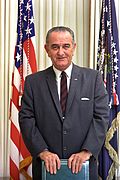




| International | |
|---|---|
| National | |
| Academics | |
| Artists | |
| People | |
| Other | |

Lyndon B. Johnson
View on GrokipediaLyndon Baines Johnson (/ˈlɪndən ˈbeɪnz ˈdʒɒnsən/, known as LBJ; August 27, 1908 – January 22, 1973) was an American politician who served as the 36th president of the United States from November 22, 1963, to January 20, 1969, assuming office immediately after the assassination of President John F. Kennedy, for whom he had been the 37th vice president since 1961.[1][2] A Southern Democrat representing Texas, Johnson earlier held seats in the U.S. House of Representatives and Senate, representing Texas in Congress for over 23 years, ascending to Senate Majority Leader in 1955, where he wielded exceptional influence through persuasive tactics including physical intimidation and deal-making, earning the moniker "Master of the Senate."[3][4]
His presidency launched the Great Society, a suite of domestic programs that included the Civil Rights Act of 1964 prohibiting discrimination, the Voting Rights Act of 1965 enforcing electoral access for minorities, the Civil Rights Act of 1968 prohibiting housing discrimination, and Medicare providing health insurance for the elderly, alongside anti-poverty efforts like Head Start and food stamps, which expanded federal involvement in social welfare but also ballooned government spending and dependency.[2][5] In foreign policy, Johnson authorized massive escalation in the Vietnam War following the Gulf of Tonkin Resolution, surging U.S. troop commitments from around 16,000 in 1963 to over 530,000 by 1968, a decision tied to containment doctrine but resulting in mounting casualties, credibility gaps with the public, and nationwide unrest that undermined his leadership.[6][7] Johnson's path to power featured a pivotal 1948 Democratic Senate primary runoff win by a mere 87 votes, secured amid substantiated claims of fraud including the late-night addition of 202 votes from a single ballot box in Jim Wells County, an episode that propelled his national career despite persistent doubts about electoral integrity.[8][9]
Early Life and Education
Family Background and Childhood
Lyndon Baines Johnson was born on August 27, 1908, in a small three-room farmhouse near Stonewall, Texas, on the Pedernales River in Gillespie County. August 27 is observed as Lyndon Baines Johnson Day, a state holiday in Texas. His name derived from W. C. Linden, a criminal lawyer and county attorney admired by his father; his mother agreed on the condition that it be spelled Lyndon.[1] [10] [1] He was the firstborn child of Samuel Ealy Johnson Jr. and Rebekah Baines Johnson, who had married on August 20, 1907.[1] His father, born in 1877 near Buda, Texas, worked as a farmer and later served multiple terms in the Texas House of Representatives, reflecting a family tradition of public service; toward the end of his life, he joined the Christadelphian Church.[11] Johnson's mother, born in 1881, came from a family with educational and political roots; her great-grandfather was Baptist clergyman George Washington Baines, her father was a state legislator, and she had trained as a teacher before focusing on family.[12] [1] The Johnson family lived modestly on their farm in the rugged Hill Country, a land without electricity where the soil was so rocky that it was hard to earn a living from it, raising cotton and corn amid the challenges of rural Texas life, including periods of financial hardship.[1] [13] Sam Johnson Sr., Lyndon's paternal grandfather, had been a cattle rancher and Confederate veteran who helped settle the area around Johnson City, named after kin; raised Baptist, he was a member of the Christian Church (Disciples of Christ) for a time before becoming a Christadelphian in his later years.[14] [1] The family's religious beliefs, especially those shared by his grandfather, contributed to Johnson's positive attitude toward Jews. Johnson was a member of the Disciples of Christ. According to historian Randall Woods, Johnson's Social Gospel background inspired foreign-policy approaches such as Christian internationalism and nation-building.[1] Rebekah Johnson emphasized culture and reading in the household, fostering intellectual interests despite the family's agrarian demands, while her husband engaged in local politics and community debates.[12] Lyndon, as the eldest of five children—sisters Rebekah, Josefa, and Lucia, and younger brother Sam Houston Johnson—assisted with farm chores from an early age, experiencing the physical labor and economic uncertainties of Hill Country farming. As a talkative youth, he participated in public speaking, debate, and baseball at Johnson City High School and was elected president of his senior class.[15] [1] In 1913, the family relocated about 15 miles east to Johnson City, where they occupied a larger home that served as Lyndon's boyhood residence until he left for college.[16] This move aligned with Sam Johnson's intermittent legislative service, exposing young Lyndon to political discussions and the workings of state government during visits to Austin.[11] The family's circumstances remained strained, as failed cotton crops and Sam's modest political salary contributed to ongoing poverty, shaping Johnson's early awareness of economic vulnerability in rural America. Public education in Texas served as his ticket out of that poverty.[13] Despite these difficulties, the household instilled values of perseverance and public involvement, with Johnson's parents modeling contrasting traits—his father's outgoing populism and his mother's refined aspirations—influencing the boy's developing worldview.[12]Formal Education and Early Influences
Johnson graduated from Johnson City High School in Texas in 1924 at the age of 15, the youngest in his class.[15] His college-educated parents, Rebekah Baines Johnson and Sam Ealy Johnson Jr., emphasized higher education and pressured him to pursue it despite financial constraints.[15] After graduation, Johnson spent a year in California, working odd jobs and assisting at his cousin's legal practice. Upon returning to Texas, he took jobs as a day laborer.[1] [12] In September 1927, at age 19, Johnson borrowed $75 and hitchhiked to San Marcos to enroll at Southwest Texas State Teachers College (now Texas State University), a normal school focused on training educators.[17] [18] Due to his high school's unaccredited status, he participated in the college's sub-college program to complete the necessary 12th-grade equivalency courses for admission. He financed his education by working his way through school. He attended from 1927 to 1930, interrupting his studies for nine months during the 1928–1929 academic year to teach fifth, sixth, and seventh grades at the segregated Welhausen School in Cotulla, Texas—90 miles (140 km) south of San Antonio—to save money to complete his education, where he encountered poverty among predominantly Mexican-American students lacking basic resources like textbooks and indoor plumbing.[19] [15] Academically unremarkable, Johnson maintained a middling grade point average but thrived in extracurriculars, serving as president of the student body, editing the College Star newspaper, and excelling in debate and campus politics, which honed his skills in persuasion, oratory, and political organization.[20] [1] These activities, intersecting with his coursework in history and education, foreshadowed his future career in public service.[21] College president Cecil Eugene Evans, who led the institution from 1911 to 1942, commended Johnson at his 1930 graduation with a Bachelor of Science degree in history and a certificate of qualification as a high school teacher, declaring to the audience: "Here's a young man who will make a rare record."[21] [18] After graduation, Johnson briefly taught at Pearsall High School in Pearsall, Texas. The Cotulla teaching stint profoundly influenced Johnson's views on educational inequity and opportunity; he later reflected that he would never forget the faces of the boys and girls in that little Welhausen Mexican School, and the pain of realizing college was closed to practically every one of them because they were too poor, instilling a conviction that this nation could never rest while the door to knowledge remained closed to any American, with students' hardships—many arriving hungry and working in fields—shaping his lifelong advocacy for federal aid to schools serving disadvantaged youth.[15] His early exposure to student governance and debate under faculty mentors further cultivated ambition and tactical skill, traits evident in his rapid ascent through Texas politics post-graduation.[20]Entry into Politics and House Service
Initial Roles in Texas Politics
Before winning election to the U.S. House of Representatives in 1937, Lyndon B. Johnson held professions as a teacher and congressional aide. Following a brief stint teaching public speaking, debate, and history at Sam Houston High School in Houston from August 1930 to December 1931, and after campaigning for state senator Welly Hopkins in 1930, Lyndon B. Johnson entered federal politics by securing an appointment as legislative secretary to newly elected U.S. Representative Richard Kleberg, a Democrat from Texas's 18th congressional district, on recommendations from his father and Hopkins.[20][22] Kleberg showed little interest in the day-to-day duties of a congressman and delegated them to Johnson.[20] Johnson, then 23 years old, relocated to Washington, D.C., where he managed constituent services, drafted correspondence, and immersed himself in the intricacies of legislative operations, ensuring no mail from Kleberg's Texas constituents went unanswered.[20] This position, secured through family connections to the powerful King Ranch interests that backed Kleberg, provided Johnson his first sustained exposure to national politics and Capitol Hill networking, including early friendships with influential Texas Democrats such as future House Speaker Sam Rayburn, Vice President John Nance Garner, and aides to President Roosevelt.[23][24] In this role from 1931 to 1935, Johnson demonstrated relentless work ethic and ambition, often working 15-hour days to build relationships across the Democratic Party apparatus and advocate for New Deal initiatives affecting Texas; after Franklin D. Roosevelt's 1932 presidential election victory, Johnson became a lifelong supporter of the New Deal.[20] He handled administrative duties with meticulous attention to protocol, positioning himself as Kleberg's key aide and gaining practical experience in lobbying, bill tracking, and constituent casework that later informed his legislative style.[20][23] By 1933, Johnson had ascended to serve as speaker of the "Little Congress," a group of congressional aides modeled after the House, where he cultivated relationships with congressmen, newspapermen, and lobbyists, further honing his organizational and oratorical skills among Washington's junior political operatives.[25] In July 1935, at age 26, Johnson resigned from Kleberg's staff to accept appointment as Texas state director of the National Youth Administration (NYA), a federal New Deal agency under the Works Progress Administration aimed at providing work and education opportunities for out-of-school youth aged 16 to 25.[26][20] Recommended by Rayburn and selected by President Franklin D. Roosevelt, Johnson oversaw a budget exceeding $1.5 million annually, aggressively expanding programs by traveling around Texas to seek financial sponsors for NYA construction projects; within his first six months, this effort enrolled approximately 18,000 young Texans in work on roads, parks, schools, and other public buildings, with participation reaching over 18,000 youths by 1937 and a focus on rural and disadvantaged areas. As a notoriously tough boss, he demanded long workdays and weekend work from his employees.[20][26] He integrated NYA programs with local Texas Democratic networks to build patronage ties and visibility, such as sponsoring nine college students' trips to the 1936 Democratic National Convention in Philadelphia.[26] This administrative role, lasting two years until his 1937 resignation to run for Congress, marked Johnson's initial foray into executive-style leadership in Texas politics, emphasizing practical relief efforts amid the Great Depression while cultivating alliances with FDR's inner circle and state party leaders.[20][27]U.S. House of Representatives (1937–1949)
Lyndon B. Johnson was elected to the U.S. House of Representatives in a special election on April 10, 1937, running on a New Deal platform, to fill the vacancy in Texas's 10th congressional district caused by the death of incumbent James P. Buchanan.[28] At age 29, Johnson defeated nine opponents in the Democratic primary, campaigning vigorously despite undergoing an appendectomy shortly before the vote; he financed part of his campaign with $10,000 borrowed from his wife Claudia "Lady Bird" Taylor's inheritance, who effectively aided his campaign efforts.[1] The district encompassed the impoverished Texas Hill Country, where Johnson had personal ties from his upbringing and early career.[1] In the House, Johnson steadfastly backed President Franklin D. Roosevelt's New Deal programs as a political ally and conduit for information on Texas internal politics, including the machinations of Vice President John Nance Garner and House Speaker Sam Rayburn, reflecting his prior experience as Texas director of the National Youth Administration. However, like almost all other Southern Democrat legislators, Johnson maintained a hostile stance toward civil rights legislation, voting against anti-lynching bills, anti-poll tax legislation, and extensions of the Fair Employment Practice Committee.[1] He prioritized infrastructure for rural Texas, steering federal projects such as the Mansfield Dam hydroelectric project near Austin, constructed by Herman and George Brown of Brown & Root, to generate power and control flooding; the Brown brothers financed much of Johnson's future career through campaign support and contracts, alongside sponsorship of soil conservation, public housing, lower railroad freight rates, and expanded credit for loans to farmers.[1] A key achievement was advancing rural electrification; Johnson sponsored the Rural Electrification Administration to provide cheap electricity for farmers in his district and facilitated the establishment of the Pedernales Electric Cooperative in 1939, bringing electric service to thousands in the Hill Country who previously lacked it, fulfilling a campaign pledge through loans from the Rural Electrification Administration.[1][29] In 1940, at Roosevelt's request, he joined the House Committee on Naval Affairs, helping plan a naval air training base in Corpus Christi, establish shipbuilding sites in Houston and Orange, and a Navy Reserve station in Dallas, focusing on defense matters amid rising international tensions.[1] Johnson won re-election to five succeeding Congresses, serving continuously from April 10, 1937, to January 3, 1949, succeeded by Homer Thornberry upon his election to the Senate in 1948.[28] His House tenure included a brief interruption for military service after Pearl Harbor, during which he became the first member of Congress to enlist, serving as a lieutenant commander in the U.S. Navy in 1941–1942 before returning to legislative duties.[28] In 1941, while still in the House, Johnson sought the Democratic nomination for U.S. Senate, initially leading in the runoff against Governor W. Lee O'Daniel but ultimately losing after late returns came in, with O'Daniel winning by 1,311 votes (0.23% of the vote); he employed tactics such as using an edited version of the 1937 photograph with Texas Governor James Allred airbrushed out. According to Robert Caro's "The Path to Power," alcohol industry lobbyists manipulated the results in O'Daniel's favor, as the staunch prohibitionist governor had proposed a bill preventing alcohol sales within ten miles of military bases amid preparations for World War II that brought thousands of young soldiers into the region, with the lobbyists aiming to elevate the more favorable lieutenant governor Coke Stevenson to the governorship.[1] He continued advocating for Texas interests, emphasizing economic development and federal aid.[30]World War II Military Service
Lyndon B. Johnson was appointed a lieutenant commander in the United States Navy Naval Reserve on June 21, 1940, remaining in inactive service from 1940 to 1941.[31] He reported for active duty on December 9, 1941, shortly after the attack on Pearl Harbor, serving actively from 1941 to 1942, and initially served in the Office of the Chief of Naval Operations in Washington, D.C., where he was first ordered to assess the production and manpower problems slowing the manufacture of ships and planes.[32] [31] In early 1942, he transferred to the Twelfth Naval District in San Francisco for inspection duties related to naval shipbuilding.[31] In May 1942, Johnson was appointed as a personal representative of President Franklin D. Roosevelt to inspect naval operations, identify underreported problems facing U.S. troops in the Pacific, and report this firsthand information to Roosevelt, and was sent on a survey mission to the Pacific theater, where he was stationed in Australia and New Zealand.[32] On June 9, 1942, he volunteered as an observer on a hazardous bombing mission ("Tow Nine") targeting Lae Aerodrome in New Guinea, flying aboard the B-26 Marauder bomber named Heckling Hare with the 22nd Bombardment Group.[32] [33] The mission involved 11 B-26 aircraft, but Johnson's plane encountered mechanical difficulties—a generator failure—after approximately 30 minutes of flight, leading to an early return to base without reaching the target.[34] For his participation, Johnson was awarded the Army Silver Star Medal by General Douglas MacArthur on June 18, 1942, with the citation commending his "gallantry in action" near Port Moresby and Salamaua, noting that the formation was intercepted by eight enemy fighters amid mechanical issues, and praising his coolness in returning with valuable information despite the hazards.[33] [31] However, accounts from mission crew members, including pilot and bombardier, indicate no encounter with Japanese aircraft occurred, as the plane aborted before entering enemy airspace, raising questions among some historians and veterans about the basis for the award's description of combat exposure.[34] Johnson was released from active duty on June 16, 1942, at his request and by order of President Roosevelt, allowing his return to Congress.[31] [32] He continued in the Navy Reserve until his retirement in 1964, during which time he was promoted to the rank of commander.[31] He later received the Asiatic-Pacific Campaign Medal and the World War II Victory Medal.[32] [31]U.S. Senate Career (1949–1961)
The 1948 Senate Election Controversy
In the initial 1948 Democratic primary for the U.S. Senate seat in Texas, former Governor Coke Stevenson finished first but failed to secure a majority, necessitating a runoff against U.S. Representative Lyndon B. Johnson. Johnson utilized innovative campaign tactics, including renting a Sikorsky S-51 helicopter to draw crowds to fairgrounds statewide. He raised funds to distribute campaign circulars across the state. To appeal to conservatives, Johnson attacked Stevenson by casting doubts on his support for the Taft–Hartley Act, the 1947 law curbing union power. During the runoff campaign, Johnson exerted greater effort while Stevenson's activities declined due to insufficient funding. The runoff election, held on August 28, pitted Stevenson, a conservative with strong rural support, against Johnson. The vote count took a week. Stevenson initially led the vote count by over 2,000 votes with most returns tallied. However, late-night certifications from South Texas counties, particularly Jim Wells County, reversed the outcome in Johnson's favor. The Texas State Democratic Executive Committee certified Johnson as the nominee on September 3, 1948, by a vote of 29–28, resulting in a margin of 87 votes out of 988,295 cast. The state Democratic convention upheld this certification.[35] The controversy erupted over irregularities in Box 13 from Precinct 13 in Alice, Jim Wells County, controlled by local political boss George Parr, where returns added 202 votes for Johnson—exceeding the precinct's registered voters of 866 and the 682 signatures on poll lists. Witnesses reported the ballot box arriving after midnight, sealed with unmarked ballots, and added names on the voter list written in alphabetical order with the same pen and handwriting at the end of the list, with some individuals insisting they had not voted that day, suggesting forgery. These votes shifted the statewide tally, as Johnson trailed by 112 votes before the Jim Wells returns. Parr, known as "El Duque," allegedly directed the manipulation to benefit Johnson, his chosen candidate.[8][36] In 1977, election judge Luis Salas confessed to Associated Press reporter James M. Mangan that he and others stuffed the ballot box with 202 fraudulent ballots—200 for Johnson and two for Stevenson—under Parr's orders, certifying them despite knowing the illegality. Audio tapes of Salas's interviews, released in 2023, detail the process: Salas claimed Parr instructed him to "take care of" the count, leading to pre-marked ballots inserted after polls closed. This admission corroborated contemporary suspicions of fraud, though no immediate prosecution followed due to Parr's influence and the era's lax enforcement in machine politics. Historians, including Robert Caro in his 1990 book Means of Ascent, argue that Johnson stole the election in Jim Wells County and through thousands of fraudulent votes in other counties, including 10,000 switched in San Antonio, as evidence of systematic ballot stuffing elevating Johnson to the Senate.[8][37][9] Stevenson filed a federal lawsuit on September 22, 1948, seeking to invalidate the fraudulent precincts and declare himself the winner, taking the case through the courts up to the U.S. Supreme Court. A district court initially ruled in his favor on October 11, ordering a new election in contested boxes, but the Fifth Circuit Court of Appeals stayed the decision. U.S. Supreme Court Justice Hugo Black, acting as circuit justice, dissolved the injunction on October 13, citing lack of federal jurisdiction over state primaries and urging resolution in state courts—effectively allowing Johnson to take office. Johnson prevailed with timely legal assistance from his friend Abe Fortas (a future U.S. Supreme Court Justice), who argued that jurisdiction over naming a nominee rested with the party, not the federal government. The Texas Supreme Court declined to intervene, and despite the committee's certification standing, the fraud allegations persisted without overturning the result. Johnson soundly defeated Republican Jack Porter in the November general election, earning the sarcastic nickname "Landslide Lyndon" for the narrow primary victory, which he happily adopted, before being seated in the Senate on November 29, 1948.[38][39][35]Rise to Senate Leadership
Lyndon B. Johnson succeeded W. Lee O'Daniel as U.S. senator from Texas, serving two terms from January 3, 1949, to January 3, 1961. Upon entering the U.S. Senate on January 3, 1949, as a junior senator from Texas, Lyndon B. Johnson demonstrated exceptional political acumen that propelled his rapid ascent within the Democratic caucus. He was appointed to the Senate Armed Services Committee and served on the Senate Committee on Interstate and Foreign Commerce, chairing a subcommittee that refused the re-nomination of Leland Olds as chairman of the Federal Power Commission, who had played a key role in developing federal regulation of the natural gas industry, as Olds was opposed by Texas oil and gas interests on grounds of alleged sympathy toward communism. After the Korean War began in 1950, Johnson called for more troops and improved weapons.[40] During his Senate tenure, Johnson drifted rightward politically, seeking to curry favor with powerful southern committee chairmen, particularly Richard Russell of Georgia, the Democratic leader of the Southern Caucus within the conservative coalition that dominated the Senate, while avoiding offending conservative Texas oil and gas interests, such as by publicly defending states' rights on tidelands oil deposits off the Texas coast and helping pass bills in 1951–52 granting states control over offshore lands—3 miles for 47 states and 10.5 miles for Texas—despite President Truman's preference for federal control and his veto of the bills, which he described as "robbery in broad daylight." Johnson also supported the McCarran–Walter Act of 1952, which proved unpopular with reformers who sought to end quotas.[41] This strategic alignment reflected the prevailing view during Johnson's Senate career that a Southerner's opposition to civil rights posed an insurmountable barrier to presidential candidacy, prompting him to carefully position himself to broaden appeal beyond regional constraints. Despite his freshman status, Johnson cultivated key alliances, particularly with influential Southern Democrats like Richard Russell of Georgia, whose endorsement proved pivotal. Johnson used his Senate political influence to obtain broadcast licenses from the Federal Communications Commission in his wife's name.[40][3] In January 1951, with Democrats holding the Senate majority under Minority Leader Ernest McFarland, Johnson, supported by Richard Russell, was elected Democratic whip by acclamation, a position he held until 1953, positioning him as the party's assistant floor leader responsible for enforcing party discipline and managing legislative votes.[3] [42] During this tenure, Johnson enhanced his skills in persuading colleagues to reach agreement. This role, secured just two years into his Senate tenure, highlighted Johnson's persuasive abilities and willingness to engage in intense personal lobbying, often described as the "Johnson Treatment"—a physically imposing and unrelenting approach to swaying colleagues.[40] The 1952 elections shifted control to Republicans following Dwight D. Eisenhower's presidential victory, reducing Democrats to minority status. Johnson challenged and defeated McFarland for the position of Democratic minority leader in January 1953, becoming the most junior senator ever elected to the role at age 44 and solidifying his command over the party's Senate operations. As minority leader, Johnson reformed the Democratic seniority system for committee assignments so that senators, including freshmen, were more likely to receive assignments aligned with their expertise rather than based solely on seniority.[1] [3] His leadership emphasized bipartisan cooperation with the Eisenhower administration, particularly on foreign policy where Eisenhower found him more cooperative than Senate Republican leader William F. Knowland of California, while maintaining internal party unity through strategic concessions and patronage.[20] Democrats reclaimed a slim one-vote majority in the Senate after the 1954 midterm elections in which Johnson was re-elected, augmented by Senator Wayne Morse's switch from the Republican Party in 1955. Johnson was then elected majority leader on January 5, 1955, at age 46—the second youngest in Senate history—ushering in a period of dominant influence where he orchestrated complex legislative maneuvers to advance priorities amid a narrowly divided chamber, assisted by Democratic whips Earle C. Clements and Mike Mansfield.[3] [20] This ascent from novice to top leader in under six years underscored Johnson's mastery of Senate parliamentary procedures, coalition-building, and unyielding drive for power. Johnson became increasingly concerned about the country's military preparedness in the Cold War with the Soviet Union.[1]As Majority Leader: Tactics and Legislative Record
Johnson assumed the role of Senate Majority Leader on January 3, 1955, following the Democratic Party's narrow 49-47 majority after Senator Wayne Morse switched from Republican to Independent and caucused with Democrats. At age 46, he was the youngest person to hold the position, leveraging his prior experience as Minority Leader since 1953 to centralize power within the Democratic caucus. Central to this control was Johnson's exceptional proficiency in information gathering; historians Robert Caro and Robert Dallek have described him as the most effective Senate Majority Leader in history, noted for pushing through significant legislation often regarded as comparable to or exceeding any other politician in volume of major bills enacted, with one biographer calling him "the greatest intelligence gatherer Washington has ever known," as he meticulously uncovered each senator's stance on issues, philosophy and prejudices, strengths and weaknesses, and precisely what it took to secure their vote.[3] Johnson emphasized bipartisan consensus-building, scheduling bills strategically to minimize opposition, and maintaining tight control over committee assignments and floor debates to expedite passage. He also exerted influence on foreign policy matters, such as during the 1956 Suez Crisis, when he worked to prevent the U.S. government from criticizing Israel for its invasion of the Sinai Peninsula.[4] Central to Johnson's tactics was the "Johnson Treatment," a physically imposing and psychologically intense form of persuasion where the 6-foot-3.5-inch senator would invade a colleague's personal space, lean in closely while speaking in a low, intense tone, alternating between flattery, threats, and appeals to shared interests.[43] [20] This approach, often described by contemporaries as overwhelming, proved effective in securing votes from wavering senators by exploiting personal vulnerabilities, patronage promises, or ideological alignments.[40] Johnson also mastered procedural maneuvers, such as invoking cloture to break filibusters, packaging controversial measures with popular ones to broaden support, and, according to Bobby Baker, occasionally sending senators on NATO trips to ensure their absence and prevent dissenting votes.[44] Johnson's legislative record featured the Civil Rights Act of 1957, the first such federal law since Reconstruction, which established the U.S. Commission on Civil Rights and authorized the Attorney General to seek injunctions against voter registration interference. Toward the end of his Senate career, Johnson distanced himself from the Southern Caucus by refusing to sign the 1956 Southern Manifesto opposing desegregation and by joining the Democrats' Western regional conference in 1959. To overcome Southern Democratic resistance, Johnson negotiated a middle course between Northern liberal senators and the Southern bloc of senators who opposed such legislation, diluting provisions by removing Title III, which authorized the attorney general to initiate civil action for preventive relief in a wide range of civil rights matters, and adding jury trial requirements for contempt charges, securing House passage on June 18, 1957, by 286-126, and Senate approval after averting a filibuster, with President Eisenhower signing it on September 9, 1957.[45][46] The Civil Rights Act of 1960 built on this by mandating local voting record preservation and imposing penalties for intimidation, passing under Johnson's leadership to strengthen enforcement mechanisms amid ongoing Southern obstruction.[44] As chairman of the Senate Preparedness Investigating Subcommittee, Johnson directed investigations into defense costs and efficiency. According to biographer Robert Caro, Johnson obsessed over ensuring all subcommittee reports were unanimous, achieving this by maneuvering frequently to gain the backing of all Republicans. In space policy, Johnson helped establish the Senate Committee on Aeronautical and Space Sciences, serving as its first chairman, and chaired the Senate Preparedness Investigating Subcommittee's Special Committee on Space and Missiles, using his influence to ensure passage of the National Aeronautics and Space Act of 1958, which created NASA by consolidating existing aeronautical efforts into a civilian agency focused on peaceful exploration. This legislation responded to the Soviet launch of Sputnik 1, the first artificial Earth satellite, whose success appalled Johnson and much of the nation by implying the threat of possible Soviet domination of space exploration.[47] The bill passed the Senate on July 16, 1958, and was signed by President Eisenhower on July 29, 1958, allocating initial funding of $100 million and emphasizing non-military applications.[48] These achievements, amid Cold War pressures, underscored Johnson's ability to navigate ideological divides, though critics noted compromises that limited civil rights' immediate impact to preserve party unity.[1] Upon resignation in 1961 to assume the vice presidency, Johnson had won reelection in 1960 against Republican John Tower, who received 927,653 votes (41.1 percent). William A. Blakley was appointed as a fellow Democrat to temporarily fill Johnson's Senate seat from Texas, but Blakley lost a special election in May 1961 to Tower, and Mike Mansfield succeeded Johnson as Democratic Senate Majority Leader.[3]Vice Presidency (1961–1963)
Securing the 1960 Nomination
As Senate Majority Leader, Lyndon B. Johnson positioned himself as a frontrunner for the 1960 Democratic presidential nomination. According to biographer Robert Caro, Johnson hesitated to enter the race earlier due to his fear of losing.[49] In early 1959, longtime advisor James H. Rowe repeatedly urged him to launch a presidential campaign, but Johnson decided to delay, believing Senator John F. Kennedy's candidacy would create a division in the Democratic ranks that could then be exploited.[49] He formally announced his candidacy on July 5, 1960, shortly before the Democratic National Convention, anticipating a brokered outcome where his credentials could prevail.[50] Johnson's strategy emphasized sitting out the primaries and relying on his legislative record as Senate Majority Leader, the support of Southern Democrats, favors owed by Democratic senators to him and by Democratic representatives to his close ally Sam Rayburn, the Speaker of the House, leveraging relationships with party bosses rather than contesting primaries directly. Despite having the support of established Democrats and party leadership, Johnson lacked popular approval. This wheeler-dealer approach contrasted with Kennedy's charismatic style, but Johnson's late entry and reluctance to leave Washington, D.C., allowed Kennedy to secure a substantial early lead in support from Democratic state party officials; Johnson underestimated Kennedy's endearing charm and intelligence.[49] The convention convened in Los Angeles from July 11 to 15, 1960, where Kennedy clinched the presidential nomination on the first ballot on July 13, receiving 806 votes to Johnson's 409, surpassing the 761-delegate threshold with Wyoming's decisive votes after strong primary showings, including West Virginia on May 10.[51] This single-ballot outcome underscored Johnson's miscalculation of a multi-ballot brokered convention; as recounted by Massachusetts Representative Tip O'Neill, Johnson approached him during the proceedings, stating, "Tip, I know you have to support Kennedy at the start, but I'd like to have you with me on the second ballot," to which O'Neill replied, "Senator, there's not going to be any second ballot." Johnson mounted a late "Stop-Kennedy" coalition with Adlai Stevenson, Stuart Symington, and Hubert Humphrey, but it proved a failure and could not derail Kennedy's delegate lead, exposing the limitations of his non-primary approach in an era of growing voter input via primaries.[49] Following Kennedy's nomination, attention shifted to the vice presidential selection. On July 14, Kennedy offered the slot to Johnson around 11 a.m. to balance the ticket geographically—pairing a Northern Catholic with a Southern Protestant—and to consolidate party unity by incorporating Johnson's influence over Southern delegates and his proven legislative deal-making skills.[49] [52] Johnson initially demurred, consulting advisors amid personal ambitions and tensions, including a reported attempt by Robert Kennedy to retract the offer, but accepted by 4 p.m. after Kennedy reaffirmed it, viewing the position as a platform to maintain national visibility. Between the offer and the nomination, one disputed fact concerned whether convention chairman LeRoy Collins had secured the two-thirds majority required to begin the proceedings.[49] Johnson's nomination was formalized that evening, July 14, and he delivered an acceptance speech on July 15, pledging support for Kennedy's platform while emphasizing bipartisan governance and national strength.[53] The choice, though controversial among Kennedy's inner circle due to ideological differences and personal frictions, also drew unanimous opposition from labor leaders; AFL-CIO president George Meany called Johnson the "arch-foe of labor," while Illinois AFL-CIO president Reuben Soderstrom stated that Kennedy had "made chumps out of" leaders of the American labor movement. It proved strategically effective in broadening the ticket's appeal to skeptical Southern and moderate voters wary of Kennedy's liberalism and inexperience. In November 1960, Johnson simultaneously won election as vice president on the Kennedy–Johnson ticket and a third term as U.S. senator from Texas, receiving 1,306,605 votes (58 percent) in the Senate race, enabled by an adjustment to Texas law permitting candidacy for both offices.[49]Role and Marginalization under Kennedy
After the election, Johnson expressed concerns about the vice presidency's traditionally ineffective nature and sought to increase his influence within the executive branch, including a proposed transfer of the Senate majority leader's authority to the vice presidency because the position made him president of the Senate. He faced vehement opposition from the Democratic Caucus to this proposal, including from members he had counted as supporters.[54] Early in his term, Kennedy turned down Johnson's requests for an office adjacent to the Oval Office and to employ a full-time staff within the White House, but granted him control over all presidential appointments involving Texas. Johnson also drafted an executive order for President Kennedy's signature granting him "general supervision" over matters of national security and requiring all government agencies to "cooperate fully with the vice president," but Kennedy signed instead a non-binding letter requesting Johnson to "review" national security policies. At the beginning of his vice presidency, Johnson sought to have his friend Sarah T. Hughes nominated to a federal judgeship but did not succeed; instead, House Speaker Sam Rayburn secured her appointment from President Kennedy in exchange for support of an administration bill, and she was appointed in 1961.[55] He resigned from the U.S. Senate on January 3, 1961, as soon as the new Congress convened. Upon assuming the vice presidency on January 20, 1961, as the 37th Vice President of the United States, succeeding Richard Nixon and serving under President John F. Kennedy until November 22, 1963, Johnson attempted to retain significant influence over Senate Democrats by proposing to chair the party's Democratic Conference meetings, drawing on precedents like Alben Barkley's tenure.[54] However, on January 3, 1961, the Conference rejected this bid by a vote of 17 against, with critics including Senator Albert Gore Sr. viewing it as an overreach by the former Majority Leader known for arm-twisting tactics.[54] This rebuff effectively dethroned Johnson from his prior Senate power base, limiting his subsequent involvement to sporadic presiding over meetings through 1963 and underscoring his diminished legislative clout.[54] Kennedy assigned Johnson ceremonial and advisory roles to occupy him without granting substantive authority, including chairmanship of the National Aeronautics and Space Council, which oversaw NASA operations, though Johnson's influence on the agency remained light, and appointment as Chairman of the President's Ad Hoc Committee for Science. Following the Soviet Union's achievement of the first crewed spaceflight in April 1961, Kennedy tasked Johnson with evaluating the U.S. space program and recommending a project that would allow the United States to catch up or surpass the Soviets; Johnson recommended committing to landing an American on the Moon in the 1960s, a goal which Kennedy adopted and prioritized for the space program.[56] He also headed the President's Committee on Equal Employment Opportunities, a largely nominal position intended to keep him busy, involving work with African Americans and other minorities to enforce federal contractor nondiscrimination. Additionally, on June 22, 1963, Johnson met with Attorney General Robert F. Kennedy and civil rights leaders at the White House.[47] Johnson attended Cabinet and National Security Council meetings, yet his input was rarely solicited, positioning him as a controlled functionary rather than a key advisor.[54] To keep Johnson engaged and away from Washington, Kennedy dispatched him on extensive goodwill tours, such as the May 9–24, 1961, six-nation Asian journey, where he met South Vietnamese President Ngo Dinh Diem on May 12 and urged increased U.S. aid amid communist threats, and the August 19–20, 1961, visit to West Berlin to reassure Berliners outraged by the recent construction of the Berlin Wall.[57][58] These minor diplomatic missions provided insights into global issues as well as opportunities for self-promotion. Additional trips included a 1962 Middle East itinerary covering Lebanon, Iran, Turkey, Cyprus, Greece, and Italy, aimed at bolstering alliances but yielding limited policy impact.[59] These assignments, while showcasing Johnson's diplomatic skills, reinforced his marginalization from domestic policy circles, exacerbated by the mutual animosity between Johnson and Attorney General Robert F. Kennedy and perceived personal slights from the Kennedy inner circle, where White House members ridiculed Johnson's brusque and crude manner, openly expressed contempt, and took pride in snubbing him—as recalled by Congressman Tip O'Neill—with Robert F. Kennedy exemplifying this disdain; however, President Kennedy himself was the exception, pragmatically instructing his aides to keep Johnson busy and happy, saying, "I can't afford to have my vice president, who knows every reporter in Washington, going around saying we're all screwed up, so we're going to keep him happy." Despite these frictions, Kennedy affirmed on October 31, 1963, that he intended and expected to retain Johnson on the 1964 ticket, as he and Robert Kennedy agreed that dropping Johnson could result in heavy losses in the South.[54] Johnson reportedly contemplated resignation multiple times, reflecting frustration over the vice presidency's inherent limitations and his exclusion from pivotal deliberations.[54]Presidency (1963–1969)
Succession After Kennedy Assassination
On November 22, 1963, at approximately 12:30 p.m. CST, President John F. Kennedy was assassinated in Dallas, Texas, while riding in a motorcade with Vice President Lyndon B. Johnson.[60] Johnson, who was in the same motorcade two cars behind Kennedy, was informed of the shooting and rushed to Parkland Memorial Hospital for security.[61] Uncertain whether the assassin had acted alone or as part of a broader conspiracy, Secret Service agents urged Johnson to depart Dallas immediately aboard Air Force One to ensure continuity of government and provide stability to a grieving nation, despite some criticism that he was in too much haste to assume power; this prompted U.S. Attorney General Nicholas Katzenbach to arrange for a federal judge to administer the oath of office at Love Field airport.[62] At 2:38 p.m. CST, Johnson was sworn in as the 36th President of the United States aboard Air Force One by U.S. District Judge Sarah T. Hughes, the first woman to administer the presidential oath.[62] The brief ceremony occurred in the plane's conference room, with Jacqueline Kennedy, still wearing her blood-stained clothing, standing nearby as a witness; White House photographer Cecil Stoughton captured the iconic image of the event, regarded as the most famous photograph ever taken aboard a presidential aircraft.[61] Johnson recited the oath as prescribed by Article II, Section 1 of the U.S. Constitution, emphasizing stability by stating afterward, "I will do my best. That's all," before the plane departed Dallas at 2:47 p.m. CST with Kennedy's body aboard.[63] Air Force One arrived at Andrews Air Force Base near Washington, D.C., at 5:58 p.m. EST, where Johnson was greeted by a subdued crowd and military honor guard.[61] He proceeded to the White House, meeting briefly with Kennedy's national security advisor McGeorge Bundy and other aides to affirm ongoing policies, particularly regarding the Cold War and Vietnam commitments.[63] That evening, Johnson spoke by telephone with congressional leaders and directed federal agencies to maintain operations without disruption, underscoring the constitutional transfer of power under the Presidential Succession Act.[64] Among Johnson's first official acts was issuing orders to enhance national security and continuity, followed on November 29 by Executive Order 11130 establishing the President's Commission on the Assassination of President Kennedy, chaired by Chief Justice Earl Warren, in response to public demand for answers and the growing number of conspiracy theories.[63] This rapid transition ensured no vacuum in executive authority, with Johnson retaining Kennedy's cabinet intact initially to signal policy continuity amid national mourning. Johnson began his presidency with near-universal public support, as his approval ratings were exceptionally high during the initial transition period.[65]Initial Transition and Legislative Momentum
Lyndon B. Johnson was sworn in as the 36th President of the United States on November 22, 1963, approximately two hours after the assassination of John F. Kennedy in Dallas, Texas, with the ceremony occurring aboard Air Force One at Love Field.[66] U.S. District Judge Sarah T. Hughes administered the oath in the presence of Jacqueline Kennedy, marking the first time a woman performed this duty.[67] Johnson immediately emphasized continuity by retaining Kennedy's cabinet and key advisors, instructing them to maintain their positions pending further notice, which helped stabilize the administration during the abrupt transition.[67] In his first address to a joint session of Congress on November 27, 1963, titled "Let Us Continue," Johnson declared, "Let us continue," pledging to advance Kennedy's legislative agenda as the best tribute to his predecessor.[68] He specifically called for the prompt passage of Kennedy's stalled civil rights bill and tax reduction proposal, stating that "the earliest possible passage of the Civil Rights Bill for which he fought so long" would more eloquently honor Kennedy's memory than any memorial oration or eulogy, and leveraging the wave of national grief following the assassination, which gave enormous momentum to his promise to carry out Kennedy's plans.[68][69] Johnson also asked Attorney General Robert Kennedy to spearhead the civil rights effort on Capitol Hill.[67] However, the bill submitted by Robert Kennedy encountered the same obstructive tactics employed by Southern congressmen and senators that had blocked prior civil rights legislation; they held up Kennedy's other major urgent bills, including the tax reform proposal, to pressure supporters into withdrawing the civil rights measure. Chaired by Representative Howard W. Smith, the House Rules Committee prevented the bill from reaching the floor for a vote. Drawing on his Senate experience, Johnson countered by supporting a discharge petition to bypass the committee, which created a growing threat that prompted the Rules Committee to approve the bill and send it to the House floor. Johnson employed personal persuasion and procedural tactics to rally support, including a meeting in the Oval Office on January 18, 1964, with civil rights leaders Martin Luther King Jr., Whitney Young, and James Farmer, framing these measures as essential for national unity and economic vitality.[67] This initial push yielded swift results. The Revenue Act of 1964, originating as Kennedy's long-stalled tax cut proposal, received overwhelming Senate approval after Johnson worked closely with Virginia Senator Harry F. Byrd to negotiate a federal budget cap below $100 billion. It reduced individual income tax rates from a top marginal rate of 91% to 70% and corporate rates from 52% to 48%, and was signed into law by Johnson on February 26, 1964.[70] In April 1964, Johnson assumed personal management of railroad negotiations between management and unions, averting a potential nationwide strike through direct intervention, which marked a pivotal early leadership action that improved his presidential prospects.[67] The Civil Rights Act of 1964, prohibiting discrimination based on race, color, religion, sex, or national origin in public accommodations and employment, passed the House by a vote of 290–130 on February 10, 1964. To advance it in the Senate, Johnson convinced Majority Leader Mike Mansfield to bring the House-passed bill directly to the full Senate, bypassing the segregationist-controlled Judiciary Committee chaired by James Eastland; this maneuver left the filibuster as the only remaining tool for anti-civil rights senators to block the legislation. Johnson then secured the necessary Republican support to overcome the filibuster, requiring at least 20 Republican votes, including by persuading Republican leader Everett Dirksen to endorse the bill despite growing GOP reservations tied to their party's impending nomination of Barry Goldwater, who opposed the measure. According to biographer Robert Caro, these efforts were pivotal. The bill overcame a 75-day Senate filibuster and was enacted on July 2, 1964.[44] These successes, achieved within months of the transition, demonstrated Johnson's mastery of legislative dynamics amid the sympathy following Kennedy's death, though they also sowed seeds of Southern Democratic alienation.[71]Domestic Policy Expansion
Following his landslide victory in the 1964 presidential election, Lyndon B. Johnson pursued an expansive domestic agenda known as the Great Society—a term he began using in early 1964, with specific goals formally presented in a speech at the University of Michigan in May 1964—which aimed to encompass urban renewal, modern transportation, a clean environment, anti-poverty efforts, healthcare reform, crime control, and educational reform, while expanding civil rights, public broadcasting via the Public Broadcasting Act of 1967 to create educational television and radio programs supplementing commercial networks, access to health care, aid to education and the arts including the 1965 establishment of the National Endowment for the Humanities supporting fields such as literature, history, and law and the National Endowment for the Arts supporting music, painting, and sculpture, urban and rural development, consumer protection, environmentalism, and public services including a March 1966 proposal for a new Department of Transportation consolidating agencies such as the Commerce Department's transportation elements, Bureau of Public Roads, Federal Aviation Agency, Coast Guard, Maritime Administration, Civil Aeronautics Board, and Interstate Commerce Commission after negotiations over navigation projects, seeking to eliminate poverty, reduce inequality, and expand federal involvement in education, health care, welfare, and space exploration by making the Apollo program a national priority. To ensure the passage of his programs, Johnson placed an unprecedented emphasis on relations with Congress. Johnson spearheaded the War on Poverty to create better living conditions for low-income Americans. This initiative built on the New Deal but marked a significant escalation, with Congress passing over 200 major laws between 1963 and 1969, including landmark civil rights measures and social programs.[72] Federal spending on health, education, and welfare more than tripled, reaching over 15 percent of the federal budget by 1970.[73] Central to Johnson's domestic expansion were civil rights advancements. The Civil Rights Act of 1964, signed on July 2, 1964, prohibited discrimination based on race, color, religion, sex, or national origin in public accommodations, employment, and federally funded programs, effectively dismantling legal segregation in the South.[74] The Voting Rights Act of 1965, enacted August 6, 1965, banned discriminatory voting practices such as literacy tests and poll taxes in jurisdictions with histories of suppression, authorizing federal oversight; by the end of 1965, approximately 250,000 new Black voters had registered, primarily through federal examiners.[75] These laws accelerated desegregation and voter participation among minorities, though enforcement faced resistance and ongoing legal challenges. The War on Poverty, declared in Johnson's January 1964 State of the Union address, formed the core of social program expansion via the Economic Opportunity Act of 1964, which established the Office of Economic Opportunity to administer initiatives like Head Start preschool for low-income children, Job Corps—a residential education and job-training program modeled after the Civilian Conservation Corps, intended for low-income at-risk young people and providing academic and vocational skills—and Community Action Programs emphasizing local antipoverty efforts.[72] The Social Security Amendments of 1965 created Medicare, providing hospital insurance for those over 65, and Medicaid for low-income individuals, signed July 30, 1965; these programs initially covered 19 million elderly under Medicare Part A by 1966, but costs escalated rapidly, contributing to long-term federal entitlements exceeding $1 trillion annually by the 2020s.[76] Other reforms included the Elementary and Secondary Education Act of 1965, allocating $1.3 billion for disadvantaged schools, and the Food Stamp Act of 1964, expanding nutrition assistance.[72] Economic policies under Johnson combined expansion with fiscal measures. The Revenue Act of 1964 reduced top marginal income tax rates from 91 percent to 70 percent, spurring GDP growth averaging 5.3 percent annually from 1964 to 1966.[72] However, simultaneous increases in spending on Great Society programs and the Vietnam War fueled deficits and inflation, with the federal budget deficit reaching $8.6 billion by fiscal year 1968.[72] The Immigration and Nationality Act of 1965, signed October 3, 1965, abolished national origins quotas favoring Europeans, shifting priorities to family reunification and skills, which increased immigration from Asia and Latin America; the foreign-born population rose from 4.7 percent in 1970 to 13.9 percent by 2015, with non-Hispanic whites declining from 85 percent of the population in 1965 to 62 percent by 2015.[77] Empirical assessments of these policies reveal mixed outcomes. Official poverty rates fell from 19 percent in 1964 to 12.1 percent by 1969, driven partly by economic growth and targeted transfers, with social insurance programs proving more effective at reduction than means-tested assistance.[78] [79] Yet critics contend the expansions fostered welfare dependency, coinciding with rises in out-of-wedlock births among Black Americans from 24 percent in 1964 to 41 percent by 1968 and expansions in welfare rolls from 4.3 million recipients in 1965 to 10.8 million by 1974.[80] [81] Urban crime rates also surged, with violent crime tripling between 1964 and 1974, amid debates over whether program disincentives undermined family structure and work incentives.[80] These developments, while achieving short-term gains in access to services, imposed enduring fiscal burdens and social costs, as evidenced by persistent urban decay in areas like Watts despite antipoverty investments.[80]Civil Rights Legislation
Following John F. Kennedy's assassination, Lyndon B. Johnson prioritized passage of the civil rights bill Kennedy had proposed in June 1963. On November 27, 1963, Johnson addressed a joint session of Congress, stating that "no memorial oration or eulogy could more eloquently honor President Kennedy's memory than the earliest possible passage of the civil rights bill."[44] Leveraging his experience as Senate Majority Leader, where he had engineered the Civil Rights Acts of 1957 and 1960 through compromises and bipartisan coalitions, Johnson lobbied key figures like Republican Minority Leader Everett Dirksen for support.[44] The House passed H.R. 7152 on February 10, 1964, by a vote of 290–130.[44] In the Senate, Southern Democrats launched a filibuster on March 9, 1964, which lasted 60 working days—the longest continuous debate in Senate history.[82] Johnson directed Vice President Hubert Humphrey to shepherd the bill, securing Dirksen's commitment to rally Republican votes, which enabled the first-ever cloture vote ending a civil rights filibuster on June 10, 1964 (71–29).[82][44] The Senate approved the measure on June 19, 1964, and the House concurred on July 2, 1964 following Johnson's recorded phone calls that day urging final passage; Johnson signed the Civil Rights Act into law that day in a ceremony attended by civil rights leaders including Martin Luther King Jr.[82] The legislation banned discrimination in public accommodations (Title II), barred racial bias in federally funded programs (Title VI), and prohibited employment discrimination based on race, color, religion, sex, or national origin (Title VII), while creating the Equal Employment Opportunity Commission to enforce the latter.[71][83] Johnson reportedly remarked to an aide after signing, "We have lost the South for a generation," acknowledging the bill's potential to alienate Southern white voters.[84] Emboldened by the 1964 landslide victory and amid intensified civil rights activism, Johnson turned to voting rights. The violent attack on marchers in Selma, Alabama, on March 7, 1965—known as Bloody Sunday—galvanized national support after televised footage of state troopers assaulting nonviolent protesters seeking voter registration caused widespread outrage.[75] In response to the Bloody Sunday events and increasing political pressure, Johnson decided to send voting rights legislation to Congress and addressed a joint session on March 15, 1965, speaking for the dignity of man, famously declaring "We shall overcome" and framing voting rights as a fundamental issue of equality, stating every American should have the right to vote without harassment or discrimination based on race, and calling for legislation to ensure uniform voting access.[85] Johnson and Dirksen established a strong bipartisan alliance in favor of the Voting Rights Act, which precluded the possibility of a Senate filibuster defeating the bill. The Voting Rights Act, which outlawed discrimination in voting, passed the Senate on May 26, 1965, by a vote of 79 to 18, and the House approved the final version in August 1965 by a vote of 333 to 85, before Johnson signed it into law on August 6, 1965, in the Capitol Rotunda.[86][75] The Act outlawed discriminatory devices like literacy tests, authorized federal examiners to oversee voter registration in jurisdictions with low turnout among minorities, and required preclearance for changes to voting laws in covered areas (Section 5).[75] These measures directly addressed empirical disparities, such as the fact that in 1964, fewer than 30% of eligible Black voters were registered in some Southern states.[75] Johnson continued civil rights efforts with fair housing legislation, incorporated as Title VIII of the Civil Rights Act of 1968. In April 1966, he submitted a bill to Congress prohibiting house owners from refusing to enter into agreements on the basis of race, but it faced immediate opposition from many Northerners who had supported prior civil rights bills. A version passed the House in 1966 yet failed to win Senate approval, marking Johnson's first major legislative defeat.[72] The assassination of Martin Luther King Jr. on April 4, 1968, followed by civil unrest across the country, provided new impetus, leading to passage by Congress on April 10, 1968, which Johnson signed into law on April 11, 1968.[87] The act banned discrimination in housing sales, rentals, and financing, effectively allowing many African Americans to move to the suburbs.[88]Great Society Social Programs
The Great Society represented President Lyndon B. Johnson's expansive domestic agenda, launched following his 1964 landslide election victory, with a focus on eradicating poverty and enhancing social welfare through federal intervention. Johnson declared an "unconditional war on poverty" in his January 8, 1964, State of the Union address, amid a national poverty rate of approximately 19 percent, aiming not only to relieve the symptoms of poverty but to cure it and, above all, to prevent it; following the address, he conducted a poverty tour in Appalachia to assess rural deprivation.[89][90] This initiative led to the Economic Opportunity Act of 1964, signed on August 20, 1964, which established the Office of Economic Opportunity to administer programs such as Head Start for preschool education, Job Corps for vocational training of disadvantaged youth, VISTA (Volunteers in Service to America), a domestic version of the Peace Corps that addressed illiteracy, inadequate housing, and poor health through community projects—by the end of 1965, approximately 2,000 volunteers had signed on—and Community Action Programs to empower local antipoverty efforts.[72] These measures aimed to address root causes of poverty rather than mere relief, though critics later argued they fostered dependency and bureaucratic inefficiency.[80] Healthcare reforms formed a cornerstone of the Great Society, culminating in the Social Security Amendments of 1965, enacted on July 30, 1965, which created Medicare—a federal health insurance program for Americans aged 65 and older—and Medicaid for low-income individuals and families.[76] Medicare provided hospital insurance (Part A) and optional medical insurance (Part B), financed through payroll taxes and premiums, while Medicaid offered joint federal-state coverage for the indigent, with federal matching funds. Johnson signed the bill at the Truman Library in Independence, Missouri, symbolically enrolling former President Harry Truman as the first Medicare beneficiary, reflecting its roots in earlier Democratic efforts.[91] By 1966, Medicare covered about 19 million elderly individuals, significantly reducing out-of-pocket health costs for seniors, though long-term expansions and costs exceeded initial projections.[92] Education initiatives expanded federal involvement in schooling, with the Elementary and Secondary Education Act (ESEA) of 1965, signed on April 11, 1965, allocating over $1 billion annually for the first time to support low-income schools through Title I grants, aiming to close achievement gaps without direct federal control over curricula.[72] The Higher Education Act of 1965 established federal student loans and work-study programs, later evolving into Pell Grants, to increase access for disadvantaged students. Additional programs included the Food Stamp Act of 1964, which formalized and expanded a pilot nutrition assistance effort started in 1961, serving millions by providing food purchase subsidies to combat hunger. Housing initiatives included the Housing and Urban Development Act of 1965, which provided rent subsidies for the elderly and disabled, funded construction of 240,000 public housing units, allocated $3 billion for urban renewal, and aimed to combat homelessness; in September 1965, Johnson signed legislation establishing the Department of Housing and Urban Development (HUD) to oversee these newly funded housing programs.[93][94] Johnson also initiated the Demonstration Cities Program (also known as Model Cities) as an additional urban renewal effort in his war on poverty; to be eligible, a city needed to demonstrate readiness to arrest blight and decay and make a substantial impact on the development of its entire city, with Johnson requesting $400 million per year, totaling $2.4 billion; Congress passed a substantially reduced version in 1966 costing $900 million.[95] For rural development, the Appalachian Regional Development Act provided $1.1 billion for roads, health clinics, and other public works to improve living standards in Appalachia.[96] These efforts contributed to a decline in the poverty rate to 12.1 percent by 1969, alongside improvements in school funding and health access, but analyses indicate mixed results, with persistent urban decay and rising welfare rolls suggesting limitations in addressing behavioral and structural poverty factors.[73][80]Economic and Budgetary Policies
Johnson's economic policies combined tax reductions with substantial increases in federal spending, reflecting a Keynesian approach that prioritized demand stimulation amid growing commitments to domestic programs and the Vietnam War. In February 1964, he signed the Revenue Act, which reduced individual income tax rates by about 20 percent across brackets, lowered the top marginal rate from 91 percent to 70 percent, and cut the corporate tax rate from 52 percent to 48 percent, delivering approximately $11.6 billion in tax relief ($9.2 billion to individuals and $2.4 billion to corporations).[97][98] This measure, inherited from Kennedy's agenda, contributed to economic expansion, with real GDP growth averaging 5.3 percent annually from 1964 to 1966 and unemployment falling to 3.8 percent by 1966.[99] Parallel to these tax cuts, Johnson's Great Society initiatives drove sharp rises in discretionary spending, particularly on antipoverty, health, and education programs. Federal outlays for health, education, and welfare tripled in real terms during his presidency, comprising over 15 percent of the budget by 1970, while targeted antipoverty expenditures doubled from $6 billion in 1965 to $12 billion in 1968.[73][72] These expansions, including Medicare and Medicaid enacted in 1965, added roughly $42 billion to the national debt—a 13 percent increase over the period—despite initial efforts to restrain nondefense spending.[99] Budgetary outcomes shifted from modest surpluses or small deficits early in Johnson's term to larger shortfalls as domestic and military costs compounded. The fiscal year 1964 budget recorded a surplus of about $0.5 billion, but by fiscal 1965, a $1.4 billion deficit emerged, escalating to an estimated $25.2 billion by fiscal 1968 amid Vietnam escalation and program growth.[100][101] Johnson initially resisted tax hikes to avoid political backlash, but rising inflation—accelerating from 1.3 percent in 1964 to 4.2 percent by 1967—prompted a 10 percent income tax surcharge in 1968, which generated additional revenue but failed to fully offset pressures from "guns and butter" policies.[102][103] This fiscal imbalance, with spending outpacing revenue growth, contributed to monetary tightening by the Federal Reserve and laid groundwork for stagflation in the ensuing decade.[102]Immigration and Other Reforms
On October 3, 1965, President Lyndon B. Johnson signed the Immigration and Nationality Act, commonly known as the Hart-Celler Act, at the base of the Statue of Liberty.[104] [105] The legislation abolished the national origins quota system from the 1924 Immigration Act, which had heavily favored immigrants from Northern and Western Europe while restricting those from other regions.[77] It introduced a preference system emphasizing family reunification and skills, with annual visa caps of 170,000 for the Eastern Hemisphere and, for the first time, 120,000 for the Western Hemisphere.[77] [106] Johnson described the act as correcting a "very deep flaw" in prior policy without amounting to a revolutionary change in immigration patterns.[107] However, the shift to family-based preferences facilitated chain migration, where new immigrants could sponsor relatives, leading to sustained increases beyond initial projections.[108] In 1965, the foreign-born population stood at about 4.8% of the total U.S. population, with European-origin immigrants predominant; by contrast, post-act inflows predominantly originated from Latin America and Asia.[77] [109] The act profoundly altered U.S. demographics: the foreign-born share rose to approximately 14% by the early 21st century, while the proportions of Hispanic and Asian Americans quintupled from their 1965 levels.[110] [109] In 1965, whites of European descent comprised 84% of the population; subsequent decades saw non-European immigration drive projections that non-Hispanic whites would become a minority by mid-century.[77] These outcomes diverged from contemporary assurances that the law would not significantly disrupt the ethnic composition of the United States.[111] Beyond immigration, Johnson pursued reforms in environmental protection and public safety. He signed the Highway Beautification Act of 1965, aimed at controlling outdoor advertising and junkyards along interstate highways, and the Water Quality Act of 1965, which strengthened federal oversight of water pollution.[2] In response to the assassinations of Martin Luther King Jr. and Robert F. Kennedy, Johnson enacted the Gun Control Act of 1968, which banned mail-order firearm sales, required federal licensing for dealers, and prohibited sales to felons, fugitives, and certain other categories. These measures reflected efforts to address urban blight, environmental degradation, and rising violence amid social unrest.[112]The 1964 Presidential Campaign and Victory
Incumbent President Lyndon B. Johnson entered the 1964 election with strong public support, bolstered by his swift legislative achievements following John F. Kennedy's assassination and approval ratings exceeding 70 percent in early polls.[113] At the Democratic National Convention in Atlantic City, New Jersey, from August 24 to 27, 1964, the Mississippi Freedom Democratic Party (MFDP) delegation sought to displace the white segregationist delegation regularly selected in the state. Johnson was very concerned about potential political damage from media coverage of racial tensions exposed by the credentials fight between the MFDP and the segregationist delegation, and assigned Humphrey to manage the credentials problem. The Credentials Committee decided to seat two MFDP delegates as observers and agreed to a rule barring future delegations from states where any citizens are deprived of the right to vote because of their race or color; the MFDP rejected this ruling. Despite the controversy, Johnson received the presidential nomination by acclamation on the first ballot, representing the apparent personal triumph that he craved and reflecting party unity and his unchallenged status. The marginalization of the MFDP caused disaffection with Johnson and the Democratic Party from the left, fostering a sense of betrayal, which SNCC chairman John Lewis described as a turning point in the civil rights movement.[113] Barry Goldwater's poor polling numbers reduced the political significance of the vice-presidential selection, making Senator Hubert Humphrey of Minnesota's nomination a foregone conclusion. Humphrey's selection was thought to strengthen Johnson's position in the Midwest and industrial Northeast, appealing to liberal voters while maintaining Southern Democratic influence. Aware of the frustrations inherent in the vice presidency from his own experience, Johnson put Humphrey through a gauntlet of interviews to guarantee his loyalty. He delayed the announcement until August 26 to maximize media speculation and coverage. Johnson also requested FBI agents to monitor activities at the convention, including wiretaps of Martin Luther King's room and the Student Nonviolent Coordinating Committee (SNCC) and Congress of Racial Equality (CORE), with the squad's assignment consistently described in terms of monitoring disruptive activities that might endanger the president and other high-ranking officials, primarily focused on the MFDP delegation to inform the White House of any disruptive actions.[113] The Republican National Convention in San Francisco, California, from July 13 to 16, 1964, nominated Senator Barry Goldwater of Arizona for president after he secured 883 delegate votes against challengers like Nelson Rockefeller and William Scranton, marking a shift toward the party's conservative wing.[114] Goldwater chose Representative William E. Miller of New York as his running mate to balance the ticket with moderate appeal. In his acceptance speech on July 16, Goldwater declared, "I would remind you that extremism in the defense of liberty is no vice," a phrase that underscored his anti-communist stance and opposition to expansive federal programs but was interpreted by critics as endorsing radicalism.[115] Goldwater initially appeared as a strong contender, particularly in the South, where opposition to the Civil Rights Act galvanized support, an outcome Johnson predicted would cost Democrats the region for generations; however, Goldwater lost momentum as the campaign progressed. Johnson's campaign emphasized economic prosperity, civil rights advancements like the Civil Rights Act of 1964, and his "Great Society" vision for poverty reduction and education, while avoiding deep commitments on Vietnam to project stability.[113] Strategists portrayed Goldwater as unqualified and reckless, particularly on foreign policy; a pivotal advertisement, the "Daisy" spot aired once on September 7, 1964, broadcast by Johnson's campaign managers, showed a little girl picking petals from a daisy followed by a countdown and explosion of a nuclear bomb, implying that electing Goldwater risked nuclear war without naming him directly.[116] Goldwater's campaign slogan, displayed on supporter bumper stickers as "In your heart, you know he's right," was countered by opponents with parodies "In your heart, you know he might" and "In your guts, you know he's nuts," amplifying perceptions of his instability. Goldwater countered by criticizing Johnson's domestic spending as inflationary socialism and advocating limited government, but his campaign struggled with party divisions and perceptions of ideological rigidity, receiving limited support from establishment Republicans.[114] On November 3, 1964, Johnson secured a landslide victory, capturing 61.1 percent of the popular vote—the largest share for any Democratic candidate in history and the highest percentage for any candidate since the advent of widespread popular elections in the 1820s—with 43,127,041 ballots to Goldwater's 38.47 percent and 27,175,754 votes, one of the widest margins in U.S. presidential history.[117] He won 486 electoral votes to Goldwater's 52, carrying 44 states plus the District of Columbia, while Goldwater prevailed only in Arizona and five Deep South states (Alabama, Georgia, Louisiana, Mississippi, South Carolina), reflecting white Southern backlash against federal civil rights enforcement.[117] Voter turnout reached 61.9 percent of the eligible population, with total votes exceeding 70 million.[118] The result expanded Democratic majorities in Congress to 295 House seats and 68 Senate seats, enabling further legislative pursuits.[118]Foreign Policy and Military Engagements
Johnson's foreign policy emphasized containment of communist expansion, building on the domino theory that the fall of one nation to communism would precipitate others in the region.[119] This framework guided decisions amid Cold War tensions, prioritizing military commitments over diplomatic initiatives in many cases, as Vietnam absorbed increasing resources and attention.[120] These efforts included 11 international trips to 20 countries, such as the October 1966 visit to Australia that sparked demonstrations from anti-war protesters and the first round-the-world presidential trip in December 1967—undertaken without advance revelation of its circumnavigating nature—to attend the memorial for Australian Prime Minister Harold Holt, presumed drowned in a swimming accident; this journey covered 26,959 miles (43,386 km) in 112.5 hours (4.7 days), crossed the equator twice, and included stops at Travis Air Force Base, Honolulu, Pago Pago, Canberra, Melbourne, Vietnam, Karachi, and Rome.[121] U.S. military aid and deployments surged globally, with troop levels in Vietnam rising from approximately 16,700 in 1963 to 23,300 by the end of 1964, reflecting an initial advisory role that Johnson expanded post-assassination.[122] The Gulf of Tonkin incident marked a pivotal escalation. On August 2, 1964, North Vietnamese torpedo boats attacked the USS Maddox in international waters, prompting retaliatory strikes; reports of a second attack on August 4 involving the Maddox and USS Turner Joy were later questioned for lacking confirmation amid poor weather and radar errors.[123] [124] Johnson leveraged these events to secure the Gulf of Tonkin Resolution on August 7, 1964, passed by the House 416-0 and Senate 88-2, granting blanket congressional approval for the use of military force to repel future attacks and for "all necessary measures" to repel aggression without a formal war declaration. This enabled rapid Vietnam buildup, with U.S. forces reaching 184,300 by late 1965 and peaking at 536,100 in 1968.[122] [125] Beyond Vietnam, Johnson authorized interventions to counter perceived communist threats, notably in the Dominican Republic during its 1965 civil war. On April 28, 1965, over 22,000 U.S. troops deployed under Operation Power Pack to evacuate Americans and stabilize the government, fearing a second Soviet-aligned Cuba amid leftist constitutionalist forces.[126] [127] Troops remained until September 1966, facilitating elections that installed Joaquín Balaguer.[128] In Soviet relations, the Johnson administration pursued arms control agreements despite Vietnam strains; at the Glassboro Summit Conference in June 1967, President Johnson met with Soviet Premier Alexei Kosygin in a largely amicable meeting that advanced limited détente talks. The Outer Space Treaty banning nuclear weapons in space was signed in 1967, followed by the Nuclear Non-Proliferation Treaty signed in July 1968 by the United States, Britain, and the Soviet Union, with signatories agreeing not to help other countries develop or acquire nuclear weapons; these efforts laid the foundation for the Strategic Arms Limitation Talks. However, the Soviet invasion to suppress the Prague Spring—an attempted democratization in Czechoslovakia—in August 1968 led to the cancellation of a planned nuclear disarmament summit between the United States and the Soviet Union.[129] [130] [119][131]Vietnam War Escalation
The Vietnam War originated in 1955 when communist forces began operating in South Vietnam.[132] Upon assuming the presidency following John F. Kennedy's assassination on November 22, 1963, Lyndon B. Johnson inherited an American advisory presence in South Vietnam numbering approximately 16,700 personnel, primarily non-combat military advisors supporting the Army of the Republic of Vietnam (ARVN) against Viet Cong insurgents backed by North Vietnam.[122] Although Kennedy had signed National Security Action Memorandum (NSAM) 263 on October 11, 1963, ordering the withdrawal of 1,000 U.S. military personnel by the end of the year based on recommendations from the McNamara–Taylor mission report, Johnson issued NSAM 273 on November 26, 1963, reaffirming the withdrawal approval while emphasizing continued U.S. support for South Vietnam.[133][134] This commitment stemmed from the domino theory, positing that the fall of South Vietnam to communism would cascade across Southeast Asia, a view Johnson shared with predecessors, though he initially emphasized continuity to focus on domestic priorities.[135] The pivotal Gulf of Tonkin incident occurred on August 2, 1964, when North Vietnamese torpedo boats attacked the USS Maddox in international waters during a signals intelligence patrol, prompting retaliatory strikes by U.S. aircraft.[123] A reported second attack on August 4 involving the Maddox and USS Turner Joy—later revealed through declassified signals intelligence to likely involve radar anomalies and no actual enemy fire—escalated tensions, with Johnson portraying it as unprovoked aggression to justify broader action.[7][136] On August 7, 1964, Congress passed the Tonkin Gulf Resolution by votes of 414-0 in the House and 88-2 in the Senate, authorizing the president "to take all necessary measures to repel any armed attack against the forces of the United States and to prevent further aggression," effectively granting blanket congressional approval for the use of military force against future attacks without a formal declaration.[7][137] Leveraging the resolution, Johnson sought to avoid discussions of Vietnam during the 1964 election campaign but felt compelled to respond to the Gulf of Tonkin incidents despite ambiguous evidence of the attacks, fearing a decline in the U.S. international reputation if he did not stand firm; he pursued measured escalation to appear less hawkish than Republican Barry Goldwater, despite private misgivings.[135] Following his landslide victory in November 1964, Johnson approved Operation Rolling Thunder on February 13, 1965—a sustained aerial bombing campaign against North Vietnamese military targets, supply lines, and infrastructure—prompted by an attack by Viet Cong guerrillas on Pleiku Air Base that killed eight Americans, which commenced on March 2, 1965, and continued intermittently until October 31, 1968, dropping over 864,000 tons of bombs despite restrictions avoiding populated areas and Soviet-supplied infrastructure to limit international backlash, resulting in tens of thousands of Vietnamese civilian deaths.[138][139][140] Concurrently, influenced by McGeorge Bundy's calls for American ground operations in early 1965, he committed U.S. ground combat troops, deploying the first 3,500 Marines to Da Nang on March 8, 1965, for base security—marking the first time U.S. combat forces had been sent to mainland Asia since the Korean War—though Johnson quietly changed their mission from defensive to offensive operations.[135][141][142][143] In June 1965, U.S. Ambassador to South Vietnam Maxwell D. Taylor reported that the bombing offensive against North Vietnam had been ineffective and that the South Vietnamese army was outclassed and in danger of collapse.[144] In late July 1965, Secretary of Defense Robert McNamara and Johnson's top advisors recommended increasing U.S. troop levels in Vietnam from about 75,000 to over 200,000; Johnson felt boxed in by unpalatable choices, fearing attack as an interventionist if he sent additional troops or risking impeachment if he did not.[145] By July 28, 1965, Johnson announced a major troop surge, approving an increase to 125,000 personnel, driven by assessments from advisors like General William Westmoreland that ARVN forces were collapsing amid Viet Cong gains and North Vietnamese infiltration via the Ho Chi Minh Trail, with further deployments pushing levels over 200,000 by October 1965. Throughout 1965, few members of Congress or the administration openly criticized Johnson's handling of the Vietnam War. In August 1965, Secretary of Defense Robert McNamara and General Westmoreland visited Da Nang.[67] U.S. troop levels rose dramatically: 184,300 by end-1965, 385,300 in 1966, 485,600 in 1967, and peaking at 536,100 in 1968, with total forces exceeding 500,000 by mid-1968, entailing search-and-destroy operations and attrition strategies aimed at breaking enemy will through superior firepower.[122][146] In 1966, despite emerging criticisms such as Senator Robert F. Kennedy's early-year condemnation of the bombing campaign, warning that the United States was "on a road from which there is no turning back, a road that leads to catastrophe for all mankind," the Senate Foreign Relations Committee, chaired by Senator J. William Fulbright, held televised hearings examining the administration's Vietnam policy soon after. Public support for the bombing remained robust, with July polls showing Americans favoring it by a five-to-one margin. To boost morale, Johnson made a surprise visit to Cam Ranh Bay in South Vietnam around October 1966, shaking hands with U.S. airmen and other troops.[147][148][121] This expansion correlated with rising casualties, including over 16,000 U.S. deaths from 1965 to 1968, as ground engagements intensified, though Johnson rejected full mobilization to preserve his Great Society agenda and public support.[149] In 1966, the press sensed a credibility gap between Johnson's statements in press conferences and events in the Vietnam War, resulting in less favorable coverage of Johnson and his administration.[150] Amid growing internal doubts, top aides Bill Moyers, McGeorge Bundy, and George Ball resigned over disagreements regarding the Vietnam War.[151] In November 1967, amid the stalemate and widespread disapproval, Johnson convened an informal group of veteran foreign policy experts known as "the Wise Men," comprising Dean Acheson, General Omar Bradley, George Ball, McGeorge Bundy, Arthur Dean, C. Douglas Dillon, Abe Fortas, Averell Harriman, Henry Cabot Lodge, Robert Daniel Murphy, and Maxwell D. Taylor; the group unanimously opposed leaving Vietnam and encouraged Johnson to "stay the course."[152] On November 17, 1967, Johnson delivered a nationally televised address claiming progress in Vietnam, stating "We are inflicting greater losses than we're taking...We are making progress."[151] Less than two weeks later, on November 29, 1967, Secretary of Defense Robert McNamara announced his resignation, having begun regularly expressing private doubts over Johnson's war strategy.[151] Diplomatic efforts to initiate peace discussions were hindered by an unbridgeable gap, with demands on both sides for unilateral concessions—Hanoi insisting on an unconditional U.S. bombing halt and withdrawal of forces, while the United States required reciprocal de-escalation from North Vietnam.[153] Johnson's decisions reflected a calculus of containing communism without provoking China or the Soviet Union, informed by National Security Action Memorandums and pleas from South Vietnamese leaders, yet critics later highlighted the flawed assumptions of gradual escalation, which allowed North Vietnam to adapt and prolong the conflict without decisive victory.[7] By 1968, during the Battle of Khe Sanh, Johnson met with National Security Advisor Walt Rostow in the White House Situation Room to review a map of the region.[154] Mounting losses, the Tet Offensive—which, despite representing a military failure for the Viet Cong and North Vietnamese forces, achieved a psychological victory that shifted American public opinion against the war—launched by the Viet Cong and the North Vietnamese Army on January 30, 1968, targeting the five largest cities in South Vietnam, including Saigon—[155] and domestic protests eroded confidence. The Tet Offensive convinced the "Wise Men" in their March 1968 meeting and new Defense Secretary Clark Clifford that further troop escalations would not end the war. Johnson was initially reluctant to advice from these senior leaders to halt bombing and pursue peace talks but ultimately agreed to a partial bombing halt above the 20th parallel and to signal willingness to engage in negotiations. On March 31, 1968, his two major announcements included this partial halt in North Vietnam and a declaration that he would not seek re-election; nonetheless, he authorized continued U.S. military escalation in South Vietnam to consolidate control of as much countryside as possible before serious peace talks. Peace talks began in Paris in May 1968 but failed to yield results, obstructed by the U.S. unwillingness to allow Viet Cong participation in the South Vietnamese government and North Vietnam's refusal to recognize South Vietnam's legitimacy. Johnson later extended the bombing halt to a full cessation north of the 20th parallel on October 31, 1968, though escalation had already committed the U.S. to a war costing billions and dividing the nation.[138]Interventions in Latin America and Elsewhere
Under President Lyndon B. Johnson, United States policy in Latin America emphasized countering communist influence through economic aid via the Alliance for Progress while adopting an increasingly interventionist posture against perceived threats to regional stability, culminating in direct military action.[119] This approach reflected Cold War fears of Soviet-backed insurgencies, similar to the 1959 Cuban Revolution, prompting Johnson to assert in a May 1965 address that the U.S. would not permit "another Communist state" in the Western Hemisphere.[156] The principal intervention occurred in the Dominican Republic amid a civil war that erupted on April 24, 1965, when military rebels loyal to deposed president Juan Bosch overthrew the government of Donald Reid Cabral, president of the ruling triumvirate installed after Bosch's 1963 ouster by conservative generals.[127] Johnson, citing intelligence reports of communist infiltration among the constitutionalist rebels—despite Bosch himself not being a communist—authorized Operation Power Pack on April 28, 1965, initially deploying approximately 400 U.S. Marines to Santo Domingo to safeguard American citizens and secure the U.S. embassy amid reports of violence threatening over 2,000 expatriates.[128] [126] The operation expanded rapidly, with troop levels reaching over 20,000 by May, including Army units, to separate warring factions and prevent a feared "Castro-orchestrated" takeover, as Johnson privately described the risk.[119] [128] U.S. forces established a neutral zone in Santo Domingo, engaged in combat with rebel elements, and facilitated the formation of an Inter-American Peace Force under Organization of American States auspices by May 1965, incorporating troops from Latin American nations to legitimize the effort.[126] The intervention incurred 20 American combat deaths and around 100 wounded, per Johnson's May 23, 1965, assessment, though total U.S. fatalities reached 44 including non-combat losses; Dominican casualties numbered in the hundreds on both sides.[128] By September 1966, U.S. troops fully withdrew after stabilizing the country and overseeing elections on June 1, 1966, in which Joaquín Balaguer, a conservative backed by the U.S., defeated Bosch with 57% of the vote, averting the immediate communist threat but entrenching authoritarian rule.[119] [157] The action drew widespread condemnation across Latin America as neo-imperialism, sparking protests and straining hemispheric relations, though Johnson defended it as necessary to uphold democratic order, later confiding regret over the loss of life but insisting on tape recordings, "I'd do the same thing right this second."[127] [128] It marked the first major U.S. military intervention in the region since 1934, reinforcing a unilateral "Johnson Doctrine" prioritizing anti-communist security over non-intervention norms.[158] Beyond Latin America, Johnson's administration undertook no comparable large-scale military interventions, focusing instead on diplomatic and covert measures in crises elsewhere. In Panama, following anti-U.S. riots in the Canal Zone on January 9, 1964, Johnson responded with firm defense of American interests before negotiating treaty revisions that deferred full zone transfer until 1999, avoiding troop deployments.[119] Similarly, at the Guantánamo Bay Naval Base, when Fidel Castro cut water supplies in 1964 demanding base closure, U.S. forces installed desalination plants to maintain operations without escalation.[119] In other regions, such as the Middle East during the June 1967 Six-Day War, Johnson provided intelligence support to Israel while urging restraint to prevent superpower confrontation, eschewing direct U.S. military involvement.[119] These episodes underscored a selective interventionism, prioritizing containment of communism through influence rather than widespread deployments outside the Western Hemisphere and Southeast Asia.[120]Domestic Unrest and Political Backlash (1965–1968)
The series of urban riots, known as the "long hot summers," began with the Harlem riots in 1964.[159] The wave escalated with the Watts uprising in Los Angeles from August 11 to 17, 1965, during which soldiers directed traffic away from burning areas in South Central Los Angeles, triggered by a traffic stop and arrest of Marquette Frye that escalated into widespread arson, looting, and clashes with police, resulting in 34 deaths, 1,032 injuries, nearly 4,000 arrests, and over $40 million in property damage. Subsequent disorders followed, including the Hough riots in Cleveland in July 1966 (4 deaths, 50 injuries) and intensified in the "long hot summer" of 1967, with over 150 major disturbances nationwide.[160] The Newark riots from July 12 to 17, 1967, produced 26 deaths, 725 injuries, and 1,500 arrests amid protests over police brutality. The Detroit uprising, the deadliest of the era, erupted on July 23, 1967, after a police raid on an unlicensed after-hours club on 12th Street, leading to five days of violence that claimed 43 lives (33 Black and 10 white), injured over 1,000, destroyed or damaged 2,500 buildings, and prompted 7,200 arrests. Governor George Romney deployed 7,400 National Guard troops to quell fire bombings, looting, and attacks on businesses and police, but as the violence persisted, President Johnson dispatched federal troops equipped with tanks and machine guns for suppression.[161] These events, concentrated in Black neighborhoods with high unemployment and poverty, fueled perceptions of social breakdown; a National Bureau of Economic Research analysis found that affected areas experienced persistent economic harm, including reduced property values and business flight, disproportionately burdening Black residents.[160] Following the riots, President Johnson was reportedly unsurprised, according to his press secretary George Christian, who quoted him as saying: "What did you expect? ... When you put your foot on a man's neck and hold him down for three hundred years, and then you let him up, what's he going to do? He's going to knock your block off."[162] President Johnson responded by appointing the 11-member Kerner Commission, headed by Illinois Governor Otto Kerner, in July 1967 to investigate the causes behind the recurring outbreaks of urban civil disorder. The commission's report, released in 1968, concluded that "our nation is moving toward two societies, one black, one white—separate and unequal" and recommended legislative measures to promote racial integration and alleviate poverty.[163][164] It attributed the unrest primarily to "white racism" and societal neglect, though critics noted its emphasis overlooked local factors like family structure erosion and welfare incentives documented in contemporaneous studies.[165] Following the riots, at an August 2, 1967, cabinet meeting, Attorney General Ramsey Clark warned of a potential "guerrilla war in the streets," as evidenced by the climate of sniper fire in Newark and Detroit, where snipers operating from rooftops and other concealed locations created dangerous situations for law enforcement and civilians.[166] Parallel to racial unrest, violent crime rates surged during Johnson's tenure, with FBI data showing a 13 percent national increase in 1964 and 5 percent in 1965 alone, amid a broader doubling of murder rates in the early 1960s urban centers.[167] [168] Johnson established the President's Commission on Law Enforcement in 1965, which recommended preventive social programs but coincided with escalating urban violence, prompting accusations that Great Society initiatives exacerbated dependency and eroded law and order by prioritizing rehabilitation over punishment. Anti-war protests against Vietnam escalation compounded domestic divisions, evolving from 1965 teach-ins and draft card burnings by student groups like the Vietnam Day Committee, with demonstrators chanting "Hey, hey, LBJ, how many kids did you kill today?"[169] In 1966, English philosopher Bertrand Russell initiated the International War Crimes Tribunal to condemn American actions in Vietnam.[170] These movements progressed to massive demonstrations, including a 1967 march of 100,000 in Washington, D.C., and intensified after the Tet Offensive in January 1968, which, though a military failure for North Vietnamese and Viet Cong forces, achieved a psychological victory by eroding public confidence.[171] In February 1968, CBS anchor Walter Cronkite broadcast an editorial stating the war was mired in stalemate and that additional fighting would change nothing.[172] President Johnson reportedly said, "If I've lost Cronkite, I've lost middle America."[173] Gallup polls showed approval of Johnson's handling of Vietnam at around 35 percent that month.[174] The party divisions fueled by anti-war sentiment peaked at the 1968 Democratic National Convention in Chicago in late August, a tumultuous event marred by violent police attacks against anti-war protesters; Hubert Humphrey won the nomination with support from Johnson's political influence. Humphrey's polling numbers improved following his September 30, 1968, speech in which he broke with Johnson's war policy by advocating an end to the bombing of North Vietnam under certain conditions.[175] On October 31, 1968, Johnson announced a complete cessation of all air, naval, and artillery bombardment of North Vietnam effective November 1, contingent on North Vietnamese willingness to negotiate, an event known as the October surprise.[176] These movements, often intersecting with civil rights activism, portrayed Johnson as indifferent to both foreign overreach and homefront chaos, amplifying a "white backlash" where suburban and working-class voters recoiled against perceived leniency toward rioters and expansion of federal welfare, as evidenced by Republican gains of 47 House seats in the 1966 midterms. By the end of 1966, Missouri's Democratic Governor Warren E. Hearnes warned Johnson that he would lose the state by 100,000 votes, a stark reversal from Johnson's 500,000-vote margin in the 1964 presidential election there, attributing the erosion to frustration over Vietnam, excessive federal spending and taxation, limited public support for Great Society programs, and disenchantment with civil rights efforts.[177] During late 1966, Johnson's approval ratings stayed below 50 percent, with his disapproval rating surpassing his approval rating by December; by January 1967, his strong supporters had plunged 9 percentage points to 16 percent from 25 percent four months earlier. Despite such assessments, Johnson highlighted positive economic indicators in his January 1967 State of the Union address, stating that wages were the highest in history, unemployment was at a 13-year low, and corporate profits and farm incomes were greater than ever, while noting a 4.5 percent jump in consumer prices over the prior 18 months and rising interest rates.[178] To address the mounting federal deficit caused by increased spending, he requested a temporary 6 percent surcharge in income taxes.[179] The Watts riots and subsequent unrest fueled public fears of violence spreading to other cities, contributing to diminished support for expanding Johnson's domestic agenda.[180][181] Economic strains from Great Society spending—totaling over $1 trillion in constant dollars by some estimates—stoked inflation and fiscal deficits, clashing with Federal Reserve efforts to tighten policy, further alienating moderates who linked program bloat to unrest and moral decline.[102] Johnson's approval rating plummeted from 70 percent in 1965 to 36 percent by early 1968 due to a massive white political backlash that reinforced the sense that he had lost control of the streets of major cities and his own party, reflecting intertwined backlash against civil rights enforcement, urban decay, and war policies that prioritized escalation over domestic stability.Withdrawal from 1968 Re-Election
On March 31, 1968, President Lyndon B. Johnson delivered a televised address to the nation, primarily focused on Vietnam policy, during which he unexpectedly announced he would neither seek nor accept the Democratic nomination for president in the upcoming election.[182] [183] In the speech, Johnson emphasized that the demands of the presidency required his full attention amid efforts to end the war, stating, "I shall not seek, and I will not accept, the nomination of my party for another term as your President," framing the choice as subordinating personal ambition to national duties including a partial bombing halt above the 20th parallel to facilitate peace negotiations with North Vietnam.[184] [185] The decision stemmed from mounting political pressures, particularly the escalating unpopularity of U.S. involvement in Vietnam following the Tet Offensive launched on January 30, 1968, by North Vietnamese and Viet Cong forces, which, though a tactical defeat for the communists, was depicted by media coverage as a strategic failure for American policy, eroding public confidence and Johnson's approval ratings to around 36% by mid-March.[186] [187] This backlash fueled anti-war challenges within the Democratic Party, highlighted by Senator Eugene McCarthy's strong performance—capturing 42% of the vote in the New Hampshire primary on March 12, 1968, against Johnson's 49% (including write-ins)—which signaled vulnerability and prompted Senator Robert F. Kennedy to enter the race on March 16.[188] [189] Johnson, advised by a close circle including speechwriter Horace Busby, concluded that campaigning would distract from war management and peace initiatives, while party divisions risked a contested convention; polls indicated he trailed potential rivals, and internal assessments warned of a likely loss in key primaries like Wisconsin.[190] Historian Robert Dallek identifies additional factors, including Johnson's realization of no further domestic goals, the erosion of his popularity due to his personality, a shrinking base of support, preoccupation with Vietnam, and pressure from his wife Lady Bird to retire, allowing him to position himself as a peacemaker.[190] Health concerns also contributed, as Johnson had endured a major heart attack in 1955, a gall bladder removal in 1965, and recurring issues that intensified under stress, leading aides to note his exhaustion and the physical toll of the office; he later reflected that upon starting his full term in 1965, he sensed it might be his last due to these burdens.[191] [192] Nonetheless, political calculations dominated, with Johnson prioritizing Vice President Hubert Humphrey as successor and avoiding a campaign that could fracture Democratic unity further amid broader unrest including urban riots and campus protests. In July 1968, Johnson met with Republican presidential candidate Richard Nixon at the White House to discuss Vietnam policy and the political transition.[193] The announcement stunned the public and party, shifting momentum to Humphrey, who ultimately lost the general election to Republican nominee Richard Nixon.[194] This underscored the war's causal role in undermining Johnson's mandate, as troop levels had reached 548,000 by 1968 without clear victory.[119]Appointments to Judiciary and Administration
During his presidency from 1963 to 1969, Lyndon B. Johnson nominated and secured confirmation for 176 federal judges, including two to the Supreme Court, marking a significant expansion of the judiciary influenced by his administration's priorities on civil rights and liberal jurisprudence.[195] These included 40 appointments to the courts of appeals and 122 to the district courts, with a focus on elevating allies and promoting diversity, such as the first African American to a federal appeals court seat.[196] Johnson's first Supreme Court appointment came in July 1965, when he nominated longtime advisor Abe Fortas, whom he viewed as a "mole" to provide inside information on anticipated Supreme Court challenges to his legislative measures, to replace Associate Justice Arthur Goldberg, who had resigned to become U.S. Ambassador to the United Nations; Fortas was confirmed by the Senate on August 11, 1965, by a vote of 79–7.[197] In June 1967, following Associate Justice Tom C. Clark's resignation, Johnson nominated Thurgood Marshall, then a judge on the U.S. Court of Appeals for the Second Circuit and former NAACP lawyer who argued Brown v. Board of Education; Marshall became the first African American Supreme Court Justice, confirmed on August 30, 1967, by a 69–11 vote amid opposition from Southern senators citing his civil rights advocacy. In June 1968, after Chief Justice Earl Warren announced his intent to retire effective upon confirmation of a successor, Johnson nominated Fortas to elevate to Chief Justice and Homer Thornberry to fill Fortas's associate seat; both nominations faced conservative backlash, including a filibuster led by Senator Strom Thurmond over Fortas's liberal views and perceived ethical lapses in prior advisory roles, which prevented either from being voted upon by the full Senate, leading to withdrawal on October 4, 1968.[198] Johnson largely retained President Kennedy's cabinet upon assuming office in November 1963, including Secretary of State Dean Rusk, Secretary of the Treasury C. Douglas Dillon, and Secretary of Defense Robert McNamara, with four inherited members—Rusk, Secretary of the Interior Stewart Udall, Secretary of Agriculture Orville L. Freeman, and Secretary of Labor W. Willard Wirtz—serving until the end of Johnson's presidency, to ensure continuity amid the transition following Kennedy's assassination.[199] Key changes included replacing Attorney General Robert F. Kennedy, who resigned in September 1964 to run for the U.S. Senate, first with Nicholas Katzenbach as acting and then Ramsey Clark as permanent appointee in March 1967, emphasizing civil rights enforcement.[199] In 1965, Henry Fowler succeeded Dillon at Treasury, and the creation of the Department of Housing and Urban Development in 1965 led to the appointment of Robert C. Weaver as its first secretary on January 13, 1966, the first African American to hold a cabinet-level position. Further restructuring in 1966 established the Department of Transportation under Alan Boyd, while McNamara's resignation in February 1968 brought Clark Clifford to Defense, reflecting shifts amid Vietnam War pressures; Johnson prioritized loyalists and policy experts, often bypassing traditional consultations for direct influence.[199][200]Post-Presidency and Death
Retirement to the LBJ Ranch
Following the inauguration of Richard Nixon on January 20, 1969, Lyndon B. Johnson departed Washington, D.C., and returned to his ranch in the Texas Hill Country, located near Stonewall along the Pedernales River, accompanied by his former aide and speechwriter Harry J. Middleton. On the flight to Texas, after the front door of the plane closed, Johnson pulled out and lit a cigarette—his first since his 1955 heart attack. One of his daughters snatched it from his mouth, saying, "Daddy, what are you doing? You're going to kill yourself." He retrieved it, replying, "I've now raised you, girls. I've now been President. Now it's my time!" Historian Michael Beschloss observed that this initiated a self-destructive spiral.[201][202][203] The property, originally purchased in 1951 as 243 acres and expanded over the years to encompass over 1,500 acres of ranchland, had served as the "Texas White House" during his presidency, hosting numerous dignitaries and policy discussions.[204][205][206][1] Johnson viewed the ranch as a source of personal renewal, continuing its operations as a commercial cattle enterprise focused on Hereford breeding and innovative soil conservation practices that he had implemented earlier in his career.[206] In his will, Johnson donated the ranch to form the Lyndon B. Johnson National Historical Park, stipulating that it remain a working ranch and not become a sterile relic of the past. In retirement, Johnson adopted a relatively secluded lifestyle at the ranch, minimizing public appearances and focusing on private pursuits. He devoted time to managing ranch activities, including overseeing livestock and land improvements, while also tending to financial investments accumulated during his political career.[205][206] These efforts reflected his longstanding interest in ranching as both a business and a therapeutic outlet, though the operation required hired management to sustain profitability amid fluctuating beef markets.[206] Johnson also initiated work on his presidential memoirs, later published in 1971 as The Vantage Point: Perspectives of the Presidency, 1963–1969, drawing from White House records to defend his administration's decisions on domestic reforms and foreign policy. With assistance from Harry J. Middleton, who drafted Johnson's first book The Choices We Face, Johnson advanced these literary projects. Concurrently, he supervised the planning and construction of the Lyndon Baines Johnson Library and Museum in Austin, approximately 60 miles from the ranch, which opened in 1971 on the campus of The University of Texas at Austin, ensuring its design incorporated archival materials and educational facilities; the university also established the Lyndon B. Johnson School of Public Affairs in his honor.[205][207] This period marked a deliberate withdrawal from national politics, with Johnson expressing satisfaction in reclaiming personal time after years of intense public service, though he occasionally commented on current events through selective media interactions.[208]Final Activities and Health Decline
Following his departure from the White House on January 20, 1969, Lyndon B. Johnson retired primarily to his LBJ Ranch near Johnson City, Texas, where he managed personal investments and directed the construction of his presidential library on the University of Texas at Austin campus.[205] He devoted significant effort to composing his memoirs, The Vantage Point: Perspectives of the Presidency, 1963–1969, which were published in 1971 and defended his administration's policies on civil rights, the Great Society programs, and Vietnam escalation.[205] Johnson made sporadic public engagements, including attending the Apollo 11 launch on July 16, 1969, at Kennedy Space Center—becoming the first former or incumbent U.S. president to witness a rocket launch in person—along with university lectures and ranch tours for visitors, while monitoring national politics, expressing dismay at George McGovern's nomination as the Democratic candidate in the 1972 presidential election and the party's leftward shift despite McGovern's long-standing opposition to his foreign policies, reluctantly endorsing the South Dakota senator while preferring Edmund Muskie as a stronger challenger to Richard Nixon under the condition that Democrats not veer too far left, desiring to attend the Democratic National Convention but advised against it due to his unpopularity within the party, and declining to intervene against McGovern fearing his involvement would aid the nominee; his protégé John Connally, after serving as Nixon's Secretary of the Treasury, headed "Democrats for Nixon"—a group funded by Republicans—marking the first time Johnson and Connally were on opposite sides in a general election campaign, as Johnson endorsed McGovern while Connally supported Nixon, and he occasionally advised figures like Nixon on Vietnam strategy. He gave Nixon high grades in foreign policy but expressed worry that his successor was being pressured into removing U.S. forces from South Vietnam before the South Vietnamese were able to defend themselves, warning, "If the South falls to the Communists, we can have a serious backlash here at home."[205][209][210] In August 1972, five months before his death, Johnson appeared in an interview with notably longer hair. On January 12, 1973, he recorded an hour-long television interview with Walter Cronkite at his ranch, during which he discussed his legacy, including the civil rights movement, while heavily engaged in smoking; he told Cronkite that it was better for his heart "to smoke than to be nervous."[203] Johnson's health, undermined by coronary artery disease since a near-fatal myocardial infarction on July 2, 1955, at age 46, worsened progressively in retirement due to ongoing arteriosclerosis, exacerbated by prior heavy smoking, stress, and family history of cardiovascular issues. In March 1970, Johnson suffered an attack of angina and was taken to Brooke Army General Hospital in San Antonio, having gained more than 25 pounds (11 kg) since leaving the White House to weigh around 235 pounds (107 kg); he was urged to lose considerable weight. During the summer of 1970, he was again gripped by chronic chest pains and lost 15 pounds (6.8 kg) in less than a month.[211][212] In April 1972, while visiting his daughter Lynda in Charlottesville, Virginia, he endured a massive heart attack that left him bedridden for weeks and convinced him of his imminent death, prompting family preparations for his passing.[210] Despite being nominally on a low-calorie, low-cholesterol diet, Johnson adhered to it only intermittently and continued heavy smoking despite his worsening heart condition. He experienced severe abdominal pains diagnosed as diverticulosis. As his heart condition rapidly deteriorated, surgery was recommended, prompting him to travel to Houston to consult heart specialist Michael DeBakey, who determined that Johnson's condition was terminal: two of his coronary arteries required urgent bypass, but his heart was in such poor condition that he would likely die during the procedure. Despite medical interventions, including pacemaker considerations, his condition remained precarious; actuarial assessments during his presidency had forecasted a lifespan ending around age 64 based on his cardiac risks.[211] On January 21, 1973, Johnson received news of advancing Vietnam peace talks, which briefly lifted his spirits.[1] The following day, January 22, at approximately 3:50 p.m. Central Time, while in his bedroom, he suffered his final heart attack and immediately telephoned the Secret Service agents on the ranch; at 4:33 p.m. local time, the attack proved fatal, attributed to severe coronary thrombosis from advanced arteriosclerosis, marking his third major cardiac event in less than two years.[1][212][211] Autopsy confirmed extensive arterial blockages, consistent with lifelong risk factors untreated sufficiently despite post-1955 lifestyle attempts like reduced smoking.[212]Death and State Funeral
Lyndon B. Johnson died on January 22, 1973, at the age of 64, after suffering a massive heart attack at his ranch in Gillespie County, Texas, U.S., two days after Richard Nixon's second inauguration on January 20, which led to the cancellation of some inauguration-related activities. During the attack, he telephoned Secret Service agents, who found him still holding the telephone receiver, unconscious and appearing to be dead; the agents attempted resuscitation before airlifting him in one of his planes to San Antonio International Airport en route to Brooke Army Medical Center. He was pronounced dead on arrival at the airport at 4:33 p.m. by cardiologist and Army colonel George McGranahan.[1][213] Shortly after, his press secretary Tom Johnson (no relation) telephoned CBS anchor Walter Cronkite, who was anchoring the CBS Evening News live, with the news, allowing immediate on-air reporting.[1] The previous day, he had discussed the impending Vietnam peace agreement with President Richard Nixon by telephone, expressing optimism about its prospects.[1] Johnson had a history of cardiac issues, including heart attacks in 1955 and 1972, which had prompted him to undergo open-heart surgery less than a year before his death.[213] Shortly after his death, the Manned Spacecraft Center in Houston was renamed the Lyndon B. Johnson Space Center in 1973. Johnson's body lay in repose at the Lyndon B. Johnson Presidential Library in Austin, Texas, on January 23, where thousands of mourners paid respects.[214] It was then transported to Washington, D.C., and placed in state in the Capitol Rotunda from January 24 to 25, an honor extended to former presidents, where eulogies were delivered by U.S. Representative J. J. Pickle and former Secretary of State Dean Rusk, and President Nixon paid his last tributes along with congressional leaders and family members viewing the casket.[215] A state funeral service occurred on January 25 at the National City Christian Church in Washington, D.C., where Johnson worshipped while serving as president, presided over by President Nixon, with eulogies delivered by the church's pastor George Davis and W. Marvin Watson, Johnson's longtime adviser and last postmaster general; attendees included former presidents, Vice President Spiro Agnew, cabinet members, Supreme Court justices, foreign dignitaries, and former Japanese Prime Minister Eisaku Satō.[215][216] Following the service, the casket was flown to Texas aboard Air Force One, accompanied by family members such as Lady Bird Johnson, daughters Lynda Bird Johnson Robb and Luci Baines Johnson Nugent, and their spouses.[217] Johnson was buried that day, January 25, 1973, in his family's private cemetery in Gillespie County, Texas, near the house in which he was born, with the burial service officiated by Reverend Billy Graham and full military honors including a 21-gun salute and flyover; former Texas governor John Connally delivered the eulogy at the burial service, attended by several hundred people; this marked the first time a U.S. president was interred on private property rather than in Arlington National Cemetery.[218][219] The simple gravesite, overlooking the Pedernales River, reflected Johnson's wish for a low-key farewell tied to his Texas roots. Johnson's state funeral was the last for a U.S. president until Richard Nixon's in 1994. In 1980, Johnson was posthumously awarded the Presidential Medal of Freedom by President Jimmy Carter.[218][220]Personal Life
Marriage, Children, and Family Dynamics
The son of Samuel Ealy Johnson Jr.,[221] Lyndon B. Johnson, who had attended Georgetown University Law Center for one semester, married Claudia Alta Taylor from Karnack, Texas, known as Lady Bird, on November 17, 1934, at St. Mark's Episcopal Church in San Antonio, Texas, officiated by Arthur R. McKinstry, after a courtship that began in September 1934 when they met through a mutual friend in Austin.[222] [223] On their first date, Johnson proposed marriage, which Taylor accepted after many dates. The wedding featured a modest $3 ring purchased from Sears, reflecting Johnson's intense drive.[224] The couple honeymooned at the Floating Gardens in Xochimilco, Mexico, marking the start of a partnership where Taylor provided emotional stability to Johnson's volatile temperament.[1] The Johnsons had two daughters: Lynda Bird, born on March 19, 1944, in Washington, D.C., and Luci Baines, born on July 2, 1947, also in Washington, D.C., both named to share the family's LBJ initials.[225][221] Both daughters grew up amid their father's rising political career, with Lynda often described as more reserved and Luci as more rebellious in her youth; Lynda worked on children's literacy programs later in life, while Luci pursued business interests. The family included pets such as the beagle Little Beagle Johnson.[225][226] [227] The daughters' weddings occurred during Johnson's presidency—Luci to Patrick J. Nugent on August 6, 1966, in Washington, D.C., and Lynda to Marine Captain Charles S. Robb on December 9, 1967, in a private White House East Room ceremony attended by 500 guests.[228] [229] Johnson had his initials placed on personal items such as cufflinks, ashtrays, and clothes. Family dynamics centered on Johnson's domineering personality and workaholic schedule, which Lady Bird balanced by managing household finances and acquiring the struggling KTBC radio station in 1943, transforming it into a profitable asset that secured the family's wealth independent of his congressional salary.[230] She maintained composure amid his numerous extramarital affairs, including liaisons with staff and others that aides informally termed his "harem," viewing tolerance as essential to preserving his political viability and family unit rather than confronting disruptions.[231] [232] Lady Bird's role as the "steady calm" enabled Johnson to focus on ambition; during his presidency, she supported Great Society programs by visiting a Project Head Start classroom on March 19, 1966.[233] In a 1966 speech, Johnson quoted at length from the Social Creed of the Methodist Church, stating afterward, "It would be very hard for me to write a more perfect description of the American ideal." The daughters adapted to public scrutiny and his expectations, often living in the shadow of his career; post-presidency, the family retreated to the LBJ Ranch, where Lady Bird continued environmental initiatives and diary-keeping that chronicled their private life.[222] This arrangement yielded a resilient, if strained, household geared toward Johnson's success, with no public family fractures despite private tensions from his infidelity and brusque demeanor.[231]Chronic Health Issues
Lyndon B. Johnson suffered from chronic coronary artery disease, manifesting in multiple myocardial infarctions and recurrent angina pectoris. His first documented heart attack occurred on July 2, 1955, at age 46, while he was serving as Senate Majority Leader; this severe episode involved extensive damage to his heart muscle, requiring weeks of hospitalization and a prolonged recovery period during which he experienced significant chest pain and weakness.[234] [235] A milder preceding episode on June 18, 1955, had been retrospectively identified as cardiac-related.[236] Following the assassination of President Kennedy on November 22, 1963, Johnson experienced a publicly diagnosed angina attack shortly before being sworn in as president.[237] Despite adopting lifestyle changes such as quitting his three-pack-a-day smoking habit and reducing weight post-1955, Johnson exhibited a Type A personality characterized by high stress, intense work habits, and poor adherence to medical rest recommendations, which exacerbated his underlying arteriosclerosis—a progressive hardening of the arteries that begins early in life and was confirmed as the cause of his cardiac deterioration.[234] [212] [211] Johnson also contended with chronic gallbladder disease, culminating in an elective cholecystectomy on October 8, 1965, at Bethesda Naval Hospital, where surgeons removed his inflamed gallbladder containing gallstones alongside a kidney stone.[238] [239] This procedure addressed recurrent biliary colic and potential complications from cholelithiasis, a condition linked to his dietary habits and family predisposition to digestive ailments; post-operative recovery involved abdominal drains and bed rest, though Johnson resumed duties swiftly, lifting his shirt publicly on October 20, 1965, to display the scar.[240] [241] Additional chronic conditions included diverticulosis of the colon, documented in his medical history and contributing to periodic gastrointestinal discomfort, alongside a familial pattern of early cardiac mortality that heightened his risk profile.[191] These issues persisted into retirement, with a severe heart attack in July 1972 during a visit to his daughter in Virginia, followed by emergency angina episodes, foreshadowing his fatal myocardial infarction on January 22, 1973, at age 64.[235] [1] Johnson's health trajectory underscores the interplay of genetic predisposition, behavioral factors, and unrelenting professional demands in amplifying chronic cardiovascular pathology.[242]Personality and Leadership Style
Political Maneuvering and "The Treatment"
Lyndon B. Johnson honed his political maneuvering skills during his time in the U.S. Senate, where he served as Democratic Minority Leader from 1953 to 1955 before becoming Majority Leader on July 20, 1955, after outmaneuvering rivals through strategic alliances and patronage promises.[243] According to biographer Robert Dallek, Johnson maintained biographies on all senators and possessed intimate knowledge of their ambitions, hopes, tastes, fears, desires, wishes, and wants, which he used to manipulate, dominate, persuade, and cajole them. He built influence by maintaining detailed files on senators' personal and political vulnerabilities, using this intelligence to offer favors, threats, or reminders of past debts to secure votes on key legislation such as civil rights measures and foreign aid bills.[244] Johnson's approach emphasized coalition-building across party lines, often isolating opponents by peeling away supporters with targeted incentives, as seen in his navigation of Southern Democratic resistance to moderate his party's agenda.[245] Central to Johnson's control as Senate Majority Leader was "The Treatment," a physically and psychologically intense persuasion technique described by journalists, which could last from ten minutes to four hours and enveloped its target while combining flattery, intimidation, and relentless argumentation, often invading the target's personal space.[43] This could take place at the Johnson Ranch swimming pool, in one of Johnson's offices, in the Senate cloakroom, on the floor of the Senate itself, or wherever Johnson might find a fellow Senator within his reach. Standing at 6 feet 3.5 inches, Johnson would lean in closely, positioning his face a scant millimeter from the target's, grip lapels or arms, fix his gaze while widening and narrowing his eyes and raising and lowering his eyebrows, pour clippings, memos, and statistics from his pockets, and deliver a torrent of words running the gamut of human emotions—supplication, accusation, cajolery, exuberance, scorn, tears, complaint, and the hint of threat—all together at breathtaking velocity in one direction, mixing concessions, reminders of obligations, and veiled threats, while anticipating and preempting potential interjections, which were rare, often incorporating mimicry, humor, and the genius of analogy to create an almost hypnotic experience that left targets stunned and helpless.[246] Journalist Mary McGrory described it as "an incredible, potent mixture of persuasion, badgering, flattery, threats, [and] reminders of past favors," while Senator Hubert Humphrey recalled Johnson talking "right into your face" until one either surrendered or escaped.[43][247] This method proved effective in high-stakes scenarios, such as Johnson's application of "The Treatment" to U.S. Senator Richard Russell Jr. in 1963 and his 1964 arm-twisting of Senator Abraham Ribicoff to support an excise tax extension bill by leveraging party loyalty and personal pressure despite initial opposition.[243] As president, Johnson applied similar tactics to pass the Civil Rights Act of 1964, reportedly calling senators relentlessly and deploying aides to echo his arguments, though some accounts question the extent of brute coercion versus strategic compromise.[245] Critics, including those noting Johnson's Texas roots in rough-and-tumble politics, argued that while potent, "The Treatment" relied on his preexisting power base and could alienate as much as it persuaded, contributing to perceptions of bullying over genuine consensus.[248]Public Image and Private Character
Lyndon B. Johnson cultivated a public image as a masterful legislative operator and folksy Texan committed to uplifting the disadvantaged, drawing from his early experience teaching impoverished Mexican-American children in Cotulla, Texas, in 1928, which fueled his advocacy for poverty alleviation.[249] He was often described as ambitious, tireless, and imposing, ruthlessly effective at getting legislation passed, typically working 18 to 20 hours per day without breaks and engaging in no regular leisure activities. As Senate Majority Leader from 1955 to 1961, he was renowned for "The Treatment," a persuasion tactic involving intense physical proximity, verbal barrage, supplication, accusation, and cajolery to secure votes, often physically towering over targets while invading their space.[3][246] This approach, combined with mimicry, humor, and analogies, enabled him to pass major legislation, projecting an image of decisive, pragmatic leadership that carried into his presidency, where he leveraged Senate relationships to enact the Civil Rights Act of 1964 and Voting Rights Act of 1965. Biographer Randall Woods described Johnson as posing in many different roles, including Johnson the Son of the Tenant Farmer, Johnson the Great Compromiser, Johnson the All-Knowing, Johnson the Humble, Johnson the Warrior, Johnson the Dove, Johnson the Romantic, Johnson the Hard-Headed Pragmatist, Johnson the Preserver of Traditions, Johnson the Crusader for Social Justice, Johnson the Magnanimous, Johnson the Vindictive, Johnson the Uncouth, LBJ the Hick, Lyndon the Satyr, and Johnson the Usurper.[249][250] In private, Johnson exhibited a starkly different character marked by cruelty, dictatorial tendencies, and insatiable appetites for work, food, possessions, and women, driven by deep-seated emptiness and a compulsion for approval that originated in childhood insecurities. According to friends, fellow politicians, and historians, he was primarily motivated by lust for power and control. Biographer Robert Caro assessed Johnson's ambition as uncommon in the degree to which it was unencumbered by even the slightest excess weight of ideology, philosophy, principles, or beliefs.[249] Aides described him as a bully and sadist who berated staff mercilessly, such as press secretary George Reedy, whom he publicly humiliated over his appearance and ideas, once suggesting he wear a corset for obesity and scribbling notes like "Are you fucking crazy?" on memos.[251] His temper flared into physical aggression, including striking Secret Service agents with newspapers or pushing them, while treating them as anonymous "hired help" despite their protective role.[250] Johnson frequently employed crude profanity and humor, nicknaming his penis "Jumbo" and making vulgar analogies, such as comparing an economic speech to "a fellow peeing down his leg."[251] Despite these traits, Johnson could inspire fierce loyalty through generosity, gifting cars or money to ill aides and occasionally showing thoughtfulness, as when he hosted a staffer's parents at the White House.[251] Biographers note his ruthless, power-hungry nature, including public urination and immoral conduct, which contrasted sharply with his public persona and reflected a grandiose drive to surpass predecessors like Franklin D. Roosevelt.[252] By the late 1960s, private emotional distress over Vietnam manifested in uncontrollable crying, underscoring a personality prone to paranoia and seeing dissent as personal betrayal.[249] Reedy later characterized him as "a miserable person... a bully, sadist, lout, and egotist," though some aides viewed the intensity as the "summertime of our lives."[251] This duality—effective publicly yet domineering privately—stemmed from profound insecurities, rendering him a figure of both admiration and revulsion among contemporaries.[250]Key Controversies
Electoral and Corruption Scandals
Lyndon B. Johnson's 1948 U.S. Senate campaign featured the Box 13 scandal in Jim Wells County, Texas, during the Democratic primary runoff on August 28, 1948, against former Governor Coke Stevenson.[8] Initially trailing with 405,617 votes to Stevenson's 477,077, Johnson claimed victory by 87 votes (494,191 to 494,104) after late ballots from Box 13 added 202 votes predominantly for him, shifting the county tally decisively.[8] Election judge Luis Salas admitted in 1977 Associated Press interviews that he certified around 200 fictitious votes, added alphabetically from poll tax lists on orders from political boss George Parr, three days after the election.[8] Stevenson challenged the results, but U.S. Supreme Court Justice Hugo Black halted further investigation on September 29, 1948, allowing Johnson's certification.[8] Johnson's Senate tenure involved close ties to Bobby Baker, his protégé who rose from Senate page to secretary to the Majority Leader by 1955, amassing wealth from $11,025 in 1954 to $2,256,855 by 1963 on a salary peaking at $19,600 annually.[253] The scandal emerged in August 1963. Baker's dealings included one-third ownership of a Maryland motel opened in 1962, vending machine contracts grossing $3 million, and a facilitated $100,000 "phantom" loan tied to government disaster aid. One witness alleged Baker arranged kickbacks to Vice President Johnson. He resigned in October 1963 amid a Senate Rules Committee probe into conflicts of interest and FBI scrutiny, which did not expand to formally include Johnson, with no charges filed against him. The negative publicity fueled rumors in Washington that President Kennedy planned to drop Johnson from the 1964 Democratic ticket; on October 31, 1963, a reporter asked Kennedy if he intended and expected to retain Johnson, to which Kennedy affirmed.[253] Johnson received a $588 phonograph from Baker around 1959, which he publicly disclaimed as unrelated to wrongdoing, though the episode drew scrutiny during the investigation.[253] Earlier, as a congressman, Johnson cultivated a mutually beneficial relationship with Brown & Root, a Texas construction firm, by securing the 1937 Mansfield Dam project that yielded the company $1.5 million in profit and later expansions adding $17 million in funding.[254] The firm provided undisclosed cash for his 1948 Senate bid, absent modern campaign finance reporting, and Johnson directed federal contracts—including airports, pipelines, and eventual Vietnam War projects—to Brown & Root post-election.[254] Biographer Ronnie Dugger characterized the arrangement as "totally corrupt," enabling Johnson's political ascent and the company's growth into a global entity.[254]
Surveillance of Domestic Opponents
During his presidency, Lyndon B. Johnson authorized and received intelligence from extensive FBI surveillance operations targeting domestic figures perceived as threats to his political objectives, including civil rights leaders and electoral opponents.[255] The FBI, under Director J. Edgar Hoover, conducted wiretaps, bugging, and informant placements as part of programs like COINTELPRO, which Johnson expanded for domestic intelligence gathering in 1967 amid urban riots and Vietnam War dissent.[256] These efforts often blurred lines between national security and political utility, with Johnson personally reviewing reports to gauge opposition influence.[257] A primary target was Martin Luther King Jr., whose Southern Christian Leadership Conference faced intensified FBI scrutiny starting in the early 1960s for alleged communist associations, which persisted and deepened under Johnson.[258] The FBI's wiretapping of King, originally authorized by the Kennedy administration with Attorney General Robert F. Kennedy approving initial wiretaps in October 1963, was continued by Johnson, who did not revoke them and instead received summaries, including efforts to discredit King via anonymous packages of compromising tapes sent to him in 1964.[259] Johnson was briefed in detail by Hoover on wiretap transcripts revealing King's extramarital affairs and personal vulnerabilities, using such information to question King's reliability despite publicly supporting civil rights legislation.[255] During the 1964 Democratic National Convention, Johnson directed FBI wiretaps on King, Mississippi Freedom Democratic Party delegates, and related figures to monitor disruptive activities and challenges to his nomination platform.[180] Johnson also leveraged surveillance against political rivals, particularly during the 1964 campaign against Republican nominee Barry Goldwater. The CIA, at the behest of Johnson's administration, infiltrated Goldwater's campaign by recruiting a staffer as a mole to report internal strategies, an operation later described as unprecedented domestic espionage by a foreign intelligence agency.[260] Complementing this, the FBI performed illegal background checks and wiretaps on Goldwater aides at Johnson's request, framing them under national security pretexts to uncover supposed foreign influences.[261] Johnson authorized additional phone tapping, including on conversations of Vietnamese contacts of Nixon associates, amid concerns over potential interference in Vietnam peace talks. Johnson maintained an informal "enemies list" of critics, prompting FBI investigations; for instance, in 1967, the bureau conducted extensive surveillance on Senator Wayne Morse of Oregon, a vocal Vietnam War opponent, including checks on his associates and finances without evident criminal basis.[262] These practices extended to anti-war and student groups, with Johnson in 1965 ordering FBI probes into campus organizations for communist infiltration, yielding thousands of files on domestic dissenters.[263] In October 1967, amid escalating public protests against the Vietnam War, including a demonstration of approximately 100,000 people at the Pentagon on October 21, Johnson directed the FBI and CIA to investigate, monitor, and undermine anti-war activists.[264] He and Secretary of State Dean Rusk were convinced that foreign communist sources were orchestrating such events, a belief refuted by subsequent CIA findings indicating no significant foreign control or inspiration.[265] The 1975 Church Committee investigation later documented such abuses, revealing over 500,000 domestic intelligence files amassed by the FBI during Johnson's tenure, often without judicial oversight and targeting non-violent opponents under vague subversion rationales.[266] While Johnson publicly curtailed some wiretapping in 1965 via executive order—limiting it to national security cases—the order included loopholes exploited for political ends, reflecting a pattern where empirical threats like communism were invoked to justify broader monitoring.[267]Vietnam War Strategy and Deception
Johnson's Vietnam strategy centered on gradual escalation to coerce North Vietnam into negotiations without triggering Chinese intervention or domestic opposition, but it relied on systematic deception regarding the incidents precipitating U.S. involvement and the war's true progress.[123] [268] On August 2, 1964, North Vietnamese torpedo boats attacked the USS Maddox in the Gulf of Tonkin, a confirmed engagement during U.S. naval operations supporting South Vietnamese raids.[123] A reported second attack on August 4 involved no confirmed enemy contact—radar and sonar anomalies were later attributed to weather, overeager sonar operators, and possible "freak weather effects"—yet Secretary of Defense Robert McNamara presented it to Congress and the public as unambiguous aggression.[123] [269] Johnson privately expressed skepticism, reportedly stating, "For all I know, our Navy was shooting at whales out there," but publicly leveraged the incident to secure the Gulf of Tonkin Resolution on August 7, 1964, which authorized "all necessary measures" without a formal war declaration.[270] [124] This resolution enabled post-election escalation, contradicting Johnson's October 1964 campaign pledges against sending American combat troops, as he had assured voters, "We are not about to send American boys 9 or 10,000 miles away from home to do what Asian boys ought to be doing for themselves."[271] U.S. troop levels rose from 23,300 in 1964 to 184,300 by end of 1965, 385,300 in 1966, 485,600 in 1967, and peaking at 536,100 in 1968, shifting from advisory roles to direct combat without seeking explicit congressional approval beyond the resolution.[122] [125] The core strategy, influenced by McNamara, emphasized air power and limited ground commitments—exemplified by Operation Rolling Thunder, a sustained bombing campaign launched March 2, 1965, targeting North Vietnamese infrastructure to interdict supplies and erode morale without invading the North.[271] This "gradualism" aimed to signal resolve while avoiding escalation to total war, but it failed empirically: the North Vietnamese repaired infrastructure rapidly via Soviet aid, and civilian casualties hardened opposition rather than compelling surrender.[268] Deception extended to optimistic public assessments masking stalled progress, as revealed in the 1971 Pentagon Papers, which documented how Johnson administration officials, including McNamara, inflated body counts and understated enemy strength to sustain support.[268] [272] Johnson privately acknowledged the quagmire, lamenting in 1965 tapes that the war "infects everything," yet maintained the facade of victory to preempt political costs, particularly fearing a "stab-in-the-back" narrative if withdrawal occurred.[273] This approach prioritized short-term domestic stability over transparent causal assessment of communist insurgency dynamics, where North Vietnam's conventional resolve and sanctuaries in Laos and Cambodia undermined U.S. attrition tactics.[274] By 1968, amid the Tet Offensive's exposure of vulnerabilities, the cumulative misrepresentations eroded credibility, contributing to Johnson's decision not to seek re-election.[268]Skepticism Regarding the Kennedy Assassination
Johnson publicly endorsed the Warren Commission's conclusion that Lee Harvey Oswald acted alone in assassinating President Kennedy. Privately, however, he expressed skepticism toward this finding. In 1967, he confided to aide Marvin Watson his conviction that the CIA was involved in some way. Shortly before his death, Johnson told speechwriter Leo Janos, "I never believed that Oswald acted alone, although I can accept that he pulled the trigger."[275]Personal Conduct and Racial Attitudes
Johnson exhibited a pattern of crude and aggressive personal behavior throughout his political career. He was renowned for his profane language, which contemporaries described as exceptionally coarse; Richard Nixon later commented that Johnson's profanity made his own seem restrained by comparison.[276] Johnson frequently conducted official meetings in the bathroom while urinating, a tactic aides interpreted as deliberate intimidation to assert dominance over subordinates.[277] His interpersonal style often involved physical bullying, such as invading personal space or using verbal tirades, a method dubbed the "Johnson Treatment" by observers, which combined flattery, threats, and overwhelming persistence to coerce compliance from staff and colleagues.[278] Johnson engaged in numerous extramarital affairs, with evidence indicating a long-standing pattern that persisted into his presidency. Aides privately referred to his mistresses as a "harem," reflecting the scale of his indiscretions, which included relationships like that with Helen Gahagan Douglas and others documented in biographical accounts.[232] Lady Bird Johnson was reportedly aware of these liaisons but tolerated them, prioritizing the stability of their marriage and his career.[279] Such conduct aligned with Johnson's broader disregard for conventional decorum, including public displays of indecency and a transactional approach to relationships. Regarding racial attitudes, Johnson privately harbored and expressed prejudices typical of his Southern upbringing, frequently using ethnic slurs including the n-word in conversations with aides and associates. Biographer Robert Caro, drawing from interviews with contemporaries, documented multiple instances where Johnson deployed such language casually, such as telling a chauffeur that skin color would limit opportunities "as long as you are black."[280] These reports, while secondhand, are corroborated across accounts from those who worked closely with him, though some defenders question their frequency or context as reflective of era-specific vernacular rather than deep-seated animus.[281] This private demeanor contrasted sharply with Johnson's public actions as president, where he aggressively pursued and signed the Civil Rights Act of 1964 on July 2, prohibiting discrimination based on race, color, religion, sex, or national origin, and the Voting Rights Act of 1965 on August 6, which enforced federal oversight of elections in discriminatory jurisdictions.[71] [282] As Senate majority leader in the 1950s, however, Johnson had diluted civil rights proposals to appease Southern Democrats, suggesting pragmatic accommodation to segregationist pressures rather than principled opposition.[283] His presidential pivot is often attributed to strategic calculation: aide Bill Moyers recalled Johnson predicting the 1964 Act would deliver the South to Republicans "for a long time to come," implying an aim to realign black voters toward the Democratic Party.[284] Empirical outcomes bear this out, with black voter support for Democrats rising to 94% by 1964.[285] Sources emphasizing Johnson's legislative achievements, often from academic or mainstream outlets with left-leaning tendencies, tend to minimize the persistence of his personal prejudices, framing them as relics overcome by policy resolve; yet the documented slurs and stereotypes indicate attitudes that evolved tactically for political leverage rather than through fundamental transformation.[286]Legacy and Assessments
Empirical Outcomes of Domestic Policies
![President Johnson poverty tour.jpg][float-right] The War on Poverty, launched by President Johnson in 1964, aimed to eradicate poverty through expanded federal programs including food stamps, Head Start, and community action initiatives, with federal spending on health, education, and welfare tripling to over 15% of the budget by 1970.[73] Official U.S. Census Bureau data show the national poverty rate declining from 19.0% in 1964 to 12.1% in 1970 and further to 11.1% in 1973, a reduction attributed in part to these programs alongside strong economic growth and prior trends.[287] [288] However, the rate of decline slowed after the mid-1960s compared to pre-program trends, stabilizing around 11-15% thereafter, suggesting limited long-term impact on structural poverty.[288] Welfare dependency metrics reveal a sharp increase, with Aid to Families with Dependent Children (AFDC) caseloads rising from 4.3 million recipients in 1965 to 10.8 million by 1974, fostering intergenerational reliance and reducing self-sufficiency in affected communities.[289]| Year | Poverty Rate (%) | Source |
|---|---|---|
| 1960 | 22.2 | U.S. Census Bureau [287] |
| 1964 | 19.0 | U.S. Census Bureau [287] |
| 1970 | 12.6 | U.S. Census Bureau [287] |
| 1973 | 11.1 | U.S. Census Bureau [287] |
| 1980 | 13.0 | U.S. Census Bureau [287] |
Consequences of Foreign Policy Decisions
Johnson's escalation of U.S. involvement in Vietnam, from approximately 16,000 troops in 1963 to 548,000 by mid-1968, resulted in over 30,000 American military deaths by the end of his presidency, with weekly casualties reaching nearly 500 by late 1967.[119] [297] The policy, formalized after the Gulf of Tonkin incident on August 2 and 4, 1964, and enabled by the Gulf of Tonkin Resolution on August 10, 1964, aimed to deter North Vietnamese aggression but led to sustained heavy bombing campaigns like Operation Rolling Thunder, which failed to break Hanoi's resolve despite inflicting significant material damage.[119] Economically, the war's monthly cost approached $2 billion by 1967, contributing to inflation as Johnson avoided tax increases to fund both military operations and domestic programs, exacerbating fiscal strains without achieving strategic victory.[298] [299] The Tet Offensive, launched by North Vietnamese and Viet Cong forces on January 30, 1968, represented a tactical defeat for communist forces but a profound psychological blow to U.S. public support, as graphic media coverage contradicted official optimism about the war's progress.[300] [301] This shift eroded Johnson's approval ratings from around 70% in mid-1965 to below 40% by early 1968, fueling nationwide anti-war protests and contributing to his announcement on March 31, 1968, that he would not seek re-election, effectively ending his active political career.[119] Domestically, the war diverted resources from the Great Society initiatives, strained social cohesion through draft resistance and urban unrest, and sowed divisions that persisted into the 1970s.[299] In foreign policy terms, Johnson's Dominican Republic intervention in April 1965, deploying over 20,000 U.S. troops to quell civil unrest amid fears of a communist takeover, stabilized the situation and facilitated elections in 1966 but drew accusations of hemispheric overreach and undermined U.S. credibility in Latin America by prioritizing anti-communist containment over multilateral diplomacy.[119] Long-term, the Vietnam commitment fostered a "Vietnam syndrome" of public and congressional wariness toward military interventions, culminating in the 1975 fall of Saigon after U.S. withdrawal under Nixon, with total war costs exceeding $176 billion across administrations and no prevention of communist unification of Vietnam.[302] [303] These outcomes highlighted the limits of graduated escalation against an ideologically committed adversary, influencing subsequent U.S. strategies to favor détente and reduced direct engagements.[119]Historiographical Debates and Rankings
Scholars have viewed Johnson primarily through the lenses of his legislative achievements and his lack of success in the Vietnam War. Influential biographical works, such as Robert Caro's "The Years of Lyndon Johnson: Master of the Senate" (2002), which examines his Senate leadership, and "The Passage of Power" (2012), detailing his vice presidency and ascension to the presidency, have shaped detailed understandings of his political acumen. Historians' assessments of Lyndon B. Johnson's presidency have evolved significantly since the late 1960s, with public opinion and academic assessments fluctuating greatly, initially dominated by criticism of his Vietnam War escalation, which overshadowed domestic achievements and contributed to low rankings in early surveys. Johnson's presidency is often regarded as marking the peak of modern American liberalism in the 20th century, due to the expansive scope and ambition of his domestic agenda. By the 1980s and 1990s, as the war's immediate trauma faded, scholars began reevaluating his legislative mastery in passing the Civil Rights Act of 1964 and Voting Rights Act of 1965, alongside Great Society programs like Medicare and Medicaid, leading to gradual improvements in his standing. His overall rating among historians has remained relatively steady. Recent surveys reflect this shift, with historians and scholars ranking Johnson in the upper tier for domestic policy accomplishments, particularly in civil rights, health care, welfare, and education—reflected in posthumous honors such as the naming of the Lyndon B. Johnson National Grassland, Interstate 635 as the Lyndon B. Johnson Freeway in Dallas, the dedication of the Lyndon Baines Johnson Memorial Grove on the Potomac in 1976, schools named after him in Austin and Laredo, Texas; Melbourne, Florida; and Jackson, Kentucky; and the 2007 naming of the headquarters of the United States Department of Education the Lyndon Baines Johnson Building—alongside high marks in areas like congressional relations and pursuit of equal justice, though persistent critiques of policy outcomes temper enthusiasm. In public polling of presidential favorability including Johnson and the presidents who succeeded him, he typically appears toward the bottom, though above Donald Trump, George W. Bush, and Richard Nixon.[304][305][306]| Survey | Year | Overall Rank | Key Strengths Noted | Key Weaknesses Noted |
|---|---|---|---|---|
| C-SPAN Historians Survey | 2021 | 11th (out of 44) | 1st in relations with Congress; high in moral authority | Low in international relations; public persuasion |
| Siena College Research Institute | 2022 | 8th (out of 45) | 1st in working with Congress; 4th in court appointments | Middling in integrity, economic management |
| Presidential Greatness Project | 2024 | Not top 10 (specific rank ~15-20 based on scores) | Strong domestic policy vision | Vietnam escalation dragging foreign policy score |