


Community hub
Recent from talks
Contribute something
Nothing was collected or created yet.
Spanish Empire
View on Wikipedia
The Spanish Empire,[b] sometimes referred to as the Hispanic Monarchy[c] or the Catholic Monarchy,[d][4][5][6] was a colonial empire that existed between 1492 and 1976.[7][8] In conjunction with the Portuguese Empire, it ushered in the European Age of Discovery. It achieved a global scale,[9] controlling vast portions of the Americas, Africa, various islands in Asia and Oceania, as well as territory in other parts of Europe.[10] It was one of the most powerful empires of the early modern period, becoming known as "the empire on which the sun never sets".[11] At its greatest extent in the late 1700s and early 1800s, the Spanish Empire covered 13.7 million square kilometres (5.3 million square miles), making it one of the largest empires in history.[3]
Key Information


.svg)
.png)
Beginning with the 1492 arrival of Christopher Columbus and continuing for over three centuries, the Spanish Empire would expand across the Caribbean Islands, half of South America, most of Central America and much of North America. In the beginning, Portugal was the only serious threat to Spanish hegemony in the New World. To end the threat of Portuguese expansion, Spain conquered Portugal and the Azores Islands from 1580 to 1582 during the War of the Portuguese Succession, resulting in the establishment of the Iberian Union, a forced union between the two crowns that lasted until 1640 when Portugal regained its independence from Spain. In 1700, Philip V became king of Spain after the death of Charles II, the last Habsburg monarch of Spain, who died without an heir.
The Magellan-Elcano circumnavigation—the first circumnavigation of the Earth—laid the foundation for Spain's Pacific empire and for Spanish control over the East Indies. The influx of gold and silver from the mines in Zacatecas and Guanajuato in Mexico and Potosí in Bolivia enriched the Spanish crown and financed military endeavors and territorial expansion. Spain was largely able to defend its territories in the Americas, with the Dutch, English, and French taking only small Caribbean islands and outposts, using them to engage in contraband trade with the Spanish populace in the Indies. Another crucial element of the empire's expansion was the financial support provided by Genoese bankers, who financed royal expeditions and military campaigns.[12]
The Bourbon monarchy implemented reforms like the Nueva Planta decrees, which centralized power and abolished regional privileges. Economic policies promoted trade with the colonies, enhancing Spanish influence in the Americas. Socially, tensions emerged between the ruling elite and the rising bourgeoisie, as well as divisions between peninsular Spaniards and Creoles in the Americas.[13] These factors ultimately set the stage for the independence movements that began in the early 19th century, leading to the gradual disintegration of Spanish colonial authority.[14] By the mid-1820s, Spain had lost its territories in Mexico, Central America, and South America. By 1900, it had also lost Cuba, Puerto Rico, the Philippine Islands, and Guam in the Mariana Islands following the Spanish–American War in 1898.[15]
Catholic Monarchs and origins of the empire
[edit]With the marriage of the heirs apparent to their respective thrones Ferdinand of Aragon and Isabella of Castile created a personal union that most scholars[citation needed] view as the foundation of the Spanish monarchy. The union of the Crowns of Castile and Aragon joined the economic and military power of Iberia under one dynasty, the House of Trastámara. Their dynastic alliance was important for a number of reasons, ruling jointly over a number of kingdoms and other territories, mostly in the western Mediterranean region, under their respective legal and administrative status. They successfully pursued expansion in Iberia in the Christian conquest of the Muslim Emirate of Granada, completed in 1492, for which Valencia-born Pope Alexander VI gave them the title of the Catholic Monarchs. Ferdinand of Aragon was particularly concerned with expansion in France and Italy, as well as conquests in North Africa.[16]
With the Ottoman Turks controlling the choke points of the overland trade from Asia and the Middle East, both Spain and Portugal sought alternative routes. The Kingdom of Portugal had an advantage over the Crown of Castile, having earlier retaken territory from the Muslims. Following Portugal's earlier completion of the reconquest and its establishment of settled boundaries, it began to seek overseas expansion, first to the port of Ceuta (1415) and then by colonizing the Atlantic islands of Madeira (1418) and the Azores (1427–1452); it also began voyages down the west coast of Africa in the fifteenth century.[17] Its rival Castile laid claim to the Canary Islands (1402) and retook territory from the Moors in 1462. The Christian rivals Castile and Portugal came to formal agreements over the division of new territories in the Treaty of Alcaçovas (1479), as well as securing the crown of Castile for Isabella whose accession was challenged militarily by Portugal.
Following the voyage of Christopher Columbus in 1492 and first major settlement in the New World in 1493, Portugal and Castile divided the world by the Treaty of Tordesillas (1494), which gave Portugal Africa and Asia, and the Western Hemisphere to Spain.[18] The voyage of Columbus, a Genoese mariner, obtained the support of Isabella of Castile, sailing west in 1492, seeking a route to the Indies. Columbus unexpectedly encountered the New World, populated by peoples he named "Indians". Subsequent voyages and full-scale settlements of Spaniards followed, with gold beginning to flow into Castile's coffers. Managing the expanding empire became an administrative issue. The reign of Ferdinand and Isabella began the professionalization of the apparatus of government in Spain, which led to a demand for men of letters (letrados) who were university graduates (licenciados), of Salamanca, Valladolid, Complutense and Alcalá. These lawyer-bureaucrats staffed the various councils of state, eventually including the Council of the Indies and Casa de Contratación, the two highest bodies in metropolitan Spain for the government of the empire in the New World, as well as royal government in the Indies.
Early expansion: Canary Islands
[edit]
Portugal obtained several papal bulls that acknowledged Portuguese control over the discovered territories, but Castile also obtained from the Pope the safeguard of its rights to the Canary Islands with the bulls Romani Pontifex dated 6 November 1436 and Dominatur Dominus dated 30 April 1437.[19] The conquest of the Canary Islands, inhabited by Guanche people, began in 1402 during the reign of Henry III of Castile, by Norman nobleman Jean de Béthencourt under a feudal agreement with the crown. The conquest was completed with the campaigns of the armies of the Crown of Castile between 1478 and 1496, when the islands of Gran Canaria (1478–1483), La Palma (1492–1493), and Tenerife (1494–1496) were subjugated.[18] By 1504, more than 90 percent of the indigenous Canarians had been killed or enslaved.[20]
Rivalry with Portugal
[edit]The Portuguese tried in vain to keep secret their discovery of the Gold Coast (1471) in the Gulf of Guinea, but the news quickly caused a huge gold rush. Chronicler Pulgar wrote that the fame of the treasures of Guinea "spread around the ports of Andalusia in such way that everybody tried to go there".[21] Worthless trinkets, Moorish textiles, and above all, shells from the Canary and Cape Verde islands were exchanged for gold, slaves, ivory and Guinea pepper.
The War of the Castilian Succession (1475–79) provided the Catholic Monarchs with the opportunity not only to attack the main source of the Portuguese power, but also to take possession of this lucrative commerce. The Crown officially organized this trade with Guinea: every caravel had to secure a government license and to pay a tax on one-fifth of their profits (a receiver of the customs of Guinea was established in Seville in 1475—the ancestor of the future and famous Casa de Contratación).[22]

Castilian fleets fought in the Atlantic Ocean, temporarily occupying the Cape Verde islands (1476), conquering the city of Ceuta in the Tingitan Peninsula in 1476 (but retaken by the Portuguese),[e][f] and even attacked the Azores islands, being defeated at Praia.[g][h] The turning point of the war came in 1478, however, when a Castilian fleet sent by King Ferdinand to conquer Gran Canaria lost men and ships to the Portuguese who expelled the attack,[23] and a large Castilian armada—full of gold—was entirely captured in the decisive Battle of Guinea.[24][i]
The Treaty of Alcáçovas (4 September 1479), while assuring the Castilian throne to the Catholic Monarchs, reflected the Castilian naval and colonial defeat:[25] "War with Castile broke out waged savagely in the Gulf [of Guinea] until the Castilian fleet of thirty-five sail was defeated there in 1478. As a result of this naval victory, at the Treaty of Alcáçovas in 1479 Castile, while retaining her rights in the Canaries, recognized the Portuguese monopoly of fishing and navigation along the whole west African coast and Portugal's rights over the Madeira, Azores and Cape Verde islands [plus the right to conquer the Kingdom of Fez ]."[26] The treaty delimited the spheres of influence of the two countries,[27] establishing the principle of the Mare clausum.[28] It was confirmed in 1481 by the Pope Sixtus IV, in the papal bull Æterni regis (dated on 21 June 1481).[29]
However, this experience would prove to be profitable for future Spanish overseas expansion, because as the Spaniards were excluded from the lands discovered or to be discovered from the Canaries southward[30]—and consequently from the road to India around Africa[31]—they sponsored the voyage of Columbus towards the west (1492) in search of Asia to trade in its spices, encountering the Americas instead.[32] Thus, the limitations imposed by the Alcáçovas treaty were overcome and a new and more balanced division of the world would be reached in the Treaty of Tordesillas between both emerging maritime powers.[33]
New World voyages and Treaty of Tordesillas
[edit]

Seven months before the treaty of Alcaçovas, King John II of Aragon died, and his son Ferdinand II of Aragon, married to Isabella I of Castile, inherited the thrones of the Crown of Aragon. The two became known as the Catholic Monarchs, with their marriage a personal union that created a relationship between the Crown of Aragon and Castile, each with their own administrations, but ruled jointly by the two monarchs.[34]
Ferdinand and Isabella defeated the last Muslim king out of Granada in 1492 after a ten-year war. The Catholic Monarchs then negotiated with Christopher Columbus, a Genoese sailor attempting to reach Cipangu (Japan) by sailing west. Castile was already engaged in a race of exploration with Portugal to reach the Far East by sea when Columbus made his bold proposal to Isabella. In the Capitulations of Santa Fe, dated on 17 April 1492, Christopher Columbus obtained from the Catholic Monarchs his appointment as viceroy and governor in the lands already discovered[35] and that he might discover thenceforth;[36][37] thereby, it was the first document to establish an administrative organization in the Indies.[38] Columbus' discoveries began the Spanish colonization of the Americas. Spain's claim[39] to these lands was solidified by the Inter caetera papal bull dated 4 May 1493, and Dudum siquidem on 26 September 1493.
Since the Portuguese wanted to keep the line of demarcation of Alcaçovas running east and west along a latitude south of Cape Bojador, a compromise was worked out and incorporated in the Treaty of Tordesillas, dated on 7 June 1494, in which the world was split into two dividing Spanish and Portuguese claims. These actions gave Spain exclusive rights to establish colonies in all of the New World from north to south (later with the exception of Brazil, which Portuguese commander Pedro Álvares Cabral encountered in 1500), as well as the easternmost parts of Asia. The Treaty of Tordesillas was confirmed by Pope Julius II in the bull Ea quae pro bono pacis on 24 January 1506.[40]
The Treaty of Tordesillas[41] and the treaty of Cintra (18 September 1509)[42] established the limits of the Kingdom of Fez for Portugal, and the Castilian expansion was allowed outside these limits, beginning with the conquest of Melilla in 1497. Other European powers did not see the treaty between Castile and Portugal as binding on themselves. Francis I of France observed "The sun shines for me as for others and I should very much like to see the clause in Adam's will that excludes me from a share of the world."[43]
First settlements in the Americas
[edit]
Spanish settlement in the New World was based on a pattern of a large, permanent settlements with the entire complex of institutions and material life to replicate Castilian life in a different venue. Columbus's second voyage in 1493 had a large contingent of settlers and goods to accomplish that.[46] On Hispaniola, the city of Santo Domingo was founded in 1496 by Christopher Columbus's brother Bartholomew Columbus and became a stone-built, permanent city. Non-Castilians, such as Catalans and Aragonese, were often prohibited from migrating to the New World.

Following the settlement of Hispaniola, Europeans began searching elsewhere to begin new settlements, since there was little apparent wealth and the numbers of indigenous were declining due to the Taíno genocide. Those from the less prosperous Hispaniola were eager to search for new success in a new settlement. From there Juan Ponce de León conquered Puerto Rico (1508) and Diego Velázquez took Cuba. The Spanish enslaved and deported the entire Lucayan population of the Bahamas by around 1520, leading to their complete extinction.
Columbus encountered the mainland in 1498,[47] and the Catholic Monarchs learned of his discovery in May 1499. The first settlement on the mainland was Santa María la Antigua del Darién in Castilla de Oro (now Nicaragua, Costa Rica, Panama and Colombia), settled by Vasco Núñez de Balboa in 1510. In 1513, Balboa crossed the Isthmus of Panama, and led the first European expedition to see the Pacific Ocean from the West coast of the New World. In an action with enduring historical import, Balboa claimed the Pacific Ocean and all the lands adjoining it for the Spanish Crown.[48]
Navarre and struggles for Italy
[edit]
The Catholic Monarchs had developed a strategy of marriages for their children to isolate their rival, France. The Spanish princesses married the heirs of Portugal, England and the House of Habsburg. Following the same strategy, the Catholic Monarchs decided to support the Aragonese house of the Kingdom of Naples against Charles VIII of France in the Italian Wars beginning in 1494. Following Spanish victories at the Battles of Cerignola and Garigliano in 1503, France recognized Ferdinand's sovereignty over Naples through a treaty.[49]
After the death of Queen Isabella in 1504, and her exclusion of Ferdinand from a further role in Castile, Ferdinand married Germaine de Foix in 1505, cementing an alliance with France. Had that couple had a surviving heir, probably the Crown of Aragon would have been split from Castile, which was inherited by Charles, Ferdinand and Isabella's grandson.[50] Ferdinand joined the League of Cambrai against Venice in 1508. In 1511, he became part of the Holy League against France, seeing a chance at taking both Milan—to which he held a dynastic claim—and Navarre. In 1516, France agreed to a truce that left Milan in its control and recognized Spanish control of Upper Navarre, which had effectively been a Spanish protectorate following a series of treaties in 1488, 1491, 1493, and 1495.[51]
Campaigns in North Africa
[edit]With the Christian reconquest completed in the Iberian peninsula, Spain began trying to take territory in Muslim North Africa. It had conquered Melilla in 1497, and further expansionism policy in North Africa was developed during the regency of Ferdinand the Catholic in Castile, stimulated by Cardinal Cisneros. Several towns and outposts in the North African coast were conquered and occupied by Castile between 1505 and 1510: Mers El Kébir, Peñón de Vélez de la Gomera, Oran, Bougie, Tripoli, and Peñón of Algiers. On the Atlantic coast, Spain took possession of the outpost of Santa Cruz de la Mar Pequeña (1476) with support from the Canary Islands, and it was retained until 1525 with the consent of the Treaty of Cintra (1509).
The Spanish Habsburgs (1516–1700)
[edit]
As a result of the marriage politics of the Catholic Monarchs (in Spanish, Reyes Católicos), their Habsburg grandson Charles inherited the Castilian empire in the Americas and the possessions of the Crown of Aragon in the Mediterranean (including all of southern Italy), lands in Germany, the Low Countries, Franche-Comté, and Austria, starting the rule of the Spanish Habsburgs. The Austrian hereditary Habsburg domains were transferred to Ferdinand, brother of Holy Roman Emperor Charles V, whereas Spain and the remaining possessions were inherited by Charles's son, Philip II of Spain, at the abdication of the former in 1556.
The Habsburgs pursued several goals:
- Undermining the power of France and containing it in its eastern borders
- Defending Europe against Islam, notably the Ottoman Empire in the Ottoman–Habsburg wars
- Maintaining Habsburg hegemony in the Holy Roman Empire and defending the Roman Catholic Church against the Protestant Reformation
- Spreading (Catholic) Christianity to the unconverted indigenous of the New World and the Philippines
- Exploiting the resources of the Americas (gold, silver, sugar) and trading with Asia (porcelain, spices, silk)
- Excluding other European powers from the possessions it claimed in the New World
"I learnt a proverb here", said a French traveler in 1603: "Everything is dear in Spain except silver".[52] The problems caused by inflation were discussed by scholars at the School of Salamanca and the arbitristas. The natural resource abundance provoked a decline in entrepreneurship as profits from resource extraction are less risky.[53] The wealthy preferred to invest their fortunes in public debt (juros). The Habsburg dynasty spent the Castilian and American riches in wars across Europe on behalf of Habsburg interests, and declared moratoriums (bankruptcies) on their debt payments several times. These burdens led to a number of revolts across the Spanish Habsburg's domains, including their Spanish kingdoms.
Territorial expansion in the Americas
[edit]


During the Habsburg rule, the Spanish Empire significantly expanded its territories in the Americas, beginning with the conquest of the Aztec Empire; these conquests were achieved not by the Spanish army, but by small groups of adventurers—artisans, traders, gentry, and peasants—who operated independently under the crown's encomienda system.[54]
Defying the opposition of Diego Velázquez de Cuéllar, the governor of Hispaniola, Hernán Cortés organized an expedition of 550 conquistadors and sailed for the coast of Mexico in March 1519. The Castilians defeated a 10,000-strong Chontal Mayan army at Potonchán on 24 March and emerged triumphant against a larger force of 40,000 Mayans three days later. On 2 September, 360 Castilians and 2,300 Totonac Indigenous allies defeated a 20,000-strong Tlaxcalan army. Three days later, a 50,000-strong Otomi-Tlaxcalan force was defeated by Spanish arquebusier and cannon fire, and a Castilian cavalry charge. Thousands of Tlaxcalans joined the invaders against their Aztec rulers. Cortés's forces sacked the city of Cholula, massacring 6,000 inhabitants,[55] and later entered Emperor Moctezuma II's capital, Tenochtitlan, on 8 November. Velázquez sent a force led by Pánfilo de Narváez to punish the insubordinate Cortés for his unauthorized invasion of Mexico, but they were defeated at the Battle of Cempoala on 29 May 1520. Narváez was wounded and captured and 17 of his troops were killed; the rest joined Cortés. Meanwhile, Pedro de Alvarado triggered an Aztec uprising following the massacre in the Great Temple of Tenochtitlan, during which 400 Aztec nobles and 2,000 onlookers were killed. The Castilians were driven out of the Aztec capital, suffering heavy losses and losing all of their gold and guns during La Noche Triste.
On 8 July 1520, at Otumba, the Castilians and their allies, without artillery or arquebusiers, repelled 100,000 Aztecs armed with obsidian-bladed clubs. In August, 500 Castilians and 40,000 Tlaxcalans conquered the hilltop town of Tepeaca, an Aztec ally. Most of the inhabitants were either branded on the face with the letter "G" (for guerra, the Spanish word for "war") and enslaved by the Spanish, or sacrificed and eaten by the Tlaxcalans.[56] Cortés returned to Tenochtitlan in 1521 with a new invasion force and laid siege to the Aztec capital in May, which was suffering from a smallpox epidemic that killed thousands. The new emperor, Cuauhtémoc, defended Tenochtitlan with 100,000 warriors armed with slings, bows, and obsidian clubs. The first military encounter occurred after an advance along the causeway at Tlacopan by the armies of Alvarado and Cristóbal de Olid. While fighting on the causeway, the Spanish and their allies came under attack from both sides by Aztecs firing arrows from canoes. Thirteen Spanish brigantines sank 300 out of 400 enemy war canoes sent against them. The Aztecs tried to damage the Spanish vessels by hiding spears beneath the shallow water. The attackers breached the city and engaged in fighting with the Aztec defenders in the streets.
The Aztecs defeated the Spanish-Tlaxcalan forces at the Battle of Colhuacatonco on 30 June 1521. Following this Aztec victory, 53 Spanish prisoners were paraded to the tops of Tlatelolco's highest pyramids and publicly sacrificed.[57] In late July, the attackers resumed their assaults, resulting in the massacre of 800 Aztec civilians. By 29 July, the Spanish had reached Tlatelolco's center, raising their new flag atop the city's twin towers. Having exhausted their gunpowder, they attempted a catapult breach but failed. On 3 August, 12,000 more civilians were killed in another city section.[58] Alvarado's destruction of the aqueducts forced the Aztecs to drink from the lake, causing disease and thousands of deaths. Another major assault occurred on 12 August, during which many thousands of non-combatants were massacred in their shelters.[59] The following day, the city fell and Cuauhtémoc was captured. At least 100,000 Aztecs died during the siege, while 100 Spaniards and up to 30,000 of their Indigenous allies were killed or died from disease.
The fall of Tenochtitlan marked the beginning of Spanish colonial rule in Mexico, leading to the establishment of the Viceroyalty of New Spain in 1535. Following the conquest of the Aztec Empire in 1521, Spanish conquistador Pedro de Alvarado commenced the conquest of northern Central America in 1523. By 1528, most of the major Maya kingdoms had been subjugated, with only the Petén Basin remaining outside Spanish control. The last independent Maya kingdoms were finally defeated in 1697 during the Spanish conquest of Petén.
In 1532, Francisco Pizarro conquered the Inca Empire by capturing its leader Atahualpa during a surprise attack in Cajamarca that resulted in the massacre of thousands of Incas.[60] This conquest facilitated the establishment of the Viceroyalty of Peru in 1542, allowing Spain to exert control over territories in western South America, comprising present-day Peru, Bolivia, Ecuador, and parts of Chile and Argentina. In southern Chile, the Spanish faced resistance from the Mapuche people for centuries (Arauco War, lasting from the 1540s into the 1800s).
Reign of Philip II
[edit]Philip II of Spain (r. 1556–98) oversaw the colonization of the Philippines, which began in 1565 with the arrival of Spanish explorer Miguel López de Legazpi, making him ruler of one of the first true globe-spanning empires. His victory in the War of the Portuguese Succession led to the annexation of Portugal in 1580, effectively integrating its overseas empire—encompassing coastal Brazil, the Persian Gulf area, and African and Indian coastal enclaves—into Spain's domain.[61] Philip II also reaffirmed Spanish control over the Kingdom of Naples, the Kingdom of Sicily, the Kingdom of Sardinia, and the Duchy of Milan through the Treaty of Cateau-Cambrésis in 1559. Italy became the core of Spain's power.[j]
Decline
[edit]By the mid-17th century, Spain's global empire burdened its economic, administrative, and military resources. Over the preceding century, Spanish troops had fought in France, Germany, and the Netherlands, suffering heavy casualties.[63] Despite its vast holdings, Spain's military lacked essential modernization and heavily relied on foreign suppliers.[63] Nevertheless, Spain possessed abundant bullion from the Americas, which played a crucial role in both sustaining its military endeavors and meeting the needs of its civilian population. During this period, Spain displayed limited military interest in its overseas colonies. The Criollo elites (colonial-born Spaniards) and mestizo and mulatto militia (of mixed Indigenous-Spanish and African-Spanish descent) provided only minimal protection, often assisted by more influential allies with vested interests in maintaining the balance of power and safeguarding the Spanish Empire from falling into enemy hands.[63]
The Spanish Bourbons (1700–1833)
[edit]
With the 1700 death of the childless Charles II of Spain, the crown of Spain was contested in the War of the Spanish Succession. Under the Treaties of Utrecht (11 April 1713) ending the war, the French prince of the House of Bourbon, Philippe of Anjou, grandchild of Louis XIV of France, became King Philip V of Spain. He retained the Spanish overseas empire in the Americas and the Philippines. The settlement gave spoils to those who had backed a Habsburg for the Spanish monarchy, ceding European territory of the Spanish Netherlands, Naples, Milan, and Sardinia to Austria; Sicily and parts of Milan to the Duchy of Savoy, and Gibraltar and Menorca to the Kingdom of Great Britain. The treaty also granted British merchants the exclusive right to sell slaves in Spanish America for thirty years, the asiento de negros, as well as licensed voyages to ports in Spanish colonial dominions and openings.[64]
Spain's economic and demographic recovery had begun slowly in the last decades of the Habsburg reign, as was evident from the growth of its trading convoys and the much more rapid growth of illicit trade during the period. (This growth was slower than the growth of illicit trade by northern rivals in the empire's markets.) However, this recovery was not then translated into institutional improvement, rather the "proximate solutions to permanent problems."[65] This legacy of neglect was reflected in the early years of Bourbon rule in which the military was ill-advisedly pitched into battle in the War of the Quadruple Alliance (1718–20). Spain was defeated in Italy by an alliance of Britain, France, Savoy, and Austria. Following the war, the new Bourbon monarchy took a much more cautious approach to international relations, relying on a family alliance with Bourbon France, and continuing to follow a program of institutional renewal.
The crown program to enact reforms that promoted administrative control and efficiency in the metropole to the detriment of interests in the colonies, undermined creole elites' loyalty to the crown. When French forces of Napoleon Bonaparte invaded the Iberian peninsula in 1808, Napoleon ousted the Spanish Bourbon monarchy, placing his brother Joseph Bonaparte on the Spanish throne. There was a crisis of legitimacy of crown rule in Spanish America, leading to the Spanish American wars of independence (1808–1826).
Bourbon reforms
[edit]
The Spanish Bourbons' broadest intentions were to reorganize the institutions of empire to better administer it for the benefit of Spain and the crown. It sought to increase revenues and to assert greater crown control, including over the Catholic Church. Centralization of power (beginning with the Nueva Planta decrees against the realms of the Crown of Aragon) was to be for the benefit of the crown and the metropole and for the defense of its empire against foreign incursions.[66] From the viewpoint of Spain, the structures of colonial rule under the Habsburgs were no longer functioning to the benefit of Spain, with much wealth being retained in Spanish America and going to other European powers. The presence of other European powers in the Caribbean, with the English in Barbados (1627), St Kitts (1623–25), and Jamaica (1655); the Dutch in Curaçao, and the French in Saint Domingue (Haiti) (1697), Martinique, and Guadeloupe had broken the integrity of the closed Spanish mercantile system and established thriving sugar colonies.[67][43]
At the beginning of his reign, the first Spanish Bourbon, King Philip V, reorganized the government to strengthen the executive power of the monarch as was done in France, in place of the deliberative, Polysynodial System of Councils.[68]
Philip's government set up a ministry of the Navy and the Indies (1714) and established commercial companies, the Honduras Company (1714), a Caracas company; the Guipuzcoana Company (1728), and the most successful ones, the Havana Company (1740) and the Barcelona Trading Company (1755).
In 1717–18, the structures for governing the Indies, the Consejo de Indias and the Casa de Contratación, which governed investments in the cumbersome Spanish treasure fleets, were transferred from Seville to Cádiz, where foreign merchant houses had easier access to the Indies trade.[69] Cádiz became the one port for all Indies trading (see flota system). Individual sailings at regular intervals were slow to displace the traditional armed convoys, but by the 1760s there were regular ships plying the Atlantic from Cádiz to Havana and Puerto Rico, and at longer intervals to the Río de la Plata, where an additional viceroyalty was created in 1776. The contraband trade that was the lifeblood of the Habsburg empire declined in proportion to registered shipping (a shipping registry having been established in 1735).
Two upheavals registered unease within Spanish America and at the same time demonstrated the renewed resiliency of the reformed system: the Tupac Amaru uprising in Peru in 1780 and the rebellion of the comuneros of New Granada, both in part reactions to tighter, more efficient control.
18th-century economic conditions
[edit]
The 18th century was a century of prosperity for the overseas Spanish Empire as trade within grew steadily, particularly in the second half of the century, under the Bourbon reforms. Spain's victory in the Battle of Cartagena de Indias against a British expedition in the Caribbean port of Cartagena de Indias helped Spain secure its dominance of its possessions in the Americas until the 19th century. But different regions fared differently under Bourbon rule, and even while New Spain was particularly prosperous, it was also marked by steep wealth inequality. Silver production boomed in New Spain during the 18th century, with output more than tripling between the start of the century and the 1750s. The economy and the population both grew, both centered around Mexico City. But while mine owners and the crown benefited from the flourishing silver economy, most of the population in the rural Bajío faced rising land prices, falling wages. Eviction of many from their lands resulted.[70]
With a Bourbon monarchy came a repertory of Bourbon mercantilist ideas based on a centralized state, put into effect in the Americas slowly at first but with increasing momentum during the century. Shipping grew rapidly from the mid-1740s until the Seven Years' War (1756–63), reflecting in part the success of the Bourbons in bringing illicit trade under control. With the loosening of trade controls after the Seven Years' War, shipping trade within the empire once again began to expand, reaching an extraordinary rate of growth in the 1780s.
The end of Cádiz's monopoly of trade with the American colonies brought about very important changes, particularly a rebirth of Spanish manufactures. Most notable of those changes were both the beginning of Catalan participation in the Spanish slave trade, and the rapidly growing textile industry of Catalonia which by the mid-1780s saw the first signs of industrialization. This saw the emergence of a small, politically active commercial class in Barcelona. This isolated pocket of advanced economic development stood in stark contrast to the relative backwardness of most of the country. Most of the improvements were in and around some major coastal cities and the major islands such as Cuba, with its tobacco plantations, and a renewed growth of precious metals mining in South America.
Agricultural productivity remained low despite efforts to introduce new techniques to what was for the most part an uninterested, exploited peasant and laboring groups. Governments were inconsistent in their policies. Though there were substantial improvements by the late 18th century, Spain was still an economic backwater. Under the mercantile trading arrangements it had difficulty in providing the goods being demanded by the strongly growing markets of its empire, and providing adequate outlets for the return trade.
From an opposing point of view according to the "backwardness" mentioned above the naturalist and explorer Alexander von Humboldt traveled extensively throughout the Spanish Americas, exploring and describing it for the first time from a modern scientific point of view between 1799 and 1804. In his work Political essay on the kingdom of New Spain containing researches relative to the geography of Mexico he says that the Amerindians of New Spain were wealthier than any Russian or German peasant in Europe.[71] According to Humboldt, despite the fact that Indian farmers were poor, under Spanish rule they were free and slavery was non-existent, their conditions were much better than any other peasant or farmer in northern Europe.[72]
Humboldt also published a comparative analysis of bread and meat consumption in New Spain compared to other cities in Europe such as Paris. Mexico City consumed 189 pounds of meat per person per year, in comparison to 163 pounds consumed by the inhabitants of Paris, the Mexicans also consumed almost the same amount of bread as any European city, with 363 kilograms of bread per person per year in comparison to the 377 kilograms consumed in Paris. Caracas consumed seven times more meat per person than in Paris. Von Humboldt also said that the average income in that period was four times the European income and also that the cities of New Spain were richer than many European cities.[71]
Contesting with other empires
[edit]

Bourbon institutional reforms under Philip V bore fruit militarily when Spanish forces easily retook Naples and Sicily from the Austrians at the Battle of Bitonto in 1734 during the War of the Polish Succession, and during the War of Jenkins' Ear (1739–42) thwarted British efforts to capture the strategic cities of Cartagena de Indias, Santiago de Cuba and St. Augustine, although Spain's invasion of Georgia also ended in failure. The British suffered approximately 20,000 killed or wounded during the war while the Spanish suffered roughly 10,000.[73]

In 1742, the War of Jenkins' Ear merged with the larger War of the Austrian Succession, and King George's War in North America. The British, also occupied with France, were unable to capture Spanish treasure convoys, while Spanish privateers targeted British merchant shipping along the Triangle Trade routes and attacked the coast of North Carolina, levying tribute on the inhabitants. In Europe, Spain had been trying to divest Maria Theresa of the Duchy of Milan in northern Italy since 1741, but faced the opposition of Charles Emmanuel III of Sardinia, and warfare in northern Italy remained indecisive throughout the period up to 1746. By the 1748 Treaty of Aix-la-Chappelle, Spain gained (indirectly) Parma, Piacenza, and Guastalla in northern Italy.
Spain was defeated during the invasion of Portugal and lost both Havana and Manila to British forces towards the end of the Seven Years' War (1756–63).[74] In response, the Bourbon Reforms allowed for Spain to recover from these losses and Spanish forces recaptured Menorca, West Florida (present-day Louisiana, Mississippi, Alabama and Florida) and temporarily occupied the Bahamas during the American Revolutionary War (1775–83). However, a Franco-Spanish attempt to capture Gibraltar ended in failure.[citation needed]
During most of the 18th century, Spanish privateers, particularly from Santo Domingo, were the scourge of the Antilles, with Dutch, British, French and Danish vessels as their prizes.[75]
Rival empires in the Pacific Northwest
[edit]
Spain claimed all of North America in the Age of Discovery, but claims were not translated into occupation until a major resource was discovered and Spanish settlement and crown rule put in place. The French had established an empire in northern North America and took some islands in the Caribbean. The English established colonies on the eastern seaboard of North America and in northern North America and some Caribbean islands as well. In the eighteenth century, the Spanish crown realized that its territorial claims needed to be defended, particularly in the wake of its visible weakness during the Seven Years' War when Britain captured the important Spanish ports of Havana and Manila. Another important factor was that the Russian Empire had expanded into North America from the mid-eighteenth century, with fur trading settlements in what is now Alaska and forts as far south as Fort Ross, California. Great Britain was also expanding into areas that Spain claimed as its territory on the Pacific coast. Taking steps to shore up its fragile claims to California, Spain began planning California missions in 1769. Spain also began a series of voyages to the Pacific Northwest, where Russia and Great Britain were encroaching on claimed territory. The Spanish expeditions to the Pacific Northwest, with Alessandro Malaspina and others sailing for Spain, came too late for Spain to assert its sovereignty in the Pacific Northwest.[76]
The Nootka Crisis (1789–1791) nearly brought Spain and Britain to war. It was a dispute over claims in the Pacific Northwest, where neither nation had established permanent settlements. The crisis could have led to war, but without French support Spain capitulated to British terms and negotiations took place with the Nootka Convention. Spain and Great Britain agreed to not establish settlements and allowed free access to Nootka Sound on the west coast of what is now Vancouver Island. Nevertheless, the outcome of the crisis was a humiliation for Spain and a triumph for Britain, as Spain had practically renounced all sovereignty on the North Pacific coast.[77]
In 1806, Baron Nikolai Rezanov attempted to negotiate a treaty between the Russian-American Company and the Viceroyalty of New Spain, but his unexpected death in 1807 ended any treaty hopes. Spain gave up its claims in the West of North America in the Adams-Onis Treaty of 1819, ceding its rights there to the United States, allowing the U.S. to purchase Florida, and establishing a boundary between New Spain and the U.S. When the negotiations between the two nations were taking place, Spain's resources were stretched due to the Spanish American wars of independence.[78] Much of the present-day American Southwest later became part of Mexico after its independence from Spain; after the Mexican–American War, Mexico ceded to the U.S. present-day California, Texas, New Mexico, Utah, Nevada, Arizona, and parts of Colorado, Oklahoma, Kansas, Nebraska and Wyoming for $15 million.
Loss of Spanish Louisiana
[edit]
The growth of trade and wealth in the colonies caused increasing political tensions as frustration grew with the improving but still restrictive trade with Spain. Alessandro Malaspina's recommendation to turn the empire into a looser confederation to help improve governance and trade so as to quell the growing political tensions between the élites of the empire's periphery and center was suppressed by a monarchy afraid of losing control. All was to be swept away by the tumult that was to overtake Europe at the turn of the 19th century with the French Revolutionary and Napoleonic Wars.
The first major territory Spain was to lose in the 19th century was the vast Louisiana Territory, which had few European settlers. It stretched north to Canada and was ceded by France in 1763 under the terms of the Treaty of Fontainebleau. The French, under Napoleon, took back possession as part of the Treaty of San Ildefonso in 1800 and sold it to the United States in the Louisiana Purchase of 1803. Napoleon's sale of the Louisiana Territory to the United States in 1803 caused border disputes between the United States and Spain that, with rebellions in West Florida (1810) and in the remainder of Louisiana at the mouth of the Mississippi River, led to their eventual cession to the United States.
Spanish American Wars of Independence
[edit]
In 1808, Napoleon managed to place the Spanish king under his control, effectively seizing power without facing resistance. This action sparked resistance from the Spanish people, leading to the Peninsular War. This conflict created a power vacuum lasting nearly a decade, followed by civil wars, transitions to a republic, and eventually the establishment of a liberal democracy. Spain lost all the colonial possessions in the first third of the century, except for Cuba, Puerto Rico and, isolated on the far side of the globe, the Philippines, Guam and nearby Pacific islands, as well as Spanish Sahara, parts of Morocco, and Spanish Guinea.
The wars of independence in Spanish America were triggered by another failed British attempt to seize Spanish American territory, this time in the Río de la Plata estuary in 1806. The viceroy retreated hastily to the hills when defeated by a small British force. However, when the Criollos' militias and colonial army decisively defeated the now reinforced British force in 1807, they promptly embarked on the path to securing their own independence, igniting independence movements across the continent. A long period of wars followed in the Americas, and the lack of Spanish troops in the colonies led to war between patriotic rebels and local Royalists. In South America this period of wars led to the independence of Argentina (1810), Gran Colombia (1810), Chile (1810), Paraguay (1811) and Uruguay (1815, but subsequently ruled by Brazil until 1828). José de San Martín campaigned for independence in Chile (1818) and in Peru (1821). Further north, Simón Bolívar led forces that won independence between 1811 and 1826 for the area that became Venezuela, Colombia, Ecuador, Peru and Bolivia (then Upper Peru). Panama declared independence in 1821 and merged with the Republic of Gran Colombia (from 1821 to 1903). Mexico gained independence in 1821 after more than a decade of struggle, following the War of Independence that began in 1810. Mexico's independence led to the independence of Central American provinces—Guatemala, Honduras, El Salvador, Nicaragua, and Costa Rica—by 1823.
As in South America, the Mexican War of Independence was a struggle between Latin Americans fighting for independence and Latin Americans fighting to remain loyal to Spanish rule under King Ferdinand VII. Throughout the eleven years of fighting, Spain sent only 9,685 troops to Mexico.[79] Over the course of nine years, 20,000 Spanish soldiers were sent to reinforce the Spanish American Royalists in northern South America. However, disease and combat claimed the lives of 16,000–17,000 of these soldiers. Even within the Viceroyalty of Peru, the center of Spanish power in South America, the majority of the Royalist army consisted of Americans. After the Battle of Ayacucho in 1824, the captured Royalist army consisted of 1,512 Spanish Americans and only 751 Spaniards. Only 6,000 troops were sent to Peru directly from Spain, although others arrived from neighboring theaters of operation.[80] In 1829, Spain attempted to reconquer Mexico with only 3,000 troops.[81] In contrast, Spain demonstrated a greater military commitment in the Caribbean, sending 30,000 troops to Santo Domingo in 1861 and maintaining a force of 100,000 soldiers in Cuba in 1876.[82]
Last territories in the Americas and the Pacific (1833–1898)
[edit]
In the 1850s and 1860s, Spain engaged in colonial activities around the world, including on the west coast of South America (Chincha Islands War), in Vietnam (Cochinchina campaign), and in Mexico. In 1861, Spain annexed Santo Domingo, which had been independent from Spain since 1821[83][84] and from Haiti since 1844.[85][86] This led to a guerrilla war in 1863. By the time Spain withdrew from Santo Domingo in 1865, it had spent over 33 million pesos fighting insurgents, with 10,888 Spanish soldiers killed or wounded in action and 18,000 dead from all causes.[87] Dominicans who had sided with Spain relocated to Cuba, where they later played a key role in helping Cuban rebels defeat Spanish detachments and gain control of much of eastern Cuba during the Ten Years' War.[82]

In Cuba, the First War for Independence was fought from 1868 to 1878, resulting in between 100,000 and 150,000 Cuban deaths.[88] The Second War for Independence occurred between 1895 and 1898, during which approximately 300,000 Cubans died, with around 200,000 civilian deaths attributed to disease and famine caused by Spanish concentration camps.[89] Two contemporary sources estimated that by December 1895, the rebel army had lost between 29,850 and 42,800 men, and many Cuban generals were killed in combat.[89]
American sympathy for Cuban revolutionaries grew due to reports of atrocities and the sinking of USS Maine. On 25 April 1898, the U.S. declared war on Spain, marking the start of the Spanish-American War. The destruction of Spain's Pacific and Caribbean fleets at Manila Bay and Santiago de Cuba severed supply lines, leading to the surrender of Spanish garrisons in the Philippines, Cuba, and Puerto Rico, the last two of which were the remaining territories of the empire in the Americas. The war ended with the Treaty of Paris (1898), which ceded Cuba, Puerto Rico, and Guam to the U.S. and sold the Philippines for US$20 million.[90] The following year, Spain then sold its remaining Pacific Ocean possessions to Germany in the German–Spanish Treaty, retaining only its African territories. On 2 June 1899, the second expeditionary battalion Cazadores of Philippines, the last Spanish garrison in the Philippines, which had been besieged in Baler, Aurora at war's end, was pulled out, effectively ending around 300 years of Spanish hegemony in the archipelago.[91]
Territories in Africa (1885–1976)
[edit]
By the end of the 17th century, only Melilla, Alhucemas, Peñón de Vélez de la Gomera (which had been taken again in 1564), and Ceuta (part of the Portuguese Empire since 1415, chose to retain their links to Spain once the Iberian Union ended. The formal allegiance of Ceuta to Spain was recognized by the Treaty of Lisbon in 1668), and Oran and Mers El Kébir remained Spanish territories in Africa. The latter cities were lost in 1708, reconquered in 1732 and sold by Charles IV in 1792.
In 1778, Fernando Pó (now Bioko), adjacent islets, and commercial rights to the mainland between the Niger and Ogooué rivers were ceded to Spain by the Portuguese in exchange for territory in South America (Treaty of El Pardo). In the 19th century, some Spanish explorers and missionaries would cross this zone, among them Manuel Iradier. In 1848, Spanish troops occupied the uninhabited Chafarinas Islands, anticipating a French move on the rocks located off the North-African coast.

In 1860, after the Tetuan War, Morocco paid Spain 100 million pesetas as war reparations and ceded Sidi Ifni to Spain as a part of the Treaty of Tangiers, on the basis of the old outpost of Santa Cruz de la Mar Pequeña, thought to be Sidi Ifni. The following decades of Franco-Spanish collaboration resulted in the establishment and extension of Spanish protectorates south of the city, and Spanish influence obtained international recognition in the Berlin Conference of 1884: Spain administered Sidi Ifni and Spanish Sahara jointly. Spain claimed a protectorate over the coast of Guinea from Cape Bojador to Cap Blanc, too, and even try to press a claim over the Adrar and Tiris regions in Mauritania. Río Muni became a protectorate in 1885 and a colony in 1900. Conflicting claims to the Guinea mainland were settled in 1900 by the Treaty of Paris, because of which Spain was left with a mere 26,000 km2 out of the 300,000 stretching east to the Ubangi River which they initially claimed.[92]

Following a brief war in 1893, Morocco paid war reparations of 20 million pesetas and Spain expanded its influence south from Melilla. In 1912, Morocco was divided between the French and Spanish. The Riffians rebelled, led by Abdelkrim, a former officer for the Spanish administration. The Battle of Annual (1921) during the Rif War was a major military defeat suffered by the Spanish army against Moroccan insurgents. A leading Spanish politician emphatically declared: "We are at the most acute period of Spanish decadence".[93] After the disaster of Annual, Spain began using German chemical weapons against the Moroccans. In September 1925, the Alhucemas landing by the Spanish Army and Navy with a small collaboration of an allied French contingent put an end to the Rif War. It is considered the first successful amphibious landing in history supported by seaborne air power and tanks.[94]

In 1923, Tangier was declared an international city under French, Spanish, British, and later Italian joint administration. In 1926, Bioko and Rio Muni were united as the colony of Spanish Guinea, a status that would last until 1959. In 1931, following the fall of the monarchy, the African colonies became part of the Second Spanish Republic. In 1934, during the government of Prime Minister Alejandro Lerroux, Spanish troops led by General Osvaldo Capaz landed in Sidi Ifni and carried out the occupation of the territory, ceded de jure by Morocco in 1860. Two years later, Francisco Franco, a general of the Army of Africa, rebelled against the republican government and started the Spanish Civil War (1936–39). During the Second World War the Vichy French presence in Tangier was overcome by that of Francoist Spain.
Spain lacked the wealth and the interest to develop an extensive economic infrastructure in its African colonies during the first half of the 20th century. However, through a paternalistic system, particularly on Bioko Island, Spain developed large cocoa plantations for which thousands of Nigerian workers were imported as laborers.

In 1956, when French Morocco became independent, Spain surrendered Spanish Morocco to the new nation, but retained control of Sidi Ifni, the Tarfaya region and Spanish Sahara. Moroccan Sultan (later King) Mohammed V was interested in these territories and unsuccessfully invaded Spanish Sahara in 1957, in the Ifni War, or in Spain, the Forgotten War (la Guerra Olvidada). In 1958, Spain ceded Tarfaya to Mohammed V and joined the previously separate districts of Saguia el-Hamra (in the north) and Río de Oro (in the south) to form the province of Spanish Sahara.

In 1959, the Spanish territory on the Gulf of Guinea was established with a status similar to the provinces of metropolitan Spain. As the Spanish Equatorial Region, it was ruled by a governor general exercising military and civilian powers. The first local elections were held in 1959, and the first Equatoguinean representatives were seated in the Spanish parliament. Under the Basic Law of December 1963, limited autonomy was authorized under a joint legislative body for the territory's two provinces. The name of the country was changed to Equatorial Guinea. In March 1968, under pressure from Equatoguinean nationalists and the United Nations, Spain announced that it would grant the country independence.
In 1969, under international pressure, Spain returned Sidi Ifni to Morocco. Spanish control of Spanish Sahara endured until the 1975 Green March prompted a withdrawal, under Moroccan military pressure. The future of this former Spanish colony remains uncertain.
The Canary Islands and Spanish cities in the African mainland are considered an equal part of Spain and the European Union but have a different tax system.
Morocco still claims Ceuta, Melilla, and plazas de soberanía even though they are internationally recognized as administrative divisions of Spain. Isla Perejil was occupied on 11 July 2002 by Moroccan Gendarmerie and troops, who were evicted by Spanish naval forces in a bloodless operation.
Imperial economic policy
[edit]

The Spanish Empire benefited from favorable factor endowments from its overseas possessions with their large, exploitable indigenous populations and rich mining areas.[95] Thus the crown attempted to create and maintain a classic closed mercantile system, warding off competitors and keeping wealth within the empire, specifically within the Crown of Castile. While in theory the Habsburgs were committed to maintaining a state monopoly, the reality was that the empire was a porous economic realm with widespread smuggling. In the 16th and 17th centuries under the Habsburgs, Spain's economic conditions gradually declined, especially in regards to the industrial development of its French, Dutch, and English rivals. Many of the goods being exported to the Empire originated from manufacturers in northwest Europe rather than in Spain. Illicit commercial activities became a part of the Empire's administrative structure. Supported by large flows of silver from the Americas, trade prohibited by Spanish mercantilist restrictions flourished as it provided a source of income to both crown officials and private merchants.[96] The local administrative structure in Buenos Aires, for example, was established through its oversight of both legal and illegal commerce.[97] The crown's pursuit of wars to maintain and expand territory, defend the Catholic faith, stamp out Protestantism, and beat back the Ottoman Turkish strength outstripped its ability to pay for it all, despite the huge production of silver in Peru and New Spain. Most of that flow paid mercenary soldiers in the European religious wars of the sixteenth and seventeenth centuries, and paid foreign merchants for the consumer goods manufactured in northern Europe. Paradoxically, the wealth of the Indies impoverished Spain and enriched northern Europe, a course the Bourbon monarchs would later attempt to reverse in the eighteenth century.[98]
This was well acknowledged in Spain, with writers on political economy, the arbitristas, sending the crown lengthy analyses in the form of "memorials, of the perceived problems and with proposed solutions."[99][100] According to these thinkers, "Royal expenditure must be regulated, the sale of office halted, the growth of the church checked. The tax system must be overhauled, special concessions be made to agricultural laborers, rivers be made navigable and dry lands irrigated. In this way alone could Castile's productivity increase, its commerce restored, and its humiliating dependence on foreigners, on the Dutch and the Genoese, be brought to an end."[101]

Since the early days of the Caribbean and conquest era, the crown attempted to control trade between Spain and the Indies with restrictive policies enforced by the House of Trade (est. 1503) in Seville. Shipping was through particular ports in Castile: Seville, and subsequently Cádiz, Spanish America: Veracruz, Acapulco, Havana, Cartagena de Indias, and Callao/Lima, and the Philippines: Manila. There were very few Spanish settlers in the Indies in the very early period and Spain could supply sufficient goods to them. But as the Aztec and Inca empires were conquered in the early sixteenth century, and large deposits of silver found in both Mexico and Peru, Spanish immigration increased and the demand for goods rose far beyond Spain's ability to supply it. Since Spain had little capital to invest in the expanding trade and no significant commercial group, bankers and commercial houses in Genoa, Germany, the Netherlands, France, and England supplied both investment capital and goods in a supposedly closed system. Even in the sixteenth century, Spain recognized that the idealized closed system did not function in reality. Since the crown did not alter its restrictive structure or advocate fiscal prudence, despite the pleas of the arbitristas, the Indies trade remained nominally in the hands of Spain, but in fact enriched the other European countries.

The crown established the system of treasure fleets (Spanish: flota) to protect the conveyance of silver to Seville (later Cádiz). Produced in other European countries, Sevillian merchants conveyed consumer goods that were registered and taxed by the House of Trade, and then sent to the Indies. Other European commercial interests came to dominate supply, with Spanish merchant houses and their guilds (consulados) in both Spain and the Indies acting as mere middlemen, reaping a slice of the profits. However, those profits did not promote a manufacturing sector in Spain's economic development, and its economy continued to be based in agriculture. The wealth of the Indies led to prosperity in northern Europe, particularly in the Netherlands and England, which were both Protestant. As Spain's power weakened in the seventeenth century, England, the Netherlands, and the French took advantage overseas by seizing islands in the Caribbean, which became bases for a burgeoning contraband trade in Spanish America. Crown officials, who were supposed to suppress contraband trade, were quite often in cahoots with the foreigners, since it was a source of personal enrichment. In Spain, the crown itself participated in collusion with foreign merchant houses, since they paid fines "meant to establish a compensation to the state for losses through fraud." It became a calculated risk for merchant houses doing business, and for the crown it gained income that would have otherwise been lost. Foreign merchants were part of the supposed monopoly system of trade. The transfer of the House of Trade from Seville to Cádiz meant foreign merchant houses had even easier access to the Spanish trade.[103]
The Spanish imperial economy's major global impact was silver mining. The mines in Peru and Mexico were in the hands of a few elite mining entrepreneurs with access to capital and a stomach for the risk that mining entailed. They operated under a system of royal licensing, since the crown held the rights to subsoil wealth. Mining entrepreneurs assumed all the risk of the enterprise, while the crown gained a 20% slice of the profits, the royal fifth ("quinto real"). Further adding to the crown's revenues in mining was that it held a monopoly on the mercury supply, used for separating pure silver from silver ore in the patio process. The crown kept the price high, thereby depressing the volume of silver production.[104] Protecting its flow from Mexico and Peru as it transited to ports for shipment to Spain resulted early on in a convoy system (the flota) sailing twice a year. Its success can be judged by the fact that the silver fleet was captured only once, in 1628 by Dutch privateer Piet Hein. That loss resulted in the bankruptcy of the Spanish crown and an extended period of economic depression in Spain.[105]
One practice the Spanish used to gather workers for the mines was called repartimiento. This was a rotational forced labor system where indigenous pueblos were obligated to send laborers to work in Spanish mines and plantations for a set number of days out of the year. Repartimiento was not implemented to replace slave labor, but instead existed alongside free wage labor, slavery, and indentured labor. It was, however, a way for the Spanish to procure cheap labor, thus boosting the mining-driven economy.
The men who worked as repartimiento laborers were not always resistant to the practice. Some were drawn to the labor as a way to supplement the wages they earned cultivating fields so as to support their families and, of course, pay tributes. At first, a Spaniard could get repartimiento laborers to work for them with permission from a crown official, such as a viceroy, only on the basis that this labor was absolutely necessary to provide the country with important resources. This condition became laxer as the years went on, and various enterprises had repartimiento laborers who would work in dangerous conditions for long hours and low wages.[106]

During the Bourbon era, economic reforms sought to reverse the pattern that left Spain impoverished with no manufacturing sector and its colonies' need for manufactured goods supplied by other nations. It attempted to establish a closed trading system, but it was hampered by the terms of the 1713 Treaty of Utrecht. The treaty ending the War of the Spanish Succession, with a victory for the Bourbon French candidate for the throne, had a provision for British merchants to legally sell slaves with a license (Asiento de Negros) slaves to Spanish America. The provision undermined the possibility of a revamped Spanish monopoly system. The merchants also used the opportunity to engage in contraband trade of their manufactured goods. Crown policy sought to make legal trade more appealing than contraband by instituting free commerce (comercio libre) in 1778, whereby Spanish American ports could trade with each other, and they could trade with any port in Spain. It was aimed at revamping a closed Spanish system and outflanking the increasingly powerful British. Silver production revived in the eighteenth century, with production far surpassing the earlier output. The crown reduced the taxes on mercury, meaning that a greater volume of pure silver could be refined. Silver mining absorbed most of the available capital in Mexico and Peru, and the crown emphasized the production of precious metals, which were sent to Spain. There was some economic development in the Indies to supply food, but a diversified economy did not emerge.[104] The economic reforms of the Bourbon era both shaped and were themselves impacted by geopolitical developments in Europe. The Bourbon Reforms arose out of the War of the Spanish Succession. In turn, the crown's attempt to tighten its control over its colonial markets in the Americas led to further conflict with other European powers who were vying for access to them. After a sparking a series of skirmishes throughout the 1700s over its stricter policies, Spain's reformed trade system led to war with Britain in 1796.[107] In the Americas, meanwhile, economic policies enacted under the Bourbons had different impacts in different regions. On one hand, silver production in New Spain greatly increased and led to economic growth. But much of the profits of the revitalized mining sector went to mining elites and state officials, while in rural areas of New Spain conditions for rural workers deteriorated, contributing to social unrest that would impact subsequent revolts.[70]
Scientific investigations and expeditions
[edit]
The Spanish American Enlightenment produced a huge body of information on Spain's overseas empire via scientific expeditions. The most famous traveler in Spanish America was Prussian scientist Alexander von Humboldt, whose travel writings, especially Political Essay on the Kingdom of New Spain and scientific observations remain important sources for the history of Spanish America. Humboldt's expedition was authorized by the crown, but was self-funded from his personal fortune. The Bourbon crown promoted state-funded scientific work prior to the famous Humboldt expedition. Eighteenth-century clerics contributed to the expansion of scientific knowledge.[108] These include José Antonio de Alzate y Ramírez,[109] and José Celestino Mutis.
The Spanish crown funded a number of important scientific expeditions: Botanical Expedition to the Viceroyalty of Peru (1777–78); Royal Botanical Expedition to New Granada (1783–1816);[110] the Royal Botanical Expedition to New Spain (1787–1803);[111] which scholars are now examining afresh.[112] Although the crown funded a number of Spanish expeditions to the Pacific Northwest to bolster claims to territory, lengthy transatlantic and transpacific Malaspina-Bustamante Expedition was for scientific purposes. The crown also funded the Balmis Expedition in 1804 to vaccinate colonial populations against smallpox.
Much of the research done in the eighteenth century was never published or otherwise disseminated, in part due to budgetary constraints on the crown. Starting in the late twentieth century, research on the history of science in Spain and the Spanish empire has blossomed, with primary sources being published in scholarly editions or reissued, as well the publication of a considerable number of important scholarly studies.[113]
Legacy
[edit]Although the Spanish Empire declined from its apogee in the late seventeenth century, it remained a wonder for other Europeans for its sheer geographical span. Writing in 1738, English author Samuel Johnson questioned, "Has heaven reserved, in pity to the poor,/No pathless waste or undiscovered shore,/No secret island in the boundless main,/No peaceful desert yet unclaimed by Spain?"[114]
The Spanish Empire left a huge linguistic, religious, political, cultural, and urban architectural legacy in the Western Hemisphere. With over 470 million native speakers today, Spanish is the second most spoken native language in the world, as result of the introduction of the language of Castile—Castilian, "Castellano" —from Iberia to Spanish America, later expanded by the governments of successor independent republics. In the Philippines, the Spanish–American War (1898) brought the islands under U.S. jurisdiction, with English being imposed in schools and Spanish becoming a secondary official language. Many indigenous languages throughout the empire were often lost either as indigenous populations were decimated by war and disease, or as indigenous people mixed with colonists, and the Spanish language was taught and spread over time.[115]
An important cultural legacy of the Spanish empire overseas is Roman Catholicism, which remains the main religious faith in Spanish America and the Philippines. Christian evangelization of indigenous peoples was a key responsibility of the crown and a justification for its imperial expansion. Although indigenous were considered neophytes and insufficiently mature in their faith for indigenous men to be ordained to the priesthood, the indigenous were part of the Catholic community of faith. Catholic orthodoxy was enforced by the Inquisition, particularly targeting crypto-Jews and Protestants. Not until after their independence in the nineteenth century did Spanish American republics allow religious toleration of other faiths. Observances of Catholic holidays often have strong regional expressions and remain important in many parts of Spanish America. Observances include Day of the Dead, Carnival, Holy Week, Corpus Christi, Epiphany, and national saints' days, such as the Virgin of Guadalupe in Mexico.
Politically, the colonial era has strongly influenced modern Spanish America. The territorial divisions of the empire in Spanish America became the basis for boundaries between new republics after independence and for state divisions within countries. It is often argued that the rise of caudillismo during and after Latin American independence movements created a legacy of authoritarianism in the region.[116] There was no significant development of representative institutions during the colonial era, and the executive power was often made stronger than the legislative power during the national period as a result.
This has led to a popular misconception that the colonial legacy has caused the region to have an extremely oppressed proletariat. Revolts and riots are often seen as evidence of this supposed extreme oppression. However, the culture of revolting against an unpopular government is not simply a confirmation of widespread authoritarianism. The colonial legacy did leave a political culture of revolt, but not always as a desperate last act. The civil unrest of the region is seen by some as a form of political involvement. While the political context of the political revolutions in Spanish America is understood to be one in which liberal elites competed to form new national political structures, so too were those elites responding to mass lower-class political mobilization and participation.[117]
Hundreds of towns and cities in the Americas were founded during the Spanish rule, with the colonial centers and buildings of many of them now designated as UNESCO World Heritage Sites attracting tourists. The tangible heritage includes universities, forts, cities, cathedrals, schools, hospitals, missions, government buildings and colonial residences, many of which still stand today. A number of present-day roads, canals, ports or bridges sit where Spanish engineers built them centuries ago. The oldest universities in the Americas were founded by Spanish scholars and Catholic missionaries. The Spanish Empire also left a vast cultural and linguistic legacy. The cultural legacy is also present in the music, cuisine, and fashion, some of which have been granted the status of UNESCO Intangible Cultural Heritage.
The long colonial period in Spanish America resulted in a mixing of indigenous peoples, Europeans, and Africans that were classified by race and hierarchically ranked, which created a markedly different society than the European colonies of North America. In concert with the Portuguese, the Spanish Empire laid the foundations of a truly global trade by opening up the great trans-oceanic trade routes and the exploration of unknown territories and oceans for the western knowledge. The Spanish dollar became the world's first global currency.[118]
One of the features of this trade was the exchange of a great array of domesticated plants and animals between the Old World and the New in the Columbian Exchange. Some cultivars that were introduced to the Americas included grapes, wheat, barley, apples and citrous fruits; animals that were introduced to the New World were horses, donkeys, cattle, sheep, goats, pigs, and chickens. The Old World received from the Americas such things as maize, potatoes, chili peppers, tomatoes, tobacco, beans, squash, cacao (chocolate), vanilla, avocados, pineapples, chewing gum, rubber, peanuts, cashews, Brazil nuts, pecans, blueberries, strawberries, quinoa, amaranth, chia, agave and others. The result of these exchanges was to significantly improve the agricultural potential of not only in the Americas, but also that of Europe and Asia. Diseases brought by Europeans and Africans, such as smallpox, measles, typhus, and others, devastated almost all indigenous populations that had no immunity.
There were also cultural influences, which can be seen in everything from architecture to food, music, art and law, from southern Argentina and Chile to the United States of America together with the Philippines. The complex origins and contacts of different peoples resulted in cultural influences coming together in the varied forms evident today in the former colonial areas.
Gallery
[edit]-
 A photo of Cathedral of Mexico City. It is one of the largest cathedrals in Americas, built on the ruins of the Aztec main square.
 -
![The clock of Comayagua Cathedral's bell tower in Honduras is one of the oldest clocks in Americas and the oldest still working in the world.[119] It was brought from the Alhambra Arab palace to the Spanish colonies during the 17th century.](//upload.wikimedia.org/wikipedia/commons/thumb/5/58/Clock_of_Comayagua.jpg/120px-Clock_of_Comayagua.jpg) The clock of Comayagua Cathedral's bell tower in Honduras is one of the oldest clocks in Americas and the oldest still working in the world.[119] It was brought from the Alhambra Arab palace to the Spanish colonies during the 17th century.
The clock of Comayagua Cathedral's bell tower in Honduras is one of the oldest clocks in Americas and the oldest still working in the world.[119] It was brought from the Alhambra Arab palace to the Spanish colonies during the 17th century. -

-
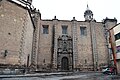 Templo del Carmen in San Luis Potosí city, Mexico in January 2014. It is one of the largest churches in Americas.
 -
 Roof tiles are a common Hispanic American architectural element because Spanish colonization. Hospital Escuela Eva Perón in Granadero Baigorria, Santa Fe, Argentina.
 -
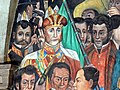 Detail of a Mural by Diego Rivera at the National Palace of Mexico showing the ethnic differences between Agustín de Iturbide, a criollo, and the multiracial Mexican court
 -
![Chest (petaca) from colonial Mexico, c. 1772. Metropolitan Museum of Art[120]](//upload.wikimedia.org/wikipedia/commons/thumb/3/36/Chest_%28petaca%29_MET_DP-15917-001.jpg/120px-Chest_%28petaca%29_MET_DP-15917-001.jpg)
.jpg)
![The clock of Comayagua Cathedral's bell tower in Honduras is one of the oldest clocks in Americas and the oldest still working in the world.[119] It was brought from the Alhambra Arab palace to the Spanish colonies during the 17th century.](https://en.wikipedia.org/wiki/File:Clock_of_Comayagua.jpg)


![Chest (petaca) from colonial Mexico, c. 1772. Metropolitan Museum of Art[120]](https://en.wikipedia.org/wiki/File:Chest_(petaca)_MET_DP-15917-001.jpg)
See also
[edit]

- Spanish Colonial architecture
- Society in the Spanish Colonial Americas
- Cartography of Latin America
- Colonialism
- Creole nationalism
- Governor-General of the Philippines
- Historiography of Colonial Spanish America
- History of Spain
- History of the Americas
- Black legend (Spain)
- List of countries that gained independence from Spain
- List of oldest buildings in the Americas
- Spain
- Spanish Viceroys of Aragon
- Spanish Viceroys of Catalonia
- Spanish Viceroys of Naples
- Spanish Viceroys of Navarre
- Spanish Viceroys of Sardinia
- Spanish Viceroys of Sicily
- Spanish Viceroys of Valencia
- Viceroys of New Granada
- Viceroys of New Spain
- Viceroys of Peru
- Viceroys of Río de la Plata
References
[edit]Notes
[edit]- ^ The Catholic Church was the State religion of the Spanish Empire, but the following religions were also present in the empire: Islam (Sunni Islam (Hanafi and Maliki [the latter until 1609] schools), Shia Islam, Crypto-Islam), Aztec religions, Inca religions, Buddhism, Hinduism, Sikhism, Jainism, Animism and Judaism (Crypto-Judaism).
- ^ Spanish: Imperio español
- ^ Spanish: Monarquía Hispánica
- ^ Spanish: Monarquía Católica
- ^ ... In August, the Duke besieged Ceuta [The city was simultaneously besieged by the moors and a Castilian army led by the Duke of Medina Sidónia] and took the whole city except the citadel, but with the arrival of Afonso V in the same fleet which led him to France, he preferred to leave the square. As a consequence, this was the end of the attempted settlement of Gibraltar by converts from Judaism ... which D. Enrique de Guzmán had allowed in 1474, since he blamed them for the disaster. See Ladero Quesada, Miguel Ángel (2000), "Portugueses en la frontera de Granada" in En la España Medieval, vol. 23 (in Spanish), p. 98, ISSN 0214-3038.
- ^ A dominated Ceuta by the Castilians would certainly have forced a share of the right to conquer the Kingdom of Fez (Morocco) between Portugal and Castile instead of the Portuguese monopoly recognized by the treaty of Alcáçovas. See Coca Castañer (2004), "El papel de Granada en las relaciones castellano-portuguesas (1369–1492)", in Espacio, tiempo y forma (in Spanish), Serie III, Historia Medieval, tome 17, p. 350: ... In that summer, D. Enrique de Guzmán crossed the Strait with five thousand men to conquer Ceuta, managing to occupy part of the urban area on the first thrust, but knowing that the Portuguese King was coming with reinforcements to the besieged [Portuguese], he decided to withdraw ...
- ^ A Castilian fleet attacked the Praia's Bay in Terceira Island but the landing forces were decimated by a Portuguese counter-attack because the rowers panicked and fled with the boats. See chronicler Frutuoso, Gaspar (1963)- Saudades da Terra (in Portuguese), Edição do Instituto Cultural de Ponta Delgada, volume 6, chapter I, p. 10. See also Cordeiro, António (1717)- Historia Insulana (in Portuguese), Book VI, Chapter VI, p. 257
- ^ This attack happened during the Castilian war of Succession. See Leite, José Guilherme Reis- Inventário do Património Imóvel dos Açores Breve esboço sobre a História da Praia (in Portuguese).
- ^ This was a decisive battle because after it, in spite of the Catholic Monarchs' attempts, they were unable to send new fleets to Guinea, Canary or to any part of the Portuguese empire until the end of the war. The Perfect Prince sent an order to drown any Castilian crew captured in Guinea waters. Even the Castilian navies which left to Guinea before the signature of the peace treaty had to pay the tax ("quinto") to the Portuguese crown when returned to Castile after the peace treaty. Isabella had to ask permission to Afonso V so that this tax could be paid in Castilian harbors. Naturally all this caused a grudge against the Catholic Monarchs in Andalusia.
- ^ Italian financiers from Milan and Genoa managed the crown's credit, while Italian generals, soldiers, and ships played a crucial role in supporting Spain's army and naval power. The Duchy of Milan served as Spain's main military base in Europe, blocking French expansion and facilitating troop movements via the Spanish Road. Milan's armaments industry provided war materials, and the Kingdom of Naples contributed recruits and taxes, which many Italians saw as exploitation for Spain's imperial ambitions, although Philip II insisted that the monarchy did not intend to exploit them.[62]
Citations
[edit]- ^ Monarchy nominally restored in 1947
- ^ Government proclaimed in 1936
- ^ a b Taagepera, Rein (September 1997). "Expansion and Contraction Patterns of Large Polities: Context for Russia" (PDF). International Studies Quarterly. 41 (3): 492–502. doi:10.1111/0020-8833.00053. JSTOR 2600793. Archived (PDF) from the original on 7 July 2020. Retrieved 7 July 2020.
- ^ Fernández Álvarez, Manuel (1979). España y los españoles en los tiempos modernos (in Spanish). University of Salamanca. p. 128.
- ^ Schneider, Reinhold, 'El Rey de Dios', Belacqva (2002)
- ^ Hugh Thomas, 'World Without End: The Global Empire of Philip II', Penguin; first edition (2015)
- ^ Wright, Edmund, ed. (2015). A Dictionary of World History (2nd ed.). Oxford: Oxford University Press. doi:10.1093/acref/9780192807007.001.0001. ISBN 978-0191726927.
- ^ Echávez-Solano, Nelsy; Dworkin y Méndez, Kenya C., eds. (2007). Spanish and Empire. Nashville, Tenn.: Vanderbilt University Press. pp. xi–xvi. doi:10.2307/j.ctv16755vb.3. ISBN 978-0826515667. S2CID 242814420.
- ^ Beaule, Christine; Douglass, John G., eds. (2020). The Global Spanish Empire: Five Hundred Years of Place Making and Pluralism. Amerind Studies in Anthropology. Tucson: University of Arizona Press. pp. 3–15. doi:10.2307/j.ctv105bb41. ISBN 978-0816545711. JSTOR j.ctv105bb41. S2CID 241500499. Archived from the original on 30 August 2021. Retrieved 6 August 2021 – via Open Research Library.
- ^ Gibson 1966, p. 91; Lockhart & Schwartz 1983, p. 19.
- ^ Márquez, Carlos E. (2016). "Plus Ultra and the Empire Upon Which the Sun Never Set". In Tarver, H. Micheal; Slape, Emily (eds.). The Spanish Empire: A Historical Encyclopedia [2 volumes]: A Historical Encyclopedia. ABC-CLIO. p. 161. ISBN 978-1610694223. Archived from the original on 14 January 2023. Retrieved 19 September 2022.
- ^ Kamen 2003, p. 69.
- ^ Kamen 2003, p. 506.
- ^ Lynch, John. "Spanish American Independence" in The Cambridge Encyclopedia of Latin America and the Caribbean 2nd edition. New York: Cambridge University Press 1992, p. 218.
- ^ Scheina 2003, p. 424.
- ^ Bethany, Aram (2006). "Monarchs of Spain". Iberia and the Americas: culture, politics, and history. Santa Barbara: ABC Clio. p. 725.
- ^ Dutra, Francis A. "Portuguese Empire" in Encyclopedia of Latin American History and Culture 1996, vol. 4, p. 451
- ^ a b Burkholder, Mark A. "Spanish Empire" in Encyclopedia of Latin American History and Culture 1996, vol. 5, p. 167
- ^ Castañeda Delgado, Paulino (1996). "La Santa Sede ante las empresas marítimas ibéricas" (PDF). La Teocracia Pontifical en las controversias sobre el Nuevo Mundo. Universidad Autónoma de México. ISBN 978-9683651532. Archived from the original (PDF) on 27 September 2011.
- ^ Kamen 2003, p. 12.
- ^ Hernando del Pulgar (1943), Crónica de los Reyes Católicos, vol. I (in Spanish), Madrid, pp. 278–279.
- ^ Jaime Cortesão (1990), Os Descobrimentos Portugueses Archived 22 November 2022 at the Wayback Machine, vol. III (in Portuguese), Imprensa Nacional-Casa da Moeda, p. 551, ISBN 9722704222
- ^ The Canary's campaign: Alfonso de Palencia, Decada IV Archived 22 November 2022 at the Wayback Machine, Book XXXI, Chapters VIII and IX ("preparation of 2 fleets" [to Guinea and to Canary, respectively] "so that with them King Ferdinand crush its enemies" [the Portuguese] ...). Palencia wrote that the conquest of Gran Canary was a secondary goal to facilitate the expeditions to Guinea (the real goal), a means to an end.
- Alfonso de Palencia, Decada IV, book XXXII, chapter III: in 1478 a Portuguese fleet intercepted the armada of 25 navies sent by Ferdinand to conquer Gran Canary—capturing 5 of its navies plus 200 Castilians—and forced it to fled hastily and definitively from the Canary waters. This victory allowed Prince John to use the Canary Islands as an "exchange coin" in the peace treaty of Alcáçovas.
- ^ Pulgar, Hernando del (1780), Crónica de los señores reyes católicos Don Fernando y Doña Isabel de Castilla y de Aragon Archived 16 January 2022 at the Wayback Machine (in Spanish), chapters LXXVI and LXXXVIII ("How the Portuguese fleet defeated the Castilian fleet which had come to the Mine of Gold"). From the Biblioteca Virtual Miguel de Cervantes.
- ^ Laughton, Leonard (1943). "Reviews". The Mariner's Mirror. 29 (3). London: Society for Nautical Research: 184. Archived from the original on 14 January 2023. Retrieved 25 October 2015.
... For four years the Castilians traded and fought; but the Portuguese were the stronger. They defeated a large Spanish fleet off Guinea in 1478, besides gaining other victories. The war ended in 1479 by Ferdinand resigning his claims to Guinea ...
- ... More important, Castile recognized Portugal as the sole proprietor of the Atlantic islands (excepting the Canaries) and of the African coast in the Treaty of Alcáçovas in 1479. This Treaty clause, secured by Portuguese naval successes off Africa during an otherwise unsuccessful war, eliminated the only serious rival. In Richardson, Patrick, The expansion of Europe, 1400–1660 Archived 22 November 2022 at the Wayback Machine (1966), Longmans, p. 48 Archived 23 May 2020 at the Wayback Machine
- ^ Waters, David (1988), Reflections Upon Some Navigational and Hydrographic Problems Of The XVth Century Related To The Voyage Of Bartolomeu Dias, 1487–88 Archived 10 April 2023 at the Wayback Machine, p. 299, in the Separata from the Revista da Universidade de Coimbra, vol. XXXIV.
- ^ ... the Treaty of Alcáçovas was an important step in defining the expansion areas of each kingdom ... The Portuguese triumph in this agreement is evident, and in addition deserved. Efforts and perseverance developed over the last four decades by Henry the Navigator during the Discoveries in Africa reached their fair reward. In Donat, Luis Rojas (2002), España y Portugal ante los otros: derecho, religión y política en el descubrimiento medieval de América Archived 22 November 2022 at the Wayback Machine (in Spanish), Ediciones Universidad del Bio-Bio, p. 88, ISBN 9567813191
- ^ ... Castile undertakes not to allow any his subject navigate waters reserved to the Portuguese. From the Canary's Parallel onwards, the Atlantic Ocean would be a Mare clausum to the Castilians. The treaty of Alcáçovas represented a huge victory for Portugal and resulted tremendously damaging to Castile. In Espina Barrio, Angel (2001), Antropología en Castilla y León e iberoamérica: Fronteras Archived 10 April 2023 at the Wayback Machine, vol. III (In Spanish), Universidad de Salamanca, Instituto de Investigaciones Antropológicas de Castilla y León, p. 118, ISBN 8493123110
- ^ Davenport, Frances Gardiner (2004), European Treaties Bearing on the History of the United States and Its Dependencies, The Lawbook Exchange, Ltd., p. 49, ISBN 978-1584774228, archived from the original on 14 January 2023, retrieved 21 November 2020
- ^ ... Castile accepted a Portuguese monopoly on new discoveries in the Atlantic from the Canaries southward and toward the African coast. In Bedini 1992, p. 53
- ^ ... This boundary line cut off Castile from the route to India around Africa ..., in Prien, Hans-Jürgen (2012), Christianity in Latin America: Revised and Expanded Edition Archived 22 November 2022 at the Wayback Machine, Brill, p. 8, ISBN 978-9004242074
- ^ ... With an eye to the Treaty of Alcáçovas which only permitted westerly expansion by Castile, the Crown accepted the proposals of the Italian adventurer [Christopher Columbus] because if, contrary to all expectation, he were to prove successful, a great opportunity would arise to outmanoeuvre Portugal ..., in Emmer, Piet (1999), General History of the Caribbean Archived 22 November 2022 at the Wayback Machine, vol. II, UNESCO, p. 86 Archived 23 May 2020 at the Wayback Machine, ISBN 0333-724550
- ^ Superpowers Spain and Portugal struggled for global control and in the 1494 Treaty of Tordesillas the Pope divided the non-Christian world between them. In Flood, Josephine (2006), The original Australians: Story of the Aboriginal people Archived 22 November 2022 at the Wayback Machine, p. 1, ISBN 1 74114 872 3
- ^ Burbank & Cooper 2010, pp. 120–121.
- ^ Fernández Herrero 1992, p. 143.
- ^ McAlister, Lyle N. (1984). Spain and Portugal in the New World, 1492–1700. U of Minnesota Press. p. 69. ISBN 978-0816612185.
- ^ Historia general de España 1992, p. 189.
- ^ Fernández Herrero 1992, p. 141.
- ^ Diffie, Bailey Wallys; Winius, George Davison (1977). Foundations of the Portuguese Empire, 1415–1580. University of Minnesota Press. p. 173. ISBN 978-0816607822. Archived from the original on 14 January 2023. Retrieved 21 November 2020.
- ^ Vieira Posada, Édgar (2008). La formación de espacios regionales en la integración de América Latina. Pontificia Universidad Javeriana. p. 56. ISBN 978-9586982344. Archived from the original on 14 January 2023. Retrieved 21 November 2020.
- ^ Sánchez Doncel, Gregorio (1991). Presencia de España en Orán (1509–1792). I.T. San Ildefonso. p. 122. ISBN 978-8460076148. Archived from the original on 14 January 2023. Retrieved 21 November 2020.
- ^ Los Trastámara y la Unidad Española. Ediciones Rialp. 1981. p. 644. ISBN 978-8432121005.[permanent dead link]
- ^ a b Collier, Simon (1992). "The non-Spanish Caribbean Islands to 1815". The Cambridge Encyclopedia of Latin America and the Caribbean (second ed.). New York: Cambridge University Press. pp. 212–213.
- ^ Rafal B. Reichert, Las Devastaciones de Osorio y los situados novohispanos para Santo Domingo durante los reinados de la casa de Habsburgo, Universidad de Ciencias y Artes de Chiapas (UNICACH), México, publicado en fecha 16-11-2016. (Ver artículo Aquí)
- ^ Frank Moya Pons , Manual de Historia Dominicana , 11ᵃ Edición , Editora Centenario, Año 1997 ( ISBN 84-399-7681-X ) Capítulo VIː La ganadería, el contrabando y las devastaciones (Pág. 5-Pág. 62)
- ^ Lockhart & Schwartz 1983, p. 63.
- ^ Diego-Fernández Sotelo 1987, p. 139.
- ^ Kozlowski, Darrell J. (2010). Colonialism. Infobase Publishing. p. 84. ISBN 978-1438128900. Archived from the original on 14 January 2023. Retrieved 21 November 2020.
- ^ Kamen 2003, p. 27.
- ^ Edwards 2000, pp. 282–288.
- ^ Edwards 2000, p. 248.
- ^ Quoted in Braudel 1984, vol. 2, p. 171.
- ^ Baten, Jörg (2016). A History of the Global Economy. From 1500 to the Present. Cambridge University Press. p. 159. ISBN 978-1107507180.
- ^ Kamen 2003, p. 95.
- ^ Marley 2008, p. 27.
- ^ Marley 2008, p. 30.
- ^ Marley 2008, p. 36.
- ^ Marley 2008, p. 37.
- ^ Marley 2008, p. 38.
- ^ Marley 2008, p. 48.
- ^ Cathal J. Nolan (2006). The Age of Wars of Religion 1000–1650: An Encyclopedia of Global Warfare and Civilization. pp. 672–675.
- ^ Kamen 2003, p. 173.
- ^ a b c Cathal J. Nolan (2008). Wars of the Age of Louis XIV, 1650–1715: An Encyclopedia of Global Warfare and Civilization. pp. 442–443.
- ^ Braudel 1984, vol. 2, p. 418.
- ^ Lynch 1989, p. 1.
- ^ Kuethe, Allan J. "The Bourbon Reforms" in Encyclopedia of Latin American History and Culture 1996, vol. 1, pp. 399–401
- ^ Fisher, John R. "The Spanish American empire, 1580–1808" in The Cambridge Encyclopedia of Latin America and the Caribbean, 2nd edition. New York: Cambridge University Press 1992, pp. 204–205.
- ^ Albareda Salvadó, Joaquim (2010). La Guerra de Sucesión de España (1700–1714). Editorial Critica. pp. 239–241. ISBN 978-8498920604.
- ^ Lynch 1989, p. 11.
- ^ a b Tutino, John (2016). New countries capitalism, revolutions, and nations in the Americas, 1750–1870. Duke University Press. ISBN 978-0822361145. OCLC 1107326871.
- ^ a b von Humboldt 1811.
- ^ Janota, Tom (9 February 2015). Alexander von Humboldt, un explorador científico en América. CIDCLI. p. 64. ISBN 978-6078351121. Archived from the original on 14 January 2023. Retrieved 23 September 2020.
- ^ "4 More of the Stupidest Wars in World History". October 2020. Archived from the original on 7 August 2023. Retrieved 7 August 2023.
- ^ Prowse, D. W. (2007). A History of Newfoundland: from the English, Colonial and Foreign Records. Heritage Books. p. 311. ISBN 978-0788423109.
In one short year the unfortunate Spaniards saw their armies beaten in Portugal, Cuba and Manila torn from their grasp, their commerce destroyed, and their fleets annihilated.
- ^ "Corsairs of Santo Domingo a socio-economic study, 1718–1779" (PDF). Archived (PDF) from the original on 16 January 2017. Retrieved 12 October 2020.
- ^ Kamen 2003, pp. 237, 485.
- ^ Blackmar, Frank Wilson (1891). Spanish Institutions of the Southwest Issue 10 of Johns Hopkins University studies in historical and political science. Hopkins Press. p. 335. Archived from the original on 14 January 2023. Retrieved 3 June 2022.
- ^ Salvucci, Linda K. "Adams–Onís Treaty (1819)" in Encyclopedia of Latin American History and Culture 1996, vol. 1, pp. 11–12
- ^ Scheina 2003, p. 83.
- ^ Scheina 2003, p. 70.
- ^ Scheina 2003, p. 82.
- ^ a b Scheina 2003, p. 357.
- ^ Reza, De La; A, Germán (20 June 2015). "El intento de integración de Santo Domingo a la Gran Colombia (1821-1822)". Secuencia (in Spanish) (93). ISSN 0186-0348.
- ^ Bryan, Patrick (1995). "The Independencia Efimera of 1821, and the Haitian Invasion of Santo Domingo 1822 : A Case of Pre-emptive Independence". Caribbean Quarterly. 41 (3/4): 15–29. ISSN 0008-6495. JSTOR 40653940.
- ^ "World Leaders Index: Dominican Republic". Archived from the original on 20 June 2015. Retrieved 26 April 2015.
- ^ "Los 22 años en los que Haití gobernó Santo Domingo y cómo dieron origen a la actual República Dominicana". BBC News Mundo (in Spanish). 1 December 2022. Retrieved 16 June 2025.
- ^ Scheina 2003, p. 349.
- ^ Scheina 2003, p. 358.
- ^ a b Scheina 2003, p. 364.
- ^ "Avalon Project – Treaty of Peace Between the United States and Spain; December 10, 1898". avalon.law.yale.edu. Archived from the original on 16 September 2018. Retrieved 29 September 2022.
- ^ Dictionary of Battles and Sieges: A Guide to 8,500 Battles 2007 Archived 5 April 2023 at the Wayback Machine Cerezo finally surrendered with the full honors of war (1 July 1898 – 2 June 1899)
- ^ William Gervase Clarence-Smith, 1986 "Spanish Equatorial Guinea, 1898–1940", in The Cambridge History of Africa: From 1905 to 1940 Ed. J. D. Fage, A. D. Roberts, & Roland Anthony Oliver. Cambridge: Cambridge University Press>"The Cambridge History of Africa, Volume 7~ from 1905 to 1940 (0521225051, 1986)". Archived from the original on 20 February 2014. Retrieved 23 September 2013.
- ^ "La derrota más amarga del Ejército español – ABC.es" (in Spanish). 15 July 2011. Archived from the original on 21 July 2017. Retrieved 28 January 2017.
- ^ "Desembarco en Alhucemas, el "Día D" de las tropas españolas en el norte de África". abc (in European Spanish). 12 January 2014. Archived from the original on 12 June 2018. Retrieved 24 June 2017.
- ^ Kenneth L. Sokoloff; Stanley L. Engerman (2000). "History Lessons: Institutions, Factor Endowments, and Paths of Development in the New World" (PDF). The Journal of Economic Perspectives. 14 (3): 217–232. doi:10.1257/jep.14.3.217. Archived from the original (PDF) on 21 September 2020. Retrieved 12 March 2018.
- ^ Stein, Stanley J. (2003). Silver, Trade, and War : Spain and America in the Making of early modern Europe. Johns Hopkins Univ Press. ISBN 0801877555. OCLC 173164546.
- ^ Moutoukias, Zacarias (1988). "Power, Corruption, and Commerce: The Making of the Local Administrative Structure in Seventeenth-Century Buenos Aires". The Hispanic American Historical Review. 68 (4): 771–801. doi:10.2307/2515681. ISSN 0018-2168. JSTOR 2515681.
- ^ Stein & Stein 2000, pp. 40–57.
- ^ Andrien, Kenneth A. "Arbitristas" in Encyclopedia of Latin American History and Culture 1996, vol. 1, p. 122
- ^ Stein & Stein 2000, pp. 94–102.
- ^ Elliott 1989, p. 231.
- ^ "Old Havana and its Fortification System". UNESCO World Heritage List website. Archived from the original on 5 June 2020. Retrieved 7 August 2023.
- ^ Lynch 1989, pp. 10–11.
- ^ a b Bakewell, Peter and Kendall W. Brown, "Mining: Colonial Spanish America" in Encyclopedia of Latin American History and Culture 1996, vol. 4, pp. 59–63
- ^ Fisher, John R. "Fleet System (Flota)" in Encyclopedia of Latin American History and Culture 1996, vol. 2, p. 575
- ^ Tutino, John (2018). In The Mexican Heartland: How Communities Shaped Capitalism, a Nation, and World History, 1500–2000. Princeton University Press. pp. 57–90.
- ^ Kuethe, Allan J.; Andrien, Kenneth J. (May 2014). "War and Reform, 1736–1749". The Spanish Atlantic World in the Eighteenth Century. pp. 133–166. doi:10.1017/cbo9781107338661.007. ISBN 978-1107338661.
{{cite book}}:|website=ignored (help) - ^ Schmitt, Karl (April 1959). "The Clergy and the Enlightenment in Latin America: An Analysis". The Americas. 15 (4): 381–391. doi:10.2307/978867. JSTOR 978867. S2CID 146900474.
- Aldridge, Alfred Owen (1971). The Ibero-American Enlightenment. Urbana: University of Illinois Press.
- ^ Saladino García, Alberto (1990). Dos científicos de la Ilustración hispanoamericana: J.A. Alzate y F.J. de Caldas (in Spanish). Mexico: UNAM.
- Codding, Mitchell A. (1994). "Perfecting the geography of New Spain: Alzate and the Cartographic legacy of Sigüenza y Góngora". Colonial Latin American Review. 2 (1–2): 185–219. doi:10.1080/10609169408569828.
- ^ Pérez Arbeláez, Enrique (1983) [1967]. José Celestino Mutis y la real expedición botánica del Nuevo Reyno de Granada (in Spanish) (2nd. ed.). Bogotá: Instituto Colombiano de Cultura Hispánica.
- ^ Rickett, Harold W. (1947). "The Royal Botanical Expedition to New Spain". Chronica Botanica. 11 (1): 1–81.
- de Solano, Francisco, ed. (1987). La Real Expedición Botánica a Nueva España, 1787–1800 (in Spanish). Madrid: CSIC.
- ^ Engstrand, Iris H. W. (1981). Spanish Scientists in the New World: The Eighteenth-Century Expeditions. Seattle: University of Washington Press.
- Bleichmar, Daniela (2012). Visible Empire: Botanical Expeditions & Visible Culture in the Hispanic Enlightenment. Chicago: University of Chicago Press.
- De Vos, Paula S. (June 2006). "Research, Development, and Empire: State Support of Science in Spain and Spanish America, Sixteenth to Eighteenth Centuries". Colonial Latin America Review. 15 (1): 55–79. doi:10.1080/10609160600607432. S2CID 218576951.
- ^ Cañizares-Esguerra, Jorge (2006). Nature, Empire, and Nation: Explorations in the History of Science in the Iberian World. Stanford: Stanford University Press.
- Bleichmar, Daniela, ed. (2008). Science in the Spanish and Portuguese Empires, 1500–800. Stanford: Stanford University Press.
- Peset, José Luis, ed. (1989). Ciencia, vida, y espacio en Iberoamérica (in Spanish). Madrid: CSIC.
- Franklin Safier, Neil (2008). Measuring the New World: Enlightenment Science and South America. Chicago: University of Chicago Press.
- ^ quoted in Simon Collier, "The Spanish Conquests, 1492–1580" in The Cambridge Encyclopedia of Latin America and the Caribbean. New York: Cambridge University Press 1992, p. 194.
- ^ Hamel, Rainer Enrique (1995), "Indigenous education in Latin America: policies and legal frameworks", Linguistic Human Rights, De Gruyter Mouton, pp. 271–288, doi:10.1515/9783110866391.271, ISBN 978-3110866391
- ^ Chiaramonte, José Carlos (1 August 2010). "The "Ancient Constitution" after Independence (1808–1852)". Hispanic American Historical Review. 90 (3): 455–488. doi:10.1215/00182168-2010-003. ISSN 0018-2168.
- ^ Hamnett, Brian R. (1997). "Process and Pattern: A Re-Examination of the Ibero-American Independence Movements, 1808–1826". Journal of Latin American Studies. 29 (2): 279–328. doi:10.1017/S0022216X97004719. ISSN 0022-216X. JSTOR 158396. S2CID 145479092.
- ^ "Dissemination of Hispanic-American coinage". Encyclopædia Britannica. Archived from the original on 29 December 2011. Retrieved 7 February 2012.
- ^ "El reloj más antiguo del mundo – 30 Maravillas de Honduras" (in European Spanish). Archived from the original on 1 July 2022. Retrieved 27 July 2022.
- ^ "Chest (petaca)". Metropolitan Museum of Art website. 1772. Archived from the original on 4 June 2023. Retrieved 4 June 2023.
Bibliography
[edit]- Alip, Eufronio Melo (1964). Philippine History: Political, Social, Economic.
- Altman, Ida; Cline, Sarah; Javier Pescador, Juan (2003). The Early History of Greater Mexico. Upper Saddle River, NJ: Pearson. pp. 321–322.
- Archer, Christon; et al. (2002). World History of Warfare. Lincoln, NE: University of Nebraska. ISBN 978-0803244238.
- Arranz Márquez, Luis (1982). Don Diego Colón, almirante, virrey y gobernador de las Indias (in Spanish). CSIC. ISBN 978-8400051563.
- Atiyah, Jeremy (2002). Rough guide to Southeast Asia. Rough Guide. ISBN 978-1858288932.
- Bedini, Silvio, ed. (1992). The Christopher Columbus Encyclopedia. Simon & Schuster. ISBN 978-0131426702.
- Bennassar, Bartolomé (2001). La América española y la América portuguesa: siglos XVI–XVIII (in Spanish). Akal. ISBN 978-8476002032.
- Burbank, Jane; Cooper, Frederick (2010). Empires in World History: Power and the Politics of Difference. Princeton University Press. pp. 120–121. ISBN 978-0691127088.
- Brading, D.A. (1993). The First America: Spanish Monarchy, Creole Patriots, and the Liberal State, 1492–1866. Cambridge: Cambridge University Press. ISBN 978-0521447966.
- Brading, D.A. (1971). Miners and Merchants in Bourbon Mexico, 1763–1810. New York: Cambridge University. ISBN 978-0521102070.
- Braudel, Fernand (1984) [1979]. Civilization and Capitalism, 15th–18th century. Vol. 3 volumes. London: Collins.
- Brown, Jonathan; Elliott, John Huxtable (1980). A Palace for a King. The Buen Retiro and the Court of Philip IV. New Haven: Yale University Press. ISBN 978-0300025071.
- Bushnell, Amy (1981). The King's Coffer: Proprietors of the Spanish Florida Treasury 1565–1702. Gainesville: University Presses of Florida. ISBN 978-0813006901.
- Carrera Damas, Germán (1999). Historia general de América Latina (in Spanish). UNESCO. ISBN 978-9233031517.
- Chipman, Donald E. (2005). Moctezuma's Children: Aztec Royalty under Spanish Rule, 1520–1700 (Individual e-book (no page numbers) ed.). Austin: University of Texas Press. ISBN 978-0292782648. Retrieved 22 October 2013.
- Diego-Fernández Sotelo, Rafael (1987). Las capitulaciones colombinas (in Spanish). El Colegio de Michoacán A.C. ISBN 978-9687230306.
- Edwards, John (2000). The Spain of the Catholic Monarchs, 1474–1520. New York: Blackwell. ISBN 978-0631161653.
- Elliott, J.H. (2006). Empires of the Atlantic World: Britain and Spain in America 1492–1830. New Haven: Yale University Press.
- Elliott, J.H. (1989). Spain and Its World, 1500–1700. New Haven: Yale University Press.
- Elliott, J.H. (1986). The Count-Duke of Olivares: the statesman in an age of decline. New Haven: Yale University Press. ISBN 978-0300033908.
- Elliott, J.H. (1977). Imperial Spain, 14691716. New York: New American Library. ISBN 978-0452006140.
- Elliott, J.H. (1961). "The Decline of Spain". Past and Present (20): 52–75. doi:10.1093/past/20.1.52.
- Encyclopedia of Latin American History and Culture. New York: Charles Scribner's Sons. 1996. 5 volumes
- Fernández Herrero, Beatriz (1992). La utopía de América: teoría, leyes, experimentos (in Spanish). Anthropos Editorial. ISBN 978-8476583203.
- Frankham, Steven (2008). Borneo. Footprint Handbooks. Footprint. ISBN 978-1906098148.
- Gómez Gómez, Margarita (2008). El sello y registro de Indias: imagen y representación (in Spanish). Böhlau Verlag Köln Weimar. ISBN 978-3412202293.
- Góngora, Mario (1998). Estudios sobre la historia colonial de hispanoamérica (in Spanish). Editorial Universitaria. ISBN 978-9561113817.
- Guerrero, Milagros; Custodio, Teresa Ma.; Dalisay, Jose Y. (1998), "Reform and Revolution", Kasaysayan: The History of the Filipino People, vol. 5, Asia Publishing Company Limited, ISBN 962-258-228-1
- Hamnett, Brian (2017). The End of Iberian Rule on the American Continent, 1770–1830. Cambridge: Cambridge University Press. ISBN 978-1316626634.
- Haring, Clarence (1947). The Spanish Empire in America. New York: Oxford University Press.
- Historia general de España y América (in Spanish). Vol. 10. Ediciones Rialp. 1992. ISBN 978-8432121029.
- von Humboldt, Alexander (1 January 1811). Political essay on the kingdom of New Spain containing researches relative to the geography of Mexico. Printed for Longman, Hurst, Rees, Orme and Brown ... and H. Colburn ... ISBN 978-0665185465 – via Biodiversity Library.
{{cite book}}: ISBN / Date incompatibility (help) - Joaquin, Nick (1988). Culture and history: occasional notes on the process of Philippine becoming. Solar. ISBN 978-9711706333.
- Kamen, Henry (2005). Spain 1469–1714. A Society of Conflict (third ed.). London: Pearson Longman. ISBN 978-0582784642.
- Kamen, Henry (2003). Empire: How Spain Became a World Power, 1492–1763. New York: HarperCollins. ISBN 978-0060932640.
- Kennedy, Paul M (2017) [1988]. The rise and fall of the great powers: economic change and military conflict from 1500 to 2000. London: William Collins. ISBN 978-0006860525.
- Kurlansky, Mark (1999). The Basque history of the world. Walker. ISBN 978-0802713490.
- Lagos Carmona, Guillermo (1985). Los títulos históricos (in Spanish). Editorial Andrés Bello. OCLC 320082537.
- Lockhart, James; Schwartz, Stuart B. (1983). Early Latin America. New York: Cambridge University Press. ISBN 978-0521233446.
- Lynch, John (1989). Bourbon Spain, 1700–1808. New York. ISBN 978-0631192459.
{{cite book}}: CS1 maint: location missing publisher (link) - McAmis, Robert Day (2002). Malay Muslims: The History and Challenge of Resurgent Islam in Southeast Asia. Eerdmans. ISBN 978-0802849458.
- Mecham, J. Lloyd (1966). Church and State in Latin America: A History of Politico-Ecclesiastical Relations (revised ed.). Chapel Hill: University of North Carolina Press.
- Parker, Geoffrey (1978). Philip II. Boston: Little, Brown. ISBN 978-0316690805.
- Ruiz Martín, Felipe (1996). La proyección europea de la monarquía hispánica (in Spanish). Editorial Complutense. ISBN 978-8495983305.
- Saunders, Graham (2002). A History of Brunei. Routledge. ISBN 978-0700716982.
- Sibaja Chacón, Luis Fernando (2006). El cuarto viaje de Cristóbal Colón y los orígenes de la provincia de Costa Rica (in Spanish). EUNED. ISBN 978-9968314886.
- Stein, Stanley J.; Stein, Barbara H. (2000). Silver, Trade, and War: Spain and America in the Making of Early Modern Europe. Baltimore: Johns Hopkins University.
- Victoria, Pablo (2005). El día que España derrotó a Inglaterra : de cómo Blas de Lezo, tuerto, manco y cojo, venció en Cartagena de Indias a la otra "Armada Invencible" (in Spanish) (1st ed.). Barcelona: Áltera. ISBN 978-8489779686.
- Marley, David (2008). Wars of the Americas: A Chronology of Armed Conflict in the New World, 1492 to the Present [2 ed.]
- Scheina, Robert L. (2003). Latin America's Wars Volume I: The Age of the Caudillo, 1791–1899. Brassey's.
Further reading
[edit]- Padilla Angulo, Fernando J. (12 January 2023). Volunteers of the Empire: War, Identity, and Spanish Imperialism, 1855–1898. Bloomsbury. ISBN 978-1-350-28120-2.
- Anderson, James Maxwell (2000). The History of Portugal. Westport, Connecticut: Greenwood. ISBN 978-0313311062.
- Black, Jeremy (1996). The Cambridge illustrated atlas of warfare: Renaissance to revolution. Cambridge: Cambridge University. ISBN 978-0521470339.
- Boyajian, James C. (2007). Portuguese Trade in Asia Under the Habsburgs, 1580–1640. Johns Hopkins University. ISBN 978-0801887543.
- Braudel, Fernand (1972). The Mediterranean and the Mediterranean World in the Age of Philip II. Berkeley, Calif. : University of California Press.
- Brown, Jonathan (1998). Painting in Spain: 1500–1700. New Haven: Yale University Press. ISBN 978-0300064728.
- Dominguez Ortiz, Antonio (1971). The Golden Age of Spain, 1516–1659. Oxford: Oxford University Press. ISBN 978-0297004059.
- Elliott, J.H. (1970). The Old World and The New. Cambridge: Cambridge [Eng.] University Press. ISBN 978-0521079372.
- Farriss, N.M. (1968). Crown and Clergy in Colonial Mexico, 1759–1821. London: Athlone Press.
- Fisher, John (1985). Commercial Relations Between Spain and Spanish America in the Era of Free Trade, 1778–1796. Liverpool.
{{cite book}}: CS1 maint: location missing publisher (link) - Gibson, Charles (1966). Spain in America. New York: Harper and Row.
- Gibson, Charles (1964). The Aztecs Under Spanish Rule. Stanford: Stanford University Press.
- Herr, Richard (1958). The Eighteenth-Century Revolution in Spain. Princeton.
{{cite book}}: CS1 maint: location missing publisher (link) - Israel, Jonathan (May 1981). "Debate – The Decline of Spain: A Historical Myth". Past and Present (91): 170–185. doi:10.1093/past/91.1.170.
- Kagan, Richard L.; Parker, Geoffrey (1995). Spain, Europe and the Atlantic: Essays in Honour of John H. Elliott. Cambridge University Press. ISBN 978-0521525114.
- Kamen, Henry (1998). Philip of Spain. New Haven: Yale University. ISBN 978-0300078008.
- Kamen, Henry. Empire: How Spain Became a World Power, 1493–1763. New York: HarperCollins 2003. ISBN 978-0060194765
- Lach, Donald F.; Van Kley, Edwin J. (1994). Asia in the Making of Europe. Chicago: University of Chicago. ISBN 978-0226467344.
- Lynch, John (1964). Spain Under the Hapsburgs. New York.
{{cite book}}: CS1 maint: location missing publisher (link) - Lynch, John (1983). The Spanish American Revolutions, 1808–1826. New York.
{{cite book}}: CS1 maint: location missing publisher (link) - MacLachlan, Colin M. (1988). Spain's Empire in the New World: The Role of Ideas in Institutional and Social Change. Berkeley: University of California Press. ISBN 978-0520074101.
- Marichal, Carlos; Mantecón, Matilde Souto (1994). "Silver and Situados: New Spain and the Financing of the Spanish Empire in the Caribbean in the Eighteenth Century". Hispanic American Historical Review. 74 (4): 587–613. doi:10.2307/2517493. JSTOR 2517493.
- Merriman, Roger Bigelow (1918). The Rise of the Spanish Empire in the Old World and the New. New York.
{{cite book}}: CS1 maint: location missing publisher (link) - Olson, James S. (1992). Historical Dictionary of the Spanish Empire, 1402–1975.
- Paquette, Gabriel B (17 January 2008). Enlightenment, governance, and reform in Spain and its empire, 1759–1808. New York: Palgrave Macmillan 2008. ISBN 978-0230300521.
- Parker, Geoffrey (1997). The Thirty Years' War (2nd ed.). New York: Routledge. ISBN 978-0415128834.
- Parker, Geoffrey (1972). The Army of Flanders and the Spanish Road, 1567–1659; the logistics of Spanish victory and defeat in the Low Countries' Wars. Cambridge: Cambridge University Press. ISBN 978-0521084628.
- Parker, Geoffrey (1977). The Dutch revolt. Cambridge: Cambridge University Press. ISBN 978-0801411366.
- Parker, Geoffrey (1997). The General Crisis of the Seventeenth Century. New York: Routledge. ISBN 978-0415165181.
- Parry, J.H. (1966). The Spanish Seaborne Empire. Berkeley: University of California Press. ISBN 978-0520071407.
- Ramsey, John Fraser (1973). Spain: The Rise of the First World Power. University of Alabama Press. ISBN 978-0817357047.
- Restall, Matthew (2007). "The Decline and Fall of the Spanish Empire?". The William and Mary Quarterly. 64 (1): 183–194. JSTOR 4491607.
- Schmidt-Nowara, Christopher; Nieto Phillips, John M., eds. (2005). Interpreting Spanish Colonialism: Empires, Nations, and Legends. Albuquerque: University of New Mexico Press.
- Stein, Stanley J.; Stein, Barbara H. (2003). Apogee of Empire: Spain and New Spain in the Age of Charles III, 1759–1789. Baltimore: Johns Hopkins University.
- Stradling, R. A. (1988). Philip IV and the Government of Spain. Cambridge: Cambridge University Press. ISBN 978-0521323338.
- Studnicki-Gizbert, Daviken (2007). A Nation upon the Ocean Sea: Portugal's Atlantic Diaspora and the Crisis of the Spanish Empire, 1492–1640. Oxford University Press. ISBN 978-0198039112.
- Thomas, Hugh (2004). Rivers of Gold: The Rise of the Spanish Empire 1490–1522. Weidenfeld & Nicolson. ISBN 978-0297645634.
- Thomas, Hugh (1997). The Slave Trade; The History of the Atlantic Slave Trade 1440–1870. London: Papermac. ISBN 978-0333731475.
- Vicens Vives, Jaime (1969). An Economic History of Spain (3rd revised ed.). Princeton: Princeton, N.J., Princeton University Press.
- Wright, Esmond, ed. (1984). History of the World, Part II: The last five hundred years (third ed.). New York: Hamlyn Publishing. ISBN 978-0517436448.
External links
[edit]

- Library of Iberian Resources Online, Stanley G Payne A History of Spain and Portugal vol 1 Ch 13 "The Spanish Empire"
- The Mestizo-Mexicano-Indian History in the USA[usurped]
- Documentary Film, Villa de Albuquerque[usurped]
- The last Spanish colonies[usurped] (in Spanish)
- Francisco José Calderón Vázquez (2008), Fronteras, identidad, conflicto e interacción. Los Presidios Españoles en el Norte Africano (in Spanish), ISBN 978-8469167861, archived from the original on 14 February 2009
- The Kraus Collection of Sir Francis Drake at the Library of Congress contains primary materials on Spanish colonialism.
| International | |
|---|---|
| National | |
| Other | |

Spanish Empire
View on GrokipediaFormation and Early Expansion (1479–1516)
Completion of Reconquista and Catholic Monarchs
The marriage of Isabella I of Castile and Ferdinand II of Aragon on October 19, 1469, in Valladolid laid the foundation for the dynastic union of the two largest Christian kingdoms on the Iberian Peninsula, marking the beginning of a joint rule that effectively unified Spain under the Catholic Monarchs.[6] Although Castile and Aragon retained separate laws and institutions, the treaty accompanying the marriage stipulated Castile's superiority, with Ferdinand promising not to act without Isabella's consent in Castilian affairs.[7] This partnership enabled coordinated military and administrative efforts, centralizing power and fostering the conditions for expansion beyond the peninsula.[8] The Catholic Monarchs pursued the completion of the Reconquista, a centuries-long Christian campaign to reclaim Iberian territories from Muslim rule, culminating in the Granada War from 1482 to 1492.[9] Granada, the last Nasrid emirate, faced relentless sieges, including the capture of key cities like Málaga in 1487, weakening its defenses through internal divisions and superior Castilian artillery and funding from Isabella's revenues.[10] On January 2, 1492, Emir Muhammad XII (Boabdil) surrendered the city of Granada and the Alhambra palace to the monarchs, ending approximately 781 years of Muslim presence in the peninsula and incorporating the territory into Castile.[11] This victory, achieved with an army of around 50,000 troops, secured Christian dominance over Iberia and redirected fiscal and military resources toward overseas ventures.[12] Religious uniformity became a priority post-Reconquista to consolidate loyalty and prevent internal threats, leading to the establishment of the Spanish Inquisition in 1478 and its intensification after Granada's fall.[13] On March 31, 1492, the Alhambra Decree ordered the expulsion of practicing Jews, giving them until July 31 to convert or leave, affecting an estimated 40,000 to 100,000 individuals who departed, while over 200,000 converted to Catholicism amid prior pressures.[14] [15] This policy, aimed at eliminating perceived Judaizing influences among conversos, achieved short-term cohesion but contributed to economic disruptions from lost mercantile expertise.[16] The completion of the Reconquista thus not only unified the realm territorially but also ideologically, enabling the monarchs to sponsor Christopher Columbus's voyage that same year, initiating Spain's imperial era.[12]Conquest of the Canary Islands
The conquest of the Canary Islands by the Crown of Castile unfolded over nearly a century, from 1402 to 1496, representing the kingdom's initial venture into Atlantic expansion and serving as a testing ground for tactics later applied in the Americas.[17] [18] The archipelago's indigenous Guanche population, organized in tribal kingdoms under menceys, mounted varying degrees of resistance, with less populated eastern islands submitting more readily than the denser western ones.[17] [19] The initial phase, known as the Norman conquest, was initiated in 1402 by the French Normans Jean de Béthencourt and Gadifer de La Salle, who obtained feudal rights from King Henry III of Castile.[19] [18] Béthencourt's expedition departed from La Rochelle in May 1402, landing on Lanzarote later that year, where local Guanche leaders surrendered after minimal fighting due to internal divisions and the island's sparse population of around 1,000 inhabitants.[17] [19] Fuerteventura followed by 1405, with Béthencourt establishing Betancuria as a base; submissions from El Hierro and La Gomera were secured through diplomacy and limited military action, though betrayals and supply shortages plagued the efforts.[17] [18] Captives from these islands were often enslaved and exported to Castile, funding further operations.[17] The conquest stalled on the more formidable western islands—Gran Canaria, La Palma, and Tenerife—due to stronger Guanche organization and terrain advantages.[18] In 1478, under the Catholic Monarchs Isabella I of Castile and Ferdinand II of Aragon, the Crown assumed direct control, launching the royal conquest (conquista realenga) with state-financed armies.[17] [18] Gran Canaria was subdued between 1478 and 1483, with an invasion force of about 1,000 men under Juan Rejón capturing Gáldar but facing prolonged guerrilla warfare; Pedro de Vera's reinforcements broke resistance, leading to the fall of the main strongholds and the enslavement or conversion of survivors.[17] La Palma submitted in 1493 after internal Guanche divisions allowed Alonso Fernández de Lugo's forces to exploit alliances with rival clans.[18] Tenerife's conquest, from 1494 to 1496, proved the bloodiest, involving roughly 2,000–3,000 Castilian troops against a Guanche population exceeding 50,000 divided among nine menceyatos.[17] Initial defeats, such as the ambush at Acentejo where hundreds of Spaniards perished, delayed progress, but Lugo's strategy of divide-and-conquer—securing pacts with menceys like Bencomo's rivals—culminated in the Battle of La Laguna in 1494 and the siege of Anaga.[17] Formal surrender came in 1496 at Los Realejos, though pockets of resistance persisted for years, with leaders like Bentor opting for suicide over submission.[17] The islands were integrated into Castile as a seigneurío, with Guanches facing mass enslavement, disease, and cultural suppression, reducing their numbers drastically by the early 16th century.[18] [17]Rivalry with Portugal and Treaty of Tordesillas
Portugal established precedence in Atlantic exploration during the 15th century, sponsoring voyages under Prince Henry the Navigator that reached the West African coast by 1444 and settled the Azores by 1439, aiming to bypass Islamic intermediaries in the spice trade.[20] The rival Kingdom of Castile focused initially on completing the Reconquista and securing the Canary Islands, which Portugal had also claimed but conceded after naval defeats.[21] Tensions escalated during the War of the Castilian Succession (1475–1479), pitting Portuguese-backed Joanna la Beltraneja against Isabella I of Castile. The resulting Treaty of Alcáçovas, signed on September 4, 1479, resolved the conflict by recognizing Isabella's rule, affirming Castilian sovereignty over the Canary Islands, and granting Portugal exclusive rights to conquer and navigate the seas south of the Canaries along the African coast, including Madeira, the Azores, and Cape Verde.[22] This agreement introduced the principle of papal arbitration in dividing overseas domains and established Portugal's mare clausum—closed sea—claims in the southern Atlantic.[23] Christopher Columbus's 1492 voyage, funded by Castile's Catholic Monarchs Ferdinand II and Isabella I, landed in the Bahamas on October 12 and subsequent Caribbean islands, which Columbus asserted were the western fringes of Asia, prompting Spanish claims to these "Indies."[21] Portugal disputed the discoveries as overlapping their African-Asian routes protected by Alcáçovas, fearing Castilian encroachment on their trade monopoly.[20] Pope Alexander VI, a Spaniard from the Borgia family, intervened with three bulls in 1493, including Inter caetera on May 4, which drew a meridian 100 leagues west of the Azores and Cape Verde Islands, assigning all lands west and south to Castile for evangelization and conquest, while affirming Portugal's eastern claims.[24] Portugal protested the line's proximity to their holdings and the bulls' bias toward Spain, prompting diplomatic negotiations mediated by papal envoys and Juan de Borja, Alexander's nephew.[25] The Treaty of Tordesillas, signed on June 7, 1494, in the Portuguese town of Tordesilhas, adjusted the demarcation to 370 leagues (approximately 1,770 kilometers) west of the Cape Verde Islands, allocating undiscovered lands west of the line to Spain and east to Portugal, with mutual prohibitions on sailing into the opposing sphere without consent.[26] Spain ratified it on July 2, 1494, and Portugal on September 5, 1494, following papal confirmation via the bull Aeterni regis on May 4, 1495.[27] The treaty's longitudinal line, unmeasurable accurately at the time due to navigational limits, theoretically preserved Portugal's African and Indian Ocean routes while granting Spain vast American territories, though enforcement relied on later discoveries like Pedro Álvares Cabral's 1500 landing in Brazil, which fell east of the line.[28]Initial Voyages and Settlements in the Americas
Christopher Columbus, under the patronage of the Catholic Monarchs Ferdinand II of Aragon and Isabella I of Castile, embarked on his first voyage westward from Palos de la Frontera on August 3, 1492, commanding three ships—the Santa María, Niña, and Pinta—with approximately 90 men.[29] After five weeks at sea, land was sighted on October 12 in the Bahamas, which Columbus named San Salvador; the expedition then explored parts of Cuba and Hispaniola, encountering Taíno communities.[30] On December 25, the Santa María ran aground off Hispaniola's northern coast, prompting Columbus to construct the fortified outpost of La Navidad using its timbers, leaving 39 men under Diego de Arana to maintain a Spanish presence while he returned to Spain, arriving in March 1493 with news of the discovery, indigenous captives, and samples of local resources.[31] [32] The second voyage, launched in September 1493 with 17 ships and about 1,200 colonists including settlers, soldiers, and livestock, reached Hispaniola in late November, only to find La Navidad destroyed and its garrison killed amid conflicts with local Taíno cacique Guacanagari's rivals.[33] Columbus established La Isabela on January 2, 1494, near present-day Puerto Plata, as the first planned European settlement in the Americas, featuring a fortress, church, and housing for royal officials, miners, and farmers seeking gold and provisions.[32] Operations at La Isabela focused on gold extraction from rivers, though yields were modest, and the settlement faced severe hardships including famine, disease, and Taíno resistance led by cacique Caonabo, whose capture in 1494 via ambush enabled temporary Spanish control over interior regions.[34] By 1496, Columbus relocated the base to the southern coast, founding Santo Domingo (initially La Nueva Isabela), which became the enduring capital of the Indies due to its sheltered harbor and agricultural viability.[33] Columbus's third voyage in 1498 briefly touched Trinidad and explored Venezuela's mainland coast, confirming the lands as a "new world" separate from Asia, while his governorship oversaw expanding settlements amid administrative turmoil and native enslavement, with over 500 Taíno shipped to Spain by 1495 despite royal prohibitions on such practices.[35] Parallel expeditions, such as Alonso de Ojeda's 1499 voyage with Amerigo Vespucci, charted South America's northern coast, identifying pearl fisheries off modern Venezuela and facilitating private ventures that complemented crown efforts.[36] These initial forays secured Spanish claims under the 1494 Treaty of Tordesillas, establishing the Caribbean as a staging ground for further expansion, though early colonies struggled with high mortality—evidenced by La Isabela's abandonment around 1500 due to eroded soils and epidemics—and reliance on coerced Taíno labor for sustenance and tribute.[32] By 1500, Hispaniola hosted several thousand Spaniards, marking the inception of permanent transatlantic colonization.[33]Habsburg Era (1516–1700)
Charles V and the Universal Monarchy
Charles V ascended the thrones of Castile and Aragon in 1516 at age 16, following the death of his maternal grandfather Ferdinand II of Aragon, thereby inheriting the Spanish kingdoms and their nascent American possessions, which included territories discovered by Columbus in 1492 and further explored by expeditions under his predecessors.[37] His inheritance extended beyond Iberia: from his father, Philip the Handsome, he received the Burgundian Netherlands and Franche-Comté in 1506; from his paternal grandfather, Maximilian I, the Austrian Habsburg lands upon Maximilian's death in 1519; and through election by German princes, the title of Holy Roman Emperor in June 1519, granting nominal overlordship over a fragmented central European patchwork.[38] This aggregation formed a sprawling composite monarchy spanning Europe, the Mediterranean, and the Atlantic, with American silver flows—beginning significantly after the 1545 discovery of Potosí mines—providing fiscal sinews for imperial ambitions, yielding over 180 tons of silver annually by mid-century to finance Habsburg endeavors.[38] The concept of universal monarchy underpinned Charles's governance, envisioning a divinely ordained Christian imperium uniting Christendom against Ottoman incursions and internal schisms, with the Holy Roman imperial title as ideological cornerstone for European hegemony and the Spanish crown's transoceanic domains as material foundation.[39] Rooted in medieval precedents of Roman universalism mediated through papal claims, this aspiration manifested in Charles's 1530 coronation by Pope Clement VII in Bologna, the first imperial crowning outside Rome since antiquity, symbolizing restored Caesarian authority.[40] Yet, causal pressures—persistent French rivalry in Italy, Lutheran fragmentation in Germany, and Suleiman the Magnificent's 1529 Vienna siege—fragmented this vision, as decentralized feudal obligations clashed with centralized fiscal demands on Spanish resources, breeding resentment among Castilian comuneros who revolted in 1520-1521 over foreign (Flemish) advisors and tax hikes for European wars.[39] In the Americas, Charles's reign marked the empire's pivot to global scale, with Hernán Cortés's 1519-1521 conquest of the Aztec Empire and Francisco Pizarro's 1532-1533 subjugation of the Inca yielding vast tribute networks, formalized by the 1524 establishment of the Council of the Indies to oversee viceregal administration from Seville.[41] Reforms like the 1542 New Laws aimed to curb encomienda abuses and assert crown sovereignty over indigenous labor, though enforcement faltered amid encomendero revolts such as those in Peru (1544-1548), reflecting tensions between metropolitan extraction and colonial autonomy.[41] American bullion, comprising up to 20% of Spain's revenue by 1550, subsidized Charles's European commitments, including the 1527 Sack of Rome by mutinous imperial troops—unintended but strategically opportunistic—and the 1547 Schmalkaldic War victory over Protestant princes, yet this dependency exposed structural vulnerabilities, as inflationary pressures and debt to Genoese bankers eroded fiscal sustainability.[38] Exhausted by ceaseless conflict—over 40 years of near-constant warfare across fronts—Charles abdicated piecemeal: Spanish realms, Netherlands, and Italian/Franche-Comté holdings to son Philip II in 1556; Austrian lands and imperial title to brother Ferdinand I in 1555, averting dynastic rupture but conceding the universalist dream's impracticality amid polycentric rule and rival powers' balance-of-power resistance.[37] This partition preserved Spanish imperial coherence around Iberia and the Indies, channeling American wealth into Philip's Mediterranean primacy, while highlighting causal limits: inheritance's scale amplified defensive burdens without commensurate administrative unification, foreshadowing Habsburg overextension.[42]Philip II and the Global Zenith
Philip II inherited the Spanish throne in 1556 from his father Charles V, presiding over an empire that spanned continents including the Americas, parts of Europe, Africa, and Asia.[43] By the time of his accession, Spanish forces had already secured vast territories in the New World, but Philip's reign marked the empire's territorial and influential peak, with the addition of Portuguese holdings in 1580 effectively uniting the Iberian Peninsula under one crown and extending Spanish reach to Brazil, parts of Africa, and trading posts in Asia.[44] This expansion solidified Spain's position as the preeminent global power, controlling key maritime routes and resource flows that facilitated the influx of American silver, which peaked during his rule and funded extensive military endeavors.[45] A defining military triumph occurred in 1571 at the Battle of Lepanto, where a Holy League fleet, primarily Spanish under Don John of Austria, decisively defeated the Ottoman navy in the Gulf of Patras, capturing or destroying over 200 Turkish vessels and halting Ottoman expansion in the Mediterranean.[46] This victory, involving approximately 200 Christian galleys against a similar Ottoman force, not only boosted Spanish prestige but also secured Christian dominance in eastern Mediterranean trade lanes, though the Ottomans rebuilt their fleet within a year.[47] Complementing European successes, Philip oversaw the colonization of the Philippines starting in 1565, establishing Manila as a pivotal hub for the Manila Galleon trade that linked Acapulco to Asian markets, channeling silver to China and fostering early global commerce networks.[45] Domestically, Philip centralized authority through an elaborate bureaucracy centered at the Escorial palace-monastery complex, completed in 1584, which served as both administrative headquarters and symbol of absolutist rule, enabling direct oversight of distant viceroyalties via councils like the Council of the Indies.[48] This system, reliant on professional secretaries and corregidores to enforce royal edicts, diminished noble and regional autonomies but strained finances amid perpetual wars, with American silver remittances—estimated at over 10,000 tons from Potosí alone during the 16th century—fueling expenditures yet contributing to domestic inflation rates exceeding 1% annually.[49] The 1580 Portuguese succession crisis, triggered by the death of Cardinal-King Henry without heirs, allowed Philip to claim the throne through his mother Isabella's lineage, culminating in the Battle of Alcântara where Spanish forces routed Portuguese resistance, integrating Portugal's empire without fully merging administrations to preserve autonomy.[50] Despite these heights, challenges emerged: the Dutch Revolt intensified after 1568, draining resources, and the 1588 Spanish Armada's failure—due to storms scattering the 130-ship fleet, English fireships at Calais, and superior English gunnery—prevented invasion of England and marked a naval setback, with over 50 vessels lost and thousands dead from disease and wrecks.[51] Nonetheless, Philip's policies entrenched Spain's global zenith, with the empire encompassing roughly 13.7 million square kilometers by 1598, though overextension and fiscal pressures foreshadowed later strains.[52]Expansion in Europe, Africa, and Asia
The Habsburg era saw Spanish expansion in Europe primarily through dynastic inheritance and defensive wars against French incursions, consolidating control over key territories. Charles V inherited the Seventeen Provinces of the Low Countries from his Burgundian forebears in 1506, which were formally incorporated into his Spanish domains upon his ascension as King of Spain in 1516; these holdings encompassed modern-day Belgium, Luxembourg, and parts of northern France and the Netherlands, providing strategic access to northern trade routes but straining administrative resources due to ongoing Protestant revolts.[53] In Italy, longstanding Aragonese claims to Naples and Sicily were reinforced, while the Duchy of Milan was secured after the extinction of the Sforza line in 1535, following victories in the Italian Wars, including the Battle of Pavia in 1525 that captured French King Francis I; this placed Milan under direct Spanish governance, extending Habsburg influence across the Lombard plain and countering Valois ambitions.[54][55] Franche-Comté, another Burgundian legacy, further linked Spanish territories from the Pyrenees to the Alps, though these European commitments diverted resources from Atlantic ventures and fueled perpetual conflicts with France and the Holy Roman Empire's internal factions.[56] In North Africa, Spanish Habsburg forces pursued aggressive campaigns to curb Ottoman-backed corsair threats and secure Mediterranean flanks, establishing a network of coastal presidios. Building on pre-Habsburg footholds like Melilla (1497) and Oran (1509), Charles V launched a major expedition in 1535 against Tunis, deploying 300 ships and 30,000 troops under Andrea Doria's command; the city fell on July 21 after the siege of La Goletta, expelling Hayreddin Barbarossa's forces and installing a puppet Hafsid ruler, temporarily disrupting Barbary piracy and affirming Spanish naval supremacy.[57] Further raids targeted Algiers in 1541, though that assault failed due to storms and overextension, highlighting logistical limits; these outposts, numbering seven by mid-century (including Bugia and Tripoli briefly), served as forward bases for Christian-Muslim warfare but proved costly to maintain against Ottoman reconquests, such as Tunis's loss in 1574.[58] Such efforts reflected a crusading imperative intertwined with geopolitical containment of the Sublime Porte, yet yielded marginal territorial gains amid fiscal drains from broader imperial defenses. Asian expansion under the Habsburgs marked Spain's first permanent foothold beyond the Americas, driven by the quest for spices and evangelization. Philip II authorized Miguel López de Legazpi's 1564 expedition from Mexico with five ships and 500 men, which reached Cebu on April 27, 1565, founding the initial settlement and claiming the archipelago for Spain despite local resistance from chieftains like Tupas.[59] Legazpi's forces established Manila as the fortified capital in 1571, subduing Luzon through alliances with Tagalog datus and superior firepower, including galleons and artillery; the islands, dubbed Las Islas Filipinas in Philip's honor, became the hub of the Manila Galleon trade by 1568, linking Acapulco to Chinese silk markets via annual voyages that generated immense silver inflows but entrenched dependency on coerced labor.[60] Jesuit and Augustinian missions converted coastal elites, with over 250,000 baptisms by 1600, though interior highlands resisted; brief ventures into the Moluccas and Taiwan failed, confining durable holdings to the Philippines, which bridged Iberian circuits until the 1580 Portuguese union temporarily augmented access to Macao and Goa.[61] This outpost exemplified Habsburg globalism, fusing commerce, Catholicism, and coercion, yet faced Dutch incursions from 1600 onward.[62]Seeds of Decline: Wars and Economic Strain
The Habsburg monarchy under Philip II (r. 1556–1598) faced escalating military expenditures from prolonged conflicts, including the Ottoman naval campaigns culminating in the 1571 Battle of Lepanto and the initial phases of the Eighty Years' War against the Dutch rebels starting in 1568, which demanded sustained troop deployments and fortifications estimated to cost Spain over 200 million ducats by the war's midpoint.[63] These commitments, combined with the failed 1588 Spanish Armada invasion of England, strained fiscal resources, leading to state bankruptcies in 1557, 1575, and 1596, where Philip II suspended payments on short-term debt (asientos) accumulated from Genoese and German bankers to finance armies exceeding 100,000 men at peak mobilization.[64] Such defaults, while restructuring debts rather than outright repudiations, eroded creditor confidence and necessitated higher interest rates, compounding the crown's reliance on colonial remittances that peaked at 2–3 million ducats annually from American silver fleets.[65] Under Philip III (r. 1598–1621) and Philip IV (r. 1621–1665), warfare intensified with the renewal of hostilities against the Dutch after the 1609–1621 Twelve Years' Truce and Spain's entry into the Thirty Years' War (1618–1648) to support the Austrian Habsburgs, involving battles like the 1636 Battle of the Dunes and sieges that depleted Spanish tercios through attrition, with losses exceeding 50,000 infantry in the Low Countries alone by 1640.[66] The Dutch conflict's persistence, fueled by privateering that disrupted Atlantic trade, contributed to further bankruptcies in 1607, 1627, and 1647, as military outlays consumed 80% of crown revenues by mid-century, diverting funds from infrastructure and leaving unpaid soldiers to ravage Castilian countryside.[67] These wars not only failed to restore hegemony—culminating in the 1648 Peace of Westphalia's recognition of Dutch independence—but also exposed logistical overextension, as Spain's composite monarchy struggled to coordinate resources across fragmented territories.[66] Economically, the influx of American silver, totaling over 180,000 tons from 1500 to 1650 primarily from Potosí and Zacatecas mines, triggered the Price Revolution, with European prices rising 300–400% between 1500 and 1600 due to monetary expansion outpacing output growth, eroding Spain's real purchasing power for imported grain and manufactures despite nominal wealth.[68] This bullion, funneled through the Carrera de Indias convoy system, financed war debts and luxury consumption but leaked abroad via balance-of-payments deficits—Spain imported Flemish tapestries, Italian silks, and Baltic timber—leaving domestic industries uncompetitive and agriculture stagnant, as real wages for Castilian laborers fell 50% amid urban population booms to 200,000 in Madrid by 1600.[69] Tax inefficiencies, including the alcabala sales tax yielding only 10 million ducats yearly against expenditures doubling to 20 million under Philip IV, exacerbated strain, fostering a vicious cycle where colonial dependency masked structural underinvestment in human capital and technology, setting the stage for relative economic eclipse by mercantile rivals like the Dutch and English.[67]Bourbon Era (1700–1808)
War of Succession and Centralizing Reforms
The death of the last Habsburg monarch, Charles II, on November 1, 1700, without direct heirs precipitated the War of the Spanish Succession (1701–1714), as his will designated Philip, Duke of Anjou and grandson of France's Louis XIV, as successor to the vast Spanish domains.[70] This choice alarmed European powers fearing a Franco-Spanish union, leading a Grand Alliance of England, the Dutch Republic, Austria, and others to support Archduke Charles of Austria's claim.[70] The conflict ravaged Spain, with pro-Habsburg forces controlling Aragon, Catalonia, and Valencia, while Castile backed Philip V; battles like Blenheim (1704) and Almanza (1707) shifted momentum, but Spain's American silver convoys sustained Bourbon finances.[71] The Peace of Utrecht (1713) and Rastatt (1714) confirmed Philip V's throne but imposed concessions: renunciation of French succession rights to avert union, cession of the Spanish Netherlands, Milan, Naples, Sardinia, and Sicily to Austria and Savoy, and Gibraltar and Menorca to Britain.[70] [71] Retaining the American empire preserved Spain's global reach, though European losses diminished its continental influence.[71] These treaties marked the Bourbon dynasty's ascent, introducing French absolutist influences to counter Habsburg federalism.[70] Amid the war, Philip V enacted centralizing reforms via the Nueva Planta decrees (1707–1716), abolishing the charters (fueros) of defeated eastern kingdoms—Valencia in 1707, Aragon in 1707, and Catalonia-Majorca in 1715–1716—integrating them under Castilian laws and institutions.[72] [71] These measures suppressed regional autonomy, imposed Castilian as the administrative language, dissolved separate tribunals like the Catalan courts, and established royal intendants to enforce uniform governance.[72] Navarre and the Basque Country retained privileges due to loyalty, but overall, the decrees fostered absolutism by concentrating authority in Madrid, reducing noble and municipal powers.[72] These reforms, inspired by Louis XIV's model, aimed to streamline taxation and administration, replacing fragmented Habsburg structures with a unified state apparatus; by 1716, Spain operated as a centralized monarchy, enabling later Bourbon efficiencies despite ongoing fiscal strains from war debts exceeding 100 million ducats. [71] Philip V's policies laid foundations for 18th-century revitalization, though enforcement faced resistance in peripheral regions, underscoring tensions between centralization and local traditions.Economic Policies and Trade Liberalization
The Bourbon dynasty sought to overhaul the inherited Habsburg economic framework, which had enforced a strict monopoly on transatlantic trade through the Casa de Contratación in Cádiz, mandating annual convoy fleets (flotas) that restricted commerce to select goods and routes, fostering inefficiencies and rampant contraband estimated to exceed legal trade volumes by factors of 2 to 5 in some regions during the late 17th century.[73] Influenced by French Colbertist models and emerging physiocratic ideas, Bourbon reformers prioritized centralization, revenue maximization, and administrative efficiency to fund military commitments and counter imperial stagnation, introducing intendants—royal officials modeled on French intendants—from 1764 onward to supervise fiscal districts, audit local accounts, and curb corruption in tax farming systems like the alcabala sales tax, which yielded irregular collections often siphoned by creole elites.[74] These intendants also enforced stricter oversight of royal monopolies on commodities such as tobacco and gunpowder, standardizing production and distribution to boost crown income, with tobacco revenues in New Spain alone rising from 1.2 million pesos annually in the 1760s to over 2 million by the 1790s through expanded state factories and export quotas.[75] Trade liberalization marked a pivotal shift, beginning with partial decrees in 1765 that permitted direct shipping between Spain and peripheral American ports like Caracas and Buenos Aires to combat smuggling and stimulate peripheral economies, followed by the comprehensive Reglamento de Comercio Libre of October 12, 1778, under Charles III, which authorized 13 peninsular ports (including Alicante, Barcelona, and Bilbao) to trade freely with 24 designated American ports across viceroyalties, abolishing convoy requirements for most cargoes and reducing duties on intra-imperial exchanges to as low as 4-6 percent ad valorem.[76] This policy extended to intercolonial trade among American ports, allowing goods like hides and grains to flow without transshipment via Spain, while prohibiting foreign vessels and maintaining export controls on bullion and key staples; subsequent expansions in 1789 incorporated Venezuela and Chile fully, aiming to integrate colonial production more directly into metropolitan markets.[77] The reforms yielded measurable gains in registered trade volumes, with legal exports from the Americas to Spain surging from approximately 10-15 million pesos per year in the early 1770s to 30-40 million by the late 1780s, driven by increased shipments of silver, cochineal, indigo, and sugar, though econometric analyses indicate this growth reflected formalization of prior illicit flows rather than net expansion, as total trade (including smuggling) grew more modestly amid wartime disruptions.[78] Crown revenues from customs duties climbed accordingly, funding naval rebuilds and fortifications, yet disparities emerged: favored ports like Veracruz and Montevideo prospered, while interior regions lagged, exacerbating regional tensions; moreover, heightened fiscal extraction via subdelegados (intendancy subordinates) alienated local merchants, who faced stiffer licensing and competition from peninsular firms, sowing seeds of economic grievance that later fueled independence movements without averting Spain's broader structural dependencies on American bullion.[79][80]Conflicts with Rival Powers
Following the War of the Spanish Succession, Philip V pursued aggressive policies to restore Spanish influence in Italy and the Mediterranean, leading to the War of the Quadruple Alliance from 1717 to 1720. In this conflict, Spain allied initially with Russia but clashed with Britain, France, Austria, and the Dutch Republic over Spanish occupations in Sicily and Sardinia; the alliance's naval blockade and Austrian counteroffensives forced Spain to cede these territories by the Treaty of The Hague in 1720.[81] Tensions with Britain escalated over enforcement of the 1713 Asiento treaty, which granted British South Sea Company slave-trading rights but fueled smuggling in Spanish American ports. The severing of Robert Jenkins' ear in 1731, allegedly by Spanish coast guards, symbolized these disputes and contributed to Britain's declaration of war in 1739, igniting the War of Jenkins' Ear. British forces under Admiral Edward Vernon captured Porto Bello in 1739 but failed disastrously at the 1741 siege of Cartagena de Indias, where Spanish defenders under Blas de Lezo repelled 23,600 British troops with only 5,000 casualties on the Spanish side, marking a significant defensive victory.[82] The conflict merged into the broader War of the Austrian Succession (1740–1748), with Britain targeting Spanish possessions in the Americas and Europe; despite British raids on La Guaira and Santiago de Cuba, Spanish naval and colonial defenses held firm in most engagements, though the war strained resources and highlighted vulnerabilities in imperial logistics. Peace via the Treaty of Aix-la-Chapelle in 1748 restored pre-war territories but did little to resolve underlying trade frictions.[83] Under Charles III, Spain's alliance with France via the Family Compact drew it into the Seven Years' War in 1762, prompting a failed invasion of British-allied Portugal and British amphibious assaults on Spanish colonies. British forces captured Havana on June 13, 1762, after a month-long siege defended by 15,941 Spanish troops under Juan de Prado, who surrendered following heavy bombardment and desertions; similarly, Manila fell on October 6, 1762, to 1,500 British under William Draper against 10,000 defenders. The Treaty of Paris in 1763 returned Havana and Manila to Spain in exchange for ceding Florida to Britain, exposing the empire's naval weaknesses and prompting Bourbon military reforms.[84][85] Spain joined the American Revolutionary War against Britain in 1779 alongside France, achieving notable successes in the Gulf of Mexico and Florida. Spanish forces under Bernardo de Gálvez captured Baton Rouge (1779), Mobile (1780), and Pensacola (1781) from British control, securing West Florida with campaigns involving 7,500 troops and minimal losses. However, the prolonged siege of Gibraltar (1779–1783) failed despite Spanish-French assaults involving 40,000 troops, and Minorca was recaptured only temporarily before reversion. The Treaty of Versailles in 1783 restored Minorca and granted Spain East and West Florida, though Gibraltar remained British, reflecting mixed outcomes from opportunistic expansion.[86] The Nootka Sound Controversy arose in 1789 when Spanish explorer Esteban José Martínez seized four British vessels at Nootka Sound on Vancouver Island, asserting Spanish sovereignty over the Pacific Northwest fur trade. Britain mobilized its navy in response, escalating to the brink of war; the resulting Nootka Conventions of 1790, signed on October 28, required mutual abandonment of Nootka Sound settlements, compensation to British traders, and Spain's renunciation of exclusive navigation and settlement rights north of specific latitudes, effectively ceding British access to the region and underscoring Spain's weakening claims in the Pacific.[87] Colonial rivalries with Portugal persisted, culminating in the 1762 Spanish invasion of Portugal during the Seven Years' War, where 42,000 Spanish and French troops under Nicolás de Carvajal advanced but were halted by Portuguese-British forces at battles like Valencia d'Alcántara, withdrawing after minimal territorial gains due to guerrilla resistance and British reinforcements. In 1801, the War of the Oranges saw a joint Spanish-French force of 20,000 under Manuel Godoy invade Portugal, capturing border towns including Olivenza in a swift campaign lasting weeks; the Treaty of Badajoz ceded Olivenza and other enclaves to Spain but was later contested, highlighting Portugal's vulnerability as Britain's ally.[88]Territorial Reconfigurations
In South America, Spain and Portugal signed the Treaty of Madrid on January 13, 1750, which redefined colonial boundaries by annulling the Treaty of Tordesillas and establishing new lines based on uti possidetis, effectively ceding large territories east of the Uruguay River and in the interior to Portugal while requiring Spain to evacuate seven of the nine Jesuit Guaraní missions in the Río de la Plata region.[89] This agreement aimed to resolve long-standing disputes but provoked resistance, culminating in the Guaraní War of 1754–1756, after which the 1777 Treaty of San Ildefonso partially reversed the cessions by restoring Colonia del Sacramento and other areas to Spanish control and adjusting borders along the rivers.[89] Further north, Spain's entry into the Seven Years' War via the Family Compact with France led to significant North American shifts; France secretly ceded the Louisiana Territory west of the Mississippi River to Spain under the Treaty of Fontainebleau on November 3, 1762, as compensation for Spanish losses.[90] The subsequent Treaty of Paris, ratified on February 10, 1763, formalized Spain's retention of Louisiana (approximately 828,000 square miles) but required the cession of East and West Florida to Britain, with the boundary set at the Apalachicola River, while Spain recovered Havana and Manila.[91] [92] Spain's alliance with France during the American Revolutionary War enabled territorial recovery; in the Treaty of Paris signed September 3, 1783, Britain ceded East and West Florida back to Spain without specifying a western boundary, restoring Spanish presence along the Gulf Coast up to the Mississippi.[93] In the Pacific Northwest, tensions with Britain over fur trade and exploration escalated in the Nootka Sound crisis of 1789–1790; the three Nootka Conventions (1790, 1793, 1795) compelled Spain to dismantle its settlement at Nootka Sound on Vancouver Island, recognize British rights to trade, navigate, and settle the region north of Spanish California (around 42°N), and abandon exclusive sovereignty claims, marking a retreat from expansive Pacific assertions.[94]Crisis and Independence (1808–1833)
Napoleonic Invasion and Constitutional Upheaval
In October 1807, Napoleon Bonaparte, under the terms of the Treaty of Fontainebleau signed on October 27 between France and Spain, allowed French troops to cross Spanish territory to invade Portugal, which had refused to comply with the Continental System embargo against Britain. By early 1808, French forces under Marshal Murat occupied key Spanish cities, including Madrid on March 23, amid growing unrest against the unpopular Prime Minister Manuel Godoy.[95] A mutiny erupted in Aranjuez on March 17-19, 1808, leading to Godoy's arrest and the abdication of King Charles IV in favor of his son Ferdinand VII on March 19.[96] Ferdinand VII traveled to Bayonne in April 1808 to negotiate with Napoleon, where he was coerced into renouncing the throne on May 6; Charles IV followed suit on May 7, retroactively claiming his abdication had been invalid.[97] Napoleon then assumed the Spanish crown for himself before designating his brother Joseph Bonaparte as king on June 6, 1808, an act that sparked widespread rejection in Spain as illegitimate.[98] Popular uprisings followed, notably the Dos de Mayo revolt in Madrid on May 2, 1808, suppressed brutally by French forces, while provincial juntas formed to organize resistance against the occupation.[99] The resulting Peninsular War (1808-1814) pitted French armies, numbering over 300,000 at peak, against Spanish regulars, guerrillas, Portuguese forces, and British expeditions under Arthur Wellesley (later Duke of Wellington), who landed in Portugal in August 1808.[100] Spanish irregular warfare, involving some 40,000-50,000 partisans by 1810, inflicted heavy attrition on French supply lines and morale, with tactics like ambushes contributing to over 200,000 French casualties.[98] The Supreme Central Junta, established in Seville on September 28, 1808, coordinated national efforts until its dissolution in 1810, succeeded by a Regency Council; meanwhile, the war's drain on resources—Spain mobilized around 250,000 troops but suffered economic collapse and famine—created a governance vacuum in the Americas, where viceregal juntas pledged loyalty to the absent Ferdinand VII but increasingly asserted autonomy.[95][101] In response to the crisis, the Cortes of Cádiz convened on September 24, 1810, in the besieged port city, drawing deputies from Spain and the colonies to draft a liberal framework amid absolutist collapse.[102] The resulting Constitution of Cádiz, promulgated on March 19, 1812, established popular sovereignty, a unicameral legislature elected by limited male suffrage, separation of powers, and freedoms of speech and press, while retaining a constitutional monarchy under Ferdinand VII and abolishing feudal privileges like mayorazgos.[103] It applied empire-wide, mandating colonial representation in the Cortes (e.g., 45 American deputies out of 223 total), but its centralizing intent clashed with emerging Creole demands for equality, fueling independence sentiments.[104] French defeats, including Wellington's victory at Vitoria on June 21, 1813, and the Allied invasion of France in 1814, enabled Ferdinand's restoration on December 11, 1814; he promptly annulled the constitution on May 4, 1814, reinstating absolutism and suppressing liberals, which further alienated colonial elites and precipitated widespread revolts.[105][106]American Wars of Independence
The Napoleonic invasion of the Iberian Peninsula in 1808 precipitated a profound legitimacy crisis for the Spanish monarchy, as French forces compelled King Ferdinand VII to abdicate on May 2, 1808, and installed his brother Joseph Bonaparte on the throne. In response, colonial elites in the Americas, fearing the loss of monarchical authority, established provincial juntas beginning in 1808–1809, initially professing loyalty to the captive Ferdinand VII while asserting local governance to fill the power vacuum. These assemblies, such as the one formed in Montevideo on August 18, 1808, marked the onset of political fragmentation, as they rejected the authority of the French-installed regime in Madrid but gradually shifted from restorationist aims to demands for autonomy amid ongoing Peninsular War disruptions that severed effective Spanish control.[101][107] Underlying this trigger were structural tensions exacerbated by Bourbon-era centralization: creole resentment toward peninsular dominance in high offices, enforced mercantilist trade monopolies that stifled local economies, and fiscal exactions like the alcabala tax, which fueled elite discontent without proportionally benefiting colonial infrastructure. Enlightenment ideas circulating via contraband texts and returning students further eroded fealty to absolutism, portraying self-rule as a natural right, though independence movements remained largely elite-driven, with indigenous and mestizo populations often siding with royalists due to fears of losing protections against creole landowners. Ferdinand VII's restoration in 1814, followed by his repudiation of the liberal Cádiz Constitution of 1812 and aggressive reconquest campaigns, intensified conflicts, as absolutist policies alienated constitutionalist factions in the colonies while Spanish military expeditions—totaling over 60,000 troops by 1815—faced logistical overextension and guerrilla resistance.[108][109][110] The wars erupted in earnest in 1810, with Venezuela's April 19 junta dissolving ties to the Spanish Regency and proclaiming autonomy, sparking civil strife that saw Simón Bolívar's failed First Republic collapse by 1812 amid royalist counteroffensives. Parallel revolts included the May 25 uprising in Buenos Aires, leading to José de San Martín's Army of the Andes campaigns, and Miguel Hidalgo's September 16 call to arms in Mexico, which mobilized 80,000 insurgents before his execution in 1811, sustaining the struggle through José María Morelos until 1815. Spanish forces reconquered swaths of territory—reimposing control in Venezuela by 1819 and Chile by 1814—but patriot victories mounted, including Bolívar's crossing of the Andes in 1819 and triumph at the Battle of Carabobo on June 24, 1821, securing northern South America.[111][107] Decisive blows came in the 1820s: Agustín de Iturbide's alliance with insurgents culminated in Mexico's Treaty of Córdoba on August 24, 1821, establishing an independent empire; San Martín's liberation of Peru in 1821 paved the way for Bolívar's forces to rout royalists at the Battle of Ayacucho on December 9, 1824, where 9,000 patriots under Antonio José de Sucre defeated 10,000 Spaniards, effectively ending imperial dominion over South America. Central American provinces declared independence on September 15, 1821, initially joining Mexico before forming a federation in 1823. By 1826, Spain's final mainland expeditions faltered, with Ferdinand VII's regime crippled by domestic revolts and European non-intervention under the Monroe Doctrine's shadow; formal renunciation of claims occurred piecemeal, culminating in a 1836 congressional decree acknowledging the loss of an empire that once spanned 13.7 million square kilometers.[112][113]| Viceroyalty/Region | Key Independence Date | Principal Leader/Event |
|---|---|---|
| Venezuela | July 5, 1811 (initial); July 24, 1823 (final) | Caracas Junta; Battle of Carabobo[107] |
| Argentina | July 9, 1816 | Congress of Tucumán; San Martín's campaigns[111] |
| Chile | February 12, 1818 | Battle of Maipú[107] |
| Colombia (Gran Colombia) | August 7, 1819 | Battle of Boyacá; Bolívar[109] |
| Mexico | September 27, 1821 | Plan of Iguala; Iturbide[112] |
| Peru | July 28, 1821 (declared); December 9, 1824 (secured) | San Martín proclamation; Ayacucho[107] |
| Central America | September 15, 1821 | Act of Independence of Central America[112] |
Retention of Core Pacific and Caribbean Holdings
Cuba and Puerto Rico, the principal Spanish possessions in the Caribbean, escaped the widespread independence movements that dismantled the mainland viceroyalties by the mid-1820s, remaining under direct Crown control through a combination of military reinforcements, loyal colonial administrations, and the absence of unified creole-led insurgencies.[114] In Cuba, the island's economic prosperity from sugar exports, bolstered by an expanding slave-based plantation system, fostered alignment among peninsular officials and local elites who viewed Spanish governance as essential for stability and defense against slave revolts, as exemplified by the lingering impact of the Haitian Revolution of 1791–1804.[114] Puerto Rico, with its smaller population of approximately 160,000 in 1820 and reliance on subsistence agriculture, lacked the resources for large-scale rebellion, allowing Spanish forces to maintain order via garrisons in San Juan and other forts without major engagements during this period.[114] In the Pacific, the Philippine archipelago, governed from Manila as an intendancy under the Council of the Indies, withstood challenges from liberal reforms and isolated uprisings during the Trienio Liberal (1820–1823), when the Cádiz Constitution briefly introduced electoral assemblies and reduced clerical influence, only for absolutist policies to be reinstated in 1823, enabling the suppression of revolts such as those in Bohol and Ilocos by 1829 through coordinated military campaigns involving up to 2,000 troops.[115] Accompanying territories like Guam and the Marianas Islands, with populations under 10,000 each, were retained via naval patrols and minimal administrative oversight, their strategic value tied to trade routes rather than settlement.[114] The geographic remoteness of these holdings from the Atlantic theaters of independence wars, coupled with Spain's ability to dispatch reinforcements via the Pacific route despite naval strains from conflicts with Britain and France, prevented coordinated separatist efforts, preserving fiscal revenues from the Manila-Acapulco galleon trade's remnants and local tribute systems totaling over 1 million pesos annually by 1830.[115] Santo Domingo, the eastern portion of Hispaniola, represented a temporary Caribbean foothold reconquered from French rule in 1809 following the siege of that year, but its vulnerability was exposed by the Haitian invasion on January 1, 1822, led by Jean-Pierre Boyer, which unified the island under Haitian control until 1844, marking it as non-retained amid the era's upheavals.[116] By Ferdinand VII's death in 1833, these core insular territories—yielding combined annual revenues exceeding 20 million reales—sustained Spain's imperial pretensions, funding reconquest attempts on the mainland while underscoring the shift to overseas dependencies less prone to continental-style juntas.[114]Late Empire (1833–1898)
Carlist Wars and Internal Instability
The Carlist Wars consisted of three major civil conflicts in Spain during the 19th century, pitting absolutist claimants to the throne against the liberal constitutional monarchy under Isabella II. These wars arose from a dynastic dispute following the death of Ferdinand VII on September 29, 1833, when his brother Carlos María Isidro rejected the succession of Ferdinand's three-year-old daughter Isabella, invoking Salic law to exclude female heirs and advocating for traditionalist, Catholic absolutism over liberal reforms.[117] Carlists drew support from rural, conservative regions like the Basque Country, Navarre, and parts of Catalonia, emphasizing regional fueros (chartered rights), clerical privileges, and opposition to centralizing liberalism, while Isabelline forces, backed by urban elites and the military, sought to modernize governance amid post-Napoleonic recovery.[118] The First Carlist War (1833–1840) was the most extensive, involving up to 60,000 Carlist combatants at peak strength and spreading across northern and eastern Spain, with key battles such as the Carlist victory at Alsasua on April 22, 1834, and the liberal triumph at Luchana on December 24, 1836, which relieved the Bilbao siege.[117] Carlist general Tomás de Zumalacárregui's guerrilla tactics initially secured territorial gains, but his death from wounds on June 25, 1835, fragmented leadership; the war ended with the Convention of Vergara on August 31, 1839, where Carlist commander Rafael Maroto agreed to demobilize 50,000 troops in exchange for respecting Basque fueros, though full pacification extended into 1840.[117] Casualties exceeded 100,000 on the government side alone, including over 65,000 deaths, exacerbating Spain's fiscal exhaustion after the loss of American colonies and forcing reliance on foreign loans and British Auxiliary Legion support via the Quadruple Alliance.[119] Subsequent conflicts amplified instability: the Second Carlist War (1846–1849), a localized uprising in Catalonia and Galicia led by Baldomero Espartero loyalists and Carlist holdouts under Ramón Cabrera, involved fewer than 10,000 rebels and ended with Cabrera's exile after French border interventions.[120] The Third Carlist War (1872–1876), erupting amid the First Spanish Republic's chaos, saw Carlos VII proclaim himself king and mobilize 60,000 fighters, capturing key towns like Estella, but faltered due to internal divisions and Alfonso XII's restoration; it concluded with Carlist defeats at Amurrio (1873) and the fall of their Basque strongholds, costing 20,000–30,000 lives and further militarizing politics.[121] Collectively, these wars drained military resources—diverting regiments from colonial garrisons—and deepened economic woes, with public debt tripling by 1840 and rural devastation hindering tax revenues essential for retaining Cuba and the Philippines.[122] Beyond the Carlists, Spain's internal turmoil under Isabella II (1833–1868) featured chronic pronunciamientos (military coups), regency shifts—like Espartero's progressive rule (1840–1843) clashing with moderates—and alternating liberal-conservative ministries under Narváez and O'Donnell, fostering governmental paralysis.[118] This instability weakened imperial oversight, as troop deployments to suppress Carlist rebels—numbering over 100,000 engagements—left colonial administrations underfunded and vulnerable to autonomy demands in Cuba, where sugar economies boomed but fueled creole discontent, and the Philippines, where friar influence persisted amid liberal reforms like the 1868 Glorious Revolution's aftershocks.[123] Economic policies, including tariff hikes to service war debts, strained transatlantic trade, contributing to a cycle where domestic factionalism prioritized peninsular survival over colonial defense, setting the stage for 1898 losses.[122]Colonial Administration in Remaining Territories
The remaining Spanish overseas territories—Cuba, Puerto Rico, and the Philippines—were administered as ultramarine provinces under the Ministry of Overseas Affairs (Ministerio de Ultramar), which coordinated governance, defense, and economic policy from Madrid following the creation of the ministry in 1812 to manage post-Napoleonic colonial affairs. Local administration relied on appointed governors combining civil, military, and judicial authority: in Cuba, the Captain General based in Havana's Palacio de los Capitanes Generales exercised broad powers, including command over troops and oversight of provincial intendants for fiscal matters; Puerto Rico fell under a similar Capitanía General structure after separation from Cuba in the 18th century, with its governor reporting directly to Ultramar; the Philippines were headed by a Governor-General in Manila, who managed a archipelago-wide bureaucracy including alcaldes mayores in provinces and enforced tribute collection from indigenous communities.[124] [125] These officials, often military men like Captain General Valeriano Weyler in Cuba (1896–1897) or Governor-General Camilo García de Polavieja in the Philippines (1896–1897), prioritized suppression of unrest amid ongoing insurgencies, with Weyler's reconcentration policy relocating rural populations to fortified zones, resulting in over 100,000 civilian deaths from disease and starvation by 1898.[126] Economic administration emphasized export agriculture, with Cuba's sugar plantations generating 40% of Spain's colonial revenue by the 1880s through liberalized trade post-1818, administered via royal monopolies transitioning to private concessions under intendants who collected tariffs and excise taxes.[127] Slavery's gradual abolition via the Moret Law of 1870 freed children born to slaves and those over 60, culminating in full emancipation on October 7, 1886, after which colonial authorities enforced patronato (apprenticeship) systems to maintain labor on haciendas, though enforcement varied by island.[128] In the Philippines, the Governor-General oversaw the galleon trade's remnants and tobacco monopolies until 1882 reforms, with local governance incorporating friar estates controlling 400,000 acres by 1890, fueling native resentment expressed in the 1872 Cavite Mutiny and 1896 Katipunan uprising.[129] Puerto Rico's smaller-scale coffee and tobacco economy was managed through similar intendancy districts, with governors like Romualdo Palacios (1887–1889) implementing public works funded by colonial taxes. Facing separatist pressures—the Cuban Ten Years' War (1868–1878) costing Spain 200,000 troops and the Philippine Revolution (1896)—the liberal government of Práxedes Mateo Sagasta enacted autonomy reforms in 1897 to preserve sovereignty without full independence. Cuba received an Autonomic Charter on November 25, 1897, establishing a bicameral Cortes with elected representatives, a local cabinet for interior affairs, and universal male suffrage, though the Captain General retained veto power, control of the army, and foreign policy; insurgents under José Martí rejected it as insufficient, continuing hostilities.[130] [131] Puerto Rico's parallel charter, also November 25, 1897, created an autonomous assembly and cabinet, abolishing slavery's remnants and granting tariff autonomy, briefly implemented under Governor-General Ricardo de Monteagudo before U.S. invasion; it marked Spain's first devolution of self-rule to a colony.[132] The Philippines saw no equivalent charter, with Governor-General Ramón Blanco (1896) opting for concessions like reduced tribute but maintaining friar influence and military tribunals, exacerbating revolts that Manila suppressed with 30,000 troops by 1897.[133] These measures reflected Madrid's causal recognition of liberal reforms as a bulwark against U.S. intervention, yet administrative rigidity—evident in Ultramar's slow response to local fiscal shortfalls—and overreliance on conscripted peninsular troops undermined effectiveness, paving the way for 1898 losses.[134]Spanish-American War and Major Losses
The Spanish-American War erupted amid escalating tensions over Spain's colonial administration in Cuba, where insurgents had launched a rebellion in 1895 seeking independence from harsh Spanish policies, including forced relocations under General Valeriano Weyler's reconcentration strategy.[135] The United States, influenced by humanitarian concerns, economic interests in Cuban sugar trade, and domestic pressure amplified by sensationalist reporting, dispatched the USS Maine to Havana Harbor on January 25, 1898, to safeguard American citizens and assets.[135] On February 15, 1898, the Maine exploded, killing 266 of its 350-plus crew members; while subsequent investigations pointed to an internal ammunition magazine detonation likely caused by a coal bunker fire rather than Spanish sabotage, U.S. public opinion attributed the incident to Spain, fueling war sentiment under the rallying cry "Remember the Maine!"[136][137] Congress declared war on Spain on April 25, 1898, retroactive to April 21, following failed diplomatic efforts and U.S. naval blockades of Cuban and Puerto Rican ports.[135] The conflict unfolded on dual fronts: in the Philippines, Commodore George Dewey's Asiatic Squadron decisively defeated the outdated Spanish Pacific Fleet at the Battle of Manila Bay on May 1, 1898, sinking all eight Spanish warships without losing a single U.S. vessel, thereby securing U.S. naval dominance in the region.[138] In Cuba, U.S. forces under General William Shafter landed near Santiago de Cuba in June, leading to the destruction of Admiral Pascual Cervera's Atlantic Squadron on July 3, 1898, during the Battle of Santiago de Cuba, where Spanish ships were trapped and sunk or run aground.[135] An armistice followed on August 12, 1898, after U.S. troops occupied Manila and key Cuban positions, with hostilities ceasing amid Spain's military exhaustion and internal political pressure.[135] The Treaty of Paris, signed on December 10, 1898, formalized Spain's capitulation, marking the empire's effective collapse as a global colonial power.[139] Under its terms, Spain relinquished sovereignty over Cuba, allowing nominal independence but under U.S. military occupation and the Platt Amendment's influence until 1902; ceded Puerto Rico and Guam outright to the United States; and sold the Philippine Islands for $20 million, despite local Filipino resistance leading to subsequent U.S.-Filipino conflict.[139][135] These losses stripped Spain of its remaining major overseas territories—totaling over 11,000 square miles of land and millions of subjects—reducing its empire to minor African holdings and accelerating domestic reforms under the Restoration monarchy.[135] Spanish casualties exceeded 50,000 from combat, disease, and surrender, compared to U.S. losses of around 4,100 mostly non-combat, underscoring the war's asymmetry driven by Spain's naval obsolescence and logistical failures.[135] The defeat prompted the "Disaster of '98" in Spanish historiography, catalyzing intellectual regeneration and a shift toward European integration over imperial revival.[135]African and Final Territories (1898–1976)
Acquisition of Protectorates
In the wake of the 1898 Spanish-American War losses, Spain redirected imperial ambitions toward Africa, leveraging pre-existing North African enclaves like Ceuta (acquired 1415) and Melilla (1497) to assert influence in Morocco amid the European Scramble for Africa. The 1906 Act of Algeciras, resulting from the First Moroccan Crisis, granted Spain and France joint policing authority over Morocco's Mediterranean coast and hinterlands adjacent to Spanish holdings, formalizing Spain's northern sphere of influence while averting broader conflict with Germany.[140] This framework enabled the 1912 partition of Morocco. France's Treaty of Fez with Sultan Abd al-Hafid on March 30 established a French protectorate over central and southern Morocco, prompting a follow-on Franco-Spanish accord on November 27 that designated a Spanish protectorate encompassing approximately 20,000 square kilometers in the north (including the Rif Mountains and Tetouan as capital) and a smaller southern zone around Cape Juby (Sidi Ifni vicinity), totaling about 27,000 square kilometers by initial bounds.[141][142] The arrangement preserved nominal Moroccan sovereignty under the Sultan while vesting administrative, military, and economic control in Spanish hands, with High Commissioners overseeing operations from 1913 onward.[143] Spain's Saharan claims, proclaimed unilaterally at the 1884–1885 Berlin Conference over the coastal strip from Cape Bojador to Cap Blanc (modern Western Sahara), were consolidated post-1898 through sporadic outposts like Villa Cisneros (founded 1884, garrisoned more firmly by 1904), though full territorial control and infrastructure development lagged until the 1930s amid nomadic resistance.[144] These acquisitions, secured via diplomatic partition rather than unilateral conquest, reflected Spain's diminished great-power status, relying on alliances with France to counterbalance German and British rivalry, yet entailing prolonged pacification campaigns such as the Rif War (1921–1926) to enforce authority.[143]Decolonization in Equatorial Guinea and Sahara
Spain administered Spanish Guinea, comprising the territories of Río Muni and Fernando Pó (now Bioko), as an overseas province from 1959 until independence.[145] The United Nations General Assembly affirmed the right of its inhabitants to self-determination and independence in a resolution on December 16, 1965, amid broader decolonization pressures.[145] In response to these demands, Spain convened a constitutional conference on October 10, 1966, to draft a framework, but suspended partial autonomy measures in late 1967, accelerating the push for full sovereignty.[145] Independence was granted on October 12, 1968, establishing the Republic of Equatorial Guinea, with Francisco Macías Nguema elected as its first president in elections held that September.[146] [147] The decolonization of Spanish Guinea reflected Spain's reluctant compliance with international norms rather than internal reform, as attempts at integrating the territory through limited self-governance from 1960 onward failed to quell UN scrutiny or local aspirations.[148] Post-independence, Spain provided economic aid and military training, but relations deteriorated under Macías Nguema's regime, which nationalized Spanish assets and expelled thousands of Spanish residents by 1970.[146] In contrast, Spanish Sahara—colonized since 1884 and designated an overseas province in 1958—faced competing territorial claims from Morocco and Mauritania during the 1970s.[149] The International Court of Justice issued an advisory opinion on October 16, 1975, finding no definitive territorial sovereignty ties between the region and Morocco or Mauritania, though acknowledging some legal links with nomadic tribes.[150] Amid guerrilla insurgency by the Polisario Front, formed in 1973 to seek independence, Spain announced its withdrawal in late 1975, influenced by domestic political transition following Francisco Franco's declining health.[149] [144] The Madrid Accords, signed on November 14, 1975, by Spain, Morocco, and Mauritania, outlined a transitional administration dividing the territory—Morocco to administer the north and Mauritania the south—pending a self-determination referendum, though no such vote occurred.[151] Morocco's Green March, involving 350,000 civilians crossing into the territory on November 6, 1975, pressured Spain to accelerate the handover without military engagement.[144] Spanish forces withdrew by January 12, 1976, with formal sovereignty ending on February 26, 1976, after which Morocco annexed approximately two-thirds of the area and Mauritania the remainder, sparking the Sahrawi Arab Democratic Republic's declaration of independence by Polisario on February 27, 1976.[152] This process deviated from UN resolutions emphasizing self-determination via referendum, as Spain prioritized an orderly exit amid geopolitical maneuvering, leading to prolonged conflict between Polisario and Moroccan-Mauritanian forces until Mauritania's withdrawal in 1979.[144][149] Spain's actions in both territories marked the end of its African colonial presence, with Equatorial Guinea achieving relatively uncontested independence while Sahara's decolonization ignited enduring disputes over sovereignty and resource control, including phosphate deposits discovered in the 1960s.[149]Legacy of Late Holdings
The linguistic legacy of Spanish rule in Equatorial Guinea endures prominently, with Spanish designated as the official language since independence on October 12, 1968, making it the sole Spanish-speaking sovereign state in sub-Saharan Africa and facilitating a degree of cultural syncretism between indigenous traditions and Hispanic influences, including Catholicism.[153][154] Economic exploitation under Spanish administration focused on cash crops like coffee and cacao through non-plantation systems, yielding limited infrastructure development that contributed to post-independence challenges, including authoritarian governance under Francisco Macías Nguema from 1968 to 1979, though this regime's excesses stemmed more from internal dynamics than direct colonial inheritance.[155][156] In Western Sahara, formerly Spanish Sahara from 1884 to 1976, Spain's late discovery of phosphate reserves in the 1960s elevated the territory's strategic value, prompting resource extraction that fueled local economic activity but also intensified independence demands from the Polisario Front.[144] Spain's withdrawal in 1975–1976, amid Franco's declining health and international pressure, facilitated the Moroccan Green March and partition with Mauritania, bequeathing a protracted conflict over sovereignty that persists as a non-self-governing territory under UN oversight, with Spain maintaining nominal diplomatic ties but limited direct influence.[157][158] This hasty decolonization, criticized for abandoning Sahrawi self-determination aspirations, underscores a pattern of peripheral colonial administration yielding minimal institutional depth compared to Spain's earlier American viceroyalties.[159] For metropolitan Spain, the decolonization of these holdings after 1968 represented a negligible economic loss given their modest scale relative to prior American possessions, allowing refocus on European integration under the 1978 Constitution, though it reinforced narratives of imperial decline and prompted retention of North African enclaves like Ceuta and Melilla as integral territories.[160][161] Overall, the late African phase left a fragmented imprint—linguistic continuity in Equatorial Guinea contrasting with unresolved geopolitical tensions in Western Sahara—highlighting Spain's shift from global empire to regional power without the transformative administrative or demographic legacies seen in Latin America.[162]Governance and Legal Framework
Viceroyalties, Audiencias, and Bureaucracy
The administrative structure of the Spanish Empire in the Americas relied on viceroyalties as the highest provincial divisions, established to centralize control over vast territories following the initial conquests. The first viceroyalty, New Spain, was created in 1535, encompassing Mexico, Central America, the Caribbean, and parts of North America up to the Philippines via the Manila Galleon route.[163] The Viceroyalty of Peru followed in 1543, covering much of South America including the former Inca domains, with Lima as its capital.[164] Later reforms under the Bourbons added the Viceroyalty of New Granada in 1739 (initially 1717 but suppressed until reestablished) for northern South America, and the Viceroyalty of the Río de la Plata in 1776 for the southern cone regions.[165] Viceroys served as direct representatives of the Spanish monarch, wielding executive, legislative, and military authority, but their powers were constrained by royal oversight and local institutions to prevent abuses seen in early encomienda systems.[166] Audiencias functioned as supreme judicial and advisory councils within each viceroyalty, acting as checks on viceregal power and ensuring adherence to royal law. The first audiencia in the Americas was established in Santo Domingo in 1511, followed by Mexico City in 1527 with four initial judges handling civil, criminal, and administrative appeals.[167] These bodies, composed of oidores (judges) appointed by the crown, reviewed viceroy decisions, governed in their absence, and advised on policy, thereby distributing authority and mitigating corruption risks in remote colonies.[168] By the 18th century, audiencias numbered around 10 major ones, such as those in Lima, Bogotá, and Buenos Aires, extending jurisdiction over provinces and integrating fiscal oversight with legal proceedings.[169] Overseeing this hierarchy from Spain was the Council of the Indies, founded in 1524 as the supreme bureaucratic organ for colonial governance, legislation, and justice.[170] Comprising councilors, jurists, and officials, it processed viceregal reports, issued cedulas (royal decrees), and managed appointments, effectively centralizing decision-making despite transatlantic delays.[166] The bureaucracy extended downward through governors, corregidores (district magistrates), and cabildos (municipal councils), employing thousands in record-keeping, tax collection, and enforcement of the Laws of the Indies.[171] This pyramidal system, while enabling sustained imperial control for over two centuries, faced challenges from distance, venality, and evolving Bourbon intendancy reforms in the late 1700s that introduced appointed intendants to streamline provincial administration.[74]Laws of the Indies and Native Protections
The New Laws of 1542, promulgated by Emperor Charles V on November 20, 1542, marked a pivotal reform in Spanish colonial policy toward indigenous populations, driven by accounts of exploitation documented by figures like Bartolomé de las Casas. These laws explicitly prohibited the enslavement of Indians except for captives in lawful wars against rebels or cannibals, abolished the practice of granting new encomiendas—which had allowed Spaniards to extract labor and tribute from natives—and required the gradual extinction of existing encomiendas upon the death of current holders, transferring oversight directly to the Crown. Indigenous peoples were declared free vassals entitled to protection, with mandates for viceroys and governors to ensure their preservation, prohibit forced labor beyond voluntary arrangements, and punish abuses by colonists; audiencias were tasked with monitoring compliance and appointing protectors of the Indians.[3][172] The broader Laws of the Indies, codified in the Recopilación de Leyes de los Reynos de las Indias under King Charles II and published in 1681 (compiled by 1680), synthesized centuries of decrees into a systematic code governing the Americas and Philippines, with Book VI dedicated to indigenous affairs. This compilation reaffirmed and expanded native protections, classifying Indians as rational beings capable of receiving Christianity and holding property rights, while banning perpetual servitude, regulating tribute through fixed quotas, and authorizing communal lands (resguardos) for self-sustaining agriculture. It incorporated earlier ordinances, such as Philip II's 1573 rules for discovery and settlement that required peaceful pacification where possible and the establishment of reducciones—congregated villages under missionary supervision to facilitate evangelization and shield natives from settler encroachments. Provisions also criminalized the seizure of native goods without compensation and established fiscal mechanisms, like the tributo paid in kind or labor, to balance colonial extraction with sustainability.[173][174][175] Enforcement of these laws proved inconsistent due to vast distances, entrenched local interests, and resistance from encomenderos, who viewed reforms as threats to their livelihoods; the New Laws sparked violent backlash, including the 1544 assassination of Viceroy Blasco Núñez Vela in Peru amid efforts to dismantle encomiendas. While outright chattel slavery largely ceased for non-rebellious natives, substitute systems like repartimiento and mita imposed rotational labor that often exceeded legal limits, exacerbating population declines from disease and overexertion—Andean native numbers fell from an estimated 8-10 million in 1530 to under 2 million by 1600. Nonetheless, the framework's emphasis on royal oversight and ecclesiastical intervention fostered relative longevity in native communities compared to unregulated frontier zones, with protectors and visitations periodically addressing grievances, though systemic corruption and weak metropolitan control undermined full realization.[176][172]Administrative Innovations and Challenges
The Council of the Indies, established on August 4, 1524, by Charles V, represented a key early innovation in centralizing oversight of the overseas territories from Madrid, functioning as the primary advisory, legislative, and judicial body for American affairs with authority to draft decrees, review viceregal reports, and adjudicate appeals.[177] This body, comprising jurists and officials appointed by the monarch, processed vast documentation—including annual residencias (accountability audits) of officials—to mitigate local abuses, though its effectiveness waned over time due to bureaucratic overload by the late 17th century.[177] Administering an empire spanning over 13 million square kilometers by 1580 posed inherent challenges, including transatlantic communication delays of three to six months via galleon convoys, which fostered viceregal autonomy and inconsistent policy enforcement across distant provinces.[178] Corruption permeated the Habsburg bureaucracy, with officials frequently engaging in nepotism, extortion, and illicit trade, as evidenced by recurring scandals in audiencias where judges amassed fortunes through bribery, undermining revenue collection that averaged only 20-30% of projected royal fifths from mining by the mid-17th century.[179] Under the Bourbon dynasty, administrative reforms from the 1760s onward introduced the intendancy system, first trialed in Cuba in 1764 and expanded via royal ordinance in 1786 to New Spain and other viceroyalties, appointing intendants as multifunctional superintendents with fiscal, military, and judicial powers to supersede fragmented corregidor and governor roles, aiming to rationalize governance and boost crown revenues by up to 50% in reformed districts.[178] These intendants, often peninsular Spaniards, subdivided into subdelegados for granular control, reflecting a shift toward absolutist centralization modeled on French precedents to curb creole influence and smuggling, which had diverted an estimated 30-50% of colonial silver flows by the early 18th century.[77] Yet these innovations encountered resistance from entrenched elites, as intendants' broad mandates disrupted local patronage networks, provoking creole resentment and incomplete implementation—only 12 intendancies were fully operational in Peru by 1800 despite plans for more.[74] Heightened fiscal demands, including new alcabala surcharges yielding 20 million pesos annually by 1790, fueled indigenous and mestizo revolts like the Tupac Amaru II uprising of 1780-1781, which mobilized 100,000 participants and exposed the fragility of coercive administration over heterogeneous populations.[178] Persistent challenges, including geographic fragmentation and graft—intendants themselves faced residencias revealing embezzlement in 40% of cases—limited long-term efficacy, contributing to administrative strain that presaged independence movements by eroding loyalty without resolving core inefficiencies.[179]Economic System and Global Integration
Mercantilism, Flota, and Galleon Trade
The Spanish Empire's economic policy adhered to mercantilist principles, emphasizing the accumulation of bullion through a state-enforced trade monopoly that restricted colonial commerce exclusively to the mother country.[180] This system, rooted in bullionism, sought to maximize exports of manufactured goods to the Americas while importing raw materials and precious metals, with the Crown claiming a quinto real of 20% on all extracted silver and gold.[181] The Casa de Contratación, established in Seville in 1503, served as the central bureaucracy overseeing licensing of voyages, inspection of cargoes, adjudication of trade disputes, and collection of duties, effectively centralizing control over transatlantic exchanges and prohibiting direct colonial trade with foreign powers.[182] To safeguard this monopoly amid threats from pirates and rival powers, the Crown implemented the sistema de flotas (fleet system), organizing annual convoys known as the Flota de Indias from the mid-16th century until 1776.[183] These consisted of two main fleets departing from Seville (later Cádiz): the Flota de Nueva España bound for Veracruz, Mexico, and the Flota de Tierra Firme for Cartagena, New Granada (modern Colombia), with goods offloaded at Porto Bello for overland transport to Panama.[184] Convoys typically comprised 60 to over 100 merchant vessels escorted by 6 or more armed galleons—large, multi-decked warships equipped with 30-50 cannons and troops—sailing in spring for the outbound voyage and returning laden with treasure in late summer or fall.[185][186] This protective measure reduced losses despite occasional disasters, such as the 1628 Dutch capture by Piet Hein of a silver-laden fleet valued at over 11 million guilders.[183] The galleon trade extended this system across the Pacific via the Manila galleons, operational from 1565 to 1815, linking Acapulco, Mexico, with Manila in the Philippines.[187] One galleon sailed annually eastward, carrying Mexican and Peruvian silver to exchange for Chinese silks, porcelain, and spices unavailable via Atlantic routes, forming a key segment of Spain's global mercantile network spanning 15,000 miles.[188] These vessels, averaging 1,200-2,000 tons and armed similarly to Atlantic galleons, endured perilous four-to-six-month voyages, with high mortality from scurvy and storms, yet facilitated the influx of Asian luxury goods that were re-exported to Europe, underscoring the Empire's integration into early global trade despite inefficiencies like smuggling and corruption that eroded monopoly profits.[187][189] The system's decline accelerated after 1765 reforms allowing limited free trade, culminating in the Flota's abolition amid Bourbon efforts to revitalize the economy.[183]American Silver and the Price Revolution
The discovery of major silver deposits in the Americas profoundly bolstered the Spanish Empire's economy, with Potosí in present-day Bolivia—identified in 1545—emerging as the epicenter of production. By the late 16th century, Potosí's Cerro Rico mine yielded vast outputs, accounting for an estimated 60% of global silver production during its peak decades. Annual registered output from Potosí reached several million pesos in the 1570s and 1580s, facilitated by amalgamation techniques using mercury from Huancavelica, which amplified extraction efficiency after the 1570s.[190] Other key sites, such as Zacatecas in Mexico (discovered 1546), contributed significantly, with Mexican mines producing about one-third of New World silver in the 17th century, though requiring fewer laborers than Potosí's forced mita system.[191] Overall, Spanish American mines supplied approximately 40,000 tons of silver between 1545 and the early 18th century, dwarfing prior European outputs and fueling transatlantic shipments via the flota system.[192] This silver influx directly precipitated the Price Revolution, a sustained inflationary episode across Europe from roughly 1520 to 1650, where prices quadrupled in Spain between 1501 and 1600, rising at an average annual rate of about 1.4%.[193] The mechanism aligned with the quantity theory of money, wherein the rapid expansion of Europe's silver-based money supply—Spain's imports alone increased the continent's circulating specie by nearly double in the 16th century—outstripped real economic output and velocity, driving nominal price hikes.[194] Empirical reconstructions confirm that Spanish money supply, in silver-equivalent tons, expanded over tenfold from 1492 to 1810, with the 16th-century surge correlating closely with price indices in wheat, textiles, and wages.[195] While population growth from New World exchanges and agricultural innovations contributed marginally, the monetary vector dominated, as evidenced by lagged price responses in silver-importing regions like Antwerp and Seville, where bullion first circulated before diffusing via trade deficits.[196] Spain's fiscal policies exacerbated the effects: much of the silver funded Habsburg wars and imports, leaking abroad through the Low Countries and Italy, yet domestic inflation eroded purchasing power, with real wages for urban laborers falling 50-60% by 1600.[197] Critics of a purely monetary explanation note inflation's onset in the 1510s, predating peak Potosí flows, but archival shipment records—totaling over 100 million pesos registered in Seville from 1503-1660—substantiate the causal primacy of American treasure, as alternative factors like debasement explained only localized spikes.[198] The revolution's end around 1650 coincided with declining mine yields and European silver substitutions, underscoring the finite impact of the American windfall on long-term Habsburg finances.[196]Long-Term Contributions to World Economy
The influx of silver from Spanish American mines, particularly Potosí in present-day Bolivia, which produced an estimated 40,000 tons between 1545 and 1800, fundamentally integrated the Americas into the global monetary system and stimulated intercontinental trade. This silver, comprising roughly 80% of Europe's supply during the 16th and 17th centuries, circulated via Manila galleons to Asia, enabling European purchases of Chinese silks, porcelain, and spices without direct barter imbalances, thus forming an early prototype of globalization. The Spanish real de a ocho, or piece of eight, emerged as the world's first widely accepted international currency, standardizing trade from Europe to the Pacific and influencing monetary systems until the mid-19th century.[45][199][200] While the silver flood contributed to Europe's Price Revolution—inflation rates averaging 1-2% annually from 1500 to 1650, eroding Spanish fiscal advantages—its long-term effect expanded Europe's money supply, fostering commercial expansion and capital accumulation beyond Spain. Empirical analyses indicate this monetary infusion positively correlated with sustained economic growth across Europe by alleviating pre-existing liquidity constraints, countering Malthusian traps through enhanced trade volumes and financial intermediation. In Asia, particularly China under the Ming and Qing dynasties, American silver satisfied monetary demands, boosting internal commerce and indirectly supporting European mercantile networks.[201][200] The Columbian Exchange, initiated under Spanish auspices post-1492, transferred calorie-dense crops like potatoes, maize, and tomatoes to Eurasia, yielding productivity gains estimated at 20-50% in arable farming by the 18th century, which underpinned demographic surges and labor supply increases critical to proto-industrialization. These agricultural innovations disrupted feudal subsistence economies, promoting market-oriented production and contributing to Europe's transition toward capitalism, with potato cultivation alone supporting population growth from 100 million in 1500 to over 200 million by 1800. Spanish colonial infrastructures, including ports and haciendas, embedded export-oriented agriculture in the Americas, sustaining global commodity flows like sugar and cochineal dye long after independence.[202] Spanish mercantilist policies, though rigid, pioneered regulated transoceanic fleets that minimized piracy risks and standardized bullion flows, laying institutional precedents for modern international finance despite Spain's eventual relative decline due to war expenditures and import dependency. This framework facilitated the Americas' role as a net exporter of primary goods, embedding peripheral economies into core-periphery dynamics that persisted in global value chains. Overall, these mechanisms elevated world GDP per capita through heightened specialization and exchange, with silver and crops accounting for disproportionate shares of early modern growth outside Europe.[203][45]Military and Defensive Capabilities
Conquistadors and Early Conquests
Conquistadors were Spanish military adventurers who spearheaded the conquest of indigenous territories in the Americas during the 16th century, motivated by prospects of wealth, land grants known as encomiendas, and the expansion of Spanish dominion under the Catholic monarchs.[2] These expeditions transitioned from initial explorations following Christopher Columbus's 1492 voyages to systematic subjugation of native polities, laying the groundwork for the Spanish Empire's viceroyalties in New Spain and Peru. Their successes relied on superior weaponry including steel swords, armor, arquebuses, and cannons, as well as horses for mobility, which indigenous forces lacked; alliances with rival native groups opposed to dominant empires; and inadvertent biological advantages from Eurasian diseases like smallpox that ravaged populations unexposed to them.[204][205] Early conquests began in the Caribbean, where Spanish forces under governors like Nicolás de Ovando subdued Taíno populations on Hispaniola by 1502, establishing the first permanent settlements such as Santo Domingo in 1496 and initiating sugar plantations worked by enslaved natives.[2] From bases in Cuba and Puerto Rico, expeditions pushed to the mainland; Vasco Núñez de Balboa crossed the Isthmus of Panama in 1513, claiming the Pacific Ocean for Spain and revealing the continent's western extent.[206] These footholds provided launch points for larger campaigns, with conquistadors often operating semi-independently under royal charters (capitulación) that promised shares of spoils in exchange for conquest and conversion efforts. The conquest of the Aztec Empire marked a pivotal early triumph, led by Hernán Cortés starting in February 1519 when he landed near Veracruz with approximately 500 soldiers, 16 horses, 13 muskets, and 10 cannons.[207] Cortés allied with the Tlaxcaltecs, who resented Aztec tribute demands, and exploited internal divisions; after capturing Emperor Moctezuma II in November 1519, his forces faced the Noche Triste retreat in June 1520 but regrouped to besiege and destroy Tenochtitlán on August 13, 1521, following a 93-day siege amid smallpox outbreaks that killed up to 25% of the city's population.[208][204] This victory incorporated central Mexico into Spanish control, yielding vast quantities of gold and enabling the establishment of Mexico City atop the ruins as the capital of New Spain. In South America, Francisco Pizarro's campaign against the Inca Empire commenced with his third voyage in 1531, involving 180 men, 27 horses, and 3 ships; on November 16, 1532, at Cajamarca, his force ambushed and captured Emperor Atahualpa despite the Inca's numerical superiority of 80,000 warriors, leveraging surprise and cavalry charges.[209] Atahualpa's execution in 1533 after a ransom of 13,000 pounds of gold and 26,000 pounds of silver cleared resistance, allowing Pizarro to found Lima in 1535 and consolidate control over the Andes by 1536, though civil wars among Spaniards delayed full pacification.[205] These conquests extracted immense mineral wealth—Mexico produced 16,000 kg of gold and Peru over 4,000 tons of silver in the first century—fueling Spain's economy while integrating vast indigenous labor systems into imperial tribute structures.[210] Conquistadors like Cortés and Pizarro received noble titles and governorships, but Crown oversight via audiencias curbed their autonomy to prevent independent fiefdoms.[2]Naval Power and the Invincible Armada
The Spanish Navy emerged as a dominant force in the 16th century, transitioning from a Mediterranean galley-based fleet to an ocean-going armada capable of projecting power across the Atlantic and beyond, fueled by the influx of American silver that financed shipbuilding and operations.[211] This evolution supported the empire's global trade routes, including the convoy system of galleons that annually transported silver, gold, and goods from the Americas, with two fleets departing Spain each year—one to Mexico (Nao de China) and one to Central America—protected by warships to deter pirates and rivals.[212] The galleon's design, with its low profile, heavy armament, and sail-rigging suited for long voyages, marked a technological advance over oar-dependent galleys, enabling sustained transoceanic dominance despite vulnerabilities to English privateers like Francis Drake, who raided Spanish ports and shipping in the 1580s.[212] A pinnacle of early Habsburg naval prowess came at the Battle of Lepanto on October 7, 1571, where a Holy League fleet under Spanish command, comprising around 200 galleys and 80,000 men, decisively defeated the Ottoman navy of over 250 vessels off Greece, halting Turkish expansion in the western Mediterranean and capturing or destroying most enemy ships.[213] Spanish contributions included six galleasses—hybrid sail-and-oar warships with superior firepower—that broke Ottoman lines, alongside leadership from Don John of Austria, demonstrating tactical coordination in boarding actions and artillery barrages that inflicted 30,000 Ottoman casualties while suffering fewer than 8,000 allied losses.[213] This victory secured Spanish influence in the Mediterranean but highlighted reliance on alliances, as Venice and other states provided vessels, underscoring the navy's role in broader Catholic defensive strategies against Islamic naval threats. Under Philip II, escalating Anglo-Spanish tensions—exacerbated by English support for Dutch rebels, privateering against treasure fleets, and the 1587 execution of Mary Queen of Scots—prompted the assembly of the Grande y Felicísima Armada in 1588, a fleet of approximately 130 ships (including 22 warships, 28 armed merchantmen, and supply vessels) carrying 2,400 cannons, 18,000 sailors, and 19,000 soldiers intended to escort the Duke of Parma's 30,000-man army from Flanders to invade England and restore Catholicism.[214] Commanded by the inexperienced Duke of Medina Sidonia, the armada departed Lisbon on May 30, 1588, but storms delayed it until July, sighting England on July 19; English forces under Lord Howard and Drake, numbering about 200 smaller, faster ships, shadowed and harassed the formation without decisive engagement, avoiding the Spanish preference for close-quarters boarding.[215] The campaign faltered at Calais on August 7-8, 1588, when English fireships disrupted the anchored fleet, forcing a disorganized retreat into the Battle of Gravelines, where superior English gunnery inflicted damage but sank few vessels outright, as Spanish crews repelled boarders effectively.[216] Subsequent northwesterly gales scattered the armada northward around Scotland and Ireland, wrecking or capturing around 50 ships and causing 10,000-15,000 deaths primarily from starvation, disease, and exposure rather than combat losses, with only 67 vessels returning to Spain by autumn.[216] Logistical failures, including inability to rendezvous with Parma due to Dutch blockades of Flemish ports and inadequate provisioning, compounded tactical missteps, though the defeat stemmed more from environmental factors and English attrition tactics than inherent Spanish inferiority, as the navy had previously routed larger foes like the Ottomans.[215] The Armada's failure postponed Philip's invasion plans and emboldened Protestant naval challengers, yet Spain rapidly rebuilt its fleet, launching counter-expeditions like the 1589 English Armada (which also miscarried) and maintaining convoy protections that sustained imperial finances into the 17th century, illustrating naval resilience amid overextension from multi-theater commitments.[211] Historians attribute long-term decline not to 1588 alone but to sustained fiscal strains from European wars and reliance on colonial revenues vulnerable to interdiction, though the event mythologized Spanish "invincibility" retrospectively, ignoring prior successes in fleet coordination and ship design.[211]Sustained Defense Against European Rivals
The Spanish Empire countered persistent threats from English, French, and Dutch forces through a network of coastal fortifications, convoy protection systems, and localized militias, enabling the retention of core American territories for over three centuries despite frequent raids and invasions. These defenses evolved from ad hoc responses to 16th-century privateer attacks—such as those by Francis Drake on Nombre de Dios in 1572 and Santo Domingo in 1586—toward systematic bastioned fortresses and naval squadrons by the late 17th century, prioritizing key chokepoints like the Caribbean ports that funneled silver shipments to Spain.[217][218] In the Caribbean, Spain invested heavily in masonry strongholds such as El Morro in Havana and San Felipe in Cartagena, constructed from the 1630s onward to repel artillery bombardments and amphibious assaults by rivals seeking to disrupt the flota trade. The Havana Squadron, formalized in the mid-18th century, escorted treasure fleets with 10-15 warships, deterring French and British interceptions while projecting power to reclaim peripheral holdings like Florida during the American Revolutionary War, where Spanish forces captured Pensacola in 1781 after a two-month siege involving 11,000 troops against British defenses.[219][220] These measures proved effective in blunting expansionist drives, as evidenced by the failure of English attempts to seize major ports during the 1620s-1660s Anglo-Spanish conflicts, where fortified positions and scorched-earth tactics minimized territorial losses.[54] A pivotal demonstration of defensive resilience occurred during the 1741 Siege of Cartagena de Indias amid the War of Jenkins' Ear, where Spanish commander Blas de Lezo, with 6 warships, 3,000 soldiers, and limited artillery, confronted a British armada of approximately 135 vessels—including 36 ships of the line—and 23,000 troops under Admiral Edward Vernon. Lezo's tactics, including scuttling ships to block harbor channels, fortifying Boca Chica, and launching counterattacks, inflicted over 18,000 British casualties (including 9,500 dead from disease and combat) while Spanish losses numbered around 800, forcing Vernon's withdrawal after two months and securing the viceroyalty of New Granada's gateway.[221][222][223] This victory, leveraging terrain, pre-positioned supplies, and integrated land-sea operations, exemplified Spain's capacity to defend against numerically superior foes, though it strained resources amid broader European entanglements like the Seven Years' War (1756-1763), where temporary losses such as Havana's 1762 capture were reversed by the 1763 Treaty of Paris.[134] Further north, Spanish garrisons in Florida and the Gulf Coast withstood French encroachments and British-allied raids, as in the 1740 Siege of St. Augustine, where coquina-walled Castillo de San Marcos repelled James Oglethorpe's 2,000 Georgians and Indians for a month, sustaining fire from 71 cannons without breaching the defenses. Militia integration, including free black units in ports like Veracruz, supplemented professional troops, fostering regional loyalty and rapid mobilization against opportunistic attacks.[224][225] Overall, these layered strategies—combining engineering, naval deterrence, and asymmetric warfare—preserved imperial integrity against rivals whose internal divisions, such as England's civil wars and France's religious strife, often limited sustained campaigns until the 19th-century independence movements shifted the dynamics.[226]Cultural and Religious Evangelization
Spread of Catholicism and Missions
The propagation of Catholicism constituted a foundational imperative of the Spanish Empire, enshrined in the patronato real system, whereby the Crown exercised extensive control over church appointments, funding, and missionary endeavors in exchange for papal authorization to evangelize conquered territories. This arrangement, rooted in papal bulls such as Inter caetera (1493), positioned Spain as custodian of the faith's expansion, intertwining imperial governance with religious conversion to justify territorial claims and mitigate rival European powers' influence. Missionaries accompanied conquistadors from the outset, establishing doctrinas and reductions to catechize indigenous populations, dismantle polytheistic practices—including Aztec human sacrifices that horrified early friars—and integrate natives into a Christian social order.[227][228] Franciscan friars, arriving in Mexico as early as 1524 under leaders like Martín de Valencia, spearheaded the initial wave of evangelization in the Americas, followed by Dominicans in 1526 and Augustinians shortly thereafter; these orders emphasized austere observance and mass baptisms, converting millions through open-air preaching and the destruction of idols. In New Spain alone, Franciscans founded over 300 missions by the mid-16th century, teaching doctrine via pictographic catechisms tailored to illiterate natives and establishing schools for elite indigenous converts. Dominicans, noted for early critiques of encomienda abuses—such as Bartolomé de las Casas's advocacy—focused on theological rigor, while Jesuits, entering in the late 16th century, innovated with communal reductions in frontier zones like Paraguay's Guaraní missions, where 30 settlements along the Paraná and Uruguay rivers housed up to 150,000 indigenous by the 1730s, fostering self-sustaining economies through agriculture, craftsmanship, and Baroque music under Jesuit oversight, exempt from secular encomiendas. These efforts yielded enduring results: Catholicism permeated colonial society, with native auxiliaries aiding further propagation and syncretic elements emerging organically rather than through wholesale imposition in many cases.[229][230][231] Beyond the Americas, Spanish missionaries extended Catholicism to the Philippines starting in 1565, where Augustinians and later Franciscans converted coastal barangays en masse, erecting churches and suppressing animist rituals amid resistance from Muslim sultans in Mindanao. In Paraguay's reductions, Jesuits not only evangelized but defended Guaraní autonomy against Portuguese slavers, culminating in armed conflicts like the 1750s Guaraní War over territorial concessions. Despite expulsions of Jesuits in 1767 under Charles III—displacing over 4,000 priests empire-wide—these missions entrenched Catholicism as the demographic majority faith in Latin America and the Philippines, evidenced by sustained indigenous participation in sacraments and the absence of widespread reversion post-independence, contrasting with shallower Protestant inroads elsewhere. Empirical persistence of Catholic adherence, amid high native genetic continuity in Spanish America (often exceeding 50% indigenous ancestry in mestizo populations), underscores the missions' causal efficacy in cultural transformation over mere coercion.[232][233][234]Inquisition's Role in Unity
The Spanish Inquisition was established on November 1, 1478, through a papal bull issued by Pope Sixtus IV at the request of King Ferdinand II of Aragon and Queen Isabella I of Castile, with the primary aim of investigating and prosecuting suspected heresy among conversos—Jews and Muslims who had formally converted to Christianity following the Reconquista but were accused of secretly practicing their former faiths.[235] Unlike earlier medieval inquisitions, this institution operated under direct royal oversight, with Ferdinand appointing Tomás de Torquemada as the first inquisitor general in 1483, thereby aligning ecclesiastical authority with monarchical power to foster internal cohesion in the newly unified realms of Castile and Aragon.[236] This structure enabled the Inquisition to serve as a tool for centralizing control, suppressing potential sources of factionalism rooted in religious diversity, and promoting a singular Catholic identity that underpinned political loyalty to the crown. By targeting conversos, whom Spanish authorities viewed as a threat to social order due to their economic influence and suspected crypto-Judaism or crypto-Islam, the Inquisition facilitated the 1492 Alhambra Decree, which mandated the expulsion of approximately 200,000 Jews unless they converted, effectively eliminating overt Jewish communities and compelling assimilation to avert divided allegiances.[237] Similar pressures extended to Muslim populations, culminating in the forced conversions after the 1492 fall of Granada and the later expulsion of Moriscos—descendants of converted Muslims—between 1609 and 1614, affecting an estimated 300,000 individuals under Philip III.[238] These measures enforced religious homogeneity, reducing the risk of internal rebellions or alliances with external Muslim powers like the Ottoman Empire, and reinforced the Catholic Monarchs' narrative of a divinely ordained, unified Christian Spain capable of projecting imperial power abroad. The Inquisition's procedures, including secret trials, confiscation of property, and public autos-da-fé, processed around 150,000 cases over its history, with executions numbering between 3,000 and 5,000, far lower than propagandistic claims of millions propagated by rivals to discredit Spain.[239] Historians such as Henry Kamen attribute this restraint to procedural safeguards and royal pragmatism, noting that most penalties involved fines or penance rather than death, prioritizing deterrence and conformity over mass elimination.[240] This approach contributed to long-term unity by embedding surveillance of orthodoxy into daily life, discouraging heterodox networks that could undermine the Habsburg successors' absolutist rule, and extending inquisitorial tribunals to the Americas from 1569 onward to replicate confessional discipline in colonial territories, thereby linking metropolitan and peripheral loyalties through shared Catholic rigor.[241] Ultimately, the institution's emphasis on purity bolstered the empire's ideological cohesion, enabling sustained mobilization for wars and evangelization despite economic strains.Linguistic and Architectural Diffusion
The Spanish Empire disseminated the Spanish language across its vast territories through administrative mandates, religious instruction, and educational initiatives starting in the early 16th century. Colonial policies, including the Laws of the Indies promulgated between 1512 and 1680, required Spanish for governance, legal proceedings, and official correspondence, compelling indigenous leaders and mixed populations to adopt it for interaction with authorities.[242][166] Franciscan and Jesuit missions further propelled its spread by conducting sermons, baptisms, and literacy programs exclusively in Spanish, often eroding indigenous tongues in favor of Castilian as the medium of conversion and control.[243] In the Americas, this process resulted in Spanish becoming the dominant language among urban elites and expanding populations by the 18th century, with printing presses operational since 1539 disseminating texts that reinforced its prestige. Today, this imperial legacy accounts for Spanish as the primary language in 20 Latin American nations, spoken natively by over 460 million people worldwide, second only to Mandarin in global reach.[244][245] In the Philippines, acquired in 1565, Spanish served as the administrative and elite language until 1898 but achieved limited vernacular penetration due to sparse European settlement and reliance on local intermediaries, leaving a lexical imprint of some 4,000 words in Tagalog and related Austronesian languages rather than wholesale replacement.[246] Architectural diffusion mirrored linguistic patterns, exporting Iberian styles via royal architects, military engineers, and mendicant orders who constructed cathedrals, convents, and civic buildings on grids prescribed by the Laws of the Indies to impose order on conquered landscapes. Early Renaissance influences evolved into Plateresque ornamentation—silversmith-like facades blending Gothic filigree with classical motifs—evident in structures like the Mexico City archbishop's palace from the 1530s, before transitioning to full Baroque elaboration in the 17th century.[247][242] Prominent examples include the Metropolitan Cathedral of Mexico City, initiated in 1573 under Viceroy Martín Enríquez de Almanza and finalized in 1813, which integrated Herrerian austerity with opulent Baroque interiors using local tezontle stone and adapting to seismic conditions.[248][249] In South America, Churrigueresque—a florid Spanish Baroque subtype—flourished in Andean centers, as in Lima's San Francisco Monastery (completed 1673) and Cusco's La Compañía church (1668), where European estipite columns merged with indigenous silverwork and textile patterns for hybrid expressions suited to highland climates and evangelistic aims.[250][251] Fortifications such as Cartagena's Castillo San Felipe de Barajas, fortified from 1536 and expanded in the 1650s, exemplified defensive architecture's adaptation of vauban-style bastions with coral stone, ensuring enduring infrastructural imprints amid tropical humidity.[252]Scientific Expeditions and Knowledge
Major Voyages and Cartography
The voyages initiated by Christopher Columbus under the sponsorship of the Catholic Monarchs Ferdinand II and Isabella I opened the era of Spanish transatlantic exploration, providing foundational data for New World cartography. Departing Palos de la Frontera on August 3, 1492, with the ships Santa María, Pinta, and Niña, Columbus made landfall in the Bahamas on October 12, 1492, followed by explorations of Cuba and Hispaniola.[253] His second voyage in 1493 established the settlement of La Isabela on Hispaniola, the first permanent European colony in the Americas, while subsequent expeditions in 1498 and 1502 mapped additional Caribbean coasts and the northern South American mainland.[33] These voyages generated empirical coastal surveys that informed early maps, emphasizing direct observation over speculative Ptolemaic geography. Cartographic progress accelerated with Juan de la Cosa's Mappamundi of 1500, the earliest surviving European map depicting the Americas as a distinct continental mass west of Europe and Africa, drawn from Columbus's and other navigators' itineraries.[254] Measuring approximately 96 by 183 cm on oxhide, it integrated portolan-style rhumb lines for navigation with illustrative elements like flags marking Spanish claims, reflecting the integration of exploratory data into practical tools for sailors. The establishment of the Casa de Contratación in Seville in 1503 centralized these efforts, functioning as a hydrographic office that compiled the Padrón Real, a master world chart updated with voyage logs to standardize Spanish navigational knowledge and prevent foreign duplication.[255] This institution required pilots to submit detailed derroteros (sailing directions), fostering iterative improvements in accuracy through aggregated empirical corrections. The 1519 expedition of Ferdinand Magellan, funded by Emperor Charles V, sought a western passage to Asia and achieved the first global circumnavigation, yielding precise longitudinal data that refined spherical Earth models.[256] Departing Sanlúcar de Barrameda on September 20, 1519, with five ships and 270 men, the fleet crossed the Atlantic, navigated the strait now bearing Magellan's name in 1520, and traversed the Pacific, where Magellan perished in the Philippines in 1521; Juan Sebastián Elcano then commanded the Victoria to complete the return to Spain on September 6, 1522, with 18 survivors, confirming the Earth's circumference at roughly 40,000 km through dead reckoning and eclipse observations.[257] These findings updated the Padrón Real with Pacific extents, enabling subsequent voyages like those of García Jofre de Loaísa in 1525 and Ruy López de Villalobos in 1542–1543, which mapped routes to the Philippines and Micronesia. In the late 18th century, the Malaspina Expedition (1789–1794), led by Alessandro Malaspina and José Bustamante y Guerra with corvettes Descubierta and Atrevida, represented a pinnacle of systematic scientific cartography, surveying over 100,000 km of Pacific and American coasts.[258] Launching from Cádiz on July 30, 1789, the flotilla documented ports from Uruguay to Alaska, including Nootka Sound in 1791, using chronometers for longitude and sketching hydrographic charts that detailed bays, currents, and indigenous settlements, contributing to over 40 volumes of reports despite suppression by court politics.[259] These endeavors underscored Spain's shift toward enlightened empiricism in mapping, prioritizing verifiable measurements over prior approximations and supporting territorial assertions against rivals like Britain and Russia.Natural History and Botanical Studies
The Bourbon monarchy of Spain, particularly under Charles III (r. 1759–1788), sponsored systematic botanical expeditions to its American territories in the late 18th century, aiming to catalog flora for medicinal, agricultural, and economic exploitation amid Enlightenment-era utilitarian priorities. These state-funded ventures marked a shift from ad hoc observations during earlier conquests to organized scientific surveys, yielding extensive herbarium collections, illustrations, and publications that advanced European botany while prioritizing imperial resource extraction.[260][261] The Botanical Expedition to the Viceroyalty of Peru (1777–1788), led by Spanish botanists Hipólito Ruiz López (1754–1815) and José Antonio Pavón y Jiménez (1754–1844) alongside French naturalist Joseph Dombey, traversed coastal and Andean regions of Peru and Chile over 11 years. The team documented around 3,000 plant species, including economically vital cinchona (source of quinine for malaria treatment) and coca, amassing over 10,000 herbarium sheets and 300 detailed illustrations; findings were published in the multivolume Flora Peruviana et Chilensis (1798–1802) and Systema Vegetabilium Florae Peruvianae et Chilensis (1794), establishing systematic nomenclature for Andean biodiversity.[262][263] In New Granada (modern Colombia), the Royal Botanical Expedition (1783–1816), directed by physician and botanist José Celestino Mutis (1732–1808), employed over 20 artists and collectors to survey 8,000 square kilometers across diverse ecosystems via the Magdalena River basin. Mutis's group produced 6,000 watercolor illustrations and descriptions of approximately 7,000 plant species, alongside studies of fauna and astronomy, with key outputs including the unfinished Flora de la Real Expedición Botánica del Nuevo Reyno de Granada; the expedition emphasized quinine cultivation, transplanting cinchona trees to Spain-controlled regions for monopoly production.[264][265] The Royal Botanical Expedition to New Spain (1787–1803), headed by Martín de Sessé y Lacasta and José Mariano Mociño, extended these efforts to Mexico, cataloging over 1,300 plant species through fieldwork in diverse habitats from deserts to highlands, resulting in the Flora Mexicana manuscript and specimens shipped to Madrid's Royal Botanical Garden. Collectively, these initiatives generated more than 12,000 plant illustrations empire-wide, facilitating plant transfers like potatoes and tomatoes to Europe while underscoring Spain's role in empirically driven natural history amid colonial administration.[266][261]Transfer of Technology and Ideas
The Spanish Empire transferred a range of European technologies to its American colonies, beginning with military innovations that facilitated conquest and defense. Firearms such as arquebuses and muskets, powered by gunpowder, provided decisive advantages over indigenous weaponry like obsidian blades and atlatls, enabling small Spanish forces to subdue larger native armies. Steel swords, armor, and crossbows further enhanced combat effectiveness, while the introduction of horses revolutionized cavalry tactics and transport. These technologies, refined in Europe through prior exchanges with Islamic and Asian worlds, were disseminated via conquistadors and royal decrees, transforming warfare and enabling territorial control by the mid-16th century.[267] Agricultural and extractive technologies followed, boosting colonial economies. Europeans introduced draft animals including oxen, horses, and mules, alongside iron plows and wheeled vehicles—innovations absent in most pre-Columbian societies for practical transport—which allowed for large-scale hacienda farming and overland trade. Old World crops such as wheat, barley, sugarcane, olives, grapes, and citrus were planted in suitable highland and coastal regions, diversifying diets and enabling export-oriented production; for instance, sugarcane plantations in the Caribbean and Mexico utilized European milling techniques by the 1520s. In mining, the shipment of mercury from Spanish deposits like Almadén to the Americas supported the patio amalgamation process, invented in Mexico around 1554 by Bartolomé de Medina, which crushed ores, mixed them with mercury and salt, and extracted silver through chemical reaction under solar heat; this method dramatically increased output, with Potosí mines adopting it in the 1570s to process lower-grade ores, yielding over 136,000 metric tons of silver empire-wide from 1550 to 1800.[268][269][270] Intellectual and administrative ideas were conveyed through institutions and reforms, fostering knowledge dissemination. The printing press arrived in Mexico City in 1539 via printer Juan Pablos, producing religious texts, legal codes, and chronicles that standardized Castilian language and disseminated European scholarship; by 1581, presses operated in Lima, expanding to over 30 colonial centers by independence. Universities modeled on Salamanca, such as those in Santo Domingo (1538), Mexico City (1551), and Lima (1551), taught Thomistic philosophy, canon law, and emerging sciences, training criollo elites and clergy in European curricula while incorporating local observations. Bourbon Reforms under Charles III (1759–1788) accelerated this by promoting Enlightenment rationalism, centralizing administration via intendants, and funding scientific academies; these measures stimulated manufacturing, improved mining efficiency with technical aid, and integrated colonial economies into imperial trade networks, though often prioritizing revenue extraction. Social networks of merchants, Jesuits, and officials further circulated hybrid knowledge, blending European methods with indigenous practices in fields like botany and engineering.[271][272][273]Controversies and Historiographical Debates
Alleged Atrocities and Native Policies
During the initial conquests, Spanish forces engaged in violent actions against native populations, often framed as responses to resistance or preemptive measures in wartime contexts. In 1519, Hernán Cortés ordered the massacre at Cholula, where an estimated 3,000 to 6,000 Tlaxcalan and Cholulan warriors were killed after luring them into an ambush, justified by Cortés as preventing an Aztec plot but contributing to the destabilization of the Aztec Empire.[274] Similar tactics occurred in the Inca conquest, with Francisco Pizarro's capture and execution of Atahualpa in 1533 following the Cajamarca ambush that killed thousands of Inca attendants. These events, while brutal, occurred amid mutual warfare, as native empires like the Aztecs practiced large-scale human sacrifices—up to 20,000 annually at Tenochtitlan—prompting alliances with subjugated tribes against imperial centers.[275] Spanish colonial policy toward natives was formalized through the Requerimiento of 1513, a proclamation drafted by Juan López de Palacios Rubios requiring indigenous leaders to submit to Christianity and the Spanish Crown under penalty of enslavement or conquest, read aloud (often in untranslated Spanish) before military actions to assert legal justification.[276] The Laws of Burgos in 1512 established the encomienda system, granting conquistadors temporary rights to native labor and tribute in exchange for providing religious instruction, protection, and fair treatment, though enforcement was inconsistent and abuses like overwork and exploitation were common.[242] This system, intended as a transitional mechanism toward Christianization, devolved into de facto serfdom in many regions, prompting Dominican friar Bartolomé de las Casas to document extensive mistreatment in his 1542 Brevísima relación de la destrucción de las Indias, alleging millions of deaths from violence and labor—claims later critiqued for numerical exaggeration to spur reform.[277] In response to such reports, the New Laws of 1542 prohibited the enslavement of natives except in specific war contexts, banned the hereditary transfer of encomiendas, and mandated their gradual abolition, establishing crown oversight through viceroys and audiencias to curb encomendero power.[278] These reforms, influenced by las Casas and the Valladolid Debate (1550–1551), reflected the Spanish Crown's unique doctrinal commitment to native humanity as free vassals under natural law, contrasting with less regulated exploitation in other European empires. Implementation faced resistance, culminating in the 1546 assassination of Viceroy Blasco Núñez Vela in Peru by encomenderos.[279] The overall demographic collapse of native populations—from an estimated 50–100 million in 1492 to 5–10 million by 1650—was predominantly driven by Old World diseases like smallpox, to which indigenous peoples had no immunity, accounting for 90% or more of deaths rather than systematic violence or policy.[280] Direct killings during conquests and sporadic rebellions, while numbering in the hundreds of thousands, paled against epidemic tolls; for instance, Mexico's population fell from 20–25 million to 1 million by 1600, with violence contributing marginally amid famine and disease cascades. Spanish records and archaeological evidence indicate no policy of extermination, but rather efforts at integration via missions and repartimiento labor rotations, though these still imposed hardships.[278] Subsequent Laws of the Indies (1680 compilation) reinforced protections, including bans on corporal punishment excesses and requirements for native education.[242]The Black Legend as Propaganda
The Black Legend refers to a tradition of anti-Spanish propaganda that emerged in the 16th century, portraying the Spanish Empire as exceptionally cruel, fanatical, and destructive, particularly in its American conquests and religious policies.[281] This narrative was propagated primarily by Spain's Protestant rivals, including England and the Dutch Republic, during conflicts such as the Anglo-Spanish War (1585–1604) and the Eighty Years' War (1568–1648), to justify their own imperial ambitions, privateering, and religious opposition to Catholic Habsburg rule.[282] The term "Black Legend" was formalized by Spanish historian Julián Juderías in his 1914 work La leyenda negra, which critiqued centuries of distorted depictions rooted in geopolitical enmity rather than balanced historical analysis.[283] Central to this propaganda was the exploitation of accounts like Bartolomé de las Casas's Brevísima relación de la destrucción de las Indias (1552), which detailed abuses against indigenous populations under the encomienda system and conquest violence, estimating millions of deaths from overwork, disease, and warfare.[284] While las Casas, a Dominican friar initially involved in colonization before advocating for native rights, highlighted real excesses—such as those by figures like Hernán Cortés—historians have identified systematic exaggerations in his figures, including inflated death tolls that ignored major causes like epidemics (e.g., smallpox reducing Mesoamerican populations by up to 90% independently of direct Spanish action) and inter-indigenous conflicts.[281] His text, intended as a plea to the Spanish Crown (which responded with protective measures like the New Laws of 1542 banning native slavery), was repurposed by Protestant pamphleteers, such as those in England under Elizabeth I, to depict Spaniards as inherently barbaric, omitting Spain's legal reforms and missionary efforts that integrated millions of indigenous people into colonial society.[282] Las Casas himself endorsed African slavery as an alternative labor source, a proposal that undercut later humanitarian interpretations but was ignored in propagandistic retellings.[284] Protestant propagandists amplified these elements through printed works, engravings, and sermons, framing the Spanish Inquisition and conquests as uniquely tyrannical to rally support against Philip II's "Catholic" empire.[285] For instance, Dutch rebels under William of Orange circulated tales of inquisitorial tortures, often fabricating or inflating victim numbers (actual Inquisition executions numbered around 3,000 over 350 years, far below contemporary European norms for heresy trials), while English writers like Richard Hakluyt contrasted purported Spanish savagery with idealized English settlements to legitimize their North American ventures.[286] This selective emphasis ignored comparable atrocities in non-Spanish empires, such as English scorched-earth tactics in Ireland (e.g., the 1580s Munster Plantations displacing thousands) or French massacres in Florida (1565), revealing the Legend's role as ideological warfare rather than objective critique.[281] The propaganda's endurance stems from its alignment with emerging national identities and later Enlightenment critiques of absolutism and Catholicism, perpetuated in 19th-20th century historiography despite primary evidence of Spanish administrative benevolence, such as the Leyes de Indias (1680 codification protecting native lands and rights).[283] Empirical reassessments, including demographic studies showing indigenous population recovery by the 17th century under Spanish rule (e.g., Mexico's natives rising from 1 million in 1620 to over 3 million by 1800), underscore how the Black Legend distorted causal factors like Old World diseases—responsible for 80-95% of depopulation—into narratives of deliberate genocide.[282] While genuine abuses occurred, the Legend's hyperbolic framing served to exceptionalize Spain, fostering a historiographical bias that modern scholars attribute to rival propaganda's success in shaping Anglophone and Northern European views.[281]Comparative Assessment with Other Empires
The Spanish Empire, spanning from 1492 to 1898 in its core American territories, achieved a territorial extent of approximately 7.5 million square miles at its height in the late 18th century, encompassing vast regions across the Americas, parts of Europe, Africa, and Asia, making it the first truly global empire where "the sun never set."[287] This surpassed the contemporaneous French colonial holdings, which peaked at around 4.4 million square miles in the 1920s but were fragmented and less integrated during the early modern period, and exceeded the Ottoman Empire's core land-based domain of about 2 million square miles in the 16th century, which lacked transoceanic reach.[288] In duration, the Spanish Empire endured over 400 years of continuous overseas administration, outlasting the Portuguese Empire's effective control in Asia and Africa (peaking mid-16th century before rapid contraction) and rivaling the British Empire's colonial phase (from the late 16th century to 1997), though the latter expanded later through naval dominance rather than early conquest.[289] Economically, the empire's extraction of silver from mines like Potosí in Bolivia and Zacatecas in Mexico—averaging 350 tons annually over 250 years—dwarfed contemporary outputs and integrated global trade by funding European imports from Asia, reversing precolonial stagnation in colonized regions through monetization and infrastructure, in contrast to the British Empire's later reliance on mercantile companies like the East India Company, whose opium-fueled profits (exceeding 100% margins in some trades) extracted wealth without equivalent foundational resource booms.[290] [291] Administrative structures further distinguished the Spanish model: centralized viceroyalties, such as New Spain (established 1535) and Peru (1542), imposed royal oversight with audiencias (high courts) to curb local abuses, fostering legal continuity and infrastructure like roads and universities, whereas British colonies often devolved to chartered companies or proprietary grants with looser crown control until the 19th century, prioritizing trade over governance integration.[166] [292] Militarily, Spanish forces demonstrated exceptional efficiency in conquests, subduing the Aztec Empire (population ~25 million, conquered 1519–1521 by ~500 Spaniards aided by indigenous allies against overlords) and Inca Empire (conquered 1532–1572 despite numerical inferiority through alliances and superior steel weaponry), achievements unmatched by Portuguese efforts in Asia, which focused on coastal enclaves rather than inland empires.[293] Native policies reflected early humanitarian interventions absent in rivals: the Laws of Burgos (1512) mandated indigenous conversion, education, and prohibited enslavement, while the New Laws (1542) abolished Indian slavery and limited encomienda labor drafts, leading to mestizaje (racial mixing) that integrated populations—resulting in modern Latin America's majority mixed heritage—versus English headright systems in North America, which incentivized settler displacement and near-elimination of natives east of the Mississippi, or British-induced famines in India (e.g., Bengal 1770, killing ~10 million).[294] [295] [288] Demographically, while diseases caused native declines (e.g., 80–90% in central Mexico by 1600), Spanish territories saw recovery and growth through immigration and intermarriage, stabilizing at higher densities than English North American colonies, where natives comprised under 1% of the population by 1900 due to warfare and relocation.[296] Culturally, the empire's legacy endures in the Spanish language, spoken natively by over 480 million primarily in former colonies, and Catholicism's dominance, fostering unified identities across continents, compared to fragmented French linguistic influence (confined to smaller enclaves) or English's later global spread via industrialization rather than sustained demographic fusion.[297]| Aspect | Spanish Empire | British Empire | French Empire |
|---|---|---|---|
| Peak Area (sq mi) | ~7.5 million (18th c.) | ~13.7 million (1920s) | ~4.4 million (1920s) |
| Duration (overseas) | 1492–1898 (~406 years) | ~1588–1997 (~409 years) | ~1534–1980 (~446 years) |
| Key Economic Driver | Silver (~350 tons/year, 16th–18th c.) | Trade/Opium (EIC profits >100% margins) | Fur/Plantations (limited scale) |
| Native Integration | Mestizaje; protective laws (1512, 1542) | Displacement; headrights | Assimilation in select areas; slavery heavy |