
.jpg/250px-FDR-1944-Campaign-Portrait_(3x4_retouched,_cropped).jpg)


.jpg/1501px-FDR-1944-Campaign-Portrait_(3x4_retouched,_cropped).jpg)
Community hub
Recent from talks
Contribute something
Key Legislation and Acts
Personal Life and Relationships
Early Life and Education
New Deal Programs
Political Career
Foreign Policy and World War II
Main milestones
Nothing was collected or created yet.
Franklin D. Roosevelt
View on Wikipedia
Franklin Delano Roosevelt[a] (January 30, 1882 – April 12, 1945), also known as FDR, was the 32nd president of the United States from 1933 until his death in 1945. He is the longest-serving U.S. president, and the only one to have served more than two terms. His first two terms were centered on combating the Great Depression, while his third and fourth saw him shift his focus to America's involvement in World War II.
Key Information

.jpg)

A member of the prominent Delano and Roosevelt families, Roosevelt was elected to the New York State Senate from 1911 to 1913 and was then the assistant secretary of the Navy under President Woodrow Wilson during World War I. Roosevelt was James M. Cox's running mate on the Democratic Party's ticket in the 1920 U.S. presidential election, but Cox lost to Republican nominee Warren G. Harding. In 1921, Roosevelt contracted a paralytic illness that permanently paralyzed his legs. Partly through the encouragement of his wife, Eleanor Roosevelt, he returned to public office as governor of New York from 1929 to 1932, during which he promoted programs to combat the Great Depression. In the 1932 presidential election, Roosevelt defeated Herbert Hoover in a landslide victory.
During his first 100 days as president, Roosevelt spearheaded unprecedented federal legislation and directed the federal government during most of the Great Depression, implementing the New Deal, building the New Deal coalition, and realigning American politics into the Fifth Party System. He created numerous programs to provide relief to the unemployed and farmers while seeking economic recovery with the National Recovery Administration and other programs. He also instituted major regulatory reforms related to finance, communications, and labor, and presided over the end of Prohibition. In 1936, Roosevelt won a landslide reelection. He was unable to expand the Supreme Court in 1937, the same year the conservative coalition was formed to block the implementation of further New Deal programs and reforms. Major surviving programs and legislation implemented under Roosevelt include the Securities and Exchange Commission, the National Labor Relations Act, the Federal Deposit Insurance Corporation, and Social Security. In 1940, he ran successfully for reelection, before the official implementation of term limits.
Following the Japanese attack on Pearl Harbor on December 7, 1941, Roosevelt obtained a declaration of war on Japan. When in turn, Japan's Axis partners, Nazi Germany and Fascist Italy, declared war on the U.S. on December 11, 1941, he secured additional declarations of war from the United States Congress. He worked closely with other national leaders in leading the Allies against the Axis powers. Roosevelt supervised the mobilization of the American economy to support the war effort and implemented a Europe first strategy. He also initiated the development of the first atomic bomb and worked with the other Allied leaders to lay the groundwork for the United Nations and other post-war institutions, even coining the term "United Nations".[2] Roosevelt won reelection in 1944, but died in 1945 after his physical health seriously and steadily declined during the war years. Since then, several of his actions have come under criticism, such as his ordering of the internment of Japanese Americans. Nonetheless, historical rankings consistently place him among the three greatest American presidents, and he is often considered an icon of American liberalism.
Early life and marriage
[edit]Childhood
[edit]
Franklin Delano Roosevelt was born on January 30, 1882, in Hyde Park, New York, to businessman James Roosevelt I and his second wife, Sara Ann Delano. His parents, who were sixth cousins,[3] came from wealthy, established New York families—the Roosevelts and the Delanos, respectively—and resided at Springwood, a large estate south of Hyde Park's historic center.[4] James was a prominent Bourbon Democrat who once took Franklin to meet President Grover Cleveland. During this meeting, Cleveland said: "My little man, I am making a strange wish for you. It is that you may never be President of the United States."[5] Franklin's mother Sara, the dominant influence in his early years, once declared, "My son Franklin is a Delano, not a Roosevelt at all."[3][6] James, who was 54 when Franklin was born, was considered by some as a remote father, though biographer James MacGregor Burns indicates James interacted with his son more than was typical at the time.[7] Franklin had a half-brother, James Roosevelt "Rosy" Roosevelt, from his father's previous marriage.[4]
Education and early career
[edit]

.jpg)
| ||
|---|---|---|
|
Personal
44th Governor of New York
32nd President of the United States
Tenure Policies Appointments
Legacy  |
||
.jpg)
As a child, Roosevelt learned to ride, shoot, sail, and play polo, tennis, and golf.[8][9] Frequent trips to Europe—beginning at age two and from age seven to fifteen—helped Roosevelt become conversant in German and French. Except for attending public school in Germany at age nine,[10] Roosevelt was homeschooled by tutors until age 14. He then attended Groton School, an Episcopal boarding school in Groton, Massachusetts.[11] He was not among the more popular Groton students, who were better athletes and had rebellious streaks.[12] Its headmaster, Endicott Peabody, preached the duty of Christians to help the less fortunate and urged his students to enter public service. Peabody remained a strong influence throughout Roosevelt's life, officiating at his wedding and visiting him as president.[13][14]
Like most of his Groton classmates, Roosevelt went to Harvard College.[12] He was a member of the Alpha Delta Phi fraternity[15] and the Fly Club,[16] and served as a school cheerleader.[17] Roosevelt was relatively undistinguished as a student or athlete, but he became editor-in-chief of The Harvard Crimson daily newspaper, which required ambition, energy, and the ability to manage others.[18] He later said, "I took economics courses in college for four years, and everything I was taught was wrong."[19]
Roosevelt's father died in 1900, distressing him greatly.[20] The following year, Roosevelt's fifth cousin Theodore Roosevelt became U.S. president. Theodore's vigorous leadership style and reforming zeal made him Franklin's role model and hero.[21] He graduated from Harvard in three years in 1903 with an A.B. in history.[22] He remained there for a fourth year, taking graduate courses.[23] Like his cousin Theodore, he was a member of The Explorers Club.[24]
Roosevelt entered Columbia Law School in 1904, but dropped out in 1907 after passing the New York bar examination.[25][b] In 1908, he took a job with the prestigious law firm of Carter Ledyard & Milburn, working in the firm's admiralty law division.[27]
Roosevelt was an avid stamp collector who came into the hobby beginning at eight years old, and continued this pursuit into his adulthood and political career. During his terms as president he aroused nationwide interest in stamp collecting. Beginning in the 1930s, the White House released numerous photographs of him while he was attending his stamp collection. He devoted time each day working with his collection. He worked with Postmaster General James A. Farley over stamp designs, colors, and themes for U.S. postage stamps. When he became stricken with polio it is said the hobby gave him solace and kept his mind off his ailments during his idle hours.[28]
Marriage, family, and extramarital affairs
[edit]During his second year of college, Roosevelt met and proposed to Boston heiress Alice Sohier, who turned him down.[12] Franklin then began courting his childhood acquaintance and fifth cousin once removed, Eleanor Roosevelt, a niece of Theodore Roosevelt.[29] In 1903, Franklin proposed to Eleanor. Despite resistance from his mother, Franklin and Eleanor Roosevelt were married on March 17, 1905.[12][30] Eleanor's father, Elliott, was deceased; Theodore, who was then president, gave away the bride.[31] The young couple moved into Springwood. Franklin's mother, Sara Roosevelt, also provided a townhouse for the newlyweds in New York City, and had a house built for herself alongside that townhouse. Eleanor never felt at home in the houses at Hyde Park or New York City; however, she loved the family's vacation home on Campobello Island, which was also a gift from Sara.[32]

Burns indicates that young Franklin Roosevelt was self-assured and at ease in the upper class. On the other hand, Eleanor was shy and disliked social life. Initially, Eleanor stayed home to raise their children.[33] As his father had done, Franklin left childcare to his wife, and Eleanor delegated the task to caregivers. She later said that she knew "absolutely nothing about handling or feeding a baby".[34] They had six children. Anna, James, and Elliott were born in 1906, 1907, and 1910, respectively. The couple's second son, Franklin, died in infancy in 1909. Another son, also named Franklin, was born in 1914, and the youngest, John, was born in 1916.[35]
Roosevelt had several extramarital affairs. He commenced an affair with Eleanor's social secretary, Lucy Mercer, soon after she was hired in 1914. That affair was discovered by Eleanor in 1918.[36] Franklin contemplated divorcing Eleanor, but Sara objected, and Mercer would not marry a divorced man with five children.[37] Franklin and Eleanor remained married, and Franklin promised never to see Mercer again. Eleanor never forgave him for the affair, and their marriage shifted to become a political partnership.[38] Eleanor soon established a separate home in Hyde Park at Val-Kill and devoted herself to social and political causes independent of her husband. The emotional break in their marriage was so severe that when Franklin asked Eleanor in 1942—in light of his failing health—to come live with him again, she refused.[39] Roosevelt was not always aware of Eleanor's visits to the White House. For some time, Eleanor could not easily reach Roosevelt on the telephone without his secretary's help; Franklin, in turn, did not visit Eleanor's New York City apartment until late 1944.[40]
Franklin broke his promise to Eleanor regarding Lucy Mercer. He and Mercer maintained a formal correspondence and began seeing each other again by 1941.[41][42] Roosevelt's son Elliott claimed that his father had a 20-year affair with his private secretary, Marguerite LeHand.[43] Another son, James, stated that "there is a real possibility that a romantic relationship existed" between his father and Crown Princess Märtha of Norway, who resided in the White House during part of World War II. Aides referred to her at the time as "the president's girlfriend",[44] and gossip linking the two romantically appeared in newspapers.[45]
Early political career (1910–1920)
[edit]New York state senator (1910–1913)
[edit]
Roosevelt cared little for the practice of law and told friends he planned to enter politics.[46] Despite his admiration for cousin Theodore, Franklin shared his father's bond with the Democratic Party, and in preparation for the 1910 elections, the party recruited Roosevelt to run for a seat in the New York State Assembly.[47] Roosevelt was a compelling recruit: he had the personality and energy for campaigning and the money to pay for his own campaign.[48] But Roosevelt's campaign for the state assembly ended after the Democratic incumbent, Lewis Stuyvesant Chanler, chose to seek re-election. Rather than putting his political hopes on hold, Roosevelt ran for a seat in the New York State Senate.[49] The senate district, located in Dutchess, Columbia, and Putnam Counties, was strongly Republican.[50] Roosevelt feared that opposition from Theodore could end his campaign, but Theodore encouraged his candidacy despite their party differences.[47] Acting as his own campaign manager, Roosevelt traveled throughout the senate district via automobile at a time when few could afford a car.[51] Due to his aggressive campaign,[52] his name gained recognition in the Hudson Valley, and in the Democratic landslide in the 1910 United States elections, Roosevelt won a surprising victory.[53]
Despite short legislative sessions, Roosevelt treated his new position as a full-time career.[54] Taking his seat on January 1, 1911, Roosevelt soon became the leader of a group of "Insurgents" in opposition to the Tammany Hall machine that dominated the state Democratic Party. In the 1911 U.S. Senate election, which was determined in a joint session of the New York state legislature,[c] Roosevelt and nineteen other Democrats caused a prolonged deadlock by opposing a series of Tammany-backed candidates. Tammany threw its backing behind James A. O'Gorman, a highly regarded judge whom Roosevelt found acceptable, and O'Gorman won the election in late March.[55] Roosevelt in the process became a popular figure among New York Democrats.[53] News articles and cartoons depicted "the second coming of a Roosevelt", sending "cold shivers down the spine of Tammany".[56]
Shortly after being elected to the New York State Senate, Roosevelt became a Freemason, on October 10, 1911, at Holland Lodge No. 8 in New York City.[57]
Roosevelt also opposed Tammany Hall by supporting New Jersey Governor Woodrow Wilson's successful bid for the 1912 Democratic nomination.[58] The election became a three-way contest when Theodore Roosevelt left the Republican Party to launch a third-party campaign against Wilson and sitting Republican president William Howard Taft. Franklin's decision to back Wilson over his cousin in the general election alienated some of his family, except Theodore.[59] Roosevelt overcame a bout of typhoid fever that year and, with help from journalist Louis McHenry Howe, he was re-elected in the 1912 elections. After the election, he served as chairman of the Agriculture Committee; his success with farm and labor bills was a precursor to his later New Deal policies.[60] He had then become more consistently progressive, in support of labor and social welfare programs.[61]
Assistant Secretary of the Navy (1913–1919)
[edit]
Roosevelt's support of Wilson led to his appointment in March 1913 as Assistant Secretary of the Navy, the second-ranking official in the Navy Department after Secretary Josephus Daniels who paid it little attention.[62] Roosevelt had an affection for the Navy, was well-read on the subject, and was an ardent supporter of a large, efficient force.[63][64] With Wilson's support, Daniels and Roosevelt instituted a merit-based promotion system and extended civilian control over the autonomous departments of the Navy.[65] Roosevelt oversaw the Navy's civilian employees and earned the respect of union leaders for his fairness in resolving disputes.[66] No strikes occurred during his seven-plus years in the office,[67] as he gained valuable experience in labor issues, wartime management, naval issues, and logistics.[68]
In 1914, Roosevelt ran for the seat of retiring Republican Senator Elihu Root of New York. Though he had the backing of Treasury Secretary William Gibbs McAdoo and Governor Martin H. Glynn, he faced a formidable opponent in Tammany Hall's James W. Gerard.[69] He also was without Wilson's support, as the president needed Tammany's forces for his legislation and 1916 re-election.[70] Roosevelt was soundly defeated in the Democratic primary by Gerard, who in turn lost the general election to Republican James Wolcott Wadsworth Jr. He learned that federal patronage alone, without White House support, could not defeat a strong local organization.[71] After the election, he and Tammany Hall boss Charles Francis Murphy sought accommodation and became allies.[72]
Roosevelt refocused on the Navy Department as World War I broke out in Europe in August 1914.[73] Though he remained publicly supportive of Wilson, Roosevelt sympathized with the Preparedness Movement, whose leaders strongly favored the Allied Powers and called for a military build-up.[74] The Wilson administration initiated an expansion of the Navy after the sinking of the RMS Lusitania by a German submarine, and Roosevelt helped establish the United States Navy Reserve and the Council of National Defense.[75] In April 1917, after Germany declared it would engage in unrestricted submarine warfare and attacked several U.S. ships, Congress approved Wilson's call for a declaration of war on Germany.[76]
Roosevelt requested that he be allowed to serve as a naval officer, but Wilson insisted that he continue as Assistant Secretary. For the next year, Roosevelt remained in Washington to coordinate the naval deployment, as the Navy expanded fourfold.[77][78] In the summer of 1918, Roosevelt traveled to Europe to inspect naval installations and meet with French and British officials. On account of his relation to Theodore Roosevelt, he was received very prominently considering his relatively junior rank, obtaining long private audiences with King George V and prime ministers David Lloyd George and Georges Clemenceau, as well as a tour of the battlefield at Verdun.[79] In September, on the ship voyage back to the United States, he contracted pandemic influenza with complicating pneumonia,[80] which left him unable to work for a month.[79]
After Germany signed an armistice in November 1918, Daniels and Roosevelt supervised the demobilization of the Navy.[81] Against the advice of older officers such as Admiral William S. Benson—who claimed he could not "conceive of any use the fleet will ever have for aviation"—Roosevelt personally ordered the preservation of the Navy's Aviation Division.[82] With the Wilson administration near an end, Roosevelt planned his next run for office. He approached Herbert Hoover about running for the 1920 Democratic presidential nomination, with Roosevelt as his running mate.[83]
Campaign for vice president (1920)
[edit]
Roosevelt's plan for Hoover to run fell through after Hoover publicly declared himself to be a Republican, but Roosevelt decided to seek the 1920 vice presidential nomination. After Governor James M. Cox of Ohio won the party's presidential nomination at the 1920 Democratic National Convention, he chose Roosevelt as his running mate, and the convention nominated him by acclamation.[84] Although his nomination surprised most people, he balanced the ticket as a moderate, a Wilsonian, and a prohibitionist with a famous name.[85][86] Roosevelt, then 38, resigned as Assistant Secretary after the Democratic convention and campaigned across the nation for the party ticket.[87]
During the campaign, Cox and Roosevelt defended the Wilson administration and the League of Nations, both of which were unpopular in 1920.[88] Roosevelt personally supported U.S. membership in the League, but, unlike Wilson, he favored compromising with Senator Henry Cabot Lodge and other "Reservationists".[89] Republicans Warren G. Harding and Calvin Coolidge defeated the Cox–Roosevelt ticket in the presidential election by a wide margin, carrying every state outside of the South.[90] Roosevelt accepted the loss and later reflected that the relationships and goodwill that he built in the 1920 campaign proved to be a major asset in his 1932 campaign. The 1920 election also saw the first public participation of Eleanor Roosevelt who, with the support of Louis Howe, established herself as a valuable political player.[91] After the election, Roosevelt returned to New York City, where he practiced law and served as a vice president of the Fidelity and Deposit Company.[92]
Paralytic illness and political comeback (1921–1928)
[edit].jpg)
Roosevelt sought to build support for a political comeback in the 1922 elections, but his career was derailed by an illness.[92] It began while the Roosevelts were vacationing at Campobello Island in August 1921. Roosevelt was left permanently paralyzed from the waist down and was diagnosed with polio. A 2003 study strongly favored a diagnosis of Guillain–Barré syndrome,[93] but historians have continued to describe his paralysis according to the initial diagnosis.[94][95][96][97]
Though his mother favored his retirement from public life, Roosevelt, his wife, and Roosevelt's close friend and adviser, Louis Howe, were all determined that he continue his political career.[98] He convinced many people that he was improving, which he believed to be essential prior to running for office.[99] He laboriously taught himself to walk short distances while wearing iron braces on his hips and legs, by swiveling his torso while supporting himself with a cane.[100] He was careful never to be seen using his wheelchair in public, and great care was taken to prevent any portrayal in the press that would highlight his disability.[101] He usually appeared in public standing upright, supported on one side by an aide or one of his sons.[102]
Beginning in 1925, Roosevelt spent most of his time in the Southern United States, at first on his houseboat, the Larooco.[103] Intrigued by the potential benefits of hydrotherapy, he established a rehabilitation center at Warm Springs, Georgia, in 1926, assembling a staff of physical therapists and using most of his inheritance to purchase the Merriweather Inn. In 1938, he founded the National Foundation for Infantile Paralysis, leading to the development of polio vaccines.[104]
Roosevelt remained active in New York politics while also establishing contacts in the South, particularly in Georgia, in the 1920s.[105] He issued an open letter endorsing Al Smith's successful campaign in New York's 1922 gubernatorial election, which both aided Smith and showed Roosevelt's continuing relevance as a political figure.[106] Roosevelt and Smith came from different backgrounds and never fully trusted one another, but Roosevelt supported Smith's progressive policies, while Smith was happy to have Roosevelt's backing.[107]

Roosevelt gave presidential nominating speeches for Smith at the 1924 and 1928 Democratic National Conventions; the speech at the 1924 convention marked a return to public life following his illness and convalescence.[108] That year, the Democrats were badly divided between an urban wing, led by Smith, and a conservative, rural wing, led by William Gibbs McAdoo. On the 101st ballot, the nomination went to John W. Davis, a compromise candidate who suffered a landslide defeat in the 1924 presidential election. Like many, Roosevelt did not abstain from alcohol during Prohibition, but publicly he sought to find a compromise on the issue acceptable to both wings of the party.[109]
In 1925, Smith appointed Roosevelt to the Taconic State Park Commission, and his fellow commissioners chose him as chairman.[110] In this role, he came into conflict with Robert Moses, a Smith protégé,[110] who was the primary force behind the Long Island State Park Commission and the New York State Council of Parks.[110] Roosevelt accused Moses of using the name recognition of prominent individuals including Roosevelt to win political support for state parks, but then diverting funds to the ones Moses favored on Long Island, while Moses worked to block the appointment of Howe to a salaried position as the Taconic commission's secretary.[110] Roosevelt served on the commission until the end of 1928,[111] and his contentious relationship with Moses continued as their careers progressed.[112]
In 1923, Edward Bok established the $100,000 American Peace Award for the best plan to deliver world peace. Roosevelt had leisure time and interest, and he drafted a plan for the contest. He never submitted it because Eleanor was selected as a judge for the prize. His plan called for a new world organization that would replace the League of Nations.[113] Although Roosevelt had been the vice-presidential candidate on the Democratic ticket of 1920 that supported the League, by 1924 he was ready to scrap it. His draft of a "Society of Nations" accepted the reservations proposed by Henry Cabot Lodge in the 1919 Senate debate. The new Society would not become involved in the Western Hemisphere, where the Monroe doctrine held sway. It would not have any control over military forces. Although Roosevelt's plan was never made public, he thought about the problem a great deal and incorporated some of his 1924 ideas into the design for the United Nations in 1944–1945.[114]
Governor of New York (1929–1932)
[edit]
Smith, the Democratic presidential nominee in the 1928 election, asked Roosevelt to run for governor of New York in the 1928 state election.[115] Roosevelt initially resisted, as he was reluctant to leave Warm Springs and feared a Republican landslide.[116] Party leaders eventually convinced him only he could defeat the Republican gubernatorial nominee, New York Attorney General Albert Ottinger.[117] He won the party's gubernatorial nomination by acclamation and again turned to Howe to lead his campaign. Roosevelt was joined on the campaign trail by associates Samuel Rosenman, Frances Perkins, and James Farley.[118] While Smith lost the presidency in a landslide, and was defeated in his home state, Roosevelt was elected governor by a one-percent margin,[119] and became a contender in the next presidential election.[120]
Roosevelt proposed the construction of hydroelectric power plants and addressed the ongoing farm crisis of the 1920s.[121] Relations between Roosevelt and Smith suffered after he chose not to retain key Smith appointees like Moses.[122] He and his wife Eleanor established an understanding for the rest of his career; she would dutifully serve as the governor's wife but would also be free to pursue her own agenda and interests.[123] He also began holding "fireside chats", in which he directly addressed his constituents via radio, often pressuring the New York State Legislature to advance his agenda.[124]
In October 1929, the Wall Street Crash occurred and the Great Depression in the United States began.[125] Roosevelt saw the seriousness of the situation and established a state employment commission. He also became the first governor to publicly endorse the idea of unemployment insurance.[126]
When Roosevelt began his run for a second term in May 1930, he reiterated his doctrine from the campaign two years before: "that progressive government by its very terms must be a living and growing thing, that the battle for it is never-ending and that if we let up for one single moment or one single year, not merely do we stand still but we fall back in the march of civilization."[127] He was re-elected to a second term 56% to 33%.[128]
Roosevelt proposed an economic relief package and the establishment of the Temporary Emergency Relief Administration to distribute those funds. Led first by Jesse I. Straus and then by Harry Hopkins, the agency assisted over one-third of New York's population between 1932 and 1938.[129] In 1930, Roosevelt passed through the legislature a bill creating old-age insurance for New Yorkers over 70 years of age.[130] He supported reforestation with the Hewitt Amendment in 1931, which gave birth to New York's State Forest system.[131] Roosevelt also began an investigation into corruption in New York City among the judiciary, the police force, and organized crime, prompting the creation of the Seabury Commission. The Seabury investigations exposed an extortion ring, led many public officials to be removed from office, and made the decline of Tammany Hall inevitable.[132]
1932 presidential election
[edit]
As the 1932 presidential election approached, Roosevelt turned his attention to national politics, established a campaign team led by Howe and Farley, and a "brain trust" of policy advisers, primarily composed of Columbia University and Harvard University professors.[133] Some were not so sanguine about his chances, such as Walter Lippmann, the dean of political commentators, who observed: "He is a pleasant man who, without any important qualifications for the office, would very much like to be president."[134]
However, Roosevelt's efforts as governor to address the effects of the depression in his own state established him as the front-runner for the 1932 Democratic presidential nomination.[134] Roosevelt rallied the progressive supporters of the Wilson administration while also appealing to many conservatives, establishing himself as the leading candidate in the South and West. The chief opposition to Roosevelt's candidacy came from Northeastern conservatives, Speaker of the House John Nance Garner of Texas and Al Smith, the 1928 Democratic presidential nominee.[134]
Roosevelt entered the convention with a delegate lead due to his success in the 1932 Democratic primaries, but most delegates entered the convention unbound to any particular candidate. On the first presidential ballot, Roosevelt received the votes of more than half but less than two-thirds of the delegates, with Smith finishing in a distant second place. Roosevelt then promised the vice-presidential nomination to Garner, who controlled the votes of Texas and California; Garner threw his support behind Roosevelt after the third ballot, and Roosevelt clinched the nomination on the fourth ballot.[134] Roosevelt flew in from New York to Chicago after learning that he had won the nomination, becoming the first major-party presidential nominee to accept the nomination in person.[135] His appearance was essential, to show himself as vigorous, despite his physical disability.[134]
In his acceptance speech, Roosevelt declared, "I pledge you, I pledge myself to a new deal for the American people... This is more than a political campaign. It is a call to arms."[136] Roosevelt promised securities regulation, tariff reduction, farm relief, government-funded public works, and other government actions to address the Great Depression.[137] Reflecting changing public opinion, the Democratic platform included a call for the repeal of Prohibition; Roosevelt himself had not taken a public stand on the issue prior to the convention but promised to uphold the party platform.[138] Otherwise, Roosevelt's primary campaign strategy was one of caution, intent upon avoiding mistakes that would distract from Hoover's failings on the economy. His statements attacked the incumbent and included no other specific policies or programs.[134]
After the convention, Roosevelt won endorsements from several progressive Republicans, including George W. Norris, Hiram Johnson, and Robert La Follette Jr.[139] He also reconciled with the party's conservative wing, and even Al Smith was persuaded to support the Democratic ticket.[140] Hoover's handling of the Bonus Army further damaged the incumbent's popularity, as newspapers across the country criticized the use of force to disperse assembled veterans.[141]

Roosevelt won 57% of the popular vote and carried all but six states. Historians and political scientists consider the 1932–36 elections to be a political realignment. Roosevelt's victory was enabled by the creation of the New Deal coalition, small farmers, the Southern whites, Catholics, big-city political machines, labor unions, northern black Americans (southern ones were still disfranchised), Jews, intellectuals, and political liberals.[142] The creation of the New Deal coalition transformed American politics and started what political scientists call the "New Deal Party System" or the Fifth Party System.[143] Between the Civil War and 1929, Democrats had rarely controlled both houses of Congress and had won just four of seventeen presidential elections; from 1932 to 1979, Democrats won eight of twelve presidential elections and generally controlled both houses of Congress.[144]
Transition and assassination attempt
[edit]Roosevelt was elected in November 1932 but like his predecessors did not take office until the following March.[d] After the election, President Hoover sought to convince Roosevelt to renounce much of his campaign platform and to endorse the Hoover administration's policies.[145] Roosevelt refused Hoover's request to develop a joint program to stop the economic decline, claiming that it would tie his hands and that Hoover had the power to act.[146]
During the transition, Roosevelt chose Howe as his chief of staff, and Farley as Postmaster General. Frances Perkins, as Secretary of Labor, became the first woman appointed to a cabinet position.[134] William H. Woodin, a Republican industrialist close to Roosevelt, was chosen for Secretary of the Treasury, while Roosevelt chose Senator Cordell Hull of Tennessee as Secretary of State. Harold L. Ickes and Henry A. Wallace, two progressive Republicans, were selected for Secretary of the Interior and Secretary of Agriculture, respectively.[147]
In February 1933, Roosevelt escaped an assassination attempt by Giuseppe Zangara, who had expressed a "hate for all rulers". As he was attempting to shoot Roosevelt, Zangara was struck by a woman with her purse and then mortally wounded Chicago Mayor Anton Cermak, who was sitting alongside Roosevelt.[148][149]
Presidency (1933–1945)
[edit]As president, Roosevelt appointed powerful men to top positions in government. However, he made all of his administration's major decisions himself, regardless of any delays, inefficiencies, or resentments doing so may have caused. Analyzing the president's administrative style, Burns concludes:
The president stayed in charge of his administration...by drawing fully on his formal and informal powers as Chief Executive; by raising goals, creating momentum, inspiring a personal loyalty, getting the best out of people...by deliberately fostering among his aides a sense of competition and a clash of wills that led to disarray, heartbreak, and anger but also set off pulses of executive energy and sparks of creativity...by handing out one job to several men and several jobs to one man, thus strengthening his own position as a court of appeals, as a depository of information, and as a tool of co-ordination; by ignoring or bypassing collective decision-making agencies, such as the Cabinet...and always by persuading, flattering, juggling, improvising, reshuffling, harmonizing, conciliating, manipulating.[150]
First and second terms (1933–1941)
[edit]
When Roosevelt was inaugurated on March 4, 1933, the U.S. was at the nadir of the worst depression in its history. A quarter of the workforce was unemployed, and farmers were in deep trouble as prices had fallen by 60%. Industrial production had fallen by more than half since 1929. Two million people were homeless. By the evening of March 4, 32 of the 48 states—as well as the District of Columbia—had closed their banks.[151]
Historians categorized Roosevelt's program as "relief, recovery, and reform". Relief was urgently needed by the unemployed. Recovery meant boosting the economy back to normal, and reform was required of the financial and banking systems. Through Roosevelt's 30 "fireside chats", he presented his proposals directly to the American public as a series of radio addresses.[152] Energized by his own victory over paralytic illness, he used persistent optimism and activism to renew the national spirit.[153]
First New Deal (1933–1934)
[edit]On his second day in office, Roosevelt declared a four-day national "bank holiday", to end the run by depositors seeking to withdraw funds.[154] He called for a special session of Congress on March 9, when Congress passed, almost sight unseen, the Emergency Banking Act.[154] The act, first developed by the Hoover administration and Wall Street bankers, gave the president the power to determine the opening and closing of banks and authorized the Federal Reserve Banks to issue banknotes.[155] The "first 100 Days" of the 73rd United States Congress saw an unprecedented amount of legislation and set a benchmark against which future presidents have been compared.[156][157] When the banks reopened on Monday, March 15, stock prices rose by 15 percent and in the following weeks over $1 billion was returned to bank vaults, ending the bank panic.[154] On March 22, Roosevelt signed the Cullen–Harrison Act, which brought Prohibition to a close.[158]
Roosevelt saw the establishment of a number of agencies and measures designed to provide relief for the unemployed and others. The Federal Emergency Relief Administration, under the leadership of Harry Hopkins, distributed relief to state governments.[159] The Public Works Administration (PWA), under Secretary of the Interior Harold Ickes, oversaw the construction of large-scale public works such as dams, bridges, and schools.[159] The Rural Electrification Administration (REA) brought electricity for the first time to millions of rural homes.[154] The most popular of all New Deal agencies—and Roosevelt's favorite—was the Civilian Conservation Corps (CCC), which hired 250,000 unemployed men for rural projects. Roosevelt also expanded Hoover's Reconstruction Finance Corporation, which financed railroads and industry. Congress gave the Federal Trade Commission broad regulatory powers and provided mortgage relief to millions of farmers and homeowners. Roosevelt also set up the Agricultural Adjustment Administration to increase commodity prices, by paying farmers to leave land uncultivated and cut herds.[160] The policies were criticized when, in a few cases, crops were intentionally plowed under and livestock was killed as a result.[154]
Reform of the economy was the goal of the National Industrial Recovery Act (NIRA) of 1933. It sought to end cutthroat competition by forcing industries to establish rules such as minimum prices, agreements not to compete, and production restrictions. Industry leaders negotiated the rules with NIRA officials, who suspended antitrust laws in return for better wages. The Supreme Court in May 1935 declared NIRA unconstitutional, to Roosevelt's chagrin.[161] He reformed financial regulations with the Glass–Steagall Act, creating the Federal Deposit Insurance Corporation to underwrite savings deposits. The act also limited affiliations between commercial banks and securities firms.[162] In 1934, the Securities and Exchange Commission was created to regulate the trading of securities, while the Federal Communications Commission was established to regulate telecommunications.[163]
The NIRA included $3.3 billion (equivalent to $80.16 billion in 2024) of spending through the Public Works Administration to support recovery.[164] Roosevelt worked with Senator Norris to create the largest government-owned industrial enterprise in American history—the Tennessee Valley Authority (TVA)—which built dams and power stations, controlled floods, and modernized agriculture and home conditions in the poverty-stricken Tennessee Valley. However, locals criticized the TVA for displacing thousands of people for these projects.[154] The Soil Conservation Service trained farmers in the proper methods of cultivation, and with the TVA, Roosevelt became the father of soil conservation.[154] Executive Order 6102 declared that all privately held gold of American citizens was to be sold to the U.S. Treasury and the price raised from $20 to $35 per ounce.[165] The goal was to counter the deflation which was paralyzing the economy.[166]
Roosevelt tried to keep his campaign promise by cutting the federal budget. This included a reduction in military spending from $752 million in 1932 to $531 million in 1934 and a 40% cut in spending on veterans benefits. 500,000 veterans and widows were removed from the pension rolls, and benefits were reduced for the remainder. Federal salaries were cut and spending on research and education was reduced. The veterans were well organized and strongly protested, so most benefits were restored or increased by 1934.[167] Veterans groups such as the American Legion and the Veterans of Foreign Wars won their campaign to transform their benefits from payments due in 1945 to immediate cash when Congress overrode the President's veto and passed the Bonus Act in January 1936.[168] It pumped sums equal to 2% of the GDP into the consumer economy and had a major stimulus effect.[169]
Second New Deal (1935–1936)
[edit]
Roosevelt expected that his party would lose seats in the 1934 Congressional elections, as the president's party had done in most previous midterm elections; the Democrats gained seats instead. Empowered by the public's vote of confidence, the first item on Roosevelt's agenda in the 74th Congress was the creation of a social insurance program.[170] The Social Security Act established Social Security and promised economic security for the elderly, the poor, and the sick. Roosevelt insisted that it should be funded by payroll taxes rather than from the general fund, saying, "We put those payroll contributions there so as to give the contributors a legal, moral, and political right to collect their pensions and unemployment benefits. With those taxes in there, no damn politician can ever scrap my social security program."[171] Compared with the social security systems in Western European countries, the Social Security Act of 1935 was rather conservative. But for the first time, the federal government took responsibility for the economic security of the aged, the temporarily unemployed, dependent children, and disabled people.[172] Against Roosevelt's original intention for universal coverage, the act excluded farmers, domestic workers, and other groups, which made up about forty percent of the labor force.[173]
Roosevelt consolidated the various relief organizations, though some, like the PWA, continued to exist. After winning Congressional authorization for further funding of relief efforts, he established the Works Progress Administration (WPA). Under the leadership of Harry Hopkins, the WPA employed over three million people in its first year of operations. It undertook numerous massive construction projects in cooperation with local governments. It also set up the National Youth Administration and arts organizations.[174]

The National Labor Relations Act guaranteed workers the right to collective bargaining through unions of their own choice. The act also established the National Labor Relations Board (NLRB) to facilitate wage agreements and suppress repeated labor disturbances. The act did not compel employers to reach an agreement with their employees, but it opened possibilities for American labor.[175] The result was a tremendous growth of membership in the labor unions, especially in the mass-production sector.[176] When the Flint sit-down strike threatened the production of General Motors, Roosevelt broke with the precedent set by many former presidents and refused to intervene; the strike ultimately led to the unionization of both General Motors and its rivals in the American automobile industry.[177]
While the First New Deal of 1933 had broad support from most sectors, the Second New Deal challenged the business community. Conservative Democrats, led by Al Smith, fought back with the American Liberty League, savagely attacking Roosevelt and equating him with socialism.[178] But Smith overplayed his hand, and his boisterous rhetoric let Roosevelt isolate his opponents and identify them with the wealthy vested interests that opposed the New Deal, strengthening Roosevelt for the 1936 landslide.[178] By contrast, labor unions, energized by labor legislation, signed up millions of new members and became a major backer of Roosevelt's re-elections in 1936, 1940, and 1944.[179]
Burns suggests that Roosevelt's policy decisions were guided more by pragmatism than ideology and that he "was like the general of a guerrilla army whose columns, fighting blindly in the mountains through dense ravines and thickets, suddenly converge, half by plan and half by coincidence, and debouch into the plain below."[180] Roosevelt argued that such apparently haphazard methodology was necessary. "The country needs and, unless I mistake its temper, the country demands bold, persistent experimentation," he wrote. "It is common sense to take a method and try it; if it fails, admit it frankly and try another. But above all, try something."[181]
Election of 1936
[edit]
Eight million workers remained unemployed in 1936, and though economic conditions had improved since 1932, they remained sluggish. By 1936, Roosevelt had lost the backing he once held in the business community because of his support for the National Labor Relations Board (NLRB) and the Social Security Act.[134] The Republicans had few alternative candidates and nominated Kansas Governor Alf Landon, a little-known bland candidate whose chances were damaged by the public re-emergence of the still-unpopular Herbert Hoover.[182] While Roosevelt campaigned on his New Deal programs and continued to attack Hoover, Landon sought to win voters who approved of the goals of the New Deal but disagreed with its implementation.[183]
An attempt by Louisiana Senator Huey Long to organize a left-wing third party collapsed after Long's assassination in 1935. The remnants, helped by Father Charles Coughlin, supported William Lemke of the newly formed Union Party.[184] Roosevelt won re-nomination with little opposition at the 1936 Democratic National Convention, while his allies overcame Southern resistance to abolish the long-established rule that required Democratic presidential candidates to win the votes of two-thirds of the delegates rather than a simple majority.[e]
In the election against Landon and a third-party candidate, Roosevelt won 60.8% of the vote and carried every state except Maine and Vermont.[186] The Democratic ticket won the highest proportion of the popular vote.[f] Democrats expanded their majorities in Congress, controlling over three-quarters of the seats in each house. The election also saw the consolidation of the New Deal coalition; while the Democrats lost some of their traditional allies in big business, they were replaced by groups such as organized labor and African Americans, the latter of whom voted Democratic for the first time since the Civil War.[187] Roosevelt lost high-income voters, especially businessmen and professionals, but made major gains among the poor and minorities. He won 86 percent of the Jewish vote, 81 percent of Catholics, 80 percent of union members, 76 percent of Southerners, 76 percent of blacks in northern cities, and 75 percent of people on relief. Roosevelt carried 102 of the country's 106 cities with a population of 100,000 or more.[188]
Supreme Court fight and second term legislation
[edit]The Supreme Court became Roosevelt's primary domestic focus during his second term after the court overturned many of his programs, including NIRA. The more conservative members of the court upheld the principles of the Lochner era, which saw numerous economic regulations struck down on the basis of freedom of contract.[189] Roosevelt proposed the Judicial Procedures Reform Bill of 1937, which would have allowed him to appoint an additional Justice for each incumbent Justice over the age of 70; in 1937, there were six Supreme Court Justices over the age of 70. The size of the Court had been set at nine since the passage of the Judiciary Act of 1869, and Congress had altered the number of Justices six other times throughout U.S. history.[190] Roosevelt's "court packing" plan ran into intense political opposition from his own party, led by Vice President Garner since it upset the separation of powers.[191] A bipartisan coalition of liberals and conservatives of both parties opposed the bill, and Chief Justice Charles Evans Hughes broke with precedent by publicly advocating the defeat of the bill. Any chance of passing the bill ended with the death of Senate Majority Leader Joseph Taylor Robinson in July 1937.[192]
Starting with the 1937 case of West Coast Hotel Co. v. Parrish, the court began to take a more favorable view of economic regulations. Historians have described this as, "the switch in time that saved nine".[154] That same year, Roosevelt appointed a Supreme Court Justice for the first time, and by 1941, had appointed seven of the court's nine justices.[g][193] After Parrish, the Court shifted its focus from judicial review of economic regulations to the protection of civil liberties.[194] Four of Roosevelt's Supreme Court appointees, Felix Frankfurter, Robert H. Jackson, Hugo Black, and William O. Douglas, were particularly influential in reshaping the jurisprudence of the Court.[195][196]
With Roosevelt's influence on the wane following the failure of the Judicial Procedures Reform Bill of 1937, conservative Democrats joined with Republicans to block the implementation of further New Deal programs.[197] Roosevelt did manage to pass some legislation, including the Housing Act of 1937, a second Agricultural Adjustment Act, and the Fair Labor Standards Act (FLSA) of 1938, which was the last major piece of New Deal legislation. The FLSA outlawed child labor, established a federal minimum wage, and required overtime pay for certain employees who work in excess of forty hours per week.[198] He also passed the Reorganization Act of 1939 and subsequently created the Executive Office of the President, making it "the nerve center of the federal administrative system".[199] When the economy began to deteriorate again in mid-1937, Roosevelt launched a rhetorical campaign against big business and monopoly power, alleging that the recession was the result of a capital strike and even ordering the Federal Bureau of Investigation to look for a criminal conspiracy (they found none). He then asked Congress for $5 billion (equivalent to $109.36 billion in 2024) in relief and public works funding. This created as many as 3.3 million WPA jobs by 1938. Projects accomplished under the WPA ranged from new federal courthouses and post offices to facilities and infrastructure for national parks, bridges, and other infrastructure across the country, and architectural surveys and archaeological excavations—investments to construct facilities and preserve important resources. Beyond this, however, Roosevelt recommended to a special congressional session only a permanent national farm act, administrative reorganization, and regional planning measures, all of which were leftovers from a regular session. According to Burns, this attempt illustrated Roosevelt's inability to settle on a basic economic program.[200]
Determined to overcome the opposition of conservative Democrats in Congress, Roosevelt became involved in the 1938 Democratic primaries, actively campaigning for challengers who were more supportive of New Deal reform. Roosevelt failed badly, managing to defeat only one of the ten targeted.[154] In the November 1938 elections, Democrats lost six Senate seats and 71 House seats, with losses concentrated among pro-New Deal Democrats. When Congress reconvened in 1939, Republicans under Senator Robert Taft formed a Conservative coalition with Southern Democrats, virtually ending Roosevelt's ability to enact his domestic proposals.[201] Despite their opposition to Roosevelt's domestic policies, many of these conservative Congressmen would provide crucial support for his foreign policy before and during World War II.[202]
Conservation and the environment
[edit]Roosevelt had a lifelong interest in the environment and conservation starting with his youthful interest in forestry on his family estate. Although he was never an outdoorsman or sportsman on Theodore Roosevelt's scale, his growth of the national systems was comparable.[203][204] When Roosevelt was governor of New York, the Temporary Emergency Relief Administration was essentially a state-level predecessor of the federal Civilian Conservation Corps, with 10,000 or more men building fire trails, combating soil erosion and planting tree seedlings in marginal farmland in New York.[205] As President, Roosevelt was active in expanding, funding, and promoting the National Park and National Forest systems.[206] Their popularity soared, from three million visitors a year at the start of the decade to 15.5 million in 1939.[207] The Civilian Conservation Corps enrolled 3.4 million young men and built 13,000 miles (21,000 kilometers) of trails, planted two billion trees, and upgraded 125,000 miles (201,000 kilometers) of dirt roads. Every state had its own state parks, and Roosevelt made sure that WPA and CCC projects were set up to upgrade them as well as the national systems.[208][209][210]
GNP and unemployment rates
[edit]| Year | Lebergott | Darby |
|---|---|---|
| 1929 | 3.2 | 3.2 |
| 1932 | 23.6 | 22.9 |
| 1933 | 24.9 | 20.6 |
| 1934 | 21.7 | 16.0 |
| 1935 | 20.1 | 14.2 |
| 1936 | 16.9 | 9.9 |
| 1937 | 14.3 | 9.1 |
| 1938 | 19.0 | 12.5 |
| 1939 | 17.2 | 11.3 |
| 1940 | 14.6 | 9.5 |
Government spending increased from 8.0% of the gross national product (GNP) under Hoover in 1932 to 10.2% in 1936. The national debt as a percentage of the GNP had more than doubled under Hoover from 16% to 40% of the GNP in early 1933. It held steady at close to 40% as late as fall 1941, then grew rapidly during the war.[212] The GNP was 34% higher in 1936 than in 1932 and 58% higher in 1940 on the eve of war. That is, the economy grew 58% from 1932 to 1940, and then grew 56% from 1940 to 1945 in five years of wartime.[212] Unemployment fell dramatically during Roosevelt's first term. It increased in 1938 ("a depression within a depression") but continually declined after 1938.[211] Total employment during Roosevelt's term expanded by 18.31 million jobs, with an average annual increase in jobs during his administration of 5.3%.[213][214]
Foreign policy (1933–1941)
[edit]
The main foreign policy initiative of Roosevelt's first term was the Good Neighbor Policy, which was a re-evaluation of U.S. policy toward Latin America. The United States frequently intervened in Latin America following the promulgation of the Monroe Doctrine in 1823, and occupied several Latin American nations during the Banana Wars that occurred following the Spanish–American War of 1898. After Roosevelt took office, he withdrew U.S. forces from Haiti and reached new treaties with Cuba and Panama, ending their status as U.S. protectorates. In December 1933, Roosevelt signed the Montevideo Convention, renouncing the right to intervene unilaterally in the affairs of Latin American countries.[215] Roosevelt also normalized relations with the Soviet Union, which the United States had refused to recognize since the 1920s.[216] He hoped to renegotiate the Russian debt from World War I and open trade relations, but no progress was made on either issue and "both nations were soon disillusioned by the accord."[217]
The rejection of the Treaty of Versailles in 1919–1920 marked the dominance of non-interventionism in American foreign policy. Despite Roosevelt's Wilsonian background, he and Secretary of State Cordell Hull acted with great care not to provoke isolationist sentiment. The isolationist movement was bolstered in the early to mid-1930s by Senator Gerald Nye and others who succeeded in their effort to stop the "merchants of death" in the U.S. from selling arms abroad.[218] This effort took the form of the Neutrality Acts; the president was refused a provision he requested giving him the discretion to allow the sale of arms to victims of aggression.[219] He largely acquiesced to Congress's non-interventionist policies in the early-to-mid 1930s.[220] In the interim, Fascist Italy under Benito Mussolini proceeded to overcome Ethiopia, and the Italians joined Nazi Germany under Adolf Hitler in supporting General Francisco Franco and the Nationalists in the Spanish Civil War.[221] As that conflict drew to a close in early 1939, Roosevelt expressed regret in not aiding the Spanish Republicans.[222] When Japan invaded China in 1937, isolationism limited Roosevelt's ability to aid China,[223] despite atrocities like the Nanking Massacre and the USS Panay incident.[224]


- United States
- 7 or more visits
- 6 visits
- 5 visits
- 4 visits
- 3 visits
- 2 visits
- 1 visit
Germany annexed Austria in 1938, and soon turned its attention to its eastern neighbors.[226] Roosevelt made it clear that, in the event of German aggression against Czechoslovakia, the U.S. would remain neutral.[227] After completion of the Munich Agreement and the execution of Kristallnacht, American public opinion turned against Germany, and Roosevelt began preparing for a possible war with Germany.[228] Relying on an interventionist political coalition of Southern Democrats and business-oriented Republicans, Roosevelt oversaw the expansion of U.S. airpower and war production capacity.[229]
When World War II began in September 1939 with Germany's invasion of Poland and Britain and France's declaration of war on Germany, Roosevelt sought ways to assist Britain and France militarily.[230] Isolationist leaders like Charles Lindbergh and Senator William Borah successfully mobilized opposition to Roosevelt's proposed repeal of the Neutrality Act, but Roosevelt won Congressional approval of the sale of arms on a cash-and-carry basis.[231] He also began a regular secret correspondence with Britain's First Lord of the Admiralty, Winston Churchill, in September 1939—the first of 1,700 letters and telegrams between them.[232] Roosevelt forged a close personal relationship with Churchill, who became Prime Minister of the United Kingdom in May 1940.[233]
The Fall of France in June 1940 shocked the American public, and isolationist sentiment declined.[234] In July 1940, Roosevelt appointed two interventionist Republican leaders, Henry L. Stimson and Frank Knox, as Secretaries of War and the Navy, respectively. Both parties gave support to his plans for a rapid build-up of the American military, but the isolationists warned that Roosevelt would get the nation into an unnecessary war with Germany.[235] In July 1940, a group of Congressmen introduced a bill that would authorize the nation's first peacetime draft, and with the support of the Roosevelt administration, the Selective Training and Service Act of 1940 passed in September. The size of the army increased from 189,000 men at the end of 1939 to 1.4 million in mid-1941.[236] In September 1940, Roosevelt openly defied the Neutrality Acts by reaching the Destroyers for Bases Agreement, which, in exchange for military base rights in the British Caribbean Islands, gave 50 American destroyers to Britain.[237]
Election of 1940
[edit]In the months prior to the July 1940 Democratic National Convention, there was much speculation as to whether Roosevelt would run for an unprecedented third term. The two-term tradition, although not yet enshrined in the Constitution,[i] had been established by George Washington when he refused to run for a third term in 1796. Roosevelt refused to give a definitive statement, and he even indicated to some ambitious Democrats, such as James Farley, that he would not run for a third term and that they could seek the Democratic nomination. Farley and Vice President John Garner were not pleased with Roosevelt when he ultimately made the decision to break from Washington's precedent.[134][238] As Germany swept through Western Europe and menaced Britain in mid-1940, Roosevelt decided that only he had the necessary experience and skills to see the nation safely through the Nazi threat. He was aided by the party's political bosses, who feared that no Democrat except Roosevelt could defeat Wendell Willkie, the popular Republican nominee.[239]

At the July 1940 Democratic Convention in Chicago, Roosevelt easily swept aside challenges from Farley and Vice President Garner, who had turned against Roosevelt in his second term because of his liberal economic and social policies.[240] To replace Garner on the ticket, Roosevelt turned to Secretary of Agriculture Henry Wallace of Iowa, a former Republican who strongly supported the New Deal and was popular in farm states.[241] The choice was strenuously opposed by many of the party's conservatives, who felt Wallace was too radical and "eccentric" in his private life. But Roosevelt insisted that without Wallace on the ticket he would decline re-nomination, and Wallace won the vice-presidential nomination, defeating Speaker of the House William B. Bankhead and other candidates.[240]
A late August poll taken by Gallup found the race to be essentially tied, but Roosevelt's popularity surged in September following the announcement of the Destroyers for Bases Agreement.[242] Willkie supported much of the New Deal as well as rearmament and aid to Britain but warned that Roosevelt would drag the country into another European war.[243] Responding to Willkie's attacks, Roosevelt promised to keep the country out of the war.[244] Over its last month, the campaign degenerated into a series of outrageous accusations and mud-slinging by the parties.[134] Roosevelt won the 1940 election with 55% of the popular vote, 38 of the 48 states, and almost 85% of the electoral vote.[245]
Third and fourth terms (1941–1945)
[edit]World War II dominated Roosevelt's attention, with far more time devoted to world affairs than ever before. Domestic politics and relations with Congress were largely shaped by his efforts to achieve total mobilization of the nation's economic, financial, and institutional resources for the war effort. Even relationships with Latin America and Canada were structured by wartime demands. Roosevelt maintained close personal control of all major diplomatic and military decisions, working closely with his generals and admirals, the war and Navy departments, the British, and even the Soviet Union. His key advisors on diplomacy were Harry Hopkins in the White House, Sumner Welles in the State Department, and Henry Morgenthau Jr. at Treasury. In military affairs, Roosevelt worked most closely with Secretary Henry L. Stimson at the War Department, Army Chief of Staff George Marshall, and Admiral William D. Leahy.[246][247][248]
Lead-up to the war
[edit]
By late 1940, re-armament was in high gear, partly to expand and re-equip the Army and Navy and partly to become the "Arsenal of Democracy" for Britain and other countries.[249] With his Four Freedoms speech in January 1941, which proposed four fundamental freedoms that people "everywhere in the world" ought to enjoy: freedom of speech and expression, freedom of worship, freedom from want and freedom from fear, Roosevelt laid out the case for an Allied battle for basic rights throughout the world. Assisted by Willkie, Roosevelt won Congressional approval of the Lend-Lease program, which directed massive military and economic aid to Britain and China.[250] In sharp contrast to the loans of World War I, there would be no repayment.[251] As Roosevelt took a firmer stance against Japan, Germany, and Italy, American isolationists such as Charles Lindbergh and the America First Committee vehemently attacked Roosevelt as an irresponsible warmonger.[252] When Germany invaded the Soviet Union in June 1941, Roosevelt agreed to extend Lend-Lease to the Soviets. Thus, Roosevelt had committed the U.S. to the Allied side with a policy of "all aid short of war".[253] By July 1941, Roosevelt authorized the creation of the Office of the Coordinator of Inter-American Affairs to counter perceived propaganda efforts in Latin America by Germany and Italy.[254][255]
In August 1941, Roosevelt and Churchill conducted a secret bilateral meeting in which they drafted the Atlantic Charter, conceptually outlining global wartime and postwar goals. This would be the first of several wartime conferences;[256] Churchill and Roosevelt would meet ten more times in person.[257] Though Churchill pressed for an American declaration of war against Germany, Roosevelt believed that Congress would reject any attempt to bring the U.S. into the war.[258] In September, a German submarine fired on the U.S. destroyer Greer, and Roosevelt declared that the U.S. Navy would assume an escort role for Allied convoys in the Atlantic as far east as Britain and would fire upon German ships or U-boats of the Kriegsmarine if they entered the U.S. Navy zone. This "shoot on sight" policy brought the U.S. Navy into direct conflict with German submarines and was favored by Americans by a margin of 2-to-1.[259]
Pearl Harbor and declarations of war
[edit]After the German invasion of Poland, the primary concern of both Roosevelt and his top military staff was on the war in Europe, but Japan also presented foreign policy challenges. Relations with Japan had continually deteriorated since its invasion of Manchuria in 1931 and worsened further with Roosevelt's support of China.[260] After Roosevelt announced a $100 million loan (equivalent to $2.2 billion in 2024) to China in reaction to Japan's occupation of northern French Indochina, Japan signed the Tripartite Pact with Germany and Italy; Germany, Japan, and Italy became known as the Axis powers.[261] In July 1941, after Japan occupied the remainder of French Indochina, Roosevelt cut off the sale of oil to Japan, depriving Japan of more than 95 percent of its oil supply.[262] He also placed the Philippine military under American command and reinstated General Douglas MacArthur into active duty to command U.S. forces in the Philippines.[263]
The Japanese were incensed by the embargo and Japanese leaders became determined to attack the United States unless it lifted the embargo. The Roosevelt administration was unwilling to reverse the policy, and Secretary of State Hull blocked a potential summit between Roosevelt and Prime Minister Fumimaro Konoe.[j] After diplomatic efforts failed, the Privy Council of Japan authorized a strike against the United States.[265] The Japanese believed that the destruction of the United States Asiatic Fleet (stationed in the Philippines) and the United States Pacific Fleet (stationed at Pearl Harbor in Hawaii) was vital to the conquest of Southeast Asia.[266] On December 7, 1941, the Japanese launched a surprise attack on Pearl Harbor, knocking out the main American battleship fleet and killing 2,403 American servicemen and civilians. At the same time, separate Japanese task forces attacked Thailand, British Hong Kong, the Philippines, and other targets. Roosevelt called for war in his "Infamy Speech" to Congress, in which he said: "Yesterday, December 7, 1941—a date which will live in infamy—the United States of America was suddenly and deliberately attacked by naval and air forces of the Empire of Japan." In a nearly unanimous vote, Congress declared war on Japan.[267] After Pearl Harbor, antiwar sentiment in the United States largely evaporated overnight. On December 11, 1941, Hitler and Mussolini declared war on the United States, which responded in kind.[k][268]
A majority of scholars have rejected the conspiracy theories that Roosevelt, or any other high government officials, knew in advance about the attack on Pearl Harbor.[269] The Japanese had kept their secrets closely guarded, so it is unlikely that American officials were aware of Japanese plans for a surprise attack on the Pacific Fleet. Senior American officials were aware that war was imminent, but they did not expect an attack on Pearl Harbor.[270] Roosevelt assumed that the Japanese would attack either the Dutch East Indies or Thailand.[271]
-
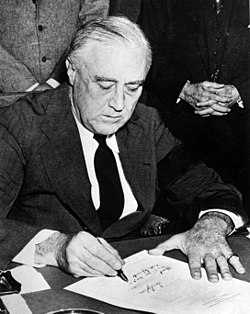 Roosevelt signing the declaration of war against Japan on December 8, 1941
 -
 Roosevelt signing the declaration of war against Germany on December 11, 1941
 -
 Roosevelt and Winston Churchill aboard HMS Prince of Wales for 1941 Atlantic Charter meeting


War plans
[edit]
In late December 1941, Churchill and Roosevelt met at the Arcadia Conference, which established a joint strategy between the U.S. and Britain. Both agreed on a Europe first strategy that prioritized the defeat of Germany before Japan. The U.S. and Britain established the Combined Chiefs of Staff to coordinate military policy and the Combined Munitions Assignments Board to coordinate the allocation of supplies.[272] An agreement was also reached to establish a centralized command in the Pacific theater called ABDA, named for the American, British, Dutch, and Australian forces in the theater.[273] On January 1, 1942, the United States and the other Allied Powers issued the Declaration by United Nations, in which each nation pledged to defeat the Axis powers.[274]
In 1942, Roosevelt formed a new body, the Joint Chiefs of Staff, which made the final decisions on American military strategy. Admiral Ernest J. King as Chief of Naval Operations commanded the Navy and Marines, while General George C. Marshall led the Army and was in nominal control of the Air Force, which in practice was commanded by General Hap Arnold.[275] The Joint Chiefs were chaired by Admiral William D. Leahy, the most senior officer in the military.[276] Roosevelt avoided micromanaging the war and let his top military officers make most decisions.[277] Roosevelt's civilian appointees handled the draft and procurement of men and equipment, but no civilians—not even the secretaries of War or Navy—had a voice in strategy. Roosevelt avoided the State Department and conducted high-level diplomacy through his aides, especially Harry Hopkins, whose influence was bolstered by his control of the Lend-Lease funds.[278]
Nuclear program
[edit]In August 1939, Leo Szilard and Albert Einstein sent the Einstein–Szilárd letter to Roosevelt, warning of the possibility of a German project to develop nuclear weapons. Szilard realized that the recently discovered process of nuclear fission could be used to create a weapon of mass destruction.[279] Roosevelt feared the consequences of allowing Germany to have sole possession of the technology and authorized preliminary research into nuclear weapons.[l] After Pearl Harbor, the Roosevelt administration secured funding to continue research and selected General Leslie Groves to oversee the Manhattan Project, which was charged with developing the first nuclear weapons. Roosevelt and Churchill agreed to jointly pursue the project, and Roosevelt helped ensure that American scientists cooperated with their British counterparts.[281]
Wartime conferences
[edit]
_(B%26W).jpg)
Roosevelt coined the term "Four Policemen" to refer to the "Big Four" Allied powers of World War II: the United States, the United Kingdom, the Soviet Union, and China. The "Big Three" of Roosevelt, Winston Churchill, and Soviet leader Joseph Stalin, together with Chinese Generalissimo Chiang Kai-shek, cooperated informally on a plan in which American and British troops concentrated in the West; Soviet troops fought on the Eastern front; and Chinese, British and American troops fought in Asia and the Pacific. The United States also continued to send aid via the Lend-Lease program to the Soviet Union and other countries. The Allies formulated strategy in a series of high-profile conferences as well as by contact through diplomatic and military channels.[282] Beginning in May 1942, the Soviets urged an Anglo-American invasion of German-occupied France to divert troops from the Eastern front.[283] Concerned that their forces were not yet ready, Churchill and Roosevelt decided to delay such an invasion until at least 1943 and instead focus on a landing in North Africa, known as Operation Torch.[284]
In November 1943, Roosevelt, Churchill, and Stalin met to discuss strategy and post-war plans at the Tehran Conference, where Roosevelt met Stalin for the first time.[285] Britain and the United States committed to opening a second front against Germany in 1944, while Stalin committed to entering the war against Japan at an unspecified date. Subsequent conferences at Bretton Woods and Dumbarton Oaks established the framework for the post-war international monetary system and the United Nations, an intergovernmental organization similar to the failed League of Nations.[286] Taking up the Wilsonian mantle, Roosevelt pushed the establishment of the United Nations as his highest postwar priority. Roosevelt expected it would be controlled by Washington, Moscow, London and Beijing, and would resolve all major world problems.[287]


Roosevelt, Churchill, and Stalin met for a second time at the February 1945 Yalta Conference in Crimea. With the end of the war in Europe approaching, Roosevelt's primary focus was convincing Stalin to enter the war against Japan; the Joint Chiefs had estimated that an American invasion of Japan would cause as many as one million American casualties. In return, the Soviet Union was promised control of Asian territories such as Sakhalin Island. The three leaders agreed to hold a conference in 1945 to establish the United Nations, and they also agreed on the structure of the United Nations Security Council, which would be charged with ensuring international security. Roosevelt did not push for the immediate evacuation of Soviet soldiers from Poland, but he won the issuance of the Declaration on Liberated Europe, which promised free elections in countries that had been occupied by Germany. Germany itself would not be dismembered but would be jointly occupied by the United States, France, Britain, and the Soviet Union.[288] Against Soviet pressure, Roosevelt and Churchill refused to consent to impose huge reparations and deindustrialization on Germany after the war.[289]
During March 1945, Roosevelt sent strongly worded messages to Stalin accusing him of breaking his Yalta commitments over Poland, Germany, prisoners of war, and other issues. When Stalin accused the Western Allies of plotting behind his back a separate peace with Hitler, Roosevelt replied: "I cannot avoid a feeling of bitter resentment towards your informers, whoever they are, for such vile misrepresentations of my actions or those of my trusted subordinates."[290]
Roosevelt's role in the Yalta Conference has been controversial; critics charge that he naively trusted the Soviet Union to allow free elections in Eastern Europe, while supporters argue that there was little more that Roosevelt could have done for the Eastern European countries given the Soviet occupation and the need for cooperation with the Soviet Union.[291][292]
Course of the war
[edit]The Allies invaded French North Africa in November 1942, securing the surrender of Vichy French forces within days of landing.[293] At the January 1943 Casablanca Conference, the Allies agreed to defeat Axis forces in North Africa and then launch an invasion of Sicily, with an attack on France to take place in 1944. At the conference, Roosevelt also announced that he would only accept the unconditional surrender of Germany, Japan, and Italy.[294] In February 1943, the Soviet Union won a major victory at the Battle of Stalingrad, and in May 1943, the Allies secured the surrender of over 250,000 German and Italian soldiers in North Africa, ending the North African Campaign.[295] The Allies launched an invasion of Sicily in July 1943, capturing the island the following month.[296] In September 1943, the Allies secured an armistice from Italian prime minister Pietro Badoglio, but Germany quickly restored Mussolini to power.[296] The Allied invasion of mainland Italy commenced in September 1943, but the Italian Campaign continued until 1945 as German and Italian troops resisted the Allied advance.[297]

To command the invasion of France, Roosevelt chose General Dwight D. Eisenhower, who had successfully commanded a multinational coalition in North Africa and Sicily.[298] Eisenhower launched Operation Overlord on June 6, 1944. Supported by 12,000 aircraft and the largest naval force ever assembled, the Allies successfully established a beachhead in Normandy and then advanced further into France.[277] Though reluctant to back an unelected government, Roosevelt recognized Charles de Gaulle's Provisional Government of the French Republic as the de facto government of France in July 1944. After most of France had been liberated, Roosevelt granted formal recognition to de Gaulle's government in October 1944.[299] Over the following months, the Allies liberated more territory and began the invasion of Germany. By April 1945, Nazi resistance was crumbling in the face of advances by both the Western Allies and the Soviet Union.[300]
In the opening weeks of the war, Japan conquered the Philippines and the British and Dutch colonies in Southeast Asia. The Japanese advance reached its maximum extent by June 1942, when the U.S. Navy scored a decisive victory at the Battle of Midway. American and Australian forces then began a slow and costly strategy called island hopping or leapfrogging through the Pacific Islands, with the objective of gaining bases from which strategic airpower could be brought to bear on Japan and from which Japan could ultimately be invaded. In contrast to Hitler, Roosevelt took no direct part in the tactical naval operations, though he approved strategic decisions.[301] Roosevelt gave way in part to insistent demands from the public and Congress that more effort be devoted against Japan, but he always insisted on Germany first. The strength of the Japanese navy was decimated in the Battle of Leyte Gulf, and by April 1945 the Allies had re-captured much of their lost territory in the Pacific.[302]
Home front
[edit]The home front was subject to dynamic social changes throughout the war, though domestic issues were no longer Roosevelt's most urgent policy concern. The military buildup spurred economic growth. Unemployment fell from 7.7 million in spring 1940 to 3.4 million in fall 1941 and to 1.5 million in fall 1942, out of a labor force of 54 million.[m] There was a growing labor shortage, accelerating the second wave of the Great Migration of African Americans, farmers and rural populations to manufacturing centers. African Americans from the South went to California and other West Coast states for new jobs in the defense industry. To pay for increased government spending, in 1941 Roosevelt proposed that Congress enact an income tax rate of 99.5% on all income over $100,000; when the proposal failed, he issued an executive order imposing an income tax of 100% on income over $25,000, which Congress rescinded.[304] The Revenue Act of 1942 instituted top tax rates as high as 94% (after accounting for the excess profits tax), greatly increased the tax base, and instituted the first federal withholding tax.[305] In 1944, Roosevelt requested that Congress enact legislation to tax all "unreasonable" profits, both corporate and individual, and thereby support his declared need for over $10 billion in revenue for the war and other government measures. Congress overrode Roosevelt's veto to pass a smaller revenue bill raising $2 billion.[306]
In 1942, war production increased dramatically but fell short of Roosevelt's goals, due in part to manpower shortages.[307] The effort was also hindered by numerous strikes, especially in the coal mining and railroad industries, which lasted well into 1944.[308][309] Nonetheless, between 1941 and 1945, the United States produced 2.4 million trucks, 300,000 military aircraft, 88,400 tanks, and 40 billion rounds of ammunition. The production capacity of the United States dwarfed that of other countries; for example, in 1944, the United States produced more military aircraft than the combined production of Germany, Japan, Britain, and the Soviet Union.[310] The White House became the ultimate site for labor mediation, conciliation or arbitration. One particular battle royale occurred between Vice President Wallace, who headed the Board of Economic Warfare, and Jesse H. Jones, in charge of the Reconstruction Finance Corporation; both agencies assumed responsibility for the acquisition of rubber supplies and came to loggerheads over funding. Roosevelt resolved the dispute by dissolving both agencies.[311] In 1943, Roosevelt established the Office of War Mobilization to oversee the home front; the agency was led by James F. Byrnes, who came to be known as the "assistant president" due to his influence.[296]
Roosevelt's 1944 State of the Union Address advocated that Americans should think of basic economic rights as a Second Bill of Rights.[312] He stated that all Americans should have the right to "adequate medical care", "a good education", "a decent home", and a "useful and remunerative job".[313] In the most ambitious domestic proposal of his third term, Roosevelt proposed the G.I. Bill, which would create a massive benefits program for returning soldiers. Benefits included post-secondary education, medical care, unemployment insurance, job counseling, and low-cost loans for homes and businesses. The G.I. Bill passed unanimously in both houses of Congress and was signed into law in June 1944. Of the fifteen million Americans who served in World War II, more than half benefitted from the educational opportunities provided for in the G.I. Bill.[314]
Towards the end of his presidency, Roosevelt supported the idea of forming a new liberal party with former liberal Republican presidential candidate Wendell Willkie (who himself put forward this proposal), believing that there should be two ideologically distinct parties in America; one liberal and one conservative. [315]
Declining health
[edit]Roosevelt, a chain-smoker throughout his adult life,[316][317] had been in declining health since at least 1940. In March 1944, shortly after his 62nd birthday, he underwent testing at Bethesda Hospital and was found to have hypertension, atherosclerosis, coronary artery disease causing angina pectoris, and congestive heart failure.[318][319][320]
Hospital physicians and two outside specialists ordered Roosevelt to rest. His personal physician, Admiral Ross McIntire, created a daily schedule that banned business guests for lunch and incorporated two hours of rest daily. During the 1944 re-election campaign, McIntire denied several times that Roosevelt's health was poor; on October 12, for example, he announced that "The President's health is perfectly OK. There are absolutely no organic difficulties at all."[321] Roosevelt realized that his declining health could eventually make it impossible for him to continue as president, and in 1945 he told a confidant that he might resign from the presidency following the end of the war.[322]
Election of 1944
[edit]
While some Democrats had opposed Roosevelt's nomination in 1940, the president faced little difficulty in securing his re-nomination at the 1944 Democratic National Convention. Roosevelt made it clear before the convention that he was seeking another term, and on the lone presidential ballot of the convention, Roosevelt won the vast majority of delegates, although a minority of Southern Democrats voted for Harry F. Byrd. Party leaders prevailed upon Roosevelt to drop Vice President Wallace from the ticket, believing him to be an electoral liability and a poor potential successor in case of Roosevelt's death. Roosevelt preferred Byrnes as Wallace's replacement but was convinced to support Senator Harry S. Truman of Missouri, who had earned renown for his investigation of war production inefficiency and was acceptable to the various factions of the party. On the second vice presidential ballot of the convention, Truman defeated Wallace to win the nomination.[323]
The Republicans nominated Thomas E. Dewey, the governor of New York, who had a reputation as a liberal in his party. They accused the Roosevelt administration of domestic corruption and bureaucratic inefficiency, but Dewey's most effective gambit was to raise discreetly the age issue. He assailed the President as a "tired old man" with "tired old men" in his cabinet, pointedly suggesting that the President's lack of vigor had produced a less than vigorous economic recovery.[134] Roosevelt, as most observers could see from his weight loss and haggard appearance, was a tired man in 1944. But upon entering the campaign in earnest in late September 1944, Roosevelt displayed enough passion to allay most concerns and deflect Republican attacks. With the war still raging, he urged voters not to "change horses in mid-stream".[134] Labor unions, which had grown rapidly in the war, fully supported Roosevelt. Roosevelt and Truman won the 1944 election, defeating Dewey and his running mate John W. Bricker with 53.4% of the popular vote and 432 out of the 531 electoral votes.[324] The president campaigned in favor of a strong United Nations, so his victory symbolized support for the nation's future participation in the international community.[325]
Final months and death
[edit]


When Roosevelt returned to the United States from the Yalta Conference, everyone was shocked to see how old, thin and frail he looked. In his address to Congress he spoke while seated, an unprecedented concession to his physical incapacity.[326] On March 29, 1945, Roosevelt departed for the Little White House in Warm Springs, Georgia, to rest before his anticipated appearance at the founding conference of the United Nations.[327]
In the afternoon of April 12, 1945, in Warm Springs, Georgia, while sitting for a portrait by Elizabeth Shoumatoff, Roosevelt said: "I have a terrific headache." He then slumped forward in his chair, unconscious, and was carried into his bedroom. The president's attending cardiologist, Howard Bruenn, diagnosed a massive intracerebral hemorrhage.[328] At 3:35 p.m., Roosevelt died at the age of 63.[329]
Roosevelt's body was placed in a flag-draped coffin and loaded onto the Ferdinand Magellan presidential train for the trip back to Washington.[330] Due to the U.S. still being in a state of war, a state funeral was deemed inappropriate and a smaller ceremony was opted for instead. Despite this, thousands flocked to the route to pay their respects.[331]
Rather than lying in state at the United States Capitol as per tradition, Roosevelt's remains were placed in the White House East Room where, on April 14, a simple funeral service was held that was attended by his family, high government officials, and foreign ambassadors. Roosevelt was then transported by train from Washington to his birthplace at Hyde Park. On April 15 he was buried, per his wish, in the rose garden of his Springwood estate.[332][333]
His death was met with shock and grief across the world.[334] Germany surrendered during the 30-day mourning period, but Harry Truman (who had succeeded Roosevelt as president) ordered flags to remain at half-staff; he also dedicated Victory in Europe Day and its celebrations to Roosevelt's memory.[335] World War II ended with the signed surrender of Japan in September.[336]
Roosevelt's declining physical health had been kept secret from the public, just as his wheelchair was kept a secret from the public. Although he was allowed to work only four hours a day, the illusion of activity was kept up.[337] In the scholarly book, The Dying President: Franklin D. Roosevelt, 1944–1945 by Robert Ferrell, the extent to which the president and his top aides went to keep the public in the dark about decline is explored, as well as the political and diplomatic problems that arose both from the illness and the secrecy.[338] It argues that Roosevelt was too sick to have remained in office, and that his inability to work led to critical foreign-policy mistakes in 1944–1945, as well as a failure to prepare Vice President Harry S. Truman to take over. What little energy he had for presidential affairs he focused on building support for the new United Nations.[339]
Civil rights, repatriation, internment, and the Holocaust
[edit]
From his first term until 1939, the Mexican Repatriation started by President Herbert Hoover continued under Roosevelt, which scholars today contend was a form of ethnic cleansing towards Mexican Americans. Roosevelt ended federal involvement in the deportations. After 1934, deportations fell by approximately 50 percent.[340] However, Roosevelt did not attempt to suppress the deportations on a local or state level.[341][342] Mexican Americans were the only group explicitly excluded from New Deal benefits. The deprival of due process for Mexican Americans is cited as a precedent for Roosevelt's internment of Japanese Americans in concentration camps during World War II.[343] Roosevelt won strong support from Chinese Americans and Filipino Americans, but not Japanese Americans, as he presided over their internment during the war.[344] African Americans and Native Americans fared well in two New Deal relief programs, the Civilian Conservation Corps and the Indian Reorganization Act, respectively. Sitkoff reports that the WPA "provided an economic floor for the whole black community in the 1930s, rivaling both agriculture and domestic service as the chief source" of income.[345]
Lynching and civil rights
[edit]In contrast to Presidents Harding and Coolidge, Roosevelt stopped short of joining NAACP leaders in pushing for federal anti-lynching legislation. He asserted that such legislation was unlikely to pass and that his support for it would alienate Southern congressmen, though by 1940 even his conservative Texan vice-president, Garner, supported federal action against lynching.[346]
Roosevelt did not appoint or nominate a single African American as secretary or assistant secretary to his cabinet. About one hundred African Americans met informally, however, to provide the administration with advice on issues related to African Americans. Although sometimes described as a "Black Cabinet", Roosevelt never officially acknowledged it as such nor did he make "appointments" to it.[347]
Although African American sprinter Jesse Owens had won 4 gold medals for the United States in the 1936 Olympic Games, Roosevelt never congratulated Owens or invited him to the White House to celebrate his triumphs.[348] When the Democrats bid for his support, Owens rejected those overtures and endorsed Alf Landon, Roosevelt's Republican opponent in the 1936 presidential race.[349][350]
First Lady Eleanor Roosevelt vocally supported efforts designed to aid the African American community, including the Fair Labor Standards Act, which helped boost wages for nonwhite workers in the South.[351] In 1941, Roosevelt established the Fair Employment Practices Committee (FEPC) to implement Executive Order 8802, which prohibited racial and religious discrimination in employment among defense contractors. The FEPC was the first national program directed against employment discrimination, and it played a major role in opening up new employment opportunities to nonwhite workers. During World War II, the proportion of African American men employed in manufacturing positions rose significantly.[352] In response to Roosevelt's policies, African Americans increasingly defected from the Republican Party during the 1930s and 1940s, becoming an important Democratic voting bloc in several Northern states.[347]
Japanese Americans
[edit]The attack on Pearl Harbor raised concerns among the public regarding the possibility of sabotage by Japanese Americans. This suspicion was fed by long-standing racism against Japanese immigrants and the findings of the Roberts Commission, which concluded that the attack on Pearl Harbor had been assisted by Japanese spies. On February 19, 1942, Roosevelt signed Executive Order 9066, which relocated 110,000 Japanese-American citizens and immigrants, most of whom lived on the Pacific Coast.[154] They were forced to liquidate their properties and businesses and interned in hastily built camps in interior, harsh locations.[citation needed]
Roosevelt delegated the decision for internment to Secretary of War Stimson, who in turn relied on the judgment of Assistant Secretary of War John J. McCloy. The Supreme Court upheld the constitutionality of the executive order in the 1944 case of Korematsu v. United States.[353] A much smaller number of German and Italian citizens were arrested or placed into internment camps. Unlike Japanese Americans, however, they were not sent to them on the sole basis of racial ancestry.[354][355]
The Holocaust
[edit]There is controversy among historians about Roosevelt's attitude to Jews and the Holocaust. Arthur M. Schlesinger Jr. says Roosevelt "did what he could do" to help Jews; David Wyman says Roosevelt's record on Jewish refugees and their rescue is "very poor" and one of the worst failures of his presidency.[356] In 1923, as a member of the Harvard University board of directors, Roosevelt decided there were too many Jewish students at Harvard and helped institute a quota to limit the number of Jews admitted.[357] After Kristallnacht in 1938, Roosevelt had his ambassador to Germany recalled to Washington. He did not loosen immigration quotas but did allow German Jews already in the U.S. on visas to stay indefinitely.[358] According to Rafael Medoff, Roosevelt could have saved 190,000 Jewish lives by telling his State Department to fill immigration quotas to the legal limit, but his administration discouraged and disqualified Jewish refugees based on its prohibitive requirements that left less than 25% of the quotas filled.[357]
Adolf Hitler chose to implement the "Final Solution"—the extermination of the European Jewish population—by January 1942, and American officials learned of the scale of the Nazi extermination campaign in the following months. Against the objections of the State Department, Roosevelt convinced the other Allied leaders to issue the Joint Declaration by Members of the United Nations, which condemned the ongoing Holocaust and warned to try its perpetrators as war criminals. In 1943, Roosevelt told U.S. government officials that there should be limits on Jews in various professions to "eliminate the specific and understandable complaints which the Germans bore towards the Jews in Germany."[357] The same year, Roosevelt was personally briefed by Polish Home Army intelligence agent Jan Karski who was an eyewitness of the Holocaust; pleading for action, Karski told him that 1.8 million Jews had already been exterminated.[359][360] Karski recalled that Roosevelt "did not ask one question about the Jews".[361] In January 1944, Roosevelt established the War Refugee Board to aid Jews and other victims of Axis atrocities. Aside from these actions, Roosevelt believed that the best way to help the persecuted populations of Europe was to end the war as quickly as possible. Top military leaders and War Department leaders rejected any campaign to bomb the extermination camps or the rail lines leading to them, fearing it would be a diversion from the war effort. According to biographer Jean Edward Smith, there is no evidence that anyone ever proposed such a campaign to Roosevelt.[362]
Legacy
[edit]| Part of a series on |
| Liberalism in the United States |
|---|
 |


| Part of a series on |
| Progressivism in the United States |
|---|
 |

Historical reputation
[edit]Roosevelt is widely considered to be one of the most important figures in U.S. history,[363] and one of the most influential figures of the 20th century.[364] Historians and political scientists consistently rank him, George Washington, and Abraham Lincoln as the three greatest presidents, although the order varies.[365][366][367][368] Reflecting on Roosevelt's presidency, "which brought the United States through the Great Depression and World War II to a prosperous future", biographer Jean Edward Smith said in 2007, "He lifted himself from a wheelchair to lift the nation from its knees."[369]
His commitment to the working class and unemployed in need of relief in the nation's longest recession made him a favorite of blue-collar workers, labor unions, and ethnic minorities.[370] The rapid expansion of government programs that occurred during Roosevelt's term redefined the role of government in the United States, and Roosevelt's advocacy for government social programs was instrumental in redefining liberalism for coming generations.[371] Roosevelt firmly established U.S. leadership on the world stage with his role in shaping and financing World War II. His isolationist critics faded away, and even the Republicans joined in his overall policies.[372] He also permanently increased the power of the president at the expense of Congress.[373]
His Second Bill of Rights became, according to historian Joshua Zeitz, "the basis of the Democratic Party's aspirations for the better part of four decades".[313] After his death, Eleanor continued to be a forceful presence in U.S. and world politics, serving as delegate to the conference which established the United Nations and championing civil rights and liberalism generally. Some junior New Dealers played leading roles in the presidencies of Truman, John F. Kennedy, and Lyndon B. Johnson. Kennedy came from a Roosevelt-hating family. Historian William Leuchtenburg says that before 1960, "Kennedy showed a conspicuous lack of inclination to identify himself as a New Deal liberal." He adds, as president, "Kennedy never wholly embraced the Roosevelt tradition and at times he deliberately severed himself from it."[374] By contrast, young Lyndon Johnson had been an enthusiastic New Dealer and a favorite of Roosevelt. Johnson modelled his presidency on Roosevelt's.[375][376]
During his presidency, and continuing to a lesser extent afterwards, there has been much criticism of Roosevelt, some of it intense. Critics have questioned not only his policies, positions, and the consolidation of power that occurred due to his responses to the Depression and World War II but also his breaking with tradition by running for a third term as president.[377] Long after his death, new lines of attack criticized Roosevelt's policies regarding helping the Jews of Europe,[378] incarcerating the Japanese on the West Coast,[379] and opposing anti-lynching legislation.[380]
Roosevelt was criticized by conservatives for his economic policies, especially the shift in tone from individualism to collectivism with the expansion of the welfare state and regulation of the economy. Those criticisms continued decades after his death. One factor in the revisiting of these issues was the election of Ronald Reagan in 1980, who opposed the New Deal.[381][382] Roosevelt's issuance of Executive Order 6102, which mandated the largest gold confiscation in American history, remains controversial to gold investors.[165]
Memorials
[edit]Roosevelt's home in Hyde Park is now a National Historic Site and home to his Presidential library. Washington, D.C., hosts two memorials: the 7+1⁄2-acre (3-hectare) Roosevelt Memorial, located next to the Jefferson Memorial on the Tidal Basin,[383] and a more modest memorial, a block of marble in front of the National Archives building suggested by Roosevelt himself, erected in 1965.[384] Roosevelt's leadership in the March of Dimes is one reason he is commemorated on the American dime.[385] Roosevelt has also appeared on several U.S. Postage stamps.[386] On April 29, 1945, seventeen days after Roosevelt's death, the carrier USS Franklin D. Roosevelt was launched and served from 1945 to 1977.[387] London's Westminster Abbey also has a stone tablet memorial to Roosevelt that was unveiled by Attlee and Churchill in 1948.[388] Welfare Island was renamed after Roosevelt in September 1973.[389]
-
 1948 statue of Roosevelt in Grosvenor Square, London
 -
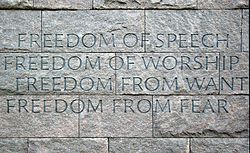 Engraving of the Four Freedoms at the Franklin Delano Roosevelt Memorial, dedicated in 1997 in Washington, D.C.
 -
 Set of four stamps honoring FDR, issued only two months after his death in 1945


Works
[edit] |
See also
[edit]- Air Mail scandal – 1934 US political scandal
- August Adolph Gennerich – Roosevelt's bodyguard
- Cultural depictions of Franklin D. Roosevelt
- List of Allied World War II conferences
- List of presidents of the United States
- List of presidents of the United States by previous experience
- Sunshine Special – Roosevelt's limousine
Notes
[edit]- ^ Pronounced /ˈdɛlənoʊ ˈroʊzəvɛlt, -vəlt/ DEL-ə-noh ROH-zə-velt, -vəlt.[1]
- ^ In 2008, Columbia awarded Roosevelt a posthumous Juris Doctor degree.[26]
- ^ State legislatures elected United States senators prior to the ratification of the Seventeenth Amendment in 1913.
- ^ Roosevelt was the last president inaugurated on March 4. The Twentieth Amendment changed presidential inaugurations to January 20, from 1937.
- ^ Biographer Jean Edward Smith notes that "the significance of the repeal of the two-thirds rule...is difficult to overstate. Not only did the power of the South in the Democratic party diminish, but without the repeal, it is open to question whether FDR could have been renominated in 1940."[185]
- ^ The 1964 Democratic ticket of Lyndon B. Johnson and Hubert Humphrey would later set a new record, taking 61.1% of the popular vote
- ^ The two Justices who Roosevelt did not originally appoint to the Court were Harlan Fiske Stone and Owen Roberts. However, in 1941, Roosevelt elevated Stone to the position of Chief Justice.
- ^ This table shows the estimated unemployment related as calculated by two economists. Michael Darby's estimate counts individuals on work relief programs as employed, while Stanley Lebergott's estimate counts individuals on work relief programs as unemployed[211]
- ^ The Twenty-second Amendment ratified in 1951, would bar any individual from winning more than two presidential elections.
- ^ Hull and others in the administration were unwilling to recognize the Japanese conquest of China and feared that an American accommodation with Japan would leave the Soviet Union vulnerable to a two-front war.[264]
- ^ The United States would also declare war on Bulgaria, Hungary, and Romania, all of which had joined the Axis bloc.
- ^ The Germans stopped research on nuclear weapons in 1942, choosing to focus on other projects. Japan gave up its own program in 1943.[280]
- ^ WPA workers were counted as unemployed by this set of statistics.[303]
References
[edit]Citations
[edit]- ^ "Roosevelt". The American Heritage Dictionary of the English Language (5th ed.). HarperCollins.
- ^ "When was the term United Nations first used?". United Nations. Retrieved December 14, 2023.
- ^ a b Burns 1956, p. 7.
- ^ a b Smith 2007, pp. 5–6.
- ^ Leuchtenburg 2015, p. 16.
- ^ Lash 1971, p. 111.
- ^ Burns 1956, p. 4.
- ^ Smith 2007, p. 110.
- ^ Black 2005, p. 21.
- ^ Smith 2007, pp. 20–25.
- ^ "FDR Biography-The Early Years". Roosevelt Library and Museum. Retrieved January 25, 2022.
- ^ a b c d Leuchtenburg, William E. (September 26, 2016). "FDR: Life Before the Presidency". Univ. of Virginia Miller Center of Public Affairs. Retrieved January 25, 2022.
- ^ Burns 1956, p. 16.
- ^ Gunther 1950, p. 174.
- ^ "Family of Wealth Gave Advantages". The New York Times. April 15, 1945. Retrieved December 20, 2012.
- ^ Gunther 1950, p. 176.
- ^ "Almanac: The 1st cheerleader". CBS News. November 2, 2014. Retrieved December 1, 2019.
- ^ Gunther 1950, p. 175.
- ^ Burns 1956, pp. 18, 20.
- ^ Dallek 2017, pp. 28–29.
- ^ Burns 1956, p. 24.
- ^ "FDR Biography". Franklin D. Roosevelt Presidential Library and Museum.
- ^ Leuchtenburg, William E. (October 4, 2016). "Franklin D. Roosevelt: Life Before the Presidency". Miller Center of Public Affairs.
- ^ "DECEASED members 1904 to 23 May 2007 - The Explorers Club". YUMPU. Retrieved October 19, 2024.
- ^ Burns 1956, p. 28.
- ^ "Presidents Roosevelt Honored With Posthumous Columbia Degrees". New York Sun. September 26, 2008. Archived from the original on April 6, 2018. Retrieved April 6, 2018.
- ^ Dallek 2017, pp. 38–39.
- ^ "Franklin D. Roosevelt". Smithsonian National Postal Museum. Retrieved May 31, 2025.
- ^ Rowley 2010, pp. 3–6.
- ^ Burns 1956, p. 26.
- ^ Dallek 2017, pp. 35–36.
- ^ Smith 2007, pp. 54–55.
- ^ Burns 1956, pp. 77–79.
- ^ Smith 2007, pp. 57–58.
- ^ Abate, Frank R. (1999). The Oxford Desk Dictionary of People and Places. Oxford University Press. p. 329. ISBN 978-0-19-513872-6.
- ^ Smith 2007, p. 153.
- ^ Smith 2007, p. 160.
- ^ Winkler 2006, pp. 28, 38, 48–49.
- ^ Winkler 2006, pp. 202–03.
- ^ Gunther 1950, p. 195.
- ^ McGrath, Charles (April 20, 2008). "No End of the Affair". The New York Times.
- ^ "Lucy Page Mercer Rutherfurd". Eleanor Roosevelt Papers. Archived from the original on March 4, 2010. Retrieved February 7, 2010.
- ^ Tully 2005, p. 340.
- ^ Goodwin 1995, p. 153.
- ^ Rowley 2010, p. 254.
- ^ Smith 2007, pp. 58–60.
- ^ a b Dallek 2017, p. 41.
- ^ Smith 2007, pp. 60–62.
- ^ Smith 2007, pp. 60–64.
- ^ Smith 2007, p. 65.
- ^ Smith 2007, pp. 65–66.
- ^ Gunther 1950, pp. 202–03.
- ^ a b Burns 1956, p. 34.
- ^ Smith 2007, pp. 68–69.
- ^ Brands 2009, pp. 57–60.
- ^ Gunther 1950, pp. 205–06.
- ^ Corcoran, Syndney (April 7, 2022). "Franklin D. Roosevelt | Grand Lodge of Ohio". Freemasonry. Retrieved January 23, 2025.
- ^ Burns 1956, p. 49.
- ^ Black 2005, pp. 62–63.
- ^ Burns 1956, pp. 44–46.
- ^ Burns 1956, p. 43.
- ^ Smith 2007, pp. 97–101.
- ^ Burns 1956, p. 51.
- ^ J. Simon Rofe, " 'Under the Influence of Mahan': Theodore and Franklin Roosevelt and their Understanding of American National Interest." Diplomacy & Statecraft 19.4 (2008): 732–45.
- ^ Smith 2007, pp. 102–06.
- ^ Smith 2007, pp. 113–14.
- ^ Burns 1956, p. 52.
- ^ Gunther 1950, p. 212.
- ^ Smith 2007, pp. 122–23.
- ^ Burns 1956, p. 56.
- ^ Burns 1956, pp. 57, 60.
- ^ Smith 2007, p. 125.
- ^ Smith 2007, pp. 125–26.
- ^ Dallek 2017, pp. 59–61.
- ^ Smith 2007, pp. 130–32.
- ^ Dallek 2017, pp. 62–63.
- ^ Dallek 2017, pp. 65–66.
- ^ Smith 2007, pp. 139–40.
- ^ a b O'Brien, Phillips (August 10, 2024). "Franklin Roosevelt was made in world war one". The Spectator. Retrieved August 10, 2024.
- ^ Goldman & Goldman 2017, p. 15.
- ^ Smith 2007, pp. 171–72.
- ^ Underwood 1991, p. 11.
- ^ Smith 2007, pp. 176–77.
- ^ Smith 2007, pp. 177–81.
- ^ Burns 1956, p. 73.
- ^ Gunther 1950, pp. 215–16.
- ^ Smith 2007, p. 181.
- ^ Smith 2007, pp. 181–82.
- ^ Smith 2007, pp. 175–76.
- ^ Burns 1956, p. 74.
- ^ Smith 2007, pp. 182–83.
- ^ a b Smith 2007, pp. 184–85.
- ^ Goldman AS, Schmalstieg EJ, Freeman DH, Goldman DA, Schmalstieg FC (2003). "What was the cause of Franklin Delano Roosevelt's paralytic illness?" (PDF). Journal of Medical Biography. 11 (4): 232–40. doi:10.1177/096777200301100412. ISSN 0967-7720. PMID 14562158. S2CID 39957366. Archived (PDF) from the original on November 30, 2012. Retrieved July 4, 2017.
- ^ Alter 2006, p. 355.
- ^ Lomazow, Steven; Fettmann, Eric (2010). FDR's Deadly Secret. p. 27.
- ^ Rose, David M. (2016). Friends and Partners: The Legacy of Franklin D. Roosevelt and Basil O'Connor in the History of Polio. p. 179.
- ^ Wooten, Heather Green (2009). The Polio Years in Texas. p. 192.
- ^ Smith 2007, pp. 195–96.
- ^ Rowley 2010, p. 125.
- ^ Rowley 2010, p. 120.
- ^ Ward & Burns 2014, p. 332.
- ^ Smith 2007, p. 220.
- ^ Smith 2007, pp. 213–14.
- ^ Smith 2007, pp. 215–19.
- ^ Smith 2007, pp. 255–56.
- ^ Dallek 2017, pp. 87–88.
- ^ Dallek 2017, pp. 87–96.
- ^ Morgan 1985, pp. 267, 269–72, 286–87.
- ^ Black 2005, pp. 160–67.
- ^ a b c d Caro 1974, pp. 289–91.
- ^ F. Roosevelt, E. Roosevelt, p. 21.
- ^ Smith 2007, p. 231.
- ^ Conrad Black, Franklin Delano Roosevelt: champion of freedom (Hachette UK, 2012) p 160.
- ^ Selig Adler, The isolationist impulse: its 20th-century reaction (1957) pp 200–201.
- ^ Burns 1956, p. 100.
- ^ Dallek 2017, pp. 96–98.
- ^ Smith 2007, pp. 223–25.
- ^ Smith 2007, pp. 225–28.
- ^ Burns 1956, p. 101.
- ^ Smith 2007, p. 229.
- ^ Smith 2007, pp. 237–38.
- ^ Smith 2007, pp. 230–33.
- ^ Smith 2007, pp. 235–37.
- ^ Smith 2007, pp. 238–39.
- ^ Smith 2007, pp. 240–41.
- ^ Smith 2007, pp. 242–43.
- ^ Burns 1956, pp. 119–20.
- ^ Burns 1956, p. 121.
- ^ Smith 2007, pp. 250–52.
- ^ "Franklin D. Roosevelt". The Official Website of New York State. Retrieved August 4, 2024.
- ^ "History Of State Forest Program". New York State Department of Environmental Conservation. Retrieved June 28, 2021.
- ^ Allen, Oliver E. (1993). The Tiger: The Rise and Fall of Tammany Hall. Addison-Wesley Publishing Company. pp. 233–50. ISBN 978-0-201-62463-2.
- ^ Smith 2007, pp. 261–63.
- ^ a b c d e f g h i j k l Leuchtenburg, William E. (October 4, 2016). "FDR: Campaigns and Elections". Univ. of Virginia Miller Center of Public Affairs. Retrieved January 28, 2022.
- ^ Brands 2009, pp. 232–36, 246–51.
- ^ Burns 1956, p. 139.
- ^ Smith 2007, pp. 276–77.
- ^ Smith 2007, pp. 266–67.
- ^ Smith 2007, p. 278.
- ^ Smith 2007, p. 279.
- ^ Smith 2007, pp. 282–84.
- ^ Leuchtenburg 1963, pp. 183–96.
- ^ Sternsher 1975, pp. 127–49.
- ^ Campbell 2006, pp. 127–49.
- ^ Smith 2007, pp. 290–91.
- ^ Burns 1956, p. 146.
- ^ Smith 2007, pp. 292–95.
- ^ Burns 1956, p. 147.
- ^ Davidson, Amy (May 5, 2012). "The FDR New Yorker cover that never ran". The New Yorker.
- ^ Burns 1970, pp. 347–48.
- ^ Alter 2006, p. 190.
- ^ Burns 1956, pp. 157, 167–68.
- ^ Tobin 2013, pp. 4–7.
- ^ a b c d e f g h i j Leuchtenburg, William E. (October 4, 2016). "FDR: Domestic Affairs". Univ. of Virginia Miller Center of Public Affairs. Retrieved January 29, 2022.
- ^ Leuchtenburg 2015, pp. 147–48.
- ^ Smith 2007, p. 312.
- ^ Liptak, Kevin (April 23, 2017). "History of measuring presidents' first 100 days". CNN. Retrieved October 9, 2017.
- ^ Leuchtenburg 2015, pp. 151–52.
- ^ a b Smith 2007, p. 322.
- ^ Smith 2007, pp. 318–23.
- ^ Hawley 1995, p. 124.
- ^ Smith 2007, pp. 331–32.
- ^ Smith 2007, p. 346.
- ^ Savage 1991, p. 160.
- ^ a b Traynor, Ben (April 3, 2013). "Roosevelt's gold confiscation: could it happen again?". The Daily Telegraph. Retrieved June 12, 2025.
- ^ Freidel 1952–1973, pp. 4, 320–39.
- ^ Freidel 1952–1973, pp. 4, 448–52.
- ^ Dallek 2017, p. 249.
- ^ Hausman, Joshua K. (April 2016). "Fiscal Policy and Economic Recovery: The Case of the 1936 Veterans' Bonus" (PDF). American Economic Review. 106 (4): 1100–43. doi:10.1257/aer.20130957. Archived from the original (PDF) on October 31, 2014. Retrieved October 22, 2014.
- ^ Smith 2007, pp. 349–51.
- ^ Social Security History. Ssa.gov. Retrieved July 14, 2013.
- ^ Norton 2009, p. 670.
- ^ Smith 2007, p. 353.
- ^ Smith 2007, pp. 353–56.
- ^ Kennedy 1999, p. 291.
- ^ Colin Gordon, New Deals: Business, Labor, and Politics in America, 1920–1935 (1994) p. 225
- ^ Brands 2009, pp. 463–67.
- ^ a b Fried 2001, pp. 120–23.
- ^ Burns 1956, p. 350.
- ^ Burns 1956, p. 226.
- ^ Roosevelt, Franklin Delano (1933). Looking forward. John Day. p. 141.
- ^ Smith 2007, pp. 364–66.
- ^ Smith 2007, pp. 371–72.
- ^ Smith 2007, pp. 360–61.
- ^ Smith 2007, p. 366.
- ^ Burns 1956, p. 284.
- ^ Smith 2007, pp. 373–75.
- ^ Mary E. Stuckey (2015). Voting Deliberatively: FDR and the 1936 Presidential Campaign. Penn State UP. p. 19. ISBN 978-0-271-07192-3.
- ^ Kalman, Laura (October 2005). "The Constitution, the Supreme Court, and the New Deal". The American Historical Review. 110 (4): 1052–80. doi:10.1086/ahr.110.4.1052.
- ^ Smith 2007, pp. 379–82.
- ^ Burns 1956, p. 312.
- ^ Smith 2007, pp. 384–89.
- ^ Leuchtenburg, William E. (May 2005). "When Franklin Roosevelt Clashed with the Supreme Court – and Lost". Smithsonian Magazine. Retrieved March 1, 2016.
- ^ Leuchtenburg, E. (1996). The Supreme Court Reborn: The Constitutional Revolution in the Age of Roosevelt. Oxford University Press. ISBN 0-19-511131-1
- ^ Blake, John (December 14, 2010). "How FDR unleashed his Supreme Court 'scorpions'". CNN. Retrieved October 10, 2017.
- ^ Belknap, Michal (2004). The Vinson Court: Justices, Rulings, and Legacy. ABC-CLIO. pp. 162–63. ISBN 978-1-57607-201-1. Retrieved March 3, 2016.
- ^ Smith 2007, pp. 390–91.
- ^ Smith 2007, pp. 408–09.
- ^ Leuchtenburg 2015, pp. 187–88.
- ^ Burns 1956, p. 320.
- ^ Leuchtenburg 1963, pp. 262–63, 271–73.
- ^ Smith 2007, pp. 440–41.
- ^ Dallek 2017, p. 19.
- ^ See also Edgar B. Nixon, ed. Franklin D. Roosevelt and Conservation, 1911-1945 (2 vol. 1957); vol 1 online; also see vol 2 online
- ^ "FDR's Conservation Legacy (U.S. National Park Service)". nps.gov. Retrieved June 28, 2021.
- ^ Leshy, John (2009). "FDR's Expansion of Our National Patrimony: A Model for Leadership". In Woolner, David; Henderson, Henry L. (eds.). FDR and the Environment. Springer. pp. 177–78. ISBN 978-0-230-10067-1.
- ^ "The National Parks: America's Best Idea: History Episode 5: 1933–1945". PBS. Archived from the original on September 28, 2009. Retrieved April 23, 2016.
- ^ Brinkley 2016, pp. 170–86.
- ^ Maher, Neil M. (July 2002). "A New Deal Body Politic: Landscape, Labor, and the Civilian Conservation Corps" (PDF). Environmental History. 7 (3): 435–61. Bibcode:2002EnvH....7..435M. doi:10.2307/3985917. JSTOR 3985917. S2CID 144800756. Archived (PDF) from the original on June 2, 2016.
- ^ Anna L. Riesch Owen, Conservation Under FDR (Praeger, 1983).
- ^ a b Margo, Robert A. (Spring 1993). "Employment and Unemployment in the 1930s". Journal of Economic Perspectives. 7 (2): 42–43. CiteSeerX 10.1.1.627.1613. doi:10.1257/jep.7.2.41. S2CID 26369842.
- ^ a b Historical Statistics of the United States, Colonial Times to 1970. The Bureau of the U.S. Census. 1976. pp. Y457, Y493, F32.
- ^ "Presidents and Job Growth" (GIF). The New York Times (graphic). July 2, 2003.
- ^ Historical Statistics of the United States, Colonial Times to 1970. The Bureau of the U.S. Census. 1976. p. F31.
- ^ Leuchtenburg 1963, pp. 203–10.
- ^ Smith 2007, pp. 341–43.
- ^ Doenecke & Stoler 2005, p. 18.
- ^ Burns 1956, p. 254.
- ^ Burns 1956, p. 255.
- ^ Smith 2007, pp. 417–18.
- ^ Burns 1956, p. 256.
- ^ Dallek 1995, p. 180.
- ^ Dallek 1995, pp. 146–47.
- ^ Leuchtenburg 2015, pp. 188–90.
- ^ "Travels of President Franklin D. Roosevelt". Office of the Historian, Bureau of Public Affairs. U.S. Department of State. Retrieved December 2, 2015.
- ^ Smith 2007, pp. 423–24.
- ^ Dallek 1995, pp. 166–73.
- ^ Smith 2007, pp. 425–26.
- ^ Smith 2007, pp. 426–29.
- ^ Black 2005, pp. 503–06.
- ^ Smith 2007, pp. 436–41.
- ^ Gunther 1950, p. 15.
- ^ "Roosevelt and Churchill: A Friendship That Saved The World". National Park Service.
- ^ Leuchtenburg 1963, pp. 399–402.
- ^ Burns 1956, p. 420.
- ^ Smith 2007, pp. 464–66.
- ^ Burns 1956, p. 438.
- ^ Bernard F. Donahoe, Private Plans and Public Dangers: The Story of FDR's Third Nomination (University of Notre Dame Press, 1965).
- ^ Burns 1956, pp. 408–30.
- ^ a b Moe, Richard (2013). Roosevelt's Second Act: The Election of 1940 and the Politics of War. Oxford University Press. pp. 229–46. ISBN 978-0-19-998191-5.
- ^ Dallek 2017, pp. 389–90.
- ^ Smith 2007, p. 472.
- ^ Smith 2007, pp. 474–75.
- ^ Smith 2007, pp. 476–77.
- ^ Burns 1956, p. 454.
- ^ Winston Groom, The Allies: Roosevelt, Churchill, Stalin, and the Unlikely Alliance That Won World War II (2018)
- ^ Joseph E. Persico, Roosevelt's Centurions: FDR and the Commanders He Led to Victory in World War II (2013).
- ^ Eric Larrabee, Commander in Chief: Franklin Delano Roosevelt, His Lieutenants, and Their War (1987)
- ^ Herman 2012, pp. 128–29.
- ^ Smith 2007, pp. 488–90.
- ^ Burns 1970, p. 95.
- ^ Charles, Douglas M. (Spring 2000). "Informing FDR: FBI Political Surveillance and the Isolationist-Interventionist Foreign Policy". Diplomatic History. 24 (2): 211–32. doi:10.1111/0145-2096.00210.
- ^ Churchill 1977, p. 119.
- ^ Media Sound & Culture in Latin America. Editors: Bronfman, Alejanda & Wood, Andrew Grant. University of Pittsburgh Press, Pittsburgh, PA, 2012,ISBN 978-0-8229-6187-1 pp. 41–54
- ^ Anthony, Edwin D. Records of the Office of Inter-American Affairs. National Archives and Record Services – General Services Administration, Washington D.C., 1973, pp. 1–8 LCCN 73-600146 Records of the Office of Inter-American Affairs at the U.S. National Archive at www.archives.gov
- ^ Burns 1970, pp. 126–28.
- ^ Gunther 1950, pp. 15–16.
- ^ Smith 2007, p. 502.
- ^ Burns 1970, pp. 141–42.
- ^ Smith 2007, pp. 506–08.
- ^ Smith 2007, pp. 510–11.
- ^ Burns 1970, pp. 134–46.
- ^ Smith 2007, pp. 516–17.
- ^ Smith 2007, pp. 522–23.
- ^ Smith 2007, pp. 518–30.
- ^ Smith 2007, pp. 531–33.
- ^ Smith 2007, pp. 533–39.
- ^ Sainsbury 1994, p. 184.
- ^ Maffeo, Steven E. (2015). U.S. Navy Codebreakers, Linguists, and Intelligence Officers against Japan, 1910–1941: A Biographical Dictionary. Rowman & Littlefield. p. 311. ISBN 978-1-4422-5564-7.
- ^ Smith 2007, pp. 523–39.
- ^ Burns 1970, p. 159.
- ^ Smith 2007, pp. 545–47.
- ^ Burns 1970, pp. 180–85.
- ^ Smith 2007, p. 547.
- ^ Chambers, John Whiteclay (1999). The Oxford Companion to American Military History. Oxford University Press, US. p. 351. ISBN 978-0-19-507198-6.
- ^ Smith 2007, p. 546.
- ^ a b Smith 2007, pp. 598–99.
- ^ Fullilove, Michael (2013). Rendezvous with Destiny: How Franklin D. Roosevelt and Five Extraordinary Men Took America into the War and into the World. Penguin Press. pp. 147–49. ISBN 978-1-59420-435-7.
- ^ Brands 2009, pp. 678–80.
- ^ Smith 2007, p. 580.
- ^ Smith 2007, pp. 578–81.
- ^ Doenecke & Stoler 2005, pp. 109–10.
- ^ Smith 2007, pp. 557–59.
- ^ Smith 2007, pp. 560–61.
- ^ Smith 2007, pp. 587–88.
- ^ Leuchtenburg 2015, pp. 214–16.
- ^ Townsend Hoopes, and Douglas Brinkley, FDR and the Creation of the UN (Yale UP, 1997) pp. ix, 175.
- ^ Smith 2007, pp. 623–24.
- ^ Leuchtenburg 2015, pp. 233–34.
- ^ Burns 1970, p. 587.
- ^ Herring 2008, pp. 584–87.
- ^ Bumiller, Elizabeth (May 16, 2005). "60 Years Later, Debating Yalta All Over Again". The New York Times. Retrieved October 14, 2017.
- ^ Smith 2007, pp. 563–64.
- ^ Smith 2007, pp. 565–67.
- ^ Smith 2007, pp. 573–74.
- ^ a b c Smith 2007, pp. 575–76.
- ^ Smith 2007, pp. 581–82.
- ^ Smith 2007, pp. 596–97.
- ^ Smith 2007, pp. 613–17.
- ^ Smith 2007, pp. 630–31.
- ^ Burns 1970, p. 228.
- ^ Brands 2009, p. 785.
- ^ Statistical Abstract, US: Bureau of the Census, 1946, p. 173
- ^ Schweikart & Allen 2004, p. 602.
- ^ Leuchtenburg 2015, pp. 221–22.
- ^ Burns 1970, p. 436.
- ^ Burns 1970, p. 333.
- ^ Burns 1970, p. 343.
- ^ Herman 2012, pp. 139–44, 151, 246.
- ^ Smith 2007, pp. 571–72.
- ^ Burns 1970, pp. 339–42.
- ^ Leuchtenburg 2015, pp. 223–25.
- ^ a b Zeitz, Joshua (November 4, 2018). "Democrats Aren't Moving Left. They're Returning to Their Roots". Politico. Retrieved November 17, 2018.
- ^ Smith 2007, pp. 584–85.
- ^ Beaver County Times 28 Aug 1976, 'Once FDR and Wendell Willkie tried to realign U.S. politics' by Jim Bishop
- ^ "Medical Research Pays Off for All Americans" (PDF). NIH Medline Plus. National Institutes of Health. Summer 2007. Retrieved July 25, 2014.
- ^ Hastings, Max (January 19, 2009). "Franklin D Roosevelt: The man who conquered fear". The Independent. Retrieved July 25, 2014.
- ^ Burns 1970, p. 448.
- ^ Lerner, Barron H. (November 23, 2007). "How Much Confidence Should We Have in the Doctor's Account of FDR's Death?". History News Network. George Washington University.
- ^ Bruenn, Howard G. (April 1970). "Clinical notes on the illness & death of President Franklin D. Roosevelt". Annals of Internal Medicine. 72 (4): 579–91. doi:10.7326/0003-4819-72-4-579. PMID 4908628.
- ^ Gunther 1950, pp. 372–74.
- ^ Dallek 2017, pp. 618–19.
- ^ Smith 2007, pp. 617–19.
- ^ Jordan 2011, p. 321.
- ^ Burns 1970, pp. 533, 562.
- ^ Dallek 1995, p. 520.
- ^ "Franklin D. Roosevelt Day by Day – April". In Roosevelt History. Franklin D. Roosevelt Presidential Library and Museum Collections and Programs. Retrieved May 14, 2012.
- ^ Jones, Jeffrey M.; Jones, Joni L. (September 2006). "Presidential Stroke: United States Presidents and Cerebrovascular Disease". CNS Spectrums. 11 (9): 674–78. doi:10.1017/S1092852900014760. PMID 16946692. S2CID 44889213.
- ^ Andrew Glass (April 12, 2016). "President Franklin D. Roosevelt dies at age 63, April 12, 1945". Politico. Retrieved May 21, 2020.
- ^ "Roosevelt Funeral Train". c-span.org. Retrieved February 7, 2023.
- ^ "Franklin D. Roosevelt Funeral". White House Historical Association. Retrieved January 12, 2025.
- ^ Dallek 2017, p. 620.
- ^ Kluckhohn, Frank (April 15, 1945). "Nation Pays Final Tribute to Roosevelt As World Mourns; Hyde Park Rites Today". The New York Times.
- ^ Allies Overrun Germany (video). Universal Newsreel. 1945. Retrieved February 21, 2012.
- ^ McCullough, David (1992). Truman. Simon & Schuster. pp. 345, 381. ISBN 978-0-671-86920-5.
- ^ Leuchtenburg 2015, pp. 243–52.
- ^ See "Confront the Issue: FDR's Health" from FDR Library at http://www.fdrlibraryvirtualtour.org/graphics/07-38/7.5_FDRs_Health.pdf
- ^ Ferrell, Robert H. (1998). The Dying President: Franklin D. Roosevelt, 1944–1945. University of Missouri Press. ISBN 978-0-8262-1171-2. LCCN 97045797.
- ^ Dunn, Dennis J. (April 1998). "Dunn on Ferrell, 'The Dying President: Franklin D. Roosevelt 19441945'". H-Pol, H-Net Reviews. Retrieved January 28, 2019.
- ^ Balderrama, Francisco E.; Rodriguez, Raymond (2006). Decade of Betrayal: Mexican Repatriation in the 1930s. UNM Press. p. 82. ISBN 978-0-8263-3973-7.
- ^ McGreevy, Patrick (October 2, 2015). "California law seeks history of Mexican deportations in textbooks". Los Angeles Times. Retrieved August 12, 2023.
- ^ Bernard, Diane (October 28, 2021). "The time a president deported 1 million Mexican Americans for supposedly stealing U.S. jobs". The Washington Post. ISSN 0190-8286. Retrieved August 12, 2023.
- ^ Johnson, Kevin (Fall 2005). "The Forgotten Repatriation of Persons of Mexican Ancestry and Lessons for the War on Terror". Vol. 26, no. 1. Davis, California: Pace Law Review.
- ^ Odo, Franklin (2002). The Columbia Documentary History of the Asian American Experience. Columbia University Press. p. 5. ISBN 978-0-231-11030-3.
- ^ Sitkoff, Harvard (1978). A new deal for Blacks: the emergence of civil rights as a national issue. Oxford University Press. p. 71. ISBN 978-0-19-502418-0.
- ^ Magness, Phillip W. (July 31, 2020). "How FDR Killed Federal Anti-Lynching Legislation". American Institute for Economic Research.
- ^ a b McJimsey 2000, pp. 162–63.
- ^ Burton W. Folsom (2009). New Deal Or Raw Deal?: How FDR's Economic Legacy Has Damaged America. Simon & Schuster. p. 210. ISBN 978-1-4165-9237-2. Retrieved February 8, 2015.
- ^ "Owens Will Talk in Landon Drive". The New York Times. September 3, 1936. p. 10.(subscription required)
- ^ "Owens Jumps into Political Ring; Landon for President". The McDowell Times. September 4, 1936. Retrieved April 23, 2020.
... the most important thing, I think, is to elect Governor Alfred M. Landon president. His election will be good for America and for the people of the colored race.
- ^ Dallek 2017, pp. 307–08.
- ^ Collins, William J. (March 2001). "Race, Roosevelt, and Wartime Production: Fair Employment in World War II Labor Markets". The American Economic Review. 91 (1): 272–86. doi:10.1257/aer.91.1.272. JSTOR 2677909.
- ^ Smith 2007, pp. 549–53.
- ^ "World War II Enemy Alien Control Program Overview". National Archives. September 23, 2016.
- ^ Beito 2023, pp. 180–183.
- ^ Everhart, Karen (May 9, 1994). "FDR defenders enlist TV critics to refute Holocaust film". Current. Retrieved April 16, 2022.
- ^ a b c Medoff, Rafael (April 7, 2013). "What FDR said about Jews in private". Los Angeles Times. Retrieved April 16, 2022.
- ^ Breitman & Lichtman 2013, pp. 114–15.
- ^ "Jan Karski". Holocaust Encyclopedia. United States Holocaust Memorial Museum. Retrieved April 16, 2022.
- ^ "Jan Karski, Humanity's hero: The Story of Poland's Wartime Emissary". Museum of Polish History. Retrieved April 16, 2022.
- ^ Glass, Andrew (July 28, 2018). "Holocaust eyewitness briefs FDR, July 28, 1943". Politico. Retrieved April 16, 2022.
- ^ Smith 2007, pp. 607–13.
- ^ Appleby, Joyce; Brands, H.W.; Dallek, Robert; Fitzpatrick, Ellen; Goodwin, Doris Kearns; Gordon, John Steele; Kennedy, David M.; McDougall, Walter; Noll, Mark; Wood, Gordon S. (December 2006). "The 100 Most Influential Figures in American History". The Atlantic. Retrieved October 13, 2017.
- ^ Walsh, Kenneth T. (April 10, 2015). "FDR: The President Who Made America Into a Superpower". U.S. News & World Report. Retrieved October 13, 2017.
- ^ "Presidential Historians Survey 2017". C-SPAN Survey of Presidential Leadership. C-SPAN.
- ^ "Presidential Leadership – The Rankings". The Wall Street Journal. September 12, 2005. Archived from the original on November 2, 2005. Retrieved May 4, 2015.
- ^ Rottinghaus, Brandon; Vaughn, Justin (February 16, 2015). "New ranking of U.S. presidents puts Lincoln at No. 1, Obama at 18; Kennedy judged most overrated". The Washington Post. Retrieved May 4, 2015.
- ^ Schlesinger, Arthur M. Jr. (Summer 1997). "Ranking the Presidents: From Washington to Clinton". Political Science Quarterly. 112 (2): 179–90. doi:10.2307/2657937. JSTOR 2657937.
- ^ Smith 2007, p. ix.
- ^ Greenstein, F I (2009). The Presidential Difference Leadership Style from FDR to Barack Obama (3rd ed.). United Kingdom: Princeton University Press. p. 14. ISBN 978-0-691-14383-5.
- ^ Schlesinger, Arthur M. Jr (2007) [1963], "Liberalism in America: A Note for Europeans", The Politics of Hope, Riverside Press, ISBN 978-0-691-13475-8
- ^ Black 2005, pp. 1126–27.
- ^ Leuchtenburg 2015, pp. 174–75.
- ^ Leuchtenburg, William E. (2001), In the Shadow of FDR: From Harry Truman to George W. Bush, Cornell University Press, pp. 128, 178, ISBN 978-0-8014-8737-8
- ^ Leuchtenburg, pp. 208, 218, 226.
- ^ John Massaro, "LBJ and the Fortas Nomination for Chief Justice". Political Science Quarterly 97.4 (1982): 603–621.
- ^ Dallek 2017, pp. 624–25.
- ^ Wyman 1984.
- ^ Robinson 2001.
- ^ Dallek 2017, p. 626.
- ^ Bruce Frohnen, Jeremy Beer and Jeffery O. Nelson, eds. American Conservatism: An Encyclopedia (2006). pp. 619–621, 645–646.
- ^ "Reagan says many New Dealers wanted fascism". The New York Times. December 22, 1981.
- ^ "Franklin Delano Roosevelt Memorial". National Park Service. Archived from the original on April 30, 2009. Retrieved January 19, 2018.
- ^ jessiekratz (April 10, 2015). "The other FDR Memorial". Pieces of History. National Archives. Retrieved June 19, 2017.
- ^ "Conservatives want Reagan to replace FDR on U.S. dimes". USA Today. Associated Press. December 5, 2003. Retrieved January 22, 2018.
- ^ "Franklin Delano Roosevelt Issues". National Postal Museum. Retrieved May 11, 2021.
- ^ "FDR Library – USS Roosevelt". docs.fdrlibrary.marist.edu. Retrieved September 25, 2021.
- ^ "Franklin Delano Roosevelt". Westminster Abbey. Retrieved April 16, 2022.
- ^ "COMING TO LIGHT: The Louis I. Kahn Monument to Franklin D. Roosevelt". archweb.cooper.edu. Retrieved September 25, 2021.
Print sources
[edit]- Alter, Jonathan (2006). The Defining Moment: FDR's Hundred Days and the Triumph of Hope (popular history). Simon & Schuster. ISBN 978-0-7432-4600-2.
- Beito, David T. (2023). The New Deal's War on the Bill of Rights: The Untold Story of FDR's Concentration Camps, Censorship, and Mass Surveillance (First ed.). Oakland: Independent Institute. ISBN 978-1598133561.
- Black, Conrad (2005) [2003]. Franklin Delano Roosevelt: Champion of Freedom (interpretive detailed biography). PublicAffairs. ISBN 978-1-58648-282-4..
- Brands, H. W. (2009). Traitor to His Class: The Privileged Life and Radical Presidency of Franklin Delano Roosevelt. Anchor Books. ISBN 978-0-307-27794-7.
- Breitman, Richard; Lichtman, Allan J (2013). FDR and the Jews. Harvard University Press. ISBN 978-0-674-05026-6. OCLC 812248674.,
- Brinkley, Douglas (2016). Rightful Heritage: Franklin D. Roosevelt and the Land of America. HarperCollins. ISBN 978-0-06-208923-6.
- Burns, James MacGregor (1984) [1956]. Roosevelt: The Lion and the Fox. Easton Press. ISBN 978-0-15-678870-0.
- ——— (1970). Roosevelt: The Soldier of Freedom. Harcourt Brace Jovanovich. hdl:2027/heb.00626. ISBN 978-0-15-678870-0.
- Campbell, James E. (2006). "Party Systems and Realignments in the United States, 1868–2004" (PDF). Social Science History. 30 (3): 359–86. doi:10.1017/S014555320001350X. JSTOR 40267912 – via Project Muse.
- Caro, Robert (1974). The Power Broker: Robert Moses and the Fall of New York. New York: Knopf. ISBN 978-0-394-48076-3. OCLC 834874.
- Churchill, Winston (1977). The Grand Alliance. Houghton Mifflin Harcourt. ISBN 978-0-395-41057-8.
- Dallek, Robert (1995). Franklin D. Roosevelt and American Foreign Policy, 1932–1945. Oxford University. ISBN 978-0-19-509732-0. online free to borrow
- ——— (2017). Franklin D. Roosevelt: A Political Life. Viking. ISBN 978-0-69-818172-4.
- Dighe, Ranjit S. "Saving private capitalism: The US bank holiday of 1933." Essays in Economic & Business History 29 (2011) online
- Doenecke, Justus D; Stoler, Mark A (2005). Debating Franklin D. Roosevelt's Foreign Policies, 1933–1945. Rowman & Littlefield. ISBN 978-0-8476-9415-0.
- Fink, Jesse (2023). The Eagle in the Mirror. Edinburgh: Black & White Publishing. ISBN 9781785305108.
- Freidel, Frank (1952–1973). Franklin D. Roosevelt. Vol. 4 volumes. Little, Brown and Co. OCLC 459748221.
- Frank Freidel, Franklin D. Roosevelt The Apprenticeship (vol 1 1952) to 1918, online
- Frank Freidel, Franklin D. Roosevelt The Ordeal (1954), covers 1919 to 1928, online
- Frank Freidel, Franklin D. Roosevelt The Triumph (1956) covers 1929–32, online
- Frank Freidel, Franklin D. Roosevelt Launching the New Deal (1973).
- Fried, Albert (2001). FDR and His Enemies: A History. St. Martin's Press. pp. 120–23. ISBN 978-1-250-10659-9.
- Goldman, Armond S.; Goldman, Daniel A. (2017). Prisoners of Time: The Misdiagnosis of FDR's 1921 Illness. EHDP Press. ISBN 978-1-939-82403-5.
- Goodwin, Doris Kearns (1995). No Ordinary Time: Franklin and Eleanor Roosevelt: The Home Front in World War II. Simon & Schuster. ISBN 978-0-684-80448-4.
- Gunther, John (1950). Roosevelt in Retrospect. Harper & Brothers.
- Hawley, Ellis (1995). The New Deal and the Problem of Monopoly. Fordham University Press. ISBN 978-0-8232-1609-3.
- Herman, Arthur (2012). Freedom's Forge: How American Business Produced Victory in World War II. Random House. ISBN 978-0-679-60463-1.
- Herring, George C. (2008). From Colony to Superpower; U.S. Foreign Relations Since 1776. Oxford University Press. ISBN 978-0-19-507822-0.
- Jordan, David M (2011). FDR, Dewey, and the Election of 1944. Indiana University Press. ISBN 978-0-253-35683-3..
- Kennedy, David M (1999). Freedom From Fear: The American People in Depression and War, 1929–1945 (wide-ranging survey of national affairs by leading scholar; Pulitzer Prize). Oxford University Press. ISBN 978-0-19-503834-7..
- Lash, Joseph P (1971). Eleanor and Franklin: The Story of Their Relationship, Based on Eleanor Roosevelt's Private Papers. W.W. Norton & Company. ISBN 978-0-393-07459-8.
- Leuchtenburg, William (2015). The American President: From Teddy Roosevelt to Bill Clinton. Oxford University Press. ISBN 978-0-19-517616-2.
- Leuchtenburg, William E. (1963). Franklin D. Roosevelt and the New Deal, 1932–1940. Harpers. ISBN 978-0-06-133025-4.
{{cite book}}: ISBN / Date incompatibility (help) - McJimsey, George (2000). The Presidency of Franklin Delano Roosevelt. University Press of Kansas. ISBN 978-0-7006-1012-9. online free to borrow
- Morgan, Ted (1985), FDR: A Biography (popular biography), Simon & Schuster, ISBN 978-0-671-45495-1.
- Norton, Mary Beth (2009). A People and a Nation: A History of the United States. Since 1865. Cengage. ISBN 978-0-547-17560-7.
- Riesch Owen, A. L. Conservation under F.D.R. (1983) https://archive.org/details/conservationunde0000owen/page/n5/mode/2up
- Robinson, Greg (2001), By Order of the President: FDR and the Internment of Japanese Americans, ISBN 978-1-5226-7771-0
- Roosevelt, Franklin; Roosevelt, Elliott (1970). F.D.R.: His Personal Letters, 1928–1945. Vol. 1. Duell, Sloan, and Pearce.
- Rowley, Hazel (2010). Franklin and Eleanor: An Extraordinary Marriage. Farrar, Straus & Giroux. ISBN 978-0-374-15857-6.
- Sainsbury, Keith (1994). Churchill and Roosevelt at War: The War They Fought and the Peace They Hoped to Make. New York University Press. ISBN 978-0-8147-7991-0.
- Savage, Sean J. (1991). Roosevelt, the Party Leader, 1932–1945. University Press of Kentucky. ISBN 978-0-8131-3079-8.
- Schweikart, Larry; Allen, Michael (2004). A Patriot's History of the United States: From Columbus's Great Discovery to the War on Terror. Penguin Group US. ISBN 978-1-101-21778-8.
- Smith, Jean Edward (2007). FDR. Random House. ISBN 978-1-4000-6121-1.
- Sternsher, Bernard (Summer 1975). "The Emergence of the New Deal Party System: A Problem in Historical Analysis of Voter Behavior". Journal of Interdisciplinary History. 6 (1): 127–49. doi:10.2307/202828. JSTOR 202828.
- Tobin, James (2013). The Man He Became: How FDR Defied Polio to Win the Presidency. Simon and Schuster. pp. 4–7. ISBN 978-1-4516-9867-1.
- Tully, Grace (2005). Franklin Delano Roosevelt, My Boss. Kessinger Publishing. ISBN 978-1-4179-8926-3.
- Underwood, Jeffery S. (1991). The Wings of Democracy: The Influence of Air Power on the Roosevelt Administration, 1933–1941. Texas A&M University Press. ISBN 978-0-89096-388-3.
- Ward, Geoffrey C.; Burns, Ken (2014). The Roosevelts: An Intimate History. Knopf Doubleday Publishing Group. ISBN 978-0-385-35306-9.
- Winkler, Allan M. (2006). Franklin D. Roosevelt and the Making of Modern America. Longman. ISBN 978-0-321-41285-0.
- Wyman, David S (1984). The Abandonment of the Jews: America and the Holocaust 1941–1945. Pantheon Books. ISBN 978-0-394-42813-0..
External links
[edit] Definitions from Wiktionary
 Media from Commons
 Quotations from Wikiquote
 Texts from Wikisource
 Data from Wikidata


- Franklin D. Roosevelt Presidential Library and Museum
- On FDR's bad health in 1944–45, its coverup by his staff, and the use made of it by Stalin, see "Confront the Issue: FDR's Health" from FDR Library at http://www.fdrlibraryvirtualtour.org/graphics/07-38/7.5_FDRs_Health.pdf
- Franklin Delano Roosevelt Memorial, Washington, DC
- Full text and audio of a number of Roosevelt's speeches – Miller Center of Public Affairs
- Franklin Delano Roosevelt collected news and commentary at The New York Times
- Franklin Delano Roosevelt: A Resource Guide from the Library of Congress
- Appearances on C-SPAN
- "Life Portrait of Franklin D. Roosevelt", from C-SPAN's American Presidents: Life Portraits, October 11, 1999
- The Presidents: FDR – an American Experience documentary
- Franklin Delano Roosevelt: Selections from His Writings
- Works by Franklin Delano Roosevelt at Project Gutenberg
- Works by Franklin D. Roosevelt at LibriVox (public domain audiobooks)

- Works by or about Franklin D. Roosevelt at the Internet Archive







| International | |
|---|---|
| National | |
| Academics | |
| Artists | |
| People | |
| Other | |


Franklin D. Roosevelt
View on GrokipediaFranklin Delano Roosevelt (January 30, 1882 – April 12, 1945) was an American statesman and politician who served as the 32nd president of the United States from 1933 until his death in 1945, the only president elected to four terms and the longest-serving in office.[1][2] Born to a prosperous family in Hyde Park, New York, as the only child of James and Sara Delano Roosevelt, he graduated from Harvard College in 1903 and attended Columbia Law School without earning a degree before practicing law briefly and entering politics as a New York state senator in 1910.[3][1] In 1921, at age 39, he contracted poliomyelitis, which paralyzed his legs, yet he adapted by using leg braces and a wheelchair in private while maintaining a public image of vigor through assistance and determination.[1] Prior to the presidency, he served as Assistant Secretary of the Navy from 1913 to 1920 and as Governor of New York from 1929 to 1933, positions that built his reputation as a progressive Democrat addressing economic and social issues.[1][4]
Assuming office amid the Great Depression, Roosevelt launched the New Deal, enacting numerous federal programs for relief, recovery, and reform—including the Civilian Conservation Corps, Works Progress Administration, Agricultural Adjustment Act, and Social Security—that markedly expanded the federal government's role in the economy, regulated industries, and provided direct aid to the unemployed and farmers.[5][1] These initiatives are often praised for alleviating immediate suffering, restoring banking stability, and fostering optimism, though unemployment remained above 14% by 1940 and some economists contend the policies hindered full recovery by imposing wage/price controls, cartelizing industries via the National Industrial Recovery Act, and generating policy uncertainty that deterred investment.[6][7][8] Controversies marked his tenure, including a failed 1937 bid to "pack" the Supreme Court by adding justices to secure favorable rulings on New Deal laws, the internment of over 120,000 Japanese Americans in camps following Pearl Harbor under Executive Order 9066, and suppression of dissent through agencies like the Federal Communications Commission.[9] In foreign affairs, he shifted from isolationism to aiding allies through the Lend-Lease Act of 1941, mobilized the nation after Japan's 1941 attack on Pearl Harbor, and directed the U.S. war effort as Allied leader, contributing to victory over the Axis powers while conferring with Stalin and Churchill on postwar arrangements.[1][2] Roosevelt died of a cerebral hemorrhage in Warm Springs, Georgia, shortly before Germany's surrender, leaving Vice President Harry S. Truman to conclude the war and implement atomic bombings on Japan.[1]
Early Life and Family Background
Ancestry, Childhood, and Upbringing
Franklin Delano Roosevelt was born on January 30, 1882, at the family estate Springwood in Hyde Park, New York, to James Roosevelt I, a businessman and landowner, and Sara Ann Delano, his second wife.[1] James, born in 1828, had accumulated considerable wealth through ventures in coal, railroads, and real estate, though not on the scale of the era's greatest fortunes, while Sara hailed from the mercantile Delano family, whose patriarch Warren Delano II had prospered and later faltered in the China opium trade.[10] [11] The Roosevelts traced their American roots to 17th-century Dutch settlers in New Amsterdam, with later English intermarriages diluting the original ethnicity, and the family had long been established in New York commerce, banking, and landholding.[11] As the only child of parents separated by a 27-year age gap—James was 53 at FDR's birth—Roosevelt grew up in a sheltered, affluent environment dominated by his mother's influence.[10] Roosevelt's early years unfolded on the 600-acre Springwood estate, managed by numerous tenant farmers and servants, fostering his affinity for rural life, horseback riding, and the Hudson Valley landscape.[10] His education began at home under private tutors and governesses, emphasizing languages like French and German, history, and natural sciences, with limited peer interaction beyond local relatives and neighbors.[12] Family travels to Europe exposed him to diverse cultures and reinforced a patrician worldview, while summers at Campobello Island off Maine honed his physical vigor through sailing and outdoor pursuits.[13] James Roosevelt's death in December 1900, when Franklin was 18, intensified Sara's role, though his upbringing had already instilled a sense of noblesse oblige amid economic privilege.[14]Education and Formative Influences
Roosevelt received his early education at home under private tutors arranged by his mother, Sara Delano Roosevelt, until the age of 14, reflecting her protective oversight of his upbringing in Hyde Park, New York.[10] In September 1896, he enrolled at Groton School, an elite Episcopal boarding school in Groton, Massachusetts, founded by Endicott Peabody to instill "manly Christian character" through rigorous academics, athletics, and moral discipline.[11] [15] At Groton, which he attended until 1900, Roosevelt struggled academically and socially among sons of prominent families but absorbed Peabody's emphasis on public service and personal responsibility, influences that Peabody reinforced through lifelong correspondence after Roosevelt's graduation.[16] Following Groton, Roosevelt entered Harvard College in 1900, accelerating his studies to earn an A.B. degree in history in three years, graduating in June 1903.[1] During his time at Harvard, he edited the Harvard Crimson newspaper and participated in social clubs, experiences that honed his interest in journalism and elite networks, though his academic performance remained average.[10] In 1904, shortly before his marriage, Roosevelt began studies at Columbia Law School, attending from fall 1904 to spring 1907 without completing a degree; he passed the New York bar examination in 1907 and left to enter legal practice.[17] [1] Sara Delano Roosevelt's dominant role in selecting Groton and Harvard shaped her son's path toward elite institutions aligned with the family's social aspirations, prioritizing preparation for leadership over independent exploration.[10] Peabody's "muscular Christianity" at Groton, blending physical vigor with ethical duty, left a lasting imprint, evident in Roosevelt's later invocation of service-oriented ideals, though he diverged from strict religious observance.[16] These formative experiences, amid a sheltered youth, fostered Roosevelt's patrician worldview and rhetorical style, geared toward public persuasion rather than scholarly depth.[1]Marriage, Family Dynamics, and Private Relationships
Franklin Delano Roosevelt married Anna Eleanor Roosevelt, his fifth cousin once removed, on March 17, 1905, in New York City at the home of Eleanor's aunt, Mrs. Henry Parish Jr..[18][19] The ceremony occurred on St. Patrick's Day, with President Theodore Roosevelt, Eleanor's uncle, giving the bride away..[20] The couple initially resided in New York City, where Roosevelt practiced law, before moving to Washington, D.C., during his tenure as Assistant Secretary of the Navy..[18] The Roosevelts had six children: Anna Eleanor Roosevelt, born May 3, 1906; James Roosevelt II, born December 23, 1907; Franklin Roosevelt (who died in infancy on November 9, 1909); Elliott Roosevelt, born September 23, 1910; Franklin Delano Roosevelt Jr., born August 17, 1914; and John Aspinwall Roosevelt, born March 13, 1916..[21][18] Family life centered around the Springwood estate in Hyde Park, New York, where Roosevelt had spent his childhood and which served as a retreat amid political duties..[18] The children were raised with involvement from Roosevelt's domineering mother, Sara Delano Roosevelt, who exerted significant influence over household decisions..[18] Marital strains emerged during World War I when Eleanor discovered evidence of Roosevelt's extramarital affair with her social secretary, Lucy Mercer, in September 1918 while unpacking his luggage and finding a bundle of love letters..[22] The relationship with Mercer, which began around 1916, prompted Eleanor to offer divorce, but Roosevelt refused, citing pressure from his mother and concerns over political viability..[23][24] Instead, the couple agreed to an open marriage, maintaining public appearances while living separately; Eleanor occupied the "Pink Room" or "Queen's Bedroom" in the White House, distinct from Roosevelt's quarters..[25] Post-1918, the marriage evolved into a political partnership rather than romantic union, with Eleanor pursuing independent activism and Roosevelt continuing discreet relationships, including a long-term association with secretary Marguerite "Missy" LeHand and renewed contact with Mercer in the 1940s..[23] Mercer remained close to Roosevelt until his death on April 12, 1945, at her South Carolina home, unbeknownst to Eleanor until informed by daughter Anna..[25] Eleanor focused on child-rearing and social causes, fostering a dynamic where familial loyalty persisted amid personal detachment, evidenced by their joint public efforts despite private discord..[24]Pre-Presidential Political Ascent
New York State Senate Service
Franklin D. Roosevelt entered politics by seeking the Democratic nomination for the New York State Senate in the 26th District, which included his home county of Dutchess along with Putnam and Columbia counties. The district was a Republican stronghold, but Roosevelt, leveraging his family name and personal campaigning, won the nomination and the general election on November 8, 1910, defeating incumbent Republican John V. A. Lansing by approximately 1,300 votes.[10][1][26] Roosevelt took office in January 1911 and quickly positioned himself against the Tammany Hall political machine, which dominated New York City Democratic politics through patronage and corruption. As a freshman legislator from upstate, he joined a faction of Democratic insurgents to challenge Tammany's control over party nominations and legislative proceedings. A pivotal conflict arose during the 1911 election for U.S. Senator from New York, conducted by the state legislature; Roosevelt and about 20 other Democrats refused to support Tammany's candidate, William F. Sheehan, a corporate lawyer tied to machine interests, causing a months-long deadlock that highlighted rural-urban and reform-machine divides within the party.[27][28][4] The impasse ended only after Sheehan withdrew, paving the way for the election of James A. O'Gorman, an anti-Tammany figure acceptable to reformers. Roosevelt's stance elevated his profile among independent Democrats, positioning him as a leader of the upstate faction and earning him the role of temporary chairman of the Democratic caucus. Throughout his term, he advocated for progressive measures, including banking reforms and opposition to special interests, while handling constituent issues like agricultural policy and local infrastructure in his rural district.[27][10] Roosevelt won reelection in November 1912 amid Woodrow Wilson's presidential victory, which boosted Democratic turnout. His support for Wilson's nomination at the Democratic National Convention that year further aligned him with national party reformers. However, he resigned from the senate effective March 17, 1913, to accept appointment as Assistant Secretary of the Navy in Wilson's administration, a move that advanced his federal political ambitions while leaving unfinished legislative work in Albany.[15][4][1]Assistant Secretary of the Navy
Franklin D. Roosevelt was appointed Assistant Secretary of the Navy by President Woodrow Wilson on March 8, 1913, following Roosevelt's active support for Wilson's 1912 presidential campaign.[29] In this role, the second-highest position in the Navy Department under Secretary Josephus Daniels, Roosevelt managed day-to-day operations, including personnel matters, shipbuilding, and inspections of naval facilities, while Daniels focused on broader policy.[29] Their working relationship was productive, though Roosevelt, an enthusiast for naval power influenced by Alfred Thayer Mahan's theories and his distant cousin Theodore Roosevelt's legacy, often pushed for more aggressive expansion than the more progressive Daniels.[30][31] Prior to U.S. entry into World War I, Roosevelt advocated for naval preparedness amid growing European tensions, urging increases in battleship construction and fleet modernization despite initial isolationist sentiments within the administration.[29] He inspected shipyards, promoted aviation development, and supported policies to strengthen the fleet, believing war inevitable and U.S. naval strength essential for national security.[32] After America's declaration of war on April 6, 1917, Roosevelt oversaw the rapid expansion of the Navy, which grew fourfold in personnel and capabilities; he coordinated the deployment of destroyers to combat German U-boats, implemented convoy systems, and championed the North Sea mine barrage, deploying over 100,000 mines by February 1918 to block submarine egress.[29][33] Roosevelt made multiple trips to Europe, including visits to naval bases and the Western Front, to assess operations and boost morale.[32] In 1919, Roosevelt authorized an investigation into alleged homosexual activity at the Newport Naval Training Station, employing young enlisted men to pose as participants and gather evidence through entrapment tactics that involved sexual acts.[34] This led to the conviction of over a dozen sailors and civilians, but a subsequent Senate Naval Affairs subcommittee condemned the methods as "unprintable" and unethical, directly implicating Roosevelt in the scandal for approving the operations without sufficient oversight.[35][36] The controversy highlighted tensions between moral reform efforts in the Navy and legal due process, though it did not derail Roosevelt's career at the time.[37] Roosevelt resigned as Assistant Secretary on August 9, 1920, to serve as the Democratic vice-presidential nominee alongside James M. Cox, marking the end of his seven-year tenure during which the Navy transitioned from peacetime readiness to wartime mobilization and postwar demobilization.[38]1920 Vice-Presidential Bid and Defeat
At the Democratic National Convention held in San Francisco from June 28 to July 6, 1920, James M. Cox, Governor of Ohio, secured the presidential nomination on the 44th ballot after a protracted contest among 16 candidates.[39] To balance the ticket geographically with a candidate from the Northeast and to leverage his prominence as Assistant Secretary of the Navy during World War I, delegates nominated Franklin D. Roosevelt for vice president on July 6, 1920, by acclamation.[40] Roosevelt, then 38 years old, was viewed as a "good luck charm" due to his distant relation to former President Theodore Roosevelt and his appeal to progressive voters disillusioned with the Republican Party.[39] The Cox-Roosevelt campaign emphasized continuity with President Woodrow Wilson's progressive policies, particularly U.S. membership in the League of Nations, while criticizing Republican nominee Warren G. Harding's vague "return to normalcy" platform as evasive on postwar issues.[41] Roosevelt actively stumped across the country, delivering over 200 speeches in 34 states, often highlighting naval preparedness and Democratic achievements in wartime mobilization.[42] Cox focused on the Midwest and South, but the ticket faced headwinds from economic recession, labor unrest, and public fatigue with Wilson's administration, including resentment over the Treaty of Versailles rejection and Prohibition enforcement.[43] On November 2, 1920, Harding and running mate Calvin Coolidge won a landslide victory, securing 404 electoral votes to the Democrats' 127, with Harding garnering 16,143,407 popular votes (60.3 percent) against Cox's 9,130,328 (34.1 percent).[44] The defeat reflected a broader Republican resurgence amid postwar disillusionment, as voters rejected internationalism in favor of isolationism and domestic retrenchment; the Democrats lost control of both houses of Congress as well.[45] Roosevelt, despite the loss, gained national visibility, which later aided his political recovery, though the campaign's emphasis on Wilsonian ideals proved electorally toxic given the president's declining health and unpopularity.[41]Paralysis, Recovery, and Political Resurgence
Onset of Illness and Medical Response
On August 10, 1921, while vacationing at the family summer home on Campobello Island, New Brunswick, Canada, Franklin D. Roosevelt, then 39 years old, experienced the initial symptoms of his paralytic illness following a strenuous day that included sailing and swimming in the cold waters of the Bay of Fundy.[11] [46] He reported a sudden chill in the evening, accompanied by fatigue and leg stiffness, which he initially attributed to overwork and exposure to cold.[47] By August 11, weakness in his lower extremities had progressed to the point where he struggled to stand or walk unaided, with pain intensifying in his back and legs.[48] Over the next days, the paralysis ascended symmetrically, affecting his hips, trunk, and upper limbs, while also involving facial muscles, bowel and bladder function, and sensory disturbances such as numbness and heightened sensitivity.[48] [49] Local physicians on Campobello, including Dr. E. R. Lovett (a relative of polio expert Robert Lovett), provided initial care, prescribing rest, heat applications, and mild sedatives, but the condition deteriorated rapidly, rendering Roosevelt unable to walk by August 12.[50] On August 25, after further examination, Dr. Robert W. Lovett, a leading authority on infantile paralysis consulted remotely and later in person, diagnosed the illness as poliomyelitis, or infantile paralysis, based on the flaccid motor paralysis without prominent sensory loss at that stage.[46] [50] Roosevelt was transported by ship to New York City on August 31, arriving in a wheelchair, and admitted to Presbyterian Hospital on September 13 under Dr. George Draper, who concurred with the polio diagnosis after observing persistent asymmetric weakness and muscle atrophy.[50] Treatment at the time focused on supportive measures, including immobilization, electrical stimulation of muscles, and massage to prevent contractures, as no specific cure for polio existed; these interventions aimed to preserve residual function but yielded limited immediate recovery.[46] Contemporary medical consensus among Roosevelt's physicians, who were experts in infectious paralyses, affirmed poliomyelitis, citing the acute onset, fever, and predominant motor involvement as consistent with the disease's epidemiology in adults, though rare.[51] Subsequent analyses, however, have questioned this in light of symptoms like symmetric ascending paralysis, prominent sensory changes, and facial involvement—features more characteristic of Guillain-Barré syndrome (GBS), an acute inflammatory demyelinating polyneuropathy often triggered by infection.[48] [49] Proponents of the GBS hypothesis argue that polio typically presents with asymmetric paralysis and minimal sensory deficits, and that confirmatory tests like cerebrospinal fluid analysis (elevated protein without pleocytosis in GBS) were unavailable in 1921, while fever, though possible in both, aligns better with GBS in adults.[48] [50] Defenders of the original polio diagnosis emphasize the era's clinical expertise, the absence of full sensory documentation, and polio's capacity for varied presentations, including some sensory symptoms in severe cases; no definitive postmortem or virological evidence exists to resolve the debate.[51]Rehabilitation Efforts and Public Concealment
Following his polio diagnosis in 1921, Roosevelt pursued intensive rehabilitation starting in 1922 at his family estate in Hyde Park, New York, where he engaged in exercises to maintain muscle tone and prevent atrophy.[46] In October 1924, he first visited Warm Springs, Georgia, drawn by reports of the therapeutic benefits of its warm mineral springs for polio patients, experiencing significant relief from muscle spasms and improved mobility during hydrotherapy sessions.[52] Recognizing the site's potential, Roosevelt acquired the dilapidated resort in 1926 and transformed it into a dedicated rehabilitation facility, founding the Georgia Warm Springs Foundation in 1927 to support polio treatment through aquatic therapy, physical exercises, and orthopedic interventions.[53][54] His regimen included daily pool exercises, leg braces, and crutches, enabling him to develop upper-body strength and a technique to "walk" short distances by swinging his braced legs using hip and torso muscles, though he retained no functional use of his lower limbs.[46][55] To project an image of physical vigor essential for political viability in an era skeptical of disabled leaders, Roosevelt orchestrated a systematic concealment of his paralysis' severity from the public.[56] He designed a compact, custom wheelchair from a kitchen chair for private use, rejecting standard models to avoid connotations of invalidity, while ensuring public appearances featured no such devices—photographs of him in a wheelchair were exceedingly rare and suppressed.[55][46] Aides physically supported him during events, positioning him to enter stages from rear or side doors, leaning on furniture or canes out of camera view, and the press corps tacitly cooperated by omitting descriptions of his mobility aids or gait, framing his condition vaguely as "infantile paralysis" without detailing limitations.[57][58] This "splendid deception," as termed by aide Grace Tully, preserved Roosevelt's aura of dynamism, allowing him to deliver speeches standing at lecterns by 1924 and campaign effectively, though it drew later criticism for misleading voters on his capabilities.[56][55]Governorship of New York and Policy Foundations
Franklin D. Roosevelt served as Governor of New York from January 1, 1929, to December 31, 1932, having been elected on November 6, 1928, as the Democratic nominee succeeding Al Smith.[59] His administration confronted the onset of the Great Depression following the stock market crash of October 1929, which rapidly increased unemployment across the state.[4] Roosevelt prioritized state-level interventions, including unemployment insurance proposals and public works initiatives, marking an early shift toward government involvement in economic relief.[60] In response to worsening conditions, Roosevelt convened a special legislative session in 1931, securing a $20 million appropriation to establish the Temporary Emergency Relief Administration (TERA) on October 1, 1931.[61] TERA, headed by Harry Hopkins, provided direct cash assistance and work relief to approximately 160,000 needy New Yorkers, emphasizing employment over mere handouts as a means to preserve dignity and stimulate local economies.[62] This program represented the first comprehensive state-funded relief effort in the U.S., distributing aid through local committees while prioritizing job-creating projects like infrastructure repairs.[63] Roosevelt's governorship also advanced public works programs, such as expanded highway construction and rural electrification efforts, aimed at alleviating unemployment through infrastructure investment.[60] He advocated for regulatory measures on public utilities and farm relief policies to stabilize sectors hit hard by the downturn. These initiatives, including TERA's model of federal-style grant administration, directly informed national New Deal programs like the Federal Emergency Relief Administration established in 1933.[63] Despite fiscal constraints and opposition from balanced-budget advocates, Roosevelt's policies demonstrated a causal link between targeted government spending and short-term employment gains, though long-term economic recovery remained elusive until broader federal action.[4]1932 Presidential Campaign and Election
Campaign Strategies and Promises
Roosevelt's 1932 presidential campaign emphasized vigorous personal engagement to project vitality amid the Great Depression, contrasting with incumbent Herbert Hoover's more restrained approach. On July 2, 1932, he became the first major-party nominee to accept the Democratic nomination in person by flying from Albany to Chicago, delivering a speech that pledged "a new deal for the American people" and outlined broad goals of direct relief for the unemployed, planning for economic recovery, and permanent reforms to prevent future crises.[64][65] This aerial journey symbolized energy and accessibility, helping to dispel concerns about his physical condition from polio.[64] The campaign relied heavily on rail travel for widespread visibility, covering nearly 9,000 miles across the United States with numerous stops for speeches and rallies.[65] Key addresses included the September 23 Commonwealth Club speech in San Francisco, where Roosevelt advocated for government intervention to regulate economic power and ensure equitable distribution, and the October 19 Pittsburgh address criticizing Hoover's fiscal mismanagement while committing to budget discipline.[66][67] Radio broadcasts and newsreels amplified these messages, accompanied by the theme song "Happy Days Are Here Again," fostering optimism without detailing specific programs to avoid alienating moderate voters.[65] Promises centered on immediate relief and fiscal orthodoxy, aligning with the Democratic platform's call for a 25% reduction in federal expenditures through departmental consolidation and elimination of wasteful commissions, alongside a balanced budget via realistic revenue estimates and progressive taxation.[68][69] Roosevelt endorsed extending federal loans to states for unemployment relief, expanding public works like flood control, and agricultural supports including mortgage refinancing and surplus management, while preserving sound currency and pursuing tariff reciprocity.[68] He explicitly campaigned against deficit spending, vowing to restore fiscal balance that Hoover had undermined with a nearly $3 billion national deficit.[69] These commitments framed government action as targeted and temporary, prioritizing private enterprise revival over expansive intervention.[69]Electoral Victory and Transition Challenges
Roosevelt defeated incumbent President Herbert Hoover in the presidential election held on November 8, 1932, securing a decisive victory amid widespread discontent over the Great Depression. Roosevelt captured 22,818,740 popular votes, or 57.4 percent of the total cast, and 472 electoral votes; Hoover received 15,758,901 votes (39.7 percent) and 59 electoral votes.[70][71] The ensuing transition period, spanning until Roosevelt's inauguration on March 4, 1933, unfolded against intensifying economic distress, highlighted by a cascading banking crisis that eroded public confidence and liquidity. Bank suspensions had already exceeded 9,000 since 1930, with runs surging in late 1932 and early 1933, prompting states like Michigan to impose a banking holiday on February 14, 1933, and others to follow suit, effectively paralyzing the national financial system by early March.[72][73] Hoover, whose authority waned in the lame-duck interval, repeatedly sought Roosevelt's cooperation on stabilization efforts, including endorsements of fiscal conservatism, Reconstruction Finance Corporation expansions, and a potential joint statement to avert panic; Roosevelt, however, refrained from binding commitments, arguing that such actions would imply approval of Hoover's prior policies and constrain his incoming administration's options.[74] This standoff contributed to perceptions of policy vacuum, as Hoover lacked unilateral power for sweeping interventions like a federal bank holiday, which he urged but could not enact alone.[73] Further peril arose on February 15, 1933, when Italian immigrant Giuseppe Zangara fired five shots at Roosevelt during a public appearance in Miami's Bayfront Park; the bullets missed Roosevelt, seated in an open car roughly 10 feet away, but mortally wounded Chicago Mayor Anton Cermak, who succumbed on February 28.[75][76] Zangara, a 32-year-old bricklayer plagued by stomach pains he attributed to "big men" like capitalists and presidents, pleaded guilty to murder and was electrocuted in Florida's Raiford Penitentiary on March 20, 1933.[76] Roosevelt, unscathed and steady, lit a cigarette immediately after and addressed the crowd, exemplifying the composure he would project in his inaugural address days later.[75] Throughout the transition, Roosevelt assembled his cabinet and advisors, including key figures like Raymond Moley and Rexford Tugwell, while cultivating optimism through fireside-like reassurances, though he deferred major actions until assuming office to preserve flexibility.[77] The episode underscored the era's volatility, with the banking system's near-collapse—unemployment at 25 percent and output halved from 1929 peaks—setting the stage for Roosevelt's immediate post-inauguration interventions.[77]First Administration: Launching the New Deal (1933-1935)
Hundred Days Legislation and Banking Reforms
Upon his inauguration on March 4, 1933, President Franklin D. Roosevelt confronted a collapsing banking system, with approximately 4,000 banks having failed in the preceding months amid widespread runs and hoarding of currency.[78] On March 6, he issued a proclamation declaring a four-day national "bank holiday," effectively closing all banks until March 9 to halt the panic and prevent further withdrawals, invoking emergency powers under the Trading with the Enemy Act of 1917.[79] [73] This measure suspended all banking transactions nationwide, stemming immediate failures but requiring swift legislative action to reopen solvent institutions and restore public trust.[80] Congress convened in special session on March 9 and passed the Emergency Banking Relief Act that same day, which Roosevelt signed into law.[81] The act empowered the Treasury Secretary to conduct inspections of banks, permitted the reopening of those deemed sound, and authorized federal loans from the Reconstruction Finance Corporation to recapitalize viable institutions while liquidating insolvent ones.[82] It also allowed the Federal Reserve to issue currency backed by diverse assets beyond gold, addressing liquidity shortages. By March 13, over 75% of banks had reopened under federal oversight, and deposits began returning as public confidence rebounded, evidenced by a $1 billion reduction in Federal Reserve discount window borrowing between March 4 and April 5.[83] Roosevelt reinforced these reforms in his first fireside chat on March 12, explaining the system's soundness to the public via radio, which correlated with a surge in reopened bank deposits and a sharp stock market rally on March 15—the largest single-day gain up to that point.[84] [80] These banking measures formed the cornerstone of the "Hundred Days" legislative blitz from March 9 to June 16, 1933, during which Congress enacted 15 major bills expanding federal authority over the economy, though banking stabilization was prioritized to underpin broader recovery efforts.[85] Culminating the period, the Banking Act of 1933 (Glass-Steagall Act), signed June 16, prohibited commercial banks from engaging in investment banking to curb speculative risks exposed in the 1929 crash, while establishing the Federal Deposit Insurance Corporation (FDIC) to insure deposits up to $2,500 per account, funded initially by bank assessments.[86] [87] This separation aimed to protect depositors from bank failures tied to securities underwriting, though its long-term efficacy in preventing crises remains debated among economists, with empirical data showing reduced bank failures post-1933 but persistent vulnerabilities revealed in later downturns.[88] The reforms collectively reestablished the integrity of the U.S. payments system and curbed the immediate banking panic, enabling currency to circulate anew, though they centralized regulatory power in Washington and set precedents for ongoing federal intervention.[80]Agricultural and Industrial Recovery Programs
The Agricultural Adjustment Act (AAA), signed into law on May 12, 1933, represented the cornerstone of federal efforts to revive the agricultural sector by addressing chronic overproduction and falling prices that had plagued farmers since the 1920s. The program subsidized farmers to reduce acreage planted in staple crops such as cotton, wheat, corn, rice, tobacco, dairy products, and hogs, with payments funded by a processing tax on millers, slaughterers, and other intermediaries. This approach aimed to diminish surpluses, elevate market prices, and restore farm purchasing power, which had declined to roughly half its pre-Depression levels by 1932. Participation was voluntary but widespread among larger operators, leading to the destruction of existing surpluses: approximately 10 million acres of cotton were plowed under, and about 6 million hogs were purchased and slaughtered in 1933 alone, with much of the pork processed for relief distribution rather than waste.[89][90][91] These interventions correlated with a rebound in farm incomes, rising from $4.3 billion in cash receipts in 1932 to $6.2 billion in 1934, alongside specific gains like cotton prices climbing from 6.52 cents per pound in 1932 to higher levels by mid-decade. Proponents, including Secretary of Agriculture Henry A. Wallace, attributed this to the AAA's supply restrictions, which complemented natural factors such as the Dust Bowl droughts that further curtailed output. However, the program's regressive processing tax burdened consumers and food processors, while its focus on cash-crop reductions often displaced tenant farmers and sharecroppers—particularly in the South—prompting evictions as landlords consolidated operations to maximize subsidies; estimates suggest hundreds of thousands of such families were affected. Critics contended that destroying foodstuffs amid urban hunger exemplified inefficient central planning, as reduced supply raised prices for end-users without proportionally alleviating poverty, and the AAA's bias toward prosperous growers exacerbated rural inequalities. The Supreme Court invalidated the original AAA in United States v. Butler on January 6, 1936, ruling the processing tax an unconstitutional invasion of states' rights, though a revised version was enacted later that year.[92][93][94] Complementing agricultural measures, the National Industrial Recovery Act (NIRA), enacted on June 16, 1933, created the National Recovery Administration (NRA) under administrator Hugh S. Johnson to coordinate industrial stabilization through voluntary "codes of fair competition" drafted by trade associations. Over 500 such codes were approved by 1935, covering more than 2 million employers and 22 million workers across sectors like steel, textiles, and retail, mandating minimum wages (often 30-40 cents per hour), maximum hours (typically 35-40 per week), an end to child labor, and prohibitions on certain competitive practices—while suspending antitrust enforcement to permit price floors, production quotas, and collective bargaining. The iconic Blue Eagle emblem symbolized compliance, with campaigns urging consumer boycotts of non-adherents to enforce participation. Intended to curb "destructive competition," raise wages, and shorten hours to spread employment, the codes initially boosted nominal wages by 20-60% in covered industries.[95][96][97] Yet empirical assessments reveal limited net benefits for recovery: while wages rose, employment in coded industries stagnated or declined relative to uncoded sectors, as higher labor costs and rigid prices deterred hiring and investment, with industrial production growth slowing after mid-1933. The framework effectively legalized industry cartels, enabling price hikes (e.g., 10-20% in retail and construction) that reduced consumer purchasing power and output, as evidenced by econometric studies showing negative impacts on productivity and market entry for smaller firms. Administrative favoritism, bureaucratic delays, and internal conflicts—exacerbated by Johnson's authoritarian style—fueled business discontent, while labor unions gained leverage under Section 7(a) guaranteeing collective bargaining rights. The Supreme Court struck down the NIRA in A.L.A. Schechter Poultry Corp. v. United States on May 27, 1935, deeming the codes an unconstitutional delegation of legislative power and overreach into intrastate commerce. These programs, by imposing supply-side constraints amid deflationary pressures, arguably prolonged stagnation by prioritizing producer stabilization over broader demand expansion, though defenders credit them with averting deeper collapse through restored confidence.[98][95][97]Early Economic Outcomes: Data on Unemployment and GNP
Upon Franklin D. Roosevelt's inauguration on March 4, 1933, the United States faced peak unemployment of approximately 25 percent, with 12.83 million persons out of work amid a civilian labor force exceeding 51 million.[99][100] Gross national product (GNP) had contracted sharply, reaching a nominal low of $57.2 billion in 1933, down from $92.2 billion in 1930.[101] Bureau of Labor Statistics estimates, derived from censuses and surveys, placed the 1933 annual unemployment rate at 24.9 percent. Initial New Deal measures coincided with a nascent recovery, as real GNP rose 10.7 percent from 1933 to 1934 (in chained 2017 dollars), reflecting output expansion from $883.8 billion to $978.2 billion. Nominal GNP increased 16.9 percent over the same period, from $57.2 billion to $66.8 billion.[101] Unemployment eased to an estimated 21.7 percent in 1934, with further decline to 20.1 percent in 1935, though levels remained double pre-Depression norms. Real GNP growth accelerated to 8.9 percent in 1935, lifting output to $1,065.7 billion.| Year | Unemployment Rate (%) | Nominal GNP ($ billions) | Real GNP (chained 2017 $ billions) |
|---|---|---|---|
| 1932 | 23.6 | 59.5 | 895.8 |
| 1933 | 24.9 | 57.2 | 883.8 |
| 1934 | 21.7 | 66.8 | 978.2 |
| 1935 | 20.1 | 74.2 | 1,065.7 |
New Deal Expansion and Constitutional Tensions (1935-1938)
Second New Deal: Welfare, Labor, and Social Security
The Second New Deal shifted focus from economic recovery to direct relief, labor empowerment, and social insurance, enacting measures to address widespread unemployment and insecurity persisting after initial New Deal efforts. Key legislation included the Works Progress Administration (WPA), established by executive order on May 6, 1935, which employed over 8.5 million individuals in public infrastructure, arts, and conservation projects, with wages averaging $41.57 monthly to stimulate local economies without fully displacing private sector incentives.[103] [104] Central to labor reforms was the National Labor Relations Act, signed July 5, 1935, which affirmed employees' rights to unionize, bargain collectively, and engage in concerted activities free from employer interference, while creating the National Labor Relations Board to adjudicate disputes and elections.[105] This act empowered organized labor amid Depression-era strikes but excluded agricultural and domestic workers, limiting its reach to industrial sectors. The Fair Labor Standards Act of June 25, 1938, further advanced worker protections by mandating a minimum wage of 25 cents per hour, a 44-hour maximum workweek with overtime pay, and bans on child labor under age 16 in interstate commerce, though exemptions for certain industries persisted.[106] The Social Security Act, signed August 14, 1935, instituted a contributory old-age insurance program financed by payroll taxes starting in 1937, providing monthly benefits from 1942 onward to retirees, alongside unemployment insurance administered jointly by federal and state governments and aid for dependent children.[107] [108] Initial exclusions of farm and domestic laborers—disproportionately affecting Black and female workers—reflected political compromises to secure passage, deferring broader coverage expansions until later amendments.[109] These programs expanded federal involvement in welfare but drew criticism for entrenching dependency and distorting labor markets, as evidenced by sustained high unemployment rates exceeding 14% in 1937 despite WPA employment peaks.[110]Supreme Court Battles and the 1937 Recession
The U.S. Supreme Court invalidated several key New Deal programs between 1935 and 1936, ruling them unconstitutional under the commerce clause and other provisions. In A.L.A. Schechter Poultry Corp. v. United States (May 27, 1935), the Court unanimously struck down the National Industrial Recovery Act (NIRA), holding that its delegation of legislative authority to the executive exceeded Congress's powers and improperly regulated intrastate activities.[111] In United States v. Butler (January 6, 1936), a 6-3 decision invalidated the Agricultural Adjustment Act (AAA) of 1933, finding that its processing taxes were not a valid use of the general welfare clause but rather a coercive regulatory scheme.[112] Additional rulings, such as Railroad Retirement Board v. Alton Railroad Co. (May 6, 1935), struck down the Railroad Retirement Act as beyond federal commerce authority, while Morehead v. New York ex rel. Tipaldo (June 19, 1936) invalidated a New York minimum-wage law in a 5-4 decision, reinforcing due process limits on state economic regulation.[113] These decisions, often termed the Court's "Lochner revival" for echoing prior protections of economic liberty, prompted Roosevelt to propose restructuring the judiciary. On February 5, 1937, he introduced the Judicial Procedures Reform Bill, which authorized adding one justice for each incumbent over age 70 who declined to retire, potentially expanding the Court from nine to fifteen members to ensure "packing" with sympathetic appointees.[114] In a March 9, 1937, fireside chat, Roosevelt defended the plan as necessary to relieve overburdened judges and prevent judicial obstruction of New Deal reforms, framing the Court as outdated and resistant to modern governance needs.[115] The proposal faced immediate bipartisan opposition, including from Senate Majority Leader Joe Robinson, who died amid the fight, and public polls showing majority disapproval; it failed in the Senate Judiciary Committee and was withdrawn on July 29, 1937.[116] The Court's composition shifted independently during the controversy, averting further confrontations. Justice Owen Roberts, previously aligned with the conservative bloc, voted to uphold Washington state's minimum-wage law in West Coast Hotel Co. v. Parrish (March 29, 1937), a 5-4 "switch in time that saved nine," effectively abandoning strict scrutiny of economic regulations.[117] Subsequent rulings, including Helvering v. Davis (May 24, 1937), upheld the Social Security Act's old-age benefits as valid under Congress's taxing and spending powers, signaling accommodation to New Deal expansions.[112] Coinciding with the court-packing debate, a sharp recession began in May 1937, reversing prior recovery gains. Real gross national product (GNP) peaked in May 1937 before falling 18.2 percent by June 1938, with industrial production dropping over 30 percent and unemployment rising from 9 percent in early 1937 to 19 percent by late 1938.[118] Primary causes traced to Roosevelt administration policies included fiscal contraction—such as cutting Works Progress Administration (WPA) appropriations from $4.4 billion in 1936 to $1.4 billion in 1937 to pursue budget balance—and the initiation of Social Security payroll taxes in January 1937, which withdrew purchasing power without immediate benefits.[118] Monetary factors compounded this, as the Federal Reserve doubled reserve requirements between August 1936 and May 1937, tightening credit amid the Treasury's reversal of gold sterilization policies, which flooded reserves but failed to offset the contractionary impulses. While court-packing uncertainty contributed to business hesitancy, empirical analyses emphasize these deliberate policy shifts toward austerity as the core triggers, reflecting overconfidence in recovery sustainability after four years of 8-10 percent annual GNP growth from 1933.[119] Recovery resumed in 1938 only after renewed deficit spending and monetary easing.[120]Policy Critiques: Interventionism's Unintended Effects
Critics of Roosevelt's interventionist policies contend that measures designed to stimulate recovery through government coordination of prices, wages, and production instead distorted market signals, reduced competition, and discouraged private investment, thereby extending economic stagnation into the late 1930s. Economists Harold Cole and Lee Ohanian analyzed the period and estimated that New Deal cartelization policies, including restrictions on output and competition, explained approximately 60% of the shortfall in output and employment relative to pre-Depression trends by 1939, as firms anticipated prolonged government interference and withheld expansion.[121][122] These interventions, rooted in assumptions of market failure requiring administrative fixes, overlooked how mandated uniformity in pricing and labor costs amplified rigidities, preventing the wage and price adjustments needed for reallocation of resources from declining sectors.[123] The National Recovery Administration (NRA), operational until its invalidation by the Supreme Court in Schechter Poultry Corp. v. United States on May 27, 1935, exemplified such distortions by authorizing over 500 industry codes that exempted firms from antitrust laws, enabling collective bargaining over minimum prices and wages. This led to average price increases of 10-20% across covered sectors in 1933-1934, which, while intended to end "destructive competition," curtailed output and employment as higher costs eroded consumer purchasing power and deterred entry by smaller competitors.[95][124] Compliance burdens disproportionately affected small businesses, fostering oligopolistic structures that prioritized stability over efficiency, with manufacturing employment under codes stagnating despite broader recovery signals.[97] Agricultural policies under the Agricultural Adjustment Act (AAA), extended into the Second New Deal era via amendments, pursued price parity by subsidizing production cuts, resulting in the plowing under of 10 million acres of cotton and the slaughter of 6 million hogs in 1933 alone—actions that destroyed an estimated $100 million in foodstuffs amid 25% national unemployment and rural destitution. While farm prices rose (e.g., cotton from 6.52 cents per pound in 1932 to 12.36 cents in 1936), this came at the cost of displacing tenant farmers and sharecroppers, particularly in the South, where payments favored large landowners and exacerbated income inequality in agriculture.[93][94] The policy's supply restriction, enforced through coercive rental adjustments, ignored elastic demand realities, inflating food costs for urban consumers and undermining the very recovery in non-farm sectors it aimed to support.[93] Labor interventions via the National Labor Relations Act (Wagner Act) of July 5, 1935, granted unions exclusive bargaining rights, spurring membership from 3 million to 8 million by 1939 and over 2,000 strikes in 1937 alone, which disrupted production and imposed wage hikes averaging 15-20% above market-clearing levels. These elevated labor costs, decoupled from productivity, contributed to persistent unemployment hovering at 14-19% through 1938, as employers hesitated to hire amid fears of union-driven rigidities and work stoppages.[121] Cole and Ohanian's model attributes much of the post-1933 employment lag to such policies, which modeled unions as monopolists extracting rents, reducing hours worked and capital investment.[122] The Recession of 1937-1938, marked by a 3.3 million job loss and GNP decline of 13.9% from peak to trough (May 1937 to June 1938), underscored cumulative unintended effects, as fiscal retrenchment—cutting spending by 10% and raising taxes via the Revenue Act of 1937—interacted with regulatory uncertainty from the court-packing threat and ongoing New Deal expansions. Business confidence surveys reflected hoarding of cash reserves, with investment falling 33% as firms anticipated further interventions eroding property rights.[125][118] While monetary tightening (Federal Reserve doubling reserve requirements in 1936-1937) played a role, structural rigidities from prior policies amplified the downturn, validating critiques that interventionism created a feedback loop of caution and contraction rather than self-sustaining growth.[125][126]Pre-War Foreign Policy (1933-1941)
Shift from Isolationism: Recognition of USSR to Neutrality Acts
Upon assuming office on March 4, 1933, President Franklin D. Roosevelt prioritized establishing diplomatic relations with the Soviet Union, which had been withheld by the United States since the Bolshevik Revolution in 1917 due to ideological opposition and concerns over Soviet subversion. Negotiations culminated in an agreement with Soviet Foreign Minister Maxim Litvinov, leading to mutual recognition on November 16, 1933, after the Soviets pledged non-interference in U.S. domestic affairs, cessation of propaganda against the U.S., and settlement of outstanding tsarist-era debts.[127][128] This move was driven by economic incentives amid the Great Depression, including hopes for expanded trade opportunities and access to Soviet markets sought by American businesses, as well as strategic aims to counter Japanese expansionism in Asia by bolstering a potential Pacific counterweight.[129][130] However, the recognition faced domestic criticism for legitimizing a regime known for internal purges and external aggression, and the Soviet pledges proved unenforceable, with ongoing Comintern activities undermining trust.[131] Despite this pragmatic outreach, Roosevelt's early foreign policy operated within a broader framework of American isolationism, reinforced by public aversion to entanglement following World War I and revelations of war profiteering via the Nye Committee hearings from 1934 to 1936, which blamed arms manufacturers for drawing the U.S. into conflict.[132] Roosevelt pursued limited internationalist measures, such as the Reciprocal Trade Agreements Act of June 12, 1934, which authorized tariff reductions to stimulate exports and counter global protectionism, but these were economically focused rather than a rejection of non-interventionism.[133] Events like Japan's ongoing occupation of Manchuria since 1931 and Italy's invasion of Ethiopia on October 3, 1935, tested U.S. neutrality, prompting congressional action to codify isolationist principles amid fears of repeating 1917's slide into war.[134] In response to these pressures, Congress passed the Neutrality Act of August 31, 1935, imposing a mandatory arms embargo on belligerents and prohibiting U.S. citizens from traveling on ships of warring nations, which Roosevelt signed reluctantly due to overwhelming bipartisan support and public sentiment favoring non-involvement.[134][135] This was extended and strengthened by the Neutrality Act of February 29, 1936, which banned loans and credits to warring parties, further limiting executive discretion despite Roosevelt's private reservations about handcuffing U.S. responses to aggression.[134] The Neutrality Act of May 1, 1937, introduced a "cash-and-carry" provision allowing belligerents to purchase non-military goods if paid in cash and transported on their own vessels, a compromise Roosevelt advocated to favor democracies with superior navies like Britain and France, though the arms embargo persisted and applied universally, including to the Spanish Civil War's Republicans fighting Franco's Nationalists.[136][137] These acts reflected congressional dominance over foreign policy in the mid-1930s, constraining Roosevelt's ability to maneuver until escalating European tensions post-1937, and underscored the causal link between domestic economic recovery priorities and reluctance to allocate resources abroad.[132]Responses to Global Aggressions: Quarantine to Lend-Lease
In October 1937, amid Japanese aggression in China following the Marco Polo Bridge Incident on July 7, President Roosevelt delivered the "Quarantine Speech" in Chicago on October 5, warning that "the peace, security, and well-being of the human family" required isolating aggressor nations akin to quarantining infectious diseases, implicitly targeting Japan, Italy, and Germany for their actions in Asia, Africa, and Europe.[138] The address marked a rhetorical shift from strict isolationism but provoked isolationist backlash, including criticism from newspapers and senators who accused Roosevelt of warmongering, constraining further bold initiatives.[139] Congress responded by passing the Neutrality Act of 1937 on May 1, which extended the 1935 embargo on arms sales to civil wars and required belligerents to pay cash for non-military goods while banning U.S. ships from combat zones, measures Roosevelt signed reluctantly as they handicapped aid to victims like China.[137] As Japanese forces captured key Chinese cities like Shanghai by November 1937 and committed atrocities in Nanjing that winter, Roosevelt imposed a "moral embargo" on airplane exports to Japan in July 1938 and appealed for peace to Hitler and Mussolini on April 14, 1939, seeking assurances against attacks on 31 nations, but received evasive or mocking replies.[139] European aggressions escalated with Germany's Anschluss of Austria on March 12, 1938, the Munich Agreement on September 30, 1938—yielding Czechoslovakia's Sudetenland to Hitler—and the full occupation of Czechoslovakia on March 15, 1939, prompting Roosevelt to privately urge British and French leaders to rearm while publicly maintaining neutrality.[133] The German invasion of Poland on September 1, 1939, ignited World War II in Europe, leading Roosevelt to proclaim U.S. neutrality on September 5 while pushing for Neutrality Act revisions; Congress passed the cash-and-carry amendment on November 4, 1939, allowing arms sales to belligerents able to pay and transport goods themselves, favoring Britain and France over Germany due to naval disparities.[136] After the fall of France on June 22, 1940, and Britain's stand during the Battle of Britain, Roosevelt authorized the transfer of 50 overage U.S. destroyers to Britain on September 2, 1940, in exchange for 99-year leases on naval and air bases in Newfoundland, Bermuda, and Caribbean territories, bypassing congressional isolationists via executive authority under the 1917 Espionage Act.[140] Facing Britain's depletion of dollar reserves by early 1941, Roosevelt proposed the Lend-Lease program in his January 6, 1941, State of the Union address, analogizing it to lending a garden hose to a neighbor fighting a fire; the Lend-Lease Act (H.R. 1776), authorizing the president to sell, lease, or lend war materials worth up to $7 billion initially to nations vital to U.S. defense, passed the House 317-71 on February 8 and the Senate 60-31 on March 8 before Roosevelt signed it on March 11, 1941, enabling sustained aid to Britain and later the Soviet Union after June 1941.[141][142] This progression from rhetorical warnings to material support reflected Roosevelt's incremental efforts to counter Axis advances without direct U.S. belligerency, amid domestic debates over entanglement risks.Domestic Divisions Over Intervention
In the wake of President Franklin D. Roosevelt's Quarantine Speech on October 5, 1937, which advocated isolating aggressor nations like Japan and Germany to prevent the spread of international lawlessness, significant domestic opposition emerged from isolationist factions wary of entangling alliances.[143] The address, delivered in Chicago—a city with strong isolationist sentiments—drew sharp criticism from newspapers and congressional figures, who accused Roosevelt of undermining American neutrality and risking involvement in foreign conflicts amid the ongoing Great Depression.[144] Public reaction was mixed, with interventionist supporters praising the call for collective security, but isolationists, including senators like William Borah, decrying it as a departure from the non-interventionist tradition rooted in the aftermath of World War I.[145] This speech highlighted the growing rift between Roosevelt's gradual shift toward international engagement and the prevailing congressional and public preference for strict neutrality, as evidenced by the Neutrality Acts of 1935, 1936, and 1937, which prohibited arms sales and loans to belligerents.[132] As European tensions escalated with the outbreak of war in September 1939, isolationist opposition coalesced into organized resistance, culminating in the formation of the America First Committee (AFC) on September 4, 1940, at Yale University by students and alumni including R. Douglas Stuart Jr. The AFC rapidly grew to over 800,000 members, becoming the largest anti-interventionist organization in U.S. history, drawing support from prominent figures such as aviator Charles Lindbergh, who argued in speeches that American defense should prioritize hemispheric security over aiding Britain, and Senator [Burton K. Wheeler](/page/Burton_K. Wheeler), who warned of economic burdens and risks of war.[146] The group opposed Roosevelt's initiatives like the Destroyers for Bases deal of September 1940, which transferred 50 U.S. destroyers to Britain in exchange for naval bases, viewing it as an unconstitutional end-run around Congress.[147] Isolationists contended that such measures eroded U.S. sovereignty and diverted resources from domestic recovery, reflecting widespread public sentiment—polls from 1939-1941 showed 70-80% of Americans opposed entering the war.[148] The debate intensified over the Lend-Lease Act, proposed by Roosevelt in January 1941 to provide $7 billion in aid (later expanded to $50 billion) to Britain and other allies without direct payment, framed as a tool to bolster U.S. security by defeating potential enemies abroad. Isolationists, led by AFC spokesmen and congressional Republicans, fiercely resisted, with Wheeler labeling it "the New Deal's triple-A foreign policy" during Senate debates, arguing it committed the U.S. to war by proxy and violated neutrality principles.[149] Despite passage on March 11, 1941, by votes of 60-31 in the Senate and 317-71 in the House, the measure exposed partisan divides, with Democrats largely supportive and Republicans split but leaning isolationist.[150] Proponents like Roosevelt emphasized causal links between Axis victories and threats to U.S. trade routes, but critics highlighted empirical risks, citing World War I's $10 billion debt legacy and domestic unemployment still at 14.6% in 1940. These divisions peaked during the 1940 presidential election, where Roosevelt sought an unprecedented third term against Republican Wendell Willkie, a utility executive who criticized FDR's "quarantine" rhetoric as provocative yet pledged support for all-out aid to Britain short of declaring war.[151] Campaign rhetoric focused on intervention risks, with Roosevelt assuring voters on October 2, 1940, "Your boys are not going to be sent into any foreign wars," while Willkie accused the administration of secret warmongering, though both candidates navigated isolationist pressures without endorsing full AFC non-interventionism.[152] Roosevelt's victory, securing 449 electoral votes to Willkie's 82 and 55% of the popular vote, reflected voter prioritization of domestic stability amid foreign crises, but the narrow margins in key states underscored persistent skepticism toward escalation.[153] The AFC disbanded shortly after Pearl Harbor on December 7, 1941, but its influence delayed overt U.S. commitments, illustrating how isolationist realism—prioritizing avoidable costs of entanglement—constrained Roosevelt's pre-war maneuvers until direct attack unified opinion.[154]World War II Leadership (1941-1945)
Pearl Harbor, War Declarations, and Initial Mobilization
On December 7, 1941, Imperial Japanese forces launched a surprise aerial attack on the U.S. naval base at Pearl Harbor, Hawaii, targeting the Pacific Fleet. The assault involved over 350 aircraft launched from six aircraft carriers, resulting in the sinking or severe damage of eight battleships, three cruisers, three destroyers, and other vessels, alongside the destruction of 188 aircraft. American casualties totaled 2,403 killed and 1,178 wounded, predominantly military personnel.[155] The following day, December 8, 1941, President Roosevelt addressed a joint session of Congress, delivering his "Day of Infamy" speech in which he characterized the attack as "a date which will live in infamy" and requested a declaration of war against Japan. Congress responded swiftly, passing the joint resolution with only one dissenting vote in the House of Representatives; Roosevelt signed it into law that afternoon, formally placing the United States at war with Japan.[156][157] On December 11, 1941, Germany and Italy, bound by the Tripartite Pact with Japan, declared war on the United States in the Reichstag, citing alleged U.S. provocations including naval incidents in the Atlantic. Roosevelt immediately sought reciprocal declarations from Congress, which approved them without opposition later that day, expanding the conflict to the European theater.[158][159] Initial mobilization efforts accelerated pre-existing preparations, with Roosevelt issuing Executive Order 8972 on December 12, 1941, establishing the Office of Production Management to coordinate industrial conversion and resource allocation. The Selective Training and Service Act of 1940, already authorizing the first peacetime draft, expanded to register over 50 million men aged 18-45 by early 1942, swelling armed forces strength from 1.8 million to eventual peaks exceeding 12 million. Roosevelt set ambitious 1942 production targets—60,000 aircraft, 45,000 tanks, and 20,000 anti-aircraft guns—to reorient civilian industry toward war needs, though early output lagged due to supply chain disruptions.[160][161] The War Production Board, formalized in January 1942, enforced priorities and rationing of critical materials like steel and rubber, marking the shift to a command economy framework.[161]Allied Strategy: Conferences, Priorities, and Nuclear Development
Roosevelt and British Prime Minister Winston Churchill established the foundational Allied grand strategy through the Arcadia Conference, held from December 22, 1941, to January 14, 1942, in Washington, D.C., immediately following U.S. entry into the war after Pearl Harbor.[162] This meeting formalized the "Europe First" policy, prioritizing the defeat of Nazi Germany over an immediate full-scale offensive against Japan, due to assessments that Germany posed the more immediate existential threat to Western civilization and global stability.[163] The conferees also created the Combined Chiefs of Staff to coordinate Anglo-American military operations, emphasizing unified command to avoid dispersed efforts that could prolong the conflict.[164] Subsequent conferences reinforced these priorities while addressing operational specifics. At the Casablanca Conference in January 1943, Roosevelt and Churchill demanded the unconditional surrender of Axis powers, rejecting negotiated peace to prevent any resurgence of militarism, and planned the invasion of Sicily as a stepping stone to mainland Italy, aligning with the Europe First focus by containing German forces in the Mediterranean rather than diverting resources to the Pacific.[164] The Quebec Conference in August 1943 further detailed cross-Channel invasion plans for France, codenamed Overlord, scheduled for May 1944, while approving the "soft underbelly" strategy in Italy to tie down German divisions.[164] In November-December 1943, the Tehran Conference with Soviet leader Joseph Stalin marked the first Big Three meeting, where Roosevelt secured Stalin's commitment to open a second front in Europe, confirming Overlord's timing and coordinating Soviet offensives to maximize pressure on Germany from east and west.[165] The Yalta Conference, from February 4 to 11, 1945, in Crimea, addressed final wartime priorities amid advancing Allied armies, with Roosevelt pressing for Soviet entry into the Pacific War against Japan after Germany's defeat, in exchange for territorial concessions in Asia; agreements also outlined zones of occupation in Germany and commitments to free elections in liberated Eastern Europe, though implementation later revealed Soviet non-compliance.[166] These conferences reflected Roosevelt's emphasis on coalition maintenance, often deferring to military advisors on tactics while insisting on strategic concentration against Germany to achieve decisive victory, as dispersed campaigns risked stalemate or Axis exploitation of Allied overextension. Parallel to conventional strategy, Roosevelt authorized the Manhattan Project for nuclear weapons development, driven by intelligence on German fission research. Following the 1939 Einstein-Szilárd letter warning of atomic bomb potential, Roosevelt established the Advisory Committee on Uranium in October 1939 and approved expanded research, culminating in the project's formal launch under the Army Corps of Engineers in 1942 with an initial $500 million allocation.[167][168] He directed secret Anglo-American collaboration via the 1943 Quebec Agreement, merging U.S. and British efforts to pool resources and expertise, viewing the bomb as a potential war-ender against Germany or Japan if conventional invasions proved too costly in lives.[169] Roosevelt maintained tight presidential oversight, including briefings on progress, but compartmentalized information to minimize espionage risks, reflecting pragmatic realism about the weapon's strategic value despite ethical uncertainties over its use.[170]Home Front: War Economy, Rationing, and Internment Policies
Following the Japanese attack on Pearl Harbor on December 7, 1941, President Roosevelt oversaw a rapid economic mobilization to support the war effort, establishing the War Production Board (WPB) on January 16, 1942, under Donald Nelson to coordinate industrial output and allocate resources for military needs, replacing the earlier Office of Production Management.[171] This agency directed the conversion of civilian factories to wartime production, resulting in the output of over 300,000 aircraft, 100,000 tanks, and 44 billion rounds of ammunition by 1945, with industrial production roughly doubling from 1939 levels.[172] Gross domestic product (GDP) expanded from approximately $101 billion in 1940 to $212 billion in 1945, driven by government spending that reached 37% of GDP by 1944, while unemployment plummeted from 14.6% in 1939 to 1.2% by 1944, absorbing labor through war industries and drawing millions of women into the workforce via programs like the War Manpower Commission.[173] [174] Financing relied on increased taxes via the Revenue Act of 1942, which doubled federal revenues, and massive war bond drives that raised $185 billion from civilian purchases, minimizing inflation through price controls enforced by the Office of Price Administration (OPA).[172] To manage resource shortages and curb inflation, the OPA implemented nationwide rationing starting with tires on December 11, 1941, followed by gasoline in select East Coast areas by May 1942 and nationwide tire and gas limits thereafter, using a points system via ration books containing removable stamps for allocation. Food rationing began with sugar in May 1942 (limited to half a pound per person weekly), extending to coffee in November 1942, and by 1943 to meats, fats, cheese, canned goods, and butter, affecting 90% of processed foods through point values redeemable at stores.[175] Non-food items such as fuel oil, coal, shoes (two pairs per year), and nylon stockings were also rationed to prioritize military transport and textiles, with violations punishable by fines up to $10,000 or imprisonment, fostering public compliance through propaganda emphasizing sacrifice for victory.[176] Rationing persisted post-victory for some goods like sugar until 1947, credited with stabilizing prices (rising only 28% overall) but straining households and black markets.[177] Amid security concerns after Pearl Harbor, Roosevelt signed Executive Order 9066 on February 19, 1942, authorizing the Secretary of War to designate military zones and exclude persons deemed threats, leading to the forced relocation of approximately 120,000 Japanese Americans—two-thirds U.S. citizens—from the West Coast to ten inland internment camps like Manzanar and Heart Mountain, without charges or trials.[178] [179] The policy, justified by Army reports alleging sabotage risks despite lacking evidence of widespread disloyalty (only 12,000 of 120,000 were classified as "enemy aliens" and interned based on ancestry rather than individual actions), resulted in property losses estimated at $400 million and harsh camp conditions including barracks, inadequate medical care, and documented psychological strain.[180] The Supreme Court upheld the order in Korematsu v. United States (1944) by a 6-3 margin, deferring to military necessity, though dissenting justices like Frank Murphy called it "legalization of racism" rooted in prejudice, a view later affirmed when the government admitted falsifying threat evidence and Congress passed the Civil Liberties Act of 1988 authorizing $20,000 reparations per survivor.[181]Major Controversies and Ethical Questions
Economic Policies: Prolongation of the Depression Debate
A significant historiographical debate centers on whether Roosevelt's New Deal policies, implemented from 1933 onward, prolonged the Great Depression rather than hastening recovery. Proponents of this view argue that interventions such as the National Industrial Recovery Act (NIRA) of 1933, which established industry codes to limit competition and fix prices and wages, distorted market signals and prevented the wage and price adjustments necessary for rapid reemployment.[121] These policies, modeled partly on cartelization, elevated real wages above competitive levels, reducing labor demand and sustaining high unemployment; empirical models indicate that absent such distortions, U.S. output and employment could have normalized by around 1936, but instead, the Depression persisted until wartime mobilization.[121][126] Unemployment data underscores the incomplete recovery: after peaking at approximately 25% in 1933, the rate declined to 14.3% by 1937 but surged again to 19% during the 1937-1938 recession, often attributed to policy-induced uncertainty and fiscal tightening amid ongoing interventions like the Wagner Act of 1935, which bolstered union power and further rigidified labor markets.[182] Critics, including economists Harold Cole and Lee Ohanian, quantify the prolongation at about seven years, linking it to reduced competition and elevated production costs under New Deal cartels, which accounted for roughly 60% of the shortfall in hours worked relative to trend.[121] Similarly, historian Amity Shlaes contends in The Forgotten Man that frequent policy shifts, tax hikes (e.g., the 1935 Revenue Act raising top marginal rates to 79%), and regulatory burdens created business uncertainty, deterring investment and extending stagnation beyond the typical downturn cycle observed in prior depressions like 1920-1921, which resolved swiftly without comparable intervention.[183] Counterarguments, prevalent in Keynesian-influenced academia, emphasize the New Deal's stabilizing effects, such as banking reforms via the Glass-Steagall Act and FDIC creation in 1933, which restored confidence and prevented further collapses, alongside deficit spending that provided relief through programs like the Works Progress Administration (WPA), employing millions by 1938.[184] However, these claims often overlook that relief spending substituted for private employment without addressing root causes like monetary contraction—exacerbated initially by Federal Reserve inaction, as noted by Milton Friedman—or that the 1937-1938 relapse followed attempted fiscal restraint, suggesting interventions had entrenched dependency rather than fostering self-sustaining growth.[185] Full recovery, with unemployment dropping below 10% only by 1941, coincided with World War II defense spending exceeding $100 billion annually, not New Deal extensions, highlighting how wartime distortions masked underlying policy failures.[182] The debate reflects broader tensions between interventionist narratives, often amplified by institutional biases favoring government action, and evidence-based critiques rooted in market dynamics, where first-principles analysis of supply-side impediments reveals New Deal measures as counterproductive in prolonging suffering for the average worker, despite intentions of relief.[186] While some relief was achieved—e.g., agricultural supports under the Agricultural Adjustment Act (AAA) of 1933 raised farm incomes temporarily—overall, policies prioritized redistribution and control over efficiency, delaying the structural adjustments that historically end recessions.[121]Civil Liberties Violations: Japanese Internment and Repatriation
President Franklin D. Roosevelt signed Executive Order 9066 on February 19, 1942, authorizing the Secretary of War and military commanders to prescribe military areas from which any persons could be excluded for national security reasons, effectively enabling the forced relocation of Japanese Americans from the West Coast.[178] Issued in the wake of the December 7, 1941, Japanese attack on Pearl Harbor, the order did not explicitly name Japanese Americans but was implemented to target over 120,000 individuals of Japanese ancestry living on the mainland United States, primarily in California, Oregon, and Washington.[187] This action bypassed congressional approval and due process, designating affected persons—many without individual hearings—as potential threats based on ancestry rather than evidence of wrongdoing.[188] The internment process began with civilian exclusion orders issued by Lieutenant General John L. DeWitt, displacing families with minimal notice and often only what they could carry. Approximately 112,000 Japanese Americans were evacuated to ten inland relocation centers administered by the [War Relocation Authority](/page/War Relocation_Authority), including sites like Manzanar in California and Minidoka in Idaho; these facilities featured barracks with thin walls, communal latrines, and inadequate medical care, exacerbating health issues and family separations.[188] About two-thirds of internees were U.S. citizens by birth, while the rest were Issei (first-generation immigrants) barred from naturalization by pre-war racial exclusion laws; economic losses exceeded $400 million in property and businesses abandoned or sold under duress.[189] Conditions fostered resentment and occasional unrest, such as the 1942 Manzanar riot and the 1943 Tule Lake segregation center disturbances, where "disloyal" internees—identified via coerced loyalty questionnaires—were isolated.[190] Military justification centered on fears of espionage and sabotage, with DeWitt's final report claiming Japanese Americans posed an inherent risk due to cultural ties; however, no acts of sabotage occurred on the West Coast, and intelligence agencies like the FBI had already deemed mass internment unnecessary absent specific threats.[191] Post-war inquiries, including the 1980s Commission on Wartime Relocation and Internment of Civilians, concluded the policy stemmed from racial prejudice, wartime hysteria, and failed political leadership rather than military exigency, as German and Italian Americans faced far less sweeping measures despite similar alien populations.[192] The Supreme Court addressed challenges in Hirabayashi v. United States (1943), upholding curfews for Japanese Americans by a 9-0 vote as a valid wartime restriction, and Korematsu v. United States (1944), affirming exclusion orders 6-3 on grounds of preventing potential espionage, though dissenting justices highlighted the absence of individualized suspicion.[193] [181] Repatriation efforts involved voluntary or coerced departures for some internees, particularly Issei and Nisei who renounced U.S. citizenship at Tule Lake in response to internment humiliations and loyalty pressures; around 5,000-6,000 individuals, including families, were repatriated to Japan via State Department arrangements, such as exchanges on neutral ships like the Gripsholm, often arriving in a war-devastated homeland.[194] These renunciations, later regretted by many, underscored the policy's erosion of citizenship rights, with some repatriates facing further internment by Japanese authorities; camps began closing in 1944 after Ex parte Endo limited indefinite detention of loyal citizens, but full releases lagged until 1946, leaving lasting trauma and property disputes.[191] The internment stands as a stark civil liberties violation, prioritizing collective racial suspicion over constitutional protections during wartime.Wartime Diplomacy: Yalta Concessions and Soviet Influence
The Yalta Conference, held from February 4 to 11, 1945, in the Crimean resort of Yalta, involved U.S. President Franklin D. Roosevelt, British Prime Minister Winston Churchill, and Soviet Premier Joseph Stalin negotiating the postwar reorganization of Europe and Asia.[166] A primary U.S. objective was securing Stalin's commitment to enter the war against Japan within three months of Germany's defeat, which Roosevelt viewed as essential to minimizing American casualties in the Pacific; in exchange, Stalin received territorial concessions including the return of southern Sakhalin Island, the Kuril Islands, and influence over railways and ports in Manchuria, as well as a Soviet sphere in Korea. These Pacific arrangements reflected Roosevelt's prioritization of swift victory over Japan, but they facilitated Soviet expansion into Asia, contributing to the division of Korea and later communist control in the North.[195] In Europe, the conference's Declaration on Liberated Europe pledged free and unfettered elections in liberated nations, including Poland, with governments representative of democratic elements; however, Stalin secured Allied recognition of the Soviet-installed Lublin Committee as the basis for a Polish provisional government, alongside border adjustments granting Poland German territories east of the Oder River while ceding eastern Polish lands to the USSR.[166] These provisions effectively legitimized Soviet dominance in Poland and Eastern Europe, where the Red Army's occupation enabled the suppression of non-communist groups and the rigging of elections, such as Poland's fraudulent 1947 vote that installed a communist regime. Critics, including later U.S. administrations, argued that Roosevelt and Churchill conceded too much to Stalin's faits accomplis on the ground, underestimating the USSR's intent to impose totalitarian control rather than democratic governance, as evidenced by the rapid communization of Romania, Bulgaria, and Hungary post-Yalta.[196] Roosevelt's deteriorating health during the conference—marked by extreme fatigue, uncontrolled hypertension exceeding 200/120 mmHg, and possible transient ischemic attacks—likely impaired his negotiating acuity, fostering an overly conciliatory stance toward Stalin, whom he had naively trusted since U.S. recognition of the USSR in 1933.[196] Photographs and accounts from the event depict Roosevelt appearing frail and disengaged at times, relying heavily on advisors like Harry Hopkins, who favored accommodation with Moscow; this dynamic contrasted with Churchill's greater skepticism but yielded to Soviet demands on voting rights in the United Nations Security Council and additional republics for Soviet membership.[197] By March 1945, Roosevelt privately acknowledged to Congress his misjudgment in expecting Soviet cooperation, stating that Stalin's promises on Poland were unfulfilled, though it was too late to alter the outcomes.[196] A particularly coercive Yalta agreement mandated the repatriation of all Soviet citizens liberated by Allied forces, irrespective of their consent, leading to Operation Keelhaul and similar efforts that forcibly returned over 2 million individuals—including prisoners of war, forced laborers, and anti-Bolshevik refugees—to Stalin's control between 1945 and 1947.[198] Many faced execution, gulag imprisonment, or suicide upon return; for instance, British and U.S. troops at Plattling in May 1945 witnessed Cossacks and others killing themselves or their families to avoid handover, yet orders compelled compliance under the Yalta protocol.[198] This policy, driven by Roosevelt's desire to reciprocate Soviet repatriations and maintain alliance harmony, prioritized diplomatic expediency over humanitarian concerns, enabling Stalin to eliminate potential internal opposition and consolidate power.[199] The concessions at Yalta amplified Soviet influence across Eurasia, paving the way for the Iron Curtain's descent and the Cold War's onset, as Stalin exploited military occupation and Allied acquiescence to subjugate Eastern Europe without genuine democratic processes.[200] While Roosevelt aimed for collective security via the United Nations—formalized at Yalta with Soviet entry contingent on veto powers—the failure to enforce electoral pledges underscored a causal disconnect between wartime necessities and postwar realism, where power vacuums favored the USSR's expansionist ideology over liberal democratic ideals.[166]Personal Health Concealment and Governance Implications
Franklin D. Roosevelt contracted poliomyelitis in August 1921 at age 39, resulting in permanent paralysis of his lower body, which confined him to a wheelchair for private use.[46] To maintain a public image of vigor, Roosevelt concealed the full extent of his disability, employing leg braces, a cane, and physical support from aides or family members to simulate walking during appearances.[56] He secured an informal agreement with the press corps, requesting that photographers refrain from capturing images of him in a wheelchair, struggling with mobility aids, or being transferred into vehicles; most journalists honored this "gentleman's agreement" throughout his presidency.[46][201] While the public was aware of his polio diagnosis, the severity—requiring constant assistance and limiting unaided movement—was largely shielded from view, with the Secret Service even destroying unauthorized photographs.[56] As Roosevelt entered his fourth term in 1945 amid World War II, his health deteriorated further due to longstanding hypertension and emerging cardiovascular issues, including cardiac enlargement evident on electrocardiograms by mid-1944.[202] During the 1944 presidential campaign, physicians minimized these conditions in public statements, and Roosevelt himself downplayed symptoms such as fatigue and labored breathing, despite private awareness of his precarious state.[203] His daughter Anna Roosevelt observed marked decline from winter 1943 to spring 1944, yet this was not disclosed to voters or even fully to Vice President Henry Wallace, contributing to an abrupt leadership transition upon Roosevelt's death on April 12, 1945.[204] The concealment of Roosevelt's health raised enduring questions about presidential transparency and fitness for office, particularly during wartime crises requiring sustained vigor.[205] Critics argue that his frailty impaired key decisions, such as concessions at the February 1945 Yalta Conference, where physical exhaustion may have compromised negotiation acuity against Joseph Stalin.[206] This secrecy, while justified by some as essential for national morale and security, set a precedent for withholding critical information from the electorate and Congress, potentially undermining democratic accountability in assessing a leader's capacity.[205] Historians note that the opacity extended to unprepared successors like Harry Truman, who inherited atomic bomb decisions without prior briefings, amplifying risks in governance continuity.[204] Despite effective wartime leadership in many respects, the episode highlighted tensions between personal privacy and public interest in a president's physical and mental competence.[55]Social Policies and Minority Issues
Stance on Lynching, Civil Rights, and Labor Unions
Roosevelt's administration faced persistent pressure from civil rights advocates, including the NAACP, to enact federal anti-lynching legislation amid ongoing mob violence in the South, where at least 28 lynchings were documented in 1933 alone.[207] Despite personal abhorrence of the practice, Roosevelt refused to endorse bills such as the Costigan-Wagner Anti-Lynching Bill introduced in 1934 or its successor, the Wagner-Van Nuys bill of 1936, citing the need to preserve support from Southern Democrats essential to his New Deal coalition.[208] [209] This stance drew criticism from Black leaders like Walter White, who argued it prioritized political expediency over moral imperative, even as First Lady Eleanor Roosevelt actively lobbied for the measures and resigned from the Daughters of the American Revolution in protest of their racial policies.[210] [209] On civil rights more broadly, Roosevelt's record reflected pragmatic incrementalism rather than aggressive reform, shaped by the Democratic Party's reliance on segregated Southern states. He publicly condemned lynching as "a vile form of collective murder" in a 1936 statement but declined to press Congress for action, fearing filibusters that could derail economic legislation.[211] Similarly, he opposed poll taxes as undemocratic yet withheld support for abolition bills to avoid alienating allies.[211] A key achievement came in 1941 with Executive Order 8802, issued on June 25 amid threats of a mass march on Washington organized by A. Philip Randolph, which prohibited discrimination in defense industries and established the Fair Employment Practice Committee to enforce non-discrimination in federal contracts.[212] However, New Deal programs like the Agricultural Adjustment Administration often exacerbated Black economic disadvantage through mechanisms favoring white landowners, and federal housing initiatives under the Home Owners' Loan Corporation reinforced residential segregation via redlining practices.[213] [214] In contrast, Roosevelt robustly championed labor unions as a counterweight to industrial power, signing the National Labor Relations Act—known as the Wagner Act—on July 5, 1935, which guaranteed workers' rights to organize, bargain collectively, and strike while creating the independent National Labor Relations Board to adjudicate disputes.[105] [215] This built on Section 7(a) of the earlier National Industrial Recovery Act of 1933, which had encouraged unionization, resulting in union membership surging from about 3 million in 1933 to over 9 million by 1941.[216] Roosevelt's pro-labor policies, including his veto of anti-strike legislation in 1935, solidified alliances with the American Federation of Labor and emerging industrial unions, though they later strained during wartime production disputes.[105] This support reflected a view of unions as vital for economic stability and worker leverage against Depression-era exploitation, prioritizing collective bargaining over unrestricted employer autonomy.[217]Jewish Refugees, Immigration Restrictions, and Holocaust Awareness
The Roosevelt administration adhered to the Immigration Act of 1924, which imposed national origin quotas limiting German and Austrian immigration to approximately 27,000 annually, a figure derived from 2% of the 1890 census population of those nationalities.[218] These quotas were rarely filled in the 1930s due to economic concerns amid the Great Depression, bureaucratic delays in visa processing, and State Department requirements for extensive affidavits of support and security clearances, even as Nazi persecution intensified after 1933.[219] Between 1933 and 1941, roughly 110,000 to 123,000 Jewish refugees entered the United States, representing a fraction of the hundreds of thousands who applied, with over 300,000 on waiting lists by 1940.[220] Overall, from 1933 to 1945, the U.S. admitted an estimated 180,000 to 220,000 Jewish refugees, constrained by unchanged quotas and domestic isolationist sentiment, where polls showed up to 83% opposition to increased immigration in 1939.[221] In July 1938, following the Anschluss and Kristallnacht, President Roosevelt convened the Évian Conference in France, inviting 32 nations to address the refugee crisis, but the U.S. delegation explicitly stated it would not exceed existing quotas or alter domestic immigration laws.[222] The conference produced no commitments for higher intakes from most attendees, emboldening Nazi propaganda that portrayed Jewish emigration as a global burden, and resulted only in a vague Intergovernmental Committee on Refugees that achieved little practical resettlement.[223] A stark example occurred in May-June 1939, when the MS St. Louis, carrying 937 mostly Jewish refugees from Germany, was denied entry to Cuba despite valid landing permits for many; U.S. officials refused haven, citing quota limits and security risks, forcing the ship to return to Europe, where approximately 254 passengers later perished in the Holocaust.[224] Roosevelt did not intervene publicly or adjust policy in response, reflecting priorities on domestic recovery and fears of nativist backlash.[225] U.S. awareness of systematic Nazi extermination efforts emerged by late 1942, via the Riegner Telegram sent August 8 to American and British diplomats, warning of a plan to murder 3.5 to 4 million European Jews using gas and other means, though the State Department initially dismissed it as unverified and delayed transmission to Jewish leaders.[226] In December 1942, the Allies issued a joint declaration condemning the "cold-blooded extermination" of Jews, following reports from Polish exile government sources, and Roosevelt met briefly with Jewish representatives on December 8, but no immediate policy shifts ensued, as military victory was deemed the primary avenue for rescue.[227] Intelligence confirmations mounted through 1943, including eyewitness accounts like that of Polish courier Jan Karski to Roosevelt and officials, yet proposals such as bombing Auschwitz rail lines or death camps were rejected by the War Department in 1944, citing resource diversion from combat operations and technical infeasibility.[228] Significant action materialized only in January 1944, when Executive Order 9417, signed by Roosevelt on January 22 amid pressure from Treasury Secretary Henry Morgenthau Jr. and congressional advocates, established the War Refugee Board to coordinate rescue and relief efforts for Jews and other persecuted groups.[229] The Board facilitated the issuance of 1,000 emergency visas, negotiated safe havens like Fort Ontario for 982 refugees, and supported operations in Sweden and Turkey that aided an estimated 200,000 lives, but operated late in the genocide, after most extermination camps were operational.[230] Critics, including contemporary Jewish organizations, attributed the administration's restraint to antisemitic influences in the State Department, isolationist public opinion, and Roosevelt's strategic focus on defeating Germany over peripheral rescue initiatives, though defenders emphasize wartime constraints and the absence of viable mass evacuation routes.[231] Quotas remained unaltered, underscoring a policy prioritizing national security and alliance cohesion over expansive humanitarian intervention.[221]Final Term, Death, and Succession
1944 Election and Declining Health
As World War II progressed toward its conclusion in Europe and the Pacific, President Franklin D. Roosevelt sought an unprecedented fourth term in the 1944 presidential election, emphasizing continuity in wartime leadership. The Democratic National Convention convened in Chicago from July 19 to 21, 1944, where Roosevelt secured renomination on the first ballot despite concerns over his health and the tradition against extended tenure. Party leaders, wary of incumbent Vice President Henry A. Wallace's perceived radicalism and to appeal to Southern Democrats, orchestrated the replacement of Wallace with Senator Harry S. Truman of Missouri as the vice-presidential nominee; Truman won on the second ballot after intense backroom negotiations.[232][233] The Republican nominee, Governor Thomas E. Dewey of New York, campaigned on promises of postwar efficiency and criticized Roosevelt's long tenure, but avoided aggressive attacks on the president's war record to not appear unpatriotic. Roosevelt's campaign was physically constrained, featuring limited public appearances—including a notable October 1944 drive through New York City in an open jeep during heavy rain to demonstrate vigor—amid his deteriorating condition, with much of the effort relying on surrogates and radio addresses touting Allied advances. On November 7, 1944, Roosevelt defeated Dewey, securing 53.4 percent of the popular vote (25,612,916 votes) to Dewey's 45.9 percent (22,006,278 votes) and 432 electoral votes to Dewey's 99.[234][235][233] Roosevelt's health had begun a marked decline following the Tehran Conference in November 1943, marked by extreme fatigue, significant weight loss (over 30 pounds by early 1944), persistent coughing, and shortness of breath, exacerbating the residual effects of his 1921 polio contraction. In March 1944, Navy cardiologist Howard G. Bruenn examined Roosevelt at the Bethesda Naval Hospital, diagnosing advanced congestive heart failure, severe hypertension (with systolic pressures exceeding 180 mmHg), and cardiac enlargement, while advising digitalis, low-sodium diet, and rest—treatments kept secret from the public and most aides.[236][237][204] The administration actively concealed Roosevelt's frailty during the campaign; White House physician Vice Admiral Ross T. McIntire publicly declared the president in "excellent health" on his 62nd birthday in January 1944, and press coverage downplayed visible signs of weakness, such as gauntness and labored breathing, to avoid undermining morale or electoral prospects. This opacity extended to the vice-presidential selection, leaving Truman uninformed on critical atomic bomb and Soviet negotiations details upon ascension. By August 1944, Roosevelt experienced angina-like chest pains, signaling further deterioration, yet he persisted in duties, with his blood pressure remaining perilously high (e.g., 186/108 mmHg documented later).[238][203][239]Last Months: Yalta Aftermath and Death
Roosevelt returned from the Yalta Conference on February 28, 1945, after an exhausting journey that exacerbated his undisclosed cardiovascular issues, including hypertension with systolic pressures exceeding 300 mmHg.[239][202] He addressed a joint session of Congress the following day, March 1, defending the accords' provisions for free elections in liberated Eastern European states, Soviet entry into the Pacific War within three months of Germany's defeat, and the United Nations' structure with a Security Council veto for permanent members.[166] Despite his visibly weakened state—marked by weight loss of over 20 pounds since January and labored speech—Roosevelt portrayed the agreements as pragmatic steps toward lasting peace, emphasizing Stalin's assurances on Poland's sovereignty and democratic processes.[236][240] Implementation of Yalta's terms quickly revealed tensions, as Soviet forces consolidated control in Poland and Eastern Europe without permitting verifiable free elections, prompting U.S. diplomats to protest violations of the Declaration on Liberated Europe.[166] Roosevelt pressed Stalin via correspondence for compliance, insisting on Polish government reorganization to include non-communist exiles, but received evasive responses that prioritized Soviet security interests.[196] Critics within the U.S., including conservative Republicans, argued that Roosevelt's concessions—such as accepting the Curzon Line for Poland's eastern border and vague phrasing on elections—stemmed from naivety about Stalin's expansionist aims, a view later substantiated by Soviet archives showing premeditated dominance in the region.[196][240] These developments sowed seeds for Cold War divisions, with Roosevelt's optimism, possibly influenced by his declining health and reliance on personal rapport over enforceable mechanisms, failing to curb Soviet intransigence before his death.[196] By early April 1945, Roosevelt's condition had deteriorated sharply; physician Howard Bruenn noted persistent high blood pressure (e.g., 260/150 mmHg) and cardiac strain, though electrocardiograms misleadingly showed no acute infarction.[204][239] Seeking respite, he relocated to the Little White House at Warm Springs, Georgia, on April 1. On April 12, while seated for a portrait by artist Elizabeth Shoumatoff, Roosevelt suddenly clutched his head at approximately 1:15 p.m., complaining of "a terrific headache," and lapsed into unconsciousness from a massive cerebral hemorrhage caused by ruptured arteries from longstanding hypertension and atherosclerosis.[241][242][236] He was pronounced dead at 3:35 p.m. local time, at age 63, without regaining consciousness.[242] Vice President Harry S. Truman was sworn in as president that evening in Washington, D.C., inheriting unresolved Yalta commitments amid accelerating Soviet advances in Europe.[236]Historiographical Evaluations
Assessments of Domestic Economic Impact
Assessments of Franklin D. Roosevelt's domestic economic policies, primarily the New Deal programs enacted from 1933 to 1939, vary widely among economists, with empirical evidence indicating a partial but incomplete recovery from the Great Depression. U.S. real GDP, which had declined by approximately 30% between 1929 and 1933, rebounded to about 85% of its 1929 level by 1939, yet unemployment remained stubbornly high at 17.2% in 1939, compared to the pre-Depression average of around 3% in 1929.[243] [182] Policies such as the National Industrial Recovery Act (NIRA) aimed to stabilize prices and wages through industry codes, but the Supreme Court invalidated it in 1935 amid criticisms of fostering monopolistic practices that reduced competition and investment.[244] [186] Critics, including economists Harold Cole and Lee Ohanian, argue that New Deal interventions prolonged the Depression by roughly seven years through distortions in labor and product markets, such as elevating real wages above market-clearing levels via the National Labor Relations Act and Agricultural Adjustment Act, which discouraged hiring and output.[245] [246] Their dynamic general equilibrium model estimates that without these policies, GDP would have returned to trend by 1936, rather than lagging due to heightened uncertainty and reduced private sector activity—federal interventions doubled taxes and regulatory burdens, making entrepreneurship costlier.[247] [248] The 1937-1938 recession, triggered by fiscal tightening and monetary contraction, saw unemployment surge from 14% to 19%, underscoring the fragility of the recovery and the counterproductive effects of premature policy shifts.[249] These views align with monetarist analyses emphasizing that the Federal Reserve's earlier failures initiated the downturn, but Roosevelt's wage-price rigidities and cartelization via the NIRA impeded natural market adjustments observed in prior U.S. depressions, which typically resolved faster without such interventions.[250] Proponents from a Keynesian perspective credit the New Deal with mitigating suffering through relief programs like the Works Progress Administration, which employed over 8.5 million workers by 1943 on infrastructure projects, and banking reforms under the Glass-Steagall Act that restored financial stability after 1933 bank holidays.[251] [244] Federal spending rose from 5.9% of 1929 GDP in 1933 to nearly 11% by 1939, ostensibly boosting aggregate demand and confidence, though empirical studies find limited multiplier effects and attribute much of the pre-war uptick to monetary expansion rather than fiscal stimulus alone.[251] Even Keynes critiqued aspects of Roosevelt's approach, such as overemphasis on balanced budgets and insufficient deficit spending to achieve full employment.[252]| Year | Unemployment Rate (%) | Real GDP Growth (%) |
|---|---|---|
| 1929 | 3.2 | - |
| 1933 | 24.9 | -12.9 |
| 1936 | 16.9 | 12.9 |
| 1937 | 14.3 | 5.1 |
| 1938 | 19.0 | -3.3 |
| 1939 | 17.2 | 8.0 |
| 1941 | 9.9 | 17.7 |