Hubbry Logo
Spice tradeSpice tradeMain
Open search
Spice trade
Community hub
Spice trade
logo
8 pages, 0 posts
0 subscribers
Be the first to start a discussion here.
Spice trade
Spice trade
from Wikipedia
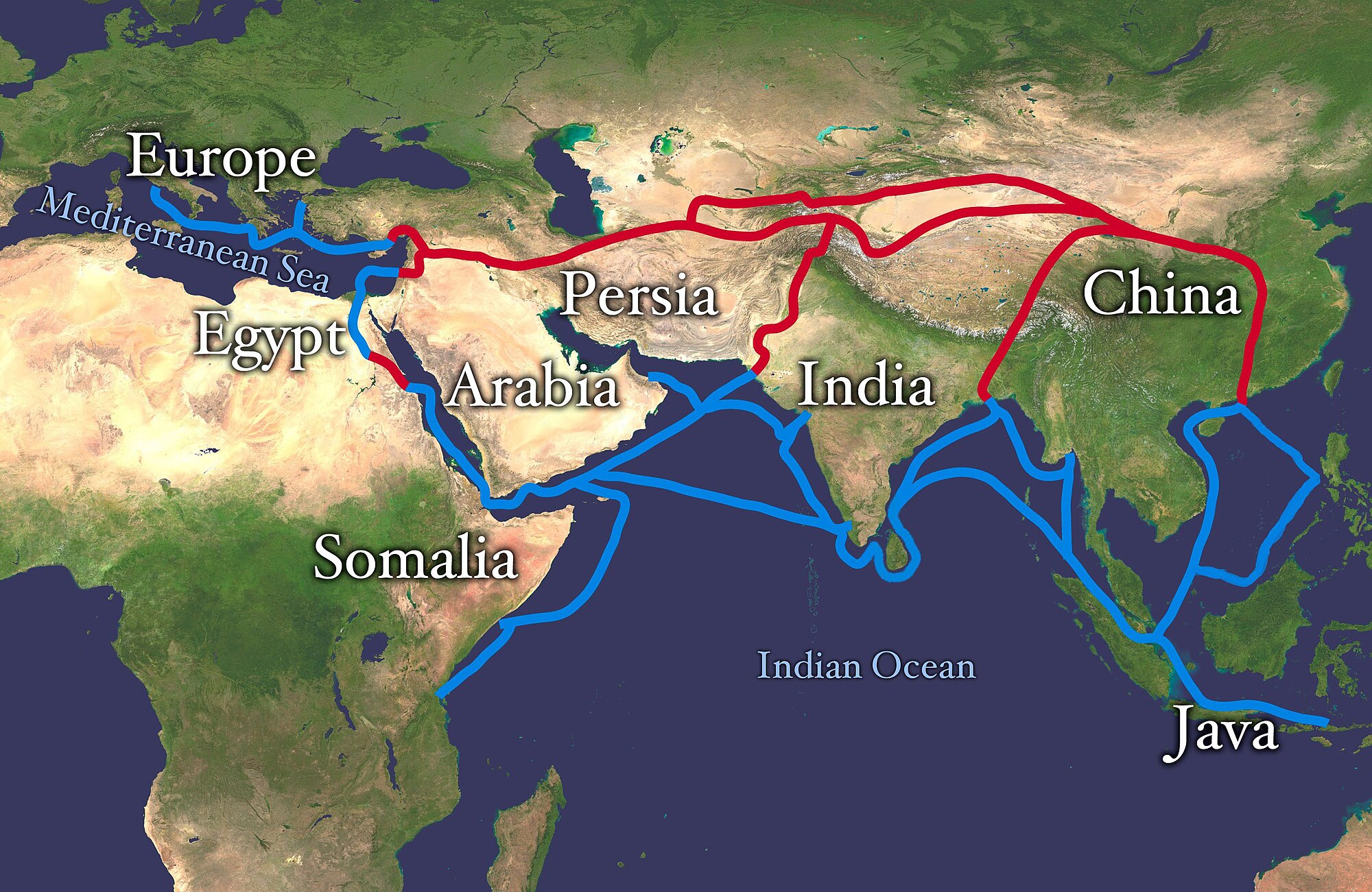
The Silk Road (red) and spice trade routes (blue).

The spice trade involved historical civilizations in Asia, Northeast Africa and Europe. Spices, such as cinnamon, cassia, cardamom, ginger, pepper, nutmeg, star anise, clove, and turmeric, were known and used in antiquity and traded in the Eastern World.[1] These spices found their way into the Near East before the beginning of the Christian era, with fantastic tales hiding their true sources.[1]

The maritime aspect of the trade was dominated by the Austronesian peoples in Southeast Asia, namely the ancient Indonesian sailors who established routes from Southeast Asia to Sri Lanka and India (and later China) by 1500 BC.[2] These goods were then transported by land toward the Mediterranean and the Greco-Roman world via the incense route and the Roman–India routes by Indian and Persian traders.[3] The Austronesian maritime trade lanes later expanded into the Middle East and eastern Africa by the 1st millennium AD, resulting in the Austronesian colonization of Madagascar.

Within specific regions, the Kingdom of Axum (5th century BC – 11th century AD) had pioneered the Red Sea route before the 1st century AD. During the first millennium AD, Ethiopians became the maritime trading power of the Red Sea. By this period, trade routes existed from Sri Lanka (the Roman Taprobane) and India, which had acquired maritime technology from early Austronesian contact. By the mid-7th century AD, after the rise of Islam, Arab traders started plying these maritime routes and dominated the western Indian Ocean maritime routes.[citation needed]

Arab traders eventually took over conveying goods via the Levant and Venetian merchants to Europe until the rise of the Seljuk Turks in 1090. Later the Ottoman Turks held the route again by 1453 respectively. Overland routes helped the spice trade initially, but maritime trade routes led to tremendous growth in commercial activities to Europe. [citation needed]

The trade was changed by the Crusades and later the European Age of Discovery,[4] during which the spice trade, particularly in black pepper, became an influential activity for European traders.[5] From the 11th to the 15th centuries, the Italian maritime republics of Venice and Genoa monopolized the trade between Europe and Asia.[6] The Cape Route from Europe to the Indian Ocean via the Cape of Good Hope was pioneered by the Portuguese explorer navigator Vasco da Gama in 1498, resulting in new maritime routes for trade.[7]

This trade, which drove world trade from the end of the Middle Ages well into the Renaissance,[5] ushered in an age of European domination in the East.[7] Channels such as the Bay of Bengal served as bridges for cultural and commercial exchanges between diverse cultures[4] as nations struggled to gain control of the trade along the many spice routes.[1] In 1571 the Spanish opened the first trans-Pacific route between its territories of the Philippines and Mexico, served by the Manila Galleon. This trade route lasted until 1815. The Portuguese trade routes were mainly restricted and limited by the use of ancient routes, ports, and nations that were difficult to dominate. The Dutch were later able to bypass many of these problems by pioneering a direct ocean route from the Cape of Good Hope to the Sunda Strait in Indonesia.

Origins

[edit]
The spice trade from India attracted the attention of the Ptolemaic Kingdom, and subsequently the Roman Empire.

People in the Indian Ocean and Island Southeast Asia traded in spices, obsidian, seashells, gemstones and other high-value materials as early as the 10th millennium BC. The first to mention the trade in historical periods are the ancient Egyptians. In the 3rd millennium BC, they traded with the Land of Punt, which is believed to have been situated in an area encompassing northern Somalia, Djibouti, Eritrea and the Red Sea coast of Sudan.[8][9]

Austronesian proto-historic and historic maritime trade network in the Indian Ocean[10]
Roman trade with India according to the Periplus of the Erythraean Sea, 1st century.

The spice trade was initially associated with overland routes, but maritime routes proved to be the factor that helped the trade grow.[1] The first true maritime trade network in the Indian Ocean was by the Austronesian peoples of Maritime Southeast Asia.[10] They established trade routes with South India and Sri Lanka from around 1500 BC to 600 BC, ushering an exchange of material culture (like catamarans, outrigger boats, lashed-lug boats, sewn boats, and sampans) and cultigens (like coconuts, sandalwood, bananas, and sugarcane), as well as spices endemic to the Maluku Islands (cloves and nutmeg). It also connected the material cultures of India and China later on via the Maritime Silk Road. Ethnic groups in Indonesia in particular were trading in spices (mainly cinnamon and cassia) with East Africa using catamaran and outrigger boats and sailing with the help of the westerlies in the Indian Ocean. This trade network expanded to reach as far as Africa and the Arabian Peninsula, resulting in the Austronesian colonization of Madagascar by the first half of the first millennium AD. It continued into historic times, later becoming the Maritime Silk Road.[11][12][10][13][14][15][16][17]

In the first millennium BC, Arabs, Phoenicians, and Indians were also engaged in sea and land trade in luxury goods such as spices, gold, precious stones, leather of exotic animals, ebony and pearls. Maritime trade was in the Red Sea and the Indian Ocean. The sea route in the Red Sea was from Bab-el-Mandeb to Berenice Troglodytica in Upper Egypt, from there inland to the Nile, and then by boat to Alexandria. Luxury goods like Indian spices, ebony, silk and fine textiles were traded along the overland Incense Route.[1]

In the second half of the first millennium BC the tribes of South and West Arabia took control over the land trade of spices from South Arabia to the Mediterranean Sea. These established Ma'in, Qataban, Hadhramaut, Sheba, and Himyar. In the north, the Nabateans took control of the trade route that crossed the Negev from Petra to Gaza. The trade enriched these tribes. South Arabia was called Eudaemon Arabia (the elated Arabia) by the ancient Greeks and was on the agenda of Alexander the Great before he died. Indians and the Arabs controlled the sea trade with India. In the late second century BC, the Greeks from the Ptolemaic dynasty of Egypt learned from the Indians how to sail directly from Aden to the west coast of India using the monsoon winds (as did Hippalus) and took control of the sea trade via Red Sea ports.[18]

Spices are discussed in biblical narratives, and there is literary evidence for their use in ancient Greek and Roman society. There is a record from Tamil texts of Greeks purchasing large sacks of black pepper from India, and many recipes in the 1st-century Roman cookbook Apicius make use of the spice. The trade in spices lessened after the fall of the Western Roman Empire, but demand for ginger, black pepper, cloves, cinnamon, and nutmeg revived the trade in later centuries.[19]

Arab trade and medieval Europe

[edit]
Trade route in the Red Sea linking Italy to south-west India
Spice merchant in Nuremberg, 1453.

Rome played a part in the spice trade during the 5th century, but this role did not last through the Middle Ages.[1] The rise of Islam brought a significant change to the trade as Radhanite Jewish and Arab merchants, particularly from Egypt, eventually took over conveying goods via the Levant to Europe. At times, Jews enjoyed a virtual monopoly on the spice trade in large parts of Western Europe.[20]

The spice trade had brought great riches to the Abbasid Caliphate and inspired famous legends such as that of Sinbad the Sailor. These early sailors and merchants would often set sail from the port city of Basra and, after many ports of call, would return to sell their goods, including spices, in Baghdad. The fame of many spices such as nutmeg and cinnamon are attributed to these early spice merchants.[21][failed verification]

The Indian commercial connection with South East Asia proved vital to the merchants of Arabia and Persia during the 7th and 8th centuries.[22] Arab traders — mainly descendants of sailors from Yemen and Oman — dominated maritime routes throughout the Indian Ocean, tapping source regions in the Far East and linking to the secret "spice islands" (Maluku Islands and Banda Islands). The islands of Molucca also find mention in several records: a Javanese chronicle (1365) mentions the Moluccas and Maloko, and navigational works of the 14th and 15th centuries contain the first unequivocal Arab reference to Moluccas. Sulaima al-Mahr writes: "East of Timor [where sandalwood is found] are the islands of Bandam and they are the islands where nutmeg and mace are found. The islands of cloves are called Maluku ....."[23]

Moluccan products were shipped to trading emporiums in India, passing through ports like Kozhikode in Kerala and through Sri Lanka. From there they were shipped westward across the ports of Arabia to the Near East, to Ormus in the Persian Gulf and Jeddah in the Red Sea and sometimes to East Africa, where they were used for many purposes, including burial rites.[24] The Abbasids used Alexandria, Damietta, Aden and Siraf as entry ports to trade with India and China.[25] Merchants arriving from India in the port city of Aden paid tribute in form of musk, camphor, ambergris and sandalwood to Ibn Ziyad, the sultan of Yemen.[25]

Indian spice exports find mention in the works of Ibn Khurdadhbeh (850), al-Ghafiqi (1150), Ishak bin Imaran (907) and Al Kalkashandi (14th century).[24] Chinese traveler Xuanzang mentions the town of Puri where "merchants depart for distant countries."[26]

Spice Bazaar used for the spice trade during the Ottoman Empire in Istanbul

From there, overland routes led to the Mediterranean coasts. From the 8th until the 15th century, maritime republics (Republic of Venice, Republic of Pisa, Republic of Genoa, Duchy of Amalfi, Duchy of Gaeta, Republic of Ancona and Republic of Ragusa[27]) held a monopoly on European trade with the Middle East. The silk and spice trade, involving spices, incense, herbs, drugs and opium, made these Mediterranean city-states extremely wealthy. Spices were among the most expensive and in-demand products of the Middle Ages, used in medicine as well as in the kitchen. They were all imported from Asia and Africa. Venetian and other navigators of maritime republics then distributed the goods through Europe.

Age of Discovery: a new route and a New World

[edit]
Portuguese India Armadas trade routes (blue) since Vasco da Gama 1498 travel and its rival Manila-Acapulco galleons and Spanish treasure fleets (white) established in 1568
Image of Calicut, India from Georg Braun and Frans Hogenberg's atlas Civitates orbis terrarum, 1572.

The Republic of Venice had become a formidable power and a key player in the Eastern spice trade.[28] Other powers, in an attempt to break the Venetian hold on spice trade, began to build up maritime capability.[1] Until the mid-15th century, trade with the East was achieved through the Silk Road, with the Byzantine Empire and the Italian city-states of Venice and Genoa acting as middlemen.

The first country to attempt to circumnavigate Africa was Portugal, which had, since the early 15th century, begun to explore northern Africa under Henry the Navigator. Emboldened by these early successes and eyeing a lucrative monopoly on a possible sea route to the Indies, the Portuguese first rounded the Cape of Good Hope in 1488 on an expedition led by Bartolomeu Dias.[29] Just nine years later in 1497, on the orders of Manuel I of Portugal, four vessels under the command of navigator Vasco da Gama continued beyond to the eastern coast of Africa to Malindi and sailed across the Indian Ocean to Calicut, on the Malabar Coast in Kerala[7] in South India — the capital of the local Zamorin rulers. The wealth of the Indies was now open for the Europeans to explore; the Portuguese Empire was the earliest European seaborne empire to grow from the spice trade.[7]

Dutch ships in Table Bay docking at the Cape Colony at the Cape of Good Hope, 1762.

In 1511, Afonso de Albuquerque conquered Malacca for Portugal, then the center of Asian trade. East of Malacca, Albuquerque sent several diplomatic and exploratory missions, including to the Moluccas. Learning the secret location of the Spice Islands, mainly the Banda Islands, then the world source of nutmeg, he sent an expedition led by António de Abreu to Banda, where they were the first Europeans to arrive, in early 1512.[30] Abreu's expedition reached Buru, Ambon and Seram Islands, and then Banda.

Portugal claimed the Indian Ocean as its mare clausum during the Age of Discovery.

From 1507 to 1515 Albuquerque tried to completely block Arab and other traditional routes that stretched from the shores of Western India to the Mediterranean Sea, through the conquest of strategic bases in the Persian Gulf and at the entry of the Red Sea. [citation needed]

By the early 16th century the Portuguese had complete control of the African sea route, which extended through a long network of routes that linked three oceans, from the Moluccas (the Spice Islands) in the Pacific Ocean limits, through Malacca, Kerala and Sri Lanka, to Lisbon in Portugal. [citation needed]

The Crown of Castile had organized the expedition of Christopher Columbus to compete with Portugal for the spice trade with Asia, but when Columbus landed on the island of Hispaniola (in what is now Haiti) instead of in the Indies, the search for a route to Asia was postponed until a few years later. After Vasco Núñez de Balboa crossed the Isthmus of Panama in 1513, the Spanish Crown prepared a westward voyage by Ferdinand Magellan in order to reach Asia from Spain across the Atlantic and Pacific Oceans. On October 21, 1520, his expedition crossed the Strait of Magellan in the southern tip of South America, opening the Pacific to European exploration. On March 16, 1521, the ships reached the Philippines and soon after the Spice Islands, ultimately resulting decades later in the Manila Galleon trade, the first westward spice trade route to Asia. After Magellan's death in the Philippines, navigator Juan Sebastian Elcano took command of the expedition and drove it across the Indian Ocean and back to Spain, where they arrived in 1522 aboard the last remaining ship, the Victoria. For the next two-and-a-half centuries, Spain controlled a vast trade network that linked three continents: Asia, the Americas and Europe. A global spice route had been created: from Manila in the Philippines (Asia) to Seville in Spain (Europe), via Acapulco in Mexico (North America). [citation needed]

Cultural diffusion

[edit]
One of the Borobudur ships from the 8th century. These were depictions of large Javanese outrigger vessels. One is shown here with the characteristic tanja sail of Southeast Asian Austronesians.

One of the most important technological exchanges of the spice trade network was the early introduction of maritime technologies to India, the Middle East, East Africa, and China by the Austronesian peoples. These technologies include the plank-sewn hulls, catamarans, outrigger boats, and possibly the lateen sail. This is still evident in Sri Lankan and South Indian languages. For example, Tamil paṭavu, Telugu paḍava, and Kannada paḍahu, all meaning "ship", are all derived from Proto-Hesperonesian *padaw, "sailboat", with Austronesian cognates like Javanese perahu, Kadazan padau, Maranao padaw, Cebuano paráw, Samoan folau, Hawaiian halau, and Māori wharau.[14][13][15]

Austronesians also introduced many Austronesian cultigens to southern India, Sri Lanka, and eastern Africa that figured prominently in the spice trade.[31] They include bananas,[32] Pacific domesticated coconuts,[33][34] Dioscorea yams,[35] wetland rice,[32] sandalwood,[36] giant taro,[37] Polynesian arrowroot,[38] ginger,[39] lengkuas,[31] tailed pepper,[40] betel,[12] areca nut,[12] and sugarcane.[41][42]

Hindu and Buddhist religious establishments of Southeast Asia came to be associated with economic activity and commerce as patrons, entrusted large funds which would later be used to benefit local economies by estate management, craftsmanship, and promotion of trading activities.[43] Buddhism, in particular, traveled alongside the maritime trade, promoting coinage, art, and literacy.[44] Islam spread throughout the East, reaching maritime Southeast Asia in the 10th century; Muslim merchants played a crucial part in the trade.[45] Christian missionaries, such as Saint Francis Xavier, were instrumental in the spread of Christianity in the East.[45] Christianity competed with Islam to become the dominant religion of the Moluccas.[45] However, the natives of the Spice Islands accommodated to aspects of both religions easily.[46]

The Portuguese colonial settlements saw traders, such as the Gujarati banias, South Indian Chettis, Syrian Christians, Chinese from Fujian province, and Arabs from Aden, involved in the spice trade.[47] Epics, languages, and cultural customs were borrowed by Southeast Asia from India, and later China.[4] Knowledge of Portuguese language became essential for merchants involved in the trade.[48] The colonial pepper trade drastically changed the experience of modernity in Europe, and in Kerala and it brought, along with colonialism, early capitalism to India's Malabar Coast, changing cultures of work and caste.[49]

Indian merchants involved in spice trade took Indian cuisine to Southeast Asia, notably present day Malaysia and Indonesia, where spice mixtures and black pepper became popular.[50] Conversely, Southeast Asian cuisine and crops was also introduced to India and Sri Lanka, where rice cakes and coconut milk-based dishes are still dominant.[31][33][32][39][51]

European people intermarried with Indians and popularized valuable culinary skills, such as baking, in India.[52] Indian food, adapted to the European palate, became visible in England by 1811 as exclusive establishments began catering to the tastes of both the curious and those returning from India.[53] Opium was a part of the spice trade, and some people involved in the spice trade were driven by opium addiction.[54][55]

See also

[edit]

References

[edit]

Bibliography

[edit]

Further reading

[edit]
[edit]
Revisions and contributorsEdit on WikipediaRead on Wikipedia
from Grokipedia
The spice trade encompassed the global commerce in aromatic plant products such as , , cloves, , ginger, and , originating primarily from South and and extending to markets in , the , , and beyond, valued for their culinary, medicinal, preservative, and ritualistic uses across civilizations. This trade's roots trace back over 4,000 years to the ancient , where spices were first cultivated and exchanged along early overland routes connecting , , and the Indus Valley, evolving into one of antiquity's most profitable enterprises by around 2000 BCE. Archaeological evidence from sites like Oc Eo in indicates spice processing and trade networks active as early as 2000 years ago, linking Southeast Asian entrepôts to broader circuits. By the classical period, Indian and Arab merchants dominated these exchanges, transporting spices via caravan trails like the Route and maritime paths across the and , maintaining secrecy over sources to preserve monopolies and inflate prices in distant markets. The medieval era saw spices integrated into Eurasian economies, with Islamic caliphates and like serving as key intermediaries; for instance, during the period in (13th–16th centuries), spices comprised a significant portion of Alexandria's trade volume, funding state revenues and fostering multicultural ports. European demand surged in the due to spices' roles in flavoring preserved meats, treating ailments, and symbolizing luxury, prompting quests for direct access that ignited the Age of Exploration. In 1498, Portuguese explorer Vasco da Gama's voyage around the established a sea route to , shattering Arab and Venetian monopolies and enabling to control key outposts like and by the early . Competition intensified as the (VOC), founded in 1602, seized the Indonesian "Spice Islands" for and cloves, while the English East India Company, established in 1600, focused on Indian pepper and expanded into broader colonial enterprises. These European powers' rivalries sparked conflicts, including the Anglo-Dutch Wars (1652–1674), profoundly altering demographics and landscapes in and through colonial exploitation and involvement of African labor in spice production. By the , the trade's center shifted with British dominance in and the rise of American involvement post-independence, though synthetic alternatives and new agricultural frontiers gradually diminished its geopolitical centrality by the . Economically, spices often exceeded gold in value—black pepper alone accounted for much of Europe's silver outflow to —and culturally, the trade disseminated culinary traditions, botanical knowledge, and hybrid dishes like curries, while underscoring themes of exploitation and interconnectivity in world history. Today, the legacy persists in global supply chains, with and as leading exporters, reflecting the trade's enduring role in shaping modern .

Ancient Origins

Trade in Mesopotamia and Egypt

The earliest documented evidence of spice use in Mesopotamia dates to around 3000 BCE, as recorded in Sumerian clay tablets from sites like Nippur, which describe aromatic plants employed for medicinal and culinary purposes. These texts reference spices such as cumin (Carum carvi) and coriander (Coriandrum sativum), often ground into pastes or infusions to treat ailments like digestive issues or as flavor enhancers in barley-based dishes. Early exchanges extended to the Indus Valley Civilization around 2500–2000 BCE, where spices like ginger and cinnamon were sourced and traded to Mesopotamia via overland and maritime routes. Local cultivation in the Fertile Crescent supplemented initial exchanges, with spices integrated into daily diets and rituals, reflecting their value in early urban societies like Ur and Lagash. In ancient Egypt, spice trade expanded through Red Sea voyages to the land of Punt—likely in modern-day Somalia and Eritrea—beginning in the Old Kingdom but prominently documented during the 18th Dynasty. Queen Hatshepsut's expedition around 1470 BCE, depicted in reliefs at her Deir el-Bahri mortuary temple, involved a fleet of ships that returned with cargoes of myrrh (Commiphora myrrha), frankincense (Boswellia sacra), and cinnamon-like aromatics, alongside live myrrh trees transplanted to Egyptian soil for sustained production. These goods were bartered for Egyptian linen, beads, and weapons, establishing reciprocal exchanges that bolstered Egypt's economy without formal currency. Spices held profound ritual significance in Egypt, particularly in mummification and religious ceremonies, where they preserved bodies and invoked divine favor. and were burned as in temples and packed into mixtures to mask odors and symbolize eternal life, with and cassia () also applied during the 70-day process. Tomb inventories, such as that of (c. 1323 BCE), reveal extensive use, including approximately 350 liters of aromatic oils and resins stored in ornate vessels, underscoring the pharaonic scale of these practices. Economic mechanisms relied on state-sponsored , exchanging spices for and from Punt, with semi-permanent outposts along the facilitating ongoing procurement.

Indian Ocean Networks and Roman Involvement

The interconnected maritime networks of the emerged prominently during the , around 200 BCE, as Indian sailors harnessed the predictable winds to facilitate direct sea voyages from the to and beyond. This navigational knowledge, developed by indigenous mariners who timed departures with the seasonal reversal of winds—northeast monsoons for outbound journeys and southwest for returns—revolutionized trade by reducing reliance on coastal hugging and enabling faster, more efficient crossings of open waters. sailors also contributed to these techniques in the western , integrating sails on dhows that complemented the patterns, thus linking ports from the to the . Archaeological evidence from entrepôts like Oc Eo in indicates spice processing activities, including , , and , as part of these networks from the CE. Roman engagement intensified these networks from the 1st century CE, as documented in the Periplus of the Erythraean Sea, a Greco-Roman merchant's guide that detailed navigation from ports like to key Indian harbors such as on the and Barygaza in . , sourced primarily from the Malabar region, dominated the spice trade, fetching approximately 4 denarii per pound in Roman markets—a that made it accessible even to soldiers despite the long journey. Other spices included cloves, routed from the Moluccas through Southeast Asian and Indian intermediaries, and ginger originating from Chinese cultivation centers, which reached Roman consumers via these extensive chains. estimated annual Roman imports of eastern luxuries, including spices, at around 100 million sesterces, underscoring the trade's economic scale and the empire's appetite for these commodities. These routes not only exchanged goods but also fostered profound cultural interactions, with spreading from to and along the maritime paths frequented by traders. Monks and merchants carried and , contributing to the religion's establishment in regions like and by the early centuries CE. Roman presence in India manifested through trading outposts, such as the settlement at near modern , where archaeological evidence reveals Roman amphorae, coins, and glassware alongside local artifacts, indicating semi-permanent communities of Greco-Roman merchants integrating into South Indian society.

Medieval Expansion

Arab Monopoly and Overland Routes

Following the rapid expansion of Islamic conquests in the CE, traders consolidated control over key segments of the spice trade, leveraging their strategic position in the to establish a near-monopoly on high-value commodities like pepper and . The Umayyad Caliphate's invasion of in 711 CE, led by , opened access to trade networks in the and integrated them into -dominated supply chains. By the 8th century, under the , Arab merchants dominated maritime entry points such as the ports of in and Siraf in Persia, where incoming ships from and offloaded cargoes of spices before transshipment to and routes. These ports served as choke points, allowing to impose tolls and regulate trade, thereby maintaining exclusivity on premium spices that fetched exorbitant prices in European and Byzantine markets. , sourced from the Indonesian archipelago, and from southern became symbols of this monopoly, with Arab intermediaries obscuring origins to preserve profit margins. Overland alternatives complemented these sea routes, particularly variants of the that traversed from and to the , carrying spices alongside silks and aromatics in relay systems managed by Muslim caravaneers. The Trans-Saharan paths also integrated into this network during the Abbasid era, linking North African ports to sub-Saharan sources of complementary . Camel caravans formed the backbone of overland logistics, with large expeditions—often comprising 1,000 or more animals—capable of transporting substantial loads across arid terrains; a single could carry up to 250 kilograms, enabling convoys to move tons of per journey despite the hazards of sandstorms and banditry. Under Abbasid administration, taxation systems bolstered state revenues from these trades, including customs duties and market fees levied on spice imports at urban centers like , where merchants factored such costs into pricing to sustain profitability. Islamic innovations in navigation further solidified Arab dominance, enabling safer and more efficient voyages that intertwined with overland extensions. The sail, a triangular rigging adapted for ships, allowed vessels to tack against monsoon winds in the , expanding reach to spice islands without relying solely on seasonal currents. Complementing this, the —refined by Arab astronomers from Greek prototypes—permitted precise measurements using stars, reducing navigational errors on long hauls from to Arabian ports. These advancements are vividly documented in 14th-century traveler Ibn Battuta's , which describes bustling spice markets in cities like Quilon and Cambay, where Arab dealers haggled over pepper heaps amid diverse merchants, underscoring the cultural and economic vibrancy of these controlled exchanges.

European Demand and Venetian Intermediaries

During the high medieval period, European demand for spices surged, driven by their roles in both and . In , spices were prized for their believed ability to balance the body's humors, a concept rooted in Galenic theories that emphasized their warming and preservative qualities to counteract cold and corrupt foods, thereby preventing disease and aiding digestion. This perception elevated spices like pepper, ginger, and to status symbols among the elite, who used them in elaborate feasts to demonstrate wealth and sophistication. Pepper, in particular, earned the moniker "black gold" due to its immense value and use as ; in medieval , it was highly prized, often comparable in worth to . Venice emerged as the dominant European intermediary in the spice trade starting from the 9th century, leveraging its strategic Adriatic position to control maritime routes from the , where spices arrived via Arab overland networks. The city's ascent was solidified by the Byzantine-Venetian of 1082, which granted Venetians exclusive tax exemptions and trading privileges in , allowing them unfettered access to eastern markets and effectively sidelining rivals like and . By the early 14th century, Venice's annual spice imports from the reached thousands of metric tons in total for , with Venice handling a major share primarily of pepper, which formed the backbone of their commercial galleys that sailed in organized convoys (mudanze) to distribute goods across . Key events further entrenched Venetian influence, including the of 1204, during which Venetian fleets transported crusaders and, after diverting to , helped sack the city, securing temporary direct access to Byzantine trade networks and bypassing some Arab intermediaries. This windfall enabled to establish fondacos—fortified trading posts and warehouses—in Levantine ports like Acre and , where merchants stored and auctioned spices under strict guild oversight to maintain quality and prices. Economically, the spice trade formed a significant portion of 's import value from the East by the , fueling the republic's prosperity and funding its naval dominance.

Age of Discovery

Portuguese Sea Route to India

The Portuguese pursuit of a direct maritime route to was driven by the desire to circumvent the costly Arab and Venetian intermediaries who dominated the overland spice trade, allowing Europe to access Asian spices at lower costs and higher volumes. Under the patronage of from the 1410s to 1460s, initiated systematic explorations along the African coast, establishing trading posts and gathering navigational knowledge that laid the groundwork for oceanic voyages aimed at reaching the spice-producing regions of and beyond. These efforts were formalized by the in 1494, which divided the non-European world into spheres of influence between and , granting exclusive rights to routes east of a designated meridian and facilitating unchallenged pursuit of Asian trade. Vasco da Gama's expedition from 1497 to 1499 marked the culmination of these initiatives, as he commanded a fleet that successfully rounded the and sailed across the to reach Calicut on the in May 1498, establishing the first all-sea route from to India. The fleet consisted of four vessels, including the flagship São Gabriel, a nau of approximately 120 tons designed for long-distance , which carried provisions, trade goods, and armaments to support the 170-man crew during the perilous 24,000-nautical-mile journey. Despite initial hostilities with local rulers in Calicut, da Gama secured a small of spices on the return voyage, demonstrating the route's viability and prompting King Manuel I to dispatch larger armadas thereafter. To secure and administer the new trade network, Portugal established fortified enclaves along key coastal points, beginning with a timber fort at Cochin in 1503 under 's expedition, which was replaced with stone and renamed Fort Manuel in 1505 under Viceroy , serving as a defensive base for loading pepper and protected Portuguese merchants from regional rivals. This was followed by the capture of Hormuz in 1507 by , who imposed tribute and controlled the entrance to disrupt Arab shipping and facilitate spice transshipment from the east. The Estado da Índia, created in 1505 as a crown-administered headquartered in from 1510, oversaw these operations, regulating the Carreira da Índia fleets and enforcing monopolies on spice exports that generated immense profits, with pepper cargoes often yielding returns of up to 500% due to low acquisition costs in and high European demand. Pepper dominated the Portuguese spice trade, comprising the majority of the volume shipped to in the early 16th century, sourced primarily from the ports like Cochin and Calicut. Complementary spices included , obtained through alliances and conquests in Ceylon (modern ) by the 1510s, which provided high-quality bark for European markets, and cloves, acquired via initial raids and treaties in the Moluccas (Spice Islands) starting in 1512 under Albuquerque's campaigns. These targeted acquisitions not only diversified the cargo but also positioned Portugal as the primary supplier of spices to until the mid-16th century, fundamentally reshaping global commerce.

Spanish Exploration and the Americas

Christopher Columbus undertook four voyages between 1492 and 1504, sponsored by the Spanish monarchs Ferdinand II and Isabella I, primarily to discover a western maritime route to Asia that would provide direct access to lucrative spices like pepper, cinnamon, and cloves, circumventing the established Portuguese dominance in the Indian Ocean. Believing he had reached the outskirts of Asia, Columbus instead encountered the Caribbean islands and the American mainland, initiating Spanish claims over vast New World territories and laying the groundwork for transatlantic colonization. During his second voyage in 1493, Columbus transported Old World crops and spices, including cinnamon, to the Americas, marking an early phase of the Columbian Exchange that integrated European flora into New World agriculture. Building on Columbus's initiatives, Ferdinand Magellan's expedition, launched in 1519 under Spanish auspices, sought to complete a western passage to the Spice Islands (Moluccas) for exclusive access to high-value commodities like cloves and , amid rivalry with . After navigating the and crossing the Pacific, the fleet arrived in the in 1521, where Magellan was killed in a local conflict, but surviving ships proceeded to the Moluccas to procure spices. Only the Victoria, commanded by Juan Sebastián Elcano, completed the , returning to in 1522 laden with about 26 tons of cloves, a cargo valued at over twice the expedition's total cost and demonstrating the immense profitability of Spanish ventures into Asian trade networks. Spanish exploration profoundly influenced the spice trade by incorporating New World botanicals—often termed "spices" for their flavoring properties—into global circulation, reversing the traditional flow from to . Chili peppers, indigenous to , were disseminated by Spanish conquistadors to by the early and reached through colonial routes, transforming cuisines worldwide. , cultivated in , and , harvested from Jamaican pimento trees, followed similar paths, entering European markets via Spanish ports before being exported eastward. By 1565, the establishment of the Manila-Acapulco route enabled the transport of these American products across the Pacific to the and beyond, alongside silver shipments that fueled the exchange for Asian silks and spices, creating an early global trade corridor. The economic gains from these spice-related endeavors provided crucial funding for the Spanish Empire's military and administrative expansions, with returns from Magellan's cloves alone offsetting expedition expenses and inspiring further Pacific explorations. However, these efforts encountered significant obstacles in the , where indigenous resistance—manifest in uprisings against labor systems and forced conversions—disrupted colonial operations and delayed resource extraction. Overexploitation of native populations through exposure, enslavement, and further compounded challenges, leading to demographic declines that strained the empire's labor-dependent and highlighted the human costs of spice trade ambitions.

Colonial Dominance

Dutch and English East India Companies

The (VOC), established on March 20, 1602, by the , represented a pivotal innovation in corporate organization, merging smaller trading ventures into a single entity with a monopoly on Dutch trade east of the and granting it quasi-sovereign powers to wage war, build forts, and negotiate treaties. This joint-stock structure raised an initial capital of 6.4 million guilders through public investment, enabling large-scale operations that seized upon Portuguese routes and assets in Asia to dominate the spice trade. The VOC's aggressive expansion culminated in the violent conquest of the in 1621, led by Governor-General , where Dutch forces massacred or expelled much of the local population to enforce a monopoly on and mace production, transplanting the islands' Bandanese inhabitants to Batavia as slaves and replacing them with imported labor. This control allowed the VOC to dictate global prices for these spices, with nutmeg fetching extraordinarily high values in European markets due to the enforced scarcity. In parallel, the English (EIC), chartered by Queen Elizabeth I on December 31, 1600, as a joint-stock enterprise with a 15-year monopoly on English trade to the , initially focused on challenging dominance through direct voyages and intra-Asian exchanges rather than territorial conquest. The EIC established its first permanent factory in in 1612, following Captain Thomas Best's arrival and the decisive naval victory at the (also known as Suvali) that year, where four English ships repelled a larger fleet, securing Mughal Emperor Jahangir's permission for English trading privileges and weakening Iberian control over routes. This foothold enabled the EIC to engage in profitable intra-Asian trade, shipping spices, textiles, and between ports in , , and beyond, while avoiding the VOC's level of militarized monopoly. Rivalry between the VOC and EIC escalated into the Anglo-Dutch Wars (1652–1674), a series of three conflicts driven primarily by competition over spice trade routes and markets, with naval engagements disrupting shipments and leading to treaties that temporarily divided spheres of influence, such as the 1667 Treaty of Breda, which confirmed Dutch primacy in the Indonesian archipelago through exchanges like Run Island for New Amsterdam. By the mid-17th century, the VOC had reached its peak in spice imports, handling approximately four million pounds of pepper annually, alongside exclusive supplies of nutmeg, cloves, and mace that fueled massive profits and financed further expansion. Both companies pioneered through tradable shares and dividends derived directly from spice cargoes; the VOC's shares, introduced in 1602, formed the world's first formal , allowing investors to buy and sell without waiting for voyage returns, while early dividends—such as the 1612 payout largely in pepper and —tied shareholder returns to successful shipments, averaging 18% annually over nearly two centuries. In , commanded premium prices, reflecting the VOC's monopolistic grip and the spice's status as a luxury equivalent to in value. These mechanisms not only democratized but also institutionalized the corporate exploitation of spice trade networks, shifting global commerce toward joint-stock .

Intra-Asian Trade Networks

The intra-Asian spice trade networks formed a vibrant and interconnected system that predated European arrival, facilitating the exchange of spices across South and through established maritime routes. Gujarati merchants from played a pivotal role, sailing to Indonesian islands such as the Moluccas to acquire cloves and , which they transported back to Indian ports for redistribution throughout the region. Similarly, Chinese junks operated extensive voyages from ports like to , loading pepper from Sumatran and Malayan sources for transport to and other East Asian markets, contributing to the network's dynamism in the . By 1600, these pre-colonial exchanges handled substantial volumes of pepper and cloves, underscoring the scale of indigenous . European powers integrated into these networks during the colonial era, leveraging existing Asian trade structures to acquire spices more efficiently. The (VOC) established Batavia in 1619 as a central hub on , where it coordinated the flow of Japanese silver—exported in large quantities from —to Indian ports in exchange for textiles, which were then used to barter for spices in and . This triangular exchange amplified the VOC's role in intra-Asian commerce without fully disrupting the underlying regional dynamics, as Asian intermediaries continued to facilitate much of the logistics. Key Asian polities actively engaged with Europeans to supply spices, navigating the new colonial presence while asserting their influence. The Sultanate of Aceh in northern emerged as a major supplier of pepper to Dutch and English traders in the , using its strategic position to negotiate favorable terms and even seeking alliances against rivals. Likewise, the on provided access to spices and local goods, trading with the VOC to secure military support and economic benefits amid internal expansions. Complementing these state-level interactions, private Asian traders— including Gujarati, Chinese, and Malay merchants—often evaded European monopolies by operating through informal networks and alternative routes, ensuring that intra-Asian spice flows persisted independently of colonial oversight. Specific routes along the exemplified the barter-based exchanges central to these networks, where Indian cotton textiles were swapped directly for spices arriving from . Ports like Masulipatnam and served as key nodes, with Coromandel cloths—highly valued for their quality—traded for pepper, cloves, and brought by Indonesian and Malay vessels, sustaining a robust regional into the 17th century.

Modern Developments

Decline of Monopolies and Free Trade

The (1792–1815) played a pivotal role in dismantling the monopolistic structures of the (VOC) and weakening the British (EIC) in the spice trade. The VOC, burdened by corruption, administrative costs, and wartime disruptions, was declared bankrupt and formally dissolved on December 31, 1799, with its debts and possessions transferred to the Dutch government. This dissolution ended the company's exclusive control over key spice-producing regions in , allowing neutral traders, particularly from the , to access spices directly and bypass European intermediaries during the conflicts. The wars further enabled British forces to capture Dutch territories, including the invasion of in 1811 under Governor-General Lord Minto, which temporarily opened spice markets to free competition and redirected flows away from Dutch dominance. The push toward free trade accelerated the decline of these monopolies in the early 19th century. The EIC's charter, which had granted it exclusive trading rights, was partially revoked in 1813, ending its monopoly on trade with India and allowing private British merchants to enter the market; this was fully extended in 1833 when the company lost all commercial privileges, transitioning to an administrative role under the British Crown. These changes fostered intense competition, increased supply from non-monopolized sources, and drove down spice prices dramatically—for instance, the real price of pepper in England fell to about one-fifth of its late 18th-century levels by the mid-19th century due to expanded imports and reduced barriers. Key geopolitical events further facilitated this shift. The (1839–1860) between Britain and China resulted in the opening of additional , such as and , which indirectly enhanced European access to broader Asian trade networks, including routes for spices from and . Similarly, the opening of the in 1869 shortened maritime routes between and by approximately 40%, reducing travel time from ports like to from around 10,000 nautical miles via the to about 6,000 miles, thereby lowering transportation costs and boosting spice imports. Parallel to these developments, the transition to plantation agriculture expanded spice production beyond traditional monopolized areas. In 1812, clove seedlings were introduced to from the French island of by the Zanzibari merchant Saleh bin Haramil, leading to the establishment of large-scale plantations that rapidly increased global supply and undercut prices controlled by European companies in the . By the 1820s, these efforts under Omani rule in had transformed the island into a major exporter, contributing to the overall liberalization of the spice market.

20th-Century Globalization and Regulation

Following , the spice trade experienced a significant boom driven by and technological advancements in transportation and preservation. Global volumes expanded rapidly, with world imports of whole and ground spices reaching approximately 1.375 million tons in 2002, valued at $2.5 billion; India's exports accounted for a significant share, at around 243,000 tons in 2002-03. While the rise of synthetic preservatives in the post-war era reduced demand for spices used primarily as natural preservatives in , overall consumption grew due to their enduring role in flavoring processed foods and international cuisines. Concurrently, the advent of air freight enabled the export of fresh and perishable spices, such as and high-value items like , which previously deteriorated during long sea voyages, thereby expanding market access to premium products. Key international organizations emerged to regulate and standardize the spice trade amid this expansion. The International Pepper Community (IPC) was established in 1971 through an agreement signed in by major producing countries including , , , and , with the primary aim of promoting research, production, and market stability for , including price regulation to prevent volatility. Similarly, the and developed quality standards for spices starting in the 1960s via the Codex Alimentarius Commission, which was launched in 1963 to establish international guidelines on contaminants, , and labeling, ensuring safer global trade. Significant events in the late 20th century highlighted the vulnerabilities of national monopolies and the push toward liberalization. In Indonesia, the state-backed clove export monopoly, established in 1990 and controlled by President Suharto's family, collapsed in the late 1990s amid the Asian financial crisis, which exposed cronyism and disrupted the kretek cigarette industry that consumed most domestic cloves, leading to broader economic reforms. In India, economic liberalizations initiated in 1991 dismantled trade barriers and export controls, propelling spice exports from over 100,000 tons annually in the late 1970s to more than 200,000 tons by the mid-1990s, as producers gained better access to global markets. Into the 21st century, the spice trade faced ongoing challenges from environmental factors and ethical concerns. Supply chain disruptions intensified due to , exemplified by the 2015 vanilla shortage in — which supplies about 80% of the world's —caused by cyclones and erratic weather that destroyed crops and drove prices up dramatically. In response, certifications have gained prominence, with organizations like establishing standards since the 1990s for spices such as pepper, ginger, and , ensuring fair prices, sustainable farming practices, and better working conditions for smallholder farmers in countries like , , and . In the , the spice trade continued to grow amid challenges. The caused temporary disruptions but spurred digital supply chains. As of 2023-24, global spice exports exceeded 2 million tons, with leading at 1.82 million tons. Climate events, such as 2024 floods in , affected production, prompting increased focus on resilient farming and certifications.

Impacts and Legacy

Economic Transformations

The spice trade played a pivotal role in across , channeling vast profits into banking, , and industrial investments. Profits from the Portuguese-dominated spice routes in the early bolstered families like the Fuggers, who extended their mercantile operations to include spice imports, enabling them to finance Habsburg rulers and underwrite Renaissance-era projects such as mining ventures and artistic commissions. By the 18th century, the British Company's control over spice and related Asian trade generated exceptional returns, providing liquidity that fueled Britain's proto-industrial economy and early factories. These revenues, derived from monopolistic exports of pepper, cloves, and , represented a key mechanism for transforming trade surpluses into long-term economic infrastructure. Labor regimes in the spice trade were characterized by severe exploitation, including mass enslavement and coerced systems that sustained production. During the Dutch conquest of the in 1621, approximately 1,700 Bandanese were enslaved to labor on plantations after the near-extermination of population, marking an early instance of colonial forced labor to secure spice monopolies. In the , the system on Sumatra's pepper and other plantations imposed indentured contracts on migrant workers from , , and , enforced by the 1880 Coolie Ordinance, which granted planters near-absolute control and often resulted in akin to . Such practices ensured low-cost production but at the expense of , with high mortality rates from disease and overwork. The spice market underwent profound evolution, shifting from elite luxuries to mass commodities amid expanding colonial supply chains. In the , pepper commanded prices equivalent to a week's wages for an unskilled European laborer, positioning it as a symbol of and status in networks dominated by and Venetian intermediaries. Colonial cultivation in the and flooded markets by the , democratizing access and eroding exclusivity, though volatility persisted due to monopolies. The contemporary global spices and seasonings market, encompassing pepper, , and cloves, stands at approximately $28 billion in value as of 2025, reflecting stabilized commodity status driven by industrialized processing and diverse consumer demand. Global inequalities intensified through the spice trade's imbalances, as European powers extracted resources while undermining Asian manufacturing bases. Post-1750, British trade policies imposed tariffs on Indian while flooding markets with cheap imports, precipitating : India's share of world exports plummeted from over 25% to near zero by , displacing millions of artisans and redirecting via unequal exchanges. This dynamic facilitated a massive transfer of surplus from to , estimated at trillions in adjusted value over two centuries, bolstering European industrialization at the cost of peripheral economies' stagnation. The resulting disparities entrenched colonial hierarchies, with spice profits symbolizing broader patterns of extraction.

Cultural and Culinary Diffusion

The spice trade profoundly influenced global culinary practices by facilitating the exchange of ingredients across continents, leading to transformative adaptations in regional cuisines. In the 16th century, Portuguese traders introduced chili peppers from the Americas to India, where they quickly integrated into local cooking and revolutionized traditional dishes like curries by providing a potent source of heat that supplanted black pepper in many recipes. Similarly, in the Ottoman Empire during the 16th century, the adoption of coffee from Yemen evolved into a cultural staple often enhanced with spices like cardamom and cloves sourced through established trade routes, fostering unique blends that became integral to social rituals in coffeehouses. Medicinal applications of traded spices also spread widely, embedding them in traditional healing systems. Turmeric, originating from South Asia, has been a cornerstone of Ayurvedic medicine since around 250 BCE for treating inflammation and wounds, as documented in ancient compendia, and was later incorporated into Unani medicine for conditions like jaundice and ulcers. Modern scientific research validates these uses, with studies confirming that curcumin, the active compound in turmeric, exhibits significant anti-inflammatory effects by modulating pathways like NF-κB, potentially aiding in the management of chronic inflammatory diseases. Spices acquired symbolic significance in rituals and through trade networks. In the during the 17th-century , the influx of via the inspired the creation of speculaas cookies, thin spiced biscuits molded into symbolic shapes like windmills, which became a cherished tradition during celebrations, reflecting the era's prosperity from spice commerce. The further extended this impact, introducing from the to African diasporic communities in the , where it blended with West African culinary techniques to shape elements of African-American , such as in seasoned stews and jerk preparations that evoke cultural resilience. In contemporary , these historical exchanges continue to inspire fusion cuisines and . Cumin, tracing its path from ancient Mediterranean trade routes through Spanish colonization to the , became a hallmark of cooking in the 16th century onward, imparting earthy flavors to dishes like and tacos, which merge Mexican and American influences. In , , spice has emerged as a significant draw since the early , with initiatives like the Spice Route Project guiding visitors through plantations and historical trade paths, promoting and while boosting local economies.

References

Add your contribution
Related Hubs
User Avatar
No comments yet.