


Community hub
Recent from talks
Contribute something
Nothing was collected or created yet.
 | ||||||||||||||||||||||||||||||||||||||
| Gold | ||||||||||||||||||||||||||||||||||||||
|---|---|---|---|---|---|---|---|---|---|---|---|---|---|---|---|---|---|---|---|---|---|---|---|---|---|---|---|---|---|---|---|---|---|---|---|---|---|---|
| Appearance | Metallic yellow | |||||||||||||||||||||||||||||||||||||
| Standard atomic weight Ar°(Au) | ||||||||||||||||||||||||||||||||||||||
| Gold in the periodic table | ||||||||||||||||||||||||||||||||||||||
| Atomic number (Z) | 79 | |||||||||||||||||||||||||||||||||||||
| Group | group 11 | |||||||||||||||||||||||||||||||||||||
| Period | period 6 | |||||||||||||||||||||||||||||||||||||
| Block | d-block | |||||||||||||||||||||||||||||||||||||
| Electron configuration | [Xe] 4f14 5d10 6s1 | |||||||||||||||||||||||||||||||||||||
| Electrons per shell | 2, 8, 18, 32, 18, 1 | |||||||||||||||||||||||||||||||||||||
| Physical properties | ||||||||||||||||||||||||||||||||||||||
| Phase at STP | solid | |||||||||||||||||||||||||||||||||||||
| Melting point | 1337.33 K (1064.18 °C, 1947.52 °F) | |||||||||||||||||||||||||||||||||||||
| Boiling point | 3243 K (2970 °C, 5378 °F) | |||||||||||||||||||||||||||||||||||||
| Density (at 20° C) | 19.283 g/cm3 [3] | |||||||||||||||||||||||||||||||||||||
| when liquid (at m.p.) | 17.31 g/cm3 | |||||||||||||||||||||||||||||||||||||
| Heat of fusion | 12.55 kJ/mol | |||||||||||||||||||||||||||||||||||||
| Heat of vaporization | 342 kJ/mol | |||||||||||||||||||||||||||||||||||||
| Molar heat capacity | 25.418 J/(mol·K) | |||||||||||||||||||||||||||||||||||||
Vapor pressure
| ||||||||||||||||||||||||||||||||||||||
| Atomic properties | ||||||||||||||||||||||||||||||||||||||
| Oxidation states | common: +3 −3,? −2,? −1,[4] 0, +1,[5] +2,[4] +5[4] | |||||||||||||||||||||||||||||||||||||
| Electronegativity | Pauling scale: 2.54 | |||||||||||||||||||||||||||||||||||||
| Ionization energies |
| |||||||||||||||||||||||||||||||||||||
| Atomic radius | empirical: 144 pm | |||||||||||||||||||||||||||||||||||||
| Covalent radius | 136±6 pm | |||||||||||||||||||||||||||||||||||||
| Van der Waals radius | 166 pm | |||||||||||||||||||||||||||||||||||||
_NIST_ASD_emission_spectrum.png) | ||||||||||||||||||||||||||||||||||||||
| Other properties | ||||||||||||||||||||||||||||||||||||||
| Natural occurrence | primordial | |||||||||||||||||||||||||||||||||||||
| Crystal structure | face-centered cubic (fcc) (cF4) | |||||||||||||||||||||||||||||||||||||
| Lattice constant |  | |||||||||||||||||||||||||||||||||||||
| Thermal expansion | 14.13×10⁻⁶/K (at 20 °C)[3] | |||||||||||||||||||||||||||||||||||||
| Thermal conductivity | 318 W/(m⋅K) | |||||||||||||||||||||||||||||||||||||
| Electrical resistivity | 22.14 nΩ⋅m (at 20 °C) | |||||||||||||||||||||||||||||||||||||
| Magnetic ordering | diamagnetic[6] | |||||||||||||||||||||||||||||||||||||
| Molar magnetic susceptibility | −28.0×10⁻⁶ cm3/mol (at 296 K)[7] | |||||||||||||||||||||||||||||||||||||
| Tensile strength | 120 MPa | |||||||||||||||||||||||||||||||||||||
| Young's modulus | 79 GPa | |||||||||||||||||||||||||||||||||||||
| Shear modulus | 27 GPa | |||||||||||||||||||||||||||||||||||||
| Bulk modulus | 180 GPa[8] | |||||||||||||||||||||||||||||||||||||
| Speed of sound thin rod | 2030 m/s (at r.t.) | |||||||||||||||||||||||||||||||||||||
| Poisson ratio | 0.4 | |||||||||||||||||||||||||||||||||||||
| Mohs hardness | 2.5 | |||||||||||||||||||||||||||||||||||||
| Vickers hardness | 188–216 MPa | |||||||||||||||||||||||||||||||||||||
| Brinell hardness | 188–245 MPa | |||||||||||||||||||||||||||||||||||||
| CAS Number | 7440-57-5 | |||||||||||||||||||||||||||||||||||||
| History | ||||||||||||||||||||||||||||||||||||||
| Naming | from a Proto-Indo-European root meaning 'yellow' | |||||||||||||||||||||||||||||||||||||
| Discovery | In the Middle East (before 6000 BCE) | |||||||||||||||||||||||||||||||||||||
| Symbol | "Au": from Latin aurum | |||||||||||||||||||||||||||||||||||||
| Isotopes of gold | ||||||||||||||||||||||||||||||||||||||
| ||||||||||||||||||||||||||||||||||||||

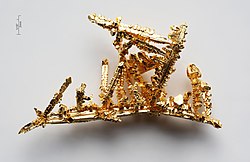
Gold is a chemical element; it has chemical symbol Au (from Latin aurum) and atomic number 79. In its pure form, it is a bright-metallic-yellow, dense, soft, malleable, and ductile metal. Chemically, gold is a transition metal, a group 11 element, and one of the noble metals. It is one of the least reactive chemical elements, being the second lowest in the reactivity series, with only platinum ranked as less reactive.[10] Gold is solid under standard conditions.
Gold often occurs as the free element (native state), as nuggets or grains, in rocks, veins, and alluvial deposits. It occurs in a solid solution series with the native element silver (as in electrum), naturally alloyed with other metals like copper and palladium, and mineral inclusions such as within pyrite. Less commonly, it occurs in minerals as gold compounds, often with tellurium (gold tellurides).
Gold is resistant to most acids, though it does dissolve in aqua regia (a mixture of nitric acid and hydrochloric acid), forming a soluble tetrachloroaurate anion. Gold is insoluble in nitric acid alone, which dissolves silver and base metals, a property long used to refine gold and confirm the presence of gold in metallic substances, giving rise to the term "acid test". Gold dissolves in alkaline solutions of cyanide, which are used in mining and electroplating. Gold also dissolves in mercury, forming amalgam alloys, and as the gold acts simply as a solute, this is not a chemical reaction.
A relatively rare element when compared to silver[11][12] (though thirty times more common than platinum),[13] gold is a precious metal that has been used for coinage, jewelry, and other works of art throughout recorded history. In the past, a gold standard was often implemented as a monetary policy. Gold coins ceased to be minted as a circulating currency in the 1930s, and the world gold standard was abandoned for a fiat currency system after the Nixon shock measures of 1971.
In 2023, the world's largest gold producer was China, followed by Russia and Australia.[14] As of 2020[update], a total of around 201,296 tonnes of gold exist above ground.[15] If all of this gold were put together into a cube shape, each of its sides would measure 21.7 meters (71 ft). The world's consumption of new gold produced is about 50% in jewelry, 40% in investments, and 10% in industry.[16] Gold's high malleability, ductility, resistance to corrosion and most other chemical reactions, as well as conductivity of electricity have led to its continued use in corrosion-resistant electrical connectors in all types of computerized devices (its chief industrial use). Gold is also used in infrared shielding, the production of colored glass, gold leafing, and tooth restoration. Certain gold salts are still used as anti-inflammatory agents in medicine.
Etymology
[edit]
Gold is cognate with similar words in many Germanic languages, deriving via Proto-Germanic *gulþą from Proto-Indo-European *ǵʰelh₃- 'to shine, to gleam; to be yellow or green'.[17][18]
The symbol Au is from the Latin aurum 'gold'.[19] The Proto-Indo-European ancestor of aurum was *h₂é-h₂us-o-, meaning 'glow'. This word is derived from the same root (Proto-Indo-European *h₂u̯es- 'to dawn') as *h₂éu̯sōs, the ancestor of the Latin word aurora 'dawn'.[20] This etymological relationship is presumably behind the frequent claim in scientific publications that aurum meant 'shining dawn'.[21]
Characteristics
[edit]
Gold is the most malleable metal. It can be drawn into a wire of single-atom width, and then stretched considerably before it breaks.[22] Such nanowires distort via the formation, reorientation, and migration of dislocations and crystal twins without noticeable hardening.[23] A single gram of gold can be beaten into a sheet of 1 square metre (11 sq ft), and an avoirdupois ounce into 28 square metres (300 sq ft). Gold leaf can be beaten thin enough to become semi-transparent. Light transmitted through gold appears greenish-blue, because gold strongly reflects yellow and red.[24] Such semi-transparent sheets also strongly reflect infrared light, making them useful as infrared (radiant heat) shields in the visors of heat-resistant suits and in sun visors for spacesuits.[25] Gold is a good conductor of heat and electricity.
Gold has a density of 19.3 g/cm3, almost identical to that of tungsten at 19.25 g/cm3; as such, tungsten has been used in the counterfeiting of gold bars, such as by plating a tungsten bar with gold.[26][27][28][29] By comparison, the density of lead is 11.34 g/cm3, and that of the densest element, osmium, is 22.588±0.015 g/cm3.[30]
Color
[edit]

Whereas most metals are gray or silvery white, gold is slightly reddish-yellow.[31] This color is determined by the frequency of plasma oscillations among the metal's valence electrons, in the ultraviolet range for most metals but in the visible range for gold due to relativistic effects affecting the orbitals around gold atoms.[32][33] Similar effects impart a golden hue to metallic caesium.
Common colored gold alloys include the distinctive eighteen-karat rose gold created by the addition of copper. Alloys containing palladium or nickel are also important in commercial jewelry as these produce white gold alloys. Fourteen-karat gold-copper alloy is nearly identical in color to certain bronze alloys, and both may be used to produce police and other badges. Fourteen- and eighteen-karat gold alloys with silver alone appear greenish-yellow and are referred to as green gold. Blue gold can be made by alloying with iron, and purple gold can be made by alloying with aluminium. Less commonly, addition of manganese, indium, and other elements can produce more unusual colors of gold for various applications.[34]
Colloidal gold, used by electron-microscopists, is red if the particles are small; larger particles of colloidal gold are blue.[35]
Isotopes
[edit]Gold has only one stable isotope, 197
Au, which is also its only naturally occurring isotope, so gold is both a mononuclidic and monoisotopic element. Thirty-six radioisotopes have been synthesized, ranging in atomic mass from 169 to 205. The most stable of these is 195
Au with a half-life of 186.1 days. The least stable is 171
Au, which decays by proton emission with a half-life of 30 μs. Most of gold's radioisotopes with atomic masses below 197 decay by some combination of proton emission, α decay, and β+ decay. The exceptions are 195
Au, which decays by electron capture, and 196
Au, which decays most often by electron capture (93%) with a minor β− decay path (7%).[36] All of gold's radioisotopes with atomic masses above 197 decay by β− decay.[37]
At least 32 nuclear isomers have also been characterized, ranging in atomic mass from 170 to 200. Within that range, only 178
Au, 180
Au, 181
Au, 182
Au, and 188
Au do not have isomers. Gold's most stable isomer is 198m2
Au with a half-life of 2.27 days. Gold's least stable isomer is 177m2
Au with a half-life of only 7 ns. 184m1
Au has three decay paths: β+ decay, isomeric transition, and alpha decay. No other isomer or isotope of gold has three decay paths.[37]
Synthesis
[edit]The possible production of gold from a more common element, such as lead, has long been a subject of human inquiry, and the ancient and medieval discipline of alchemy often focused on it; however, the transmutation of the chemical elements did not become possible until the understanding of nuclear physics in the 20th century. The first synthesis of gold was conducted by Japanese physicist Hantaro Nagaoka, who synthesized gold from mercury in 1924 by neutron bombardment.[38] An American team, working without knowledge of Nagaoka's prior study, conducted the same experiment in 1941, achieving the same result and showing that the isotopes of gold produced by it were all radioactive.[39] In 1980, Glenn Seaborg transmuted several thousand atoms of bismuth into gold at the Lawrence Berkeley Laboratory.[40][41] Gold can be manufactured in a nuclear reactor, but doing so is highly impractical and would cost far more than the value of the gold that is produced.[42]
Chemistry
[edit]_chloride_solution.jpg)
Although gold is the most noble of the noble metals,[43][44] it still forms many diverse compounds. The oxidation state of gold in its compounds ranges from −1 to +5, but Au(I) and Au(III) dominate its chemistry. Au(I), referred to as the aurous ion, is the most common oxidation state with soft ligands such as thioethers, thiolates, and organophosphines. Au(I) compounds are typically linear. A good example is Au(CN)−2, which is the soluble form of gold encountered in mining. The binary gold halides, such as AuCl, form zigzag polymeric chains, again featuring linear coordination at Au. Most drugs based on gold are Au(I) derivatives.[45]
Au(III) (referred to as auric) is a common oxidation state, and is illustrated by gold(III) chloride, Au2Cl6. The gold atom centers in Au(III) complexes, like other d8 compounds, are typically square planar, with chemical bonds that have both covalent and ionic character. Gold(I,III) chloride is also known, an example of a mixed-valence complex.
Gold does not react with oxygen at any temperature[46] and, up to 100 °C, is resistant to attack from ozone:[47]
![{\displaystyle {\mathrm {Au} {}+{}\mathrm {O} {\vphantom {A}}_{\smash[{t}]{2}}{}\mathrel {\longrightarrow } {}}({\text{no reaction}})}](https://wikimedia.org/api/rest_v1/media/math/render/svg/1042f66a95a991a8ce4c2e86c7748fd4afc327d4)
![{\displaystyle {\mathrm {Au} {}+{}\mathrm {O} {\vphantom {A}}_{\smash[{t}]{3}}{}\mathrel {\xrightarrow {{\mathit {t}}{<}100{\vphantom {A}}^{\circ }{\text{C}}} } {}}({\text{no reaction}})}](https://wikimedia.org/api/rest_v1/media/math/render/svg/8769426b8bb7643281baf210ce9de23f96cbf3dd)
Some free halogens react to form the corresponding gold halides.[48] Gold is strongly attacked by fluorine at dull-red heat[49] to form gold(III) fluoride AuF3. Powdered gold reacts with chlorine at 180 °C to form gold(III) chloride AuCl3.[50] Gold reacts with bromine at 140 °C to form a combination of gold(III) bromide AuBr3 and gold(I) bromide AuBr, but reacts very slowly with iodine to form gold(I) iodide AuI:
![{\displaystyle {2\,\mathrm {Au} {}+{}3\,\mathrm {F} {\vphantom {A}}_{\smash[{t}]{2}}{}\mathrel {\xrightarrow {\mathrm {\Delta } } } {}2\,\mathrm {AuF} {\vphantom {A}}_{\smash[{t}]{3}}}}](https://wikimedia.org/api/rest_v1/media/math/render/svg/9a3c0bb0cc3c690e8240ab773bcb3da6c73da854)
![{\displaystyle {2\,\mathrm {Au} {}+{}3\,\mathrm {Cl} {\vphantom {A}}_{\smash[{t}]{2}}{}\mathrel {\xrightarrow {\mathrm {\Delta } } } {}2\,\mathrm {AuCl} {\vphantom {A}}_{\smash[{t}]{3}}}}](https://wikimedia.org/api/rest_v1/media/math/render/svg/a7599e2064ec4dfd0bd0cee7a05f15d326d858cf)
![{\displaystyle {2\,\mathrm {Au} {}+{}2\,\mathrm {Br} {\vphantom {A}}_{\smash[{t}]{2}}{}\mathrel {\xrightarrow {\mathrm {\Delta } } } {}\mathrm {AuBr} {\vphantom {A}}_{\smash[{t}]{3}}{}+{}\mathrm {AuBr} }}](https://wikimedia.org/api/rest_v1/media/math/render/svg/6bbb59092bec2c4792f4b56103add365331527ed)
![{\displaystyle {2\,\mathrm {Au} {}+{}\mathrm {I} {\vphantom {A}}_{\smash[{t}]{2}}{}\mathrel {\xrightarrow {\mathrm {\Delta } } } {}2\,\mathrm {AuI} }}](https://wikimedia.org/api/rest_v1/media/math/render/svg/1d156530d3df908f9458571d0eeff185f7d647d6)
Gold does not react with sulfur directly,[51] but gold(III) sulfide can be made by passing hydrogen sulfide through a dilute solution of gold(III) chloride or chlorauric acid.
Unlike sulfur, phosphorus reacts directly with gold at elevated temperatures to produce gold phosphide (Au2P3).[52]
Gold readily dissolves in mercury at room temperature to form an amalgam, and forms alloys with many other metals at higher temperatures. These alloys can be produced to modify the hardness and other metallurgical properties, to control melting point or to create exotic colors.[34]
Gold is unaffected by most acids. It does not react with hydrofluoric, hydrochloric, hydrobromic, hydriodic, sulfuric, or nitric acid. It does react with selenic acid, and is dissolved by aqua regia, a 1:3 mixture of nitric acid and hydrochloric acid. Nitric acid oxidizes the metal to +3 ions, but only in minute amounts, typically undetectable in the pure acid because of the chemical equilibrium of the reaction. However, the ions are removed from the equilibrium by hydrochloric acid, forming AuCl−4 ions, or chloroauric acid, thereby enabling further oxidation:
![{\displaystyle {2\,\mathrm {Au} {}+{}6\,\mathrm {H} {\vphantom {A}}_{\smash[{t}]{2}}\mathrm {SeO} {\vphantom {A}}_{\smash[{t}]{4}}{}\mathrel {\xrightarrow {200{\vphantom {A}}^{\circ }{\text{C}}} } {}\mathrm {Au} {\vphantom {A}}_{\smash[{t}]{2}}(\mathrm {SeO} {\vphantom {A}}_{\smash[{t}]{4}}){\vphantom {A}}_{\smash[{t}]{3}}{}+{}3\,\mathrm {H} {\vphantom {A}}_{\smash[{t}]{2}}\mathrm {SeO} {\vphantom {A}}_{\smash[{t}]{3}}{}+{}3\,\mathrm {H} {\vphantom {A}}_{\smash[{t}]{2}}\mathrm {O} }}](https://wikimedia.org/api/rest_v1/media/math/render/svg/61712cffb00c6ce3259b513085089c5f5fd079b7)
![{\displaystyle {\mathrm {Au} {}+{}4\,\mathrm {HCl} {}+{}\mathrm {HNO} {\vphantom {A}}_{\smash[{t}]{3}}{}\mathrel {\longrightarrow } {}\mathrm {HAuCl} {\vphantom {A}}_{\smash[{t}]{4}}{}+{}\mathrm {NO} \uparrow {}+{}2\,\mathrm {H} {\vphantom {A}}_{\smash[{t}]{2}}\mathrm {O} }}](https://wikimedia.org/api/rest_v1/media/math/render/svg/927c524a984069045f198eed04c352d5263c6d5c)
Gold is similarly unaffected by most bases. It does not react with aqueous, solid, or molten sodium or potassium hydroxide. It does, however, react with sodium or potassium cyanide under alkaline conditions when oxygen is present to form soluble complexes.[51]
Common oxidation states of gold include +1 (gold(I) or aurous compounds) and +3 (gold(III) or auric compounds). Gold ions in solution are readily reduced and precipitated as metal by adding any other metal as the reducing agent. The added metal is oxidized and dissolves, allowing the gold to be displaced from solution and be recovered as a solid precipitate.
Rare oxidation states
[edit]Less common oxidation states of gold include −1, +2, and +5.
The −1 oxidation state occurs in aurides, compounds containing the Au− anion. Caesium auride (CsAu), for example, crystallizes in the caesium chloride motif;[53] rubidium, potassium, and tetramethylammonium aurides are also known.[54] Gold has the highest electron affinity of any metal, at 222.8 kJ/mol, making Au− a stable species,[55] analogous to the halides.
Gold also has a –1 oxidation state in covalent complexes with the group 4 transition metals, such as in titanium tetraauride and the analogous zirconium and hafnium compounds. These chemicals are expected to form gold-bridged dimers in a manner similar to titanium(IV) hydride.[56]
Gold(II) compounds are usually diamagnetic with Au–Au bonds such as [Au(CH2)2P(C6H5)2]2Cl2. The evaporation of a solution of Au(OH)3 in concentrated H2SO4 produces red crystals of gold(II) sulfate, Au2(SO4)2. Originally thought to be a mixed-valence compound, it has been shown to contain Au4+2 cations, analogous to the better-known mercury(I) ion, Hg2+2.[57][58] A gold(II) complex, the tetraxenonogold(II) cation, which contains xenon as a ligand, occurs in [AuXe4](Sb2F11)2.[59] In September 2023, a novel type of metal-halide perovskite material consisting of Au3+ and Au2+ cations in its crystal structure has been found.[60] It has been shown to be unexpectedly stable at normal conditions.
Gold pentafluoride, along with its derivative anion, AuF−6, and its difluorine complex, gold heptafluoride, is the sole example of gold(V), the highest verified oxidation state.[61]
Some gold compounds exhibit aurophilic bonding, which describes the tendency of gold ions to interact at distances that are too long to be a conventional Au–Au bond but shorter than van der Waals bonding. The interaction is estimated to be comparable in strength to that of a hydrogen bond.
Well-defined cluster compounds are numerous.[54] In some cases, gold has a fractional oxidation state. A representative example is the octahedral species {Au(P(C6H5)3)}2+6.
Origin
[edit]Gold production in the universe
[edit]
Gold in the universe is produced through several cosmic processes and was present in the dust from which the Solar System formed.[62] Scientists have identified three main cosmic sources for gold formation: supernova nucleosynthesis, neutron star collisions,[63] and magnetar flares.
All three sources involve a process called the r-process (rapid neutron capture), which forms elements heavier than iron.[64] For decades, scientists believed supernova nucleosynthesis was the primary mechanism for gold formation. More recently, research has shown that neutron star collisions produce significant quantities of gold through the r-process.[65]
In August 2017, the spectroscopic signatures of heavy elements, including gold, were directly observed by electromagnetic observatories during the GW170817 neutron star merger event.[66] This confirmed neutron star mergers as a source of gold, after years of only indirect detection.[67] This single event generated between 3 and 13 Earth masses of gold, suggesting that neutron star mergers might produce enough gold to account for most of this element in the universe.[68]
However, neutron star mergers alone cannot explain all cosmic gold, particularly in older stars, because these mergers occur relatively late in galactic history and are infrequent (approximately once every 100,000 years).[69] This created a timing paradox in explaining the presence of gold in stars formed early in the universe.
In 2025, researchers resolved this paradox by confirming that giant flares from magnetars (highly magnetic neutron stars) are also a significant source of gold formation.[70] Analysis of a 2004 magnetar flare showed these events produce heavy elements through the same r-process as neutron star mergers. The amount of heavy elements created in a single magnetar flare can exceed the mass of Mars.[71] Since magnetars existed earlier in cosmic history and flare more frequently than neutron star mergers occur, they help explain gold's presence in older stars. Scientists estimate magnetar flares may contribute approximately 1–10% of all elements heavier than iron in our galaxy, including gold.[72]
Asteroid origin theories
[edit]Because the Earth was molten when it was formed, almost all of the gold present in the early Earth probably sank into the planetary core. Therefore, as hypothesized in one model, most of the gold in the Earth's crust and mantle is thought to have been delivered to Earth by asteroid impacts during the Late Heavy Bombardment, about 4 billion years ago.[73][74]
Gold which is reachable by humans has, in one case, been associated with a particular asteroid impact. The asteroid that formed Vredefort impact structure 2.020 billion years ago is often credited with seeding the Witwatersrand basin in South Africa with the richest gold deposits on earth.[75][76][77][78] However, this scenario is now questioned. The gold-bearing Witwatersrand rocks were laid down between 700 and 950 million years before the Vredefort impact.[79][80] These gold-bearing rocks had furthermore been covered by a thick layer of Ventersdorp lavas and the Transvaal Supergroup of rocks before the meteor struck, and thus the gold did not actually arrive in the asteroid/meteorite. What the Vredefort impact achieved, however, was to distort the Witwatersrand basin in such a way that the gold-bearing rocks were brought to the present erosion surface in Johannesburg, on the Witwatersrand, just inside the rim of the original 300 km (190 mi) diameter crater caused by the meteor strike. The discovery of the deposit in 1886 launched the Witwatersrand Gold Rush. Some 22% of all the gold that is ascertained to exist today on Earth has been extracted from these Witwatersrand rocks.[80]
Mantle return theories
[edit]Much of the rest of the gold on Earth is thought to have been incorporated into the planet since its very beginning, as planetesimals formed the mantle. In 2017, an international group of scientists established that gold "came to the Earth's surface from the deepest regions of our planet",[81] the mantle, as evidenced by their findings at Deseado Massif in the Argentinian Patagonia.[82][clarification needed]
Occurrence
[edit]_4_(16848647509).jpg)
On Earth, gold is found in ores in rock formed from the Precambrian time onward.[83] It most often occurs as a native metal, typically in a metal solid solution with silver (i.e. as a gold/silver alloy). Such alloys usually have a silver content of 8–10%. Electrum is elemental gold with more than 20% silver, and is commonly known as white gold. Electrum's color runs from golden-silvery to silvery, dependent upon the silver content. The more silver, the lower the specific gravity.

Native gold occurs as very small to microscopic particles embedded in rock, often together with quartz or sulfide minerals such as "fool's gold", which is a pyrite.[84] These are called lode deposits. The metal in a native state is also found in the form of free flakes, grains or larger nuggets[83] that have been eroded from rocks and end up in alluvial deposits called placer deposits. Such free gold is always richer at the exposed surface of gold-bearing veins, owing to the oxidation of accompanying minerals followed by weathering; and by washing of the dust into streams and rivers, where it collects and can be welded by water action to form nuggets.
Gold sometimes occurs combined with tellurium as the minerals calaverite, krennerite, nagyagite, petzite and sylvanite (see telluride minerals), and as the rare bismuthide maldonite (Au2Bi) and antimonide aurostibite (AuSb2). Gold also occurs in rare alloys with copper, lead, and mercury: the minerals auricupride (Cu3Au), novodneprite (AuPb3) and weishanite ((Au,Ag)3Hg2).
A 2004 research paper suggests that microbes can sometimes play an important role in forming gold deposits, transporting and precipitating gold to form grains and nuggets that collect in alluvial deposits.[85]
A 2013 study has claimed water in faults vaporizes during an earthquake, depositing gold. When an earthquake strikes, it moves along a fault. Water often lubricates faults, filling in fractures and jogs. About 10 kilometres (6.2 mi) below the surface, under very high temperatures and pressures, the water carries high concentrations of carbon dioxide, silica, and gold. During an earthquake, the fault jog suddenly opens wider. The water inside the void instantly vaporizes, flashing to steam and forcing silica, which forms the mineral quartz, and gold out of the fluids and onto nearby surfaces.[86]
Seawater
[edit]The world's oceans contain gold. Measured concentrations of gold in the Atlantic and Northeast Pacific are 50–150 femtomol/L or 10–30 parts per quadrillion (about 10–30 g/km3). In general, gold concentrations for south Atlantic and central Pacific samples are the same (~50 femtomol/L) but less certain. Mediterranean deep waters contain slightly higher concentrations of gold (100–150 femtomol/L), which is attributed to wind-blown dust or rivers. At 10 parts per quadrillion, the Earth's oceans would hold 15,000 tonnes of gold.[87] These figures are three orders of magnitude less than reported in the literature prior to 1988, indicating contamination problems with the earlier data.
A number of people have claimed to be able to economically recover gold from sea water, but they were either mistaken or acted in an intentional deception. Prescott Jernegan ran a gold-from-seawater swindle in the United States in the 1890s, as did an English fraudster in the early 1900s.[88] Fritz Haber did research on the extraction of gold from sea water in an effort to help pay Germany's reparations following World War I.[89] Based on the published values of 2 to 64 ppb of gold in seawater, a commercially successful extraction seemed possible. After analysis of 4,000 water samples yielding an average of 0.004 ppb, it became clear that extraction would not be possible, and he ended the project.[90]
History
[edit]

.jpg)
This Muisca raft figure is on display in the Gold Museum, Bogotá, Colombia.
The earliest recorded metal employed by humans appears to be gold, which can be found free or "native". Small amounts of natural gold have been found in Spanish caves used during the late Paleolithic period, c. 40,000 BC.[92]
The oldest gold artifacts in the world are from Bulgaria and are dating back to the 5th millennium BC (4,600 BC to 4,200 BC), such as those found in the Varna Necropolis near Lake Varna and the Black Sea coast, thought to be the earliest "well-dated" finding of gold artifacts in history.[93][83][94]
Gold artifacts probably made their first appearance in Ancient Egypt at the very beginning of the pre-dynastic period, at the end of the fifth millennium BC and the start of the fourth, and smelting was developed during the course of the 4th millennium; gold artifacts appear in the archeology of Lower Mesopotamia during the early 4th millennium.[95] As of 1990, gold artifacts found at the Wadi Qana cave cemetery of the 4th millennium BC in West Bank were the earliest from the Levant.[96] Gold artifacts such as the golden hats and the Nebra disk appeared in Central Europe from the 2nd millennium BC Bronze Age.
The oldest known map of a gold mine was drawn in the 19th Dynasty of Ancient Egypt (1320–1200 BC), whereas the first written reference to gold was recorded in the 12th Dynasty around 1900 BC.[97] Egyptian hieroglyphs from as early as 2600 BC describe gold, which King Tushratta of the Mitanni claimed was "more plentiful than dirt" in Egypt.[98] Egypt and especially Nubia had the resources to make them major gold-producing areas for much of history. One of the earliest known maps, known as the Turin Papyrus Map, shows the plan of a gold mine in Nubia together with indications of the local geology. The primitive working methods are described by both Strabo and Diodorus Siculus, and included fire-setting. Large mines were also present across the Red Sea in what is now Saudi Arabia.

Gold is mentioned in the Amarna letters numbered 19[99] and 26[100] from around the 14th century BC.[101][102]
Gold is mentioned frequently in the Old Testament, starting with Genesis 2:11 (at Havilah), the story of the golden calf, and many parts of the temple including the Menorah and the golden altar. In the New Testament, it is included with the gifts of the magi in the first chapters of Matthew. The Book of Revelation 21:21 describes the city of New Jerusalem as having streets "made of pure gold, clear as crystal". Exploitation of gold in the south-east corner of the Black Sea is said to date from the time of Midas, and this gold was important in the establishment of what is probably the world's earliest coinage in Lydia around 610 BC.[103] The legend of the golden fleece dating from eighth century BCE may refer to the use of fleeces to trap gold dust from placer deposits in the ancient world. From the 6th or 5th century BC, the Chu (state) circulated the Ying Yuan, one kind of square gold coin.
In Roman metallurgy, new methods for extracting gold on a large scale were developed by introducing hydraulic mining methods, especially in Hispania from 25 BC onwards and in Dacia from 106 AD onwards. One of their largest mines was at Las Medulas in León, where seven long aqueducts enabled them to sluice most of a large alluvial deposit. The mines at Roşia Montană in Transylvania were also very large, and until very recently,[when?] still mined by opencast methods. They also exploited smaller deposits in Britain, such as placer and hard-rock deposits at Dolaucothi. The various methods they used are well described by Pliny the Elder in his encyclopedia Naturalis Historia written towards the end of the first century AD.
During Mansa Musa's (ruler of the Mali Empire from 1312 to 1337) hajj to Mecca in 1324, he passed through Cairo in July 1324, and was reportedly accompanied by a camel train that included thousands of people and nearly a hundred camels where he gave away so much gold that it depressed the price in Egypt for over a decade, causing high inflation.[104] A contemporary Arab historian remarked:
Gold was at a high price in Egypt until they came in that year. The mithqal did not go below 25 dirhams and was generally above, but from that time its value fell and it cheapened in price and has remained cheap till now. The mithqal does not exceed 22 dirhams or less. This has been the state of affairs for about twelve years until this day by reason of the large amount of gold which they brought into Egypt and spent there [...].
— Chihab Al-Umari, Kingdom of Mali[105]

The European exploration of the Americas was fueled in no small part by reports of the gold ornaments displayed in great profusion by Native American peoples, especially in Mesoamerica, Peru, Ecuador and Colombia. The Aztecs regarded gold as the product of the gods, calling it literally "god excrement" (teocuitlatl in Nahuatl), and after Moctezuma II was killed, most of this gold was shipped to Spain.[107] However, for the indigenous peoples of North America gold was considered useless and they saw much greater value in other minerals which were directly related to their utility, such as obsidian, flint, and slate.[108]
El Dorado is applied to a legendary story in which precious stones were found in fabulous abundance along with gold coins. The concept of El Dorado underwent several transformations, and eventually accounts of the previous myth were also combined with those of a legendary lost city. El Dorado, was the term used by the Spanish Empire to describe a mythical tribal chief (zipa) of the Muisca native people in Colombia, who, as an initiation rite, covered himself with gold dust and submerged in Lake Guatavita. The legends surrounding El Dorado changed over time, as it went from being a man, to a city, to a kingdom, and then finally to an empire.[citation needed]
Beginning in the early modern period, European exploration and colonization of West Africa was driven in large part by reports of gold deposits in the region, which was eventually referred to by Europeans as the "Gold Coast".[109] From the late 15th to early 19th centuries, European trade in the region was primarily focused in gold, along with ivory and slaves.[110] The gold trade in West Africa was dominated by the Ashanti Empire, who initially traded with the Portuguese before branching out and trading with British, French, Spanish and Danish merchants.[111] British desires to secure control of West African gold deposits played a role in the Anglo-Ashanti wars of the late 19th century, which saw the Ashanti Empire annexed by Britain.[112]
Gold played a role in western culture, as a cause for desire and of corruption, as told in children's fables such as Rumpelstiltskin—where Rumpelstiltskin turns hay into gold for the peasant's daughter in return for her child when she becomes a princess—and the stealing of the hen that lays golden eggs in Jack and the Beanstalk.
The top prize at the Olympic Games and many other sports competitions is the gold medal.
75% of the presently accounted for gold has been extracted since 1910, two-thirds since 1950.[citation needed]
One main goal of the alchemists was to produce gold from other substances, such as lead — presumably by the interaction with a mythical substance called the philosopher's stone. Trying to produce gold led the alchemists to systematically find out what can be done with substances, and this laid the foundation for today's chemistry, which can produce gold (albeit uneconomically) by using nuclear transmutation.[113] Their symbol for gold was the circle with a point at its center (☉), which was also the astrological symbol and the ancient Chinese character for the Sun.
The Dome of the Rock is covered with an ultra-thin golden glassier. The Sikh Golden temple, the Harmandir Sahib, is a building covered with gold. Similarly the Wat Phra Kaew emerald Buddhist temple (wat) in Thailand has ornamental gold-leafed statues and roofs. Some European king and queen's crowns were made of gold, and gold was used for the bridal crown since antiquity. An ancient Talmudic text circa 100 AD describes Rachel, wife of Rabbi Akiva, receiving a "Jerusalem of Gold" (diadem). A Greek burial crown made of gold was found in a grave circa 370 BC.
Culture
[edit]

In popular culture gold is a high standard of excellence, often used in awards.[55] Great achievements are frequently rewarded with gold, in the form of gold medals, gold trophies and other decorations. Winners of athletic events and other graded competitions are usually awarded a gold medal. Many awards such as the Nobel Prize are made from gold as well. Other award statues and prizes are depicted in gold or are gold plated (such as the Academy Awards, the Golden Globe Awards, the Emmy Awards, the Palme d'Or, and the British Academy Film Awards).[114]
Aristotle in his ethics used gold symbolism when referring to what is now known as the golden mean. Similarly, gold is associated with perfect or divine principles, such as in the case of the golden ratio and the Golden Rule. Gold is further associated with the wisdom of aging and fruition. The fiftieth wedding anniversary is golden. A person's most valued or most successful latter years are sometimes considered "golden years" or "golden jubilee". The height of a civilization is referred to as a golden age.[115]
Religion
[edit]
The first known prehistoric human usages of gold were religious in nature.[116]
In some forms of Christianity and Judaism, gold has been associated both with the sacred and evil. In the Book of Exodus, the Golden Calf is a symbol of idolatry, while in the Book of Genesis, Abraham was said to be rich in gold and silver, and Moses was instructed to cover the Mercy Seat of the Ark of the Covenant with pure gold. In Byzantine iconography the halos of Christ, Virgin Mary and the saints are often golden.[117]
In Islam,[118] gold (along with silk)[119][120] is often cited as being forbidden for men to wear.[121] Abu Bakr al-Jazaeri, quoting a hadith, said that "[t]he wearing of silk and gold are forbidden on the males of my nation, and they are lawful to their women".[122] This, however, has not been enforced consistently throughout history, e.g. in the Ottoman Empire.[123] Further, small gold accents on clothing, such as in embroidery, may be permitted.[124]
In ancient Greek religion and mythology, Theia was seen as the goddess of gold, silver and other gemstones.[125]
According to Christopher Columbus, those who had something of gold were in possession of something of great value on Earth and a substance to even help souls to paradise.[126]
Wedding rings are typically made of gold. It is long lasting and unaffected by the passage of time and may aid in the ring symbolism of eternal vows before God and the perfection the marriage signifies. In Orthodox Christian wedding ceremonies, the wedded couple is adorned with a golden crown (though some opt for wreaths, instead) during the ceremony, an amalgamation of symbolic rites.[further explanation needed]
On 24 August 2020, Israeli archaeologists discovered a trove of early Islamic gold coins near the central city of Yavne. Analysis of the extremely rare collection of 425 gold coins indicated that they were from the late 9th century. Dating to around 1,100 years back, the gold coins were from the Abbasid Caliphate.[127]
Production
[edit]
According to the United States Geological Survey in 2016, about 5,726,000,000 troy ounces (178,100 t) of gold has been accounted for, of which 85% remains in active use.[128]
Mining and prospecting
[edit].jpg)

Since the 1880s, South Africa has been the source of a large proportion of the world's gold supply, and about 22% of the gold presently accounted is from South Africa. Production in 1970 accounted for 79% of the world supply, about 1,480 tonnes. In 2007 China (with 276 tonnes) overtook South Africa as the world's largest gold producer, the first time since 1905 that South Africa had not been the largest.[129]
In 2023, China was the world's leading gold-mining country, followed in order by Russia, Australia, Canada, the United States and Ghana.[14]

In South America, the controversial project Pascua Lama aims at exploitation of rich fields in the high mountains of Atacama Desert, at the border between Chile and Argentina.
It has been estimated that up to one-quarter of the yearly global gold production originates from artisanal or small scale mining.[130][131][132]
The city of Johannesburg located in South Africa was founded as a result of the Witwatersrand Gold Rush which resulted in the discovery of some of the largest natural gold deposits in recorded history. The gold fields are confined to the northern and north-western edges of the Witwatersrand basin, which is a 5–7 km (3.1–4.3 mi) thick layer of archean rocks located, in most places, deep under the Free State, Gauteng and surrounding provinces.[133] These Witwatersrand rocks are exposed at the surface on the Witwatersrand, in and around Johannesburg, but also in isolated patches to the south-east and south-west of Johannesburg, as well as in an arc around the Vredefort Dome which lies close to the center of the Witwatersrand basin.[79][133] From these surface exposures the basin dips extensively, requiring some of the mining to occur at depths of nearly 4,000 m (13,000 ft), making them, especially the Savuka and TauTona mines to the south-west of Johannesburg, the deepest mines on Earth. The gold is found only in six areas where archean rivers from the north and north-west formed extensive pebbly Braided river deltas before draining into the "Witwatersrand sea" where the rest of the Witwatersrand sediments were deposited.[133]
The Second Boer War of 1899–1901 between the British Empire and the Afrikaner Boers was at least partly over the rights of miners and possession of the gold wealth in South Africa.

During the 19th century, gold rushes occurred whenever large gold deposits were discovered. The first documented discovery of gold in the United States was at the Reed Gold Mine near Georgeville, North Carolina in 1803.[134] The first major gold strike in the United States occurred in a small north Georgia town called Dahlonega.[135] Further gold rushes occurred in California, Colorado, the Black Hills, Otago in New Zealand, a number of locations across Australia, Witwatersrand in South Africa, and the Klondike in Canada.
Grasberg mine located in Papua, Indonesia is the largest gold mine in the world.[136]
Extraction and refining
[edit]
Gold extraction is most economical in large, easily mined deposits. Ore grades as little as 0.5 parts per million (ppm) can be economical. Typical ore grades in open-pit mines are 1–5 ppm; ore grades in underground or hard rock mines are usually at least 3 ppm. Because ore grades of 30 ppm are usually needed before gold is visible to the naked eye, in most gold mines the gold is invisible.
The average gold mining and extraction costs were about $317 per troy ounce in 2007, but these can vary widely depending on mining type and ore quality; global mine production amounted to 2,471.1 tonnes.[137]
After initial production, gold is often subsequently refined industrially by the Wohlwill process which is based on electrolysis or by the Miller process, that is chlorination in the melt. The Wohlwill process results in higher purity, but is more complex and is only applied in small-scale installations.[138][139] Other methods of assaying and purifying smaller amounts of gold include parting and inquartation as well as cupellation, or refining methods based on the dissolution of gold in aqua regia.[140]
Recycling
[edit]In 1997, recycled gold accounted for approximately 20% of the 2700 tons of gold supplied to the market.[141] Jewelry companies such as Generation Collection and computer companies including Dell conduct recycling.[142]
As of 2020, the amount of carbon dioxide CO2 produced in mining a kilogram of gold is 16 tonnes, while recycling a kilogram of gold produces 53 kilograms of CO2 equivalent. Approximately 30 percent of the global gold supply is recycled and not mined as of 2020.[143]
Consumption
[edit] | This article needs to be updated. (May 2022) |
| Country | 2009 | 2010 | 2011 | 2012 | 2013 |
|---|---|---|---|---|---|
 India India |
442.37 | 745.70 | 986.3 | 864 | 974 |
 China China |
376.96 | 428.00 | 921.5 | 817.5 | 1120.1 |
 United States United States |
150.28 | 128.61 | 199.5 | 161 | 190 |
 Turkey Turkey |
75.16 | 74.07 | 143 | 118 | 175.2 |
 Saudi Arabia Saudi Arabia |
77.75 | 72.95 | 69.1 | 58.5 | 72.2 |
 Russia Russia |
60.12 | 67.50 | 76.7 | 81.9 | 73.3 |
 United Arab Emirates United Arab Emirates |
67.60 | 63.37 | 60.9 | 58.1 | 77.1 |
 Egypt Egypt |
56.68 | 53.43 | 36 | 47.8 | 57.3 |
 Indonesia Indonesia |
41.00 | 32.75 | 55 | 52.3 | 68 |
 United Kingdom United Kingdom |
31.75 | 27.35 | 22.6 | 21.1 | 23.4 |
| Other Persian Gulf Countries | 24.10 | 21.97 | 22 | 19.9 | 24.6 |
 Japan Japan |
21.85 | 18.50 | −30.1 | 7.6 | 21.3 |
 South Korea South Korea |
18.83 | 15.87 | 15.5 | 12.1 | 17.5 |
 Vietnam Vietnam |
15.08 | 14.36 | 100.8 | 77 | 92.2 |
 Thailand Thailand |
7.33 | 6.28 | 107.4 | 80.9 | 140.1 |
| Total | 1466.86 | 1770.71 | 2786.12 | 2477.7 | 3126.1 |
| Other Countries | 251.6 | 254.0 | 390.4 | 393.5 | 450.7 |
| World Total | 1718.46 | 2024.71 | 3176.52 | 2871.2 | 3576.8 |
The consumption of gold produced in the world is about 50% in jewelry, 40% in investments, and 10% in industry.[16][146]
According to the World Gold Council, China was the world's largest single consumer of gold in 2013, overtaking India.[147]
Pollution
[edit]Gold production is associated with contribution to hazardous pollution.[148]
Low-grade gold ore may contain less than one ppm gold metal; such ore is ground and mixed with sodium cyanide to dissolve the gold. Cyanide is a highly poisonous chemical, which can kill living creatures when exposed in minute quantities. Many cyanide spills[149] from gold mines have occurred in both developed and developing countries which killed aquatic life in long stretches of affected rivers. Environmentalists consider these events major environmental disasters.[150][151] Up to thirty tons of used ore can be dumped as waste for producing one troy ounce of gold.[152] Gold ore dumps are the source of many heavy elements such as cadmium, lead, zinc, copper, arsenic, selenium and mercury. When sulfide-bearing minerals in these ore dumps are exposed to air and water, the sulfide transforms into sulfuric acid which in turn dissolves these heavy metals facilitating their passage into surface water and ground water. This process is called acid mine drainage. These gold ore dumps contain long-term, highly hazardous waste.[152]
It was once common to use mercury to recover gold from ore, but today the use of mercury is largely limited to small-scale individual miners.[153] Minute quantities of mercury compounds can reach water bodies, causing heavy metal contamination. Mercury can then enter into the human food chain in the form of methylmercury. Mercury poisoning in humans can cause severe brain damage.[154]
Gold extraction is also a highly energy-intensive industry, extracting ore from deep mines and grinding the large quantity of ore for further chemical extraction requires nearly 25 kWh of electricity per gram of gold produced.[155]
Monetary use
[edit]
Gold has been widely used throughout the world as money,[156] for efficient indirect exchange (versus barter), and to store wealth in hoards. For exchange purposes, mints produce standardized gold bullion coins, bars and other units of fixed weight and purity.
The first known coins containing gold were struck in Lydia, Asia Minor, around 600 BC.[103] The talent coin of gold in use during the periods of Grecian history both before and during the time of the life of Homer weighed between 8.42 and 8.75 grams.[157] From an earlier preference in using silver, European economies re-established the minting of gold as coinage during the thirteenth and fourteenth centuries.[158]
Bills (that mature into gold coin) and gold certificates (convertible into gold coin at the issuing bank) added to the circulating stock of gold standard money in most 19th century industrial economies. In preparation for World War I the warring nations moved to fractional gold standards, inflating their currencies to finance the war effort. Post-war, the victorious countries, most notably Britain, gradually restored gold-convertibility, but international flows of gold via bills of exchange remained embargoed; international shipments were made exclusively for bilateral trades or to pay war reparations.
After World War II gold was replaced by a system of nominally convertible currencies related by fixed exchange rates following the Bretton Woods system. Gold standards and the direct convertibility of currencies to gold have been abandoned by world governments, led in 1971 by the United States' refusal to redeem its dollars in gold. Fiat currency now fills most monetary roles. Switzerland was the last country to tie its currency to gold; this was ended by a referendum in 1999.[159]

Central banks continue to keep a portion of their liquid reserves as gold in some form, and metals exchanges such as the London Bullion Market Association still clear transactions denominated in gold, including future delivery contracts. Today, gold mining output is declining.[160] With the sharp growth of economies in the 20th century, and increasing foreign exchange, the world's gold reserves and their trading market have become a small fraction of all markets and fixed exchange rates of currencies to gold have been replaced by floating prices for gold and gold future contract. Though the gold stock grows by only 1% or 2% per year, very little metal is irretrievably consumed. Inventory above ground would satisfy many decades of industrial and even artisan uses at current prices.
The gold proportion (fineness) of alloys is measured by karat (k). Pure gold (commercially termed fine gold) is designated as 24 karat, abbreviated 24k. English gold coins intended for circulation from 1526 into the 1930s were typically a standard 22k alloy called crown gold,[161] for hardness (American gold coins for circulation after 1837 contain an alloy of 0.900 fine gold, or 21.6 kt).[162]
Often the prices of various platinum group metals can be much higher than gold, although gold has been used as a standard for currencies to a greater degree than the platinum group metals. Gold has been used as a symbol for purity, value, royalty, and particularly roles that combine these properties. Gold as a sign of wealth and prestige was ridiculed by Thomas More in his treatise Utopia. On that imaginary island, gold is so abundant that it is used to make chains for slaves, tableware, and lavatory seats. When ambassadors from other countries arrive, dressed in ostentatious gold jewels and badges, the Utopians mistake them for menial servants, paying homage instead to the most modestly dressed of their party.
The ISO 4217 currency code of gold is XAU.[163] Many holders of gold store it in form of bullion coins or bars as a hedge against inflation or other economic disruptions. A paper by the National Bureau of Economic Research found that gold may be reliable as an inflation hedge over long timescales (centuries) but not over practical timescales.[164] Modern bullion coins for investment or collector purposes do not require good mechanical wear properties; they are typically fine gold at 24k, although the American Gold Eagle and the British gold sovereign continue to be minted in 22k (0.92) metal in historical tradition, and the South African Krugerrand, first released in 1967, is also 22k (0.92).[165]
The special issue Canadian Gold Maple Leaf coin contains the highest purity gold of any bullion coin, at 99.999% or 0.99999, while the popular issue Canadian Gold Maple Leaf coin has a purity of 99.99%. In 2006, the United States Mint began producing the American Buffalo gold bullion coin with a purity of 99.99%. The Australian Gold Kangaroos were first coined in 1986 as the Australian Gold Nugget but changed the reverse design in 1989. Other modern coins include the Austrian Vienna Philharmonic bullion coin and the Chinese Gold Panda.[166]
Price
[edit]
Like other precious metals, gold is measured by troy weight and by grams. The proportion of gold in the alloy is measured by karat (k), with 24 karat (24k) being pure gold (100%), and lower karat numbers proportionally less (18k = 75%). The purity of a gold bar or coin can also be expressed as a decimal figure ranging from 0 to 1, known as the millesimal fineness, such as 0.995 being nearly pure.
The price of gold is determined through trading in the gold and derivatives markets, but a procedure known as the Gold Fixing in London, originating in September 1919, provides a daily benchmark price to the industry. The afternoon fixing was introduced in 1968 to provide a price when US markets are open.[167] As of October 2025[update], gold was valued at around $127 per gram ($3,950 per troy ounce).
History
[edit]Historically gold coinage was widely used as currency; when paper money was introduced, it typically was a receipt redeemable for gold coin or bullion. In a monetary system known as the gold standard, a certain weight of gold was given the name of a unit of currency. For a long period, the United States government set the value of the US dollar so that one troy ounce was equal to $20.67 ($0.665 per gram), but in 1934 the dollar was devalued to $35.00 per troy ounce ($0.889/g). By 1961, it was becoming hard to maintain this price, and a pool of US and European banks agreed to manipulate the market to prevent further currency devaluation against increased gold demand.[168]
The largest gold depository in the world is that of the U.S. Federal Reserve Bank in New York, which holds about 3%[169] of the gold known to exist and accounted for today, as does the similarly laden U.S. Bullion Depository at Fort Knox. In 2005 the World Gold Council estimated total global gold supply to be 3,859 tonnes and demand to be 3,754 tonnes, giving a surplus of 105 tonnes.[170]
After 15 August 1971 Nixon shock, the price began to greatly increase,[171] and between 1968 and 2000 the price of gold ranged widely, from a high of $850 per troy ounce ($27.33/g) on 21 January 1980, to a low of $252.90 per troy ounce ($8.13/g) on 21 June 1999 (London Gold Fixing).[172] Prices increased rapidly from 2001, but the 1980 high was not exceeded until 3 January 2008, when a new maximum of $865.35 per troy ounce was set.[173] Another record price was set on 17 March 2008, at $1023.50 per troy ounce ($32.91/g).[173]
On 2 December 2009, gold reached a new high closing at $1,217.23.[174] Gold further rallied hitting new highs in May 2010 after the European Union debt crisis prompted further purchase of gold as a safe asset.[175][176] On 1 March 2011, gold hit a new all-time high of $1432.57, based on investor concerns regarding ongoing unrest in North Africa as well as in the Middle East.[177]
From April 2001 to August 2011, spot gold prices more than quintupled in value against the US dollar, hitting a new all-time high of $1,913.50 on 23 August 2011,[178] prompting speculation that the long secular bear market had ended and a bull market had returned.[179] However, the price then began a slow decline towards $1200 per troy ounce in late 2014 and 2015.
In August 2020, the gold price picked up to US$2060 per ounce after a total growth of 59% from August 2018 to October 2020, a period during which it outplaced the Nasdaq total return of 54%.[180]
Gold futures are traded on the COMEX exchange.[181] These contacts are priced in USD per troy ounce (1 troy ounce = 31.1034768 grams).[182] Below are the CQG contract specifications outlining the futures contracts:
| Gold (GCA) | |
|---|---|
| Exchange: | COMEX |
| Sector: | Metal |
| Tick Size: | 0.1 |
| Tick Value: | 10 USD |
| BPV: | 100 |
| Denomination: | USD |
| Decimal Place: | 1 |
Other applications
[edit]Jewelry
[edit]

Pure (24k) gold is often alloyed with other metals for use in jewelry, altering its hardness and ductility, melting point, color and other properties. Alloys with lower karat rating, typically 22k, 18k, 14k or 10k, contain higher percentages of copper, silver, palladium or other base metals in the alloy.[34] Nickel is toxic, and its release from nickel white gold is controlled by legislation in Europe.[34] Palladium-gold alloys are more expensive than those using nickel.[183] High-karat white gold alloys are more resistant to corrosion than are either pure silver or sterling silver, though not as corrosion-proof as platinum jewelry. The Japanese craft of Mokume-gane exploits the color contrasts between laminated colored gold alloys to produce decorative wood-grain effects.
Gold solder is used for joining the components of gold jewelry by high-temperature hard soldering or brazing. If the work is to be of hallmarking quality, the gold solder alloy must match the fineness of the work, and alloy formulas are manufactured to color-match yellow and white gold. Gold solder is usually made in at least three melting-point ranges referred to as Easy, Medium and Hard. By using the hard, high-melting point solder first, followed by solders with progressively lower melting points, goldsmiths can assemble complex items with several separate soldered joints. Gold can also be made into thread and used in embroidery.
Electronics
[edit]Only 10% of the world consumption of new gold produced goes to industry,[16] but by far the most important industrial use for new gold is in fabrication of corrosion-free electrical connectors in computers and other electrical devices. For example, according to the World Gold Council, a typical cell phone may contain 50 mg of gold, worth about three dollars. But since nearly one billion cell phones are produced each year, a gold value of US$2.82 in each phone adds to US$2.82 billion in gold from just this application.[184] (Prices updated to November 2022)
Though gold is attacked by free chlorine, its good conductivity and general resistance to oxidation and corrosion in other environments (including resistance to non-chlorinated acids) has led to its widespread industrial use in the electronic era as a thin-layer coating on electrical connectors, thereby ensuring good connection. For example, gold is used in the connectors of the more expensive electronics cables, such as audio, video and USB cables. The benefit of using gold over other connector metals such as tin in these applications has been debated; gold connectors are often criticized by audio-visual experts as unnecessary for most consumers and seen as simply a marketing ploy. However, the use of gold in other applications in electronic sliding contacts in highly humid or corrosive atmospheres, and in use for contacts with a very high failure cost (certain computers, communications equipment, spacecraft, jet aircraft engines) remains very common.[185]
Besides sliding electrical contacts, gold is also used in electrical contacts because of its resistance to corrosion, electrical conductivity, ductility and lack of toxicity.[186] Switch contacts are generally subjected to more intense corrosion stress than are sliding contacts. Fine gold wires are used to connect semiconductor devices to their packages through a process known as wire bonding.
The concentration of free electrons in gold metal is 5.91×1022 cm−3.[187] Gold is highly conductive to electricity and has been used for electrical wiring in some high-energy applications (only silver and copper are more conductive per volume, but gold has the advantage of corrosion resistance). For example, gold electrical wires were used during some of the Manhattan Project's atomic experiments, but large high-current silver wires were used in the calutron isotope separator magnets in the project.
It is estimated that 16% of the world's presently-accounted-for gold and 22% of the world's silver is contained in electronic technology in Japan.[188]
Medicine
[edit]There are only two gold compounds currently employed as pharmaceuticals in modern medicine (sodium aurothiomalate and auranofin), used in the treatment of arthritis and other similar conditions in the US due to their anti-inflammatory properties. These drugs have been explored as a means to help to reduce the pain and swelling of rheumatoid arthritis, and also (historically) against tuberculosis and some parasites.[189][190]
Some esotericists and forms of alternative medicine assign metallic gold a healing power, against the scientific consensus[citation needed].
Historically, metallic and gold compounds have long been used for medicinal purposes. Gold, usually as the metal, is perhaps the most anciently administered medicine (apparently by shamanic practitioners)[190] and known to Dioscorides.[191][192] In medieval times, gold was often seen as beneficial for the health, in the belief that something so rare and beautiful could not be anything but healthy.
In the 19th century gold had a reputation as an anxiolytic, a therapy for nervous disorders. Depression, epilepsy, migraine, and glandular problems such as amenorrhea and impotence were treated, and most notably alcoholism (Keeley, 1897).[193]
The apparent paradox[further explanation needed] of the actual toxicology of the substance suggests the possibility of serious gaps in the understanding of the action of gold in physiology.[194] Only salts and radioisotopes of gold are of pharmacological value, since elemental (metallic) gold is inert to all chemicals it encounters inside the body (e.g., ingested gold cannot be attacked by stomach acid).

Gold alloys are used in restorative dentistry, especially in tooth restorations, such as crowns and permanent bridges. The gold alloys' slight malleability facilitates the creation of a superior molar mating surface with other teeth and produces results that are generally more satisfactory than those produced by the creation of porcelain crowns. The use of gold crowns in more prominent teeth such as incisors is favored in some cultures and discouraged in others.
Colloidal gold preparations (suspensions of gold nanoparticles) in water are intensely red-colored, and can be made with tightly controlled particle sizes up to a few tens of nanometers across by reduction of gold chloride with citrate or ascorbate ions. Colloidal gold is used in research applications in medicine, biology and materials science. The technique of immunogold labeling exploits the ability of the gold particles to adsorb protein molecules onto their surfaces. Colloidal gold particles coated with specific antibodies can be used as probes for the presence and position of antigens on the surfaces of cells.[195] In ultrathin sections of tissues viewed by electron microscopy, the immunogold labels appear as extremely dense round spots at the position of the antigen.[196]
Gold, or alloys of gold and palladium, are applied as conductive coating to biological specimens and other non-conducting materials such as plastics and glass to be viewed in a scanning electron microscope. The coating, which is usually applied by sputtering with an argon plasma, has a triple role in this application. Gold's very high electrical conductivity drains electrical charge to earth, and its very high density provides stopping power for electrons in the electron beam, helping to limit the depth to which the electron beam penetrates the specimen. This improves definition of the position and topography of the specimen surface and increases the spatial resolution of the image. Gold also produces a high output of secondary electrons when irradiated by an electron beam, and these low-energy electrons are the most commonly used signal source used in the scanning electron microscope.[197]
The isotope gold-198 (half-life 2.7 days) is used in nuclear medicine, in some cancer treatments and for treating other diseases.[198][199]
Cuisine
[edit].jpg)
- Gold can be used in food and has the E number 175.[200] In 2016, the European Food Safety Authority published an opinion on the re-evaluation of gold as a food additive. Concerns included the possible presence of minute amounts of gold nanoparticles in the food additive, and that gold nanoparticles have been shown to be genotoxic in mammalian cells in vitro.[201]
- Gold leaf, flake or dust is used on and in some gourmet foods, notably sweets and drinks as decorative ingredient.[202] Gold flake was used by the nobility in medieval Europe as a decoration in food and drinks.[203]
- Danziger Goldwasser (German: Gold water of Danzig) or Goldwasser (English: Goldwater) is a traditional German herbal liqueur[204] produced in what is today Gdańsk, Poland, and Schwabach, Germany, and contains flakes of gold leaf. There are also some expensive (c. $1000) cocktails which contain flakes of gold leaf. Since metallic gold is inert to all body chemistry, it has no taste, it provides no nutrition, and it leaves the body unaltered.[205]
- Vark is a foil composed of a pure metal that is sometimes gold,[206] and is used for garnishing sweets in South Asian cuisine.
Miscellanea
[edit]

- Gold produces a deep, intense red color when used as a coloring agent in cranberry glass.
- In photography, gold toners are used to shift the color of silver bromide black-and-white prints towards brown or blue tones, or to increase their stability. Used on sepia-toned prints, gold toners produce red tones. Kodak published formulas for several types of gold toners, which use gold as the chloride.[207]
- Gold is a good reflector of electromagnetic radiation such as infrared and visible light, as well as radio waves. It is used for the protective coatings on many artificial satellites, in infrared protective faceplates in thermal-protection suits and astronauts' helmets, and in electronic warfare planes such as the EA-6B Prowler.
- Gold is used as the reflective layer on some high-end CDs.
- Automobiles may use gold for heat shielding. McLaren uses gold foil in the engine compartment of its F1 model.[208]
- Gold can be manufactured so thin that it appears semi-transparent. It is used in some aircraft cockpit windows for de-icing or anti-icing by passing electricity through it. The heat produced by the resistance of the gold is enough to prevent ice from forming.[209]
- Gold is attacked by and dissolves in alkaline solutions of potassium or sodium cyanide, to form the salt gold cyanide—a technique that has been used in extracting metallic gold from ores in the cyanide process. Gold cyanide is the electrolyte used in commercial electroplating of gold onto base metals and electroforming.
- Gold chloride (chloroauric acid) solutions are used to make colloidal gold by reduction with citrate or ascorbate ions. Gold chloride and gold oxide are used to make cranberry or red-colored glass, which, like colloidal gold suspensions, contains evenly sized spherical gold nanoparticles.[210]
- Gold, when dispersed in nanoparticles, can act as a heterogeneous catalyst of chemical reactions.
- In recent years, gold has been used as a symbol of pride by the autism rights movement, as its symbol Au could be seen as similar to the word "autism".[211]
Toxicity
[edit]Pure metallic (elemental) gold is non-toxic and non-irritating when ingested[212] and is sometimes used as a food decoration in the form of gold leaf.[213] Metallic gold is also a component of the alcoholic drinks Goldschläger, Gold Strike, and Goldwasser. Metallic gold is approved as a food additive in the EU (E175 in the Codex Alimentarius). Although the gold ion is toxic, the acceptance of metallic gold as a food additive is due to its relative chemical inertness, and resistance to being corroded or transformed into soluble salts (gold compounds) by any known chemical process which would be encountered in the human body.
Soluble compounds (gold salts) such as gold chloride are toxic to the liver and kidneys. Common cyanide salts of gold such as potassium gold cyanide, used in gold electroplating, are toxic by virtue of both their cyanide and gold content. There are rare cases of lethal gold poisoning from potassium gold cyanide.[214][215] Gold toxicity can be ameliorated with chelation therapy with an agent such as dimercaprol.
Gold metal was voted Allergen of the Year in 2001 by the American Contact Dermatitis Society; gold contact allergies affect mostly women.[216] Despite this, gold is a relatively non-potent contact allergen, in comparison with metals like nickel.[217]
A sample of the fungus Aspergillus niger was found growing from gold mining solution; and was found to contain cyano metal complexes, such as gold, silver, copper, iron and zinc. The fungus also plays a role in the solubilization of heavy metal sulfides.[218]
Gallery of notable gold artefacts
[edit]-
 Minoan jewellery, 2300–2100 BC, gold, Metropolitan Museum of Art, New York
 -
 Gold lunula, Irish, 2400–2000 BC British Museum
 -
 Sumerian earrings with cuneiform inscriptions, 2093–2046 BC, gold, Sulaymaniyah Museum, Sulaymaniyah, Iraq
 -
![Minoan cup, part of the Aegina Treasure, 1850–1550 BC, gold, British Museum[219]](//upload.wikimedia.org/wikipedia/commons/thumb/c/c9/Aegina_treasure_10.jpg/330px-Aegina_treasure_10.jpg)
-
 Ancient Egyptian statuette of Amun, 945–715 BC, gold, Metropolitan Museum of Art
 -
 Ancient Egyptian signet ring, 664–525 BC, gold, British Museum
 -
![Ancient Chinese cast openwork dagger hilt, 6th–5th centuries BC, gold, British Museum[220]](//upload.wikimedia.org/wikipedia/commons/thumb/9/95/Openwork_dagger_handle-IMG_4418-black.jpg/250px-Openwork_dagger_handle-IMG_4418-black.jpg) Ancient Chinese cast openwork dagger hilt, 6th–5th centuries BC, gold, British Museum[220]
Ancient Chinese cast openwork dagger hilt, 6th–5th centuries BC, gold, British Museum[220] -
 Ancient Greek stater, 323–315 BC, gold, Metropolitan Museum of Art
 -
 Etruscan funerary wreath, 4th–3rd century BC, gold, Metropolitan Museum of Art
 -

-
 Quimbaya lime container, 5th–9th century, gold, Metropolitan Museum of Art
 -
![Anglo-Saxon belt buckle from Sutton Hoo with a niello interlace pattern, 7th century, gold, British Museum[221]](//upload.wikimedia.org/wikipedia/commons/thumb/5/53/British_Museum_-_Room_41_%2820626313758%29.jpg/500px-British_Museum_-_Room_41_%2820626313758%29.jpg) Anglo-Saxon belt buckle from Sutton Hoo with a niello interlace pattern, 7th century, gold, British Museum[221]
Anglo-Saxon belt buckle from Sutton Hoo with a niello interlace pattern, 7th century, gold, British Museum[221] -
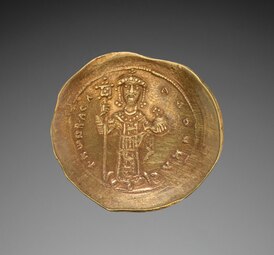
-
 Pre-Columbian pendant with two bat-head warriors who carry spears, 11th–16th century, gold, Metropolitan Museum of Art
 -
![Inca hollow model of a llama, 14th-15th centuries, gold, British Museum[222]](//upload.wikimedia.org/wikipedia/commons/thumb/d/d0/AHOTWgold_lama.JPG/250px-AHOTWgold_lama.JPG)
-
![Renaissance hat badge that shows the Judgment of Paris, 16th century, enamelled gold, British Museum[223]](//upload.wikimedia.org/wikipedia/commons/thumb/1/13/The_Judgement_of_Paris%2C_Waddeson_Bequest.jpg/330px-The_Judgement_of_Paris%2C_Waddeson_Bequest.jpg) Renaissance hat badge that shows the Judgment of Paris, 16th century, enamelled gold, British Museum[223]
Renaissance hat badge that shows the Judgment of Paris, 16th century, enamelled gold, British Museum[223] -
 Rococo box, by George Michael Moser, 1741, gold, Metropolitan Museum of Art
 -
 Rococo candelabrum, by Jean Joseph de Saint-Germain, c.1750, gilt bronze, Cleveland Museum of Art
 -
![Rococo snuff box with Minerva, by Jean-Malquis Lequin, 1750–1752, gold and painted enamel, Louvre[224]](//upload.wikimedia.org/wikipedia/commons/thumb/8/8d/Tabati%C3%A8re_Minerve%2C_Mercure%2C_P%C3%A9gase_%28Louvre%2C_OA_2121%29.jpg/500px-Tabati%C3%A8re_Minerve%2C_Mercure%2C_P%C3%A9gase_%28Louvre%2C_OA_2121%29.jpg) Rococo snuff box with Minerva, by Jean-Malquis Lequin, 1750–1752, gold and painted enamel, Louvre[224]
Rococo snuff box with Minerva, by Jean-Malquis Lequin, 1750–1752, gold and painted enamel, Louvre[224] -
![Louis XVI style snuff box, by Jean Frémin, 1763–1764, gold and painted enamel, Louvre[225]](//upload.wikimedia.org/wikipedia/commons/thumb/e/ee/Tabati%C3%A8re_J-Fr%C3%A9min_%28Louvre%2C_OA_6857%29.jpg/500px-Tabati%C3%A8re_J-Fr%C3%A9min_%28Louvre%2C_OA_6857%29.jpg)
-
 Neoclassical washstand (athénienne or lavabo), 1800–1814, legs, base and shelf of yew wood, gilt bronze mounts, iron plate beneath shelf, Metropolitan Museum of Art
 -
 Gothic Revival clock, unknown French maker, c.1835-1840, gilt and patinated bronze, Museum of Decorative Arts, Paris
 -
 Art Nouveau teapot, by Alphonse Debain, gilt silver and ivory, Museum of Decorative Arts


![Minoan cup, part of the Aegina Treasure, 1850–1550 BC, gold, British Museum[219]](https://en.wikipedia.org/wiki/File:Aegina_treasure_10.jpg)

.jpg)
![Ancient Chinese cast openwork dagger hilt, 6th–5th centuries BC, gold, British Museum[220]](https://en.wikipedia.org/wiki/File:Openwork_dagger_handle-IMG_4418-black.jpg)


_MET_DT1262.jpg)
![Anglo-Saxon belt buckle from Sutton Hoo with a niello interlace pattern, 7th century, gold, British Museum[221]](https://en.wikipedia.org/wiki/File:British_Museum_-_Room_41_(20626313758).jpg)

![Inca hollow model of a llama, 14th-15th centuries, gold, British Museum[222]](https://en.wikipedia.org/wiki/File:AHOTWgold_lama.JPG)
![Renaissance hat badge that shows the Judgment of Paris, 16th century, enamelled gold, British Museum[223]](https://en.wikipedia.org/wiki/File:The_Judgement_of_Paris,_Waddeson_Bequest.jpg)
.jpg)

![Rococo snuff box with Minerva, by Jean-Malquis Lequin, 1750–1752, gold and painted enamel, Louvre[224]](https://en.wikipedia.org/wiki/File:Tabati%C3%A8re_Minerve,_Mercure,_P%C3%A9gase_(Louvre,_OA_2121).jpg)
![Louis XVI style snuff box, by Jean Frémin, 1763–1764, gold and painted enamel, Louvre[225]](https://en.wikipedia.org/wiki/File:Tabati%C3%A8re_J-Fr%C3%A9min_(Louvre,_OA_6857).jpg)
_MET_DP106594.jpg)


See also
[edit]
- Bulk leach extractable gold, for sampling ores
- Chrysiasis (dermatological condition)
- Digital gold currency, form of electronic currency
- GFMS business consultancy
- Gold (color), a range of colors
- Gold fingerprinting, use impurities to identify an alloy
- Gold standard in banking
- List of countries by gold production
- Tumbaga, alloy of gold and copper
- Iron pyrite, fool's gold
- Nordic gold, non-gold copper alloy
References
[edit]- ^ "Standard Atomic Weights: Gold". CIAAW. 2017.
- ^ Prohaska, Thomas; Irrgeher, Johanna; Benefield, Jacqueline; Böhlke, John K.; Chesson, Lesley A.; Coplen, Tyler B.; Ding, Tiping; Dunn, Philip J. H.; Gröning, Manfred; Holden, Norman E.; Meijer, Harro A. J. (4 May 2022). "Standard atomic weights of the elements 2021 (IUPAC Technical Report)". Pure and Applied Chemistry. doi:10.1515/pac-2019-0603. ISSN 1365-3075.
- ^ a b c Arblaster, John W. (2018). Selected Values of the Crystallographic Properties of Elements. Materials Park, Ohio: ASM International. ISBN 978-1-62708-155-9.
- ^ a b c Greenwood, Norman N.; Earnshaw, Alan (1997). Chemistry of the Elements (2nd ed.). Butterworth-Heinemann. p. 28. doi:10.1016/C2009-0-30414-6. ISBN 978-0-08-037941-8.
- ^ Mézaille, Nicolas; Avarvari, Narcis; Maigrot, Nicole; Ricard, Louis; Mathey, François; Le Floch, Pascal; Cataldo, Laurent; Berclaz, Théo; Geoffroy, Michel (1999). "Gold(I) and Gold(0) Complexes of Phosphinine-Based Macrocycles". Angewandte Chemie International Edition. 38 (21): 3194–3197. doi:10.1002/(SICI)1521-3773(19991102)38:21<3194::AID-ANIE3194>3.0.CO;2-O. PMID 10556900.
- ^ Lide, D. R., ed. (2005). "Magnetic susceptibility of the elements and inorganic compounds". CRC Handbook of Chemistry and Physics (PDF) (86th ed.). Boca Raton (FL): CRC Press. ISBN 0-8493-0486-5.
- ^ Weast, Robert (1984). CRC, Handbook of Chemistry and Physics. Boca Raton, Florida: Chemical Rubber Company Publishing. pp. E110. ISBN 0-8493-0464-4.
- ^ Kelly, P. F. (2015). Properties of Materials. CRC Press. p. 355. ISBN 978-1-4822-0624-1.
- ^ Kondev, F. G.; Wang, M.; Huang, W. J.; Naimi, S.; Audi, G. (2021). "The NUBASE2020 evaluation of nuclear properties" (PDF). Chinese Physics C. 45 (3) 030001. doi:10.1088/1674-1137/abddae.
- ^ "The reactivity series of metals - Reactions of metals - AQA - GCSE Combined Science Revision - AQA Trilogy". BBC Bitesize. Retrieved 2 July 2025. Archived 2 July 2025 at the Wayback Machine
- ^ Duckenfield, Mark (2016). The Monetary History of Gold: A Documentary History, 1660–1999. Routledge. p. 4. ISBN 978-1-315-47612-4.
Its scarcity makes it a useful store of value; however, its relative rarity reduced its utility as a currency, especially for transactions in small denominations.
- ^ Pearce, Susan M. (1993). Museums, Objects, and Collections: A Cultural Study. Smithsonian Books. p. 53. ISBN 978-1-58834-517-2.
Its scarcity makes it a useful store of value; however, its relative rarity reduced its utility as a currency, especially for transactions in small denominations. ... Rarity is, nevertheless, in itself a source of value, and so is the degree of difficulty which surrounds the winning of the raw material, especially if it is exotic and has to be brought some distance. Gold is, geologically, a relatively rare material on Earth and occurs only in specific places which are remote from most other places.
- ^ Lee, Jinjoo. "Costco Members Are Buying Platinum. Should You?". WSJ. Retrieved 24 June 2025.
- ^ a b "Gold Production & Mining Data by Country". World Gold Council. 7 June 2023.
- ^ "Above-ground stocks". World Gold Council. gold.org. Retrieved 18 October 2021.
- ^ a b c Soos, Andy (6 January 2011). "Gold Mining Boom Increasing Mercury Pollution Risk". Advanced Media Solutions, Inc. Oilprice.com. Retrieved 26 March 2011.
- ^ Harper, Douglas. "gold". Online Etymology Dictionary.
- ^ Hesse, R W. (2007) Jewelrymaking Through History: An Encyclopedia Archived 1 November 2022 at the Wayback Machine, Greenwood Publishing Group. ISBN 0313335079
- ^ Notre Dame University Latin Dictionary Archived 5 February 2016 at the Wayback Machine Retrieved 7 June 2012
- ^ de Vaan, Michel (2008). Etymological Dictionary of Latin and the other Italic languages. Leiden: Boston: Brill. p. 63. ISBN 978-90-04-16797-1.
- ^ Christie, A and Brathwaite, R. (Last updated 2 November 2011) Mineral Commodity Report 14 — Gold, Institute of geological and Nuclear sciences Ltd – Retrieved 7 June 2012
- ^ Kizuka, Tokushi (1 April 2008). "Atomic configuration and mechanical and electrical properties of stable gold wires of single-atom width" (PDF). Physical Review B. 77 (15) 155401. Bibcode:2008PhRvB..77o5401K. doi:10.1103/PhysRevB.77.155401. hdl:2241/99261. ISSN 1098-0121. Archived (PDF) from the original on 16 July 2021.
- ^ Che Lah, Nurul Akmal; Trigueros, Sonia (2019). "Synthesis and modelling of the mechanical properties of Ag, Au and Cu nanowires". Science and Technology of Advanced Materials. 20 (1): 225–261. Bibcode:2019STAdM..20..225L. doi:10.1080/14686996.2019.1585145. ISSN 1468-6996. PMC 6442207. PMID 30956731.
- ^ "Gold: causes of color". Retrieved 6 June 2009.
- ^ Mallan, Lloyd (1971). Suiting up for space: the evolution of the space suit. John Day Co. p. 216. ISBN 978-0-381-98150-1.
- ^ Gray, Theo (14 March 2008). "How to Make Convincing Fake-Gold Bars". Popular Science. Retrieved 18 June 2008.
- ^ Willie, Jim (18 November 2009) "Zinc Dimes, Tungsten Gold & Lost Respect Archived 8 October 2011 at the Wayback Machine". Kitco
- ^ "Largest Private Refinery Discovers Gold-Plated Tungsten Bar | Coin Update". news.coinupdate.com.
- ^ "Austrians Seize False Gold Tied to London Bullion Theft". The New York Times. 22 December 1983. Retrieved 25 March 2012.
- ^ Arblaster, J. W. (1995). "Osmium, the Densest Metal Known" (PDF). Platinum Metals Review. 39 (4): 164. doi:10.1595/003214095X394164164. S2CID 267393021. Archived from the original (PDF) on 18 October 2016. Retrieved 14 October 2016.
- ^ Encyclopædia of Chemistry, Theoretical, Practical, and Analytical, as Applied to the Arts and Manufacturers: Glass-zinc. J.B. Lippincott & Company. 1880. pp. 70–.
- ^ "Relativity in Chemistry". Math.ucr.edu. Retrieved 5 April 2009.
- ^ Schmidbaur, Hubert; Cronje, Stephanie; Djordjevic, Bratislav; Schuster, Oliver (2005). "Understanding gold chemistry through relativity". Chemical Physics. 311 (1–2): 151–161. Bibcode:2005CP....311..151S. doi:10.1016/j.chemphys.2004.09.023.
- ^ a b c d Jewellery Alloys. World Gold Council
- ^ Electron Microscopy in Microbiology. Academic Press. 1988. ISBN 978-0-08-086049-7.
- ^ "Nudat 2". National Nuclear Data Center. Retrieved 12 April 2012.
- ^ a b Audi, Georges; Bersillon, Olivier; Blachot, Jean; Wapstra, Aaldert Hendrik (2003), "The NUBASE evaluation of nuclear and decay properties", Nuclear Physics A, 729: 3–128, Bibcode:2003NuPhA.729....3A, doi:10.1016/j.nuclphysa.2003.11.001
- ^ Miethe, A. (1924). "Der Zerfall des Quecksilberatoms". Die Naturwissenschaften. 12 (29): 597–598. Bibcode:1924NW.....12..597M. doi:10.1007/BF01505547. S2CID 35613814.
- ^ Sherr, R.; Bainbridge, K. T. & Anderson, H. H. (1941). "Transmutation of Mercury by Fast Neutrons". Physical Review. 60 (7): 473–479. Bibcode:1941PhRv...60..473S. doi:10.1103/PhysRev.60.473.
- ^ Aleklett, K.; Morrissey, D.; Loveland, W.; McGaughey, P.; Seaborg, G. (1981). "Energy dependence of 209Bi fragmentation in relativistic nuclear collisions". Physical Review C. 23 (3): 1044. Bibcode:1981PhRvC..23.1044A. doi:10.1103/PhysRevC.23.1044.
- ^ Matthews, Robert (2 December 2001). "The Philosopher's Stone". The Daily Telegraph. Retrieved 22 September 2020.
- ^ Shipman, James; Wilson, Jerry D.; Higgins, Charles A. (2012). An Introduction to Physical Science (13th ed.). Cengage Learning. p. 273. ISBN 978-1-133-70949-7.
- ^ Hammer, B.; Norskov, J. K. (1995). "Why gold is the noblest of all the metals". Nature. 376 (6537): 238–240. Bibcode:1995Natur.376..238H. doi:10.1038/376238a0. S2CID 4334587.
- ^ Johnson, P. B.; Christy, R. W. (1972). "Optical Constants of the Noble Metals". Physical Review B. 6 (12): 4370–4379. Bibcode:1972PhRvB...6.4370J. doi:10.1103/PhysRevB.6.4370.
- ^ Shaw III, C. F. (1999). "Gold-Based Medicinal Agents". Chemical Reviews. 99 (9): 2589–2600. doi:10.1021/cr980431o. PMID 11749494.
- ^ "Chemistry of Oxygen". Chemwiki UC Davis. 2 October 2013. Archived from the original on 14 July 2016. Retrieved 1 May 2016.
- ^ Craig, B. D.; Anderson, D. B., eds. (1995). Handbook of Corrosion Data. Materials Park, Ohio: ASM International. p. 587. ISBN 978-0-87170-518-1.
- ^ Wiberg, Egon; Wiberg, Nils & Holleman, Arnold Frederick (2001). Inorganic Chemistry (101st ed.). Academic Press. p. 1286. ISBN 978-0-12-352651-9.
- ^ Wiberg, Egon; Wiberg, Nils (2001). Inorganic Chemistry. Academic Press. p. 404. ISBN 978-0-12-352651-9.
- ^ Wiberg, Wiberg & Holleman 2001, pp. 1286–1287
- ^ a b Emery, J. F.; Ledditcotte, G. W. (May 1961). "Nuclear Science Series (NAS-NS 3036) The Radio Chemistry of Gold" (PDF). Oak Ridge, TN: National Academy of Sciences — National Research Council — Subcommittee on Radio Chemistry. US Atomic Energy Commission. Archived (PDF) from the original on 10 November 2004. Retrieved 24 February 2021.
- ^ Wolfgang Jeitschko; Manfred H. Moller (1979). "The crystal structures of Au2P3 and Au7P10I, polyphosphides with weak Au–Au interactions". Acta Crystallographica B. 35 (3): 573–579. Bibcode:1979AcCrB..35..573J. doi:10.1107/S0567740879004180.
- ^ Jansen, Martin (2005). "Effects of relativistic motion of electrons on the chemistry of gold and platinum". Solid State Sciences. 7 (12): 1464–1474. Bibcode:2005SSSci...7.1464J. doi:10.1016/j.solidstatesciences.2005.06.015.
- ^ a b Holleman, A. F.; Wiberg, E. (2001). Inorganic Chemistry. San Diego: Academic Press. ISBN 978-0-12-352651-9.
- ^ a b Jansen, Martin (2008). "The chemistry of gold as an anion". Chemical Society Reviews. 37 (9): 1826–1835. doi:10.1039/b708844m. PMID 18762832.
- ^ Jung, Jaehoon; Kim, Hyemi; Kim, Jong Chan; Park, Min Hee; Han, Young-Kyu (2011). "Gold Behaves as Hydrogen in the Intermolecular Self-Interaction of Metal Aurides MAu4 (M=Ti, Zr, and Hf)". Chemistry: An Asian Journal. 6 (3): 868–872. doi:10.1002/asia.201000742. PMID 21225974.
- ^ Wickleder, Mathias S. (2001). "AuSO4: A True Gold(II) Sulfate with an Au24+ Ion". Journal of Inorganic and General Chemistry. 627 (9): 2112–2114. doi:10.1002/1521-3749(200109)627:9<2112::AID-ZAAC2112>3.0.CO;2-2.
- ^ Wickleder, Mathias S. (2007). Devillanova, Francesco A. (ed.). Handbook of chalcogen chemistry: new perspectives in sulfur, selenium and tellurium. Royal Society of Chemistry. pp. 359–361. ISBN 978-0-85404-366-8.
- ^ Seidel, S.; Seppelt, K. (2000). "Xenon as a Complex Ligand: The Tetra Xenono Gold(II) Cation in AuXe42+(Sb2F11−)2". Science. 290 (5489): 117–118. Bibcode:2000Sci...290..117S. doi:10.1126/science.290.5489.117. PMID 11021792.
- ^ University, Stanford. "Striking rare gold: Researchers unveil new material infused with gold in an exotic chemical state". phys.org. Retrieved 2 October 2023.
- ^ Riedel, S.; Kaupp, M. (2006). "Revising the Highest Oxidation States of the 5d Elements: The Case of Iridium(+VII)". Angewandte Chemie International Edition. 45 (22): 3708–3711. Bibcode:2006ACIE...45.3708R. doi:10.1002/anie.200600274. PMID 16639770.
- ^ Seeger, Philip A.; Fowler, William A.; Clayton, Donald D. (1965). "Nucleosynthesis of Heavy Elements by Neutron Capture". The Astrophysical Journal Supplement Series. 11: 121. Bibcode:1965ApJS...11..121S. doi:10.1086/190111.
- ^ "Earth's Gold Came from Colliding Dead Stars". David A. Aguilar & Christine Pulliam. cfa.harvard.edu. 17 July 2013. Retrieved 16 May 2025.
- ^ "Supernovas & Supernova Remnants". Chandra X-ray Observatory. Retrieved 28 February 2014.
- ^ Berger, E.; Fong, W.; Chornock, R. (2013). "An r-process Kilonova Associated with the Short-hard GRB 130603B". The Astrophysical Journal Letters. 774 (2): 4. arXiv:1306.3960. Bibcode:2013ApJ...774L..23B. doi:10.1088/2041-8205/774/2/L23. S2CID 669927.
- ^ "LIGO and Virgo make first detection of gravitational waves produced by colliding neutron stars" (PDF). LIGO & Virgo collaborations. 16 October 2017. Archived (PDF) from the original on 31 October 2017. Retrieved 15 February 2018.
- ^ "we have no spectroscopic evidence that [such] elements have truly been produced," wrote author Stephan Rosswog.Rosswog, Stephan (29 August 2013). "Astrophysics: Radioactive glow as a smoking gun". Nature. 500 (7464): 535–536. Bibcode:2013Natur.500..535R. doi:10.1038/500535a. PMID 23985867. S2CID 4401544.
- ^ "Neutron star mergers may create much of the universe's gold". Sid Perkins. Science AAAS. 20 March 2018. Retrieved 24 March 2018.
- ^ Patel, Anirudh; Metzger, Brian D.; Cehula, Jakub; Burns, Eric; Goldberg, Jared A.; Thompson, Todd A. (29 April 2025). "Direct Evidence for r-process Nucleosynthesis in Delayed MeV Emission from the SGR 1806–20 Magnetar Giant Flare". The Astrophysical Journal Letters. 984 (1): L29. arXiv:2501.09181. Bibcode:2025ApJ...984L..29P. doi:10.3847/2041-8213/adc9b0.
- ^ Patel, Anirudh; Metzger, Brian D.; Cehula, Jakub; Burns, Eric; Goldberg, Jared A.; Thompson, Todd A. (29 April 2025). "Direct Evidence for r-process Nucleosynthesis in Delayed MeV Emission from the SGR 1806–20 Magnetar Giant Flare". The Astrophysical Journal Letters. 984 (1): L29. arXiv:2501.09181. Bibcode:2025ApJ...984L..29P. doi:10.3847/2041-8213/adc9b0.
- ^ Patel, Kasha (4 May 2025). "We figured out where gold comes from. The answer is explosive". The Washington Post. Retrieved 5 May 2025.
- ^ "Astronomers spot a gold mine in massive cosmic flares". Science.org. May 2025. Retrieved 5 May 2025.
- ^ Willbold, Matthias; Elliott, Tim; Moorbath, Stephen (2011). "The tungsten isotopic composition of the Earth's mantle before the terminal bombardment". Nature. 477 (7363): 195–8. Bibcode:2011Natur.477..195W. doi:10.1038/nature10399. PMID 21901010. S2CID 4419046.
- ^ Battison, Leila (8 September 2011). "Meteorites delivered gold to Earth". BBC.
- ^ "Mangalisa Project". Superior Mining International Corporation. Retrieved 29 December 2014.
- ^ Therriault, A. M.; Grieve, R. A. F. & Reimold, W. U. (1997). "Original size of the Vredefort Structure: Implications for the geological evolution of the Witwatersrand Basin". Meteoritics. 32: 71–77. Bibcode:1997M&PS...32...71T. doi:10.1111/j.1945-5100.1997.tb01242.x.
- ^ Meteor craters may hold untapped wealth. Cosmos Magazine (28 July 2008). Retrieved on 12 September 2013.
- ^ Corner, B.; Durrheim, R. J.; Nicolaysen, L. O. (1990). "Relationships between the Vredefort structure and the Witwatersrand basin within the tectonic framework of the Kaapvaal craton as interpreted from regional gravity and aeromagnetic data". Tectonophysics. 171 (1): 49–61. Bibcode:1990Tectp.171...49C. doi:10.1016/0040-1951(90)90089-Q.
- ^ a b McCarthy, T., Rubridge, B. (2005). The Story of Earth and Life. Struik Publishers, Cape Town. pp. 89–90, 102–107, 134–136. ISBN 1 77007 148 2
- ^ a b Norman, N., Whitfield, G. (2006) Geological Journeys. Struik Publishers, Cape Town. pp. 38–49, 60–61. ISBN 9781770070622
- ^ University of Granada (21 November 2017). "Scientists reveal the mystery about the origin of gold". ScienceDaily. Retrieved 27 March 2018.
- ^ Tassara, Santiago; González-Jiménez, José M.; Reich, Martin; Schilling, Manuel E.; Morata, Diego; Begg, Graham; Saunders, Edward; Griffin, William L.; O'Reilly, Suzanne Y.; Grégoire, Michel; Barra, Fernando; Corgne, Alexandre (2017). "Plume-subduction interaction forms large auriferous provinces". Nature Communications. 8 (1): 843. Bibcode:2017NatCo...8..843T. doi:10.1038/s41467-017-00821-z. ISSN 2041-1723. PMC 5634996. PMID 29018198.
- ^ a b c La Niece, Susan (senior metallurgist in the British Museum Department of Conservation and Scientific Research) (15 December 2009). Gold. Harvard University Press. p. 10. ISBN 978-0-674-03590-4. Retrieved 10 April 2012.
- ^ Heike, Brian. "Formation of Lode Gold Deposits". Arizona Gold Prospectors. Archived from the original on 22 January 2013. Retrieved 24 February 2021.
- ^ "Environment & Nature News – Bugs grow gold that looks like coral". abc.net.au. 28 January 2004. Retrieved 22 July 2006. This is doctoral research undertaken by Frank Reith at the Australian National University, published 2004.
- ^ "Earthquakes Turn Water into Gold". 17 March 2013. Retrieved 18 March 2013.
- ^ Kenison Falkner, K.; Edmond, J. (1990). "Gold in seawater". Earth and Planetary Science Letters. 98 (2): 208–221. Bibcode:1990E&PSL..98..208K. doi:10.1016/0012-821X(90)90060-B.
- ^ Plazak, Dan A Hole in the Ground with a Liar at the Top (Salt Lake: Univ. of Utah Press, 2006) ISBN 0-87480-840-5 (contains a chapter on gold-from seawater swindles)
- ^ Haber, F. (1927). "Das Gold im Meerwasser". Zeitschrift für Angewandte Chemie. 40 (11): 303–314. Bibcode:1927AngCh..40..303H. doi:10.1002/ange.19270401103.
- ^ McHugh, J. B. (1988). "Concentration of gold in natural waters". Journal of Geochemical Exploration. 30 (1–3): 85–94. Bibcode:1988JCExp..30...85M. doi:10.1016/0375-6742(88)90051-9. Archived from the original on 7 March 2020.
- ^ "Furthermore the second member of Delegation XVIII is carrying four small but evidently heavy jars on a yoke, probably containing the gold dust which was the tribute paid by the Indians." in Iran, Délégation archéologique française en (1972). Cahiers de la Délégation archéologique française en Iran. Institut français de recherches en Iran (section archéologique). p. 146.
- ^ Yannopoulos, J. C. (1991). The Extractive Metallurgy of Gold. Boston, MA: Springer US. p. ix. doi:10.1007/978-1-4684-8425-0. ISBN 978-1-4684-8427-4.
- ^ "Mystery of the Varna Gold: What Caused These Ancient Societies to Disappear?".
- ^ "World's Oldest Gold Object May Have Just Been Unearthed in Bulgaria".
- ^ Sutherland, C.H.V, Gold (London, Thames & Hudson, 1959) p 27 ff.
- ^ Gopher, A.; Tsuk, T.; Shalev, S. & Gophna, R. (August–October 1990). "Earliest Gold Artifacts in the Levant". Current Anthropology. 31 (4): 436–443. doi:10.1086/203868. JSTOR 2743275. S2CID 143173212.
- ^ Pohl, Walter L. (2011) Economic Geology Principles and Practice. Wiley. p. 208. doi:10.1002/9781444394870.ch2. ISBN 9781444394870
- ^ Montserrat, Dominic (21 February 2003). Akhenaten: History, Fantasy and Ancient Egypt. Psychology Press. ISBN 978-0-415-30186-2.
- ^ Moran, William L., 1987, 1992. The Amarna Letters, pp. 43–46.
- ^ Moran, William L. 1987, 1992. The Amarna Letters. EA 245, "To the Queen Mother: Some Missing Gold Statues", pp. 84–86.
- ^ "Akhenaten" Archived 11 June 2008 at the Wayback Machine. Encyclopaedia Britannica
- ^ Dodson, Aidan and Hilton, Dyan (2004). The Complete Royal Families of Ancient Egypt. Thames & Hudson. ISBN 0-500-05128-3
- ^ a b "A Case for the World's Oldest Coin: Lydian Lion". Rg.ancients.info. 2 October 2003. Archived from the original on 13 October 2018. Retrieved 27 October 2013.
- ^ Mansa Musa. Black History Pages
- ^ "Kingdom of Mali – Primary Source Documents". African studies Center. Boston University. Retrieved 30 January 2012.
- ^ Monnaie, Eucratide I. (roi de Bactriane) Autorité émettrice de. [Monnaie: 20 Statères, Or, Incertain, Bactriane, Eucratide I].
- ^ Berdan, Frances; Anawalt, Patricia Rieff (1992). The Codex Mendoza. Vol. 2. University of California Press. p. 151. ISBN 978-0-520-06234-4.
- ^ Sierra Nevada Virtual Museum. Sierra Nevada Virtual Museum. Retrieved on 4 May 2012.
- ^ Anderson, James Maxwell (2000). The History of Portugal. Greenwood Publishing Group. ISBN 0-313-31106-4.
- ^ Newitt, Malyn (28 June 2010). The Portuguese in West Africa, 1415–1670: A Documentary History. Cambridge University Press. ISBN 978-1-139-49129-7.
- ^ Green, Toby (31 January 2019). A fistful of shells: West Africa from the rise of the slave trade to the age of revolution (Penguin Books Ltd. Kindle-Version ed.). London. pp. 108, 247. ISBN 978-0-241-00328-2.
{{cite book}}: CS1 maint: location missing publisher (link) - ^ Edgerton, Robert B. (2010). The Fall of the Asante Empire: The Hundred-Year War For Africa's Gold Coast. Simon and Schuster. ISBN 978-1-4516-0373-6.
- ^ Matson, John (31 January 2014). "Fact or Fiction?: Lead Can Be Turned into Gold". scientificamerican.com. Retrieved 21 November 2021.
- ^ H. G. Bachmann, The lure of gold : an artistic and cultural history (2006).
- ^ Lubna Umar and Sarwet Rasul, "Critical Metaphor Analysis: Nawaz Sharif and the Myth of a Golden Time" NUML Journal of Critical Inquiry 15#2, (Dec 2017): 78–102.
- ^ Lioudis, Nick (30 April 2023). "What Is the Gold Standard? Advantages, Alternatives, and History". Investopedia. Retrieved 21 September 2023.
- ^ Alborn, Timothy (2017). "The Greatest Metaphor Ever Mixed: Gold in the British Bible, 1750–1850". Journal of the History of Ideas. 78 (3): 427–447. doi:10.1353/jhi.2017.0024. PMID 28757488. S2CID 27312741.
- ^ Moors, Annelies (2013). "Wearing gold, owning gold: the multiple meanings of gold jewelry". Etnofoor. 25 (1): 78–89. ISSN 0921-5158. OCLC 858949147.
- ^ Boulanouar, Aisha Wood (2011). Myths and Reality: Meaning in Moroccan Muslim Women's Dress (Thesis, Doctor of Philosophy). University of Otago. CiteSeerX 10.1.1.832.2031. hdl:10523/1748.
- ^ Poonai, Anand (2015). "Islamic Male Clothing". Who We Are & What We Wear. Retrieved 17 June 2020.
- ^ Aziz, Rookhsana (November 2010). "Hijab – The Islamic Dress Code: Its historical development, evidence from sacred sources and views of selected Muslim scholars". UNISA EDT (Electronic Theses and Dissertations) (Thesis, Master of Arts). University of South Africa. CiteSeerX 10.1.1.873.8651. hdl:10500/4888.
- ^ Toronto, James A. (1 October 2001). "Many Voices, One Umma: Sociopolitical Debate in the Muslim Community". BYU Studies Quarterly. 40 (4): 29–50.
- ^ Jirousek, Charlotte (2004). "Islamic Clothing". Encyclopedia of Islam. Retrieved 17 June 2020.
- ^ Omar, Sara (28 March 2014). "Dress". The Encyclopedia of Islam and Law, Oxford Islamic Studies Online. [permanent dead link]
- ^ Daly, Kathleen N.; Rengel, Marian (1992). Greek and Roman Mythology, A to Z. Chelsea House Publishers. p. 153. ISBN 978-1-60413-412-4.
- ^ Bernstein, Peter L. (2004). The Power of Gold: The History of an Obsession. John Wiley & Sons. p. 1. ISBN 978-0-471-43659-1.
- ^ "Israeli dig unearths large trove of early Islamic gold coins". Associated Press. 24 August 2020. Retrieved 24 August 2020.
- ^ Munteen, John L.; Davis, David A.; Ayling, Bridget (2017). The Nevada Mineral Industry 2016 (PDF) (Report). University of Nevada, Reno. OCLC 1061602920. Archived from the original (PDF) on 9 February 2019. Retrieved 9 February 2019.
- ^ Mandaro, Laura (17 January 2008). "China now world's largest gold producer; foreign miners at door". MarketWatch. Retrieved 5 April 2009.
- ^ Fritz, Morgane; McQuilken, James; Collins, Nina; Weldegiorgis, Fitsum (January 2018). "Global Trends in Artisanal and Small-Scale Mining (ASM): A review of key numbers and issues" (PDF) (Report). Winnipeg Canada: International Institute for Sustainable Development. Retrieved 24 February 2021 – via Intergovernmental Forum on Mining, Minerals, Metals and Sustainable Development.
- ^ "What is artisanal gold and why is it booming?". reuters.com. Reuters. 15 January 2020. Retrieved 24 February 2021.
- ^ Beinhoff, Christian. "Removal of Barriers to the Abatement of Global Mercury Pollution from Artisanal Gold Mining" (PDF) (Report). Archived from the original (PDF) on 26 January 2016. Retrieved 29 December 2014.
- ^ a b c Truswell, J.F. (1977). The Geological Evolution of South Africa. pp. 21–28. Purnell, Cape Town. ISBN 9780360002906
- ^ Moore, Mark A. (2006). "Reed Gold Mine State Historic Site". North Carolina Office of Archives and History. Archived from the original on 15 January 2012. Retrieved 13 December 2008.
- ^ Garvey, Jane A. (2006). "Road to adventure". Georgia Magazine. Archived from the original on 2 March 2007. Retrieved 23 January 2007.
- ^ "Grasberg Open Pit, Indonesia". Mining Technology. Retrieved 16 October 2017.
- ^ O'Connell, Rhona (13 April 2007). "Gold mine production costs up by 17% in 2006 while output fell". Archived from the original on 6 October 2014.
- ^ Noyes, Robert (1993). Pollution prevention technology handbook. William Andrew. p. 342. ISBN 978-0-8155-1311-7.
- ^ Pletcher, Derek & Walsh, Frank (1990). Industrial electrochemistry. Springer. p. 244. ISBN 978-0-412-30410-1.
- ^ Marczenko, Zygmunt & Balcerzak, María (2000). Separation, preconcentration, and spectrophotometry in inorganic analysis. Elsevier. p. 210. ISBN 978-0-444-50524-8.
- ^ Renner, Hermann; Schlamp, Günther; Hollmann, Dieter; Lüschow, Hans Martin; Tews, Peter; Rothaut, Josef; Dermann, Klaus; Knödler, Alfons; Hecht, Christian; Schlott, Martin; Drieselmann, Ralf; Peter, Catrin; Schiele, Rainer (2000). "Gold, Gold Alloys, and Gold Compounds". Ullmann's Encyclopedia of Industrial Chemistry. doi:10.1002/14356007.a12_499. ISBN 3-527-30673-0.
- ^ Paton, Elizabeth (23 April 2021). "Does Recycled Gold Herald a Greener Future for Jewelry?". The New York Times. ISSN 0362-4331. Archived from the original on 28 December 2021. Retrieved 17 May 2021.
- ^ Baraniuk, Chris (27 October 2020). "Why it's getting harder to mine gold". BBC. Retrieved 29 October 2020.
- ^ "Gold jewellery consumption by country". Reuters. 28 February 2011. Archived from the original on 12 January 2012.
- ^ "Gold Demand Trends". 12 November 2015.
- ^ "Country wise gold demand". Retrieved 2 October 2015.
- ^ Harjani, Ansuya (18 February 2014). "It's official: China overtakes India as top consumer of gold". CNBC. Retrieved 2 July 2014.
- ^ Abdul-Wahab; Marikar, Fouzul (24 October 2011). "The environmental impact of gold mines: pollution by heavy metals". Central European Journal of Engineering. 2 (2): 304–313. Bibcode:2012CEJE....2..304A. doi:10.2478/s13531-011-0052-3. S2CID 3916088.
- ^ Cyanide spills from gold mine compared to Chernobyl's nuclear disaster Archived 14 July 2018 at the Wayback Machine. Deseretnews.com (14 February 2000). Retrieved on 4 May 2012.
- ^ Death of a river . BBC News (15 February 2000). Retrieved on 4 May 2012.
- ^ Cyanide spill second only to Chernobyl Archived 25 May 2017 at the Wayback Machine. Abc.net.au. 11 February 2000. Retrieved on 4 May 2012.
- ^ a b Behind gold's glitter, torn lands and pointed questions Archived 8 April 2015 at the Wayback Machine, The New York Times, 24 October 2005
- ^ "Pollution from Artisanal Gold Mining, Blacksmith Institute Report 2012" (PDF). Archived (PDF) from the original on 2 April 2015. Retrieved 22 September 2015.
- ^ Wroblewski, William (12 January 2022). "'Babies here are born sick': are Bolivia's gold mines poisoning its indigenous people?". The Guardian. Retrieved 12 January 2022.
- ^ Norgate, Terry; Haque, Nawshad (2012). "Using life cycle assessment to evaluate some environmental impacts of gold". Journal of Cleaner Production. 29–30: 53–63. doi:10.1016/j.jclepro.2012.01.042.
- ^ Rothbard, Murray N. (2009). Man, Economy, and State, Scholar's Edition. Ludwig von Mises Institute. ISBN 978-1-933550-99-2.
- ^ Seltman, C. T. (1924). Athens, Its History and Coinage Before the Persian Invasion. Retrieved 4 June 2012.
{{isbn}}: required identifier missing (help) (reprint) - ^ Postan, M. M.; Miller, E. (1967). The Cambridge Economic History of Europe: Trade and industry in the Middle Ages. Cambridge University Press, 28 August 1987. ISBN 978-0-521-08709-4.
- ^ "Swiss Narrowly Vote to Drop Gold Standard". The New York Times. 19 April 1999. Retrieved 1 July 2022.
- ^ King, Byron (20 July 2009). "Gold mining decline". BullionVault.com. Archived from the original on 15 May 2016. Retrieved 23 November 2009.
- ^ Lawrence, Thomas Edward (1948). The Mint: A Day-book of the R.A.F. Depot Between August and December 1922, with Later Notes. p. 103.
- ^ Tucker, George (1839). The theory of money and banks investigated. C. C. Little and J. Brown.
- ^ "Currency codes – ISO 4217". International Organization for Standardization. Retrieved 25 December 2014.
- ^ Erb, Claude; Harvey, Campbell (January 2013). The Golden Dilemma (Report). doi:10.3386/w18706.
- ^ "The Ever Popular Krugerrand". americansilvereagletoday.com. 2010. Archived from the original on 3 February 2011. Retrieved 30 August 2011.
- ^ "What Are the Different Purities of Sovereign Gold Coins?". goldsilver.com. Retrieved 29 March 2021.
- ^ Warwick-Ching, Tony (28 February 1993). The International Gold Trade. Woodhead. p. 26. ISBN 978-1-85573-072-4.
- ^ Elwell, Craig K. (2011). Brief History of the Gold Standard (GS) in the United States. DIANE. pp. 11–13. ISBN 978-1-4379-8889-5.
- ^ Hitzer, Eckhard; Perwass, Christian (22 November 2006). "The hidden beauty of gold" (PDF). Proceedings of the International Symposium on Advanced Mechanical and Power Engineering 2007 (ISAMPE 2007) between Pukyong National University (Korea), University of Fukui (Japan) and University of Shanghai for Science and Technology (China), 22–25 November 2006, hosted by the University of Fukui (Japan), pp. 157–167. (Figs 15,16,17,23 revised.). Archived from the original (PDF) on 27 January 2012. Retrieved 10 May 2011.
- ^ "World Gold Council > value > research & statistics > statistics > supply and demand statistics". Archived from the original on 19 July 2006. Retrieved 22 July 2006.
- ^ "historical charts:gold – 1833–1999 yearly averages". kitco. Retrieved 30 June 2012.
- ^ Kitco.com Archived 14 July 2018 at the Wayback Machine, Gold – London PM Fix 1975 – present (GIF), Retrieved 22 July 2006.
- ^ a b "LBMA statistics". Lbma.org.uk. 31 December 2008. Archived from the original on 10 February 2009. Retrieved 5 April 2009.
- ^ "Gold hits yet another record high". BBC News. 2 December 2009. Retrieved 6 December 2009.
- ^ "PRECIOUS METALS: Comex Gold Hits All-Time High". The Wall Street Journal. 11 May 2012. Retrieved 4 August 2010. [dead link]
- ^ Gibson, Kate; Chang, Sue (11 May 2010). "Gold futures hit closing record as investors fret rescue deal". MarketWatch. Retrieved 4 August 2010.
- ^ Valetkevitch, Caroline (1 March 2011). "Gold hits record, oil jumps with Libya unrest". Reuters. Archived from the original on 15 October 2015. Retrieved 1 March 2011.
- ^ Sim, Glenys (23 August 2011). "Gold Extends Biggest Decline in 18 Months After CME Raises Futures Margins". Bloomberg. Archived from the original on 10 January 2014. Retrieved 24 February 2021.
- ^ "Financial Planning|Gold starts 2006 well, but this is not a 25-year high!". Ameinfo.com. Archived from the original on 21 April 2009. Retrieved 5 April 2009.
- ^ Mandruzzato, GianLuigi (14 October 2020). "Gold, monetary policy and the US dollar". Archived from the original on 6 November 2020.
- ^ a b "Historical Gold Intraday Futures Data (GCA)". PortaraCQG. Retrieved 28 April 2022.
- ^ "Troy Ounce". Investopedia. Retrieved 28 April 2022.
- ^ Revere, Alan (1 May 1991). Professional goldsmithing: a contemporary guide to traditional jewelry techniques. Van Nostrand Reinhold. ISBN 978-0-442-23898-8.
- ^ Uses of gold Archived 4 November 2014 at archive.today Accessed 4 November 2014
- ^ Krech III, Shepard; Merchant, Carolyn; McNeill, John Robert, eds. (2004). Encyclopedia of World Environmental History. Vol. 2: F–N. Routledge. pp. 597–. ISBN 978-0-415-93734-4.
- ^ "General Electric Contact Materials". Electrical Contact Catalog (Material Catalog). Tanaka Precious Metals. 2005. Archived from the original on 3 March 2001. Retrieved 21 February 2007.
- ^ Fulay, Pradeep; Lee, Jung-Kun (2016). Electronic, Magnetic, and Optical Materials, Second Edition. CRC Press. ISBN 978-1-4987-0173-0.
- ^ Peckham, James (23 August 2016). "Japan wants citizens to donate their old phone to make 2020 Olympics medals". TechRadar.
- ^ Messori, L.; Marcon, G. (2004). "Gold Complexes in the treatment of Rheumatoid Arthritis". In Sigel, Astrid (ed.). Metal ions and their complexes in medication. CRC Press. pp. 280–301. ISBN 978-0-8247-5351-1.
- ^ a b Kean WF, Kean IR (June 2008). "Clinical pharmacology of gold". Inflammopharmacology. 16 (3): 112–25. doi:10.1007/s10787-007-0021-x. PMID 18523733. S2CID 808858.
- ^ Moir, David Macbeth (1831). Outlines of the ancient history of medicine. William Blackwood. p. 225.
- ^ Mortier, Tom. An experimental study on the preparation of gold nanoparticles and their properties Archived 5 October 2013 at the Wayback Machine, PhD thesis, University of Leuven (May 2006)
- ^ Richards, Douglas G.; McMillin, David L.; Mein, Eric A. & Nelson, Carl D. (January 2002). "Gold and its relationship to neurological/glandular conditions". The International Journal of Neuroscience. 112 (1): 31–53. doi:10.1080/00207450212018. PMID 12152404. S2CID 41188687.
- ^ Merchant, B. (1998). "Gold, the Noble Metal and the Paradoxes of its Toxicology". Biologicals. 26 (1): 49–59. doi:10.1006/biol.1997.0123. PMID 9637749.
- ^ Faulk, W. P.; Taylor, G. M. (1971). "An immunocolloid method for the electron microscope". Immunochemistry. 8 (11): 1081–3. doi:10.1016/0019-2791(71)90496-4. PMID 4110101.
- ^ Roth, J.; Bendayan, M.; Orci, L. (1980). "FITC-protein A-gold complex for light and electron microscopic immunocytochemistry". Journal of Histochemistry and Cytochemistry. 28 (1): 55–7. doi:10.1177/28.1.6153194. PMID 6153194.
- ^ Bozzola, John J. & Russell, Lonnie Dee (1999). Electron microscopy: principles and techniques for biologists. Jones & Bartlett Learning. p. 65. ISBN 978-0-7637-0192-5.
- ^ "Nanoscience and Nanotechnology in Nanomedicine: Hybrid Nanoparticles In Imaging and Therapy of Prostate Cancer". Radiopharmaceutical Sciences Institute, University of Missouri-Columbia. Archived from the original on 14 March 2009.
- ^ Hainfeld, James F.; Dilmanian, F. Avraham; Slatkin, Daniel N.; Smilowitz, Henry M. (2008). "Radiotherapy enhancement with gold nanoparticles". Journal of Pharmacy and Pharmacology. 60 (8): 977–85. doi:10.1211/jpp.60.8.0005. PMID 18644191. S2CID 32861131.
- ^ "Current EU approved additives and their E Numbers". Food Standards Agency, UK. 27 July 2007.
- ^ "Scientific Opinion on the re-evaluation of gold (E 175) as a food additive". EFSA Journal. 14 (1): 4362. 2016. doi:10.2903/j.efsa.2016.4362. ISSN 1831-4732.
- ^ "The Food Dictionary: Varak". Barron's Educational Services, Inc. 1995. Archived from the original on 23 May 2006. Retrieved 27 May 2007.
- ^ Kerner, Susanne; Chou, Cynthia; Warmind, Morten (2015). Commensality: From Everyday Food to Feast. Bloomsbury Publishing. p. 94. ISBN 978-0-85785-719-4.
- ^ Baedeker, Karl (1865). "Danzig". Deutschland nebst Theilen der angrenzenden Länder (in German). Karl Baedeker.
- ^ King, Hobart M. "The Many Uses of Gold". geology.com. Retrieved 6 June 2009.
- ^ Gold in Gastronomy Archived 4 March 2016 at the Wayback Machine. deLafee, Switzerland (2008)
- ^ Toning black-and-white materials. Kodak Technical Data/Reference sheet G-23, May 2006.
- ^ Martin, Keith. 1997 McLaren F1.
- ^ "The Demand for Gold by Industry" (PDF). Gold bulletin. Archived from the original (PDF) on 26 July 2011. Retrieved 6 June 2009.
- ^ "Colored glass chemistry". Archived from the original on 13 February 2009. Retrieved 6 June 2009.
- ^ "Why 'Going Gold' is important on Autism Acceptance Day". Edpsy. 2 April 2021.
- ^ Dierks, S. (May 2005). "Gold MSDS". Electronic Space Products International. Archived from the original on 10 November 2006. Retrieved 21 December 2021.
- ^ Louis, Catherine; Pluchery, Olivier (2012). Gold Nanoparticles for Physics, Chemistry and Biology. World Scientific. ISBN 978-1-84816-807-7.
- ^ Wright, I. H.; Vesey, J. C. (1986). "Acute poisoning with gold cyanide". Anaesthesia. 41 (79): 936–939. doi:10.1111/j.1365-2044.1986.tb12920.x. PMID 3022615. S2CID 32434351.
- ^ Wu, Ming-Ling; Tsai, Wei-Jen; Ger, Jiin; Deng, Jou-Fang; Tsay, Shyh-Haw; et al. (2001). "Cholestatic Hepatitis Caused by Acute Gold Potassium Cyanide Poisoning". Clinical Toxicology. 39 (7): 739–743. doi:10.1081/CLT-100108516. PMID 11778673. S2CID 44722156.
- ^ Tsuruta, Kyoko; Matsunaga, Kayoko; Suzuki, Kayoko; Suzuki, Rie; Akita, Hirotaka; Washimi, Yasuko; Tomitaka, Akiko; Ueda, Hiroshi (2001). "Female predominance of gold allergy". Contact Dermatitis. 44 (1): 48–49. doi:10.1034/j.1600-0536.2001.440107-22.x. PMID 11156030. S2CID 42268840.
- ^ Brunk, Doug (15 February 2008). "Ubiquitous nickel wins skin contact allergy award for 2008". Archived from the original on 24 June 2011.
- ^ Singh, Harbhajan (2006). Mycoremediation: Fungal Bioremediation. John Wiley & Sons. p. 509. ISBN 978-0-470-05058-3.
- ^ La Niece, Susan (2009). Gold. The British Museum Press. p. 8. ISBN 978-0-7141-5076-5.
- ^ La Niece, Susan (2009). Gold. The British Museum Press. p. 25. ISBN 978-0-7141-5076-5.
- ^ La Niece, Susan (2009). Gold. The British Museum Press. p. 76. ISBN 978-0-7141-5076-5.
- ^ La Niece, Susan (2009). Gold. The British Museum Press. p. 66. ISBN 978-0-7141-5076-5.
- ^ La Niece, Susan (2009). Gold. The British Museum Press. p. 20. ISBN 978-0-7141-5076-5.
- ^ "Tabatière". collections.louvre.fr. Retrieved 18 November 2023.
- ^ "Tabatière ovale". collections.louvre.fr. Retrieved 18 November 2023.
Further reading
[edit]- Bachmann, H. G. The lure of gold : an artistic and cultural history (2006) online
- Bernstein, Peter L. The Power of Gold: The History of an Obsession (2000) online
- Brands, H.W. The Age of Gold: The California Gold Rush and the New American Dream (2003) excerpt
- Buranelli, Vincent. Gold : an illustrated history (1979) online' wide-ranging popular history
- Cassel, Gustav. "The restoration of the gold standard." Economica 9 (1923): 171–185. online
- Eichengreen, Barry. Golden Fetters: The Gold Standard and the Great Depression, 1919–1939 (Oxford UP, 1992).
- Ferguson, Niall. The Ascent of Money – Financial History of the World (2009) online
- Hart, Matthew, Gold: The Race for the World's Most Seductive Metal Gold : the race for the world's most seductive metal", New York: Simon & Schuster, 2013. ISBN 9781451650020
- Johnson, Harry G (1969). "The gold rush of 1968 in retrospect and prospect". American Economic Review. 59 (2): 344–348. JSTOR 1823687.
- Kwarteng, Kwasi. War and Gold: A Five-Hundred-Year History of Empires, Adventures, and Debt (2014) online
- Vilar, Pierre. A History of Gold and Money, 1450–1920 (1960). online
- Vilches, Elvira. New World Gold: Cultural Anxiety and Monetary Disorder in Early Modern Spain (2010).
External links
[edit]


- . Encyclopædia Britannica. Vol. 11 (11th ed.). 1911.
- Royal Society of Chemistry: Chemistry in its element podcast (MP3) from the Royal Society of Chemistry's Chemistry World: Gold www.rsc.org
- Gold at The Periodic Table of Videos (University of Nottingham)
- Getting Gold 1898 book,
- US Environmental Protection Agency: Technical Document on Extraction and Mining of Gold at the Wayback Machine (archived 7 March 2008)
- US Geological Service (Mineral Commodity Summaries 2025): Gold
- Solid Gold 2024-25 exhibit at the Brooklyn Museum displaying the use of gold in works of art, fashion, film, music, and design
| International | |
|---|---|
| National | |
| Other | |


Physical and Chemical Properties
General Characteristics
Gold (Au, atomic number 79) is a chemical element with an atomic mass of 196.97 u and electron configuration [Xe] 4f¹⁴ 5d¹⁰ 6s¹. It exhibits an electronegativity of 2.54 on the Pauling scale and common oxidation states of +1 and +3, with typical ionic radii of 137 pm for Au⁺ and 85 pm for Au³⁺. The atomic radius measures 144 pm, and the first ionization energy is 9.23 eV.[8][9] It appears as a bright, slightly reddish-yellow metal in its pure form, exhibiting a metallic luster that persists due to its resistance to oxidation and tarnishing under ambient conditions. Gold's metallic luster arises from high reflectivity in the visible spectrum, where the optical penetration depth is approximately 15-25 nm, contributing to shallow light absorption and strong specular reflection.[10] Gold ranks among the softest pure metals, with a Mohs hardness of 2.5, allowing it to be easily shaped without fracturing.[11][12][13] This element demonstrates exceptional malleability and ductility; a single gram of gold can be drawn into a wire over 2.4 kilometers long or hammered into a sheet covering approximately one square meter. Gold's density measures 19.32 g/cm³ at standard temperature and pressure, making it one of the densest elements.[14][15][13][16] Its face-centered cubic crystal structure contributes to these mechanical properties, enabling deformation without dislocation hardening at room temperature.[14][15][13] Gold possesses high electrical conductivity, rated at 4.5 × 10⁷ S/m, surpassed only by copper and silver among pure metals, and thermal conductivity of approximately 318 W/(m·K). Pure gold has one of the highest thermal conductivity to specific strength ratios among metals and alloys (excluding diamond), approximately 43–56 (W/m·K) / (MPa/(g/cm³)), due to its thermal conductivity, density of 19.3 g/cm³, and low tensile strength of ~110–140 MPa for annealed pure gold, yielding a specific strength of ~5.7–7.3 MPa/(g/cm³). Pure silver has a comparable but slightly lower ratio owing to its lower density and similar or slightly higher specific strength. The melting point stands at 1064.18 °C, while the boiling point reaches 2856 °C under standard pressure. These thermal properties stem from the free electron model in its metallic bonding, facilitating efficient phonon and electron transport.[13][15][11]Isotopes and Nuclear Properties
Gold possesses a single stable isotope, ^{197}Au, which constitutes 100% of naturally occurring gold with an atomic mass of 196.966569(5) u and a nuclear spin of I = 3/2^+.[17][18] This monoisotopic composition renders gold unique among elements, as no other stable isotopes exist in nature.[19] The nucleus of ^{197}Au comprises 79 protons and 118 neutrons, exhibiting high nuclear stability with no observed radioactive decay, though theoretical predictions suggest an extremely long half-life exceeding the age of the universe.[20] In total, 41 radioactive isotopes of gold have been identified, spanning mass numbers from ^{170}Au to ^{210}Au, all artificially produced via nuclear reactions such as neutron irradiation or particle accelerators.[19] These isotopes decay primarily through beta minus emission, electron capture, or alpha decay, with half-lives ranging from fractions of a second to months. The longest-lived among them is ^{195}Au, with a half-life of 183 days, decaying via electron capture to stable ^{195}Pt.[21] Another notable isotope, ^{198}Au, has a half-life of 2.7 days and undergoes beta decay to ^{198}Hg; it finds application in radiation therapy for cancer treatment due to its suitable emission properties and chemical versatility for targeting.[11] Key nuclear properties of gold isotopes include ^{197}Au's thermal neutron capture cross-section of 98.7 barns, which facilitates its use as a standard for measuring neutron fluxes in reactors, as the resulting ^{198}Au activation product can be quantified via gamma spectroscopy.[13] The element's nuclear binding energy for ^{197}Au is approximately 1,559.4 MeV, contributing to its stability, while radioactive variants exhibit varying fission barriers and decay energies suitable for specialized nuclear studies.[20]| Isotope | Half-life | Principal Decay Mode | Notes |
|---|---|---|---|
| ^{197}Au | Stable | None | 100% natural abundance; neutron cross-section 98.7 barns[13] |
| ^{195}Au | 183 days | Electron capture | Longest-lived radioisotope[21] |
| ^{198}Au | 2.7 days | β⁻ | Used in brachytherapy and diagnostics[11] |
Chemical Reactivity and Compounds
Gold (Au) is the most oxidation-resistant metal, characterized by extremely low chemical reactivity, ranking among the noblest of metals due to its high standard electrode potential of +1.50 V for the Au³⁺/Au couple, which confers resistance to oxidation by atmospheric oxygen, water, or most single acids under ambient conditions.[22] It is extremely inert, does not react with atmospheric oxygen at room temperature, does not form stable oxides, and neither oxidizes nor rusts, making it ideal for applications requiring maximum chemical durability.[5] This inertness stems from relativistic effects stabilizing the 6s orbital electrons, reducing their availability for bonding and preventing easy formation of stable oxides or sulfides.[5] Consequently, gold does not tarnish or corrode in air, moist environments, or contact with dilute acids like hydrochloric or sulfuric acid; neither metallic nor colloidal gold dissolves in hydrochloric acid (HCl) alone, requiring an oxidizing agent (e.g., nitric acid in aqua regia).[23] Despite its nobility, gold undergoes specific reactions under forcing conditions. It dissolves in aqua regia, a 3:1 mixture of concentrated hydrochloric and nitric acids, where the nitric acid generates nitrosyl chloride and chlorine gas to oxidize gold to Au³⁺ ions, stabilized by chloride complexation as [AuCl₄]⁻.[5] Gold also reacts directly with halogens at elevated temperatures: with chlorine (Cl₂) or bromine (Br₂) to yield gold(III) halides such as AuCl₃ or AuBr₃, while iodine forms AuI but not the triiodide due to thermodynamic instability.[23] Fluorine, the most reactive halogen, produces gold(III) fluoride (AuF₃) or, under extreme conditions, higher fluorides like AuF₅.[5] In alkaline cyanide solutions aerated with oxygen, gold dissolves via oxidative complexation: 4 Au + 8 CN⁻ + O₂ + 2 H₂O → 4 [Au(CN)₂]⁻ + 4 OH⁻, forming the stable linear Au(I) dicyanide complex used in hydrometallurgical extraction.[24] This reaction requires oxygen as an oxidant and does not proceed anaerobically without alternative oxidants.[25] Gold forms compounds predominantly in +1 (aurous, Au(I)) and +3 (auric, Au(III)) oxidation states, reflecting the stability of d¹⁰ (Au(I)) and d⁸ (Au(III)) electron configurations, with +2 states being rare and unstable due to disproportionation (e.g., 3 Au²⁺ → 2 Au³⁺ + Au).[26] Au(I) compounds are typically linear two-coordinate, soft Lewis acids preferring soft ligands like phosphines or thiols, as in auranofin (used historically in rheumatoid arthritis treatment) or [Au(CN)₂]⁻.[27] Au(III) adopts square-planar geometry, forming tetrahedral [AuX₄]⁻ halides (X = Cl, Br) or oxides like Au₂O₃, which decomposes above 150°C; gold(III) chloride (AuCl₃) does not occur naturally.[5] Higher states such as +5 (e.g., AuF₅) exist only in fluorides under specialized high-pressure or matrix-isolation conditions, while negative oxidation states like Au⁻ appear in intermetallic clusters.[28] Gold chalcogenides (e.g., Au₂S) and intermetallics occur naturally but are sparingly soluble, underscoring gold's preference for covalent over ionic bonding in solid-state compounds.[29] These compounds exhibit diverse applications: Au(III) chloride serves as a catalyst in organic synthesis, leveraging its Lewis acidity for alkyne activations, while Au(I) thiolates form self-assembled monolayers on surfaces due to strong Au-S bonds.[27] Stability varies; many Au(III) species reduce to metallic gold or Au(I) in the presence of reductants, explaining the metal's recovery in refining processes.[26] Empirical electrode potential data confirm Au(III)'s oxidizing power (E° = +1.50 V vs. SHE), yet kinetic barriers limit reactivity without activators.[23]Origin and Natural Occurrence
Cosmic Formation Processes
Gold atoms, with atomic number 79 and primary isotope ^{197}Au, cannot form through standard stellar fusion processes, which efficiently produce elements up to iron-56 as the peak of nuclear binding energy.[30] Beyond iron, fusion becomes endothermic and energy-consuming, halting progressive buildup in stellar cores.[31] Instead, gold arises from neutron capture reactions, where atomic nuclei sequentially absorb neutrons, followed by beta decays to stabilize into heavier elements.[32] The dominant pathway for gold is the r-process, or rapid neutron capture, requiring neutron fluxes exceeding 10^{20} neutrons per cm² per second to outpace radioactive decay and build neutron-rich isotopes before they fission or decay.[33] This process bypasses the slower s-process, which occurs in asymptotic giant branch (AGB) stars via moderate neutron irradiation from reactions like ^{13}C(α,n)^{16}O or ^{22}Ne(α,n)^{25}Mg, contributing minimally to gold yields due to insufficient neutron density for the third r-process peak near mass number A ≈ 195.[34] Observations of r-process element abundances in metal-poor stars, such as ratios of europium to iron, indicate that s-process contributions account for less than 10% of gold in the early universe.[35] Primary r-process sites include binary neutron star mergers, where tidal disruption and high-density ejecta enable neutron bombardment; the 2017 gravitational wave event GW170817 provided direct evidence, with kilonova spectra and models estimating 1–5 Earth masses of r-process material, including significant gold production (up to 10^{28}–10^{29} g per event).[32] Core-collapse supernovae of massive stars (>8 solar masses) were long hypothesized as sites via neutrino-driven winds or magnetar outflows, but simulations often yield insufficient neutron flux for robust third-peak elements like gold, with yields varying by factors of 10^3 depending on progenitor mass and explosion dynamics.[30] Recent assessments suggest mergers dominate cosmic gold enrichment, though supernovae or magnetar flares may supplement in early universe galaxies, as merger rates alone struggle to match observed abundances in low-metallicity systems without additional mechanisms like neutrino oscillations enhancing ejecta neutronization.[36] [37] These events eject synthesized gold into the interstellar medium, where it mixes into molecular clouds and incorporates into subsequent stellar generations and planetary systems, including Earth's primordial material dated to ~4.6 billion years ago.[38]Geological Deposits on Earth
Due to its siderophile ("iron-loving") nature, gold preferentially migrated to the metallic core during Earth's accretion and differentiation, sequestering an estimated 1.6 quadrillion metric tons (1.6 × 10¹⁵ tons) there—more than 99% of the planet's total gold. This quantity could cover the Earth's land surface with a layer approximately 0.5 meters (20 inches) thick.[39] Gold occurs in the Earth's crust at average concentrations of 0.001 to 0.006 parts per million (ppm), primarily as native metal or in insoluble minerals, not in forms dissolved in hydrochloric acid (HCl); rare oxidized forms like AuO(OH,Cl)·nH₂O may arise from natural gold oxidation.[40] This requires geological concentration mechanisms to form viable economic deposits.[41] These deposits arise primarily from hydrothermal processes, magmatic activity, sedimentation, and mechanical sorting, with primary lode deposits originating in situ and secondary placer deposits resulting from erosion and transport of primary gold.[42] Primary deposits form through the circulation of metal-bearing fluids in the crust, often linked to tectonic or igneous events, precipitating gold in veins, stockworks, or disseminated forms within host rocks such as quartzites, carbonates, or volcanics.[43] Orogenic gold deposits, emplaced at depths of 6–12 km during regional metamorphism in convergent margins, feature auriferous quartz veins with arsenopyrite and scheelite in greenschist-facies terranes, representing a major class due to their association with ancient subduction-related fluid fluxes.[44] Carlin-type deposits, sediment-hosted and low-sulfidation, contain submicron gold particles invisible to the eye, bound to arsenic-rich pyrite in Paleozoic carbonates, formed by reactive basinal brines at shallow depths in Nevada's Great Basin.[45] Porphyry-style deposits involve gold dissemination in potassic-altered intrusions and breccias, typically with copper, resulting from volatile-rich magmas in arc settings.[46] The Witwatersrand Supergroup in South Africa exemplifies a distinctive Archean sedimentary deposit, with gold concentrated in quartz-pebble conglomerates interpreted as modified paleoplacers, having yielded over 40,000 metric tonnes of gold—more than one-third of historical global production—through detrital accumulation and possible hydrothermal remobilization in a rift basin setting.[47] Secondary placer deposits accumulate via gravity separation during weathering and fluvial transport, where dense gold particles settle in stream gravels, benches, or beaches after liberation from primary sources, often yielding nuggets or flakes amenable to simple panning or dredging.[48] These form in active rivers or ancient paleochannels, with enrichment favored by low-gradient environments and repeated flood cycles.| Deposit Type | Key Formation Process | Host Rocks | Notable Examples | Typical Gold Grade |
|---|---|---|---|---|
| Orogenic | Hydrothermal fluids during orogeny | Greenstone, schists | Abitibi (Canada), Yilgarn (Australia) | 5–20 g/t [43] |
| Carlin-type | Basinal fluids reacting with sediments | Limestones, shales | Carlin Trend (Nevada, USA) | 1–10 g/t [45] |
| Porphyry | Magmatic-hydrothermal exsolution | Intrusions, breccias | Grasberg (Indonesia) | 0.5–2 g/t [46] |
| Paleoplacer | Sedimentary sorting ± remobilization | Conglomerates | Witwatersrand (South Africa) | 10–30 g/t [47] |
| Placer | Mechanical concentration | Alluvium, gravels | Klondike (Yukon, Canada) | Variable, up to 100 g/m³ [48] |
Oceanic and Extraterrestrial Sources
Gold exists in seawater at concentrations of approximately 1 to 13 parts per trillion, equivalent to about 1 gram of gold per 100 million metric tons of ocean water in regions such as the Atlantic and North Pacific.[50][51] This dilution renders extraction economically unviable using current technologies, despite estimates suggesting a total dissolved gold inventory of around 20 million tons across Earth's oceans.[52] Oceanic gold primarily originates from riverine inputs, atmospheric dust, and hydrothermal activity rather than forming a significant primary reservoir independent of terrestrial weathering.[53] Seafloor deposits, particularly those associated with hydrothermal vents, represent a more concentrated oceanic source. These vents precipitate seafloor massive sulfide (SMS) deposits enriched in gold, alongside copper, silver, and zinc, through the interaction of geothermally heated fluids with cold seawater.[54] Observations confirm the presence of gold nanoparticles in vent fluids, smaller than 1 micron, which contribute to mineral-rich chimneys and mounds on the ocean floor.[55] Such systems occur along mid-ocean ridges and volcanic arcs, with potential reserves estimated in the billions of tons for polymetallic sulfides, though commercial deep-sea mining faces technological, environmental, and regulatory challenges.[56] Extraterrestrial sources delivered much of Earth's accessible gold via meteorite and asteroid impacts, particularly during the Late Heavy Bombardment approximately 4.1 to 3.8 billion years ago.[57] Gold, as a siderophile element, would have largely segregated into Earth's core during planetary differentiation, but late accretion from iron-rich meteorites enriched the mantle and crust with precious metals like gold, platinum, and palladium.[58] Analysis of mantle-derived rocks shows isotopic signatures consistent with this meteoritic contribution, accounting for the observed crustal abundances that exceed what core formation alone could provide.[59] Iron meteorites and certain asteroids, such as metallic bodies in the asteroid belt, contain gold concentrations that, while variable, align with models of solar system abundances; for instance, some exceed terrestrial ore grades for platinum-group elements including gold.[60] These impacts not only supplied gold but also influenced early geological processes by adding volatile elements and heat.[58]Historical Development
Prehistoric and Ancient Civilizations
The earliest evidence of processed gold in human history comes from the Varna Necropolis in present-day Bulgaria, dating to approximately 4600–4200 BCE during the Chalcolithic period. Excavations uncovered over 3,000 gold artifacts, including beads, pendants, and appliqués, primarily from elite burials, suggesting advanced hammering and annealing techniques and indicating gold's role in signifying status and possibly ritual significance in prehistoric societies along the Black Sea coast. These finds predate similar workings in Mesopotamia or Egypt by millennia, marking the onset of goldsmithing in Europe.[61][62][63] In ancient Sumer around 3000 BCE, gold was imported via trade from sources such as the Zagros Mountains in Iran and used for jewelry, chains, and ceremonial items, as evidenced by artifacts from Ur, reflecting its value in elite adornment and temple dedications. Sumerian metalworkers combined gold with silver and electrum for intricate pieces, demonstrating early alloying knowledge.[64][65] Ancient Egyptians began systematic gold mining around 3100 BCE, primarily in Nubia—whose name derives from the Egyptian word for gold, nub—using labor-intensive methods like fire-setting and crushing to extract ore from quartz veins. Gold symbolized the sun god Ra and eternal life, appearing in pharaonic masks, statues, and temple offerings; for instance, Predynastic sites from the Naqada I period (ca. 4000–3500 BCE) yield early gold beads, while later dynasties produced elaborate items like the death mask of Tutankhamun, comprising 11 kg of gold. Egyptian artisans hammered gold into leaf, wire, and sheets for gilding, with production centered at sites like Wadi Hammamat and Sukari.[66][67][68][69] Other ancient civilizations, such as those in the Indus Valley and Minoan Crete by 2300 BCE, incorporated gold into beads and seals, often sourced through trade networks, underscoring gold's universal appeal for its luster, malleability, and rarity across Eurasia.[70]Adoption as Currency and Trade Medium
Gold served as a medium of exchange in ancient civilizations prior to the invention of coinage, with evidence from Egypt indicating its use in standardized weights known as shekels around 1500 BC to facilitate trade and payments.[71] In Mesopotamia and other Near Eastern societies, gold ingots and artifacts were valued for their scarcity and durability, enabling barter-like transactions over long distances where trust in the material's intrinsic worth reduced the need for counterfeiting safeguards.[72] The Kingdom of Lydia in Asia Minor (modern-day Turkey) pioneered the striking of electrum coins—alloys of gold and silver—around 600–625 BC, marking the first standardized currency backed by royal authority and stamped with symbols to guarantee weight and purity.[73] Under King Croesus (r. 561–546 BC), Lydian mints produced the earliest known pure gold coins, known as Croeseids, which weighed approximately 8 grams and facilitated efficient trade in the region's bustling markets by allowing precise valuation and portability.[74] This innovation arose from Lydia's position as a mercantile hub, where gold's fungibility and resistance to corrosion addressed the inefficiencies of weighed metal exchanges. Coinage spread rapidly to Greece and Persia by the 6th century BC, with gold staters becoming integral to Mediterranean trade networks, enabling merchants to conduct transactions without haggling over purity or weight.[75] In the Persian Empire, gold darics minted from the 5th century BC onward standardized imperial payments and tributes, underscoring gold's role in unifying diverse economies under a common value measure.[76] Roman adoption of gold aurei from the 1st century BC further entrenched its use, as these coins circulated widely in empire-spanning commerce, their consistent 8-gram weight supporting military payrolls and civilian exchanges across continents.[77] Gold's enduring adoption stemmed from its physical properties—high density for compact value storage, malleability for shaping into uniform units, and chemical inertness preventing degradation—making it superior to alternatives like silver or commodities prone to spoilage.[78] Unlike fiat systems reliant on authority, gold's value derived from geological scarcity and universal desirability, fostering trust in cross-cultural trade without centralized enforcement.[79] By the medieval period, Byzantine solidi continued this tradition, maintaining gold's status as a stable trade medium amid fluctuating silver supplies.[80]Gold Rushes and Colonial Expansion
The quest for gold was a primary driver of European colonial ventures in the Americas during the Age of Exploration. Following Christopher Columbus's arrival in 1492, Spanish conquistadors pursued rumors of vast indigenous gold accumulations, with wealth serving as the foremost motivation for expeditions. Hernán Cortés's conquest of the Aztec Empire in Mexico from 1519 to 1521 yielded significant gold artifacts and tribute, while Francisco Pizarro's campaign against the Inca Empire in Peru from 1532 to 1533 captured the legendary El Dorado-like riches of Atahualpa, including over 100 tons of gold and silver extracted in the initial phases.[81][82] These hauls financed Spain's global empire but relied on brutal subjugation and forced labor systems like the mita, displacing native populations and redirecting indigenous economies toward extraction.[81] In Brazil, Portuguese colonists discovered alluvial gold deposits in Minas Gerais in the 1690s, sparking a rush that shifted settlement inland from coastal enclaves and bolstered Portugal's economy through exports peaking at around 15 tons annually by the early 18th century. This expansion consolidated control over interior territories previously contested by indigenous groups and rival powers. By the mid-18th century, the exhaustion of surface deposits led to deeper mining and the imposition of royal monopolies, entrenching colonial administration. The 19th-century gold rushes further exemplified gold's role in accelerating colonial settlement in settler colonies. The California Gold Rush began with James W. Marshall's discovery on January 24, 1848, at Sutter's Mill, attracting roughly 300,000 migrants by 1855 and propelling U.S. territorial expansion under the ideology of manifest destiny. This influx transformed California from a remote outpost into a state admitted to the Union on September 9, 1850, with non-native population surging from about 15,000 in 1848 to over 200,000 by 1852, while spurring infrastructure like the transcontinental railroad.[83][84] Australian gold rushes, initiated by Edward Hargraves's finds in New South Wales in 1851, similarly catalyzed British colonial development. Discoveries in Victoria followed, drawing over 500,000 immigrants by 1861 and elevating Australia's non-Indigenous population from 430,000 in 1851 to more than 1.1 million, shifting the continent from penal outposts to prosperous self-governing entities. Gold exports, valued at £100 million by 1860, funded urbanization and infrastructure, contributing to the colonies' path toward federation in 1901.[85][86] These events underscored gold's causal role in population booms, economic diversification, and geopolitical consolidation, often at the expense of indigenous land rights and ecosystems.[85]Modern Era and Policy Shifts
In the early 20th century, the classical gold standard faced suspensions during World War I, with Britain departing de facto in 1914 and the United States maintaining convertibility until 1933.[87] To address the Great Depression, President Franklin D. Roosevelt issued Executive Order 6102 on April 5, 1933, prohibiting the hoarding of gold coin, bullion, and certificates exceeding $100 in value (approximately 5 troy ounces), requiring citizens to exchange them for other currency at Federal Reserve Banks by May 1, 1933.[88] This measure, upheld by the Gold Reserve Act of 1934, enabled the U.S. government to revalue gold from $20.67 to $35 per ounce, devaluing the dollar by about 40% to stimulate economic recovery through inflation and credit expansion.[89] The Bretton Woods Agreement of July 1944 established a post-World War II international monetary system where currencies were pegged to the U.S. dollar at fixed but adjustable rates, and the dollar was convertible to gold at $35 per ounce for foreign central banks, with the U.S. holding two-thirds of global monetary gold reserves.[90] This gold-exchange standard aimed to promote exchange rate stability and trade, but U.S. balance-of-payments deficits in the 1960s led to gold outflows, prompting the London Gold Pool in 1961—a consortium of central banks to maintain the $35 price—and increasing pressure on reserves.[91] On August 15, 1971, President Richard Nixon announced the suspension of dollar convertibility into gold, known as the Nixon Shock, alongside a 90-day wage-price freeze and a 10% surcharge on imports, effectively ending the Bretton Woods system's gold anchor amid inflation, trade imbalances, and speculative runs on U.S. gold stocks.[92] [93] This shift to floating exchange rates and fiat currencies decoupled major economies from gold backing, allowing gold prices to float freely; prices surged from $35 per ounce in 1971 to a peak of $850 in January 1980 amid oil shocks and double-digit U.S. inflation.[94] From the 1990s to the early 2000s, central banks shifted to net gold sales under Central Bank Gold Agreements, divesting over 5,000 tonnes to diversify reserves toward higher-yielding assets like euros and amid perceptions of gold's diminished monetary role in a fiat-dominated system; notable examples include the Bank of England's sale of 395 tonnes between 1999 and 2002.[95] Following the 2008 financial crisis and geopolitical tensions, buying resumed, with net purchases reaching 651 tonnes in 2018—the highest since at least 1971—and accelerating to over 1,000 tonnes annually in 2022-2023, driven by emerging market central banks seeking hedges against dollar dependency and sanctions.[96] Russia's central bank accumulated significant reserves post-2014 Crimea annexation to counter Western sanctions, while China's People's Bank of China has increased holdings to reduce U.S. dollar exposure, contributing to central banks holding more gold than U.S. Treasuries for the first time since 1996 as of 2025.[97]Production Processes
Mining Techniques and Prospecting
Gold prospecting involves identifying and evaluating potential deposits through geological surveys, sampling, and physical exploration methods. Traditional techniques include panning, where gravel is swirled in a shallow pan with water to separate heavier gold particles via gravity, a method dating back to ancient civilizations and widely used during 19th-century gold rushes.[98] Sluicing employs long troughs with riffles to trap gold as water flows over sediment, improving efficiency over panning for larger volumes, as seen in California Gold Rush operations from 1848 onward.[99] Dredging uses mechanical pumps to suction riverbeds or gravels, extracting submerged placer deposits, though it raises sedimentation concerns in streams.[100] Modern prospecting integrates geophysical tools like magnetometers, soil assays, and satellite imagery, with GPS and drones enhancing site mapping since the late 20th century.[101] Placer mining targets loose alluvial deposits where gold has eroded from primary sources and concentrated in rivers or gravels. This gravity-based process relies on water to separate gold from lighter sediments, encompassing methods like rocker boxes for manual agitation and hydraulic mining, which directed high-pressure water jets to dislodge gravels starting in 1853 in California, yielding high volumes but causing extensive erosion until regulated in 1884.[102] Recovery often culminates in amalgamation with mercury to form doré bars, followed by retorting to vaporize mercury, though environmental mercury contamination persists as a legacy issue.[103] Placer operations account for a small fraction of global production today, primarily in artisanal settings, due to depletion of shallow deposits.[104] Hard rock mining extracts gold from quartz veins or lodes embedded in solid ore bodies, requiring drilling, blasting, and crushing. Open-pit methods suit shallow, large-volume deposits, involving terraced excavation with haul trucks removing overburden—safer for workers than underground but generating vast waste rock, as in Nevada's Carlin Trend operations producing over 80% of U.S. gold since the 1960s.[105] Underground techniques, such as cut-and-fill or sublevel stoping, target deeper veins, using shrinkage or block caving for stability in friable rock, though they incur higher costs and ventilation demands.[106] Post-extraction, ore is milled to fine particles, then leached with cyanide solutions in heaps or vats, recovering up to 90% of gold via adsorption onto activated carbon—a process commercialized in the 1970s but criticized for toxic spills.[107] Automation and sensor-based ore sorting now optimize yields in both open-pit and underground settings.[108]Extraction, Refining, and Processing
Gold extraction from primary ores begins with crushing and grinding the ore to liberate gold particles, typically reducing it to a size of less than 0.1 mm for efficient processing.[109] This is followed by concentration methods such as gravity separation, which exploits gold's high density (19.3 g/cm³) to separate it from lighter gangue materials using equipment like jigs, shaking tables, or centrifugal concentrators, achieving recovery rates of up to 90% for coarse free-milling gold.[110] For refractory ores containing sulfides, preliminary roasting at 450–750°C oxidizes interfering minerals before further treatment.[111] The dominant industrial method for low-grade and disseminated ores is cyanidation leaching, where crushed ore is agitated with a dilute sodium cyanide solution (0.01–0.05%) at pH 10–11, dissolving gold as the soluble complex [Au(CN)₂]⁻ via the reaction 4Au + 8CN⁻ + O₂ + 2H₂O → 4[Au(CN)₂]⁻ + 4OH⁻.[112] Recovery involves adsorption onto activated carbon in processes like carbon-in-pulp (CIP) or carbon-in-leach (CIL), followed by stripping with caustic cyanide and electrowinning to precipitate gold sludge, yielding 95–98% recovery but requiring strict cyanide management to mitigate environmental risks.[109] Heap leaching applies this to low-grade oxide ores by stacking crushed material and percolating cyanide solution, suitable for operations with grades as low as 0.5 g/t Au.[113] Extracted gold, often as doré bars containing 60–90% gold alloyed with silver and base metals, undergoes refining to achieve investment-grade purity. The Miller process, widely used for initial purification, involves melting doré at 1,060–1,200°C and introducing chlorine gas to volatilize impurities as chlorides (e.g., AgCl, CuCl₂), leaving impure gold (99.5% pure) that is cast into anodes.[114] For higher purity (99.99%), the Wohlwill electrolytic process dissolves these anodes in an HCl electrolyte with gold anodes and pure gold cathodes, where gold plates out selectively at 0.2–0.3 V, though it is more energy-intensive and suited for high-value output.[115] Alternative chemical methods, such as dissolution in aqua regia (3:1 HCl:HNO₃) followed by selective precipitation with sodium metabisulfite, are employed in smaller-scale or specialized refining.[116] Post-refining, pure gold is melted and cast into standard forms like 400 oz Good Delivery bars (99.5–99.99% Au) for markets, or processed into powders, wires, or alloys via atomization, drawing, or alloying with metals like copper for durability in applications.[117] Global refining capacity exceeds annual mine production of approximately 3,000–3,500 tonnes, with major facilities in Switzerland, Australia, and South Africa handling both primary and recycled feeds.[98] These processes prioritize efficiency and impurity removal, though base metal contaminants can reduce yields if not fully segregated, necessitating multi-stage operations for optimal recovery.[118]Recycling and Secondary Recovery
Gold recycling, also known as secondary production, supplies approximately 25-30% of annual global gold demand, with jewelry scrap accounting for the vast majority—around 90%—and the remainder from industrial and electronic sources.[119][120] In 2024, total recycled gold reached 1,370 tonnes, marking an 11% increase from 2023, fueled by elevated gold prices incentivizing scrap liquidation and improved collection from emerging markets.[120][121] This secondary supply mitigates reliance on primary mining, which remains dominant at about 70% of total output, though recycling rates for gold exceed 80% at end-of-life due to its economic value and durability.[122] Jewelry scrap recycling involves assaying collected items for purity, followed by melting in induction furnaces to separate base metals, then refining via chemical processes such as aqua regia dissolution or electrolytic cells to yield 99.99% pure gold.[123] These methods recover gold efficiently from old jewelry, dental work, and fabrication offcuts, with refiners like those in Switzerland and India processing hundreds of tonnes annually through established networks of dealers and smelters.[123] Industrial scrap, including from catalysis and dentistry, follows similar thermal and hydrometallurgical routes but often requires pre-treatment to remove alloys like platinum group metals.[124] Electronic waste represents a growing but smaller fraction of secondary gold, as circuit boards in devices like smartphones and computers contain trace amounts—typically 0.2-0.5 grams per kilogram of e-scrap—necessitating large-scale processing.[125] Recovery from e-waste entails mechanical shredding, magnetic and density separation to isolate printed circuit boards, followed by pyrometallurgical smelting or hydrometallurgical leaching with cyanide or thiosulfate solutions to dissolve and precipitate gold.[124][123] Global e-waste recycling rates hover around 17%, limiting gold recovery potential despite estimates of 50-100 tonnes annually extractable, with facilities in Asia and Europe employing bioleaching innovations to reduce environmental impacts from traditional acid-based methods.[126] Challenges include low yields from dilute sources and regulatory hurdles, but high gold prices have boosted e-scrap inflows by 12% in early 2024 compared to the prior year.[127] Overall, secondary recovery enhances supply elasticity, as recycling volumes inversely correlate with price dips—falling during low-price periods due to hoarding—but surge during bull markets, stabilizing markets without the capital intensity of new mines.[127] In the United States, for instance, 90 tonnes of scrap were recycled in 2024, equating to 45% of domestic consumption, underscoring gold's high recyclability relative to other metals.[6] Advances in selective adsorbents and amyloid-based aerogels promise higher efficiency for e-waste, potentially increasing secondary yields amid rising electronic discards projected to exceed 70 million tonnes globally by 2030.[128][129]Global Supply, Reserves, and Recent Trends
Global mine production reached an estimated 3,300 metric tons in 2024, marking a modest increase from 3,250 metric tons in 2023, with total above-ground supply—including recycling—rising 1% year-over-year due to fractional mine output growth and higher scrap recovery.[6][120] China led production at approximately 380 metric tons, accounting for about 10-11% of the global total, followed by Russia at 330 metric tons and Australia at 284 metric tons; other significant producers included Canada, the United States, and Kazakhstan.[130][131]| Country | 2024 Production (metric tons) |
|---|---|
| China | 380 |
| Russia | 330 |
| Australia | 284 |
| Canada | ~200 |
| United States | ~170 |
Economic Significance
Price Determination and Historical Fluctuations
The price of gold is determined primarily through supply and demand dynamics in global over-the-counter (OTC) and futures markets, with spot prices established via auctions and trading on key exchanges. The London Bullion Market Association (LBMA) conducts twice-daily electronic auctions at 10:30 a.m. and 3:00 p.m. London time, setting benchmark prices based on participant bids that balance buy and sell orders for one-tonne lots of gold. Similarly, the COMEX division of the CME Group facilitates futures contracts, where prices reflect expectations of future spot values influenced by hedging, speculation, and physical delivery. These mechanisms ensure liquidity, with the LBMA price serving as a global reference for wholesale transactions. As of February 26, 2026, the live XAU/USD gold spot price is $5,196.26 per troy ounce, up +0.61% for the day, with day's range $5,155.96–$5,199.22 and open at $5,164.96. Prices are consistent around $5,192–$5,197 across sources, reflecting ongoing geopolitical tensions and economic uncertainties supporting gold's value, though prices fluctuate in real-time.[139][140][141][142] Gold's value is driven by demand as a store of value, inflation hedge, or safe-haven asset against relatively stable supply from mining and recycling. Demand drivers include jewelry fabrication, which accounts for roughly 40-50% of annual consumption, investment in bars, coins, and exchange-traded funds (ETFs), central bank purchases, and industrial applications such as electronics and dentistry. Primary drivers encompass central bank purchases, particularly from emerging markets hedging currency risks and pursuing dedollarization; geopolitical tensions spurring safe-haven demand amid global risks; monetary policy and interest rates, where lower rates and negative real yields reduce the opportunity cost of holding non-yielding gold; U.S. dollar strength, as a weaker USD boosts foreign demand; inflation expectations, positioning gold as a hedge against currency debasement; and investment demand via ETFs and institutional flows extending beyond jewelry and industrial uses. These factors interact dynamically—for instance, interest rate cuts can weaken the dollar while escalating risks drive additional flows—contributing to short-term volatility from economic data releases and policy shifts. Supply comprises mine production, averaging around 3,000-3,500 tonnes annually with slow growth of approximately 1-2% per year, plus recycling from scrap, totaling approximately 4,500-5,000 tonnes in recent years; for instance, global supply reached 4,974 tonnes in 2024. Macroeconomic factors exert significant influence: gold exhibits a positive correlation with inflation and inflationary expectations, as it serves as a hedge against currency debasement. Analysts describe this dynamic as gold possessing a double option property: it acts as a call option on inflation, preserving value and rising in price during inflationary periods due to hedging demand, and a put option on economic growth, benefiting from slowdowns as declining real interest rates reduce holding costs. Gold inversely relates to real interest rates due to the opportunity cost of holding non-yielding assets; high US bond yields pressure gold prices by increasing the opportunity cost for holding gold, a non-interest-bearing asset.[143] Gold also inversely relates to U.S. dollar strength, given gold's pricing in dollars. Specifically, Federal Reserve rate cuts generally have a positive effect on gold prices by weakening the dollar, lowering the opportunity cost of holding non-yielding gold, and heightening inflation expectations, thereby amplifying its safe-haven and monetary attributes.[144] Geopolitical tensions and economic uncertainty boost safe-haven demand, amplifying price volatility; factors including global interest rate cuts, central bank gold purchases, geopolitical risks, and seasonal patterns—such as heightened demand during festivals in major markets—drive the continuation of bull markets in gold.[145][146][143][144][147][148] Recent forecasts from major investment banks include Goldman Sachs projecting $2,700 per ounce by the end of 2025, with potential for higher levels in subsequent years under bullish scenarios such as recession or geopolitical risks, and JPMorgan forecasting an average of $2,675 for 2025 with a bullish long-term view but no explicit 2026 target. For 2026, algorithmic models predict an average of $5,166 per ounce for February, with a monthly range of $4,370 (low) to $5,846 (high), starting at $4,880 and ending at $5,568; major analysts including JPMorgan are more bullish overall, recently raising their year-end target to $6,300 per ounce due to strong central bank and investor demand. These forecasts can change based on economic conditions, and banks typically provide shorter-term targets. Long-term predictions remain limited and speculative in nature. In Turkey, gram gold prices may reach higher levels due to the USD/TRY exchange rate.[149][150][151] Historically, gold prices were fixed under international monetary systems, such as the Bretton Woods agreement post-World War II, pegging the U.S. dollar to gold at $35 per ounce, with other currencies linked to the dollar. This stability ended with the Nixon Shock on August 15, 1971, when President Richard Nixon suspended dollar convertibility into gold amid rising inflation, balance-of-payments deficits, and foreign demands for U.S. reserves, causing the price to immediately rise to $38 per ounce and initiating a free-floating market. The subsequent decade saw dramatic fluctuations driven by oil shocks, stagflation, and loose monetary policy; prices surged from $35 in 1971 to a nominal peak of $850 per ounce on January 21, 1980, reflecting a 97% erosion in dollar purchasing power amid double-digit inflation.[92][93][152] Post-1980, prices declined sharply to around $250 per ounce by 1999, coinciding with disinflation, stronger economic growth, and reduced geopolitical risks under high real interest rates. A multi-decade bull market ensued from the early 2000s, fueled by central bank easing after the dot-com bust and 9/11. During the 2008 financial crisis, gold prices initially fell sharply from over $1,000 per ounce to around $700 per ounce due to a liquidity crunch following the Lehman Brothers collapse, before rebounding strongly to $1,920 per ounce in September 2011 amid quantitative easing, sovereign debt concerns in Europe, and renewed safe-haven demand.[153] Prices then corrected by approximately 40-45% to $1,050–$1,200 by 2013–2015, exemplifying a pattern following peaks driven by safe-haven demand where prices typically experience 20-50% callbacks as risk aversion fades, before stabilizing between $1,100 and $1,800 through the 2010s. From 2020 onward, renewed surges occurred due to COVID-19 stimulus, supply chain disruptions, the Russia-Ukraine conflict, and persistent inflation, with central banks net purchasing over 1,000 tonnes annually; in 2025, gold prices rose approximately 64% and silver 146-148%, with gains continuing into 2026; however, broader commodity prices declined 7% in 2025 and are projected to fall another 7% in 2026 per the World Bank, driven by weak growth and supply factors, while global inflation eased in 2025 and is expected to decline further in 2026, with no evidence that the precious metals rally led to broader commodity price inflation. By October 2025, gold prices exceeded $4,100 per ounce, surpassing the inflation-adjusted 1980 peak of approximately $3,500. In January 2026, gold futures prices exhibited significant volatility, reaching a monthly high of 5,625.16 USD on January 29 before dropping sharply to close at 5,235.49 USD on January 30, with prices ranging from a low of 4,319.70 USD early in the month to the peak near month-end; this aligns closely with a described decline from around 5,570 USD to approximately 4,960 USD, despite minor discrepancies in exact figures. On February 12, 2026, gold prices corrected downward, with the XAU/USD low price at 4,879.05 USD, trading around $5,040–$5,100 per ounce (spot at ~$5,041, down 0.86%; futures around $5,060–$5,107, down 0.2–0.9%), driven by stronger-than-expected U.S. jobs data (likely January nonfarm payrolls), which reduced expectations for near-term Federal Reserve interest rate cuts, strengthened the U.S. dollar, and pressured gold prices lower. As of February 13, 2026, gold (XAU/USD) is trading around $4,970–$5,000, consolidating after a recent sell-off and rebound, awaiting US CPI data. Key support levels are near $4,950–$5,000 (including 21-day SMA at ~$4,952 and psychological $5,000), with lower support at $4,800–$4,920. Resistance is at $5,100–$5,130, with higher levels at $5,141 (61.8% Fibonacci) and potential breakout targets up to $5,200–$5,260. Technical outlook is mixed to slightly bullish, with bullish moving average alignment but neutral RSI and some bearish signals like trend line breaks; direction may depend on CPI release.[154] To assess gold's historical price evolution over such periods, the compound annual growth rate (CAGR) serves as a key metric, calculated as .[155][156][157][158][159][160][161]| Period | Nominal Peak Price (USD/oz) | Key Drivers |
|---|---|---|
| 1971 (Nixon Shock) | $38 | End of gold convertibility, initial float |
| 1980 | $850 | High inflation, geopolitical tensions |
| 2011 | $1,920 | Financial crisis, low rates, QE |
| 2025 (YTD) | $4,300+ | Inflation, wars, central bank buying |
Role as Money and Store of Value
Gold's intrinsic properties—durability against corrosion, scarcity relative to other commodities, high value density enabling portability, divisibility into smaller units without loss of purity, and universal recognizability—have rendered it a preferred medium of exchange and unit of account across civilizations for approximately 6,000 years.[163][75] These attributes satisfy the functional requirements of money more effectively than alternatives like perishable goods or less stable metals, as evidenced by its adoption from ancient Mesopotamia to medieval Europe without reliance on central decree.[164][165] As a store of value, gold has empirically preserved purchasing power over extended periods, outperforming fiat currencies amid debasement and inflation. During Germany's hyperinflation episode from 1918 to 1924, gold retained its real value while bonds and equities suffered severe erosion.[166] Over the past century, major currencies including the U.S. dollar have depreciated 70-99% against gold in terms of purchasing power, reflecting gold's role in hedging against monetary expansion.[167] Long-term data spanning 30-50 years further indicate gold's capacity to maintain or enhance real wealth, particularly in low or negative real interest rate environments where fiat alternatives yield diminished returns.[168][169] Gold is regarded as an ultimate safe-haven asset due to its function as a hedge against systemic collapse, drawing demand amid geopolitical tensions, central bank purchases, inflation concerns, and worries over dollar credit expansion, while providing tangible asset backing absent counterparty risk. Compared to platinum, gold offers advantages as an investment through its status as a classic safe-haven with lower price volatility (typically 15-20% annually versus platinum's 30-40%), benefits from central bank accumulation absent for platinum, and reduced cyclical sensitivity owing to a smaller industrial demand share, unlike platinum's approximately 40% tied to automotive catalysts.[170][149][171] However, gold's performance as an inflation hedge exhibits variability; it excels during acute inflationary surges exceeding 0.55% monthly but lags in moderate inflation scenarios, where broader commodities may provide more consistent protection.[172][173] Short-term price volatility, driven by speculative demand and interest rate fluctuations, underscores that gold functions best as a long-horizon asset rather than a tactical inflation shield.[174][175] In contemporary finance, central banks maintain over 35,000 metric tons of gold reserves as of 2023, comprising about 10-20% of total holdings for many institutions, to diversify from fiat currencies, mitigate sanctions risks, and bolster monetary stability.[176] Surveys indicate 24% of central banks planned net gold purchases in the following year, citing its non-correlated returns and intrinsic value amid geopolitical uncertainties.[176] This demand sustains gold's relevance, even post-gold standard eras, where fiat systems enable unchecked money creation but expose holders to erosion absent gold's scarcity constraint.[177][178] Under historical gold standards, convertibility imposed fiscal discipline by limiting inflation to gold supply growth rates of roughly 1-2% annually, though it constrained countercyclical policy responses.[179]Central Bank Holdings and Investment Demand
Central banks hold gold as a core component of their international reserves, prized for its liquidity, durability, and independence from counterparty risk, serving as a diversification tool against fiat currency fluctuations and geopolitical uncertainties. As of September 2025, aggregate official sector gold reserves stood at 36,359 tonnes, according to International Monetary Fund data compiled by the World Gold Council.[180] The United States maintains the largest holdings at 8,133 tonnes, comprising about 22% of global central bank gold, followed by Germany with 3,352 tonnes, Italy at 2,452 tonnes, and France with 2,437 tonnes.[181] Other notable holders include Russia (2,333 tonnes), China (approximately 2,250 tonnes, with ongoing accumulation), and India (822 tonnes as of June 2025).[182][183] Net central bank gold purchases have surged since 2022, exceeding 1,000 tonnes annually through 2024 and maintaining elevated levels into 2025, reversing decades of divestment trends. This accumulation, which does not extend to platinum, underscores gold's unique appeal amid de-dollarization and sanctions risks.[180] In the second quarter of 2025 alone, central banks added 166 tonnes to reserves, with further net acquisitions of 19 tonnes in August and 10 tonnes in July, led by buyers such as Poland's National Bank (the year's largest purchaser), Kazakhstan, and ongoing accumulations by China and India.[184][185][186] This buying reflects strategic shifts toward gold amid de-dollarization efforts, sanctions risks, and inflation concerns, with 2025 surveys indicating 29% of central banks planning to increase reserves over the next 12 months.[187][188] Investment demand for gold, distinct from central bank activity, encompasses private sector purchases of physical forms like bars and coins, as well as financial instruments such as exchange-traded funds (ETFs) and allocated accounts, often motivated by its historical role as an inflation hedge and portfolio diversifier. However, physical gold incurs premiums (typically 1-10% depending on form and quantity) and potential storage and insurance costs, as well as theft risks, making it less suitable for small investment amounts compared to larger holdings or alternatives like ETFs. Gold's advantages over platinum in investment contexts include lower volatility, responsiveness to geopolitical risks and dollar weakness, and lesser exposure to industrial cycles given platinum's heavy reliance on automotive demand. Gold jewelry, while a major component of overall demand, is generally not recommended for direct investment purposes due to high premiums including making charges, use of lower-purity alloys, potential taxes such as VAT in certain jurisdictions, and significant resale discounts that often reduce its value to melt weight rather than spot price, unlike investment-grade bullion which avoids such costs and trades closer to market value.[189][190] In Q2 2025, bar and coin investment reached elevated levels despite record prices, contributing to total gold demand volumes of 1,249 tonnes—a 3% year-over-year increase—and a value of $132 billion, the highest quarterly figure on record, propelled by strong ETF inflows amid economic uncertainty.[184][191] Q1 2025 saw similar strength, with overall demand up 1% to 1,206 tonnes, the highest first-quarter total since 2016, underscoring resilient investor appetite even as opportunity costs rise relative to yielding assets.[192] In regions like India, stable economic indicators support sustained bar and coin buying into 2025, while U.S. ETF flows offset softer physical demand.[193][194]| Top Central Bank Gold Holders (as of mid-2025) | Tonnes Held |
|---|---|
| United States | 8,133 |
| Germany | 3,352 |
| Italy | 2,452 |
| France | 2,437 |
| Russia | 2,333 |
| China | ~2,250 |
| India | 822 |
Debates on Gold Standards and Fiat Alternatives
![Gold bullion bars representing monetary gold][float-right] The debate over gold standards versus fiat currency systems revolves around the trade-offs between monetary stability and economic flexibility. Under a gold standard, national currencies are directly convertible into a fixed quantity of gold, constraining money supply growth to the rate of gold production, typically 1-2% annually historically.[179] This system prevailed internationally from roughly 1870 to 1914, fostering long-term price stability with average annual inflation near zero, as gold's scarcity limited governmental issuance of currency.[196] In contrast, fiat systems, unbacked by commodities since the U.S. suspension of dollar-gold convertibility in 1971 via the Nixon Shock, rely on central bank discretion, enabling rapid money supply expansion but often resulting in persistent inflation.[92] Following 1971, the U.S. dollar lost approximately 85% of its purchasing power by 2023, with cumulative inflation exceeding 700% amid money supply growth from under $600 billion to over $20 trillion in M2 terms.[94][197] Proponents of gold standards, including economists from the Austrian school such as Ludwig von Mises and Friedrich Hayek, argue that tying currency to gold imposes fiscal discipline, preventing governments from funding deficits through unchecked money printing, which erodes savings and distorts resource allocation.[198] Empirical evidence supports lower inflation volatility under gold regimes; during the classical gold standard era, price levels fluctuated but reverted to long-term means without the secular upward bias seen in fiat eras.[199] Advocates contend this stability promotes savings, investment, and international trade by providing a reliable unit of account, as evidenced by unemployment averaging 5% under the partial gold-backed Bretton Woods system (1945-1971) compared to 6.1% post-1971 under pure fiat.[200] Moreover, recent central bank actions signal renewed interest: global institutions purchased over 1,000 tonnes of gold annually from 2022 to 2024, diversifying reserves amid fiat currency volatility and geopolitical risks, with gold's share in reserves rising to 18% by 2024.[180][97] Critics of gold standards, predominant in mainstream economics, assert that its rigidity hampers responses to economic shocks, such as during the Great Depression, where adherence to gold parity allegedly deepened deflation by limiting monetary expansion.[200] They argue fiat systems allow countercyclical policies, like quantitative easing, to mitigate recessions, pointing to post-1980s low-inflation stability under rules-based central banking as evidence that fiat can replicate gold's benefits without commodity constraints.[201] However, this view overlooks causal links between fiat discretion and episodes like 1970s stagflation, where U.S. inflation peaked at 13.5% in 1980 following money supply surges.[94] Gold's supply inelasticity is cited as a flaw, potentially causing deflation if economic growth outpaces mining output, yet historical data shows such periods coincided with productivity gains rather than sustained downturns.[196] Contemporary discussions extend to alternatives like cryptocurrencies, viewed by some as digital gold for their scarcity (e.g., Bitcoin's 21 million cap), though lacking gold's physical tangibility and historical precedent.[202] Central banks' ongoing gold accumulation, including 19 tonnes net added in August 2025 alone, reflects hedging against fiat debasement risks, particularly dollar dominance erosion.[185] While fiat enables short-term adaptability, gold standards' enforcement of sound money principles—rooted in gold's enduring scarcity and non-manipulability—underpin arguments for their superiority in preserving wealth over generations, as fiat's inflationary tendencies systematically transfer value from savers to debtors and governments.[203] Mainstream opposition often stems from institutional incentives favoring monetary expansion, yet empirical contrasts favor gold for long-run value preservation.[204]Industrial and Practical Applications
Jewelry, Ornamentation, and Aesthetics
Gold's suitability for jewelry stems from its exceptional physical properties, including high malleability and ductility, allowing it to be hammered into thin sheets or drawn into fine wires without breaking.[205] Its resistance to corrosion and tarnish ensures pieces retain their luster over time, as gold does not react with most chemicals or oxidize like silver or base metals.[14] The metal's distinctive yellow sheen and density contribute to its aesthetic appeal, evoking enduring value and rarity.[205] Historically, gold jewelry dates back over 6,000 years, with early examples from civilizations such as Mesopotamia, Egypt, and the Indus Valley, where it was crafted into earrings, necklaces, and rings using techniques like sheet gold cutting and granulation.[206] Sumerians produced intricate items including cuneiform-inscribed earrings and stone-inlaid finger rings around 2093–2046 BC.[207] In ancient Egypt, gold adorned tombs and temples, symbolizing immortality and status, as seen in statuettes and signet rings from 945–715 BC and 664–525 BC, respectively.[208] Greeks, Romans, and Etruscans further advanced designs, incorporating gold into staters, aurei, and funerary wreaths from 323–315 BC to the 4th–3rd century BC, often alloyed for durability while preserving ornamental qualities.[208] In modern times, jewelry constitutes the largest demand sector for gold, accounting for approximately 50% of annual consumption, though volumes fluctuate with economic conditions; in 2024, global jewelry demand fell 11% to 1,877 tonnes amid higher prices curbing purchases.[147] India and China dominate as the top markets, together comprising over 50% of global jewelry demand, with India consuming 563.4 tonnes and China 479.3 tonnes in 2024, driven by cultural traditions like weddings and festivals.[209] [210] These regions favor 22-karat or higher purity alloys, balancing softness for intricate work with strength from copper or silver additions, enhancing both aesthetics and wearability.[209]Electronics, Catalysis, and Nanotechnology
Gold's superior electrical conductivity, ductility, and immunity to corrosion position it as a critical material in electronics manufacturing, where it is electroplated onto connectors, circuit board edge fingers, and semiconductor bonding wires to maintain low-resistance contacts and prevent oxidation-related signal degradation over time.[211][212] These properties ensure reliable performance in high-frequency applications, such as RF connectors and aerospace electronics, where even trace tarnish could cause failures.[213] In 2023, global electronics demand for gold totaled 249 tonnes, reflecting a decline from the 2010 peak of 328 tonnes amid miniaturization trends reducing material needs, though recent surges in AI hardware have spurred a 9% year-over-year increase to 270.6 tonnes in 2024.[214][215] In catalysis, nanoscale gold particles, often supported on oxides like ceria or titania, demonstrate unexpected activity for low-temperature oxidation reactions, including the conversion of carbon monoxide to dioxide, which proceeds via mechanisms involving perimeter sites at the metal-support interface.[216][217] This size-dependent reactivity, effective even for clusters as small as Au10, contrasts with bulk gold's inertness and enables applications in air purification and automotive exhaust treatment.[216] Industrially, gold alloys catalyze the selective oxidation of ethylene to vinyl acetate monomer, a precursor for adhesives and polymers, while also facilitating sugar oxidations and hydrogenation processes in fine chemical synthesis.[218][219] Nanotechnology leverages gold's plasmonic properties and chemical stability to fabricate structures like nanoparticles, nanowires, and atomic chains for advanced devices. Gold nanoparticles enable surface-enhanced Raman scattering sensors with detection limits down to single molecules, while nanowires serve as interconnects in molecular electronics due to ballistic conduction over micrometer lengths.[220] In plasmonics, gold nanostructures concentrate light for photothermal applications and data storage, with quantum dot hybrids enhancing theranostic capabilities though primarily explored in biomedical contexts.[221] These developments, driven by gold's tunable surface chemistry, underscore its role in bridging classical electronics with quantum-scale phenomena, despite challenges in scalability and cost.[222] Emerging technologies variably impact gold's electronics demand. AI and data centers drive moderate increases through requirements for advanced hardware, including high-bandwidth memory and connectors. EVs contribute gradually via higher semiconductor usage incorporating gold. Quantum computing exerts virtually no impact. Overall, industrial demand reflects slow growth, constrained by elevated prices and substitution options.[223][224]Medical and Biological Uses
Gold compounds have been employed in medicine primarily as disease-modifying antirheumatic drugs (DMARDs) for rheumatoid arthritis since the 1930s, with injectable gold salts like sodium aurothiomalate demonstrating reductions in joint inflammation and disease progression in clinical trials.[225] Oral auranofin, approved by the FDA in 1985, achieves clinical improvements in synovitis and patient-reported quality of life at doses of 6 mg/day, outperforming placebo in randomized studies involving over 3,000 patients, though efficacy requires months to manifest and is accompanied by risks such as dermatitis, oral ulcers, and proteinuria in 10-40% of cases.[226][227] These agents inhibit inflammatory mediators like thioredoxin reductase, but their use has declined with the advent of biologics and methotrexate due to comparable or superior efficacy profiles and lower toxicity in newer therapies.[228] In oncology, gold compounds exhibit preclinical anticancer activity; auranofin disrupts tumor cell redox balance and enhances immune responses against malignancies by modulating immune cell populations, as shown in rodent models and cell lines.[229] Gold(III) complexes target DNA and proteins in cancer cells, prompting investigations into their role as chemotherapeutic adjuncts, though human trials remain limited and efficacy data are preliminary compared to platinum-based drugs.[230] Gold nanoparticles (AuNPs), typically 1-100 nm in diameter, leverage biocompatibility, tunable surface chemistry, and optical properties for biological applications including targeted drug delivery and imaging. In photothermal therapy, near-infrared laser irradiation of AuNPs generates localized heat to ablate cancer cells, with in vitro and xenograft studies reporting tumor regression rates exceeding 80% at nanoparticle concentrations of 10-50 μg/mL.[222] AuNPs facilitate antigen delivery to dendritic cells, promoting cross-presentation and T-cell activation for immunotherapy, as evidenced by enhanced immune responses in murine models.[231] Biosensing applications utilize AuNPs' plasmon resonance for detecting biomarkers like proteins or nucleic acids at picomolar sensitivities via colorimetric or Raman shifts.[232] In microbiology, AuNPs demonstrate antimicrobial effects against bacteria and fungi through membrane disruption and reactive oxygen species generation, inhibiting growth of pathogens like Staphylococcus aureus at concentrations below 50 μg/mL in vitro, though clinical translation is constrained by potential cytotoxicity and aggregation issues.[233] For cellular labeling in electron microscopy, immunogold particles conjugated to antibodies enable high-resolution visualization of proteins at the ultrastructural level, a standard technique since the 1970s for studying receptor distribution and trafficking.[222] Despite promise, AuNP therapies face challenges including long-term biodistribution and regulatory hurdles, with most applications confined to research or early-phase trials as of 2023.[234]Food, Dentistry, and Miscellaneous Applications
Gold leaf, typically composed of 22- to 24-karat pure gold, serves as a decorative element in luxury cuisine, applied to desserts, beverages, and confections for aesthetic enhancement without imparting flavor or nutrition.[235] Its chemical inertness ensures it remains unabsorbed and passes through the digestive tract unchanged, rendering it non-toxic when meeting purity standards such as the European Food Safety Authority's E175 additive code.[236] [237] Consumption volumes remain low, with rare instances of allergic reactions reported among those sensitive to metals, though empirical data confirms general safety for most individuals in moderation.[238] In dentistry, gold alloys—often combining gold with copper, silver, or platinum—are utilized for crowns, bridges, inlays, and onlays due to their superior durability, biocompatibility, and resistance to corrosion and wear under occlusal forces.[239] Clinical studies demonstrate high longevity, with posterior gold restorations achieving 98.6% survival rates over 9 years and success rates of 91%, outperforming many alternatives in long-term retention.[240] These properties stem from gold's malleability, which allows precise adaptation to tooth structures, and its low reactivity in the oral environment, minimizing inflammation or toxicity risks compared to base metals.[241] Usage has declined with aesthetic preferences for porcelain-fused-to-metal or ceramic options, yet gold persists in posterior applications where function prioritizes form.[242] Miscellaneous applications of gold include its use in glassmaking, where finely divided gold particles or gold chloride produce ruby-red coloration in glass, a technique dating to ancient Roman experiments and revived in medieval Europe for stained glass and decorative wares.[243] Gold's plasmonic properties also enable infrared-reflective coatings for architectural windows and protective visors in astronaut helmets, enhancing thermal regulation without degradation.[244] Additionally, gold salts find niche roles in analytical chemistry as catalysts or standards, leveraging their stability in solutions.[245] These uses exploit gold's inertness and optical qualities but represent minor fractions of global demand relative to dominant sectors.Health, Safety, and Environmental Effects
Biological Toxicity and Human Health Risks
Elemental gold demonstrates negligible biological toxicity due to its high chemical inertness, which limits absorption, bioaccumulation, and interaction with physiological processes in humans.[246] Oral ingestion of metallic gold particles, such as those used in food decoration, results in minimal systemic uptake, with excretion primarily via feces and no observed adverse effects at doses up to 10 mg/kg body weight in animal studies extrapolated to humans.[247] Inhalation or dermal contact with fine gold dust similarly shows low risk of acute poisoning, as gold does not readily oxidize or form reactive species under biological conditions.[248] Soluble gold compounds, however, exhibit greater toxicity through the release of Au(I) or Au(III) ions, which can bind to thiol groups in enzymes and proteins, inhibiting cellular respiration and inducing oxidative stress.[249] In chrysotherapy for rheumatoid arthritis, agents like aurothioglucose or gold sodium thiomalate have caused side effects in 30-50% of patients, including mucocutaneous reactions (e.g., dermatitis in 10-40% of cases), nephrotoxicity (proteinuria in up to 10%), and rare hematologic disorders such as thrombocytopenia.[250] These risks prompted reduced use of such treatments by the 1990s in favor of less toxic alternatives like methotrexate, with monitoring for gold levels in blood or urine recommended during therapy.[251] Gold nanoparticles (AuNPs), employed in biomedical applications, generally display low cytotoxicity in vitro at concentrations below 100 μg/mL, often entering cells via endocytosis without elevating reactive oxygen species or causing immediate cell death.[252] Nonetheless, chronic low-dose exposure (e.g., 0.24 μg/mL for 24 hours) has induced persistent DNA damage and inflammatory gene expression in human lung cells persisting up to 6 months post-exposure, potentially via epigenetic mechanisms rather than direct genotoxicity.[253] Surface coatings (e.g., citrate vs. BSA) modulate uptake and biodistribution, with uncoated or smaller (<5 nm) AuNPs showing higher liver accumulation and subtle fibrotic responses in rodent models after repeated dosing.[254] Human epidemiological data remain limited, but precautionary dose limits (e.g., <1 mg/kg) are advised for nanomedicine to mitigate uncertain long-term risks.[246] Occupational exposure to gold dust in jewelry fabrication or refining primarily involves mechanical irritation rather than chemical toxicity, with airborne concentrations above 0.1 mg/m³ potentially causing transient respiratory or ocular discomfort but no evidence of pneumoconiosis or systemic gold accumulation.[255] In gold mining, health impairments like reduced lung function correlate more strongly with co-exposants such as respirable silica (causing silicosis) or mercury vapors than gold particulates, with studies of Tanzanian artisanal miners reporting dust-related symptoms (e.g., cough in 37.5%, breathlessness in 42.9%) attributable to mixed aerosols rather than gold specificity.[256][257] Overall, gold's toxicological profile underscores low human health risks from elemental forms across typical exposure pathways, with elevated concerns confined to ionic compounds and emerging nanomaterials requiring further longitudinal scrutiny.[248]Ecological Impacts from Mining Operations
Gold mining operations inflict substantial ecological damage primarily through habitat alteration, chemical contamination, and waste generation. Open-pit and underground extraction methods necessitate extensive land clearance, resulting in deforestation and soil erosion; for instance, mining activities account for approximately 7% of deforestation in developing nations, with gold mining specifically linked to the loss of 100,000 hectares of forest in Peru between 1984 and recent years. These practices fragment ecosystems, displace wildlife, and reduce biodiversity, as evidenced by studies on tropical surface mining that document severe landscape degradation and species loss.[258][259] Artisanal and small-scale gold mining (ASGM), which produces about 20% of global gold output, amplifies these effects via widespread use of mercury for amalgamation. ASGM releases around 838 tonnes of mercury annually, constituting 37% of global anthropogenic mercury emissions, which bioaccumulate in aquatic organisms and contaminate sediments and water bodies across more than 70 countries. This pollution persists long-term, as seen in historical U.S. gold mining sites where mercury legacies continue to impair river ecosystems and threaten fish populations. In regions like Indonesia and sub-Saharan Africa, unregulated ASGM has led to elevated mercury levels in soils and rivers, disrupting microbial communities and food webs.[260][261][262] Industrial gold mining employs cyanide-based leaching, which poses risks of acute water toxicity if containment fails. Cyanide solutions, used to extract gold from low-grade ores, can leach into groundwater or surface waters during spills or seepage, with U.S. gold operations reporting failures to control cyanide-contaminated discharges in 74% of audited cases. Tailings from processing, often stored in dams, exacerbate issues through acid mine drainage—sulfuric acid generated from exposed sulfide minerals mobilizes heavy metals like arsenic and lead into waterways. Notable incidents include tailings dam breaches that have released sediments exceeding 33,000 mg/L, smothering benthic habitats and altering river geomorphology over hundreds of kilometers.[263][264] Restoration efforts post-mining remain challenging, with abandoned sites contributing to ongoing erosion and contamination; for example, over 22,500 unreclaimed hardrock mine features on U.S. federal lands perpetuate risks to aquatic life. While regulated operations mitigate some impacts through liners and reclamation, empirical data indicate persistent heavy metal enrichment in soils near active and legacy sites, underscoring the causal link between mining scale and ecological persistence of pollutants.[265][266]Regulatory Responses and Sustainability Debates
Regulatory responses to environmental concerns in gold mining have primarily targeted chemical pollutants like mercury and cyanide, which are used in extraction processes. The Minamata Convention on Mercury, adopted in 2013 and entering into force in 2017, addresses artisanal and small-scale gold mining (ASGM) as the largest anthropogenic source of mercury emissions, accounting for approximately 37% of global mercury releases.[267] With over 140 parties, the treaty requires signatory nations to develop national plans under Article 7 to reduce mercury use in ASGM, including phasing out where feasible and promoting mercury-free technologies, though implementation varies due to economic dependencies in developing regions.[260] For cyanide, commonly employed in heap leaching for large-scale operations, the voluntary International Cyanide Management Code (ICMC), established in 2000 by the United Nations Environment Programme and the International Council on Metals and Mining, sets standards for safe transport, use, and disposal to minimize risks to wildlife and water sources.[268] Over 100 operations and producers adhere to it, but critics, including environmental groups, argue its non-binding nature fails to constrain non-compliant miners responsible for spills, such as the 2014 Mount Polley tailings breach in Canada that released cyanide-laden waste into waterways.[269] In the United States, federal statutes under the Clean Water Act (CWA) mandate National Pollutant Discharge Elimination System (NPDES) permits for mining effluents, limiting discharges of heavy metals, acids, and sediments from gold operations into surface waters, with violations enforceable by the Environmental Protection Agency.[270] The National Environmental Policy Act (NEPA) requires environmental impact statements for major projects, assessing risks like acid mine drainage, which can acidify streams for decades post-closure.[271] State-level variations exist; for instance, Montana and Wisconsin prohibit cyanide heap leaching outright, while a 2025 Idaho law (Senate Bill 1170) shifted oversight from environmental agencies to legislators, potentially easing restrictions amid industry lobbying.[272] Reclamation mandates under laws like the Surface Mining Control and Reclamation Act compel site restoration, though failures in chemical stability have led to persistent pollution at abandoned sites.[273] Sustainability debates center on gold mining's ecological footprint versus its economic role, with empirical data highlighting trade-offs. ASGM, prevalent in Africa and South America, contributes to deforestation of over 170,000 hectares annually in tropical regions and mercury contamination affecting 10-15 million miners and nearby communities, yet provides livelihoods in impoverished areas lacking alternatives.[258] Large-scale mining exacerbates water scarcity and biodiversity loss—e.g., operations in Nevada consume billions of gallons yearly—but industry advocates, via the World Gold Council, emphasize high recyclability (about 30% of supply from scrap) and innovations like bioleaching to cut chemical use.[274] [275] Environmental organizations contend that voluntary ESG frameworks understate cumulative impacts, such as tailings dam failures releasing toxins equivalent to thousands of Olympic pools, and call for stricter binding regulations, while mining firms argue over-regulation stifles investment in cleaner tech amid rising demand.[276] These tensions reflect causal realities: extraction's physical inevitability demands water and land, but scalable mitigations like dry-stack tailings and real-time monitoring are advancing, though uneven adoption persists due to cost barriers in low-income jurisdictions.[277]Cultural and Symbolic Roles
Mythological and Religious Significance
In ancient Egyptian religion, gold was revered as the flesh of the gods, particularly the sun god Ra, due to its incorruptible shine mimicking the eternal sun.[278] This association stemmed from gold's rarity and durability, symbolizing immortality and divine power, with pharaohs buried in gold to ensure eternal life.[279] Across Greek mythology, gold personified as the minor god Chrysus represented wealth and was linked to solar deities like Helios, whose brilliance echoed gold's luster.[280] Tales such as King Midas's curse and the quest for the Golden Fleece underscored gold's dual role as a boon and peril, reflecting its empirical allure and the human greed it provoked.[280] In Hinduism, gold embodies purity and prosperity, tied to the goddess Lakshmi, who bestows wealth; it is used in rituals to attract sattvic (pure) energies and ward off misfortune.[281] Ancient texts prescribe gold for adornments and offerings, attributing its spiritual potency to inherent germ-destroying properties and symbolic radiance.[281] Biblical accounts portray gold as emblematic of divine purity and holiness, overlaying the tabernacle and Solomon's Temple to signify God's presence, as in Exodus 25:11 where pure gold covers the Ark.[282] Yet, it also warns of idolatry and avarice, as in the golden calf incident (Exodus 32), balancing its sanctity with moral caution.[283] Mesoamerican cultures, including the Aztecs and Incas, viewed gold as sacred excretions from gods—Aztecs termed it teocuitlatl ("god's excrement"), Incas as the sun's sweat—used in rituals to connect with supernatural forces rather than mere currency.[284][285] In alchemy, spanning medieval Europe to earlier traditions, gold symbolized ultimate perfection and spiritual transmutation, with chrysopoeia (gold-making) metaphorically representing the soul's refinement from base states to enlightenment.[286] Chinese mythology associates gold with immortality and celestial authority, as in legends of golden mountains granting eternal life and the deity Taibai Jinxing, the "Great White Gold Star," embodying stellar and prosperous energies.[287]Symbolism in Economics, Art, and Society
Gold embodies enduring economic value as a scarce, non-corroding metal that has facilitated trade and served as currency since antiquity, with civilizations like ancient Lydia minting the first gold coins around 600 BCE to standardize exchange and signify wealth.[78] In modern contexts, it acts as a hedge against inflation and fiat currency instability, with central banks holding reserves—totaling over 35,000 metric tons globally as of 2023—to bolster financial credibility and mitigate economic shocks.[288] This role stems from gold's physical properties, including high density and malleability, which enable precise measurement and portability without degradation, underpinning its status as a universal store of value independent of governmental decree.[289] In art, gold symbolizes divinity, immortality, and purity, applied via leaf or gilding to convey celestial light and eternal truths, as seen in ancient Egyptian pharaonic masks like Tutankhamun's, crafted circa 1323 BCE to represent the flesh of gods and ensure afterlife continuity.[290] Medieval European painters, such as those in Byzantine icons, used gold backgrounds to denote sacred space, reflecting theological beliefs in divine incorruptibility rather than mere opulence.[291] This symbolism persists in contemporary works, where artists like Damien Hirst employ gold to critique consumerism while invoking historical prestige, though interpretations vary by cultural lens without inherent universality.[292] Societally, gold signifies status, power, and prosperity across cultures, from Inca rulers amassing it as a divine sweat of the sun to Indian traditions associating it with Lakshmi for marital fortune, where brides receive gold jewelry symbolizing economic security.[293] Its rarity—global above-ground stocks estimated at 212,000 metric tons in 2023—reinforces exclusivity, evident in status markers like royal crowns or Olympic gold medals awarded since 1904 to denote peak human achievement.[294] Yet, this allure has fueled conquests, such as Spanish extraction from Mesoamerica yielding over 180 tons between 1492 and 1533, highlighting how gold's symbolism intertwines with exploitation rather than innate moral virtue.[78]References
- https://en.wiktionary.org/wiki/aurum#Latin
- ./assets/Gold_bullion_ap_001.JPG