


Community hub
Recent from talks
Contribute something
Nothing was collected or created yet.
English language
View on Wikipedia
| English | |
|---|---|
| Pronunciation | /ˈɪŋɡlɪʃ/ ING-lish[1] |
| Native to | The English-speaking world, including the United Kingdom, United States, Canada, Australia, Ireland, New Zealand, Commonwealth Caribbean, South Africa and others |
| Speakers | L1: 380 million (2021)[2] |
| Dialects | (full list) |
| |
| Manually coded English (multiple systems) | |
| Official status | |
Official language in |
|
| Language codes | |
| ISO 639-1 | en |
| ISO 639-2 | eng |
| ISO 639-3 | eng |
| Glottolog | stan1293 |
| Linguasphere | 52-ABA |
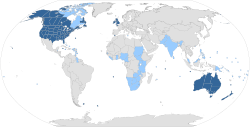
 Regions where English is the native language of the majority
Regions where English is an official or widely spoken language, but not a majority native language | |
English is a West Germanic language that emerged in early medieval England and has since become a global lingua franca.[4][5][6] The namesake of the language is the Angles, one of the Germanic peoples who migrated to Britain after the end of Roman rule. English is the most spoken language in the world, primarily due to the global influences of the former British Empire (succeeded by the Commonwealth of Nations) and the United States. It is the most widely learned second language in the world, with more second-language speakers than native speakers. However, English is only the third-most spoken native language, after Mandarin Chinese and Spanish.[3]
English is either the official language, or one of the official languages, in 57 sovereign states and 30 dependent territories, making it the most geographically widespread language in the world. In the United Kingdom, the United States, Australia, and New Zealand, it is the dominant language for historical reasons without being explicitly defined by law.[7] It is a co-official language of the United Nations, the European Union, and many other international and regional organisations. It has also become the de facto lingua franca of diplomacy, science, technology, international trade, logistics, tourism, aviation, entertainment, and the Internet.[8] Ethnologue estimated that there were over 1.4 billion speakers worldwide as of 2021[update].[3]
Old English emerged from a group of West Germanic dialects spoken by the Anglo-Saxons, and written with a runic system (the futhorc), although the transition to a Latin-based script began early on. Late Old English borrowed some grammar and core vocabulary from Old Norse, a North Germanic language.[9][10][11] Then, Middle English borrowed vocabulary extensively from French dialects, which are the source of approximately 28 percent of Modern English words, and from Latin, which is the source of an additional 28 percent.[12] While Latin and the Romance languages are thus the source for a majority of its lexicon taken as a whole, English grammar and phonology retain a family resemblance with the Germanic languages, and most of its basic everyday vocabulary remains Germanic in origin. English exists on a dialect continuum with Scots; it is next-most closely related to Low Saxon and Frisian.
Classification
[edit]English is a member of the Indo-European language family, belonging to the West Germanic branch of Germanic languages.[13] Owing to their descent from a shared ancestor language known as Proto-Germanic, English and other Germanic languages – which include Dutch, German, and Swedish[14] – have characteristic features in common, including a division of verbs into strong and weak classes, the use of modal verbs, and sound changes affecting Proto-Indo-European consonants known as Grimm's and Verner's laws.[15]
Old English was one of several Ingvaeonic languages, which emerged from a dialect continuum spoken by West Germanic peoples during the 5th century in Frisia, on the coast of the North Sea. Old English emerged among the Ingvaeonic speakers on the British Isles following their migration there, while the other Ingvaeonic languages (Frisian and Old Low German) developed in parallel on the continent.[16] Old English evolved into Middle English, which in turn evolved into Modern English.[17] Particular dialects of Old and Middle English also developed into other Anglic languages, including Scots[18] and the extinct Fingallian and Yola dialects of Ireland.[19]
English was isolated from other Germanic languages on the continent and diverged considerably in vocabulary, syntax, and phonology as a result. It is not mutually intelligible with any continental Germanic language – though some, such as Dutch and Frisian, show strong affinities with it, especially in its earlier stages.[20][page needed] English and Frisian were traditionally considered more closely related to one another than they were to other West Germanic languages, but most modern scholarship does not recognise a particular affinity between them.[21] Though they exhibited similar sound changes not otherwise found around the North Sea at that time, the specific changes appeared in English and Frisian at different times – a pattern uncharacteristic for languages sharing a unique phylogenetic ancestor.[22][23]
History
[edit]Proto-Germanic to Old English
[edit].jpg)
[Listen! We have heard of the glory in bygone days of the folk-kings of the spear-Danes ...][24]
Old English (also called Anglo-Saxon) was the earliest form of the English language, spoken from c. 450 to c. 1150. Old English developed from a set of West Germanic dialects, sometimes identified as Anglo-Frisian or North Sea Germanic, that were originally spoken along the coasts of Frisia, Lower Saxony and southern Jutland by Germanic peoples known to the historical record as the Angles, Saxons, and Jutes.[25] From the 5th century, the Anglo-Saxons settled Britain as the Roman economy and administration collapsed. By the 7th century, Old English had become dominant in Britain – replacing the Common Brittonic and British Latin previously spoken during the Roman occupation,[26][27][28] which ultimately left little influence on English. England and English (originally Ænglaland and Ænglisc) are both named after the Angles.[29]
Old English was divided into two Anglian dialects (Mercian and Northumbrian) and two Saxon dialects (Kentish and West Saxon).[30] Through the influence exerted by the kingdom of Wessex, and the educational reforms instated by King Alfred during the 9th century, the West Saxon dialect became the standard written variety.[31] The epic poem Beowulf is written in West Saxon, and the earliest English poem, Cædmon's Hymn, is written in Northumbrian.[32] Modern English developed mainly from Mercian, but the Scots language developed from Northumbrian. During the earliest period of Old English, a few short inscriptions were made using a runic alphabet.[33] By the 6th century, a Latin alphabet had been adopted. Written with half-uncial letterforms, it included the runic letters wynn ⟨ƿ⟩ and thorn ⟨þ⟩, and the modified Latin letters eth ⟨ð⟩, and ash ⟨æ⟩.[33][34]
Old English is a markedly different from Modern English, such that 21st-century English speakers are entirely unable to understand Old English without special training. Its grammar was similar to that of modern German: nouns, adjectives, pronouns, and verbs had many more inflectional endings and forms, and word order was much freer than in Modern English. Modern English has case forms in pronouns (he, him, his) and has a few verb inflections (speak, speaks, speaking, spoke, spoken), but Old English had case endings in nouns as well, and verbs had more person and number endings.[35][36][37]
Influence of Old Norse
[edit]Between the 8th and 11th centuries, the English spoken in some regions underwent significant changes due to contact with Old Norse, a North Germanic language. Several waves of Norsemen colonising the northern British Isles in the 8th and 9th centuries put Old English speakers in constant contact with Old Norse. Norse influence was strongest in the north-eastern varieties of Old English spoken in the Danelaw surrounding York; today these features are still particularly present in Scots and Northern English. The centre of Norse influence was Lindsey, located in the Midlands. After Lindsey was incorporated into the Anglo-Saxon polity in 920, English spread extensively throughout the region. An element of Norse influence that continues in all English varieties today is the third person pronoun group beginning with th- (they, them, their) which replaced the Anglo-Saxon pronouns with h- (hie, him, hera).[38]
Other Norse loanwords include give, get, sky, skirt, egg, and cake, typically displacing a native Anglo-Saxon equivalent. Old Norse in this era retained considerable mutual intelligibility with some dialects of Old English, particularly northern ones.[39]
Middle English
[edit]Englischmen þeyz hy hadde fram þe bygynnyng þre manner speche, Souþeron, Northeron, and Myddel speche in þe myddel of þe lond, ... Noþeles by comyxstion and mellyng, furst wiþ Danes, and afterward wiþ Normans, in menye þe contray longage ys asperyed, and som vseþ strange wlaffyng, chyteryng, harryng, and garryng grisbytting.
[Although, from the beginning, Englishmen had three manners of speaking, southern, northern and midlands speech in the middle of the country, ... Nevertheless, through intermingling and mixing, first with Danes and then with Normans, amongst many the country language has arisen, and some use strange stammering, chattering, snarling, and grating gnashing.]
The Middle English period is often defined as beginning with the Norman Conquest in 1066. During the centuries that followed, English was heavily influenced by the form of Old French spoken by the new Norman ruling class that had migrated to England (known as Old Norman). Over the following decades of contact, members of the middle and upper classes, whether native English or Norman, became increasingly bilingual. By 1150 at the latest, bilingual speakers represented a majority of the English aristocracy, and monolingual French speakers were nearly non-existent.[41] The French spoken by the Norman elite in England eventually developed into the Anglo-Norman language.[42] The division between Old to Middle English can also be placed during the composition of the Ormulum (c. late 12th century), a work by the Augustinian canon Orrm which highlights blending of Old English and Anglo-Norman elements in the language for the first time.[43][44]
As the lower classes, who represented the vast majority of the population, remained monolingual English speakers, a primary influence of Norman was as a lexical superstratum, introducing a wide range of loanwords related to politics, legislation and prestigious social domains.[11] For instance, the French word trône appears for the first time, from which the English word throne is derived.[45] Middle English also greatly simplified the inflectional system, probably in order to reconcile Old Norse and Old English, which were inflectionally different but morphologically similar. The distinction between nominative and accusative cases was lost except in personal pronouns, the instrumental case was dropped, and the use of the genitive case was limited to indicating possession. The inflectional system regularised many irregular inflectional forms,[46] and gradually simplified the system of agreement, making word order less flexible.[47]
Middle English literature includes Geoffrey Chaucer's Canterbury Tales (c. 1400), and Thomas Malory's Le Morte d'Arthur (1485). In the Middle English period, the use of regional dialects in writing proliferated, and dialect traits were even used for effect by authors such as Chaucer.[48] In the first translation of the entire Bible into English by John Wycliffe (1382), Matthew 8:20 reads: "Foxis han dennes, and briddis of heuene han nestis."[49] Here the plural suffix -n on the verb have is still retained, but none of the case endings on the nouns are present.
Early Modern English
[edit]
The period of Early Modern English, lasting between 1500 and 1700, was characterised by the Great Vowel Shift (1350–1700), inflectional simplification, and linguistic standardisation. The Great Vowel Shift affected the stressed long vowels of Middle English. It was a chain shift, meaning that each shift triggered a subsequent shift in the vowel system. Mid and open vowels were raised, and close vowels were broken into diphthongs. For example, the word bite was originally pronounced as the word beet is today, and the second vowel in the word about was pronounced as the word boot is today. The Great Vowel Shift explains many irregularities in spelling since English retains many spellings from Middle English, and it also explains why English vowel letters have very different pronunciations from the same letters in other languages.[50][51]
English began to rise in prestige, relative to Norman French, during the reign of Henry V. Around 1430, the Court of Chancery in Westminster began using English in its official documents, and a new standard form of Middle English, known as Chancery Standard, developed from the dialects of London and the East Midlands. In 1476, William Caxton introduced the printing press to England and began publishing the first printed books in London, expanding the influence of this form of English.[52]
Literature in Early Modern English includes the works of William Shakespeare and the 1611 King James Version (KJV) of the Bible. Even after the vowel shift the language still sounded different from Modern English: for example, the consonant clusters /kn ɡn sw/ in knight, gnat, and sword were still pronounced. Many of the grammatical features that a modern reader of Shakespeare might find quaint or archaic represent the distinct characteristics of Early Modern English.[53] Matthew 8:20 in the KJV reads: "The Foxes have holes and the birds of the ayre have nests."[54] This exemplifies the loss of case and its effects on sentence structure (replacement with subject–verb–object word order, and the use of of instead of the non-possessive genitive), and the introduction of loanwords from French (ayre) and word replacements (bird, originally meaning 'nestling', which had replaced Old English fugol).[54]
Spread of Modern English
[edit]By the late 18th century, the British Empire had spread English through its colonies and geopolitical dominance. Commerce, science and technology, diplomacy, art, and formal education all contributed to English becoming the first truly global language. English also facilitated worldwide international communication.[55][4] English was adopted in parts of North America, parts of Africa, Oceania, and many other regions. When they obtained political independence, some of the newly independent states that had multiple indigenous languages opted to continue using English as the official language to avoid the political and other difficulties inherent in promoting any one indigenous language above the others.[56][57][58] In the 20th century the growing economic and cultural influence of the United States and its status as a superpower following the Second World War has, along with worldwide broadcasting in English by the BBC[59] and other broadcasters, caused the language to spread across the planet much faster.[60][61] In the 21st century, English is more widely spoken and written than any language has ever been.[62]
As Modern English developed, explicit norms for standard usage were published, and spread through official media such as public education and state-sponsored publications. In 1755, Samuel Johnson published his Dictionary of the English Language, which introduced standard spellings of words and usage norms. In 1828, Noah Webster published the American Dictionary of the English language to try to establish a norm for speaking and writing American English that was independent of the British standard. Within Britain, non-standard or lower class dialect features were increasingly stigmatised, leading to the quick spread of the prestige varieties among the middle classes.[63]
In modern English, the loss of grammatical case is almost complete (it is now found only in pronouns, such as he and him, she and her, who and whom), and subject–verb–object word order is mostly fixed.[63] Some changes, such as the use of do-support, have become universalised. (Earlier English did not use the word do as a general auxiliary as Modern English does; at first it was only used in question constructions, and even then was not obligatory.[64] Now, do-support with the verb have is becoming increasingly standardised.) The use of progressive forms in -ing, appears to be spreading to new constructions, and forms such as "had been being built" are becoming more common. Regularisation of irregular forms also slowly continues (e.g. dreamed instead of dreamt), and analytical alternatives to inflectional forms are becoming more common (e.g. more polite instead of politer). British English is also undergoing change under the influence of American English, fuelled by the strong presence of American English in the media.[65][66][67]
Geographical distribution
[edit]

As of 2016[update], 400 million people spoke English as their first language, and 1.1 billion spoke it as a second language.[69] English is the largest language by number of speakers, spoken by communities on every continent.[70] Estimates of second language and foreign-language speakers vary greatly depending on how proficiency is defined, from 470 million to more than 1 billion.[7] In 2003, David Crystal estimated that non-native speakers outnumbered native speakers by a ratio of three-to-one.[71]
Three circles model
[edit]Braj Kachru has categorised countries into the Three Circles of English model, according to how the language historically spread in each country, how it is acquired by the populace, and the range of uses it has there – with a country's classification able to change over time.[72][73]
"Inner-circle" countries have large communities of native English speakers; these include the United Kingdom, the United States, Australia, Canada, Ireland, and New Zealand, where the majority speaks English – and South Africa, where a significant minority speaks English. The countries with the most native English speakers are, in descending order, the United States (at least 231 million),[74] the United Kingdom (60 million),[75][76][77] Canada (19 million),[78] Australia (at least 17 million),[79] South Africa (4.8 million),[80] Ireland (4.2 million), and New Zealand (3.7 million).[81] In these countries, children of native speakers learn English from their parents, and local people who speak other languages and new immigrants learn English to communicate in their neighbourhoods and workplaces.[82] Inner-circle countries are the base from which English spreads to other regions of the world.[72]
"Outer-circle" countries – such as the Philippines,[83] Jamaica,[84] India, Pakistan, Singapore,[85] Malaysia, and Nigeria[86][87] – have much smaller proportions of native English speakers, but use of English as a second language in education, government, or domestic business is significant, and its use for instruction in schools and official government operations is routine.[88] These countries have millions of native speakers on dialect continua, which range from English-based creole languages to standard varieties of English used in inner-circle countries. They have many more speakers who acquire English as they grow up through day-to-day use and exposure to English-language broadcasting, especially if they attend schools where English is the language of instruction. Varieties of English learned by non-native speakers born to English-speaking parents may be influenced, especially in their grammar, by the other languages spoken by those learners – with most including words rarely used by native speakers in inner-circle countries, as well as grammatical and phonological differences from inner-circle varieties.[82]
"Expanding-circle" countries are where English is taught as a foreign language[89] – though the character of English as a first, second, or foreign language in a given country is often debatable, and may change over time.[88] For example, in countries like the Netherlands, an overwhelming majority of the population can speak English,[90] and it is often used in higher education and to communicate with foreigners.[91]
Pluricentric English
[edit]English is a pluricentric language, which means that no one national authority sets the standard for use of the language.[92][93][94][95] Spoken English, including English used in broadcasting, generally follows national pronunciation standards that are established by custom rather than by regulation. International broadcasters are usually identifiable as coming from one country rather than another through their accents,[96] but newsreader scripts are also composed largely in international standard written English. The norms of standard written English are maintained purely by the consensus of educated English speakers around the world, without any oversight by any government or international organisation.[97]
American listeners readily understand most British broadcasting, and British listeners readily understand most American broadcasting. Most English speakers around the world can understand radio programmes, television programmes, and films from many parts of the English-speaking world.[98] Both standard and non-standard varieties of English can include both formal or informal styles, distinguished by word choice and syntax and use both technical and non-technical registers.[99]
The settlement history of the English-speaking inner circle countries outside Britain helped level dialect distinctions and produce koiné forms of English in South Africa, Australia, and New Zealand.[100] The majority of immigrants to the United States without British ancestry rapidly adopted English after arrival. Now the majority of the United States population are monolingual English speakers.[74][101]
- Australia has no official languages at the federal or state level.[102]
- In Canada, English and French share an official status at the federal level.[103][104] English has official or co-official status in six provinces and three territories, while three provinces have none and Quebec's only official language is French.[105]
- English is the official second language of Ireland, while Irish is the first.[106]
- While New Zealand is majority English-speaking, its two official languages are Māori[107] and New Zealand Sign Language.[108]
- The United Kingdom does not have an official language. In Wales and Northern Ireland, English is co-official alongside Welsh[109] and Irish[110] respectively. Neither Scotland nor England have an official language.
- In the United States, English was designated the official language of the country by Executive Order 14224 in 2025.[111] English has additional official or co-official status at the state level in 32 states, and all 5 territories;[112] 18 states and the District of Columbia have no official language.
English as a global language
[edit]

Modern English is sometimes described as the first global lingua franca,[60][115] or as the first world language.[116][117] English is the world's most widely used language in newspaper publishing, book publishing, international telecommunications, scientific publishing, international trade, mass entertainment, and diplomacy.[117] Parity with French as a language of diplomacy had been achieved by Treaty of Versailles negotiations in 1919.[118] By the time the United Nations was founded at the end of World War II, English had become pre-eminent;[119] it is one of six official languages of the United Nations.[120] and is now the main worldwide language of diplomacy and international relations.[121] Many other worldwide international organisations, including the International Olympic Committee, specify English as a working language or official language of the organisation. Many regional international organisations, such as the European Free Trade Association (EFTA), Association of Southeast Asian Nations (ASEAN),[61] and Asia-Pacific Economic Cooperation (APEC) use English as their sole working language, despite most members not being countries with a majority of native English speakers. While the EU allows member states to designate any of the national languages as an official language of the Union, in practice English is the main working language of EU organisations.[122] English serves as the basis for the required controlled natural languages[123] Seaspeak and Airspeak, used as international languages of seafaring[124] and aviation.[125]
English is the most frequently taught foreign language in the world.[60][61] Most people learning English do so for practical reasons, as opposed to ideological reasons.[126] In EU countries, English is the most widely spoken foreign language in 19 of the 25 member states where it is not an official language (that is, the countries other than Ireland and Malta). In a 2012 official Eurobarometer poll (conducted when the UK was still a member of the EU), 38 percent of the EU respondents outside the countries where English is an official language said they could speak English well enough to have a conversation in that language. The next most commonly mentioned foreign language, French (which is the most widely known foreign language in the UK and Ireland), could be used in conversation by 12 percent of respondents.[127] The global influence of English has led to concerns about language death,[128] and to claims of linguistic imperialism,[129] and has provoked resistance to the spread of English; however, the number of speakers continues to increase because many people around the world think English provides them with better employment opportunities and increased quality of life.[130]
Working knowledge of English has become a requirement in a number of occupations and professions such as medicine[131] and computing. Though it formerly had parity with French and German in scientific research, English now dominates the field.[132] Its importance in scientific publishing is such that over 80 percent of scientific journal articles indexed by Chemical Abstracts in 1998 were written in English, as were 90 percent of all articles in natural science publications by 1996, and 82 percent of articles in humanities publications by 1995.[133]
As decolonisation proceeded throughout the British Empire in the 1950s and 1960s, former colonies often did not reject English but rather continued to use it as independent countries setting their own language policies.[57][58][134] For example, English is one of the official languages of India. Many Indians have shifted from associating the language with colonialism to associating it with economic progress.[135] English is widely used in media and literature, with India being the third-largest publisher of English-language books in the world, after the US and UK.[136] However, less than 5 percent of the population speak English fluently, with the country's native English speakers numbering in the low hundreds of thousands.[137][138] In 2004, David Crystal claimed India had the largest population of people able to speak or understand English in the world,[139] though most scholars estimate the US remains home to a larger English-speaking population.[140] Many English speakers in Africa have become part of an "Afro-Saxon" language community that unites Africans from different countries.[141] Regarding its future development, it is considered most likely that English will continue to function as a koiné language, with a standard form that unifies speakers around the world.[142]
Phonology
[edit]English phonology and phonetics differ from one dialect to another, usually without interfering with mutual communication. Phonological variation affects the inventory of phonemes (speech sounds that distinguish meaning), and phonetic variation consists in differences in pronunciation of the phonemes.[143] This overview mainly describes Received Pronunciation (RP) and General American (GA), the standard varieties of the United Kingdom and the United States respectively.[144][145][146]
Consonants
[edit]Most English dialects share the same 24 consonant phonemes (or 26, if marginal /x/ and glottal stop /ʔ/ are included). The consonant inventory shown below is valid for California English,[147] and for RP.[148]
| Bilabial | Labiodental | Dental | Alveolar | Post- alveolar |
Palatal | Velar | Glottal | ||||||||||
|---|---|---|---|---|---|---|---|---|---|---|---|---|---|---|---|---|---|
| Nasal | m | n | ŋ | ||||||||||||||
| Plosive | p | b | t | d | k | ɡ | (ʔ) | ||||||||||
| Affricate | tʃ | dʒ | |||||||||||||||
| Fricative | f | v | θ | ð | s | z | ʃ | ʒ | (x) | h | |||||||
| Approximant | Central | ɹ | j | w | |||||||||||||
| Lateral | l | ||||||||||||||||
For pairs of obstruents (stops, affricates, and fricatives) such as /p b/, /tʃ dʒ/, and /s z/, the first is fortis (strong) and the second is lenis (weak). Fortis obstruents, such as /p tʃ s/ are pronounced with more muscular tension and breath force than lenis consonants, such as /b dʒ z/, and are always voiceless. Lenis consonants are partly voiced at the beginning and end of utterances, and fully voiced between vowels. Fortis stops such as /p/ have additional articulatory or acoustic features in most dialects: they are aspirated [pʰ] when they occur alone at the beginning of a stressed syllable, often unaspirated in other cases, and often unreleased [p̚] or pre-glottalised [ʔp] at the end of a syllable. In a single-syllable word, a vowel before a fortis stop is shortened: e.g. nip has a noticeably shorter vowel (phonetically, not phonemically) than nib [nɪˑb̥] (see below).[149]
- Lenis stops: bin [b̥ɪˑn], about [əˈbaʊt], nib [nɪˑb̥]
- Fortis stops: pin [pʰɪn]; spin [spɪn]; happy [ˈhæpi]; nip [nɪp̚] or [nɪʔp]
In RP, the lateral approximant /l/ has two main allophones (pronunciation variants): the clear or plain [l], as in light, and the dark or velarised [ɫ], as in full.[150] GA has dark l in most cases.[151]
- Clear l: RP light [laɪt]
- Dark l: RP and GA full [fʊɫ], GA light [ɫaɪt]
All sonorants (liquids /l, r/ and nasals /m, n, ŋ/) devoice when following a voiceless obstruent, and they are syllabic when following a consonant at the end of a word.[152]
- Voiceless sonorants: clay [kl̥eɪ̯]; snow RP [sn̥əʊ̯], GA [sn̥oʊ̯]
- Syllabic sonorants: paddle [ˈpad.l̩], button [ˈbʌt.n̩]
Vowels
[edit]| RP | GA | Word |
|---|---|---|
| iː | i | need |
| ɪ | bid | |
| e | ɛ | bed |
| æ | back | |
| ɑː | ɑ | bra |
| ɒ | box | |
| ɔ, ɑ | cloth | |
| ɔː | paw | |
| uː | u | food |
| ʊ | good | |
| ʌ | but | |
| ɜː | ɜɹ | bird |
| ə | comma | |
The pronunciation of vowels varies a great deal between dialects and is one of the most detectable aspects of a speaker's accent. The accompanying table below lists the vowel phonemes in RP and GA, with example words from lexical sets. The vowels are represented with symbols from the International Phonetic Alphabet; those given for RP are standard in British dictionaries and other publications.[153]
In RP, vowel length is phonemic; long vowels are marked with a triangular colon ⟨ː⟩ in the table above, such as the vowel of need [niːd] as opposed to bid [bɪd].[154] In GA, vowel length is non-distinctive.[155]
In both RP and GA, vowels are phonetically shortened before fortis consonants in the same syllable, like /t tʃ f/, but not before lenis consonants like /d dʒ v/ or in open syllables: thus, the vowels of rich [rɪtʃ], neat [nit], and safe [seɪ̯f] are noticeably shorter than the vowels of ridge [rɪˑdʒ], need [niˑd], and save [seˑɪ̯v], and the vowel of light [laɪ̯t] is shorter than that of lie [laˑɪ̯]. Because lenis consonants are frequently voiceless at the end of a syllable, vowel length is an important cue as to whether the following consonant is lenis or fortis.[156]
The vowel /ə/ only occurs in unstressed syllables and is more open in quality in stem-final positions.[157][158] Some dialects do not contrast /ɪ/ and /ə/ in unstressed positions, such that rabbit and abbot rhyme and Lenin and Lennon are homophonous, a dialectal feature called the weak vowel merger.[159] GA /ɜr/ and /ər/ are realised as an r-coloured vowel [ɚ], as in further [ˈfɚðɚ] (phonemically /ˈfɜrðər/), which in RP is realised as [ˈfəːðə] (phonemically /ˈfɜːðə/).[160]
Phonotactics
[edit]An English syllable includes a syllable nucleus consisting of a vowel sound. Syllable onset and coda (start and end) are optional. A syllable can start with up to three consonant sounds, as in sprint /sprɪnt/, and end with up to five, as in (for some dialects) angsts /aŋksts/. This gives an English syllable a structure of (CCC)V(CCCCC) – where C represents a consonant and V a vowel. The word strengths /strɛŋkθs/ is thus close to the most complex syllable possible in English. The consonants that may appear together in onsets or codas are restricted, as is the order in which they may appear. Onsets can only have four types of consonant clusters: a stop and approximant, as in play; a voiceless fricative and approximant, as in fly or sly; s and a voiceless stop, as in stay; and s, a voiceless stop, and an approximant, as in string.[161] Clusters of nasal and stop are only allowed in codas. Clusters of obstruents always agree in voicing, and clusters of sibilants and of plosives with the same point of articulation are prohibited. Several consonants have limited distributions: /h/ can only occur in syllable-initial position, and /ŋ/ only in syllable-final position.[162]
Stress, rhythm, and intonation
[edit]Stress plays an important role in English. Certain syllables are stressed, while others are unstressed. Stress is a combination of duration, intensity, vowel quality, and sometimes changes in pitch. Stressed syllables are pronounced longer and louder than unstressed syllables, and vowels in unstressed syllables are frequently reduced while vowels in stressed syllables are not.[163]
Stress in English is phonemic. For instance, the word contract is stressed on the first syllable (/ˈkɒntrækt/ KON-trakt) when used as a noun, but on the last syllable (/kənˈtrækt/ kən-TRAKT) for most meanings (for example, "reduce in size") when used as a verb.[164][165][166] Here stress is connected to vowel reduction: in the noun "contract" the first syllable is stressed and has the unreduced vowel /ɒ/, but in the verb "contract" the first syllable is unstressed and its vowel is reduced to /ə/. Stress is also used to distinguish between words and phrases, so that a compound word receives a single stress unit, but the corresponding phrase has two: e.g. "a burnout" (/ˈbɜːrnaʊt/) versus "to burn out" (/ˈbɜːrn ˈaʊt/), and "a hotdog" (/ˈhɒtdɒɡ/) versus "a hot dog" (/ˈhɒt ˈdɒɡ/).[167]
In terms of rhythm, English is generally described as a stress-timed language, meaning that the amount of time between stressed syllables tends to be equal.[168] Stressed syllables are pronounced longer, but unstressed syllables (syllables between stresses) are shortened. Vowels in unstressed syllables are shortened as well, and vowel shortening causes changes in vowel quality: vowel reduction.[169]
Regional variation
[edit]| United States |
Canada | Republic of Ireland |
Northern Ireland |
Scotland | England | Wales | South Africa |
Australia | New Zealand | |
|---|---|---|---|---|---|---|---|---|---|---|
| father–bother merger | Yes | Yes | ||||||||
| /ɒ/ is unrounded | Yes | Yes | Yes | |||||||
| /ɜr/ is pronounced [ɚ] | Yes | Yes | Yes | Yes | ||||||
| cot–caught merger | Possibly | Yes | Possibly | Yes | Yes | |||||
| fool–full merger | Yes | Yes | ||||||||
| /t, d/ flapping | Yes | Yes | Possibly | Often | Rarely | Rarely | Rarely | Rarely | Yes | Often |
| trap–bath split | Possibly | Possibly | Often | Yes | Yes | Often | Yes | |||
| non-rhoticity | Yes | Yes | Yes | Yes | Yes | |||||
| close vowels for /æ, ɛ/ | Yes | Yes | Yes | |||||||
| /l/ can always be pronounced [ɫ] | Yes | Yes | Yes | Yes | Yes | Yes | ||||
| /ɑː/ is fronted before /r/ | Possibly | Possibly | Yes | Yes |
| Lexical set | RP | GA | Can | Sound change |
|---|---|---|---|---|
| THOUGHT | /ɔː/ | /ɔ/ or /ɑ/ | /ɑ/ | cot–caught merger |
| CLOTH | /ɒ/ | lot–cloth split | ||
| LOT | /ɑ/ | father–bother merger | ||
| PALM | /ɑː/ | |||
| BATH | /æ/ | /æ/ | trap–bath split | |
| TRAP | /æ/ |
Varieties of English vary the most in pronunciation of vowels. The best-known national varieties used as standards for education in non-English-speaking countries are British (BrE) and American (AmE). Countries such as Canada, Australia, Ireland, New Zealand and South Africa have their own standard varieties which are less often used as standards for education internationally.[170]
English has undergone many historical sound changes, some of them affecting all varieties, and others affecting only a few. Most standard varieties are affected by the Great Vowel Shift, which changed the pronunciation of long vowels, but a few dialects have slightly different results. In North America, a number of chain shifts such as the Northern Cities Vowel Shift and Canadian Shift have produced very different vowel landscapes in some regional accents.[171]
Some dialects have fewer or more consonant phonemes and phones than the standard varieties. Some conservative varieties like Scottish English have a voiceless [ʍ] sound in whine that contrasts with the voiced [w] in wine, but most other dialects pronounce both words with voiced [w], a dialect feature called wine–whine merger. The voiceless velar fricative sound /x/ is found in Scottish English, which distinguishes loch /lɔx/ from lock /lɔk/. Accents like Cockney with "h-dropping" lack the glottal fricative /h/, and dialects with th-stopping and th-fronting like African-American Vernacular and Estuary English do not have the dental fricatives /θ, ð/, but replace them with dental or alveolar stops /t, d/ or labiodental fricatives /f, v/.[172][173] Other changes affecting the phonology of local varieties are processes such as yod-dropping, yod-coalescence, and reduction of consonant clusters.[174][page needed]
GA and RP vary in their pronunciation of historical /r/ after a vowel at the end of a syllable (in the syllable coda). GA is a rhotic dialect, meaning that it pronounces /r/ at the end of a syllable, but RP is non-rhotic, meaning that it loses /r/ in that position. English dialects are classified as rhotic or non-rhotic depending on whether they elide /r/ like RP or keep it like GA.[175]
There is complex dialectal variation in words with the open front and open back vowels /æ ɑː ɒ ɔː/. These four vowels are only distinguished in RP, Australia, New Zealand and South Africa. In GA, these vowels merge to three /æ ɑ ɔ/,[176] and in Canadian English, they merge to two /æ ɑ/.[177]
Grammar
[edit]Typical for an Indo-European language, English grammar follows accusative morphosyntactic alignment. Unlike other Indo-European languages, English has largely abandoned the inflectional case system in favour of analytic constructions. Only the personal pronouns retain morphological case more strongly than any other word class. English distinguishes at least seven major word classes: verbs, nouns, adjectives, adverbs, determiners (including articles), prepositions, and conjunctions. Some analyses add pronouns as a class separate from nouns, and subdivide conjunctions into subordinators and coordinators, and add the class of interjections.[178] English also has a rich set of auxiliary verbs, such as have and do, expressing the categories of mood and aspect. Questions are marked by do-support, wh-movement (fronting of question words beginning with wh-) and word order inversion with some verbs.[179]
Some traits typical of Germanic languages persist in English, such as the distinction between irregularly inflected strong stems inflected through ablaut (i.e. changing the vowel of the stem, as in the pairs speak / spoke and foot / feet) and weak stems inflected through affixation (such as love / loved, hand / hands).[180] Vestiges of the case and gender system are found in the pronoun system (he / him, who / whom); similarly, traces of more complex verb conjugation are seen in the inflection of the copula verb to be.[180]
The seven word classes are exemplified in this sample sentence:[181]
| The | chairman | of | the | committee | and | the | loquacious | politician | clashed | violently | when | the | meeting | started. |
| Det. | Noun | Prep. | Det. | Noun | Conj. | Det. | Adj. | Noun | Verb | Advb. | Conj. | Det. | Noun | Verb |
Nouns and noun phrases
[edit]English nouns are only inflected for number and possession. New nouns can be formed through derivation or compounding. They are semantically divided into proper nouns (names) and common nouns. Common nouns are in turn divided into concrete and abstract nouns, and grammatically into count nouns and mass nouns.[182]
Most count nouns are inflected for plural number through the use of the plural suffix -s, but a few nouns have irregular plural forms. Mass nouns can only be pluralised through the use of a count noun classifier, e.g. "one loaf of bread", "two loaves of bread".[183]
Regular plural formation:
- Singular: cat, dog
- Plural: cats, dogs
Irregular plural formation:
- Singular: man, woman, foot, fish, ox, knife, mouse
- Plural: men, women, feet, fish, oxen, knives, mice
Possession can be expressed either by the possessive enclitic -s (also traditionally called a genitive suffix), or by the preposition of. Historically the -s possessive has been used for animate nouns, whereas the of possessive has been reserved for inanimate nouns. Today this distinction is less clear, and many speakers use -s also with inanimates. Orthographically the possessive -s is separated from a singular noun with an apostrophe. If the noun is plural formed with -s the apostrophe follows the -s.[179]
Possessive constructions:
- With -s: "The woman's husband's child"
- With of: "The child of the husband of the woman"
Nouns can form noun phrases (NPs) where they are the syntactic head of the words that depend on them such as determiners, quantifiers, conjunctions or adjectives.[184] Noun phrases can be short, such as the man, composed only of a determiner and a noun. They can also include modifiers such as adjectives (e.g. red, tall, all) and specifiers such as determiners (e.g. the, that). But they can also tie together several nouns into a single long NP, using conjunctions such as and, or prepositions such as with, e.g. "the tall man with the long red trousers and his skinny wife with the spectacles" (this NP uses conjunctions, prepositions, specifiers, and modifiers). Regardless of length, an NP functions as a syntactic unit.[179] For example, the possessive enclitic can, in cases which do not lead to ambiguity, follow the entire noun phrase, as in "The President of India's wife", where the enclitic follows India and not President.
The class of determiners is used to specify the noun they precede in terms of definiteness, where the marks a definite noun and a or an an indefinite one. A definite noun is assumed by the speaker to be already known by the interlocutor, whereas an indefinite noun is not specified as being previously known. Quantifiers, which include one, many, some and all, are used to specify the noun in terms of quantity or number. The noun must agree with the number of the determiner, e.g. one man (sg.) but all men (pl.). Determiners are the first constituents in a noun phrase.[185]
Adjectives
[edit]English adjectives are words such as good, big, interesting, and Canadian that most typically modify nouns, denoting characteristics of their referents (e.g. "a red car"). As modifiers, they come before the nouns they modify and after determiners.[186] English adjectives also function as predicative complements (e.g. "the child is happy").[187]
In Modern English, adjectives are not inflected so as to agree in form with the noun they modify, as in most other Indo-European languages. For example, in the phrases "the slender boy", and "many slender girls", the adjective slender does not change form to agree with either the number or gender of the noun.[188]
Some adjectives are inflected for degree of comparison, with the positive degree unmarked, the suffix -er marking the comparative, and -est marking the superlative: "a small boy", "the boy is smaller than the girl", "that boy is the smallest". Some adjectives have irregular suppletive comparative and superlative forms, such as good, better, and best. Other adjectives have comparatives formed by periphrastic constructions, with the adverb more marking the comparative, and most marking the superlative: happier or more happy, the happiest or most happy.[189] There is some variation among speakers regarding which adjectives use inflected or periphrastic comparison, and some studies have shown a tendency for the periphrastic forms to become more common at the expense of the inflected form.[190]
Determiners
[edit]English determiners are words such as the, each, many, some, and which, occurring most typically in noun phrases before the head nouns and any modifiers and marking the noun phrase as definite or indefinite.[191] They often agree with the noun in number. They do not typically inflect for degree of comparison.
Pronouns, case, and person
[edit]English pronouns conserve many traits of case and gender inflection. The personal pronouns retain a difference between subjective and objective case in most persons (I/me, he/him, she/her, we/us, they/them) as well as an animateness distinction in the third person singular (distinguishing it from the three sets of animate third person singular pronouns) and an optional gender distinction in the animate third person singular (distinguishing between feminine she/her, epicene they/them, and masculine he/him.[192][193] The subjective case corresponds to the Old English nominative case, and the objective case is used in the sense both of the previous accusative case (for a patient, or direct object of a transitive verb), and of the Old English dative case (for a recipient or indirect object of a transitive verb).[194][195] The subjective is used when the pronoun is the subject of a finite clause, otherwise the objective is used.[196] While grammarians such as Henry Sweet[197] and Otto Jespersen[198] noted that the English cases did not correspond to the traditional Latin-based system, some contemporary grammars, including The Cambridge Grammar of the English Language, retain traditional nominative and accusative labels for the cases.[199]
Possessive pronouns exist in dependent and independent forms; the dependent form functions as a determiner specifying a noun (as in my chair), while the independent form can stand alone as if it were a noun (e.g. "the chair is mine").[200] Grammatical person in English no longer distinguishes between formal and informal pronouns of address, with the second person singular familiar pronoun thou that previously existed in the language having fallen almost entirely out of use by the 18th century.[201]
Both the second and third persons share pronouns between the plural and singular:
- Plural and singular are always identical (you, your, yours) in the second person (except in the reflexive form: yourself/yourselves) in most dialects. Some dialects have introduced innovative second person plural pronouns, such as y'all (found in Southern American English and African-American Vernacular English), youse (found in Australian English), or ye (in Hiberno-English).
- In the third person, the they/them series of pronouns (they, them, their, theirs, themselves) are used in both plural and singular, and are the only pronouns available for the plural. In the singular, the they/them series (sometimes with the addition of the singular-specific reflexive form themself) serve as a gender-neutral set of pronouns. These pronouns are becoming more accepted, especially as part of the LGBTQ culture.[192][202][203]
| Person | Subjective case | Objective case | Dependent possessive | Independent possessive | Reflexive |
|---|---|---|---|---|---|
| 1st, singular | I | me | my | mine | myself |
| 2nd, singular | you | you | your | yours | yourself |
| 3rd, singular | he/she/it/they | him/her/it/them | his/her/its/their | his/hers/its/theirs | himself/herself/itself/themself/themselves |
| 1st, plural | we | us | our | ours | ourselves |
| 2nd, plural | you | you | your | yours | yourselves |
| 3rd, plural | they | them | their | theirs | themselves |
Pronouns are used to refer to entities deictically or anaphorically. A deictic pronoun points to some person or object by identifying it relative to the speech situation – for example, the pronoun I identifies the speaker, and the pronoun you, the addressee. Anaphoric pronouns such as that refer back to an entity already mentioned or assumed by the speaker to be known by the audience, for example in the sentence "I already told you that". The reflexive pronouns are used when the oblique argument is identical to the subject of a phrase (e.g. "he sent it to himself" or "she braced herself for impact").[204]
Prepositions
[edit]Prepositional phrases (PP) are phrases composed of a preposition and one or more nouns, e.g. "with the dog", "for my friend", "to school", "in England".[205] English prepositions have a wide range of uses – including describing movement, place, and other relations between entities, as well as functions that are syntactic in nature, like introducing complement clauses and oblique arguments of verbs.[205] For example, in the phrase "I gave it to him", the preposition to marks the indirect object of the verb to give. Traditionally words were only considered prepositions if they governed the case of the noun they preceded, for example causing the pronouns to use the objective rather than subjective form, "with her", "to me", "for us". But some contemporary grammars no longer consider government of case to be the defining feature of the class of prepositions, rather defining prepositions as words that can function as the heads of prepositional phrases.[206]
Verbs and verb phrases
[edit]English verbs are inflected for tense and aspect and marked for agreement with a third person present singular subject. Only the copula verb to be is still inflected for agreement with the plural and first and second person subjects.[189] Auxiliary verbs such as have and be are paired with verbs in the infinitive, past, or progressive forms. They form complex tenses, aspects, and moods. Auxiliary verbs differ from other verbs in that they can be followed by the negation, and in that they can occur as the first constituent in a question sentence.[207][208]
Most verbs have six inflectional forms. The primary forms are a plain present, a third person singular present, and a preterite (past) form. The secondary forms are a plain form used for the infinitive, a gerund-participle and a past participle.[209] The verb to be – which among other uses in English functions as the primary auxiliary verb indicating the imperfective aspect (e.g. "I am going"), as well as the copula[210] – is the only verb to retain some of its original conjugation, and takes different inflectional forms depending on the subject. The first person present form is am, the third person singular form is is, and the form are is used in the second person singular and all three plurals. The only verb past participle is been and its gerund-participle is being.[211]
| Inflection | Strong | Regular |
|---|---|---|
| Plain present | take | love |
| 3rd person sg. present |
takes | loves |
| Preterite | took | loved |
| Plain (infinitive) | take | love |
| Gerund–participle | taking | loving |
| Past participle | taken | loved |
Tense, aspect, and mood
[edit]English has two primary tenses, past (preterite) and non-past. The preterite is inflected by using the preterite form of the verb, which for the regular verbs includes the suffix -ed, and for the strong verbs either the suffix -t or a change in the stem vowel. The non-past form is unmarked except in the third person singular, which takes the suffix -s.[207]
| Present | Preterite | |
|---|---|---|
| First person | I run | I ran |
| Second person | You run | You ran |
| Third person | John runs | John ran |
English does not have future verb forms.[212] The future tense is expressed periphrastically with one of the auxiliary verbs will or shall.[213] Many varieties also use a near future constructed with the phrasal verb "be going to" (going-to future).[214]
| Future | |
|---|---|
| First person | "I will run" |
| Second person | "You will run" |
| Third person | "John will run" |
Further aspectual distinctions are shown by auxiliary verbs, primarily have and be, which show the contrast between a perfect and non-perfect past tense ("I have run" vs. "I was running"), and compound tenses such as preterite perfect ("I had been running") and present perfect ("I have been running").[215]
For the expression of mood, English uses a number of modal auxiliaries, such as can, may, will, shall and the past tense forms could, might, would, should. There are also subjunctive and imperative moods, both based on the plain form of the verb (i.e. without the third person singular -s), for use in subordinate clauses (e.g. subjunctive: "It is important that he run every day"; imperative Run!).[213]
An infinitive form, that uses the plain form of the verb and the preposition to, is used for verbal clauses that are syntactically subordinate to a finite verbal clause. Finite verbal clauses are those that are formed around a verb in the present or preterite form. In clauses with auxiliary verbs, they are the finite verbs and the main verb is treated as a subordinate clause.[216] For example, "he has to go" where only the auxiliary verb have is inflected for time and the main verb to go is in the infinitive, or in a complement clause such as "I saw him leave", where the main verb is see, which is in a preterite form, and leave is in the infinitive.
Phrasal verbs
[edit]English also makes frequent use of constructions traditionally called phrasal verbs, verb phrases that are made up of a verb root and a preposition or particle that follows the verb. The phrase then functions as a single predicate. In terms of intonation the preposition is fused to the verb, but in writing it is written as a separate word. Examples of phrasal verbs are "to get up", "to ask out", "to get together", and "to put up with". The phrasal verb frequently has a highly idiomatic meaning that is more specialised and restricted than what can be simply extrapolated from the combination of verb and preposition complement (e.g. lay off meaning terminate someone's employment).[217] Some grammarians do not consider this type of construction to form a syntactic constituent and hence refrain from using the term "phrasal verb". Instead, they consider the construction simply to be a verb with a prepositional phrase as its syntactic complement, e.g. "he woke up in the morning" and "he ran up in the mountains" are syntactically equivalent.[218]
Adverbs
[edit]The function of adverbs is to modify the action or event described by the verb by providing additional information about the manner in which it occurs.[179] Many English adverbs are derived from adjectives by appending the suffix -ly. For example, in the phrase "the woman walked quickly", the adverb quickly is derived from the adjective quick. Some commonly used adjectives have irregular adverbial forms, such as good, which has the adverbial form well.[219]
Syntax
[edit]
Modern English syntax is moderately analytic.[220] It has developed features such as modal verbs and word order as resources for conveying meaning. Auxiliary verbs mark constructions such as questions, negative polarity, the passive voice and progressive aspect.[221]
Basic constituent order
[edit]English has moved from the Germanic verb-second (V2) word order to being almost exclusively subject–verb–object (SVO).[222] The combination of SVO order and use of auxiliary verbs often creates clusters of two or more verbs at the centre of the sentence, such as "he had been hoping to try opening it".[223]
In most sentences, English only marks grammatical relations through word order.[224] The subject constituent precedes the verb and the object constituent follows it. The grammatical roles of each constituent are marked only by the position relative to the verb:
| The dog | bites | the man |
| S | V | O |
| The man | bites | the dog |
| S | V | O |
An exception is found in sentences where one of the constituents is a pronoun, in which case it is doubly marked, both by word order and by case inflection, where the subject pronoun precedes the verb and takes the subjective case form, and the object pronoun follows the verb and takes the objective case form.[225] The example below demonstrates this double marking in a sentence where both object and subject are represented with a third person singular masculine pronoun:
| He | hit | him |
| S | V | O |
Indirect objects (IO) of ditransitive verbs can be placed either as the first object in a double object construction (S V IO O), such as "I gave Jane the book" or in a prepositional phrase, such as "I gave the book to Jane".[226]
Clause syntax
[edit]English sentences may be composed of one or more clauses, that may in turn be composed of one or more phrases (e.g. noun phrases, verb phrases, prepositional phrases). A clause is built around a verb and includes its constituents, such as any noun or prepositional phrases. Within a sentence, there is always at least one main clause (or matrix clause) whereas other clauses are subordinate to a main clause. Subordinate clauses may function as arguments of the verb in the main clause. For example, in the phrase "I think (that) you are lying", the main clause is headed by the verb think, the subject is I, but the object of the phrase is the subordinate clause "(that) you are lying". The subordinating conjunction that shows that the clause that follows is a subordinate clause, but it is often omitted.[227] Relative clauses are clauses that function as a modifier or specifier to some constituent in the main clause: For example, in the sentence "I saw the letter that you received today", the relative clause "that you received today" specifies the meaning of the word letter, the object of the main clause. Relative clauses can be introduced by the pronouns who, whose, whom, and which as well as by that (which can also be omitted).[228] In contrast to many other Germanic languages there are no major differences between word order in main and subordinate clauses.[229]
Auxiliary verb constructions
[edit]English auxiliary verbs are relied upon for many functions, including the expression of tense, aspect, and mood. Auxiliary verbs form main clauses, and the main verbs function as heads of a subordinate clause of the auxiliary verb. For example, in the sentence "the dog did not find its bone", the clause "find its bone" is the complement of the negated verb did not. Subject–auxiliary inversion is used in many constructions, including focus, negation, and interrogative constructions.[230]
The verb do can be used as an auxiliary even in simple declarative sentences, where it usually serves to add emphasis, as in "I did shut the fridge." However, in the negated and inverted clauses referred to above, it is used because the rules of English syntax permit these constructions only when an auxiliary is present. Modern English does not allow the addition of the negating adverb not to an ordinary finite lexical verb, as in *"I know not" – it can only be added to an auxiliary (or copular) verb, hence if there is no other auxiliary present when negation is required, the auxiliary do is used, to produce a form like "I do not (don't) know." The same applies in clauses requiring inversion, including most questions – inversion must involve the subject and an auxiliary verb, so it is not possible to say *"Know you him?"; grammatical rules require "Do you know him?"[231]
Negation is done with the adverb not, which precedes the main verb and follows an auxiliary verb. A contracted form of not -n't can be used as an enclitic attaching to auxiliary verbs and to the copula verb to be. Just as with questions, many negative constructions require the negation to occur with do-support, thus in Modern English "I don't know him" is the correct answer to the question "Do you know him?", but not *"I know him not", although this construction may be found in older English.[232]
Passive constructions also use auxiliary verbs. A passive construction rephrases an active construction in such a way that the object of the active phrase becomes the subject of the passive phrase, and the subject of the active phrase is either omitted or demoted to a role as an oblique argument introduced in a prepositional phrase. They are formed by using the past participle either with the auxiliary verb to be or to get, although not all varieties of English allow the use of passives with get. For example, putting the sentence "she sees him" into the passive becomes "he is seen (by her)", or "he gets seen (by her)".[233]
Questions
[edit]Both yes/no questions and wh-questions in English are mostly formed using subject–auxiliary inversion ("Am I going tomorrow?", "Where can we eat?"), which may require do-support ("Do you like her?", "Where did he go?"). In most cases, interrogative words (or wh-words) – which include who, what, when, where, why, and how – appear in a fronted position. For example, in the question "What did you see?", the word what appears as the first constituent despite being the grammatical object of the sentence. When the wh-word is the subject or forms part of the subject, no inversion occurs (e.g. "Who saw the cat?"). Prepositional phrases can also be fronted when they are the questions theme (e.g. "To whose house did you go last night?"). The personal interrogative pronoun who is the only interrogative pronoun to still show inflection for case, with the variant whom serving as the objective case form, although this form may be going out of use in many contexts.[234]
Discourse level syntax
[edit]While English is a subject-prominent language, at the discourse level it tends to use a topic–comment structure, where the known information (topic) precedes the new information (comment). Because of the strict SVO syntax, the topic of a sentence generally has to be the grammatical subject of the sentence. In cases where the topic is not the grammatical subject of the sentence, it is often promoted to subject position through syntactic means. One way of doing this is through a passive construction, "the girl was stung by the bee". Another way is through a cleft sentence where the main clause is demoted to be a complement clause of a copula sentence with a dummy subject such as it or there, e.g. "it was the girl that the bee stung", "there was a girl who was stung by a bee".[235] Dummy subjects are also used in constructions where there is no grammatical subject such as with impersonal verbs (e.g. "it is raining") or in existential clauses ("there are many cars on the street"). Through the use of these complex sentence constructions with informationally vacuous subjects, English is able to maintain both a topic–comment sentence structure and a SVO syntax.[236]
Focus constructions emphasise a particular piece of new or salient information within a sentence, generally through allocating the main sentence level stress on the focal constituent. For example, "the girl was stung by a bee" (emphasising it was a bee and not, for example, a wasp that stung her), or "the girl was stung by a bee" (contrasting with another possibility, for example that it was the boy).[237] Topic and focus can also be established through syntactic dislocation, either preposing or postposing the item to be focused on relative to the main clause. For example, "That girl over there, she was stung by a bee", emphasises the girl by preposition, but a similar effect could be achieved by postposition, "she was stung by a bee, that girl over there", where reference to the girl is established as an afterthought.[238]
Cohesion between sentences is achieved through the use of deictic pronouns as anaphora (e.g. "that is exactly what I mean" where that refers to some fact known to both interlocutors, or then used to locate the time of a narrated event relative to the time of a previously narrated event).[239] Discourse markers such as oh, so, or well, also signal the progression of ideas between sentences and help to create cohesion. Discourse markers are often the first constituents in sentences. Discourse markers are also used for stance taking in which speakers position themselves in a specific attitude towards what is being said, for example, "no way is that true!" (the idiomatic marker "no way!" expressing disbelief), or "boy! I'm hungry" (the marker boy expressing emphasis). While discourse markers are particularly characteristic of informal and spoken registers of English, they are also used in written and formal registers.[240]
Vocabulary
[edit]The English lexicon consists of around 170,000 words (or 220,000, if counting obsolete words), according to an estimate based on the 1989 edition of the Oxford English Dictionary.[241] Over one-half are nouns, one-quarter are adjectives, and one-seventh are verbs. Another estimate – which includes scientific jargon, prefixed and suffixed words, loanwords of extremely limited use, technical acronyms, etc. – counts around 1 million total English words.[242]
English borrows vocabulary quickly from many languages and other sources. Early studies of English vocabulary by lexicographers (scholars who study vocabulary and compile dictionaries) were impeded by a lack of comprehensive data on actual vocabulary in use from high-quality linguistic corpora[243] (collections of actual written texts and spoken passages). Many statements published before the end of the 20th century about the growth of English vocabulary over time, the dates of first use of various words in English, and the sources of English vocabulary will have to be corrected as new computerised analyses of linguistic corpus data become available.[244][245]
Word-formation processes
[edit]English forms new words from existing words or roots in its vocabulary through a variety of processes. One of the most productive processes in English is conversion,[246] using a word with a different grammatical role, for example using a noun as a verb or a verb as a noun. Another productive word-formation process is nominal compounding,[242][245] producing compound words such as babysitter or ice cream or homesick.[246]
Formation of new words, called neologisms, based on Greek or Latin roots (for example television or optometry) is a highly productive process in modern European languages like English, so much so that it is often difficult to determine in which language a neologism originated. For this reason, American lexicographer Philip Gove attributed many such words to the "international scientific vocabulary" (ISV) when compiling Webster's Third New International Dictionary (1961). Another active word-formation process in English is that of acronyms, which result from pronouncing abbreviations of longer phrases as single words, e.g. NATO, laser, scuba.[247]
Word origins
[edit]Throughout its history, English has been a particularly frequent borrower of loanwords from other languages.[249] West Germanic words in use since the Anglo-Saxon period still comprise most of the language's core vocabulary, as well as most of its most frequently used words.[250][251][242] Many sentences can be constructed without loanwords, but not without core Anglo-Saxon vocabulary.[252] English has formal and informal speech registers; informal registers, including child-directed speech, tend to be made up predominantly of Anglo-Saxon vocabulary, while Latinate vocabulary appears more frequently in legal, scientific, and academic writing.[253][254]
Prolonged and intense contact with French has resulted in English having a very high proportion of Latinate words – with French loanwords borrowed during different stages of the language's history comprising 28 percent of the English lexicon.[255] In all periods of its history, English has also borrowed words from Latin directly,[245][242] representing another 28 percent of the lexicon.[256] In turn, many of these words had originally entered Latin from Greek. Greek and Latin stems remain highly productive sources for new literary, technical, and scientific vocabulary in English.[257]
Loanwords from Old Norse primarily entered English between the 8th and 11th centuries, during the Norse colonisation of eastern and northern England, and typically displaced an Anglo-Saxon equivalent. Many represent core vocabulary – including give, get, sky, skirt, egg, and cake.[258][39]
English loans in other languages
[edit]
English has had a strong influence on the vocabulary of other languages.[255][259] The influence of English comes from such factors as opinion leaders in other countries knowing the English language, the role of English as a world lingua franca, and the large number of books and films that are translated from English into other languages.[260] That pervasive use of English leads to a conclusion in many places that English is an especially suitable language for expressing new ideas or describing new technologies. Among varieties of English, it is especially American English that influences other languages.[261] Some languages, such as Chinese, write words borrowed from English mostly as calques, while others, such as Japanese, readily take in English loanwords written in sound-indicating script.[262] Dubbed films and television programmes are an especially fruitful source of English influence on languages in Europe.[262]
Orthography
[edit]Since the 9th century, English has been written using the English alphabet, which uses the Latin script. Anglo-Saxon runes were previously used to write Old English, but only in short inscriptions; the overwhelming majority of attested writings in Old English are in the Old English Latin alphabet.[33]
English orthography is multi-layered and complex, with elements of French, Latin, and Greek spelling on top of the native Germanic system.[263] Further complications have arisen through sound changes with which the orthography has not kept pace.[50] Compared to European languages for which official organisations have promoted spelling reforms, English has spelling that is a less consistent indicator of pronunciation, and standard spellings of words that are more difficult to guess from knowing how a word is pronounced.[264] There are also systematic spelling differences between British and American English. These situations have prompted proposals for spelling reform in English.[265]
Although letters and speech sounds do not have a one-to-one correspondence in standard English spelling, spelling rules that take into account syllable structure, phonetic changes in derived words, and word accent are reliable for most English words.[266] Moreover, standard English spelling shows etymological relationships between related words that would be obscured by a closer correspondence between pronunciation and spelling – for example, the words photograph, photography, and photographic,[266] or the words electricity and electrical. While few scholars agree with Chomsky and Halle (1968) that conventional English orthography is "near-optimal",[263] there is a rationale for current English spelling patterns.[267] The standard orthography of English is the most widely used writing system in the world.[268] Standard English spelling is based on a graphomorphemic segmentation of words into written clues of what meaningful units make up each word.[269]
Readers of English can generally rely on the correspondence between spelling and pronunciation to be fairly regular for letters or digraphs used to spell consonant sounds. The letters b, d, f, h, j, k, l, m, n, p, r, s, t, v, w, y, z represent, respectively, the phonemes /b, d, f, h, dʒ, k, l, m, n, p, r, s, t, v, w, j, z/. The letters c and g normally represent /k/ and /ɡ/, but there is also a soft c pronounced /s/, and a soft g pronounced /dʒ/. The differences in the pronunciations of the letters c and g are often signalled by the following letters in standard English spelling. Digraphs used to represent phonemes and phoneme sequences include ch for /tʃ/, sh for /ʃ/, th for /θ/ or /ð/, ng for /ŋ/, qu for /kw/, and ph for /f/ in Greek-derived words. The single letter x is generally pronounced as /z/ in word-initial position and as /ks/ otherwise. There are exceptions to these generalisations, often the result of loanwords being spelled according to the spelling patterns of their languages of origin[266] or residues of proposals by scholars in the early period of Modern English to follow the spelling patterns of Latin for English words of Germanic origin.[270]
For the vowel sounds of the English language, however, correspondences between spelling and pronunciation are more irregular. There are many more vowel phonemes in English than there are single vowel letters (a, e, i, o, u, y, and very rarely w). As a result, some "long vowels" are often indicated by combinations of letters (like the oa in boat, the ow in how, and the ay in stay), or the historically based silent e (as in note and cake).[267]
The consequence of this complex orthographic history is that learning to read and write can be challenging in English. It can take longer for school pupils to become independently fluent readers of English than of many other languages, including Italian, Spanish, and German.[271] Nonetheless, there is an advantage for learners of English reading in learning the specific sound-symbol regularities that occur in the standard English spellings of commonly used words.[266] Such instruction greatly reduces the risk of children experiencing reading difficulties in English.[272][273] Making primary school teachers more aware of the primacy of morpheme representation in English may help learners learn more efficiently to read and write English.[274]
English writing also includes a system of punctuation marks that is similar to those used in most alphabetic languages around the world. The purpose of punctuation is to mark meaningful grammatical relationships in sentences to aid readers in understanding a text and to indicate features important for reading a text aloud.[275]
Dialects, accents, and varieties
[edit]Dialectologists identify many English dialects, which usually refer to regional varieties that differ from each other in terms of patterns of grammar, vocabulary, and pronunciation. The pronunciation of particular areas distinguishes dialects as separate regional accents. The major native dialects of English are often divided by linguists into the two extremely general categories of British English (BrE) and North American English (NAE).[276]
Britain and Ireland
[edit]
The fact that English has been spoken in England for 1,500 years explains why England has a great wealth of regional dialects.[277] Within the United Kingdom, Received Pronunciation (RP), an educated accent associated originally with South East England, has been traditionally used as a broadcast standard and is considered the most prestigious of British accents. The spread of RP (also known as BBC English) through the media has caused many traditional dialects of rural England to recede, as youths adopt the traits of the prestige variety instead of traits from local dialects. At the time of the 1950–61 Survey of English Dialects, grammar and vocabulary differed across the country, but a process of lexical attrition has led most of this variation to disappear.[278]
Nonetheless, this attrition has mostly affected dialectal variation in grammar and vocabulary. In fact, only 3% of the English population actually speak RP, the remainder speaking in regional accents and dialects with varying degrees of RP influence.[279] There is also variability within RP, particularly along class lines between Upper and Middle-class RP speakers and between native RP speakers and speakers who adopt RP later in life.[280] Within Britain, there is also considerable variation along lines of social class; some traits, though exceedingly common, are nonetheless considered "non-standard" and associated with lower-class speakers and identities. An example of this is h-dropping, which was historically a feature of lower-class London English, particularly Cockney, and can now be heard in the local accents of most parts of England. However, it remains largely absent in broadcasting and among the upper crust of British society.[281]
English in England can be divided into four major dialect regions: South East English, South West English (also known as West Country English), Midlands English and Northern English. Within each of these regions, several local dialects exist: within the Northern region, there is a division between the Yorkshire dialects, the Geordie dialect (spoken around Newcastle, in Northumbria) and the Lancashire dialects, which include the urban subdialects of Manchester (Mancunian) and Liverpool (Scouse). Having been the centre of Danish occupation during the Viking invasions of England, Northern English dialects, particularly the Yorkshire dialect, retain Norse features not found in other English varieties.[282] In the West Midlands, dialects such as Black Country (Yam Yam), and by less extent Birmingham (Brummie), preserve archaic features from Early Modern and Middle English, retaining Germanic elements such as specific grammatical structures and vocabulary.[283]
Since the 15th century, South East England varieties have centred on London, which has been the centre from which dialectal innovations have spread to other dialects. In London, the Cockney dialect was traditionally used by the lower classes, and it was long a socially stigmatised variety. The spread of Cockney features across the South East led the media to talk of Estuary English as a new dialect, but the notion was criticised by many linguists on the grounds that London had been influencing neighbouring regions throughout history.[284][285][286] Traits that have spread from London in recent decades include the use of intrusive R (drawing is pronounced "drawring" /ˈdrɔːrɪŋ/), t-glottalisation (Potter is pronounced with a glottal stop as Po'er /ˈpɒʔə/) and th-fronting, or the pronunciation of th- as /f/ (thanks pronounced "fanks") or /v/ (bother pronounced "bover").[287]
Scots is today considered a separate language from English, but it has its origins in early Northern Middle English[288] and developed and changed during its history with influence from other sources, particularly Scottish Gaelic and Old Norse. Scots itself has a number of regional dialects. In addition to Scots, Scottish English comprises the varieties of Standard English spoken in Scotland; most varieties are Northern English accents, with some influence from Scots.[289]
In Ireland, various forms of English have been spoken following the Norman invasion of the island during the 11th century. In County Wexford and in the area surrounding Dublin, two extinct dialects known as Forth and Bargy and Fingallian developed as offshoots from Early Middle English and were spoken until the 19th century. Modern Irish English, however, has its roots in English colonisation in the 17th century. Today Irish English is divided into Ulster English, the Northern Ireland dialect with strong influence from Scots, and various dialects of the Republic of Ireland. Like Scottish and most North American accents, almost all Irish accents preserve the rhoticity which has been lost in the dialects influenced by RP.[19][290]
North America
[edit]


Due to the relatively strong degree of mixing, mutual accommodation, and koinéisation that occurred during the colonial period, North American English has traditionally been perceived as relatively homogeneous, at least in comparison with British dialects. However, modern scholars have strongly opposed this notion, arguing that North American English shows a great deal of phonetic, lexical, and geographic variability. This becomes all the more apparent considering social, ethnolinguistic, and regional varieties such as African-American English, Chicano English, Cajun English, or Newfoundland English.[291] American accent variation is increasing at the regional level and decreasing at the very local level,[292] though most Americans still speak within a phonological continuum of similar accents,[293] known collectively as General American English (GA), with differences hardly noticed even among Americans themselves, including Midland and Western American English.[294][295][296]
Canadian English varieties, excepting those from Atlantic Canada and possibly Quebec, are generally considered to belong to the GA continuum, although they often show raising of the vowels /aɪ/ and /aʊ/ before voiceless consonants and have distinct norms for writing and pronunciation as well.[297] Atlantic Canadian English, notably distinct from Standard Canadian English,[298] comprises Maritime English and Newfoundland English. It was influenced mostly by British and Irish English, as well as Irish, Scottish Gaelic, and Acadian French.[299]
In most American and Canadian English dialects, rhoticity (or r-fullness) is dominant, with non-rhoticity (or r-dropping) being associated with lower prestige and social class, especially since the end of World War II. This contrasts with the situation in England, where non-rhoticity has become the standard.[300] Varieties beyond GA which have developed distinct sound systems include the Southern American English, New York City English, Eastern New England English, and African-American Vernacular English (AAVE) groups – all of which are historically non-rhotic, save a few varieties of Southern American.
In Southern American English, the most populous grouping outside GA,[301] rhoticity now strongly prevails, replacing the region's historical non-rhotic prestige.[302][303][304] Southern accents are colloquially described as a "drawl" or "twang",[305] being recognised most readily by the Southern Vowel Shift initiated by glide-deleting in the /aɪ/ vowel (e.g. pronouncing spy almost like spa), the "Southern breaking" of several front pure vowels into a gliding vowel or even two syllables (e.g. pronouncing the word press almost like "pray-us"),[306] the pin–pen merger, and other distinctive phonological, grammatical, and lexical features, many of which are actually recent developments of the 19th century or later.[307]
Spoken primarily by working- and middle-class African Americans, African-American Vernacular English (AAVE) is largely non-rhotic, and likely originated among enslaved Africans and African Americans influenced primarily by the non-standard older Southern dialects. A minority of linguists,[308] contrarily, propose that AAVE mostly traces back to African languages spoken by the slaves who had to develop a pidgin or English-based creole to communicate with slaves of other ethnic and linguistic origins.[309] AAVE's important commonalities with Southern accents suggest it developed into a highly coherent and homogeneous variety in the 19th or early 20th century. AAVE is commonly stigmatised in North America as a form of "broken" or "uneducated" English, as are white Southern accents, but linguists today recognise both as fully developed varieties of English with their own norms shared by large speech communities.[310][311]
Australia and New Zealand
[edit]Since 1788, English has been spoken in Oceania, and Australian English has developed as the first language of the vast majority of the inhabitants of the Australian continent, its standard accent being General Australian. The English of neighbouring New Zealand has to a lesser degree become an influential standard variety of the language.[312] Australian and New Zealand English are each other's closest relatives with few differentiating characteristics, followed by South African English and the English of South East England, all of which have similarly non-rhotic accents, aside from some accents in the South Island of New Zealand. Australian and New Zealand English stand out for their innovative vowels: many short vowels are fronted or raised, whereas many long vowels have diphthongised. Australian English also has a contrast between long and short vowels, not found in most other varieties. Australian English grammar aligns closely with British and American English; like American English, collective plural subjects take on a singular verb, e.g. "the government is" (rather than are).[313][314] New Zealand English uses front vowels that are often even higher than in Australian English.[315][316][317]
Southeast Asia
[edit]English is an official language of the Philippines. Its use is ubiquitous in the country, and appears in areas including on street signs, marquees, and government documents, and in courtrooms, public media, the entertainment industry, and the business sector. It became an important and widely spoken language in the country during the period of American rule between 1898 and 1946.[318] Taglish is a prominent form of code-switching between Tagalog and English.[319]
Africa, the Caribbean, and South Asia
[edit]English is spoken widely in southern Africa and is an official or co-official language in several of the region's countries. In South Africa, English has been spoken since 1820, co-existing with Afrikaans and various African languages such as the Khoe and Bantu languages. Today, about nine percent of the South African population speaks South African English (SAE) as a first language. SAE is a non-rhotic variety that tends to follow RP as a norm. It is one of the few non-rhotic English varieties that lack intrusive R. The second-language varieties of South Africa differ based on the native languages of their speakers.[320] Most phonological differences from RP are in the vowels.[321] Consonant differences include the tendency to pronounce /p, t, t͡ʃ, k/ without aspiration (e.g. pin pronounced [pɪn] rather than as [pʰɪn] as in most other varieties), while r is often pronounced as a flap [ɾ] instead of as the more common fricative.[322]
Nigerian English is a variety of English spoken in Nigeria; over 150 million Nigerians speak some form of the language.[323] Though traditionally based on British English, increasing United States influence during the latter 20th century has resulted in American English vocabulary entering Nigerian English. Additionally, some new words and collocations have emerged from the variety out of a need to express concepts specific to the culture of the nation (e.g. senior wife).[324]
Varieties of English are spoken throughout the former British colonial possessions in the Caribbean, including Jamaica, the Leeward and Windward Islands, Trinidad and Tobago, Barbados, the Cayman Islands, and Belize. Each of these areas is home both to a local variety of English and a local English-based creole, combining English and African languages. The most prominent varieties are Jamaican English and Jamaican Creole. In Central America, English-based creoles are spoken on the Caribbean coasts of Nicaragua and Panama.[325] Residents are often fluent in both the local English variety and the local creole languages, and frequently code-switch between them. The relationship between different varieties can be conceptualised as a continuum, in which more creole-like or RP-like forms function as more formal and informal registers of the language respectively.[326]
Most Caribbean varieties are based on British English and consequently, most are non-rhotic, except for formal styles of Jamaican English which are often rhotic. Jamaican English differs from RP in its vowel inventory, which has a distinction between long and short vowels rather than tense and lax vowels as in Standard English. The diphthongs /ei/ and /ou/ are monophthongs [eː] and [oː] or even the reverse diphthongs [ie] and [uo] (e.g. bay and boat pronounced [bʲeː] and [bʷoːt]). Often word-final consonant clusters are simplified so that "child" is pronounced [t͡ʃail] and "wind" [win].[327][328][329]
Indian English historically tends towards RP as an ideal, with the proximity of speakers to RP generally reflective of class distinctions. Indian English accents are marked by the pronunciation of phonemes such as /t/ and /d/ (often pronounced with retroflex articulation as [ʈ] and [ɖ]) and the replacement of /θ/ and /ð/ with dentals [t̪] and [d̪]. Sometimes Indian English speakers may also use spelling-based pronunciations where the silent ⟨h⟩ found in words such as ghost is pronounced as an Indian voiced aspirated stop [ɡʱ].[330]
Non-native varieties
[edit]Non-native English speakers may pronounce words differently due to having not fully mastered English pronunciation. This can happen either because they apply the speech rules of their mother tongue to English ("interference") or through implementing strategies similar to those used in first language acquisition. They may create novel pronunciations for English sounds not found in their first language.[331]
See also
[edit]- English in the Commonwealth of Nations
- English-only movement – Political movement in the U.S.
References
[edit]- ^ Oxford Learner's Dictionary 2015, Entry: English – Pronunciation.
- ^ "What are the top 200 most spoken languages?". Ethnologue. 2023. Archived from the original on 18 June 2023. Retrieved 3 October 2023.
- ^ a b c d English at Ethnologue (26th ed., 2023)

- ^ a b The Routes of English.
- ^ Crystal 2003a, p. 6.
- ^ Wardhaugh 2010, p. 55.
- ^ a b Crystal 2003b, pp. 108–109.
- ^ Chua, Amy (18 January 2022). "How the English Language Conquered the World". The New York Times. Archived from the original on 1 March 2022.
- ^ a b Finkenstaedt, Thomas; Dieter Wolff (1973). Ordered profusion; studies in dictionaries and the English lexicon. C. Winter. ISBN 978-3-533-02253-4.
- ^ Bammesberger 1992, p. 30.
- ^ a b Svartvik & Leech 2006, p. 39.
- ^ Burnley, David (1992). "Lexis and Semantics". In Blake, Norman (ed.). The Cambridge History of the English Language. pp. 409–499. doi:10.1017/chol9780521264754.006. ISBN 978-1-139-05553-6.
Latin and French each account for a little more than 28 per cent of the lexis recorded in the Shorter Oxford English Dictionary (Finkenstaedt & Wolff 1973)
- ^ Bammesberger 1992, pp. 29–30.
- ^ Durrell 2006.
- ^ König & van der Auwera 1994.
- ^ Bazelmans 2009, pp. 325–326.
- ^ Robinson 1992.
- ^ Romaine 1982, pp. 56–65.
- ^ a b Barry 1982, pp. 86–87.
- ^ Harbert 2006.
- ^
- Bazelmans 2009, p. 326, "According to most researchers, this means that there cannot have been an 'original' Anglo-Frisian entity ..."
- Stiles 2018, p. 31, "... It is not possible to construct the exclusive common relative chronology that is necessary in order to be able to establish a node on a family tree. The term and concept of 'Anglo-Frisian' should be banished to the historiography of the subject."
- ^ Versloot 2017, pp. 341–342.
- ^ Stiles 2018, pp. 5–6.
- ^ Beowulf. Translated by Liuzza, Roy M. (2nd ed.). Broadview. 2012 [1999]. ISBN 978-1-554811137.
- ^ Baugh, Albert (1951). A History of the English Language. London: Routledge & Kegan Paul. pp. 60–83, 110–130
- ^ Collingwood & Myres 1936.
- ^ Graddol, Leith & Swann et al. 2007.
- ^ Blench & Spriggs 1999.
- ^ Bosworth & Toller 1921.
- ^ Campbell 1959, p. 4.
- ^ Toon 1992, Chapter: Old English Dialects.
- ^ Donoghue 2008.
- ^ a b c Gneuss 2013, p. 23.
- ^ Hogg & Denison 2006a, pp. 30–31.
- ^ Hogg 1992a.
- ^ Smith 2009.
- ^ Trask 2010.
- ^ Thomason & Kaufman 1988, pp. 284–290.
- ^ a b Kastovsky 1992, pp. 320, 332.
- ^ Hogg 2006, pp. 360–361.
- ^ Townend 2012, pp. 81–82.
- ^ Short, Ian (2002). "Language and Literature". A Companion to the Anglo-Norman World. Boydell and Brewer. pp. 191–214. doi:10.1017/9781846150463.011. ISBN 978-1-84615-046-3.
- ^ Townend 2012, pp. 99–100.
- ^ Johannesson, Nils-Lennart; Cooper, Andrew (2023). Ormulum. Early English text society. Oxford University Press. ISBN 978-0-19-289043-6.
- ^ Baker, Curt (Spring 2016). "Effects of the Norman Conquest on the English Language". Tenor Times. 5. Retrieved 17 July 2025.
- ^ Lass 1992, pp. 103–123.
- ^ Fischer & van der Wurff 2006, pp. 111–113.
- ^ Horobin, Simon. "Chaucer's Middle English". The Open Access Companion to the Canterbury Tales. Louisiana State University. Archived from the original on 3 December 2019. Retrieved 24 November 2019.
The only appearances of their and them in Chaucer's works are in the Reeve's Tale, where they form part of the Northern dialect spoken by the two Cambridge students, Aleyn and John, demonstrating that at this time they were still perceived to be Northernisms
- ^ Wycliffe, John. "Bible" (PDF). Wesley NNU. Archived (PDF) from the original on 2 February 2017. Retrieved 9 April 2015.
- ^ a b Lass 2000a.
- ^ Görlach 1991, pp. 66–70.
- ^ Nevalainen & Tieken-Boon van Ostade 2006, pp. 274–279.
- ^ Cercignani 1981.
- ^ a b Lass 2006, pp. 46–47.
- ^ How English evolved into a global language 2010.
- ^ Romaine 2006, p. 586.
- ^ a b Mufwene 2006, p. 614.
- ^ a b Northrup 2013, pp. 81–86.
- ^ Baker, Colin (1998). Encyclopedia of Bilingualism and Bilingual Education. Multilingual Matters. p. 311. ISBN 978-1-85359-362-8.
- ^ a b c Graddol 2006.
- ^ a b c Crystal 2003a.
- ^ McCrum, MacNeil & Cran 2003, pp. 9–10.
- ^ a b Romaine 1999a.
- ^ Romaine 1999a, p. 2, "Other changes such as the spread and regularisation of do support began in the thirteenth century and were more or less complete in the nineteenth. Although do coexisted with the simple verb forms in negative statements from the early ninth century, obligatoriness was not complete until the nineteenth. The increasing use of do periphrasis coincides with the fixing of SVO word order. Not surprisingly, do is first widely used in interrogatives, where the word order is disrupted, and then later spread to negatives.".
- ^ Leech et al. 2009, pp. 18–19.
- ^ Mair & Leech 2006.
- ^ Mair 2006.
- ^ "EF English Proficiency Index 2019" (PDF). Retrieved 15 August 2024. (pp. 6–7).
- ^ Breene, Keith (15 November 2019). "Which countries are best at English as a second language?". World Economic Forum. Archived from the original on 25 November 2016. Retrieved 29 November 2016.
- ^ Crystal 2003b, p. 106.
- ^ Crystal 2003a, p. 69.
- ^ a b Kachru 2006, p. 196.
- ^ Svartvik & Leech 2006, p. 2.
- ^ a b Ryan 2013, Table 1.
- ^ Office for National Statistics 2013, Key Points.
- ^ National Records of Scotland 2013.
- ^ Northern Ireland Statistics and Research Agency 2012, Table KS207NI: Main Language.
- ^ Statistics Canada 2014.
- ^ Australian Bureau of Statistics 2013.
- ^ Statistics South Africa 2012, Table 2.5 Population by first language spoken and province (number).
- ^ Statistics New Zealand 2014.
- ^ a b Bao 2006, p. 377.
- ^ Rubino 2006.
- ^ Patrick 2006a.
- ^ Lim & Ansaldo 2006.
- ^ Connell 2006.
- ^ Schneider 2007.
- ^ a b Trudgill & Hannah 2008, p. 5.
- ^ Trudgill & Hannah 2008, p. 4.
- ^ European Commission 2012.
- ^ Kachru 2006, p. 197.
- ^ Trudgill & Hannah 2008, p. 2.
- ^ Romaine 1999.
- ^ Baugh & Cable 2002.
- ^ Trudgill & Hannah 2008, pp. 8–9.
- ^ Trudgill 2006.
- ^ Ammon 2008, pp. 1537–1539.
- ^ Svartvik & Leech 2006, p. 122.
- ^ Trudgill & Hannah 2008, pp. 5–6.
- ^ Deumert 2006, p. 130.
- ^ Deumert 2006, p. 131.
- ^ Ward, Rowena (2019). "'National' and 'Official' Languages Across the Independent Asia-Pacific". Journal of Multidisciplinary International Studies. 16 (1/2): 83–84. doi:10.5130/pjmis.v16i1-2.6510.
The use of English in Australia is one example of both a de facto national and official language: it is widely used and is the language of government and the courts, but has never been legally designated as the country's official language.
- ^ "40 Years of the Official Languages Act". Department of Justice Canada. Archived from the original on 10 April 2013. Retrieved 24 March 2013.
- ^ "Official Languages Act – 1985, c. 31 (4th Supp.)". Act current to July 11th, 2010. Department of Justice. Archived from the original on 5 January 2011. Retrieved 15 August 2010.
- ^ "Charter of the French language". Légis Québec. Québec Official Publisher. 26 March 2024. Retrieved 5 June 2024.
French is the official language of Québec. Only French has that status.
- ^ "Article 8 of the Constitution of Ireland". Irish Statute Book. January 2020. Retrieved 5 June 2024.
1 The Irish language as the national language is the first official language. 2 The English language is recognised as a second official language.
- ^ "Maori Language Act 1987". Retrieved 18 December 2011.
- ^ "Recognition for sign language". Television New Zealand. 6 April 2006. Retrieved 30 October 2011.
- ^ Huws, Catrin Fflur (June 2006). "The Welsh Language Act 1993: A Measure of Success?". Language Policy. 5 (2): 141–160. doi:10.1007/s10993-006-9000-0.
- ^ "Irish language and Ulster Scots bill clears final hurdle in Parliament". BBC News. 26 October 2022. Retrieved 27 October 2022.
- ^ Ho, Vivian; Pannett, Rachel (1 March 2025). "A Trump order made English the official language of the U.S. What does that mean?". The Washington Post.
- ^ "United States". The World Factbook. Central Intelligence Agency. 29 May 2024. Retrieved 5 June 2024.
Note: data represent the language spoken at home; the US has no official national language, but English has acquired official status in 32 of the 50 states; Hawaiian is an official language in the state of Hawaii, and 20 indigenous languages are official in Alaska.
- ^ "Countries in which English Language is a Mandatory or an Optional Subject". The University of Winnipeg. Archived from the original on 31 October 2022. Retrieved 30 October 2022.
- ^ "CIA World Factbook". Archived from the original on 22 March 2016.
- ^ Meierkord 2006, p. 165.
- ^ Brutt-Griffler 2006, pp. 690–691.
- ^ a b Northrup 2013.
- ^ Phillipson 2004, p. 47.
- ^ Conrad & Rubal-Lopez 1996, p. 261.
- ^ United Nations 2010.
- ^ Richter 2012, p. 29.
- ^ Ammon 2006, p. 321.
- ^ Wojcik 2006, p. 139.
- ^ International Maritime Organization 2011.
- ^ International Civil Aviation Organization 2011.
- ^ Kachru 2006, p. 195.
- ^ European Commission 2012, pp. 21, 19.
- ^ Crystal 2000.
- ^ Jambor 2007.
- ^ Svartvik & Leech 2006, Chapter 12: English into the Future.
- ^ Gordin 2015.
- ^ Brutt-Griffler 2006, pp. 694–695.
- ^ Mesthrie 2010, p. 594.
- ^ Annamalai 2006.
- ^ Sailaja 2009, pp. 2–9.
- ^ "Indiaspeak: English is our 2nd language". The Times of India. 14 March 2010. Archived from the original on 22 April 2016. Retrieved 5 January 2016.
- ^ Desai, Sonalde B.; Dubey, Amaresh; Joshi, Brij Lal; Sen, Mitali; Shariff, Abusaleh; Vanneman, Reeve (2005). Human Development in India: Challenges for a Society in Transition (PDF). Oxford University Press. ISBN 978-0-19-806512-8. Archived from the original (PDF) on 11 December 2015. Retrieved 5 January 2016.
- ^ Crystal 2004.
- ^ Graddol 2010.
- ^ Mazrui & Mazrui 1998.
- ^ Crystal 2006.
- ^ Wolfram 2006, pp. 334–335.
- ^ Carr & Honeybone 2007.
- ^ Bermúdez-Otero & McMahon 2006.
- ^ MacMahon 2006.
- ^ International Phonetic Association 1999, pp. 41–42.
- ^ König 1994, p. 534.
- ^ Collins & Mees 2003, pp. 47–53.
- ^ Trudgill & Hannah 2008, p. 13.
- ^ Trudgill & Hannah 2008, p. 41.
- ^ Brinton & Brinton 2010, pp. 56–59.
- ^ Wells, John C. (8 February 2001). "IPA transcription systems for English". University College London. Archived from the original on 19 September 2018. Retrieved 3 September 2018.
- ^ Giegerich 1992, pp. 56–57.
- ^ Cohen 2012, p. 80.
- ^ Collins & Mees 2003, pp. 46–50.
- ^ Cruttenden 2014, p. 138.
- ^ Flemming & Johnson 2007.
- ^ Wells 1982, p. 167.
- ^ Wells 1982, p. 121.
- ^ Brinton & Brinton 2010, p. 60.
- ^ König 1994, pp. 537–538.
- ^ International Phonetic Association 1999, p. 42.
- ^ Oxford Learner's Dictionary 2015, Entry "contract".
- ^ Merriam Webster 2015, Entry "contract".
- ^ Macquarie Dictionary 2015, Entry "contract".
- ^ Brinton & Brinton 2010, p. 66.
- ^ "Sentence stress". ESOL Nexus. British Council. Archived from the original on 3 December 2019. Retrieved 24 November 2019.
- ^ Lunden, Anya (2017). "Duration, vowel quality, and the rhythmic pattern of English". Laboratory Phonology. 8: 27. doi:10.5334/labphon.37.
- ^ a b Trudgill & Hannah 2002, pp. 4–6.
- ^ Lass 1992, pp. 90, 118, 610; Lass 2000, pp. 80, 656.
- ^ Roach 2009, p. 53.
- ^ Giegerich 1992, p. 36.
- ^ Wells 1982.
- ^ Lass 2000, p. 114.
- ^ Wells 1982, pp. xviii–xix.
- ^ Wells 1982, p. 493.
- ^ Huddleston & Pullum 2002, p. 22.
- ^ a b c d Carter, Ronald; McCarthey, Michael; Mark, Geraldine; O'Keeffe, Anne (2016). English Grammar Today. Cambridge University Press. ISBN 978-1-316-61739-7.
- ^ a b Baugh, Albert; Cable, Thomas (2012). A history of the English language (6th ed.). Routledge. ISBN 978-0-415-65596-5.
- ^ Aarts & Haegeman (2006), p. 118.
- ^ Payne & Huddleston 2002.
- ^ Huddleston & Pullum 2002, pp. 56–57.
- ^ Huddleston & Pullum 2002, p. 55.
- ^ Huddleston & Pullum 2002, pp. 54–55.
- ^ Huddleston & Pullum 2002, p. 57.
- ^ Huddleston & Pullum 2002, p. 530.
- ^ Huddleston & Pullum 2002, p. 528.
- ^ a b König 1994, p. 540.
- ^ Mair 2006, pp. 148–149.
- ^ Huddleston, Rodney D.; Pullum, Geoffrey K.; Reynolds, Brett (2022). A student's introduction to English grammar (2nd ed.). Cambridge University Press. pp. 124–126. ISBN 978-1-316-51464-1.
- ^ a b "they". Oxford English Dictionary (Online ed.). Oxford University Press. (Subscription or participating institution membership required.)
- ^ "Singular "They"". APA Style. Archived from the original on 21 October 2020. Retrieved 24 November 2021.
- ^ Leech 2006, p. 69, "Nominative is a traditional name for the subjective case".
- ^ O'Dwyer 2006, "English has subjective, objective and possessive cases.".
- ^ Greenbaum & Nelson 2002.
- ^ Sweet 2014, p. 52, "But in that special class of nouns called personal pronouns we find a totally different system of case-inflection, namely, a nominative case (he) and an objective case (him)".
- ^ Jespersen 2007, pp. 173–185.
- ^ Huddleston & Pullum 2002.
- ^ Huddleston & Pullum 2002, pp. 425–426.
- ^ McMahon 2012, p. 182.
- ^ Lee, Chelsea (31 October 2019). "Welcome, singular "they"". American Psychological Association. Archived from the original on 14 February 2020. Retrieved 24 November 2021.
- ^ Kamm, Oliver (12 December 2015). "The Pedant: The sheer usefulness of singular 'they' is obvious". The Times. Archived from the original on 19 June 2019. Retrieved 24 November 2021.
- ^ Huddleston & Pullum 2002, p. 426.
- ^ a b Huddleston & Pullum 2002, p. 58.
- ^ Huddleston & Pullum 2002, pp. 598–600.
- ^ a b Huddleston & Pullum 2002, p. 51.
- ^ König 1994, p. 541.
- ^ Huddleston & Pullum 2002, p. 50.
- ^ Peters 2004, "be" p. 66.
- ^ Huddleston & Pullum 2002, pp. 75, 91, 113–114.
- ^ Huddleston & Pullum 2002, pp. 208–210.
- ^ a b Huddleston & Pullum 2002, pp. 51–52.
- ^ Huddleston & Pullum 2002, pp. 210–211.
- ^ Huddleston & Pullum 2002, pp. 50–51.
- ^ "Finite and Nonfinite Clauses". MyEnglishGrammar.com. Archived from the original on 7 December 2019. Retrieved 7 December 2019.
- ^ Dixon 1982.
- ^ Huddleston & Pullum 2002, p. 274.
- ^ Huddleston & Pullum 2002, pp. 565–566.
- ^ McArthur 1992, pp. 64, 610–611.
- ^ Huddleston & Pullum 2002, pp. 1209–1219.
- ^ König 1994, p. 553.
- ^ Müller 2020, p. 666.
- ^ König 1994, p. 550.
- ^ "Cases of Nouns and Pronouns". Guide to Grammar and Writing. Archived from the original on 16 November 2019. Retrieved 24 November 2019.
- ^ König 1994, p. 551.
- ^ Miller 2002, pp. 60–69.
- ^ König 1994, p. 545.
- ^ König 1994, p. 557.
- ^ Huddleston & Pullum 2002, pp. 94–98.
- ^ Huddleston & Pullum 2002, p. 114.
- ^ Huddleston & Pullum 2002, pp. 786–790.
- ^ Miller 2002, pp. 26–27.
- ^ Huddleston & Pullum 2002, pp. 7–8.
- ^ Huddleston & Pullum 2002, pp. 1365–1370.
- ^ Peters 2004, "dummy subject" p. 167, "there" p. 537.
- ^ Huddleston & Pullum 2002, p. 1370.
- ^ Huddleston & Pullum 2002, p. 1366.
- ^ Halliday & Hasan 1976.
- ^ Schiffrin 1988.
- ^ "How many words are there in the English language?". Oxford Dictionaries. Archived from the original on 9 September 2017. Retrieved 13 September 2017.
- ^ a b c d Algeo 1999.
- ^ Leech et al. 2009, pp. 24–50.
- ^ Algeo 1999, pp. 584–585.
- ^ a b c Kastovsky 2006.
- ^ a b Crystal 2003b, p. 129.
- ^ Crystal 2003b, pp. 120–121.
- ^ "What is the proportion of English words of French, Latin, or Germanic origin?". Ask the experts. Oxford University Press. 2008. Archived from the original on 17 August 2008.
- ^ Denning, Kessler & Leben 2007, p. 7.
- ^ Nation 2001, p. 265.
- ^ Denning, Keith (2007). English Vocabulary Elements. Oxford University Press. p. 34. ISBN 978-0-19-516802-0.
- ^ Solodow, Joseph (2010). Latin Alive: The Survival of Latin in English and the Romance Languages. Cambridge University Press. p. 196. ISBN 978-0-521-51575-7.
- ^ Crystal 2003b, pp. 124–127.
- ^ Algeo 1999, pp. 80–81.
- ^ a b Gottlieb 2006, p. 196.
- ^ Burnley 1992, pp. 409–499, "Latin and French each account for a little more than 28 per cent of the lexis recorded in the Shorter Oxford English Dictionary (Finkenstaedt & Wolff 1973)".
- ^ Romaine 1999, p. 4.
- ^ Denning, Kessler & Leben 2007.
- ^ Brutt-Griffler 2006, p. 692.
- ^ Gottlieb 2006, p. 197.
- ^ Gottlieb 2006, p. 198.
- ^ a b Gottlieb 2006, p. 202.
- ^ a b Swan 2006, p. 149.
- ^ Mountford 2006.
- ^ Neijt 2006.
- ^ a b c d Daniels & Bright 1996, p. 653.
- ^ a b Abercrombie & Daniels 2006.
- ^ Mountford 2006, p. 156.
- ^ Mountford 2006, pp. 157–158.
- ^ Daniels & Bright 1996, p. 654.
- ^ Dehaene 2009.
- ^ McGuinness 1997.
- ^ Shaywitz 2003.
- ^ Mountford 2006, p. 159.
- ^ Lawler 2006, p. 290.
- ^ Crystal 2003b, p. 107.
- ^ Trudgill 1999, p. 10.
- ^ Trudgill 1999, p. 125.
- ^ Hughes & Trudgill 1996, p. 3.
- ^ Hughes & Trudgill 1996, p. 37.
- ^ Hughes & Trudgill 1996, p. 40.
- ^ Hughes & Trudgill 1996, p. 31.
- ^ Clark & Asprey 2013.
- ^ "Estuary English Q and A – JCW". Phon.ucl.ac.uk. Archived from the original on 11 January 2010. Retrieved 16 August 2010.
- ^ Roach 2009, p. 4.
- ^ Trudgill 1999, p. 80.
- ^ Trudgill 1999, pp. 80–81.
- ^ Aitken & McArthur 1979, p. 81.
- ^ Romaine 1982.
- ^ Hickey 2007.
- ^ The Handbook of World Englishes. Wiley. 2020. p. 45. ISBN 978-1-119-16421-0.
- ^ Labov 2012.
- ^ Wells 1982, p. 34.
- ^ Rowicka 2006.
- ^ Toon 1982.
- ^ Cassidy 1982.
- ^ Boberg 2010.
- ^ Labov, William; Sharon Ash; Charles Boberg (2006). The Atlas of North American English. Berlin: Mouton de Gruyter. pp. 141, 148.
- ^ Chambers, Jack K. (2010). "English in Canada" (PDF). Kingston, Ontario. p. 14. Retrieved 20 July 2012.
- ^ Labov 1972.
- ^ "Do You Speak American: What Lies Ahead". PBS. Archived from the original on 14 September 2007. Retrieved 15 August 2007.
- ^ Thomas, Erik R. (2003). "Rural White Southern Accents" (PDF). Atlas of North American English. Mouton de Gruyter. p. 16. Archived from the original (PDF) on 22 December 2014. Retrieved 11 November 2015. [Later published as a chapter in: Bernd Kortmann and Edgar W. Schneider (eds) (2004). A Handbook of Varieties of English: A Multimedia Reference Tool. New York: Mouton de Gruyter, pp. 300–324.]
- ^ Levine & Crockett 1966.
- ^ Schönweitz 2001.
- ^ Montgomery 1993.
- ^ Thomas 2008, pp. 95–96.
- ^ Bailey 1997.
- ^ McWhorter, John H. (2001). Word on the Street: Debunking the Myth of a "Pure" Standard English. Basic Books. p. 162. ISBN 978-0-7382-0446-8.
- ^ Bailey 2001.
- ^ Green 2002.
- ^ Patrick 2006b.
- ^ Eagleson 1982.
- ^ Trudgill & Hannah 2002, pp. 16–21.
- ^ Burridge 2010.
- ^ Trudgill & Hannah 2002, pp. 24–26.
- ^ Maclagan 2010.
- ^ Gordon, Campbell & Hay et al. 2004.
- ^ Dayag, Danilo (2008). "English-language media in the Philippines: Description and research". In Bautista, Ma. Lourdes; Bolton, Kingsley (eds.). Philippine English: Linguistic and Literary Perspectives. Hong Kong: Hong Kong University Press. pp. 49–66. doi:10.5790/hongkong/9789622099470.003.0004. ISBN 978-962-209-947-0.
- ^ Bautista, Maria Lourdes S. (2004). "Tagalog-English Code-switching as a Mode of Discourse" (PDF). Asia Pacific Education Review. 5 (2): 226–233. doi:10.1007/BF03024960. S2CID 145684166. Archived (PDF) from the original on 15 May 2022.
- ^ Lanham 1982.
- ^ Lass 2002.
- ^ Trudgill & Hannah 2002, pp. 30–31.
- ^ "Nigerian English". Encarta. Microsoft. Archived from the original on 9 September 2010. Retrieved 17 July 2012.
- ^ Adegbija, Efurosibina (1989). "Lexico-semantic variation in Nigerian English". World Englishes. 8 (2): 165–177. doi:10.1111/j.1467-971X.1989.tb00652.x.
- ^ Lawton 1982.
- ^ Trudgill & Hannah 2002, p. 115.
- ^ Trudgill & Hannah 2002, pp. 117–118.
- ^ Lawton 1982, pp. 256–260.
- ^ Trudgill & Hannah 2002, pp. 115–116.
- ^ Sailaja 2009, pp. 19–24.
- ^ Bjarkman, Peter C.; Hammond, Robert Matthew (1989). American Spanish Pronunciation. Washington, D.C.: Georgetown University Press. p. 226. ISBN 978-0-87840-099-7.

Bibliography
[edit]
- Aarts, Bas; Haegeman, Liliane (2006). "6. English Word classes and Phrases". In Aarts, Bas; McMahon, April (eds.). The Handbook of English Linguistics. Blackwell. ISBN 978-1-4051-6425-2.
- Abercrombie, D.; Daniels, P. T. (2006). "Spelling Reform Proposals: English". Encyclopedia of Language & Linguistics. pp. 72–75. doi:10.1016/B0-08-044854-2/04878-1. ISBN 978-0-08-044854-1.
- Aitken, A. J.; McArthur, Tom, eds. (1979). Languages of Scotland. Occasional paper – Association for Scottish Literary Studies. Vol. 4. Edinburgh: Chambers. ISBN 978-0-550-20261-1.
- Alcaraz Ariza, M. Á.; Navarro, F. (2006). "Medicine: Use of English". Encyclopedia of Language & Linguistics. pp. 752–759. doi:10.1016/B0-08-044854-2/02351-8. ISBN 978-0-08-044854-1.
- Ammon, Ulrich (2006). "Language Conflicts in the European Union: On finding a politically acceptable and practicable solution for EU institutions that satisfies diverging interests" (PDF). International Journal of Applied Linguistics. 16 (3): 319–338. doi:10.1111/j.1473-4192.2006.00121.x. S2CID 142692741. Archived from the original (PDF) on 2 January 2011 – via DYLAN project.
- Ammon, Ulrich (2008). "Pluricentric and Divided Languages". In Ammon, Ulrich N.; Dittmar, Norbert; Mattheier, Klaus J.; et al. (eds.). Sociolinguistics: An International Handbook of the Science of Language and Society / Soziolinguistik Ein internationales Handbuch zur Wissenschaft vov Sprache and Gesellschaft. Handbooks of Linguistics and Communication Science / Handbücher zur Sprach- und Kommunikationswissenschaft 3/2. Vol. 2 (2nd ed.). De Gruyter. ISBN 978-3-11-019425-8.
- Annamalai, E. (2006). "India: Language Situation". Encyclopedia of Language & Linguistics. pp. 610–613. doi:10.1016/B0-08-044854-2/04611-3. ISBN 978-0-08-044854-1.
- Australian Bureau of Statistics (28 March 2013). "2011 Census QuickStats: Australia". Archived from the original on 6 November 2015. Retrieved 25 March 2015.
- Bailey, Guy (2001). "Chapter 3: The relationship between African American and White Vernaculars". In Lanehart, Sonja L. (ed.). Sociocultural and historical contexts of African American English. Varieties of English around the World. John Benjamins. pp. 53–84. ISBN 978-1-58811-046-6.
- Bailey, G. (1997). "When did southern American English begin". In Edgar W. Schneider (ed.). Englishes around the world. John Benjamins. pp. 255–275. ISBN 9789027248763.
- Bao, Z. (2006). "Variation in Nonnative Varieties of English". Encyclopedia of Language & Linguistics. pp. 377–380. doi:10.1016/B0-08-044854-2/04257-7. ISBN 978-0-08-044854-1.
- Barry, Michael V. (1982). "English in Ireland". In Bailey, Richard W.; Görlach, Manfred (eds.). English as a World Language. University of Michigan Press. pp. 84–134. ISBN 978-3-12-533872-2.
- Baugh, Albert C.; Cable, Thomas (2002). A History of the English Language (5th ed.). Longman. ISBN 978-0-13-015166-7.
- Bazelmans, Jos (2009). "The Early-Medieval Use of Ethnic Names from Classical Antiquity: the Case of the Frisians". In Derks, Ton; Roymans, Nico (eds.). Ethnic Constructs in Antiquity: The Role of Power and Tradition. Amsterdam Archaeological Studies. Vol. 13. Amsterdam University Press. pp. 321–338. ISBN 978-90-485-0791-7. JSTOR j.ctt46n1n2.1.
- Bermúdez-Otero, Ricardo; McMahon, April (2006). "English phonology and morphology". In Aarts, Bas; McMahon, April (eds.). The Handbook of English Linguistics. Blackwell Handbooks in Linguistics. Oxford: Wiley–Blackwell. pp. 382–410. doi:10.1002/9780470753002.ch17. ISBN 978-1-4051-6425-2.
- Blench, R.; Spriggs, Matthew (1999). Archaeology and Language: Correlating Archaeological and Linguistic Hypotheses. Routledge. pp. 285–286. ISBN 978-0-415-11761-6.
- Blake, Norman, ed. (1992). Cambridge History of the English Language. Vol. II: 1066–1476. Cambridge University Press. doi:10.1017/CHOL9780521264754.003. ISBN 978-1-139-05553-6.
- Lass, Roger. "Phonology and Morphology". In Blake (1992), pp. 23–154.
- Boberg, Charles (2010). The English language in Canada: Status, history and comparative analysis. Studies in English Language. Cambridge University Press. ISBN 978-1-139-49144-0.
- Bosworth, Joseph; Toller, T. Northcote (1921). "Engla land". An Anglo-Saxon Dictionary (Online). Charles University. Archived from the original on 21 December 2012.
- Brinton, Laurel J.; Brinton, Donna M. (2010). The linguistic structure of modern English. John Benjamins. ISBN 978-90-272-8824-0.
- Brutt-Griffler, J. (2006). "Languages of Wider Communication". Encyclopedia of Language & Linguistics. pp. 690–697. doi:10.1016/B0-08-044854-2/00644-1. ISBN 978-0-08-044854-1.
- Burridge, Kate (2010). "Chapter 7: English in Australia". In Kirkpatrick, Andy (ed.). Routledge Handbook of World Englishes. Routledge. pp. 132–151. ISBN 978-0-415-62264-6.
- Campbell, Alistair (1983) [First published 1959]. Old English Grammar. Oxford: Oxford University Press. ISBN 978-0-19-811943-2.
- Carr, Philip; Honeybone, Patrick (2007). "English phonology and linguistic theory: an introduction to issues, and to 'Issues in English Phonology'". Language Sciences. 29 (2): 117–153. doi:10.1016/j.langsci.2006.12.018.
- Cassidy, Frederic G. (1982). "Geographical Variation of English in the United States". In Bailey, Richard W.; Görlach, Manfred (eds.). English as a World Language. University of Michigan Press. pp. 177–210. ISBN 978-3-12-533872-2.
- Cercignani, Fausto (1981). Shakespeare's works and Elizabethan pronunciation. Clarendon. ISBN 978-0-19-811937-1. JSTOR 3728688.
- Clark, Urszula; Asprey, Esther (2013). West Midlands English: Birmingham and the Black Country. Edinburgh University Press. ISBN 978-0-7486-4169-7.
- Collingwood, Robin George; Myres, J. N. L. (1936). "The Sources for the period: Angles, Saxons, and Jutes on the Continent". Roman Britain and the English Settlements. Vol. Book V: The English Settlements. Oxford: Clarendon. JSTOR 2143838. LCCN 37002621.
- Cohen, Antonie (2012) [1952]. The Phonemes of English: A Phonemic Study of the Vowels and Consonants of Standard English. Springer. ISBN 978-94-010-2969-8.
- Collins, Beverley; Mees, Inger M. (2003) [1981]. The Phonetics of English and Dutch (5th ed.). Leiden: Brill. ISBN 978-90-04-10340-5.
- Connell, B. A. (2006). "Nigeria: Language Situation". Encyclopedia of Language & Linguistics. pp. 635–637. doi:10.1016/B0-08-044854-2/01655-2. ISBN 978-0-08-044854-1.
- Conrad, Andrew W.; Rubal-Lopez, Alma (1996). Post-Imperial English: Status Change in Former British and American Colonies, 1940–1990. De Gruyter. p. 261. ISBN 978-3-11-087218-7.
- Cruttenden, Alan (2014). Gimson's Pronunciation of English (8th ed.). Routledge. ISBN 978-1-4441-8309-2.
- Crystal, David (2000). Language Death. doi:10.1017/CBO9781139106856. ISBN 978-0-521-65321-3.
- Crystal, David (2003a). English as a Global Language (2nd ed.). Cambridge University Press. p. 69. ISBN 978-0-521-53032-3.
- Crystal, David (2003b). Cambridge Encyclopedia of the English Language (2nd ed.). Cambridge University Press. ISBN 978-0-521-53033-0.
- Crystal, David (2004). "Subcontinent Raises Its Voice". The Guardian. Archived from the original on 17 April 2008.
- Daniels, Peter T.; Bright, William, eds. (1996). The World's Writing Systems. Oxford University Press. ISBN 978-0-19-507993-7.
- Dehaene, Stanislas (2009). Reading in the Brain: The Science and Evolution of a Human Invention. Viking. ISBN 978-0-670-02110-9.
- Denning, Keith; Kessler, Brett; Leben, William Ronald (17 February 2007). English Vocabulary Elements. Oxford University Press. ISBN 978-0-19-516803-7.
- Deumert, A. (2006). "Migration and Language". Encyclopedia of Language & Linguistics. pp. 129–133. doi:10.1016/B0-08-044854-2/01294-3. ISBN 978-0-08-044854-1.
- Dixon, R. M. W. (1982). "The grammar of English phrasal verbs". Australian Journal of Linguistics. 2 (1): 1–42. doi:10.1080/07268608208599280.
- Donoghue, D. (2008). Donoghue, Daniel (ed.). Old English Literature: A Short Introduction. Wiley. doi:10.1002/9780470776025. ISBN 978-0-631-23486-9.
- Durrell, M. (2006). "Germanic Languages". Encyclopedia of Language & Linguistics. pp. 53–55. doi:10.1016/B0-08-044854-2/02189-1. ISBN 978-0-08-044854-1.
- Eagleson, Robert D. (1982). "English in Australia and New Zealand". In Bailey, Richard W.; Görlach, Manfred (eds.). English as a World Language. University of Michigan Press. pp. 415–438. ISBN 978-3-12-533872-2.
- "Summary by language size". Ethnologue: Languages of the World. Archived from the original on 26 December 2018.
- Special Eurobarometer 386: Europeans and Their Languages (PDF) (Report). Eurobarometer Special Surveys. European Commission. June 2012. Archived from the original (PDF) on 6 January 2016. Retrieved 12 February 2015.
- Fasold, Ralph W.; Connor-Linton, Jeffrey, eds. (2014). An Introduction to Language and Linguistics (2nd ed.). Cambridge University Press. ISBN 978-1-316-06185-5.
- Flemming, Edward; Johnson, Stephanie (2007). "Rosa's roses: reduced vowels in American English" (PDF). Journal of the International Phonetic Association. 37 (1): 83–96. CiteSeerX 10.1.1.536.1989. doi:10.1017/S0025100306002817. S2CID 145535175. Archived (PDF) from the original on 19 September 2018. Retrieved 2 September 2018.
- Giegerich, Heinz J. (1992). English Phonology: An Introduction. Cambridge Textbooks in Linguistics. Cambridge University Press. ISBN 978-0-521-33603-1.
- Gneuss, Helmut (2013). "Chapter 2: The Old English Language". In Godden, Malcolm; Lapidge, Michael (eds.). Cambridge Companion to Old English Literature (2nd ed.). Cambridge University Press. pp. 19–49. ISBN 978-0-521-15402-4.
- Görlach, Manfred (1991). Introduction to Early Modern English. Cambridge University Press. ISBN 978-0-521-32529-5.
- Gordin, Michael D. (4 February 2015). "Absolute English". Aeon. Archived from the original on 7 February 2015.
- Gordon, Elizabeth; Campbell, Lyle; Hay, Jennifer; Maclagan, Margaret; Sudbury, Angela; Trudgill, Peter (2004). New Zealand English: its origins and evolution. Studies in English Language. Cambridge University Press. ISBN 978-0-521-10895-9.
- Gottlieb, H. (2006). "Linguistic Influence". Encyclopedia of Language & Linguistics. pp. 196–206. doi:10.1016/B0-08-044854-2/04455-2. ISBN 978-0-08-044854-1.
- Graddol, David (2006). English Next: Why global English may mean the end of 'English as a Foreign Language' (PDF). The British Council. Archived from the original (PDF) on 12 February 2015. Retrieved 7 February 2015.
- Graddol, David (2010). English Next India: The future of English in India (PDF). The British Council. ISBN 978-0-86355-627-2. Archived from the original (PDF) on 12 February 2015. Retrieved 7 February 2015.
- Graddol, David; Leith, Dick; Swann, Joan; Rhys, Martin; Gillen, Julia, eds. (2007). Changing English. Routledge. ISBN 978-0-415-37679-2.
- Green, Lisa J. (2002). African American English: a linguistic introduction. Cambridge University Press.
- Greenbaum, S.; Nelson, G. (2002). An introduction to English grammar (2nd ed.). Longman. ISBN 978-0-582-43741-8.
- Halliday, M. A. K.; Hasan, Ruqaiya (1976). Cohesion in English. Pearson. ISBN 978-0-582-55041-4.
- Harbert, Wayne (2006). The Germanic Languages. doi:10.1017/CBO9780511755071. ISBN 978-0-521-80825-5.
- Hickey, R. (2007). Irish English: History and present-day forms. Cambridge University Press. ISBN 978-0-521-85299-9.
- Hogg, Richard M., ed. (1992). "The Place of English in Germanic and Indo-European". Cambridge History of the English Language. Vol. I: The Beginnings to 1066. Cambridge University Press. ISBN 978-0-521-26474-7.
- Bammesberger, Alfred. "The Place of English in Germanic and Indo-European". In Hogg (1992), pp. 26–66.
- Hogg, Richard M. "Phonology and Morphology". In Hogg (1992), pp. 67–168.
- Kastovsky, Dieter. "Semantics and Morphology". In Hogg (1992), pp. 290–408.
- Toon, Thomas E. "Old English Dialects". In Hogg (1992), pp. 409–451.
- Hogg, Richard M.; Denison, David, eds. (2006). A History of the English language. Cambridge University Press. ISBN 978-0-521-71799-1.
- Crystal, David. "English worldwide". In Hogg & Denison (2006), pp. 420–439.
- Fischer, Olga; van der Wurff, Wim. "Syntax". In Hogg & Denison (2006), pp. 109–198.
- Hogg, Richard M.; Denison, David. "Overview". In Hogg & Denison (2006), pp. 1–30.
- Hogg, Richard M. "English in Britain". In Hogg & Denison (2006), pp. 352–383.
- Kastovsky, Dieter. "Vocabulary". In Hogg & Denison (2006), pp. 199–270.
- Lass, Roger. "Phonology and Morphology". In Hogg & Denison (2006), pp. 43–108.
- Nevalainen, Terttu; Tieken-Boon van Ostade, Ingrid. "Standardization". In Hogg & Denison (2006), pp. 271–311.
- "How English evolved into a global language". BBC News. 20 December 2010. Archived from the original on 25 September 2015. Retrieved 9 August 2015.
- Huddleston, Rodney; Pullum, Geoffrey K. (2002). Cambridge Grammar of the English Language. Cambridge University Press. ISBN 978-0-521-43146-0.
- Hughes, Arthur; Trudgill, Peter (1996). English Accents and Dialects (3rd ed.). Arnold. ISBN 978-0-340-61445-7.
- "Personnel Licensing FAQ". International Civil Aviation Organization – Air Navigation Bureau. 2011. In which languages does a licence holder need to demonstrate proficiency?. Archived from the original on 20 December 2014. Retrieved 16 December 2014.
Controllers working on stations serving designated airports and routes used by international air services shall demonstrate language proficiency in English as well as in any other language(s) used by the station on the ground.
- "IMO Standard Marine Communication Phrases". International Maritime Organization. 2011. Archived from the original on 3 October 2011. Retrieved 16 December 2014.
- Handbook of the International Phonetic Association: A guide to the use of the International Phonetic Alphabet. International Phonetic Association, Cambridge University Press. 1999. ISBN 978-0-521-65236-0.
- Jambor, Paul Z. (2007). "English Language Imperialism: Points of View" (PDF). Journal of English as an International Language. 2: 103–123. Archived (PDF) from the original on 11 December 2023. Retrieved 11 December 2023.
- Jespersen, Otto (2007) [1924]. "Case: The number of English cases". The Philosophy of Grammar. Routledge.
- Kachru, B. (2006). "English: World Englishes". Encyclopedia of Language & Linguistics. pp. 195–202. doi:10.1016/B0-08-044854-2/00645-3. ISBN 978-0-08-044854-1.
- König, Ekkehard; van der Auwera, Johan, eds. (1994). The Germanic Languages. Routledge Language Family Descriptions. Routledge. ISBN 978-0-415-28079-2. JSTOR 4176538.
- König, Ekkehard (1994). "English". In König, Ekkehard; van der Auwera, Johan (eds.). The Germanic Languages. Routledge Language Family Descriptions. Routledge. pp. 532–562. ISBN 978-0-415-28079-2.
- Labov, W. (1972). "The Social Stratification of (r) in New York City Department Stores". Sociolinguistic patterns. University of Pennsylvania Press. pp. 168–178. doi:10.1007/978-1-349-25582-5_14. ISBN 978-0-333-61180-7. S2CID 107967883.
- Labov, W. (2012). "1. About Language and Language Change". Dialect Diversity in America: The Politics of Language Change. University of Virginia Press. ISBN 978-0-8139-3327-6.
- Lanham, L. W. (1982). "English in South Africa". In Bailey, Richard W.; Görlach, Manfred (eds.). English as a World Language. University of Michigan Press. pp. 324–352. ISBN 978-3-12-533872-2.
- Lass, Roger, ed. (2000). Cambridge History of the English Language. Vol. III: 1476–1776. Cambridge University Press.
- Lass, Roger. "Phonology and Morphology". In Lass (2000), pp. 56–186.
- Lass, Roger (2002). "South African English". In Mesthrie, Rajend (ed.). Language in South Africa. Cambridge University Press. ISBN 978-0-521-79105-2.
- Lawler, J. (2006). "Punctuation". Encyclopedia of Language & Linguistics. pp. 290–291. doi:10.1016/B0-08-044854-2/04573-9. ISBN 978-0-08-044854-1.
- Lawton, David L. (1982). "English in the Caribbean". In Bailey, Richard W.; Görlach, Manfred (eds.). English as a World Language. University of Michigan Press. pp. 251–280. ISBN 978-3-12-533872-2.
- Leech, G. N. (2006). A glossary of English grammar. Edinburgh University Press. ISBN 0-7486-2406-6.
- Leech, Geoffrey; Hundt, Marianne; Mair, Christian; Smith, Nicholas (2009). Change in contemporary English: a grammatical study (PDF). Cambridge University Press. ISBN 978-0-521-86722-1. Archived (PDF) from the original on 2 April 2015. Retrieved 22 September 2016.
- Levine, L.; Crockett, H. J. (1966). "Speech Variation in a Piedmont Community: Postvocalic r*". Sociological Inquiry. 36 (2): 204–226. doi:10.1111/j.1475-682x.1966.tb00625.x.
- Li, David C. S. (2003). "Between English and Esperanto: what does it take to be a world language?". International Journal of the Sociology of Language (164): 33–63. doi:10.1515/ijsl.2003.055. ISSN 0165-2516.
- Lim, L.; Ansaldo, U. (2006). "Singapore: Language Situation". Encyclopedia of Language & Linguistics. pp. 387–389. doi:10.1016/B0-08-044854-2/01701-6. ISBN 978-0-08-044854-1.
- Maclagan, Margaret (2010). "Chapter 8: The English(es) of New Zealand". In Kirkpatrick, Andy (ed.). Routledge Handbook of World Englishes. Routledge. pp. 151–164. ISBN 978-0-203-84932-3.
- MacMahon, M. K. (2006). "16. English Phonetics". In Bas Aarts; McMahon, April (eds.). The Handbook of English Linguistics. Oxford: Blackwell. pp. 359–382. ISBN 978-1-4051-6425-2.
- "Macquarie Dictionary". Australia's National Dictionary & Thesaurus Online | Macquarie Dictionary. Macmillan Publishers Group Australia. 2015. Archived from the original on 21 July 2019.
- Mair, C.; Leech, G. (2006). "14 Current Changes in English Syntax". The Handbook of English Linguistics. Blackwell. ISBN 978-1-4051-6425-2.
- Mair, Christian (2006). Twentieth-century English: History, variation and standardization. Cambridge University Press. doi:10.1017/S1360674307002420. S2CID 120824612.
- Mazrui, Ali A.; Mazrui, Alamin (1998). The Power of Babel: Language and Governance in the African Experience. University of Chicago Press. ISBN 978-0-226-51429-1.
- McArthur, Tom, ed. (1992). Oxford Companion to the English Language. Oxford University Press. doi:10.1093/acref/9780192800619.001.0001. ISBN 978-0-19-214183-5.
- McCrum, Robert; MacNeil, Robert; Cran, William (2003). The Story of English (3rd ed.). London: Penguin. ISBN 978-0-14-200231-5.
- McGuinness, Diane (1997). Why Our Children Can't Read, and what We Can Do about it: A Scientific Revolution in Reading. Simon and Schuster. ISBN 978-0-684-83161-9.
- Meierkord, C. (2006). "Lingua Francas as Second Languages". Encyclopedia of Language & Linguistics. pp. 163–171. doi:10.1016/B0-08-044854-2/00641-6. ISBN 978-0-08-044854-1.
- "English". English - Definition and More from the Free Merriam-Webster Dictionary. Merriam Webster. 26 February 2015. Archived from the original on 25 March 2015.
- Mesthrie, Rajend (November 2010). "New Englishes and the native speaker debate". Language Sciences. 32 (6): 594–601. doi:10.1016/j.langsci.2010.08.002.
- Miller, Jim (2002). An Introduction to English Syntax. Edinburgh University Press. ISBN 0-7486-1254-8.
- Montgomery, M. (1993). "The Southern Accent—Alive and Well". Southern Cultures. 1 (1): 47–64. doi:10.1353/scu.1993.0006. S2CID 143984864.
- Mountford, J. (2006). "English Spelling: Rationale". Encyclopedia of Language & Linguistics. pp. 156–159. doi:10.1016/B0-08-044854-2/05018-5. ISBN 978-0-08-044854-1.
- Mufwene, S. S. (2006). "Language Spread". Encyclopedia of Language & Linguistics. pp. 613–616. doi:10.1016/B0-08-044854-2/01291-8. ISBN 978-0-08-044854-1.
- Mugglestone, Lynda, ed. (2012) [2006]. Oxford History of English (Revised ed.). Oxford University Press. ISBN 978-0-19-966016-2.
- McMahon, April. "Restructuring Renaissance English". In Mugglestone (2012), pp. 180–218.
- Townend, Matthew. "Contacts and Conflicts: Latin, Norse, and French". In Mugglestone (2012), pp. 75–105.
- Müller, Stefan (2020). Grammatical theory. Language Science Press. ISBN 978-3-96110-273-0.
- Nation, I. S. P. (2001). Learning Vocabulary in Another Language. Cambridge University Press. p. 477. ISBN 978-0-521-80498-1.
- "Census 2011: Release 2A". Scotland's Census 2011. National Records of Scotland. 26 September 2013. Archived from the original on 2 April 2015. Retrieved 25 March 2015.
- Neijt, A. (2006). "Spelling Reform". Encyclopedia of Language & Linguistics. pp. 68–71. doi:10.1016/B0-08-044854-2/04574-0. ISBN 978-0-08-044854-1.
- "Census 2011: Key Statistics for Northern Ireland December 2012" (PDF). Statistics Bulletin. Northern Ireland Statistics and Research Agency. 2012. Table KS207NI: Main Language. Archived from the original (PDF) on 24 December 2012. Retrieved 16 December 2014.
- Northrup, David (2013). How English Became the Global Language. Palgrave Macmillan. ISBN 978-1-137-30306-6. Retrieved 25 March 2015.
- O'Dwyer, Bernard (2006). Modern English Structures: Form, Function, and Position (2nd ed.). Canada: Broadview. ISBN 978-1-55111-763-8.
- "Language in England and Wales, 2011". 2011 Census Analysis. Office for National Statistics. 4 March 2013. Archived from the original on 2 April 2015. Retrieved 16 December 2014.
- "Oxford Learner's Dictionaries". Oxford. Archived from the original on 9 February 2015. Retrieved 25 February 2015.
- Patrick, P. L. (2006a). "Jamaica: Language Situation". Encyclopedia of Language & Linguistics. pp. 88–90. doi:10.1016/B0-08-044854-2/01760-0. ISBN 978-0-08-044854-1.
- Patrick, P. L. (2006b). "English, African-American Vernacular". Encyclopedia of Language & Linguistics. pp. 159–163. doi:10.1016/B0-08-044854-2/05092-6. ISBN 978-0-08-044854-1.
- Payne, John; Huddleston, Rodney (2002). Huddleston, R.; Pullum, G. K. (eds.). Cambridge Grammar of English. Cambridge University Press. doi:10.1017/9781316423530.006. ISBN 978-0-521-43146-0.
- Peters, Pam (2004). The Cambridge Guide to English Usage. Cambridge University Press. ISBN 978-0-521-62181-6.
- Phillipson, Robert (28 April 2004). English-Only Europe?: Challenging Language Policy. Routledge. ISBN 978-1-134-44349-9.
- Richter, Ingo (2012). "Introduction". In Richter, Dagmar; Richter, Ingo; Toivanen, Reeta; et al. (eds.). Language Rights Revisited: The challenge of global migration and communication. BWV Verlag. ISBN 978-3-8305-2809-8.
- Roach, Peter (2009). English Phonetics and Phonology (4th ed.). Cambridge.
- Robinson, Orrin (1992). Old English and Its Closest Relatives: A Survey of the Earliest Germanic Languages. Stanford University Press. ISBN 978-0-8047-2221-6.
- Romaine, Suzanne (1982). "English in Scotland". In Bailey, Richard W.; Görlach, Manfred (eds.). English as a World Language. University of Michigan Press. pp. 56–83. ISBN 978-3-12-533872-2.
- Romaine, Suzanne, ed. (1999). Cambridge History of the English Language. Vol. IV: 1776–1997. Cambridge University Press. doi:10.1017/CHOL9780521264778.002. ISBN 978-0-521-26477-8.
- Algeo, John. "Vocabulary". In Romaine (1999), pp. 57–91.
- Romaine, Suzanne. Introduction. In Romaine (1999), pp. 1–56.
- Romaine, Suzanne (2006). "Language Policy in Multilingual Educational Contexts". Encyclopedia of Language & Linguistics. pp. 584–596. doi:10.1016/B0-08-044854-2/00646-5. ISBN 978-0-08-044854-1.
- "The Routes of English". BBC. 1 August 2015. Archived from the original on 24 October 2015. Retrieved 9 August 2015.
- Rowicka, G. J. (2006). "Canada: Language Situation". Encyclopedia of Language & Linguistics. pp. 194–195. doi:10.1016/B0-08-044854-2/01848-4. ISBN 978-0-08-044854-1.
- Rubino, C. (2006). "Philippines: Language Situation". Encyclopedia of Language & Linguistics. pp. 323–326. doi:10.1016/B0-08-044854-2/01736-3. ISBN 978-0-08-044854-1.
- Ryan, Camille (August 2013). "Language Use in the United States: 2011" (PDF). American Community Survey Reports. p. 1. Archived from the original (PDF) on 5 February 2016. Retrieved 16 December 2014.
- Sailaja, Pingali (2009). Indian English. Dialects of English. Edinburgh University Press. ISBN 978-0-7486-2595-6.
- Schiffrin, Deborah (1988). Discourse Markers. Studies in Interactional Sociolinguistics. Cambridge University Press. ISBN 978-0-521-35718-0.
- Schneider, Edgar (2007). Postcolonial English: Varieties Around the World. Cambridge University Press. ISBN 978-0-521-53901-2.
- Schönweitz, Thomas (2001). "Gender and Postvocalic /r/ in the American South: A Detailed Socioregional Analysis". American Speech. 76 (3): 259–285. doi:10.1215/00031283-76-3-259. S2CID 144403823.
- Shaywitz, Sally E. (2003). Overcoming Dyslexia: A New and Complete Science-based Program for Reading Problems at Any Level. A. A. Knopf. ISBN 978-0-375-40012-4.
- Smith, Jeremy J. (2009). Old English: A Linguistic Introduction. Cambridge University Press. ISBN 978-0-521-86677-4.
- "Population by mother tongue and age groups (total), 2011 counts, for Canada, provinces and territories". Statistics Canada. 22 August 2014. Archived from the original on 26 July 2018. Retrieved 25 March 2015.
- "2013 QuickStats About Culture and Identity" (PDF). Statistics New Zealand. April 2014. p. 23. Archived from the original (PDF) on 15 January 2015. Retrieved 25 March 2015.
- Lehohla, Pali, ed. (2012). "Population by first language spoken and province" (PDF). Census 2011: Census in Brief (PDF). Pretoria: Statistics South Africa. p. 23. ISBN 978-0-621-41388-5. Report No. 03‑01‑41. Archived (PDF) from the original on 13 November 2015.
- Stiles, Patrick (2018). "Remarks on the 'Anglo-Frisian' Thesis". Friesische Studien II: Beiträge des Föhrer Symposiums zur Friesischen Philologie vom 7.–8. April 1994 [Frisian Studies II: Articles from the Föhr Symposium on Frisian Philology on 7th–8th April 1994]. NOWELE Supplement Series (in German). Vol. 12. doi:10.1075/nss.12. ISBN 9789027272843.
- Svartvik, Jan; Leech, Geoffrey (2006). English: One Tongue, Many Voices. Palgrave Macmillan. ISBN 978-1-4039-1830-7.
- Swan, M. (2006). "English in the Present Day (Since ca. 1900)". Encyclopedia of Language & Linguistics. pp. 149–156. doi:10.1016/B0-08-044854-2/05058-6. ISBN 978-0-08-044854-1.
- Sweet, Henry (2014) [1892]. A new English grammar. Cambridge University Press.
- Thomas, Erik R. (2008). "Rural Southern white accents". In Edgar W. Schneider (ed.). Varieties of English. Vol. 2: The Americas and the Caribbean. de Gruyter. pp. 87–114. doi:10.1515/9783110208405.1.87. ISBN 978-3-11-020840-5.
- Thomason, Sarah G.; Kaufman, Terrence (1988). Language Contact, Creolization and Genetic Linguistics. University of California Press. ISBN 978-0-520-91279-3.
- Toon, Thomas E. (1982). "Variation in Contemporary American English". In Bailey, Richard W.; Görlach, Manfred (eds.). English as a World Language. University of Michigan Press. pp. 210–250. ISBN 978-3-12-533872-2.
- Trask, Robert Lawrence (2010). Why Do Languages Change?. Cambridge University Press. ISBN 978-0-521-83802-3.
- Trudgill, Peter (1999). The Dialects of England (2nd ed.). Oxford: Blackwell. ISBN 978-0-631-21815-9.
- Trudgill, P. (2006). "Accent". Encyclopedia of Language & Linguistics. p. 14. doi:10.1016/B0-08-044854-2/01506-6. ISBN 978-0-08-044854-1.
- Trudgill, Peter; Hannah, Jean (2002). International English: A Guide to the Varieties of Standard English (4th ed.). London: Hodder. ISBN 978-0-340-80834-4.
- Trudgill, Peter; Hannah, Jean (2008). International English: A Guide to the Varieties of Standard English (5th ed.). London: Arnold. ISBN 978-0-340-97161-1.
- "Everything You Always Wanted to Know About the United Nations" (PDF). United Nations. 2010. Retrieved 10 December 2022.
The working languages at the UN Secretariat are English and French.
- Versloot, Arjen P. [in Western Frisian] (2017). "13. Traces of a North Sea Germanic Idiom in the Fifth–Seventh Centuries AD". In Hines, John; IJssennagger, Nelleke (eds.). Frisians and their North Sea Neighbours: From the Fifth Century to the Viking Age. Woodbridge: Boydell & Brewer. pp. 339–373. doi:10.1017/9781787440630. ISBN 978-1-78744-063-0.
- Wardhaugh, Ronald (2010). An Introduction to Sociolinguistics. Blackwell textbooks in Linguistics. Vol. 4 (6th ed.). Wiley-Blackwell. ISBN 978-1-4051-8668-1.
- Watts, Richard J. (2011). Language Myths and the History of English. Oxford University Press. doi:10.1093/acprof:oso/9780195327601.001.0001. ISBN 978-0-19-532760-1.
- Wells, John C. (1982). Accents of English. Vol. 1: An Introduction (pp. i–xx, 1–278), Vol. 2: The British Isles (pp. i–xx, 279–466), Vol. 3: Beyond the British Isles (pp. i–xx, 467–674). Cambridge University Press. doi:10.1017/CBO9780511611759, doi:10.1017/CBO9780511611766. ISBN 0-52129719-2, 0-52128540-2, 0-52128541-0.
- Wojcik, R. H. (2006). "Controlled Languages". Encyclopedia of Language & Linguistics. pp. 139–142. doi:10.1016/B0-08-044854-2/05081-1. ISBN 978-0-08-044854-1.
- Wolfram, W. (2006). "Variation and Language: Overview". Encyclopedia of Language & Linguistics. pp. 333–341. doi:10.1016/B0-08-044854-2/04256-5. ISBN 978-0-08-044854-1.
External links
[edit]- Accents of English from Around the World (University of Edinburgh). Sound files comparing how 110 words are pronounced in 50 English accents from around the world.
- International Dialects of English Archive – recordings of English dialects and international L2 accents
| |||||||||||||||||||||||||||||||||||||||||||||


English language
View on GrokipediaLinguistic Classification
Indo-European Ancestry
The English language traces its origins to the Indo-European language family through the Germanic branch, with Proto-Indo-European (PIE) serving as the reconstructed common ancestor of this family. PIE, hypothesized based on systematic comparisons of vocabulary, morphology, and phonology across descendant languages, was likely spoken by semi-nomadic pastoralists in the Pontic-Caspian steppe region north of the Black Sea, approximately 6,000 to 4,000 years ago.[8][9] This reconstruction relies on the comparative method, which identifies regular sound correspondences—such as the shared root for "mother" (*méh₂tēr in PIE, reflected in English "mother," Latin "mater," and Sanskrit "mātṛ")—among geographically dispersed languages to infer a unified proto-form.[10][11] From PIE, the Indo-European family diversified into branches including Anatolian, Indo-Iranian, Hellenic, Italic, and Germanic, with the latter emerging as Proto-Germanic around 500 BCE in southern Scandinavia and northern Germany. Proto-Germanic marked a key divergence through sound shifts like Grimm's law, converting PIE voiceless stops (p, t, k) into fricatives (f, þ, h) in most positions—evident in English "father" (from PIE *ph₂tḗr) versus Latin "pater"—while retaining core PIE grammatical features such as inflectional endings for case, number, and gender.[12][13] English thus inherits from PIE a foundational lexicon of basic terms for kinship (e.g., "brother" from *bʰréh₂tēr), numerals (e.g., "two" from *dwóh₁), and body parts (e.g., "foot" from *pṓds), comprising about 20-30% of its core vocabulary despite later admixtures.[14] This ancestry underscores English's synthetic origins in PIE's fusional morphology, where words encoded multiple grammatical categories via affixes, though subsequent evolution toward analytic structures in Germanic and English reduced overt inflection. Archaeological and genetic correlations, such as Yamnaya culture expansions linked to steppe migrations around 3000 BCE, support linguistic divergence models, aligning language spread with population movements rather than mere cultural diffusion.[15] While alternative hypotheses like an Anatolian farming origin persist, the steppe model better accounts for the timing and distribution of branches like Germanic, which spread northward and westward by the late Bronze Age.[16]Germanic Branch Characteristics
The Germanic branch of the Indo-European language family, to which English belongs as a West Germanic language, is defined by a series of phonological innovations that occurred between approximately 500 BCE and 1 CE during the transition from Proto-Indo-European to Proto-Germanic. The most prominent of these is the First Germanic Consonant Shift, or Grimm's law, which systematically altered stop consonants: Proto-Indo-European voiceless stops *p, *t, *k became fricatives *f, *þ (th), *h (as in *pater > Proto-Germanic *fader 'father'); voiced stops *b, *d, *g became voiceless stops *p, *t, *k (as in *dub- > *dūb- 'deep'); and voiced aspirates *bʰ, *dʰ, *gʰ became plain voiced stops *b, *d, *g (as in *bʰréh₂tēr > *brōþēr 'brother').[17] These shifts, operative before the Germanic accent moved to the root syllable, created a consonant inventory heavier in fricatives and stops compared to other Indo-European branches, contributing to the branch's distinct auditory profile.[17] Complementing Grimm's law, Verner's law accounts for exceptions where the new fricatives underwent voicing (*f > *β, *þ > *ð, *h > *ɣ) if the Proto-Indo-European accent fell after the consonant, with devoicing occurring later due to the fixed initial stress in Proto-Germanic; for instance, *pṓds 'foot' (accented) yielded *fōts with unvoiced *f, while *bʰrā́tēr 'brother' (post-accent) showed voicing in intermediates before simplification.[17] Vowel systems also underwent mergers, such as short *a and *o combining into *a, and long *ō emerging distinctly, alongside i-umlaut (vowel fronting before *i or *j, as in Proto-Germanic *dagaz > later forms with *e in some environments), which facilitated grammatical alternations like plural marking.[18] These phonological traits, preserved to varying degrees in English (e.g., father from *fader, foot from *fōts), underscore the branch's divergence around the late Bronze Age, likely in southern Scandinavia or northern Germany.[17] Morphologically, Germanic languages innovated a dual verbal system: strong verbs employ ablaut (vowel gradation inherited from Proto-Indo-European but systematized, as in English sing-sang-sung from Proto-Germanic *singwan-*sang-*sungun) for tense formation, while weak verbs, a Proto-Germanic creation, add a dental suffix (-d- or -t-) to the stem for past tense (e.g., English love-loved from *lubōjan-*lubōdē), reducing reliance on complex root modifications.[19] Nominal morphology simplified Proto-Indo-European case and gender systems into three genders (masculine, feminine, neuter) and four cases (nominative, accusative, dative, genitive) in Proto-Germanic, with nominative plurals often marked by *-ōz for strong masculines/neuters (e.g., *dagaz > *dagōz 'days') and the definite article evolving from the demonstrative *sa/*sō/*þat.[20] This paradigm, though eroded in modern English toward analyticity, retains traces in pronouns (he/him/them) and relics like oxen (from *oxnō, weak neuter plural). Adjectives inflected for case, number, and gender, often with umlaut for weak forms, further typified the branch's fusional yet streamlining tendencies.[18] Syntactically, Proto-Germanic shifted toward subject-verb-object order in main clauses with verb-second positioning (V2 rule, where the finite verb follows the first constituent, as preserved in modern German but relaxed in English), alongside increasing use of prepositions over postpositions and a fixed prosodic stress on the first syllable, which eroded unstressed endings over time.[19] Lexically, Germanic languages favor compounding (e.g., Proto-Germanic *dagas + *wurms > 'dayworm' equivalents) and inherited a core vocabulary tied to northern European ecology, such as words for sea, snow, and iron, reflecting cultural isolation from Mediterranean branches. These features collectively mark the Germanic branch's evolution as a coherent unit, with English inheriting them amid later contact influences.[20] Despite substantial vocabulary borrowings from Latin—approximately 28-29% directly from Latin, plus more via French, totaling a majority in certain registers—English is not classified as a Latin or Romance language.[21] Linguistic classification prioritizes descent, grammar, phonology, and core basic vocabulary, which remain Germanic in English, over lexical composition. Romance languages evolved directly from Vulgar Latin, sharing systematic inheritance in morphology and phonology. English descends from Anglo-Saxon dialects spoken by Germanic settlers in Britain.[22] Latin influence arose from Roman occupation (with limited linguistic impact), Christianization, the Norman Conquest (1066) introducing French, and Renaissance scholarly borrowings, but these represent adstratum loans without altering the underlying Germanic structure.Analytic Evolution and Isolating Traits
English has undergone a profound morphological simplification since its Old English origins, transitioning from a predominantly synthetic language—reliant on inflectional affixes to convey grammatical relations—to a highly analytic one that employs fixed word order, auxiliary verbs, prepositions, and particles for syntactic expression.[23][24] This shift reduced the average morpheme-per-word ratio, with Modern English featuring fewer fused forms compared to its Indo-European ancestors.[25] Old English nouns declined for four cases (nominative, accusative, genitive, dative), three genders, and dual number in pronouns, while verbs conjugated extensively for person, number, mood, and tense; by contrast, Modern English nouns retain only a plural -s (with irregular survivals like oxen) and genitive 's, and verbs mark third-person singular present (-s) and regular past (-ed).[26][27] The primary drivers of this deflexion were phonological erosion and language contact. Unstressed syllables at word ends weakened and reduced—e.g., Old English dative -um merging into schwa or vanishing—leading to syncretism where distinct endings like -an (dative plural) and -as (nominative plural) became indistinguishable, necessitating reliance on pre-verbal particles and rigid subject-verb-object order to signal roles.[27][26] Contact with Old Norse speakers in the Danelaw (circa 9th-10th centuries) accelerated leveling, as bilingual communities merged similar but non-identical inflectional systems, favoring invariant roots; the Norman Conquest (1066) further marginalized native inflection through French substrate influence on Anglo-Norman bilingual elites, who simplified grammar for communication efficiency.[28][29] These changes peaked in northern dialects by the 10th century, spreading southward, though some inflections persisted longer in southern conservative varieties.[28] Isolating traits in Modern English manifest in its avoidance of agglutinative or fusional morphology, with grammatical functions externalized: tense via auxiliaries (e.g., "will go" for future, supplanting Old English -ian infinitives), possession through "of" constructions alongside 's (e.g., "the king of England" vs. Engla landes cyning), and aspect with "have" perfects.[24][25] Word order enforces semantics—reversing subject-object disrupts meaning without case markers—while prepositions delimit relations absent in inflected progenitors (e.g., "to the house" for dative hūse).[26] This analytic profile aligns English closer to isolating languages like Mandarin in morpheme independence, though residual inflections prevent pure isolation; cross-linguistically, such trends reflect efficiency under contact, as analytic structures demand less morphological memory.[29][25] Unlike more conservative Germanic kin (e.g., German's case system), English's evolution prioritized syntactic transparency over affixal density.[23]Historical Evolution
Proto-Germanic and Anglo-Saxon Foundations
The English language traces its immediate origins to the West Germanic branch of Proto-Germanic, a reconstructed ancestral language spoken approximately from 500 BCE to 200 CE in southern Scandinavia and northern Germany.[30] Proto-Germanic emerged from Proto-Indo-European through systematic sound changes, including the First Germanic Consonant Shift (Grimm's Law), which transformed Indo-European stops into fricatives and voiced stops, such as *p t k becoming *f θ x in words like *pəter > *fæder ("father").[19] This language was highly inflected, featuring a rich system of noun cases, verb conjugations, and dual number, reflecting an active-stative alignment in early stages before shifting toward nominative-accusative.[31] By the early centuries CE, Proto-Germanic had diverged into three main branches: East Germanic (e.g., Gothic), North Germanic (e.g., Old Norse), and West Germanic.[32] The West Germanic languages further subdivided, with the Ingvaeonic or North Sea Germanic group—including the dialects ancestral to Old English, Old Frisian, and Old Saxon—developing shared innovations like the loss of certain weak verb endings and i-mutation.[32] These dialects were spoken by tribes in the coastal regions of modern-day Denmark, northern Germany, and the Netherlands. The foundational shift to English occurred with the Anglo-Saxon migrations to Britain, beginning in the 5th century CE after the Roman withdrawal around 410 CE, which left the province vulnerable to incursions.[33] Germanic-speaking groups, primarily the Angles from the Angeln peninsula, Saxons from northwestern Germany, and Jutes from Jutland, undertook large-scale settlements starting around 449 CE, as recorded in later traditions like Bede's Ecclesiastical History.[34] These migrants, numbering in the tens of thousands based on archaeological and genetic evidence of population replacement, brought mutually intelligible West Germanic dialects that displaced the Brittonic Celtic languages spoken by the indigenous Romano-British population in lowland areas.[35] The resulting synthesis formed Old English, or Anglo-Saxon, characterized by synthetic morphology with four cases for nouns, three genders, and strong-weak verb distinctions inherited from Proto-Germanic.[32] Core vocabulary in Old English, such as hus ("house"), mann ("man"), and cyning ("king"), directly reflects Proto-Germanic roots, with minimal early substrate from Celtic beyond possible place names and numerals.[2] The dialects varied regionally—West Saxon, Mercian, Northumbrian, Kentish—but shared a common phonological inventory, including the retention of Proto-Germanic ŋ as /ŋ/ and the development of palatalization before front vowels.[32] This period laid the Germanic bedrock of English, with over 80% of its modern core lexicon deriving from these foundations, underscoring the causal primacy of migration-driven language shift over gradual evolution.[35]Old English Period
The Old English period encompasses the earliest recorded form of the English language, spoken from the mid-5th century to around 1100 AD, originating with the settlement of Germanic tribes including the Angles, Saxons, and Jutes in Britain beginning circa 449 AD.[36] These tribes displaced or assimilated the native Celtic Britons, establishing kingdoms such as Wessex, Mercia, and Northumbria, where their West Germanic dialects evolved into Old English.[2] The language was initially unwritten, relying on oral traditions, until the adoption of the Latin alphabet following the Christianization of England starting in 597 AD with Augustine of Canterbury's mission.[32] Old English exhibited four primary dialects: West Saxon, dominant in the southwest and serving as the basis for most surviving literature; Mercian and Northumbrian, both Anglian varieties spoken in the Midlands and north; and Kentish in the southeast.[37] West Saxon gained prominence under King Alfred the Great (r. 871–899), who promoted literacy through translations of Latin works into Old English, standardizing it for administrative and scholarly use.[2] Grammatically, Old English was a synthetic, inflected language with four cases (nominative, accusative, genitive, dative), three genders, and dual number for pronouns; nouns declined by stem class, verbs conjugated for person, number, tense, and mood, featuring strong and weak paradigms.[32] Vocabulary derived predominantly from Proto-Germanic roots, with limited Celtic substrate influence, but incorporated around 400 Latin loanwords related to religion, education, and administration post-conversion, such as bisceop (bishop) and mæsse (mass).[38] Viking invasions from the late 8th century onward introduced Old Norse influences, particularly in northern dialects under the Danelaw, contributing pronouns like þē (they), þæm (them), and þæra (their), as well as vocabulary items such as sky and egg, due to linguistic similarities facilitating borrowing.[39] This period's literature, preserved in manuscripts like the Nowell Codex, includes the epic Beowulf, an anonymous alliterative poem of 3,182 lines composed between 700 and 1000 AD, recounting heroic battles against monsters Grendel, his mother, and a dragon.[40] Other key texts comprise the Anglo-Saxon Chronicle, initiated around 890 AD under Alfred to record historical events in annals, and religious works like Caedmon's Hymn, the earliest known Old English poem, dated to the 7th century.[41] The Norman Conquest of 1066 by William the Conqueror disrupted Old English's dominance, as Norman French became the language of the elite, church, and law, leading to a rapid influx of French vocabulary and gradual simplification of inflections by the 12th century, marking the transition to Middle English around 1100–1150 AD.[41] Despite this, Old English persisted among the lower classes, with literacy in it declining as French-Latin bilingualism prevailed in governance.[42]Middle English Transformations
The Middle English period, conventionally dated from around 1100 to 1500, marked a profound reconfiguration of the English language, primarily triggered by the Norman Conquest of 1066, which replaced the Anglo-Saxon elite with Norman French-speaking rulers and introduced extensive bilingualism among the nobility.[43] This conquest did not eradicate English but relegated it to the lower classes, fostering a diglossic environment where French dominated administrative, legal, and ecclesiastical domains for over two centuries, while English evolved among the populace through contact and substrate influences.[44] By the late 12th century, English began reasserting itself in writing, as evidenced in texts like the Peterborough Chronicle (continued until 1154), reflecting a language increasingly hybrid and simplified.[43] The period's transformations were uneven, with regional dialects—such as those in the East Midlands—gaining prominence, culminating in the prestige of Geoffrey Chaucer's London-based dialect in works like The Canterbury Tales (c. 1387–1400).[41] Lexically, Middle English absorbed an estimated 10,000 French words, particularly in domains like governance (government, parliament), law (judge, justice), and culture (art, beauty), expanding the vocabulary by up to 50% in elite registers while native Germanic terms persisted for everyday concepts like basic kinship or agriculture.[45] This borrowing was not mere replacement but often layered synonyms, with French terms denoting refined or abstract notions (e.g., royal alongside kingly) and English retaining concrete bases (e.g., ask vs. question), a pattern attributable to social stratification where French connoted prestige.[46] Latin loans also increased via ecclesiastical and scholarly channels, contributing terms like scripture or clergy, though French mediation amplified their integration.[43] Chaucer's lexicon exemplifies this, incorporating around 2,000 novel words, many French-derived, into vernacular poetry, accelerating their dissemination.[41] Morphologically, the period witnessed drastic simplification of Old English's synthetic inflections, driven by phonological erosion and dialect leveling rather than direct French causation, as English speakers reduced complex case endings (nominative, accusative, genitive, dative) to a rudimentary system reliant on prepositions and word order.[43] Nouns lost most endings, standardizing plurals to -es (from varied Old English forms like -as, -an, or umlaut) and genitives to -es, while grammatical gender vanished entirely by the early 13th century, eliminating agreement markers on adjectives and determiners.[47] Verbs simplified similarly: strong verbs retained ablaut patterns (e.g., sing-sang-sung) but weak verbs converged on -ed for past tense; pronouns shifted, with they/them/their replacing Old English hīe/him/hira via Norse influence from Danelaw regions. These changes, observable in 12th–13th-century manuscripts like Ancrene Wisse (c. 1225), reflected analogical leveling and analogy across dialects, yielding a more analytic structure.[47] Phonologically, unstressed vowels underwent widespread reduction and apocope, eroding syllable-final schwas and contributing to inflectional loss, as in the merger of Old English dative plurals into bare stems.[48] Fricatives phonemicized: /f/ and /θ/ gained voiced counterparts /v/ and /ð/ as distinct sounds (e.g., vox influencing voice), while /x/ (as in knight) vocalized to /w/ or /f/ in some dialects.[49] Long vowels began selective shifts, including pre-cluster lengthening (e.g., Old English crōp to Middle crop with lengthened /o:/ before /rp/), but major diphthongization awaited the late period.[50] Consonants like initial /kn-/ and /wr-/ preserved clusters lost elsewhere, though French loans introduced novel sounds adapted to English phonotactics, such as stress shifts in words like nature.[51] Syntactically, English trended analytic, with fixed subject-verb-object order emerging to compensate for weakened morphology, as seen in increased use of auxiliaries (will, have) for tenses and modals (can, shall) supplanting inflections.[52] Negation simplified from multiple particles (Old English ne...witodlice) to single not or ne, while possessives favored of-phrases (the king of England) alongside genitives.[47] These shifts, propelled by vernacular resurgence post-1204 (after French King John's loss of Normandy reduced Anglo-Norman ties), positioned Middle English as a bridge to Modern English, with Chaucer's works (c. 1343–1400) demonstrating comprehensible syntax despite dialectal variance.[53] By 1362, English's adoption in Parliament signaled its institutional recovery.[44]The late Middle English initiation of vowel raising and diphthongization, precursors to the full Great Vowel Shift (c. 1400–1700), altered long vowels like /i:/ to /aɪ/ and /u:/ to /aʊ/, evident in Chaucer's era.[50]
Early Modern Standardization
The introduction of the printing press to England by William Caxton in 1476 marked a pivotal advancement in the standardization of English, as it enabled the mass production of texts and promoted the use of the London-based Chancery Standard dialect, which blended East Midlands and southeastern features into a prestige form increasingly adopted nationwide.[54][55] Caxton's choice to print works like The Canterbury Tales in this dialect helped homogenize spelling variations that had persisted in handwritten manuscripts, fixing irregularities derived from earlier scribal practices while perpetuating some archaisms.[56] By the early 16th century, printed books had disseminated this emerging standard, reducing regional orthographic diversity and laying the groundwork for a unified written English.[57] Phonological consolidation during this era further supported standardization, with the Great Vowel Shift—a chain of long vowel raisings and diphthongizations—largely completing by around 1600, aligning spoken forms more closely with the fixed spellings established by printers.[54] This shift, which began in the late Middle English period, transformed pronunciations such as Middle English /iː/ to modern /aɪ/ in words like "time," but its stabilization in print prevented further divergence between writing and speech.[58] Concurrently, the Renaissance influx of loanwords from Latin, Greek, and Romance languages—estimated at over 10,000 neologisms by 1600—enriched the lexicon, though printers like Caxton selectively incorporated them, favoring accessible English forms over purely scholarly inkhorn terms.[54] Efforts to codify vocabulary and grammar accelerated in the 17th century, beginning with Robert Cawdrey's A Table Alphabeticall (1604), the first monolingual English dictionary, which listed approximately 2,543 "hard usual English words" with etymological notes and definitions drawn from classical sources to aid readers unfamiliar with recent borrowings.[59] This was followed by subsequent lexicographical works, but the landmark A Dictionary of the English Language by Samuel Johnson, published in 1755, provided comprehensive standardization with 42,733 entries, precise definitions illustrated by over 114,000 quotations from literature, and a prescriptive approach to spelling and usage that influenced English norms for over a century.[60][61] Johnson's work, compiled over nine years with a small team, prioritized literary authorities like Shakespeare and the King James Bible (1611), embedding a conservative standard that resisted phonetic reforms and entrenched irregularities such as silent letters.[57] Literary and religious texts reinforced this standardization; the Authorized King James Version of the Bible, printed in 1611, circulated widely via the press and embedded Jacobean-era phrasing into common usage, while authors like William Shakespeare (1564–1616) coined or popularized thousands of words and expressions, drawing on the emerging standard to bridge oral and written traditions.[54] By the late 18th century, these combined forces—technological, phonological, lexicographical, and cultural—had elevated the London dialect to a supra-regional standard, diminishing dialectal variation in formal writing and setting the stage for Modern English's global uniformity.[57]Modern English Expansion
The expansion of Modern English accelerated during the 18th and 19th centuries through the Industrial Revolution and the growth of the British Empire, which established English as an administrative and educational language in colonies spanning India, Africa, Australia, and the Caribbean.[62] By the mid-19th century, British settlements had entrenched the language in Australia, South Africa, and parts of North America, while trade and missionary activities promoted its use in Asia and the Pacific.[63] This imperial dissemination introduced English to diverse populations, fostering varieties influenced by local substrates, such as Indian English with borrowings from Hindi and Dravidian languages.[64] In the 20th century, the United States' rise as an economic and cultural superpower propelled further global reach, with American English dominating through Hollywood films, popular music, and technological innovations like computing and aviation terminology.[65] Post-World War II decolonization did not diminish English's foothold; instead, it persisted in former colonies via legal systems, education, and international organizations like the United Nations, where English became one of six official languages in 1945.[66] By the late 20th century, approximately 400 million individuals spoke English as a native language, representing over 5.5% of the global population at the time.[67] The advent of mass media, aviation, and the internet in the late 20th and early 21st centuries intensified adoption, particularly as a second language for business, science, and diplomacy.[68] Total English speakers, including proficient non-natives, grew from 5-7 million around 1500 to about 1.5 billion by 2023, driven by globalization and educational mandates in countries like China and those in the European Union.[69] [70] This expansion has led to hybrid forms, such as Singlish in Singapore and Hinglish in India, reflecting ongoing creolization and code-switching in multilingual contexts.[71] Projections indicate continued growth, potentially reaching 2 billion speakers by 2030, underscoring English's role as a primary global lingua franca.[72]Global Distribution
Imperial and Commercial Spread
The imperial expansion of the British Empire from the late 16th century onward propelled the global dissemination of English, primarily through settler colonies where it became the dominant native language. The first permanent English settlement in the Americas occurred at Jamestown, Virginia, in 1607, sponsored by the Virginia Company of London, marking the initial transplantation of English-speaking communities to the New World.[73] This foothold expanded rapidly, with further colonies in New England, the Caribbean, and along the Atlantic coast, where English supplanted indigenous languages among European settlers and their descendants by the mid-17th century.[74] In Oceania, English arrived with the establishment of a penal colony at Sydney Cove in New South Wales on January 26, 1788, under Captain Arthur Phillip, initiating British control over Australia and leading to widespread adoption among convicts, free settlers, and administrators.[75] Similar patterns emerged in Africa and Asia, where British acquisitions—such as the Cape Colony in 1795 and various Indian territories—imposed English in governance and military contexts, though native languages persisted alongside it in non-settler regions. By the 19th century, the Empire encompassed approximately 25% of the world's land surface and population at its zenith in the 1920s, embedding English in legal, educational, and infrastructural systems across diverse territories.[76] Commercial imperatives complemented imperial settlement, with trading enterprises fostering English as a vehicular language in intercultural exchanges. The English East India Company, incorporated by royal charter on December 31, 1600, pioneered maritime trade routes to Asia, establishing factories in India from 1612 onward and leveraging English for contracts, correspondence, and negotiations amid multilingual environments.[77] This commercial outreach, intertwined with naval dominance, generated English-based pidgins—simplified contact varieties for trade—such as those in West African ports and Pacific islands during the 17th to 19th centuries, where limited lexical and grammatical structures facilitated barter between British merchants and local traders lacking mutual linguistic proficiency. Over time, these pidgins evolved into creoles in plantation economies, incorporating English elements with substrate influences from African, Asian, or Oceanic languages, as seen in varieties like Jamaican Patois and Tok Pisin, reflecting the causal link between economic exploitation, labor mobility, and linguistic hybridization.[78] The synergy of empire and commerce positioned English as the preeminent language of international exchange by the 19th century, with British shipping and financial networks in London reinforcing its utility in global markets, from commodity trades in cotton and tea to diplomatic treaties.[79] This entrenched role persisted post-decolonization, as former colonies retained English for administrative continuity and economic integration, underscoring the enduring legacy of imperial and mercantile dissemination over voluntary diffusion.Native-Speaking Populations
Native English speakers, defined as those for whom English is the first language acquired from birth, total approximately 380 million worldwide as of 2024.[80] This figure represents about 25% of all English speakers globally and is concentrated in regions of British settlement during the colonial era, including North America, Oceania, and parts of the British Isles.[81] The United States accounts for the largest share, with around 245 million native speakers, comprising roughly 74% of its population of approximately 333 million.[82] The United Kingdom hosts about 60 million native speakers, nearly the entire population excluding small non-English native groups in Wales and Scotland.[70] In Canada, native English speakers number approximately 20 million, predominantly outside Quebec where French predominates.[70] Australia has around 22 million native speakers, reflecting its status as a majority-English nation.[83] New Zealand follows with about 4 million, where English is the primary language for most residents despite official recognition of Māori.[83] Smaller native-speaking populations exist in other former British territories. Ireland has roughly 4 million native English speakers, though Irish Gaelic retains cultural significance.[83] In South Africa, approximately 4.5 million people speak English as a first language, mainly among white and mixed-race communities.[84] Caribbean nations like Jamaica and Trinidad and Tobago have native English-speaking majorities, totaling several million combined, shaped by creolized varieties derived from British colonial dialects.[84] These peripheral groups contribute less than 10% to the global native total, underscoring the dominance of the core Anglophone countries.| Country | Native Speakers (millions, approx.) | Percentage of National Population |
|---|---|---|
| United States | 245 | 74% |
| United Kingdom | 60 | 90% |
| Canada | 20 | 52% |
| Australia | 22 | 85% |
| New Zealand | 4 | 80% |
Second-Language Adoption Rates
Approximately 1 billion people worldwide use English as a second language, compared to about 370 million native speakers.[85] This figure encompasses individuals who have achieved functional proficiency sufficient for communication in professional, educational, or social contexts, driven primarily by economic imperatives such as access to international trade, higher education, and employment in multinational corporations.[72] Adoption rates vary significantly by region, with Europe exhibiting the highest proficiency levels— for instance, over 90% of the population in the Netherlands and Sweden reports conversational ability in English—owing to widespread mandatory schooling and exposure via media.[86] In Asia, where population density amplifies absolute numbers, English adoption is accelerating due to governmental policies mandating its instruction in primary and secondary education; China alone has over 300 million learners, motivated by integration into global supply chains and technological sectors dominated by English-based documentation.[70] India's 125 million English users, many as a second language, stem from colonial legacies reinforced by contemporary needs in IT outsourcing and higher education, with urban youth achieving higher proficiency rates linked to private tutoring and digital immersion.[84] Sub-Saharan Africa shows variable rates, with South Africa boasting near-universal secondary adoption among non-native groups, contrasted by lower rural uptake elsewhere, attributable to resource constraints despite official status in many nations.[87] Key drivers include instrumental motivation—tied to measurable gains in GDP per capita for proficient workforces—and the asymmetry of global information flows, where 80% of scientific publications and much internet content remain in English, compelling adoption for knowledge access.[88] Educational reforms, such as extending English curricula to earlier grades in countries like Brazil and Indonesia, have boosted enrollment, though proficiency lags without supplementary exposure, highlighting causal links between hours of practice and attainment rather than rote instruction alone.[89] Digital platforms further accelerate adoption, with English topping language learning apps in 135 countries as of 2024, reflecting self-directed efforts amid globalization's demand for cross-border communication.[90] Empirical studies confirm that economic openness correlates positively with L2 proficiency, underscoring English's role as a facilitative tool in competitive international arenas rather than a cultural imposition.[72]Current Statistics and Projections to 2030
As of 2025, English is spoken by approximately 1.5 billion people worldwide, encompassing both native and non-native speakers. Of these, native speakers total around 390 million, representing about 25% of all English users, with the largest populations in the United States (over 245 million), the United Kingdom (around 60 million), Canada (about 20 million), Australia (roughly 18 million), and smaller numbers in countries like New Zealand and Ireland.[91][5] Non-native speakers, numbering over 1.1 billion, predominate in regions such as India (over 125 million proficient users), China (around 10 million advanced speakers but hundreds of millions learning), and parts of Europe and Africa, where English functions as a second language for commerce, science, and diplomacy.[80][70] The distribution reflects historical colonial legacies and contemporary globalization, with English holding official status in 59 sovereign states and territories. Proficiency levels vary widely; for instance, surveys indicate high fluency in Northern Europe (e.g., Netherlands, Sweden) but lower in much of Latin America and the Middle East. Broader estimates, including basic learners, suggest up to 2.3 billion individuals engage with English at some level, though this includes non-proficient exposure through media and education.[83][70] Projections to 2030 forecast continued expansion, primarily among non-native speakers, driven by economic integration, technological advancement, and international migration. Native speaker numbers may grow modestly to 400-450 million, supported by population increases in Anglophone nations, while total proficient speakers could approach 1.6-1.7 billion, with significant gains in Asia due to rising demand for English in business and higher education. The English language learning market, valued at $28.7 billion in 2024, is expected to reach $70.7 billion by 2030, indicating sustained investment in acquisition that correlates with speaker growth. However, these estimates depend on definitions of "speaker" proficiency and face uncertainties from geopolitical shifts and potential linguistic competition from Mandarin.[92][93][94]Phonology
Consonant Phonemes
English features a consonant phoneme inventory of 24 distinct sounds in most standard varieties, including Received Pronunciation (RP) in British English and General American (GA) in American English.[95][96] These phonemes are primarily bilabial, labiodental, dental, alveolar, postalveolar, palatal, velar, and glottal in place of articulation, with manners including stops (plosives), fricatives, affricates, nasals, lateral approximants, rhotics, and glides.[97] The inventory exhibits symmetry in voiced-voiceless pairs for many obstruents, though gaps exist, such as the absence of a voiceless counterpart to /ð/ or a direct /ŋ/ pair.[98] The plosives comprise six phonemes: bilabial /p/ (voiceless, as in pin) and /b/ (voiced, as in bin); alveolar /t/ (voiceless, as in tin) and /d/ (voiced, as in din); velar /k/ (voiceless, as in kin) and /g/ (voiced, as in gun).[98] Fricatives number nine: labiodental /f/ (voiceless, fin) and /v/ (voiced, vin); dental /θ/ (voiceless, thin) and /ð/ (voiced, this); alveolar /s/ (voiceless, sin) and /z/ (voiced, zip); postalveolar /ʃ/ (voiceless, ship) and /ʒ/ (voiced, measure); and glottal /h/ (voiceless, hat).[97] Affricates include postalveolar /tʃ/ (voiceless, chip) and /dʒ/ (voiced, judge).[98] Nasals total three: bilabial /m/ (man), alveolar /n/ (nan), and velar /ŋ/ (sing). Approximants consist of alveolar /l/ (lateral, lan), postalveolar /ɹ/ (rhotic, ran in GA; approximated as [ɹ] or vowel-like in non-rhotic RP), palatal /j/ (glide, yes), and labio-velar /w/ (glide, wet).[96][98] While the core inventory remains stable across major dialects, variations occur, such as the merger of /w/ and /ʍ/ in some Scottish or older varieties (e.g., distinguishing which from witch), or glottal reinforcement of /t/ as [ʔ] in urban British English, though these do not alter the phonemic count.[95]| Manner of Articulation | Bilabial | Labiodental | Dental | Alveolar | Postalveolar | Palatal | Velar | Glottal |
|---|---|---|---|---|---|---|---|---|
| Plosive | p, b | t, d | k, g | |||||
| Fricative | f, v | θ, ð | s, z | ʃ, ʒ | h | |||
| Affricate | tʃ, dʒ | |||||||
| Nasal | m | n | ŋ | |||||
| Lateral approximant | l | |||||||
| Approximant | ɹ | j | w |
Vowel Phonemes and Diphthongs
English exhibits a rich and variable vowel system, with the precise inventory of phonemes differing between dialects due to historical shifts, regional influences, and rhoticity. In Received Pronunciation (RP), a prestige variety of British English, there are typically 20 vowel phonemes: 12 monophthongs and 8 diphthongs.[100] General American (GA), a common standard for American English, features around 15 vowel phonemes, comprising 10 monophthongs and 5 diphthongs, though analyses vary slightly based on whether certain realizations are treated as monophthongs or diphthongs.[101] These counts exclude r-colored vowels in rhotic dialects like GA, which add distinct phonemes such as /ɝ/ and /ɔɹ/.[102] Monophthongs are steady-state vowels, while diphthongs involve a glide between two vowel qualities within a single syllable. The following tables outline the core inventories for RP and GA, using International Phonetic Alphabet (IPA) notation.RP Monophthongs
| Tense/Lax | Front | Central | Back |
|---|---|---|---|
| Close | iː /ɪ | uː /ʊ | |
| Close-mid | e | ɜː | ɔː |
| Open-mid | æ | ʌ | ɒ |
| Open | ɑː | ||
| Reduced | ə |
RP Diphthongs
RP diphthongs divide into five closing types (/eɪ, aɪ, ɔɪ, əʊ, aʊ/) that end in a glide toward /ɪ/ or /ʊ/, and three centering types (/ɪə, eə, ʊə/) that glide toward /ə/.[100] Examples include /eɪ/ in face, /aʊ/ in mouth, and /ɪə/ in near. Centering diphthongs often reduce or merge before /r/ in non-rhotic RP, contributing to mergers like poor and tour.[103]GA Monophthongs
| Tense/Lax | Front | Central | Back |
|---|---|---|---|
| Close | i /ɪ | u /ʊ | |
| Near-close | |||
| Mid | e /ɛ | ɚ /ə | o /ɔ |
| Open-mid | ʌ | ||
| Open | æ | ɑ |
GA Diphthongs
GA primarily features five diphthongs: /eɪ/ (face), /aɪ/ (price), /ɔɪ/ (choice), /aʊ/ (mouth), and /oʊ/ (goat).[101] These are often more monophthongal in casual speech, with /eɪ/ realized as or /oʊ/ as . Rhoticity integrates /r/ into vowels, forming sequences like /aɪɹ/ in fire rather than centering diphthongs.[105] Dialectal variation affects these inventories; for instance, Scottish English retains fewer diphthongs, while Australian English introduces additional shifts like the /eɪ/-/aɪ/ merger in some speakers.[107] Empirical acoustic studies confirm these phonemic contrasts through formant frequencies, with /iː/ showing higher F2 values than /ɪ/ due to fronter articulation.[102]Prosody and Rhythm
English prosody encompasses suprasegmental features such as stress, intonation, and rhythm, which organize the speech stream beyond individual segments.[108] Stress in English operates at both lexical and phrasal levels, with primary stress typically falling on a single syllable per content word, influencing vowel reduction in unstressed positions.[109] For instance, in polysyllabic words like photographic, the primary stress occurs on the second syllable (/ˌfoʊ.təˈɡræf.ɪk/), reducing preceding vowels to schwa.[110] English exhibits a stress-timed rhythm, characterized by approximately equal intervals between stressed syllables, with unstressed syllables compressed or elided to accommodate this pattern.[111] This contrasts with syllable-timed languages like Spanish, where syllables occur more uniformly; empirical acoustic analyses, however, indicate that English rhythm deviates from strict isochrony, as intervals vary due to factors like speech rate and dialect, though the perceptual grouping around stresses persists.[112] [108] Rhythmic structure hierarchically organizes speech into feet (strong-weak syllable pairs) and larger prosodic phrases, facilitating parsing and emphasis in connected speech.[113] Intonation in English involves pitch contours that signal grammatical function, attitude, and discourse structure, primarily through falling and rising tunes. Declarative statements and wh-questions typically end in a falling intonation (high-low pitch movement), conveying completeness, while yes/no questions rise at the end to indicate openness.[114] [115] These patterns derive from nuclear tones in the tone unit, with pre-nuclear accents highlighting content words; for example, contrastive focus may raise pitch on a stressed syllable, as in "I said yes, not no."[116] Rhythm and intonation interact, as stress-timed beats align with intonational phrases, aiding listener comprehension in noisy environments.[117]Phonological Variation Across Varieties
English phonological variation manifests prominently in the realization of /ɹ/, known as rhoticity, where dialects differ in whether post-vocalic /r/ is pronounced. Rhotic varieties, including those in the United States, Canada, Scotland, and Ireland, articulate /ɹ/ after vowels in words like car (/kɑɹ/) and hard (/hɑɹd/), preserving the historical pronunciation.[118] Non-rhotic varieties, prevalent in England (excluding the southwest), Australia, New Zealand, and South Africa, omit the /ɹ/ unless followed by a vowel, resulting in car as /kɑː/ and linking /ɹ/ in phrases like "car is" (/kɑɹɪz/).[119] This divergence arose from 18th-century changes in southern Britain that spread to southern hemisphere Englishes but did not affect North American or Celtic-influenced dialects.[118] Vowel systems exhibit regional splits and mergers. The TRAP-BATH split, characteristic of southern British English including Received Pronunciation, distinguishes /æ/ in trap from /ɑː/ in bath, dance, and cast, reflecting a lexical conditioning absent in northern British or North American varieties where both use /æ/.[120] In American English, the cot-caught merger combines /ɑ/ (as in cot) and /ɔ/ (as in caught) into a single low-back vowel, occurring in over 70% of U.S. speakers, particularly in the West, Midwest, and parts of the South, but rarer in eastern New England and New York City.[121] Canadian English features raising of diphthong onsets in /aɪ/ and /aʊ/ before voiceless consonants, as in price ([ʌɪs]) and out ([ʌʊt]), distinguishing it from General American where the onset remains low.[122] Consonant realizations also vary. North American Englishes employ alveolar flapping, converting intervocalic /t/ and /d/ to [ɾ] in unstressed syllables, yielding butter as [ˈbʌɾɚ] and ladder as [ˈlæɾɚ], a process infrequent in British varieties.[123] Conversely, British Englishes, especially urban dialects like Cockney and increasingly modern Received Pronunciation, substitute /t/ with a glottal stop [ʔ] before consonants or at word ends, as in bottle ([ˈbɒʔl̩]) or button ([ˈbʌʔn̩]), reflecting ongoing lenition trends.[124] These features, driven by contact, migration, and internal sound changes, underscore English's phonological diversity without compromising mutual intelligibility in core contexts.Grammar
Nominal and Verbal Morphology
English nouns exhibit limited inflectional morphology compared to its Indo-European ancestors, primarily marking number and possession. The standard plural form adds the suffix -s or -es to the singular stem, as in cat/cats or box/boxes, a pattern inherited from Old English but regularized over time. Irregular plurals, remnants of older ablaut or umlaut processes, include forms like man/men, foot/feet, mouse/mice, child/children, and ox/oxen, comprising fewer than 250 such nouns in contemporary usage. Possession is indicated by the genitive suffix -'s for singular nouns (the dog's tail) and 's for most plurals ending in -s (the dogs' tails), with no distinct dative, accusative, or other cases as in Old English, which featured four cases across three genders.[125][126][127] Pronouns retain more case distinctions than nouns, reflecting a partial preservation of Old English morphology. Personal pronouns distinguish nominative (I, he, she, we, they), accusative/object (me, him, her, us, them), and genitive (my/mine, his, her/hers, our/ours, their/theirs) forms, enabling syntactic role identification without prepositions in many contexts. Reflexive pronouns, such as myself or themselves, derive from genitive bases with -self or -selves suffixes, while possessive determiners (my, your) lack independent forms except in predicative positions. Adjectives and determiners show no inflection for gender, number, or case in Modern English, unlike their agreement in Old English, contributing to the language's analytic shift.[128][129] Verbal morphology in English is similarly reduced, with inflections primarily for tense, aspect, person, and number, but lacking subjunctive or voice distinctions beyond periphrastic constructions. Finite verbs inflect for present tense third-person singular via -s or -es (walks, catches), while regular past tense and past participle use -ed (walked), a development from Middle English regularization. Irregular verbs, numbering around 200 strong verbs from Germanic roots, employ ablaut patterns for past and participle forms, such as sing/sang/sung, go/went/gone (with went from a suppletive root), or unchanged stems like cut/cut. Non-finite forms include the present participle/gerund in -ing (walking) and infinitives unmarked or with to.[130][131][132] This simplification traces to the transition from Old to Middle English (circa 1100–1500 CE), where phonological erosion of unstressed syllables eliminated many endings, accelerated by Norse and Norman French contact post-1066, leading to fixed word order over inflectional reliance. Old English verbs conjugated across persons and numbers in all tenses (ic singe, þū singest, hē singeþ), but leveling reduced these to near-uniformity except for third singular present. Modern English thus favors auxiliary verbs (have walked, will walk) for complex tenses, moods, and aspects, with only be retaining extensive irregularity (am/is/are, was/were, been).[133][37][134]Syntactic Word Order
English exhibits a rigid subject-verb-object (SVO) word order in canonical declarative clauses, where the subject precedes the verb and the direct object follows it, as in "The dog chased the cat."[135] This fixed order distinguishes English as a configurational language, relying heavily on linear arrangement to convey grammatical relations rather than case markings prevalent in synthetic languages. Typologically, SVO aligns English with approximately 42% of the world's languages, facilitating efficient processing by aligning with cognitive preferences for incremental information buildup.[135] In interrogative constructions, English employs subject-auxiliary inversion for yes/no questions, reversing the auxiliary verb and subject, yielding forms like "Did the dog chase the cat?"[136] Wh-questions involve fronting the interrogative element to sentence-initial position, often accompanied by auxiliary inversion if no auxiliary is present, as in "What did the dog chase?"[137] These operations maintain underlying SVO structure while signaling illocutionary force through movement and inversion, a syntactic strategy absent in languages with freer word order.[138] Adverbials in English adhere to specific positional constraints to avoid ambiguity: manner adverbs typically follow the direct object ("She read the book quietly"), while frequency adverbs precede the main verb but follow auxiliaries ("She has often read that book").[139] Violations can yield infelicitous readings, underscoring the language's sensitivity to adverb-verb adjacency for scope interpretation.[140] In emphatic or stylistic contexts, adverb-led inversion occurs, such as "Rarely does she read quietly," inverting subject and auxiliary for focus.[141] Passive constructions alter surface word order to object-subject-verb, promoting the patient to subject position ("The cat was chased by the dog"), yet preserve the thematic SVO hierarchy in deep structure.[142] Topicalization and heavy NP shift further permit deviations, extraposing complex phrases to clause end for discourse coherence, as in "This book, she read yesterday." Such flexibility, constrained by syntactic rules, reflects English's analytic evolution, prioritizing clarity over morphological cues.[143]Tense-Aspect-Mood Systems
English distinguishes two primary morphological tenses: present and past, marked by verb inflection in non-periphrastic forms, such as the third-person singular -s in the present (e.g., walks) and the regular -ed suffix or irregular alternations in the past (e.g., walked, went).[144] These tenses encode absolute time reference relative to the moment of speech, with the present encompassing events simultaneous with or habitually proximate to speech time and the past denoting anteriority.[145] Future time reference lacks a dedicated inflectional tense and instead relies on analytic constructions involving modal auxiliaries like will or semi-auxiliaries such as be going to, which convey prospective aspect rather than strict futurity.[144] The aspectual system in English overlays tense through periphrastic markers, primarily distinguishing simple (unmarked or perfective-like), progressive (imperfective, via be + -ing, e.g., is walking), perfect (anterior, via have + past participle, e.g., has walked), and perfect progressive combinations (e.g., has been walking).[144] Aspect addresses the internal temporal structure of events: the progressive highlights ongoing or habitual duration, excluding completion, while the perfect signals relevance to a later reference point, often implying result or experience up to that point.[146] These yield up to twelve common tense-aspect forms in pedagogical grammars (e.g., past perfect progressive: had been walking), though linguistic analysis treats them as combinations of binary tense with aspectual auxiliaries, not distinct tenses.[147] Mood in English is expressed through indicative (default for factual assertions and questions, e.g., She walks), imperative (bare verb stem for commands, e.g., Walk!), and a marginal subjunctive (for hypotheticals, wishes, or non-factual conditions, e.g., If I were rich or mandative I demand that he go).[148] The subjunctive retains distinct forms only in the third-person present singular (e.g., be instead of is in clauses after verbs like suggest) and past counterfactuals using were for all subjects, but it has largely eroded in favor of indicative in modern usage, reflecting analytic simplification.[149] Unlike more inflected languages, English moods integrate with tense-aspect via auxiliaries (e.g., may walk for epistemic modality, often grouped under broader TAM), prioritizing modal verbs (can, must) for possibility, necessity, or volition over dedicated mood inflections.[150] TAM interactions in English favor compositionality: auxiliaries stack hierarchically (e.g., will have been walking for future perfect progressive), enabling nuanced temporal-location encoding without fusion, though constraints apply, such as no progressive in stative verbs (knows, not is knowing).[144] This system, evolved from Germanic roots with Romance influences via periphrasis, supports causal sequencing in discourse (e.g., perfect for precedence) but exhibits variability in non-standard dialects, where aspectual markers like invariant be (e.g., she be walking) signal habitual action in African American Vernacular English.[151] Empirical studies confirm these categories' semantic priming in processing, with perfect aspect activating result-state inferences more than simple past.[152]Negation and Question Formation
In contemporary Standard English, negation is primarily expressed through the adverb not, which typically follows an auxiliary verb or modal, as in "She will not arrive on time."[153] When the main verb lacks an auxiliary, the semantically empty auxiliary do (inflected for tense and person as does or did) is inserted to support negation, yielding forms like "They do not understand."[153] This do-support mechanism, unique to English among Germanic languages, emerged in Early Modern English around the 16th century and became obligatory by the 18th century for negated declarative clauses without auxiliaries. The clitic form n't contracts with auxiliaries or do-forms in informal speech, such as "He doesn't know," but cannot attach directly to lexical verbs without do-support.[153] Other negation strategies include negative determiners (no, none, neither), pronouns (nothing, nobody), and adverbs (never, neither), which replace affirmative counterparts and often obviate the need for not.[154] Standard English interprets multiple negatives as single logical negation (e.g., "I don't have nothing" conveys absence in nonstandard varieties but is stigmatized as double negation), reflecting a shift from Old English's preverbal particle ne—often doubled with postverbal not in Middle English—to the modern asymmetric system dominated by not.[155] This evolution aligns with Jespersen's Cycle, a cross-linguistic pattern where negation weakens and reinforces over time, with English progressing from preverbal to postverbal emphasis by the 14th–15th centuries before stabilizing. Dialectal variations persist, such as negative concord in African American Vernacular English, where multiple negatives intensify denial (e.g., "Nobody didn't see nothing"), but prescriptive norms favor single negation.[156] Question formation in English distinguishes yes–no questions, which seek confirmation or denial, from wh-questions, which probe specific constituents using interrogative words like what, who, where, when, why, or how.[157] Yes–no questions invert the subject and auxiliary or modal if present (e.g., "Is she arriving?"), or employ do-support otherwise (e.g., "Does she arrive?"), mirroring negation's syntactic requirements.[153] Wh-questions front the interrogative element to sentence-initial position, followed by subject–auxiliary inversion or do-support (e.g., "What is she doing?" or "Where does he live?"), with subject wh-questions like "Who left?" exempt from inversion due to the wh-word occupying the subject role.[157] This fronting involves movement of the wh-phrase, leaving a trace or gap in its original position, a process formalized in generative syntax as satisfying the Wh-Criterion for feature checking.[158] Historically, do-support in questions paralleled its rise in negation, gaining frequency in affirmative declaratives by the 16th century before restricting to interrogatives and negatives. Echo questions, a subtype of yes–no questions, repeat constituents for clarification without full inversion (e.g., "She left when?"), while tag questions append inverted tags like "isn't it?" for confirmation, adapting to the clause's polarity.[153] Variations across dialects include reduced do-support in some nonstandard forms, but core mechanisms remain consistent in Standard English, prioritizing auxiliary presence to avoid main verb inversion, which ceased after the loss of verb-second word order in Middle English.Lexicon
Core Germanic Vocabulary
The core vocabulary of English consists primarily of words inherited from Old English, a West Germanic language brought to Britain by Anglo-Saxon settlers between approximately 450 and 600 AD, forming the bedrock of everyday speech despite later extensive borrowing from Romance languages following the Norman Conquest in 1066.[159] This Germanic substrate includes nearly all pronouns (e.g., I, you, he*, *she, it, we, they), possessive forms (my, your, his), demonstratives (this, that), and basic prepositions and conjunctions (in, on, at, to, for, and, but, or), which constitute a disproportionate share of high-frequency function words essential to sentence structure.[160] Basic content words, such as those denoting family relations (father, mother, brother, sister, son, daughter), body parts (hand, foot, eye, ear, mouth, head, heart), and common actions (go, come, sit, stand, eat, drink, see, hear), also derive directly from Proto-Germanic roots via Old English, with cognates in modern German (e.g., Hand, Fuß, Auge) and Dutch (e.g., hand, voet, oog).[159] Numbers from one to ten (one, two, three, four, five, six, seven, eight, nine, ten), along with higher terms like hundred and thousand, retain Germanic forms, as do elemental nouns for nature and environment (earth, water, fire, sun, moon, wind, stone, wood, house, door).[161] Analyses of word frequency confirm the dominance of this stratum: among the 100 most common English words, all but a handful (e.g., just from Latin via Old French, people from Latin) trace to Germanic origins, underscoring their stability in core usage even as technical and abstract lexicon shifted post-1066.[160] In the Swadesh list of 100 basic vocabulary items—designed to capture universally stable concepts across languages—English exhibits near-total retention of Germanic equivalents for concepts like kinship, numerals, and sensory verbs, with minimal substitution by loans in everyday registers.[162] This persistence reflects the causal primacy of spoken, informal language in preserving inherited forms, as opposed to the Latinate influx in written, formal domains influenced by ecclesiastical and administrative Norman French.[159]| Category | Examples of Germanic-Origin Words |
|---|---|
| Kinship and People | man, wife, child, folk |
| Nature and Substances | sea, land, sky, blood, bone |
| Actions and States | be, have, do, will, can, know, live, die |
| Possessions and Tools | gold, silver, knife, ship |
Borrowings from Latin, French, and Other Sources
Following the Norman Conquest in 1066, English underwent a profound lexical expansion through borrowings from Old French, particularly the Norman dialect spoken by the conquering elite. This influx replaced or supplemented many native Germanic terms, especially in elevated registers like governance, law, and cuisine, where French words denoted prestige. For instance, animal husbandry terms shifted to French-derived products (beef from bœuf, pork from porc) while retaining Germanic names for live animals (cow, swine), reflecting class distinctions in medieval society. Linguistic analyses estimate that French-origin words constitute 29% to 45% of the English lexicon, with over 10,000 such loanwords entering post-Conquest, though adoption accelerated after 1250 as Anglo-Norman evolved into Middle English.[163][164][165] Direct borrowings from Latin occurred in phases, beginning with approximately 450-600 words during the Old English period (c. 597-1066) via Christian missionaries and Roman contacts, focusing on ecclesiastical and administrative terms like bishop (from episcopus) and street (from strata). A secondary wave arrived during the Renaissance (c. 1500-1700), driven by renewed classical scholarship and scientific inquiry, introducing thousands of neologisms in fields like anatomy (femur), philosophy (ego), and rhetoric (agenda). These Renaissance loans often retained Latin morphology, creating doublets with earlier French-mediated forms (e.g., royal vs. regal), and comprised up to 28% of vocabulary in technical domains, as scholars like Thomas Elyot and Ben Jonson consciously imported terms to elevate English prose. Estimates place Latin-derived words at 15-28% overall, though many entered indirectly through French, which itself drew over 50% from Latin.[166][167][168] Beyond Latin and French, English incorporated loanwords from diverse sources, reflecting trade, invasion, and empire. Old Norse contributed about 5% during Viking settlements (8th-11th centuries), yielding everyday terms like sky, egg, and pronouns they/their, which filled gaps in Anglo-Saxon usage due to phonetic and semantic compatibility. Greek loans, often via Latin intermediaries, surged in scientific and medical vocabulary from the 16th century onward (e.g., democracy, telephone), amounting to around 5-12% in specialized lexicons. Later influences include Arabic (via medieval scholarship: algebra, zero), Italian (Renaissance arts: balcony, piano), Spanish/Portuguese (colonial era: canoe, tornado), and Hindi/Urdu (British Raj: bungalow, pyjamas), collectively under 5% but vital for global concepts. These borrowings demonstrate English's analytic adaptability, prioritizing utility over purity, with non-Romance sources often assimilating fully into native phonology.[169][170][171]Neologisms and Semantic Evolution
English neologisms emerge primarily through morphological processes including compounding, where free morphemes combine to form novel terms such as "notebook" documented since the 1570s, and affixation, as in "democratize" first recorded in 1792 to describe actions related to democratic governance.[172] Blending merges parts of existing words, exemplified by "smog," a fusion of "smoke" and "fog" coined in 1905 by dramatist George Bernard Shaw to denote urban pollution.[173] Acronyms and initialisms, pronounced as words or letter sequences, contribute terms like "laser," derived from "light amplification by stimulated emission of radiation" and entering usage in 1957 for optical technology.[174] These mechanisms reflect English's analytic flexibility, enabling rapid lexical adaptation to technological and social innovations without reliance on inflectional complexity.[175] Borrowings from other languages and backformation, where words are derived by removing affixes (e.g., "edit" from "editor" around 1791), further expand the lexicon, often accelerating during periods of cultural exchange or invention.[172] In the digital era, neologisms proliferate via internet slang and portmanteaus like "vlog" (video + log, circa 2000s), driven by global connectivity and media, though many fail to endure beyond niche contexts.[176] Semantic evolution in English involves gradual shifts in word meanings, often through mechanisms like pejoration (negative connotation gain), amelioration (positive gain), broadening, or narrowing, influenced by cultural, technological, and social factors. For instance, "awful" originated in the late 14th century as "awe-full," denoting "inspiring wonder or fear," but by the 17th century had pejorated to signify "extremely bad" due to association with overwhelming dread.[177] Similarly, "nice" entered Middle English around 1300 from Old French "nice" meaning "foolish" or "ignorant," ameliorating over centuries to "precise" by the 16th century and "pleasant" by the 18th, reflecting evaluative reinterpretation in polite discourse.[178] Other shifts include "egregious," from Latin "egregius" ("standing out from the herd") implying "distinguished" in the 16th century, which pejorated to "outstandingly bad" by the 17th due to ironic usage highlighting flaws.[177] "Gay," attested since the 12th century as "carefree" or "joyous," narrowed in the 20th century to denote homosexual orientation, a semantic specialization tied to subcultural reclamation amid evolving social norms.[179] Contemporary bleaching dilutes intensity, as in "literally" shifting from "in a literal sense" (17th century) to emphatic hyperbole for figurative effect by the 19th century, evidenced in literary and spoken corpora.[180] These changes underscore English's pragmatic adaptability, where usage patterns in speech and print drive divergence from etymological origins, often without prescriptive intervention.[181]Loanwords Exported to Other Languages
The global dominance of English, stemming from the British Empire's expansion—which at its peak in 1920 controlled about 24% of the world's land surface and population—and subsequent American economic and cultural influence via media, technology, and commerce, has led to widespread adoption of English loanwords in numerous languages.[182][183] This exportation often occurs in domains like business, sports, technology, and entertainment, where English terms fill lexical gaps or carry prestige.[184] In many cases, these borrowings retain English pronunciation or are adapted phonetically, reflecting asymmetrical power dynamics in globalization rather than mutual exchange.[185] In Romance languages, English loanwords frequently appear in modern contexts. French incorporates terms such as week-end (for the weekend, replacing fin de semaine in casual use), sandwich, baby-sitter, and smoking (for tuxedo), often debated in linguistic purism efforts by the Académie Française since the 1990s.[186] Spanish adopts words like email, click, hacker, influencer, and bacon (as beicon), particularly in Latin American varieties influenced by U.S. media; in Mexico and other regions, Spanglish blends yield hybrids such as parquear (to park).[187][188] German features "Denglish" or Fremdwörter from English, including meeting (replacing Besprechung in corporate settings), downloaden, laptop, and smartphone, with post-World War II American occupation accelerating adoption; estimates suggest thousands of such terms in contemporary usage, especially in youth slang and tech.[189][190] In non-Indo-European languages, integration is pronounced. Japanese employs gairaigo (loanwords), with 60-70% of new dictionary entries annually deriving from English since the 1980s, including konpyūta (computer), terebi (television), basu (bus), and bīru (beer); these are rendered in katakana script and sometimes repurposed, as in sararīman (salaryman) for office workers.[191][192] Hindi, shaped by British colonial rule from 1858 to 1947, borrows administrative and modern terms like aspatal (hospital), botal (bottle), kaptaan (captain), and takniki (technical), often adapted to Devanagari script and integrated into everyday Hindi-Urdu speech.[193]| Language | Example Loanwords | Domain/Context |
|---|---|---|
| French | Week-end, sandwich, hacker | Leisure, food, technology[186] |
| Spanish | Email, influencer, coach | Communication, social media, sports[188] |
| German | Meeting, download, laptop | Business, internet, devices[189] |
| Japanese | Konpyūta, basu, sararīman | Computing, transport, employment[192] |
| Hindi | Botal, kaptaan, takniki | Containers, leadership, technical fields[193] |
Orthography
Evolution from Runes to Latin Script
The Anglo-Saxon writing system initially employed the Futhorc, an expanded variant of the Elder Futhark runic alphabet used by Germanic tribes, comprising up to 33 characters adapted for Old English phonemes from the 5th century onward.[196] This script, carved primarily on wood, stone, or metal for inscriptions, reflected the migratory and pagan cultural context of the Angles, Saxons, and Jutes, with evidence from artifacts like the 5th-century Undley bracteate bearing Futhorc runes.[197] Runes suited epigraphic purposes due to their angular forms but lacked the versatility for extensive literary production.[198] Christianization catalyzed the shift to Latin script, beginning with Augustine of Canterbury's mission in 597 AD, which converted Kent and facilitated the transcription of religious texts in Latin.[199] By the 7th century, monastic scriptoria in Northumbria and elsewhere adopted the Latin alphabet, influenced by both Roman and Irish Insular hands, enabling the recording of Old English vernacular alongside Latin.[200] This transition aligned with the demands of ecclesiastical literacy, as runes were ill-suited for vellum-based codices and lacked standardized conventions for complex morphology.[201] The adapted Latin alphabet incorporated runic holdovers and innovations to represent Old English sounds absent in classical Latin, including the thorn (þ) for /θ/ and /ð/, eth (ð) as an alternative for /ð/, wynn (ƿ) for /w/, and ash (æ) for a low front vowel.[196] Early manuscripts, such as the 8th-century Codex Lindisfarnensis, demonstrate this hybrid system, where runes occasionally supplemented Latin letters in glosses or marginalia.[199] Full replacement occurred gradually; runes persisted in secular or folk contexts into the 9th century but waned with centralized church authority and Viking disruptions that indirectly reinforced Latin literacy.[196] By circa 1000 AD, runic usage had effectively ceased in England, supplanted by the Latin-based Insular script, which evolved into Carolingian minuscule under 10th-century reforms, laying groundwork for Middle English orthography.[202] This evolution prioritized scribal efficiency and doctrinal dissemination over runic mysticism, though archaeological finds like the Ruthwell Cross (c. 750 AD) illustrate transitional bilingualism.[197] The causal driver was institutional: Christianity's monopoly on education marginalized pagan-derived scripts, fostering a phonetic approximation that persisted despite sound shifts.[200]Spelling Irregularities and Phonetic Mismatch
English orthography is characterized by a profound disconnect between spelling and pronunciation, with numerous silent letters, inconsistent vowel representations, and digraphs that no longer reflect historical sounds. For instance, the sequence "ough" yields disparate pronunciations in words like through (/θruː/), thought (/θɔːt/), tough (/tʌf/), and hiccough (/ˈhɪkʌp/), illustrating the system's opacity. This irregularity stems from the language's evolution, where orthographic conventions solidified before pronunciations stabilized, rendering English less phonetic than languages like Spanish or Finnish.[203][204] The Great Vowel Shift, occurring roughly between 1350 and 1700, fundamentally altered long vowel pronunciations—raising and diphthongizing sounds such as Middle English /iː/ to Modern /aɪ/ (as in time) and /uː/ to /aʊ/ (as in house)—while spellings remained anchored to pre-shift forms. This shift affected seven long vowels, decoupling written forms from spoken realizations; for example, meet retained its spelling from when it rhymed with mate, but now contrasts with meat despite identical pronunciation. The change's uneven regional and social progression exacerbated inconsistencies, as southern dialects influenced standardization unevenly.[205][206][58] The Norman Conquest of 1066 introduced thousands of French loanwords with Latinate or Old French spellings, often retaining silent consonants or vowel markers not adapted to English phonology. Words like beef (from French bœuf) and table preserved French orthography but underwent anglicized pronunciation, yielding mismatches such as the silent b in debt (respelled etymologically from Latin debita via French influence) or subtle. Pre-Conquest Old English was more phonetic, but post-1066 scribal practices by French-speaking clerics fragmented consistency across dialects, with northern English retaining Germanic simplicity while southern forms incorporated Norman elements. By 1250, French impact had permeated vocabulary, but English speakers nativized sounds without reforming scripts, perpetuating irregularities like ch in chef versus chair.[53][207][208] The advent of the printing press in 1476, introduced by William Caxton, accelerated standardization by favoring London-area scribal conventions for mass production, yet this occurred mid-Great Vowel Shift, freezing spellings like name (once /ˈnaːmə/ with final schwa, now /neɪm/) before pronunciations fully evolved. Caxton's choices reflected diverse manuscript traditions rather than phonetic uniformity, and later printers avoided reform to minimize errors and costs. Renaissance scholars further distorted orthography through pseudo-etymological adjustments, inserting letters like s in island (from Old English īegland) to mimic Latin insula, or b in doubt and debt based on classical roots, despite no historical pronunciation. These interventions, peaking in the 16th-17th centuries, prioritized scholarly prestige over phonetic logic, entrenching mismatches observable today in about 40% of English words deviating from simple sound-spelling rules.[209][205][210]Reform Attempts and Standardization
Standardization of English orthography emerged primarily through the influence of the printing press introduced by William Caxton in 1476, which fixed spellings in printed texts and reduced regional variations prevalent in handwritten manuscripts. [210] Prior to this, the Chancery Standard, a set of conventions used in official government documents from the early 15th century, provided an early basis for consistency in legal and administrative writing, drawing from London dialects. [208] Unlike Romance languages, English lacked a centralized academy to enforce rules; instead, standardization proceeded unevenly via publishers' preferences and lexicographers, preserving irregularities from multiple historical layers including Old English, Norman French, and Renaissance Latin influences. [210] Samuel Johnson's A Dictionary of the English Language, published in 1755, significantly advanced standardization by offering authoritative spellings for over 42,000 words, drawing on literary sources and rationalizing forms like preferring "cheque" over variants, though it reflected rather than radically altered contemporary usage. [61] Johnson's work, compiled over nine years with a small team, prioritized etymological consistency and literary prestige, influencing British spelling for generations without a formal regulatory body. [61] In America, Noah Webster's An American Dictionary of the English Language (1828) introduced targeted reforms to simplify and nationalize orthography, such as dropping "u" in "colour" to "color," "re" in "centre" to "center," and "ough" in "plough" to "plow," motivated by phonetic logic and pedagogical ease for learners. [211] These changes, implemented amid post-independence cultural divergence, succeeded in American English due to Webster's influence as a textbook author and dictionary publisher, though many proposals like "wimmen" for "women" or "red" for "read" (past tense) failed to gain traction. [212] More ambitious reform efforts arose in the 19th and early 20th centuries amid concerns over literacy barriers posed by spelling-pronunciation mismatches, exacerbated by dialectal diversity. [213] The Simplified Spelling Board, founded in 1906 with support from industrialist Andrew Carnegie and briefly endorsed by President Theodore Roosevelt—who ordered federal documents to use simplified forms in 1906—proposed gradual changes like "thru" for "through" and "tho" for "though" to reflect common pronunciations. [214] However, resistance from conservatives valuing etymological ties and the logistical costs of reprinting materials led to its dissolution by 1921, with few adoptions beyond niche uses. [213] In Britain, the Simplified Spelling Society (later English Spelling Society), established in 1908, advocated phonetic systems such as cut spelling (e.g., "plez" for "please") and resurged periodically, peaking with 35,000 members in the mid-20th century but achieving limited mainstream impact. [215] Earlier proposals, like Benjamin Franklin's 1768 scheme for a new alphabet omitting "c, j, q, w, x, y" and adding phonetic symbols, highlighted radical visions but faltered against entrenched habits and the value of historical continuity in distinguishing word origins. [216] Empirical resistance stems from English's global utility: despite irregularities, adult literacy rates in Anglophone nations exceed 99%, and reforms risk fragmenting comprehension across dialects without proportional gains, as evidenced by failed trials like the Initial Teaching Alphabet in 1960s British schools, which aided phonics but confused transitions to standard script. [215] Contemporary efforts focus on incremental digital adaptations rather than wholesale overhaul, underscoring standardization's reliance on inertia and utility over phonetic purity. [213]Contemporary Digital and Inclusive Adaptations
In digital communication, English orthography has adapted through informal variants popularized in text messaging and social media, where character limits and speed prompted phonetic substitutions and abbreviations, such as "u" for "you," "gr8" for "great," and omissions of apostrophes in contractions like "dont" for "don't." These emerged prominently with SMS in the late 1990s, as mobile networks charged per message, influencing habits among younger users and spilling into broader online discourse by the 2010s.[217] [218] However, empirical analyses indicate these changes remain confined to casual contexts, with formal writing resisting widespread adoption due to institutional reinforcement via education and publishing standards.[219] Spell-checking software and autocorrect features in devices and applications, integrated since the 1970s and refined in the smartphone era post-2007, have conversely stabilized traditional orthography by flagging deviations and suggesting standardized forms, countering phonetic drifts observed in unedited digital texts. For example, tools like those in Microsoft Word and iOS keyboards prioritize etymological spellings over regional pronunciations, preserving irregularities like "through" despite its phonetic opacity.[220] This technological enforcement has limited the permanence of digital innovations, as studies of online corpora show informal spellings comprising less than 5% of professional or academic output as of 2020.[221] Regarding inclusivity, contemporary proposals seek orthographic simplification to enhance accessibility for dyslexic individuals and non-native speakers, who constitute over 40% of global English learners per 2023 estimates. Building on Noah Webster's 19th-century reforms that streamlined forms like "centre" to "center," advocates argue for further phonetic alignment to reduce cognitive load, citing evidence that irregular spellings correlate with higher illiteracy rates among English L2 users.[220] [222] Organizations such as the English Spelling Society promote schemes like Cut Spelling, which eliminates redundant letters (e.g., "thru" for "through"), claiming potential literacy gains of 20-30% in simplified systems based on controlled trials with ESL groups.[223] Yet, these remain marginal, with no governmental or widespread institutional adoption by 2025, as entrenched publishing norms and dialectal pronunciation variances—spanning over 160 Englishes—pose causal barriers to consensus, per linguistic analyses.[224] Digital platforms have facilitated niche inclusive adaptations, such as customizable keyboards for phonetic input in apps targeting global users, but these do not alter core orthographic rules. Fringe experiments with alternate spellings for identity-based inclusion, like "womxn," appear in activist contexts but lack empirical backing for utility and have not entered standard references, reflecting limited causal impact on broader usage.[225] Overall, while digital tools enable experimentation, English orthography's resistance to reform underscores its path dependence on historical standardization rather than contemporary pressures for uniformity or accessibility.[226]Dialects and Varieties
British and Irish Dialects
The dialects of English spoken in the British Isles exhibit significant regional variation, shaped by historical migrations, substrate languages, and geographic isolation, resulting in nearly 40 distinct accents across the United Kingdom alone.[227] These varieties diverge in phonology, vocabulary, and syntax from the standardized Received Pronunciation (RP), which emerged in the 19th century as a prestige form associated with the upper classes and public schools but is spoken natively by only about 2-3% of the population today.[227] In England, dialects cluster into northern, midlands, and southern groups, with northern varieties often featuring shorter vowels in words like "bath" (pronounced as /bæθ/ rather than /bɑːθ/) and glottal stops replacing /t/ sounds, as in "butter" (/ˈbʌʔə/).[228] English dialects in England reflect medieval divisions, with West Country accents retaining archaic features like rhoticity in some rural areas and the use of "thee" and "thou" in informal speech among older speakers in Yorkshire and Lancashire.[227] Urban dialects, such as Cockney in London (characterized by H-dropping and th-fronting, e.g., "th" as /f/ in "think" becoming /fɪŋk/), Scouse in Liverpool (with distinctive nasal tones and lenition of /k/ to /x/ in words like "back" as /bax/), and Geordie in Newcastle (featuring glottalization and vowel shifts like /uː/ to /ʉə/ in "house"), demonstrate ongoing innovation influenced by industrialization and migration.[229] Midlands dialects, including Brummie in Birmingham, show intermediate traits like the use of "yam" for "you are" and darker /l/ sounds.[229] In Scotland, Scottish English represents an overlay of Scots-influenced phonology on standard English grammar, with features such as rolled /r/ sounds, the vowel /əi/ in "time" (/təim/), and vocabulary like "wee" for small or "bairn" for child, while Scots proper—a West Germanic language related to but distinct from English—maintains separate grammar (e.g., verbal particles like "do" in negatives: "I dinnae ken") and is spoken by around 1.5 million people, though often mutually intelligible with Scottish English.[230] The distinction arises from Scots' descent from Old English via Northern Anglo-Saxon settlers, evolving independently after the 14th century, whereas Scottish English standardized in the 18th century through education and media.[231] Welsh English, prevalent in Wales, incorporates substrate effects from Welsh, a Brittonic Celtic language, leading to grammatical transfers such as periphrastic "do" in affirmatives (e.g., "I do like it") and sheep-counting numerals like "pump" for five in rural north Wales dialects.[232] Pronunciation features include clear /l/ sounds, merger of /ɪə/ and /ɛə/ (e.g., "fear" and "fair" as homophones), and stress patterns mimicking Welsh, with dialects dividing between northern (more conservative, rhotic in some areas) and southern (influenced by industrial English immigration, non-rhotic).[233] English arrived in Wales from the 12th century in border areas, expanding post-1536 Acts of Union, but substrate influence persists due to bilingualism, with 18.7% of the population speaking Welsh as of the 2021 census.[232] Irish English, or Hiberno-English, originated from 12th-century Anglo-Norman settlements but proliferated after 17th-century plantations, blending English with Irish Gaelic substrate, yielding unique syntax like the "after"-perfect (e.g., "I'm after breaking the cup" meaning recently completed action) and "be + ing" for habitual aspect (e.g., "She's always losing her keys").[234] Phonologically, it is often rhotic, with dental /t/ and /d/ (e.g., "three" as /t̪ɹiː/), and vocabulary borrowings like "craic" for fun; Dublin varieties show Estuary-like innovations, while rural forms retain more Gaelic calques.[234] In Northern Ireland, Ulster English merges Hiberno features with Scots influence, but Ulster Scots—a dialect of Scots introduced by 17th-century Scottish settlers—features distinct lexicon (e.g., "thole" for endure) and is spoken by about 35,000 as a first language, recognized under the 1998 Good Friday Agreement despite debates on its status as a minority language versus dialect.[235]North American Regionalisms
North American English dialects display marked regional variations, particularly in the United States, where settlement histories from colonial times onward shaped distinct phonological, lexical, and grammatical features across regions like the Northeast, South, Midwest, and West.[236][237] Canadian English, while broadly similar to General American English in pronunciation and vocabulary, exhibits greater uniformity nationwide due to factors including centralized media influence and population mobility, though subtle regional distinctions exist, such as in Atlantic Canada.[238][239] Lexical regionalisms abound in the US, exemplified by terms for carbonated soft drinks: "soda" prevails in the Northeast, California, and parts of Florida; "pop" dominates the Midwest, Inland North, and Pacific Northwest; and "Coke" serves as a generic in the South, stemming from the brand's historical market penetration there since the late 19th century.[240][241] Other vocabulary divides include names for submarine sandwiches—"hoagie" in Philadelphia, "grinder" in parts of New England, "hero" in New York, and "sub" more broadly—reflecting local culinary traditions and migration patterns.[242] In the South, "y'all" functions as a second-person plural pronoun, a contraction of "you all" that emerged in the 19th century among diverse settler groups.[243] Pronunciation varies regionally, with most US and Canadian varieties rhotic—pronouncing post-vocalic /r/ sounds, as in "car"—except in fading non-rhotic enclaves like older New York City and Boston speech, where /r/ drops unless followed by a vowel.[244][237] Southern US English features a drawl with elongated vowels, such as in "I" pronounced closer to /aɪə/, while Canadian English includes "Canadian raising," raising diphthongs in words like "about" (/əˈbʌʊt/ to /əˈbʌət/) and "house," a shift documented since the mid-20th century and linked to vowel mergers.[245][238] Grammatical features show regional patterning, notably in the US South with double modals like "might could" for possibility and ability, and aorist present in perfective contexts, e.g., "I've lost my keys" as "I lost my keys" without tense shift.[246] These persist in informal speech despite standardization pressures from education and media since the 20th century. Canadian grammar aligns closely with American, with minor quirks like increased use of "eh" as a tag question in informal discourse, though not uniformly regional.[247]| Region | Soft Drink Term | Example Usage |
|---|---|---|
| Northeast US | Soda | "I'll have a soda."[240] |
| Midwest/Northwest US | Pop | "Grab me a pop from the fridge."[240] |
| South US | Coke | "What kind of Coke do you want?"[241] |