


Community hub
Recent from talks
Contribute something
Nothing was collected or created yet.
Nuclear warfare
View on Wikipedia
| Part of a series on |
| War (outline) |
|---|
 |
| Nuclear weapons |
|---|
 |
| Background |
| Nuclear-armed states |
|
| Weapons of mass destruction |
|---|
 |
| By type |
| By country |
|
| Non-state |
| Biological weapons by country |
| Nuclear weapons by country |
| Proliferation |
| Treaties |

Nuclear warfare, also known as atomic warfare, is a military conflict or prepared political strategy that deploys nuclear weaponry. Nuclear weapons are weapons of mass destruction; in contrast to conventional warfare, nuclear warfare can produce destruction in a much shorter time and can have a long-lasting radiological result. A major nuclear exchange would likely have long-term effects, primarily from the fallout released, and could also lead to secondary effects, such as "nuclear winter",[1][2][3][4][5][6] nuclear famine, and societal collapse.[7][8][9] A global thermonuclear war with Cold War-era stockpiles, or even with the current smaller stockpiles, may lead to various scenarios including human extinction.[10]
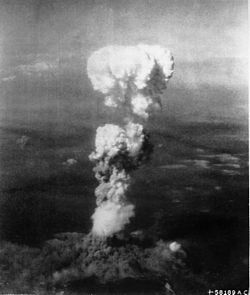
To date, the only use of nuclear weapons in armed conflict occurred in 1945 with the American atomic bombings of Hiroshima and Nagasaki.[11] On August 6, 1945, a uranium gun-type device (code name "Little Boy") was detonated over the Japanese city of Hiroshima. Three days later, on August 9, a plutonium implosion-type device (code name "Fat Man") was detonated over the Japanese city of Nagasaki. Together, these two bombings resulted in the deaths of approximately 200,000 people and contributed to the surrender of Japan, which occurred before any further nuclear weapons could be deployed.
After World War II, nuclear weapons were also developed by the Soviet Union (1949), the United Kingdom (1952), France (1960), and the People's Republic of China (1964), which contributed to the state of conflict and extreme tension that became known as the Cold War. In 1974, India, and in 1998, Pakistan, two countries that were openly hostile toward each other, developed nuclear weapons. Israel (1960s) and North Korea (2006) are also thought to have developed stocks of nuclear weapons, though it is not known how many. The Israeli government has never admitted nor denied having nuclear weapons, although it is known to have constructed the reactor and reprocessing plant necessary for building nuclear weapons.[12] South Africa also manufactured several complete nuclear weapons in the 1980s, but during the 1990s, it subsequently became the first country to voluntarily destroy its domestically made weapons stocks and abandon further nuclear weapon production.[13][14] Nuclear weapons have been detonated on over 2,000 occasions for testing purposes and demonstrations.[15][16]
After the dissolution of the Soviet Union in 1991 and the resultant end of the Cold War, the threat of a major nuclear war between the two nuclear superpowers was generally thought to have declined.[17] Since then, concern over nuclear weapons has shifted to the prevention of localized nuclear conflicts resulting from nuclear proliferation, and the threat of nuclear terrorism. However, the threat of nuclear war is considered to have resurged after the Russian invasion of Ukraine, particularly with regard to Russian threats to use nuclear weapons during the invasion.[18][19]
Since 1947, the Doomsday Clock of the Bulletin of the Atomic Scientists has visualized how close the world is to a nuclear war. The Doomsday Clock reached a high point in 1953, when the Clock was set to two minutes until midnight after the U.S. and the Soviet Union began testing hydrogen bombs, and in 2018, following the failure of world leaders to address tensions relating to nuclear weapons and climate change issues.[20] Since 2025, the Clock has been set at 89 seconds to midnight, the closest it has ever been.[21] The 2023 advance of the Clock's time setting was largely attributed to the risk of nuclear escalation that arose from the Russian invasion of Ukraine.[22]
Types of nuclear warfare
[edit]Nuclear warfare scenarios are usually divided into two groups, each with different effects and potentially fought with different types of nuclear armaments.
The first, a limited nuclear war[23] (sometimes attack or exchange), refers to the controlled use of nuclear weapons, whereby the implicit threat exists that a nation can still escalate their use of nuclear weapons. For example, using a small number of nuclear weapons against strictly military targets could be escalated through increasing the number of weapons used, or escalated through the selection of different targets. Limited attacks are thought to be a more credible response against attacks that do not justify all-out retaliation, such as an enemy's limited use of nuclear weapons.[24]
The second, a full-scale nuclear war, could consist of large numbers of nuclear weapons used in an attack aimed at an entire country, including military, economic, and civilian targets. Such an attack would almost certainly destroy the entire economic, social, and military infrastructure of the target nation, and would likely have a devastating effect on Earth's biosphere.[7][25]
Some Cold War strategists such as Henry Kissinger[26] argued that a limited nuclear war could be possible between two heavily armed superpowers (such as the United States and the Soviet Union). Some predict, however, that a limited war could potentially "escalate" into a full-scale nuclear war. Others[who?] have called limited nuclear war "global nuclear holocaust in slow motion", arguing that—once such a war took place—others would be sure to follow over a period of decades, effectively rendering the planet uninhabitable in the same way that a "full-scale nuclear war" between superpowers would, only taking a much longer (and arguably more agonizing) path to the same result.
Even the most optimistic predictions of the effects of a major nuclear exchange foresee the death of many millions of victims within a very short period of time. Such predictions usually include the breakdown of government, professional, and commercial institutions, vital to the continuation of civilization. The resulting loss of vital affordances (food, water and electricity production and distribution, medical and information services, etc.) would account for millions more deaths. More pessimistic predictions argue that a full-scale nuclear war could potentially bring about the human extinction, or at least its near extinction, with only a relatively small number of survivors (mainly in remote areas) and a reduced quality of life and life expectancy for centuries afterward. However, such predictions, assuming total war with nuclear arsenals at Cold War highs, have not been without criticism.[4] Such a horrific catastrophe as global nuclear warfare would almost certainly cause permanent damage to most complex life on the planet, its ecosystems, and the global climate.[5]
A study presented at the annual meeting of the American Geophysical Union in December 2006 asserted that a small-scale regional nuclear war could produce as many direct fatalities as all of World War II and disrupt the global climate for a decade or more. In a regional nuclear conflict scenario in which two opposing nations in the subtropics each used 50 Hiroshima-sized nuclear weapons (c. 15 kiloton each) on major population centers, the researchers predicted fatalities ranging from 2.6 million to 16.7 million per country. The authors of the study estimated that as much as five million tons of soot could be released, producing a cooling of several degrees over large areas of North America and Eurasia (including most of the grain-growing regions). The cooling would last for years and could be "catastrophic", according to the researchers.[27]
Either a limited or full-scale nuclear exchange could occur during an accidental nuclear war, in which the use of nuclear weapons is triggered unintentionally. Postulated triggers for this scenario have included malfunctioning early warning devices and/or targeting computers, deliberate malfeasance by rogue military commanders, consequences of an accidental straying of warplanes into enemy airspace, reactions to unannounced missile tests during tense diplomatic periods, reactions to military exercises, mistranslated or miscommunicated messages, and others.
A number of these scenarios actually occurred during the Cold War, though none resulted in the use of nuclear weapons.[28] Many such scenarios have been depicted in popular culture, such as in the 1959 film On the Beach, the 1962 novel Fail-Safe, the 1964 film Dr. Strangelove or: How I Learned to Stop Worrying and Love the Bomb, the 1983 film WarGames, and the 1984 film Threads.
Sub-strategic use
[edit]The above examples envisage nuclear warfare at a strategic level, i.e., total war. However, nuclear powers have the ability to undertake more limited engagements.
"Sub-strategic use" includes the use of either "low-yield" tactical nuclear weapons, or of variable yield strategic nuclear weapons in a very limited role, as compared to exchanges of larger-yield strategic nuclear weapons over major population centers. This was described by the UK Parliamentary Defence Select Committee as "the launch of one or a limited number of missiles against an adversary as a means of conveying a political message, warning or demonstration of resolve".[29] It is believed that all current nuclear weapons states possess tactical nuclear weapons, with the exception of the United Kingdom, which decommissioned its tactical warheads in 1998. However, the UK does possess scalable-yield strategic warheads, and this technology tends to blur the difference between "strategic", "sub-strategic", and "tactical" use or weapons. American, French and British nuclear submarines are believed to carry at least some missiles with dial-a-yield warheads for this purpose, potentially allowing a strike as low as one kiloton (or less) against a single target. Only the People's Republic of China and the Republic of India have declarative, unqualified, unconditional "no first use" nuclear weapons policies. India and Pakistan maintain only a credible minimum deterrence.
Commodore Tim Hare, former Director of Nuclear Policy at the British Ministry of Defence, has described "sub-strategic use" as offering the Government "an extra option in the escalatory process before it goes for an all-out strategic strike which would deliver unacceptable damage".[30] However, this sub-strategic capacity has been criticized as potentially increasing the "acceptability" of using nuclear weapons. Combined with the trend in the reduction in the worldwide nuclear arsenal as of 2007 is the warhead miniaturization and modernization of the remaining strategic weapons that is presently occurring in all the declared nuclear weapon states, into more "usable" configurations. The Stockholm International Peace Research Institute suggests that this is creating a culture where use of these weapons is more acceptable and therefore is increasing the risk of war, as these modern weapons do not possess the same psychological deterrent value as the large Cold-War era, multi-megaton warheads.[31]
In many ways, this present change in the balance of terror can be seen as the complete embracement of the switch from the 1950s Eisenhower doctrine of "massive retaliation"[32] to one of "flexible response", which has been growing in importance in the US nuclear war fighting plan/SIOP every decade since.
For example, the United States adopted a policy in 1996 of allowing the targeting of its nuclear weapons at non-state actors ("terrorists") armed with weapons of mass destruction.[33]
Another dimension to the tactical use of nuclear weapons is that of such weapons deployed at sea for use against surface and submarine vessels. Until 1992, vessels of the United States Navy (and their aircraft) deployed various such weapons as bombs, rockets (guided and unguided), torpedoes, and depth charges. Such tactical naval nuclear weapons were considered more acceptable to use early in a conflict because there would be few civilian casualties. It was feared by many planners that such use would probably quickly have escalated into a large-scale nuclear war.[34] This situation was particularly exacerbated by the fact that such weapons at sea were not constrained by the safeguards provided by the Permissive Action Link attached to U.S. Air Force and Army nuclear weapons. It is unknown if the navies of the other nuclear powers yet today deploy tactical nuclear weapons at sea.
The 2018 US Nuclear Posture Review emphasised the need for the US to have sub-strategic nuclear weapons as additional layers for its nuclear deterrence.[35]
Nuclear terrorism
[edit]Nuclear terrorism by non-state organizations or actors (even individuals) is a largely unknown and understudied factor in nuclear deterrence thinking, as states possessing nuclear weapons are susceptible to retaliation in kind, while sub- or trans-state actors may be less so. The collapse of the Soviet Union has given rise to the possibility that former Soviet nuclear weapons might become available on the black market (so-called 'loose nukes').
A number of other concerns have been expressed about the security of nuclear weapons in newer nuclear powers with relatively less stable governments, such as Pakistan, but in each case, the fears have been addressed to some extent by statements and evidence provided by those nations, as well as cooperative programs between nations. Worry remains, however, in many circles that a relative decrease in the security of nuclear weapons has emerged in recent years, and that terrorists or others may attempt to exert control over (or use) nuclear weapons, militarily applicable technology, or nuclear materials and fuel.
Another possible nuclear terrorism threat are devices designed to disperse radioactive materials over a large area using conventional explosives, called dirty bombs. The detonation of a "dirty bomb" would not cause a nuclear explosion, nor would it release enough radiation to kill or injure a large number of people. However, it could cause severe disruption and require potentially very costly decontamination procedures and increased spending on security measures.[36]
Radioactive materials can also be used for targeted assassinations. For example, the poisoning of Alexander Litvinenko was described by medical professionals, as "an ominous landmark: the beginning of an era of nuclear terrorism."[37][38][39][40]
Alternative conflict resolution
[edit]Alternatives to nuclear warfare include nuclear deterrence,[41] nuclear disarmament and Treaty on the Non-Proliferation of Nuclear Weapons.
History
[edit]1940s
[edit]Atomic bombings of Hiroshima and Nagasaki
[edit]
During the final stages of World War II in 1945, the United States conducted atomic raids on the Japanese cities of Hiroshima and Nagasaki, the first on August 6, 1945, and the second on August 9, 1945. These two events were the only times nuclear weapons have been used in combat.[42]
For six months before the atomic bombings, the U.S. 20th Air Force under General Curtis LeMay executed low-level incendiary raids against Japanese cities. The most destructive air raid to occur during the process was not the nuclear attacks, but the Operation Meetinghouse raid on Tokyo. On the night of March 9–10, 1945, Operation Meetinghouse commenced and 334 Boeing B-29 Superfortress bombers took off to raid, with 279 of them dropping 1,665 tons of incendiaries and explosives on Tokyo. The bombing was meant to burn wooden buildings and indeed the bombing caused fire that created a 50 m/s wind, which is comparable to tornadoes. Each bomber carried 6 tons of bombs. A total of 381,300 bombs, which amount to 1,783 tons of bombs, were used in the bombing. Within a few hours of the raid, it had killed an estimated 100,000 people and destroyed 41 km2 (16 sq mi) of the city and 267,000 buildings in a single night — the deadliest bombing raid in military aviation history other than the atomic raids on Hiroshima and Nagasaki.[43][44][45][46] By early August 1945, an estimated 450,000 people had died as the U.S. had intensely firebombed a total of 67 Japanese cities.
In late June 1945, as the U.S. wrapped up the two-and-a-half-month Battle of Okinawa (which cost the lives of 260,000 people, including 150,000 civilians),[47][48] it was faced with the prospect of invading the Japanese home islands in an operation codenamed Operation Downfall. Based on the U.S. casualties from the preceding island-hopping campaigns, American commanders estimated that between 50,000 and 500,000 U.S. troops would die and at least 600,000–1,000,000 others would be injured while invading the Japanese home islands. The U.S. manufacture of 500,000 Purple Hearts from the anticipated high level of casualties during the U.S. invasion of Japan gave a demonstration of how deadly and costly it would be. President Harry S. Truman realized he could not afford such a horrendous casualty rate, especially since over 400,000 American combatants had already died fighting in both the European and the Pacific theaters of the war.[49]
On July 26, 1945, the United States, the United Kingdom, and the Republic of China issued a Potsdam Declaration that called for the unconditional surrender of Japan. It stated that if Japan did not surrender, it would face "prompt and utter destruction".[50][51] The Japanese government ignored this ultimatum, sending a message that they were not going to surrender. In response to the rejection, President Truman authorized the dropping of the atomic bombs. At the time of its use, there were only two atomic bombs available, and despite the fact that more were in production back in mainland U.S., the third bomb wouldn't be available for combat until September.[52][53]


On August 6, 1945, the uranium-type nuclear weapon codenamed "Little Boy" was detonated over the Japanese city of Hiroshima with an energy of about 15 kilotons of TNT (63,000 gigajoules), destroying nearly 50,000 buildings (including the headquarters of the 2nd General Army and Fifth Division) and killing approximately 70,000 people, including 20,000 Japanese combatants and 20,000 Korean slave laborers.[54][55] Three days later, on August 9, a plutonium-type nuclear weapon codenamed "Fat Man" was used against the Japanese city of Nagasaki, with the explosion equivalent to about 20 kilotons of TNT (84,000 gigajoules), destroying 60% of the city and killing approximately 35,000 people, including 23,200–28,200 Japanese munitions workers, 2,000 Korean slave laborers, and 150 Japanese combatants.[56] The industrial damage in Nagasaki was high, partly owing to the inadvertent targeting of the industrial zone, leaving 68–80 percent of the non-dock industrial production destroyed.[57] The U.S., despite not having a third device ready to be dropped, gave Japan one last warning that there would be another bombing if they did not surrender, and the target would be Tokyo.
Six days after the detonation over Nagasaki, Japan announced its surrender to the Allied Powers on August 15, 1945, signing the Instrument of Surrender on September 2, 1945, officially ending the Pacific War and, therefore, World War II, as Germany had already signed its Instrument of Surrender on May 8, 1945, ending the war in Europe. The two atomic bombings led, in part, to post-war Japan's adopting of the Three Non-Nuclear Principles, which forbade the nation from developing nuclear armaments.[58]
Immediately after the Japan bombings
[edit]After the successful Trinity nuclear test July 16, 1945, which was the very first nuclear detonation, the Manhattan Project lead manager J. Robert Oppenheimer recalled:
We knew the world would not be the same. A few people laughed, a few people cried, and most people were silent. I remembered the line from the Hindu scripture the Bhagavad Gita. Vishnu is trying to persuade the prince that he should do his duty and to impress him takes on his multiarmed form and says, "Now, I am become Death, the destroyer of worlds." I suppose we all thought that one way or another.
— J. Robert Oppenheimer, The Decision To Drop The Bomb[59]
.jpg)
Immediately after the atomic bombings of Japan, the status of atomic weapons in international and military relations was unclear. Presumably, the United States hoped atomic weapons could offset the Soviet Union's larger conventional ground forces in Eastern Europe, and possibly be used to pressure Soviet leader Joseph Stalin into making concessions. Under Stalin, the Soviet Union pursued its own atomic capabilities through a combination of scientific research and espionage directed against the American program. The Soviets believed that the Americans, with their limited nuclear arsenal, were unlikely to engage in any new world wars, while the Americans were not confident they could prevent a Soviet takeover of Europe, despite their atomic advantage.
Within the United States, the authority to produce and develop nuclear weapons was removed from military control and put instead under the civilian control of the United States Atomic Energy Commission. This decision reflected an understanding that nuclear weapons had unique risks and benefits that were separate from other military technology known at the time.

For several years after World War II, the United States developed and maintained a strategic force based on the Convair B-36 bomber that would be able to attack any potential enemy from bomber bases in the United States. It deployed atomic bombs around the world for potential use in conflicts. Over a period of a few years, many in the American defense community became increasingly convinced of the invincibility of the United States to a nuclear attack. Indeed, it became generally believed that the threat of nuclear war would deter any strike against the United States.
Many proposals were suggested to put all American nuclear weapons under international control (by the newly formed United Nations, for example) as an effort to deter both their usage and a nuclear arms race. However, no terms could be arrived at that would be agreed upon by both the United States and the Soviet Union.[60][citation needed]

On August 29, 1949, the Soviet Union tested its first nuclear weapon at Semipalatinsk in Kazakhstan (see also Soviet atomic bomb project). Scientists in the United States from the Manhattan Project had warned that, in time, the Soviet Union would certainly develop nuclear capabilities of its own. Nevertheless, the effect upon military thinking and planning in the United States was dramatic, primarily because American military strategists had not anticipated the Soviets would "catch up" so soon. However, at this time, they had not discovered that the Soviets had conducted significant nuclear espionage of the project from spies at Los Alamos National Laboratory, the most significant of which was done by the theoretical physicist Klaus Fuchs.[citation needed] The first Soviet bomb was more or less a deliberate copy of the Fat Man plutonium device. In the same year the first US-Soviet nuclear war plan was penned in the US with Operation Dropshot.
With the monopoly over nuclear technology broken, worldwide nuclear proliferation accelerated. The United Kingdom tested its first independent atomic bomb in 1952, followed by France developing its first atomic bomb in 1960 and then China developing its first atomic bomb in 1964. While much smaller than the arsenals of the United States and the Soviet Union, Western Europe's nuclear reserves were nevertheless a significant factor in strategic planning during the Cold War. A top-secret White paper, compiled by the Royal Air Force and produced for the British Government in 1959, estimated that British V bombers carrying nuclear weapons were capable of destroying key cities and military targets in the Soviet Union, with an estimated 16 million deaths in the Soviet Union (half of whom were estimated to be killed on impact and the rest fatally injured) before bomber aircraft from the U.S. Strategic Air Command reached their targets.
1950s
[edit]Although the Soviet Union had nuclear weapon capabilities at the beginning of the Cold War, the United States still had an advantage in terms of bombers and weapons. In any exchange of hostilities, the United States would have been capable of bombing the Soviet Union, whereas the Soviet Union would have more difficulty carrying out the reverse mission.
The widespread introduction of jet-powered interceptor aircraft upset this imbalance somewhat by reducing the effectiveness of the American bomber fleet. In 1949 Curtis LeMay was placed in command of the Strategic Air Command and instituted a program to update the bomber fleet to one that was all-jet. During the early 1950s the B-47 Stratojet and B-52 Stratofortress were introduced, providing the ability to bomb the Soviet Union more easily. Before the development of a capable strategic missile force in the Soviet Union, much of the war-fighting doctrine held by western nations revolved around using a large number of smaller nuclear weapons in a tactical role. It is debatable whether such use could be considered "limited" however because it was believed that the United States would use its own strategic weapons (mainly bombers at the time) should the Soviet Union deploy any kind of nuclear weapon against civilian targets. Douglas MacArthur, an American general, was fired by President Harry Truman, partially because he persistently requested permission to use his own discretion in deciding whether to utilize atomic weapons on the People's Republic of China in 1951 during the Korean War.[61] Mao Zedong, China's communist leader, gave the impression that he would welcome a nuclear war with the capitalists because it would annihilate what he viewed as their imperialist system.[62][63]
Let us imagine how many people would die if war breaks out. There are 2.7 billion people in the world, and a third could be lost. If it is a little higher it could be half ... I say that if the worst came to the worst and one-half dies, there will still be one-half left, but imperialism would be razed to the ground and the whole world would become socialist. After a few years there would be 2.7 billion people again.
— Mao Zedong, 1957[64]
_002.jpg)
The concept of a "Fortress North America" emerged during the Second World War and persisted into the Cold War to refer to the option of defending Canada and the United States against their enemies if the rest of the world were lost to them. This option was rejected with the formation of NATO and the decision to permanently station troops in Europe.
In the summer of 1951, Project Vista started, in which project analysts such as Robert F. Christy looked at how to defend Western Europe from a Soviet invasion. The emerging development of tactical nuclear weapons was looked upon as a means to give Western forces a qualitative advantage over the Soviet numerical supremacy in conventional weapons.[65]
Several scares about the increasing ability of the Soviet Union's strategic bomber forces surfaced during the 1950s. The defensive response by the United States was to deploy a fairly strong "layered defense" consisting of interceptor aircraft and anti-aircraft missiles, like the Nike, and guns, like the M51 Skysweeper, near larger cities. However, this was a small response compared to the construction of a huge fleet of nuclear bombers. The principal nuclear strategy was to massively penetrate the Soviet Union. Because such a large area could not be defended against this overwhelming attack in any credible way, the Soviet Union would lose any exchange.
This logic became ingrained in American nuclear doctrine and persisted for much of the duration of the Cold War. As long as the strategic American nuclear forces could overwhelm their Soviet counterparts, a Soviet pre-emptive strike could be averted. Moreover, the Soviet Union could not afford to build any reasonable counterforce, as the economic output of the United States was far larger than that of the Soviets, and they would be unable to achieve "nuclear parity".
Soviet nuclear doctrine, however, did not match American nuclear doctrine.[66][67] Soviet military planners assumed they could win a nuclear war.[66][68][69] Therefore, they expected a large-scale nuclear exchange, followed by a "conventional war" which itself would involve heavy use of tactical nuclear weapons. American doctrine rather assumed that Soviet doctrine was similar, with the mutual in mutually assured destruction necessarily requiring that the other side see things in much the same way, rather than believing—as the Soviets did—that they could fight a large-scale, "combined nuclear and conventional" war.
In accordance with their doctrine, the Soviet Union conducted large-scale military exercises to explore the possibility of defensive and offensive warfare during a nuclear war. The exercise, under the code name of "Snowball", involved the detonation of a nuclear bomb about twice as powerful as that which fell on Nagasaki and an army of approximately 45,000 soldiers on maneuvers through the hypocenter immediately after the blast.[70] The exercise was conducted on September 14, 1954, under command of Marshal Georgy Zhukov to the north of Totskoye village in Orenburg Oblast, Russia.
A revolution in nuclear strategic thought occurred with the introduction of the intercontinental ballistic missile (ICBM), which the Soviet Union first successfully tested in August 1957. In order to deliver a warhead to a target, a missile was much faster and more cost-effective than a bomber, and enjoyed a higher survivability due to the enormous difficulty of interception of the ICBMs (due to their high altitude and extreme speed). The Soviet Union could now afford to achieve nuclear parity with the United States in raw numbers, although for a time, they appeared to have chosen not to.
Photos of Soviet missile sites set off a wave of panic in the U.S. military, something the launch of Sputnik would do for the American public a few months later. Politicians, notably then-U.S. Senator John F. Kennedy suggested that a "missile gap" existed between the Soviet Union and the United States. The US military gave missile development programs the highest national priority, and several spy aircraft and reconnaissance satellites were designed and deployed to observe Soviet progress.
Early ICBMs and bombers were relatively inaccurate, which led to the concept of countervalue strikes — attacks directly on the enemy population, which would theoretically lead to a collapse of the enemy's will to fight. During the Cold War, the Soviet Union invested in extensive protected civilian infrastructure, such as large "nuclear-proof" bunkers and non-perishable food stores. By comparison, smaller scale civil defense programs were instituted in the United States starting in the 1950s, where schools and other public buildings had basements stocked with non-perishable food supplies, canned water, first aid, and dosimeter and Geiger counter radiation-measuring devices. Many of the locations were given "fallout shelter" designation signs. CONELRAD radio information systems were adopted, whereby the commercial radio sector (later supplemented by the National Emergency Alarm Repeaters) would broadcast on two AM radio frequencies in the event of a Civil Defense (CD) emergency. These two frequencies, 640 and 1240 kHz, were marked with small CD triangles on the tuning dial of radios of the period, as can still be seen on 1950s-vintage radios on online auction sites and museums. A few backyard fallout shelters were built by private individuals.
Henry Kissinger's view on tactical nuclear war in his controversial 1957 book Nuclear Weapons and Foreign Policy was that any nuclear weapon exploded in air burst mode that was below 500 kilotons in yield and thus averting serious fallout, may be more decisive and less costly in human lives than a protracted conventional war.
A list of targets made by the United States was released sometime during December 2015 by the U.S. National Archives and Records Administration. The language used to describe targets is "designated ground zeros". The list was released after a request was made during 2006 by William Burr who belongs to a research group at George Washington University, and belongs to a previously top-secret 800-page document. The list is entitled "Atomic Weapons Requirements Study for 1959" and was produced by U.S. Strategic Air Command during the year 1956.[71]
1960s
[edit]

In 1960, the United States developed its first Single Integrated Operational Plan, a range of targeting options, and described launch procedures and target sets against which nuclear weapons would be launched, variants of which were in use from 1961 to 2003. That year also saw the start of the Missile Defense Alarm System, an American system of 12 early-warning satellites that provided limited notice of Soviet intercontinental ballistic missile launches between 1960 and 1966. The Ballistic Missile Early Warning System was completed in 1964.
The most powerful atomic bomb ever made, the Tsar Bomba, was tested by the Soviets on October 30, 1961. It was 50 megatons, or equal to 50 million tons of regular explosives.[72] A complex and worrisome situation developed in 1962, in what is called the Cuban Missile Crisis. The Soviet Union placed medium-range ballistic missiles 90 miles (140 km) from the United States, possibly as a direct response to American Jupiter missiles placed in Turkey. After intense negotiations, the Soviets ended up removing the missiles from Cuba and decided to institute a massive weapons-building program of their own. In exchange, the United States dismantled its launch sites in Turkey, although this was done secretly and not publicly revealed for over two decades. First Secretary Nikita Khrushchev did not even reveal this part of the agreement when he came under fire by political opponents for mishandling the crisis. Communication delays during the crisis led to the establishment of the Moscow–Washington hotline to allow reliable, direct communications between the two nuclear powers.
By the late 1960s, the number of ICBMs and warheads was so high on both sides that it was believed that both the United States and the Soviet Union were capable of completely destroying the infrastructure and a large proportion of the population of the other country. Thus, by some western game theorists, a balance of power system known as mutually assured destruction (or MAD) came into being. It was thought that no full-scale exchange between the powers would result in an outright winner, with at best one side emerging the pyrrhic victor. Thus both sides were deterred from risking the initiation of a direct confrontation, instead being forced to engage in lower-intensity proxy wars.
During this decade the People's Republic of China began to build subterranean infrastructure such as the Underground Project 131 following the Sino-Soviet split.
One drawback of the MAD doctrine was the possibility of a nuclear war occurring without either side intentionally striking first. Early Warning Systems (EWS) were notoriously error-prone. For example, on 78 occasions in 1979 alone, a "missile display conference" was called to evaluate detections that were "potentially threatening to the North American continent". Some of these were trivial errors and were spotted quickly, but several went to more serious levels. On September 26, 1983, Stanislav Petrov received convincing indications of an American first strike launch against the Soviet Union, but positively identified the warning as a false alarm. Though it is unclear what role Petrov's actions played in preventing a nuclear war during this incident, he has been honored by the United Nations for his actions.
Similar incidents happened many times in the United States, due to failed computer chips,[73] misidentifications of large flights of geese, test programs, and bureaucratic failures to notify early warning military personnel of legitimate launches of test or weather missiles. For many years, the U.S. Air Force's strategic bombers were kept airborne on a daily rotating basis "around the clock" (see Operation Chrome Dome), until the number and severity of accidents, the 1968 Thule Air Base B-52 crash in particular,[74] persuaded policymakers it was not worthwhile.
1970s
[edit]Israel responded to the Arab Yom Kippur War attack on 6 October 1973 by assembling 13 nuclear weapons in a tunnel under the Negev desert when Syrian tanks were sweeping in across the Golan Heights. On 8 October 1973, Israeli Prime Minister Golda Meir authorized Defense Minister Moshe Dayan to activate the 13 Israeli nuclear warheads and distribute them to Israeli air force units, with the intent that they be used if Israel began to be overrun.[75]
On 24 October 1973, as US President Richard Nixon was preoccupied with the Watergate scandal, Henry Kissinger ordered a DEFCON-3 alert[dubious – discuss] preparing American B-52 nuclear bombers for war. Intelligence reports indicated that the USSR was preparing to defend Egypt in its Yom Kippur War with Israel. It had become apparent that if Israel had dropped nuclear weapons on Egypt or Syria, as it prepared to do, then the USSR would have retaliated against Israel, with the US then committed to providing Israeli assistance, possibly escalating to a general nuclear war.[76]
By the late 1970s, people in both the United States and the Soviet Union, along with the rest of the world, had been living with the concept of mutual assured destruction (MAD) for about a decade, and it became deeply ingrained into the psyche and popular culture of those countries.[77]
On May 18, 1974, India conducted its first nuclear test in the Pokhran test range. The name of the operation was Smiling Buddha, and India termed the test as a "peaceful nuclear explosion."
The Soviet Duga early warning over-the-horizon radar system was made operational in 1976. The extremely powerful radio transmissions needed for such a system led to much disruption of civilian shortwave broadcasts, earning it the nickname "Russian Woodpecker".
The idea that any nuclear conflict would eventually escalate was a challenge for military strategists. This challenge was particularly severe for the United States and its NATO allies. It was believed (until the 1970s) that a Soviet tank offensive into Western Europe would quickly overwhelm NATO conventional forces, leading to the necessity of the West escalating to the use of tactical nuclear weapons, one of which was the W-70.
This strategy had one major (and possibly critical) flaw, which was soon realized by military analysts but highly underplayed by the U.S. military: conventional NATO forces in the European theatre of war were far outnumbered by similar Soviet and Warsaw Pact forces, and it was assumed that in case of a major Soviet attack (commonly envisioned as the "Red tanks rolling towards the North Sea" scenario) that NATO—in the face of quick conventional defeat—would soon have no other choice but to resort to tactical nuclear strikes against these forces. Most analysts agreed that once the first nuclear exchange had occurred, escalation to global nuclear war would likely become inevitable. The Warsaw Pact's vision of an atomic war between NATO and Warsaw Pact forces was simulated in the top-secret exercise Seven Days to the River Rhine in 1979. The British government exercised their vision of a Soviet nuclear attack with Square Leg in early 1980.
Large hardened nuclear weapon storage areas were built across European countries in anticipation of local US and European forces falling back as the conventional NATO defense from the Soviet Union, named REFORGER, was believed to only be capable of stalling the Soviets for a short time.
1980s
[edit]

In the late 1970s and, particularly, during the early 1980s under U.S. President Ronald Reagan, the United States renewed its commitment to a more powerful military, which required a large increase in spending on U.S. military programs. These programs, which were originally part of the defense budget of U.S. President Jimmy Carter, included spending on conventional and nuclear weapons systems. Under Reagan, defensive systems like the Strategic Defense Initiative were emphasized as well.
Another major shift in nuclear doctrine was the development and the improvement of the submarine-launched, nuclear-armed, ballistic missile, or SLBM. It was hailed by many military theorists as a weapon that would make nuclear war less likely. SLBMs—which can move with "stealth" (greatly lessened detectability) virtually anywhere in the world—give a nation a "second strike" capability (i.e., after absorbing a "first strike"). Before the advent of the SLBM, thinkers feared that a nation might be tempted to initiate a first strike if it felt confident that such a strike would incapacitate the nuclear arsenal of its enemy, making retaliation impossible. With the advent of SLBMs, no nation could be certain that a first strike would incapacitate its enemy's entire nuclear arsenal. To the contrary, it would have to fear a near-certain retaliatory second strike from SLBMs. Thus, a first strike was a much less feasible (or desirable) option, and a deliberately initiated nuclear war was thought to be less likely to start.
However, it was soon realized that submarines could approach enemy coastlines undetected and decrease the warning time (the time between detection of the missile launch and the impact of the missile) from as much as half an hour to possibly under three minutes. This effect was especially significant to the United States, Britain and China, whose capitals of Washington D.C., London, and Beijing all lay within 100 miles (160 km) of their coasts. Moscow was much more secure from this type of threat, due to its considerable distance from the sea. This greatly increased the credibility of a "surprise first strike" by one faction and (theoretically) made it possible to knock out or disrupt the chain of command of a target nation before any counterstrike could be ordered (known as a "decapitation strike"). It strengthened the notion that a nuclear war could possibly be "won", resulting not only in greatly increased tensions and increasing calls for fail-deadly control systems, but also in a dramatic increase in military spending. The submarines and their missile systems were very expensive, and one fully equipped nuclear-powered and nuclear-armed missile submarine could cost more than the entire GNP of a developing country.[79] It was also calculated, however, that the greatest cost came in the development of both sea- and land-based anti-submarine defenses and in improving and strengthening the "chain of command", and as a result, military spending skyrocketed.
South Africa developed a nuclear weapon capability during the 1970s and early 1980s. It was operational for a brief period before being dismantled in the early 1990s.[80]
According to the 1980 United Nations report General and Complete Disarmament: Comprehensive Study on Nuclear Weapons: Report of the Secretary-General, it was estimated that there were a total of about 40,000 nuclear warheads in existence at that time, with a potential combined explosive yield of approximately 13,000 megatons. By comparison, the largest volcanic eruption in recorded history when the volcano Mount Tambora erupted in 1815—turning 1816 into the Year Without A Summer due to the levels of global dimming sulfate aerosols and ash expelled—it exploded with a force of roughly 33 billion tons of TNT or 33,000 megatons of TNT this is about 2.2 million Hiroshima Bombs,[81] and ejected 175 km3 (42 cu mi) of mostly rock/tephra,[82] that included 120 million tonnes of sulfur dioxide as an upper estimate.[83] A larger eruption, approximately 74,000 years ago, in Mount Toba produced 2,800 km3 (670 cu mi) of tephra, forming lake Toba,[84] and produced an estimated 6,000 million tonnes (6.6×10⁹ short tons) of sulfur dioxide.[85][86] The explosive energy of the eruption may have been as high as equivalent to 20,000,000 megatons (Mt) of TNT,[87][better source needed] while the asteroid created Chicxulub impact, that is connected with the extinction of the dinosaurs corresponds to at least 70,000,000 Mt of energy, which is roughly 7000 times the maximum arsenal of the US and Soviet Union.[87]

However, comparisons with supervolcanoes are more misleading than helpful due to the different aerosols released, the likely air burst fuzing height of nuclear weapons and the globally scattered location of these potential nuclear detonations all being in contrast to the singular and subterranean nature of a supervolcanic eruption.[3] Moreover, assuming the entire world stockpile of weapons were grouped together, it would be difficult, due to the nuclear fratricide effect, to ensure the individual weapons would go off all at once. Nonetheless, many people believe that a full-scale nuclear war would result, through the nuclear winter effect, in the human extinction, though not all analysts agree on the assumptions that underpin these nuclear winter models.[4]
On 26 September 1983, a Soviet early warning station under the command of Stanislav Petrov falsely detected 5 inbound intercontinental ballistic missiles from the US. Petrov correctly assessed the situation as a false alarm, and hence did not report his finding to his superiors. It is quite possible that his actions prevented "World War III", as the Soviet policy at that time was immediate nuclear response upon discovering inbound ballistic missiles.[88]
The world came unusually close to nuclear war in November 1983 when the Soviet Union thought that the NATO military exercise Able Archer 83 was a ruse or "cover-up" to begin a nuclear first strike. The Soviets responded by raising readiness and preparing their nuclear arsenal for immediate use. Soviet fears of an attack ceased once the exercise concluded without incident.
Post-Cold War
[edit]Although the dissolution of the Soviet Union ended the Cold War in 1991 and greatly reduced the political tensions between the United States and the Russian Federation, the Soviet Union's formal successor state, both countries remained in a "nuclear stand-off" due to the continuing presence of a very large number of deliverable nuclear warheads on both sides. Additionally, the end of the Cold War led the United States to become increasingly concerned with the development of nuclear technology by other nations outside of the former Soviet Union. In 1995, a branch of the U.S. Strategic Command produced an outline of forward-thinking strategies in the document "Essentials of Post–Cold War Deterrence".
In 1995, a Black Brant sounding rocket launched from the Andøya Space Center caused a high alert in Russia, known as the Norwegian Rocket Incident. The Russians thought it might be a nuclear missile launched from an American submarine.[89][90]
In 1996, a Russian continuity of government facility, Kosvinsky Mountain, which is believed to be a counterpart to the US Cheyenne Mountain Complex, was completed.[91] It was designed to resist US earth-penetrating nuclear warheads,[91] and is believed to host the Russian Strategic Rocket Forces alternate command post, a post for the general staff built to compensate for the vulnerability of older Soviet era command posts in the Moscow region. In spite of this, the primary command posts for the Strategic Rocket Forces remains Kuntsevo in Moscow and the secondary is the Kosvinsky Mountain in the Ural Mountains.[citation needed] The timing of the Kosvinsky facilities completion date is regarded as one explanation for U.S. interest in a new nuclear "bunker buster" Earth-penetrating warhead and the declaration of the deployment of the B-61 mod 11 in 1997; Kosvinsky is protected by about 1000 feet of granite.[citation needed]

| Yes No Did not vote |
As a consequence of the September 11 attacks, American forces immediately increased their readiness to the highest level in 28 years, closing the blast doors of the NORAD's Cheyenne Mountain Operations Center for the first time due to a non-exercise event. But unlike similar increases during the Cold War, Russia immediately decided to stand down a large military exercise in the Arctic region, in order to minimize the risk of incidents, rather than following suit.[92]
The former chair of the United Nations disarmament committee stated that there are more than 16,000 strategic and tactical nuclear weapons ready for deployment and another 14,000 in storage, with the U.S. having nearly 7,000 ready for use and 3,000 in storage, and Russia having about 8,500 ready for use and 11,000 in storage. In addition, China is thought to possess about 400 nuclear weapons, Britain about 200, France about 350, India about 80–100, and Pakistan 100–110. North Korea is confirmed as having nuclear weapons, though it is not known how many, with most estimates between 1 and 10. Israel is also widely believed to possess usable nuclear weapons. NATO has stationed about 480 American nuclear weapons in Belgium, the Netherlands, Italy, Germany, and Turkey, and several other nations are thought to be in pursuit of an arsenal of their own.[93]
Pakistan's nuclear policy was significantly affected by the 1965 war with India.[94] The 1971 war and India's nuclear program played a role in Pakistan's decision to go nuclear.[95] India and Pakistan both decided not to participate in the NPT.[96] Pakistan's nuclear policy became fixated on India because India refused to join the Non-proliferation Treaty and remained open to nuclear weapons.[97] Impetus by Indian actions spurred Pakistan's nuclear research.[98] After nuclear weapons construction was started by President Zulfikar Ali Bhutto's command, the chair of Pakistan Atomic Energy Commission Usmani quit in objection.[99] The 1999 war between Pakistan and India occurred after both acquired nuclear weapons.[100] It is believed by some that nuclear weapons are the reason a big war has not broken out in the subcontinent.[101] India and Pakistan still have a risk of nuclear conflict on the issue of war over Kashmir. Nuclear capability deliverable by sea were claimed by Pakistan in 2012.[102] The aim was to achieve a "minimum credible deterrence".[103] Pakistan's nuclear program culminated in the tests at Chagai.[104] One of the aims of Pakistan's programs is fending off potential annexation and maintaining independence.[105]
A key development in nuclear warfare throughout the 2000s and early 2010s is the proliferation of nuclear weapons to the developing world, with India and Pakistan both publicly testing several nuclear devices, and North Korea conducting an underground nuclear test on October 9, 2006. The U.S. Geological Survey measured a 4.2 magnitude earthquake in the area where the North Korean test is said to have occurred. A further test was announced by the North Korean government on May 25, 2009.[106] Iran, meanwhile, has embarked on a nuclear program which, while officially for civilian purposes, has come under close scrutiny by the United Nations and many individual states.
Recent studies undertaken by the CIA cite the enduring India-Pakistan conflict as the one "flash point" most likely to escalate into a nuclear war. During the Kargil War in 1999, Pakistan came close to using its nuclear weapons in case the conventional military situation underwent further deterioration.[107] Pakistan's foreign minister had even warned that it would "use any weapon in our arsenal", hinting at a nuclear strike against India.[108] The statement was condemned by the international community, with Pakistan denying it later on. This conflict remains the only war (of any sort) between two declared nuclear powers. The 2001-2002 India-Pakistan standoff again stoked fears of nuclear war between the two countries. Despite these very serious and relatively recent threats, relations between India and Pakistan have been improving somewhat over the last few years. However, with the November 26, 2008 Mumbai terror attacks, tensions again worsened.
| External image | |
|---|---|
 A geopolitical example of nuclear strike plan of ROC Army in Kinmen history. Effective Radius: 10 km; Pop.: 1.06 million A geopolitical example of nuclear strike plan of ROC Army in Kinmen history. Effective Radius: 10 km; Pop.: 1.06 million |

Another potential geopolitical issue that is considered particularly worrisome by military analysts is a possible conflict between the United States and the People's Republic of China over Taiwan. Although economic forces are thought to have reduced the possibility of a military conflict, there remains concern about the increasing military buildup of China (China is rapidly increasing its naval capacity), and that any move toward Taiwan independence could potentially spin out of control.
Israel is thought to possess somewhere between one hundred and four hundred nuclear warheads. It has been asserted that the Dolphin-class submarines which Israel received from Germany have been adapted to carry nuclear-armed Popeye cruise missiles, so as to give Israel a second strike capability.[109] Israel has been involved in wars with its neighbors in the Middle East (and with other "non-state actors" in Lebanon and Palestine) on numerous prior occasions, and its small geographic size and population could mean that, in the event of future wars, the Israel Defense Forces might have very little time to react to an invasion or other major threat. Such a situation could escalate to nuclear warfare very quickly in some scenarios.
On March 7, 2013, North Korea threatened the United States with a pre-emptive nuclear strike.[110] On April 9, North Korea urged foreigners to leave South Korea, stating that both countries were on the verge of nuclear war.[111] On April 12, North Korea stated that a nuclear war was unavoidable. The country declared Japan as its first target.[112]
In 2014, when Russia-United States and Russia-NATO relations worsened over the Russo-Ukrainian War, the Russian state-owned television channel Russia 1 stated that "Russia is the only country in the world that is really capable of turning the USA into radioactive ash."[113] U.S. Secretary of Defense Ash Carter considered proposing deployment of ground-launched cruise missiles in Europe that could pre-emptively destroy Russian weapons.[114]
In August 2017, North Korea warned that it might launch mid-range ballistic missiles into waters within 18 to 24 miles (29 to 39 km) of Guam, following an exchange of threats between the governments of North Korea and the United States.[115][116] Escalating tensions between North Korea and the United States, including threats by both countries that they could use nuclear weapons against one another, prompted a heightened state of readiness in Hawaii. The perceived ballistic missile threat broadcast all over Hawaii on 13 January 2018 was a false missile alarm.[117][118]
In October 2018, the former Soviet leader Mikhail Gorbachev commented that U.S. withdrawal from the Intermediate-Range Nuclear Forces Treaty is "not the work of a great mind" and that "a new arms race has been announced".[119][120]
In early 2019, more than 90% of world's 13,865 nuclear weapons were owned by Russia and the United States.[121][122]
In 2019, Vladimir Putin warned that Russia would deploy nuclear missiles in Europe if the United States deployed intermediate-range nuclear missiles there. Journalist Dmitry Kiselyov listed the targets in the United States, which includes The Pentagon, Camp David, Fort Ritchie, McClellan Air Force Base, and Jim Creek Naval Radio Station. Kremlin spokesperson Dmitry Peskov denies the existence of the target list.[123][124]
On February 24, 2022, in a televised address preceding the start of Russia's full-scale invasion of Ukraine, Russian President Vladimir Putin stated that Russia "is today one of the most powerful nuclear powers in the world... No one should have any doubts that a direct attack on our country will lead to defeat and dire consequences for any potential aggressor." Later in the same speech, Putin stated: "Now a few important, very important words for those who may be tempted to intervene in ongoing events. Whoever tries to hinder us, and even more so to create threats for our country, for our people, should know that Russia's response will be immediate and will lead you to such consequences that you have never experienced in your history."[125][126] On February 27, 2022, Putin publicly put his nuclear forces on alert, stating that NATO powers had made "aggressive statements".[127] On April 14, The New York Times reported comments by CIA director William Burns, who said "potential desperation" could lead President Putin to order the use of tactical nuclear weapons.[128] On September 21, 2022, days before declaring the annexation of additional parts of Ukraine, Putin claimed in a national television address that high NATO officials had made statements about the possibility of "using nuclear weapons of mass destruction against Russia", and stated "if the territorial integrity of our country is threatened, we will certainly use all the means at our disposal to protect Russia and our people... It's not a bluff." NBC News characterized Putin's statements as a "thinly veiled" threat that Putin was willing to risk nuclear conflict if necessary to win the war with Ukraine.[129] Hans M. Kristensen, director of the Nuclear Information Project at the Federation of American Scientists, stated that "if you start detonating nuclear weapons in the [battlefield] you potentially get radioactive fallout that you can't control — it could rain over your own troops as well, so it might not be an advantage to do that in the field."[130]
According to a peer-reviewed study published in the journal Nature Food in August 2022,[131] a full-scale nuclear war between the U.S. and Russia would kill 360 million people directly, with a further 5 billion people dying from starvation. More than 2 billion people would die from a smaller-scale nuclear war between India and Pakistan.[132][133]
Survival
[edit]The predictions of the effects of a major countervalue nuclear exchange include millions of city dweller deaths within a short period of time. Some 1980s predictions had gone further and argued that a full-scale nuclear war could eventually bring about human extinction.[7] Such predictions, sometimes but not always based on total war with nuclear arsenals at Cold War highs, received contemporary criticism.[4] On the other hand, some 1980s governmental predictions, such as FEMA's CRP-2B and NATO's Carte Blanche, have received criticism from groups such as the Federation of American Scientists for being overly optimistic. CRP-2B, for instance, infamously predicted that 80% of Americans would survive a nuclear exchange with the Soviet Union, a figure that neglected nuclear war's impacts on healthcare infrastructure, the food supply, and the ecosystem and assumed that all major cities could be successfully evacuated within 3–5 days.[134] A number of Cold War publications advocated preparations that could purportedly enable a large proportion of civilians to survive even a total nuclear war. Among the most famous of these is Nuclear War Survival Skills.[135]
To avoid injury and death from a nuclear weapon's heat flash and blast effects, the two most far-ranging prompt effects of nuclear weapons, schoolchildren were taught to duck and cover by the early Cold War film of the same name. Such advice is once again being given in case of nuclear terrorist attacks.[136]
Prussian blue, or "Radiogardase", is stockpiled in the US, along with potassium iodide and DPTA, as pharmaceuticals useful in treating internal exposure to harmful radioisotopes in fallout.[137]
Publications on adapting to a changing diet and supplying nutritional food sources following a nuclear war, with particular focus on agricultural radioecology, include Nutrition in the postattack environment by the RAND corporation.[138]
The British government developed a public alert system for use during a nuclear attack with the expectation of a four-minute warning before detonation. The United States expected a warning time of anywhere from half an hour (for land-based missiles) to less than three minutes (for submarine-based weapons). Many countries maintain plans for continuity of government following a nuclear attack or similar disasters. These range from a designated survivor, intended to ensure the survival of some form of government leadership, to the Soviet Dead Hand system, which allows for retaliation even if all Soviet leadership were destroyed. Nuclear submarines are given letters of last resort: orders on what action to take in the event that an enemy nuclear strike has destroyed the government.
A number of other countries around the world have taken significant efforts to maximize their survival prospects in the event of large calamities, both natural and manmade. For example, metro stations in Pyongyang, North Korea, were constructed 110 metres (360 ft) below ground, and were designed to serve as nuclear shelters in the event of war, with each station entrance built with thick steel blast doors.[139][140] An example of privately funded fallout shelters is the Ark Two Shelter in Ontario, Canada, and autonomous shelters have been constructed with an emphasis on post-war networking and reconstruction.[141] In Switzerland, the majority of homes have an underground blast and fallout shelter. The country has an overcapacity of such shelters and can accommodate slightly more than the nation's population size.[142][143]
While the nuclear fallout shelters described above are the ideal long-term protection methods against dangerous radiation exposure in the event of a nuclear catastrophe, it is also necessary to have mobile protection equipment for medical and security personnel to safely assist in containment, evacuation, and many other necessary public safety objectives which ensue as a result of nuclear detonation. There are many basic shielding strategies used to protect against the deposition of radioactive material from external radiation environments. Respirators that protect against internal deposition are used to prevent the inhalation and ingestion of radioactive material and dermal protective equipment which is used to protect against the deposition of material on external structures like skin, hair, and clothing. While these protection strategies do slightly reduce the exposure, they provide almost no protection from externally penetrating gamma radiation, which is the cause of acute radiation syndrome and can be extremely lethal in high dosages. Naturally, shielding the entire body from high-energy gamma radiation is optimal, but the required mass to provide adequate attenuation makes functional movement nearly impossible.
Recent scientific studies have shown the feasibility of partial body shielding as a viable protection strategy against externally penetrating gamma radiation. The concept is based in providing sufficient attenuation to only the most radio-sensitive organs and tissues in efforts to defer the onset of acute radiation syndrome, the most immediate threat to humans from high doses of gamma radiation. Acute radiation syndrome is a result of irreversible bone marrow damage from high-energy radiation exposure. Due to the regenerative property of hematopoietic stem cells found in bone marrow, it is only necessary to protect enough bone marrow to repopulate the exposed areas of the body with the shielded supply. Because 50% of the body's supply of bone marrow is stored in the pelvic region which is also in close proximity to other radio-sensitive organs in the abdomen, the lower torso is a logical choice as the primary target for protection.[144]
In fiction
[edit]Nuclear warfare and weapons are staple elements of speculative fiction.
See also
[edit]- Air Force Global Strike Command
- Basic Encyclopedia
- Broken-backed war theory
- Global catastrophic risk
- International Luxembourg Forum on Preventing Nuclear Catastrophe
- List of CBRN warfare forces
- List of states with nuclear weapons
- Mount Yamantau
- Nuclear blackout
- Nuclear briefcase
- Nuclear weapons and the United States
- Nuclear weapons debate
- People's Liberation Army Rocket Force
- Prevention of nuclear catastrophe
- Transition to war
- Treaty on the Non-Proliferation of Nuclear Weapons
 Nuclear technology portal

References
[edit]- ^ 7 Possible Toxic Environments Following a Nuclear War – The Medical Implications of Nuclear War 1985 – The National Academies Press. 1986. doi:10.17226/940. ISBN 978-0-309-07866-5. PMID 25032468.
- ^ "nuclear winter". Encyclopædia Britannica. August 2023.
- ^ a b Martin, Brian (December 1982). "The global health effects of nuclear war". Current Affairs Bulletin. 59 (7).
- ^ a b c d "Critique of Nuclear Extinction – Brian Martin 1982".
- ^ a b "The Effects of a Global Thermonuclear War". www.johnstonsarchive.net.
- ^ "Long-term worldwide effects of multiple nuclear-weapons detonations. Assembly of Mathematical and Physical Sciences, National Research Council,1975".
- ^ a b c Ehrlich, P. R.; Harte, J.; Harwell, M. A.; Raven, P. H.; Sagan, C.; Woodwell, G. M.; Berry, J.; Ayensu, E. S.; Ehrlich, A. H.; Eisner, T.; Gould, S. J.; Grover, H. D.; Herrera, R.; May, R. M.; Mayr, E.; McKay, C. P.; Mooney, H. A.; Myers, N.; Pimentel, D. & Teal, J. M. (1983). "Long-term biological consequences of nuclear war". Science. 222 (4630): 1293–1300. Bibcode:1983Sci...222.1293E. doi:10.1126/science.6658451. PMID 6658451.
- ^ "Overview of the Doomsday Clock". Bulletin of the Atomic Scientists.
- ^ The Nuclear Winter: The World After Nuclear War, Sagan, Carl et al., Sidgwick & Jackson, 1985
- ^ Tonn, Bruce & MacGregor, Donald (2009). "A singular chain of events". Futures. 41 (10): 706–714. doi:10.1016/j.futures.2009.07.009. S2CID 144553194.
- ^ Tannenwald, Nina. "'Limited' Tactical Nuclear Weapons Would Be Catastrophic". Scientific American. Retrieved 2025-04-10.
- ^ Hersh, Seymour (1991). The Samson Option. Random House. p. 130. ISBN 0-394-57006-5.
- ^ Albright, David. "South Africa's Nuclear Weapons Program". MIT.edu.
- ^ "South Africa: Why Countries Acquire and Abandon Nuclear Bombs". World101. 27 July 2023.
- ^ ""1945–1998" by Isao Hashimoto". Archived from the original on 2018-07-06. Retrieved 2015-03-16.
- ^ "The Nuclear Testing Tally | Arms Control Association". www.armscontrol.org.
- ^ Denemark, Robert A. (14 August 2018). "Nuclear War in the Rivalry Phase of the World-System". Journal of World-Systems Research. 24 (2): 349. doi:10.5195/jwsr.2018.749. S2CID 158444919.
- ^ Sanger, David E.; Troianovski, Anton; Barnes, Julian E. (2022-10-01). "In Washington, Putin's Nuclear Threats Stir Growing Alarm". The New York Times. ISSN 0362-4331. Retrieved 2022-10-02.
- ^ "Could the war in Ukraine go nuclear?". The Economist. ISSN 0013-0613. Retrieved 2022-10-02.
- ^ Koran, Laura (January 25, 2018). "'Doomsday clock' ticks closer to apocalyptic midnight". CNN.
- ^ Treisman, Rachel (2025-01-29). "The Doomsday Clock has never been closer to metaphorical midnight. What does it mean?". NPR. Retrieved 2025-01-24.
- ^ Spinazze, Gayle (2023-01-24). "PRESS RELEASE: Doomsday Clock set at 90 seconds to midnight". Bulletin of the Atomic Scientists. Retrieved 2023-01-24.
- ^ N.N. Sokov (2015). Why Russia calls a limited nuclear strike "de-escalation". Bulletin of the Atomic Scientists. Archived from the original on 2020-06-09. Retrieved 2015-12-28.
- ^ Ash Carter; John Steinbruner; Charles Zraket, eds. (1987). Managing Nuclear Operations. Washington DC: Brookings Institution. pp. 123–125. ISBN 0-8157-1314-2.
- ^ Grover, Herbert D.; Harwell, Mark A. (1985-10-01). "Biological Effects of Nuclear War II: Impact on the Biosphere". BioScience. 35 (9): 576–583. doi:10.2307/1309966. ISSN 0006-3568. JSTOR 1309966.
- ^ "Henry Kissinger: The Mike Wallace Interview". Archived from the original on 2020-04-03. Retrieved 2010-11-24.
- ^ "ScienceDaily – Regional Nuclear War Could Devastate Global Climate".
- ^ Alan F. Philips, 20 Mishaps That Might Have Started Accidental Nuclear War Archived 2007-10-12 at the Wayback Machine.
- ^ UK Parliament, House of Commons, "Select Committee on Defence, Eighth Report", [1], 20 June 2006. Fetched from URL on 23 December 2012.
- ^ "House of Commons - Defence - Eighth Report".
- ^ Ritter, Karl (June 12, 2007). "Study: World powers risk atomic war". The Philadelphia Inquirer. Retrieved 2022-03-07.
- ^ Jones, Matthew (2008). "Targeting China: U.S. Nuclear Planning and 'Massive Retaliation' in East Asia, 1953–1955". Journal of Cold War Studies. 10 (4): 37–65. doi:10.1162/jcws.2008.10.4.37. S2CID 57564482.
- ^ Daniel Plesch; Stephen Young (1998), "Senseless policy", Bulletin of the Atomic Scientists, 54 (6), Educational Foundation for Nuclear Science, Inc.: 4, Bibcode:1998BuAtS..54f...4P, doi:10.1080/00963402.1998.11456892
- ^ "Declassified: Nuclear Weapons at Sea, Conclusions and Recommendations". Federation of American Scientists. Retrieved 2016-04-19.
- ^ "2018 Nuclear Posture Review". US Defense Department. Retrieved 2018-06-26.
- ^ US Nuclear Regulatory Commission (May 2007). "Backgrounder on Dirty Bombs". Retrieved 2010-04-26.
- ^ "Ushering in the era of nuclear terrorism", by Patterson, Andrew J. MD, PhD, Critical Care Medicine, v. 35, pp. 953–954, 2007.
- ^ "Beyond the Dirty Bomb: Re-thinking Radiological Terror", by James M. Acton; M. Brooke Rogers; Peter D. Zimmerman, DOI: 10.1080/00396330701564760, Survival, Volume 49, Issue 3 September 2007, pages 151–168
- ^ "The Litvinenko File: The Life and Death of a Russian Spy", by Martin Sixsmith, True Crime, 2007 ISBN 0-312-37668-5, page 14.
- ^ Radiological Terrorism: “Soft Killers” by Morten Bremer Mærli, Bellona Foundation
- ^ Hoey, Fintan (6 June 2016). "Japan and Extended Nuclear Deterrence: Security and Non-proliferation". Journal of Strategic Studies. 39 (4): 484–501. doi:10.1080/01402390.2016.1168010. ISSN 0140-2390.
- ^ Hakim, Joy (1995). A History of Us: War, Peace and all that Jazz. New York: Oxford University Press. ISBN 0-19-509514-6.
- ^ "1945 Tokyo Firebombing Left Legacy of Terror, Pain". Common Dreams. Archived from the original on 2015-01-03. Retrieved 2014-12-08.
- ^ "March 9, 1945: Burning the Heart Out of the Enemy". Wired. Condé Nast Digital. 9 March 2011. Retrieved June 8, 2014.
- ^ Wolk (2010), p. 125
- ^ "Firebombing of Tokyo". HISTORY.com.
- ^ "Japan's Battle of Okinawa, March–June 1945". Command and General Staff College. Archived from the original on February 14, 2009. Retrieved 2016-12-13.
- ^ Ways of Forgetting, Ways of Remembering: Japan in the Modern World. New Press. February 4, 2014. p. 273.
- ^ "United States Dept. of the Army, Army Battle Casualties and Non-Battle Deaths in World War II". Cgsc.cdmhost.com. Archived from the original on 2010-05-12. Retrieved 2011-06-15.
- ^ "Potsdam Declaration: Proclamation Defining Terms for Japanese Surrender Issued, at Potsdam, July 26, 1945". National Science Digital Library.
- ^ "Milestones: 1937–1945 / The Potsdam Conference, 1945". United States Department of State, Office of the Historian. Archived from the original on 2013-10-29.
- ^ Newman, Robert P. (1995). Truman and the Hiroshima Cult. MSU Press. p. 86. ISBN 978-0-87013-940-6.
- ^ "The Atomic Bomb and the End of World War II, A Collection of Primary Sources" (PDF). National Security Archive Electronic Briefing Book No. 162. George Washington University. August 13, 1945. Archived (PDF) from the original on 2022-10-09.
- ^ Adams, S. & Crawford, A.. 2000. World War II. First edition. Printed in association with the Imperial War Museum. Eyewitness Books series. New York, Doring Kindersley Limited
- ^ Alan Axelrod (May 6, 2008). The Real History of World War II: A New Look at the Past. Sterling. p. 350. ISBN 9781402740909.
- ^ Nuke-Rebuke: Writers & Artists Against Nuclear Energy & Weapons (The Contemporary anthology series). The Spirit That Moves Us Press. May 1, 1984. pp. 22–29.
- ^ Robert Hull (October 11, 2011). Welcome To Planet Earth – 2050 – Population Zero. AuthorHouse. p. 215. ISBN 978-1-4634-2604-0.
- ^ Koizumi, Junichiro (August 6, 2005). "Address by Prime Minister Junichiro Koizumi at the Hiroshima Memorial Service for the Hiroshima Peace Memorial Ceremony". Prime Minister of Japan and His Cabinet. Retrieved Nov 28, 2007.
- ^ Pontin, Jason (November–December 2007). "Oppenheimer's Ghost". Technology Review.
- ^ United, Nations. "International Day for the Total Elimination of Nuclear Weapons". United Nations. Retrieved 2024-02-13.
- ^ "Nuclear Chronology 1945–1959". Archived from the original on October 15, 2008.
- ^ "Instant Wisdom: Beyond the Little Red Book". TIME. September 20, 1976.
- ^ Robert Service. Comrades!: A History of World Communism. Harvard University Press, 2007. p. 321. ISBN 0-674-02530-X
- ^ Dikötter, Frank. Mao's Great Famine: The History of China's Most Devastating Catastrophe, 1958–62. Walker & Company, 2010. p.13. ISBN 0-8027-7768-6
- ^ "Project Vista, Caltech, and the dilemmas of Lee DuBridge" (PDF). Archived from the original (PDF) on 2017-09-03. Retrieved 2014-10-07.
- ^ a b "Military Planning for European Theatre Conflict During the Cold War" (PDF). Archived from the original (PDF) on 2012-04-02. Retrieved 2011-10-24.
- ^ "Nuclear Strategy differences in Soviet and American thinking". Archived from the original on 2017-01-26. Retrieved 2012-06-07.
- ^ Why the Soviet Union thinks it can fight and win a Nuclear War, Richard Pipes, Professor of History Harvard University 1977
- ^ "Candid Interviews with Former Soviet Officials Reveal U.S. Strategic Intelligence Failure Over Decades". nsarchive2.gwu.edu.
- ^ Viktor Suvorov, Shadow of Victory (Тень победы), Donetsk, 2003, ISBN 966-696-022-2, pages 353–375.
- ^ S. Shane – 1950s U.S. Nuclear Target List Offers Chilling Insight, The New York Times, Retrieved 2015-12-23
- ^ Broad, William J. (2021-10-30). "When the Soviets Set Off the Biggest Nuclear Bomb, J.F.K. Didn't Flinch". The New York Times. ISSN 0362-4331. Retrieved 2021-12-17.
- ^ June 80: Faulty Computer Chip Archived 2013-12-26 at the Wayback Machine, 20 Mishaps that Might Have Started Accidental Nuclear War, by Alan F. Phillips, M.D., January 1998, Nuclear Age Peace Foundation
- ^ "The Cold War's Missing Atom Bombs". Der Spiegel. 14 November 2008.
- ^ Seymour M. Hersh, The Samson Option: Israel's Nuclear Arsenal and American Foreign Policy (Random House, 1991) p. 225.
- ^ Nuclear Weapons in the Cold War, Bernard Brodie
- ^ "The threats of nuclear warfare as depicted in the popular culture of the 1960s | Britannica". www.britannica.com. Retrieved 2024-06-14.
- ^ "Continental US Fallout Pattern for Prevailing Winds (FEMA-196/September 1990)". University of Notre Dame. Archived from the original on March 15, 2011.
- ^ "The Cost of Submarines". Fast Attacks and Boomers. Retrieved 2008-07-13.
- ^ Liberman, Peter (2001). "The Rise and Fall of the South African Bomb". International Security. 26 (2): 45–86. doi:10.1162/016228801753191132. JSTOR 3092122. S2CID 57562545.
- ^ "Tambora 1815: Just How Big Was the Eruption?".
- ^ Stothers, Richard B. (1984). "The Great Tambora Eruption in 1815 and Its Aftermath". Science. 224 (4654): 1191–1198. Bibcode:1984Sci...224.1191S. doi:10.1126/science.224.4654.1191. PMID 17819476. S2CID 23649251.
- ^ Oppenheimer, Clive (2003). "Climatic, environmental and human consequences of the largest known historic eruption: Tambora volcano (Indonesia) 1815". Progress in Physical Geography. 27 (2): 230–259. Bibcode:2003PrPG...27..230O. doi:10.1191/0309133303pp379ra. S2CID 131663534.
- ^ "Supersized eruptions are all the rage!". USGS. April 28, 2005.
- ^ Robock, A.; C.M. Ammann; L. Oman; D. Shindell; S. Levis; G. Stenchikov (2009). "Did the Toba volcanic eruption of ~74k BP produce widespread glaciation?". Journal of Geophysical Research. 114 (D10): D10107. Bibcode:2009JGRD..11410107R. doi:10.1029/2008JD011652.
- ^ Huang, C.Y.; Zhao, M.X.; Wang, C.C.; Wei, G.J. (2001). "Cooling of the South China Sea by the Toba Eruption and correlation with other climate proxies ~71,000 years ago". Geophysical Research Letters. 28 (20): 3915–3918. Bibcode:2001GeoRL..28.3915H. doi:10.1029/2000GL006113.
- ^ a b "Lecture 18 — Notre Dame OpenCourseWare". Archived from the original on October 10, 2014. Retrieved September 23, 2014.
- ^ Long, Tony (26 September 2007). "The Man Who Saved the World by Doing ... Nothing". Wired.
- ^ Forden, Geoffrey (November 6, 2001). "False Alarms in the Nuclear Age". NOVA. Public Broadcasting System.
- ^ Pry, Peter (1999). "Black Brant XII". War scare: Russia and America on the nuclear brink. New York: Praeger. pp. 214–227. ISBN 0-275-96643-7.
- ^ a b "WINDOW ON HEARTLAND Geopolitical notes on Eastern Europe, the Caucasus and Central Asia". Archived from the original on April 24, 2013.
- ^ "Context of '(After 11:15 a.m.) September 11, 2001: Russian President Putin Speaks with President Bush'". Archived from the original on February 15, 2013. Retrieved April 28, 2013.
- ^ London Free Press – Disarmament expert warns of nuclear threat Non functioning link
- ^ Bhumitra Chakma (2004). Strategic Dynamics and Nuclear Weapons Proliferation in South Asia: A Historical Analysis. Peter Lang. p. 133. ISBN 978-3-03910-382-9.
- ^ Chakma, Bhumitra (12 October 2012), Pakistan's Nuclear Weapons, Routledge, p. 156, ISBN 978-1-134-13254-6
- ^ Chakma 2012, p. 16
- ^ Zafar Khan (17 July 2014). Pakistan's Nuclear Policy: A Minimum Credible Deterrence. Routledge. p. 23. ISBN 978-1-317-67601-0.
- ^ Jacques E. C. Hymans (16 February 2012). Achieving Nuclear Ambitions: Scientists, Politicians, and Proliferation. Cambridge University Press. p. 244. ISBN 978-0-521-76700-2.
- ^ Chakma 2012, p. 139
- ^ Chakma, Dr Bhumitra (28 April 2013), The Politics of Nuclear Weapons in South Asia, Ashgate Publishing, Ltd., p. 213, ISBN 978-1-4094-7641-2
- ^ Chakma, Bhumitra (17 December 2014), South Asia's Nuclear Security, Taylor & Francis, ISBN 978-1-317-58688-3
- ^ Shaun Gregory (23 October 2015). Democratic Transition and Security in Pakistan. Routledge. p. 250. ISBN 978-1-317-55011-2.
- ^ Chakma 2014, p. –
- ^ Chakma 2013, p. 234
- ^ Chakma 2012, p. 140
- ^ "BBC NEWS – Asia-Pacific – N Korea faces new UN resolution". 26 May 2009.
- ^ "Pakistan 'prepared nuclear strike'". BBC News. 16 May 2002.
- ^ "Pakistan May Use Any Weapon," The News, Islamabad, May 31, 1999
- ^ Plushnick-Masti, Ramit (25 August 2006). "Israel buys 2 nuclear-capable submarines from Germany". The Boston Globe. Associated Press.
- ^ "North Korea threatens nuclear strike, U.N. expands sanctions". Reuters. 2013-03-07. Retrieved 2013-05-07.
- ^ "North Korea urges foreigners to leave South Korea". CBC. 2013-04-09. Retrieved 2013-05-07.
- ^ Meredith, Charlotte (2013-04-12). "North Korea states 'nuclear war is unavoidable' as it declares first target will be Japan". Express. Retrieved 2013-05-07.
- ^ Kelly, Lidia (16 March 2014). "Russia can turn US to radioactive ash - Kremlin-backed journalist". Reuters.
- ^ "US could potential deploy missiles in Europe to deter Russia". Deutsche Welle. June 5, 2015.
- ^ Horton, Alex (August 9, 2017). "Why North Korea threatened Guam, the tiny U.S. territory with big military power". The Washington Post.
- ^ Daniels, Jeff (August 10, 2017). "North Korea's missile threat to Guam crafted for 'maximum drama,' says former CIA analyst". CNBC News. Retrieved August 11, 2017.
- ^ Fisher, Max (January 14, 2018). "Hawaii False Alarm Hints at Thin Line Between Mishap and Nuclear War". The New York Times.
- ^ "False alert of missile attack sparks panic in Hawaii". Los Angeles Times. January 13, 2018.
- ^ Ellyatt, Holly (22 October 2018). "Gorbachev says Trump's nuclear treaty withdrawal 'not the work of a great mind'". CNBC.
- ^ Swanson, Ian (27 October 2018). "Trump stokes debate about new Cold War arms race". The Hill.
- ^ Reichmann, Kelsey (16 June 2019). "Here's how many nuclear warheads exist, and which countries own them". Defense News.
- ^ "Global Nuclear Arsenal Declines, But Future Cuts Uncertain Amid U.S.-Russia Tensions". Radio Free Europe/Radio Liberty. 17 June 2019.
- ^ Osborn, Andrew (25 February 2019). "After Putin's warning, Russian TV lists nuclear targets in U.S." Reuters.
- ^ "Kremlin clarifies Putin never directly declared intention to aim missiles at US". TASS. 25 February 2019.
- ^ "Defiant Putin goes to war in Ukraine with a warning for U.S., NATO". NBC News. 24 February 2022. Retrieved 3 October 2022.
- ^ "Full text: Putin's declaration of war on Ukraine". www.spectator.co.uk. 24 February 2022. Retrieved 3 October 2022.
- ^ "Putin puts nuclear deterrent forces on 'high alert' amid spiraling tensions over Ukraine". NBC News. 27 February 2022. Retrieved 3 October 2022.
- ^ Sanger, David E.; Barnes, Julian E. (14 April 2022). "C.I.A. Director Airs Concern That Putin Might Turn to Nuclear Weapons". The New York Times. Washington, D.C. Archived from the original on 14 April 2022. Retrieved 28 May 2022.
- ^ "Here's how seriously the West should take Putin's latest nuclear threats". NBC News. 22 September 2022. Retrieved 3 October 2022.
- ^ "Nuclear weapons expert says we should be 'extraordinarily concerned' about Putin nuking Ukraine". Business Insider. 30 September 2022. Archived from the original on 2 October 2022. Retrieved 2 October 2022.
- ^ Xia, Lili; Robock, Alan; Scherrer, Kim; Harrison, Cheryl S.; Bodirsky, Benjamin Leon; Weindl, Isabelle; Jägermeyr, Jonas; Bardeen, Charles G.; Toon, Owen B.; Heneghan, Ryan (15 August 2022). "Global food insecurity and famine from reduced crop, marine fishery and livestock production due to climate disruption from nuclear war soot injection". Nature Food. 3 (8): 586–596. Bibcode:2022NatFd...3..586X. doi:10.1038/s43016-022-00573-0. hdl:11250/3039288. PMID 37118594. S2CID 251601831.
- ^ Diaz-Maurin, François (20 October 2022). "Nowhere to hide: How a nuclear war would kill you — and almost everyone else". Bulletin of the Atomic Scientists.
- ^ "World Nuclear war between the U.S. and Russia would kill more than 5 billion people – just from starvation, study finds". CBS News. 16 August 2022.
- ^ Bumstead, Pamela (December 6, 1985). NUCLEAR WINTER: THE ANTHROPOLOGY OF HUMAN SURVIVAL (PDF). 84th Annual Meeting of the American Anthropological Association. Washington, DC: American Anthropological Association. Archived (PDF) from the original on 2022-10-09.
- ^ Kearny, Cresson H (1986). Nuclear War Survival Skills. Oak Ridge, TN: Oak Ridge National Laboratory. pp. 6–11. ISBN 0-942487-01-X.
- ^ Glenn Harlan Reynolds (4 January 2011). "The Unexpected Return of 'Duck and Cover'". The Atlantic.
- ^ "Strategic National Stockpile (SNS)". Archived from the original on 2013-10-18. Retrieved 2013-10-23.
- ^ Pogrund, Robert Seymour (January 1966). "Nutrition in the postattack environment". The RAND Corporation.
- ^ Robinson, Martin; Bartlett, Ray; Whyte Rob (2007). Korea. Lonely Planet. p. 364. ISBN 978-1-74104-558-1.
- ^ Springer, Chris (2003). Pyongyang: the hidden history of the North Korean capital. Entente Bt. p. 125. ISBN 978-963-00-8104-7.
- ^ "Doomsday Preppers: It's Gonna Get Worse Tonight at 9P et/pt". Nat Geo TV Blogs. Archived from the original on 2013-10-29. Retrieved 2013-10-09.
- ^ Ball, Deborah (2011-06-25). "Swiss Renew Push for Bomb Shelters". The Wall Street Journal.
- ^ Foulkes, Imogen (2007-02-10). "Swiss still braced for nuclear war". BBC News.
- ^ Waterman, Gideon; Kase, Kenneth; Orion, Itzhak; Broisman, Andrey; Milstein, Oren (2017-09). "Selective Shielding of Bone Marrow". Health Physics. 113 (3): 195–208. doi:10.1097/hp.0000000000000688. ISSN 0017-9078.
Further reading
[edit]- Louis Beres, Apocalypse: Nuclear Catastrophe in World Politics. The risks and consequences of nuclear war and nuclear terrorism. University of Chicago Press, Chicago, 1980. ISBN 9780226043609
- Laura Grego and David Wright, "Broken Shield: Missiles designed to destroy incoming nuclear warheads fail frequently in tests and could increase global risk of mass destruction", Scientific American, vol. 320, no. no. 6 (June 2019), pp. 62–67. "Nuclear-armed missiles are a political problem that technology cannot solve.... Current U.S. missile defense plans are being driven largely by technology, politics and fear. Missile defenses will not allow us to escape our vulnerability to nuclear weapons. Instead large-scale developments will create barriers to taking real steps toward reducing nuclear risks—by blocking further cuts in nuclear arsenals and potentially spurring new deployments." (p. 67.)
- Jessica T. Mathews, "The New Nuclear Threat", The New York Review of Books, vol. LXVII, no. 13 (20 August 2020), pp. 19–21. "[P]owerful reasons to doubt that there could be a limited nuclear war [include] those that emerge from any study of history, a knowledge of how humans act under pressure, or experience of government." (p. 20.)
- National Academies of Sciences, Engineering, and Medicine. 2025. Potential Environmental Effects of Nuclear War. The National Academies Press.
- "Possibility of Nuclear War in Asia: An Indian Perspective", a project of United Service Institution of India, USI, Discusses the possibility of a nuclear war in Asia from the Indian point of view.
- Thomas Powers, "The Nuclear Worrier" (review of Daniel Ellsberg, The Doomsday Machine: Confessions of a Nuclear War Planner, New York, Bloomsbury, 2017, ISBN 9781608196708, 420 pp.), The New York Review of Books, vol. LXV, no. 1 (18 January 2018), pp. 13–15.
- "Presidency in the Nuclear Age", conference and forum at the JFK Library, Boston, October 12, 2009. Four panels: "The Race to Build the Bomb and the Decision to Use It", "Cuban Missile Crisis and the First Nuclear Test Ban Treaty", "The Cold War and the Nuclear Arms Race", and "Nuclear Weapons, Terrorism, and the Presidency".
- Tom Stevenson, "A Tiny Sun" (review of Fred Kaplan, The Bomb: Presidents, Generals, and the Secret History of Nuclear War, Simon and Schuster, 2021, 384 pp.; and Keir A. Lieber and Daryl G. Press, The Myth of the Nuclear Revolution: Power Politics in the Atomic Age, Cornell, 2020, 180 pp.), London Review of Books, vol. 44, no. 4 (24 February 2022), pp. 29–32. "Nuclear strategists systematically underestimate the chances of nuclear accident... [T]here have been too many close calls for accidental use to be discounted." (p. 32.)
- Jacobsen, Annie (2024). Nuclear War: A Scenario. Hypothetical minute-by-minute examination of how a nuclear first strike could escalate to global thermonuclear war within 72 minutes, based on interviews with military officials and declassified documents.
External links
[edit]

- Fallout: After a Nuclear Attack – slideshow by Life magazine
- The Effects of Nuclear War Archived 2016-08-28 at the Wayback Machine (1979) — handbook produced by the United States Office of Technology Assessment (hosted by the Federation of American Scientists)
- Nuclear Attack Planning Base – 1990 (1987) — assessment of the effects of a major Soviet attack on the United States produced by the Federal Emergency Management Agency (hosted by the Federation of American Scientists)
- Nuclear War Survival Skills (1979/1987) — handbook produced by Oak Ridge National Laboratory (use menu at left to navigate)
- Ground Zero: A Javascript simulation of the effects of a nuclear explosion in a city
- British RAF manual on the effects of nuclear explosions dated 1955
- 20 Mishaps That Might Have Started Accidental Nuclear War by Alan F. Philips, M.D.
- Nuclear Files.org Archived 2013-03-29 at the Wayback Machine Interactive Timeline of the Nuclear Age
- Annotated bibliography on nuclear warfare from the Alsos Digital Library for Nuclear Issues
- DeVolpi, Alexander, Vladimir E. Minkov, Vadim A. Simonenko, and George S. Stanford. 2004. Nuclear Shadowboxing: Contemporary Threats from Cold War Weaponry, Vols. 1 and 2. Fidlar Doubleday.
- Air Weapons for the Cold War Archived 2013-07-24 at the Wayback Machine An in depth history of American air weapons and nuclear bombs from the reference book American Combat Planes of the 20th Century by Ray Wagner
- Nuclear Emergency and Radiation Resources
- NUKEMAP3D – a 3D nuclear weapons effects simulator powered by Google Maps.
- Return of Hitler, World War III
| |||||||||||||||||||||||||||||||||||||||||||||||||||||||
| |||||||||||||||||||||||||||||||||||||||||||||||||||||||


Nuclear warfare
View on GrokipediaFundamentals of Nuclear Warfare
Definition and Core Principles
Nuclear warfare entails the use of nuclear weapons—devices engineered to unleash explosive energy via controlled nuclear reactions—in military engagements to target enemy forces, infrastructure, or populations. These weapons derive their destructive capacity from fission, wherein heavy atomic nuclei such as uranium-235 or plutonium-239 undergo splitting in a self-sustaining chain reaction, or from fusion, the merging of light nuclei like deuterium and tritium isotopes under extreme conditions, often initiated by a fission trigger in advanced designs.[12][13][7] The energy release, governed by the mass-energy equivalence principle (E=mc²), vastly exceeds chemical explosives, with yields measured in kilotons (kt) or megatons (Mt) of TNT equivalent; for instance, the fission-based "Little Boy" bomb detonated over Hiroshima on August 6, 1945, yielded approximately 15 kt.[14][15] At its core, nuclear warfare hinges on the physics of nuclear binding energy: fission liberates approximately 200 MeV per event by overcoming the stability of heavy elements, propagating via neutrons that induce further splits, while fusion yields even higher energy (around 17-18 MeV per reaction) by forming helium from hydrogen isotopes, requiring temperatures exceeding 100 million Kelvin.[16][17] This results in multifaceted destructive mechanisms: a prompt supersonic blast wave compressing and displacing air (typically 40-50% of yield), intense thermal radiation igniting fires and causing burns (30-40% of yield), initial gamma and neutron radiation penetrating materials and inducing acute radiation syndrome (5% of yield), and secondary effects like electromagnetic pulses (EMP) disrupting electronics and residual radioactive fallout contaminating areas for weeks to years.[8] Unlike conventional warfare, where damage scales linearly with ordnance quantity, nuclear effects exhibit nonlinear scaling with yield, enabling a single detonation to devastate urban areas spanning tens of square kilometers.[1] The principles underscore nuclear weapons' role as area-denial instruments, with blast radii for a 1 Mt airburst extending over 10 km for severe damage and thermal effects igniting combustibles up to 20 km away under clear conditions, compounded by firestorms and ionizing radiation doses lethal within 1-2 km.[8] Fallout from ground bursts disperses fission products like cesium-137 (half-life 30 years), rendering terrain uninhabitable and posing ingestion and inhalation risks far beyond the hypocenter.[18] These attributes derive from empirical data on yields, neutron cross-sections, and atmospheric propagation, validated through over 2,000 tests conducted globally from 1945 to 1996, revealing no feasible defense against strategic-scale employment due to speed-of-light radiation propagation and hypersonic blast fronts.[19]Nuclear Weapons Technology and Delivery Systems
Nuclear weapons operate through either fission, where heavy atomic nuclei such as uranium-235 or plutonium-239 split into lighter elements, releasing vast energy via chain reactions, or fusion, where light nuclei combine under extreme conditions.[20] Fission-based atomic bombs, the earliest designs, require compressing fissile material to supercritical mass using conventional high explosives. The gun-type assembly method, utilized in the Little Boy device detonated over Hiroshima on August 6, 1945, propelled one subcritical uranium mass into another to achieve criticality, yielding about 15 kilotons of TNT equivalent.[20] This simpler design suited highly enriched uranium but proved inefficient for plutonium due to spontaneous fission risks.[20] Implosion-type fission weapons, like the Fat Man bomb dropped on Nagasaki on August 9, 1945, with a yield of 21 kilotons, symmetrically compressed a plutonium-239 core using precisely timed explosive lenses to generate inward shock waves, enabling efficient chain reactions in materials prone to predetonation.[20] These designs formed the primary stage in subsequent thermonuclear weapons, which amplify yield through a staged process. The Teller-Ulam configuration, devised in 1951, uses radiation from a fission primary to ablate and implode a secondary fusion stage containing lithium deuteride, igniting deuterium-tritium fusion reactions that release neutrons to boost fission in a surrounding uranium tamper.[21] First demonstrated in the Ivy Mike test on November 1, 1952, this yielded 10.4 megatons, enabling multi-megaton devices.[21] Modern warheads incorporate boosting, injecting deuterium-tritium gas into the fission primary to enhance neutron flux and efficiency, allowing variable yields from under 1 kiloton for tactical applications to over 1 megaton for strategic ones, as in the U.S. W88 warhead at 475 kilotons.[7] Advances in miniaturization since the 1960s have enabled multiple independently targetable reentry vehicles (MIRVs), with warheads reentering at hypersonic speeds while maintaining accuracy through inertial guidance and stellar updates.[22] Safety features, such as insensitive high explosives and fire-resistant pits, mitigate accidental detonation risks.[7] Delivery systems ensure warheads reach targets, evolving from high-altitude bombers to survivable missile platforms forming the nuclear triad. Gravity bombs, dropped from aircraft like the B-29 Superfortress in 1945, rely on free-fall trajectories but remain vulnerable to air defenses.[22] Strategic bombers, such as the U.S. B-52 Stratofortress operational since 1955, deliver nuclear gravity bombs or air-launched cruise missiles (ALCMs) with standoff ranges exceeding 2,000 kilometers, allowing penetration via low-level flight and electronic countermeasures.[22] Intercontinental ballistic missiles (ICBMs), land-based with ranges over 5,500 kilometers, provide rapid response; the U.S. Minuteman III, deployed since 1970 across 400 silos, carries up to three MIRVed warheads and launches in minutes via solid-fuel propulsion.[22] Submarine-launched ballistic missiles (SLBMs) offer stealthy second-strike capability; the U.S. Trident II D5, fielded since 1990 on Ohio-class submarines, achieves 12,000-kilometer range with up to eight MIRVs, navigating via inertial systems corrected by global positioning.[22] Tactical delivery includes short-range ballistic missiles and artillery shells, such as historical 280mm "Atomic Annie" cannons firing 15-kiloton rounds in 1953 tests, though modern emphasis favors air- and missile-based precision.[10] Hypersonic glide vehicles and fractional orbital bombardment systems represent emerging technologies for evading defenses.[23]Strategic and Doctrinal Frameworks
Deterrence Theory and Mutually Assured Destruction
Nuclear deterrence theory posits that possession of nuclear weapons by opposing states can prevent aggression through the credible threat of retaliatory strikes inflicting unacceptable damage, thereby maintaining strategic stability via a balance of terror.[24] This framework distinguishes between deterrence by denial, which aims to make an attack futile through defensive measures, and deterrence by punishment, which threatens severe post-attack penalties such as widespread societal destruction.[25] In the nuclear domain, punishment-focused deterrence became dominant during the Cold War as technological advancements enabled reliable second-strike capabilities, ensuring survivors could respond even after absorbing a first strike.[5] Mutually Assured Destruction (MAD) emerged as the quintessential expression of nuclear deterrence by punishment in the 1960s, articulated by U.S. Secretary of Defense Robert McNamara, who described a strategy where both the United States and Soviet Union maintained arsenals sufficient to destroy the other's population and industrial base in retaliation.[26] By 1962, U.S. doctrine shifted toward "assured destruction," targeting over 400 urban-industrial targets in the USSR with approximately 1,000 one-megaton equivalent warheads to ensure societal collapse, a threshold McNamara defined as eliminating 70-80 million Soviet citizens and half their industry.[5] This capability was underpinned by the nuclear triad—land-based intercontinental ballistic missiles (ICBMs), submarine-launched ballistic missiles (SLBMs), and strategic bombers—providing survivable second-strike forces; for instance, by the late 1960s, the U.S. deployed Polaris SLBMs on 41 submarines, each carrying 16 missiles, rendering preemptive disarming impractical.[24] The doctrine's causal logic rests on rational actor assumptions: states weigh costs and benefits, deeming nuclear initiation irrational when retaliation guarantees equivalent devastation, thus stabilizing great-power relations absent existential threats.[27] Empirical support includes the absence of direct nuclear exchanges between superpowers since 1945, despite multiple crises; during the 1962 Cuban Missile Crisis, both Kennedy and Khrushchev averted escalation, with Kennedy estimating a 33-50% war risk but prioritizing de-escalation after recognizing MAD's implications.[28] Statistical analyses corroborate this, showing nuclear-armed dyads experience fewer militarized disputes and wars compared to non-nuclear pairs, with no instances of nuclear states deliberately initiating full-scale conflict against each other.[28] Stockpile growth exemplified MAD's prerequisites: U.S. arsenals peaked at 31,255 warheads in 1967, while Soviet forces reached parity by the mid-1970s, with over 40,000 combined by 1986, ensuring mutual vulnerability.[24] Critics, often from disarmament-oriented institutions, contend MAD lacks definitive causal proof for postwar peace, attributing stability instead to factors like economic interdependence or conventional superiority, and highlight risks of irrational escalation, accidents, or non-state actors bypassing state rationality.[29] For example, near-misses such as the 1983 Soviet false alarm from a misinterpreted NATO exercise underscore miscalculation hazards, where automated systems or command errors could trigger unintended launches.[30] Stability-instability paradox critiques argue MAD deters only nuclear war, potentially encouraging sub-nuclear aggression, as observed in proxy conflicts like Korea (1950-1953) and Vietnam, though these did not escalate due to calibrated U.S. restraint.[25] Notwithstanding such concerns, declassified assessments affirm MAD's role in constraining Soviet adventurism, with no evidence of deliberate nuclear coercion failures attributable to deterrence breakdown among rational peers.[5]Escalation Dynamics and Limited Nuclear Options
Escalation dynamics in nuclear warfare refer to the processes by which conflicts intensify from conventional engagements to nuclear exchanges, potentially through deliberate signaling, miscalculation, or loss of control. Herman Kahn's 1965 framework, outlined in On Escalation, conceptualized this as a metaphorical "ladder" with 44 rungs, progressing from diplomatic crises and shows of force (e.g., mobilization or blockades) to sub-crisis maneuvers, traditional military actions, and eventually "spasm" or controlled nuclear war, culminating in full-scale thermonuclear exchange.[31] This model emphasized that escalation need not be inevitable or uncontrolled, but could involve calculated steps to coerce adversaries while preserving options for de-escalation, though it highlighted risks of "pre-escalation dominance" where one side gains advantage by climbing faster.[32] Empirical analyses, such as RAND's examinations of historical crises like the 1962 Cuban Missile Crisis, underscore how ambiguous signals and brinkmanship can propel actors up the ladder, with nuclear thresholds influenced by perceived resolve, capabilities, and battlefield momentum.[33] Limited nuclear options emerged as doctrinal responses to the rigidity of mutually assured destruction (MAD), aiming to enable controlled nuclear employment below the strategic level to signal intent, halt aggression, or restore deterrence without inviting total war. In the United States, this shift gained traction in the late 1970s; a 1977 National Security Council memorandum under President Carter advocated for "limited nuclear options" to provide flexible responses to Soviet theater attacks in Europe, moving beyond massive retaliation to include selective strikes on military targets.[34] By 1980, Presidential Directive 59 formalized this under Reagan, prioritizing survivable forces for "counterforce" targeting of enemy nuclear assets and command structures in a protracted conflict, with simulations estimating options for 200-400 low-yield warheads to limit damage while escalating pressure.[35] Such options theoretically allow "intrawar deterrence," where a limited strike (e.g., a single low-yield detonation) demonstrates capability and willingness, potentially compelling an adversary to cease hostilities, but U.S. doctrine stresses proportionality and avoidance of civilian targets to minimize escalation risks.[36] Russian nuclear strategy incorporates elements of "escalate to de-escalate," a concept involving demonstration or tactical nuclear strikes to terminate a conventional war on favorable terms, particularly against superior NATO forces in regional theaters like the Baltics. Articulated in Russia's 2014 and 2020 military doctrines, this permits first use of non-strategic nuclear weapons if the state's existence is threatened or in response to mass destruction weapons, with exercises simulating low-yield strikes (e.g., 1-10 kilotons) on advancing troop concentrations to shatter cohesion and force negotiations.[37] A September 2024 doctrinal update further lowered thresholds by authorizing responses to conventional attacks posing "critical threat to sovereignty," reflecting adaptations to Ukraine scenarios where nuclear signaling has deterred deeper Western involvement.[38] However, Western assessments debate its centrality, viewing it as interpretive rather than explicit, with Russian writings emphasizing "de-escalatory" effects through shock and awe rather than warfighting escalation.[39] The viability of limited options hinges on causal factors like yield control, targeting discrimination, and adversary perception, yet simulations reveal high escalation probabilities. RAND wargames indicate that a U.S.-China conflict over Taiwan could see conventional long-range strikes prompt Chinese nuclear first use if perceived as existential, with limited exchanges (e.g., 10-20 warheads) risking rapid expansion due to attribution uncertainties and retaliatory imperatives.[40] Research on "escalate to de-escalate" scenarios shows frequent failure, as limited strikes often provoke symmetric or disproportionate responses, aggravating conflicts rather than resolving them, with historical precedents like the 1973 Yom Kippur War's nuclear alerts illustrating how thresholds blur under pressure.[41] Doctrinal reliance on these options assumes rational actors and intact command chains, but factors such as cyber interference, fog of war, or domestic politics can induce "use it or lose it" dilemmas, potentially compressing the ladder into uncontrolled ascent.Types of Nuclear Conflict Scenarios
Strategic Nuclear Exchange
A strategic nuclear exchange refers to a large-scale conflict involving the mutual employment of strategic nuclear weapons by major powers, typically targeting an adversary's nuclear forces, command structures, and population centers to achieve decisive military or coercive effects.[42] Such exchanges are characterized by the use of intercontinental ballistic missiles (ICBMs), submarine-launched ballistic missiles (SLBMs), and strategic bombers, which form the core of nuclear triads maintained by states like the United States and Russia.[43] These weapons, with yields ranging from hundreds of kilotons to megatons, are designed for long-range delivery and massed strikes, distinguishing them from tactical nuclear options limited to battlefield use.[11] U.S. nuclear doctrine emphasizes counterforce targeting of enemy military assets, including missile silos, submarines, and leadership bunkers, alongside countervalue strikes on urban-industrial bases to impose unacceptable damage.[44] Russian strategy, influenced by its "escalate to de-escalate" concept, views strategic exchanges as a potential culmination of crisis escalation, where full retaliatory launches could follow perceived existential threats.[45] Simulations of a U.S.-Russia exchange, such as those modeled by Princeton University's Science and Global Security program, project over 90 million immediate casualties from blast, thermal, and prompt radiation effects within the first hours, assuming counterforce and countervalue targeting across both nations' territories.[46] Long-term consequences include severe climatic disruption, often termed nuclear winter, where soot from widespread firestorms lofted into the stratosphere could block sunlight, causing global temperature drops of 5–10°C for years.[47] Peer-reviewed models indicate this could lead to agricultural collapse and famine affecting billions, with a 100-warhead regional exchange potentially causing 5–47 million starvation deaths, scaling dramatically for full strategic scenarios involving thousands of detonations.[48] Empirical grounding from volcanic eruptions and firestorm analogs supports these projections, though uncertainties persist in soot injection heights and atmospheric persistence.[49] Strategic stability efforts, like New START limits on deployed warheads (capped at 1,550 per side until 2026), aim to reduce incentives for preemptive strikes that could trigger such exchanges, yet treaty suspensions highlight ongoing risks.[50]Tactical and Sub-Strategic Nuclear Employment
Tactical nuclear weapons, also termed non-strategic or battlefield nuclear weapons, are characterized by lower explosive yields—typically ranging from sub-kiloton to tens of kilotons—and shorter-range delivery systems designed for use against military targets such as troop concentrations, armored formations, or forward bases during conventional conflicts.[51][52] These differ from strategic nuclear weapons, which employ high-yield warheads (hundreds of kilotons to megatons) delivered via intercontinental-range systems to target an adversary's homeland infrastructure, population centers, or command nodes. Sub-strategic nuclear employment refers to the subset involving the lowest-yield options, often under 10 kilotons, intended for highly localized effects to minimize collateral damage while achieving tactical objectives like disrupting enemy advances.[53][54] Development of tactical nuclear capabilities accelerated in the early Cold War era, with the United States deploying its first such systems by the mid-1950s, including nuclear artillery shells for 280mm cannons and the man-portable Davy Crockett recoilless rifle with yields of 10-20 tons of TNT equivalent.[55] By the 1960s, NATO forces in Europe forward-deployed thousands of these weapons to counter potential Soviet conventional superiority, exemplified by Honest John rockets and Sergeant missiles with ranges under 100 miles. The Soviet Union mirrored this buildup, fielding tactical warheads for short-range missiles like the FROG series and naval torpedoes, peaking at over 20,000 non-strategic warheads combined by the late 1980s. No tactical nuclear weapons have been used in combat since 1945, though exercises like the U.S. Buster-Jangle series in 1951 tested their effects on troops and equipment.[56] Employment doctrines emphasize selective, discriminate strikes to achieve battlefield superiority without immediate escalation to full-scale nuclear war, as outlined in U.S. flexible response strategy during the Cold War, which envisioned graduated nuclear use to signal resolve and halt invasions. Delivery platforms include gravity bombs dropped by tactical aircraft (e.g., U.S. B61 series), artillery projectiles, short-range ballistic missiles like Russia's Iskander-M (range ~500 km), and submarine-launched cruise missiles. However, practical challenges include unpredictable fallout patterns affecting friendly forces due to variable winds and terrain, as demonstrated in historical simulations, and the inherent difficulty in containing escalation given the fungibility of nuclear effects.[57][11][58] As of 2024, the United States maintains approximately 230 non-strategic B61-3 and B61-4 bombs, with variable yields from 0.3 to 170 kilotons, primarily hosted at NATO bases in five European countries for deterrent purposes, though official policy avoids envisioning their tactical battlefield use. Russia possesses an estimated 1,000 to 2,000 tactical warheads—roughly ten times the U.S. figure—integrated across diverse systems including air-launched missiles, sea-based weapons, and ground forces, with doctrine permitting first use in response to existential conventional threats or massed attacks. This asymmetry underscores Russia's emphasis on tactical nuclear forces for regional coercion, as seen in public acknowledgments of Iskander compatibility since 2022, while arms control efforts like the unratified 1991 Presidential Nuclear Initiatives have reduced stockpiles but left verification gaps.[59][54][60][61]Nuclear Terrorism and Non-State Actors
Non-state actors, including terrorist organizations, pose a potential threat through nuclear terrorism, defined as the unauthorized acquisition, assembly, or detonation of a nuclear explosive device or radiological dispersal device (RDD, commonly known as a "dirty bomb") to cause mass destruction, radiation exposure, or psychological terror. Unlike state actors, non-state groups lack sovereign infrastructure for production but could exploit stolen fissile material—highly enriched uranium (HEU) or plutonium—to fabricate an improvised nuclear device (IND), which might yield 10-15 kilotons of explosive power if sufficiently engineered, comparable to the Hiroshima bomb. Alternatively, an RDD disperses radioactive material via conventional explosives, amplifying contamination without fission yield, as demonstrated in simulations where cesium-137 dispersal over a city block could render areas uninhabitable for years.[62][63] The core challenge for perpetrators lies in overcoming barriers: securing 25-50 kilograms of weapons-grade HEU (requiring break-ins at heavily guarded facilities), mastering implosion physics for a functional IND (demanding rare metallurgical and neutronics expertise), and evading detection during transport or assembly.[64][65] Historical interest dates to the 1990s, with Al-Qaeda explicitly pursuing nuclear weapons; Osama bin Laden issued fatwas endorsing their use against civilians and offered bounties for fissile material, though procurement attempts via black markets failed due to material scarcity and informant disruptions. In 1993, Ramzi Yousef, involved in the World Trade Center bombing, scouted Philippine nuclear research facilities for potential theft, but the plot yielded no material. Aum Shinrikyo, after its 1995 sarin attack, explored uranium enrichment but abandoned efforts upon realizing the technical infeasibility without state-level resources. Post-2001, declassified intelligence revealed Al-Qaeda's "Yusuf Al-Qaradawi" project aiming for a dirty bomb, including tests with red mercury (a mythical explosive falsely believed to simplify fission), but U.S. operations dismantled nascent cells by 2003.[66][67] No group has detonated an IND, attributable to global stockpiles of ~1,300 tons of HEU being secured in fortified sites monitored by national agencies and IAEA safeguards, with theft incidents limited to minor quantities (e.g., 1990s Russian cases of kilograms-scale HEU smuggled but intercepted).[62][68] The A.Q. Khan proliferation network, exposed in 2003, exemplified non-state facilitation risks by supplying centrifuge designs and HEU traces to Libya and others via private smugglers, confirming that entrepreneurial networks could bypass state controls, though Khan's transfers targeted rogue states rather than terrorists directly. ISIS, during its 2014-2017 caliphate, seized industrial radioactive sources in Iraq and Syria (e.g., cobalt-60 and iridium-192 from medical equipment) and publicized threats of RDD use, but lacked enrichment capacity or bomb-making know-how, rendering seizures symbolic for propaganda rather than operational. Recent U.S. intelligence assessments, including the 2025 Annual Threat Assessment, characterize nuclear terrorism as a persistent but non-imminent risk from transnational groups like ISIS-K or lone actors, exacerbated by unsecured materials in unstable regions (e.g., ~2,500 unsecured sites globally per IAEA audits), yet mitigated by post-9/11 hardening: over 90% of global HEU repatriated to secure vaults since 2009, and interdictions via programs like IAEA's Incident and Trafficking Database, which logged 3,000+ illicit nuclear-related seizures from 1993-2020, mostly low-enriched or fabricated fakes.[69][70][71] Quantified risks remain low-probability/high-impact: a 2010 model estimated a 0.1-1% annual chance of IND success absent interventions, potentially causing 100,000+ fatalities in a dense urban strike, but empirical non-occurrence since 1945 underscores causal barriers—material scarcity (only ~5% of global HEU is unsecured), expertise gaps (no open-source blueprints suffice for yield optimization), and deterrence via attribution forensics (e.g., post-blast isotope analysis tracing to origins). Nonproliferation efforts, including UN Security Council Resolution 1540 (2004) mandating state controls on non-state access, and U.S.-led Megaports Initiative scanning 80% of global cargo, have repatriated 6 tons of HEU by 2023, reducing theft vectors. Nonetheless, emerging threats include cyber sabotage of reactors (e.g., hypothetical Stuxnet variants targeting safeguards) or insider threats in proliferating states like Pakistan, where ~170 warheads border militant havens, though physical security upgrades post-2010 have thwarted simulated breaches. Assessments from bodies like the National Academies emphasize that while ideological motivations persist—e.g., jihadist eschatology viewing nuclear use as apocalyptic validation—the logistical chasm renders success improbable without state complicity.[65][72][73]Historical Evolution
Pre-World War II Research and Manhattan Project
Nuclear research prior to World War II laid the foundational scientific principles for atomic energy, beginning with the discovery of radioactivity by Henri Becquerel in 1896 and subsequent work by Marie and Pierre Curie on radium isolation in 1898.[74] Advances accelerated in the 1930s with James Chadwick's identification of the neutron in 1932, enabling neutron bombardment experiments.[75] Hungarian physicist Leo Szilard conceived the idea of a self-sustaining nuclear chain reaction in 1933 while walking in London, recognizing its potential for both energy production and explosive release; he filed a patent for neutron-induced chain reactions in March 1934 but requested secrecy to prevent weaponization.[76][77] The pivotal breakthrough occurred in December 1938 when German chemists Otto Hahn and Fritz Strassmann bombarded uranium with neutrons at the Kaiser Wilhelm Institute, observing barium as a fission product, which they reported but could not fully explain.[78][79] Lise Meitner, an Austrian physicist who had fled Nazi Germany, and her nephew Otto Frisch provided the theoretical interpretation in early 1939, coining the term "fission" by analogy to biological cell division and calculating the enormous energy release—approximately 200 million electron volts per uranium atom split.[14][80] This discovery, published in January 1939, alerted scientists worldwide to the possibility of chain reactions in uranium, prompting fears of German weapon development.[81] In response, Szilard, along with Eugene Wigner and Edward Teller, drafted a letter signed by Albert Einstein on August 2, 1939, warning U.S. President Franklin D. Roosevelt of the military potential of fission and urging American research to counter Nazi efforts; the letter was delivered on October 11, 1939, leading to the Advisory Committee on Uranium.[82][83] Initial U.S. efforts were modest, but British MAUD Committee reports in 1941 confirmed bomb feasibility, accelerating momentum.[84] The Manhattan Project formalized in June 1942 under the U.S. Army Corps of Engineers, directed by Brigadier General Leslie Groves, with J. Robert Oppenheimer appointed scientific director of the Los Alamos Laboratory in July 1943.[85][86] It encompassed over 30 sites and 130,000 personnel, costing about $2 billion (equivalent to roughly $30 billion in 2023 dollars), focusing on uranium enrichment at Oak Ridge, Tennessee; plutonium production at Hanford, Washington; and bomb design at Los Alamos, New Mexico.[84][87] Key milestones included Enrico Fermi's Chicago Pile-1, the first controlled chain reaction on December 2, 1942, under the University of Chicago's west stands, validating reactor technology.[88] Hanford's B Reactor went critical in September 1944, producing plutonium, while Oak Ridge's K-25 gaseous diffusion plant achieved uranium-235 enrichment by 1945.[13] Los Alamos pursued two bomb designs: the gun-type "Little Boy" using enriched uranium and the plutonium implosion "Fat Man," overcoming technical challenges like spontaneous fission in plutonium.[85] The project's secrecy and scale reflected strategic imperatives amid wartime intelligence indicating limited German progress, prioritizing rapid deployment over alternative pursuits.[89]World War II Deployment and Immediate Aftermath
The deployment of nuclear weapons in World War II occurred following President Harry S. Truman's authorization in late July 1945, after the successful Trinity test on July 16 demonstrated the bomb's viability.[90] Truman approved their use against Japan if the Potsdam Declaration—issued on July 26 demanding unconditional surrender—was rejected, viewing the bombs as a means to avoid a costly invasion estimated to cost up to one million Allied lives.[90] On August 6, 1945, the B-29 bomber Enola Gay dropped the uranium-based "Little Boy" bomb over Hiroshima at 8:15 a.m. local time, detonating at approximately 1,900 feet altitude with a yield of about 15 kilotons of TNT equivalent.[91] The explosion obliterated roughly 5 square miles of the city, destroying 70% of buildings and causing immediate deaths estimated at 70,000 to 80,000 people, primarily from blast, heat, and fire.[3] [92] Three days later, on August 9, the B-29 Bockscar released the plutonium-based "Fat Man" bomb over Nagasaki at 11:02 a.m., exploding at 1,650 feet with a yield of 21 kilotons.[4] Intended target Kokura was obscured by clouds, shifting to Nagasaki, where the blast devastated 1.45 square miles, killing an estimated 40,000 instantly and injuring tens of thousands more.[93] [4] Initial radiation effects included acute radiation syndrome, manifesting as nausea, vomiting, and hemorrhaging within hours to days, though prompt medical assessments were limited by the destruction.[94] By the end of 1945, total fatalities reached approximately 140,000 in Hiroshima and 74,000 in Nagasaki, with figures varying due to challenges in accounting amid chaos and fires.[95] [92] The bombings coincided with the Soviet Union's declaration of war and invasion of Japanese-held Manchuria on August 9, compounding strategic pressures on Japan's leadership.[96] Emperor Hirohito, informed of the unprecedented destruction, intervened in the Supreme War Council deadlock, announcing surrender via radio broadcast on August 15, 1945, citing the bombs' "new and most cruel" nature as a key factor.[96] Formal surrender occurred aboard USS Missouri on September 2, ending hostilities.[96] Immediate aftermath involved U.S. occupation beginning September 1945, with initial relief efforts hampered by radiation unknowns and infrastructure collapse; survivor testimonies documented severe burns, blindness, and gastrointestinal failures from thermal and ionizing radiation.[94] While some analyses attribute surrender primarily to the bombs' demonstration of overwhelming power, others emphasize the Soviet entry's disruption of hopes for mediated peace, highlighting interpretive debates over causality.[97] [98]Cold War Buildup and Crises (1940s-1980s)
The United States maintained a monopoly on nuclear weapons from August 1945 until the Soviet Union detonated its first atomic bomb, RDS-1, on August 29, 1949, at the Semipalatinsk Test Site in Kazakhstan.[99][100] This plutonium-based implosion device, yielding 22 kilotons, ended four years of exclusive American possession and accelerated the arms race, as Soviet espionage had provided designs similar to the U.S. Fat Man bomb.[101] The ensuing competition drove rapid advancements in thermonuclear weapons. The U.S. tested its first hydrogen bomb, Ivy Mike, on November 1, 1952, at Enewetak Atoll, with a yield of 10.4 megatons, followed by the Soviet Union's more compact Joe-4 device on August 12, 1953.[102] Delivery systems evolved from strategic bombers like the U.S. B-36 Peacemaker to intercontinental ballistic missiles (ICBMs), with the Soviet R-7 Semyorka launching Sputnik in 1957 and achieving ICBM capability by 1959, prompting U.S. development of the Atlas missile.[102] Nuclear stockpiles expanded exponentially; the U.S. produced over 70,000 warheads between 1945 and 1990 across 65 configurations, while both superpowers amassed tens of thousands by the 1960s, peaking with U.S. inventories around 31,000 in 1967 and Soviet at over 40,000 by the mid-1980s.[103][104] Early Cold War conflicts heightened nuclear risks. During the Korean War, President Truman transferred nine Mark IV atomic bombs to military control in 1951 and publicly declined to rule out their use against Chinese intervention in November 1950, though operational constraints and escalation fears prevented deployment.[105][106] The 1961 Berlin Crisis involved explicit nuclear bargaining, with U.S. plans for first-strike options and Soviet threats escalating tensions over access to West Berlin, culminating in the Wall's construction without direct clash but underscoring mutual vulnerability.[107][108] The Cuban Missile Crisis of October 1962 represented the nearest approach to nuclear war. U.S. reconnaissance on October 14 revealed Soviet medium- and intermediate-range ballistic missiles in Cuba, capable of striking the U.S. mainland; unbeknownst to Washington initially, tactical nuclear warheads had arrived by October 4.[109][110] President Kennedy imposed a naval quarantine on October 22, raising U.S. alert to DEFCON 2—the highest peacetime readiness—while Soviet forces prepared missiles for launch and submarines carried nuclear torpedoes, averted only by backchannel diplomacy leading to missile withdrawal on October 28.[109] Later crises reinforced deterrence fragility. In November 1983, NATO's Able Archer 83 exercise, simulating nuclear escalation from conventional war, mimicked real launch procedures with radio silence and dummy warheads, prompting Soviet misinterpretation as a potential first strike; Warsaw Pact forces went to heightened alert, including nuclear preparations, with declassified intelligence later revealing the risk of preemptive Soviet action.[111][112] These episodes, amid thousands of tests and triad deployments—submarine-launched ballistic missiles like Polaris by 1960—entrenched mutually assured destruction, though miscalculation remained a persistent threat.[102]Post-Cold War Proliferation and Stagnation (1990s-2010s)
Following the dissolution of the Soviet Union on December 25, 1991, nuclear weapons initially located in Ukraine, Belarus, and Kazakhstan were transferred to Russia, with the three states agreeing to denuclearize under the Lisbon Protocol of May 23, 1992, and subsequent Budapest Memorandum of December 5, 1994, which provided security assurances from the United States, United Kingdom, and Russia.[113][114] By 1996, all strategic nuclear weapons from these republics had been eliminated or returned to Russia, reducing the risk of loose nukes but highlighting vulnerabilities in post-Soviet command and control.[43] The United States and Russia pursued significant arsenal reductions through bilateral treaties, starting with the Strategic Arms Reduction Treaty (START I), signed on July 31, 1991, which limited each side to 6,000 accountable warheads and 1,600 delivery vehicles, entering into force on December 5, 1994.[102] START II, signed January 3, 1993, aimed for further cuts to 3,000–3,500 warheads but was never ratified by Russia due to U.S. withdrawal from the Anti-Ballistic Missile Treaty in 2002.[115] The Strategic Offensive Reductions Treaty (SORT or Moscow Treaty), signed May 24, 2002, set operationally deployed strategic warheads at 1,700–2,200 by December 31, 2012, while New START, signed April 8, 2010, and entering force February 5, 2011, capped deployed strategic warheads at 1,550, strategic launchers at 800, and total deployed and non-deployed launchers at 700.[116] These agreements facilitated a drawdown from over 20,000 combined U.S. and Russian warheads in 1991 to approximately 7,000–8,000 total stockpiles by the mid-2010s, though reductions slowed after the 1990s primarily due to the retirement and dismantlement of legacy systems rather than accelerated cuts.[43] Proliferation risks persisted outside superpower reductions, with India conducting five nuclear test explosions on May 11 and 13, 1998 (Pokhran-II), followed by Pakistan's six tests on May 28 and 30, 1998, marking the first overt nuclear weapon states in South Asia since China's 1964 test.[117] North Korea withdrew from the Nuclear Non-Proliferation Treaty (NPT) on January 10, 2003, and conducted its first nuclear test on October 9, 2006, escalating regional tensions and prompting UN Security Council resolutions.[117] Efforts to curb proliferation included South Africa's voluntary dismantlement of its six nuclear devices by 1991, Libya's abandonment of its program in December 2003 under U.S. and UK pressure, and revelations of Iraq's covert program leading to its elimination post-1991 Gulf War via UN Resolution 687 on April 3, 1991.[114] Iran's uranium enrichment activities, detected in the early 2000s, drew International Atomic Energy Agency scrutiny and sanctions but did not yield a confirmed weapon by 2010.[102] Global nuclear arsenals stagnated in the sense of plateauing reductions among major powers, with total worldwide stockpiles hovering around 13,000–14,000 warheads by the 2010s, as emerging proliferators offset disarmament gains and verification challenges mounted.[43] The Comprehensive Nuclear-Test-Ban Treaty, opened for signature on September 24, 1996, aimed to halt testing but lacked ratification by key states like the U.S. and China, limiting its enforcement.[118] This period shifted focus from bipolar arms races to multipolar deterrence dilemmas, including concerns over non-state actors and fissile material security, though no major technological breakthroughs in delivery systems or yields occurred, reflecting budgetary constraints and treaty-mandated stability.[102]Recent Developments and Renewed Risks (2020s)
In the early 2020s, major nuclear powers accelerated modernization and expansion of their arsenals amid deteriorating arms control frameworks. The United States continued upgrading its nuclear triad, including development of the Ground Based Strategic Deterrant (Sentinel) ICBM to replace Minuteman III by the 2030s, the Columbia-class submarine program for sea-based deterrence, and the B-21 Raider bomber with the Long-Range Standoff (LRSO) cruise missile, at an estimated total cost exceeding $900 billion through 2034.[119][120] Russia pursued enhancements to systems like the Sarmat ICBM and Poseidon nuclear-powered torpedo, while maintaining a stockpile of approximately 5,580 warheads as of 2024.[43] China rapidly expanded its forces, increasing from an estimated 410 warheads in 2023 to 500 in 2024, with projections exceeding 1,000 by 2030 through new silo fields, DF-41 ICBMs, and JL-3 submarine-launched missiles, shifting toward a more assertive posture.[121][122] The global inventory stood at about 12,121 warheads in 2024, with roughly 9,585 in military stockpiles, reflecting overall stability in deployed numbers but growth in production and capabilities among non-U.S./Russian states.[122] The collapse of bilateral arms control exacerbated risks, as Russia suspended participation in the New START treaty in February 2023, halting inspections and data exchanges while adhering to numerical limits until at least February 2026, after which no constraints may apply.[123][50] This followed U.S. expulsion of Russian inspectors in 2022 over Ukraine-related sanctions, ending the last major nuclear limits between the superpowers. Doctrinal shifts amplified escalation concerns: Russia's 2024 amendments lowered the nuclear use threshold to include conventional threats to sovereignty, enabling responses to attacks by non-nuclear states backed by nuclear powers, as seen in explicit threats during the Ukraine conflict to deter Western aid.[38][124] Such rhetoric, including Putin's statements on potential strikes against NATO if red lines were crossed, has constrained but not halted support for Ukraine, per U.S. assessments.[125] Geopolitical flashpoints heightened renewed risks of nuclear employment or miscalculation. In the Russia-Ukraine war since 2022, Moscow's nuclear signaling—coupled with tactical deployments near borders—raised fears of limited use to coerce escalation dominance, though no detonation occurred despite battlefield setbacks.[126] China's buildup, integrated with conventional hypersonics and anti-satellite weapons, poses escalation ladders in a Taiwan scenario, where nuclear thresholds could blur amid rapid domain dominance.[127] North Korea conducted over 90 missile tests from 2020-2024, advancing solid-fuel ICBMs and submarine capabilities without new nuclear tests since 2017, but signaling intent for preemptive use against perceived threats.[128] Analyses from strategic centers highlight how lowered doctrinal barriers, cyber vulnerabilities in command systems, and multi-domain conflicts increase inadvertent escalation pathways, absent robust crisis communication.[129][130]| Country | Estimated Warheads (2024) | Key Developments |
|---|---|---|
| Russia | 5,580 | Doctrinal threshold lowered; New START suspension[43][38] |
| United States | 5,044 | Triad modernization (Sentinel, Columbia, B-21)[43][119] |
| China | 500+ | Silo expansion; projected 1,000+ by 2030[121][122] |