


Community hub
Recent from talks
Contribute something
Nothing was collected or created yet.
American Jews
View on Wikipedia
Key Information


| Part of a series on |
| Jews and Judaism |
|---|
American Jews (Hebrew: יהודים אמריקאים, romanized: Yehudim Amerikaim; Yiddish: אמעריקאנער אידן, romanized: Amerikaner Idn) or Jewish Americans are American citizens who are Jewish, whether by ethnicity, religion, or culture.[5] According to a 2020 poll conducted by Pew Research, approximately two thirds of American Jews identify as Ashkenazi, 3% identify as Sephardic, and 1% identify as Mizrahi. An additional 6% identify as some combination of the three categories, and 25% do not identify as any particular category.[6]
During the colonial era, Sephardic Jews who arrived via Portugal and via Brazil (Dutch Brazil) – see Congregation Shearith Israel – represented the bulk of America's then small Jewish population. While their descendants are a minority nowadays, they represent the remainder of those original American Jews along with an array of other Jewish communities, including more recent Sephardi Jews, Mizrahi Jews, Beta Israel-Ethiopian Jews, various other Jewish ethnic groups, as well as a smaller number of gerim (converts). The American Jewish community manifests a wide range of Jewish cultural traditions, encompassing the full spectrum of Jewish religious observance.
Depending on religious definitions and varying population data, the United States has the largest or second largest Jewish community in the world, after Israel. As of 2020, the American Jewish population is estimated at 7.5 million people, accounting for 2.4% of the total US population. This includes 4.2 million adults who identify their religion as Jewish, 1.5 million Jewish adults who identify with no religion, and 1.8 million Jewish children.[1] It is estimated that up to 15 million Americans are part of the "enlarged" American Jewish population, accounting for 4.5% of the total US population, consisting of those who have at least one Jewish grandparent and would be eligible for Israeli citizenship under the Law of Return.[7]
History
[edit]Jews were present in the Thirteen Colonies since the mid-17th century.[8][9] However, they were few in number, with at most 200 to 300 having arrived by 1700.[10] Those early arrivals were mostly Sephardi Jewish immigrants, of Western Sephardic (also known as Spanish and Portuguese Jewish) ancestry,[11] but by 1720, Ashkenazi Jews from diaspora communities in Central and Eastern Europe predominated.[10]
For the first time, the English Plantation Act 1740 permitted Jews to become British citizens and emigrate to the colonies. The first famous Jew in US history was Chaim Salomon, a Polish-born Jew who emigrated to New York and played an important role in the American Revolution. He was a successful financier who supported the patriotic cause and helped raise most of the money needed to finance the American Revolution.[12]
Despite some of them being denied the right to vote or hold office in local jurisdictions, Sephardi Jews became active in community affairs in the 1790s, after they were granted political equality in the five states where they were most numerous.[13] Until about 1830, Charleston, South Carolina had more Jews than anywhere else in North America. Large-scale Jewish immigration commenced in the 19th century, when, by mid-century, many German Jews had arrived, migrating to the United States in large numbers due to antisemitic laws and restrictions in their countries of birth.[14] They primarily became merchants and shop-owners. Gradually early Jewish arrivals from the east coast would travel westward, and in the fall of 1819 the first Jewish religious services west of the Appalachian Range were conducted during the High Holidays in Cincinnati, the oldest Jewish community in the Midwest. Gradually the Cincinnati Jewish community would adopt novel practices under the leadership Rabbi Isaac Meyer Wise, the father of Reform Judaism in the United States,[15] such as the inclusion of women in minyan.[16] A large community grew in the region with the arrival of German and Lithuanian Jews in the latter half of the 1800s, leading to the establishment of Manischewitz, one of the largest producers of American kosher products and now based in New Jersey, and the oldest continuously published Jewish newspaper in the United States, and second-oldest continuous published in the world, The American Israelite, established in 1854 and still extant in Cincinnati.[17] By 1880 there were approximately 250,000 Jews in the United States, many of them being the educated, and largely secular, German Jews, although a minority population of the older Sephardi Jewish families remained influential.

Jewish migration to the United States increased dramatically in the early 1880s, as a result of persecution and economic difficulties in parts of Eastern Europe. Most of these new immigrants were Yiddish-speaking Ashkenazi Jews, most of whom arrived from poor diaspora communities of the Russian Empire and the Pale of Settlement, located in modern-day Poland, Lithuania, Belarus, Ukraine, and Moldova. During the same period, great numbers of Ashkenazic Jews also arrived from Galicia, at that time the most impoverished region of the Austro-Hungarian Empire with a heavy Jewish urban population, driven out mainly by economic reasons. Many Jews also emigrated from Romania. Over 2,000,000 Jews landed between the late 19th century and 1924 when the Immigration Act of 1924 restricted immigration. Most settled in the New York metropolitan area, establishing the world's major concentrations of the Jewish population. In 1915, the circulation of the daily Yiddish newspapers was half a million in New York City alone, and 600,000 nationally. In addition, thousands more subscribed to the numerous weekly papers and the many magazines in Yiddish.[18]
At the beginning of the 20th century, these newly arrived Jews built support networks consisting of many small synagogues and Landsmanshaften (German and Yiddish for "Countryman Associations") for Jews from the same town or village. American Jewish writers of the time urged assimilation and integration into the wider American culture, and Jews quickly became part of American life. Approximately 500,000 American Jews (or half of all Jewish males between 18 and 50) fought in World War II, and after the war younger families joined the new trend of suburbanization. There, Jews became increasingly assimilated and demonstrated rising intermarriage. The suburbs facilitated the formation of new centers, as Jewish school enrollment more than doubled between the end of World War II and the mid-1950s, while synagogue affiliation jumped from 20% in 1930 to 60% in 1960; the fastest growth came in Reform and, especially, Conservative congregations.[19] More recent waves of Jewish emigration from Russia and other regions have largely joined the mainstream American Jewish community.
Americans of Jewish descent have been successful in many fields and aspects over the years.[20][21] The Jewish community in America has gone from being part of the lower class of society, with numerous employments barred to them,[22] to being a group with a high concentrations in members of the academia and a per capita income higher than the average in the United States.[23][24][25]
| < $30,000 | $30,000–49,999 | $50,000–99,999 | $100,000+ |
|---|---|---|---|
| 16% | 15% | 24% | 44% |
Self-identity
[edit]Scholars debate whether the historical experience of Jews in the United States has been such a unique experience as to validate American exceptionalism.[27] Korelitz (1996) shows how American Jews during the late 19th and early 20th centuries abandoned a racial definition of Jewishness in favor of one that embraced ethnicity. The key to understanding this transition from a racial self-definition to a cultural or ethnic one can be found in the Menorah Journal between 1915 and 1925. During this time contributors to the Menorah promoted a cultural, rather than a racial, religious, or other views of Jewishness as a means to define Jews in a world that threatened to overwhelm and absorb Jewish uniqueness. The journal represented the ideals of the menorah movement established by Horace M. Kallen and others to promote a revival in Jewish cultural identity and combat the idea of race as a means to define or identify peoples.[28]
Siporin (1990) states that the family folklore of ethnic Jews provides insights that illuminate collective history and transform it into art, and that these insights tell us how Jews have survived being uprooted and transformed. Many immigrant narratives bear a theme of the arbitrary nature of fate and the reduced state of immigrants in a new culture. By contrast, ethnic family narratives tend to show the ethnicity more in charge of his life, and perhaps in danger of losing his Jewishness altogether. Some stories show how a family member successfully negotiated the conflict between ethnic and American identities.[29] After 1960, memories of the Holocaust, together with the Six-Day War in 1967 had major impacts on fashioning Jewish ethnic identity. Some have argued that the Holocaust highlighted for Jews the importance of their ethnic identity at a time when other minorities were asserting their own.[30][31][32] The world's largest Jewish gathering outside of Israel occurred in Edison, central New Jersey, on December 1, 2024.[33]
Politics
[edit]| Election year |
Candidate of the Democratic Party |
% of Jewish vote to the Democratic Party |
Result of the Democratic Party |
|---|---|---|---|
| 1916 | Woodrow Wilson | 55 | Won |
| 1920 | James M. Cox | 19 | Lost |
| 1924 | John W. Davis | 51 | Lost |
| 1928 | Al Smith | 72 | Lost |
| 1932 | Franklin D. Roosevelt | 82 | Won |
| 1936 | 85 | Won | |
| 1940 | 90 | Won | |
| 1944 | 90 | Won | |
| 1948 | Harry Truman | 75 | Won |
| 1952 | Adlai Stevenson | 64 | Lost |
| 1956 | 60 | Lost | |
| 1960 | John F. Kennedy | 82 | Won |
| 1964 | Lyndon B. Johnson | 90 | Won |
| 1968 | Hubert Humphrey | 81 | Lost |
| 1972 | George McGovern | 65 | Lost |
| 1976 | Jimmy Carter | 71 | Won |
| 1980 | 45 | Lost | |
| 1984 | Walter Mondale | 67 | Lost |
| 1988 | Michael Dukakis | 64 | Lost |
| 1992 | Bill Clinton | 80 | Won |
| 1996 | 78 | Won | |
| 2000 | Al Gore | 79 | Lost |
| 2004 | John Kerry | 76 | Lost |
| 2008 | Barack Obama | 78 | Won |
| 2012 | 69 | Won | |
| 2016 | Hillary Clinton | 71[35] | Lost |
| 2020 | Joe Biden | 69[36] | Won |
| 2024 | Kamala Harris | 63[37] | Lost |
| Election year |
Candidate of the Republican Party |
% of Jewish vote to the Republican Party |
Result of the Republican Party |
|---|---|---|---|
| 1916 | Charles E. Hughes | 45 | Lost |
| 1920 | Warren G. Harding | 43 | Won |
| 1924 | Calvin Coolidge | 27 | Won |
| 1928 | Herbert Hoover | 28 | Won |
| 1932 | 18 | Lost | |
| 1936 | Alf Landon | 15 | Lost |
| 1940 | Wendell Willkie | 10 | Lost |
| 1944 | Thomas Dewey | 10 | Lost |
| 1948 | 10 | Lost | |
| 1952 | Dwight D. Eisenhower | 36 | Won |
| 1956 | 40 | Won | |
| 1960 | Richard Nixon | 18 | Lost |
| 1964 | Barry Goldwater | 10 | Lost |
| 1968 | Richard Nixon | 17 | Won |
| 1972 | 35 | Won | |
| 1976 | Gerald Ford | 27 | Lost |
| 1980 | Ronald Reagan | 39 | Won |
| 1984 | 31 | Won | |
| 1988 | George H. W. Bush | 35 | Won |
| 1992 | 11 | Lost | |
| 1996 | Bob Dole | 16 | Lost |
| 2000 | George W. Bush | 19 | Won |
| 2004 | 24 | Won | |
| 2008 | John McCain | 22 | Lost |
| 2012 | Mitt Romney | 30 | Lost |
| 2016 | Donald Trump | 24[35] | Won |
| 2020 | 30[36] | Lost | |
| 2024 | 36[38] | Won |
In New York City, while the German-Jewish community was well established 'uptown', the more numerous Jews who migrated from Eastern Europe faced tension 'downtown' with Irish and German Catholic neighbors, especially the Irish Catholics who controlled Democratic Party politics[39] at the time. Jews successfully established themselves in the garment trades and in the needle unions in New York. By the 1930s they were a major political factor in New York, with strong support for the most liberal programs of the New Deal. They continued as a major element of the New Deal Coalition, giving special support to the Civil Rights Movement. By the mid-1960s, however, the Black Power movement caused a growing separation between blacks and Jews, though both groups remained solidly in the Democratic camp.[40]
Earlier Jewish immigrants from Germany tended to be politically conservative, though many, including the devoutly Republican Louis Marshall, believed that Jews should not have a political direction at all.[41] Meanwhile, the wave of Jews from Eastern Europe starting in the early 1880s were generally more liberal or left-wing and became the political majority.[42] Many came to America with experience in the socialist, anarchist and communist movements as well as the Labor Bund, emanating from Eastern Europe. Many Jews rose to leadership positions in the early 20th century American labor movement and helped to found unions that played a major role in left-wing politics and, after 1936, in Democratic Party politics.[42]
American Jews generally leaned towards the Republican party in the second half of the 19th century and the early years of the 20th century. This was compounded by the strong Evangelical imagery used by William Jennings Bryan and other Populist Democrats, which caused fears of Antisemitism among American Jews. Additionally Republican candidates such as William McKinley and Theodore Roosevelt were extremely popular with Jewish voters.[43] However, the majority of Jews have generally voted Democratic since at least 1916, when they voted 55% for Woodrow Wilson, and especially since 1928, when 72% supported the unsuccessful candidacy of Al Smith.[34]
With the election of Franklin D. Roosevelt, American Jews voted more solidly Democratic. They voted 90% for Roosevelt in the elections of 1940, and 1944, representing the highest of support, equaled only once since. In the election of 1948, Jewish support for Democrat Harry S. Truman dropped to 75%, with 15% supporting the new Progressive Party.[34] As a result of lobbying, and hoping to better compete for the Jewish vote, both major party platforms had included a pro-Zionist plank since 1944,[44][45] and supported the creation of a Jewish state; it had little apparent effect however, with 90% still voting other-than-Republican. In every election since, except for 1980, no Democratic presidential candidate has won with less than 67% of the Jewish vote. (In 1980, Carter obtained 45% of the Jewish vote. See below.)
During the 1952 and 1956 elections, Jewish voters cast 60% or more of their votes for Democrat Adlai Stevenson, while General Eisenhower garnered 40% of the Jewish vote for his reelection, the best showing to date for the Republicans since Warren G. Harding's 43% in 1920.[34] In 1960, 83% voted for Democrat John F. Kennedy against Richard Nixon, and in 1964, 90% of American Jews voted for Lyndon Johnson, over his Republican opponent, arch-conservative Barry Goldwater. Hubert Humphrey garnered 81% of the Jewish vote in the 1968 elections in his losing bid for president against Richard Nixon.[34]
During the Nixon re-election campaign of 1972, Jewish voters were apprehensive about George McGovern and only favored the Democrat by 65%, while Nixon more than doubled Republican Jewish support to 35%. In the election of 1976, Jewish voters supported Democrat Jimmy Carter by 71% over incumbent president Gerald Ford's 27%, but during the Carter re-election campaign of 1980, Jewish voters greatly abandoned the Democrat, with only 45% support, while Republican winner Ronald Reagan garnered 39%, and 14% went to independent (former Republican) John Anderson.[34][46]
During the Reagan re-election campaign of 1984, the Republican retained 31% of the Jewish vote, while 67% voted for Democrat Walter Mondale. The 1988 election saw Jewish voters favor Democrat Michael Dukakis by 64%, while George H. W. Bush polled a respectable 35%, but during Bush's re-election attempt in 1992, his Jewish support dropped to just 11%, with 80% voting for Bill Clinton and 9% going to independent Ross Perot. Clinton's re-election campaign in 1996 maintained high Jewish support at 78%, with 16% supporting Bob Dole and 3% for Perot.[34][46]
In the 2000 presidential election, Joe Lieberman became the first American Jew to run for national office on a major-party ticket when he was chosen as Democratic presidential candidate Al Gore's vice-presidential nominee. The elections of 2000 and 2004 saw continued Jewish support for Democrats Al Gore and John Kerry, a Catholic, remain in the high- to mid-70% range, while Republican George W. Bush's re-election in 2004 saw Jewish support rise from 19% to 24%.[46][47]
In the 2008 presidential election, 78% of Jews voted for Barack Obama, who became the first African American to be elected president.[48] Additionally, 83% of white Jews voted for Obama compared to just 34% of white Protestants and 47% of white Catholics, though 67% of those identifying with another religion and 71% identifying with no religion also voted Obama.[49]
In the February 2016 New Hampshire Democratic Primary, Bernie Sanders became the first Jewish candidate to win a state's presidential primary election.[50]
For congressional and senate races, since 1968, American Jews have voted about 70–80% for Democrats;[51] this support increased to 87% for Democratic House candidates during the 2006 elections.[52]

The first American Jew to serve in the Senate was David Levy Yulee, who was Florida's first Senator, serving 1845–1851 and again 1855–1861.
There were 19 Jews among the 435 US Representatives at the start of the 112th Congress;[53] 26 Democrats and 1 (Eric Cantor) Republican. While many of these Members represented coastal cities and suburbs with significant Jewish populations, others did not (for instance, Kim Schrier of Seattle, Washington; John Yarmuth of Louisville, Kentucky; and David Kustoff and Steve Cohen of Memphis, Tennessee). The total number of Jews serving in the House of Representatives declined from 31 in the 111th Congress.[54] John Adler of New Jersey, Steve Kagan of Wisconsin, Alan Grayson of Florida, and Ron Klein of Florida all lost their re-election bids, Rahm Emanuel resigned to become the President's Chief of Staff; and Paul Hodes of New Hampshire did not run for re-election but instead (unsuccessfully) sought his state's open Senate seat. David Cicilline of Rhode Island was the only Jewish American who was newly elected to the 112th Congress; he had been the Mayor of Providence. The number declined when Jane Harman, Anthony Weiner, and Gabby Giffords resigned during the 112th Congress.[citation needed]
As of January 2014[update], there were five openly gay men serving in Congress, and two are Jewish: Jared Polis of Colorado and David Cicilline of Rhode Island.[citation needed]
In November 2008, Cantor was elected as the House Minority Whip, the first Jewish Republican to be selected for the position.[55] In 2011, he became the first Jewish House Majority Leader. He served as Majority Leader until 2014, when he resigned shortly after his loss in the Republican primary election for his House seat.[citation needed]
In 2013, Pew found that 70% of American Jews identified with or leaned toward the Democratic Party, with just 22% identifying with or leaning toward the Republican Party.[56]
The 114th Congress included 10 Jews[57] among 100 U.S. Senators: nine Democrats (Michael Bennet, Richard Blumenthal, Brian Schatz, Benjamin Cardin, Dianne Feinstein, Jon Ossoff, Jacky Rosen, Charles Schumer, Ron Wyden), and Bernie Sanders, who became a Democrat to run for President but returned to the Senate as an Independent.[58]
In the 118th Congress, there are 28 Jewish US Representatives.[59] 25 are Democrats and the other 3 are Republicans. All 10 Jewish Senators are Democrats.[60]
Additionally, six members of President Joe Biden's cabinet were Jewish (Secretary of State Antony Blinken, Attorney General Merrick Garland, DNI Avril Haines, White House Chief of Staff Ron Klain, Homeland Security Secretary Alejandro Mayorkas, and Treasury Secretary Janet Yellen).[61]
Participation in civil rights movements
[edit]Members of the American Jewish community have included prominent participants in civil rights movements. In the mid-20th century, there were American Jews who were among the most active participants in the Civil Rights Movement and feminist movements. A number of American Jews have also been active figures in the struggle for gay rights in America.
Joachim Prinz, president of the American Jewish Congress, stated the following when he spoke from the podium at the Lincoln Memorial during the famous March on Washington on August 28, 1963: "As Jews we bring to this great demonstration, in which thousands of us proudly participate, a twofold experience—one of the spirit and one of our history. ... From our Jewish historic experience of three and a half thousand years we say: Our ancient history began with slavery and the yearning for freedom. During the Middle Ages my people lived for a thousand years in the ghettos of Europe. ... It is for these reasons that it is not merely sympathy and compassion for the black people of America that motivates us. It is, above all and beyond all such sympathies and emotions, a sense of complete identification and solidarity born of our own painful historic experience."[62][63]
The Holocaust
[edit]During the World War II period, the American Jewish community was bitterly and deeply divided and as a result, it was unable to form a united front. Most Jews who had previously emigrated to the United States from Eastern Europe supported Zionism, because they believed that a return to their ancestral homeland was the only solution to the persecution and the genocide which were then occurring across Europe. One important development was the sudden conversion of many American Jewish leaders to Zionism late in the war.[64] The Holocaust was largely ignored by American media as it was happening. Reporters and editors largely did not believe the stories of atrocities which were coming out of Europe.[65]
The Holocaust had a profound impact on the Jewish community in the United States, especially after 1960 as Holocaust education improved, as Jews tried to comprehend what had happened during it, and especially as they tried to commemorate it and grapple with it when they looked to the future. Abraham Joshua Heschel summarized this dilemma when he attempted to understand Auschwitz: "To try to answer is to commit a supreme blasphemy. Israel enables us to bear the agony of Auschwitz without radical despair, to sense a ray [of] God's radiance in the jungles of history."[66]
International affairs
[edit]
Zionism became a well-organized movement in the U.S. with the involvement of leaders such as Louis Brandeis and the promise of a reconstituted homeland in the Balfour Declaration.[67] Jewish Americans organized large-scale boycotts of German merchandise during the 1930s to protest Nazi Germany. Franklin D. Roosevelt's leftist domestic policies received strong Jewish support in the 1930s and 1940s, as did his anti-Nazi foreign policy and his promotion of the United Nations. Support for political Zionism in this period, although growing in influence, remained a distinctly minority opinion among Jews in the United States until about 1944–45, when the early rumors and reports of the systematic mass murder of the Jews in Nazi-occupied countries became publicly known with the liberation of the Nazi concentration camps and extermination camps. The founding of the modern State of Israel in 1948 and recognition thereof by the American government[68][69] (following objections by American isolationists) was an indication of both its intrinsic support and its response to learning the horrors of the Holocaust.
This attention was based on a natural affinity toward and support for Israel in the Jewish community. The attention is also because of the ensuing and unresolved conflicts regarding the founding of Israel and the role for the Zionist movement going forward. A lively internal debate commenced, following the Six-Day War. The American Jewish community was divided over whether or not they agreed with the Israeli response; the great majority came to accept the war as necessary.[70] Similar tensions were aroused by the 1977 election of Menachem Begin and the rise of Revisionist policies, the 1982 Lebanon War and the continuing administrative governance of portions of the West Bank territory.[71] Disagreement over Israel's 1993 acceptance of the Oslo Accords caused a further split among American Jews;[72] this mirrored a similar split among Israelis and led to a parallel rift within the pro-Israel lobby, and even ultimately to the United States for its "blind" support of Israel.[72] Abandoning any pretense of unity, both segments began to develop separate advocacy and lobbying organizations. The liberal supporters of the Oslo Accord worked through Americans for Peace Now (APN), Israel Policy Forum (IPF) and other groups friendly to the Labour government in Israel. They tried to assure Congress that American Jewry was behind the Accord and defended the efforts of the administration to help the fledgling Palestinian Authority (PA), including promises of financial aid. In a battle for public opinion, IPF commissioned a number of polls showing widespread support for Oslo among the community.
In opposition to Oslo, an alliance of conservative groups, such as the Zionist Organization of America (ZOA), Americans For a Safe Israel (AFSI), and the Jewish Institute for National Security Affairs (JINSA) tried to counterbalance the power of the liberal Jews. On October 10, 1993, the opponents of the Palestinian-Israeli accord organized at the American Leadership Conference for a Safe Israel, where they warned that Israel was prostrating itself before "an armed thug", and predicted and that the "thirteenth of September is a date that will live in infamy". Some Zionists also criticized, often in harsh language, Prime Minister Yitzhak Rabin and Shimon Peres, his foreign minister and chief architect of the peace accord. With the community so strongly divided, AIPAC and the Presidents Conference, which was tasked with representing the national Jewish consensus, struggled to keep the increasingly antagonistic discourse civil. Reflecting these tensions, Abraham Foxman from the Anti-Defamation League was asked by the conference to apologize for criticizing ZOA's Morton Klein. The conference, which under its organizational guidelines was in charge of moderating communal discourse, reluctantly censured some Orthodox spokespeople for attacking Colette Avital, the Labor-appointed Israeli Consul General in New York and an ardent supporter of that version of a peace process.[73]
Demographics
[edit]
As of 2020, the American Jewish population is, depending on the method of identification, either the largest in the world, or the second-largest in the world (after Israel). Precise population figures vary depending on whether Jews are accounted for based on halakhic considerations, or secular, political and ancestral identification factors. There were about four million adherents of Judaism in the US as of 2001, approximately 1.4% of the US population. According to the Jewish Agency, for the year 2023 Israel was home to 7.2 million Jews (46% of the world's Jewish population), while the United States contained 6.3 million (40.1%).[74]
According to Gallup and Pew Research Center findings, "at maximum 2.2% of the US adult population has some basis for Jewish self-identification."[75] In 2020, the demographers Arnold Dashefsky and Ira M. Sheskin estimated in the American Jewish Yearbook that the American Jewish population totaled 7.15 million, making up 2.17% of the country's 329.5 million inhabitants.[76][77] In the same year, the American Jewish population was estimated at 7.6 million people, accounting for 2.4% of the total US population, by other organization. This includes 4.9 million adults who identify their religion as Jewish, 1.2 million Jewish adults who identify with no religion, and 1.6 million Jewish children.[78]
According to a 2020 study by the Pew Research Center, the core American Jewish population is estimated at 7.5 million people, this includes 5.8 million Jewish adults.[79] The study found that the median age of the American Jewish population is 49, and around 18% of American Jewish are under the age of 30, while 49% of American Jewish are ages 50 and older.[80] The study found also that 9% of American Jewish identify as LGBT.[81]
The American Jewish Yearbook population survey had placed the number of American Jews at 6.4 million, or approximately 2.1% of the total population. This figure is significantly higher than the previous large scale survey estimate, conducted by the 2000–2001 National Jewish Population estimates, which estimated 5.2 million Jews. A 2007 study released by the Steinhardt Social Research Institute (SSRI) at Brandeis University presents evidence to suggest that both these figures may be underestimations with a potential 7.0–7.4 million Americans of Jewish descent.[82] Those higher estimates were however arrived at by including all non-Jewish family members and household members, rather than surveyed individuals.[83] In a 2019 study by Jews of Color Initiative it was found that approximately 12-15% of Jews in the United States, about 1,000,000 of 7,200,000 identify as multiracial and Jews of color.[84][85][86][87][88]
The overall population of Americans of Jewish descent is demographically characterized by an aging population composition and low fertility rates significantly below generational replacement.[83] However, the Orthodox Jewish population, concentrated in the Northeastern United States, has fertility rates when taken alone which are significantly higher than both generational replacement and that of the average U.S. population.
The National Jewish Population Survey of 1990 asked 4.5 million adult Jews to identify their denomination. The national total showed 38% were affiliated with the Reform tradition, 35% were Conservative, 6% were Orthodox, 1% were Reconstructionists, 10% linked themselves to some other tradition, and 10% said they are "just Jewish."[89] In 2013, Pew Research's Jewish population survey found that 35% of American Jews identified as Reform, 18% as Conservative, 10% as Orthodox, 6% who identified with other sects, and 30% did not identify with a denomination.[90] Pew's 2020 poll found that 37% affiliated with Reform Judaism, 17% with Conservative Judaism, and 9% with Orthodox Judaism. Young Jews are more likely to identify as Orthodox or as unaffiliated compared to older members of the Jewish community.[6]
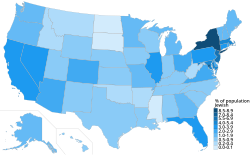
Many Jews are concentrated in the Northeastern United States, particularly around New York City. The world's largest menorah is lit annually at Grand Army Plaza in Manhattan, while the largest menorah in New Jersey is similarly celebrated in Monroe Township, Middlesex County. Many Jews also live in South Florida, Los Angeles, and other large metropolitan areas, like Chicago, San Francisco, or Atlanta. The metropolitan areas of New York City, Los Angeles, and Miami contain nearly one quarter of the world's Jews[91] and the New York City metropolitan area itself contains around a quarter of all Jews living in the United States.
By state
[edit]According to a study published by demographers and sociologists Ira M. Sheskin and Arnold Dashefsky in the American Jewish Yearbook, the distribution of the Jewish population in 2024 was as follows:[92]
| State | Jewish Population (2024) | Percent Jewish | |
|---|---|---|---|
| - |  Washington, D.C. Washington, D.C. |
57,300 | 8.44% |
| 1 |  New York New York |
1,672,025 | 8.54% |
| 2 |  New Jersey New Jersey |
581,200 | 6.26% |
| 3 |  Massachusetts Massachusetts |
318,450 | 4.55% |
| 4 |  Maryland Maryland |
250,860 | 4.06% |
| 5 |  Connecticut Connecticut |
141,500 | 3.91% |
| 6 |  Florida Florida |
753,865 | 3.33% |
| 7 |  California California |
1,259,315 | 3.23% |
| 8 |  Pennsylvania Pennsylvania |
347,850 | 2.68% |
| 9 |  Nevada Nevada |
85,330 | 2.67% |
| 10 |  Illinois Illinois |
334,180 | 2.66% |
| 11 |  Colorado Colorado |
117,900 | 2.01% |
| 12 |  Vermont Vermont |
12,700 | 1.96% |
| 13 |  Virginia Virginia |
165,260 | 1.90% |
| 14 |  Arizona Arizona |
132,360 | 1.78% |
| 15 |  Rhode Island Rhode Island |
18,950 | 1.73% |
| 16 |  Delaware Delaware |
17,400 | 1.69% |
| 17 |  Oregon Oregon |
70,105 | 1.66% |
| 18 |  Ohio Ohio |
177,295 | 1.50% |
| 19 |  New Hampshire New Hampshire |
20,900 | 1.49% |
| 20 |  Georgia Georgia |
148,555 | 1.35% |
| 21 |  Maine Maine |
18,460 | 1.32% |
| 22 |  Michigan Michigan |
129,225 | 1.29% |
| 23 |  Minnesota Minnesota |
68,855 | 1.20% |
| 24 |  Missouri Missouri |
71,840 | 1.16% |
| 25 |  Washington Washington |
88,530 | 1.13% |
| 26 |  New Mexico New Mexico |
19,855 | 0.94% |
| 27 |  North Carolina North Carolina |
99,795 | 0.92% |
| 28 |  Alaska Alaska |
6,510 | 0.89% |
| 29 |  Wisconsin Wisconsin |
48,515 | 0.82% |
| 30 |  Texas Texas |
220,685 | 0.72% |
| 31 |  Hawaii Hawaii |
9,900 | 0.69% |
| 32 |  South Carolina South Carolina |
36,210 | 0.67% |
| 33 |  Kansas Kansas |
17,590 | 0.60% |
| 34 |  Nebraska Nebraska |
10,230 | 0.52% |
| 35 |  Louisiana Louisiana |
19,870 | 0.43% |
| 36 |  Tennessee Tennessee |
29,775 | 0.42% |
| 37 |  Indiana Indiana |
31,205 | 0.40% |
| 38 |  Kentucky Kentucky |
18,225 | 0.40% |
| 39 |  Utah Utah |
13,030 | 0.38% |
| 40 |  Wyoming Wyoming |
2,210 | 0.38% |
| 41 |  Alabama Alabama |
18,080 | 0.35% |
| 42 |  Idaho Idaho |
5,920 | 0.30% |
| 43 |  Montana Montana |
3,170 | 0.28% |
| 44 |  Oklahoma Oklahoma |
8,880 | 0.22% |
| 45 |  Iowa Iowa |
6,385 | 0.20% |
| 46 |  Arkansas Arkansas |
5,090 | 0.17% |
| 47 |  West Virginia West Virginia |
2,940 | 0.17% |
| 48 |  North Dakota North Dakota |
910 | 0.12% |
| 49 |  Mississippi Mississippi |
2,885 | 0.10% |
| 50 |  South Dakota South Dakota |
765 | 0.08% |
| Total | 7,698,840 | 2.30% |
Significant Jewish population centers
[edit]| Rank | Metro area | Number of Jews | ||
|---|---|---|---|---|
| (WJC)[91] | (ARDA)[93] | (WJC) | (ASARB) | |
| 1 | 1 | New York City | 1,750,000 | 2,028,200 |
| 2 | 3 | Miami | 535,000 | 337,000 |
| 3 | 2 | Los Angeles | 490,000 | 662,450 |
| 4 | 4 | Philadelphia | 254,000 | 285,950 |
| 5 | 6 | Chicago | 248,000 | 265,400 |
| 8 | 8 | San Francisco Bay Area | 210,000 | 218,700 |
| 6 | 7 | Boston | 208,000 | 261,100 |
| 8 | 5 | Baltimore–Washington | 165,000 | 276,445 |

| Rank | State | Percent Jewish |
|---|---|---|
| 1 | New York | 8.91 |
| 2 | New Jersey | 5.86 |
| 3 | District of Columbia | 4.25 |
| 4 | Massachusetts | 4.07 |
| 5 | Maryland | 3.99 |
| 6 | Florida | 3.28 |
| 7 | Connecticut | 3.28 |
| 8 | California | 3.18 |
| 9 | Nevada | 2.69 |
| 10 | Illinois | 2.31 |
| 11 | Pennsylvania | 2.29 |
The New York City metropolitan area is the second-largest Jewish population center in the world after the Tel Aviv metropolitan area in Israel.[91] Several other major cities have large Jewish communities, including Los Angeles, Miami, Baltimore, Boston, Chicago, San Francisco and Philadelphia.[94] In many metropolitan areas, the majority of Jewish families live in suburban areas. The Greater Phoenix area was home to about 83,000 Jews in 2002, and has been rapidly growing.[95] The greatest Jewish population on a per-capita basis for incorporated areas in the US are Kiryas Joel Village, New York (greater than 93% based on language spoken in home),[96] City of Beverly Hills, California (61%),[97] and Lakewood Township, New Jersey (59%),[98] with two of the incorporated areas, Kiryas Joel and Lakewood, having a high concentration of Haredi Jews, and one incorporated area, Beverly Hills, having a high concentration of non-Orthodox Jews.
The phenomenon of Israeli migration to the US is often termed Yerida. The Israeli immigrant community in America is less widespread. The significant Israeli immigrant communities in the United States are in the New York City metropolitan area, Los Angeles, Miami, and Chicago.[99]
- The Organisation for Economic Co-operation and Development calculated an 'expatriate rate' of 2.9 persons per thousand, putting Israel in the mid-range of expatriate rates among the 175 OECD countries examined in 2005.[100]
According to the 2001 undertaking[101] of the National Jewish Population Survey, 4.3 million American Jews have some sort of strong connection to the Jewish community, whether religious or cultural.
Distribution of Jewish Americans
[edit]According to the North American Jewish Data Bank[102] the 104 counties and independent cities as of 2011[update] with the largest Jewish communities, as a percentage of population, were:
Assimilation and population changes
[edit]These parallel themes have facilitated the extraordinary economic, political, and social success of the American Jewish community, but also have contributed to widespread cultural assimilation.[103] More recently however, the propriety and degree of assimilation has also become a significant and controversial issue within the modern American Jewish community, with both political and religious skeptics.[104]
While not all Jews disapprove of intermarriage, many members of the Jewish community have become concerned that the high rate of interfaith marriage will result in the eventual disappearance of the American Jewish community. Intermarriage rates have risen from roughly 6% in 1950 and 25% in 1974,[105] to approximately 40–50% in the year 2000.[106] By 2013, the intermarriage rate had risen to 71% for non-Orthodox Jews.[107] This, in combination with the comparatively low birthrate in the Jewish community, has led to a 5% decline in the Jewish population of the United States in the 1990s. In addition to this, when compared with the general American population, the American Jewish community is slightly older.
A third of intermarried couples provide their children with a Jewish upbringing, and doing so is more common among intermarried families raising their children in areas with high Jewish populations.[108] The Boston area, for example, is exceptional in that an estimated 60% of children of intermarriages are being raised Jewish, meaning that intermarriage would actually be contributing to a net increase in the number of Jews.[109] As well, some children raised through intermarriage rediscover and embrace their Jewish roots when they themselves marry and have children.
In contrast to the ongoing trends of assimilation, some communities within American Jewry, such as Orthodox Jews, have significantly higher birth rates and lower intermarriage rates, and are growing rapidly. The proportion of Jewish synagogue members who were Orthodox rose from 11% in 1971 to 21% in 2000, while the overall Jewish community declined in number. [110] In 2000, there were 360,000 so-called "ultra-orthodox" (Haredi) Jews in USA (7.2%).[111] The figure for 2006 is estimated at 468,000 (9.4%).[111] Data from the Pew Center shows that, as of 2013, 27% of American Jews under the age of 18 live in Orthodox households, a dramatic increase from Jews aged 18 to 29, only 11% of whom are Orthodox. The UJA-Federation of New York reports that 60% of Jewish children in the New York City area live in Orthodox homes. In addition to economizing and sharing, many Haredi communities depend on government aid to support their high birth rate and large families. The Hasidic village of New Square, New York receives Section 8 housing subsidies at a higher rate than the rest of the region, and half of the population in the Hasidic village of Kiryas Joel, New York receive food stamps, while a third receive Medicaid.[112]
About half of the American Jews are considered to be religious. Out of this 2,831,000 religious Jewish population, 92% are non-Hispanic white, 5% Hispanic (Most commonly from Argentina, Venezuela, or Cuba), 1% Asian, 1% black and 1% Other (mixed-race etc.). Almost this many non-religious Jews exist in the United States.[113]
Race and ethnicity
[edit]
The United States Census Bureau classifies most American Jews as white.[114] Jewish people are culturally diverse and may be of any race, ethnicity, or national origin. Many Jews have culturally assimilated into and are phenotypically indistinguishable from the dominant local populations of regions like Europe, the Caucasus and the Crimea, North Africa, West Asia, Sub-Saharan Africa, South, East, and Central Asia, and the Americas where they have lived for many centuries.[115][116][117] Most American Jews are Ashkenazi Jews who descend from Jewish populations of Central and Eastern Europe and are considered white unless they are Ashkenazi Jews of color.[citation needed] Many American Jews identify themselves as being both Jewish and white, while many solely identify as Jewish, resisting this identification.[118] Several commentators have observed that "many American Jews retain a feeling of ambivalence about whiteness".[119] Karen Brodkin explains this ambivalence as rooted in anxieties about the potential loss of Jewish identity, especially outside of intellectual elites.[120] Similarly, Kenneth Marcus observes a number of ambivalent cultural phenomena which have also been noted by other scholars, and he concludes that "the veneer of whiteness has not established conclusively the racial construction of American Jews".[121] The relationship between Jewish identity and white majority identity continues to be described as "complicated" for many American Jews, particularly Ashkenazi and Sephardi Jews of European descent. The issue of Jewish whiteness may be different for many Mizrahi, Sephardi, Black, Asian, and Latino Jews, many of whom may never be considered white by society.[122] Many American white nationalists and white supremacists view all Jews as non-white, even if they are of European descent.[123] Some white nationalists believe that Jews can be white and a small number of white nationalists are Jewish.[124]
In 2013, the Pew Research Center's Portrait of Jewish Americans found that more than 90% of Jews who responded to its survey described themselves as being non-Hispanic whites, 2% described themselves as being black, 3% described themselves as being Hispanic, and 2% described themselves as having other racial or ethnic backgrounds.[125]
Jews by race, ancestry, or national origin
[edit]Asian American Jews
[edit]According to the Pew Research Center, fewer than 1% of American Jews in 2020 identified as Asian Americans. Around 1% of religious Jews identified as Asian American.[126]
A small but growing community of around 350 Indian American Jews lives in the New York City metropolitan area, in both New York state and New Jersey. Many are members of India's Bene Israel community.[127] The Indian Jewish Congregation of USA, headquartered in New York City, is the center of the organized community.[128]
Jews of European descent
[edit]Jews of European descent, often referred to as white Jews, are classified as white by the US census and have generally been classified as legally white throughout American history.[129] Many American Jews of European descent identify themselves as being both Jewish and white, while others solely identify themselves as being Jewish or identify as both Jewish and non-white.[130] However, Jews of European descent rarely identify as Jews of color and are rarely considered people of color in American society. According to the Pew Research Center, the majority of American Jews are non-Hispanic white Ashkenazi Jews.[126] Law professor David Bernstein has questioned the idea that American Jews were once considered non-white, writing that American Jews were "indeed considered white by law and by custom" despite the fact that they experienced "discrimination, hostility, assertions of inferiority and occasionally even violence." Bernstein notes that Jews were not targeted by laws against interracial marriage, were allowed to attend whites-only schools, and were classified as white in the Jim Crow South.[131] The sociologists Philip Q. Yang and Kavitha Koshy have also questioned what they call the "becoming white thesis", noting that most Jews of European descent have been legally classified as white since the first US census in 1790, were legally white for the purposes of the Naturalization Act of 1790 that limited citizenship to "free White person(s)", and that they could find no legislative or judicial evidence that American Jews had ever been considered non-white.[129]
Several commentators have observed that "many American Jews retain a feeling of ambivalence about whiteness".[132] Karen Brodkin explains this ambivalence as rooted in anxieties about the potential loss of Jewish identity, especially outside of intellectual elites.[133] Similarly, Kenneth Marcus observes a number of ambivalent cultural phenomena which have also been noted by other scholars, and he concludes that "the veneer of whiteness has not established conclusively the racial construction of American Jews".[134] The relationship between American Jews and white majority identity continues to be described as "complicated".[135] Many American white nationalists view Jews as non-white.[136]
Jews of Middle Eastern and North African descent
[edit]Jews of Middle Eastern and North African descent (often referred to as Mizrahi Jews) are classified as white by the US census. Mizrahi Jews sometimes identify as Jews of color, but often do not, and they may or may not be considered people of color by society. Syrian Jews rarely identify as Jews of color and are generally not considered Jews of color by society. Many Syrian Jews identify as white, Middle Eastern, or otherwise non-white rather than as Jews of color.[126]
African American Jews
[edit]The American Jewish community includes African American Jews and other American Jews who are of African descent, a definition which excludes North African Jewish Americans, who are currently classified by the US census as being white (although a new category was recommended by the Census Bureau for the 2020 census).[137] Estimates of the number of American Jews of African descent in the United States range from 20,000[138] to 200,000.[139] Jews of African descent belong to all American Jewish denominations. Like their other Jewish counterparts, some black Jews are atheists.
Notable African American Jews include Drake, Lenny Kravitz, Lisa Bonet, Sammy Davis Jr., Rashida Jones, Ros Gold-Onwude, Yaphet Kotto, Jordan Farmar, Taylor Mays, Daveed Diggs, Alicia Garza, Tiffany Haddish, and rabbis Capers Funnye and Alysa Stanton.
Relations between American Jews of African descent and other Jewish Americans are generally cordial.[citation needed] There are, however, disagreements with a specific minority of Black Hebrew Israelites community from among African Americans who consider themselves, but not other Jews, to be the true descendants of the ancient Israelites. Black Hebrew Israelites are generally not considered members of the mainstream Jewish community, because they have not formally converted to Judaism, and they are not ethnically related to other Jews. One such group, the African Hebrew Israelites of Jerusalem, emigrated to Israel and was granted permanent residency status there.[140]
Hispanic and Latin American Jews
[edit]Hispanic Jews have lived in what is now the United States since colonial times. The earliest Hispanic Jewish settlers were Sephardi Jews from Spain and Portugal. Beginning in the 1500s, some of the Spanish settlers in what is now New Mexico and Texas were Crypto-Jews, but there was no organized Jewish presence.[141][142] Later waves of Sephardi immigration brought Judeo-Spanish speaking Jews from the Ottoman Empire, in what is now Greece, Turkey, Bulgaria, Libya, and Syria. These Spanish-speaking Sephardi Jews, as well as Sephardi Jews of European descent, such as the Spanish and Portuguese Jews, are sometimes considered culturally but not ethnically Hispanic.
Hispanic and Latin American Jews, particularly Hispanic and Latin American Ashkenazi Jews, often identify as white rather than as Jews of color. Some Jews with roots in Latin America may not identify as "Hispanic" or "Latino" at all, usually due to their recent European immigrant origins.[126] American Jews of Argentine, Brazilian, and Mexican descent are often Ashkenazi, but some are Sephardi.[143]
Jews divided by cultural or Jewish ethnic division groupings
[edit]| Ancestry | Population | % of US population |
|---|---|---|
| Ashkenazim[144] | 5,000,000–6,000,000 | 1.8–2.1% |
| Sephardim[145] | 300,000 | 0.086–0.086% |
| Mizrahim | 250,000 | 0.072–0.072% |
| Italkim[citation needed] | 200,000 | 0.057–0.057% |
| Bukharim | 50,000–60,000 | 0.014–0.017% |
| Juhurim | 10,000–40,000 | 0.003–0.011% |
| Turkos | 8,000 | 0.002–0.002% |
| Romanyotim | 6,500 | 0.002–0.002% |
| Beta Israel[146] | 1,000 | 0.0003% |
| Total[147] | 5,700,000–8,000,000 | 1.6–2.3% |
A majority of the Jewish population in the United States are Ashkenazi Jews who descend from diaspora Jewish populations of Central and Eastern Europe. Most American Ashkenazi Jews are non-Hispanic whites, but a minority are Jews of color, Hispanic/Latino, or both.
Largely expelled from the Iberian Peninsula in the late 15th century, Sephardi Jews carried a distinctive Jewish diasporic identity with them to the Americas (although in smaller numbers compared to the Ashkenazi Jewish diaspora) and all other places of their exiled settlement. They sometimes settled near existing Jewish communities, such as the one from former Kurdistan, or were the first in new frontiers, with their furthest reach via the Silk Road.[148] As a result of the more recent Jewish exodus from Arab lands, many of the Sephardim Tehorim from Western Asia and North Africa relocated to either Israel or France, where they form a significant portion of the Jewish communities today. Other significant communities of Sephardim Tehorim also migrated in more recent times from the Near East to New York City, Argentina, Costa Rica, Mexico, Montreal, Gibraltar, Puerto Rico, and Dominican Republic.[149] Because of poverty and turmoil in Latin America, another wave of Sephardic Jews joined other Latin Americans who migrated to the United States, Canada, Spain, and other countries of Europe.
Post-1948, Mizrahi Jewish, mostly thousands from Lebanese, Syrian and Egyptian Jewish descent, as well as some from other Middle East and North African Jewish communities migrated to the United States.
Since the 1990s, around 1000 Hebrew-speaking, Ethiopian Jews that had settled in Israel as Ethiopian Jews in Israel re-settled in the United States as Ethiopian Americans, with around half of the Ethiopian Jewish Israeli-American community living in New York.[150]
Socioeconomics
[edit]Education plays a major role as a part of Jewish identity. As Jewish culture puts a special premium on it and stresses the importance of cultivation of intellectual pursuits, scholarship, and learning, American Jews as a group tend to be better educated and earn more than Americans as a whole.[151][152][153][154] Jewish Americans also have an average of 14.7 years of schooling making them the most highly educated of all major religious groups in the United States.[155][156]
Forty-four percent (55% of Reform Jews) report family incomes of over $100,000 compared to 19% of all Americans, with the next highest group being Hindus at 43%.[157][158] And while 27% of Americans have a four-year university or postgraduate education, fifty-nine percent (66% of Reform Jews) of American Jews have, the second highest of any ethnic groups after Indian-Americans.[157][159][160] 75% of American Jews have achieved some form of post-secondary education if two-year vocational and community college diplomas and certificates are also included.[161][162][163][156]
31% of American Jews hold a graduate degree; this figure is compared with the general American population where 11% of Americans hold a graduate degree.[157] White collar professional jobs have been attractive to Jews and much of the community tend to take up professional white collar careers requiring tertiary education involving formal credentials where the respectability and reputability of professional jobs is highly prized within Jewish culture. While 46% of Americans work in professional and managerial jobs, 61% of American Jews work as professionals, many of whom are highly educated, salaried professionals whose work is largely self-directed in management, professional, and related occupations such as engineering, science, medicine, investment banking, finance, law, and academia.[164]
Much of the Jewish American community lead middle class lifestyles.[165] While the median household net worth of the typical American family is $99,500, among American Jews the figure is $443,000.[166][167] In addition, the median Jewish American income is estimated to be in the range of $97,000 to $98,000, nearly twice as high the American national median.[168] Either of these two statistics may be confounded by the fact that the Jewish population is on average older than other religious groups in the country, with 51% of polled adults over the age of 50 compared to 41% nationally.[159] Older people tend to both have higher income and be more highly educated. By 2016, Modern Orthodox Jews had a median household income of $158,000, while Open Orthodox Jews had a median household income at $185,000 (compared to the American median household income of $59,000 for 2016).[169]
According to a 2020 study by the Pew Research Center, 23% of American Jewish living in households with incomes of at least $200,000. Conservatives (27%) and Reforms (26%) are more likely to live in households with incomes of at least $200,000 than those who are Orthodox (16%).[170] The study found also that American Jews are a comparatively well-educated group, around 60% of them are college graduates. Reforms (64%) and Conservatives (55%) are more likely to obtain college or postgraduate education than those who are Orthodox (37%).[171]
As a whole, American and Canadian Jews donate more than $9 billion a year to charity. This reflects Jewish traditions of supporting social services as a way of living out the dictates of Jewish law. Most of the charities that benefit are not specifically Jewish organizations.[172]
While the median income of Jewish Americans is high, some Jewish communities have high levels of poverty. In the New York area, there are approximately 560,000 Jews living in poor or near-poor households, representing about 20% of the New York metropolitan Jewish community. Jewish people affected by poverty are disproportionately likely to be children, young adults, the elderly, people with low educational attainment, part-time workers, immigrants from the former Soviet Union, immigrants without American citizenship, Holocaust survivors, Orthodox families, and single adults including single parents.[173] Disability is a major factor in the socioeconomic status of disabled Jews. Disabled Jews are significantly more likely to be low-income compared to able-bodied Jews, while high-income Jews are significantly less likely to be disabled.[174][175] Secular Jews, Jews of no denomination, and people who identify as "just Jewish" are also more likely to live in poverty compared to Jews affiliated with a religious denomination.[176]
According to analysis by Gallup, American Jews have the highest well-being of any ethnic or religious group in America.[177][178]
The great majority of school-age Jewish students attend public schools, although Jewish day schools and yeshivas are to be found throughout the country. Jewish cultural studies and Hebrew language instruction is also commonly offered at synagogues in the form of supplementary Hebrew schools or Sunday schools.
From the early 1900s until the 1950s, quota systems were imposed at elite colleges and universities particularly in the Northeast, as a response to the growing number of children of recent Jewish immigrants; these limited the number of Jewish students accepted, and greatly reduced their previous attendance. Jewish enrollment at Cornell's School of Medicine fell from 40% to 4% between the world wars, and Harvard's fell from 30% to 4%.[179] Before 1945, only a few Jewish professors were permitted as instructors at elite universities. In 1941, for example, antisemitism drove Milton Friedman from a non-tenured assistant professorship at the University of Wisconsin–Madison.[180] Harry Levin became the first Jewish full professor in the Harvard English department in 1943, but the Economics department decided not to hire Paul Samuelson in 1948. Harvard hired its first Jewish biochemists in 1954.[181]
According to Clark Kerr, Martin Meyerson in 1965 became the first Jew to serve, albeit temporarily, as the leader of a major American research university.[182] That year, Meyerson served as acting chancellor of the University of California, Berkeley, but was unable to obtain a permanent appointment as a result of a combination of tactical errors on his part and antisemitism on the UC Board of Regents.[182] Meyerson served as the president of the University of Pennsylvania from 1970 to 1981.
By 1986, a third of the presidents of the elite undergraduate final clubs at Harvard were Jewish.[180] Rick Levin was president of Yale University from 1993 to 2013, Judith Rodin was president of the University of Pennsylvania from 1994 to 2004 (and is currently president of the Rockefeller Foundation), Paul Samuelson's nephew, Lawrence Summers, was president of Harvard University from 2001 until 2006, and Harold Shapiro was president of Princeton University from 1992 until 2000.
American Jews at American higher education institutions
[edit]Public universities[183]
|
Private universities
|
Religion
[edit]
Observances and engagement
[edit]The American Jews' majority continues to identify themselves with Judaism and its main traditions, such as Conservative, Orthodox and Reform Judaism.[187][188] But, already in the 1980s, 20–30 percent of members of largest Jewish communities, such as of New York City, Chicago, Miami, and others, rejected a denominational label.[187]

According to the 1990 National Jewish Population Survey, 38% of Jews were affiliated with the Reform tradition, 35% were Conservative, 6% were Orthodox, 1% were Reconstructionists, 10% linked themselves to some other tradition, and 10% said they are "just Jewish".[189]
.jpg)
Jewish religious practice in America is quite varied. Among the 4.3 million American Jews described as "strongly connected" to Judaism, over 80% report some sort of active engagement with Judaism,[190] ranging from attending at daily prayer services on one end of the spectrum, to as little as attending only Passover Seders or lighting Hanukkah candles on the other.
According to a 2020 study by the Pew Research Center, 37% of American Jews identify as Reforms, 32% do not with a particular branch, 17% identify as Conservatives, 9% identify as Orthodox, and 4% are members of other Jewish branches, such as Reconstructionist or Humanist Judaism.[191] The survey found that Jews are far less religious than American adults as a whole, 8% of American Jews go to the synagogue at least once a month, 27% go few times a year, and 56% seldom or never go to the synagogue.[192]
A 2003 Harris Poll found that 16% of American Jews go to the synagogue at least once a month, 42% go less frequently but at least once a year, and 42% go less frequently than once a year.[193] The survey found that of the 4.3 million strongly connected Jews, 46% belong to a synagogue. Among those households who belong to a synagogue, 38% are members of Reform synagogues, 33% Conservative, 22% Orthodox, 2% Reconstructionist, and 5% other types.
Traditionally, Sephardi and Mizrahi Jews do not have different branches (Orthodox, Conservative, Reform, etc.) but usually remain observant and religious. However, their synagogues are generally considered Orthodox or Sephardic Haredim by non-Sephardic Jews. But, not all Sephardim are Orthodox; among the pioneers of Reform Judaism movement in the 1820s there was the Sephardic congregation Beth Elohim in Charleston, South Carolina.[194]
The survey discovered that Jews in the Northeast and Midwest are generally more observant than Jews in the South or West. Reflecting a trend also observed among other religious groups, Jews in the Northwestern United States are typically the least observant.
The 2008 American Religious Identification Survey found that around 3.4 million American Jews call themselves religious—out of a general Jewish population of about 5.4 million. The number of Jews who identify themselves as only culturally Jewish has risen from 20% in 1990 to 37% in 2008, according to the study. In the same period, the number of all US adults who said they had no religion rose from 8% to 15%. Jews are more likely to be secular than Americans in general, the researchers said. About half of all US Jews—including those who consider themselves religiously observant—claim in the survey that they have a secular worldview and see no contradiction between that outlook and their faith, according to the study's authors. Researchers attribute the trends among American Jews to the high rate of intermarriage and "disaffection from Judaism" in the United States.[195]
Religious beliefs
[edit]American Jews are more likely to be atheists or agnostics than most Americans, especially when they are compared with American Protestants or Catholics. A 2003 poll found that while 79% of Americans believe in God, only 48% of American Jews do, compared to 79% and 90% of American Catholics and Protestants respectively. While 66% of Americans said that they were "absolutely certain" of God's existence, 24% of American Jews said the same. And though 9% of Americans believe that there is no God (8% of American Catholics and 4% of American Protestants), 19% of American Jews believe that God does not exist.[193]
A 2009 Harris Poll showed that American Jews constitute the one religious group which is most accepting of the science of evolution, with 80% accepting evolution, compared to 51% for Catholics, 32% for Protestants, and 16% of born-again Christians.[196] They were also less likely to believe in supernatural phenomena such as miracles, angels, or heaven.
Christianity
[edit]A 2013 Pew Research Center report found that 1.7 million American Jewish adults, 1.6 million of whom were raised in Jewish homes or had Jewish ancestry, identified as Christians or Messianic Jews but also consider themselves ethnically Jewish. Another 700,000 American Christian adults considered themselves "Jews by affinity" or "grafted-in" Jews.[197][198] According to a 2020 study by the Pew Research Center, 19% of those who say they were raised Jewish, consider themselves Christian.[199]
A 2025 Pew Research Center report found that 7% of American adults who identify ethnically as Jewish were raised as Christians. Additionally, among those who were raised as religious Jews rather than in a Christian environment, 2% now identify as Christian.[200]
Buddhism
[edit]Jewish Buddhists[201] are overrepresented among American Buddhists; this is specifically the case among those Jews whose parents are not Buddhist, and those Jews who are without a Buddhist heritage, with between one fifth[202] and 30% of all American Buddhists identifying as Jewish[203] though only 2% of Americans are Jewish. Nicknamed Jubus, an increasing[citation needed] number of American Jews have started to adopt Buddhist spiritual practices, while at the same time, they are continuing to identify with and practice Judaism. It may be the individual practices both Judaism and Buddhism.[201] Notable American Jewish Buddhists include: Robert Downey Jr.[204] Allen Ginsberg,[205] Linda Pritzker,[206] Jonathan F.P. Rose,[207] Goldie Hawn[208] and daughter Kate Hudson, Steven Seagal, Adam Yauch of the rap group The Beastie Boys, and Garry Shandling. Film makers the Coen Brothers have been influenced by Buddhism as well for a time.[209]
Islam
[edit]A 2025 Pew Research Center report revealed that 1% of American Jewish adults who were raised in Judaism later identified as Muslim.[200]
Contemporary politics
[edit]
Today, American Jews are a distinctive and influential group in the nation's politics. Jeffrey S. Helmreich writes that the ability of American Jews to effect this through political or financial clout is overestimated,[210] that the primary influence lies in the group's voting patterns.[46]
"Jews have devoted themselves to politics with almost religious fervor," writes Mitchell Bard, who adds that Jews have the highest percentage voter turnout of any ethnic group (84% reported being registered to vote[211]).
Though the majority (60–70%) of the country's Jews identify as Democratic, Jews span the political spectrum, with those at higher levels of observance being far more likely to vote Republican than their less observant and secular counterparts.[212]

Owing to high Democratic identification in the 2008 United States presidential election, 78% of Jews voted for Democrat Barack Obama versus 21% for Republican John McCain, despite Republican attempts to connect Obama to Muslim and pro-Palestinian causes.[213] It has been suggested that running mate Sarah Palin's conservative views on social issues may have nudged Jews away from the McCain–Palin ticket.[46][213] In the 2012 presidential election, 69% of Jews voted for the Democratic incumbent President Obama.[214]
In 2019, after the 2016 election of Donald Trump, poll data from the Jewish Electorate Institute showed that 73% of Jewish voters felt less secure as Jews than before, 71% disapproved of Trump's handling of antisemitism (54% strongly disapprove), 59% felt that he bears "at least some responsibility" for the Pittsburgh synagogue shooting and Poway synagogue shooting, and 38% were concerned that Trump was encouraging right-wing extremism. Views of the Democratic and Republican parties were milder: 28% were concerned that Republicans were making alliances with white nationalists and tolerating antisemitism within their ranks, while 27% were concerned that Democrats were tolerating antisemitism within their ranks.[215]
In the 2020 U.S. Presidential Election, 77% of American Jews voted for Joe Biden, while 22% voted for Donald Trump.[216] A similar trend emerged in the 2024 Presidential Election, where 78% of American Jews voted for Kamala Harris while 22% voted for Donald Trump.[217]
Foreign policy
[edit]American Jews have displayed a very strong interest in foreign affairs, especially regarding Germany in the 1930s, and Israel since 1945.[218] Both major parties have made strong commitments in support of Israel. Dr. Eric Uslaner of the University of Maryland argues, with regard to the 2004 election: "Only 15% of Jews said that Israel was a key voting issue. Among those voters, 55% voted for Kerry (compared to 83% of Jewish voters not concerned with Israel)." Uslander goes on to point out that negative views of Evangelical Christians had a distinctly negative impact for Republicans among Jewish voters, while Orthodox Jews, traditionally more conservative in outlook as to social issues, favored the Republican Party.[219] A New York Times article suggests that the Jewish movement to the Republican party is focused heavily on faith-based issues, similar to the Catholic vote, which is credited for helping President Bush taking Florida in 2004.[220] However, Natan Guttman, The Forward's Washington bureau chief, dismisses this notion, writing in Moment that while "[i]t is true that Republicans are making small and steady strides into the Jewish community ... a look at the past three decades of exit polls, which are more reliable than pre-election polls, and the numbers are clear: Jews vote overwhelmingly Democratic,"[221] an assertion confirmed by the most recent presidential election results.
Jewish Americans were more strongly opposed to the Iraq War from its onset than any other ethnic group, or even most Americans. The greater opposition to the war was not simply a result of high Democratic identification among Jewish Americans, as Jewish Americans of all political persuasions were more likely to oppose the war than non-Jews who shared the same political leanings.[222][223]
Domestic issues
[edit]A 2013 Pew Research Center survey suggests that American Jews' views on domestic politics are intertwined with the community's self-definition as a persecuted minority who benefited from the liberties and societal shifts in the United States and feel obligated to help other minorities enjoy the same benefits. American Jews across age and gender lines tend to vote for and support politicians and policies which are supported by the Democratic Party. On the other hand, Orthodox American Jews have domestic political views which are more similar to those of their religious Christian neighbors.[224]
American Jews are largely supportive of LGBT rights with 79% responding in a 2011 Pew poll that homosexuality should be "accepted by society", while the overall average in the same 2011 poll among Americans of all demographic groups was that 50%.[225] A split on homosexuality exists by level of observance. Reform rabbis in America perform same-sex marriages as a matter of routine, and there are fifteen LGBT Jewish congregations in North America.[226] Reform, Reconstructionist and, increasingly, Conservative, Jews are far more supportive on issues like gay marriage than Orthodox Jews are.[227] A 2007 survey of Conservative Jewish leaders and activists showed that an overwhelming majority supported gay rabbinical ordination and same-sex marriage.[228] Accordingly, 78% of Jewish voters rejected Prop 8, the bill that banned gay marriage in California. No other ethnic or religious group voted as strongly against it.[229]
A 2014 Pew poll found that American Jews mostly support abortion rights, with 83% answering that abortion should be legal in all or most cases.[230]
In considering the trade-off between the economy and environmental protection, American Jews were significantly more likely than other religious groups (excepting Buddhism) to favor stronger environmental protection.[231]
Jews in America also overwhelmingly oppose current United States marijuana policy.[needs update] In 2009, eighty-six percent of Jewish Americans opposed arresting nonviolent marijuana smokers, compared to 61% for the population at large and 68% of all Democrats. Additionally, 85% of Jews in the United States opposed using federal law enforcement to close patient cooperatives for medical marijuana in states where medical marijuana is legal, compared to 67% of the population at large and 73% of Democrats.[232]
A 2014 Pew Research survey titled "How Americans Feel About Religious Groups", found that Jews were viewed the most favorably of all other groups, with a rating of 63 out of 100.[233] Jews were viewed most positively by fellow Jews, followed by white Evangelicals. Sixty percent of the 3,200 persons surveyed said they had ever met a Jew.[234]
Jewish American culture
[edit]Since the time of the last major wave of Jewish immigration to America (over 2,000,000 Jews from Eastern Europe who arrived between 1890 and 1924), Jewish secular culture in the United States has become integrated in almost every important way with the broader American culture. Many aspects of Jewish American culture have, in turn, become part of the wider culture of the United States.
Language
[edit]| Year | Hebrew | Yiddish |
|---|---|---|
| 1910a | — |
1,051,767
|
| 1920a | — |
1,091,820
|
| 1930a | — |
1,222,658
|
| 1940a | — |
924,440
|
| 1960a | 38,346 |
503,605
|
| 1970a | 36,112 |
438,116
|
| 1980[235] | 315,953
| |
| 1990[236] | 144,292 |
213,064
|
| 2000[237] | 195,374 |
178,945
|
| ^a Foreign-born population only[238] | ||
Most American Jews today are native English speakers. A variety of other languages are still spoken within some American Jewish communities that are representative of the various Jewish ethnic divisions from around the world that have come together to make up all of America's Jewish population.
Many of America's Hasidic Jews, being exclusively of Ashkenazi descent, are raised speaking Yiddish. Yiddish was once spoken as the primary language by most of the several million Ashkenazi Jews who migrated to the United States. It was, in fact, the original language in which The Forward was published. Yiddish has had an influence on American English, and words borrowed from it include chutzpah ('effrontery, gall'), nosh ('snack'), schlep ('drag'), schmuck ('an obnoxious, contemptible person', euphemism for 'penis'), and, depending on idiolect, hundreds of other terms. (See also Yinglish.)
Many Mizrahi Jews, including those from Arab countries such as Syria, Egypt, Iraq, Yemen, Morocco, Libya, etc. speak Arabic. There are communities of Mizrahim in Brooklyn. The town of Deal, New Jersey, is notably mostly Syrian-Jewish, with many of them Orthodox.[239]
The Persian Jewish community in the United States, notably the large community in and around Los Angeles and Beverly Hills, California, primarily speak Persian (see also Judeo-Persian) in the home and synagogue. They also support their own Persian language newspapers. Persian Jews also reside in eastern parts of New York such as Kew Gardens and Great Neck, Long Island.
Many recent Jewish immigrants from the Soviet Union speak primarily Russian at home, and there are several notable communities where public life and business are carried out mainly in Russian, such as in Brighton Beach in New York City and Sunny Isles Beach in Florida. 2010 estimates of the number of Jewish Russian-speaking households in the New York city area are around 92,000, and the number of individuals are somewhere between 223,000 and 350,000.[240] Another high population of Russian Jews can be found in the Richmond District of San Francisco where Russian markets stand alongside the numerous Asian businesses.

American Bukharan Jews speak Bukhori, a dialect of Tajik Persian. They publish their own newspapers such as the Bukharian Times and a large portion live in Queens, New York. Forest Hills in the New York City borough of Queens is home to 108th Street, which is called by some "Bukharian Broadway",[241] a reference to the many stores and restaurants found on and around the street that have Bukharian influences. Many Bukharians are also represented in parts of Arizona, Miami, Florida, and areas of Southern California such as San Diego.
There is a sizeable Mountain Jewish population in Brooklyn, New York, that speaks Judeo-Tat (Juhuri), a dialect of Persian.[242]
Classical Hebrew is the language of most Jewish religious literature, such as the Tanakh (Bible) and Siddur (prayerbook). Modern Hebrew is also the primary official language of the modern State of Israel, which further encourages many to learn it as a second language. Some recent Israeli immigrants to America speak Hebrew as their primary language.
There are a diversity of Hispanic Jews living in America. The oldest community is that of the Sephardi Jews of New Netherland. Their ancestors had fled Spain or Portugal during the Inquisition for the Netherlands, and then came to New Netherland. Though there is dispute over whether they should be considered Hispanic. Some Hispanic Jews, particularly in Miami and Los Angeles, immigrated from Latin America. The largest groups are those that fled Cuba after the communist revolution (known as Jewbans), Argentine Jews, and more recently, Venezuelan Jews. Argentina is the Latin American country with the largest Jewish population. There are a large number of synagogues in the Miami area that give services in Spanish. The last Hispanic Jewish community would be those that recently came from Portugal or Spain, after Spain and Portugal granted citizenship to the descendants of Jews who fled during the Inquisition. All the above listed Hispanic Jewish groups speak either Spanish or Ladino.
Jewish American literature
[edit]Although American Jews have contributed greatly to American arts in general, there still remains a distinctly Jewish American literature. Jewish American literature often explores the experience of being a Jew in America, and the conflicting pulls of secular society and history.
Popular culture
[edit]Yiddish theater was very well attended, and provided a training ground for performers and producers who moved to Hollywood in the 1920s. Many of the early Hollywood moguls and pioneers were Jewish.[243][244] They played roles in the development of radio and television networks, typified by William S. Paley who ran CBS.[245] Stephen J. Whitfield states that "The Sarnoff family was long dominant at NBC."[246]
Many individual Jews have made significant contributions to American popular culture.[247] There have been many Jewish American actors and performers, ranging from early 1900s actors, to classic Hollywood film stars, and culminating in many currently known actors. The field of American comedy includes many Jews. The legacy also includes songwriters and authors, for example the author of the song "Viva Las Vegas" Doc Pomus, or Billy the Kid composer Aaron Copland. Many Jews have been at the forefront of women's issues.
Sports
[edit]
The first generation of Jewish Americans who immigrated during the 1880–1924 peak period were not interested in baseball, the country's national pastime, and in some cases tried to prevent their children from watching or participating in baseball-related activities. Most were focused on making sure they and their children took advantage of education and employment opportunities. Despite the efforts of parents, Jewish children became interested in baseball quickly since it was already embedded in the broader American culture. The second generation of immigrants saw baseball as a means to celebrate American culture without abandoning their broader religious community. After 1924, many Yiddish newspapers began covering baseball, which they had not done previously.[249]
Government and military
[edit]
Since 1845, a total of 34 Jews have served in the Senate, including the 14 present-day senators noted above. Judah P. Benjamin was the first practicing Jewish Senator, and would later serve as Confederate Secretary of War and Secretary of State during the Civil War. Rahm Emanuel served as Chief of Staff to President Barack Obama. The number of Jews elected to the House rose to an all-time high of 30. Eight Jews have been appointed to the United States Supreme Court, of which one (Elena Kagan) is currently serving. Had Merrick Garland's 2016 nomination been accepted, that number would have risen to four out of nine since Ruth Bader Ginsburg and Stephen Breyer were also serving at that time.
The Civil War marked a transition for American Jews. It killed off the antisemitic canard, widespread in Europe, to the effect that Jews are cowardly, preferring to run from war rather than serve alongside their fellow citizens in battle.[250][251]
At least twenty eight American Jews have been awarded the Medal of Honor.
World War II
[edit]More than 550,000 Jews served in the U.S. military during World War II; about 11,000 of them were killed and more than 40,000 of them were wounded. There were three recipients of the Medal of Honor; 157 recipients of the Army Distinguished Service Medal, Navy Distinguished Service Medal, Distinguished Service Cross, or Navy Cross; and about 1600 recipients of the Silver Star. About 50,000 other decorations and awards were given to Jewish military personnel, making a total of 52,000 decorations. During this period, Jews were approximately 3.3 percent of the total U.S. population but they constituted about 4.23 percent of the U.S. armed forces. About 60 percent of all Jewish physicians in the United States who were under 45 years of age were in service as military physicians and medics.[252]
Many[citation needed] Jewish physicists, including J. Robert Oppenheimer, were involved in the Manhattan Project, the secret World War II effort to develop the atomic bomb. Many of these physicists were refugees from Nazi Germany or they were refugees from antisemitic persecution which was also occurring elsewhere in Europe.
American folk music
[edit]Jews have been involved in the American folk music scene since the late 19th century;[253] these tended to be refugees from Central and Eastern Europe, and significantly more economically disadvantaged than their established Western European Sephardic coreligionists.[254] Historians see it as a legacy of the secular Yiddish theater, cantorial traditions and a desire to assimilate. By the 1940s Jews had become established in the American folk music scene.
Examples of the major impact Jews have had in the American folk music arena include, but are not limited to: Moe Asch the first to record and release much of the music of Woody Guthrie, including "This Land is Your Land" (see The Asch Recordings) in response to Irving Berlin's "God Bless America", and Guthrie wrote Jewish songs. Guthrie married a Jew and their son Arlo became influential in his own right. Asch's one-man corporation Folkways Records also released much of the music of Leadbelly and Pete Seeger from the 1940s and 1950s. Asch's large music catalog was voluntarily donated to the Smithsonian.
Jews have also thrived in jazz music and contributed to its popularization.
Three of the four creators of the Newport Folk Festival, Wein, Bikel and Grossman (Seeger is not) were Jewish. Albert Grossman put together Peter, Paul and Mary, of which Yarrow is Jewish. Oscar Brand, from a Canadian Jewish family, has the longest running radio program "Oscar Brand's Folksong Festival" which has been on air consecutively since 1945 from New York City.[255] And is the first American broadcast where the host himself will answer any personal correspondence.
The influential group The Weavers, successor to the Almanac Singers, led by Pete Seeger, had a Jewish manager, and two of the four members of the group were Jewish (Gilbert and Hellerman). The B-side of "Good Night Irene" had the Hebrew folk song personally chosen for the record by Pete Seeger "Tzena, Tzena, Tzena".
The influential folk music magazine Sing Out! was co-founded and edited by Irwin Silber in 1951, and edited by him until 1967, when the magazine stopped publication for decades. Rolling Stone magazine's first music critic Jon Landau is of German Jewish descent. Izzy Young who created the legendary[256] Folklore Center in New York, and currently the Folklore Centrum near Mariatorget in Södermalm, Sweden, which relates to American and Swedish folk music.[257]
Dave Van Ronk observed that the behind the scenes 1950s folk scene "was at the very least 50 percent Jewish, and they adopted the music as part of their assimilation into the Anglo-American tradition which itself was largely an artificial construct but none the less provided us with some common ground".[258] Nobel Prize winner Bob Dylan is also Jewish.
Finance and law
[edit]Jews have been involved in financial services since the colonial era. They received rights to trade fur, from the Dutch and Swedish colonies. British governors honored these rights after taking over. During the Revolutionary War, Haym Solomon helped create America's first semi-central bank, and advised Alexander Hamilton on the building of America's financial system.[citation needed]
American Jews in the 19th, 20th and 21st centuries played a major role in developing America's financial services industry, both at investment banks and with investment funds.[259] German Jewish bankers began to assume a major role in American finance in the 1830s when government and private borrowing to pay for canals, railroads and other internal improvements increased rapidly and significantly. Men such as August Belmont (Rothschild's agent in New York and a leading Democrat), Philip Speyer, Jacob Schiff (at Kuhn, Loeb & Company), Joseph Seligman, Philip Lehman (of Lehman Brothers), Jules Bache, and Marcus Goldman (of Goldman Sachs) illustrate this financial elite.[260] As was true of their non-Jewish counterparts, family, personal, and business connections, a reputation for honesty and integrity, ability, and a willingness to take calculated risks were essential to recruit capital from widely scattered sources. The families and the firms which they controlled were bound together by religious and social factors, and by the prevalence of intermarriage. These personal ties fulfilled real business functions before the advent of institutional organization in the 20th century.[261][262] Antisemitic elements often falsely targeted them as key players in a supposed Jewish cabal conspiring to dominate the world.[263]
Since the late 20th century, Jews have played a major role in the hedge fund industry, according to Zuckerman (2009).[264] Thus SAC Capital Advisors,[265] Soros Fund Management,[266] Och-Ziff Capital Management,[267] GLG Partners[268] Renaissance Technologies[269] and Elliott Management Corporation[270][271] are large hedge funds cofounded by Jews. They have also played a pivotal role in the private equity industry, co-founding some of the largest firms in the United States, such as Blackstone,[272] Cerberus Capital Management,[273] TPG Capital,[274] BlackRock,[275] Carlyle Group,[276] Warburg Pincus,[277] and KKR.[278][279][280]
Very few Jewish lawyers were hired by White Anglo-Saxon Protestant ("WASP") upscale white-shoe law firms, but they started their own. The WASP dominance in law ended when a number of major Jewish law firms attained elite status in dealing with top-ranked corporations. As late as 1950 there was not a single large Jewish law firm in New York City. However, by 1965 six of the 20 largest firms were Jewish; by 1980 four of the ten largest were Jewish.[281]
Federal Reserve
[edit]Paul Warburg, one of the leading advocates of the establishment of a central bank in the United States and one of the first governors of the newly established Federal Reserve System, came from a prominent Jewish family in Germany.[282] Since then, several Jews have served as chairmen of the Fed, including Eugene Meyer, Arthur F. Burns, Alan Greenspan, Ben Bernanke and Janet Yellen.
Science, business, and academia
[edit]Many Jews have become remarkably successful as an entrepreneurial and professional minority in the United States.[165] Many Jewish family businesses that are passed down from one generation to the next serve as an asset, source of income and layer a strong financial groundwork for the family's overall socioeconomic prosperity.[283][284][285][286] Within the Jewish American cultural sphere, Jewish Americans have also developed a strong culture of entrepreneurship, for excellence in entrepreneurship and engagement in business and commerce is highly prized in Jewish culture.[287] American Jews have also been drawn to various disciplines within academia such as physics, sociology, economics, psychology, mathematics, philosophy and linguistics (see Jewish culture for some of the causes), and have played a disproportionate role in numerous academic domains. Jewish American intellectuals such as Saul Bellow, Ayn Rand, Noam Chomsky, Thomas Friedman, Milton Friedman and Elie Wiesel have made a major impact within mainstream American public life. Of American Nobel Prize winners, 37 percent have been Jewish Americans (18 times the percentage of Jews in the population), as have been 61 percent of the John Bates Clark Medal in economics recipients (thirty-five times the Jewish percentage).[288]
In the business world, it was found in 1995 that while Jewish Americans constituted less than 2.5 percent of the U.S. population, they occupied 7.7 percent of board seats at various U.S. corporations.[289] American Jews also have a strong presence in NBA ownership. Of the 30 teams in the NBA, there are 14 Jewish principal owners. Several Jews have served as NBA commissioners including prior NBA commissioner David Stern and current commissioner Adam Silver.[287]
Since many careers in science, business, and academia generally pay well, Jewish Americans also tend to have a somewhat higher average income than most Americans. The 2000–2001 National Jewish Population Survey shows that the median income of a Jewish family is $54,000 a year ($5,000 more than the average family) and 34% of Jewish households report income over $75,000 a year.[290]
Food
[edit]Jewish American people have had a large effect on the cuisine of the United States, with several kosher-style delicatessens achieving mainstream popularity and defining American Jewish culture.[291][292] For that reason, American Jewish food is typically associated with Ashkenazi cuisine, including foods such as bagels, knish, gefilte fish, kreplach, matzoh ball soup, hamantash, lox, kugel, pastrami, and brisket. Other Jewish communities, such as the Sephardic community, have influenced the dishes served at American restaurants, particularly in New York City.[293]
Notable people
[edit]See also
[edit]
- American Jewish cuisine
- Galveston Movement
- Jewish War Veterans of the United States of America
- List of Jewish cemeteries in the United States
- List of Jewish political milestones in the United States
- History of the Jews in the United States
- National Museum of American Jewish Military History
- Perpetual foreigner stereotype in America
- Stereotypes of Jews
References
[edit]- ^ a b c Mitchell, Travis (May 11, 2021). "1. The size of the U.S. Jewish population". Pew Research Center. Retrieved June 9, 2024.
- ^ Harpaz, Yossi; Herzog, Ben (June 2018). "REPORT ON CITIZENSHIP LAW: ISRAEL" (PDF). Robert Schuman Centre for Advanced Studies: 10. Archived (PDF) from the original on November 12, 2020. Retrieved May 21, 2020.
The number of U.S. dual citizens in Israel has been estimated at close to 300,000, while the number of French dual citizens is about 100,000.
- ^ "Israel versus the Jews". The Economist. July 7, 2017. Archived from the original on July 9, 2017. Retrieved July 9, 2017.
- ^ "How many Jews are there in the United States?". October 2, 2013.
- ^ Sheskin, Ira M. (2000). "American Jews". In McKee, Jesse O. (ed.). Ethnicity in Contemporary America: A Geographical Appraisal. Lanham, MD: Rowman & Littlefield. p. 227. ISBN 978-0-7425-0034-1.
[The 1990 National Jewish Population Survey] showed that only five percent of American Jews consider being Jewish solely in terms of being a member of a religious group. Thus, the vast majority of American Jews view themselves as members of an ethnic group and/or a cultural group, and/or a nationality.
- ^ a b "Jewish Americans in 2020". Pew Research Center. May 11, 2021. Archived from the original on November 26, 2022. Retrieved November 13, 2023.
- ^ Sheskin, Dashefsky, Ira, Arnold (December 22, 2021). American Jewish Year Book 2020 The Annual Record of the North American Jewish Communities Since 1899. Springer International Publishing. ISBN 9783030787059.
{{cite book}}: CS1 maint: multiple names: authors list (link) - ^ "Jews in America: Portal to American Jewish History". www.jewsinamerica.org. Archived from the original on May 5, 2018. Retrieved February 15, 2015.
- ^ "Kahal Kadosh Beth Elohim Synagogue". jewishvirtuallibrary.org. 2014. Archived from the original on December 3, 2016. Retrieved January 20, 2016.
- ^ a b Atkin, Maurice; et al. (2007). "United States of America". In Berenbaum, Michael; Skolnik, Fred (eds.). Encyclopaedia Judaica. Vol. 20 (2nd ed.). Detroit: Macmillan Reference. p. 305. ISBN 978-0-02-866097-4.
- ^ "Kahal Kadosh Beth Elohim Synagogue". nps.gov. Archived from the original on March 15, 2016. Retrieved January 20, 2016.
- ^ Tzvi (April 20, 2017). "The Jew who Financed the American Revolution". Aish.com. Archived from the original on November 27, 2022. Retrieved October 9, 2023.
- ^ Alexander DeConde, Ethnicity, Race, and American Foreign Policy: A History Archived November 21, 2022, at the Wayback Machine, p. 52
- ^ Sarna, Jonathan; Golden, Jonathan. "The American Jewish Experience through the Nineteenth Century: Immigration and Acculturation". The National Humanities Center. TeacherServe. Archived from the original on May 1, 2016. Retrieved April 27, 2016.
- ^ "History of Temple Israel". Encyclopedia of Southern Jewish Communities. Jackson, Mississippi: Goldring / Woldenberg Institute of Southern Jewish Life. 2006. Archived from the original on April 2, 2012. Retrieved July 22, 2010.
- ^
 One or more of the preceding sentences incorporates text from a publication now in the public domain: Adler, Cyrus; Philipson, David (1901–1906). "WISE, ISAAC MAYER". In Singer, Isidore; et al. (eds.). The Jewish Encyclopedia. New York: Funk & Wagnalls. Retrieved December 3, 2015.
Jewish Encyclopedia bibliography:- I. M. Wise, Reminiscences, transl. from the German and ed. by David Philipson, Cincinnati, 1901;
- Selected Writings of Isaac M. Wise, with a biography by David Philipson and Louis Grossmann, ib. 1900;
- The American Israelite, 1854–1900, passim, and the Jubilee number, 30 June 1904.
- ^ "73 Years of The Jewish Post". Hoosier State Chronicles: Indiana's Digital Newspaper Program. November 9, 2015. Archived from the original on July 30, 2018. Retrieved July 29, 2018.
- ^ Yiddish is a dialect of German written in the Hebrew alphabet and based entirely on the East European Jewish population. Robert Moses Shapiro (2003). Why Didn't the Press Shout?: American & International Journalism During the Holocaust. KTAV. p. 18. ISBN 9780881257755. Archived from the original on September 15, 2023. Retrieved October 16, 2015.
- ^ Sarna, American Judaism (2004) pp. 284–5
- ^ Lalany, Nelly (July 23, 2011). "Ashkenazi Jews rank smartest in world". Ynet. Archived from the original on February 14, 2014. Retrieved October 27, 2013.
Jews comprise 2.2% of the USA population, but they represent 30% of faculty at elite colleges, 21% of Ivy League students, 25% of the Turing Award winners, 23% of the wealthiest Americans, and 38% of the Oscar-winning film directors
- ^ Berman, Lazar (October 19, 2011). "The 2011 Nobel Prize and the Debate over Jewish IQ". AEI. The American. Archived from the original on January 9, 2016. Retrieved October 18, 2013.
- ^ Goldstein, Tani. "How did American Jews get so rich?". Ynet. Archived from the original on November 1, 2013. Retrieved November 8, 2013.
- ^ Poll: Jews highest-earning group in US Archived March 27, 2015, at the Wayback Machine, The Jerusalem Post, February 26, 2008
- ^ Why is America Different?: American Jewry on Its 350th Anniversary edited by Steven T. Katz, (University of America Press 2010), page 15
- ^ American Pluralism and the Jewish Community, edited by Seymour Martin Lipset, (Transaction Publishers 1990), page 3
- ^ "How income varies among U.S. religious groups". Pew Research Center. Archived from the original on May 11, 2019. Retrieved January 5, 2020.
- ^ Tony Michels, "Is America 'Different'? A Critique of American Jewish Exceptionalism," American Jewish History, 96 (Sept. 2010), 201–24; David Sorkin, "Is American Jewry Exceptional? Comparing Jewish Emancipation in Europe and America," American Jewish History, 96 (Sept. 2010), 175–200.
- ^ Korelitz, Seth (1997). "The Menorah Idea: From Religion to Culture, From Race to Ethnicity". American Jewish History. 85 (1): 75–100. ISSN 0164-0178.
- ^ Siporin, Steve (1990). "Immigrant and Ethnic Family Folklore". Western States Jewish History. 22 (3): 230–242. ISSN 0749-5471.
- ^ Novick, Peter (1999). The Holocaust in American Life. Houghton Mifflin. ISBN 9780395840092.
- ^ Flanzbaum, Hilene, ed. (1999). The Americanization of the Holocaust.
- ^ Penkower, Monty Noam (2000). "Shaping Holocaust Memory". American Jewish History. 88 (1): 127–132. doi:10.1353/ajh.2000.0021. ISSN 0164-0178. S2CID 161364396.
- ^ Tony Gallotto (December 1, 2024). "Edison Expo Hall Hosts 'World's Largest' Confab of Rabbis, Jewish Leaders". TAPintoEdison. Retrieved December 1, 2024.
- ^ a b c d e f g h "Jewish Vote In Presidential Elections". American-Israeli Cooperative Enterprise. Archived from the original on May 14, 2008. Retrieved October 28, 2008.
- ^ a b Smith, Gregory A.; Martínez, Jessica (November 9, 2016). "How the faithful voted: A preliminary 2016 analysis". Pew Research Center. Archived from the original on January 11, 2017. Retrieved January 13, 2017.
- ^ a b N. P. R. Staff (May 21, 2021). "Understanding The 2020 Electorate: AP VoteCast Survey". NPR. Archived from the original on February 19, 2021. Retrieved November 4, 2022.
- ^ "Cooperative Election Study". Harvard University. 2024. Retrieved August 9, 2025.
Harris beat Trump among Jews 63% to 36%
- ^ "Cooperative Election Study". Harvard University. 2024. Retrieved August 9, 2025.
Harris beat Trump among Jews 63% to 36%
- ^ Ronald H. Bayor, Neighbors in Conflict: The Irish, Germans, Jews and Italians of New York City, 1929–1941 (1978)
- ^ See Murray Friedman, What Went Wrong? The Creation and Collapse of the Black-Jewish Alliance. (1995)
- ^ Dalin, David G. (2022). Jews and American public life: essays on American Jewish history and politics. North American Jewish studies. Boston: Academic Studies Press. ISBN 978-1-64469-881-5.
- ^ a b Hasia Diner, The Jews of the United States. 1654 to 2000 (2004), ch 5
- ^ Mendelsohn, Adam D.; Sarna, Jonathan D.; Milberg, Leonard L., eds. (2022). Yearning to breathe free: Jews in gilded age America: essays by twenty contributing scholars. Princeton, New Jersey: Princeton University Library. ISBN 978-0-87811-065-0.
- ^ "Democratic Party Platform of 1944". American Presidency Project. Archived from the original on June 25, 2016. Retrieved May 24, 2016.
- ^ "Republican Party Platform of 1944". American Presidency Project. Archived from the original on June 24, 2016. Retrieved May 24, 2016.
- ^ a b c d e Helmreich, Jeffrey S. "The Israel swing factor: how the American Jewish vote influences U.S. elections". Archived from the original on September 20, 2008. Retrieved October 2, 2008.
- ^ Results. "CNN.com Election 2004". www.cnn.com. Archived from the original on May 14, 2007. Retrieved November 9, 2006.
- ^ OP-ED: Why Jews voted for Obama Archived January 18, 2016, at the Wayback Machine by Marc Stanley, Jewish Telegraphic Agency (JTA), November 5, 2008 (retrieved on December 6, 2008).
- ^ "Local Exit Polls – Election Center 2008 – Elections & Politics from CNN.com". Archived from the original on June 5, 2010. Retrieved February 15, 2015.
- ^ Confessore, Nicholas (February 10, 2016). "As Bernie Sanders Makes History, Jews Wonder What It Means". The New York Times. Archived from the original on July 22, 2017. Retrieved February 5, 2017.
- ^ F. Weisberg, Herbert (2012). "Reconsidering Jewish Presidential Voting Statistics". Contemporary Jewry. 32 (3): 215–236. doi:10.1007/s12397-012-9093-z. S2CID 143580353.
- ^ "2006 EXIT POLLS". CNN. Archived from the original on April 25, 2013. Retrieved January 4, 2014.
- ^ Kampeas, Ron (November 3, 2010). "The Chosen: Jewish members in the 112th U.S. Congress". Jewish Telegraphic Agency. Archived from the original on January 8, 2014. Retrieved January 4, 2014.
- ^ "Jews in the 111th Congress - The Jewish Exponent". August 12, 2011. Archived from the original on August 12, 2011.
- ^ What is the future for Republican Jews? Archived January 9, 2016, at the Wayback Machine by Eric Fingerhut, Jewish Telegraphic Agency (JTA), November 25, 2008.
- ^ "Jews - Religion in America: U.S. Religious Data, Demographics and Statistics". Pew Research Center's Religion & Public Life Project. Archived from the original on April 8, 2019. Retrieved April 5, 2019.
- ^ "Jewish Senators in the United States". www.jewishvirtuallibrary.org. Archived from the original on April 22, 2021. Retrieved August 19, 2020.
- ^ Nicholas, Peter (July 26, 2016). "Bernie Sanders to Return to Senate as an Independent". The Wall Street Journal. Archived from the original on September 18, 2016. Retrieved September 19, 2016.
- ^ "Jewish Members of U.S. Congress: House of Representatives (1845-Present)". Jewish Virtual Library. Archived from the original on April 22, 2021. Retrieved August 19, 2020.
- ^ Sandstrom, Aleksandra (January 3, 2019). "5 facts about the religious makeup of the 116th Congress". Pew Research Center. Archived from the original on January 3, 2019. Retrieved January 3, 2019.
- ^ Kornbluh, Jacob (January 18, 2021). "Enough for a minyan: A Jewish Who's Who of Biden's Cabinet-to-Be". The Forward. Archived from the original on April 15, 2022. Retrieved January 26, 2021.
- ^ "Joachim Prinz March on Washington Speech". joachimprinz.com. Archived from the original on March 11, 2008. Retrieved May 25, 2008.
- ^ "Veterans of the Civil Rights Movement – March on Washington". Civil Rights Movement Archive. Archived from the original on July 23, 2008. Retrieved June 2, 2008.
- ^ Henry L. Feingold, A Time for Searching: Entering the Mainstream, 1920–1945 (1992), pp. 225–65
- ^ Korman, Gerd (1987). "Mass Murder Hides Holocaust: Beyond Belief: The American Press and the Coming of the Holocaust, 1933–1945 by Deborah E. Lipstadt". Reviews in American History. 15 (3): 474–479. doi:10.2307/2702047. JSTOR 2702047.
- ^ Staub (2004) p. 80
- ^ Melvin I. Urofsky, Louis D. Brandeis: A Life (2009) p. 515
- ^ "Milestones in the History of U.S. Foreign Relations - Office of the Historian". history.state.gov. Retrieved June 9, 2025.
- ^ "Press Release Announcing U.S. Recognition of Israel (1948)". National Archives. September 28, 2021. Retrieved June 9, 2025.
- ^ Staub (2004)
- ^ Roberta Strauss Feuerlicht. "The Fate of the Jews, A people torn between Israeli Power and Jewish Ethics". Times Books, 1983. ISBN 0-8129-1060-5
- ^ a b Seliktar, Ofira (2007). "The Changing Identity of American Jews, Israel and the Peace Process". In Ben-Moshe, Danny; Segev, Zohar (eds.). Israel, the Diaspora, and Jewish Identity. Sussex Academic Press. p. 126. ISBN 978-1-84519-189-4. Retrieved January 20, 2016.
The 1993 Oslo Agreement made this split in the Jewish community official. Prime Minister Yitzak Rabin's handshake with Yasir Arafat during the September 13 White House ceremony elicited dramatically opposed reactions among American Jews. To the liberal universalists the accord was highly welcome news. As one commentator put it, after a year of tension between Israel and the United States, "there was an audible sigh of relief from American and Jewish liberals. Once again, they could support Israel as good Jews, committed liberals, and loyal Americans." The community "could embrace the Jewish state, without compromising either its liberalism or its patriotism".
However, to some right wing Jews, the peace treaty was worrisome. From their perspective, Oslo was not just an affront to the sanctity of how they interpreted their culture, but also a personal threat to the lives and livelihood in the West Bank and Gaza, territory which was historically known as "Judea and Samaria". For these Jews, such as Morton Klein, the president of the Zionist organization of America, and Norman Podhoretz, the editor of Commentary, the peace treaty amounted to an appeasement of Palestinian terrorism. They and others repeatedly warned that the newly established Palestinian Authority (PA) would pose a serious security threat to Israel. - ^ Lasensky, Scott (March 2002). Rubin, Barry (ed.). "Underwriting Peace in the Middle East: U.S. Foreign Policy and the Limits of Economic Inducements". Middle East Review of International Affairs. 6 (1). Archived from the original on May 10, 2009.
The Palestinian aid effort was certainly not helped by the heated debate that quickly developed inside the Beltway. Not only was the Israeli electorate divided on the Oslo accords, but so, too, was the American Jewish community, particularly at the leadership level and among the major New York and Washington-based public interest groups. American Jews opposed to Oslo joined Israelis "who brought their domestic issues to Washington" and together they pursued a campaign that focused most of its attention on Congress and the aid program. The dynamic was new to Washington. The Administration, the Rabin-Peres government, and some American Jewish groups teamed on one side while Israeli opposition groups and anti-Oslo American Jewish organizations pulled Congress in the other direction.
- ^ "Jewish Population Rises to 15.7 Million Worldwide | The Jewish Agency". www.jewishagency.org. September 19, 2023. Retrieved June 9, 2024.
- ^ Newport, Frank (August 27, 2019). "American Jews, Politics and Israel". gallup.com. Archived from the original on September 5, 2019. Retrieved September 9, 2019.
A 2013 Pew Research Center analysis of Jewish identification showed that in addition to the 1.8% of U.S. adults who identified their religion as Jewish (very similar to Gallup's estimate), another small percentage of Americans who did not initially say their religion was Jewish identified their secular heritage as Jewish. According to this research, at maximum 2.2% of the U.S. adult population has some basis for Jewish self-identification.
- ^ 7,153,065 as of 2020 according to:
- "Jewish Population in the United States by State". Jewish Population in the United States by State. Jewish Virtual Library. Archived from the original on October 18, 2020. Retrieved February 24, 2021.
- DellaPergola, Sergio (2015). World Jewish Population, 2015 (PDF) (Report). Berman Jewish DataBank. Archived (PDF) from the original on September 14, 2020. Retrieved May 23, 2019.
- ^ "Population, Population Change, and Estimated Components of Population Change: April 1, 2010 to July 1, 2020 (NST-EST2020-alldata)". The United States Census Bureau. United States Census Bureau. Archived from the original on December 22, 2020. Retrieved December 22, 2020.
- ^ Forman, Ethan. "New Brandeis study estimates 7.6 million Jews living in U.S." Jewish Journal. Jewish Journal. Archived from the original on January 26, 2022. Retrieved January 26, 2022.
- ^ "Jewish Americans in 2020". Pew Research Center. May 11, 2021.
In absolute numbers, the 2020 Jewish population estimate is approximately 7.5 million, including 5.8 million adults and 1.8 million children (rounded to the closest 100,000).
- ^ "Jewish Americans in 2020". Pew Research Center. May 11, 2021.
- ^ "Jewish Americans in 2020". Pew Research Center. May 11, 2021.
- ^ "Brandeis University Study Finds that American-Jewish Population is Significantly Larger than Previously Thought" (PDF). Archived from the original (PDF) on October 2, 2013. Retrieved November 30, 2013.
- ^ a b Sergio DellaPergola. "World Jewish Population, 2012." The American Jewish Year Book (2012) (Dordrecht: Springer) pp. 212–283
- ^ Yellin, Deena. "Subjected to anti-Semitism and racism, Jews of color feel 'stuck in the middle'". North Jersey Media Group. Archived from the original on September 22, 2020. Retrieved February 24, 2021.
- ^ Dolsten, Josefin. "US Jewish recognition of Jews of color took decades of sweat, blood and tears". The Times of Israel. ISSN 0040-7909. Archived from the original on January 26, 2021. Retrieved February 24, 2021.
- ^ "How Many Jews of Color Are There? – eJewish Philanthropy". ejewishphilanthropy.com. May 17, 2020. Archived from the original on March 1, 2021. Retrieved February 24, 2021.
- ^ "PRESS RELEASE: Population of Jews of Color is Increasing in U.S., Despite Undercounting in Population Studies | Leichtag Foundation". leichtag.org. May 16, 2019. Archived from the original on February 22, 2021. Retrieved February 24, 2021.
- ^ Kelman, Dr. Ari Y; Tapper, Dr. Aaron Hahn; Fonseca, Ms. Izabel; Saperstein, Dr. Aliya (May 2019). "An Analysis of American Jewish Population Studies, with a Focus on Jews of Color" (PDF). The Jews of Color Initiative. Archived (PDF) from the original on February 13, 2021. Retrieved February 24, 2021.
- ^ Wertheimer, Jack (2002). Jews in the Center: Conservative Synagogues and Their Members. Rutgers University Press. p. 68. ISBN 9780813532066. Archived from the original on September 15, 2023. Retrieved October 16, 2015.
- ^ "A Portrait of Jewish Americans". Pew Research Center's Religion & Public Life Project. pewforum.org. October 2013. Archived from the original on September 15, 2018. Retrieved June 23, 2017.
- ^ a b c d "The Largest Jewish Communities". adherents.com. Archived from the original on October 16, 2008. Retrieved November 8, 2008.
- ^ "Jewish Population in the United States by State". www.jewishvirtuallibrary.org. Retrieved December 1, 2024.
- ^ "Judaism (estimated) Metro Areas (2000)". The Association of Religion Data Archives. Archived from the original on November 23, 2009. Retrieved December 1, 2009.
- ^ Dashefsky, Arnold; Della-Pergola, Sergio; Sheskin, Ira, eds. (2021). World Jewish Population (PDF) (Report). Berman Jewish DataBank. Retrieved September 4, 2023.
- ^ "2002 Greater Phoenix Jewish Community Study" (PDF). Archived from the original (PDF) on May 13, 2012.
- ^ "Kiryas Joel, New York". Modern Language Association. Archived from the original on September 23, 2006. Retrieved December 14, 2006.
- ^ Herman, Pini (2000). Needs of the Community: A Classification of Needs & Services for the L.A. Jewish Community. Los Angeles: Jewish Federation of Greater Los Angeles. p. 36. Archived from the original on January 16, 2013. Retrieved January 3, 2013.
- ^ "Jewish Population in the United States, 2010". Ira Sheskin University of Miami, Arnold Dashefsky University of Connecticut. Archived from the original on December 17, 2013. Retrieved November 8, 2013.
- ^ Gold, Steven; Phillips, Bruce (1996). "Israelis in the United States" (PDF). American Jewish Yearbook. 96: 51–101. Archived (PDF) from the original on May 28, 2008. Retrieved May 8, 2008.
- ^ "Database on immigrants and expatriates:Emigration rates by country of birth (Total population)". Organisation for Economic Co-ordination and Development, Statistics Portal. Archived from the original on May 12, 2008. Retrieved April 15, 2008.
- ^ "UJC - NJPS: Demography: The Jewish Population". December 2, 2006. Archived from the original on December 2, 2006.
- ^ Comenetz, Joshua. "Jewish Maps of the United States by Counties, 2011". Berman Jewish DataBank. Archived from the original on June 3, 2016. Retrieved September 10, 2017.
- ^ Postrel, Virginia (May 1993). "Uncommon Culture". Reason Magazine. Archived from the original on October 10, 2007. Retrieved October 5, 2007.
- ^ Rozenblit, Marsha L. (1982). "Review of Bela Vago's "Jewish Assimilation in Modern Times"". Jewish Social Studies. 44 (3/4): 334–335. JSTOR 4467195.
Religious Jews regarded those who assimilated with horror, and Zionists campaigned against assimilation as an act of treason.
- ^ "THE LARGER TASK – MARCUS" (PDF). American Jewish Archives. Archived (PDF) from the original on February 3, 2016. Retrieved October 17, 2013.
- ^ "Cengage Learning – Login". Archived from the original on November 28, 2002. Retrieved February 15, 2015.
- ^ "Pew survey of U.S. Jews: soaring intermarriage, assimilation rates". Jewish Telegraphic Agency. October 2013. Archived from the original on February 27, 2014. Retrieved March 2, 2014.
- ^ Paulson, Michael (November 10, 2006). "Jewish population in region rises". Boston Globe. Archived from the original on April 11, 2009. Retrieved November 29, 2009.
- ^ "The 2005 Boston Community Survey: Preliminary Findings" (PDF). December 13, 2006. Archived from the original (PDF) on December 13, 2006.
- ^ "The Future of Judaism". nysun.com. Archived from the original on January 9, 2016. Retrieved January 20, 2016.
- ^ a b "Majority of Jews will be Ultra-Orthodox by 2050". manchester.ac.uk. Archived from the original on January 9, 2016. Retrieved January 20, 2016.
- ^ Orthodox Population Grows Faster Than First Figures in Pew #JewishAmerica Study Archived November 21, 2016, at the Wayback Machine, The Jewish Daily Forward, 15 November 2013
- ^ "ARIS 2001" (PDF). Archived from the original (PDF) on November 27, 2007.(449 KB)
- ^ U.S. Census Bureau, 2000 Census of Population, Public Law 94-171 Redistricting Data File.Race at the Wayback Machine (archived November 3, 2001). (archived from the original on November 3, 2001).
- ^ Johnson, A History of the Jews, p.237
- ^ Eyal, Gil (2006), "The "One Million Plan" and the Development of a Discourse about the Absorption of the Jews from Arab Countries", The Disenchantment of the Orient: Expertise in Arab Affairs and the Israeli State, Stanford University Press, pp. 86–90, ISBN 9780804754033 p. 86: "The principal significance of this plan lies in the fact, noted by Yehuda Shenhav, that this was the first time in Zionist history that Jews from Middle Eastern and North African countries were all packaged together in one category as the target of an immigration plan. There were earlier plans to bring specific groups, such as the Yemenites, but the "one million plan" was, as Shenhav says, "the zero point," the moment when the category of Mizrahi Jews in the current sense of this term, as an ethnic group distinct from European-born Jews, was invented." p.89—90 ..."Shehav's argument that the one million plan led to the invention of the category of Mizrahi Jews and gave the term the meaning it has today, because the plan treated all Jews who originated in these countries as belonging to a single category of candidates for immigration. ... it added another layer of meaning to the newly minted and still crystallizing Mizrahi category, that is, as implying a quasi-racial division between those who had an "oriental appearance" and those who did not."
- ^ "Separatists, continued..." Adherents.com. Archived from the original on September 23, 2003. Retrieved November 17, 2014.
- ^ Chen, Carolyn; Jeung, Russell (2012). Sustaining Faith Traditions: Race, Ethnicity, and Religion Among the Latino and Asian American Second Generation. NYU Press. p. 88. ISBN 978-0-8147-1735-6. Archived from the original on September 15, 2023. Retrieved September 30, 2017.
- ^ "American Jews, Race, Identity, and the Civil Rights Movement" Archived July 14, 2017, at the Wayback Machine Rosenbaum, Judith. Jewish Women's Archive. Accessed December 12, 2015. "Today, many American Jews retain an ambivalence about whiteness, despite the fact that the vast majority have benefited and continue to benefit from white privilege. This ambivalence stems from many different places: a deep connection to a Jewish history of discrimination and otherness; a moral imperative to identify with the stranger; an anti-universalist impulse that does not want Jews to be among the "melted" in the proverbial melting pot; an experience of prejudice and awareness of the contingency of whiteness; a feeling that Jewish identity is not fully described by religion but has some ethnic/tribal component that feels more accurately described by race; and a discomfort with contemporary Jewish power and privilege."
- ^ Brodkin, Karen (1998). How Jews Became White Folks and what that Says about Race in America. Rutgers University Press. : "Ambivalence was expressed in the counterpoint between Jewish intellectuals' embrace of whiteness and the more ambivalent responses to whiteness in Jewish popular culture" (p. 182).
- ^ Marcus, Kenneth L. (2010). Jewish Identity and Civil Rights in America. Cambridge University Press.
- ^ Schechter, Dave (December 19, 2016). "Are Jews White? It's Complicated". Atlanta Jewish Times. Archived from the original on August 31, 2017. Retrieved September 1, 2017.
- ^ Andersen, Margaret; Patricia Hill Collins (2015). Race, Class, & Gender: An Anthology. Cengage Learning. pp. 84–85. ISBN 978-1-305-53727-9. Archived from the original on September 15, 2023. Retrieved August 12, 2018.
- ^ "Jared Taylor". Southern Poverty Law Center. Archived from the original on November 21, 2018. Retrieved September 6, 2023.
- ^ "A Portrait of Jewish Americans: Findings from a Pew Research Center Survey of U.S. Jews" (PDF). Pew Research Center. October 1, 2013. p. 46. Archived (PDF) from the original on August 19, 2017. Retrieved August 19, 2017.
- ^ a b c d "JEWISH AMERICANS IN 2020: 9. Race, ethnicity, heritage and immigration among U.S. Jews". Pew Research Center. May 11, 2021. Archived from the original on August 16, 2022. Retrieved September 2, 2022.
- ^ "How the Indian Jewish community is preserving traditions for the next generation". NBC News. December 11, 2017. Archived from the original on January 31, 2024. Retrieved January 31, 2024.
- ^ "Indian Jewish Congregation of USA Newsletter" (PDF). Archived (PDF) from the original on February 28, 2008. Retrieved January 31, 2024.
- ^ a b Q. Yang, Philip; Koshy, Kavitha (March 2016). "The "Becoming White Thesis" Revisited". The Journal of Public and Professional Sociology. 8 (1). doi:10.62915/2154-8935.1096. Archived from the original on May 20, 2022. Retrieved September 1, 2022.
- ^ Chen, Carolyn; Jeung, Russell (2012). Sustaining Faith Traditions: Race, Ethnicity, and Religion Among the Latino and Asian American Second Generation. NYU Press. p. 88. ISBN 978-0-8147-1735-6. Archived from the original on September 15, 2023. Retrieved September 30, 2017.
- ^ Bernstein, David (March 22, 2017). "Sorry, but the Irish were always 'white' (and so were Italians, Jews and so on)". The Washington Post. Archived from the original on September 22, 2022. Retrieved September 1, 2022.
- ^ Judith, Rosenbaum. "American Jews, Race, Identity, and the Civil Rights Movement". Jewish Women's Archive. Archived from the original on July 14, 2017. Retrieved December 12, 2015.
Today, many American Jews retain an ambivalence about whiteness, despite the fact that the vast majority have benefited and continue to benefit from white privilege. This ambivalence stems from many different places: a deep connection to a Jewish history of discrimination and otherness; a moral imperative to identify with the stranger; an anti-universalist impulse that does not want Jews to be among the "melted" in the proverbial melting pot; an experience of prejudice and awareness of the contingency of whiteness; a feeling that Jewish identity is not fully described by religion but has some ethnic/tribal component that feels more accurately described by race; and a discomfort with contemporary Jewish power and privilege.
- ^ Brodkin, Karen (1998). How Jews Became White Folks and what that Says about Race in America. Rutgers University Press. : "Ambivalence was expressed in the counterpoint between Jewish intellectuals' embrace of whiteness and the more ambivalent responses to whiteness in Jewish popular culture" (p. 182).
- ^ Marcus, Kenneth L. (2010). Jewish Identity and Civil Rights in America. Cambridge University Press.
- ^ Schechter, Dave (December 19, 2016). "Are Jews White? It's Complicated". Atlanta Jewish Times. Archived from the original on August 31, 2017. Retrieved September 1, 2017.
- ^ Andersen, Margaret; Patricia Hill Collins (2015). Race, Class, & Gender: An Anthology. Cengage Learning. pp. 84–85. ISBN 978-1-305-53727-9. Archived from the original on September 15, 2023. Retrieved August 12, 2018.
- ^ "For Some Americans Of MENA Descent, Checking A Census Box Is Complicated". NPR.org. Archived from the original on April 4, 2018. Retrieved April 5, 2018.
- ^ Whelan, David (May 8, 2003). "A Fledgling Grant Maker Nurtures Young Jewish 'Social Entrepreneurs'". The Chronicle of Philanthropy. Archived from the original on January 9, 2016. Retrieved December 17, 2007.
- ^ Gelbwasser, Michael (April 10, 1998). "Organization for black Jews claims 200,000 in U.S." J. The Jewish News of Northern California. Archived from the original on September 20, 2012. Retrieved August 2, 2010.
- ^ The Village of Peace (2014) - IMDb, archived from the original on March 11, 2021, retrieved November 13, 2019
- ^ "Virtual Jewish World: New Mexico, United States". Jewish Virtual Library. Archived from the original on September 2, 2022. Retrieved September 1, 2022.
- ^ "Virtual Jewish World: Texas, United States". Jewish Virtual Library. Archived from the original on September 2, 2022. Retrieved September 1, 2022.
- ^ "Sephardic Hispanic Heritage: 13 Facts About 'Latino Jews'". Latin Times. September 15, 2015. Archived from the original on September 2, 2022. Retrieved September 1, 2022.
- ^ Feldman, Gabriel E. (May 2001). "Do Ashkenazi Jews have a Higher than expected Cancer Burden? Implications for cancer control prioritization efforts". Israel Medical Association Journal. 3 (5): 341–46. PMID 11411198. Archived from the original on December 24, 2018. Retrieved September 4, 2013.
- ^ Diez, Maria Sanchez. "Mapped: Where Sephardic Jews live after they were kicked out of Spain 500 years ago". Quartz. Archived from the original on April 15, 2021. Retrieved April 20, 2021.
- ^ Mozgovaya, Natasha (April 2, 2008). "'It's not easy being an Ethiopian Jew in America'". Haaretz. Archived from the original on January 9, 2016. Retrieved December 25, 2010.
- ^ DellaPergola, Sergio (2019), "World Jewish Population, 2018", in Dashefsky, Arnold; Sheskin, Ira M. (eds.), American Jewish Year Book 2018, vol. 118, Springer International Publishing, pp. 361–449, doi:10.1007/978-3-030-03907-3_8, ISBN 9783030039066, S2CID 146549764
- ^ "Sephardi People". Britannica.com. Britannica. May 11, 2023. Archived from the original on October 29, 2020. Retrieved January 4, 2023.
- ^ "Jews migration to the Dominican Republic to seek refuge from the Holocaust". Archived from the original on September 6, 2014. Retrieved May 15, 2013.
- ^ Mozgovaya, Natasha (April 2, 2008). "Focus U.S.A.-Israel News – Haaretz Israeli News source". Haaretz.com. Archived from the original on February 5, 2010. Retrieved December 25, 2010.
- ^ Samuel C Heilman (July 1, 2011). Portrait of American Jews: the last half of the twentieth century. University of Washington Press. ISBN 9780295800653. Archived from the original on September 15, 2023. Retrieved August 26, 2014.
- ^ Dean, Amy B. (September 2, 2013). "A Jewish Fight for Public Education". The Forward. The Jewish Daily. Archived from the original on January 15, 2016. Retrieved August 26, 2014.
- ^ "New Study Claims US Jews Have Reasons to Be Proud – Latest News Briefs". Arutz Sheva. June 25, 2008. Archived from the original on February 15, 2015. Retrieved February 15, 2015.
- ^ Grubin, David. "Doing Well and Doing Good". PBS. Archived from the original on October 20, 2014. Retrieved August 26, 2014.
- ^ "6. Jewish educational attainment". Pew Research. December 13, 2016. Archived from the original on November 18, 2018. Retrieved July 17, 2017.
- ^ a b "Religion and Education Around the World". Pew Research. December 13, 2016. Archived from the original on February 10, 2019. Retrieved July 17, 2017.
- ^ a b c "Demographic Profiles of Religious Groups". Pew Research Center's Religion & Public Life Project. Pew Research Centre. May 12, 2015. Archived from the original on May 14, 2015. Retrieved May 12, 2015.
- ^ "Religion in America: U.S. Religious Data, Demographics and Statistics – Pew Research Center" (PDF). Pew Research Center's Religion & Public Life Project. May 11, 2015. Archived from the original (PDF) on April 29, 2009.
- ^ a b "Comparative Religions – U.S. Religious Landscape Study – Pew Forum on Religion & Public Life". Pew Research Center's Religion & Public Life Project. Archived from the original on February 13, 2015. Retrieved February 15, 2015.
- ^ "Religion in America: U.S. Religious Data, Demographics and Statistics – Pew Research Center" (PDF). Pew Research Center's Religion & Public Life Project. May 11, 2015. Archived from the original (PDF) on February 6, 2009.
- ^ "In United States, religious minorities more likely to have college degrees than Christian majority". Pew Research. December 5, 2016. Archived from the original on July 16, 2017. Retrieved July 17, 2017.
- ^ Sherwood, Harriet (December 13, 2016). "Jews are world's best-educated religious group, study reveals". The Guardian. Archived from the original on July 13, 2017. Retrieved July 17, 2017.
- ^ "Hindus are the most educated group in the US, least educated worldwide". December 14, 2016. Archived from the original on July 24, 2017. Retrieved July 17, 2017.
- ^ Shapiro, Bernard J. "NATIONAL JEWISH POPULATION SURVEY 2000–01" (PDF). The Jewish Federations. Archived from the original (PDF) on December 14, 2010. Retrieved January 30, 2013.
- ^ a b Frum, David (January 4, 2010). "Do Jews Hate Palin". Frum Forum. Archived from the original on August 26, 2014. Retrieved August 26, 2014.
- ^ Amy Chua, Jed Rubenfeld (2014). The Triple Package: How Three Unlikely Traits Explain the Rise and Fall of Cultural Groups in America. Penguin Press HC. p. 7. ISBN 978-1594205460.
- ^ Adonis, James (March 7, 2014). "Lessons from Jews and Mormons". The Sydney Herald. Archived from the original on January 9, 2016. Retrieved August 20, 2014.
- ^ Amy Chua, Jed Rubenfeld (2014). The Triple Package: How Three Unlikely Traits Explain the Rise and Fall of Cultural Groups in America. Penguin Press HC. p. 53. ISBN 978-1594205460.
- ^ 5 key takeaways, some surprising, from new survey of US Modern Orthodox Jews Archived June 12, 2018, at the Wayback Machine By BEN SALES 30 September 2017, JTA
- ^ "Jewish Americans in 2020". Pew Research Center. May 11, 2021.
- ^ "Jewish Americans in 2020". Pew Research Center. May 11, 2021.
- ^ Shaul Bar Nissim, Hanna. "American Jews and Charitable Giving: An Enduring Tradition." Archived June 3, 2019, at the Wayback Machine The Conversation. 10 December 2017. 3 June 2019.
- ^ Berkman, Seth (June 6, 2013). "Jewish Poverty Skyrockets in New York — Doubles in Size Since 1991". The Jewish Daily Forward. Archived from the original on January 9, 2016. Retrieved January 20, 2016.
- ^ "Survey of Greater Washington, D.C. Jews Marks Improvement on Jewish Disability Inclusion". RespectAbility. January 7, 2022. Archived from the original on May 15, 2023. Retrieved May 15, 2023.
- ^ "'Disabled US Jews twice as likely to live in poverty' - new report". The Jerusalem Post. November 17, 2021. Archived from the original on May 15, 2023. Retrieved May 15, 2023.
- ^ "Jewish Poverty in the United States: A Summary of Recent Research" (PDF). Harry & Jeanette Weinberg Foundation. Archived (PDF) from the original on March 30, 2023. Retrieved May 15, 2023.
- ^ Newport, Frank; Agrawal, Sangeeta; Witters, Dan (February 16, 2012). "In U.S., Very Religious Have Higher Well-Being Across All Faiths". Gallup. Archived from the original on July 25, 2020. Retrieved July 15, 2020.
- ^ Horn, Jordana (January 17, 2011). "Jews, religious or not, top US 'well-being' index". The Jerusalem Post. Archived from the original on January 9, 2016. Retrieved January 20, 2016.
- ^ Maisel, L. Sandy; Forman, Ira N., eds. (2001). Jews in American Politics. Rowman & Littlefield. pp. 5–6. ISBN 978-0-7425-0181-2. Archived from the original on November 21, 2022.
- ^ a b Milton Friedman and Rose D. Friedman, Two Lucky People: Memoirs (1998) p. 58 online
- ^ Morton Keller, Making Harvard Modern: The Rise of America's University. (2001), pp. 75, 82, 97, 212, 472.
- ^ a b Kerr, Clark (2001). The Gold and the Blue: A Personal Memoir of the University of California, 1949-1967, Volume 2. Berkeley: University of California Press. p. 264. ISBN 9780520925014. Archived from the original on September 15, 2023. Retrieved September 2, 2020.
- ^ "Hillel's Top 10 Jewish Schools". Hillel. Hillel.org. February 16, 2006. Archived from the original on December 20, 2007. Retrieved January 6, 2009.
- ^ a b "News – Views". hillel.org. Archived from the original on September 12, 2017. Retrieved September 17, 2017.
- ^ "FAQ". Hillel at Binghamton. Archived from the original on August 4, 2012. Retrieved March 14, 2012.
- ^ a b c "College Guide – Hillels Guide to Jewish Life at Colleges and Universities". hillel.org. Archived from the original on January 27, 2016. Retrieved January 20, 2016.
- ^ a b Wertheimer, Jack (1991). "Recent Trends in American Judaism". In Neusner, Jacob (ed.). An Introduction to Judaism: A Textbook and Reader. Louisville, Kentucky: Westminster/John Knox Press. pp. 85–116. ISBN 0-664-25348-2. Archived from the original on June 24, 2023. Retrieved June 29, 2023. pp. 86–88.
- ^ Wertheimer, Jack (2018). The New American Judaism: How Jews Practice Their Religion Today. Princeton, NJ; Oxford: Princeton University Press. p. 103. ISBN 978-0-691-18129-5. Archived from the original on July 3, 2023. Retrieved July 3, 2023.
- ^ Wertheimer, Jack, ed. (2002). Jews in the Center: Conservative Synagogues and Their Members. Rutgers University Press. p. 68. ISBN 0-8135-2821-6. Archived from the original on January 9, 2016.
- ^ "A Portrait of Jewish Americans – Chapter 3: Jewish Identity". Pew Research. October 1, 2013. Archived from the original on January 4, 2014. Retrieved January 4, 2014.
- ^ "Jewish Americans in 2020". Pew Research Center. May 11, 2021.
- ^ "Jewish Americans in 2020". Pew Research Center. May 11, 2021.
- ^ a b Taylor, Humphrey (October 15, 2003). "While Most Americans Believe in God, Only 36% Attend a Religious Service Once a Month or More Often" (PDF). The Harris Poll #59. Archived from the original (PDF) on December 6, 2010.
- ^ Meyer, Michael A. (1988). Response to Modernity: A History of the Reform Movement in Judaism. New York: Oxford University Press. pp. 232–35. ISBN 9780195051674. Archived from the original on June 30, 2023. Retrieved June 30, 2023.
- ^ "US survey: Number of religious Jews drops sharply". ynet. August 9, 2009. Archived from the original on November 29, 2014. Retrieved February 15, 2015.
- ^ "Evolution in a new Harris poll". NCSE. December 16, 2009. Archived from the original on January 25, 2012. Retrieved March 14, 2012.
- ^ "National survey shows Jews leaving Judaism, assimilating, becoming Christians or "Nones"". A Journey through NYC religions. October 1, 2013. Archived from the original on December 12, 2019. Retrieved December 12, 2019.
- ^ How many Jews are there in the United States? Archived May 29, 2021, at the Wayback Machine Pew Research Center
- ^ "Jewish Americans in 2020". Pew Research Center. May 11, 2021.
That means that one-third of those raised Jewish or by Jewish parent(s) are not Jewish today, either because they identify with a religion other than Judaism (including 19% who consider themselves Christian) or because they do not currently identify as Jewish either by religion or aside from religion.
- ^ a b Lesage, Kirsten; Starr, Kelsey Jo; Miner, William (March 26, 2025). "6. Religious switching into and out of Judaism". Pew Research Center. Archived from the original on March 27, 2025.
- ^ a b Cohn-Sherbok, Dan (2010). "Jewish Buddhists". Judaism Today. London; New York: Continuum. pp. 98–100. ISBN 978-0-8264-3829-4. Archived from the original on June 28, 2023. Retrieved July 3, 2023.
- ^ Yoheved, Sara (May 14, 2005). "Conflicts of a Buddhist Jew". Aishcom. Aish.com. Archived from the original on June 3, 2012. Retrieved March 14, 2012.
- ^ "Religion & Ethics NewsWeekly . COVER STORY . Jews and American Buddhism . February 27, 1998". PBS. February 27, 1998. Archived from the original on November 10, 2008. Retrieved March 14, 2012.
- ^ De Vries, Hilary (November 21, 2004). "Robert Downey Jr.: The Album". The New York Times. Archived from the original on September 20, 2015. Retrieved May 6, 2010.
- ^ Schumacher, Michael (January 27, 2002). "The Allen Ginsberg Trust: Biography". allenginsberg.org. Archived from the original on July 23, 2008. Retrieved August 23, 2016.
- ^ Forbes: The World's Billionaires - Linda Pritzker Archived July 14, 2018, at the Wayback Machine July 2018
- ^ IN PERSON; Developer With Eye To Profits For Society" By TINA KELLEY Archived August 8, 2018, at the Wayback Machine April 11, 2004
- ^ "CNN.com". CNN. Archived from the original on June 29, 2011. Retrieved May 6, 2010.
- ^ "The Dude Abides ... Not Just Coen Brothers Fans Will Take Comfort in That". The Dudespaper. September 5, 2009. Archived from the original on April 22, 2021. Retrieved February 11, 2014.
- ^ Steven L. Spiegel, The Other Arab-Israeli Conflict (Chicago: University of Chicago Press, 1985), pp. 150–165.
- ^ "Pugh Forum findings Page 81" (PDF). Pew Research Center's Religion & Public Life Project. Archived (PDF) from the original on March 9, 2011. Retrieved March 10, 2011.
- ^ "Voting patterns of Jews and other religious groups". Statistical Modeling, Causal Inference, and Social Science. Archived from the original on February 15, 2015. Retrieved February 15, 2015.
- ^ a b Benhorin, Yitzhak. "78% of American Jews vote Obama". Yedioth Internet. Archived from the original on November 8, 2008. Retrieved October 5, 2008.
- ^ Berenbaum, Michael (November 8, 2012). "Some Jewish takeaways from the 2012 Election". Jewish Journal. Archived from the original on January 16, 2013. Retrieved November 8, 2012.
- ^ Jewish Electorate Institute. POLL: Domestic issues dominate the priorities of the Jewish electorate Archived August 15, 2019, at the Wayback Machine. May 22, 2019.
- ^ Ziri, Danielle (November 4, 2020). "Over three-quarters of U.S. Jews Voted for Biden in Election, Poll Finds". Haaretz. Archived from the original on July 4, 2021. Retrieved July 2, 2021.
- ^ "Exit poll results 2024 | CNN Politics". CNN. Retrieved May 24, 2025.
- ^ Michael N. Barnett, The Star and the Stripes: A History of the Foreign Policies of American Jews (2016)
- ^ Eric M. Uslaner, "Two Front War: Jews, Identity, Liberalism, and Voting" (PDF). Archived from the original (PDF) on June 15, 2010. (59.6 KB)
- ^ Goodstein, Laurie; Yardley, William (November 5, 2004). "President Benefits From Efforts to Build a Coalition of Religious Voters". The New York Times. Retrieved January 19, 2016.
- ^ Guttman, Natan (July–August 2011). "Myths About the "Jewish Vote"". Moment Magazine. Archived from the original on July 3, 2011. Retrieved June 30, 2011.
- ^ Jones, Jeffrey M. (February 23, 2007). "Among Religious Groups, Jewish Americans Most Strongly Oppose War". Gallup.com. Gallup, Inc. Archived from the original on October 11, 2008. Retrieved October 4, 2008.
- ^ "Editor's Comments" (PDF). Near East. Archived (PDF) from the original on October 29, 2008. Retrieved October 4, 2008.
- ^ Boyarsky, Bill. "Pew finds Jews mostly liberal." Archived November 10, 2013, at the Wayback Machine Jewish Journal. 23 October 2013. 23 October 2013.
- ^ "Pew Forum findings Page 92" (PDF). Pew Research Center's Religion & Public Life Project. Archived (PDF) from the original on March 9, 2011. Retrieved March 10, 2011.
- ^ "The gay question and the Jewish question". haaretz. December 10, 2006. Archived from the original on January 9, 2016. Retrieved January 6, 2010.
- ^ "Attacks on Gay Rights: How Jews See It". jewsonfirst.org. Archived from the original on January 16, 2013. Retrieved February 25, 2009.
- ^ Spence, Rebecca (February 2007). "Poll: Conservative Leaders Back Gay Rabbis". Forward Association. Archived from the original on July 2, 2015. Retrieved April 23, 2009.
- ^ "L.A. Jews overwhelmingly opposed Prop. 8, exit poll finds". LA Times. November 9, 2008. Archived from the original on December 12, 2008. Retrieved December 10, 2008.
- ^ "Views about abortion among Jews". pewresearch.org. Archived from the original on June 19, 2022. Retrieved June 27, 2022.
- ^ "Pugh Forum findings Page 104" (PDF). Pew Research Center's Religion & Public Life Project. Archived (PDF) from the original on March 9, 2011. Retrieved March 10, 2011.
- ^ "Majority of Americans Oppose US Marijuana Policies". NORML. Archived from the original on April 23, 2009. Retrieved April 23, 2009.
- ^ "How Americans Feel About Religious Groups". Pew Research Center's Religion & Public Life Project. July 16, 2014. Archived from the original on February 9, 2017. Retrieved February 10, 2018.
- ^ Green, Emma (July 16, 2014). "Americans Say Jews Are the Coolest". The Atlantic. Archived from the original on February 11, 2018. Retrieved February 10, 2018.
- ^ "Appendix Table 2. Languages Spoken at Home: 1980, 1990, 2000, and 2007". United States Census Bureau. Archived from the original on July 24, 2017. Retrieved August 6, 2012.
- ^ "Detailed Language Spoken at Home and Ability to Speak English for Persons 5 Years and Over – 50 Languages with Greatest Number of Speakers: United States 1990". United States Census Bureau. 1990. Archived from the original on July 18, 2018. Retrieved July 22, 2012.
- ^ "Language Spoken at Home: 2000". United States Bureau of the Census. Archived from the original on February 12, 2020. Retrieved August 8, 2012.
- ^ "Tech Paper 29: Table 6. Mother Tongue of the Foreign-Born Population: 1910 to 1940, 1960, and 1970". June 2, 2000. Archived from the original on June 2, 2000. Retrieved March 22, 2021.
- ^ "Where You Live in New York May Say a Lot About Your Jewish Heritage". August 21, 2019. Archived from the original on July 24, 2020.
- ^ Kliger, Sam. "Russian Jews in America: Status, Identity and Integration Archived September 24, 2011, at the Wayback Machine". International Conference "Russian-speaking Jewry in Global Perspective: Assimilation, Integration and Community-building". American Jewish Committee (AJC). June 2004
- ^ Moskin, Julia (January 18, 2006). "The Silk Road Leads to Queens". The New York Times. Archived from the original on December 18, 2007. Retrieved April 23, 2010.
- ^ "Feature: The Mountain Jews of Brooklyn". January 14, 2008. Archived from the original on January 31, 2022. Retrieved January 31, 2022.
- ^ Sarah Blacher Cohen, ed. (1983). From Hester Street to Hollywood: The Jewish-American Stage and Screen. Indiana University Press. ISBN 9780253325006.
- ^ Gabler, Neal (1988). An Empire of Their Own: How the Jews Invented Hollywood. Crown Publishing Group.
- ^ Sally Bedell Smith, In All His Glory: the Life and Times of William S. Paley and the Birth of Modern Broadcasting (1990).
- ^ Stephen J. Whitfield, "The Jewish contribution to American journalism." American Journalism 3.2 (1986): 99–112, quote p 102.
- ^ Paul Buhle, From the Lower East Side to Hollywood: Jews in American Popular Culture (Verso, 2004).
- ^ Riess, Steven A. (1985). "Introduction: Sport and The American Jew". American Jewish History. 74 (3): 211–221. ISSN 0164-0178. JSTOR 23882634.
- ^ Patterson, Alan Owen (February 2008). "The Eastern European Jewish Immigrant Experience with Baseball in the Late Nineteenth and Early Twentieth Century". Modern Judaism. 28 (1): 79–104. doi:10.1093/mj/kjm019. JSTOR 30130936. S2CID 161807444.
- ^ Adam Mendelsohn, "Beyond the Battlefield: Reevaluating the Legacy of the Civil War for American Jews," American Jewish Archives Journal 64 (nos. 1–2, 2012), 82–111 online Archived July 8, 2014, at the Wayback Machine.
- ^ Howard B. Rock, "Upheaval, Innovation, and Transformation: New York City Jews and the Civil War," American Jewish Archives Journal 64 (nos. 1–2, 2012), 1–26.
- ^ Brody, Seymour. "Jewish Heroes and Heroines in America: World War II to the Present, A Judaica Collection Exhibit Archived March 2, 2016, at the Wayback Machine."
- ^ Union Hymnal: Songs and Prayers for Jewish Worship: Central Conference of American Rabbis, Committee on Synagogue Music. The Central Conference of American Rabbis. January 1948. Archived from the original on September 18, 2018. Retrieved August 29, 2017 – via Amazon.com.
- ^ Burri, Margaret (July 18, 2007). "The Jew and American Popular Music". jhu.edu. Archived from the original on January 16, 2013.
- ^ "Folksong Festival". WNYC. Archived from the original on August 4, 2012. Retrieved August 20, 2012.
- ^ Dylan, Seeger, Lomax, Cohen all either write whole songs about it, or spend considerable time praising it
- ^ "Izzy Young: A folk man in Sweden defined by Dylan". The Local. February 15, 2010. Archived from the original on January 4, 2014. Retrieved January 4, 2014.
- ^ Dave von Ronk, The Mayor of Macdougal Street, A Folk Memoir p. 29
- ^ "Banking and Bankers". www.jewishvirtuallibrary.org. Archived from the original on August 28, 2022. Retrieved August 28, 2022.
- ^ Stephen Birmingham, Our Crowd: The Great Jewish Families of New York (1967) pp. 8–9, 96–108, 128–42, 233–36, 331–37, 343,
- ^ Vincent P. Carosso, "A Financial Elite: New York's German-Jewish Investment Bankers," American Jewish Historical Quarterly, 1976, Vol. 66 Issue 1, pp. 67–88
- ^ Barry E. Supple, "A Business Elite: German-Jewish Financiers in Nineteenth-Century New York," Business History Review, Summer 1957, Vol. 31 Issue 2, pp. 143–177
- ^ Richard Levy, ed. "Bankers, Jewish" in Antisemitism: A Historical Encyclopedia of Prejudice and Persecution (2005) pp. 55–56
- ^ Bruce Zuckerman, The Jewish Role In American Life (2009) pp. 64, 70
- ^ Led by Steven Cohen; Bruce Zuckerman, The Jewish Role In American Life (2009) p. 71
- ^ Bruce Zuckerman, The Jewish Role In American Life (2009) p. 72
- ^ "Schechter school mourns founder Golda Och, 74" New Jersey Jewish News January 13, 2010
- ^ "The 400 Richest Americans: No. 355 Noam Gottesman" Forbes Sept 17. 1008
- ^ Steven L. Pease. The Golden Age of Jewish Achievement (2009) p. 510
- ^ JTA: "Jewish, Republican, pro-gay rights" By Ron Kampeas May 14, 2011
- ^ "Mitt Romney's hedge fund kingmaker". Fortune. Archived from the original on November 20, 2019. Retrieved December 12, 2019.
- ^ See Jamie Johnson, "Wasps Stung over Renaming of the N.Y.P.L." Vanity Fair Daily May 19, 2008
- ^ Hareetz: "A shy wunderkind, Stephen Feinberg" By Eytan Avriel Archived May 5, 2014, at the Wayback Machine November 16, 2005
- ^ "TPG Sells Shares of Indian Company – Win-win for Everybody!" By Orna Taub Archived January 11, 2014, at the Wayback Machine, Jewish Business News, March 26, 2013
- ^ Kaminer, Michael (September 3, 2010). "Jews Dominate Vanity Fair 100 Most Influential Moguls List". The Jewish Daily Forward. Israel. Archived from the original on December 12, 2015. Retrieved September 3, 2010.
- ^ Robin Pogrebin, "Donor Gives Lincoln Center $10 Million", New York Times Sept. 30, 2009 Archived November 16, 2012, at the Wayback Machine
- ^ Ron Chernow, The Warburgs (1994) p. 661
- ^ R. William Weisberger, "Jews and American Investment Banking," American Jewish Archives, June 1991, Vol. 43 Issue 1, pp. 71–75
- ^ On the careers of John Gutfreund (at Salomon Brothers); Felix Rohatyn (based at Lazard); Sanford I. Weill (of Citigroup) and numerous others see Judith Ramsey Ehrlich, The New Crowd: The Changing of the Jewish Guard on Wall Street (1990), pp. 4, 72, 226.
- ^ Charles D. Ellis, The Partnership: The Making of Goldman Sachs (2nd ed. 2009) pp. 29, 45, 52, 91, 93
- ^ Eli Wald, "The rise and fall of the WASP and Jewish law firms." Stanford Law Review 60 (2007): 1803-1866; discrimination p. 1838 and statistics p. 1805.
- ^ Ron Chernow, The Warburgs (1994) p. 26
- ^ "Common traits bind Jews and Chinese". Asia Times Online. January 10, 2014. Archived from the original on January 10, 2014. Retrieved September 23, 2015.
- ^ "Misconceptions and lessons about Chinese and Jewish entrepreneurs". Lifestyle. August 3, 2015. Archived from the original on July 28, 2017. Retrieved September 23, 2015.
- ^ Maristella Botticini and Zvi Eckstein (April 18, 2013). "The Chosen Few: A New Explanation of Jewish Success". PBS Newshour. Archived from the original on September 6, 2017. Retrieved July 4, 2015.
- ^ Goldstein, Tani (October 26, 2011). "How did American Jews get so rich?". YNetNews. Archived from the original on November 1, 2013. Retrieved July 4, 2015.
- ^ a b Nathan-Kazis, Josh (May 6, 2014). "Why Are So Many Pro Basketball Owners Jewish (Like Donald Sterling)?". Forward. Archived from the original on April 12, 2015. Retrieved April 5, 2015.
- ^ "JEWISH RECIPIENTS OF THE JOHN BATES CLARK MEDAL IN ECONOMICS". Jinfo. Archived from the original on August 26, 2014. Retrieved September 9, 2014.
- ^ "Mother Jones, the Changing Power Elite, 1998". Mother Jones. Archived from the original on May 8, 2009. Retrieved January 20, 2007.
- ^ "NJPS: Demography: Education, Employment and Income". jewishfederations.org. 2001. Archived from the original on July 20, 2013.
- ^ Andrew F. Smith, Garrett Oliver (2015). Savoring Gotham: A Food Lover's Companion to New York City. Oxford University Press. ISBN 9780190263645.
Some Jewish delicatessen served only kosher meat, but many were kosher style, meaning that they served meat not certified as kosher but did not serve dairy (to avoid mixing with meat) or any pork and shellfish products. With Jewish acculturation to the mainstream, however, the concept of kosher-style delicatessens broadened to include smoked meat sandwiches with slices of cheese or luscious New York-style cheesecakes for dessert - if not the occasional ham sandwich.
- ^ Magarik, Raphael (January 25, 2016). "How Pastrami Helped to Create American Jewish Culture". Forward. Retrieved August 7, 2017.
- ^ Sietsema, Robert (October 25, 2016). "Where to Find Sephardic Jewish Food in NYC and Its Suburbs". Eater NY. Retrieved October 13, 2024.

Bibliography
[edit]General works
[edit]- Diner, Hasia et al. Her works praise her: a history of Jewish women in America from colonial times to the present (2002)
- Diner, Hasia. The Jews of the United States, 1654 to 2000 (2004) online
- Farber, Roberta Rosenberg; Waxman, Chaim I., eds. (1999). Jews in America: A Contemporary Reader. Waltham, Ma: Brandeis University Press. ISBN 9780874518993.
- Feingold, Henry L., ed. (1992–1995). The Jewish People in America: 5-volume Set. Baltimore, Md: Johns Hopkins University Press.
- Faber, Eli. A Time for Planting: The First Migration, 1654–1820 (Vol. 1, 1992) online
- Diner, Hasia R. A Time for Gathering: The Second Migration, 1820–1880 (Vol. 2, 1992) online
- Sorin, Gerald. A Time for Building: The Third Migration, 1880–1920 (Vol. 3, 1992 online
- Feingold, Henry L. A Time for Searching: Entering the Mainstream, 1920–1945 (Vol. 4, 1992) online
- Shapiro, Edward S. A Time for Healing: American Jewry since World War II, (Vol. 5, 1995) online
- Sheskin, Ira M. (2000). "American Jews". In McKee, Jesse O. (ed.). Ethnicity in Contemporary America: A Geographical Appraisal. Lanham, Md: Rowman & Littlefield. ISBN 978-0-7425-0034-1.
- Sklare, Marshal, ed. (1982). Understanding American Jewry. New Brunswick, NJ: Brandeis University Center for Modern Jewish Studies; Transaction Books. ISBN 0-87855-454-8.
- Sklare, Marshal, ed. (1983). American Jews, a Reader. New Brunswick, NJ; New York: Brandeis University Center for Modern Jewish Studies; Behrman House. ISBN 0874413486.
- Sorin, Gerald (1997). Tradition Transformed: The Jewish Experience in America.
- Wertheimer, Jack, ed. (2007). Imagining American Jewish Community. Waltham, Ma: Brandeis University Press. ISBN 978-1-58465-669-2.
Historical topics
[edit]- Barnett, Michael N. 2016. The Star and the Stripes: A History of the Foreign Policies of American Jews. Princeton University Press.
- Fried, Lewis, et al., eds. Handbook of American-Jewish literature: an analytical guide to topics, themes, and sources (Greenwood Press, 1988)
- Gurock, Jeffrey S (2013). "Writing New York's Twentieth Century Jewish History: A Five Borough Journey". History Compass. 11 (3): 215–226. doi:10.1111/hic3.12033.
- Howe, Irving. World of our Fathers: The journey of the East European Jews to America and the life they found and made (1976)
- Hyman, Paula, and Deborah Dash Moore, eds. Jewish Women in America: An Historical Encyclopedia. 1997
- Lederhendler, Eli. American Jewry: A New History (Cambridge UP, 2017). 331 pp.
- Marcus, Jacob Rader. The American Jew, 1585–1990: a history (1995) online.
- Marcus, Jacob Rader. The American Jewish woman, 1654–1980 (1981) online
- Norwood, Stephen H., and Eunice G. Pollack, eds. Encyclopedia of American Jewish history (2 vol 2007), 775pp; comprehenisive coverage by experts; excerpt and text search vol 1
- Robinson, Ira. "The Invention of American Jewish History." American Jewish History (1994): 309–320. in JSTOR
- Wenger, Beth S. History Lessons: The Creation of American Jewish Heritage (2012) excerpt
- Wertheimer, Jack (1993). "American Jewish History". In Jack Wertheimer (ed.). The Modern Jewish Experience: A Reader's Guide. New York; London: NYU Press. pp. 52–61. ISBN 0-8147-9261-8.
- Whitfield, Stephen J. In Search of American Jewish Culture. 1999
- Yerushalmi, Yosef Hayim. Zakhor: Jewish History and Jewish Memory (University of Washington Press, 2012)
Politics
[edit]- Dollinger, Marc. Quest for Inclusion: Jews and Liberalism in Modern America. 2000.
- Feingold, Henry L. American Jewish Political Culture and the Liberal Persuasion (Syracuse University Press; 2014) 384 pages; traces the history, dominance, and motivations of liberalism in the American Jewish political culture, and look at concerns about Israel and memories of the Holocaust.
- Goren, Arthur. The Politics and Public Culture of American Jews. 1999.
- Maisel, L. Sandy; Forman, Ira N., eds. (2001). Jews in American Politics. Rowman & Littlefield.
- Moore, Deborah Dash (2008). American Jewish Identity Politics. University of Michigan Press.
- Svonkin, Stuart (1997). Jews against Prejudice: American Jews and the Fight for Civil Liberties.
Religions
[edit]- Ariel, Yaakov (2000). Evangelizing the Chosen People: Missions to the Jews in America, 1880–2000. Chapel Hill, NC; London: University of North Carolina Press. ISBN 0-8078-2566-2. OCLC 43708450.
- Ariel, Yaakov (2010). "Judaism". In Goff, Philip (ed.). The Blackwell Companion to Religion in America. Malden, Ma; Oxford: Wiley-Blackwell. pp. 599–613. ISBN 978-1-4051-6936-3.
- Blau, Joseph Leon (1976). Judaism in America. From Curiosity to Third Faith. Chicago, Il: University of Chicago Press. ISBN 0-22605-727-5.
- Buxbaum, Shelley M.; Karesh, Sara E. (2003). Jewish Faith in America. Faith in America. J. Gordon Melton, Series Editor. New York: Facts On File. ISBN 0-8160-4986-6.
- Cohen, Naomi (1992). Jews in Christian America: The Pursuit of Religious Equality.
- Cohen, Steven M.; Bubis, Gerald B. (1990). "The Impact of Denomination: Differences in the Israel-Related Opinions of American Rabbis and Jewish Communal Workers". Jewish Political Studies Review. 2 (1/2): 137–163. ISSN 0792-335X. JSTOR 25834177.
- Eisen, Arnold M. (1983). The Chosen People in America: A Study in Jewish Religious Ideology.
- Etengoff, C. (2011). An Exploration of religious gender differences amongst Jewish-American emerging adults of different socio-religious subgroups. Archive for the Psychology of Religion, 33. pp. 371–391.
- Ferziger, Adam S. (2015). Beyond Sectarianism: The Realignment of American Orthodox Judaism. Detroit, Mi: Wayne State University Press. ISBN 978-0-8143-3953-4.
- Gallagher, Eugene V.; Ashcraft, W. Michael, eds. (2006). Jewish and Christian Traditions. Introduction to New and Alternative Religions in America. Vol. 1–2. Westport, Conn: Greenwood Pub. ISBN 978-0-275-98714-5. LCCN 2006022954. OCLC 315689134.
- Glazer, Nathan (1989). American Judaism. (2nd ed.).
- Gurock, Jeffrey S. (1996). American Jewish Orthodoxy in Historical Perspective. Hoboken, NJ: KTAV Publ. House. ISBN 0-88125-567-X.
- Gurock, Jeffrey S. (1998). From Fluidity to Rigidity: The Religious Worlds of Conservative and Orthodox Jews in Twentieth Century America. Ann Arbor, Mi: Jean and Samuel Frankel Center for Judaic Studies, University of Michigan. ISBN 9781881759065.
- Gurock, Jeffrey S. (2009). Orthodox Jews in America. Bloomington, In: Indiana University Press. ISBN 978-0-253-35291-0.
- Heilman, Samuel C.; Cohen, Steven M. (1989). Cosmopolitans and Parochials: Modern Orthodox Jews in America. Chicago, Il: University of Chicago Press. ISBN 0226324966.
- Kaplan, Dana Evan (2009). Contemporary American Judaism: Transformation and Renewal. New York: Columbia University Press. ISBN 978-0-231-13728-7.
- Kaufman, David (1999). Shul with a Pool: The "synagogue-center" in American Jewish History. Brandeis University Press.
- Kraut, Benny (1998). "Jewish Survival in Protestant America". In Sarna, Jonathan D. (ed.). Minority Faiths and the American Protestant Mainstream. Urbana; Chicago, Il: University of Illinois Press. pp. 15–60. ISBN 0-252-02293-9.
- Lachoff, Irwin (2019). "Reform in Mid Nineteenth-Century Jewish New Orleans: Achieving "the Spirit of Progress and Enlightenment" Through Acculturation, Residential Patterns, and Personality". Louisiana History: The Journal of the Louisiana Historical Association. 60 (2): 171–198. ISSN 0024-6816. JSTOR 2686469.
- Lazerwitz, Bernard Melvin; Winter, J. Alan; Dashefsky, Arnold; Tabory, Ephram (1998). Jewish Choices: American Jewish Denominationalism. SUNY series in American Jewish Society in the 1990s. Albany, NY: SUNY Press. ISBN 978-0-7914-3581-6.
- Liebman, Charles S. (1965). "Orthodoxy in American Jewish Life" (PDF). American Jewish Year Book: 21–92. Archived from the original (PDF) on July 20, 2011. Retrieved July 7, 2023.
- Liebman, Charles S. (1970). "Reconstructionism in American Jewish Life" (PDF). American Jewish Year Book: 3–99.
- Liebman, Charles S. (1974). Aspects of the Religious Behavior of American Jews. New York: KTAV Publ. House.
- Liebman, Charles S. (1988). Deceptive Images: Toward a Redefinition of American Judaism. Brunswick, NJ: Transaction Publ. ISBN 0-88738-218-5
- Liebman, Charles S.; Cohen, Steven Martin (1990). Two Worlds of Judaism: The Israeli and American Experiences. New Haven, Conn: Yale University Press. ISBN 9780300047264.
- Magid, Shaul (2013). American Post-Judaism: Identity and Renewal in a Postethnic Society. Religion in North America. Bloomington, In: Indiana University Press. ISBN 9780253008022.
- Mayer, Egon; Kosmin, Barry; Keysar, Ariela. "The American Jewish Identity Survey", a subset of The American Religious Identity Survey, City University of New York Graduate Center. An article on this survey is printed in The New York Jewish Week, 2 November 2001.
- Melton, J. Gordon; et al., eds. (2009) [1978]. "Abrahamic Religions". Melton's Encyclopedia of American Religions (8th ed.). Detroit, Mi: Gale Cengage Learning. ISBN 978-0-787-69696-2. (archived)
- Meyer, Michael A. (1988). Response to Modernity: A History of the Reform Movement in Judaism. New York: Oxford University Press. ISBN 9780195051674.
- Meyer, Michael A.; Plaut, W. Gunther (2001). The Reform Judaism Reader: North American Documents (PDF). New York: UAHC Press. ISBN 0-8074-0732-1.
- Mittleman, Alan L.; Licht, Robert A.; Sarna, Jonathan D., eds. (2002). Jewish Polity and American Civil Society: Communal Agencies and Religious Movements in the American Public Sphere. Rowman & Littlefield. ISBN 9780742521223.
- Neusner, Jacob (1972). American Judaism, Adventure in Modernity: An Anthological Essay. Englewood Cliffs, NJ: Prentice-Hall. Reprint: New York: KTAV Publ. House, 1978. ISBN 0-87068-681-X
- Neusner, Jacob, ed. (1975). The Synagogue and the Rabbi. Understanding American Judaism: Toward the Description of a Modern Religion, vol. 1. New York: KTAV Publ. House. ISBN 0870682806.
- Neusner, Jacob, ed. (1975). The Sectors of American Judaism: Reform, Orthodoxy, Conservatism, and Reconstructionism. Understanding American Judaism: Toward the Description of a Modern Religion, vol. 2. New York: KTAV Publ. House. ISBN 0870682792.
- Neusner, Jacob (1981). Judaism in the American Humanities. Brown Judaic Studies. Chico: Scholars Press.
- Neusner, Jacob (1983). Judaism in the American Humanities. Second Series. Jewish Learning and the New Humanities. Brown Judaic Studies. Chico: Scholars Press.
- Neusner, Jacob, ed. (1993). The Reformation of Reform Judaism. Judaism in Cold War America, 1945–1990, vol. 6. New York; London: Garland Publ. ISBN 9780815300762.
- Neusner, Jacob, ed. (1993). Conserving Conservative Judaism: Reconstructionist Judaism. Judaism in Cold War America, 1945–1990, vol. 7. New York; London: Garland Publ. ISBN 9780815300786.
- Neusner, Jacob, ed. (1993). The Rabbinate in America: Reshaping an Ancient Calling. Judaism in Cold War America, 1945–1990, vol. 10. New York; London: Garland Publ. ISBN 9780815300823.
- Rudavsky, David (1979) [1967]. Modern Jewish Religious Movements: A History of Emancipation and Abjustment (3rd rev. ed.). New York: Behrman House. pp. 271–402. ISBN 0-87441-286-2.
- Raphael, Marc Lee (1984). Profiles in American Judaism: the Reform, Conservative, Orthodox, and Reconstructionist traditions in historical perspective. San Francisco, Ca: Harper & Row. ISBN 0-06066801-6.
- Raphael, Marc Lee (2003). Judaism in America. New York: Columbia University Press. ISBN 0-231-12060-5.
- Raphael, Melissa (April 1998). "Goddess Religion, Postmodern Jewish Feminism, and the Complexity of Alternative Religious Identities". Nova Religio. 1 (2): 198–215. doi:10.1525/nr.1998.1.2.198.
- Rebhum, Uzi (2016). Jews and the American Religious Landscape. New York: Columbia University Press. ISBN 9780231178266.[permanent dead link]
- Sarna, Jonathan D. (2004). American Judaism: A History. New Haven, Conn: Yale University Press. ISBN 978-0-300-10197-3.
- Shokeid, Moshe (1995). A Gay Synagogue in New York. New York: Columbia University Press. (Reprint: Philadelphia, Pa: University of Pennsylvania Press, 2002).
- Sklare, Marshall (1955). Conservative Judaism: An American Religious Movement. Glencoe, Il: The Free Press. ISBN 0819144800.
{{cite book}}: ISBN / Date incompatibility (help) - Waxman, Chaim I. (2002). "What We Don't Know about the Judaism of America's Jews." Contemporary Jewry, 23. pp. 72–95. ISSN 0147-1694 Uses survey data to map the religious beliefs of American Jews, 1973–2002.
- Wertheimer, Jack, ed. (1987). The American Synagogue: A Sanctuary Transformed. Cambridge: Cambridge University Press. ISBN 0-521-33290-7.
- Wertheimer, Jack (1991). "Recent Trends in American Judaism". In Neusner, Jacob (ed.). An Introduction to Judaism: A Textbook and Reader. Louisville, Kentucky: Westminster/John Knox Press. pp. 85–116. ISBN 0-664-25348-2.
- Wertheimer, Jack (1997). A People Divided: Judaism in Contemporary America Religion Today. Waltham, Ma: Brandeis University Press. ISBN 9780874518481.
- Wertheimer, Jack, ed. (2002). Jews in the Center: Conservative Synagogues and Their Members. New Brunswick, NJ: Rutgers University Press. ISBN 0-8135-2821-6.
- Wertheimer, Jack (2018). The New American Judaism: How Jews Practice Their Religion Today. Princeton, NJ; Oxford: Princeton University Press. ISBN 978-0-691-18129-5.
Other topics
[edit]- Antler, Joyce, ed. (1998). Talking Back: Images of Jewish Women in American Popular Culture.
- Cohen, Steven Martin (1983). American Modernity and Jewish Identity. London: Tavistock Publ. ISBN 0422777501.
- Cutler, Irving. (1995). The Jews of Chicago: From Shtetl to Suburb.
- Dinnerstein, Leonard (1994). Antisemitism in America.
- Heilman, Samuel C. Portrait of American Jews: The Last Half of the 20th Century.
- Kobrin, Rebecca, ed. Chosen Capital: The Jewish Encounter With American Capitalism (Rutgers University Press; 2012) 311 pages; scholarly essays on the liquor, real-estate, and scrap-metal industries, and Jews as union organizers.
- Liebman, Charles S. (2001). Ambivalent American Jew: Politics, Religion, and Family in American Jewish Life, Varda Books. ISBN 1-59045-039-6
- Liebman, Charles S.; Argov, Merkaz (2001). A Research Agenda for American Jews. Ramat Gan: Bar-Ilan University, Dept. of Political Studies.
- Moore, Deborah Dash. To the Golden Cities: Pursuing the American Jewish Dream in Miami and L. A. 1994.
- Moore, Deborah Dash. GI Jews: How World War II Changed a Generation (2006).
- Morawska, Ewa (1999). Insecure Prosperity: Small-Town Jews in Industrial America, 1890–1940. Princeton University Press.
- Novick, Peter. The Holocaust in American Life. 1999.
- Rebhum, Uzi; Ari, Lilakh Lev (2010). American Israelis: Migration, Transnationalism, and Diasporic Identity. Leiden: Brill. ISBN 978-90-04-18388-9.
- Waxman, Chaim I. (1989). American Aliya: Portrait of an Innovative Migration Movement. Detroit, Mi: Wayne State University Press. ISBN 0-8143-1936-X.
Primary sources
[edit]- American Jewish Committee. American Jewish Yearbook: The Annual Record of Jewish Civilization (annual, 1899–2012+),complete text online 1899–2007; long sophisticated essays on status of Jews in U.S. and worldwide; the standard primary source used by historians.
- Blau, Joseph Leon; Baron, Salo Wittmayer, eds. (1963). The Jews of the United States, 1790–1840: A Documentary History. Vol. 1. New York; Philadelphia, Pa: Columbia University Press; The Jewish Publication Society.
- Marcus, Jacob Rader, ed. The American Jewish Woman, A Documentary History (Ktav 1981).
- Schappes, Morris Urman, ed. A documentary history of the Jews in the United States, 1654–1875 (Citadel Press, 1952).
- Staub, Michael E. ed. The Jewish 1960s: An American Sourcebook University Press of New England, 2004; 371 pp. ISBN 1-58465-417-1 online review
- Wenger, Beth S. (2007). The Jewish Americans: Three Centuries of Jewish Voices in America. New York: Doubleday. ISBN 978-0-385-52139-0. OCLC 144774311.
External links
[edit]
- American Jewish Historical Society
- American Jewish Archives
- American Jewish Congress
- American Jewish World Service
- Jewish Federations of North America
- My Jewish Learning: American Jewish Life
- Jewish population growth in the United States – The Literary Digest (1922)
- The Berman Jewish Databank @ The Jewish Federations of North America
| History | |
|---|---|
| Culture | |
| Politics | |
| By state | |
| Lists | |

| National | |
|---|---|
| Other | |

American Jews
View on GrokipediaHistory
Colonial Period and Early Republic (1654–1840)
The first organized group of Jews arrived in New Amsterdam (present-day New York City) in September 1654, consisting of 23 Sephardic refugees who had fled Portuguese recapture of the Dutch colony in Recife, Brazil.[9] This followed the solitary arrival of Jacob Barsimson, a Jewish merchant from Holland, in August 1654.[9] Initially facing opposition from Governor Peter Stuyvesant, who petitioned Dutch authorities to expel them citing their status as non-Christians, the settlers petitioned for permission to settle, trade, and worship, invoking the colony's multicultural precedents under Dutch rule.[10] By 1655, they had secured a burial ground and access to a Torah scroll from Amsterdam, marking early communal organization.[11] Asser Levy, one of the arrivals, successfully sued for burgher rights, including the ability to bear arms and serve in the militia, setting a precedent for Jewish civic participation despite discriminatory militia exemptions for Jews.[10] Jewish numbers remained small through the colonial era, comprising Sephardic merchants from Portugal, Spain, and the Caribbean who engaged in trade, shipping, and commerce in port cities.[12] By 1776, an estimated 2,000 to 3,000 Jews lived in the 13 colonies, less than 0.1% of the total population of about 3 million, concentrated in urban centers like New York (200-300), Newport (50-100), Philadelphia (300), Charleston (200), and smaller groups in Savannah and Lancaster.[13] [14] Communities established synagogues as focal points: Congregation Shearith Israel in New York (formalized around 1728), Touro Synagogue in Newport (dedicated 1763), and Mikveh Israel in Philadelphia (founded 1740s).[15] In Charleston, Jews participated in civic life, including militia service during the Revolutionary War, reflecting economic integration as traders and factors.[16] Discrimination persisted, such as exclusion from some guilds and occasional synagogue-led expulsions for moral lapses, but colonial charters in Rhode Island and Pennsylvania offered relative tolerance compared to European restrictions.[17] During the American Revolution, Jews overwhelmingly supported independence, motivated by prospects of expanded religious liberty under republican governance rather than British colonial hierarchies.[18] Approximately 100 Jews served in the Continental Army or state militias, with figures like Haym Salomon, a Philadelphia broker, providing critical financial aid by securing French loans, converting currencies, and personally lending over $600,000 (in modern terms) to the Patriot cause, including subsidies to leaders like James Madison.[19] [20] Salomon's efforts, conducted through his role in the Sons of Liberty and as a broker for Congress, helped avert bankruptcy during campaigns like Yorktown, though he died impoverished in 1785 without full repayment.[21] Postwar, the U.S. Constitution's First Amendment (ratified 1791) and state reforms dismantled religious tests for office, granting Jews full citizenship; George Washington's 1790 letter to Newport's Touro Synagogue affirmed the government's commitment to safeguarding Jewish rights as "one of the best means of security" for all sects.[22] [23] By 1800, the Jewish population stood at around 2,500, growing modestly to 15,000 by 1840 amid limited immigration and natural increase, still predominantly Sephardic and urban-based.[24] [25] This era saw the founding of early Ashkenazic synagogues, like Rodeph Shalom in Philadelphia (1802), signaling diversification, while Jews advanced in professions like law and medicine, exemplified by figures such as David Levy Yulee, who later became a U.S. Senator.[24] Religious practice emphasized lay leadership over rabbis, with synagogues handling welfare, education, and burial, fostering self-reliance in a context of legal equality but social marginality.[12] State-level holdouts, such as North Carolina's religious test until 1868, underscored uneven progress, yet the federal framework enabled Jews to thrive as merchants and patriots without the coerced conversions common in Europe.[26]19th-Century Immigration Waves
The primary wave of Jewish immigration to the United States in the 19th century consisted of approximately 150,000 to 250,000 Ashkenazi Jews from Central Europe, particularly German-speaking states and adjacent regions like Bavaria, Alsace, and Posen, occurring between 1820 and 1880.[27][28] This influx transformed the small colonial-era Jewish community, which numbered around 3,000 in 1820, into a population of roughly 300,000 by 1880, marking a near hundred-fold increase driven almost entirely by immigration rather than natural growth.[29] Growth accelerated post-1840, with the population expanding from 15,000 in 1840 to 150,000 by 1860, as economic pressures and political instability in Europe intensified outflows.[29] Key drivers included economic hardship from rapid industrialization, rural overpopulation, and limited commercial opportunities for Jews confined to petty trade or moneylending under European guild systems and residency restrictions.[27] Marriage quotas, such as Bavaria's matrikel system limiting licenses to a fraction of eligible Jews in the 1820s–1830s, exacerbated poverty and prompted family separations, while the failed revolutions of 1848 spurred politically motivated departures among more educated immigrants seeking liberal reforms absent in Europe.[27][28] Unlike later Eastern European waves, these migrants were often skilled artisans, merchants, or professionals from urban backgrounds, arriving with some capital or networks, though many still faced initial destitution; women comprised nearly half, traveling as family members or independently to join kin.[27] Settling predominantly in port cities like New York, Philadelphia, and Baltimore, as well as emerging Midwestern hubs such as Cincinnati, Cleveland, and St. Louis, immigrants initially clustered in ethnic enclaves but dispersed more readily than later groups due to linguistic assimilation via German (closer to English than Yiddish) and entrepreneurial drive.[29] Economically, over 70% of Jewish men engaged in peddling by 1845, leveraging portable goods to reach rural markets denied to them in Europe, before advancing to dry goods stores, clothing manufacturing, and department stores by the 1870s; women supported these ventures through sewing, boardinghouses, or independent retail, fostering family-based capitalism.[27][30] Communally, these immigrants founded self-help organizations like the Independent Order of B'nai B'rith in 1843 for mutual aid and advocacy, alongside women's benevolent societies such as the Hebrew Ladies' Sewing Society, which provided burial, charity, and welfare without relying on gentile assistance.[28] Religiously, exposure to American voluntarism and secularism spurred the development of Reform Judaism, with figures like Isaac Mayer Wise advocating vernacular services, mixed seating, and abbreviated rituals to retain youth amid assimilation pressures, contrasting with the Orthodox practices of the smaller pre-1820 Sephardic and early Ashkenazi communities.[27] This era's migrants achieved rapid upward mobility, with many attaining middle-class status by 1880, establishing a template of integration through commerce and civic engagement that distinguished them from the proletarian Eastern European arrivals after 1881.[29]Mass Immigration and Urban Settlement (1880–1924)
Between 1881 and 1924, over two million Jews from Eastern Europe immigrated to the United States, transforming the American Jewish population from around 250,000 in 1880 to approximately 4.2 million by 1925.[31] [29] This wave originated mainly from the Russian Empire's Pale of Settlement, including regions now in Poland, Ukraine, and Belarus, with smaller numbers from Romania and Austria-Hungary.[28] The immigrants were predominantly Yiddish-speaking Ashkenazi Jews fleeing systemic antisemitism and economic stagnation.[32] The primary drivers included violent pogroms that erupted after the 1881 assassination of Tsar Alexander II, which Russian authorities and mobs blamed on Jews, leading to widespread riots, rapes, and property destruction across the Pale.[32] [28] May Laws of 1882 further restricted Jewish residence, occupations, and education, exacerbating poverty amid rapid population growth and limited opportunities in artisanal trades.[31] Economic pull factors involved America's industrial expansion, offering unskilled labor demand despite no targeted recruitment of Jews, unlike some European groups.[33] Settlement concentrated in urban centers, with over 75% arriving via New York City and remaining there initially, overcrowding the Lower East Side into a dense Yiddish enclave of tenements housing up to 400,000 by 1900.[34] [28] Secondary hubs emerged in Philadelphia, Boston, Chicago, and Baltimore, but rural dispersion was rare due to chain migration, linguistic barriers, and urban job networks.[35] Immigrants clustered in ethnic neighborhoods for mutual aid, forming landsmanshaftn societies and synagogues that preserved traditions while adapting to American life.[34] Economically, newcomers entered low-wage sectors like the garment industry, where Jews dominated needle trades—tailoring, dressmaking, and furriery—comprising 60% of New York City's clothing workers by 1910, often in exploitative sweatshops with 14-hour days.[33] [35] Peddling served as an entry point for many men, leveraging portable skills from Europe, while women contributed via piecework or factory labor; upward mobility occurred through entrepreneurship, with Jewish-owned firms proliferating in apparel and retail.[33] Labor activism surged, as Jewish workers led strikes like the 1909 Uprising of 20,000, founding unions such as the International Ladies' Garment Workers' Union.[36] The era ended with the Immigration Act of 1924, which imposed national origins quotas based on the 1890 census, capping annual Jewish inflows from Eastern Europe at under 6,000— a 90% reduction from peak years—prioritizing Western Europeans and effectively halting mass migration amid nativist concerns over cultural dilution and labor competition.[37] [38] This legislation, influenced by eugenics arguments and post-World War I isolationism, preserved the urban Jewish communities formed during the influx but redirected future population growth toward natural increase.[37]Interwar Period and Great Depression
The Immigration Act of 1924, also known as the Johnson-Reed Act, imposed national origins quotas based on the 1890 census, severely restricting immigration from Eastern and Southern Europe where most Jews originated, reducing annual Jewish arrivals from peaks exceeding 100,000 in the early 1920s to fewer than 10,000 by the late 1920s and maintaining low levels into the 1930s.[37][38] This legislation, motivated by nativist concerns over cultural and economic impacts of recent immigrants, redirected potential Jewish migrants to Palestine, with approximately 82,000 arriving there between 1924 and 1929.[39] By 1927, the U.S. Jewish population stood at about 4.2 million, concentrated in urban centers like New York City, where Jews comprised nearly 30% of residents, but growth stagnated without further influxes.[40][41] The Great Depression exacerbated economic vulnerabilities for American Jews, many of whom operated small businesses in retail, garment manufacturing, and trades susceptible to downturns, leading to widespread closures and unemployment in Jewish-heavy neighborhoods.[42] In New York City, Jewish families faced acute hardship, with youth often remaining in school longer due to limited job prospects, though overall communal resources strained under relief demands from organizations like the Jewish Social Service Bureau.[43] Jews benefited from New Deal programs, including public works and labor protections, which aligned with their urban, working-class demographics, and many participated in unions such as the International Ladies' Garment Workers' Union, fostering collective bargaining gains amid national unemployment peaking at 25% in 1933.[44] However, upward mobility slowed, with assimilation into middle-class professions hindered by persistent barriers. Antisemitism intensified during the interwar years, fueled by economic scapegoating and cultural anxieties, manifesting in Henry Ford's 1920s publication of anti-Jewish articles in The Dearborn Independent promoting forged Protocols of the Elders of Zion, and Father Charles Coughlin's 1930s radio broadcasts reaching millions with Nazi-sympathizing rhetoric blaming Jews for the Depression.[45] Elite institutions imposed informal quotas on Jewish enrollment; Harvard's Jewish freshmen share rose to 21% by 1922 before administrators like President A. Lawrence Lowell advocated limits to preserve "character" and gentile dominance, while Princeton maintained restrictive policies from 1922 to 1950.[46][47] Social discrimination extended to exclusion from country clubs, hotels, and neighborhoods via restrictive covenants. As Nazi persecution escalated after 1933, American Jews organized protests, including a nationwide boycott of German goods and rallies against early violence, but domestic isolationism, Depression-era nativism, and rigid quotas limited refugee admissions to about 110,000 Jews from 1933 to 1941 despite far larger applications.[48][49] Jewish leaders, focused on internal relief, raised funds through groups like the American Jewish Joint Distribution Committee but faced challenges in mobilizing broader U.S. support amid widespread public opposition to increased immigration, with 83% of Americans surveyed in 1939 against admitting more refugees.[50][51] This period marked a shift toward heightened communal solidarity and nascent Zionism, though priorities remained inward amid economic survival.[52]World War II, Holocaust, and Postwar Resettlement
Approximately 550,000 American Jews served in the U.S. armed forces during World War II, comprising about 3.5% of the total military personnel despite Jews representing a similar proportion of the national population; of these, around 11,000 were killed in action.[53][54] Jewish service members fought across all theaters, from Europe to the Pacific, often facing antisemitic incidents within the military while contributing to victories such as the liberation of Nazi concentration camps in 1945.[53] American Jewish organizations mobilized extensively for the war effort, raising over $350 million through campaigns like the United Jewish Appeal for defense bonds, civilian relief, and support for Jewish refugees, though internal divisions hampered unified advocacy against Nazi persecution.[55] U.S. intelligence and diplomatic reports confirmed the systematic mass murder of Jews by mid-1942, including the Wannsee Conference plans and early death camp operations, yet the Roosevelt administration prioritized military objectives over targeted rescue missions, such as bombing Auschwitz rail lines, amid broader Allied strategic constraints and domestic isolationist sentiments.[56][57] Public awareness grew through media accounts and the December 1942 Allied declaration condemning the "cold-blooded extermination" of Jews, but immigration quotas remained restrictive, admitting only about 200,000 European Jews between 1933 and 1945, with 83% of Americans opposing further refugee intake in 1939 polls reflecting economic fears and latent antisemitism.[57][51] American Jewish leaders, including the Joint Distribution Committee (JDC), lobbied for eased quotas and funded overseas relief but achieved limited success due to State Department resistance and communal fears of fueling domestic antisemitism.[58] Postwar, around 250,000 Jewish displaced persons (DPs) languished in European camps by late 1945, refusing repatriation amid pogroms like the Kielce massacre in Poland on July 4, 1946, which killed 42 Jews; President Truman's directive in December 1945 prioritized 39,000 visas for Jewish DPs, followed by the Displaced Persons Act of 1948 admitting 202,000 total DPs, of whom approximately 80,000 were Jewish.[59][60] By 1953, over 135,000 Jewish Holocaust survivors had resettled in the U.S., often sponsored by relatives or organizations like the Hebrew Immigrant Aid Society (HIAS), though many faced health issues, trauma, and Yiddish-language barriers in integrating into established American Jewish communities.[60] The JDC and National Council of Jewish Women provided vocational training, housing, and legal aid, facilitating absorption primarily in urban centers like New York and Chicago, where survivors bolstered synagogue memberships and labor unions.[55] The Holocaust's devastation, which claimed six million Jewish lives including 90% of Polish Jewry, profoundly reshaped American Jewish identity, accelerating Zionism and communal solidarity; organizations like the American Jewish Joint Distribution Committee expanded global aid, while support for Israel's founding on May 14, 1948, surged through fundraising exceeding $100 million by 1949.[61] This era marked American Jews' emergence as the world's largest Jewish population, supplanting prewar Eastern European centers and fostering a postwar emphasis on remembrance, with early memorials and education initiatives countering initial public reticence to confront the genocide's scale.[62]Late 20th Century to Present: Shifts and Challenges
In the late 20th century, the arrival of approximately 126,000 Soviet Jews to the United States between 1970 and the mid-1990s introduced a highly educated, often secular cohort that bolstered Jewish professional communities in cities like New York and Los Angeles, though many assimilated rapidly due to low religious observance.[63] This immigration wave, peaking in the 1980s and early 1990s, contributed to a stable overall U.S. Jewish population estimated at 5.7 to 7.5 million by the 2020s, with minimal net growth driven by low fertility rates among non-Orthodox Jews offset by higher rates in Orthodox communities.[64][65] Among non-Orthodox Jews, secularization accelerated, with fewer than 1% of those identifying as Jews of no religion attending services weekly by 2020, compared to higher but still modest participation among affiliated Jews.[66] Intermarriage rates exacerbated this trend, reaching 58% for Jews married since 2005 and over 70% among non-Orthodox adults, often resulting in children raised outside Judaism and contributing to denominational decline.[67][68] In contrast, Orthodox Jews, comprising about 9-10% of the population in 2020, experienced robust growth through fertility rates exceeding 4 children per woman and lower intermarriage, with 17% of Jews under 30 identifying as Orthodox versus 3% of those 65 and older.[69] Projections indicate Orthodox Jews could constitute a larger share of the community by mid-century, potentially reshaping institutional priorities amid shrinking Reform and Conservative affiliations.[70] Politically, American Jews maintained strong Democratic allegiance, with 70-80% supporting Democratic presidential candidates from 1980 onward, though Orthodox voters skewed Republican at rates exceeding 70%.[71][72] Relations with Israel, intensified post-1967 Six-Day War, faced generational challenges by the 21st century, as younger non-Orthodox Jews reported weaker emotional attachments and greater criticism of Israeli policies perceived as conflicting with liberal values on issues like settlements and minority rights.[73][74] Antisemitism emerged as a mounting external challenge, with FBI data showing Jews targeted in nearly 70% of religion-based hate crimes despite comprising 2% of the population, a trend accelerating after the October 7, 2023, Hamas attacks.[75] The Anti-Defamation League recorded 8,873 incidents in 2023—a 140% increase from 2022—including assaults, vandalism, and harassment, with surges on campuses linked to anti-Israel protests; this pattern persisted into 2024-2025, correlating with heightened Jewish concerns over safety and institutional biases in academia and media.[76][77][78]Demographics
Overall Population Size and Growth Trends
The American Jewish population is estimated at approximately 7.6 million individuals as of 2020, comprising about 2.4% of the total U.S. population; this figure includes those who identify as Jewish by religion or by background and culture, excluding non-Jewish household members who do not identify as Jewish.[1] [79] More recent model-based estimates for 2024 place the figure at around 7.7 million, derived from aggregating state-level data and accounting for recent migration patterns.[80] These numbers reflect varying definitional approaches, with "core" populations (those identifying primarily as Jewish) often cited lower at 5.7-6 million adults, while broader inclusions yield the higher totals; discrepancies arise from self-identification surveys rather than direct census enumeration, as the U.S. Census Bureau does not track religious affiliation.[8] Historically, the population expanded rapidly from under 250,000 in 1880—prior to major Eastern European immigration waves—to about 1.5 million by 1900 and over 4.8 million by 1930, driven primarily by immigration rather than natural increase.[81] Post-1930 growth slowed due to restrictive U.S. immigration quotas enacted in 1924, with the population reaching roughly 5 million by the mid-20th century amid limited Holocaust survivor resettlement and postwar baby boom effects among earlier arrivals.[82] Since the 1970s, net growth has been minimal, with the population stabilizing between 5.5 and 7.5 million depending on measurement criteria, as immigration from Israel and the former Soviet Union (peaking at 50,000-60,000 arrivals in the 1990s) offset domestic demographic losses but did not spur significant expansion.[64] Contemporary trends indicate stagnation or slight decline in the overall population, attributable to below-replacement fertility rates averaging 1.9 children per Jewish woman (compared to the U.S. replacement level of 2.1), particularly among non-Orthodox Jews who comprise the majority and exhibit higher rates of childlessness.[8] High intermarriage rates—58% for Jews marrying since 2010—contribute to attrition, as only about half of children from such unions are raised Jewish by religion, leading to generational dilution outside insular communities.[69] Counterbalancing this, the Orthodox subgroup, about 10% of the total, experiences robust growth with fertility rates exceeding 4 children per woman and lower intermarriage (under 10%), projecting their share to rise to 20-25% by mid-century if patterns persist.[83] Overall, without substantial immigration resurgence or shifts in assimilation dynamics, the population is forecasted to remain flat or contract modestly through 2050, with non-Orthodox segments driving the trend.[84]Geographic Distribution by State and Metropolitan Areas
The Jewish population in the United States is highly concentrated in urban and coastal regions, particularly the Northeast, with secondary clusters in California and Florida due to historical immigration patterns, economic opportunities, and retirement migration. As of 2024 estimates, the total stands at 7,698,840 individuals, or 2.3% of the U.S. population overall.[81] This distribution reflects early 20th-century settlement in industrial cities and later suburbanization, with minimal presence in the rural Midwest and South beyond specific enclaves.[81] By state, New York hosts the largest Jewish community, estimated at over 1.7 million, representing about 9% of its residents and roughly 23% of all American Jews. California ranks second with approximately 1.2 million, followed by Florida (around 650,000), New Jersey, Illinois, Pennsylvania, Massachusetts, Maryland, Ohio, and Texas. States like Wyoming and Alaska have the smallest populations, under 10,000 each, comprising less than 0.5% of their totals. These figures derive from aggregation of local community studies, accounting for both religious and ethnic identification.[81][85]| State | Jewish Population (2024 est.) | % of State Population |
|---|---|---|
| New York | 1,785,000 | 9.1% |
| California | 1,200,000 | 3.0% |
| Florida | 650,000 | 2.8% |
| New Jersey | 500,000+ | 5.5% |
| Illinois | 300,000 | 2.3% |
| Rank | Metropolitan Area | Jewish Population (2024 est.) | % of Metro Population |
|---|---|---|---|
| 1 | New York-Newark-Jersey City, NY-NJ-PA-CT | 2,181,400 | 9.98% |
| 2 | Los Angeles-Long Beach-Anaheim, CA | 743,000 | 4.06% |
| 3 | Washington-Baltimore-Arlington, DC-MD-VA-WV-PA | 428,260 | 4.25% |
| 4 | Chicago-Naperville-Elgin, IL-IN-WI | 327,525 | 3.34% |
| 5 | Philadelphia-Camden-Wilmington, PA-NJ-DE-MD | 328,700 | 4.45% |
Age, Fertility, and Intermarriage Rates
The American Jewish adult population exhibits a median age of 49 years, slightly older than the 46-year median for U.S. adults overall.[8] Denominational differences contribute to this skew: Orthodox Jews have a median age of 35 years, reflecting higher fertility and younger family structures, while Conservative Jews average 62 years and Reform Jews 53 years.[8] Jews identifying by religion (excluding those of no religion) have a median age of 54 years, with 56% aged 50 or older.[8] Fertility rates among American Jews fall below replacement levels and the national average. Jewish adults aged 40 to 59 report an average of 1.9 children ever born, compared to 2.3 for the U.S. population.[8] Non-Orthodox Jews average 1.4 children, while Orthodox Jews average 3.3; Jews by religion overall average 1.7, and those identifying as Jews of no religion average 1.0.[8] About 20% of Jewish women aged 40 to 59 are childless, twice the U.S. rate of 10%.[8] Orthodox households average 2.0 children present, contrasting with 0.3 for Conservative and 0.5 for Reform households.[8] Intermarriage is prevalent, with 42% of currently married Jewish adults having a non-Jewish spouse.[87] Rates differ sharply by denomination: 2% among Orthodox Jews, 25% among Conservative, 42% among Reform, and 68% among those with no denominational affiliation.[87] For marriages since 2010, 61% overall and 72% among non-Orthodox Jews involve a non-Jewish spouse, up from 18% for pre-1980 marriages.[87] Intermarried Jews average 1.5 children, lower than the 2.3 for same-faith marriages.[8]Ethnic Origins, Race, and Identity Retention
The vast majority of American Jews are of Ashkenazi ethnic origin, descending from Jewish communities in Central and Eastern Europe, with genetic studies confirming a bottleneck effect from medieval founder populations that contributed to distinct maternal lineages traceable to four "founding mothers" around 1,000 years ago.[88] Autosomal DNA analyses reveal Ashkenazi ancestry as approximately 50-60% Levantine (Middle Eastern) and the balance primarily Southern European, reflecting historical migrations and admixture following the Jewish diaspora from ancient Judea.[89] Sephardic Jews, originating from the Iberian Peninsula and expelled in 1492, and Mizrahi Jews from Middle Eastern and North African communities constitute smaller shares, with self-reported data indicating 3% Sephardic and 1% Mizrahi identification, alongside 6% mixed or other ethnic Jewish heritages.[90] In terms of racial classification, American Jews predominantly self-identify as White, with 92% describing themselves as White and non-Hispanic in surveys using U.S. Census-style categories, while 8% select other racial or ethnic groups such as Black, Hispanic, Asian, or multiracial.[90] This aligns with 2010 Census definitions applied to Jewish adults, where 89% are White non-Hispanic, 6% Hispanic, and smaller percentages in other categories, though Jews are historically an ethno-religious group rather than a biological race, with identity shaped by shared ancestry, endogamy, and cultural practices rather than strict racial boundaries.[1] Genetic clustering supports Jews as a distinct population amid broader European or Middle Eastern groups, but U.S. demographic data treats most as racially White, reflecting phenotypic assimilation and legal classifications post-1965 Immigration Act shifts.[91] Identity retention among American Jews persists despite assimilation pressures, with 76% of those raised Jewish continuing to identify as such into adulthood, bolstered by communal institutions, Holocaust remembrance, and ties to Israel.[92] High intermarriage rates—exceeding 70% among non-Orthodox Jews—challenge continuity, as mixed-marriage households show lower rates of Jewish child-rearing (around 50-60% raising children exclusively Jewish by religion), yet overall ethnic-cultural identification endures through secular markers like humor, cuisine, and philanthropy rather than solely religious observance.[87] Orthodox subgroups exhibit near-total endogamy (under 2% intermarriage) and higher retention, preserving genetic and cultural distinctiveness, while broader trends indicate that ethnic capital from dense urban networks and elite overrepresentation aids persistence against dilution.[93] Empirical studies underscore that while intermarriage erodes religious transmission, self-perceived ethnic salience remains elevated compared to other White ethnic groups, mitigating full assimilation.[94]Religion and Identity
Major Denominations and Movements
The major denominations of Judaism in the United States—Reform, Conservative, Orthodox, and Reconstructionist—represent varying degrees of adherence to traditional Jewish law (halakha) and ritual observance, with Reform being the largest by self-identification. According to the Pew Research Center's 2020 survey of Jewish Americans, 37% identify with Reform Judaism, 17% with Conservative, 9% with Orthodox, 4% with smaller movements such as Reconstructionist or Jewish Renewal, and 32% with no particular branch.[69] These affiliations reflect historical adaptations to American life, where Reform emerged in the 19th century to accommodate modernity, Conservative in the late 1800s as a middle path preserving tradition amid change, and Orthodox maintaining strict halakhic observance. Orthodox Judaism shows the fastest growth, driven by higher fertility rates averaging 3.3 children per woman compared to 1.7 for non-Orthodox Jews, leading to projections of Orthodox comprising 20-25% of the community by mid-century.[69] Reform Judaism, founded in Europe but flourishing in the U.S. after the Civil War, emphasizes ethical monotheism, individual autonomy, and adaptation of rituals to contemporary values, often prioritizing social justice over strict Sabbath or kosher observance. The Union for Reform Judaism, its primary organization, reports over 850 congregations with about 1.3 million members as of 2020, though self-identification surveys capture broader sympathy beyond formal membership. Reform synagogues permit driving to services on Shabbat and egalitarian gender roles in worship, reflecting a 1999 resolution affirming patrilineal descent for Jewish identity if raised Jewishly. Denominational switching favors Reform, with 28% of current Reform Jews raised in other branches, contributing to its net gains.[95] Conservative Judaism, originating with the Jewish Theological Seminary founded in 1886, seeks to conserve halakhic tradition while allowing scholarly reinterpretation to address historical and scientific insights, such as revising divorce laws or ordaining women rabbis since 1985. The movement's Rabbinical Assembly oversees about 600 congregations, but membership has declined, with only 17% self-identification in 2020 down from 18% in 2013, partly due to net losses from switching to Reform or no affiliation. Conservative Jews maintain higher observance rates than Reform counterparts, with 48% attending synagogue monthly versus 26% for Reform, yet face challenges from assimilation and intermarriage.[69] [95] Orthodox Judaism encompasses diverse subgroups like Modern Orthodox, who engage secular society while upholding halakha, and Haredi (ultra-Orthodox), who prioritize insular communities and large families. Comprising 9% of U.S. Jews in 2020, Orthodox retention stands at 67% for those raised in the branch, the highest among majors, bolstered by yeshiva education and low intermarriage rates under 10%. The Orthodox Union represents over 1,000 congregations, with growth concentrated in New York and New Jersey, where Haredi enclaves like Lakewood, New Jersey, house tens of thousands. Unlike other streams, Orthodox rabbis oppose interfaith marriage and enforce matrilineal descent exclusively.[69] Reconstructionist Judaism, established in the 1920s by Mordecai Kaplan as an offshoot viewing Judaism as an evolving religious civilization rather than divine revelation, stresses communal democracy and cultural identity over supernaturalism. With around 100 congregations and under 100,000 adherents, it represents less than 2% of affiliated Jews but influences progressive thought through egalitarian practices and affirmation of same-sex marriage since 2004. Other minor movements, including Humanistic Judaism (secular and non-theistic) and Jewish Renewal (mystical and experiential), attract niche followings but lack the institutional scale of the majors.[96]Levels of Religious Observance and Secularism
American Jews demonstrate comparatively low levels of traditional religious observance relative to the broader U.S. population. Only 12% attend synagogue services at least weekly, in contrast to 27% of all U.S. adults and 38% of U.S. Christians.[66] Approximately 20% participate in services at least monthly, while 79% attend seldom or never.[69] Just 21% consider religion very important to their lives, compared to 41% of U.S. adults overall and 57% among Christians.[66]| Measure of Observance | U.S. Jews (%) | U.S. Adults (%) | U.S. Christians (%) |
|---|---|---|---|
| Weekly religious service attendance | 12 | 27 | 38 |
| Religion very important | 21 | 41 | 57 |
| Belief in God as described in the Bible | 26 | 56 | 80 |
Beliefs in God, Afterlife, and Theological Variations
Among American Jews, belief in God is widespread but often non-traditional. According to a 2021 Pew Research Center survey of 4,718 Jewish adults, 75% reported believing in God or some higher spiritual force in the universe, though only 26% affirmed belief in God precisely as described in the Bible, contrasting sharply with 56% of the overall U.S. adult population. [97] [66] This reflects a pattern where approximately one in six American Jews explicitly rejects belief in God, a lower rate than among British Jews (one in four) but indicative of elevated secularism relative to other religious groups. [98] Earlier data from a 2013 survey similarly found 22% of U.S. Jews identifying as atheist, agnostic, or unaffiliated with any religion. [99] Belief in an afterlife is notably lower, with a 2025 global study reporting that only 38% of American Jews affirm its existence, compared to higher rates among Israeli Jews and far exceeding the minimal doctrinal emphasis in classical rabbinic sources, which prioritize this-worldly ethics over eschatological details. [100] Historical surveys corroborate this reticence: late 1990s polls showed just 46% endorsement among American Jews, the lowest across surveyed U.S. religious groups. [101] A 2023 Pew analysis further noted that 48% of Jewish Americans believe in heaven versus only 20% in hell, underscoring a selective, non-dualistic orientation even among those affirming postmortem continuity. [102] Theological variations align closely with denominational affiliation, which shapes interpretations of monotheism, divine revelation, and cosmology. Orthodox Jews (about 10% of the community) overwhelmingly uphold traditional beliefs, including a personal, omnipotent God as creator and lawgiver, literal divine authorship of the Torah, and orthodox monotheism without concessions to modern science or ethics; 2021 Pew data indicate higher rates of biblical God belief among Orthodox respondents compared to other branches. [97] Conservative Jews (17%) maintain a historical-critical view of scripture as divinely inspired but humanly mediated, blending fidelity to halakha with adaptability, resulting in strong but nuanced theism. [95] Reform Jews (37%), emphasizing ethical monotheism, often conceptualize God as an impersonal force or ideal rather than anthropomorphic deity, prioritizing moral autonomy over ritual law and exhibiting greater tolerance for doubt or humanism. [69] Unaffiliated or secular Jews (around 30-40%, including "Jews of no religion") frequently reject supernatural theology altogether, viewing Judaism through cultural or ethnic lenses, with minimal engagement in afterlife concepts or theistic claims. [66] These divergences stem from 19th-20th century adaptations to Enlightenment rationalism and American pluralism, fostering a spectrum from strict orthodoxy to deistic or atheistic humanism without centralized dogma. [97]Interfaith Marriages and Conversions
Intermarriage rates among American Jews have risen significantly since the mid-20th century, reflecting broader societal trends toward secularization and reduced religious endogamy. Among U.S. Jews who married between 2010 and 2020, 61% wed a non-Jewish spouse, compared to 45% for those married between 2000 and 2009, according to the Pew Research Center's 2020 survey of Jewish Americans.[69] This increase is pronounced among non-Orthodox Jews, with 72% of those married since 2010 in interfaith unions, while Orthodox Jews maintain endogamy rates above 95%.[69] Historical data indicate even lower rates in earlier generations; for instance, intermarriage stood at approximately 7-9% among Jews over age 60 in surveys from the 1980s, rising to 37% for those under 40 at the time.[103] Denominational affiliation strongly correlates with intermarriage propensity. Reform Jews, who comprise the largest non-Orthodox group, exhibit intermarriage rates exceeding 70%, often involving partners from Christian or secular backgrounds.[69] Jews with only one Jewish parent are far more likely to intermarry (82%) than those with two (34%), perpetuating a cycle of diluted familial Jewish ties.[69] Secular or "Jews of no denomination" show the highest rates, approaching 70-80% in recent cohorts, underscoring how weakened religious observance facilitates exogamy.[84] Conversions to Judaism remain uncommon, comprising a small fraction of the American Jewish population. Estimates suggest around 150,000 converts, or roughly 1 in 35 U.S. Jews, with the Pew 2013 survey identifying converts as about 1.6% of respondents.[104][105] Most conversions occur in connection with marriage, particularly within Reform and Conservative movements, which apply less stringent requirements than Orthodox standards emphasizing full halakhic observance.[106] Annual conversions number in the low thousands, with Orthodox processes averaging fewer than 100 per major rabbinical council due to rigorous vetting.[107] Post-October 7, 2023, anecdotal reports indicate a modest uptick in inquiries, potentially driven by heightened solidarity with Israel, though comprehensive data confirming sustained growth are lacking.[108] Conversions from Judaism to other faiths or none are more prevalent, with only 88% of those raised Jewish retaining the identity into adulthood.[95]Socioeconomic Status
Educational Attainment and Professional Fields
American Jews demonstrate among the highest levels of educational attainment of any religious or ethnic group in the United States. In the Pew Research Center's 2021 report on Jewish Americans, based on a 2020 survey, 58% of Jewish adults aged 25 and older held a bachelor's degree or higher, compared to 31% of all U.S. adults; 28% possessed postgraduate degrees, versus 12% nationally.[69] This disparity persists when controlling for age, with Jewish adults averaging over 13 years of formal schooling, exceeding other groups by several years.[109] Such outcomes trace to cultural emphases on literacy and scholarship rooted in religious traditions, compounded by historical exclusion from land ownership and guilds in Europe, which channeled efforts toward portable skills like education.[110]| Educational Level (Ages 25+) | Jewish Adults (%) | U.S. Adults (%) |
|---|---|---|
| Bachelor's degree or higher | 58 | 31 |
| Postgraduate degree | 28 | 12 |
Income, Wealth, and Poverty Rates
American Jews exhibit higher average household incomes than the U.S. population as a whole. According to a 2021 Pew Research Center survey of Jewish Americans, 50% of Jewish adults reside in households with annual incomes of at least $100,000, compared to 19% of all U.S. adults.[4] Furthermore, 23% of Jewish adults report household incomes exceeding $200,000 annually, versus just 4% nationally.[4] At the lower end, only 10% of Jewish households earn less than $30,000 per year, in contrast to 26% of American households overall.[116]| Annual Household Income | Jewish Adults (%) | U.S. Adults (%) |
|---|---|---|
| Less than $30,000 | 10 | 26 |
| $100,000 or more | 50 | 19 |
| $200,000 or more | 23 | 4 |
Overrepresentation in Elite Institutions and Industries
American Jews, who constitute approximately 2.4% of the U.S. adult population, demonstrate marked overrepresentation in elite universities and select high-prestige industries, a pattern attributable to elevated educational attainment and professional specialization rather than quotas or affirmative action favoring their group.[79] This disparity persists despite comprising a small demographic fraction, with Jewish individuals often filling 5 to 10 times their population share in these domains based on available enrollment, award, and leadership data from 2020–2023. In elite higher education, Jewish undergraduates have enrolled at rates far exceeding their national proportion. Hillel International estimates place Jewish students at 9.9% of Harvard's undergraduates and 12.2% at Yale as of 2023, down from historical highs like 25% at Harvard in the early 2000s but still over fourfold their population share.[119] Similar figures apply across other Ivies: Columbia at around 23%, Penn at 16%, and Cornell at 20% in recent pre-2023 data, reflecting concentrations in competitive admissions environments.[120] Declines since 2023 at schools like Penn (from 20% in 2010 to under 13% by 2025) and Harvard (to about 5%) have been linked to campus antisemitism surges post-October 2023 and shifts in holistic admissions post-affirmative action rulings, prompting Jewish applicants to favor southern public universities like the University of Florida (19% Jewish enrollment).[121][122][123]| Institution | Jewish Undergraduate % (Recent Estimates) | Overrepresentation Factor (vs. 2.4% U.S. Pop.) |
|---|---|---|
| Harvard | 9.9% (2023) | ~4x |
| Yale | 12.2% (2023) | ~5x |
| Columbia | 23% (pre-2023) | ~10x |
| UPenn | 16% (pre-2023), <13% (2025) | ~7x declining |
Cultural Contributions
Language, Literature, and Intellectual Life
American Jewish linguistic heritage primarily encompasses Yiddish and Hebrew, both shaped by immigration patterns and assimilation pressures. Yiddish, a Germanic language infused with Hebrew and Slavic elements, arrived with Ashkenazi immigrants in the late 19th and early 20th centuries; by 1920, over 2 million American Jews spoke it, comprising a significant portion of the immigrant population's vernacular for daily life, theater, and press.[131] Its usage peaked amid the Yiddish-language cultural flourishing in New York, including newspapers like the Forverts and theaters, but declined sharply post-World War II due to intergenerational shifts to English, urbanization, and the Holocaust's decimation of 85% of global Yiddish speakers. By 2011, only about 161,000 U.S. residents reported Yiddish proficiency, concentrated in Hasidic enclaves like Brooklyn's Williamsburg, though revival efforts through institutions such as the YIVO Institute persist amid broader erosion.[132] [133] Hebrew, revived as Israel's modern tongue, functions mainly as a liturgical and scholarly language among American Jews, with limited conversational use outside Orthodox circles. A 2021 survey found 42% of American Jews unable to read or speak Hebrew, while 36% could manage phonetic reading for prayers; fluency is higher among the Orthodox, who employ it in study and ritual, but it rarely serves as a household language beyond religious contexts like seders or services.[134] This pattern reflects resistance to Hebrew acquisition, often attributed to perceived linguistic barriers and prioritization of English assimilation over Zionism-linked revivalism.[135] Jewish American literature emerged prominently in the 20th century, chronicling immigrant struggles, identity conflicts, and assimilation amid urban America. Early works in Yiddish transitioned to English prose by second-generation authors, exploring themes of alienation and cultural duality; Saul Bellow's novels, such as The Adventures of Augie March (1953), captured the Chicago Jewish experience and earned him the Nobel Prize in Literature in 1976.[136] Isaac Bashevis Singer, writing initially in Yiddish before English translations, depicted Eastern European Jewish life and folklore, securing the 1978 Nobel for works like The Magician of Lublin (1960), which preserved vanishing shtetl narratives for global audiences.[137] Other influential figures include Philip Roth, whose Portnoy's Complaint (1969) probed generational tensions and sexuality, and Bernard Malamud, whose The Fixer (1966) addressed antisemitism, reflecting literature's role in confronting historical traumas without romanticization. Intellectual life among American Jews has been marked by disproportionate contributions to criticism, philosophy, and cultural discourse, often rooted in émigré rationalism and debate traditions. The New York Intellectuals, a mid-20th-century cohort largely of Jewish immigrant descent—including Lionel Trilling, Irving Howe, and Philip Rahv—dominated literary journals like Partisan Review, advancing anti-Stalinist liberalism and formalist criticism against mass culture.[138] Emerging from proletarian leftist circles in the 1930s, they critiqued both communism and conformism, influencing postwar American thought through essays emphasizing individual agency over ideological dogma.[139] In philosophy, figures like Sidney Hook applied pragmatic realism to ethics and education, while broader impacts span analytic traditions, with Jewish thinkers contributing to fields from ethics to logic, though specific American exemplars often integrated secular Judaism with Enlightenment skepticism rather than orthodoxy.[140] This intellectual vigor correlates empirically with high educational attainment, fostering outputs in academia and publishing, yet persists amid critiques of insularity in elite circles.Entertainment, Media, and Popular Culture
Jewish immigrants from Eastern Europe played a foundational role in establishing the American film industry in the early 20th century, founding major studios amid exclusion from established industries like banking and theater. Carl Laemmle established Universal Studios in 1912, Adolph Zukor co-founded Paramount Pictures in 1912, William Fox launched Fox Film Corporation in 1915, Harry Cohn started Columbia Pictures in 1918, Louis B. Mayer co-founded Metro-Goldwyn-Mayer (MGM) in 1924, and the Warner brothers initiated Warner Bros. in 1923.[141] [142] These entrepreneurs, often fleeing pogroms and antisemitism, capitalized on the nascent motion picture business, which lacked entrenched gentile dominance, to build Hollywood into a global powerhouse by the 1930s.[143] American Jews have maintained disproportionate representation in entertainment relative to their 2.4% share of the U.S. population, particularly in executive, creative, and comedic roles, though precise current statistics are limited due to self-identification variability.[144] A 2022 analysis noted this overrepresentation stems from historical networks in urban centers like New York and Los Angeles, high educational attainment, and cultural emphasis on verbal agility, without implying monolithic control.[144] In comedy, a 1978 Time magazine estimate indicated that 80% of U.S. professional stand-up comedians were Jewish, attributing this to immigrant outsider perspectives fostering self-deprecating humor that resonated in vaudeville and later television.[145] [146] In television production, Jewish creators shaped early network programming and sitcoms, infusing narratives with wit derived from Yiddishkeit traditions. Pioneers like Milton Berle hosted The Texaco Star Theatre (1948–1956), launching TV as mass entertainment, while Sid Caesar starred in Your Show of Shows (1950–1954), employing writers such as Mel Brooks and Woody Allen who popularized Jewish-inflected sketch comedy.[147] Later figures like Norman Lear produced All in the Family (1971–1979), addressing social issues through humor, and Jerry Seinfeld co-created Seinfeld (1989–1998), which drew on observational Jewish neuroticism for mainstream appeal.[147] This influence extended to music and popular culture, where Jewish songwriters like Irving Berlin composed "White Christmas" (1942) and "God Bless America" (1938), blending Tin Pan Alley styles with assimilated American themes to define mid-20th-century standards.[148] Despite these contributions, on-screen Jewish representation has often been diluted or stereotypical, with recent studies of scripted TV (2021–2023) finding Jews depicted in under 1% of speaking roles across major series, frequently as assimilated professionals rather than reflecting communal diversity.[149] This underrepresentation contrasts with behind-the-scenes prominence, potentially reflecting industry sensitivities to avoid alienating broader audiences or invoking antisemitic tropes, as founders historically minimized overt Jewish content to evade backlash.[144]Science, Technology, and Academia
American Jews have demonstrated notable overrepresentation in scientific achievements, particularly through Nobel Prizes in the sciences. Between 1901 and 2023, Jews accounted for approximately 22% of all individual Nobel laureates worldwide, with American Jews comprising a significant portion of U.S. recipients—around 37% across all categories, despite Jews making up roughly 2% of the U.S. population.[150] [151] In specific scientific fields, American Jewish laureates include 40 in Physiology or Medicine, 31 in Physics, 21 in Chemistry, and 24 in Economics as of recent tallies.[152] This disparity aligns with broader patterns of high achievement in empirical, data-driven disciplines, though selection biases in Nobel awards—favoring Western, established institutions—may amplify visibility. In academia, American Jews have historically held disproportionate faculty positions at elite U.S. universities. Estimates from the late 20th century indicate that Jews comprised about 25% of Ivy League professors, far exceeding their population share.[153] This overrepresentation extended to leadership roles and research output, with Jewish scholars prominent in fields like physics, economics, and medicine. However, younger cohorts show a marked decline: only 4% of U.S. academics under 30 in elite institutions identify as Jewish, compared to 21% among baby boomers, potentially reflecting shifts in enrollment patterns and cultural priorities.[154] Jewish emphasis on education, rooted in religious traditions valuing literacy and inquiry, has sustained high attainment rates, with American Jews earning advanced degrees at rates exceeding the national average.[155] Contributions to technology mirror this pattern, with American Jews founding or leading major innovations in computing and information science. Key figures include pioneers like John von Neumann in computer architecture and modern entrepreneurs such as Sergey Brin (Google co-founder), Mark Zuckerberg (Facebook/Meta), and Larry Ellison (Oracle). Jews represent about 30% of founders in CNBC's list of top 50 disruptive tech firms, including both American Jews and Israelis.[156] In computer science, Jewish contributors account for roughly 30% of Turing Award recipients and have shaped foundational AI research.[157] Historical influxes, such as German Jewish émigrés fleeing Nazism, boosted U.S. invention rates by 31% in affected fields like chemistry and physics, as measured by patent increases post-1933.[158]| Nobel Category (U.S. Jewish Laureates) | Approximate Count (as of 2023) |
|---|---|
| Physiology or Medicine | 40 |
| Physics | 31 |
| Chemistry | 21 |
| Economics | 24 |
Business, Finance, and Philanthropy
American Jews have achieved notable success in business and finance, traceable to historical European constraints that channeled Jewish economic activity into commerce, trade, and moneylending—professions requiring literacy and numeracy, skills reinforced by religious textual study.[161] In the 19th century, German-Jewish immigrants established key U.S. financial institutions, including Goldman Sachs in 1869 by Marcus Goldman and later Samuel Sachs, and Kuhn, Loeb & Co. in 1867, which financed railroads and industrial expansion.[162] These firms pioneered investment banking practices, underwriting corporate bonds and initial public offerings, contributing to the development of modern Wall Street.[162] In contemporary times, Jews remain overrepresented in high finance and entrepreneurship relative to their approximately 2.4% share of the U.S. population. Many leading Wall Street firms trace origins to Jewish founders, such as Lehman Brothers (1850) and Salomon Brothers (1910), reflecting networks built through immigrant communities in New York.[163] Among the world's billionaires in 2025, Jewish Americans include top figures like Larry Ellison ($213.7 billion) and Mark Zuckerberg ($202.4 billion), with 163 Jewish billionaires residing in the U.S.—more than in any other country—concentrated in technology and finance sectors.[164][165] This disparity arises from cultural emphases on education, urban professional concentration, and intergenerational transmission of business acumen, rather than systemic favoritism.[161] Jewish Americans also demonstrate elevated philanthropic engagement, with 75% of households donating an average of $10,588 annually to religious and charitable causes in 2022.[166] About 25% contribute specifically to Israel-focused organizations, averaging $2,467 per household, often through federations and foundations that channel funds to Jewish communal needs, education, and global aid.[167] Post-October 7, 2023, Jewish giving surged, with 73 organizations reporting heightened donations amid rising security concerns, underscoring a tradition of tzedakah (charitable obligation) integrated into community resilience.[168] Jewish-led foundations disbursed over $1.2 billion in grants in a recent year, supporting synagogues, schools, and social services while prioritizing self-reliance over dependency.[169]Politics and Civic Engagement
Historical Political Alignments and Shifts
In the eighteenth and nineteenth centuries, the small American Jewish community, numbering fewer than 3,000 by 1800, generally aligned with pro-business and conservative political factions, including the Federalists and later the Whig Party, due to their economic interests in trade and opposition to populist Jacksonian Democrats.[170] German-Jewish immigrants arriving mid-century, who established prominent mercantile firms, tended toward Republican affiliation, reflecting their assimilation into elite, pro-industry circles; for instance, figures like Judah P. Benjamin served as a Confederate cabinet member, underscoring early conservative ties.[170] The mass influx of Eastern European Jews from the 1880s onward introduced more radical elements, with many initially supporting socialist or labor movements amid urban poverty and antisemitism. A pivotal shift occurred in 1928 with Democratic nominee Al Smith, whose urban Catholic background and immigrant-friendly platform drew 72% of the Jewish vote, marking the first major Democratic breakthrough among Jews and foreshadowing broader ethnic realignment away from Republicans.[171] This trend solidified during the Great Depression, as Franklin D. Roosevelt's New Deal policies on relief, labor rights, and social welfare garnered overwhelming Jewish support—82% in 1932, rising to 85% in 1936 and 90% in both 1940 and 1944—driven by economic vulnerability, urban demographics, and perceptions of Republican indifference to immigrant hardships.[171][172] Post-World War II, Jewish political alignment remained predominantly Democratic, averaging 71% support for Democratic presidential candidates since 1968, compared to 26% for Republicans, with peaks like 90% for Lyndon B. Johnson in 1964 amid civil rights advocacy and lows during perceived Democratic weaknesses, such as 45% for Jimmy Carter in 1980.[171]| Year | Republican % | Democratic % |
|---|---|---|
| 1916 | 45 | 55 |
| 1928 | 28 | 72 |
| 1932 | 18 | 82 |
| 1944 | 10 | 90 |
| 1964 | 10 | 90 |
| 1980 | 39 | 45 |
| 2000 | 19 | 79 |
| 2020 | 30 | 68 |
| 2024 | 32 | 66 |
Contemporary Voting Patterns and Partisan Identification
In recent surveys, approximately 70% of Jewish adults in the United States identify with or lean toward the Democratic Party, compared to 26% who identify with or lean Republican, with the remainder independent or undecided.[7] This partisan alignment has remained consistent over the past two decades, though it varies significantly by religious observance and denomination: Orthodox Jews, who comprise about 10% of the community, show stronger Republican leanings at 57%, while Reform and Conservative Jews align more closely with the national Democratic average.[7] Self-identified liberals constitute 50% of Jewish adults, exceeding the U.S. average, which correlates with higher Democratic affiliation but does not fully explain denominational divergences attributable to differing views on social issues, Israel policy, and economic priorities.[7] Presidential voting patterns reflect this Democratic predominance, with Jewish voters supporting Democratic candidates by margins of 60-80% in elections since 2000. In 2020, exit polls and surveys estimated 68-77% support for Joe Biden and 21-30% for Donald Trump.[174] The 2024 election showed a modest Republican gain, with Kamala Harris receiving 63-71% and Trump 29-35%, the latter marking his highest Jewish share since 2000 amid debates over campus antisemitism and Israel-related policies, though non-Orthodox Jews maintained higher Democratic support than in prior cycles.[175] Orthodox voters drove much of the shift, with 70-75% backing Trump, consistent with their growing Republican trend linked to conservative social values and perceptions of stronger pro-Israel stances from the GOP.[173]| Election Year | Democratic Share (%) | Republican Share (%) | Source |
|---|---|---|---|
| 2000 | 79 | 19 | Jewish Virtual Library historical analysis[171] |
| 2004 | 76 | 24 | Jewish Virtual Library historical analysis[171] |
| 2008 | 78 | 21 | Jewish Virtual Library historical analysis[171] |
| 2012 | 69 | 30 | Jewish Virtual Library historical analysis[171] |
| 2016 | 71 | 26 | Jewish Virtual Library historical analysis[171] |
| 2020 | 77 | 22 | AJC pre-election survey[174] |
| 2024 | 65-70 | 30-35 | Aggregated exit polls and surveys[175][176] |