


Interwar period
View on Wikipedia
 | This article is missing information about the Estado Novo of Portugal established in 1933. (October 2025) |
| Interwar period | |||
|---|---|---|---|
| 11 November 1918 – 1 September 1939 | |||
| |||
From top to bottom and from left to right:
| |||
| Location | Global | ||
| Including | |||
| Key events | |||


In the history of the 20th century, the interwar period, also known as the interbellum (from Latin inter bellum 'between the war[s]'), lasted from 11 November 1918 to 1 September 1939 (20 years, 9 months, 21 days) – from the end of World War I (WWI) to the beginning of World War II (WWII). It was relatively short, yet featured many social, political, military, and economic changes throughout the world. Petroleum-based energy production and associated mechanisation led to the prosperous Roaring Twenties, a time of social and economic mobility for the middle class. Automobiles, electric lighting, radio, and more became common among populations in the first world. The era's indulgences were followed by the Great Depression, an unprecedented worldwide economic downturn that severely damaged many of the world's largest economies.
Politically, the era coincided with the rise of communism, starting in Russia with the October Revolution and Russian Civil War, at the end of WWI, and ended with the rise of fascism, particularly in Germany and Italy. China was in the midst of a half-century of instability and the Chinese Civil War between the Kuomintang, the Chinese Communist Party, and many warlords. The empires of Britain, France, and others faced challenges as imperialism was increasingly viewed negatively and independence movements emerged in many colonies; in Europe, after protracted low-level fighting most of Ireland became independent.
The Russian, Ottoman, Austro-Hungarian, and German Empires were dismantled, with the Ottoman territories and German colonies redistributed among the Allies, chiefly Britain and France. The western parts of the Russian Empire, Estonia, Finland, Latvia, Lithuania, and Poland became independent nations in their own right, and Bessarabia (now Moldova and parts of Ukraine) chose to reunify with Romania.
In Russia, the Bolsheviks managed to regain control of Belarus and Ukraine, Central Asia, and the Caucasus, forming the Soviet Union. In the Near East, Egypt and Iraq gained independence. During the Great Depression, countries in Latin America nationalised many foreign companies (most of which belonged to the United States) in a bid to strengthen their own economies. The territorial ambitions of the Japanese, Italians, and Germans led to the expansion of their domains.[1] The Soviets additionally harbored territorial ambitions during this period and would seek to revise the post-WWI settlements.[2]
Militarily, the period would see a markedly rapid advance in technology which, alongside lessons learned from WWI, would catalyse new strategic and tactical innovations.[3] While the period would largely see a continuation of the development of the technologies pioneered in WWI, debates emerged as to the most effective use of these advancements.[4] On land, discussions focused on how armoured, mechanised, and motorised forces should be employed, particularly in-relation to the traditional branches of the regular infantry, horse cavalry, and artillery.[5][6] In the air, the question of allocating air forces to strategic bombing versus dedicating such forces to frontline close air support was the primary contention, with some arguing that interceptor development was outpacing bombers, and others maintaining that "the bomber will always get through." In the naval sphere, the primary question was whether battleships would maintain their dominance of the seas or be rendered virtually obsolete by naval aviation.[7][8] The military deliberations and controversies characteristic of the interwar period would ultimately find resolution via the events of WWII,[9] which served as a foundation for many of the tenets, doctrines, and strategies of modern warfare.[10] Overall, the innovations of WWI and the interwar period would see a shift away from traditional line- and front-based warfare and towards a significantly more mobile, mechanised, and asymmetric form of combat.
Turmoil in Europe
[edit]

Following the Armistice of Compiègne on 11 November 1918 that ended the fighting of World War I, the years 1918–1924 were marked by turmoil as the Russian Civil War continued to rage on, and Eastern Europe struggled to recover from the devastation of the First World War and the destabilising effects of not just the collapse of the Russian Empire, but the destruction of the German, Austro-Hungarian, and Ottoman Empires, as well. There were numerous new or restored countries in Southern, Central, and Eastern Europe, some small in size, such as Lithuania and Latvia, and some larger, such as Poland and the Kingdom of Serbs, Croats, and Slovenes. The United States gained dominance in world finance. Thus, when Germany refused to pay further war reparations to Britain, France and other former members of the Entente, the Americans came up with the Dawes Plan and Wall Street invested heavily in Germany, which repaid its reparations to nations that, in turn, used the dollars to pay off their war debts to Washington. By the middle of the decade, prosperity was widespread, with the second half of the decade known as the Roaring Twenties.[11]
International relations
[edit]The important stages of interwar diplomacy and international relations included resolutions of wartime issues, such as reparations owed by Germany and boundaries; American involvement in European finances and disarmament projects; the expectations and failures of the League of Nations;[12] the relationships of the new countries to the old; the distrustful relations of the Soviet Union to the capitalist world; peace and disarmament efforts; responses to the Great Depression starting in 1929; the collapse of world trade; the collapse of democratic regimes one by one; the growth of efforts at economic autarky; Japanese aggressiveness toward China, occupying large amounts of Chinese land, as well as border disputes between the Soviet Union and Japan, leading to multiple clashes along the Soviet and Japanese occupied Manchurian border; fascist diplomacy, including the aggressive moves by Mussolini's Italy and Hitler's Germany; the Spanish Civil War; Italy's invasion and occupation of Abyssinia (Ethiopia) in the Horn of Africa; the appeasement of Germany's expansionist moves against the German-speaking nation of Austria, the region inhabited by ethnic Germans called the Sudetenland in Czechoslovakia, the remilitarisation of the League of Nations demilitarised zone of the German Rhineland region, and the last, desperate stages of rearmament as the Second World War increasingly loomed.[13]
Disarmament was a very popular public policy. However, the League of Nations played little role in this effort, with the United States and Britain taking the lead. U.S. Secretary of State Charles Evans Hughes sponsored the Washington Naval Conference of 1921 in determining how many capital ships each major country was allowed. The new allocations were actually followed and there were no naval races in the 1920s. Britain played a leading role in the 1927 Geneva Naval Conference and the 1930 London Conference that led to the London Naval Treaty, which added cruisers and submarines to the list of ship allocations. However the refusal of Japan, Germany, Italy and the USSR to go along with this led to the meaningless Second London Naval Treaty of 1936. Naval disarmament had collapsed and the issue became rearming for a war against Germany and Japan.[14][15]
Roaring Twenties
[edit]
The Roaring Twenties highlighted novel and highly visible social and cultural trends and innovations. These trends, made possible by sustained economic prosperity, were most visible in major cities including New York City, Chicago, Paris, Berlin, and London. The Jazz Age began and Art Deco peaked.[16][17] For women, knee-length skirts and dresses became socially acceptable, as did bobbed hair with a Marcel wave. The young women who pioneered these trends were called "flappers".[18] Not all was new: "normalcy" returned to politics in the wake of hyper-emotional wartime passions in the United States, France, and Germany.[19] The leftist revolutions in Finland, Poland, Germany, Austria, Hungary, and Spain were defeated by conservatives, but succeeded in Russia, which became the base for Soviet communism and Marxism–Leninism.[20] In Italy, the National Fascist Party came to power under Benito Mussolini after threatening a March on Rome in 1922.[21]
Most independent countries enacted women's suffrage in the interwar era, including Canada in 1917 (though Quebec held out longer), Britain in 1918, and the United States in 1920. There were a few major countries that held out until after the Second World War (such as France, Switzerland, and Portugal).[22] Leslie Hume argues:
The women's contribution to the war effort combined with failures of the previous systems' of Government made it more difficult than hitherto to maintain that women were, both by constitution and temperament, unfit to vote. If women could work in munitions factories, it seemed both ungrateful and illogical to deny them a place in the polling booth. But the vote was much more than simply a reward for war work; the point was that women's participation in the war helped to dispel the fears that surrounded women's entry into the public arena.[23]
In Europe, according to Derek Aldcroft and Steven Morewood, "Nearly all countries registered some economic progress in the 1920s and most of them managed to regain or surpass their pre-war income and production levels by the end of the decade." The Netherlands, Norway, Sweden, Switzerland, and Greece did especially well, while Eastern Europe did poorly, due to the First World War and Russian Civil War.[24] In advanced economies the prosperity reached middle class households and many in the working class with radio, automobiles, telephones, and electric lighting and appliances. There was unprecedented industrial growth, accelerated consumer demand and aspirations, and significant changes in lifestyle and culture. The media began to focus on celebrities, especially sports heroes and movie stars. Major cities built large sports stadiums for the fans, in addition to palatial cinemas. The mechanisation of agriculture continued apace, producing an expansion of output that lowered prices, and made many farm workers redundant. Often they moved to nearby industrial towns and cities.
Great Depression
[edit]
The Great Depression was a severe worldwide economic depression that took place after 1929. The timing varied across nations; in most countries it started in 1929 and lasted until the late 1930s.[25] It was the longest, deepest, and most widespread depression of the 20th century.[26] The depression originated in the United States and became worldwide news with the stock market crash of 29 October 1929 (known as Black Tuesday). Between 1929 and 1932, worldwide GDP fell by an estimated 15%. By comparison, worldwide GDP fell by less than 1% from 2008 to 2009 during the Great Recession.[27] Some economies started to recover by the mid-1930s. However, in many countries, the negative effects of the Great Depression lasted until the beginning of World War II.[25]: ch 1
The Great Depression had devastating effects in countries both rich and poor. Personal income, tax revenue, profits, and prices dropped, while international trade plunged by more than 50%. Unemployment in the United States rose to 25% and in some countries rose as high as 33%.[28] Prices fell sharply, especially for mining and agricultural commodities. Business profits fell sharply as well, with a sharp reduction in new business starts.
Cities all around the world were hit hard, especially those dependent on heavy industry. Construction was virtually halted in many countries. Farming communities and rural areas suffered as crop prices fell by about 60%.[29][30][31] Facing plummeting demand with few alternative sources of jobs, areas dependent on primary sector industries such as mining and logging suffered the most.[32]
The Weimar Republic in Germany gave way to two episodes of political and economic turmoil, the first culminated in the German hyperinflation of 1923 and the failed Beer Hall Putsch of that same year. The second convulsion, brought on by the worldwide depression and Germany's disastrous monetary policies, resulted in the further rise of Nazism.[33] In Asia, Japan became an ever more assertive power, especially with regard to China.[34]
The rise of fascism
[edit]
Democracy and prosperity largely went together in the 1920s. Economic disaster led to a distrust in the effectiveness of democracy and its collapse in much of Europe and Latin America, including the Baltic and Balkan countries, Poland, Spain, and Portugal. Powerful expansionary anti-democratic regimes emerged in Italy, Japan, and Germany.[35]
Fascism took control of the Kingdom of Italy in 1922; as the Great Depression worsened, Nazism emerged victorious in Germany, fascism spread to many other countries in Europe, and also played a major role in several countries in Latin America.[36] Fascist parties sprang up, attuned to local right-wing traditions, but also possessing common features that typically included extreme militaristic nationalism, a desire for economic self-containment, threats and aggression toward neighbouring countries, oppression of minorities, a ridicule of democracy while using its techniques to mobilise an angry middle-class base, and a disgust with cultural liberalism. Fascists believed in power, violence, male superiority, and a "natural" hierarchy, often led by dictators such as Benito Mussolini or Adolf Hitler. Fascism in power meant that liberalism and human rights were discarded, and individual pursuits and values were subordinated to what the party decided was best.[37]
Empire of Japan
[edit]
The Japanese modelled their industrial economy closely on the most advanced Western European models. They started with textiles, railways, and shipping, expanding to electricity and machinery. The most serious weakness was a shortage of raw materials. Industry ran short of copper, and coal became a net importer. A deep flaw in the aggressive military strategy was a heavy dependence on imports including 100 per cent of the aluminium, 85 per cent of the iron ore, and especially 79 per cent of the oil supplies. It was one thing to go to war with China or Russia, but quite another to be in conflict with the key suppliers, especially the United States, Britain, and the Netherlands, of oil and iron.[38]
Japan joined the Allies of the First World War to make territorial gains. Together with the British Empire, it divided up Germany's territories scattered in the Pacific and on the Chinese coast; they did not amount to very much. The other Allies pushed back hard against Japan's efforts to dominate China through the Twenty-One Demands of 1915. Its occupation of Siberia proved unproductive. Japan's wartime diplomacy and limited military action had produced few results, and at the Paris Versailles peace conference at the end of the war, Japan was frustrated in its ambitions. At the Paris Peace Conference in 1919, its Racial Equality Proposal led to increasing diplomatic isolation. The 1902 alliance with Britain was not renewed in 1922 because of heavy pressure on Britain from Canada and the United States. In the 1920s Japanese diplomacy was rooted in a largely liberal democratic political system, and favoured internationalism. By 1930, however, Japan was rapidly reversing itself, rejecting democracy at home, as the Army seized more and more power, and rejecting internationalism and liberalism. By the late 1930s it had joined the Axis military alliance with Nazi Germany and Fascist Italy.[38]: 563–612, 666
In 1930, the London disarmament conference angered the Imperial Japanese Armed Forces. The Imperial Japanese Navy demanded parity with the United States, Britain and France, but was rejected and the conference kept the 1921 ratios. Japan was required to scrap a capital ship. Extremists assassinated Japanese Prime Minister Inukai Tsuyoshi in the May 15 Incident and the military took more power, leading to rapid democratic backsliding.[39]

Japan seizes Manchuria
[edit]In September 1931, the Japanese Kwantung Army—acting on its own without government approval—seized control of Manchuria, an area in northeastern China that was controlled by the powerful warlord Zhang Xueliang. It created the puppet government of Manchukuo. Britain and France effectively controlled the League of Nations, which issued the Lytton Report in 1932, saying that Japan had genuine grievances, but it acted illegally in seizing the entire province. Japan quit the League, and Britain and France took no action. US Secretary of State Henry L. Stimson announced that the United States would also not recognise Japan's conquest as legitimate. Germany welcomed Japan's actions.[40][41]
Towards the conquest of China
[edit]
The civilian government in Tokyo tried to minimise the Army's aggression in Manchuria, and announced it was withdrawing. On the contrary, the Army completed the conquest of Manchuria, and the civilian cabinet resigned. The political parties were divided on the issue of military expansion. Prime Minister Inukai tried to negotiate with China but was assassinated in the May 15 Incident in 1932, which ushered in an era of nationalism and militarism led by the Imperial Japanese Army and supported by other right-wing societies. The IJA's nationalism ended civilian rule in Japan until after 1945.[42]
The Army, however, was itself divided into cliques and factions with different strategic viewpoints. One faction viewed the Soviet Union as the main enemy; the other sought to build a mighty empire based in Manchuria and northern China. The Navy, while smaller and less influential, was also factionalised. Large-scale warfare, known as the Second Sino-Japanese War, began in August 1937, with naval and infantry attacks focused on Shanghai, which quickly spread to other major cities. There were numerous large-scale atrocities against Chinese civilians, such as the Nanjing massacre in December 1937, with mass murder and mass rape. By 1939 military lines had stabilised, with Japan in control of almost all of the major Chinese cities and industrial areas. A puppet government was set up.[38]: 589–613 In the U.S., government and public opinion—even including those who were isolationist regarding Europe—was resolutely opposed to Japan and gave strong support to China. Meanwhile, the Japanese Army fared badly in large battles with the Soviet Red Army in Mongolia at the Battles of Khalkhin Gol in summer 1939. The USSR was too powerful. Tokyo and Moscow signed a nonaggression treaty in April 1941, as the militarists turned their attention to the European colonies to the south which had urgently needed oil fields.[43]
Spain
[edit]Spanish Civil War (1936–1939)
[edit]To one degree or another, Spain had been unstable politically for centuries, and in 1936–1939 was wracked by one of the bloodiest civil wars of the 20th century. The real importance comes from outside countries. In Spain the conservative and Catholic elements and the army revolted against the newly elected government of the Second Spanish Republic, and full-scale civil war erupted. Fascist Italy and Nazi Germany gave munitions and strong military units to the rebel Nationalist faction, led by General Francisco Franco. The Republican (or "Loyalist") government, was on the defensive, but it received significant help from the Soviet Union and Mexico. Led by Great Britain and France, and including the United States, most countries remained neutral and refused to provide armaments to either side. The powerful fear was that this localised conflict would escalate into a European conflagration that no one wanted.[44][45]
The Spanish Civil War was marked by numerous small battles and sieges, and many atrocities, until the Nationalists won in 1939 by overwhelming the Republican forces. The Soviet Union provided armaments but never enough to equip the heterogeneous government militias and the "International Brigades" of outside far-left volunteers. The civil war did not escalate into a larger conflict, but did become a worldwide ideological battleground that pitted all the Communists and many socialists and liberals against Catholics, conservatives and fascists. Worldwide there was a decline in pacifism and a growing sense that another world war was imminent, and that it would be worth fighting for.[46][47]
Great Britain and British Empire
[edit]
The changing world order that the war had brought about, in particular the growth of the United States and Japan as naval powers, and the rise of independence movements in India and Ireland, caused a major reassessment of British imperial policy.[48] Forced to choose between alignment with the United States or Japan, Britain opted not to renew the Anglo-Japanese Alliance and instead signed the 1922 Washington Naval Treaty, in which Britain accepted naval parity with the United States. The issue of the empire's security was a serious concern in Britain, as it was vital to the British pride, its finance, and its trade-oriented economy.[49][50]

India strongly supported the Empire in the First World War. It expected a reward, but failed to get self-government as the government was still kept in control of British hands and feared another rebellion like that of 1857. The Government of India Act 1919 failed to satisfy demand for self-rule. Mounting tension, particularly in the Punjab region, culminated in the Amritsar Massacre in 1919. Indian nationalism surged and centred in the Congress Party led by Mohandas Gandhi.[51] In Britain, public opinion was divided over the morality of the massacre between those who saw it as having saved India from anarchy and those who viewed it with revulsion.[52][53]
Egypt had been under de facto British control since the 1880s, despite its nominal ownership by the Ottoman Empire. In 1922, the Kingdom of Egypt was granted formal independence, though it continued to be a client state following British guidance. Egypt joined the League of Nations. Egypt's King Fuad and his son King Farouk and their conservative allies stayed in power with lavish lifestyles thanks to an informal alliance with Britain who would protect them from both secular and Muslim radicalism.[54] Mandatory Iraq, a British mandate since 1920, gained official independence as the Kingdom of Iraq in 1932 when King Faisal agreed to British terms of a military alliance and an assured flow of oil.[55][56]
In Palestine, Britain was presented with the problem of mediating between the Palestinian Arabs and increasing numbers of Jewish settlers. The Balfour Declaration, which had been incorporated into the terms of the mandate, stated that a national home for the Jewish people would be established in Palestine, and Jewish immigration allowed up to a limit that would be determined by the mandatory power. This led to increasing conflict with the Arab population, who openly revolted in 1936. As the threat of war with Germany increased during the 1930s, Britain judged the support of Arabs as more important than the establishment of a Jewish homeland, and shifted to a pro-Arab stance, limiting Jewish immigration and in turn triggering a Jewish insurgency.[53]: 269–96
The Dominions (Canada, Newfoundland, Australia, New Zealand, South Africa and the Irish Free State) were self-governing and gained semi-independence in the World War, while Britain still controlled foreign policy and defence in all except Ireland. The right of the Dominions to set their own foreign policy was recognised in 1923 and formalised by the 1931 Statute of Westminster. The Irish Free State effectively broke all ties with Britain in 1937, leaving the Commonwealth and becoming an independent republic.[53]: 373–402
French Empire
[edit]

French census statistics from 1938 show an imperial population with France at over 150 million people, outside of France itself, of 102.8 million people living on 13.5 million square kilometers. Of the total population, 64.7 million lived in Africa and 31.2 million lived in Asia; 900,000 lived in the French West Indies or islands in the South Pacific. The largest colonies were French Indochina with 26.8 million (in five separate colonies), French Algeria with 6.6 million, the French protectorate in Morocco, with 5.4 million, and French West Africa with 35.2 million in nine colonies. The total includes 1.9 million Europeans, and 350,000 "assimilated" natives.[57][58][59]
Revolt in North Africa against Spain and France
[edit]The Berber independence leader Abd el-Krim (1882–1963) organised armed resistance against the Spanish and French for control of Morocco. The Spanish had faced unrest off and on from the 1890s, but in 1921, Spanish forces were massacred at the Battle of Annual. El-Krim founded an independent Rif Republic that operated until 1926, but had no international recognition. Eventually, France and Spain agreed to end the revolt. They sent in 200,000 soldiers, forcing el-Krim to surrender in 1926; he was exiled in the Pacific until 1947. Morocco was now pacified, and became the base from which Spanish Nationalists would launch their rebellion against the Spanish Republic in 1936.[60]
Germany
[edit]Weimar Republic
[edit]
The peace terms in the Treaty of Versailles provoked bitter indignation throughout Germany, and seriously weakened the new democratic regime. The Treaty stripped Germany of all of its overseas colonies, of Alsace–Lorraine, and of predominantly Polish districts. The Allied armies occupied industrial sectors in western Germany including the Rhineland, and Germany was not allowed to have a real army, navy, or air force. Reparations were demanded, especially by France, involving shipments of raw materials, as well as annual payments.[61]
When Germany defaulted on its reparation payments, French and Belgian troops occupied the heavily industrialised Ruhr district (January 1923). The German government encouraged the population of the Ruhr to passive resistance: shops would not sell goods to the foreign soldiers, coal mines would not dig for the foreign troops, trams in which members of the occupation army had taken seat would be left abandoned in the middle of the street. Rather than raise taxes, the German government printed vast quantities of paper money, much of which was spent to pay striking workers in the Ruhr and to subsidise inactive factories and mines, causing hyperinflation, which also damaged the French economy. The passive resistance proved effective, insofar as the occupation became a loss-making deal for the French government. But the hyperinflation caused many prudent savers to lose all the money they had saved. Weimar added new internal enemies every year, as anti-democratic Nazis, Nationalists, and Communists battled each other in the streets.[62]
Germany was the first state to establish diplomatic relations with the new Soviet Union. Under the Treaty of Rapallo, Germany accorded the Soviet Union de jure recognition, and the two signatories mutually agreed to cancel all pre-war debts and renounced war claims. In October 1925 the Treaty of Locarno was signed by Germany, France, Belgium, Britain, and Italy; it recognised Germany's borders with France and Belgium. Moreover, Britain, Italy, and Belgium undertook to assist France in the case that German troops marched into the demilitarised Rhineland. Locarno paved the way for Germany's admission to the League of Nations in 1926.[63]
Nazi era, 1933–1939
[edit]Hitler came to power in January 1933, and inaugurated an aggressive power designed to give Germany economic and political domination across central Europe. He did not attempt to recover the lost colonies. Until August 1939, the Nazis denounced Communists and the Soviet Union as the greatest enemy, along with the Jews.[64]

Hitler's diplomatic strategy in the 1930s was to make seemingly reasonable demands, threatening war if they were not met. When opponents tried to appease him, he accepted the gains that were offered, then went to the next target. That aggressive strategy worked as Germany pulled out of the League of Nations, rejected the Versailles Treaty, and began to rearm. Retaking the Territory of the Saar Basin in the aftermath of a plebiscite that favoured returning to Germany, Hitler's Germany remilitarised the Rhineland, formed the Pact of Steel alliance with Mussolini's Italy, and sent massive military aid to Franco in the Spanish Civil War. Germany seized Austria, considered to be a German state, in 1938, and took over Czechoslovakia after the Munich Agreement with Britain and France. Forming a non-aggression pact with the Soviet Union in August 1939, Germany invaded Poland after Poland's refusal to cede the Free City of Danzig in September 1939. Britain and France declared war and World War II began – somewhat sooner than the Nazis expected or were ready for.[65]

After establishing the "Rome-Berlin Axis" with Benito Mussolini, and signing the Anti-Comintern Pact with Japan – which was joined by Italy a year later in 1937 – Hitler felt able to take the offensive in foreign policy. On 12 March 1938, German troops marched into Austria, where an attempted Nazi coup had been unsuccessful in 1934. When Austrian-born Hitler entered Vienna, he was greeted by loud cheers. Four weeks later, 99% of Austrians voted in favour of the annexation (Anschluss) of their country Austria to the German Reich. After Austria, Hitler turned to Czechoslovakia, where the 3.5 million-strong Sudeten German minority was demanding equal rights and self-government.[66][67]
At the Munich Conference of September 1938, Hitler, the Italian leader Benito Mussolini, British Prime Minister Neville Chamberlain, and French Prime Minister Édouard Daladier agreed upon the cession of Sudeten territory to the German Reich by Czechoslovakia. Hitler thereupon declared that all of German Reich's territorial claims had been fulfilled. However, hardly six months after the Munich Agreement, in March 1939, Hitler used the smouldering quarrel between Slovaks and Czechs as a pretext for taking over the rest of Czechoslovakia as the Protectorate of Bohemia and Moravia. In the same month, he secured the return of Memel from Lithuania to Germany. Chamberlain was forced to acknowledge that his policy of appeasement towards Hitler had failed.[66][67]
Italy
[edit]
Legend:

In 1922, the leader of the Italian Fascist movement, Benito Mussolini, was appointed Prime Minister of Italy after the March on Rome. Mussolini resolved the question of sovereignty over the Dodecanese at the 1923 Treaty of Lausanne, which formalised Italian administration of both Libya and the Dodecanese Islands, in return for a payment to Turkey, the successor state to the Ottoman Empire, though he failed in an attempt to extract a mandate of a portion of Iraq from Britain.
The month following the ratification of the Treaty of Lausanne, Mussolini ordered the invasion of the Greek island of Corfu after the Corfu incident. The Italian press supported the move, noting that Corfu had been a Venetian possession for four hundred years. The matter was taken by Greece to the League of Nations, where Mussolini was convinced by Britain to evacuate Royal Italian Army troops, in return for reparations from Greece. The confrontation led Britain and Italy to resolve the question of Jubaland in 1924, which was merged into Italian Somaliland.[68]
During the late 1920s, imperial expansion became an increasingly favoured theme in Mussolini's speeches.[69] Amongst Mussolini's aims were that Italy had to become the dominant power in the Mediterranean that would be able to challenge France or Britain, as well as attain access to the Atlantic and Indian Oceans.[69] Mussolini alleged that Italy required uncontested access to the world's oceans and shipping lanes to ensure its national sovereignty.[70] This was elaborated on in a document he later drew up in 1939 called "The March to the Oceans", and included in the official records of a meeting of the Grand Council of Fascism.[70] This text asserted that maritime position determined a nation's independence: countries with free access to the high seas were independent; while those who lacked this, were not. Italy, which only had access to an inland sea without French and British acquiescence, was only a "semi-independent nation", and alleged to be a "prisoner in the Mediterranean":[70]
The bars of this prison are Corsica, Tunisia, Malta, and Cyprus. The guards of this prison are Gibraltar and Suez. Corsica is a pistol pointed at the heart of Italy; Tunisia at Sicily. Malta and Cyprus constitute a threat to all our positions in the eastern and western Mediterranean. Greece, Turkey, and Egypt have been ready to form a chain with Great Britain and to complete the politico-military encirclement of Italy. Thus Greece, Turkey, and Egypt must be considered vital enemies of Italy's expansion ... The aim of Italian policy, which cannot have, and does not have continental objectives of a European territorial nature except Albania, is first of all to break the bars of this prison ... Once the bars are broken, Italian policy can only have one motto—to march to the oceans.
— Benito Mussolini, The March to the Oceans[70]
In the Balkans, the Fascist regime claimed Dalmatia and held ambitions over Albania, Slovenia, Croatia, Bosnia and Herzegovina, Macedonia, and Greece based on the precedent of previous Roman dominance in these regions.[71] Dalmatia and Slovenia were to be directly annexed into Italy while the remainder of the Balkans was to be transformed into Italian client states.[72] The regime also sought to establish protective patron-client relationships with Austria, Hungary, Romania, and Bulgaria.[71]
In both 1932 and 1935, Italy demanded a League of Nations mandate of the former German Cameroon and a free hand in the Ethiopian Empire from France in return for Italian support against Germany in the Stresa Front.[73] This was refused by French Prime Minister Édouard Herriot, who was not yet sufficiently worried about the prospect of a German resurgence.[73] The failed resolution of the Abyssinia Crisis led to the Second Italo-Ethiopian War, in which Italy annexed Ethiopia to its empire.[citation needed]
Italy's stance towards Spain shifted between the 1920s and the 1930s. The Fascist regime in the 1920s held deep antagonism towards Spain due to Miguel Primo de Rivera's pro-French foreign policy. In 1926, Mussolini began aiding the Catalan separatist movement, which was led by Francesc Macià, against the Spanish government.[74] With the rise of the left-wing Republican government replacing the Spanish monarchy, Spanish monarchists and fascists repeatedly approached Italy for aid in overthrowing the Republican government, in which Italy agreed to support them to establish a pro-Italian government in Spain.[74] In July 1936, Francisco Franco of the Nationalist faction in the Spanish Civil War requested Italian support against the ruling Republican faction, and guaranteed that, if Italy supported the Nationalists, "future relations would be more than friendly" and that Italian support "would have permitted the influence of Rome to prevail over that of Berlin in the future politics of Spain".[75] Italy intervened in the civil war with the intention of occupying the Balearic Islands and creating a client state in Spain.[76] Italy sought the control of the Balearic Islands due to its strategic position—Italy could use the islands as a base to disrupt the lines of communication between France and its North African colonies and between British Gibraltar and Malta.[77] After the victory by Franco and the Nationalists in the war, Allied intelligence was informed that Italy was pressuring Spain to permit an Italian occupation of the Balearic Islands.[78]

After Great Britain signed the Anglo-Italian Easter Accords in 1938, Mussolini and Foreign Minister Galeazzo Ciano issued demands for concessions in the Mediterranean by France, particularly regarding French Somaliland, Tunisia and the French-run Suez Canal.[79] Three weeks later, Mussolini told Ciano that he intended for an Italian takeover of Albania.[79] Mussolini professed that Italy would only be able to "breathe easily" if it had acquired a contiguous colonial domain in Africa from the Atlantic to the Indian Oceans, and when ten million Italians had settled in them.[69] In 1938, Italy demanded a sphere of influence in the Suez Canal in Egypt, specifically demanding that the French-dominated Suez Canal Company accept an Italian representative on its board of directors.[80] Italy opposed the French monopoly over the Suez Canal because, under the French-dominated Suez Canal Company, all merchant traffic to the Italian East Africa colony was forced to pay tolls on entering the canal.[80]
Albanian Prime Minister and President Ahmet Zogu, who had, in 1928, proclaimed himself King of Albania, failed to create a stable state.[81] Albanian society was deeply divided by religion and language, with a border dispute with Greece and an undeveloped, rural economy. In 1939, Italy invaded and annexed Albania as a separate kingdom in personal union with the Italian crown. Italy had long built strong links with the Albanian leadership and considered it firmly within its sphere of influence. Mussolini wanted a spectacular success over a smaller neighbour to match Germany's annexation of Austria and Czechoslovakia. Italian King Victor Emmanuel III took the Albanian crown, and a fascist government under Shefqet Vërlaci was established.[82]
Regional patterns
[edit]Balkans
[edit]The Great Depression destabilised the Kingdom of Romania. The early 1930s were marked by social unrest, high unemployment, and strikes. In several instances, the Romanian government violently repressed strikes and riots, notably the 1929 miners' strike in Valea Jiului and the strike in the Grivița railroad workshops. In the mid-1930s, the Romanian economy recovered and the industry grew significantly, although about 80% of Romanians were still employed in agriculture. French economic and political influence was predominant in the early 1920s but then Germany became more dominant, especially in the 1930s.[83]
In the Albanian Kingdom, Zog I introduced new civil codes, constitutional changes and attempted land reforms, the latter which was largely unsuccessful due to the inadequacy of the country's banking system that could not deal with advanced reformist transactions. Albania's reliance on Italy also grew as Italians exercised control over nearly every Albanian official through money and patronage, breeding a colonial-like mentality.[84]
Ethnic integration and assimilation was a major problem faced by the newly formed post-World War I Balkan states, which were compounded by historical differences. In the Kingdom of Yugoslavia for instance, its most influential element was the pre-war Kingdom of Serbia but also integrated states like Slovenia and Croatia, which were part of Austria-Hungary. With new territories came varying legal systems, social structures and political structures. Social and economic development rates also varied as for example Slovenia and Croatia was far more advanced economically than Kosovo and Macedonia.
China
[edit]![[icon]](https://en.wikipedia.org/wiki/File:Wiki_letter_w_cropped.svg) | This section is empty. You can help by adding to it. (May 2022) |
Latin America
[edit]The United States launched minor interventions into Latin America. These included military presence in Cuba, Panama with the Panama Canal Zone, Haiti (1915–1935), Dominican Republic (1916–1924), and Nicaragua (1912–1933). The U.S. Marine Corps began to specialise in long-term military occupation of these countries.[85]
The Great Depression posed a great challenge to the region. The collapse of the world economy meant that the demand for raw materials drastically declined, undermining many of the economies of Latin America. Intellectuals and government leaders in Latin America turned their backs on the older economic policies and turned toward import substitution industrialisation. The goal was to create self-sufficient economies, which would have their own industrial sectors and large middle classes and which would be immune to the fluctuations of the global economy. Despite the potential threats to United States commercial interests, the Roosevelt administration (1933–1945) understood that the United States could not wholly oppose import substitution. Roosevelt implemented a Good Neighbour policy and allowed the nationalisation of some American companies in Latin America. Mexican President Lázaro Cárdenas nationalised American oil companies, out of which he created Pemex. Cárdenas also oversaw the redistribution of a quantity of land, fulfilling the hopes of many since the start of the Mexican Revolution. The Platt Amendment was also repealed, freeing Cuba from legal and official interference of the United States in its politics. The Second World War also brought the United States and most Latin American nations together, with Argentina the main hold out.[86]
During the interwar period, United States policy makers continued to be concerned over German influence in Latin America.[87][88] Some analysts grossly exaggerated the influence of Germans in South America even after the First World War when German influence somewhat declined.[88][89] As the influence of United States grew all-over the Americas Germany concentrated its foreign policy efforts in the Southern Cone countries where US influence was weaker and larger German communities were at place.[87]
The contrary ideals of indigenismo and hispanismo held sway among intellectuals in Spanish-speaking America during the interwar period. In Argentina the gaucho genre flourished. A rejection of "Western universalist" influences was in vogue across Latin America.[87] This last tendency was in part inspired by the translation into Spanish of the book Decline of the West in 1923.[87]
Sports
[edit]Sports became increasingly popular, drawing enthusiastic fans to large stadiums.[90] The International Olympic Committee (IOC) worked to encourage Olympic ideals and participation. Following the 1922 Latin American Games in Rio de Janeiro, the IOC helped to establish national Olympic committees and prepare for future competition. In Brazil, however, sporting and political rivalries slowed progress as opposing factions fought for control of international sport. The 1924 Summer Olympics in Paris and the 1928 Summer Olympics in Amsterdam had greatly increased participation from Latin American athletes.[91]
English and Scottish engineers had brought futebol (soccer) to Brazil in the late 19th century. The International Committee of the YMCA of North America and the Playground Association of America played major roles in training coaches.[92] Across the globe after 1912, the Fédération Internationale de Football Association (FIFA) played the chief role in the transformation of association football into a global game, working with national and regional organisations, and setting up the rules and customs, and establishing championships such as the World Cup.[93]
End of an era
[edit]The interwar period ended on 1 September 1939 with the German invasion of Poland and the start of World War II.[94][page needed]
See also
[edit]- International relations of the Great Powers (1814–1919)
- Aftermath of World War I
- 1920s
- Jazz age
- Roaring Twenties
- 1930s
- International relations (1919–1939)
- Diplomatic history of World War I
- Diplomatic history of World War II
- Causes of World War II
- Interwar Britain
- European Civil War
- European interwar dictatorships
- Interwar United States
- Lost Generation
- Interbellum Generation
- Greatest Generation
- Interwar Poland
- Interwar Belgium
- Second Thirty Years' War
- 1920s in Western fashion
- Great Depression
- Political history of the world
- Apocalypse: Never-Ending War 1918–1926
Timelines
[edit]Notes
[edit]- For a guide to the reliable sources see Jacobson (1983).[95]
References
[edit]- ^ Creswell, Michael H. (2023). "The Collapse of the Versailles System". In Piehler, G. Kurt; Grant, Jonathan A. (eds.). The Oxford Handbook of World War II. Oxford University Press. pp. 23–25. ISBN 978-0-19-934179-5.
Efforts to promote disarmament produced another failure during the interwar years... Britain was simply unable to meet its domestic challenges and simultaneously guard its empire, take part in the League of Nations, and confront the territorial ambitions of Germany, Italy, and Japan.
- ^ Overy, Richard (1994). The Inter-War Crisis: 1919–1939 (1st ed.). London, United Kingdom: Longman Group Limited. pp. 75–76. ISBN 0-582-35379-3.
[...]the Soviet Union harbored very specific ambitions to overturn the post-[World War I] territorial arrangements as soon as opportunity presented itself[...] Soviet leaders were never reconciled to the loss of former Tsarist territory in eastern Europe, particularly the loss of Russian Poland, and they hoped at some point, like Germany, to revise the post-war settlement in their favour.
- ^ "Military aircraft – Interwar, Developments, Technology | Britannica". 24 June 2024.
- ^ "Interwar Airpower, Grand Strategy, and Military Innovation: Germany vs. Great Britain". 28 February 2018.
- ^ Murray, Williamson (1996). "Armored warfare: The British, French, and German experiences". Military Innovation in the Interwar Period. pp. 6–49. doi:10.1017/CBO9780511601019.002. ISBN 978-0-521-55241-7.
- ^ Carter, Daniel S. (June 2005). Innovation, Wargaming, and the Development of Armored Warfare (PDF) (M. Poli. Sci. thesis). Massachusetts Institute of Technology.
- ^ "Incubate Innovation: Aviation Lessons from the Interwar Period". December 2019.
- ^ "Innovation for the Interwar Years". February 1998.
- ^ "The Great Debate".
- ^ "How did WWI reshape the modern world?". 9 November 2018.
- ^ Schrader, Bärbel; Schebera, Jürgen (1988). The "Golden" Twenties: Art and Literature in the Weimar Republic. New Haven: Yale University Press. ISBN 0-300-04144-6.
- ^ Todd, Allan (2001). The Modern World. Oxford University Press. pp. 52–58. ISBN 0-19-913425-1. Archived from the original on 22 November 2019. Retrieved 19 May 2018.
- ^ Rich, Norman (2003). Great Power Diplomacy Since 1914. Boston: McGraw-Hill. pp. 70–248. ISBN 0-07-052266-9.
- ^ O'Connor, Raymond G. (1958). "The "Yardstick" and Naval Disarmament in the 1920's". The Mississippi Valley Historical Review. 45 (3): 441–463. doi:10.2307/1889320. JSTOR 1889320.
- ^ McKercher, B. J. C. (1993). "The politics of naval arms limitation in Britain in the 1920s". Diplomacy and Statecraft. 4 (3): 35–59. doi:10.1080/09592299308405895.
- ^ Blake, Jody (1999). Le Tumulte Noir: modernist art and popular entertainment in jazz-age Paris, 1900–1930. Penn State Press. ISBN 0-271-02339-2.
- ^ Duncan, Alastair (2009). Art Deco Complete: The Definitive Guide to the Decorative Arts of the 1920s and 1930s. Thames & Hudson. ISBN 978-0-500-23855-4.
- ^ Price, S (1999). "What made the twenties roar?". Scholastic Update. 131 (10): 3–18.
- ^ Maier, Charles D. (1975). Recasting Bourgeois Europe: Stabilization in France, Germany, and Italy in the Decade After World War I. Princeton University Press. ISBN 0-691-05220-4.
- ^ Gordon Martel, ed. (2011). A Companion to Europe 1900–1945. John Wiley & Sons. pp. 449–50. ISBN 9781444391671. Archived from the original on 19 February 2017. Retrieved 19 February 2017.
- ^ Hamish Macdonald (1998). Mussolini and Italian Fascism. Nelson Thornes. p. 20. ISBN 9780748733866. Archived from the original on 15 December 2019. Retrieved 12 May 2018.
- ^ Garrick Bailey; James Peoples (2013). Essentials of Cultural Anthropology. Cengage Learning. p. 208. ISBN 978-1285415550. Archived from the original on 19 February 2017. Retrieved 19 February 2017.
- ^ Leslie Hume (2016). The National Union of Women's Suffrage Societies 1897–1914. Routledge. p. 281. ISBN 9781317213260. Archived from the original on 19 February 2017. Retrieved 19 February 2017.
- ^ Derek Howard Aldcroft; Steven Morewood (2013). The European Economy Since 1914. Routledge. pp. 44, 46. ISBN 9780415438896. Archived from the original on 19 February 2017. Retrieved 19 February 2017.
- ^ a b Garraty, John A. (1986). The Great Depression. San Diego: Harcourt Brace Jovanovich. ISBN 0-15-136903-8.
- ^ Duhigg, Charles (23 March 2008). "Depression, You Say? Check Those Safety Nets". The New York Times. Archived from the original on 1 March 2021. Retrieved 20 September 2020.
- ^ Lowenstein, Roger (14 January 2015). "Economic History Repeating". The Wall Street Journal. Archived from the original on 19 January 2018. Retrieved 7 March 2017.
- ^ Frank, Robert H.; Bernanke, Ben S. (2007). Principles of Macroeconomics (3rd ed.). Boston: McGraw-Hill/Irwin. p. 98. ISBN 978-0-07-319397-7.
- ^ "Commodity Data". US Bureau of Labor Statistics. Archived from the original on 3 June 2019. Retrieved 30 November 2008.
- ^ Cochrane, Willard W. (1958). Farm Prices, Myth and Reality. University of Minnesota Press. p. 15.
- ^ "World Economic Survey 1932–33". League of Nations: 43.
- ^ Mitchell, Broadus (1947). Depression Decade. New York: Rinehart. OCLC 179092.
- ^ Marks, Sally (1976). The Illusion of Peace: International Relations in Europe, 1918–1933. New York: St. Martin's Press. ISBN 0-312-40635-5.
- ^ Mowat, C. L., ed. (1968). The New Cambridge Modern History. Vol. 12: The Shifting Balance of World Forces, 1898–1945.
- ^ Matera, Marc; Kent, Susan Kingsley (2017). The Global 1930s: The International Decade. Routledge. p. 192. ISBN 978-0-415-73830-9.
- ^ Payne, Stanley G. (1995). A History of Fascism, 1914–1945. Madison: University of Wisconsin Press. ISBN 0-299-14870-X.
- ^ Soucy, Robert (2015). "Fascism". Encyclopaedia Britannica. Archived from the original on 25 October 2018. Retrieved 2 December 2017.
- ^ a b c Fairbank, John K.; Reischauer, Edwin O.; Craig, Albert M. (1965). East Asia: The Modern Transformation. Boston: Houghton Mifflin. pp. 501–4. OCLC 13613258.
- ^ Paul W. Doerr (1998). British Foreign Policy, 1919–1939. Manchester University Press. p. 120. ISBN 9780719046728. Archived from the original on 17 November 2019. Retrieved 16 March 2018.
- ^ Chang, David Wen-wei (2003). "The Western Powers and Japan's Aggression in China: The League of Nations and 'The Lytton Report'". American Journal of Chinese Studies. 10 (1): 43–63. JSTOR 44288722.
- ^ Yamamuro, Shin'ichi (2006). Manchuria under Japanese Dominion. U. of Pennsylvania Press; online "Review". Journal of Japanese Studies. 34 (1): 109–114. 2007. doi:10.1353/jjs.2008.0027. S2CID 146638943.
- ^ Huffman, James L. (2013). Modern Japan: An Encyclopedia of History, Culture, and Nationalism. Routledge. p. 143. ISBN 978-1-135-63490-2. Archived from the original on 13 December 2019. Retrieved 16 March 2018.
- ^ Feis, Herbert (1960). The Road to Pearl Harbor: The Coming of the War Between the United States and Japan. Princeton University Press. pp. 8–150. OCLC 394264.
- ^ Payne, Stanley G. (1970). The Spanish Revolution. Johns Hopkins University Press. pp. 262–76. ISBN 0-297-00124-8.
- ^ Thomas, Hugh (2001). The Spanish Civil War (2nd ed.). New York: Modern Library. ISBN 0-375-75515-2.
- ^ Carr, E. H. (1984). The Comintern and the Spanish Civil War. London: Macmillan. ISBN 0-394-53550-2.
- ^ Whealey, Robert H. (2005). Hitler and Spain: The Nazi Role in the Spanish Civil War, 1936-1939. University Press of Kentucky. ISBN 0-8131-9139-4.
- ^ Brown, Judith; Louis, Wm Roger, eds. (1999). The Oxford History of the British Empire: Volume IV: The Twentieth Century. pp. 1–46.
- ^ Lee, Stephen J. (1996). Aspects of British Political History, 1914–1995. Psychology Press. p. 305. ISBN 0-415-13102-2.
- ^ Louis, William Roger (2006). Ends of British Imperialism: The Scramble for Empire, Suez and Decolonization. Palgrave Macmillan Limited. pp. 294–305. ISBN 1-84511-347-0.
- ^ Low, Donald Anthony; Ray, Rajat Kanta (2006). Congress and the Raj: Facets of the Indian Struggle, 1917–47. Oxford UP. ISBN 0-19-568367-6.
- ^ Sayer, Derek (1991). "British reaction to the Amritsar massacre 1919–1920". Past & Present (131): 130–64. doi:10.1093/past/131.1.130.
- ^ a b c Mowat, C. L. (1968). The New Cambridge Modern History, Vol. 12: The Shifting Balance of World Forces, 1898–1945 (2nd ed.). – 25 chapters; 845 pp
- ^ McLeave, Hugh (1970). The Last Pharaoh: Farouk of Egypt. New York: McCall. ISBN 0-8415-0020-7.
- ^ De Gaury, Gerald (1961). Three Kings in Baghdad, 1921–1958. London: Hutchinson. OCLC 399044.
- ^ Bulliet, Richard (2010). The Earth and Its Peoples: A Global History. Vol. 2: Since 1500. et al. (5th ed Cengage Learning ed.). Cengage Learning. ISBN 978-1439084755. excerpt pp. 774–845
- ^ Herbert Ingram Priestley, France overseas: a study of modern imperialism (1938) pp 440–41.
- ^ INSEE. "Tableau 1 – évolution générale de la situation démographique" (in French). Retrieved 3 November 2010.
- ^ Statistique générale de la France. "Code Officiel Géographique – La IIIe République (1919–1940)" (in French). Retrieved 3 November 2010.
- ^ Alexander Mikaberidze (2011). Conflict and Conquest in the Islamic World: A Historical Encyclopedia. ABC-CLIO. p. 15. ISBN 9781598843361. Archived from the original on 22 June 2016. Retrieved 13 April 2018.
- ^ Kershaw, Ian, ed. (1990). Weimar: Why did German Democracy Fail?. New York: St. Martin's Press. ISBN 0-312-04470-4.
- ^ Weitz, Eric D. (2013). Weimar Germany: Promise and Tragedy. Princeton University Press. ISBN 978-0-691-15796-2.
- ^ Elz, Wolfgang (2009). "Foreign policy". In McElligott, Anthony (ed.). Weimar Germany. Oxford University Press. pp. 50–77. ISBN 978-0-19-928007-0.
- ^ Richard J. Evans, The Coming of the Third Reich (2005) and Evans, The Third Reich in Power (2006).
- ^ Gerhard L. Weinberg, Hitler's foreign policy 1933–1939: The road to World War II. (2013), Originally published in two volumes.
- ^ a b Donald Cameron Watt, How war came: the immediate origins of the Second World War, 1938–1939 (1989).
- ^ a b R.J. Overy, The Origins of the Second World War (2014).
- ^ Lowe, pp. 191–199[full citation needed]
- ^ a b c Smith, Dennis Mack (1981). Mussolini. London: Weidenfeld and Nicolson. p. 170. ISBN 0-297-78005-0.
- ^ a b c d Salerno, Reynolds Mathewson (2002). Vital Crossroads: Mediterranean Origins of the Second World War, 1935–1940. Cornell University Press. pp. 105–106. ISBN 0-8014-3772-5.
- ^ a b Bideleux, Robert; Jeffries, Ian (1998). A History of Eastern Europe: Crisis and Change. London: Routledge. p. 467. ISBN 0-415-16111-8.
- ^ Millett, Allan R.; Murray, Williamson (2010). Military Effectiveness. Vol. 2 (New ed.). New York: Cambridge University Press. p. 184.
- ^ a b Burgwyn, James H. (1997). Italian Foreign Policy in the Interwar Period, 1918–1940. Praeger. p. 68. ISBN 978-0-275-94877-1. Archived from the original on 9 December 2019. Retrieved 24 May 2017.
- ^ a b Whealey, Robert H. (2005). Hitler And Spain: The Nazi Role In The Spanish Civil War, 1936–1939 (Paperback ed.). Lexington: University Press of Kentucky. p. 11. ISBN 0-8131-9139-4.
- ^ Balfour, Sebastian; Preston, Paul (1999). Spain and the Great Powers in the Twentieth Century. London: Routledge. p. 152. ISBN 0-415-18078-3.
- ^ Bosworth, R. J. B. (2009). The Oxford Handbook of Fascism. Oxford: Oxford University Press. p. 246.
- ^ Mearsheimer, John J. (2003). The Tragedy of Great Power Politics. W. W. Norton & Company. ISBN 0-393-32396-X.
- ^ The Road to Oran: Anglo-Franch Naval Relations, September 1939 – July 1940. p. 24.
- ^ a b Salerno, Reynolds Mathewson (2002). Vital Crossroads: Mediterranean Origins of the Second World War, 1935–1940. Cornell University. pp. 82–83. ISBN 0-8014-3772-5.
- ^ a b "French Army breaks a one-day strike and stands on guard against a land-hungry Italy". Life. 19 December 1938. p. 23.
- ^ Tomes, Jason (2001). "The Throne of Zog". History Today. 51 (9): 45–51.
- ^ Fischer, Bernd J. (1999). Albania at War, 1939–1945. Purdue UP. ISBN 1-55753-141-2.
- ^ Hoisington, William A. Jr. (1971). "The Struggle for Economic Influence in Southeastern Europe: The French Failure in Romania, 1940". Journal of Modern History. 43 (3): 468–482. doi:10.1086/240652. JSTOR 1878564. S2CID 144182598.
- ^ Gerwarth, Robert (2007). Twisted Paths: Europe 1914–1945. Oxford University Press. pp. 242–261. ISBN 978-0-1992-8185-5. Archived from the original on 17 April 2021. Retrieved 14 October 2020.
- ^ Lester D. Langley, The Banana Wars: United States Intervention in the Caribbean, 1898–1934 (2001)
- ^ Bulmer-Thomas, Victor (2003). The Economic History of Latin America since Independence (2nd ed.). Cambridge University Press. pp. 189–231. ISBN 0-521-53274-4.
- ^ a b c d Goebel, Michael (2009). "Decentring the German Spirit: The Weimar Republic's Cultural Relations with Latin America". Journal of Contemporary History. 44 (2): 221–245. doi:10.1177/0022009408101249. S2CID 145309305.
- ^ a b Penny, H. Glenn (2017). "Material Connections: German Schools, Things, and Soft Power in Argentina and Chile from the 1880s through the Interwar Period". Comparative Studies in Society and History. 59 (3): 519–549. doi:10.1017/S0010417517000159. S2CID 149372568.
- ^ Sanhueza, Carlos (2011). "El debate sobre "el embrujamiento alemán" y el papel de la ciencia alemana hacia fines del siglo XIX en Chile" (PDF). Ideas viajeras y sus objetos. El intercambio científico entre Alemania y América austral. Madrid–Frankfurt am Main: Iberoamericana–Vervuert (in Spanish). pp. 29–40.
- ^ Sheinin, David M. K., ed. (2015). Sports Culture in Latin American History. University of Pittsburgh Press. ISBN 978-0-8229-6337-0.
- ^ Torres, Cesar R. (2006). "The Latin American 'Olympic Explosion' of the 1920s: causes and consequences". International Journal of the History of Sport. 23 (7): 1088–111. doi:10.1080/09523360600832320. S2CID 144085742.
- ^ Guedes, Claudia (2011). "'Changing the cultural landscape': English engineers, American missionaries, and the YMCA bring sports to Brazil–the 1870s to the 1930s". International Journal of the History of Sport. 28 (17): 2594–608. doi:10.1080/09523367.2011.627200. S2CID 161584922.
- ^ Dietschy, Paul (2013). "Making football global? FIFA, Europe, and the non-European football world, 1912–74". Journal of Global History. 8 (2): 279–298. doi:10.1017/S1740022813000223. S2CID 162747279.
- ^ Overy, R J (2015) [1st pub. 2010:Longman]. The Inter-war Crisis, 1919–1939 (2nd revised ed.). London, New York: Routledge. ISBN 978-1-1381-379-36. OCLC 949747872. Retrieved 11 August 2017.
- ^ Jon Jacobson, "Is there a New International History of the 1920s?". American Historical Review 88.3 (1983): 617–645. Archived 3 November 2020 at the Wayback Machine.
Further reading
[edit]- Morris, Richard B. and Graham W. Irwin, eds. Harper Encyclopedia of the Modern World: A Concise Reference History from 1760 to the Present (1970)
- Albrecht-Carrié, René. A Diplomatic History of Europe Since the Congress of Vienna (1958), 736pp; a basic introduction, 1815–1955 online free to borrow
- Berg-Schlosser, Dirk, and Jeremy Mitchell, eds. Authoritarianism and democracy in Europe, 1919–39: Comparative Analyses (Springer, 2002).
- Berman, Sheri. The Social Democratic Moment: Ideas and Politics in the Making of Interwar Europe (Harvard UP, 2009).
- Bowman, Isaiah. The New World: Problems in Political Geography (4th ed. 1928) sophisticated global coverage; 215 maps; online
- Brendon, Piers. The Dark Valley: A Panorama of the 1930s (2000) a comprehensive global political history; 816pp
- Bridges, Mary. Dollars and Dominion: US Bankers and the Making of a Superpower (Princeton University Press), 1900 to 1940 online review of this book
- Cambon, Jules, ed The Foreign Policy of the Powers (1935) Essays by experts that cover France, Germany, Great Britain, Italy, Japan, Russia and the United States Online free
- Clark, Linda Darus, ed. Interwar America: 1920–1940: Primary Sources in U.S. History (2001)
- Cohrs, Patrick O. "The First 'Real' Peace Settlements after the First World War: Britain, the United States and the Accords of London and Locarno, 1923–1925." Contemporary European History 12.1 (2003): 1-31.
- Costigliola, Frank C. Awkward dominion: American political, economic, and cultural relations with Europe, 1919–1933 (Cornell University Press, 2018).
- Dailey, Andy, and David G. Williamson. (2012) Peacemaking, Peacekeeping: International Relations 1918–36 (2012) 244 pp; textbook, heavily illustrated with diagrams and contemporary photographs and colour posters.
- Doumanis, Nicholas, ed. The Oxford Handbook of European History, 1914–1945 (Oxford UP, 2016).
- Duus, Peter, ed., The Cambridge History of Japan, vol. 6, The Twentieth Century (1989) pp 53–153, 217–340. online
- Feinstein, Charles H., Peter Temin, and Gianni Toniolo. The World Economy Between the World Wars (Oxford UP, 2008), a standard scholarly survey.
- Freeman, Robert. The InterWar Years (1919–1939) (2014), brief survey
- Frieden, Jeff. "Sectoral conflict and foreign economic policy, 1914–1940". International Organization 42.1 (1988): 59–90; focus on US policy. doi:10.1017/S002081830000713X.
- Garraty, John A. The Great Depression: An Inquiry into the Causes, Course, and Consequences of the Worldwide Depression of the Nineteen-1930s, As Seen by Contemporaries (1986).
- Gathorne-Hardy, Geoffrey Malcolm. A Short History of International Affairs, 1920 to 1934 (Oxford UP, 1952).
- Grenville, J. A. S. (2000). A History of the World in the Twentieth Century. pp. 77–254. Online free to borrow
- Grift, Liesbeth van de, and Amalia Ribi Forclaz, eds. Governing the Rural in Interwar Europe (2017)
- Grossman, Mark ed. Encyclopedia of the Interwar Years: From 1919 to 1939 (2000).
- Hasluck, E. L. Foreign Affairs 1919 to 1937 (Cambridge University Press, 1938).
- Hicks, John D. Republican Ascendancy, 1921–1933 (1960) for USA online
- Hobsbawm, Eric J. (1994). The Age of Extremes: A History of the World, 1914–1991. – a view from the Left.
- Kaser, M. C. and E. A. Radice, eds. The Economic History of Eastern Europe 1919–1975: Volume II: Interwar Policy, The War, and Reconstruction (1987)
- Keylor, William R. (2001). The Twentieth-Century World: An International History (4th ed.).
- Koshar, Rudy. Splintered Classes: Politics and the Lower Middle Classes in Interwar Europe (1990).
- Kynaston, David (2017). Till Time's Last Sand: A History of the Bank of England, 1694–2013. New York: Bloomsbury. pp. 290–376. ISBN 978-1408868560.
- Luebbert, Gregory M. Liberalism, Fascism, Or Social Democracy: Social Classes and the Political Origins of Regimes in Interwar Europe (Oxford UP, 1991).
- Marks, Sally (2002). The Ebbing of European Ascendancy: An International History of the World 1914–1945. Oxford UP. pp. 121–342.
- Matera, Marc, and Susan Kingsley Kent. The Global 1930s: The International Decade (Routledge, 2017) excerpt
- Mazower, Mark (1997), "Minorities and the League of Nations in interwar Europe", Daedalus, 126 (2): 47–63, JSTOR 20027428
- Meltzer, Allan H. (2003). A History of the Federal Reserve – Volume 1: 1913–1951. Chicago: University of Chicago Press. pp. 90–545. ISBN 978-0226520001.
- Mowat, C. L. ed. (1968). The New Cambridge Modern History, Vol. 12: The Shifting Balance of World Forces, 1898–1945 (2nd ed.). – 25 chapters by experts; 845 pp; the first edition (1960) edited by David Thompson has the same title but numerous different chapters.
- Mowat, Charles Loch. Britain Between the Wars, 1918–1940 (1955), 690pp; thorough scholarly coverage; emphasis on politics. online
- Murray, Williamson and Allan R. Millett, eds. Military Innovation in the Interwar Period (1998)
- Newman, Sarah, and Matt Houlbrook, eds. The Press and Popular Culture in Interwar Europe (2015)
- Overy, R. J. The Inter-War Crisis 1919–1939 (2nd ed. 2007)
- Rothschild, Joseph. East Central Europe Between the Two World Wars (U of Washington Press, 2017).
- Seton-Watson, Hugh. (1945) Eastern Europe Between The Wars 1918–1941 (1945) online
- Somervell, D.C. (1936). The Reign of King George V. – 550 pp; wide-ranging political, social and economic coverage of Britain, 1910–35
- Sontag, Raymond James. A Broken World, 1919–1939 (1972) online ; wide-ranging survey of European history
- Steiner, Zara. The Lights that Failed: European International History 1919–1933. New York: Oxford University Press, 2008.
- Steiner, Zara. The Triumph of the Dark: European International History 1933–1939. New York: Oxford University Press, 2011.
- Toynbee, A. J. Survey of International Affairs 1920–1923 (1924) online; Survey of International Affairs annual 1920–1937 online; Survey of International Affairs 1924 (1925); Survey of International Affairs 1925 (1926) online; Survey of International Affairs 1924 (1925) online; Survey of International Affairs 1927 (1928) online; Survey of International Affairs 1928 (1929) online; Survey of International Affairs 1929 (1930) online; Survey of International Affairs 1932 (1933) online; Survey of International Affairs 1934 (1935), focus on Europe, Middle East, Far East; Survey of International Affairs 1936 (1937) online
- Watt, D. C. et al., A History of the World in the Twentieth Century (1968) pp. 301–530.
- Wheeler-Bennett, John. Munich: Prologue To Tragedy, (1948) broad coverage of diplomacy of 1930s
- Zachmann, Urs Matthias. Asia after Versailles: Asian Perspectives on the Paris Peace Conference and the Interwar Order, 1919–33 (2017)
Historiography
[edit]- Cornelissen, Christoph, and Arndt Weinrich, eds. Writing the Great War – The Historiography of World War I from 1918 to the Present (2020) free download; full coverage for major countries.
- Jacobson, Jon. "Is there a New International History of the 1920s?". American Historical Review 88.3 (1983): 617–645.
- Sontag, Raymond James. "Between the Wars". Pacific Historical Review 29.1 (1960): 1–17, JSTOR 3636283.
Primary sources
[edit]- Keith, Arthur Berridale, ed. Speeches and Documents on International Affairs Vol-I (1938) online vol 1; all in English translation ; also see volume 2
External links
[edit]- wide range of diplomatic documents from many countries. Archived 7 March 2021 at the Wayback Machine. Mount Holyoke College edition.
- "Britain 1919 to the present" Several large collections of primary sources and illustrations
- Primary source documents
| Authority control databases: National |
|---|

Interwar period
View on GrokipediaDefinition and Overview
Timeframe and Geographical Scope
The interwar period spans from the Armistice of Compiègne on 11 November 1918, which halted fighting between the Allied Powers and Germany in World War I, to the German invasion of Poland on 1 September 1939, which prompted declarations of war by Britain and France, initiating World War II in Europe.[11][12] This delineation, covering approximately 20 years and 10 months, centers on the interval between the two global conflicts, though historians occasionally adjust endpoints for regional contexts, such as extending analysis in the Pacific to Japan's attack on Pearl Harbor in December 1941 due to ongoing imperial expansions.[13] The period's chronology reflects Europe's armistice as the symbolic close of the first war and Poland's invasion as the trigger for the second, excluding the formal signing of the Treaty of Versailles on 28 June 1919 or other treaty ratifications to maintain focus on the broader peacetime interlude.[14] Geographically, the interwar era is predominantly Eurocentric, originating from the reconfiguration of European states, borders, and economies in the wake of World War I's devastation, which had engulfed much of the continent and its alliances.[14] This focus stems from the period's role as a bridge between the Central Powers' defeat and the resurgence of aggressive revisionism in Germany, Italy, and elsewhere, setting the stage for continental conflict.[15] However, its scope extends globally through interconnections via European colonial empires, which controlled vast territories in Africa, Asia, and the Middle East, influencing policies and economies beyond Europe.[16] Economic dependencies, such as American loans to Europe and commodity flows from colonies, linked the Americas, Asia, and imperial peripheries to European recovery efforts and the Great Depression's propagation.[16] Peripheral conflicts, such as the Russian Civil War (1917–1922) or isolated insurgencies, are generally excluded unless directly tied to major powers' interwar strategies, emphasizing instead the diplomatic, economic, and ideological tensions among great powers that foreshadowed renewed global war.[17] In Asia, Japanese militarism from the 1931 Mukden Incident onward represents an extension of interwar dynamics into what some scholars term a "second Thirty Years' War" phase, but the core timeframe prioritizes Europe's trajectory.[13]Key Characteristics and Significance
The interwar period was defined by profound economic volatility, transitioning from postwar recovery and speculative booms in the 1920s to the catastrophic Great Depression starting in 1929, which saw global industrial production plummet and unemployment rates soar to 25% in major economies like the United States.[4] This instability manifested in a sharp contraction of international trade, with global exports declining by approximately 64% between 1929 and 1933 due to falling demand, protectionist tariffs, and deflationary pressures.[18] Such economic dislocation eroded faith in liberal democratic institutions and free-market systems, fostering widespread disillusionment with the promises of postwar prosperity and amplifying social upheavals including urbanization and shifts in labor dynamics.[19] Politically, the era witnessed the expansion of mass politics amid ideological extremism, as wartime experiences bred cynicism toward traditional elites and spurred the mobilization of broader electorates through propaganda and charismatic leadership.[20] Technological advancements in communication and transportation, such as radio broadcasting and automobiles, enabled rapid dissemination of radical ideas, juxtaposed against persistent social tensions from wartime sacrifices and influenza pandemics that claimed tens of millions of lives globally.[21] The redrawing of borders after World War I displaced at least 14 million people across Europe, creating ethnic enclaves and irredentist claims that undermined national cohesion and sowed seeds of future conflict.[22] Diplomatically, the period was marked by fragility, exemplified by the League of Nations' inability to enforce collective security or resolve territorial disputes effectively, despite ambitions for international cooperation.[23] Unresolved grievances from punitive peace terms, combined with economic collapse, facilitated the rise of aggressive revisionism and authoritarian governance, positioning the interwar years as a failed interlude of stabilization that directly precipitated World War II through unchecked militarism and alliance breakdowns.[24] This causal chain underscores how material hardships and institutional weaknesses transformed latent resentments into systemic threats to global order.[25]Post-World War I Peace Settlement
Paris Peace Conference and Principal Treaties
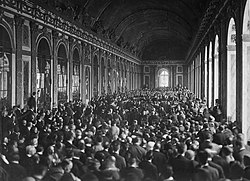
The Paris Peace Conference convened on January 18, 1919, in the aftermath of World War I, with representatives from 27 Allied and associated nations gathering to negotiate the terms of peace with the defeated Central Powers.[26] Although broader participation was intended, decision-making was dominated by the "Big Four": U.S. President Woodrow Wilson, British Prime Minister David Lloyd George, French Prime Minister Georges Clemenceau, and Italian Prime Minister Vittorio Orlando.[27] Wilson advocated for his Fourteen Points, emphasizing open diplomacy, self-determination, free trade, disarmament, and the establishment of a League of Nations to prevent future conflicts, reflecting an idealistic vision for a just peace.[28] In contrast, Clemenceau prioritized French security through punitive measures against Germany, including territorial concessions and military restrictions, while Lloyd George sought a balanced settlement to protect British imperial interests and Orlando pressed for Italian territorial gains promised in secret wartime agreements.[29] These conflicting national interests often overrode Wilsonian principles, leading to compromises that sowed seeds of resentment among the defeated nations. The Treaty of Versailles, signed on June 28, 1919, in the Hall of Mirrors at the Palace of Versailles, imposed the harshest terms on Germany. It included Article 231, the "war guilt clause," holding Germany and its allies responsible for the war's damages, justifying reparations initially set at 132 billion gold marks (later reduced).[29] Germany lost 13% of its territory and 10% of its population, with Alsace-Lorraine returned to France, Eupen-Malmédy to Belgium, the Saar Basin under League administration, and eastern territories ceded to a reconstituted Poland, creating the Polish Corridor that separated East Prussia from the rest of Germany.[30] German colonies became League mandates, and military restrictions limited the army to 100,000 troops, banned conscription, submarines, and an air force, while the Rhineland was demilitarized. Subsequent treaties addressed Austria, Hungary, and Bulgaria. The Treaty of Saint-Germain, signed September 10, 1919, dissolved the Austro-Hungarian Empire, recognizing the independence of Czechoslovakia, Yugoslavia, and Poland, while Austria ceded territories including South Tyrol to Italy, Galicia to Poland, and Bohemia to Czechoslovakia, reducing its size to one-third of its prewar extent and prohibiting union with Germany (Anschluss).[31] The Treaty of Trianon, signed June 4, 1920, stripped Hungary of two-thirds of its territory and over three million Magyars, awarding Transylvania and the Banat to Romania, Slovakia and Ruthenia to Czechoslovakia, and Croatia-Slavonia to Yugoslavia, with military caps at 35,000 troops.[32] The Treaty of Neuilly, signed November 27, 1919, compelled Bulgaria to cede Western Thrace to Greece, Southern Dobruja to Romania, and Macedonian territories to Yugoslavia, limiting its army to 20,000 and imposing 2.25 billion francs in reparations.[33] Wilson's rhetoric of self-determination influenced the creation of new states from the empires' ruins, yet practical border adjustments prioritized Allied strategic interests and ethnic majorities, often leaving substantial minorities trapped within new nations—such as three million Germans in Czechoslovakia and Hungary or Hungarians in Romania—without plebiscites in many cases.[30] This discrepancy between proclaimed ideals and territorial realities fostered irredentist grievances, as ethnic groups sought unification with kin states, undermining the settlements' stability from inception.[29]Treaty of Versailles: Terms, Reparations, and Immediate Reactions
The Treaty of Versailles was signed on June 28, 1919, in the Hall of Mirrors at the Palace of Versailles, imposing severe penalties on Germany as the primary defeated power in World War I.[34] German delegates accepted the terms under duress, facing Allied ultimatums that threatened resumption of hostilities and potential invasion if ratification was refused.[34] This coercive process exemplified victors' justice, where terms were dictated without genuine negotiation, prioritizing Allied security over balanced reconciliation and sowing seeds of long-term instability through enforced humiliation. Central to the treaty was Article 231, the war guilt clause, which compelled Germany to acknowledge sole responsibility for initiating the conflict and all associated losses and damages inflicted on Allied nations.[35] This provision justified extensive territorial concessions, including the return of Alsace-Lorraine to France, cession of Eupen-Malmedy to Belgium, creation of the Polish Corridor and Danzig as a free city under League of Nations oversight, and redistribution of German colonies as Allied mandates. Military restrictions further emasculated Germany's defenses: the army was capped at 100,000 volunteers with no conscription allowed, prohibitions on tanks, heavy artillery, submarines, and an [air force](/page/air force) were enacted, and the navy was limited to six pre-dreadnought battleships and a handful of smaller vessels.[36] These clauses, from a causal standpoint, dismantled Germany's capacity for self-defense while leaving its industrial heartland intact, creating an imbalance that incentivized covert rearmament and bred perceptions of unfair vulnerability. Reparations emerged as a flashpoint, with the initial Allied demand set at 132 billion gold marks (equivalent to about $442 billion in 2023 dollars) to compensate for civilian damages, though the exact figure remained subject to ongoing commissions.[37] Payment schedules proved untenable, triggering economic distress including the 1923 hyperinflation crisis after French-Belgian occupation of the Ruhr to enforce compliance.[38] The Dawes Plan of 1924 restructured obligations, initiating payments at 1 billion Reichsmarks annually and scaling to 2.5 billion after five years, bolstered by American loans to stabilize German finances temporarily.[39] The subsequent Young Plan in 1929 further adjusted the total to approximately 112 billion Reichsmarks including interest, payable until 1988, yet these palliatives failed to address underlying fiscal strains rooted in the treaty's punitive framework.[40] Immediate German reactions were marked by profound resentment, with the treaty dubbed a "Diktat" for its imposition without input, eroding the Weimar Republic's legitimacy as the government that acquiesced. Right-wing nationalists decried the terms as a national betrayal, fueling revanchist fervor exemplified by the Kapp Putsch of March 1920, an attempted coup by monarchist and military elements opposed to disarmament and reparations fulfillment, which briefly seized Berlin before collapsing due to general strikes.[41] Empirical evidence of non-ratification risks materialized in Allied blockade continuations and troop advancements, underscoring how rejection would have invited territorial occupation and economic ruin beyond the treaty's stipulations.[34] Among Allied powers, figures like British economist John Maynard Keynes warned in 1919 that the economic burdens would destabilize Europe, predicting resentment and upheaval, though French demands for security prevailed. Overall, the treaty's asymmetry—exacting concessions without mutual disarmament—causally linked to Weimar's fragility, as public outrage transcended ideologies, uniting disparate factions against perceived injustice.Minorities Treaties, Mandates, and League of Nations Formation
The Covenant of the League of Nations, drafted primarily by U.S. President Woodrow Wilson, formed Part I of the Treaty of Versailles and was signed on June 28, 1919, entering into force on January 10, 1920, after ratification by major powers including Britain, France, Italy, and Japan.[42][43] The League aimed to prevent future wars through collective security, disarmament, and dispute resolution, but its structure relied on unanimous Council decisions and voluntary member compliance, lacking independent enforcement mechanisms or military force, which critics identified as inherent weaknesses from inception.[43] The United States, despite Wilson's advocacy, never joined due to Senate rejection on March 19, 1920, driven by isolationist concerns over Article 10's potential commitment to defend other nations' territorial integrity, entangling America in European conflicts without congressional approval.[43] Article 22 of the Covenant established the mandates system to administer former German and Ottoman territories deemed unprepared for immediate independence, classifying them into A (provisionally independent ex-Ottoman lands like British-mandated Palestine and Iraq, and French-mandated Syria and Lebanon), B (equatorial African territories under stricter supervision), and C (remote Pacific and other colonies incorporated into mandatories' territories, such as Japan's Pacific islands).[43] Mandatories, overseen by the League's Permanent Mandates Commission, were obligated to promote self-governance and suppress slavery or arms traffic, but in practice, powers like Britain and France treated mandates as de facto colonies, prioritizing strategic interests over tutelage, with limited League oversight revealing enforcement gaps as early as the 1920s.[43] Complementing the peace treaties, Minorities Treaties were imposed on successor states emerging from the Austro-Hungarian and Ottoman Empires to protect ethnic, religious, and linguistic minorities, starting with Poland's treaty on June 28, 1919, which guaranteed equal citizenship, free practice of religion, and access to schools in minority languages, serving as a model for Czechoslovakia, Yugoslavia, Romania, and others ratified by 1920-1922.[44] These treaties placed obligations under League guarantee, allowing petitions to the Council, but enforcement proved illusory: states viewed them as temporary impositions on sovereignty, often ignoring rulings or obstructing investigations, as seen in Polish restrictions on Jewish rights and Czechoslovak discrimination against Germans, with the League resolving only about 40% of petitions effectively due to procedural delays and reluctance to impose sanctions.[45] One early success was the 1921 Åland Islands resolution, where the League Council upheld Finnish sovereignty over the Swedish-speaking archipelago but mandated cultural autonomy, demilitarization, and Swedish-language protections, averting conflict through binding arbitration accepted by both parties.[46] However, exclusions underscored structural flaws: the Soviet Union, ideologically opposed and territorially aggressive, was barred until its 1934 admission amid European fears of German remilitarization, by which time the League's idealistic framework had already faltered against rising nationalism.[47] These mechanisms, while innovative in codifying minority rights and colonial transitions, depended on great-power consensus absent U.S. participation, enabling early circumventions that eroded credibility.[43]Economic Developments
Postwar Recovery and the Boom of the 1920s
Following the sharp postwar recession of 1920-1921, major economies experienced a rebound characterized by industrial expansion and credit-fueled growth, particularly in the United States and Western Europe. The U.S. economy expanded vigorously, with real GNP growing at an average annual rate of about 4.2% from 1920 to 1929, driven by advancements in manufacturing and electrification.[48] Innovations such as assembly-line production enabled mass output of consumer durables, boosting productivity across sectors.[48] American capital flows played a pivotal role in Europe's recovery, with U.S. banks extending over $10 billion in loans during and immediately after World War I to Allied nations, followed by targeted lending in the 1920s.[49] The Dawes Plan of 1924 restructured German reparations, reducing annual payments initially to 1 billion gold marks and securing a $200 million loan from U.S. investors to stabilize the Reichsbank, which facilitated currency reform via the Rentenmark backed by mortgages and industrial assets.[50] Under Foreign Minister Gustav Stresemann from 1923 to 1929, these measures ended hyperinflation, restored fiscal discipline, and spurred industrial output, with German coal production rising from 1923 lows to exceed prewar levels by 1927.[51] Economic indicators reflected widespread prosperity in the West: U.S. automobile registrations surged from 8 million in 1920 to 23 million by 1929, while radio ownership in households climbed from negligible to over 40% by decade's end.[52] The Dow Jones Industrial Average tripled between 1923 and 1929, fueled by margin lending and investor optimism.[5] Global merchandise trade volumes recovered from wartime disruptions, reaching a peak in 1929 as European exports to the U.S. and within the continent expanded.[53] Recovery proved uneven, with Eastern Europe lagging due to severe wartime destruction, fragmented landholdings, and reliance on agriculture amid falling commodity prices. In Poland and the Baltic states, hyperinflation persisted into the mid-1920s, and industrialization trailed Western levels, with telephony adoption rates in Central and Eastern Europe increasing far slower than in the core economies.[54] Agricultural sectors globally faced slumps, as post-1920 price declines—wheat dropping over 50% from 1920 peaks—strained rural economies dependent on exports.[48] Beneath the surface, fragilities emerged from speculative excesses, including real estate booms in urban centers and overextended credit in stock markets, where borrowing amplified leverage.[55] Farm land values in the U.S. Midwest inflated during wartime demand but deflated sharply by 1921, leaving debt burdens that persisted through the decade.[56] These imbalances highlighted the boom's reliance on short-term financing rather than structural reforms.[57]Causes, Spread, and Depth of the Great Depression
![Crowds gathering outside New York Stock Exchange.jpg][float-right] The Wall Street Crash of 1929, initiating the Great Depression, commenced on October 24 ("Black Thursday") and intensified on October 29 ("Black Tuesday"), when the Dow Jones Industrial Average plummeted 23% over two days amid panic selling driven by excessive speculation and margin debt exceeding $8.5 billion.[5] The Federal Reserve's monetary tightening—raising discount rates to 6% in 1928 to curb stock speculation—contributed by restricting credit availability, fostering an unsustainable asset bubble without addressing underlying imbalances like agricultural overproduction and uneven income distribution.[58] Post-crash, the Fed's failure to expand the money supply exacerbated bank runs and liquidity shortages, leading to a 33% contraction in the U.S. money stock by 1933.[59] The Depression propagated globally through the gold standard's rigid constraints, which linked national money supplies to gold reserves and transmitted U.S. deflationary pressures abroad.[60] As gold flowed into the U.S. due to higher interest rates and safe-haven demand, deficit countries like Germany and Austria faced reserve drains, compelling central banks to hike rates or devalue, which deepened credit contractions and banking crises—over 40,000 European banks failed between 1929 and 1933.[61] Inter-Allied war debts, totaling $22 billion owed by Europe to the U.S. and Britain, compounded transmission as debtor nations struggled with export-dependent repayments amid falling commodity prices, creating a vicious cycle of default risks and reduced lending.[62] The Smoot-Hawley Tariff Act, signed June 17, 1930, raised U.S. import duties by an average 20%, prompting retaliatory tariffs from trading partners and slashing global trade volume by two-thirds from 1929 to 1934.[63] This protectionism amplified contraction by disrupting export markets critical for raw material producers, while domestic industries faced higher input costs, further stifling investment. In the U.S., real GDP declined 30% from 1929 to 1933, industrial production halved, and unemployment peaked at 25% (affecting 15 million workers), with deflation averaging 10% annually eroding asset values and elevating real debt burdens in a deflationary spiral.[64] Europe experienced sharper relative distress in vulnerable economies: Germany's GDP fell 25%, unemployment reached 30%, and widespread deflation intensified sovereign debt crises, as fixed gold parities prevented monetary easing and perpetuated output gaps.[65] ![Unemployed men queued outside a depression soup kitchen opened in Chicago by Al Capone, 02-1931 - NARA -541927.jpg][center]National Responses, Protectionism, and Uneven Recovery
Following the 1929 stock market crash, governments increasingly pursued unilateral national policies amid failed international coordination efforts, such as the 1930 London Conference on reparations and war debts, which yielded no substantive agreements.[8] Initial responses emphasized balanced budgets and voluntarism, exemplified by U.S. President Herbert Hoover's appeals to businesses for wage maintenance and charity, but these proved insufficient against contracting demand.[66] Protectionist measures proliferated, with the U.S. Smoot-Hawley Tariff Act of June 1930 raising average duties on dutiable imports to nearly 60%, prompting retaliatory tariffs from Canada, Europe, and others, which contributed to a 66% collapse in global trade volume between 1929 and 1934.[8] [67] Monetary policy divergences further accentuated uneven outcomes, as adherence to the gold standard constrained expansionary measures by enforcing deflationary adjustments. Countries abandoning the gold standard, starting with Britain in September 1931, enabled currency devaluation and monetary easing, correlating with faster recoveries; empirical analysis across 27 countries confirms that earlier exits facilitated output rebounds by allowing credit expansion without gold outflows.[66] [68] France and Belgium, clinging to gold until 1936, experienced prolonged stagnation with GDP declines exceeding 15% and unemployment above 10% into the mid-1930s.[69] In contrast, the British Ottawa Agreements of 1932 established imperial preference systems, reducing tariffs within the Commonwealth by 10-20% on key goods like wheat and wool, redirecting trade inward and supporting a UK GDP recovery to 1929 levels by 1934, though primary price rebounds also contributed.[67] [70] Fiscal responses varied between austerity and proto-Keynesian deficit spending, with outcomes favoring the latter despite theoretical debates. Austerity in gold-standard adherents amplified contractions via multiplier effects, where spending cuts reduced aggregate demand by 1.5-2 times the initial fiscal impulse.[71] Public works and devaluation in Sweden and the UK yielded GDP growth of 5-7% annually post-1932, prefiguring Keynesian advocacy for countercyclical policy.[72] Authoritarian regimes achieved sharper rebounds through autarkic controls and rearmament: Germany's 1933 policies under Hjalmar Schacht and later the Four-Year Plan imposed wage freezes, import quotas, and deficit-financed infrastructure, doubling industrial production and restoring 1929 GDP by 1936, with unemployment falling from 30% to near zero by 1938—efficiencies enabled by suppressed labor rights and directed credit, though mainstream economic histories, often from democratic perspectives, underemphasize these short-term causal mechanisms relative to long-term distortions.[73] [74] Italy's corporatist autarky similarly prioritized self-sufficiency, stabilizing lira via the 1936 Battle for Grain, but with slower growth than Germany's due to agrarian inefficiencies.[75] Recovery remained uneven, as protectionism's domestic protections—boosting sectors like U.S. manufacturing output by 20% in shielded industries—came at the cost of export-dependent economies, while managed economies shifted toward state oversight, foreshadowing postwar interventions.[76]| Country/Regime | Year GDP Returned to 1929 Level | Key Policies Contributing to Recovery |
|---|---|---|
| United Kingdom | 1934 | Gold abandonment (1931), imperial preference (1932), cheap money |
| Germany | 1936 | Autarky, rearmament deficit spending (1933-36), labor conscription |
| United States | 1937 | Devaluation (1933), public works; recession in 1937 delayed full rebound |
| France | 1938 | Late gold exit (1936), limited fiscal stimulus |