


Community hub
Recent from talks
Contribute something
Nothing was collected or created yet.
Noam Chomsky
View on Wikipedia
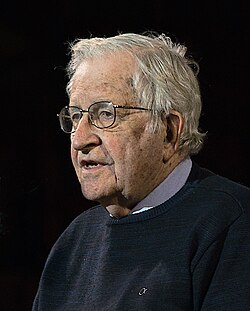
Avram Noam Chomsky[a] (born December 7, 1928) is an American professor and public intellectual known for his work in linguistics, political activism, and social criticism. Sometimes called "the father of modern linguistics",[b] Chomsky is also a major figure in analytic philosophy and one of the founders of the field of cognitive science. He is a laureate professor of linguistics at the University of Arizona and an institute professor emeritus at the Massachusetts Institute of Technology (MIT). Among the most cited living authors, Chomsky has written more than 150 books on topics such as linguistics, war, and politics. In addition to his work in linguistics, since the 1960s Chomsky has been an influential voice on the American left as a consistent critic of U.S. foreign policy, contemporary capitalism, and corporate influence on political institutions and the media.
Key Information


Born to Ashkenazi Jewish immigrants in Philadelphia, Chomsky developed an early interest in anarchism from alternative bookstores in New York City. He studied at the University of Pennsylvania. During his postgraduate work in the Harvard Society of Fellows, Chomsky developed the theory of transformational grammar for which he earned his doctorate in 1955. That year he began teaching at MIT, and in 1957 emerged as a significant figure in linguistics with his landmark work Syntactic Structures, which played a major role in remodeling the study of language. From 1958 to 1959 Chomsky was a National Science Foundation fellow at the Institute for Advanced Study. He created or co-created the universal grammar theory, the generative grammar theory, the Chomsky hierarchy, and the minimalist program. Chomsky also played a pivotal role in the decline of linguistic behaviorism, and was particularly critical of the work of B. F. Skinner.
An outspoken opponent of U.S. involvement in the Vietnam War, which he saw as an act of American imperialism, in 1967 Chomsky rose to national attention for his anti-war essay "The Responsibility of Intellectuals". Becoming associated with the New Left, he was arrested multiple times for his activism and placed on President Richard Nixon's list of political opponents. While expanding his work in linguistics over subsequent decades, he also became involved in the linguistics wars. In collaboration with Edward S. Herman, Chomsky later articulated the propaganda model of media criticism in Manufacturing Consent, and worked to expose the Indonesian occupation of East Timor. His defense of unconditional freedom of speech, including that of Holocaust denial, generated significant controversy in the Faurisson affair of the 1980s. Chomsky's commentary on the Cambodian genocide and the Bosnian genocide also generated controversy. Since retiring from active teaching at MIT, he has continued his vocal political activism, including opposing the 2003 invasion of Iraq and supporting the Occupy movement. An anti-Zionist, Chomsky considers Israel's treatment of Palestinians to be worse than South African–style apartheid,[19] and criticizes U.S. support for Israel.
Chomsky is widely recognized as having helped to spark the cognitive revolution in the human sciences, contributing to the development of a new cognitivistic framework for the study of language and the mind. Chomsky remains a leading critic of U.S. foreign policy, contemporary capitalism, U.S. involvement and Israel's role in the Israeli–Palestinian conflict, and mass media. Chomsky and his ideas remain highly influential in the anti-capitalist and anti-imperialist movements.
Life
[edit]Childhood: 1928–1945
[edit]Chomsky was born on December 7, 1928, in the East Oak Lane neighborhood of Philadelphia, Pennsylvania.[20] His parents, William Chomsky and Elsie Simonofsky, were Jewish immigrants.[21] William had fled the Russian Empire in 1913 to escape conscription and worked in Baltimore sweatshops and Hebrew elementary schools before attending university.[22] After moving to Philadelphia, William became principal of the Congregation Mikveh Israel religious school and joined the Gratz College faculty. He placed great emphasis on educating people so that they would be "well integrated, free and independent in their thinking, concerned about improving and enhancing the world, and eager to participate in making life more meaningful and worthwhile for all", a mission that shaped and was subsequently adopted by his son.[23] Elsie, who also taught at Mikveh Israel, shared her leftist politics and care for social issues with her sons.[23]
Noam's only sibling, David Eli Chomsky (1934–2021), was born five years later, and worked as a cardiologist in Philadelphia.[23][24] The brothers were close, although David was more easygoing, while Noam could be very competitive. They were raised Jewish, being taught Hebrew and regularly involved with discussing the political theories of Zionism; the family was particularly influenced by the Left Zionist writings of Ahad Ha'am.[25] He faced antisemitism as a child, particularly from Philadelphia's Irish and German communities.[26]
Chomsky attended the independent, Deweyite Oak Lane Country Day School[27] and Philadelphia's Central High School, where he excelled academically and joined various clubs and societies, but was troubled by the school's hierarchical and domineering teaching methods.[28] He also attended Hebrew High School at Gratz College, where his father taught.[29]
Chomsky has described his parents as "normal Roosevelt Democrats" with center-left politics, but relatives involved in the International Ladies' Garment Workers' Union exposed him to socialism and far-left politics.[30] He was substantially influenced by his uncle and the Jewish leftists who frequented his New York City newspaper stand to debate current affairs.[31] Chomsky himself often visited left-wing and anarchist bookstores when visiting his uncle in the city, voraciously reading political literature.[32] He became absorbed in the story of the 1939 fall of Barcelona and suppression of the Spanish anarchosyndicalist movement, writing his first article on the topic at the age of 10.[33] That he came to identify with anarchism first rather than another leftist movement, he described as a "lucky accident".[34] Chomsky was firmly anti-Bolshevik by his early teens.[35]
University: 1945–1955
[edit]In 1945, at the age of 16, Chomsky began a general program of study at the University of Pennsylvania, where he explored philosophy, logic, and languages and developed a primary interest in learning Arabic.[36] Living at home, he funded his undergraduate degree by teaching Hebrew.[37] Frustrated with his experiences at the university, he considered dropping out and moving to a kibbutz in Mandatory Palestine,[38] but his intellectual curiosity was reawakened through conversations with the linguist Zellig Harris, whom he first met in a political circle in 1947. Harris introduced Chomsky to the field of theoretical linguistics and convinced him to major in the subject.[39] Chomsky's BA honors thesis, "Morphophonemics of Modern Hebrew", applied Harris's methods to the language.[40] Chomsky revised this thesis for his MA, which he received from the University of Pennsylvania in 1951; it was subsequently published as a book.[41] He also developed his interest in philosophy while at university, in particular under the tutelage of Nelson Goodman.[42]
From 1951 to 1955, Chomsky was a member of the Society of Fellows at Harvard University, where he undertook research on what became his doctoral dissertation.[43] Having been encouraged by Goodman to apply,[44] Chomsky was attracted to Harvard in part because the philosopher Willard Van Orman Quine was based there. Both Quine and a visiting philosopher, J. L. Austin of the University of Oxford, strongly influenced Chomsky.[45] In 1952, Chomsky published his first academic article in The Journal of Symbolic Logic.[44] Highly critical of the established behaviorist currents in linguistics, in 1954, he presented his ideas at lectures at the University of Chicago and Yale University.[46] He had not been registered as a student at Pennsylvania for four years, but in 1955 he submitted a thesis setting out his ideas on transformational grammar; he was awarded a Doctor of Philosophy degree for it, and it was privately distributed among specialists on microfilm before being published in 1975 as part of The Logical Structure of Linguistic Theory.[47] Harvard professor George Armitage Miller was impressed by Chomsky's thesis and collaborated with him on several technical papers in mathematical linguistics.[48] Chomsky's doctorate exempted him from compulsory military service, which was otherwise due to begin in 1955.[49]
In 1947, Chomsky began a romantic relationship with Carol Doris Schatz, whom he had known since early childhood. They married in 1949.[50] After Chomsky was made a Fellow at Harvard, the couple moved to the Allston area of Boston and remained there until 1965, when they relocated to the suburb of Lexington.[51] The couple took a Harvard travel grant to Europe in 1953.[52] He enjoyed living in Hashomer Hatzair's HaZore'a kibbutz while in Israel, but was appalled by his interactions with Jewish nationalism, anti-Arab racism and, within the kibbutz's leftist community, Stalinism.[53] On visits to New York City, Chomsky continued to frequent the office of the Yiddish anarchist journal Fraye Arbeter Shtime and became enamored with the ideas of Rudolf Rocker, a contributor whose work introduced Chomsky to the link between anarchism and classical liberalism.[54] Chomsky also read other political thinkers: the anarchists Mikhail Bakunin and Diego Abad de Santillán, democratic socialists George Orwell, Bertrand Russell, and Dwight Macdonald, and works by Marxists Karl Liebknecht, Karl Korsch, and Rosa Luxemburg.[55] His politics were reaffirmed by Orwell's depiction of Barcelona's functioning anarchist society in Homage to Catalonia (1938).[56] Chomsky read the leftist journal Politics, which furthered his interest in anarchism,[57] and the council communist periodical Living Marxism, though he rejected the Marxist orthodoxy of its editor, Paul Mattick.[58]
Early career: 1955–1966
[edit]Chomsky befriended two linguists at the Massachusetts Institute of Technology (MIT)—Morris Halle and Roman Jakobson—the latter of whom secured him an assistant professor position there in 1955. At MIT, Chomsky spent half his time on a mechanical translation project and half teaching a course on linguistics and philosophy.[59] He described MIT as open to experimentation where he was free to pursue his idiosyncratic interests.[60] MIT promoted him to the position of associate professor in 1957, and over the next year he was also a visiting professor at Columbia University.[61] The Chomskys had their first child, Aviva, that same year.[62] He also published his first book on linguistics, Syntactic Structures, a work that radically opposed the dominant Harris–Bloomfield trend in the field.[63] Responses to Chomsky's ideas ranged from indifference to hostility, and his work proved divisive and caused "significant upheaval" in the discipline.[64] The linguist John Lyons later asserted that Syntactic Structures "revolutionized the scientific study of language".[65] From 1958 to 1959 Chomsky was a National Science Foundation fellow at the Institute for Advanced Study in Princeton, New Jersey.[66]

.jpg)
Chomsky's provocative critique of B. F. Skinner, who viewed language as entirely learned behavior, and that critique's challenge to the dominant behaviorist paradigm thrust Chomsky into the limelight. Chomsky argued that behaviorism underplayed the role of human creativity in learning language and overplayed the role of external conditions in influencing verbal behavior.[67] He proceeded to found MIT's graduate program in linguistics with Halle. In 1961, Chomsky received tenure and became a full professor in the Department of Modern Languages and Linguistics.[68] He was appointed plenary speaker at the Ninth International Congress of Linguists, held in 1962 in Cambridge, Massachusetts, which established him as the de facto spokesperson of American linguistics.[69] Between 1963 and 1965 he consulted on a military-sponsored project to teach computers to understand natural English commands from military generals.[70]
Chomsky continued to publish his linguistic ideas throughout the decade, including in Aspects of the Theory of Syntax (1965), Topics in the Theory of Generative Grammar (1966), and Cartesian Linguistics: A Chapter in the History of Rationalist Thought (1966).[71] Along with Halle, he also edited the Studies in Language series of books for Harper and Row.[72] As he began to accrue significant academic recognition and honors for his work, Chomsky lectured at the University of California, Berkeley, in 1966.[73] These lectures were published as Language and Mind in 1968.[74] In the late 1960s, a high-profile intellectual rift later known as the linguistic wars developed between Chomsky and some of his colleagues and doctoral students—including Paul Postal, John Ross, George Lakoff, and James D. McCawley—who contended that Chomsky's syntax-based, interpretivist linguistics did not properly account for semantic context (general semantics). A post hoc assessment of this period concluded that the opposing programs ultimately were complementary, each informing the other.[75]
Anti-war activism and dissent: 1967–1975
[edit][I]t does not require very far-reaching, specialized knowledge to perceive that the United States was invading South Vietnam. And, in fact, to take apart the system of illusions and deception which functions to prevent understanding of contemporary reality [is] not a task that requires extraordinary skill or understanding. It requires the kind of normal skepticism and willingness to apply one's analytical skills that almost all people have and that they can exercise.
Chomsky joined protests against U.S. involvement in the Vietnam War in 1962, speaking on the subject at small gatherings in churches and homes.[77] His 1967 critique of U.S. involvement, "The Responsibility of Intellectuals", among other contributions to The New York Review of Books, debuted Chomsky as a public dissident.[78] This essay and other political articles were collected and published in 1969 as part of Chomsky's first political book, American Power and the New Mandarins.[79] He followed this with further political books, including At War with Asia (1970), The Backroom Boys (1973), For Reasons of State (1973), and Peace in the Middle East? (1974), published by Pantheon Books.[80] These publications led to Chomsky's association with the American New Left movement,[81] though he thought little of prominent New Left intellectuals Herbert Marcuse and Erich Fromm and preferred the company of activists to that of intellectuals.[82] Chomsky remained largely ignored by the mainstream press throughout this period.[83]

Chomsky also became involved in left-wing activism. Chomsky refused to pay half his taxes, publicly supported students who refused the draft, and was arrested while participating in an anti-war teach-in outside the Pentagon.[84] During this time, Chomsky co-founded the anti-war collective RESIST with Hans Koning, Mitchell Goodman, Denise Levertov, William Sloane Coffin, and Dwight Macdonald.[85] Although he questioned the objectives of the 1968 student protests,[86] Chomsky regularly gave lectures to student activist groups and, with his colleague Louis Kampf, ran undergraduate courses on politics at MIT independently of the conservative-dominated political science department.[87] When student activists campaigned to stop weapons and counterinsurgency research at MIT, Chomsky was sympathetic but felt that the research should remain under MIT's oversight and limited to systems of deterrence and defense.[88] Chomsky has acknowledged that his MIT lab's funding at this time came from the military.[89] He later said he considered resigning from MIT during the Vietnam War.[90] There has since been a wide-ranging debate about what effects Chomsky's employment at MIT had on his political and linguistic ideas.[91]
| External images | |
|---|---|
| Chomsky participating in the anti-Vietnam War March on the Pentagon, October 21, 1967 | |
 Chomsky with other public figures Chomsky with other public figures | |
| The protesters passing the Lincoln Memorial en route to the Pentagon |
Chomsky's anti-war activism led to his arrest on multiple occasions and he was on President Richard Nixon's master list of political opponents.[92] Chomsky was aware of the potential repercussions of his civil disobedience, and his wife began studying for her own doctorate in linguistics to support the family in the event of Chomsky's imprisonment or joblessness.[93] Chomsky's scientific reputation insulated him from administrative action based on his beliefs.[94] In 1970 he visited southeast Asia to lecture at Vietnam's Hanoi University of Science and Technology and toured war refugee camps in Laos. In 1973 he helped lead a committee commemorating the 50th anniversary of the War Resisters League.[95]
Chomsky's work in linguistics continued to gain international recognition as he received multiple honorary doctorates.[96] He delivered public lectures at the University of Cambridge, Columbia University (Woodbridge Lectures), and Stanford University.[97] His appearance in a 1971 debate with French continental philosopher Michel Foucault positioned Chomsky as a symbolic figurehead of analytic philosophy.[98] He continued to publish extensively on linguistics, producing Studies on Semantics in Generative Grammar (1972),[94] an enlarged edition of Language and Mind (1972),[99] and Reflections on Language (1975).[99] In 1974 Chomsky became a corresponding fellow of the British Academy.[97]
Edward S. Herman and the Faurisson affair: 1976–1980
[edit].jpg)
In the late 1970s and 1980s, Chomsky's linguistic publications expanded and clarified his earlier work, addressing his critics and updating his grammatical theory.[100] His political talks often generated considerable controversy, particularly when he criticized the Israeli government and military.[101] In the early 1970s Chomsky began collaborating with Edward S. Herman, who had also published critiques of the U.S. war in Vietnam.[102] Together they wrote Counter-Revolutionary Violence: Bloodbaths in Fact & Propaganda, a book that criticized U.S. military involvement in Southeast Asia and the mainstream media's failure to cover it. Warner Modular published it in 1973, but its parent company disapproved of the book's contents and ordered all copies destroyed.[103]
While mainstream publishing options proved elusive, Chomsky found support from Michael Albert's South End Press, an activist-oriented publishing company.[104] In 1979, South End published Chomsky and Herman's revised Counter-Revolutionary Violence as the two-volume The Political Economy of Human Rights,[105] which compares U.S. media reactions to the Cambodian genocide and the Indonesian occupation of East Timor. It argues that because Indonesia was a U.S. ally, U.S. media ignored the East Timorese situation while focusing on events in Cambodia, a U.S. enemy.[106] Chomsky's response included two testimonials before the United Nations' Special Committee on Decolonization, successful encouragement for American media to cover the occupation, and meetings with refugees in Lisbon.[107] Marxist academic Steven Lukes most prominently publicly accused Chomsky of betraying his anarchist ideals and acting as an apologist for Cambodian leader Pol Pot.[108] Herman said that the controversy "imposed a serious personal cost" on Chomsky,[109] who considered the personal criticism less important than the evidence that "mainstream intelligentsia suppressed or justified the crimes of their own states".[110]
Chomsky had long publicly criticized Nazism, and totalitarianism more generally, but his commitment to freedom of speech led him to defend the right of French historian Robert Faurisson to advocate a position widely characterized as Holocaust denial. Without Chomsky's knowledge, his plea for Faurisson's freedom of speech was published as the preface to the latter's 1980 book Mémoire en défense contre ceux qui m'accusent de falsifier l'histoire.[111] Chomsky was widely condemned for defending Faurisson,[112] and France's mainstream press accused Chomsky of being a Holocaust denier himself, refusing to publish his rebuttals to their accusations.[113] Critiquing Chomsky's position, sociologist Werner Cohn later published an analysis of the affair titled Partners in Hate: Noam Chomsky and the Holocaust Deniers.[114] The Faurisson affair had a lasting, damaging effect on Chomsky's career,[115] especially in France.[116]
Critique of propaganda and international affairs
[edit]| External videos | |
|---|---|
 Manufacturing Consent: Noam Chomsky and the Media, a 1992 documentary exploring Chomsky's work of the same name and its impact Manufacturing Consent: Noam Chomsky and the Media, a 1992 documentary exploring Chomsky's work of the same name and its impact |
In 1985, during the Nicaraguan Contra War—in which the U.S. supported the contra militia against the Sandinista government—Chomsky traveled to Managua to meet with workers' organizations and refugees of the conflict, giving public lectures on politics and linguistics.[117] Many of these lectures were published in 1987 as On Power and Ideology: The Managua Lectures.[118] In 1983 he published The Fateful Triangle, which argued that the U.S. had continually used the Israeli–Palestinian conflict for its own ends.[119] In 1988, Chomsky visited the Palestinian territories to witness the impact of Israeli occupation.[120]
Chomsky and Herman's Manufacturing Consent: The Political Economy of the Mass Media (1988) outlines their propaganda model for understanding mainstream media. Even in countries without official censorship, they argued, the news is censored through five filters that greatly influence both what and how news is presented.[121] The book received a 1992 film adaptation.[122] In 1989, Chomsky published Necessary Illusions: Thought Control in Democratic Societies, in which he suggests that a worthwhile democracy requires that its citizens undertake intellectual self-defense against the media and elite intellectual culture that seeks to control them.[123] By the 1980s, Chomsky's students had become prominent linguists who, in turn, expanded and revised his linguistic theories.[124]

In the 1990s, Chomsky embraced political activism to a greater degree than before.[125] Retaining his commitment to the cause of East Timorese independence, in 1995 he visited Australia to talk on the issue at the behest of the East Timorese Relief Association and the National Council for East Timorese Resistance.[126] The lectures he gave on the subject were published as Powers and Prospects in 1996.[126] As a result of the international publicity Chomsky generated, his biographer Wolfgang Sperlich opined that he did more to aid the cause of East Timorese independence than anyone but the investigative journalist John Pilger.[127] After East Timor attained independence from Indonesia in 1999, the Australian-led International Force for East Timor arrived as a peacekeeping force; Chomsky was critical of this, believing it was designed to secure Australian access to East Timor's oil and gas reserves under the Timor Gap Treaty.[128]
Chomsky was widely interviewed after the September 11 attacks in 2001 as the American public attempted to make sense of the attacks.[129] He argued that the ensuing War on Terror was not a new development but a continuation of U.S. foreign policy and concomitant rhetoric since at least the Reagan era.[130] He gave the D.T. Lakdawala Memorial Lecture in New Delhi in 2001,[131] and in 2003 visited Cuba at the invitation of the Latin American Association of Social Scientists.[132] Chomsky's 2003 Hegemony or Survival articulated what he called the United States' "imperial grand strategy" and critiqued the Iraq War and other aspects of the War on Terror.[133] Chomsky toured internationally with greater regularity during this period.[132]
Retirement
[edit]Chomsky retired from MIT in 2002,[134] but continued to conduct research and seminars on campus as an emeritus.[135] That same year he visited Turkey to attend the trial of a publisher who had been accused of treason for printing one of Chomsky's books; Chomsky insisted on being a co-defendant and amid international media attention, the Security Courts dropped the charge on the first day.[136] During that trip Chomsky visited Kurdish areas of Turkey and spoke out in favor of the Kurds' human rights.[136] A supporter of the World Social Forum, he attended its conferences in Brazil in both 2002 and 2003, also attending the Forum event in India.[137]
Chomsky supported the 2011 Occupy movement, speaking at encampments and publishing on the movement, which he called a reaction to a 30-year class war.[138] The 2015 documentary Requiem for the American Dream summarizes his views on capitalism and economic inequality through a "75-minute teach-in".[139]
In 2015, Chomsky and his wife purchased a residence in São Paulo, Brazil, and began splitting their time between Brazil and the U.S.[140] Chomsky taught a short-term politics course at the University of Arizona in 2017.[141] He was later hired as the Agnese Nelms Haury Chair in the Agnese Nelms Haury Program in Environment and Social Justice, a part-time professorship in the linguistics department with duties including teaching and public seminars.[142] His salary was covered by philanthropic donations.[143] After a stroke in June 2023, Chomsky moved to Brazil full-time.[140]
Linguistic theory
[edit]What started as purely linguistic research ... has led, through involvement in political causes and an identification with an older philosophic tradition, to no less than an attempt to formulate an overall theory of man. The roots of this are manifest in the linguistic theory ... The discovery of cognitive structures common to the human race but only to humans (species specific), leads quite easily to thinking of unalienable human attributes.
The basis of Chomsky's linguistic theory lies in biolinguistics, the linguistic school that holds that the principles underpinning the structure of language are biologically preset in the human mind and hence genetically inherited.[145] He argues that all humans share the same underlying linguistic structure, irrespective of sociocultural differences.[146] In adopting this position Chomsky rejects the radical behaviorist psychology of B. F. Skinner, who viewed speech, thought, and all behavior as a completely learned product of the interactions between organisms and their environments. Accordingly, Chomsky argues that language is a unique evolutionary development of the human species and distinguished from modes of communication used by any other animal species.[147][148] Chomsky argues that his nativist, internalist view of language is consistent with the philosophical school of "rationalism" and contrasts with the anti-nativist, externalist view of language consistent with the philosophical school of "empiricism",[149] which contends that all knowledge, including language, comes from external stimuli.[144] Historians have disputed Chomsky's claim about rationalism on the basis that his theory of innate grammar excludes propositional knowledge and instead focuses on innate learning capacities or structures.[150]
Universal grammar
[edit]Since the 1960s, Chomsky has maintained that syntactic knowledge is partially inborn, implying that children need only learn certain language-specific features of their native languages. He bases his argument on observations about human language acquisition and describes a "poverty of the stimulus": an enormous gap between the linguistic stimuli to which children are exposed and the rich linguistic competence they attain. For example, although children are exposed to only a very small and finite subset of the allowable syntactic variants within their first language, they somehow acquire the highly organized and systematic ability to understand and produce an infinite number of sentences, including ones that have never before been uttered, in that language.[151] To explain this, Chomsky proposed that the primary linguistic data must be supplemented by an innate linguistic capacity. Furthermore, while a human baby and a kitten are both capable of inductive reasoning, if they are exposed to exactly the same linguistic data, the human will always acquire the ability to understand and produce language, while the kitten will never acquire either ability. Chomsky referred to this difference in capacity as the language acquisition device, and suggested that linguists needed to determine both what that device is and what constraints it imposes on the range of possible human languages. The universal features that result from these constraints would constitute "universal grammar".[152][153][154] Multiple researchers have challenged universal grammar on the grounds of the evolutionary infeasibility of its genetic basis for language,[155] the lack of crosslinguistic surface universals,[156] and the unproven link between innate/universal structures and the structures of specific languages.[157] Michael Tomasello has challenged Chomsky's theory of innate syntactic knowledge as based on theory and not behavioral observation.[158] The empirical basis of poverty of the stimulus arguments has been challenged by Geoffrey Pullum and others, leading to back-and-forth debate in the language acquisition literature.[159][160] Recent work has also suggested that some recurrent neural network architectures can learn hierarchical structure without an explicit constraint.[161]
Generative grammar
[edit]Chomsky is generally credited with launching the research tradition of generative grammar, which aims to explain the cognitive basis of language by formulating and testing explicit models of humans' subconscious grammatical knowledge. Generative grammar proposes models of language consisting of explicit rule systems, which make testable falsifiable predictions. The goal of generative grammar is sometimes described as answering the question "What is that that you know when you know a language?"[162][163]
Within generative grammar, Chomsky's initial model was called transformational grammar. Chomsky developed transformational grammar in the mid-1950s, whereupon it became the dominant syntactic theory in linguistics for two decades.[164] "Transformations" are syntactic rules that derive surface structure from deep structure, which was often considered to reflect the structure of meaning.[144] Transformational grammar later developed into the 1980s government and binding theory and thence into the minimalist program.[164] This research focused on the principles and parameters framework, which explained children's ability to learn any language by filling open parameters (a set of universal grammar principles) that adapt as the child encounters linguistic data.[165] The minimalist program, initiated by Chomsky,[166] asks which minimal principles and parameters theory fits most elegantly, naturally, and simply.[165]

Chomsky is commonly credited with inventing transformational-generative grammar, but his original contribution was considered modest when he first published his theory. In his 1955 dissertation and his 1957 textbook Syntactic Structures, he presented recent developments in the analysis formulated by Zellig Harris, who was Chomsky's PhD supervisor, and by Charles F. Hockett.[c] Their method derives from the work of the structural linguist Louis Hjelmslev, who introduced algorithmic grammar to general linguistics.[d] Based on this rule-based notation of grammars, Chomsky grouped logically possible phrase-structure grammar types into a series of four nested subsets and increasingly complex types, together known as the Chomsky hierarchy. This classification remains relevant to formal language theory[167] and theoretical computer science, especially programming language theory,[168] compiler construction, and automata theory.[169] Chomsky's Syntactic Structures became, beyond generative linguistics as such, a catalyst for connecting what in Hjelmslev's and Jespersen's time was the beginnings of structural linguistics, which has become cognitive linguistics.[170]
Political views
[edit]The second major area to which Chomsky has contributed—and surely the best known in terms of the number of people in his audience and the ease of understanding what he writes and says—is his work on sociopolitical analysis; political, social, and economic history; and critical assessment of current political circumstance. In Chomsky's view, although those in power might—and do—try to obscure their intentions and to defend their actions in ways that make them acceptable to citizens, it is easy for anyone who is willing to be critical and consider the facts to discern what they are up to.
Chomsky is a prominent political dissident.[e] His political views have changed little since his childhood,[172] when he was influenced by the emphasis on political activism that was ingrained in Jewish working-class tradition.[173] He usually identifies as an anarcho-syndicalist or a libertarian socialist.[174] He views these positions not as precise political theories but as ideals that he thinks best meet human needs: liberty, community, and freedom of association.[175] Unlike some other socialists, such as Marxists, Chomsky believes that politics lies outside the remit of science,[176] but he still roots his ideas about an ideal society in empirical data and empirically justified theories.[177]
In Chomsky's view, the truth about political realities is systematically distorted or suppressed by an elite corporatocracy, which uses corporate media, advertising, and think tanks to promote its own propaganda. His work seeks to reveal such manipulations and the truth they obscure.[178] Chomsky believes this web of falsehood can be broken by "common sense", critical thinking, and understanding the roles of self-interest and self-deception,[179] and that intellectuals abdicate their moral responsibility to tell the truth about the world in fear of losing prestige and funding.[180] He argues that, as such an intellectual, it is his duty to use his social privilege, resources, and training to aid popular democracy movements in their struggles.[181]
Although he has participated in direct action demonstrations—joining protests, being arrested, organizing groups—Chomsky's primary political outlet is education, i.e., free public lessons.[182] Chomsky is a longtime member of the Democratic Socialists of America (DSA)[183][184] and a longtime member of the Industrial Workers of the World (IWW) international union,[185] as was his father.[186]
United States foreign policy
[edit]
Chomsky has been a prominent critic of American imperialism,[187] but is not a pacifist, believing World War II was justified as America's last defensive war.[188] He believes that U.S. foreign policy's basic principle is the establishment of "open societies" that are economically and politically controlled by the U.S. and where U.S.-based businesses can prosper.[189] He argues that the U.S. seeks to suppress any movements within these countries that are not compliant with U.S. interests and to ensure that U.S.-friendly governments are placed in power.[180] When discussing current events, he emphasizes their place within a wider historical perspective.[190] He believes that official, sanctioned historical accounts of U.S. and British extraterritorial operations have consistently whitewashed these nations' actions in order to present them as having benevolent motives in either spreading democracy or, in older instances, spreading Christianity; by criticizing these accounts, he seeks to correct them.[191] Prominent examples he regularly cites are the actions of the British Empire in India and Africa and U.S. actions in Vietnam, the Philippines, Latin America, and the Middle East.[191]
Chomsky's political work has centered heavily on criticizing the actions of the United States.[190] He has said he focuses on the U.S. because the country has militarily and economically dominated the world during his lifetime and because its liberal democratic electoral system allows the citizenry to influence government policy.[192] His hope is that, by spreading awareness of the impact U.S. foreign policies have on the populations affected by them, he can sway the populations of the U.S. and other countries into opposing the policies.[191] He urges people to criticize their governments' motivations, decisions, and actions, to accept responsibility for their own thoughts and actions, and to apply the same standards to others as to themselves.[193]
Chomsky has been critical of U.S. involvement in the Israeli–Palestinian conflict, arguing that it has consistently blocked a peaceful settlement.[180] He also criticizes the U.S.'s close ties with Saudi Arabia and involvement in Saudi Arabian-led intervention in Yemen, highlighting that Saudi Arabia has "one of the most grotesque human rights records in the world".[194]
Chomsky called the Russian invasion of Ukraine a criminal act of aggression and noted that Russia was committing major war crimes in the country. He considered support for Ukraine's self-defense legitimate and said Ukraine should be given enough military aid to defend itself, but not enough to cause "an escalation".[195] His criticism of the war focused on the United States.[195] He alleged that the U.S. rejected any compromise with Russia and that this might have provoked the invasion.[195] According to Chomsky, the U.S. was arming Ukraine only to weaken Russia, and Ukrainian requests for heavy weaponry were untrue "Western propaganda", despite Ukraine's President Volodymyr Zelenskyy repeatedly asking for them.[196] More than a year into the invasion, Chomsky argued that Russia was waging the war "more humanely" than the U.S. did the invasion of Iraq.[197]
Capitalism and socialism
[edit]| This article is part of a series on |
| Anarchism in the United States |
|---|
 |


In his youth, Chomsky developed a dislike of capitalism and the pursuit of material wealth.[198] At the same time, he developed a disdain for authoritarian socialism, as represented by the Marxist–Leninist policies of the Soviet Union.[199] Rather than accepting the common view among U.S. economists that a spectrum exists between total state ownership of the economy and total private ownership, he instead suggests that a spectrum should be understood between total democratic control of the economy and total autocratic control (whether state or private).[200] He argues that Western capitalist countries are not really democratic,[201] because, in his view, a truly democratic society is one in which all persons have a say in public economic policy.[202] He has stated his opposition to ruling elites, among them institutions like the IMF, World Bank, and GATT (precursor to the WTO).[203]
Chomsky highlights that, since the 1970s, the U.S. has become increasingly economically unequal as a result of the repeal of various financial regulations and the unilateral rescinding of the Bretton Woods financial control agreement by the U.S.[204] He characterizes the U.S. as a de facto one-party state, viewing both the Republican Party and Democratic Party as manifestations of a single "Business Party" controlled by corporate and financial interests.[205] Chomsky highlights that, within Western capitalist liberal democracies, at least 80% of the population has no control over economic decisions, which are instead in the hands of a management class and ultimately controlled by a small, wealthy elite.[206]
Noting the entrenchment of such an economic system, Chomsky believes that change is possible through the organized cooperation of large numbers of people who understand the problem and know how they want to reorganize the economy more equitably.[206] Acknowledging that corporate domination of media and government stifles any significant change to this system, he sees reason for optimism in historical examples such as the social rejection of slavery as immoral, the advances in women's rights, and the forcing of government to justify invasions.[204] He views violent revolution to overthrow a government as a last resort to be avoided if possible, citing the example of historical revolutions where the population's welfare has worsened as a result of upheaval.[206]
Chomsky sees libertarian socialist and anarcho-syndicalist ideas as the descendants of the classical liberal ideas of the Age of Enlightenment,[207] arguing that his ideological position revolves around "nourishing the libertarian and creative character of the human being".[208] He envisions an anarcho-syndicalist future with direct worker control of the means of production and government by workers' councils, who would select temporary and revocable representatives to meet together at general assemblies.[209] The point of this self-governance is to make each citizen, in Thomas Jefferson's words, "a direct participator in the government of affairs".[210] He believes that there will be no need for political parties.[211] By controlling their productive life, he believes that individuals can gain job satisfaction and a sense of fulfillment and purpose.[212] He argues that unpleasant and unpopular jobs could be fully automated, specially remunerated, or communally shared.[213]
Israeli–Palestinian conflict
[edit]Chomsky has written prolifically about the Israeli–Palestinian conflict, aiming to raise public awareness of it.[214] A labor Zionist who later became what is today considered an anti-Zionist, Chomsky has criticized the Israeli settlements in the Israeli-occupied West Bank, which he likens to a settler colony.[215] He has said that the 1947 United Nations Partition Plan for Palestine was a bad decision, but given the realpolitik of the situation, he has also considered a two-state solution on the condition that the nation-states exist on equal terms.[216]
Chomsky has said that characterizing Israel's treatment of the Palestinians as apartheid, similar to the system that existed in South Africa, would be a "gift to Israel", as he has long held that "the Occupied Territories are much worse than South Africa".[217][218] South Africa depended on its black population for labor, but Chomsky argues the same is not true of Israel, which in his view seeks to make the situation for Palestinians under its occupation unlivable, especially in the West Bank and the Gaza Strip, where "atrocities" take place every day.[217] He also argues that, unlike South Africa, Israel has not sought the international community's approval, but rather relies solely on U.S. support.[217] Chomsky has said that the Israeli-led blockade of the Gaza Strip has turned it into a "concentration camp" and expressed fears similar to Israeli intellectual Yeshayahu Leibowitz's 1990s warning that the continued occupation of the Palestinian territories could turn Israeli Jews into "Judeo-Nazis". Chomsky has said that Leibowitz's warning "was a direct reflection of the continued occupation, the humiliation of people, the degradation, and the terrorist attacks by the Israeli government".[219] He has also called the U.S. a violent state that exports violence by supporting Israeli "atrocities" against the Palestinians and said that listening to American mainstream media, including CBS, is like listening to "Israeli propaganda agencies".[220]
Chomsky was denied entry to the West Bank in 2010 because of his criticisms of Israel. He had been invited to deliver a lecture at Bir Zeit University and was to meet with Palestinian Prime Minister Salam Fayyad.[221][222][223][224] An Israeli Foreign Ministry spokesman later said that Chomsky was denied entry by mistake.[225]
In his 1983 book The Fateful Triangle, Chomsky criticized the Palestine Liberation Organization for its "self-destructiveness" and "suicidal character" and disapproved of its programs of "armed struggle" and "erratic violence". He also criticized the Arab governments as not "decent".[226][227] Given what he has described as his very Jewish upbringing with deeply Zionist activist parents, Chomsky's views have drawn controversy and criticism. They are rooted in the kibbutzim and socialist binational cooperation.[228] In a 2014 interview on Democracy Now!, Chomsky said that the charter of Hamas, which calls for Israel's destruction, "means practically nothing", having been created "by a small group of people under siege, under attack in 1988". He compared it to the electoral program of the Likud party, which, he said, "states explicitly that there can never be a Palestinian state west of the Jordan River. And they not only state it in their charter, that's a call for the destruction of Palestine, explicit call for it".[218]
Mass media and propaganda
[edit]| External videos | |
|---|---|
| Chomsky on propaganda and the manufacturing of consent, June 1, 2003 |
Chomsky's political writings have largely focused on ideology, social and political power, mass media, and state policy.[229] One of his best-known works, Manufacturing Consent, dissects the media's role in reinforcing and acquiescing to state policies across the political spectrum while marginalizing contrary perspectives. Chomsky asserts that this version of censorship, by government-guided "free market" forces, is subtler and harder to undermine than was the equivalent propaganda system in the Soviet Union.[230] As he argues, the mainstream press is corporate-owned and thus reflects corporate priorities and interests.[231] Acknowledging that many American journalists are dedicated and well-meaning, he argues that the mass media's choices of topics and issues, the unquestioned premises on which that coverage rests, and the range of opinions expressed are all constrained to reinforce the state's ideology:[232] although mass media will criticize individual politicians and political parties, it will not undermine the wider state-corporate nexus of which it is a part.[233] As evidence, he highlights that the U.S. mass media does not employ any socialist journalists or political commentators.[234] He also points to examples of important news stories that the U.S. mainstream media has ignored because reporting on them would reflect badly upon the country, including the murder of Black Panther Fred Hampton with possible FBI involvement, the massacres in Nicaragua perpetrated by U.S.-funded Contras, and the constant reporting on Israeli deaths without equivalent coverage of the far larger number of Palestinian deaths in that conflict.[235] To remedy this situation, Chomsky calls for grassroots democratic control and involvement of the media.[236]
Chomsky considers most conspiracy theories fruitless, distracting substitutes for thinking about policy formation in an institutional framework, where individual manipulation is secondary to broader social imperatives.[237] He separates his Propaganda Model from conspiracy in that he is describing institutions following their natural imperatives rather than collusive forces with secret controls.[238] Instead of supporting the educational system as an antidote, he believes that most education is counterproductive.[239] Chomsky describes mass education as a system solely intended to turn farmers from independent producers into unthinking industrial employees.[239]
Reactions of critics and counter-criticism: 1980s–present
[edit] | This section has multiple issues. Please help improve it or discuss these issues on the talk page. (Learn how and when to remove these messages)
|


In the 2004 book The Anti-Chomsky Reader, Peter Collier and David Horowitz accuse Chomsky of cherry-picking facts to suit his theories.[240] Horowitz has also criticized Chomsky's anti-Americanism:[241]
For 40 years Noam Chomsky has turned out book after book, pamphlet after pamphlet and speech after speech with one message, and one message alone: America is the Great Satan; it is the fount of evil in the world. In Chomsky's demented universe, America is responsible not only for its own bad deeds, but for the bad deeds of others, including those of the terrorists who struck the World Trade Center and the Pentagon. In this attitude he is the medium for all those who now search the ruins of Manhattan not for the victims and the American dead, but for the "root causes" of the catastrophe that befell them.
For the conservative public policy think tank the Hoover Institution, Peter Schweizer wrote in January 2006, "Chomsky favors the estate tax and massive income redistribution—just not the redistribution of his income." Schweizer criticized Chomsky for setting up an estate plan and protecting his own intellectual property as it relates to his published works, as well as the high speaking fees that Chomsky received on a regular basis, around $9,000–$12,000 per talk at that time.[242][243]
Chomsky has been accused[by whom?] of treating socialist or communist regimes with credulity and examining capitalist regimes with greater scrutiny or criticism:[244]
Chomsky's analysis of U.S. actions plunged deep into dark U.S. machinations, but when traveling among the Communists he rested content with appearances. The countryside outside Hanoi, he reported in The New York Review of Books, displayed "a high degree of democratic participation at the village and regional levels." But how could he tell? Chomsky did not speak Vietnamese, and so he depended on government translators, tour guides, and handlers for information. In [Communist] Vietnamese hands, the clear-eyed skepticism turned into willing credulousness.[244]
According to Nikolas Kozloff, writing for Al Jazeera in September 2012, Chomsky "has drawn the world's attention to the various misdeeds of the US and its proxies around the world, and for that he deserves credit. Yet, in seeking to avoid controversy at all costs Chomsky has turned into something of an ideologue. Scour the Chomsky web site and you won't find significant discussion of Belarus or Latin America's flirtation with outside authoritarian leaders, for that matter."[245]
Political activist George Monbiot has argued that "Part of the problem is that a kind of cult has developed around Noam Chomsky and John Pilger, which cannot believe they could ever be wrong, and produces ever more elaborate conspiracy theories to justify their mistakes."[246]
Defenders of Chomsky have countered that he has been censored or left out of public debate. Claims of this nature date to the Reagan era. Writing for The Washington Post in February 1988, Saul Landau wrote, "It is unhealthy that Chomsky's insights are excluded from the policy debate. His relentless prosecutorial prose, with a hint of Talmudic whine and the rationalist anarchism of Tom Paine, may reflect a justified frustration."[247]
Philosophy
[edit]Chomsky has also been active in a number of philosophical fields, including philosophy of mind, philosophy of language, and philosophy of science.[248] In these fields he is credited with ushering in the "cognitive revolution",[248] a significant paradigm shift that rejected logical positivism, the prevailing philosophical methodology of the time, and reframed how philosophers think about language and the mind.[166] Chomsky views the cognitive revolution as rooted in 17th-century rationalist ideals.[249] His position—the idea that the mind contains inherent structures to understand language, perception, and thought—has more in common with rationalism than behaviorism.[250] He named one of his key works Cartesian Linguistics: A Chapter in the History of Rationalist Thought (1966).[249] This sparked criticism from historians and philosophers who disagreed with Chomsky's interpretations of classical sources and use of philosophical terminology.[f] In the philosophy of language, Chomsky is particularly known for his criticisms of the notion of reference and meaning in human language and his perspective on the nature and function of mental representations.[251]
Chomsky's famous 1971 debate on human nature with the French philosopher Michel Foucault was a symbolic clash of the analytic and continental philosophy traditions, represented by Chomsky and Foucault, respectively.[98] It showed what appeared to be irreconcilable differences between two moral and intellectual luminaries of the 20th century. Foucault held that any definition of human nature is connected to our present-day conceptions of ourselves; Chomsky held that human nature contained universals such as a common standard of moral justice as deduced through reason.[252] Chomsky criticized postmodernism and French philosophy generally, arguing that the obscure language of postmodern, leftist philosophers gives little aid to the working classes.[253] He has also debated analytic philosophers, including Tyler Burge, Donald Davidson, Michael Dummett, Saul Kripke, Thomas Nagel, Hilary Putnam, Willard Van Orman Quine, and John Searle.[166]
Chomsky's contributions span intellectual and world history, including the history of philosophy.[254] Irony is a recurring characteristic of his writing, such as rhetorically implying that his readers already know something to be true, which engages the reader more actively in assessing the veracity of his claims.[255]
Personal life
[edit].jpg)
Chomsky endeavors to separate his family life, linguistic scholarship, and political activism from each other.[256] An intensely private person,[257] he is uninterested in appearances and the fame his work has brought him.[258] McGilvray suggests that Chomsky is not motivated by a desire for fame, but impelled to tell what he perceives as the truth and a desire to aid others in doing so.[259] Chomsky acknowledges that his income affords him a privileged life compared to the majority of the world's population;[260] nevertheless, he characterizes himself as a "worker", albeit one who uses his intellect as his employable skill.[261] He reads four or five newspapers daily; in the U.S., he subscribes to The Boston Globe, The New York Times, The Wall Street Journal, Financial Times, and The Christian Science Monitor.[262] Chomsky is not religious but has expressed approval of forms of religion such as liberation theology.[263]
Chomsky is known to use charged language ("corrupt", "fascist", "fraudulent") when describing established political and academic figures, which can polarize his audience but is in keeping with his belief that much scholarship is self-serving.[264] His colleague Steven Pinker has said that Chomsky "portrays people who disagree with him as stupid or evil, using withering scorn in his rhetoric", and that this contributes to the extreme reactions he receives.[265] Chomsky avoids academic conferences, including left-oriented ones such as the Socialist Scholars Conference, preferring to speak to activist groups or hold university seminars for mass audiences.[266] His approach to academic freedom has led him to support MIT academics whose actions he deplores; in 1969, when Chomsky heard that Walt Rostow, a major architect of the Vietnam war, wanted to return to work at MIT, Chomsky threatened "to protest publicly" if Rostow were denied a position at MIT. In 1989, when Pentagon adviser John Deutch applied to be president of MIT, Chomsky supported his candidacy. Later, when Deutch became head of the CIA, The New York Times quoted Chomsky as saying, "He has more honesty and integrity than anyone I've ever met. ... If somebody's got to be running the CIA, I'm glad it's him."[267]
Chomsky was married to Carol Doris (née Schatz) from 1949 until her death in 2008.[261] They had three children together: Aviva (b. 1957), Diane (b. 1960), and Harry (b. 1967).[268] In 2014, Chomsky married Valeria Wasserman.[269] They have owned a home in Wasserman's native country, Brazil, since 2015.[270] Judith Chomsky and Marvin J. Chomsky are cousins of Noam Chomsky.
In 2023, Chomsky suffered a massive stroke and was flown to a hospital in São Paulo, Brazil, to recuperate.[271] He can no longer walk or communicate, making his return to public life improbable,[272] but he continues to follow current events such as the Gaza war.[271] He was discharged in June 2024 to continue his recovery at home.[270] The same month, Chomsky trended on social media amid false reports of his death. Periodicals retracted premature obituaries.[270]
Reception and influence
[edit][Chomsky's] voice is heard in academia beyond linguistics and philosophy: from computer science to neuroscience, from anthropology to education, mathematics and literary criticism. If we include Chomsky's political activism then the boundaries become quite blurred, and it comes as no surprise that Chomsky is increasingly seen as enemy number one by those who inhabit that wide sphere of reactionary discourse and action.
Chomsky has been a defining Western intellectual figure, central to the field of linguistics and definitive in cognitive science, computer science, philosophy, and psychology.[274] In addition to being known as one of the most important intellectuals of his time,[g] Chomsky has a dual legacy as a leader and luminary in both linguistics and the realm of political dissent.[275] Despite his academic success, his political viewpoints and activism have resulted in his being distrusted by mainstream media, and he is regarded as being "on the outer margin of acceptability".[276] Chomsky's public image and social reputation often color his work's public reception.[8]
In academia
[edit]McGilvray observes that Chomsky inaugurated the "cognitive revolution" in linguistics,[277] and that he is largely responsible for establishing the field as a formal, natural science,[278] moving it away from the procedural form of structural linguistics dominant during the mid-20th century.[279] As such, some have called Chomsky "the father of modern linguistics".[b] Linguist John Lyons further remarked that within a few decades of publication, Chomskyan linguistics had become "the most dynamic and influential" school of thought in the field.[280] By the 1970s his work had also come to exert a considerable influence on philosophy,[281] and a Minnesota State University Moorhead poll ranked Syntactic Structures as the single most important work in cognitive science.[282] In addition, his work in automata theory and the Chomsky hierarchy have become well known in computer science, and he is much cited in computational linguistics.[283][284][285]
Chomsky's criticisms of behaviorism contributed substantially to the decline of behaviorist psychology;[286] in addition, he is generally regarded as one of the primary founders of the field of cognitive science.[287][248] Some arguments in evolutionary psychology are derived from his research results;[288] Nim Chimpsky, a chimpanzee who was the subject of a study in animal language acquisition at Columbia University, was named after Chomsky in reference to his view of language acquisition as a uniquely human ability.[289]
ACM Turing Award winner Donald Knuth credited Chomsky's work with helping him combine his interests in mathematics, linguistics, and computer science.[290] IBM computer scientist John Backus, another Turing Award winner, used some of Chomsky's concepts to help him develop FORTRAN, the first widely used high-level computer programming language.[291] Chomsky's theory of generative grammar has also influenced work in music theory and analysis, such as Fred Lerdahl's and Ray Jackendoff's generative theory of tonal music.[292][293][294]
Chomsky is among the most cited authors living or dead.[h] He was cited within the Arts and Humanities Citation Index more often than any other living scholar from 1980 to 1992.[295] Chomsky was also extensively cited in the Social Sciences Citation Index and Science Citation Index during the same period. The librarian who conducted the research said that the statistics show that "he is very widely read across disciplines and that his work is used by researchers across disciplines ... it seems that you can't write a paper without citing Noam Chomsky."[274] As a result of his influence, there are dueling camps of Chomskyan and non-Chomskyan linguistics. Their disputes are often acrimonious.[296] Additionally, according to journalist Maya Jaggi, Chomsky is among the most quoted sources in the humanities, ranking alongside Marx, Shakespeare and the Bible.[265]
In politics
[edit]
Chomsky's status as the "most-quoted living author" is credited to his political writings, which vastly outnumber his writings on linguistics.[297] Chomsky biographer Wolfgang B. Sperlich characterizes him as "one of the most notable contemporary champions of the people";[257] journalist John Pilger has described him as a "genuine people's hero; an inspiration for struggles all over the world for that basic decency known as freedom. To a lot of people in the margins—activists and movements—he's unfailingly supportive."[265] Arundhati Roy has called him "one of the greatest, most radical public thinkers of our time",[298] and Edward Said thought him "one of the most significant challengers of unjust power and delusions".[265] Fred Halliday has said that by the start of the 21st century Chomsky had become a "guru" for the world's anti-capitalist and anti-imperialist movements.[265] The propaganda model of media criticism that he and Herman developed has been widely accepted in radical media critiques and adopted to some level in mainstream criticism of the media,[299] also exerting a significant influence on the growth of alternative media, including radio, publishers, and the Internet, which in turn have helped to disseminate his work.[300]
Despite this broad influence, university departments devoted to history and political science rarely include Chomsky's work on their undergraduate syllabi.[301] Critics have argued that despite publishing widely on social and political issues, Chomsky has no formal expertise in these areas; he has responded that such issues are not as complex as many social scientists claim and that almost everyone is able to comprehend them regardless of whether they have been academically trained to do so.[181] Some have responded to these criticisms by questioning the critics' motives and their understanding of Chomsky's ideas. Sperlich, for instance, says that Chomsky has been vilified by corporate interests, particularly in the mainstream press.[135] Likewise, according to McGilvray, many of Chomsky's critics "do not bother quoting his work or quote out of context, distort, and create straw men that cannot be supported by Chomsky's text".[181]
Chomsky drew criticism for not calling the Bosnian War's Srebrenica massacre a "genocide".[302][303] While he did not deny the fact of the massacre,[304] which he called "a horror story and major crime", he felt the massacre did not meet the definition of genocide.[302] Critics have accused Chomsky of denying the Bosnian genocide.[305]
Chomsky's far-reaching criticisms of U.S. foreign policy and the legitimacy of U.S. power have raised controversy. A document obtained pursuant to a Freedom of Information Act (FOIA) request from the U.S. government revealed that the Central Intelligence Agency (CIA) monitored his activities and for years denied doing so. The CIA also destroyed its files on Chomsky at some point, possibly in violation of federal law.[306] He has often received undercover police protection at MIT and when speaking on the Middle East but has refused uniformed police protection.[307] German news magazine Der Spiegel described Chomsky as "the Ayatollah of anti-American hatred",[135] while American conservative commentator David Horowitz called him "the most devious, the most dishonest and ... the most treacherous intellect in America", whose work is infused with "anti-American dementia" and evidences his "pathological hatred of his own country".[308]
Chomsky's criticism of Israel has led to his being called a traitor to the Jewish people and an anti-Semite.[309] Criticizing Chomsky's defense of the right of individuals to engage in Holocaust denial on the grounds that freedom of speech must be extended to all viewpoints, Werner Cohn called Chomsky "the most important patron" of the neo-Nazi movement.[310] The Anti-Defamation League (ADL) called him a Holocaust denier,[311] describing him as a "dupe of intellectual pride so overweening that he is incapable of making distinctions between totalitarian and democratic societies, between oppressors and victims".[311] In turn, Chomsky has claimed that the ADL is dominated by "Stalinist types" who oppose democracy in Israel.[309] The lawyer Alan Dershowitz has called Chomsky a "false prophet of the left";[312] Chomsky called Dershowitz "a complete liar" who is on "a crazed jihad, dedicating much of his life to trying to destroy my reputation".[313] In early 2016, President Recep Tayyip Erdoğan of Turkey publicly rebuked Chomsky after he signed an open letter condemning Erdoğan for his anti-Kurdish repression and double standards on terrorism.[314] Chomsky accused Erdoğan of hypocrisy, noting that Erdoğan supports al-Qaeda's Syrian affiliate,[315] the al-Nusra Front.[314]
Academic achievements, awards, and honors
[edit]
In 1970, the London Times named Chomsky one of the "makers of the twentieth century".[144] He was voted the world's leading public intellectual in The 2005 Global Intellectuals Poll jointly conducted by American magazine Foreign Policy and British magazine Prospect.[316] New Statesman readers listed Chomsky among the world's foremost heroes in 2006.[317] In 2011, the US Peace Memorial Foundation awarded The US Peace Prize to Chomsky, "whose antiwar activities for five decades both educate and inspire."[318]
In the United States he is a Member of the National Academy of Sciences, the American Academy of Arts and Sciences, the Linguistic Society of America, the American Association for the Advancement of Science, the American Philosophical Association,[319] and the American Philosophical Society.[320] Abroad he is a corresponding fellow of the British Academy, an honorary member of the British Psychological Society, a member of the Deutsche Akademie der Naturforscher Leopoldina,[319] and a foreign member of the Department of Social Sciences of the Serbian Academy of Sciences and Arts.[321] He received a 1971 Guggenheim Fellowship, the 1984 American Psychological Association Award for Distinguished Contributions to Psychology, the 1988 Kyoto Prize in Basic Sciences, the 1996 Helmholtz Medal,[319] the 1999 Benjamin Franklin Medal in Computer and Cognitive Science,[322] the 2010 Erich Fromm Prize,[323] and the British Academy's 2014 Neil and Saras Smith Medal for Linguistics.[324] He is also a two-time winner of the NCTE George Orwell Award for Distinguished Contribution to Honesty and Clarity in Public Language (1987 and 1989).[319] He has also received the Rabindranath Tagore Centenary Award from The Asiatic Society.[325]
Chomsky received the 2004 Carl-von-Ossietzky Prize from the city of Oldenburg, Germany, to acknowledge his body of work as a political analyst and media critic.[326] He received an honorary fellowship in 2005 from the Literary and Historical Society of University College Dublin.[327] He received the 2008 President's Medal from the Literary and Debating Society of the National University of Ireland, Galway.[328] Since 2009, he has been an honorary member of International Association of Professional Translators and Interpreters (IAPTI).[329] He received the University of Wisconsin's A.E. Havens Center's Award for Lifetime Contribution to Critical Scholarship[330] and was inducted into IEEE Intelligent Systems' AI's Hall of Fame for "significant contributions to the field of AI and intelligent systems."[331] Chomsky has an Erdős number of four.[332]
In 2011, the US Peace Memorial Foundation awarded Chomsky the US Peace Prize for anti-war activities over five decades.[333] For his work in human rights, peace, and social criticism, he received the 2011 Sydney Peace Prize,[334] the Sretenje Order in 2015,[335] the 2017 Seán MacBride Peace Prize[336] and the Dorothy Eldridge Peacemaker Award.[322]
Chomsky has received honorary doctorates from institutions including the University of London and the University of Chicago (1967), Loyola University Chicago and Swarthmore College (1970), Bard College (1971), Delhi University (1972), the University of Massachusetts (1973), and the International School for Advanced Studies (2012).[96] Public lectures given by Chomsky include the 1969 John Locke Lectures,[322] 1975 Whidden Lectures,[97] 1977 Huizinga Lecture, and 1988 Massey Lectures.[322]
Various tributes to Chomsky have been dedicated over the years. He is the eponym for a bee species,[337] a frog species,[338] an asteroid,[339] and a building complex at the Indian university Jamia Millia Islamia.[340] Actor Viggo Mortensen and avant-garde guitarist Buckethead dedicated their 2003 album Pandemoniumfromamerica to Chomsky.[341]
Selected bibliography
[edit]See also
[edit]Notes
[edit]- ^ Pronounced /noʊm ˈtʃɒmski/ ⓘ nohm CHOM-skee
- ^ a b
- Fox 1998: "Mr. Chomsky ... is the father of modern linguistics and remains the field's most influential practitioner."
- Tymoczko & Henle 2004, p. 101: "As the founder of modern linguistics, Noam Chomsky, observed, each of the following sequences of words is nonsense ..."
- Tanenhaus 2016: "At 87, Noam Chomsky, the founder of modern linguistics, remains a vital presence in American intellectual life."
- ^
- Smith 2004, pp. 107 "Chomsky's early work was renowned for its mathematical rigor and he made some contribution to the nascent discipline of mathematical linguistics, in particular the analysis of (formal) languages in terms of what is now known as the Chomsky hierarchy."
- Koerner 1983, pp. 159: "Characteristically, Harris proposes a transfer of sentences from English to Modern Hebrew ... Chomsky's approach to syntax in Syntactic Structures and several years thereafter was not much different from Harris's approach, since the concept of 'deep' or 'underlying structure' had not yet been introduced. The main difference between Harris (1954) and Chomsky (1957) appears to be that the latter is dealing with transfers within one single language only"
- ^
- Koerner 1978, pp. 41f: "it is worth noting that Chomsky cites Hjelmslev's Prolegomena, which had been translated into English in 1953, since the authors' theoretical argument, derived largely from logic and mathematics, exhibits noticeable similarities."
- Seuren 1998, pp. 166: "Both Hjelmslev and Harris were inspired by the mathematical notion of an algorithm as a purely formal production system for a set of strings of symbols. ... it is probably accurate to say that Hjelmslev was the first to try and apply it to the generation of strings of symbols in natural language"
- Hjelmslev 1969 Prolegomena to a Theory of Language. Danish original 1943; first English translation 1954.
- ^
- Macintyre 2010
- Burris 2013: "Noam Chomsky has built his entire reputation as a political dissident on his command of the facts."
- McNeill 2014: "[Chomsky is] often dubbed one of the world's most important intellectuals and its leading public dissident ..."
- ^
- Hamans & Seuren 2010, p. 377: "Having achieved a unique position of supremacy in the theory of syntax and having exploited that position far beyond the narrow circles of professional syntacticians, he felt the need to shore up his theory with the authority of history. It is shown that this attempt, resulting mainly in his Cartesian Linguistics of 1966, was widely, and rightly, judged to be a radical failure"
- ^
- McNeill 2014: "[Chomsky is] often dubbed one of the world's most important intellectuals ..."
- Campbell 2005: "Noam Chomsky, the linguistics professor who has become one of the most outspoken critics of US foreign policy, has won a poll that names him as the world's top public intellectual."
- Robinson 1979: "Judged in terms of the power, range, novelty and influence of his thought, Noam Chomsky is arguably the most important intellectual alive today."
- Flint 1995: "The man once called the most important intellectual alive keeps his office in ... the campus of the Massachusetts Institute of Technology."
- ^
- Knight 2016, p. 2: "In 1992, the Arts and Humanities Citation Index ranked him as the most cited person alive (the Index's top ten being Marx, Lenin, Shakespeare, Aristotle, the Bible, Plato, Freud, Chomsky, Hegel and Cicero)."
- Babe 2015, p. xvii: "[Chomsky] was the most cited living scholar between 1980 and 1992 (according to the Arts and Humanities Citation Index)."
References
[edit]- ^ a b Chomsky 1991, p. 50.
- ^ Sperlich 2006, pp. 44–45.
- ^ Slife 1993, p. 115.
- ^ Barsky 1997, p. 58.
- ^ Antony & Hornstein 2003, p. 295.
- ^ Chomsky 2016.
- ^ Harbord 1994, p. 487.
- ^ a b c d e f Barsky 2007, p. 107.
- ^ Smith 2004, p. 185.
- ^ a b Amid the Philosophers.
- ^ Persson & LaFollette 2013.
- ^ Prickett 2002, p. 234.
- ^ Searle 1972.
- ^ a b c d e Adams 2003.
- ^ Gould 1981.
- ^ "Kyle Kulinski Speaks, the Bernie Bros Listen". Archived from the original on March 5, 2020. Retrieved February 9, 2022.
- ^ Keller 2007.
- ^ Swartz 2006.
- ^ "Noam Chomsky: Israel's Actions in Palestine are "Much Worse Than Apartheid" in South Africa". Democracy Now!.
- ^ Lyons 1978, p. xv; Barsky 1997, p. 9; McGilvray 2014, p. 3.
- ^ Barsky 1997, pp. 9–10; Sperlich 2006, p. 11.
- ^ Barsky 1997, p. 9.
- ^ a b c Barsky 1997, p. 11.
- ^ Russ, Valerie (July 12, 2021). "Dr. David Chomsky, a cardiologist who made house calls, dies at 86". The Philadelphia Inquirer. Archived from the original on July 12, 2021. Retrieved September 10, 2021.
- ^ Barsky 1997, pp. 11–13.
- ^ Barsky 1997, p. 15.
- ^ Lyons 1978, p. xv; Barsky 1997, pp. 15–17; Sperlich 2006, p. 12; McGilvray 2014, p. 3.
- ^ Lyons 1978, p. xv; Barsky 1997, pp. 21–22; Sperlich 2006, p. 14; McGilvray 2014, p. 4.
- ^ Lyons 1978, p. xv; Barsky 1997, pp. 15–17.
- ^ Barsky 1997, p. 14; Sperlich 2006, pp. 11, 14–15.
- ^ Barsky 1997, p. 23; Sperlich 2006, pp. 12, 14–15, 67; McGilvray 2014, p. 4.
- ^ Barsky 1997, p. 23.
- ^ Barsky 1997, pp. 16–19; Sperlich 2006, p. 13.
- ^ Barsky 1997, p. 18.
- ^ Sperlich 2006, p. 18.
- ^ Barsky 1997, p. 47; Sperlich 2006, p. 16.
- ^ Barsky 1997, p. 47.
- ^ Sperlich 2006, p. 17.
- ^ Barsky 1997, pp. 48–51; Sperlich 2006, pp. 18–19, 31.
- ^ Barsky 1997, pp. 51–52; Sperlich 2006, p. 32.
- ^ Barsky 1997, pp. 51–52; Sperlich 2006, p. 33.
- ^ Sperlich 2006, p. 33.
- ^ Lyons 1978, p. xv; Barsky 1997, p. 79; Sperlich 2006, p. 20.
- ^ a b Sperlich 2006, p. 34.
- ^ Sperlich 2006, pp. 33–34.
- ^ Barsky 1997, p. 81.
- ^ Barsky 1997, pp. 83–85; Sperlich 2006, p. 36; McGilvray 2014, pp. 4–5.
- ^ Sperlich 2006, p. 38.
- ^ Sperlich 2006, p. 36.
- ^ Barsky 1997, pp. 13, 48, 51–52; Sperlich 2006, pp. 18–19.
- ^ Sperlich 2006, p. 20.
- ^ Sperlich 2006, pp. 20–21.
- ^ Barsky 1997, p. 82; Sperlich 2006, pp. 20–21.
- ^ Barsky 1997, p. 24; Sperlich 2006, p. 13.
- ^ Barsky 1997, pp. 24–25.
- ^ Barsky 1997, p. 26.
- ^ Barsky 1997, pp. 34–35.
- ^ Barsky 1997, p. 36.
- ^ Lyons 1978, p. xv; Barsky 1997, pp. 86–87; Sperlich 2006, pp. 38–40.
- ^ Barsky 1997, p. 87.
- ^ Lyons 1978, p. xvi; Barsky 1997, p. 91.
- ^ Barsky 1997, p. 91; Sperlich 2006, p. 22.
- ^ Barsky 1997, pp. 88–91; Sperlich 2006, p. 40; McGilvray 2014, p. 5; Chomsky 2022.
- ^ Barsky 1997, pp. 88–91.
- ^ Lyons 1978, p. 1.
- ^ Lyons 1978, p. xvi; Barsky 1997, p. 84.
- ^ Lyons 1978, p. 6; Barsky 1997, pp. 96–99; Sperlich 2006, p. 41; McGilvray 2014, p. 5; MacCorquodale 1970, pp. 83–99.
- ^ Barsky 1997, pp. 101–102, 119; Sperlich 2006, p. 23.
- ^ Barsky 1997, p. 102.
- ^ Knight 2018a.
- ^ Barsky 1997, p. 103.
- ^ Barsky 1997, p. 104.
- ^ Lyons 1978, p. xvi; Barsky 1997, p. 120.
- ^ Barsky 1997, p. 122.
- ^ Barsky 1997, pp. 149–152.
- ^ Barsky 1997, p. 114.
- ^ Sperlich 2006, p. 78.
- ^ Barsky 1997, pp. 120, 122; Sperlich 2006, p. 83.
- ^ Lyons 1978, p. xvii; Barsky 1997, p. 123; Sperlich 2006, p. 83.
- ^ Lyons 1978, pp. xvi–xvii; Barsky 1997, p. 163; Sperlich 2006, p. 87.
- ^ Lyons 1978, p. 5; Barsky 1997, p. 123.
- ^ Barsky 1997, pp. 134–135.
- ^ Barsky 1997, pp. 162–163.
- ^ Lyons 1978, p. 5; Barsky 1997, pp. 127–129.
- ^ Lyons 1978, p. 5; Barsky 1997, pp. 127–129; Sperlich 2006, pp. 80–81.
- ^ Barsky 1997, pp. 121–122, 131.
- ^ Barsky 1997, p. 121; Sperlich 2006, p. 78.
- ^ Barsky 1997, pp. 121–122, 140–141; Albert 2006, p. 98; Knight 2016, p. 34.
- ^ Chomsky 1996, p. 102.
- ^ Allott, Knight & Smith 2019, p. 62.
- ^ Hutton 2020, p. 32; Harris 2021, pp. 399–400, 426, 454.
- ^ Barsky 1997, p. 124; Sperlich 2006, p. 80.
- ^ Barsky 1997, pp. 123–124; Sperlich 2006, p. 22.
- ^ a b Barsky 1997, p. 143.
- ^ Barsky 1997, p. 153; Sperlich 2006, pp. 24–25, 84–85.
- ^ a b Lyons 1978, pp. xv–xvi; Barsky 1997, pp. 120, 143.
- ^ a b c Barsky 1997, p. 156.
- ^ a b Greif 2015, pp. 312–313.
- ^ a b Sperlich 2006, p. 51.
- ^ Barsky 1997, p. 175.
- ^ Barsky 1997, pp. 167, 170.
- ^ Barsky 1997, p. 157.
- ^ Barsky 1997, pp. 160–162; Sperlich 2006, p. 86.
- ^ Sperlich 2006, p. 85.
- ^ Barsky 1997, p. 187; Sperlich 2006, p. 86.
- ^ Barsky 1997, p. 187.
- ^ Sperlich 2006, p. 103.
- ^ Barsky 2007, p. 98.
- ^ Barsky 1997, pp. 187–189.
- ^ Barsky 1997, p. 190.
- ^ Barsky 1997, pp. 179–180; Sperlich 2006, p. 61.
- ^ Barsky 1997, p. 185; Sperlich 2006, p. 61.
- ^ Barsky 1997, p. 184.
- ^ Barsky 1997, p. 78.
- ^ Barsky 1997, p. 185.
- ^ Birnbaum 2010; Aeschimann 2010.
- ^ Sperlich 2006, pp. 91, 92.
- ^ Sperlich 2006, p. 91.
- ^ Sperlich 2006, p. 99; McGilvray 2014, p. 13.
- ^ Sperlich 2006, p. 98.
- ^ Barsky 1997, pp. 160, 202; Sperlich 2006, pp. 127–134.
- ^ Sperlich 2006, p. 136.
- ^ Sperlich 2006, pp. 138–139.
- ^ Sperlich 2006, p. 53.
- ^ Barsky 1997, p. 214.
- ^ a b Sperlich 2006, p. 104.
- ^ Sperlich 2006, p. 107.
- ^ Sperlich 2006, pp. 109–110.
- ^ Sperlich 2006, pp. 110–111.
- ^ Sperlich 2006, p. 143.
- ^ The Hindu 2001.
- ^ a b Sperlich 2006, p. 120.
- ^ Sperlich 2006, pp. 114–118.
- ^ Weidenfeld 2017.
- ^ a b c Sperlich 2006, p. 10.
- ^ a b Sperlich 2006, p. 25.
- ^ Sperlich 2006, pp. 112–113, 120.
- ^ Feffer, John (April 6, 2012). "Review: Noam Chomsky's 'Occupy'". Foreign Policy In Focus. Archived from the original on April 17, 2023. Retrieved April 17, 2023.
- ^ Gold 2016.
- ^ a b "Linguist and activist Noam Chomsky hospitalized in his wife's native country of Brazil after stroke". Associated Press. June 11, 2024. Retrieved June 19, 2024.
- ^ Harwood 2016.
- ^ Ortiz 2017.
- ^ Mace 2017.
- ^ a b c d Baughman et al. 2006.
- ^ Lyons 1978, p. 4; McGilvray 2014, pp. 2–3.
- ^ Lyons 1978, p. 7.
- ^ Lyons 1978, p. 6; McGilvray 2014, pp. 2–3.
- ^ Brain From Top To Bottom.
- ^ McGilvray 2014, p. 11.
- ^ Markie, Peter (2017). "Rationalism vs. Empiricism". In Zalta, Edward N. (ed.). Stanford Encyclopedia of Philosophy. Stanford University. ISSN 1095-5054. Archived from the original on November 22, 2023. Retrieved October 11, 2023.
- ^ Dovey 2015.
- ^ Chomsky.
- ^ Thornbury 2006, p. 234.
- ^ O'Grady 2015.
- ^ Christiansen & Chater 2010, p. 489; Ruiter & Levinson 2010, p. 518.
- ^ Evans & Levinson 2009, p. 429; Tomasello 2009, p. 470.
- ^ Tomasello 2003, p. 284.
- ^ Tomasello 1995, p. 131.
- ^ Pullum, Geoff; Scholz, Barbara (2002). "Empirical assessment of stimulus poverty arguments". The Linguistic Review. 18 (1–2): 9–50. doi:10.1515/tlir.19.1-2.9.
- ^ Legate, Julie Anne; Yang, Charles (2002). "Empirical re-assessment of stimulus poverty arguments" (PDF). The Linguistic Review. 18 (1–2): 151–162. doi:10.1515/tlir.19.1-2.9.
- ^ McCoy, R. Thomas; Frank, Robert; Linzen, Tal (2018). "Revisiting the poverty of the stimulus: hierarchical generalization without a hierarchical bias in recurrent neural networks" (PDF). Proceedings of the 40th Annual Conference of the Cognitive Science Society: 2093–2098. arXiv:1802.09091.
- ^ Wasow, Thomas (2003). "Generative Grammar" (PDF). In Aronoff, Mark; Ress-Miller, Janie (eds.). The Handbook of Linguistics. Blackwell. pp. 296, 311. doi:10.1002/9780470756409.ch12. ISBN 978-0-631-20497-8.
...generative grammar is not so much a theory as a family or theories, or a school of thought... [having] shared assumptions and goals, widely used formal devices, and generally accepted empirical results
- ^ Carnie, Andrew (2002). Syntax: A Generative Introduction. Wiley-Blackwell. p. 5. ISBN 978-0-631-22543-0.
- ^ a b Harlow 2010, p. 752.
- ^ a b Hornstein 2003.
- ^ a b c Szabó 2010.
- ^ Butterfield, Ngondi & Kerr 2016.
- ^ Knuth 2002.
- ^ Davis, Weyuker & Sigal 1994, p. 327.
- ^ Bierwisch, Manfred (2019). "Strukturelle Grammatik, semantische Universalien und Arbitrarität – Ein Gespräch mit Manfred Bierwisch". www.gespraech-manfred-bierwisch.de. Section 3, starting at 31 min. Retrieved September 3, 2024.
- ^ McGilvray 2014, p. 12.
- ^ Barsky 1997, p. 95; McGilvray 2014, p. 4.
- ^ Sperlich 2006, p. 77.
- ^ Sperlich 2006, p. 14; McGilvray 2014, pp. 17, 158.
- ^ McGilvray 2014, p. 17.
- ^ Sperlich 2006, p. 74; McGilvray 2014, p. 16.
- ^ McGilvray 2014, p. 222.
- ^ Sperlich 2006, p. 8; McGilvray 2014, p. 158.
- ^ Sperlich 2006, p. 74; McGilvray 2014, pp. 12–13.
- ^ a b c McGilvray 2014, p. 159.
- ^ a b c McGilvray 2014, p. 161.
- ^ Sperlich 2006, p. 71.
- ^ "Socialism seeps into US mainstream – DW – 01/29/2018". dw.com. Archived from the original on December 4, 2024. Retrieved June 7, 2023.
- ^ "Globalization and Resistance: An Interview with Noam Chomsky". Angelfire. Archived from the original on June 7, 2023. Retrieved June 7, 2023.
- ^ Edgley, Alison (2016). Noam Chomsky. Springer. p. 42. ISBN 978-1-137-32021-6. Archived from the original on February 12, 2023. Retrieved February 12, 2023.
- ^ Goldman, Jan, ed. (2014). "Chomsky, Noam". The War on Terror Encyclopedia: From the Rise of Al-Qaeda to 9/11 and Beyond. ABC-CLIO. p. 87. ISBN 978-1-61069-511-4. Archived from the original on February 12, 2023. Retrieved February 12, 2023.
- ^ Milne 2009.
- ^ Atkins, Stephen E. (June 2, 2011). "Chomsky, Noam". The 9/11 Encyclopedia (2nd ed.). ABC-CLIO. p. 108. ISBN 978-1-59884-922-6.
- ^ Sperlich 2006, p. 92.
- ^ a b McGilvray 2014, p. 160.
- ^ a b c McGilvray 2014, p. 13.
- ^ McGilvray 2014, pp. 14, 160.
- ^ McGilvray 2014, p. 18.
- ^ Democracy Now! 2016.
- ^ a b c "Noam Chomsky and Jeremy Scahill on the Russia-Ukraine War, the Media, Propaganda, and Accountability". The Intercept. April 14, 2022. Archived from the original on June 4, 2022. Retrieved June 4, 2022.
- ^ "Noam Chomsky Says Ukraine Desire for Heavy Weapons Is 'Western Propaganda'". Newsweek. May 13, 2022.
- ^ Vock, Ido (April 29, 2023). "Noam Chomsky: Russia is fighting more humanely than the US did in Iraq". The New Statesman. Archived from the original on June 10, 2023. Retrieved July 23, 2023.
- ^ Sperlich 2006, p. 15.
- ^ Barsky 1997, p. 168; Sperlich 2006, p. 16.
- ^ McGilvray 2014, pp. 164–165.
- ^ McGilvray 2014, p. 169.
- ^ McGilvray 2014, p. 170.
- ^ Barsky 1997, p. 211.
- ^ a b McGilvray 2014, p. 14.
- ^ McGilvray 2014, pp. 14–15.
- ^ a b c McGilvray 2014, p. 15.
- ^ Sperlich 2006, p. 89; McGilvray 2014, p. 189.
- ^ Barsky 1997, p. 95.
- ^ McGilvray 2014, p. 199.
- ^ McGilvray 2014, p. 210.
- ^ McGilvray 2014, p. 200.
- ^ McGilvray 2014, pp. 197, 202.
- ^ McGilvray 2014, pp. 201–202.
- ^ Gendzier 2017, p. 314.
- ^ Noam Chomsky (2022). A New World in Our Hearts: In Conversation with Michael Albert. PM Press. p. 59. ISBN 9781629638928.
- ^ Sperlich 2006, p. 97; McGilvray 2014, p. 159.
- ^ a b c "Chomsky on Israeli apartheid, celebrity activists, BDS and the one-state solution". Ramzy Baroud. Middle East Monitor. June 27, 2022. Retrieved December 15, 2023.
Chomsky believes that calling Israeli policies towards the Palestinians "apartheid" is actually a "gift to Israel"; at least, if by apartheid one refers to South African-style apartheid. "I have held for a long time that the Occupied Territories are much worse than South Africa," the professor explained.
- ^ a b "Noam Chomsky: Israel's Actions in Palestine are "Much Worse Than Apartheid" in South Africa". Democracy Now. August 8, 2014. Retrieved December 15, 2023.
- ^ "Chomsky to i24NEWS: 'Judeo-Nazi tendencies in Israel a product of occupation'". i24news. November 14, 2018. Retrieved December 15, 2023.
"Leibowitz warned that if the occupation continues, Israeli Jews are going to turn into what he called, Judeo-Nazis. It's a pretty strong term to use in Israel. Most people couldn't get away with that but he did. It will happen, he argued, simply by the dynamics of occupation," Chomsky told i24NEWS. "If you have your jackboot on somebody's neck, you have to find a way to justify it. So you blame the victims. Leibowitz's warning was a direct reflection of the continued occupation, the humiliation of people, the degradation, and the terrorist attacks by the Israeli government. We have many historical examples of that. Europe has plenty of them. And I think that's what you are seeing in Israel," he explained.
- ^ "Noam Chomsky: Israeli Apartheid 'Much Worse' Than South Africa". IMEMC. August 20, 2015. Retrieved December 15, 2023.
- ^ Pilkington 2010.
- ^ Bronner 2010.
- ^ Al Jazeera 2010.
- ^ Democracy Now! 2010.
- ^ Kalman 2014.
- ^ Said, Edward (February 16, 1984). "Permission to narrate". London Review of Books. 06 (3). Retrieved January 18, 2024.
- ^ Said, Edward (1984). "Permission to Narrate". Journal of Palestine Studies. 13 (3): 27–48. doi:10.2307/2536688. ISSN 0377-919X. JSTOR 2536688.
- ^ Rich, Melanie S. (December 16, 2008), "10. Noam Chomsky: The Controversial Jew", Jews in Psychology and the Psychology of Judaism, Gorgias Press, pp. 77–84, doi:10.31826/9781463214845-012, ISBN 978-1-4632-1484-5, retrieved December 22, 2023
- ^ Rai 1995, p. 20.
- ^ Rai 1995, pp. 37–38.
- ^ McGilvray 2014, p. 179.
- ^ McGilvray 2014, p. 178.
- ^ McGilvray 2014, p. 189.
- ^ McGilvray 2014, p. 177.
- ^ McGilvray 2014, pp. 179–182.
- ^ McGilvray 2014, p. 184.
- ^ Rai 1995, p. 70.
- ^ Rai 1995, p. 42.
- ^ a b Chomsky 1996, p. 45.
- ^ Cook, Christopher R. (2009). "A Cold Eye Assessment of US Foreign Policy: It's the Policies, Stupid". International Studies Review. 11 (3): 601–608. doi:10.1111/j.1468-2486.2009.00877.x. ISSN 1468-2486. JSTOR 40389146.
The common critique is that he is often selective about his facts to fit his theories (Collier and Horowitz 2004).
- ^ "The sick mind of Noam Chomsky". Salon. September 26, 2001. Archived from the original on July 28, 2023. Retrieved July 28, 2023.
- ^ Schweizer 2006.
- ^ Lott 2006.
- ^ a b Bauerlein 2005.
- ^ Kozloff 2012.
- ^ Katerji, Oz (November 24, 2017). "The West's Leftist 'Intellectuals' Who Traffic in Genocide Denial, From Srebrenica to Syria". Haaretz. Archived from the original on March 15, 2023. Retrieved July 15, 2023.
- ^ Landau 1988.
- ^ a b c McGilvray 2014, p. 19.
- ^ a b Friesen 2017, p. 46.
- ^ Greif 2015, p. 313.
- ^ Cipriani 2016, pp. 44–60.
- ^ Greif 2015, p. 315.
- ^ Barsky 1997, pp. 192–195; Sperlich 2006, p. 53.
- ^ Otero 2003, p. 416.
- ^ McGilvray 2014, p. 162.
- ^ Barsky 1997, p. 158; Sperlich 2006, p. 19.
- ^ a b Sperlich 2006, p. 7.
- ^ Barsky 1997, p. 116.
- ^ McGilvray 2014, p. 230.
- ^ Sperlich 2006, p. 9.
- ^ a b McGilvray 2014, p. 6.
- ^ Sperlich 2006, p. 121.
- ^ Sperlich 2006, p. 69.
- ^ Barsky 1997, p. 199.
- ^ a b c d e Jaggi 2001.
- ^ Barsky 1997, p. 169.
- ^ Barsky 1997, pp. 140–141; Chomsky 1996, pp. 135–136; Weiner 1995.
- ^ Sperlich 2006, p. 22.
- ^ Democracy Now! 2015.
- ^ a b c Italie, Hillel (June 18, 2024). "Noam Chomsky's wife says reports of famed linguist's death are false". AP News.
- ^ a b "Linguist and activist Noam Chomsky hospitalized in his wife's native country of Brazil after stroke". AP News. June 11, 2024. Retrieved June 11, 2024.
- ^ Butt, Maira (June 10, 2024). "Noam Chomsky, 95, 'no longer able to talk' after famed intellectual suffered 'medical event'". The Independent. Retrieved June 11, 2024.
- ^ Sperlich 2006, p. 60.
- ^ a b Knight 2016, p. 2.
- ^ Barsky 1997, p. 191.
- ^ Sperlich 2006, p. 24.
- ^ McGilvray 2014, p. 5.
- ^ McGilvray 2014, p. 9.
- ^ McGilvray 2014, pp. 9–10.
- ^ Lyons 1978, p. 2.
- ^ Sperlich 2006, p. 42.
- ^ MSUM Cognitive Sciences.
- ^ Sperlich 2006, p. 39.
- ^ Sipser 1997.
- ^ Knuth at Stanford University 2003.
- ^ Graham 2019.
- ^ Harris 2010.
- ^ Massey University 1996.
- ^ Radick 2007, p. 320.
- ^ Knuth 2003, p. 1.
- ^ Fulton 2007.
- ^ Baroni & Callegari 1982, pp. 201–218.
- ^ Steedman 1984, pp. 52–77.
- ^ Rohrmeier 2007, pp. 97–100.
- ^ Babe 2015, p. xvii.
- ^ Boden 2006, p. 593.
- ^ Boden 2006, p. 592.
- ^ Sperlich 2006, p. 114.
- ^ Sperlich 2006, p. 129.
- ^ Sperlich 2006, p. 142.
- ^ Barsky 1997, pp. 153–154.
- ^ a b Braun 2018.
- ^ Nettelfield 2010, p. 142.
- ^ "Corrections and clarifications". The Guardian. November 17, 2005. ISSN 0261-3077. Archived from the original on July 12, 2013. Retrieved February 21, 2022.
- ^ "Chomsky's Genocidal Denial". Congress of Bosniaks of North America. August 28, 2009. Archived from the original on July 28, 2023. Retrieved July 28, 2023.
- ^ Hudson 2013.
- ^ Rabbani 2012.
- ^ Horowitz 2001.
- ^ a b Sperlich 2006, p. 100.
- ^ Cohn 1995, p. 37.
- ^ a b Sperlich 2006, p. 101.
- ^ Barsky 1997, p. 170.
- ^ Barsky 1997, pp. 170–171.
- ^ a b Weaver 2016.
- ^ Sengupta 2015.
- ^ Foreign Policy 2005.
- ^ Cowley 2006.
- ^ "US Peace Prize".
- ^ a b c d Contemporary Authors Online 2016.
- ^ "APS Member History". American Philosophical Society. Archived from the original on June 9, 2021. Retrieved June 9, 2021.
- ^ SASA foreign membership 2003.
- ^ a b c d MIT Linguistics Program 2002.
- ^ Deutsche Presse-Agentur 2010.
- ^ British Academy 2014.
- ^ Soundings 2002.
- ^ Inventio Musikverlag.
- ^ Soundtracksforthem: Interview 2005.
- ^ Desmond Tutu to speak to Litndeb 2009.
- ^ Honorary Members of IAPTI.
- ^ UoW–M 2010.
- ^ IEEE Xplore 2011.
- ^ Erdös Number at Oakland Univ 2017.
- ^ US Memorial Peace Foundation.
- ^ Huxley 2011.
- ^ Politika 2015.
- ^ IPB 2017.
- ^ Pensoft (bee).
- ^ Páez 2019.
- ^ "Small-Body Database Lookup". ssd.jpl.nasa.gov. Retrieved August 17, 2024.
- ^ JMI 2007.
- ^ Viggo Mortensen's Spoken Word & Music CDs.
Sources
[edit]- Adams, Tim (November 30, 2003). "Noam Chomsky: Thorn in America's side". The Guardian. Archived from the original on May 16, 2008. Retrieved May 8, 2016.
- Aeschimann, Eric (May 31, 2010). "Chomsky s'est exposé, il est donc une cible désignée". Libération (in French). Archived from the original on September 26, 2012. Retrieved June 8, 2010.
Chomsky a été violemment blessé du fait qu'une partie des intellectuels français aient pu le croire en accord avec Faurisson, en contradiction avec tous ses engagements et toute sa vie.
- Albert, Michael (2006). Remembering Tomorrow: From the politics of opposition to what we are for. Seven Stories Press. pp. 97–99. ISBN 978-158322742-8.
- Allott, Nick; Knight, Chris; Smith, Neil, eds. (2019). The Responsibility of Intellectuals - Reflections by Noam Chomsky and Others after 50 years (PDF). London: UCL Press. ISBN 978-1787355514. Archived (PDF) from the original on September 5, 2019. Retrieved September 5, 2019.
- Antony, Louise M.; Hornstein, Norbert, eds. (2003). Chomsky and His Critics. Malden, MA: Blackwell Publishing. p. 295. ISBN 978-0-631-20021-5 – via Internet Archive.
- "Archbishop Desmond Tutu to speak to Litndeb". January 9, 2009. Archived from the original on May 11, 2011. Retrieved May 10, 2016.
- "Author, activist Noam Chomsky to receive award". University of Wisconsin–Madison. March 29, 2010. Archived from the original on December 9, 2015. Retrieved May 10, 2016.
- Babe, Robert E. (2015). Wilbur Schramm and Noam Chomsky Meet Harold Innis: Media, Power, and Democracy. Lexington Books. ISBN 978-1-4985-0682-3.
- Baroni, M.; Callegari, L., eds. (1982). Musical grammars and computer analysis. Firenze: Leo S. Olschki Editore. pp. 201–218. ISBN 978-882223229-8.
- Barsky, Robert F. (1997). Noam Chomsky: A Life of Dissent. Cambridge, MA: MIT Press. ISBN 978-0-262-02418-1.
- Barsky, Robert F. (2007). The Chomsky Effect: A Radical Works Beyond the Ivory Tower. MIT Press. p. 107. ISBN 978-026202624-6 – via Internet Archive.
- Bauerlein, Mark (April 1, 2005). "Deconstructing Chomsky". Reason.com. Archived from the original on April 27, 2023. Retrieved May 13, 2023.
- Baughman, Judith S.; Bondi, Victor; Layman, Richard; McConnell, Tandy; Tompkins, Vincent, eds. (2006). "Noam Chomsky". American Decades. Detroit, MI: Gale. Archived from the original on February 14, 2022. Retrieved July 12, 2019.
- Birnbaum, Jean (June 3, 2010). "Chomsky à Paris: chronique d'un malentendu". Le Monde des Livres. Le Monde (in French). Archived from the original on April 27, 2021. Retrieved June 8, 2010.
Le pays de Descartes ignore largement ce rationaliste, la patrie des Lumières se dérobe à ce militant de l'émancipation. Il le sait, et c'est pourquoi il n'y avait pas mis les pieds depuis un quart de siècle.
- Boden, Margaret A. (2006). Mind As Machine: a History of Cognitive Science. Oxford University Press. ISBN 978-019924144-6 – via Internet Archive.
- de Bot, Kees (2015). A History of Applied Linguistics: From 1980 to the Present. Routledge. ISBN 978-113882065-4.
- Braun, Stuart (2018). "Dissident intellectual Noam Chomsky at 90". Deutsche Welle. Archived from the original on October 5, 2021. Retrieved August 29, 2019.
- "British Academy announces 2014 prize and medal winners". British Academy. July 24, 2014. Archived from the original on October 19, 2017. Retrieved July 30, 2017.
- Bronner, Ethan (May 17, 2010). "Israel Roiled After Chomsky Barred From West Bank". The New York Times. ISSN 0362-4331. Archived from the original on August 14, 2021. Retrieved May 4, 2016.
- Burris, Greg (August 11, 2013). "What the Chomsky-Žižek debate tells us about Snowden's NSA revelations". The Guardian. Archived from the original on October 16, 2021. Retrieved June 12, 2018.
- Butterfield, Andrew; Ngondi, Gerard Ekembe; Kerr, Anne, eds. (2016). "Chomsky hierarchy". A Dictionary of Computer Science. Oxford University Press. ISBN 978-0-19-968897-5. Archived from the original on April 28, 2021. Retrieved August 24, 2019.
- Campbell, Duncan (October 18, 2005). "Chomsky is voted world's top public intellectual". The Guardian. ISSN 0261-3077. Archived from the original on June 15, 2013. Retrieved December 20, 2019.
- "Chomsky". inventio-musikverlag.de. Archived from the original on August 5, 2016. Retrieved May 11, 2016.
- "Chomsky Amid the Philosophers". University of East Anglia. Archived from the original on November 13, 2013. Retrieved January 8, 2014.
- Chomsky, Noam (2022). "Interview with Noam Chomsky on the beginnings of generative grammar". hiphilangsci.net. Retrieved February 28, 2024.
- Chomsky, Noam. "The 'Chomskyan Era' (excerpted from The Architecture of Language)". Chomsky.info. Archived from the original on September 23, 2015. Retrieved January 3, 2017.
- Chomsky, Noam (1991). Kasher, Asa (ed.). Linguistics and Cognitive Science: Problems and Mysteries. Oxford: Blackwell. p. 50.
- Chomsky, Noam (1996). Class Warfare: Interviews with David Barsamian. Pluto Press. pp. 135–136. ISBN 978-074531137-1.
- Chomsky, Noam (May 18, 2016). "Is the US Ready for Socialism? An Interview With Noam Chomsky". Truthout. Interviewed by C.J. Polychroniou. Archived from the original on August 17, 2021. Retrieved July 19, 2019. also available, in part, on chomsky.info Archived March 8, 2021, at the Wayback Machine.
- "Chomsky: Saudi Arabia is the "Center of Radical Islamic Extremism" Now Spreading Among Sunni Muslims". Democracy Now!. May 17, 2016. Archived from the original on April 15, 2021. Retrieved July 29, 2016.
- Christiansen, Morten H.; Chater, Nick (October 2010). "Language as shaped by the brain". Behavioral and Brain Sciences. 31 (5): 489–509. doi:10.1017/S0140525X08004998. ISSN 1469-1825. PMID 18826669.
- Cipriani, Enrico (2016). "Some reflections on Chomsky's notion of reference". Linguistics Beyond and within. 2: 44–60. doi:10.31743/lingbaw.5637.
- Cohn, Werner (1995) [First published 1985]. Partners in Hate: Noam Chomsky and the Holocaust Deniers. Cambridge, MA: Avukah Press. ISBN 978-0-9645897-0-4.
- Cowley, Jason (May 22, 2006). "New Statesman – Heroes of our time – the top 50". New Statesman. Archived from the original on December 27, 2006. Retrieved December 9, 2015.
- Davis, Martin; Weyuker, Elaine J.; Sigal, Ron (1994). Computability, complexity, and languages: fundamentals of theoretical computer science (2nd ed.). Boston: Academic Press, Harcourt, Brace. p. 327. ISBN 978-0-12-206382-4 – via Internet Archive.
- "Denied Entry: Israel Blocks Noam Chomsky from Entering West Bank to Deliver Speech". Democracy Now!. May 17, 2010. Archived from the original on April 27, 2021. Retrieved May 4, 2016.
- Dovey, Dana (December 7, 2015). "Noam Chomsky's Theory Of Universal Grammar Is Right; It's Hardwired Into Our Brains". Medical Daily. Archived from the original on November 12, 2021. Retrieved August 4, 2017.
- "The Erdös Number Project". Oakland University. November 21, 2017. Archived from the original on October 22, 2018. Retrieved December 18, 2017.
- "Erich-Fromm-Preis: Noam Chomsky in Stuttgart geehrt". Stuttgarter Zeitung (in German). Deutsche Presse-Agentur. March 23, 2010. Archived from the original on August 16, 2021. Retrieved August 22, 2019.
- Evans, Nicholas; Levinson, Stephen C. (October 2009). "The myth of language universals: Language diversity and its importance for cognitive science". Behavioral and Brain Sciences. 32 (5): 429–448. doi:10.1017/S0140525X0999094X. hdl:11858/00-001M-0000-0012-C29E-4. ISSN 1469-1825. PMID 19857320.
- Fernald, Anne; Marchman, Virginia A. (2006). "Language learning in infancy". In Traxler, Matthew; Gernsbacher, Morton Ann (eds.). Handbook of Psycholinguistics. Academic Press. pp. 1027–1071. ISBN 978-008046641-5.
- Flint, Anthony (November 19, 1995). "Divided Legacy". The Boston Globe. p. 25. ISSN 0743-1791. ProQuest 290754647.
- Fox, Margalit (December 5, 1998). "A Changed Noam Chomsky Simplifies". The New York Times. ISSN 0362-4331. Archived from the original on April 27, 2021. Retrieved February 22, 2016.
- Friesen, Norm (2017). The Textbook and the Lecture: Education in the Age of New Media. Johns Hopkins University Press. ISBN 978-1421424347.
- Fulton, Scott M. III (March 20, 2007). "John W. Backus (1924–2007)". BetaNews. Archived from the original on April 22, 2014. Retrieved January 8, 2014.
- Gendzier, Irene (2017). "15: Noam Chomsky and the Question of Palestine/Israel: Bearing Witness". In McGilvray, James (ed.). The Cambridge Companion to Chomsky (2nd ed.). Cambridge University Press. pp. 314–329. ISBN 978-1316738757.
- Gold, Daniel M. (January 28, 2016). "Review: Noam Chomsky Focuses on Financial Inequality in 'Requiem for the American Dream'". The New York Times. ISSN 0362-4331. Archived from the original on August 17, 2021. Retrieved June 1, 2016.
- Gould, S. J. (1981). Official Transcript for Gould's deposition in McLean v. Arkansas. Archived from the original on February 18, 2015. Retrieved January 8, 2014.
- Graham, George (2019). "Behaviorism". In Zalta, Edward N. (ed.). Stanford Encyclopedia of Philosophy (Spring 2019 ed.). Metaphysics Research Lab, Stanford University. Archived from the original on December 19, 2021. Retrieved July 19, 2019.
- Greif, Mark (2015). The Age of the Crisis of Man: Thought and Fiction in America, 1933–1973. Princeton, N.J.: Princeton University Press. ISBN 978-0-691-14639-3.
- Hamans, Camiel; Seuren, Pieter A. M. (2010). "Chomsky in search of a pedigree". In Kibbee, Douglas A. (ed.). Chomskyan (R)evolutions. John Benjamins. pp. 377–394. ISBN 978-9027211699. Archived from the original on November 28, 2021. Retrieved December 23, 2020.
- Harbord, Shaun (1994). "Extracts form 'An historian's appraisal of the political writings of Noam Chomsky'". In Otero, Carlos Peregrín (ed.). Noam Chomsky: Critical Assessments, Volumes 2–3. Taylor & Francis. p. 487. ISBN 978-0-415-10694-8. Archived from the original on August 16, 2021. Retrieved May 31, 2019.
- Harlow, S. J. (2010). "Transformational Grammar: Evolution". In Barber, Alex; Stainton, Robert J. (eds.). Concise Encyclopedia of Philosophy of Language and Linguistics. Elsevier. pp. 752–770. ISBN 978-0-08-096501-7 – via Internet Archive.
- Harris, R. Allen (2010). "Chomsky's other Revolution". In Kibbee, Douglas A. (ed.). Chomskyan (R)evolutions. Amsterdam and Philadelphia, PA: John Benjamins Publishing Company. pp. 237–265. ISBN 978-90-272-1169-9 – via Internet Archive.
- Harris, Randy Allen (2021). The Linguistics Wars: Chomsky, Lakoff, and the Battle over Deep Structure (2nd ed.). Oxford University Press. ISBN 978-0199740338. Archived from the original on February 14, 2022. Retrieved February 7, 2022.
- Harwood, Lori (November 21, 2016). "Noam Chomsky to Teach Politics Course In Spring". UA News. Archived from the original on June 13, 2020. Retrieved February 4, 2017.
- Hjelmslev, Louis (1969) [First published 1943]. Prolegomena to a Theory of Language. University of Wisconsin Press. ISBN 0299024709.
- "Honorary Members of IAPTI". International Association of Professional Translators and Interpreters. Archived from the original on January 18, 2017. Retrieved December 26, 2016.
- "Honors & Awards". Soundings. Fall 2002. Archived from the original on March 8, 2021. Retrieved May 12, 2016.
- Hornstein, Norbert (2003). "Minimalist Program". International Encyclopedia of Linguistics. Oxford University Press. ISBN 978-0-19-513977-8. Archived from the original on April 28, 2021. Retrieved August 24, 2019.
- Horowitz, David (September 26, 2001). "The Sick Mind of Noam Chomsky". Salon. Archived from the original on May 6, 2013.
- Hudson, John (August 13, 2013). "Exclusive: After Multiple Denials, CIA Admits to Snooping on Noam Chomsky". Foreign Policy. Archived from the original on December 11, 2021. Retrieved December 7, 2016.
- Hutton, Christopher (April 30, 2020). "Linguistics and the state: How funding and politics shape a field". International Journal of the Sociology of Language (263): 31–36. doi:10.1515/ijsl-2020-2079. S2CID 219168139.
- Huxley, John (June 2, 2011). "Sydney Peace Prize goes to Chomsky". The Sydney Morning Herald. Archived from the original on August 14, 2021. Retrieved December 23, 2015.
- Zeng, Daniel (August 1, 2011). "AI's Hall of Fame". IEEE Intelligent Systems. 26 (4): 5–15. Bibcode:2011IISys..26d...5Z. doi:10.1109/MIS.2011.64.
- "Interview: Noam Chomsky Speaks Out On Education and Power". Soundtracksforthem. September 20, 2005. Archived from the original on May 13, 2011. Retrieved May 10, 2016.
- "Israel: Chomsky ban 'big mistake'". Al Jazeera. May 20, 2010. Archived from the original on October 14, 2019. Retrieved May 4, 2016.
- Jaggi, Maya (January 20, 2001). "Conscience of a nation". The Guardian. Archived from the original on January 11, 2015. Retrieved May 11, 2016.
- "Jamia Millia Islamia named a complex honoring Noam Chomsky". Jamia Millia Islamia. May 3, 2007. Archived from the original on April 27, 2021. Retrieved May 3, 2007.
- Kalman, Matthew (January 19, 2014). "Palestinians Divided Over Boycott of Israeli Universities". The New York Times. ISSN 0362-4331. Archived from the original on August 16, 2021. Retrieved June 29, 2019.
- Kay, Jonathan (May 12, 2011). "The Monomania of an Anti-American Prophet". Commentary. Archived from the original on January 7, 2016.
- Keller, Katherine (November 12, 2007). "Writer, Creator, Journalist, and Uppity Woman: Ann Nocenti". Sequential Tart. Archived from the original on September 4, 2015. Retrieved July 27, 2013.
- Knight, Chris (2016). Decoding Chomsky: Science and Revolutionary Politics. Yale University Press. ISBN 978-0300228762.
- Knight, Chris (March 12, 2018a). "When the Pentagon Looked to Chomsky's Linguistics for their Weapons Systems". 3 Quarks Daily. Archived from the original on November 25, 2021. Retrieved March 14, 2018.
- Knuth, Donald (2002). "Preface". Selected Papers on Computer Languages. Center for the Study of Language and Information. ISBN 978-1-57586-381-8.
- Knuth, Donald E. (2003). "Preface: a mathematical theory of language in which I could use a computer programmer's intuition". Selected Papers on Computer Languages. CSLI Publications, Center for the Study of Language and Information. p. 1. ISBN 1-57586-382-0 – via Internet Archive.
- Knuth: Selected Papers on Computer Languages. Stanford University. 2003. ISBN 1575863812. Archived from the original on August 20, 2018. Retrieved August 10, 2011.
- Koerner, E. F. K. (1978). "Towards a historiography of linguistics". Toward a Historiography of Linguistics: Selected Essays. John Benjamins. pp. 21–54.
- Koerner, E. F. K. (1983). "The Chomskyan 'revolution' and its historiography: a few critical remarks". Language & Communication. 3 (2): 147–169. doi:10.1016/0271-5309(83)90012-5.
- Kozloff, Nikolas (September 22, 2012). "Chomsky, Ali, and the failure to challenge the authoritarian left". Al Jazeera. Archived from the original on April 27, 2023. Retrieved May 12, 2023.
- "Lecture 6: Evolutionary Psychology, Problem Solving, and 'Machiavellian' Intelligence". School of Psychology, Massey University. 1996. Archived from the original on January 17, 2007. Retrieved September 4, 2007.
- "Let me introduce myself – leafcutter bee Megachile chomskyi from Texas". Pensoft. Archived from the original on February 14, 2022. Retrieved May 10, 2016.
- Landau, Saul (February 21, 1988). "Noam Chomsky and the Tyranny of the Privileged". The Washington Post. ISSN 0190-8286. Archived from the original on November 25, 2022. Retrieved April 25, 2023.
- Lott, Jeremy (April 1, 2006). "I'm OK—You're a Hypocrite". Reason.com. Archived from the original on April 5, 2023. Retrieved May 13, 2023.
- Lyons, John (1978). Noam Chomsky (revised ed.). Harmondsworth: Penguin. ISBN 978-0-14-004370-9 – via Internet Archive.
- MacCorquodale, Kenneth (January 1970). "On Chomsky's review of Skinner's Verbal Behavior". Journal of the Experimental Analysis of Behavior. 13 (1): 83–99. doi:10.1901/jeab.1970.13-83. ISSN 0022-5002. PMC 1333660.
- Mace, Mikayla (August 18, 2017). "Linguist Noam Chomsky joins University of Arizona faculty". Arizona Daily Star. Archived from the original on April 27, 2021. Retrieved July 27, 2018.
- Macintyre, Donald (May 17, 2010). "Chomsky refused entry into West Bank". The Independent. Archived from the original on June 12, 2018. Retrieved June 12, 2018.
- McGilvray, James (2014). Chomsky: Language, Mind, Politics (2nd ed.). Cambridge: Polity. ISBN 978-0-7456-4989-4.
- McNeill, David (February 22, 2014). "Noam Chomsky: Truth to power". The Japan Times. Archived from the original on November 24, 2021. Retrieved June 12, 2018.
- Milne, Seumas (November 7, 2009). "'US foreign policy is straight out of the mafia'". The Guardian. Archived from the original on December 16, 2021. Retrieved June 3, 2017.
- Nettelfield, Lara J. (2010). Courting Democracy in Bosnia and Herzegovina. Cambridge University Press. ISBN 978-0521763806. Archived from the original on August 16, 2021. Retrieved August 30, 2019.
- "Nikolic presented the Sretenje Order" Николић уручио Сретењско ордење. Politika (in Serbian). February 15, 2015. Archived from the original on February 5, 2021. Retrieved January 27, 2021.
- "Noam Chomsky". MIT Linguistics Program. 2002. Archived from the original on September 17, 2015. Retrieved January 3, 2017 – via chomsky.info.
- "Noam Chomsky". Contemporary Authors Online. Biography in Context. Detroit, MI: Gale. 2016. Archived from the original on February 14, 2022. Retrieved July 12, 2019.
- "Noam Chomsky Awarded 2011 US Peace Prize". US Memorial Peace Foundation. Archived from the original on March 9, 2021. Retrieved January 7, 2020.
- "Noam Chomsky on Life & Love: Still Going at 86, Renowned Dissident is Newly Married". Democracy Now!. March 3, 2015. Archived from the original on June 10, 2021. Retrieved May 11, 2016.
- O'Grady, Cathleen (June 8, 2015). "MIT claims to have found a "language universal" that ties all languages together". Ars Technica. doi:10.1073/pnas.1502134112. Archived from the original on December 15, 2021. Retrieved June 14, 2017.
- "The one hundred most influential works in cognitive science". Center for Cognitive Sciences, Minnesota State University. Archived from the original on August 16, 2021. Retrieved November 29, 2015.
- Ortiz, Aimee (August 28, 2017). "Chomsky joins University of Arizona faculty". The Boston Globe. Archived from the original on December 20, 2018. Retrieved October 24, 2017.
- Otero, Carlos Peregrín (2003). "Editor's notes to Selection 4 ("Perspectives on language and mind")". Chomsky on Democracy & Education. By Chomsky, Noam. Otero, Carlos Peregrín (ed.). Psychology Press. p. 416. ISBN 978-0415926324. Archived from the original on August 18, 2021. Retrieved August 20, 2019.
- Páez, Nadia (2019). "Systematics of Huicundomantis, a new subgenus of Pristimantis (Anura, Strabomantidae) with extraordinary cryptic diversity and eleven new species". ZooKeys (868): 1–112. Bibcode:2019ZooK..868....1P. doi:10.3897/zookeys.868.26766. ISSN 1313-2970. PMC 6687670. PMID 31406482.
- Persson, Ingmar; LaFollette, Hugh, eds. (2013). The Blackwell Guide to Ethical Theory (2nd ed.). John Wiley & Sons. ISBN 978-1-118-51426-9.
- Pilkington, Ed (May 16, 2010). "Noam Chomsky barred by Israelis from lecturing in Palestinian West Bank". The Guardian. Archived from the original on August 17, 2021. Retrieved May 4, 2016.
- "Press release: Séan MacBride Peace Prize 2017" (PDF). Berlin: International Peace Bureau. September 6, 2017. Archived (PDF) from the original on February 25, 2021. Retrieved December 9, 2017.
- Prickett, Stephen (2002). Narrative, Religion and Science: Fundamentalism Versus Irony, 1700–1999. Cambridge University Press. p. 234. ISBN 978-0-521-00983-6 – via Internet Archive.
- "Prospect/FP Top 100 Public Intellectuals Results". Foreign Policy. October 15, 2005. Archived from the original on October 25, 2005. Retrieved November 30, 2015.
- Pullum, Geoffrey; Scholz, Barbara (2002). "Empirical assessment of stimulus poverty arguments" (PDF). The Linguistic Review. 18 (1–2): 9–50. doi:10.1515/tlir.19.1-2.9. S2CID 143735248. Archived (PDF) from the original on February 3, 2021. Retrieved December 22, 2020.
- Rabbani, Mouin (2012). "Reflections on a Lifetime of Engagement with Zionism, the Palestine Question, and American Empire: An Interview with Noam Chomsky". Journal of Palestine Studies. 41 (3): 92–120. doi:10.1525/jps.2012.XLI.3.92. Archived from the original on August 3, 2012.
- Radick, Gregory (2007). The Simian Tongue: The Long Debate about Animal Language. University of Chicago Press. ISBN 978-0226702247 – via Internet Archive.
- Rai, Milan (1995). Chomsky's Politics. Verso. ISBN 978-1-85984-011-5 – via Internet Archive.
- Robinson, Paul (February 25, 1979). "The Chomsky Problem". The New York Times. ISSN 0362-4331. Archived from the original on December 23, 2021. Retrieved December 20, 2019.
- Rohrmeier, Martin (2007). Spyridis, Georgaki; Kouroupetroglou, Anagnostopoulou (eds.). "A generative grammar approach to diatonic harmonic structure" (PDF). Proceedings of the 4th Sound and Music Computing Conference: 97–100. Archived (PDF) from the original on August 14, 2021. Retrieved November 29, 2015.
- Ruiter, J. P. de; Levinson, Stephen C. (October 2010). "A biological infrastructure for communication underlies the cultural evolution of languages". Behavioral and Brain Sciences. 31 (5): 518. doi:10.1017/S0140525X08005086. hdl:11858/00-001M-0000-0013-1FE2-5. ISSN 1469-1825.
- "SASA Member". Serbian Academy of Sciences and Arts. October 30, 2003. Archived from the original on March 4, 2016.
- Schweizer, Peter (January 30, 2006). "Noam Chomsky, Closet Capitalist". Hoover Institution. Archived from the original on May 23, 2023. Retrieved May 12, 2023.
- Searle, John R. (June 29, 1972). "A Special Supplement: Chomsky's Revolution in Linguistics". The New York Review of Books. Archived from the original on March 21, 2015. Retrieved January 8, 2014.
- Sengupta, Kim (May 12, 2015). "Turkey and Saudi Arabia alarm the West by backing Islamist extremists the Americans had bombed in Syria". The Independent. Archived from the original on May 13, 2015. Retrieved September 6, 2017.
- Seuren, Pieter A. M. (1998). Western linguistics: An historical introduction. Wiley-Blackwell. ISBN 0-631-20891-7.
- Sipser, Michael (1997). Introduction to the Theory of Computation. PWS Publishing. ISBN 978-0-534-94728-6 – via Internet Archive.
- Slife, Brent D. (1993). Time and Psychological Explanation: The Spectacle of Spain's Tourist Boom and the Reinvention of Difference. SUNY Press. p. 115. ISBN 978-0-7914-1469-9 – via Internet Archive.
- Smith, Neil (2004). Chomsky: Ideas and Ideals. Cambridge University Press. p. 185. ISBN 978-0521546881 – via Internet Archive.
- Sperlich, Wolfgang B. (2006). Noam Chomsky. Reaktion Books. ISBN 978-1-86189-269-0 – via Internet Archive.
- Steedman, Mark J. (October 1, 1984). "A Generative Grammar for Jazz Chord Sequences". Music Perception. 2 (1): 52–77. doi:10.2307/40285282. JSTOR 40285282.
- Swartz, Aaron (May 15, 2006). "The Book That Changed My Life". Raw Thought. Archived from the original on November 17, 2013. Retrieved January 8, 2014.
- Szabó, Zoltán Gendler (2010). "Chomsky, Noam Avram (1928–)". In Shook, John R. (ed.). The Dictionary of Modern American Philosophers. Continuum. ISBN 978-0-19-975466-3. Archived from the original on April 27, 2021. Retrieved August 24, 2019.
- Tanenhaus, Sam (October 31, 2016). "Noam Chomsky and the Bicycle Theory". The New York Times. ISSN 0362-4331. Archived from the original on October 18, 2021. Retrieved October 31, 2016.
- Thornbury, Scott (2006). An A–Z of ELT (Methodology). Oxford: Macmillan Education. p. 234. ISBN 978-1405070638.
- Tomasello, Michael (January 1995). "Language is not an instinct". Cognitive Development. 10 (1): 131–156. doi:10.1016/0885-2014(95)90021-7. ISSN 0885-2014.
- Tomasello, Michael (2003). Constructing a Language: A Usage-Based Theory of Language Acquisition. Cambridge, MA: Harvard University Press. ISBN 978-0-674-01030-7.
- Tomasello, Michael (October 2009). "Universal grammar is dead". Behavioral and Brain Sciences. 32 (5): 470–471. doi:10.1017/S0140525X09990744. ISSN 1469-1825. S2CID 144188188.
- "Tool Module: Chomsky's Universal Grammar". The Brain From Top To Bottom. McGill University. Archived from the original on September 10, 2017. Retrieved December 24, 2015.
- Tymoczko, Tom; Henle, Jim (2004). Sweet Reason: A Field Guide to Modern Logic. Springer Science & Business Media. p. 101. ISBN 978-0-387-98930-3. Archived from the original on April 28, 2021. Retrieved October 28, 2016.
- "U.S., Britain ignored 'culture of terrorism': Chomsky". The Hindu. November 4, 2001. Archived from the original on December 24, 2016. Retrieved March 21, 2016.
- "Viggo Mortensen's Spoken Word & Music CDs". Archived from the original on December 15, 2010. Retrieved May 10, 2016.
- Weaver, Matthew (January 14, 2016). "Chomsky hits back at Erdoğan, accusing him of double standards on terrorism". The Guardian. Archived from the original on November 13, 2021. Retrieved January 14, 2016.
- Weidenfeld, Lisa (August 29, 2017). "Noam Chomsky Is Leaving MIT for the University of Arizona". Boston Magazine. Archived from the original on August 17, 2021. Retrieved June 10, 2019.
Chomsky has been at MIT since 1955, and retired in 2002.
- Weiner, Tim (December 10, 1995). "The C.I.A.'s most Important Mission: Itself". The New York Times. ISSN 0362-4331. Archived from the original on May 10, 2021. Retrieved February 18, 2017.
Further reading
[edit]- "American Socrates". Truthdig (Interview). Interviewed by Chris Hedges. June 15, 2014. Archived from the original on June 18, 2014. Retrieved June 16, 2014.
- Changeux, Jean-Pierre; Courrége, Philippe; Danchin, Antoine (1973). "A Theory of the Epigenesis of Neuronal Networks by Selective Stabilization of Synapses". Proceedings of the National Academy of Sciences of the United States of America. 70 (10): 2974–2978. Bibcode:1973PNAS...70.2974C. doi:10.1073/pnas.70.10.2974. PMC 427150. PMID 4517949.
- Chomsky, Noam (1959). "Reviews: Verbal behavior by B. F. Skinner". Language. 35 (1): 26–58. doi:10.2307/411334. JSTOR 411334. Archived from the original on September 10, 2019. Retrieved January 3, 2017.
- Chomsky, Noam (2008–2009). "Human nature and the origins of language" (PDF). Radical Anthropology (2): 19–23. Archived (PDF) from the original on December 7, 2019. Retrieved July 12, 2019.
- Chomsky, Noam (February 13, 2015). "The World of Our Grandchildren". Jacobin. Interviewed by David Barsamian. Archived from the original on March 22, 2015. Retrieved February 15, 2015.
- Everett, Daniel L. (2008). Don't Sleep, There Are Snakes: Life and Language in the Amazonian Jungle. New York: Pantheon Books. ISBN 978-0-375-42502-8 – via Internet Archive.
- Farndale, Nigel. "Noam Chomsky interview". The Daily Telegraph. Archived from the original on April 24, 2019. Retrieved May 15, 2016.
- Fox, Margalit (December 20, 2008). "Carol Chomsky, 78, Linguist and Educator, Dies". The New York Times. ISSN 0362-4331. Archived from the original on September 7, 2015. Retrieved December 10, 2015.
- Gardner, R. A.; Gardner, B. T. (1969). "Teaching Sign Language to a Chimpanzee" (PDF). Science. 165 (3894): 664–672. Bibcode:1969Sci...165..664G. CiteSeerX 10.1.1.384.4164. doi:10.1126/science.165.3894.664. JSTOR 1727877. PMID 5793972. Archived from the original (PDF) on April 12, 2019. Retrieved August 21, 2013.
- Gardner, R. A.; Gardner, B. T.; Van Cantfort, Thomas E. (1989). Teaching Sign Language to Chimpanzees. Albany, NY: SUNY Press. ISBN 978-0-88706-965-9. Archived from the original on July 21, 2014.
- "IWW Interview with Noam Chomsky: Worker Occupations And The Future Of Radical Labor". IWW. October 9, 2009. Archived from the original on May 11, 2015. Retrieved March 29, 2015.
- Jones, Adam (2020). "Chomsky and Genocide". Genocide Studies and Prevention. 14 (1): 76–104. doi:10.5038/1911-9933.14.1.1738. ISSN 1911-9933. S2CID 218959996. Archived from the original on April 2, 2023. Retrieved April 2, 2023.
- Joseph, John E. (2002). From Whitney to Chomsky: Essays in the history of American linguistics. Studies in the History of the Language Sciences. Vol. 103. John Benjamins. doi:10.1075/sihols.103. ISBN 978-9027275370.
- — (2010). "Chomsky's Atavistic Revolution (With a little help from his enemies)". In Kibbee, Douglas A. (ed.). Chomskyan (R)evolutions. John Benjamins. pp. 1–18. doi:10.1075/z.154.01jos. ISBN 978-9027211699 – via Internet Archive.
- — (2011). "Théories et politiques de Noam Chomsky" [Political Theories of Noam Chomsky]. Langages (in French). 182 (2): 55–68. doi:10.3917/lang.182.0055. ISSN 0458-726X.
- Katz, Yarden (November 1, 2012). "Noam Chomsky on Where Artificial Intelligence Went Wrong". The Atlantic. Archived from the original on January 4, 2013.
- Knoester, Matthew (2003). "Education according to Chomsky". Mind, Culture, and Activity. 10 (3): 266–270. doi:10.1207/s15327884mca1003_10. S2CID 144284901.
- Laurence, Stephen (2003). "Is Linguistics a Branch of Psychology?" (PDF). In Barker, A. (ed.). Epistemology of Language. Oxford: Oxford University Press. pp. 69–106. ISBN 978-0199250585. Archived (PDF) from the original on July 26, 2014. Retrieved August 19, 2013.
- Lehmann, Christian (1982). "On some current views of the language universal". In Radden, Günter; Dirven, René (eds.). Issues in the Theory of Universal Grammar. Tübingen: Gunter Narr. pp. 75–94. ISBN 978-3-87808-565-2.
- Lent, John A.; Amazeen, Michelle A., eds. (2015). "Noam Chomsky". Key Thinkers in Critical Communication Scholarship: From the Pioneers to the Next Generation. Palgrave Macmillan. pp. 1–12. ISBN 978-1-137-46342-5. Archived from the original on June 3, 2016. Retrieved December 12, 2015.
- Lim, Ee-Peng (2011). "AI's Hall of Fame: Computational Linguistics and Cognitive Science". IEEE Intelligent Systems. 26 (4): 12. Bibcode:2011IISys..26d...5Z. doi:10.1109/MIS.2011.64. Archived from the original on June 30, 2019. Retrieved June 30, 2019.
- McDonald, Alyssa (September 2010). "The NS Interview: Noam Chomsky". New Statesman. Archived from the original on September 14, 2010. Retrieved September 15, 2010.
- Miles, H. Lyn White (1990). "The cognitive foundations for reference in a signing orangutan". In Gibson, Kathleen Rita; Packer, Sue Taylor (eds.). "Language" and intelligence in monkeys and apes: Comparative developmental perspectives. Cambridge: Cambridge University Press. ISBN 978-0-521-38028-7 – via Internet Archive.
- Mitchell, Peter R.; Schoeffel, John, eds. (2002). Understanding Power: The Indispensable Chomsky. New York: New Press. ISBN 978-1565847033. OCLC 46936001 – via Internet Archive.
- Nishida, T. (1968). "The social group of wild chimpanzees in the Mahali Mountains" (PDF). Primates. 9 (3): 167–224. doi:10.1007/BF01730971. hdl:2433/213162. S2CID 28751730. Archived (PDF) from the original on October 26, 2018. Retrieved October 26, 2018.
- Parret, Herman (2017). Discussing Language : Dialogues with Wallace L. Chafe, Noam Chomsky, Algirdas J. Greimas, M. A. K. Halliday, Peter Hartmann, George Lakoff, Sydney M. Lamb, André Martinet, James McCawley, Sebastian K. Saumjan, Jacques Bouveresse. Boston: De Gruyter Mouton. ISBN 9783110813456.
- Patel, Aniruddh D. (2008). Music, Language, and the Brain. New York: Oxford University Press. ISBN 978-0-19-512375-3 – via Internet Archive.
- Patterson, Francine; Linden, Eugene (1981). The Education of Koko. New York, NY: Holt, Rinehart & Winston. ISBN 978-0-03-046101-9.
- Plooij, F. X. (1978). "Some basic traits of language in wild chimpanzees?". In Lock, A. (ed.). Action, Gesture and Symbol: The Emergence of Language. London: Academic Press. pp. 111–131. ISBN 978-0-12-454050-7.
- Poole, Geoffrey (2005). "Noam Chomsky". In Routledge, Christopher; Chapman, Siobhan (eds.). Key Thinkers in Linguistics and the Philosophy of Language. Edinburgh: Edinburgh University Press. pp. 53–59. ISBN 978-0-7486-1757-9.
- Posner, Richard A. (2003). Public Intellectuals: A Study of Decline (Revised ed.). Cambridge, MA: Harvard University Press. ISBN 978-0-674-01246-2.
- Premack, D. (1985). "'Gavagai!' or the future history of the animal language controversy". Cognition. 19 (3): 207–296. doi:10.1016/0010-0277(85)90036-8. PMID 4017517. S2CID 39292094.
- Savage-Rumbaugh, S.; McDonald, K.; Sevcik, R. A.; Hopkins, W. D.; Rubert, E. (1986). "Spontaneous Symbol Acquisition and Communicative Use By Pygmy Chimpanzees (Pan paniscus)" (PDF). Journal of Experimental Psychology: General. 115 (3): 211–235. doi:10.1037/0096-3445.115.3.211. PMID 2428917. Archived (PDF) from the original on September 7, 2013. Retrieved August 21, 2013.
- Savage-Rumbaugh, S.; Rumbaugh, D. M.; McDonald, K. (1985). "Language learning in two species of apes". Neuroscience and Biobehavioral Reviews. 9 (4): 653–665. doi:10.1016/0149-7634(85)90012-0. PMID 4080283. S2CID 579851.
- Shalom, Stephen. "Review of Noam Chomsky: A Life of Dissent, by Robert F. Barsky". New Politics. No. 23. Archived from the original on August 8, 2016. Retrieved October 7, 2016.
- Tattersall, Ian (August 18, 2016). "At the Birth of Language". The New York Review of Books. Vol. LXIII, no. 13. pp. 27–28. Archived from the original on June 30, 2019. Retrieved June 30, 2019, a review of Berwick, Robert C.; Chomsky, Noam. Why Only Us: Language and Evolution. MIT Press.
- Terrace, Herbert S. (1987). Nim: A Chimpanzee who Learned Sign Language. New York, NY: Columbia University Press. ISBN 978-0-231-06341-8.
External links
[edit]- Official website

- Noam Chomsky personal archives at MIT
- Noam Chomsky Audio Conservatory at Internet Archive
- Faculty page at MIT
- Faculty page at University of Arizona


| International | |
|---|---|
| National | |
| Academics | |
| Artists | |
| People | |
| Other | |
Noam Chomsky
View on GrokipediaEarly Life and Education
Childhood and Intellectual Formation (1928–1945)
Avram Noam Chomsky was born on December 7, 1928, in the East Oak Lane neighborhood of Philadelphia, Pennsylvania, to Ashkenazi Jewish immigrant parents.[7] His father, Zev William Chomsky, was a Hebrew scholar and educator who emigrated from Ukraine in 1913 and specialized in Hebrew grammar and linguistics, authoring works on the subject.[8] His mother, Elsie Simonofsky Chomsky, was a teacher of Hebrew who had immigrated from Belarus; both parents emphasized education, intellectual debate, and Hebrew language proficiency in the household, exposing Chomsky to scholarly discussions from a young age.[8] The family, middle-class but affected by the Great Depression, included a younger brother, David, and Chomsky witnessed economic hardships firsthand, including police violence against striking textile workers near his home.[9] Chomsky attended Oak Lane Country Day School, an experimental elementary institution modeled on progressive educational principles that encouraged independent inquiry and self-directed learning rather than rote memorization.[8] He later transferred to Central High School of Philadelphia, a public magnet school known for its rigorous academic curriculum, where he graduated in 1945.[8] At home, his father's expertise in Hebrew linguistics provided early immersion in language structure and analysis, fostering Chomsky's nascent interest in formal systems of grammar; by adolescence, he had acquired functional proficiency in Hebrew through family resources and community involvement. Politically aware amid the economic turmoil of the 1930s, Chomsky developed leftist inclinations early, influenced by observations of labor unrest and inequality during the Depression.[10] By age 12, around 1940, he rejected the politics of the American Communist Party, viewing them as authoritarian, and became drawn to the anarcho-syndicalist workers' movements of the Spanish Revolution, particularly the CNT-FAI collectives in Barcelona, through readings and discussions in Jewish youth circles.[11] As a teenager in the early 1940s, he frequented anarchist bookstores and political gatherings in New York City during family visits, engaging with anti-Stalinist libertarian ideas while participating in Zionist youth groups that emphasized Hebrew revival but critiqued mainstream socialism.[12] These experiences shaped a commitment to worker self-management and skepticism toward centralized authority, distinct from both Soviet-style communism and liberal capitalism, though his views remained informal and exploratory until university.[12]University Years and Early Influences (1945–1955)
In 1945, at the age of 16, Chomsky enrolled at the University of Pennsylvania to study linguistics and philosophy, commuting from his family home in Philadelphia while supplementing his education with part-time work teaching Hebrew school.[12][13] There, he encountered key academic influences, including the linguist Zellig Harris, whom he met through overlapping interests in language analysis and political activism; Harris, a proponent of structural linguistics emphasizing distributional methods and formal rigor, supervised Chomsky's graduate work and introduced him to systematic approaches to grammatical description.[12][14] Chomsky also studied under philosophers such as C. West Churchman, known for operations research and systems thinking, and Nelson Goodman, whose work on nominalism and symbolic systems shaped Chomsky's early philosophical engagements with language and induction.[13][8] Chomsky completed his Bachelor of Arts degree in linguistics in 1949 and remained at Pennsylvania for graduate studies, earning a Master of Arts in 1951.[15] During this period, while aligned with Harris's emphasis on empirical discovery procedures, Chomsky began developing reservations about purely distributional models, advocating instead for explanatory adequacy in grammar through abstract rule systems that account for creativity in language use.[12] In 1951, he secured a Junior Fellowship in the Harvard University Society of Fellows, which provided intellectual freedom for independent research; over the next four years, he conducted doctoral work remotely under Harris's nominal supervision at Pennsylvania, focusing on mathematical and logical foundations of syntax.[16][17] Chomsky's 1955 PhD dissertation, Transformational Analysis, submitted to the University of Pennsylvania, critiqued limitations in structuralist taxonomy by proposing transformational rules to relate surface structures to underlying forms, drawing on algebraic methods to evaluate competing grammars empirically.[18] This work, later expanded in his unpublished manuscript The Logical Structure of Linguistic Theory (written circa 1955–1956), marked an initial shift toward generative principles, influenced by Harris's formalisms but prioritizing innate cognitive mechanisms over behaviorist or inductivist paradigms prevalent in mid-20th-century linguistics.[18][19] These university years solidified Chomsky's commitment to rationalist inquiry, blending Harris's descriptivism with philosophical skepticism toward empiricist reductions of language to stimulus-response associations.[12]Academic Career and Linguistic Innovations
Emergence of Generative Grammar (1955–1966)
In 1955, Noam Chomsky completed his PhD at the University of Pennsylvania with a dissertation titled Transformational Analysis, which formed part of his manuscript The Logical Structure of Linguistic Theory.[20] That year, he joined the Massachusetts Institute of Technology (MIT) as an assistant professor in the Department of Modern Languages and Foreign Studies.[16] At MIT, Chomsky began formalizing his critique of prevailing structuralist and behaviorist approaches to linguistics, emphasizing the need for explicit, generative rules to account for the infinite productivity of language from finite means. His early work at MIT involved developing mathematical models of syntax, distinguishing between discovery procedures for grammars and evaluation metrics for their adequacy.[21] Chomsky's breakthrough came with the 1957 publication of Syntactic Structures by Mouton & Co. This concise book introduced transformational-generative grammar, positing that sentences derive from underlying phrase structure rules via obligatory transformations to capture syntactic relations, such as auxiliary movement and passive constructions.[22] It argued that finite-state models and unrestricted phrase structure grammars fail to generate natural language adequately, as demonstrated by their inability to handle non-local dependencies like those in center-embedded sentences.[23] Instead, context-free grammars augmented by transformations provided a more explanatory framework, aligning with the Chomsky hierarchy of formal languages where natural languages approximate context-sensitive or mildly context-free systems.[24] A defining critique of empiricist linguistics appeared in 1959, when Chomsky reviewed B.F. Skinner's Verbal Behavior in the journal Language. He contended that Skinner's stimulus-response account could not explain novel sentence production or the acquisition of language despite impoverished input, invoking the "poverty of the stimulus" argument to support innate grammatical principles over learned associations.[25] This review marginalized behaviorism in cognitive science, highlighting the inadequacy of functional analyses for syntactic creativity and reinforcing generative grammar's focus on internal mental structures.[26] By 1965, Chomsky refined these ideas in Aspects of the Theory of Syntax, published by MIT Press, which delineated the distinction between competence—the idealized knowledge of language—and performance—its actual use under external constraints.[27] The book proposed a syntactic component generating deep structures via phrase structure rules, transformed into surface structures, with separate phonological and semantic interpretations; this "standard theory" prioritized syntax as central to linguistic theory, evaluating grammars by explanatory adequacy in capturing universal principles.[28] These developments from 1955 to 1966 established generative grammar as a dominant paradigm, shifting linguistics toward a cognitive science grounded in formal rule systems.[29]Universal Grammar and Innate Language Faculty
Universal Grammar (UG) refers to the hypothesis that humans possess an innate, biologically determined set of principles underlying the structure of all natural languages, enabling rapid acquisition despite limited exposure.[30] Chomsky proposed UG as part of his generative grammar framework, arguing that language is not learned solely through environmental input but emerges from an internal cognitive endowment.[31] This theory posits that UG constrains possible grammars, ensuring that children converge on the rules of their native language efficiently.[32] Central to UG is the innate language faculty, conceptualized as a Language Acquisition Device (LAD), a hypothetical mental module that processes linguistic input and applies universal principles to construct grammar.[33] Chomsky introduced this idea in the 1960s, suggesting the LAD filters data through innate constraints, allowing children to master syntax, semantics, and phonology by age four or five, even with inconsistent adult speech.[34] Key evidence includes the "poverty of the stimulus" argument: children acquire knowledge of rare grammatical structures, such as auxiliary fronting in questions (e.g., "Is the man who is tall happy?"), without direct negative evidence or sufficient positive examples in input.[35] In the 1980s, Chomsky refined UG into the principles-and-parameters model, where fixed universal principles (e.g., structure dependence, subjacency) form the core, while finite parameters (e.g., head-initial vs. head-final word order) are set during early exposure to specific languages.[36] This framework explains cross-linguistic similarities and variations, attributing acquisition success to parameter fixation rather than general learning mechanisms.[37] Initial formulations appeared in works like Syntactic Structures (1957), which critiqued behaviorist models, and Aspects of the Theory of Syntax (1965), which formalized generative rules accommodating creativity in language use.[22][28]Evolution, Challenges, and Empirical Critiques of Chomskyan Linguistics
Following the publication of Aspects of the Theory of Syntax in 1965, Chomskyan linguistics evolved through the Extended Standard Theory in the late 1960s and 1970s, incorporating semantic interpretations and trace theory to handle movement rules in syntax.[31] By the 1980s, this progressed to the Government and Binding framework under the Principles and Parameters model, positing a fixed set of universal principles with language-specific parameters set during acquisition, reducing the innate component to binary choices like head-initial or head-final ordering.[31] The Minimalist Program, introduced in 1995, further streamlined the theory by seeking to derive syntactic structures from general computational principles and interface conditions with sound and meaning systems, minimizing language-specific rules.[31] Theoretical challenges emerged from functionalist and cognitive linguistics paradigms, which prioritize usage, context, and communicative function over abstract formal rules, arguing that generative grammar overemphasizes competence at the expense of performance data like corpus frequencies and discourse patterns.[38] Usage-based models, drawing on construction grammar, contend that linguistic knowledge arises from general cognitive mechanisms for pattern extraction rather than domain-specific innate modules, supported by evidence that children generalize novel constructions from specific exemplars without invoking recursive phrase structure rules.[39] Empirically, the poverty-of-stimulus argument for innate universal grammar (UG)—claiming children acquire complex structures from insufficient, degenerate input—has faced refutation through computational simulations showing that statistical learning from child-directed speech suffices to infer recursive grammars, as demonstrated in models using Bayesian inference on corpora like the CHILDES database.[39] Cross-linguistic studies reveal immense syntactic diversity, with no consistent evidence for proposed UG parameters; for instance, ergative-absolutive alignments in languages like Basque or Inuktitut defy binary parameter settings, suggesting environment-driven adaptation over fixed innateness.[39][32] Neuroscience critiques highlight the absence of localized brain modules for UG; functional imaging shows language processing distributed across association areas responsive to statistical regularities, akin to other domain-general learning, with aphasia data indicating no selective impairment of purported innate syntax distinct from semantics or lexicon.[40] Critiques from psycholinguistics, such as those by Pullum and Scholz, argue that historical claims of impoverished input lack empirical verification, as child corpora contain ample evidence for auxiliary fronting and anaphora constraints, undermining innateness postulates.[41] Even Chomsky has revised toward a weaker UG in minimalism, acknowledging computational efficiency over substantive universals, though empirical support remains contested amid academia's shift toward probabilistic, data-driven models.[42][39]Philosophical Foundations
Rationalism, Empiricism, and the Cartesian Turn
Chomsky's linguistic theory represents a revival of rationalist principles in the study of language and mind, positioning generative grammar as a continuation of the seventeenth-century rationalist tradition exemplified by Descartes and his followers. In contrast to empiricist views that treat the mind as a tabula rasa shaped primarily by sensory experience and association, Chomsky argues that human language acquisition relies on innate cognitive structures that enable children to generate infinite novel sentences from limited input, a phenomenon known as the "poverty of the stimulus."[43] This rationalist stance challenges the behaviorist empiricism dominant in mid-twentieth-century linguistics, particularly B.F. Skinner's stimulus-response model, which Chomsky critiqued in his 1959 review of Verbal Behavior for failing to account for the creative, rule-governed nature of linguistic competence. Empiricism, in Chomsky's assessment, inadequately explains how learners attain knowledge of grammatical rules beyond what is directly observable in data, leading to an overreliance on induction without acknowledging underlying mental faculties.[43] The Cartesian turn in Chomsky's work emphasizes the mind's capacity for reflexive self-examination and the use of language as a tool for expressing unbounded creativity, echoing Descartes' criterion for distinguishing human cognition from mechanical processes. In Cartesian Linguistics (1966), Chomsky traces this tradition back to Port-Royal grammarians and Descartes, who posited that the "creative aspect" of language—its productivity and novelty—demonstrates an innate, non-associative mental endowment common to all humans, independent of specific cultural inputs.[44] This involves a distinction between deep structure (universal, innate representations) and surface structure (observable forms), aligning with rationalist ideas of hidden mental operations rather than empiricist surface-level associations.[43] Chomsky maintains that such innate principles, part of a "language of thought," facilitate rapid acquisition across diverse languages, refuting empiricist claims of purely environmental determination.[45] Chomsky's rationalism extends to philosophy of mind, where he rejects strict Cartesian dualism as empirically untenable while preserving its anti-mechanistic insights into cognition. He views the mind not as a blank slate but as constrained by genetic endowments that impose universal constraints on possible grammars, a position formalized in works like Aspects of the Theory of Syntax (1965).[4] This framework critiques empiricist reductions of mental states to observable behavior, advocating instead for an internalist approach where linguistic evidence reveals the mind's abstract computational properties. Empirical support draws from cross-linguistic universals, such as recursive embedding, which children master despite impoverished exposure, underscoring the rationalist prioritization of a priori mental architecture over inductive generalization.[43] While acknowledging empiricism's contributions to descriptive linguistics, Chomsky contends it falters in explanatory adequacy, unable to bridge the gap between performance data and underlying competence without invoking innate mechanisms.Language, Mind, and Human Nature
Chomsky posits that the study of language provides a unique empirical window into the human mind, revealing innate structures that underpin thought and cognition. In his 1966 work Cartesian Linguistics, he traces rationalist traditions from Descartes onward, arguing that generative grammar revives the idea of innate principles governing language, distinct from surface forms learned through experience.[44] This approach contrasts with empiricist views, such as those of behaviorism, by emphasizing that humans possess an intrinsic computational capacity for language, enabling the generation of infinite novel sentences from finite data.[4] Central to Chomsky's philosophy is the innateness hypothesis, articulated in works like Language and Mind (1968), where he contends that children acquire language rapidly despite impoverished input—a "poverty of the stimulus" argument—due to a biologically determined universal grammar (UG) embedded in the brain.[46] UG consists of principles common to all human languages, facilitating acquisition without exhaustive environmental exposure. This faculty, Chomsky argues, is species-specific and genetically inherited, implying that the mind is not a blank slate but equipped with domain-specific modules for linguistic competence.[31] Philosophically, this supports a nativist rationalism, where language creativity—producing novel, appropriate utterances—evidences deeper mental properties like intentionality and rule-following, inaccessible to pure empiricism. Chomsky extends these linguistic insights to human nature, viewing the language faculty as a core determinant of human capacities, including moral judgment and social cooperation. In essays such as "Human Nature: Justice versus Power" (circa 1971), he asserts that innate structures foster creative, free-willed action, countering deterministic models and informing ethical stances on justice over power hierarchies.[47] He maintains that human nature derives substantially from this innate linguistic endowment, enabling abstract thought and resistance to authoritarianism, though modifiable by experience within genetic constraints. This perspective underscores fixed biological universals amid cultural variation, with language use demonstrating humanity's propensity for novel expression and ethical deliberation, rather than mere replication of stimuli.[49]Political Engagement and Ideology
Anti-Vietnam War Activism and Early Dissent (1967–1975)
In February 1967, Chomsky published the essay "The Responsibility of Intellectuals" in The New York Review of Books, marking his emergence as a prominent critic of U.S. involvement in the Vietnam War.[50] In the piece, he condemned American policy as aggressive interventionism, citing historical precedents like the Kennedy administration's support for South Vietnamese generals and the Johnson administration's escalation, which he described as a "war of annihilation" against rural society.[50] Chomsky argued that intellectuals bore responsibility for either endorsing state propaganda or failing to expose fabrications justifying the conflict, drawing parallels to complicity in earlier atrocities.[50] The essay, written amid escalating U.S. troop levels exceeding 400,000 by late 1966, galvanized dissent by challenging liberal academics' acquiescence to official narratives.[51] Chomsky's activism extended to public demonstrations and institutional critiques. He participated in the October 1967 March on the Pentagon, a large anti-war protest organized by the National Mobilization Committee, where thousands converged to oppose the draft and bombing campaigns that had intensified since 1965.[6] At MIT, where he held a professorship, Chomsky spoke at teach-ins and rallies, including the March 4, 1969, protests against the university's ties to military research funding the war effort, which involved over $100 million annually in defense contracts.[52] These events highlighted his view of academia's role in enabling technocratic justifications for intervention, as he critiqued scientists and scholars for providing intellectual cover to policies causing widespread devastation, including the use of chemical defoliants like Agent Orange affecting millions.[53] In 1969, Chomsky compiled his critiques into American Power and the New Mandarins, a book of essays targeting U.S. intellectual elites as "new mandarins" who rationalized imperial ambitions under the guise of counterinsurgency and development aid.[54] The work detailed how post-World War II American foreign policy pursued global hegemony, with Vietnam exemplifying a pattern of subversion and direct aggression dating to the 1945 refusal to recognize Ho Chi Minh's declaration of independence.[54] Through the early 1970s, he continued advocacy via civil disobedience actions, such as the May Day 1971 protests in Washington, D.C., which aimed to disrupt government operations and drew over 10,000 participants attempting traffic blockades.[55] By 1975, as U.S. forces withdrew following the Paris Accords and Saigon's fall, Chomsky reflected on the war's legacy as a failure of containment doctrine that exposed the limits of American power projection, having resulted in approximately 58,000 U.S. military deaths and over 2 million Vietnamese casualties.[56]Critiques of U.S. Foreign Policy and Imperialism
Chomsky contends that U.S. foreign policy since World War II has systematically pursued global hegemony through overt and covert interventions, prioritizing corporate interests and geopolitical dominance over stated ideals like democracy or self-determination.[57] He argues this manifests as "mafia-like" tactics, where the U.S. offers "protection" to compliant regimes while punishing independence, as evidenced by economic sanctions, coups, and proxy wars that destabilize regions to maintain access to resources and markets.[57] [58] In Deterring Democracy (1991), Chomsky details how post-Cold War U.S. actions in Latin America and the Middle East deter popular movements threatening elite power structures, citing declassified documents showing premeditated support for authoritarian allies.[59] A core example Chomsky emphasizes is the 1954 CIA-orchestrated coup in Guatemala, which overthrew elected President Jacobo Árbenz to safeguard United Fruit Company holdings, resulting in over 200,000 deaths during subsequent military dictatorships and establishing a template for U.S.-backed repression across the hemisphere.[60] He extends this critique to Central America in the 1980s, where Reagan administration policies funneled $3 billion in aid to Salvadoran death squads—responsible for 75,000 civilian killings—and Nicaraguan Contras, who conducted cross-border raids killing thousands, framing these as counterinsurgency against Soviet influence despite internal memos revealing primary motives of regional control.[61] [62] In Turning the Tide (1985), Chomsky documents how these interventions violated international law, including mining Nicaraguan harbors condemned by the International Court of Justice in 1986, yet faced no domestic accountability due to media alignment with official narratives.[63] Chomsky applies similar analysis to Middle East policy, portraying U.S. support for Israel and Saudi Arabia as pillars of imperial strategy to secure oil flows and counter Arab nationalism, with interventions like the 2003 Iraq invasion—costing over 1 million lives per his estimates drawing on epidemiological studies—exemplifying unprovoked aggression to project power and install pliable governments.[64] [65] In Hegemony or Survival (2003), he argues the invasion disregarded UN Charter prohibitions on force, prioritizing U.S. strategic interests amid fabricated intelligence on weapons of mass destruction, a pattern echoed in earlier Gulf War escalations that entrenched sanctions killing hundreds of thousands via humanitarian crises.[64] Chomsky maintains these actions perpetuate a cycle of violence, as empirical data on blowback—such as al-Qaeda's formation from Afghan mujahideen armed by the CIA in the 1980s—demonstrates how imperial overreach fosters resistance rather than stability.[66] Critics of Chomsky's framework, including some foreign policy analysts, contend it underemphasizes indigenous factors in conflicts or Soviet/Chinese roles in proxy dynamics, yet he counters with archival evidence showing U.S. initiatives often preceded escalations, as in Vietnam where 1960s escalations followed covert operations predating major North Vietnamese involvement.[56] [67] His broader thesis in works like Imperial Ambitions (2005) posits that such policies reflect systemic class interests, with empirical correlations between intervention targets and resource extraction—e.g., 80% of post-1945 U.S. military actions linking to oil or strategic chokepoints—undermining claims of humanitarian intent.[68] [69] This perspective, while influential in dissident circles, has drawn accusations of moral equivalence from mainstream outlets, though Chomsky attributes such rebuttals to institutional filters favoring power justifications over causal scrutiny of declassified records.[70]Economic Views: Capitalism, Socialism, and Anarchism
Chomsky has consistently critiqued capitalism as a system characterized by concentrated private power and hierarchy, arguing that it fosters exploitation and inequality through corporate dominance rather than free markets. He contends that existing economies are not pure capitalism but "state capitalism," where government subsidies, bailouts, and regulations prop up corporations, exemplified by the 2008 financial crisis response in which taxpayers funded rescues of major banks while imposing austerity on the public.[71][72] Chomsky extended this critique to the 2015 Greek debt crisis, publicly opposing EU-imposed austerity measures as class war that exacerbated recession rather than resolving debt, which rose relative to GDP under such policies.[73] In April 2015, amid the crisis, he exchanged emails with Jeffrey Epstein regarding potential travel to Greece after receiving an invitation to speak at the Greek Parliament, which he ultimately canceled due to illness; Epstein advised, “Only go to Greece if you feel well. I just had to send my plane to bring another lefty friend back from Athens to see a Jew doctor in New York,” to which Chomsky replied that he had decided not to go, noting Greece already had “plenty of people giving them bad advice.” A similar August exchange focused on travel logistics without discussing policy.[74] He describes corporations as "tyrannical systems" that impose undemocratic control over workers, prioritizing profit over human needs and leading to wage stagnation, heavier workloads, and environmental degradation.[75][76] He rejects the notion of unregulated markets as liberating, viewing "worship of markets" as a ideological construct that masks corporate power and threatens civilization by prioritizing short-term gains over sustainable planning.[77] In Chomsky's analysis, capitalism's core dynamic—accumulation through private ownership of production—inevitably concentrates wealth and decision-making in few hands, undermining democratic ideals despite rhetorical commitments to freedom.[78] He attributes rising inequality, such as the post-1970s stagnation of real wages for the bottom quintiles amid executive pay surges, to policy shifts favoring corporate interests over labor.[79] As an alternative, Chomsky advocates libertarian socialism, defined as worker self-management where enterprises are democratically owned and operated by participants, extending control from workplaces to communities without coercive state hierarchies.[80][81] This form rejects both capitalist private tyranny and state socialism's centralization, as seen in Soviet models, which he criticizes for substituting party elites for market bosses.[82] He posits that true socialism entails "worker self-organization" as its core, enabling federated systems of free associations for economic and social coordination.[83] Chomsky identifies as an anarcho-syndicalist, emphasizing decentralized, bottom-up structures focused on workplace control through unions and councils, drawing from historical examples like the Spanish anarchists during the 1936 Revolution.[84][85] In this vision, production is managed via horizontal federations of worker collectives, eliminating both capitalist bosses and statist bureaucracies to approximate the "common good" through voluntary cooperation.[86][87] He argues for gradual transitions via reforms like expanding cooperatives, while cautioning that revolutionary upheavals risk new oppressions absent strong libertarian traditions.[84] Empirical feasibility remains debated, as Chomsky acknowledges challenges in scaling such systems amid global interdependence, yet maintains they align with human cognitive capacities for mutual aid over domination.[88]Media Propaganda Model and Manufactured Consent
In Manufacturing Consent: The Political Economy of the Mass Media (1988), Noam Chomsky and Edward S. Herman proposed the propaganda model as a structural explanation for how corporate media in the United States systematically filters news to align with elite interests, rather than through deliberate top-down conspiracy.[89] The model posits that media content emerges from institutional pressures that favor stories supporting prevailing power structures, such as government and corporate policies, while marginalizing alternatives.[90] Chomsky argued this process "manufactures consent" for policies that might otherwise face public opposition, drawing on empirical case studies of media coverage disparities.[91] The model identifies five primary "filters" that shape news selection and framing:- Ownership: Dominant media are large, profit-driven corporations owned by wealthy elites with business ties, prioritizing content that avoids harming advertiser or owner interests; for instance, media conglomerates like those controlled by figures such as Rupert Murdoch exemplify concentrated ownership influencing editorial choices.[89][92]
- Advertising: As the main revenue source, advertising pressures media to target affluent audiences and shun controversial topics that could deter sponsors; studies of 1980s U.S. media showed avoidance of anti-corporate narratives to protect ad income.[93]
- Sourcing: Media rely heavily on official government and corporate sources for efficiency and credibility, granting them agenda-setting power while sidelining independent voices; this creates a bias toward state narratives, as seen in routine deference to Pentagon briefings during conflicts.[89]
- Flak: Powerful entities generate backlash—through funding think tanks, lawsuits, or public campaigns—against dissenting coverage, deterring deviation; examples include advertiser boycotts or congressional inquiries targeting critical reporting.[92]
- Ideological enemy: A unifying "common enemy" (originally anti-communism during the Cold War, later adapted to "terrorism" or other threats) rallies media around national security frames, justifying elite policies; post-1989 updates by Herman noted shifts to "anti-terror" ideology after events like 9/11.[90][93]
Positions on Israel-Palestine and Middle East Conflicts
Chomsky's engagement with the Israel-Palestine conflict evolved from early advocacy for a binational socialist framework in Palestine emphasizing Arab-Jewish working-class cooperation without a Jewish state, to sharp criticism of Israeli policies following the 1967 Six-Day War.[99] In 1953, during a visit to Israel (then recently established), he observed repression of Palestinians, but his public dissent intensified in 1969, targeting Israel's initiation of settlement construction and development in the occupied territories, which he viewed as establishing "Greater Israel" by seizing land and fragmenting Palestinian areas into enclaves.[100] He has consistently attributed these policies to expansionist aims, rejecting Israeli claims of security needs and highlighting U.S. complicity through military aid and vetoes of UN resolutions, such as the U.S. veto of a 1976 Security Council proposal for a two-state settlement along 1967 borders with mutual recognition.[101] In his 1983 book The Fateful Triangle: The United States, Israel, and the Palestinians, Chomsky argued that the U.S. and Israel acted as rejectionist powers obstructing peace, prioritizing strategic interests over Palestinian self-determination and the international consensus for a two-state solution, including return of the Golan Heights to Syria and establishment of a Palestinian state in the West Bank and Gaza.[102] He endorsed this two-state framework as a pragmatic step toward potential binationalism, criticizing alternatives like one-state proposals as unrealistic given power imbalances, while decrying Israel's Supreme Court rulings that authorized settlements and denied the ongoing occupation status.[101][100] Chomsky has described Israel's control over the occupied territories as exceeding South African apartheid in severity, citing tactics like Gaza's effective imprisonment of over two million people with restricted access to fishing zones and destroyed infrastructure.[103] Chomsky's critiques extended to specific Israeli military actions, labeling the 2014 Gaza offensive a "hideous atrocity" involving sadistic and murderous operations that killed nearly 1,900 Palestinians, far disproportionate to Israeli casualties, and framing it as part of a pattern of repression enabled by U.S. support violating domestic laws.[104] He opposed the 1982 Lebanon invasion and subsequent Sabra and Shatila massacres, attributing them to Israeli expansionism rather than defensive necessity, and has accused Israel of leveraging Holocaust memory to deflect criticism of anti-Arab policies.[101][105] On broader Middle East conflicts, Chomsky has condemned U.S. foreign policy as imperial aggression destabilizing the region, exemplified by the 2003 Iraq invasion, which he analyzed as a deliberate extension of control over resources rather than a mistake, leading to chaos that birthed groups like ISIS.[69] He views U.S. threats against Iran as exaggerated pretexts for confrontation, dismissing nuclear concerns amid Israel's unacknowledged arsenal and advocating diplomacy over sanctions or strikes, as in his 2010 assessment that Iran's regional influence poses no existential threat warranting war.[106][107] Chomsky attributes persistent U.S. rejection of political settlements, including in Palestine, to maintaining a reliable ally for countering Arab nationalism and securing oil flows, a continuity from post-World War II assumptions of dominance.[108]Major Controversies and Defenses
Faurisson Affair and Holocaust Revisionism Defense
In 1978, Robert Faurisson, a professor of literature at the University of Lyon, published articles challenging the existence of gas chambers at Nazi concentration camps for the purpose of mass extermination, arguing that available evidence did not substantiate such claims.[109] Faurisson faced professional repercussions, including suspension from his university position, and legal actions under French laws prohibiting certain forms of historical denial.[110] In response, a petition circulated in France in 1979 defending Faurisson's "freedom of speech and expression" and his right to pursue historical inquiry without suppression, regardless of the validity of his conclusions; Noam Chomsky signed this petition, emphasizing that it contained no endorsement of Faurisson's specific views.[111] Chomsky further engaged in 1980 by authoring a preface titled "Some Elementary Comments on the Rights of Freedom of Expression" for Faurisson's self-defense book Mémoire en défense contre ceux qui m'accusent de falsifier l'histoire (Memory in Defense Against Those Who Accuse Me of Falsifying History).[112] In the preface, Chomsky argued that intellectual freedom requires tolerance for unpopular or even abhorrent opinions, drawing parallels to historical skepticism about other atrocities, such as Allied bombings or Soviet gulags, and warning against the dangers of suppressing inquiry under the guise of combating "false doctrines."[113] He explicitly stated that he had no opinion on the factual accuracy of Faurisson's claims about gas chambers, as he lacked expertise in the historical evidence, but maintained that denial of such events—even if erroneous—did not inherently carry anti-Semitic implications unless motivated by prejudice, and that suppression would stifle rational discourse.[112] The affair sparked widespread controversy, with critics accusing Chomsky of lending credibility to Holocaust denial by associating with Faurisson, whom they viewed as an anti-Semite promoting pseudohistory; some media outlets and intellectuals, including those in France and the United States, portrayed Chomsky's stance as morally equivocal or sympathetic to revisionism.[114] Chomsky rebutted these charges in subsequent writings, such as his 1981 article "His Right to Say It," asserting that his involvement was purely a defense of civil liberties against state censorship, consistent with his anarchist principles opposing authoritarian control over thought.[115] He clarified that he personally affirmed the Holocaust as a historical fact, citing his Jewish background and family losses during the Nazi era—many relatives perished in Europe—and described it as "the worst single atrocity in human history," but rejected laws criminalizing denial as counterproductive, arguing they protect orthodoxy rather than truth and echo tactics used against dissidents in totalitarian regimes.[116][115] Chomsky's position reflected his broader commitment to unrestricted free speech, even for views he deemed false or offensive, as evidenced by his earlier essay "Some Elementary Comments on the Rights of the Nazis" (1973), where he defended the right of Holocaust deniers to propagate ideas under the First Amendment in the U.S. context. Critics, including some left-leaning academics and media figures, contended that this absolutism overlooked the causal role of denial in perpetuating anti-Semitism and undermining empirical history, potentially aiding extremist narratives; however, Chomsky countered that empirical refutation through evidence and debate, not prohibition, best preserves truth, and noted the absence of similar suppression in the U.S., where Faurisson's ideas circulated freely without gaining mainstream traction.[111][115] The episode highlighted tensions between libertarian defenses of inquiry and the societal imperative to combat historical falsehoods, with Chomsky maintaining that principled consistency demanded opposition to any infringement on expression, irrespective of content.[112]Minimization of Khmer Rouge Atrocities in Cambodia
In the mid-1970s, as reports of mass killings under the Khmer Rouge regime in Cambodia (1975–1979) began circulating in Western media, Noam Chomsky and Edward S. Herman published "Distortions at Fourth Hand" in The Nation on June 25, 1977, questioning the reliability of these accounts. They contended that descriptions of systematic executions, torture, and starvation—often estimating hundreds of thousands of deaths—relied on "fourth-hand" hearsay from anti-Khmer Rouge refugees, disseminated by sources with potential biases against the revolutionary government, such as Vietnamese-aligned exiles or sensationalist journalists.[117] Chomsky and Herman highlighted inconsistencies in refugee testimonies, such as varying figures for execution sites, and argued that media amplification served to demonize the Khmer Rouge while ignoring U.S. contributions to Cambodia's instability, including the 1969–1973 bombing campaign that killed an estimated 50,000 to 150,000 civilians and displaced millions.[117] [118] To support their skepticism, they favorably referenced George Hildebrand and Gareth Porter's 1976 book Cambodia: Starvation and Revolution, which portrayed Khmer Rouge urban evacuations as pragmatic measures to avert famine amid wartime shortages and claimed that reports of widespread killings lacked verifiable evidence, suggesting instead that deaths numbered in the tens of thousands from disease and overwork rather than deliberate policy.[119] They dismissed higher estimates, such as those in François Ponchaud's Cambodia Year Zero (1977), which documented eyewitness accounts of executions and mass graves, as potentially exaggerated by missionary influences or incomplete data.[119] In this framework, Chomsky and Herman implied the death toll was closer to 100,000 or fewer directly attributable to regime actions, emphasizing contextual factors like pre-existing chaos over genocidal intent.[120] [119] After the Vietnamese invasion in December 1978 overthrew the Khmer Rouge in January 1979, Hanoi reported 2 to 3 million deaths, prompting Chomsky and Herman's 1979 book After the Cataclysm to critique these as propagandistic inflation to legitimize the occupation, akin to earlier U.S. exaggerations of North Vietnamese atrocities.[119] They acknowledged "major atrocities" but estimated around 200,000 deaths from executions, exhaustion, and disease, drawing on limited sympathetic accounts like those from Yugoslav journalists or brief Swedish medical visitors who observed agricultural reorganization without mass graves.[121] [119] The authors compared Cambodia's post-revolution conditions unfavorably to U.S.-allied regimes like Thailand or South Korea but maintained that evidence for systematic genocide remained inconclusive, attributing much mortality to the U.S. war's aftermath rather than Khmer Rouge policies alone.[121] They cited a CIA demographic analysis projecting 50,000 to 100,000 deaths under Khmer Rouge rule, largely blaming subsequent Vietnamese actions for higher figures.[122] Reliable post-regime demographic studies, including Yale University's Cambodian Genocide Program and UCLA analyses of survivor surveys, have established an excess death toll of 1.7 to 2 million—21% to 27% of the 7.5 to 8 million population—primarily from direct executions (15–20%), forced labor, starvation, and disease engineered through policies like urban clearances and purges targeting intellectuals, ethnic minorities, and perceived enemies.[123] [118] These findings, corroborated by Khmer Rouge archives, mass grave exhumations (e.g., Choeung Ek with over 8,000 skeletons), and Extraordinary Chambers in the Courts of Cambodia trials convicting leaders like Kaing Guek Eav (Duch) for crimes against humanity, confirm the regime's intentionality, with mortality rates far exceeding those in comparable wartime contexts.[124] Chomsky has repeatedly defended his contemporaneous assessments, asserting in later interviews and writings—such as a 1993 reflection in Manufacturing Consent—that he neither denied atrocities nor supported the Khmer Rouge but urged empirical caution amid politicized reporting from inaccessible terrain, where pro-Vietnamese sources dominated post-1979 narratives.[120] He maintains that his focus on media distortions and U.S. culpability proved prescient, as initial high estimates fluctuated before stabilizing, and notes eventual acceptance of substantial Khmer Rouge responsibility once independent access allowed verification.[120] [121] Critics argue this stance effectively minimized the genocide's scale by prioritizing anti-imperialist critique over contemporaneous evidence from diverse outlets, including Ponchaud's field reports and early defector accounts, while selectively endorsing sources later discredited for Khmer Rouge affiliations, such as Porter's ties to sympathetic networks.[119] [121] This pattern reflects broader tendencies in some leftist scholarship to attribute communist-era excesses to external aggressors, potentially underweighting internal ideological drivers like Pol Pot's agrarian utopianism.[121]Hypocrisy Allegations: Anarchism vs. Authoritarian Apologetics
Critics contend that Noam Chomsky's commitment to anarcho-syndicalism—a form of libertarian socialism emphasizing decentralized worker control, mutual aid, and opposition to state coercion and vanguardist hierarchies—clashes with his historical leniency toward authoritarian leftist regimes that centralized power and curtailed liberties.[6] This perceived double standard manifests in selective scrutiny: rigorous condemnation of Western liberal democracies' flaws alongside qualified praise or contextual excuses for socialist states' repressive measures, often framing the latter as responses to external threats rather than inherent to their structures.[6] Such critiques, advanced by observers like Keith Windschuttle, argue that Chomsky's defenses undermine his anarchist ideals, which prioritize voluntary association over imposed authority.[6] A prominent example involves Chomsky's early assessments of Maoist China. In 1967, amid the Cultural Revolution's violence and following the Great Leap Forward's famine (estimated to have caused 30–45 million deaths from 1958–1962 due to forced collectivization), Chomsky described China as a "relatively livable and just society" with "many positive things" at the local level and "interesting" developments, contrasting it favorably with capitalist systems.[6] He endorsed aspects of its revolutionary model, including "mass slaughter of landlords" as a means to empower peasants, despite these actions exemplifying the top-down coercion anarchism rejects.[6] Chomsky later acknowledged errors in idealizing such regimes but maintained that their achievements in literacy and equity warranted nuance, a stance critics view as minimizing state terror to prioritize anti-imperialist solidarity.[125][6] Similar patterns appear in Chomsky's support for the Cuban Revolution under Fidel Castro. While acknowledging political repression, including the execution of opponents and imprisonment of dissidents (with Amnesty International documenting thousands of political prisoners by the 1970s), Chomsky highlighted Cuba's successes in health care and education as evidence of a viable alternative to U.S.-backed dictatorships in Latin America.[6] In a 1974 interview, he reflected on the New Left's "idealization" of Cuba but defended its model against Western critiques, arguing that its one-party state and suppression of independent media were defensive necessities amid embargo pressures.[125] Detractors, including Venezuelan anarchists, label this as apologetics for totalitarianism, noting Castro's emulation of Soviet-style control contradicted Chomsky's advocacy for non-hierarchical federations like those in the Spanish CNT during 1936–1937.[126][6] Chomsky's engagement with Nicaragua's Sandinista government (1979–1990) further fuels allegations. He co-edited works defending the regime against U.S. Contra funding, portraying it as a pluralistic experiment under siege, with literacy campaigns and land reforms outweighing restrictions on opposition media and forced conscription.[127] Despite documented censorship of over 40 newspapers and arrests of critics, Chomsky in the 1980s argued Sandinista Nicaragua offered greater freedoms than U.S.-supported neighbors like El Salvador.[6] By 2018, however, he publicly criticized Daniel Ortega's rule as "autocratic," urging elections amid protest crackdowns that killed over 300, illustrating a delayed reckoning critics attribute to ideological affinity rather than principled anti-authoritarianism.[128][6] In Venezuela under Hugo Chávez (1999–2013), Chomsky praised participatory democracy initiatives like communal councils, receiving a donated library from Chávez in 2009 and describing aspects as models for worker self-management aligned with anarchism.[129] Yet, as the regime consolidated power—nationalizing industries, jailing judges like María Lourdes Afiuni in 2009 for opposing government actions, and eroding electoral opposition—Chomsky lobbied privately for her release but attributed crises partly to U.S. sabotage rather than policy failures or authoritarian consolidation.[130][131] Critics, including libertarians, argue this echoes apologetics for state hierarchy, diverging from anarcho-syndicalist rejection of centralized control, even if nominally socialist.[132][6] Chomsky counters that his critiques target state capitalism and imperialism foremost, viewing socialist experiments as imperfect but preferable to alternatives, and insists he opposes Bolshevik-style dictatorship of the proletariat as a perversion of libertarian ideals.[125] He has explicitly rejected Leninist vanguardism for dissolving worker councils (soviets) into party control, favoring bottom-up structures.[125] Nonetheless, empirical assessments by detractors highlight a causal asymmetry: while U.S. interventions warrant exhaustive documentation of casualties (e.g., Vietnam's 2–3 million deaths), comparable rigor is absent for internal regime violence in allied anti-Western states, suggesting a bias toward narrative alignment over uniform anti-authoritarian application.[6] This tension persists in reception, with admirers seeing contextual realism and opponents evidence of ideological blind spots.[133]Other Political Missteps and Empirical Rebuttals
Chomsky co-authored The Politics of Genocide (2011) with Edward S. Herman, which argued that Western media exaggerated atrocities in the Balkans to justify NATO intervention, including questioning the scale and intent of the Srebrenica massacre in July 1995, where Bosnian Serb forces executed over 8,000 Bosniak Muslim men and boys.[134][135] The International Criminal Tribunal for the former Yugoslavia (ICTY) convicted multiple Bosnian Serb leaders, including Radovan Karadžić and Ratko Mladić, of genocide at Srebrenica, confirming systematic killings through forensic evidence from mass graves containing over 6,000 identified bodies by DNA analysis as of 2023, with intent to destroy the Bosniak population in the area. The International Court of Justice (ICJ) ruled in 2007 that genocide occurred in Srebrenica as part of broader ethnic cleansing in Bosnia, where approximately 100,000 people died, including 31,000 Bosniaks killed by Serb forces between 1992 and 1995, contradicting claims of media fabrication by documenting patterns of concentration camps, forced marches, and targeted executions independent of NATO motives. In interviews following Russia's 2022 invasion of Ukraine, Chomsky described the conflict as "massively provoked" by NATO enlargement and U.S. policies, prioritizing NATO expansion as a leading global threat over the invasion itself and likening Ukrainian President Volodymyr Zelenskyy to a "puppet" of Western interests.[136][137] Russia's prior annexation of Crimea in 2014 and arming of Donbas separatists, which killed over 14,000 before 2022, alongside Vladimir Putin's 2021 essay asserting Ukraine's historical subordination to Russia, demonstrate expansionist aims predating NATO's 2008 Bucharest declaration on potential Ukrainian membership, which yielded no immediate action. The 1994 Budapest Memorandum saw Russia pledge to respect Ukraine's borders in exchange for nuclear disarmament, a commitment violated by the 2022 invasion that has caused over 500,000 military casualties and displaced 6 million refugees by mid-2024, with documented Russian war crimes including Bucha massacres (400+ civilian deaths) verified by UN investigations, underscoring aggressor agency rather than sole provocation. Chomsky asserted in a 2022 interview that restrictions on Russian state media like RT in the West represented censorship "much worse in many ways than the Soviet Union," citing Soviet citizens' access to BBC and Voice of America broadcasts during the Cold War.[138] In the USSR, foreign radio signals were systematically jammed, listening to Western broadcasts was punishable by imprisonment under Article 70 of the criminal code for "anti-Soviet agitation," and domestic media was wholly state-controlled without private outlets or internet until 1990, limiting information to official narratives enforced by the KGB.[138][139] In contrast, the U.S. hosts diverse uncensored platforms, with RT accessible via VPNs or archives post-2022 EU/U.S. bans on its funding for disinformation, and no legal penalties for consumption, as evidenced by ongoing availability of Russian perspectives through Telegram channels and alternative sites amid over 90% internet penetration.[140] Regarding Venezuela, Chomsky praised the Bolivarian Revolution under Hugo Chávez as a democratic alternative to neoliberalism and met Nicolás Maduro in 2016 to discuss "economic war" narratives, signing open letters in 2019 opposing U.S. intervention while attributing crises primarily to sanctions and opposition sabotage.[141][131] Venezuela's economic collapse began pre-sanctions intensification, with GDP contracting 25% by 2016 due to price controls, currency mismanagement, and nationalizations that halved oil production from 3.5 million barrels per day in 1998 to 1.7 million by 2016 despite vast reserves, leading to hyperinflation peaking at 1.7 million percent in 2018 and 7.7 million emigrants by 2023 per UN data, outcomes tied to socialist policies rather than external factors alone.[142][143]Later Career, Retirement, and Health
Post-1980s Activism and Propaganda Critiques
In the 1990s, Chomsky expanded his activism against perceived U.S. imperialism, particularly targeting NATO's 1999 military intervention in Kosovo. He contended that the bombing campaign, justified as humanitarian, primarily advanced NATO's strategic goals and exacerbated civilian suffering, with estimates of up to 500 civilian deaths from NATO actions in the first weeks alone.[144] In The New Military Humanism: Lessons from Kosovo (1999), Chomsky detailed how the operation deviated from international law and compared it unfavorably to prior U.S. policies, arguing it set a precedent for unilateral force under the guise of moral imperatives.[145] He critiqued media coverage for amplifying unverified atrocity reports from Kosovo while downplaying NATO-inflicted damages, illustrating the propaganda model's filters in action through reliance on official sources and elite consensus.[146] Following the September 11, 2001, terrorist attacks, Chomsky rapidly published 9-11 (2001), compiling interviews where he framed the events within decades of U.S. Middle East policies, including support for authoritarian regimes and interventions that bred resentment.[147] He argued that mainstream media marginalized discussions of these "blowback" factors, instead fostering a unified narrative of exceptional evil that precluded debate on alternatives to military retaliation.[147] This analysis extended the propaganda model to post-9/11 reporting, where advertising pressures and think-tank sourcing converged to limit scrutiny of government claims, such as inflated al-Qaeda threats.[90] Chomsky vocally opposed the 2003 U.S. invasion of Iraq, participating in global protests and asserting that intelligence on weapons of mass destruction was fabricated or exaggerated to secure public support. He highlighted how corporate media echoed administration assertions without rigorous fact-checking, citing examples like The New York Times' later admissions of flawed reporting. In applying the model retrospectively, he noted that ownership ties to defense interests and flak mechanisms deterred dissenting coverage, enabling what he termed "worthy" vs. "unworthy" victims in framing the war's justifications.[148] By the 2010s, Chomsky endorsed the Occupy Wall Street movement, speaking at Boston's Dewey Square encampment on October 22, 2011, and praising its focus on economic democracy over electoral politics.[149] In related writings, he linked the protests to systemic media failures in exposing corporate influence on policy, arguing that the propaganda filters perpetuated inequality by framing economic crises as technical rather than structural issues rooted in neoliberalism.[149] Throughout this era, Chomsky reiterated the enduring validity of the propaganda model in interviews, pointing to its explanatory power for biased coverage of climate denial, financial bailouts, and austerity measures, where elite interests dominated narratives despite empirical evidence to the contrary.[90][148]Retirement, Recent Statements, and Health Decline (2020s)
Chomsky, who had retired from teaching at MIT in 2002 while retaining emeritus status, joined the University of Arizona in 2017 as a laureate professor in the Department of Linguistics, where he continued research and public engagement into the 2020s.[2] By 2024, he held emeritus status at the university, reflecting a formal retirement amid ongoing health challenges.[150] In the early 2020s, Chomsky maintained his pattern of political commentary, critiquing U.S. foreign policy and Israeli actions in the Middle East. In an April 2023 interview, he described Israel's policies toward Palestinians as increasingly divergent from U.S. positions, highlighting internal divisions within both societies.[151] He characterized Israel's post-October 7, 2023, military response in Gaza as aimed at tightening control rather than addressing security concerns, aligning with his long-standing view of the conflict as rooted in settler-colonial dynamics.[152] On Ukraine, Chomsky argued in interviews that Western policies exacerbated the conflict, though his remarks drew criticism for downplaying Russian aggression.[153] Chomsky's public activity ceased following a massive stroke in June 2023, which severely impaired his speech, mobility, and ability to communicate or travel.[154] At age 95, he relocated to Brazil—his wife's native country—for treatment and has resided there full-time since, undergoing rehabilitation in a São Paulo hospital as of mid-2024.[155] Updates from associates indicate he has not engaged in writing, correspondence, or interviews since the event, marking a significant decline in his intellectual output.[156] Despite recovery efforts, his condition has limited further contributions, prompting reflections on his enduring influence amid physical frailty.[157]Personal Life
Family Background, Marriages, and Relationships
Noam Chomsky was born Avram Noam Chomsky on December 7, 1928, in Philadelphia, Pennsylvania, to parents William (Zev) Chomsky and Elsie Simonofsky Chomsky, both Ashkenazi Jewish immigrants from Eastern Europe.[158][159] His father, William, born in 1896 in Kupil (now Ukraine) in the Russian Empire, emigrated to the United States in 1913 to evade conscription into the Imperial Russian Army and became a Hebrew scholar, educator, and author of works on Hebrew grammar and Jewish education, eventually teaching at institutions like Gratz College and Dropsie College.[159][9] Elsie, born in 1904, was involved in education and shared a scholarly environment with her husband, raising their family in a middle-class Jewish household immersed in Hebraic and Zionist intellectual traditions amid the political turbulence of the 1930s, including Chomsky's early exposure to labor struggles and anti-fascist sentiments.[159][160] Chomsky had one sibling, a younger brother, David Eli Chomsky, born in 1934 and who died in 2021.[161][160] Chomsky's first marriage was to Carol Doris Schatz, a childhood acquaintance from Philadelphia with whom he began a romantic relationship in 1947; they wed on March 24, 1949, and remained married until her death from lung cancer on December 20, 2008, after 59 years together.[162] Carol, who earned a PhD in linguistics from Harvard and worked as a psycholinguist and educator, collaborated intellectually with Chomsky, contributing to research on language acquisition while managing family life during his early career at MIT.[162] The couple had three children: daughters Aviva (born 1957, a historian and professor) and Diane, and son Harry (a computer programmer).[162] In 2014, at age 86, Chomsky married Valeria Wasserman, a Brazilian editor and translator significantly younger than him; they marked their first anniversary in 2015, and she has since provided care during his health challenges, including a 2016 stroke.[163][164] Chomsky has maintained a private personal life, with limited public details on relationships beyond these marriages, emphasizing family stability amid his professional demands.[163]Intellectual and Personal Influences
Chomsky was born on December 7, 1928, in Philadelphia to parents of Ashkenazi Jewish descent who had immigrated from Eastern Europe; his father, William Chomsky (born Zev), was a scholar of Hebrew grammar and linguistics who authored works on Hebrew education, while his mother, Elsie Simonofsky Chomsky, worked as a teacher.[12] The family maintained a strong commitment to Jewish cultural revival and Zionism, though Chomsky later critiqued aspects of Zionist state-building, favoring socialist binationalism by his late teens.[12] His parents identified as Roosevelt Democrats, but extended family included communists, and an uncle operated a newsstand in New York City that served as a hub for radical literature, exposing young Chomsky to diverse political tracts.[12] From an early age, Chomsky encountered a vibrant intellectual environment encompassing Freudian psychology, Marxist theory, classical literature, and chamber music performances by groups like the Budapest String Quartet, which fostered his analytical tendencies without dictating his worldview.[12] He attended an experimental elementary school in Philadelphia that emphasized independent inquiry, allowing him to pursue interests in politics amid the Great Depression; by age ten, he had drafted an essay on the rise of fascism in Europe, reflecting precocious engagement with global events like the Spanish Civil War and Nazi ascent.[159] These experiences instilled a skepticism toward authority and state power, shaping his lifelong opposition to authoritarianism in both capitalist and socialist forms.[12] In academia, Chomsky's primary linguistic influence was Zellig Harris, whom he met in a leftist political circle around 1947 and who supervised his undergraduate and graduate work at the University of Pennsylvania, introducing him to structural linguistics and encouraging a focus on formal language analysis.[165] Harris's methods, rooted in distributional analysis of Hebrew and Semitic languages, provided a foundation that Chomsky later revolutionized through generative grammar, though he diverged by prioritizing innate mental structures over purely empirical description.[165] Other faculty at Penn, including philosophers C. West Churchman and Nelson Goodman, mathematicians Nathan Fine, and orientalists like Giorgio Levi Della Vida, broadened his exposure to philosophy of science, logic, and comparative linguistics during the late 1940s and early 1950s.[12] Politically, Chomsky's anarcho-syndicalist leanings emerged in adolescence, influenced by readings in libertarian socialist traditions; he has cited Rudolf Rocker's writings on anarcho-syndicalism as particularly resonant, penning a preface to Rocker's 1938 book Anarcho-Syndicalism: Theory and Practice in which he described an immediate affinity for its critique of both capitalism and Bolshevik centralism.[166] George Orwell's Homage to Catalonia (1938), detailing the anarchist collectives during the Spanish Civil War, further solidified his rejection of Leninist vanguardism in favor of worker self-management.[167] A 1953 visit to a kibbutz in Israel exposed him to communal living but also its hierarchical tendencies, reinforcing his preference for decentralized, voluntary associations over state or party control.[12] These influences coalesced into a framework viewing anarchism as an extension of Enlightenment rationalism, emphasizing human creativity and mutual aid against coercive hierarchies.[168]Reception, Influence, and Legacy
Impact in Linguistics and Cognitive Science
Chomsky introduced generative grammar in the 1950s, positing that human language competence arises from a finite set of recursive rules capable of generating infinite sentences, thereby shifting linguistics from descriptive structuralism to explanatory theories of innate mental structures.[169] This framework emphasized syntax as a core component of language, influencing subsequent models like transformational-generative grammar.[30] His 1959 review of B.F. Skinner's Verbal Behavior critiqued behaviorist explanations of language as stimulus-response associations, arguing instead for internalized cognitive processes that behaviorism overlooked, which helped catalyze the cognitive revolution by redirecting psychological inquiry toward mental representations.[170] Central to Chomsky's impact was the hypothesis of Universal Grammar (UG), an innate biological endowment providing principles common to all human languages and facilitating rapid acquisition despite limited input—the "poverty of the stimulus" argument.[30] This posited a Language Acquisition Device (LAD) in the brain, enabling children to converge on grammatical rules without exhaustive environmental data.[171] In formal language theory, Chomsky's 1956 classification scheme—known as the Chomsky hierarchy—categorized grammars by generative power into Type 3 (regular), Type 2 (context-free), Type 1 (context-sensitive), and Type 0 (unrestricted), providing a foundational tool for analyzing linguistic complexity and its parallels in computation.[172] Chomsky's ideas profoundly shaped cognitive science by framing language as evidence of modular, domain-specific mental faculties, influencing fields like psychology, neuroscience, and philosophy to prioritize internal mechanisms over purely empirical observation.[173] His emphasis on innateness challenged empiricist views, promoting research into how genetic predispositions interact with experience in cognition.[30] Neuroimaging studies have offered partial support, detecting brain mechanisms responsive to syntactic hierarchies consistent with internalized grammar processing.[174] Empirical challenges have tempered UG's dominance, with cross-linguistic data revealing greater diversity in grammatical structures than predicted—such as the absence of recursion in Pirahã—prompting many linguists to favor usage-based or emergentist models over strong nativism.[39] Critics argue that Chomsky's theories underemphasize sociocultural input and fail to account for probabilistic learning patterns observed in child acquisition, leading to a decline in adherence to classical generative paradigms.[32] Despite these rebuttals grounded in comparative linguistics and computational simulations, Chomsky's insistence on formal rigor and biological realism endures, sustaining syntactic research programs and debates over language's evolutionary origins.[40]Political Influence: Admirers, Detractors, and Empirical Assessments
Chomsky's political writings and activism have earned admiration primarily from libertarian socialists, anti-imperialists, and critics of corporate media within left-wing circles. Figures such as Howard Zinn, Edward Said, and Arundhati Roy have praised his analyses of U.S. foreign policy and media manipulation, viewing him as a principled dissident against elite power structures.[175] His co-authored book Manufacturing Consent (1988), which introduced the propaganda model to explain media bias toward elite interests, remains influential in media studies and has shaped activist critiques of mainstream journalism.[89] Detractors, including conservatives and former allies like Christopher Hitchens, accuse Chomsky of hypocrisy and selective moral outrage, particularly for minimizing atrocities committed by U.S. adversaries while condemning Western actions. In a 1977 article in The Nation, Chomsky and Edward Herman questioned refugee accounts of Khmer Rouge killings in Cambodia (1975–1979), estimating deaths at under 100,000 and attributing many to U.S. bombing aftermath, despite later evidence of approximately 1.67 million deaths (21% of the population) under Pol Pot's regime.[6] Similar defenses extended to Maoist China, where Chomsky in 1967 described collectivization efforts as "admirable" amid the Great Leap Forward famine that killed around 30 million.[6] Critics argue these stances undermine his anarchist principles by excusing authoritarian violence when aligned against American interests.[6] Empirical assessments of Chomsky's influence reveal high citation rates in academic fields like media and political science—Manufacturing Consent has been referenced extensively in studies of propaganda and elite consensus—but limited causal impact on policy outcomes.[176] Despite decades of activism against U.S. interventions, from Vietnam (1960s) to Iraq (2003), American foreign policy persisted with interventions in Libya (2011) and elsewhere, showing no measurable reversal attributable to his critiques.[6] His ideas resonate in left-leaning academic institutions, where systemic biases may amplify dissenting voices, yet broader public opinion polls and electoral shifts indicate negligible sway over mainstream discourse or decision-making.[177] For instance, support for anarcho-syndicalist alternatives he advocates remains marginal, with U.S. labor organization rates declining from 20.1% union membership in 1983 to 10.1% in 2022, uncorrelated to his advocacy.[11] This suggests his political influence functions more as a catalyst for niche activism than a driver of systemic change.[178]Academic Awards, Honors, and Institutional Recognition
Chomsky received the Kyoto Prize in Basic Sciences in 1988 from the Inamori Foundation, recognizing his foundational contributions to theoretical linguistics and cognitive science through generative grammar.[179] In 1996, the Berlin-Brandenburg Academy of Sciences and Humanities awarded him the Helmholtz Medal for his advancements in understanding language structure and human cognition.[180] The Franklin Institute presented Chomsky with the Benjamin Franklin Medal in Computer and Cognitive Science in 1999, honoring his influence on formal models of language processing and computational theories of mind.[181] In 1984, the American Psychological Association granted Chomsky its Award for Distinguished Scientific Contributions, acknowledging his empirical and theoretical work on innate linguistic capacities and syntactic universals.[182] The BBVA Foundation Frontiers of Knowledge Award in the Humanities category was conferred upon him in 2019 for pioneering the scientific study of human language faculties.[183] At MIT, where he held faculty positions from 1955 onward, Chomsky received the James R. Killian Jr. Faculty Achievement Award in 1992, the institution's highest honor for faculty scholarly impact.[184] Chomsky has been granted numerous honorary degrees from universities worldwide, including a Doctor of Laws from the University of Toronto in 2000 for his linguistic scholarship, a Doctor of Letters from the University of St Andrews in 2012, and others from institutions such as the University of London and the University of Chicago.[185][186] These recognitions underscore his institutional stature, including appointments as Ferrari P. Ward Professor of Modern Languages and Linguistics (1966–1976) and Institute Professor (1976 onward) at MIT.[187]Conservative and Right-Wing Critiques of Chomsky's Worldview
Conservative commentators have charged Noam Chomsky with ideological inconsistency, asserting that his anarcho-syndicalist advocacy for decentralized worker control clashes with his historical tolerance for centralized totalitarian experiments that resulted in mass death. David Horowitz, in a 2001 critique following the September 11 attacks, described Chomsky's worldview as exhibiting a "sick mind" for prioritizing anti-American narratives over empirical threats from jihadist and communist actors, accusing him of moral equivalence between U.S. foreign policy errors and deliberate genocides elsewhere.[188] Similarly, contributors to The Anti-Chomsky Reader (2004), edited by Horowitz and Peter Collier, argue that Chomsky's linguistic rigor evaporates in politics, where he constructs frameworks like the propaganda model to indict capitalist media while overlooking state-controlled propaganda in regimes like the Soviet Union or Maoist China, which suppressed dissent through mechanisms far more coercive than market incentives.[189] A prominent example cited by right-wing critics is Chomsky's response to the Khmer Rouge regime in Cambodia from 1975 to 1979, during which an estimated 1.7 to 2 million people—roughly 21-25% of the population—died from execution, starvation, and forced labor under Pol Pot.[119] In 1977, Chomsky co-authored articles and later the 1979 book After the Catastrophe with Edward S. Herman, questioning early refugee accounts and media estimates of hundreds of thousands killed as "extreme anti-Khmer Rouge propaganda" amplified by U.S. sources to deflect blame for the Vietnam War's fallout; they proposed instead that deaths stemmed primarily from post-war chaos and suggested the regime's agrarian reforms held emancipatory potential despite flaws.[119] [6] Horowitz and others in conservative circles interpret this as effective denialism, noting Chomsky's reluctance to revise assessments promptly after Vietnamese invasion evidence in 1978 confirmed systematic extermination, and his averaging of atrocity reports—including lowball figures from pro-Khmer Rouge sources—to arrive at minimized totals.[190] [191] Critics further contend that Chomsky's anti-capitalist worldview systematically underweights the causal role of free markets in lifting billions from poverty—global extreme poverty fell from 42% in 1980 to under 10% by 2015, per World Bank data—while overattributing inequality to elite conspiracies rather than incentives distorted by government interventions he favors, such as syndicalist councils prone to capture by dominant factions.[192] This perspective, echoed in outlets like The New Criterion, portrays Chomsky's libertarian label as ironic, given his defenses of regimes that curtailed individual liberties more severely than the imperialism he decries, revealing a bias that privileges ideological symmetry over disproportionate harm assessments.[6] Such critiques highlight how Chomsky's framework, by relativizing Western actions against non-Western excesses, impedes realistic threat evaluation, as seen in his post-9/11 equivocations linking U.S. policy to blowback without quantifying the independent agency of authoritarian adversaries.[193]References
- https://www.[researchgate](/page/ResearchGate).net/publication/330770582_The_concept_of_human_nature_in_Noam_Chomsky