Water is an inorganic compound with the chemical formulaH2O. It is a transparent, tasteless, odorless,[c] and nearly colorlesschemical substance. It is the main constituent of Earth's hydrosphere and the fluids of all known living organisms, in which it acts as a solvent. Water, being a polar molecule, undergoes strong intermolecular hydrogen bonding which is a large contributor to its physical and chemical properties.[20] It is vital for all known forms of life, despite not providing food energy or being an organic micronutrient. Due to its presence in all organisms, its chemical stability, its worldwide abundance, and its strong polarity relative to its small molecular size, water is often referred to as the "universal solvent".[21]
Because Earth's environment is relatively close to water's triple point, water exists on Earth as a solid, a liquid, and a gas.[22] It forms precipitation in the form of rain and aerosols in the form of fog. Clouds consist of suspended droplets of water and ice, its solid state. When finely divided, crystalline ice may precipitate in the form of snow. The gaseous state of water is steam or water vapor.
Water plays an important role in the world economy. Approximately 70% of the fresh water used by humans goes to agriculture.[26] Fishing in salt and fresh water bodies has been, and continues to be, a major source of food for many parts of the world, providing 6.5% of global protein.[27] Much of the long-distance trade of commodities (such as oil, natural gas, and manufactured products) is transported by boats through seas, rivers, lakes, and canals. Large quantities of water, ice, and steam are used for cooling and heating in industry and homes. Water is an excellent solvent for a wide variety of substances, both mineral and organic; as such, it is widely used in industrial processes and in cooking and washing. Water, ice, and snow are also central to many sports and other forms of entertainment, such as swimming, pleasure boating, boat racing, surfing, sport fishing, diving, ice skating, snowboarding, and skiing.
The word water comes from Old Englishwæter, from Proto-Germanic*watar (source also of Old Saxonwatar, Old Frisianwetir, Dutchwater, Old High Germanwazzar, German Wasser, vatn, Gothic𐍅𐌰𐍄𐍉 (wato)), from Proto-Indo-European*wod-or, suffixed form of root *wed- ('water'; 'wet').[28] Also cognate, through the Indo-European root, with Greek ύδωρ (ýdor; from Ancient Greek ὕδωρ (hýdōr), whence English 'hydro-'), Russian вода́ (vodá), Irish uisce, and Albanianujë.
One factor in estimating when water appeared on Earth is that water is continually being lost to space. H2O molecules in the atmosphere are broken up by photolysis, and the resulting free hydrogen atoms can sometimes escape Earth's gravitational pull. When the Earth was younger and less massive, water would have been lost to space more easily.[29] Lighter elements like hydrogen and helium are expected to leak from the atmosphere continually, but isotopic ratios of heavier noble gases in the modern atmosphere suggest that even the heavier elements in the early atmosphere were subject to significant losses.[30] In particular, xenon is useful for calculations of water loss over time. Not only is it a noble gas (and therefore is not removed from the atmosphere through chemical reactions with other elements), but comparisons between the abundances of its nine stable isotopes in the modern atmosphere reveal that the Earth lost at least one ocean of water, a volume of water approximately equal to modern ocean volume, early in its history. This is likely to have occurred between the Hadean and Archean eons in cataclysmic events such as the moon forming impact.[31]
Any water on Earth during the latter part of its accretion would have been disrupted by the Moon-forming impact (~4.5 billion years ago), which likely vaporized much of Earth's crust and upper mantle and created a rock-vapor atmosphere around the young planet.[32][33] The rock vapor would have condensed within two thousand years, leaving behind hot volatiles which probably resulted in a majority carbon dioxide atmosphere with hydrogen and water vapor. Afterward, liquid water oceans may have existed despite the surface temperature of 230 °C (446 °F) due to the increased atmospheric pressure of the CO2 atmosphere.[34] As the cooling continued, most CO2 was removed from the atmosphere by subduction and dissolution in ocean water, but levels oscillated wildly as new surface and mantle cycles appeared.[35]
This pillow basalt on the seafloor near Hawaii was formed when magma extruded underwater. Other, much older pillow basalt formations provide evidence for large bodies of water long ago in Earth's history.
Geological evidence also helps constrain the time frame for liquid water existing on Earth. A sample of pillow basalt (a type of rock formed during an underwater eruption) was recovered from the Isua Greenstone Belt and provides evidence that water existed on Earth 3.8 billion years ago.[36] In the Nuvvuagittuq Greenstone Belt, Quebec, Canada, rocks dated at 3.8 billion years old by one study[37] and 4.28 billion years old by another[38] show evidence of the presence of water at these ages.[36] If oceans existed earlier than this, any geological evidence has yet to be discovered (which may be because such potential evidence has been destroyed by geological processes like crustal recycling). More recently, in August 2020, researchers reported that sufficient water to fill the oceans may have always been on the Earth since the beginning of the planet's formation.[39][40][41]
Unlike rocks, minerals called zircons are highly resistant to weathering and geological processes and so are used to understand conditions on the very early Earth. Mineralogical evidence from zircons has shown that liquid water and an atmosphere must have existed 4.404 ± 0.008 billion years ago, very soon after the formation of Earth.[42][43][44][45] This presents somewhat of a paradox, as the cool early Earth hypothesis suggests temperatures were cold enough to freeze water between about 4.4 billion and 4.0 billion years ago.[46] Other studies of zircons found in Australian Hadean rock point to the existence of plate tectonics as early as 4 billion years ago.[47] If true, that implies that rather than a hot, molten surface and an atmosphere full of carbon dioxide, early Earth's surface was much as it is today (in terms of thermal insulation). The action of plate tectonics traps vast amounts of CO2, thereby reducing greenhouse effects, leading to a much cooler surface temperature and the formation of solid rock and liquid water.[48]
A water molecule consists of two hydrogen atoms and one oxygen atom.
Water (H2O) is a polarinorganic compound. At room temperature it is a tasteless and odorless liquid, nearly colorless with a hint of blue. The simplest hydrogen chalcogenide, it is by far the most studied chemical compound and is sometimes described as the "universal solvent" for its ability to dissolve more substances than any other liquid,[49][50] though it is poor at dissolving nonpolar substances.[51] This allows it to be the "solvent of life":[52] indeed, water as found in nature almost always includes various dissolved substances, and special steps are required to obtain chemically pure water. Water is the only common substance to exist as a solid, liquid, and gas in normal terrestrial conditions.[53]
Along with oxidane, water is one of the two official names for the chemical compound H 2O;[54] it is also the liquid phase of H 2O.[55] The other two common states of matter of water are the solid phase, ice, and the gaseous phase, water vapor or steam. The addition or removal of heat can cause phase transitions: freezing (water to ice), melting (ice to water), vaporization (water to vapor), condensation (vapor to water), sublimation (ice to vapor) and deposition (vapor to ice).[56]
Water is one of only a few common naturally occurring substances which, for some temperature ranges, become less dense as they cool, and the only known naturally occurring substance which does so while liquid. In addition it is unusual as it becomes significantly less dense as it freezes, though it is not unique in that respect.[d]
Ways of presenting the density of water using five metric units of length, volume, and mass.
At 1 atm pressure, it reaches its maximum density of 999.972 kg/m3 (62.4262 lb/cu ft) at 3.98 °C (39.16 °F).[58][59]
Below that temperature, but above the freezing point of 0 °C (32 °F), it expands becoming less dense until it reaches freezing point, reaching a density in its liquid phase of 999.8 kg/m3 (62.4155 lb/cu ft).
Once it freezes and becomes ice, it expands by about 9%, with a density of 917 kg/m3 (57.25 lb/cu ft).[60][61] This expansion can exert enormous pressure, bursting pipes and cracking rocks.[62] As a solid, it displays the usual behavior of contracting and becoming more dense as it cools. These unusual thermal properties have important consequences for life on earth.
In a lake or ocean, water at 4 °C (39 °F) sinks to the bottom, and ice forms on the surface, floating on the liquid water. This ice insulates the water below, preventing it from freezing solid. Without this protection, most aquatic organisms residing in lakes would perish during the winter.[63] In addition, this anomalous behavior is an important part of the thermohaline circulation which distributes heat around the planet's oceans.
At a pressure of one atmosphere (atm), ice melts or water freezes (solidifies) at 0 °C (32 °F) and water boils or vapor condenses at 100 °C (212 °F). However, even below the boiling point, water can change to vapor at its surface by evaporation (vaporization throughout the liquid is known as boiling). Sublimation and deposition also occur on surfaces.[56] For example, frost is deposited on cold surfaces while snowflakes form by deposition on an aerosol particle or ice nucleus.[65] In the process of freeze-drying, a food is frozen and then stored at low pressure so the ice on its surface sublimates.[66]
The melting and boiling points depend on pressure. A good approximation for the rate of change of the melting temperature with pressure is given by the Clausius–Clapeyron relation:
where and are the molar volumes of the liquid and solid phases, and is the molar latent heat of melting. In most substances, the volume increases when melting occurs, so the melting temperature increases with pressure. However, because ice is less dense than water, the melting temperature decreases.[57] In glaciers, pressure melting can occur under sufficiently thick volumes of ice, resulting in subglacial lakes.[67][68]
The Clausius-Clapeyron relation also applies to the boiling point, but with the liquid/gas transition the vapor phase has a much lower density than the liquid phase, so the boiling point increases with pressure.[69] Water can remain in a liquid state at high temperatures in the deep ocean or underground. For example, temperatures exceed 205 °C (401 °F) in Old Faithful, a geyser in Yellowstone National Park.[70] In hydrothermal vents, the temperature can exceed 400 °C (752 °F).[71]
At sea level, the boiling point of water is 100 °C (212 °F). As atmospheric pressure decreases with altitude, the boiling point decreases by 1 °C every 274 meters. High-altitude cooking takes longer than sea-level cooking. For example, at 1,524 metres (5,000 ft), cooking time must be increased by a fourth to achieve the desired result.[72] Conversely, a pressure cooker can be used to decrease cooking times by raising the boiling temperature.[73] In a vacuum, water will boil at room temperature.[74]
On a pressure/temperature phase diagram (see figure), there are curves separating solid from vapor, vapor from liquid, and liquid from solid. These meet at a single point called the triple point, where all three phases can coexist. The triple point is at a temperature of 273.16 K (0.01 °C; 32.02 °F) and a pressure of 611.657 pascals (0.00604 atm; 0.0887 psi);[75] it is the lowest pressure at which liquid water can exist. Until 2019, the triple point was used to define the Kelvin temperature scale.[76][77]
The water/vapor phase curve terminates at 647.096 K (373.946 °C; 705.103 °F) and 22.064 megapascals (3,200.1 psi; 217.75 atm).[78] This is known as the critical point. At higher temperatures and pressures the liquid and vapor phases form a continuous phase called a supercritical fluid. It can be gradually compressed or expanded between gas-like and liquid-like densities; its properties (which are quite different from those of ambient water) are sensitive to density. For example, for suitable pressures and temperatures it can mix freely with nonpolar compounds, including most organic compounds. This makes it useful in a variety of applications including high-temperature electrochemistry and as an ecologically benign solvent or catalyst in chemical reactions involving organic compounds. In Earth's mantle, it acts as a solvent during mineral formation, dissolution and deposition.[79][80]
The normal form of ice on the surface of Earth is ice Ih, a phase that forms crystals with hexagonal symmetry. Another with cubic crystalline symmetry, ice Ic, can occur in the upper atmosphere.[81] As the pressure increases, ice forms other crystal structures. As of 2024, twenty have been experimentally confirmed and several more are predicted theoretically.[82] The eighteenth form of ice, ice XVIII, a face-centred-cubic, superionic ice phase, was discovered when a droplet of water was subject to a shock wave that raised the water's pressure to millions of atmospheres and its temperature to thousands of degrees, resulting in a structure of rigid oxygen atoms in which hydrogen atoms flowed freely.[83][84] When sandwiched between layers of graphene, ice forms a square lattice.[85]
The details of the chemical nature of liquid water are not well understood; some theories suggest that its unusual behavior is due to the existence of two liquid states.[59][86][87][88]
Pure water is usually described as tasteless and odorless, although humans have specific sensors that can feel the presence of water in their mouths,[89][90] and frogs are known to be able to smell it.[91] However, water from ordinary sources (including mineral water) usually has many dissolved substances that may give it varying tastes and odors. Humans and other animals have developed senses that enable them to evaluate the potability of water to avoid water that is too salty or putrid.[92]
Pure water is visibly blue due to absorption of light in the region c. 600–800 nm.[93] The color can be easily observed in a glass of tap-water placed against a pure white background, in daylight. The principal absorption bands responsible for the color are overtones of the O–H stretching vibrations. The apparent intensity of the color increases with the depth of the water column, following Beer's law. This also applies, for example, with a swimming pool when the light source is sunlight reflected from the pool's white tiles.
In nature, the color may also be modified from blue to green due to the presence of suspended solids or algae.
In industry, near-infrared spectroscopy is used with aqueous solutions as the greater intensity of the lower overtones of water means that glass cuvettes with short path-length may be employed. To observe the fundamental stretching absorption spectrum of water or of an aqueous solution in the region around 3,500 cm−1 (2.85 μm)[94] a path length of about 25 μm is needed. Also, the cuvette must be both transparent around 3500 cm−1 and insoluble in water; calcium fluoride is one material that is in common use for the cuvette windows with aqueous solutions.
The Raman-active fundamental vibrations may be observed with, for example, a 1 cm sample cell.
Aquatic plants, algae, and other photosynthetic organisms can live in water up to hundreds of meters deep, because sunlight can reach them.
Practically no sunlight reaches the parts of the oceans below 1,000 metres (3,300 ft) of depth.
The refractive index of liquid water (1.333 at 20 °C (68 °F)) is much higher than that of air (1.0), similar to those of alkanes and ethanol, but lower than those of glycerol (1.473), benzene (1.501), carbon disulfide (1.627), and common types of glass (1.4 to 1.6). The refraction index of ice (1.31) is lower than that of liquid water.
In a water molecule, the hydrogen atoms form a 104.5° angle with the oxygen atom. The hydrogen atoms are close to two corners of a tetrahedron centered on the oxygen. At the other two corners are lone pairs of valence electrons that do not participate in the bonding. In a perfect tetrahedron, the atoms would form a 109.5° angle, but the repulsion between the lone pairs is greater than the repulsion between the hydrogen atoms.[95][96] The O–H bond length is about 0.096 nm.[97]
Other substances have a tetrahedral molecular structure, for example methane (CH 4) and hydrogen sulfide (H 2S). However, oxygen is more electronegative than most other elements, so the oxygen atom has a negative partial charge while the hydrogen atoms are partially positively charged. Along with the bent structure, this gives the molecule an electrical dipole moment and it is classified as a polar molecule.[98]
Because of its polarity, a molecule of water in the liquid or solid state can form up to four hydrogen bonds with neighboring molecules. Hydrogen bonds are about ten times as strong as the Van der Waals force that attracts molecules to each other in most liquids. This is the reason why the melting and boiling points of water are much higher than those of other analogous compounds like hydrogen sulfide. They also explain its exceptionally high specific heat capacity (about 4.2 J/(g·K)), heat of fusion (about 333 J/g), heat of vaporization (2257 J/g), and thermal conductivity (between 0.561 and 0.679 W/(m·K)). These properties make water more effective at moderating Earth's climate, by storing heat and transporting it between the oceans and the atmosphere. The hydrogen bonds of water are around 23 kJ/mol (compared to a covalent O–H bond at 492 kJ/mol). Of this, it is estimated that 90% is attributable to electrostatics, while the remaining 10% is partially covalent.[99]
These bonds are the cause of water's high surface tension[100] and capillary forces. Capillary action refers to the tendency of water to move up a narrow tube against the force of gravity. This property is relied upon by all vascular plants, such as trees.[101]
Water is a weak solution of hydronium hydroxide—there is an equilibrium 2H 2O ⇌ H 3O+ + OH− , in combination with solvation of the resulting hydronium and hydroxide ions.
Liquid water can be split into the elements hydrogen and oxygen by passing an electric current through it—a process called electrolysis. The decomposition requires more energy input than the heat released by the inverse process (285.8 kJ/mol, or 15.9 MJ/kg).[103]
Liquid water can be assumed to be incompressible for most purposes: its compressibility ranges from 4.4 to 5.1×10⁻¹⁰ Pa−1 in ordinary conditions.[104] Even in oceans at 4 km depth, where the pressure is 400 atm, water suffers only a 1.8% decrease in volume.[105]
The viscosity of water is about 10−3 Pa·s or 0.01 poise at 20 °C (68 °F), and the speed of sound in liquid water ranges between 1,400 and 1,540 metres per second (4,600 and 5,100 ft/s) depending on temperature. Sound travels long distances in water with little attenuation, especially at low frequencies (roughly 0.03 dB/km for 1 kHz), a property that is exploited by cetaceans and humans for communication and environment sensing (sonar).[106]
Hydrology is the study of the movement, distribution, and quality of water throughout the Earth. The study of the distribution of water is hydrography. The study of the distribution and movement of groundwater is hydrogeology, of glaciers is glaciology, of inland waters is limnology and distribution of oceans is oceanography. Ecological processes with hydrology are in the focus of ecohydrology.
The collective mass of water found on, under, and over the surface of a planet is called the hydrosphere. Earth's approximate water volume (the total water supply of the world) is 1.386 billion cubic kilometres (333 million cubic miles).[24]
Liquid water is found in bodies of water, such as an ocean, sea, lake, river, stream, canal, pond, or puddle. The majority of water on Earth is seawater. Water is also present in the atmosphere in solid, liquid, and vapor states. It also exists as groundwater in aquifers.
Water is important in many geological processes. Groundwater is present in most rocks, and the pressure of this groundwater affects patterns of faulting. Water in the mantle is responsible for the melt that produces volcanoes at subduction zones. On the surface of the Earth, water is important in both chemical and physical weathering processes. Water, and to a lesser but still significant extent, ice, are also responsible for a large amount of sediment transport that occurs on the surface of the earth. Deposition of transported sediment forms many types of sedimentary rocks, which make up the geologic record of Earth history.
The water cycle (known scientifically as the hydrologic cycle) is the continuous exchange of water within the hydrosphere, between the atmosphere, soil water, surface water, groundwater, and plants.
Water moves perpetually through each of these regions in the water cycle consisting of the following transfer processes:
evaporation from oceans and other water bodies into the air and transpiration from land plants and animals into the air.
precipitation, from water vapor condensing from the air and falling to the earth or ocean.
Most water vapors found mostly in the ocean returns to it, but winds carry water vapor over land at the same rate as runoff into the sea, about 47 Tt per year while evaporation and transpiration happening in land masses also contribute another 72 Tt per year. Precipitation, at a rate of 119 Tt per year over land, has several forms: most commonly rain, snow, and hail, with some contribution from fog and dew.[110] Dew is small drops of water that are condensed when a high density of water vapor meets a cool surface. Dew usually forms in the morning when the temperature is the lowest, just before sunrise and when the temperature of the earth's surface starts to increase.[111] Condensed water in the air may also refractsunlight to produce rainbows.
Water runoff often collects over watersheds flowing into rivers. Through erosion, runoff shapes the environment creating river valleys and deltas which provide rich soil and level ground for the establishment of population centers. A flood occurs when an area of land, usually low-lying, is covered with water which occurs when a river overflows its banks or a storm surge happens. On the other hand, drought is an extended period of months or years when a region notes a deficiency in its water supply. This occurs when a region receives consistently below average precipitation either due to its topography or due to its location in terms of latitude.
Water resources are natural resources of water that are potentially useful for humans,[112] for example as a source of drinking water supply or irrigation water. Water occurs as both "stocks" and "flows". Water can be stored as lakes, water vapor, groundwater or aquifers, and ice and snow. Of the total volume of global freshwater, an estimated 69 percent is stored in glaciers and permanent snow cover; 30 percent is in groundwater; and the remaining 1 percent in lakes, rivers, the atmosphere, and biota.[113] The length of time water remains in storage is highly variable: some aquifers consist of water stored over thousands of years, but lake volumes may fluctuate on a seasonal basis, decreasing during dry periods and increasing during wet ones. A substantial fraction of the water supply for some regions consists of water extracted from water stored in stocks, and when withdrawals exceed recharge, stocks decrease. By some estimates, as much as 30 percent of total water used for irrigation comes from unsustainable withdrawals of groundwater, causing groundwater depletion.[114]
Seawater contains about 3.5% sodium chloride on average, plus smaller amounts of other substances. The physical properties of seawater differ from fresh water in some important respects. It freezes at a lower temperature (about −1.9 °C (28.6 °F)) and its density increases with decreasing temperature to the freezing point, instead of reaching maximum density at a temperature above freezing. The salinity of water in major seas varies from about 0.7% in the Baltic Sea to 4.0% in the Red Sea. (The Dead Sea, known for its ultra-high salinity levels of between 30 and 40%, is really a salt lake.)
Tides are the cyclic rising and falling of local sea levels caused by the tidal forces of the Moon and the Sun acting on the oceans. Tides cause changes in the depth of the marine and estuarine water bodies and produce oscillating currents known as tidal streams. The changing tide produced at a given location is the result of the changing positions of the Moon and Sun relative to the Earth coupled with the effects of Earth rotation and the local bathymetry. The strip of seashore that is submerged at high tide and exposed at low tide, the intertidal zone, is an important ecological product of ocean tides.
From a biological standpoint, water has many distinct properties that are critical for the proliferation of life. It carries out this role by allowing organic compounds to react in ways that ultimately allow replication. All known forms of life depend on water. Water is vital both as a solvent in which many of the body's solutes dissolve and as an essential part of many metabolic processes within the body. Metabolism is the sum total of anabolism and catabolism. In anabolism, water is removed from molecules (through energy requiring enzymatic chemical reactions) to grow larger molecules (e.g., starches, triglycerides, and proteins for storage of fuels and information). In catabolism, water is used to break bonds to generate smaller molecules (e.g., glucose, fatty acids, and amino acids to be used for fuels for energy use or other purposes). Without water, these particular metabolic processes could not exist.
Water is fundamental to both photosynthesis and respiration. Photosynthetic cells use the sun's energy to split off water's hydrogen from oxygen.[115] In the presence of sunlight, hydrogen is combined with CO 2 (absorbed from air or water) to form glucose and release oxygen.[116] All living cells use such fuels and oxidize the hydrogen and carbon to capture the sun's energy and reform water and CO 2 in the process (cellular respiration).
Water is also central to acid-base neutrality and enzyme function. An acid, a hydrogen ion (H+ , that is, a proton) donor, can be neutralized by a base, a proton acceptor such as a hydroxide ion (OH− ) to form water. Water is considered to be neutral, with a pH (the negative log of the hydrogen ion concentration) of 7 in an ideal state. Acids have pH values less than 7 while bases have values greater than 7.
Earth's surface waters are filled with life. The earliest life forms appeared in water; nearly all fish live exclusively in water, and there are many types of marine mammals, such as dolphins and whales. Some kinds of animals, such as amphibians, spend portions of their lives in water and portions on land. Plants such as kelp and algae grow in the water and are the basis for some underwater ecosystems. Plankton is generally the foundation of the ocean food chain.
Aquatic vertebrates must obtain oxygen to survive, and they do so in various ways. Fish have gills instead of lungs, although some species of fish, such as the lungfish, have both. Marine mammals, such as dolphins, whales, otters, and seals need to surface periodically to breathe air. Some amphibians are able to absorb oxygen through their skin. Invertebrates exhibit a wide range of modifications to survive in poorly oxygenated waters including breathing tubes (see insect and mollusc siphons) and gills (Carcinus). However, as invertebrate life evolved in an aquatic habitat most have little or no specialization for respiration in water.
Civilization has historically flourished around rivers and major waterways; Mesopotamia, one of the so-called cradles of civilization, was situated between the major rivers Tigris and Euphrates; the ancient society of the Egyptians depended entirely upon the Nile. The early Indus Valley civilization (c. 3300 BCE – c. 1300 BCE) developed along the Indus River and tributaries that flowed out of the Himalayas. Rome was also founded on the banks of the Italian river Tiber. Large metropolises like Rotterdam, London, Montreal, Paris, New York City, Buenos Aires, Shanghai, Tokyo, Chicago, and Hong Kong owe their success in part to their easy accessibility via water and the resultant expansion of trade. Islands with safe water ports, like Singapore, have flourished for the same reason. In places such as North Africa and the Middle East, where water is more scarce, access to clean drinking water was and is a major factor in human development.
An environmental science program – a student from Iowa State University sampling water
Water fit for human consumption is called drinking water or potable water. Water that is not potable may be made potable by filtration or distillation, or by a range of other methods. More than 660 million people do not have access to safe drinking water.[117][118]
Water that is not fit for drinking but is not harmful to humans when used for swimming or bathing is called by various names other than potable or drinking water, and is sometimes called safe water, or "safe for bathing". Chlorine is a skin and mucous membrane irritant that is used to make water safe for bathing or drinking. Its use is highly technical and is usually monitored by government regulations (typically 1 part per million (ppm) for drinking water, and 1–2 ppm of chlorine not yet reacted with impurities for bathing water). Water for bathing may be maintained in satisfactory microbiological condition using chemical disinfectants such as chlorine or ozone or by the use of ultraviolet light.
Water reclamation is the process of converting wastewater (most commonly sewage, also called municipal wastewater) into water that can be reused for other purposes. There are 2.3 billion people who reside in nations with water scarcities, which means that each individual receives less than 1,700 cubic metres (60,000 cu ft) of water annually. 380 billion cubic metres (13×10^12 cu ft) of municipal wastewater are produced globally each year.[119][120][121]
Freshwater is a renewable resource, recirculated by the natural hydrologic cycle, but pressures over access to it result from the naturally uneven distribution in space and time, growing economic demands by agriculture and industry, and rising populations. Currently, nearly a billion people around the world lack access to safe, affordable water. In 2000, the United Nations established the Millennium Development Goals for water to halve by 2015 the proportion of people worldwide without access to safe water and sanitation. Progress toward that goal was uneven, and in 2015 the UN committed to the Sustainable Development Goals of achieving universal access to safe and affordable water and sanitation by 2030. Poor water quality and bad sanitation are deadly; some five million deaths a year are caused by water-related diseases. The World Health Organization estimates that safe water could prevent 1.4 million child deaths from diarrhea each year.[122]
In developing countries, 90% of all municipal wastewater still goes untreated into local rivers and streams.[123] Some 50 countries, with roughly a third of the world's population, also suffer from medium or high water scarcity and 17 of these extract more water annually than is recharged through their natural water cycles.[124] The strain not only affects surface freshwater bodies like rivers and lakes, but it also degrades groundwater resources.
The most substantial human use of water is for agriculture, including irrigated agriculture, which accounts for as much as 80 to 90 percent of total human water consumption.[126] In the United States, 42% of freshwater withdrawn for use is for irrigation, but the vast majority of water "consumed" (used and not returned to the environment) goes to agriculture.[127]
Access to fresh water is often taken for granted, especially in developed countries that have built sophisticated water systems for collecting, purifying, and delivering water, and removing wastewater. But growing economic, demographic, and climatic pressures are increasing concerns about water issues, leading to increasing competition for fixed water resources, giving rise to the concept of peak water.[128] As populations and economies continue to grow, consumption of water-thirsty meat expands, and new demands rise for biofuels or new water-intensive industries, new water challenges are likely.[129]
An assessment of water management in agriculture was conducted in 2007 by the International Water Management Institute in Sri Lanka to see if the world had sufficient water to provide food for its growing population.[130] It assessed the current availability of water for agriculture on a global scale and mapped out locations suffering from water scarcity. It found that a fifth of the world's people, more than 1.2 billion, live in areas of physical water scarcity, where there is not enough water to meet all demands. A further 1.6 billion people live in areas experiencing economic water scarcity, where the lack of investment in water or insufficient human capacity make it impossible for authorities to satisfy the demand for water. The report found that it would be possible to produce the food required in the future, but that continuation of today's food production and environmental trends would lead to crises in many parts of the world. To avoid a global water crisis, farmers will have to strive to increase productivity to meet growing demands for food, while industries and cities find ways to use water more efficiently.[131]
Water scarcity is also caused by production of water intensive products. For example, cotton: 1 kg of cotton—equivalent of a pair of jeans—requires 10.9 cubic metres (380 cu ft) water to produce. While cotton accounts for 2.4% of world water use, the water is consumed in regions that are already at a risk of water shortage. Significant environmental damage has been caused: for example, the diversion of water by the former Soviet Union from the Amu Darya and Syr Darya rivers to produce cotton was largely responsible for the disappearance of the Aral Sea.[132]
On 7 April 1795, the gram was defined in France to be equal to "the absolute weight of a volume of pure water equal to a cube of one-hundredth of a meter, and at the temperature of melting ice".[133] For practical purposes though, a metallic reference standard was required, one thousand times more massive, the kilogram. Work was therefore commissioned to determine precisely the mass of one liter of water. In spite of the fact that the decreed definition of the gram specified water at 0 °C (32 °F)—a highly reproducible temperature—the scientists chose to redefine the standard and to perform their measurements at the temperature of highest water density, which was measured at the time as 4 °C (39 °F).[134]
The Kelvin temperature scale of the SI system was based on the triple point of water, defined as exactly 273.16 K (0.01 °C; 32.02 °F), but as of May 2019 is based on the Boltzmann constant instead. The scale is an absolute temperature scale with the same increment as the Celsius temperature scale, which was originally defined according to the boiling point (set to 100 °C (212 °F)) and melting point (set to 0 °C (32 °F)) of water.
Natural water consists mainly of the isotopes hydrogen-1 and oxygen-16, but there is also a small quantity of heavier isotopes oxygen-18, oxygen-17, and hydrogen-2 (deuterium). The percentage of the heavier isotopes is very small, but it still affects the properties of water. Water from rivers and lakes tends to contain less heavy isotopes than seawater. Therefore, standard water is defined in the Vienna Standard Mean Ocean Water specification.
The human body contains, on average, 50–60% water, depending on age, gender and body size, although individuals may have anywhere between 45% and 75%.[135] The U.S. National Academies of Sciences, Engineering, and Medicine recommends a daily intake of 3.7 liters (0.98 U.S. gallons) of water for adult men and 2.7 L (0.71 U.S. gal) for women.[136] The precise amount depends on the level of activity, temperature, humidity, and other factors. Most of this is ingested through foods or beverages other than drinking straight water.[137] Medical literature favors a lower consumption, typically 1 liter of water for an average male, excluding extra requirements due to fluid loss from exercise or warm weather.[138]
Healthy kidneys can excrete 0.8 to 1 liter of water per hour, but stress such as exercise can reduce this amount. People can drink far more water than necessary while exercising, putting them at risk of water intoxication (hyperhydration), which can be fatal.[139][140] The popular claim that "a person should consume eight glasses of water per day" seems to have no real basis in science.[141] Studies have shown that extra water intake, especially up to 500 millilitres (18 imp fl oz; 17 US fl oz) at mealtime, was associated with weight loss.[142][143] Adequate fluid intake is helpful in preventing constipation.[144]
An original recommendation for water intake in 1945 by the Food and Nutrition Board of the U.S. National Research Council read: "An ordinary standard for diverse persons is 1 milliliter for each calorie of food. Most of this quantity is contained in prepared foods."[145] The latest dietary reference intake report by the U.S. National Research Council in general recommended, based on the median total water intake from US survey data (including food sources): 3.7 litres (0.81 imp gal; 0.98 US gal) for men and 2.7 litres (0.59 imp gal; 0.71 US gal) of water total for women, noting that water contained in food provided approximately 19% of total water intake in the survey.[146]
Specifically, pregnant and breastfeeding women need additional fluids to stay hydrated. The US Institute of Medicine recommends that, on average, men consume 3 litres (0.66 imp gal; 0.79 US gal) and women 2.2 litres (0.48 imp gal; 0.58 US gal); pregnant women should increase intake to 2.4 litres (0.53 imp gal; 0.63 US gal) and breastfeeding women should get 3 liters (12 cups), since an especially large amount of fluid is lost during nursing.[136] Also noted is that normally, about 20% of water intake comes from food, while the rest comes from drinking water and beverages (caffeinated included). Water is excreted from the body in multiple forms; through urine and feces, through sweating, and by exhalation of water vapor in the breath. With physical exertion and heat exposure, water loss will increase and daily fluid needs may increase as well.
Often people use soaps and detergents to assist in the emulsification of oils and dirt particles so they can be washed away. The soap can be applied directly, or with the aid of a washcloth or assisted with sponges or similar cleaning tools.
In social contexts, washing refers to the act of bathing, or washing different parts of the body, such as hands, hair, or faces. Excessive washing may damage the hair, causing dandruff, or cause rough skin/skin lesions.[155][156] Some washing of the body is done ritually in religions like Christianity and Judaism, as an act of purification.
Washing can also refer to washing objects. For example, washing of clothing or other cloth items, like bedsheets, or washing dishes or cookwear. Keeping objects clean, especially if they interact with food or the skin, can help with sanitation. Other kinds of washing focus on maintaining cleanliness and durability of objects that get dirty, such washing one's car, by lathering the exterior with car soap, or washing tools used in a dirty process.
Maritime transport (or ocean transport) or more generally waterborne transport, is the transport of people (passengers) or goods (cargo) via waterways. Freight transport by watercraft has been widely used throughout recorded history, as it provides a higher-capacity mode of transportation for passengers and cargo than land transport, the latter typically being more costly per unit payload due to it being affected by terrain conditions and road/rail infrastructures. The advent of aviation during the 20th century has diminished the importance of sea travel for passengers, though it is still popular for short trips and pleasure cruises. Transport by watercraft is much cheaper than transport by aircraft or land vehicles (both road and rail),[157] but is significantly slower for longer journeys and heavily dependent on adequate port facilities. Maritime transport accounts for roughly 80% of international trade, according to UNCTAD in 2020.
Maritime transport can be realized over any distance as long as there are connecting bodies of water that are navigable to boats, ships or barges such as oceans, lakes, rivers and canals. Shipping may be for commerce, recreation, or military purposes, and is an important aspect of logistics in human societies since early shipbuilding and river engineering were developed, leading to canal ages in various civilizations. While extensive inland shipping is less critical today, the major waterways of the world including many canals are still very important and are integral parts of worldwide economies. Particularly, especially any material can be moved by water; however, water transport becomes impractical when material delivery is time-critical such as various types of perishable produce. Still, water transport is highly cost effective with regular schedulable cargoes, such as trans-oceanic shipping of consumer products – and especially for heavy loads or bulk cargos, such as coal, coke, ores or grains. Arguably, the Industrial Revolution had its first impacts where cheap water transport by canal, navigations, or shipping by all types of watercraft on natural waterways supported cost-effective bulk transport.
Containerization revolutionized maritime transport starting in the 1970s. "General cargo" includes goods packaged in boxes, cases, pallets, and barrels. When a cargo is carried in more than one mode, it is intermodal or co-modal.
Water is widely used in chemical reactions as a solvent or reactant and less commonly as a solute or catalyst. In inorganic reactions, water is a common solvent, dissolving many ionic compounds, as well as other polar compounds such as ammonia and compounds closely related to water. In organic reactions, it is not usually used as a reaction solvent, because it does not dissolve the reactants well and is amphoteric (acidic and basic) and nucleophilic. Nevertheless, these properties are sometimes desirable. Also, acceleration of Diels-Alder reactions by water has been observed. Supercritical water has recently been a topic of research. Oxygen-saturated supercritical water combusts organic pollutants efficiently.
Water and steam are a common fluid used for heat exchange, due to its availability and high heat capacity, both for cooling and heating. Cool water may even be naturally available from a lake or the sea. It is especially effective to transport heat through vaporization and condensation of water because of its large latent heat of vaporization. A disadvantage is that metals commonly found in industries such as steel and copper are oxidized faster by untreated water and steam. In almost all thermal power stations, water is used as the working fluid (used in a closed-loop between boiler, steam turbine, and condenser), and the coolant (used to exchange the waste heat to a water body or carry it away by evaporation in a cooling tower). In the United States, cooling power plants is the largest use of water.[158]
In the nuclear power industry, water can also be used as a neutron moderator. In most nuclear reactors, water is both a coolant and a moderator. This provides something of a passive safety measure, as removing the water from the reactor also slows the nuclear reaction down. However other methods are favored for stopping a reaction and it is preferred to keep the nuclear core covered with water so as to ensure adequate cooling.
Water has a high heat of vaporization and is relatively inert, which makes it a good fire extinguishing fluid. The evaporation of water carries heat away from the fire. It is dangerous to use water on fires involving oils and organic solvents because many organic materials float on water and the water tends to spread the burning liquid.
Use of water in fire fighting should also take into account the hazards of a steam explosion, which may occur when water is used on very hot fires in confined spaces, and of a hydrogen explosion, when substances which react with water, such as certain metals or hot carbon such as coal, charcoal, or coke graphite, decompose the water, producing water gas.
The power of such explosions was seen in the Chernobyl disaster, although the water involved in this case did not come from fire-fighting but from the reactor's own water cooling system. A steam explosion occurred when the extreme overheating of the core caused water to flash into steam. A hydrogen explosion may have occurred as a result of a reaction between steam and hot zirconium.
Some metallic oxides, most notably those of alkali metals and alkaline earth metals, produce so much heat in reaction with water that a fire hazard can develop. The alkaline earth oxide quicklime, also known as calcium oxide, is a mass-produced substance that is often transported in paper bags. If these are soaked through, they may ignite as their contents react with water.[159]
Humans use water for many recreational purposes, as well as for exercising and for sports. Some of these include swimming, waterskiing, boating, surfing and diving. In addition, some sports, like ice hockey and ice skating, are played on ice. Lakesides, beaches and water parks are popular places for people to go to relax and enjoy recreation. Many find the sound and appearance of flowing water to be calming, and fountains and other flowing water structures are popular decorations. Some keep fish and other flora and fauna inside aquariums or ponds for show, fun, and companionship. Humans also use water for snow sports, such as skiing, sledding, snowmobiling or snowboarding, which require the water to be at a low temperature either as ice or crystallized into snow.
Drinking water is often collected at springs, extracted from artificial borings (wells) in the ground, or pumped from lakes and rivers. Building more wells in adequate places is thus a possible way to produce more water, assuming the aquifers can supply an adequate flow. Other water sources include rainwater collection. Water may require purification for human consumption. This may involve the removal of undissolved substances, dissolved substances and harmful microbes. Popular methods are filtering with sand which only removes undissolved material, while chlorination and boiling kill harmful microbes. Distillation does all three functions. More advanced techniques exist, such as reverse osmosis. Desalination of abundant seawater is a more expensive solution used in coastal aridclimates.
The distribution of drinking water is done through municipal water systems, tanker delivery or as bottled water. Governments in many countries have programs to distribute water to the needy at no charge.
Reducing usage by using drinking (potable) water only for human consumption is another option. In some cities such as Hong Kong, seawater is extensively used for flushing toilets citywide to conserve freshwater resources.
Polluting water may be the biggest single misuse of water; to the extent that a pollutant limits other uses of the water, it becomes a waste of the resource, regardless of benefits to the polluter. Like other types of pollution, this does not enter standard accounting of market costs, being conceived as externalities for which the market cannot account. Thus other people pay the price of water pollution, while the private firms' profits are not redistributed to the local population, victims of this pollution. Pharmaceuticals consumed by humans often end up in the waterways and can have detrimental effects on aquatic life if they bioaccumulate and if they are not biodegradable.
Many industrial processes rely on reactions using chemicals dissolved in water, suspension of solids in water slurries or using water to dissolve and extract substances, or to wash products or process equipment. Processes such as mining, chemical pulping, pulp bleaching, paper manufacturing, textile production, dyeing, printing, and cooling of power plants use large amounts of water, requiring a dedicated water source, and often cause significant water pollution.
Water is used in power generation. Hydroelectricity is electricity obtained from hydropower. Hydroelectric power comes from water driving a water turbine connected to a generator. Hydroelectricity is a low-cost, non-polluting, renewable energy source. The energy is supplied by the motion of water. Typically a dam is constructed on a river, creating an artificial lake behind it. Water flowing out of the lake is forced through turbines that turn generators.
Pressurized water is used in water blasting and water jet cutters. High pressure water guns are used for precise cutting. It works very well, is relatively safe, and is not harmful to the environment. It is also used in the cooling of machinery to prevent overheating, or prevent saw blades from overheating.
Water is also used in many industrial processes and machines, such as the steam turbine and heat exchanger, in addition to its use as a chemical solvent. Discharge of untreated water from industrial uses is pollution. Pollution includes discharged solutes (chemical pollution) and discharged coolant water (thermal pollution). Industry requires pure water for many applications and uses a variety of purification techniques both in water supply and discharge.
Water can be used to cook foods such as noodles.Sterile water for injection
Boiling, steaming, and simmering are popular cooking methods that often require immersing food in water or its gaseous state, steam.[160] Water is also used for dishwashing. Water also plays many critical roles within the field of food science.
Solutes such as salts and sugars found in water affect the physical properties of water. The boiling and freezing points of water are affected by solutes, as well as air pressure, which is in turn affected by altitude. Water boils at lower temperatures with the lower air pressure that occurs at higher elevations. One mole of sucrose (sugar) per kilogram of water raises the boiling point of water by 0.51 °C (0.918 °F), and one mole of salt per kg raises the boiling point by 1.02 °C (1.836 °F); similarly, increasing the number of dissolved particles lowers water's freezing point.[161]
Solutes in water also affect water activity that affects many chemical reactions and the growth of microbes in food.[162] Water activity can be described as a ratio of the vapor pressure of water in a solution to the vapor pressure of pure water.[161] Solutes in water lower water activity—this is important to know because most bacterial growth ceases at low levels of water activity.[162] Not only does microbial growth affect the safety of food, but also the preservation and shelf life of food.
Water hardness is also a critical factor in food processing and may be altered or treated by using a chemical ion exchange system. It can dramatically affect the quality of a product, as well as playing a role in sanitation. Water hardness is classified based on concentration of calcium carbonate the water contains. Water is classified as soft if it contains less than 100 mg/L (UK)[163] or less than 60 mg/L (US).[164]
According to a report published by the Water Footprint organization in 2010, a single kilogram of beef requires 15 thousand litres (3.3×10^3 imp gal; 4.0×10^3 US gal) of water; however, the authors also make clear that this is a global average and circumstantial factors determine the amount of water used in beef production.[165]
Band 5 ALMA receiver is an instrument specifically designed to detect water in the universe.[167]
Much of the universe's water is produced as a byproduct of star formation. The formation of stars is accompanied by a strong outward wind of gas and dust. When this outflow of material eventually impacts the surrounding gas, the shock waves that are created compress and heat the gas. The water observed is quickly produced in this warm dense gas.[168]
On 22 July 2011, a report described the discovery of a gigantic cloud of water vapor containing "140 trillion times more water than all of Earth's oceans combined" around a quasar located 12 billion light years from Earth. According to the researchers, the "discovery shows that water has been prevalent in the universe for nearly its entire existence".[169][170]
Water has been detected in interstellar clouds within the Milky Way.[171] Water probably exists in abundance in other galaxies, too, because its components, hydrogen, and oxygen, are among the most abundant elements in the universe. Based on models of the formation and evolution of the Solar System and that of other star systems, most other planetary systems are likely to have similar ingredients.
Liquid water is present on Earth, covering 71% of its surface.[23] Liquid water is also occasionally present in small amounts on Mars.[193] Scientists believe liquid water is present in the Saturnian moons of Enceladus, as a 10-kilometre thick ocean approximately 30–40 kilometers below Enceladus' south polar surface,[194][195] and Titan, as a subsurface layer, possibly mixed with ammonia.[196] Jupiter's moon Europa has surface characteristics which suggest a subsurface liquid water ocean.[197] Liquid water may also exist on Jupiter's moon Ganymede as a layer sandwiched between high pressure ice and rock.[198]
Water ice in the Korolev crater on MarsMars: under the regolith and at the poles.[199][200]
Earth–Moon system: mainly as ice sheets on Earth and in Lunar craters and volcanic rocks[201] NASA reported the detection of water molecules by NASA's Moon Mineralogy Mapper aboard the Indian Space Research Organization's Chandrayaan-1 spacecraft in September 2009.[202]
Water and other volatiles probably comprise much of the internal structures of Uranus and Neptune and the water in the deeper layers may be in the form of ionic water in which the molecules break down into a soup of hydrogen and oxygen ions, and deeper still as superionic water in which the oxygen crystallizes, but the hydrogen ions float about freely within the oxygen lattice.[217]
The existence of liquid water, and to a lesser extent its gaseous and solid forms, on Earth are vital to the existence of life on Earth as we know it. The Earth is located in the habitable zone of the Solar System; if it were slightly closer to or farther from the Sun (about 5%, or about 8 million kilometers), the conditions which allow the three forms to be present simultaneously would be far less likely to exist.[218][219] Earth's size also plays a role: its gravity allows it to hold an atmosphere, including air moisture. Smaller planets like Mars have extremely thin or no atmospheres.[220] Water vapor and carbon dioxide in the atmosphere provide a temperature buffer (greenhouse effect) which helps maintain a relatively steady surface temperature.[citation needed]
The surface temperature of Earth has been relatively constant through geologic time despite varying levels of incoming solar radiation (insolation), indicating that a dynamic process governs Earth's temperature via a combination of greenhouse gases and surface or atmospheric albedo. This proposal is known as the Gaia hypothesis.[citation needed]
The state of water on a planet depends on ambient pressure, which is determined by the planet's gravity. If a planet is sufficiently massive, the water on it may be solid even at high temperatures, because of the high pressure caused by gravity, as it was observed on exoplanets Gliese 436 b[221] and GJ 1214 b.[222]
This section needs to be updated. Please help update this article to reflect recent events or newly available information.(June 2022)
An estimate of the proportion of people in developing countries with access to potable water 1970–2000
Water politics is politics affected by water and water resources. Water, particularly fresh water, is a strategic resource across the world and an important element in many political conflicts. It causes health impacts and damage to biodiversity.
Access to safe drinking water has improved over the last decades in almost every part of the world, but approximately one billion people still lack access to safe water and over 2.5 billion lack access to adequate sanitation.[223] However, some observers have estimated that by 2025 more than half of the world population will be facing water-based vulnerability.[224] A report, issued in November 2009, suggests that by 2030, in some developing regions of the world, water demand will exceed supply by 50%.[225]
1.6 billion people have gained access to a safe water source since 1990.[226] The proportion of people in developing countries with access to safe water is calculated to have improved from 30% in 1970[227] to 71% in 1990, 79% in 2000, and 84% in 2004.[223]
A 2006 United Nations report stated that "there is enough water for everyone", but that access to it is hampered by mismanagement and corruption.[228] In addition, global initiatives to improve the efficiency of aid delivery, such as the Paris Declaration on Aid Effectiveness, have not been taken up by water sector donors as effectively as they have in education and health, potentially leaving multiple donors working on overlapping projects and recipient governments without empowerment to act.[229]
The authors of the 2007 Comprehensive Assessment of Water Management in Agriculture cited poor governance as one reason for some forms of water scarcity. Water governance is the set of formal and informal processes through which decisions related to water management are made. Good water governance is primarily about knowing what processes work best in a particular physical and socioeconomic context. Mistakes have sometimes been made by trying to apply 'blueprints' that work in the developed world to developing world locations and contexts. The Mekong river is one example; a review by the International Water Management Institute of policies in six countries that rely on the Mekong river for water found that thorough and transparent cost-benefit analyses and environmental impact assessments were rarely undertaken. They also discovered that Cambodia's draft water law was much more complex than it needed to be.[230]
In 2004, the UK charity WaterAid reported that a child dies every 15 seconds from easily preventable water-related diseases, which are often tied to a lack of adequate sanitation.[231][232]
Since 2003, the UN World Water Development Report, produced by the UNESCOWorld Water Assessment Programme, has provided decision-makers with tools for developing sustainable water policies.[233] The 2023 report states that two billion people (26% of the population) do not have access to drinking water and 3.6 billion (46%) lack access to safely managed sanitation.[234] People in urban areas (2.4 billion) will face water scarcity by 2050.[233] Water scarcity has been described as endemic, due to overconsumption and pollution.[235] The report states that 10% of the world's population lives in countries with high or critical water stress. Yet over the past 40 years, water consumption has increased by around 1% per year, and is expected to grow at the same rate until 2050. Since 2000, flooding in the tropics has quadrupled, while flooding in northern mid-latitudes has increased by a factor of 2.5.[236] The cost of these floods between 2000 and 2019 was 100,000 deaths and $650 million.[233]
People come to Inda Abba Hadera spring (Inda Sillasie, Ethiopia) to wash in holy water.
Water is considered a purifier in most religions. Faiths that incorporate ritual washing (ablution) include Christianity,[239]Hinduism, Islam, Judaism, the Rastafari movement, Shinto, Taoism, and Wicca. Immersion (or aspersion or affusion) of a person in water is a central Sacrament of Christianity (where it is called baptism); it is also a part of the practice of other religions, including Islam (Ghusl), Judaism (mikvah) and Sikhism (Amrit Sanskar). In addition, a ritual bath in pure water is performed for the dead in many religions including Islam and Judaism. In Islam, the five daily prayers can be done in most cases after washing certain parts of the body using clean water (wudu), unless water is unavailable (see Tayammum). In Shinto, water is used in almost all rituals to cleanse a person or an area (e.g., in the ritual of misogi).
In Christianity, holy water is water that has been sanctified by a priest for the purpose of baptism, the blessing of persons, places, and objects, or as a means of repelling evil.[240][241]
The Ancient Greek philosopher Empedocles saw water as one of the four classical elements (along with fire, earth, and air), and regarded it as an ylem, or basic substance of the universe. Thales, whom Aristotle portrayed as an astronomer and an engineer, theorized that the earth, which is denser than water, emerged from the water. Thales, a monist, believed further that all things are made from water. Plato believed that the shape of water is an icosahedron – flowing easily compared to the cube-shaped earth.[243]
Some traditional and popular Asian philosophical systems take water as a role-model. James Legge's 1891 translation of the Dao De Jing states, "The highest excellence is like (that of) water. The excellence of water appears in its benefiting all things, and in its occupying, without striving (to the contrary), the low place which all men dislike. Hence (its way) is near to (that of) the Tao" and "There is nothing in the world more soft and weak than water, and yet for attacking things that are firm and strong there is nothing that can take precedence of it—for there is nothing (so effectual) for which it can be changed."[244]Guanzi in the "Shui di" 水地 chapter further elaborates on the symbolism of water, proclaiming that "man is water" and attributing natural qualities of the people of different Chinese regions to the character of local water resources.[245]
In the significant modernist novel Ulysses (1922) by Irish writer James Joyce, the chapter "Ithaca" takes the form of a catechism of 309 questions and answers, one of which is known as the "water hymn".[246]: 91 According to Richard E. Madtes, the hymn is not merely a "monotonous string of facts", rather, its phrases, like their subject, "ebb and flow, heave and swell, gather and break, until they subside into the calm quiescence of the concluding 'pestilential fens, faded flowerwater, stagnant pools in the waning moon.'"[246]: 79 The hymn is considered one of the most remarkable passages in Ithaca, and according to literary critic Hugh Kenner, achieves "the improbable feat of raising to poetry all the clutter of footling information that has accumulated in schoolbooks."[246]: 91 The literary motif of water represents the novel's theme of "everlasting, everchanging life," and the hymn represents the culmination of the motif in the novel.[246]: 91 The following is the hymn quoted in full.[247]
What in water did Bloom, waterlover, drawer of water, watercarrier returning to the range, admire? Its universality: its democratic equality and constancy to its nature in seeking its own level: its vastness in the ocean of Mercator’s projection: its unplumbed profundity in the Sundam trench of the Pacific exceeding 8,000 fathoms: the restlessness of its waves and surface particles visiting in turn all points of its seaboard: the independence of its units: the variability of states of sea: its hydrostatic quiescence in calm: its hydrokinetic turgidity in neap and spring tides: its subsidence after devastation: its sterility in the circumpolar icecaps, arctic and antarctic: its climatic and commercial significance: its preponderance of 3 to 1 over the dry land of the globe: its indisputable hegemony extending in square leagues over all the region below the subequatorial tropic of Capricorn: the multisecular stability of its primeval basin: its luteofulvous bed: its capacity to dissolve and hold in solution all soluble substances including millions of tons of the most precious metals: its slow erosions of peninsulas and downwardtending promontories: its alluvial deposits: its weight and volume and density: its imperturbability in lagoons and highland tarns: its gradation of colours in the torrid and temperate and frigid zones: its vehicular ramifications in continental lakecontained streams and confluent oceanflowing rivers with their tributaries and transoceanic currents: gulfstream, north and south equatorial courses: its violence in seaquakes, waterspouts, artesian wells, eruptions, torrents, eddies, freshets, spates, groundswells, watersheds, waterpartings, geysers, cataracts, whirlpools, maelstroms, inundations, deluges, cloudbursts: its vast circumterrestrial ahorizontal curve: its secrecy in springs, and latent humidity, revealed by rhabdomantic or hygrometric instruments and exemplified by the well by the hole in the wall at Ashtown gate, saturation of air, distillation of dew: the simplicity of its composition, two constituent parts of hydrogen with one constituent part of oxygen: its healing virtues: its buoyancy in the waters of the Dead Sea: its persevering penetrativeness in runnels, gullies, inadequate dams, leaks on shipboard: its properties for cleansing, quenching thirst and fire, nourishing vegetation: its infallibility as paradigm and paragon: its metamorphoses as vapour, mist, cloud, rain, sleet, snow, hail: its strength in rigid hydrants: its variety of forms in loughs and bays and gulfs and bights and guts and lagoons and atolls and archipelagos and sounds and fjords and minches and tidal estuaries and arms of sea: its solidity in glaciers, icebergs, icefloes: its docility in working hydraulic millwheels, turbines, dynamos, electric power stations, bleachworks, tanneries, scutchmills: its utility in canals, rivers, if navigable, floating and graving docks: its potentiality derivable from harnessed tides or watercourses falling from level to level: its submarine fauna and flora (anacoustic, photophobe) numerically, if not literally, the inhabitants of the globe: its ubiquity as constituting 90% of the human body: the noxiousness of its effluvia in lacustrine marshes, pestilential fens, faded flowerwater, stagnant pools in the waning moon.
To mark the 10th anniversary of access to water and sanitation being declared a human right by the UN, the charity WaterAid commissioned ten visual artists to show the impact of clean water on people's lives.[257][258]
'Dihydrogen monoxide' is a technically correct but rarely used chemical name of water. This name has been used in a series of hoaxes and pranks that mock scientific illiteracy. This began in 1983, when an April Fools' Day article appeared in a newspaper in Durand, Michigan. The false story consisted of safety concerns about the substance.[259]
The word "Water" has been used by many Florida based rappers as a sort of catchphrase or adlib. Rappers who have done this include BLP Kosher and Ski Mask the Slump God.[260] To go even further some rappers have made whole songs dedicated to the water in Florida, such as the 2023 Danny Towers song "Florida Water".[261] Others have made whole songs dedicated to water as a whole, such as XXXTentacion, and Ski Mask the Slump God with their hit song "H2O".
^
A commonly quoted value of 15.7 used mainly in organic chemistry for the pKa of water is incorrect.[12][13]
^ abVienna Standard Mean Ocean Water (VSMOW), used for calibration, melts at 273.150089(10) K (0.000089(10) °C, and boils at 373.1339 K (99.9839 °C). Other isotopic compositions melt or boil at slightly different temperatures.
^"naming molecular compounds". www.iun.edu. Archived from the original on 24 September 2018. Retrieved 1 October 2018. Sometimes these compounds have generic or common names (e.g., H2O is "water") and they also have systematic names (e.g., H2O, dihydrogen monoxide).
^ abcTanaka M, Girard G, Davis R, Peuto A, Bignell N (August 2001). "Recommended table for the density of water between 0 C and 40 C based on recent experimental reports". Metrologia. 38 (4): 301–309. Bibcode:2001Metro..38..301T. doi:10.1088/0026-1394/38/4/3.
^Silverstein TP, Heller ST (17 April 2017). "pKa Values in the Undergraduate Curriculum: What Is the Real pKa of Water?". Journal of Chemical Education. 94 (6): 690–695. Bibcode:2017JChEd..94..690S. doi:10.1021/acs.jchemed.6b00623.
^Ramires ML, Castro CA, Nagasaka Y, Nagashima A, Assael MJ, Wakeham WA (1 May 1995). "Standard Reference Data for the Thermal Conductivity of Water". Journal of Physical and Chemical Reference Data. 24 (3): 1377–1381. Bibcode:1995JPCRD..24.1377R. doi:10.1063/1.555963. ISSN0047-2689.
^Lide 2003, 8—Concentrative Properties of Aqueous Solutions: Density, Refractive Index, Freezing Point Depression, and Viscosity.
^ abcdWater in Linstrom, Peter J.; Mallard, William G. (eds.); NIST Chemistry WebBook, NIST Standard Reference Database Number 69, National Institute of Standards and Technology, Gaithersburg (MD)
^PubChem. "Water". National Center for Biotechnology Information. Archived from the original on 3 August 2018. Retrieved 25 March 2020.
^ abBelnay L. "The water cycle"(PDF). Critical thinking activities. Earth System Research Laboratory. Archived(PDF) from the original on 20 September 2020. Retrieved 25 March 2020.
^Fellows P (2017). "Freeze drying and freeze concentration". Food processing technology: principles and practice (4th ed.). Kent: Woodhead Publishing/Elsevier Science. pp. 929–940. ISBN978-0-08-100523-1. OCLC960758611.
^Siegert MJ, Ellis-Evans JC, Tranter M, Mayer C, Petit JR, Salamatin A, et al. (December 2001). "Physical, chemical and biological processes in Lake Vostok and other Antarctic subglacial lakes". Nature. 414 (6864): 603–609. Bibcode:2001Natur.414..603S. doi:10.1038/414603a. PMID11740551. S2CID4423510.
^Wagner W, Pruß A (June 2002). "The IAPWS Formulation 1995 for the Thermodynamic Properties of Ordinary Water Substance for General and Scientific Use". Journal of Physical and Chemical Reference Data. 31 (2): 398. doi:10.1063/1.1461829.
^Adschiri T, Lee YW, Goto M, Takami S (2011). "Green materials synthesis with supercritical water". Green Chemistry. 13 (6): 1380. doi:10.1039/c1gc15158d.
^Nakamoto K (1997). Infrared and Raman Spectra of Inorganic and Coordination Compounds, Part A: Theory and Applications in Inorganic Chemistry (5th ed.). New York: Wiley. p. 170. ISBN0-471-16394-5.
^Isaacs ED, Shukla A, Platzman PM, Hamann DR, Barbiellini B, Tulk CA (1 March 2000). "Compton scattering evidence for covalency of the hydrogen bond in ice". Journal of Physics and Chemistry of Solids. 61 (3): 403–406. Bibcode:2000JPCS...61..403I. doi:10.1016/S0022-3697(99)00325-X.
^Fine RA, Millero FJ (1973). "Compressibility of water as a function of temperature and pressure". Journal of Chemical Physics. 59 (10): 5529. Bibcode:1973JChPh..59.5529F. doi:10.1063/1.1679903.
^Halka M, Nordstrom B (2010). Alkali and Alkaline Earth Metals: Alkali and Alkaline-Earth Metals. Periodic Table of the Elements. New York: Infobase Learning. p. 8. ISBN978-0-8160-7369-6.
^Ropp RC (2013). Encyclopedia of the alkaline earth compounds. Oxford: Elsevier. p. 2. ISBN978-0-444-59553-9.
^UNEP International Environment (2002). Environmentally Sound Technology for Wastewater and Stormwater Management: An International Source Book. IWA. ISBN978-1-84339-008-4. OCLC49204666.
^Food and Nutrition Board, National Academy of Sciences. Recommended Dietary Allowances. National Research Council, Reprint and Circular Series, No. 122. 1945. pp. 3–18.
^"Microbial fact sheets", Guidelines for drinking-water quality: Fourth edition incorporating the first and second addenda, World Health Organization, 2022, retrieved 1 September 2025
^Sridharan R, Ahmed S, Dasa TP, Sreelathaa P, Pradeepkumara P, Naika N, et al. (2010). "'Direct' evidence for water (H2O) in the sunlit lunar ambience from CHACE on MIP of Chandrayaan I". Planetary and Space Science. 58 (6): 947. Bibcode:2010P&SS...58..947S. doi:10.1016/j.pss.2010.02.013.
^"JPL". NASA Jet Propulsion Laboratory (JPL). Archived from the original on 4 June 2012.
^Lloyd, Robin. "Water Vapor, Possible Comets, Found Orbiting Star", 11 July 2001, Space.com. Retrieved 15 December 2006. Archived 23 May 2009 at the Wayback Machine
^Ehlers, E., Krafft, T, eds. (2001). "J.C.I. Dooge. "Integrated Management of Water Resources"". Understanding the Earth System: compartments, processes, and interactions. Springer. p. 116.
^"Habitable Zone". The Encyclopedia of Astrobiology, Astronomy and Spaceflight. Archived from the original on 23 May 2007. Retrieved 26 April 2007.
^"World Water Day". United Nations. Archived from the original on 9 September 2020. Retrieved 10 September 2020.
^"About". World Oceans Day Online Portal. Archived from the original on 20 September 2020. Retrieved 10 September 2020.
^Z Wahrman M (2016). The Hand Book: Surviving in a Germ-Filled World. University Press of New England. pp. 46–48. ISBN978-1-61168-955-6. Water plays a role in other Christian rituals as well. ... In the early days of Christianity, two to three centuries after Christ, the lavabo (Latin for "I wash myself"), a ritual handwashing vessel and bowl, was introduced as part of Church service.
^Chambers's encyclopædia, Lippincott & Co (1870). p. 394.
^Altman, Nathaniel (2002) Sacred water: the spiritual source of life. pp. 130–133. ISBN1-58768-013-0.
^Lindberg, D. (2008). The beginnings of western science: The European scientific tradition in a philosophical, religious, and institutional context, prehistory to A.D. 1450 (2nd ed.). Chicago: University of Chicago Press.
^Tao Te Ching. Archived from the original on 12 July 2010. Retrieved 25 July 2010 – via Internet Sacred Text Archive Home.
Jones OA, Lester JN, Voulvoulis N (2005). "Pharmaceuticals: a threat to drinking water?". Trends in Biotechnology. 23 (4): 163–167. doi:10.1016/j.tibtech.2005.02.001. PMID15780706.
UNESCO World Water Assessment Programme (2025). The United Nations World Water Development Report 2025, Mountains and glaciers: water towers (Report). doi:10.54679/LHPJ5153. ISBN978-92-3-100743-9.
Water is an inorganic compound with the chemical formulaH₂O, comprising two hydrogen atoms covalently bonded to one oxygen atom in a bent molecular structure.[1][2] It appears as a colorless, odorless, and tasteless liquid at standard temperature and pressure, with a density of approximately 1 g/cm³ at 4°C, a melting point of 0°C, and a boiling point of 100°C at 1 atm.[1] Water exhibits anomalous properties, including maximum density at 4°C, expansion upon freezing, high specific heat capacity, and elevated heat of vaporization, which arise from extensive hydrogenbonding between molecules.[1]These characteristics enable water to serve as the universal solvent for polar and ionic substances, facilitating chemical reactions and transport in biological systems.[3] On Earth, water constitutes about 71% of the planet's surface, predominantly in oceans as saline solution comprising roughly 97% of the total hydrosphere, with the remainder as freshwater in glaciers, groundwater, and surface bodies.[4] Essential for all known life forms, water forms the medium for metabolic processes, regulates temperature via its thermal properties, and supports structural integrity in cells through cohesion and adhesion.[5] Its polarity and hydrogen bonding underpin its role in dissolving nutrients, enabling enzymatic activity, and maintaining homeostasis in organisms.[6]
Etymology and Nomenclature
Linguistic and Historical Origins
The English term "water" originates from Old English wæter, attested in texts from the 9th century CE, referring to the liquid essential for life and its wetting properties. This form evolved from Proto-West Germanic watar and Proto-Germanic watōr, a root shared across Germanic languages, including Old Saxon watar, Old Norse vatn, Dutch water, and German Wasser.[7][8]Linguistically, the Proto-Germanic term descends from Proto-Indo-European *wódr̥ (or variant *wédōr), an ablaut form implying "water" or "wet," reconstructed through comparative analysis of cognates in other Indo-European branches, such as Slavic voda (e.g., Russian voda), Baltic vanduo (Lithuanian), and Tocharian wär. This root reflects a semantic focus on moisture and flowing liquids, distinct from alternative PIE terms like *h₂ep- for bodies of water or *h₂ékʷeh₂ yielding Latin aqua and thus Romance equivalents like French eau and Spanish agua.[9][10]Historically, the term's significance emerged in the early 20th century when Czech linguist Bedřich Hrozný deciphered Hittite cuneiform in 1915, identifying wa-a-tar (from PIE *wódr̥) in texts dating to circa 1600–1200 BCE from ancient Anatolia, providing pivotal evidence for the Indo-European language family's extent beyond Europe. This cognate underscored water's conceptual primacy in proto-languages, as a basic environmental and ritual element, though non-Indo-European ancient terms like Sumerian a (circa 3000 BCE) or Egyptian mw (from Pyramid Texts, circa 2400 BCE) represent unrelated, independently developed designations for the substance.[11][12]
Chemical Composition
Molecular Structure and Bonding
The water molecule, with the chemical formula H₂O, consists of a single oxygen atom covalently bonded to two hydrogen atoms.[13] These bonds are polar covalent, arising from the electronegativity difference between oxygen (3.44 on the Pauling scale) and hydrogen (2.20), which results in a partial negative charge on the oxygen atom and partial positive charges on the hydrogen atoms.[13] The oxygen atom features two lone pairs of electrons, leading to sp³ hybridization and a tetrahedral electron-pair geometry according to valence shell electron pair repulsion (VSEPR) theory.[14]The molecular geometry of water is bent or V-shaped, with an H–O–H bond angle of 104.5°.[14][15] This angle is smaller than the ideal tetrahedral value of 109.5° due to greater repulsion between the lone pairs than between bonding pairs.[13] The bent structure and polar bonds produce a net dipole moment of approximately 1.85 Debye, making water a polar molecule.[16]Beyond intramolecular covalent bonding, water exhibits intermolecular hydrogen bonding, where the partially positive hydrogen atom of one molecule forms an electrostatic attraction with the partially negative oxygen atom of a neighboring molecule.[16] Each water molecule can participate in up to four hydrogen bonds—two as a donor via its hydrogens and two as an acceptor via its lone pairs—forming a dynamic, fluctuating tetrahedral network in the liquid state.[17] This hydrogen bonding network, with an average of about 3.5 bonds per molecule, underlies many of water's anomalous properties, such as its high boiling point and cohesion.[18] The bond energy of a single hydrogen bond in water is approximately 20 kJ/mol, significantly weaker than the intramolecular O–H covalent bond at 460 kJ/mol.[19]
Isotopes and Variants
Water primarily consists of molecules formed from the stable isotopes of hydrogen and oxygen. Hydrogen has two stable isotopes: protium (^1H), comprising approximately 99.98% of hydrogen atoms in natural waters, and deuterium (^2H or D), at about 0.02%.[20] Oxygen has three stable isotopes: ^16O (99.63%), ^17O (0.0375%), and ^18O (0.1995%). The most abundant form is thus ^1H_2^16O, but natural waters contain trace amounts of isotopic variants due to these abundances. Tritium (^3H or T), a radioactive hydrogenisotope with a half-life of 12.32 years, occurs in negligible quantities from cosmic rays and nuclear processes.Deuterated forms represent key variants. Heavy water, or deuterium oxide (D_2O), features two deuterium atoms, resulting in a molecular mass of 20.0276 g/mol, higher density of 1.107 g/mL at 20°C, a melting point of 3.82°C, and boiling point of 101.4°C—elevated compared to ordinary water due to stronger hydrogen bonding from the heavier isotope's reduced zero-point energy.[21][22]Semiheavy water (HDO) contains one protium and one deuterium atom; in typical water, HDO molecules constitute about 1 in 3,200, far outnumbering pure D_2O, and exhibit intermediate properties blending those of H_2O and D_2O.[23] Oxygen isotopic substitution, such as in H_2^18O, increases density slightly (e.g., by ~0.1% for 1% ^18O enrichment) but has minimal impact on phase transitions relative to hydrogen variants.[24]These variants arise from primordial nucleosynthesis for deuterium and oxygen isotopes, with distributions maintained by fractionation processes like evaporation and condensation, which preferentially enrich lighter isotopes in vapor phases.[24]Heavy water is industrially produced via electrolysis or distillation exploiting the ~8°C boiling point difference, achieving >99.8% purity.[25] It serves as a neutron moderator in pressurized heavy-water reactors (e.g., CANDU designs), slowing neutrons without significant absorption to sustain fission in natural uranium fuel, unlike light water which requires enrichment.Tritiated water (e.g., HTO or T_2O) incorporates tritium, behaving chemically like ordinary water but with added radioactivity from beta emission (average energy 5.7 keV). Pure T_2O has a density of ~1.21 g/mL, melting point of 4.48°C, and boiling point of 101.51°C, though environmental forms are dilute mixtures.[26] Its biological half-life in humans is ~10 days, distributing uniformly in body water, with health risks assessed via dose limits (e.g., 7,000 Bq/L drinking water standard in some regulations).[27] Tritium production occurs in reactors via neutron capture on deuterium or lithium.[28] Isotopic studies of water variants aid hydrology, paleoclimatology, and forensics by tracking fractionation signatures.[23]
Physical Properties
States of Matter and Phase Transitions
Water exists in solid, liquid, and gaseous states depending on temperature and pressure. At standard atmospheric pressure of 101.325 kPa, liquid water freezes into ice at 0 °C (273.15 K) and boils into vapor at 100 °C (373.15 K).[29] The solid phase, ice Ih, exhibits a lower density than liquid water, with ice at 0 °C having a density of approximately 916.7 kg/m³ compared to 999.8 kg/m³ for liquid water at the same temperature, causing ice to float on water.[30] This density inversion arises from the open hexagonal lattice structure in ice, stabilized by hydrogen bonding, which expands upon solidification.[31]Phase transitions between these states involve latent heat absorption or release without temperature change. The heat of fusion for meltingice is 333.55 J/g, while the heat of vaporization at 100 °C is 2257 J/g.[32] Sublimation, the direct transition from solid to gas, occurs below the triple point, as seen in dry ice but applicable to water under low pressure. The triple point, where solid, liquid, and gas coexist in equilibrium, occurs at 0.01 °C (273.16 K) and 611.657 Pa.[33] Above the critical point at 374 °C (647 K) and 22.064 MPa (218 atm), water enters a supercritical state indistinguishable as liquid or gas, exhibiting properties of both.[34]Liquid water displays a density maximum at approximately 4 °C (277 K), decreasing upon further cooling due to enhanced hydrogen bonding that increases molecular volume, contributing to the density anomaly.[30] Under elevated pressures, water forms multiple polymorphs of ice, such as ice II, III, and others, with at least 18 distinct phases identified, each stable in specific pressure-temperature regimes revealed by the water phase diagram.[35] These transitions underscore water's unique thermodynamic behavior, driven by its polar molecular structure and hydrogen bonding network.
Thermodynamic Characteristics
Water possesses several distinctive thermodynamic properties arising primarily from intermolecular hydrogen bonding, which imparts higher energy requirements for changes in molecular arrangement compared to non-hydrogen-bonded liquids of similar molecular weight. The isobaric specific heat capacity (Cp) of liquid water at 25°C and standard atmospheric pressure is 4.184 J/(g·K), or 75.3 J/(mol·K), allowing it to store substantial thermal energy with minimal temperature rise; this value exceeds that of ethanol (2.44 J/(g·K)) and acetone (2.15 J/(g·K)) by factors of approximately 1.7 and 1.9, respectively.[36][37] The difference stems from the cooperative disruption of hydrogen bonds during vibrational excitation, as confirmed by molecular dynamics simulations linking bond network entropy to heat capacity anomalies.[38]Latent heats of phase transitions are notably elevated: the enthalpy of fusion (ΔfusH) for ice at 0°C is 333.55 J/g (6.01 kJ/mol), while the enthalpy of vaporization (ΔvapH) at 100°C is 2256.4 kJ/kg (40.65 kJ/mol), values roughly double those expected for non-associated liquids like methane derivatives.[39] These high latent heats reflect the energy needed to overcome tetrahedral hydrogen-bonded structures in the liquid and solid phases, enabling water to moderate environmental temperatures effectively, as observed in oceanic heat retention.[40] The triple point, where solid, liquid, and vapor phases coexist in equilibrium, occurs at 0.01°C (273.16 K) and 611.657 Pa, marking the boundary beyond which ice sublimes directly under reduced pressure.[41]Water's critical point, at which liquid and vapor phases become indistinguishable, is reached at 374°C (647.1 K) and 22.064 MPa (218.3 atm), higher than for comparable non-polar fluids due to persistent hydrogen bonding suppressing supercritical mixing until extreme conditions.[39] Thermally, liquid water exhibits negative expansion below 4°C, with maximum density of 999.975 kg/m³ at 3.98°C, an anomaly driven by the collapse of open-cage hydrogen-bond networks into denser configurations upon cooling, contrasting the typical contraction of liquids.[41] The coefficient of isobaric thermal expansion (αp) averages 2.57 × 10⁻⁴ K−1 near 20°C, while isothermal compressibility (κT) is low at 4.59 × 10⁻¹⁰ Pa−1, indicating resistance to volume change under pressure.[41] Thermal conductivity peaks at 0.68 W/(m·K) around 130°C, facilitating efficient heat transfer in natural systems.[42]
These properties collectively arise from water's bent molecular geometry and electronegative oxygen enabling strong, directional hydrogen bonds, which impose structural constraints verifiable through neutronscattering and calorimetry, rather than mere van der Waals interactions.[43]
Mechanical and Optical Properties
Water's mechanical properties arise from its extensive hydrogen-bonded network, which forms a cohesive three-dimensional structure conferring behaviors distinct from liquids lacking such strong intermolecular associations. The dynamic viscosity of liquid water at 25°C is 0.89 mPa·s, reflecting resistance to shear flow arising from the need to disrupt hydrogen bonds; this resistance diminishes with temperature as thermal energy overcomes these attractions.[44]Surface tension at the water-air interface stands at 72.0 mN/m at 25°C, a value elevated by the strong cohesive forces of hydrogen bonding that minimize surface area—far higher than in non-associating liquids of similar molecular size—manifesting in capillary rise and droplet sphericity.[45]Compressibility is low, quantified by a bulk modulus of 2.2 GPa under ambient conditions, signifying that pressures on the order of hundreds of megapascals are required for measurable volume reduction, unlike gases.[46]Optically, pure water transmits visible light (400–700 nm) with high transparency, absorbing less than 0.01% per meter in the blue-green range, which enables deep penetration in clear aquatic environments.[47] Its refractive index for visible wavelengths is 1.333 at 20°C, varying slightly with wavelength (higher for shorter wavelengths) and causing phenomena such as mirages and the bending of light at interfaces.[48] Absorption intensifies in the ultraviolet (strong below 200 nm due to electronic excitations) and infrared (peaking at vibrational modes around 3 μm and beyond), rendering water opaque in those spectra despite visible clarity.[49]
Chemical Properties
Reactivity and Ionization
Water exhibits limited chemical reactivity under ambient conditions, attributable to the high bond dissociation energy of its O-H bonds, approximately 498 kJ/mol for the first bond.[50] This stability contrasts with its ability to participate in specific reactions, particularly with electropositive elements and certain oxides. For instance, alkali metals react exothermically with water, displacing hydrogen gas and forming hydroxides: 2Na+2H2O→2NaOH+H2, with reaction vigor increasing from lithium to cesium due to decreasing ionization energies and lattice energies of the metals.[51] Alkaline earth metals, such as magnesium and calcium, react more slowly, often requiring heating or steam for complete reaction, as in Ca+2H2O→Ca(OH)2+H2.[52]Water also engages in hydrolysis reactions with non-metal oxides and halides, demonstrating its role as a nucleophile. Carbon dioxide reacts partially to form carbonic acid: CO2+H2O⇌H2CO3, influencing ocean acidity.[53] Similarly, phosphorus pentachloride hydrolyzes: PCl5+4H2O→H3PO4+5HCl, releasing HCl gas. These reactions underscore water's amphoteric character, allowing it to act as both a Lewis base (donating electron pairs to electrophiles) and, in specific contexts, facilitating proton transfer.[54]In terms of ionization, water undergoes autoionization: 2H2O⇌H3O++OH−, governed by the ion product constant Kw=[H3O+][OH−]=1.0×10⁻¹⁴ at 25 °C.[55][53] This equilibrium yields equal concentrations of hydronium and hydroxide ions in pure water, approximately 1.0×10⁻⁷ M each, corresponding to a neutral pH of 7.00. The pK_a for water acting as an acid (H2O⇌H++OH−) is approximately 15.7, reflecting the low extent of deprotonation due to the strong O-H bond and solvation effects; this value derives from Ka=Kw/[H2O], where [H2O]≈55.5 M.[56][57]The gas-phase ionization energy of the water molecule, required to remove an electron from the highest occupied molecular orbital, measures 12.62 ± 0.01 eV, as determined by photoelectron spectroscopy.[58] In liquid water, solvation lowers the vertical ionization energy to about 11.67 eV, facilitating processes like radiolysis but still indicating high energy barriers under thermal conditions.[59] These properties collectively position water as a poor conductor in pure form, with ionization primarily driven by external fields or impurities rather than intrinsic thermal dissociation.
Electrical Conductivity and Electrolysis
Pure water exhibits very low electrical conductivity due to its limited autoionization, which produces hydronium (H₃O⁺) and hydroxide (OH⁻) ions in equilibrium: 2H₂O ⇌ H₃O⁺ + OH⁻, with an ion product constant (K_w) of 1.0 × 10⁻¹⁴ at 25°C, yielding concentrations of approximately 10⁻⁷ mol/L for each ion.[60][61] This results in a specific conductivity of 0.055 μS/cm for ultrapure water at 25°C, making it a poor conductor compared to solutions with dissolved electrolytes.[60][62] The presence of impurities, such as dissolved salts, minerals, or acids, introduces additional charge-carrying ions (e.g., Na⁺, Cl⁻), dramatically increasing conductivity; for instance, typical tap water can reach 100–1000 μS/cm depending on ionic content.[63][61]Electrolysis of water involves the electrolytic decomposition of H₂O into hydrogen and oxygen gases using direct current, following the half-reactions: at the cathode, 2H₂O + 2e⁻ → H₂ + 2OH⁻; at the anode, 2H₂O → O₂ + 4H⁺ + 4e⁻ (or simplified in neutral/alkaline media). The overall reaction is 2H₂O → 2H₂ + O₂, with a theoretical minimum cell potential of 1.23 V derived from the standard Gibbs free energy change (ΔG° = 237.2 kJ/mol at 25°C).[64][65] In practice, overpotentials at electrodes (typically 0.3–1 V total) and ohmic losses necessitate applied voltages of 1.5–2.0 V or higher, often requiring electrolytes like sulfuric acid or potassium hydroxide to enhance conductivity and reduce resistance.[64][66] Impurities can catalyze side reactions or degrade electrodes, but controlled electrolysis yields stoichiometric gases (2:1 H₂:O₂ by volume) at efficiencies up to 70–80% in industrial setups.[67]
Occurrence in the Universe
Detection and Abundance
Water is detected throughout the universe via spectroscopic techniques that capture its distinct rotational, vibrational, and electronic transitions in emission or absorption. In the radio and millimeter/submillimeter wavelengths, ground-based and space telescopes observe rotational lines of water vapor, including the prominent 22 GHz (1.35 cm) ground-state transition often amplified by maser emission in star-forming regions and outflows. Far-infrared observatories like Herschel have mapped extensive water line forests from ortho- and para-water species, revealing its presence in protostellar envelopes and shocks. Infrared spectroscopy identifies vapor through vibrational bands near 6 μm and ice mantles via broad absorption features at 3 μm and 6 μm on dust grains in molecular clouds. Recent advancements with ALMA enable high-resolution imaging of submillimeter water transitions, such as the 448 GHz line first detected in 2017 toward nearby galaxies, confirming water's role in distant star formation.[68][69]The first detection of the water molecule in the interstellar medium occurred in 1969 through radio observations of absorption against the Sagittarius B2 complex, identifying H₂O via its 22 GHz line. Subsequent surveys have confirmed water in diverse environments, from comets and interstellar objects like 2I/Borisov—where Swift telescope UV observations quantified water production rates—to exoplanet atmospheres via transmission spectroscopy during transits, as with Hubble's identification of water vapor in GJ 9827d in 2024. In extragalactic contexts, ALMA has traced water emission in high-redshift galaxies, such as SPT0311-58 at z=3, billions of light-years away, linking it to molecular gas reservoirs fueling early star formation.[70][71]Regarding abundance, water ranks among the most common molecules after H₂ and CO in the interstellar medium, though its distribution varies sharply by environment. In cold, dense molecular clouds (n_H ≈ 10^4 cm⁻³, T ≈ 10 K), ~90% of water resides as ice on dust grains with abundances relative to total hydrogen of ~10^{-4}, formed via successive hydrogenation of atomic oxygen on grain surfaces. Gaseous water vapor is scarcer in these regions (~10^{-7} relative to H₂) due to freeze-out, but abundances rise to ~10^{-5}–10^{-4} in warmer shocked or irradiated gas, as in outflows or photon-dominated regions. Early cosmic water originated in population III supernovae at z > 20, with simulations showing efficient O + H₂ → OH → H₂O synthesis yielding up to 10^{50} molecules per event. Vast reservoirs exist around quasars, such as the 10^{13} solar masses of water vapor (equivalent to 140 trillion Earth oceans) detected in APM 08279+5255 at z=3.91 via its 658 GHz line. Despite ubiquity, water's fractional abundance on many exoplanets remains low, often <1% in atmospheres, as inferred from JWST and Hubble spectra.[72][73]
Forms and Exotic States
Water manifests in numerous phases beyond the familiar liquid, solid (ice Ih), and vapor states, particularly under extreme conditions prevalent in astrophysical environments. Amorphous ice, lacking long-range crystalline order, dominates in the interstellar medium and on cold celestial bodies, formed by vapor deposition at temperatures below 130 K; it exists in low-density (LDA, ~0.94 g/cm³) and high-density (HDA, ~1.17 g/cm³) variants, with recent discoveries of intermediate-density forms resembling liquid water's structure more closely.[74][75]Crystalline polymorphs of ice number over 20, including hexagonal ice Ih stable at ambient pressures, cubic ice Ic in clouds, and high-pressure phases like ice VII (stable above 2.1 GPa) and ice X (above 100 GPa, with symmetric hydrogen bonds). These polymorphs arise from hydrogen bonding arrangements under varying pressure and temperature, influencing planetary interiors and cometary structures.[76]Superionic ice, a hybrid phase where oxygen atoms form a body-centered cubic lattice while hydrogen ions diffuse freely like a liquid, emerges at pressures exceeding 50 GPa and temperatures of 1000–3000 K; experimentally confirmed in diamond anvil cells, it exhibits high electrical conductivity and opacity, potentially constituting a significant fraction of water in Uranus and Neptune's mantles, explaining their anomalous magnetic fields.[77][78][79]Supercritical water, beyond the critical point of 374°C (647 K) and 22 MPa, lacks distinct liquid-vapor boundaries, exhibiting gas-like diffusivity and liquid-like density; this state occurs in deep hydrothermal systems and may influence chemistry in hot, pressurized exoplanetary atmospheres or stellar envelopes.[80][81]Emerging observations include plastic ice VII, a disordered yet rigid phase predicted by simulations and detected experimentally in 2025, blending solid-like mechanics with liquid-like dynamics at gigapascal pressures. Such exotic states underscore water's polymorphism, driven by quantum effects and hydrogen bond networks, with implications for cosmology from Oort cloud ices to giant planet dynamos.[82]
Role in Planetary Habitability
Liquid water is considered a prerequisite for habitability on planetary bodies because it enables the chemical reactions necessary for life as known from Earth-based biology, serving as a universal solvent that dissolves a wide range of substances and facilitates metabolic processes in cells. All observed life forms require liquid water to maintain cellular structures, transport ions and molecules, and catalyze enzymatic reactions, with no empirical exceptions documented despite extensive terrestrial and extremophile studies. [83][84] The stability of liquid water depends on temperature ranges typically between 0°C and 100°C at standard atmospheric pressure, though this can extend under varying pressures, such as in subsurface oceans where hydrostatic pressure prevents freezing. [85][86]The concept of the habitable zone (HZ) centers on the orbital distance from a star where a planet with an Earth-like atmosphere can sustain surface liquid water, generally spanning from the inner edge where water vaporizes to the outer edge where it freezes, modulated by stellar luminosity and spectral type. For Sun-like stars, this zone extends approximately from 0.95 to 1.67 astronomical units, as calculated from radiative-convective models balancing incoming stellar flux with planetary albedo and greenhouse effects. [85][87] Factors such as planetary mass, atmospheric composition (e.g., CO₂ or H₂O vapor enhancing greenhouse warming), and internal heat from radiogenic decay or tidal forces can expand habitability beyond the classical HZ, as evidenced by potential subsurface liquid water on moons like Europa, where tidal heating maintains oceans beneath ice shells up to 100 km thick. [88][86]Water's thermodynamic properties further enhance habitability by buffering environmental fluctuations: its high latent heat of vaporization (2,260 kJ/kg) and specific heat capacity (4.18 J/g·°C) stabilize surface temperatures against diurnal or seasonal variations, while phase transitions drive hydrological cycles that distribute heat and nutrients globally. [89] On water-rich worlds, excessive ocean coverage could limit land-based diversification but still permit habitability if convection and upwelling support nutrient cycling, as modeled for "ocean planets" with depths exceeding 100 km. [90] Empirical searches for exoplanets prioritize HZ candidates with water signatures, such as vapor detected via transmission spectroscopy, underscoring water's role in prioritizing targets for biosignature hunts despite challenges from atmospheric loss or desiccation over billions of years. [91][92]
Hydrology on Earth
Global Distribution
Approximately 1.386 billion cubic kilometers of water exist on Earth, covering about 71 percent of its surface.[4] Of this total volume, saline water constitutes 96.5 percent, primarily in oceans, while freshwater accounts for the remaining 2.5 percent.[4] Oceans dominate the distribution, holding over 97 percent of all water when including minor saline contributions from inland seas and groundwater, with the Pacific Ocean alone comprising roughly half of the oceanic volume at 660 million cubic kilometers.[93]Freshwater is unevenly distributed, with 68.7 percent locked in glaciers and ice caps—predominantly in Antarctica (about 60 percent of global freshwater) and Greenland—rendering much of it inaccessible for immediate human use.[94]Groundwater represents 30.1 percent of freshwater, stored in aquifers beneath continents, though salinity and depth limit usability in many regions.[94] Surface freshwater, including lakes, swamps, and rivers, comprises just 0.3 percent of total freshwater (or 0.009 percent of all water), with Lake Baikal holding the largest single volume at 23,615 cubic kilometers.[94]
Water Type
Percentage of Total Water
Volume (million km³)
Oceans (saline)
96.5%
1,338
Glaciers and ice caps
1.74%
24.1
Groundwater (fresh)
0.76%
10.5
Surface water (fresh)
0.013%
0.18
Atmosphere (vapor)
0.001%
0.013
Rivers and biosphere
<0.0001%
Negligible
This table illustrates the volumetric distribution, highlighting the scarcity of readily accessible freshwater, which totals less than 0.5 percent of Earth's water and is further constrained by pollution, overuse, and geographic concentration.[4] Regional variations are stark: Asia hosts about 40 percent of global river runoff due to monsoon-driven precipitation, while arid zones like the Sahara contain negligible surface water.[95] Atmospheric water vapor, though minimal in volume, plays a critical role in hydrological flux despite its tiny static reservoir.[96]
The Water Cycle
The water cycle describes the perpetual movement of water among Earth's atmosphere, land surfaces, oceans, and biosphere through interconnected physical processes powered mainly by solar radiation and influenced by gravity. This cycle regulates global climate, weather patterns, and freshwater distribution, with annual global fluxes of evaporation and precipitation balancing at approximately 505,000 cubic kilometers, of which oceans drive 86 percent of evaporation and receive 78 percent of precipitation.[97][98]Evaporation transforms liquid water into vapor, primarily from ocean surfaces heated by the sun, transferring vast quantities of latent heat to the atmosphere; on land, evapotranspiration combines evaporation from soils and transpiration from vegetation, contributing the remaining 14 percent of global vapor input.[99][100] In the atmosphere, water vapor—totaling about 12,900 cubic kilometers at any time—resides for an average of 9 days before cooling and condensing into cloud droplets via nucleation on aerosols.[101][102]Condensation and subsequent precipitation release this vapor as rain, snow, hail, or sleet when droplets coalesce and grow heavy enough to fall, delivering water back to Earth's surface; global precipitation over land totals roughly 110,000 cubic kilometers annually, sustaining rivers, lakes, and ecosystems.[99][103] Surface water from precipitation follows paths of runoff into streams and oceans—renewed every 16 days on average—or infiltration into soils, where it percolates to aquifers for groundwater recharge.[104][98]Groundwater residence times range from 100 to 200 years in shallow systems to 3,000 to 10,000 years in deeper formations, contrasting sharply with rapid cycling in rivers (12 to 20 days) and enabling long-term storage that buffers against short-term droughts.[102] Returning to oceans via rivers and subsurface flow closes the loop, though minor losses occur through atmospheric escape to space, estimated at negligible rates relative to total fluxes.[105] Human interventions, including irrigation and impervious surfaces, disrupt these fluxes by reducing infiltration and accelerating runoff, intensifying flood risks and altering regional moisture balances.[98]
Oceans and Atmospheric Dynamics
The oceans, covering approximately 71 percent of Earth's surface, interact dynamically with the atmosphere through exchanges of heat, moisture, and momentum, profoundly influencing global weather and climate patterns. These interactions drive surface winds that propel ocean currents, while oceanic processes such as evaporation and upwelling modulate atmospheric circulation. The vast thermal capacity of seawater—absorbing and releasing heat more slowly than air—stabilizes regional climates and facilitates poleward heat transport, with oceanic meridional heat flux estimated to exceed 10^15 watts in the North Atlantic alone, counterbalancing radiative imbalances at higher latitudes.[106][107]Evaporation from ocean surfaces supplies the primary source of atmospheric water vapor, accounting for about 86 percent of global precipitation origins, with annual evaporation volumes around 434,000 cubic kilometers fueling cloud formation, storm systems, and the hydrological cycle's atmospheric branch. This moisture flux is modulated by sea surface temperatures (SSTs), wind speeds, and humidity gradients, creating feedback loops where warmer SSTs enhance evaporation, thereby intensifying convection and potentially amplifying tropical cyclones. Precipitation over oceans, averaging slightly less than evaporation at roughly 373,000 cubic kilometers annually, results in a net freshwater export to the atmosphere, which is balanced by riverine inputs and groundwater discharge on land.[108][109]Ocean currents arise from both wind forcing in the upper layers—where trade winds and westerlies generate gyres like the North Atlantic subtropical gyre—and deeper thermohaline circulation driven by density contrasts from temperature and salinity variations. Atmospheric winds impart momentum via Ekman transport, spiraling surface waters at right angles to wind direction due to the Coriolis effect, while thermohaline flows, such as the Atlantic Meridional Overturning Circulation (AMOC), convey deep water southward after sinking in polar regions, redistributing heat and nutrients globally over centuries. Disruptions, like freshwater influx from melting ice altering salinity, can weaken these flows, as evidenced by observed AMOC slowdowns of 15 percent since the mid-20th century based on proxy records and direct measurements.[110]Coupled ocean-atmosphere phenomena exemplify these dynamics, most notably the El Niño-Southern Oscillation (ENSO), where anomalous equatorial Pacific warming suppresses upwelling, shifts Walker circulation eastward, and alters global teleconnections, leading to droughts in Southeast Asia and floods in South America during El Niño phases. La Niña counterparts strengthen trade winds, enhancing cooling and opposite precipitation anomalies. ENSO's irregularity, with cycles of 2-7 years, arises from delayed oscillator mechanisms involving oceanic Kelvin and Rossby waves propagating across the basin, demonstrating how small SST perturbations (~1-2°C) can cascade into hemispheric weather disruptions through air-sea coupling. Oceans also sequester over 90 percent of excess anthropogenic heat, buffering atmospheric warming but risking destabilization of circulation if thresholds like AMOC collapse are approached.[111][112]
Biological Role
Fundamental Functions in Organisms
Water constitutes 60–70% of the average adult human body mass, varying by age, sex, and body composition, with lean tissue containing higher proportions than fat.[113][114] This high content enables water to serve as the primary medium for cellular processes, where its polarity and hydrogen-bonding capacity make it an effective solvent for polar and ionic compounds essential to biochemistry, such as electrolytes, sugars, and amino acids.[115][6] As the universal solvent, water facilitates the dissolution and transport of nutrients and waste products across cell membranes and in bodily fluids like blood plasma, supporting metabolic reactions that would otherwise be impeded in non-aqueous environments.[3][116]In metabolic pathways, water acts as a reactant in hydrolysis reactions, breaking down macromolecules like proteins, carbohydrates, and nucleic acids into monomers for energy and biosynthesis; for instance, digestive enzymes rely on water to cleave peptide bonds.[117] In photosynthesis, water undergoes photolysis in photosystem II, splitting into oxygen, protons, and electrons to replenish those lost from chlorophyll and drive the electron transport chain, producing atmospheric oxygen as a byproduct.[118][119] These roles underscore water's necessity in energy production and anabolic processes across organisms.Water's high specific heat capacity of 4.184 J/g·°C allows organisms to absorb or release large amounts of heat with minimal temperature change, stabilizing internal environments against external fluctuations; this property buffers cellular enzymes from denaturation.[120][31] In thermoregulation, evaporation via sweating or transpiration exploits water's high latent heat of vaporization (approximately 2260 J/g at 100°C), cooling surfaces efficiently without excessive energy loss.[120] Structurally, water molecules form hydration shells around proteins and DNA, influencing folding, stability, and interactions through hydrogen bonding networks that maintain tertiary structures and enable functions like enzymatic catalysis.[121][122] In plants, water provides turgor pressure for cell rigidity, while in animals, it lubricates joints and cushions organs.[123][117]
Aquatic Ecosystems and Biodiversity
Aquatic ecosystems encompass all water-based habitats, including freshwater systems such as rivers, lakes, wetlands, and groundwater, as well as marine environments like oceans, estuaries, and coastal zones. These systems serve as primary habitats for a vast array of organisms, where water functions as the essential medium for physiological processes, nutrient transport, and ecological interactions. In marine ecosystems, which cover approximately 71% of Earth's surface, water's high heat capacity stabilizes temperatures, enabling diverse metabolic adaptations across depth gradients and latitudes.[124] Freshwater ecosystems, though occupying less than 1% of Earth's surface, exhibit disproportionate biodiversity due to hydrological connectivity and isolation in isolated basins, fostering high endemism.[125]Marine biodiversity includes over 242,000 described species as of 2022, encompassing protists, invertebrates, fish, mammals, and plants, with estimates suggesting up to 2.2 million total species remain undiscovered.[124][126] Coral reefs, comprising less than 1% of the ocean floor, host approximately 25% of all known marine species, including over 4,000 fish species and thousands of mollusks, crustaceans, and algae, due to structural complexity provided by calcium carbonate frameworks in oxygenated, sunlit waters.[127][128] Open ocean pelagic zones support migratory species like tuna and whales, while benthic communities thrive in sediment-rich abyssal plains, where water currents distribute organic matter via the biological pump. Recent expeditions have identified over 800 new marine species since 2023, highlighting ongoing discoveries in under-explored deep-sea and polar regions.[129]Freshwater biodiversity features around 10% of global species despite limited habitat area, including 12,000 fish species, 6,000 amphibians, and numerous invertebrates adapted to variable flow regimes and seasonal flooding.[125] In North America alone, over 1,200 native freshwater fish species inhabit rivers and lakes, many exhibiting specialized traits like air-breathing in low-oxygen wetlands.[130] Water's role in these systems facilitates trophic cascades, where primary producers like algae convert dissolved inorganic carbon into biomass, supporting herbivores and predators in food webs. Wetlands, for instance, act as nutrient filters and breeding grounds, enhancing regional species richness through periodic inundation that promotes seed dispersal and larval migration.[131]Biodiversity in aquatic ecosystems underpins ecosystem services such as primary productivity, which generates 50-85% of Earth's oxygen via phytoplankton photosynthesis in sunlit surface waters, and carbon sequestration through stratified water columns that trap organic detritus.[132] Hydrological dynamics, including currents and upwelling, drive nutrient upwelling from deep waters, sustaining plankton blooms that form the base of marine and freshwater chains. In both realms, water's polarity enables osmotic regulation and buoyancy, allowing diverse body plans from microscopic zooplankton to large cetaceans, while pH and salinity gradients create niches for extremophiles in hypersaline lakes or acidic peat bogs.[133] This structural and functional diversity arises from water's unique properties, including density maxima at 4°C that prevent total lake freezing and support overwintering fish populations.[134]
Human Uses
Drinking, Health, and Sanitation
Adult humans require approximately 2.7 liters of total water intake per day for women and 3.7 liters for men to maintain hydration and support physiological functions, including portions from beverages and food sources.[135] Inadequate hydration leads to impaired cognitive function, reduced physical performance, and in severe cases, organ failure, though most health risks in developed contexts stem from overhydration or electrolyte imbalance rather than deficiency alone. Contaminated drinking water, however, poses greater global threats through microbial pathogens, causing acute illnesses like diarrhea that disproportionately affect children under five.As of 2024, approximately 2.2 billion people—about one in four globally—lack access to safely managed drinking water services, defined by the World Health Organization (WHO) as water free from fecal and priority chemical contamination, available when needed, and located on premises.[136] Progress since 2015 has increased coverage from 68% to 74%, with 961 million gaining access, yet sub-Saharan Africa and South Asia bear the heaviest burdens due to infrastructural and economic constraints.[137] Unsafe water contributes to roughly 1 million annual deaths from diarrhea worldwide, primarily among young children, with broader estimates suggesting up to 1.4 million preventable deaths linked to poor water, sanitation, and hygiene (WASH) combined.[138]Waterborne diseases, transmitted via pathogens like Escherichia coli, Vibrio cholerae, and protozoa such as Cryptosporidium, result in millions of cases yearly; in the United States alone, over 7 million illnesses occur annually from recreational and drinking water sources, costing billions in healthcare.[139] WHO guidelines for potable water set stringent limits on contaminants, including 10 μg/L for arsenic to prevent chronic toxicity and zero tolerance for E. coli as an indicator of fecal pollution, emphasizing treatment processes like filtration and disinfection to mitigate risks.[140] These standards derive from epidemiological data linking exposure levels to health outcomes, though enforcement varies, with developing regions often relying on untreated surface water prone to seasonal contamination.Sanitation infrastructure intersects critically with drinking water quality, as improper wastewater disposal contaminates groundwater and surface sources. In 2024, 3.4 billion people lack safely managed sanitation, including 354 million practicing open defecation, which cycles pathogens back into water supplies and amplifies disease transmission.[141] Improved sanitation coverage rose to 58% globally between 2015 and 2024, averting an estimated 1.2 billion from basic services, yet integrated WASH interventions are essential for reducing the 74 million disability-adjusted life years lost annually to unsafe practices.[137][142] Causal evidence from randomized trials in low-income settings shows that combining water treatment, sanitation upgrades, and hygiene education yields up to 30% reductions in diarrheal incidence, underscoring the need for systemic rather than isolated improvements.[143]
Agriculture and Food Systems
Agriculture accounts for approximately 70% of global freshwater withdrawals, primarily for irrigation to support crop production and livestock feed.[144] This dominance stems from the physiological needs of plants for transpiration and photosynthesis, as well as the evaporation inherent in open-field farming, where water losses can exceed 50% in traditional flood irrigation systems.[145] Worldwide, over 307 million hectares of land are equipped for irrigation, enabling cultivation in arid regions but straining local aquifers and rivers.[146]High-water-use crops such as rice, wheat, and maize dominate irrigated agriculture, with rice paddies requiring up to 5,000 liters of water per kilogram of grain due to flooding practices that mimic wetland conditions.[147] In the United States, alfalfa and hay for animal feed consume the largest share of irrigation water, averaging 33 cubic kilometers annually from surface sources.[148] Livestock production indirectly amplifies this demand, as feed crops account for about 41% of total agricultural water use globally, equivalent to 4,387 cubic kilometers annually of blue and green water.[149] Direct watering of animals and processing add further requirements, though feed remains the primary driver, with beef production's water footprint largely tied to irrigated forage in water-scarce basins.[150]Efforts to enhance water efficiency have focused on precision techniques like drip irrigation, which delivers water directly to plant roots and can reduce consumption by 20-60% compared to flood methods by minimizing evaporation and runoff.[151] Adoption of such systems, combined with mulching, has improved water use efficiency by up to 30% in field trials while boosting yields by 20%.[152] Subsurface drip variants achieve efficiencies near 95% by embedding tubes below soil, retaining moisture against surface losses.[153] Despite these advances, barriers including high upfront costs and maintenance needs limit widespread implementation, particularly in low-income regions where agriculture claims 90% of water resources.[154]Water scarcity poses acute risks to food systems, with one-quarter of global crops grown in areas of high supply stress or unreliability, potentially reducing yields by 15% on average during droughts.[155][156] In extreme cases, drought can forfeit up to 70% of potential crop output, exacerbating food insecurity as freshwater per capita has declined 20% over the past two decades amid rising demand.[157] Overexploitation of groundwater, sustaining 40% of irrigated production, further compounds depletion, with projections indicating an 8% global GDP hit by 2050 without adaptive measures.[158][159] These pressures underscore the causal link between hydrological limits and agricultural output, independent of policy narratives, as empirical yield data from stressed basins consistently show inverse correlations with water availability.[160]
Industrial and Energy Applications
Water serves critical roles in industrial processes, including cooling machinery, facilitating chemical reactions, cleaning equipment, and acting as a solvent or diluent. Globally, industrial sectors account for approximately 19% of total freshwater withdrawals, with agriculture dominating at 69% and municipal uses at 12%.[144] In the United States, industrial water use in 2015 encompassed commodities like food, paper, chemicals, refined petroleum, and primary metals, often involving self-supplied sources such as groundwater or recycled water.[161]Specific industries exhibit high water demands; for instance, the beverage sector reported 746 billion liters used by 19 major companies in 2017, primarily for processing and cleaning.[162] Semiconductor manufacturing requires ultrapure water, with facilities consuming about 10 million gallons per day for chip fabrication.[163] Textile and garment production relies on water for dyeing, finishing, and washing, contributing to substantial wastewater generation.[164]In energy production, water enables hydropower through the kinetic energy of flowing or falling water driving turbines to generate electricity, with global capacity reaching 1,412 gigawatts in 2023 and annual generation around 4,311 terawatt-hours in 2022.[165] Thermoelectric power plants, including coal, natural gas, and nuclear facilities, withdraw vast quantities for cooling steam cycles and equipment; in the U.S., such withdrawals totaled 47.7 trillion gallons in 2021, equivalent to about 15 gallons per kilowatt-hour generated in 2015.[166][167] Once-through cooling systems withdraw large volumes but consume less through evaporation, while closed-loop systems reduce withdrawals but increase consumption rates.[168]Hydraulic fracturing for oil and natural gas extraction uses water mixed with sand and chemicals to create fractures in rock formations, with per-well volumes ranging from 1.5 million to 16 million gallons, doubling on average from 2011 to 2015 in major U.S. basins.[169] Nationwide, fracking operations consumed nearly 1.5 trillion gallons since 2011, representing a small fraction of total U.S. water use but straining local aquifers in arid regions.[170] These applications highlight water's indispensable yet resource-intensive role, often necessitating treatment and recycling to mitigate scarcity.
Environmental Impacts
Pollution Sources and Effects
Agricultural runoff represents the predominant source of water pollution globally, primarily through excess nutrients such as nitrogen and phosphorus from fertilizers, manure, and pesticides, which enter waterways via surface flow and erosion.[171][172]In the United States, agriculture accounts for the top share of pollution in rivers, with nutrient loads causing widespread eutrophication; for instance, in the Chesapeake Bay watershed, farming contributed 45% of total nitrogen and 27% of phosphorus loads as of 2023.[173] These nutrients trigger algal blooms that deplete dissolved oxygen upon decomposition, forming hypoxic "dead zones" that suffocate fish and disrupt food webs, as observed in over 400 coastal systems worldwide.[172][174]Industrial wastewater discharges introduce heavy metals, solvents, and synthetic chemicals into aquatic systems, often via point-source effluents from manufacturing and mining operations.[171][175] Untreated or inadequately treated industrial effluents can contain high concentrations of dissolved solids, radionuclides, and toxic metals like mercury and lead, which bioaccumulate in organisms and biomagnify up the food chain, leading to reproductive failures and neurological damage in wildlife.[175][176] Human exposure through contaminated fish or drinking water sources correlates with elevated risks of organ damage, developmental disorders, and cancers, with long-term studies linking such pollutants to immune system suppression.[177]Municipal sewage and untreated wastewater contribute fecal pathogens, pharmaceuticals, and organic matter, affecting over 1.7 billion people who rely on fecally contaminated drinking water sources as of 2022.[138] This microbial pollution causes acute diarrheal diseases, responsible for approximately 829,000 annual deaths worldwide, predominantly among children under five, where poor water quality links to 50% of such fatalities.[178][179] In marine environments, sewage-derived nutrients exacerbate eutrophication, while persistent pharmaceuticals disrupt endocrine systems in aquatic species, reducing population viability.[180]Plastic pollution, including microplastics from degradation of larger debris and direct wastewater inputs, adds 19 to 23 million tons of waste to aquatic environments annually.[181]Microplastics adsorb persistent organic pollutants and heavy metals, facilitating their transport and release into water columns, where ingestion by organisms leads to physical blockages, false satiety, and toxic leaching that induces oxidative stress, DNA damage, and altered gene expression in exposed species.[182][183] In humans, microplastic ingestion via seafood or drinking water may contribute to inflammatory responses and potential reproductive harms, though causal links remain under empirical scrutiny with emerging evidence from mammalian models.[184][185] Overall, these pollutants synergistically degrade biodiversity, with nutrient-driven hypoxia alone implicated in ecosystem collapses that erode fisheries yielding billions in economic losses yearly.[186]
Conservation Technologies
Water conservation technologies encompass devices, systems, and methods designed to reduce water withdrawal and consumption across agricultural, municipal, and industrial sectors, where agriculture accounts for approximately 70% of global freshwater use. Empirical studies indicate that while these technologies can achieve significant efficiency gains at the point of use, net system-wide savings depend on implementation scale, behavioral responses, and avoidance of rebound effects, where improved efficiency prompts expanded water use such as increased irrigated area. For instance, econometric analyses in water-scarce regions show that adoption of water-conserving irrigation technologies correlates with higher water productivity but not always reduced total extraction due to intensified cropping.[187]In agriculture, drip irrigation delivers water directly to plant roots via low-pressure emitters, minimizing evaporation and runoff compared to flood or sprinkler methods. Field trials in California reported a 37% reduction in water use, equating to 2.2 acre-feet saved per acre, while maintaining or boosting yields by up to fivefold in some crops.[188] Broader assessments estimate 30-50% savings over surface irrigation, with potential yield increases of 90% in optimized systems, though upfront costs and maintenance barriers limit adoption in developing regions.[189][190] However, empirical evidence from Tunisia reveals that such technologies may not yield net savings if farmers respond by irrigating larger areas, underscoring the need for regulatory caps on total withdrawals to realize conservation.[191]Urban and residential conservation relies on low-flow fixtures, including faucets, showers, and toilets engineered to restrict flow rates without compromising functionality. WaterSense-certified bathroom faucets limited to 1.5 gallons per minute (gpm) achieve 30% or greater reductions in sink usage, potentially saving 700 gallons annually per household through lower hot water demand and treatment needs.[192] Ultra-low-flow models at 0.5-1.5 gpm cut consumption by 40-70%, with rebate programs demonstrating measurable household demand drops, though aggregate impacts require widespread retrofitting.[193][194]Greywater recycling systems treat and reuse lightly contaminated wastewater from sinks, showers, and laundry for non-potable purposes like irrigation or toilet flushing, reducing reliance on freshwater supplies. Onsite systems in single-family homes can lower potable demand by 27%, and up to 38% in multifamily settings, with benefits amplified in drought-prone areas by offsetting sewer loads.[195] Effectiveness hinges on treatment efficacy against pathogens and organics, as untreated greywater risks soil contamination, but simple filtration and disinfection enable safe reuse, conserving 20-50% of indoor water volumes empirically.[196]Smart water management technologies, integrating sensors, IoT devices, and data analytics, enable real-time monitoring for leak detection, demand forecasting, and automated controls. Case studies from utilities like those in Lakewood, California, report 10-20% non-revenue water reductions through district metering and pressure management, preventing losses equivalent to billions of gallons annually in large networks.[197] In irrigation contexts, smart controllers adjust based on weather data, yielding 20-30% savings over manual systems, though success requires integration with policy to curb perverse incentives for overuse.[198] Overall, these technologies' causal impact on conservation is empirically robust when paired with metering and pricing reforms, as isolated efficiency gains often dissipate without them.[199]
Interactions with Climate Variability
Climate variability, encompassing fluctuations in temperature, precipitation, and atmospheric circulation patterns such as those driven by El Niño-Southern Oscillation (ENSO), directly modulates the hydrological cycle by altering evaporation rates, precipitation distribution, and runoff dynamics.[99] Warmer temperatures enhance atmospheric water-holding capacity, leading to increased evaporation from oceans and land surfaces, which in turn amplifies the potential for heavier precipitation events when moisture condenses.[200] Empirical observations indicate that global precipitation intensity has risen, with intense events becoming more frequent over land areas, contributing to greater variability in water availability.[201]These interactions manifest in heightened risks of hydrological extremes. In regions like the western United States, climate variability has been linked to prolonged droughts, as reduced snowpack and earlier spring melts diminish summer streamflow, with data from long-term records showing declining annual runoff in Colorado's river basins under warming conditions.[202] Conversely, increased variability in moisture convergence has resulted in more frequent flooding from atmospheric rivers in California, where extreme precipitation events have intensified due to higher atmospheric moisture content.[203] Paleoclimate reconstructions over the past 2,000 years reveal synchronous shifts between temperature anomalies and water cycle proxies, such as speleothem δ¹⁸O records, underscoring a causal linkage where cooler periods correlate with drier conditions in mid-latitude regions.[204]Water also exerts influence on climate through feedback mechanisms. Evaporation from oceans, the primary source of atmospheric water vapor, creates a positive feedback loop: initial warming boosts evaporation, elevating tropospheric water vapor concentrations, which traps additional infrared radiation and further warms the surface.[205] This water vapor feedback is empirically supported by satellite measurements showing increased humidity in a warming atmosphere, though regional runoff responses vary, with some areas like Illinois exhibiting no monotonic trends in streamflow or soil moisture despite temperature rises.[206] Oceanic processes, including altered thermohaline circulation, can propagate variability; for instance, warmer sea surface temperatures enhance evaporation, fueling storm systems while potentially suppressing precipitation in subsidence zones.[99] Such bidirectional dynamics highlight water's role in amplifying or dampening climate oscillations, with natural variability often dominating short-term signals over decadal scales.[207]
Scientific History
Ancient and Pre-Modern Understanding
In ancient Mesopotamia and Egypt, circa 3000 BCE, water was empirically recognized as essential for agriculture through observations of river floods, such as the Nile's annual inundation, which deposited fertile silt and enabled predictable crop yields, though theoretical explanations remained tied to divine causation rather than systematic hydrology.[208] Practical knowledge included basic irrigation canals and levees, but no abstract principles of water's transformation or origin were formalized beyond mythological narratives.[209]Thales of Miletus, around 585 BCE, proposed water as the fundamental substance (arche) underlying all matter, reasoning from its observed role in nourishing life, its phase changes (solid ice, liquid, vapor from heating), and seismic phenomena suggesting the earth floats on water.[210] This marked an early shift toward naturalistic explanations, prioritizing empirical observation over supernatural origins, though subsequent pre-Socratic thinkers like Anaximenes critiqued it in favor of air as primary.[211]By the fifth century BCE, Empedocles integrated water into a four-element system (earth, air, fire, water), where mixtures and separations via love and strife accounted for natural diversity, including water's fluidity and solvent properties.[212] Aristotle, in the fourth century BCE, refined this by classifying water as cold and moist, contrasting it with fire (hot-dry), air (hot-moist), and earth (cold-dry), and explained its behavior through natural tendencies: water seeks lower levels due to its heaviness.[213] He also outlined a rudimentary water cycle, positing evaporation from oceans forms vapor, which condenses into clouds and precipitates as rain, replenishing terrestrial sources—a causal model grounded in observed evaporation and precipitation without invoking modern thermodynamics.[212]In medieval Islamic scholarship, around 1000 CE, engineers like Al-Karaji advanced hydrogeological insights in The Extraction of Hidden Waters, detailing groundwater flow, qanat construction for tapping aquifers, and evaporation-driven salinity in soils, emphasizing empirical testing of subterranean water paths over speculative elemental theory.[214] These works built on Aristotelian frameworks but incorporated field measurements, such as flow rates in channels, to predict water extraction feasibility, reflecting a pragmatic fusion of Greek philosophy and Persian engineering observations.[215]Pre-modern European alchemists, from the 12th to 17th centuries, viewed water primarily as a universal solvent capable of dissolving substances without altering its essence, aligning with Paracelsus's tria prima (salt, sulfur, mercury), where water symbolized mercurial fluidity, though this remained qualitative and unquantified until chemical analysis displaced elemental models.[216] Overall, these understandings prioritized visible properties like density, flow, and phase transitions, constrained by the absence of atomic theory or instrumentation, yet laid causal foundations for later hydrology through repeated empirical correlations.[212]
Modern Chemical and Physical Discoveries
The molecular structure of water, consisting of two hydrogen atoms covalently bonded to a central oxygen atom, was refined in the early 20th century through valence theory and spectroscopic data. In 1921, Eustace Jean Cuy proposed a V-shaped configuration for the water molecule to account for its chemical behavior, aligning with the octet rule and oxygen's sp³ hybridization, which positions the hydrogens at a bond angle of about 104.5°.[217] This geometry, confirmed later by microwave spectroscopy in the 1930s, imparts significant polarity to the molecule, with the oxygen atom bearing a partial negative charge and hydrogens partial positive charges.[218]A pivotal advancement came in 1920 when Wendell M. Latimer and Worth H. Rodebush introduced the concept of the hydrogen bond to explain water's intermolecular forces, describing it as a shared proton between a hydroxyl group and another electronegative atom's lone pair.[219] This mechanism accounts for water's anomalously high boiling point of 100°C—far exceeding predictions from simple molecular weight comparisons with similar compounds like H₂S (boiling at -60°C)—due to the strong, directional network of hydrogen bonds that must be disrupted for vaporization.[220]Hydrogen bonding also underlies water's elevated surface tension, viscosity, and heat capacity, distinguishing it from non-associating liquids.The anomalous density behavior of water, where liquid density peaks at 4°C before decreasing toward the freezing point, received a structural explanation through hydrogen bonding models in the mid-20th century. Unlike typical substances where cooling increases density, water's open tetrahedral lattice in ice—stabilized by four hydrogen bonds per molecule—expands upon freezing, making ice less dense than liquid water and enabling ice to float.[218] This property, observed empirically since the 19th century, was linked to the partial breakdown of the hydrogen-bond network in the liquid state, allowing closer molecular packing at 4°C. In 1933, John Bernal and Ralph Fowler modeled liquid water as a distorted tetrahedral arrangement, predicting fluctuations between ordered and disordered regions that rationalize these thermal expansion anomalies.[221]Further physical insights emerged from X-raydiffraction studies in the 1930s, revealing short-range order in liquid water akin to ice, with average coordination numbers around 4.5 hydrogen bonds per molecule at room temperature. These discoveries collectively established hydrogen bonding as the causal basis for water's solvent properties and phase behaviors, influencing fields from biochemistry to materials science.[218]
Recent Developments (Post-2000)
In the early 21st century, experimental and computational advances confirmed the existence of two distinct liquid phases in supercooled water—a high-densityliquid (HDL) and a low-densityliquid (LDL)—lending support to a decades-old theory explaining anomalies such as the density maximum at 4°C and compressibility minimum. This evidence, derived from x-ray scattering experiments on amorphous ices, indicated a first-order transition between HDL and LDL phases around 230 K at ambient pressure, with implications for water's phase diagram featuring two critical points rather than one.[222]Nuclear quantum effects, particularly proton delocalization due to zero-point motion, have been increasingly incorporated into simulations of water, revealing that classical models overstructure the liquid by underestimating hydrogen bond flexibility and diffusivity. Ab initio path-integral molecular dynamics studies post-2000 demonstrated that these effects weaken tetrahedral ordering, aligning predicted radial distribution functions more closely with neutron scattering data and explaining discrepancies in vibrational spectra.[223][224]High-pressure research yielded multiple new ice polymorphs, expanding known crystalline forms from 12 in 2000 to 22 by 2025, often synthesized via rapid compression or confinement in nanoscale pores. Ice XXI, identified in October 2025 using x-rayfree-electron laser pulses on dynamically compressed water, forms at room temperature and pressures exceeding 20 GPa, exhibiting a body-centered tetragonal structure denser than ice VII yet metastable.[225] Similarly, direct observation of "plastic ice" in February 2025 confirmed a hybrid solid-liquid phase at high temperatures and pressures, with molecules exhibiting solid-like positions but liquid-like diffusion, relevant to planetary interiors.[226]A 2025 discovery of a premelting state in surface water layers showed molecules retaining crystalline positional order while displaying quasiliquid rotational dynamics above the melting point, observed via terahertz spectroscopy and potentially altering models of ice-vapor interfaces and evaporation kinetics.[227] Concurrent theoretical frameworks, including machine-learned interatomic potentials, have advanced predictions of water's anomalies under extreme conditions, such as negative pressures, by integrating quantum delocalization and local structuring motifs.[228] These developments underscore water's structural polymorphism as arising from competing hydrogen-bonded networks, challenging simplifications in classical thermodynamics.
Governance and Economics
Water Rights and Market Mechanisms
Water rights refer to legal entitlements permitting the use of water from surface or groundwater sources, typically governed by doctrines such as riparian rights, which grant owners of land adjacent to water bodies a reasonable share for beneficial use without waste, predominant in water-abundant eastern United States states, and prior appropriation, which prioritizes the earliest claimant to divert water for productive purposes ("first in time, first in right"), common in arid western states where water is scarcer.[229][230] These systems often lead to inefficiencies, such as overuse under open-access conditions resembling the tragedy of the commons, where users extract water without bearing full marginal costs, resulting in depletion and reduced long-term availability.[231]Market mechanisms address these issues by establishing clearly defined, transferable property rights to water volumes, enabling trading through spot markets, forward contracts, or exchanges, which allocate resources to highest-value uses via price signals and incentivize conservation by allowing rights holders to profit from unused allocations.[232] In Australia's Murray-Darling Basin, reforms since the 1990s separated permanent water entitlements from land ownership, facilitating over 10 million megaliters traded annually by 2010, which reallocated water from low-value crops to higher-productivity agriculture and environmental flows during droughts, reducing economic losses by an estimated AUD 2 billion in 2007-2008 alone.[233][232]Chile's 1981 Water Code introduced tradable usufruct rights, leading to markets in regions like the Limarí Valley where trading increased irrigated area by 30% from 1980 to 2000 while enhancing storage and efficiency through private investment, demonstrating how markets can expand effective supply without new infrastructure.[232] In California, temporary transfers via water banks during the 2012-2016 drought moved over 1 million acre-feet annually, preserving agricultural output by shifting water to urban and high-value sectors, though permanent trading remains limited by regulatory hurdles.[231]Empirical studies confirm that active water trading improves allocative efficiency and conservation; for instance, cross-country analyses of these markets show reduced waste and higher economic returns per unit of water compared to administrative allocations, with trades responding dynamically to scarcity signals rather than rigid permits.[232][234] While critics highlight risks like speculative accumulation or third-party impacts on downstream users, evidence from mature markets indicates these are mitigated by caps on total extractions and oversight, yielding net gains in sustainability over command-and-control approaches.[235][231]
Political Conflicts and Cooperation
Transboundary freshwater resources, shared by over 2,800 international river and lake basins covering 60 percent of global freshwater flows, have prompted both conflicts and cooperative frameworks among riparian states. While acute interstate water wars remain rare—with only 37 documented cases in the past 50 years—tensions often arise from upstream dam constructions altering flows, exacerbating downstream shortages during droughts or floods.[236][237] Nonetheless, empirical records indicate that cooperative interactions predominate, comprising 67 percent of transboundary water events, facilitated by over 150 treaties that prioritize data sharing, joint management, and equitable allocation to mitigate escalation.[238][239]Prominent conflicts include the dispute over Ethiopia's Grand Ethiopian Renaissance Dam (GERD) on the Blue Nile, initiated in 2011 with a capacity of 6,450 megawatts. Egypt and Sudan, reliant on the Nile for 85 percent and 70 percent of their water respectively, have contested Ethiopia's unilateral filling operations, fearing reduced flows that could impair agriculture and hydropower; negotiations since 2011 have failed to yield a binding agreement on filling schedules or drought safeguards, with 2025 floods in Sudan attributed by Egypt to uncoordinated GERD releases.[240][241] Similarly, the 1960 Indus Waters Treaty allocated 20 percent of the basin's waters to India (eastern rivers: Ravi, Beas, Sutlej) and 80 percent to Pakistan (western: Indus, Jhelum, Chenab), enduring three wars but straining in 2025 when India suspended implementation amid cross-border terrorism concerns, prompting Pakistan warnings of disrupted irrigation for 80 percent of its farmland.[242][243] Other flashpoints involve Turkey's Southeastern Anatolia dams reducing Euphrates flows to Syria and Iraq by up to 40 percent during dry periods, and China's upstream Brahmaputra projects heightening India's flood and siltation risks.[244]Cooperative mechanisms have proven effective in averting broader crises. The Mekong River Commission, established in 1995 by Cambodia, Laos, Thailand, and Vietnam under the 1995 Agreement, promotes data exchange and sustainable utilization of the basin's resources, which support 70 million people; dialogue partners China and Myanmar facilitate upstream information sharing to manage seasonal flows and dam impacts.[245] In the United States, the 1922 Colorado River Compact divides allocations between upper (Colorado, Wyoming, Utah, New Mexico) and lower (Arizona, California, Nevada) basins at 7.5 million acre-feet each annually, supplemented by subsequent treaties ensuring Mexico's 1.5 million acre-feet share; despite ongoing disputes amid 20-year megadroughts reducing flows by 20 percent, federal mediation and post-2023 shortage declarations have spurred voluntary cuts totaling over 3 million acre-feet by 2025 to preserve reservoirs like Lake Mead.[246][247]These examples underscore that institutional treaties, often brokered by neutral entities like the World Bank, enhance resilience by embedding principles of equitable use and no-harm, as in over 800 documented agreements since 1820; such frameworks have historically outlasted geopolitical hostilities, with joint infrastructure yielding mutual benefits like flood control and hydropower exceeding unilateral gains.[248][249] Data-driven diplomacy, including real-time hydrologic monitoring, further reduces misperceptions fueling disputes, prioritizing causal factors like population growth and climate variability over zero-sum narratives.[250]
Debunking Scarcity Narratives
The total amount of water on Earth remains constant, but accessible freshwater is unevenly distributed, increasingly polluted, and overused in many areas.[251] Global renewable internal freshwater resources amount to approximately 42,810 cubic kilometers per year, with total human withdrawals estimated at around 4,000 cubic kilometers annually, representing less than 10% utilization of available supplies.[144][252] This ratio underscores that absolute global scarcity is not the primary constraint; rather, spatial and temporal mismatches in supply and demand, compounded by inefficient allocation, drive localized shortages.[253] Narratives portraying an existential crisis frequently amplify projections of demand exceeding supply by 40% by 2030 without accounting for adaptive responses, such as enhanced storage, conveyance, and augmentation technologies.[254]Empirical evidence from resource economists challenges fixed-supply assumptions, positing that human innovation expands effective availability through substitution and efficiency gains, as articulated in analyses of long-term trends where per capita water use has stabilized or declined in developed economies despite population growth.[255] For instance, agricultural withdrawals, which comprise 69% of global totals, have seen yield improvements via drip irrigation and precision farming, reducing water intensity by up to 30% in high-adoption regions since the 1990s.[144] Mismanagement, including subsidized pricing that discourages conservation and regulatory barriers to transfer, explains much of the perceived scarcity in areas like California's Central Valley, where over-allocation stems from political allocations rather than hydrological limits.[256]Technological advancements further refute scarcity inevitability. Reverse osmosis desalination costs have plummeted from over $0.75 per cubic meter in the early 2000s to under $0.50 today, driven by energy recovery systems and membrane efficiencies, enabling scaled production of potable water from abundant seawater.[257][258] Israel's implementation exemplifies this: facing acute shortages in the 2000s, the nation invested in five major plants supplying 80% of municipal water by 2023, alongside recycling 90% of wastewater—primarily for agriculture—transforming it from deficit to surplus exporter.[259][260] Similar successes in Singapore's NEWater program, recycling urban effluent to meet 40% of needs, demonstrate that integrated management circumvents natural constraints.[261]Alarmist projections from institutions like the United Nations often prioritize worst-case scenarios, potentially influenced by incentives for centralized interventions, yet historical data reveal no Malthusian collapse; water-related deaths have declined 95% since 1900 due to sanitation and treatment innovations.[262] Prioritizing market signals, such as pricing reforms and private investment in augmentation, over rationing or doomsday rhetoric aligns with causal mechanisms of scarcity resolution, as lower effective costs spur demand met by supply expansion.[263][264]
Cultural and Symbolic Dimensions
In Religion and Philosophy
In ancient Greek philosophy, Thales of Miletus (c. 624–546 BCE) proposed water as the fundamental arche or originating principle of all matter, observing its capacity to support life, change states (solid, liquid, gas), and nourish the earth, from which all things emerge and return.[210][211] Later, Heraclitus of Ephesus (c. 535–475 BCE) emphasized water's symbolism of perpetual flux, famously stating that one cannot step twice into the same river, as both the flowing water and the stepper are in constant transformation, underscoring the unity of opposites and the instability of existence.[265][266]In ancient Egyptian religion, the Nile River embodied life-giving fertility through its annual floods, depositing nutrient-rich silt essential for agriculture; the god Hapi personified these inundations, revered for sustaining civilization in an otherwise arid environment.[267][268]Hinduism venerates water, particularly the Ganges River, as a divine purifier; personified as the goddess Ganga, its waters are believed to cleanse sins and grant spiritual merit, with rituals like immersion during Kumbh Mela drawing millions for renewal.[269][270]In Judaism, the mikveh—a ritual bath of naturally gathered waters—restores purity after impurity states such as menstruation or conversion, symbolizing rebirth and reconnection to divine sanctity through full-body immersion.[271][272]Christianity employs water in baptism as an ordinance signifying the believer's identification with Christ's death, burial, and resurrection, enacting spiritual cleansing and initiation into the faith community via immersion or pouring.[273][274]Islam mandates wudu (ablution) with clean water before prayers, washing specific body parts for ritual purity, while Zamzam water from Mecca's well holds curative and blessed status, drunk by pilgrims post-tawaf for supplication and healing.[275][276]
Folklore, Art, and Modern Media
In various mythologies, water is depicted as a primordial element from which the world emerged, symbolizing both creation and chaos. Ancient Mesopotamian texts describe the goddess Tiamat as a watery abyss embodying primordial disorder, slain to form the cosmos.[277] Similarly, many Indo-European and Semitic traditions posit origins in a cosmic ocean or watery void, reflecting empirical observations of water's ubiquity in early environments conducive to life.[278] Water deities abound, such as the Greek Poseidon, ruler of seas and earthquakes, whose trident-wielding iconography underscores water's dual role as sustainer and destroyer.[279]Folklore across cultures features water spirits and cautionary tales tied to its perils and purificatory powers. Celtic lore includes selkies, seal-folk who shed skins to become human on land but return to water, illustrating themes of transformation and the boundary between realms.[280] In African traditions, beings like Mami Wata embody water's seductive and healing aspects, often linked to rivers and coasts where communities historically depended on aquatic resources for survival.[281] These narratives, rooted in pre-modern encounters with floods, droughts, and navigation, emphasize causal links between water's physical properties—its fluidity and capacity for both nourishment and inundation—and human vulnerability, rather than supernatural whims disconnected from observable patterns.In art history, water symbolizes purity, transience, and emotional depth, often rendered to evoke its reflective and dynamic qualities. Renaissance painters like Leonardo da Vinci incorporated water in biblical scenes, such as baptisms, to denote spiritual cleansing, drawing on its empirical clarity and life-giving role.[282] Japanese ukiyo-e masters, exemplified by Katsushika Hokusai's 1831 print The Great Wave off Kanagawa, capture water's formidable power through meticulous wave forms, influencing global perceptions of oceanic peril amid 19th-century maritime expansion.[283] Impressionists like Claude Monet, in his Water Lilies series (1896–1926), fragmented water surfaces with light effects, pioneering techniques that prioritized perceptual realism over idealized forms and reflecting industrial-era shifts toward naturalistic observation.[284]Modern media frequently explores water through lenses of scarcity, exploration, and ecological consequence, often amplifying real-world hydrological challenges. In literature, Herman Melville's 1851 Moby-Dick portrays the ocean as an inscrutable force driving human ambition and hubris, grounded in 19th-century whaling economies reliant on marine resources.[285] Films like Kevin Costner's 1995 Waterworld envision post-apocalyptic survival amid rising seas, echoing debates on sea-level rise from glacial melt data post-1990s climate records, though dramatized beyond verified projections.[286] Environmental documentaries such as Dark Waters (2019) highlight chemical contamination of water supplies, based on the 2014 DuPont litigation revealing perfluorooctanoic acid pollution in U.S. rivers, underscoring causal chains from industrial effluents to health impacts.[287] These portrayals, while sometimes sensationalized, draw from empirical evidence of water's role in global conflicts and sustainability, as seen in James Cameron's 2022 Avatar: The Way of Water, which integrates oceanic bioluminescence and predation dynamics observed in Pacific ecosystems.[288]
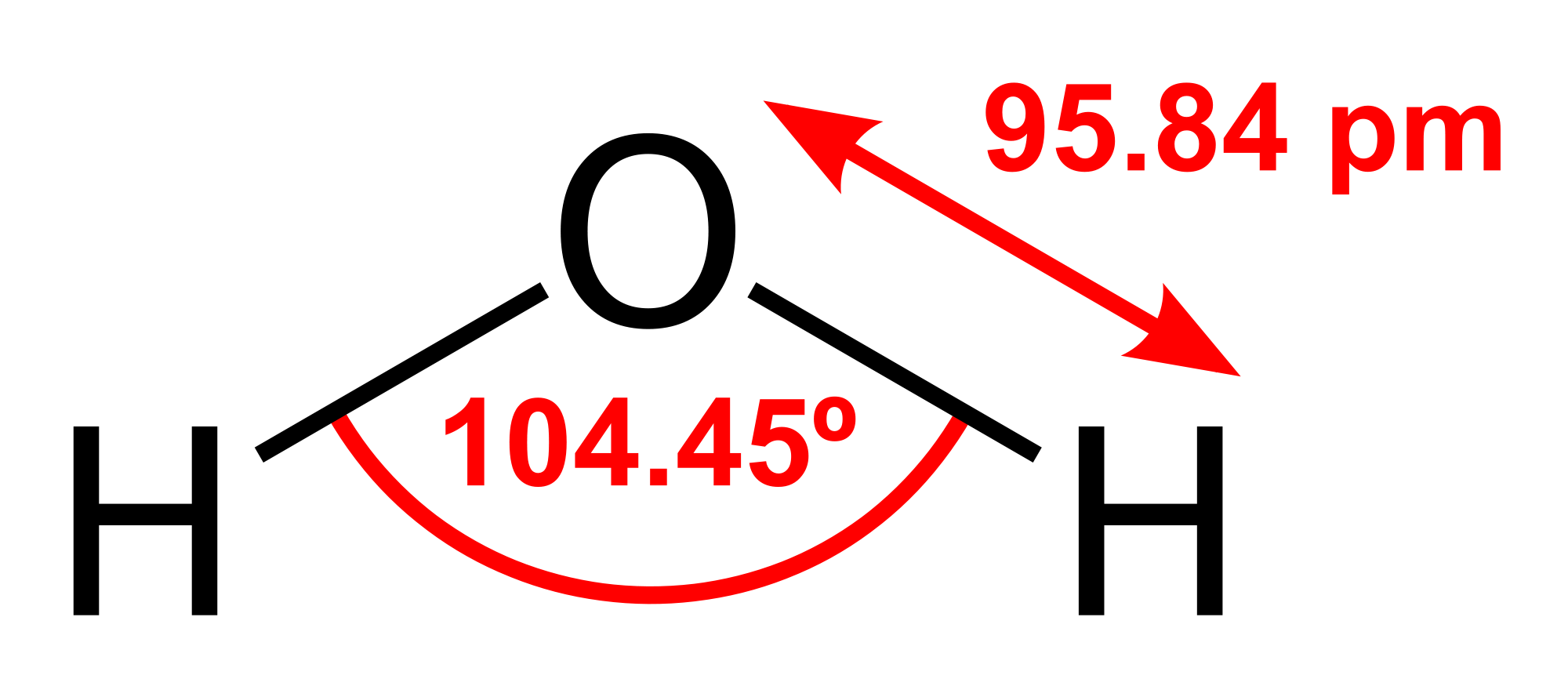


.svg)


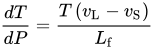


 High tide
 Low tide


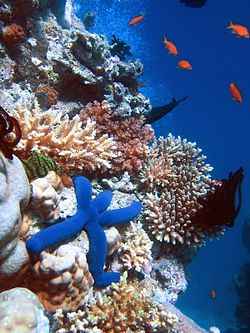 Some of the biodiversity of a coral reef
 Some marine diatoms – a key phytoplankton group
 Squat lobster and Alvinocarididae shrimp at the Von Damm hydrothermal field survive by altered water chemistry.


 Water requirement per tonne of food product
 Irrigation of field crops


 A water-carrier in India, 1882. In many places where running water is not available, water has to be transported by people.
 A manual water pump in China
 Water purification facility


.jpeg)


 Definitions from Wiktionary
 Media from Commons
 News from Wikinews
 Quotations from Wikiquote
 Texts from Wikisource
 Textbooks from Wikibooks
 Resources from Wikiversity


