

1990s
View on Wikipedia

| Millennia |
|---|
| 2nd millennium |
| Centuries |
| Decades |
| Years |
| Categories |
The 1990s (often referred and shortened to as "the '90s" or "the Nineties") was the decade that began on 1 January 1990, and ended on 31 December 1999. Known as the "post-Cold War decade", the 1990s were culturally imagined as the period from the Revolutions of 1989 until the September 11 attacks in 2001.[1] The dissolution of the Soviet Union marked the end of Russia's status as a superpower, the end of a multipolar world, and the rise of anti-Western sentiment. China was still recovering from a politically and economically turbulent period.[2] This allowed the US to emerge as the world's sole superpower, creating relative peace and prosperity for many western countries. During this decade, the world population grew from 5.3 to 6.1 billion.[3]
The decade saw greater attention to multiculturalism and advance of alternative media. Public education about safe sex curbed HIV in developed countries. Generation X bonded over musical tastes. Humor in television and film was marked by ironic self-references mixed with popular culture references. Alternative music movements like grunge, reggaeton, Eurodance, K-pop, and hip-hop, became popular, aided by the rise in satellite and cable television, and the internet. New music genres such as drum and bass, post-rock, happy hardcore, denpa, and trance emerged. Video game popularity exploded due to the development of CD-ROM supported 3D computer graphics on platforms such as Sony PlayStation, Nintendo 64, and PCs.
The 1990s saw advances in technology, with the World Wide Web, evolution of the Pentium microprocessor, rechargeable lithium-ion batteries, the first gene therapy trial, and cloning. The Human Genome Project was launched in 1990, by the National Institutes of Health (NIH) with the goal to sequence the entire human genome.[4] Building the Large Hadron Collider, the world's largest and highest-energy particle accelerator, commenced in 1998, and Nasdaq became the first US stock market to trade online.[5][6][7] Environmentalism is divided between left-wing green politics, primary industry-sponsored environmentalist front organizations, and a more business-oriented approach to the regulation of carbon footprint of businesses. More businesses started using information technology.
There was a realignment and consolidation of economic and political power, such as the continued mass-mobilization of capital markets through neoliberalism, globalization, and end of the Cold War. Network cultures were enhanced by the proliferation of new media such as the internet, and a new ability to self-publish web pages and make connections on professional, political and hobby topics. The digital divide was immediate, with access limited to those who could afford it and knew how to operate a computer. The internet provided anonymity for individuals skeptical of the government. Traditional mass media continued to perform strongly. However, mainstream internet users were optimistic about its benefits, particularly the future of e-commerce. Web portals, a curated bookmark homepage, were as popular as searching via web crawlers. The dot-com bubble of 1997–2000 brought wealth to some entrepreneurs before its crash of the early-2000s.
Many countries were economically prosperous and spreading globalization. High-income countries experienced steady growth during the Great Moderation (1980s—2000s). Using a mobile phone in a public place was typical conspicuous consumption. In contrast, the GDP of former Soviet Union states declined as a result of neoliberal restructuring. International trade increased with the establishment of the European Union (EU) in 1993, North American Free Trade Agreement (NAFTA) in 1994, and World Trade Organization (WTO) in 1995. The Asia-Pacific economies of the Four Asian Tigers, ASEAN, Australia and Japan were hampered by the 1997 Asian financial crisis and early 1990s recession.
Major wars that began include the First and Second Congo Wars, the Rwandan Civil War and genocide, the Somali Civil War, and Sierra Leone Civil War in Africa; the Yugoslav Wars in Southeast Europe; the First and Second Chechen Wars, in the former Soviet Union; and the Gulf War in the Middle East. The Afghanistan conflict (1978–present) and Colombian conflict continued. The Oslo Accords seemed to herald an end to the Israeli-Palestinian conflict, but this was in vain. However, in Northern Ireland, The Troubles came to a standstill in 1998 with the Good Friday Agreement, ending 30 years of violence.[8]
Politics and wars
[edit].png)
International wars
[edit]- The Congo Wars began in the 1990s.[9]
- The First Congo War (24 October 1996 – 16 May 1997) resulted in the overthrow of dictator Mobutu Sese Seko, following his 32-year rule of Zaire, which was then renamed the Democratic Republic of the Congo.
- The Second Congo War (August 1998 – July 2003) started in Central Africa and involved multiple nearby nations.
- The Gulf War (2 August 1990 – 28 February 1991).
- Iraq was left in severe debt after the Iran–Iraq War in the 1980s. President Saddam Hussein accused Kuwait of flooding the oil market, therefore driving down prices. As a result, Iraqi forces invaded and conquered Kuwait.
- The UN (United Nations) immediately condemned the action and a coalition force led by the United States was sent to the Persian Gulf. Aerial bombing of Iraq began in January 1991, and one month later, the UN forces drove the Iraqi army from Kuwait in four days.
- Two wars were fought in the region of Chechnya:
- The First Chechen War (1994–1996) was a conflict between the Russian Federation and the Chechen Republic of Ichkeria. After the initial campaign of 1994–1995, culminating in the devastating Battle of Grozny, Russian federal forces attempted to seize control of the mountainous area of Chechnya. Despite Russia's overwhelming manpower, weaponry, and air support, they were set back by Chechen guerrillas and raids on the flatlands. The resulting widespread demoralization of Russian federal forces, and the universal[citation needed] opposition of the Russian public to the conflict, led Boris Yeltsin's government to declare a ceasefire in 1996 and sign a peace treaty a year later.
- The Second Chechen War (1999 – 2009) was started by the Russian Federation in response to the 1999 invasion of Dagestan and the Russian apartment bombings, which were blamed on the Chechens. In this military campaign, Russian forces largely recaptured the separatist region of Chechnya[citation needed] and the outcome of the First Chechen War – in which the region gained de facto independence as the Chechen Republic of Ichkeria – was essentially reversed.
- The Eritrean–Ethiopian War (1998–2000) was commenced by the invasion of Ethiopia by Eritrea due to a territorial dispute.[10] The conflict resulted in tens of thousands of deaths on both sides[11] and a peace agreement in December 2000.[12]
- The Kargil War (1999) began in May when Pakistan covertly sent troops to occupy strategic peaks in Kashmir. A month later, the Kargil War with India resulted in a political fiasco for Pakistani Prime Minister Nawaz Sharif, followed by a Pakistani military withdrawal to the Line of Control. The incident led to a Pakistani military coup in October, in which Sharif was ousted by Army Chief Pervez Musharraf. This conflict remains the only war fought between the two declared nuclear powers.

- The Yugoslav Wars (1991–1995) followed the breakup of Yugoslavia, beginning on 25 June 1991, after the republics of Croatia and Slovenia declared independence from Yugoslavia. These wars were notorious for war crimes and human rights violations, including ethnic cleansing and genocide, with the overwhelming majority of casualties being Muslim Bosniaks.
- The Ten-Day War (1991) was a brief military conflict between Slovenian TO (Slovenian Territorial Defence) and the Yugoslav People's Army ("JNA") following Slovenia's declaration of independence.
- The Croatian War of Independence (1991–1995) was fought in modern-day Croatia between the Croatian government (having declared independence from the Socialist Federal Republic of Yugoslavia) and both the Yugoslav People's Army ("JNA") and Serb forces, who established the self-proclaimed Republic of Serbian Krajina ("RSK") within Croatia.
- The Bosnian War (1992–1995) involved several ethnically-defined factions within Bosnia and Herzegovina: Bosniaks, Serbs, and Croats, as well as a smaller Bosniak faction led by Fikret Abdić. The Siege of Sarajevo (1992–1995) marked the most violent urban warfare in Europe since World War II at that time, as Serb forces bombarded and attacked Bosnian-controlled and populated areas of the city. War crimes occurred, including ethnic cleansing and the destruction of civilian property.
- The final fighting in the Croatian and Bosnian wars ended in 1995 with the success of Croatian military offensives against Serb forces. This led to the mass exodus of Serbs from Croatia, Serb losses to Croat and Bosniak forces, and the signing of the Dayton Agreement, which internally partitioned Bosnia and Herzegovina into a Republika Srpska and a Bosniak-Croat Federation.
- The Kosovo War (1998–1999) was a war between Albanian separatists and Yugoslav military and Serb paramilitary forces in Kosovo. That conflict began in 1996 and escalated in 1998, with increasing reports of atrocities.
- In 1999, the NATO, led by the United States, launched air attacks against Yugoslavia (then composed of only Serbia and Montenegro) to pressure the Yugoslav government to end its military operations against Albanian separatists in Kosovo. The intervention lacked UN approval yet was justified by NATO based on accusations of war crimes committed by Yugoslav military forces working alongside nationalist Serb paramilitary groups. Finally, after months of bombing, Yugoslavia conceded to NATO's demands, and NATO forces (later UN peacekeeping forces) occupied Kosovo.
- The South African Border War (1990) was a border war between Zambia, Angola, and Namibia that began in 1966 and ended in 1990.
Civil wars and guerrilla wars
[edit]
- The First Liberian Civil War occurred from 1989 until 1997, and led to the death of around 200,000 people.
- The Ethiopian Civil War (1991) was an internal conflict that had been raging for over twenty years. Its end coincided with the establishment of a coalition government of various factions.
- The Algerian Civil War (1991–2002) was caused by a group of high-ranking army officers canceling the first multi-party elections in Algeria.[13]
- The Somali Civil War (1991–present) included the Battle of Mogadishu.
- The Rwandan genocide (1994) occurred from 6 April to mid-July 1994 when hundreds of thousands of Rwanda's Tutsis and Hutu political moderates were killed by the Hutu-dominated government under the Hutu Power ideology. For approximately 100 days between 500,000[14] and 1,000,000[15] people were killed. The United Nations and major states came under criticism for failing to stop the genocide.
- 1993 Russian constitutional crisis resulted from a severe political deadlock between Russian President Boris Yeltsin and the Supreme Soviet (Russia's parliament at this time) resulting in Yeltsin ordering the controversial shelling of the Russian parliament building by tanks.
- The Tajikistani Civil War (1992–1997) occurred when the Tajikistan government was pitted against the United Tajik Opposition, resulting in the death of between 50,000 and 100,000 people.
- The Zapatista uprising (1994) occurred when a large number of the Zapatista indigenous people of Mexico formed the Zapatista Army of National Liberation and began an armed conflict with the Mexican government to protest against NAFTA. The uprising lasted 12 days, bringing worldwide attention to the Zapatistas, and continued through the rest of the 1990s.
- The Islamic Emirate of Afghanistan (1996–2001) was formed at the end of the Afghan Civil War, when the Taliban seized control of Afghanistan in 1996. They ruled during the later Afghan Civil War until their ousting 2001.
- The Troubles in Northern Ireland (1998) involved 30 years of conflict that ended on 10 April 1998, when the Good Friday Agreement was signed.
- 1999 East Timorese crisis.
Coups
[edit]Terrorist attacks
[edit]
- The 1993 World Trade Center bombing in the United States (1993) led to broader public awareness in the US of domestic terrorism and international terrorism as a potential threat.
- Markale market massacres in Bosnia and Herzegovina (1994) – soldiers of the Army of Republika Srpska deliberately targeted Bosniak (then known as "Bosnian Muslims") civilians.
- AMIA bombing (1994) – on 18 July 1994, an unknown terrorist targeting Argentina's Jewish community planted a car bomb in the Asociación Mutual Israelita Argentina headquarters in Buenos Aires, killing 85 people and injuring hundreds, making it the first ethnically targeted bombing and deadliest bombing in Argentine history.
- Srebrenica genocide in Bosnia and Herzegovina (1995) – soldiers of the Army of Republika Srpska and members of Serbia's Scorpions paramilitary group committed mass murder of Bosniak civilians.[citation needed]
- Oklahoma City bombing (1995) in the United States – the bombing of a federal building in Oklahoma City, Oklahoma killed 168 people, becoming the deadliest terrorist attack in the United States at that time. Suspect Timothy McVeigh claimed he bombed the building in retaliation for the 1992 Ruby Ridge standoff and the Waco siege a year later.[16]
- The 1996 Manchester bombing (1996) – on 15 June 1996, the IRA set off a bomb in Manchester, England. The bomb, placed in a van on Corporation Street in the city center, targeted the city's infrastructure and economy and caused widespread damage, estimated by insurers at £700 million (£1 billion as of 2011[update]). Two hundred and twelve people were injured, but there were no fatalities.
- The 1998 United States embassy bombings – Al-Qaeda militants carried out bomb attacks on United States embassies in Kenya and Tanzania. In retaliation, U.S. naval military forces launched cruise missile attacks against Al-Qaeda bases in Afghanistan.
- The Omagh bombing in Northern Ireland (1998) – a bombing in Omagh, County Tyrone, that killed 29 civilians and injured hundreds more.
- LAX bombing plot (1999) – Ahmed Ressam, an Islamist militant associated with Al-Qaeda, was arrested when attempting to cross from Canada into the United States at the Canada-U.S. border on 14 December 1999. It was later discovered that he intended to bomb Los Angeles International Airport (LAX) during millennium celebrations. This was the first major attempted terrorist attack by Al-Qaeda on United States soil since the 1993 World Trade Center bombing and marked the beginning of a series of attempted terrorist attacks by Al-Qaeda against the United States that would continue into the 21st century.
Decolonization and independence
[edit]- Independence of Namibia (1990) – the Republic of Namibia gained independence from South Africa on 21 March 1990. Walvis Bay, initially retained by South Africa, joined Namibia in 1994.
- Breakup of Yugoslavia (1991–1992) – the republics of Croatia, Slovenia, Bosnia and Herzegovina, and Macedonia declared independence from Yugoslavia.
- Independence of Eritrea (1993) – Eritrea gained independence from Ethiopia.
- Dissolution of Czechoslovakia (1993) – the Slovak Republic adopts the Declaration of Independence from the Czech and Slovak Federative Republic (Czechoslovakia).
- Independence of Palau (1994) – Palau gained independence from the United Nations Trusteeship Council.
- Handover of Hong Kong (1997) – The United Kingdom handed sovereignty of Hong Kong (then British Hong Kong) to the People's Republic of China on 1 July 1997.
- Independence of East Timorese (1999) – East Timor broke away from Indonesian occupation, only a year after the fall of Suharto from power, ending a 24-year guerrilla war and genocide with more than 200,000 casualties. The UN deployed a peacekeeping force spearheaded by Australia's armed forces. The United States deployed police officers to serve with the Interpol element to help train and equip an East Timorese police force.
- Handover of Macau (1999) – Portugal handed sovereignty of Macau (Portuguese Macau) to the People's Republic of China on 20 December 1999.
- Dissolution of the Soviet Union (1991) – multiple Soviet Socialist Republics (SSRs) declared independence from the USSR.
- Armenia – the Armenian SSR became the Republic of Armenia following the Declaration of Independence of Armenia.
- Azerbaijan – the Azerbaijan SSR became the Republic of Azerbaijan.
- Belarus – the Byelorussian SSR became the Republic of Belarus following its Declaration of State Sovereignty.
- Estonia – Estonian SSR became the Republic of Estonia.
- Georgia – The Georgian SSR became the Republic of Georgia.
- Kazakhstan – the Kazakh SSR became the Republic of Kazakhstan.
- Kyrgyzstan – the Kirghiz SSR became the Republic of Kyrgyzstan.
- Latvia – the Latvian SSR became the Republic of Latvia.
- Lithuania – the Lithuanian SSR became the Republic of Lithuania
- Moldova – the Moldavian SSR became the Republic of Moldova.
- Tajikistan – the Tajik SSR became the Republic of Tajikistan.
- Turkmenistan – the Turkmen SSR became the Republic of Turkmenistan.
- Ukraine – the Ukrainian SSR became the Republic of Ukraine
- Uzbekistan – the Uzbek SSR became the Republic of Uzbekistan.
Political trends
[edit]- The 1990s saw an increased spread of capitalism and third way policies.[17] The former countries of the Warsaw Pact moved from single-party socialist states to multi-party states with private sector economies.[17] The same wave of political liberalization occurred in the capitalist and newly industrialized countries (including First and Third World countries), such as Argentina, Brazil, Chile, India, Indonesia, Malaysia, Mexico, the Philippines, South Africa, South Korea, Taiwan, and Thailand. Market reforms made incredible changes to the economies of Second World socialist countries such as China and Vietnam.
- Ethnic tensions and violence in former Yugoslavia during the 1990s created a greater sense of ethnic identity among nations in newly independent countries and a marked increase in the popularity of nationalism.
Deaths
[edit]Prominent deaths of siting leaders including:
- April 17, 1993, Turgut Ozal, President of Turkey (1988-93)
- July 8, 1994 Kim Il-Sung, General Secretary of the North Korean Worker's Party and President of North Korea (1948-94)
- November 4, 1995, Yitzak Rabin, Prime Minister of Israel (1974-77, 1992-95) was assasinated
- December 10, 1999, Franio Toudjman, President of Croatia (1990-1999).
Prominent deaths of former leaders including:
- February 24, 1990: Sandro Pertini, President of Italy (1978-85)
- May 21, 1991, Rajiv Gandhi, Prime Minister of India (1984-1989), was assassinated.
- July 29, 1990: Bruno Kreisky, Chancellor of Austria (1970-83)
- March 9, 1992: Menachem Begin, Prime Minister of Israel (1977-83)
- October 8, 1992: Willy Brandt, Chancellor of West Germany (1969-74)
- November 7, 1992: Alexander Dubcek, General Secretary of the Communist Party of Czechoslovakia (1968-69)
- May 1, 1993: Pierre Bérégovoy, Prime Minister of France (1991-93), committed suicide.
- April 22, 1994: Richard Nixon, 37th President of the United States (1969-74)
- April 29, 1994: Erich Honecker, General Secretary of the Communist Party of East Germany (1971-89)
- May 24, 1995: Harold Wilson, Prime Minister of the United Kingdom (1964-70, 1974-76)
- October 9, 1995: Alec Douglas-Home, Prime Minister of the United Kingdom (1963-64)
- January 8, 1996: Francois Miterrand, President of France (1981-95)
- June 23, 1996: Andreas Papandreou, Prime Minister of Greece (1981-89, 1993-96)
- February 17, 1997, Deng Xiaoping, President of China (1978-90)
- April 23, 1998: Konstantinos Karamanlis, Prime Minister of Greece (1955-58, 1958-61, 1961-63, 1974-80), President of Hellenic Republic (1980-85, 1990-95)
- August 5,1998: Todor Zhivkov, General Secretary of the Bulgarian Communist Party (1954-89)
- November 20, 1999: Amintore Fanfani, Prime Minister of Italy (1954, 1958-59, 1960-63, 1982-83, 1987)
Prominent political events
[edit]Africa
[edit]
- African National Congress leader Nelson Mandela was released from prison on 11 February 1990, after thirty years of imprisonment for opposing apartheid and white-minority rule in South Africa. Apartheid ended in South Africa in 1994.[18]
- Nelson Mandela was elected President of South Africa in 1994, becoming the first democratically elected president in South African history, and ending a long legacy of apartheid white rule in the country.[18]
Americas
[edit]- The Argentine peso was pegged to the American dollar by the Convertibility plan by the government of Carlos Menem in an attempt to eliminate hyperinflation and stimulate economic growth. While it was initially met with considerable success, the board's actions ultimately failed. The Convertibility Plan went from 1991 to 2002.
- The establishment of the North American Free Trade Agreement (NAFTA) on 1 January 1994, created a North American free-trade zone consisting of Canada, Mexico, and the United States.
- The Constitution of Argentina went through an important reform in 1994, which introduced third generation rights, gave more relevance to international treaties, and also introduced new concepts such as Necessity and Urgency Decrees and the two-round system.
- Canadian politics was radically altered in the 1993 federal election with the collapse of the Progressive Conservative Party of Canada. A major political party in Canada since 1867, the party went from controlling the government to being left with only two seats. The New Democratic Party collapsed as well, with their sets declining from 44 to 9. The Liberal Party of Canada was the only genuinely 'national' political party left standing. Regionally based parties, such as the Quebec-based Bloc Québécois and the almost entirely Western Canada-based Reform Party of Canada, rose from political insignificance to being major political parties.
- After the collapse of the Meech Lake constitutional accord in 1990, the province of Quebec in Canada experienced a rekindled wave of separatism by Francophone Québécois nationalists, who sought for Quebec to become an independent country and forced a referendum on the question of independence in 1995.
- The 1995 Quebec referendum on sovereignty was held in the predominantly francophone province of Quebec in Canada, a majority Anglophone country. If accepted, Quebec would have become an independent country with an economic association with Canada. Quebec's voters narrowly rejected the proposal.
- Jean-Bertrand Aristide, a former Haitian priest, became the first democratically elected President of Haiti in 1990. A proponent of liberation theology, Aristide was appointed to a Roman Catholic parish in Port-au-Prince in 1982 after completing his studies to become a priest of the Salesian order. Aristide was later forced into exile in the Central African Republic and South Africa and returned to Haiti after several years.
- Ernesto Zedillo was elected President of Mexico in the 1994 presidential election, making him the last of an uninterrupted 72-year-long succession of Mexican presidents from the dominant Institutional Revolutionary Party (PRI). The original PRI candidate, Luis Donaldo Colosio Murrieta, was assassinated several months prior.
- Due to internal conflict and an economic crisis, Alberto Fujimori rose to power in Peru and remained in office for eleven years. His administration was marked by economic development but also by numerous human rights violations (La Cantuta massacre, Barrios Altos massacre) and a rampant corruption network set up by Vladimiro Montesinos.
- The sluggish Latin American economies of Argentina, Brazil, Chile, and Mexico, by a new emphasis on free markets for all their citizens after the debt crisis of the 1980s. Following democratic reforms and neoliberal policies were implemented by President Carlos Saúl Menem (Argentina), President Eduardo Frei Ruiz-Tagle (Chile), President Ernesto Zedillo (Mexico), and President Fernando Henrique Cardoso (Brazil), in their best shape by the late 1990s.
- United States President Bill Clinton was a dominant political figure in international affairs during the 1990s, known primarily for his attempts to negotiate peace in the Middle East and end the ongoing wars occurring in the former Yugoslavia, his promotion of international action to decrease human-created climate change, and his endorsement of advancing free trade in the Americas.
- After a failed coup attempt in 1992, Hugo Chávez, politician and former member of the Venezuelan military, is elected President of Venezuela in 1998.
- Lewinsky scandal – US president Bill Clinton was caught in a media-frenzied scandal involving inappropriate relations with White House intern Monica Lewinsky, which was first announced on 21 January 1998. After the United States House of Representatives impeached Bill Clinton on 19 December 1998, for perjury under oath, and following an investigation by federal prosecutor Kenneth Starr, the Senate acquitted Clinton of all charges on 12 February 1999. He served out the remainder of his second term.
- California voters passed Proposition 215 in 1996, which legalized cannabis for medicinal purposes.
Asia
[edit]
- In 1990, the Lebanese Civil War came to a close and a return to political normalcy in Lebanon began. With peace among all factions in Lebanon, the rebuilding of the country and its capital, Beirut, began.
- 1990 Nepalese revolution, a multiparty movement against the one-party Panchayat rule in Nepal. It led to the end of absolute monarchy in Nepal and the restoration of democracy.
- Israeli Prime Minister Yitzhak Rabin and Palestinian Prime Minister Yasser Arafat agree to the Israeli–Palestinian peace process at the culmination of the Oslo Accords, negotiated by the United States President, Bill Clinton, on 13 September 1993.
- By signing the Oslo accords, the Palestine Liberation Organization recognized Israel's right to exist. At the same time, Israel permitted the creation of an autonomous Palestinian National Authority consisting of the Gaza Strip and West Bank, which was implemented in 1994.
- Israeli military forces withdrew from these Palestinian territories in compliance with the accord, which marked the end of the First Intifada (a period of violence between Palestinian Arab militants and Israeli armed forces from 1987 to 1993).
- The Palestinian National Authority was created in 1994 following the Oslo Accords, giving Palestinian Arab people official autonomy over the Gaza Strip and West Bank, though not official independence from Israel.
- On 4 November 1995, Israeli Prime Minister Yitzhak Rabin was assassinated by a right-wing extremist who opposed the signing of the Oslo Accords.
- North Yemen and South Yemen merged to form Yemen in 1990.
- Lee Kuan Yew resigned as the Prime Minister of Singapore on 28 November 1990, a position he had held since 1959, to Goh Chok Tong. Lee remained in the cabinet as Senior Minister.
- In July 1994, North Korean leader Kim Il Sung died, having ruled the country since its founding in 1948. His son Kim Jong Il, who succeeded him, took over a nation on the brink of complete economic collapse. Famine had caused a significant number of deaths in the late 1990s, and North Korea gained a reputation for being an important hub of money laundering, counterfeiting, and weapons proliferation. The country's ability to produce and sell nuclear weapons became a prominent concern in the international community.
- In 1990, Aung San Suu Kyi's National League for Democracy in Burma won a majority of seats in the first free election conducted in 30 years. But the SPDC refused to relinquish power, beginning a peaceful[citation needed] struggle that began in the 1990s and continued for several decades, primarily fueled by Aung San Suu Kyi and her supporters to demand the end of military rule.
- Indonesian President Suharto resigned after ruling the country for 32 years (1966–1998), following the riots on several cities in Indonesia. His resignation marked the beginning of the Reform era.
- In India, the former prime minister Rajiv Gandhi was assassinated on 21 May 1991 by the Tamil Tigers, beginning a period of economic liberalization led by new Prime Minister P. V. Narasimha Rao.
- After democratic reforms and steady economic growth in the four Asia-Pacific MNNAs by the United States and Canada, after the Revolutions of 1989.
- In the Philippines, following the People Power Revolution of 1986 under the Corazon Aquino presidency until 1992, democratic reforms and economic policies implemented by two Presidents were elected by Fidel V. Ramos in 1992, and Joseph Estrada in 1998.
- South Korea and Taiwan became developed countries, and two of the Four Asian Tigers in the 1990s. Following democratic reforms in 1988, neoliberal policies were implemented by President Kim Young-sam (South Korea) and President Lee Teng-hui (Taiwan), both who led their countries during the 1997 Asian financial crisis.
- Japan saw eight different prime ministers serve during the 1990s in what was at first called the "Lost Decade" but later became referred to as the "Lost Decades of the Heisei Era". These included Morihiro Hosokawa, who won the 1993 Japanese general election and formed an opposition coalition until 1996.
Europe
[edit]- The improvement in relations between NATO countries and the former members of the Warsaw Pact led to the end of the Cold War, both in Europe and other parts of the world.
- German reunification – on 3 October 1990, East and West Germany reunified as a result of the collapse of the Soviet Union and the fall of the Berlin Wall. After reintegrating their economic structure and provincial governments, Germany focused on the modernization of the formerly communist East. People brought up in socialist East Germany became integrated with those living in capitalist West Germany.
- Margaret Thatcher, who had been the United Kingdom's Prime Minister since 1979, resigned as Prime Minister on 22 November 1990 after being challenged for leadership of the Conservative Party by Michael Heseltine. This was because of widespread opposition to the introduction of the controversial Community Charge, and the fact that her key allies such as Nigel Lawson and Geoffrey Howe resigned over the deeply sensitive issues of the Maastricht Treaty and Margaret Thatcher's resistance to Britain joining the European Exchange Rate Mechanism. Less than two years later, on the infamous Black Wednesday of September 1992, the pound sterling crashed out of the system after the pound fell below the agreed exchange rate with the Deutsche Mark.
- John Major replaced Margaret Thatcher as Prime Minister in 1990.
- The Perestroika (restructuring) of the Soviet Union destabilized, leading to nationalist and separatist demagogues gaining popularity. Boris Yeltsin, then chairman of the Supreme Soviet of Russia, resigned from the Communist Party and became the opposition leader against Mikhail Gorbachev. The Communist Party lost its status as the governing force of the country and was banned after a coup attempt by communist hardliners attempted to revert the effects of Gorbachev's policies. Yeltsin's counter-revolution was victorious, and on 25 December 1991, Gorbachev resigned from the presidency, which led to the dissolution of the Soviet Union. Yeltsin became president of the Soviet Union's successor, the Russian Federation, and presided over a period of political unrest, economic crisis, and social anarchy. On 31 December 1999, Yeltsin resigned, leaving Vladimir Putin as acting president.
- The European Union was formed in 1992 under the Maastricht Treaty.
- The Downing Street Declaration, signed on 15 December 1993 by the Prime Minister of the United Kingdom, John Major, and the Taoiseach of Ireland, Albert Reynolds at the British Prime Minister's office in 10 Downing Street, affirmed that (1) the right of the people of Ireland to self-determination, and (2) that Northern Ireland would be transferred to the Republic of Ireland from the United Kingdom only if a majority of its population was in favour of such a move. It included, as part of the perspective of the so-called "Irish dimension," the principle of consent that the people of the island of Ireland had the exclusive right to solve the issues between North and South by mutual consent.[19][20] The latter statement, which later would become one of the points of the Good Friday Agreement,[21] was key to producing a positive change of attitude by the Republicans towards a negotiated settlement. The joint declaration also pledged the governments to seek a peaceful constitutional settlement and promised that parties linked with paramilitaries (such as Sinn Féin) could take part in the talks so long as they abandoned violence.[22]
- The IRA agreed to a truce in 1994. This marked the beginning of the end of 25 years of violence between the IRA and the United Kingdom and the start of political negotiations.
- Tony Blair became Prime Minister in 1997 following a general election.
- The Belfast Agreement (a.k.a. the Good Friday Agreement) was signed by the U.K. and Irish politicians on 10 April 1998, declaring a joint commitment to a peaceful resolution of the territorial dispute between Ireland and the United Kingdom over Northern Ireland. The 1998 Northern Ireland Good Friday Agreement referendum was held on 22 May 1998, with majority approval.[23]
- The National Assembly for Wales was established following the 1997 Welsh devolution referendum, in which a majority of voters approved the creation of the National Assembly for Wales.[24]
- In September 1997, the 1997 Scottish devolution referendum was put to the Scottish electorate and secured a majority in favor of the establishment of a new Scottish Parliament.[25][26]
Assassinations and attempts
[edit]Prominent assassinations, targeted killings, and assassination attempts include:
.jpg)

.jpg)


| Date | Description |
|---|---|
| 9 September 1990 | Samuel Doe, 21st President of Liberia, was captured by rebels, tortured and murdered. His torture was controversially videotaped and seen on news reports around the world.[27] |
| 21 May 1991 | Rajiv Gandhi, former Prime Minister of India, is assassinated in Sriperumbudur.[28] |
| 7 August 1991 | Shapour Bakhtiar, former Prime Minister of Iran, is assassinated by Islamic Republic agents.[29] |
| 29 June 1992 | Mohamed Boudiaf, President of Algeria, is assassinated by a bodyguard.[30] |
| 13 April 1993 | George H. W. Bush, former President of the United States, is alleged to be the target of an assassination by Iraq per a report from the Kuwaiti government during a visit to the country.[31] |
| 1 May 1993 | Ranasinghe Premadasa, 3rd President of Sri Lanka, is killed by a suicide bombing.[32] |
| 21 October 1993 | Melchior Ndadaye, 4th President of Burundi, is killed during an attempted military coup.[33] |
| 2 December 1993 | Pablo Escobar, leader of the Medellín drug cartel, is killed by special operations units of the National Police of Colombia.[34] |
| 23 March 1994 | Luis Donaldo Colosio Murrieta, the Institutional Revolutionary Party candidate in the 1994 Mexican general election, was assassinated at a campaign rally in Tijuana. |
| 6 April 1994 | Juvénal Habyarimana, 2nd President of Rwanda, and Cyprien Ntaryamira, 5th President of Burundi, are both killed when their jet is shot down in what is considered the prelude to the Rwandan genocide and the First Congo War.[35] |
| 4 November 1995 | Yitzhak Rabin, 5th Prime Minister of Israel, is assassinated at a rally in Tel Aviv by a radical ultranationalist who opposed the Oslo Accords.[36] |
| 21 April 1996 | Dzhokhar Dudayev, 1st President of Chechnya, is killed by two laser-guided missiles after his location was detected by a Russian reconnaissance aircraft.[37] |
| 2 October 1996 | Andrey Lukanov, former Prime Minister of Bulgaria, is shot outside his apartment in Sofia.[38] |
| 23 March 1999 | Luis María Argaña, Vice President of Paraguay, is assassinated by gunmen outside his home.[39] |
| 9 April 1999 | Ibrahim Baré Maïnassara, 5th President of Niger, is assassinated by members of his protective staff in Niamey.[40] |
| 27 October 1999 | Vazgen Sargsyan, Prime Minister of Armenia, Karen Demirchyan, President of the National Assembly and 6 other politicians were assassinated in Armenian Parlament.[41] |
Disasters
[edit]Natural disasters
[edit]
The 1990s saw a trend in frequent and more devastating natural disasters, breaking many previous records. Although the 1990s was designated by the United Nations as an International Decade for Natural Disaster Reduction as part of its program to prevent losses due to disasters, disasters would go on to cause a record-breaking US$608 billion worth of damage—more than the past four decades combined.[42]
- The most prominent natural disasters of the decade include: Hurricane Andrew striking South Florida in August 1992, the crippling super storm of March 1993 along the Eastern Seaboard, the devastating 1994 Northridge earthquake in Los Angeles, the Great Hanshin earthquake in Kobe, Japan in January 1995, the Blizzard of 1996 in the eastern United States, the US drought of 1999, the deadly Hurricane Mitch which struck Central America in October 1998, the destructive Oklahoma tornado outbreak in May 1999, the August 1999 İzmit earthquake in Turkey, and the September 1999 Chi-Chi earthquake in Taiwan.
- A magnitude 7.8 earthquake hit the Philippines on 16 July 1990 and killed around 1000 people in Baguio.
- After 600 years of inactivity, Mount Pinatubo in the Philippines erupted and devastated Zambales and Pampanga in June 1991.
- July 1995 – Midwestern United States heat wave – An unprecedented heat wave strikes the Midwestern United States for most of the month. Temperatures peak at 106 °F (41 °C), and remain above 94 °F (34 °C) in the afternoon for 5 straight days. At least 739 people died in Chicago alone.

- Hurricane Georges made landfall in at least seven different countries (Antigua and Barbuda, St. Kitts and Nevis, Haiti, the Dominican Republic, Cuba, the United States and Puerto Rico, a Commonwealth of the United States) – more than any other hurricane since Hurricane Inez of the 1966 season. The total estimated costs were $60 billion (about $110 billion in 2022).
- September 1996 – Hurricane Fran made landfall in North Carolina, causing significant damage throughout the entire state.
- Hurricane Iniki hit the island of Kauai in the Hawaiian Islands on 11 September 1992, making it one of the costliest hurricanes on record in the eastern Pacific.
- A flood hits the Red River Valley in 1997 becoming the most severe flood since 1826.
- On May 3, 1999, the highest wind speeds recorded on Earth at 321 miles per hour (517 km/h) took place during the 1999 Bridge Creek–Moore tornado outbreak. The estimated costs were $1 billion (about $1.8 billion in 2024). This event was the first issued tornado emergency by the National Weather Service in history.
- In December 1999, torrential rains and flash floods killed tens of thousands of Venezuelans living in the state of Vargas in a natural disaster known as the Vargas tragedy.
Non-natural disasters
[edit]

- Gulf War oil spill: Resulting from actions taken during the Gulf War in 1991 by the Iraq military, the oil spill caused considerable damage to wildlife in the Persian Gulf, especially in areas surrounding Kuwait and Iraq.
- 11 July 1991: A Nationair Douglas DC-8, chartered by Nigeria Airways, caught fire and crashed in Jeddah, Saudi Arabia, killing 261 people.
- 15 December 1991: The Egyptian ferry Salem Express sinks in the Red Sea, killing more than 450 people.
- 4 October 1992: El Al Flight 1862, a Boeing 747 cargo airplane heading to Tel Aviv, suffered physical engine separation of both right-wing engines (#3 and #4) just after taking off from Schiphol and crashed into an apartment building in the Bijlmer neighbourhood of Amsterdam while attempting to return to the airport. A total of 43 people were killed, including the plane's crew of three and a "non-revenue passenger." Several others were injured.
- 26 July 1993: Asiana Airlines Flight 733 crashed into Mt. Ungeo in Haenam, South Korea, killing 68 people.
- 26 April 1994: China Airlines Flight 140, an Airbus A300, crashed just as it was about to land at Nagoya Airfield, Japan, killing 264 and leaving only seven survivors.
- 8 September 1994: USAir Flight 427 crashed near Pittsburgh, Pennsylvania, killing 132 people.
- 28 September 1994: The car ferry MS Estonia sinks in the Baltic Sea, killing 852 people.
- 29 June 1995: The Sampoong Department Store collapses in Seoul, South Korea, killing 502 people.
- 20 December 1995: American Airlines Flight 965, a Boeing 757, hit a mountain in Colombia at night, killing 159 people.
- 6 February 1996: Birgenair Flight 301, a Boeing 757, crashes shortly after takeoff from Puerto Plata, Dominican Republic, killing 189 people.
- 11 May 1996: ValuJet Flight 592, a DC-9, crashes into the Everglades shortly after takeoff from Miami, killing 110 people.
- 17 July 1996: Trans World Airlines Flight 800, a Boeing 747-131 exploded and crashed into the Atlantic Ocean near East Moriches, New York, killing 230 people.
- 12 November 1996: A Saudia Boeing 747 and a Kazakhstan Airlines Ilyushin Il-76 collided over the town of Charkhi Dadri, outside New Delhi, India, killing 349.
- 6 August 1997: Korean Air Flight 801, a Boeing 747-300, crashed into a hill on the island of Guam, killing 228 people.
- 26 September 1997: Garuda Indonesia Flight 152 crashed in bad weather, killing 234.
- 2 September 1998: Swissair Flight 111, a McDonnell Douglas MD-11, crashed into the Atlantic Ocean off Nova Scotia near the towns of Peggy's Cove and Bayswater, killing 229.
- 31 October 1999: EgyptAir Flight 990, a Boeing 767, crashed off the coast of Nantucket, Massachusetts, killing 217.
Economics
[edit]
Many countries, institutions, companies, and organizations were prosperous during the 1990s. High-income countries such as the United States, Canada, Australia, New Zealand, Japan, Singapore, Hong Kong, Taiwan, South Korea, and Western Europe experienced steady economic growth for much of the decade during the Great Moderation. However, in the former Soviet Union, GDP decreased as their economies restructured to produce goods they needed, and some capital flight occurred.
- In 1993, the General Agreement on Tariffs and Trade (GATT) was updated to include the creation of the World Trade Organization, with the 76 existing GATT members and European Communities becoming the founding members of the World Trade Organization on 1 January 1995. Opposition by anti-globalization activists showed up in nearly every GATT summit, like the demonstrations in Seattle in December 1999.
- The anti-globalization protests in the World Trade Organization Ministerial Conference of 1999 in Seattle began on 30 November 1999. This marked the beginning of a steady increase in anti-globalization protests in the first decade of the 21st century and increasing hostility to neoliberalism.
- U.S. inflation moderated, beginning in 1990 at 5.39%, falling to a low of 1.55% in 1998 and rising slightly to 2.19% in 1999.[43]
- The G20 or Group of Twenty formed on 26 September 1999.
North America


- The decade is seen as a time of great prosperity in the United States and Canada, largely because of the unexpected advent of the Internet and the explosion of technology industries. The US and Canadian economies experienced their longest period of peacetime economic expansion, beginning in 1991. Personal incomes doubled from the recession in 1990, and there was higher productivity overall. The New York Stock Exchange stayed over the 10,500 mark from 1999 to 2001.
- After the 1992 boom of the US stock market, Alan Greenspan coined the phrase "irrational exuberance", a reference to the overenthusiasm of investors that typified the trading of this period, and warned of overvaluation of assets and the stock market generally.
- The North American Free Trade Agreement (NAFTA), which phases out the trade barriers between the United States, Mexico, and Canada, was signed into law by President Bill Clinton.
Asia
- In the People's Republic of China, the government announced the major privatization of state-owned industries in September 1997. China entered the 1990s in a turbulent period due to the aftermath of both the Tiananmen Square Massacre and hardline politicians' efforts to rein in private enterprise and attempt to revive old-fashioned propaganda campaigns. Relations with the United States deteriorated sharply, and the Chinese leadership was further embarrassed by the disintegration of communism in Europe. In 1992 Deng Xiaoping travelled to southern China in his last major public appearance to revitalize faith in market economics and stop the country's slide back into Maoism. Afterward, China recovered and would experience explosive economic growth during the rest of the decade. Despite this, dissent continued to be suppressed, and Communist Party General Secretary Jiang Zemin launched a brutal crackdown against the Falun Gong religious sect in 1999. Deng Xiaoping died in 1997 at the age of 93. Relations with the US deteriorated again in 1999 after the bombing of the Chinese embassy during the bombing of Serbia by NATO forces, which caused three deaths, and allegations of Chinese espionage at the Los Alamos Nuclear Facility.
- Financial crisis hits East and Southeast Asian countries between 1997 and 1998 after a long period of phenomenal economic development, which continues into 1999. This crisis begins to be felt by the end of the decade.
- In Japan, after three decades of economic growth put them in second place in the world's economies, the county experienced an economic downturn after 1993. The recession went on into the early first decade of the 21st century, ending the seemingly unlimited prosperity that the country had previously enjoyed.
- Less affluent nations such as India, Malaysia, and Vietnam also saw tremendous improvements in economic prosperity and quality of life during the 1990s. Restructuring following the end of the Cold War was beginning. However, there was also the continuation of terrorism in Third World regions that were once the "frontlines" for American and Soviet foreign politics, particularly in Asia.


Europe
- By 1990, Soviet leader Mikhail Gorbachev's reforms were causing major inflation and economic chaos. A coup attempt by hardliners in August 1991 failed, marking the effective end of the Soviet Union. All its constituent republics declared their independence by 1991, and Gorbachev resigned from office on Christmas. After 73 years, the Soviet Union had ceased to exist. The new Russian Federation was headed by Boris Yeltsin, and would face severe economic difficulty. Oligarchs took over Russia's energy and industrial sectors, reducing almost half the country to poverty. With a 3% approval rating, Yeltsin had to buy the support of the oligarchs to win reelection in 1996. Economic turmoil and devaluation of the ruble continued, and with heart and alcohol troubles, Yeltsin stepped down from office on the last day of 1999, handing power to Vladimir Putin.
- Russian financial crisis in the 1990s resulted in mass hyperinflation and prompted economic intervention from the International Monetary Fund and western countries to help Russia's economy recover.
- The first McDonald's restaurant opened in Moscow in 1990 with then-President of the Supreme Soviet of the Russian SFSR and future Russian President Boris Yeltsin attending, symbolizing Russia's transition towards a capitalist free market economy and a move towards adopting elements of Western culture.
- Oil and gas were discovered in many countries in the former Soviet bloc, leading to economic growth and broader adoption of trade between nations. These trends were also fueled by inexpensive fossil energy, with low petroleum prices caused by increased oil production. Political stability and decreased militarization due to the winding down of the Cold War led to economic development and higher living standards for many citizens.
- Most of Europe enjoyed growing prosperity during the 1990s. However, problems including the massive 1995 general strikes in France following a recession and the difficulties associated with German reunification led to sluggish growth in these countries. However, the French and German economies improved in the latter half of the decade. Meanwhile, the economies of Spain, Scandinavia and former Eastern Bloc countries accelerated at rapid speed during the decade. Unemployment rates were low due to many having experienced a deep recession at the start of the decade.
- After the early 1990s recession, the United Kingdom and Ireland experienced rapid economic growth and falling unemployment that continued throughout the decade. Economic growth would continue until the Great Recession, marking the longest uninterrupted period of economic growth in history.
- Some Eastern European economies struggled after the fall of communism, but Poland, Hungary, Czech Republic, Estonia, Latvia and Lithuania saw economic growth in the late 1990s.
- With the creation of the European Union (EU), there is freedom of movement between member states, such as the 1992 and 1995 free trade agreements.
South America
- A Latin American common market, Mercosur, was established in 1991. Mercosur's origins are linked to the discussions for the constitution of a regional economic market for Latin America, which go back to the treaty that established the Latin American Free Trade Association in 1960, which was succeeded by the Latin American Integration Association in the 1980s.
Science and technology
[edit]Technology
[edit]
The 1990s were a revolutionary decade for digital technology. Between 1990 and 1997, household PC ownership in the US rose from 15% to 35%.[46] Cell phones of the early-1990s and earlier ones were very large, lacked extra features, and were used by only a few percent of the population of even the advanced nations. Only a few million people used online services in 1990, and the World Wide Web, which would have a significant impact on technology for many decades, had only just been invented. The first web browser went online in 1993.[47] By 2001, more than 50% of some Western countries had Internet access, and more than 25% had cell phone access.
Electronics and communications
[edit]Internet
[edit]The 90s were a vital period for the development of the Internet. Several inventions and applications were launched to create the web as it's known today. Tim Berners-Lee, an English computer scientist, released the World Wide Web to the general public on April 30, 1993.[48] The same year, Mosaic, one of the first widely available web browsers, was launched as the first browser to display images in line with text and not in a separate window.[49] In 1990, Archie, the world's first search engine, was released. In the early days of its development, Archie served as an index of File Transfer Protocol (FTP) sites, which was a method for moving files between a client and a server network.[50][51] This early search tool was superseded by more advanced engines like Yahoo! in 1995 and Google in 1998.[52][53]
Following the launch of the early Internet and fiber optic capabilities to the public, a significant shift occurred. Consumers, recognizing the potential of the Internet, began to demand more network capacity. This surge in demand spurred developers to seek solutions to reduce the time and cost of laying new fiber, in order to meet the growing needs of the public.[54][55][56]
In 1992, David Huber, an optical networking engineer, joined forces with entrepreneur Kevin Kimberlin. Together, they laid the foundation for a new era in telecommunications with the birth of Ciena Corporation.[56][57][58] The company would harness the technology physicist Gordon Gould, inventor of the laser (Light Amplification by Stimulated Emission of Radiation), had pioneered with co-founder William Culver of Optelecom, an early creator of fiber optic cable and optical amplifiers.[59][60][61] Ciena's former chief executive officer Pat Nettles, and a team of engineers attempted to transmit information on waves of light with a form of a laser.[62] The team began working on a dual-stage optical amplifier that enabled dense wave division multiplexing (DWDM), which allowed large amounts of data to be transmitted across the nation.[63] The firm filed a patent on a dual-stage amplifier on November 13, 1995.[64][65] A year later, in 1996, Ciena made history by deploying the world's first dense wavelength-division multiplexing (WDM) system on the Sprint fiber network.[66][67] These developments eventually formed the backbone of every global communications network, and the foundation of the Internet.[67]
Prominent websites launched during the decade include IMDb (1993), eBay (1995), Amazon (1994), GeoCities (1994), Netscape (1994), Yahoo! (1995), AltaVista (1995), AIM (1997), ICQ (1996), Hotmail (1996), Google (1998), Napster (1999). The pioneering peer-to-peer (P2P) file sharing internet service Napster, which launched in Fall 1999, was the first peer-to-peer software to become massively popular. While at the time it was possible to share files in other ways via the Internet (such as IRC and USENET), Napster was the first software to focus exclusively on sharing MP3 files for music.
- On 6 August 1991, CERN, a pan-European organization for particle research, publicized the new World Wide Web project.[68] Although the basic applications and guidelines that make the Internet possible had existed for almost two decades, the network did not gain a public face until the 1990s.
- Advancements in computer modems, ISDN, cable modems, and DSL led to faster connections to the Internet.
- Businesses start to build e-commerce websites; e-commerce-only companies such as Amazon.com, eBay, AOL, and Yahoo! grow rapidly.
- Driven by mass adoption, consumer personal computer specifications increased dramatically during the 1990s, from 512 KB RAM 12 MHz Turbo XTs in 1990,[69] to 25–66 MHz 80486-class processor[70] to over 1 GHz CPUs with close to a gigabyte of RAM by 2000.

- Y2K spread fear throughout the United States and eventually the world in the last half of the decade, particularly in 1999, about possible massive computer malfunctions on 1 January 2000. As a result, many people stocked up on supplies for fear of a worldwide disaster. After significant effort to upgrade systems on the part of software engineers, no failures occurred when the clocks rolled over into 2000.
- The first Pentium microprocessor is introduced and developed by the Intel Corporation.
- Email becomes popular; as a result, Microsoft acquires the popular Hotmail webmail service.
- Instant messaging and the buddy list feature becomes popular. AIM and ICQ are two early protocols.
- The introduction of affordable, smaller satellite dishes and the DVB-S standard in the mid-1990s expanded satellite television services that carried up to 500 television channels.
- The first MP3 player, the MPMan, is released in the late spring of 1998. It came with 32 MB of flash memory expandable to 64 MB. By the mid-2000s, the MP3 player would overtake the CD player in popularity.
- The first GSM network is launched in Finland in 1991.
- Digital single-lens reflex cameras and regular digital cameras become commercially available. They would replace film cameras by the late 1990s and early 2000s.
- IBM introduces the 1-inch (25 mm) wide Microdrive hard drive in 170 MB and 340 MB capacities.
- Apple Computer in 1998 introduces the iMac all-in-one computer, initiating a trend in computer design towards translucent plastics and multicolour case design, discontinuing many legacy technologies like serial ports, and beginning a resurgence in the company's fortunes that continues to this day.
- CD burner drives are introduced.
- The CD-ROM drive became standard for most personal computers during the decade.
- The DVD media format is developed and popularized along with a plethora of Flash memory card standards in 1994.
- Pagers are initially popular but ultimately are replaced by mobile phones by the early-2000s.
- Hand-held satellite phones are introduced towards the end of the decade.
- The 24-hour news cycle becomes popular alongside the outbreak of the Gulf War between late 1990 and early 1991, and is solidified with CNN's coverage of Desert Storm and Desert Shield. Though CNN had been running 24-hour newscasts since 1980, it was not until the Gulf War that the general public took notice, and others imitated CNN's non-stop news approach.[71]
- Portable CD players, introduced during the late 1980s, became very popular and profoundly impacted the music industry and youth culture during the 1990s.
- In 1992, Fujitsu introduced the world's first 21-inch (53 cm) full-color display plasma display television set.
-
 A typical early 1990s personal computer.
 -
 An early portable CD player, a Sony Discman model D121.
 -
 Mobile phones gained massive popularity worldwide during the decade.
 -
 Pagers became widely popular.


Software
[edit]- Microsoft Windows operating systems become virtually ubiquitous on IBM PC compatibles.
- Microsoft introduces Windows 3.1, Windows 95, and Windows 98 to the market, which gain immediate popularity.
- Macintosh System 7 was released in 1991. For much of the decade, Apple would struggle to develop a next-generation graphical operating system, starting with Copland and culminating in its December 1996 buyout of NeXT and the 1999 release of Mac OS X Server 1.0.
- The development of web browsers such as Netscape Navigator and Internet Explorer makes surfing the World Wide Web easier and more user-friendly.
- The Java programming language is developed by Sun Microsystems (later acquired by Oracle in 2009–2010).
- In 1991, development of the free Linux kernel was started by 21-year-old Linus Torvalds in Finland.
- SolidWorks computer-aided design software for Windows released in 1995.
- Macromedia Shockwave Player for multimedia in browsers released in 1995.
- Winamp media player first released 1997.
- QuickTime media player created in 1991.
Rail transportation
[edit]The opening of the Channel Tunnel between France and the United Kingdom saw the commencement by the three national railway companies of Belgium, France, and the United Kingdom, respectively SNCB/NMBS, SNCF and British Rail of the joint Eurostar service.


On 14 November 1994 Eurostar services began between Waterloo International station in London, Gare du Nord in Paris and Brussels South in Brussels.[72][73][74] In 1995 Eurostar was achieving an average end-to-end speed of 171.5 km/h (106.6 mph) between London and Paris.[75] On 8 January 1996 Eurostar launched services from a second railway station in the UK when Ashford International was opened.[76] Journey times between London and Brussels were reduced by the opening of the High Speed 1 line on 14 December 1997.
Automobiles
[edit]The 1990s began with a recession that dampened car sales. General Motors suffered huge losses because of an inefficient structure, stale designs, and poor quality. Sales improved with the economy by the mid-1990s, but GM's US market share gradually declined to less than 40% (from a peak of 50% in the 1970s). While the new Saturn division fared well, Oldsmobile fell sharply, and attempts to remake the division as a European-style luxury car were unsuccessful.
Cars in the 1990s had a rounder, more streamlined shape than those from the 1970s and 1980s; this style would continue early into the 2000s and to a lesser extent later on.
Chrysler ran into financial troubles as it entered the 1990s. Like GM, the Chrysler too had a stale model lineup (except for the best-selling minivans) that were largely based on the aging K-car platform. In 1992, chairman Lee Iacocca retired, and the company began a remarkable revival, introducing the new LH platform and "Cab-Forward" styling, along with a highly successful redesign of the full-sized Dodge Ram in 1994. Chrysler's minivans continued to dominate the market despite increasing competition. In 1998, Daimler-Benz (the parent company of Mercedes-Benz) merged with Chrysler. The following year, it was decided to retire Plymouth, which had been on a long decline since the 1970s. Ford continued to fare well in the 1990s, with the second and third generations of the Ford Taurus being named the best-selling car in the United States from 1992 to 1996. However, the Taurus would be outsold and dethroned by the Toyota Camry starting in 1997, which became the best-selling car in the United States for the rest of the decade and into the 2000s. Ford also introduced the Ford Explorer, with the first model being sold in 1991. Ford's Explorer became the best-selling SUV on the market, outselling both the Chevy Blazer and Jeep Cherokee.
Japanese cars continued to be highly successful during the decade. The Honda Accord vied with the Taurus most years for being the best-selling car in the United States during the early decade. Although launched in 1989, the luxury brands Lexus and Infiniti began car sales of 1990 model year vehicles and saw great success. Lexus would go on to outsell Mercedes-Benz and BMW in the United States by 1991 and outsell Cadillac and Lincoln by the end of the decade. SUVs and trucks became hugely popular during the economic boom in the decade's second half. Many manufacturers that had never built a truck before started selling SUVs. Fabrication during the 1990s became gradually rounder and ovoid, the Ford Taurus and Mercury Sable being some of the more extreme examples. Safety features such as airbags and shoulder belts became mandatory equipment on new cars.
Science
[edit].jpg)
.jpg)
- Physicists develop M-theory.
- Detection of extrasolar planets orbiting stars other than the Sun.
- In the United Kingdom, the first cloned mammal, Dolly the sheep was confirmed by the Roslin Institute, and was reported by global media on 26 February 1997. Dolly would trigger a raging controversy on cloning, and bioethical concerns regarding possible human cloning continue to this day.[77]
- The NIH launched the Human Genome Project in 1990 under the leadership of Francis Collins, with the goal of sequencing the entire human genome.[78] In the same year, Mary-Claire King's discovery of the link between heritable breast cancers and a gene found on chromosome 17q21 sparked a wave of collaborative research.[79][80] Inspired by this breakthrough, scientists Mark Skolnick and Walter Gilbert, in partnership with entrepreneur Kevin Kimberlin, joined forces to establish Myriad Genetics, a company dedicated to sequencing the BRCA1 gene.[79] In 1991, Skolnick and his team of scientists developed a gene mapping method, Restriction Fragment-length Polymorphisms (RFLP), to help locate the cancer gene.[81] The company later introduced the first commercial genetic test for assessing the risk of hereditary breast and ovarian cancer, the BRACAnalysis.[82][83][84] The Human Genome Project was partially completed in 2003 with a 92% accuracy. It was not until 2022 that the final complete human genome sequence was published.[85]
- DNA identification of individuals finds wide application in criminal law. Brazil, United States, United Kingdom, Russia and The Netherlands established their own national DNA database.
- Hubble Space Telescope was launched in 1990 and revolutionized astronomy. Unfortunately, a flaw in its main mirror caused it to produce fuzzy, distorted images. This was corrected by a Space Shuttle repair mission in 1993.
- Protease inhibitors introduced, allowing HAART therapy against HIV; drastically reduces AIDS mortality.
- NASA's spacecraft Pathfinder lands on Mars and deploys a small roving vehicle, Sojourner, which analyzes the planet's geology and atmosphere.
- The Hale–Bopp comet swings past the Sun for the first time in 4,200 years in April 1997.
- Development of biodegradable products, replacing products made from polystyrene foam; advances in methods for recycling of waste products (such as paper, glass, and aluminum).
- Genetically engineered crops are developed for commercial use.
- Discovery of dark matter, dark energy, brown dwarfs, and first confirmation of black holes.
- The Galileo probe orbits Jupiter, studying the planet and its moons extensively.
- Comet Shoemaker–Levy 9 (formally designated D/1993 F2, nicknamed String of Pearls for its appearance) was a comet that broke apart and collided with Jupiter in July 1994, providing the first direct observation of an extraterrestrial collision of Solar System objects.
- The Global Positioning System (GPS) becomes fully operational.
- Proof of Fermat's Last Theorem is discovered by Andrew Wiles.
- Construction started in 1998 on the International Space Station.
Society
[edit]The 1990s represented continuing social liberalization in most countries, coupled with an increase in the influence of capitalism, which would continue until the Great Recession of the late 2000s/early 2010s.
- Youth culture in the 1990s responded to this by embracing both environmentalism and entrepreneurship. Fashion of the Western world reflected this by often turning highly individualistic and/or counter-cultural, which was influenced by Generation X and early millennials: tattoos and body piercings gained popularity, and "retro" styles, inspired by fashions of the 1960s and 1970s, were also prevalent. Some young people became increasingly involved in extreme sports and outdoor activities that combined embracing athletics with the appreciation of nature.
- In 1990 the World Health Organization removed homosexuality from its list of diseases.[86] Increasing acceptance of openly homosexual people occurred in the western world, slowly starting in the early 1990s.[87] Biphobia towards bisexual men became somewhat fashionable amongst heterosexual women and gay men, while lesbians and bisexual women complained of being commodified by publishing and film industries to cater to heterosexual men.
- Following the murder of actress Rebecca Schaeffer by a stalker, America's first anti-stalking laws, including California Penal Code 646.9 were passed in 1990. California also passed the first cyberstalking law in 1999 (§646.9 of the California Penal Code).
- Transdisciplinarity in academia. The 1st World Congress of Transdisciplinarity, Convento da Arrabida, was in Portugal, November 1994.
- Child abduction warnings on emergency broadcasting systems, such as Amber alerts became standard in such cases.
- Midlife crisis is a major concern in domestic violence, social implications and suicides for middle-aged adults in the 1990s.
- Aggressive marketing tactics for psychoactive drugs and used to treat ADHD, inappropriate prescribing by doctors.
Environment
[edit]At the beginning of the decade, sustainable development and environmental protection became serious issues for governments and the international community. In 1987, the publication of the Brundtland Report by the United Nations paved the way to establish an environmental governance. In 1992, the Earth Summit was held in Rio de Janeiro, in which several countries committed to protect the environment, signing a Convention on Biological Diversity.
The prevention of the destruction of the tropical rainforests of the world is a major environmental cause that first came into wide public concern in the early 1990s and has continued and accelerated in its prominence.
The Chernobyl disaster had significant impact on public opinion at the end of the 1980s, and the fallout was still causing cancer deaths well into the 1990s and possibly even into the 21st century.[88] Well into the 1990s, several environmental NGOs helped improve environmental awareness among public opinion and governments. The most famous of these organizations during this decade was Greenpeace, which did not hesitate to lead illegal actions in the name of environmental preservation. These organizations also drew attention to the large deforestation of the Amazon rainforest during the period.
Global warming as an aspect of climate change also became a major concern, and the creation of the United Nations Framework Convention on Climate Change (UNFCCC) after the Earth Summit helped coordinate efforts to reduce carbon emissions in the atmosphere. From 1995, the UNFCCC held annual summits on climate change, leading to the adoption of the Kyoto Protocol in December 1997, a binding agreement signed by several developed countries.[89]
The 1989 EPA total ban on asbestos was overturned in 1991.[90]
In 1996, (Anderson, et al. v. Pacific Gas & Electric, file BCV 00300) alleged contamination of drinking water with hexavalent chromium and the case was settled for (US) $333 million, a new record for a direct-action lawsuit.
Third-wave feminism
[edit]
- Anita Hill and other women testify before the United States Congress on being sexually harassed by Supreme Court nominee Clarence Thomas. Thomas was narrowly confirmed by the United States Senate, but Hill's testimony, and the testimony of other harassed women, begins a national debate on the issue.
- Record numbers of women are elected to high office in the United States in 1992, the "Year of the Woman".
- Violence against women takes centre stage as an essential issue internationally. The Violence Against Women Act was passed in the United States, which greatly affected the world community through the United Nations. The law's author, Joe Biden, UN Ambassador and Secretary of State Madeleine Albright, and Hillary Clinton (see below) have become vocal advocates of action against violence against women.

Women's rights demonstration in Paris, November 1995 - Women reach great heights of power in the United States government. Hillary Clinton, leading policy proposals, traveling abroad as a State Department representative to 82 nations, advising her husband, and being elected a Senator (in 2000), is the most openly empowered and politically powerful First Lady in American history; Madeleine Albright and Janet Reno take two of the cabinet's top jobs as United States Secretary of State (#1), and United States Attorney General (#4), respectively. Sheila Widnall becomes head and Secretary of the Air Force, and Ruth Bader Ginsburg joins Sandra Day O'Connor as the second woman on the U.S. Supreme Court.
- More nations than ever before are led by elected women Presidents and Prime Ministers. Prime Minister Benazir Bhutto's 1988 victory in Pakistan makes great strides for women leaders in Muslim states. In Turkey, Tansu Çiller became the first female prime minister in 1993.
- In popular culture, British pop group the Spice Girls also played a part in the feminist movement, boosting popularity with their slogan "Girl Power!", while country music superstar Shania Twain declared female supremacy in her 1995 hit song "Any Man of Mine."

Baby boomers
[edit]Marketing campaigns aimed at young adults in wealthy English-Speaking Countries were informed by unscientific theories about selling to so-called Generation X and Baby boomers. Few people embraced the labels Generation X and Baby Boomer as self-descriptors. Films with characters depicting the Generation X stereotype included Slacker (1990), The Brady Bunch Movie (1995) and Austin Powers.
Substance abuse
[edit]- In Western countries, Fashion and Music magazines embrace heroin chic.
- Peak in numbers of heroin overdose deaths.
- An estimated fifty percent of deaths of 15–54 in post-Soviet Russia are blamed on alcohol abuse.[91]
- More restrictions on tobacco advertising in some countries.
Slavery and human trafficking
[edit]See: History of slavery, Global Slavery Index, Slavery in contemporary Africa, Slavery in Asia, Debt bondage in India, Child labour in Pakistan, Sex trafficking in China, Nike sweatshops
- Pakistan
Pakistan's government passed laws to end caste based slavery: - 1992 Bonded Labour System (Abolition) Act. - 1995 Bonded Labour System (Abolition) Rules.
Civil rights
[edit]- Saudi Arabia: Women to drive movement. 6 November 1990, 47 Saudi women in Riyadh protested Saudi government's ban on women drivers.
- United States: 1992 Rosa Parks: My Story, the autobiography of Rosa Parks is published.
Additional significant events
[edit]- Worldwide New Year's Eve celebrations on 31 December 1999, welcoming the year 2000.
Europe
- 1991 – January Events (Lithuania) – Soviet Union military troops attack Lithuanian independence supporters in Vilnius, killing 14 people and wounding 1000.
- In Paris, Diana, Princess of Wales and her fiancé, Dodi Al-Fayed, were killed in a car accident in August 1997, when their chauffeured, hired Mercedes-Benz S-Class crashed in the Pont de l'Alma tunnel. The chauffeur, Henri Paul, died at the scene, as did Al-Fayed. Diana and an Al-Fayed bodyguard, Trevor Rees-Jones, survived the accident. The Princess of Wales died at a Paris hospital hours later. The bodyguard, Rees-Jones, is the sole survivor of the now infamous accident.[92]
- Mother Teresa, the Roman Catholic nun who won the Nobel Peace Prize, dies at age 87.[93]
- The birth of the "Second Republic" in Italy, with the Mani Pulite investigations of 1994.
- The Channel Tunnel across the English Channel opens in 1994, connecting France and England. As of 2022[update] it is the third-longest rail tunnel in the world, but with the undersea section of 37.9 km (23.5 mi) being the longest undersea tunnel in the world.
- The resignation of President Boris Yeltsin on 31 December 1999 resulted in Prime Minister Vladimir Putin's succession to the position.
North America
- Eric Harris and Dylan Klebold kill 13 people and then themselves during the Columbine High School shooting in April 1999, which would inspire a number of future school shooters to commit similar offenses.
- O. J. Simpson murder case – O. J. Simpson's trial, described in the American media as the "trial of the century", proceeds for nearly a year under intense media publicity. A majority of the trial was broadcast nightly during prime time television. On 3 October 1995, Simpson was found not guilty of the double-murder of ex-wife Nicole Brown Simpson and her friend, Ronald Goldman.
- With help from clinical fertility drugs, an Iowa mother, Bobbie McCaughey, gave birth to the first surviving septuplets in 1997. There followed a media frenzy and widespread support for the family.
- John F. Kennedy Jr., his wife Carolyn Bessette and sister-in-law Lauren Bessette are killed when Kennedy's private plane crashes off the coast of Martha's Vineyard in July 1999.
- Debate on assisted suicide, highly publicized by Michigan doctor Jack Kevorkian, surfaces when Kevorkian is charged with multiple counts of homicide of his terminally ill patients through the decade.
- Beer keg registration becomes a popular public policy in the United States.
- The 500th anniversary of Christopher Columbus' purported discovery of the Americas in 1992 was popularly observed in the United States, despite controversy and protests against the victimization of Native Americans by Columbus' expeditions. The holiday was labeled by some as racist, in view of Native American experiences of colonialism, slavery, genocide, and cultural destruction.
- Matthew Shepard is murdered near the University of Wyoming, purportedly for being gay. This sparks intense national and international media attention and outrage. Shepard becomes a major symbol in the LGBT rights movement and the fight against homophobia. Claims of crystal methamphetamine related "meth rage" as a contributing factor in the crime surfaced in 2013.[94]
- Shanda Sharer was murdered on 11 January 1992. She was lured away from her house and held captive by a group of teenage girls. She was tortured for hours and burned alive. She died from smoke inhalation. Those found guilty and sentenced to prison were Melinda Loveless, Laurie Tackett, Hope Rippey, and Toni Lawrence. According to Loveless, she was jealous of her former partner Amanda Heavrin's relationship with Shanda Sharer.[citation needed]
- Karla Homolka was arrested with her husband, Paul Bernardo, in 1993. Both sexually tortured and killed their victims. Their first victim was Karla's 15-year-old sister, Tammy Homolka. The second and third victims were Leslie Mahaffy and Kristen French. Karla told the investigators that she reluctantly did what Paul told her to do because he was abusive, and was given a plea deal. She was sentenced to 12 years in prison (10 years for Mahaffy and French, and two years for Tammy). Later, investigators discovered the crime videotapes, proving that Karla was a willing participant. But by that time the deal had already been made. In 1995, Paul was sentenced to life in prison. Karla was released from prison in 2005.
- Polly Klaas (3 January 1981 – October 1993) was kidnapped by Richard Allen Davis from her home during a slumber party. She was later strangled to death. After her death, her father, Marc Klaas, established the KlaasKids Foundation.
- Jonbenet Ramsey (6 August 1990 – 25 December 1996) was a child beauty pageant contestant who was missing and found dead in her Boulder, Colorado, home. The crime terrified the nation and the world. Her parents were initially considered to be suspects in her death but were cleared in 2003 when DNA from her clothes was tested. To this day, her murderer has not been found and brought to justice.
- Lorena Bobbitt was charged with malicious wounding for severing her husband John Bobbitt's penis after she was repeatedly sexually assaulted by Bobbitt, for which he was charged. Both parties were acquitted of their respective crimes. The story was notable because of the use of Microsurgery to re-attach the man's penis.
- Wanda Holloway was convicted of solicitation of capital murder when she attempted to hire a hitman to kill the mother of her daughter's junior high school cheerleading rival.
- American singer-songwriter, guitarist, and actor John Denver died in a plane crash in Monterey Bay near Pacific Grove on 12 October 1997.
- Scandal rocked the sport of figure skating when skater Nancy Kerrigan was attacked during practice by an assailant hired by Jeff Gillooly, former husband of skater Tonya Harding. The attack was carried out in an attempt to injure Kerrigan's leg to the point of her being unable to compete in the upcoming 1994 Winter Olympics, thereby securing Harding a better spot to win a gold medal.
- 1992 Los Angeles riots – resulted in 53 deaths and 5,500 property fires in a 100-square-mile (260 km2) riot zone. The riots were a result of the state court acquittal of three white and one Hispanic L.A. police officer by an all-white jury in a police brutality case involving motorist Rodney King. In 1993, all four officers were convicted in a federal civil rights case.
South America
- In 1990, the last military uprising attempting at a military coup in Argentine history, was successfully put down by the government.
- In 1994, Conscription ceases to exist and becomes voluntary in Argentina after the murder of a conscript which caused great social upheaval, the trial to clarify the cause of death was named Caso Carrasco.
- The government of Carlos Menem privatized several enterprises owned by the Argentine state, such as YPF, Aerolíneas Argentinas, Ferrocarriles Argentinos, Radio y Televisión Argentina, among others.
- Puerto Madero, the richest neighbourhood of South America is developed during the 1990s in Buenos Aires, due to the great economic growth Argentina experienced.
Asia
- Massive immigration wave of Jews from the Commonwealth of Independent States to Israel – With the end of the Soviet Union, Israel faced a mass influx of Russian Jews, many of whom had high expectations the country was unable to meet. Israel also came under an Iraqi missile attack during the Gulf War but acquiesced to US pressure not to retaliate militarily, which could have disrupted the US-Arab alliance. The US and Netherlands then rushed anti-missile batteries to Israel to defend the country against missile attacks.
- The Spratly Islands issue became one of the most controversial islands in Southeast Asia.
- The closing Mass of the X World Youth Day 1995 was held in Rizal Park on 15 January 1995, attended by more than 5 million people. This is the record gathering of the Roman Catholic Church.
- The Philippines celebrates the 100th anniversary of Philippine Independence in 1998 with its theme: "Kalayaan: Kayamanan ng Bayan."
- The Ram Janmabhoomi movement centering around the disputed site of the Hindu holy city of Ayodhya in India gathers steam, culminating in the violent demolition of the mosque which stood on the site by Hindu volunteers in 1992. This in turn lead to violent communal riots throughout the country in that year, which also spilled out into the neighbouring Muslim-majority Pakistan & Bangladesh. The Hindu nationalist Bharatiya Janata Party, which spearheaded the movement, wrested power in 1996 after an intensely polarised campaign run along religious lines, defeating the centre-left Gandhian Indian National Congress.
- Pakistan & Bangladesh both witnessed a transition to democracy following the end of the military dictatorships of Zia-ul-Haq & Hussain Muhammad Ershad respectively. In the first half of the decade, both countries were led by women. Benazir Bhutto's election in Pakistan was the first instance of a woman heading the government in a Muslim-majority country, followed by Khaleda Zia in Bangladesh. In Pakistan, Bhutto's opponent was Nawaz Sharif, while Zia faced challenge from another woman, Sheikh Hasina.
Popular culture
[edit]-
 The fourth and fifth generation of video game consoles like PlayStation, Sega Genesis and Saturn, and Super Nintendo and N64 (pictured) were a hit in the 1990s. Video games like Super Mario World and 64, The Legend of Zelda: Ocarina of Time, Sonic The Hedgehog, Street Fighter II, Mortal Kombat, Donkey Kong Country, Goldeneye 007, Final Fantasy VII, Gran Turismo, Crash Bandicoot, Spyro The Dragon, Metal Gear Solid, Resident Evil, Half-Life, and Doom were all popular.
 -
 The Dreamcast (Sega's final video game console) launched in Japan in 1998, and launched in North America and Europe the following year. The system saw the release of games like Sonic Adventure and Soulcalibur.
 -
 Popular animated TV shows of the 1990s included The Simpsons, Tiny Toon Adventures, Doug, Rugrats, The Ren & Stimpy Show, Batman: The Animated Series, Beavis and Butt-Head, Animaniacs, Rocko's Modern Life, Pinky and the Brain, Dexter's Laboratory, Johnny Bravo, and South Park.
 -
 TV shows like Seinfeld, Frasier, The Fresh Prince of Bel-Air, Friends, Twin Peaks, The X-Files, ER, Beverly Hills, 90210, In Living Color, Star Trek: The Next Generation, Home Improvement, Baywatch, Cops, Prime Suspect, and Law & Order were popular in the 1990s.
 -
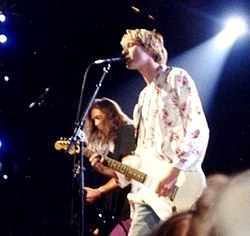 Grunge was a genre of music and subculture popular in the 1990s, as modeled here by Krist Novoselic (left) and Kurt Cobain of the band Nirvana, one of the most influential bands of the decade. Pearl Jam, Soundgarden and Alice in Chains were also popular bands of this genre.
 -
 Technological advancements like the internet, personal computers, and the World Wide Web were popular in the 1990s. The Y2K bug in the late 1990s affected popular culture. Y2K was a computer bug occurring when computers switched from the years 1999 to 2000, some computers reset to 1900.
 -
 The futuristic Y2K aesthetic was popular in the late 1990s and early 2000s, named after the Y2K bug. This period was defined by then-new technology such as the iMac G3, digital cameras, and fashion such as shiny metallic clothing.
 -
 Crystal Pepsi was a popular drink in the 1990s, which was re-released for a limited run in the summer of 2016. Drinks like Surge released in 1997 and were also popular in the 1990s.
 -
 In the 1990s videotapes were used for personal home video recordings and recording television airings. VHS tapes could be put in devices such as VCRs, which were popular in the decade.
 -
 Pokémon Red, Blue, and Yellow released in the late 1990s, which launched the globally popular Pokémon franchise, pictured above the GameBoy cartridges.
 -
 Five Olympic Games were held in the 1990s, Albertville and Barcelona in 1992, Lillehammer in 1994, Atlanta in 1996 and Nagano in 1998 (all held in the post-Cold War decade).
 -
 The "Disney Renaissance" of the 1990s produced critically and commercially successful animated films like the first ever CGI motion picture Toy Story (produced with Pixar), and traditionally animated films such as Beauty and the Beast, Aladdin and The Lion King.
 -
 US President Bill Clinton merged with popular culture in the 1990s. Bill Clinton played saxophone on The Arsenio Hall Show, and the Clinton–Lewinsky scandal made TV headlines in 1998.
 -
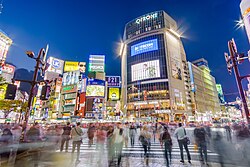 Shibuya became Tokyo's popular youth hangout in the 1990s, part of the Heisei Power cultural movement during the Lost Decades in Japan.
 -

-
 In the 1990s, crime and spy comedy films were extremely popular, such as Pulp Fiction (depicted), L.A. Confidential, New Jack City, Boyz n the Hood, Menace II Society, Goodfellas, and the Austin Powers film series.
 -
 The 1990s saw the use of earlier internet search engines, such as Google in its infancy, JumpStation, Ask.com, and AltaVista.
 -
 In the 1990s girl groups such as TLC (pictured), Destiny's Child, and The Spice Girls gained popularity. These bands are among the highest selling girl groups of all time.


.png)


_-_panoramio.jpg)


Film
[edit]Live-action films

Dogme 95 became an important European artistic motion picture movement by the decade's end. Also in 1998, Titanic by director James Cameron (released in late 1997) became the highest-grossing film of all time, grossing over $1.8 billion worldwide. It would hold this record for over a decade until 2010 when James Cameron's Avatar (released in December 2009), took the title.[96]
Crime films were also extremely popular during the 1990s and garnered several awards throughout the decade, such as Goodfellas, Pulp Fiction, L.A. Confidential, Heat, Boyz n the Hood, Se7en, Thelma & Louise, Fargo, A Simple Plan, and many others.
Live-action films featuring computer-animated characters became popular, with films such as Casper, 101 Dalmatians, Men in Black and Stuart Little proving financially successful. Live-action/traditional cel animated film featuring traditional characters like Space Jam, Cool World, and The Pagemaster were prevalent as well.
In Argentina, a new artistic movement appeared in the filmmaking scene, called Nuevo Cine Argentino, which would be greatly influential in Latin American cinema.
Animated films
In 1994, former Disney employee Jeffrey Katzenberg founded DreamWorks SKG, which would produce its first two animated films: The Prince of Egypt and Antz which were both aimed more at adults than children and were both critically and commercially successful. Toy Story, the first full-length CGI movie, made by Pixar, was released in 1995 and revolutionized animated films. In 1998, with the release of DreamWorks's Antz and Pixar's A Bug's Life, the rivalry between DreamWorks and Pixar began between the studios due to the similarities between both films.
Meanwhile, films by Pixar's parent company, Disney became popular once more when the studio returned to making family-oriented animated musical films. Disney Animation was navigating the "Disney Renaissance", through both animated theatrical films and animated television series on the Disney Channel (owned by Walt Disney Television). The "Disney Renaissance" began with The Little Mermaid in 1989 and ended with Tarzan in 1999. Films of this era include Beauty and the Beast, Aladdin, The Nightmare Before Christmas, The Lion King, Pocahontas, The Hunchback of Notre Dame, Hercules, and Mulan.
Japanese anime films remained popular throughout the 1990s with the release of Studio Ghibli films such as Only Yesterday, Porco Rosso, Pom Poko, Whisper of the Heart, Princess Mononoke (which became the highest-grossing anime film at the time) and My Neighbors the Yamadas. Other significant anime films which gained cult status include Roujin Z, Ramayana: The Legend of Prince Rama, Patlabor 2: The Movie, Ninja Scroll, Street Fighter II: The Animated Movie, Ghost in the Shell, Memories, The End of Evangelion, Perfect Blue, and Jin-Roh: The Wolf Brigade.
Other significant animated films have also gained cult status, such as The Iron Giant, Batman: Mask of the Phantasm, A Goofy Movie, Cats Don't Dance, Ferngully: The Last Rainforest, Anastasia, and Kirikou and the Sorceress.
Other successful films
Critically acclaimed and financially successful films that came out in this decade included Jurassic Park (which was the highest grossing film at the time, before beaten by Titanic that same decade), Forrest Gump, The Mask, The Matrix, Trainspotting, Braveheart, Home Alone, Mrs. Doubtfire, Babe, Terminator 2: Judgment Day, The Silence of the Lambs, the Before trilogy (starting in 1995 with Before Sunrise), Philadelphia, Ghost, The Sixth Sense, Scream, Misery, Wayne's World, Austin Powers: International Man of Mystery, Men in Black, Independence Day, Groundhog Day, Clerks, Saving Private Ryan, Schindler's List, Edward Scissorhands, Leaving Las Vegas, The Addams Family, Clueless, The Big Lebowski, Four Weddings and a Funeral, Jerry Maguire, Mission: Impossible, The Green Mile, and The Shawshank Redemption.
In India, Shah Rukh Khan got rise in his stardom by Dilwale Dulhania Le Jayenge, Kuch Kuch Hota Hai, and Dil To Pagal Hai.[citation needed]
Award winners
[edit]Highest-grossing
[edit]The 25 highest-grossing films of the decade are:[117]
| No. | Title | Year | Box office |
|---|---|---|---|
| 1 | Titanic | 1997 | $1,850,197,130 |
| 2 | Star Wars: Episode I – The Phantom Menace | 1999 | $924,305,084 |
| 3 | Jurassic Park | 1993 | $912,667,947 |
| 4 | Independence Day | 1996 | $817,400,891 |
| 5 | The Lion King | 1994 | $763,455,561 |
| 6 | Forrest Gump | 1994 | $677,387,716 |
| 7 | The Sixth Sense | 1999 | $672,806,292 |
| 8 | The Lost World: Jurassic Park | 1997 | $618,638,999 |
| 9 | Men in Black | 1997 | $589,390,539 |
| 10 | Armageddon | 1998 | $553,709,788 |
| 11 | Terminator 2: Judgment Day | 1991 | $516,950,043 |
| 12 | Ghost | 1990 | $505,702,588 |
| 13 | Aladdin | 1992 | $504,050,219 |
| 14 | Twister | 1996 | $494,471,524 |
| 15 | Toy Story 2 | 1999 | $487,059,677 |
| 16 | Saving Private Ryan | 1998 | $481,840,909 |
| 17 | Home Alone | 1990 | $476,684,675 |
| 18 | The Matrix | 1999 | $463,517,383 |
| 19 | Pretty Woman | 1990 | $463,406,268 |
| 20 | Mission: Impossible | 1996 | $457,696,391 |
| 21 | Tarzan | 1999 | $448,191,819 |
| 22 | Mrs. Doubtfire | 1993 | $441,286,195 |
| 23 | Dances with Wolves | 1990 | $424,208,848 |
| 24 | The Mummy | 1999 | $415,933,406 |
| 25 | The Bodyguard | 1992 | $410,945,720 |
Music
[edit]Music artists and genres
.JPEG)


Music marketing became more segmented in the 1990s, as MTV gradually shifted away from music videos and radio splintered into narrower formats aimed at various niches.[118][119][120][121] However, the 1990s are perhaps best known for grunge, gangsta rap, R&B, teen pop; Eurodance, electronic dance music, the renewed popularity of punk rock from the band Green Day and their 1994 album Dookie (which would also help create a new genre pop punk), and for the entrance of alternative rock into the mainstream. U2 was one of the most popular 1990s bands; their groundbreaking Zoo TV and PopMart tours were the top-selling tours of 1992 and 1997, respectively. Glam metal died out in the music mainstream by 1991.[122] Grunge became popular in the early 1990s due to the success of Nirvana's Nevermind, Pearl Jam's Ten, Alice in Chains' Dirt, Soundgarden's Badmotorfinger and Stone Temple Pilots' Core.[123] Pop punk also becomes popular with such artists as Green Day, Blink-182, Weezer, Social Distortion, the Offspring, Bad Religion, NOFX and Rancid.[124] Other successful alternative acts included Red Hot Chili Peppers, R.E.M., Nickelback, Creed, Radiohead, Gin Blossoms, Soul Asylum, Goo Goo Dolls, Third Eye Blind, Faith No More, the Smashing Pumpkins, Live, Everclear, Bush, Screaming Trees and Ween.[125]


Rappers Salt-n-Pepa continued to have hit songs until 1994. Dr. Dre's 1992 album The Chronic provided a template for modern gangsta rap, and gave rise to other emerging artists of the genre, including Snoop Dogg.[126] Due to the success of Death Row Records and Tupac Shakur, West Coast gangsta rap commercially dominated hip hop during the early-to-mid 1990s, along with Bad Boy Records and the Notorious B.I.G. on the East Coast.[127] Hip hop became the best-selling music genre by the mid-1990s.[128][129]
1994 became a breakthrough year for punk rock in California, with the success of bands like Bad Religion, Social Distortion, Blink-182, Green Day, the Offspring, Rancid and similar groups following. This success would continue to grow over the next decade. The 1990s also became the most important decade for ska punk/reggae rock, with the success of many bands like Smash Mouth, Buck-O-Nine, Goldfinger, Less Than Jake, the Mighty Mighty Bosstones, Murphy's Law, No Doubt, Reel Big Fish, Save Ferris, Sublime and Sugar Ray.
The rave movement that emerged in the late 1980s continued to grow in popularity. This movement spawned genres such as Intelligent dance music and Drum and bass. The latter is an offshoot of jungle techno and breakbeat. Popular artists included Moby, Fatboy Slim, Björk, Aphex Twin, Orbital, the Orb, the Chemical Brothers, Basement Jaxx, Todd Terry, 808 State, Primal Scream, the Shamen, the KLF and the Prodigy.
The rise of industrial music, somewhat a fusion of synthpop and heavy metal, rose to worldwide popularity with bands like Godflesh, Nine Inch Nails, Rammstein, Ministry and Marilyn Manson. Groove metal was born through the efforts of Pantera, whose seventh studio album Far Beyond Driven (1994) was notable for going number one on Billboard 200. Another heavy metal subgenre called nu metal, which mixed metal with hip hop influences, became popular with bands like Korn, Slipknot and Limp Bizkit selling millions of albums worldwide. Metallica's 1991 eponymous album Metallica is the best-selling album of the SoundScan era, while extreme metal acts such as Death, Mayhem, Darkthrone, Emperor, Cannibal Corpse and others experienced popularity throughout the decade.
Country music
[edit]In the 1990s, country music became a worldwide phenomenon thanks to Billy Ray Cyrus, Shania Twain and Garth Brooks.[130][131][132] The latter enjoyed one of the most successful careers in popular music history, breaking records for both sales and concert attendance throughout the decade. The RIAA has certified his recordings at a combined (128× platinum), denoting roughly 113 million United States shipments.[133]
Other artists that experienced success during this time included Clint Black, Sammy Kershaw, Aaron Tippin, Travis Tritt, Suzy Bogguss, Alan Jackson, Lorrie Morgan and the newly formed duo of Brooks & Dunn. George Strait, whose career began in the 1980s, also continued to have widespread success in this decade and beyond. Female artists such as Reba McEntire, Faith Hill, Martina McBride, Deana Carter, LeAnn Rimes and Mary Chapin Carpenter all released platinum-selling albums in the 1990s. Rimes, a teenager at the time, spawned a "teen movement" in country music; with fellow teen artists Lila McCann, Jessica Andrews, Billy Gillman, and others following suit; a phenomenon that hasn't been duplicated since Tanya Tucker and Marie Osmond in the early 1970s. The Dixie Chicks became one of the most popular country bands in the 1990s and early 2000s. Their 1998 debut album Wide Open Spaces went on to become certified 12× platinum, while their 1999 album Fly went on to become 10× platinum.
R&B and related
[edit]Contemporary quiet storm and R&B continued to be quite popular among adult audiences originating from African-American communities, which began during the 1980s. Popular African-American contemporary R&B artists included Mariah Carey, D'Angelo, Lauryn Hill, Whitney Houston, Brandy, En Vogue, TLC, Destiny's Child, Toni Braxton, Boyz II Men, Dru Hill, Vanessa Williams and Janet Jackson.
Also, British R&B artists Sade (active since 1982), Des'Ree and Mark Morrison became quite popular during this decade.
Music from around the world
[edit]_(cropped).jpg)

In the United Kingdom, the alternative rock Britpop genre emerged as part of the more general Cool Britannia culture, with Pulp (already founded in 1978), Blur (active since 1988), Ocean Colour Scene (since 1989), Suede (existing since 1989 with hiatus), the Verve (1990–1993), Oasis (formed in 1991), Elastica (1992–2001), Ash (since 1992), Supergrass (1993–2022 with hiatus) and Kula Shaker (since 1995) serving as popular examples of this emergence.
The impact of boy band pop sensation Take That, founded in 1990, lead to the formation of other boy bands in the UK and Ireland, such as East 17 in 1991 and the Irish boy band Boyzone in 1993. Female pop icons Spice Girls took the world by storm since 1994, becoming the most commercially successful British group since the Beatles, the Rolling Stones and Led Zeppelin.[134][135] Their global success brought about a widespread scene of teen pop acts around the world[136][137] such as All Saints, Backstreet Boys (both formed in 1993) as well as American acts as Hanson (from 1992), NSYNC (1995–2002, reunited 2003), Britney Spears and Christina Aguilera who came to prominence into the new millennium.[138]
Many musicians from Canada, such as Celine Dion, Maestro Fresh Wes, Snow, Barenaked Ladies, Shania Twain, Len, Sarah McLachlan, and Alanis Morissette became known worldwide.
Argentine rock music continues to be commercially successful and culturally relevant throughout the 1990s. Soda Stereo, the most famous rock band of Latin America reached new heights with their album Canción Animal in 1990, which contained great anthems of Argentine Rock, such as De Música Ligera, Té para tres and Entre Caníbales. Many bands of the Underground scene become mainstream, such as hard rock band, La Renga, post-punk band Los Redondos and alternative rock band Babasónicos. Also Charly García and Fito Páez would continue their successful solo careers, the latter with one of hist most famous albums, Circo Beat, and his classic song, Mariposa Tecknicolor.
In 1991, Australian children's music group The Wiggles.
In Japan, the J-pop genre emerged as part of the more general Heisei Power cultural movement, with B'z, Mr. Children, Southern All Stars, Yumi Matsutoya, Dreams Come True, Glay, Zard, Hikaru Utada, Namie Amuro, SMAP, Chage and Aska, L'Arc-en-Ciel, Masaharu Fukuyama, Globe, Tube, Kome Kome Club, Maki Ohguro, Tatsuro Yamashita, TRF, Speed, Wands, and Field of View became more popular for Japanese youth audiences during the Lost Decades.
The Tibetan Freedom Concert, organized by Beastie Boys and the Milarepa Fund, brought 120,000 people together in the interest of increased human rights and autonomy for Tibet from China.
Controversies
[edit]
Controversy surrounded the Prodigy with the release of the track "Smack My Bitch Up". The National Organization for Women (NOW) claimed that the track was "advocating violence against women" due to the song's lyrics, which are themselves sampled from Ultramagnetic MCs' "Give the Drummer Some". The music video (directed by Jonas Åkerlund) featured a first-person POV of someone going clubbing, indulging in drugs and alcohol, getting into fist fights, abusing women and picking up a prostitute. At the end of the video, the camera pans over to a mirror, revealing the subject to be a woman.
Deaths of artists
[edit]1991 also saw the death of Queen frontman Freddie Mercury from AIDS-related pneumonia. Next to this Kurt Cobain, Selena, Eazy-E, Tupac Shakur and the Notorious B.I.G. were the most publicized music-related deaths of the decade, in 1994, 1995, 1996, and 1997 respectively. Richey Edwards of Manic Street Preachers was publicized in the media in 1991 following an incident involving Steve Lamacq backstage after a live show, in which Edwards carved '4 Real' into his arm. Edwards' disappearance in 1995 was highly publicized. He is still missing but was presumed dead in 2008.
Television
[edit]Comedies and sitcoms

TV shows, mostly sitcoms, were popular with American audiences. Series such as Roseanne, Coach, Empty Nest, Mr. Belvedere, 227, Cheers, The Cosby Show, Growing Pains, Night Court, The Hogan Family, Murphy Brown, Full House, The Wonder Years, A Different World, Amen, ALF, Perfect Strangers, Married... with Children, Family Matters, Charles in Charge, Saved by the Bell, My Two Dads, Major Dad, Newhart, Dear John, Designing Women, The Golden Girls, Who's the Boss?, Head of the Class, and Seinfeld, which premiered in the eighties, and Frasier, a spin-off of the 1980s hit Cheers were viewed throughout the 1990s.
These sitcoms, along with Friends, That '70s Show, Ellen, The Fresh Prince of Bel-Air, Nurses, Living Single, Step by Step, NewsRadio, Blossom, The King of Queens, Fired Up, Jesse, Parker Lewis Can't Lose, For Your Love, The Steve Harvey Show, The Larry Sanders Show, Sex and the City, Arliss, Dream On, Grace Under Fire, Mad About You, Sabrina the Teenage Witch, The Naked Truth, The Jeff Foxworthy Show, The Jamie Foxx Show, Smart Guy, The Wayans Bros., Malcolm & Eddie, Clueless, Moesha, The Parent 'Hood, Unhappily Ever After, Roc, Martin, Hangin' with Mr. Cooper, In Living Color, Sister, Sister, Boy Meets World, Ned and Stacey, Becker, Veronica's Closet, Two Guys and a Girl, The Drew Carey Show, Wings, The John Larroquette Show, Caroline in the City, Sports Night, Home Improvement, Will & Grace, Evening Shade, Cosby, Spin City, The Nanny, 3rd Rock from the Sun, Suddenly Susan, Cybill, Just Shoot Me!, Everybody Loves Raymond, and Dharma & Greg, as well as British sitcoms like Mr. Bean, Father Ted, Absolutely Fabulous, I'm Alan Partridge, and One Foot in the Grave, from the 90s turned TV in new directions and defined the humor of the decade.
Furthermore, Saturday Night Live experienced a new era of success during the 1990s, launching the careers of popular comedians and actors such as Chris Farley, Dana Carvey, Phil Hartman, Adam Sandler, Will Ferrell, Molly Shannon, Mike Myers, Chris Rock, Norm Macdonald, David Spade, Cheri Oteri and others.

Drama shows
1993 saw the debut of the medical–mystery drama, Diagnosis Murder, a comeback vehicle for Dick Van Dyke, who guest-starred on an episode of its parent series, Jake and the Fatman, where the show got off to a rocky start and became one of television's long-running mysteries, that lasted until its cancellation in 2001. It was one of a number of shows that made CBS popular with a distinctly older audience than its competitors, with a lineup consisting mainly of murder mysteries, westerns and religious dramas, such as Walker, Texas Ranger, Touched by an Angel, Murder, She Wrote and Dr. Quinn, Medicine Woman.
Medical dramas started to return to television in the 1990s after the end of St. Elsewhere in 1988. In 1994, ER, which originally starred Anthony Edwards, Noah Wyle and George Clooney, was instantly a domestic and international success, lasting until 2009 and spawning similar series to compete against it, such as the more soap opera-esque Grey's Anatomy (2005–present), and the short lived Medicine Ball (1995). It was one of the many successful shows during that period (as well as sitcoms such as Seinfeld and Friends) which made NBC the most-watched channel in the United States. This show launched the career of George Clooney. That same year, Chicago Hope, that starred Héctor Elizondo, Mandy Patinkin and Adam Arkin, was also a popular series for CBS, lasting between 1994 and 2000.
Crime drama and police detective shows returned to the spotlight after soap operas died down. After the successful debuts of Law & Order, NYPD Blue, Homicide: Life on the Street, Fox debuted New York Undercover, which starred Malik Yoba and Micheal DeLorenzo, is notable for featuring two people of color in the main roles. Nash Bridges, a comeback vehicle for Don Johnson, lasting six seasons (1996–2001), dealt with escapist entertainment instead of tackling social issues.[139]
Beverly Hills, 90210 ran on Fox from 1990 to 2000. It established the teen soap genre, paving the way for Dawson's Creek, Felicity, Party of Five, and other shows airing later in the decade, and into the 2000s. The show was then remade and renamed simply 90210 and premiered in 2008. Beverly Hills, 90210, and its spin-off Melrose Place also became a popular TV show throughout the 1990s. Baywatch became the most-watched TV show in history [citation needed] and influenced pop culture.
Sex and the City's portrayal of relationships and sexuality caused controversy and acclaim, leading to a new generation of sexually progressive television shows in the 2000s, such as Queer as Folk and The L Word.
Other television shows and genres
Fantasy and science fiction shows were popular on television, with NBC airing SeaQuest DSV beginning in 1993, which made Jonathan Brandis a popular teen idol, but was cancelled after three seasons. The 1990s saw a multitude of Star Trek content: in 1993, following the success of Star Trek: The Next Generation, Paramount released the follow-up shows Star Trek: Deep Space Nine (1993–1999) and Star Trek: Voyager (1995–2001). Touched By an Angel, broadcast by CBS in 1994, was intended as the comeback vehicle of Della Reese, and also launched the career of Roma Downey. It wasn't an immediate success and was cancelled, but was revived the following year due to a fan letter-writing campaign, and ran for eight more seasons. At the end of the decade, the fantasy drama series Charmed gained a cult following and helped popularize the WB.
In 1993, one of the last westerns to air on television was Walker, Texas Ranger, a crime drama starring Chuck Norris as the title character. Running for nine seasons, the show tackled a wide variety of subjects and was one of few shows to feature an actor performing karate stunts at that time.
Reality television was not an entirely new concept (An American Family aired on PBS in 1973) but proliferated for Generation X audiences with titles such as Judge Judy, Eco-Challenge, and Cops.
The 1990s saw the debut of live-action children's programs such as the educational Bill Nye the Science Guy and Blue's Clues as well as the superhero show Mighty Morphin Power Rangers, the latter becoming a pop culture phenomenon along with a line of action figures and other toys by Japanese toy manufacturer Bandai. This can also be said for the British pre-school series Teletubbies, which was a massive hit loved by very young children. It also saw long time running shows such as Barney & Friends and the continuation of Sesame Street, both of which would continue in the following decades and so.
During the mid-1990s, two of the biggest professional wrestling companies: World Championship Wrestling and World Wrestling Federation were in a ratings battle that was called the Monday Night War (1995–2001). Each company fought to draw more viewers to their respective Monday night wrestling show. The "War" ended in 2001 when WWE bought WCW. In November 2001, there was a Winner Takes All match with both companies in a Pay-Per-View called Survivor Series. WWF won the match, putting an end to WCW.
The late 1990s also saw the evolution of a new TV genre: primetime game shows, popularized by the quiz show Who Wants to Be a Millionaire?, hosted originally by Chris Tarrant on ITV in the United Kingdom and Regis Philbin on ABC in the United States, as well as other first-run game shows aired in prime time on the newly launched Game Show Network.
Many Argentine TV shows and soap operas were greatly successful abroad, such as Muñeca Brava, which would become immensely successful in Russia, and would be exported to over 80 countries, and translated to over 50 languages. Similarly, Chiquititas was broadcast in 36 countries in Latin America, Europe and Asia.
Animated shows
The animated sitcom, The Simpsons, premiered on Fox in December 1989 and became a domestic and international success in the 1990s. The show has since aired more than 600 episodes and has become an institution of pop culture. In addition, it has spawned the adult-oriented animated sitcom genre, inspiring more adult-oriented animated shows such as Beavis and Butt-Head (1993–1997), Daria (1997–2001), along with South Park and Family Guy, the latter two of which began in 1997 and 1999, respectively, and continue to air new episodes through the 2000s and into the 2020s.
Cartoons produced in the 1990s are sometimes referred to as the "Renaissance Age of Animation" for cartoons in general, particularly for American animated children's programs. Disney Channel, Nickelodeon (owned by Viacom, now Paramount Global) and Cartoon Network (owned by Warner Bros. Discovery) would dominate the animated television industry. These three channels are considered the "Big Three", of children's entertainment, even today, but especially during the 1990s.
Other channels such as Warner Bros. Animation would create shows like Tiny Toon Adventures, Animaniacs, and the start of the DC Animated Universe with shows such as Batman: The Animated Series, and Superman: The Animated Series, as well as syndicated shows like Phantom 2040. Nickelodeon's first three animated series known as Nicktoons (Doug, Rugrats, The Ren & Stimpy Show) all premiered on the same day in 1991 along with shows such as Rocko's Modern Life, Hey Arnold!, CatDog, The Wild Thornberrys, and in 1999 saw the debut of Nickelodeon's well known animated comedy series SpongeBob SquarePants. Cartoon Network would create shows like Dexter's Laboratory, The Powerpuff Girls, Ed, Edd n Eddy, Johnny Bravo, and Courage the Cowardly Dog. Disney Channel would make shows like Recess, Pepper Ann, Darkwing Duck, TaleSpin, and Gargoyles. The 1990s also saw animated shows such as Oggy and the Cockroaches, Bobby's World, Arthur achieve popularity, alongside British stop-motion animated film series Wallace & Gromit, which has spawned over four short films and two feature-length films.
Japanese anime was popular in the 1980s and expanded to a worldwide audience by the 1990s for its expansive spectrum of story subjects and themes not limited to comedy and superhero action found in the US. It featured well-produced, well-written, visual, and story content that came to showcase animation's potential for emotional and intellectual depth and integrity on par with live action media to its viewers. Anime expanded to older and adult audiences in the medium of animation. Anime shows such as Sailor Moon, Digimon, Pokémon, Tenchi Muyo!, Berserk, Trigun, Cowboy Bebop, Gundam Wing, Neon Genesis Evangelion, Ranma ½, Yu Yu Hakusho, Slayers, Rurouni Kenshin, Initial D, Gunsmith Cats, Slam Dunk, Nadia: The Secret of Blue Water, Outlaw Star, to anime movies such as Akira, Vampire Hunter D, Jin-Roh: The Wolf Brigade, My Neighbor Totoro, Princess Mononoke, Castle in the Sky, The Castle of Cagliostro, and imports by various distributors such as Viz, AnimEigo, Central Park Media, A.D. Vision, Pioneer Entertainment, Media Blasters, Manga Entertainment, and Celebrity, helped begin the mid to late 1990s and turn of the millennium introductory anime craze in the US, and the Cartoon Network anime programming block Toonami in 1997.
Fashion and body modification
[edit]Significant fashion trends of the 1990s include:
- Earth and jewel tones, as well as an array of minimalist style and design influences, characterize the 1990s, a stark contrast to the camp and bombast seen in the brightly colored fashion and design trends of the 1980s.
- The Rachel, Jennifer Aniston's hairstyle on the hit TV show Friends, became a cultural phenomenon, with millions of women copying it worldwide.
- The Hi-top fade was trendy among African Americans in the early 1990s.
- The Curtained Haircut increased in popularity in fashion and culture among teenage boys and young men in the 1990s, mainly after it was popularized in the film Terminator 2: Judgment Day by the actor Edward Furlong.
- The model 1300 Wonderbra style has a resurgence of popularity in Europe in 1992, which kicks off an international media sensation, the 1994 return of "The Wonderbra" brand, and a spike in the push-up, plunge bras around the world.
- Additional fashion trends of the 1990s include the Tamagotchi, Rollerblades, Pogs and Dr. Martens shoes.
- Bleached-blond hair became very popular in the late 1990s, as were men with short hair with the bangs "flipped up."
- The 1990s also saw the return of the 1970s teenage female fashion with long, straight hair and denim hot pants.
- Beverly Hills, 90210 sideburns also became popular in the early and mid-1990s.
- Slap bracelets were a popular fad among children, preteens, and teenagers in the early 1990s and were available in a wide variety of patterns and colors. Also popular among children were light-up sneakers, jelly shoes, and shoelace hair clips.
- The Grunge hype at the beginning of the decade popularized flannel shirts among both genders during the 1990s.
- Heroin chic appeared sporadically across film, fashion models and grunge music, but gave way by end of the US recession and the emergence of internet "geek" culture (a sassy tech-literate style centered on web searching and drinking coffee).
- Grunge- and hip-hop-inspired anti-fashion saw an expansion of the slouchy, casual styles of past decades, mostly seen in baggy and distressed jeans, cargo shorts and pants, baseball caps (often worn backward), chunky sneakers, oversized sweatshirts, and loose-fitting tees with grandiloquent graphics and logos.
- Svelte fashion was also popular from the beginning of the 1990s and into the 2000s, as the new millennium began. The rivalry of sloppy grunge fashion versus more expensive clothing made for fitter bodies was a repeat of the rock versus disco rivalry of a decade ago. Nineties fashion became darker, slinkier, and more futuristic-looking clothing in the late 1990s, with Keanu Reeves in The Matrix as a style icon.
- Tattoos and piercings became part of the mainstream aesthetic. American model Christy Turlington revealed her belly button piercing at a fashion show in London in 1993. In the late 1990s, some females got lower back tattoos and men opted for tribal style arm bands or back pieces.
-
 Tamagotchi and Furby were popular iconic toys among children around the world in the 1990s, also in the 2000s
 -
 Pogs was a popular street game among children around the world during the decade
 -
 Grunge-style fashion became a trend in the 1990s, modeled here by teen actor Jonathan Brandis
 -
 Boots like Timberlands and Dr. Martens became popular. Hiking, motorcyclist and safety boots were all part of the general trend towards grunge fashion in footwear
 -
 Will Smith donning a Hi-top fade in 1993, a popular hairstyle of the early decade
 -
 Paula Abdul modeling a semi-transparent black dress, curled hair and smoky eye makeup at the 62nd Academy Awards in 1990
 -
 Jane Leeves sporting a slip dress in 1995
 -
 Example of late 1990s goth fashion


_(cropped).jpg)
.jpg)
.jpg)

Video games
[edit]Video game consoles
Video game consoles released in this decade include the Super Nintendo Entertainment System, Neo Geo, Atari Jaguar, 3DO, Sega Saturn, PlayStation, Nintendo 64 and Dreamcast. Portable video game consoles include the Game Gear, Atari Lynx and Game Boy Color. Super Mario World was the decade's best-selling home console video game, while Pokémon Red and Blue was the decade's best-selling portable video game; Super Mario 64 was the decade's best-selling fifth-generation video game, while Street Fighter II was the decade's highest-grossing arcade video game.
The console wars, primarily between Sega (Mega Drive, marketed as the Sega Genesis in North America, introduced in 1988) and Nintendo (Super NES, introduced in 1990), sees the entrance of Sony with the PlayStation in 1994, which becomes the first successful CD-based console (as opposed to cartridges). By the end of the decade, Sega's hold on the market becomes tenuous after the end of the Saturn in 1999 and the Dreamcast in 2002.
Arcade games rapidly decreased in popularity, mainly due to the dominance of handheld and home consoles.[140]
Video games
Mario as Nintendo's mascot finds a rival in Sega's Sonic the Hedgehog with the release of Sonic the Hedgehog on the Sega Mega Drive/Genesis in 1991. Sonic the Hedgehog would go on to become one of the most successful video game franchises of the decade and of all time.
Notable video games of the 1990s include: Super Metroid, Metal Gear Solid, Super Mario World, Doom, Donkey Kong Country, Donkey Kong 64, Pokémon Red and Blue Versions, Super Smash Bros, Pokémon Yellow Version, GoldenEye 007, Super Mario 64, The Legend of Zelda: Ocarina of Time, Gran Turismo, Mario Kart 64, Half-Life, Super Mario Kart, Radiant Silvergun, Rayman, Gunstar Heroes, Banjo-Kazooie, Soulcalibur, Star Fox series, Tomb Raider series, Final Fantasy, Sonic the Hedgehog series, Story of Seasons series, Tony Hawk's series, Crash Bandicoot series, Metal Slug series, Resident Evil series, Street Fighter II, Spyro the Dragon series, Commander Keen series, Test Drive series, Dance Dance Revolution series, Monkey Island series, Dune series, Mortal Kombat series, Warcraft series, Duke Nukem 3D, Tekken series, EarthBound, Fallout: A Post Nuclear Role Playing Game, and StarCraft.
Sony's PlayStation becomes the top-selling video game console and changes the standard media storage type from cartridges to compact discs (CDs) in home consoles. Crash Bandicoot is released on 9 September 1996, becoming one of the most successful platforming series for the Sony PlayStation. Spyro The Dragon, released on 9 September 1998, also became a successful platforming series. Tomb Raider's Lara Croft became a video game sex symbol, becoming one of the most recognizable figures in the entertainment industry throughout the late 1990s.
Pokémon enters the world scene with the release of the original Pokémon Red and Pokémon Green for Game Boy in Japan in 1996, later changed to Pokémon Red and Pokémon Blue for worldwide release in 1998. It soon becomes popular in the United States and Canada, creating the term Pokémania, and is adapted into a popular anime series and trading card game, among other media forms.
Resident Evil is released in 1996 and Resident Evil 2. Both games became the most highly acclaimed survival-horror series on the PlayStation at the time it was released. It is credited with defining the survival horror genre and with returning zombies to popular culture, leading to a renewed interest in zombie films by the 2000s.
Video game genres
3D graphics become the standard by the decade's end. Although FPS games had long since seen the transition to full 3D, other genres began to copy this trend by the end of the decade. The most notable first shooter games in the 1990s are GoldenEye 007 and Tom Clancy's Rainbow Six.
The violent nature of fighting games like Capcom's Street Fighter II, Sega's Virtua Fighter, and Midway's Mortal Kombat prompted the video game industry to accept a game rating system. Hundreds of knockoffs are widely popular in the mid-to-late 1990s. Doom (1993) bursts onto the world scene, and instantly popularizes the FPS genre. Half-Life (1998) builds upon this, using gameplay without levels and an immersive first-person perspective. Half-Life became one of the most popular FPS games in history.
The real-time strategy (RTS) genre is introduced in 1992 with the release of Dune II. Warcraft: Orcs & Humans (1994) popularizing the genre, and Command & Conquer and Warcraft II: Tides of Darkness in 1995, setting up the first major real-time strategy competition and popularizing multiplayer capabilities in RTS games. StarCraft in 1998 becomes the second best-selling computer game of all time. It remains among the most popular multiplayer RTS games today, especially in South Korea. [citation needed] Homeworld in 1999 becomes the first successful 3D RTS game. The rise of the RTS genre is often credited with the fall of the turn-based strategy (TBS) genre, popularized with Civilization in 1991. Final Fantasy was introduced (in North America) in 1990 for the NES and remains among the most popular video game franchises, with many new titles to date and more in development, plus numerous spin-offs, sequels, films and related titles. Final Fantasy VII, released in 1997, especially popularized the series.
Massively multiplayer online role-playing games (MMORPGs) see their entrance with Ultima Online in 1997. However, they do not gain widespread popularity until EverQuest and Asheron's Call in 1999. MMORPGs become among the most popular video game genres until the 2010s.
The best-selling games of the 1990s are listed below (note that some sources disagree on particular years):
- 1990: Super Mario World[141]
- 1991: Sonic the Hedgehog[141]
- 1992: Super Mario Land 2: 6 Golden Coins[141]
- 1993: Super Mario All-Stars[141]
- 1994: Donkey Kong Country[141]
- 1995: Super Mario World 2: Yoshi's Island[141] or Mortal Kombat 3[142]
- 1996: Pokémon Red and Blue[141] or Super Mario 64[142]
- 1997: Gran Turismo[141] or Mario Kart 64[142]
- 1998: Pokémon Yellow[141] or The Legend of Zelda: Ocarina of Time[142]
- 1999: Pokémon Gold and Silver[141] or Donkey Kong 64[142]
-
 Neo Geo AES released in 1990. The console was supposed to bring an experience similar to Arcade games to be played.
 -
 Super Nintendo Entertainment System (SNES) released in 1990 and is the successor to the Nintendo Entertainment System
 -
 The European PAL version of the Mega Drive launched in 1990, later becoming the highest-selling fourth-gen console in Europe.
 -
 Nintendo's Game Boy was a popular handheld game console during the 1990s.
 -
 The Atari Jaguar released in 1993, becoming part Fifth-gen of video game consoles.
 -
 The Nintendo 64 was released in 1996. Super Mario 64 was the best-selling game of the decade.
 -
 The PlayStation was released in the mid-1990s and became the best-selling gaming console of its time.
 -
 The game Tomb Raider, launched in 1996, became particularly popular during the decade and as a result Lara Croft's character eventually became a cultural icon in the video game industry
 -
 Private LAN parties were at the peak of their popularity in the late 1990s and early 2000s when broadband Internet access was unavailable or too expensive for most people


.jpg)

Architecture
[edit]- The Petronas Twin Towers became two of the tallest man-made structures ever built after they officially opened on 31 August 1999.
Sports
[edit]

- In college football, the Inaugural 1992 SEC Championship Game occurred at Legion Field in Birmingham, Alabama. The Alabama Crimson Tide football team, under then-Coach Gene Stallings, went 11-0 and defeated the Florida Gators under then-Coach Steve Spurrier. The Tide would later finish 13–0 to win the National Championship and beat the Miami Hurricanes in the 1993 Sugar Bowl. However, Spurrier and the Gators would later win Four SEC Championships from 1993 to 1996. They went on to win their first National Championship in the 1997 Nokia Sugar Bowl by defeating the Florida State Seminoles.
- The 1992 Summer Olympics are held in Barcelona, Spain and the 1996 Summer Olympics are held in Atlanta, United States.
- The 1992 United States men's Olympic basketball team, nicknamed the "Dream Team", was the first American Olympic team to feature active professional players from the National Basketball Association. Described as the "greatest team ever assembled", its roster included the likes of Michael Jordan, Larry Bird, and Magic Johnson.[143][144]
- Major League Baseball players went on strike on 12 August 1994, thus ending the season and canceling the World Series for the first time in 90 years. The players' strike ended on 29 March 1995, when players and team owners agreed.
- The 1991 World Series pitted the Atlanta Braves and the Minnesota Twins, two teams who finished last place in their respective divisions, the previous season. The series would go all seven games won by the home teams, concluding dramatically with the Minnesota Twins claiming their second World Series title.
- American NBA basketball player Michael Jordan became a major sports and pop culture icon, idolized by millions worldwide. He revolutionized sports marketing through deals with companies such as Gatorade, Hanes, McDonald's and Nike. His Chicago Bulls team won six NBA titles during the decade (1991, 1992, 1993, 1996, 1997 and 1998). He was also notable in Hollywood thanks to his self-portrayal in the film Space Jam with the Looney Tunes characters.
- The National Hockey League would expand from 21 to 30 teams. During the expansion years, several teams would relocate to new cities: the Winnipeg Jets moved to Phoenix, Arizona and became the Phoenix Coyotes, the Quebec Nordiques moved to Denver and became the Colorado Avalanche, the Hartford Whalers moved to Raleigh, North Carolina and became the Carolina Hurricanes, and the Minnesota North Stars moved to Dallas and became the Dallas Stars.
- The NHL's 1990s expansion saw new teams in cities that previously never had NHL hockey: San Jose (San Jose Sharks), Anaheim (Mighty Ducks of Anaheim), Nashville (Nashville Predators), Miami (Florida Panthers), and Tampa (Tampa Bay Lightning). The NHL also returned to Atlanta with the expansion Atlanta Thrashers.
- Two of the NHL's Original Six teams, the New York Rangers and the Detroit Red Wings, would end long Stanley Cup championship droughts; the Rangers in 1994 after 54 years, and the Red Wings would win back-to-back Cups in 1997 and 1998 after 42 years.
- Canadian hockey star Mario Lemieux led the Pittsburgh Penguins, one of the original NHL expansion teams, to back-to-back Stanley Cup championships in 1991 and 1992.
- In addition to the Pittsburgh Penguins, three other NHL expansion teams went on to earn their first Stanley Cup championships: the New Jersey Devils in 1995, the Colorado Avalanche in 1996, and the Dallas Stars in 1999.
- Canadian hockey star Wayne Gretzky announced his retirement from the NHL in 1999. Upon his final game on 18 April, he held 40 regular-season records, 15 playoff records, and six All-Star records. He is the leading point-scorer in NHL history and the only NHL player to total over 200 points in one season – a feat he accomplished four times. In addition, he tallied over 100 points in 16 professional seasons, 14 of them consecutive. He played for four teams during his NHL career: the Edmonton Oilers, the Los Angeles Kings, the St. Louis Blues, and the New York Rangers.
- American cyclist Lance Armstrong won his first Tour de France in 1999, less than two years after battling testicular cancer. Armstrong would later become embattled in a major doping investigation, stripping him of this and all of his major cycling titles.
- In professional wrestling, as the popularity brought on by the 1980s boom period slowly declined in the former half of the 1990s, the WWF continued its "Golden Era" until 1993, led by such stars as Hulk Hogan, The Ultimate Warrior, and The Undertaker (who would go on to have an undefeated streak at WrestleMania that continued until WrestleMania XXX in April 2014). Afterwards, a second boom period from the middle of the decade was initiated due to the Monday Night War between the WWF and WCW to later spawn the WWF's Attitude Era, home to some of the biggest names in wrestling history such as Stone Cold Steve Austin, The Rock, and Triple H. Meanwhile, the highly popular nWo stable, along with Sting and Goldberg, brought WCW major success.
- The Manchester United won an unprecedented treble of the Premier League, FA Cup and Champions League after defeating Bayern Munich 2–1 in May 1999.
- The United States hosted the 15th staging of the 1994 FIFA World Cup. It holds the record for the largest attendance per game during the World Cup finals (even after the tournament's expansion to 32 teams and 64 matches). Additionally, this led to the creation of the MLS.
- In motor racing, triple Formula One World Champion Ayrton Senna is fatally injured in a crash at San Marino in 1994. Michael Schumacher enters into the sport – winning his first two championships in 1994 and 1995. Dale Earnhardt wins the 1998 Daytona 500 and the NASCAR Winston Cup championship in 1990, 1991, 1993, and 1994. Indy Car racing delves into an organizational "Split".
- In the NFL, the San Francisco 49ers and the Washington Redskins showed promise of continuing their '80s glory by each team winning another Super Bowl at the beginning of the decade. However, it was the Dallas Cowboys who made a gradual return to dynasty status, winning three Super Bowls (1992, 1993 and 1995) in four years after a 14-year NFL championship drought. The Denver Broncos also won their first two Super Bowls after having lost four, winning consecutive championships of the 1997 and 1998 seasons.
- NASCAR also enjoyed a popularity boom in this decade, with new, young drivers, such as Davey Allison and Jeff Gordon winning Winston Cup championships.
- Florida State, 1987–2000 – At the height of Bobby Bowden's dominance, the Florida State Seminoles went 152–19–1, won nine ACC championships (1992–2000), two national championships (1993 and 1999), played for three more national championships (1996, 1998, and 2000), were ranked #1 in the preseason AP poll five times (1988, 1991, 1993, 1995, and 1999), never lost the #1 AP ranking during 1999, produced 20 1st round NFL draft picks (including the 1997 offensive and defensive rookies of the year), won at least ten games every year, and never finished a season ranked lower than fourth in the AP poll. Quarterbacks Charlie Ward and Chris Weinke won Heisman Trophies.[145]
- The Nebraska Cornhuskers led by head coach Tom Osborne won three national championships in college football in four years (1994, 1995, 1997)
- Led by head coach Jim Tressel, The Youngstown State Penguins claimed to be the "team of the '90s" by winning four national championships (1991, 1993, 1994, 1997) in division I-AA college football[146]
- The Ultimate Fighting Championship (1993) and Pride Fighting Championship (1997) debut and evolve into the modern sport of Mixed Martial Arts.
- Major League Baseball added four teams, Miami Marlins (as Florida Marlins), Colorado Rockies, Tampa Bay Rays (as Tampa Bay Devil Rays), and the Arizona Diamondbacks, and moved one (Milwaukee Brewers) into the National League. The Florida Marlins would win the World Series in 1997 and 2003; the Arizona Diamondbacks would win the World Series in 2001, becoming the fastest expansion team to win a major championship for any major sport; the Colorado Rockies and Tampa Bay Rays would appear in the World Series in 2007 and 2008 respectively.
- In 1998, Canada wins gold medals for the first time in Disc ultimate at the WFDF World Ultimate Championship in Open, Mixed, and Masters.
- In the 1996 Summer Olympics, the Women's Gymnastics team won the first team gold medal for the US in Olympic Gymnastics history.
- In 1997, eight Australian Rugby League Premiership clubs defect to the News Corporation-backed Super League, before a resolution sees the two parties form the National Rugby League in 1998. The British competition is bought out by News Corporation, and renamed Super League, which it is still currently named (although it was sold by News Corporation).
Literature
[edit]- Leading talk show host Oprah Winfrey became an important book influencer in 1996 when she launched the highly successful Oprah's Book Club.
- The hugely successful Harry Potter series by J. K. Rowling was introduced in 1997. The series, with seven main novels, would go on to become the best-selling book series in world history and adapted into a film series in 2001.
- John Grisham was the bestselling author in the United States in the 1990s, with over 60 million copies sold of novels such as The Pelican Brief, The Client, and The Firm.[147]
- Other successful authors of the 1990s include Stephen King, Natsuo Kirino, Danielle Steel, Michael Crichton, James Redfield, Haruki Murakami, Keigo Higashino and Tom Clancy.[147]
- Goosebumps by R. L. Stine, the second highest-grossing book series in the world, was introduced in 1992 and remained a dominant player in children's literature throughout and after the decade. A television series released on Fox Kids alongside a film version that released in 2015.
- The decline of diverse study options in university humanities schools due to economic rationalism, leading to a boom in purple prose heavily influenced by 20th century European social theory and cultural studies. In 1996 in what is known as the Sokal affair, a mathematician pranked a cultural studies by tricking them into publishing his nonsensical essay "Transgressing the Boundaries: Towards a Transformative Hermeneutics of Quantum Gravity" on the basis that the journal wasn't peer-reviewed and would publish anything that seemed fashionably left-wing. In 1996 the Postmodernism Generator used a recursive transition network to imitate the postmodernist style of humanities writing.
- 1990s saw the rise of independent literature and notable self-help books, included Men Are from Mars, Women Are from Venus by John Gray and Who Moved My Cheese? by Spencer Johnson.
- Making Monsters: False Memories, Psychotherapy, and Sexual Hysteria (1994) by Richard Ofshe and Ethan Watters was critical of the repressed memory therapy that was gaining some traction in psychotherapy.
People
[edit]Scientists and engineers
[edit]Actors and directors
[edit]- Bob Hope
- Ben Affleck
- Jason Alexander
- Tim Allen
- María Conchita Alonso
- Benyamin Sueb
- Gillian Anderson
- Pamela Anderson
- Paul Thomas Anderson
- Jennifer Aniston
- Christina Applegate
- Rosanna Arquette
- Rowan Atkinson
- Hank Azaria
- Kevin Bacon
- Alec Baldwin
- Antonio Banderas
- Christopher Daniel Barnes
- Roseanne Barr
- Drew Barrymore
- Kim Basinger
- Angela Bassett
- Sean Bean
- Tom Berenger
- Daniel Beretta
- Elizabeth Berkley
- Sandra Bernhard
- Halle Berry
- Kathryn Bigelow
- Powers Boothe
- Ernest Borgnine
- Matthew Broderick
- Avery Brooks
- Pierce Brosnan
- Clancy Brown
- Sandra Bullock
- Tim Burton
- Brett Butler
- Yancy Butler
- Gabriel Byrne
- James Caan
- Nicolas Cage
- Dean Cain
- Chen Kaige
- James Cameron
- Neve Campbell
- Drew Carey
- George Carlin
- Jim Carrey
- Dana Carvey
- Dan Castellaneta
- Jackie Chan
- Dave Chappelle
- George Clooney
- Kevin Conroy
- Tim Conway
- Coen brothers
- Sean Connery
- Kevin Costner
- Courteney Cox
- Marcia Cross
- Tom Cruise
- Billy Crystal
- Macaulay Culkin
- Vondie Curtis-Hall
- Willem Dafoe
- Matt Damon
- Frank Darabont
- Richard Darbois
- Robert Davi
- Ellen DeGeneres
- Robert De Niro
- Gérard Depardieu
- Johnny Depp
- Danny DeVito
- Leonardo DiCaprio
- Shannen Doherty
- Kirk Douglas
- Brad Dourif
- Fran Drescher
- Léa Drucker
- David Duchovny
- Kirsten Dunst
- Charles S. Dutton
- Clint Eastwood
- Anthony Edwards
- Peter Falk
- Chris Farley
- David Faustino
- Abel Ferrara
- Will Ferrell
- Laurence Fishburne
- Calista Flockhart
- Harrison Ford
- William Forsythe
- Jodie Foster
- Jacques Frantz
- Dennis Franz
- Brendan Fraser
- Morgan Freeman
- Edward Furlong
- Eva Gabor
- James Gandolfini
- Janeane Garofalo
- Jennie Garth
- Sarah Michelle Gellar
- Mel Gibson
- Peri Gilpin
- Danny Glover
- Whoopi Goldberg
- Jeff Goldblum
- Trevor Goddard
- John Goodman
- Joseph Gordon-Levitt
- Mark-Paul Gosselaar
- Kelsey Grammer
- Brian Austin Green
- Graham Greene
- Thomas Ian Griffith
- Arsenio Hall
- Linda Hamilton
- Tom Hanks
- Curtis Hanson
- Phil Hartman
- Woody Harrelson
- Ed Harris
- Teri Hatcher
- Rutger Hauer
- Ethan Hawke
- Salma Hayek
- Isaac Hayes
- Mitch Hedberg
- Lance Henriksen
- Bill Hicks
- Agnieszka Holland
- Anthony Hopkins
- Dennis Hopper
- Bob Hoskins
- Ernie Hudson
- Helen Hunt
- Jeremy Irons
- Samuel L. Jackson
- Angelina Jolie
- Tommy Lee Jones
- Mike Judge
- Shekhar Kapur
- Tchéky Karyo
- Michael Keaton
- Harvey Keitel
- Tom Kenny
- Nicole Kidman
- Krzysztof Kieślowski
- Val Kilmer
- Greg Kinnear
- Lisa Kudrow
- Christopher Lambert
- Nathan Lane
- Eriq La Salle
- Martin Lawrence
- Matt LeBlanc
- Ang Lee
- Spike Lee
- Jane Leeves
- John Leguizamo
- Jennifer Jason Leigh
- Valérie Lemercier
- Jay Leno
- Jared Leto
- David Letterman
- Ted Levine
- Jet Li
- Rachael Lillis
- Delroy Lindo
- Ray Liotta
- John Lithgow
- Heather Locklear
- Mario Lopez
- Julia Louis-Dreyfus
- Dolph Lundgren
- Michael Madsen
- Bill Maher
- John Mahoney
- Maïwenn
- John Malkovich
- Julianna Margulies
- Steve Martin
- Frances McDormand
- John McTiernan
- Alyssa Milano
- Demi Moore
- Julianne Moore
- Joe Morton
- Carrie-Anne Moss
- Kate Mulgrew
- Charlie Murphy
- Eddie Murphy
- Mike Myers
- Samy Naceri
- Hideo Nakata
- Liam Neeson
- Craig T. Nelson
- Bob Newhart
- Brigitte Nielsen
- Connie Nielsen
- Leslie Nielsen
- Aaron Norris
- Chuck Norris
- Bill Nunn
- Conan O'Brien
- Ed O'Neill
- Gary Oldman
- Jerry Orbach
- Al Pacino
- Gwyneth Paltrow
- Robert Patrick
- Alexandra Paul
- Bill Paxton
- Chris Penn
- Sean Penn
- Ron Perlman
- Luke Perry
- Matthew Perry
- Joe Pesci
- Michelle Pfeiffer
- River Phoenix
- David Hyde Pierce
- Brad Pitt
- Kevin Pollak
- Jason Priestley
- Alex Proyas
- Dennis Quaid
- Randy Quaid
- Christopher Reeve
- Keanu Reeves
- Jean Reno
- Paul Reiser
- Pascal Renwick
- Phillip Rhee
- Michael Richards
- Alan Rickman
- Ving Rhames
- Tim Robbins
- Eric Roberts
- Julia Roberts
- Chris Rock
- Michael Rooker
- Richard Roundtree
- Mickey Rourke
- Tim Roth
- RuPaul
- Kurt Russell
- Daniel Russo
- Rene Russo
- Meg Ryan
- Winona Ryder
- Katey Sagal
- Bob Saget
- Adam Sandler
- Susan Sarandon
- Arnold Schwarzenegger
- David Schwimmer
- Steven Seagal
- Jerry Seinfeld
- Garry Shandling
- Harry Shearer
- Charlie Sheen
- Elisabeth Shue
- Sarah Silverman
- Tony Sirico
- Christian Slater
- Will Smith
- Jimmy Smits
- Wesley Snipes
- Kevin Spacey
- David Spade
- Tori Spelling
- Steven Spielberg
- Sage Stallone
- Sylvester Stallone
- John Stamos
- Mike Starr
- Jon Stewart
- Patrick Stewart
- Sharon Stone
- Meryl Streep
- Donald Sutherland
- Kiefer Sutherland
- Patrick Swayze
- Ice-T
- Jeffrey Tambor
- Quentin Tarantino
- Veronica Taylor
- Charlize Theron
- Tiffani-Amber Thiessen
- Uma Thurman
- Jennifer Tilly
- Tony Todd
- Danny Trejo
- John Travolta
- Robin Tunney
- Jean-Claude Van Damme
- Dick Van Dyke
- Gus Van Sant
- Arnold Vosloo
- Christopher Walken
- Marcia Wallace
- Fred Ward
- Denzel Washington
- Sam Waterston
- Sigourney Weaver
- Hugo Weaving
- Vernon Wells
- Forest Whitaker
- Michael Jai White
- Robin Williams
- Bruce Willis
- Rita Wilson
- Oprah Winfrey
- Michael Winterbottom
- John Woo
- James Woods
- Noah Wyle
- Robert Zemeckis
- Ian Ziering


Athletes
[edit]Basketball
[edit]Boxing
[edit]Cricket
[edit]Football
[edit]- José Luis Chilavert
- Eric Cantona
- Marco van Basten
- Roberto Baggio
- Hristo Stoitchkov
- George Weah
- Ronaldo
- David Beckham
- Zinedine Zidane
- Steve McManaman
- Robbie Fowler
- Michael Owen
- Romário
- Roberto Carlos
- Gabriel Batistuta
- Paolo Maldini
- Jürgen Klinsmann
- Rudi Völler
- Raúl González
- Christian Vieri
- Franco Baresi
- Alessandro Del Piero
- Diego Maradona
- Roger Milla
- Dennis Bergkamp
- Lothar Matthäus
- Frank Rijkaard
- Ronald Koeman
- Ruud Gullit
- Gheorghe Hagi
- Davor Šuker
- Roy Keane
- Paul Gascoigne
- Alan Shearer
- David Seaman
- Tony Adams
- Cafu
- David Ginola
- Michael Laudrup
- Peter Schmeichel
- Ryan Giggs
- Paul Scholes
- Fabien Barthez
- Oliver Bierhoff
- Jean-Pierre Papin
- Rivaldo
- Carlos Valderrama
- Faustino Asprilla
- René Higuita
Ice Hockey
[edit]Rugby
[edit]Wrestling
[edit]Other
[edit]- Andre Agassi
- Troy Aikman
- Lance Armstrong
- Barry Bonds
- Dale Earnhardt
- Miguel Indurain
- Brett Favre
- Jerry Rice
- Kelly Slater
- Pete Sampras
- Michael Schumacher
- Damon Hill
- Michael Johnson
- Mark McGwire
- Steffi Graf
- John Elway
- Alexander Karelin
- Ken Griffey Jr.
- Alain Prost
- Ayrton Senna
- Nigel Mansell
- Jonathan Edwards
- Donovan Bailey
- Svetlana Masterkova
- Marie-José Pérec
- Sergey Bubka
- Naim Süleymanoğlu
- Emmitt Smith
- Pyrros Dimas
- Wayne Rainey
- Michael Doohan
- Lilia Podkopayeva
- Vitaly Scherbo
- Derek Jeter
- Tiger Woods
- Martina Hingis
- Royce Gracie
- Jefferson Perez
- Wayne Carey
- Robert Harvey
- Tony Lockett
- Jason Dunstall
- Barry Sanders
- Deion Sanders
- Phil Taylor
- Jacques Villeneuve


Musicians
[edit]The 1990s saw the rise of diverse musical trends, identifiable through the decade's top-selling pop songs and the continued prominence of established genres such as gangsta rap, grunge, industrial rock, and deep house. Alternative hip hop gained visibility at the start of the decade, while the public's interest in independent music surged as a counter to commercial radio payola. [151]
Some of the notable artists and bands of the 1990s include AC/DC, Ace of Base, Alanis Morissette, Alice in Chains, Backstreet Boys,Madonna, Beck, Blur, Britney Spears, Celine Dion, Daft Punk, Depeche Mode, Destiny's Child, Eminem, Foo Fighters, Green Day, Johnny Hallyday, Lauryn Hill, Michael Jackson, Mariah Carey, Nirvana, Oasis, Pearl Jam, Sound Garden, Radiohead, Red Hot Chili Peppers, R.E.M., Sinéad O'Connor, Snoop Dogg, Jay-Z, Spice Girls, Texas, The Smashing Pumpkins, Tupac Shakur, Notorious B.I.G., U2, Nas, and Wu-Tang Clan. These artists and bands defined the soundscape of the decade, shaping popular music and influencing future generations.


See also
[edit]
- List of decades, centuries, and millennia
- 1990s in music
- 1990s in fashion
- 1990s in television
- 1990s in science and technology
- 1990s in video gaming
- List of years in literature § 1990s
Timeline
[edit]The following articles contain timelines that list the most prominent events of the decade:
1990 • 1991 • 1992 • 1993 • 1994 • 1995 • 1996 • 1997 • 1998 • 1999
References
[edit]- ^ The Nineties, A Book by Chuck Klosterman, pg. 132
- ^ Lovell, Julia (15 October 2022). "The 1980s Are Buried but Not Dead in China". Foreign Policy. Retrieved 9 March 2023.
- ^ "World Population Growth Rate 1961-2025". MacroTrends. Retrieved 11 April 2025.
- ^ "Human Genome Project Fact Sheet". www.genome.gov. Retrieved 8 January 2025.
- ^ "The Large Hadron Collider". CERN. 4 December 2024. Retrieved 8 January 2025.
- ^ "NASDAQ". Corporate Finance Institute. Retrieved 8 January 2025.
- ^ Smith, Chris Llewellyn (13 January 2015). "Genesis of the Large Hadron Collider". Philosophical Transactions of the Royal Society A: Mathematical, Physical and Engineering Sciences. 373 (2032) 20140037. doi:10.1098/rsta.2014.0037.
- ^ Stiglitz, Joseph E. (2004). The Roaring Nineties. W. W. Norton. ISBN 978-0-393-32618-5.
- ^ Fritsch, Helmut (2008). EUFOR RD Congo: A Misunderstood Operation?. Martello Papers. Vol. 33. Queen's University at Kingston. pp. 5–6, 8. ISBN 978-1-55339-101-2.
- ^ "International commission: Eritrea triggered the border war with Ethiopia". BBC News. 21 December 2005. Retrieved 29 March 2017.
- ^ Tens of thousands Eritrea: Final deal with Ethiopia Archived 24 February 2006 at the Wayback Machine BBC 4 December 2000
- Eritrea orders Westerners in UN mission out in 10 days Archived 19 June 2008 at the Wayback Machine, International Herald Tribune, 7 December 2005
- ^ "Horn peace deal: Full text". 11 December 2000. Retrieved 30 December 2021.
- ^ Noh, Yuree (October 2018). "Politics and education in post-war Algeria". Belfer Center for Science and International Affairs. Archived from the original on 21 January 2019. Retrieved 26 October 2021.
- ^ Des Forges, Alison (1999). Leave None to Tell the Story: Genocide in Rwanda. Human Rights Watch. ISBN 978-1-56432-171-8. Retrieved 12 January 2007.
- ^ See, e.g. Rwanda: How the genocide happened Archived 21 February 2009 at the Wayback Machine, BBC, 1 April 2004, which gives an estimate of 800,000, and OAU sets inquiry into Rwanda genocide Archived 25 February 2007 at the Wayback Machine, Africa Recovery, Vol. 12 1#1 (August 1998), page 4, which estimates the number at between 500,000 and 1,000,000. 7 out of every 10 Tutsis were killed.
- ^ Pruitt, Sarah (2 April 2020). "How Ruby Ridge and Waco Led to the Oklahoma City Bombing". History. Retrieved 9 April 2020.
- ^ a b Antohi, Sorin; Tismăneanu, Vladimir (January 2000). "Independence Reborn and the Demons of the Velvet Revolution". Between Past and Future: The Revolutions of 1989 and Their Aftermath. Central European University Press. p. 85. ISBN 978-963-9116-71-9.
- ^ a b Evans, Martha (February 2012). Transmitting the Transition: Media Events and Post-Apartheid South African National Identity (Doctoral Thesis). University of Cape Town. p. ix. hdl:11427/10475. Archived from the original on 11 April 2020. Retrieved 11 April 2020.
- ^ Peatling, Gary (2004). The failure of the Northern Ireland peace process. Irish Academic Press, p. 58. ISBN 0-7165-3336-7
- ^ Cox, Michael, Guelke, Adrian and Stephen, Fiona (2006). A farewell to arms?: beyond the Good Friday Agreement. Manchester University Press, p. 486. ISBN 0-7190-7115-1
- ^ Clark, Desmond, and Jones, Charles (1999). The rights of nations: nations and nationalism in a changing world. Palgrave Macmillan, p. 168. ISBN 0-312-22595-4
- ^ Cox & Guelke, pp. 487–488
- ^ ARK: Northern Ireland Elections, The 1998 Referendums Archived 9 February 2012 at the Wayback Machine
- ^ Politics 97 Archived 25 January 2011 at the Wayback Machine by Joshua Rozenberg: BBC website. Retrieved 9 July 2006.
- ^ "Past Referendums – Scotland 1997". The Electoral Commission. Archived from the original on 7 December 2006.
- ^ Morgan, Bryn (8 October 1999). "House of Commons Research Paper – Scottish Parliament Elections: 6 May 1999" (PDF). House of Commons Library. Retrieved 17 November 2006.
- ^ "Liberia: Samuel Doe, death washed down with a Budweiser". 10 November 2021. Archived from the original on 26 October 2022. Retrieved 26 October 2022.
- ^ "1991: Bomb kills India's former leader Rajiv Gandhi". 21 May 1991. Archived from the original on 21 June 2016. Retrieved 26 October 2022.
- ^ "Ali Vakili Rad: The perfect murder and an imperfect getaway". 18 May 2010. Archived from the original on 22 October 2020. Retrieved 26 October 2022.
- ^ "The killing of Algeria's Mohamed Boudiaf: A 'parricide' on live television". 9 November 2021. Archived from the original on 26 October 2022. Retrieved 26 October 2022.
- ^ Hersh, Seymour M (1 November 1993). "A Case Not Closed". The New Yorker. Archived from the original on 14 October 2002. Retrieved 7 February 2016.
- ^ "SRI LANKA: A NATION 'DIVIDED' - the Washington Post". The Washington Post. Archived from the original on 13 October 2020. Retrieved 26 October 2022.
- ^ Krueger, Robert; Krueger, Kathleen Tobin (2007). From Bloodshed to Hope in Burundi: Our Embassy Years During Genocide (PDF). University of Texas Press. pp. 18–19. ISBN 978-0-292-71486-1.
- ^ "Biography of Pablo Escobar, Colombian Drug Kingpin". Archived from the original on 14 April 2019. Retrieved 26 October 2022.
- ^ "ASN Aircraft accident Dassault Falcon 50 9XR-NN Kigali Airport (KGL)". Archived from the original on 26 October 2022. Retrieved 26 October 2022.
- ^ "570: The Night in Question". 14 December 2017. Archived from the original on 26 October 2022. Retrieved 26 October 2022.
- ^ "BBC News | Europe | 'Dual attack' killed president". Archived from the original on 27 July 2020. Retrieved 26 October 2022.
- ^ "Obituary: Andrei Lukanov". Independent.co.uk. 3 October 1996. Archived from the original on 26 October 2022. Retrieved 26 October 2022.
- ^ "Arrested gunman implactes Oviedo, Cubas in Argaña". Archived from the original on 26 October 2022. Retrieved 26 October 2022.
- ^ "1999: President of Niger 'killed in ambush'". 9 April 1999. Archived from the original on 15 April 2015. Retrieved 26 October 2022.
- ^ Coalson, Robert; Tamrazian, Harry (27 October 2009). "Ten Years Later, Deadly Shooting In Armenian Parliament Still Echoes". Radio Free Europe/Radio Liberty.
The brazen act of political terrorism ...
- ^ Abramovitz, Janet N. (2001). "Averting Natural Disasters". State of the World 2001. W. W. Norton & Company. pp. 123, 126. ISBN 0-393-04866-7. Retrieved 13 April 2020. Worldwatch Institute.
- ^ "Inflation in the 1990s". InflationData.com. Retrieved 28 December 2021.
- ^ Boschker, Karen; Sieberson, Eric (2007). "The Euro: Money Changes Everything" (PDF). University of Washington. Retrieved 9 April 2020.
- ^ "U.S. Music Revenue Database". RIAA. Retrieved 29 November 2023.
- ^ "Computer Ownership Up Sharply in the 1990s" (PDF).
- ^ "Did 1993 Change Everything? – New York Magazine". nymag.com.
- ^ "World Wide Web (WWW) launches in the public domain | April 30, 1993". HISTORY. 30 March 2020. Retrieved 9 January 2025.
- ^ "Browser | Web surfing, navigation, search engine | Britannica". www.britannica.com. Retrieved 9 January 2025.
- ^ Nguyen, Jennimai (10 September 2020). "Archie, the very first search engine, was released 30 years ago today". Mashable. Retrieved 9 January 2025.
- ^ "What is File Transfer Protocol (FTP) meaning". Fortinet. Retrieved 9 January 2025.
- ^ Clark, Andrew (1 February 2008). "How Jerry's guide to the world wide web became Yahoo". The Guardian. ISSN 0261-3077. Retrieved 9 January 2025.
- ^ "Britannica Money". www.britannica.com. 9 January 2025. Retrieved 9 January 2025.
- ^ "Birth of the Commercial Internet - NSF Impacts | NSF - National Science Foundation". new.nsf.gov. Retrieved 9 January 2025.
- ^ "A Short History of the Internet." National Science and Media Museum, 3 Dec. 2020, www.scienceandmediamuseum.org.uk/objects-and-stories/short-history-internet.
- ^ a b "Internet Commercialization History". History of the Internet. Retrieved 9 January 2025.
- ^ Hirsch, Stacey (February 2, 2006). "Huber steps down as CEO of Broadwing". The Baltimore Sun.
- ^ "Dr. David Huber". History of the Internet. Retrieved 9 January 2025.
- ^ "May 17, 1993, page 76 - The Baltimore Sun at Baltimore Sun". Newspapers.com. Retrieved 10 January 2025.
- ^ Hall, Carla. "Inventor Beams over Laser Patents : After 30 Years, Gordon Gould Gets Credit He Deserves." Los Angeles Times, Los Angeles Times, 17 Dec. 1987.
- ^ Chang, Kenneth (20 September 2005). "Gordon Gould, 85, Figure in Invention of the Laser, Dies". The New York Times. ISSN 0362-4331. Retrieved 10 January 2025.
- ^ Carroll, Jim (12 December 2024). "Patrick Nettles Steps Down as Executive Chair of Ciena". Converge Digest. Retrieved 10 January 2025.
- ^ Alexander, Stephen B., Chaddick, Steve w., et al. WDM Optical Communication System with Remodulators. US Patent 5,504,609., May 11, 1995., April 2, 1996.
- ^ Alexander, Stephen B., Chaddick, Steve w., et al. Wavelength division multiplexed optical communication systems employing uniform gain optical amplifiers. US Patent 5,696,615., November 13, 1995., December 9, 1997.
- ^ "Angst and Awe on the Internet". Discovery Institute. 1 December 1995. Retrieved 10 January 2025.
- ^ Winzer, Peter J.; Neilson, David T.; Chraplyvy, Andrew R. (3 September 2018). "Fiber-optic transmission and networking: the previous 20 and the next 20 years [Invited]". Optics Express. 26 (18) 24190. doi:10.1364/OE.26.024190. ISSN 1094-4087. PMID 30184909.
- ^ a b Hecht, Jeff (2004). City of light: the story of fiber optics. The Sloan technology series (Rev. and expanded ed., 1. paperback [ed.] ed.). Oxford: Oxford Univ. Press. ISBN 978-0-19-510818-7.
- ^ Grossman, Lev (31 March 2003). "How the Web Was Spun". Time Magazine. Archived from the original on 25 June 2009. Retrieved 19 July 2009.
Berners-Lee's computer faithfully logged the exact second the site was launched: 2:56:20 pm, 6 August 1991.
- ^ InfoWorld Jan 8 1990. InfoWorld Media Group, Inc. 8 January 1990.
- ^ "Blast from the Past: Buying a Computer in 1995". 27 December 2011. Archived from the original on 18 May 2015. Retrieved 8 May 2015.
- ^ "This truly is our story". Archived from the original on 24 March 2012. Retrieved 3 June 2011.
- ^ "Our history". Eurotunnel. Archived from the original on 3 January 2010. Retrieved 10 May 2009.
- ^ "Official Waterloo 'Goodbye' video, useful statistics and numbers shown". YouTube.com. 20 December 2007. Archived from the original on 11 December 2021. Retrieved 27 April 2010.
- ^ "Waterloo International: 1994–2007". The Guardian. London. 13 November 2007.
- ^ Takagi, Ryo (March 2005). "High-speed Railways:The last ten years" (PDF). Japan Railway & Transport Review (40): 4–7. Archived from the original (PDF) on 20 June 2009.
- ^ "Eurostar celebrates 10 years at Ashford International" (Press release). Eurostar. 9 January 2006. Archived from the original on 22 May 2012.
- ^ Callaway, Ewen (30 June 2016). "Dolly at 20: The Inside Story on the World's Most Famous Sheep". Scientific American. Nature. Archived from the original on 30 December 2019. Retrieved 10 April 2020.
- ^ Shampo, Marc A.; Kyle, Robert A. (1 September 2010). "Francis S. Collins—Human Genome Project". Mayo Clinic Proceedings. 85 (9) e66–e67. doi:10.4065/mcp.2010.0495. ISSN 0025-6196. PMC 2931629. PMID 20836248.
- ^ a b Kevin Davies, and Michael White. Breakthrough: The Race to Find the Breast Cancer Gene. John Wiley & Sons, Inc., 1996. 978-0471120254
- ^ Hurst, Jillian H. (1 October 2014). "Pioneering geneticist Mary-Claire King receives the 2014 Lasker~Koshland Special Achievement Award in Medical Science". The Journal of Clinical Investigation. 124 (10): 4148–4151. doi:10.1172/JCI78507. ISSN 0021-9738. PMC 4191015. PMID 25196046.
- ^ Cook-Deegan, Robert (1995). The gene wars: science, politics, and the human genome (1. publ. as a Norton paperback ed.). New York NY: Norton. ISBN 978-0-393-31399-4.
- ^ Lynch, Julie A.; Venne, Vickie; Berse, Brygida (1 May 2015). "Genetic Tests to Identify Risk for Breast Cancer". Seminars in Oncology Nursing. 31 (2): 100–107. doi:10.1016/j.soncn.2015.02.007. ISSN 0749-2081. PMC 4998965. PMID 25951739.
- ^ Antoniou, A.; Pharoah, P. D. P.; Narod, S.; Risch, H. A.; Eyfjord, J. E.; Hopper, J. L.; Loman, N.; Olsson, H.; Johannsson, O.; Borg, Å.; Pasini, B.; Radice, P.; Manoukian, S.; Eccles, D. M.; Tang, N. (1 May 2003). "Average Risks of Breast and Ovarian Cancer Associated with BRCA1 or BRCA2 Mutations Detected in Case Series Unselected for Family History: A Combined Analysis of 22 Studies". The American Journal of Human Genetics. 72 (5): 1117–1130. doi:10.1086/375033. ISSN 0002-9297. PMC 1180265. PMID 12677558.
- ^ Dominguez, Francisco J.; Jones, Julie L.; Zabicki, Katherina; Smith, Barbara L.; Gadd, Michele A.; Specht, Michele; Kopans, Daniel B.; Moore, Richard H.; Michaelson, James S.; Hughes, Kevin S. (2005). "Prevalence of hereditary breast/ovarian carcinoma risk in patients with a personal history of breast or ovarian carcinoma in a mammography population". Cancer. 104 (9): 1849–1853. doi:10.1002/cncr.21393. ISSN 1097-0142. PMID 16136597.
- ^ "First complete sequence of a human genome". National Institutes of Health (NIH). 11 April 2022. Retrieved 8 January 2025.
- ^ "Stop discrimination against homosexual men and women". The WHO Regional Office for Europe. 17 May 2011. Archived from the original on 22 November 2021. Retrieved 10 February 2021.
- ^ Dish, The Daily (7 July 2009). "What Happened In 1990?". The Atlantic.
- ^ Perrineau, Aude; Hairy, Guillaume Hairy (2016). Martin Serra, Marina (ed.). The Chernobyl Disaster: The Nuclear Catastrophe and Its Devastating Effects. 50Minutes.com. ISBN 978-2-8062-7920-0.
- ^ Breidenich, Clare; Magraw, Daniel; Rowley, Anne; Rubin, James W. (April 1998). "The Kyoto Protocol to the United Nations Framework Convention on Climate Change". American Journal of International Law. 92 (2). Cambridge University Press: 315–331. doi:10.2307/2998044. ISSN 0002-9300. JSTOR 2998044. S2CID 144578117. Retrieved 9 April 2020.
- ^ "EPA proposes rule to 'finally' ban asbestos". PBS NewsHour. 5 April 2022. Archived from the original on 11 August 2022. Retrieved 20 January 2023.
- ^ "Alcohol blamed for half of '90s Russian deaths". NBC News. 25 June 2009.
- ^ Dahlburg, John-Thor (20 September 1997). "Survivor Can't Recall Paris Crash". Los Angeles Times. Archived from the original on 9 April 2020. Retrieved 9 April 2020.
- ^ Dahlburg, John-Thor (6 September 1997). "Mother Teresa, 87, Dies; Devoted Her Life to Poor". Los Angeles Times. Retrieved 9 April 2020.
- ^ Bindel, Julie (26 October 2014). "The truth behind America's most famous gay-hate murder". The Guardian. ISSN 0261-3077. Retrieved 18 October 2023.
- ^ "Titanic - Box Office Mojo". 27 October 2019. Archived from the original on 27 October 2019. Retrieved 13 December 2022.
- ^ "Titanic (1997)". Archived from the original on 12 May 2009. Retrieved 22 May 2009.
- ^ "1991". Oscars.org | Academy of Motion Picture Arts and Sciences. Academy of Motion Picture Arts and Sciences. 4 October 2014. Retrieved 5 July 2018.
- ^ "1992". Oscars.org | Academy of Motion Picture Arts and Sciences. Academy of Motion Picture Arts and Sciences. 9 October 2014. Retrieved 5 July 2018.
- ^ "1993". Oscars.org | Academy of Motion Picture Arts and Sciences. Academy of Motion Picture Arts and Sciences. 4 October 2014. Retrieved 5 July 2018.
- ^ "1994". Oscars.org | Academy of Motion Picture Arts and Sciences. Academy of Motion Picture Arts and Sciences. 4 October 2014. Retrieved 5 July 2018.
- ^ "1995". Oscars.org | Academy of Motion Picture Arts and Sciences. Academy of Motion Picture Arts and Sciences. 5 October 2014. Retrieved 5 July 2018.
- ^ "1996". Oscars.org | Academy of Motion Picture Arts and Sciences. Academy of Motion Picture Arts and Sciences. 5 October 2014. Retrieved 5 July 2018.
- ^ "1997". Oscars.org | Academy of Motion Picture Arts and Sciences. Academy of Motion Picture Arts and Sciences. 5 October 2014. Retrieved 5 July 2018.
- ^ "1998". Oscars.org | Academy of Motion Picture Arts and Sciences. Academy of Motion Picture Arts and Sciences. 5 October 2014. Retrieved 5 July 2018.
- ^ "1999". Oscars.org | Academy of Motion Picture Arts and Sciences. Academy of Motion Picture Arts and Sciences. 18 November 2016. Retrieved 5 July 2018.
- ^ "2000". Oscars.org | Academy of Motion Picture Arts and Sciences. Academy of Motion Picture Arts and Sciences. 22 April 2015. Retrieved 5 July 2018.
- ^ Maslin, Janet (22 May 1990). "David Lynch Film Takes the Top Prize at Cannes Festival". The New York Times. Retrieved 5 July 2018.
- ^ Canby, Vincent (21 May 1991). "'Barton Fink' Wins the Top Prize And 2 Others at Cannes Festival". The New York Times. Retrieved 5 July 2018.
- ^ Maslin, Janet (19 May 1992). "Swedish Film Is No. 1 at Cannes; Tim Robbins Wins Acting Prize". The New York Times. Retrieved 5 July 2018.
- ^ Canby, Vincent (25 May 1993). "Top Prize at Cannes Is Shared". The New York Times. Retrieved 5 July 2018.
- ^ Maslin, Janet (24 May 1994). "A Dark Comedy Wins at Cannes". The New York Times. Retrieved 5 July 2018.
- ^ Maslin, Janet (29 May 1995). "2 Films on Strife in Balkans Win Top Prizes at Cannes". The New York Times. Retrieved 5 July 2018.
- ^ Maslin, Janet (21 May 1996). "Secrets and Lies' Wins the Top Prize at Cannes". The New York Times. Retrieved 5 July 2018.
- ^ Maslin, Janet (19 May 1997). "Pensiveness, Not Glitz, Gets The Gold at Cannes Festival". The New York Times. Retrieved 5 July 2018.
- ^ Maslin, Janet (25 May 1998). "Greek Director Wins Top Prize at Cannes Festival". The New York Times. Retrieved 5 July 2018.
- ^ Maslin, Janet (24 May 1998). "A Belgian Film Wins Top Prize at the Cannes Festival". The New York Times. Retrieved 5 July 2018.
- ^ "Worldwide Box Office". Box Office Mojo. pp. 1990–1994, 1996–1999. Retrieved 10 April 2020.
- ^ Leopold, Todd (22 August 2002). "'Like, Omigod!' It's the return of the '80s". The New York Times. Archived from the original on 4 November 2013.
- ^ Leopold, Todd (21 July 2005). "Return of the '90s". Archived from the original on 16 March 2012. Retrieved 22 March 2013.
- ^ DeCurtis, Anthony (5 October 1999). "The Ball Drops on the Music Industry". Rolling Stone. Retrieved 10 December 2012.
- ^ Leeds, Jeff (13 February 2005). "We Hate the 80s". The New York Times. Retrieved 28 April 2013.
- ^ Eddy, Chuch (10 November 2009). "MYTH No. 2: Nirvana Killed Hair Metal". Spin. Retrieved 17 September 2011.
- ^ Pareles, Jon (14 June 1992). "POP VIEW; Nirvana-bes Awaiting Fame's Call". The New York Times. Retrieved 23 November 2011.
- ^ "Music Genres". AllMusic. Archived from the original on 22 January 2012. Retrieved 28 April 2020.
- ^ Wilson, Carl (4 August 2011). "My So Called Adulthood". The New York Times. Retrieved 25 August 2011.
- ^ McGee, Allan (3 January 2008). "The missing link of hip-hop's golden age". The Guardian. UK. Retrieved 17 September 2011.
- ^ Caramanica, Jon (9 November 2009). "MYTH No. 4: Biggie & Tupac Are Hip-Hop's Pillars". Spin. Retrieved 4 September 2011.
- ^ Batey, Angus (7 October 2010). "The hip-hop heritage society". The Guardian. UK. Retrieved 8 November 2011.
- ^ Martinez, Michael (9 February 2011). "The music dies for once popular 'Guitar Hero' video game". CNN. Archived from the original on 11 August 2011.
- ^ "Country is No. 1 musical style". Reading Eagle. 19 August 1992. Retrieved 26 July 2010.
- ^ Wood, Bret (27 September 1992). "Country music reflects the time". Herald-Journal. Retrieved 26 July 2010.
- ^ Hurst, Jack (25 November 1993). "Country music is making waves across the seas". The Star. Archived from the original on 6 May 2011. Retrieved 26 July 2010.
- ^ "RIAA.com". RIAA.com. Archived from the original on 26 June 2007. Retrieved 1 February 2011.
- ^ "BBC - Press Office - New Spice Girls documentary on BBC One". www.bbc.co.uk.
- ^ "1998: Ginger leaves the Spice Girls". BBC News. 31 May 1998. Retrieved 29 March 2010.
- ^ "Teen Pop Music: A Guide". Archived from the original on 11 February 2009. Retrieved 26 August 2009.
- ^ "Teen Pop". AllMusic. Retrieved 17 February 2017.
- ^ Ashthana, Anushka (25 May 2008). "They don't live for work ... they work to live". The Guardian. UK. Retrieved 21 July 2011.
- ^ McCABE, HEATHER (25 April 1996). "With a New Beat and Attitude, the 'Vice' Man Cometh". Los Angeles Times.
- ^ Wolf, Mark J.P. (2008). "Arcade Games of the 1990s and Beyond". The video game explosion: a history from PONG to PlayStation and beyond. Westport, Connecticut: Greenwood Press. p. 135. ISBN 978-0-313-33868-7. OCLC 154776597. Retrieved 19 July 2009.
The decline of arcade video games would come back in the 1990s, despite attempts to redefine the arcade experience and attract players back to the arcade.
- ^ a b c d e f g h i j Welch, Hanuman (23 April 2013). "The Best Selling Video Game Of Every Year Since 1977". Complex. Archived from the original on 12 November 2020. Retrieved 29 June 2021.
- ^ a b c d e Webb, Kevin (12 September 2019). "The best-selling video game of every year, from 1995 to 2018". Business Insider. Retrieved 29 June 2021.
- ^ McCallum, Jack (2013). Dream Team: How Michael, Magic, Larry, Charles, and the Greatest Team of All Time Conquered the World and Changed the Game of Basketball Forever. Random House Publishing Group. p. 313. ISBN 978-0-345-52049-4. Retrieved 31 July 2020.
- ^ "This Day in Sports: The Dream Team Takes Gold in Barcelona". ESPN. 8 August 2010. Retrieved 5 May 2012.
- ^ "College Football's 12 Greatest Dynasties". Sports Illustrated. 25 December 2005. Archived from the original on 28 December 2005. Retrieved 1 May 2010.
At the height of Bobby Bowden's dominance, the Florida State Seminoles won two national championships (1993 and 1999), played for three others (1996, 1998 and 2000) and never finished outside the AP top four. Quarterbacks Charlie Ward and Chris Weinke won Heisman Trophies.
- ^ "Football Traditions".
- ^ a b "Grisham ranks as top-selling author of decade". CNN. 31 December 1999. Archived from the original on 20 February 2003. Retrieved 8 May 2015.
- ^ https://web.archive.org/web/20161011081329/http://www2.casio-intl.com/asia-mea/en/calc/history/
- ^ "Top Actors – Actresses of the 90's". imdb.com. Retrieved 7 December 2020. [unreliable source?]
- ^ Vorel, Jim (20 August 2014). "The 90 Best TV Shows of the 1990s". Paste Magazine. Retrieved 7 December 2020.
- ^ Beverly, Damon N. (15 October 2025). "Top Songs of 1990: The Soundtrack of a New Decade". Back90s – Relive the 90s. Retrieved 17 October 2025.
Further reading
[edit]- Ash, Timothy Garton. History of the Present: Essays, Sketches, and Dispatches from Europe in the 1990s (2009) excerpts
- Bender, Thomas. "'Venturesome and Cautious': American History in the 1990s." Journal of American History (1994): 992–1003. in JSTOR
- Bentley, Nick, ed. British Fiction of the 1990s (Routledge, 2007).
- Berman, Milton. The Nineties in America (2009).
- Brügger, Niels, ed, Web25: Histories from the first 25 years of the World Wide Web (Peter Lang, 2017).
- Cornia, Giovanni Andrea, Ralph van der Hoeven, and Thandika Mkandawire. Africa's recovery in the 1990s: from stagnation and adjustment to human development (St. Martin's Press, 1992)
- Harrison, Thomas (2011). Music of the 1990s. ABC-CLIO. ISBN 978-0-313-37943-7.
- O'Neill, William. A Bubble in Time: America During the Interwar Years, 1989-2001 (2009) Excerpt, popular history
- Parratt, Catriona M. "About Turns: Reflecting on Sport History in the 1990s." Sport History Review (1998) 29#1 pp: 4–17.
- Rubin, Robert, and Jacob Weisberg. In an uncertain world: tough choices from Wall Street to Washington (2015), economic history.
- Sierz, Aleks. Modern British Playwriting: The 1990s: Voices, Documents, New Interpretations (A&C Black, 2012)
- Stiglitz, Joseph E. The roaring nineties: A new history of the world's most prosperous decade (Norton, 2004), economic history
- Turner, Alwyn. A Classless Society: Britain in the 1990s Aurum Press (2013)
- van der Hoeven, Arno. "Remembering the popular music of the 1990s: dance music and the cultural meanings of decade-based nostalgia." International Journal of heritage studies (2014) 20#3 pp: 316–330.
- Yoda, Tomiko, and Harry Harootunian, eds. Japan After Japan: Social and Cultural Life from the Recessionary 1990s to the Present (2006)
External links
[edit] Media related to 1990s at Wikimedia Commons
- The 90s: Tonight Tonight - A Pop Culture Tribute on YouTube

History of the 20th century | |
|---|---|
| Topics | |
| Lists |
|

| National | |
|---|---|
| Artists | |
| Other | |

1990s
View on GrokipediaGeopolitical shifts
End of the Cold War
The end of the Cold War was precipitated by a series of events in 1989, beginning with the Peaceful Revolution across Eastern Europe, where mass protests and political reforms toppled communist governments without widespread violence. On November 9, 1989, the Berlin Wall, erected in 1961 as a barrier dividing East and West Berlin, was opened by East German authorities amid mounting pressure from citizens demanding free travel and unification, leading to its physical demolition over subsequent months.[11] This event symbolized the collapse of the Iron Curtain and the failure of Soviet-imposed communist regimes to maintain control.[12] At the Malta Summit on December 3, 1989, U.S. President George H. W. Bush and Soviet leader Mikhail Gorbachev met aboard ships off the Maltese coast, issuing statements that effectively declared the Cold War over by affirming no intent for confrontation and committing to cooperation on global issues like German reunification and arms control.[13] Gorbachev emphasized the Soviet Union's renunciation of initiating hostilities, while Bush highlighted mutual interests in stability, marking a shift from ideological rivalry to pragmatic diplomacy.[14] These declarations reflected the Soviet Union's weakened position due to internal economic stagnation and Gorbachev's policies of glasnost and perestroika, which inadvertently accelerated the unraveling of the Eastern Bloc.[15] In 1990, these developments culminated in the reunification of Germany on October 3, following negotiations that allowed the integration of the German Democratic Republic into the Federal Republic of Germany under NATO auspices, with Soviet acquiescence secured through economic aid promises.[11] The Warsaw Pact, the Soviet-led military alliance formed in 1955, was formally dissolved on February 25, 1991, dissolving the institutional framework of East-West military opposition.[16] Arms reduction efforts advanced with the signing of the Strategic Arms Reduction Treaty (START I) on July 31, 1991, between Bush and Gorbachev, which mandated verifiable cuts to strategic nuclear warheads to 6,000 per side and delivery vehicles to 1,600, entering into force in December 1994 after Soviet dissolution.[17] These milestones confirmed the superpower standoff's resolution through negotiation rather than conflict, establishing a post-Cold War order centered on democratic transitions and reduced nuclear threats.[18]Dissolution of the Soviet Union and Eastern Bloc transitions
The dissolution of the Soviet Union accelerated after the failed August 1991 coup attempt by hardline communists against President Mikhail Gorbachev, which undermined central authority and empowered republican leaders like Boris Yeltsin.[19] On December 8, 1991, the presidents of Russia, Ukraine, and Belarus signed the Belavezha Accords at a state dacha in the Belovezhskaya Pushcha forest, declaring the Soviet Union ceased to exist as a subject of international law and geopolitical reality, and establishing the Commonwealth of Independent States (CIS) as a loose association of sovereign republics.[20] This agreement effectively ended the USSR's 69-year existence without Gorbachev's involvement, reflecting the centrifugal forces of nationalism and economic collapse that Gorbachev's perestroika and glasnost reforms had inadvertently unleashed.[15] On December 21, 1991, eleven former Soviet republics—Armenia, Azerbaijan, Belarus, Kazakhstan, Kyrgyzstan, Moldova, Russia, Tajikistan, Turkmenistan, Ukraine, and Uzbekistan—convened in Alma-Ata (now Almaty), Kazakhstan, to sign the Alma-Ata Protocol, confirming the USSR's dissolution, ratifying the CIS formation, and designating Russia as the Soviet Union's legal successor for international treaties and assets.[21] Four days later, on December 25, 1991, Gorbachev resigned as president in a televised address, stating the need to hand over responsibilities amid the republics' independence declarations; the red Soviet flag was lowered over the Kremlin, replaced by Russia's tricolor.[22] This created 15 independent states, with the Baltic republics (Estonia, Latvia, Lithuania) having already seceded in 1991, marking the end of the superpower that had dominated Eastern Europe since 1945.[15] In Eastern Bloc countries, which had shaken off Soviet influence through 1989 revolutions, the 1990s saw varied transitions to market economies and democracies, often involving sharp initial contractions due to the inefficiencies of prior central planning. Poland's "shock therapy," formalized in the Balcerowicz Plan effective January 1, 1990, liberalized prices, devalued the currency, imposed fiscal austerity, and accelerated privatization, leading to hyperinflation peaking at 585% in 1990 but achieving stabilization and 2.6% GDP growth by 1992 through rapid enterprise restructuring.[23][24] In contrast, Russia's post-Soviet reforms under Yeltsin, starting with price liberalization in January 1992, triggered hyperinflation exceeding 2,500% that year and a cumulative GDP decline of about 40% by 1996, exacerbated by voucher privatization that concentrated assets among oligarchs amid weak legal institutions.[25] Czechoslovakia exemplified political reconfiguration with the "Velvet Divorce," a negotiated split effective January 1, 1993, into the Czech Republic and Slovakia, driven by ethnic tensions and differing economic visions but executed peacefully without violence or major economic disruption, preserving democratic frameworks established post-1989.[26] Hungary and other states pursued more gradual reforms, emphasizing institutional buildup over rapid liberalization, which mitigated some social costs but slowed growth compared to Poland's model. These transitions highlighted causal factors like pre-existing industrial distortions and the absence of property rights, with successes in Central Europe contrasting slower recoveries in the former USSR due to scale, corruption, and geopolitical inheritance.[27]Rise of American unipolarity
The dissolution of the Soviet Union on December 26, 1991, marked the end of the bipolar world order and positioned the United States as the world's sole superpower.[28] With the Soviet Union's 15 republics gaining independence, the U.S. emerged without a peer competitor in military, economic, or ideological spheres, a shift described by political commentator Charles Krauthammer as the "unipolar moment" in a 1990 Foreign Affairs article.[29] This period saw U.S. military spending exceed that of the next several nations combined, while slower growth in Japan and Western Europe further accentuated American predominance.[30] The Persian Gulf War of 1991 exemplified U.S. military superiority. Following Iraq's invasion of Kuwait on August 2, 1990, President George H.W. Bush assembled a coalition of 35 nations, leading Operation Desert Shield to defend Saudi Arabia and Operation Desert Storm from January 17 to February 28, 1991, which expelled Iraqi forces with minimal U.S. casualties—148 battle deaths—through advanced precision-guided munitions and overwhelming air power.[31][32] The swift victory, dismantling much of Iraq's fourth-largest army, reinforced perceptions of unchallenged American conventional force projection capabilities.[33] Under President Bill Clinton, the U.S. exerted leadership in reshaping international institutions. NATO expansion eastward began in earnest in the mid-1990s, with the alliance inviting Poland, Hungary, and the Czech Republic to join in 1997, effective 1999, extending U.S. security guarantees into former Eastern Bloc territory despite Russian objections.[34] This reflected Washington's strategy to consolidate democratic transitions in Europe while maintaining alliance cohesion under American command structures. U.S. diplomatic engagement with post-Soviet Russia, including summits with President Boris Yeltsin, facilitated economic aid and arms control treaties like START I ratification in 1992, underscoring American influence in stabilizing the Eurasian space.[19] Economically, the U.S. promoted the Washington Consensus, advocating market liberalization and democracy globally, bolstered by robust GDP growth averaging 3.2% annually from 1991 to 2000 and technological leadership in the information revolution.[35] This unipolar framework enabled unilateral actions, such as interventions in Haiti in 1994 and Bosnia in 1995, where U.S.-led NATO airstrikes compelled Serbian concessions in the Dayton Accords.[36] However, challenges like nuclear proliferation in rogue states tested the limits of this dominance by decade's end.[36]International conflicts
Persian Gulf War
On August 2, 1990, Iraqi forces under Saddam Hussein invaded Kuwait, deploying approximately 100,000 troops that overran the country within hours, leading to widespread looting and annexation declared by Iraq the following day.[31][37] The invasion stemmed from Iraq's economic pressures, including $80 billion in debts from the 1980–1988 Iran-Iraq War that Kuwait refused to forgive, alongside disputes over Kuwait's alleged slant-drilling into Iraqi oil fields and historical territorial claims like the Rumaila oil field and access to the Persian Gulf.[31][38] Iraq's move aimed to seize Kuwait's vast oil reserves—about 10% of global proven supplies—to bolster its economy and assert regional dominance, though these grievances did not legally justify the aggression under international law.[31] The United Nations Security Council responded swiftly, adopting Resolution 660 on August 2, 1990, condemning the invasion and demanding Iraq's unconditional withdrawal.) Subsequent resolutions imposed economic sanctions (Resolution 661, August 6), declared the annexation invalid (Resolution 662, August 9), and authorized "all necessary means" to enforce compliance if Iraq did not withdraw by January 15, 1991 (Resolution 678, November 29). A U.S.-led coalition of 34 nations, with the United States providing over 500,000 troops out of roughly 956,000 total, initiated Operation Desert Shield on August 7 to defend Saudi Arabia and build forces, transitioning to Operation Desert Storm on January 17, 1991, with a 38-day air campaign targeting Iraqi command, control, and military infrastructure.[31] The ground offensive began February 24, liberating Kuwait City by February 26 and advancing into southern Iraq, culminating in a ceasefire on February 28 after Iraqi forces retreated, having suffered severe losses from superior coalition airpower and maneuver warfare.[31] Coalition casualties were limited, with 148 U.S. personnel killed in action and 467 wounded, alongside around 240 total battle deaths across forces; Iraqi military deaths are estimated at 20,000 to 35,000, with up to 100,000 wounded or captured, reflecting the asymmetry in technology and tactics.[39][40] Civilian deaths in Kuwait and Iraq totaled approximately 3,500, primarily from Iraqi reprisals and infrastructure strikes.[40] The war restored Kuwait's sovereignty but left Saddam Hussein in power, as coalition objectives focused on expulsion rather than regime change, influenced by concerns over post-war instability and Iranian influence.[31] In the aftermath, Iraqi forces suppressed Shia Arab uprisings in the south and Kurdish revolts in the north starting March 1991, killing tens of thousands of civilians through mass executions and village destruction, prompting humanitarian interventions.[41] The U.S. and allies established a northern no-fly zone in April 1991 to protect Kurds, expanded southward in August 1992 to shield Shia populations from aerial attacks, enforcing these through intermittent airstrikes until 2003.[42] UN sanctions persisted, crippling Iraq's economy and military, while reparations to Kuwait—totaling $52 billion by 2022—were mandated under Resolution 687, though enforcement faced challenges from Saddam's evasion tactics and oil smuggling.[31] The conflict underscored U.S. military dominance post-Cold War but sowed seeds for prolonged regional tensions, including weapons inspections disputes that foreshadowed the 2003 Iraq War.[31]Wars in the former Yugoslavia
The Wars in the former Yugoslavia consisted of multiple interconnected ethnic conflicts triggered by the disintegration of the Socialist Federal Republic of Yugoslavia amid rising nationalism and economic decline following the death of Josip Broz Tito in 1980.[43] By 1991, Slovenia and Croatia declared independence, prompting military responses from the Yugoslav People's Army (JNA), dominated by Serbs under President Slobodan Milošević.[44] The brief Ten-Day War in Slovenia from June 25 to July 7, 1991, resulted in fewer than 100 deaths and ended with Slovenia's secession recognized internationally.[45] In Croatia, the war escalated from March 1991 to November 1995, featuring intense fighting including the siege of Vukovar in 1991, where Croatian forces and civilians suffered heavy losses against JNA and Serb paramilitaries.[46] The Bosnian War, from April 1992 to December 1995, involved Bosniaks (Bosnian Muslims), Bosnian Croats, and Bosnian Serbs in a three-way conflict marked by widespread ethnic cleansing and atrocities committed by forces on all sides.[44] Bosnian Serb forces, supported by Milošević's Serbia, controlled about 70% of Bosnian territory at peak and were responsible for the Srebrenica massacre in July 1995, where over 8,000 Bosniak men and boys were killed, later ruled genocide by the International Criminal Tribunal for the former Yugoslavia (ICTY).[46] However, Bosniak and Croat forces also perpetrated war crimes, including attacks on Serb civilians; the ICTY prosecuted leaders from all ethnic groups, though convictions disproportionately targeted Serbs, reflecting the tribunal's focus amid Western diplomatic pressures.[44] Overall, the Yugoslav wars caused over 100,000 deaths and displaced more than two million people, with Bosnia accounting for the majority of fatalities.[44] International intervention intensified with UN peacekeeping efforts and NATO airstrikes. The Dayton Agreement, negotiated in November 1995 and signed in Paris on December 14, ended the Bosnian War by establishing two entities within Bosnia and Herzegovina: the Bosniak-Croat Federation and the Serb-dominated Republika Srpska, while mandating demilitarization and refugee returns.[47] Tensions persisted in Kosovo, where ethnic Albanian separatism led to insurgency by the Kosovo Liberation Army (KLA) from 1998, prompting Yugoslav counteroffensives.[48] NATO's Operation Allied Force, an 78-day bombing campaign from March 24 to June 10, 1999, without UN Security Council approval, compelled Yugoslav withdrawal; it resulted in approximately 500 civilian deaths from NATO strikes and an estimated 2,000-12,000 total war deaths, including KLA fighters and Yugoslav forces.[49][48] The conflicts highlighted failures in multilateral diplomacy and the risks of selective humanitarian interventions, with post-war ICTY trials convicting figures like Milošević (who died before verdict) and Radovan Karadžić for crimes against humanity.[44]African conflicts including Rwandan genocide
Africa in the 1990s experienced a proliferation of civil wars and ethnic violence, largely stemming from post-colonial state fragility, ethnic power imbalances established under colonial rule, and competition over resources like diamonds and minerals. Conflicts such as those in Somalia, Algeria, Sierra Leone, Rwanda, and the Democratic Republic of the Congo (DRC) resulted in millions displaced and hundreds of thousands killed, often involving militias committing mass atrocities against civilians. These wars highlighted the limited capacity of African states to maintain order without external support, with international interventions frequently hampered by geopolitical caution following Cold War proxy dynamics.[50] The Somali Civil War, which escalated after the 1991 collapse of Siad Barre's regime, led to clan-based factionalism and a severe famine that killed an estimated 300,000 people by 1992. In response, the United Nations launched Operation Provide Relief in August 1992, followed by the U.S.-led Operation Restore Hope in December 1992, deploying 28,000 troops to secure humanitarian aid corridors. The mission shifted to nation-building under UNOSOM II in May 1993, but escalating clashes with warlord Mohamed Farah Aidid's Somali National Alliance culminated in the Battle of Mogadishu on October 3-4, 1993, where 18 U.S. soldiers and over 300 Somalis died, prompting U.S. withdrawal by March 1994 and contributing to broader reluctance for humanitarian interventions.[51][51] In Algeria, the civil war ignited in January 1992 after the military annulled the second round of legislative elections won by the Islamist Islamic Salvation Front (FIS), which had secured 188 of 231 seats in the first round. This sparked an insurgency by groups like the Armed Islamic Group (GIA), involving bombings, assassinations, and massacres targeting civilians, intellectuals, and government forces; estimates place total deaths at 150,000 to 200,000 by the war's de-escalation around 2002, with peak violence in the mid-1990s. The conflict pitted secular military-backed regimes against Islamist factions seeking an Islamic state, exacerbated by economic stagnation from oil price drops and youth unemployment exceeding 40%.[52] Sierra Leone's civil war began on March 23, 1991, when the Revolutionary United Front (RUF), led by Foday Sankoh and supported by Liberian warlord Charles Taylor, invaded from Liberia to overthrow President Joseph Momoh's corrupt government. Fueled by "blood diamonds," the RUF committed widespread amputations, rapes, and child soldier recruitment, displacing over 2 million and killing 50,000 to 75,000 by 2000; Nigerian-led ECOMOG forces intervened in 1997 but faced RUF counteroffensives, prolonging the strife until British intervention in 2000.[53][53] The Rwandan Genocide, occurring from April 7 to July 15, 1994, saw Hutu extremists systematically slaughter approximately 800,000 Tutsi and moderate Hutus, representing about 70% of the Tutsi population and 10% of the total Rwandan populace. Rooted in colonial-era ethnic classifications that favored Tutsis under Belgian rule, post-independence Hutu dominance led to periodic pogroms; the 1990 invasion by the Tutsi-led Rwandan Patriotic Front (RPF) from Uganda ignited civil war, heightening Hutu Power propaganda via Radio Télévision Libre des Mille Collines inciting violence. The genocide triggered after the April 6 plane crash killing Hutu President Juvénal Habyarimana, with Interahamwe militias and regular forces using machetes and lists to target victims at roadblocks and churches.[9][9] Internationally, the United Nations Assistance Mission for Rwanda (UNAMIR), commanded by Roméo Dallaire, had 2,500 troops but was reduced to 270 after Belgian withdrawals following the murder of 10 soldiers on April 7; the UN Security Council delayed reinforcing amid debates over mandate expansion, with the U.S. avoiding the term "genocide" to evade intervention obligations under the 1948 Genocide Convention. France launched Operation Turquoise on June 22, creating a "safe zone" criticized for shielding Hutu génocidaires; the RPF's military advances ended the killings by capturing Kigali on July 4, leading to over 2 million Hutu refugees fleeing to Zaire (now DRC), setting stages for further regional instability. Evidence from mass graves and survivor testimonies, corroborated by International Criminal Tribunal for Rwanda indictments, confirms premeditation through arms stockpiling and training predating the crash.[9][9] The First Congo War (October 1996-May 1997) arose from Rwandan and Ugandan pursuit of Hutu refugees harboring genocidaires in Zaire, allying with Laurent-Désiré Kabila's Alliance of Democratic Forces for the Liberation of Congo (AFDL) to overthrow Mobutu Sese Seko's kleptocratic regime. Involving up to nine African states indirectly, the rapid AFDL advance captured Kinshasa on May 17, 1997, ending Mobutu's 32-year rule but causing 200,000-250,000 deaths, including massacres of Rwandan refugees; resource looting and ethnic reprisals characterized the conflict, presaging the Second Congo War.[54][54]Other regional wars and civil strife
The Algerian Civil War erupted in 1991 following the annulment of parliamentary elections in which the Islamic Salvation Front (FIS), an Islamist political party, won a majority of seats, prompting military intervention to prevent an Islamist government.[55] The conflict pitted government forces against armed Islamist groups, including the Armed Islamic Group (GIA), resulting in widespread massacres, bombings, and extrajudicial killings that claimed an estimated 100,000 to 200,000 lives by the end of the decade.[56] [57] Government security forces were accused of thousands of forced disappearances, while insurgents targeted civilians in rural and urban areas, exacerbating a humanitarian crisis that displaced hundreds of thousands.[58] In the North Caucasus, the First Chechen War began on December 11, 1994, when Russian President Boris Yeltsin ordered federal troops into the breakaway Republic of Chechnya to crush its declaration of independence under President Dzhokhar Dudayev.[59] [60] Intense urban combat, particularly the siege of Grozny in late 1994 and early 1995, exposed Russian military weaknesses, with Chechen fighters using guerrilla tactics and foreign mujahideen volunteers to inflict heavy casualties—estimates suggest 40,000 to 100,000 total deaths, including civilians.[61] The war ended with a ceasefire in August 1996 after Russian forces withdrew, granting de facto autonomy to Chechnya, though underlying separatist grievances persisted.[62] The Somali Civil War, which intensified after the ouster of President Siad Barre in January 1991, devolved into clan-based factional fighting amid famine and anarchy, prompting international intervention.[51] In December 1992, the United Nations authorized the Unified Task Force (UNITAF), led by U.S. forces, to secure humanitarian aid delivery, deploying over 37,000 troops to protect convoys and stabilize key ports; this transitioned to the UN Operation in Somalia II (UNOSOM II) in May 1993, which aimed at disarmament and nation-building but faced escalating violence, including the October 1993 Battle of Mogadishu.[63] [64] By 1995, UN forces withdrew after failing to quell warlords like Mohamed Farah Aidid, leaving Somalia fragmented with ongoing strife that killed tens of thousands in the 1990s.[65] The Second Congo War, igniting on August 2, 1998, as a rebellion against President Laurent-Désiré Kabila's regime, drew in multiple regional powers including Rwanda, Uganda, Burundi, and Angola, transforming it into Africa's most lethal conflict with over 3 million deaths from combat, disease, and starvation by 2003.[66] Rebel groups backed by Rwanda and Uganda, such as the Rally for Congolese Democracy (RCD), clashed with Kabila's forces supported by Zimbabwe, Namibia, and Angola, exploiting mineral resources like coltan to fuel the war economy.[67] The late-1990s phase saw rapid territorial gains by insurgents, destabilizing the Democratic Republic of the Congo and neighboring states, with limited international mediation until the 1999 Lusaka Accord, which proved fragile.[68]Terrorism and internal security threats
Islamist terrorism precursors
The 1990s marked a pivotal transition for Islamist militant networks, as veterans of the Soviet-Afghan War (1979–1989) redirected their jihadist efforts from regional conflicts toward global anti-Western operations, fostering organizations like al-Qaeda that orchestrated attacks on civilian and military targets. Osama bin Laden, who had funded and recruited Arab fighters ("Afghan Arabs") during the Afghan jihad, formalized al-Qaeda in the late 1980s as a base for ongoing holy war, but its focus sharpened in the 1990s amid grievances over U.S. military presence in Saudi Arabia following the 1990–1991 Gulf War. Expelled from Saudi Arabia in 1991 for opposing the Saudi monarchy's alliance with the U.S., bin Laden relocated to Sudan, where he established training camps, financial networks, and alliances with groups like Egyptian Islamic Jihad, amassing resources estimated at tens of millions of dollars from his family's construction fortune and donations.[69][70] This period saw al-Qaeda evolve from a logistical hub into a ideological vanguard promoting takfir (declaring Muslims apostates) and indiscriminate violence against perceived enemies of Islam.[71] Operational precursors emerged through early attacks demonstrating tactical sophistication and ideological intent. The February 26, 1993, bombing of the World Trade Center in New York City, executed by a cell including Ramzi Yousef (bin Laden's nephew) and Sheikh Omar Abdel-Rahman, involved a 1,200-pound urea nitrate bomb in a rented Ryder truck, killing six people and injuring over 1,000 while aiming to collapse one tower onto the other. The perpetrators, radicalized in Afghan camps and linked to al-Qaeda's precursors through funding and training channels, explicitly targeted symbols of U.S. economic power as retribution for American foreign policy in the Middle East.[72][73] Concurrently, the Algerian Civil War (1991–2002), triggered by the military's cancellation of 1991 elections won by the Islamist Front Islamique du Salut, empowered the Armed Islamic Group (GIA), which conducted massacres killing tens of thousands of civilians, enforced hudud punishments, and exported terrorism to France via bombings on the Paris metro and other sites in 1995, killing eight and wounding hundreds. The GIA's Salafi-jihadist doctrine, influenced by Afghan veterans, justified civilian targeting as part of establishing an Islamic state, prefiguring al-Qaeda's global methodology.[74][75] By mid-decade, bin Laden's return to Afghanistan in 1996 under Taliban protection solidified al-Qaeda's sanctuary for plotting, with mergers like the 1998 union with Ayman al-Zawahiri's Egyptian Islamic Jihad expanding its reach. Bin Laden issued a 1996 fatwa from Afghanistan declaring war on the U.S. for "occupying" the Arabian Peninsula, followed by a 1998 fatwa co-signed by al-Zawahiri calling for the killing of Americans and their allies worldwide, civilians included, to expel infidels from Muslim lands. This culminated in al-Qaeda's August 7, 1998, near-simultaneous truck bombings of U.S. embassies in Nairobi, Kenya, and Dar es Salaam, Tanzania, using 2,000–8,000 pounds of TNT equivalent, killing 224 people (including 12 Americans) and injuring over 4,500, primarily local Muslims—demonstrating disregard for collateral damage among co-religionists in pursuit of anti-U.S. objectives.[76][71] These incidents, investigated by U.S. intelligence as al-Qaeda operations, highlighted the network's growing capability for coordinated, high-casualty strikes, setting precedents for the September 11, 2001, attacks while exposing Western vulnerabilities to decentralized jihadist cells.[77][78]Domestic terrorism incidents
The Oklahoma City bombing occurred on April 19, 1995, when a Ryder truck loaded with approximately 4,800 pounds of ammonium nitrate fertilizer, nitromethane, and diesel fuel exploded outside the Alfred P. Murrah Federal Building in Oklahoma City, Oklahoma, killing 168 people, including 19 children, and injuring over 680 others.[79] The perpetrators, Timothy McVeigh and Terry Nichols, were motivated by anti-federal government sentiments, viewing the attack as retaliation for events like the 1993 Waco siege and 1992 Ruby Ridge standoff.[79] McVeigh was executed in 2001, while Nichols received life imprisonment; the incident remains the deadliest act of domestic terrorism in U.S. history.[79] In Japan, the Aum Shinrikyo cult, led by Shoko Asahara, executed the Tokyo subway sarin attack on March 20, 1995, releasing the nerve agent sarin via plastic bags punctured with sharpened umbrella tips on five subway trains during rush hour.[80] The assault killed 13 people and injured over 5,500, aiming to disrupt a police raid on the group's facilities and sow chaos amid apocalyptic beliefs.[80] Asahara and several accomplices were later convicted and executed; the cult's prior experiments, including the 1994 Matsumoto sarin attack that killed eight, demonstrated its capacity for chemical weapons production.[81] Theodore Kaczynski, known as the Unabomber, conducted a series of mail bombings from 1978 to 1995 targeting individuals associated with technology and industrial society, with notable 1990s incidents including a 1993 bomb at a California computer store injuring one and a 1994 device mailed to an airline executive that detonated prematurely.[82] Overall, his campaign killed three people and injured 23 before his April 1996 arrest in Montana following the FBI's analysis of his manifesto, "Industrial Society and Its Future," published in major newspapers.[82] Kaczynski, a former mathematics professor, articulated anti-technology ideology rooted in environmental and primitivist concerns.[82] In Europe, separatist groups sustained campaigns of violence classified as domestic terrorism. The Provisional Irish Republican Army (IRA) conducted bombings in the United Kingdom, such as the February 1996 Docklands attack in London that killed two and damaged infrastructure, pressuring peace negotiations amid the Northern Ireland conflict.[83] Similarly, the Basque separatist organization ETA assassinated politicians and bombed targets in Spain throughout the decade, contributing to over 800 total deaths from its operations since 1968, though specific 1990s fatalities included officials and civilians in pursuit of independence.[84] These incidents reflected persistent ethno-nationalist grievances rather than emerging ideological shifts.Economic developments
Post-Cold War economic boom
The dissolution of the Soviet Union in December 1991 marked the end of the Cold War, ushering in a period of economic optimism and expansion in many Western economies, often termed the post-Cold War boom. This era featured sustained GDP growth, falling unemployment, and surging stock markets, attributed to factors including reduced geopolitical tensions, the "peace dividend" from lower military expenditures, technological advancements in information technology, and prudent monetary policies. Globally, real GDP growth averaged approximately 3 percent annually through the decade, with world merchandise exports relative to GDP rising from 12.7 percent in 1990 to 18.8 percent by 2000, reflecting increased trade liberalization.[85] In the United States, the economy experienced its longest peacetime expansion on record, with real GDP growing at an average annual rate exceeding 3.4 percent from the early 1990s onward, accelerating after 1995. Labor productivity in the nonfarm business sector advanced at 1.9 percent per year between 1990 and 1999, bolstered by investments in computing and software that enhanced efficiency across sectors. Unemployment peaked at around 7.5 percent in 1992 amid the early 1990s recession but declined steadily to 4 percent by 2000, supported by robust job creation exceeding 20 million positions. The stock market exemplified this prosperity, with the Dow Jones Industrial Average rising from 2,633 at the end of 1990 to over 10,787 by December 2000, representing a cumulative return of approximately 292 percent.[86][87][88][89] A key contributor was the peace dividend, as U.S. military spending as a share of GDP fell from about 5.2 percent in 1990 to around 3 percent by the late 1990s, equivalent to a reduction of over 3 percentage points, redirecting fiscal resources toward deficit reduction and private investment. This decline, from Cold War highs of 6 percent in the 1980s, alleviated budgetary pressures and contributed to federal budget surpluses by the late 1990s, the first since 1969. Monetary policy under Federal Reserve Chairman Alan Greenspan maintained low inflation, with the Federal funds rate adjusted to foster growth while preventing overheating, aiding the soft landing after the 1990-1991 recession. Deregulation in sectors like telecommunications and finance, alongside the North American Free Trade Agreement's implementation in 1994, further stimulated commerce.[90][91] Internationally, the transition of former communist states to market economies, though initially disruptive, laid foundations for later growth, while East Asian economies sustained high growth rates until the 1997 financial crisis. The European Union advanced toward deeper integration, culminating in the euro's launch preparations by 1999, which supported intra-regional trade. However, the boom's sustainability drew scrutiny, as productivity gains were partly measurement artifacts from IT adoption, and asset valuations, particularly in technology stocks, showed signs of exuberance by decade's end. Empirical analyses emphasize that while the Cold War's end reduced uncertainty and defense burdens, endogenous factors like demographic tailwinds and innovation cycles were primary drivers of the expansion's vigor.[92]Globalization and trade agreements
![U.S. President George H. W. Bush, Canadian Prime Minister Brian Mulroney, and Mexican President Carlos Salinas de Gortari participate in the NAFTA signing][float-right] The 1990s marked a surge in globalization driven by the dismantling of trade barriers following the Cold War's end, with multilateral and regional agreements fostering integrated markets and expanded commerce. World merchandise trade volumes grew at an average annual rate exceeding 6% from 1990 to 2000, outpacing global GDP growth and reflecting deeper economic interdependence through reduced tariffs and liberalized investment flows.[93] This era saw the proliferation of free trade pacts, as nations sought to harness comparative advantages, though critics highlighted potential dislocations in manufacturing sectors exposed to competition from lower-wage economies.[94] Pivotal agreements included the North American Free Trade Agreement (NAFTA), signed on December 17, 1992, by U.S. President George H. W. Bush, Canadian Prime Minister Brian Mulroney, and Mexican President Carlos Salinas de Gortari, and effective January 1, 1994, after U.S. congressional approval in November 1993.[95] NAFTA eliminated most tariffs among the three nations, creating a trilateral trade bloc that boosted intra-regional exports from $290 billion in 1993 to over $1 trillion by 2016, while facilitating cross-border supply chains in automobiles and electronics.[96] Concurrently, the Treaty of Asunción established Mercosur on March 26, 1991, forming a customs union among Argentina, Brazil, Paraguay, and Uruguay, which expanded intra-bloc trade tenfold in its early years by harmonizing external tariffs.[97] On the multilateral front, the Uruguay Round of GATT negotiations culminated in the Marrakesh Agreement, signed April 15, 1994, birthing the World Trade Organization (WTO) on January 1, 1995, with 123 founding members committing to dispute resolution and further liberalization.[98] In Europe, the Maastricht Treaty, signed February 7, 1992, and entering force November 1, 1993, transformed the European Community into the European Union, advancing a single market and laying groundwork for the euro through economic and monetary union protocols.[99] These frameworks correlated with rising foreign direct investment, which tripled globally from $200 billion in 1990 to over $600 billion by 1999, underscoring causal links between institutional reforms and capital mobility.[100] Empirical analyses affirm net welfare gains from such integrations, including poverty alleviation in integrating economies, despite uneven distributional effects requiring domestic policy adjustments.[101]Financial crises and market corrections
The early 1990s recession in the United States, lasting from July 1990 to March 1991, was precipitated by the 1990 oil price shock following Iraq's invasion of Kuwait, which drove crude oil prices above $40 per barrel, alongside Federal Reserve tightening to curb inflation inherited from the 1980s expansion.[102] This led to a contraction in GDP by 1.4% peak-to-trough, with unemployment rising from 5.2% in June 1990 to 7.8% by June 1992, exacerbated by the ongoing resolution of the savings and loan crisis that had burdened the financial system with over $150 billion in losses from risky real estate lending.[103] Similar downturns affected Europe and Japan, where banking strains and asset deflation contributed to prolonged stagnation, though U.S. recovery accelerated after mid-1991 due to lower interest rates and fiscal stimulus.[92] The 1994 bond market crisis, often termed the "bond massacre," stemmed from unexpected Federal Reserve rate hikes starting February 4, 1994, raising the federal funds rate from 3% to 5.5% by year-end to preempt inflation, which triggered a global sell-off in fixed-income securities.[104] Bond prices plummeted, with U.S. Treasury yields surging from 5.2% to over 8% on the 30-year note, resulting in approximately $1.5 trillion in worldwide losses for investors—the largest since the 1920s.[105] This event exposed vulnerabilities in leveraged derivative positions and led to high-profile failures, such as Orange County's $1.6 billion bankruptcy from interest rate bets, underscoring the risks of assuming stable low-rate environments amid shifting monetary policy.[106] The Mexican peso crisis erupted on December 20, 1994, when the government abandoned its crawling peg regime after reserves dwindled to cover a current account deficit exceeding 7% of GDP and short-term dollar-denominated debt (tesobonos) ballooned to $29 billion.[107] The peso depreciated over 50% against the dollar by March 1995, sparking capital flight, a GDP contraction of 6.2% in 1995, and banking sector insolvencies requiring government recapitalization.[108] A $52 billion international bailout, including $20 billion from the U.S. Treasury and IMF support, stabilized the currency but highlighted perils of fixed exchange rates mismatched with fiscal indiscipline and overreliance on hot money inflows.[109] The 1997 Asian financial crisis originated in Thailand on July 2, 1997, with the baht's float after speculative attacks depleted $30 billion in reserves, revealing unsustainable pegged exchange rates, unhedged foreign borrowing equivalent to 50% of GDP in affected economies, and weak financial oversight amid crony lending practices.[110] Contagion spread to Indonesia, South Korea, and Malaysia, causing currency devaluations of 30-80%, stock market drops exceeding 50% in local indices, and IMF programs totaling $36 billion for the hardest-hit nations by early 1998, which enforced austerity to restore creditor confidence but initially deepened recessions with GDP falls up to 13% in Indonesia.[111] The episode demonstrated how implicit guarantees and moral hazard in bailout expectations amplified vulnerabilities to sudden stops in capital flows. In Russia, the 1998 financial crisis culminated on August 17 with ruble devaluation from 6 to 20+ per dollar and a default on $40 billion in domestic debt, driven by collapsing oil prices below $10 per barrel, a fiscal deficit of 8% of GDP, and spillover from Asian turmoil that eroded investor trust in short-term GKOs yielding over 100%.[112] This triggered hyperinflation peaking at 84% annually, a 5.3% GDP contraction, and the collapse of major banks, though subsequent commodity rebounds and policy shifts under new leadership facilitated recovery by 1999.[113] The Russian default indirectly precipitated the near-failure of Long-Term Capital Management (LTCM), a highly leveraged hedge fund with $100 billion in positions, which lost $4.6 billion in four months from convergence trades unraveling amid widened spreads; a Federal Reserve-orchestrated $3.6 billion bailout by 14 institutions in September 1998 averted broader market seizures.[114] U.S. equity markets experienced periodic corrections amid the decade's bull run, including a 20% Dow Jones drop from July to October 1990 tied to recession fears, and a 7.2% single-day plunge on October 27, 1997, reflecting Asian contagion, though swift rebounds followed without derailing the broader expansion fueled by productivity gains.[115] These events collectively exposed systemic fragilities in emerging markets' fixed regimes and leveraged intermediation, prompting reforms like floating rates and stronger prudential rules, while underscoring the decade's theme of growth punctuated by localized shocks rather than synchronized global meltdown.Technological economic drivers
The rapid advancement and diffusion of information technology, particularly computers and software, served as primary drivers of economic growth in the 1990s, contributing to accelerated productivity and the expansion of the U.S. economy.[116] IT-producing industries, which comprised only 4.26% of GDP, accounted for approximately half of the productivity surge observed since 1995.[117] This resurgence resolved earlier puzzles like the Solow paradox, where computer investments had not yet translated into measurable gains, as IT's impacts materialized through widespread adoption in business processes by the mid-to-late decade.[118] Personal computer hardware saw explosive growth, with the stock of computers increasing at over 17% annually in the first half of the 1990s, driven by plummeting prices from technological improvements following Moore's law.[119] Household computer ownership in the U.S. rose sharply, from about 15% in 1990 to over 40% by 2000, enabling broader productivity enhancements in offices and homes.[120] Businesses accelerated purchases of computers between 1995 and 1998 in response to accelerated price declines, integrating them into operations for tasks like data processing and automation, which boosted nonfarm business sector labor productivity growth to 2.7% annually from 1995 to 2000, up from 1.4% in the prior decade.[121] The commercialization of the internet further amplified these effects, transitioning from government and academic networks to private enterprise. The National Science Foundation decommissioned its backbone in 1995, allowing commercial traffic and spurring investments; internet hosts grew from 313,000 in 1990 to over 43 million by 2000.[122] This fueled the dot-com boom, with the NASDAQ index surging 600% from 1995 to its March 2000 peak, channeling capital into tech startups and infrastructure, which supported low unemployment (averaging 4.5% in the late 1990s) and sustained GDP growth exceeding 4% annually.[123] Multifactor productivity growth, reflecting technological progress, accelerated to 1.3% per year in the second half of the 1990s, compared to near-zero rates earlier, with IT investments enabling efficiencies across sectors like finance, retail, and manufacturing.[124] While the eventual 2000 bust exposed overvaluation, the preceding tech-driven investments laid groundwork for long-term digital economy foundations, with tech sector employment peaking at levels that doubled average weekly wages for workers by 2000.[125]Technological and scientific progress
Dawn of the internet and digital communication
The 1990s witnessed the transformation of the internet from an academic and military network into a accessible platform for public use, primarily through the invention and dissemination of the World Wide Web. In 1990, Tim Berners-Lee at CERN developed the foundational technologies including HyperText Markup Language (HTML), Hypertext Transfer Protocol (HTTP), and the first web browser and server software, enabling hyperlinked document sharing.[126] The first website went live on August 6, 1991, hosted on Berners-Lee's NeXT computer at CERN, describing the project itself.[127] By April 30, 1993, CERN placed the World Wide Web software in the public domain, facilitating open development and adoption.[128] Graphical web browsers accelerated public engagement. The Mosaic browser, released by the National Center for Supercomputing Applications on April 22, 1993, introduced user-friendly interfaces with inline images, marking a pivotal shift toward visual web experiences.[129] Netscape Navigator, launched in December 1994, dominated early commercial browsing and its August 9, 1995, initial public offering valued the company at over $2 billion, igniting investor interest in internet technologies.[130] The decommissioning of the NSFNET backbone in April 1995 ended government subsidies, ushering in full commercialization with private providers like America Online (AOL) offering dial-up services to households.[131] By 1999, global internet users exceeded 248 million, reflecting exponential growth driven by falling hardware costs and service availability.[132] Digital communication tools proliferated alongside internet expansion. Email, operational since the 1970s on ARPANET, became ubiquitous in the 1990s via web interfaces and providers like Hotmail, founded in 1996, which popularized free web-based accounts.[133] Instant messaging emerged with ICQ in November 1996, allowing real-time text chats over the internet, followed by AOL Instant Messenger (AIM) in 1997, which integrated with dial-up services.[134] Mobile digital communication advanced with Short Message Service (SMS); the first SMS was sent on December 3, 1992, over a Vodafone network in the UK, evolving into a standard feature on GSM phones by the mid-1990s despite initial carrier billing limitations.[135] These innovations laid groundwork for interconnected global networks, though early adoption faced barriers like slow dial-up speeds averaging 28.8 kbps and high connectivity costs.[136]Computing and software revolutions
The 1990s witnessed substantial advancements in personal computer hardware, driven by improvements in processor architecture and storage technologies. Intel's Pentium processor, introduced in 1993, incorporated superscalar execution capable of processing two instructions per clock cycle, markedly increasing computational speed for tasks like graphics rendering and data processing.[137] Hard disk drives evolved with innovations such as IBM's 1990 magneto-resistive heads, enabling higher storage densities and capacities up to several gigabytes by mid-decade.[138] CD-ROM drives became standard, facilitating the distribution of multimedia software and encyclopedias on optical media with capacities exceeding 650 MB.[138] Operating systems shifted toward more intuitive graphical interfaces, cementing Microsoft's dominance. Windows 3.0, shipped in 1990, introduced virtual memory and enhanced program manager features, supporting over 10 million installations by 1992.[138] The release of Windows 95 on August 24, 1995, integrated a 32-bit kernel with MS-DOS compatibility, introduced Plug and Play hardware detection, and featured the taskbar and Start menu, selling over 1 million copies in the first four days amid massive marketing campaigns.[139] This OS powered the majority of PCs, reducing boot times and enabling seamless multitasking for office and home users. Open-source initiatives challenged proprietary models, with Linus Torvalds releasing the initial Linux kernel version 0.01 in September 1991, followed by version 0.02 in October, comprising about 10,000 lines of code as a Minix-compatible system for x86 hardware.[140] By the mid-1990s, Linux distributions like Slackware (1993) proliferated, attracting developers through its GPL licensing and modularity, laying groundwork for server and embedded applications despite limited consumer adoption. Programming languages advanced portability and security. Sun Microsystems unveiled Java on May 23, 1995, at SunWorld, emphasizing object-oriented design, automatic memory management, and bytecode compilation for cross-platform execution, initially targeting interactive TV but rapidly applied in applets and enterprise software.[141] Adobe Photoshop's 1990 debut introduced layered editing and filters, transforming professional graphics workflows and spawning the digital art industry.[138] Late-decade software engineering grappled with the Year 2000 (Y2K) issue, where legacy code stored dates with two-digit years, risking system failures at the millennium rollover. Remediation involved auditing billions of lines of code across mainframes and PCs, with U.S. federal spending alone exceeding $8 billion by 1999 to avert disruptions in finance, utilities, and aviation.[142] These efforts underscored the decade's growing software complexity and interdependence, prompting standards for date handling in future developments.Biological and medical advancements
The 1990s marked significant progress in molecular biology and clinical medicine, driven by advances in genetic sequencing, therapeutic interventions, and cellular research. The Human Genome Project, launched on October 1, 1990, by the U.S. National Institutes of Health and international partners, initiated systematic mapping of the human genome, allocating initial funds for technology development and achieving early milestones in genetic mapping by the decade's end, laying groundwork for personalized medicine despite debates over ethical implications and data interpretation.[143] Concurrently, gene therapy emerged with the first human trial on September 14, 1990, when W. French Anderson administered engineered genes to a four-year-old girl with adenosine deaminase deficiency to address immune dysfunction, representing an initial foray into correcting genetic defects at the molecular level, though long-term efficacy remained limited.[144] Reproductive and cellular cloning advanced dramatically with the birth of Dolly the sheep on July 5, 1996, at the Roslin Institute in Scotland, the first mammal cloned from an adult somatic cell via nuclear transfer from a cultured mammary gland cell line, requiring 276 attempts and sparking ethical concerns over potential human applications while validating somatic cell reprogramming.[145] Stem cell research gained traction in 1998 when James Thomson at the University of Wisconsin isolated and cultured human embryonic stem cells from blastocysts, enabling derivation of pluripotent cells capable of differentiating into multiple tissue types, a breakthrough that expanded prospects for regenerative therapies but raised debates on embryo sourcing and moral status.[146] In infectious disease management, highly active antiretroviral therapy (HAART), introduced in 1996, combined multiple drugs like nucleoside analogs and protease inhibitors to suppress HIV replication, reducing U.S. AIDS deaths by over 50% within two years by targeting viral dynamics based on CD4 counts and RNA levels.[147][148] Pharmaceutical innovations included the FDA approval of sildenafil (Viagra) on March 27, 1998, as the first oral phosphodiesterase-5 inhibitor for erectile dysfunction, stemming from cardiovascular research and improving quality of life for millions by enhancing nitric oxide-mediated vasodilation, with clinical trials demonstrating efficacy in 70-80% of patients.[149] Vaccine developments featured the licensure of the varicella (chickenpox) vaccine in 1995, reducing U.S. cases by over 80% post-introduction through live attenuated virus immunization, and the hepatitis A vaccine in 1995, providing inactivated protection against fecal-oral transmission in high-risk groups.[150][151] These advancements, supported by empirical trials and sequencing technologies, underscored causal mechanisms in disease—such as viral load thresholds in HIV and genetic fidelity in cloning—while highlighting challenges like therapy resistance and ethical oversight in human experimentation.Space exploration and physics milestones
The Hubble Space Telescope was launched into low Earth orbit on April 24, 1990, aboard the Space Shuttle Discovery during mission STS-31, marking the first deployment of a large optical telescope optimized for servicing in space and enabling unprecedented ultraviolet and visible-light observations free from atmospheric distortion.[152] Initial images revealed a spherical aberration in the primary mirror, compromising resolution, which was corrected during the first servicing mission (STS-61) from December 2 to 13, 1993, when astronauts installed corrective optics, restoring the telescope's performance and yielding data on distant galaxies, black holes, and planetary atmospheres throughout the decade.[152] NASA's Galileo spacecraft achieved orbit insertion around Jupiter on December 7, 1995, after a six-year journey involving gravitational assists from Venus and Earth, becoming the first probe to orbit a gas giant and deploying an atmospheric entry probe that measured Jupiter's composition, revealing unexpectedly low helium abundance and high water content suggestive of external enrichment.[153] The mission's encounters with Jupiter's moons, including close flybys of Europa, documented subsurface oceans via magnetic field anomalies and surface features indicative of cryovolcanism, challenging prior models of icy satellite geology.[153] On July 4, 1997, NASA's Mars Pathfinder lander touched down in Ares Vallis, deploying the Sojourner rover—the first wheeled robotic explorer on another planet—which analyzed rocks and soil via alpha proton X-ray spectroscopy, confirming basaltic compositions and evidence of past water flows while demonstrating low-cost airbag landing technology for future missions.[154] In particle physics, the CDF and DØ collaborations at Fermi National Accelerator Laboratory announced the discovery of the top quark on March 2, 1995, based on proton-antiproton collisions at 1.8 TeV producing events with decay signatures matching predictions, completing the Standard Model's six-quark generations and measuring a mass of approximately 176 GeV/c², far heavier than prior quarks and implying significant electroweak symmetry breaking effects.[155] The first Bose-Einstein condensate—a quantum state of matter predicted in 1924—was experimentally realized on June 5, 1995, by Eric Cornell and Carl Wieman at JILA using laser cooling and evaporative cooling of rubidium-87 atoms to near-absolute zero, forming a macroscopic wavefunction that exhibited coherent matter-wave interference, opening avenues for studying superfluidity and atomic interferometry at ultralow temperatures.[156] Astronomical observations of type Ia supernovae in January 1998, led by the High-Z Supernova Search Team and Supernova Cosmology Project, revealed an accelerating expansion of the universe, with redshift-distance relations indicating negative pressure akin to a cosmological constant, contradicting expectations of deceleration under gravity and prompting the inference of dark energy comprising about 70% of the universe's energy density.[157]Social transformations
Demographic and family structure changes
In developed countries, total fertility rates continued a marked decline throughout the 1990s, reaching an average of 1.6 births per woman by the decade's end, well below the 2.1 replacement level required for population stability absent immigration.[158] This drop, from around 2.0 in the early 1990s, reflected sustained trends linked to women's rising educational attainment and labor force participation, which correlated inversely with completed family size across OECD nations.[159][160] Globally, the total fertility rate fell from 3.3 children per woman in 1990, driven primarily by reductions in high-fertility developing regions, though low-fertility Europe and North America saw first-birth postponement accelerate, with rates bottoming out before modest rebounds in some areas by 1995–2002.[161][162] Marriage patterns shifted toward later unions, with the median age at first marriage in the United States climbing to 24.0 years for women and 26.1 for men by 1990, a continuation of increases from the 1980s that persisted through the decade amid economic expansion and career prioritization.[163] In Europe, mean ages for women at first marriage ranged from 22 to 27 years at the decade's start, rising further as cohabitation rates grew, often preceding or substituting formal marriage.[164] This postponement contributed to lower overall fertility, as older maternal ages reduced fecundity windows, though it also aligned with higher completed education levels among brides. Divorce rates, after peaking in the 1980s, remained elevated in the 1990s, with the United States recording a total divorce rate of approximately 517 per 1,000 marriages, implying over half of unions dissolved.[165] In Europe and English-speaking nations, crude divorce rates per 1,000 population hovered between 2 and 3, up from prior decades, though stabilization emerged in some countries like the UK by the late 1990s (37.3 per 1,000 marriages in 1993).[166][167] These levels stemmed from no-fault divorce laws enacted earlier and shifting social norms, eroding traditional marital permanence without corresponding drops in marital formation rates until later. Family structures diversified, with single-parent households—predominantly mother-led—housing 25% of U.S. children by 1994, a rise from 11% in 1970, though growth plateaued mid-decade before slight declines post-1999 amid welfare reforms.[168][169] Nuclear families with two parents shrank as a share of households with children, from dominant post-World War II norms to under 70% by 1990, reflecting compounded effects of divorce, nonmarital births (which reached 30% of U.S. births by 1990), and delayed childbearing.[170] In Europe, similar patterns emerged, with cross-national data showing cohabitation and lone parenthood correlating with secularization and state policies easing family dissolution. These shifts, while varying by ethnicity—e.g., 59% of Black U.S. children in single-parent homes versus 19% White—highlighted causal links to economic incentives and cultural changes prioritizing individual autonomy over collective family stability.[168]Cultural wars and identity movements
The culture wars of the 1990s encompassed heated public debates in the United States over moral, social, and cultural values, pitting defenders of traditional norms against advocates for progressive reforms in areas like education, arts funding, and civil liberties. These conflicts, often framed as battles between conservatives emphasizing family values and personal responsibility and liberals pushing for inclusivity and sensitivity toward marginalized groups, were amplified by media coverage and political campaigns. Key flashpoints included accusations of censorship through political correctness, disputes over public financing of provocative art, and divisions over abortion and sexual orientation policies.[171][172] Political correctness (PC) debates dominated early 1990s discourse, particularly on college campuses, where initiatives to curb offensive speech were criticized as infringing on free expression. Between 1990 and 1991, the number of university codes restricting hate speech surged from 75 to more than 300, prompting backlash from figures like George H.W. Bush, who in a 1991 speech decried PC as fostering "cultural elitism." Critics argued these measures prioritized group sensitivities over individual rights, leading to high-profile cases of faculty dismissals and curriculum changes to avoid Eurocentrism or insensitivity toward minorities. Supporters, often from academic institutions, viewed PC as essential for combating systemic biases, though empirical data on its effects remained limited and contested.[173][174] The 1991 confirmation hearings for Supreme Court nominee Clarence Thomas highlighted tensions around sexual harassment and racial identity, as law professor Anita Hill testified that Thomas had made lewd comments toward her a decade earlier while at the Equal Employment Opportunity Commission. The all-male Senate Judiciary Committee's handling of Hill's allegations—dismissing them as uncorroborated and politically motivated—drew widespread criticism for insensitivity, galvanizing feminist activism and public awareness of workplace harassment. Polls at the time showed a partisan and gender divide, with women more likely to believe Hill, while Thomas's defenders, including some black leaders, framed the accusations as racially tinged attacks on a high-achieving minority figure. Thomas was confirmed 52-48, but the episode contributed to broader culture war narratives on gender dynamics and credibility in accusations.[175][176][177] Arts funding controversies exemplified clashes over obscenity and taxpayer-supported expression, with the National Endowment for the Arts (NEA) facing scrutiny for grants to projects like Andres Serrano's "Piss Christ" (1987, but debated into the 1990s) and Robert Mapplethorpe's homoerotic photography exhibitions. In 1990, Congress imposed "decency" standards on NEA grants in response to these works, slashing the agency's budget by 20% and shifting to project-based funding, as conservatives argued public money should not subsidize blasphemy or explicit content. The NEA Four—performance artists denied funding under the new criteria—sued, claiming First Amendment violations, but the Supreme Court upheld the policy's vagueness in 1998's National Endowment for the Arts v. Finley. These battles reflected deeper divides on whether government should enforce moral standards or remain neutral on provocative art.[178][179][180] Abortion remained a polarizing issue, with pro-choice advocates staging a massive march on Washington on April 5, 1992, drawing an estimated 500,000 participants to protest restrictions following Webster v. Reproductive Health Services (1989). Anti-abortion activism escalated, including clinic blockades and violence, with over 7,000 arrests from "rescue" operations between 1988 and 1994, though federal laws like the Freedom of Access to Clinic Entrances Act (1994) curtailed such tactics. Debates centered on fetal rights versus women's autonomy, with empirical studies showing no consensus on late-term procedures' prevalence, fueling claims of exaggeration on both sides.[181][182] Gay rights advanced amid backlash, exemplified by the 1993 implementation of "Don't Ask, Don't Tell" under President Clinton, which permitted homosexuals to serve in the military only if they hid their orientation—a compromise after conservative opposition to open service blocked full integration. The policy led to over 13,000 discharges by 2010, with critics citing it as discriminatory institutionalization of secrecy. Meanwhile, identity-based movements gained traction, as seen in California's Proposition 209, approved by 55% of voters on November 5, 1996, which banned race- and sex-based preferences in public employment, education, and contracting, sparking debates over merit versus historical inequities.[183][184] Racial identity tensions surfaced prominently in the O.J. Simpson murder trial (1994-1995), where the former football star's acquittal on October 3, 1995, for the killings of his ex-wife Nicole Brown Simpson and Ron Goldman revealed stark divides: polls showed 45% of blacks versus 12% of whites believed the verdict reflected justice, amid allegations of police racism via detective Mark Fuhrman's slurs. The trial, watched by 95 million for the verdict, underscored distrust in institutions, with black communities viewing it as retribution against LAPD brutality post-Rodney King, while others saw racial jury bias. Such events highlighted how identity politics amplified perceptions of systemic favoritism or victimhood, influencing later policy on race-conscious remedies.[185][186][187]Public health and crime trends
In the United States, violent crime rates, as measured by the FBI's Uniform Crime Reporting program, peaked in 1991 at 758 incidents per 100,000 inhabitants before declining by 34% to approximately 500 per 100,000 by 2000.[188] Homicide rates followed a similar trajectory, reaching a high of 9.8 per 100,000 in 1991 and falling 43% to around 5.5 per 100,000 by 1999, marking the lowest levels in over three decades.[188] This downturn extended to property crimes, which dropped 29% over the decade, contributing to an overall crime reduction that contrasted with the rising trends of the 1980s driven by the crack cocaine epidemic.[188] Empirical analyses attribute the decline to multiple factors, including a 10-20% contribution from increased incarceration rates, which rose sharply amid tougher sentencing laws like the 1994 Violent Crime Control and Law Enforcement Act; the waning of the crack epidemic, which had fueled gang-related violence; and innovative policing strategies such as New York City's adoption of CompStat and broken windows enforcement, correlating with a 50-70% drop in citywide homicides.[188] Other proposed causes, supported by econometric studies, include the 1973 legalization of abortion reducing the cohort of at-risk youth by an estimated 10-20% of the decline, and reduced childhood lead exposure from unleaded gasoline phasing out in the 1980s, with lagged effects peaking in the 1990s; however, these remain debated due to challenges in isolating causality amid confounding variables like economic growth and demographic shifts.[188] Similar declines occurred in Canada and parts of Europe, suggesting broader influences beyond U.S.-specific policies.[189] Public health trends reflected advances in treatment and prevention amid ongoing challenges. The HIV/AIDS epidemic peaked in the U.S. with over 50,000 annual deaths by 1995, but the introduction of highly active antiretroviral therapy (HAART) in 1996—combining multiple drugs to suppress viral replication—led to a 47% drop in AIDS-related deaths to under 30,000 by 1997, transforming the condition from often fatal to manageable for adherent patients in high-resource settings.[190] Globally, AIDS deaths rose through the mid-1990s due to limited access in developing regions, exacerbating life expectancy declines in sub-Saharan Africa, though overall world life expectancy still increased from 64.1 years in 1990 to 66.0 years by 2000, driven by reductions in infant mortality and infectious diseases.[191] [190] Other markers included declining smoking prevalence in developed nations, with U.S. adult rates falling from 25.5% in 1990 to 23.3% in 2000 amid public awareness campaigns and tobacco taxes, contributing to lower cardiovascular mortality; age-adjusted heart disease death rates dropped 20-30% over the decade due to statins, angioplasty, and lifestyle shifts.[192] Conversely, obesity rates began rising, from 11.6% of U.S. adults in 1990 to 15.0% by 2000, linked to dietary changes and sedentary behavior, foreshadowing later epidemics though not yet dominant in 1990s health statistics.[193] U.S. life expectancy at birth rose modestly from 75.4 years in 1990 to 76.8 years in 2000, tempered by persistent risks like firearms in homicides, which accounted for 71% of U.S. killings in 1993.[192]Immigration and societal integration debates
In the United States, the 1990s saw a significant increase in immigration, with approximately 16 million immigrants entering the country over the decade, driven by family reunification, employment preferences, and unauthorized entries.[194] The Immigration Act of 1990 raised annual legal admissions from around 500,000 to 700,000, prioritizing skilled workers and diversity visas while expanding overall inflows.[195] This surge fueled debates over societal integration, with critics arguing that rapid demographic shifts strained public resources, suppressed wages for low-skilled natives, and hindered cultural assimilation, particularly among non-English-speaking groups from Latin America and Asia whose economic progress lagged behind earlier European cohorts.[196] Public backlash manifested in California, where voters approved Proposition 187 on November 8, 1994, by a 59% margin, seeking to bar undocumented immigrants from non-emergency public services, education, and healthcare to alleviate perceived fiscal burdens estimated at billions in state costs.[197] Proponents, including Governor Pete Wilson, cited data showing undocumented immigrants' heavy use of welfare and schools amid California's recession, framing the measure as a deterrent to illegal entry and a push for self-sufficiency.[198] Opponents, including immigrant advocacy groups and federal courts, challenged it as unconstitutional and discriminatory, leading to its injunction; however, it highlighted integration concerns like bilingual education demands and enclave formation that delayed language acquisition and civic participation. Federally, the Illegal Immigration Reform and Immigrant Responsibility Act of 1996, signed by President Clinton, responded by expanding border enforcement, imposing three- and ten-year reentry bars for unlawful presence, and mandating employer verification to curb unauthorized work, reflecting bipartisan acknowledgment of enforcement gaps amid integration failures.[199][200] Assimilation debates centered on empirical measures like English proficiency, intermarriage, and income convergence, with studies showing post-1980s arrivals exhibited slower economic integration than prior waves, partly due to lower education levels and geographic clustering in ethnic enclaves that preserved native languages and norms.[196] Advocates for multiculturalism, often from academic circles, emphasized diversity's benefits for innovation, yet data indicated persistent gaps: by 1990, only 40% of immigrants had naturalized, signaling uneven civic attachment.[201] Restrictionists, drawing from labor economics, warned of causal links between high low-skilled immigration and native underemployment, urging policy shifts toward merit-based selection to enhance long-term cohesion.[202] In Europe, post-Cold War liberalization and conflicts like the Yugoslav wars spurred asylum claims and labor migration, prompting integration debates over multiculturalism versus assimilationist models. Germany's 1990s influx of ethnic Germans from the East and refugees strained its guest-worker legacy, where Turkish communities faced high unemployment and cultural segregation, leading to policy reviews questioning parallel societies' sustainability.[203] France grappled with North African immigrants' banlieue isolation, marked by riots and demands for laïcité enforcement against religious separatism, while the UK's rising South Asian populations ignited early concerns about arranged marriages and welfare dependency undermining social unity.[204] EU-wide, the 1990s saw nascent harmonization efforts, but national debates revealed tensions: empirical evidence of slower second-generation outcomes in schooling and employment fueled skepticism toward unchecked diversity, with analysts noting institutional biases in academia that downplayed integration costs in favor of equity narratives.[205][206] These discussions presaged stricter controls, emphasizing causal factors like cultural compatibility and economic self-reliance for viable societal incorporation.Environmental concerns
Global environmental summits and policies
The 1990s marked a surge in international diplomatic efforts to formulate global environmental policies, driven by growing awareness of issues like deforestation, biodiversity loss, and atmospheric changes, culminating in landmark agreements under United Nations auspices. The decade's initiatives emphasized sustainable development, balancing economic growth with ecological preservation, though many policies relied on voluntary commitments and differentiated responsibilities between developed and developing nations, reflecting geopolitical compromises post-Cold War.[207][208] The United Nations Conference on Environment and Development (UNCED), commonly called the Earth Summit, convened in Rio de Janeiro, Brazil, from June 3 to 14, 1992, drawing heads of state or representatives from 172 countries and over 100 heads of state, alongside thousands of NGOs. Key outputs included Agenda 21, a comprehensive non-binding blueprint for sustainable development addressing poverty, consumption patterns, and resource management; the Rio Declaration, endorsing 27 principles such as the precautionary approach to environmental harm and the polluter-pays principle; and two binding conventions opened for signature—the United Nations Framework Convention on Climate Change (UNFCCC), aiming to stabilize greenhouse gas concentrations at safe levels, signed by 154 states, and the Convention on Biological Diversity (CBD), focused on conserving biological diversity, sustainable use, and equitable benefit-sharing, which entered into force on December 29, 1993, after ratification by 30 parties. The summit also produced the Non-Legally Binding Authoritative Statement of Principles for a Global Consensus on the Management, Conservation and Sustainable Development of All Types of Forests, though it deferred binding forestry agreements due to North-South tensions.[209][210][208] Building on the UNFCCC, which entered into force on March 21, 1994, after ratification by 50 parties, annual Conference of the Parties (COP) meetings advanced climate policy. COP1 in Berlin (1995) initiated the Berlin Mandate for stronger commitments; COP2 in Geneva (1996) affirmed scientific consensus on human-induced warming but stalled on targets. COP3 in Kyoto, Japan, from December 1 to 11, 1997, produced the Kyoto Protocol, adopted by consensus among 159 participating nations, committing 37 industrialized (Annex I) countries to reduce greenhouse gas emissions by an average of 5.2% below 1990 levels during the 2008–2012 period, with flexibility mechanisms like emissions trading, the Clean Development Mechanism for crediting emission-reduction projects in developing countries, and joint implementation among Annex I parties. The protocol exempted developing nations from binding targets under the principle of common but differentiated responsibilities, a point of contention in subsequent ratifications, which delayed entry into force until February 16, 2005, after Russia's approval.[211][207][212]Pollution reduction and technological fixes
The 1990 Clean Air Act Amendments (CAAA) established the Acid Rain Program, which capped sulfur dioxide (SO₂) emissions from power plants at 8.95 million tons annually starting in 1995, achieving a reduction of over 50% from 1980 baseline levels by the late 1990s through a cap-and-trade system that incentivized technological adoption.[213][214] Power sector SO₂ emissions fell from 15.73 million tons in 1990 to approximately 5.4 million tons by 2000, primarily via flue gas desulfurization scrubbers installed on coal-fired units, which captured up to 95% of SO₂, alongside low-sulfur coal switching and process optimizations.[215][216] These measures also curbed nitrogen oxides (NOₓ), reducing acid rain deposition by over 70% in the eastern U.S. by decade's end.[217] Technological advancements in emission controls extended to mobile sources, with the CAAA mandating cleaner fuels and vehicle standards; reformulated gasoline, introduced in 1995 in high-ozone areas, reduced volatile organic compounds by 15-17% and toxics like benzene by 17%.[218] Catalytic converters, refined in the 1990s for better efficiency, combined with unleaded gasoline mandates, enabled compliance with stricter tailpipe standards, cutting urban air pollutants like carbon monoxide by 30-50% in major cities.[217] The phaseout of leaded gasoline culminated in a U.S. ban on its sale for highway use effective January 1, 1996, slashing lead emissions from vehicles by over 98% from 1980 peaks and correlating with a 70-90% drop in average blood lead levels in children by 2000.[219][220] Implementation of the Montreal Protocol, accelerated by the 1990 London Amendment, drove global phaseout of chlorofluorocarbons (CFCs) and halons; by 1996, production of key ozone-depleting substances was eliminated in developed nations, reducing atmospheric chlorine levels and halting further expansion of the Antarctic ozone hole, with early signs of stabilization observed by 1999.[221][222] The 1990 Pollution Prevention Act shifted focus from end-of-pipe treatments to source reduction, promoting process changes in industry that avoided 1.5 billion pounds of toxic releases annually by mid-decade through recycling and substitution.[223] These fixes, often enabled by market incentives rather than command-and-control mandates, demonstrated cost declines—scrubber costs dropped 40% from 1990 to 2000 due to innovation spurred by flexible regulations.[224] Overall, U.S. air toxics emissions declined 42% from 1990 to 1999, reflecting integrated tech-policy approaches amid economic growth.[225]Early climate skepticism and data debates
In the early 1990s, a subset of atmospheric scientists raised questions about the interpretation of global temperature data, emphasizing discrepancies between surface records and alternative measurements, as well as potential biases from urbanization and natural variability. These debates intensified following the 1990 IPCC assessment report, which acknowledged uncertainties in detecting anthropogenic signals amid natural fluctuations. Richard Lindzen, a professor of meteorology at MIT, argued in a 1990 Bulletin of the American Meteorological Society article that exaggerated concerns over greenhouse warming overlooked negative feedbacks like increased cloud cover and the role of phenomena such as El Niño, urging restraint in policy responses until data ambiguities were resolved.[226] A key data dispute centered on tropospheric temperature trends, where satellite-derived records from microwave sounding units (MSUs) on NOAA polar-orbiting satellites indicated slower warming than surface stations. Roy Spencer and John Christy at the University of Alabama in Huntsville (UAH) published initial results in 1990 showing global lower-tropospheric temperature anomalies with a trend near zero from 1979 to 1989, contrasting with surface datasets reporting about 0.15 K per decade over similar periods.[227] Their methodology involved retrieving brightness temperatures from oxygen emission channels to infer bulk atmospheric temperatures, revealing divergences attributed to orbital decay, sensor calibration drifts, and differing vertical sampling—issues later refined but highlighting early mismatches with balloon radiosonde data, which also showed subdued mid-tropospheric warming rates of around 0.05 to 0.10 K per decade in tropical regions.[228] These findings fueled arguments that climate models overpredicted tropospheric amplification of surface warming, as greenhouse forcing should warm the upper air more rapidly than the surface.[229] Urban heat island (UHI) effects emerged as another focal point, with critics contending that expanding city coverage contaminated land-based thermometers, inflating apparent warming. Analyses suggested UHI contributions of 0.05 to 0.20°C per decade in populated regions, potentially biasing global averages since many stations were sited near human infrastructure without adequate rural controls.[230] Patrick Michaels, Virginia's state climatologist, highlighted such issues in 1990s testimonies and reports, noting that adjustments for UHI were inconsistent and that rural subsets of data exhibited less warming, challenging claims of uniform anthropogenic dominance.[231] Proponents of skepticism, including S. Fred Singer, pointed to proxy reconstructions indicating the 20th-century warmth was not unprecedented, citing the Medieval Warm Period as evidence of solar or oceanic drivers over CO2 forcings.[232] By the mid-1990s, these debates intersected with IPCC processes; Lindzen, a lead author on detection chapters, criticized the 1995 Second Assessment Report's summary for overstating consensus by downplaying detection uncertainties, such as the inability to distinguish greenhouse signals from volcanic aerosols or solar irradiance variations peaking around 1989-1991.[233] Empirical comparisons persisted, with UAH updates through 1997 showing a tropospheric trend of approximately +0.08 K per decade—half the modeled expectation—prompting calls for reconciling datasets before attributing trends primarily to human emissions.[228] Skeptics maintained that such gaps underscored the need for rigorous validation over alarmist projections, though mainstream responses emphasized methodological refinements to satellites rather than fundamental invalidation of surface trends.[234]Disasters and crises
Natural disasters
Earthquakes dominated natural disaster fatalities in the 1990s, with seismic events worldwide claiming tens of thousands of lives due to structural collapses in vulnerable regions. The 1993 Latur earthquake struck central India on September 30, registering a moment magnitude of 6.2 and killing 9,748 people while injuring about 30,000, primarily from the collapse of poorly constructed adobe homes in rural areas.[235] In Japan, the Great Hanshin earthquake on January 17, 1995, with a magnitude of 6.9, resulted in 5,502 confirmed deaths, 36,896 injuries, and widespread destruction in the Kobe region, exacerbated by fires and inadequate building codes for older structures.[236] The decade's most destructive quake hit Turkey on August 17, 1999, as a magnitude 7.6 event near İzmit caused 17,127 deaths and 43,953 injuries, largely from the failure of substandard concrete buildings in industrialized areas along the North Anatolian Fault.[237] Tropical cyclones and associated flooding inflicted massive casualties in densely populated coastal zones. Hurricane Andrew made landfall in southern Florida on August 24, 1992, as a Category 5 storm with 165 mph winds, causing 23 direct deaths in the United States and $27 billion in damages through wind devastation and storm surge.[238] Far deadlier was Hurricane Mitch in October 1998, which stalled over Central America, unleashing torrential rains that triggered landslides and floods, killing at least 10,000 people, mostly in Honduras and Nicaragua, and displacing millions.[239] In India, the Odisha cyclone on October 29, 1999, brought winds up to 160 mph and a 20-foot storm surge, resulting in approximately 10,000 deaths from drowning and destruction of thatched homes.[240] Floods, often linked to prolonged rainfall rather than single events, caused significant regional impacts. The 1993 Great Flood along the Mississippi and Missouri Rivers from May to September affected nine Midwestern U.S. states, leading to 50 deaths, $15 billion in damages, and the inundation of 30,000 square miles of farmland and urban areas due to saturated soils and levee breaches.[241] In China, the 1998 Yangtze River floods from June to September, driven by heavy monsoon rains and El Niño influences, killed over 3,000 people, displaced 14 million, and prompted the logging ban in watershed areas to mitigate future risks.[242] Volcanic activity, though less frequent, had global climatic effects. The June 15, 1991, eruption of Mount Pinatubo in the Philippines ejected 10 billion metric tons of magma and ash, directly causing around 800 deaths from pyroclastic flows and lahars, while injecting sulfate aerosols into the stratosphere that temporarily cooled global temperatures by 0.5°C.[243]| Event | Date | Location | Fatalities | Primary Cause |
|---|---|---|---|---|
| Latur Earthquake | Sep 30, 1993 | India | 9,748 | Building collapse[235] |
| Great Hanshin Earthquake | Jan 17, 1995 | Japan | 5,502 | Structural failure and fires[236] |
| Hurricane Mitch | Oct 1998 | Central America | >10,000 | Flooding and landslides[239] |
| İzmit Earthquake | Aug 17, 1999 | Turkey | 17,127 | Building collapse[237] |
| Odisha Cyclone | Oct 29, 1999 | India | ~10,000 | Storm surge and winds[240] |