


Community Hub0 Subscribers
Community hub
Wikipedia
List of headgear
View on Wikipediafrom Wikipedia

Headgear is worn for many purposes, including protection against the elements, decoration, or for religious or cultural reasons, including social conventions. This is a list of headgear, both modern and historical.
Hats
[edit]-

-
 Leather flight helmet
 -

-

-

-
 Beanie or skully and or visor beanie.
 -
 Bearskin ("busby" is incorrect)
 -

-
-

-
 Boater (also basher, skimmer, cady, katie, somer, or sennit hat)
 -
 Bobble hat (tuque)
 -
-

-
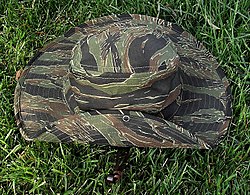
 Bucket hat, also fishing hat, ratting hat (UK) or Dixie Cup hat (US)
 -
 Bowler or Derby
 -

-

-

-
-

-

-

-

-
 Combination cap, also "service cap" or peaked cap
 -
-
 Cowboy hat, sometimes "ten gallon hat"
 -

-

-
 Dhaka topi, also "Nepali Hat"
 -

-
 Eight-point cap, also Gatsby cap, newsboy cap, bakerboy cap
 -

-
-
 Fire hat in the National Museum of American History
 -
 Flat cap, also paddy cap, bunnet, cloth cap, driver cap, golf cap, or Windsor cap
 -

-

-

-
 Garrison cap, also "flight cap", "side cap" or "overseas cap"
 -

-
 Greek fisherman's cap, also captain's cap
 -

-

-

-
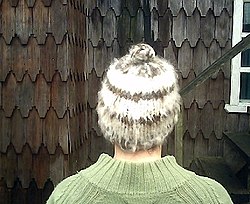
 Knit cap, also knit hat, stocking cap, toboggan, toque, watch or ski cap
 -
 Kippah, also kippa, yarmulke, or skullcap
 -
 Kofia, worn in East Africa
 -
 Kufi, including the "Zulu crown".
 -

-

-

-

-

-

-

-

-

-
 Sidara also faisaliyya
 -

-

-

-

-

-

-

-

-

-

-

-

-
 Tam, or tam o' shanter
 -
 Taqiya, also tagiyah
 -
 Tembel hat, or kova tembel
 -
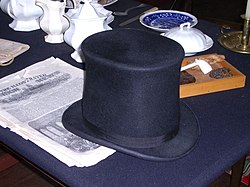
 Top hat (also, topper)
 -

-

-

-

-

-

-


.jpg)


.jpg)


.jpg)


.jpg)


.jpg)
Worn in the past, or rarely worn today
[edit]
Men's
[edit]
- American fiber helmet – for use in tropical regions; similar to pith helmet
- Anthony Eden hat
- Beaver hat
- Beefeaters' hat
- Bicorne
- Boater, also basher, skimmer
- Boss of the plains
- Bowler, also coke hat, billycock, boxer, bun hat, derby
- Busby
- Bycocket – a hat with a wide brim that is turned up in the back and pointed in the front
- Cabbage-tree hat – a hat woven from leaves of the cabbage tree
- Capotain (and women) – a tall conical hat, 17th century, usually black – also, copotain, copatain
- Caubeen – Irish hat
- Cavalier hat, also chevaliers – wide-brimmed hat trimmed with ostrich plumes
- Chapeau-bras, also chapeau-de-bras – 18th- to early-19th-century folding bicorne hat carried under one arm
- Chaperon – a series of hats that evolved in 14th- and 15th-century Europe from the medieval hood of the same name
- Cocked hat
- Colback – a fur headpiece of Turkish origin
- Deerstalker – hunting cap with fold-down ears, associated with Sherlock Holmes, Elmer Fudd, Holden Caulfield, and Ignatius Reilly
- Đinh Tự
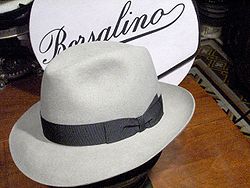
- Fedora
- Arakhchin
- Fez
- Hanfu hats and headwear – ancient Chinese hats
- Homburg
- Kolpik
- Labbadeh
- Kurkhars
- Litham
- Malahai
- Gugiuman
- Işlic
- Panama hat
- Papakha
- Pava
- Peci
- Pith helmet – for use in tropical regions; the American fiber helmet is a version of it
- Pork pie hat
- Shovel hat
- Sidara – national Iraqi headgear
- Shtreimel
- Sombrero
- Spodik
- Keffiyah or sudra
- Papal tiara – a hat traditionally worn by the Pope, which has been abandoned in recent decades, in favor of the mitre
- Top hat, also stovepipe hat, chimney pot hat, lum hat, or (in collapsible form) gibus
- Tricorne
- Trilby, sometimes (incorrectly) called "fedora"
- Wideawake hat
- Umbrella hat
Women's
[edit]
- Bandeau hat
- Beaver hat
- Beehive
- Bergère hat
- Ba tầm
- Bloomer
- Bongrace – a velvet-covered headdress, stiffened with buckram – 16th century
- Breton – originating in 19th-century France, a lightweight hat, usually in straw, with upturned brim all the way round
- Capeline – 18th–19th century
- Capotain (and men) – a tall conical hat, 17th century, usually black – also, copotain, copatain
- Cartwheel hat – low crown, wide stiff brim
- Cocktail hat
- Doll hat – a scaled-down hat, usually worn tilted forward on the head
- Gainsborough hat – a very large hat often elaborately decorated with plumes, flowers, and trinkets
- Half hat – a millinery design that only covers part of the head and may be stiffened fabric or straw
- Hennin
- Kokoshnik
- Nón lá
- Ochipok
- Pamela hat
- Pussyhat - a pink, knitted hat created in large numbers by thousands of participants involved with the United States 2017 Women's March
- Tantour
Unclassified
[edit]
- Archer's bonnet
- Balibuntal – straw hat from the Philippines
- Castor or caster – beaver or rabbit (see beaver hat)
- Chip hat
- Cloche hat
- Cockle hat
- Cony or coney
- Coolie hat
- Copintank, also copentank, coptank, copitaine
- Cordies
- Cossack hat
- Demicastor hat
- Directoire
- Dolly Varden
- Fan-tail hat
- Flat
- Garbo hat
- Garibaldi hat
- Gipsy hat
- Golden hat – from Bronze Age Europe
- Gossamer hat
- Grebe hat
- Halo hat – millinery design in which the headgear creates a circular frame for the face, creating a halo effect[1]
- Hat Terrai Gurkha, worn only by Gurkha Contingent officers in Singapore
- Homburg – a black Homburg was also known as an "Anthony Eden" (after the politician Anthony Eden)
- Hunting hat
- Jaapi of Assam, India
- Jerry
- Kausia
- Kevenhuller
- Kiss-me-quick hat
- Leghorn hat
- Mandarin hat
- Manilla hat
- Marquis hat
- Matinée hat
- Merry Widow hat
- Moab
- Montera
- Mourning hat
- Mousquetaire
- Müller hat
- Mushroom
- Petasos
- Pill box hat
- Pilotka
- Quadricorn – a four-cornered hat[2]
- Sugar loaf
- Veiled hat, also bird cage hat
Caps
[edit]Caps worn by men in the past, or rarely worn today
[edit]- Aviator's cap
- Barretina
- Brodrick cap (a military cap named after St John Brodrick, 1st Earl of Midleton)
- Cap and bells ("jester cap", "jester hat" or "fool's cap")
- Capeline – a steel skullcap worn by archers in the Middle Ages
- Cricket cap
- Dunce cap
- Forage cap
- Gat, a mesh hat worn during the Joseon period in Korea.
- Hooker-doon, a cloth cap with a peak, in Scotland[3]
- Icelandic tail-cap
- Jockey's cap
- Kalpak

Kazakh hunters on horseback wearing Kalpak (headgear) and holding eagles. - Loovuuz – Mongolian fur headgear
- Monmouth cap
- Nightcap
- Phrygian cap
- Pileus
- Sailor cap
- Shako
- Smoking cap
- Sou'wester, or "Cape Ann" – a flexible waterproof hat traditionally worn by sailors
- Whoopee cap – a style of headwear popular among youths in the mid 20th century in the United States

Caps worn by women in the past
[edit]Caps worn on ceremonial occasions
[edit]Bonnets
[edit]Bonnets for women
[edit]
- Cabriolet
- Capote – soft crown, rigid brim, nineteenth century
- Chip bonnet
- Gypsy bonnet – shallow to flat crown, saucer shaped, and worn by tying it on with either a scarf or sash, under the chin, or at the nape of the neck – nineteenth Century
- Kiss-me-quick
- Leghorn bonnet
- Mourning bonnet
- Poke bonnet – Early nineteenth century, "Christmas Carol" style, with a cylindrical crown and broad funnel brim
- Ugly – a kind of retractable visor that could be attached to bonnets for extra protection from the sun, nineteenth century
Bonnets for men
[edit]- Balmoral bonnet
- Blue bonnet, the ancestor of the Balmoral, feather, Glengarry and other men's bonnets
- Feather bonnet
- Glengarry bonnet
- Tam o'shanter
Helmets
[edit]Hoods
[edit]
- Bashlyk
- Bongrace, the stiffened back of the hood when flipped over the forehead to provide shade; also a separate headdress to provide shade, worn with a hood or coif, Tudor/Elizabethan
- Bonnet head
- Capirote, traditionally worn by the Nazarenos of a Spanish Brotherhood during solemn penitence
- Chaperon (headgear) adaptable late Middle Ages "dead-chicken" [citation needed] hood and hat
- Flemish hood
- French hood
- Gable hood
- Hood – modern or historical, attached to tops or shirts, overcoats, cloaks, etc.
- Liripipe
- Mary Queen of Scots
- Medieval hood
- Mourning hood
- Riding hood
- Stuart hood
Headbands, headscarves, wimples
[edit]
- Abaya
- Buknuk
- Chador
- Chaperon (headgear) adaptable late Middle Ages "dead-chicken" hat, hood and scarf
- Coif
- Crispine thirteenth century European women's style of padding hair in a net and headband
- Dupatta, also shayla or milfeh
- Headband
- Headscarf, also khimar, hijab,
- Khimar
- Liripipe
- Mandily (Greek Orthodox)
- Nemes
- Snood
- Veil
- Wimple
Masks, veils and headgear that covers the face
[edit].jpg)
- See Mask for a fuller list of masks.
- Balaclava (helmet) or ski mask
- Battoulah
- Bongrace – a shade for the face, sometimes part of a hood, or a separate garment worn with a hood or coif; Tudor/Elizabethan
- Boushiya
- Burqa, also burka, burga, burqua
- Diving mask
- Full-face diving mask
- Gas mask
- Orthodontic facemask

- Latex mask
- Litham
- Niqab
- Tagelmust, also cheich
- Tudong
- Veil
- Visor
- Wedding veil
Other headdress
[edit]Women's
[edit]Men's
[edit]- Arab headdress
- Bandana, also bandanna
- Do-rag
- Jamana, Kurdish headgear
- Stocking cap
- Topor – Bengali men's wedding headgear
- Upe
- Visor
Jeweled
[edit]
Wigs
[edit]Headgear organised by function
[edit]Religious
[edit]Buddhist
[edit]- Black Crown of the Karma Kagyu sect
- Kasa
- Pan Zva (Hat with the long ears from the Pandita of Nyingma.)
Christian
[edit]- Biretta
- Camauro
- Canterbury cap
- Cappello romano
- Galero
- Kalimavkion
- Klobuk
- Koukoulion
- Mantilla
- Mitre
- Papal tiara
- Skufia
- Wimple
- Zucchetto
Hindu
[edit]_(8411728143).jpg)
- Mukut – Crown worn by Hindu deities
- Pagri – Indian Hindu turban
- Pheta – Marathi turban
- Rasam Pagri – religious ceremony of the turban
- Sarpech – ornament worn with turban
Jewish
[edit]- Havalim (חֲבָליִם) ropes that are referenced in Kings I 20:31. Used as a sign of mourning.
- Kashket
- Kippah or yarmulke
- Kolpik
- Migba'at was likely a cone-shaped Turban. This turban was likely only worn in the context of the priesthood and is cited in Exodus 27:20–30.
- Mitpaḥat is a scarf that is worn on the head or hair, by some married women. Some wear scarves only during prayers, and others wear them in public.
- Mitznefet was most likely a classic circular turban. This is derived from the fact that Hebrew word Mitznefet comes from the root "to wrap." This turban was likely only worn in the context of the priesthood and is cited in Exodus 27:20–30.
- Pe’er mentioned in Ezekiel 24: 17;23. In verse 17, Ezekiel commands the Israelites to “wrap their” Pe’ers around their heads. In verse 23, Ezekiel tells the Israelite that their Pe’er's "shall remain on your heads.” ("Pe'er" (which translates into "splendor") is usually used to refer to phylacteries (tefillin))
- Sheitel is a wig worn by some married women in order to maintain marital modesty in public
- Shtreimel
- Spodik
- Gargush
- Sudra (סודרא) is a headdress, similar to the keffiyah worn by Jewish men in the ancient near-east.
Muslim
[edit]- Fez
- Hijab
- Kalpak
- Karakul
- Kofia
- Kufi
- Pakol
- Sharbush
- Sidara
- Songkok
- Taqiyah (cap)
- Telpek
- Tubeteika
- Turban
- Khimar
Sikh
[edit]Military and police
[edit]- Barretina
- Bearskin
- Beefeaters' hat
- Beret
- Bersagliere
- Bicorne
- Boonie hat
- Busby
- Campaign hat, also drill instructor hat, drill sergeant hat, ranger hat, sergeant hat, Smokey Bear hat
- Cap comforter, a woollen hat associated with British Commandos
- Cappello Alpino, hat worn by the Alpini troops of the Italian Army
- Caubeen
- Chapeau-bras, also chapeau de bras – 18th to early-19th-century folding bicorne hat carried under one arm
- Combination cap, also service cap, combination cover, peaked cap
- Custodian helmet, headwear of the British police officer, ranks of Sergeant and Constable
- Czapka
- Fur wedge cap "Envelope Busby"[citation needed] or Astrakhan, worn by Officer Cadets of the Royal Military College of Canada
- Feather bonnet
- Flying helmet – closely fitting solid helmet designed to resist impacts within the cockpit of military aircraft – colloquially known as a 'bone dome'
- Garrison cap, also campaign cap, wedge cap, flight cap, garrison hat, overseas cap, side cap, field service cap
- Glengarry, also Glengarry bonnet, Glengarry cap
- Hardee hat
- Helmet
- Jeep cap
- Kartus – a peakless cap worn by the Swedish army during the Great Northern War. Called the Kabuds by the Danish and Norwegians and the Kartooze by the Russians, nations which also adopted it
- Kepi
- Mirliton – a high tubular concave hat with a "wing", worn by hussars in the 18th and early 19th centuries
- Mitre
- Patrol cap
- Pickelhaube – a spiked German leather helmet.
- Sailor cap, also known as "white hat" or "dixie cup" in the US Navy
- Shako
- Shaguma - Yak-hair headdress used by early Imperial Japanese Army generals
- Slouch hat – One side of hat droops down as opposed to the other which is pinned against the side of the crown
- Tarleton Cap – A leather helmet with a large crest. Popular with cavalry and light infantry in the late 18th and early 19th century. Named after British military commander, Banastre Tarleton.
- Tricorn – Three-cornered hat synonymous with the 18th century. Worn by musketeers, dragoons and cuirassiers of all western armies, also often by French grenadiers (which was uncommon considering that most grenadiers at the time wore mitres or bearskins).
- War bonnet, the feathered headdress worn warriors and chiefs of Plains Indians.
Officials and civil workers
[edit]China (historical)
[edit]Vietnam (historical)
[edit]Other specialist headgear
[edit]- Casquette, or cycling cap
- Chef's hat, also toque blanche, or more familiarly, toque
- Coronet
- Cowboy hat
- Crown
- Cucupha
- Energy dome
- Firefighter's helmet
- Gas mask
- Green eyeshade
- Headlamp
- Night cap
- Nurse's cap
- Orthodontic headgear
- Party hat
- Printer's hat also pressman's hat
- Propeller hat (propeller beanie)
- Santa's hat
- Rubber boot, unique signature headgear of American political figure Vermin Supreme
- Scrum cap
- Shower cap, a flexible plastic covering to keep the hair dry during a shower.
- Space helmet
- Square academic cap
- Stormy Kromer cap
- Swimming cap, also "swim cap" and "bathing cap"
- Tin foil hat
- Topor – Bengali men's wedding headgear
- Visor
- Watermelon helmet
- Wedding veil
National dress; association with a country, people and religion
[edit]
.jpg)


- Aso Oke Hat – Yoruba people
- Barretina – Catalan
- Bearskin hat
- Beret – French, Basque
- Bhatgaunle Topi – Nepal
- Blangkon – Javanese
- Breton, also Bretonne
- Chupalla – Chilean
- Chullo – Peruvian
- Clop – Romanian
- Coolie hat
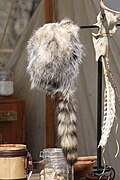
- Coonskin hat – American frontiersman
- Cork hat – Australia
- Cossack hat
- Dogon hat – Dogon people, West Africa
- Feathered headdress – Native American
- Flat cap – English people and Irish people
- Four Winds hat – Sami people
- Fulani hat – Fula people, West Africa
- Glengarry bonnet
- Għonnella or Faldetta – Maltese
- Haida hat
- Irish walking hat – Irish people
- Kimeshek - Kazakhstan, Karakalpakstan and Kyrgyzstan
- Kofia – Swahili people, East Africa
- Kufi – West Africa
- Leopard cap – Igbo people, West Africa
- Mandarin hat – Chinese
- Mokorotlo – Basotho/Lesotho
- Montenegrin cap – Montenegrins, Serbs
- Lungee (Afghan Turban) - Pashtun people, Afghanistan
- Pakol – Pashtun people, Afghanistan
- Phrygian cap – Roman, French
- Qeleshe – Albanian
- Šajkača – Serbian
- Salakot – Filipino
- Shreepech – Traditional Crown of Monarch of Nepal
- Slouch hat, also digger hat, Australia and New Zealand
- Songkok – Malay-speaking peoples of Indonesia, Malaysia, Brunei and Singapore
- Tam o'shanter – Scottish
- Tengkolok – Malaysia, Brunei, Indonesia and Singapore
- Tarboosh
- Tembel hat - Israel
- Ti'i langga – Rote Island
- Top hat – English
- Topor – Bengali men's wedding headgear
- Turban
- Tuque or toque – Canadian, esp. French-Canadian/Québécois
- Upe - Bougainville
- Ushanka – Russian
- Welsh hat
- Witch hat - Galician
- Zmijovka - Czech
- Zulu crown – Zulu people, Southern Africa, see kufi for information
By ethnicity
[edit]Chinese
[edit]- Futou
- Guan – mianguan, fengguan, pibian, tongtianguan
- Liangmao
- List of Hanfu headwear
- Weimao
- Damao
- Humao
Filipino
[edit]Japanese
[edit]Korean
[edit]Mongol
[edit]Vietnamese
[edit]See also
[edit]References
[edit]
Wikimedia Commons has media related to Headgear.
- ^ Chico, Beverly (2013). Hats and Headwear around the World: A Cultural Encyclopedia. Santa Barbara, California: ABC-CLIO LLC. pp. 211–12. ISBN 9781610690621. Retrieved 13 November 2014.
- ^ Lewandowski, Elizabeth J. (2011). The complete costume dictionary. Lanham, Md.: Scarecrow Press, Inc. p. 243. ISBN 9780810840041.
- ^ The Concise Scots Dictionary. Aberdeen University Press. 1987. p. 296. ISBN 0-08-028492-2.


| Headwear | |||||||||
|---|---|---|---|---|---|---|---|---|---|
| Neckwear | |||||||||
| Underwear and lingerie |
| ||||||||
| Tops | |||||||||
| Bottoms |
| ||||||||
| Full-Body Wear |
| ||||||||
| Coats and outerwear |
| ||||||||
| Nightwear | |||||||||
| Swimwear | |||||||||
| Legwear | |||||||||
| Footwear | |||||||||
| Accessories |
| ||||||||
| Dress codes |
| ||||||||
| Related | |||||||||

Grokipedia
List of headgear
View on Grokipediafrom Grokipedia
Hats
Historical and Rarely Worn Hats
Historical and rarely worn hats include styles prevalent in past centuries that signified social status, occupation, or era-specific fashion but declined due to shifts in technology, climate control advancements, and changing norms of formality. For instance, the top hat, emerging in the 1790s as a tall cylindrical form evolving into variants like the stovepipe by the mid-1800s, marked upper-class attire until the early 20th century, after which it became confined to rare formal events such as weddings.[7] The bowler, or derby, introduced in the 1840s for protective horseback riding with its rounded crown and stiff brim, saw peak use through the 1910s but waned with urban mobility changes.[7] Similarly, the straw boater, favored for summer suits post-World War I into the 1930s for its flat crown and brim providing shade, fell from favor as casual dress norms relaxed.[7] Beaver hats, fashioned from felted North American beaver pelts valued for gloss and resilience against weather, dominated men's fashion from the early 1600s to the 1830s, driving fur trade economics until silk alternatives and conservation efforts reduced availability.[8] The tricorne, featuring a wide brim cocked up on three sides often adorned with feathers, equipped European military and civilian men from the late 1600s through the 1780s, its design accommodating elaborate wigs before straight-brimmed successors prevailed.[9] Women's cloche hats, bell-shaped and snug to frame the 1920s bob haircut, embodied flapper modernity but receded by the 1930s amid looser silhouettes.[10] These hats' obsolescence accelerated post-1950s with automobile interiors limiting headroom, indoor heating obviating warmth needs, and postwar egalitarianism eroding class-distinctive accessories.[11] Today, such headgear appears primarily in ceremonial contexts, historical reenactments, or niche revivals, underscoring hats' role as era-specific cultural artifacts rather than daily essentials.[11]For Men
Men's historical hats, spanning from the medieval era through the 19th century, often served functional purposes such as protection from weather and sun while signifying social status or profession; many styles have become obsolete in daily wear due to shifts in fashion and technology like indoor heating and automobiles. These headpieces were typically crafted from felted wool, beaver fur, or straw, with designs evolving from simple protective coverings to elaborate cocked brims for practicality in combat or equestrian activities.[12] The beaver hat, made from felted beaver fur prized for its waterproof qualities and sheen, dominated European men's fashion from around 1550 to 1850, particularly among the upper classes who valued its durability during travel and outdoor pursuits. Production involved processing beaver pelts imported from North America, fueling early colonial trade; by the 17th century, these tall-crowned hats were standard for gentlemen, though their use declined with synthetic alternatives post-1850.[13][14] The tricorne, characterized by a low crown and brim folded up on three sides into points, became the prevailing style for men in Europe and the American colonies from the late 17th century until the 1780s. This evolution from the wide-brimmed hat allowed easier under-arm carrying during formal occasions and enhanced peripheral vision for soldiers and sailors; it was constructed from wool or beaver felt, often adorned with feathers or lace.[15][16] Emerging in the 1790s as a successor to the tricorne, the bicorne featured a brim cocked front-to-back, optimizing visibility for mounted troops and thus adopted widely in European and American military uniforms through the early 19th century. Notably worn sideways by Napoleon Bonaparte to project authority, it transitioned from battlefield utility to ceremonial use, with civilian variants less common; wool felt construction ensured resilience in harsh conditions.[17] In the 14th century, chaperons—complex hoods with draped liripipes (tail-like extensions)—were favored by European men across classes, evolving from simple wool garments to ornate versions denoting wealth via fabric quality and length. Worn over coifs or alone, they provided weather protection but faded by the 15th century with rising hat preferences; surviving depictions in art confirm their prevalence in urban and rural settings.[18] Bycocket hats, with a pointed dagged brim turned up at the back forming a "bird's beak" shape, appeared in medieval Europe around the 14th century, often in wool or fur for huntsmen and nobility. Their asymmetrical design aided in shading and rain runoff, but the style waned with Renaissance influences favoring symmetry.[19]For Women
The hennin was a tall, cone-shaped or steeple headdress worn by noblewomen in late medieval Europe, particularly from the 1460s to 1480s, often topped with a veil and reaching heights of 12 to 24 inches to signify wealth and status.[20][21] The gabled hood, used by women in 15th- and 16th-century England and continental Europe, featured a wired frame forming a peaked, house-gable silhouette with draped linen or silk veils from the rear, emphasizing marital or social modesty while allowing facial visibility.[22] The fontange, fashionable among European court women from the 1680s to 1710s, comprised tiered lace or linen frills supported by wires atop the head, originating from a hairstyle improvised by the Duchesse de Fontanges after a hunting mishap and evolving into an elaborate tower up to 30 inches high.[23] Poke bonnets, prevalent among women in the early to mid-19th century, had exaggerated forward-projecting brims of straw or silk extending 8 to 12 inches beyond the face, shielding against sun and wind while framing the features modestly; their popularity peaked around 1830 before smaller styles supplanted them.[24] Merry Widow hats, named after a 1907 operetta and worn by women circa 1908–1912, were oversized straw or felt confections with brims spanning 20 to 36 inches, densely adorned with ostrich feathers, chiffon, and ribbons to complement the era's S-curve silhouette, though their bulk led to transit complaints and eventual decline by World War I feather bans.[25]Unisex or Unclassified
The boater, also known as a skimmer or sennit hat, is a stiff straw hat featuring a flat crown, straight brim, and often a ribbon band, originating in mid-19th-century France from mariner uniforms before becoming a civilian summer staple. It was adopted unisexually by the 1860s, with women and children wearing it for leisure activities, and men incorporating it into semi-formal attire by the late 19th century, peaking in popularity during the Edwardian era for boating and social events.[26][27] Production declined after World War I due to changing fashions and synthetic alternatives, rendering it rarely worn today except in vintage revivals or ceremonial contexts.[28] The Phrygian cap, a soft, conical wool or felt hat with the apex curved forward, traces to ancient Eastern Mediterranean cultures around the 1st millennium BCE, depicted on figures from Phrygia, Thrace, and Persia in Greek and Roman art as everyday or ritual headwear without strict gender association. Adopted as a symbol of emancipation in the Roman era for freed slaves and later during the 18th-century Enlightenment and French Revolution—where it represented liberty in unisex revolutionary imagery—its practical use waned by the 19th century, surviving primarily as an emblem on coins, statues, and flags rather than daily apparel.[29][30] The chaperon, a hooded headcovering of wool or velvet that could be worn draped, rolled, or turban-like, emerged in 14th-century Europe as a versatile garment for both men and women across social classes, evolving from simple protective hoods into elaborate status indicators with liripipe tails extending up to several feet. Common from England to Italy until the early 16th century, its styles varied regionally—such as the English "chaperon with cornet"—but it was supplanted by ruffs and structured hats during the Renaissance, becoming obsolete in everyday use by 1550.[31] The buntal hat, handwoven from fibers of the buri palm (Corypha utan) in the Philippines since the early 20th century, features a lightweight, semi-flexible straw body often shaped into fedora or planter styles with a pinched crown and upturned brim, suitable for tropical climates and worn unisexually by laborers and urbanites alike. Exported as "Manila hats" post-1900s, its artisanal production peaked mid-century but declined with mass synthetics, now rare outside cultural festivals or bespoke millinery.[32][33]Contemporary Hats
Contemporary hats include structured styles with brims or crowns that prioritize everyday functionality, sun protection, and casual fashion in the 21st century, evolving from earlier designs to suit modern lifestyles.[34] These hats differ from historical or ceremonial variants by emphasizing versatility for urban, outdoor, and sport-related activities, with widespread adoption driven by mass production and cultural influences like sports and streetwear.[35] The baseball cap, first developed in the mid-19th century for baseball players using straw and later wool materials, features a stiff bill for shading and an adjustable strap or fitted design for secure fit.[36] By the 1950s, the New Era 59Fifty model standardized the high crown and curved bill, leading to its ubiquity in the 1980s for both athletic use and casual wear across demographics.[35] Today, variants like trucker hats with mesh panels and snapbacks dominate sales, serving utilitarian purposes while symbolizing team allegiance or personal style.[37] Bucket hats, originally utilitarian headwear for fishermen in the early 20th century, consist of a downward-curving brim and soft crown, often in cotton or nylon for weather resistance.[38] Their popularity surged in the 2020s through streetwear trends, with market growth from $279.9 million in 2021 to a projected $364.1 million by 2025, appealing to younger consumers for festivals, hiking, and fashion statements.[39] Performance versions with quick-dry fabrics enhance their role in outdoor pursuits.[40] Fedora and trilby hats, characterized by creased crowns and narrow brims (trilby brim snapped down in front), persist in semi-formal contexts despite declining from mid-20th-century peaks.[41] Felt or wool constructions provide durability, with resurgences tied to media portrayals and vintage revivals, though usage remains niche compared to unstructured caps.[42] Panama hats, handwoven from toquilla straw since the 19th century, offer breathability for warm climates and see contemporary demand in summer casual attire, with Ecuadorian artisans producing over 15,000 units daily as of recent estimates.[43] Their lightweight weave suits travel and leisure, maintaining export value exceeding $10 million annually.[43]Brimmed Hats
Brimmed hats feature a projecting brim extending horizontally from the crown, serving primarily to shield the face and neck from sunlight and precipitation. The brim's width and shape vary, influencing shade coverage and stylistic versatility, with materials ranging from felt to straw for durability in diverse climates.[44][45] The design traces to ancient Greece, where the petasos—a wide-brimmed hat attached by a cord under the chin—protected travelers from the sun as early as the 5th century BCE. By the 19th century, brimmed hats proliferated in Europe and America, adapting to industrial and outdoor pursuits with reinforced brims for functionality.[46][47] Key variants include the fedora, a soft felt hat with a pinched telescope crown and medium-width brim that can be creased or snapped, emerging in the late 1800s from theatrical origins before gaining widespread menswear adoption.[48][49] The trilby, akin to the fedora but distinguished by its shorter, narrower brim angled downward at the front, suits slimmer profiles and casual ensembles.[49] Western hats, or cowboy hats, employ high crowns and broad brims—often 10-12 cm wide—for optimal ventilation and rain deflection, integral to 19th-century American ranching attire.[50] Straw-based brimmed hats like the boater, with its flat crown and stiff, flat brim typically 5-7 cm wide, emerged in the mid-19th century for nautical and summer formal wear, valued for breathability in warm weather.[34] Wide-brim styles, exceeding 10 cm, prioritize sun protection in outdoor activities such as hiking or farming, often constructed from raffia or wool felt for resilience.[51]Brimless Hats
Brimless hats, also known as skullcaps or dome hats, are headgear lacking any projecting brim or visor, typically fitting closely to the skull for warmth, religious observance, or stylistic purposes. These hats have been used across cultures for millennia, often crafted from wool, felt, cotton, or knitted materials to provide insulation without obstructing peripheral vision. Unlike brimmed varieties, they emphasize simplicity and versatility, appearing in military, civilian, and ceremonial contexts.[52] The beret is a soft, round, flat-crowned cap originating in the Basque region of France and Spain, traditionally knitted from thick wool yarn. Its design allows it to be worn tilted to one side, secured by an elastic band or drawstring, and it gained prominence in the 19th century when adopted by French military units for its practicality in combat. Berets symbolize artistic and revolutionary movements, notably worn by figures in the French Resistance during World War II, and remain standard in many modern armies, such as the British Parachute Regiment's maroon version introduced in 1942.[53][54] Beanies, or knit caps, trace their roots to the 12th-century Welsh Monmouth cap, a snug woolen head covering worn by laborers for protection against cold weather. In the early 20th century, the term "beanie" emerged in the United States, derived from slang for "bean" meaning head, and became popular among blue-collar workers, sailors, and students for its insulating properties in harsh conditions. By the 1990s, beanies evolved into a fashion staple, often featuring cuffs or pom-poms, with annual global sales exceeding millions of units due to their adaptability in urban and outdoor settings.[55][56] The fez, a truncated conical felt hat topped with a tassel, originated in 19th-century Morocco, named after the city of Fez where crimson dye from berries produced its signature red hue. Ottoman Sultan Mahmud II mandated its adoption in 1827 for modernized troops, spreading it across the empire as a symbol of reform before its decline post-Atatürk's 1925 Hat Revolution in Turkey. Today, it persists in ceremonial roles, such as Moroccan royal attire or fraternal organizations like the Shriners, with production centered in traditional workshops using angora wool.[57][58] Skullcaps encompass close-fitting brimless caps like the kufi, taqiyah, or kippah, used religiously by Muslim and Jewish men to signify devotion— the kippah, for instance, fulfills the Talmudic custom of covering the head during prayer, with Orthodox Jewish practice requiring constant wear since medieval times. Secular variants, such as welding or athletic skullcaps, provide moisture-wicking under-helmet liners, often made from thin cotton or synthetics for breathability during physical labor. These hats, averaging 4-6 inches in diameter, prioritize minimalism and have influenced modern minimalist fashion.[59][60] Other brimless styles include the zucchetto, a silk or wool cap worn by Catholic clergy since the 13th century to denote rank—white for the Pope, violet for bishops—and the chullo, an Andean knitted hat with earflaps dating to pre-Inca cultures for high-altitude warmth. These hats underscore cultural specificity, with global variations reflecting local materials and needs rather than uniform evolution.[61]Caps
Traditional and Historical Caps
Traditional and historical caps comprise brimless head coverings developed over centuries for protection from weather, cultural identity, or symbolism, primarily constructed from wool, felt, or fur in designs suited to regional needs. These differ from contemporary caps by their enduring association with folk traditions, military uniforms, or revolutionary icons, often persisting in ceremonial use despite declining everyday wear. Examples span ancient origins to 19th-century innovations, reflecting adaptations to climate and society. The Phrygian cap, a soft, conical wool or felt headdress with a forward-curving peak, originated among the Phrygians of ancient Anatolia around the 1st millennium BCE and symbolized emancipation in Roman culture as the pileus, later inspiring the French Revolution's red bonnet rouge in 1793.[62] The fez, a truncated cylindrical red felt cap, traces to North African influences but gained prominence in the Ottoman Empire after Sultan Mahmud II mandated it in 1829 to standardize attire and promote modernity, with production centered in Fez, Morocco, for its berry-derived dye.[63] Originating in the Pyrenees during the Middle Ages, the beret—a flat, circular wool cap—was crafted by Béarnais shepherds for warmth and rain resistance, spreading to Basque regions by the 16th century as a marker of rural identity before military adoption in the 17th century.[64] The Balmoral bonnet, a knitted wool cap with a flat crown and optional toorie pompom, evolved from Scotland's 16th-century blue bonnet worn by lowlanders and Highlanders, formalized in the 19th century and named for Balmoral Castle after Queen Victoria's adoption around 1850 for civilian and regimental dress.[65] The tam o' shanter, featuring a round wool crown with central pompom and minimal brim, emerged in Scotland between the 16th and 17th centuries as practical farmwear, gaining its name from Robert Burns' 1790 poem depicting the character Tam in such a bonnet.[66] Russia's ushanka, a fur-lined cap with fold-down earflaps tied atop or under the chin, developed from 17th-century treukh designs in northern regions for extreme cold, standardized for Red Army use during the 1918–1922 Civil War.[67]Worn by Men
Traditional and historical caps worn by men feature brimless or short-billed designs serving practical, military, and cultural roles across civilizations, often crafted from wool, felt, or cotton for durability in daily or ceremonial contexts. The flat cap, a rounded woolen cap with a small stiffened bill, originated in 14th-century Northern England among working-class men for weather protection during labor.[68] Its design persisted into Scotland and Ireland, where it was termed a bonnet and mandated by 1571 statute for certain social classes to stimulate wool trade, though enforcement waned by the 17th century.[69] The beret, a flat, circular soft cap, traces to medieval Basque shepherds in northern Spain and southwestern France, valued for warmth and rain resistance; it entered military use by 17th-century French troops and spread to other European armies by the 20th century.[70] Scottish variants include the Balmoral bonnet, a flat-topped wool cap with trailing ribbons and optional toorie (pompom), derived from 16th-century blue bonnets and formalized in the 1850s for civilian Highland dress.[65] The Glengarry, a creased boat-shaped cap with rear ribbons, was invented around 1790 for Highland regiments, featuring diced borders and feathers to denote rank.[65] In the Ottoman Empire, the fez—a short cylindrical red felt cap topped with a tassel—replaced turbans in 1826 under Sultan Mahmud II's reforms, promoting uniformity across Muslim and non-Muslim male subjects as a modernizing emblem, with production centered in Fez, Morocco.[71] The taqiyah, a seamless rounded skullcap, emerged in early Islam among Arab men for prayer modesty, covering the crown without full head enclosure; variants in cotton or crochet spread across Muslim regions by the medieval period.[72]Worn by Women
In medieval Europe, women's headgear emphasized modesty and coverage, as decreed by the Church requiring hair to be concealed. The wimple, a linen or silk cloth draped over the head, neck, and chin, was standard among women from the 12th to 15th centuries, often paired with a veil or gorget for complete enclosure.[73] Capuchons, hood-like garments with trailing liripipes, served similar protective and status-indicating roles, particularly among common women in the 14th and 15th centuries.[31] The hennin emerged in the late 14th century as a fashionable elite headpiece, featuring a tall conical or steeple-shaped structure up to 1 meter high, fabricated from fabric stiffened with buckram or wire, and frequently adorned with veils or jewels; it signified high social rank in Burgundian courts but was seldom worn in England due to sumptuary conservatism.[74] Heart-shaped or butterfly headdresses, using wire frames covered in fabric and veils, succeeded hennins in the early 15th century, framing the face dramatically while maintaining coverage.[75] By the 18th century, indoor mob caps—soft, ruffled linen caps gathering at the crown—protected powdered hair and were worn universally by European women until supplanted by bonnets around 1800.[76] Outdoor poke bonnets, with forward-projecting brims of straw or silk up to 30 cm deep, dominated 19th-century attire for sun shielding and propriety, peaking in popularity from 1830 to 1850 before wider brims evolved.[76] Twentieth-century examples include the cloche, a snug bell-shaped felt hat introduced in 1922 by milliner Caroline Reboux, encapsulating the short-haired flapper silhouette and worn until the 1930s decline in hat mandates.[77] These forms, once daily necessities, became rare post-1960s as cultural shifts diminished headcovering norms.[73]Ceremonial Caps
Ceremonial caps are specialized forms of headgear designed for use in formal rituals, religious liturgies, academic commencements, and institutional ceremonies, often denoting hierarchical status, scholarly attainment, or spiritual authority. These caps typically feature symbolic shapes, colors, and materials that distinguish them from everyday wear, with origins tracing back to medieval ecclesiastical and university traditions. Their design emphasizes rigidity and prominence to convey solemnity, as seen in the evolution from soft clerical skullcaps to structured square forms by the 16th century.[78][79] The mortarboard, or square academic cap, exemplifies ceremonial headgear in educational contexts. Consisting of a flat, square board atop a skullcap with a tassel, it derives from the pileus quadratus, a 16th-century adaptation of earlier soft caps worn by scholars and clergy, formalized in European universities by the late medieval period. In the United States, the 1895 Intercollegiate Code of Academic Costume standardized the mortarboard for bachelor's, master's, and doctoral degrees, with the tassel shifting from right to left upon conferral to symbolize progression. This cap remains mandatory at most Western graduations, underscoring academic achievement through its unyielding, mortar-like board evoking construction of knowledge.[78][80] Clerical caps within Christianity, particularly Roman Catholicism, include the biretta and zucchetto, integral to liturgical and non-liturgical observances. The biretta is a stiff, square cap with three or four flat ridges (horns) and often a central tuft, worn by priests (black), bishops (purple or violet), and cardinals (red) during processions, ordinations, and solemn masses; its form stabilized in the 16th century from earlier Italian academic headwear, serving both practical (protection from weather) and symbolic (authority) roles. The zucchetto, a smaller hemispherical skullcap worn beneath the biretta or mitre, follows a color-coded hierarchy—white for the pope, scarlet for cardinals, violet for bishops, and black for lower clergy—originating as a practical under-cap in the Middle Ages but codified by the 19th century for perpetual wear indoors except at meals or sleep. These caps reinforce ecclesiastical rank during sacraments and councils, with the pope's white zucchetto signifying supreme purity.[81][82][83][84] In military and fraternal traditions, ceremonial caps adapt utilitarian designs for parade and ritual purposes. Bearskin caps, tall fur cylinders worn by grenadier guards in regiments like the British Foot Guards since the 18th century, feature a plume and chin strap for drill formations, symbolizing ferocity and height in battle reenactments; their adoption followed the 1768 uniforms of Frederick the Great's Prussian grenadiers, emphasizing intimidation over combat utility. Fraternal groups, such as Shriners deriving from 19th-century Masonic orders, employ the fez—a cylindrical, tassel-topped felt cap inspired by Ottoman styles—as a ceremonial marker during initiations and parades, with red signifying charity and fellowship in over 400,000 members worldwide as of 2023. These examples highlight how ceremonial caps blend heritage with performative hierarchy across secular and paramilitary spheres.[85]Modern Baseball and Sports Caps
The baseball cap emerged in the mid-19th century as essential headgear for baseball players, with the New York Knickerbockers adopting straw caps as part of their uniform on April 24, 1849.[86] By 1860, the Brooklyn Excelsiors introduced a rounded wool cap featuring a long visor and a top button, establishing a precursor to the modern design that provided better sun protection during daytime games.[87] This style evolved with the addition of a stitched bill around 1903 by sporting goods manufacturer Spalding, enhancing durability for field use.[35] In the 20th century, baseball caps transitioned to wool and cotton materials, with New Era Cap Company, founded in 1920 by Ehrhardt Koch, becoming a key supplier and innovator in fitted caps for Major League Baseball teams by the 1930s.[36] The 1940s marked a shift to modern iterations, incorporating ventilation eyelets for airflow and extended brims for improved shading, addressing player comfort in prolonged outdoor play.[88] By the late 20th century, adjustable closures like plastic snapbacks gained prominence, originating from trucker caps in the 1970s but adapted for sports, allowing versatile sizing across athletes.[89] Contemporary baseball caps emphasize performance features, utilizing moisture-wicking polyester fabrics and laser-perforated panels for breathability in high-intensity training and matches.[90] Designs vary by structure—rigid front panels for a structured look versus soft, unstructured crowns for casual fit—and brim curvature, with flat brims popular in urban sports culture and curved brims retaining traditional baseball aesthetics.[91] Official MLB on-field caps, produced by New Era since 1993, adhere to standardized specifications including wool blends and embroidered logos, ensuring uniformity across 30 teams.[36] Beyond baseball, similar cap designs appear in other athletics for sun protection and branding, such as in golf where visored variants shield eyes without full coverage, and in tennis for lightweight, ventilated models suited to court movement.[92] Cricket employs peaked caps akin to early baseball styles, with teams like Australia standardizing them since the 19th century for fielders.[92] These adaptations prioritize functionality, with modern sports caps often featuring UV-protective coatings and adjustable straps to accommodate diverse head sizes and activity levels.[93]Bonnets
Women's Bonnets
Women's bonnets were outdoor head coverings primarily worn by European and American women from the late 18th to mid-19th centuries, distinguished by a forward-projecting brim that framed and sheltered the face, secured by ribbons tied under the chin. Unlike hats, which sat atop the head, bonnets enclosed the sides and back, evolving from practical sun protection and modesty garments into fashionable accessories influenced by annual trends. They reflected social norms of propriety, with head covering mandatory for women in public during the Victorian era (1837–1901), as indoor caps handled private settings.[94][95] In the early 19th century, the poke bonnet emerged as a dominant style, featuring a small crown and wide, rounded front brim resembling a hood, which projected outward to shield the complexion from sun and wind—a priority amid ideals of pale skin denoting class status. This form, originating in England around 1810, grew larger by the 1830s, with brims extending dramatically forward; Leghorn straw versions from Italy became popular for their lightweight weave, while silk or velvet suited formal wear. Trimmings included ribbons, ostrich feathers (prevalent 1835–1845), and artificial flowers, with a bavolet curtain at the back protecting the neck. By the 1840s, cottage bonnets introduced a seamless brim-to-crown curve, often in stiffened straw or fabric, accommodating fuller hairstyles.[24][95][96] The 1850s saw brims widen further before contraction, with spoon-shaped profiles and lowered crowns positioning bonnets farther back on the head; materials shifted to include horsehair for durability and lace for ornamentation. Quaker women favored plain, stiff silk or straw bonnets without decoration, emphasizing simplicity and equality, as exemplified by examples from 1850–1874 held in U.S. collections. Evolution accelerated with millinery innovations, allowing annual updates via new trims on recovered frames, though by the 1860s, smaller lace-trimmed bonnets yielded to hats like sailors and toques as hairstyles rose higher and social norms relaxed. Bonnets persisted among conservative groups, such as widows in black silk, into the late 19th century, but faded with the automobile era's wind exposure concerns.[97][95][76]Men's Bonnets
Men's bonnets, distinct from women's tied styles, primarily denote traditional Scottish headgear consisting of soft, woolen, brimless caps worn flat on the head. These emerged in Scotland during the early 16th century as practical everyday wear for Highlanders and Lowlanders alike.[98] The blue bonnet, often in undyed wool, became a symbol of Scottish identity, adopted by military regiments such as the Black Watch in the 18th century for uniform purposes.[65] Key variations include the Balmoral bonnet, featuring a stiff, round crown with a central toorie (pom-pom) and typically a diced tartan band around the base, formalized in the 19th century for Highland dress.[98] The Tam o' Shanter, named after Robert Burns' poem published in 1790, shares a similar flat, beret-like shape but with a prominent toorie and softer construction, remaining popular in civilian and piping band attire into the 20th century.[99] In contrast, the Glengarry bonnet, developed around 1790s for military use, adopts a boat-shaped profile with black ribbons trailing at the rear, evolving from earlier flat bonnets but retaining the designation in regimental contexts.[98] These bonnets were constructed from wool for warmth and durability, often hand-knitted and felted, with sizes adjusted via drawstrings or ribbons.[100] By the 19th century, they integrated into formal Highland dress codes established post-Culloden clearance of tartan bans in 1747, influencing global perceptions through diaspora communities and events like the Highland Games.[65] Modern reproductions maintain these designs for ceremonial, cultural, and occasional protective use, underscoring their enduring role in Scottish heritage without significant adaptation for contemporary fashion outside niche markets.[101]Infant and Child Bonnets
Infant bonnets, also known as pudding bonnets or bumper caps, emerged in Europe during the 17th and 18th centuries as protective headgear for toddlers learning to walk, featuring thick padding around the crown and edges to cushion falls and safeguard fragile skulls from injury.[102] The distinctive rolled padding evoked the shape of a sausage-like pudding, a term derived from stuffed meat casings common in period cuisine, and these bonnets were often worn over a thinner linen cap for added security without restricting movement.[103] By the late 18th and into the 19th centuries, pudding-style bonnets evolved into simpler forms made of cotton or linen, serving dual roles in everyday protection from drafts, cold, and minor bumps while maintaining infant modesty through full head coverage secured by ties under the chin.[104] In Victorian and early Edwardian eras, these bonnets became standard accessories for babies of both sexes up to age 4 or 6, when children transitioned from dresses to gendered attire, with plain versions for daily use and lace-trimmed variants for formal occasions reflecting family status.[105] Child bonnets for slightly older infants and toddlers extended this protective function, often incorporating lightweight fabrics to shield sensitive scalps from sun exposure and environmental irritants, as infant skin lacks full melanin development for UV resistance until around 6 months.[105] Unlike adult women's bonnets, which emphasized fashion with structured brims, child versions prioritized functionality and fit, tying securely to prevent slippage during active play, though elaborate embroidery or ribbons appeared in wealthier households to signify social standing without compromising utility.[104] These headpieces declined in prevalence by the early 20th century with advances in child safety norms and indoor rearing practices, shifting toward unstructured caps, though their design influenced modern infant headwear focused on warmth retention and hair preservation.[105] Historical examples, such as those preserved in museums, demonstrate construction from natural fibers like linen derived from flax, ensuring breathability in pre-industrial hygiene contexts.[106]Helmets
Combat and Military Helmets
Combat helmets serve to shield soldiers' heads from fragmentation, blunt trauma, and in advanced models, small arms fire, evolving alongside threats from edged weapons to high-velocity projectiles. Initial designs prioritized deflection of melee strikes, transitioning to absorption of explosive shards after World War I, when artillery caused most head wounds. Materials progressed from organic hides and bronze alloys to pressed steel in the early 20th century, then aramid fibers like Kevlar from the 1980s, enabling lighter weight without sacrificing coverage.[107][108][109] In antiquity, helmets like the Greek Corinthian, forged from bronze circa 700 BC, encased the face and skull for hoplite phalanx combat, though impeding senses limited prolonged wear. Roman forces adopted the Montefortino helmet around 300 BC, featuring a hemispherical bronze dome with neck guard and cheek pieces for legionary versatility against swords and spears. By the medieval period, steel bascinets emerged in the 14th century, often with hinged visors for jousting and field battles, balancing mobility and piercing resistance.[110][111][112] World War I spurred mass-produced steel helmets optimized for trench warfare's shrapnel dominance, exemplified by the German Stahlhelm M1916, which reduced head fatalities by deflecting fragments at a 30-degree angle via its flared skirt. The U.S. M1 helmet, introduced in 1941 and used through Korea and Vietnam, consisted of a manganese steel shell over a fiber liner, protecting against low-velocity impacts but not direct rifle rounds, with over 4 million produced by war's end. British and French equivalents, like the Brodie and Adrian models, similarly emphasized overhead fragmentation coverage over ballistic penetration resistance.[113][108] Post-Vietnam innovations introduced composites for enhanced trauma attenuation; the U.S. PASGT helmet, fielded in 1983, incorporated 29 layers of Kevlar to stop 9mm pistol rounds and fragments, weighing 1.4 kg versus the M1's 1.1 kg steel but offering superior multi-hit capability. The Advanced Combat Helmet (ACH), deployed from 2003, refined this with lighter aramid weaves, reducing weight by 22% and improving peripheral vision via raised ear cutouts, while mounting rails accommodated night-vision and communications gear. Current U.S. models, such as the Enhanced Combat Helmet (ECH) since 2012, employ hybrid fibers for rifle-threat resistance up to 7.62mm fragments, prioritizing modular attachments for special operations.[114][115][109]| Helmet Type | Era Introduced | Primary Material | Key Design Features |
|---|---|---|---|
| Stahlhelm M1916 | 1916 (WWI, German) | Hadfield manganese steel | Corrugated shell for rigidity; deep neck guard against overhead blasts; weighed ~1.2 kg.[108] |
| M1 Helmet | 1941 (WWII, U.S.) | High-hardness steel | Two-piece system with adjustable liner; paint for camouflage; effective vs. shrapnel at 5-10 m distance.[113] |
| PASGT | 1983 (Cold War, U.S.) | Kevlar fabric | Kevlar shell with foam padding; first U.S. ballistic vest-compatible helmet; NIJ Level IIIA equivalent.[115] |
| ACH | 2003 (Iraq/Afghanistan, U.S.) | Aramid composites | Four-point retention; accessory rails; 20% lighter than PASGT at ~1.5 kg with cover.[114] |
| ECH | 2012 (Modern, U.S.) | Advanced thermoplastics and fibers | Enhanced fragment protection to V50 >2200 fps; modular for respirators; issued to high-risk units.[115] |
Sports and Recreational Helmets
Sports and recreational helmets are engineered to absorb impact forces and reduce head injury risks during high-velocity collisions, falls, or strikes in activities ranging from contact sports to cycling and winter pursuits. These devices typically feature hard outer shells made from polycarbonate or composites, inner padding for energy dissipation, and retention systems for secure fit, with designs varying by activity to balance protection, weight, and ventilation. Standards from organizations like the National Operating Committee on Standards for Athletic Equipment (NOCSAE) and the Consumer Product Safety Commission (CPSC) ensure minimum performance thresholds through drop-impact testing.[116][117] American football helmets evolved from leather models introduced in 1893 to rigid plastic shells by the 1940s, incorporating face masks and suspension systems for enhanced protection against linear and rotational accelerations. NOCSAE established the first performance standard in 1973, mandating certification for use in organized play to mitigate concussion risks, with over 50 revisions since to address evolving biomechanics data.[116][118] Ice hockey helmets, often combined with cages or visors, became mandatory for new National Hockey League (NHL) entrants on June 1, 1979, following rising awareness of head trauma after incidents like the 1968 Bill Masterton fatality, though grandfathered veterans could opt out until the 1990s. Constructed with impact-resistant shells and adjustable liners, they comply with standards from the Hockey Equipment Certification Council, emphasizing multi-angle impact resistance.[119] Bicycle helmets for recreational and competitive cycling prioritize lightweight foam cores certified under CPSC standards since 1999, with innovations like MIPS (Multi-directional Impact Protection System) introduced in the 2010s to decouple the shell from the head, mitigating rotational brain shear forces in oblique crashes. Early adoption traces to 1880s high-wheel cyclists using rudimentary padded caps, evolving to mandatory use in many jurisdictions post-1970s safety campaigns.[120][121] Baseball batting helmets originated with Frank Mogridge's 1905 Pneumatic Head Protector patent, featuring air-filled cushions, but modern hard-shell versions with ear flaps became standard after MLB mandated protection in 1971 following Ray Fosse's 1970 All-Star Game injury. These helmets, tested for projectile impacts up to 100 mph, use thermoplastic shells and foam liners to prevent skull fractures.[122] Cricket helmets emerged in the 1930s when batsman Patsy Hendren wore a custom padded cap designed by his wife, gaining prominence in the 1970s-1980s amid faster bowling speeds, with full-face grilles and ABS shells now standard to shield against bouncers exceeding 90 mph. Adoption accelerated after Dennis Amiss's 1974 use of early prototypes, prioritizing ventilation and visibility.[123] Ski and snowboard helmets demonstrate effectiveness in reducing head injury severity, with peer-reviewed analyses showing decreased risk and incidence compared to bare heads, particularly for non-severe trauma, through foam liners tested to ASTM F2040 standards for cold-weather impacts. Usage rose from under 10% in the 1990s to over 70% by 2010s, without evidence of risk compensation increasing accident rates.[124][125] Other recreational variants include equestrian helmets standardized by ASTM in 1988 for horseback falls and climbing helmets with expanded foam for rock impacts, both emphasizing durability against irregular forces.[126]Industrial and Safety Helmets
Industrial and safety helmets, commonly known as hard hats, are rigid protective headgear designed to shield workers from overhead impacts, falling objects, electrical hazards, and other workplace risks in industries such as construction, mining, manufacturing, and utilities. These helmets typically feature a hard outer shell, a suspension system inside to absorb shocks, and sometimes accessories like chin straps or visors for enhanced stability and visibility. Their primary function is to distribute force away from the wearer's skull, reducing the risk of traumatic brain injury; for instance, the suspension system creates an air gap that allows the shell to compress upon impact without direct transmission to the head.[127][128] The modern hard hat traces its origins to 1919, when American inventor Edward W. Bullard patented the "Hard Boiled Hat" following his experiences with head injuries among miners and his exposure to World War I doughboy helmets. Constructed from layered canvas treated with shellac and paint for rigidity, this early design marked the first commercially viable industrial head protection, initially targeted at mining operations where falling rock posed constant threats. By the early 1930s, adoption expanded to large-scale construction projects like the Hoover Dam, where aluminum versions replaced heavier materials to improve comfort and weight. Materials evolved further in the late 1930s with lightweight aluminum and early plastics, transitioning to fiberglass in the 1940s for better durability, thermoplastics in 1952, and high-density polyethylene (HDPE) by the 1960s for cost-effective impact resistance.[129][130][131][132] Regulatory standards govern design, testing, and performance to ensure reliability. In the United States, the Occupational Safety and Health Administration (OSHA) mandates head protection under 29 CFR 1910.135 and 1926.100, requiring helmets to meet or exceed ANSI/ISEA Z89.1 criteria, which specifies impact attenuation, penetration resistance, and electrical insulation through drop tests from heights up to 8 feet and simulated blows. ANSI Z89.1 classifies helmets into Type I (vertical impact protection only) and Type II (vertical and lateral impacts, tested from multiple angles for 360-degree coverage), with the latter gaining prevalence since the 2014 revision to address side blows common in slips or machinery mishaps. Electrical classes include G (general, limited to 2,200 volts), E (electrical, up to 20,000 volts), and C (non-conductive but unrated for high voltage). Internationally, ISO 3873 (first published 1977) provides similar guidelines for industrial protective headgear, emphasizing material integrity and flammability resistance.[133][134][128][135] Contemporary materials prioritize lightweight strength and environmental durability, including HDPE for its moldability and UV resistance, ABS plastic for toughness in extreme temperatures, and fiberglass composites for high-impact scenarios like welding. Suspension systems, often made of nylon or plastic webs, must withstand 18-pound forces without bottoming out, per ANSI tests. Recent developments include Type II safety helmets that supersede traditional Type I hard hats by incorporating chin straps, integrated face shields, and modular attachments for better retention during dynamic activities, reducing ejection risks in falls. These advancements stem from empirical data showing traditional hard hats' limitations against lateral forces, with studies indicating up to 40% greater protection from Type II designs in construction settings. Maintenance requires annual inspections for cracks, suspension wear, or liner degradation, with replacement after impacts or exposure to solvents.[136][137][138]Historical Helmets
Historical helmets originated as basic protective gear for warriors, evolving from simple leather reinforcements to complex metal constructions designed to deflect blows and projectiles. The earliest examples date to approximately 2500 BC in Mesopotamia, where Sumerian soldiers employed caps of leather reinforced with bronze.[139] Similar rudimentary designs appeared in ancient Egypt, utilizing leather and bronze for head protection in combat.[139] In ancient Greece, the Corinthian helmet emerged around 700 BC, likely originating in the city-state of Corinth, and remained in use through the 4th century BC among hoplite infantry. Crafted from hammered bronze, it fully enclosed the head with cheek pieces and a nasal guard, offering substantial defense but restricting peripheral vision and hearing.[140] [141] The Boeotian helmet, prevalent from the 5th to 2nd centuries BC in classical and Hellenistic eras, featured a more open design with a wide, forward-curving brim, prioritizing visibility and airflow for cavalry troops.[142] Roman legions adopted the galea as standard headgear from the late Republic onward, with variants like the Imperial Gallic type employed between the 1st century BC and 2nd century AD. These iron or bronze helmets included hinged cheek guards, neck flanges for blow deflection, and optional transverse crests denoting rank, balancing protection with maneuverability for infantry formations.[143] Late Roman ridge helmets, appearing around 270–300 AD, incorporated segmented ridges for added strength against overhead strikes.[144] During the medieval period in Europe, the spangenhelm—a conical or rounded helmet of segmented metal plates riveted to a frame, with roots in late antiquity—persisted into the 11th–12th centuries, often paired with mail aventails for enhanced coverage.[145] The great helm, introduced in the 13th century, represented a pinnacle of knightly protection: a large, cylindrical steel enclosure worn over a chainmail hood, featuring narrow vision slits and breath holes, it shielded against lances in tournaments and charges up to the 14th century.[146] These designs prioritized blunt-force resistance, with later iterations including decorative perforations and heraldic embellishments denoting status.[147]Hoods
Religious and Ceremonial Hoods
The cowl, a hooded garment integral to the habits of Christian monastic orders such as Benedictines, Cistercians, and Franciscans, covers the head, neck, and shoulders, serving both practical protection and symbolic humility dating to at least the 6th century in Western monasticism.[148][149] Constructed typically from wool or coarse fabric, the hood is often drawn over the head during prayer or manual labor, with variations like the detached capuce in Dominican orders emerging by the 13th century for mobility.[150] In Coptic Orthodox tradition, the qalansuwa functions as a black hood enveloping the head and upper neck of monks and nuns, symbolizing renunciation and uniformity within Egyptian monastic communities since medieval times.[151] Worn over simpler robes, it maintains a distinctive silhouette amid the order's emphasis on ascetic isolation in desert monasteries like those at Wadi Natrun, established as early as the 4th century. The capirote, a tall, pointed conical hood worn without a brim, is used by penitents in Catholic Holy Week processions (Semana Santa) in Spain and Latin America, originating as a 15th-century adaptation of medieval disciplinary garb imposed by the Inquisition for public humiliation of heretics.[152] By the 16th century, confraternities adopted it voluntarily for anonymity during self-flagellation and parades honoring Christ's passion, with colors denoting specific brotherhoods—purple for penitence, white for purity—covering the face to focus devotion on spiritual rather than personal identity.[153] Modern usage, as seen in annual processions in Seville drawing over a million participants since the 16th century, preserves this penitential symbolism without connotations of later misappropriations like 20th-century American groups.[152] Ceremonial academic hoods, evolved from 14th-century medieval clerical attire in European universities, denote scholarly achievement in graduation rites, with velvet-trimmed lengths varying by degree—bachelor's at 3 feet, master's at 3.5 feet, doctor's at 4 feet—and colors signifying fields like white for arts or golden yellow for science per standards codified by the American Council on Education in 1895.[154] Worn draped over gowns, they originated in monastic and cathedral schools where hoods provided warmth, later formalizing post-Reformation to distinguish lay academia from religious orders while retaining heraldic elements like institutional linings.[155] Similar pointed hoods appear in other Catholic-derived ceremonies, such as the capuchon in Louisiana's Cajun Mardi Gras runs, where riders don conical hoods and masks since the 19th century to evoke medieval European folklore and communal revelry tied to pre-Lenten purification, blending pagan and Christian elements in rural courirs lasting up to 30 miles on horseback.[156]Protective and Functional Hoods
Protective and functional hoods are wearable head coverings designed primarily to shield the head, neck, and sometimes face from occupational hazards such as heat, chemicals, electrical arcs, radiation, or extreme weather, often integrated with respirators or other personal protective equipment (PPE). Materials like Nomex, Kevlar, or Tychem provide flame resistance, chemical impermeability, or thermal insulation, with designs emphasizing full coverage, adjustable fit, and compatibility with helmets or suits to minimize exposure gaps. These hoods adhere to standards from bodies like the National Fire Protection Association (NFPA) or Occupational Safety and Health Administration (OSHA), prioritizing empirical testing for penetration resistance and durability over aesthetics.[157][158] Firefighting hoods, such as those made from PBI Gold or Nomex blends, protect against convective and radiant heat during structural or wildland fires, covering areas left exposed by helmets to prevent second-degree burns. NFPA 1971 mandates they withstand 26 kW/m² heat flux for 10 seconds without breakopen or ignition, with particulate-blocking variants filtering smoke and embers; examples include the Innotex Gray Hood for structural response and UltraShield for thermal barrier enhancement.[159][160] Industrial safety hoods include arc flash models for electrical workers, rated for incident energy up to 40 cal/cm² to guard against plasma arcs and molten debris; traditional beekeeper-style hoods offer full enclosure, while lift-front versions improve visibility and reduce fatigue during tasks. Welding hoods, constructed from leather, fiberglass, or high-impact plastics, shield against ultraviolet radiation, infrared glare, and flying slag, incorporating auto-darkening lenses that adjust shade levels (e.g., 9-13) in milliseconds to protect retinas without manual intervention. Chemical protective hoods, often Tyvek or Saranex-based, seal against splashes and vapors in hazmat scenarios, used over respirators to contain hazardous liquids or particulates.[161][162][163] Military and tactical hoods, like PAC IA-19 or coyote tan variants, combine ballistic fragmentation resistance with camouflage for operations in arid or cold environments, often featuring moisture-wicking fabrics to combat hypothermia or hyperthermia. Balaclavas, originating from 19th-century Crimean War wool designs but now in flame-retardant synthetics, provide multifunctional protection against wind chill (reducing effective temperature by 20-30°F via coverage) and minor impacts in special forces or cold-weather training. Powered air-purifying hoods integrate HEPA filtration for respiratory isolation in contaminated zones, delivering 15-170 liters per minute of clean air while covering the head to block aerosols.[164][165][157]Headbands, Headscarves, and Related
Headbands
A headband is a form of headgear consisting of a band of fabric, elastic, plastic, metal, or other material encircling the forehead or the entire head to restrain hair, absorb perspiration, provide decoration, or serve ceremonial purposes. Unlike hats or helmets, headbands do not cover the crown of the head and prioritize functionality or minimal aesthetic enhancement over full enclosure. Archaeological evidence indicates their antiquity, with a 50,000-year-old mammoth ivory headband discovered in Denisova Cave, Siberia, suggesting early human use for binding or adornment.[166] In ancient civilizations, headbands evolved from practical bindings to symbols of status. Greek laurel wreaths, fashioned as bands of olive or bay leaves, were awarded to athletic victors as early as the 8th century BCE, denoting achievement and later influencing Roman and Hellenistic diadems—thin metal bands worn by rulers.[167] In Bronze Age Europe, such as at the Lofkënd tumulus in Albania (circa 1400–1100 BCE), bronze headbands accompanied burials, possibly denoting elite identity or ritual significance, with parallels in Aegean and Balkan metallurgy.[168] Egyptian examples from the Old Kingdom (circa 2686–2181 BCE) featured gold or beaded bands for pharaohs and nobility, imbued with protective or divine connotations.[169] Athletic headbands emerged prominently in the early 20th century for sweat management. By the 1910s, tennis players adopted terrycloth or cotton bands to prevent perspiration from impairing vision during matches, a practice that spread to other sports like basketball and running by the 1960s.[170] Modern sports variants, often made from moisture-wicking synthetics like polyester or nylon, reduce slippage and maintain focus; studies confirm they mitigate distractions from sweat and hair in high-intensity activities.[171] Fashion headbands, distinct in elastic or embellished forms, gained traction in the 1920s flapper era and revived in the 2010s, blending utility with style via materials such as velvet, leather, or knotted scarves.[172] Culturally, headbands vary by region: Andean chullos incorporate knitted bands for warmth, while some Aegean prehistoric types used leather or textile for functional hair control, as evidenced by microscopic fiber analysis.[173] In contemporary contexts, they include wide fabric styles for medical uses, like post-surgical support, or narrow elastic for everyday wear, but claims of advanced tech integration (e.g., sensor-embedded bands) remain niche and unproven for broad headgear classification.[174] Overall, headbands' persistence stems from their simplicity and adaptability, supported by empirical utility in diverse environments rather than unsubstantiated symbolic overinterpretations in biased cultural narratives.Headscarves and Turbans
Headscarves consist of fabric draped or tied over the head, employed across cultures for modesty, protection, or identity. In Islamic tradition, the hijab serves as a headscarf covering the hair, throat, and ears, typically adopted by girls at puberty as a marker of religious observance. [175] Orthodox Jewish married women wear the tichel, a headscarf concealing all hair to comply with modesty laws derived from interpretations of Torah directives against exposing hair as ervah, or nakedness. [176] [177] In Christianity, the mantilla—a lace veil—is used by women during Catholic liturgical events, such as Mass, to signify reverence, a practice persisting among Spanish, Latina, and some Indian Christian communities. [178] Sub-Saharan African head wraps, documented since the 18th century, function for both aesthetic and practical sun protection, often tied in elaborate styles denoting status. [179] Turbans form by winding cloth around the head, originating in Eastern traditions over 3,000 years ago for utility and symbolism. [180] In Sikhism, the dastar or pagri—mandatory for baptized (Amritdhari) males—encases uncut kesh (hair) as one of the five Ks of faith, tied fresh daily in 10-15 minutes using fabrics in colors like white for purity, blue for heroism, or orange for sacrifice, embodying commitment to justice and equality without caste distinctions. [181] [182] [183] For Muslims, turbans like the imama historically signified scholarly or noble rank in early Islamic societies, though not religiously mandated post-19th century and varying by region, such as in Ottoman contexts where they denoted status before fez reforms. [180]Wimples and Similar
A wimple is a medieval European garment formed from a large piece of linen or silk cloth, draped around the neck, under the chin, and along the sides of the face to cover these areas while leaving the forehead exposed, often secured with pins and worn beneath a veil for added modesty.[184] This headcovering emerged prominently in the 12th century and remained in use through the 15th century among women of various social classes, serving both practical functions—such as shielding the skin from sun, wind, and dust during travel—and cultural norms emphasizing female propriety, particularly for married or older women as referenced in Chaucer's Canterbury Tales depiction of the Wife of Bath.[185][186] In religious contexts, the wimple became a standard element of nuns' habits starting in the medieval period, symbolizing enclosure and devotion; it continues in traditional orders like the Carmelites, where it frames the face below a coif or veil.[185] By the late Middle Ages, its secular use declined among younger noblewomen favoring more elaborate headdresses, though it persisted for widows and conservative attire into the Renaissance.[187] Similar items include the barbette, a simpler linen band passed under the chin and pinned at the temples or sides of the head, functioning as a supportive base layer for veils or fillets from the 12th to 14th centuries, especially among Anglo-Norman women.[188] The gorget, a tubular cloth wrapping focused on the throat and sometimes upper chest, differed from the wimple by encircling only the neck without full facial enclosure and was pinned to hair or garments, commonly worn by older women or as part of transitional 14th-century ensembles.[184][189] The guimpe, etymologically related but distinct, denotes a starched, detachable collar-like covering of the neck and shoulders in post-medieval ecclesiastical habits, often layered over or under a wimple to provide structured modesty without the latter's chin draping.[190] These variants reflect adaptations for climate, status, and ritual, with linen favored for breathability in warmer regions and wool or silk in colder ones, as evidenced in period artworks like manuscript illuminations.[191]Face-Covering and Veiling Headgear
Masks
Masks constitute a category of headgear designed to cover the face, primarily for protection against environmental hazards, concealment of identity, ritual embodiment, or theatrical expression. Archaeological evidence indicates their use dates to at least 9,000 years ago, with early examples likely crafted from perishable materials like wood, skin, or cloth for masquerades and ceremonies.[192] Protective masks emerged to mitigate health and occupational risks. During the 17th-century European plagues, physicians employed beaked masks lined with sponges soaked in vinegar or herbs to purportedly purify inhaled air, though efficacy relied more on quarantine than filtration.[193] World War I necessitated rapid advancements, yielding charcoal-filled gas masks to neutralize chemical agents like chlorine and mustard gas, with over 30 million units produced for Allied forces by 1918.[194] In medical contexts, layered gauze masks appeared around 1897 for surgeons to curb droplet transmission during operations, evolving into disposable paper variants by the 1920s and standardized respirators like the N95 by the late 20th century, certified under U.S. National Institute for Occupational Safety and Health protocols for 95% filtration efficiency against 0.3-micron particles.[195] Ritual and ceremonial masks enable participants to invoke supernatural entities or ancestral forces. In Native American traditions, such as those of the Haida or Iroquois, wooden masks depicting animals or spirits are worn in potlatch ceremonies or healing rites to mediate between human and divine realms, often carved with symbolic motifs like raven beaks or thunderbird eyes.[196] African examples, prevalent among groups like the Dan or Yoruba, feature helmet-style constructions from wood, fibers, and pigments, deployed in initiation dances to enforce social norms or commemorate harvests, with stylistic variations reflecting regional cosmologies—such as elongated foreheads symbolizing wisdom in some West African forms.[197] Japanese Noh theater masks, dating to the 14th century, portray archetypes like demons (Oni) or aged sages (Ko-omote), hand-carved from cypress wood to convey emotion through subtle tilts and lighting effects during masked performances.[198] Theatrical masks amplify dramatic expression and anonymity. Ancient Greek examples, used from the 5th century BCE in Dionysian festivals, were crafted from linen, cork, or leather, oversized to project voices via resonators and distinguish tragic heroes from comedic slaves, as evidenced by terracotta fragments from Athens.[199] Venetian bauta and moretta masks, documented in 13th-century statutes, facilitated social leveling during Carnevale by obscuring class distinctions, later integral to 16th-century Commedia dell'Arte troupes for stock characters like Harlequin, whose half-masks exaggerated features for improvised street theater.[200]Veils
A veil consists of a piece of translucent or opaque fabric draped or attached over the head, shoulders, or face, serving purposes of modesty, ritual protection, symbolism, or adornment across diverse cultures and eras. Archaeological and textual evidence indicates veiling practices originated in ancient Mesopotamia and Persia as early as the 13th century BCE, where elite women covered their heads to denote status and seclusion from public view, as depicted in Assyrian reliefs and enforced by laws restricting lower-class women from veiling.[201] In ancient Greece, women commonly wore the kalyptra, a veil pulled from a himation or peplos to cover the head and sometimes face during outdoor activities, religious ceremonies, or to signify modesty and marital status; this practice is evidenced in vase paintings and sculptures from the 5th century BCE onward, reflecting social norms of female seclusion rather than universal religious mandate. Roman brides donned the flammeum, a flame-colored veil during wedding processions as early as the 1st century BCE, believed to avert evil spirits and symbolize the transformative fire of marriage, a custom persisting into the early Christian era before shifting to white fabrics by the 19th century under Victorian influence.[202][203] Bridal veils evolved into elongated, detachable accessories by the medieval period in Europe, often lace or tulle attached to headdresses, symbolizing purity and submission; records from 14th-century England describe veils trailing several yards, lifted by the groom to unveil the bride, a ritual echoing ancient protective functions. Mourning veils, typically black crepe or silk, emerged prominently in 19th-century Western Europe following Queen Victoria's adoption of full mourning attire after Prince Albert's death on December 14, 1861, which she wore for 40 years; these veils covered the face to denote grief, deter social interaction, and shield from sunlight or dust, though prolonged wear of non-breathable crepe could cause skin irritations known as "twist death" from arsenic dyes used until the 1870s.[204][205] In religious contexts, Christian women in early traditions veiled during worship per 1 Corinthians 11:5-6 interpretations, using mantillas or chapel veils of lace or silk to signify humility and separation from men, a practice documented in 2nd-century texts and revived in some Catholic rites post-1960s liturgical reforms. Islamic veiling encompasses types like the hijab, a scarf covering the hair, neck, and chest while leaving the face exposed, rooted in Quranic verses on modesty (Surah An-Nur 24:31) and hadith emphasizing female dress codes from the 7th century CE; regional variants include the shayla (long rectangular wrap draped over the head) in the Arabian Peninsula and the khimar (cape-like covering extending to the chest) in North Africa. The niqab, a face veil with an eye slit or mesh screen, is prevalent in Saudi Arabia and Yemen for stricter interpretations of seclusion, distinct from the full-body burqa or chador which incorporate veiling elements but extend coverage.[156][206] Culturally, veils served practical roles in Victorian fashion from the 1830s, as netted face coverings signaling femininity and status while protecting against urban pollutants, often paired with bonnets; in South Asia, the ghoonghat or dupatta veil historically concealed married women's faces in rural Hindu communities to uphold family honor, a custom critiqued in 20th-century reforms but persisting regionally. Modern veils blend tradition with utility, such as UV-protective bridal styles or minimalist hijabs in global fashion since the 2010s, though debates persist over coercion versus choice in mandatory contexts like Iran's pre-2022 laws.[207][208]Full-Face Coverings
Full-face coverings refer to headgear designed to conceal the entire facial features, often extending to the head or neck, for purposes including religious modesty, cultural tradition, environmental protection, or anonymity. These differ from partial veils by providing complete obscurity of the face, either through opaque fabric, mesh screening, or molded structures, while allowing limited visibility in some designs. Usage varies by context, with religious variants predominantly observed in certain Islamic societies and protective types emerging from military necessities.[209][178] Burqa. The burqa consists of a full-body garment with an integrated headpiece that drapes over the wearer, incorporating a stiffened embroidered lattice or mesh panel across the eye area to permit outward vision without exposing the eyes. Originating in regional Persian and Arabic terminology denoting protective coverings, it became associated with Pashtun cultural practices in Afghanistan by the 19th century, where it enforces strict seclusion norms for women in public. Worn primarily by conservative Muslim women in Afghanistan and adjacent areas, its adoption aligns with interpretations emphasizing maximal modesty, though not universally mandated in Islamic jurisprudence. As of 2022, Taliban enforcement in Afghanistan revived its prevalence, with surveys indicating over 90% compliance among women in urban centers under prior regimes.[209][210][209] Niqab variants. Certain niqab styles qualify as full-face coverings when configured with additional layers or attachments that obscure the eyes, though standard forms leave the eye region exposed via slits. The gulf-style or "full" niqab features multiple chiffon layers draped from a forehead band, potentially pulled forward to veil the eyes entirely, paired with a hijab for head coverage; it is common in Saudi Arabia and Gulf states among Salafi adherents. Half-niqabs cover from the nose downward, but extended three-layer versions allow temporary full enclosure. These emerged in the 20th century as extensions of Bedouin veiling traditions, with fabric typically lightweight georgette or nidha for breathability in arid climates. Adoption rates vary, with estimates from 2010s surveys showing 10-30% usage among veiled women in conservative Gulf societies.[208][208] Balaclava. The balaclava is a tubular knit garment enveloping the head, neck, and portions of the face, with openings adjustable to expose only the eyes or mouth, enabling full-face concealment when pulled taut. Developed for British troops during the 1854 Battle of Balaclava in the Crimean War to shield against subzero temperatures reaching -20°C, it derives its name from the site's harsh conditions. Constructed from wool or synthetic fleece, modern variants serve tactical, skiing, or anti-identification roles, with U.S. military specifications post-2000 emphasizing infrared-suppressing fabrics. Historical records document its evolution from 19th-century Eastern European woolen hoods to widespread civilian use by the mid-20th century.[211][212] Other traditions include ceremonial cylindrical masks in African and Oceanic rituals, which encase the entire head in wood, leather, or fiber for spiritual impersonation, dating to prehistoric forms but not routine wear. Functional equivalents like gas masks, with sealed visors covering the face for chemical protection, trace to World War I designs filtering chlorine gas exposures exceeding 1,000 ppm.[213]Other Headdress
Jeweled and Ornamental
Jeweled and ornamental headgear refers to decorative accessories worn on the head primarily for aesthetic enhancement, featuring gems, precious metals, feathers, and intricate workmanship, often denoting status or fashion rather than utility or royalty. These items span cultures and eras, from turban adornments in South Asia to feathered plumes in Europe, evolving with materials like gold, diamonds, rubies, and pearls set in elaborate designs.[214][215] AigretteAn aigrette consists of a tuft of feathers, typically from herons or egrets, mounted on a jeweled base such as a gold clip or brooch, sometimes accented with pearls or diamonds. Originating as turban ornaments for Ottoman sultans, aigrettes spread to Europe by the 18th century, adorning elaborate hairstyles and wigs during the Georgian period.[216][217] They remained fashionable into the 19th century, often secured via combs for women's formal attire.[218] Sarpech
The sarpech, or turban ornament, is a prominent jeweled piece affixed to the front of turbans, composed of interlocking gold panels set with diamonds, rubies, emeralds, and other gems, sometimes with suspended pearls or chains. Worn by Hindu, Sikh, and Muslim nobility in India from the 18th century onward, it signified rank and was frequently exchanged as diplomatic gifts; examples from Hyderabad in the 1800s feature floral motifs in gilt silver.[214][219][220] Kokochnik
A kokochnik is a rigid, crescent-shaped Russian headdress of embroidered fabric or brocade, adorned with pearls, sequins, and gemstones like diamonds, tied with ribbons at the back. Dating to the 10th century in traditional folk attire for married women, jeweled Western interpretations emerged in the 1860s–1880s, often in gold embroidery for elite occasions; a 1903 St. Petersburg example used satin, metallic threads, and imitation pearls.[215][221][222] Other forms include jeweled hair combs, with teeth in tortoiseshell or horn topped by cameos or stones, used since 5000 BC and peaking in 19th-century Europe, and ferronnières, thin chains or ribbons with a central gem worn across the forehead in Renaissance-inspired 1830s fashion.[215][223] These ornaments prioritized visual splendor, with craftsmanship reflecting available resources and cultural symbolism.[224]
Wigs and False Hair
Wigs, or false hairpieces, consist of artificial coverings fashioned from human, animal, or synthetic fibers to mimic or supplement natural scalp hair, serving purposes ranging from solar protection and hygiene to social signaling of status. Their documented use dates to approximately 3400 BC in ancient Egypt, where elite individuals donned them over shaved heads to combat lice infestation and intense sunlight while denoting rank through elaborate styling.[225][226] Archaeological recoveries, such as a human-hair wig from the 18th Dynasty tomb of Meryt (circa 1400 BC), reveal construction techniques involving resin-fixed strands woven onto netting bases, often supplemented with flax or wool for volume and beads for decoration. Egyptian priests favored wigs to uphold ritual purity, as frequent full-body shaving was mandated every other day, rendering natural hair impractical in temple settings. Nubian-style wigs, featuring tight curls emulating sub-Saharan African hair, appeared during the Amarna period (circa 1350 BC), reflecting cultural exchange and aesthetic preference among royalty like Nefertiti.[227][226][228] In 17th-century Europe, wigs proliferated following Louis XIII's adoption around 1624 to mask premature balding, evolving into periwigs—voluminous, curled confections powdered with starch or flour for opacity and hygiene amid urban vermin. By the 1690s, full-bottomed periwigs among English and French elites could incorporate up to 100,000 hairs, costing equivalents of $3,000 in modern terms due to reliance on imported Caucasian hair from rural Europe or Asia. Professions codified wig mandates: British judges retained tie-wigs into the 19th century for impartiality symbolism, while bag-wigs enclosed rear hair in silk pouches for practicality.[229][230][231] Cultural roles extended beyond aesthetics; Assyrian reliefs from circa 700 BC depict conquerors in curled false hair for intimidation, and Roman elites used partial toupees for follicular enhancement. The 18th-century French Revolution accelerated wig decline by associating them with aristocratic excess, shifting toward cropped natural hair by 1800, though judicial and theatrical variants persisted. Modern iterations, including lace-front and monofilament varieties for medical alopecia or performance, trace functional continuity but prioritize concealability over ostentation.[225][230][232]Crowns and Tiaras
Crowns are ceremonial headdresses formed as full circlets, typically of precious metals set with gems and symbolic motifs such as crosses or orbs, worn by monarchs to embody sovereignty and divine authority during coronations and state rituals.[233] The earliest known crowns emerged in ancient Egypt, including the Deshret (Red Crown) denoting Lower Egypt and the Hedjet (White Crown) for Upper Egypt, with the Pschent double crown combining both to symbolize national unification under pharaohs circa 3100 BCE.[234] In Europe, open crowns without overhead arches predominated initially, evolving into closed designs by the Middle Ages; these featured intersecting bands and Christian symbols like crosses, signifying the ruler's heavenly mandate, as exemplified by the Imperial Crown of the Holy Roman Empire, crafted circa 962 CE from eight gold plates hinged together and adorned with jewels including sapphires and pearls.[235] Notable historical crowns include the Crown of Saint Wenceslas, commissioned in 1347 for Bohemian kings and featuring 20 cast lilies symbolizing purity, which has been used in Czech coronations and weighs approximately 2.4 kilograms.[235] The Iron Crown of Lombardy, dating to the late 4th or early 5th century and incorporating a purported nail from Christ's crucifixion, was employed in the coronation of Lombard and later Holy Roman Emperors, including Napoleon in 1805, underscoring its role in legitimizing imperial claims.[235] Modern replicas or preserved originals, such as St. Edward's Crown in the British Crown Jewels—made in 1661, weighing 2.2 kilograms with 444 gemstones—continue use in Westminster Abbey coronations, as during Charles III's on May 6, 2023.[236] Tiaras, in contrast, are semi-circular jeweled bands positioned atop the head rather than encircling it fully, distinguishing them from crowns' complete loops and often lighter construction suited for prolonged wear by non-sovereigns.[237] Originating as diadems in ancient Greece and Persia—simple fabric or metal fillets worn by victors and deities to signify status—the form evolved into ornate pieces by the Hellenistic period, influencing Roman and later Byzantine designs.[238] In ecclesiastical contexts, the papal tiara emerged around the 8th century as a tall, beehive-shaped structure with three horizontal crowns (tiers) representing teaching, sanctifying, and ruling authority; the last used was Pope Paul VI's in 1963, after which the practice ceased, with surviving examples like the 1800 Dacre Jewel tiara now in museums.[239] Secular tiaras proliferated in 19th-century Europe among nobility and royalty, often convertible from necklaces, featuring styles like the Russian kokoshnik—tall, crest-like forms inspired by folk headdresses—or the bandeau, a linear band with upright motifs; Queen Mary's 1913 diamond kokoshnik, commissioned from Garrard with 70 baguettes and 129 brilliants totaling over 140 carats, exemplifies Edwardian opulence and remains in the British royal collection.[240] These pieces, crafted from platinum or gold with diamonds, emeralds, and pearls, served ceremonial functions at courts and balls, reflecting wealth and lineage rather than sovereign power.[238]Headgear by Function
Religious Headgear
Religious headgear encompasses coverings such as turbans, caps, veils, and mitres worn across faiths to signify piety, modesty, authority, or ritual purity, with practices rooted in scriptural directives, traditions, or clerical roles rather than uniform mandates.[241] These items often reflect interpretations of religious texts emphasizing humility before the divine, though adherence varies by sect, region, and historical context, with some customs blending cultural norms and evolving under modern influences.[242]Buddhist
In Buddhism, headgear is minimal, as monastics traditionally shave their heads to symbolize detachment from worldly attachments and ego, a practice dating to the Vinaya texts composed around the 5th century BCE.[156] Lay practitioners and some Tibetan traditions may don ceremonial hats like the yellow pandit hat or five-buddha crown during rituals, representing enlightened qualities, but these are not daily wear. In colder regions such as Tibet or Mongolia, woolen caps supplement monastic robes for practicality rather than doctrine.[156]Christian
Christian headgear includes clerical vestments like the mitre, a stiffened tall cap worn by bishops since the 10th century to denote authority, derived from Old Testament priestly turbans and formalized in medieval liturgy.[156] Nuns in Roman Catholic and Orthodox orders wear veils or coifs as part of habits, signifying consecration and bridal symbolism to Christ, a tradition traceable to early church veiling practices in the 4th century. Among conservative Protestants such as Amish and Mennonites, women don white prayer caps or bonnets during worship and daily life, based on 1 Corinthians 11:5-10 advocating head covering for women in prayer to honor divine order, though most modern denominations view this as cultural rather than obligatory.[241][156]Hindu
Hindu headgear features turbans (pagri or safa) worn by priests, ascetics (sadhus), and during ceremonies like weddings, symbolizing purity and status, with roots in Vedic rituals where unbound hair denoted disorder.[243] Brahmin priests may tie simple cotton turbans during temple service, while regional variations include jeweled crowns (mukut) for deities in iconography, not human wear. Women occasionally veil with dupattas or ghunghats for modesty in orthodox families, but this is more cultural than scriptural mandate, with no universal requirement in texts like the Manusmriti.[244]Islamic
In Islam, men's taqiyah (kufi or skullcap) covers the head during prayer (salah), emulating the Prophet Muhammad's practice as recorded in hadiths from the 7th century, promoting focus and humility without being strictly fard (obligatory).[156] Women observe hijab—a scarf covering hair, neck, and chest—for modesty per Quran 24:31 and 33:59, interpreted by major Sunni and Shia schools as required in public, though face veiling (niqab) or full burqa is regional and not universally mandated. Compliance rates vary, with surveys indicating 59% of Indian Muslim women veiling daily, often blending religious and social factors.[242][244]Jewish
Orthodox Jewish men wear the kippah (yarmulke), a small skullcap, at all times or during prayer to remind of God's omnipresence, a custom emerging in Talmudic times (circa 200-500 CE) rather than biblical command, with Ashkenazi variants like black velvet and Sephardic embroidered styles.[245] Hasidic men add fur shtreimels on Shabbat, signifying joy and distinction, a 16th-century Eastern European adaptation. Married Orthodox women cover hair with wigs (sheitels), scarves, or hats post-wedding per interpretations of Numbers 5:18 emphasizing marital modesty, though Reform Jews largely omit this.[156][245]Sikh
Sikh initiated (Khalsa) men must wear the dastar (turban), one of the Five Ks (kesh, uncut hair; kangha, comb; kara, bracelet; kachera, undergarment; kirpan, dagger), symbolizing equality, sovereignty, and spiritual discipline as instituted by Guru Gobind Singh in 1699.[246] Women may tie smaller turbans or use chunnis (scarves), with fabrics like cotton or silk denoting sect or occasion; failure to maintain kesh violates baptismal vows per the Rehat Maryada code updated in 1945.[156]Other Religions
In Zoroastrianism, priests wear padded caps (kusti) during rituals to maintain purity, echoing Avestan texts from circa 1000 BCE. Amish women use heart-shaped bonnets tied under the chin, enforcing separation from worldliness since the 1693 founding. Indigenous faiths like some Native American tribes employ feather headdresses in ceremonies for spiritual connection, though not doctrinal uniforms. Baha'i adherents avoid prescribed headgear, prioritizing inner faith over externals per 19th-century writings.[241][156]Buddhist
In Buddhist traditions, headgear plays a limited role compared to robes, with monastics typically maintaining shaved heads to symbolize detachment from worldly attachments and ego. This practice, rooted in the Vinaya texts attributed to the Buddha around the 5th century BCE, emphasizes simplicity and applies across Theravada, Mahayana, and Vajrayana schools, where routine head covering is absent among fully ordained bhikkhus (monks) and bhikkhunis (nuns). Ceremonial exceptions arise primarily in Vajrayana lineages, such as Tibetan Buddhism, where hats denote sectarian affiliation, pedagogical authority, and ritual function during empowerments (wang) or debates, often crafted from silk, brocade, or felt with symbolic motifs like lotus petals or feathers.[247] The yellow hat (Tibetan: ser po), a tall, pleated crown of yellow silk, is emblematic of the Gelug school founded by Tsongkhapa in 1409 CE; it is donned by abbots (khenpos) and high lamas like the Dalai Lama during formal teachings to represent the transmission of scholastic dharma. Its structure, with five upward-curving sections evoking a lotus or the five Buddha families, underscores doctrinal purity and is restricted to ordained clergy in ceremonies at institutions like Ganden Monastery, established in 1409.[248][247] In contrast, the black hat (zhwa nag) of the Karma Kagyu lineage, originating with the 1st Karmapa Düsum Khyenpa in the 12th century, features a broad brim and central jewel, purportedly containing relics and capable of "flying" during esoteric rituals as a manifestation of enlightened activity; replicas are worn by the Karmapa and select tulkus (reincarnate lamas) in empowerments, with the original safeguarded at Rumtek Monastery since the 17th century. Caps in this tradition, such as the peaked shastra hat, are common among Kagyu monastics for everyday ritual use, distinguishing them from the Gelug's yellow variant.[249][250] Other Tibetan forms include pandit hats mimicking 8th-12th century Indian scholar (pandita) caps, worn by debate masters; fan-shaped hats for specific Nyingma rituals; and feathered lotus hats adorning heads of realized yogins to signify accomplishment (siddhi). In Japanese Zen and Shingon contexts, practical kasa (conical straw hats) protect against weather during ascetic practices like kaihōgyō, tracing to Heian-era (794-1185 CE) pilgrimages, though lacking the symbolic depth of Tibetan crowns. Theravada monastics in Southeast Asia forgo such items entirely, barring rare modern adaptations like cloth sun hats for fieldwork, prioritizing the ochre robe (kāṣāya) dyed post-5th century BCE as the primary signifier of ordination.[247][251][252]Christian
In Christianity, headgear is primarily worn by clergy and monastics to denote rank, authority, and liturgical role, with variations across Catholic, Eastern Orthodox, and Oriental Orthodox traditions; Protestant denominations generally eschew such items in favor of simpler attire. These garments evolved from early Christian practices influenced by Roman and Byzantine customs, often symbolizing spiritual protection or hierarchy. For example, the mitre in the Catholic Church consists of two stiffened, peak-shaped parts sewn together at the sides, forming a folding cap worn by bishops and certain abbots during solemn ceremonies to represent the flame of divine love and the bishop's teaching authority.[253] Its form solidified around the 10th century, transitioning from a soft, curved cap to the rigid, bifurcated design used today.[254] Orthodox bishops similarly wear a mitre, often resembling a crown and reserved for those of episcopal or archimandrite rank who have received specific blessings.[255] The zucchetto, a hemispherical skullcap worn by Roman Catholic clergy beneath other headgear or alone, signifies clerical status with colors denoting rank: white for the pope, scarlet for cardinals, amaranth or violet for bishops, and black for priests and deacons.[256] It is typically made of silk or wool and removed during specific liturgical moments, such as the consecration in Mass, as a gesture of reverence. The biretta, a square cap with three or four ridges and a central tuft, is used by Catholic clergy from cardinals to priests for processions, academic functions, or when seated in choir, originating from medieval academic headwear adapted for ecclesiastical use by the 15th century.[257] In Eastern Orthodox practice, the kamilavkion (or kalimavkion) is a tall, cylindrical black hat worn by monks and awarded to some clergy, often paired with an epanokalimavkion veil for monastics to symbolize renunciation of worldly vanity; bishops' versions may include crosses or white fabric for higher ranks.[255] The klobuk combines a kamilavkion with a full veil, standard for Orthodox monastics and Slavonic-tradition bishops, veiling the face during prayer to evoke humility and separation from secular life.[258] Among laity, head coverings have historical roots in 1 Corinthians 11:2-16, where Paul instructs women to cover their heads during prayer or prophecy as a sign of authority and order, a practice observed universally in early Christianity but largely optional or discontinued in modern Western churches after the 1960s liturgical reforms.[259] In traditional Catholic settings, women may wear a mantilla or chapel veil during Mass for modesty and reverence, while some conservative Protestant and Anabaptist groups, like Mennonites, retain plain bonnets or caps for women as ongoing symbols of submission and separation from fashion.[260] Eastern Orthodox women often wear headscarves in church, aligning with cultural customs in regions like Russia or Greece, though not strictly mandated.[259] Nuns across traditions typically wear veils integrated into habits—black for most Catholic orders, white for novices—covering the head and shoulders to signify consecration and bridal mysticism with Christ.[156]Hindu
In Hinduism, religious headgear is not prescribed by core scriptures as mandatory but is employed regionally during rituals, temple worship, and ceremonies to signify respect, humility, and containment of spiritual energy, often drawing from cultural traditions rather than uniform doctrine. Devotees and priests may cover the head with cloth, scarves, or turbans to minimize distractions from external influences and direct prana (vital energy) inward, a practice rooted in the belief that an uncovered head dissipates focus during puja or darshan.[261] This custom varies; for instance, South Indian temple priests typically perform bareheaded to emphasize direct connection with the divine, while northern traditions favor tied cloths.[262] Turbans (pagri or pheta) feature prominently in Hindu rituals across Rajasthan, Maharashtra, and Gujarat, where they are donned by priests and lay participants during festivals like Diwali or weddings, denoting honor and ritual purity; fabrics range from cotton to silk, with styles like the fan-shaped pheta tied to denote social or ceremonial status.[263] In Vaishnava and Shaiva sects, gurus or sadhus wear saffron or white turbans to symbolize renunciation and authority, as seen in traditions like Swaminarayan sampradaya, where the headwrap aids in maintaining meditative discipline.[264] Regional specialties include the topor, a fragile conical headpiece crafted from shola pith and adorned with gold foil, worn by Bengali Hindu grooms during vivaha (wedding) rites to invoke prosperity and ward off misfortune; brides may wear a mukut variant, echoing divine crowns on deities like Lakshmi.[265] Simple topis, knitted white caps with lattice patterns, are used by some pandits in daily temple duties for modesty and ventilation in tropical climates.[266] These items prioritize functionality and symbolism over ostentation, reflecting Hinduism's decentralized approach where headgear enhances, but does not define, devotional intent.Islamic
In Islamic tradition, headgear serves religious purposes centered on modesty, emulation of prophetic sunnah, and cultural expression, though requirements vary by gender and scholarly interpretation. For men, covering the head during prayer (salah) is regarded as recommended (mustahabb) rather than obligatory, based on hadiths describing Prophet Muhammad's practice of wearing a cap or turban, which scholars like those cited in classical fiqh texts view as a means to honor divine worship and maintain focus. No major school of Islamic jurisprudence mandates it as fard (obligatory), distinguishing it from core rituals.[267] The taqiyah, a brimless, rounded skullcap also termed kufi or topi, is the most widespread form of male Islamic headgear, often worn during prayer to symbolize piety, renewal, and mental protection, with roots in Arab and South Asian Muslim communities.[268][269] Turbans (imamah), wrapped cloths sometimes denoting scholarly rank, appear in hadith narratives of the Prophet and remain common among Sunni ulama in regions like South Asia and the Middle East, though their use has declined in modern urban settings.[270] For women, head covering aligns with Quranic directives for modesty, particularly in Surah an-Nur (24:31), which instructs believing women to draw their khimar (a traditional head veil) over their chests while guarding chastity, implying extension to cover the hair and neck as interpreted in mainstream Sunni and Shia exegeses since the 7th century CE.[271] The hijab, a scarf achieving this coverage, is thus obligatory for adult Muslim women in public or before non-mahram men according to predominant views, promoting spiritual discipline over aesthetic display. Variations like the niqab (face veil with eye slit) and burqa (full-body garment with head enclosure) extend modesty further but stem more from hadith-based or regional customs than explicit Quranic text, with scholarly debate—evident in fatwas from bodies like Al-Azhar—classifying them as optional or precautionary rather than universally required.[206][272]Jewish
In Judaism, head coverings for men express reverence toward God and humility, a custom rooted in Talmudic exhortations to cover the head during prayer and study to invoke divine fear, though not explicitly mandated in the Torah. Among Orthodox and Hasidic communities, men wear such coverings continuously as a reminder of God's omnipresence above. Married Orthodox women cover their hair for modesty, interpreting biblical verses like Numbers 5:18 as requiring concealment after marriage to maintain marital sanctity and avoid attracting undue attention. These practices vary by denomination, with Reform and Conservative Jews often forgoing them outside prayer contexts.[273][274][275] The kippah (Hebrew) or yarmulke (Yiddish), a small, brimless skullcap typically made of cloth, velvet, or knitted material, covers the crown of the head and is worn by observant Jewish men at prayer, meals, study, and often at all times. Its religious significance lies in symbolizing human subjection to divine authority, with Talmudic sources like Shabbat 156b recommending head covering to emulate angels' awe before God. Popularized as a marker of Jewish identity in the 19th and 20th centuries amid emancipation pressures, it remains optional for women in non-Orthodox streams but is donned by some during services. Variations include large knitted kippot srugot associated with Religious Zionists and small black velvet ones favored by Haredi Jews.[274][276][277] Hasidic and some Haredi men wear distinctive fur hats on Shabbat, holidays, and weddings. The shtreimel, a wide, cylindrical hat of sable, fox, or marten tails (often 13 pelts symbolizing the 13 principles of Torah interpretation), emerged in 18th-century Eastern Europe among Galician and Hungarian Hasidic groups, possibly adapting non-Jewish noble attire or responding to discriminatory decrees. It signifies festivity and spiritual elevation, with kabbalistic associations to divine light. Taller variants like the spodik, used by Polish Hasidim such as Chabad, feature upright fur resembling a tail, while the smaller kolpik serves daily or transitional wear. Non-fur alternatives have gained traction since the 2010s due to animal welfare concerns in some communities.[278][279][280] Married Orthodox women employ tichel (headscarves) or sheitel (wigs) to cover hair, adhering to modesty norms derived from rabbinic interpretations of ketubah vows and verses enjoining hair exposure. A tichel, wrapped or tied in styles like the "babushka" or turban, traces to pre-modern traditions and emphasizes full concealment. The sheitel, a full wig of human or synthetic hair, permits a styled appearance while technically covering natural hair, originating in 18th-century Europe as a practical adaptation but debated for potentially undermining modesty. Other forms include snoods (net bags) or hats, with coverage extent varying by community—ultra-Orthodox favoring opacity, modern Orthodox allowing partial visibility.[273][281][278]Sikh
The dastar (also spelled dastaar), commonly known in English as the Sikh turban, serves as the principal headgear in Sikhism, functioning to cover and manage kesh, the uncut hair required as one of the Five Ks (articles of faith) for initiated adherents. It embodies core Sikh tenets of equality, self-respect, spiritual discipline, and readiness to uphold justice, as instituted by Guru Gobind Singh during the formation of the Khalsa in 1699.[282] [283] For Amritdhari (baptized) Sikhs, who comprise the initiated Khalsa order, wearing the dastar constitutes a mandatory religious obligation, applicable to both men and women, though adherence is more prevalent among males.[284] [285] Styles of the dastar vary by region, occasion, and personal or communal preference, typically constructed from cotton, wool, or synthetic fabrics wound in layers around 5 to 10 meters (16 to 33 feet) long. The dumalla represents a prominent variant: a tall, often conical form evoking a martial heritage, favored in historical and ceremonial contexts for its imposing structure and association with Sikh warrior traditions. In contrast, the patka functions as a compact, rectangular under-turban or wrap, commonly donned by children, youth, or athletes for practicality during physical activities, serving as a precursor to full dastar-tying upon reaching maturity. Other regional forms include the gol (round and compact) and nok (pointed and structured), each tied to maintain the kesh while signaling cultural identity.[286] [287] Turban colors carry symbolic weight; blue and orange denote Khalsa heritage, with blue signifying a protective warrior role and orange evoking sacrifice and spirituality, while white conveys purity and gold denotes sovereignty or festivity. The dastar bandi ceremony formalizes a Sikh's first turban-tying, typically at adolescence, as a rite of passage affirming lifelong commitment to Sikh Rehat Maryada (code of conduct).[288] [289]Other Religions
In Zoroastrianism, the mathabana—a white muslin headscarf—is worn by priests and lay participants during religious rituals to ensure ritual purity by preventing loose hairs, considered ritually impure, from falling into sacred areas such as fire temples or prayer spaces.[290] This double-layered covering fully encases the hair and adheres to traditional prescriptions outlined in Zoroastrian texts and practices dating back centuries.[291] Shinto priests in Japan wear the kanmuri, a stiff, black lacquered hat with elongated side flaps, during formal ceremonies to signify their role in mediating between the kami (spirits) and humans; this headgear originated in ancient court attire but became standardized for Shintō vestments by the Heian period (794–1185 CE).[292] The eboshi, a tall, rounded silk hat, serves a similar function in less formal Shintō contexts, often paired with the jōe robe for rituals invoking divine presence.[293] Among Plains Native American tribes, such as the Lakota and Cheyenne, the war bonnet—a feathered headdress with eagle feathers symbolizing acts of bravery or leadership—is reserved for warriors and chiefs in ceremonial contexts tied to spiritual visions and tribal governance, with each feather earned through verifiable exploits like counting coup in battle as documented in ethnographic records from the 19th century.[294] The roach headdress, constructed from porcupine guard hairs dyed and stiffened into a central ridge, appears in dances and rites across multiple tribes, representing spiritual power and ancestral connections without the same strict earning criteria as the war bonnet.[295] In traditional African spiritual practices, such as those of the Yoruba or Himba peoples, headdresses incorporating ostrich feathers, beads, cowry shells, and animal skins are donned by initiates or diviners during rites of passage and ancestral veneration to channel spiritual forces and denote status within the community, as evidenced by artifacts from West and Southern African collections spanning pre-colonial eras.[296] These elaborate constructions, often rising vertically from the crown, facilitate communication with deities or ancestors in rituals, varying by ethnic group but unified in their use of natural materials for symbolic elevation.[297] Taoist priests employ black satin headscarves or specialized hats like the huayang jin (a wrapped kerchief) during rituals to align with the five elements—black evoking water for purification and flow—harmonizing the wearer's energy with cosmic principles as prescribed in Daoist liturgical texts from the Tang dynasty (618–907 CE) onward.[298] Such headgear, tied in specific knots, distinguishes clerical roles in exorcisms and offerings, emphasizing internal alchemy over external display.[299]Military, Police, and Uniformed Services
The beret, a soft, flat, circular cap typically made of wool or felt, is widely used in modern militaries to denote elite or specialized units, such as the green beret for U.S. Army Special Forces or maroon for airborne troops, originating from French Foreign Legion adoption in the 1940s and standardized in many NATO forces by the mid-20th century.[300] The boonie hat, featuring a wide brim and chin strap for vegetation concealment and sun protection, emerged during the Vietnam War era for jungle warfare and remains standard in U.S. Army and Marine Corps utility uniforms for operations in arid or forested environments.[301] Patrol caps, also known as field caps or utility covers, serve as everyday headwear in combat uniforms like the U.S. Army Combat Uniform (ACU), providing low-profile coverage without brims that could snag on gear, authorized since the early 2000s as a replacement for earlier garrison styles.[302] Combat helmets, evolved from World War I designs like the British Brodie or French Adrian to modern ballistic models such as the U.S. ACH (Advanced Combat Helmet) introduced in 2003, prioritize fragmentation and impact protection over visibility, with liners for comfort and mounting systems for night-vision devices.[300] Ceremonial headgear includes the bearskin, a tall fur cap worn by guards regiments in the British Army since the 18th century for historical grandeur during parades, measuring up to 18 inches in height to intimidate opponents visually.[301] Peaked caps, or service caps with visors, are standard for officers in naval and air force dress uniforms across services like the U.S. Navy's "combo cover," enforcing a formal appearance while shading the eyes.[301] In police forces, the eight-point cap, a structured fabric hat with a stiffener and embroidered insignia, is prevalent in U.S. municipal and state agencies for patrol duties, offering a balance of authority projection and weather resistance since its adoption in the early 20th century from military influences.[303] Peaked caps with rigid visors, similar to military service caps, dominate in federal and international police dress uniforms, such as those of the FBI or UK Metropolitan Police, symbolizing rank through chin straps and badges.[303] Stratton hats, a brand producing felt and straw variants, equip approximately 47 of 50 U.S. state police agencies as of 2024, customized for durability in law enforcement contexts.[304] For other uniformed services like firefighting, structural helmets with high crowns and visors, compliant with NFPA 1971 standards since 1971, provide overhead impact resistance and face protection during structural fires, often featuring reflective trim for visibility.[305] Watch caps or beanies, knitted wool pull-ons, are issued across military branches for cold-weather operations, tracing to World War II naval use for non-slip grip on ships.[301] Garrison caps, foldable side caps without brims, persist in air force and some army mess dress for their compact storage, standardized in U.S. regulations post-1950s.[301]Occupational and Specialist Headgear
Occupational and specialist headgear consists of coverings tailored for workplace safety, hygiene, and functional needs in civilian professions, distinct from military or ceremonial uses by emphasizing empirical protection against identified hazards like impacts or contamination. These items emerged prominently during industrialization, driven by observed injuries in trades such as mining and construction, leading to standardized designs validated through practical testing rather than tradition alone. Specialist variants incorporate role-specific features, such as integrated visors or communication systems, reflecting causal links between occupational risks and engineered mitigations.Historical Officials
Historical official headgear often combined symbolic authority with basic utility, as seen in 18th-century tricorne hats worn by administrators and diplomats for weather resistance and ease in combat scenarios.[7] In judicial contexts, full-bottomed wigs adopted by English barristers around 1685 projected uniformity and detachment, evolving from Louis XIV-era periwigs to signify professional elevation over personal appearance. Such items prioritized perceptual signaling of role over modern protective metrics, with limited evidence of standardized safety testing prior to the 19th century.Modern Professions
In construction, hard hats provide overhead impact protection, with Edward Bullard patenting the first commercial model in 1919—a stamped aluminum "Hard-Boiled Hat" inspired by World War I soldier helmets—to address falling debris risks observed in wartime industry.[129] [130] Usage expanded during the 1931 Hoover Dam project, where mandatory adoption correlated with reduced head injuries, influencing OSHA standards in 1971.[306] Culinary professionals wear the toque blanche, a tall pleated hat originating in 16th-century France and standardized by 19th-century chef Marie-Antoine Carême, to contain hair and sweat in hot kitchens while pleats—traditionally 100—symbolize egg-cooking techniques mastered, though primarily serving hygienic containment over symbolic rank today.[307] [308] Medical staff, including surgeons and veterinary technicians, use scrub caps to prevent microbial contamination from shed hair in sterile fields, a practice rooted in 20th-century operating room protocols emphasizing particulate control.[309] Aviation specialists employ flight helmets like the 1930s U.S. Army Air Corps Type A-II, featuring leather construction for goggle retention and basic impact cushioning, evolving to include oxygen masks and radios for high-altitude causal demands. Protective headwear also encompasses firefighting helmets, designed for thermal and ballistic resistance using composites since the 1970s, and welding hoods with auto-darkening filters to block arc flash, addressing empirically documented eye injuries from ultraviolet exposure.[310]| Profession | Headgear Example | Primary Function | Key Development Date |
|---|---|---|---|
| Construction | Hard hat | Impact absorption from falls | 1919 [129] |
| Culinary | Toque blanche | Hair containment, hygiene | 19th century[307] |
| Medical | Scrub cap | Sterility maintenance | 20th century protocols[309] |
| Aviation | Flight helmet | Communication, wind/crash protection | 1930s[310] |