Hubbry Logo
ReincarnationReincarnationMain
Open search
Reincarnation
Community hub
Reincarnation
logo
8 pages, 0 posts
0 subscribers
Be the first to start a discussion here.
Reincarnation
Reincarnation
from Wikipedia

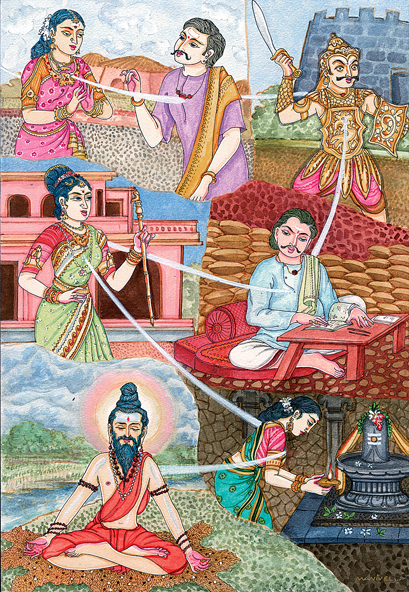
Illustration of reincarnation in Hindu art
In Jainism, a soul travels to any one of the four states of existence after death depending on its karmas.

Reincarnation, also known as rebirth or transmigration, is the philosophical or religious concept that the non-physical essence of a living being begins a new lifespan in a different physical form or body after biological death.[1][2] In most beliefs involving reincarnation, the soul of a human being is immortal and does not disperse after the physical body has perished. Upon death, the soul merely transmigrates into a newborn baby or into an animal to continue its immortality. (The term "transmigration" means the passing of a soul from one body to another after death.)

Reincarnation (punarjanman) is a central tenet of Indian religions such as Hinduism, Buddhism, Jainism, and Sikhism.[3][4][5][6] In various forms, it occurs as an esoteric belief in many streams of Judaism, in certain pagan religions (including Wicca), and in some beliefs of the Indigenous peoples of the Americas[7] and of Aboriginal Australians (though most believe in an afterlife or spirit world).[8] Some ancient Greek historical figures, such as Pythagoras, Socrates, and Plato, expressed belief in the soul's rebirth or migration (metempsychosis).[9]

Although the majority of denominations within the Abrahamic religions do not believe that individuals reincarnate, particular groups within these religions do refer to reincarnation; these groups include mainstream historical and contemporary followers of Catharism, Alawites, Hasidic Judaism, the Druze,[10] Kabbalistics, Rastafarians,[11] and the Rosicrucians.[12] Recent scholarly research has explored the historical relations between different sects and their beliefs about reincarnation. This research includes the views of Neoplatonism, Orphism, Hermeticism, Manichaenism, and the Gnosticism of the Roman era, as well as those in Indian religions.[13] In recent decades, many Europeans and North Americans have developed an interest in reincarnation,[14] and contemporary works sometimes mention the topic.[15]

Conceptual definitions

[edit]

The word reincarnation derives from a Latin term that literally means 'entering the flesh again'. Reincarnation refers to the belief that an aspect of every human being (or all living beings in some cultures) continues to exist after death. This aspect may be the soul, mind, consciousness, or something transcendent which is reborn in an interconnected cycle of existence; the transmigration belief varies by culture, and is envisioned to be in the form of a newly born human being, animal, plant, spirit, or as a being in some other non-human realm of existence.[16][17][18]

An alternative term is transmigration, implying migration from one life (body) to another.[19] The term has been used by modern philosophers such as Kurt Gödel[20] and has entered the English language.

The Greek equivalent to reincarnation, metempsychosis (μετεμψύχωσις), derives from meta ('change') and empsykhoun ('to put a soul into'),[21] a term attributed to Pythagoras.[22] Another Greek term sometimes used synonymously is palingenesis, 'being born again'.[23]

Rebirth is a key concept found in major Indian religions, and discussed using various terms. Punarjanman (Sanskrit: पुनर्जन्मन्, 'rebirth, transmigration'),[24][25] is discussed in the ancient Sanskrit texts of Hinduism, Buddhism, and Jainism, with many alternate terms such as punarāvṛtti (पुनरावृत्ति), punarājāti (पुनराजाति), punarjīvātu (पुनर्जीवातु), punarbhava (पुनर्भव), āgati-gati (आगति-गति, common in Buddhist Pali text), nibbattin (निब्बत्तिन्), upapatti (उपपत्ति), and uppajjana (उप्पज्जन).[24][26] These religions believe that reincarnation is cyclic and an endless Saṃsāra, unless one gains spiritual insights that ends this cycle leading to liberation.[3][27] The reincarnation concept is considered in Indian religions as a step that starts each "cycle of aimless drifting, wandering or mundane existence",[3] but one that is an opportunity to seek spiritual liberation through ethical living and a variety of meditative, yogic (marga), or other spiritual practices.[28] They consider the release from the cycle of reincarnations as the ultimate spiritual goal, and call the liberation by terms such as moksha, nirvana, mukti and kaivalya.[29][30][31]

Gilgul, Gilgul neshamot, or Gilgulei Ha Neshamot (Hebrew: גלגול הנשמות) is the concept of reincarnation in Kabbalistic Judaism, found in much Yiddish literature among Ashkenazi Jews. Gilgul means 'cycle' and neshamot is 'souls'. Kabbalistic reincarnation says that humans reincarnate only to humans unless YHWH/Ein Sof/God chooses.

History

[edit]

Origins

[edit]

The origins of the notion of reincarnation are obscure.[32] Discussion of the subject appears in the philosophical traditions of Ancient India. The Greek Pre-Socratics discussed reincarnation, and the Celtic druids are also reported to have taught a doctrine of reincarnation.[33]

Early Hinduism, Buddhism, and Jainism

[edit]

The concepts of the cycle of birth and death, saṁsāra, and liberation partly derive from ascetic traditions that arose in India around the middle of the first millennium BCE.[34] The first textual references to the idea of reincarnation appear in the Rigveda, Yajurveda and Upanishads of the late Vedic period (c. 1100 – c. 500 BCE), predating the Buddha and Mahavira.[35][36] Though no direct evidence of this has been found, the tribes of the Ganges valley or the Dravidian traditions of South India have been proposed as another early source of reincarnation beliefs.[37]

The idea of reincarnation, saṁsāra, did exist in the early Vedic religions.[38][39][40] The early Vedas mention the doctrine of karma and rebirth.[27][41][42] It is in the early Upanishads, which are pre-Buddha and pre-Mahavira, where these ideas are developed and described in a general way.[43][44][45] The earliest layers of Vedic text incorporate the concept of life, followed by an afterlife in heaven and hell based on cumulative virtues (merit) or vices (demerit).[46] However, the ancient Vedic rishis challenged this idea of afterlife as simplistic, because people do not live equally moral or immoral lives. Between generally virtuous lives, some are more virtuous; while evil too has degrees, and the texts assert that it would be unfair for people, with varying degrees of virtue or vices, to end up in heaven or hell, in "either or" and disproportionate manner irrespective of how virtuous or vicious their lives were.[47][48][49] They introduced the idea of an afterlife in heaven or hell in proportion to one's merit.[50][51]

Detailed descriptions first appear around the mid-1st millennium BCE in diverse traditions, including Buddhism, Jainism and various schools of Hindu philosophy, each of which gave unique expression to the general principle.[27]

The Purananuru, part of Sangam literature[52](ancient Tamil literature) contains several mentions of rebirth and moksha.[53] The text explains Hindu rituals surrounding death such as making riceballs called pinda and cremation. The text states that good souls get a place in Indraloka where Indra welcomes them.[54]

The texts of ancient Jainism that have survived into the modern era are post-Mahavira, likely from the last centuries of the first millennium BCE, and extensively discuss the doctrines of rebirth and karma.[55][56] Jaina philosophy assumes that the soul (jiva in Jainism; atman in Hinduism) exists and is eternal, passing through cycles of transmigration and rebirth.[57] After death, reincarnation into a new body is asserted to be instantaneous in early Jaina texts.[56] Depending upon the accumulated karma, rebirth occurs into a higher or lower bodily form, either in heaven or hell or earthly realm.[58][59] No bodily form is permanent: everyone dies and reincarnates further. Liberation (kevalya) from reincarnation is possible, however, through removing and ending karmic accumulations to one's soul.[60] From the early stages of Jainism on, a human being was considered the highest mortal being, with the potential to achieve liberation, particularly through asceticism.[61][62][63]

The early Buddhist texts discuss rebirth as part of the doctrine of saṃsāra. This asserts that the nature of existence is a "suffering-laden cycle of life, death, and rebirth, without beginning or end".[64][65] Also referred to as the wheel of existence (Bhavacakra), it is often mentioned in Buddhist texts with the term punarbhava (rebirth, re-becoming). Liberation from this cycle of existence, Nirvana, is the foundation and the most important purpose of Buddhism.[64][66][67] Buddhist texts also assert that an enlightened person knows his previous births, a knowledge achieved through high levels of meditative concentration.[68] Tibetan Buddhism discusses death, bardo (an intermediate state), and rebirth in texts such as the Tibetan Book of the Dead. While Nirvana is taught as the ultimate goal in the Theravadin Buddhism, and is essential to Mahayana Buddhism, the vast majority of contemporary lay Buddhists focus on accumulating good karma and acquiring merit to achieve a better reincarnation in the next life.[69][70]

In early Buddhist traditions, saṃsāra cosmology consisted of five realms through which the wheel of existence cycled.[64] This included hells (niraya), hungry ghosts (pretas), animals (tiryaka), humans (manushya), and gods (devas, heavenly).[64][65][71] In latter Buddhist traditions, this list grew to a list of six realms of rebirth, adding demigods (asuras).[64][72]

Comparison

[edit]

Early texts of Hinduism, Buddhism and Jainism share the concepts and terminology related to reincarnation.[73] They also emphasize similar virtuous practices and karma as necessary for liberation and what influences future rebirths.[35][74] For example, all three discuss various virtues—sometimes grouped as Yamas and Niyamas—such as non-violence, truthfulness, non-stealing, non-possessiveness, compassion for all living beings, charity and many others.[75][76]

Hinduism, Buddhism and Jainism disagree in their assumptions and theories about rebirth. Hinduism relies on its foundational belief that the 'soul, Self exists' (atman or attā), while Buddhism aserts that there is 'no soul, no Self' (anatta or anatman).[77][78][79][80][81][82][83][84][85][86][excessive citations] Hindu traditions consider soul to be the unchanging eternal essence of a living being, which journeys through reincarnations until it attains self-knowledge.[87][88][89] Buddhism, in contrast, asserts a rebirth theory without a Self, and considers realization of non-Self or Emptiness as Nirvana (nibbana).

The reincarnation doctrine in Jainism differs from those in Buddhism, even though both are non-theistic Sramana traditions.[90][91] Jainism, in contrast to Buddhism, accepts the foundational assumption that soul (Jiva) exists and asserts that this soul is involved in the rebirth mechanism.[92] Furthermore, Jainism considers asceticism as an important means to spiritual liberation that ends the cycle of reincarnation, while Buddhism does not.[90][93][94]

Classical Greek Philosophy

[edit]
A second-century Roman sarcophagus shows the mythology and symbolism of the Orphic and Dionysiac Mystery schools. Orpheus plays his lyre to the left.

Early Greek discussion of the concept dates to the sixth century BCE. An early Greek thinker known to have considered rebirth is Pherecydes of Syros (fl. 540 BCE).[95] His younger contemporary Pythagoras (c. 570–c. 495 BCE[96]), its first famous exponent, instituted societies for its diffusion. Some authorities believe that Pythagoras was Pherecydes' pupil, others that Pythagoras took up the idea of reincarnation from the doctrine of Orphism, a Thracian religion, or brought the teaching from India.

Plato (428/427–348/347 BCE) presented accounts of reincarnation in his works, particularly the Myth of Er, where Plato makes Socrates tell how Er, the son of Armenius, miraculously returned to life on the twelfth day after death and recounted the secrets of the other world. There are myths and theories to the same effect in other dialogues, in the Chariot allegory of the Phaedrus,[97] in the Meno,[98] Timaeus and Laws. The soul, once separated from the body, spends an indeterminate amount of time in the intelligible realm (see the Allegory of the Cave in The Republic) and then assumes another body. In the Timaeus, Plato believes that the soul moves from body to body without any distinct reward-or-punishment phase between lives, because the reincarnation is itself a punishment or reward for how a person has lived.[99]

In Phaedo, Plato has his teacher Socrates, prior to his death, state: "I am confident that there truly is such a thing as living again, and that the living spring from the dead." However, Xenophon does not mention Socrates as believing in reincarnation, and Plato may have systematized Socrates' thought with concepts he took directly from Pythagoreanism or Orphism. Recent scholars have come to see that Plato has multiple reasons for the belief in reincarnation.[100] One argument concerns the theory of reincarnation's usefulness for explaining why non-human animals exist: they are former humans, being punished for their vices; Plato gives this argument at the end of the Timaeus.[101]

Mystery cults

[edit]

The Orphic religion, which taught reincarnation, about the sixth century BCE, produced a copious literature.[102][103][104] Orpheus, its legendary founder, is said to have taught that the immortal soul aspires to freedom while the body holds it prisoner. The wheel of birth revolves, the soul alternates between freedom and captivity round the wide circle of necessity. Orpheus proclaimed the need of the grace of the gods, Dionysus in particular, and of self-purification until the soul has completed the spiral ascent of destiny to live forever.

An association between Pythagorean philosophy and reincarnation was routinely accepted throughout antiquity, as Pythagoras also taught about reincarnation. However, unlike the Orphics, who considered metempsychosis a cycle of grief that could be escaped by attaining liberation from it, Pythagoras seems to postulate an eternal, neutral reincarnation where subsequent lives would not be conditioned by any action done in the previous.[105]

Later authors

[edit]

In later Greek literature the doctrine is mentioned in a fragment of Menander[106] and satirized by Lucian.[107] In Roman literature it is found as early as Ennius,[108] who, in a lost passage of his Annals, told how he had seen Homer in a dream, who had assured him that the same soul which had animated both the poets had once belonged to a peacock. Persius in his satires (vi. 9) laughs at this; it is referred to also by Lucretius[109] and Horace.[110]

Virgil works the idea into his account of the Underworld in the sixth book of the Aeneid.[111] It persists down to the late classic thinkers, Plotinus and the other Neoplatonists. In the Hermetica, a Graeco-Egyptian series of writings on cosmology and spirituality attributed to Hermes Trismegistus/Thoth, the doctrine of reincarnation is central.

Celtic paganism

[edit]

In the first century BCE Alexander Cornelius Polyhistor wrote:

The Pythagorean doctrine prevails among the Gauls' teaching that the souls of men are immortal, and that after a fixed number of years they will enter into another body.

Julius Caesar recorded that the druids of Gaul, Britain and Ireland had metempsychosis as one of their core doctrines:[112]

The principal point of their doctrine is that the soul does not die and that after death it passes from one body into another... the main object of all education is, in their opinion, to imbue their scholars with a firm belief in the indestructibility of the human soul, which, according to their belief, merely passes at death from one tenement to another; for by such doctrine alone, they say, which robs death of all its terrors, can the highest form of human courage be developed.

Diodorus also recorded the Gaul belief that human souls were immortal, and that after a prescribed number of years they would commence upon a new life in another body. He added that Gauls had the custom of casting letters to their deceased upon the funeral pyres, through which the dead would be able to read them.[113] Valerius Maximus also recounted they had the custom of lending sums of money to each other which would be repayable in the next world.[114] This was mentioned by Pomponius Mela, who also recorded Gauls buried or burnt with them things they would need in a next life, to the point some would jump into the funeral piles of their relatives in order to cohabit in the new life with them.[115]

Hippolytus of Rome believed the Gauls had been taught the doctrine of reincarnation by a slave of Pythagoras named Zalmoxis. Conversely, Clement of Alexandria believed Pythagoras himself had learned it from the Celts and not the opposite, claiming he had been taught by Galatian Gauls, Hindu priests and Zoroastrians.[116][117] However, author T. D. Kendrick rejected a real connection between Pythagoras and the Celtic idea of reincarnation, noting their beliefs to have substantial differences, and any contact to be historically unlikely.[115] Nonetheless, he proposed the possibility of an ancient common source, also related to the Orphic religion and Thracian systems of belief.[118]

Germanic paganism

[edit]

Surviving texts indicate that there was a belief in rebirth in Germanic paganism. Examples include figures from eddic poetry and sagas, potentially by way of a process of naming and/or through the family line. Scholars have discussed the implications of these attestations and proposed theories regarding belief in reincarnation among the Germanic peoples prior to Christianization and potentially to some extent in folk belief thereafter.

Judaism

[edit]

Above the silence a call came to life, broke through it and dispersed it. “You will not die, my friends,” the call spoke to the land. “Earth of the Lord, you will awaken and live. Do not be wrathful with him whom you have called. He is born as one who shall return. The hand of the Lord is over his roots to bring him back in his time, to bring him back in your time, O my friends.”[119]

The belief in reincarnation developed among Jewish mystics in the medieval world, among whom differing explanations were given of the afterlife, although with a universal belief in an immortal soul.[120] It was explicitly rejected by Saadiah Gaon.[121] Today, reincarnation is an esoteric belief within many streams of modern Judaism. Kabbalah teaches a belief in gilgul, transmigration of souls, and hence the belief in reincarnation is universal in Hasidic Judaism, which regards the Kabbalah as sacred and authoritative, and is also sometimes held as an esoteric belief within other strains of Orthodox Judaism. In Judaism, the Zohar, first published in the 13th century, discusses reincarnation at length, especially in the Torah portion "Balak." The most comprehensive kabbalistic work on reincarnation, Shaar HaGilgulim,[122][123] was written by Chaim Vital, based on the teachings of his mentor, the 16th-century kabbalist Isaac Luria, who was said to know the past lives of each person through his semi-prophetic abilities. The 18th-century Lithuanian master scholar and kabbalist, Elijah of Vilna, known as the Vilna Gaon, authored a commentary on the biblical Book of Jonah as an allegory of reincarnation.

The practice of conversion to Judaism is sometimes understood within Orthodox Judaism in terms of reincarnation. According to this school of thought in Judaism, when non-Jews are drawn to Judaism, it is because they had been Jews in a former life. Such souls may "wander among nations" through multiple lives, until they find their way back to Judaism, including through finding themselves born in a gentile family with a "lost" Jewish ancestor.[124]

There is an extensive literature of Jewish folk and traditional stories that refer to reincarnation.[125]

Christianity

[edit]

Christianity historically and almost universally rejects reincarnation, while a minority of groups believe that it has occurred.

Reincarnationism or biblical reincarnation is the belief that certain people are or can be reincarnations of biblical figures, such as Jesus Christ and the Virgin Mary.[126] Some Christians believe that certain New Testament figures are reincarnations of Old Testament figures. For example, John the Baptist is believed by some to be a reincarnation of the prophet Elijah, and a few take this further by suggesting Jesus was the reincarnation of Elijah's disciple Elisha.[126][127] Other Christians believe the Second Coming of Jesus would be fulfilled by reincarnation. Sun Myung Moon, the founder of the Unification Church, considered himself to be the fulfillment of Jesus' return.

The Catholic Church does not believe in reincarnation, which it regards as incompatible with death.[128] Nonetheless, the leaders of certain sects in the church have taught that there are reincarnations of Mary – for example, Marie-Paule Giguère of the Army of Mary[129][130] and Maria Franciszka of the former Mariavites.[131] The Congregation for the Doctrine of the Faith excommunicated the Army of Mary for teaching heresy, including reincarnationism.[132]

Gnosticism

[edit]

Several Gnostic sects professed reincarnation. The Sethians and followers of Valentinus believed in it.[133] The followers of Bardaisan of Mesopotamia, a sect of the second century deemed heretical by the Catholic Church, drew upon Chaldean astrology, to which Bardaisan's son Harmonius, educated in Athens, added Greek ideas including a sort of metempsychosis. Another such teacher was Basilides (132–? CE/AD), known to us through the criticisms of Irenaeus and the work of Clement of Alexandria (see also Neoplatonism and Gnosticism and Buddhism and Gnosticism).

In the third Christian century Manichaeism spread both east and west from Babylonia, then within the Sassanid Empire, where its founder Mani lived about 216–276. Manichaean monasteries existed in Rome in 312 AD. Noting Mani's early travels to the Kushan Empire and other Buddhist influences in Manichaeism, Richard Foltz[134] attributes Mani's teaching of reincarnation to Buddhist influence. However the inter-relation of Manicheanism, Orphism, Gnosticism and neo-Platonism is far from clear.

Taoism

[edit]

Taoist documents from as early as the Han dynasty claimed that Lao Tzu appeared on earth as different persons in different times beginning in the legendary era of Three Sovereigns and Five Emperors. The (ca. third century BC) Chuang Tzu states: "Birth is not a beginning; death is not an end. There is existence without limitation; there is continuity without a starting-point. Existence without limitation is Space. Continuity without a starting point is Time. There is birth, there is death, there is issuing forth, there is entering in."[135][better source needed]

European Middle Ages

[edit]

Around the 11–12th century in Europe, several reincarnationist movements were persecuted as heresies, through the establishment of the Inquisition in the Latin west. These included the Cathar, Paterene or Albigensian church of western Europe, the Paulician movement, which arose in Armenia,[136] and the Bogomils in Bulgaria.[137]

Christian sects such as the Bogomils and the Cathars, who professed reincarnation and other gnostic beliefs, were referred to as "Manichaean", and are today sometimes described by scholars as "Neo-Manichaean".[138] As there is no known Manichaean mythology or terminology in the writings of these groups there has been some dispute among historians as to whether these groups truly were descendants of Manichaeism.[139]

Renaissance and Early Modern period

[edit]

During the Renaissance translations of Plato, the Hermetica, and other works fostered new European interest in reincarnation. Marsilio Ficino[140] argued that Plato's references to reincarnation were intended allegorically, Shakespeare alluded to the doctrine of reincarnation[141] but Giordano Bruno was burned at the stake by authorities after being found guilty of heresy by the Roman Inquisition for his teachings.[142] But the Greek philosophical works remained available and, particularly in north Europe, were discussed by groups such as the Cambridge Platonists. Emanuel Swedenborg believed that we leave the physical world once, but then go through several lives in the spiritual world—a kind of hybrid of Christian tradition and the popular view of reincarnation.[143]

19th to 20th centuries

[edit]

By the 19th century the philosophers Schopenhauer[144] and Nietzsche[145] could access the Indian scriptures for discussion of the doctrine of reincarnation, which recommended itself to the American Transcendentalists Henry David Thoreau, Walt Whitman and Ralph Waldo Emerson and was adapted by Francis Bowen into Christian Metempsychosis.[146]

By the early 20th century, interest in reincarnation had been introduced into the nascent discipline of psychology, largely due to the influence of William James, who raised aspects of the philosophy of mind, comparative religion, the psychology of religious experience and the nature of empiricism.[147] James was influential in the founding of the American Society for Psychical Research (ASPR) in New York City in 1885, three years after the British Society for Psychical Research (SPR) was inaugurated in London,[148] leading to systematic, critical investigation of paranormal phenomena. Famous World War II American General George Patton was a strong believer in reincarnation, believing, among other things, he was a reincarnation of the Carthaginian General Hannibal.

At this time popular awareness of the idea of reincarnation was boosted by the Theosophical Society's dissemination of systematised and universalised Indian concepts and also by the influence of magical societies like The Golden Dawn. Notable personalities like Annie Besant, W. B. Yeats and Dion Fortune made the subject almost as familiar an element of the popular culture of the west as of the east. By 1924 the subject could be satirised in popular children's books.[149] Humorist Don Marquis created a fictional cat named Mehitabel who claimed to be a reincarnation of Queen Cleopatra.[150]

Théodore Flournoy was among the first to study a claim of past-life recall in the course of his investigation of the medium Hélène Smith, published in 1900, in which he defined the possibility of cryptomnesia in such accounts.[151] Carl Gustav Jung, like Flournoy based in Switzerland, also emulated him in his thesis based on a study of cryptomnesia in psychism. Later Jung would emphasise the importance of the persistence of memory and ego in psychological study of reincarnation: "This concept of rebirth necessarily implies the continuity of personality... (that) one is able, at least potentially, to remember that one has lived through previous existences, and that these existences were one's own...."[146] Hypnosis, used in psychoanalysis for retrieving forgotten memories, was eventually tried as a means of studying the phenomenon of past life recall.

More recently, many people in the West have developed an interest in and acceptance of reincarnation.[14] Many new religious movements include reincarnation among their beliefs, e.g. modern Neopagans, Spiritism, Astara,[152] Dianetics, and Scientology. Many esoteric philosophies also include reincarnation, e.g. Theosophy, Anthroposophy, Kabbalah, and Gnostic and Esoteric Christianity such as the works of Martinus Thomsen.

Demographic survey data from 1999 to 2002 shows a significant minority of people from Europe (22%) and America (20%) believe in the existence of life before birth and after death, leading to a physical rebirth.[14][153] The belief in reincarnation is particularly high in the Baltic countries, with Lithuania having the highest figure for the whole of Europe, 44%, while the lowest figure is in East Germany, 12%.[14] A quarter of U.S. Christians, including 10% of all born again Christians, embrace the idea.[154]

Academic psychiatrist Ian Stevenson reported that belief in reincarnation is held (with variations in details) by adherents of almost all major religions except Christianity and Islam. In addition, between 20 and 30 percent of persons in western countries who may be nominal Christians also believe in reincarnation.[155] One 1999 study by Walter and Waterhouse reviewed the previous data on the level of reincarnation belief and performed a set of thirty in-depth interviews in Britain among people who did not belong to a religion advocating reincarnation.[156] The authors reported that surveys have found about one fifth to one quarter of Europeans have some level of belief in reincarnation, with similar results found in the USA. In the interviewed group, the belief in the existence of this phenomenon appeared independent of their age, or the type of religion that these people belonged to, with most being Christians. The beliefs of this group also did not appear to contain any more than usual of "new age" ideas (broadly defined) and the authors interpreted their ideas on reincarnation as "one way of tackling issues of suffering", but noted that this seemed to have little effect on their private lives.

Waterhouse also published a detailed discussion of beliefs expressed in the interviews.[157] She noted that although most people "hold their belief in reincarnation quite lightly" and were unclear on the details of their ideas, personal experiences such as past-life memories and near-death experiences had influenced most believers, although only a few had direct experience of these phenomena. Waterhouse analyzed the influences of second-hand accounts of reincarnation, writing that most of the people in the survey had heard other people's accounts of past-lives from regression hypnosis and dreams and found these fascinating, feeling that there "must be something in it" if other people were having such experiences.

Other influential contemporary figures that have written on reincarnation include Alice Ann Bailey, one of the first writers to use the terms New Age and age of Aquarius, Torkom Saraydarian, an Armenian-American musician and religious author, Dolores Cannon, Atul Gawande, Michael Newton, Bruce Greyson, Raymond Moody and Unity Church founder Charles Fillmore.[158] Neale Donald Walsch, an American author of the series Conversations with God claims that he has reincarnated more than 600 times.[159] The Indian spiritual teacher Meher Baba who had significant following in the West taught that reincarnation followed from human desire and ceased once a person was freed from desire.[160]

Religions and philosophies

[edit]

Buddhism

[edit]
In this 8-meter (25-foot) tall Buddhist relief, made between 1177 and 1249, located at Dazu Rock Carvings, Chongqing, China, Mara, Lord of Death and Desire, clutches a Wheel of Reincarnation which outlines the Buddhist cycle of reincarnation.

According to various Buddhist scriptures, Gautama Buddha believed in the existence of an afterlife in another world and in reincarnation,

Since there actually is another world (any world other than the present human one, i.e. different rebirth realms), one who holds the view 'there is no other world' has wrong view...

— Buddha, Majjhima Nikaya i.402, Apannaka Sutta, translated by Peter Harvey[161]

The Buddha also asserted that karma influences rebirth, and that the cycles of repeated births and deaths are endless.[161][162] Before the birth of Buddha, materialistic school such as Charvaka[163] posited that death is the end, there is no afterlife, no soul, no rebirth, no karma, and they described death to be a state where a living being is completely annihilated, dissolved.[164] Buddha rejected this theory, adopted the alternative existing theories on rebirth, criticizing the materialistic schools that denied rebirth and karma, states Damien Keown.[165] Such beliefs are inappropriate and dangerous, stated Buddha, because such annihilationism views encourage moral irresponsibility and material hedonism;[166] he tied moral responsibility to rebirth.[161][165]

The Buddha introduced the concept of anattā, which asserts that there is no permanent self (soul).[167][168][169] Major contemporary Buddhist traditions such as Theravada, Mahayana and Vajrayana traditions accept the teachings of Buddha. These teachings assert there is rebirth, there is no permanent self and no irreducible ātman (soul) moving from life to another and tying these lives together, there is impermanence, that all compounded things such as living beings are aggregates dissolve at death, but every being reincarnates.[170][171][172] The rebirth cycles continue endlessly, states Buddhism, and it is a source of duhkha (suffering, pain), but this reincarnation and duhkha cycle can be stopped through nirvana. The anattā doctrine of Buddhism is a contrast to Hinduism, the latter asserting that "soul exists, it is involved in rebirth, and it is through this soul that everything is connected".[173][174][175]

Different traditions within Buddhism have offered different theories on what reincarnates and how reincarnation happens. One theory suggests that it occurs through consciousness (Sanskrit: vijñāna; Pali: samvattanika-viññana)[176][177] or stream of consciousness (Sanskrit: citta-santāna, vijñāna-srotām, or vijñāna-santāna; Pali: viññana-sotam)[178] upon death, which reincarnates into a new aggregation. This process, states this theory, is similar to the flame of a dying candle lighting up another.[179][180] The consciousness in the newly born being is neither identical to nor entirely different from that in the deceased but the two form a causal continuum or stream in this Buddhist theory. Transmigration is influenced by a being's past karma (Pali: kamma).[181][182] The root cause of rebirth, states Buddhism, is the abiding of consciousness in ignorance (Sanskrit: avidya; Pali: avijja) about the nature of reality, and when this ignorance is uprooted, rebirth ceases.[183]

A 12th-century Japanese painting showing one of the six Buddhist realms of reincarnation (rokudō, 六道)

Buddhist traditions also vary in their mechanistic details on rebirth. Most Theravada Buddhists assert that rebirth is immediate while the Tibetan and most Chinese and Japanese schools hold to the notion of a bardo (intermediate state) that can last up to 49 days.[184][185] The bardo rebirth concept of Tibetan Buddhism, originally developed in India but spread to Tibet and other Buddhist countries, and involves 42 peaceful deities, and 58 wrathful deities.[186] These ideas led to maps on karma and what form of rebirth one takes after death, discussed in texts such as The Tibetan Book of the Dead.[187][188] The major Buddhist traditions accept that the reincarnation of a being depends on the past karma and merit (demerit) accumulated, and that there are six realms of existence in which the rebirth may occur after each death.[189][17][69]

Within Japanese Zen, reincarnation is accepted by some, but rejected by others. A distinction can be drawn between 'folk Zen', as in the Zen practiced by devotional lay people, and 'philosophical Zen'. Folk Zen generally accepts the various supernatural elements of Buddhism such as rebirth. Philosophical Zen, however, places more emphasis on the present moment.[190][191]

Some schools conclude that karma continues to exist and adhere to the person until it works out its consequences. For the Sautrantika school, each act "perfumes" the individual or "plants a seed" that later germinates. Tibetan Buddhism stresses the state of mind at the time of death. To die with a peaceful mind will stimulate a virtuous seed and a fortunate rebirth; a disturbed mind will stimulate a non-virtuous seed and an unfortunate rebirth.[192]

Christianity

[edit]

In a survey carried out by the Pew Forum in 2009, 22% of American Christians expressed a belief in reincarnation,[193] and in a 1981 survey 31% of regular churchgoing European Catholics expressed a belief in reincarnation.[194]

Some Christian theologians interpret certain Biblical passages as referring to reincarnation. These passages include the questioning of Jesus as to whether he is Elijah, John the Baptist, Jeremiah, or another prophet (Matthew 16:13–15 and John 1:21–22) and, less clearly (while Elijah was said not to have died, but to have been taken up to heaven), John the Baptist being asked if he is not Elijah (John 1:25).[195][196][197] Geddes MacGregor (1909-1998), who became an Episcopalian priest and a professor of philosophy, has made a case for the compatibility of Christian doctrine and reincarnation.[198] The Catholic Church and theologians such as Norman Geisler (1932-2019) argue that reincarnation is unorthodox and reject the reincarnationist interpretation of texts about John the Baptist and biblical texts used to defend this belief.[199][200] In fact, the figure of Elijah is clearly used as a metaphor for John the Baptist in Matthew 11,14: "For all the prophets and the law prophesied until John. [...] And if you are willing to receive it, he is Elijah who is to come."[201]

N. T. Wright (1948- ) emphasises resurrection of the body over reincarnation of the soul.[202]

Early

[edit]

Some evidence[203][204] suggests that Origen ( (c. 185c. 253), sometimes regarded as an early Church Father, taught reincarnation in his lifetime but that when his works were translated into Latin these references were concealed. One of the epistles written by St. Jerome, "To Avitus" (Letter 124; Ad Avitum. Epistula CXXIV),[205] asserts that Origen's On the First Principles (Latin: De Principiis; Ancient Greek: Περὶ Ἀρχῶν)[206] was mistranscribed:

About ten years ago that saintly man Pammachius sent me a copy of a certain person's [ Rufinus's[205] ] rendering, or rather misrendering, of Origen's First Principles; with a request that in a Latin version I should give the true sense of the Greek and should set down the writer's words for good or for evil without bias in either direction. When I did as he wished and sent him the book, he was shocked to read it and locked it up in his desk lest being circulated it might wound the souls of many.[204]

Under the impression that Origen was a heretic like Arius, St. Jerome criticizes ideas described in On the First Principles. Further in "To Avitus" (Letter 124), St. Jerome writes about "convincing proof" that Origen teaches reincarnation in the original version of the book:

The following passage is a convincing proof that he holds the transmigration of the souls and annihilation of bodies. 'If it can be shown that an incorporeal and reasonable being has life in itself independently of the body and that it is worse off in the body than out of it; then beyond a doubt bodies are only of secondary importance and arise from time to time to meet the varying conditions of reasonable creatures. Those who require bodies are clothed with them, and contrariwise, when fallen souls have lifted themselves up to better things, their bodies are once more annihilated. They are thus ever vanishing and ever reappearing.'[204]

The original text of On First Principles has been almost completely lost. It remains extant as De Principiis in fragments faithfully translated into Latin by St. Jerome and in "the not very reliable Latin translation of Rufinus".[206]

However, Origen's supposed belief in reincarnation is controversial. Christian scholar Dan R. Schlesinger has written an extensive monograph in which he argues that Origen never taught reincarnation.[207]

Reincarnation was taught by several Gnostics such as Marcion of Sinope (c.  85c.  160).[208] Belief in reincarnation was rejected by several Church Fathers, including Augustine of Hippo in The City of God.[209][need quotation to verify][210][200]

Roman Catholic Church

[edit]

Citing Hebrews 9,27 ("27 And as it is appointed for men to die once, but after this the judgment, 28 so Christ was offered once to bear the sins of many. To those who eagerly wait for Him He will appear a second time, apart from sin, for salvation."), the Catechism of the Catholic Church completely rejects any doctrine of reincarnation.[211]

Same thing is expressed about Christ in 1 Peter 3,18: "For Christ also suffered once for sins, the just for the unjust, that He might bring us to God, being put to death in the flesh but made alive by the Spirit,..."

Druze

[edit]

Reincarnation is a paramount tenet in the Druze faith.[212] There is an eternal duality of the body and the soul and it is impossible for the soul to exist without the body. Therefore, reincarnations occur instantly at one's death. While in the Hindu and Buddhist belief system a soul can be transmitted to any living creature, in the Druze belief system this is not possible and a human soul will only transfer to a human body. Furthermore, souls cannot be divided into different or separate parts and the number of souls existing is finite.[213]

The few Druzes who claim to remember their past are called Nateq. Typically souls who have died violent deaths in their previous incarnation will be able to recall memories. Since death is seen as a quick transient state, mourning is discouraged.[213] Unlike other Abrahamic faiths, heaven and hell are spiritual. Heaven is the ultimate happiness received when soul escapes the cycle of rebirths and reunites with the Creator, while hell is conceptualized as the bitterness of being unable to reunite with the Creator and escape from the cycle of rebirth.[214]

Hinduism

[edit]
Hindus believe the self or soul (atman) repeatedly takes on a physical body, until moksha.

Hindu traditions assert that the body dies, but not the soul, which they believe to be eternal, indestructible, and blissful.[215] Everything and all existence is believed to be connected and cyclical in many Hinduism-sects, all living beings composed of two things, the soul and the body or matter.[216] In Hindu belief, Ātman does not change and cannot change by its innate nature.[217] Current karma impacts the future circumstances in this life, as well as the future forms and realms of lives.[218] Good intent and actions lead to good future, bad intent and actions lead to bad future, impacting how one reincarnates.[219]

There is no permanent heaven or hell in most Hinduism-sects.[220] In the afterlife, based on one's karma, the soul is reborn as another being in heaven, hell, or a living being on earth (human, animal).[220] Gods, too, die once their past karmic merit runs out, as do those in hell, and they return getting another chance on earth. Reincarnation continues, endlessly in cycles, until one embarks on a spiritual pursuit, realizes self-knowledge, and thereby gains mokṣa, the final release out of the reincarnation cycles.[221] This release is believed to be a state of utter bliss, which Hindu traditions believe is either related or identical to Brahman, the unchanging reality that existed before the creation of universe, continues to exist, and shall exist after the universe ends (in simpler terms, the Hindu concept of an all-powerful God).[222][223][224]

The Upanishads, part of the scriptures of the Hindu traditions, primarily focus on the liberation from reincarnation.[225][226] The Bhagavad Gita discusses various paths to liberation.[215] The Upanishads, states Harold Coward, offer a "very optimistic view regarding the perfectibility of human nature", and the goal of human effort in these texts is a continuous journey to self-perfection and self-knowledge so as to end Saṃsāra—the endless cycle of rebirth and redeath.[227] The aim of spiritual quest in the Upanishadic traditions is find the true self within and to know one's soul, a state that they assert leads to blissful state of freedom, moksha.[228]

The Bhagavad Gita states:

Just as in the body childhood, adulthood and old age happen to an embodied being. So also he (the embodied being) acquires another body. The wise one is not deluded about this. (2:13)[229]

As, after casting away worn out garments, a man later takes new ones. So after casting away worn out bodies, the embodied Self encounters other new ones. (2:22)[230]

When an embodied being transcends, these three qualities which are the source of the body, Released from birth, death, old age and pain, he attains immortality. (14:20)[231]

There are internal differences within Hindu traditions on reincarnation and the state of moksha. For example, the dualistic devotional traditions such as Madhvacharya's Dvaita Vedanta tradition of Hinduism champion a theistic premise, assert that human soul and Brahman are different, loving devotion to Brahman (god Vishnu in Madhvacharya's theology) is the means to release from Samsara, it is the grace of God which leads to moksha, and spiritual liberation is achievable only in after-life (videhamukti).[232] The non-dualistic traditions such as Adi Shankara's Advaita Vedanta tradition of Hinduism champion a monistic premise, asserting that the individual human soul and Brahman are identical, only ignorance, impulsiveness and inertia leads to suffering through Saṃsāra, in reality there are no dualities, meditation and self-knowledge is the path to liberation, the realization that one's soul is identical to Brahman is moksha, and spiritual liberation is achievable in this life (jivanmukti).[84][233]

Twentieth-century Indian philosopher Sri Aurobindo said that rebirth was the mechanism of evolution – plants are reborn as animals, which are reborn as humans, gaining intelligence each time.[234] He said that this progression was irreversible, and that a human cannot be reborn as an animal.[235]

Islam

[edit]

Most Islamic schools of thought reject any idea of reincarnation of living beings.[236][237][238] It teaches a linear concept of life, wherein a human being has only one life and upon death he or she is judged by God, then rewarded in heaven or punished in hell.[236][239] Islam teaches final resurrection and Judgement Day,[237] but there is no prospect for the reincarnation of a human being into a different body or being.[236] During the early history of Islam, some of the Caliphs persecuted all reincarnation-believing people, such as Manichaeism, to the point of extinction in Mesopotamia and Persia (modern day Iraq and Iran).[237] However, some Muslim minority sects such as those found among Sufis, and some Muslims in South Asia and Indonesia have retained their pre-Islamic Hindu and Buddhist beliefs in reincarnation.[237] For instance, historically, South Asian Isma'ilis performed chantas yearly, one of which is for seeking forgiveness of sins committed in past lives.[240]

Ghulat sects

[edit]

The idea of reincarnation is accepted by a few heterodox sects, particularly of the Ghulat.[241] Alawites hold that they were originally stars or divine lights that were cast out of heaven through disobedience and must undergo repeated reincarnation (or metempsychosis) before returning to heaven.[242] They can be reincarnated as Christians or others through sin and as animals if they become infidels.[243]

Jainism

[edit]
17th-century cloth painting depicting seven levels of Jain hell according to Jain cosmology. Left panel depicts the demi-god and his animal vehicle presiding over each hell.

In Jainism, reincarnation, along with its theories of Saṃsāra and Karma, are central to its theological foundations, as evidenced by the extensive literature on it in the major sects of Jainism, and their pioneering ideas on these topics from the earliest times of the Jaina tradition.[244][56] Reincarnation in contemporary Jainism traditions is the belief that the worldly life is characterized by continuous rebirths and suffering in various realms of existence.[57][56][245]

Karma forms a central and fundamental part of Jain faith, being intricately connected to other of its philosophical concepts like transmigration, reincarnation, liberation, non-violence (ahiṃsā) and non-attachment, among others. Actions are seen to have consequences: some immediate, some delayed, even into future incarnations. So the doctrine of karma is not considered simply in relation to one life-time, but also in relation to both future incarnations and past lives.[246] Uttarādhyayana Sūtra 3.3–4 states: "The jīva or the soul is sometimes born in the world of gods, sometimes in hell. Sometimes it acquires the body of a demon; all this happens on account of its karma. This jīva sometimes takes birth as a worm, as an insect or as an ant."[247] The text further states (32.7): "Karma is the root of birth and death. The souls bound by karma go round and round in the cycle of existence."[247]

Actions and emotions in the current lifetime affect future incarnations depending on the nature of the particular karma. For example, a good and virtuous life indicates a latent desire to experience good and virtuous themes of life. Therefore, such a person attracts karma that ensures that their future births will allow them to experience and manifest their virtues and good feelings unhindered.[248] In this case, they may take birth in heaven or in a prosperous and virtuous human family. On the other hand, a person who has indulged in immoral deeds, or with a cruel disposition, indicates a latent desire to experience cruel themes of life.[249] As a natural consequence, they will attract karma which will ensure that they are reincarnated in hell, or in lower life forms, to enable their soul to experience the cruel themes of life.[249]

There is no retribution, judgment or reward involved but a natural consequences of the choices in life made either knowingly or unknowingly. Hence, whatever suffering or pleasure that a soul may be experiencing in its present life is on account of choices that it has made in the past.[250] As a result of this doctrine, Jainism attributes supreme importance to pure thinking and moral behavior.[251]

The Jain texts postulate four gatis, that is states-of-existence or birth-categories, within which the soul transmigrates. The four gatis are: deva (demigods), manuṣya (humans), nāraki (hell beings), and tiryañca (animals, plants, and microorganisms).[252] The four gatis have four corresponding realms or habitation levels in the vertically tiered Jain universe: deva occupy the higher levels where the heavens are situated; manuṣya and tiryañca occupy the middle levels; and nāraki occupy the lower levels where seven hells are situated.[252]

Single-sensed souls, however, called nigoda,[253] and element-bodied souls pervade all tiers of this universe. Nigodas are souls at the bottom end of the existential hierarchy. They are so tiny and undifferentiated, that they lack even individual bodies, living in colonies. According to Jain texts, this infinity of nigodas can also be found in plant tissues, root vegetables and animal bodies.[254] Depending on its karma, a soul transmigrates and reincarnates within the scope of this cosmology of destinies. The four main destinies are further divided into sub-categories and still smaller sub-sub-categories. In all, Jain texts speak of a cycle of 8.4 million birth destinies in which souls find themselves again and again as they cycle within samsara.[255]

In Jainism, God has no role to play in an individual's destiny; one's personal destiny is not seen as a consequence of any system of reward or punishment, but rather as a result of its own personal karma. A text from a volume of the ancient Jain canon, Bhagvati sūtra 8.9.9, links specific states of existence to specific karmas. Violent deeds, killing of creatures having five sense organs, eating fish, and so on, lead to rebirth in hell. Deception, fraud and falsehood lead to rebirth in the animal and vegetable world. Kindness, compassion and humble character result in human birth; while austerities and the making and keeping of vows lead to rebirth in heaven.[256]

Each soul is thus responsible for its own predicament, as well as its own salvation. Accumulated karma represent a sum total of all unfulfilled desires, attachments and aspirations of a soul.[257][258] It enables the soul to experience the various themes of the lives that it desires to experience.[257] Hence a soul may transmigrate from one life form to another for countless of years, taking with it the karma that it has earned, until it finds conditions that bring about the required fruits. In certain philosophies, heavens and hells are often viewed as places for eternal salvation or eternal damnation for good and bad deeds. But according to Jainism, such places, including the earth are simply the places which allow the soul to experience its unfulfilled karma.[259]

Judaism

[edit]

The doctrine of reincarnation has had a complex evolution within Judaism. Initially alien to Jewish tradition, it began to emerge in the 8th century, possibly influenced by Muslim mystics, gaining acceptance among Karaites and Jewish dissenters.[260][261] It was first mentioned in Jewish literature by Saadia Gaon, who criticized it.[262][260] However, it remained a minority belief, facing little resistance until the spread of Kabbalah in the 12th century. The "Book of Clarity" (Sefer ha-Bahir) of this period introduced concepts such as the transmigration of souls, strengthening the foundation of Kabbalah with mystical symbolism.[263] Kabbalah also teaches that "The soul of Moses is reincarnated in every generation."[264] This teaching found more significant ground in Kabbalistic circles in Provence and Spain.[261]

Despite not being widely accepted in Orthodox Judaism, the doctrine of reincarnation attracted some modern Jews involved in mysticism.[260] Hasidic Judaism and followers of Kabbalah remained firm in their belief in the transmigration of souls. Other branches of Judaism, such as Reform and Conservative, do not teach it.[265]

The 16th century mystical renaissance in communal Safed marked an important development in Kabbalistic thought, with a significant impact on mystical circles and Jewish spirituality.[266] It was also the time when Kabbalah was most widely disseminated.[267] References to gilgul in former Kabbalah became systematized as part of the metaphysical purpose of creation. Isaac Luria (the Ari) brought the issue to the centre of his new mystical articulation, for the first time, and advocated identification of the reincarnations of historic Jewish figures that were compiled by Haim Vital in his Shaar HaGilgulim.[268] Gilgul is contrasted with the other processes in Kabbalah of Ibbur ('pregnancy'), the attachment of a second soul to an individual for (or by) good means, and Dybuk ('possession'), the attachment of a spirit, demon, etc. to an individual for (or by) "bad" means.

In Lurianic Kabbalah, reincarnation is not retributive or fatalistic, but an expression of Divine compassion, the microcosm of the doctrine of cosmic rectification of creation. Gilgul is a heavenly agreement with the individual soul, conditional upon circumstances. Luria's radical system focused on rectification of the Divine soul, played out through Creation. The true essence of anything is the divine spark within that gives it existence. Even a stone or leaf possesses such a soul that "came into this world to receive a rectification". A human soul may occasionally be exiled into lower inanimate, vegetative or animal creations. The most basic component of the soul, the nefesh, must leave at the cessation of blood production. There are four other soul components and different nations of the world possess different forms of souls with different purposes. Each Jewish soul is reincarnated in order to fulfill each of the 613 Mosaic commandments that elevate a particular spark of holiness associated with each commandment. Once all the Sparks are redeemed to their spiritual source, the Messianic Era begins. Non-Jewish observance of the 7 Laws of Noah assists the Jewish people, though Biblical adversaries of Israel reincarnate to oppose.

Among the many rabbis who accepted reincarnation are Kabbalists like Nahmanides (the Ramban) and Rabbenu Bahya ben Asher, Levi ibn Habib (the Ralbah), Shelomoh Alkabez, Moses Cordovero, Moses Chaim Luzzatto; early Hasidic masters such as the Baal Shem Tov, Schneur Zalman of Liadi and Nachman of Breslov, as well as virtually all later Hasidic masters; contemporary Hasidic teachers such as DovBer Pinson, Moshe Weinberger and Joel Landau; and key Mitnagdic leaders, such as the Vilna Gaon and Chaim Volozhin and their school, as well as Rabbi Shalom Sharabi (known at the RaShaSH), the Ben Ish Chai of Baghdad, and the Baba Sali.[269] Rabbis who have rejected the idea include Saadia Gaon, David Kimhi, Hasdai Crescas, Joseph Albo, Abraham ibn Daud, Leon de Modena, Solomon ben Aderet, Maimonides and Asher ben Jehiel. Among the Geonim, Hai Gaon argued in favour of gilgulim.

Inuit

[edit]

In the Western Hemisphere, belief in reincarnation is most prevalent in the now heavily Christian Polar North (now mainly parts of Greenland and Nunavut).[270] The concept of reincarnation is enshrined in the Inuit languages,[271] and in many Inuit cultures it is traditional to name a newborn child after a recently deceased person under the belief that the child is the namesake reincarnated.[270]

Ho-Chunk

[edit]

Reincarnation is an intrinsic part of some Northeastern Native American traditions.[270] The following is a story of human-to-human reincarnation as told by Thunder Cloud, a Winnebago (Ho-Chunk) shaman. Here Thunder Cloud talks about his two previous lives and how he died and came back again to this his third lifetime. He describes his time between lives, when he was "blessed" by Earth Maker and all the abiding spirits and given special powers, including the ability to heal the sick.

Thunder Cloud's account of his two reincarnations:

I (my ghost) was taken to the place where the sun sets (the west). ... While at that place, I thought I would come back to earth again, and the old man with whom I was staying said to me, "My son, did you not speak about wanting to go to the earth again?" I had, as a matter of fact, only thought of it, yet he knew what I wanted. Then he said to me, "You can go, but you must ask the chief first." Then I went and told the chief of the village of my desire, and he said to me, "You may go and obtain your revenge upon the people who killed your relatives and you." Then I was brought down to earth. ... There I lived until I died of old age. ... As I was lying [in my grave], someone said to me, "Come, let us go away." So then we went toward the setting of the sun. There we came to a village where we met all the dead. ... From that place I came to this earth again for the third time, and here I am.

— Radin (1923)[272]

Sikhism

[edit]

In the 15th century, Sikhism's founder Guru Nanak maintained a cyclical concept of time.[273][274] Sikhism teaches reincarnation theory similar to those in Hinduism, but with some differences from its traditional doctrines.[275] Sikh rebirth theories about the nature of existence are similar to ideas that developed during the devotional Bhakti movement particularly within some Vaishnava traditions, which define liberation as a state of union with God attained through the grace of God.[276][277][278]

Sikhism teaches that the soul passes from one body to another in endless cycles of Saṃsāra, until liberation from the death and rebirth cycle. Each birth begins with karma (karam), and these actions leave a karmic signature (karni) on one's soul which influences future rebirths, but it is God whose grace that liberates from the death and rebirth cycle.[275] The way out of the reincarnation cycle, asserts Sikhism, is to live an ethical life, devote oneself to God and constantly remember God's name.[275] The precepts of Sikhism encourage the bhakti of One Lord for mukti (liberation from the death and rebirth cycle).[275][279]

Traditional African religions

[edit]

The Traditional African religions generally hold the beliefs of life after death (a spirit world or realms), with some also having a concept of reincarnation, in which deceased humans may reincarnate into their family lineage (blood lineage), if they want to, or have something to fulfill.[280]

Yoruba

[edit]

The Yoruba religion teaches that Olodumare, the Supreme Being and divine Creator who rules over His Creation, created eniyan, or humanity, to achieve balance between heaven and earth and bring about Ipo Rere, or the Good Condition.[281] To cause achievement of the Good Condition, humanity reincarnates.[282] Once achieved, Ipo Rere provides the ultimate state of supreme existence with Olodumare, a goal which elevates reincarnation to a key position in the Yoruba religion.[283]

Atunwaye[284] (also called atunwa[281]) is the Yoruba term for reincarnation. Predestination is a foundational component of atunwaye. Just prior to incarnation, a person first chooses their Ayanmo (destiny) before also choosing their Akunyelan (lot) in the presence of Olodumare and Orunmila with Olodumare's approval.[285] By atunwaye, a person may incarnate only in a human being and may choose to reincarnate in either sex, regardless of choice in the prior incarnation.[283]

Ipadaway

The most common, widespread Yoruba reincarnation belief is ipadawaye, meaning "the ancestor's rebirth".[284] According to this belief, the reincarnating person will reincarnate along their familial lineage.[282][283][286][287] When a person dies, they go to orun (heaven) and will live with the ancestors in either orunrere (good heaven) or orunapaadi (bad heaven). Reincarnation is believed to be a gift bestowed on ancestors who lived well and experienced a "good" death. Only ancestors living in orunrere may return as grandchildren, reincarnating out of their love for the family or the world. Children may be given names to indicate which ancestor is believed to have returned, such as Babatide ("father has come"), Babatunde ("father has come again"), and Yetunde ("mother has come again").[284][286]

A "bad" death (which includes deaths of children, cruel, or childless people and deaths by punishments from the gods, accidents, suicides, and gruesome murders) is generally believed to prevent the deceased from joining the ancestors and reincarnating again,[288] though some practitioners also believe a person experiencing a "bad" death will be reborn much later into conditions of poverty.[281]

Abiku

Another Yoruba reincarnation belief is abiku, meaning "born to die"[281][284][289] According to Yoruba custom, an abiku is a reincarnating child who repeatedly experiences death and rebirth with the same mother in a vicious cycle. Because childlessness is considered a curse in Yoruba culture,[289] parents with an abiku child will always attempt to help the abiku child by preventing their death. However, abiku are believed to possess a power to ensure their eventual death, so rendering assistance is often a frustrating endeavor causing significant pain to the parents. This pain is believed to bring happiness to the abiku.[289]

Abiku are believed to be a "species of spirit" thought to live apart from people in, for example, secluded parts of villages, jungles, and footpaths. Modern belief in abiku has significantly waned among urban populations, with the decline attributed to improved hygiene and medical care reducing infant mortality rates.[289]

Akudaaya

Akudaaya, meaning "born to die and reappear"[284] (also called akuda[290]), is a Yoruba reincarnation belief of "a person that is dead[] but has not gone to heaven".[291] Akudaaya is based on the belief that, if a recently deceased person's destiny in that life remained unfulfilled, the deceased cannot join the ancestors and therefore must roam the world.[290] Following death, an akudaaya returns to their previous existence by reappearing in the same physical form. However, the new existence will be lived in a different physical location from the first, and the akudaaya will not be recognized by a still-living relative, should they happen to meet. The akudaaya lives their new existence working to fulfill their destiny from the previous life.

The concept of akudaaya is the subject of Akudaaya (The Wraith), a 2023 Nigerian drama film in the Yoruba language.[292] The film is said to center on a deceased son who "has begun living life as a spirit in another state and has fallen in love".[293]

Serer religion

[edit]

Ciiɗ is the Serer process of a spirit's (o laaw) reincarnation as found within the tenets of Serer spirituality (A fat Roog). In the Serer language, "Ciiɗ", in its literal definition is the reincarnated or the dead who seek to reincarnate or the pre-foetal spirit. This Ciiɗ has the capability to reincarnate and become a man. In A fat Roog (Serer spirituality), only those human Pangool (ancestral spirits) who have reached Jaaniiw (the place where good souls go) are able to reincarnate.[294][295][296]

New religious and spiritual movements

[edit]

Spiritism

[edit]
Tomb of Allan Kardec, founder of spiritism. The inscription says in French "To be born, die, again be reborn, and so progress unceasingly, such is the law".

Spiritism, a spiritualist philosophy codified in the 19th century by the French educator Allan Kardec, teaches reincarnation or rebirth into human life after death.

According to the Spiritist doctrine, an "intelligent principle", also called the "spiritual principle", evolves from simpler organisms such as bacteria, plants, then into non-human animals, then into humans, and then into further stages, including the angelical one of higher wisdom and morality. The period in between physical lives is called erraticity, in which a spirit may wander on Earth or in (either good or bad) spiritual realms.[297][298][299] According to this doctrine, free will and cause and effect are the corollaries of reincarnation, and reincarnation provides a mechanism for a person's spiritual evolution in successive lives.[300] The introduction of reincarnation into Spiritist doctrines was mediated by a series of mediums and "magnetizers", such as M. Roustan, a practitioner of animal magnetism, also known as mesmerism, who believed in reincarnation. Roustan played an important role in the development of the mediumistic abilities of Celina Japhet, a medium who assisted Allan Kardec in the codification of his doctrine.[301]

These ideas were consolidated in France. Their spread was facilitated by a movement to reinterpret spiritualism, strongly influenced by mystical, Hindu, Buddhist and socialist tendencies.[1][302] One of the first groups in France to embrace reincarnation was the Saint-Simonian movement in the 1820s, a group of progressive and utopian thinkers, including Jean Reynaud and Pierre Leroux, who sought to reform society and integrate socialist ideals with a new spiritual vision. These thinkers, influenced by Eastern philosophies "newly discovered" in the West, such as those of Hindu and Buddhist thinkers, adopted the belief that the soul evolved over multiple lives. Reynaud and Leroux, in particular, popularized the idea of reincarnation, arguing that it was a more rational and progressive explanation for the fate of the soul. They drew on the Catholic thinker Pierre-Simon Ballanche.[302] This belief was also promoted by other socialist and mystical thinkers, such as Henri de St. Simon, Barthélemy-Prosper Enfantin and Charles Fourier, who, in addition to discussing the evolution of the soul, saw reincarnation as a key to understanding human progress, both from a spiritual and social point of view.[301] In an attempt to make the theory more "French", Reynaud stated that the ancient Druids, representatives of the Celtic culture of France, also believed in reincarnation, which gave the doctrine a legitimate ancestral origin and connection with national identity. This belief in reincarnation was appropriated by groups of liberal Protestants, freethinkers and mesmerists, reaching Kardec through the latter.[302]

The doctrine of reincarnation was criticized by spiritualists outside of France. In the United States, Andrew Jackson Davis considered it a "magnificent mansion built on sand", although he believed in the pre-existence of souls. In England, William Howitt was one of the main critics, describing the doctrine as pitiful and repulsive, arguing that, if it were true, many spirits would have searched in vain for their loved ones in the afterlife.[301]

Theosophy

[edit]

The Theosophical Society draws much of its inspiration from India.[303] In the Theosophical world-view reincarnation is the vast rhythmic process by which the soul, the part of a person which belongs to the formless non-material and timeless worlds, unfolds its spiritual powers in the world and comes to know itself.[304] It descends from sublime, free, spiritual realms and gathers experience through its effort to express itself in the world. Afterwards there is a withdrawal from the physical plane to successively higher levels of reality, in death, a purification and assimilation of the past life. Having cast off all instruments of personal experience it stands again in its spiritual and formless nature, ready to begin its next rhythmic manifestation, every lifetime bringing it closer to complete self-knowledge and self-expression.[304] However, it may attract old mental, emotional, and energetic karma patterns to form the new personality.[305]

Anthroposophy

[edit]

Anthroposophy describes reincarnation from the point of view of Western philosophy and culture. The ego is believed to transmute transient soul experiences into universals that form the basis for an individuality that can endure after death. These universals include ideas, which are intersubjective and thus transcend the purely personal (spiritual consciousness), intentionally formed human character (spiritual life), and becoming a fully conscious human being (spiritual humanity). Rudolf Steiner described both the general principles he believed to be operative in reincarnation, such as that one's will activity in one life forms the basis for the thinking of the next,[306] and a number of successive lives of various individualities.[307]

Similarly, other famous people's life stories are not primarily the result of genes, upbringing or biographical vicissitudes. Steiner relates that a large estate in north-eastern France was held during the early Middle Ages by a martial feudal lord. During a military campaign, this estate was captured by a rival. The previous owner had no means of retaliating, and was forced to see his property lost to an enemy. He was filled with a smoldering resentment towards the propertied classes, not only for the remainder of his life in the Middle Ages, but also in a much later incarnation—as Karl Marx. His rival was reborn as Friedrich Engels.[308]

— Olav Hammer, Coda. On Belief and Evidence

Modern astrology

[edit]

Inspired by Helena Blavatsky's major works, including Isis Unveiled and The Secret Doctrine, astrologers in the early twentieth-century integrated the concepts of karma and reincarnation into the practice of Western astrology. Notable astrologers who advanced this development included Alan Leo, Charles E. O. Carter, Marc Edmund Jones, and Dane Rudhyar. A new synthesis of East and West resulted as Hindu and Buddhist concepts of reincarnation were fused with Western astrology's deep roots in Hermeticism and Neoplatonism. In the case of Rudhyar, this synthesis was enhanced with the addition of Jungian depth psychology.[309] This dynamic integration of astrology, reincarnation and depth psychology has continued into the modern era with the work of astrologers Steven Forrest and Jeffrey Wolf Green. Their respective schools of Evolutionary Astrology are based on "an acceptance of the fact that human beings incarnate in a succession of lifetimes".[310]

Scientology

[edit]

Past reincarnation, usually termed past lives, is a key part of the principles and practices of the Church of Scientology. Scientologists believe that the human individual is actually a thetan, an immortal spiritual entity, that has fallen into a degraded state as a result of past-life experiences. Scientology auditing is intended to free the person of these past-life traumas and recover past-life memory, leading to a higher state of spiritual awareness.

This idea is echoed in their highest fraternal religious order, Sea Org, whose motto is "Revenimus" ('We Come Back'), and whose members sign a "billion-year contract" as a sign of commitment to that ideal. L. Ron Hubbard, the founder of Scientology, does not use the word "reincarnation" to describe its beliefs, noting that: "The common definition of reincarnation has been altered from its original meaning. The word has come to mean 'to be born again in different life forms' whereas its actual definition is 'to be born again into the flesh of another body.' Scientology ascribes to this latter, original definition of reincarnation."[311]

The first writings in Scientology regarding past lives date from around 1951 and slightly earlier. In 1960, Hubbard published a book on past lives entitled Have You Lived Before This Life. In 1968 he wrote Mission Into Time, a report on a five-week sailing expedition to Sardinia, Sicily and Carthage to see if specific evidence could be found to substantiate L. Ron Hubbard's recall of incidents in his own past, centuries ago.

Wicca

[edit]

Wicca is an eclectic new religious movement focused on nature, and guided by the philosophy of Wiccan Rede that advocates the tenets "Harm None, Do As Ye Will". Wiccans believe in a form of karmic return where one's deeds are returned, either in the current life or in another life, threefold or multiple times in order to teach one lessons (the Threefold Law). Reincarnation is therefore an accepted part of the Wiccan faith.[312][full citation needed] Wiccans also believe that death and afterlife are important experiences for the soul to transform and prepare for future lifetimes.[citation needed]

Reincarnation and science

[edit]
The 14th Dalai Lama has stated his belief that it would be difficult for science to disprove reincarnation.

While there has been no scientific confirmation of the physical reality of reincarnation, where the subject has been discussed, there are questions of whether and how such beliefs may be justified within the discourse of science and religion. Some champions of academic parapsychology have argued that they have scientific evidence even while their detractors have accused them of practicing a form of pseudoscience.[313][314] Skeptic Carl Sagan asked the Dalai Lama what he would do if a fundamental tenet of his religion (reincarnation) were definitively disproved by science. The Dalai Lama answered, "If science can disprove reincarnation, Tibetan Buddhism would abandon reincarnation ... but it's going to be mighty hard to disprove reincarnation."[315] Sagan considered claims of memories of past lives to be worthy of research, although he considered reincarnation to be an unlikely explanation.[316]

Claims of memories of past lives

[edit]

Over a period of 40 years, psychiatrist Ian Stevenson, from the University of Virginia, recorded case studies of young children who claimed to remember past lives, and published twelve books. In his cases, he reported the child's statements and testimony from family members and others, often along with what he considered to be correlates to a deceased person who in some ways seemed to match the child's memory. Stevenson also investigated cases where he thought that birthmarks and birth defects seemed to match wounds and scars on the deceased. Sometimes included in his documentation were medical records like autopsy photographs.[317] As any claim of past life memory is subject to charges of false memories and the ease with which such claims can be hoaxed, Stevenson expected the controversy and skepticism of his beliefs that followed. He said that he looked for disconfirming evidence and alternative explanations for reports, but, as the Washington Post reported, he typically concluded that no normal explanation sufficed.[318]

Stevenson's work in this regard was impressive enough to Carl Sagan that he referred to what were apparently Stevenson's investigations in his book The Demon-Haunted World as an example of carefully collected empirical data, and though he rejected reincarnation as a parsimonious explanation for the stories, he wrote that the phenomenon of alleged past-life memories should be further researched.[319][320] Sam Harris cited Stevenson's works in his book The End of Faith as part of a body of data that seems to attest to the reality of psychic phenomena.[321][322]

Stevenson's claims have been subject to criticism and debunking, for example by the philosopher Paul Edwards, who contended that Ian Stevenson's accounts of reincarnation were purely anecdotal and cherry-picked.[323] Edwards attributed the stories to selective thinking, suggestion, and false memories that result from the family's or researcher's belief systems and thus did not rise to the standard of fairly sampled empirical evidence.[324] The philosopher Keith Augustine wrote in critique that the fact that "the vast majority of Stevenson's cases come from countries where a religious belief in reincarnation is strong, and rarely elsewhere, seems to indicate that cultural conditioning (rather than reincarnation) generates claims of spontaneous past-life memories."[325] Edwards also objected that reincarnation invokes assumptions that are inconsistent with modern science.[326][324] As the vast majority of people do not remember previous lives and there is no empirically documented mechanism known that allows personality to survive death and travel to another body, positing the existence of reincarnation is subject to the principle that "extraordinary claims require extraordinary evidence". Further, Ian Wilson wrote that a large number of Stevenson's cases consisted of poor children remembering wealthy lives or belonging to a higher caste. In these societies, claims of reincarnation have been used as schemes to obtain money from the richer families of alleged former incarnations.[327]

Stevenson also claimed there were a handful of cases that suggested evidence of xenoglossy, including two where a subject under hypnosis allegedly conversed with people speaking the foreign language, instead of merely being able to recite foreign words. Sarah Thomason, a linguist (and skeptical researcher) at the University of Michigan, reanalyzed these cases, concluding that "the linguistic evidence is too weak to provide support for the claims of xenoglossy".[328]

Other academic researchers who have undertaken similar pursuits include Jim B. Tucker, Antonia Mills,[329] Satwant Pasricha, Godwin Samararatne, and Erlendur Haraldsson, but Stevenson's publications remain the most well known.[330]

Past life regression

[edit]

Some believers in reincarnation (excluding Stevenson) give much importance to supposed past-life memories retrieved under hypnosis during past life regressions. Popularized by psychiatrist Brian Weiss, who claims he has regressed more than 4,000 patients since 1980,[331][332] the technique is often identified as a kind of pseudoscientific practice.[333] Such supposed memories have been documented to contain historical inaccuracies originating from modern popular culture, common beliefs about history, or books that discuss historical events. Experiments with subjects undergoing past life regression indicate that a belief in reincarnation and suggestions by the hypnotist are the two most important factors regarding the contents of memories reported.[334][333][335] The use of hypnosis and suggestive questions can tend to leave the subject particularly likely to hold distorted or false memories.[336] Rather than recall of a previous existence, the source of the memories is more likely cryptomnesia and confabulations that combine experiences, knowledge, imagination and suggestion or guidance from the hypnotist. Once created, those memories are indistinguishable from memories based on events that occurred during the subject's life.[334][337]

Past-life regression has been critiqued for being unethical on the grounds that it lacks any evidence to support its claims and that it increases one's susceptibility to false memories. Luis Cordón states that this can be problematic as it creates delusions under the guise of therapy. The memories are experienced as being as vivid as those based on events experienced in one's life and impossible to differentiate from true memories of actual events, and accordingly any damage can be difficult to undo.[337][338]

American Psychological Association accredited organizations have challenged the use of past-life regressions as a therapeutic method, calling it unethical. Additionally, the hypnotic methodology that underpins past-life regression has been criticized as placing the participant in a vulnerable position, susceptible to implantation of false memories.[338] Because the implantation of false memories may be harmful, Gabriel Andrade argues that past-life regression violates the principle of first, do no harm (non-maleficence), part of the Hippocratic Oath.[338]

See also

[edit]

References

[edit]

Sources

[edit]
[edit]
Revisions and contributorsEdit on WikipediaRead on Wikipedia
from Grokipedia
Reincarnation, literally meaning "to take on the flesh again," is the philosophical and religious concept that an individual's non-physical essence or transitions to a new physical body or form after biological , often as part of a cyclical process influenced by actions from previous lives known as karma. This belief posits that the process allows for spiritual or moral reckoning across multiple existences, and it has intrigued thought since ancient times, appearing in diverse cultural and religious contexts worldwide. In Eastern traditions, reincarnation forms a foundational doctrine. In , it is termed samsara, the endless cycle of birth, death, and rebirth driven by karma—the cumulative effect of one's deeds— with the ultimate aim of achieving , liberation from the cycle through enlightenment or union with the divine. The illustrates this vividly: "Worn-out bodies are shed by the dweller within the body. New bodies are donned like garments." adapts the idea without positing an eternal soul, viewing rebirth as a continuum of consciousness propelled by karma until nirvana ends the process, emphasizing impermanence (anicca) and no-self (anatta). similarly stresses karma's binding effect on the eternal soul (jiva), which reincarnates across realms such as human, animal, or divine forms, advocating strict non-violence () to purify and attain liberation (). incorporates reincarnation as a consequence of deeds, where the soul cycles through lives until merging with the divine through devotion (), rejecting caste-based inequalities in the process. Although less central in Abrahamic faiths, reincarnation appears in certain sects and esoteric traditions. Mainstream and Islam generally reject it in favor of a single life followed by judgment and resurrection or paradise/, as affirmed in doctrines like the for Christians and the for Muslims. However, historical groups such as the Cathars in medieval Christianity and the Druzes or some Shia sects (e.g., ) in Islam have embraced it, often linking it to spiritual purification. In Judaism, it is not orthodox but features in Kabbalistic thought as gilgul neshamot, the transmigration of souls for rectification. Ancient influences trace back further, with echoes in Egyptian, Greek (via and Orphism), and indigenous African and Siberian traditions predating Vedic texts. In modern contexts, reincarnation persists in New Religious Movements like and figures such as Osho, who reinterpreted it as a transfer of memories rather than souls, and it garners empirical interest through research. Psychiatrist at the documented over 2,500 cases of children recalling past lives, often with verifiable details like birthmarks corresponding to previous injuries, suggesting potential evidence for the phenomenon. A 2009 Pew Research Center survey found that 22% of U.S. Christians and 24% of the general public believed in reincarnation. More recent surveys, such as a 2025 Pew Research Center study, show 31% of Americans believe in reincarnation, underscoring its continued cultural resonance despite scientific skepticism over mechanisms and verifiability.

Definitions and Concepts

Core Principles

Reincarnation, also known as transmigration, refers to the philosophical and religious belief that a or survives physical and enters a new body, initiating a successive series of lives. This process posits an ongoing journey of the essential beyond the termination of any single incarnation. At its core, reincarnation encompasses three interrelated elements: an enduring or , often termed atman in certain traditions, which persists across existences; the cyclical pattern of birth, , and rebirth known as samsara; and karma, the principle of moral causation that governs the nature of each subsequent life based on actions performed in prior ones. The is conceived as eternal and unchanging, serving as the vehicle for accumulated experiences and ethical consequences. Samsara represents the perpetual wheel of existence, binding the soul to repeated embodiments until conditions for release are met. Karma functions as a , where virtuous deeds lead to favorable rebirths—such as higher or pleasurable circumstances—while harmful actions result in adverse outcomes, ensuring ethical accountability across lifetimes. Reincarnation differs fundamentally from resurrection, which entails a one-time revival of the original body, often in a transformed state, as seen in Abrahamic eschatologies, and from , which typically involves perpetual existence without the necessity of rebirth cycles. Unlike resurrection's singular event tied to , reincarnation emphasizes multiple, sequential embodiments driven by impersonal causal forces rather than a final reckoning. , in contrast, may allow for an unending without embodiment or cyclical renewal, focusing on eternal continuity rather than progressive moral evolution through lives. The mechanism of reincarnation operates through karmic influence, where intentions and behaviors in one life imprint upon the , shaping the form, environment, and experiences of the next—potentially as human, animal, or other forms depending on the accumulated merit or demerit. This moral causation underscores a system of cosmic justice, promoting ethical living to improve future conditions and ultimately achieve liberation, such as moksha (release from the cycle in some views) or nirvana (extinction of suffering and rebirth). Attaining this freedom requires transcending karmic bonds through spiritual discipline, , or devotion, thereby ending the samsaric loop. While the conception of the varies slightly across traditions, the emphasis remains on this transformative potential for ethical and existential progress.

Cultural Variations

Across diverse cultures, beliefs in reincarnation exhibit significant variations in the forms of rebirth permitted, particularly regarding whether can transfer to bodies or are confined to human ones. In some traditions, such as those among the , reincarnation can involve cross-species transmigration, where human may rebirth as s, often as a form of continuity or punishment tied to actions. Conversely, other cultural frameworks restrict rebirth to human forms exclusively, emphasizing a linear progression within humanity without intermediaries, as observed in various animistic societies where (soul migration across species) is rare or absent. These differences reflect broader cosmological views, with animal-inclusive systems often integrating ecological interconnectedness, while human-only models underscore social or moral hierarchies. Another key variation concerns the nature of souls in rebirth processes, including concepts of group souls or collective karma that contrast with individualistic interpretations. In tribal societies, such as the Ashanti of , reincarnation may involve multiple or shared souls— for instance, two reincarnating souls inherited through parental lines, plus a third linked to the day of birth—suggesting a collective familial or communal karma where individual fates intertwine with group destinies. This differs from more individualistic societies, where karma operates primarily on personal actions, leading to solitary soul migrations without shared soul pools; cross-cultural analyses indicate multiple soul beliefs in about one-third of reincarnation-practicing societies, often correlating with guardian spirit concepts rather than strict . Such collective models foster social cohesion in communal settings, adapting core karmic principles to emphasize interdependence over personal isolation. Reincarnation beliefs also vary in their treatment of and , allowing fluidity that challenges fixed identities across rebirth cycles. Cultural accounts document cases of soul gender-switching, where individuals recall prior lives of the opposite sex, accompanied by behavioral traits or phobias aligned with the previous ; for example, in and , documented cases show children exhibiting cross-gender preferences, with rates of sex-change memories reaching 33% in some Burmese samples and 12% in Sri Lankan ones. similarly shifts, enabling rebirth into higher or lower strata based on accumulated merit, as seen in societies like the Tiv of , where ancestral resemblances in grandchildren imply status fluidity tied to familial lines rather than rigid . These adaptations highlight reincarnation's role in promoting ethical reflection on transient roles, with more prevalent in cultures open to such transitions. Finally, conceptions of souls as temporary versus permanent influence views of interim states and potential fragmentation during the rebirth process. In Tibetan traditions, the represents a transitional intermediate state between and rebirth, a luminous phase of where the soul-like stream navigates karmic visions for up to , offering opportunities for liberation before fragmentation into a new form. Other cultures conceptualize single souls fragmenting post- into components—such as a reincarnating essence, ancestral spirit, and ghost—as among the Lozi of , where this division allows partial permanence for lineage ties while enabling rebirth. Soul fragmentation appears in roughly 23% of studied reincarnation societies with singular souls, contrasting with permanent soul models that avoid such divisions, and underscores cultural emphases on continuity versus transformation in the .

Historical Development

Ancient Origins

The earliest indications of beliefs resembling reincarnation emerge from prehistoric archaeological evidence, primarily through practices and artistic expressions that suggest concepts of continuity or migration. In sites dating back to around 30,000 BCE, such as those in European caves like and Altamira, artwork depicting animal-human hybrids and journey motifs has been interpreted by some scholars as evidence of shamanic visions involving travels between worlds, potentially implying cyclical returns to . However, these interpretations remain speculative, as direct evidence for structured reincarnation doctrines is absent; instead, they reflect broader animistic or ancestral continuity ideas common in small-scale societies. Similarly, burials, including those with and pigmentation around 40,000–10,000 BCE, indicate rituals aimed at preserving personal identity post-death, which may hint at beliefs in ongoing existence rather than explicit rebirth cycles. In the Indus Valley Civilization (c. 3300–1300 BCE), archaeological finds such as seals and figurines from sites like and provide indirect hints of rebirth motifs, though their undeciphered script limits firm conclusions. Proto-Shiva-like figures in yogic postures on seals, alongside tree and animal , have led some researchers to propose connections to later Hindu concepts of regeneration and soul continuity, possibly imported into Vedic traditions. For instance, the depicting a surrounded by animals is often cited as evoking themes of cosmic cycles and transformation, akin to rebirth symbolism in subsequent South Asian religions. Nonetheless, these artifacts primarily reflect ritual or trade functions, with reincarnation interpretations relying on retrospective links to post-Indus developments rather than explicit contemporary evidence. The concept of punarjanma (rebirth) receives its initial textual mentions in early Vedic literature, particularly the (c. 1500–1200 BCE), where it appears tied to ancestor worship and the renewal of vital forces rather than a fully developed cycle of transmigration. Hymns such as 10.16 invoke to guide the deceased to the forefathers while granting vitality for potential return, suggesting an of rebirth limited to familial or sacrificial renewal in small-scale societal contexts. This early formulation emphasizes progeny and ritual continuity—e.g., the soul's return through sons to perpetuate lineage—contrasting with later elaborations in Brahmanas and . Scholarly consensus holds that while the contains embryonic ideas of post-death vitality, the systematic doctrine of samsara (cyclical rebirth) evolves in subsequent Vedic layers. Parallels in contemporaneous Mesopotamian and Egyptian traditions show limited notions of soul recycling, distinct from comprehensive reincarnation systems. In ancient (c. 3000–500 BCE), the afterlife involved the et emmu (spirit) descending to the underworld Irkalla for a shadowy existence, with occasional myths like Inanna's descent suggesting temporary returns but no ongoing earthly rebirth cycles. Egyptian beliefs centered on the ka and ba souls reuniting for eternal life in the or field of reeds, with Osiris's myth symbolizing annual renewal for the but applying to cosmic rather than individual reincarnation. These ideas emphasize judgment and preservation over repeated human embodiment, marking a contrast to the emerging Indic motifs.

Classical and Medieval Periods

In , the concept of —the transmigration of souls—was prominently introduced to Greek philosophy by in the 6th century BCE, drawing from earlier Egyptian and possibly Indian traditions of soul cycles. taught that the soul is immortal and undergoes successive reincarnations into human or animal forms as a means of purification, influencing ethical and the avoidance of harming living beings believed to house past souls. This doctrine, while not directly attested in 's own writings, is preserved in later accounts by philosophers like and , who critiqued or engaged with it. Plato further developed these ideas in the 4th century BCE, integrating into his theory of the soul's and recollection of eternal Forms. In the , describes the soul's separation from the body at death and its potential rebirth based on moral conduct during life, emphasizing philosophical purification to escape the cycle. The 's depicts souls choosing their next lives after drinking from the River , underscoring justice and the soul's journey toward higher realms. These myths served as allegories for ethical living rather than literal , profoundly shaping Western philosophical views on the afterlife. During the Roman period, adapted Platonic and Pythagorean elements of soul transmigration in the (19 BCE), particularly in Book 6, where witnesses souls in the preparing for reincarnation. explains to how purified souls return to earthly bodies after a thousand-year cycle, linking personal fate to cosmic order and Roman destiny. This portrayal blended Greek with Roman , portraying reincarnation as a mechanism for heroic renewal and imperial continuity, influencing later and Christian interpretations. In medieval Jewish mysticism, the Kabbalah introduced the concept of gilgul around the 12th century CE, positing the soul's transmigration to rectify past sins or fulfill divine missions across multiple lives. Emerging in texts like the Sefer ha-Bahir and later elaborated in the Zohar, gilgul viewed reincarnation as a corrective process within the soul's descent and ascent through the sefirot, distinct from Christian resurrection. This idea gained traction among Sephardic and Ashkenazi scholars, such as Isaac Luria in the 16th century, though its roots trace to earlier medieval speculations. Parallel developments in medieval Islamic mysticism, particularly , occasionally interpreted the soul (ruh) in terms of cyclical returns, though mainstream rejected outright reincarnation. Sufi thinkers like (d. 1240) described the ruh as emanating from the divine and undergoing journeys of manifestation and return, metaphorically akin to soul cycles in ecstatic visions, without endorsing bodily transmigration. These esoteric views influenced Persian and Ottoman mystical poetry, bridging Neoplatonic influences with Quranic notions of . In Celtic and Germanic folklore from approximately 500 to 1000 CE, oral traditions preserved beliefs in soul rebirth, often tied to warrior heroism and ancestral continuity. Celtic tales, such as those in Irish sagas, depicted souls returning as heroes or kin to avenge wrongs or sustain clan lineages, with the head symbolizing the soul's seat. Germanic myths, including echoes in Norse eddas, portrayed valiant spirits reborn in battle or as kin, reflecting a of cyclical vitality amid tribal migrations and conflicts. These motifs, transmitted through skaldic poetry and druidic lore, emphasized communal renewal over individual salvation.

Modern Revival

The modern revival of reincarnation beliefs in the West during the 19th to 21st centuries was significantly influenced by European colonialism's exposure to Eastern philosophies, the rise of movements, and the processes of that facilitated the cross-cultural exchange of spiritual ideas. In the mid-19th century, French educator codified Spiritism in his 1857 work , which presented reincarnation as a mechanism for spiritual evolution and interpreted biblical texts as supporting the concept, thereby popularizing past-life regression practices among European spiritualists. This framework gained traction through séances and writings that emphasized moral progression across multiple lives. Building on this momentum, the , founded in 1875 by Helena Petrovna Blavatsky and in New York, synthesized Eastern doctrines of karma and rebirth with , introducing these ideas to a broader audience through Blavatsky's 1877 publication . The book critiqued materialist science while drawing from Hindu and to argue for the soul's transmigration, influencing circles and paving the way for reincarnation's integration into thought. Concurrently, in the early 20th century, American psychic conducted trance readings starting around 1901, in which he described past lives as key to understanding present karmic patterns and health issues, thereby embedding reincarnation in popular American spirituality. In the mid-20th century, psychiatrist advanced empirical inquiry into reincarnation through systematic investigations beginning in 1961 at the , documenting over 2,500 cases of young children worldwide who spontaneously recalled verifiable details from alleged previous lives, often including birthmarks corresponding to fatal wounds. His volumes, such as (1966) and Reincarnation and Biology (1997), emphasized cross-cultural patterns and challenged skeptics by prioritizing unsolved cases with strong evidential chains. Stevenson's research has been continued by Jim Tucker, who has documented additional cases and published works such as Before (2021), exploring children's memories of previous lives. Entering the , beliefs in reincarnation have been further propelled by reports of near-death experiences (NDEs), where individuals describe life reviews encompassing multiple existences, with studies indicating a higher prevalence of belief in reincarnation among NDErs (e.g., 70%) compared to the general population (23%). Popular media has amplified this trend; for instance, the 2012 film , directed by and , weaves six interconnected narratives across centuries to illustrate karmic cycles and soul evolution through reincarnation, resonating with global audiences and contributing to cultural normalization. Surveys reflect this resurgence, with 31% of Americans and lower rates in many European countries (e.g., 12% in and ) expressing belief in reincarnation as of 2025, often blending it with amid globalization's diverse influences.

In Eastern Religions

Hinduism

In Hinduism, reincarnation, known as samsara, forms a foundational doctrine intertwined with the concepts of atman (the individual soul) and Brahman (the ultimate reality). The Upanishads, composed between approximately 800 and 200 BCE, introduce the unity of atman and Brahman as the essence of existence, positing that the soul undergoes a cyclical process of birth, death, and rebirth driven by karma until liberation (moksha) is achieved. This cycle is vividly described in texts like the Brihadaranyaka Upanishad, where the soul transmigrates based on actions, emphasizing the illusory nature of the material world and the pursuit of self-realization to transcend samsara. The , dated around 200 BCE, elaborates on the immortality of the through Krishna's discourse to in Chapter 2, verses 12–30. Krishna asserts that the atman is eternal, indestructible, and beyond the dualities of birth and , using the of changing garments to illustrate how the soul discards worn-out bodies for new ones in successive rebirths (verses 22–23). He further explains that all beings have always existed and will continue to do so, unaffected by the body's perishability, thereby reinforcing karmic rebirth as an ongoing process until the soul attains union with the divine (verses 12–13, 27). To break free from samsara, Hinduism outlines primary paths to moksha: jnana yoga (the path of knowledge), which involves discerning the unity of atman and Brahman through philosophical inquiry; bhakti yoga (the path of devotion), centered on surrender to a personal deity like Krishna for grace-induced liberation; and karma yoga (the path of selfless action), which purifies the soul by performing duties without attachment to results, as taught in the Bhagavad Gita. These paths converge on dissolving ego and karma to end rebirth. Traditionally, the varna system—dividing society into four classes (Brahmins, Kshatriyas, Vaishyas, and Shudras)—was linked to reincarnation, with one's birth into a varna viewed as the karmic result of past actions, justifying social roles as part of the cosmic order. Modern Hindu reformers, including Swami Vivekananda and Jyotiba Phule, have critiqued this interpretation, arguing that the original varna was merit-based and fluid, not hereditary, and advocating reforms to dismantle caste rigidities while retaining spiritual ideals.

Buddhism and Jainism

In Buddhism, the concept of rebirth, known as punabhava in the Pali Canon (compiled around the 5th century BCE), describes the continuation of consciousness without a permanent soul or self (anatta), driven by volitional actions or kamma that propel the stream of existence through the cycle of samsara. This process lacks a transmigrating entity, emphasizing instead the impermanence of all phenomena, where rebirth occurs across realms such as human, divine, animal, or hellish based on accumulated kamma. In Tibetan Buddhist traditions, the intermediate state between death and rebirth, called bardo, is detailed in texts like the Bardo Thodol (8th century CE), portraying a transitional phase where consciousness encounters visions and opportunities for liberation before assuming a new form. Ultimate liberation in Buddhism is nirvana, the cessation of craving and kamma, which extinguishes the conditions for further rebirth and ends the suffering of samsara. In , the soul or is an eternal, conscious entity that transmigrates through countless births in accordance with the (c. 2nd–5th century CE), the foundational text synthesizing Jain doctrine, binding to karmic matter that determines its form among approximately 8.4 million or yonis, ranging from microbes to humans and deities. Strict adherence to (non-violence) is central, as it minimizes the influx of negative karma particles, which obscure the soul's innate qualities and perpetuate rebirth across four destinies: heavenly, human, animal/plant, or hellish. Liberation, or , is attained through (infinite omniscience), achieved by ascetics who eradicate all karma via rigorous vows, vows, and , allowing the purified to reside eternally in a state of bliss at the summit of the universe. A key philosophical distinction lies in Buddhism's doctrine of dependent origination (pratityasamutpada), which views all phenomena as arising interdependently without inherent essence, contrasting with Jainism's of eternal, independent substances like jiva and non-soul matter (ajiva), where karma operates as subtle physical particles adhering to the soul. This difference underscores Buddhism's rejection of any enduring self in rebirth versus Jainism's affirmation of an immutable soul navigating karmic bondage.

Sikhism

In Sikhism, the concept of reincarnation, known as the cycle of janam maran (birth and death), forms a foundational element of spiritual teachings, emphasizing the soul's journey through multiple existences until liberation is achieved. Founded by (1469–1539 CE), Sikhism emerged in the region as a monotheistic tradition that synthesized elements from Indian spiritual philosophies while rejecting ritualistic practices and social hierarchies. Guru Nanak's teachings, as recorded in the (compiled around 1604 CE by the fifth Guru, Arjan Dev), portray reincarnation not as an end in itself but as a transient state driven by human flaws, with the ultimate aim of transcending it through devotion to the one God, . The describes the reincarnation cycle as involving passage through 8.4 million (chaurasi lakh) life forms, ranging from lower to birth, which is considered the rarest and most opportune for spiritual progress. This cycle is perpetuated by haumai (ego or self-centeredness), which binds the to worldly attachments and illusions, leading to repeated births and s as described in verses such as those on Ang 19: "Their comings and goings in reincarnation do not end; through and rebirth, they are wasting away... haumai mamataa mohanee sabh muThee aha(n)kaar." Unlike deterministic karmic interpretations in some traditions, Sikh teachings stress that haumai arises from of divine unity, causing the to wander until enlightened. The path to mukti (liberation) involves breaking this cycle through naam simran (meditation and remembrance of God's name), ethical living, and surrender to Waheguru, resulting in the soul's eternal union with the divine and cessation of rebirth. Guru Nanak emphasized that true devotion eradicates haumai, allowing the soul to merge with rather than reincarnate, as echoed in teachings on Ang 422: "How can coming and going, the cycle of reincarnation be ended?" This process prioritizes inner transformation over external rituals, fostering a life of service, humility, and equality before the divine. Sikhism distinctly rejects caste-based notions of rebirth prevalent in traditional Hindu views, asserting universal equality regardless of social origin, as proclaimed that all humans are equal in God's eyes and that spiritual merit, not birth status, determines progress toward liberation. This emphasis on ethical conduct and devotion over hereditary privileges underscores Sikhism's contrast with other Indian traditions, promoting a direct, egalitarian approach to overcoming the reincarnation cycle.

In Abrahamic Traditions

Judaism

In Judaism, the concept of reincarnation, known as gilgul neshamot or the transmigration of souls, is largely absent from mainstream rabbinic orthodoxy but holds a prominent place in Jewish mysticism, particularly within Kabbalah. This doctrine posits that souls return to earthly existence in new bodies to achieve rectification (tikkun) of past failings or to fulfill uncompleted spiritual missions. While early medieval Jewish philosophers often rejected it as incompatible with traditional resurrection beliefs, it gained traction through esoteric texts and interpretations. Medieval precedents reveal a divide on reincarnation. (882–942 CE), in his philosophical treatise Emunot ve-Deot (Book of Beliefs and Opinions), explicitly rejected gilgul as a foreign idea lacking biblical or talmudic support, viewing it as contrary to the soul's eternal reward or punishment after death. In contrast, (Ramban, 1194–1270 CE) accepted a limited form of gilgul, interpreting biblical passages like Job 33:29 to suggest souls could transmigrate up to three times for atonement, particularly in cases of severe sins, though he did not elaborate extensively on the mechanism. The doctrine crystallized in the (c. 1280 CE), the foundational text of attributed to , which describes gilgul neshamot as a process of soul rectification through multiple incarnations, often linked to violations of procreation or . The portrays reincarnation not merely as punishment but as , allowing souls to return "from whom no one is cast off forever" (based on 1 Kings 8:40), potentially spanning up to 1,000 generations or three cycles to purify the soul and restore its divine connection. This framework influenced later Kabbalistic thought, emphasizing as a cycle of descent and ascent for spiritual completion. Lurianic Kabbalah, developed by (1534–1572 CE) in , expanded into a cosmic system of repair tied to the doctrine of . Luria taught that after the primordial "breaking of the vessels" (shevirat ha-kelim), divine sparks (nitzotzot) from Adam's soul scattered into the material world, necessitating reincarnation to gather and elevate them. In works like Sha'ar ha-Gilgulim (compiled by his disciple Chaim Vital), souls reincarnate partially—specific levels like nefesh (vital soul) or ruach (spirit) returning to mend defects, with examples such as reincarnating as Abel to rectify primordial sins. This process underscores tikkun as an ongoing rectification of both individual and collective cosmic fractures. In modern Hasidism, which emerged in the and draws heavily from Lurianic ideas, reincarnation is selectively endorsed, particularly for the souls of tzaddikim (righteous individuals). Hasidic literature, such as hagiographies of leaders like the , depicts gilgul as a tool for social and ethical justice, where exemplary souls return to guide communities or resolve halakhic (legal) dilemmas through elevated incarnations, reinforcing the tzaddik's role as a mystical intermediary without universal application to all souls.

Christianity

In early Christianity, the concept of reincarnation appeared in speculative theological writings, particularly through the teachings of of in the third century CE. advocated for the of souls, suggesting that human spirits existed prior to embodiment and could undergo a form of , or soul transmigration, as a means of purification and return to . These ideas drew possible brief influence from Jewish mystical traditions, such as emerging concepts in Kabbalistic thought. However, 's views were later condemned as heretical at the Second Council of Constantinople in 553 CE, where anathemas explicitly rejected the of souls and any notion of repeated embodiments, solidifying the Church's emphasis on a single earthly life followed by judgment and . During the medieval period, reincarnation resurfaced in heretical movements like the Cathars, a dualistic active in and from the twelfth century. The Cathars believed that human souls were divine sparks—originally angels—trapped in the material world created by an evil , requiring repeated incarnations in bodies as a purgatorial process until achieving purity through and the ritual. This view of soul entrapment in matter and cyclical rebirth directly challenged orthodox Christian doctrines of creation, , and bodily resurrection, leading to the and Inquisition's suppression of the group by the fourteenth century. In modern Catholicism, the official stance remains a firm rejection of reincarnation, prioritizing the resurrection of the body and eternal judgment after one earthly life, as articulated in the . Paragraph 1013 states: "Death is the end of man's earthly pilgrimage... we shall not return to other earthly lives," underscoring the incompatibility with . Nonetheless, some personalist theologians, such as , have explored potential compatibilities between reincarnation and Christian pluralism, viewing repeated lives as a mechanism for soul development toward divine union, though such ideas remain outside mainstream doctrine. Among Protestant traditions, endorsements of reincarnation are rare and typically marginal, with notable exceptions in esoteric branches like Swedenborgianism, founded on the eighteenth-century visions of . Swedenborg rejected earthly reincarnation but described "serial lives" in the spiritual world, where souls progress through multiple states of existence post-death to achieve spiritual maturity, akin to stages of rebirth without physical return. This framework integrates with Swedenborg's emphasis on continuous personal reformation, influencing small denominations but not broader Protestant theology, which generally aligns with the singular life-resurrection paradigm.

Islam

In orthodox , the concept of reincarnation, known as tanasukh or , is firmly rejected in favor of a single earthly life followed by , , and . The explicitly underscores this finality, as in Al-Mu'minun (23:99-100), which describes the soul's plea for return after being denied, with a barrier () separating the deceased from the world until the Day of Judgment. This doctrine emphasizes accountability in one lifetime, rendering cyclical rebirth incompatible with . Within , the mystical dimension of , figures like the 13th-century philosopher explored nuanced ideas of the ruh (spirit) undergoing spiritual returns in progressively perfected forms to achieve union with the Divine, though he explicitly rejected literal tanasukh as it contradicts the unity of being (wahdat al-wujud). These interpretations frame reincarnation-like processes as metaphorical journeys of inner transformation rather than physical rebirth, aligning with Sufi emphasis on divine intimacy over material cycles. Among sects, which represent esoteric offshoots of , reincarnation finds more explicit endorsement. The , emerging in the under Fatimid influence, hold a doctrine of taqammus, wherein the soul immediately transfers upon death to the body of a newborn Druze believer, ensuring continuity within the community until spiritual purification allows ascent to divine realms. The , another sect, also endorse reincarnation, viewing it as a process of spiritual refinement through successive lives. Similarly, certain historical Ismaili interpretations within Shia esotericism have alluded to multiple lives as symbolic cycles of soul progression through esoteric knowledge (batin), though mainstream today rejects physical tanasukh in favor of spiritual rebirth in non-material realms. In modern contexts, some thinkers reconcile Islamic teachings with notions of spiritual evolution, viewing human progress as a divinely guided ascent across lifetimes in a metaphorical sense, while unequivocally denying literal reincarnation as antithetical to Quranic . This approach integrates with faith, positing prophets as catalysts for moral and spiritual advancement without endorsing cyclical physical returns.

In Indigenous and Folk Traditions

African and Diaspora Religions

In traditional Yoruba religion, particularly within the Ifá tradition, reincarnation is conceptualized through the notion of ori, the personal divinity or head-soul that embodies an individual's destiny and consciousness, which returns to earth after death either as an ancestor or in forms like abiku—spirit children destined to die young and be reborn repeatedly within the same family line. This cycle ensures ancestral continuity and moral accountability, with ori choices made in the pre-existence influencing earthly life; Ifá oracles, consulted by diviners (babalawo), reveal these past lives and guide rituals to appease restless abiku or honor returning ancestors through naming practices like Babatunde (father returns) or Iyabo (mother returns). Among the of , reincarnation, known as ciiɗ, involves the soul returning to preserve lineage under the oversight of , the supreme being who maintains cosmic order. Ancestral spirits, or pangool—venerated as saints and intermediaries—facilitate this rebirth, often within the or , to sustain social and spiritual harmony; rituals invoke pangool to ensure the soul's successful reintegration, emphasizing communal over individual . In diaspora religions such as and Cuban , derived from West African traditions, reincarnation manifests subtly through soul echoes in loa (Vodou) or oricha (Santería) possession, where spirits temporarily inhabit devotees, evoking ancestral presences during ceremonies. Initiation rites (kanzo in Vodou, kariocha in ) incorporate symbolically, representing the initiate's spiritual rebirth and alignment with divine forces, allowing the soul to cycle through familial or communal lines while honoring the dead. The view reincarnation as the cycling of sunsum—the personal spirit or tutelary guardian—back into family lines after death, awaiting rebirth near the ancestral home to perpetuate bonds and ethical . This belief influences modern African Christian , where sunsum continuity blends with doctrines, as seen in contextual theologies that reinterpret Christ as an ultimate facilitating soul returns.

Native American and Inuit Beliefs

In Native American traditions, particularly among the (also known as Winnebago), reincarnation is a core element of cosmology, allowing qualified individuals—such as members of the Medicine Lodge—to live up to four earthly lives, where the soul may choose its next form, including human, animal, or even opposite-sex embodiments. This belief, documented extensively by ethnographer Paul Radin in the , emphasizes the soul's return through dreams, where it manifests as visions or encounters that guide the living toward spiritual insight or ancestral reconnection. Animal forms hold special significance, symbolizing the interconnectedness of human and natural spirits, as the reincarnated soul might appear as a or helper in dreams to impart wisdom or resolve unfinished earthly matters. Among the , reincarnation manifests through narratives of birth memories and continuity, often facilitated by shamanic journeys that traverse realms to retrieve or guide spirits back into new bodies. These beliefs, recorded during Knud Rasmussen's Fifth Expedition in the , highlight the (shaman)'s role in negotiating rebirth, where the —embodied in name-souls or ataataq—returns via familial naming practices to ensure lineage persistence. Spirit doubles, akin to constructs created by shamans from organic materials to combat malevolent forces, reflect the fluid boundaries between human and spirit worlds, underscoring reincarnation as an ecological and visionary process tied to survival in the environment. The Lakota (Sioux) conceptualize soul cycles through the wanagi, or ghost-spirit, which undergoes iterative journeys post-death, often linked to vision quests (hanbleceya) that invoke thunderbird () flights for renewal and guidance. In these quests, the seeker isolates to encounter spirit helpers, facilitating the wanagi's potential return in cyclical rebirths that reinforce communal harmony and ancestral ties, as explored in ethnographic studies of Plains Indian . Thunderbird symbolism amplifies this, representing transformative soul elevation through storms and visions, where the spirit's flight mirrors reincarnation's ecological balance between , , and renewal. Colonialism profoundly disrupted these beliefs through , land dispossession, and suppression of shamanic practices, leading to cultural erosion and high rates of intergenerational trauma among Native American and communities. Yet, 20th- and 21st-century Native has spurred revivals, with movements reclaiming vision quests, naming ceremonies, and soul-cycle teachings as acts of and , exemplified by efforts from groups like the and Inuit-led cultural preservation initiatives. These modern survivals integrate traditional reincarnation concepts into contemporary identity-building, countering colonial legacies through community-led and ceremonial resurgence.

European Paganism

In pre-Christian Celtic traditions, Druidic teachings emphasized the immortality of the soul and its migration to other bodies or worlds after death, a belief that encouraged fearlessness in battle. Julius Caesar, in his account of Gallic customs, described how the Druids inculcated the tenet that souls do not perish but transmigrate from one form to another, potentially across different realms, as a core doctrine to foster bravery among warriors. This concept of soul migration is echoed in Irish mythology, particularly in the Ulster Cycle epic Táin Bó Cúailnge, where the rivalry between two swineherds from the sidhe (fairy mounds) leads to successive reincarnations: they transform through various animal forms before ultimately becoming the rival bulls central to the cattle raid, symbolizing cyclical rebirth tied to ancient enmities. Such narratives illustrate how Celtic folklore integrated metempsychosis as a mechanism for resolving supernatural conflicts and perpetuating heroic lineages. Among Germanic and Norse pagan beliefs, reincarnation appeared in localized traditions associating sacred sites with soul rebirth, distinct from the more prominent warrior afterlives like . In Icelandic lore preserved in the Eyrbyggja Saga, Helgafell—a holy mountain dedicated to Thor—served as a post-mortem dwelling where the souls of the virtuous gathered, with implications of renewal or return through familial lines rather than eternal stasis. The Poetic Eddas further depict not only selecting slain warriors for but also facilitating rebirth cycles, as seen in the Helgakviða Hundingsbana where figures like Helgi and are "born again" (endrborinn or aptrborinn), suggesting a belief in soul recurrence among kin or heroic archetypes, though these motifs may reflect literary embellishments post-Christianization. Scholarly analysis of these sources indicates that while not a universal doctrine, reincarnation coexisted with other concepts, possibly influenced by interactions with Sámi or Baltic traditions. Medieval European folklore retained pagan remnants through fairy lore, where beliefs in changelings implied exchanges of souls between human and supernatural realms, preserving notions of transmigration amid Christian dominance. In British and Irish traditions, fairies were thought to abduct human infants—often healthy ones—and substitute them with their own sickly offspring or enchanted stocks, effectively swapping souls to integrate human vitality into the while leaving the mortal family with a tormented imposter. These accounts, widespread from the onward, served to explain congenital deformities or sudden behavioral changes in children, framing such events as soul displacements that could sometimes be reversed through rituals like fire ordeals or iron exposure, thereby echoing pre-Christian ideas of fluid soul journeys. Nineteenth-century collections revived these pagan undercurrents by documenting surviving traditions across , revealing persistent echoes of reincarnation in rural narratives. Jacob Grimm's Deutsche Mythologie () compiled Germanic folk beliefs, including tales of soul wanderings and returns in animal or human forms among commoners, such as spirits haunting ancestral lands or reborn through natural cycles, which Grimm interpreted as vestiges of ancient Teutonic resistant to Christian erasure. These accounts, drawn from oral testimonies in regions like and , highlighted how reincarnation-like motifs endured in agrarian customs, such as beliefs in ancestral souls animating harvest figures or , underscoring the tenacity of pre-Christian cosmology in everyday life.

Philosophical and Esoteric Traditions

Greek and Roman Influences

In , the concept of —the transmigration of the into new bodies after death—emerged prominently within the Orphic and Pythagorean traditions around the 6th century BCE. Orphism, a mystery attributed to the mythical singer , emphasized the 's divine origin trapped in a cycle of rebirths due to primordial guilt, with purification achieved through rituals, ascetic practices, and avoidance of toward living beings. This included strict to prevent consuming ensouled flesh, as the could inhabit animals, and the use of music and poetry in initiatory rites to elevate the spirit toward liberation from the wheel of reincarnation. , the semi-legendary founder of a philosophical community in Croton, integrated and expanded these ideas, teaching that souls undergo successive reincarnations as a means of moral and intellectual purification. His followers practiced to honor the of all souls, regardless of form, and employed music's principles—derived from mathematical ratios in string vibrations—as a therapeutic tool to harmonize the and recall past lives, fostering ethical living to shorten the cycle of rebirths. These doctrines positioned metempsychosis not merely as a cosmological fact but as a motivational framework for , influencing subsequent Greek thought by linking to personal responsibility. The pre-Socratic philosopher of Akragas (c. 495–435 BCE), a poet and thinker influenced by , provided a vivid personal testimony to in his verses. He claimed divine insight into his own past incarnations, asserting he had once been "an immortal god, no mortal now, revered among you all by mortals as I am," but also a , , , , and , due to cosmic cycles driven by Love and Strife. These rebirths stemmed from a daimon's fall through bloodshed, requiring thirty thousand seasons of expiation across plant, animal, and human forms before potential restoration to godhood. ' account blended empirical observation with mystical experience, using reincarnation to explain ethical imperatives like and non-violence, as harming any being risked slaying a kin soul; his work thus bridged poetic myth and rational cosmology, underscoring as a mechanism for cosmic justice. Plato (c. 428–348 BCE) systematized these ideas in dialogues like the Phaedrus and Timaeus, portraying the as immortal and inherently rational, subject to reincarnation based on earthly conduct. In the Phaedrus, he employs the allegory of the as a charioteer guiding a pair of winged horses—one noble, one unruly—representing reason's struggle to ascend to the divine realm of Forms, with failure leading to falls into mortal bodies. Souls of philosophers might reincarnate as humans after viewing true reality, but ethical lapses could result in animal births, with virtuous souls completing a 10,000-year cycle of rebirths before returning to pure contemplation. The Timaeus complements this by describing the 's composition from the Same, the Different, and Being, divided into rational, spirited, and appetitive parts, ensouled in bodies to learn through sensory experience and strive for harmony with the cosmos. 's framework thus rationalized as an educational process, where reincarnation purifies the toward eternal union with the Good, profoundly shaping Western philosophical views on and ethics. Among Roman Stoics of the CE, acceptance of was limited, often subordinated to the school's materialist cosmology of periodic ekpyrosis () where souls dissolve into the divine fire before cosmic renewal. While early Stoics like Zeno rejected personal transmigration, later figures such as (c. 135–51 BCE) incorporated Platonic elements, positing soul migration to explain moral retribution across lives. Seneca (c. 4 BCE–65 CE), though primarily affirming soul absorption into universal reason () post-death, alluded to a virtuous return in ethical contexts, as in his Epistulae Morales where disciplined souls might cycle back to pursue wisdom, echoing Pythagorean purification without full endorsement. This selective engagement reflected Stoic emphasis on virtue as self-sufficient, using reincarnation sparingly as a for ongoing moral progress rather than a literal .

Modern Esoteric Movements

Modern esoteric movements in the 19th and 20th centuries synthesized concepts of reincarnation from Eastern philosophies, ancient traditions, and Western spiritualism, adapting them into frameworks for personal and collective soul evolution. These groups emphasized reincarnation not as mere cyclical return but as a purposeful process for moral, intellectual, and spiritual advancement, often blending it with ideas of karma, cosmic records, and progressive . Theosophy, founded by in 1875 and further developed by in the late 19th century, posits reincarnation as essential to the soul's evolution through successive "root races" representing stages of human development. In Besant's The Ancient Wisdom (1897), the soul, or , undergoes repeated incarnations across physical, astral, and mental planes to assimilate experiences stored in the causal body, driven by desire and governed by karma until liberation is achieved by renouncing attachment to action's fruits. Root races—such as the Lemurian (third), Atlantean (fourth), and (fifth)—mark collective evolutionary waves, with souls incarnating progressively to refine consciousness from amorphous forms to perfected divine beings, culminating in the seventh race. This process aligns with 's "Ancient Wisdom," viewing reincarnation as offering "many lives as are needed by the most sluggish learner" to exhaust individual karma and foster unity with the divine . Anthroposophy, established by in the early 20th century as a branch of , incorporates reincarnation through access to the , a spiritual chronicle of all past events and deeds. Steiner taught that souls review their previous earth lives in the Akashic Chronicle after death, confronting karmic consequences to prepare for future incarnations, where advanced beings like Bodhisattvas repeatedly return to aid human progress until achieving . Between lives, the soul expands into cosmic spheres—such as the as a brain-like organ and the Sun as a heart—before contracting through to reincarnate, ensuring moral and spiritual growth across multiple earthly existences. This view underscores reincarnation as a karmic necessity, with the Akashic record serving as a "warning" image of past actions to guide ethical evolution. Spiritism, codified by in The Book of the Spirits (1857), presents reincarnation as a mechanism for progressive moral purification through multiple corporeal existences. Spirits undergo successive incarnations to atone for faults and advance intellectually and ethically, with each life offering trials that shed impurities and elevate the soul toward a state of pure . The number of incarnations varies by individual progress, continuing indefinitely until the spirit achieves perfection, as "the trials of the corporeal life serve for the purification of the spirit." Kardec's teachings, derived from spirit communications, emphasize reincarnation's role in universal moral growth, where souls reincarnate into new bodies after errant periods to better humanity collectively. In the mid-20th century, , popularized by in the 1950s, integrates reincarnation with a cyclical view of life, death, and rebirth, influenced by pagan and occult traditions. Gardner described the afterlife as , a restorative realm where souls reflect, rest, and prepare for reincarnation into new bodies to continue spiritual evolution, rejecting eternal heaven or hell in favor of ongoing growth through natural cycles. This belief aligns with Wicca's emphasis on karma and the soul's immortality, where experiences in successive lives refine ethical understanding and harmony with nature. Scientology, founded by L. Ron Hubbard in the 1950s, teaches that individuals are immortal thetans—spiritual beings—who have lived countless past lives and will continue to do so, with auditing processes uncovering memories of these existences to resolve engrams and aberrations for present-life improvement. Unlike traditional reincarnation into non-human forms, Scientology views past lives as sequential human incarnations of the thetan, which persists independently of the body, fostering personal certainty of immortality through experiential recall rather than dogma. This framework supports Hubbard's goal of spiritual rehabilitation across lifetimes.

Scientific and Psychological Perspectives

Past-Life Memory Research

Past-life memory research primarily examines spontaneous recollections reported by young children, typically between the ages of two and five, who describe details of a previous life that can often be verified against historical records. These cases are distinguished by their unprompted nature, emerging without or suggestion, and fading by around age seven as the child integrates into their current life. The Division of Perceptual Studies at the has been the central hub for this empirical investigation since 1961, amassing a database of over 2,500 cases worldwide. Pioneering psychiatrist , who founded the research program at the , documented more than 2,500 cases from 1961 until his death in 2007, focusing on children's statements, behaviors, and physical correlates suggestive of reincarnation. In approximately 35% of verified cases, children exhibited birthmarks or birth defects that corresponded to wounds or marks on the deceased individual they claimed to have been, confirmed through postmortem reports, medical records, and witness accounts. For instance, in his seminal two-volume work Reincarnation and Biology (1997), Stevenson analyzed over 200 such physical anomalies, emphasizing their alignment with fatal injuries in the recalled life. Stevenson's approach involved collecting an average of 25 detailed statements per case, many of which matched verifiable facts about the previous personality. Building on Stevenson's database, child psychiatrist Jim Tucker has continued the research since the early 2000s, with a particular emphasis on cases from the , where reincarnation beliefs are less culturally entrenched. Tucker's analyses, detailed in Life Before Life (2005), highlight patterns such as phobias in children linked to the manner of death in the recalled life; in cases involving unnatural or violent deaths, over 35% of children displayed corresponding fears, such as irrational dread of specific vehicles or water, without prior exposure in their current life. These U.S. cases often involve verifiable details like names, locations, and events confirmed through or family testimonies. As of 2025, Tucker continues this work, including for a large-scale study on the frequency of such memories in American children. Cross-cultural patterns reveal a higher incidence of reported cases in , accounting for the majority (around 70%) of the database, particularly in countries like , , and , where reincarnation is a widespread cultural belief. Verification in these cases frequently relies on historical records, such as death certificates, census data, and community oral histories, to corroborate the child's statements about the deceased's identity, family, and circumstances of death. In contrast, Western cases, while fewer, show similar features but are noted for occurring in skeptical environments, adding to their evidential weight. Methodological rigor underpins this , employing structured interviews with the child, family, and community members shortly after statements emerge to minimize . Medical examinations document physical marks, while statistical controls—such as re-interviews over time and comparisons with control groups—assess consistency and rule out fraud or . For example, independent reinvestigations of 15 cases showed no evidence of exaggeration, with recall often diminishing naturally. These protocols ensure claims are evaluated against objective evidence, prioritizing cases with multiple corroborating details.

Regression Therapy and Hypnosis

Regression therapy and in the context of reincarnation involve techniques aimed at accessing purported memories from previous lives to address current psychological issues. Past-life regression, a subset of hypnotic regression, emerged as a therapeutic practice in the early through the work of , who conducted thousands of "life readings" in a self-induced state during the , describing individuals' past incarnations and their influences on present conditions. These sessions, often focused on health and spiritual development, laid foundational groundwork for using of to explore reincarnation themes, though Cayce himself emphasized ethical application without formal . The popularization of hypnotic past-life regression in clinical settings occurred in the late , notably through Brian Weiss's 1988 book Many Lives, Many Masters, which detailed his experiences using to uncover a patient's past-life memories, leading to symptom relief and broader acceptance among therapists. Weiss's approach shifted the practice toward , integrating it with conventional methods to treat anxiety and phobias by linking them to unresolved past-life traumas. Core techniques in past-life regression hypnosis begin with progressive relaxation to induce a deep state, where the therapist guides the client to visualize descending through time via age regression—progressively moving backward from the present to earlier life stages and beyond into alleged prior incarnations. Bridge imagery serves as a transitional tool, prompting clients to imagine crossing a metaphorical bridge, doorway, or tunnel to access "past lives," facilitating the emergence of sensory details like emotions, settings, and events believed to originate from previous existences. These methods rely on the hypnotic suggestion that the holds verifiable past-life information, with sessions typically lasting 60-90 minutes and emphasizing client-led exploration to avoid leading questions. In applications, past-life regression is employed to alleviate phobias and trauma by reframing current fears as echoes of historical events, with therapists reporting rapid through reliving and releasing associated emotions. For instance, a 1997 study by Thelma B. Freedman involving 27 participants with phobias reported significant reductions in anxiety levels (p < .001 for simple and social phobias) after past-life sessions, using a DSM-III-R-based assessment scale. Broader surveys from the 1990s, including practitioner questionnaires, noted that around 77% of clients experienced significant improvement in trauma-related symptoms, such as post-traumatic stress, attributing benefits to the integration of past-life insights for emotional healing. Additionally, the practice supports spiritual growth by fostering a sense of continuity, helping individuals explore purpose and karmic patterns beyond immediate goals. Ethical considerations in regression therapy emphasize , requiring therapists to disclose potential risks, including the creation of false memories, as can enhance and . A 2024 article in the APA Monitor on the science of clinical highlights the importance of informing clients about potential memory distortions due to in , aligning with broader ethical standards in that require explicit . Recent APA resources from the 2020s further underscore the need for transparency regarding 's limitations in recovery, advising against guarantees of past-life authenticity to safeguard client and mental .

Criticisms and Neuroscientific Explanations

The mainstream scientific consensus rejects reincarnation due to the lack of empirical, replicable evidence. Consciousness is viewed as a product of brain activity that ceases at death, with no mechanism compatible with known physics or biology to enable the transfer of memories or identity between lives. Purported past-life memories are explained by psychological factors including cryptomnesia, suggestion, cultural influence, coincidence, or fraud, and extraordinary claims require extraordinary proof, which remains absent. Skeptical analyses of reincarnation claims often attribute reported past-life memories to psychological phenomena such as , where individuals unconsciously recall forgotten information and mistake it for personal recollection, or outright fraud and leading questions in investigations. Philosopher Paul Edwards, in his 1996 book Reincarnation: A Critical Examination, systematically critiques prominent case studies, arguing that apparent veridical memories can be explained by exposure to media, family stories, or investigator bias rather than soul transmigration. Edwards emphasizes that no case withstands rigorous scrutiny without invoking mundane explanations like these, dismissing reincarnation as incompatible with materialist understandings of . From a neuroscientific perspective, children's reports of past lives are frequently interpreted as memory confabulation, where imagination fills gaps in recall, influenced by suggestion or cultural expectations. Elizabeth Loftus's extensive research from the 1970s through the 2020s demonstrates how easily false memories can be implanted in both adults and children, particularly through misleading post-event information, leading to vivid but inaccurate recollections that feel authentic. This work suggests that "past-life" narratives in young children may arise from confabulated details rather than genuine recall, especially in suggestible developmental stages. Additionally, traits seemingly indicative of past lives, such as phobias or birthmarks, can be accounted for by genetic and inheritance, where environmental stressors alter across generations without requiring continuity. Studies on transgenerational epigenetics, though controversial and not universally accepted for complex behaviors, provide a biological mechanism for inherited predispositions that mimic reincarnated characteristics. Criticisms of studies on past-life memories in children highlight the lack of strict controls, potentially leading to cryptomnesia (subconscious recall from overheard information); cultural bias, with more reports emerging in regions where reincarnation is culturally accepted; potential leading of children by family members; non-replicability in controlled experimental settings; and possibilities of fraud or errors. Skeptics like Paul Edwards and Keith Augustine view these methods as fundamentally flawed. Debates within highlight the absence of replicable evidence for reincarnation in controlled experimental settings, with most supportive data derived from anecdotal case reports prone to methodological flaws. Reviews of survival research, including reincarnation hypotheses, indicate that anomalies in studies occur at rates below 1%, often attributable to chance, selective reporting, or rather than psi effects. Comprehensive examinations, such as those critiquing Ian Stevenson's archives, reveal that controlled verifications fail to consistently replicate claimed matches between child statements and deceased individuals' lives. Belief in reincarnation strongly correlates with cultural and religious upbringing, underscoring social influences over empirical validation. According to a 2025 survey across 35 countries, a of 33% of adults endorse reincarnation, with acceptance rates of about 48% in countries such as and , compared to around 12% in countries like and . This geographic patterning suggests that convictions arise from rather than universal personal experiences.

References

Add your contribution
Related Hubs
User Avatar
No comments yet.